US11826355B1 - Aspirin-mimetic antioxidants for treatment of age-related cataract - Google Patents
Aspirin-mimetic antioxidants for treatment of age-related cataract Download PDFInfo
- Publication number
- US11826355B1 US11826355B1 US17/817,812 US202217817812A US11826355B1 US 11826355 B1 US11826355 B1 US 11826355B1 US 202217817812 A US202217817812 A US 202217817812A US 11826355 B1 US11826355 B1 US 11826355B1
- Authority
- US
- United States
- Prior art keywords
- eye drops
- drops solution
- eye
- subject
- acid
- Prior art date
- Legal status (The legal status is an assumption and is not a legal conclusion. Google has not performed a legal analysis and makes no representation as to the accuracy of the status listed.)
- Active
Links
- 208000002177 Cataract Diseases 0.000 title claims abstract description 35
- 239000003963 antioxidant agent Substances 0.000 title abstract description 32
- 239000003889 eye drop Substances 0.000 claims abstract description 42
- 229940012356 eye drops Drugs 0.000 claims abstract description 40
- 238000000034 method Methods 0.000 claims abstract description 12
- 239000000243 solution Substances 0.000 claims description 28
- 150000001875 compounds Chemical class 0.000 claims description 23
- 230000037396 body weight Effects 0.000 claims description 11
- FAPWRFPIFSIZLT-UHFFFAOYSA-M Sodium chloride Chemical compound [Na+].[Cl-] FAPWRFPIFSIZLT-UHFFFAOYSA-M 0.000 claims description 9
- 239000000546 pharmaceutical excipient Substances 0.000 claims description 9
- WCUXLLCKKVVCTQ-UHFFFAOYSA-M Potassium chloride Chemical compound [Cl-].[K+] WCUXLLCKKVVCTQ-UHFFFAOYSA-M 0.000 claims description 8
- 239000008186 active pharmaceutical agent Substances 0.000 claims description 8
- QTBSBXVTEAMEQO-UHFFFAOYSA-N Acetic acid Chemical compound CC(O)=O QTBSBXVTEAMEQO-UHFFFAOYSA-N 0.000 claims description 6
- 241001465754 Metazoa Species 0.000 claims description 6
- 235000002639 sodium chloride Nutrition 0.000 claims description 6
- 239000002253 acid Substances 0.000 claims description 5
- 239000003937 drug carrier Substances 0.000 claims description 5
- 229940124531 pharmaceutical excipient Drugs 0.000 claims description 5
- LYCAIKOWRPUZTN-UHFFFAOYSA-N Ethylene glycol Chemical compound OCCO LYCAIKOWRPUZTN-UHFFFAOYSA-N 0.000 claims description 4
- PEDCQBHIVMGVHV-UHFFFAOYSA-N Glycerine Chemical compound OCC(O)CO PEDCQBHIVMGVHV-UHFFFAOYSA-N 0.000 claims description 4
- VEXZGXHMUGYJMC-UHFFFAOYSA-N Hydrochloric acid Chemical compound Cl VEXZGXHMUGYJMC-UHFFFAOYSA-N 0.000 claims description 4
- NBIIXXVUZAFLBC-UHFFFAOYSA-N Phosphoric acid Chemical compound OP(O)(O)=O NBIIXXVUZAFLBC-UHFFFAOYSA-N 0.000 claims description 4
- QAOWNCQODCNURD-UHFFFAOYSA-N Sulfuric acid Chemical compound OS(O)(=O)=O QAOWNCQODCNURD-UHFFFAOYSA-N 0.000 claims description 4
- 229910021538 borax Inorganic materials 0.000 claims description 4
- KGBXLFKZBHKPEV-UHFFFAOYSA-N boric acid Chemical compound OB(O)O KGBXLFKZBHKPEV-UHFFFAOYSA-N 0.000 claims description 4
- 239000004327 boric acid Substances 0.000 claims description 4
- 235000010338 boric acid Nutrition 0.000 claims description 4
- 239000001103 potassium chloride Substances 0.000 claims description 4
- 235000011164 potassium chloride Nutrition 0.000 claims description 4
- 239000011780 sodium chloride Substances 0.000 claims description 4
- 235000010339 sodium tetraborate Nutrition 0.000 claims description 4
- BSVBQGMMJUBVOD-UHFFFAOYSA-N trisodium borate Chemical compound [Na+].[Na+].[Na+].[O-]B([O-])[O-] BSVBQGMMJUBVOD-UHFFFAOYSA-N 0.000 claims description 4
- XLYOFNOQVPJJNP-UHFFFAOYSA-N water Substances O XLYOFNOQVPJJNP-UHFFFAOYSA-N 0.000 claims description 4
- 241000282465 Canis Species 0.000 claims description 2
- 241000282472 Canis lupus familiaris Species 0.000 claims description 2
- 241000699800 Cricetinae Species 0.000 claims description 2
- 241000283086 Equidae Species 0.000 claims description 2
- 241000282326 Felis catus Species 0.000 claims description 2
- 241000283973 Oryctolagus cuniculus Species 0.000 claims description 2
- DPXJVFZANSGRMM-UHFFFAOYSA-N acetic acid;2,3,4,5,6-pentahydroxyhexanal;sodium Chemical compound [Na].CC(O)=O.OCC(O)C(O)C(O)C(O)C=O DPXJVFZANSGRMM-UHFFFAOYSA-N 0.000 claims description 2
- 229910000147 aluminium phosphate Inorganic materials 0.000 claims description 2
- 229960000686 benzalkonium chloride Drugs 0.000 claims description 2
- CADWTSSKOVRVJC-UHFFFAOYSA-N benzyl(dimethyl)azanium;chloride Chemical compound [Cl-].C[NH+](C)CC1=CC=CC=C1 CADWTSSKOVRVJC-UHFFFAOYSA-N 0.000 claims description 2
- 229920003123 carboxymethyl cellulose sodium Polymers 0.000 claims description 2
- 229940063834 carboxymethylcellulose sodium Drugs 0.000 claims description 2
- 235000011187 glycerol Nutrition 0.000 claims description 2
- 229960005150 glycerol Drugs 0.000 claims description 2
- WGCNASOHLSPBMP-UHFFFAOYSA-N hydroxyacetaldehyde Natural products OCC=O WGCNASOHLSPBMP-UHFFFAOYSA-N 0.000 claims description 2
- 229950008882 polysorbate Drugs 0.000 claims description 2
- 229920000136 polysorbate Polymers 0.000 claims description 2
- 150000003839 salts Chemical class 0.000 claims description 2
- 239000003814 drug Substances 0.000 abstract description 21
- 229940079593 drug Drugs 0.000 abstract description 17
- 230000003078 antioxidant effect Effects 0.000 abstract description 12
- 239000008194 pharmaceutical composition Substances 0.000 abstract 1
- 150000003254 radicals Chemical class 0.000 description 45
- 235000006708 antioxidants Nutrition 0.000 description 30
- RMVRSNDYEFQCLF-UHFFFAOYSA-N thiophenol Chemical compound SC1=CC=CC=C1 RMVRSNDYEFQCLF-UHFFFAOYSA-N 0.000 description 16
- GVJHHUAWPYXKBD-UHFFFAOYSA-N (±)-α-Tocopherol Chemical compound OC1=C(C)C(C)=C2OC(CCCC(C)CCCC(C)CCCC(C)C)(C)CCC2=C1C GVJHHUAWPYXKBD-UHFFFAOYSA-N 0.000 description 14
- HEDRZPFGACZZDS-MICDWDOJSA-N Trichloro(2H)methane Chemical compound [2H]C(Cl)(Cl)Cl HEDRZPFGACZZDS-MICDWDOJSA-N 0.000 description 12
- 239000002547 new drug Substances 0.000 description 12
- BSYNRYMUTXBXSQ-UHFFFAOYSA-N Aspirin Chemical compound CC(=O)OC1=CC=CC=C1C(O)=O BSYNRYMUTXBXSQ-UHFFFAOYSA-N 0.000 description 11
- 229960001138 acetylsalicylic acid Drugs 0.000 description 10
- 239000000902 placebo Substances 0.000 description 10
- 229940068196 placebo Drugs 0.000 description 10
- 125000000524 functional group Chemical group 0.000 description 9
- 241000700159 Rattus Species 0.000 description 8
- 201000010099 disease Diseases 0.000 description 8
- 208000037265 diseases, disorders, signs and symptoms Diseases 0.000 description 8
- 238000001727 in vivo Methods 0.000 description 8
- 239000002516 radical scavenger Substances 0.000 description 8
- 238000001356 surgical procedure Methods 0.000 description 8
- 206010028980 Neoplasm Diseases 0.000 description 7
- 229930003427 Vitamin E Natural products 0.000 description 7
- 230000000694 effects Effects 0.000 description 7
- WIGCFUFOHFEKBI-UHFFFAOYSA-N gamma-tocopherol Natural products CC(C)CCCC(C)CCCC(C)CCCC1CCC2C(C)C(O)C(C)C(C)C2O1 WIGCFUFOHFEKBI-UHFFFAOYSA-N 0.000 description 7
- 229910052760 oxygen Inorganic materials 0.000 description 7
- 229910052717 sulfur Inorganic materials 0.000 description 7
- 235000019165 vitamin E Nutrition 0.000 description 7
- 239000011709 vitamin E Substances 0.000 description 7
- 229940046009 vitamin E Drugs 0.000 description 7
- WFDIJRYMOXRFFG-UHFFFAOYSA-N Acetic anhydride Chemical compound CC(=O)OC(C)=O WFDIJRYMOXRFFG-UHFFFAOYSA-N 0.000 description 6
- BWGNESOTFCXPMA-UHFFFAOYSA-N Dihydrogen disulfide Chemical compound SS BWGNESOTFCXPMA-UHFFFAOYSA-N 0.000 description 6
- AGBQKNBQESQNJD-UHFFFAOYSA-N lipoic acid Chemical compound OC(=O)CCCCC1CCSS1 AGBQKNBQESQNJD-UHFFFAOYSA-N 0.000 description 6
- 238000001644 13C nuclear magnetic resonance spectroscopy Methods 0.000 description 5
- 238000005160 1H NMR spectroscopy Methods 0.000 description 5
- 102000014824 Crystallins Human genes 0.000 description 5
- 108010064003 Crystallins Proteins 0.000 description 5
- 229940123457 Free radical scavenger Drugs 0.000 description 5
- 206010024214 Lenticular opacities Diseases 0.000 description 5
- OKPNYGAWTYOBFZ-UHFFFAOYSA-N Pirenoxine Chemical compound C12=NC3=CC=CC=C3OC2=CC(=O)C2=C1C(=O)C=C(C(=O)O)N2 OKPNYGAWTYOBFZ-UHFFFAOYSA-N 0.000 description 5
- 230000002411 adverse Effects 0.000 description 5
- QVGXLLKOCUKJST-UHFFFAOYSA-N atomic oxygen Chemical compound [O] QVGXLLKOCUKJST-UHFFFAOYSA-N 0.000 description 5
- 239000001301 oxygen Substances 0.000 description 5
- 235000018102 proteins Nutrition 0.000 description 5
- 102000004169 proteins and genes Human genes 0.000 description 5
- 108090000623 proteins and genes Proteins 0.000 description 5
- 230000002829 reductive effect Effects 0.000 description 5
- IAZDPXIOMUYVGZ-WFGJKAKNSA-N Dimethyl sulfoxide Chemical compound [2H]C([2H])([2H])S(=O)C([2H])([2H])[2H] IAZDPXIOMUYVGZ-WFGJKAKNSA-N 0.000 description 4
- NINIDFKCEFEMDL-UHFFFAOYSA-N Sulfur Chemical compound [S] NINIDFKCEFEMDL-UHFFFAOYSA-N 0.000 description 4
- OENHQHLEOONYIE-UKMVMLAPSA-N all-trans beta-carotene Natural products CC=1CCCC(C)(C)C=1/C=C/C(/C)=C/C=C/C(/C)=C/C=C/C=C(C)C=CC=C(C)C=CC1=C(C)CCCC1(C)C OENHQHLEOONYIE-UKMVMLAPSA-N 0.000 description 4
- 125000003118 aryl group Chemical group 0.000 description 4
- 235000013734 beta-carotene Nutrition 0.000 description 4
- 239000011648 beta-carotene Substances 0.000 description 4
- TUPZEYHYWIEDIH-WAIFQNFQSA-N beta-carotene Natural products CC(=C/C=C/C=C(C)/C=C/C=C(C)/C=C/C1=C(C)CCCC1(C)C)C=CC=C(/C)C=CC2=CCCCC2(C)C TUPZEYHYWIEDIH-WAIFQNFQSA-N 0.000 description 4
- 229960002747 betacarotene Drugs 0.000 description 4
- YMWUJEATGCHHMB-DICFDUPASA-N dichloromethane-d2 Chemical compound [2H]C([2H])(Cl)Cl YMWUJEATGCHHMB-DICFDUPASA-N 0.000 description 4
- 239000003623 enhancer Substances 0.000 description 4
- XEEYBQQBJWHFJM-UHFFFAOYSA-N iron Substances [Fe] XEEYBQQBJWHFJM-UHFFFAOYSA-N 0.000 description 4
- 150000002632 lipids Chemical class 0.000 description 4
- 201000006417 multiple sclerosis Diseases 0.000 description 4
- 238000011552 rat model Methods 0.000 description 4
- YGSDEFSMJLZEOE-UHFFFAOYSA-N salicylic acid Chemical compound OC(=O)C1=CC=CC=C1O YGSDEFSMJLZEOE-UHFFFAOYSA-N 0.000 description 4
- 239000011593 sulfur Substances 0.000 description 4
- OENHQHLEOONYIE-JLTXGRSLSA-N β-Carotene Chemical compound CC=1CCCC(C)(C)C=1\C=C\C(\C)=C\C=C\C(\C)=C\C=C\C=C(/C)\C=C\C=C(/C)\C=C\C1=C(C)CCCC1(C)C OENHQHLEOONYIE-JLTXGRSLSA-N 0.000 description 4
- HIHUAMSKWMGUNW-UHFFFAOYSA-N 2-acetylsulfanylbenzoic acid Chemical compound CC(=O)SC1=CC=CC=C1C(O)=O HIHUAMSKWMGUNW-UHFFFAOYSA-N 0.000 description 3
- 206010061218 Inflammation Diseases 0.000 description 3
- YLEIFZAVNWDOBM-ZTNXSLBXSA-N ac1l9hc7 Chemical compound C([C@H]12)C[C@@H](C([C@@H](O)CC3)(C)C)[C@@]43C[C@@]14CC[C@@]1(C)[C@@]2(C)C[C@@H]2O[C@]3(O)[C@H](O)C(C)(C)O[C@@H]3[C@@H](C)[C@H]12 YLEIFZAVNWDOBM-ZTNXSLBXSA-N 0.000 description 3
- 206010002026 amyotrophic lateral sclerosis Diseases 0.000 description 3
- 230000008901 benefit Effects 0.000 description 3
- JJWKPURADFRFRB-UHFFFAOYSA-N carbonyl sulfide Chemical compound O=C=S JJWKPURADFRFRB-UHFFFAOYSA-N 0.000 description 3
- 150000001768 cations Chemical class 0.000 description 3
- KRKNYBCHXYNGOX-UHFFFAOYSA-N citric acid Chemical compound OC(=O)CC(O)(C(O)=O)CC(O)=O KRKNYBCHXYNGOX-UHFFFAOYSA-N 0.000 description 3
- 229910052802 copper Inorganic materials 0.000 description 3
- 239000010949 copper Substances 0.000 description 3
- 230000006378 damage Effects 0.000 description 3
- 206010012601 diabetes mellitus Diseases 0.000 description 3
- BVTBRVFYZUCAKH-UHFFFAOYSA-L disodium selenite Chemical compound [Na+].[Na+].[O-][Se]([O-])=O BVTBRVFYZUCAKH-UHFFFAOYSA-L 0.000 description 3
- 229910001385 heavy metal Inorganic materials 0.000 description 3
- 229910052742 iron Inorganic materials 0.000 description 3
- 235000019136 lipoic acid Nutrition 0.000 description 3
- 229910003002 lithium salt Inorganic materials 0.000 description 3
- 230000007246 mechanism Effects 0.000 description 3
- 230000008506 pathogenesis Effects 0.000 description 3
- 229960001471 sodium selenite Drugs 0.000 description 3
- 235000015921 sodium selenite Nutrition 0.000 description 3
- 239000011781 sodium selenite Substances 0.000 description 3
- 241000894007 species Species 0.000 description 3
- 238000012360 testing method Methods 0.000 description 3
- RTKIYNMVFMVABJ-UHFFFAOYSA-L thimerosal Chemical compound [Na+].CC[Hg]SC1=CC=CC=C1C([O-])=O RTKIYNMVFMVABJ-UHFFFAOYSA-L 0.000 description 3
- 229960002663 thioctic acid Drugs 0.000 description 3
- 150000003573 thiols Chemical class 0.000 description 3
- 229960004906 thiomersal Drugs 0.000 description 3
- FPIPGXGPPPQFEQ-UHFFFAOYSA-N 13-cis retinol Natural products OCC=C(C)C=CC=C(C)C=CC1=C(C)CCCC1(C)C FPIPGXGPPPQFEQ-UHFFFAOYSA-N 0.000 description 2
- QZCLKYGREBVARF-UHFFFAOYSA-N Acetyl tributyl citrate Chemical compound CCCCOC(=O)CC(C(=O)OCCCC)(OC(C)=O)CC(=O)OCCCC QZCLKYGREBVARF-UHFFFAOYSA-N 0.000 description 2
- 208000024827 Alzheimer disease Diseases 0.000 description 2
- CIWBSHSKHKDKBQ-JLAZNSOCSA-N Ascorbic acid Chemical compound OC[C@H](O)[C@H]1OC(=O)C(O)=C1O CIWBSHSKHKDKBQ-JLAZNSOCSA-N 0.000 description 2
- 201000001320 Atherosclerosis Diseases 0.000 description 2
- 208000023105 Huntington disease Diseases 0.000 description 2
- 206010020772 Hypertension Diseases 0.000 description 2
- 208000018737 Parkinson disease Diseases 0.000 description 2
- FPIPGXGPPPQFEQ-BOOMUCAASA-N Vitamin A Natural products OC/C=C(/C)\C=C\C=C(\C)/C=C/C1=C(C)CCCC1(C)C FPIPGXGPPPQFEQ-BOOMUCAASA-N 0.000 description 2
- 230000002159 abnormal effect Effects 0.000 description 2
- 230000021736 acetylation Effects 0.000 description 2
- 238000006640 acetylation reaction Methods 0.000 description 2
- 230000032683 aging Effects 0.000 description 2
- 125000000217 alkyl group Chemical group 0.000 description 2
- FPIPGXGPPPQFEQ-OVSJKPMPSA-N all-trans-retinol Chemical compound OC\C=C(/C)\C=C\C=C(/C)\C=C\C1=C(C)CCCC1(C)C FPIPGXGPPPQFEQ-OVSJKPMPSA-N 0.000 description 2
- 239000002585 base Substances 0.000 description 2
- 239000003054 catalyst Substances 0.000 description 2
- 210000004027 cell Anatomy 0.000 description 2
- 230000008859 change Effects 0.000 description 2
- 239000013078 crystal Substances 0.000 description 2
- VFLDPWHFBUODDF-FCXRPNKRSA-N curcumin Chemical compound C1=C(O)C(OC)=CC(\C=C\C(=O)CC(=O)\C=C\C=2C=C(OC)C(O)=CC=2)=C1 VFLDPWHFBUODDF-FCXRPNKRSA-N 0.000 description 2
- 238000013461 design Methods 0.000 description 2
- VYFYYTLLBUKUHU-UHFFFAOYSA-N dopamine Chemical compound NCCC1=CC=C(O)C(O)=C1 VYFYYTLLBUKUHU-UHFFFAOYSA-N 0.000 description 2
- QELUYTUMUWHWMC-UHFFFAOYSA-N edaravone Chemical compound O=C1CC(C)=NN1C1=CC=CC=C1 QELUYTUMUWHWMC-UHFFFAOYSA-N 0.000 description 2
- 229950009041 edaravone Drugs 0.000 description 2
- 125000001072 heteroaryl group Chemical group 0.000 description 2
- 230000004054 inflammatory process Effects 0.000 description 2
- 238000006138 lithiation reaction Methods 0.000 description 2
- 229910052751 metal Inorganic materials 0.000 description 2
- 239000002184 metal Substances 0.000 description 2
- 239000000203 mixture Substances 0.000 description 2
- GVOISEJVFFIGQE-YCZSINBZSA-N n-[(1r,2s,5r)-5-[methyl(propan-2-yl)amino]-2-[(3s)-2-oxo-3-[[6-(trifluoromethyl)quinazolin-4-yl]amino]pyrrolidin-1-yl]cyclohexyl]acetamide Chemical compound CC(=O)N[C@@H]1C[C@H](N(C)C(C)C)CC[C@@H]1N1C(=O)[C@@H](NC=2C3=CC(=CC=C3N=CN=2)C(F)(F)F)CC1 GVOISEJVFFIGQE-YCZSINBZSA-N 0.000 description 2
- 238000007254 oxidation reaction Methods 0.000 description 2
- FJKROLUGYXJWQN-UHFFFAOYSA-N papa-hydroxy-benzoic acid Natural products OC(=O)C1=CC=C(O)C=C1 FJKROLUGYXJWQN-UHFFFAOYSA-N 0.000 description 2
- 239000003961 penetration enhancing agent Substances 0.000 description 2
- 238000002360 preparation method Methods 0.000 description 2
- 238000010791 quenching Methods 0.000 description 2
- 230000005855 radiation Effects 0.000 description 2
- 239000007845 reactive nitrogen species Substances 0.000 description 2
- 239000003642 reactive oxygen metabolite Substances 0.000 description 2
- 230000027756 respiratory electron transport chain Effects 0.000 description 2
- 230000002441 reversible effect Effects 0.000 description 2
- 229960004889 salicylic acid Drugs 0.000 description 2
- 239000000126 substance Substances 0.000 description 2
- 208000024891 symptom Diseases 0.000 description 2
- 229940124597 therapeutic agent Drugs 0.000 description 2
- 238000002560 therapeutic procedure Methods 0.000 description 2
- NBOMNTLFRHMDEZ-UHFFFAOYSA-N thiosalicylic acid Chemical compound OC(=O)C1=CC=CC=C1S NBOMNTLFRHMDEZ-UHFFFAOYSA-N 0.000 description 2
- 229940103494 thiosalicylic acid Drugs 0.000 description 2
- 235000019155 vitamin A Nutrition 0.000 description 2
- 239000011719 vitamin A Substances 0.000 description 2
- 229940045997 vitamin a Drugs 0.000 description 2
- 125000004169 (C1-C6) alkyl group Chemical group 0.000 description 1
- 125000006570 (C5-C6) heteroaryl group Chemical group 0.000 description 1
- -1 2-[(pyridine-3-carbonyl)sulfanyl]benzene-1-carbothioic S-acid Chemical compound 0.000 description 1
- 208000002874 Acne Vulgaris Diseases 0.000 description 1
- 241000024188 Andala Species 0.000 description 1
- 208000024172 Cardiovascular disease Diseases 0.000 description 1
- RYGMFSIKBFXOCR-UHFFFAOYSA-N Copper Chemical compound [Cu] RYGMFSIKBFXOCR-UHFFFAOYSA-N 0.000 description 1
- 102000004127 Cytokines Human genes 0.000 description 1
- 108090000695 Cytokines Proteins 0.000 description 1
- ZZZCUOFIHGPKAK-UHFFFAOYSA-N D-erythro-ascorbic acid Natural products OCC1OC(=O)C(O)=C1O ZZZCUOFIHGPKAK-UHFFFAOYSA-N 0.000 description 1
- 208000003556 Dry Eye Syndromes Diseases 0.000 description 1
- 206010013774 Dry eye Diseases 0.000 description 1
- KCXVZYZYPLLWCC-UHFFFAOYSA-N EDTA Chemical compound OC(=O)CN(CC(O)=O)CCN(CC(O)=O)CC(O)=O KCXVZYZYPLLWCC-UHFFFAOYSA-N 0.000 description 1
- 208000012671 Gastrointestinal haemorrhages Diseases 0.000 description 1
- 208000010412 Glaucoma Diseases 0.000 description 1
- 201000005569 Gout Diseases 0.000 description 1
- 208000031226 Hyperlipidaemia Diseases 0.000 description 1
- XUJNEKJLAYXESH-REOHCLBHSA-N L-Cysteine Chemical compound SC[C@H](N)C(O)=O XUJNEKJLAYXESH-REOHCLBHSA-N 0.000 description 1
- 206010058467 Lung neoplasm malignant Diseases 0.000 description 1
- 208000002193 Pain Diseases 0.000 description 1
- 206010060862 Prostate cancer Diseases 0.000 description 1
- 208000000236 Prostatic Neoplasms Diseases 0.000 description 1
- YZCKVEUIGOORGS-IGMARMGPSA-N Protium Chemical compound [1H] YZCKVEUIGOORGS-IGMARMGPSA-N 0.000 description 1
- 241000700157 Rattus norvegicus Species 0.000 description 1
- QNVSXXGDAPORNA-UHFFFAOYSA-N Resveratrol Natural products OC1=CC=CC(C=CC=2C=C(O)C(O)=CC=2)=C1 QNVSXXGDAPORNA-UHFFFAOYSA-N 0.000 description 1
- 208000007107 Stomach Ulcer Diseases 0.000 description 1
- KDYFGRWQOYBRFD-UHFFFAOYSA-N Succinic acid Natural products OC(=O)CCC(O)=O KDYFGRWQOYBRFD-UHFFFAOYSA-N 0.000 description 1
- UCKMPCXJQFINFW-UHFFFAOYSA-N Sulphide Chemical compound [S-2] UCKMPCXJQFINFW-UHFFFAOYSA-N 0.000 description 1
- LUKBXSAWLPMMSZ-OWOJBTEDSA-N Trans-resveratrol Chemical compound C1=CC(O)=CC=C1\C=C\C1=CC(O)=CC(O)=C1 LUKBXSAWLPMMSZ-OWOJBTEDSA-N 0.000 description 1
- 229930003270 Vitamin B Natural products 0.000 description 1
- 229930003268 Vitamin C Natural products 0.000 description 1
- 230000001594 aberrant effect Effects 0.000 description 1
- 125000000218 acetic acid group Chemical group C(C)(=O)* 0.000 description 1
- 230000002378 acidificating effect Effects 0.000 description 1
- 150000007513 acids Chemical class 0.000 description 1
- 206010000496 acne Diseases 0.000 description 1
- 239000004480 active ingredient Substances 0.000 description 1
- 230000001154 acute effect Effects 0.000 description 1
- 230000010933 acylation Effects 0.000 description 1
- 238000005917 acylation reaction Methods 0.000 description 1
- 206010064930 age-related macular degeneration Diseases 0.000 description 1
- 230000001476 alcoholic effect Effects 0.000 description 1
- 150000001356 alkyl thiols Chemical class 0.000 description 1
- 125000000539 amino acid group Chemical group 0.000 description 1
- 230000002924 anti-infective effect Effects 0.000 description 1
- 230000002421 anti-septic effect Effects 0.000 description 1
- 229940121375 antifungal agent Drugs 0.000 description 1
- 239000003429 antifungal agent Substances 0.000 description 1
- 239000004599 antimicrobial Substances 0.000 description 1
- 238000013459 approach Methods 0.000 description 1
- 125000006615 aromatic heterocyclic group Chemical group 0.000 description 1
- 229910052793 cadmium Inorganic materials 0.000 description 1
- BDOSMKKIYDKNTQ-UHFFFAOYSA-N cadmium atom Chemical compound [Cd] BDOSMKKIYDKNTQ-UHFFFAOYSA-N 0.000 description 1
- 201000011510 cancer Diseases 0.000 description 1
- 150000001720 carbohydrates Chemical class 0.000 description 1
- 229910052799 carbon Inorganic materials 0.000 description 1
- 125000004432 carbon atom Chemical group C* 0.000 description 1
- QGJOPFRUJISHPQ-NJFSPNSNSA-N carbon disulfide-14c Chemical compound S=[14C]=S QGJOPFRUJISHPQ-NJFSPNSNSA-N 0.000 description 1
- 238000000423 cell based assay Methods 0.000 description 1
- 238000012512 characterization method Methods 0.000 description 1
- 239000013522 chelant Substances 0.000 description 1
- 230000009920 chelation Effects 0.000 description 1
- 238000006243 chemical reaction Methods 0.000 description 1
- 239000003153 chemical reaction reagent Substances 0.000 description 1
- OEYIOHPDSNJKLS-UHFFFAOYSA-N choline Chemical compound C[N+](C)(C)CCO OEYIOHPDSNJKLS-UHFFFAOYSA-N 0.000 description 1
- 229960001231 choline Drugs 0.000 description 1
- 229940125904 compound 1 Drugs 0.000 description 1
- 229940125782 compound 2 Drugs 0.000 description 1
- 230000008878 coupling Effects 0.000 description 1
- 238000010168 coupling process Methods 0.000 description 1
- 238000005859 coupling reaction Methods 0.000 description 1
- 238000004132 cross linking Methods 0.000 description 1
- 235000012754 curcumin Nutrition 0.000 description 1
- 239000004148 curcumin Substances 0.000 description 1
- 229940109262 curcumin Drugs 0.000 description 1
- 235000018417 cysteine Nutrition 0.000 description 1
- XUJNEKJLAYXESH-UHFFFAOYSA-N cysteine Natural products SCC(N)C(O)=O XUJNEKJLAYXESH-UHFFFAOYSA-N 0.000 description 1
- 230000007423 decrease Effects 0.000 description 1
- 238000001514 detection method Methods 0.000 description 1
- 238000011161 development Methods 0.000 description 1
- 230000018109 developmental process Effects 0.000 description 1
- VFLDPWHFBUODDF-UHFFFAOYSA-N diferuloylmethane Natural products C1=C(O)C(OC)=CC(C=CC(=O)CC(=O)C=CC=2C=C(OC)C(O)=CC=2)=C1 VFLDPWHFBUODDF-UHFFFAOYSA-N 0.000 description 1
- 150000002019 disulfides Chemical class 0.000 description 1
- 150000004662 dithiols Chemical class 0.000 description 1
- 229960003638 dopamine Drugs 0.000 description 1
- 229940000406 drug candidate Drugs 0.000 description 1
- 238000009510 drug design Methods 0.000 description 1
- 125000001495 ethyl group Chemical group [H]C([H])([H])C([H])([H])* 0.000 description 1
- PJDVOLYULHZZAG-UHFFFAOYSA-N ethylmercury Chemical group CC[Hg] PJDVOLYULHZZAG-UHFFFAOYSA-N 0.000 description 1
- 238000011156 evaluation Methods 0.000 description 1
- 238000002474 experimental method Methods 0.000 description 1
- 208000030533 eye disease Diseases 0.000 description 1
- 229930003935 flavonoid Natural products 0.000 description 1
- 150000002215 flavonoids Chemical class 0.000 description 1
- 235000017173 flavonoids Nutrition 0.000 description 1
- 238000009472 formulation Methods 0.000 description 1
- 208000030304 gastrointestinal bleeding Diseases 0.000 description 1
- 239000007928 intraperitoneal injection Substances 0.000 description 1
- 208000028867 ischemia Diseases 0.000 description 1
- 208000017169 kidney disease Diseases 0.000 description 1
- 239000011133 lead Substances 0.000 description 1
- 230000000670 limiting effect Effects 0.000 description 1
- 230000007774 longterm Effects 0.000 description 1
- 210000004072 lung Anatomy 0.000 description 1
- 201000005202 lung cancer Diseases 0.000 description 1
- 208000020816 lung neoplasm Diseases 0.000 description 1
- 206010025135 lupus erythematosus Diseases 0.000 description 1
- 208000002780 macular degeneration Diseases 0.000 description 1
- QSHDDOUJBYECFT-UHFFFAOYSA-N mercury Chemical compound [Hg] QSHDDOUJBYECFT-UHFFFAOYSA-N 0.000 description 1
- 229910052753 mercury Inorganic materials 0.000 description 1
- 125000002496 methyl group Chemical group [H]C([H])([H])* 0.000 description 1
- 230000004048 modification Effects 0.000 description 1
- 238000012986 modification Methods 0.000 description 1
- 239000007922 nasal spray Substances 0.000 description 1
- 230000004770 neurodegeneration Effects 0.000 description 1
- 208000015122 neurodegenerative disease Diseases 0.000 description 1
- 210000002569 neuron Anatomy 0.000 description 1
- 231100000956 nontoxicity Toxicity 0.000 description 1
- 230000003647 oxidation Effects 0.000 description 1
- 125000004430 oxygen atom Chemical group O* 0.000 description 1
- 230000007170 pathology Effects 0.000 description 1
- 230000000737 periodic effect Effects 0.000 description 1
- 230000002093 peripheral effect Effects 0.000 description 1
- 229960005071 pirenoxine Drugs 0.000 description 1
- 239000003755 preservative agent Substances 0.000 description 1
- 230000002335 preservative effect Effects 0.000 description 1
- 230000002265 prevention Effects 0.000 description 1
- 230000003449 preventive effect Effects 0.000 description 1
- 230000003244 pro-oxidative effect Effects 0.000 description 1
- 230000008569 process Effects 0.000 description 1
- 229940002612 prodrug Drugs 0.000 description 1
- 239000000651 prodrug Substances 0.000 description 1
- 125000004076 pyridyl group Chemical group 0.000 description 1
- 230000000171 quenching effect Effects 0.000 description 1
- 230000009257 reactivity Effects 0.000 description 1
- 239000011369 resultant mixture Substances 0.000 description 1
- 235000021283 resveratrol Nutrition 0.000 description 1
- 229940016667 resveratrol Drugs 0.000 description 1
- 206010039073 rheumatoid arthritis Diseases 0.000 description 1
- 238000012216 screening Methods 0.000 description 1
- 230000028327 secretion Effects 0.000 description 1
- 230000000391 smoking effect Effects 0.000 description 1
- 239000007787 solid Substances 0.000 description 1
- 239000008227 sterile water for injection Substances 0.000 description 1
- 150000003431 steroids Chemical class 0.000 description 1
- 238000003860 storage Methods 0.000 description 1
- 125000004434 sulfur atom Chemical group 0.000 description 1
- 238000003786 synthesis reaction Methods 0.000 description 1
- 230000034005 thiol-disulfide exchange Effects 0.000 description 1
- 150000007944 thiolates Chemical class 0.000 description 1
- 231100000331 toxic Toxicity 0.000 description 1
- 230000002588 toxic effect Effects 0.000 description 1
- 210000003934 vacuole Anatomy 0.000 description 1
- 235000019156 vitamin B Nutrition 0.000 description 1
- 239000011720 vitamin B Substances 0.000 description 1
- 235000019154 vitamin C Nutrition 0.000 description 1
- 239000011718 vitamin C Substances 0.000 description 1
Images

Classifications
-
- A—HUMAN NECESSITIES
- A61—MEDICAL OR VETERINARY SCIENCE; HYGIENE
- A61K—PREPARATIONS FOR MEDICAL, DENTAL OR TOILETRY PURPOSES
- A61K31/00—Medicinal preparations containing organic active ingredients
- A61K31/33—Heterocyclic compounds
- A61K31/395—Heterocyclic compounds having nitrogen as a ring hetero atom, e.g. guanethidine or rifamycins
- A61K31/435—Heterocyclic compounds having nitrogen as a ring hetero atom, e.g. guanethidine or rifamycins having six-membered rings with one nitrogen as the only ring hetero atom
- A61K31/44—Non condensed pyridines; Hydrogenated derivatives thereof
- A61K31/4406—Non condensed pyridines; Hydrogenated derivatives thereof only substituted in position 3, e.g. zimeldine
-
- A—HUMAN NECESSITIES
- A61—MEDICAL OR VETERINARY SCIENCE; HYGIENE
- A61K—PREPARATIONS FOR MEDICAL, DENTAL OR TOILETRY PURPOSES
- A61K31/00—Medicinal preparations containing organic active ingredients
- A61K31/21—Esters, e.g. nitroglycerine, selenocyanates
- A61K31/26—Cyanate or isocyanate esters; Thiocyanate or isothiocyanate esters
-
- A—HUMAN NECESSITIES
- A61—MEDICAL OR VETERINARY SCIENCE; HYGIENE
- A61K—PREPARATIONS FOR MEDICAL, DENTAL OR TOILETRY PURPOSES
- A61K31/00—Medicinal preparations containing organic active ingredients
- A61K31/21—Esters, e.g. nitroglycerine, selenocyanates
- A61K31/265—Esters, e.g. nitroglycerine, selenocyanates of carbonic, thiocarbonic, or thiocarboxylic acids, e.g. thioacetic acid, xanthogenic acid, trithiocarbonic acid
-
- A—HUMAN NECESSITIES
- A61—MEDICAL OR VETERINARY SCIENCE; HYGIENE
- A61K—PREPARATIONS FOR MEDICAL, DENTAL OR TOILETRY PURPOSES
- A61K31/00—Medicinal preparations containing organic active ingredients
- A61K31/33—Heterocyclic compounds
- A61K31/395—Heterocyclic compounds having nitrogen as a ring hetero atom, e.g. guanethidine or rifamycins
- A61K31/435—Heterocyclic compounds having nitrogen as a ring hetero atom, e.g. guanethidine or rifamycins having six-membered rings with one nitrogen as the only ring hetero atom
- A61K31/44—Non condensed pyridines; Hydrogenated derivatives thereof
- A61K31/4427—Non condensed pyridines; Hydrogenated derivatives thereof containing further heterocyclic ring systems
- A61K31/444—Non condensed pyridines; Hydrogenated derivatives thereof containing further heterocyclic ring systems containing a six-membered ring with nitrogen as a ring heteroatom, e.g. amrinone
-
- A—HUMAN NECESSITIES
- A61—MEDICAL OR VETERINARY SCIENCE; HYGIENE
- A61K—PREPARATIONS FOR MEDICAL, DENTAL OR TOILETRY PURPOSES
- A61K9/00—Medicinal preparations characterised by special physical form
- A61K9/0012—Galenical forms characterised by the site of application
- A61K9/0048—Eye, e.g. artificial tears
-
- A—HUMAN NECESSITIES
- A61—MEDICAL OR VETERINARY SCIENCE; HYGIENE
- A61K—PREPARATIONS FOR MEDICAL, DENTAL OR TOILETRY PURPOSES
- A61K9/00—Medicinal preparations characterised by special physical form
- A61K9/08—Solutions
-
- A—HUMAN NECESSITIES
- A61—MEDICAL OR VETERINARY SCIENCE; HYGIENE
- A61P—SPECIFIC THERAPEUTIC ACTIVITY OF CHEMICAL COMPOUNDS OR MEDICINAL PREPARATIONS
- A61P27/00—Drugs for disorders of the senses
- A61P27/02—Ophthalmic agents
- A61P27/12—Ophthalmic agents for cataracts
Definitions
- This disclosure relates to novel antioxidant compounds useful as therapeutic agents, in the form of eye drops for intervention of age-related cataract.
- Aspirin is perhaps the most popular drug in the world. Like other drugs, aspirin has its side effects. The adverse effects of long-term daily usage of aspirin include stomach ulcers, gastrointestinal bleeding, and so forth.
- Aspirin is used for many indications. Some aspirin analogues have been reported, such as Thioaspirin and Thiomersal. Thiomersal is toxic due to its ethyl mercury part, which is approved only for external use as antiseptic/antifungal agent, such as preservative, nasal sprays, eye drops, etc. No preclinical study on thioaspirin has been reported. Both thioaspirin and thiomersal yield thiosalicylic acid in vivo. Thiosalicylic acid is a thiophenol-based antioxidant.
- Cataract is an eye disease characterized by that the lens of eyes becomes opaque, causing vision issues.
- the pathogenesis of cataract is not clear, and there is currently no approved medicine for treatment of cataract.
- the surgery therapy has its own drawbacks and limitations. For example, the costs of the surgery are often high, $10k to $20k per eye surgery; patients with high blood pressure, high eye pressure, diabetic conditions, and low platelet conditions may not be suitable for having cataract surgery; and some patients may be reluctant to take any eye surgery for assorted reasons.
- some eye drops are always needed for post-surgery use, such as anti-infection, dry eye syndrome, and so on.
- the present disclosure aims to meet the foregoing unmet medical needs by providing eye drops of novel antioxidants for treatment of cataracts.
- the preliminary data has demonstrated that the eye drops can gradually reverse cataract in rat model.
- the eye drops could also serve as veterinary medicine for pets.
- X is O or S
- R is alkyl or heteroaryl
- this disclosure provides an eye drops solution comprising a compound of formula (I), in any embodiment disclosed, and a pharmaceutically acceptable carrier, and optionally one or more pharmaceutical excipients.
- the present disclosure provides a method of treating an age-related cataract in an eye of a subject, comprising administering to the eye of the subject a therapeutically effective amount of the eye drops solution described in any embodiment disclosed.
- FIG. 1 illustrates the Lens Opacity Score in the rat model with the comparison of antioxidant drugs with the placebo.
- the present disclosure provides novel compounds capable of terminating free radical chain reactions, i.e., serving as free radical scavengers and/or antioxidants, useful as therapeutic agents for treatment of diseases and conditions related to reactive oxygen species (ROS) and/or reactive nitrogen species (RNS).
- ROS reactive oxygen species
- RNS reactive nitrogen species
- X is O or S
- R is alkyl or heteroaryl
- X is O.
- X is S.
- R is C 1-6 alkyl, preferably methyl or ethyl.
- R is a 5 to 6-membered heteroaryl, preferably pyridinyl.
- the compound of formula (I) is selected from:
- this disclosure provides an eye drops solution comprising a compound of formula (I) as defined above, and a pharmaceutically acceptable carrier, and optionally one or more pharmaceutical excipients.
- the pharmaceutically acceptable carrier is water
- the eye drops solution further comprises a pharmaceutical excipient selected from sodium chloride, potassium chloride, boric acid, sodium borate, benzalkonium chloride, glycol, glycerin, polysorbate, carboxy methylcellulose sodium, and combinations thereof.
- the concentration of the API in the eye drops solution is in a range from 0.01 mg/mL to 0.05 mg/mL.
- the concentration of the API is in a range from 0.018 mg/mL to 0.036 mg/mL.
- the eye drops solution has a pH in the range from 5.5 to 8.5, inclusive.
- the pH of the eye drops solution is adjusted using an acid selected from hydrochloric acid, sulfuric acid, phosphoric acid, acetic acid, and combinations thereof.
- the present disclosure provides a method of treating an age-related cataract in an eye of a subject, comprising administering to the eye of the subject a therapeutically effective amount of the eye drops solution described in any embodiment disclosed herein.
- the dose range of API in the eye drops solution administered to the subject is from 10 ⁇ L to 120 ⁇ L each time, or from 0.00073 mg/kg body weight to 0.015 mg/kg body weight, or from 2.5 nmol/kg body weight to 50 nmol/kg body weight.
- the eye drops solution is administered to the subject in a frequency from one time daily to five times daily.
- the subject is a human.
- the subject is a mammalian animal selected from dogs (canine), cats, rabbits, horses, ox, hamster.
- the secondary free radicals are still strong enough to directly oxidize some vulnerable DNA, lipids, and proteins, etc.
- the secondary free radicals may be too weak to directly oxidize biomolecules such as DNA, lipids, and proteins, but with some metal cation (Fe, Cu, etc.) present as the catalyst for electron transfer in vivo, they can readily oxidize some DNA, lipids, and proteins, etc.
- vitamin E is a strong antioxidant. However, when it quenches a free radical, it becomes a free radical itself (Scheme II), called the secondary free radical in the propagation process.
- the free radical form of vitamin E is a pro-oxidant, as it can still oxidize some other molecules by taking in an electron or hydrogen radical. Thus, the free radical form of vitamin E can still harm, especially in the presence of some metal cation (Fe, Cu, etc.) as the catalyst for electron transfer. Therefore, vitamin E is not a good scavenger of free radicals in this regard. The same conclusion can be drawn for various other known antioxidants.
- Free radical scavengers as antioxidant drugs would work.
- the key is to effectively terminate free radicals, to avoid the lengthy propagation of free radicals and to reduce the life expectancy of free radicals in vivo.
- This logic prompts innovative designs of novel aspirin-mimics in this invention.
- Preclinical efficacy tests on new drugs of this disclosure have showed unprecedented results, such as reversing cataract in the rat model, and suppressing the release of various cytokines on cell-based assay in anti-inflammation.
- Termination of free radicals is a key concept in the working mechanisms of the novel aspirin-mimetics in this disclosure.
- a simple and effective method to terminate free radicals is to let one free radical react with another free radical to form a coupling compound (Scheme III).
- Disulfide has the highest bond energy among all interested functional groups (N-N, O-O, S-S, Se-Se) and thiol is hence one of the most powerful scavengers of free radicals among them. See, e.g., U.S. Pat. No. 9,994,519, which is hereby incorporated by reference in its entirety for all purposes.
- thiophenol is the focus of designing novel antioxidants in this invention. Based on chemical kinetics, a dithiol-containing molecule can form a 5-membered ring (intramolecular disulfide) faster than to form an intermolecular disulfide. A disulfide formed in a 5-membered ring is also stabler than that formed in a chain. Plus, a 5-membered ring disulfide is formed with much more favored bond angles than that of ALA. Thus, the novel aspirin-mimetics in this disclosure are much better free radical scavengers than ALA.
- Thio-aspirin-mimetics can efficiently terminate free radicals.
- the mechanism of how they effectively terminate free radicals is illustrated in Scheme IV.
- the “druggability” of aspirin is utilized in the design of novel antioxidants in this invention.
- the novel antioxidants will keep the essential skeleton of aspirin molecule, but with sulfur atom to replace oxygen atom in a pair of key functional groups.
- sulfur and oxygen are in the same “oxygen group” and are of similar properties.
- the replacement of oxygen with sulfur will avoid any “abrupt change” in molecular structure and the novel antioxidants thus constructed would still keep the “druggability” of aspirin.
- the replacement of oxygen with sulfur will enable the new molecules to be the strongest possible scavenger of free radicals, as discussed above.
- Antioxidant “drugs” in this invention should be in their “reduced forms”.
- the disulfides are “oxidized form” that is not active and has no more capability of quenching free radicals.
- Thiol and thiophenol are the “reduced forms” of antioxidants, but they are unstable for storage because they are prone to air-oxidation.
- thiophenol group in this invention must be chemically protected by other functional groups.
- the protected one is a prodrug that can release the drug as active “reduced form” in vivo where the protection group is chemically disconnected.
- the protection groups selected in this invention also act as penetration enhancer, efficacy enhancer, selectivity enhancer, or a combination among them. In addition, the protection groups must have no toxicity issue.
- novel aspirin-mimetics in this invention are summarized in several models of molecular structure.
- Compounds DPL-001 and DPL-002 are the simplest forms of novel aspirin-mimetics in this invention.
- Compound 1a the mimetic of salicylic acid
- Compound 2a the mimetic of salicylic acid
- Compounds 1b and 2b are known, but chemically prepared via different approaches. Aspirin-mimetics in this disclosure are expected being hydrolyzed in vivo, giving compound 2a or 1a.
- each novel molecule in this invention consists of at least a pair of two functional groups.
- the pair of functional groups consists of one thiol (—SH); and one carbodithioic acid (—CSSH), or one carbothioic acid (—COSH).
- Each of the pair of functional groups is covalently single-bonded with a carbon atom located on aromatic ring, or on substituted aromatic ring.
- the aromatic ring can be either regular aromatic ring or aromatic heterocyclic ring, with any combinations among them.
- Each of the pair of functional groups can be covalently single-bonded with other functional groups selected from acetyl (—Ac), amino acid residue, vitamin B's residue, choline, dopamine, carbohydrate, nucleic base, citric acid, succinic acid, heterocycles, etc.
- These functional groups would act as protection group, penetration enhancer, efficacy enhancer, selectivity enhancer, or a combination among them.
- antioxidant drug that can scavenge free radicals and show efficacy to many diseases like Alzheimer's disease (AD), Parkinson's disease (PD), Huntington's disease (HD), amyotrophic lateral sclerosis (ALS), diabetes, cancers, atherosclerosis, cardiovascular disease, renal disease, hypertension, hyperlipidemia, rheumatoid arthritis, lupus, multiple sclerosis (MS), gout, inflammation, pain, acne, aging, stroke, depression, cataract, glaucoma, age-related macular degeneration and HIV, and so forth.
- the novel antioxidants in this invention could bring answer to major diseases like cataract.
- the lens proteins in eyes are transparent in normal array.
- Age-related cataract is opaque of the lens, wherein the lens proteins are in disarray.
- many factors associated with high incidence of cataract like excessive exposure to heat, cosmic radiation, nuclear radiation, UV light, smoking, alcoholic, steroid, and so forth, can also help generate free radicals.
- free radicals When oxidized by free radicals, the primary structure of the lens proteins would be altered, and thus lead to the advanced structure change of the lens proteins, causing disarray of the lens proteins, and yielding opacity of the lens.
- a good scavenger of free radicals would intervene cataract as a rational design.
- Surgical removal of opaque lens and implanting artificial lens is the only therapy for cataract patients. Eye drops with the novel antioxidants herein would effectively intervene cataract and offer a better option for cataract patients.
- DPL-006 1 H-NMR (400 MHz, CDCl 3 ): ⁇ (ppm) 8.01-8.07 (m, 2 H), 7.58-7.65 (m, 1 H), 7.40-7.60 (m, 7 H); 13 CNMR(100 MHz, CDCl 3 ): ⁇ 190.170, 136.632, 135.114, 134.470, 133.680, 129.545, 129.462, 129.272, 129.227, 128.764 (2 C), 127.497 (2 C), 127.337.
- Placebo was a solution that contained the same excipients but without the drug compound.
- the eye drops solutions were prepared as follows:
- Excipients were sodium borate, boric acid, sodium chloride, and potassium chloride.
- Eye drops solutions comprising DPL-004 at a concentration of 36 mg/100 mL and 12 mg/100 mL were prepared similarly according to the above procedure by using 90 mg and 30 mg of DPL-004, respectively, while maintaining the same amounts of excipients as shown above.
- the pH of the “pirenoxine” group was about 6.4.
- the pH of the subjects in the model group and the test set 1, group 2, and group 3 was 6.5.
- the dosage of D1-D31 in the 1 group of samples was 36 mg/0.1 L and D32-D60 was 1.8 mg/0.1 L.
- G6 pH was 7.4 at D-6-D31 and 6.0 at D32-D60.
- the time of daily administration the first time was 9:30 ⁇ 30 minutes; the second time was 13 The ⁇ 30 minutes at 30:00; the third time was 17:10 ⁇ 30 minute.
- the subject suckling rats of groups G1 to G5 were treated at the age of 20 days after birth (D1), and the specific dosing information is shown in Table 1.
- Treatment in the G6 group was conducted after the animals opened their eyes (14-16 days old, D-6-D-4), and the specific dosing information is shown in Table 1.
- the slit lamp was used at the end of administration to observe the turbidity of the lens and grade it, and the grading and scoring criteria are shown in the following Table 2.
- the DPL-004 groups with different concentrations were compared with the placebo group and the pirenoxine group, no abnormal symptoms (including activity status, body weight, skin hair, secretion morphology and color, etc.) were seen in any group.
- the new drug groups compared with the placebo group showed some efficacy.
- the efficacy of compound DPL-004 on the G5 group of rats was among the highest at all detection stages, the performance was stable, and the compound DPL-004 improved the opacity score over time in comparison with the placebo (e.g., efficacy by 6.81% at D28 and by 14.0% at D60). More notably, DPL-004 showed an effect of gradually reversing cataracts.
Landscapes
- Health & Medical Sciences (AREA)
- Veterinary Medicine (AREA)
- Chemical & Material Sciences (AREA)
- Medicinal Chemistry (AREA)
- Pharmacology & Pharmacy (AREA)
- Life Sciences & Earth Sciences (AREA)
- Animal Behavior & Ethology (AREA)
- General Health & Medical Sciences (AREA)
- Public Health (AREA)
- Epidemiology (AREA)
- Ophthalmology & Optometry (AREA)
- Emergency Medicine (AREA)
- Engineering & Computer Science (AREA)
- Bioinformatics & Cheminformatics (AREA)
- Chemical Kinetics & Catalysis (AREA)
- General Chemical & Material Sciences (AREA)
- Nuclear Medicine, Radiotherapy & Molecular Imaging (AREA)
- Organic Chemistry (AREA)
- Pharmaceuticals Containing Other Organic And Inorganic Compounds (AREA)
Abstract
Pharmaceutical compositions comprising antioxidant drugs in the form of eye drops for treatment of age-related cataract, and methods thereof, are disclosed.
Description
This application claims priority under 35 U.S.C. § 119(a) to Chinese Patent Application No. 202210791555.7, filed on Jul. 5, 2022, with the China National Intellectual Property Administration, the disclosure of which is incorporated herein by reference in its entirety.
This disclosure relates to novel antioxidant compounds useful as therapeutic agents, in the form of eye drops for intervention of age-related cataract.
The pathogenesis and pathology of lots of major diseases remain elusive. Free radicals have been implicated in the etiology of many major diseases; therefore, antioxidants that can combat free radicals have drawn significant attention in the past decades. However, there are still very few antioxidant drugs approved for treatment of major diseases.
Numerous clinical studies have been carried out on naturally occurring antioxidants including resveratrol, vitamin A, vitamin C, vitamin E, beta-carotene, flavonoids, curcumin, and so forth, in intervention of a variety of diseases, such as neurodegenerative diseases, cancers, diabetes, inflammation, atherosclerosis, aging, etc. However, no established benefits, marginal benefits or controversial results have been obtained. In some randomized controlled clinical trials, vitamin A, vitamin E, or beta-carotene has caused higher adverse effects, such as higher mortality or higher risk of certain cancers. For example, these adverse results were observed in RCTs on prevention of cancers, such as Olli P. Heinonen and Demetrius Albanes, N. Engl. J. Med. 330(15), 1029-1035 (1994) (“1994 ATBC RCT”), Gilbert S. Omenn, et al., N. Engl. J Med. 334(18), 1150-1155 (1996) (“1996 CARET RCT”), Scott M. Lippman and Eric A. Klein, JAMA, 301(1), 39-51 (2009) (“2008 SELECT RCT”) (Table I).
| TABLE I |
| Three Randomized Clinical Trials on Antioxidants |
| Name of Clinical Trials | Subject Antioxidants | Adverse Effects |
| 1994 ATBC RCT | Beta-carotene only | 18% more lung |
| cancer | ||
| 1996 CARET RCT | Beta-carotene and | 28% more lung |
| Vit A | cancer | |
| 2008 SELECT RCT | Vitamin E | 17% more prostate |
| cancer | ||
There is no plausible explanation on these adverse results, and there has been no critical breakthrough for antioxidant drugs thereof. There is a truly need for breakthrough. Antioxidant drug Edaravone has been approved in Japan, China, and USA, for either acute ischemia stroke (AIS) and/or ALS. Edaravone is a compound identified in 1950's, but it doesn't solve the issue of antioxidants, and it shows only marginal efficacy (5%).

Aspirin is perhaps the most popular drug in the world. Like other drugs, aspirin has its side effects. The adverse effects of long-term daily usage of aspirin include stomach ulcers, gastrointestinal bleeding, and so forth.
Aspirin is used for many indications. Some aspirin analogues have been reported, such as Thioaspirin and Thiomersal. Thiomersal is toxic due to its ethyl mercury part, which is approved only for external use as antiseptic/antifungal agent, such as preservative, nasal sprays, eye drops, etc. No preclinical study on thioaspirin has been reported. Both thioaspirin and thiomersal yield thiosalicylic acid in vivo. Thiosalicylic acid is a thiophenol-based antioxidant.

Cataract is an eye disease characterized by that the lens of eyes becomes opaque, causing vision issues. The pathogenesis of cataract is not clear, and there is currently no approved medicine for treatment of cataract. Although cataract could be treated by surgery, the surgery therapy has its own drawbacks and limitations. For example, the costs of the surgery are often high, $10k to $20k per eye surgery; patients with high blood pressure, high eye pressure, diabetic conditions, and low platelet conditions may not be suitable for having cataract surgery; and some patients may be reluctant to take any eye surgery for assorted reasons. In addition, some eye drops are always needed for post-surgery use, such as anti-infection, dry eye syndrome, and so on.
Therefore, effective eye drop medication for cataract is highly desirable but remains unmet medical needs.
The present disclosure aims to meet the foregoing unmet medical needs by providing eye drops of novel antioxidants for treatment of cataracts. The preliminary data has demonstrated that the eye drops can gradually reverse cataract in rat model. The eye drops could also serve as veterinary medicine for pets.
In one aspect, the present disclosure provides compounds of formula (I):

wherein X is O or S, and R is alkyl or heteroaryl.
In another aspect, this disclosure provides an eye drops solution comprising a compound of formula (I), in any embodiment disclosed, and a pharmaceutically acceptable carrier, and optionally one or more pharmaceutical excipients.
In another aspect, the present disclosure provides a method of treating an age-related cataract in an eye of a subject, comprising administering to the eye of the subject a therapeutically effective amount of the eye drops solution described in any embodiment disclosed.
Other aspects or advantages of the present invention will be better appreciated in view of the following detailed description, drawing, Examples, and claims.
The present disclosure provides novel compounds capable of terminating free radical chain reactions, i.e., serving as free radical scavengers and/or antioxidants, useful as therapeutic agents for treatment of diseases and conditions related to reactive oxygen species (ROS) and/or reactive nitrogen species (RNS).
In one aspect, the present disclosure provides compounds of formula (I):

wherein X is O or S, and R is alkyl or heteroaryl.
In one embodiment, X is O.
In another embodiment, X is S.
In another embodiment, R is C1-6 alkyl, preferably methyl or ethyl.
In another embodiment, R is a 5 to 6-membered heteroaryl, preferably pyridinyl.
In another embodiment, the compound of formula (I) is selected from:

or a pharmaceutically acceptable salt thereof.
In another aspect, this disclosure provides an eye drops solution comprising a compound of formula (I) as defined above, and a pharmaceutically acceptable carrier, and optionally one or more pharmaceutical excipients.
In one embodiment of this aspect, the pharmaceutically acceptable carrier is water, and the eye drops solution further comprises a pharmaceutical excipient selected from sodium chloride, potassium chloride, boric acid, sodium borate, benzalkonium chloride, glycol, glycerin, polysorbate, carboxy methylcellulose sodium, and combinations thereof.
In one embodiment of this aspect, the concentration of the API in the eye drops solution is in a range from 0.01 mg/mL to 0.05 mg/mL.
In one embodiment of this aspect, the concentration of the API is in a range from 0.018 mg/mL to 0.036 mg/mL.
In one embodiment of this aspect, the eye drops solution has a pH in the range from 5.5 to 8.5, inclusive.
In one embodiment of this aspect, the pH of the eye drops solution is adjusted using an acid selected from hydrochloric acid, sulfuric acid, phosphoric acid, acetic acid, and combinations thereof.
In another aspect, the present disclosure provides a method of treating an age-related cataract in an eye of a subject, comprising administering to the eye of the subject a therapeutically effective amount of the eye drops solution described in any embodiment disclosed herein.
In one embodiment of this aspect, the dose range of API in the eye drops solution administered to the subject is from 10 μL to 120 μL each time, or from 0.00073 mg/kg body weight to 0.015 mg/kg body weight, or from 2.5 nmol/kg body weight to 50 nmol/kg body weight.
In one embodiment of this aspect, the eye drops solution is administered to the subject in a frequency from one time daily to five times daily.
In one embodiment, the subject is a human.
In some embodiments, the subject is a mammalian animal selected from dogs (canine), cats, rabbits, horses, ox, hamster.
So far, all known antioxidants used in preclinical and clinical studies are not good terminators of free radicals. When those antioxidants quench the primary free radicals, they themselves become new free radicals, called secondary free radicals. The secondary free radicals are less reactive compared to the primary free radicals (Scheme I). With a lower reactivity, the secondary free radicals can live longer and thus can travel a longer distance within cell/biological system compared to the corresponding primary free radicals. Based on the molecular structures of antioxidants, some secondary free radicals derived from the antioxidants, though less reactive, could reach some pivotal parts and harm DNA, lipids, and proteins via free radical oxidation. There are two explanations. First, although they are less reactive compared to the primary free radicals, the secondary free radicals are still strong enough to directly oxidize some vulnerable DNA, lipids, and proteins, etc. Second, the secondary free radicals may be too weak to directly oxidize biomolecules such as DNA, lipids, and proteins, but with some metal cation (Fe, Cu, etc.) present as the catalyst for electron transfer in vivo, they can readily oxidize some DNA, lipids, and proteins, etc.

For example, vitamin E is a strong antioxidant. However, when it quenches a free radical, it becomes a free radical itself (Scheme II), called the secondary free radical in the propagation process. The free radical form of vitamin E is a pro-oxidant, as it can still oxidize some other molecules by taking in an electron or hydrogen radical. Thus, the free radical form of vitamin E can still harm, especially in the presence of some metal cation (Fe, Cu, etc.) as the catalyst for electron transfer. Therefore, vitamin E is not a good scavenger of free radicals in this regard. The same conclusion can be drawn for various other known antioxidants.

Those RCT data with higher incidence of some certain cancers (Table I) can be well explained now as elaboration above. On the other hand, those clinical trials can verify that the hypothesis that free radicals can cause cancers is true.
Free radical scavengers as antioxidant drugs would work. The key is to effectively terminate free radicals, to avoid the lengthy propagation of free radicals and to reduce the life expectancy of free radicals in vivo. This logic prompts innovative designs of novel aspirin-mimics in this invention. Preclinical efficacy tests on new drugs of this disclosure have showed unprecedented results, such as reversing cataract in the rat model, and suppressing the release of various cytokines on cell-based assay in anti-inflammation.
The chemical activity of free radicals can usually be completely quenched via termination. Termination of free radicals is a key concept in the working mechanisms of the novel aspirin-mimetics in this disclosure. A simple and effective method to terminate free radicals is to let one free radical react with another free radical to form a coupling compound (Scheme III). Disulfide has the highest bond energy among all interested functional groups (N-N, O-O, S-S, Se-Se) and thiol is hence one of the most powerful scavengers of free radicals among them. See, e.g., U.S. Pat. No. 9,994,519, which is hereby incorporated by reference in its entirety for all purposes.
It is well known that the antioxidant strength of thiophenol is much stronger than that of alkyl thiol like cysteine and ALA (alpha lipoic acid). Thus, thiophenol is the focus of designing novel antioxidants in this invention. Based on chemical kinetics, a dithiol-containing molecule can form a 5-membered ring (intramolecular disulfide) faster than to form an intermolecular disulfide. A disulfide formed in a 5-membered ring is also stabler than that formed in a chain. Plus, a 5-membered ring disulfide is formed with much more favored bond angles than that of ALA. Thus, the novel aspirin-mimetics in this disclosure are much better free radical scavengers than ALA.

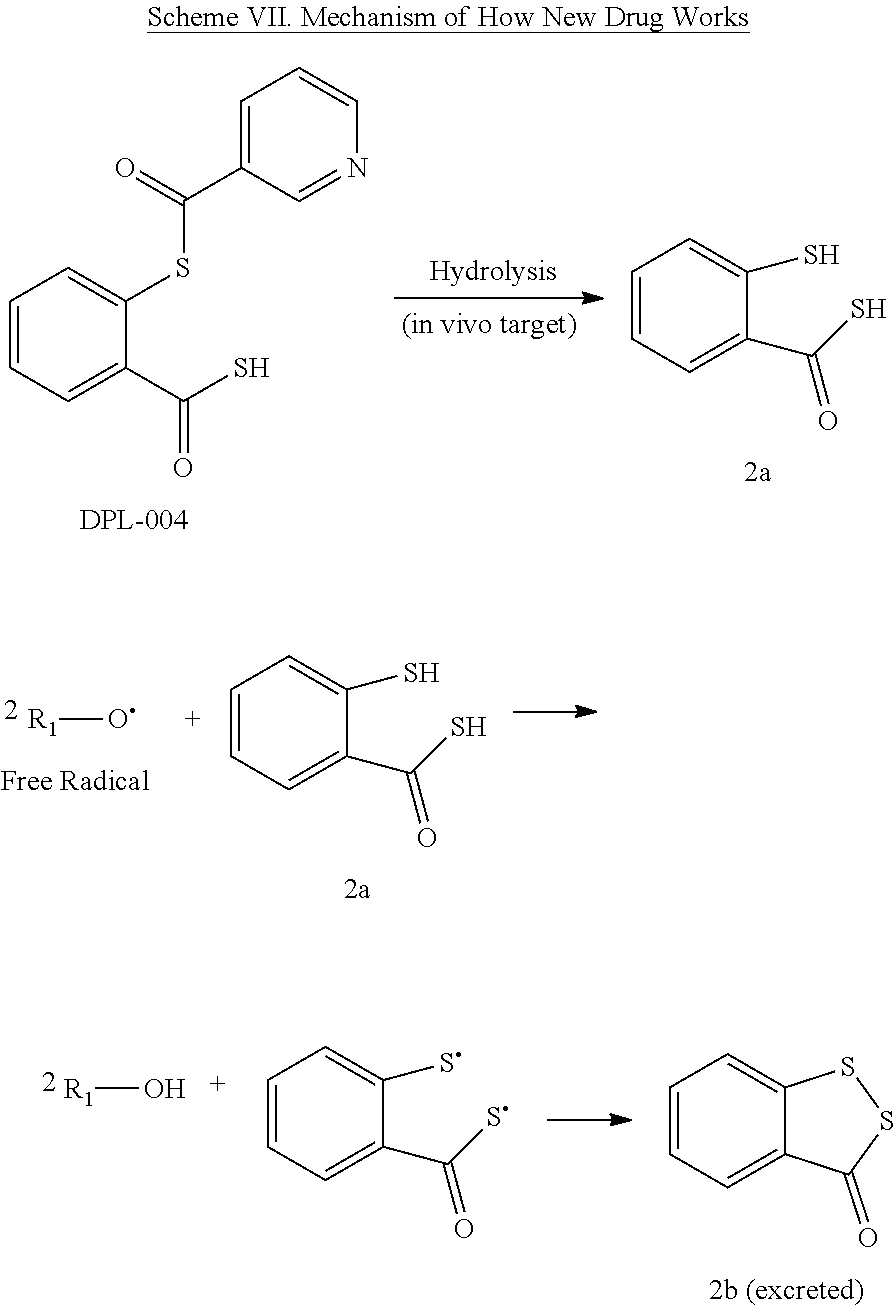
Thio-aspirin-mimetics can efficiently terminate free radicals. The mechanism of how they effectively terminate free radicals is illustrated in Scheme IV.

The “druggability” of aspirin is utilized in the design of novel antioxidants in this invention. To inherit the “druggability” from aspirin, the novel antioxidants will keep the essential skeleton of aspirin molecule, but with sulfur atom to replace oxygen atom in a pair of key functional groups. In the periodic table of the elements, sulfur and oxygen are in the same “oxygen group” and are of similar properties. The replacement of oxygen with sulfur will avoid any “abrupt change” in molecular structure and the novel antioxidants thus constructed would still keep the “druggability” of aspirin. In addition, the replacement of oxygen with sulfur will enable the new molecules to be the strongest possible scavenger of free radicals, as discussed above. Plus, it will enable the new molecules to participate in “thiol-disulfide exchange” (Scheme V) and could reverse some miss-folded proteins caused by aberrant disulfide crosslinking. Based on SHAB, the replacement of oxygen with sulfur will enable the new molecules to form a stronger chelate with heavy metals (Scheme VI), which is because sulfide or thiolate is a softer base and has higher affinity to heavy metal cations (soft acids) like mercury, cadmium, lead, iron, copper, etc. Hence, the novel aspirin-mimetics in this project could efficiently remove heavy metals out of the body. The chelation power is subtle, as too weak like aspirin or too strong like EDTA has proven no good. The active ingredients of the novel aspirin-mimetics, like 2a (Scheme VI), may fit in as a perfect one.

Antioxidant “drugs” in this invention should be in their “reduced forms”. The disulfides are “oxidized form” that is not active and has no more capability of quenching free radicals. Thiol and thiophenol are the “reduced forms” of antioxidants, but they are unstable for storage because they are prone to air-oxidation. Hence, thiophenol group in this invention must be chemically protected by other functional groups. At this point, the protected one is a prodrug that can release the drug as active “reduced form” in vivo where the protection group is chemically disconnected. The protection groups selected in this invention also act as penetration enhancer, efficacy enhancer, selectivity enhancer, or a combination among them. In addition, the protection groups must have no toxicity issue.
The novel aspirin-mimetics in this invention are summarized in several models of molecular structure. Compounds DPL-001 and DPL-002 are the simplest forms of novel aspirin-mimetics in this invention. Compound 1a, the mimetic of salicylic acid, would be the active form of compound DPL-001 as free radical scavenger in vivo. Compound 2a, the mimetic of salicylic acid, would be the active form of compound DPL-002 as free radical scavenger in vivo. Compounds 1b and 2b are known, but chemically prepared via different approaches. Aspirin-mimetics in this disclosure are expected being hydrolyzed in vivo, giving compound 2a or 1a.

The mechanism of how a typical novel aspirin-mimetic works is proposed in Scheme IV and Scheme VII. The compound DPL-004 is delivered to the target cell such as neuron, where it is hydrolyzed to 2a. Compound 2a can efficiently terminate two free radicals in vivo. Thus, the dose of the new drugs can be halved in this regard and so does the cost of the new drugs. More importantly, this effective termination of free radicals would minimize any harm from the primary free radicals and the secondary free radicals so forth yielded in the propagation chain down the track.
As a summary, each novel molecule in this invention consists of at least a pair of two functional groups. When oxidized, the configuration allows it to form a 5-membered ring via an intramolecular disulfide bond. The pair of functional groups consists of one thiol (—SH); and one carbodithioic acid (—CSSH), or one carbothioic acid (—COSH). Each of the pair of functional groups is covalently single-bonded with a carbon atom located on aromatic ring, or on substituted aromatic ring. The aromatic ring can be either regular aromatic ring or aromatic heterocyclic ring, with any combinations among them.
Each of the pair of functional groups can be covalently single-bonded with other functional groups selected from acetyl (—Ac), amino acid residue, vitamin B's residue, choline, dopamine, carbohydrate, nucleic base, citric acid, succinic acid, heterocycles, etc. These functional groups would act as protection group, penetration enhancer, efficacy enhancer, selectivity enhancer, or a combination among them.
As free radical is one of the possible key causes of many major diseases, it is plausible to find an antioxidant drug that can scavenge free radicals and show efficacy to many diseases like Alzheimer's disease (AD), Parkinson's disease (PD), Huntington's disease (HD), amyotrophic lateral sclerosis (ALS), diabetes, cancers, atherosclerosis, cardiovascular disease, renal disease, hypertension, hyperlipidemia, rheumatoid arthritis, lupus, multiple sclerosis (MS), gout, inflammation, pain, acne, aging, stroke, depression, cataract, glaucoma, age-related macular degeneration and HIV, and so forth. The novel antioxidants in this invention could bring answer to major diseases like cataract.
The lens proteins in eyes are transparent in normal array. Age-related cataract is opaque of the lens, wherein the lens proteins are in disarray. Although the pathogenesis of cataract is not fully elucidated, many factors associated with high incidence of cataract, like excessive exposure to heat, cosmic radiation, nuclear radiation, UV light, smoking, alcoholic, steroid, and so forth, can also help generate free radicals. When oxidized by free radicals, the primary structure of the lens proteins would be altered, and thus lead to the advanced structure change of the lens proteins, causing disarray of the lens proteins, and yielding opacity of the lens. Thus, a good scavenger of free radicals would intervene cataract as a rational design. Currently, there is no medication available to cure or prevent cataract. Surgical removal of opaque lens and implanting artificial lens is the only therapy for cataract patients. Eye drops with the novel antioxidants herein would effectively intervene cataract and offer a better option for cataract patients.
The following non-limiting examples will further illustrate certain aspects of the invention disclosed.
According to the procedure reported in J. Am. Chem. Soc., 1989. 111, 654-658, lithiation of thiophenol gave ortho-directed lithiation intermediate, a di-lithium salt species. That di-lithium salt species was allowed to react with carbon disulfide, followed by acetylation (via acetic anhydride), to afford compound 1 (DPL-001) in a good yield (Scheme VIII). Similarly, the di-lithium salt species can react with carbonyl sulfide, followed by acetylation (via acetic anhydride), to afford compound 2 (DPL-002) (Scheme VIII). Other new compounds were obtained when corresponding acylation reagents were applied.


DPL-001: 1H-NMR (400 MHz, CD2Cl2) δ (ppm) 7.443 (s, 4 H), 2.421 (d, J=1.6 Hz, 3 H); 13CNMR (100 MHz, CD2Cl2) 6193.850, 134.538, 129.371, 129.113, 129.083, 128.210, 127.512, 127.239, 29.989.
DPL-003: 1H-NMR (400 MHz, DMSO-d6) δ (ppm) 9.148 (d, J=2.0 Hz, 1 H), 8.936 (dd, J=1.6, 5.2 Hz, 1 H), 8.40-8.60 (m, 1 H), 7.70-7.90 (m, 1 H), 7.40-7.60 (m, 5 H); 13CNMR (100 MHz, DMSO-d6) δ186.322, 150.983, 146.113, 144.557, 135.446, 133.420, 130.750, 128.625, 128.208, 128.109, 124.802, 124.240, 123.739; MS(m/z) 292 (M+H)+, 248 (M+H−CS, 100)+.
DPL-004: 1H-NMR (500 MHz, CDCl3) δ (ppm) 9.179 (d, J=2.0 Hz, 1 H), 8.759 (dd, J=2.0, 5.0 Hz, 1 H), 8.07 (dt, J=2.0, 8.0 Hz, 1 H), 7.35-7.48 (m, 6 H); 13CNMR (125 MHz, CDCl3) δ88.837, 153.951, 148.590, 135.022(2), 134.828, 132.412, 129.917(2), 129.438(2), 126.291, 123.738; MS(m/z) 274 (M-H)+, 216 (M+H-OCS, 100)+.
DPL-005: 1H-NMR (500 MHz, CDCl3): δ (ppm) 7.468 (s, 4 H), 2.713 (t, J=2.5 Hz, 2 H), 1.772 (quin, J=2.5 Hz, 2 H), 1.30-1.50 (m, 20 H), 0.948 (t, J=6.6 Hz, 3 H); 13CNMR (125 MHz, CDCl3): δ198.574, 135.476, 130.264, 130.135, 130.059, 128.989, 128.519, 128.147, 44.739, 32.927, 30.673, 30.643 (2C), 30.582, 30.415, 30.355, 30.248, 29.968, 26.607, 23.694, 15.121.
DPL-006: 1H-NMR (400 MHz, CDCl3): δ (ppm) 8.01-8.07 (m, 2 H), 7.58-7.65 (m, 1 H), 7.40-7.60 (m, 7 H); 13CNMR(100 MHz, CDCl3): δ190.170, 136.632, 135.114, 134.470, 133.680, 129.545, 129.462, 129.272, 129.227, 128.764 (2 C), 127.497 (2 C), 127.337.
Preparation of Eye Drops Solutions
A new batch of eye drops solutions was prepared every week. Placebo was a solution that contained the same excipients but without the drug compound. The eye drops solutions were prepared as follows:
1. Sterilized water for injection was used.
2. Excipients were sodium borate, boric acid, sodium chloride, and potassium chloride.
3. An illustrative procedure: To a 250 mL volume flask were added 25 mg each of the excipients, sodium borate, boric acid, sodium chloride, and potassium chloride, an aspirin mimetic drug compound to be tested (e.g., DPL-004, 9.0 mg), and about 200 ml of sterilized water to form a mixture. The resultant mixture was shaken well to dissolve solids; and more sterilized water was added to bring the volume of solution to 250 mL, which was shaken well and then distributed into small portions. Each portion was labeled with a concentration of 3.6 mg/100 mL and the preparation date and was stored in a refrigerator for future use.
4. Eye drops solutions comprising DPL-004 at a concentration of 36 mg/100 mL and 12 mg/100 mL were prepared similarly according to the above procedure by using 90 mg and 30 mg of DPL-004, respectively, while maintaining the same amounts of excipients as shown above.
The above formulations could be reduced according to the actual amount of use.
Model Building
At the age of 11-12 days after birth, all suckling rats underwent a single intraperitoneal injection of sodium selenite (30 μmol/kg, i.e., 0.1 ml/10 g) for model-building. Sodium selenite solution was configured with normal saline at a concentration of 3 mM.
Animal Grouping and Dosing Protocols
At the age of 19 days after birth (D-1) of the suckling rats, 30 lens opacities were selected for a cloudy rating at Class 4 or 5; Wister suckling rats were randomly divided into 5 groups (G1-G5 groups, 6 in each group); and a cage of suckling rats as G6 was randomly selected after the animals opened their eyes (14-16 days of age). The grouping and dosing regimen in the six groups are shown in Table 1.
| TABLE 1 |
| Grouping and Administration |
| Mode of Administration |
| Group | Number | Route of | Frequency of | ||||
| No. | Group Name | of animals | administration | | Dosage | Time | |
| 1 | “Pirenoxine” | 6 | |
3 times/day | 10 μl/ |
D1-D28 | |
| group G1 | sac eye drops | (D60) | |||||
| 2 | Model groups | 6 | |
3 times/day | 10 μl/ |
D1-D28 | |
| (Placebo) G2 | sac eye drops | (D60) | |||||
| 3 | New Drug G3 | 6 | |
3 times/day | 10 μl/ |
D1-D28 | |
| sac eye drops | (D60) | ||||||
| New Drug G4 | 6 | |
3 times/day | 10 μl/ |
D1-D28 | ||
| sac eye drops | (D60) | ||||||
| 5 | New Drug G5 | 6 | |
3 times/day | 10 μl/ |
D1-D28 | |
| sac eye drops | (D60) | ||||||
| 6 | G6 Preventive | 6 | |
3 times/day | 10 μl/ |
D-6-D24 | |
| dosing group | sac eye drops | (D60) | |||||
| Note: | |||||||
| In this experiment, the first dosing day was defined as day 1 (Day1/D1), the first day before administration was defined as (Day-1/D-1), and so on. The pH of the “pirenoxine” group was about 6.4. The pH of the subjects in the model group and the test set 1, group 2, and |
|||||||
The subject suckling rats of groups G1 to G5 were treated at the age of 20 days after birth (D1), and the specific dosing information is shown in Table 1. Treatment in the G6 group was conducted after the animals opened their eyes (14-16 days old, D-6-D-4), and the specific dosing information is shown in Table 1.
At D-1, in the fourth week of treatment, the slit lamp was used at the end of administration to observe the turbidity of the lens and grade it, and the grading and scoring criteria are shown in the following Table 2.
| TABLE 2 |
| Crystal turbidity (grade 0-5) |
| Rating | Characterization | Fraction |
| Level 0 | Crystal clear | 0 |
| |
Vacuoles may be seen in the peripheral or | 0.4 |
| anterior cortex | ||
| Level 2 | The density of the lens nucleus is slightly | 1 |
| increased | ||
| |
The lens nucleus is translucent | 2 |
| Level 4 | The lens nucleus is cloudy at least slightly | 3 |
| transparent | ||
| Level 5 | The lens nucleus is cloudy to the point of | 4 |
| being completely opaque | ||
| TABLE 3 |
| Body Weight (g) of Rats |
| Days | G1 | G2 | G3 | G4 | G5 | G6 | |
| −6 | Mean | — | — | — | — | — | 35.83 |
| SEM | — | — | — | — | — | 0.97 | |
| −1 | Mean | 43.48 | 43.88 | 45.68 | 46.10 | 45.40 | 45.27 |
| SEM | 2.95 | 1.32 | 3.01 | 1.92 | 1.37 | 1.35 | |
| 4 | Mean | 57.07 | 54.38 | 58.22 | 59.37 | 60.25 | 62.15 |
| SEM | 3.98 | 1.86 | 4.22 | 2.75 | 2.28 | 1.93 | |
| 11 | Mean | 96.02 | 93.75 | 97.48 | 98.03 | 101.48 | 106.70 |
| SEM | 6.95 | 3.68 | 7.31 | 4.53 | 4.24 | 3.61 | |
| 18 | Mean | 133.87 | 134.33 | 130.98 | 138.57 | 149.00 | 140.92 |
| SEM | 10.74 | 7.86 | 14.02 | 5.84 | 7.22 | 7.43 | |
| 25 | Mean | 163.00 | 163.63 | 161.68 | 166.05 | 188.37 | 171.78 |
| SEM | 17.68 | 12.84 | 19.24 | 8.39 | 11.67 | 13.25 | |
| 32 | Mean | 197.18 | 196.18 | 184.12 | 188.40 | 230.95 | 211.43 |
| SEM | 24.50 | 17.81 | 27.12 | 12.57 | 15.38 | 7.72 | |
| 39 | Mean | 219.45 | 233.73 | 210.05 | 209.05 | 257.97 | 251.03 |
| SEM | 30.29 | 23.95 | 31.12 | 14.10 | 17.88 | 12.20 | |
| 46 | Mean | 239.75 | 262.35 | 232.55 | 232.02 | 304.65 | 283.27 |
| SEM | 33.80 | 30.42 | 37.71 | 15.49 | 24.76 | 16.71 | |
| 53 | Mean | 255.82 | 296.10 | 256.08 | 240.18 | 323.03 | 303.65 |
| SEM | 38.31 | 32.38 | 41.07 | 18.05 | 31.09 | 18.00 | |
| 60 | Mean | 270.00 | 295.88 | 273.13 | 269.85 | 343.05 | 330.03 |
| SEM | 41.99 | 38.55 | 43.91 | 18.05 | 29.49 | 22.72 | |
| SEM: standard error mean. | |||||||
| TABLE 4 |
| Summary of lens opacity scores |
| Days | G1 | G2 | G3 | G4 | G5 | G6 | |
| −6 | Mean | — | — | — | — | — | 4.00 |
| SEM | — | — | — | — | — | 0.00 | |
| −1 | Mean | 4.00 | 4.00 | 4.00 | 4.00 | 4.00 | 4.00 |
| SEM | 0.00 | 0.00 | 0.00 | 0.00 | 0.00 | 0.00 | |
| 22 | Mean | — | — | — | — | — | 4.00 |
| SEM | — | — | — | — | — | 0.00 | |
| 28 | Mean | 3.42 | 3.67 | 3.58 | 3.50 | 3.42 | — |
| SEM | 0.15 | 0.14 | 0.15 | 0.15 | 0.15 | — | |
| 60 | Mean | 2.92 | 3.00 | 2.75 | 2.58 | 2.58 | 3.08 |
| SEM | 0.29 | 0.25 | 0.22 | 0.19 | 0.23 | 0.19 | |
| Efficacy at D60 (G5 vs G2): (3.0-2.58) ÷ 3.0 = 14.0%; at D28: (3.67-3.42) ÷ 3.67 = 6.81% | |||||||
| TABLE 5 |
| Raw data for lens opacity score |
| serial | ||||||||
| Days | number | eye | G1 | G2 | G3 | G4 | G5 | G6 |
| −6 | 1 | OD | — | — | — | — | — | 4 |
| OS | — | — | — | — | — | 4 | ||
| 2 | OD | — | — | — | — | — | 4 | |
| OS | — | — | — | — | — | 4 | ||
| 3 | OD | — | — | — | — | — | 4 | |
| OS | — | — | — | — | — | 4 | ||
| 4 | OD | — | — | — | — | — | 4 | |
| OS | — | — | — | — | — | 4 | ||
| 5 | OD | — | — | — | — | — | 4 | |
| OS | — | — | — | — | — | 4 | ||
| 6 | OD | — | — | — | — | — | 4 | |
| OS | — | — | — | — | — | 4 | ||
| −1 | 1 | OD | 4 | 4 | 4 | 4 | 4 | 4 |
| OS | 4 | 4 | 4 | 4 | 4 | 4 | ||
| 2 | OD | 4 | 4 | 4 | 4 | 4 | 4 | |
| OS | 4 | 4 | 4 | 4 | 4 | 4 | ||
| 3 | OD | 4 | 4 | 4 | 4 | 4 | 4 | |
| OS | 4 | 4 | 4 | 4 | 4 | 4 | ||
| 4 | OD | 4 | 4 | 4 | 4 | 4 | 4 | |
| OS | 4 | 4 | 4 | 4 | 4 | 4 | ||
| 5 | OD | 4 | 4 | 4 | 4 | 4 | 4 | |
| OS | 4 | 4 | 4 | 4 | 4 | 4 | ||
| 6 | OD | 4 | 4 | 4 | 4 | 4 | 4 | |
| OS | 4 | 4 | 4 | 4 | 4 | 4 | ||
| 22 | 1 | OD | — | — | — | — | — | 4 |
| OS | — | — | — | — | — | 4 | ||
| 2 | OD | — | — | — | — | — | 4 | |
| OS | — | — | — | — | — | 4 | ||
| 3 | OD | — | — | — | — | — | 4 | |
| OS | — | — | — | — | — | 4 | ||
| 4 | OD | — | — | — | — | — | 4 | |
| OS | — | — | — | — | — | 4 | ||
| 5 | OD | — | — | — | — | — | 4 | |
| OS | — | — | — | — | — | 4 | ||
| 6 | OD | — | — | — | — | — | 4 | |
| OS | — | — | — | — | — | 4 | ||
| 28 | 1 | OD | 3 | 3 | 3 | 3 | 4 | — |
| OS | 3 | 3 | 3 | 3 | 4 | — | ||
| 2 | OD | 4 | 4 | 4 | 4 | 3 | — | |
| OS | 4 | 4 | 4 | 4 | 3 | — | ||
| 3 | OD | 4 | 4 | 3 | 3 | 3 | — | |
| OS | 4 | 4 | 3 | 3 | 3 | — | ||
| 4 | OD | 4 | 4 | 4 | 4 | 4 | — | |
| OS | 3 | 4 | 4 | 4 | 4 | — | ||
| 5 | OD | 3 | 4 | 4 | 4 | 3 | — | |
| OS | 3 | 4 | 4 | 4 | 3 | — | ||
| 6 | OD | 3 | 3 | 4 | 3 | 4 | — | |
| OS | 3 | 3 | 3 | 3 | 3 | — | ||
| 60 | 1 | OD | 2 | 2 | 2 | 2 | 3 | 4 |
| OS | 2 | 2 | 2 | 2 | 4 | 3 | ||
| 60 | 2 | OD | 4 | 4 | 3 | 3 | 2 | 3 |
| OS | 4 | 4 | 3 | 3 | 2 | 2 | ||
| 60 | 3 | OD | 4 | 4 | 2 | 2 | 2 | 4 |
| OS | 4 | 3 | 2 | 2 | 2 | 3 | ||
| 60 | 4 | OD | 4 | 3 | 4 | 4 | 3 | 2 |
| OS | 3 | 3 | 4 | 3 | 4 | 4 | ||
| 60 | 5 | OD | 2 | 4 | 3 | 3 | 2 | 3 |
| OS | 2 | 3 | 3 | 3 | 2 | 3 | ||
| 60 | 6 | OD | 2 | 2 | 3 | 2 | 2 | 3 |
| OS | 2 | 2 | 2 | 2 | 3 | 3 | ||
| OD: right eye; OS: left eye. | ||||||||
The DPL-004 groups with different concentrations were compared with the placebo group and the pirenoxine group, no abnormal symptoms (including activity status, body weight, skin hair, secretion morphology and color, etc.) were seen in any group.
Preliminary screening with efficacy tests of the new drug candidate compound DPL-004, 2-[(pyridine-3-carbonyl)sulfanyl]benzene-1-carbothioic S-acid, with several different concentration groups and placebo group (G2) and “pirenoxine” group (G1), were carried out in a period of 60 days (66 day administration in the G6 early intervention group) on a Wistar rat cataract model induced by sodium selenite, with a frequency of 3 times/day and 10 μL of eye drop each time. The efficacy of new drug compound was evaluated by quantifying the lens turbidity score. The lens opacity score was 4.0 for all enrolled rats. Findings and conclusions are as follows:
1. The new drug groups compared with the placebo group showed some efficacy. In particular, the efficacy of compound DPL-004 on the G5 group of rats was among the highest at all detection stages, the performance was stable, and the compound DPL-004 improved the opacity score over time in comparison with the placebo (e.g., efficacy by 6.81% at D28 and by 14.0% at D60). More notably, DPL-004 showed an effect of gradually reversing cataracts.
2. The correlation between the concentration and the efficacy of DPL-004 has been preliminarily established. At D60, the efficacy of G4 and G5 groups was the same at 14.0%, which related to new drug concentrations of 12 mg/0.1 L and 3.6 mg/0.1 L, respectively. At D28, the efficacy of G4 and G5 was 4.63% and 6.81%, respectively.
3. The efficacy of weakly acidic eye drops is significantly better than that of weakly alkaline. This finding is original and has not been reported in literature. The drug concentration of G5 is the same as that of G6 (early intervention group), in the period of 28 days, with the lens opacity score of 3.42 (the efficacy was 6.81%) and 4.0 (3.67 in the placebo group); the only difference was in pH, 6.5 and 7.4 respectively. When adjusting its pH from 7.4 to 6.0, the G6 group at D60 (pH 6.0 for 28 days) showed the lens turbidity score reduced from 4.0 (pH 7.4 for 28 days) to 3.08; , the largest single-month decline. Later development will be optimized between pH 6.0-6.5.
4. Safety of new drug compound (DPL-004): during the observation of the 60-day administration phase, the new drug groups with different concentrations compared with the placebo group and the “pirenoxine” group, no abnormal symptoms were seen from the active state, body weight, skin hair, the form and color of the discharge.
It will be understood by those of skill in the art that the various embodiments and examples of the present disclosure are illustrative only and are not intended to limit the scope of the present disclosure, and numerous modifications can be made without departing from the spirit and scope of the invention disclosed and are intended to be encompassed by the present disclosure.
Claims (11)
1. An active pharmaceutical ingredient (API) selected from:

or a pharmaceutically acceptable salt thereof.
2. An eye drops solution comprising a compound of claim 1 , a pharmaceutically acceptable carrier, and optionally one or more pharmaceutical excipients.
3. The eye drops solution of claim 2 , wherein the pharmaceutically acceptable carrier is water, and wherein the eye drops solution further comprises a pharmaceutical excipient selected from sodium chloride, potassium chloride, boric acid, sodium borate, benzalkonium chloride, glycol, glycerin, polysorbate, carboxy methylcellulose sodium, and combinations thereof.
4. The eye drops solution of claim 2 , wherein concentration of the API in the eye drops solution is in a range from 0.01 mg/mL to 0.05 mg/mL.
5. The eye drops solution of claim 2 , wherein the concentration of the API is in a range from 0.018 mg/mL to 0.036 mg/mL.
6. The eye drops solution of claim 2 , having a pH in the range from 5.5 to 8.5, inclusive.
7. The eye drops solution of claim 6 , wherein pH is adjusted using an acid selected from hydrochloric acid, sulfuric acid, phosphoric acid, acetic acid, and combinations thereof.
8. A method of treating an age-related cataract in an eye of a subject, comprising administering to the eye of the subject a therapeutically effective amount of the eye drops solution of claim 2 .
9. The method of claim 4 , wherein the subject is a human, or a mammalian animal selected from dogs (canine), cats, rabbits, horses, ox, hamster.
10. The method of claim 8 , wherein dose range of API in the eye drops solution administered to the subject is from 10 μL to 120 μL each time, or from 0.00073 mg/kg body weight to 0.015 mg/kg body weight, or from 2.5 nmol/kg body weight to 50 nmol/kg body weight.
11. The method of claim 8 , wherein the eye drops solution is administered to the subject in a frequency from one time daily to 5 times daily.
Applications Claiming Priority (2)
| Application Number | Priority Date | Filing Date | Title |
|---|---|---|---|
| CN202210791555.7 | 2022-07-05 | ||
| CN202210791555.7A CN117379413A (en) | 2022-07-05 | 2022-07-05 | Aspirin mimetic antioxidants for treating age-related cataracts |
Publications (1)
| Publication Number | Publication Date |
|---|---|
| US11826355B1 true US11826355B1 (en) | 2023-11-28 |
Family
ID=83080728
Family Applications (1)
| Application Number | Title | Priority Date | Filing Date |
|---|---|---|---|
| US17/817,812 Active US11826355B1 (en) | 2022-07-05 | 2022-08-05 | Aspirin-mimetic antioxidants for treatment of age-related cataract |
Country Status (3)
| Country | Link |
|---|---|
| US (1) | US11826355B1 (en) |
| EP (1) | EP4302760A1 (en) |
| CN (1) | CN117379413A (en) |
Citations (1)
| Publication number | Priority date | Publication date | Assignee | Title |
|---|---|---|---|---|
| WO2015053797A2 (en) | 2012-11-28 | 2015-04-16 | Yansong Lu | Novel synthetic aspirin-mimics and innovative antioxidants and their uses |
-
2022
- 2022-07-05 CN CN202210791555.7A patent/CN117379413A/en active Pending
- 2022-08-05 US US17/817,812 patent/US11826355B1/en active Active
- 2022-08-25 EP EP22192144.8A patent/EP4302760A1/en active Pending
Patent Citations (2)
| Publication number | Priority date | Publication date | Assignee | Title |
|---|---|---|---|---|
| WO2015053797A2 (en) | 2012-11-28 | 2015-04-16 | Yansong Lu | Novel synthetic aspirin-mimics and innovative antioxidants and their uses |
| US9994519B2 (en) * | 2012-11-28 | 2018-06-12 | Yansong Lu | Synthetic antioxidants and their uses |
Non-Patent Citations (2)
| Title |
|---|
| Beltz et al., "A Dual Therapeutic Approach for the Reversal of Cataracts," Free Radical Biology and Medicine (2016); 100: p. 156. |
| Carey et al., "In vivo inhibition of 1-buthionine-(S,R)-sulfoximine-induced cataracts by a novel antioxidant, N-acetylcysteine amide," Free Radical Biology & Medicine (2010); 50(6): pp. 722-729. |
Also Published As
| Publication number | Publication date |
|---|---|
| CN117379413A (en) | 2024-01-12 |
| EP4302760A1 (en) | 2024-01-10 |
Similar Documents
| Publication | Publication Date | Title |
|---|---|---|
| EP2442647B1 (en) | Dithiol compounds, derivatives, and uses therefor | |
| AU754064B2 (en) | Anti-inflammatory eye drops | |
| JP2005529938A (en) | Methods of using artemisinin-like compounds for preventing or delaying the onset of cancer | |
| US20040053989A1 (en) | Dithiolthione compounds for the treatment of neurological disorders and for memory enhancement | |
| US9155719B2 (en) | N-acetyl-DL-leucine, neuroprotective and retinoprotective medicament | |
| EA025414B1 (en) | Pharmaceutical composition for use in medical and veterinary ophthalmology | |
| JP5275214B2 (en) | Ophthalmic stable composition comprising an oxidatively unstable component | |
| JP2008515778A (en) | Combination methods, compositions and therapies for treating ocular conditions with 13-cis-retinyl derivatives | |
| WO1996040107A1 (en) | The use of n,n'-bis(mercaptoacetyl) hydrazine drivatives as anticataract agents | |
| DE69704833T2 (en) | DERIVATIVES OF THIAZOLIDINE-4-CARBONIC ACID AS A CYTOPROTECTIVE AGENT | |
| JP2022523402A (en) | Compounds for the prevention and treatment of postoperative cognitive dysfunction | |
| US11826355B1 (en) | Aspirin-mimetic antioxidants for treatment of age-related cataract | |
| US9994519B2 (en) | Synthetic antioxidants and their uses | |
| CN112316150A (en) | A pharmaceutical composition for preventing or treating metabolism or injury related diseases | |
| US8513280B2 (en) | Use of epothilones in the treatment of neuronal connectivity defects such as schizophrenia and autism | |
| KR20080111021A (en) | Use of Strobillin for the Treatment of Iron Metabolic Disorders | |
| EP0990441A1 (en) | A drug for treating diabetic nephrosis | |
| WO2016068278A1 (en) | Phacosclerosis inhibitor | |
| WO2008127138A1 (en) | Composition for decelerating the ageing in the organism and for extending the life time thereof and the use of said composition | |
| US12357596B2 (en) | Compounds for prevention and treatment of obesity and related disorders | |
| CN111867580A (en) | Composition for preventing or ameliorating hair loss containing dhonidone as an active ingredient | |
| CA2615231A1 (en) | Prevention and treatment of ophthalmic complications of diabetes | |
| US20110136898A1 (en) | Treatment of retinal degeneration | |
| Agent | PrJAMP-KETOTIFEN | |
| CN120960428A (en) | Application of MAT2A inhibitor in preparation of medicines for treating hyperhomocysteinemia |
Legal Events
| Date | Code | Title | Description |
|---|---|---|---|
| FEPP | Fee payment procedure |
Free format text: ENTITY STATUS SET TO UNDISCOUNTED (ORIGINAL EVENT CODE: BIG.); ENTITY STATUS OF PATENT OWNER: SMALL ENTITY |
|
| FEPP | Fee payment procedure |
Free format text: ENTITY STATUS SET TO SMALL (ORIGINAL EVENT CODE: SMAL); ENTITY STATUS OF PATENT OWNER: SMALL ENTITY |
|
| STCF | Information on status: patent grant |
Free format text: PATENTED CASE |