US11821964B2 - Magnetoresistive random access memory and method for fabricating the same - Google Patents
Magnetoresistive random access memory and method for fabricating the same Download PDFInfo
- Publication number
- US11821964B2 US11821964B2 US16/927,918 US202016927918A US11821964B2 US 11821964 B2 US11821964 B2 US 11821964B2 US 202016927918 A US202016927918 A US 202016927918A US 11821964 B2 US11821964 B2 US 11821964B2
- Authority
- US
- United States
- Prior art keywords
- layer
- mtj
- barrier layer
- pinned
- free
- Prior art date
- Legal status (The legal status is an assumption and is not a legal conclusion. Google has not performed a legal analysis and makes no representation as to the accuracy of the status listed.)
- Active, expires
Links
Images



Classifications
-
- G—PHYSICS
- G01—MEASURING; TESTING
- G01R—MEASURING ELECTRIC VARIABLES; MEASURING MAGNETIC VARIABLES
- G01R33/00—Arrangements or instruments for measuring magnetic variables
- G01R33/02—Measuring direction or magnitude of magnetic fields or magnetic flux
- G01R33/06—Measuring direction or magnitude of magnetic fields or magnetic flux using galvano-magnetic devices
- G01R33/09—Magnetoresistive devices
- G01R33/093—Magnetoresistive devices using multilayer structures, e.g. giant magnetoresistance sensors
-
- G—PHYSICS
- G01—MEASURING; TESTING
- G01R—MEASURING ELECTRIC VARIABLES; MEASURING MAGNETIC VARIABLES
- G01R33/00—Arrangements or instruments for measuring magnetic variables
- G01R33/02—Measuring direction or magnitude of magnetic fields or magnetic flux
- G01R33/06—Measuring direction or magnitude of magnetic fields or magnetic flux using galvano-magnetic devices
- G01R33/09—Magnetoresistive devices
- G01R33/098—Magnetoresistive devices comprising tunnel junctions, e.g. tunnel magnetoresistance sensors
-
- G—PHYSICS
- G11—INFORMATION STORAGE
- G11C—STATIC STORES
- G11C11/00—Digital stores characterised by the use of particular electric or magnetic storage elements; Storage elements therefor
- G11C11/02—Digital stores characterised by the use of particular electric or magnetic storage elements; Storage elements therefor using magnetic elements
-
- H—ELECTRICITY
- H10—SEMICONDUCTOR DEVICES; ELECTRIC SOLID-STATE DEVICES NOT OTHERWISE PROVIDED FOR
- H10B—ELECTRONIC MEMORY DEVICES
- H10B61/00—Magnetic memory devices, e.g. magnetoresistive RAM [MRAM] devices
-
- H—ELECTRICITY
- H10—SEMICONDUCTOR DEVICES; ELECTRIC SOLID-STATE DEVICES NOT OTHERWISE PROVIDED FOR
- H10B—ELECTRONIC MEMORY DEVICES
- H10B61/00—Magnetic memory devices, e.g. magnetoresistive RAM [MRAM] devices
- H10B61/20—Magnetic memory devices, e.g. magnetoresistive RAM [MRAM] devices comprising components having three or more electrodes, e.g. transistors
- H10B61/22—Magnetic memory devices, e.g. magnetoresistive RAM [MRAM] devices comprising components having three or more electrodes, e.g. transistors of the field-effect transistor [FET] type
-
- H—ELECTRICITY
- H10—SEMICONDUCTOR DEVICES; ELECTRIC SOLID-STATE DEVICES NOT OTHERWISE PROVIDED FOR
- H10N—ELECTRIC SOLID-STATE DEVICES NOT OTHERWISE PROVIDED FOR
- H10N50/00—Galvanomagnetic devices
- H10N50/01—Manufacture or treatment
-
- H—ELECTRICITY
- H10—SEMICONDUCTOR DEVICES; ELECTRIC SOLID-STATE DEVICES NOT OTHERWISE PROVIDED FOR
- H10N—ELECTRIC SOLID-STATE DEVICES NOT OTHERWISE PROVIDED FOR
- H10N50/00—Galvanomagnetic devices
- H10N50/10—Magnetoresistive devices
-
- H—ELECTRICITY
- H10—SEMICONDUCTOR DEVICES; ELECTRIC SOLID-STATE DEVICES NOT OTHERWISE PROVIDED FOR
- H10N—ELECTRIC SOLID-STATE DEVICES NOT OTHERWISE PROVIDED FOR
- H10N50/00—Galvanomagnetic devices
- H10N50/80—Constructional details
-
- H—ELECTRICITY
- H10—SEMICONDUCTOR DEVICES; ELECTRIC SOLID-STATE DEVICES NOT OTHERWISE PROVIDED FOR
- H10N—ELECTRIC SOLID-STATE DEVICES NOT OTHERWISE PROVIDED FOR
- H10N50/00—Galvanomagnetic devices
- H10N50/80—Constructional details
- H10N50/85—Materials of the active region
-
- G—PHYSICS
- G01—MEASURING; TESTING
- G01R—MEASURING ELECTRIC VARIABLES; MEASURING MAGNETIC VARIABLES
- G01R33/00—Arrangements or instruments for measuring magnetic variables
- G01R33/0052—Manufacturing aspects; Manufacturing of single devices, i.e. of semiconductor magnetic sensor chips
Definitions
- the invention relates to a semiconductor device and method for fabricating the same, and more particularly to a magnetoresistive random access memory (MRAM) and method for fabricating the same.
- MRAM magnetoresistive random access memory
- Magnetoresistance (MR) effect has been known as a kind of effect caused by altering the resistance of a material through variation of outside magnetic field.
- the physical definition of such effect is defined as a variation in resistance obtained by dividing a difference in resistance under no magnetic interference by the original resistance.
- MR effect has been successfully utilized in production of hard disks thereby having important commercial values.
- the characterization of utilizing GMR materials to generate different resistance under different magnetized states could also be used to fabricate MRAM devices, which typically has the advantage of keeping stored data even when the device is not connected to an electrical source.
- the aforementioned MR effect has also been used in magnetic field sensor areas including but not limited to for example electronic compass components used in global positioning system (GPS) of cellular phones for providing information regarding moving location to users.
- GPS global positioning system
- various magnetic field sensor technologies such as anisotropic magnetoresistance (AMR) sensors, GMR sensors, magnetic tunneling junction (MTJ) sensors have been widely developed in the market. Nevertheless, most of these products still pose numerous shortcomings such as high chip area, high cost, high power consumption, limited sensibility, and easily affected by temperature variation and how to come up with an improved device to resolve these issues has become an important task in this field.
- a method for fabricating semiconductor device includes the steps of first forming a magnetic tunneling junction (MTJ) stack on a substrate, in which the MTJ stack includes a pinned layer on the substrate, a barrier layer on the pinned layer, and a free layer on the barrier layer. Next, a top electrode is formed on the MTJ stack, the top electrode, the free layer, and the barrier layer are removed, a first cap layer is formed on the top electrode, the free layer, and the barrier layer, and the first cap layer and the pinned layer are removed to form a MTJ and a spacer adjacent to the MTJ.
- MTJ magnetic tunneling junction
- a semiconductor device includes a magnetic tunneling junction (MTJ) on a substrate, in which the MTJ includes a pinned layer on the substrate, a barrier layer on the pinned layer, and a free layer on the barrier layer.
- MTJ magnetic tunneling junction
- a critical dimension of the barrier layer is different from a critical dimension of the pinned layer.
- FIGS. 1 - 5 illustrate a method for fabricating a MRAM device according to an embodiment of the present invention.
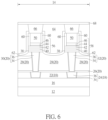
- FIG. 6 illustrates a structural view of a MRAM device according to an embodiment of the present invention.
- FIG. 7 illustrates a structural view of a MRAM device according to an embodiment of the present invention.
- FIGS. 1 - 5 illustrate a method for fabricating a semiconductor device, or more specifically a MRAM device according to an embodiment of the present invention.
- a substrate 12 made of semiconductor material is first provided, in which the semiconductor material could be selected from the group consisting of silicon (Si), germanium (Ge), Si—Ge compounds, silicon carbide (SiC), and gallium arsenide (GaAs), and a MTJ region 14 and a logic region (not shown) are defined on the substrate 12 .
- MOS transistors metal-oxide semiconductor (MOS) transistors, passive devices, conductive layers, and interlayer dielectric (ILD) layer 16 could also be formed on top of the substrate 12 .
- MOS transistors metal-oxide semiconductor (MOS) transistors, passive devices, conductive layers, and interlayer dielectric (ILD) layer 16 could also be formed on top of the substrate 12 .
- MOS transistors planar MOS transistors or non-planar (such as FinFETs) MOS transistors could be formed on the substrate 12 , in which the MOS transistors could include transistor elements such as gate structures (for example metal gates) and source/drain region, spacer, epitaxial layer, and contact etch stop layer (CESL).
- the ILD layer 16 could be formed on the substrate 12 to cover the MOS transistors, and a plurality of contact plugs could be formed in the ILD layer 16 to electrically connect to the gate structure and/or source/drain region of MOS transistors. Since the fabrication of planar or non-planar transistors and
- metal interconnect structures 18 , 20 are sequentially formed on the ILD layer 16 to electrically connect the aforementioned contact plugs, in which the metal interconnect structure 18 includes an inter-metal dielectric (IMD) layer 22 and metal interconnections 24 embedded in the IMD layer 22 , and the metal interconnect structure 20 includes a stop layer 26 , an IMD layer 28 , and metal interconnections 30 , 32 embedded in the stop layer 26 and the IMD layer 28 .
- IMD inter-metal dielectric
- each of the metal interconnections 24 from the metal interconnect structure 18 preferably includes a trench conductor and each of the metal interconnections 30 , 32 from the metal interconnect structure 20 includes a via conductor.
- each of the metal interconnections 24 , 30 , 32 from the metal interconnect structures 18 , 20 could be embedded within the IMD layers 22 , 28 and/or stop layer 26 according to a single damascene process or dual damascene process.
- each of the metal interconnections 24 , 30 , 32 could further include a barrier layer 34 and a metal layer 36 , in which the barrier layer 34 could be selected from the group consisting of titanium (Ti), titanium nitride (TiN), tantalum (Ta), and tantalum nitride (TaN) and the metal layer 36 could be selected from the group consisting of tungsten (W), copper (Cu), aluminum (Al), titanium aluminide (TiAl), and cobalt tungsten phosphide (CoWP). Since single damascene process and dual damascene process are well known to those skilled in the art, the details of which are not explained herein for the sake of brevity.
- the metal layers 36 in the metal interconnections 24 are preferably made of copper
- the metal layers 36 in the metal interconnections 30 , 32 are preferably made of tungsten
- the IMD layers 22 , 28 are preferably made of silicon oxide or ultra low-k (ULK) dielectric layer
- the stop layers 26 is preferably made of nitrogen doped carbide (NDC), silicon nitride, silicon carbon nitride (SiCN), or combination thereof.
- a bottom electrode 38 is formed on the surface of the IMD layer 28 , a MTJ stack 48 including a pinned layer 40 , a reference layer 42 , a barrier layer 44 , and a free layer 46 is formed on the bottom electrode 38 , and a top electrode 50 and a hard mask 52 are formed on the MTJ stack 48 .
- the free layer 46 could further include a first free layer (not shown) disposed on the barrier layer 44 , a stop layer (not shown) disposed on the first free layer, and a second free layer (not shown) disposed on the stop layer.
- a photo-etching process is conducted to remove part of the hard mask 52 and part of the top electrode 50 to expose the surface of the MTJ stack 48 .
- the bottom electrode 38 and the top electrode 50 are preferably made of conductive material including but not limited to for example Ta, Pt, Cu, Au, Al, or combination thereof.
- the pinned layer 40 could be made of ferromagnetic material including but not limited to for example iron, cobalt, nickel, or alloys thereof such as cobalt-iron-boron (CoFeB) or cobalt-iron (CoFe), in which the pinned layer 40 is formed to fix or limit the direction of magnetic moment of adjacent layers.
- the reference layer 42 is disposed between the pinned layer 40 and the barrier layer 44 , in which the reference layer 42 could be made of ferromagnetic material including but not limited to for example iron, cobalt, nickel, or alloys thereof such as cobalt-iron-boron (CoFeB).
- the barrier layer 44 could be made of insulating material including but not limited to for example oxides such as aluminum oxide (AlO x ) or magnesium oxide (MgO).
- the free layer 46 including the first free layer and the second free layer could be made of ferromagnetic material including but not limited to for example iron, cobalt, nickel, or alloys thereof such as cobalt-iron-boron (CoFeB), in which the magnetized direction of the free layer 46 could be altered freely depending on the influence of outside magnetic field.
- the stop layer between the first free layer and the second free layer preferably includes tantalum (Ta) and the hard mask 52 preferably includes silicon oxide or silicon nitride.
- a pattern transfer or photo-etching process is conducted by using the patterned hard mask 52 as mask to remove part of the free layer 46 , part of the barrier layer 44 , and even part of the reference layer 42 to expose the surface of the remaining reference layer 42 .
- the pattern transfer process conducted at this stage removes part of the reference layer 42 and stops on the surface of the reference layer 42
- the pattern transfer process could be accomplished by a reactive ion etching (ME) process and/or an ion beam etching (IBE) process.
- ME reactive ion etching
- IBE ion beam etching
- a cap layer 54 is formed on the hard mask 52 and the remaining MTJ stack 48 , in which the cap layer 54 is conformally formed on the top surface of the hard mask 52 , sidewalls of the hard mask 52 , sidewalls of the top electrode 50 , sidewalls of the free layer 46 , sidewalls of the barrier layer 44 , and sidewalls and top surface of the reference layer 42 .
- the cap layer 54 preferably includes silicon nitride, but not limited thereto.
- one or more etching process could be conducted without forming extra mask to remove part of the cap layer 54 , the hard masks 52 , part of the top electrodes 50 , part of the reference layer 42 , part of the pinned layer 40 , part of the bottom electrode 38 , and part of the IMD layer 28 to form a plurality of MTJs 56 , 58 on the substrate 12 and at the same time form spacers 60 adjacent to the MTJs 56 , 58 or more specifically adjacent to the reference layer 42 , barrier layer 44 , free layer 46 , and top electrode 50 .
- each of the spacers 60 formed from the cap layer 54 includes an I-shape cross-section as sidewalls of the spacers 60 are aligned with sidewalls of the reference layer 42 , pinned layer 40 , and bottom electrode 38 .
- the hard masks 52 are removed during the aforementioned etching process.
- a reactive ion etching (ME) process and/or an ion beam etching (IBE) process could be conducted to remove part of the MTJ stack 48 and even part of the IMD layer 28 for forming the MTJs 56 , 58 . Due to the characteristics of the IBE process, the top surface of the remaining IMD layer 28 is slightly lower than the top surface of the metal interconnections 30 , 32 after the IBE process and the top surface of the IMD layer 28 also reveals a curve or an arc.
- another cap layer 62 is formed on the MTJs 56 , 58 and covering the surface of the IMD layer 28 , an IMD layer 64 is formed on the cap layer 62 , and one or more photo-etching process is conducted to remove part of the IMD layer 64 and part of the cap layer 62 to form contact holes (not shown) exposing the top electrodes 50 .
- conductive materials are deposited into the contact holes and planarizing process such as CMP is conducted to form metal interconnections 66 connecting the top electrodes 50 underneath.
- another stop layer 68 is formed on the IMD layer 58 and covering the metal interconnections 66 .
- the cap layer 62 preferably includes silicon nitride, but could also include other dielectric material including but not limited to for example silicon oxide, silicon oxynitride (SiON), or SiCN depending on the demand of the product.
- the cap layer 62 and the spacers 60 are made of different materials, in which the cap layer 62 includes higher concentration of silicon ions than the spacers 60 thereby constituting a silicon-rich layer.
- the stop layer 68 could include nitrogen doped carbide (NDC), silicon nitride, silicon carbon nitride (SiCN), and most preferably SiCN.
- each of the metal interconnections 66 could be formed in the IMD layer 64 according to a single damascene process or dual damascene process.
- each of the metal interconnections 66 could further include a barrier layer and a metal layer, in which the barrier layer could be selected from the group consisting of titanium (Ti), titanium nitride (TiN), tantalum (Ta), and tantalum nitride (TaN) and the metal layer could be selected from the group consisting of tungsten (W), copper (Cu), aluminum (Al), titanium aluminide (TiAl), and cobalt tungsten phosphide (CoWP).
- the barrier layer could be selected from the group consisting of titanium (Ti), titanium nitride (TiN), tantalum (Ta), and tantalum nitride (TaN)
- the metal layer could be selected from the group consisting of tungsten (W), copper (Cu), aluminum (Al), titanium aluminide (T
- FIG. 5 further illustrates a structural view of a semiconductor device according to an embodiment of the present invention.
- the semiconductor device includes at least a MTJ such as MTJ 56 disposed on the substrate 12 , a bottom electrode 38 disposed under the MTJ 56 , a top electrode 50 disposed on top of the MTJ 56 , and spacers 60 adjacent to the sidewalls of the MTJ 56 , in which the MTJ 56 includes a pinned layer 40 , a reference layer 42 on the pinned layer 40 , a barrier layer 44 on the reference layer 42 , and a free layer 46 on the barrier layer 44 .
- the critical dimension of the barrier layer 44 is different form the critical dimension of the pinned layer 40 .
- the width of the top electrode 50 is preferably equal to the width of the free layer 46
- the width of the free layer 46 is equal to the width of the barrier layer 44
- the width of the barrier layer 44 is equal to or less than the width of the reference layer 42
- the width of each one of the free layer 46 and barrier layer 44 is less than the width of the pinned layer 40
- the width of the reference layer 42 could be less than or equal to the width of the pinned layer 40 .
- the spacer 60 is disposed on and directly contacting the sidewalls of the top electrode 50 , free layer 46 , barrier layer 44 , and part of the reference layer 42 , the sidewalls of the spacer 60 are aligned with sidewalls of the reference layer 42 and pinned layer 40 , the top surfaces of the spacer 60 and top electrode 50 are coplanar, and the bottom surface of the spacer 60 is lower than the bottom surface of the barrier layer 44 .
- the reference layer 42 includes different thicknesses in this embodiment, according to another embodiment of the present invention as shown in FIG. 6 , it would also be desirable to remove part of the barrier layer 44 without removing any of the reference layer 42 and stop on the top surface of the reference layer 42 during the etching process conducted in FIG. 2 so that the barrier layer 44 and the reference layer 42 would have different widths, the sidewalls of the spacer 60 would still be aligned with sidewalls of the reference layer 42 and pinned layer 40 , and the bottom of the spacer 60 would be even with the bottom surface of the barrier layer 44 .
- the reference layer 42 it would also be desirable to remove the reference layer 42 and expose the surface of the pinned layer 40 underneath during the etching process conducted in FIG. 2 so that the barrier layer 44 and the reference layer 42 would share equal widths, the sidewalls of the spacer 60 would only align with the sidewall of the pinned layer 40 , the bottom surface of the spacer 60 is even with the bottom surface of the reference layer 42 , and the bottom surface of the spacer 60 contacts the pinned layer 40 directly, which is also within the scope of the present invention.
- etching processes such as IBE is often employed to pattern a MTJ stack made of pinned layer, reference layer, barrier layer, and free layer for forming MTJs.
- the IBE process conducted however often generates metal impurities and sputtering of these metal impurities onto sidewalls of the MTJs in particular the sidewalls of the barrier layer often affects operation of the device substantially.
- the present invention preferably defines the pattern of the free layer and barrier layer during patterning of the MTJ stack and then forms a spacer on sidewalls of the free layer and the barrier layer. By using the spacer as protection it would be desirable to prevent metal ions generated during IBE process from contacting the barrier layer of MTJ directly and affecting the performance of the device.
Landscapes
- Physics & Mathematics (AREA)
- Engineering & Computer Science (AREA)
- Condensed Matter Physics & Semiconductors (AREA)
- General Physics & Mathematics (AREA)
- Manufacturing & Machinery (AREA)
- Computer Hardware Design (AREA)
- Hall/Mr Elements (AREA)
- Mram Or Spin Memory Techniques (AREA)
Abstract
Description
Claims (1)
Priority Applications (4)
| Application Number | Priority Date | Filing Date | Title |
|---|---|---|---|
| US18/376,451 US12146927B2 (en) | 2020-06-16 | 2023-10-04 | Magnetoresistive random access memory and method for fabricating the same |
| US18/376,843 US12306274B2 (en) | 2020-06-16 | 2023-10-05 | Magnetoresistive random access memory and method for fabricating the same |
| US18/915,389 US20250035718A1 (en) | 2020-06-16 | 2024-10-15 | Semiconductor device and method for fabricating the same |
| US19/173,772 US20250237718A1 (en) | 2020-06-16 | 2025-04-08 | Semiconductor device and method for fabricating the same |
Applications Claiming Priority (2)
| Application Number | Priority Date | Filing Date | Title |
|---|---|---|---|
| CN202010546950.XA CN113809117B (en) | 2020-06-16 | 2020-06-16 | Semiconductor element and manufacturing method thereof |
| CN202010546950.X | 2020-06-16 |
Related Child Applications (2)
| Application Number | Title | Priority Date | Filing Date |
|---|---|---|---|
| US18/376,451 Continuation US12146927B2 (en) | 2020-06-16 | 2023-10-04 | Magnetoresistive random access memory and method for fabricating the same |
| US18/376,843 Division US12306274B2 (en) | 2020-06-16 | 2023-10-05 | Magnetoresistive random access memory and method for fabricating the same |
Publications (2)
| Publication Number | Publication Date |
|---|---|
| US20210389394A1 US20210389394A1 (en) | 2021-12-16 |
| US11821964B2 true US11821964B2 (en) | 2023-11-21 |
Family
ID=78824035
Family Applications (5)
| Application Number | Title | Priority Date | Filing Date |
|---|---|---|---|
| US16/927,918 Active 2041-02-05 US11821964B2 (en) | 2020-06-16 | 2020-07-13 | Magnetoresistive random access memory and method for fabricating the same |
| US18/376,451 Active US12146927B2 (en) | 2020-06-16 | 2023-10-04 | Magnetoresistive random access memory and method for fabricating the same |
| US18/376,843 Active US12306274B2 (en) | 2020-06-16 | 2023-10-05 | Magnetoresistive random access memory and method for fabricating the same |
| US18/915,389 Pending US20250035718A1 (en) | 2020-06-16 | 2024-10-15 | Semiconductor device and method for fabricating the same |
| US19/173,772 Pending US20250237718A1 (en) | 2020-06-16 | 2025-04-08 | Semiconductor device and method for fabricating the same |
Family Applications After (4)
| Application Number | Title | Priority Date | Filing Date |
|---|---|---|---|
| US18/376,451 Active US12146927B2 (en) | 2020-06-16 | 2023-10-04 | Magnetoresistive random access memory and method for fabricating the same |
| US18/376,843 Active US12306274B2 (en) | 2020-06-16 | 2023-10-05 | Magnetoresistive random access memory and method for fabricating the same |
| US18/915,389 Pending US20250035718A1 (en) | 2020-06-16 | 2024-10-15 | Semiconductor device and method for fabricating the same |
| US19/173,772 Pending US20250237718A1 (en) | 2020-06-16 | 2025-04-08 | Semiconductor device and method for fabricating the same |
Country Status (2)
| Country | Link |
|---|---|
| US (5) | US11821964B2 (en) |
| CN (1) | CN113809117B (en) |
Families Citing this family (2)
| Publication number | Priority date | Publication date | Assignee | Title |
|---|---|---|---|---|
| US20220020920A1 (en) * | 2020-07-16 | 2022-01-20 | Taiwan Semiconductor Manufacturing Co., Ltd. | Memory device and fabrication method thereof |
| TWI896265B (en) | 2024-08-02 | 2025-09-01 | 聯華電子股份有限公司 | Semiconductor device and method for fabricating the same |
Citations (20)
| Publication number | Priority date | Publication date | Assignee | Title |
|---|---|---|---|---|
| US20040235205A1 (en) * | 2000-09-20 | 2004-11-25 | Kla-Tencor, Inc. | Methods and systems for determining a critical dimension and overlay of a specimen |
| US20060158792A1 (en) * | 2005-01-20 | 2006-07-20 | Hitachi Global Storage Technologies Netherlands, B.V. | In-stack biasing of the free layer of a magnetoresistive read element |
| US20070064350A1 (en) * | 2005-09-19 | 2007-03-22 | Hitachi Global Storage Technologies Netherlands B.V. | Magnetoresistive (MR) elements having pinned layers with canted magnetic moments |
| US20100020592A1 (en) * | 2008-07-25 | 2010-01-28 | Kabushiki Kaisha Toshiba | Magnetic random access memory and write method of the same |
| US20100258887A1 (en) * | 2009-04-14 | 2010-10-14 | Qualcomm Incorporated | Magnetic Tunnel Junction (MTJ) and Methods, and Magnetic Random Access Memory (MRAM) Employing Same |
| US20130241075A1 (en) * | 2012-03-13 | 2013-09-19 | Macronix International Co., Ltd. | Contact or via critical dimension control with novel closed loop control system in chemical mechanical planarization process |
| US9269894B2 (en) | 2013-10-15 | 2016-02-23 | Everspin Technologies, Inc. | Isolation of magnetic layers during etch in a magnetoresistive device |
| US20160254440A1 (en) | 2015-02-26 | 2016-09-01 | Globalfoundries Singapore Pte. Ltd. | Integration of spintronic devices with memory device |
| US9472753B1 (en) | 2015-06-02 | 2016-10-18 | HGST Netherlands B.V. | Method for fabricating MRAM bits on a tight pitch |
| CN106549102A (en) | 2015-09-18 | 2017-03-29 | 台湾积体电路制造股份有限公司 | Magnetic random access memory unit and its manufacture method |
| US20170330806A1 (en) * | 2016-05-13 | 2017-11-16 | Tokyo Electron Limited | Critical dimension control by use of a photo agent |
| US20170358734A1 (en) | 2016-06-08 | 2017-12-14 | Globalfoundries Singapore Pte. Ltd. | Magnetic tunnel junction element |
| US20180182443A1 (en) * | 2016-12-27 | 2018-06-28 | Everspin Technologies, Inc. | Data storage in synthetic antiferromagnets included in magnetic tunnel junctions |
| US20190067112A1 (en) * | 2017-08-29 | 2019-02-28 | Taiwan Semiconductor Manufacturing Co., Ltd. | Fin Critical Dimension Loading Optimization |
| US20190157544A1 (en) * | 2017-11-17 | 2019-05-23 | Taiwan Semiconductor Manufacturing Company Ltd. | Semiconductor structure and method for manufacturing the same |
| US20190189910A1 (en) * | 2017-12-14 | 2019-06-20 | Taiwan Semiconductor Manufacturing Company. Ltd. | Low Resistance MgO Capping Layer for Perpendicularly Magnetized Magnetic Tunnel Junctions |
| CN110875421A (en) | 2018-09-04 | 2020-03-10 | 联华电子股份有限公司 | Magnetoresistive memory cell and method for manufacturing the same |
| US20200111206A1 (en) * | 2018-10-08 | 2020-04-09 | Kla-Tencor Corporation | Deep Learning Based Adaptive Regions of Interest for Critical Dimension Measurements of Semiconductor Substrates |
| US20200395214A1 (en) * | 2019-06-13 | 2020-12-17 | Nanya Technology Corporation | Semiconductor device with reduced critical dimensions and method of manufacturing the same |
| US20210143324A1 (en) * | 2019-11-11 | 2021-05-13 | United Microelectronics Corp. | Semiconductor device and method for fabricating the same |
Family Cites Families (5)
| Publication number | Priority date | Publication date | Assignee | Title |
|---|---|---|---|---|
| US10177197B2 (en) * | 2015-11-16 | 2019-01-08 | Samsung Electronics Co., Ltd. | Magnetic junctions having elongated free layers |
| KR20180016874A (en) * | 2016-08-08 | 2018-02-20 | 에스케이하이닉스 주식회사 | Electronic device and method for fabricating the same |
| US10516102B1 (en) * | 2018-10-16 | 2019-12-24 | Taiwan Semiconductor Manufacturing Company, Ltd. | Multiple spacer assisted physical etching of sub 60nm MRAM devices |
| KR102857549B1 (en) * | 2021-02-05 | 2025-09-10 | 에스케이하이닉스 주식회사 | Semiconductor device and manufacturing method of semiconductor device |
| KR20230077200A (en) * | 2021-11-25 | 2023-06-01 | 삼성전자주식회사 | Magnetic memory device |
-
2020
- 2020-06-16 CN CN202010546950.XA patent/CN113809117B/en active Active
- 2020-07-13 US US16/927,918 patent/US11821964B2/en active Active
-
2023
- 2023-10-04 US US18/376,451 patent/US12146927B2/en active Active
- 2023-10-05 US US18/376,843 patent/US12306274B2/en active Active
-
2024
- 2024-10-15 US US18/915,389 patent/US20250035718A1/en active Pending
-
2025
- 2025-04-08 US US19/173,772 patent/US20250237718A1/en active Pending
Patent Citations (20)
| Publication number | Priority date | Publication date | Assignee | Title |
|---|---|---|---|---|
| US20040235205A1 (en) * | 2000-09-20 | 2004-11-25 | Kla-Tencor, Inc. | Methods and systems for determining a critical dimension and overlay of a specimen |
| US20060158792A1 (en) * | 2005-01-20 | 2006-07-20 | Hitachi Global Storage Technologies Netherlands, B.V. | In-stack biasing of the free layer of a magnetoresistive read element |
| US20070064350A1 (en) * | 2005-09-19 | 2007-03-22 | Hitachi Global Storage Technologies Netherlands B.V. | Magnetoresistive (MR) elements having pinned layers with canted magnetic moments |
| US20100020592A1 (en) * | 2008-07-25 | 2010-01-28 | Kabushiki Kaisha Toshiba | Magnetic random access memory and write method of the same |
| US20100258887A1 (en) * | 2009-04-14 | 2010-10-14 | Qualcomm Incorporated | Magnetic Tunnel Junction (MTJ) and Methods, and Magnetic Random Access Memory (MRAM) Employing Same |
| US20130241075A1 (en) * | 2012-03-13 | 2013-09-19 | Macronix International Co., Ltd. | Contact or via critical dimension control with novel closed loop control system in chemical mechanical planarization process |
| US9269894B2 (en) | 2013-10-15 | 2016-02-23 | Everspin Technologies, Inc. | Isolation of magnetic layers during etch in a magnetoresistive device |
| US20160254440A1 (en) | 2015-02-26 | 2016-09-01 | Globalfoundries Singapore Pte. Ltd. | Integration of spintronic devices with memory device |
| US9472753B1 (en) | 2015-06-02 | 2016-10-18 | HGST Netherlands B.V. | Method for fabricating MRAM bits on a tight pitch |
| CN106549102A (en) | 2015-09-18 | 2017-03-29 | 台湾积体电路制造股份有限公司 | Magnetic random access memory unit and its manufacture method |
| US20170330806A1 (en) * | 2016-05-13 | 2017-11-16 | Tokyo Electron Limited | Critical dimension control by use of a photo agent |
| US20170358734A1 (en) | 2016-06-08 | 2017-12-14 | Globalfoundries Singapore Pte. Ltd. | Magnetic tunnel junction element |
| US20180182443A1 (en) * | 2016-12-27 | 2018-06-28 | Everspin Technologies, Inc. | Data storage in synthetic antiferromagnets included in magnetic tunnel junctions |
| US20190067112A1 (en) * | 2017-08-29 | 2019-02-28 | Taiwan Semiconductor Manufacturing Co., Ltd. | Fin Critical Dimension Loading Optimization |
| US20190157544A1 (en) * | 2017-11-17 | 2019-05-23 | Taiwan Semiconductor Manufacturing Company Ltd. | Semiconductor structure and method for manufacturing the same |
| US20190189910A1 (en) * | 2017-12-14 | 2019-06-20 | Taiwan Semiconductor Manufacturing Company. Ltd. | Low Resistance MgO Capping Layer for Perpendicularly Magnetized Magnetic Tunnel Junctions |
| CN110875421A (en) | 2018-09-04 | 2020-03-10 | 联华电子股份有限公司 | Magnetoresistive memory cell and method for manufacturing the same |
| US20200111206A1 (en) * | 2018-10-08 | 2020-04-09 | Kla-Tencor Corporation | Deep Learning Based Adaptive Regions of Interest for Critical Dimension Measurements of Semiconductor Substrates |
| US20200395214A1 (en) * | 2019-06-13 | 2020-12-17 | Nanya Technology Corporation | Semiconductor device with reduced critical dimensions and method of manufacturing the same |
| US20210143324A1 (en) * | 2019-11-11 | 2021-05-13 | United Microelectronics Corp. | Semiconductor device and method for fabricating the same |
Also Published As
| Publication number | Publication date |
|---|---|
| US20240027549A1 (en) | 2024-01-25 |
| US20210389394A1 (en) | 2021-12-16 |
| CN113809117A (en) | 2021-12-17 |
| US20240027550A1 (en) | 2024-01-25 |
| CN113809117B (en) | 2023-12-22 |
| US12306274B2 (en) | 2025-05-20 |
| US20250035718A1 (en) | 2025-01-30 |
| US20250237718A1 (en) | 2025-07-24 |
| US12146927B2 (en) | 2024-11-19 |
Similar Documents
| Publication | Publication Date | Title |
|---|---|---|
| US11508904B2 (en) | Semiconductor device and method for fabricating the same | |
| US11706996B2 (en) | Magnetoresistive random access memory | |
| US11476411B2 (en) | Semiconductor device and method for fabricating the same | |
| EP4202931A1 (en) | Semiconductor device and method for fabricating the same | |
| US12414481B2 (en) | Semiconductor device and method for fabricating the same | |
| US12310259B2 (en) | Semiconductor device and method for fabricating the same | |
| US20220140002A1 (en) | Semiconductor device and method for fabricating the same | |
| US12089508B2 (en) | Semiconductor device and method for fabricating the same | |
| US11968910B2 (en) | Semiconductor device and method for fabricating the same | |
| US20250237718A1 (en) | Semiconductor device and method for fabricating the same | |
| US20250301662A1 (en) | Semiconductor device and method for fabricating the same | |
| US20240206192A1 (en) | Semiconductor device and method for fabricating the same | |
| US20250194434A1 (en) | Magnetoresistive random access memory and method for fabricating the same | |
| US11552241B2 (en) | Magnetoresistance random access memory (MRAM) device |
Legal Events
| Date | Code | Title | Description |
|---|---|---|---|
| AS | Assignment |
Owner name: UNITED MICROELECTRONICS CORP., TAIWAN Free format text: ASSIGNMENT OF ASSIGNORS INTEREST;ASSIGNORS:WANG, HUI-LIN;WENG, CHEN-YI;CHANG, CHE-WEI;AND OTHERS;REEL/FRAME:053196/0028 Effective date: 20200708 |
|
| FEPP | Fee payment procedure |
Free format text: ENTITY STATUS SET TO UNDISCOUNTED (ORIGINAL EVENT CODE: BIG.); ENTITY STATUS OF PATENT OWNER: LARGE ENTITY |
|
| STPP | Information on status: patent application and granting procedure in general |
Free format text: NON FINAL ACTION MAILED |
|
| STPP | Information on status: patent application and granting procedure in general |
Free format text: RESPONSE TO NON-FINAL OFFICE ACTION ENTERED AND FORWARDED TO EXAMINER |
|
| STPP | Information on status: patent application and granting procedure in general |
Free format text: NON FINAL ACTION MAILED |
|
| STPP | Information on status: patent application and granting procedure in general |
Free format text: RESPONSE TO NON-FINAL OFFICE ACTION ENTERED AND FORWARDED TO EXAMINER |
|
| STPP | Information on status: patent application and granting procedure in general |
Free format text: FINAL REJECTION MAILED |
|
| STPP | Information on status: patent application and granting procedure in general |
Free format text: DOCKETED NEW CASE - READY FOR EXAMINATION |
|
| STPP | Information on status: patent application and granting procedure in general |
Free format text: NON FINAL ACTION MAILED |
|
| STPP | Information on status: patent application and granting procedure in general |
Free format text: FINAL REJECTION MAILED |
|
| STPP | Information on status: patent application and granting procedure in general |
Free format text: NOTICE OF ALLOWANCE MAILED -- APPLICATION RECEIVED IN OFFICE OF PUBLICATIONS |
|
| STPP | Information on status: patent application and granting procedure in general |
Free format text: PUBLICATIONS -- ISSUE FEE PAYMENT VERIFIED |
|
| STCF | Information on status: patent grant |
Free format text: PATENTED CASE |