US11802099B2 - Or relating to energetic materials - Google Patents
Or relating to energetic materials Download PDFInfo
- Publication number
- US11802099B2 US11802099B2 US15/767,547 US201615767547A US11802099B2 US 11802099 B2 US11802099 B2 US 11802099B2 US 201615767547 A US201615767547 A US 201615767547A US 11802099 B2 US11802099 B2 US 11802099B2
- Authority
- US
- United States
- Prior art keywords
- energetic material
- material formulation
- binder polymer
- tackifying resin
- resin
- Prior art date
- Legal status (The legal status is an assumption and is not a legal conclusion. Google has not performed a legal analysis and makes no representation as to the accuracy of the status listed.)
- Active, expires
Links
Images


Classifications
-
- C—CHEMISTRY; METALLURGY
- C06—EXPLOSIVES; MATCHES
- C06B—EXPLOSIVES OR THERMIC COMPOSITIONS; MANUFACTURE THEREOF; USE OF SINGLE SUBSTANCES AS EXPLOSIVES
- C06B23/00—Compositions characterised by non-explosive or non-thermic constituents
-
- C—CHEMISTRY; METALLURGY
- C06—EXPLOSIVES; MATCHES
- C06B—EXPLOSIVES OR THERMIC COMPOSITIONS; MANUFACTURE THEREOF; USE OF SINGLE SUBSTANCES AS EXPLOSIVES
- C06B45/00—Compositions or products which are defined by structure or arrangement of component of product
- C06B45/04—Compositions or products which are defined by structure or arrangement of component of product comprising solid particles dispersed in solid solution or matrix not used for explosives where the matrix consists essentially of nitrated carbohydrates or a low molecular organic explosive
- C06B45/06—Compositions or products which are defined by structure or arrangement of component of product comprising solid particles dispersed in solid solution or matrix not used for explosives where the matrix consists essentially of nitrated carbohydrates or a low molecular organic explosive the solid solution or matrix containing an organic component
- C06B45/10—Compositions or products which are defined by structure or arrangement of component of product comprising solid particles dispersed in solid solution or matrix not used for explosives where the matrix consists essentially of nitrated carbohydrates or a low molecular organic explosive the solid solution or matrix containing an organic component the organic component containing a resin
-
- C—CHEMISTRY; METALLURGY
- C06—EXPLOSIVES; MATCHES
- C06B—EXPLOSIVES OR THERMIC COMPOSITIONS; MANUFACTURE THEREOF; USE OF SINGLE SUBSTANCES AS EXPLOSIVES
- C06B21/00—Apparatus or methods for working-up explosives, e.g. forming, cutting, drying
- C06B21/0008—Compounding the ingredient
- C06B21/0025—Compounding the ingredient the ingredient being a polymer bonded explosive or thermic component
-
- C—CHEMISTRY; METALLURGY
- C06—EXPLOSIVES; MATCHES
- C06B—EXPLOSIVES OR THERMIC COMPOSITIONS; MANUFACTURE THEREOF; USE OF SINGLE SUBSTANCES AS EXPLOSIVES
- C06B23/00—Compositions characterised by non-explosive or non-thermic constituents
- C06B23/009—Wetting agents, hydrophobing agents, dehydrating agents, antistatic additives, viscosity improvers, antiagglomerating agents, grinding agents and other additives for working up
-
- C—CHEMISTRY; METALLURGY
- C06—EXPLOSIVES; MATCHES
- C06B—EXPLOSIVES OR THERMIC COMPOSITIONS; MANUFACTURE THEREOF; USE OF SINGLE SUBSTANCES AS EXPLOSIVES
- C06B29/00—Compositions containing an inorganic oxygen-halogen salt, e.g. chlorate, perchlorate
- C06B29/22—Compositions containing an inorganic oxygen-halogen salt, e.g. chlorate, perchlorate the salt being ammonium perchlorate
-
- C—CHEMISTRY; METALLURGY
- C06—EXPLOSIVES; MATCHES
- C06B—EXPLOSIVES OR THERMIC COMPOSITIONS; MANUFACTURE THEREOF; USE OF SINGLE SUBSTANCES AS EXPLOSIVES
- C06B33/00—Compositions containing particulate metal, alloy, boron, silicon, selenium or tellurium with at least one oxygen supplying material which is either a metal oxide or a salt, organic or inorganic, capable of yielding a metal oxide
Definitions
- the present invention relates to improvements to energetic materials and to the improved energetic materials and to material for use in the production of energetic materials.
- Energetic materials are materials that contain a high amount of stored chemical energy that can be realised.
- Typical classes of energetic materials are propellants such as rocket propellants, oxidizers, fuels and explosives and they are materials that can undergo, contribute to or cause rapid exothermic decomposition, deflagration or detonation.
- propellants such as rocket propellants, oxidizers, fuels and explosives and they are materials that can undergo, contribute to or cause rapid exothermic decomposition, deflagration or detonation.
- These materials include chemical compounds or mixtures thereof that when subject to heat, impact, friction, detonation or other forms of initiation undergo a rapid chemical change with the evolution of large volumes of gasses, usually heated gasses that exert pressures in the surrounding medium.
- Energetic materials can take various forms and the present invention is applicable to many different forms of energetic materials.
- the invention is applicable to propellants that may be hybrid propellants or solid propellants, pyrotechnic materials and explosives.
- a hybrid Propellant is at least two components one of which is stored in the liquid phase (usually the oxidizer, which can be cryogenic, e.g. liquid oxygen or non-cryogenic, e.g. hydrogen peroxide) and the other component is in the solid phase (e.g. cross-linked hydroxyl-terminated polybutadiene (HTPB)).
- the oxidizer which can be cryogenic, e.g. liquid oxygen or non-cryogenic, e.g. hydrogen peroxide
- the other component is in the solid phase (e.g. cross-linked hydroxyl-terminated polybutadiene (HTPB)).
- HTPB cross-linked hydroxyl-terminated polybutadiene
- Pyrotechnic Material includes explosive or chemical ingredients, including powdered metals, used in the manufacture of pyrotechnic devices which includes all devices and assemblies containing or actuated by propellants or explosives, with the exception of large rocket motors.
- Pyrotechnic devices include items such as initiators, ignitors, detonators, safe-and-arm devices, booster cartridges, pressure cartridges, separation bolts and nuts, pin pullers, linear separation systems, shaped charges, explosive guillotines, pyrovalves, detonation transfer assemblies (mild detonating fuse, confined detonating cord, confined detonating fuse, shielded mild detonating cord, etc.), thru-bulkhead initiators, mortars, thrusters, explosive circuit interruptors, and other similar items.
- An example of a complete device that derives its thrust from ejection of hot gases generated from propellants carried in the vehicle is a rocket, the rocket motor being the portion of the complete rocket or booster that is loaded with solid propellant.
- a Solid Propellant is a solid composition used for propelling projectiles and rockets and to generate gases for powering auxiliary devices. It can be a rubbery or plastic-like mixture of oxidizer, fuel and other ingredients that has been processed into a finished propellant grain.
- the term solid propellant is sometimes used to refer to the processed but uncured product or the individual ingredients, such as the fuel or the oxidizer.
- Double-base propellants are usually made from a homogeneous propellant grain such as nitrocellulose, into which liquid nitroglycerine is absorbed (usually plus additives). This material is a combined fuel and oxidizer.
- Composite propellants are a heterogeneous propellant grain with the oxidizer crystals (such as ammonium perchlorate (AP)) and a powdered fuel ((usually Aluminium) held together in a matrix of synthetic rubber (or plastic) binder (such as hydroxyl terminated polybutadiene (HTPB)). This mixture may be hardened by a curing agent.
- oxidizer crystals such as ammonium perchlorate (AP)
- AP ammonium perchlorate
- HTPB hydroxyl terminated polybutadiene
- FIGS. 1 and 2 show the Resodyn Resonant Acoustic Mixer (RAM) and conventionally mixed samples of Formulation 1.
- FIGS. 3 and 4 show the samples with tackifier resin of Formulation 2 using the same mixing techniques.
- FIG. 5 shows Formulation 3 (no tackifier resin).
- FIG. 6 shows Formulation 4 (with tackifier resin).
- FIG. 7 shows a plot of the results of table 2.
- FIG. 8 shows a plot of the results of table 2.
- FIG. 9 shows the results with Formulation 3 (8.2 mm diameter throat).
- FIG. 10 shows the results with the propellant formulations of this invention (9.5 mm diameter throat).
- FIG. 11 shows the results with the propellant formulations of this invention.
- FIG. 12 shows that the charges burn in a stable manner and are thus suitable for rocket motors.
- FIG. 13 shows that the charges burn in a stable manner and are thus suitable for rocket motors.
- FIG. 14 shows the actual firing of the 8.2 mm diameter throat.
- Polymer bonded energetic materials comprising an energetic filler material, usually in the form of a solid crystalline powder, formed into a consolidated mass having suitable mechanical properties and insensitivity by a polymeric binder.
- Such materials are well known and are used in a variety of military and civilian applications such as high explosives for use in demolition, welding, detonating, for example in mining applications, cutting charges and munition fillings, as propellants for guns and rockets, as gas generators and as pyrotechnics.
- Binders used in polymer bonded energetic materials need to be (amongst other things) compatible with the other ingredients of the material and suitably processed together with the other ingredients into the appropriate shapes required in the various applications.
- Polymeric binders may be classified generally into chemically cured materials and thermoplastic materials. Chemically cured materials, e.g. thermosetting resins, rely on the chemical reaction between different components to provide the desired polymeric structure.
- Thermoplastic binders allow energetic materials containing them to be processed at elevated temperatures, usually outside the in-service envelope of the end product, which cool to give dimensionally stable sheet, bars, cylinders and other shapes. Reject materials may be re-cycled by re-heating. This may not normally be achieved with materials based on chemically cured binders. Where thermoplastic materials are used we prefer that they have a number average molecular weight (Mn) of 20,000 or greater in order to provided sufficient strength to the energetic material.
- Mn number average molecular weight
- the polymer or polymers used may have functional terminations or functional pendant groups.
- the polymers may be carboxyl terminated, hydroxy terminated, amino terminated or vinyl terminated.
- the polymer may be non-functionally terminated. Note that “terminated, termination, etc.” here means that it is accessible for further cross-linking reactions and can be at the ends of the polymer chains or at other parts of the polymer chain off pendant chain or branch points.
- polymeric binders for solid composite propellants (which can also include explosives and pyrotechnics) are of two main types, viz. cured (cross-linked) polymers and thermoplastic polymers.
- Chemically cross-linked systems need functional points of attachment at the ends and/or along the polymer chain with which to react and form an immobile but flexible network-like structure in which to embed and bind the energetic material particles.
- the cross-linking may occur by adding a separate cross-linking agent (e.g. a multi-isocyanate, e.g. isophorone diisocyanate, to an hydroxyl containing polymer, e.g. hydroxyl-modified polybutadiene). It is preferable to add the tackifying resin, which is the subject of this invention prior to cross-linking the polymer system.
- the resulting polymer-resin blend may be stored and transported as a complete system of any desirable concentration used as a total component and possibly diluted with the neat polymer as the application demands.
- Thermoplastic binders do not need chemical cross-linking. They form physical “cross-links” as the temperature is lowered from the polymer melt.
- a physical type of “cross-linking” occurs by the association and immobilisation of the polymer chains by two types of mechanisms. One type is crystallisation, in which segments of the polymer chains associate and form crystal domains which effectively physically “cross-link” the system into a flexible solid. Care must be taken not to have too many and/or too big crystalline domains because this would make the resulting solid hard and brittle.
- the other type is formed by the association of amorphous polymer segments with a higher glass transition temperature (Tg) than other segments of the polymer (which remain above their Tgs at the operating temperatures).
- the polymer is heated above the highest Tg and then cooled.
- the highest Tg segments associate and form domains which effectively physically “cross-link the polymer system onto a flexible solid.
- examples of such polymers are styrenic-block copolymers such as polystyrene-polyethylene/butene block polymers.
- tackifying resin which is the subject of this invention prior to cooling the polymer system below the highest Tg.
- the resulting polymer-resin blend may be stored and transported as a complete system of any desirable concentration used as a total component and possibly heated and diluted with the neat polymer as the application demands.
- Some of these polymers may also be energetic materials in their own right.
- Polymers comprising acrylonitrile/carboxyl terminated butadienes may include as copolymerized monomer units optionally substituted alkyl chains, eg. dimethylene optionally substituted with a carboxyl group.
- Carboxyl terminated acrylonitrile/butadiene copolymers and hydroxy terminated polybutadiene have been found to be particularly useful.
- the present invention is concerned with improving one or more of the processing, storage, transportation, safety, physical and mechanical properties and the end use of energetic materials.
- the energetic materials typically comprise one or more active components which can be activated by energy input, e.g. heat, impact, agitation as is required according to the particular use envisaged for the energetic material.
- active components In the final composition the active components are usually bound together within a matrix of a polymer binder.
- binders polyisobutylene is one well known binder although the currently preferred binder is cross-linked hydroxyl terminated polybutadiene.
- the performance of these energetic materials including their processing and the energy generated per unit of the active components can depend upon the distribution of the active components throughout the matrix of the polymer binder. We have found that the performance may be significantly improved if a tackifying resin is included in the energetic material formulation.
- the present invention therefore provides an energetic material formulation containing a tackifying resin.
- UK patent Application GB 2365420 relates to plastic mouldable explosive compositions comprising a gelled binder and a particulate explosive filler contained in the binder, the binder being a blend of polyethylene wax polymer together with a polyisobutylene polymer which is described as a tackifying resin.
- the use of the blend as the binder is said to show reduced migration of the liquid binder components (and hence brittleness) with exudation compared with the use of liquid paraffin gelled to form a grease as a binder.
- tackifying resin has several meanings.
- Polyisobutylene is a sticky material with a Tg below ⁇ 80° C. typically between ⁇ 100° C. and ⁇ 90° C. and is used in GB 2365420 to ensure adhesion between the materials of the formulation.
- Polyisobutylene is incompatible with polyethylene.
- the term tackifying resin is used to describe a material that is compatible with the polymeric binder that is used in the formulation.
- the tackifying resin should be compatible with the polymeric binder and the integrity of the blend of the polymeric binder and the tackifying resin in the resin should be maintained over a temperature range of ⁇ 60° C. to 150° C. or higher perhaps up to 200° C.
- the tackifying resin used in this invention preferably has a Tg in the range ⁇ 70° C. to +200° C., preferably ⁇ 50° C. to +150° C., most preferably ⁇ 20° C. to +130° C.
- the formulations typically can also contain cross linking agents (curing agents) for the polymeric binder matrix.
- the invention provides the use of a tackifying resin to improve the adhesion and dispersion of one or more active components within the polymer matrix of an energetic material.
- the invention further provides a blend of a polymer matrix and a tackifying resin as described herein useful as a binder for active ingredients of energetic materials.
- the tackifying resins used in the present invention are largely amorphous materials of low molecular weight (e.g. 400-2000) with relatively high (but variable) glass transition temperatures (Tg) above ⁇ 70° C. and preferably in the range ⁇ 70° C. to +200° C. as set out above.
- Tg glass transition temperatures
- Tackifying resins that can be used in this invention are well known and may be derived from natural materials such as Tall Oil Rosin Esters or they may be synthetic resins such as the hydrocarbon resins derived from hydrocarbon streams obtained in the cracking of petroleum products. These synthetic resins may be aliphatic, aromatic or aliphatic/aromatic and, in the case of synthetic resins, are typically derived from C5 streams, C9 streams or mixtures thereof from refinery/chemical plant steam crackers.
- Suitable resins for use in this invention are rosin esters derived from rosin which may be converted to rosin ester. Three types of rosin are used for resin manufacture, gum rosin, wood rosin and tall oil rosin, and they are all generated from the pine tree.
- Tall oil rosin is obtained by distillation of crude tall oil, a by-product of the kraft sulphate pulping process used in paper making. Crude tall oil typically contains 70-90% acidic material, which is composed essentially of fatty acid and tall oil rosin.
- Tall oil rosin (TOR) has a tendency to crystallize and usually contains 200-600 ppm sulfur. Highly distilled TOR can produce esters which have been found to be useful in this invention.
- Rosin resins are typically a blend of the following different molecules.
- Rosin molecules can have poor stability caused by unsaturation and stability can be improved by various methods such as disproportionation and hydrogenation.
- Another method to improve stability is to hydrogenate the rosin molecules as follows.
- the carboxylic acid can be converted to an ester using various alcohols.
- the number of alcohol groups and molecular weight of the alcohol determines the softening point of the subsequent ester.
- Glycerol and pentaerythritol are the most commonly used alcohols.
- Methanol and tri-ethylene-glycol are used to produce lower softening point esters.
- the esterification reaction is an equilibrium reaction, which is driven to near completion. However, there will always be some unreacted acidic and hydroxyl groups.
- a typical acid number for a pure rosin acid is around 170.
- a glycerol ester typically has an acid value below 20.
- the type of alcohol chosen is key to the molecular weight of the rosin ester and its softening point.
- Multi-alcohol compounds may be partially esterified, e.g. a mixture of mono-, di-, tri-, tetra-, etc. esters.
- a typical softening point for glycerol esters is 85° C., and 105° C. for pentaerythritol esters. The difference in softening point affects their compatibility and hence the softening point will be chosen according to the nature of the polymer binder in the energetic material.
- Rosin resins have a wide span of compatibility with almost all polymers and they have been found to be particularly useful in the present invention.
- Terpene resins are typically based on three natural feedstreams and are formed by a cationic polymerization reaction using a Lewis acid catalyst.
- Terepenes such as alpha-pinene and beta-pinene are derived primarily from two processes: stump extraction leading to the isolation of steam distilled wood turpentine and the kraft sulfate pulping process leading to the isolation of sulfate turpentine.
- the individual terpene compounds are isolated by distillation from these two streams.
- d-Limonene is obtained from citrus sources and a similar compound, dipentene, is obtained by distillation from petroleum sources.
- terpenes can be added to hydrocarbon resins.
- Hydrocarbon resins may also be used and there are five major types of hydrocarbon resins:
- DCPD cycloaliphatic resins dicyclopentadiene precursor
- the feedstocks to produce C5 and C9 hydrocarbon resins are usually fractions from a naphtha cracker or a steam cracker.
- the feed streams to produce hydrocarbon resins can be divided into two groups: C5 piperylene feedstock and C9 resin oil.
- C5 piperylene feedstock contains one or more of the various monomers, illustrated below.
- the liquid C5 feedstock can be polymerized to a solid resin using a Lewis acid catalyst (e.g. AlCl3 or BF3) and carefully selecting temperature and pressure to obtain the desired softening point and molecular weight.
- a Lewis acid catalyst e.g. AlCl3 or BF3
- C5 resins are, in essence, aliphatic materials. They are available in a wide range of softening points and molecular weights.
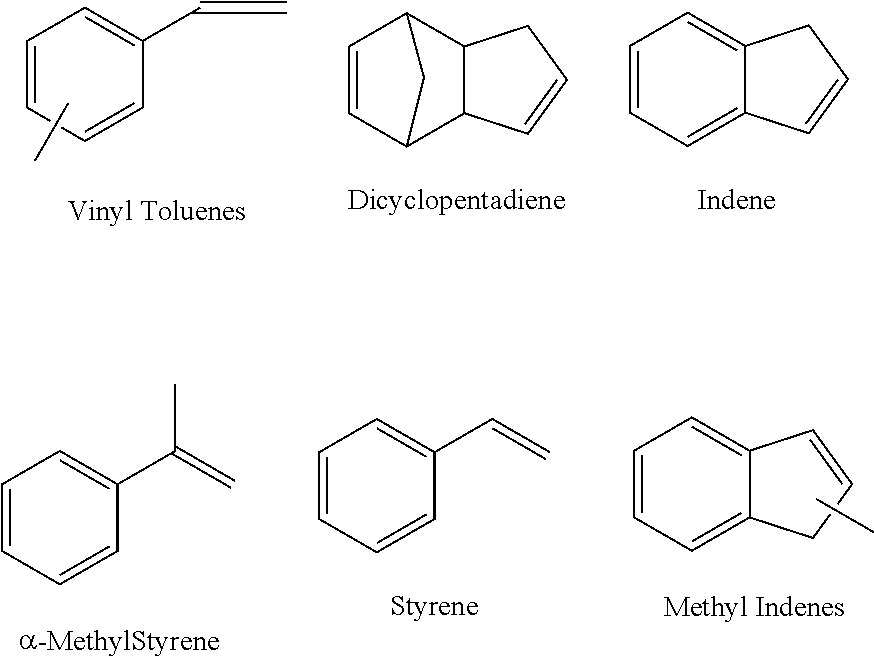
- C9 resin oil contains various monomers as shown below.
- C9 resins are aromatic molecules. They are also available in a wide variety of softening points and molecular weights.
- C5 and C9 resins can be modified by mixing the two feed streams together in certain ratios. This ratio determines the aliphatic/aromatic balance of the resin, which is essential to formulators.
- the aliphatic C5 feed can be replaced with a terpene feedstock and modified with styrene to form “styrenated terpenes” which have excellent colour and stability.
- Dicyclopentadiene (DCPD) feedstock contains various structures such as those shown below, but is primarily made up of dicyclopentadiene.
- the feed stock also contains codimers with dienes such as isoprene, butadiene and methylcyclopentadiene.
- codimers with dienes such as isoprene, butadiene and methylcyclopentadiene.
- dicyclopentadiene will crack into cyclopentadiene.
- the thermal polymerization is thought to involve the Diels-Alder addition of cyclopentadiene to the norbornene olefin followed by continued additions of this type by additional cyclopentadiene to propagate the growing chain as shown below.
- Aromatics e.g. C9 stream, can be added to this material.
- Dicyclopentadiene is polymerized either thermally or with a catalyst to form relatively dark and unstable resins with a characteristic odour. They are more commonly used as a base resin for subsequent hydrogenation to form water white resins with excellent stability and low odour.
- the hydrocarbon resins described above can be hydrogenated to produce another class of hydrocarbon resins. Hydrogenation is primarily used to improve colour and stability of the resin by removing vulnerable double bonds.
- Partial and selective hydrogenation are methods used to produce resins with broad compatibility and good stability.
- C9 resins contain double bonds and have predominantly aromatic ring structures with an overall aromaticity, which are relatively unstable. Hydrogenation is a useful way to stabilize these resins. Resins can be hydrogenated in solution with very specific operating parameters: temperature, pressure, hydrogen concentration and catalyst level. Changing any one of these operating parameters will bring a change in the degree of hydrogenation of the final resin. During hydrogenation, the aromatic ring structures gradually lose their aromatic nature and become cyclo-aliphatic.
- the result is a fully hydrogenated hydrocarbon resin with full aliphatic character.
- the process can also be adjusted so that the resins are partially hydrogenated and still have some aromatic rings.
- the resin can also control the burn rate of the energetic material particular the hydrocarbon resins.
- tackifying resins may be used in the present invention.
- the choice of resin will depend upon the nature of the energetic material and also the nature of the polymer binder used in the formulation. Resins containing polar groups are preferred.
- the energetic filler and the relative proportions of the components of the energetic material will depend upon the type of application for which the material is to be used.
- the present invention may be used in for example a plastic bonded explosive in which the binder forms between 0.5 and 30% by weight and the energetic filler forms between 99.5 and 70% by weight.
- ratio of polymeric binder matrix and tackifying resin in the energetic material be from 99:1 to 10:90, preferably from 95:5 to 20:80, more preferably from 90:10 to 40:60.
- Suitable energetic binder materials are nitrocellulose, polyvinyl nitrate, nitroethylene, nitroallyl acetate, nitroethyl acrylate, nitroethyl methacrylate, trinitroethyl acrylate, dinitropropyl acrylate, C-nitropolystyrene and its derivatives, polyurethanes with aliphatic C- and N-nitro groups, polyesters made from dinitrocarboxylic acids and dinitrotrodiols and nitrated polybutadienes.
- Extenders may be used as part of the binder formulation to improve the processibility and flexibility of the product.
- heavy grade liquid paraffin up to 3% by weight of the binder formulation
- the mixture of polymer binder matrix and tackifying resin is used at a ratio of 1:99 to 90:10 in relation to the total of the other components in the formulation. Preferably from 5:95 to 40:60 more preferably from 10:90 to 30:70.
- active components include organic secondary explosives.
- Alicyclic nitranes such as RDX (1,3,5-cyclotrimethylene-2,4,6-trinitramine) and HMX (1,3,5,7-cyclotetramethylene-2,4,6,8-tetraritramine) and TATND (tetranitro-tetraminodecalin) and mixtures thereof.
- the following active components may also be used as the main or as a subsidiary energetic component in plastic bonded explosives—nitroguanidine, aromatic nitramines such as tetryl, ethylene dinitramine, nitrate esters such as nitroglycerine, butanetriol trinitrate and PETN (pentaerythritol tetranitrate).
- aromatic nitramines such as tetryl, ethylene dinitramine
- nitrate esters such as nitroglycerine, butanetriol trinitrate and PETN (pentaerythritol tetranitrate).
- Other nitroaromatic compounds such as trinitrotoluene (TNT) triaminobenzene (TATB) triaminotrinitro benzene (TATNB) and hexanitrostilbene may also be used.
- active components such as inorganic fillers such as ammonium nitrate and alkaline earth metal salts provide suitable high explosive materials.
- Metallic fuels such as powdered aluminium, magnesium or zirconium may be used to fuel the exothermic reaction of the oxidation of the energetic material.
- the metallic fuel may comprise up to 50% by weight of the energetic filler.
- the energetic materials may alternatively comprise a gun propellant.
- the content of the active component is generally in the range 70 to 90% by weight of the binder/filler mixture and may be selected for example from nitroglycerine, RDX and HMX or a combination thereof, optionally with other highly active components such as those listed above.
- the binder of such a material may comprise in addition to the blend specified above a cellulosic material eg. nitrocellulose eg. forming from 5 to 95%, eg. 30 to 70% by weight of the binder.
- the energetic material may alternatively comprise a gas generator material as the active component for example, for power cartridges for actuators: for base burning, reduced base drag, extended range projectiles: and for control gas jets for missile and projectile guidance systems and the like.
- a gas generator material as the active component for example, for power cartridges for actuators: for base burning, reduced base drag, extended range projectiles: and for control gas jets for missile and projectile guidance systems and the like.
- Such material is similar in nature to a propellant, but in general contains a lower content of active component, eg. 45% to 65% by weight optionally together with a surface burning rate inhibitor, eg. ethyl cellulose.
- the propellant composition may include as active component ammonium perchlorate (20 to 90% by weight) together with aluminium as fuel (5 to 50% by weight of its mixture with the active component), the binder forming for example 5 to 30% by weight of the composition together with the tackifying resin.
- the energetic material may also comprise a polymer bonded pyrotechnic material, eg. containing an inorganic nitrate or perchlorate of ammonium, barium or strontium (forming 20 to 80% by weight of the energetic filler), a metallic fuel such as magnesium or zirconium (forming 5 to 60% by weight of the filler), the binder comprising 5 to 30% by weight of the overall composition.
- a polymer bonded pyrotechnic material eg. containing an inorganic nitrate or perchlorate of ammonium, barium or strontium (forming 20 to 80% by weight of the energetic filler), a metallic fuel such as magnesium or zirconium (forming 5 to 60% by weight of the filler), the binder comprising 5 to 30% by weight of the overall composition.
- non-viscous plasticisers may be avoided by use of the polymer bonded energetic materials because the polymers can have a plasticising effect upon the polymer, non-viscous plasticisers may optionally be incorporated in low concentrations in the compositions according to the present invention. Additionally the use of the tackifying resin may avoid the need for plasticisers in the formulation.
- plasticisers which are dialkyl esters of phthalic, adipic and sebacic acids may be used as the optional plasticiser, eg. the plasticiser may comprise dibutyl phthalate, disobutyl phthalate, dimethyl glycol phthalate, dioctyl adipate or dioctyl sebacate preferably less than 10% by weight of the binder binder processibility.
- energetic plasticisers such as BDNPAIF (bis-2-dinitropropylacetral/formal), bis-(2-fluoro-2,2-dinitroethyl) formal, diethylene glycol dinitrate, glycerol trinitrate, glycol trinitrate, triethylene glycerol dinitrate, trimethylolethane trinitrate butanetriol trinitrate, or 1,2,4-butanetriol trinitrate, may be employed in concentration less than 10% by weight of binder in the materials according to the present invention.
- BDNPAIF bis-2-dinitropropylacetral/formal
- bis-(2-fluoro-2,2-dinitroethyl) formal diethylene glycol dinitrate, glycerol trinitrate, glycol trinitrate, triethylene glycerol dinitrate, trimethylolethane trinitrate butanetriol trinitrate, or 1,2,4-butanetriol trinitrate
- suitable additional inert or non-energetic binder materials are cellulosic materials such as the esters, eg. cellulose acetate, cellulose acetate butyrate, and synthetic polymers such as polyurethanes, polyesters, polybutadienes, polyethylenes, polyvinyl acetate and blends and/or copolymers thereof.
- esters eg. cellulose acetate, cellulose acetate butyrate
- synthetic polymers such as polyurethanes, polyesters, polybutadienes, polyethylenes, polyvinyl acetate and blends and/or copolymers thereof.
- additives may be added to the formulations of the present invention.
- material that may be used include surfactants and antifoam.
- the additives content comprises no more than 10% by weight, desirably less than 5% by weight, of the overall energetic material composition.
- the additive may for example comprise one or more stabilisers, eg. carbamite or PNTYIA (para-nitromethylaniline); and/or one or more ballistic modifiers, eg. carbon black or lead salts; and/or one or more flash suppressants, eg. one or more sodium or potassium salts, eg. sodium or potassium sulphate or bicarbonate.
- stabilisers eg. carbamite or PNTYIA (para-nitromethylaniline)
- ballistic modifiers eg. carbon black or lead salts
- flash suppressants eg. one or more sodium or potassium salts, eg. sodium or potassium sulphate or bicarbonate.
- Other modifiers particularly for ballistics include iron oxide, catacene or butadiene.
- Antioxidant in an extent of up to 1% by weight of the overall composition of the energetic materials may usefully be incorporate in the materials.
- Phenolic antioxidents such as 2,2′-methylene-bis (4-methyl-6-butyl) phenol has been found to be very suitable.
- Coupling agents known per se eg. in concentrations of up to 2% by weight of the overall composition weight, may be employed to improve adhesion between the binder and the active energetic components.
- the energetic material according to the present invention is a plastic bonded explosive it contains the following components (in percentage parts by weight): RDX: 80-99.5%, preferably about 88%; binder: 20-0.5%, preferably about 12%; 0 to 1% antioxidant, the overall percentages (excluding further optional additives) adding to 100 in each case.
- the formulations of the present invention may be processed into manufactured products by processes which are generally known per se.
- the binder ingredients including the tackifying resin may be mixed together in a blender at temperatures of 80° C. to 140° C. and then added to the active component by a solventless process or a solvent lacquer process.
- a pre-blend of the polymer binder and tackifying resin is the preferred method as polymer binder-tackifying resin compatibility/miscibility is important.
- the polymer-tackifying resin mixture should ideally be completely compatible/miscible and produce a clear mixture/solution.
- the formulation also contains a cross-linking agent for the polymer binder it is preferred that it be added after the polymer has been blended with the tackifying resin. All materials may be mixed simultaneously although this is not preferred.
- the pre-blend may be prepared in one location and provided to another location for the introduction of the active material and optionally the cross linking agent for the polymer.
- the binder tackifying resin mixture may be dissolved in an organic solvent at a moderately elevated temperature, eg. 40° C. to 80° C. and the active component is subsequently stirred into the solvent lacquer after cooling to about 20° C. to give a slurry.
- the slurry is then mixed under vacuum at an elevated temperature, eg. 50° C. to 90° C., preferably 75° C. to 90° C.
- an elevated temperature eg. 50° C. to 90° C., preferably 75° C. to 90° C.
- the required quantity of pre-dried active component is wetted with water or an aqueous solution and heated to an elevated temperature, eg. 80° C.-100° C.
- the binder tackifying resin mixture is then added to the active component and the components are mixed together at that temperature. Any water remaining in the composition is removed under vacuum.
- Materials produced in the ways described above or in other known ways may, depending on the material composition and its intended use, be shaped into products in known ways.
- the material may be pressed, moulded or cast into a desired shape eg. for use as blocks, sheet explosive or for filling of shells, warheads and the like.
- the material may be extruded in a known manner in a corotating twin screw extruder, and subsequently cooled.
- the latter technique is especially suitable for the manufacture of gun propellant materials, eg. stick or tubular propellants of known cross-sectional shape.
- the energetic materials of the present invention may, depending upon their specific composition and properties, be used in any one or more of the following well known applications: (i) General demolition; (ii) Explosive welding; (iii) Active armour; (iv) Detonating cord; (v) Linear cutting charges; (vi) Shell fillings; (vii) Mine fillings; (viii) Grenade fillings; (ix) Shaped-charge warhead fillings; (x) rocket propellants and gas generator propellants.
- the energetic material needs to be a stable system which can be handled, stored and transported.
- the conditions under which it should be stable will vary from one energetic material to another and according to the use to which the energetic material is to be put.
- generally energetic materials need to be prepared, handled, stored and transported at temperature in the range from ⁇ 50° C. to 71° C. or higher.
- the energetic materials have comprised the active material or materials dispersed within a polymer binder, such as the blend of polyethylene and polyisobutylene of GB 2365240 or other binders as described in https://application.wiley-vch.de/books/sample/3527331557_c01.pdf
- a polymer binder comprising hydroxyl-terminated polybutadiene (Trade name: Poly bd R-45HTLO) and a tackifying resin: Tall Oil Rosin Ester (TORE) (Trade name: Dercol PE 100) were blended together by stirring the mixture at 100° C. for 30 minutes.
- the materials are compatible and formed a clear and bright liquid which was stable for at least 7 months
- Formulation Active Material Component: 1 2 Polymer Binder* R45HTLO 3.754 3.754 Plasticizer Dioctyl adipate 1.131 1.131 Fuel Aluminium powder 1.000 1.000 Fuel Zinc Powder 0.500 0.500 Burning rate Fe 2 O 3 0.135 0.135 modifier Oxidiser Double-ground 6.011 6.012 ammonium perchlorate Oxidiser 90 um ammonium 12.020 12.022 perchlorate Curing agent** ISONATE 143L modified 0.521 0.386 MDI *Formulation 1 contains only R45HTLO and Formulation 2 contains a 90/10 (w/w) ratio of the previously prepared R45HTLO/TORE mixture. **The amount of curing agent ISONATE 143L was reduced in Formulation 2 so that both formulations contained the same amount relative to the amount of R45HTLO.
- the curing agent is provided to crosslink the Polymer Binder which is (qualitatively) a low viscosity polymer at room temperature which mixes with all the components.
- the polymer is then crosslinked so that the energetic material is set to form a fixed stable system which can be handled and stored at temperatures between ⁇ 50° C. and over 100° C.
- Formulation 3 was based on the conventional formulation based on Formulation 1.
- Formulation 4 was based on the tackifying resin.
- RAM Resodyn Resonant Acoustic Mixer
- the Curative was added at start and the mixing conditions were as follows.
- the mixing conditions were:
- the mixture containing the tackifying resin (as per Formulation 2) produced a more consistent mixture (very even slurry) which was easier to work with than Formulation 1.
- Formulation 2 cured (cross-linked via urethane linkages) faster overall and more consistently. This may be explained by understanding that the tackifying resin decreases the entanglement density of the polymer allowing greater diffusion (and lowering the plateau modulus) and more efficient urethane reactions.
- FIGS. 1 and 2 show the RAM and conventionally mixed samples of Formulation 1.
- FIGS. 3 and 4 show the samples with tackifying resin (Formulation 2) using the same mixing techniques.
- Formulations 3 and 4 show the same trends, i.e. the improvement in mixing, particle dispersion and adhesion of the binder to the other particles. After Formulations 3 and 4 were cast in polyethylene containers and fully cured they were examined by photomicroscopy. The top and bottom surfaces were examined. The sample was then sectioned and the cut surfaces examined.
- FIG. 5 shows Formulation 3 (no tackifying resin) and
- FIG. 6 shows Formulation 4 (with tackifying resin).
- sample containing the tackifying resin improved dispersion of the active components and the adhesion of the polymer binder to the solid particulate matter (active components) in the formulation, especially the ammonium perchlorate.
- Formulations 1 and 2 were moulded into tensile testing bars prior to complete crosslinking.
- the conventional sample did not extend the tensile bar at all. Failure occurred through cracking and minor fibrillation.
- the sample of this invention (Formulation 2) extended and showed an increased tensile strength.
- Table 2 shows the tensile stress and strain measurements (average from 3 tensile bars) together with the standard deviations for Formulation 1 and Formulation 2.
- the percent improvement of Formulation 2 over Formulation 1 is also given (Table 2).
- the formulation containing the tackifying resin according to this invention is stronger (maximum stress), more elastic (4.26 v 5.13 N/mm2) and more extensible (maximum strain).
- the standard deviations show that it is also much more consistent.
- Rocket Firing Test used to fire a rocket :
- FIGS. 9 , 10 and 11 show the result with the conventional propellant formulation (Formulation 3) in FIG. 9 and FIGS. 10 and 11 show the results with the propellant formulations of this invention.
- the polybutadiene (R45 HTLO pre-cured polymer binder as used in Formulations 1 and 2) was used alone and also blended with 5% (w/w) Tall Oil Rosin Ester (TORE) (Trade name: Dercol PE 100).
- TORE Tall Oil Rosin Ester
- the two polymer samples were placed into a tensile bar mould with a Reduced Section of 4 mm ⁇ 4 mm.
- the cross-linking agent was isophorone diisocyanate.
- the polymer was cross-linked to a theoretical value of 85%.
- Burning rate modifier Iron Oxide: 0.54%
- the K-Round is a double cone and cylinder charge designed to give a neutral burning surface area. It has a simple sonic nozzle
- Oxidiser AP: 72.86%
- Curing agent IPDI: 1.1% (Cured to 0.85 placed in oven at 60° C. for 8 days)
- FIGS. 9 and 10 show that the charges burn in a stable manner and are thus suitable for rocket motors.
Landscapes
- Chemical & Material Sciences (AREA)
- Organic Chemistry (AREA)
- Health & Medical Sciences (AREA)
- Life Sciences & Earth Sciences (AREA)
- Dispersion Chemistry (AREA)
- Molecular Biology (AREA)
- Crystallography & Structural Chemistry (AREA)
- Engineering & Computer Science (AREA)
- Materials Engineering (AREA)
- Metallurgy (AREA)
- Inorganic Chemistry (AREA)
- Compositions Of Macromolecular Compounds (AREA)
- Adhesives Or Adhesive Processes (AREA)
Abstract
Description


-
- Styrenated terpenes—mixed aliphatic/aromatic resins
- Terpene phenolics—polar resins with excellent adhesion and broad compatibility with polar polymers.
- Hydrogenated terpenes—improved colour by hydrogenation



-
- C9 and C9/C5 resins
- DCPD and modified DCPD resins
| TABLE 1 | |
| Formulation | |
| Active Material: | Component: | 1 | 2 |
| Polymer Binder* | R45HTLO | 3.754 | 3.754 |
| Plasticizer | Dioctyl adipate | 1.131 | 1.131 |
| Fuel | Aluminium powder | 1.000 | 1.000 |
| Fuel | Zinc Powder | 0.500 | 0.500 |
| Burning rate | Fe2O3 | 0.135 | 0.135 |
| modifier | |||
| Oxidiser | Double-ground | 6.011 | 6.012 |
| ammonium perchlorate | |||
| Oxidiser | 90 um ammonium | 12.020 | 12.022 |
| perchlorate | |||
| Curing agent** | ISONATE 143L modified | 0.521 | 0.386 |
| MDI | |||
| *Formulation 1 contains only R45HTLO and Formulation 2 contains a 90/10 (w/w) ratio of the previously prepared R45HTLO/TORE mixture. | |||
| **The amount of curing agent ISONATE 143L was reduced in Formulation 2 so that both formulations contained the same amount relative to the amount of R45HTLO. | |||
-
- 30 g, no vacuum, 2 minutes
- 0 g, vacuum (−45 kPa), 5 minutes
- 30 g, vacuum, 5 minutes
-
- Mixing blades rotating at 11 rpm
- 10 min mixing, no vacuum
- 45 min mixing, vacuum (−45 kPa)
- The curative, was added after the 10 min mixing under vacuum.
| TABLE 2 | ||||
| Max Stress | Max Strain | |||
| (N/mm2) | SD | (mm) | SD | |
| Formulation 1 | 0.109 | 0.023 | 3.0 | 0.5 |
| Formulation 2 | 0.250 | 0.005 | 7.7 | 0.3 |
| % Improvement | 129 | 157 | ||
| TABLE 3 | |||||
| RE | RE | ||||
| Elongation | Improve- | Stress at | Improve- | ||
| at Break | ment | Break | ment | ||
| Binder | Pull Rate | εB | εB | σB | σB |
| Composition | (mm/min) | (%) | (%) | (Mpa) | (%) |
| HTLO | 10 | 147 | 1.35 | ||
| HTLO + RE | 10 | 200 | 36.1 | 1.37 | 1.5 |
| |
100 | 261 | 0.202 | ||
| HTLO + |
100 | 340 | 30.3 | 0.259 | 28.2 |
Claims (20)
Applications Claiming Priority (4)
| Application Number | Priority Date | Filing Date | Title |
|---|---|---|---|
| GB1518010 | 2015-10-12 | ||
| GB1518010.2A GB2555764B (en) | 2015-10-12 | 2015-10-12 | Improvements in or relating to energetic materials |
| GB1518010.2 | 2015-10-12 | ||
| PCT/EP2016/074423 WO2017064102A1 (en) | 2015-10-12 | 2016-10-12 | Improvements in or relating to energetic materials |
Publications (2)
| Publication Number | Publication Date |
|---|---|
| US20180305270A1 US20180305270A1 (en) | 2018-10-25 |
| US11802099B2 true US11802099B2 (en) | 2023-10-31 |
Family
ID=55130913
Family Applications (1)
| Application Number | Title | Priority Date | Filing Date |
|---|---|---|---|
| US15/767,547 Active 2037-02-06 US11802099B2 (en) | 2015-10-12 | 2016-10-12 | Or relating to energetic materials |
Country Status (6)
| Country | Link |
|---|---|
| US (1) | US11802099B2 (en) |
| EP (1) | EP3362422A1 (en) |
| KR (1) | KR102902441B1 (en) |
| GB (1) | GB2555764B (en) |
| WO (1) | WO2017064102A1 (en) |
| ZA (1) | ZA201803076B (en) |
Families Citing this family (14)
| Publication number | Priority date | Publication date | Assignee | Title |
|---|---|---|---|---|
| EP3606892B1 (en) | 2017-04-03 | 2022-01-05 | BAE Systems PLC | Improved process for making and filling a pbx composition |
| GB2565031B (en) * | 2017-04-10 | 2023-02-22 | Lewtas Science & Tech Ltd | Improvements in or relating to energetic materials |
| US10731955B2 (en) * | 2017-04-13 | 2020-08-04 | Lawrence Livermore National Security, Llc | Modular gradient-free shaped charge |
| GB2567234B (en) | 2017-10-09 | 2022-11-16 | The Falcon Project Ltd | Acoustic mixers |
| GB2572372A (en) * | 2018-03-28 | 2019-10-02 | Bae Systems Plc | Improved PBX composition |
| US11506520B2 (en) * | 2019-10-30 | 2022-11-22 | Raytheon Company | Systems and methods for real-time, nondestructive monitoring of energetic materials |
| US12049433B2 (en) | 2020-03-24 | 2024-07-30 | University Of Rhode Island Board Of Trustees | Plasticized flexible pyrotechnic material |
| CN112521237A (en) * | 2020-12-25 | 2021-03-19 | 雅化集团雅安实业有限公司 | Special emulsifier for liquid integrated oil phase and preparation method thereof |
| BR102021009092A2 (en) * | 2021-05-11 | 2022-11-16 | Instituto Militar De Engenharia | STABILIZING COMPOSITION OF NITRATED ETHERS AND USE OF SUCH COMPOSITION |
| CN113649562B (en) * | 2021-08-18 | 2022-03-25 | 北京理工大学 | A method for improving fluidity and reactivity of energetic active materials |
| FR3132712A1 (en) * | 2022-02-15 | 2023-08-18 | Eurenco | Process for obtaining ignition pastes in an acoustic resonance mixer |
| CN116283456B (en) * | 2023-01-05 | 2024-03-05 | 北京理工大学 | A heat-insensitive aluminum-containing mixed explosive and its preparation method |
| GB202407790D0 (en) * | 2024-05-31 | 2024-07-17 | Lewtas Science & Tech Ltd | improvements in and related to polymeric materials |
| CN119083033B (en) * | 2024-10-12 | 2025-12-02 | 厦门当盛新材料有限公司 | A colored flash-evaporated nonwoven fabric, its preparation method and application |
Citations (11)
| Publication number | Priority date | Publication date | Assignee | Title |
|---|---|---|---|---|
| GB876951A (en) | 1960-04-04 | 1961-09-06 | Du Pont | Improvements in or relating to self-supporting explosive compositions and to their production |
| JPS57196788A (en) | 1981-05-28 | 1982-12-02 | Yoshihiko Masumi | Iron powder rust preventing agent for fireworks |
| JPS57196789A (en) | 1981-05-28 | 1982-12-02 | Yoshihiko Masumi | Firework aid |
| GB2166128A (en) | 1984-09-27 | 1986-04-30 | Alan Richard Howard Bullock | Flexible, self supporting, plastic bonded high explosive compositions |
| US5712511A (en) * | 1997-03-03 | 1998-01-27 | The United States Of America As Represented By The Secretary Of The Navy | Preparation of fine particulate CL-20 |
| US20010021737A1 (en) * | 2000-02-17 | 2001-09-13 | John Hazen | Polyester tackifier and adhesive composition |
| GB2365420A (en) | 1988-05-11 | 2002-02-20 | Royal Ordnance Plc | Explosive compositions |
| US6740180B1 (en) * | 1997-07-15 | 2004-05-25 | Anthony Joseph Cesaroni | Thermoplastic polymer propellant compositions |
| GB2507459A (en) | 1987-07-21 | 2014-05-07 | Thiokol Corp | High-energy formulation having an elastomeric binder formed from mixed hydroxyl-terminated polybutadiene |
| CN103951534A (en) | 2014-04-08 | 2014-07-30 | 中煤科工集团淮北爆破技术研究院有限公司 | Easily-emulsified compound oil phase for emulsion explosive and preparation method |
| US20140260185A1 (en) | 2013-03-15 | 2014-09-18 | Alliant Techsystems Inc. | Precursor formulations for an energetic composition including high surface area amorphous carbon black |
Family Cites Families (1)
| Publication number | Priority date | Publication date | Assignee | Title |
|---|---|---|---|---|
| EP2022770A1 (en) * | 2006-04-19 | 2009-02-11 | Nipponkayaku Kabushikikaisha | Explosive composition, explosive composition molded body, and their production methods |
-
2015
- 2015-10-12 GB GB1518010.2A patent/GB2555764B/en active Active
-
2016
- 2016-10-12 KR KR1020187013435A patent/KR102902441B1/en active Active
- 2016-10-12 EP EP16781395.5A patent/EP3362422A1/en active Pending
- 2016-10-12 US US15/767,547 patent/US11802099B2/en active Active
- 2016-10-12 WO PCT/EP2016/074423 patent/WO2017064102A1/en not_active Ceased
-
2018
- 2018-05-10 ZA ZA2018/03076A patent/ZA201803076B/en unknown
Patent Citations (11)
| Publication number | Priority date | Publication date | Assignee | Title |
|---|---|---|---|---|
| GB876951A (en) | 1960-04-04 | 1961-09-06 | Du Pont | Improvements in or relating to self-supporting explosive compositions and to their production |
| JPS57196788A (en) | 1981-05-28 | 1982-12-02 | Yoshihiko Masumi | Iron powder rust preventing agent for fireworks |
| JPS57196789A (en) | 1981-05-28 | 1982-12-02 | Yoshihiko Masumi | Firework aid |
| GB2166128A (en) | 1984-09-27 | 1986-04-30 | Alan Richard Howard Bullock | Flexible, self supporting, plastic bonded high explosive compositions |
| GB2507459A (en) | 1987-07-21 | 2014-05-07 | Thiokol Corp | High-energy formulation having an elastomeric binder formed from mixed hydroxyl-terminated polybutadiene |
| GB2365420A (en) | 1988-05-11 | 2002-02-20 | Royal Ordnance Plc | Explosive compositions |
| US5712511A (en) * | 1997-03-03 | 1998-01-27 | The United States Of America As Represented By The Secretary Of The Navy | Preparation of fine particulate CL-20 |
| US6740180B1 (en) * | 1997-07-15 | 2004-05-25 | Anthony Joseph Cesaroni | Thermoplastic polymer propellant compositions |
| US20010021737A1 (en) * | 2000-02-17 | 2001-09-13 | John Hazen | Polyester tackifier and adhesive composition |
| US20140260185A1 (en) | 2013-03-15 | 2014-09-18 | Alliant Techsystems Inc. | Precursor formulations for an energetic composition including high surface area amorphous carbon black |
| CN103951534A (en) | 2014-04-08 | 2014-07-30 | 中煤科工集团淮北爆破技术研究院有限公司 | Easily-emulsified compound oil phase for emulsion explosive and preparation method |
Non-Patent Citations (6)
| Title |
|---|
| Eastman, Technical Data Sheet, Foral ™ 105-E Ester of Hydrogenated Resin, accessed Jun. 9, 2020. |
| H.G. Ang, S. Pisharath, "Energetic Polymers: Binders and Plasticizers for Enhancing Performance", First Edition 2012, https://application.wiley-vch.de/books/sample/3527331557_c01.pdf. |
| International Preliminary Report on Patentability from the European Patent Office for Application No. PCT/EP2016/074423 dated Jan. 17, 2018. |
| International Search Report and Written Opinion from the European Patent Office for Application No. PCT/EP2016/074423 dated Dec. 21, 2016. |
| K. Kunal et al. "Polyisobutylene: A Most Unusual Polymer", Journal of Polymer Science Part B: Polymer Physics, vol. 46, No. 13, Jul. 1, 2008 (Jul. 1, 2008), pp. 1390-1399. |
| Pinova, Inc., "Product Data Sheet Foral ® 105 Synthetic Resin", pinovasolutions.com, Available from: http://harwick.com/files/tds/FORAL_105.PDF accessed Dec. 6, 2021. |
Also Published As
| Publication number | Publication date |
|---|---|
| US20180305270A1 (en) | 2018-10-25 |
| EP3362422A1 (en) | 2018-08-22 |
| ZA201803076B (en) | 2024-12-18 |
| KR102902441B1 (en) | 2025-12-18 |
| GB2555764A (en) | 2018-05-16 |
| GB201518010D0 (en) | 2015-11-25 |
| KR20180082997A (en) | 2018-07-19 |
| WO2017064102A1 (en) | 2017-04-20 |
| GB2555764B (en) | 2022-06-15 |
Similar Documents
| Publication | Publication Date | Title |
|---|---|---|
| US11802099B2 (en) | Or relating to energetic materials | |
| US5540794A (en) | Energetic binder and thermoplastic elastomer-based low vulnerability ammunition gun propellants with improved mechanical properties | |
| US6740180B1 (en) | Thermoplastic polymer propellant compositions | |
| US12391631B2 (en) | Relating to energetic materials | |
| CA2008418C (en) | Polymer bonded energetic materials | |
| US3014796A (en) | Solid composite propellants containing chlorinated polyphenols and method of preparation | |
| US4416710A (en) | Polynorbornene-based combustible compositions and processes for the fabrication thereof | |
| GB2577873A (en) | Polymerisable Binder | |
| US9919980B2 (en) | Insensitive munition propellants | |
| WO2025248133A1 (en) | Improvements in or relating to polymeric materials | |
| EP2978731A1 (en) | Non-phthalate propellants | |
| GB2512346A (en) | Non-phthalate propellants | |
| Wilkinson | Evaluation of novel propellants manufactured from commercially available Thermoplastic Elastomers (TPE) using resonant acoustic mixing | |
| EP2784054A1 (en) | Insensitive munition propellants | |
| Hoffman et al. | Clean, agile alternative binders, additives and plasticizers for propellant and explosive formulations | |
| CA2322096A1 (en) | Thermoplastic polymer propellant compositions | |
| US3830674A (en) | Propellant composition containing beryllium and an energetic difluoramino containing binder | |
| EP2784053A1 (en) | Non- phthalate propellants | |
| US8864923B1 (en) | Ballistic modifier formulation for double base propellant | |
| CN110963874A (en) | Solid propellant with polyester-butylated hydroxyanisole block polymer as adhesive | |
| GB2512345A (en) | Insensitive munition propellants | |
| CA2243254A1 (en) | Thermoplastic polymer propellant compositions |
Legal Events
| Date | Code | Title | Description |
|---|---|---|---|
| FEPP | Fee payment procedure |
Free format text: ENTITY STATUS SET TO UNDISCOUNTED (ORIGINAL EVENT CODE: BIG.); ENTITY STATUS OF PATENT OWNER: SMALL ENTITY |
|
| FEPP | Fee payment procedure |
Free format text: ENTITY STATUS SET TO SMALL (ORIGINAL EVENT CODE: SMAL); ENTITY STATUS OF PATENT OWNER: SMALL ENTITY |
|
| AS | Assignment |
Owner name: LEWTAS SCIENCE & TECHNOLOGIES LTD, UNITED KINGDOM Free format text: ASSIGNMENT OF ASSIGNORS INTEREST;ASSIGNORS:LEWTAS, KENNETH;JUBB, DANIEL;PRICE, MARK;REEL/FRAME:045950/0052 Effective date: 20180518 |
|
| STPP | Information on status: patent application and granting procedure in general |
Free format text: DOCKETED NEW CASE - READY FOR EXAMINATION |
|
| STPP | Information on status: patent application and granting procedure in general |
Free format text: NON FINAL ACTION MAILED |
|
| STPP | Information on status: patent application and granting procedure in general |
Free format text: RESPONSE TO NON-FINAL OFFICE ACTION ENTERED AND FORWARDED TO EXAMINER |
|
| STPP | Information on status: patent application and granting procedure in general |
Free format text: FINAL REJECTION MAILED |
|
| STPP | Information on status: patent application and granting procedure in general |
Free format text: DOCKETED NEW CASE - READY FOR EXAMINATION |
|
| STPP | Information on status: patent application and granting procedure in general |
Free format text: NON FINAL ACTION MAILED |
|
| STPP | Information on status: patent application and granting procedure in general |
Free format text: RESPONSE TO NON-FINAL OFFICE ACTION ENTERED AND FORWARDED TO EXAMINER |
|
| STPP | Information on status: patent application and granting procedure in general |
Free format text: FINAL REJECTION MAILED |
|
| STPP | Information on status: patent application and granting procedure in general |
Free format text: RESPONSE AFTER FINAL ACTION FORWARDED TO EXAMINER |
|
| STPP | Information on status: patent application and granting procedure in general |
Free format text: ADVISORY ACTION MAILED |
|
| STPP | Information on status: patent application and granting procedure in general |
Free format text: DOCKETED NEW CASE - READY FOR EXAMINATION |
|
| STPP | Information on status: patent application and granting procedure in general |
Free format text: NON FINAL ACTION MAILED |
|
| ZAAB | Notice of allowance mailed |
Free format text: ORIGINAL CODE: MN/=. |
|
| STPP | Information on status: patent application and granting procedure in general |
Free format text: NOTICE OF ALLOWANCE MAILED -- APPLICATION RECEIVED IN OFFICE OF PUBLICATIONS |
|
| ZAAA | Notice of allowance and fees due |
Free format text: ORIGINAL CODE: NOA |
|
| ZAAB | Notice of allowance mailed |
Free format text: ORIGINAL CODE: MN/=. |
|
| STPP | Information on status: patent application and granting procedure in general |
Free format text: PUBLICATIONS -- ISSUE FEE PAYMENT RECEIVED |
|
| STPP | Information on status: patent application and granting procedure in general |
Free format text: AWAITING TC RESP, ISSUE FEE PAYMENT VERIFIED |
|
| STPP | Information on status: patent application and granting procedure in general |
Free format text: PUBLICATIONS -- ISSUE FEE PAYMENT VERIFIED |
|
| STCF | Information on status: patent grant |
Free format text: PATENTED CASE |