US11800792B2 - Organic compound with spirocyclic adamantane, and electronic element and electronic device using same - Google Patents
Organic compound with spirocyclic adamantane, and electronic element and electronic device using same Download PDFInfo
- Publication number
- US11800792B2 US11800792B2 US18/011,754 US202118011754A US11800792B2 US 11800792 B2 US11800792 B2 US 11800792B2 US 202118011754 A US202118011754 A US 202118011754A US 11800792 B2 US11800792 B2 US 11800792B2
- Authority
- US
- United States
- Prior art keywords
- carbon atoms
- substituted
- ring
- unsubstituted
- organic compound
- Prior art date
- Legal status (The legal status is an assumption and is not a legal conclusion. Google has not performed a legal analysis and makes no representation as to the accuracy of the status listed.)
- Active, expires
Links
Images


Classifications
-
- H—ELECTRICITY
- H10—SEMICONDUCTOR DEVICES; ELECTRIC SOLID-STATE DEVICES NOT OTHERWISE PROVIDED FOR
- H10K—ORGANIC ELECTRIC SOLID-STATE DEVICES
- H10K85/00—Organic materials used in the body or electrodes of devices covered by this subclass
- H10K85/60—Organic compounds having low molecular weight
- H10K85/615—Polycyclic condensed aromatic hydrocarbons, e.g. anthracene
- H10K85/624—Polycyclic condensed aromatic hydrocarbons, e.g. anthracene containing six or more rings
-
- C—CHEMISTRY; METALLURGY
- C07—ORGANIC CHEMISTRY
- C07C—ACYCLIC OR CARBOCYCLIC COMPOUNDS
- C07C13/00—Cyclic hydrocarbons containing rings other than, or in addition to, six-membered aromatic rings
- C07C13/28—Polycyclic hydrocarbons or acyclic hydrocarbon derivatives thereof
- C07C13/32—Polycyclic hydrocarbons or acyclic hydrocarbon derivatives thereof with condensed rings
- C07C13/72—Spiro hydrocarbons
-
- C—CHEMISTRY; METALLURGY
- C07—ORGANIC CHEMISTRY
- C07D—HETEROCYCLIC COMPOUNDS
- C07D209/00—Heterocyclic compounds containing five-membered rings, condensed with other rings, with one nitrogen atom as the only ring hetero atom
- C07D209/56—Ring systems containing three or more rings
- C07D209/80—[b, c]- or [b, d]-condensed
- C07D209/82—Carbazoles; Hydrogenated carbazoles
- C07D209/86—Carbazoles; Hydrogenated carbazoles with only hydrogen atoms, hydrocarbon or substituted hydrocarbon radicals, directly attached to carbon atoms of the ring system
-
- C—CHEMISTRY; METALLURGY
- C07—ORGANIC CHEMISTRY
- C07D—HETEROCYCLIC COMPOUNDS
- C07D307/00—Heterocyclic compounds containing five-membered rings having one oxygen atom as the only ring hetero atom
- C07D307/77—Heterocyclic compounds containing five-membered rings having one oxygen atom as the only ring hetero atom ortho- or peri-condensed with carbocyclic rings or ring systems
- C07D307/91—Dibenzofurans; Hydrogenated dibenzofurans
-
- C—CHEMISTRY; METALLURGY
- C07—ORGANIC CHEMISTRY
- C07D—HETEROCYCLIC COMPOUNDS
- C07D333/00—Heterocyclic compounds containing five-membered rings having one sulfur atom as the only ring hetero atom
- C07D333/50—Heterocyclic compounds containing five-membered rings having one sulfur atom as the only ring hetero atom condensed with carbocyclic rings or ring systems
- C07D333/76—Dibenzothiophenes
-
- C—CHEMISTRY; METALLURGY
- C09—DYES; PAINTS; POLISHES; NATURAL RESINS; ADHESIVES; COMPOSITIONS NOT OTHERWISE PROVIDED FOR; APPLICATIONS OF MATERIALS NOT OTHERWISE PROVIDED FOR
- C09K—MATERIALS FOR MISCELLANEOUS APPLICATIONS, NOT PROVIDED FOR ELSEWHERE
- C09K11/00—Luminescent materials, e.g. electroluminescent or chemiluminescent
- C09K11/06—Luminescent materials, e.g. electroluminescent or chemiluminescent containing organic luminescent materials
-
- H—ELECTRICITY
- H10—SEMICONDUCTOR DEVICES; ELECTRIC SOLID-STATE DEVICES NOT OTHERWISE PROVIDED FOR
- H10K—ORGANIC ELECTRIC SOLID-STATE DEVICES
- H10K50/00—Organic light-emitting devices
-
- H—ELECTRICITY
- H10—SEMICONDUCTOR DEVICES; ELECTRIC SOLID-STATE DEVICES NOT OTHERWISE PROVIDED FOR
- H10K—ORGANIC ELECTRIC SOLID-STATE DEVICES
- H10K85/00—Organic materials used in the body or electrodes of devices covered by this subclass
- H10K85/60—Organic compounds having low molecular weight
- H10K85/615—Polycyclic condensed aromatic hydrocarbons, e.g. anthracene
-
- H—ELECTRICITY
- H10—SEMICONDUCTOR DEVICES; ELECTRIC SOLID-STATE DEVICES NOT OTHERWISE PROVIDED FOR
- H10K—ORGANIC ELECTRIC SOLID-STATE DEVICES
- H10K85/00—Organic materials used in the body or electrodes of devices covered by this subclass
- H10K85/60—Organic compounds having low molecular weight
- H10K85/615—Polycyclic condensed aromatic hydrocarbons, e.g. anthracene
- H10K85/622—Polycyclic condensed aromatic hydrocarbons, e.g. anthracene containing four rings, e.g. pyrene
-
- H—ELECTRICITY
- H10—SEMICONDUCTOR DEVICES; ELECTRIC SOLID-STATE DEVICES NOT OTHERWISE PROVIDED FOR
- H10K—ORGANIC ELECTRIC SOLID-STATE DEVICES
- H10K85/00—Organic materials used in the body or electrodes of devices covered by this subclass
- H10K85/60—Organic compounds having low molecular weight
- H10K85/615—Polycyclic condensed aromatic hydrocarbons, e.g. anthracene
- H10K85/626—Polycyclic condensed aromatic hydrocarbons, e.g. anthracene containing more than one polycyclic condensed aromatic rings, e.g. bis-anthracene
-
- H—ELECTRICITY
- H10—SEMICONDUCTOR DEVICES; ELECTRIC SOLID-STATE DEVICES NOT OTHERWISE PROVIDED FOR
- H10K—ORGANIC ELECTRIC SOLID-STATE DEVICES
- H10K85/00—Organic materials used in the body or electrodes of devices covered by this subclass
- H10K85/60—Organic compounds having low molecular weight
- H10K85/631—Amine compounds having at least two aryl rest on at least one amine-nitrogen atom, e.g. triphenylamine
-
- H—ELECTRICITY
- H10—SEMICONDUCTOR DEVICES; ELECTRIC SOLID-STATE DEVICES NOT OTHERWISE PROVIDED FOR
- H10K—ORGANIC ELECTRIC SOLID-STATE DEVICES
- H10K85/00—Organic materials used in the body or electrodes of devices covered by this subclass
- H10K85/60—Organic compounds having low molecular weight
- H10K85/631—Amine compounds having at least two aryl rest on at least one amine-nitrogen atom, e.g. triphenylamine
- H10K85/633—Amine compounds having at least two aryl rest on at least one amine-nitrogen atom, e.g. triphenylamine comprising polycyclic condensed aromatic hydrocarbons as substituents on the nitrogen atom
-
- H—ELECTRICITY
- H10—SEMICONDUCTOR DEVICES; ELECTRIC SOLID-STATE DEVICES NOT OTHERWISE PROVIDED FOR
- H10K—ORGANIC ELECTRIC SOLID-STATE DEVICES
- H10K85/00—Organic materials used in the body or electrodes of devices covered by this subclass
- H10K85/60—Organic compounds having low molecular weight
- H10K85/631—Amine compounds having at least two aryl rest on at least one amine-nitrogen atom, e.g. triphenylamine
- H10K85/636—Amine compounds having at least two aryl rest on at least one amine-nitrogen atom, e.g. triphenylamine comprising heteroaromatic hydrocarbons as substituents on the nitrogen atom
-
- H—ELECTRICITY
- H10—SEMICONDUCTOR DEVICES; ELECTRIC SOLID-STATE DEVICES NOT OTHERWISE PROVIDED FOR
- H10K—ORGANIC ELECTRIC SOLID-STATE DEVICES
- H10K85/00—Organic materials used in the body or electrodes of devices covered by this subclass
- H10K85/60—Organic compounds having low molecular weight
- H10K85/649—Aromatic compounds comprising a hetero atom
- H10K85/654—Aromatic compounds comprising a hetero atom comprising only nitrogen as heteroatom
-
- H—ELECTRICITY
- H10—SEMICONDUCTOR DEVICES; ELECTRIC SOLID-STATE DEVICES NOT OTHERWISE PROVIDED FOR
- H10K—ORGANIC ELECTRIC SOLID-STATE DEVICES
- H10K85/00—Organic materials used in the body or electrodes of devices covered by this subclass
- H10K85/60—Organic compounds having low molecular weight
- H10K85/649—Aromatic compounds comprising a hetero atom
- H10K85/657—Polycyclic condensed heteroaromatic hydrocarbons
- H10K85/6572—Polycyclic condensed heteroaromatic hydrocarbons comprising only nitrogen in the heteroaromatic polycondensed ring system, e.g. phenanthroline or carbazole
-
- H—ELECTRICITY
- H10—SEMICONDUCTOR DEVICES; ELECTRIC SOLID-STATE DEVICES NOT OTHERWISE PROVIDED FOR
- H10K—ORGANIC ELECTRIC SOLID-STATE DEVICES
- H10K85/00—Organic materials used in the body or electrodes of devices covered by this subclass
- H10K85/60—Organic compounds having low molecular weight
- H10K85/649—Aromatic compounds comprising a hetero atom
- H10K85/657—Polycyclic condensed heteroaromatic hydrocarbons
- H10K85/6574—Polycyclic condensed heteroaromatic hydrocarbons comprising only oxygen in the heteroaromatic polycondensed ring system, e.g. cumarine dyes
-
- H—ELECTRICITY
- H10—SEMICONDUCTOR DEVICES; ELECTRIC SOLID-STATE DEVICES NOT OTHERWISE PROVIDED FOR
- H10K—ORGANIC ELECTRIC SOLID-STATE DEVICES
- H10K85/00—Organic materials used in the body or electrodes of devices covered by this subclass
- H10K85/60—Organic compounds having low molecular weight
- H10K85/649—Aromatic compounds comprising a hetero atom
- H10K85/657—Polycyclic condensed heteroaromatic hydrocarbons
- H10K85/6576—Polycyclic condensed heteroaromatic hydrocarbons comprising only sulfur in the heteroaromatic polycondensed ring system, e.g. benzothiophene
-
- H—ELECTRICITY
- H10—SEMICONDUCTOR DEVICES; ELECTRIC SOLID-STATE DEVICES NOT OTHERWISE PROVIDED FOR
- H10K—ORGANIC ELECTRIC SOLID-STATE DEVICES
- H10K99/00—Subject matter not provided for in other groups of this subclass
-
- C—CHEMISTRY; METALLURGY
- C07—ORGANIC CHEMISTRY
- C07B—GENERAL METHODS OF ORGANIC CHEMISTRY; APPARATUS THEREFOR
- C07B2200/00—Indexing scheme relating to specific properties of organic compounds
- C07B2200/05—Isotopically modified compounds, e.g. labelled
-
- C—CHEMISTRY; METALLURGY
- C07—ORGANIC CHEMISTRY
- C07C—ACYCLIC OR CARBOCYCLIC COMPOUNDS
- C07C2603/00—Systems containing at least three condensed rings
- C07C2603/02—Ortho- or ortho- and peri-condensed systems
- C07C2603/04—Ortho- or ortho- and peri-condensed systems containing three rings
- C07C2603/06—Ortho- or ortho- and peri-condensed systems containing three rings containing at least one ring with less than six ring members
- C07C2603/10—Ortho- or ortho- and peri-condensed systems containing three rings containing at least one ring with less than six ring members containing five-membered rings
- C07C2603/12—Ortho- or ortho- and peri-condensed systems containing three rings containing at least one ring with less than six ring members containing five-membered rings only one five-membered ring
- C07C2603/18—Fluorenes; Hydrogenated fluorenes
-
- C—CHEMISTRY; METALLURGY
- C07—ORGANIC CHEMISTRY
- C07C—ACYCLIC OR CARBOCYCLIC COMPOUNDS
- C07C2603/00—Systems containing at least three condensed rings
- C07C2603/02—Ortho- or ortho- and peri-condensed systems
- C07C2603/04—Ortho- or ortho- and peri-condensed systems containing three rings
- C07C2603/22—Ortho- or ortho- and peri-condensed systems containing three rings containing only six-membered rings
- C07C2603/24—Anthracenes; Hydrogenated anthracenes
-
- C—CHEMISTRY; METALLURGY
- C07—ORGANIC CHEMISTRY
- C07C—ACYCLIC OR CARBOCYCLIC COMPOUNDS
- C07C2603/00—Systems containing at least three condensed rings
- C07C2603/02—Ortho- or ortho- and peri-condensed systems
- C07C2603/04—Ortho- or ortho- and peri-condensed systems containing three rings
- C07C2603/22—Ortho- or ortho- and peri-condensed systems containing three rings containing only six-membered rings
- C07C2603/26—Phenanthrenes; Hydrogenated phenanthrenes
-
- C—CHEMISTRY; METALLURGY
- C07—ORGANIC CHEMISTRY
- C07C—ACYCLIC OR CARBOCYCLIC COMPOUNDS
- C07C2603/00—Systems containing at least three condensed rings
- C07C2603/93—Spiro compounds
- C07C2603/94—Spiro compounds containing "free" spiro atoms
-
- C—CHEMISTRY; METALLURGY
- C07—ORGANIC CHEMISTRY
- C07C—ACYCLIC OR CARBOCYCLIC COMPOUNDS
- C07C2603/00—Systems containing at least three condensed rings
- C07C2603/93—Spiro compounds
- C07C2603/95—Spiro compounds containing "not free" spiro atoms
- C07C2603/96—Spiro compounds containing "not free" spiro atoms containing at least one ring with less than six members
- C07C2603/97—Spiro compounds containing "not free" spiro atoms containing at least one ring with less than six members containing five-membered rings
-
- C—CHEMISTRY; METALLURGY
- C09—DYES; PAINTS; POLISHES; NATURAL RESINS; ADHESIVES; COMPOSITIONS NOT OTHERWISE PROVIDED FOR; APPLICATIONS OF MATERIALS NOT OTHERWISE PROVIDED FOR
- C09K—MATERIALS FOR MISCELLANEOUS APPLICATIONS, NOT PROVIDED FOR ELSEWHERE
- C09K2211/00—Chemical nature of organic luminescent or tenebrescent compounds
- C09K2211/10—Non-macromolecular compounds
- C09K2211/1003—Carbocyclic compounds
- C09K2211/1007—Non-condensed systems
-
- C—CHEMISTRY; METALLURGY
- C09—DYES; PAINTS; POLISHES; NATURAL RESINS; ADHESIVES; COMPOSITIONS NOT OTHERWISE PROVIDED FOR; APPLICATIONS OF MATERIALS NOT OTHERWISE PROVIDED FOR
- C09K—MATERIALS FOR MISCELLANEOUS APPLICATIONS, NOT PROVIDED FOR ELSEWHERE
- C09K2211/00—Chemical nature of organic luminescent or tenebrescent compounds
- C09K2211/10—Non-macromolecular compounds
- C09K2211/1003—Carbocyclic compounds
- C09K2211/1011—Condensed systems
-
- C—CHEMISTRY; METALLURGY
- C09—DYES; PAINTS; POLISHES; NATURAL RESINS; ADHESIVES; COMPOSITIONS NOT OTHERWISE PROVIDED FOR; APPLICATIONS OF MATERIALS NOT OTHERWISE PROVIDED FOR
- C09K—MATERIALS FOR MISCELLANEOUS APPLICATIONS, NOT PROVIDED FOR ELSEWHERE
- C09K2211/00—Chemical nature of organic luminescent or tenebrescent compounds
- C09K2211/10—Non-macromolecular compounds
- C09K2211/1018—Heterocyclic compounds
-
- C—CHEMISTRY; METALLURGY
- C09—DYES; PAINTS; POLISHES; NATURAL RESINS; ADHESIVES; COMPOSITIONS NOT OTHERWISE PROVIDED FOR; APPLICATIONS OF MATERIALS NOT OTHERWISE PROVIDED FOR
- C09K—MATERIALS FOR MISCELLANEOUS APPLICATIONS, NOT PROVIDED FOR ELSEWHERE
- C09K2211/00—Chemical nature of organic luminescent or tenebrescent compounds
- C09K2211/10—Non-macromolecular compounds
- C09K2211/1018—Heterocyclic compounds
- C09K2211/1025—Heterocyclic compounds characterised by ligands
- C09K2211/1088—Heterocyclic compounds characterised by ligands containing oxygen as the only heteroatom
-
- C—CHEMISTRY; METALLURGY
- C09—DYES; PAINTS; POLISHES; NATURAL RESINS; ADHESIVES; COMPOSITIONS NOT OTHERWISE PROVIDED FOR; APPLICATIONS OF MATERIALS NOT OTHERWISE PROVIDED FOR
- C09K—MATERIALS FOR MISCELLANEOUS APPLICATIONS, NOT PROVIDED FOR ELSEWHERE
- C09K2211/00—Chemical nature of organic luminescent or tenebrescent compounds
- C09K2211/10—Non-macromolecular compounds
- C09K2211/1018—Heterocyclic compounds
- C09K2211/1025—Heterocyclic compounds characterised by ligands
- C09K2211/1092—Heterocyclic compounds characterised by ligands containing sulfur as the only heteroatom
-
- H—ELECTRICITY
- H10—SEMICONDUCTOR DEVICES; ELECTRIC SOLID-STATE DEVICES NOT OTHERWISE PROVIDED FOR
- H10K—ORGANIC ELECTRIC SOLID-STATE DEVICES
- H10K50/00—Organic light-emitting devices
- H10K50/10—OLEDs or polymer light-emitting diodes [PLED]
- H10K50/11—OLEDs or polymer light-emitting diodes [PLED] characterised by the electroluminescent [EL] layers
Definitions
- the present disclosure belongs to the technical field of organic materials, and in particular provides an organic compound, and an electronic element and electronic device using the same.
- An organic light-emitting phenomenon refers to a phenomenon in which an organic substance is used to convert an electric energy into a light energy.
- An organic light-emitting element utilizing the organic light-emitting phenomenon generally has a structure including an anode, a cathode and an organic layer located between them.
- the organic layer is often formed in a multilayer structure composed of different substances, and can be composed of, for example, a hole injection layer, a hole transport layer, an organic light-emitting layer, an electron transport layer, an electron injection layer, and the like.
- the organic light-emitting element For the structure of the organic light-emitting element, if a voltage is applied between the two electrodes, holes are injected from the anode to the organic layer and electrons are injected from the cathode to the organic layer, and when the injected holes and electrons meet, excitons are formed, and light is emitted when the excitons transit to a ground state again.
- CN106206964, WO2011010843 and the like disclose organic light-emitting layer materials that can be used in organic electroluminescent devices. However, it is still necessary to continue to develop new materials to further improve the performance of electronic components.
- the present disclosure aims to provide an organic compound, and an electronic element and electronic device using the same.
- the organic compound can be used as an organic light-emitting layer of an organic electroluminescent device.
- the present disclosure provides an organic compound, having a structural formula represented by a Formula 1:
- ring A and ring B are the same or different, and are each independently selected from a benzene ring or a fused aromatic ring with 10 to 14 ring-forming carbon atoms, and at least one of ring A and ring B is selected from the fused aromatic ring with 10 to 14 ring-forming carbon atoms;
- the present disclosure provides an electronic element, comprising an anode and a cathode which is arranged oppositely to the anode, and a functional layer disposed between the anode and the cathode, and the functional layer comprises the organic compound of the first aspect of the present disclosure;
- the present disclosure provides an electronic device, comprising the electronic element of the second aspect of the present disclosure.
- the organic compound provided by the present disclosure has a molecular structure in which an anthryl group is bonded to benzofluorene spiro adamantyl group.
- the molecular structure increases the electron density, charge carrier transfer rate, and triplet energy level of the whole molecule, and thus the organic compound is suitable for use as a host material for an organic light-emitting layer; and introduction of a spirocyclic adamantane structure into the molecular structure can improve the performance of a film, and then improve the service life of the film.
- the molecular structure has a large molecular weight, the glass transition temperature of the material can be effectively improved, and an aromatic group introduced on a benzo structure and rigid conjugated planar anthryl can increase steric hindrance, thus, the structure is adjusted, the film-forming properties of the material are increased, and the molecule is less likely to crystallize in an amorphous state, thus improving the luminous efficiency of an organic electroluminescent device using the organic compound, and improving the conversion efficiency of a photoelectric conversion device using the organic compound.
- FIG. 1 is a structural schematic diagram of an organic electroluminescent device according to one embodiment of the present disclosure.
- FIG. 2 is a structural schematic diagram of a first electronic device according to one embodiment of the present disclosure.
- FIG. 3 is a structural schematic diagram of a second electronic device according to another embodiment of the present disclosure.
- anode 100 , anode; 200 , cathode; 300 , functional layer; 310 , hole injection layer; 321 , hole transport layer; 322 , electron blocking layer; 330 , organic light-emitting layer; 341 , hole blocking layer, 340 , electron transport layer; 350 , electron injection layer; 400 , first electronic device; and 500 , second electronic device.
- the present disclosure provides an organic compound, having a structural formula represented by a Formula 1:
- aryl with 6 to 20 carbon atoms which can be optionally substituted by 0, 1, 2, 3, 4, or 5 substituents independently selected from deuterium, fluorine, chlorine, cyano, methyl, and tert-butyl means that the aryl may be substituted by one or more of deuterium, fluorine, chlorine, cyano, methyl, and tert-butyl, or may not substituted by deuterium, fluorine, chlorine, cyano, methyl, or tert-butyl, and when the number of substituents on the aryl is greater than or equal to 2, the substituents may be the same or different.
- the organic compound provided by the present disclosure has a molecular structure in which an anthryl group is bonded to spiro-(benzoadamantane-fluorene).
- the molecular structure increases the electron density, charge carrier transport rate, and triplet energy level of the whole molecule, so that the compound is suitable for use as a host material for an organic light-emitting layer; and on the other hand, the molecular structure has a large molecular weight, the glass transition temperature of the material can be effectively improved.
- An aromatic group introduced on a benzoadamantane structure and rigid conjugated planar anthryl can increase steric hindrance, thus, the structure is adjusted, the film-forming properties of the material are increased, and the molecule is less likely to crystallize in an amorphous state, thus improving the luminous efficiency of an organic electroluminescent device using the organic compound, and improving the conversion efficiency of a photoelectric conversion device using the organic compound.
- the ring A and ring B are the same or different, and are each independently selected from a benzene ring, a naphthalene ring, a phenanthrene ring, or an anthracene ring, and ring A and ring B are not simultaneously the benzene ring.
- the organic compound is selected from a group consisting of structures of the following Formulae 2 to 21:
- adamantane is a three-dimensional structure, and in a compound structure diagram, different planar shapes will present due to different drawing angles, spirocyclic structures formed on cyclopentane in fluorene rings are all adamantane, and the connection positions are also the same.
- the following structures all belong to a same structure:
- each . . . is independently”, “ . . . is respectively and independently“and” . . . is independently selected from” can be interchanged, which should be understood in a broad sense, and may mean that specific options expressed by a same symbol in different groups do not influence each other, or that specific options expressed by a same symbol in a same group do not influence each other.
- each q is independently 0, 1, 2 or 3 and each R′′ is independently selected from hydrogen, deuterium, fluorine, and chlorine”, the meaning is as follows: a formula Q-1 represents that q substituents R′′ exist on the benzene ring, wherein each R′′ can be the same or different, and options of each R′′ do not influence each other; and a formula Q-2 represents that each benzene ring of biphenyl has q substituents R′′, the number q of the substituents R′′ on the two benzene rings can be the same or different, each R′′ can be the same or different, and options of each R′′ do not influence each other.
- substituted or unsubstituted means that a functional group described behind the term may or may not have a substituent (the substituent is collectively referred to as Rc hereinafter for ease of description).
- substituted or unsubstituted aryl refers to aryl with a substituent Rc or unsubstituted aryl.
- Rc may, for example, be deuterium, a halogen group, cyano, heteroaryl with 3 to 20 carbon atoms, aryl with 6 to 20 carbon atoms which can be optionally substituted by 0, 1, 2, 3, 4, or 5 substituents independently selected from deuterium, fluorine, cyano, methyl, and tert-butyl, alkyl with 1 to 10 carbon atoms, haloalkyl with 1 to 10 carbon atoms, cycloalkyl with 3 to 10 carbon atoms, alkoxy with 1 to 10 carbon atoms, alkylthio with 1 to 10 carbon atoms, trialkylsilyl with 3 to 12 carbon atoms, triarylsilyl with 18 to 24 carbon atoms, and phosphinyloxy with 6 to 18 carbon atoms.
- a “substituted” functional group may be substituted by one or two or more substituents in the above Rc; when two substituents Rc are connected to a same atom, the two substituents Rc may independently exist or may be connected to each other to form a ring with the atom; and when two adjacent substituents Rc are present on a functional group, the two adjacent substituents Rc may independently be present or may be fused to a ring with the functional group to which they are connected.
- the number of carbon atoms of a substituted or unsubstituted functional group refers to the number of all carbon atoms. For example, if L 1 is selected from substituted aryl with 30 carbon atoms, the number of all carbon atoms of the aryl and substituents on the aryl is 30.
- the number of carbon atoms of L 1 , L 2 and Ar 1 refers to the number of all carbon atoms. For example: if L 1 is substituted arylene with 12 carbon atoms, then the number of all carbon atoms of the arylene and substituents on the arylene is 12. For example: if Ar 1 is
- the number of carbon atoms is 12.
- aryl refers to an optional functional group or substituent derived from an aromatic carbon ring.
- the aryl can be monocyclic aryl (e.g., phenyl) or polycyclic aryl, in other words, the aryl can be monocyclic aryl, fused aryl, two or more monocyclic aryl conjugatedly connected by carbon-carbon bond, monocyclic aryl and fused aryl which are conjugatedly connected by a carbon-carbon bond, and two or more fused aryl conjugatedly connected by carbon-carbon bond. That is, unless specified otherwise, two or more aromatic groups conjugatedly connected by carbon-carbon bonds can also be regarded as aryl of the present disclosure.
- the fused aryl may, for example, include bicyclic fused aryl (e.g., naphthyl), tricyclic fused aryl (e.g., phenanthryl, fluorenyl, and anthryl), and the like.
- the aryl does not contain heteroatoms such as B, N, O, S, P, Se, and Si.
- phenyl, etc. are aryl.
- aryl can include, but are not limited to, phenyl, naphthyl, fluorenyl, anthryl, phenanthryl, biphenyl, terphenyl, quaterphenyl, quinquephenyl, benzo[9,10]phenanthryl, pyrenyl, benzofluoranthenyl, chrysenyl, and the like.
- “Substituted or unsubstituted aryl” in the present disclosure can contain 6 to 30 carbon atoms, in some embodiments, the number of carbon atoms in the substituted or unsubstituted aryl can be 6 to 25, in other embodiments, the number of carbon atoms in the substituted or unsubstituted aryl can be 6 to 18, and in still other embodiments, the number of carbon atoms in the substituted or unsubstituted aryl can be 6 to 13.
- the number of carbon atoms may be 6, 12, 13, 14, 15, 18, 20, 25, or 30, and of course, the number of carbon atoms may also be other numbers, which will not be listed herein.
- the related arylene refers to a divalent group formed by further loss of one hydrogen atom of the aryl.
- a fused aromatic ring refers to a polyaromatic ring formed by two or more aromatic or heteroaromatic rings sharing ring edges, such as naphthalene, anthracene, phenanthrene, and pyrene.
- substituted aryl can be that one or two or more hydrogen atoms in the aryl are substituted by other groups such as a deuterium atom, a halogen group, cyano, aryl, heteroaryl, trialkylsilyl, alkyl, cycloalkyl, alkoxy, alkylthio, and the like. It should be understood that the number of carbon atoms of the substituted aryl refers to the total number of carbon atoms of the aryl and substituents on the aryl, for example, substituted aryl with 18 carbon atoms means that the total number of carbon atoms of the aryl and substituents is 18.
- substituted aryl examples include, but are not limited to, phenyl-substituted naphthyl, naphthyl-substituted phenyl, phenanthryl-substituted phenyl, phenyl-substituted biphenyl, dimethylfluorenyl-substituted phenyl, dibenzothienyl-substituted phenyl, carbazolyl-substituted phenyl, phenanthrolinyl-substituted phenyl, and the like.
- aryl as a substituent include, but are not limited to, phenyl, naphthyl, phenanthryl, anthryl, dimethylfluorenyl, biphenyl, terphenyl, and the like.
- the related arylene refers to a divalent group formed by further loss of one hydrogen atom of the aryl.
- heteroaryl refers to a monovalent aromatic ring containing 1, 2, 3, 4, 5, or 6 heteroatoms in the ring or its derivative, and the heteroatom may be at least one of B, O, N, P, Si, Se, and S.
- the heteroaryl can be monocyclic heteroaryl or polycyclic heteroaryl, in other words, the heteroaryl can be a single aromatic ring system or a polycyclic of aromatic ring systems conjugatedly connected by carbon-carbon bond, and any one aromatic ring system is one aromatic monocyclic ring or one aromatic fused ring.
- the heteroaryl may include thienyl, furyl, pyrrolyl, imidazolyl, thiazolyl, oxazolyl, oxadiazolyl, triazolyl, pyridyl, bipyridyl, pyrimidinyl, triazinyl, acridinyl, pyridazinyl, pyrazinyl, quinolyl, quinazolinyl, quinoxalinyl, phenothiazinyl, phenoxazinyl, phthalazinyl, pyridopyrimidinyl, pyridopyrazinyl, pyrazinopyrazinyl, isoquinolyl, indolyl, carbazolyl, benzoxazolyl, benzimidazolyl, benzothiazolyl, benzocarbazolyl, benzothienyl, dibenzothienyl, thienothienyl, triazo
- Thienyl, furyl, phenanthrolinyl, etc. are heteroaryl of the single aromatic ring system, and N-arylcarbazolyl, and N-heteroarylcarbazolyl are heteroaryl of the plurality of aromatic ring systems conjugatedly connected by carbon-carbon bonds.
- “Substituted or unsubstituted heteroaryl” in the present disclosure can contain 3 to 30 carbon atoms, in some embodiments, the number of carbon atoms in the substituted or unsubstituted heteroaryl can be 3 to 25, in other embodiments, the number of carbon atoms in the substituted or unsubstituted heteroaryl can be 3 to 20, and in still other embodiments, the number of carbon atoms in the substituted or unsubstituted heteroaryl can be 12 to 20.
- the number of carbon atoms may be 3, 4, 5, 7, 12, 13, 18, 20, 24, 25 or 30, and of course, the number of carbon atoms may also be other numbers, which will not be listed herein.
- heteroaryl refers to a monovalent aromatic ring containing at least one heteroatom in the ring or its derivative, and the heteroatom may be at least one of B, O, N, P, Si, Se and S, and the heteroaryl at least has one N.
- the related heteroarylene refers to a divalent group formed by further loss of one hydrogen atom of the heteroaryl.
- substituted heteroaryl may be that one or two or more hydrogen atoms in the heteroaryl are substituted by other groups such as a deuterium atom, a halogen group, cyano, aryl, heteroaryl, trialkylsilyl, alkyl, cycloalkyl, alkoxy, alkylthio, and the like. It should be understood that the number of carbon atoms of the substituted heteroaryl refers to the total number of carbon atoms of the heteroaryl and substituents on the heteroaryl.
- heteroaryl as a substituent include, but are not limited to, dibenzofuranyl, dibenzothienyl, N-phenylcarbazolyl, carbazolyl, and the like.
- alkyl with 1 to 10 carbon atoms can be linear alkyl or branched alkyl.
- the alkyl with 1 to 10 carbon atoms may be linear alkyl with 1 to 10 carbon atoms, or branched alkyl with 3 to 10 carbon atoms.
- the number of carbon atoms may, for example, be 1, 2, 3, 4, 5, 6, 7, 8, 9, or 10.
- alkyl with 1 to 10 carbon atoms include, but are not limited to, methyl, ethyl, n-propyl, isopropyl, n-butyl, isobutyl, tert-butyl, n-pentyl, isopentyl, neopentyl, cyclopentyl, n-hexyl, heptyl, n-octyl, 2-ethylhexyl, nonyl, decyl, 3,7-dimethyloctyl, and the like.
- the halogen group may be fluorine, chlorine, bromine, or iodine.
- an unpositioned connecting bond refers to a single bond
- naphthyl represented by the formula (f) is connected to other positions of a molecule through two unpositioned connecting bonds penetrating a dicyclic ring, and its meaning includes any one possible connecting mode represented by formulae (f-1) to (f-10).
- dibenzofuranyl represented by the formula (X′) is connected with other positions of a molecule through one unpositioned connecting bond extending from the middle of a benzene ring on one side, and its meaning includes any possible connecting mode represented by formulae (X′-1) to (X′-4).
- R 1 and R 2 are respectively and independently selected from hydrogen.
- the Ar 1 is selected from substituted or unsubstituted aryl with 6 to 24 carbon atoms, and substituted or unsubstituted heteroaryl with 3 to 24 carbon atoms.
- the substituent in the Ar 1 is selected from deuterium, a halogen group, cyano, aryl with 6 to 20 carbon atoms, heteroaryl with 3 to 20 carbon atoms, alkyl with 1 to 5 carbon atoms, haloalkyl with 1 to 4 carbon atoms, cycloalkyl with 3 to 10 carbon atoms, trialkylsilyl with 3 to 7 carbon atoms, and triarylsilyl with 18 to 24 carbon atoms.
- Ar 1 is selected from substituted or unsubstituted aryl with 6 to 20 carbon atoms, and substituted or unsubstituted heteroaryl with 3 to 20 carbon atoms.
- the substituent in Ar 1 is selected from deuterium, fluorine, cyano, alkyl with 1 to 5 carbon atoms, aryl with 6 to 15 carbon atoms, and heteroaryl with 12 to 18 carbon atoms.
- the substituent in the Ar 1 includes, but is not limited to, deuterium, fluorine, cyano, methyl, ethyl, n-propyl, isopropyl, tert-butyl, phenyl, naphthyl, biphenyl, anthryl, phenanthryl, dimethylfluorenyl, dibenzofuranyl, dibenzothienyl, carbazolyl, and N-phenylcarbazolyl.
- the Ar 1 is selected from a group consisting of groups represented by i-1 to i-15 shown as follow:
- M 1 is selected from a single bond or
- G 1 to G 5 and G 1 ′ to G 4 ′ are each independently selected from N, C, or C(J 1 ), and at least one of G 1 to G 5 is selected from N; when two or more of G 1 to G 5 are selected from C(J 1 ), any two J 1 s are the same or different; and when two or more of G 1 ′ to G 4 ′ are selected from C(J 1 ), any two J 1 s are the same or different;
- the Ar 1 is selected from a substituted or unsubstituted group V 1 , and the unsubstituted group V 1 is selected from a group consisting of the following groups:
- the substituted group V 1 has one or two or more substituents, and the substituents in the substituted group V 1 are independently selected from deuterium, fluorine, cyano, alkyl with 1 to 5 carbon atoms, cycloalkyl with 3 to 10 carbon atoms, and aryl with 6 to 12 carbon atoms.
- Ar 1 is selected from a group consisting of the following groups:
- L 1 and L 2 are the same or different, and are each independently selected from a single bond, substituted or unsubstituted arylene with 6 to 20 carbon atoms, and substituted or unsubstituted heteroarylene with 3 to 20 carbon atoms.
- substituents in L 1 and L 2 are the same or different, and are each independently selected from deuterium, a halogen group, cyano, alkyl with 1 to 5 carbon atoms, aryl with 6 to 12 carbon atoms, and cycloalkyl with 3 to 10 carbon atoms.
- L 1 and L 2 are the same or different, and are each independently selected from a single bond, substituted or unsubstituted phenylene, substituted or unsubstituted naphthylene, substituted or unsubstituted biphenylene, substituted or unsubstituted terphenylene, substituted or unsubstituted fluorenylene, substituted or unsubstituted phenanthrylene, substituted or unsubstituted dibenzothienylene, substituted or unsubstituted dibenzofurylene, substituted or unsubstituted N-phenylcarbazolylene, and substituted or unsubstituted carbazolylene.
- substituents in L 1 and L 2 are the same or different, and specific embodiments include, but are not limited to, deuterium, a halogen group, cyano, methyl, ethyl, n-propyl, isopropyl, tert-butyl, phenyl, naphthyl, biphenyl, phenanthryl, and anthryl.
- L 1 and L 2 are the same or different, and are each independently selected from a single bond or a group consisting of groups represented by j-1 to j-13 as follow:
- M 2 is selected from a single bond or
- L 1 and L 2 are each independently selected from a single bond or a substituted or unsubstituted group V 2 , and the unsubstituted group V 2 is selected from a group consisting of the following groups:
- the substituted group V 2 has one or two or more substituents, and the substituents in the substituted group V 2 are independently selected from deuterium, fluorine, cyano, alkyl with 1 to 5 carbon atoms, and aryl with 6 to 12 carbon atoms.
- L 1 and L 2 are each independently selected from a single bond or a group consisting of the following groups:
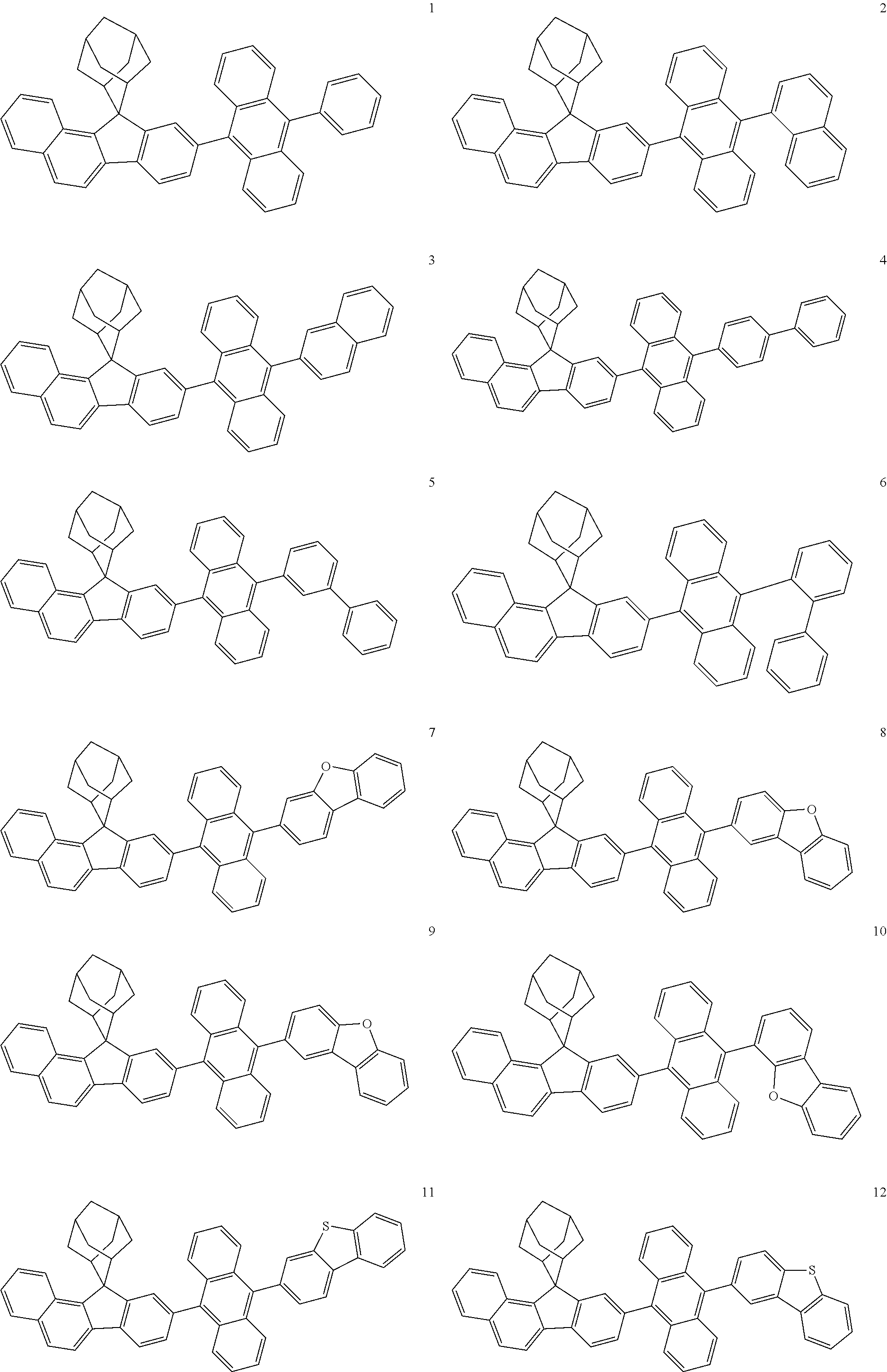
- the organic compound is selected from a group consisting of the following compounds:
- the present disclosure provides an electronic element, comprising an anode and a cathode which is arranged oppositely to the anode, and a functional layer disposed between the anode and the cathode; and the functional layer comprises the organic compound of the first aspect of the present disclosure.
- the organic compound provided by the present disclosure can be used to form at least one organic film layer in the functional layer to improve the efficiency and service life characteristics of electronic elements.
- the functional layer comprises an organic light-emitting layer, and the organic light-emitting layer comprising the organic compound.
- the organic light-emitting layer may comprise a host material and a guest material, where the host material comprises the organic compound of the present disclosure.
- the electronic element is an organic electroluminescent device, for example a blue light device.
- the organic electroluminescent device may comprise an anode 100 , a hole transport layer 321 , an electron blocking layer 322 , an organic light-emitting layer 330 as an energy conversion layer, an electron transport layer 340 , and a cathode 200 which are sequentially stacked.
- the anode 100 comprises an anode material, which is preferably a material with a large work function that facilitates hole injection into the functional layer.
- anode material examples include: metals such as nickel, platinum, vanadium, chromium, copper, zinc, and gold, or their alloy; metal oxides such as zinc oxide, indium oxide, indium tin oxide (ITO) and indium zinc oxide (IZO); combined metals and oxides, such as ZnO:Al or SnO 2 :Sb; or a conductive polymer such as poly(3-methylthiophene), poly[3,4-(ethylene-1,2-dioxy)thiophene] (PEDT), polypyrrole, and polyaniline, but are not limited to this.
- a transparent electrode comprising indium tin oxide (ITO) as the anode is preferably included.
- the hole transport layer 321 and the electron blocking layer 322 each comprise one or more hole transport materials, and the hole transport materials may be selected from a carbazole polymer, carbazole-linked triarylamine compounds, or other types of compounds.
- the organic light-emitting layer 330 may be composed of a single light-emitting material and may also comprise a host material and a guest material.
- the host material of the organic light-emitting layer may comprise the organic compound of the present disclosure.
- the organic light-emitting layer 330 is composed of the host material and the guest material, and holes injected into the organic light-emitting layer 330 and electrons injected into the organic light-emitting layer 330 can be recombined in the organic light-emitting layer 330 to form excitons, the excitons transfer energy to the host material, and the host material transfers energy to the guest material, thus enabling the guest material to emit light.
- the host material of the organic light-emitting layer 330 may be a metal chelate compound, a bis-styryl derivative, an aromatic amine derivative, a dibenzofuran derivative, or other types of materials, which is not specially limited in the present disclosure.
- the host material of the organic light-emitting layer 330 can be the organic compound of the present disclosure.
- the guest material of the organic light-emitting layer 330 may be a compound having a condensed aryl ring or its derivative, a compound having a heteroaryl ring or its derivative, an aromatic amine derivative, or other materials, which is not specially limited in the present disclosure.
- the organic electroluminescent device is a blue light device and the guest material of the organic light-emitting layer 330 is BD-1.
- the electron transport layer 340 may be of a single-layer structure or a multi-layer structure and may comprise one or more electron transport materials, and the electron transport materials can be selected from, but are not limited to, a benzimidazole derivative, an oxadiazole derivative, a quinoxaline derivative, or other electron transport materials.
- the electron transport layer 340 may be composed of ET-06 and LiQ.
- the cathode 200 may comprise a cathode material, which is a material having a small work function that facilitates electron injection into the functional layer.
- a cathode material which is a material having a small work function that facilitates electron injection into the functional layer.
- the cathode material include, but are not limited to, metals such as magnesium, calcium, sodium, potassium, titanium, indium, yttrium, lithium, gadolinium, aluminum, silver, tin, and lead or their alloy; or multilayer materials such as LiF/Al, Liq/Al, LiO 2 /Al, LiF/Ca, LiF/Al, and BaF 2 /Ca.
- a metal electrode comprising silver and magnesium as the cathode is preferably included.
- a hole injection layer 310 may also be arranged between the anode 100 and the hole transport layer 321 to enhance the ability to inject holes into the hole transport layer 321 .
- the hole injection layer 310 can be made of a benzidine derivative, a starburst arylamine compound, a phthalocyanine derivative or other materials, which is not specially limited in the present disclosure.
- the hole injection layer 310 may be composed of F4-TCNQ.
- an electron injection layer 350 may also be arranged between the cathode 200 and the electron transport layer 340 to enhance the ability to inject electrons into the electron transport layer 340 .
- the electron injection layer 350 may comprise an inorganic material such as an alkali metal sulfide and an alkali metal halide, or may comprise a complex of an alkali metal and an organic substance.
- the electron injection layer 350 may be composed of a metal Yb.
- the organic electroluminescent device of the present disclosure is a blue light device.
- a hole blocking layer 341 may also be arranged between the organic light-emitting layer 330 and the electron transport layer 340 .
- the present disclosure provides an electronic device, comprising the electronic element of the second aspect of the present disclosure.
- the electronic device is a first electronic device 400 including the organic electroluminescent device described above.
- the first electronic device 400 may, for example, be a display device, a lighting device, an optical communication device, or other types of electronic devices, and may include, for example, but is not limited to, a computer screen, a mobile phone screen, a television, electronic paper, an emergency lighting lamp, an optical module, and the like.
- the electronic device is a second electronic device 500 including a photoelectric conversion device.
- the second electronic device 500 may, for example, be a solar power plant, a light detector, a fingerprint recognition device, an optical module, a CCD camera, or other types of electronic devices.
- a synthesis method of the organic compound of the present disclosure is specifically described below in conjunction with synthesis examples.
- the synthesis method of the organic compound provided is not particularly limited in the present disclosure, and those skilled in the art can determine a suitable synthesis method according to the organic compound of the present disclosure in combination with preparation methods provided in synthesis examples.
- the synthesis examples of the present disclosure exemplarily provide preparation methods for the organic compounds, and raw materials used may be commercially obtained or obtained by a method well known in the art.
- Those skilled in the art can obtain all organic compounds provided by the present disclosure according to these exemplary preparation methods, and all specific preparation methods for the organic compounds are not described in detail herein, and those skilled in the art should not understand as limiting the present disclosure.
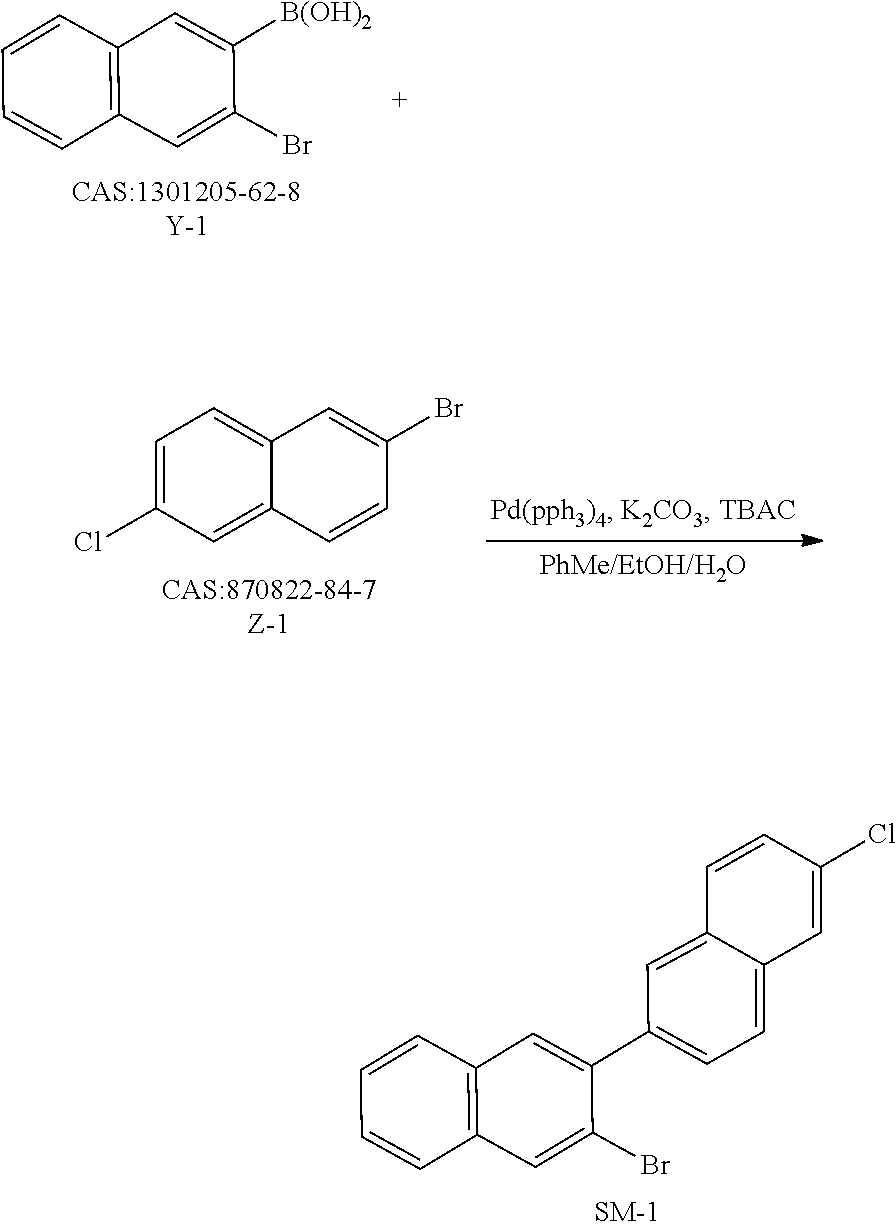
- Y-1 100 g, 398.5 mmol
- Z-1 96.3 g, 398.5 mmol
- tetrakis(triphenylphosphine)palladium 2.3 g, 1.9 mmol
- potassium carbonate 110.2 g, 797.1 mmol
- tetrabutylammonium chloride 0.55 g, 1.9 mmol
- toluene 800 mL
- ethanol 400 mL
- deionized water 200 mL
- Y-2 (33.2 g, 272.2 mmol), Z-2 (100 g, 272.2 mmol), tetrakis(triphenylphosphine)palladium (9.4 g, 8.2 mmol), potassium carbonate (112.8 g, 816.5 mmol), tetrabutylammonium chloride (0.75 g, 2.72 mmol), toluene (800 mL), ethanol (400 mL) and deionized water (200 mL) were added into a three-necked flask, heated to 78° C.
- Y-3 (100 g, 350.5 mmol), Z-3 (71.5 g, 350.5 mmol), tetrakis(triphenylphosphine)palladium (12.1 g, 10.5 mmol), potassium carbonate (145.3 g, 1051.5 mmol), tetrabutylammonium chloride (0.97 g, 3.5 mmol), toluene (800 mL), ethanol (400 mL) and deionized water (200 mL) were added into a three-necked flask, heated to 78° C.
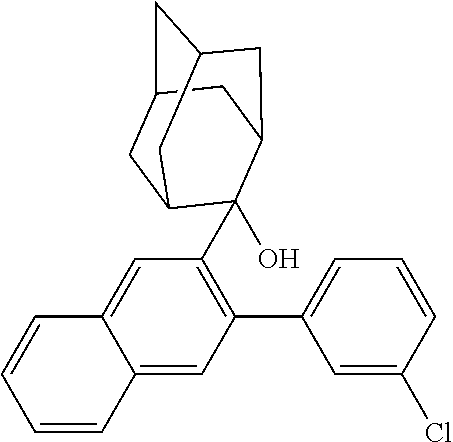
- Intermediates IM-A-X were synthesized with reference to the method for the intermediate IM-A-1, except that the intermediates IM-A-X were prepared by using SMA-X/SM-X shown in Table 1 instead of SMA-1, where the prepared intermediates IM-A-X are as shown in Table 1.
- Intermediates IM-B-X/intermediates M-B-X-0 were synthesized with reference to the synthesis method for the intermediate IM-B-1, except that the intermediates IM-B-X/intermediates IM-B-X-0 were prepared by using intermediates IM-A-X shown in Table 2 instead of the intermediate IM-A-1, where the prepared intermediates IM-B-X/intermediates IM-B-X-0 are as shown in Table 2.
- the intermediate IM-B-1 (15 g, 40.4 mmol), bis(pinacolato)diboron (10.3 g, 40.4 mmol), tris(dibenzylideneacetone)dipalladium (0.74 g, 0.81 mmol), 2-dicyclohexylphosphino-2,4,6-triisopropylbiphenyl (0.19 g, 0.40 mmol), potassium acetate (7.9 g, 80.8 mmol) and 1,4-dioxane (150 mL) were added into a reaction flask, heated to 110° C. under nitrogen protection, and stirred under heating and refluxing for 5 h.
- Intermediates IM-C-X/intermediates IM-C-X-0 were synthesized with reference to the method for the intermediate IM-C-1, except that the intermediates IM-C-X/intermediates IM-C-X-0 were prepared by using intermediates IM-B-X/intermediates IM-B-X-0 shown in Table 3 instead of the intermediate IM-B-1, where the prepared intermediates IM-C-X/intermediates IM-C-X-0 are as shown in Table 3.
- Intermediates IM-M-X were synthesized with reference to the method for the intermediate IM-M-1, except that the intermediates IM-M-X were prepared by using intermediates IM-C-X/intermediates IM-C-X-0 shown in Table 4 instead of the intermediate IM-C-1, and SM A was used instead of p-bromophenylboronic acid, and the prepared intermediates IM-M-X are as shown in Table 4.
- Intermediates IM-D-X/intermediates IM-D-X-0 were synthesized with reference to the method for the intermediate IM-D-1, except that the intermediates IM-D-X/intermediates IM-D-X-0 were prepared by using intermediates IM-C-X/intermediates IM-C-X-0/intermediates IM-M-X instead of the intermediate IM-C-1, where the prepared intermediates IM-D-X/intermediates IM-D-X-0 are as shown in Table 5.
- An anode was prepared by the following process: an ITO substrate (manufactured by Corning) with a thickness of 1500 ⁇ was cut into a dimension of 40 mm ⁇ 40 mm ⁇ 0.7 mm to be prepared into an experimental substrate with a cathode pattern, an anode pattern and an insulating layer pattern by adopting a photoetching process, and surface treatment was performed by utilizing ultraviolet ozone and O 2 :N 2 plasma so as to increase the work function of the anode (the experimental substrate) and remove scum.
- F4-TCNQ was vacuum-evaporated on the experimental substrate (the anode) to form a hole injection layer (HIL) with a thickness of 100 ⁇
- HIL hole injection layer
- NPB hole transport layer
- a compound EB-01 was evaporated on the HTL to be used as an electron blocking layer (EBL) with a thickness of 100 ⁇ .
- EBL electron blocking layer
- a compound 1 as a host was doped simultaneously with BD-1 at a film thickness ratio of 100:3 on the EBL to form an organic light-emitting layer (EML) with a thickness of 200 ⁇ .
- EML organic light-emitting layer
- ET-06 and LiQ were evaporated on the EML at a film thickness ratio of 1:1 to form an electron transport layer (ETL) with a thickness of 300 ⁇
- ETL electron transport layer
- EIL electron injection layer
- Mg magnesium
- Ag silver
- CPL organic capping layer
- An organic electroluminescent device was manufactured by the same method as that in Example 1 except that compounds shown in the following Table 10 were used instead of the compound 1 when the organic light-emitting layer was formed.
- An organic electroluminescent device was manufactured by the same method as that in Example 1 except that a compound A shown in the following Table 9 was used instead of the compound 1 when the organic light-emitting layer was formed.
- An organic electroluminescent device was manufactured by the same method as that in Example 1 except that a compound B shown in the following Table 9 was used instead of the compound 1 when the organic light-emitting layer was formed.
- An organic electroluminescent device was manufactured by the same method as that in Example 1 except that a compound C shown in the following Table 9 was used instead of the compound 1 when the organic light-emitting layer was formed.
- An organic electroluminescent device was manufactured by the same method as that in Example 1 except that a compound D shown in the following Table 9 was used instead of the compound 1 when the organic light-emitting layer was formed.
Landscapes
- Chemical & Material Sciences (AREA)
- Organic Chemistry (AREA)
- Engineering & Computer Science (AREA)
- Materials Engineering (AREA)
- Physics & Mathematics (AREA)
- Spectroscopy & Molecular Physics (AREA)
- Optics & Photonics (AREA)
- Electroluminescent Light Sources (AREA)
Abstract
Description

-
- L1 and L2 are the same or different, and are each independently selected from a single bond, substituted or unsubstituted arylene with 6 to 30 carbon atoms, and substituted or unsubstituted heteroarylene with 3 to 30 carbon atoms;
- each R1 and R2 are the same or different, and are respectively and independently selected from: hydrogen, deuterium, a halogen group, cyano, haloalkyl with 1 to 10 carbon atoms, alkyl with 1 to 10 carbon atoms, cycloalkyl with 3 to 15 carbon atoms, alkoxy with 1 to 4 carbon atoms, alkylthio with 1 to 4 carbon atoms, trialkylsilyl with 3 to 12 carbon atoms, triarylsilyl with 18 to 24 carbon atoms, aryl with 6 to 12 carbon atoms, heteroaryl with 4 to 12 carbon atoms, and heteroaralkyl with 5 to 13 carbon atoms;
- m represents the number of R1, q represents the number of R2; m and q are respectively and independently selected from 1, 2, 3, 4, 5, 6, 7 or 8;
- Ar1 is selected from substituted or unsubstituted aryl with 6 to 30 carbon atoms, and substituted or unsubstituted heteroaryl with 3 to 30 carbon atoms;
- substituents in the L1, L2 and Ar1 are the same or different, and are each independently selected from: deuterium, a halogen group, cyano, heteroaryl with 3 to 20 carbon atoms, aryl with 6 to 20 carbon atoms which can be optionally substituted by 0, 1, 2, 3, 4, or 5 substituents independently selected from deuterium, fluorine, cyano, methyl, and tert-butyl, alkyl with 1 to 10 carbon atoms, haloalkyl with 1 to 10 carbon atoms, cycloalkyl with 3 to 10 carbon atoms, alkoxy with 1 to 10 carbon atoms, alkylthio with 1 to 10 carbon atoms, trialkylsilyl with 3 to 12 carbon atoms, triarylsilyl with 18 to 24 carbon atoms, and phosphinyloxy with 6 to 18 carbon atoms.
-
- preferably, the functional layer comprises an organic light-emitting layer, and the organic light-emitting layer comprises the organic compound;
- more preferably, the organic light-emitting layer comprises a host material and a guest material, and the host material comprises the organic compound.

-
- wherein ring A and ring B are the same or different, and are each independently selected from a benzene ring or a fused aromatic ring with 10 to 14 ring-forming carbon atoms, and at least one of ring A and ring B is selected from the fused aromatic ring with 10 to 14 ring-forming carbon atoms;
- L1 and L2 are the same or different, and are each independently selected from a single bond, substituted or unsubstituted arylene with 6 to 30 carbon atoms, and substituted or unsubstituted heteroarylene with 3 to 30 carbon atoms;
- each R1 and R2 are the same or different, and are respectively and independently selected from: hydrogen, deuterium, a halogen group, cyano, haloalkyl with 1 to 10 carbon atoms, alkyl with 1 to 10 carbon atoms, cycloalkyl with 3 to 15 carbon atoms, alkoxy with 1 to 4 carbon atoms, alkylthio with 1 to 4 carbon atoms, trialkylsilyl with 3 to 12 carbon atoms, triarylsilyl with 18 to 24 carbon atoms, aryl with 6 to 12 carbon atoms, heteroaryl with 4 to 12 carbon atoms, and heteroaralkyl with 5 to 13 carbon atoms;
- m represents the number of R1, q represents the number of R2; m and q are respectively and independently selected from 1, 2, 3, 4, 5, 6, 7 or 8;
- Ar1 is selected from substituted or unsubstituted aryl with 6 to 30 carbon atoms, and substituted or unsubstituted heteroaryl with 3 to 30 carbon atoms;
- substituents in the L1, L2 and Ar1 are the same or different, and are each independently selected from: deuterium, a halogen group, cyano, heteroaryl with 3 to 20 carbon atoms, aryl with 6 to 20 carbon atoms which can be optionally substituted by 0, 1, 2, 3, 4, or 5 substituents independently selected from deuterium, fluorine, cyano, methyl, and tert-butyl, alkyl with 1 to 10 carbon atoms, haloalkyl with 1 to 10 carbon atoms, cycloalkyl with 3 to 10 carbon atoms, alkoxy with 1 to 10 carbon atoms, alkylthio with 1 to 10 carbon atoms, trialkylsilyl with 3 to 12 carbon atoms, triarylsilyl with 18 to 24 carbon atoms, and phosphinyloxy with 6 to 18 carbon atoms.


where each q is independently 0, 1, 2 or 3 and each R″ is independently selected from hydrogen, deuterium, fluorine, and chlorine”, the meaning is as follows: a formula Q-1 represents that q substituents R″ exist on the benzene ring, wherein each R″ can be the same or different, and options of each R″ do not influence each other; and a formula Q-2 represents that each benzene ring of biphenyl has q substituents R″, the number q of the substituents R″ on the two benzene rings can be the same or different, each R″ can be the same or different, and options of each R″ do not influence each other.

then the number of carbon atoms is 7; and if L1 is

the number of carbon atoms is 12.

extending from a ring system, which indicates that one end of the connecting bond can be connected to any position in the ring system through which the bond penetrates, and the other end of the connecting bond is connected to the remaining part of a compound molecule.


is selected from a group consisting of structures shown as follow:


represents a chemical bond for connecting with

in the above structures, and

represents a chemical bond for connecting with

in the above structures.

when q is equal to 1,

is selected from a group consisting of structures shown as follow:


represents a chemical bond for connecting with

in the above structures, and

represents a chemical bond for connecting with

in the above structures.

is selected from a group consisting of structures shown as follow:

represents a chemical bond for connecting with

in the above structures, and

represents a chemical bond for connecting with

in the

above structures.

when m is equal to 1,

is selected from a group consisting of structures shown as follow:


represents a chemical bond for connecting with

in the above structures, and

represents a chemical bond for connecting with

in the above structures.


-
- G6 to G13 are each independently selected from N, C or C(J2), and at least one of G6 to G13 is selected from N; and when two or more of G6 to G13 are selected from C(J2), any two J2s are the same or different;
- G14 to G23 are each independently selected from N, C or C(J3), and at least one of G14 to G23 is selected from N; and when two or more of G14 to G23 are selected from C(J3), any two J3s are the same or different;
- G24 to G33 are each independently selected from N, C or C(J4), and at least one of G24 to G33 is selected from N; and when two or more of G24 to G33 are selected from C(J4), any two J4s are the same or different;
- Z1 is selected from hydrogen, deuterium, a halogen group, cyano, trialkylsilyl with 3 to 12 carbon atoms, alkyl with 1 to 10 carbon atoms, haloalkyl with 1 to 10 carbon atoms, cycloalkyl with 3 to 10 carbon atoms, alkoxy with 1 to 10 carbon atoms, alkylthio with 1 to 10 carbon atoms, and triarylsilyl with 18 to 24 carbon atoms;
- Z2 to Z9, and Z21 are each independently selected from: hydrogen, deuterium, a halogen group, cyano, trialkylsilyl with 3 to 12 carbon atoms, alkyl with 1 to 10 carbon atoms, haloalkyl with 1 to 10 carbon atoms, cycloalkyl with 3 to 10 carbon atoms, alkoxy with 1 to 10 carbon atoms, alkylthio with 1 to 10 carbon atoms, heteroaryl with 3 to 18 carbon atoms, and triarylsilyl with 18 to 24 carbon atoms;
- Z10 to Z20, and J1 to J4 are each independently selected from: hydrogen, deuterium, a halogen group, cyano, trialkylsilyl with 3 to 12 carbon atoms, alkyl with 1 to 10 carbon atoms, haloalkyl with 1 to 10 carbon atoms, cycloalkyl with 3 to 10 carbon atoms, alkoxy with 1 to 10 carbon atoms, alkylthio with 1 to 10 carbon atoms, aryl with 6 to 20 carbon atoms which can be optionally substituted by 0, 1, 2, 3, 4, or 5 substituents independently selected from deuterium, fluorine, cyano, methyl, and tert-butyl, heteroaryl with 3 to 18 carbon atoms, and triarylsilyl with 18 to 24 carbon atoms;
- h1 to h21 are represented by hk, Z1 to Z21 are represented by Zk, k is a variable, and represents any integer from 1 to 21, and hk represents the number of a substituent Zk; when k is selected from 5 or 17, hk is selected from 1, 2 or 3; when k is selected from 2, 7, 8, 12, 15, 16, 18 or 21, hk is selected from 1, 2, 3 or 4; when k is selected from 1, 3, 4, 6, 9 or 14, hk is selected from 1, 2, 3, 4 or 5; when k is 13, hk is selected from 1, 2, 3, 4, 5, or 6; when k is selected from 10 or 19, hk is selected from 1, 2, 3, 4, 5, 6 or 7; when k is 20, hk is selected from 1, 2, 3, 4, 5, 6, 7, or 8; when k is 11, hk is selected from 1, 2, 3, 4, 5, 6, 7, 8 or 9; and when hk is greater than 1, any two Zks are the same or different;
- K1 is selected from O, S, N(Z22), C(Z23Z24), and Si(Z28Z29); where Z22, Z23, Z24, Z28, and Z29 are each independently selected from aryl with 6 to 18 carbon atoms, heteroaryl with 3 to 18 carbon atoms, alkyl with 1 to 10 carbon atoms, or cycloalkyl with 3 to 10 carbon atoms, or the Z23 and the Z24 are connected to each other to form a saturated or unsaturated ring with 3 to 15 carbon atoms together with the atoms to which they are commonly connected, or the Z28 and the Z29 are connected to each other to form a saturated or unsaturated ring with 3 to 15 carbon atoms together with the atoms to which they are commonly connected; and
- K2 is selected from a single bond, O, S, N(Z25), C(Z26Z27), and Si(Z30Z31); where Z25, Z26, Z27, Z30, and Z31 are each independently selected from aryl with 6 to 18 carbon atoms, heteroaryl with 3 to 18 carbon atoms, alkyl with 1 to 10 carbon atoms, or cycloalkyl with 3 to 10 carbon atoms, or the Z26 and the Z27 are connected to each other to form a saturated or unsaturated ring with 3 to 15 carbon atoms together with the atoms to which they are commonly connected, or the Z30 and the Z31 are connected to each other to form a saturated or unsaturated ring with 3 to 15 carbon atoms together with the atoms to which they are commonly connected.


and

represents a chemical bond;
-
- Q1 to Q5 and Q′1 to Q′4 are each independently selected from N or C(J5), and at least one of Q1-Q5 is selected from N; and when two or more of Q1 to Q5 are selected from C(J5), any two J5 are the same or different, and when two or more of Q′1 to Q′4 are selected from C(J5), any two J5s are the same or different;
- Q6 to Q13 are each independently selected from N, C or C(J6), and at least one of Q6 to Q13 is selected from N; and when two or more of Q6 to Q13 are selected from C(J6), any two J6s are the same or different;
- Q14 to Q23 are each independently selected from N, C or C(J7), and at least one of Q14 to Q23 is selected from N; and when two or more of Q14 to Q23 are selected from C(J7), any two J7s are the same or different;
- Q24 to Q33 are each independently selected from N, C or C(J8), and at least one of Q24 to Q33 is selected from N; and when two or more of Q24 to Q33 are selected from C(J8), any two J8s are the same or different;
- E1 to E14, and J5 to J8 are each independently selected from: hydrogen, deuterium, a halogen group, cyano, heteroaryl with 3 to 20 carbon atoms, aryl with 6 to 20 carbon atoms which can be optionally substituted by 0, 1, 2, 3, 4, or 5 independently selected from deuterium, fluorine, chlorine, cyano, methyl, and tert-butyl, trialkylsilyl with 3 to 12 carbon atoms, alkyl with 1 to 10 carbon atoms, cycloalkyl with 3 to 10 carbon atoms, alkoxy with 1 to 10 carbon atoms, alkylthio with 1 to 10 carbon atoms, phosphinyloxy with 6 to 18 carbon atoms, and triarylsilyl with 18 to 24 carbon atoms;
- e1 to e14 are represented by er, E1 to E14 are represented by Er, r is a variable, and represents any integer from 1 to 14, and er represents the number of a substituent Er; when r is selected from 1, 2, 3, 4, 5, 6, 9, 13 or 14, er is selected from 1, 2, 3 or 4; when r is selected from 7 or 11, er is selected from 1, 2, 3, 4, 5 or 6; when r is 12, er is selected from 1, 2, 3, 4, 5, 6, or 7; when r is selected from 8 or 10, er is selected from 1, 2, 3, 4, 5, 6, 7, or 8; and when er is greater than 1, any two Ers are the same or different;
- K3 is selected from O, S, Se, N(E15), C(E16E17), and Si(E18E19); where E15, E16, E17, E18 and E19 are each independently selected from: aryl with 6 to 20 carbon atoms, heteroaryl with 3 to 20 carbon atoms, alkyl with 1 to 10 carbon atoms, and cycloalkyl with 3 to 10 carbon atoms, or E16 and E17 are connected to each other to form a saturated or unsaturated ring with 3 to 15 carbon atoms together with the atoms to which they are commonly connected, or E18 and E19 are connected to each other to form a saturated or unsaturated ring with 3 to 15 carbon atoms together with the atoms to which they are commonly connected;
- K4 is selected from a single bond, O, S, Se, N(E20), C(E21E22), and Si(E23E24); where E20 to E24 are each independently selected from: aryl with 6 to 20 carbon atoms, heteroaryl with 3 to 20 carbon atoms, alkyl with 1 to 10 carbon atoms, and cycloalkyl with 3 to 10 carbon atoms, or E21 and E22 are connected to each other to form a saturated or unsaturated ring with 3 to 15 carbon atoms together with the atoms to which they are commonly connected, or E23 and E24 are connected to each other to form a saturated or unsaturated ring with 3 to 15 carbon atoms together with the atoms to which they are commonly connected.




| TABLE 1 | ||
| SMA-X/SM-X | Intermediate IM-A-X | Yield (%) |
 |
 |
79 |
| IM-A-2 | ||
 |
 |
77 |
| IM-A-3 | ||
 |
 |
76 |
| IM-A-4 | ||
 |
 |
77 |
| IM-A-5 | ||
 |
 |
75 |
| IM-A-6 | ||
 |
 |
74 |
| IM-A-7 | ||
 |
 |
78 |
| IM-A-8 | ||
 |
 |
77 |
| IM-A-9 | ||
 |
 |
78 |
| IM-A-10 | ||
 |
 |
78 |
| IM-A-11 | ||
 |
 |
77 |
| IM-A-12 | ||

| TABLE 2 | ||
| Intermediate IM-B-X/ | ||
| Intermediate IM-A-X | intermediate IM-B-X-O | Yield (%) |
 |
 |
41 |
| IM-A-2 | ||
 |
39 | |
| IM-B-2-0 | ||
 |
 |
81 |
| IM-A-3 | IM-B-3 | |
 |
 |
83 |
 |
 |
38 |
 |
39 | |
| IM-B-5-0 | ||
 |
 |
84 |
| IM-A-6 | IM-B-6 | |
 |
 |
83 |
 |
 |
38 |
 |
37 | |
| IM-B-8-0 | ||
 |
 |
82 |
 |
 |
82 |
 |
 |
84 |
 |
 |
83 |

| TABLE 3 | ||
| Intermediate IM-B-X/ | Intermediate IM-C-X/ | |
| intermediate IM-B-X-0 | intermediate IM-C-X-0 | Yield (%) |
 |
 |
75 |
| IM-C-2 | ||
 |
 |
73 |
| IM-B-2-0 | IM-C-2-0 | |
 |
 |
71 |
| IM-C-3 | ||
 |
 |
74 |
| IM-B-4 | IM-C-4 | |
 |
 |
73 |
| IM-C-5 | ||
 |
 |
76 |
| IM-B-5-0 | IM-C-5-0 | |
 |
 |
73 |
| IM-C-6 | ||
 |
 |
74 |
| IM-B-7 | IM-C-7 | |
 |
 |
75 |
| IM-C-8 | ||
 |
 |
74 |
| IM-B-8-0 | IM-C-8-0 | |
 |
 |
76 |
| IM-C-9 | ||
 |
 |
75 |
 |
 |
73 |
| IM-B-11 | IM-C-11 | |
 |
 |
74 |
| IM-C-12 | ||

| TABLE 4 | |||
| Intermediate IM-C-X/ | |||
| intermediate IM-C-X-0 | SM A | Intermediate IM-M-X | Yield (%) |
 |
 |
 |
73 |
| IM-M-2 | |||
 |
 |
 |
72 |
| IM-M-3 | |||
 |
 |
 |
73 |
| IM-M-4 | |||

| TABLE 5 | ||
| Intermediate IM-C-X/ | ||
| intermediate IM-C-X-0/ | Intermediate IM-D-X/ | |
| intermediate IM-M-X | intermediate IM-D-X-0 | Yield (%) |
 |
 |
71 |
 |
 |
70 |
 |
 |
71 |
 |
 |
72 |
 |
 |
73 |
 |
 |
74 |
| IM-C-5-0 | IM-D-5-0 | |
 |
 |
70 |
 |
 |
71 |
| IM-C-7 | IM-D-7 | |
 |
 |
70 |
 |
 |
71 |
| IM-C-8-0 | IM-D-8-0 | |
 |
 |
70 |
| IM-D-9 | ||
 |
 |
72 |
| IM-D-10 | ||
 |
 |
72 |
 |
 |
73 |
| IM-D-12 | ||
 |
 |
74 |
| IM-D-13 | ||
 |
 |
75 |
| IM-D-13-0 | ||
 |
 |
76 |
| IM-D-14 | ||
 |
 |
72 |
| IM-D-15 | ||

| TABLE 6 | |||
| Intermediate IM-D-X/ | Raw material | ||
| intermediate IM-D-X-0 | SM B | Compound X | Yield (%) |
 |
 |
 |
76 |
| IM-D-1 | 2 | ||
 |
 |
77 | |
| 5 | |||
 |
 |
75 | |
| 6 | |||
 |
 |
74 | |
| 7 | |||
 |
 |
 |
76 |
| 35 | |||
 |
 |
75 | |
| 45 | |||
 |
 |
74 | |
| 49 | |||
 |
 |
 |
76 |
| 75 | |||
 |
 |
 |
73 |
| 73 | |||
 |
 |
72 | |
| 70 | |||
 |
 |
 |
73 |
| 88 | |||
 |
 |
75 | |
| 107 | |||
 |
 |
 |
74 |
| 119 | |||
 |
 |
 |
75 |
| 148 | |||
 |
 |
 |
73 |
| 136 | |||
 |
 |
 |
72 |
| 162 | |||
 |
 |
71 | |
| 175 | |||
 |
 |
 |
70 |
| 186 | |||
 |
 |
71 | |
| 186 | |||
 |
 |
 |
73 |
| 152 | |||
 |
 |
 |
72 |
| 212 | |||
 |
 |
 |
71 |
| 317 | |||
 |
 |
 |
70 |
| 231 | |||
 |
 |
 |
73 |
| 247 | |||
 |
 |
 |
72 |
| 260 | |||
 |
 |
 |
73 |
| 316 | |||
 |
 |
 |
71 |
| 276 | |||
 |
 |
 |
73 |
| 291 | |||
| TABLE 7 | |||
| Compound | Mass spectrum [M + H]+ | Compound | Mass spectrum [M + H]+ |
| 1 | 589.3 | 136 | 695.3 |
| 2 | 639.3 | 162 | 679.3 |
| 5 | 665.3 | 175 | 755.3 |
| 6 | 665.3 | 182 | 665.3 |
| 7 | 679.3 | 186 | 679.3 |
| 35 | 639.3 | 152 | 679.3 |
| 45 | 695.3 | 212 | 715.3 |
| 49 | 705.3 | 317 | 729.3 |
| 75 | 755.3 | 231 | 711.3 |
| 73 | 689.3 | 247 | 639.3 |
| 70 | 715.3 | 260 | 681.3 |
| 88 | 665.3 | 316 | 681.3 |
| 107 | 771.3 | 276 | 805.3 |
| 119 | 715.3 | 291 | 791.3 |
| 148 | 665.3 | ||
| TABLE 8 | |
| Compound | NMR data |
| Compound | 1HNMR (400 MHz, CD2Cl2): 8.67 (d, 2H), 8.55 (d, 2H), 8.51 (d, 1H), |
| 2 | 7.95-7.90 (m, 3H), 7.85-7.74 (m, 5H), 7.70 (s, 1H), 7.61-7.57 (m, 2H), |
| 7.54-7.45 (m, 6H), 7.42-7.36 (m, 2H), 2.82-2.77 (m, 2H), 2.45 (d, 1H), | |
| 2.03 (s, 2H), 1.92-1.80 (m, 3H), 1.44-1.34 (m, 2H), 1.27-1.14 (m, 3H), | |
| 1.04 (d, 1H). | |
| Compound | 1HNMR (400 MHz, CD2Cl2): 8.60 (d, 1H), 8.54-8.50 (m, 4H), 8.55 (s, |
| 107 | 1H), 7.98 (d, 1H), 7.93-7.87 (m, 5H), 7.83-7.77 (m, 3H), 7.76 (s, 1H), 7.68 |
| (s, 1H), 7.65 (d, 1H), 7.58-7.53 (m, 6H), 7.49-7.35 (m, 4H), 2.83-2.78 (m, | |
| 2H), 2.46 (d, 1H), 2.04 (s, 2H), 1.93-1.81 (m, 3H), 1.45-1.36 (m, 2H), | |
| 1.28-1.15 (m, 3H), 1.06 (d, 1H). | |
| Compound | 1HNMR (400 MHz, CD2Cl2): 8.15-8.12 (m, 4H), 7.99 (d, 1H), 7.89-7.73 |
| 212 | (m, 9H), 7.64-7.60 (m, 1H), 7.55 (d, 2H), 7.54-7.38 (m, 10H), 7.05 (d,lH), |
| 2.85-2.79 (m, 2H), 2.45 (d, 1H), 2.03 (s, 2H), 1.94-1.82 (m, 3H), 1.46- | |
| 1.37 (m, 2H), 1.27-1.15 (m, 3H), 1.05 (d, 1H). | |
| TABLE 9 |
 |
| F4-TCNQ |
 |
| NPB |
 |
| EB-01 |
 |
| BD-1 |
 |
| ET-06 |
 |
| LiQ |
 |
| CP-5 |
 |
| Compound A |
 |
| Compound B |
 |
| Compound C |
 |
| Compound D |
| TABLE 10 | ||||||||
| T95 | ||||||||
| Volt | EQE | (hrs)@15 | ||||||
| Compound | (V) | Cd/A | Im/W | CIE-x | CIE-y | % | mA/cm2 | |
| Example 1 | Compound | 3.93 | 6.78 | 5.42 | 0.14 | 0.05 | 13.95 | 293 |
| 1 | ||||||||
| Example 2 | Compound | 3.91 | 6.73 | 5.41 | 0.14 | 0.05 | 13.84 | 295 |
| 2 | ||||||||
| Example 3 | Compound | 3.87 | 6.65 | 5.40 | 0.14 | 0.05 | 13.68 | 290 |
| 5 | ||||||||
| Example 4 | Compound | 3.95 | 6.71 | 5.34 | 0.14 | 0.05 | 13.80 | 304 |
| 6 | ||||||||
| Example 5 | Compound | 3.87 | 6.55 | 5.32 | 0.14 | 0.05 | 13.47 | 311 |
| 7 | ||||||||
| Example 6 | Compound | 3.96 | 6.55 | 5.20 | 0.14 | 0.05 | 13.47 | 325 |
| 35 | ||||||||
| Example 7 | Compound | 3.89 | 6.62 | 5.35 | 0.14 | 0.05 | 13.62 | 303 |
| 45 | ||||||||
| Example 8 | Compound | 3.83 | 6.74 | 5.53 | 0.14 | 0.05 | 13.86 | 297 |
| 49 | ||||||||
| Example 9 | Compound | 3.94 | 6.59 | 5.25 | 0.14 | 0.05 | 13.56 | 196 |
| 75 | ||||||||
| Example 10 | Compound | 3.94 | 6.66 | 5.31 | 0.14 | 0.05 | 13.70 | 329 |
| 73 | ||||||||
| Example 11 | Compound | 3.87 | 6.71 | 5.45 | 0.14 | 0.05 | 13.80 | 297 |
| 70 | ||||||||
| Example 12 | Compound | 3.87 | 6.74 | 5.47 | 0.14 | 0.05 | 13.86 | 291 |
| 88 | ||||||||
| Example 13 | Compound | 3.86 | 6.55 | 5.33 | 0.14 | 0.05 | 13.47 | 317 |
| 107 | ||||||||
| Example 14 | Compound | 3.91 | 6.53 | 5.25 | 0.14 | 0.05 | 13.43 | 314 |
| 119 | ||||||||
| Example 15 | Compound | 3.96 | 6.58 | 5.22 | 0.14 | 0.05 | 13.54 | 215 |
| 148 | ||||||||
| Example 16 | Compound | 3.86 | 6.58 | 5.36 | 0.14 | 0.05 | 13.54 | 305 |
| 136 | ||||||||
| Example 17 | Compound | 3.97 | 6.77 | 5.36 | 0.14 | 0.05 | 13.93 | 314 |
| 162 | ||||||||
| Example 18 | Compound | 3.87 | 6.80 | 5.52 | 0.14 | 0.05 | 13.99 | 303 |
| 175 | ||||||||
| Example 19 | Compound | 3.85 | 6.48 | 5.29 | 0.14 | 0.05 | 13.33 | 311 |
| 182 | ||||||||
| Example 20 | Compound | 3.88 | 6.77 | 5.48 | 0.14 | 0.05 | 13.93 | 309 |
| 186 | ||||||||
| Example 21 | Compound | 3.90 | 6.52 | 5.25 | 0.14 | 0.05 | 13.41 | 190 |
| 152 | ||||||||
| Example 22 | Compound | 3.95 | 6.55 | 5.21 | 0.14 | 0.05 | 13.47 | 314 |
| 212 | ||||||||
| Example 23 | Compound | 3.96 | 6.56 | 5.20 | 0.14 | 0.05 | 13.49 | 230 |
| 317 | ||||||||
| Example 24 | Compound | 3.92 | 6.54 | 5.24 | 0.14 | 0.05 | 13.45 | 305 |
| 231 | ||||||||
| Example 25 | Compound | 3.97 | 6.56 | 5.19 | 0.14 | 0.05 | 13.49 | 254 |
| 247 | ||||||||
| Example 26 | Compound | 3.93 | 6.42 | 5.13 | 0.14 | 0.05 | 13.21 | 316 |
| 260 | ||||||||
| Example 27 | Compound | 3.90 | 6.50 | 5.24 | 0.14 | 0.05 | 13.37 | 308 |
| 316 | ||||||||
| Example 28 | Compound | 3.95 | 6.46 | 5.14 | 0.14 | 0.05 | 13.29 | 296 |
| 276 | ||||||||
| Example 29 | Compound | 3.92 | 6.52 | 5.23 | 0.14 | 0.05 | 13.41 | 243 |
| 291 | ||||||||
| Comparative | Compound | 4.05 | 5.96 | 4.69 | 0.14 | 0.05 | 12.26 | 155 |
| Example 1 | A | |||||||
| Comparative | Compound | 4.04 | 6.02 | 4.74 | 0.14 | 0.05 | 12.38 | 158 |
| Example 2 | B | |||||||
| Comparative | Compound | 4.11 | 5.85 | 4.50 | 0.14 | 0.05 | 12.03 | 162 |
| Example 3 | C | |||||||
| Comparative | Compound | 4.09 | 5.91 | 4.66 | 0.14 | 0.05 | 12.16 | 170 |
| Example 4 | D | |||||||
Claims (13)




Applications Claiming Priority (3)
| Application Number | Priority Date | Filing Date | Title |
|---|---|---|---|
| CN202011063177.8 | 2020-09-30 | ||
| CN202011063177.8A CN112142548B (en) | 2020-09-30 | 2020-09-30 | Organic compound, and electronic element and electronic device using same |
| PCT/CN2021/102557 WO2022068292A1 (en) | 2020-09-30 | 2021-06-25 | Organic compound, and electronic element and electronic device using same |
Publications (2)
| Publication Number | Publication Date |
|---|---|
| US20230200215A1 US20230200215A1 (en) | 2023-06-22 |
| US11800792B2 true US11800792B2 (en) | 2023-10-24 |
Family
ID=73951893
Family Applications (1)
| Application Number | Title | Priority Date | Filing Date |
|---|---|---|---|
| US18/011,754 Active 2041-06-25 US11800792B2 (en) | 2020-09-30 | 2021-06-25 | Organic compound with spirocyclic adamantane, and electronic element and electronic device using same |
Country Status (3)
| Country | Link |
|---|---|
| US (1) | US11800792B2 (en) |
| CN (1) | CN112142548B (en) |
| WO (1) | WO2022068292A1 (en) |
Families Citing this family (3)
| Publication number | Priority date | Publication date | Assignee | Title |
|---|---|---|---|---|
| CN111848501B (en) | 2020-05-08 | 2021-06-01 | 陕西莱特光电材料股份有限公司 | Nitrogen-containing compound, and electronic element and electronic device using same |
| CN112142548B (en) | 2020-09-30 | 2021-09-24 | 陕西莱特光电材料股份有限公司 | Organic compound, and electronic element and electronic device using same |
| CN114835692A (en) * | 2021-02-02 | 2022-08-02 | 上海嵘彩光电材料有限公司 | Compound and organic electronic device thereof |
Citations (27)
| Publication number | Priority date | Publication date | Assignee | Title |
|---|---|---|---|---|
| US20040062726A1 (en) * | 2002-09-17 | 2004-04-01 | Bonda Craig A. | Novel photostabilizers, UV absorbers, and methods of photostabilizing a sunscreen composition |
| US20090105488A1 (en) * | 2007-10-22 | 2009-04-23 | Chien-Hong Cheng | Triptycene derivatives and their application |
| WO2011010843A1 (en) | 2009-07-21 | 2011-01-27 | Rohm And Haas Electronic Materials Korea Ltd. | Novel organic electroluminescent compounds and organic electroluminescent device using the same |
| US20120194062A1 (en) * | 2011-01-28 | 2012-08-02 | Semiconductor Energy Laboratory Co., Ltd. | Composite Material, Light-Emitting Element, Light-Emitting Device, Lighting Device, Electronic Device, and Fluorene Derivative |
| US20150236267A1 (en) * | 2014-02-17 | 2015-08-20 | Samsung Display Co., Ltd. | Organic electroluminescence device |
| US9145383B2 (en) * | 2012-08-10 | 2015-09-29 | Hallstar Innovations Corp. | Compositions, apparatus, systems, and methods for resolving electronic excited states |
| US9192552B2 (en) * | 2011-07-07 | 2015-11-24 | The Procter & Gamble Company | Personal care compositions with improved solubility of a solid UV active |
| US9271912B2 (en) * | 2012-06-13 | 2016-03-01 | The Procter & Gamble Company | Personal care compositions comprising a pH tuneable gellant and methods of using |
| US20160181542A1 (en) * | 2013-09-06 | 2016-06-23 | Idemitsu Kosan Co., Ltd. | Anthracene derivative and organic electroluminescent element using same |
| CN106206964A (en) | 2015-05-27 | 2016-12-07 | 三星显示有限公司 | organic light emitting device |
| US9549891B2 (en) * | 2012-03-19 | 2017-01-24 | The Procter & Gamble Company | Superabsorbent polymers and sunscreen actives for use in skin care compositions |
| US9675531B2 (en) * | 2011-06-20 | 2017-06-13 | The Procter & Gamble Company | Personal care compositions comprising shaped abrasive particles |
| US9867800B2 (en) * | 2012-08-10 | 2018-01-16 | Hallstar Innovations Corp. | Method of quenching singlet and triplet excited states of pigments, such as porphyrin compounds, particularly protoporphyrin IX, with conjugated fused tricyclic compounds have electron withdrawing groups, to reduce generation of reactive oxygen species, particularly singlet oxygen |
| US20180309081A1 (en) * | 2015-10-20 | 2018-10-25 | Idemitsu Kosan Co., Ltd. | Organic electroluminescence device |
| US20180309057A1 (en) * | 2015-10-20 | 2018-10-25 | Idemitsu Kosan Co., Ltd. | Organic electroluminescence device |
| US20190010256A1 (en) * | 2016-03-11 | 2019-01-10 | Lg Chem, Ltd. | Supported hybrid catalyst system for ethylene slurry polymerization and method for preparing ethylene polymer with the catalyst system |
| US10285926B2 (en) * | 2015-06-29 | 2019-05-14 | The Procter & Gamble Company | Superabsorbent polymers and starch powders for use in skin care compositions |
| US20190363259A1 (en) * | 2016-01-29 | 2019-11-28 | Semiconductor Energy Laboratory Co., Ltd. | Light-emitting element, light-emitting device, electronic device, and lighting device |
| WO2020046049A1 (en) | 2018-08-31 | 2020-03-05 | 주식회사 엘지화학 | Novel compound and organic light emitting device using same |
| CN111018797A (en) | 2019-12-26 | 2020-04-17 | 陕西莱特光电材料股份有限公司 | Organic compound, electronic element containing the same, and electronic device |
| CN111377853A (en) | 2019-12-27 | 2020-07-07 | 陕西莱特光电材料股份有限公司 | Nitrogen-containing compounds, electronic components and electronic devices |
| CN111454197A (en) | 2019-12-31 | 2020-07-28 | 陕西莱特光电材料股份有限公司 | Nitrogen-containing compound, organic electroluminescent device, and electronic device |
| KR20200107855A (en) | 2019-03-08 | 2020-09-16 | 주식회사 엘지화학 | Compound and organic light emitting device comprising the same |
| CN111825518A (en) | 2019-12-30 | 2020-10-27 | 陕西莱特光电材料股份有限公司 | Organic compound, organic electroluminescent device, and electronic device |
| CN111848588A (en) | 2020-07-17 | 2020-10-30 | 陕西莱特光电材料股份有限公司 | An organic compound and electronic components and electronic devices using the same |
| CN111925315A (en) | 2020-04-07 | 2020-11-13 | 陕西莱特光电材料股份有限公司 | Nitrogen-containing compound, organic electroluminescent element using same, and electronic device |
| CN112142548A (en) | 2020-09-30 | 2020-12-29 | 陕西莱特光电材料股份有限公司 | Organic compound, and electronic element and electronic device using same |
-
2020
- 2020-09-30 CN CN202011063177.8A patent/CN112142548B/en active Active
-
2021
- 2021-06-25 US US18/011,754 patent/US11800792B2/en active Active
- 2021-06-25 WO PCT/CN2021/102557 patent/WO2022068292A1/en not_active Ceased
Patent Citations (27)
| Publication number | Priority date | Publication date | Assignee | Title |
|---|---|---|---|---|
| US20040062726A1 (en) * | 2002-09-17 | 2004-04-01 | Bonda Craig A. | Novel photostabilizers, UV absorbers, and methods of photostabilizing a sunscreen composition |
| US20090105488A1 (en) * | 2007-10-22 | 2009-04-23 | Chien-Hong Cheng | Triptycene derivatives and their application |
| WO2011010843A1 (en) | 2009-07-21 | 2011-01-27 | Rohm And Haas Electronic Materials Korea Ltd. | Novel organic electroluminescent compounds and organic electroluminescent device using the same |
| US20120194062A1 (en) * | 2011-01-28 | 2012-08-02 | Semiconductor Energy Laboratory Co., Ltd. | Composite Material, Light-Emitting Element, Light-Emitting Device, Lighting Device, Electronic Device, and Fluorene Derivative |
| US9675531B2 (en) * | 2011-06-20 | 2017-06-13 | The Procter & Gamble Company | Personal care compositions comprising shaped abrasive particles |
| US9192552B2 (en) * | 2011-07-07 | 2015-11-24 | The Procter & Gamble Company | Personal care compositions with improved solubility of a solid UV active |
| US9549891B2 (en) * | 2012-03-19 | 2017-01-24 | The Procter & Gamble Company | Superabsorbent polymers and sunscreen actives for use in skin care compositions |
| US9271912B2 (en) * | 2012-06-13 | 2016-03-01 | The Procter & Gamble Company | Personal care compositions comprising a pH tuneable gellant and methods of using |
| US9867800B2 (en) * | 2012-08-10 | 2018-01-16 | Hallstar Innovations Corp. | Method of quenching singlet and triplet excited states of pigments, such as porphyrin compounds, particularly protoporphyrin IX, with conjugated fused tricyclic compounds have electron withdrawing groups, to reduce generation of reactive oxygen species, particularly singlet oxygen |
| US9145383B2 (en) * | 2012-08-10 | 2015-09-29 | Hallstar Innovations Corp. | Compositions, apparatus, systems, and methods for resolving electronic excited states |
| US20160181542A1 (en) * | 2013-09-06 | 2016-06-23 | Idemitsu Kosan Co., Ltd. | Anthracene derivative and organic electroluminescent element using same |
| US20150236267A1 (en) * | 2014-02-17 | 2015-08-20 | Samsung Display Co., Ltd. | Organic electroluminescence device |
| CN106206964A (en) | 2015-05-27 | 2016-12-07 | 三星显示有限公司 | organic light emitting device |
| US10285926B2 (en) * | 2015-06-29 | 2019-05-14 | The Procter & Gamble Company | Superabsorbent polymers and starch powders for use in skin care compositions |
| US20180309081A1 (en) * | 2015-10-20 | 2018-10-25 | Idemitsu Kosan Co., Ltd. | Organic electroluminescence device |
| US20180309057A1 (en) * | 2015-10-20 | 2018-10-25 | Idemitsu Kosan Co., Ltd. | Organic electroluminescence device |
| US20190363259A1 (en) * | 2016-01-29 | 2019-11-28 | Semiconductor Energy Laboratory Co., Ltd. | Light-emitting element, light-emitting device, electronic device, and lighting device |
| US20190010256A1 (en) * | 2016-03-11 | 2019-01-10 | Lg Chem, Ltd. | Supported hybrid catalyst system for ethylene slurry polymerization and method for preparing ethylene polymer with the catalyst system |
| WO2020046049A1 (en) | 2018-08-31 | 2020-03-05 | 주식회사 엘지화학 | Novel compound and organic light emitting device using same |
| KR20200107855A (en) | 2019-03-08 | 2020-09-16 | 주식회사 엘지화학 | Compound and organic light emitting device comprising the same |
| CN111018797A (en) | 2019-12-26 | 2020-04-17 | 陕西莱特光电材料股份有限公司 | Organic compound, electronic element containing the same, and electronic device |
| CN111377853A (en) | 2019-12-27 | 2020-07-07 | 陕西莱特光电材料股份有限公司 | Nitrogen-containing compounds, electronic components and electronic devices |
| CN111825518A (en) | 2019-12-30 | 2020-10-27 | 陕西莱特光电材料股份有限公司 | Organic compound, organic electroluminescent device, and electronic device |
| CN111454197A (en) | 2019-12-31 | 2020-07-28 | 陕西莱特光电材料股份有限公司 | Nitrogen-containing compound, organic electroluminescent device, and electronic device |
| CN111925315A (en) | 2020-04-07 | 2020-11-13 | 陕西莱特光电材料股份有限公司 | Nitrogen-containing compound, organic electroluminescent element using same, and electronic device |
| CN111848588A (en) | 2020-07-17 | 2020-10-30 | 陕西莱特光电材料股份有限公司 | An organic compound and electronic components and electronic devices using the same |
| CN112142548A (en) | 2020-09-30 | 2020-12-29 | 陕西莱特光电材料股份有限公司 | Organic compound, and electronic element and electronic device using same |
Non-Patent Citations (1)
| Title |
|---|
| International Search Report from corresponding International Application No. PCT/CN2021/102557, dated Aug. 25, 2021, 6 pages with translation. |
Also Published As
| Publication number | Publication date |
|---|---|
| CN112142548A (en) | 2020-12-29 |
| CN112142548B (en) | 2021-09-24 |
| US20230200215A1 (en) | 2023-06-22 |
| WO2022068292A1 (en) | 2022-04-07 |
Similar Documents
| Publication | Publication Date | Title |
|---|---|---|
| US11746093B2 (en) | Nitrogen-containing compound, electronic element, and electronic device | |
| US11718583B2 (en) | Nitrogen-containing compound, electronic component using same and electronic device | |
| US20230269958A1 (en) | Organic compound, and electronic component and electronic device having same | |
| US20230265063A1 (en) | Organic compound, and electronic element and electronic device using same | |
| US20230146030A1 (en) | Arylamine compound, electronic component using same and electronic device | |
| US20230242484A1 (en) | Nitrogen-containing compound, and electronic element and electronic apparatus using same | |
| US11691952B2 (en) | Nitrogen-containing compound, and electronic element and electronic device using same | |
| US12457900B2 (en) | Organic compound, and electronic element and electronic device using same | |
| US12120950B2 (en) | Organic compound, electronic element and electronic apparatus | |
| US12144247B2 (en) | Organic compound and electronic device and electronic apparatus thereof | |
| US12150379B2 (en) | Arylamine compound, organic electroluminescent device, and electronic apparatus | |
| US11434208B2 (en) | Organic compound, electronic component and electronic apparatus | |
| US12108660B2 (en) | Organic compound, electronic component, and electronic apparatus | |
| US20230250048A1 (en) | Nitrogen-containing compound, electronic element and electronic device | |
| US11795389B2 (en) | Nitrogen-containing compound, electronic component, and electronic device | |
| US11849637B2 (en) | Nitrogen-containing compound, electronic component comprising same, and electronic apparatus | |
| US20250109091A1 (en) | Nitrogen-containing compound, electronic element, and electronic device | |
| US20240217956A1 (en) | Organic compounds, organic electroluminescent device and electronic apparatus | |
| US20230320205A1 (en) | Nitrogen-containing compound, organic electroluminescent device, and electronic apparatus | |
| US20230200225A1 (en) | Nitrogen-containing compound, electronic component, and electronic device | |
| US12010910B2 (en) | Nitrogen-containing compound, and electronic element and electronic device comprising same | |
| US20250115807A1 (en) | Arylamine compound, organic electroluminescent device, and electronic apparatus | |
| US20230183191A1 (en) | Nitrogen-containing compound, electronic element, and electronic device | |
| US12048240B2 (en) | Organic compound, electronic component and electronic apparatus comprising the same | |
| US20230200215A1 (en) | Organic compound, and electronic element and electronic device using same |
Legal Events
| Date | Code | Title | Description |
|---|---|---|---|
| FEPP | Fee payment procedure |
Free format text: ENTITY STATUS SET TO UNDISCOUNTED (ORIGINAL EVENT CODE: BIG.); ENTITY STATUS OF PATENT OWNER: SMALL ENTITY |
|
| AS | Assignment |
Owner name: SHAANXI LIGHTE OPTOELECTRONICS MATERIAL CO., LTD., CHINA Free format text: ASSIGNMENT OF ASSIGNORS INTEREST;ASSIGNORS:YANG, MIN;NAN, PENG;SIGNING DATES FROM 20221016 TO 20221019;REEL/FRAME:062167/0633 |
|
| FEPP | Fee payment procedure |
Free format text: ENTITY STATUS SET TO SMALL (ORIGINAL EVENT CODE: SMAL); ENTITY STATUS OF PATENT OWNER: SMALL ENTITY |
|
| STPP | Information on status: patent application and granting procedure in general |
Free format text: RESPONSE TO NON-FINAL OFFICE ACTION ENTERED AND FORWARDED TO EXAMINER |
|
| STPP | Information on status: patent application and granting procedure in general |
Free format text: PUBLICATIONS -- ISSUE FEE PAYMENT RECEIVED |
|
| STPP | Information on status: patent application and granting procedure in general |
Free format text: PUBLICATIONS -- ISSUE FEE PAYMENT VERIFIED |
|
| STCF | Information on status: patent grant |
Free format text: PATENTED CASE |