US11800664B2 - Wearable device - Google Patents

Wearable device Download PDF

Info

Publication number
US11800664B2
US11800664B2 US17/584,768 US202217584768A US11800664B2 US 11800664 B2 US11800664 B2 US 11800664B2 US 202217584768 A US202217584768 A US 202217584768A US 11800664 B2 US11800664 B2 US 11800664B2
Authority
US
United States
Prior art keywords
assembly
fan
wearable device
angle
shaped portion
Prior art date
Legal status (The legal status is an assumption and is not a legal conclusion. Google has not performed a legal analysis and makes no representation as to the accuracy of the status listed.)
Active
Application number
US17/584,768
Other versions
US20230164933A1 (en
Inventor
Shan-Peng LAI
Cheng-Wei Wu
Chun-Lung Chen
Heng-Min Hu
Current Assignee (The listed assignees may be inaccurate. Google has not performed a legal analysis and makes no representation or warranty as to the accuracy of the list.)
Quanta Computer Inc
Original Assignee
Quanta Computer Inc
Priority date (The priority date is an assumption and is not a legal conclusion. Google has not performed a legal analysis and makes no representation as to the accuracy of the date listed.)
Filing date
Publication date
Application filed by Quanta Computer Inc filed Critical Quanta Computer Inc
Assigned to QUANTA COMPUTER INC. reassignment QUANTA COMPUTER INC. ASSIGNMENT OF ASSIGNORS INTEREST (SEE DOCUMENT FOR DETAILS). Assignors: CHEN, CHUN-LUNG, HU, HENG-MIN, LAI, SHAN-PENG, WU, CHENG-WEI
Publication of US20230164933A1 publication Critical patent/US20230164933A1/en
Application granted granted Critical
Publication of US11800664B2 publication Critical patent/US11800664B2/en
Active legal-status Critical Current
Anticipated expiration legal-status Critical

Links

Images

Classifications

    • GPHYSICS
    • G02OPTICS
    • G02BOPTICAL ELEMENTS, SYSTEMS OR APPARATUS
    • G02B27/00Optical systems or apparatus not provided for by any of the groups G02B1/00 - G02B26/00, G02B30/00
    • G02B27/01Head-up displays
    • G02B27/017Head mounted
    • G02B27/0176Head mounted characterised by mechanical features
    • HELECTRICITY
    • H05ELECTRIC TECHNIQUES NOT OTHERWISE PROVIDED FOR
    • H05KPRINTED CIRCUITS; CASINGS OR CONSTRUCTIONAL DETAILS OF ELECTRIC APPARATUS; MANUFACTURE OF ASSEMBLAGES OF ELECTRICAL COMPONENTS
    • H05K5/00Casings, cabinets or drawers for electric apparatus
    • H05K5/02Details
    • H05K5/0217Mechanical details of casings
    • HELECTRICITY
    • H05ELECTRIC TECHNIQUES NOT OTHERWISE PROVIDED FOR
    • H05KPRINTED CIRCUITS; CASINGS OR CONSTRUCTIONAL DETAILS OF ELECTRIC APPARATUS; MANUFACTURE OF ASSEMBLAGES OF ELECTRICAL COMPONENTS
    • H05K5/00Casings, cabinets or drawers for electric apparatus
    • H05K5/0086Casings, cabinets or drawers for electric apparatus portable, e.g. battery operated apparatus
    • GPHYSICS
    • G02OPTICS
    • G02BOPTICAL ELEMENTS, SYSTEMS OR APPARATUS
    • G02B27/00Optical systems or apparatus not provided for by any of the groups G02B1/00 - G02B26/00, G02B30/00
    • G02B27/01Head-up displays
    • G02B27/0179Display position adjusting means not related to the information to be displayed

Definitions

  • the present invention relates to a wearable device.
  • the angle of the conventional wearable devices with augmented reality (AR) technology cannot be adjusted, or when a user wearing the conventional wearable device need to work with his head down, the user's viewing angle is often not the same as the viewing angle of the camera lens of the optical module. Hence, the virtual image and the real image may not be superimposed and a good augmented reality effect may not be achieved.
  • AR augmented reality
  • a wearable device is provided, and the user can simply adjust a relative angle between the user's viewing angle and the optical module, so that the virtual image and the real image are superimposed to achieve the good augmented reality effect.
  • An embodiment of the invention provides a wearable device, worn on a user's head, includes a front assembly, a rear assembly, and a connecting assembly.
  • the connecting assembly connects the front assembly and the rear assembly, wherein the front assembly is rotatable to an angle relative to the rear assembly via the connecting assembly.
  • the front assembly includes a first fan-shaped portion
  • the connecting assembly includes an engaging element, wherein the engaging element and the first fan-shaped portion are engaged with each other.
  • the front assembly has a plurality of first teeth, the first teeth are arranged to form the first fan-shaped portion, wherein the engaging element has a plurality of second teeth, the second teeth are arranged to form a second fan-shaped portion, and the first teeth are inserted into gaps between the second teeth to be engaged with each other.
  • the first fan-shaped portion has a first angle
  • the second fan-shaped portion has a second angle
  • the first angle is smaller than the second angle.
  • the second angle is twice the first angle.
  • the front assembly further includes a front accommodating portion
  • the rear assembly includes a rear accommodating portion
  • the front accommodating portion and the rear accommodating portion respectively accommodate a part of the engaging element.
  • the connecting assembly further includes at least one elastic element, disposed on the rear accommodating portion, connecting the engaging element and the rear assembly.
  • the connecting assembly further includes a pressing element
  • the front assembly further includes a front receiving portion, wherein the front receiving portion and the front accommodating portion are communicated by a through hole, and the pressing element is disposed on the front receiving portion.
  • the connecting assembly further includes a fixing element, wherein the rear assembly further includes a rear receiving portion, and the fixing element sequentially passes through the rear accommodating portion, the elastic element, the engaging element, and the front accommodating portion to be locked into the pressing element.
  • the front assembly includes an inner wall and the rear assembly includes a stopper.
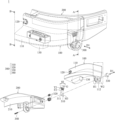
  • FIG. 1 is a perspective view of a partial structure of a wearable device according to an embodiment of the present disclosure.
  • FIG. 2 is an exploded view of a partial structure of a wearable device according to an embodiment of the present disclosure.
  • FIG. 3 is an enlarged schematic view of the part framed by the dotted line in FIG. 2 from another angle.
  • FIG. 4 is a cross-sectional view of a partial structure of the wearable device cut along the line A-A′ in FIG. 1 .
  • FIG. 5 is a schematic diagram of a wearable device being worn by a user according to an embodiment of the present disclosure.
  • FIG. 6 is a schematic diagram of operating a wearable device according to an embodiment of the present disclosure.
  • FIG. 7 is a cross-sectional view of a partial structure of the wearable device cut along the line B-B′ in FIG. 1 .
  • FIG. 1 is a perspective view of a partial structure a wearable device 1 according to an embodiment of the present disclosure, wherein some assemblies are shown as transparent by dashed lines for clearly illustrating main elements of the wearable device 1 .
  • FIG. 2 is an exploded view of a partial structure of the wearable device 1 according to an embodiment of the disclosure.
  • FIG. 3 is an enlarged schematic view of the part framed by the dotted line in FIG. 2 from another angle.
  • FIG. 4 is a cross-sectional view of the wearable device 1 cut along the line A-A′ in FIG. 1 . It should be noted that, in FIGS.
  • the wearable device 1 may be worn on the user's head, so that the user may use it to perform an application of augmented reality technology.
  • the wearable device 1 includes a front assembly 100 , a rear assembly 200 , and a connecting assembly 300 .
  • the connecting assembly 300 connects the front assembly 100 and the rear assembly 200 . When viewed along a first direction D 1 , the rear assembly 200 is closer to the user's head than the front assembly 100 .
  • the front assembly 100 may include an outer cover 110 , an image capturing portion 120 , and an optical machine 130 .
  • the image capturing portion 120 and the optical machine 130 are disposed on the outer cover 110 .
  • a first fan-shaped portion F 1 and a front accommodating portion 111 are disposed on a side wall W 1 (refer to FIG. 3 ) of the outer cover 110 for engaging and accommodating a part of the connecting assembly 300 , and the side wall W 1 is not parallel to the first direction D 1 and is close to the rear assembly 200 .
  • a front receiving portion 112 is disposed on a side wall W 2 (refer to FIG. 2 ) opposite to the side wall W 1 to receive a part of the connecting assembly 300 .
  • the first fan-shaped portion F 1 includes a plurality of first teeth T 1 .
  • the front accommodating portion 111 is disposed adjacent to the first fan-shaped portion F 1 , and the front accommodating portion 111 has a circular groove shape and a through hole H 1 .
  • the front accommodating portion 111 and the front receiving portion 112 are communicated by the through hole H 1 .
  • the image capturing portion 120 may capture external images.
  • the image capturing portion 120 may also include a camera, GPS, wireless positioning, etc., configured to detect the spatial position.
  • the optical machine 130 may include, for example, a liquid crystal display (LCD), a light-emitting diode (LED) display (such as an OLED display or a Micro LED display), or other similar devices, to project images on the user's eyes.
  • the rear assembly 200 includes a frame 210 and a wearing fixing portion (not shown). Two sides of the frame 210 may extend backward along the user's head to be connected with the wearing fixing portion. In FIGS. 1 to 4 , although the wearing fixing portion is not shown, the wearing fixing portion may be fixed to the user's head in a form like a glasses frame or a headband (refer to FIGS. 5 and 6 ), and does not limit to this.
  • a rear accommodating portion 211 is disposed on the a side wall W 3 (refer to FIG. 2 ) of frame 210 to correspond to the front accommodating portion 111 and receiving a part of the connecting assembly 300 , and the side wall W 3 is not parallel to the first direction D 1 and is close to the front assembly 100 .
  • a rear receiving portion 212 (refer to FIG. 4 ) is disposed on a side wall W 4 opposite to the side wall W 3 to accommodate a part of the connecting assembly 300 .
  • the rear receiving portion 212 and the rear accommodating portion 211 are communicated by a through hole H 2 .
  • the connecting assembly 300 includes an engaging element 310 , at least one elastic element 320 , a pressing element 330 , and a fixing element 340 .
  • the engaging element 310 includes a second fan-shaped portion F 2 , a mating portion 311 , and a through hole H 3 .
  • the second fan-shaped portion F 2 includes a plurality of second teeth T 2 . In more detail, there is a gap G between each of the plurality of second teeth T 2 and the adjacent one, and the plurality of second teeth T 2 are arranged to form a second fan-shaped portion F 2 .
  • the mating portion 311 When viewed along the first direction D 1 , the mating portion 311 has a circular shape and may be partially accommodated in the front accommodating portion 111 , and the through hole H 3 penetrates the mating portion 311 in the first direction D 1 .
  • the plurality of first teeth T 1 may be inserted into the gaps G between the plurality of second teeth T 2 to be engaged with each other.
  • the first fan-shaped portion F 1 has a first angle ⁇ 1
  • the second fan-shaped portion F 2 has a second angle ⁇ 2
  • the second angle ⁇ 2 is greater than the first angle ⁇ 1
  • the second angle ⁇ 2 is twice the first angle ⁇ 1 .
  • the second angle ⁇ 2 is 40 degrees
  • the first angle ⁇ 1 is 20 degrees.
  • the front assembly 100 may be rotated 20 degrees relative to the rear assembly 200 (operation of the rotation will be described in detail below).
  • the first angle ⁇ 1 and the second angle ⁇ 2 are not limited to this, and may be adjusted according to the requirements of the rotation range.
  • the elastic element 320 may be a compression spring.
  • there are two elastic elements 320 disposed on the rear accommodating portion 211 and extended parallel to the first direction D 1 , and connected the engaging element 310 and the rear assembly 200 .
  • one of the elastic elements 320 is connected to the second fan-shaped portion F 2 (opposite to the second tooth T 2 ) of the engaging element 310 and the rear assembly 200
  • the other elastic element 320 is connected to the mating portion 311 of the engaging element 310 and the rear assembly 200 .
  • a force of the elastic element 320 presses the engaging element 310 , so that the second fan-shaped portion F 2 of the engaging element 310 may be tightly engaged with the first fan-shaped portion F 1 of the front assembly 100 .
  • the number, size, and length of the elastic element 320 is not limited to this, and may be changed according to requirements.
  • the pressing element 330 may be a round button, which is disposed on the front receiving portion 112 , and contacts the engaging element 310 through the through hole H 1 .
  • the pressing element 330 has a bottom surface S 1 , and there is a distance d 1 between the bottom surface S 1 and a bottom surface S 2 of the front receiving portion 112 .
  • the distance d 1 is a depth that the pressing element 330 may be pressed to.
  • the fixing element 340 may be a screw, and a corresponding thread is disposed on the pressing element 330 .
  • the fixing element 340 may sequentially pass through the through hole H 2 , the rear accommodating portion 211 , and the elastic element 320 , the through hole H 3 of the engaging element 310 , and the front accommodating portion 111 from the rear receiving portion 212 to be locked into the pressing element 330 .
  • FIG. 5 is a schematic diagram of the wearable device 1 being worn by a user according to an embodiment of the present disclosure.
  • FIG. 6 is a schematic diagram of operating the wearable device 1 according to an embodiment of the present disclosure.
  • FIG. 7 is a cross-sectional view of the wearable device 1 cut along the line B-B′ in FIG. 1 .
  • the image capturing portion 120 and the optical machine 130 disposed on the front assembly 100 are consistent with the user's viewing angle. Therefore, the real image obtained by the user's eyes and the virtual image generated by the wearable device 1 are superimposed, and the good augmented reality effect may be achieved.
  • the user may press the pressing element 330 along the first direction D 1 with the left hand, so that the fixing element 340 locked to the pressing element 330 moves by the distance d 1 , and further the engaging element 310 fixed to the fixing element 340 is pressed toward the elastic element 320 along with the fixing element 340 .
  • the user's right hand may rotate the front assembly 100 downward by an angle ⁇ with the fixing element 340 as the central axis, so that after the real image and the virtual image are superimposed, the left hand releases the pressing element 330 , and the force of the elastic element 320 pushes the engaging element 310 back, so that the second fan-shaped portion F 2 is engaged with the first fan-shaped portion F 1 . Then, an adjustment is completed.
  • the second angle ⁇ 2 of the second fan-shaped portion F 2 may be formed to 40 degrees, and the first angle ⁇ 1 of the first fan-shaped portion F 1 may be formed to 20 degrees.
  • the first fan-shaped portion F 1 is engaged with the second fan-shaped portion F 2 in a range of 20 to 40 degrees.
  • the user may rotate the front assembly 100 at most 20 degrees, so that the first fan-shaped portion F 1 is engaged with the second fan-shaped portion F 2 in a range of 0 to 20 degrees.
  • the front assembly 100 may not be engaged and fixed. That is, the second fan-shaped portion F 2 may be used to control a rotation range of the front assembly 100 relative to the rear assembly 200 .
  • the front assembly 100 may include an inner wall Wi
  • the rear assembly 200 may include a stopper 213 .
  • the front assembly 100 may stop rotating while the inner wall Wi contacts the stopper 213 , which may further limit the rotation range of the front assembly 100 relative to the rear assembly 200 to avoid excessive rotation.
  • the present disclosure provides a wearable device that is worn on a user's head and includes a front assembly, a rear assembly, and a connecting assembly.
  • the connecting assembly connects the front assembly and the rear assembly, wherein the front assembly is rotatable to an angle relative to the rear assembly via the connecting assembly.

Landscapes

  • Engineering & Computer Science (AREA)
  • Microelectronics & Electronic Packaging (AREA)
  • Physics & Mathematics (AREA)
  • General Physics & Mathematics (AREA)
  • Optics & Photonics (AREA)
  • Measuring Pulse, Heart Rate, Blood Pressure Or Blood Flow (AREA)

Abstract

A wearable device, which is worn on a user's head, includes a front assembly, a rear assembly, and a connecting assembly. The connecting assembly connects the front assembly and the rear assembly, wherein the front assembly may be rotated by an angle relative to the rear assembly via the connecting assembly.

Description

CROSS-REFERENCE TO RELATED APPLICATIONS
The present application claims priority of Taiwan Patent Application No. 110213955, filed 25 Nov. 2021, which is incorporated by reference herein in its entirety.
BACKGROUND OF THE DISCLOSURE Field of the Disclosure
The present invention relates to a wearable device.
Description of the Related Art
In a situation that the angle of the conventional wearable devices with augmented reality (AR) technology cannot be adjusted, or when a user wearing the conventional wearable device need to work with his head down, the user's viewing angle is often not the same as the viewing angle of the camera lens of the optical module. Hence, the virtual image and the real image may not be superimposed and a good augmented reality effect may not be achieved.
BRIEF SUMMARY OF THE DISCLOSURE
Therefore, in the present embodiments, a wearable device is provided, and the user can simply adjust a relative angle between the user's viewing angle and the optical module, so that the virtual image and the real image are superimposed to achieve the good augmented reality effect.
An embodiment of the invention provides a wearable device, worn on a user's head, includes a front assembly, a rear assembly, and a connecting assembly. The connecting assembly connects the front assembly and the rear assembly, wherein the front assembly is rotatable to an angle relative to the rear assembly via the connecting assembly.
According to some embodiments of the present disclosure, the front assembly includes a first fan-shaped portion, and the connecting assembly includes an engaging element, wherein the engaging element and the first fan-shaped portion are engaged with each other. The front assembly has a plurality of first teeth, the first teeth are arranged to form the first fan-shaped portion, wherein the engaging element has a plurality of second teeth, the second teeth are arranged to form a second fan-shaped portion, and the first teeth are inserted into gaps between the second teeth to be engaged with each other. The first fan-shaped portion has a first angle, the second fan-shaped portion has a second angle, and the first angle is smaller than the second angle. The second angle is twice the first angle.
According to some embodiments of the present disclosure, the front assembly further includes a front accommodating portion, the rear assembly includes a rear accommodating portion, and the front accommodating portion and the rear accommodating portion respectively accommodate a part of the engaging element. The connecting assembly further includes at least one elastic element, disposed on the rear accommodating portion, connecting the engaging element and the rear assembly. The connecting assembly further includes a pressing element, and the front assembly further includes a front receiving portion, wherein the front receiving portion and the front accommodating portion are communicated by a through hole, and the pressing element is disposed on the front receiving portion. The connecting assembly further includes a fixing element, wherein the rear assembly further includes a rear receiving portion, and the fixing element sequentially passes through the rear accommodating portion, the elastic element, the engaging element, and the front accommodating portion to be locked into the pressing element.
According to some embodiments of the present disclosure, the front assembly includes an inner wall and the rear assembly includes a stopper.
BRIEF DESCRIPTION OF THE DRAWINGS
Aspects of this disclosure are best understood from the following detailed description when read with the accompanying figures. It should be noted that, in accordance with the standard practice in the industry, various features are not drawn to scale. In fact, the dimensions of the various features may be arbitrarily increased or reduced for clarity of discussion.
FIG. 1 is a perspective view of a partial structure of a wearable device according to an embodiment of the present disclosure.
FIG. 2 is an exploded view of a partial structure of a wearable device according to an embodiment of the present disclosure.
FIG. 3 is an enlarged schematic view of the part framed by the dotted line in FIG. 2 from another angle.
FIG. 4 is a cross-sectional view of a partial structure of the wearable device cut along the line A-A′ in FIG. 1 .
FIG. 5 is a schematic diagram of a wearable device being worn by a user according to an embodiment of the present disclosure.
FIG. 6 is a schematic diagram of operating a wearable device according to an embodiment of the present disclosure.
FIG. 7 is a cross-sectional view of a partial structure of the wearable device cut along the line B-B′ in FIG. 1 .
DETAILED DESCRIPTION OF THE DISCLOSURE
In the following detailed description, for the purposes of explanation, numerous specific details and embodiments are set forth in order to provide a thorough understanding of the present disclosure. The specific elements and configurations described in the following detailed description are set forth in order to clearly describe the present disclosure. It will be apparent, however, that the exemplary embodiments set forth herein are used merely for the purpose of illustration, and the inventive concept can be embodied in various forms without being limited to those exemplary embodiments. In addition, the drawings of different embodiments can use like and/or corresponding numerals to denote like and/or corresponding elements in order to clearly describe the present disclosure. However, the use of like and/or corresponding numerals in the drawings of different embodiments does not suggest any correlation between different embodiments. The directional terms, such as “up”, “down”, “left”, “right”, “front” or “rear”, are reference directions for accompanying drawings. Therefore, using the directional terms is for description instead of limiting the disclosure.
It should be understood that when an element is referred to as being “connected to” or “coupled to” another element, the element may be directly connected or coupled to another element, or there are one or more elements between the two elements. In addition, the use of ordinal numbers such as first, second, and third does not necessarily imply a sense of order, but can be multiple instances to distinguish actions or structures.
Reference to “one embodiment” or “an embodiment” throughout the specification means that particular features, structures, or characteristics described in conjunction with the embodiment are included in at least one embodiment. Therefore, the sentences “in one embodiment” or “in an embodiment” appearing in various places throughout the specification do not necessarily all refer to the same embodiment. In addition, in one or more embodiments, specific features, structures, or characteristics may be combined in any suitable manner.
First, refer to FIGS. 1 to 4 . FIG. 1 is a perspective view of a partial structure a wearable device 1 according to an embodiment of the present disclosure, wherein some assemblies are shown as transparent by dashed lines for clearly illustrating main elements of the wearable device 1. FIG. 2 is an exploded view of a partial structure of the wearable device 1 according to an embodiment of the disclosure. FIG. 3 is an enlarged schematic view of the part framed by the dotted line in FIG. 2 from another angle. FIG. 4 is a cross-sectional view of the wearable device 1 cut along the line A-A′ in FIG. 1 . It should be noted that, in FIGS. 1 to 4 , for clear description, only a partial structure of the wearable device 1 corresponding to a user's left eye is shown, and the unshown right eye part may be symmetrical or similar structure. The wearable device 1 may be worn on the user's head, so that the user may use it to perform an application of augmented reality technology. The wearable device 1 includes a front assembly 100, a rear assembly 200, and a connecting assembly 300. The connecting assembly 300 connects the front assembly 100 and the rear assembly 200. When viewed along a first direction D1, the rear assembly 200 is closer to the user's head than the front assembly 100.
The front assembly 100 may include an outer cover 110, an image capturing portion 120, and an optical machine 130. The image capturing portion 120 and the optical machine 130 are disposed on the outer cover 110. A first fan-shaped portion F1 and a front accommodating portion 111 are disposed on a side wall W1 (refer to FIG. 3 ) of the outer cover 110 for engaging and accommodating a part of the connecting assembly 300, and the side wall W1 is not parallel to the first direction D1 and is close to the rear assembly 200. A front receiving portion 112 is disposed on a side wall W2 (refer to FIG. 2 ) opposite to the side wall W1 to receive a part of the connecting assembly 300.
The first fan-shaped portion F1 includes a plurality of first teeth T1. In more detail, there is gap G between each of the plurality of first teeth T1 and the adjacent one, and the plurality of first teeth T1 are arranged to form a first fan-shaped portion F1. The front accommodating portion 111 is disposed adjacent to the first fan-shaped portion F1, and the front accommodating portion 111 has a circular groove shape and a through hole H1. The front accommodating portion 111 and the front receiving portion 112 are communicated by the through hole H1.
The image capturing portion 120 may capture external images. In addition, the image capturing portion 120 may also include a camera, GPS, wireless positioning, etc., configured to detect the spatial position. The optical machine 130 may include, for example, a liquid crystal display (LCD), a light-emitting diode (LED) display (such as an OLED display or a Micro LED display), or other similar devices, to project images on the user's eyes.
The rear assembly 200 includes a frame 210 and a wearing fixing portion (not shown). Two sides of the frame 210 may extend backward along the user's head to be connected with the wearing fixing portion. In FIGS. 1 to 4 , although the wearing fixing portion is not shown, the wearing fixing portion may be fixed to the user's head in a form like a glasses frame or a headband (refer to FIGS. 5 and 6 ), and does not limit to this.
A rear accommodating portion 211 is disposed on the a side wall W3 (refer to FIG. 2 ) of frame 210 to correspond to the front accommodating portion 111 and receiving a part of the connecting assembly 300, and the side wall W3 is not parallel to the first direction D1 and is close to the front assembly 100. A rear receiving portion 212 (refer to FIG. 4 ) is disposed on a side wall W4 opposite to the side wall W3 to accommodate a part of the connecting assembly 300. The rear receiving portion 212 and the rear accommodating portion 211 are communicated by a through hole H2.
Refer to FIGS. 2 and 3 . The connecting assembly 300 includes an engaging element 310, at least one elastic element 320, a pressing element 330, and a fixing element 340. The engaging element 310 includes a second fan-shaped portion F2, a mating portion 311, and a through hole H3. The second fan-shaped portion F2 includes a plurality of second teeth T2. In more detail, there is a gap G between each of the plurality of second teeth T2 and the adjacent one, and the plurality of second teeth T2 are arranged to form a second fan-shaped portion F2. When viewed along the first direction D1, the mating portion 311 has a circular shape and may be partially accommodated in the front accommodating portion 111, and the through hole H3 penetrates the mating portion 311 in the first direction D1. On the other hand, the plurality of first teeth T1 may be inserted into the gaps G between the plurality of second teeth T2 to be engaged with each other.
The first fan-shaped portion F1 has a first angle θ1, the second fan-shaped portion F2 has a second angle θ2, and the second angle θ2 is greater than the first angle θ1. In some embodiments, the second angle θ2 is twice the first angle θ1. For example, the second angle θ2 is 40 degrees, and the first angle θ1 is 20 degrees. With such an angular configuration, the front assembly 100 may be rotated 20 degrees relative to the rear assembly 200 (operation of the rotation will be described in detail below). However, the first angle θ1 and the second angle θ2 are not limited to this, and may be adjusted according to the requirements of the rotation range.
Refer to FIGS. 2 and 4 . The elastic element 320 may be a compression spring. In this embodiment, there are two elastic elements 320, disposed on the rear accommodating portion 211 and extended parallel to the first direction D1, and connected the engaging element 310 and the rear assembly 200.
In more detail, one of the elastic elements 320 is connected to the second fan-shaped portion F2 (opposite to the second tooth T2) of the engaging element 310 and the rear assembly 200, and the other elastic element 320 is connected to the mating portion 311 of the engaging element 310 and the rear assembly 200. A force of the elastic element 320 presses the engaging element 310, so that the second fan-shaped portion F2 of the engaging element 310 may be tightly engaged with the first fan-shaped portion F1 of the front assembly 100. In this embodiment, although two elastic elements 320 of different sizes and lengths are disposed to evenly and surely press the engaging element 310, the number, size, and length of the elastic element 320 is not limited to this, and may be changed according to requirements.
The pressing element 330 may be a round button, which is disposed on the front receiving portion 112, and contacts the engaging element 310 through the through hole H1. The pressing element 330 has a bottom surface S1, and there is a distance d1 between the bottom surface S1 and a bottom surface S2 of the front receiving portion 112. The distance d1 is a depth that the pressing element 330 may be pressed to.
The fixing element 340 may be a screw, and a corresponding thread is disposed on the pressing element 330. Thus, the fixing element 340 may sequentially pass through the through hole H2, the rear accommodating portion 211, and the elastic element 320, the through hole H3 of the engaging element 310, and the front accommodating portion 111 from the rear receiving portion 212 to be locked into the pressing element 330.
Refer to FIGS. 4 to 7 , and how to operate the wearable device 1 to make it consistent with the user's viewing angle will be explained. FIG. 5 is a schematic diagram of the wearable device 1 being worn by a user according to an embodiment of the present disclosure. FIG. 6 is a schematic diagram of operating the wearable device 1 according to an embodiment of the present disclosure. FIG. 7 is a cross-sectional view of the wearable device 1 cut along the line B-B′ in FIG. 1 . As shown in FIG. 5 , when the user wears the wearable device 1 on his head and looks at the front horizontally, the image capturing portion 120 and the optical machine 130 disposed on the front assembly 100 are consistent with the user's viewing angle. Therefore, the real image obtained by the user's eyes and the virtual image generated by the wearable device 1 are superimposed, and the good augmented reality effect may be achieved.
However, if the user's head does not move or slightly moves while the user's viewing angle is downward, or the user's head moves downward while the user's viewing angle remains at the front horizontally, etc., which may not cause the good augmented reality effect because the real image and the virtual image are not superimposed.
Therefore, for example, as shown in FIGS. 4 and 6 , the user may press the pressing element 330 along the first direction D1 with the left hand, so that the fixing element 340 locked to the pressing element 330 moves by the distance d1, and further the engaging element 310 fixed to the fixing element 340 is pressed toward the elastic element 320 along with the fixing element 340. When the first fan-shaped portion F1 of the front assembly 100 and the second fan-shaped portion F2 of the engaging element 310 are not engaged and are in a separated state, the user's right hand may rotate the front assembly 100 downward by an angle θ with the fixing element 340 as the central axis, so that after the real image and the virtual image are superimposed, the left hand releases the pressing element 330, and the force of the elastic element 320 pushes the engaging element 310 back, so that the second fan-shaped portion F2 is engaged with the first fan-shaped portion F1. Then, an adjustment is completed.
As mentioned above, in some embodiments, the second angle θ2 of the second fan-shaped portion F2 may be formed to 40 degrees, and the first angle θ1 of the first fan-shaped portion F1 may be formed to 20 degrees. Under normal circumstances, the first fan-shaped portion F1 is engaged with the second fan-shaped portion F2 in a range of 20 to 40 degrees. When the adjustment is required, the user may rotate the front assembly 100 at most 20 degrees, so that the first fan-shaped portion F1 is engaged with the second fan-shaped portion F2 in a range of 0 to 20 degrees.
Therefore, it can be seen from the above that if the front assembly 100 is rotated beyond the second fan-shaped portion F2 of the engaging element 310, the front assembly 100 and the rear assembly 200 may not be engaged and fixed. That is, the second fan-shaped portion F2 may be used to control a rotation range of the front assembly 100 relative to the rear assembly 200.
In addition, in some embodiments, as shown in FIG. 7 , the front assembly 100 may include an inner wall Wi, the rear assembly 200 may include a stopper 213. When the front assembly 100 is rotated with the fixing element 340 extending alone the first direction D1 as the central axis, the front assembly 100 may stop rotating while the inner wall Wi contacts the stopper 213, which may further limit the rotation range of the front assembly 100 relative to the rear assembly 200 to avoid excessive rotation.
In summary, the present disclosure provides a wearable device that is worn on a user's head and includes a front assembly, a rear assembly, and a connecting assembly. The connecting assembly connects the front assembly and the rear assembly, wherein the front assembly is rotatable to an angle relative to the rear assembly via the connecting assembly. With the wearable device of the present disclosure, the user can simply adjust the relative angle between the user's viewing angle and the optical module, so that the virtual image and the real image are superimposed to achieve a good augmented reality effect.
Although the embodiments and their advantages have been described in detail, it should be understood that various changes, substitutions, and alterations can be made herein without departing from the spirit and scope of the embodiments as defined by the appended claims. Moreover, the scope of the present application is not intended to be limited to the particular embodiments of the process, machine, manufacture, composition of matter, means, methods, and steps described in the specification. As one of ordinary skill in the art will readily appreciate from the disclosure, processes, machines, manufacture, compositions of matter, means, methods, or steps, presently existing or later to be developed, that perform substantially the same function or achieve substantially the same result as the corresponding embodiments described herein can be utilized according to the disclosure. Accordingly, the appended claims are intended to include within their scope such processes, machines, manufacture, compositions of matter, means, methods, or steps. In addition, each claim constitutes a separate embodiment, and the combination of various claims and embodiments are within the scope of the disclosure.
Claims (8)

What is claimed is:
1. A wearable device, worn on a user's head, comprising:
a front assembly;
a rear assembly; and
a connecting assembly, connecting the front assembly and the rear assembly,
wherein the front assembly is rotatable to an angle relative to the rear assembly via the connecting assembly;
wherein the front assembly comprises a first fan-shaped portion, the connecting assembly comprises an engaging element, the engaging element comprises a second fan-shaped portion, the engaging element and the first fan-shaped portion are engaged with each other, the first fan-shaped portion has a first angle, the second fan-shaped portion has a second angle, and the first angle is smaller than the second angle.
2. The wearable device as claimed in claim 1, wherein the front assembly has a plurality of first teeth, the first teeth are arranged to form the first fan-shaped portion, wherein the engaging element has a plurality of second teeth, the second teeth are arranged to form the second fan-shaped portion, and the first teeth are inserted into gaps between the second teeth to be engaged with each other.
3. The wearable device as claimed in claim 1, wherein the second angle is twice the first angle.
4. The optical element driving mechanism as claimed in claim 1, wherein when viewed in a direction that is perpendicular to the optical axis, the first driving assembly partially overlaps the second driving assembly.
5. The wearable device as claimed in claim 4, wherein the connecting assembly further comprises at least one elastic element, disposed on the rear accommodating portion, connecting the engaging element and the rear assembly.
6. The wearable device as claimed in claim 5, wherein the connecting assembly further comprises a pressing element, and the front assembly further comprises a front receiving portion, wherein the front receiving portion and the front accommodating portion are communicated by a through hole, and the pressing element is disposed on the front receiving portion.
7. The wearable device as claimed in claim 6, wherein the connecting assembly further comprises a fixing element, wherein the rear assembly further comprises a rear receiving portion, and the fixing element sequentially passes through the rear accommodating portion, the elastic element, the engaging element, and the front accommodating portion to be locked into the pressing element.
8. The wearable device as claimed in claim 1, wherein the front assembly comprises an inner wall and the rear assembly comprises a stopper.
US17/584,768 2021-11-25 2022-01-26 Wearable device Active US11800664B2 (en)

Applications Claiming Priority (2)

Application Number Priority Date Filing Date Title
TW110213955 2021-11-25
TW110213955U TWM629692U (en) 2021-11-25 2021-11-25 Wearable device

Publications (2)

Publication Number Publication Date
US20230164933A1 US20230164933A1 (en) 2023-05-25
US11800664B2 true US11800664B2 (en) 2023-10-24

Family

ID=83437738

Family Applications (1)

Application Number Title Priority Date Filing Date
US17/584,768 Active US11800664B2 (en) 2021-11-25 2022-01-26 Wearable device

Country Status (2)

Country Link
US (1) US11800664B2 (en)
TW (1) TWM629692U (en)

Cited By (1)

* Cited by examiner, † Cited by third party
Publication number Priority date Publication date Assignee Title
US20230279989A1 (en) * 2022-03-04 2023-09-07 Htc Corporation Wearable device

Citations (17)

* Cited by examiner, † Cited by third party
Publication number Priority date Publication date Assignee Title
US20120068914A1 (en) * 2010-09-20 2012-03-22 Kopin Corporation Miniature communications gateway for head mounted display
US8577427B2 (en) * 2012-03-08 2013-11-05 Lee Serota Headset with adjustable display and integrated computing system
US20160077337A1 (en) * 2014-09-15 2016-03-17 Google Inc. Managing Information Display
US20180011326A1 (en) * 2015-03-31 2018-01-11 Brother Kogyo Kabushiki Kaisha Head-Mounted Display and Image Display Device
US20180027676A1 (en) * 2015-02-27 2018-01-25 Sony Interactive Entertainment Inc. Head-mounted display
US20180295733A1 (en) * 2017-03-24 2018-10-11 Htc Corporation Head-mounted display device
US20180308397A1 (en) * 2016-01-28 2018-10-25 Brother Kogyo Kabushiki Kaisha Attaching Fixture and Display System
US10289157B2 (en) * 2016-08-30 2019-05-14 Quanta Computer Inc. Head-mounted display device
US20190159354A1 (en) * 2016-08-03 2019-05-23 Shenzhen Kuku Technology Co., Ltd. Head-mounted display apparatus
US10408313B1 (en) * 2017-05-01 2019-09-10 Facebook Technologies, Llc Spooled torsion spring for securing head strap in head-mounted display
US20190280416A1 (en) * 2017-06-21 2019-09-12 Goertek Technology Co.,Ltd. Connecting mechanism
US20190293947A1 (en) * 2018-03-21 2019-09-26 Beijing Boe Optoelectronics Technology Co., Ltd. Rotating mechanism and head-mounted display apparatus
US10617025B1 (en) * 2018-11-06 2020-04-07 Quanta Computer Inc Head-mounted display device
US20200213708A1 (en) * 2018-12-27 2020-07-02 Quanta Computer Inc. Headset Electronic Device And Headband Adjustment Structure Thereof
US20210216099A1 (en) * 2020-01-09 2021-07-15 Universal City Studios Llc Interface device for wearable visualization device, systems and methods
US20210315301A1 (en) * 2020-04-08 2021-10-14 Quanta Computer Inc. Headset Electronic Device And Headband Adjustment Structure Thereof
US20210381639A1 (en) * 2020-06-04 2021-12-09 Facebook Technologies, Llc Pass-through ratcheting mechanism

Patent Citations (17)

* Cited by examiner, † Cited by third party
Publication number Priority date Publication date Assignee Title
US20120068914A1 (en) * 2010-09-20 2012-03-22 Kopin Corporation Miniature communications gateway for head mounted display
US8577427B2 (en) * 2012-03-08 2013-11-05 Lee Serota Headset with adjustable display and integrated computing system
US20160077337A1 (en) * 2014-09-15 2016-03-17 Google Inc. Managing Information Display
US20180027676A1 (en) * 2015-02-27 2018-01-25 Sony Interactive Entertainment Inc. Head-mounted display
US20180011326A1 (en) * 2015-03-31 2018-01-11 Brother Kogyo Kabushiki Kaisha Head-Mounted Display and Image Display Device
US20180308397A1 (en) * 2016-01-28 2018-10-25 Brother Kogyo Kabushiki Kaisha Attaching Fixture and Display System
US20190159354A1 (en) * 2016-08-03 2019-05-23 Shenzhen Kuku Technology Co., Ltd. Head-mounted display apparatus
US10289157B2 (en) * 2016-08-30 2019-05-14 Quanta Computer Inc. Head-mounted display device
US20180295733A1 (en) * 2017-03-24 2018-10-11 Htc Corporation Head-mounted display device
US10408313B1 (en) * 2017-05-01 2019-09-10 Facebook Technologies, Llc Spooled torsion spring for securing head strap in head-mounted display
US20190280416A1 (en) * 2017-06-21 2019-09-12 Goertek Technology Co.,Ltd. Connecting mechanism
US20190293947A1 (en) * 2018-03-21 2019-09-26 Beijing Boe Optoelectronics Technology Co., Ltd. Rotating mechanism and head-mounted display apparatus
US10617025B1 (en) * 2018-11-06 2020-04-07 Quanta Computer Inc Head-mounted display device
US20200213708A1 (en) * 2018-12-27 2020-07-02 Quanta Computer Inc. Headset Electronic Device And Headband Adjustment Structure Thereof
US20210216099A1 (en) * 2020-01-09 2021-07-15 Universal City Studios Llc Interface device for wearable visualization device, systems and methods
US20210315301A1 (en) * 2020-04-08 2021-10-14 Quanta Computer Inc. Headset Electronic Device And Headband Adjustment Structure Thereof
US20210381639A1 (en) * 2020-06-04 2021-12-09 Facebook Technologies, Llc Pass-through ratcheting mechanism

Cited By (2)

* Cited by examiner, † Cited by third party
Publication number Priority date Publication date Assignee Title
US20230279989A1 (en) * 2022-03-04 2023-09-07 Htc Corporation Wearable device
US11927303B2 (en) * 2022-03-04 2024-03-12 Htc Corporation Wearable device

Also Published As

Publication number Publication date
US20230164933A1 (en) 2023-05-25
TWM629692U (en) 2022-07-21

Similar Documents

Publication Publication Date Title
JP6874143B2 (en) Compact optotype tracking with folded display optics
US11988842B2 (en) Head-mounted display with pivoting display
US10445573B2 (en) Gaze detection device
US5999147A (en) Virtual image display device
US10095038B1 (en) Head-mounted display
JP6551278B2 (en) Head mounted display
US11194165B2 (en) Wearable display device
JP7432339B2 (en) head mounted display
US11714454B1 (en) Head-mounted display device and wearable assembly
JP6281456B2 (en) Head mounted display
US11800664B2 (en) Wearable device
CN101320131A (en) Head-mounted display capable of adjusting ambient light intensity
US11249515B2 (en) Head-mounted display device
WO2020255562A1 (en) Image display device and display device
TWI868421B (en) Head-mounted display device and wearable assembly
US8419182B2 (en) Glasses
CN216870948U (en) wearable device
KR20160003517U (en) A head mounted display device having enhanced wearing-feeling
TWM545255U (en) Head mounted display device
JP2023050769A (en) Image display device and light shielding member
JP2017026704A (en) Display device and glasses-type display device
US11172718B2 (en) Wearable display device
KR102071934B1 (en) Wearable display device
JP2025002321A (en) Image display device and image display system
JP6229624B2 (en) Head mounted display and wearing equipment

Legal Events

Date Code Title Description
AS Assignment

Owner name: QUANTA COMPUTER INC., TAIWAN

Free format text: ASSIGNMENT OF ASSIGNORS INTEREST;ASSIGNORS:LAI, SHAN-PENG;WU, CHENG-WEI;CHEN, CHUN-LUNG;AND OTHERS;REEL/FRAME:058776/0680

Effective date: 20220120

FEPP Fee payment procedure

Free format text: ENTITY STATUS SET TO UNDISCOUNTED (ORIGINAL EVENT CODE: BIG.); ENTITY STATUS OF PATENT OWNER: LARGE ENTITY

STPP Information on status: patent application and granting procedure in general

Free format text: NOTICE OF ALLOWANCE MAILED -- APPLICATION RECEIVED IN OFFICE OF PUBLICATIONS

STPP Information on status: patent application and granting procedure in general

Free format text: PUBLICATIONS -- ISSUE FEE PAYMENT VERIFIED

STCF Information on status: patent grant

Free format text: PATENTED CASE