US11798018B2 - Efficient feature selection for predictive models using semantic classification and generative filtering - Google Patents
Efficient feature selection for predictive models using semantic classification and generative filtering Download PDFInfo
- Publication number
- US11798018B2 US11798018B2 US15/062,937 US201615062937A US11798018B2 US 11798018 B2 US11798018 B2 US 11798018B2 US 201615062937 A US201615062937 A US 201615062937A US 11798018 B2 US11798018 B2 US 11798018B2
- Authority
- US
- United States
- Prior art keywords
- feature
- features
- processors
- semantic
- subset
- Prior art date
- Legal status (The legal status is an assumption and is not a legal conclusion. Google has not performed a legal analysis and makes no representation as to the accuracy of the status listed.)
- Active, expires
Links
Images


Classifications
-
- G—PHYSICS
- G06—COMPUTING OR CALCULATING; COUNTING
- G06Q—INFORMATION AND COMMUNICATION TECHNOLOGY [ICT] SPECIALLY ADAPTED FOR ADMINISTRATIVE, COMMERCIAL, FINANCIAL, MANAGERIAL OR SUPERVISORY PURPOSES; SYSTEMS OR METHODS SPECIALLY ADAPTED FOR ADMINISTRATIVE, COMMERCIAL, FINANCIAL, MANAGERIAL OR SUPERVISORY PURPOSES, NOT OTHERWISE PROVIDED FOR
- G06Q30/00—Commerce
- G06Q30/02—Marketing; Price estimation or determination; Fundraising
- G06Q30/0201—Market modelling; Market analysis; Collecting market data
- G06Q30/0204—Market segmentation
- G06Q30/0205—Market segmentation based on location or geographical consideration
-
- G—PHYSICS
- G06—COMPUTING OR CALCULATING; COUNTING
- G06F—ELECTRIC DIGITAL DATA PROCESSING
- G06F16/00—Information retrieval; Database structures therefor; File system structures therefor
- G06F16/30—Information retrieval; Database structures therefor; File system structures therefor of unstructured textual data
- G06F16/35—Clustering; Classification
-
- G—PHYSICS
- G06—COMPUTING OR CALCULATING; COUNTING
- G06F—ELECTRIC DIGITAL DATA PROCESSING
- G06F16/00—Information retrieval; Database structures therefor; File system structures therefor
- G06F16/90—Details of database functions independent of the retrieved data types
- G06F16/95—Retrieval from the web
- G06F16/953—Querying, e.g. by the use of web search engines
- G06F16/9535—Search customisation based on user profiles and personalisation
-
- G—PHYSICS
- G06—COMPUTING OR CALCULATING; COUNTING
- G06Q—INFORMATION AND COMMUNICATION TECHNOLOGY [ICT] SPECIALLY ADAPTED FOR ADMINISTRATIVE, COMMERCIAL, FINANCIAL, MANAGERIAL OR SUPERVISORY PURPOSES; SYSTEMS OR METHODS SPECIALLY ADAPTED FOR ADMINISTRATIVE, COMMERCIAL, FINANCIAL, MANAGERIAL OR SUPERVISORY PURPOSES, NOT OTHERWISE PROVIDED FOR
- G06Q10/00—Administration; Management
- G06Q10/06—Resources, workflows, human or project management; Enterprise or organisation planning; Enterprise or organisation modelling
- G06Q10/063—Operations research, analysis or management
- G06Q10/0639—Performance analysis of employees; Performance analysis of enterprise or organisation operations
- G06Q10/06395—Quality analysis or management
-
- G—PHYSICS
- G06—COMPUTING OR CALCULATING; COUNTING
- G06Q—INFORMATION AND COMMUNICATION TECHNOLOGY [ICT] SPECIALLY ADAPTED FOR ADMINISTRATIVE, COMMERCIAL, FINANCIAL, MANAGERIAL OR SUPERVISORY PURPOSES; SYSTEMS OR METHODS SPECIALLY ADAPTED FOR ADMINISTRATIVE, COMMERCIAL, FINANCIAL, MANAGERIAL OR SUPERVISORY PURPOSES, NOT OTHERWISE PROVIDED FOR
- G06Q10/00—Administration; Management
- G06Q10/40—Business processes related to social networking or social networking services
-
- G06Q50/01—
-
- G—PHYSICS
- G06—COMPUTING OR CALCULATING; COUNTING
- G06N—COMPUTING ARRANGEMENTS BASED ON SPECIFIC COMPUTATIONAL MODELS
- G06N3/00—Computing arrangements based on biological models
- G06N3/02—Neural networks
- G06N3/04—Architecture, e.g. interconnection topology
- G06N3/044—Recurrent networks, e.g. Hopfield networks
-
- G—PHYSICS
- G06—COMPUTING OR CALCULATING; COUNTING
- G06N—COMPUTING ARRANGEMENTS BASED ON SPECIFIC COMPUTATIONAL MODELS
- G06N3/00—Computing arrangements based on biological models
- G06N3/02—Neural networks
- G06N3/04—Architecture, e.g. interconnection topology
- G06N3/045—Combinations of networks
-
- G—PHYSICS
- G06—COMPUTING OR CALCULATING; COUNTING
- G06N—COMPUTING ARRANGEMENTS BASED ON SPECIFIC COMPUTATIONAL MODELS
- G06N3/00—Computing arrangements based on biological models
- G06N3/02—Neural networks
- G06N3/08—Learning methods
Definitions
- Online marketing tools provide marketers with predictive capabilities, such as identifying valuable customers or estimating the likelihood that a product will be purchased.
- the predictive capabilities are provided by predictive models, which are typically built using customer data. Often, a large amount of customer data is available for building these predictive models. In some cases, the customer data can include hundreds of features regarding each customer.
- the ability to make accurate predictions is determined by smaller sets of influential features, and the remaining features have little to no impact on the predictive capabilities.
- using all features for prediction is not a good approach.
- the massive number of irrelevant features will incur unnecessarily heavy computational costs.
- the irrelevant features may cause overfitting that leads to adverse results.
- one current solution includes requiring a user to select a subset of features as input to a predictive model.
- a domain expert can select a sensible set of features.
- Forward selection includes iteratively testing the addition of each feature in building a predictive model and adding the feature that best improves the model at each iteration until minimal or no improvement is gained from adding any additional features. While this improves performance, such feature selection techniques can be slow, especially when there are a large number of features.
- Embodiments of the present invention relate to automated feature selection approaches that combine semantic classification and generative filtering with forward selection to achieve high efficiency without sacrificing prediction performance.
- features from an original set of features are divided into feature subsets corresponding to ranked semantic classes. Additionally, low quality features likely to have little to no effect on a predictive model are filtered out.
- the feature subsets are iteratively processed using forward selection in an order corresponding to the ranking of the semantic classes to select features for a reduced feature set. The reduced feature set is then used to build a predictive model.
- FIG. 1 is a block diagram illustrating an exemplary system in accordance with implementations of the present disclosure
- FIG. 2 is a flow diagram showing a method for selecting a reduced feature set and generating a predictive model using the reduced feature set in accordance with implementations of the present disclosure
- FIG. 3 A- 3 D are block diagrams illustrating various use cases for selecting reduced feature sets in accordance with implementations of the present disclosure
- FIG. 4 includes displays showing features in an original feature set and a reduced feature set
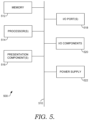
- FIG. 5 is a block diagram of an exemplary computing environment suitable for use in implementations of the present disclosure.
- a feature refers to an attribute of a dataset that may be used when building a predictive model.
- a feature is any attribute describing customers in customer data, such as: features that describe customer traits (e.g., demographics of a customer, such as age, gender, geo location, and language); features regarding the computing device used by customers to access marketing resources (e.g., browser used, operating system used, mobile or desktop device, etc.); features identifying a social channel used by customers (e.g., the FACEBOOK, TWITTER, GOOGLE PLUS social networks) to interact with marketing resources; customer actions (e.g., click, view, download, purchase, additions, removal, and search); and temporal features describing some aspect regarding time.
- customer traits e.g., demographics of a customer, such as age, gender, geo location, and language
- features regarding the computing device used by customers to access marketing resources e.g., browser used, operating system used, mobile or desktop device, etc.
- features identifying a social channel used by customers
- Features can be categorical values (e.g., United States, Brazil, etc. as categorical values for a Country feature; or www.google.com, www.yahoo.com, etc. as categorical values for a Referring Domain feature).
- features can be continuous (numeric) values (e.g., Revenue, Count of Orders, Number of times someone activated a device, etc.).
- semantic class refers to a category of features that are logically related.
- semantic classes in the context of digital marketing may include: customer traits (e.g., demographics); customer source (e.g., features of customers' computing devices); social channels (e.g., social networks used by customers to interact with marketing resources); customer actions (e.g., actions with marketing resources and products); and temporal (e.g., time-related features).
- feature quality score refers to a metric that reflects the ability of a feature to segment a customer population or otherwise impact predictive capabilities of a predictive model.
- a feature quality score for a feature can be based on a correlation between a feature and a predictive outcome (e.g., purchasing a product).
- a feature quality score can be based on an entropy measure reflecting the variance in a feature (e.g., a feature with low entropy/variance will have little impact on predictive capabilities).
- forward selection refers to selection of features from a feature set in a stepwise fashion. Each iteration of forward selection includes testing the addition of each remaining feature in the feature set with previously selected features (if any) to determine which remaining feature best improves the predictive capability of the predictive model being built. The feature that best improves the predictive model (if any) is added to the group of selected features. This process of selecting features is continued until none of the remaining features improves the predictive model. This could include stopping when the improved performance is minimal or below some threshold.
- predictive model refers to a model used to predict an outcome given a set of input characteristics.
- a predictive model could be directed to determining the likelihood of a customer purchasing a product given information regarding the customer.
- a predictive model can be built from features from a dataset using any of a variety of known machine-learning algorithms.
- Embodiments of the present invention relate to an automated feature selection approach that combines semantic classification and generative filtering techniques with forward selection to achieve high efficiency without sacrificing prediction performance.
- An original feature set is divided into multiple feature subsets corresponding to semantic classes relevant to the dataset.
- the semantic classes are ranked based on the likelihood that features in each semantic class will impact predictive capabilities.
- Generative filtering is also used to remove low quality features from consideration.
- Low quality features are features likely to have little to no effect on a predictive model.
- the low quality features may include, for instance, features with a low correlation to a predictive outcome and/or features with a low entropy measure.
- Forward selection is then performed iteratively over each of the filtered feature subsets in an order corresponding to the semantic class rankings.
- forward selection is first performed over a filtered feature subset corresponding to a highest ranked semantic class, then performed over a filtered feature subset corresponding to the next highest ranked semantic class, and so on until all filtered feature subsets have been processed.
- the process outputs a reduced feature set that includes features selected by the forward selection iterations.
- Features from the reduced feature set are then used to generate a predictive model, which may be used to generate predictions given certain input information.
- the semantic classification-based feature selection described herein can be thought of as using expert knowledge to regularize the feature selection process.
- performance degrading i.e., selecting suboptimal features.
- embodiments perform forward selection first on features which are likely to be more influential on predictive capabilities, thereby increasing the likelihood of selecting these influential features while reducing the likelihood of selecting inferior features.
- FIG. 1 is a block diagram illustrating an exemplary system 100 for selecting a reduced feature set for use in generating a predictive model in accordance with implementations of the present disclosure. It should be understood that this and other arrangements described herein are set forth only as examples. Other arrangements and elements (e.g., machines, interfaces, functions, orders, and groupings of functions, etc.) can be used in addition to or instead of those shown, and some elements may be omitted altogether. Further, many of the elements described herein are functional entities that may be implemented as discrete or distributed components or in conjunction with other components, and in any suitable combination and location. Various functions described herein as being performed by one or more entities may be carried out by hardware, firmware, and/or software. For instance, various functions may be carried out by a processor executing instructions stored in memory.
- the system 100 is an example of a suitable architecture for implementing certain aspects of the present disclosure.
- the system 100 includes a feature selection engine 104 configured to receive an original feature set 102 as input and output a reduced feature set 106 .
- the reduced feature set 106 is then processed by a model building engine 120 to generate a predictive model 122 .
- the feature selection engine 104 and model building engine 120 may be provided, for instance, by an online marketing tool, such as the ADOBE ANALYTICS marketing tool (available from Adobe Systems Inc. of San Jose, California) to perform predictive capabilities for digital marketing.
- the components shown in FIG. 1 can be implemented on a computing device, such as the computing device 500 shown in FIG. 5 .
- the original feature set 102 includes a listing of features from a relevant dataset.
- the features relate to attributes of customers found in a customer dataset.
- a semantic classifier 108 divides the original feature set 102 into a number of feature subsets, such as feature subsets 112 A, 112 B, . . . 112 N shown in FIG. 1 . It should be understood that a feature set may be divided into any number of feature subsets within the scope of embodiments of the present invention. Generally, each feature subset corresponds to a different semantic class.
- embodiments employ a number of semantic classes for grouping features from the original feature set 102 into the feature subsets 112 A, 112 B, . . . 112 N.
- the semantic classes are ordered based on their likelihood of segmenting a customer population.
- the semantic classes employed include: customer traits, customer source, social channels, customer actions, temporal features, and miscellaneous.
- Customer traits comprise features regarding the demographics of a customer, such as age, gender, geo location, and language. Based on experience, the inventors identified that it is reasonable to expect customers to react to offers and various campaigns depending on their demographics. Hence, these features have a very high likelihood of segmenting the customer population with respect to a metric like conversion or revenue. As a result, some embodiments assign a rank 1 (top rank) to the customer traits semantic class.
- Customer source comprises features regarding the computing device used by customer to access online marketing resources, such as the browser used, operating system used, mobile or desktop device, etc. Based on experience, the inventors identified that it is reasonable to expect customers using different sources to access online resources (e.g., mobile versus desktop) to react differently to various offers and campaigns. As a result, some embodiments consider customer source as the next best semantic class for segmenting a customer population with regard to metrics like conversion and revenue. Accordingly, some embodiments assign a rank 2 to the customer source semantic class.
- Customer segmentation also happens based on the social channel used by customers.
- a customer's behavior might vary with regard to a metric depending on the social channel (e.g., the FACEBOOK, TWITTER, GOOGLE PLUS social networks) via which the customer interacts with marketing resources. This is indicative of the customer's preference for a certain social media platform, and customers might respond very differently to the same campaign on different platforms. Accordingly, some embodiments assign a rank 3 to the social channels semantic class.
- Customer populations may also be segmented based on various customer actions.
- Features capturing information about various customer actions like click, view, download, purchase, additions, removal, and search fall under this category.
- it is possible to detect a clear segment for some of the customer actions For example, a feature like “last click tactic before purchase,” which describes the form of a marketing campaign (e.g., banner ad, social, email, etc.) that was clicked by the customer before finally purchasing the product, may show clear segmentation of the customer population. Accordingly, some embodiments assign a rank 4 to the customer actions semantic class.
- Temporal features describe some aspect regarding time. Some of the features in this semantic class may facilitate customer segmentation. For example, it is reasonable to expect seasonal trends in customer behavior. Thus, features describing seasons (summer, winter, spring etc.) have an impact on customer segmentation in case of an apparel dataset. This may be especially true for temporal dimensions describing annual events. Accordingly, some embodiments assign a rank 5 to the temporal features semantic class.
- a miscellaneous semantic class may be employed to captures these features.
- a rank 6 is assigned to the miscellaneous semantic class.
- semantic classes and the specific ranking of the semantic classes described above are provided by way of example only and not limitation.
- Various embodiments of the present invention may use semantic classes not described above and/or may exclude some of the semantic classes described above. Additionally, an alternative ordering of the semantic classes may be employed. Any and all such variations are contemplated to be within the scope of embodiments of the present invention.
- each of the feature subsets 112 A, 112 B, . . . 112 N corresponds with one of the semantic classes.
- the semantic classifier 108 segments features from the original feature set 102 into the feature subsets 112 A, 112 B, . . . 112 N using any of a number of different classification approaches.
- the semantic classifier 108 employs a dictionary-based approach for classifying the features from the original feature set into semantic classes to generate the feature subsets 112 A, 112 B, . . . 112 N.
- a dictionary is provided that includes a set of keywords for each semantic class.
- the dictionary may be designed, for instance, by looking at various customer datasets and literature regarding digital marketing, such as digital marketing glossaries, to select keywords for each semantic class.
- the keywords for the customer traits semantic class include: age, gender, city, country, geo, longitude, latitude, and region
- the keywords for customer source include: browser, operating system, operating system (OS), and mobile
- the keywords for the campaign source semantic class include: banner, blog, email, social, and search
- the keywords for the social channels semantic class include: facebook, youtube, twitter, and yahoo
- the keywords for the customer actions semantic class include: searched, click, view, touch, order, visit, download, launch, clickthrough, find, addition, removal, checkout, exit, signup, share, review, entry, spent, abandon, and purchase
- the keywords for the temporal semantic class include: after, annual, before, biennial, calendar, year, time, day, decade, delay, early, fiscal, fortnight, future, hour, later, minute, month, night, annum, period, premature, quarter, second,
- the feature name of each feature is compared against the keywords associated with the semantic classes. If the feature name of a feature matches a keyword from the set of keywords for a particular semantic class, the feature is assigned to the feature subset corresponding to that semantic class. For example, suppose that the keyword “click” is included in the set of keywords for the customer actions semantic class. The presence of “click” in a feature name would cause that feature to be included in the feature subset for the customer actions semantic class.
- a feature could be classified into more than one semantic class.
- a feature directed to “mobile purchase” could be classified into the customer source semantic class and customer actions semantic class (i.e., “mobile” is classified into the customer source semantic class, and “purchase” is classified into the customer actions semantic class). Both the semantic classes make sense in this example.
- some embodiments place a feature classified into more than one semantic class into the feature subset corresponding to the highest ranked semantic class to which it corresponds. In the example of “mobile purchase,” the feature would be placed in the feature subset for the customer source semantic class since it is ranked higher than the customer actions semantic class.
- some embodiments use a stemmer before comparing a word in the feature name to a keyword. For example, suppose a feature includes the word “clicked.” Before comparing to keywords in the dictionary, the word “clicked” is stemmed to get the word click and then a comparison is made to identify the visitor actions semantic class.
- a generative filter 114 operates to remove, from the feature subsets 112 A, 112 B, . . . 112 N, features that would likely not perform well for the current prediction task for which the reduced feature set 106 is being used. Generally, for each of the feature subsets 112 A, 112 B, . . . 112 N, the generative filter 114 calculates a feature quality score for each feature and removes low quality features to provide filtered feature subsets 116 A, 116 B, . . . 116 N.
- a low quality feature may comprise a feature that has a feature quality score below a threshold score. In embodiments, the threshold score may be empirically set.
- the generative filter 114 may use any of a number of filtering techniques to remove low quality features.
- the generative filter 114 employs a correlation filter and/or an entropy measure to identify low quality features to remove.
- a correlation filter uses existing customer data to determine the correlation between each feature and an outcome corresponding to the current prediction task (e.g., the likelihood a customer will purchase a product).
- the correlation for a given feature may be determined using a first feature vector from the customer data that represents whether each customer exhibits the feature and a second feature vector from the customer data the represents whether each customer exhibited the outcome corresponding to the current prediction task (e.g., whether each customer purchased a product).
- a correlation is then computed between the two feature vectors. Features having a low correlation can be filtered out.
- An entropy measure reflects the amount of variance of a feature among customers seen in the customer data. For instance, a feature has low entropy if a large percentage of the customers have the same feature. In contrast, a feature has high entropy if there is a lot of variability in the feature among customers. When a feature has low entropy, the feature will have a low impact on prediction. Therefore, features having low entropy can be filtered out.
- a forward selection module 118 employs forward selection to select features from the filtered feature subsets 116 A, 116 B, . . . 116 N for inclusion in the reduced feature set 106 .
- the forward selection module iterates through each of the filtered feature subsets 116 A, 116 B, . . . 116 N in the order of the semantic classes with which the filtered features subsets 116 A, 116 B, . . . 116 N correspond. For example, suppose six semantic classes are used for a prediction in digital marketing and the semantic classes as ordered as follows: customer traits, customer source, social channel, customer actions, temporal, and miscellaneous.
- the forward selection module 106 performs forward selection first on the filtered feature subset corresponding to the customer traits semantic class, then forward selection on the filtered feature subset corresponding to the customer source semantic class, then forward selection on the filtered feature subset corresponding to the social channels semantic class, then forward selection on the filtered feature subset corresponding to the customer actions semantic class, then forward selection on the filtered feature subset corresponding to the temporal semantic class, and finally forward selection on the filtered feature subset corresponding to the miscellaneous semantic class.
- Forward selection is performed on each filtered feature subset using forward selection techniques known in the art.
- features are selected in a stepwise fashion.
- Each iteration of forward selection on a given filtered feature subset includes testing the addition of each remaining feature in the filtered feature subset with any previously selected features (including features selected from previously-considered filtered feature subsets, if any) to determine which remaining feature best improves the predictive capability of the predictive model being built (e.g., using a known model comparison criteria, such as the Akaike information criterion or the Bayesion information criterion).
- the feature that best improves the predictive model (if any) is added to the group of selected features.
- This process of selecting a best feature is continued until none of the remaining features from the current filtered feature subset improves the predictive model. This could include stopping when the improved performance is minimal or below some threshold. Forward selection on a given filtered feature subset could result in zero, one, or multiple features being selected from that filtered feature subset.
- the forward selection module 118 outputs the reduced feature set 106 after iterating through each of the filtered feature subsets 116 A, 116 B, . . . 116 N.
- the reduced feature set 106 is used by a model building module 120 to generate a predictive model 122 .
- the predictive model 122 is then employed to provide predictive capabilities given new customer data.
- the predictive model 122 could be built to identify customers who are likely to purchase a given product. Accordingly, the predictive model 122 could be provided information regarding a customer or group of customers to determine the likelihood of each customer purchasing the product.
- FIG. 1 illustrates an embodiment in which the generative filter 114 operates on the feature subsets 112 A, 112 B, . . . 112 N
- the generative filter 114 may be used before the semantic classifier 108 to filter out features from the original feature set 102 .
- the semantic classifier 108 would then operate to classify features not filtered out by the generative filter 114 to provide the filtered feature subsets 116 A, 116 B, . . . 116 N.
- filtering is iteratively performed on the feature subsets 112 A, 112 B, . . . 112 N in the order of the semantic classes with the forward selection. For instance, filtering and forward selection could be performed first on a feature subset corresponding to the highest ranked semantic class, then filtering and forward selection performed on a feature subset corresponding to the second highest ranked semantic class, and so on.
- the filtering performed on each feature subset can be varied. For instance, the filtering can be dependent on the number of features currently selected. By way of example to illustrate, suppose that a large number of features have been selected from the feature subsets corresponding to the first and second semantic classes.
- a higher filter threshold may be set to filter out more features.
- a lower filter threshold could be used to filter out fewer features. This may help to improve efficiency while ensuring that an effective set of features is selected.
- a flow diagram is provided illustrating a method 200 for selecting a reduced feature set and generating a predictive model using the reduced feature set.
- Each block of the method 200 and any other methods described herein comprises a computing process that may be performed using any combination of hardware, firmware, and/or software. For instance, various functions may be carried out by a processor executing instructions stored in memory.
- the methods may also be embodied as computer-usable instructions stored on computer storage media.
- the methods may be provided by a standalone application, a service or hosted service (standalone or in combination with another hosted service), or a plug-in to another product, to name a few.
- the method 200 may be performed, for instance, by the feature selection engine 104 and model building engine 120 of FIG. 1 .
- an original feature set is obtained.
- the original feature set includes all available features for the data set.
- the original feature set includes only a selection of available features, such as a group of features initially selected by a user.
- Each feature subset corresponds with a particular semantic class. Any number of semantic classes may be used to generate the feature subsets. As discussed above, some embodiments use six semantic classes to group features in the digital marketing space, including customer traits, customer source, social channels, customer actions, temporal, and miscellaneous. In such embodiments, each feature from the original feature subset is classified into one of these six semantic classes.
- features are classified into the semantic classes using a dictionary-based approach in which a group of keywords is provided for each semantic class. A feature is then classified by comparing terms from the feature name for the feature against the keywords. When a term from the feature name matches a keyword for a particular semantic class, the feature is added to the feature subset for that semantic class.
- low quality features are filtered out to remove these low quality features from consideration.
- Low quality features may be identified and filtered by computing a feature quality score for each feature and removing features with a low feature quality score (e.g., a feature quality score that does not satisfy a threshold score). Any of a variety of different known filtering techniques may be employed to generate the feature quality score and remove low quality features. For instance, some embodiments employ correlation filtering that filters out features having a low correlation to a desired output prediction and/or employ an entropy measure in which features with low entropy are filtered out.
- forward selection is iteratively performed on each of the filtered feature subsets in an order corresponding to the ranking/ordering of the semantic classes. For instance, forward selection is performed first on the filtered feature subset corresponding to the highest ranked semantic class, forward selection is then performed on the filtered feature subset corresponding to the second highest ranked semantic class, and so on until forward selection has been performed on each of the filtered feature subsets. Each iteration adds zero, one, or more selected features. Accordingly, a forward selection iteration for a subsequent filtered feature subset considers selected features from previously processed filtered feature subsets, if any.
- a reduced feature set is provided, as shown at block 210 .
- the reduced feature set includes the collection of features selected from the forward selection iterations on the filtered feature subsets.
- the reduced feature set is then used to generate a predictive model, as shown at block 212 .
- the predictive model may correspond with any desired predictive capability. The generation of predictive models from feature sets is well-known and therefore will not be described in further detail herein.
- FIG. 2 illustrates the low quality features being filtered out after classifying features into feature subsets
- the low quality features may first be filtered from the original feature set and the remaining features classified into subsets. Regardless of the order of operation, a number of filtered feature subsets are provided for forward selection. Additionally, as noted previously, in some configurations, filtering may be performed iteratively on feature subsets in the order of the semantic classes with the forward selection. This allows the filtering to be varied among the feature subsets, for instance, depending on the number of features selected from previous iterations.
- Algorithm 1 illustrates an approach that includes iteratively processing feature subsets by filtering features and performing forward selection from a subset during each iteration.
- FIGS. 3 A- 3 D illustrate several use cases in accordance with various embodiments of the present invention.
- a user can choose to input nothing, and the system explores a feature set 302 A that includes all available features from a data set.
- the feature set 302 A includes 100 features (F 1 -F 100 ).
- Feature selection in accordance with embodiments described herein is performed on the feature set 302 A to provide a reduced feature set 304 A.
- four features F 7 , F 37 , F 63 , F 92
- This approach may be best suited for a non-expert user since no user input selecting any features is needed.
- a user selects, from all available features 302 B, a set of candidate features 306 B which the user believes will provide a good predictive model.
- the user has selected eight features (F 2 , F 7 , F 20 , F 37 , F 42 , F 51 , F 63 , F 92 ) for the set of candidate features 306 B.
- Feature selection in accordance with embodiments described herein is then performed on the set of candidate features 306 B to provide a reduced feature set 304 B.
- a user selects, from a feature set 302 C, features that are directly added to a reduced feature set 304 C based on the user selections.
- the user has selected to add features F 7 and F 63 directly to the reduced feature set 304 C.
- Feature selection is then performed using embodiments described herein to select, from the remaining features in the feature set 302 C, features to add to the reduced features set 304 C in addition to the user-selected features. In such embodiments, forward selection is performed by selecting features to add in addition to the user-selected features.
- a user selects, from a feature set 302 D, both features that are directly added to a reduced feature set 304 D (F 7 and F 63 ) and features that are added to a set of candidate features 306 D (F 2 , F 20 , F 37 , F 42 , F 51 , F 92 ).
- Feature selection is then performed using embodiments described herein to select, from the set of candidate features 306 D, features to add to the reduced feature set 304 D in addition to the features the user explicitly added to the reduced feature set 304 D.
- FIG. 4 provides a specific example illustrating a list of features 402 included in an original feature set.
- the list of features 402 shown in FIG. 4 is a partial list and other features not shown are also included in the original feature set.
- the features included are attributes regarding customers from a customer data set.
- feature selection in accordance with embodiments described herein is performed on the original feature set in order to select features to include in a reduced feature set 404 .
- computing device 500 an exemplary operating environment in which embodiments of the present invention may be implemented is described below in order to provide a general context for various aspects of the present disclosure.
- FIG. 5 an exemplary operating environment for implementing embodiments of the present invention is shown and designated generally as computing device 500 .
- Computing device 500 is but one example of a suitable computing environment and is not intended to suggest any limitation as to the scope of use or functionality of the invention. Neither should the computing device 500 be interpreted as having any dependency or requirement relating to any one or combination of components illustrated.
- the invention may be described in the general context of computer code or machine-useable instructions, including computer-executable instructions such as program modules, being executed by a computer or other machine, such as a personal data assistant or other handheld device.
- program modules including routines, programs, objects, components, data structures, etc., refer to code that perform particular tasks or implement particular abstract data types.
- the invention may be practiced in a variety of system configurations, including hand-held devices, consumer electronics, general-purpose computers, more specialty computing devices, etc.
- the invention may also be practiced in distributed computing environments where tasks are performed by remote-processing devices that are linked through a communications network.
- computing device 500 includes bus 510 that directly or indirectly couples the following devices: memory 512 , one or more processors 514 , one or more presentation components 516 , input/output (I/O) ports 518 , input/output components 520 , and illustrative power supply 522 .
- Bus 510 represents what may be one or more busses (such as an address bus, data bus, or combination thereof).
- I/O input/output
- FIG. 5 represents what may be one or more busses (such as an address bus, data bus, or combination thereof).
- FIG. 5 is merely illustrative of an exemplary computing device that can be used in connection with one or more embodiments of the present invention. Distinction is not made between such categories as “workstation,” “server,” “laptop,” “hand-held device,” etc., as all are contemplated within the scope of FIG. 5 and reference to “computing device.”
- Computer-readable media can be any available media that can be accessed by computing device 500 and includes both volatile and nonvolatile media, removable and non-removable media.
- Computer-readable media may comprise computer storage media and communication media.
- Computer storage media includes both volatile and nonvolatile, removable and non-removable media implemented in any method or technology for storage of information such as computer-readable instructions, data structures, program modules or other data.
- Computer storage media includes, but is not limited to, RAM, ROM, EEPROM, flash memory or other memory technology, CD-ROM, digital versatile disks (DVD) or other optical disk storage, magnetic cassettes, magnetic tape, magnetic disk storage or other magnetic storage devices, or any other medium which can be used to store the desired information and which can be accessed by computing device 500 .
- Computer storage media does not comprise signals per se.
- Communication media typically embodies computer-readable instructions, data structures, program modules or other data in a modulated data signal such as a carrier wave or other transport mechanism and includes any information delivery media.
- modulated data signal means a signal that has one or more of its characteristics set or changed in such a manner as to encode information in the signal.
- communication media includes wired media such as a wired network or direct-wired connection, and wireless media such as acoustic, RF, infrared and other wireless media. Combinations of any of the above should also be included within the scope of computer-readable media.
- Memory 512 includes computer-storage media in the form of volatile and/or nonvolatile memory.
- the memory may be removable, non-removable, or a combination thereof.
- Exemplary hardware devices include solid-state memory, hard drives, optical-disc drives, etc.
- Computing device 500 includes one or more processors that read data from various entities such as memory 512 or I/O components 520 .
- Presentation component(s) 516 present data indications to a user or other device.
- Exemplary presentation components include a display device, speaker, printing component, vibrating component, etc.
- I/O ports 518 allow computing device 500 to be logically coupled to other devices including I/O components 520 , some of which may be built in. Illustrative components include a microphone, joystick, game pad, satellite dish, scanner, printer, wireless device, etc.
- the I/O components 520 may provide a natural user interface (NUI) that processes air gestures, voice, or other physiological inputs generated by a user. In some instance, inputs may be transmitted to an appropriate network element for further processing.
- NUI may implement any combination of speech recognition, touch and stylus recognition, facial recognition, biometric recognition, gesture recognition both on screen and adjacent to the screen, air gestures, head and eye-tracking, and touch recognition associated with displays on the computing device 500 .
- the computing device 500 may be equipped with depth cameras, such as, stereoscopic camera systems, infrared camera systems, RGB camera systems, and combinations of these for gesture detection and recognition. Additionally, the computing device 500 may be equipped with accelerometers or gyroscopes that enable detection of motion.
- depth cameras such as, stereoscopic camera systems, infrared camera systems, RGB camera systems, and combinations of these for gesture detection and recognition.
- the computing device 500 may be equipped with accelerometers or gyroscopes that enable detection of motion.
- implementations of the present disclosure relate to a feature selection approach that employs semantic classification and generative filtering in conjunction with forward selection to select features for reduced feature sets that are in turn used to build predictive models.
- the present invention has been described in relation to particular embodiments, which are intended in all respects to be illustrative rather than restrictive. Alternative embodiments will become apparent to those of ordinary skill in the art to which the present invention pertains without departing from its scope.
Landscapes
- Engineering & Computer Science (AREA)
- Business, Economics & Management (AREA)
- Theoretical Computer Science (AREA)
- Strategic Management (AREA)
- Human Resources & Organizations (AREA)
- Entrepreneurship & Innovation (AREA)
- Development Economics (AREA)
- Physics & Mathematics (AREA)
- General Physics & Mathematics (AREA)
- Economics (AREA)
- Databases & Information Systems (AREA)
- Finance (AREA)
- Accounting & Taxation (AREA)
- Marketing (AREA)
- General Business, Economics & Management (AREA)
- Data Mining & Analysis (AREA)
- Game Theory and Decision Science (AREA)
- Educational Administration (AREA)
- Tourism & Hospitality (AREA)
- Quality & Reliability (AREA)
- Operations Research (AREA)
- General Engineering & Computer Science (AREA)
- Computing Systems (AREA)
- Information Retrieval, Db Structures And Fs Structures Therefor (AREA)
Abstract
Description
| Algorithm 1 |
| 1. | Let S = { }, F = {set of original features} |
| 2. | Classify F into subsets, F = {F1, F2,..., Fn}, using offline designed |
| semantic based classifier. | |
| 3. | For i = 1 to n |
| a. | Compute feature quality for all features in Fi, remove |
| low quality features, and form a new subset Fi′. |
| b. | Do forward selection from Fi′, |
| i. | Select the best feature f* from Fi′, meaning | |
| the model M*build using {S, f*} give the best | ||
| performance among all models built using {S, f } | ||
| for any f ∈ Fi′. | ||
| ii. | Check if M* is better than the previous model | |
| (built using S), by quality measures like AIC or | ||
| BIC. If not, stop selection within this category | ||
| and go to 3. | ||
| iii. | S = {S, f*}, remove f* from Fi′. |
| 4. | Output S as the final set of selected features. |
Claims (20)
Priority Applications (1)
| Application Number | Priority Date | Filing Date | Title |
|---|---|---|---|
| US15/062,937 US11798018B2 (en) | 2016-03-07 | 2016-03-07 | Efficient feature selection for predictive models using semantic classification and generative filtering |
Applications Claiming Priority (1)
| Application Number | Priority Date | Filing Date | Title |
|---|---|---|---|
| US15/062,937 US11798018B2 (en) | 2016-03-07 | 2016-03-07 | Efficient feature selection for predictive models using semantic classification and generative filtering |
Publications (2)
| Publication Number | Publication Date |
|---|---|
| US20170255952A1 US20170255952A1 (en) | 2017-09-07 |
| US11798018B2 true US11798018B2 (en) | 2023-10-24 |
Family
ID=59723614
Family Applications (1)
| Application Number | Title | Priority Date | Filing Date |
|---|---|---|---|
| US15/062,937 Active 2039-10-14 US11798018B2 (en) | 2016-03-07 | 2016-03-07 | Efficient feature selection for predictive models using semantic classification and generative filtering |
Country Status (1)
| Country | Link |
|---|---|
| US (1) | US11798018B2 (en) |
Families Citing this family (13)
| Publication number | Priority date | Publication date | Assignee | Title |
|---|---|---|---|---|
| US10496693B2 (en) * | 2016-05-31 | 2019-12-03 | Adobe Inc. | Unified classification and ranking strategy |
| US10621497B2 (en) * | 2016-08-19 | 2020-04-14 | International Business Machines Corporation | Iterative and targeted feature selection |
| US10885441B2 (en) | 2016-12-22 | 2021-01-05 | Adobe Inc. | Selecting attributes by progressive sampling to generate digital predictive models |
| US11599753B2 (en) * | 2017-12-18 | 2023-03-07 | Oracle International Corporation | Dynamic feature selection for model generation |
| US10402726B1 (en) * | 2018-05-03 | 2019-09-03 | SparkCognition, Inc. | Model building for simulation of one or more target features |
| US11080727B1 (en) * | 2018-12-11 | 2021-08-03 | Stitch Fix, Inc. | Global optimization of inventory allocation |
| US20200334492A1 (en) * | 2019-04-18 | 2020-10-22 | Chatterbox Labs Limited | Ablation on observable data for determining influence on machine learning systems |
| US11875253B2 (en) * | 2019-06-17 | 2024-01-16 | International Business Machines Corporation | Low-resource entity resolution with transfer learning |
| CN119904867A (en) * | 2019-09-17 | 2025-04-29 | 同方威视技术股份有限公司 | Semantic-based image recognition system and method |
| US20220067581A1 (en) * | 2020-09-03 | 2022-03-03 | Zscaler, Inc. | Utilizing Machine Learning for dynamic content classification of URL content |
| US11847144B2 (en) * | 2020-05-18 | 2023-12-19 | Charles Schwab & Co., Inc. | Systems and methods of correlating database entries for automated metric computation |
| CN113743436B (en) * | 2020-06-29 | 2024-12-10 | 北京沃东天骏信息技术有限公司 | A feature selection method and device for generating user portraits |
| CN116206708A (en) * | 2023-02-14 | 2023-06-02 | 深圳先进电子材料国际创新研究院 | Thermodynamic performance prediction method and device based on artificial neural network |
Citations (4)
| Publication number | Priority date | Publication date | Assignee | Title |
|---|---|---|---|---|
| US7318051B2 (en) * | 2001-05-18 | 2008-01-08 | Health Discovery Corporation | Methods for feature selection in a learning machine |
| US7499897B2 (en) * | 2004-04-16 | 2009-03-03 | Fortelligent, Inc. | Predictive model variable management |
| US8452778B1 (en) * | 2009-11-19 | 2013-05-28 | Google Inc. | Training of adapted classifiers for video categorization |
| EP3260943A1 (en) * | 2016-06-24 | 2017-12-27 | The Boeing Company | Prediction methods and systems for structural repair during heavy maintenance of aircraft |
-
2016
- 2016-03-07 US US15/062,937 patent/US11798018B2/en active Active
Patent Citations (4)
| Publication number | Priority date | Publication date | Assignee | Title |
|---|---|---|---|---|
| US7318051B2 (en) * | 2001-05-18 | 2008-01-08 | Health Discovery Corporation | Methods for feature selection in a learning machine |
| US7499897B2 (en) * | 2004-04-16 | 2009-03-03 | Fortelligent, Inc. | Predictive model variable management |
| US8452778B1 (en) * | 2009-11-19 | 2013-05-28 | Google Inc. | Training of adapted classifiers for video categorization |
| EP3260943A1 (en) * | 2016-06-24 | 2017-12-27 | The Boeing Company | Prediction methods and systems for structural repair during heavy maintenance of aircraft |
Non-Patent Citations (12)
| Title |
|---|
| Author(s): Krause, J. Title:Feature selection for predictive modeling of high dimensional Journal:IEEE[online]. Publication date: 2014.[retrieved on:May 4, 2023 ]. Retrieved from the Internet: < URL:https://ieeexplore.ieee.org/abstract/document/6876047 (Year: 2014). * |
| Author(s):Chandrashekar, Girish Title: "A survey on feature selection methods . . . " Journal:RIT [online]. Publication date: Dec. 2013.[retrieved on:Jul. 13, 2023 ]. Retrieved from the Internet: < URL: https://www.sciencedirect.com/science/article/pii/S0045790613003066 > (Year: 2013). * |
| Author(s):DAS, Sammy Title: "Filters, wrappers and boosted hybrid feature selection" Journal:HARVARD[online]. Publication date:2001.[retrieved on:Jul. 13, 2023 ]. Retrieved from the Internet: < URL: https://citeseerx.ist.psu.edu/document?repid=rep1&type=pdf&doi=127b12cb0052511ecd2e6a64931ccef50eba1c7e> (Year: 2001). * |
| Author(s):Naseriparsa, Mehdi Title: "A hybrid feature selection method . . . " Journal:ARXIV [online]. Publication date:2013.[retrieved on:Jul. 13, 2023 ]. Retrieved from the Internet: < URL: https://arxiv.org/ftp/arxiv/papers/1403/1403.2372.pdf > (Year: 2013). * |
| Author(s):Wu Yimin. Title:Feature selection for classifying high dimensional numberical data Journal:IEEE[online]. Publication date:2004.[retrieved on: Jun. 1, 2022 ]. Retrieved from the Internet: < URL:https://ieeexplore.ieee.org/stamp/stamp.jsp?tp=&arnumber=1315171> (Year: 2004). * |
| Chandrashekar, Girish, A survey on feature selection methods, Rochester Institute of Technology, Dec. 7, 2013 (https://www.sciencedirect.com/science/article/pii/S0045790613003066) (p. 16, 17, 18, 19 and 27) (Year: 2013). * |
| Huang, Samuel, Supervised feature selection: tutorial, Sciedu.ca, Published: Apr. 9, 2015 https://www.researchgate.net/profile/Samuel-Huang-3/publication/275228384_Supervised_feature_selection_A_tutorial/links/5a1d720f0f7e9b2a531726a3/Supervised-feature-selection-A-tutorial.pdf (retrieved Sep. 8, 2021) (Year: 2015). * |
| Isabelle Guyon, André Elisseeff, "An Introduction to Variable and Feature Selection". 3(Mar):1157-1182, 2003. |
| Jiliang Tang, Salem Alelyani and Huan Liu, "Feature Selection for Classification: a Review", 2014. |
| Khun, Applied Predictive modeling, SPRINGER, https://link.springer.com/content/pdf/10.1007/978-1-4614-6849-3.pdf, p. 487-500) (Year: 2013). * |
| Salem Alelyani, Jiliang Tang and Huan Liu, "Feature Selection for Clustering: a Review", 2014. |
| Senliol, Baris, et al. "Fast Correlation Based Filter (FCBF) with a different search strategy." ISCIS'08. 23rd International Symposium on. IEEE, 2008. |
Also Published As
| Publication number | Publication date |
|---|---|
| US20170255952A1 (en) | 2017-09-07 |
Similar Documents
| Publication | Publication Date | Title |
|---|---|---|
| US11798018B2 (en) | Efficient feature selection for predictive models using semantic classification and generative filtering | |
| US11978106B2 (en) | Method and non-transitory, computer-readable storage medium for deep learning model based product matching using multi modal data | |
| US11816436B2 (en) | Automated summarization of extracted insight data | |
| US10783361B2 (en) | Predictive analysis of target behaviors utilizing RNN-based user embeddings | |
| US10650245B2 (en) | Generating digital video summaries utilizing aesthetics, relevancy, and generative neural networks | |
| US11501161B2 (en) | Method to explain factors influencing AI predictions with deep neural networks | |
| CN108509465B (en) | Method, device and server for recommending video data | |
| US11288709B2 (en) | Training and utilizing multi-phase learning models to provide digital content to client devices in a real-time digital bidding environment | |
| US10095686B2 (en) | Trending topic extraction from social media | |
| US20210056458A1 (en) | Predicting a persona class based on overlap-agnostic machine learning models for distributing persona-based digital content | |
| US10685265B2 (en) | Cognitive analysis and classification of apparel images | |
| US20210035132A1 (en) | Predicting digital survey response quality and generating suggestions to digital surveys | |
| CN112685635B (en) | Item recommendation method, device, server and storage medium based on classification label | |
| US11836779B2 (en) | Systems, methods, and manufactures for utilizing machine learning models to generate recommendations | |
| WO2018053966A1 (en) | Click rate estimation | |
| US10346861B2 (en) | Adaptive sampling scheme for imbalanced large scale data | |
| CN110175298A (en) | User matching method | |
| US20170177739A1 (en) | Prediction using a data structure | |
| US20190087838A1 (en) | Determining brand exclusiveness of users | |
| US12020124B2 (en) | Selecting optimum primary and secondary parameters to calibrate and generate an unbiased forecasting model | |
| US20160148271A1 (en) | Personalized Marketing Based on Sequence Mining | |
| CN113297471A (en) | Method and device for generating data object label and searching data object and electronic equipment | |
| US10289624B2 (en) | Topic and term search analytics | |
| US11842299B2 (en) | System and method using deep learning machine vision to conduct product positioning analyses | |
| US10496693B2 (en) | Unified classification and ranking strategy |
Legal Events
| Date | Code | Title | Description |
|---|---|---|---|
| AS | Assignment |
Owner name: ADOBE SYSTEMS INCORPORATED, CALIFORNIA Free format text: ASSIGNMENT OF ASSIGNORS INTEREST;ASSIGNORS:ZHANG, WEI;BOSE, SHILADITYA;KOBEISSI, SAID;AND OTHERS;SIGNING DATES FROM 20160212 TO 20160216;REEL/FRAME:038528/0630 |
|
| AS | Assignment |
Owner name: ADOBE INC., CALIFORNIA Free format text: CHANGE OF NAME;ASSIGNOR:ADOBE SYSTEMS INCORPORATED;REEL/FRAME:047687/0115 Effective date: 20181008 |
|
| STPP | Information on status: patent application and granting procedure in general |
Free format text: PRE-INTERVIEW COMMUNICATION MAILED |
|
| STPP | Information on status: patent application and granting procedure in general |
Free format text: RESPONSE TO NON-FINAL OFFICE ACTION ENTERED AND FORWARDED TO EXAMINER |
|
| STPP | Information on status: patent application and granting procedure in general |
Free format text: NON FINAL ACTION MAILED |
|
| STPP | Information on status: patent application and granting procedure in general |
Free format text: RESPONSE TO NON-FINAL OFFICE ACTION ENTERED AND FORWARDED TO EXAMINER |
|
| STPP | Information on status: patent application and granting procedure in general |
Free format text: FINAL REJECTION MAILED |
|
| STPP | Information on status: patent application and granting procedure in general |
Free format text: DOCKETED NEW CASE - READY FOR EXAMINATION |
|
| STPP | Information on status: patent application and granting procedure in general |
Free format text: NON FINAL ACTION MAILED |
|
| STPP | Information on status: patent application and granting procedure in general |
Free format text: RESPONSE TO NON-FINAL OFFICE ACTION ENTERED AND FORWARDED TO EXAMINER |
|
| STPP | Information on status: patent application and granting procedure in general |
Free format text: NON FINAL ACTION MAILED |
|
| STPP | Information on status: patent application and granting procedure in general |
Free format text: RESPONSE TO NON-FINAL OFFICE ACTION ENTERED AND FORWARDED TO EXAMINER |
|
| STPP | Information on status: patent application and granting procedure in general |
Free format text: FINAL REJECTION MAILED |
|
| STCV | Information on status: appeal procedure |
Free format text: NOTICE OF APPEAL FILED |
|
| STCV | Information on status: appeal procedure |
Free format text: APPEAL BRIEF (OR SUPPLEMENTAL BRIEF) ENTERED AND FORWARDED TO EXAMINER |
|
| STPP | Information on status: patent application and granting procedure in general |
Free format text: NON FINAL ACTION MAILED |
|
| STPP | Information on status: patent application and granting procedure in general |
Free format text: RESPONSE TO NON-FINAL OFFICE ACTION ENTERED AND FORWARDED TO EXAMINER |
|
| STPP | Information on status: patent application and granting procedure in general |
Free format text: FINAL REJECTION MAILED |
|
| STPP | Information on status: patent application and granting procedure in general |
Free format text: RESPONSE AFTER FINAL ACTION FORWARDED TO EXAMINER |
|
| STPP | Information on status: patent application and granting procedure in general |
Free format text: AWAITING TC RESP, ISSUE FEE PAYMENT VERIFIED |
|
| STPP | Information on status: patent application and granting procedure in general |
Free format text: PUBLICATIONS -- ISSUE FEE PAYMENT VERIFIED |
|
| STPP | Information on status: patent application and granting procedure in general |
Free format text: AWAITING TC RESP, ISSUE FEE PAYMENT VERIFIED |
|
| STPP | Information on status: patent application and granting procedure in general |
Free format text: PUBLICATIONS -- ISSUE FEE PAYMENT VERIFIED |
|
| STCF | Information on status: patent grant |
Free format text: PATENTED CASE |