US11795438B2 - Composition for promoting proliferation of pluripotent stem cells, and method for promoting proliferation of pluripotent stem cells - Google Patents
Composition for promoting proliferation of pluripotent stem cells, and method for promoting proliferation of pluripotent stem cells Download PDFInfo
- Publication number
- US11795438B2 US11795438B2 US16/471,312 US201716471312A US11795438B2 US 11795438 B2 US11795438 B2 US 11795438B2 US 201716471312 A US201716471312 A US 201716471312A US 11795438 B2 US11795438 B2 US 11795438B2
- Authority
- US
- United States
- Prior art keywords
- pluripotent stem
- cells
- stem cells
- hemagglutinin
- cell
- Prior art date
- Legal status (The legal status is an assumption and is not a legal conclusion. Google has not performed a legal analysis and makes no representation as to the accuracy of the status listed.)
- Active, expires
Links
Images


Classifications
-
- C—CHEMISTRY; METALLURGY
- C12—BIOCHEMISTRY; BEER; SPIRITS; WINE; VINEGAR; MICROBIOLOGY; ENZYMOLOGY; MUTATION OR GENETIC ENGINEERING
- C12N—MICROORGANISMS OR ENZYMES; COMPOSITIONS THEREOF; PROPAGATING, PRESERVING, OR MAINTAINING MICROORGANISMS; MUTATION OR GENETIC ENGINEERING; CULTURE MEDIA
- C12N5/00—Undifferentiated human, animal or plant cells, e.g. cell lines; Tissues; Cultivation or maintenance thereof; Culture media therefor
- C12N5/06—Animal cells or tissues; Human cells or tissues
- C12N5/0602—Vertebrate cells
- C12N5/0603—Embryonic cells ; Embryoid bodies
- C12N5/0606—Pluripotent embryonic cells, e.g. embryonic stem cells [ES]
-
- C—CHEMISTRY; METALLURGY
- C12—BIOCHEMISTRY; BEER; SPIRITS; WINE; VINEGAR; MICROBIOLOGY; ENZYMOLOGY; MUTATION OR GENETIC ENGINEERING
- C12N—MICROORGANISMS OR ENZYMES; COMPOSITIONS THEREOF; PROPAGATING, PRESERVING, OR MAINTAINING MICROORGANISMS; MUTATION OR GENETIC ENGINEERING; CULTURE MEDIA
- C12N5/00—Undifferentiated human, animal or plant cells, e.g. cell lines; Tissues; Cultivation or maintenance thereof; Culture media therefor
- C12N5/06—Animal cells or tissues; Human cells or tissues
- C12N5/0602—Vertebrate cells
- C12N5/0696—Artificially induced pluripotent stem cells, e.g. iPS
-
- C—CHEMISTRY; METALLURGY
- C07—ORGANIC CHEMISTRY
- C07K—PEPTIDES
- C07K14/00—Peptides having more than 20 amino acids; Gastrins; Somatostatins; Melanotropins; Derivatives thereof
- C07K14/005—Peptides having more than 20 amino acids; Gastrins; Somatostatins; Melanotropins; Derivatives thereof from viruses
-
- C—CHEMISTRY; METALLURGY
- C12—BIOCHEMISTRY; BEER; SPIRITS; WINE; VINEGAR; MICROBIOLOGY; ENZYMOLOGY; MUTATION OR GENETIC ENGINEERING
- C12N—MICROORGANISMS OR ENZYMES; COMPOSITIONS THEREOF; PROPAGATING, PRESERVING, OR MAINTAINING MICROORGANISMS; MUTATION OR GENETIC ENGINEERING; CULTURE MEDIA
- C12N2501/00—Active agents used in cell culture processes, e.g. differentation
- C12N2501/998—Proteins not provided for elsewhere
-
- C—CHEMISTRY; METALLURGY
- C12—BIOCHEMISTRY; BEER; SPIRITS; WINE; VINEGAR; MICROBIOLOGY; ENZYMOLOGY; MUTATION OR GENETIC ENGINEERING
- C12N—MICROORGANISMS OR ENZYMES; COMPOSITIONS THEREOF; PROPAGATING, PRESERVING, OR MAINTAINING MICROORGANISMS; MUTATION OR GENETIC ENGINEERING; CULTURE MEDIA
- C12N2513/00—3D culture
-
- C—CHEMISTRY; METALLURGY
- C12—BIOCHEMISTRY; BEER; SPIRITS; WINE; VINEGAR; MICROBIOLOGY; ENZYMOLOGY; MUTATION OR GENETIC ENGINEERING
- C12N—MICROORGANISMS OR ENZYMES; COMPOSITIONS THEREOF; PROPAGATING, PRESERVING, OR MAINTAINING MICROORGANISMS; MUTATION OR GENETIC ENGINEERING; CULTURE MEDIA
- C12N2533/00—Supports or coatings for cell culture, characterised by material
- C12N2533/50—Proteins
- C12N2533/52—Fibronectin; Laminin
-
- C—CHEMISTRY; METALLURGY
- C12—BIOCHEMISTRY; BEER; SPIRITS; WINE; VINEGAR; MICROBIOLOGY; ENZYMOLOGY; MUTATION OR GENETIC ENGINEERING
- C12N—MICROORGANISMS OR ENZYMES; COMPOSITIONS THEREOF; PROPAGATING, PRESERVING, OR MAINTAINING MICROORGANISMS; MUTATION OR GENETIC ENGINEERING; CULTURE MEDIA
- C12N2760/00—MICROORGANISMS OR ENZYMES; COMPOSITIONS THEREOF; PROPAGATING, PRESERVING, OR MAINTAINING MICROORGANISMS; MUTATION OR GENETIC ENGINEERING; CULTURE MEDIA ssRNA viruses negative-sense
- C12N2760/00011—Details
- C12N2760/16011—Orthomyxoviridae
- C12N2760/16211—Influenzavirus B, i.e. influenza B virus
- C12N2760/16222—New viral proteins or individual genes, new structural or functional aspects of known viral proteins or genes
Definitions
- the present disclosure relates to a composition for promoting the proliferation of pluripotent stem cells and a method for promoting the proliferation of pluripotent stem cells.
- pluripotent stem cells need to be cultured in large quantities while maintaining their undifferentiated state.
- Patent Document 1 discloses culturing pluripotent stem cells in the presence of activin.
- Patent Documents 2 and 3 disclose a method for removing cells deviated from the undifferentiated state, which emerge during culture of pluripotent stem cells, by using hemagglutinin and modified hemagglutinin.
- Patent Document 3 discloses a method for dividing a cell aggregate into small aggregates in suspension culture of pluripotent stem cells by using hemagglutinin.
- Patent Document 1 JP 2012-143229 A
- Patent Document 2 WO 2014/104207
- Patent Document 3 WP 2015/199243
- the present disclosure provides a composition for promoting the proliferation of pluripotent stem cells and a method for promoting the proliferation of pluripotent stem cells.
- the present disclosure relates to a composition for promoting the proliferation of pluripotent stem cells.
- the composition contains hemagglutinin or modified hemagglutinin as an active ingredient.
- the present disclosure relates to a method for promoting the proliferation of pluripotent stem cells.
- the method includes culturing pluripotent stem cells in a culture medium to which the proliferation promoting composition of the present disclosure has been added.
- the present disclosure relates to a method for culturing pluripotent stem cells.
- the method includes performing the proliferation promoting method of the present disclosure.
- the present disclosure has the effect of being able to promote the proliferation of pluripotent stem cells while maintaining their undifferentiated state.
- FIG. 1 shows the results of observing the proliferation promoting effect of hemagglutinin (HA) in clonal cell culture derived from single cells of human iPS cells.
- HA hemagglutinin
- FIG. 2 is a schematic view of the experimental scheme in Examples.
- FIG. 3 is a diagram plotting the culture time and the cell density in suspension culture of cell aggregates of human iPS cells.
- FIG. 4 shows the results of the micrographs of the effect of hemagglutinin (HA) in suspension culture of cell aggregates of human iPS cells.
- HA hemagglutinin
- FIG. 5 shows an example of a graph that confirmed the effect of the addition of HA on the number of cells in a cell aggregate ( ⁇ : without the addition of HA, ⁇ : with the addition of HA (5 nM), ⁇ : with the addition of HA (10 nM)).
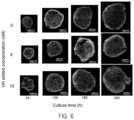
- FIG. 6 shows an example of the results of the micrographs of fluorescent staining of the localization of divisible cells in cell aggregates.
- the present inventors have been involved in the development of the technology of removing “cells deviated from the undifferentiated state” that emerge during culture of pluripotent stem cells.
- the “cells deviated from the undifferentiated state” tend to emerge in the central or peripheral portion of a colony of pluripotent stem cells during culture. It has been revealed that the “cells deviated from the undifferentiated state” that have emerged or emerge in the central portion of a colony can be removed by adding hemagglutinin to the colony during culture (WO 2014/104207 and WO 2015/199243).
- hemagglutinin has the effect of contributing to the promotion of proliferation of pluripotent stem cells.
- the present disclosure is based on the findings. Specifically, hemagglutinin is expected to function to reduce cell-cell adhesion so that the cell environment in the colonies or cell aggregates of pluripotent stem cells to be cultured may become more suitable for proliferation, thereby promoting the proliferation of pluripotent stem cells.
- pluripotent stem cells of the present disclosure are human pluripotent stem cells. In one or more non-limiting embodiments, the human pluripotent stem cells of the present disclosure are human iPS cells or human ES cells.
- the cells deviated from the undifferentiated state i.e., deviated cells
- the undifferentiated cells are different in morphology from cells in the undifferentiated state and therefore can be distinguished.
- the emergence of deviated cells can be confirmed by the disappearance of an undifferentiation marker.
- the undifferentiation marker is Oct3/4, Nanog, SSEA-4, or TEA-1-60.
- hemagglutinin of the present disclosure is hemagglutinin of Clostridium botulinum .
- hemagglutinin is a neurotoxin complex (also referred to as a hemagglutinin complex).
- hemagglutinin may be a complex composed of two or three components selected from the group consisting of three hemagglutinin subcomponents HA1 (HA33), HA2 (HA17), and HA3 (HA70) of the neurotoxin complex of Clostridium botulinum , or a substance containing the complex.
- hemagglutinin may be a complex composed of HA2 (HA17) and HA3 (HA70), a complex composed of the three components, or a substance containing the complex.
- the subcomponent HA3 is preferably of Clostridium botulinum type A or Clostridium botulinum type B.
- the subcomponents HA1 (HA33) and HA2 (HA17) may be of any one of Clostridium botulinum type A, Clostridium botulinum type B, and Clostridium botulinum type C.
- each subcomponent of hemagglutinin may be of a recombinant type or a natural type.
- hemagglutinin may be modified hemagglutinin as long as it has the effect of contributing to the promotion of proliferation of pluripotent stem cells.
- the modified hemagglutinin may have at least one amino acid mutation in an amino acid sequence of one, two or three subcomponents. Examples of the modified hemagglutinin include those described in WO 2015/199243.
- hemagglutinin includes “modified hemagglutinin”. Moreover, unless otherwise specified in the present disclosure, the “modified hemagglutinin” has the effect of contributing to the promotion of proliferation of pluripotent stem cells.
- the present disclosure relates to a composition for promoting the proliferation of pluripotent stem cells.
- the composition contains hemagglutinin or modified hemagglutinin.
- the proliferation promoting composition of the present disclosure preferably contains an effective amount of hemagglutinin or modified hemagglutinin.
- the proliferation promoting composition of the present disclosure can promote the proliferation of pluripotent stem cells.
- the proliferation promoting composition of the present disclosure further allows the cells to be cultured with high uniformity.
- the term “high uniformity” may indicate, e.g., that the uniformity in cell-cell adhesion of cells to be cultured is high, that the uniformity in the cell-cell adhesion strength is high, or that cell aggregates are the same in size.
- the cell culture with high uniformity can contribute to the improvement in quality of the pluripotent stem cells obtained after proliferation.
- the proliferation promoting composition of the present disclosure allows the cells to be cultured with high uniformity between the cells in cell aggregates or cell colonies.
- the number of cells that maintain the cell proliferative capacity is increased even at the position where the number of cells with low proliferative capacity has been increased in the conventional culture method, e.g., the position other than the inside of a cell aggregate or the peripheral portion of a cell colony.
- the position where the number of cells with low proliferative capacity has been increased in the conventional culture method, e.g., the position other than the inside of a cell aggregate or the peripheral portion of a cell colony.
- cells can be efficiently proliferated.
- the proliferation promoting composition of the present disclosure may be added to a culture medium of pluripotent stem cells.
- the concentration of the composition added to the culture medium may be determined so that the concentration of hemagglutinin or modified hemagglutinin in the culture medium after the addition of the composition is 5 nM or more, 10 nM or more, or 15 nM or more. From the same view point, the added concentration may be determined so that the concentration of hemagglutinin or modified hemagglutinin is 200 nM or less, 150 nM or less, or 100 nM or less.
- the proliferation promoting composition of the present disclosure may be used in a method for promoting the proliferation of pluripotent stem cells and a method for culturing pluripotent stem cells, which will be described later.
- the present disclosure relates to a method for promoting the proliferation of pluripotent stem cells.
- the method includes culturing pluripotent stem cells in a culture medium to which the proliferation promoting composition of the present disclosure has been added.
- the culture medium to which the proliferation promoting composition of the present disclosure is added is not particularly limited and may be a culture medium that can be used for culture of pluripotent stem cells.
- the added concentration of the proliferation promoting composition of the present disclosure may be the effective amount, as described above. In one or more embodiments, the added concentration may be determined so that the concentration of hemagglutinin or modified hemagglutinin in the culture medium after the addition of the composition is 5 nM or more, 10 nM or more, or 15 nM or more. From the same view point, the added concentration may be determined so that the concentration of hemagglutinin or modified hemagglutinin is 200 nM or less, 150 nM or less, or 100 nM or less.
- the present disclosure relates to a method for promoting the proliferation of pluripotent stem cells.
- the method includes seeding pluripotent stem cells in a single-cell state or a dispersed state, and culturing the pluripotent stem cells in a culture medium to which hemagglutinin or modified hemagglutinin has been added.
- the pluripotent stem cell population in the single-cell state or the dispersed state is brought into contact with hemagglutinin or modified hemagglutinin, so that the cells can be cultured with high uniformity. This can improve the efficiency of the promotion of cell proliferation, which in the end makes it possible to culture the cells at a high proliferation ratio, as compared to the conventional method.
- Cells in the single-cell state of the present disclosure mean one or more cells obtained by dispersing a cell aggregate to a single-cell state with a cell dispersion treatment.
- the number of cells to be seeded is not particularly limited and may be either one or more than one cell.
- the method of the cell dispersion treatment is not particularly limited and may be, e.g., an enzyme treatment using trypsin, pronase, etc., a physical treatment such as pipetting, or a combination of these treatments.
- Seeding cells in the dispersed state of the present disclosure means seeding a cell population that is obtained by the cell dispersion treatment of a cell aggregate, and that is in a state where not all cells are single cells.
- the cell population may include single cells.
- hemagglutinin or modified hemagglutinin may be performed in any desired order or simultaneously.
- the proliferation promoting method of Embodiment 1 may be monolayer culture (adhesion culture) or suspension culture.
- monolayer culture it is preferable that hemagglutinin or modified hemagglutinin is added to the culture medium before a colony of pluripotent stem cells is formed.
- the present disclosure relates to a method for promoting the proliferation of pluripotent stem cells.
- the method includes adding hemagglutinin or modified hemagglutinin to a culture medium for suspension culture of a cell aggregate of pluripotent stem cells, and culturing the pluripotent stem cells without dividing the cell aggregate into small aggregates.
- the cell aggregate of the present disclosure means a spheroid cell cluster that is formed by suspension culture of pluripotent stem cells.
- the phrase “without dividing the cell aggregate into small aggregates” of the present disclosure means that after hemagglutinin or modified hemagglutinin is added, no operation or treatment is performed to produce, e.g., a cell aggregate, a dispersed cell, and a single cell, which are smaller in size than the cell aggregate before the addition of hemagglutinin or modified hemagglutinin, until a part or the whole of the culture is completed.
- the cells can be cultured with high uniformity, the proliferation of pluripotent stem cells can be promoted while reducing damage or stress to the cells. Consequently, the cells can be efficiently proliferated without dividing the cell aggregate.
- dividing the cell aggregate into small aggregates means dividing the cell aggregate of pluripotent stem cells due to hemagglutinin (see WO 2015/199243).
- WO 2015/199243 discloses that when hemagglutinin is added to a culture medium including cell aggregates of iPS cells during culture, the cell aggregates can be smoothly divided into small aggregates by, e.g., pipetting, although the cell clusters are composed of delicate cells such as iPS cells.
- dividing the cell aggregate into small aggregates can improve the concentration of viable cells to be cultured.
- the cells are cultured without dividing the cell aggregate after hemagglutinin has acted on the cell aggregate.
- the mechanism of the proliferation promoting method of this embodiment can be assumed as follows. When hemagglutinin acts on the cell aggregate, the interaction between cells of the cell aggregate is reduced. Therefore, the number of cells that maintain the cell proliferative capacity is increased even inside the cell aggregate, so that the cells can be cultured with high uniformity. Consequently, larger cell aggregates can be formed, which in turn promotes efficient proliferation.
- the present disclosure should not be interpreted solely based on the above mechanism.
- the proliferation promoting method of this embodiment (Embodiment 2) can promote the proliferation of cells while suppressing damage caused by the division of cell aggregates, even if the cells are delicate cells such as iPS cells.
- the suspension culture of pluripotent stem cells may be performed by using, e.g., a bioreactor.
- the present disclosure relates to a method for culturing pluripotent stem cells.
- the method includes performing the proliferation promoting method of the present disclosure.
- the proliferation promoting method of the present disclosure has already been described above.
- the culture method of the present disclosure can promote the proliferation of pluripotent stem cells.
- the culture method of the present disclosure further allows the cells to be cultured with high uniformity.
- the present disclosure may also relate to the following embodiments.
- a composition for promoting proliferation of pluripotent stem cells comprising:
- hemagglutinin or modified hemagglutinin.
- a method for promoting proliferation of pluripotent stem cells comprising: culturing pluripotent stem cells in a culture medium to which the composition according to [1] has been added.
- a method for promoting proliferation of pluripotent stem cells comprising:
- hemagglutinin or modified hemagglutinin to the culture medium before a colony of the pluripotent stem cells is formed.
- a method for promoting proliferation of pluripotent stem cells comprising: adding hemagglutinin or modified hemagglutinin to a culture medium for suspension culture of a cell aggregate of pluripotent stem cells; and culturing the pluripotent stem cells without dividing the cell aggregate into small aggregates.
- a method for culturing pluripotent stem cells comprising:
- HA hemagglutinin
- Human iPS cells single cells of Tic strain
- FIG. 1 shows the micrographs thus obtained.
- the growth rate was higher in the culture using the culture medium that contained HA than in the culture using the culture medium that did not contain HA.
- the frequency of appearance of the cells deviated from the undifferentiated state was suppressed in the culture using the culture medium that contained HA, as compared to the culture using the culture medium that did not contain HA.
- HA hemagglutinin
- Human iPS cells single cells of Tic strain
- Human iPS cells single cells of Tic strain
- Cell proliferation properties The number of cells in a cell aggregate and the apparent specific growth rate ( ⁇ ) in culture between 24 h and 168 h were measured.
- the Tic strain was cultured in the culture media containing HA at a concentration of 0, 5, 10 nM under the above culture conditions.
- the number of cells in each cell aggregate and the specific growth rate ( ⁇ ) were measured as the proliferation properties.
- FIG. 5 shows the results of the number of cells in a cell aggregate.
- the specific growth rate ( ⁇ ) was calculated based on the following formulas as an apparent specific growth rate in culture between 24 h and 168 h.
- Table 2 shows the results. As shown in Table 2, the results confirmed that the specific growth rate ( ⁇ ) was higher with the addition of HA than without the addition of HA, and that the cell proliferation was promoted.
- ⁇ LN ( X 2 /X 1 )/( t 2 ⁇ t 1 )
- the properties in cell aggregates were observed by fluorescent staining with a microscope.
- the nuclei were stained with DAPI (red) and the divisible cells were stained with the anti-ki-67 antibody (green) so that the localization of the divisible cells in the cell aggregates was confirmed.
- FIG. 6 shows an example of the results.
- the divisible cells (ki-67 positive cells) were substantially uniformly present (i.e., portions represented by yellow) in a cell aggregate after 24 hours of culture. Then, no divisible cell was observed inside the cell aggregate and the cells were localized only in the peripheral portion. In other words, the cells divided only in the peripheral portion of the cell aggregate, and thus the number of cells in the cell aggregate was increased.
- the cells When HA was added (5, 10 nM), the cells had the same tendency as those without the addition of HA after 24 hours of culture. However, in the subsequent culture, the frequency of the divisible cells was increased in the peripheral portion of the aggregate, as compared to without the addition of HA. In the culture with the addition of HA at 10 nM, the divisible cells were also present inside the cell aggregate. Thus, it was evident that the addition of HA improved the frequency of cell division in cell aggregates and increased the growth rate. Moreover, it was confirmed that the increase in growth rate due to HA indicated the HA concentration dependence.
- the method and composition of the present disclosure are useful, e.g., in the field of regenerative medicine.
Landscapes
- Health & Medical Sciences (AREA)
- Life Sciences & Earth Sciences (AREA)
- Engineering & Computer Science (AREA)
- Biomedical Technology (AREA)
- Chemical & Material Sciences (AREA)
- Organic Chemistry (AREA)
- Genetics & Genomics (AREA)
- Zoology (AREA)
- Biotechnology (AREA)
- Bioinformatics & Cheminformatics (AREA)
- Wood Science & Technology (AREA)
- Developmental Biology & Embryology (AREA)
- General Health & Medical Sciences (AREA)
- Biochemistry (AREA)
- General Engineering & Computer Science (AREA)
- Microbiology (AREA)
- Cell Biology (AREA)
- Transplantation (AREA)
- Gynecology & Obstetrics (AREA)
- Reproductive Health (AREA)
- Gastroenterology & Hepatology (AREA)
- Medicinal Chemistry (AREA)
- Molecular Biology (AREA)
- Proteomics, Peptides & Aminoacids (AREA)
- Biophysics (AREA)
- Virology (AREA)
- Micro-Organisms Or Cultivation Processes Thereof (AREA)
Abstract
Description
α=X 24 /X 0
-
- X0=Cell density at seeding (0 h)
- X24=
Cell density 24 hours after seeding
μ=LN(X 2 /X 1)/(t 2 −t 1) - t1=24 h (first phase) or 96 h (second phase)
- t2=72 h (first phase) or 168 h (second phase)
| TABLE 1 |
| Comparison of cell survival ratio (α) and |
| apparent specific growth rate (μ) |
| HA (Type B, 10 nM) | |
| 1st phase | 2nd |
1st phase | 2nd phase | ||
| α (—) | 0.35 | 0.33 | ||||
| μ (h−1) | 0.031 | 0.035 | 0.033 | 0.013 | ||
μ=LN(X 2 /X 1)/(t 2 −t 1)
| TABLE 2 |
| Comparison of proliferation properties |
| HA concentration (nM) | μ (10−2h−1) | ||
| 0 | 2.04 ± 0.12 | ||
| 5 | 2.33 ± 0.15 | ||
| 10 | 2.35 ± 0.05 | ||
Claims (5)
Applications Claiming Priority (3)
| Application Number | Priority Date | Filing Date | Title |
|---|---|---|---|
| JP2016247064A JP6949349B2 (en) | 2016-12-20 | 2016-12-20 | A composition for promoting the proliferation of pluripotent stem cells, and a method for promoting the proliferation of pluripotent stem cells. |
| JP2016-247064 | 2016-12-20 | ||
| PCT/JP2017/045574 WO2018117110A1 (en) | 2016-12-20 | 2017-12-19 | Composition for promoting proliferation of pluripotent stem cells, and method for promoting proliferation of pluripotent stem cells |
Publications (2)
| Publication Number | Publication Date |
|---|---|
| US20200017836A1 US20200017836A1 (en) | 2020-01-16 |
| US11795438B2 true US11795438B2 (en) | 2023-10-24 |
Family
ID=62626505
Family Applications (1)
| Application Number | Title | Priority Date | Filing Date |
|---|---|---|---|
| US16/471,312 Active 2039-01-27 US11795438B2 (en) | 2016-12-20 | 2017-12-19 | Composition for promoting proliferation of pluripotent stem cells, and method for promoting proliferation of pluripotent stem cells |
Country Status (8)
| Country | Link |
|---|---|
| US (1) | US11795438B2 (en) |
| EP (1) | EP3561051A4 (en) |
| JP (1) | JP6949349B2 (en) |
| KR (1) | KR102501565B1 (en) |
| CN (1) | CN110088270A (en) |
| AU (1) | AU2017379330A1 (en) |
| CA (1) | CA3047715A1 (en) |
| WO (1) | WO2018117110A1 (en) |
Families Citing this family (2)
| Publication number | Priority date | Publication date | Assignee | Title |
|---|---|---|---|---|
| US20250163369A1 (en) | 2022-02-07 | 2025-05-22 | Osaka University | Differentiation induction control agent and differentiation induction stabilizing agent for pluripotent stem cells |
| EP4477744A4 (en) * | 2022-02-07 | 2025-06-11 | Osaka University | Method for inducing differentiation of pluripotent stem cells into retinal pigment epithelial cells |
Citations (7)
| Publication number | Priority date | Publication date | Assignee | Title |
|---|---|---|---|---|
| US20090155222A1 (en) * | 2006-02-02 | 2009-06-18 | The University Of Manchester | Cell culture |
| US20120164729A1 (en) | 2010-12-24 | 2012-06-28 | National University Corporation Chiba University | Composition for culturing pluripotent stem cells and use thereof |
| CN102597217A (en) | 2009-10-08 | 2012-07-18 | 国立大学法人大阪大学 | Culture substrate for human pluripotent stem cells and use thereof |
| WO2014104207A1 (en) | 2012-12-28 | 2014-07-03 | 国立大学法人大阪大学 | Method for culturing pluripotent stem cells |
| JP2014143229A (en) | 2013-01-22 | 2014-08-07 | Nikon Corp | Measuring method and measuring system, exposure method and exposure device, and device manufacturing method |
| WO2015199243A1 (en) | 2014-06-27 | 2015-12-30 | 国立大学法人大阪大学 | Mutant hemagglutinin complex protein, and method for culturing pluripotent stem cells using same |
| WO2016121840A1 (en) | 2015-01-29 | 2016-08-04 | 国立大学法人 東京大学 | Cell culture method, cell aggregates, cell aggregation control agent, and medium |
-
2016
- 2016-12-20 JP JP2016247064A patent/JP6949349B2/en active Active
-
2017
- 2017-12-19 CN CN201780078568.7A patent/CN110088270A/en active Pending
- 2017-12-19 EP EP17884218.3A patent/EP3561051A4/en active Pending
- 2017-12-19 AU AU2017379330A patent/AU2017379330A1/en not_active Abandoned
- 2017-12-19 KR KR1020197017657A patent/KR102501565B1/en active Active
- 2017-12-19 WO PCT/JP2017/045574 patent/WO2018117110A1/en not_active Ceased
- 2017-12-19 CA CA3047715A patent/CA3047715A1/en active Pending
- 2017-12-19 US US16/471,312 patent/US11795438B2/en active Active
Patent Citations (12)
| Publication number | Priority date | Publication date | Assignee | Title |
|---|---|---|---|---|
| US20090155222A1 (en) * | 2006-02-02 | 2009-06-18 | The University Of Manchester | Cell culture |
| CN102597217A (en) | 2009-10-08 | 2012-07-18 | 国立大学法人大阪大学 | Culture substrate for human pluripotent stem cells and use thereof |
| US20120220031A1 (en) | 2009-10-08 | 2012-08-30 | Kiyotoshi Sekiguchi | Culture substrate for human pluripotent stem cells and use thereof |
| US20120164729A1 (en) | 2010-12-24 | 2012-06-28 | National University Corporation Chiba University | Composition for culturing pluripotent stem cells and use thereof |
| WO2014104207A1 (en) | 2012-12-28 | 2014-07-03 | 国立大学法人大阪大学 | Method for culturing pluripotent stem cells |
| CN105051185A (en) | 2012-12-28 | 2015-11-11 | 国立大学法人大阪大学 | Method for culturing pluripotent stem cells |
| US20150329831A1 (en) | 2012-12-28 | 2015-11-19 | Osaka University | Method for Culturing Pluripotent Stem Cells |
| JP2014143229A (en) | 2013-01-22 | 2014-08-07 | Nikon Corp | Measuring method and measuring system, exposure method and exposure device, and device manufacturing method |
| WO2015199243A1 (en) | 2014-06-27 | 2015-12-30 | 国立大学法人大阪大学 | Mutant hemagglutinin complex protein, and method for culturing pluripotent stem cells using same |
| US20170130206A1 (en) | 2014-06-27 | 2017-05-11 | Osaka University | Mutant Hemagglutinin Complex Protein, and Method for Culturing Pluripotent Stem Cells Using Same |
| WO2016121840A1 (en) | 2015-01-29 | 2016-08-04 | 国立大学法人 東京大学 | Cell culture method, cell aggregates, cell aggregation control agent, and medium |
| US20180023057A1 (en) * | 2015-01-29 | 2018-01-25 | The University Of Tokyo | Cell culture method, cell aggregates, cell aggregation control agent, and medium |
Non-Patent Citations (9)
| Title |
|---|
| Extended European Search Report issued in corresponding European Patent Application No. 17884218.3 dated Oct. 10, 2019. |
| First Examination Report issued in corresponding Australian Patent Application No. 2017379330 dated Mar. 31, 2023. |
| International Search Report issued in corresponding International Patent Application No. PCT/JP2017/045574 dated Feb. 6, 2018. |
| Kim et al., "A Simple and Robust Method for Culturing Human-Induced Pluripotent Stem Cells in an Undifferentiated State Using Botulinum Hemagglutinin," Biotechnology Journal, 13: 1700384 (2018). |
| Kim et al., "Maintenance of an undifferentiated state of human induced pluripotent stem cells through migration-dependent regulation of the balance between cell-cell and cell-substrate interactions," Journal of Bioscience and Bioengineering, 119: 617-622 (2015). |
| Mohamet et al. "Abrogation of E-Cadherin-Mediated Cellular Aggregation Allows Proliferation of Pluripotent Mouse Embryonic Stem Cells in Shake Flask Bioreactors." PLOS One Sep. 23, 2010;5(9):e12921. (Year: 2010). * |
| Office Action issued in corresponding Chinese Patent Application No. 201780078568.7 dated Apr. 29, 2023. |
| Office Action issued in corresponding Chinese Patent Application No. 201780078568.7 dated Sep. 13, 2022. |
| Toh et al. "Modulation of integrin and E-cadherin-mediated adhesions to spatially control heterogeneity in human pluripotent stem cell differentiation." Biomaterials.May 2015;50:87-97. (Year: 2015). * |
Also Published As
| Publication number | Publication date |
|---|---|
| JP2018099078A (en) | 2018-06-28 |
| EP3561051A1 (en) | 2019-10-30 |
| US20200017836A1 (en) | 2020-01-16 |
| CN110088270A (en) | 2019-08-02 |
| EP3561051A4 (en) | 2019-11-13 |
| WO2018117110A1 (en) | 2018-06-28 |
| JP6949349B2 (en) | 2021-10-13 |
| KR102501565B1 (en) | 2023-02-17 |
| AU2017379330A1 (en) | 2019-07-11 |
| KR20190091466A (en) | 2019-08-06 |
| CA3047715A1 (en) | 2018-06-28 |
Similar Documents
| Publication | Publication Date | Title |
|---|---|---|
| Le et al. | Enhanced telomere rejuvenation in pluripotent cells reprogrammed via nuclear transfer relative to induced pluripotent stem cells | |
| KR101293637B1 (en) | Suspension Culture Composition of Stem Cells | |
| Imaizumi et al. | A simple and highly effective method for slow-freezing human pluripotent stem cells using dimethyl sulfoxide, hydroxyethyl starch and ethylene glycol | |
| US20240076620A1 (en) | Production of skeletal muscle cells and skeletal muscle tissue from pluripotent stem cells | |
| JP6452249B2 (en) | 3D cell culture method using fiber-on-fiber and substrate for the same | |
| Kim et al. | Endogenous extracellular matrices enhance human mesenchymal stem cell aggregate formation and survival | |
| Nichol et al. | Co-culture induces alignment in engineered cardiac constructs via MMP-2 expression | |
| JP2013247943A (en) | Method for culturing multipotent stem cell and base material for the same | |
| CN102144027B (en) | Produce the method for multipotential stem cell | |
| CN104877961A (en) | Serum-free human amniotic mesenchymal stem cell culture medium and preparation method thereof | |
| US11795438B2 (en) | Composition for promoting proliferation of pluripotent stem cells, and method for promoting proliferation of pluripotent stem cells | |
| Jin et al. | Enhanced differentiation of human pluripotent stem cells into cardiomyocytes by bacteria-mediated transcription factors delivery | |
| US11230701B2 (en) | Mutant hemagglutinin complex protein, and method for culturing pluripotent stem cells using same | |
| Escobedo-Lucea et al. | Development of a human extracellular matrix for applications related with stem cells and tissue engineering | |
| Chaudhry et al. | Basal medium composition and serum or serum replacement concentration influences on the maintenance of murine embryonic stem cells | |
| CN105051185A (en) | Method for culturing pluripotent stem cells | |
| Generali et al. | Generation and purification of iPSC-derived cardiomyocytes for clinical applications | |
| WO2016187451A1 (en) | Multi-pathway induction of stem cell differentiation with rna | |
| US20230407249A1 (en) | Media and methods for establishing and maintaining early embryo-like cells | |
| CN102449139A (en) | Method for inducing cell death in pluripotent stem cells and differentiated cells other than cardiac myocytes | |
| CN111019886B (en) | Novel sternness factor and method or culture system for culturing embryonic stem cells by using same | |
| KR101647030B1 (en) | Compositions comprising a mitofusin inhibitor for promoting cell reprogramming and the use thereof | |
| HK40005437A (en) | Composition for promoting proliferation of pluripotent stem cells, and method for promoting proliferation of pluripotent stem cells | |
| Zheng | Cell types for cultured meat production: current challenges and recent advances | |
| Kim et al. | Effects of clustered regularly interspaced short palindromic repeat (CRISPR)/CRISPR-associated (Cas) protein 9 system-Based Deletion of miR-451 in Mouse Embryonic Stem Cells on Their Self-Renewal and Hematopoietic Differentiation |
Legal Events
| Date | Code | Title | Description |
|---|---|---|---|
| AS | Assignment |
Owner name: OSAKA UNIVERSITY, JAPAN Free format text: ASSIGNMENT OF ASSIGNORS INTEREST;ASSIGNORS:KINOOKA, MASAHIRO;KIM, MEEHAE;FUJINAGA, YUKAKO;SIGNING DATES FROM 20190531 TO 20190603;REEL/FRAME:049523/0085 |
|
| FEPP | Fee payment procedure |
Free format text: ENTITY STATUS SET TO UNDISCOUNTED (ORIGINAL EVENT CODE: BIG.); ENTITY STATUS OF PATENT OWNER: LARGE ENTITY |
|
| FEPP | Fee payment procedure |
Free format text: ENTITY STATUS SET TO SMALL (ORIGINAL EVENT CODE: SMAL); ENTITY STATUS OF PATENT OWNER: LARGE ENTITY |
|
| STPP | Information on status: patent application and granting procedure in general |
Free format text: APPLICATION DISPATCHED FROM PREEXAM, NOT YET DOCKETED |
|
| STPP | Information on status: patent application and granting procedure in general |
Free format text: DOCKETED NEW CASE - READY FOR EXAMINATION |
|
| STPP | Information on status: patent application and granting procedure in general |
Free format text: NON FINAL ACTION MAILED |
|
| STPP | Information on status: patent application and granting procedure in general |
Free format text: RESPONSE TO NON-FINAL OFFICE ACTION ENTERED AND FORWARDED TO EXAMINER |
|
| STPP | Information on status: patent application and granting procedure in general |
Free format text: FINAL REJECTION MAILED |
|
| STPP | Information on status: patent application and granting procedure in general |
Free format text: ADVISORY ACTION MAILED |
|
| STPP | Information on status: patent application and granting procedure in general |
Free format text: DOCKETED NEW CASE - READY FOR EXAMINATION |
|
| STPP | Information on status: patent application and granting procedure in general |
Free format text: NON FINAL ACTION MAILED |
|
| FEPP | Fee payment procedure |
Free format text: ENTITY STATUS SET TO UNDISCOUNTED (ORIGINAL EVENT CODE: BIG.); ENTITY STATUS OF PATENT OWNER: LARGE ENTITY |
|
| STPP | Information on status: patent application and granting procedure in general |
Free format text: NOTICE OF ALLOWANCE MAILED -- APPLICATION RECEIVED IN OFFICE OF PUBLICATIONS |
|
| STPP | Information on status: patent application and granting procedure in general |
Free format text: AWAITING TC RESP., ISSUE FEE NOT PAID |
|
| STPP | Information on status: patent application and granting procedure in general |
Free format text: NOTICE OF ALLOWANCE MAILED -- APPLICATION RECEIVED IN OFFICE OF PUBLICATIONS |
|
| STPP | Information on status: patent application and granting procedure in general |
Free format text: PUBLICATIONS -- ISSUE FEE PAYMENT RECEIVED |
|
| STPP | Information on status: patent application and granting procedure in general |
Free format text: PUBLICATIONS -- ISSUE FEE PAYMENT VERIFIED |
|
| STCF | Information on status: patent grant |
Free format text: PATENTED CASE |