US11795155B2 - Compound having naphthobenzofuranyl structure, material for organic electroluminescence device, organic electroluminescence device, and electronic instrument - Google Patents

Compound having naphthobenzofuranyl structure, material for organic electroluminescence device, organic electroluminescence device, and electronic instrument Download PDF

Info

Publication number
US11795155B2
US11795155B2 US17/810,443 US202217810443A US11795155B2 US 11795155 B2 US11795155 B2 US 11795155B2 US 202217810443 A US202217810443 A US 202217810443A US 11795155 B2 US11795155 B2 US 11795155B2
Authority
US
United States
Prior art keywords
group
substituted
bonded
unsubstituted
ring
Prior art date
Legal status (The legal status is an assumption and is not a legal conclusion. Google has not performed a legal analysis and makes no representation as to the accuracy of the status listed.)
Active
Application number
US17/810,443
Other versions
US20230026288A1 (en
Inventor
Yusuke Takahashi
Tasuku Haketa
Shota TANAKA
Current Assignee (The listed assignees may be inaccurate. Google has not performed a legal analysis and makes no representation or warranty as to the accuracy of the list.)
Idemitsu Kosan Co Ltd
Original Assignee
Idemitsu Kosan Co Ltd
Priority date (The priority date is an assumption and is not a legal conclusion. Google has not performed a legal analysis and makes no representation as to the accuracy of the date listed.)
Filing date
Publication date
Application filed by Idemitsu Kosan Co Ltd filed Critical Idemitsu Kosan Co Ltd
Assigned to IDEMITSU KOSAN CO.,LTD. reassignment IDEMITSU KOSAN CO.,LTD. ASSIGNMENT OF ASSIGNORS INTEREST (SEE DOCUMENT FOR DETAILS). Assignors: TAKAHASHI, YUSUKE, HAKETA, TASUKU, TANAKA, SHOTA
Publication of US20230026288A1 publication Critical patent/US20230026288A1/en
Priority to US18/329,687 priority Critical patent/US12012389B2/en
Application granted granted Critical
Publication of US11795155B2 publication Critical patent/US11795155B2/en
Priority to US18/637,498 priority patent/US20240300912A1/en
Active legal-status Critical Current
Anticipated expiration legal-status Critical

Links

Images

Classifications

    • CCHEMISTRY; METALLURGY
    • C07ORGANIC CHEMISTRY
    • C07DHETEROCYCLIC COMPOUNDS
    • C07D407/00Heterocyclic compounds containing two or more hetero rings, at least one ring having oxygen atoms as the only ring hetero atoms, not provided for by group C07D405/00
    • C07D407/02Heterocyclic compounds containing two or more hetero rings, at least one ring having oxygen atoms as the only ring hetero atoms, not provided for by group C07D405/00 containing two hetero rings
    • C07D407/12Heterocyclic compounds containing two or more hetero rings, at least one ring having oxygen atoms as the only ring hetero atoms, not provided for by group C07D405/00 containing two hetero rings linked by a chain containing hetero atoms as chain links
    • CCHEMISTRY; METALLURGY
    • C07ORGANIC CHEMISTRY
    • C07CACYCLIC OR CARBOCYCLIC COMPOUNDS
    • C07C15/00Cyclic hydrocarbons containing only six-membered aromatic rings as cyclic parts
    • C07C15/20Polycyclic condensed hydrocarbons
    • C07C15/27Polycyclic condensed hydrocarbons containing three rings
    • C07C15/28Anthracenes
    • CCHEMISTRY; METALLURGY
    • C07ORGANIC CHEMISTRY
    • C07CACYCLIC OR CARBOCYCLIC COMPOUNDS
    • C07C15/00Cyclic hydrocarbons containing only six-membered aromatic rings as cyclic parts
    • C07C15/20Polycyclic condensed hydrocarbons
    • C07C15/38Polycyclic condensed hydrocarbons containing four rings
    • CCHEMISTRY; METALLURGY
    • C07ORGANIC CHEMISTRY
    • C07DHETEROCYCLIC COMPOUNDS
    • C07D307/00Heterocyclic compounds containing five-membered rings having one oxygen atom as the only ring hetero atom
    • C07D307/77Heterocyclic compounds containing five-membered rings having one oxygen atom as the only ring hetero atom ortho- or peri-condensed with carbocyclic rings or ring systems
    • CCHEMISTRY; METALLURGY
    • C07ORGANIC CHEMISTRY
    • C07DHETEROCYCLIC COMPOUNDS
    • C07D307/00Heterocyclic compounds containing five-membered rings having one oxygen atom as the only ring hetero atom
    • C07D307/77Heterocyclic compounds containing five-membered rings having one oxygen atom as the only ring hetero atom ortho- or peri-condensed with carbocyclic rings or ring systems
    • C07D307/91Dibenzofurans; Hydrogenated dibenzofurans
    • CCHEMISTRY; METALLURGY
    • C07ORGANIC CHEMISTRY
    • C07DHETEROCYCLIC COMPOUNDS
    • C07D405/00Heterocyclic compounds containing both one or more hetero rings having oxygen atoms as the only ring hetero atoms, and one or more rings having nitrogen as the only ring hetero atom
    • C07D405/02Heterocyclic compounds containing both one or more hetero rings having oxygen atoms as the only ring hetero atoms, and one or more rings having nitrogen as the only ring hetero atom containing two hetero rings
    • C07D405/12Heterocyclic compounds containing both one or more hetero rings having oxygen atoms as the only ring hetero atoms, and one or more rings having nitrogen as the only ring hetero atom containing two hetero rings linked by a chain containing hetero atoms as chain links
    • CCHEMISTRY; METALLURGY
    • C07ORGANIC CHEMISTRY
    • C07DHETEROCYCLIC COMPOUNDS
    • C07D405/00Heterocyclic compounds containing both one or more hetero rings having oxygen atoms as the only ring hetero atoms, and one or more rings having nitrogen as the only ring hetero atom
    • C07D405/14Heterocyclic compounds containing both one or more hetero rings having oxygen atoms as the only ring hetero atoms, and one or more rings having nitrogen as the only ring hetero atom containing three or more hetero rings
    • CCHEMISTRY; METALLURGY
    • C07ORGANIC CHEMISTRY
    • C07DHETEROCYCLIC COMPOUNDS
    • C07D407/00Heterocyclic compounds containing two or more hetero rings, at least one ring having oxygen atoms as the only ring hetero atoms, not provided for by group C07D405/00
    • C07D407/14Heterocyclic compounds containing two or more hetero rings, at least one ring having oxygen atoms as the only ring hetero atoms, not provided for by group C07D405/00 containing three or more hetero rings
    • CCHEMISTRY; METALLURGY
    • C07ORGANIC CHEMISTRY
    • C07DHETEROCYCLIC COMPOUNDS
    • C07D409/00Heterocyclic compounds containing two or more hetero rings, at least one ring having sulfur atoms as the only ring hetero atoms
    • C07D409/02Heterocyclic compounds containing two or more hetero rings, at least one ring having sulfur atoms as the only ring hetero atoms containing two hetero rings
    • C07D409/12Heterocyclic compounds containing two or more hetero rings, at least one ring having sulfur atoms as the only ring hetero atoms containing two hetero rings linked by a chain containing hetero atoms as chain links
    • CCHEMISTRY; METALLURGY
    • C07ORGANIC CHEMISTRY
    • C07DHETEROCYCLIC COMPOUNDS
    • C07D409/00Heterocyclic compounds containing two or more hetero rings, at least one ring having sulfur atoms as the only ring hetero atoms
    • C07D409/14Heterocyclic compounds containing two or more hetero rings, at least one ring having sulfur atoms as the only ring hetero atoms containing three or more hetero rings
    • HELECTRICITY
    • H10SEMICONDUCTOR DEVICES; ELECTRIC SOLID-STATE DEVICES NOT OTHERWISE PROVIDED FOR
    • H10KORGANIC ELECTRIC SOLID-STATE DEVICES
    • H10K50/00Organic light-emitting devices
    • H10K50/10OLEDs or polymer light-emitting diodes [PLED]
    • H10K50/14Carrier transporting layers
    • H10K50/15Hole transporting layers
    • HELECTRICITY
    • H10SEMICONDUCTOR DEVICES; ELECTRIC SOLID-STATE DEVICES NOT OTHERWISE PROVIDED FOR
    • H10KORGANIC ELECTRIC SOLID-STATE DEVICES
    • H10K50/00Organic light-emitting devices
    • H10K50/10OLEDs or polymer light-emitting diodes [PLED]
    • H10K50/14Carrier transporting layers
    • H10K50/15Hole transporting layers
    • H10K50/156Hole transporting layers comprising a multilayered structure
    • HELECTRICITY
    • H10SEMICONDUCTOR DEVICES; ELECTRIC SOLID-STATE DEVICES NOT OTHERWISE PROVIDED FOR
    • H10KORGANIC ELECTRIC SOLID-STATE DEVICES
    • H10K85/00Organic materials used in the body or electrodes of devices covered by this subclass
    • H10K85/60Organic compounds having low molecular weight
    • H10K85/615Polycyclic condensed aromatic hydrocarbons, e.g. anthracene
    • HELECTRICITY
    • H10SEMICONDUCTOR DEVICES; ELECTRIC SOLID-STATE DEVICES NOT OTHERWISE PROVIDED FOR
    • H10KORGANIC ELECTRIC SOLID-STATE DEVICES
    • H10K85/00Organic materials used in the body or electrodes of devices covered by this subclass
    • H10K85/60Organic compounds having low molecular weight
    • H10K85/615Polycyclic condensed aromatic hydrocarbons, e.g. anthracene
    • H10K85/622Polycyclic condensed aromatic hydrocarbons, e.g. anthracene containing four rings, e.g. pyrene
    • HELECTRICITY
    • H10SEMICONDUCTOR DEVICES; ELECTRIC SOLID-STATE DEVICES NOT OTHERWISE PROVIDED FOR
    • H10KORGANIC ELECTRIC SOLID-STATE DEVICES
    • H10K85/00Organic materials used in the body or electrodes of devices covered by this subclass
    • H10K85/60Organic compounds having low molecular weight
    • H10K85/615Polycyclic condensed aromatic hydrocarbons, e.g. anthracene
    • H10K85/626Polycyclic condensed aromatic hydrocarbons, e.g. anthracene containing more than one polycyclic condensed aromatic rings, e.g. bis-anthracene
    • HELECTRICITY
    • H10SEMICONDUCTOR DEVICES; ELECTRIC SOLID-STATE DEVICES NOT OTHERWISE PROVIDED FOR
    • H10KORGANIC ELECTRIC SOLID-STATE DEVICES
    • H10K85/00Organic materials used in the body or electrodes of devices covered by this subclass
    • H10K85/60Organic compounds having low molecular weight
    • H10K85/631Amine compounds having at least two aryl rest on at least one amine-nitrogen atom, e.g. triphenylamine
    • HELECTRICITY
    • H10SEMICONDUCTOR DEVICES; ELECTRIC SOLID-STATE DEVICES NOT OTHERWISE PROVIDED FOR
    • H10KORGANIC ELECTRIC SOLID-STATE DEVICES
    • H10K85/00Organic materials used in the body or electrodes of devices covered by this subclass
    • H10K85/60Organic compounds having low molecular weight
    • H10K85/631Amine compounds having at least two aryl rest on at least one amine-nitrogen atom, e.g. triphenylamine
    • H10K85/633Amine compounds having at least two aryl rest on at least one amine-nitrogen atom, e.g. triphenylamine comprising polycyclic condensed aromatic hydrocarbons as substituents on the nitrogen atom
    • HELECTRICITY
    • H10SEMICONDUCTOR DEVICES; ELECTRIC SOLID-STATE DEVICES NOT OTHERWISE PROVIDED FOR
    • H10KORGANIC ELECTRIC SOLID-STATE DEVICES
    • H10K85/00Organic materials used in the body or electrodes of devices covered by this subclass
    • H10K85/60Organic compounds having low molecular weight
    • H10K85/631Amine compounds having at least two aryl rest on at least one amine-nitrogen atom, e.g. triphenylamine
    • H10K85/636Amine compounds having at least two aryl rest on at least one amine-nitrogen atom, e.g. triphenylamine comprising heteroaromatic hydrocarbons as substituents on the nitrogen atom
    • HELECTRICITY
    • H10SEMICONDUCTOR DEVICES; ELECTRIC SOLID-STATE DEVICES NOT OTHERWISE PROVIDED FOR
    • H10KORGANIC ELECTRIC SOLID-STATE DEVICES
    • H10K85/00Organic materials used in the body or electrodes of devices covered by this subclass
    • H10K85/60Organic compounds having low molecular weight
    • H10K85/649Aromatic compounds comprising a hetero atom
    • H10K85/657Polycyclic condensed heteroaromatic hydrocarbons
    • H10K85/6572Polycyclic condensed heteroaromatic hydrocarbons comprising only nitrogen in the heteroaromatic polycondensed ring system, e.g. phenanthroline or carbazole
    • HELECTRICITY
    • H10SEMICONDUCTOR DEVICES; ELECTRIC SOLID-STATE DEVICES NOT OTHERWISE PROVIDED FOR
    • H10KORGANIC ELECTRIC SOLID-STATE DEVICES
    • H10K85/00Organic materials used in the body or electrodes of devices covered by this subclass
    • H10K85/60Organic compounds having low molecular weight
    • H10K85/649Aromatic compounds comprising a hetero atom
    • H10K85/657Polycyclic condensed heteroaromatic hydrocarbons
    • H10K85/6574Polycyclic condensed heteroaromatic hydrocarbons comprising only oxygen in the heteroaromatic polycondensed ring system, e.g. cumarine dyes
    • HELECTRICITY
    • H10SEMICONDUCTOR DEVICES; ELECTRIC SOLID-STATE DEVICES NOT OTHERWISE PROVIDED FOR
    • H10KORGANIC ELECTRIC SOLID-STATE DEVICES
    • H10K85/00Organic materials used in the body or electrodes of devices covered by this subclass
    • H10K85/60Organic compounds having low molecular weight
    • H10K85/649Aromatic compounds comprising a hetero atom
    • H10K85/657Polycyclic condensed heteroaromatic hydrocarbons
    • H10K85/6576Polycyclic condensed heteroaromatic hydrocarbons comprising only sulfur in the heteroaromatic polycondensed ring system, e.g. benzothiophene
    • HELECTRICITY
    • H10SEMICONDUCTOR DEVICES; ELECTRIC SOLID-STATE DEVICES NOT OTHERWISE PROVIDED FOR
    • H10KORGANIC ELECTRIC SOLID-STATE DEVICES
    • H10K50/00Organic light-emitting devices
    • H10K50/10OLEDs or polymer light-emitting diodes [PLED]
    • H10K50/11OLEDs or polymer light-emitting diodes [PLED] characterised by the electroluminescent [EL] layers
    • H10K50/12OLEDs or polymer light-emitting diodes [PLED] characterised by the electroluminescent [EL] layers comprising dopants

Definitions

  • the present invention relates to a compound, a material for organic electroluminescence devices, an organic electroluminescence device, and an electronic instrument including the organic electroluminescence device.
  • an organic electroluminescence device (hereinafter sometimes referred to as “organic EL device”) is composed of an anode, a cathode, and an organic layer interposed between the anode and the cathode.
  • organic EL device In application of a voltage between the two electrodes, electrons from the cathode side and holes from the anode side are injected into a light emitting region, and the injected electrons and holes are recombined in the light emitting region to generate an excited state, which then returns to the ground state to emit light. Accordingly, it is important, for providing a high-performance organic EL device, to develop a material that efficiently transports electrons or holes into a light emitting region to promote recombination of the electrons and holes.
  • PTLs 1 to 8 disclose compounds for use as a material for organic electroluminescence devices.
  • the present invention has been made for solving the above problem, and has an object to provide a compound that further improves performance of an organic EL device, an organic EL device having further improved device performance, and an electronic instrument including such an organic EL device.
  • the present invention provides a compound represented by the following formula (1):
  • R 1 to R 9 are each independently a hydrogen atom, a substituted or unsubstituted alkyl group having 1 to 50 carbon atoms, a substituted or unsubstituted cycloalkyl group having 3 to 50 ring carbon atoms, a halogen atom, a cyano group, a nitro group, or a substituted or unsubstituted heterocyclic group having 5 to 50 ring atoms,
  • L 1 is a substituted or unsubstituted arylene group having 6 to 30 ring carbon atoms or a substituted or unsubstituted divalent heterocyclic group having 5 to 30 ring atoms, and
  • L 2 and L 3 are each independently a single bond, a substituted or unsubstituted divalent heterocyclic group having 5 to 30 ring atoms, or a group represented by any of the following formulae (i) to (iii):
  • Ar 1 and Ar 2 are each independently a group represented by any of the following formulae (a) to (e):
  • the present invention provides a material for organic EL devices, the material containing the compound represented by the formula (1).
  • the present invention provides an organic electroluminescence device including an anode, a cathode, and an organic layer disposed between the anode and the cathode, the organic layer including a light emitting layer, at least one layer of the organic layer containing the compound represented by the formula (1).
  • the present invention provides an electronic instrument including the organic electroluminescence device.
  • the organic EL device containing the compound represented by the formula (1) shows an improved device performance.
  • FIG. 1 is a schematic diagram illustrating an example of the layer configuration of the organic EL device according to an aspect of the present invention.
  • FIG. 2 is a schematic diagram illustrating another example of the layer configuration of the organic EL device according to an aspect of the present invention.
  • the hydrogen atom encompasses isotopes thereof having different numbers of neutrons, i.e., a light hydrogen atom (protium), a heavy hydrogen atom (deuterium), and tritium.
  • the bonding site where the symbol, such as “R”, or “D” representing a deuterium atom is not shown is assumed to have a hydrogen atom, i.e., a protium atom, a deuterium atom, or a tritium atom, bonded thereto.
  • the number of ring carbon atoms shows the number of carbon atoms among the atoms constituting the ring itself of a compound having a structure including atoms bonded to form a ring (such as a monocyclic compound, a condensed ring compound, a bridged compound, a carbocyclic compound, and a heterocyclic compound).
  • a ring such as a monocyclic compound, a condensed ring compound, a bridged compound, a carbocyclic compound, and a heterocyclic compound.
  • the carbon atom contained in the substituent is not included in the number of ring carbon atoms.
  • the same definition is applied to the “number of ring carbon atoms” described hereinafter unless otherwise indicated.
  • a benzene ring has 6 ring carbon atoms
  • a naphthalene ring has 10 ring carbon atoms
  • a pyridine ring has 5 ring carbon atoms
  • a furan ring has 4 ring carbon atoms.
  • 9,9-diphenylfluorenyl group has 13 ring carbon atoms
  • 9,9′-spirobifluorenyl group has 25 ring carbon atoms.
  • a benzene ring having, for example, an alkyl group substituted thereon as a substituent the number of carbon atoms of the alkyl group is not included in the number of ring carbon atoms of the benzene ring. Accordingly, a benzene ring having an alkyl group substituted thereon has 6 ring carbon atoms.
  • a naphthalene ring having, for example, an alkyl group substituted thereon as a substituent the number of carbon atoms of the alkyl group is not included in the number of ring carbon atoms of the naphthalene ring. Accordingly, a naphthalene ring having an alkyl group substituted thereon has 10 ring carbon atoms.
  • the number of ring atoms shows the number of atoms constituting the ring itself of a compound having a structure including atoms bonded to form a ring (such as a monocyclic ring, a condensed ring, and a set of rings) (such as a monocyclic compound, a condensed ring compound, a bridged compound, a carbocyclic compound, and a heterocyclic compound).
  • a ring such as a monocyclic ring, a condensed ring, and a set of rings
  • the atom that does not constitute the ring such as a hydrogen atom terminating the bond of the atom constituting the ring
  • the atom contained in the substituent are not included in the number of ring atoms.
  • a pyridine ring has 6 ring atoms
  • a quinazoline ring has 10 ring atoms
  • a furan ring has 5 ring atoms.
  • the number of hydrogen atoms bonded to a pyridine ring or atoms constituting a substituent is not included in the number of ring atoms of the pyridine ring. Accordingly, a pyridine ring having a hydrogen atom or a substituent bonded thereto has 6 ring atoms.
  • a quinazoline ring having a hydrogen atom or a substituent bonded thereto has 10 ring atoms.
  • the expression “having XX to YY carbon atoms” in the expression “substituted or unsubstituted ZZ group having XX to YY carbon atoms” means the number of carbon atoms of the unsubstituted ZZ group, and, in the case where the ZZ group is substituted, the number of carbon atoms of the substituent is not included.
  • YY is larger than “XX”, “XX” represents an integer of 1 or more, and “YY” represents an integer of 2 or more.
  • the expression “having XX to YY atoms” in the expression “substituted or unsubstituted ZZ group having XX to YY atoms” means the number of atoms of the unsubstituted ZZ group, and, in the case where the ZZ group is substituted, the number of atoms of the substituent is not included.
  • YY is larger than “XX”, “XX” represents an integer of 1 or more, and “YY” represents an integer of 2 or more.
  • an unsubstituted ZZ group means the case where the “substituted or unsubstituted ZZ group” is an “unsubstituted ZZ group”
  • a substituted ZZ group means the case where the “substituted or unsubstituted ZZ group” is a “substituted ZZ group”.
  • the expression “unsubstituted” in the expression “substituted or unsubstituted ZZ group” means that hydrogen atoms in the ZZ group are not substituted by a substituent.
  • the hydrogen atoms in the “unsubstituted ZZ group” each are a protium atom, a deuterium atom, or a tritium atom.
  • the expression “substituted” in the expression “substituted or unsubstituted ZZ group” means that one or more hydrogen atom in the ZZ group is substituted by a substituent.
  • the expression “substituted” in the expression “BB group substituted by an AA group” similarly means that one or more hydrogen atom in the BB group is substituted by the AA group.
  • the number of ring carbon atoms of the “unsubstituted aryl group” is 6 to 50, preferably 6 to 30, and more preferably 6 to 18, unless otherwise indicated in the description.
  • the number of ring atoms of the “unsubstituted heterocyclic group” is 5 to 50, preferably 5 to 30, and more preferably 5 to 18, unless otherwise indicated in the description.
  • the number of carbon atoms of the “unsubstituted alkyl group” is 1 to 50, preferably 1 to 20, and more preferably 1 to 6, unless otherwise indicated in the description.
  • the number of carbon atoms of the “unsubstituted alkenyl group” is 2 to 50, preferably 2 to 20, and more preferably 2 to 6, unless otherwise indicated in the description.
  • the number of carbon atoms of the “unsubstituted alkynyl group” is 2 to 50, preferably 2 to 20, and more preferably 2 to 6, unless otherwise indicated in the description.
  • the number of ring carbon atoms of the “unsubstituted cycloalkyl group” is 3 to 50, preferably 3 to 20, and more preferably 3 to 6, unless otherwise indicated in the description.
  • the number of ring carbon atoms of the “unsubstituted arylene group” is 6 to 50, preferably 6 to 30, and more preferably 6 to 18, unless otherwise indicated in the description.
  • the number of ring atoms of the “unsubstituted divalent heterocyclic group” is 5 to 50, preferably 5 to 30, and more preferably 5 to 18, unless otherwise indicated in the description.
  • the number of carbon atoms of the “unsubstituted alkylene group” is 1 to 50, preferably 1 to 20, and more preferably 1 to 6, unless otherwise indicated in the description.
  • specific examples (set of specific examples G1) of the “substituted or unsubstituted aryl group” include the unsubstituted aryl groups (set of specific examples G1A) and the substituted aryl groups (set of specific examples G1B) shown below.
  • the unsubstituted aryl group means the case where the “substituted or unsubstituted aryl group” is an “unsubstituted aryl group”, and the substituted aryl group means the case where the “substituted or unsubstituted aryl group” is a “substituted aryl group”.
  • the simple expression “aryl group” encompasses both the “unsubstituted aryl group” and the “substituted aryl group”.
  • the “substituted aryl group” means a group formed by substituting one or more hydrogen atom of the “unsubstituted aryl group” by a substituent.
  • Examples of the “substituted aryl group” include groups formed by one or more hydrogen atom of each of the “unsubstituted aryl groups” in the set of specific examples G1A by a substituent, and the examples of the substituted aryl groups in the set of specific examples G1B.
  • the examples of the “unsubstituted aryl group” and the examples of the “substituted aryl group” enumerated herein are mere examples, and the “substituted aryl group” in the description herein encompasses groups formed by substituting a hydrogen atom bonded to the carbon atom of the aryl group itself of each of the “substituted aryl groups” in the set of specific examples G1B by a substituent, and groups formed by substituting a hydrogen atom of the substituent of each of the “substituted aryl groups” in the set of specific examples G1B by a substituent.
  • heterocyclic group means a cyclic group containing at least one hetero atom in the ring atoms.
  • the hetero atom include a nitrogen atom, an oxygen atom, a sulfur atom, a silicon atom, a phosphorus atom, and a boron atom.
  • heterocyclic group is a monocyclic group or a condensed ring group.
  • heterocyclic group is an aromatic heterocyclic group or a non-aromatic heterocyclic group.
  • specific examples (set of specific examples G2) of the “substituted or unsubstituted heterocyclic group” include the unsubstituted heterocyclic groups (set of specific examples G2A) and the substituted heterocyclic groups (set of specific examples G2B) shown below.
  • the unsubstituted heterocyclic group means the case where the “substituted or unsubstituted heterocyclic group” is an “unsubstituted heterocyclic group”
  • the substituted heterocyclic group means the case where the “substituted or unsubstituted heterocyclic group” is a “substituted heterocyclic group”.
  • the simple expression “heterocyclic group” encompasses both the “unsubstituted heterocyclic group” and the “substituted heterocyclic group”.
  • the “substituted heterocyclic group” means a group formed by substituting one or more hydrogen atom of the “unsubstituted heterocyclic group” by a substituent.
  • Specific examples of the “substituted heterocyclic group” include groups formed by substituting a hydrogen atom of each of the “unsubstituted heterocyclic groups” in the set of specific examples G2A by a substituent, and the examples of the substituted heterocyclic groups in the set of specific examples G2B.
  • the examples of the “unsubstituted heterocyclic group” and the examples of the “substituted heterocyclic group” enumerated herein are mere examples, and the “substituted heterocyclic group” in the description herein encompasses groups formed by substituting a hydrogen atom bonded to the ring atom of the heterocyclic group itself of each of the “substituted heterocyclic groups” in the set of specific examples G2B by a substituent, and groups formed by substituting a hydrogen atom of the substituent of each of the “substituted heterocyclic groups” in the set of specific examples G2B by a substituent.
  • the set of specific examples G2A includes, for example, the unsubstituted heterocyclic group containing a nitrogen atom (set of specific examples G2A1), the unsubstituted heterocyclic group containing an oxygen atom (set of specific examples G2A2), the unsubstituted heterocyclic group containing a sulfur atom (set of specific examples G2A3), and monovalent heterocyclic groups derived by removing one hydrogen atom from each of the ring structures represented by the following general formulae (TEMP-16) to (TEMP-33) (set of specific examples G2A4).
  • the unsubstituted heterocyclic group containing a nitrogen atom set of specific examples G2A1
  • the unsubstituted heterocyclic group containing an oxygen atom set of specific examples G2A2
  • the unsubstituted heterocyclic group containing a sulfur atom set of specific examples G2A3
  • the set of specific examples G2B includes, for example, the substituted heterocyclic groups containing a nitrogen atom (set of specific examples G2B1), the substituted heterocyclic groups containing an oxygen atom (set of specific examples G2B2), the substituted heterocyclic groups containing a sulfur atom (set of specific examples G2B3), and groups formed by substituting one or more hydrogen atom of each of monovalent heterocyclic groups derived from the ring structures represented by the following general formulae (TEMP-16) to (TEMP-33) by a substituent (set of specific examples G2B4).
  • the substituted heterocyclic groups containing a nitrogen atom set of specific examples G2B1
  • the substituted heterocyclic groups containing an oxygen atom set of specific examples G2B2
  • the substituted heterocyclic groups containing a sulfur atom set of specific examples G2B3
  • dibenzothiophenyl group a dibenzothiophenyl group (dibenzothienyl group)
  • diazanaphthobenzothiophenyl group a diazanaphthobenzothiophenyl group (diazanaphthobenzothienyl group).
  • X A and Y A each independently represent an oxygen atom, a sulfur atom, NH, or CH 2 , provided that at least one of X A and Y A represents an oxygen atom, a sulfur atom, or NH.
  • the monovalent heterocyclic groups derived from the ring structures represented by the general formulae (TEMP-16) to (TEMP-33) include monovalent groups formed by removing one hydrogen atom from the NH or CH 2 .
  • the “one or more hydrogen atom of the monovalent heterocyclic group” means one or more hydrogen atom selected from the hydrogen atom bonded to the ring carbon atom of the monovalent heterocyclic group, the hydrogen atom bonded to the nitrogen atom in the case where at least one of X A and Y A represents NH, and the hydrogen atom of the methylene group in the case where one of X A and Y A represents CH 2 .
  • specific examples (set of specific examples G3) of the “substituted or unsubstituted alkyl group” include the unsubstituted alkyl groups (set of specific examples G3A) and the substituted alkyl groups (set of specific examples G3B) shown below.
  • the unsubstituted alkyl group means the case where the “substituted or unsubstituted alkyl group” is an “unsubstituted alkyl group”
  • the substituted alkyl group means the case where the “substituted or unsubstituted alkyl group” is a “substituted alkyl group”.
  • the simple expression “alkyl group” encompasses both the “unsubstituted alkyl group” and the “substituted alkyl group”.
  • the “substituted alkyl group” means a group formed by substituting one or more hydrogen atom of the “unsubstituted alkyl group” by a substituent.
  • Specific examples of the “substituted alkyl group” include groups formed by substituting one or more hydrogen atom of each of the “unsubstituted alkyl groups” (set of specific examples G3A) by a substituent, and the examples of the substituted alkyl groups (set of specific examples G3B).
  • the alkyl group in the “unsubstituted alkyl group” means a chain-like alkyl group.
  • the “unsubstituted alkyl group” encompasses an “unsubstituted linear alkyl group” and an “unsubstituted branched alkyl group”.
  • the examples of the “unsubstituted alkyl group” and the examples of the “substituted alkyl group” enumerated herein are mere examples, and the “substituted alkyl group” in the description herein encompasses groups formed by substituting a hydrogen atom of the alkyl group itself of each of the “substituted alkyl groups” in the set of specific examples G3B by a substituent, and groups formed by substituting a hydrogen atom of the substituent of each of the “substituted alkyl groups” in the set of specific examples G3B by a substituent.
  • specific examples (set of specific examples G4) of the “substituted or unsubstituted alkenyl group” include the unsubstituted alkenyl groups (set of specific examples G4A) and the substituted alkenyl groups (set of specific examples G4B) shown below.
  • the unsubstituted alkenyl group means the case where the “substituted or unsubstituted alkenyl group” is an “unsubstituted alkenyl group”
  • the substituted alkenyl group means the case where the “substituted or unsubstituted alkenyl group” is a “substituted alkenyl group”.
  • the simple expression “alkenyl group” encompasses both the “unsubstituted alkenyl group” and the “substituted alkenyl group”.
  • the “substituted alkenyl group” means a group formed by substituting one or more hydrogen atom of the “unsubstituted alkenyl group” by a substituent.
  • Specific examples of the “substituted alkenyl group” include the “unsubstituted alkenyl groups” (set of specific examples G4A) that each have a substituent, and the examples of the substituted alkenyl groups (set of specific examples G4B).
  • the examples of the “unsubstituted alkenyl group” and the examples of the “substituted alkenyl group” enumerated herein are mere examples, and the “substituted alkenyl group” in the description herein encompasses groups formed by substituting a hydrogen atom of the alkenyl group itself of each of the “substituted alkenyl groups” in the set of specific examples G4B by a substituent, and groups formed by substituting a hydrogen atom of the substituent of each of the “substituted alkenyl groups” in the set of specific examples G4B by a substituent.
  • specific examples (set of specific examples G5) of the “substituted or unsubstituted alkynyl group” include the unsubstituted alkynyl group (set of specific examples G5A) shown below.
  • the unsubstituted alkynyl group means the case where the “substituted or unsubstituted alkynyl group” is an “unsubstituted alkynyl group”.
  • the simple expression “alkynyl group” encompasses both the “unsubstituted alkynyl group” and the “substituted alkynyl group”.
  • the “substituted alkynyl group” means a group formed by substituting one or more hydrogen atom of the “unsubstituted alkynyl group” by a substituent.
  • Specific examples of the “substituted alkenyl group” include groups formed by substituting one or more hydrogen atom of the “unsubstituted alkynyl group” (set of specific examples G5A) by a substituent.
  • specific examples (set of specific examples G6) of the “substituted or unsubstituted cycloalkyl group” include the unsubstituted cycloalkyl groups (set of specific examples G6A) and the substituted cycloalkyl group (set of specific examples G6B) shown below.
  • the unsubstituted cycloalkyl group means the case where the “substituted or unsubstituted cycloalkyl group” is an “unsubstituted cycloalkyl group”, and the substituted cycloalkyl group means the case where the “substituted or unsubstituted cycloalkyl group” is a “substituted cycloalkyl group”.
  • the simple expression “cycloalkyl group” encompasses both the “unsubstituted cycloalkyl group” and the “substituted cycloalkyl group”.
  • the “substituted cycloalkyl group” means a group formed by substituting one or more hydrogen atom of the “unsubstituted cycloalkyl group” by a substituent.
  • Specific examples of the “substituted cycloalkyl group” include groups formed by substituting one or more hydrogen atom of each of the “unsubstituted cycloalkyl groups” (set of specific examples G6A) by a substituent, and the example of the substituted cycloalkyl group (set of specific examples G6B).
  • the examples of the “unsubstituted cycloalkyl group” and the examples of the “substituted cycloalkyl group” enumerated herein are mere examples, and the “substituted cycloalkyl group” in the description herein encompasses groups formed by substituting one or more hydrogen atom bonded to the carbon atoms of the cycloalkyl group itself of the “substituted cycloalkyl group” in the set of specific examples G6B by a substituent, and groups formed by substituting a hydrogen atom of the substituent of the “substituted cycloalkyl group” in the set of specific examples G6B by a substituent.
  • G1 represents the “substituted or unsubstituted aryl group” described in the set of specific examples G1,
  • G2 represents the “substituted or unsubstituted heterocyclic group” described in the set of specific examples G2,
  • G3 represents the “substituted or unsubstituted alkyl group” described in the set of specific examples G3, and
  • G6 represents the “substituted or unsubstituted cycloalkyl group” described in the set of specific examples G6.
  • G1 in —Si(G1)(G1)(G1) are the same as or different from each other.
  • G2 in —Si(G1)(G2)(G2) are the same as or different from each other.
  • G1 in —Si(G1)(G1)(G2) are the same as or different from each other.
  • G2 in —Si(G2)(G2)(G2) are the same as or different from each other.
  • G3 Plural groups represented by G3 in —Si(G3)(G3)(G3) are the same as or different from each other.
  • G6 in —Si(G6)(G6)(G6) are the same as or different from each other.
  • G1 represents the “substituted or unsubstituted aryl group” described in the set of specific examples G1,
  • G2 represents the “substituted or unsubstituted heterocyclic group” described in the set of specific examples G2,
  • G3 represents the “substituted or unsubstituted alkyl group” described in the set of specific examples G3, and
  • G6 represents the “substituted or unsubstituted cycloalkyl group” described in the set of specific examples G6.
  • G1 represents the “substituted or unsubstituted aryl group” described in the set of specific examples G1,
  • G2 represents the “substituted or unsubstituted heterocyclic group” described in the set of specific examples G2,
  • G3 represents the “substituted or unsubstituted alkyl group” described in the set of specific examples G3, and
  • G6 represents the “substituted or unsubstituted cycloalkyl group” described in the set of specific examples G6.
  • G1 represents the “substituted or unsubstituted aryl group” described in the set of specific examples G1,
  • G2 represents the “substituted or unsubstituted heterocyclic group” described in the set of specific examples G2,
  • G3 represents the “substituted or unsubstituted alkyl group” described in the set of specific examples G3, and
  • G6 represents the “substituted or unsubstituted cycloalkyl group” described in the set of specific examples G6.
  • G1 in —N(G1)(G1) are the same as or different from each other.
  • G2 in —N(G2)(G2) are the same as or different from each other.
  • G3 in —N(G3)(G3) are the same as or different from each other.
  • G6 in —N(G6)(G6) are the same as or different from each other.
  • halogen atom examples include a fluorine atom, a chlorine atom, a bromine atom, and an iodine atom.
  • the “substituted or unsubstituted fluoroalkyl group” means a group formed by substituting at least one hydrogen atom bonded to the carbon atom constituting the alkyl group in the “substituted or unsubstituted alkyl group” by a fluorine atom, and encompasses a group formed by substituting all the hydrogen atoms bonded to the carbon atoms constituting the alkyl group in the “substituted or unsubstituted alkyl group” by fluorine atoms (i.e., a perfluoroalkyl group).
  • the number of carbon atoms of the “unsubstituted fluoroalkyl group” is 1 to 50, preferably 1 to 30, and more preferably 1 to 18, unless otherwise indicated in the description.
  • the “substituted fluoroalkyl group” means a group formed by substituting one or more hydrogen atom of the “fluoroalkyl group” by a substituent.
  • the “substituted fluoroalkyl group” encompasses a group formed by substituting one or more hydrogen atom bonded to the carbon atom of the alkyl chain in the “substituted fluoroalkyl group” by a substituent, and a group formed by substituting one or more hydrogen atom of the substituent in the “substituted fluoroalkyl group” by a substituent.
  • Specific examples of the “unsubstituted fluoroalkyl group” include examples of groups formed by substituting one or more hydrogen atom in each of the “alkyl group” (set of specific examples G3) by a fluorine atom.
  • the “substituted or unsubstituted haloalkyl group” means a group formed by substituting at least one hydrogen atom bonded to the carbon atom constituting the alkyl group in the “substituted or unsubstituted alkyl group” by a halogen atom, and encompasses a group formed by substituting all the hydrogen atoms bonded to the carbon atoms constituting the alkyl group in the “substituted or unsubstituted alkyl group” by halogen atoms.
  • the number of carbon atoms of the “unsubstituted haloalkyl group” is 1 to 50, preferably 1 to 30, and more preferably 1 to 18, unless otherwise indicated in the description.
  • the “substituted haloalkyl group” means a group formed by substituting one or more hydrogen atom of the “haloalkyl group” by a substituent.
  • the “substituted haloalkyl group” encompasses a group formed by substituting one or more hydrogen atom bonded to the carbon atom of the alkyl chain in the “substituted haloalkyl group” by a substituent, and a group formed by substituting one or more hydrogen atom of the substituent in the “substituted haloalkyl group” by a substituent.
  • Specific examples of the “unsubstituted haloalkyl group” include examples of groups formed by substituting one or more hydrogen atom in each of the “alkyl group” (set of specific examples G3) by a halogen atom.
  • a haloalkyl group may be referred to as a halogenated alkyl group in some cases.
  • specific examples of the “substituted or unsubstituted alkoxy group” include a group represented by —O(G3), wherein G3 represents the “substituted or unsubstituted alkyl group” described in the set of specific examples G3.
  • the number of carbon atoms of the “unsubstituted alkoxy group” is 1 to 50, preferably 1 to 30, and more preferably 1 to 18, unless otherwise indicated in the description.
  • specific examples of the “substituted or unsubstituted alkylthio group” include a group represented by —S(G3), wherein G3 represents the “substituted or unsubstituted alkyl group” described in the set of specific examples G3.
  • the number of carbon atoms of the “unsubstituted alkylthio group” is 1 to 50, preferably 1 to 30, and more preferably 1 to 18, unless otherwise indicated in the description.
  • specific examples of the “substituted or unsubstituted aryloxy group” include a group represented by —O(G1), wherein G1 represents the “substituted or unsubstituted aryl group” described in the set of specific examples G1.
  • the number of ring carbon atoms of the “unsubstituted aryloxy group” is 6 to 50, preferably 6 to 30, and more preferably 6 to 18, unless otherwise indicated in the description.
  • specific examples of the “substituted or unsubstituted arylthio group” include a group represented by —S(G1), wherein G1 represents the “substituted or unsubstituted aryl group” described in the set of specific examples G1.
  • the number of ring carbon atoms of the “unsubstituted arylthio group” is 6 to 50, preferably 6 to 30, and more preferably 6 to 18, unless otherwise indicated in the description.
  • trialkylsilyl group examples include a group represented by —Si(G3)(G3)(G3), wherein G3 represents the “substituted or unsubstituted alkyl group” described in the set of specific examples G3.
  • Plural groups represented by G3 in —Si(G3)(G3)(G3) are the same as or different from each other.
  • the number of carbon atoms of each of alkyl groups of the “substituted or unsubstituted trialkylsilyl group” is 1 to 50, preferably 1 to 20, and more preferably 1 to 6, unless otherwise indicated in the description.
  • specific examples of the “substituted or unsubstituted aralkyl group” include a group represented by -(G3)-(G1), wherein G3 represents the “substituted or unsubstituted alkyl group” described in the set of specific examples G3, and G1 represents the “substituted or unsubstituted aryl group” described in the set of specific examples G1.
  • the “aralkyl group” is a group formed by substituting a hydrogen atom of an “alkyl group” by an “aryl group” as a substituent, and is one embodiment of the “substituted alkyl group”.
  • the “unsubstituted aralkyl group” is an “unsubstituted alkyl group” that is substituted by an “unsubstituted aryl group”, and the number of carbon atoms of the “unsubstituted aralkyl group” is 7 to 50, preferably 7 to 30, and more preferably 7 to 18, unless otherwise indicated in the description.
  • substituted or unsubstituted aralkyl group examples include a benzyl group, a 1-phenylethyl group, a 2-phenylethyl group, a 1-phenylisopropyl group, a 2-phenylisopropyl group, a phenyl-t-butyl group, an ⁇ -naphthylmethyl group, a 1- ⁇ -naphthylethyl group, a 2- ⁇ -naphthylethyl group, a 1- ⁇ -naphthylisopropyl group, a 2- ⁇ -naphthylisopropyl group, a ß-naphthylmethyl group, a 1-ß-naphthylethyl group, a 2-ß-naphthylethyl group, a 1-ß-naphthylisopropyl group, and a 2-ß-
  • the substituted or unsubstituted aryl group is preferably a phenyl group, a p-biphenyl group, a m-biphenyl group, an o-biphenyl group, a p-terphenyl-4-yl group, a p-terphenyl-3-yl group, a p-terphenyl-2-yl group, a m-terphenyl-4-yl group, a m-terphenyl-3-yl group, a m-terphenyl-2-yl group, an o-terphenyl-4-yl group, an o-terphenyl-3-yl group, an o-terphenyl-2-yl group, a 1-naphthyl group, a 2-naphthyl group, an anthryl group, a phenanthryl group, a pyrenyl group, a chrysenyl
  • the substituted or unsubstituted heterocyclic group is preferably a pyridyl group, a pyrimidinyl group, a triazinyl group, a quinolyl group, an isoquinolyl group, a quinazolinyl group, a benzimidazolyl group, a phenanthrolinyl group, a carbazolyl group (e.g., a 1-carbazolyl, group, a 2-carbazolyl, group, a 3-carbazolyl, group, a 4-carbazolyl, group, or a 9-carbazolyl, group), a benzocarbazolyl group, an azacarbazolyl group, a diazacarbazolyl group, a dibenzofuranyl group, a naphthobenzofuranly group, an azadibenzofuranyl group, a diazadibenzofuranyl group, a diazadibenzo
  • the carbazolyl group is specifically any one of the following groups unless otherwise indicated in the description.
  • the (9-phenyl)carbazolyl group is specifically any one of the following groups unless otherwise indicated in the description.
  • dibenzofuranyl group and the dibenzothiophenyl group are specifically any one of the following groups unless otherwise indicated in the description.
  • the substituted or unsubstituted alkyl group is preferably a methyl group, an ethyl group, a propyl group, an isopropyl group, a n-butyl group, an isobutyl group, a t-butyl group, or the like unless otherwise indicated in the description.
  • the “substituted or unsubstituted arylene group” is a divalent group derived by removing one hydrogen atom on the aryl ring from the “substituted or unsubstituted aryl group” described above unless otherwise indicated in the description.
  • Specific examples (set of specific examples G12) of the “substituted or unsubstituted arylene group” include divalent groups derived by removing one hydrogen atom on the aryl ring from the “substituted or unsubstituted aryl groups” described in the set of specific examples G1.
  • the “substituted or unsubstituted divalent heterocyclic group” is a divalent group derived by removing one hydrogen atom on the heterocyclic ring from the “substituted or unsubstituted heterocyclic group” described above unless otherwise indicated in the description.
  • Specific examples (set of specific examples G13) of the “substituted or unsubstituted divalent heterocyclic group” include divalent groups derived by removing one hydrogen atom on the heterocyclic ring from the “substituted or unsubstituted heterocyclic groups” described in the set of specific examples G2.
  • the “substituted or unsubstituted alkylene group” is a divalent group derived by removing one hydrogen atom on the alkyl chain from the “substituted or unsubstituted alkyl group” described above unless otherwise indicated in the description.
  • Specific examples (set of specific examples G14) of the “substituted or unsubstituted alkylene group” include divalent groups derived by removing one hydrogen atom on the alkyl chain from the “substituted or unsubstituted alkyl groups” described in the set of specific examples G3.
  • the substituted or unsubstituted arylene group is preferably any one of the groups represented by the following general formulae (TEMP-42) to (TEMP-68) unless otherwise indicated in the description.
  • Q 1 to Q 10 each independently represent a hydrogen atom or a substituent.
  • Q 1 to Q 10 each independently represent a hydrogen atom or a substituent.
  • the formulae Q 9 and Q 10 may be bonded to each other to form a ring via a single bond.
  • Q 1 to Q 8 each independently represent a hydrogen atom or a substituent.
  • the substituted or unsubstituted divalent heterocyclic group is preferably the groups represented by the following general formulae (TEMP-69) to (TEMP-102) unless otherwise indicated in the description.
  • Q 1 to Q 8 each independently represent a hydrogen atom or a substituent.
  • Q 1 to Q 8 each independently represent a hydrogen atom or a substituent.
  • the case where “one or more combinations of combinations each including adjacent two or more each are bonded to each other to form a substituted or unsubstituted monocyclic ring, or each are bonded to each other to form a substituted or unsubstituted condensed ring, or each are not bonded to each other” means a case where “one or more combinations of combinations each including adjacent two or more each are bonded to each other to form a substituted or unsubstituted monocyclic ring”, a case where “one or more combinations of combinations each including adjacent two or more each are bonded to each other to form a substituted or unsubstituted condensed ring”, and a case where “one or more combinations of combinations each including adjacent two or more each are not bonded to each other”.
  • the combinations each including adjacent two as one combination include a combination of R 921 and R 922 , a combination of R 922 and R 923 , a combination of R 923 and R 924 , a combination of R 924 and R 930 , a combination of R 930 and R 925 , a combination of R 925 and R 926 , a combination of R 926 and R 927 , a combination of R 927 and R 928 , a combination of R 928 and R 929 , and a combination of R 929 and R 921 .
  • the “one or more combinations” mean that two or more combinations each including adjacent two or more may form rings simultaneously.
  • the anthracene compound represented by the general formula (TEMP-103) is represented by the following general formula (TEMP-104).
  • the “combination including adjacent two or more forms rings” encompasses not only the case where adjacent two included in the combination are bonded as in the aforementioned example, but also the case where adjacent three or more included in the combination are bonded.
  • this case means that R 921 and R 922 are bonded to each other to form a ring Q A , R 922 and R 923 are bonded to each other to form a ring Q C , and adjacent three (R 921 , R 922 , and R 923 ) included in the combination are bonded to each other to form rings, which are condensed to the anthracene core skeleton, and in this case, the anthracene compound represented by the general formula (TEMP-103) is represented by the following general formula (TEMP-105). In the following general formula (TEMP-105), the ring Q A and the ring Q C share R 922 .
  • the formed “monocyclic ring” or “condensed ring” may be a saturated ring or an unsaturated ring in terms of structure of the formed ring itself.
  • the “monocyclic ring” or the “condensed ring” may form a saturated ring or an unsaturated ring.
  • the ring Q A and the ring Q B formed in the general formula (TEMP-104) each are a “monocyclic ring” or a “condensed ring”.
  • the ring Q A and the ring Q C formed in the general formula (TEMP-105) each are a “condensed ring”.
  • the ring Q A and the ring Q C in the general formula (TEMP-105) form a condensed ring through condensation of the ring Q A and the ring Q C .
  • the ring Q A in the general formula (TMEP-104) is a benzene ring
  • the ring Q A is a monocyclic ring.
  • the ring Q A in the general formula (TMEP-104) is a naphthalene ring
  • the ring Q A is a condensed ring.
  • the “unsaturated ring” means an aromatic hydrocarbon ring or an aromatic heterocyclic ring.
  • the “saturated ring” means an aliphatic hydrocarbon ring or a non-aromatic heterocyclic ring.
  • aromatic hydrocarbon ring examples include the structures formed by terminating the groups exemplified as the specific examples in the set of specific examples G1 with a hydrogen atom.
  • aromatic heterocyclic ring examples include the structures formed by terminating the aromatic heterocyclic groups exemplified as the specific examples in the set of specific examples G2 with a hydrogen atom.
  • Specific examples of the aliphatic hydrocarbon ring include the structures formed by terminating the groups exemplified as the specific examples in the set of specific examples G6 with a hydrogen atom.
  • the expression “to form a ring” means that the ring is formed only with the plural atoms of the core structure or with the plural atoms of the core structure and one or more arbitrary element.
  • the ring Q A formed by bonding R 921 and R 922 each other shown in the general formula (TEMP-104) means a ring formed with the carbon atom of the anthracene skeleton bonded to R 921 , the carbon atom of the anthracene skeleton bonded to R 922 , and one or more arbitrary element.
  • the ring Q A is formed with R 921 and R 922
  • a monocyclic unsaturated ring is formed with the carbon atom of the anthracene skeleton bonded to R 921
  • the carbon atom of the anthracene skeleton bonded to R 922 is a benzene ring.
  • the “arbitrary element” is preferably at least one kind of an element selected from the group consisting of a carbon element, a nitrogen element, an oxygen element, and a sulfur element, unless otherwise indicated in the description.
  • a bond that does not form a ring may be terminated with a hydrogen atom or the like, and may be substituted by an “arbitrary substituent” described later.
  • the formed ring is a heterocyclic ring.
  • the number of the “one or more arbitrary element” constituting the monocyclic ring or the condensed ring is preferably 2 or more and 15 or less, more preferably 3 or more and 12 or less, and further preferably 3 or more and 5 or less, unless otherwise indicated in the description.
  • the “monocyclic ring” is preferably a benzene ring unless otherwise indicated in the description.
  • the “unsaturated ring” is preferably a benzene ring unless otherwise indicated in the description.
  • the “one or more combinations of combinations each including adjacent two or more” each are “bonded to each other to form a substituted or unsubstituted monocyclic ring”, or each are “bonded to each other to form a substituted or unsubstituted condensed ring”, it is preferred that the one or more combinations of combinations each including adjacent two or more each are bonded to each other to form a substituted or unsubstituted “unsaturated ring” containing the plural atoms of the core skeleton and 1 or more and 15 or less at least one kind of an element selected from the group consisting of a carbon element, a nitrogen element, an oxygen element, and a sulfur element, unless otherwise indicated in the description.
  • the substituent is, for example, an “arbitrary substituent” described later.
  • specific examples of the substituent include the substituents explained in the section “Substituents in Description” described above.
  • the substituent is, for example, an “arbitrary substituent” described later.
  • specific examples of the substituent include the substituents explained in the section “Substituents in Description” described above.
  • the substituent for the case of “substituted or unsubstituted” (which may be hereinafter referred to as an “arbitrary substituent”) is, for example, a group selected from the group consisting of
  • R 901 to R 907 each independently represent
  • the two or more groups each represented by R 906 are the same as or different from each other, and
  • the two or more groups each represented by R 907 are the same as or different from each other.
  • the substituent for the case of “substituted or unsubstituted” may be a group selected from the group consisting of
  • the substituent for the case of “substituted or unsubstituted” may be a group selected from the group consisting of
  • the arbitrary adjacent substituents may form a “saturated ring” or an “unsaturated ring”, preferably form a substituted or unsubstituted saturated 5-membered ring, a substituted or unsubstituted saturated 6-membered ring, a substituted or unsubstituted unsaturated 5-membered ring, or a substituted or unsubstituted unsaturated 6-membered ring, and more preferably form a benzene ring, unless otherwise indicated.
  • the arbitrary substituent may further have a substituent unless otherwise indicated in the description.
  • the definition of the substituent that the arbitrary substituent further has may be the same as the arbitrary substituent.
  • a numerical range shown by “AA to BB” means a range including the numerical value AA as the former of “AA to BB” as the lower limit value and the numerical value BB as the latter of “AA to BB” as the upper limit value.
  • the compound of the present invention is represented by the following formula (1).
  • the compound of the present invention represented by the formula (1) or each formula mentioned later is sometimes simply referred to as “the inventive compound”.
  • R 1 to R 9 are each independently a hydrogen atom, a substituted or unsubstituted alkyl group having 1 to 50 carbon atoms, a substituted or unsubstituted cycloalkyl group having 3 to 50 ring carbon atoms, a halogen atom, a cyano group, a nitro group, or a substituted or unsubstituted heterocyclic group having 5 to 50 ring atoms.
  • R 1 to R 9 are preferably each independently a hydrogen atom, a substituted or unsubstituted alkyl group having 1 to 50 carbon atoms, a substituted or unsubstituted cycloalkyl group having 3 to 50 ring carbon atoms, more preferably each independently a hydrogen atom, a substituted or unsubstituted alkyl group having 1 to 50 carbon atoms, or a substituted or unsubstituted cycloalkyl group having 3 to 50 carbon atoms, and further preferably a hydrogen atom.
  • halogen atom Details of the halogen atom are as described above in the section “Substituents in Description”, and preferred is a fluorine atom.
  • the unsubstituted alkyl group is preferably a methyl group, an ethyl group, an n-propyl group, an isopropyl group, or a t-butyl group, and more preferably a methyl group, an isopropyl group, or a t-butyl group,
  • the unsubstituted cycloalkyl group is preferably a cyclopropyl group, a cyclobutyl group, a cyclopentyl group, a cyclohexyl group, or an adamantyl group.
  • all of R 1 to R 9 are preferably a hydrogen atom.
  • Adjacent two selected from R 1 to R 9 are not bonded to each other, thus forming no ring structure.
  • L 1 is a substituted or unsubstituted arylene group having 6 to 30 ring carbon atoms or a substituted or unsubstituted divalent heterocyclic group having 5 to 30 ring atoms.
  • L 1 is preferably a substituted or unsubstituted arylene group having 6 to 30 ring carbon atoms.
  • the unsubstituted arylene group having 6 to 30 ring carbon atoms is preferably a phenylene group, a biphenylene group, a terphenylene group, or a naphthylene group.
  • L 1 is preferably a substituted or unsubstituted phenylene group, a substituted or unsubstituted biphenylene group, or a substituted or unsubstituted naphthylene group, and more preferably a substituted or unsubstituted phenylene group.
  • L 2 and L 3 are each independently a single bond, a substituted or unsubstituted divalent heterocyclic group having 5 to 30 ring atoms, or a group represented by any of the following formulae (i) to (iii).
  • *a is bonded to one selected from the carbon atoms *1 to *3,
  • *b is bonded to one selected from the carbon atoms *4 to *6,
  • *c is bonded to one selected from the carbon atoms *7 to *9,
  • *d is bonded to one selected from the carbon atoms *10 to *17
  • *e is bonded to another one selected from the carbon atoms *10 to *17
  • ** represents a bonding site to Ar 1 or Ar 2 .
  • L 2 and L 3 are preferably each independently a single bond or a group represented by the formula (i) or (ii).
  • *a is preferably bonded to the carbon atom *3.
  • *b is preferably bonded to the carbon atom *6.
  • *c is preferably bonded to the carbon atom *7.
  • Ar 1 and Ar 2 are each independently a group represented by any of the following formulae (a) to (e).
  • R 10 to R 25 are each independently a hydrogen atom, a substituted or unsubstituted alkyl group having 1 to 50 carbon atoms, a substituted or unsubstituted cycloalkyl group having 3 to 50 ring carbon atoms, a halogen atom, a cyano group, a nitro group, a substituted or unsubstituted aryl group having 6 to 30 ring carbon atoms constituted only of 6-membered rings, or a substituted or unsubstituted heterocyclic group having 5 to 50 ring atoms.
  • R 10 to R 14 is a single bond bonded to *f
  • R 15 to R 20 is a single bond bonded to *g, another one selected from R 15 to R 20 is a single bond bonded to *h,
  • n1 is 0 or 1
  • k1 is 1 or 2.
  • Adjacent two selected from R 10 to R 14 that are not the single bond are, and adjacent two selected from R 15 to R 20 that are not either of the single bonds are, not bonded to each other, thus forming no ring structure.
  • Ar 1 is a group represented by the formula (a) in which m1 is 0, n1 is 0, and L 2 is a single bond, *h is bonded to the central nitrogen atom.
  • Ar 2 is a group represented by the formula (a) in which m1 is 0, n1 is 0, and L 3 is a single bond, *h is bonded to the central nitrogen atom.
  • Ar 1 is a group represented by the formula (a) in which m1 is 0, n1 is 1, and L 2 is a single bond, *f is bonded to the central nitrogen atom.
  • Ar 2 is a group represented by the formula (a) in which m1 is 0, n1 is 1, and L 3 is a single bond, *f is bonded to the central nitrogen atom.
  • Ar 2 is a group represented by the formula (a) in which m1 is 1, n1 is 1, and L 2 is a single bond, *** represents a bonding site to the central nitrogen atom.
  • Ar 2 is a group represented by the formula (a) in which m1 is 1, n1 is 1, and L 3 is a single bond, *** represents a bonding site to the central nitrogen atom.
  • k1 is preferably 1.
  • m1 is 0, n1 is 0, and k1 is 1, in another embodiment, it is preferred that m1 is 0, n1 is 1, and k1 is 1, or that m1 is 1, n1 is 0, and k1 is 1. In still another embodiment, it is preferred that m1 is 1, n1 is 1, and k1 is 1. In still yet another embodiment, it is preferred that m1 is 1, n1 is 1, and k1 is 2.
  • At least one of Ar 1 and Ar 2 is preferably a group represented by the formula (a).
  • R 10 to R 20 *f, *g, *h, and *** are the same as described above,
  • R 26 to R 33 are each independently a hydrogen atom, a substituted or unsubstituted alkyl group having 1 to 50 carbon atoms, a substituted or unsubstituted cycloalkyl group having 3 to 50 ring carbon atoms, a halogen atom, a cyano group, a nitro group, a substituted or unsubstituted aryl group having 6 to 30 ring carbon atoms constituted only of 6-membered rings, or a substituted or unsubstituted heterocyclic group having 5 to 50 ring atoms.
  • R 26 to R* 3 is a single bond bonded to *i.
  • n2 is 0 or 1
  • Adjacent two selected from R 10 to R 14 that are not the single bond are, and adjacent two selected from R 15 to R 20 that are not either of the single bonds are, not bonded to each other, thus forming no ring structure.
  • Ar 1 is a group represented by the formula (b) in which m2 is 0, n2 is 0, and L 2 is a single bond, *h is bonded to the central nitrogen atom.
  • Ar 2 is a group represented by the formula (b) in which m2 is 0, n2 is 0, and L 3 is a single bond, *h is bonded to the central nitrogen atom.
  • Ar 1 is a group represented by the formula (b) in which m2 is 0, n2 is 1, and L 2 is a single bond, *f is bonded to the central nitrogen atom.
  • Ar 2 is a group represented by the formula (b) in which m2 is 0, n2 is 1, and L 3 is a single bond, *f is bonded to the central nitrogen atom.
  • Ar 1 is a group represented by the formula (b) in which m2 is 1, n2 is 1, and L 2 is a single bond, *** represents a bonding site to the central nitrogen atom.
  • Ar 2 is a group represented by the formula (b) in which m2 is 1, n2 is 1, and L 3 is a single bond, *** represents a bonding site to the central nitrogen atom.
  • n2 is 0 and n2 is 0, in another embodiment, it is preferred that m2 is 0 and n2 is 1, or that m2 is 1 and n2 is 0. In still another embodiment, it is preferred that m2 is 1 and n2 is 1.
  • R 10 to R 20 *f, *g, *h, and *** are the same as described above,
  • R 34 to R 43 are each independently a hydrogen atom, a substituted or unsubstituted alkyl group having 1 to 50 carbon atoms, a substituted or unsubstituted cycloalkyl group having 3 to 50 ring carbon atoms, a halogen atom, a cyano group, a nitro group, a substituted or unsubstituted aryl group having 6 to 30 ring carbon atoms constituted only of 6-membered rings, or a substituted or unsubstituted heterocyclic group having 5 to 50 ring atoms.
  • one selected from R 34 to R 43 is a single bond bonded to *j.
  • n3 is 0 or 1
  • Adjacent two selected from R 10 to R 14 that are not the single bond are, adjacent two selected from R 15 to R 20 that are not either of the single bonds are, and R 34 and R 35 are, not bonded to each other, thus forming no ring structure.
  • R 34 or R 37 is preferably a single bond bonded to *j.
  • Ar 1 is a group represented by the formula (c) in which m3 is 0, n3 is 0, and L 2 is a single bond, *h is bonded to the central nitrogen atom.
  • Ar 2 is a group represented by the formula (c) in which m3 is 0, n3 is 0, and L 3 is a single bond, *h is bonded to the central nitrogen atom.
  • Ar 1 is a group represented by the formula (c) in which m3 is 0, n3 is 1, and L 2 is a single bond, *f is bonded to the central nitrogen atom.
  • Ar 2 is a group represented by the formula (c) in which m3 is 0, n3 is 1, and L 3 is a single bond, *f is bonded to the central nitrogen atom.
  • Ar 1 is a group represented by the formula (c) in which m3 is 1, n3 is 1, and L 2 is a single bond, *** represents a bonding site to the central nitrogen atom.
  • Ar 2 is a group represented by the formula (c) in which m3 is 1, n3 is 1, and L 3 is a single bond, *** represents a bonding site to the central nitrogen atom.
  • m3 is 0 and n3 is 0, and in another embodiment, it is preferred that m3 is 0 and n3 is 1, or that m3 is 1 and n3 is 0. In still another embodiment, it is preferred that m3 is 1 and n3 is 1.
  • R 44 to R 51 are each independently a hydrogen atom, a substituted or unsubstituted alkyl group having 1 to 50 carbon atoms, a substituted or unsubstituted cycloalkyl group having 3 to 50 ring carbon atoms, a halogen atom, a cyano group, a nitro group, a substituted or unsubstituted aryl group having 6 to 30 ring carbon atoms constituted only of 6-membered rings, or a substituted or unsubstituted heterocyclic group having 5 to 50 ring atoms.
  • X is an oxygen atom, a sulfur atom, CR a R b , or NR c ,
  • R a , R b , and R c are each independently a hydrogen atom, a substituted or unsubstituted alkyl group having 1 to 50 carbon atoms, a substituted or unsubstituted aryl group having 6 to 50 ring carbon atoms, or a substituted or unsubstituted heterocyclic group having 5 to 50 ring atoms.
  • one selected from R 44 to R 51 and R c is a single bond bonded to *k.
  • m4 is 0 or 1
  • combinations of adjacent two selected from R 44 to R 51 that are not the single bond may each independently be bonded to each other to form a substituted or unsubstituted ring structure.
  • R a and R b are not crosslinked.
  • X is preferably an oxygen atom, CR a R b , or NR c , and more preferably an oxygen atom.
  • the unsubstituted aryl groups having 5 to 50 ring carbon atoms represented by R a , R b , and R c are preferably each independently selected from a phenyl group, a biphenyl group, and a naphthyl group.
  • R a , R b , and R c Details of the substituted or unsubstituted heterocyclic group having 5 to 50 carbon atoms represented by R a , R b , and R c are as described above for R 1 to R 9 .
  • Ar 1 is a group represented by the formula (d) in which m4 is 0 and L 2 is a single bond, *f is bonded to the central nitrogen atom.
  • Ar 2 is a group represented by the formula (d) in which m4 is 0 and L 3 is a single bond, *f is bonded to the central nitrogen atom.
  • m4 is preferably 0, and in another embodiment, m4 is preferably 1.
  • combinations of adjacent two selected from R 44 to R 61 that are not the single bond are each independently not bonded to each other to form a substituted or unsubstituted ring structure.
  • R 52 to R 66 are each independently a hydrogen atom, a substituted or unsubstituted alkyl group having 1 to 50 carbon atoms, a substituted or unsubstituted cycloalkyl group having 3 to 50 ring carbon atoms, a halogen atom, a cyano group, a nitro group, a substituted or unsubstituted aryl group having 6 to 30 ring carbon atoms constituted only of 6-membered rings, or a substituted or unsubstituted heterocyclic group having 5 to 50 ring atoms.
  • R 52 to R 56 is a single bond bonded to *l, another one selected from R 52 to R 56 is a single bond bonded to *m,
  • m5 is 0 or 1
  • Adjacent two selected from R 10 to R 14 that are not the single bond are, adjacent two selected from R 52 to R 56 that are not either of the single bonds are, R 52 and R 61 are, and R 56 and R 57 are, not bonded to each other, thus forming no ring structure.
  • R 53 is a single bond bonded to *l and R 56 is a single bond bonded to *m.
  • Ar 1 is a group represented by the formula (e) in which m5 is 0 and L 2 is a single bond, *f is bonded to the central nitrogen atom.
  • Ar 2 is a group represented by the formula (e) in which m5 is 0 and L 3 is a single bond, *f is bonded to the central nitrogen atom.
  • Ar 1 is a group represented by the formula (e) in which m5 is 1 and L 2 is a single bond, *** represents a bonding site to the central nitrogen atom.
  • m5 is preferably 0, and in another embodiment, m5 is preferably 1.
  • the unsubstituted aryl group having 5 to 50 ring carbon atoms represented by R 10 to R 66 are preferably each independently selected from a phenyl group, a biphenyl group, and a naphthyl group.
  • Ar 1 and Ar 2 are preferably each independently a group represented by any of the following formulae (a-1) to (e-1).
  • R 10 , R 11 , R 13 , R 14 , R 15 to R 19 , R 21 to R 66 , X, *i, *j, *k, *l, *m, m1, n1, k1, m2, n2, m3, n3, m4, and m5 are as defined in the formula (1).
  • all of R 10 to R 14 that are not the single bond bonded to *f may be a hydrogen atom
  • all of R 15 to R 20 that are not the single bond bonded to *g nor the single bond bonded to *h may be a hydrogen atom
  • R 21 to R 25 may be a hydrogen atom
  • all of R 10 to R 14 that are not the single bond bonded to *f may be a hydrogen atom
  • all of R 15 to R 20 that are not the single bond bonded to *g nor the single bond bonded to *h may be a hydrogen atom
  • R 26 to R 33 that are not the single bond bonded to *i may be a hydrogen atom
  • all of R 10 to R 14 that are not the single bond bonded to *f may be a hydrogen atom
  • all of R 15 to R 20 that are not the single bond bonded to *g nor the single bond bonded to *h may be a hydrogen atom
  • R 34 to R 43 that are not the single bond bonded to *j may be a hydrogen atom
  • all of R 10 to R 14 that are not the single bond bonded to *f may be a hydrogen atom
  • R 44 to R 51 that are not the single bond bonded to *k may be a hydrogen atom
  • all of R 10 to R 14 that are not the single bond bonded to *f may be a hydrogen atom
  • R 52 to R 56 that are not the single bond bonded to *l nor the single bond bonded to *m may be a hydrogen atom
  • R 57 to R 61 may be a hydrogen atom
  • R 52 to R 66 may be a hydrogen atom.
  • a “hydrogen atom” as used herein includes a light hydrogen atom, a deuterium atom, and a tritium atom.
  • the inventive compound may contain a naturally-derived deuterium atom.
  • a deuterium atom may also be intentionally introduced in the inventive compound by using a deuterated compound in a part or all of raw material compounds.
  • the inventive compound contains at least one deuterium atom.
  • the inventive compound may be a compound represented by formula (1), at least one of the hydrogen atoms contained in the compound being a deuterium atom.
  • At least one hydrogen atom selected from the following hydrogen atoms may be a deuterium atom:
  • a hydrogen atom represented by any of R 1 to R 9 a hydrogen atom represented by any of R 1 to R 9 ; a hydrogen atom of a substituted or unsubstituted alkyl group, a cycloalkyl group, a halogen atom, a cyano group, a nitro group, or a heterocyclic group represented by any of R 1 to R 9 ;
  • a hydrogen atom represented by any of R 10 to R 25 a hydrogen atom represented by any of R 10 to R 25 ; a hydrogen atom of a substituted or unsubstituted alkyl group, a substituted or unsubstituted cycloalkyl group, a halogen atom, a cyano group, a nitro group, a substituted or unsubstituted aryl group constituted only of 6-membered rings, or a substituted or unsubstituted heterocyclic group represented by any of R 10 to R 25 ;
  • a hydrogen atom represented by any of R 26 to R 33 a hydrogen atom of a substituted or unsubstituted alkyl group, a substituted or unsubstituted cycloalkyl group, a halogen atom, a cyano group, a nitro group, a substituted or unsubstituted aryl group constituted only of 6-membered rings, or a substituted or unsubstituted a heterocyclic group represented by any of R 26 to R 33 ;
  • a hydrogen atom represented by any of R 34 to R 43 a hydrogen atom represented by any of R 34 to R 43 ; a hydrogen atom of a substituted or unsubstituted alkyl group, a substituted or unsubstituted cycloalkyl group, a halogen atom, a cyano group, a nitro group, a substituted or unsubstituted aryl group constituted only of 6-membered rings, or a substituted or unsubstituted heterocyclic group represented by any of R 34 to R 43 ;
  • a hydrogen atom represented by any of R 44 to R 51 a hydrogen atom represented by any of R 44 to R 51 ; a hydrogen atom of a substituted or unsubstituted alkyl group, a substituted or unsubstituted cycloalkyl group, a halogen atom, a cyano group, a nitro group, a substituted or unsubstituted aryl group constituted only of 6-membered rings, or a substituted or unsubstituted heterocyclic group represented by any of R 44 to R 51 ;
  • a hydrogen atom represented by any of R a , R b , and R c a hydrogen atom represented by any of R a , R b , and R c ; a hydrogen atom of a substituted or unsubstituted alkyl group, a substituted or unsubstituted aryl group, or a substituted or unsubstituted heterocyclic group represented by any of R a , R b , and R c ;
  • the deuteration ratio of the inventive compound depends on the deuteration ratio of the raw material compound used. Even when a raw material having a predetermined deuteration ratio is used, light hydrogen isomers may be contained at a certain naturally-derived ratio.
  • the embodiments of the deuteration ratio of the inventive compound shown below are a ratio obtained by taking a minor amount of naturally-derived isomers into account based on a ratio obtained by simply counting the number of deuterium atoms shown by the chemical formula.
  • the deuteration ratio of the inventive compound is preferably 1% or more, more preferably 3% or more, further preferably 5% or more, furthermore preferably 10% or more, and still furthermore preferably 50% or more.
  • the inventive compound may be a mixture containing a deuterated compound and a non-deuterated compound or a mixture of two or more compounds having different deuteration ratios.
  • the deuteration ratio of such a mixture is preferably 1% or more, more preferably 3% or more, further preferably 5% or more, further preferably 10% or more, furthermore preferably 50% or more, and less than 100%.
  • the ratio of the number of the deuterium atoms based on the number of all the hydrogen atoms in the inventive compound is preferably 1% or more, more preferably 3% or more, further preferably 5% or more, further preferably 10% or more, and 100% or less.
  • said arbitrary substituent in the definition of each formula according to the formula (1) does not include an aryl group, a heterocyclic group, and the substituent in which R 901 to R 907 are a heterocyclic group among the substituents described in the section “Substituent for “Substituted or Unsubstituted””.
  • the inventive compound can be easily produced by a person skilled in the art with reference to synthetic examples described below and known synthetic methods.
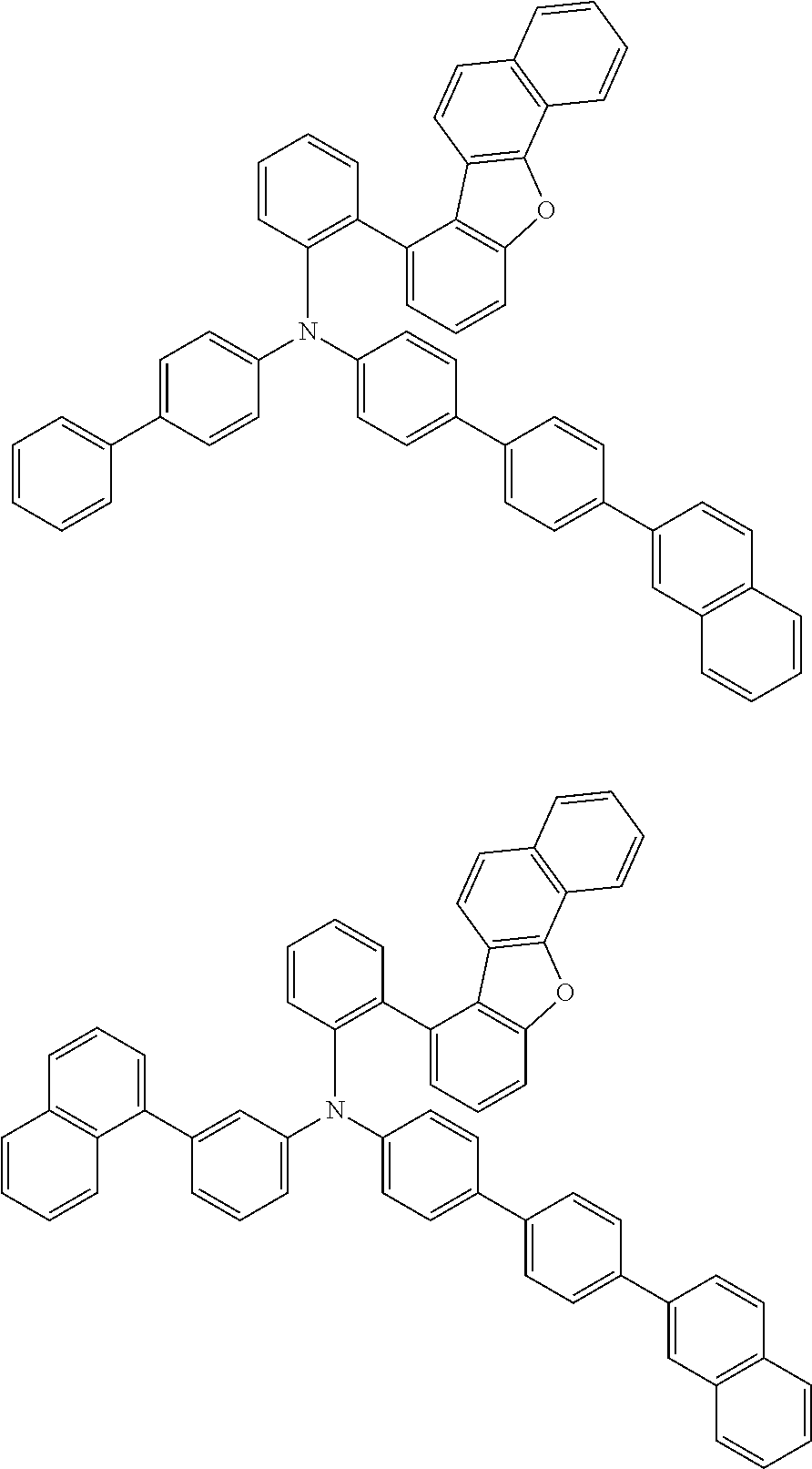
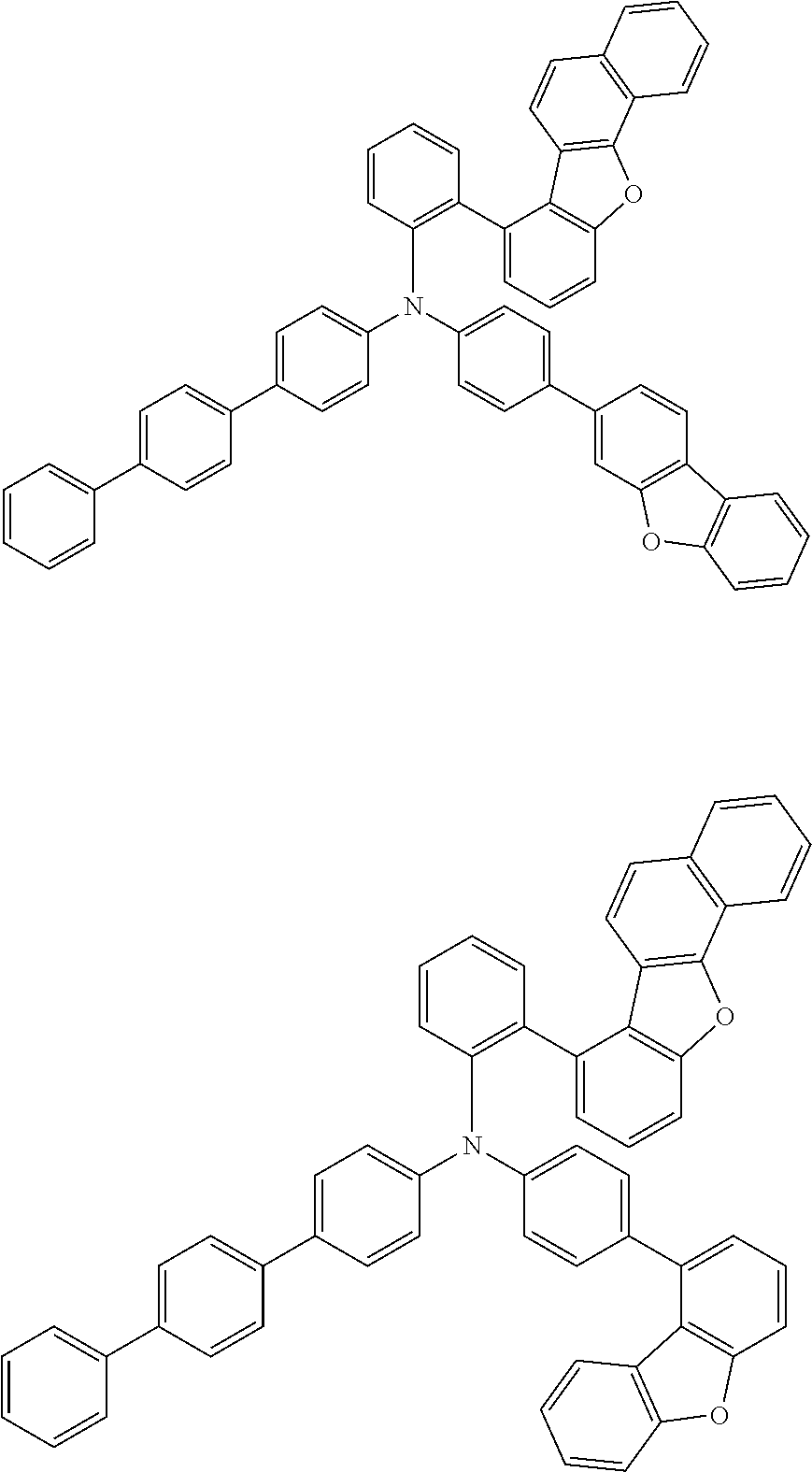
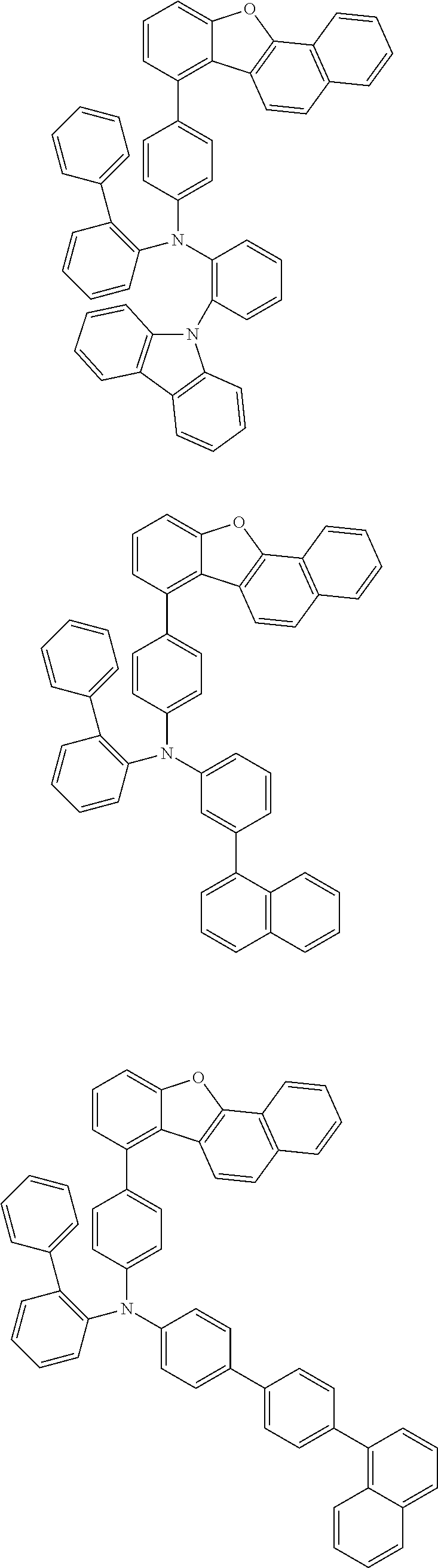
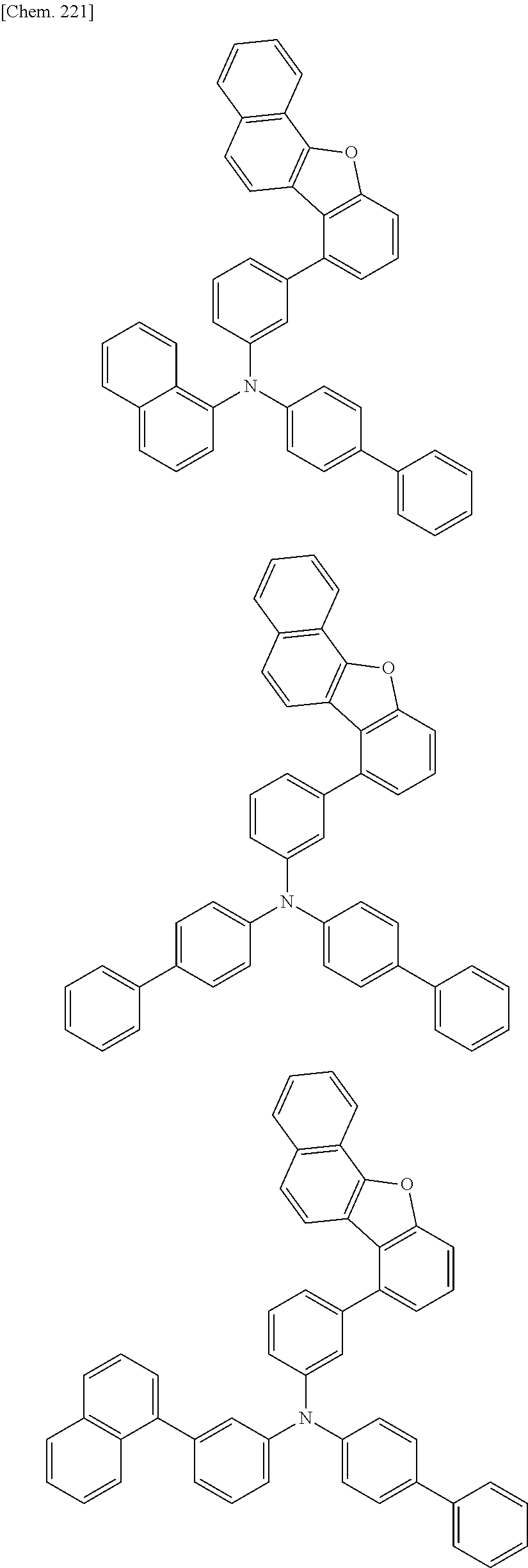
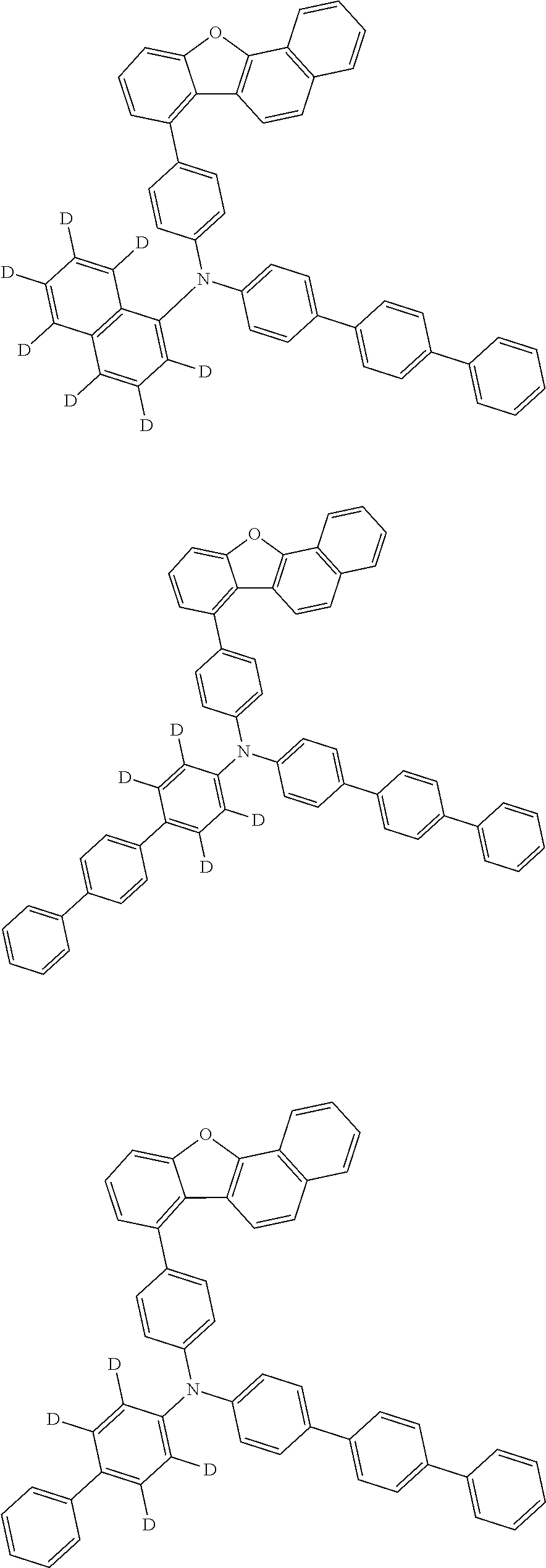
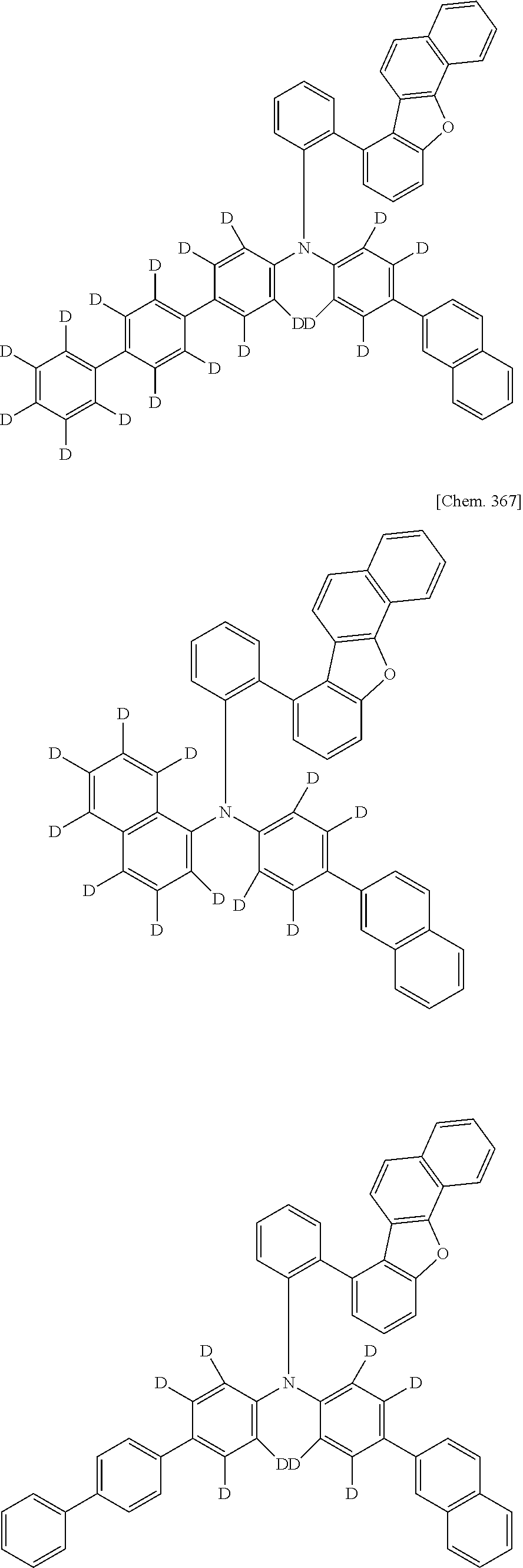
  • inventive compound will be shown below, but were not limited to the exemplified compounds.
  • D represents a deuterium atom.
  • the material for organic EL devices as an aspect of the present invention contains the inventive compound.
  • the content of the inventive compound in the material for organic EL devices is 1% by mass or more (including 100%), preferably 10% by mass or more (including 100%), more preferably 50% by mass or more (including 100%), further preferably 80% by mass or more (including 100%), and particularly preferably 90% by mass or more (including 100%).
  • the material for organic EL devices as an aspect of the present invention is useful for production of an organic EL device.
  • the organic EL device as an aspect of the present invention includes an anode, a cathode, and organic layers disposed between the anode and the cathode.
  • the organic layers include a light emitting layer and at least one of the organic layers contains the inventive compound.
  • organic layer containing the inventive compound examples include, but not limited to, a hole transporting zone (hole injecting layer, hole transporting layer, electron blocking layer, exciton blocking layer, etc.) provided between the anode and the light emitting layer, the light emitting layer, a space layer, an electron transporting zone (electron injecting layer, electron transporting layer, hole blocking layer, etc.) provided between the cathode and the light emitting layer.
  • a hole transporting zone hole injecting layer, hole transporting layer, electron blocking layer, exciton blocking layer, etc.
  • an electron transporting zone electron injecting layer, electron transporting layer, hole blocking layer, etc.
  • the inventive compound is preferably used as a material for the hole transporting zone or light emitting layer, more preferably as a material for the hole transporting zone, further preferably as a material for the hole injecting layer, hole transporting layer, electron blocking layer, or exciton blocking layer, and particularly preferably as a material for the hole injecting layer or hole transporting layer, of a fluorescent or phosphorescent EL device.
  • the organic EL device as an aspect of the present invention may be a fluorescence or phosphorescence emission type monochromatic luminescent device, a fluorescence/phosphorescence hybrid type white luminescent device, a simple type having a single light emitting unit, or a tandem type having two or more light emitting units, and is preferably a fluorescence emission type device.
  • the “light emitting unit” refers to a minimum unit that includes organic layers, at least one of which is a light emitting layer, and that emits light by recombination of injected holes and injected electrons.
  • An example of a typical device configuration of the simple type organic EL device is the following device configuration.
  • the light emitting unit may be a multilayer type having two or more phosphorescence emitting layers and fluorescence emitting layers, and in this case, a space layer may be provided between the light emitting layers for the purpose of preventing excitons generated in the phosphorescence emitting layers from diffusing into the fluorescence emitting layers.
  • a typical layer configuration of the simple type light emitting unit is shown below. The layers in parentheses are optional.
  • the phosphorescence or fluorescence emitting layers described above can exhibit luminescent colors different from one another.
  • a specific example of the layer configuration is a layer configuration in the light emitting unit (f) of (hole injecting layer/) hole transporting layer/first phosphorescence emitting layer (red light emission)/second phosphorescence emitting layer (green light emission)/space layer/fluorescence emitting layer (blue light emission)/electron transporting layer.
  • An electron blocking layer may be appropriately provided between each light emitting layer and a hole transporting layer or a space layer.
  • a hole blocking layer may be appropriately provided between each light emitting layer and an electron transporting layer.
  • An example of a typical device configuration of the tandem type organic EL device is the following device configuration.
  • first light emitting unit and the second light emitting unit can each be independently selected, for example, from the light emitting units as described above.
  • the intermediate layer is generally also referred to as intermediate electrode, intermediate conductive layer, charge generating layer, electron withdrawing layer, connection layer, or intermediate insulating layer, and a known material configuration in which electrons are supplied to the first light emitting unit and holes are supplied to the second light emitting unit can be used.
  • FIG. 1 is a schematic diagram illustrating an example of the configuration of the organic EL device according to an aspect of the present invention.
  • An organic EL device 1 includes a substrate 2 , an anode 3 , a cathode 4 , and a light emitting unit 10 disposed between the anode 3 and the cathode 4 .
  • the light emitting unit 10 includes a light emitting layer 5 .
  • the organic EL device 1 includes a hole transporting zone 6 (hole injecting layer, hole transporting layer, etc.) between the light emitting layer 5 and the anode 3 , and an electron transporting zone 7 (electron injecting layer, electron transporting layer, etc.) between the light emitting layer 5 and the cathode 4 .
  • an electron blocking layer (not shown) may be provided on the anode 3 side of the light emitting layer 5 and a hole blocking layer (not shown) may be provided on the cathode 4 side of the light emitting layer 5 .
  • This enables to trap electrons or holes in the light emitting layer 5 to further increase the efficiency of generating excitons in the light emitting layer 5 .
  • FIG. 2 is a schematic diagram illustrating another configuration of the organic EL device according to an aspect of the present invention.
  • An organic EL device 11 includes the substrate 2 , the anode 3 , the cathode 4 , and a light emitting unit 20 disposed between the anode 3 and the cathode 4 .
  • the light emitting unit 20 includes the light emitting layer 5 .
  • a hole transporting zone disposed between the anode 3 and the light emitting layer 5 is formed of a hole injecting layer 6 a , a first hole transporting layer 6 b , and a second hole transporting layer 6 c .
  • the electron transporting zone disposed between the light emitting layer 5 and the cathode 4 is formed of a first electron transporting layer 7 a and a second electron transporting layer 7 b.
  • a host combined with a fluorescent dopant is referred to as a fluorescent host
  • a host combined with a phosphorescent dopant is referred to as a phosphorescent host.
  • the fluorescent host and the phosphorescent host are not distinguished only by the molecular structure.
  • the phosphorescent host means a material that forms a phosphorescence emitting layer containing a phosphorescent dopant, and does not mean that it cannot be used as a material that forms a fluorescence emitting layer. The same applies to the fluorescent host.
  • the substrate is used as a support of the organic EL device.
  • a plate of glass, quartz, or a plastic can be used as the substrate.
  • a flexible substrate may be used as the substrate.
  • An example of the flexible substrate is a plastic substrate of polycarbonate, polyarylate, polyethersulfone, polypropylene, polyester, polyvinyl fluoride, or polyvinyl chloride.
  • An inorganic vapor deposition film can also be used.
  • a metal, an alloy, an electrically conductive compound, a mixture thereof, or the like that has a high work function (specifically 4.0 eV or more) is preferably used.
  • a metal, an alloy, an electrically conductive compound, a mixture thereof, or the like that has a high work function (specifically 4.0 eV or more) is preferably used.
  • Specific examples thereof include indium oxide-tin oxide (ITO: indium tin oxide), indium oxide-tin oxide containing silicon or silicon oxide, indium oxide-zinc oxide, indium oxide containing tungsten oxide and zinc oxide, and graphene.
  • nitride examples include gold (Au), platinum (Pt), nickel (Ni), tungsten (W), chromium (Cr), molybdenum (Mo), iron (Fe), cobalt (Co), cupper (Cu), palladium (Pd), titanium (Ti), and nitride of the metals (for example, titanium nitride).
  • a film of such a material is generally formed by a spattering method.
  • indium oxide-zinc oxide can be formed by a spattering method by using a target obtained by adding to indium oxide 1 to 10 wt % of zinc oxide based on the indium oxide
  • indium oxide containing tungsten oxide and zinc oxide can be formed by a spattering method by using a target obtained by adding to indium oxide 0.5 to 5 wt % of tungsten oxide and 0.1 to 1 wt % of zinc oxide based on the indium oxide.
  • a film of such a material may be produced by a vacuum vapor deposition method, a coating method, an inkjet method, a spin-coating method, or the like.
  • the hole injecting layer formed in contact with the anode is, regardless of the work function of the anode, formed by using a material in which hole injection is easy, and thus a material that is generally used as an electrode material (for example, a metal, an alloy, an electrically conductive compound, or a mixture thereof, or an element belonging to the group 1 or 2 in the periodic table) can be used.
  • a material that is generally used as an electrode material for example, a metal, an alloy, an electrically conductive compound, or a mixture thereof, or an element belonging to the group 1 or 2 in the periodic table
  • An element belonging to the group 1 or 2 in the periodic table which is a material having a small work function, specifically, an alkali metal, such as lithium (Li) or cesium (Cs), or an alkaline earth metal, such as magnesium (Mg), calcium (Ca), or strontium (Sr), and an alloy containing them (for example, MgAg, AlLi), a rare earth metal, such as europium (Eu) or ytterbium (Yb), or an alloy containing them, or the like, can be used.
  • an alkali metal such as lithium (Li) or cesium (Cs)
  • an alkaline earth metal such as magnesium (Mg), calcium (Ca), or strontium (Sr)
  • an alloy containing them for example, MgAg, AlLi
  • a rare earth metal such as europium (Eu) or ytterbium (Yb), or an alloy containing them, or the like
  • the hole injecting layer is a layer containing a material having a high hole injecting capability (hole injecting material), and is formed between the anode and the light emitting layer, or between a hole transporting layer, if present, and the anode.
  • hole injecting material a material having a high hole injecting capability
  • molybdenum oxide titanium oxide, vanadium oxide, rhenium oxide, ruthenium oxide, chromium oxide, zirconium oxide, hafnium oxide, tantalum oxide, silver oxide, tungsten oxide, manganese oxide, or the like can be used.
  • a material for the hole injecting layer include aromatic amine compounds, such as 4,4′,4′′-tris(N,N-diphenylamino)triphenylamine (abbreviation: TDATA), 4,4′,4′′-tris[N-(3-methylphenyl)-N-phenylamino]triphenylamine (abbreviation: MTDATA), 4,4′-bis[N-(4-diphenylaminophenyl)-N-phenylamino]biphenyl (abbreviation: DPAB), 4,4′-bis(N- ⁇ 4-[N′-(3-methylphenyl)-N′-phenylamino]phenyl ⁇ -N-phenylamino)biphenyl (abbreviation: DNTPD), 1,3,5-tris[N-(4-diphenylaminophenyl)-N-phenylamino]benzene (abbreviation: DPA3B), 3-[N-(N-
  • a high-molecular weight compound (oligomer, dendrimer, polymer, or the like) can also be used.
  • the high-molecular weight compound include poly(N-vinylcarbazole) (abbreviation: PVK), poly(4-vinyltriphenylamine) (abbreviation: PVTPA), poly[N-(4- ⁇ N′-[4-(4-diphenylamino)phenyl]phenyl-N′-phenylamino ⁇ phenyl)methacrylamide] (abbreviation: PTPDMA), and poly[N,N′-bis(4-butylphenyl)-N,N′-bis(phenyl)benzidine] (abbreviation: Poly-TPD).
  • PVK poly(N-vinylcarbazole)
  • PVTPA poly(4-vinyltriphenylamine)
  • PTPDMA poly[N-(4- ⁇ N′-[4-(4-diphenylamino
  • a high-molecular weight compound with an acid such as poly(3,4-ethylenedioxythiophene)/poly(styrenesulfonic acid) (PEDOT/PSS) or polyaniline/poly(styrenesulfonic acid) (PAni/PSS), added thereto can also be used.
  • an acid such as poly(3,4-ethylenedioxythiophene)/poly(styrenesulfonic acid) (PEDOT/PSS) or polyaniline/poly(styrenesulfonic acid) (PAni/PSS)
  • an acceptor material such as a hexaazatriphenylene (HAT) compound represented by the following formula (K), is also preferably used.
  • HAT hexaazatriphenylene
  • R 201 to R 206 each independently represent a cyano group, —CONH 2 , a carboxy group, or —COOR 207 (R 207 represents an alkyl group having 1 to 20 carbon atoms or a cycloalkyl group having 3 to 20 carbon atoms). Adjacent two selected from R 201 and R 202 , R 23 and R 24 , and R 25 and R 20 may be bonded to each other to form a group represented by —CO—O—CO—.)
  • R 207 examples include a methyl group, an ethyl group, an n-propyl group, an isopropyl group, an n-butyl group, an isobutyl group, a t-butyl group, a cyclopentyl group, and a cyclohexyl group.
  • the hole transporting layer is a layer containing a material having a high hole transporting capability (hole transporting material), and is formed between the anode and the light emitting layer or between a hole injecting layer, if present, and the light emitting layer.
  • the inventive compound may be used, for the hole transporting layer, alone or in combination with the following compound.
  • the hole transporting layer may have a monolayer structure or a multilayer structure including two or more layers.
  • the hole transporting layer may have a two-layer structure including a first hole transporting layer (anode side) and a second hole transporting layer (cathode side).
  • the hole transporting layer of the monolayer structure is preferably adjacent to the light emitting layer, and the hole transporting layer that is the nearest to the cathode in the multilayer structure, for example, the second hole transporting layer in the two-layer structure, is preferably adjacent to the light emitting layer.
  • an electron blocking layer as described later or the like may be interposed between the hole transporting layer of the monolayer structure and the light emitting layer or between the hole transporting layer that is the nearest to the light emitting layer in the multilayer structure and the light emitting layer.
  • the inventive compound may be contained in one of the first hole transporting layer and the second hole transporting layer, or may be contained in the both.
  • the inventive compound is preferably contained only in the first hole transporting layer, in another embodiment, the inventive compound is preferably contained only in the second hole transporting layer, and in still another embodiment, the inventive compound is preferably contained in the first hole transporting layer and the second hole transporting layer.
  • the inventive compound contained in one or both of the first hole transporting layer and the second hole transporting layer is preferably a light hydrogen form from the viewpoint of the production cost.
  • the light hydrogen form refers to the inventive compound in which all the hydrogen atoms are a light hydrogen atom.
  • the organic EL device as an aspect of the present invention is preferably an organic EL device in which one or both of the first hole transporting layer and the second hole transporting layer contains the inventive compound essentially constituted only of light hydrogen forms.
  • inventive compound essentially constituted only of light hydrogen forms means that the content of the light hydrogen form based on the total amount of the inventive compound is 90% by mole or more, preferably 95% by mole or more, and more preferably 99% by mole or more (each including 100%).
  • an aromatic amine compound for example, an aromatic amine compound, a carbazole derivative, an anthracene derivative, or the like can be used.
  • aromatic amine compound examples include 4,4′-bis[N-(1-naphtyl)-N-phenylamino]biphenyl (abbreviation: NPB) and N,N′-bis(3-methylphenyl)-N,N′-diphenyl-[1,1′-biphenyl]-4,4′-diamine (abbreviation: TPD), 4-phenyl-4′-(9-phenylfluorene-9-yl)triphenylamine (abbreviation: BAFLP), 4,4′-bis[N-(9,9-dimethylfluoren-2-yl)-N-phenylamino]biphenyl (abbreviation: DFLDPBi), 4,4′,4′′-tris(N,N-diphenylamino)triphenylamine (abbreviation: TDATA), 4,4′,4′′-tris[N-(3-methylphenyl)-N-phenylamino]
  • carbazole derivative examples include 4,4′-di(9-carbazolyl)biphenyl (abbreviation: CBP), 9-[4-(9-carbazolyl)phenyl]-10-phenylanthracene (abbreviation: CzPA), and 9-phenyl-3-[4-(10-phenyl-9-anthryl)phenyl]-9H-carbazole (abbreviation: PCzPA).
  • anthracene derivative examples include 2-t-butyl-9,10-di(2-naphtyl)anthracene (abbreviation: t-BuDNA), 9,10-di(2-naphtyl)anthracene (abbreviation: DNA), and 9,10-diphenylanthracene (abbreviation: DPAnth).
  • t-BuDNA 2-t-butyl-9,10-di(2-naphtyl)anthracene
  • DNA 9,10-di(2-naphtyl)anthracene
  • DPAnth 9,10-diphenylanthracene
  • a high-molecular weight compound such as poly(N-vinylcarbazole) (abbreviation: PVK) or poly(4-vinyltriphenylamine) (abbreviation: PVTPA), can also be used.
  • PVK poly(N-vinylcarbazole)
  • PVTPA poly(4-vinyltriphenylamine)
  • the light emitting layer is a layer containing a material having a high light emitting capability (dopant material), and various materials can be used.
  • a fluorescence emitting material or a phosphorescence emitting material can be used as the dopant material.
  • a fluorescence emitting material is a compound that emits light from the singlet excited state
  • a phosphorescence emitting material is a compound that emits light from the triplet excited state.
  • a blue fluorescence emitting material that can be used for the light emitting layer
  • a pyrene derivative, a styrylamine derivative, a chrysene derivative, a fluoranthene derivative, a fluoran derivative, a diamine derivative, or a triarylamine derivative can be used.
  • N,N′-bis[4-(9H-carbazol-9-yl)phenyl]-N,N′-diphenylstilbene-4,4′-diamine abbreviation: YGA2S
  • 4-(9H-carbazol-9-yl)-4′-(10-phenyl-9-anthryl)triphenylamine abbreviation: YGAPA
  • 4-(10-phenyl-9-anthryl)-4′-(9-phenyl-9H-carbazol-3-yl)triphenylamine abbreviation: PCBAPA.
  • an aromatic amine derivative or the like can be used as the green fluorescence emitting material that can be used in the light emitting layer.
  • Specific examples thereof include N-(9,10-diphenyl-2-anthryl)-N,9-diphenyl-9H-carbazole-3-amine (abbreviation: 2PCAPA), N-[9,10-bis(1,1′-biphenyl-2-yl)-2-anthryl]-N,9-diphenyl-9H-carbazole-3-amine (abbreviation: 2PCABPhA), N-(9,10-diphenyl-2-anthryl)-N,N′,N′-triphenyl-1,4-phenylenediamine (abbreviation: 2DPAPA), N-[9,10-bis(1,1′-biphenyl-2-yl)-2-anthryl]-N,N′,N′-triphenyl-1,4-phenylenediamine (abbreviation: 2DP
  • a red fluorescence emitting material that can be used in the light emitting layer
  • a tetracene derivative, a diamine derivative, or the like can be used.
  • Specific examples thereof include N,N,N′,N′-tetrakis(4-methylphenyl)tetracene-5,11-diamine (abbreviation: p-mPhTD) and 7,14-diphenyl-N,N,N′,N′-tetrakis(4-methylphenyl)acetonaphtho[1,2-a]fluoranthene-3,10-diamine (abbreviation: p-mPhAFD).
  • a metal complex such as an iridium complex, an osmium complex, or a platinum complex
  • a metal complex such as an iridium complex, an osmium complex, or a platinum complex
  • a metal complex such as an iridium complex, an osmium complex, or a platinum complex
  • Specific examples thereof include bis[2-(4′,6′-difluorophenyl)pyridinato-N,C2′]iridium(III) tetrakis(1-pyrazolyl)borate (abbreviation: FIr6), bis[2-(4′,6′-difluorophenyl)pyridinato-N,C2′]iridium(III) picolinate (abbreviation: FIrpic), bis[2-(3′,5′-bistrifluoromethylphenyl)pyridinato-N,C2′]iridium(III) picolinate (abbreviation: Ir(CF
  • an iridium complex or the like is used as a green phosphorescence emitting material that can be used in the light emitting layer.
  • examples thereof include tris(2-phenylpyridinato-N,C2′)iridium(III) (abbreviation: Ir(ppy)3), bis(2-phenylpyridinato-N,C2′)iridium(III) acetylacetonate (abbreviation: Ir(ppy)2(acac)), bis(1,2-diphenyl-1H-benzimidazolato)iridium(III) acetylacetonate (abbreviation: Ir(pbi)2(acac)), and bis(benzo[h]quinolato)iridium(III) acetylacetonate (abbreviation: Ir(bzq)2(acac)).
  • a metal complex such as an iridium complex, a platinum complex, a terbium complex, or a europium complex
  • organic metal complexes such as bis[2-(2′-benzo[4,5-a]thienyl)pyridinato-N,C3′]iridium(III) acetylacetonate (abbreviation: Ir(btp)2(acac)), bis(1-phenylisoquinolinato-N,C2′)iridium(II) acetylacetonate (abbreviation: Ir(piq)2(acac)), (acetylacetonato)bis[2,3-bis(4-fluorophenyl)quinoxalinato]iridium(III) (abbreviation: Ir(Fdpq)2(acac)), and 2,3,7,
  • a rare earth metal complex such as tris(acetylacetonate)(monophenanthroline)terbium(III) (abbreviation: Tb(acac)3(Phen)), tris(1,3-diphenyl-1,3-propanedionato)(monophenanthroline)europium(III) (abbreviation: Eu(DBM)3(Phen)), or tris[1-(2-thenoyl)-3,3,3-trifluoroacetonato](monophenanthroline)europium(III) (abbreviation: Eu(TTA)3(Phen)), emits light from rare earth metal ions (electron transition between different multiplicities) and thus, can be used as a phosphorescence emitting material.
  • Tb(acac)3(Phen) tris(1,3-diphenyl-1,3-propanedionato)(monophenanthroline)europium(III)
  • the light emitting layer may have a configuration in which such a dopant material as described above is dispersed in another material (host material).
  • a material that has a higher lowest unoccupied molecular orbital level (LUMO level) and a lower highest occupied molecular orbital level (HOMO level) than the dopant material is preferably used.
  • the host material for example,
  • a metal complex such as an aluminum complex, a beryllium complex, or a zinc complex
  • a heterocyclic compound such as an oxadiazole derivative, a benzimidazole derivative, or a phenanthroline derivative
  • a condensed aromatic compound such as a carbazole derivative, an anthracene derivative, a phenanthrene derivative, a pyrene derivative, or a chrysene derivative, or
  • an aromatic amine compound such as a triarylamine derivative or a condensed polycyclic aromatic amine derivative is used.
  • a metal complex such as tris(8-quinolinolato)aluminum(III) (abbreviation: Alq), tris(4-methyl-8-quinolinolato)aluminum(III) (abbreviation: Almq3), bis(10-hydroxybenzo[h]quinolinato)beryllium(II) (abbreviation: BeBq2), bis(2-methyl-8-quinolinolato)(4-phenylphenolato)aluminum(III) (abbreviation: BAlq), bis(8-quinolinolato)zinc(II) (abbreviation: Znq), bis[2-(2-benzoxazolyl)phenolato]zinc(II) (abbreviation: ZnPBO), or bis[2-(2-benzothiazolyl)phenolato]zinc(II) (abbreviation: ZnBTZ);
  • Alq tris(8-quinolinolato)aluminum
  • heterocyclic compound such as 2-(4-biphenyly)-5-(4-tert-butylphenyl)-1,3,4-oxadiazole (abbreviation: PBD), 1,3-bis[5-(p-tert-butylphenyl)-1,3,4-oxadiazol-2-yl]benzene (abbreviation: OXD-7), 3-(4-biphenylyl)-4-phenyl-5-(4-tert-butylphenyl)-1,2,4-triazole (abbreviation: TAZ), 2,2′,2′′-(1,3,5-benzenetriyl)tris(1-phenyl-1H-benzimidazole) (abbreviation: TPBI), bathophenanthroline (abbreviation: BPhen), or bathocuproine (abbreviation: BCP);
  • PBD 2-(4-biphenyly)-5-(4-tert-butylphenyl)-1,
  • a condensed aromatic compound such as 9-[4-(10-phenyl-9-anthryl)phenyl]-9H-carbazole (abbreviation: CzPA), 3,6-diphenyl-9-[4-(10-phenyl-9-anthryl)phenyl]-9H-carbazole (abbreviation: DPCzPA), 9,10-bis(3,5-diphenylphenyl)anthracene (abbreviation: DPPA), 9,10-di(2-naphtyl)anthracene (abbreviation: DNA), 2-tert-butyl-9,10-di(2-naphtyl)anthracene (abbreviation: t-BuDNA), 9,9′-bianthryl (abbreviation: BANT), 9,9′-(stilbene-3,3′-diyl)diphenanthrene (abbreviation: DPNS), 9,9′-(stilbene-4,4′-di
  • an aromatic amine compound such as N,N-diphenyl-9-[4-(10-phenyl-9-anthryl)phenyl]-9H-carbazole-3-amine (abbreviation: CzA1PA), 4-(10-phenyl-9-anthryl)triphenylamine (abbreviation: DPhPA), N,9-diphenyl-N-[4-(10-phenyl-9-anthryl)phenyl]-9H-carbazole-3-amine (abbreviation: PCAPA), N,9-diphenyl-N- ⁇ 4-[4-(10-phenyl-9-anthryl)phenyl]phenyl ⁇ -9H-carbazole-3-amine (abbreviation: PCAPBA), N-(9,10-diphenyl-2-anthryl)-N,9-diphenyl-9H-carbazole-3-amine (abbreviation: 2PCAPA), 4,4′-bis[N-(1-naph
  • the following anthracene compounds are preferably used as a host material.
  • the electron transporting layer is a layer containing a material having a high electron transporting capability (electron transporting material), and is formed between the light emitting layer and the cathode or between an electron injecting layer, if present, and the light emitting layer.
  • electron transporting material a material having a high electron transporting capability
  • the electron transporting layer may have a monolayer structure or a multilayer structure including two or more layers.
  • the electron transporting layer may have a two-layer structure including a first electron transporting layer (anode side) and a second electron transporting layer (cathode side).
  • the electron transporting layer in the monolayer structure is preferably adjacent to the light emitting layer, and the electron transporting layer that is the nearest to the anode in the multilayer configuration, for example, the first electron transporting layer of the two-layer structure, is preferably adjacent to the light emitting layer.
  • a hole blocking layer as described later or the like may be interposed between the electron transporting layer of the monolayer structure and the light emitting layer or between the electron transporting layer that is the nearest to the light emitting layer in the multilayer structure and the light emitting layer.
  • the electron transporting layer for example,
  • Examples of the metal complex include tris(8-quinolinolato)aluminum(III) (abbreviation: Alq), tris(4-methyl-8-quinolinolato)aluminum (abbreviation: Almq3), bis(10-hydroxybenzo[h]quinolinato)beryllium (abbreviation: BeBq 2 ), bis(2-methyl-8-quinolinolato)(4-phenylphenolato)aluminum(III) (abbreviation: BAlq), bis(8-quinolinolato)zinc(II) (abbreviation: Znq), bis[2-(2-benzoxazolyl)phenolato]zinc(II) (abbreviation: ZnPBO), and bis[2-(2-benzothiazolyl)phenolato]zinc(II) (abbreviation: ZnBTZ).
  • Alq tris(8-quinolinolato)aluminum(III)
  • heteroaromatic compound examples include 2-(4-biphenylyl)-5-(4-tert-butylphenyl)-1,3,4-oxadiazole (abbreviation: PBD), 1,3-bis[5-(p-tert-butylphenyl)-1,3,4-oxadiazol-2-yl]benzene (abbreviation: OXD-7), 3-(4-tert-butylphenyl)-4-phenyl-5-(4-biphenylyl)-1,2,4-triazole (abbreviation: TAZ), 3-(4-tert-butylphenyl)-4-(4-ethylphenyl)-5-(4-biphenylyl)-1,2,4-triazole (abbreviation: p-EtTAZ), bathophenanthroline (abbreviation: BPhen), bathocuproine (abbreviation: BCP), and 4,4′-bis(5-methylbenzoxa
  • high-molecular weight compound examples include poly[(9,9-dihexylfluorene-2,7-diyl)-co-(pyridine-3,5-diyl)] (abbreviation: PF-Py) and poly[(9,9-dioctylfluorene-2,7-diyl)-co-(2,2′-bipyridine-6,6′-diyl)] (abbreviation: PF-BPy).
  • the materials are materials having an electron mobility of 10 ⁇ 6 cm 2 Vs or more. Materials other than those as mentioned above may be used for the electron transporting layer so long as they are materials higher in the electron transporting capability rather than in the hole transporting capability.
  • the electron injecting layer is a layer containing a material having a high electron injecting capability.
  • an alkali metal such as lithium (Li) or cesium (Cs)
  • an alkaline earth metal such as magnesium (Mg), calcium (Ca), or strontium (Sr)
  • Mg magnesium
  • Ca calcium
  • a rare earth metal such as europium (Eu) or ytterbium (Yb)
  • a compound containing them can be used.
  • Examples of the compound include an alkali metal oxide, an alkali metal halide, an alkali metal-containing organic complex, an alkaline earth metal oxide, an alkaline earth metal halide, an alkaline earth metal-containing organic complex, a rare earth metal oxide, a rare earth metal halide, and a rare earth metal-containing organic complex.
  • two or more of the compounds can be used in mixture.
  • a material in which an alkali metal, an alkaline earth metal, or a compound thereof is contained in a material having electron transporting capability specifically, a material in which magnesium (Mg) is contained in Alq, or the like, may be used. In this case, electron injection from the cathode can be more efficiently achieved.
  • a composite material obtained by mixing an organic compound with an electron doner may be used in the injecting layer.
  • Such a composite material is excellent in the electron injecting capability and the electron transporting capability because the organic compound receives electrons from the electron doner.
  • the organic compound is preferably a material excellent in transporting received electrons, and specifically, a material constituting the aforementioned electron transporting layer (such as a metal complex or a heteroaromatic compound) can be used.
  • the electron donor a material having an electron donation capability for an organic compound can be used.
  • an alkali metal, an alkaline earth metal, and a rare earth metal are preferred, and examples thereof include lithium, cesium, magnesium, calcium, erbium, and ytterbium.
  • An alkali metal oxide or an alkaline earth metal oxide is also preferred, and examples thereof include lithium oxide, calcium oxide, and barium oxide.
  • a Lewis base such as magnesium oxide, can also be used.
  • a metal, an alloy, an electrically conductive compound, or a mixture thereof that has a low work function (specifically 3.8 eV or less) is preferably used for the cathode.
  • a cathode material include elements belonging to the group 1 or 2 of the periodic table, that is, an alkali metal, such as lithium (Li) or cesium (Cs), an alkaline earth metal, such as magnesium (Mg), calcium (Ca), or strontium (Sr), and an alloy containing them (for example, MgAg, AlLi), and a rare earth metal, such as europium (Eu) or ytterbium (Yb), and an alloy containing them.
  • an alkali metal such as lithium (Li) or cesium (Cs)
  • an alkaline earth metal such as magnesium (Mg), calcium (Ca), or strontium (Sr)
  • an alloy containing them for example, MgAg, AlLi
  • a rare earth metal such as europium (E
  • the cathode is formed by using an alkali metal, an alkaline earth metal, and an alloy containing them, a vacuum vapor deposition method or a sputtering method can be adopted.
  • a coating method, an inkjet method, or the like can be adopted.
  • the cathode can be formed using various conductive materials, such as Al, Ag, ITO, graphene, and indium oxide-tin oxide containing silicon or silicon oxide, regardless of the magnitude of the work function.
  • a film of such a conductive material can be formed by using a sputtering method, an inkjet method, a spin-coating method, or the like.
  • the organic EL device applies an electric field to an ultrathin film, and thus, pixel defects are likely to occur due to leaks or short-circuiting.
  • an insulating layer formed of an insulating thin film layer may be inserted between a pair of electrodes.
  • Examples of the material used for the insulating layer include aluminum oxide, lithium fluoride, lithium oxide, cesium fluoride, cesium oxide, magnesium oxide, magnesium fluoride, calcium oxide, calcium fluoride, aluminum nitride, titanium oxide, silicon oxide, germanium oxide, silicon nitride, boron nitride, molybdenum oxide, ruthenium oxide, and vanadium oxide. A mixture or a laminate of them may also be used.
  • the space layer is, for example, a layer provided between a fluorescence emitting layer and a phosphorescence emitting layer for the purpose of preventing excitons generated in the phosphorescence emitting layer from diffusing into the fluorescence emitting layer, or adjusting the carrier balance, in the case where the fluorescence emitting layers and the phosphorescence emitting layers are stacked.
  • the space layer can also be provided between two or more phosphorescence emitting layers.
  • the space layer is provided between the light emitting layers, a material having both an electron transporting capability and a hole transporting capability is preferred.
  • one having a triplet energy of 2.6 eV or more is preferred in order to prevent diffusion of the triplet energy in the adjacent phosphorescence emitting layers.
  • Examples of a material used for the space layer include the same as those used for the hole transporting layer as described above.
  • a blocking layer such as an electron blocking layer, a hole blocking layer, or an exciton blocking layer, may be provided adjacent to the light emitting layer.
  • the electron blocking layer is a layer that prevents electrons from leaking from the light emitting layer to a hole transporting layer
  • the hole blocking layer is a layer that prevents holes from leaking from the light emitting layer to an electron transporting layer.
  • the exciton blocking layer functions to prevent excitons generated in the light emitting layer from diffusing into the surrounding layers to trap the excitons within the light emitting layer.
  • Each layer of the organic EL device can be formed by a conventionally known vapor deposition method, a coating method, or the like.
  • each layer can be formed by a known technique by a vapor deposition method, such as a vacuum vapor deposition method or a molecular beam vapor deposition method (MBE method), or a coating method using a solution of a compound for forming a layer, such as a dipping method, a spin-coating method, a casting method, a bar-coating method, and a roll-coating method.
  • a vapor deposition method such as a vacuum vapor deposition method or a molecular beam vapor deposition method (MBE method)
  • MBE method molecular beam vapor deposition method
  • a coating method using a solution of a compound for forming a layer such as a dipping method, a spin-coating method, a casting method, a bar-coating method, and a roll-coating method.
  • the film thickness of each layer is not particularly limited, but is typically 5 nm to 10 ⁇ m, and more preferably 10 nm to 0.2 ⁇ m because in general, when the film thickness is too small, defects such as pinholes are likely to occur, and conversely, when the film thickness is too large, a high driving voltage is required and the efficiency decreases.
  • the organic EL device can be suitably used in an electronic instrument, such as a display component of an organic EL panel module or the like, a display apparatus of a television, a mobile phone, a personal computer, or the like, and a luminescent apparatus of a lighting or a vehicular lamp.
  • an electronic instrument such as a display component of an organic EL panel module or the like, a display apparatus of a television, a mobile phone, a personal computer, or the like, and a luminescent apparatus of a lighting or a vehicular lamp.
  • a glass substrate of 25 mm ⁇ 75 mm ⁇ 1.1 mm with an ITO transparent electrode (anode) (manufactured by GEOMATEC Co., Ltd.) was ultrasonically cleaned in isopropyl alcohol for 5 minutes and then subjected to UV ozone cleaning for 30 minutes.
  • the film thickness of the ITO was 130 nm.
  • the cleaned glass substrate with the transparent electrode was mounted on a substrate holder of a vacuum vapor deposition apparatus, and firstly, Compound HT-1 and Compound HA were vapor co-deposited on the surface having the transparent electrode formed thereon so as to cover the transparent electrode, thus forming a hole injecting layer with a film thickness of 10 nm.
  • the mass ratio of Compound HT-1 and Compound HA was 97:3.
  • Compound HT-1 was vapor deposited to form a first hole transporting layer with a film thickness of 80 nm.
  • Compound 1 was vapor deposited to form a second hole transporting layer with a film thickness of 10 nm.
  • Compound BH-1 (host material) and Compound BD-1 (dopant material) were vapor co-deposited to form a light emitting layer with a film thickness of 25 nm.
  • the mass ratio of Compound BH-1 and Compound BD-1 (BH-1:BD-1) was 96:4.
  • Compound ET-1 was vapor deposited to form a first electron transporting layer with a film thickness of 5 nm.
  • Compound ET-2 and Liq were vapor co-deposited to form a second electron transporting layer with a film thickness of 20 nm.
  • the mass ratio of Compound ET-2 and Liq (ET-2:Liq) was 50:50.
  • LiF was vapor deposited to form an electron injecting electrode with a film thickness of 1 nm.
  • metal Al was vapor deposited to form a metal cathode with a film thickness of 50 nm.
  • the layer configuration of the organic EL device of Example 1 thus obtained was as follows.
  • the numerals in parentheses each indicate the film thickness (nm), and the ratios are each a mass ratio
  • the resulting organic EL device was driven with direct current at a current density of 50 mA/cm 2 and the period of time until the luminance was reduced to 95% of the initial luminance was measured, and was defined as 95% lifetime (LT95).
  • LT95 95% lifetime
  • An organic EL device was produced in the same manner as in Example 1 except for changing the material of the second hole transporting layer to Compound 2 (Example 2) or Comparative Compound 1 (Comparative Example 1), and LT95 was measured. The results are shown in Table 1.
  • the organic EL devices respectively containing the inventive compounds have a longer lifetime than the organic EL device containing Comparative Compound 1.
  • a glass substrate of 25 mm ⁇ 75 mm ⁇ 1.1 mm with an ITO transparent electrode (anode) (manufactured by GEOMATEC Co., Ltd.) was ultrasonically cleaned in isopropyl alcohol for 5 minutes and then subjected to UV ozone cleaning for 30 minutes.
  • the film thickness of the ITO was 130 nm.
  • the cleaned glass substrate with the transparent electrode was mounted on a substrate holder of a vacuum vapor deposition apparatus, and firstly, Compound HT-2 and Compound HA were vapor co-deposited on the surface having the transparent electrode formed thereon so as to cover the transparent electrode, thus forming a hole injecting layer with a film thickness of 10 nm.
  • the mass ratio of Compound HT-2 and Compound HA was 97:3.
  • Compound HT-2 was vapor deposited to form a first hole transporting layer with a film thickness of 75 nm.
  • Compound 6 was vapor deposited to form a second hole transporting layer with a film thickness of 10 nm.
  • Compound BH-2 (host material) and Compound BD-2 (dopant material) were vapor co-deposited to form a light emitting layer with a film thickness of 20 nm.
  • the mass ratio of Compound BH-2 and Compound BD-2 (BH-2:BD-2) was 99:1.
  • Compound ET-1 was vapor deposited to form a first electron transporting layer with a film thickness of 5 nm.
  • Compound ET-3 and Liq were vapor co-deposited to form a second electron transporting layer with a film thickness of 25 nm.
  • the mass ratio of Compound ET-3 and Liq (ET-3:Liq) was 50:50.
  • Yb was vapor deposited to form an electron injecting electrode with a film thickness of 1 nm.
  • metal Al was vapor deposited to form a metal cathode with a film thickness of 80 nm.
  • the layer configuration of the organic EL device of Example 1 thus obtained was as follows.
  • the numerals in parentheses each indicate the film thickness (nm), and the ratios are each a mass ratio.
  • An organic EL device was produced in the same manner as in Example 3 except for changing the material of the second hole transporting layer to the compound shown in Table 2, and LT95 was measured in the same manner as in Example 1. The results are shown in Table 2.
  • the organic EL devices containing the inventive compounds have a longer lifetime than the organic EL devices containing Comparative Compounds 2 to 4.
  • a glass substrate of 25 mm ⁇ 75 mm ⁇ 1.1 mm with an ITO transparent electrode (anode) (manufactured by GEOMATEC Co., Ltd.) was ultrasonically cleaned in isopropyl alcohol for 5 minutes and then subjected to UV ozone cleaning for 30 minutes.
  • the film thickness of the ITO was 130 nm.
  • the cleaned glass substrate provided with the transparent electrode was mounted on a substrate holder of a vacuum vapor deposition apparatus, and firstly, Compound HT-3 and Compound HA were vapor co-deposited on the surface having the transparent electrode formed thereon so as to cover the transparent electrode, thus forming a hole injecting layer with a film thickness of 10 nm.
  • the mass ratio of Compound HT-3 and Compound HA (HT-3:HA) was 97:3.
  • Compound HT-3 was vapor deposited to form a first hole transporting layer with a film thickness of 80 nm.
  • Compound 3 was vapor deposited to form a second hole transporting layer with a film thickness of 10 nm.
  • Compound BH-1 (host material) and Compound BD-1 (dopant material) were vapor co-deposited to form a light emitting layer with a film thickness of 25 nm.
  • the mass ratio of Compound BH-1 and Compound BD-1 (BH-1:BD-1) was 96:4.
  • Compound ET-1 was vapor deposited to form a first electron transporting layer with a film thickness of 5 nm.
  • Compound ET-3 and Liq were vapor co-deposited to form a second electron transporting layer with a film thickness of 20 nm.
  • the mass ratio of Compound ET-3 and Liq (ET-3:Liq) was 50:50.
  • LiF was vapor deposited to form an electron injecting electrode with a film thickness of 1 nm.
  • metal Al was vapor deposited to form a metal cathode with a film thickness of 50 nm.
  • the layer configuration of the organic EL device of Example 1 thus obtained was as follows.
  • the numerals in parentheses each indicate the film thickness (nm), and the ratios are each a mass ratio.
  • An organic EL device was produced in the same manner as in Example 14 except for changing the material of the second hole transporting layer to the compound shown in Table 3, and LT95 was measured in the same manner as in Example 1. The results are shown in Table 3.
  • the organic EL devices respectively containing the inventive compounds have a longer lifetime than the organic EL device containing Comparative Compound 5.
  • a white solid was obtained in the same manner as in Intermediate Synthetic Example 2 except for using 2-chlorophenylboronic acid instead of 4-chlorophenylboronic acid. The yield was 90%.
  • a white solid was obtained in the same manner as in Synthetic Example 1 except for using N-([1,1′-biphenyl]-4-yl-2,3,5,6-d4)-[1,1′-biphenyl-2,3,5,6-d4]-4-amine instead of N-[1,1′-biphenyl]-4-yl-[1,1′-biphenyl]-4-amine.
  • the yield was 81%.
  • a white solid was obtained in the same manner as in Synthetic Example 1 except for using 4-(1-naphthalenyl)-N-[4-(1-naphthalenyl)phenyl]benzene amine instead of N-[1,1′-biphenyl]-4-yl-[1,1′-biphenyl]-4-amine and changing the reaction temperature to 130° C.
  • the yield was 61%.
  • a white solid was obtained in the same manner as in Synthetic Example 1 except for using 4-(2-naphthalenyl)-N-[4-(2-naphthalenyl)phenyl]benzene amine instead of N-[1,1′-biphenyl]-4-yl-[1,1′-biphenyl]-4-amine and changing the reaction temperature to 120° C.
  • the yield was 61%.
  • a white solid was obtained in the same manner as in Synthetic Example 1 except for using N-[1,1′-biphenyl]-4-yl-[1,1′:4′,1′′-terphenyl]-4-amine instead of N-[1,1′-biphenyl]-4-yl-[1,1′-biphenyl]-4-amine and changing the reaction temperature to 130° C. The yield was 63%.
  • a white solid was obtained in the same manner as in Synthetic Example 8 except for using N-[4-(1-naphthalenyl)phenyl][1,1′-biphenyl]-4-amine instead of N-[1,1′-biphenyl]-4-yl-[1,1′-biphenyl]-4-amine. The yield was 89%.
  • a white solid was obtained in the same manner as in Synthetic Example 8 except for using 4-(1-naphthalenyl)-N-[4-(1-naphthalenyl)phenyl]benzene amine instead of N-[1,1′-biphenyl]-4-yl-[1,1′-biphenyl]-4-amine. The yield was 64%.
  • a white solid was obtained in the same manner as in Synthetic Example 8 except for using N-([1,1′-biphenyl]-4-yl-2,3,5,6-d4)-[1,1′-biphenyl-2,3,5,6-d4]-4-amine instead of N-[1,1′-biphenyl]-4-yl-[1,1′-biphenyl]-4-amine.
  • the yield was 71%.
  • a white solid was obtained in the same manner as in Synthetic Example 8 except for using N,9,9-triphenyl-9H-fluoren-2-amine instead of N-[1,1′-biphenyl]-4-yl-[1,1′-biphenyl]-4-amine. The yield was 47%.
  • a white solid was obtained in the same manner as in Synthetic Example 8 except for using Intermediate F instead of N-[1,1′-biphenyl]-4-yl-[1,1′-biphenyl]-4-amine. The yield was 75%.
  • a white solid was obtained in the same manner as in Synthetic Example 1 except for using Intermediate G instead of N-[1,1′-biphenyl]-4-yl-[1,1′-biphenyl]-4-amine. The yield was 68%.
  • a white solid was obtained in the same manner as in Synthetic Example 1 except for using Intermediate H instead of N-[1,1′-biphenyl]-4-yl-[1,1′-biphenyl]-4-amine. The yield was 62%.
  • a white solid was obtained in the same manner as in Synthetic Example 8 except for using N-[3-(1-naphthalenyl)phenyl][1,1′:4′,1′′-terphenyl]-4-amine instead of N-[1,1′-biphenyl]-4-yl-[1,1′-biphenyl]-4-amine. The yield was 75%.
  • a white solid was obtained in the same manner as in Synthetic Example 1 except for using 4-(4-dibenzofranyl)-N-[4-(1-naphthalenyl)phenyl]benzene amine instead of N-[1,1′-biphenyl]-4-yl-[1,1′-biphenyl]-4-amine. The yield was 66%.
  • a white solid was obtained in the same manner as in Synthetic Example 8 except for using N-[1,1′-biphenyl]-4-yl-9,9-dimethyl-9H-fluoren-2-amine instead of N-[1,1′-biphenyl]-4-yl-[1,1′-biphenyl]-4-amine. The yield was 61%.

Landscapes

  • Chemical & Material Sciences (AREA)
  • Organic Chemistry (AREA)
  • Physics & Mathematics (AREA)
  • Spectroscopy & Molecular Physics (AREA)
  • Engineering & Computer Science (AREA)
  • Materials Engineering (AREA)
  • Optics & Photonics (AREA)
  • Electroluminescent Light Sources (AREA)
  • Furan Compounds (AREA)
  • Plural Heterocyclic Compounds (AREA)
  • Heterocyclic Carbon Compounds Containing A Hetero Ring Having Oxygen Or Sulfur (AREA)

Abstract

A compound represented by the following formula (1):The R1 to R9, L1 to L3, and Ar1 to Ar2 in the formula (1) are as defined in the description. An organic electroluminescence device contains the compound, and an electronic instrument includes the organic electroluminescence device.

Description

CROSS-REFERENCE TO RELATED APPLICATIONS
This application is a continuation of International Application No. PCT/JP2021/040498 filed on Nov. 4, 2021 and claims priority to Japanese application No. 2020-185314 filed on Nov. 5, 2020, the disclosures of all of which are incorporated herein by reference in their entireties.
TECHNICAL FIELD
The present invention relates to a compound, a material for organic electroluminescence devices, an organic electroluminescence device, and an electronic instrument including the organic electroluminescence device.
BACKGROUND ART
In general, an organic electroluminescence device (hereinafter sometimes referred to as “organic EL device”) is composed of an anode, a cathode, and an organic layer interposed between the anode and the cathode. In application of a voltage between the two electrodes, electrons from the cathode side and holes from the anode side are injected into a light emitting region, and the injected electrons and holes are recombined in the light emitting region to generate an excited state, which then returns to the ground state to emit light. Accordingly, it is important, for providing a high-performance organic EL device, to develop a material that efficiently transports electrons or holes into a light emitting region to promote recombination of the electrons and holes.
PTLs 1 to 8 disclose compounds for use as a material for organic electroluminescence devices.
CITATION LIST Patent Literature
  • PTL 1: KR 2076958 B1
  • PTL 2: KR 2019-0007789 A
  • PTL 3: CN 108689972 A
  • PTL 4: CN 108658932 A
  • PTL 5: CN 108947902 A
  • PTL 6: KR 2020-0056059 A
  • PTL 7: KR 2020-0053284 A
  • PTL 8: US 2018/0083197 A1
SUMMARY OF INVENTION Technical Problem
Although many compounds for organic EL devices have conventionally been reported, a compound that further enhances performance of an organic EL device is still desired.
The present invention has been made for solving the above problem, and has an object to provide a compound that further improves performance of an organic EL device, an organic EL device having further improved device performance, and an electronic instrument including such an organic EL device.
Solution to Problem
As a result of intensive and extensive studies about the compounds disclosed in the above patent literatures and the performance of organic EL devices including the compounds, the present inventors have found that a monoamine represented by the following formula (1) provides an organic EL device having further improved device performance.
In an aspect, the present invention provides a compound represented by the following formula (1):
Figure US11795155-20231024-C00002

wherein
R1 to R9 are each independently a hydrogen atom, a substituted or unsubstituted alkyl group having 1 to 50 carbon atoms, a substituted or unsubstituted cycloalkyl group having 3 to 50 ring carbon atoms, a halogen atom, a cyano group, a nitro group, or a substituted or unsubstituted heterocyclic group having 5 to 50 ring atoms,
provided that
adjacent two selected from R1 to R9 are not bonded to each other, thus forming no ring structure,
L1 is a substituted or unsubstituted arylene group having 6 to 30 ring carbon atoms or a substituted or unsubstituted divalent heterocyclic group having 5 to 30 ring atoms, and
L2 and L3 are each independently a single bond, a substituted or unsubstituted divalent heterocyclic group having 5 to 30 ring atoms, or a group represented by any of the following formulae (i) to (iii):
Figure US11795155-20231024-C00003
wherein
    • *a is bonded to one selected from the carbon atoms *1 to *3,
    • *b is bonded to one selected from the carbon atoms *4 to *6,
    • *c is bonded to one selected from the carbon atoms *7 to *9,
    • *d is bonded to one selected from the carbon atoms *10 to *17, *e is bonded to another one selected from the carbon atoms *10 to *17,
    • * represents a bonding site to the central nitrogen atom, and
    • ** represents a bonding site to Ar1 or Ar2,
Ar1 and Ar2 are each independently a group represented by any of the following formulae (a) to (e):
Figure US11795155-20231024-C00004
in the formula (a),
    • R10 to R25 are each independently a hydrogen atom, a substituted or unsubstituted alkyl group having 1 to 50 carbon atoms, a substituted or unsubstituted cycloalkyl group having 3 to 50 ring carbon atoms, a halogen atom, a cyano group, a nitro group, a substituted or unsubstituted aryl group having 6 to 30 ring carbon atoms constituted only of 6-membered rings, or a substituted or unsubstituted heterocyclic group having 5 to 50 ring atoms.
    • provided that
    • one selected from R10 to R14 is a single bond bonded to *f,
    • one selected from R15 to R20 is a single bond bonded to *g, another one selected from R11 to R20 is a single bond bonded to *h,
    • ** represents a bonding site to L2 or L3,
    • m1 is 0 or 1, n1 is 0 or 1,
    • when m1 is 0 and n1 is 0, *h is bonded to L2 or L3,
    • when m1 is 0 and n1 is 1, *f is bonded to L2 or L3,
    • when m1 is 1 and n1 is 0, one selected from R10 to R14 is a single bond bonded to *h,
    • k1 is 1 or 2, and
    • adjacent two selected from R10 to R14 that are not the single bond are, and adjacent two selected from R15 to R20 that are not either of the single bonds are, not bonded to each other, thus forming no ring structure;
in the formula (b),
    • R10 to R20, *f, *g, *h, and *** are the same as described above,
    • R26 to R33 are each independently a hydrogen atom, a substituted or unsubstituted alkyl group having 1 to 50 carbon atoms, a substituted or unsubstituted cycloalkyl group having 3 to 50 ring carbon atoms, a halogen atom, a cyano group, a nitro group, a substituted or unsubstituted aryl group having 6 to 30 ring carbon atoms constituted only of 6-membered rings, or a substituted or unsubstituted heterocyclic group having 5 to 50 ring atoms,
    • provided that one selected from R26 to R33 is a single bond bonded to *i,
    • m2 is 0 or 1, n2 is 0 or 1,
    • when m2 is 0 and n2 is 0, *h is bonded to L2 or L3,
    • when m2 is 0 and n2 is 1, *f is bonded to L2 or L3,
    • when m2 is 1 and n2 is 0, one selected from R10 to R14 is a single bond bonded to *h, and
    • adjacent two selected from R10 to R14 that are not the single bond are, and adjacent two selected from R15 to R20 that are not either of the single bonds are, not bonded to each other, thus forming no ring structure;
in the formula (c),
    • R10 to R20, *f, *g, *h, and *** are the same as described above,
    • R34 to R43 are each independently a hydrogen atom, a substituted or unsubstituted alkyl group having 1 to 50 carbon atoms, a substituted or unsubstituted cycloalkyl group having 3 to 50 ring carbon atoms, a halogen atom, a cyano group, a nitro group, a substituted or unsubstituted aryl group having 6 to 30 ring carbon atoms constituted only of 6-membered rings, or a substituted or unsubstituted heterocyclic group having 5 to 50 ring atoms,
    • provided that one selected from R34 to R43 is a single bond bonded to *j,
    • m3 is 0 or 1, n3 is 0 or 1,
    • when m3 is 0 and n3 is 0, *h is bonded to L2 or L3,
    • when m3 is 0 and n3 is 1, *f is bonded to L2 or L,
    • when m3 is 1 and n2 is 0, one selected from R10 to R14 is a single bond bonded to *h, and
    • adjacent two selected from R10 to R14 that are not the single bond are, adjacent two selected from R15 to R20 that are not either of the single bonds are, and R34 and R35 are, not bonded to each other, thus forming no ring structure;
in the formula (d),
    • R10 to R14, *f, and *** are the same as described above,
    • R44 to R51 are each independently a hydrogen atom, a substituted or unsubstituted alkyl group having 1 to 50 carbon atoms, a substituted or unsubstituted cycloalkyl group having 3 to 50 ring carbon atoms, a halogen atom, a cyano group, a nitro group, a substituted or unsubstituted aryl group having 6 to 30 ring carbon atoms constituted only of 6-membered rings, or a substituted or unsubstituted heterocyclic group having 5 to 50 ring atoms,
    • X is an oxygen atom, a sulfur atom, CRaRb, or NRC,
    • Ra, Rb, and Rc are each independently a hydrogen atom, a substituted or unsubstituted alkyl group having 1 to 50 carbon atoms, a substituted or unsubstituted aryl group having 6 to 50 ring carbon atoms, or a substituted or unsubstituted heterocyclic group having 5 to 50 ring atoms,
    • provided that one selected from R44 to R51 and Rc is a single bond bonded to *k.
    • m4 is 0 or 1,
    • when m4 is 0. *f is bonded to L2 or L3,
    • combinations of adjacent two selected from R44 to R51 that are not the single bond may each independently be bonded to each other to form a substituted or unsubstituted ring structure, and
    • Ra and Rb are not crosslinked;
in the formula (e),
    • R10 to R14, *f, and *** are the same as described above,
    • R52 to R66 are each independently a hydrogen atom, a substituted or unsubstituted alkyl group having 1 to 50 carbon atoms, a substituted or unsubstituted cycloalkyl group having 3 to 50 ring carbon atoms, a halogen atom, a cyano group, a nitro group, a substituted or unsubstituted aryl group having 6 to 30 ring carbon atoms constituted only of 6-membered rings, or a substituted or unsubstituted heterocyclic group having 5 to 50 ring atoms,
    • provided that
    • one selected from R52 to R56 is a single bond bonded to *l, another one selected from R52 to R56 is a single bond bonded to *m,
    • m5 is 0 or 1,
    • when m5 is 0, *f is bonded to L2 or L3,
    • adjacent two selected from R10 to R14 that are not the single bond are, adjacent two selected from R52 to R56 that are not either of the single bonds are, R52 and R61 are, and R56 and R57 are, not bonded to each other, thus forming no ring structure.
In another aspect, the present invention provides a material for organic EL devices, the material containing the compound represented by the formula (1).
In still another aspect, the present invention provides an organic electroluminescence device including an anode, a cathode, and an organic layer disposed between the anode and the cathode, the organic layer including a light emitting layer, at least one layer of the organic layer containing the compound represented by the formula (1).
In still yet another aspect, the present invention provides an electronic instrument including the organic electroluminescence device.
Advantageous Effects of Invention
The organic EL device containing the compound represented by the formula (1) shows an improved device performance.
BRIEF DESCRIPTION OF DRAWINGS
FIG. 1 is a schematic diagram illustrating an example of the layer configuration of the organic EL device according to an aspect of the present invention.
FIG. 2 is a schematic diagram illustrating another example of the layer configuration of the organic EL device according to an aspect of the present invention.
DESCRIPTION OF EMBODIMENTS Definitions
In the description herein, the hydrogen atom encompasses isotopes thereof having different numbers of neutrons, i.e., a light hydrogen atom (protium), a heavy hydrogen atom (deuterium), and tritium.
In the description herein, the bonding site where the symbol, such as “R”, or “D” representing a deuterium atom is not shown is assumed to have a hydrogen atom, i.e., a protium atom, a deuterium atom, or a tritium atom, bonded thereto.
In the description herein, the number of ring carbon atoms shows the number of carbon atoms among the atoms constituting the ring itself of a compound having a structure including atoms bonded to form a ring (such as a monocyclic compound, a condensed ring compound, a bridged compound, a carbocyclic compound, and a heterocyclic compound). In the case where the ring is substituted by a substituent, the carbon atom contained in the substituent is not included in the number of ring carbon atoms. The same definition is applied to the “number of ring carbon atoms” described hereinafter unless otherwise indicated. For example, a benzene ring has 6 ring carbon atoms, a naphthalene ring has 10 ring carbon atoms, a pyridine ring has 5 ring carbon atoms, and a furan ring has 4 ring carbon atoms. For example, 9,9-diphenylfluorenyl group has 13 ring carbon atoms, and 9,9′-spirobifluorenyl group has 25 ring carbon atoms.
In the case where a benzene ring has, for example, an alkyl group substituted thereon as a substituent, the number of carbon atoms of the alkyl group is not included in the number of ring carbon atoms of the benzene ring. Accordingly, a benzene ring having an alkyl group substituted thereon has 6 ring carbon atoms. In the case where a naphthalene ring has, for example, an alkyl group substituted thereon as a substituent, the number of carbon atoms of the alkyl group is not included in the number of ring carbon atoms of the naphthalene ring. Accordingly, a naphthalene ring having an alkyl group substituted thereon has 10 ring carbon atoms.
In the description herein, the number of ring atoms shows the number of atoms constituting the ring itself of a compound having a structure including atoms bonded to form a ring (such as a monocyclic ring, a condensed ring, and a set of rings) (such as a monocyclic compound, a condensed ring compound, a bridged compound, a carbocyclic compound, and a heterocyclic compound). The atom that does not constitute the ring (such as a hydrogen atom terminating the bond of the atom constituting the ring) and, in the case where the ring is substituted by a substituent, the atom contained in the substituent are not included in the number of ring atoms. The same definition is applied to the “number of ring atoms” described hereinafter unless otherwise indicated. For example, a pyridine ring has 6 ring atoms, a quinazoline ring has 10 ring atoms, and a furan ring has 5 ring atoms. For example, the number of hydrogen atoms bonded to a pyridine ring or atoms constituting a substituent is not included in the number of ring atoms of the pyridine ring. Accordingly, a pyridine ring having a hydrogen atom or a substituent bonded thereto has 6 ring atoms. For example, the number of hydrogen atoms bonded to carbon atoms of a quinazoline ring or atoms constituting a substituent is not included in the number of ring atoms of the quinazoline ring. Accordingly, a quinazoline ring having a hydrogen atom or a substituent bonded thereto has 10 ring atoms.
In the description herein, the expression “having XX to YY carbon atoms” in the expression “substituted or unsubstituted ZZ group having XX to YY carbon atoms” means the number of carbon atoms of the unsubstituted ZZ group, and, in the case where the ZZ group is substituted, the number of carbon atoms of the substituent is not included. Herein, “YY” is larger than “XX”, “XX” represents an integer of 1 or more, and “YY” represents an integer of 2 or more.
In the description herein, the expression “having XX to YY atoms” in the expression “substituted or unsubstituted ZZ group having XX to YY atoms” means the number of atoms of the unsubstituted ZZ group, and, in the case where the ZZ group is substituted, the number of atoms of the substituent is not included. Herein, “YY” is larger than “XX”, “XX” represents an integer of 1 or more, and “YY” represents an integer of 2 or more.
In the description herein, an unsubstituted ZZ group means the case where the “substituted or unsubstituted ZZ group” is an “unsubstituted ZZ group”, and a substituted ZZ group means the case where the “substituted or unsubstituted ZZ group” is a “substituted ZZ group”.
In the description herein, the expression “unsubstituted” in the expression “substituted or unsubstituted ZZ group” means that hydrogen atoms in the ZZ group are not substituted by a substituent. The hydrogen atoms in the “unsubstituted ZZ group” each are a protium atom, a deuterium atom, or a tritium atom.
In the description herein, the expression “substituted” in the expression “substituted or unsubstituted ZZ group” means that one or more hydrogen atom in the ZZ group is substituted by a substituent. The expression “substituted” in the expression “BB group substituted by an AA group” similarly means that one or more hydrogen atom in the BB group is substituted by the AA group.
Substituents in Description
The substituents described in the description herein will be explained.
In the description herein, the number of ring carbon atoms of the “unsubstituted aryl group” is 6 to 50, preferably 6 to 30, and more preferably 6 to 18, unless otherwise indicated in the description.
In the description herein, the number of ring atoms of the “unsubstituted heterocyclic group” is 5 to 50, preferably 5 to 30, and more preferably 5 to 18, unless otherwise indicated in the description.
In the description herein, the number of carbon atoms of the “unsubstituted alkyl group” is 1 to 50, preferably 1 to 20, and more preferably 1 to 6, unless otherwise indicated in the description.
In the description herein, the number of carbon atoms of the “unsubstituted alkenyl group” is 2 to 50, preferably 2 to 20, and more preferably 2 to 6, unless otherwise indicated in the description.
In the description herein, the number of carbon atoms of the “unsubstituted alkynyl group” is 2 to 50, preferably 2 to 20, and more preferably 2 to 6, unless otherwise indicated in the description.
In the description herein, the number of ring carbon atoms of the “unsubstituted cycloalkyl group” is 3 to 50, preferably 3 to 20, and more preferably 3 to 6, unless otherwise indicated in the description.
In the description herein, the number of ring carbon atoms of the “unsubstituted arylene group” is 6 to 50, preferably 6 to 30, and more preferably 6 to 18, unless otherwise indicated in the description.
In the description herein, the number of ring atoms of the “unsubstituted divalent heterocyclic group” is 5 to 50, preferably 5 to 30, and more preferably 5 to 18, unless otherwise indicated in the description.
In the description herein, the number of carbon atoms of the “unsubstituted alkylene group” is 1 to 50, preferably 1 to 20, and more preferably 1 to 6, unless otherwise indicated in the description.
Substituted or Unsubstituted Aryl Group
In the description herein, specific examples (set of specific examples G1) of the “substituted or unsubstituted aryl group” include the unsubstituted aryl groups (set of specific examples G1A) and the substituted aryl groups (set of specific examples G1B) shown below. (Herein, the unsubstituted aryl group means the case where the “substituted or unsubstituted aryl group” is an “unsubstituted aryl group”, and the substituted aryl group means the case where the “substituted or unsubstituted aryl group” is a “substituted aryl group”.) In the description herein, the simple expression “aryl group” encompasses both the “unsubstituted aryl group” and the “substituted aryl group”.
The “substituted aryl group” means a group formed by substituting one or more hydrogen atom of the “unsubstituted aryl group” by a substituent. Examples of the “substituted aryl group” include groups formed by one or more hydrogen atom of each of the “unsubstituted aryl groups” in the set of specific examples G1A by a substituent, and the examples of the substituted aryl groups in the set of specific examples G1B. The examples of the “unsubstituted aryl group” and the examples of the “substituted aryl group” enumerated herein are mere examples, and the “substituted aryl group” in the description herein encompasses groups formed by substituting a hydrogen atom bonded to the carbon atom of the aryl group itself of each of the “substituted aryl groups” in the set of specific examples G1B by a substituent, and groups formed by substituting a hydrogen atom of the substituent of each of the “substituted aryl groups” in the set of specific examples G1B by a substituent.
Unsubstituted Aryl Group (Set of Specific Examples G1A):
a phenyl group,
a p-biphenyl group,
a m-biphenyl group,
an o-biphenyl group,
a p-terphenyl-4-yl group,
a p-terphenyl-3-yl group,
a p-terphenyl-2-yl group,
a m-terphenyl-4-yl group,
a m-terphenyl-3-yl group,
a m-terphenyl-2-yl group,
an o-terphenyl-4-yl group,
an o-terphenyl-3-yl group,
an o-terphenyl-2-yl group,
a 1-naphthyl group,
a 2-naphthyl group,
an anthryl group,
a benzanthryl group,
a phenanthryl group,
a benzophenanthryl group,
a phenarenyl group,
a pyrenyl group,
a chrysenyl group,
a benzochrysenyl group,
a triphenylenyl group,
a benzotriphenylenyl group,
a tetracenyl group,
a pentacenyl group,
a fluorenyl group,
a 9,9′-spirobifluorenyl group,
a benzofluorenyl group,
a dibenzofluorenyl group,
a fluoranthenyl group,
a benzofluoranthenyl group,
a perylenyl group, and
monovalent aryl groups derived by removing one hydrogen atom from each of the ring structures represented by the following general formulae (TEMP-1) to (TEMP-15):
Figure US11795155-20231024-C00005
Figure US11795155-20231024-C00006

Substituted Aryl Group (Set of Specific Examples G1B):
an o-tolyl group,
a m-tolyl group,
a p-tolyl group,
a p-xylyl group,
a m-xylyl group,
an o-xylyl group,
a p-isopropylphenyl group,
a m-isopropylphenyl group,
an o-isopropylphenyl group,
a p-t-butylphenyl group,
a m-t-butylphenyl group,
a o-t-butylphenyl group,
a 3,4,5-trimethylphenyl group,
a 9,9-dimethylfluorenyl group,
a 9,9-diphenylfluorenyl group,
a 9,9-bis(4-methylphenyl)fluorenyl group,
a 9,9-bis(4-isopropylphenyl)fluorenyl group,
a 9,9-bis(4-t-butylphenyl)fluorenyl group,
a cyanophenyl group,
a triphenylsilylphenyl group,
a trimethylsilylphenyl group,
a phenylnaphthyl group,
a naphthylphenyl group, and
groups formed by substituting one or more hydrogen atom of each of monovalent aryl groups derived from the ring structures represented by the general formulae (TEMP-1) to (TEMP-15) by a substituent.
Substituted or Unsubstituted Heterocyclic Group
In the description herein, the “heterocyclic group” means a cyclic group containing at least one hetero atom in the ring atoms. Specific examples of the hetero atom include a nitrogen atom, an oxygen atom, a sulfur atom, a silicon atom, a phosphorus atom, and a boron atom.
In the description herein, the “heterocyclic group” is a monocyclic group or a condensed ring group.
In the description herein, the “heterocyclic group” is an aromatic heterocyclic group or a non-aromatic heterocyclic group.
In the description herein, specific examples (set of specific examples G2) of the “substituted or unsubstituted heterocyclic group” include the unsubstituted heterocyclic groups (set of specific examples G2A) and the substituted heterocyclic groups (set of specific examples G2B) shown below. (Herein, the unsubstituted heterocyclic group means the case where the “substituted or unsubstituted heterocyclic group” is an “unsubstituted heterocyclic group”, and the substituted heterocyclic group means the case where the “substituted or unsubstituted heterocyclic group” is a “substituted heterocyclic group”.) In the description herein, the simple expression “heterocyclic group” encompasses both the “unsubstituted heterocyclic group” and the “substituted heterocyclic group”.
The “substituted heterocyclic group” means a group formed by substituting one or more hydrogen atom of the “unsubstituted heterocyclic group” by a substituent. Specific examples of the “substituted heterocyclic group” include groups formed by substituting a hydrogen atom of each of the “unsubstituted heterocyclic groups” in the set of specific examples G2A by a substituent, and the examples of the substituted heterocyclic groups in the set of specific examples G2B. The examples of the “unsubstituted heterocyclic group” and the examples of the “substituted heterocyclic group” enumerated herein are mere examples, and the “substituted heterocyclic group” in the description herein encompasses groups formed by substituting a hydrogen atom bonded to the ring atom of the heterocyclic group itself of each of the “substituted heterocyclic groups” in the set of specific examples G2B by a substituent, and groups formed by substituting a hydrogen atom of the substituent of each of the “substituted heterocyclic groups” in the set of specific examples G2B by a substituent.
The set of specific examples G2A includes, for example, the unsubstituted heterocyclic group containing a nitrogen atom (set of specific examples G2A1), the unsubstituted heterocyclic group containing an oxygen atom (set of specific examples G2A2), the unsubstituted heterocyclic group containing a sulfur atom (set of specific examples G2A3), and monovalent heterocyclic groups derived by removing one hydrogen atom from each of the ring structures represented by the following general formulae (TEMP-16) to (TEMP-33) (set of specific examples G2A4).
The set of specific examples G2B includes, for example, the substituted heterocyclic groups containing a nitrogen atom (set of specific examples G2B1), the substituted heterocyclic groups containing an oxygen atom (set of specific examples G2B2), the substituted heterocyclic groups containing a sulfur atom (set of specific examples G2B3), and groups formed by substituting one or more hydrogen atom of each of monovalent heterocyclic groups derived from the ring structures represented by the following general formulae (TEMP-16) to (TEMP-33) by a substituent (set of specific examples G2B4).
Unsubstituted Heterocyclic Group Containing Nitrogen Atom (Set of Specific Examples G2A1):
a pyrrolyl group,
an imidazolyl group,
a pyrazolyl group,
a triazolyl group,
a tetrazolyl group,
an oxazolyl group,
an isoxazolyl group,
an oxadiazolyl group,
a thiazolyl group,
an isothiazolyl group,
a thiadiazolyl group,
a pyridyl group,
a pyridazinyl group,
a pyrimidinyl group,
a pyrazinyl group,
a triazinyl group,
an indolyl group,
an isoindolyl group,
an indolizinyl group,
a quinolizinyl group,
a quinolyl group,
an isoquinolyl group,
a cinnolinyl group,
a phthalazinyl group,
a quinazolinyl group,
a quinoxalinyl group,
a benzimidazolyl group,
an indazolyl group,
a phenanthrolinyl group,
a phenanthridinyl group,
an acridinyl group,
a phenazinyl group,
a carbazolyl group,
a benzocarbazolyl group,
a morpholino group,
a phenoxazinyl group,
a phenothiazinyl group,
an azacarbazolyl group, and
a diazacarbazolyl group.
Unsubstituted Heterocyclic Group containing Oxygen Atom (Set of Specific Examples G2A2):
a furyl group,
an oxazolyl group,
an isoxazolyl group,
an oxadiazolyl group,
a xanthenyl group,
a benzofuranyl group,
an isobenzofuranyl group,
a dibenzofuranyl group,
a naphthobenzofuranyl group,
a benzoxazolyl group,
a benzisoxazolyl group,
a phenoxazinyl group,
a morpholino group,
a dinaphthofuranyl group,
an azadibenzofuranyl group,
a diazadibenzofuranyl group,
an azanaphthobenzofuranyl group, and
a diazanaphthobenzofuranyl group.
Unsubstituted Heterocyclic Group Containing Sulfur Atom (Set of Specific Examples G2A3):
a thienyl group,
a thiazolyl group,
an isothiazolyl group,
a thiadiazolyl group,
a benzothiophenyl group (benzothienyl group),
an isobenzothiophenyl group (isobenzothienyl group),
a dibenzothiophenyl group (dibenzothienyl group),
a naphthobenzothiophenyl group (naphthobenzothienyl group),
a benzothiazolyl group,
a benzisothiazolyl group,
a phenothiazinyl group,
a dinaphthothiophenyl group (dinaphthothienyl group),
an azadibenzothiophenyl group (azadibenzothienyl group),
a diazadibenzothiophenyl group (diazadibenzothienyl group),
an azanaphthobenzothiophenyl group (azanaphthobenzothienyl group), and
a diazanaphthobenzothiophenyl group (diazanaphthobenzothienyl group).
Monovalent Heterocyclic Group Derived by Removing One Hydrogen Atom from Ring Structures represented by General Formulae (TEMP-16) to (TEMP-33) (Set of Specific Examples G2A4)
Figure US11795155-20231024-C00007
Figure US11795155-20231024-C00008
Figure US11795155-20231024-C00009
In the general formulae (TEMP-16) to (TEMP-33), XA and YA each independently represent an oxygen atom, a sulfur atom, NH, or CH2, provided that at least one of XA and YA represents an oxygen atom, a sulfur atom, or NH.
In the general formulae (TEMP-16) to (TEMP-33), in the case where at least one of XA and YA represents NH or CH2, the monovalent heterocyclic groups derived from the ring structures represented by the general formulae (TEMP-16) to (TEMP-33) include monovalent groups formed by removing one hydrogen atom from the NH or CH2.
Substituted Heterocyclic Group Containing Nitrogen Atom (Set of Specific Examples G2B1):
a (9-phenyl)carbazolyl group,
a (9-biphenylyl)carbazolyl group,
a (9-phenyl)phenylcarbazolyl group,
a (9-naphthyl)carbazolyl group,
a diphenylcarbazol-9-yl group,
a phenylcarbazol-9-yl group,
a methylbenzimidazolyl group,
an ethylbenzimidazolyl group,
a phenyltriazinyl group,
a biphenyltriazinyl group,
a diphenyltriazinyl group,
a phenylquinazolinyl group, and
a biphenylquinazolinyl group.
Substituted Heterocyclic Group Containing Oxygen Atom (Set of Specific Examples G2B2):
a phenyldibenzofuranyl group,
a methyldibenzofuranyl group,
a t-butyldibenzofuranyl group, and
a monovalent residual group of spiro[9H-xanthene-9,9′-[9H]fluorene].
Substituted Heterocyclic Group containing Sulfur Atom (Set of Specific Examples G2B3):
a phenyldibenzothiophenyl group,
a methyldibenzothiophenyl group,
a t-butyldibenzothiophenyl group, and
a monovalent residual group of spiro[9H-thioxanthene-9,9′-[9H]fluorene].
Group formed by substituting one or more Hydrogen Atom of Monovalent Heterocyclic Group derived from Ring Structures represented by General Formulae (TEMP-16) to (TEMP-33) by Substituent (Set of Specific Examples G2B4)
The “one or more hydrogen atom of the monovalent heterocyclic group” means one or more hydrogen atom selected from the hydrogen atom bonded to the ring carbon atom of the monovalent heterocyclic group, the hydrogen atom bonded to the nitrogen atom in the case where at least one of XA and YA represents NH, and the hydrogen atom of the methylene group in the case where one of XA and YArepresents CH2.
Substituted or Unsubstituted Alkyl Group
In the description herein, specific examples (set of specific examples G3) of the “substituted or unsubstituted alkyl group” include the unsubstituted alkyl groups (set of specific examples G3A) and the substituted alkyl groups (set of specific examples G3B) shown below. (Herein, the unsubstituted alkyl group means the case where the “substituted or unsubstituted alkyl group” is an “unsubstituted alkyl group”, and the substituted alkyl group means the case where the “substituted or unsubstituted alkyl group” is a “substituted alkyl group”.) In the description herein, the simple expression “alkyl group” encompasses both the “unsubstituted alkyl group” and the “substituted alkyl group”.
The “substituted alkyl group” means a group formed by substituting one or more hydrogen atom of the “unsubstituted alkyl group” by a substituent. Specific examples of the “substituted alkyl group” include groups formed by substituting one or more hydrogen atom of each of the “unsubstituted alkyl groups” (set of specific examples G3A) by a substituent, and the examples of the substituted alkyl groups (set of specific examples G3B). In the description herein, the alkyl group in the “unsubstituted alkyl group” means a chain-like alkyl group. Accordingly, the “unsubstituted alkyl group” encompasses an “unsubstituted linear alkyl group” and an “unsubstituted branched alkyl group”. The examples of the “unsubstituted alkyl group” and the examples of the “substituted alkyl group” enumerated herein are mere examples, and the “substituted alkyl group” in the description herein encompasses groups formed by substituting a hydrogen atom of the alkyl group itself of each of the “substituted alkyl groups” in the set of specific examples G3B by a substituent, and groups formed by substituting a hydrogen atom of the substituent of each of the “substituted alkyl groups” in the set of specific examples G3B by a substituent.
Unsubstituted Alkyl Group (Set of Specific Examples G3A):
a methyl group,
an ethyl group,
a n-propyl group,
an isopropyl group,
a n-butyl group,
an isobutyl group,
a s-butyl group, and
a t-butyl group.
Substituted Alkyl Group (Set of Specific Examples G3B):
a heptafluoropropyl group (including isomers),
a pentafluoroethyl group,
a 2,2,2-trifluoroethyl group, and
a trifluoromethyl group.
Substituted or Unsubstituted Alkenyl Group
In the description herein, specific examples (set of specific examples G4) of the “substituted or unsubstituted alkenyl group” include the unsubstituted alkenyl groups (set of specific examples G4A) and the substituted alkenyl groups (set of specific examples G4B) shown below. (Herein, the unsubstituted alkenyl group means the case where the “substituted or unsubstituted alkenyl group” is an “unsubstituted alkenyl group”, and the substituted alkenyl group means the case where the “substituted or unsubstituted alkenyl group” is a “substituted alkenyl group”.) In the description herein, the simple expression “alkenyl group” encompasses both the “unsubstituted alkenyl group” and the “substituted alkenyl group”.
The “substituted alkenyl group” means a group formed by substituting one or more hydrogen atom of the “unsubstituted alkenyl group” by a substituent. Specific examples of the “substituted alkenyl group” include the “unsubstituted alkenyl groups” (set of specific examples G4A) that each have a substituent, and the examples of the substituted alkenyl groups (set of specific examples G4B). The examples of the “unsubstituted alkenyl group” and the examples of the “substituted alkenyl group” enumerated herein are mere examples, and the “substituted alkenyl group” in the description herein encompasses groups formed by substituting a hydrogen atom of the alkenyl group itself of each of the “substituted alkenyl groups” in the set of specific examples G4B by a substituent, and groups formed by substituting a hydrogen atom of the substituent of each of the “substituted alkenyl groups” in the set of specific examples G4B by a substituent.
Unsubstituted Alkenyl Group (Set of Specific Examples G4A):
a vinyl group,
an allyl group,
a 1-butenyl group,
a 2-butenyl group, and
a 3-butenyl group.
Substituted Alkenyl Group (Set of Specific Examples G4B):
a 1,3-butanedienyl group,
a 1-methylvinyl group,
a 1-methylallyl group,
a 1,1-dimethylallyl group,
a 2-methylallyl group, and
a 1,2-dimethylallyl group.
Substituted or Unsubstituted Alkynyl Group
In the description herein, specific examples (set of specific examples G5) of the “substituted or unsubstituted alkynyl group” include the unsubstituted alkynyl group (set of specific examples G5A) shown below. (Herein, the unsubstituted alkynyl group means the case where the “substituted or unsubstituted alkynyl group” is an “unsubstituted alkynyl group”.) In the description herein, the simple expression “alkynyl group” encompasses both the “unsubstituted alkynyl group” and the “substituted alkynyl group”.
The “substituted alkynyl group” means a group formed by substituting one or more hydrogen atom of the “unsubstituted alkynyl group” by a substituent. Specific examples of the “substituted alkenyl group” include groups formed by substituting one or more hydrogen atom of the “unsubstituted alkynyl group” (set of specific examples G5A) by a substituent.
Unsubstituted Alkynyl Group (Set of Specific Examples G5A):
an ethynyl group.
Substituted or Unsubstituted Cycloalkyl Group
In the description herein, specific examples (set of specific examples G6) of the “substituted or unsubstituted cycloalkyl group” include the unsubstituted cycloalkyl groups (set of specific examples G6A) and the substituted cycloalkyl group (set of specific examples G6B) shown below. (Herein, the unsubstituted cycloalkyl group means the case where the “substituted or unsubstituted cycloalkyl group” is an “unsubstituted cycloalkyl group”, and the substituted cycloalkyl group means the case where the “substituted or unsubstituted cycloalkyl group” is a “substituted cycloalkyl group”.) In the description herein, the simple expression “cycloalkyl group” encompasses both the “unsubstituted cycloalkyl group” and the “substituted cycloalkyl group”.
The “substituted cycloalkyl group” means a group formed by substituting one or more hydrogen atom of the “unsubstituted cycloalkyl group” by a substituent. Specific examples of the “substituted cycloalkyl group” include groups formed by substituting one or more hydrogen atom of each of the “unsubstituted cycloalkyl groups” (set of specific examples G6A) by a substituent, and the example of the substituted cycloalkyl group (set of specific examples G6B). The examples of the “unsubstituted cycloalkyl group” and the examples of the “substituted cycloalkyl group” enumerated herein are mere examples, and the “substituted cycloalkyl group” in the description herein encompasses groups formed by substituting one or more hydrogen atom bonded to the carbon atoms of the cycloalkyl group itself of the “substituted cycloalkyl group” in the set of specific examples G6B by a substituent, and groups formed by substituting a hydrogen atom of the substituent of the “substituted cycloalkyl group” in the set of specific examples G6B by a substituent.
Unsubstituted Cycloalkyl Group (Set of Specific Examples G6A):
a cyclopropyl group,
a cyclobutyl group,
a cyclopentyl group,
a cyclohexyl group,
a 1-adamantyl group,
a 2-adamantyl group,
a 1-norbornyl group, and
a 2-norbornyl group.
Substituted Cycloalkyl Group (Set of Specific Examples G6B):
a 4-methylcyclohexyl group.
Group represented by —Si(R901)(R902)(R903)
In the description herein, specific examples (set of specific examples G7) of the group represented by —Si(R901)(R902)(R903) include:
—Si(G1)(G1)(G1),
—Si(G1)(G2)(G2),
—Si(G1)(G1)(G2),
—Si(G2)(G2)(G2),
—Si(G3)(G3)(G3), and
—Si(G6)(G6)(G6).
Herein,
G1 represents the “substituted or unsubstituted aryl group” described in the set of specific examples G1,
G2 represents the “substituted or unsubstituted heterocyclic group” described in the set of specific examples G2,
G3 represents the “substituted or unsubstituted alkyl group” described in the set of specific examples G3, and
G6 represents the “substituted or unsubstituted cycloalkyl group” described in the set of specific examples G6.
Plural groups represented by G1 in —Si(G1)(G1)(G1) are the same as or different from each other.
Plural groups represented by G2 in —Si(G1)(G2)(G2) are the same as or different from each other.
Plural groups represented by G1 in —Si(G1)(G1)(G2) are the same as or different from each other.
Plural groups represented by G2 in —Si(G2)(G2)(G2) are the same as or different from each other.
Plural groups represented by G3 in —Si(G3)(G3)(G3) are the same as or different from each other.
Plural groups represented by G6 in —Si(G6)(G6)(G6) are the same as or different from each other.
Group represented by —O—(R904)
In the description herein, specific examples (set of specific examples G8) of the group represented by —O—(R904) include:
—O(G1),
—O(G2),
—O(G3), and
—O(G6).
Herein,
G1 represents the “substituted or unsubstituted aryl group” described in the set of specific examples G1,
G2 represents the “substituted or unsubstituted heterocyclic group” described in the set of specific examples G2,
G3 represents the “substituted or unsubstituted alkyl group” described in the set of specific examples G3, and
G6 represents the “substituted or unsubstituted cycloalkyl group” described in the set of specific examples G6.
Group Represented by —S—(R905)
In the description herein, specific examples (set of specific examples G9) of the group represented by —S—(R905) include:
—S(G1),
—S(G2),
—S(G3), and
—S(G6).
Herein,
G1 represents the “substituted or unsubstituted aryl group” described in the set of specific examples G1,
G2 represents the “substituted or unsubstituted heterocyclic group” described in the set of specific examples G2,
G3 represents the “substituted or unsubstituted alkyl group” described in the set of specific examples G3, and
G6 represents the “substituted or unsubstituted cycloalkyl group” described in the set of specific examples G6.
Group Represented by —N(R906)(R907)
In the description herein, specific examples (set of specific examples G10) of the group represented by —N(R906)(R907) include:
—N(G1)(G1),
—N(G2)(G2),
—N(G1)(G2),
—N(G3)(G3), and
—N(G6)(G6).
G1 represents the “substituted or unsubstituted aryl group” described in the set of specific examples G1,
G2 represents the “substituted or unsubstituted heterocyclic group” described in the set of specific examples G2,
G3 represents the “substituted or unsubstituted alkyl group” described in the set of specific examples G3, and
G6 represents the “substituted or unsubstituted cycloalkyl group” described in the set of specific examples G6.
Plural groups represented by G1 in —N(G1)(G1) are the same as or different from each other.
Plural groups represented by G2 in —N(G2)(G2) are the same as or different from each other.
Plural groups represented by G3 in —N(G3)(G3) are the same as or different from each other.
Plural groups represented by G6 in —N(G6)(G6) are the same as or different from each other.
Halogen Atom
In the description herein, specific examples (set of specific examples G11) of the “halogen atom” include a fluorine atom, a chlorine atom, a bromine atom, and an iodine atom.
Substituted or Unsubstituted Fluoroalkyl Group
In the description herein, the “substituted or unsubstituted fluoroalkyl group” means a group formed by substituting at least one hydrogen atom bonded to the carbon atom constituting the alkyl group in the “substituted or unsubstituted alkyl group” by a fluorine atom, and encompasses a group formed by substituting all the hydrogen atoms bonded to the carbon atoms constituting the alkyl group in the “substituted or unsubstituted alkyl group” by fluorine atoms (i.e., a perfluoroalkyl group). The number of carbon atoms of the “unsubstituted fluoroalkyl group” is 1 to 50, preferably 1 to 30, and more preferably 1 to 18, unless otherwise indicated in the description. The “substituted fluoroalkyl group” means a group formed by substituting one or more hydrogen atom of the “fluoroalkyl group” by a substituent. In the description herein, the “substituted fluoroalkyl group” encompasses a group formed by substituting one or more hydrogen atom bonded to the carbon atom of the alkyl chain in the “substituted fluoroalkyl group” by a substituent, and a group formed by substituting one or more hydrogen atom of the substituent in the “substituted fluoroalkyl group” by a substituent. Specific examples of the “unsubstituted fluoroalkyl group” include examples of groups formed by substituting one or more hydrogen atom in each of the “alkyl group” (set of specific examples G3) by a fluorine atom.
Substituted or Unsubstituted Haloalkyl Group
In the description herein, the “substituted or unsubstituted haloalkyl group” means a group formed by substituting at least one hydrogen atom bonded to the carbon atom constituting the alkyl group in the “substituted or unsubstituted alkyl group” by a halogen atom, and encompasses a group formed by substituting all the hydrogen atoms bonded to the carbon atoms constituting the alkyl group in the “substituted or unsubstituted alkyl group” by halogen atoms. The number of carbon atoms of the “unsubstituted haloalkyl group” is 1 to 50, preferably 1 to 30, and more preferably 1 to 18, unless otherwise indicated in the description. The “substituted haloalkyl group” means a group formed by substituting one or more hydrogen atom of the “haloalkyl group” by a substituent. In the description herein, the “substituted haloalkyl group” encompasses a group formed by substituting one or more hydrogen atom bonded to the carbon atom of the alkyl chain in the “substituted haloalkyl group” by a substituent, and a group formed by substituting one or more hydrogen atom of the substituent in the “substituted haloalkyl group” by a substituent. Specific examples of the “unsubstituted haloalkyl group” include examples of groups formed by substituting one or more hydrogen atom in each of the “alkyl group” (set of specific examples G3) by a halogen atom. A haloalkyl group may be referred to as a halogenated alkyl group in some cases.
Substituted or Unsubstituted Alkoxy Group
In the description herein, specific examples of the “substituted or unsubstituted alkoxy group” include a group represented by —O(G3), wherein G3 represents the “substituted or unsubstituted alkyl group” described in the set of specific examples G3. The number of carbon atoms of the “unsubstituted alkoxy group” is 1 to 50, preferably 1 to 30, and more preferably 1 to 18, unless otherwise indicated in the description.
Substituted or Unsubstituted Alkylthio Group
In the description herein, specific examples of the “substituted or unsubstituted alkylthio group” include a group represented by —S(G3), wherein G3 represents the “substituted or unsubstituted alkyl group” described in the set of specific examples G3. The number of carbon atoms of the “unsubstituted alkylthio group” is 1 to 50, preferably 1 to 30, and more preferably 1 to 18, unless otherwise indicated in the description.
Substituted or Unsubstituted Aryloxy Group
In the description herein, specific examples of the “substituted or unsubstituted aryloxy group” include a group represented by —O(G1), wherein G1 represents the “substituted or unsubstituted aryl group” described in the set of specific examples G1. The number of ring carbon atoms of the “unsubstituted aryloxy group” is 6 to 50, preferably 6 to 30, and more preferably 6 to 18, unless otherwise indicated in the description.
Substituted or Unsubstituted Arylthio Group
In the description herein, specific examples of the “substituted or unsubstituted arylthio group” include a group represented by —S(G1), wherein G1 represents the “substituted or unsubstituted aryl group” described in the set of specific examples G1. The number of ring carbon atoms of the “unsubstituted arylthio group” is 6 to 50, preferably 6 to 30, and more preferably 6 to 18, unless otherwise indicated in the description.
Substituted or Unsubstituted Trialkylsilyl Group
In the description herein, specific examples of the “trialkylsilyl group” include a group represented by —Si(G3)(G3)(G3), wherein G3 represents the “substituted or unsubstituted alkyl group” described in the set of specific examples G3. Plural groups represented by G3 in —Si(G3)(G3)(G3) are the same as or different from each other. The number of carbon atoms of each of alkyl groups of the “substituted or unsubstituted trialkylsilyl group” is 1 to 50, preferably 1 to 20, and more preferably 1 to 6, unless otherwise indicated in the description.
Substituted or Unsubstituted Aralkyl Group
In the description herein, specific examples of the “substituted or unsubstituted aralkyl group” include a group represented by -(G3)-(G1), wherein G3 represents the “substituted or unsubstituted alkyl group” described in the set of specific examples G3, and G1 represents the “substituted or unsubstituted aryl group” described in the set of specific examples G1. Accordingly, the “aralkyl group” is a group formed by substituting a hydrogen atom of an “alkyl group” by an “aryl group” as a substituent, and is one embodiment of the “substituted alkyl group”. The “unsubstituted aralkyl group” is an “unsubstituted alkyl group” that is substituted by an “unsubstituted aryl group”, and the number of carbon atoms of the “unsubstituted aralkyl group” is 7 to 50, preferably 7 to 30, and more preferably 7 to 18, unless otherwise indicated in the description.
Specific examples of the “substituted or unsubstituted aralkyl group” include a benzyl group, a 1-phenylethyl group, a 2-phenylethyl group, a 1-phenylisopropyl group, a 2-phenylisopropyl group, a phenyl-t-butyl group, an α-naphthylmethyl group, a 1-α-naphthylethyl group, a 2-α-naphthylethyl group, a 1-α-naphthylisopropyl group, a 2-α-naphthylisopropyl group, a ß-naphthylmethyl group, a 1-ß-naphthylethyl group, a 2-ß-naphthylethyl group, a 1-ß-naphthylisopropyl group, and a 2-ß-naphthylisopropyl group.
In the description herein, the substituted or unsubstituted aryl group is preferably a phenyl group, a p-biphenyl group, a m-biphenyl group, an o-biphenyl group, a p-terphenyl-4-yl group, a p-terphenyl-3-yl group, a p-terphenyl-2-yl group, a m-terphenyl-4-yl group, a m-terphenyl-3-yl group, a m-terphenyl-2-yl group, an o-terphenyl-4-yl group, an o-terphenyl-3-yl group, an o-terphenyl-2-yl group, a 1-naphthyl group, a 2-naphthyl group, an anthryl group, a phenanthryl group, a pyrenyl group, a chrysenyl group, a triphenylenyl group, a fluorenyl group, a 9,9′-spirobifluorenyl group, a 9,9-dimethylfluorenyl group, a 9,9-diphenylfluorenyl group, and the like, unless otherwise indicated in the description.
In the description herein, the substituted or unsubstituted heterocyclic group is preferably a pyridyl group, a pyrimidinyl group, a triazinyl group, a quinolyl group, an isoquinolyl group, a quinazolinyl group, a benzimidazolyl group, a phenanthrolinyl group, a carbazolyl group (e.g., a 1-carbazolyl, group, a 2-carbazolyl, group, a 3-carbazolyl, group, a 4-carbazolyl, group, or a 9-carbazolyl, group), a benzocarbazolyl group, an azacarbazolyl group, a diazacarbazolyl group, a dibenzofuranyl group, a naphthobenzofuranly group, an azadibenzofuranyl group, a diazadibenzofuranyl group, a dibenzothiophenyl group, a naphthobenzothiophenyl group, an azadibenzothiophenyl group, a diazadibenzothiophenyl group, a (9-phenyl)carbazolyl group (e.g., a (9-phenyl)carbazol-1-yl group, a (9-phenyl)carbazol-2-yl group, a (9-phenyl)carbazol-3-yl group, or a (9-phenyl)carbazol-4-yl group), a (9-biphenylyl)carbazolyl group, a (9-phenyl)phenylcarbazolyl group, a diphenylcarbazol-9-yl group, a phenylcarbazol-9-yl group, a phenyltriazinyl group, a biphenylyltriazinyl group, a diphenyltriazinyl group, a phenyldibenzofuranyl group, a phenyldibenzothiophenyl group, and the like, unless otherwise indicated in the description.
In the description herein, the carbazolyl group is specifically any one of the following groups unless otherwise indicated in the description.
Figure US11795155-20231024-C00010
In the description herein, the (9-phenyl)carbazolyl group is specifically any one of the following groups unless otherwise indicated in the description.
Figure US11795155-20231024-C00011
In the general formulae (TEMP-Cz1) to (TEMP-Cz9), * represents a bonding site.
In the description herein, the dibenzofuranyl group and the dibenzothiophenyl group are specifically any one of the following groups unless otherwise indicated in the description.
Figure US11795155-20231024-C00012
In the general formulae (TEMP-34) to (TEMP-41), * represents a bonding site.
In the description herein, the substituted or unsubstituted alkyl group is preferably a methyl group, an ethyl group, a propyl group, an isopropyl group, a n-butyl group, an isobutyl group, a t-butyl group, or the like unless otherwise indicated in the description.
Substituted or Unsubstituted Arylene Group
In the description herein, the “substituted or unsubstituted arylene group” is a divalent group derived by removing one hydrogen atom on the aryl ring from the “substituted or unsubstituted aryl group” described above unless otherwise indicated in the description. Specific examples (set of specific examples G12) of the “substituted or unsubstituted arylene group” include divalent groups derived by removing one hydrogen atom on the aryl ring from the “substituted or unsubstituted aryl groups” described in the set of specific examples G1.
Substituted or Unsubstituted Divalent Heterocyclic Group
In the description herein, the “substituted or unsubstituted divalent heterocyclic group” is a divalent group derived by removing one hydrogen atom on the heterocyclic ring from the “substituted or unsubstituted heterocyclic group” described above unless otherwise indicated in the description. Specific examples (set of specific examples G13) of the “substituted or unsubstituted divalent heterocyclic group” include divalent groups derived by removing one hydrogen atom on the heterocyclic ring from the “substituted or unsubstituted heterocyclic groups” described in the set of specific examples G2.
Substituted or Unsubstituted Alkylene Group
In the description herein, the “substituted or unsubstituted alkylene group” is a divalent group derived by removing one hydrogen atom on the alkyl chain from the “substituted or unsubstituted alkyl group” described above unless otherwise indicated in the description. Specific examples (set of specific examples G14) of the “substituted or unsubstituted alkylene group” include divalent groups derived by removing one hydrogen atom on the alkyl chain from the “substituted or unsubstituted alkyl groups” described in the set of specific examples G3.
In the description herein, the substituted or unsubstituted arylene group is preferably any one of the groups represented by the following general formulae (TEMP-42) to (TEMP-68) unless otherwise indicated in the description.
Figure US11795155-20231024-C00013
Figure US11795155-20231024-C00014
In the general formulae (TEMP-42) to (TEMP-52), Q1 to Q10 each independently represent a hydrogen atom or a substituent.
In the general formulae (TEMP-42) to (TEMP-52), * represents a bonding site.
Figure US11795155-20231024-C00015
Figure US11795155-20231024-C00016
In the general formulae (TEMP-53) to (TEMP-62), Q1 to Q10 each independently represent a hydrogen atom or a substituent.
The formulae Q9 and Q10 may be bonded to each other to form a ring via a single bond.
In the general formulae (TEMP-53) to (TEMP-62), * represents a bonding site.
Figure US11795155-20231024-C00017
In the general formulae (TEMP-63) to (TEMP-68), Q1 to Q8 each independently represent a hydrogen atom or a substituent.
In the general formulae (TEMP-63) to (TEMP-68), * represents a bonding site.
In the description herein, the substituted or unsubstituted divalent heterocyclic group is preferably the groups represented by the following general formulae (TEMP-69) to (TEMP-102) unless otherwise indicated in the description.
Figure US11795155-20231024-C00018
Figure US11795155-20231024-C00019
Figure US11795155-20231024-C00020
In the general formulae (TEMP-69) to (TEMP-82), Q1 to Q8 each independently represent a hydrogen atom or a substituent.
Figure US11795155-20231024-C00021
Figure US11795155-20231024-C00022
Figure US11795155-20231024-C00023
Figure US11795155-20231024-C00024
In the general formulae (TEMP-83) to (TEMP-102), Q1 to Q8 each independently represent a hydrogen atom or a substituent.
The above are the explanation of the “substituents in the description herein”.
Case Forming Ring by Bonding
In the description herein, the case where “one or more combinations of combinations each including adjacent two or more each are bonded to each other to form a substituted or unsubstituted monocyclic ring, or each are bonded to each other to form a substituted or unsubstituted condensed ring, or each are not bonded to each other” means a case where “one or more combinations of combinations each including adjacent two or more each are bonded to each other to form a substituted or unsubstituted monocyclic ring”, a case where “one or more combinations of combinations each including adjacent two or more each are bonded to each other to form a substituted or unsubstituted condensed ring”, and a case where “one or more combinations of combinations each including adjacent two or more each are not bonded to each other”.
In the description herein, the case where “one or more combinations of combinations each including adjacent two or more each are bonded to each other to form a substituted or unsubstituted monocyclic ring” and the case where “one or more combinations of combinations each including adjacent two or more each are bonded to each other to form a substituted or unsubstituted condensed ring” (which may be hereinafter collectively referred to as a “case forming a ring by bonding”) will be explained below. The cases will be explained for the anthracene compound represented by the following general formula (TEMP-103) having an anthracene core skeleton as an example.
Figure US11795155-20231024-C00025
For example, in the case where “one or more combinations of combinations each including adjacent two or more each are bonded to each other to form a ring” among R921 to R930, the combinations each including adjacent two as one combination include a combination of R921 and R922, a combination of R922 and R923, a combination of R923 and R924, a combination of R924 and R930, a combination of R930 and R925, a combination of R925 and R926, a combination of R926 and R927, a combination of R927 and R928, a combination of R928 and R929, and a combination of R929 and R921.
The “one or more combinations” mean that two or more combinations each including adjacent two or more may form rings simultaneously. For example, in the case where R921 and R922 are bonded to each other to form a ring QA, and simultaneously R925 and R926 are bonded to each other to form a ring QB, the anthracene compound represented by the general formula (TEMP-103) is represented by the following general formula (TEMP-104).
Figure US11795155-20231024-C00026
The case where the “combination including adjacent two or more forms rings” encompasses not only the case where adjacent two included in the combination are bonded as in the aforementioned example, but also the case where adjacent three or more included in the combination are bonded. For example, this case means that R921 and R922 are bonded to each other to form a ring QA, R922 and R923 are bonded to each other to form a ring QC, and adjacent three (R921, R922, and R923) included in the combination are bonded to each other to form rings, which are condensed to the anthracene core skeleton, and in this case, the anthracene compound represented by the general formula (TEMP-103) is represented by the following general formula (TEMP-105). In the following general formula (TEMP-105), the ring QA and the ring QC share R922.
Figure US11795155-20231024-C00027
The formed “monocyclic ring” or “condensed ring” may be a saturated ring or an unsaturated ring in terms of structure of the formed ring itself. In the case where the “one combination including adjacent two” forms a “monocyclic ring” or a “condensed ring”, the “monocyclic ring” or the “condensed ring” may form a saturated ring or an unsaturated ring. For example, the ring QA and the ring QB formed in the general formula (TEMP-104) each are a “monocyclic ring” or a “condensed ring”. The ring QA and the ring QC formed in the general formula (TEMP-105) each are a “condensed ring”. The ring QA and the ring QC in the general formula (TEMP-105) form a condensed ring through condensation of the ring QA and the ring QC. In the case where the ring QA in the general formula (TMEP-104) is a benzene ring, the ring QA is a monocyclic ring. In the case where the ring QA in the general formula (TMEP-104) is a naphthalene ring, the ring QA is a condensed ring.
The “unsaturated ring” means an aromatic hydrocarbon ring or an aromatic heterocyclic ring. The “saturated ring” means an aliphatic hydrocarbon ring or a non-aromatic heterocyclic ring.
Specific examples of the aromatic hydrocarbon ring include the structures formed by terminating the groups exemplified as the specific examples in the set of specific examples G1 with a hydrogen atom.
Specific examples of the aromatic heterocyclic ring include the structures formed by terminating the aromatic heterocyclic groups exemplified as the specific examples in the set of specific examples G2 with a hydrogen atom.
Specific examples of the aliphatic hydrocarbon ring include the structures formed by terminating the groups exemplified as the specific examples in the set of specific examples G6 with a hydrogen atom.
The expression “to form a ring” means that the ring is formed only with the plural atoms of the core structure or with the plural atoms of the core structure and one or more arbitrary element. For example, the ring QA formed by bonding R921 and R922 each other shown in the general formula (TEMP-104) means a ring formed with the carbon atom of the anthracene skeleton bonded to R921, the carbon atom of the anthracene skeleton bonded to R922, and one or more arbitrary element. As a specific example, in the case where the ring QA is formed with R921 and R922, and in the case where a monocyclic unsaturated ring is formed with the carbon atom of the anthracene skeleton bonded to R921, the carbon atom of the anthracene skeleton bonded to R922, and four carbon atoms, the ring formed with R921 and R922 is a benzene ring.
Herein, the “arbitrary element” is preferably at least one kind of an element selected from the group consisting of a carbon element, a nitrogen element, an oxygen element, and a sulfur element, unless otherwise indicated in the description. For the arbitrary element (for example, for a carbon element or a nitrogen element), a bond that does not form a ring may be terminated with a hydrogen atom or the like, and may be substituted by an “arbitrary substituent” described later. In the case where an arbitrary element other than a carbon element is contained, the formed ring is a heterocyclic ring.
The number of the “one or more arbitrary element” constituting the monocyclic ring or the condensed ring is preferably 2 or more and 15 or less, more preferably 3 or more and 12 or less, and further preferably 3 or more and 5 or less, unless otherwise indicated in the description.
What is preferred between the “monocyclic ring” and the “condensed ring” is the “monocyclic ring” unless otherwise indicated in the description.
What is preferred between the “saturated ring” and the “unsaturated ring” is the “unsaturated ring” unless otherwise indicated in the description.
The “monocyclic ring” is preferably a benzene ring unless otherwise indicated in the description.
The “unsaturated ring” is preferably a benzene ring unless otherwise indicated in the description.
In the case where the “one or more combinations of combinations each including adjacent two or more” each are “bonded to each other to form a substituted or unsubstituted monocyclic ring”, or each are “bonded to each other to form a substituted or unsubstituted condensed ring”, it is preferred that the one or more combinations of combinations each including adjacent two or more each are bonded to each other to form a substituted or unsubstituted “unsaturated ring” containing the plural atoms of the core skeleton and 1 or more and 15 or less at least one kind of an element selected from the group consisting of a carbon element, a nitrogen element, an oxygen element, and a sulfur element, unless otherwise indicated in the description.
In the case where the “monocyclic ring” or the “condensed ring” has a substituent, the substituent is, for example, an “arbitrary substituent” described later. In the case where the “monocyclic ring” or the “condensed ring” has a substituent, specific examples of the substituent include the substituents explained in the section “Substituents in Description” described above.
In the case where the “saturated ring” or the “unsaturated ring” has a substituent, the substituent is, for example, an “arbitrary substituent” described later. In the case where the “monocyclic ring” or the “condensed ring” has a substituent, specific examples of the substituent include the substituents explained in the section “Substituents in Description” described above.
The above are the explanation of the case where “one or more combinations of combinations each including adjacent two or more” each are “bonded to each other to form a substituted or unsubstituted monocyclic ring”, and the case where “one or more combinations of combinations each including adjacent two or more” each are “bonded to each other to form a substituted or unsubstituted condensed ring” (i.e., the “case forming a ring by bonding”).
Substituent for “Substituted or Unsubstituted”
In one embodiment in the description herein, the substituent for the case of “substituted or unsubstituted” (which may be hereinafter referred to as an “arbitrary substituent”) is, for example, a group selected from the group consisting of
an unsubstituted alkyl group having 1 to 50 carbon atoms,
an unsubstituted alkenyl group having 2 to 50 carbon atoms,
an unsubstituted alkynyl group having 2 to 50 carbon atoms,
an unsubstituted cycloalkyl group having 3 to 50 ring carbon atoms,
—Si(R901)(R902)(R903),
—O—(R904),
—S—(R905),
—N(R906)(R907),
a halogen atom, a cyano group, a nitro group,
an unsubstituted aryl group having 6 to 50 ring carbon atoms, and
an unsubstituted heterocyclic group having 5 to 50 ring atoms,
wherein R901 to R907 each independently represent
a hydrogen atom,
a substituted or unsubstituted alkyl group having 1 to 50 carbon atoms
a substituted or unsubstituted cycloalkyl group having 3 to 50 ring carbon atoms,
a substituted or unsubstituted aryl group having 6 to 50 ring carbon atoms, or
a substituted or unsubstituted heterocyclic group having 5 to 50 ring atoms.
In the case where two or more groups each represented by R901 exist, the two or more groups each represented by R901 are the same as or different from each other,
in the case where two or more groups each represented by R902 exist, the two or more groups each represented by R902 are the same as or different from each other,
in the case where two or more groups each represented by R903 exist, the two or more groups each represented by R903 are the same as or different from each other,
in the case where two or more groups each represented by R904 exist, the two or more groups each represented by R904 are the same as or different from each other,
in the case where two or more groups each represented by R905 exist, the two or more groups each represented by R905 are the same as or different from each other,
in the case where two or more groups each represented by R906 exist, the two or more groups each represented by R906 are the same as or different from each other, and
in the case where two or more groups each represented by R907 exist, the two or more groups each represented by R907 are the same as or different from each other.
In one embodiment, the substituent for the case of “substituted or unsubstituted” may be a group selected from the group consisting of
an alkyl group having 1 to 50 carbon atoms,
an aryl group having 6 to 50 ring carbon atoms, and
a heterocyclic group having 5 to 50 ring atoms.
In one embodiment, the substituent for the case of “substituted or unsubstituted” may be a group selected from the group consisting of
an alkyl group having 1 to 18 carbon atoms,
an aryl group having 6 to 18 ring carbon atoms, and
a heterocyclic group having 5 to 18 ring atoms.
The specific examples of the groups for the arbitrary substituent described above are the specific examples of the substituent described in the section “Substituents in Description” described above.
In the description herein, the arbitrary adjacent substituents may form a “saturated ring” or an “unsaturated ring”, preferably form a substituted or unsubstituted saturated 5-membered ring, a substituted or unsubstituted saturated 6-membered ring, a substituted or unsubstituted unsaturated 5-membered ring, or a substituted or unsubstituted unsaturated 6-membered ring, and more preferably form a benzene ring, unless otherwise indicated.
In the description herein, the arbitrary substituent may further have a substituent unless otherwise indicated in the description. The definition of the substituent that the arbitrary substituent further has may be the same as the arbitrary substituent.
In the description herein, a numerical range shown by “AA to BB” means a range including the numerical value AA as the former of “AA to BB” as the lower limit value and the numerical value BB as the latter of “AA to BB” as the upper limit value.
The compound of the present invention will be described below.
The compound of the present invention is represented by the following formula (1). Hereinafter, the compound of the present invention represented by the formula (1) or each formula mentioned later is sometimes simply referred to as “the inventive compound”.
Figure US11795155-20231024-C00028
Signs in the formula (1) and each formula mentioned later will be described below. The same signs have the same meanings in the following formulae unless otherwise specified.
In the formula (1),
R1 to R9 are each independently a hydrogen atom, a substituted or unsubstituted alkyl group having 1 to 50 carbon atoms, a substituted or unsubstituted cycloalkyl group having 3 to 50 ring carbon atoms, a halogen atom, a cyano group, a nitro group, or a substituted or unsubstituted heterocyclic group having 5 to 50 ring atoms.
R1 to R9 are preferably each independently a hydrogen atom, a substituted or unsubstituted alkyl group having 1 to 50 carbon atoms, a substituted or unsubstituted cycloalkyl group having 3 to 50 ring carbon atoms, more preferably each independently a hydrogen atom, a substituted or unsubstituted alkyl group having 1 to 50 carbon atoms, or a substituted or unsubstituted cycloalkyl group having 3 to 50 carbon atoms, and further preferably a hydrogen atom.
Details of the halogen atom are as described above in the section “Substituents in Description”, and preferred is a fluorine atom.
Details of the substituted or unsubstituted alkyl group having 1 to 50 carbon atoms are as described above in the section “Substituents in Description”.
The unsubstituted alkyl group is preferably a methyl group, an ethyl group, an n-propyl group, an isopropyl group, or a t-butyl group, and more preferably a methyl group, an isopropyl group, or a t-butyl group,
Details of the substituted or unsubstituted cycloalkyl group having 3 to 50 ring carbon atoms are as described above in the section “Substituents in Description”.
The unsubstituted cycloalkyl group is preferably a cyclopropyl group, a cyclobutyl group, a cyclopentyl group, a cyclohexyl group, or an adamantyl group.
In an embodiment of the present invention, all of R1 to R9 are preferably a hydrogen atom.
Adjacent two selected from R1 to R9 are not bonded to each other, thus forming no ring structure.
L1 is a substituted or unsubstituted arylene group having 6 to 30 ring carbon atoms or a substituted or unsubstituted divalent heterocyclic group having 5 to 30 ring atoms. L1 is preferably a substituted or unsubstituted arylene group having 6 to 30 ring carbon atoms.
Details of the substituted or unsubstituted arylene group having 6 to 30 ring carbon atoms are as described above in the section “Substituents in Description”.
The unsubstituted arylene group having 6 to 30 ring carbon atoms is preferably a phenylene group, a biphenylene group, a terphenylene group, or a naphthylene group.
Details of the substituted or unsubstituted divalent heterocyclic group having 5 to 30 ring atoms are as described above in the section “Substituents in Description”.
In an embodiment of the present invention, L1 is preferably a substituted or unsubstituted phenylene group, a substituted or unsubstituted biphenylene group, or a substituted or unsubstituted naphthylene group, and more preferably a substituted or unsubstituted phenylene group.
L2 and L3 are each independently a single bond, a substituted or unsubstituted divalent heterocyclic group having 5 to 30 ring atoms, or a group represented by any of the following formulae (i) to (iii).
Figure US11795155-20231024-C00029
In the formulae (i) to (iii),
*a is bonded to one selected from the carbon atoms *1 to *3,
*b is bonded to one selected from the carbon atoms *4 to *6,
*c is bonded to one selected from the carbon atoms *7 to *9,
*d is bonded to one selected from the carbon atoms *10 to *17, *e is bonded to another one selected from the carbon atoms *10 to *17,
* represents a bonding site to the central nitrogen atom, and
** represents a bonding site to Ar1 or Ar2.
In an embodiment of the present invention, L2 and L3 are preferably each independently a single bond or a group represented by the formula (i) or (ii).
Details of the substituted or unsubstituted divalent heterocyclic group having 5 to 30 ring atoms represented by L2 and L3 are as described above in the section “Substituents in Description”.
In an embodiment of the present invention, *a is preferably bonded to the carbon atom *3.
In another embodiment of the present invention, *b is preferably bonded to the carbon atom *6.
In still another embodiment of the present invention, *c is preferably bonded to the carbon atom *7.
Ar1 and Ar2 are each independently a group represented by any of the following formulae (a) to (e).
Figure US11795155-20231024-C00030
In the formula (a),
R10 to R25 are each independently a hydrogen atom, a substituted or unsubstituted alkyl group having 1 to 50 carbon atoms, a substituted or unsubstituted cycloalkyl group having 3 to 50 ring carbon atoms, a halogen atom, a cyano group, a nitro group, a substituted or unsubstituted aryl group having 6 to 30 ring carbon atoms constituted only of 6-membered rings, or a substituted or unsubstituted heterocyclic group having 5 to 50 ring atoms.
Provided that
one selected from R10 to R14 is a single bond bonded to *f,
one selected from R15 to R20 is a single bond bonded to *g, another one selected from R15 to R20 is a single bond bonded to *h,
*** represents a bonding site to L2 or L3,
m1 is 0 or 1, n1 is 0 or 1,
when m1 is 0 and n1 is 0, *h is bonded to L2 or L3,
when m1 is 0 and n1 is 1, *f is bonded to L2 or L3,
when m1 is 1 and n1 is 0, one selected from R10 to R14 is a single bond bonded to *h, and
k1 is 1 or 2.
Adjacent two selected from R10 to R14 that are not the single bond are, and adjacent two selected from R15 to R20 that are not either of the single bonds are, not bonded to each other, thus forming no ring structure.
When Ar1 is a group represented by the formula (a) in which m1 is 0, n1 is 0, and L2 is a single bond, *h is bonded to the central nitrogen atom.
When Ar2 is a group represented by the formula (a) in which m1 is 0, n1 is 0, and L3 is a single bond, *h is bonded to the central nitrogen atom.
When Ar1 is a group represented by the formula (a) in which m1 is 0, n1 is 1, and L2 is a single bond, *f is bonded to the central nitrogen atom.
When Ar2 is a group represented by the formula (a) in which m1 is 0, n1 is 1, and L3 is a single bond, *f is bonded to the central nitrogen atom.
When Ar2 is a group represented by the formula (a) in which m1 is 1, n1 is 1, and L2 is a single bond, *** represents a bonding site to the central nitrogen atom.
When Ar2 is a group represented by the formula (a) in which m1 is 1, n1 is 1, and L3 is a single bond, *** represents a bonding site to the central nitrogen atom.
k1 is preferably 1.
In an embodiment of the present invention, it is preferred that m1 is 0, n1 is 0, and k1 is 1, in another embodiment, it is preferred that m1 is 0, n1 is 1, and k1 is 1, or that m1 is 1, n1 is 0, and k1 is 1. In still another embodiment, it is preferred that m1 is 1, n1 is 1, and k1 is 1. In still yet another embodiment, it is preferred that m1 is 1, n1 is 1, and k1 is 2.
In an embodiment of the present invention, at least one of Ar1 and Ar2 is preferably a group represented by the formula (a).
In the formula (b),
R10 to R20, *f, *g, *h, and *** are the same as described above,
R26 to R33 are each independently a hydrogen atom, a substituted or unsubstituted alkyl group having 1 to 50 carbon atoms, a substituted or unsubstituted cycloalkyl group having 3 to 50 ring carbon atoms, a halogen atom, a cyano group, a nitro group, a substituted or unsubstituted aryl group having 6 to 30 ring carbon atoms constituted only of 6-membered rings, or a substituted or unsubstituted heterocyclic group having 5 to 50 ring atoms.
Provided that, one selected from R26 to R*3 is a single bond bonded to *i.
m2 is 0 or 1, n2 is 0 or 1,
when m2 is 0 and n2 is 0, *h is bonded to L2 or L3,
when m2 is 0 and n2 is 1, *f is bonded to L2 or L3, and
when m2 is 1 and n2 is 0, one selected from R10 to R14 is a single bond bonded to *h.
Adjacent two selected from R10 to R14 that are not the single bond are, and adjacent two selected from R15 to R20 that are not either of the single bonds are, not bonded to each other, thus forming no ring structure.
When Ar1 is a group represented by the formula (b) in which m2 is 0, n2 is 0, and L2 is a single bond, *h is bonded to the central nitrogen atom.
When Ar2 is a group represented by the formula (b) in which m2 is 0, n2 is 0, and L3 is a single bond, *h is bonded to the central nitrogen atom.
When Ar1 is a group represented by the formula (b) in which m2 is 0, n2 is 1, and L2 is a single bond, *f is bonded to the central nitrogen atom.
When Ar2 is a group represented by the formula (b) in which m2 is 0, n2 is 1, and L3 is a single bond, *f is bonded to the central nitrogen atom.
When Ar1 is a group represented by the formula (b) in which m2 is 1, n2 is 1, and L2 is a single bond, *** represents a bonding site to the central nitrogen atom.
When Ar2 is a group represented by the formula (b) in which m2 is 1, n2 is 1, and L3 is a single bond, *** represents a bonding site to the central nitrogen atom.
In an embodiment of the present invention, it is preferred that m2 is 0 and n2 is 0, in another embodiment, it is preferred that m2 is 0 and n2 is 1, or that m2 is 1 and n2 is 0. In still another embodiment, it is preferred that m2 is 1 and n2 is 1.
In the formula (c),
R10 to R20, *f, *g, *h, and *** are the same as described above,
R34 to R43 are each independently a hydrogen atom, a substituted or unsubstituted alkyl group having 1 to 50 carbon atoms, a substituted or unsubstituted cycloalkyl group having 3 to 50 ring carbon atoms, a halogen atom, a cyano group, a nitro group, a substituted or unsubstituted aryl group having 6 to 30 ring carbon atoms constituted only of 6-membered rings, or a substituted or unsubstituted heterocyclic group having 5 to 50 ring atoms.
Provided that, one selected from R34 to R43 is a single bond bonded to *j.
m3 is 0 or 1, n3 is 0 or 1,
when m3 is 0 and n3 is 0, *h is bonded to L2 or L3,
when m3 is 0 and n3 is 1, *f is bonded to L2 or L3, and
when m3 is 1 and n2 is 0, one selected from R10 to R14 is a single bond bonded to *h.
Adjacent two selected from R10 to R14 that are not the single bond are, adjacent two selected from R15 to R20 that are not either of the single bonds are, and R34 and R35 are, not bonded to each other, thus forming no ring structure.
In an embodiment of the present invention, R34 or R37 is preferably a single bond bonded to *j.
When Ar1 is a group represented by the formula (c) in which m3 is 0, n3 is 0, and L2 is a single bond, *h is bonded to the central nitrogen atom.
When Ar2 is a group represented by the formula (c) in which m3 is 0, n3 is 0, and L3 is a single bond, *h is bonded to the central nitrogen atom.
When Ar1 is a group represented by the formula (c) in which m3 is 0, n3 is 1, and L2 is a single bond, *f is bonded to the central nitrogen atom.
When Ar2 is a group represented by the formula (c) in which m3 is 0, n3 is 1, and L3 is a single bond, *f is bonded to the central nitrogen atom.
When Ar1 is a group represented by the formula (c) in which m3 is 1, n3 is 1, and L2 is a single bond, *** represents a bonding site to the central nitrogen atom.
When Ar2 is a group represented by the formula (c) in which m3 is 1, n3 is 1, and L3 is a single bond, *** represents a bonding site to the central nitrogen atom.
In an embodiment of the present invention, it is preferred that m3 is 0 and n3 is 0, and in another embodiment, it is preferred that m3 is 0 and n3 is 1, or that m3 is 1 and n3 is 0. In still another embodiment, it is preferred that m3 is 1 and n3 is 1.
In the formula (d),
R10 to R14, *f, and *** are the same as described above,
R44 to R51 are each independently a hydrogen atom, a substituted or unsubstituted alkyl group having 1 to 50 carbon atoms, a substituted or unsubstituted cycloalkyl group having 3 to 50 ring carbon atoms, a halogen atom, a cyano group, a nitro group, a substituted or unsubstituted aryl group having 6 to 30 ring carbon atoms constituted only of 6-membered rings, or a substituted or unsubstituted heterocyclic group having 5 to 50 ring atoms.
X is an oxygen atom, a sulfur atom, CRaRb, or NRc,
Ra, Rb, and Rc are each independently a hydrogen atom, a substituted or unsubstituted alkyl group having 1 to 50 carbon atoms, a substituted or unsubstituted aryl group having 6 to 50 ring carbon atoms, or a substituted or unsubstituted heterocyclic group having 5 to 50 ring atoms.
Provided that, one selected from R44 to R51 and Rc is a single bond bonded to *k.
m4 is 0 or 1, and
when m4 is 0, *f is bonded to L2 or LU.
combinations of adjacent two selected from R44 to R51 that are not the single bond may each independently be bonded to each other to form a substituted or unsubstituted ring structure.
Ra and Rb are not crosslinked.
In an embodiment of the present invention, X is preferably an oxygen atom, CRaRb, or NRc, and more preferably an oxygen atom.
Details of the substituted or unsubstituted alkyl group having 1 to 50 carbon atoms represented by Ra, Rb, and Re are as described above for R1 to R9.
Details of the substituted or unsubstituted aryl group having 6 to 50 ring carbon atoms represented by Ra, Rb, and Rc are as described above in the section “Substituents in Description”.
The unsubstituted aryl groups having 5 to 50 ring carbon atoms represented by Ra, Rb, and Rc are preferably each independently selected from a phenyl group, a biphenyl group, and a naphthyl group.
Details of the substituted or unsubstituted heterocyclic group having 5 to 50 carbon atoms represented by Ra, Rb, and Rc are as described above for R1 to R9.
When Ar1 is a group represented by the formula (d) in which m4 is 0 and L2 is a single bond, *f is bonded to the central nitrogen atom.
When Ar2 is a group represented by the formula (d) in which m4 is 0 and L3 is a single bond, *f is bonded to the central nitrogen atom.
When Ar1 is a group represented by the formula (d) in which m4 is 1 and L2 is a single bond, *** represents a bonding site to the central nitrogen atom.
When Ar2 is a group represented by the formula (d) in which m4 is 1 and L3 is a single bond, *** represents a bonding site to the central nitrogen atom.
In an embodiment of the present invention, m4 is preferably 0, and in another embodiment, m4 is preferably 1.
In an embodiment of the present invention, combinations of adjacent two selected from R44 to R61 that are not the single bond are each independently not bonded to each other to form a substituted or unsubstituted ring structure.
In the formula (e),
R10 to R14, *f, and *** are the same as described above,
R52 to R66 are each independently a hydrogen atom, a substituted or unsubstituted alkyl group having 1 to 50 carbon atoms, a substituted or unsubstituted cycloalkyl group having 3 to 50 ring carbon atoms, a halogen atom, a cyano group, a nitro group, a substituted or unsubstituted aryl group having 6 to 30 ring carbon atoms constituted only of 6-membered rings, or a substituted or unsubstituted heterocyclic group having 5 to 50 ring atoms.
Provided that,
one selected from R52 to R56 is a single bond bonded to *l, another one selected from R52 to R56 is a single bond bonded to *m,
m5 is 0 or 1, and
when m5 is 0, *f is bonded to L2 or L3.
Adjacent two selected from R10 to R14 that are not the single bond are, adjacent two selected from R52 to R56 that are not either of the single bonds are, R52 and R61 are, and R56 and R57 are, not bonded to each other, thus forming no ring structure.
In an embodiment of the present invention, it is preferred that R53 is a single bond bonded to *l and R56 is a single bond bonded to *m.
When Ar1 is a group represented by the formula (e) in which m5 is 0 and L2 is a single bond, *f is bonded to the central nitrogen atom.
When Ar2 is a group represented by the formula (e) in which m5 is 0 and L3 is a single bond, *f is bonded to the central nitrogen atom.
When Ar1 is a group represented by the formula (e) in which m5 is 1 and L2 is a single bond, *** represents a bonding site to the central nitrogen atom.
When Ar2 is a group represented by the formula (e) in which m5 is 1 and L3 is a single bond, *** represents a bonding site to the central nitrogen atom.
In an embodiment of the present invention, m5 is preferably 0, and in another embodiment, m5 is preferably 1.
Details of the substituted or unsubstituted aryl group having 6 to 50 ring carbon atoms represented by R10 to R66 are as described above in the section “Substituents in Description”.
The unsubstituted aryl group having 5 to 50 ring carbon atoms represented by R10 to R66 are preferably each independently selected from a phenyl group, a biphenyl group, and a naphthyl group.
Details of each group other than the aryl group represented by R10 to R66 are the same as the details of the corresponding group described for R1 to R9.
Ar1 and Ar2 are preferably each independently a group represented by any of the following formulae (a-1) to (e-1).
Figure US11795155-20231024-C00031
In the formulae (a-1) to (e-1),
R10, R11, R13, R14, R15 to R19, R21 to R66, X, *i, *j, *k, *l, *m, m1, n1, k1, m2, n2, m3, n3, m4, and m5 are as defined in the formula (1).
In an embodiment of the present invention,
in the formula (a), all of R10 to R14 that are not the single bond bonded to *f may be a hydrogen atom,
in the formula (a), all of R15 to R20 that are not the single bond bonded to *g nor the single bond bonded to *h may be a hydrogen atom, and
all of R21 to R25 may be a hydrogen atom,
in the formula (b), all of R10 to R14 that are not the single bond bonded to *f may be a hydrogen atom,
in the formula (b), all of R15 to R20 that are not the single bond bonded to *g nor the single bond bonded to *h may be a hydrogen atom, and
all of R26 to R33 that are not the single bond bonded to *i may be a hydrogen atom,
in the formula (c), all of R10 to R14 that are not the single bond bonded to *f may be a hydrogen atom,
in the formula (c), all of R15 to R20 that are not the single bond bonded to *g nor the single bond bonded to *h may be a hydrogen atom, and
all of R34 to R43 that are not the single bond bonded to *j may be a hydrogen atom,
in the formula (d), all of R10 to R14 that are not the single bond bonded to *f may be a hydrogen atom, and
all of R44 to R51 that are not the single bond bonded to *k may be a hydrogen atom, and
in the formula (e), all of R10 to R14 that are not the single bond bonded to *f may be a hydrogen atom,
all of R52 to R56 that are not the single bond bonded to *l nor the single bond bonded to *m may be a hydrogen atom,
all of R57 to R61 may be a hydrogen atom, and
all of R52 to R66 may be a hydrogen atom.
As described above, a “hydrogen atom” as used herein includes a light hydrogen atom, a deuterium atom, and a tritium atom. Thus, the inventive compound may contain a naturally-derived deuterium atom.
A deuterium atom may also be intentionally introduced in the inventive compound by using a deuterated compound in a part or all of raw material compounds. Thus, in an embodiment of the present invention, the inventive compound contains at least one deuterium atom. Specifically, the inventive compound may be a compound represented by formula (1), at least one of the hydrogen atoms contained in the compound being a deuterium atom.
At least one hydrogen atom selected from the following hydrogen atoms may be a deuterium atom:
a hydrogen atom represented by any of R1 to R9; a hydrogen atom of a substituted or unsubstituted alkyl group, a cycloalkyl group, a halogen atom, a cyano group, a nitro group, or a heterocyclic group represented by any of R1 to R9;
a hydrogen atom represented by any of R10 to R25; a hydrogen atom of a substituted or unsubstituted alkyl group, a substituted or unsubstituted cycloalkyl group, a halogen atom, a cyano group, a nitro group, a substituted or unsubstituted aryl group constituted only of 6-membered rings, or a substituted or unsubstituted heterocyclic group represented by any of R10 to R25;
a hydrogen atom represented by any of R26 to R33; a hydrogen atom of a substituted or unsubstituted alkyl group, a substituted or unsubstituted cycloalkyl group, a halogen atom, a cyano group, a nitro group, a substituted or unsubstituted aryl group constituted only of 6-membered rings, or a substituted or unsubstituted a heterocyclic group represented by any of R26 to R33;
a hydrogen atom represented by any of R34 to R43; a hydrogen atom of a substituted or unsubstituted alkyl group, a substituted or unsubstituted cycloalkyl group, a halogen atom, a cyano group, a nitro group, a substituted or unsubstituted aryl group constituted only of 6-membered rings, or a substituted or unsubstituted heterocyclic group represented by any of R34 to R43;
a hydrogen atom represented by any of R44 to R51; a hydrogen atom of a substituted or unsubstituted alkyl group, a substituted or unsubstituted cycloalkyl group, a halogen atom, a cyano group, a nitro group, a substituted or unsubstituted aryl group constituted only of 6-membered rings, or a substituted or unsubstituted heterocyclic group represented by any of R44 to R51;
a hydrogen atom represented by any of Ra, Rb, and Rc; a hydrogen atom of a substituted or unsubstituted alkyl group, a substituted or unsubstituted aryl group, or a substituted or unsubstituted heterocyclic group represented by any of Ra, Rb, and Rc;
a hydrogen atom of a substituted or unsubstituted arylene group or a substituted or unsubstituted divalent heterocyclic group represented by L1; and
a hydrogen atom of a substituted or unsubstituted divalent heterocyclic group represented by either of L2 and L3; a hydrogen atom of a group represented by the any of the formulae (i) to (iii) represented by either of L2 and LU.
The deuteration ratio of the inventive compound depends on the deuteration ratio of the raw material compound used. Even when a raw material having a predetermined deuteration ratio is used, light hydrogen isomers may be contained at a certain naturally-derived ratio. Thus, the embodiments of the deuteration ratio of the inventive compound shown below are a ratio obtained by taking a minor amount of naturally-derived isomers into account based on a ratio obtained by simply counting the number of deuterium atoms shown by the chemical formula.
The deuteration ratio of the inventive compound is preferably 1% or more, more preferably 3% or more, further preferably 5% or more, furthermore preferably 10% or more, and still furthermore preferably 50% or more.
The inventive compound may be a mixture containing a deuterated compound and a non-deuterated compound or a mixture of two or more compounds having different deuteration ratios. The deuteration ratio of such a mixture is preferably 1% or more, more preferably 3% or more, further preferably 5% or more, further preferably 10% or more, furthermore preferably 50% or more, and less than 100%.
The ratio of the number of the deuterium atoms based on the number of all the hydrogen atoms in the inventive compound is preferably 1% or more, more preferably 3% or more, further preferably 5% or more, further preferably 10% or more, and 100% or less.
Details of the substituent (arbitrary substituent) in the “substituted or unsubstituted” included in the definition of each formula as mentioned above are as described in the section “Substituent for “Substituted or Unsubstituted””.
Here, said arbitrary substituent in the definition of each formula according to the formula (1) does not include an aryl group, a heterocyclic group, and the substituent in which R901 to R907 are a heterocyclic group among the substituents described in the section “Substituent for “Substituted or Unsubstituted””.
The inventive compound can be easily produced by a person skilled in the art with reference to synthetic examples described below and known synthetic methods.
Specific examples of the inventive compound will be shown below, but were not limited to the exemplified compounds.
In the following specific examples, D represents a deuterium atom.
Figure US11795155-20231024-C00032
Figure US11795155-20231024-C00033
Figure US11795155-20231024-C00034
Figure US11795155-20231024-C00035
Figure US11795155-20231024-C00036
Figure US11795155-20231024-C00037
Figure US11795155-20231024-C00038
Figure US11795155-20231024-C00039
Figure US11795155-20231024-C00040
Figure US11795155-20231024-C00041
Figure US11795155-20231024-C00042
Figure US11795155-20231024-C00043
Figure US11795155-20231024-C00044
Figure US11795155-20231024-C00045
Figure US11795155-20231024-C00046
Figure US11795155-20231024-C00047
Figure US11795155-20231024-C00048
Figure US11795155-20231024-C00049
Figure US11795155-20231024-C00050
Figure US11795155-20231024-C00051
Figure US11795155-20231024-C00052
Figure US11795155-20231024-C00053
Figure US11795155-20231024-C00054
Figure US11795155-20231024-C00055
Figure US11795155-20231024-C00056
Figure US11795155-20231024-C00057
Figure US11795155-20231024-C00058
Figure US11795155-20231024-C00059
Figure US11795155-20231024-C00060
Figure US11795155-20231024-C00061
Figure US11795155-20231024-C00062
Figure US11795155-20231024-C00063
Figure US11795155-20231024-C00064
Figure US11795155-20231024-C00065
Figure US11795155-20231024-C00066
Figure US11795155-20231024-C00067
Figure US11795155-20231024-C00068
Figure US11795155-20231024-C00069
Figure US11795155-20231024-C00070
Figure US11795155-20231024-C00071
Figure US11795155-20231024-C00072
Figure US11795155-20231024-C00073
Figure US11795155-20231024-C00074
Figure US11795155-20231024-C00075
Figure US11795155-20231024-C00076
Figure US11795155-20231024-C00077
Figure US11795155-20231024-C00078
Figure US11795155-20231024-C00079
Figure US11795155-20231024-C00080
Figure US11795155-20231024-C00081
Figure US11795155-20231024-C00082
Figure US11795155-20231024-C00083
Figure US11795155-20231024-C00084
Figure US11795155-20231024-C00085
Figure US11795155-20231024-C00086
Figure US11795155-20231024-C00087
Figure US11795155-20231024-C00088
Figure US11795155-20231024-C00089
Figure US11795155-20231024-C00090
Figure US11795155-20231024-C00091
Figure US11795155-20231024-C00092
Figure US11795155-20231024-C00093
Figure US11795155-20231024-C00094
Figure US11795155-20231024-C00095
Figure US11795155-20231024-C00096
Figure US11795155-20231024-C00097
Figure US11795155-20231024-C00098
Figure US11795155-20231024-C00099
Figure US11795155-20231024-C00100
Figure US11795155-20231024-C00101
Figure US11795155-20231024-C00102
Figure US11795155-20231024-C00103
Figure US11795155-20231024-C00104
Figure US11795155-20231024-C00105
Figure US11795155-20231024-C00106
Figure US11795155-20231024-C00107
Figure US11795155-20231024-C00108
Figure US11795155-20231024-C00109
Figure US11795155-20231024-C00110
Figure US11795155-20231024-C00111
Figure US11795155-20231024-C00112
Figure US11795155-20231024-C00113
Figure US11795155-20231024-C00114
Figure US11795155-20231024-C00115
Figure US11795155-20231024-C00116
Figure US11795155-20231024-C00117
Figure US11795155-20231024-C00118
Figure US11795155-20231024-C00119
Figure US11795155-20231024-C00120
Figure US11795155-20231024-C00121
Figure US11795155-20231024-C00122
Figure US11795155-20231024-C00123
Figure US11795155-20231024-C00124
Figure US11795155-20231024-C00125
Figure US11795155-20231024-C00126
Figure US11795155-20231024-C00127
Figure US11795155-20231024-C00128
Figure US11795155-20231024-C00129
Figure US11795155-20231024-C00130
Figure US11795155-20231024-C00131
Figure US11795155-20231024-C00132
Figure US11795155-20231024-C00133
Figure US11795155-20231024-C00134
Figure US11795155-20231024-C00135
Figure US11795155-20231024-C00136
Figure US11795155-20231024-C00137
Figure US11795155-20231024-C00138
Figure US11795155-20231024-C00139
Figure US11795155-20231024-C00140
Figure US11795155-20231024-C00141
Figure US11795155-20231024-C00142
Figure US11795155-20231024-C00143
Figure US11795155-20231024-C00144
Figure US11795155-20231024-C00145
Figure US11795155-20231024-C00146
Figure US11795155-20231024-C00147
Figure US11795155-20231024-C00148
Figure US11795155-20231024-C00149
Figure US11795155-20231024-C00150
Figure US11795155-20231024-C00151
Figure US11795155-20231024-C00152
Figure US11795155-20231024-C00153
Figure US11795155-20231024-C00154
Figure US11795155-20231024-C00155
Figure US11795155-20231024-C00156
Figure US11795155-20231024-C00157
Figure US11795155-20231024-C00158
Figure US11795155-20231024-C00159
Figure US11795155-20231024-C00160
Figure US11795155-20231024-C00161
Figure US11795155-20231024-C00162
Figure US11795155-20231024-C00163
Figure US11795155-20231024-C00164
Figure US11795155-20231024-C00165
Figure US11795155-20231024-C00166
Figure US11795155-20231024-C00167
Figure US11795155-20231024-C00168
Figure US11795155-20231024-C00169
Figure US11795155-20231024-C00170
Figure US11795155-20231024-C00171
Figure US11795155-20231024-C00172
Figure US11795155-20231024-C00173
Figure US11795155-20231024-C00174
Figure US11795155-20231024-C00175
Figure US11795155-20231024-C00176
Figure US11795155-20231024-C00177
Figure US11795155-20231024-C00178
Figure US11795155-20231024-C00179
Figure US11795155-20231024-C00180
Figure US11795155-20231024-C00181
Figure US11795155-20231024-C00182
Figure US11795155-20231024-C00183
Figure US11795155-20231024-C00184
Figure US11795155-20231024-C00185
Figure US11795155-20231024-C00186
Figure US11795155-20231024-C00187
Figure US11795155-20231024-C00188
Figure US11795155-20231024-C00189
Figure US11795155-20231024-C00190
Figure US11795155-20231024-C00191
Figure US11795155-20231024-C00192
Figure US11795155-20231024-C00193
Figure US11795155-20231024-C00194
Figure US11795155-20231024-C00195
Figure US11795155-20231024-C00196
Figure US11795155-20231024-C00197
Figure US11795155-20231024-C00198
Figure US11795155-20231024-C00199
Figure US11795155-20231024-C00200
Figure US11795155-20231024-C00201
Figure US11795155-20231024-C00202
Figure US11795155-20231024-C00203
Figure US11795155-20231024-C00204
Figure US11795155-20231024-C00205
Figure US11795155-20231024-C00206
Figure US11795155-20231024-C00207
Figure US11795155-20231024-C00208
Figure US11795155-20231024-C00209
Figure US11795155-20231024-C00210
Figure US11795155-20231024-C00211
Figure US11795155-20231024-C00212
Figure US11795155-20231024-C00213
Figure US11795155-20231024-C00214
Figure US11795155-20231024-C00215
Figure US11795155-20231024-C00216
Figure US11795155-20231024-C00217
Figure US11795155-20231024-C00218
Figure US11795155-20231024-C00219
Figure US11795155-20231024-C00220
Figure US11795155-20231024-C00221
Figure US11795155-20231024-C00222
Figure US11795155-20231024-C00223
Figure US11795155-20231024-C00224
Figure US11795155-20231024-C00225
Figure US11795155-20231024-C00226
Figure US11795155-20231024-C00227
Figure US11795155-20231024-C00228
Figure US11795155-20231024-C00229
Figure US11795155-20231024-C00230
Figure US11795155-20231024-C00231
Figure US11795155-20231024-C00232
Figure US11795155-20231024-C00233
Figure US11795155-20231024-C00234
Figure US11795155-20231024-C00235
Figure US11795155-20231024-C00236
Figure US11795155-20231024-C00237
Figure US11795155-20231024-C00238
Figure US11795155-20231024-C00239
Figure US11795155-20231024-C00240
Figure US11795155-20231024-C00241
Figure US11795155-20231024-C00242
Figure US11795155-20231024-C00243
Figure US11795155-20231024-C00244
Figure US11795155-20231024-C00245
Figure US11795155-20231024-C00246
Figure US11795155-20231024-C00247
Figure US11795155-20231024-C00248
Figure US11795155-20231024-C00249
Figure US11795155-20231024-C00250
Figure US11795155-20231024-C00251
Figure US11795155-20231024-C00252
Figure US11795155-20231024-C00253
Figure US11795155-20231024-C00254
Figure US11795155-20231024-C00255
Figure US11795155-20231024-C00256
Figure US11795155-20231024-C00257
Figure US11795155-20231024-C00258
Figure US11795155-20231024-C00259
Figure US11795155-20231024-C00260
Figure US11795155-20231024-C00261
Figure US11795155-20231024-C00262
Figure US11795155-20231024-C00263
Figure US11795155-20231024-C00264
Figure US11795155-20231024-C00265
Figure US11795155-20231024-C00266
Figure US11795155-20231024-C00267
Figure US11795155-20231024-C00268
Figure US11795155-20231024-C00269
Figure US11795155-20231024-C00270
Figure US11795155-20231024-C00271
Figure US11795155-20231024-C00272
Figure US11795155-20231024-C00273
Figure US11795155-20231024-C00274
Figure US11795155-20231024-C00275
Figure US11795155-20231024-C00276
Figure US11795155-20231024-C00277
Figure US11795155-20231024-C00278
Figure US11795155-20231024-C00279
Figure US11795155-20231024-C00280
Figure US11795155-20231024-C00281
Figure US11795155-20231024-C00282
Figure US11795155-20231024-C00283
Figure US11795155-20231024-C00284
Figure US11795155-20231024-C00285
Figure US11795155-20231024-C00286
Figure US11795155-20231024-C00287
Figure US11795155-20231024-C00288
Figure US11795155-20231024-C00289
Figure US11795155-20231024-C00290
Figure US11795155-20231024-C00291
Figure US11795155-20231024-C00292
Figure US11795155-20231024-C00293
Figure US11795155-20231024-C00294
Figure US11795155-20231024-C00295
Figure US11795155-20231024-C00296
Figure US11795155-20231024-C00297
Figure US11795155-20231024-C00298
Figure US11795155-20231024-C00299
Figure US11795155-20231024-C00300
Figure US11795155-20231024-C00301
Figure US11795155-20231024-C00302
Figure US11795155-20231024-C00303
Figure US11795155-20231024-C00304
Figure US11795155-20231024-C00305
Figure US11795155-20231024-C00306
Figure US11795155-20231024-C00307
Figure US11795155-20231024-C00308
Figure US11795155-20231024-C00309
Figure US11795155-20231024-C00310
Figure US11795155-20231024-C00311
Figure US11795155-20231024-C00312
Figure US11795155-20231024-C00313
Figure US11795155-20231024-C00314
Figure US11795155-20231024-C00315
Figure US11795155-20231024-C00316
Figure US11795155-20231024-C00317
Figure US11795155-20231024-C00318
Figure US11795155-20231024-C00319
Figure US11795155-20231024-C00320
Figure US11795155-20231024-C00321
Figure US11795155-20231024-C00322
Figure US11795155-20231024-C00323
Figure US11795155-20231024-C00324
Figure US11795155-20231024-C00325
Figure US11795155-20231024-C00326
Figure US11795155-20231024-C00327
Figure US11795155-20231024-C00328
Figure US11795155-20231024-C00329
Figure US11795155-20231024-C00330
Figure US11795155-20231024-C00331
Figure US11795155-20231024-C00332
Figure US11795155-20231024-C00333
Figure US11795155-20231024-C00334
Figure US11795155-20231024-C00335
Figure US11795155-20231024-C00336
Figure US11795155-20231024-C00337
Figure US11795155-20231024-C00338
Figure US11795155-20231024-C00339
Figure US11795155-20231024-C00340
Figure US11795155-20231024-C00341
Figure US11795155-20231024-C00342
Figure US11795155-20231024-C00343
Figure US11795155-20231024-C00344
Figure US11795155-20231024-C00345
Figure US11795155-20231024-C00346
Figure US11795155-20231024-C00347
Figure US11795155-20231024-C00348
Figure US11795155-20231024-C00349
Figure US11795155-20231024-C00350
Figure US11795155-20231024-C00351
Figure US11795155-20231024-C00352
Figure US11795155-20231024-C00353
Figure US11795155-20231024-C00354
Figure US11795155-20231024-C00355
Figure US11795155-20231024-C00356
Figure US11795155-20231024-C00357
Figure US11795155-20231024-C00358
Figure US11795155-20231024-C00359
Figure US11795155-20231024-C00360
Figure US11795155-20231024-C00361
Figure US11795155-20231024-C00362
Figure US11795155-20231024-C00363
Figure US11795155-20231024-C00364
Figure US11795155-20231024-C00365
Figure US11795155-20231024-C00366
Figure US11795155-20231024-C00367
Figure US11795155-20231024-C00368
Figure US11795155-20231024-C00369
Figure US11795155-20231024-C00370
Figure US11795155-20231024-C00371
Figure US11795155-20231024-C00372
Figure US11795155-20231024-C00373
Figure US11795155-20231024-C00374
Figure US11795155-20231024-C00375
Figure US11795155-20231024-C00376
Figure US11795155-20231024-C00377
Figure US11795155-20231024-C00378
Figure US11795155-20231024-C00379
Figure US11795155-20231024-C00380
Figure US11795155-20231024-C00381
Figure US11795155-20231024-C00382
Figure US11795155-20231024-C00383
Figure US11795155-20231024-C00384
Figure US11795155-20231024-C00385
Figure US11795155-20231024-C00386
Figure US11795155-20231024-C00387
Figure US11795155-20231024-C00388
Figure US11795155-20231024-C00389
Figure US11795155-20231024-C00390
Figure US11795155-20231024-C00391
Figure US11795155-20231024-C00392
Figure US11795155-20231024-C00393
Figure US11795155-20231024-C00394
Figure US11795155-20231024-C00395
Figure US11795155-20231024-C00396
Figure US11795155-20231024-C00397
Figure US11795155-20231024-C00398
Figure US11795155-20231024-C00399
Figure US11795155-20231024-C00400
Figure US11795155-20231024-C00401
Figure US11795155-20231024-C00402
Figure US11795155-20231024-C00403
Figure US11795155-20231024-C00404
Figure US11795155-20231024-C00405
Figure US11795155-20231024-C00406
Figure US11795155-20231024-C00407
Figure US11795155-20231024-C00408
Figure US11795155-20231024-C00409
Figure US11795155-20231024-C00410
Figure US11795155-20231024-C00411
Figure US11795155-20231024-C00412
Figure US11795155-20231024-C00413
Figure US11795155-20231024-C00414
Figure US11795155-20231024-C00415
Figure US11795155-20231024-C00416
Figure US11795155-20231024-C00417
Figure US11795155-20231024-C00418
Figure US11795155-20231024-C00419
Figure US11795155-20231024-C00420
Figure US11795155-20231024-C00421
Figure US11795155-20231024-C00422
Figure US11795155-20231024-C00423
Figure US11795155-20231024-C00424
Figure US11795155-20231024-C00425
Figure US11795155-20231024-C00426
Figure US11795155-20231024-C00427
Figure US11795155-20231024-C00428
Figure US11795155-20231024-C00429
Figure US11795155-20231024-C00430
Figure US11795155-20231024-C00431
Figure US11795155-20231024-C00432
Figure US11795155-20231024-C00433
Figure US11795155-20231024-C00434
Figure US11795155-20231024-C00435
Figure US11795155-20231024-C00436
Figure US11795155-20231024-C00437
Figure US11795155-20231024-C00438
Figure US11795155-20231024-C00439
Figure US11795155-20231024-C00440
Figure US11795155-20231024-C00441
Figure US11795155-20231024-C00442
Figure US11795155-20231024-C00443
Figure US11795155-20231024-C00444
Figure US11795155-20231024-C00445
Figure US11795155-20231024-C00446
Figure US11795155-20231024-C00447
Figure US11795155-20231024-C00448
Figure US11795155-20231024-C00449
Figure US11795155-20231024-C00450
Figure US11795155-20231024-C00451
Figure US11795155-20231024-C00452
Figure US11795155-20231024-C00453
Figure US11795155-20231024-C00454
Figure US11795155-20231024-C00455
Figure US11795155-20231024-C00456
Figure US11795155-20231024-C00457
Figure US11795155-20231024-C00458
Figure US11795155-20231024-C00459
Figure US11795155-20231024-C00460
Figure US11795155-20231024-C00461
Figure US11795155-20231024-C00462
Figure US11795155-20231024-C00463
Figure US11795155-20231024-C00464
Figure US11795155-20231024-C00465
Figure US11795155-20231024-C00466
Figure US11795155-20231024-C00467
Figure US11795155-20231024-C00468
Figure US11795155-20231024-C00469
Figure US11795155-20231024-C00470
Figure US11795155-20231024-C00471
Figure US11795155-20231024-C00472
Figure US11795155-20231024-C00473
Figure US11795155-20231024-C00474
Figure US11795155-20231024-C00475
Figure US11795155-20231024-C00476
Figure US11795155-20231024-C00477
Figure US11795155-20231024-C00478
Figure US11795155-20231024-C00479
Figure US11795155-20231024-C00480
Figure US11795155-20231024-C00481
Figure US11795155-20231024-C00482
Figure US11795155-20231024-C00483
Figure US11795155-20231024-C00484
Figure US11795155-20231024-C00485
Figure US11795155-20231024-C00486
Figure US11795155-20231024-C00487
Figure US11795155-20231024-C00488
Figure US11795155-20231024-C00489
Figure US11795155-20231024-C00490
Figure US11795155-20231024-C00491
Figure US11795155-20231024-C00492
Figure US11795155-20231024-C00493
Figure US11795155-20231024-C00494
Figure US11795155-20231024-C00495
Figure US11795155-20231024-C00496
Figure US11795155-20231024-C00497
Figure US11795155-20231024-C00498
Figure US11795155-20231024-C00499
Figure US11795155-20231024-C00500
Figure US11795155-20231024-C00501
Figure US11795155-20231024-C00502
Figure US11795155-20231024-C00503
Figure US11795155-20231024-C00504
Figure US11795155-20231024-C00505
Figure US11795155-20231024-C00506
Figure US11795155-20231024-C00507
Figure US11795155-20231024-C00508
Figure US11795155-20231024-C00509
Figure US11795155-20231024-C00510
Figure US11795155-20231024-C00511
Figure US11795155-20231024-C00512
Figure US11795155-20231024-C00513
Figure US11795155-20231024-C00514
Figure US11795155-20231024-C00515
Figure US11795155-20231024-C00516
Figure US11795155-20231024-C00517
Figure US11795155-20231024-C00518
Figure US11795155-20231024-C00519
Figure US11795155-20231024-C00520
Figure US11795155-20231024-C00521
Figure US11795155-20231024-C00522
Figure US11795155-20231024-C00523
Figure US11795155-20231024-C00524
Figure US11795155-20231024-C00525
Figure US11795155-20231024-C00526
Figure US11795155-20231024-C00527
Figure US11795155-20231024-C00528
Figure US11795155-20231024-C00529
Figure US11795155-20231024-C00530
Figure US11795155-20231024-C00531
Figure US11795155-20231024-C00532
Figure US11795155-20231024-C00533
Figure US11795155-20231024-C00534
Figure US11795155-20231024-C00535
Figure US11795155-20231024-C00536
Figure US11795155-20231024-C00537
Figure US11795155-20231024-C00538
Figure US11795155-20231024-C00539
Figure US11795155-20231024-C00540
Figure US11795155-20231024-C00541
Figure US11795155-20231024-C00542
Figure US11795155-20231024-C00543
Figure US11795155-20231024-C00544
Figure US11795155-20231024-C00545
Figure US11795155-20231024-C00546
Figure US11795155-20231024-C00547
Figure US11795155-20231024-C00548
Figure US11795155-20231024-C00549
Figure US11795155-20231024-C00550
Figure US11795155-20231024-C00551
Figure US11795155-20231024-C00552
Figure US11795155-20231024-C00553
Figure US11795155-20231024-C00554
Figure US11795155-20231024-C00555
Figure US11795155-20231024-C00556
Figure US11795155-20231024-C00557
Figure US11795155-20231024-C00558
Figure US11795155-20231024-C00559
Figure US11795155-20231024-C00560
Figure US11795155-20231024-C00561
Figure US11795155-20231024-C00562
Figure US11795155-20231024-C00563
Figure US11795155-20231024-C00564
Figure US11795155-20231024-C00565
Figure US11795155-20231024-C00566
Figure US11795155-20231024-C00567
Figure US11795155-20231024-C00568
Figure US11795155-20231024-C00569
Figure US11795155-20231024-C00570
Figure US11795155-20231024-C00571
Figure US11795155-20231024-C00572
Figure US11795155-20231024-C00573
Figure US11795155-20231024-C00574
Figure US11795155-20231024-C00575
Figure US11795155-20231024-C00576
Figure US11795155-20231024-C00577
Figure US11795155-20231024-C00578
Figure US11795155-20231024-C00579
Figure US11795155-20231024-C00580
Figure US11795155-20231024-C00581
Figure US11795155-20231024-C00582
Figure US11795155-20231024-C00583
Figure US11795155-20231024-C00584
Figure US11795155-20231024-C00585
Figure US11795155-20231024-C00586
Figure US11795155-20231024-C00587
Figure US11795155-20231024-C00588
Figure US11795155-20231024-C00589
Figure US11795155-20231024-C00590
Figure US11795155-20231024-C00591
Figure US11795155-20231024-C00592
Figure US11795155-20231024-C00593
Figure US11795155-20231024-C00594
Figure US11795155-20231024-C00595
Figure US11795155-20231024-C00596
Figure US11795155-20231024-C00597
Figure US11795155-20231024-C00598
Figure US11795155-20231024-C00599
Figure US11795155-20231024-C00600
Figure US11795155-20231024-C00601
Figure US11795155-20231024-C00602
Figure US11795155-20231024-C00603
Figure US11795155-20231024-C00604
Figure US11795155-20231024-C00605
Figure US11795155-20231024-C00606
Figure US11795155-20231024-C00607
Figure US11795155-20231024-C00608
Figure US11795155-20231024-C00609
Figure US11795155-20231024-C00610
Figure US11795155-20231024-C00611
Figure US11795155-20231024-C00612
Figure US11795155-20231024-C00613
Figure US11795155-20231024-C00614
Figure US11795155-20231024-C00615
Figure US11795155-20231024-C00616
Figure US11795155-20231024-C00617
Figure US11795155-20231024-C00618
Figure US11795155-20231024-C00619
Figure US11795155-20231024-C00620
Figure US11795155-20231024-C00621
Figure US11795155-20231024-C00622
Figure US11795155-20231024-C00623
Figure US11795155-20231024-C00624
Figure US11795155-20231024-C00625
Figure US11795155-20231024-C00626
Figure US11795155-20231024-C00627
Figure US11795155-20231024-C00628
Figure US11795155-20231024-C00629
Figure US11795155-20231024-C00630
Figure US11795155-20231024-C00631
Figure US11795155-20231024-C00632
Figure US11795155-20231024-C00633
Figure US11795155-20231024-C00634
Figure US11795155-20231024-C00635
Figure US11795155-20231024-C00636
Figure US11795155-20231024-C00637
Figure US11795155-20231024-C00638
Figure US11795155-20231024-C00639
Figure US11795155-20231024-C00640
Figure US11795155-20231024-C00641
Figure US11795155-20231024-C00642
Figure US11795155-20231024-C00643
Figure US11795155-20231024-C00644
Figure US11795155-20231024-C00645
Figure US11795155-20231024-C00646
Figure US11795155-20231024-C00647
Figure US11795155-20231024-C00648
Figure US11795155-20231024-C00649
Figure US11795155-20231024-C00650
Figure US11795155-20231024-C00651
Figure US11795155-20231024-C00652
Figure US11795155-20231024-C00653
Figure US11795155-20231024-C00654
Figure US11795155-20231024-C00655
Figure US11795155-20231024-C00656
Figure US11795155-20231024-C00657
Figure US11795155-20231024-C00658
Figure US11795155-20231024-C00659
Figure US11795155-20231024-C00660
Figure US11795155-20231024-C00661
Figure US11795155-20231024-C00662
Figure US11795155-20231024-C00663
Figure US11795155-20231024-C00664
Figure US11795155-20231024-C00665
Figure US11795155-20231024-C00666
Figure US11795155-20231024-C00667
Figure US11795155-20231024-C00668
Figure US11795155-20231024-C00669
Figure US11795155-20231024-C00670
Figure US11795155-20231024-C00671
Figure US11795155-20231024-C00672
Figure US11795155-20231024-C00673
Figure US11795155-20231024-C00674
Figure US11795155-20231024-C00675
Figure US11795155-20231024-C00676
Figure US11795155-20231024-C00677
Figure US11795155-20231024-C00678
Figure US11795155-20231024-C00679
Figure US11795155-20231024-C00680
Figure US11795155-20231024-C00681
Figure US11795155-20231024-C00682
Figure US11795155-20231024-C00683
Figure US11795155-20231024-C00684
Figure US11795155-20231024-C00685
Figure US11795155-20231024-C00686
Figure US11795155-20231024-C00687
Figure US11795155-20231024-C00688
Figure US11795155-20231024-C00689
Figure US11795155-20231024-C00690
Figure US11795155-20231024-C00691
Figure US11795155-20231024-C00692
Figure US11795155-20231024-C00693
Figure US11795155-20231024-C00694
Figure US11795155-20231024-C00695
Figure US11795155-20231024-C00696
Figure US11795155-20231024-C00697
Figure US11795155-20231024-C00698
Figure US11795155-20231024-C00699
Figure US11795155-20231024-C00700
Figure US11795155-20231024-C00701
Figure US11795155-20231024-C00702
Figure US11795155-20231024-C00703
Figure US11795155-20231024-C00704
Figure US11795155-20231024-C00705
Figure US11795155-20231024-C00706
Figure US11795155-20231024-C00707
Figure US11795155-20231024-C00708
Figure US11795155-20231024-C00709
Figure US11795155-20231024-C00710
Figure US11795155-20231024-C00711
Figure US11795155-20231024-C00712
Figure US11795155-20231024-C00713
Figure US11795155-20231024-C00714
Figure US11795155-20231024-C00715
Figure US11795155-20231024-C00716
Figure US11795155-20231024-C00717
Figure US11795155-20231024-C00718
Figure US11795155-20231024-C00719
Figure US11795155-20231024-C00720
Figure US11795155-20231024-C00721
Figure US11795155-20231024-C00722
Figure US11795155-20231024-C00723
Figure US11795155-20231024-C00724
Figure US11795155-20231024-C00725
Figure US11795155-20231024-C00726
Figure US11795155-20231024-C00727
Figure US11795155-20231024-C00728
Figure US11795155-20231024-C00729
Figure US11795155-20231024-C00730
Figure US11795155-20231024-C00731
Figure US11795155-20231024-C00732
Figure US11795155-20231024-C00733
Figure US11795155-20231024-C00734
Figure US11795155-20231024-C00735
Figure US11795155-20231024-C00736
Figure US11795155-20231024-C00737
Figure US11795155-20231024-C00738
Figure US11795155-20231024-C00739
Figure US11795155-20231024-C00740
Figure US11795155-20231024-C00741
Figure US11795155-20231024-C00742
Figure US11795155-20231024-C00743
Figure US11795155-20231024-C00744
Figure US11795155-20231024-C00745
Figure US11795155-20231024-C00746
Figure US11795155-20231024-C00747
Figure US11795155-20231024-C00748
Figure US11795155-20231024-C00749
Figure US11795155-20231024-C00750
Figure US11795155-20231024-C00751
Figure US11795155-20231024-C00752
Figure US11795155-20231024-C00753
Figure US11795155-20231024-C00754
Figure US11795155-20231024-C00755
Figure US11795155-20231024-C00756
Figure US11795155-20231024-C00757
Figure US11795155-20231024-C00758
Figure US11795155-20231024-C00759
Figure US11795155-20231024-C00760
Figure US11795155-20231024-C00761
Figure US11795155-20231024-C00762
Figure US11795155-20231024-C00763
Figure US11795155-20231024-C00764
Figure US11795155-20231024-C00765
Figure US11795155-20231024-C00766
Figure US11795155-20231024-C00767
Figure US11795155-20231024-C00768
Figure US11795155-20231024-C00769
Figure US11795155-20231024-C00770
Figure US11795155-20231024-C00771
Figure US11795155-20231024-C00772
Figure US11795155-20231024-C00773
Figure US11795155-20231024-C00774
Figure US11795155-20231024-C00775
Figure US11795155-20231024-C00776
Figure US11795155-20231024-C00777
Figure US11795155-20231024-C00778
Figure US11795155-20231024-C00779
Figure US11795155-20231024-C00780
Figure US11795155-20231024-C00781
Figure US11795155-20231024-C00782
Figure US11795155-20231024-C00783
Figure US11795155-20231024-C00784
Figure US11795155-20231024-C00785
Figure US11795155-20231024-C00786
Figure US11795155-20231024-C00787
Figure US11795155-20231024-C00788
Figure US11795155-20231024-C00789
Figure US11795155-20231024-C00790
Figure US11795155-20231024-C00791
Figure US11795155-20231024-C00792
Figure US11795155-20231024-C00793
Figure US11795155-20231024-C00794
Figure US11795155-20231024-C00795
Figure US11795155-20231024-C00796
Figure US11795155-20231024-C00797
Figure US11795155-20231024-C00798
Figure US11795155-20231024-C00799
Figure US11795155-20231024-C00800
Figure US11795155-20231024-C00801
Figure US11795155-20231024-C00802
Figure US11795155-20231024-C00803
Figure US11795155-20231024-C00804
Figure US11795155-20231024-C00805
Figure US11795155-20231024-C00806
Figure US11795155-20231024-C00807
Figure US11795155-20231024-C00808
Figure US11795155-20231024-C00809
Figure US11795155-20231024-C00810
Figure US11795155-20231024-C00811
Figure US11795155-20231024-C00812
Figure US11795155-20231024-C00813
Figure US11795155-20231024-C00814
Figure US11795155-20231024-C00815
Figure US11795155-20231024-C00816
Figure US11795155-20231024-C00817
Figure US11795155-20231024-C00818
Figure US11795155-20231024-C00819
Figure US11795155-20231024-C00820
Figure US11795155-20231024-C00821
Figure US11795155-20231024-C00822
Figure US11795155-20231024-C00823
Figure US11795155-20231024-C00824
Figure US11795155-20231024-C00825
Figure US11795155-20231024-C00826
Figure US11795155-20231024-C00827
Figure US11795155-20231024-C00828
Figure US11795155-20231024-C00829
Figure US11795155-20231024-C00830
Figure US11795155-20231024-C00831
Figure US11795155-20231024-C00832
Figure US11795155-20231024-C00833
Figure US11795155-20231024-C00834
Figure US11795155-20231024-C00835
Figure US11795155-20231024-C00836
Figure US11795155-20231024-C00837
Figure US11795155-20231024-C00838
Figure US11795155-20231024-C00839
Figure US11795155-20231024-C00840
Figure US11795155-20231024-C00841
Figure US11795155-20231024-C00842
Figure US11795155-20231024-C00843
Figure US11795155-20231024-C00844
Figure US11795155-20231024-C00845
Figure US11795155-20231024-C00846
Figure US11795155-20231024-C00847
Figure US11795155-20231024-C00848
Figure US11795155-20231024-C00849
Figure US11795155-20231024-C00850
Figure US11795155-20231024-C00851
Figure US11795155-20231024-C00852
Figure US11795155-20231024-C00853
Figure US11795155-20231024-C00854
Figure US11795155-20231024-C00855
Figure US11795155-20231024-C00856
Figure US11795155-20231024-C00857
Figure US11795155-20231024-C00858
Figure US11795155-20231024-C00859
Figure US11795155-20231024-C00860
Figure US11795155-20231024-C00861
Figure US11795155-20231024-C00862
Figure US11795155-20231024-C00863
Figure US11795155-20231024-C00864
Figure US11795155-20231024-C00865
Figure US11795155-20231024-C00866
Figure US11795155-20231024-C00867
Figure US11795155-20231024-C00868
Figure US11795155-20231024-C00869
Figure US11795155-20231024-C00870
Figure US11795155-20231024-C00871
Figure US11795155-20231024-C00872
Figure US11795155-20231024-C00873
Figure US11795155-20231024-C00874
Figure US11795155-20231024-C00875
Figure US11795155-20231024-C00876
Figure US11795155-20231024-C00877
Figure US11795155-20231024-C00878
Figure US11795155-20231024-C00879
Figure US11795155-20231024-C00880
Figure US11795155-20231024-C00881
Figure US11795155-20231024-C00882
Figure US11795155-20231024-C00883
Figure US11795155-20231024-C00884
Figure US11795155-20231024-C00885
Figure US11795155-20231024-C00886
Figure US11795155-20231024-C00887
Figure US11795155-20231024-C00888
Figure US11795155-20231024-C00889
Figure US11795155-20231024-C00890
Figure US11795155-20231024-C00891
Figure US11795155-20231024-C00892
Figure US11795155-20231024-C00893
Figure US11795155-20231024-C00894
Figure US11795155-20231024-C00895
Figure US11795155-20231024-C00896
Figure US11795155-20231024-C00897

[Material for Organic EL Devices]
The material for organic EL devices as an aspect of the present invention contains the inventive compound. The content of the inventive compound in the material for organic EL devices is 1% by mass or more (including 100%), preferably 10% by mass or more (including 100%), more preferably 50% by mass or more (including 100%), further preferably 80% by mass or more (including 100%), and particularly preferably 90% by mass or more (including 100%). The material for organic EL devices as an aspect of the present invention is useful for production of an organic EL device.
Organic EL Device
The organic EL device as an aspect of the present invention includes an anode, a cathode, and organic layers disposed between the anode and the cathode. The organic layers include a light emitting layer and at least one of the organic layers contains the inventive compound.
Examples of the organic layer containing the inventive compound include, but not limited to, a hole transporting zone (hole injecting layer, hole transporting layer, electron blocking layer, exciton blocking layer, etc.) provided between the anode and the light emitting layer, the light emitting layer, a space layer, an electron transporting zone (electron injecting layer, electron transporting layer, hole blocking layer, etc.) provided between the cathode and the light emitting layer. The inventive compound is preferably used as a material for the hole transporting zone or light emitting layer, more preferably as a material for the hole transporting zone, further preferably as a material for the hole injecting layer, hole transporting layer, electron blocking layer, or exciton blocking layer, and particularly preferably as a material for the hole injecting layer or hole transporting layer, of a fluorescent or phosphorescent EL device.
The organic EL device as an aspect of the present invention may be a fluorescence or phosphorescence emission type monochromatic luminescent device, a fluorescence/phosphorescence hybrid type white luminescent device, a simple type having a single light emitting unit, or a tandem type having two or more light emitting units, and is preferably a fluorescence emission type device. Here, the “light emitting unit” refers to a minimum unit that includes organic layers, at least one of which is a light emitting layer, and that emits light by recombination of injected holes and injected electrons.
An example of a typical device configuration of the simple type organic EL device is the following device configuration.
(1) Anode/Light Emitting Unit/Cathode
The light emitting unit may be a multilayer type having two or more phosphorescence emitting layers and fluorescence emitting layers, and in this case, a space layer may be provided between the light emitting layers for the purpose of preventing excitons generated in the phosphorescence emitting layers from diffusing into the fluorescence emitting layers. A typical layer configuration of the simple type light emitting unit is shown below. The layers in parentheses are optional.
(a) (hole injecting layer/) hole transporting layer/fluorescence emitting layer/electron transporting layer (/electron injecting layer)
(b) (hole injecting layer/) hole transporting layer/phosphorescence emitting layer electron transporting layer (/electron injecting layer)
(c) (hole injecting layer/) hole transporting layer/first fluorescence emitting layer/second fluorescence emitting layer/electron transporting layer (/electron injecting layer)
(d) (hole injecting layer/) hole transporting layer/first phosphorescence emitting layer/second phosphorescence emitting layer/electron transporting layer (/electron injecting layer)
(e) (hole injecting layer/) hole transporting layer/phosphorescence emitting layer/space layer/fluorescence emitting layer/electron transporting layer (/electron injecting layer)
(f) (hole injecting layer/) hole transporting layer/first phosphorescence emitting layer/second phosphorescence emitting layer/space layer/fluorescence emitting layer/electron transporting layer (/electron injecting layer)
(g) (hole injecting layer/) hole transporting layer/first phosphorescence emitting layer/space layer/second phosphorescence emitting layer/space layer/fluorescence emitting layer/electron transporting layer (/electron injecting layer)
(h) (hole injecting layer/) hole transporting layer/phosphorescence emitting layer/space layer/first fluorescence emitting layer/second fluorescence emitting layer/electron transporting layer (/electron injecting layer)
(i) (hole injecting layer/) hole transporting layer/electron blocking layer/fluorescence emitting layer/electron transporting layer (/electron injecting layer)
(j) (hole injecting layer/) hole transporting layer/electron blocking layer/phosphorescence emitting layer/electron transporting layer (/electron injecting layer)
(k) (hole injecting layer/) hole transporting layer/exciton blocking layer/fluorescence emitting layer/electron transporting layer (/electron injecting layer)
(l) (hole injecting layer/) hole transporting layer/exciton blocking layer/phosphorescence emitting layer/electron transporting layer (/electron injecting layer)
(m) (hole injecting layer/) first hole transporting layer/second hole transporting layer/fluorescence emitting layer/electron transporting layer (/electron injecting layer)
(n) (hole injecting layer/) first hole transporting layer/second hole transporting layer/phosphorescence emitting layer/electron transporting layer (/electron injecting layer)
(o) (hole injecting layer/) first hole transporting layer/second hole transporting layer/fluorescence emitting layer/first electron transporting layer/second electron transporting layer (/electron injecting layer)
(p) (hole injecting layer/) first hole transporting layer/second hole transporting layer/phosphorescence emitting layer/first electron transporting layer/second electron transporting layer (/electron injecting layer)
(q) (hole injecting layer/) hole transporting layer/fluorescence emitting layer/hole blocking layer/electron transporting layer (/electron injecting layer)
(r) (hole injecting layer/) hole transporting layer/phosphorescence emitting layer/hole blocking layer/electron transporting layer (/electron injecting layer)
(s) (hole injecting layer/) hole transporting layer/fluorescence emitting layer/exciton blocking layer/electron transporting layer (/electron injecting layer)
(t) (hole injecting layer/) hole transporting layer/phosphorescence emitting layer/exciton blocking layer/electron transporting layer (/electron injecting layer)
The phosphorescence or fluorescence emitting layers described above can exhibit luminescent colors different from one another. A specific example of the layer configuration is a layer configuration in the light emitting unit (f) of (hole injecting layer/) hole transporting layer/first phosphorescence emitting layer (red light emission)/second phosphorescence emitting layer (green light emission)/space layer/fluorescence emitting layer (blue light emission)/electron transporting layer.
An electron blocking layer may be appropriately provided between each light emitting layer and a hole transporting layer or a space layer. In addition, a hole blocking layer may be appropriately provided between each light emitting layer and an electron transporting layer. By providing an electron blocking layer or hole blocking layer, electrons or holes can be trapped inside the light emitting layer to increase the probability of recombination of charges in the light emitting layer, thus enhancing the light emitting efficiency.
An example of a typical device configuration of the tandem type organic EL device is the following device configuration.
(2) Anode/First Light Emitting Unit/Intermediate Layer/Second Light Emitting Unit/Cathode
Here, the first light emitting unit and the second light emitting unit can each be independently selected, for example, from the light emitting units as described above.
The intermediate layer is generally also referred to as intermediate electrode, intermediate conductive layer, charge generating layer, electron withdrawing layer, connection layer, or intermediate insulating layer, and a known material configuration in which electrons are supplied to the first light emitting unit and holes are supplied to the second light emitting unit can be used.
FIG. 1 is a schematic diagram illustrating an example of the configuration of the organic EL device according to an aspect of the present invention. An organic EL device 1 includes a substrate 2, an anode 3, a cathode 4, and a light emitting unit 10 disposed between the anode 3 and the cathode 4. The light emitting unit 10 includes a light emitting layer 5. The organic EL device 1 includes a hole transporting zone 6 (hole injecting layer, hole transporting layer, etc.) between the light emitting layer 5 and the anode 3, and an electron transporting zone 7 (electron injecting layer, electron transporting layer, etc.) between the light emitting layer 5 and the cathode 4. In addition, an electron blocking layer (not shown) may be provided on the anode 3 side of the light emitting layer 5 and a hole blocking layer (not shown) may be provided on the cathode 4 side of the light emitting layer 5. This enables to trap electrons or holes in the light emitting layer 5 to further increase the efficiency of generating excitons in the light emitting layer 5.
FIG. 2 is a schematic diagram illustrating another configuration of the organic EL device according to an aspect of the present invention. An organic EL device 11 includes the substrate 2, the anode 3, the cathode 4, and a light emitting unit 20 disposed between the anode 3 and the cathode 4. The light emitting unit 20 includes the light emitting layer 5. A hole transporting zone disposed between the anode 3 and the light emitting layer 5 is formed of a hole injecting layer 6 a, a first hole transporting layer 6 b, and a second hole transporting layer 6 c. The electron transporting zone disposed between the light emitting layer 5 and the cathode 4 is formed of a first electron transporting layer 7 a and a second electron transporting layer 7 b.
In the present invention, a host combined with a fluorescent dopant (fluorescence emitting material) is referred to as a fluorescent host, and a host combined with a phosphorescent dopant is referred to as a phosphorescent host. The fluorescent host and the phosphorescent host are not distinguished only by the molecular structure. In other words, the phosphorescent host means a material that forms a phosphorescence emitting layer containing a phosphorescent dopant, and does not mean that it cannot be used as a material that forms a fluorescence emitting layer. The same applies to the fluorescent host.
Substrate
The substrate is used as a support of the organic EL device. As the substrate, for example, a plate of glass, quartz, or a plastic can be used. A flexible substrate may be used. An example of the flexible substrate is a plastic substrate of polycarbonate, polyarylate, polyethersulfone, polypropylene, polyester, polyvinyl fluoride, or polyvinyl chloride. An inorganic vapor deposition film can also be used.
Anode
For the anode formed on the substrate, a metal, an alloy, an electrically conductive compound, a mixture thereof, or the like that has a high work function (specifically 4.0 eV or more) is preferably used. Specific examples thereof include indium oxide-tin oxide (ITO: indium tin oxide), indium oxide-tin oxide containing silicon or silicon oxide, indium oxide-zinc oxide, indium oxide containing tungsten oxide and zinc oxide, and graphene. Other examples include gold (Au), platinum (Pt), nickel (Ni), tungsten (W), chromium (Cr), molybdenum (Mo), iron (Fe), cobalt (Co), cupper (Cu), palladium (Pd), titanium (Ti), and nitride of the metals (for example, titanium nitride).
A film of such a material is generally formed by a spattering method. For example, indium oxide-zinc oxide can be formed by a spattering method by using a target obtained by adding to indium oxide 1 to 10 wt % of zinc oxide based on the indium oxide, and indium oxide containing tungsten oxide and zinc oxide can be formed by a spattering method by using a target obtained by adding to indium oxide 0.5 to 5 wt % of tungsten oxide and 0.1 to 1 wt % of zinc oxide based on the indium oxide. Alternatively, a film of such a material may be produced by a vacuum vapor deposition method, a coating method, an inkjet method, a spin-coating method, or the like.
The hole injecting layer formed in contact with the anode is, regardless of the work function of the anode, formed by using a material in which hole injection is easy, and thus a material that is generally used as an electrode material (for example, a metal, an alloy, an electrically conductive compound, or a mixture thereof, or an element belonging to the group 1 or 2 in the periodic table) can be used.
An element belonging to the group 1 or 2 in the periodic table which is a material having a small work function, specifically, an alkali metal, such as lithium (Li) or cesium (Cs), or an alkaline earth metal, such as magnesium (Mg), calcium (Ca), or strontium (Sr), and an alloy containing them (for example, MgAg, AlLi), a rare earth metal, such as europium (Eu) or ytterbium (Yb), or an alloy containing them, or the like, can be used. When the anode is formed using an alkali metal, an alkaline earth metal, or an alloy containing them, a vacuum vapor deposition method or a spattering method can be adopted. When silver paste or the like is used, a coating method, an inkjet method, or the like can be adopted.
Hole Injecting Layer
The hole injecting layer is a layer containing a material having a high hole injecting capability (hole injecting material), and is formed between the anode and the light emitting layer, or between a hole transporting layer, if present, and the anode.
As a hole injecting material other than the inventive compound, molybdenum oxide, titanium oxide, vanadium oxide, rhenium oxide, ruthenium oxide, chromium oxide, zirconium oxide, hafnium oxide, tantalum oxide, silver oxide, tungsten oxide, manganese oxide, or the like can be used.
Other examples of a material for the hole injecting layer include aromatic amine compounds, such as 4,4′,4″-tris(N,N-diphenylamino)triphenylamine (abbreviation: TDATA), 4,4′,4″-tris[N-(3-methylphenyl)-N-phenylamino]triphenylamine (abbreviation: MTDATA), 4,4′-bis[N-(4-diphenylaminophenyl)-N-phenylamino]biphenyl (abbreviation: DPAB), 4,4′-bis(N-{4-[N′-(3-methylphenyl)-N′-phenylamino]phenyl}-N-phenylamino)biphenyl (abbreviation: DNTPD), 1,3,5-tris[N-(4-diphenylaminophenyl)-N-phenylamino]benzene (abbreviation: DPA3B), 3-[N-(9-phenylcarbazol-3-yl)-N-phenylamino]-9-phenylcarbazole (abbreviation: PCzPCA1), 3,6-bis[N-(9-phenylcarbazol-3-yl)-N-phenylamino]-9-phenylcarbazole (abbreviation: PCzPCA2), and 3-[N-(1-naphtyl)-N-(9-phenylcarbazol-3-yl)amino]-9-phenylcarbazole (abbreviation: PCzPCN1), which are low-molecular weight organic compounds.
A high-molecular weight compound (oligomer, dendrimer, polymer, or the like) can also be used. Examples of the high-molecular weight compound include poly(N-vinylcarbazole) (abbreviation: PVK), poly(4-vinyltriphenylamine) (abbreviation: PVTPA), poly[N-(4-{N′-[4-(4-diphenylamino)phenyl]phenyl-N′-phenylamino}phenyl)methacrylamide] (abbreviation: PTPDMA), and poly[N,N′-bis(4-butylphenyl)-N,N′-bis(phenyl)benzidine] (abbreviation: Poly-TPD). A high-molecular weight compound with an acid, such as poly(3,4-ethylenedioxythiophene)/poly(styrenesulfonic acid) (PEDOT/PSS) or polyaniline/poly(styrenesulfonic acid) (PAni/PSS), added thereto can also be used.
Furthermore, an acceptor material, such as a hexaazatriphenylene (HAT) compound represented by the following formula (K), is also preferably used.
Figure US11795155-20231024-C00898

(In the formula, R201 to R206 each independently represent a cyano group, —CONH2, a carboxy group, or —COOR207 (R207 represents an alkyl group having 1 to 20 carbon atoms or a cycloalkyl group having 3 to 20 carbon atoms). Adjacent two selected from R201 and R202, R23 and R24, and R25 and R20 may be bonded to each other to form a group represented by —CO—O—CO—.)
Examples of R207 include a methyl group, an ethyl group, an n-propyl group, an isopropyl group, an n-butyl group, an isobutyl group, a t-butyl group, a cyclopentyl group, and a cyclohexyl group.
Hole Transporting Layer
The hole transporting layer is a layer containing a material having a high hole transporting capability (hole transporting material), and is formed between the anode and the light emitting layer or between a hole injecting layer, if present, and the light emitting layer. The inventive compound may be used, for the hole transporting layer, alone or in combination with the following compound.
The hole transporting layer may have a monolayer structure or a multilayer structure including two or more layers. For example, the hole transporting layer may have a two-layer structure including a first hole transporting layer (anode side) and a second hole transporting layer (cathode side). In an embodiment of the present invention, the hole transporting layer of the monolayer structure is preferably adjacent to the light emitting layer, and the hole transporting layer that is the nearest to the cathode in the multilayer structure, for example, the second hole transporting layer in the two-layer structure, is preferably adjacent to the light emitting layer. In another embodiment of the present invention, an electron blocking layer as described later or the like may be interposed between the hole transporting layer of the monolayer structure and the light emitting layer or between the hole transporting layer that is the nearest to the light emitting layer in the multilayer structure and the light emitting layer.
In the hole transporting layer of the two-layer configuration, the inventive compound may be contained in one of the first hole transporting layer and the second hole transporting layer, or may be contained in the both.
In an embodiment of the present invention, the inventive compound is preferably contained only in the first hole transporting layer, in another embodiment, the inventive compound is preferably contained only in the second hole transporting layer, and in still another embodiment, the inventive compound is preferably contained in the first hole transporting layer and the second hole transporting layer.
In an embodiment of the present invention, the inventive compound contained in one or both of the first hole transporting layer and the second hole transporting layer is preferably a light hydrogen form from the viewpoint of the production cost.
The light hydrogen form refers to the inventive compound in which all the hydrogen atoms are a light hydrogen atom.
Accordingly, the organic EL device as an aspect of the present invention is preferably an organic EL device in which one or both of the first hole transporting layer and the second hole transporting layer contains the inventive compound essentially constituted only of light hydrogen forms. “The inventive compound essentially constituted only of light hydrogen forms” means that the content of the light hydrogen form based on the total amount of the inventive compound is 90% by mole or more, preferably 95% by mole or more, and more preferably 99% by mole or more (each including 100%).
As a material for the hole transporting layer other than the inventive compound, for example, an aromatic amine compound, a carbazole derivative, an anthracene derivative, or the like can be used.
Examples of the aromatic amine compound include 4,4′-bis[N-(1-naphtyl)-N-phenylamino]biphenyl (abbreviation: NPB) and N,N′-bis(3-methylphenyl)-N,N′-diphenyl-[1,1′-biphenyl]-4,4′-diamine (abbreviation: TPD), 4-phenyl-4′-(9-phenylfluorene-9-yl)triphenylamine (abbreviation: BAFLP), 4,4′-bis[N-(9,9-dimethylfluoren-2-yl)-N-phenylamino]biphenyl (abbreviation: DFLDPBi), 4,4′,4″-tris(N,N-diphenylamino)triphenylamine (abbreviation: TDATA), 4,4′,4″-tris[N-(3-methylphenyl)-N-phenylamino]triphenylamine (abbreviation: MTDATA), and 4,4′-bis[N-(spiro-9,9′-bifluoren-2-yl)-N-phenylamino]biphenyl (abbreviation: BSPB). The compounds have a hole mobility of 10−6 cm2/Vs or more.
Examples of the carbazole derivative include 4,4′-di(9-carbazolyl)biphenyl (abbreviation: CBP), 9-[4-(9-carbazolyl)phenyl]-10-phenylanthracene (abbreviation: CzPA), and 9-phenyl-3-[4-(10-phenyl-9-anthryl)phenyl]-9H-carbazole (abbreviation: PCzPA).
Examples of the anthracene derivative include 2-t-butyl-9,10-di(2-naphtyl)anthracene (abbreviation: t-BuDNA), 9,10-di(2-naphtyl)anthracene (abbreviation: DNA), and 9,10-diphenylanthracene (abbreviation: DPAnth).
A high-molecular weight compound, such as poly(N-vinylcarbazole) (abbreviation: PVK) or poly(4-vinyltriphenylamine) (abbreviation: PVTPA), can also be used.
However, compounds other than those mentioned above may be used so long as they are materials higher in the hole transporting capability rather than in the electron transporting capability.
Dopant Material for Light Emitting Layer
The light emitting layer is a layer containing a material having a high light emitting capability (dopant material), and various materials can be used. For example, a fluorescence emitting material or a phosphorescence emitting material can be used as the dopant material. A fluorescence emitting material is a compound that emits light from the singlet excited state, and a phosphorescence emitting material is a compound that emits light from the triplet excited state.
As a blue fluorescence emitting material that can be used for the light emitting layer, a pyrene derivative, a styrylamine derivative, a chrysene derivative, a fluoranthene derivative, a fluoran derivative, a diamine derivative, or a triarylamine derivative can be used. Specific examples thereof include N,N′-bis[4-(9H-carbazol-9-yl)phenyl]-N,N′-diphenylstilbene-4,4′-diamine (abbreviation: YGA2S), 4-(9H-carbazol-9-yl)-4′-(10-phenyl-9-anthryl)triphenylamine (abbreviation: YGAPA), and 4-(10-phenyl-9-anthryl)-4′-(9-phenyl-9H-carbazol-3-yl)triphenylamine (abbreviation: PCBAPA).
As the green fluorescence emitting material that can be used in the light emitting layer, an aromatic amine derivative or the like can be used. Specific examples thereof include N-(9,10-diphenyl-2-anthryl)-N,9-diphenyl-9H-carbazole-3-amine (abbreviation: 2PCAPA), N-[9,10-bis(1,1′-biphenyl-2-yl)-2-anthryl]-N,9-diphenyl-9H-carbazole-3-amine (abbreviation: 2PCABPhA), N-(9,10-diphenyl-2-anthryl)-N,N′,N′-triphenyl-1,4-phenylenediamine (abbreviation: 2DPAPA), N-[9,10-bis(1,1′-biphenyl-2-yl)-2-anthryl]-N,N′,N′-triphenyl-1,4-phenylenediamine (abbreviation: 2DPABPhA), N-[9,10-bis(1,1′-biphenyl-2-yl)]-N-[4-(9H-carbazol-9-yl)phenyl]-N-phenylanthracene-2-amine (abbreviation: 2YGABPhA), and N,N,9-triphenylanthracene-9-amine (abbreviation: DPhAPhA).
As a red fluorescence emitting material that can be used in the light emitting layer, a tetracene derivative, a diamine derivative, or the like can be used. Specific examples thereof include N,N,N′,N′-tetrakis(4-methylphenyl)tetracene-5,11-diamine (abbreviation: p-mPhTD) and 7,14-diphenyl-N,N,N′,N′-tetrakis(4-methylphenyl)acetonaphtho[1,2-a]fluoranthene-3,10-diamine (abbreviation: p-mPhAFD).
As a blue phosphorescence emitting material that can be used in the light emitting layer, a metal complex, such as an iridium complex, an osmium complex, or a platinum complex, is used. Specific examples thereof include bis[2-(4′,6′-difluorophenyl)pyridinato-N,C2′]iridium(III) tetrakis(1-pyrazolyl)borate (abbreviation: FIr6), bis[2-(4′,6′-difluorophenyl)pyridinato-N,C2′]iridium(III) picolinate (abbreviation: FIrpic), bis[2-(3′,5′-bistrifluoromethylphenyl)pyridinato-N,C2′]iridium(III) picolinate (abbreviation: Ir(CF3ppy)2(pic)), and bis[2-(4′,6′-difluorophenyl)pyridinato-N,C2′]iridium(II) acetylacetonate (abbreviation: FIracac).
As a green phosphorescence emitting material that can be used in the light emitting layer, an iridium complex or the like is used. Examples thereof include tris(2-phenylpyridinato-N,C2′)iridium(III) (abbreviation: Ir(ppy)3), bis(2-phenylpyridinato-N,C2′)iridium(III) acetylacetonate (abbreviation: Ir(ppy)2(acac)), bis(1,2-diphenyl-1H-benzimidazolato)iridium(III) acetylacetonate (abbreviation: Ir(pbi)2(acac)), and bis(benzo[h]quinolato)iridium(III) acetylacetonate (abbreviation: Ir(bzq)2(acac)).
As a red phosphorescence emitting material that can be used in the light emitting layer, a metal complex, such as an iridium complex, a platinum complex, a terbium complex, or a europium complex, is used. Specific examples thereof include organic metal complexes, such as bis[2-(2′-benzo[4,5-a]thienyl)pyridinato-N,C3′]iridium(III) acetylacetonate (abbreviation: Ir(btp)2(acac)), bis(1-phenylisoquinolinato-N,C2′)iridium(II) acetylacetonate (abbreviation: Ir(piq)2(acac)), (acetylacetonato)bis[2,3-bis(4-fluorophenyl)quinoxalinato]iridium(III) (abbreviation: Ir(Fdpq)2(acac)), and 2,3,7,8,12,13,17,18-octaethyl-21H,23H-porphyrin platinum(II) (abbreviation: PtOEP).
In addition, a rare earth metal complex, such as tris(acetylacetonate)(monophenanthroline)terbium(III) (abbreviation: Tb(acac)3(Phen)), tris(1,3-diphenyl-1,3-propanedionato)(monophenanthroline)europium(III) (abbreviation: Eu(DBM)3(Phen)), or tris[1-(2-thenoyl)-3,3,3-trifluoroacetonato](monophenanthroline)europium(III) (abbreviation: Eu(TTA)3(Phen)), emits light from rare earth metal ions (electron transition between different multiplicities) and thus, can be used as a phosphorescence emitting material.
Host Material for Light Emitting Layer
The light emitting layer may have a configuration in which such a dopant material as described above is dispersed in another material (host material). A material that has a higher lowest unoccupied molecular orbital level (LUMO level) and a lower highest occupied molecular orbital level (HOMO level) than the dopant material is preferably used.
As the host material, for example,
(1) a metal complex, such as an aluminum complex, a beryllium complex, or a zinc complex,
(2) a heterocyclic compound, such as an oxadiazole derivative, a benzimidazole derivative, or a phenanthroline derivative,
(3) a condensed aromatic compound, such as a carbazole derivative, an anthracene derivative, a phenanthrene derivative, a pyrene derivative, or a chrysene derivative, or
(4) an aromatic amine compound, such as a triarylamine derivative or a condensed polycyclic aromatic amine derivative is used.
For example, a metal complex, such as tris(8-quinolinolato)aluminum(III) (abbreviation: Alq), tris(4-methyl-8-quinolinolato)aluminum(III) (abbreviation: Almq3), bis(10-hydroxybenzo[h]quinolinato)beryllium(II) (abbreviation: BeBq2), bis(2-methyl-8-quinolinolato)(4-phenylphenolato)aluminum(III) (abbreviation: BAlq), bis(8-quinolinolato)zinc(II) (abbreviation: Znq), bis[2-(2-benzoxazolyl)phenolato]zinc(II) (abbreviation: ZnPBO), or bis[2-(2-benzothiazolyl)phenolato]zinc(II) (abbreviation: ZnBTZ);
a heterocyclic compound, such as 2-(4-biphenyly)-5-(4-tert-butylphenyl)-1,3,4-oxadiazole (abbreviation: PBD), 1,3-bis[5-(p-tert-butylphenyl)-1,3,4-oxadiazol-2-yl]benzene (abbreviation: OXD-7), 3-(4-biphenylyl)-4-phenyl-5-(4-tert-butylphenyl)-1,2,4-triazole (abbreviation: TAZ), 2,2′,2″-(1,3,5-benzenetriyl)tris(1-phenyl-1H-benzimidazole) (abbreviation: TPBI), bathophenanthroline (abbreviation: BPhen), or bathocuproine (abbreviation: BCP);
a condensed aromatic compound, such as 9-[4-(10-phenyl-9-anthryl)phenyl]-9H-carbazole (abbreviation: CzPA), 3,6-diphenyl-9-[4-(10-phenyl-9-anthryl)phenyl]-9H-carbazole (abbreviation: DPCzPA), 9,10-bis(3,5-diphenylphenyl)anthracene (abbreviation: DPPA), 9,10-di(2-naphtyl)anthracene (abbreviation: DNA), 2-tert-butyl-9,10-di(2-naphtyl)anthracene (abbreviation: t-BuDNA), 9,9′-bianthryl (abbreviation: BANT), 9,9′-(stilbene-3,3′-diyl)diphenanthrene (abbreviation: DPNS), 9,9′-(stilbene-4,4′-diyl)diphenanthrene (abbreviation: DPNS2), 3,3′,3″-(benzene-1,3,5-triyl)tripyrene (abbreviation: TPB3), 9,10-diphenylanthracene (abbreviation: DPAnth), or 6,12-dimethoxy-5,11-diphenylchrysene; and
an aromatic amine compound, such as N,N-diphenyl-9-[4-(10-phenyl-9-anthryl)phenyl]-9H-carbazole-3-amine (abbreviation: CzA1PA), 4-(10-phenyl-9-anthryl)triphenylamine (abbreviation: DPhPA), N,9-diphenyl-N-[4-(10-phenyl-9-anthryl)phenyl]-9H-carbazole-3-amine (abbreviation: PCAPA), N,9-diphenyl-N-{4-[4-(10-phenyl-9-anthryl)phenyl]phenyl}-9H-carbazole-3-amine (abbreviation: PCAPBA), N-(9,10-diphenyl-2-anthryl)-N,9-diphenyl-9H-carbazole-3-amine (abbreviation: 2PCAPA), 4,4′-bis[N-(1-naphtyl)-N-phenylamino]biphenyl (abbreviation: NPB or α-NPD), N,N′-bis(3-methylphenyl)-N,N′-diphenyl-[1,1′-biphenyl]-4,4′-diamine (abbreviation: TPD), 4,4′-bis[N-(9,9-dimethylfluoren-2-yl)-N-phenylamino]biphenyl (abbreviation: DFLDPBi), or 4,4′-bis[N-(spiro-9,9′-bifluoren-2-yl)-N-phenylamino]biphenyl (abbreviation: BSPB), can be used. Two or more host materials may be used.
In particular, in the case of the blue fluorescence device, the following anthracene compounds are preferably used as a host material.
Figure US11795155-20231024-C00899
Figure US11795155-20231024-C00900
Figure US11795155-20231024-C00901
Figure US11795155-20231024-C00902
Figure US11795155-20231024-C00903
Figure US11795155-20231024-C00904
Figure US11795155-20231024-C00905
Figure US11795155-20231024-C00906
Figure US11795155-20231024-C00907
Figure US11795155-20231024-C00908
Figure US11795155-20231024-C00909
Figure US11795155-20231024-C00910
Figure US11795155-20231024-C00911
Figure US11795155-20231024-C00912
Figure US11795155-20231024-C00913
Figure US11795155-20231024-C00914
Figure US11795155-20231024-C00915
Figure US11795155-20231024-C00916
Figure US11795155-20231024-C00917
Figure US11795155-20231024-C00918
Figure US11795155-20231024-C00919
Figure US11795155-20231024-C00920
Figure US11795155-20231024-C00921
Figure US11795155-20231024-C00922
Figure US11795155-20231024-C00923
Figure US11795155-20231024-C00924
Figure US11795155-20231024-C00925
Figure US11795155-20231024-C00926
Figure US11795155-20231024-C00927
Figure US11795155-20231024-C00928
Figure US11795155-20231024-C00929
Figure US11795155-20231024-C00930
Figure US11795155-20231024-C00931

Electron Transporting Layer
The electron transporting layer is a layer containing a material having a high electron transporting capability (electron transporting material), and is formed between the light emitting layer and the cathode or between an electron injecting layer, if present, and the light emitting layer.
The electron transporting layer may have a monolayer structure or a multilayer structure including two or more layers. For example, the electron transporting layer may have a two-layer structure including a first electron transporting layer (anode side) and a second electron transporting layer (cathode side). In an embodiment of the present invention, the electron transporting layer in the monolayer structure is preferably adjacent to the light emitting layer, and the electron transporting layer that is the nearest to the anode in the multilayer configuration, for example, the first electron transporting layer of the two-layer structure, is preferably adjacent to the light emitting layer. In another embodiment of the present invention, a hole blocking layer as described later or the like may be interposed between the electron transporting layer of the monolayer structure and the light emitting layer or between the electron transporting layer that is the nearest to the light emitting layer in the multilayer structure and the light emitting layer.
For the electron transporting layer, for example,
    • (1) a metal complex, such as an aluminum complex, a beryllium complex, or a zinc complex,
    • (2) a heteroaromatic compound, such as an imidazole derivative, a benzinmidazole derivative, an azine derivative, a carbazole derivative, or a phenanthroline derivative, or
    • (3) a high-molecular weight compound
      can be used.
Examples of the metal complex include tris(8-quinolinolato)aluminum(III) (abbreviation: Alq), tris(4-methyl-8-quinolinolato)aluminum (abbreviation: Almq3), bis(10-hydroxybenzo[h]quinolinato)beryllium (abbreviation: BeBq2), bis(2-methyl-8-quinolinolato)(4-phenylphenolato)aluminum(III) (abbreviation: BAlq), bis(8-quinolinolato)zinc(II) (abbreviation: Znq), bis[2-(2-benzoxazolyl)phenolato]zinc(II) (abbreviation: ZnPBO), and bis[2-(2-benzothiazolyl)phenolato]zinc(II) (abbreviation: ZnBTZ).
Examples of the heteroaromatic compound include 2-(4-biphenylyl)-5-(4-tert-butylphenyl)-1,3,4-oxadiazole (abbreviation: PBD), 1,3-bis[5-(p-tert-butylphenyl)-1,3,4-oxadiazol-2-yl]benzene (abbreviation: OXD-7), 3-(4-tert-butylphenyl)-4-phenyl-5-(4-biphenylyl)-1,2,4-triazole (abbreviation: TAZ), 3-(4-tert-butylphenyl)-4-(4-ethylphenyl)-5-(4-biphenylyl)-1,2,4-triazole (abbreviation: p-EtTAZ), bathophenanthroline (abbreviation: BPhen), bathocuproine (abbreviation: BCP), and 4,4′-bis(5-methylbenzoxazol-2-yl)stilbene (abbreviation: BzOs).
Examples of the high-molecular weight compound include poly[(9,9-dihexylfluorene-2,7-diyl)-co-(pyridine-3,5-diyl)] (abbreviation: PF-Py) and poly[(9,9-dioctylfluorene-2,7-diyl)-co-(2,2′-bipyridine-6,6′-diyl)] (abbreviation: PF-BPy).
The materials are materials having an electron mobility of 10−6 cm2Vs or more. Materials other than those as mentioned above may be used for the electron transporting layer so long as they are materials higher in the electron transporting capability rather than in the hole transporting capability.
Electron Injecting Layer
The electron injecting layer is a layer containing a material having a high electron injecting capability. In the electron injecting layer, an alkali metal, such as lithium (Li) or cesium (Cs), an alkaline earth metal, such as magnesium (Mg), calcium (Ca), or strontium (Sr), a rare earth metal, such as europium (Eu) or ytterbium (Yb), and a compound containing them can be used. Examples of the compound include an alkali metal oxide, an alkali metal halide, an alkali metal-containing organic complex, an alkaline earth metal oxide, an alkaline earth metal halide, an alkaline earth metal-containing organic complex, a rare earth metal oxide, a rare earth metal halide, and a rare earth metal-containing organic complex. In addition, two or more of the compounds can be used in mixture.
Besides, a material in which an alkali metal, an alkaline earth metal, or a compound thereof is contained in a material having electron transporting capability, specifically, a material in which magnesium (Mg) is contained in Alq, or the like, may be used. In this case, electron injection from the cathode can be more efficiently achieved.
Alternatively, a composite material obtained by mixing an organic compound with an electron doner may be used in the injecting layer. Such a composite material is excellent in the electron injecting capability and the electron transporting capability because the organic compound receives electrons from the electron doner. In this case, the organic compound is preferably a material excellent in transporting received electrons, and specifically, a material constituting the aforementioned electron transporting layer (such as a metal complex or a heteroaromatic compound) can be used. As the electron donor, a material having an electron donation capability for an organic compound can be used. Specifically, an alkali metal, an alkaline earth metal, and a rare earth metal are preferred, and examples thereof include lithium, cesium, magnesium, calcium, erbium, and ytterbium. An alkali metal oxide or an alkaline earth metal oxide is also preferred, and examples thereof include lithium oxide, calcium oxide, and barium oxide. A Lewis base, such as magnesium oxide, can also be used. An organic compound, such as tetrathiafulvalene (abbreviation: TTF), can also be used.
Cathode
A metal, an alloy, an electrically conductive compound, or a mixture thereof that has a low work function (specifically 3.8 eV or less) is preferably used for the cathode. Specific examples of such a cathode material include elements belonging to the group 1 or 2 of the periodic table, that is, an alkali metal, such as lithium (Li) or cesium (Cs), an alkaline earth metal, such as magnesium (Mg), calcium (Ca), or strontium (Sr), and an alloy containing them (for example, MgAg, AlLi), and a rare earth metal, such as europium (Eu) or ytterbium (Yb), and an alloy containing them.
When the cathode is formed by using an alkali metal, an alkaline earth metal, and an alloy containing them, a vacuum vapor deposition method or a sputtering method can be adopted. When silver paste or the like is used, a coating method, an inkjet method, or the like can be adopted.
By providing the electron injecting layer, the cathode can be formed using various conductive materials, such as Al, Ag, ITO, graphene, and indium oxide-tin oxide containing silicon or silicon oxide, regardless of the magnitude of the work function. A film of such a conductive material can be formed by using a sputtering method, an inkjet method, a spin-coating method, or the like.
Insulating Layer
The organic EL device applies an electric field to an ultrathin film, and thus, pixel defects are likely to occur due to leaks or short-circuiting. In order to prevent this, an insulating layer formed of an insulating thin film layer may be inserted between a pair of electrodes.
Examples of the material used for the insulating layer include aluminum oxide, lithium fluoride, lithium oxide, cesium fluoride, cesium oxide, magnesium oxide, magnesium fluoride, calcium oxide, calcium fluoride, aluminum nitride, titanium oxide, silicon oxide, germanium oxide, silicon nitride, boron nitride, molybdenum oxide, ruthenium oxide, and vanadium oxide. A mixture or a laminate of them may also be used.
Space Layer
The space layer is, for example, a layer provided between a fluorescence emitting layer and a phosphorescence emitting layer for the purpose of preventing excitons generated in the phosphorescence emitting layer from diffusing into the fluorescence emitting layer, or adjusting the carrier balance, in the case where the fluorescence emitting layers and the phosphorescence emitting layers are stacked. The space layer can also be provided between two or more phosphorescence emitting layers.
Since the space layer is provided between the light emitting layers, a material having both an electron transporting capability and a hole transporting capability is preferred. In addition, one having a triplet energy of 2.6 eV or more is preferred in order to prevent diffusion of the triplet energy in the adjacent phosphorescence emitting layers. Examples of a material used for the space layer include the same as those used for the hole transporting layer as described above.
Blocking Layer
A blocking layer, such as an electron blocking layer, a hole blocking layer, or an exciton blocking layer, may be provided adjacent to the light emitting layer. The electron blocking layer is a layer that prevents electrons from leaking from the light emitting layer to a hole transporting layer, and the hole blocking layer is a layer that prevents holes from leaking from the light emitting layer to an electron transporting layer. The exciton blocking layer functions to prevent excitons generated in the light emitting layer from diffusing into the surrounding layers to trap the excitons within the light emitting layer.
Each layer of the organic EL device can be formed by a conventionally known vapor deposition method, a coating method, or the like. For example, each layer can be formed by a known technique by a vapor deposition method, such as a vacuum vapor deposition method or a molecular beam vapor deposition method (MBE method), or a coating method using a solution of a compound for forming a layer, such as a dipping method, a spin-coating method, a casting method, a bar-coating method, and a roll-coating method.
The film thickness of each layer is not particularly limited, but is typically 5 nm to 10 μm, and more preferably 10 nm to 0.2 μm because in general, when the film thickness is too small, defects such as pinholes are likely to occur, and conversely, when the film thickness is too large, a high driving voltage is required and the efficiency decreases.
The organic EL device can be suitably used in an electronic instrument, such as a display component of an organic EL panel module or the like, a display apparatus of a television, a mobile phone, a personal computer, or the like, and a luminescent apparatus of a lighting or a vehicular lamp.
EXAMPLES
The present invention will be described in more detail below by reference to Examples, but the present invention is not to be limited to the following Examples.
Inventive Compounds Used for Production of Organic EL Devices of Examples 1 to 2
Figure US11795155-20231024-C00932

Compound 1, Compound 2
Comparative Compound Used for Production of Organic EL Device of Comparative Example 1
Figure US11795155-20231024-C00933
Other Compounds Used for Production of Organic EL Devices of Examples 1 to 2 and Comparative Example 1
Figure US11795155-20231024-C00934
Inventive Compounds Used for Production of Organic EL Devices of Examples 3 to
Figure US11795155-20231024-C00935
Figure US11795155-20231024-C00936
Figure US11795155-20231024-C00937
Figure US11795155-20231024-C00938
Comparative Compounds Used for Production of Organic EL Devices of Comparative Examples 2 to 4
Figure US11795155-20231024-C00939
Other Compounds Used for Production of Organic EL Devices of Examples 3 to 13 and Comparative Examples 2 to 4
Figure US11795155-20231024-C00940
Inventive Compounds Used for Production of Organic EL Devices of Examples 14 to 19
Figure US11795155-20231024-C00941
Comparative Compound Used for Production of Organic EL Device of Comparative Example 5
Figure US11795155-20231024-C00942
Other Compounds Used for Production of Organic EL Devices of Examples 14 to 19 and Comparative Example 5
Figure US11795155-20231024-C00943
Production of Organic EL Device Example 1
A glass substrate of 25 mm×75 mm×1.1 mm with an ITO transparent electrode (anode) (manufactured by GEOMATEC Co., Ltd.) was ultrasonically cleaned in isopropyl alcohol for 5 minutes and then subjected to UV ozone cleaning for 30 minutes. The film thickness of the ITO was 130 nm.
The cleaned glass substrate with the transparent electrode was mounted on a substrate holder of a vacuum vapor deposition apparatus, and firstly, Compound HT-1 and Compound HA were vapor co-deposited on the surface having the transparent electrode formed thereon so as to cover the transparent electrode, thus forming a hole injecting layer with a film thickness of 10 nm. The mass ratio of Compound HT-1 and Compound HA was 97:3.
Subsequently, on the hole injecting layer, Compound HT-1 was vapor deposited to form a first hole transporting layer with a film thickness of 80 nm.
Subsequently, on this first hole transporting layer, Compound 1 was vapor deposited to form a second hole transporting layer with a film thickness of 10 nm.
Subsequently, on this second hole transporting layer, Compound BH-1 (host material) and Compound BD-1 (dopant material) were vapor co-deposited to form a light emitting layer with a film thickness of 25 nm. The mass ratio of Compound BH-1 and Compound BD-1 (BH-1:BD-1) was 96:4.
Subsequently, on this light emitting layer, Compound ET-1 was vapor deposited to form a first electron transporting layer with a film thickness of 5 nm.
Subsequently, on this first electron transporting layer, Compound ET-2 and Liq were vapor co-deposited to form a second electron transporting layer with a film thickness of 20 nm. The mass ratio of Compound ET-2 and Liq (ET-2:Liq) was 50:50.
Subsequently, on this second electron transporting layer, LiF was vapor deposited to form an electron injecting electrode with a film thickness of 1 nm.
Then, on this electron injecting electrode, metal Al was vapor deposited to form a metal cathode with a film thickness of 50 nm.
The layer configuration of the organic EL device of Example 1 thus obtained was as follows.
ITO (130)/(HT-1:HA=97:3) (10)/HT-1 (80)/Compound 1 (10)/(BH-1:BD-1=96:4) (25)/ET-1 (5)/(ET-2:Liq=50:50) (20)/LiF (1)/Al (50)
In the layer configuration, the numerals in parentheses each indicate the film thickness (nm), and the ratios are each a mass ratio
Measurement of Device Lifetime (LT95)
The resulting organic EL device was driven with direct current at a current density of 50 mA/cm2 and the period of time until the luminance was reduced to 95% of the initial luminance was measured, and was defined as 95% lifetime (LT95). The result is shown in Table 1.
Examples 2 and Comparative Example 1
An organic EL device was produced in the same manner as in Example 1 except for changing the material of the second hole transporting layer to Compound 2 (Example 2) or Comparative Compound 1 (Comparative Example 1), and LT95 was measured. The results are shown in Table 1.
TABLE 1
Material of second hole LT95 (h) at
transporting layer 50 mA/cm2
Example 1 Compound 1 84
Example 2 Compound 2 77
Comparative Comparative 59
Example 1 Compound 1
As apparent from the results in Table 1, the organic EL devices respectively containing the inventive compounds (compounds 1 and 2) have a longer lifetime than the organic EL device containing Comparative Compound 1.
Examples 3
A glass substrate of 25 mm×75 mm×1.1 mm with an ITO transparent electrode (anode) (manufactured by GEOMATEC Co., Ltd.) was ultrasonically cleaned in isopropyl alcohol for 5 minutes and then subjected to UV ozone cleaning for 30 minutes. The film thickness of the ITO was 130 nm.
The cleaned glass substrate with the transparent electrode was mounted on a substrate holder of a vacuum vapor deposition apparatus, and firstly, Compound HT-2 and Compound HA were vapor co-deposited on the surface having the transparent electrode formed thereon so as to cover the transparent electrode, thus forming a hole injecting layer with a film thickness of 10 nm. The mass ratio of Compound HT-2 and Compound HA (HT-2:Compound HA) was 97:3.
Subsequently, on the hole injecting layer, Compound HT-2 was vapor deposited to form a first hole transporting layer with a film thickness of 75 nm.
Subsequently, on this first hole transporting layer, Compound 6 was vapor deposited to form a second hole transporting layer with a film thickness of 10 nm.
Subsequently, on this second hole transporting layer, Compound BH-2 (host material) and Compound BD-2 (dopant material) were vapor co-deposited to form a light emitting layer with a film thickness of 20 nm. The mass ratio of Compound BH-2 and Compound BD-2 (BH-2:BD-2) was 99:1.
Subsequently, on this light emitting layer, Compound ET-1 was vapor deposited to form a first electron transporting layer with a film thickness of 5 nm.
Subsequently, on this first electron transporting layer, Compound ET-3 and Liq were vapor co-deposited to form a second electron transporting layer with a film thickness of 25 nm. The mass ratio of Compound ET-3 and Liq (ET-3:Liq) was 50:50.
Subsequently, on this second electron transporting layer, Yb was vapor deposited to form an electron injecting electrode with a film thickness of 1 nm.
Then, on this electron injecting electrode, metal Al was vapor deposited to form a metal cathode with a film thickness of 80 nm.
The layer configuration of the organic EL device of Example 1 thus obtained was as follows.
ITO (130)/(HT-2:HA=97:3) (10)/HT-2 (75)/Compound 6 (10)/(BH-2:BD-2=99:1) (20)/
ET-1 (5)/(ET-3:Liq=50:50) (25)/Yb (1)/Al (80)
In the layer configuration, the numerals in parentheses each indicate the film thickness (nm), and the ratios are each a mass ratio.
LT95 of the resulting organic EL device was measured. The result is shown in Table 2.
Examples 4 to 13 and Comparative Examples 2 to 4
An organic EL device was produced in the same manner as in Example 3 except for changing the material of the second hole transporting layer to the compound shown in Table 2, and LT95 was measured in the same manner as in Example 1. The results are shown in Table 2.
TABLE 2
Material of second hole LT95 (h) at
transporting layer 50 mA/cm2
Example 3 Compound 6  95
Example 4 Compound 7  97
Example 5 Compound 8  108
Example 6 Compound 9  105
Example 7 Compound 10 92
Example 8 Compound 11 119
Example 9 Compound 12 110
Example 10 Compound 13 94
Example 11 Compound 14 104
Example 12 Compound 15 90
Example 13 Compound 19 106
Comparative Comparative 78
Example 2 Compound 2 
Comparative Comparative 80
Example 3 Compound 3 
Comparative Comparative 63
Example 4 Compound 4 
As apparent from the results in Table 2, the organic EL devices containing the inventive compounds (compound 6 to 15 and 19) have a longer lifetime than the organic EL devices containing Comparative Compounds 2 to 4.
Example 14
A glass substrate of 25 mm×75 mm×1.1 mm with an ITO transparent electrode (anode) (manufactured by GEOMATEC Co., Ltd.) was ultrasonically cleaned in isopropyl alcohol for 5 minutes and then subjected to UV ozone cleaning for 30 minutes. The film thickness of the ITO was 130 nm.
The cleaned glass substrate provided with the transparent electrode was mounted on a substrate holder of a vacuum vapor deposition apparatus, and firstly, Compound HT-3 and Compound HA were vapor co-deposited on the surface having the transparent electrode formed thereon so as to cover the transparent electrode, thus forming a hole injecting layer with a film thickness of 10 nm. The mass ratio of Compound HT-3 and Compound HA (HT-3:HA) was 97:3.
Subsequently, on the hole injecting layer, Compound HT-3 was vapor deposited to form a first hole transporting layer with a film thickness of 80 nm.
Subsequently, on this first hole transporting layer, Compound 3 was vapor deposited to form a second hole transporting layer with a film thickness of 10 nm.
Subsequently, on this second hole transporting layer, Compound BH-1 (host material) and Compound BD-1 (dopant material) were vapor co-deposited to form a light emitting layer with a film thickness of 25 nm. The mass ratio of Compound BH-1 and Compound BD-1 (BH-1:BD-1) was 96:4.
Subsequently, on this light emitting layer, Compound ET-1 was vapor deposited to form a first electron transporting layer with a film thickness of 5 nm.
Subsequently, on this first electron transporting layer, Compound ET-3 and Liq were vapor co-deposited to form a second electron transporting layer with a film thickness of 20 nm. The mass ratio of Compound ET-3 and Liq (ET-3:Liq) was 50:50.
Subsequently, on this second electron transporting layer, LiF was vapor deposited to form an electron injecting electrode with a film thickness of 1 nm.
Then, on this electron injecting electrode, metal Al was vapor deposited to form a metal cathode with a film thickness of 50 nm.
The layer configuration of the organic EL device of Example 1 thus obtained was as follows.
ITO (130)/(HT-3:HA=97:3) (10)/HT-3 (80)/Compound 3 (10)/(BH-1:BD-1=96:4) (25)/
ET-1 (5)/(ET-3:Liq=50:50) (20)/LiF (1)/Al (50)
In the layer configuration, the numerals in parentheses each indicate the film thickness (nm), and the ratios are each a mass ratio.
LT95 of the resulting organic EL device was measured. The result is shown in Table 2.
Examples 15 to 19 and Comparative Example 5
An organic EL device was produced in the same manner as in Example 14 except for changing the material of the second hole transporting layer to the compound shown in Table 3, and LT95 was measured in the same manner as in Example 1. The results are shown in Table 3.
TABLE 3
Material of second hole LT95 (h) at
transporting layer 50 mA/cm2
Example 14 Compound 3  78
Example 15 Compound 4  103
Example 16 Compound 5  88
Example 17 Compound 16 81
Example 18 Compound 17 90
Example 19 Compound 18 84
Comparative Comparative 65
Example 5 Compound 5 
As apparent from the results in Table 3, the organic EL devices respectively containing the inventive compounds (compounds 3 to 5 and 16 to 18) have a longer lifetime than the organic EL device containing Comparative Compound 5.
Compounds 1 to 19 Synthesized in Synthetic Examples 1 to 19
Figure US11795155-20231024-C00944
Figure US11795155-20231024-C00945
Figure US11795155-20231024-C00946
Figure US11795155-20231024-C00947
Figure US11795155-20231024-C00948
Figure US11795155-20231024-C00949
Figure US11795155-20231024-C00950
Intermediate Synthetic Example 1: Synthesis of Intermediate A
Figure US11795155-20231024-C00951
(1) Synthesis of Intermediate A-1
In an argon atmosphere, 7.2 g of 2,2,6,6-tetramethylpiperidine and 60 mL of tetrahydrofuran (dehydrated) were put in a flask, and were cooled to −43° C. To the flask, 33 mL of n-BuLi (1.55 M in hexane) was added, and the mixture was then stirred at −40° C. for 30 minutes. Next, the mixture was cooled to −69° C., and 16.0 mL of (iPrO)3B was added. After stirring at −78° C. for 5 minutes, 20 mL of a solution of 5.00 g of 1-fluoronaphthalene in THF was added dropwise, and the mixture was stirred in an ice bath for 10 hours. After completion of the reaction, 1N HCl aq. (100 mL) was added, and the mixture was stirred at room temperature for 1 hour. Then, the reaction mixture was transferred into a separating funnel, and was extracted with ethyl acetate. This solution was dried over anhydrous magnesium sulfate, then was concentrated and washed with hexane to obtain 6.13 g (yield 71%) of a white solid of(1-fluoronaphthalen-2-yl)boronic acid (Intermediate A-1).
(2) Synthesis of Intermediate A-2
In an argon atmosphere, 4.52 g of (1-fluoronaphthalen-2-yl)boronic acid (Intermediate A-1), 4.30 g of 2-bromo-1,3-dimethoxybenzene, 0.91 g of tris(dibenzylideneacetone)dipalladium(0), 0.81 g of 2-dicyclohexylphosphino-2′,6′-dimethoxybiphenyl (SPhos), 12.6 g of tripotassium phosphate, and 10 mL of toluene (dehydrated) were put in a flask, and were heated under reflux with stirring for 7 hours. After cooling to room temperature, the reaction solution was extracted with toluene, the aqueous layer was removed, and then the organic layer was washed with saturated saline solution. The organic layer was dried over anhydrous sodium sulfate and was then concentrated. The residue was purified by silica gel chromatography to obtain 4.70 g (yield 84%) of 2-(2,6-dimethoxyphenyl)-1-fluoronaphthalene (Intermediate A-2).
(3) Synthesis of Intermediate A-3
In an argon atmosphere, 4.70 g of 2-(2,6-dimethoxyphenyl)-1-fluoronaphthalene (Intermediate A-2) and 210 mL of dichloromethane (dehydrated) were put in a flask and were cooled to 0° C. Tb the flask, 41 mL of a 1.0 mol/l boron tribromide dichloromethane solution was added, and then the mixture was stirred at room temperature for 4 hours. After completion of the reaction, the solution was cooled to −78° C., was carefully deactivated with methanol, and was further deactivated with a sufficient amount of water. The solution was transferred into a separating funnel, was extracted with dichloromethane, and was dried over anhydrous sodium sulfate. Then, the solution was allowed to pass through a silica gel short column to remove origin impurities, and the solution was concentrated. The resulting sample was dried in vacuum at room temperature for 3 hours to obtain 4.00 g (94%) of a transparent oily substance of 2-(3-fluoronaphthalen-2-yl)benzene-1,3-diol (Intermediate A-3).
(4) Synthesis of Intermediate A-4
In an argon atmosphere, 4.00 g of 2-(3-fluoronaphthalen-2-yl)benzene-1,3-diol (Intermediate A-3), 15 mL of N-methyl-2-pyrrolidinone (dehydrated), and 3.26 g of K2CO3 were put in a flask, and were then stirred at 150° C. for 2 hours. After completion of the reaction, the solution was cooled to room temperature, ethyl acetate (200 mL) was added, and the mixture was transferred into a separating funnel and was washed with water. The solution was dried over anhydrous sodium sulfate and was then purified by silica gel chromatography to obtain 1.25 g (yield 34%) of a white solid of naphtho[1,2-b]benzofuran-7-ol (Intermediate A-4).
(5) Synthesis of Intermediate 5
In an argon atmosphere, 1.25 g naphtho[1,2-b]benzofuran-7-ol (Intermediate A-4), 65 mg of N,N-dimethyl-4-aminopyridine, 1.08 mL of trifluoromethane sulfonic anhydride, and 27 mL of dichloromethane (dehydrated) were put in a flask and were cooled to 0° C. 10.6 mL of pyridine (dehydrated) was added dropwise, and then the mixture was stirred at room temperature for 2 hours. After completion of the reaction, the reaction mixture was deactivated with a sufficient amount of water. The solution was transferred into a separating funnel, was extracted with dichloromethane, and was dried over anhydrous sodium sulfate. Then, the solution was allowed to pass through a silica gel short column to remove origin impurities and the solution was concentrated. The resulting sample was dried in vacuum at room temperature for 3 hours to obtain 1.50 g (77%) of a white solid of naphtho[1,2-b]benzofuran-7-yl trifluoromethane sulfonate (Intermediate A).
Intermediate Synthetic Example 2: Synthesis of Intermediate B
Figure US11795155-20231024-C00952
In an argon atmosphere, a mixture of 7.33 g (20.0 mmol) of Intermediate A, 3.75 g (24.0 mmol) of 4-chlorophenylboronic acid, 0.327 g (0.400 mmol) of [1,1′-bis(diphenylphosphino)ferrocene]palladium(II) dichloride dichloromethane additive, 20 mL (40.0 mmol) of 2M aqueous sodium carbonate solution, and 66.7 mL of DME was stirred at 80° C. for 2 hours. The reaction solution was cooled to room temperature. Water was added thereto, followed by filtration. The resulting residue was purified by silica gel chromatography and recrystallization to obtain 6.07 g of a white solid. The yield was 92%.
Intermediate Synthetic Example 3: Synthesis of Intermediate C
Figure US11795155-20231024-C00953
A white solid was obtained in the same manner as in Intermediate Synthetic Example 2 except for using 3-chlorophenylboronic acid instead of 4-chlorophenylboronic acid. The yield was 94%.
Intermediate Synthetic Example 4: Synthesis of Intermediate D
Figure US11795155-20231024-C00954
A white solid was obtained in the same manner as in Intermediate Synthetic Example 2 except for using 2-chlorophenylboronic acid instead of 4-chlorophenylboronic acid. The yield was 90%.
Intermediate Synthetic Example Synthesis of Intermediate E
Figure US11795155-20231024-C00955
A white solid was obtained in the same manner as in Intermediate Synthetic Example 2 except for using (4′-chloro[1,1′-biphenyl]-2-yl)boronic acid instead of 4-chlorophenylboronic acid. The yield was 77%.
Intermediate Synthetic Example 6: Synthesis of Intermediate F
Figure US11795155-20231024-C00956
In an argon atmosphere, a mixture of 9.73 g (30.0 mmol) of N-(4-bromophenyl)[1,1′-biphenyl]-4-amine, 8.19 g (33.0 mmol) of (3-(naphthalen-1-yl)phenyl)boronic acid, 0.425 g (0.60 mmol) of bis[di-tert-butyl(4-dimethylaminophenyl)phosphine]dichloropalladium(II), 30 mL (60.0 mmol) of 2M aqueous sodium carbonate solution, and 150 mL of DME was stirred with heat at 80° C. for 4 hours. The reaction solution was cooled to room temperature, and then was concentrated under reduced pressure. The resulting residue was purified by silica gel chromatography to obtain 8.06 g of a white solid. The yield was 60%.
Intermediate Synthetic Example 7: Synthesis of Intermediate G
Figure US11795155-20231024-C00957
In an argon atmosphere, a mixture of 5.68 g (25.9 mmol) of 3-(1-naphthalenyl)benzene amine, 6.58 g (25.9 mmol) of 1-iodonaphthalene, 0.474 g (0.518 mmol) of tris(dibenzylideneacetone)dipalladium(0), 0.645 g (1.04 mmol) of BINAP, 2.74 g (28.5 mmol) of sodium-t-butoxide, and 130 mL of toluene was stirred at 100° C. for 7 hours. The reaction solution was cooled to room temperature, and was then concentrated under reduced pressure. The resulting residue was purified by silica gel chromatography to obtain 8.95 g of a white solid. The yield was 84%.
Intermediate Synthetic Example 8: Synthesis of Intermediate H
Figure US11795155-20231024-C00958
A white solid was obtained in the same manner as in the Synthesis of Intermediate G except for using 1-(4-bromophenyl)naphthalene instead of 1-iodonaphthalene. The yield was 79%.
Synthetic Example 1: Synthesis of Compound 1
Figure US11795155-20231024-C00959
In an argon atmosphere, a mixture of 2.25 g (7.00 mmol) of N-[1,1′-biphenyl]-4-yl-[1,1′-biphenyl]-4-amine, 2.53 g (7.70 mmol) of Intermediate B, 0.128 g (0.140 mmol) of tris(dibenzylideneacetone)dipalladium(0), 0.162 g (0.56 mmol) of tri-t-butylphosphonium tetrafluoroborate, 0.942 g (9.80 mmol) of sodium-t-butoxide, and 70 mL of xylene was stirred at 110° C. for 2 hours. The reaction solution was cooled to room temperature, and was then concentrated under reduced pressure. The resulting residue was purified by silica gel chromatography and recrystallization to obtain 3.51 g of a white solid. The yield was 82%.
The resulting substance was revealed as Compound 1 by mass spectrometry, showing m/e=614 with respect to the molecular weight of 613.76.
Synthetic Example 2: Synthesis of Compound 2
Figure US11795155-20231024-C00960
A white solid was obtained in the same manner as in Synthetic Example 1 except for using Intermediate C instead of Intermediate B. The yield was 92%.
The resulting substance was revealed as Compound 2 by mass spectrometry, showing m/e=614 with respect to the molecular weight of 613.76.
Synthetic Example 3: Synthesis of Compound 3
Figure US11795155-20231024-C00961
In an argon atmosphere, a mixture of 0.986 g (4.02 mmol) of [1,1′: 4′,1″-terphenyl]-4-amine, 2.91 g (8.85 mmol) of Intermediate B, 0.110 g (0.121 mmol) of tris(dibenzylideneacetone)dipalladium(0), 0.140 g (0.482 mmol) of tri-t-butylphosphonium tetrafluoroborate, 1.08 g (11.3 mmol) of sodium-t-butoxide, and 80 mL of toluene was stirred under reflux at the boiling point for 2 hours. The reaction solution was cooled to room temperature, and was then concentrated under reduced pressure. The resulting residue was purified by recrystallization to obtain 2.35 g of a white solid. The yield was 70%.
The resulting substance was revealed as Compound 3 by mass spectrometry, showing m/e=830 with respect to the molecular weight of 830.00.
Synthetic Example 4: Synthesis of Compound 4
Figure US11795155-20231024-C00962
A white solid was obtained in the same manner as in Synthetic Example 1 except for using N-([1,1′-biphenyl]-4-yl-2,3,5,6-d4)-[1,1′-biphenyl-2,3,5,6-d4]-4-amine instead of N-[1,1′-biphenyl]-4-yl-[1,1′-biphenyl]-4-amine. The yield was 81%.
The resulting substance was revealed as Compound 4 by mass spectrometry, showing m/e=622 with respect to the molecular weight of 621.81.
Synthetic Example 5: Synthesis of Compound 5
Figure US11795155-20231024-C00963
A white solid was obtained in the same manner as in Synthetic Example 1 except for using 4-(1-naphthalenyl)-N-[4-(1-naphthalenyl)phenyl]benzene amine instead of N-[1,1′-biphenyl]-4-yl-[1,1′-biphenyl]-4-amine and changing the reaction temperature to 130° C. The yield was 61%.
The resulting substance was revealed as Compound 5 by mass spectrometry, showing m/e=714 with respect to the molecular weight of 713.88.
Synthetic Example 6: Synthesis of Compound 6
Figure US11795155-20231024-C00964
A white solid was obtained in the same manner as in Synthetic Example 1 except for using 4-(2-naphthalenyl)-N-[4-(2-naphthalenyl)phenyl]benzene amine instead of N-[1,1′-biphenyl]-4-yl-[1,1′-biphenyl]-4-amine and changing the reaction temperature to 120° C. The yield was 61%.
The resulting substance was revealed as Compound 6 by mass spectrometry, showing m/e=714 with respect to the molecular weight of 713.88.
Synthetic Example 7: Synthesis of Compound 7
Figure US11795155-20231024-C00965
A white solid was obtained in the same manner as in Synthetic Example 1 except for using N-[1,1′-biphenyl]-4-yl-[1,1′:4′,1″-terphenyl]-4-amine instead of N-[1,1′-biphenyl]-4-yl-[1,1′-biphenyl]-4-amine and changing the reaction temperature to 130° C. The yield was 63%.
The resulting substance was revealed as Compound 7 by mass spectrometry, showing m/e=690 with respect to the molecular weight of 689.86.
Synthetic Example 8: Synthesis of Compound 8
Figure US11795155-20231024-C00966
A white solid was obtained in the same manner as in Synthetic Example 1 except for using Intermediate D instead of Intermediate B and using SPhos instead of tri-t-butylphosphonium tetrafluoroborate. The yield was 83%.
The resulting substance was revealed as Compound 8 by mass spectrometry, showing m/e=614 with respect to the molecular weight of 613.76.
Synthetic Example 9: Synthesis of Compound 9
Figure US11795155-20231024-C00967
A white solid was obtained in the same manner as in Synthetic Example 8 except for using N-[4-(1-naphthalenyl)phenyl][1,1′-biphenyl]-4-amine instead of N-[1,1′-biphenyl]-4-yl-[1,1′-biphenyl]-4-amine. The yield was 89%.
The resulting substance was revealed as Compound 9 by mass spectrometry, showing m/e=664 with respect to the molecular weight of 663.82.
Synthetic Example 10: Synthesis of Compound 10
Figure US11795155-20231024-C00968
A white solid was obtained in the same manner as in Synthetic Example 8 except for using 4-(1-naphthalenyl)-N-[4-(1-naphthalenyl)phenyl]benzene amine instead of N-[1,1′-biphenyl]-4-yl-[1,1′-biphenyl]-4-amine. The yield was 64%.
The resulting substance was revealed as Compound 10 by mass spectrometry, showing m/e=714 with respect to the molecular weight of 713.88.
Synthetic Example 11: Synthesis of Compound 11
Figure US11795155-20231024-C00969
A white solid was obtained in the same manner as in Synthetic Example 8 except for using N-([1,1′-biphenyl]-4-yl-2,3,5,6-d4)-[1,1′-biphenyl-2,3,5,6-d4]-4-amine instead of N-[1,1′-biphenyl]-4-yl-[1,1′-biphenyl]-4-amine. The yield was 71%.
The resulting substance was revealed as Compound 11 by mass spectrometry, showing m/e=622 with respect to the molecular weight of 621.81.
Synthetic Example 12: Synthesis of Compound 12
Figure US11795155-20231024-C00970
A white solid was obtained in the same manner as in Synthetic Example 8 except for using Intermediate E instead of Intermediate D. The yield was 91%.
The resulting substance was revealed as Compound 12 by mass spectrometry, showing m/e=690 with respect to the molecular weight of 689.86.
Synthetic Example 13: Synthesis of Compound 13
Figure US11795155-20231024-C00971
A white solid was obtained in the same manner as in Synthetic Example 8 except for using N,9,9-triphenyl-9H-fluoren-2-amine instead of N-[1,1′-biphenyl]-4-yl-[1,1′-biphenyl]-4-amine. The yield was 47%.
The resulting substance was revealed as Compound 13 by mass spectrometry, showing m/e=702 with respect to the molecular weight of 701.87.
Synthetic Example 14: Synthesis of Compound 14
Figure US11795155-20231024-C00972
A white solid was obtained in the same manner as in Synthetic Example 8 except for using Intermediate F instead of N-[1,1′-biphenyl]-4-yl-[1,1′-biphenyl]-4-amine. The yield was 75%.
The resulting substance was revealed as Compound 14 by mass spectrometry, showing m/e=740 with respect to the molecular weight of 739.92.
Synthetic Example 15: Synthesis of Compound 15
Figure US11795155-20231024-C00973
A white solid was obtained in the same manner as in Synthetic Example 1 except for using Intermediate G instead of N-[1,1′-biphenyl]-4-yl-[1,1′-biphenyl]-4-amine. The yield was 68%.
The resulting substance was revealed as Compound 15 by mass spectrometry, showing m/e=638 with respect to the molecular weight of 637.78.
Synthetic Example 16: Synthesis of Compound 16
Figure US11795155-20231024-C00974
A white solid was obtained in the same manner as in Synthetic Example 1 except for using Intermediate H instead of N-[1,1′-biphenyl]-4-yl-[1,1′-biphenyl]-4-amine. The yield was 62%.
The resulting substance was revealed as Compound 16 by mass spectrometry, showing m/e=714 with respect to the molecular weight of 713.88.
Synthetic Example 17: Synthesis of Compound 17
Figure US11795155-20231024-C00975
A white solid was obtained in the same manner as in Synthetic Example 8 except for using N-[3-(1-naphthalenyl)phenyl][1,1′:4′,1″-terphenyl]-4-amine instead of N-[1,1′-biphenyl]-4-yl-[1,1′-biphenyl]-4-amine. The yield was 75%.
The resulting substance was revealed as Compound 17 by mass spectrometry, showing m/e=740 with respect to the molecular weight of 739.92.
Synthetic Example 18: Synthesis of Compound 18
Figure US11795155-20231024-C00976
A white solid was obtained in the same manner as in Synthetic Example 1 except for using 4-(4-dibenzofranyl)-N-[4-(1-naphthalenyl)phenyl]benzene amine instead of N-[1,1′-biphenyl]-4-yl-[1,1′-biphenyl]-4-amine. The yield was 66%.
The resulting substance was revealed as Compound 16 by mass spectrometry, showing m/e=754 with respect to the molecular weight of 753.90.
Synthetic Example 19: Synthesis of Compound 19
Figure US11795155-20231024-C00977
A white solid was obtained in the same manner as in Synthetic Example 8 except for using N-[1,1′-biphenyl]-4-yl-9,9-dimethyl-9H-fluoren-2-amine instead of N-[1,1′-biphenyl]-4-yl-[1,1′-biphenyl]-4-amine. The yield was 61%.
The resulting substance was Compound 19 by mass spectrometry, showing m/e=654 with respect to the molecular weight of 653.83.
REFERENCE SIGNS LIST
    • 1, 11: Organic EL device
    • 2: Substrate
    • 3: Anode
    • 4: Cathode
    • 5: Light emitting layer
    • 6: Hole transporting zone (hole transporting layer)
    • 6 a: Hole injecting layer
    • 6 b: First hole transporting layer
    • 6 c: Second hole transporting layer
    • 7: Electron transporting zone (Electron transporting layer)
    • 7 a: First electron transporting layer
    • 7 b: Second electron transporting layer
    • 10, 20: Light emitting unit

Claims (28)

The invention claimed is:
1. A compound represented by the following formula (1):
Figure US11795155-20231024-C00978
wherein
R1 to R9 are each independently a hydrogen atom, a substituted or unsubstituted alkyl group baying 1 to 50 carbon atoms, a substituted or unsubstituted cycloalkyl group having 3 to 50 ring carbon atoms, a halogen atom, a cyano group, a nitro group, or a substituted or unsubstituted heterocyclic group having 5 to 50 ring atoms,
provided that adjacent two selected from R1 to R9 are not bonded to each other, thus forming no ring structure,
L1 is an arylene group represented by the following formula:
Figure US11795155-20231024-C00979
wherein
each * represents a bonding site to the carbon atom or the central nitrogen atom, and
Q1 to Q4 are each independently a hydrogen atom,
L2 and L3 are each independently a single bond, a substituted or unsubstituted divalent heterocyclic group having 5 to 30 ring atoms, or a group represented by any of the following formulae (i) to (iii):
Figure US11795155-20231024-C00980
wherein
*a is bonded to one selected from the carbon atoms *1 to *3,
*b is bonded to one selected from the carbon atoms *4 to *6,
*c is bonded to one selected from the carbon atoms *7 to *9,
*d is bonded to one selected from the carbon atoms *10 to *17, *e is bonded to another one selected from the carbon atoms *10 to *17,
* represents a bonding site to the central nitrogen atom, and
** represents a bonding site to Ar1 or Ar2,
Ar1 and Ar2 are each independently a group represented by any of the following formulae (a) to (e):
Figure US11795155-20231024-C00981
Figure US11795155-20231024-C00982
in the formula (a),
R10 to R25 are each independently a hydrogen atom, a substituted or unsubstituted alkyl group having 1 to 50 carbon atoms, a substituted or unsubstituted cycloalkyl group having 3 to 50 ring carbon atoms, a halogen atom, a cyano group, a nitro group, a substituted or unsubstituted aryl group having 6 to 30 ring carbon atoms constituted only of 6-membered rings, or a substituted or unsubstituted heterocyclic group having 5 to 50 ring atoms,
provided that
one selected from R10 to R14 is a single bond bonded to *f,
one selected from R15 to R20 is a single bond bonded to *g, another one selected from R15 to R20 is a single bond bonded to *h,
*** represents a bonding site to L2 or L3,
m1 is 0 or 1, n1 is 0 or 1,
when m1 is 0 and n1 is 0, *h is bonded to L2 or L3,
when m1 is 0 and n1 is 1, *f is bonded to L2 or L3,
when m1 is 1 and n1 is 0, one selected from R10 to R14 is a single bond bonded to *h,
k1 is 1 or 2, and
adjacent two selected from R10 to R14 that are not the single bond are, and adjacent two selected from R15 to R20 that are not either of the single bonds are, not bonded to each other, thus forming no ring structure;
in the formula (b),
R10 to R20, *f, *g, *h, and *** are the same as described above,
R26 to R33 are each independently a hydrogen atom, a substituted or unsubstituted alkyl group having 1 to 50 carbon atoms, a substituted or unsubstituted cycloalkyl group having 3 to 50 ring carbon atoms, a halogen atom, a cyano group, a nitro group, a substituted or unsubstituted aryl group having 6 to 30 ring carbon atoms constituted only of 6-membered rings, or a substituted or unsubstituted heterocyclic group having 5 to 50 ring atoms,
provided that one selected from R26 to R33 is a single bond bonded to *i,
m2 is 0 or 1, n2 is 0 or 1,
when m2 is 0 and n2, is 0, *h is bonded to L2 or L3,
when m2 is 0 and n2 is 1; *f is bonded to L2 or L3,
when m2 is 1 and n2 is 0, one selected from R10 to R14 is a single bond bonded to *h, and
adjacent two selected from R10 to R14 that are not the single bond are, and adjacent two selected from R15 to R20 that are not either of the single bonds are, not bonded to each other, thus forming no ling structure;
in the formula (c),
R10 to R20, *f, *g, *h, and *** are the same as described above,
R34 to R43 are each independently a hydrogen atom, a substituted or unsubstituted alkyl group having 1 to 50 carbon atoms, a substituted or unsubstituted cycloalkyl group having 3 to 50 ring carbon atoms, a halogen atom, a cyano group, a nitro group, a substituted or unsubstituted aryl group having 6 to 30 ring carbon atoms constituted only of 6-membered rings, or a substituted or unsubstituted heterocyclic group having 5 to 50 ring atoms,
provided that one selected from R34 to is a single bond bonded to *j,
m3 is 0 or 1, n3 is 0 or 1,
when m3 is 0 and n3 is 0, *h is bonded to or L3,
when m3 is 0 and n3 is 1, *f is bonded to L2 or L3,
when m3 is 1 and n2 is 0, one selected from R10 to R14 is a single bond bonded *h, and
adjacent two selected from R10 to R14 that are not the single bond are, adjacent two selected from R15 to R20 that are not either of the single bonds are, and R34 and R35 are, not bonded to each other, thus forming no ring structure;
in the formula (d),
R10 to R14, *f, and *** are the same as described above,
R44 to R51 are each independently a hydrogen atom, a substituted or unsubstituted alkyl group having 1 to 50 carbon atoms, a substituted or unsubstituted cycloalkyl group having 3 to 50 ring carbon atoms, a halogen atom, a cyano group, a nitro group, a substituted or unsubstituted aryl group having 6 to 30 ring carbon atoms constituted only of 6-membered rings, or a substituted or unsubstituted heterocyclic group having 5 to 50 ring atoms,
X is an oxygen atom, a sulfur atom, CRaRb, or NW,
Ra, Rb, and Rc are each independently a hydrogen atom, a substituted or unsubstituted alkyl group having 1 to 50 carbon atoms, a substituted or unsubstituted aryl group having 6 to 50 ring carbon atoms, or a substituted or unsubstituted heterocyclic group having 5 to 50 ring atoms,
provided that one selected from R44 to R54 and Rc is a single bond bonded to *k,
m4 is 0 or 1,
when m4 is 0, *f is bonded to L2 or L3,
combinations of adjacent two selected from R44 to R51 that are not the single bond may each independently be bonded to each other to form a substituted or unsubstituted ring structure,
R46 and R47, and R48 and R49, are not bonded to each other, thus forming no ring structure, and
Ra and Rb are not crosslinked;
in the formula (e),
R10 to R14, *f, and *** are the same as described above,
R52 to R66 are each independently a hydrogen atom, a substituted or unsubstituted alkyl group having 1 to 50 carbon atoms, a substituted or unsubstituted cycloalkyl group having 3 to 50 ring carbon atoms, a halogen atom, a cyano group, a nitro group, a substituted or unsubstituted aryl group having 6 to 30 ring carbon atoms constituted only of 6-membered rings, or a substituted or unsubstituted heterocyclic group having 5 to 50 ring atoms,
provided that
one selected from R52 to R56 is a single bond bonded to *1, another one selected from R52 to R56 is a single bond bonded to *m,
m5 is 0 or 1,
when m5 is 0, *f is bonded to L2 or L3,
adjacent two selected from R10 to R14 that are not the single bond are, adjacent two selected from R52 to R56 that are not either of the single bonds are, R52 and R61 are, and R56 and R57 are, not bonded to each other, thus forming no ring structure.
2. The compound according to claim 1, wherein Ar1 and Ar2 are each independently a group represented by any of the formulae (a-1) to (e-1):
Figure US11795155-20231024-C00983
wherein
R10, R11, R13, R14, R15, to R19, R21 to R66, X, *i, *j, *k, *l, *m, m1, n1, k1, m2, n2, m3, n3, m4, and m5 are as defined in the formula (1).
3. The compound according to claim 1, wherein at least one of Ar1 and Ar2 is a group represented by the formula (a).
4. The compound according to claim 1, wherein L2 and L3 are each independently a single bond, a group represented by the formula (i) or (ii).
5. The compound according to claim 1, wherein *a is bonded to the carbon atom *3.
6. The compound according to claim 1, wherein *b is bonded to the carbon atom *6.
7. The compound according to claim 1, wherein *c is bonded to the carbon atom *7.
8. The compound according to claim 1, wherein X is an oxygen atom, CRaRb, or C.
9. The compound according to claim 1, wherein R or R37 is a single bond bonded to *j.
10. The compound according to claim 1, wherein R53 is a single bond bonded to *l and R56 is a single bond bonded to *m.
11. The compound according to claim 1, wherein all of R1 to R9 are each a hydrogen atom.
12. The compound according to claim 1, wherein in the formula (a), all of R10 to R14 that are not the single bond bonded to *f are each a hydrogen atom.
13. The compound according to claim 1, wherein in the formula (a), all of R15 to R20 that are not the single bond bonded to *g nor the single bond bonded to *h are each a hydrogen atom.
14. The compound according to claim 1, wherein all of R21 to R25 are each a hydrogen atom.
15. The compound according to claim 1, wherein in the formula (b), all of R10 to R14 that are not the single bond bonded to *f are each a hydrogen atom.
16. The compound according to claim 1, wherein in the formula (b), all of R15 to R20 that are not the single bond bonded to *g nor the single bond bonded to *h are each a hydrogen atom.
17. The compound according to claim 1, wherein all of R26 to R33 that are not the single bond bonded to *i are each a hydrogen atom.
18. The compound according to claim 1, wherein the compound represented by the formula (1) comprises at least one deuterium atom.
19. A material for organic electroluminescence devices, the material comprising the compound according to claim 1.
20. An organic electroluminescence device comprising a cathode, an anode, and an organic layer between the cathode and the anode, the organic layer comprising a light emitting layer, and at least one layer of the organic layer comprises the compound according to claim 1.
21. The organic electroluminescence device according to claim 20, wherein the organic layer comprises a hole transporting zone between the anode and the light emitting layer, the hole transporting zone comprises the compound.
22. The organic electroluminescence device according to claim 21, wherein the hole transporting zone comprises a first hole transporting layer on an anode side and a second hole transporting layer on a cathode side, the first hole transporting layer, the second hole transporting layer, or both comprise the compound.
23. The organic electroluminescence device according to claim 22, wherein the second hole transporting layer comprises the compound.
24. The organic electroluminescence device according to claim 22, wherein the second hole transporting layer is adjacent to the light emitting layer.
25. The organic electroluminescence device according to claim 20, wherein the light emitting layer comprises a fluorescent dopant material.
26. The organic electroluminescence device according to claim 20, wherein the light emitting layer comprises a phosphorescent dopant material.
27. An electronic instrument comprising the organic electroluminescence device according to claim 20.
28. The compound according to claim 1, wherein in the formula (d), adjacent two selected from R44 to R51 that are not the single bond are not bonded to each other, thus forming no ring structure.
US17/810,443 2020-11-05 2022-07-01 Compound having naphthobenzofuranyl structure, material for organic electroluminescence device, organic electroluminescence device, and electronic instrument Active US11795155B2 (en)

Priority Applications (2)

Application Number Priority Date Filing Date Title
US18/329,687 US12012389B2 (en) 2020-11-05 2023-06-06 Compound, material for organic electroluminescent element, organic electroluminescent element, and electronic device
US18/637,498 US20240300912A1 (en) 2020-11-05 2024-04-17 Compound having naphthobenezofuranyl sturcture, material for organic electroluminescence device, organic electroluminescent device, and electronic instrument

Applications Claiming Priority (3)

Application Number Priority Date Filing Date Title
JP2020185314 2020-11-05
JP2020-185314 2020-11-05
PCT/JP2021/040498 WO2022009999A2 (en) 2020-11-05 2021-11-04 Compound, material for organic electroluminescent element, organic electroluminescent element, and electronic device

Related Parent Applications (1)

Application Number Title Priority Date Filing Date
PCT/JP2021/040498 Continuation WO2022009999A2 (en) 2020-11-05 2021-11-04 Compound, material for organic electroluminescent element, organic electroluminescent element, and electronic device

Related Child Applications (1)

Application Number Title Priority Date Filing Date
US18/329,687 Continuation US12012389B2 (en) 2020-11-05 2023-06-06 Compound, material for organic electroluminescent element, organic electroluminescent element, and electronic device

Publications (2)

Publication Number Publication Date
US20230026288A1 US20230026288A1 (en) 2023-01-26
US11795155B2 true US11795155B2 (en) 2023-10-24

Family

ID=79552594

Family Applications (3)

Application Number Title Priority Date Filing Date
US17/810,443 Active US11795155B2 (en) 2020-11-05 2022-07-01 Compound having naphthobenzofuranyl structure, material for organic electroluminescence device, organic electroluminescence device, and electronic instrument
US18/329,687 Active US12012389B2 (en) 2020-11-05 2023-06-06 Compound, material for organic electroluminescent element, organic electroluminescent element, and electronic device
US18/637,498 Pending US20240300912A1 (en) 2020-11-05 2024-04-17 Compound having naphthobenezofuranyl sturcture, material for organic electroluminescence device, organic electroluminescent device, and electronic instrument

Family Applications After (2)

Application Number Title Priority Date Filing Date
US18/329,687 Active US12012389B2 (en) 2020-11-05 2023-06-06 Compound, material for organic electroluminescent element, organic electroluminescent element, and electronic device
US18/637,498 Pending US20240300912A1 (en) 2020-11-05 2024-04-17 Compound having naphthobenezofuranyl sturcture, material for organic electroluminescence device, organic electroluminescent device, and electronic instrument

Country Status (6)

Country Link
US (3) US11795155B2 (en)
EP (1) EP4242200A4 (en)
JP (2) JP7196363B2 (en)
KR (2) KR102835518B1 (en)
CN (1) CN114728924A (en)
WO (1) WO2022009999A2 (en)

Families Citing this family (11)

* Cited by examiner, † Cited by third party
Publication number Priority date Publication date Assignee Title
CN114206826B (en) * 2020-03-31 2025-06-27 出光兴产株式会社 Compound, material for organic electroluminescent element, organic electroluminescent element and electronic device
WO2022009999A2 (en) 2020-11-05 2022-01-13 出光興産株式会社 Compound, material for organic electroluminescent element, organic electroluminescent element, and electronic device
WO2022181157A1 (en) 2021-02-25 2022-09-01 出光興産株式会社 Compound, material for organic electroluminescent elements, organic electroluminescent element, and electronic device
WO2022181072A1 (en) * 2021-02-26 2022-09-01 出光興産株式会社 Organic electroluminescent element and electronic device
CN115028540B (en) * 2021-04-02 2023-10-10 陕西莱特光电材料股份有限公司 Organic electroluminescent material, electronic element and electronic device
JP7538360B2 (en) 2022-04-12 2024-08-21 出光興産株式会社 Compound, material for organic electroluminescence device, organic electroluminescence device, and electronic device
CN120682176A (en) * 2022-05-20 2025-09-23 吉林奥来德光电材料股份有限公司 Luminescence auxiliary material, preparation method and application thereof
KR20240036479A (en) 2022-09-12 2024-03-20 이데미쓰 고산 가부시키가이샤 Organic electroluminescent element and electronic device
CN115850217B (en) * 2022-12-30 2023-06-02 吉林奥来德光电材料股份有限公司 A kind of organic electroluminescent compound and its preparation method and application
WO2024157890A1 (en) 2023-01-26 2024-08-02 出光興産株式会社 Compound, material for organic electroluminescent element, organic electroluminescent element, and electronic device
CN120769848A (en) 2023-02-15 2025-10-10 出光兴产株式会社 Compound, material for organic electroluminescent element, organic electroluminescent element, and electronic device

Citations (26)

* Cited by examiner, † Cited by third party
Publication number Priority date Publication date Assignee Title
WO2009145016A1 (en) 2008-05-29 2009-12-03 出光興産株式会社 Aromatic amine derivative and organic electroluminescent device using the same
US20120112169A1 (en) * 2009-04-24 2012-05-10 Yumiko Mizuki Aromatic amine derivative, and organic electroluminescent element comprising same
US20130306945A1 (en) * 2012-05-18 2013-11-21 Semiconductor Energy Laboratory Co., Ltd. Light-emitting element, light-emitting device, display device, electronic device, and lighting device
US20140034930A1 (en) * 2012-08-03 2014-02-06 Semiconductor Energy Laboratory Co., Ltd. Light-Emitting Element
US20150340623A1 (en) * 2012-12-28 2015-11-26 Idemitsu Kosan Co., Ltd. Organic electroluminescent element
US20160028022A1 (en) * 2014-07-25 2016-01-28 Semiconductor Energy Laboratory Co., Ltd. Light-Emitting Element, Light-Emitting Device, Electronic Device, Lighting Device, and Organic Compound
US20160093812A1 (en) * 2013-04-08 2016-03-31 Merck Patent Gmbh Organic electroluminescent device
WO2016148425A2 (en) 2015-03-16 2016-09-22 덕산네오룩스 주식회사 Compound for organic electric device, organic electric device using same, and electronic apparatus for same
WO2017022730A1 (en) 2015-07-31 2017-02-09 出光興産株式会社 Compound, material for organic electroluminescence elements, organic electroluminescence element, and electronic device
US20180083197A1 (en) 2015-05-27 2018-03-22 Duk San Neolux Co., Ltd. Compound for organic electric element, organic electric element comprising the same and electronic device thereof
US20180130968A1 (en) * 2015-07-10 2018-05-10 Idemitsu Kosan Co., Ltd. Organic electroluminescence element and electronic device
US20180277765A1 (en) * 2017-03-26 2018-09-27 Luminescence Technology Corporation Delayed fluorescence material for organic electroluminescence device
CN108658932A (en) 2018-05-18 2018-10-16 长春海谱润斯科技有限公司 One kind containing the aromatic amine compound and its organic electroluminescence device of 9,9 '-spiral shell, two fluorenes and dibenzothiophenes
CN108947902A (en) 2018-05-18 2018-12-07 长春海谱润斯科技有限公司 A kind of electroluminescent organic material and its organic electroluminescence device
KR20190007789A (en) 2017-07-13 2019-01-23 에스에프씨 주식회사 organic light-emitting diode with high efficiency and long lifetime
US20190229270A1 (en) * 2018-01-25 2019-07-25 Luminescence Technology Corporation 5,12-dihydrotetracene derivative and organic electroluminescence device using the same
CN110746391A (en) 2019-10-28 2020-02-04 上海天马有机发光显示技术有限公司 Compound, organic electroluminescent device and display device
KR102076958B1 (en) 2019-06-24 2020-02-13 엘티소재주식회사 Hetero-cyclic compound and organic light emitting device using same
US20200111965A1 (en) * 2018-10-03 2020-04-09 Idemitsu Kosan Co., Ltd. Organic electroluminescence device and electronic apparatus provided with the same
KR20200053284A (en) 2018-11-08 2020-05-18 주식회사 동진쎄미켐 Novel compound and organic electroluminescent divice including the same
KR20200056059A (en) 2018-11-14 2020-05-22 주식회사 동진쎄미켐 Novel compound and organic electroluminescent divice including the same
CN111253377A (en) 2020-02-28 2020-06-09 上海天马有机发光显示技术有限公司 Compound, display panel and display device
WO2020231197A1 (en) 2019-05-14 2020-11-19 덕산네오룩스 주식회사 Organic electric element comprising compound for organic electric element, and electronic device thereof
WO2021060865A1 (en) 2019-09-27 2021-04-01 엘티소재주식회사 Heterocyclic compound and organic light-emitting device comprising same
US20210167304A1 (en) * 2015-12-28 2021-06-03 Technische Universität Dresden New emitter materials and matrix materials for optoelectronic and electronic components, in particular organic light-emitting diodes (oleds)
WO2021133016A2 (en) 2019-12-26 2021-07-01 엘티소재주식회사 Heterocyclic compound, organic light-emitting element comprising same, composition for organic layer of organic light-emitting element, and method for producing organic light-emitting element

Family Cites Families (8)

* Cited by examiner, † Cited by third party
Publication number Priority date Publication date Assignee Title
CN107556310B (en) * 2017-09-20 2019-10-22 石家庄诚志永华显示材料有限公司 Imidazole derivative, material containing the same, and organic electroluminescent device
BR112020008981A2 (en) * 2017-11-09 2020-11-17 Inflazome Limited new sulfonamide carboxamide compounds
JP7253502B2 (en) * 2018-01-29 2023-04-06 出光興産株式会社 Compound and organic electroluminescence device using the same
CN108689972A (en) 2018-05-18 2018-10-23 长春海谱润斯科技有限公司 One kind containing the aromatic amine compound and its organic electroluminescence device of 9,9 '-spiral shell, two fluorenes and dibenzofurans
CN113924302B (en) * 2019-06-14 2024-12-10 出光兴产株式会社 Organic electroluminescent element and electronic device using the same
CN112534602B (en) * 2019-07-25 2024-05-10 出光兴产株式会社 Mixture, organic electroluminescent element, and electronic device
KR20220079845A (en) * 2019-10-11 2022-06-14 이데미쓰 고산 가부시키가이샤 Compounds, materials for organic electroluminescent devices, organic electroluminescent devices and electronic devices
WO2022009999A2 (en) 2020-11-05 2022-01-13 出光興産株式会社 Compound, material for organic electroluminescent element, organic electroluminescent element, and electronic device

Patent Citations (31)

* Cited by examiner, † Cited by third party
Publication number Priority date Publication date Assignee Title
WO2009145016A1 (en) 2008-05-29 2009-12-03 出光興産株式会社 Aromatic amine derivative and organic electroluminescent device using the same
US20100001636A1 (en) 2008-05-29 2010-01-07 Idemitsu Kosan Co., Ltd. Aromatic amine derivative and organic electroluminescence device
US20120112169A1 (en) * 2009-04-24 2012-05-10 Yumiko Mizuki Aromatic amine derivative, and organic electroluminescent element comprising same
US20130306945A1 (en) * 2012-05-18 2013-11-21 Semiconductor Energy Laboratory Co., Ltd. Light-emitting element, light-emitting device, display device, electronic device, and lighting device
US20140034930A1 (en) * 2012-08-03 2014-02-06 Semiconductor Energy Laboratory Co., Ltd. Light-Emitting Element
US20150340623A1 (en) * 2012-12-28 2015-11-26 Idemitsu Kosan Co., Ltd. Organic electroluminescent element
US20160093812A1 (en) * 2013-04-08 2016-03-31 Merck Patent Gmbh Organic electroluminescent device
US20160028022A1 (en) * 2014-07-25 2016-01-28 Semiconductor Energy Laboratory Co., Ltd. Light-Emitting Element, Light-Emitting Device, Electronic Device, Lighting Device, and Organic Compound
WO2016148425A2 (en) 2015-03-16 2016-09-22 덕산네오룩스 주식회사 Compound for organic electric device, organic electric device using same, and electronic apparatus for same
US20180072695A1 (en) 2015-03-16 2018-03-15 Duk San Neolux Co., Ltd. Compound for organic electric element, organic electric element comprising the same and electronic device thereof
US20180083197A1 (en) 2015-05-27 2018-03-22 Duk San Neolux Co., Ltd. Compound for organic electric element, organic electric element comprising the same and electronic device thereof
JP2018524289A (en) 2015-05-27 2018-08-30 ドク サン ネオルクス カンパニー リミテッド COMPOUND FOR ORGANIC ELECTRIC ELEMENT, ORGANIC ELECTRIC ELEMENT USING THE SAME, AND ELECTRONIC DEVICE THEREOF
US20180130968A1 (en) * 2015-07-10 2018-05-10 Idemitsu Kosan Co., Ltd. Organic electroluminescence element and electronic device
WO2017022730A1 (en) 2015-07-31 2017-02-09 出光興産株式会社 Compound, material for organic electroluminescence elements, organic electroluminescence element, and electronic device
US20190006591A1 (en) 2015-07-31 2019-01-03 Idemitsu Kosan Co., Ltd. Compound, material for organic electroluminescence elements, organic electroluminescence element, and electronic device
US20210167304A1 (en) * 2015-12-28 2021-06-03 Technische Universität Dresden New emitter materials and matrix materials for optoelectronic and electronic components, in particular organic light-emitting diodes (oleds)
US20180277765A1 (en) * 2017-03-26 2018-09-27 Luminescence Technology Corporation Delayed fluorescence material for organic electroluminescence device
KR20190007789A (en) 2017-07-13 2019-01-23 에스에프씨 주식회사 organic light-emitting diode with high efficiency and long lifetime
US20190229270A1 (en) * 2018-01-25 2019-07-25 Luminescence Technology Corporation 5,12-dihydrotetracene derivative and organic electroluminescence device using the same
CN108658932A (en) 2018-05-18 2018-10-16 长春海谱润斯科技有限公司 One kind containing the aromatic amine compound and its organic electroluminescence device of 9,9 '-spiral shell, two fluorenes and dibenzothiophenes
CN108947902A (en) 2018-05-18 2018-12-07 长春海谱润斯科技有限公司 A kind of electroluminescent organic material and its organic electroluminescence device
US20200111965A1 (en) * 2018-10-03 2020-04-09 Idemitsu Kosan Co., Ltd. Organic electroluminescence device and electronic apparatus provided with the same
KR20200053284A (en) 2018-11-08 2020-05-18 주식회사 동진쎄미켐 Novel compound and organic electroluminescent divice including the same
KR20200056059A (en) 2018-11-14 2020-05-22 주식회사 동진쎄미켐 Novel compound and organic electroluminescent divice including the same
WO2020231197A1 (en) 2019-05-14 2020-11-19 덕산네오룩스 주식회사 Organic electric element comprising compound for organic electric element, and electronic device thereof
KR102076958B1 (en) 2019-06-24 2020-02-13 엘티소재주식회사 Hetero-cyclic compound and organic light emitting device using same
WO2021060865A1 (en) 2019-09-27 2021-04-01 엘티소재주식회사 Heterocyclic compound and organic light-emitting device comprising same
US20210122723A1 (en) 2019-10-28 2021-04-29 Shanghai Tianma Am-Oled Co.,Ltd. Compound, organic electroluminescent device, and display device
CN110746391A (en) 2019-10-28 2020-02-04 上海天马有机发光显示技术有限公司 Compound, organic electroluminescent device and display device
WO2021133016A2 (en) 2019-12-26 2021-07-01 엘티소재주식회사 Heterocyclic compound, organic light-emitting element comprising same, composition for organic layer of organic light-emitting element, and method for producing organic light-emitting element
CN111253377A (en) 2020-02-28 2020-06-09 上海天马有机发光显示技术有限公司 Compound, display panel and display device

Non-Patent Citations (3)

* Cited by examiner, † Cited by third party
Title
International Search Report dated Dec. 28, 2021, in PCT/JP2021/040498, filed Nov. 4, 2021 (3 pages).
Japanese Office Action dated Aug. 16, 2022, in Japanese Patent Application No. 2022-506515 (with English Translation).
Japanese Office Action dated Oct. 4, 2022, in Japanese Patent Application No. 2022-506515 (with English Translation).

Also Published As

Publication number Publication date
JP2023036703A (en) 2023-03-14
KR102835518B1 (en) 2025-07-16
US20230312501A1 (en) 2023-10-05
JPWO2022009999A1 (en) 2022-01-13
JP7525580B2 (en) 2024-07-30
WO2022009999A2 (en) 2022-01-13
KR20250111244A (en) 2025-07-22
US12012389B2 (en) 2024-06-18
US20240300912A1 (en) 2024-09-12
US20230026288A1 (en) 2023-01-26
KR20230104066A (en) 2023-07-07
WO2022009999A3 (en) 2022-03-10
EP4242200A4 (en) 2024-11-06
CN114728924A (en) 2022-07-08
JP7196363B2 (en) 2022-12-26
EP4242200A2 (en) 2023-09-13

Similar Documents

Publication Publication Date Title
US11795155B2 (en) Compound having naphthobenzofuranyl structure, material for organic electroluminescence device, organic electroluminescence device, and electronic instrument
US11678569B2 (en) Compound, material for organic electroluminescent elements, organic electroluminescent element, and electronic device
US20230024273A1 (en) Compound, material for organic electroluminescent elements, organic electroluminescent element, and electronic device
US20230172058A1 (en) Compound, material for organic electroluminescent elements, organic electroluminescent element, and electronic device
US20240324450A1 (en) Compound, material for organic electroluminescent elements, organic electroluminescent element, and electronic device
US20230124891A1 (en) Compound, material for organic electroluminescent elements, organic electroluminescent element, and electronic device
US20230413664A1 (en) Compound, material for organic electroluminescent elements, organic electroluminescent element, and electronic device
US20250230167A1 (en) Compound, material for organic electroluminescent elements, organic electroluminescent element, and electronic device
US20230127629A1 (en) Organic electroluminescent element and electronic device
US20230120404A1 (en) Compound, material for organic electroluminescent elements, organic electroluminescent element, and electronic device
US20230026162A1 (en) Compound, material for organic electroluminescent element, organic electroluminescent element, and electronic device
US20240381761A1 (en) Compound, organic electroluminescent element material, organic electroluminescent element, and electronic device
US12435073B2 (en) Compound, material for organic electroluminescent element, organic electroluminescent element, and electronic device
US20220359831A1 (en) Compound, material for organic electroluminescent elements, organic electroluminescent element, and electronic device
US20230227397A1 (en) Compound, material for organic electroluminescent elements, organic electroluminescent element, and electronic device
US20250234771A1 (en) Compound, material for organic electroluminescence element, organic electroluminescence element, and electronic device
US20240368102A1 (en) Compound, material for organic electroluminescent elements, organic electroluminescent element, and electronic device
US20220324804A1 (en) Compound, material for organic electroluminescent elements, organic electroluminescent element, and electronic device
US20240140904A1 (en) Compound, material for organic electroluminescent elements, organic electroluminescent element, and electronic device
US20240172558A1 (en) Compound, material for organic electroluminescent element, organic electroluminescent element, and electronic appliance
US20240301281A1 (en) Compound, material for organic electroluminescent element, organic electroluminescent element, and electronic appliance
US20240147846A1 (en) Organic electroluminescent element and electronic device
US20230118654A1 (en) Compound, material for organic electroluminescence element, organic electroluminescence element, and electronic device
US20220281856A1 (en) Compound, material for organic electroluminescent element, organic electroluminescent element, and electronic device
US20250374825A1 (en) Compound, organic electroluminescent element material, organic electroluminescent element, and electronic device

Legal Events

Date Code Title Description
FEPP Fee payment procedure

Free format text: ENTITY STATUS SET TO UNDISCOUNTED (ORIGINAL EVENT CODE: BIG.); ENTITY STATUS OF PATENT OWNER: LARGE ENTITY

AS Assignment

Owner name: IDEMITSU KOSAN CO.,LTD., JAPAN

Free format text: ASSIGNMENT OF ASSIGNORS INTEREST;ASSIGNORS:TAKAHASHI, YUSUKE;HAKETA, TASUKU;TANAKA, SHOTA;SIGNING DATES FROM 20220708 TO 20220711;REEL/FRAME:060681/0658

STPP Information on status: patent application and granting procedure in general

Free format text: NOTICE OF ALLOWANCE MAILED -- APPLICATION RECEIVED IN OFFICE OF PUBLICATIONS

STPP Information on status: patent application and granting procedure in general

Free format text: PUBLICATIONS -- ISSUE FEE PAYMENT VERIFIED

STCF Information on status: patent grant

Free format text: PATENTED CASE