US11790144B2 - Fast, efficient real-time electro-magnetic systems simulator that dynamically accepts user input - Google Patents
Fast, efficient real-time electro-magnetic systems simulator that dynamically accepts user input Download PDFInfo
- Publication number
- US11790144B2 US11790144B2 US16/159,660 US201816159660A US11790144B2 US 11790144 B2 US11790144 B2 US 11790144B2 US 201816159660 A US201816159660 A US 201816159660A US 11790144 B2 US11790144 B2 US 11790144B2
- Authority
- US
- United States
- Prior art keywords
- charges
- charge
- free space
- motions
- electric
- Prior art date
- Legal status (The legal status is an assumption and is not a legal conclusion. Google has not performed a legal analysis and makes no representation as to the accuracy of the status listed.)
- Active, expires
Links
Images



Classifications
-
- G—PHYSICS
- G09—EDUCATION; CRYPTOGRAPHY; DISPLAY; ADVERTISING; SEALS
- G09B—EDUCATIONAL OR DEMONSTRATION APPLIANCES; APPLIANCES FOR TEACHING, OR COMMUNICATING WITH, THE BLIND, DEAF OR MUTE; MODELS; PLANETARIA; GLOBES; MAPS; DIAGRAMS
- G09B23/00—Models for scientific, medical, or mathematical purposes, e.g. full-sized devices for demonstration purposes
- G09B23/06—Models for scientific, medical, or mathematical purposes, e.g. full-sized devices for demonstration purposes for physics
- G09B23/18—Models for scientific, medical, or mathematical purposes, e.g. full-sized devices for demonstration purposes for physics for electricity or magnetism
- G09B23/181—Models for scientific, medical, or mathematical purposes, e.g. full-sized devices for demonstration purposes for physics for electricity or magnetism for electric and magnetic fields; for voltages; for currents
-
- G—PHYSICS
- G06—COMPUTING OR CALCULATING; COUNTING
- G06F—ELECTRIC DIGITAL DATA PROCESSING
- G06F30/00—Computer-aided design [CAD]
- G06F30/30—Circuit design
- G06F30/36—Circuit design at the analogue level
- G06F30/367—Design verification, e.g. using simulation, simulation program with integrated circuit emphasis [SPICE], direct methods or relaxation methods
-
- G—PHYSICS
- G06—COMPUTING OR CALCULATING; COUNTING
- G06F—ELECTRIC DIGITAL DATA PROCESSING
- G06F3/00—Input arrangements for transferring data to be processed into a form capable of being handled by the computer; Output arrangements for transferring data from processing unit to output unit, e.g. interface arrangements
- G06F3/01—Input arrangements or combined input and output arrangements for interaction between user and computer
- G06F3/048—Interaction techniques based on graphical user interfaces [GUI]
- G06F3/0481—Interaction techniques based on graphical user interfaces [GUI] based on specific properties of the displayed interaction object or a metaphor-based environment, e.g. interaction with desktop elements like windows or icons, or assisted by a cursor's changing behaviour or appearance
- G06F3/0482—Interaction with lists of selectable items, e.g. menus
-
- G—PHYSICS
- G06—COMPUTING OR CALCULATING; COUNTING
- G06Q—INFORMATION AND COMMUNICATION TECHNOLOGY [ICT] SPECIALLY ADAPTED FOR ADMINISTRATIVE, COMMERCIAL, FINANCIAL, MANAGERIAL OR SUPERVISORY PURPOSES; SYSTEMS OR METHODS SPECIALLY ADAPTED FOR ADMINISTRATIVE, COMMERCIAL, FINANCIAL, MANAGERIAL OR SUPERVISORY PURPOSES, NOT OTHERWISE PROVIDED FOR
- G06Q50/00—Information and communication technology [ICT] specially adapted for implementation of business processes of specific business sectors, e.g. utilities or tourism
- G06Q50/10—Services
- G06Q50/20—Education
Definitions
- the field of invention pertains generally to the computing sciences, and, more specifically, to a fast, efficient real-time electro-magnetic systems simulator that dynamically accepts user input.
- Electro-magnetic systems are extremely complex. Comprehension of the behavior of electro-magnetic systems can be particularly elusive for both students who are learning electro-magnetics or engineers who are designing electro-magnetic systems. Additionally, owing to the complexity of such systems, present day simulators are cumbersome and require abnormally long amounts of time to fully simulate even simple electro-magnetic systems/environments.
- FIGS. 1 a through 1 k demonstrate basic electro-magnetic fields and their sources
- FIGS. 2 a through 2 m demonstrate an exemplary free space simulation
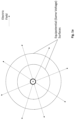
- FIG. 2 n displays a conducting disk
- FIG. 3 depicts a first simulation method
- FIG. 4 depicts a second simulation method
- FIG. 5 depicts a third simulation method
- FIG. 6 depicts a fourth simulation method
- FIGS. 7 a through 7 f depict an exemplary combined circuit and free space simulation
- FIG. 8 depicts a computing system.
- a simulator that is able to dynamically accept user input defining an electro-magnetic system and visually render the behavior of the system in real time can help, e.g., a student more easily comprehend, learn, and perhaps develop an intuitive feel for the physical processes that transpire within electro-magnetic systems.
- FIGS. 1 a through 1 k depict basic units of electricity, basic units of magnetism, the forces they create and their response to these forces.
- the discussion of FIGS. 1 a - 1 k is essentially an overview of basic, well-known physics, it also serves as an introduction to the underlying calculations performed by the aforementioned simulator, which is described more thoroughly below.
- the physical arrangements that may be simulated include, for example, free space or other two-dimensional or three-dimensional space; and/or, an electronic circuit structure having one more electrical components including one or more conductors (e.g., wires, wire segments, conducting plates, etc.), capacitors, inductors, resistors and/or batteries.
- a fundamental object capable of motion is an electronic point charge (or “free charge”) which can be assigned positive electrical charge or negative electrical charge.
- a positive point charge spherically radiates outgoing electric fields from itself and, referring to FIG. 1 b , a negative point charge spherically sinks/terminates incoming electric fields upon itself.
- a positive charge will experience an applied force that causes the positive charge to move in the direction of the field, whereas, a negative charge will experience an applied force that causes the negative charge to move in a direction opposite to the field.
- E ⁇ kq r 2 ⁇ r ⁇ Eqn . ⁇ 1
- k is a constant that involves the permittivity of the space that surrounds the charge
- q is the magnitude of the point charge's charge
- r is the radial distance from the point charge
- ⁇ right arrow over (r) ⁇ is the unit vector in the radial direction.
- the expression is a vector expression in that a positive charge produces outgoing (positive) radial fields and a negative charge produces inward/sinking (negative) radial fields.
- Moving electrical point charges as observed in FIGS. 1 d trough 1 g , create a magnetic field. That is, whereas electric fields can be created from point charges, by contrast, in strict theory, point charges for magnetic fields do not exist.
- an electrical current flows, e.g., through a straight line wire, as depicted in FIGS. 1 d and 1 e , a radial magnetic field is created that circulates around the current flow. The direction of the magnetic field depends on the direction of the current flow.
- FIGS. 1 f and 1 g When current travels in a loop (i.e., a continuous path that closes upon itself) a magnetic “dipole” is created as observed in FIGS. 1 f and 1 g .
- the classic image of a magnetic dipole is a tight (smaller radius) circular flow of electrical current that creates magnetic fields that circulate around the current flow through its cross section radiating outward therefrom. Magnetic fields that emanate outwardly from the cross section of the current loop are recognized as the “north” end of the dipole while the returning magnetic fields that sink inwardly into the cross section of the current loop are recognized as the “south” end of the dipole. Which end of the dipole is the north end and which end is the south end depends on the direction of the current flow.
- B ⁇ ⁇ ⁇ ⁇ I 2 ⁇ ⁇ ⁇ ⁇ r ⁇ r ⁇ ⁇ Eqn . ⁇ 2 ⁇ a
- I the magnitude of the current flow
- ⁇ the permittivity of the space where the magnetic field is present
- r the radial distance from the axis that the current flows along, and is the unit vector in the direction perpendicular to r.
- space having high permittivity, ⁇ (which is space that is highly magnetic in nature) will produce a larger magnetic field.
- Eqn. 2a becomes:
- a magnet e.g., a slab of magnetic material
- FIG. 1 h can be modeled as a number of magnetic dipoles that are tightly packed, e.g., in a three-dimensional array like structure.
- the magnetic field generated by each dipole in the packed structure contributes to the magnetic field generated by the magnet as a whole.
- the N and S ends of a magnetic dipole or magnet can be modeled as a magnetic “moment”.
- a magnetic field as depicted in FIG. 1 i , the north end of a magnet or magnetic dipole tries to move in the direction of the magnetic field while the south end tries to move in the direction opposite that of the magnetic field.
- the magnetic dipole will rotate or otherwise align itself with the magnetic field such that the north end is farther away from the north end of the source of the field and the south end is closer to the north end of the source of the field.
- FIG. 1 j When a point charge is moving in a direction that is perpendicular to a magnetic field's orientation, as depicted in FIG. 1 j , an effective electric field is created that causes the point charge to experience a torque.
- the torque causes the point charge's direction of travel to rotate.
- the direction of rotation depends on whether the charge is positive or negative combined with the direction of the magnetic field.
- FIG. 1 j can be seen as a corollary to the behavior described above with respect to the magnetic dipole described above with respect FIGS. 1 f and 1 g.
- a particular point charge will have electric fields applied to it that are created by: i) other electrical point charges; ii) changing magnetic fields; and/or, iii) the traveling of the point charge through a magnetic field.
- the net summation of these fields at the point charge can result in a net electric field that is applied to the point charge.
- the net electric field results in a net force (F) that is applied to the point charge which causes the point charge to move.
- F net force
- a the acceleration
- q the charge of the point charge and is the net electric field experienced by the point charge
- m the mass of the point charge.
- the acceleration can be expressed as a vector having a particular direction. The direction ultimately results from the direction(s) of the applied electric fields, their respective strengths and the polarity of the point charge (positive or negative).
- a particular magnetic dipole will have magnetic fields applied to it that are created by: i) other magnetic dipoles and/or magnets; and, ii) electrical currents (moving free charges).
- the net summation of these fields at the magnetic dipole can result in a net magnetic field that is applied to the magnetic dipole.
- the net magnetic field results in a net force that is applied to the dipole which causes the dipole to rotate or otherwise move its position.
- the movement can be expressed as a vector having a particular direction. The direction ultimately results from direction(s) of the applied magnetic fields, the magnetic fields' respective strengths and the orientation of the dipole's north and south ends.
- the aforementioned simulator not only resolves these complicated interactions for “free space” electro-magnetic systems but does so in “real time”, with user interaction and need not rely upon high-end processor hardware.
- the simulator is believed to possess significant utility as an educational tool.
- the simulator may be installed on a tablet computer.
- a student/user may tap on the screen to add objects of a system to be simulated (e.g., one or more charges, dipoles, magnets, circuit structures, etc.).
- the simulator then simulates the system graphically on the tablet's display in real time, meaning, the movement of the charges and/or dipoles in response to their interactions with one another and any other externally applied potentials (e.g., a battery) is presented on the display.
- the user is free to interrupt the simulation and change its state at any time. For example, the user may add more charges at a particular location, may remove some existing charges from a particular location, change a circuit arrangement, add a magnet, etc.
- the simulator is then able to immediately simulate and render the response of the new system with little/no loss of fluidity after the user's imposed change.
- FIGS. 2 a through 2 m show a simplistic exemplary simulation with corresponding user interactions. More advanced simulation environments, such as simulation environments that include circuit structures, are presented in more detail further below.
- FIG. 2 a user taps on the screen at a first location 201 . Responsive to the tap, a menu appears (not shown) from which the user selects the addition of a single positive charge.
- FIG. 2 b shows the screen display after the charge has been introduced into the system by the user.
- the system consists of a single positive charge that is not subject to any applied fields (no other objects exist in the system). As such the positive charge does not experience any applied forces and remains in place.
- the user taps on another screen location and adds a single negative charge.
- the emanating fields of the positive charge draw in (attract) the negative charge and, likewise, the sinking fields of the negative charge (also not shown) draw in the positive charge.
- the two charges begin to move closer to one another as observed in FIG. 2 d .
- the charges remove increasing amounts of distance between them as they accelerate toward one another with non-linear acceleration.
- the electrostatic dipole emanates associated electric field lines like those of the magnetic dipole of FIG. 1 f (except the field lines are electric field lines and not magnetic field lines).
- the field lines from the electrostatic dipole interact with the added charges, and the fields from each of the newly added charges interact with the electrostatic dipole and each of the other charges. In essence a complex arrangement of fields, forces from the fields and resulting motions of each of the objects (the electrostatic dipole and the newly added charges) is created.
- the simulator calculates all of these and renders the resulting motion of the electrostatic dipole and newly added charges in real time (their interactions with one another are observed immediately after the user adds the new charges). To the extent the moving objects create their own magnetic fields from their movement, and such magnetic fields change owing to the motion of their respective charges and/or other charges move through such fields, additional electric fields may be created that additionally affect the motion of the charges and so on.
- the simulator additionally calculates all such fields, the resulting forces on the objects from such fields, and the resultant motion of each individual objects in response to its respective resultant force. The motion is rendered on the screen and the process continually repeats as observed in FIGS. 2 k and 2 l.
- FIG. 3 shows a process flow to be executed by processing resources (e.g., central processing unit(s) (CPU(s)) and/or graphics processing unit(s) (GPU(s)) of the computing system (e.g., tablet computer) that is to implement the simulator.
- processing resources e.g., central processing unit(s) (CPU(s)) and/or graphics processing unit(s) (GPU(s)) of the computing system (e.g., tablet computer) that is to implement the simulator.
- processing resources e.g., central processing unit(s) (CPU(s)) and/or graphics processing unit(s) (GPU(s)) of the computing system (e.g., tablet computer) that is to implement the simulator.
- CPU(s) central processing unit(s)
- GPU(s) graphics processing unit
- the input information corresponds to the first object or objects that are initially added to the system.
- the initial pair of charges of FIG. 2 c may correspond to an input to the simulator.
- a positive charge is identified and its position is provided, also, a negative charge is identified and its position is provided.
- expressions for fields resulting from each of the objects are generated 301 .
- each charge has its own specific charge magnitude (e.g., +5q, +4q, etc.) but in various embodiments a default same charge (e.g., +/ ⁇ 1q) is used for both positive and negative charges.
- the electric fields generated by each charge can be efficiently calculated in the CPU or GPU using equation 1.
- the magnetic field at any point in space from a current ring in equation 2b involves elliptical integrals that have no closed-form solution, and therefore cannot be calculated in a CPU or GPU.
- the expressions for the magnetic field(s) generated by a current ring is implemented as a series expansion approximation (e.g., a Taylor or MacLaurin series expansion) of the classical equation for the particular field (e.g., a Taylor or MacLaurin series expansion is used to approximate Eqn. 2b for a current ring). Additionally, as a further approximation, only a few of the most significant terms of the expansion are included in the expression (higher order terms are not included).
- the coefficients a i and b i directly derivable from the scalar/coefficient terms of the applicable classical expression (e.g. Eqn. 2b) and the manner in which the a i and b i terms are derived for the particular type of series expansion being utilized.
- the resultant field ( B ) is expressed as a vector having both an x component and a y component and is thus applicable to a 2D simulation.
- a third vector component ( z ) could be introduced to support simulations over three dimensions.
- the expression incorporates an offset to account for the position (x ob , y ob ) of the object that generates the field. That is, the magnetic field B is the magnetic field that results from a current ring that is positioned at position (x ob , y ob ). Similarly, the electric field E is the electric field that results from a charge that is positioned at position (x ob , y ob ). Thus, referring back to the exemplary simulation of FIG.
- the simulator program code generates two electric field expressions: a first expression for the electric field created by the positive charge that incorporates the x,y position of the positive charge as its offset, and, a second expression for the electric field created by the negative charge that incorporates the x,y position of the negative charge as its offset.
- each field expression e.g., a polynomial of only a few terms for each dimension greatly reduces the computational intensity of the simulation.
- a typical CPU and/or GPU of a mobile device such as a smart phone or table computer, can execute each field expression at the object code level in only a few, e.g., multiply-accumulate instructions.
- multiply-accumulate instructions e.g., e.g., a few, e.g., multiply-accumulate instructions.
- a typical CPU and/or GPU of a mobile device can execute each field expression at the object code level in only a few, e.g., multiply-accumulate instructions.
- over 10,000 electric field calculations can be handled in less than 16-milliseconds, which corresponds to over 100 charges being efficiently handled on-screen at a frame refresh rate of 60 frames-per-second.
- over 3,600 magnetic field calculations can be handled in the same CPU at a fluid 60 frame-per-second refresh rate. Further improvements can be made moving these calculations to the GPU.
- process 301 therefore entails determining new expressions for each of the applicable fields in response to the new position, velocity, etc. data of the various objects. In terms of the machinery of a computing system, this entails the calculation of new coefficient values for the series expansions for each of the fields at play in the simulation and preserving them within the system (e.g., in register space of a CPU and/or to system memory).
- the simulator calculates the force applied to each object by the various fields that exist in the system and determines the resulting motion of each object 302 .
- the electric field applied to the positive charge is found by inserting the x, y position of the positive charge into the x,y terms of the expression for the electric field generated by the negative charge.
- E the electric field applied to the positive charge
- m is the mass of the positive charge (which may also be defined in the input description of the positive charge object)
- a is the acceleration of the positive charge.
- a is a vector having x and y components given that E is a vector having x and y components.
- the motion that is induced upon the positive charge can be determined as
- v is the velocity of the positive charge
- a x and a y are the x and y components of the positive charge's acceleration
- v 0x and v 0y are the positive charge's initial velocity terms in the x and y directions respectively (both terms of which are zero during the initial “still” starting state of the system)
- ⁇ t is the amount of time that transpires between rendered images of the simulation.
- new positions for both objects are provided.
- the process inquires whether the user has provided any input taps/touches since the rendering of the previous image (there were none after the initial setup of FIG. 2 c ) 303 .
- the process then redraws the objects in their new positions 304 .
- the objects may be redrawn at the positions observed in FIG. 2 d which depicts movement in relation to their initial positions of FIG. 2 c .
- the rendering process 304 includes not only the “drawing” of the new picture (or frame) in software (e.g., writing the new image in memory that is local to a GPU), but also physically drawing the new image on a display (e.g., reading the new data from the memory that is local to the GPU and directing it to a display driver circuit which physically draws the new frame image on the display).
- the process then continually “loops” (iterates) with the “new” object positions and velocities that were determined from a just completed iteration (and were most recently rendered on the display) being used as the input positions and velocities for the next set of calculations that are performed for the immediately following iteration that will determine the object positions for the next rendered image.
- the collision of the positive and negative charges eventually occurs.
- the forces and object motion calculation 302 not only determines the velocities of the charges but also detects the collision between them and then executes, e.g., conservation of momentum equations (which may also be expressed as a series expansion approximation) to calculate the motion and resulting positions of the charges after the collision, which are rendered as depicted in FIG. 2 h.
- the process then continually iterates. After multiple loops, the electrical force and mechanical force (collision) calculations 302 settle and the pair of charges reach an electrostatically stable state as an electrostatic dipole (the electrostatic force calculations for the pair of charges demonstrate maximum attraction between them).
- the mechanical force calculations provide results that articulate the spinning of the dipole which are subsequently rendered as depicted in FIG. 2 i.
- process 303 is triggered with the user's addition of the additional charges.
- process 303 adds a description of each charge (its (x,y) position, it's mass, the polarity of its charge) to an overall description of the system being simulated.
- the new charges are then rendered as observed in FIG. 2 j .
- process 301 accepts as input information not only the description of the position and motion of the electrostatic dipole, but also the descriptions of the newly added charges.
- the electric field calculations 301 are expanded to include not only an expression for the electric field generated by the dipole, but also a respective expression for the electric field generated by each of the newly added charges.
- the subsequent electrical forces and mechanical calculations 302 determine the force applied to the dipole by the respective electric field of each of the newly added charges, and, determine the force applied to each newly added charge by the electric field created by the dipole and the respective electric field created by every other newly added charge.
- the expansion of the calculations does not result in overly intensive numeric computations owing to how quickly each of the calculations can be made (e.g., a few instructions for each calculation).
- the electrical and mechanical collision calculations 302 determine the resulting motions and positions of the dipole and each of the newly added charges from their electrostatic interactions. The newly calculated positions for each of the objects are then rendered on the display.
- the program flow then continues to iterate, with each new iteration accepting the most recently calculated position and velocity of each object as input information, then, calculating the fields generated by the objects 301 from the input information and the electrical and mechanical forces applied to the objects and their resulting motions and positions in response thereto 302 , and, rendering the objects in their newly calculated positions 304 (no user input happens after the charges of FIG. 2 j are added).
- the results of these iterations are respectively depicted in FIGS. 2 k through 2 l.
- the incorporation of another field into the simulation is accomplished by merely adding a series approximation expansion with reduced terms for that field into the set of fields that are determined at process 301 (e.g., to account for any magnetic field induced by a moving charge, a separate expression for the magnetic field created by each charge is added to the set of field equations).
- FIG. 4 shows a more detailed embodiment of the simulation approach of FIG. 3 that accounts for the presence of magnetic fields and/or objects in the system being simulated.
- the fields calculations process 401 first calculates all magnetic fields 411 and then calculates all electric fields in the system 412 (as discussed above with respect to FIG. 3 ).
- the forces and responses process 402 of the simulation approach of FIG. 4 determines 413 all magnetic forces applied to magnetic objects in the system and any responsive motion to such force (e.g., magnetic dipole rotation) and then determines 414 all electrical forces applied to all electrical objects in the system and any responsive motion to such force (e.g., acceleration and/or change in direction of any electrical charge).
- magnetic fields can result from the presence of magnetic dipoles in the system (e.g., from one or more magnets) and/or from the motion of electrical charges.
- the fields calculation process 401 first calculates each of the magnetic fields 411 in the system that are respectively created from the various sources of magnetic fields that exist in the system (e.g., a magnetic field is calculated for each moving charge in the system and each magnetic dipole and/or magnet in the system).
- the velocity of the charge that was determined by the immediately preceding iteration is used to calculate the electrical current of the charge (specifically, the current of the charge is the charge's charge multiplied by its velocity).
- the electrical current is then used to determine the magnetic field created by the moving charge as a function of distance from the electrical charge in accordance with, e.g., classical equation Eqn. 2a.
- the magnetic field created by any magnetic dipole in the system is determined in accordance, e.g., with classical equation Eqn. 2b.
- both classical equations are expressed as series expansion approximations where, like the magnetic field calculations discussed above, higher ordered terms are ignored to provide for fast calculation of each field.
- the expressions may be multi-dimensional (e.g., having x and y components for 2D simulations or x, y and z components for 3D simulations).
- the field calculation process 401 then performs the electric field calculations 412 , e.g., as described above at length with respect to FIG. 3 .
- the electric field calculation 412 is further enhanced to determine electric fields created by changing magnetic flux and determine electric fields applied to electrical objects in motion that pass through a magnetic field.
- the expressions for magnetic field from each of the magnetic field sources that were determined in the immediately prior calculation are preserved and a respective difference is taken with the newly determined expression for each magnetic source to determine an expression for change in magnetic field from each magnetic field source.
- the expression for change in magnetic field from each magnetic field source is then used to determine an expression for change in magnetic flux and any resulting electric field that results from such change (e.g., as a function of distance from the source).
- the position of each electrical charge in motion that was accepted as an input term is used to determine the magnetic field that exists at the object in motion.
- the magnetic field that exists at the electrical charge's location and the velocity of the electrical charge that was accepted as input information are used to determine the electric field experienced by the electrical charge.
- one or both expressions are implemented as series expansion approximations where higher ordered terms are ignored to provide for fast calculation of each field.
- the expressions may be multi-dimensional (e.g., having x and y components for 2D simulations or x, y and z components for 3D simulations).
- the respective forces applied to the objects in the system by these fields is determined 402 .
- the net magnetic field at each magnetic object is determined 413 by inserting the position of the magnetic object into each of the magnetic field expressions in the system (other than the object's own expression). Summation of the resultant from each expression corresponds to the net magnetic field applied to the magnetic object (which is expressed as a vector).
- the response of the magnetic object is readily calculated 413 (e.g., a rotation of a magnetic dipole moment to a new orientation).
- the process is performed for each magnetic object in the system.
- each electrical object to its net electric field 414 is determined as described above with respect to FIG. 3 with the additional recognition of any electric fields that result from a magnetic source. That is, the net electric field at each electrical object is determined 414 by inserting the position of the electrical object into each of the electric field expressions in the system (other than the object's own expression). The set of expressions are enhanced to include electric fields resulting from changing magnetic fields and motion of the object through a magnetic field. Summation of the resultant from each expression corresponds to the net electric field applied to the electrical object (which is expressed as a vector). With the net electric field applied to the electrical object being defined, the response of the electrical object is readily calculated 414 (e.g., acceleration of the electrical object in a particular direction with a specific velocity to a new position). The process is performed for each magnetic object in the system.
- any mechanical collisions between objects is detected and their responses thereto (e.g., as a function of object mass and velocity, etc.) 415 .
- a new set of positions and/or orientations (and associated velocity) is determined for each magnetic dipole in the system.
- a new set of positions and velocities is determined for each electrical charge in the system.
- the charges are each point charges and the magnets are treated as a series of current loops (magnetic dipoles).
- a conductive structure (usually a metal disk or metal sphere) is a structure which can accumulate charge. In general, charges will redistribute around the surface of a conductive structure until the electric fields inside the conductive structure are zero. Any complex distribution of charge is possible on the surface the conductor, so long as the electric field inside the conductor is zero.
- a challenge faced by the simulator is how to efficiently simulate free space environments having conductive structures within them.
- a charge distribution equation that is specific to the structure is called out by the simulator and executed over the amount of charge applied to the structure and the dimensions of the structure (a distribution of charge generally includes more than one unit of charge spread out over some surface area).
- the user may introduce a particular type of structure to the free space environment (e.g., a metal disk or metal sphere), assign dimensions to the structure (e.g., by the user tapping on the screen and physically spreading its dimensions in/out on the screen with the user's fingertips) and assign an amount of charge to the structure.
- the simulator calls up an equation for charge distribution that is specific to the particular structure called out by the user.
- the equation generally includes the dimensions of the structure and the amount of charge placed on the structure as input parameters which, again, are received from the user's input definition of the structure.
- the fields that emanate from the structure (in the case of a positively charged conductive structure) or the fields that sink to the structure (in the case of a negatively charged conductive structure) are readily calculated with, e.g., a second equation that expresses electric fields from/to a distribution of charge (rather than individual charges on a charge-by-charge basis).
- a second equation that expresses electric fields from/to a distribution of charge (rather than individual charges on a charge-by-charge basis).
- the simulator calculates the magnitude and direction of the electric field that emanates from or sinks to the disk at the location of the free charge in order to determine the force to apply to the free charge.
- the circular disk in free space is assumed to have a non-uniform charge density, or charge per unit area ( ⁇ disk ) of:
- ⁇ disk ⁇ ( s ) Q disk 2 ⁇ ⁇ ⁇ ⁇ ⁇ R disk ⁇ ( 1 R disk 2 - s 2 ) Eqn . ⁇ 10 ⁇ a
- s is a position on the disk measured as its distance from the center of the disk
- R disk is the disk's radius
- Q disk is the total charge placed on the disk.
- the electric field from a linear or “thin” ring of charge a distance s from the center of the disk can be calculated and approximated in a manner very similar to the magnetic field calculations in Equation 2b.
- the components of this electric field, E r +E a , are
- r is the distance to the free charge from the center of the ring
- a is the axial (y) distance to the free charge
- s is the radius of the ring
- q r 2 +s 2 +a 2 +2rs
- the electric field from a ring of charge can be calculated in only a few instructions (e.g., a SUB instruction, a SQRT instruction, a DIV instruction and a MUL instruction to execute Eqn. 10c to determine Q ring ; one multiply accumulate instruction to determine E a of Eqn. 10b; two multiply accumulate instructions and a SUB instruction to determine E r of Eqn. 10b; and, some pre-cursor MUL instructions and other arithmetic instructions to determine the constant/coefficient terms in these equations) as all other quantities are known.
- the electric field of several of these rings can be numerically integrated (i.e., summed) to approximate the electric field for a complete disk.
- the code footprint of only a few instructions as described above are executed 8 times and the E r and E a components are summed to find an accurate approximation for the electric field at the current location of the free charge, (r, a).
- Eqn. 2b described a compute efficient approximation for the magnetic field at any point in space from a set of current loops.
- a set of current loops essentially corresponds to a current distribution.
- a user may call-out a structure with a specific current distribution, such as a toroidal coil or a current sheet, and the simulator pulls up an equation for current density inside the structure. After calculating the current at a number of locations inside the structure from the current density equation, the simulator will be able to approximate the magnetic field from the structure as the summation of magnetic field calculations from the current densities from each of the different locations.
- a central processing resource e.g., a processor having multiple central processing unit (CPU) cores
- a graphics processing resource e.g., a graphics processing unit (GPU)
- the GPU is designed to execute animation or other computer generated graphics programs to off-load the burden of executing these tasks from the CPU (graphics processing programs tend to be numerically computation intensive).
- a CPU performs processes 301 , 302 and 303
- a GPU performs process 304 .
- the overall program flow includes the CPU writing new object positions, velocities, etc. into system memory (or “main memory”) after the CPU executes process 303 . Then, the GPU reads the new positions, velocities, etc. from system memory, processes the data and causes a new frame image that incorporates the new data to be rendered on the display during process 304 .
- some pipelining is possible between the GPU and CPU. That is, for example, after a set of new object positions, velocities, etc. have been read from system memory by the GPU for rendering, the CPU may then subsequently read the same data from system memory to begin the field calculations 301 for the next iteration. That is, over some instant of time or contiguous window of time, the GPU is executing process 304 for a prior iteration while, concurrently, the CPU is executing process 301 (and possibly even process 302 ) for the immediately following iteration.
- the simulator can show the user the electric and/or magnetic fields. That is, for instance, the user not only observes the motion of an electrical charge in response to an electric field and/or the motion of a magnetic dipole in response to a magnetic field, but also, the simulator draws for the user the electrical and/or magnetic fields (e.g., the user observes the field lines of any of FIGS. 1 a through 1 k ).
- the GPU may be configured to perform not only process 304 of the prior iteration, but also, process 301 of the immediately following iteration.
- the GPU and CPU are different types of processors, nevertheless, they typically share some common mathematical computation abilities such as the execution of basic arithmetic instructions and/or object code processes.
- the GPU not only processes and causes the rendering of the data from a prior iteration (process 304 ) but also calculates the fields 301 for the immediately following iteration (process 301 ).
- the GPU reads from main memory the new positions, velocities of the prior iteration and loads them into its local memory. From the GPU's local memory, process 304 of the prior iteration and process 301 of the immediately following iteration are performed by the GPU (process 301 accepts as input data the positions, velocities, etc. of objects generated from the prior iteration). The GPU then writes values for the new field equations (e.g., the GPU writes new coefficient values (e.g., for a series expansion that approximate each of the fields or other field expression)) into system memory while keeping a copy of these coefficients in its local memory. When the GPU next reads the new object positions, velocities, etc.
- process 304 of the prior iteration and process 301 of the immediately following iteration are performed by the GPU (process 301 accepts as input data the positions, velocities, etc. of objects generated from the prior iteration).
- the GPU then writes values for the new field equations (e.g., the GPU writes new coefficient values (
- the coefficients or other values for the applicable fields are already resident in its local memory and the CPU can process their rendering commensurate with the rendering of the updated object positions, velocities of the immediately following iteration. The process then repeats.
- the CPU may additionally perform process 302 and possibly even process 303 (or portion thereof) while the GPU is performing process 304 for the prior iteration and/or the data from the prior iteration is being rendered.
- the GPU may first determine the fields for the next iteration and make them available to the CPU (e.g., by writing them into memory). Then, the GPU begins the task of processing the data 304 for the prior iteration and then causing the same to be rendered.
- the CPU has data to operate on (to determine forces/motions 302 of a next iteration) at approximately the same time the GPU has data to operate on (graphics processing and rendering 304 of the prior iteration).
- the two processors can then operate concurrently on their respective input data to effect a pipeline.
- FIG. 5 shows another simulation approach that extends the simulation processes of FIGS. 3 and 4 to further include simulation of electronic circuit structures 503 .
- the simulator is not only capable of simulating a free space system by itself or an electrical circuit system by itself, but also, a single system that includes both free space and electrical circuit elements and the interactions between them.
- the current flowing through the wire of an electrical circuit will generate a magnetic field in free space that can affect the position of a magnet that sits in free space in proximity to the wire.
- electrical circuits can affect the behavior of surrounding free space charges and/or magnetic dipoles and vice-versa (the movement of charges and/or dipoles in free space can affect the currents and/or voltages in a proximately located electrical circuit).
- the simulator is capable of simulating any/all of free space and electrical circuit systems including simulation environments that include both systems and the interactions between them.
- FIG. 5 shows an embodiment of a process flow for an embodiment of a complete simulator that is capable of simulating free space electric and/or free space magnetic systems, electrical circuits and interactions between free space system(s) and electrical circuit systems.
- the simulator embodiment of FIG. 5 corresponds to the simulator of FIG. 3 but with a circuit simulation block 503 inserted between the free space simulation ( 301 / 501 , 302 / 502 ) and the incorporation of user input ( 303 / 504 ).
- the circuit simulation 503 like the free space simulation of free electrical charges, provides new positions and motions of charges in the circuit being simulated with each next iteration.
- the rendering apparatus e.g., a GPU
- the rendering apparatus is provided with a description of the new positions and motions of the free space objects and the new positions and motions of the electrical charges in the circuit.
- the free space objects and circuit charges are then rendered on the display so the user can observe their motions in accordance with the system being simulated. Note that in environments where no circuit is present, process 503 is not performed and overall simulation operation is as described above with respect to FIG. 3 . Contra-wise, in the case where no free space objects exist and only a circuit structure exists, processes 501 and 502 are not performed and the overall process reduces to just performing a circuit simulation 503 .
- FIG. 6 shows an embodiment for the circuit simulation 503 , 603 itself. The details of the process described by FIG. 6 are explained more thoroughly immediately below with respect to an example, presented in FIGS. 7 a through 7 f , that pertains to a current driven through an inductor of an electrical circuit that causes a free space magnet to rotate and a free space charge to move.
- a circuit structure 701 is shown in the proximity of a free space magnet 702 and a free space charge 703 .
- the circuit includes two charged spheres A, B which represent the nodes of the circuit (that is, the circuit only has two nodes A and B).
- the user has placed five units of positive charge (+5q) on sphere A and five units of negative charge ( ⁇ 5q) on sphere B.
- the charge spheres A, B are each connected to respective wires that are in turn connected to different ends of an inductor L. Each of the spheres, the wires and the inductor are fixed in their positions (they cannot move).
- a magnet 702 exists in free space in proximity to the inductor L.
- the magnet 702 is fixed to the position of its midpoint, however, it can rotate about the midpoint.
- a free charge 703 having one unit of positive charge (+q) also exists in free space between the conducting spheres A, B of the circuit.
- the free space calculations will first determine 501 respective expressions for the electric fields that emanate from the positive sphere A and the free charge 703 , the electric fields that are sunk by the negative sphere B and the magnetic fields of the magnet. From these field expressions the free space calculations will determine the forces 502 that are applied to the free charge 703 and the magnet 702 , from which, in turn, a new position and vector motion for the free charge 703 is determined (the free charge 703 will move “down” toward the negative sphere B as it is repelled from the positive sphere A and attracted to the negative sphere B).
- the process then flows to the circuit simulation 503 .
- the circuit simulation 503 referring now to FIGS. 6 and 7 b , during the initial iteration of the simulator (which is the present situation), the circuit simulation will perform an “initial pre-runtime” configuration 601 of the circuit simulator. This entails building 611 a model of the circuit 704 including introducing a capacitance to a same reference (e.g., ground) for each node in the circuit and then identifying 612 different loops of current (or “current loops”) within the circuit (generally, at least one current loop must flow through every component in the circuit).
- a same reference e.g., ground
- the exemplary circuit of FIGS. 7 a - f is simplistic and includes only one current loop 705 (which flows out of one sphere, through the inductor and into the other sphere). It is pertinent to point out that more complex circuit structures can be simulated by the simulator. Thus, more generally, referring to FIG. 6 , once the capacitances have been added 611 and the current loops have been identified 612 , the simulator develops expressions 613 from the identified current loop(s) that expresses their respective current(s) as change in charge in the time increment of the simulation iteration. The equation(s) are then solved 614 for the respective change in charge in the time increment of the simulation for each of the identified current loop(s).
- an expression is developed for each identified current loop that expresses the voltage drop across each component along a current loop as a function of the change in charge in the time increment of the simulator that flows through the component, where, the sum of the voltage drops along a same current loop must equal the induced EMF from any changing magnetic fields in the circuit.
- more than one current loop may flow through a same component and the expression for the voltage drop across the component includes the change in charge in the time increment of the simulator for each current loop that flows through the component.
- both the added capacitances C A , C B and the identified current loop 705 are drawn in FIG. 7 b at inset 704 .
- the user does not actually observe the circuit model of inset 704 (its presence is only contemplated internally within the simulator flow). Rather, the user only observes the circuit structures and free space objects that the user entered on the display.
- Eqn 13 provides the expression that is developed for the single loop current 705 of the example of FIGS. 7 a - e .
- Eqns 11 and 12a-c provide theoretical insight into the development of Eqn. 13.
- V CA is the voltage of node/port A
- V CB is the voltage of node/port B
- ⁇ L V is the EMF induced across the inductor.
- Each of these voltage terms can be respectively expressed as a function of current through the current loop. More specifically, V CA can be expressed as:
- 1) q A,i is the charge on capacitor C A for the present iteration
- C A is the capacitance of capacitor C A
- ⁇ q AB,i is the loss in positive charge at node A (from the gain of negative charges at node A) for the present iteration
- q A,i-1 is the charge at node A from the prior iteration (which is the initial condition of +5q for the first iteration).
- V CB can be expressed as:
- 1) q B,i is the charge on capacitor C B for the present iteration
- C B is the capacitance of capacitor C B
- ⁇ q AB,i is the gain in positive charge at node B (from the loss of negative charges from node B) for the present iteration
- q B,i-1 is the charge at node B from the prior iteration (which is the initial condition of ⁇ 5q the first iteration).
- ⁇ q AB,i is the same value in both equations 12a and 12b with each equation including the appropriate polarity for the term in view of the direction charges will flow based on the initial charge allocation (i.e., current will flow from node A to node B because positive charges have been placed at node A and negative charges have been placed at node B).
- ⁇ AB,i / ⁇ t can be viewed as the current flow (I) from node A to node B for the current iteration where ⁇ t is the time increment of each iteration.
- I current flow
- ⁇ ⁇ ⁇ I ⁇ ⁇ ⁇ t ⁇ ⁇ ⁇ q AB , i - ⁇ ⁇ ⁇ q AB , i - 1 ⁇ ⁇ ⁇ t 2 Eqn . ⁇ 12 ⁇ c ⁇ ( i )
- ⁇ t is the time increment of the simulation
- ⁇ q AB,i is minus the flow of negative charge from node B to node A during the present iteration
- ⁇ q AB,i-1 is minus the flow of negative charge from node B to node A during the prior iteration.
- the induced EMF across the inductor, ⁇ L can therefore be expressed as:
- Equation 11 From Eqns. 12a, 12b and 12c(ii), Equation 11 can be expressed as:
- Eqn. 13 for ⁇ q AB,i corresponds to the solving 614 for the current in the current loop 705 , for the present iteration, as its change in charge in the time increment of the simulator iteration.
- the per iteration “output” of the circuit simulator is very comparable to the per iteration output of the free space simulator for free electrical charges. That is, a number of charges are defined, the polarity of these charges are defined, and the directions of motion of these charges are defined.
- the new state corresponds to the motion of the free charge 703 towards the negative sphere B, and, the motion of the charges within the circuit.
- FIG. 7 c presents an exemplary depiction of the rendered display of the results of the first iteration (the circuit model at inset 704 is shown for the reader's reference and in various embodiments is not rendered on the display).
- the user will observe the free charge 703 moving to sphere B and will observe a number of negative charges flowing from sphere B to sphere A through the wire.
- node A is assumed to lose three units of positive charge and node B is assumed to lose three units of negative charge resulting in +2q remaining charge on sphere A and ⁇ 2q remaining charge on sphere B.
- FIG. 7 c also depicts the electric field between spheres A and B that was calculated by the free space simulation for the first simulation.
- imagery like that observed in FIG. 7 c for the fields is able to be rendered so the user can view them.
- the fields are not rendered.
- the process then begins a new (second) iteration.
- the change in charge for both of nodes A,B that was determined 614 at the end of the circuit simulation is used to determine a new charge for each of spheres A and B. That is, each new iteration starts with a new amount of charge for each node in the circuit.
- the initial state also includes the motions of the free charge 703 and the charges in the circuit.
- the free space simulation 501 , 502 determines: 1) the electric fields between the spheres A, B; and, 2) the magnetic field from the flow of charges in the circuit (for ease of explanation, the force on the moving charges in the circuit from the magnet 702 is ignored as is the magnetic field created by the moving free charge 703 ).
- the electric field between the spheres will not be as strong and the acceleration of the free charge's motion toward sphere B will diminish.
- the new position and vector motion that is calculated for the free charge 703 for the second iteration will reflect the slowing acceleration (e.g., its new position will reflect a distance traveled between iterations that corresponds to slowing acceleration).
- the inductor With respect to the magnetic field generated by the current flow in the circuit, the inductor essentially creates a magnetic field because its physical construction consists of multiple loops of current.
- the strength of the magnetic field that is created by the inductor is a function of the current through the circuit (which flows through each loop of the inductor) and the number of current loops in the inductor.
- the free space simulation 501 , 502 will also determine the rotational motion of the magnet 702 in response to the magnetic field that is generated by the inductor.
- FIG. 7 d shows the rendered image from the second iteration (again, the circuit model at inset 704 is shown for the reader's reference and in various embodiments is not rendered on the display).
- the weaker electric fields between spheres A and B are shown as is the magnetic field generated by the moving charges within the circuit from the first iteration (again, in various embodiments, the rendering of these fields is optional).
- the rotation of the magnet 702 in response to this magnetic field is shown.
- the moving charges in the circuit are also shown.
- the process then begins the third iteration.
- the change in charge for both of nodes A, B that was determined 614 at the end of the circuit simulation is again used to determine a new charge for each of spheres A and B.
- the initial state also includes the motions of the free charge 703 , the motions of the charges in the circuit and the rotation of the magnet 702 .
- the free space simulation 501 , 502 determines: 1) the electric fields between the spheres A, B; 2) the magnetic field from the flow of charges in the circuit; and, 3) the electric field (or electro-motive force, EMF) that is induced in the inductor from the current in the circuit (again, for ease of explanation, the force on the moving charges in the circuit from the magnet 702 is ignored as is the magnetic field created by the moving free charge 703 ).
- EMF electro-motive force
- the magnet rotated a maximum amount during the second iteration and practically aligned itself with the magnetic field that was generated by the inductor.
- the flow of current after the second iteration is less than the flow of current after the first iteration resulting in a somewhat weaker magnetic field being created in the third iteration as compared to the second.
- the free space magnet will hardly rotate in the third iteration.
- the free space calculations 501 , 502 for the third iteration will generate a new position for the magnet that is hardly changed from its position from the prior (second) iteration.
- the third iteration will base its induced EMF calculation from the amount of magnetic flux change within the inductor.
- the third iteration will determine that a maximum change in magnetic field occurred between the second and first iterations (a maximum magnetic field was determined from the second iteration and no magnetic field was determined from the first iteration).
- the free space simulations of the third iteration 501 , 502 will determine that a maximum EMF is generated across the inductor.
- FIG. 7 e shows the display after the results of the third iteration are rendered.
- Sphere A has a net charge of ⁇ 4q and sphere B has a net charge of +4q.
- Charges are moving in the circuit in accordance with the induced EMF that was calculated for the inductor. The magnet has rotated a negligible amount and the free charge has stopped accelerating toward sphere B.
- the free space simulation 501 , 502 will determine that an electric field exists between spheres A and B but the direction of the field is opposite that of the electric field that initially existed between the spheres. That is, whereas the initial electric field ran from positive sphere A to negative sphere B, by contrast, the free space simulation 501 , 502 of the fourth iteration will determine that the electric field runs from positive sphere B to negative sphere A. As such, the free space simulation 501 , 502 for the fourth iteration will determine that the free charge 703 will presently reverse direction and begin accelerating toward sphere A.
- the third iteration determined that a somewhat weaker magnetic field was generated by the inductor due to the reduction in current flow that occurred in the second iteration. Nevertheless, the difference between the somewhat weaker magnetic field of the third iteration and the maximum magnetic field of the second iteration corresponds to considerably less change in magnetic flux as compared to the difference between the first and second iterations (maximum magnetic flux and no magnetic flux). As such, the fourth iteration will calculate a noticeably reduced EMF across the inductor.
- the circuit simulation 503 for the fourth iteration determines that the induced EMF adds only one unit of positive charge to node B and one of negative charge to node A for the circuit simulation so that sphere B has +5q units of charge and sphere A has ⁇ 5q units of charge.
- the circuit simulation will delay calculation of circuit currents driven by the difference in charge on the spheres until the EMF current has reduced to zero (the induced EMF current charges spheres A and B until no more EMF current exists, after which, spheres A and B are permitted to drive current through the circuit).
- FIG. 7 f shows the rendered display after the fourth iteration.
- the state of the system is “opposite” that of the initial state of the system of FIG. 7 a (where sphere A had +5q units of charge and sphere B had ⁇ 5q units of charge).
- the coupling between the accelerating free charge 703 and the rotating magnet 702 and the circuit behavior can also be simulated.
- any change in the magnetic field in the loops of the inductor due to the spinning magnet will create an induced EMF (i.e., voltage) across the inductor. Therefore, we can expand the expression for the EMF in equation 11 to include this effect.
- This flux can be calculated by numerically integrating the magnetic field over the area of each loop. The change in flux determines the induced voltage, so that in this example anytime the magnet spins (either because of the magnetic field from the inductor, or from the user spinning the magnet), there will be a voltage induced across the inductor.
- the link between the circuit and the magnetic field in physical space is bi-directional.
- Eqn. 11 (and ultimately Eqn. 13) can be readily expanded to include the terms of Eqn. 14 (and therefore account for the physics described by Eqn. 14). That is, with respect to the simulator's operation, ⁇ i of Eqn. 14 is determined during the free space magnetic field calculations 501 , 502 of the current iteration leaving ⁇ q AB,i as the only unknown that is solved for by the following circuit behavior calculations 503 for the current iteration ( ⁇ i-1 and ⁇ g AB,i-1 are known from the prior iteration).
- the free charge 703 will electrically induce a voltage on both the top A and bottom B conductors. This can be modeled by including a voltage term in V C A and V C B . Similar to Eqn. 1 which describes the electric field in free space due to a point charge, we can define the voltage at any point in space due to a point charge:
- V FA q F ⁇ ⁇ ⁇ r FA , where q F is the charge on the free charge 703 , and r FA is the distance between the free charge and the top conductor A. Similarly, the bottom conductor B will have an induced voltage of
- V FB q F ⁇ ⁇ ⁇ r FB .
- the simulator can also be extended to handle other common circuit components.
- a parallel plate capacitor can be handled as two circular disks. If the disks are close together, the charge density described by Equation 10a can be approximated as uniform and the electric field at any point in space can again be efficiently calculated. Similar to the conducting spheres in FIG. 7 a , these plates can be included in both the free-space and circuit portions of the simulator.
- a two-terminal resistor can be modeled as a parallel plate capacitor with a partially conductive (semi-conductive) material inside.
- the free-charges inside the resistor move in response to the electric field between the two plates of the resistor, but their motion is impeded (resisted) by the material.
- the simulator uses a charge-based approach, and models how the charges move through the semi-conductive material.
- this obstacle may be a crystal lattice edge or an impurity.
- the kinetic energy of the charge in converted into heat or light, slowing and scattering the charge.
- Drude approximation of a resistor is simulated and visualized. Note that this classical model is used to illustrate the behavior. Other, more accurate illustrations could be used, perhaps involving the quantum behavior of real resistors.
- this model is more accurate than a constant resistance as the stochastic nature of the charges inside the resistor and the temperature dependence can both be included and visualized.
- Similar, multi-terminal models can be constructed for transistors, diodes, and other semi-conducting components.
- a battery can be modeled as a parallel plate capacitor with a reservoir of neutral charges inside and something supplying energy to separate those neutral charges against the electric field.
- a battery is defined as a constant voltage source (V equals some fixed amount, and the current can take on any value).
- the simulator uses a charge-based approach instead of voltage.
- the battery model checks if the desired charge difference, ⁇ Q, appears across its two terminals. If ⁇ Q ⁇ Q desired , one of the neutral charges from the reservoir is separated with an initial velocity (kinetic energy can be used to illustrate the chemical work done by the battery to overcome the electric field between the two conductors). Note that this kinetic energy is only a substitute used to illustrate the chemical work function, and other illustration methods could be used.
- the battery is “dead”. If ⁇ Q> ⁇ Q desired , the electric field would overcome the intrinsic chemical work function of the battery. Any excess charges ( ⁇ Q ⁇ Q desired ) would be re-combined. The newly combined neutral charge could be re-added to the reservoir, effectively recharging the battery.
- Section 3.0 described at length some work sharing that can exist between a CPU and GPU in a computing system (such as a tablet computer).
- substantially all the comments made above in Section 3.0 are applicable to a system that includes circuit simulation. That is, although the discussion of Section 3.0 made significant reference to processes 301 , 302 and 304 of FIG. 3 , these same statements can equally apply to processes 501 , 502 and 505 , respectively of FIG. 5 .
- the points made in Section 3.0 are equally applicable to a system in which the CPU is also performing circuit simulation.
- the CPU performs the circuit simulation calculations, although various embodiments may include the GPU calculating some or all circuit simulation calculations to off load the task from the CPU.
- the instant simulator is able to provide the user with an “intuitive feel” as to how electro-magnetic systems behave.
- the overall subject matter will be more easily comprehended and/or less intimidating at first. That is, it is believed that the instant simulator eases the difficulty of learning the subject matter which, in turn, results in more students learning the material faster or more efficiently as compared to traditional teaching methods, and possibly, ultimately, more students overall who successfully comprehend the material.
- a student can continually increase the charge on the spheres over multiple successive iterations resulting, as immediately observed on the screen by the student, increasingly stronger currents flowing through the inductor (the student will see more and more charges flowing through the circuit), and, an increasingly faster spinning magnet (the student will see the magnet spinning faster and faster as the student adds more charge to the spheres).
- a student can continually change the dimensions of a resistor over successive iterations, such as increasing its width, and immediately observe in real time the electrical current increasingly flow faster through the resistor (because the increase in width increases the resistor's surface area which decreases its resistance).
- a student can continually add more and more charge to a node, or to a battery, and visually observe in immediate real time in response the current increasing within the circuit (more and more charges will flow through the circuit).
- increasing currents will, e.g., cause any proximate magnets to increase their respective speeds of rotation as observed by the student in immediate real time response.
- the simulator permits the student to instantaneously change the environment being simulated and the simulator will immediately, in real time, render on the screen the behavior of the system as it would behave with the newly introduced change.
- the student is therefore free to “experiment” over a range of, e.g., extremes, directions, polarities, sizes, magnitudes, etc.
- the student is able to intuitively comprehend how electric and magnetic objects interact with one another, thus bringing an intuitive sense and feel for such systems to the student.
- FIG. 8 provides an exemplary depiction of a computing system 800 (e.g., a smartphone, a tablet computer, a laptop computer, a desktop computer, a server computer, etc.).
- the basic computing system 800 may include a central processing unit 801 (which may include, e.g., a plurality of general purpose processing cores 815 _ 1 through 815 _X) and a main memory controller 817 disposed on a multi-core processor or applications processor, system memory 802 , a display 803 (e.g., touchscreen, flat-panel), a local wired point-to-point link (e.g., USB) interface 804 , various network I/O functions 805 (such as an Ethernet interface and/or cellular modem subsystem), a wireless local area network (e.g., WiFi) interface 806 , a wireless point-to-point link (e.g., Bluetooth) interface 807 and a Global Positioning System interface 808 , various sensors 809 _ 1 through
- An applications processor or multi-core processor 850 may include one or more general purpose processing cores 815 within its CPU 801 , one or more graphical processing units (GPUs) 816 , a memory management function 817 (e.g., a memory controller) and an I/O control function 818 .
- the general purpose processing cores 815 typically execute the operating system and application software of the computing system.
- the graphics processing unit 816 typically executes graphics intensive functions to, e.g., generate graphics information that is presented on the display 803 .
- the memory control function 817 interfaces with the system memory 802 to write/read data to/from system memory 802 .
- the power management control unit 812 generally controls the power consumption of the system 800 .
- Each of the touchscreen display 803 , the communication interfaces 804 - 807 , the GPS interface 808 , the sensors 809 , the camera(s) 810 , and the speaker/microphone codec 813 , 814 all can be viewed as various forms of I/O (input and/or output) relative to the overall computing system including, where appropriate, an integrated peripheral device as well (e.g., the one or more cameras 810 ).
- I/O input and/or output
- various ones of these I/O components may be integrated on the applications processor/multi-core processor 850 or may be located off the die or outside the package of the applications processor/multi-core processor 850 .
- the computing system also includes non-volatile storage 820 which may be the mass storage component of the system.
- the computing system 800 may include application software (e.g., stored on the computing system's non volatile mass storage hardware) that performs free space and/or circuit simulations as described at length above in the preceding sections.
- application software e.g., stored on the computing system's non volatile mass storage hardware
- the display 803 of the computing system may be touch screen that a user taps on to define simulation environments that are subsequently rendered on the display 803 .
- User input can also be readily accepted through a keyboard and/or mouse device.
- Embodiments of the invention may include various processes as set forth above.
- the processes may be embodied in machine-executable instructions.
- the instructions can be used to cause a general-purpose or special-purpose processor to perform certain processes.
- these processes may be performed by specific/custom hardware components that contain hardwired logic circuitry or programmable logic circuitry (e.g., field programmable gate array (FPGA), programmable logic device (PLD)) for performing the processes, or by any combination of programmed computer components and custom hardware components.
- FPGA field programmable gate array
- PLD programmable logic device
- Elements of the present invention may also be provided as a machine-readable medium for storing the machine-executable instructions.
- the machine-readable medium may include, but is not limited to, floppy diskettes, optical disks, CD-ROMs, and magneto-optical disks, FLASH memory, ROMs, RAMs, EPROMs, EEPROMs, magnetic or optical cards, propagation media or other type of media/machine-readable medium suitable for storing electronic instructions.
- the present invention may be downloaded as a computer program which may be transferred from a remote computer (e.g., a server) to a requesting computer (e.g., a client) by way of data signals embodied in a carrier wave or other propagation medium via a communication link (e.g., a modem or network connection).
- a remote computer e.g., a server
- a requesting computer e.g., a client
- a communication link e.g., a modem or network connection
Landscapes
- Engineering & Computer Science (AREA)
- Business, Economics & Management (AREA)
- Theoretical Computer Science (AREA)
- Physics & Mathematics (AREA)
- General Physics & Mathematics (AREA)
- Computer Hardware Design (AREA)
- General Engineering & Computer Science (AREA)
- Tourism & Hospitality (AREA)
- Educational Administration (AREA)
- Educational Technology (AREA)
- General Health & Medical Sciences (AREA)
- Economics (AREA)
- Primary Health Care (AREA)
- General Business, Economics & Management (AREA)
- Marketing (AREA)
- Human Resources & Organizations (AREA)
- Health & Medical Sciences (AREA)
- Strategic Management (AREA)
- Human Computer Interaction (AREA)
- Microelectronics & Electronic Packaging (AREA)
- Evolutionary Computation (AREA)
- Geometry (AREA)
- Mathematical Optimization (AREA)
- Mathematical Physics (AREA)
- Pure & Applied Mathematics (AREA)
- Mathematical Analysis (AREA)
- Computational Mathematics (AREA)
- Algebra (AREA)
- Management, Administration, Business Operations System, And Electronic Commerce (AREA)
- Instructional Devices (AREA)
Abstract
Description
where k is a constant that involves the permittivity of the space that surrounds the charge, q is the magnitude of the point charge's charge, r is the radial distance from the point charge, and {right arrow over (r)} is the unit vector in the radial direction. The expression is a vector expression in that a positive charge produces outgoing (positive) radial fields and a negative charge produces inward/sinking (negative) radial fields.
where B is the magnetic field strength, I is the magnitude of the current flow, μ is the permittivity of the space where the magnetic field is present, r is the radial distance from the axis that the current flows along, and

where r is the distance from the center of the loop, a is the axial (y) distance, R is the radius of the loop, q=r2+R2+a2+2rR, and
and K(√{square root over (m)}) represent the elliptical integrals of the first and second kind (respectively). The field at any point will have both a radial component outward from the axis of the loop


Where v is the velocity of the moving point charge, “X” is a cross product operation and B is the magnetic flux density of the magnetic field.
E=−(A/2πr)(δB/δt) Eqn. 4
where A is the area of the circular cross section, r is the radius of the circular cross section and (δB/δt) is the rate of change of magnetic flux intensity per unit area through the circular cross section.
where a is the acceleration,


B =(a 0 +a 1(x−x ob)+a 2(x−x ob)2) x +(b 0 +b 1(y−y ob)+b 2(y−y ob)2) y Eqn. 6a
if only three terms of the expansion are used; or,
B =(a 0 +a 1(x−x ob)+a 2(x−x ob)2 +a 3(x−x ob)3) x +(b 0 +b 1(y−y ob)+b 2(y−y ob)2 +b 2(x−x ob)2) y Eqn. 6b
if four terms of the expansion are used.
F=ma ; or a=qE/m Eqn. 7
where E is the electric field applied to the positive charge, m is the mass of the positive charge (which may also be defined in the input description of the positive charge object) and a is the acceleration of the positive charge. Here, a is a vector having x and y components given that E is a vector having x and y components.
where v is the velocity of the positive charge, ax and ay are the x and y components of the positive charge's acceleration, v0x and v0y are the positive charge's initial velocity terms in the x and y directions respectively (both terms of which are zero during the initial “still” starting state of the system) and Δt is the amount of time that transpires between rendered images of the simulation. The velocity equations above are incorporated into the following displacement equations (assuming constant acceleration)
x new =x ob+½F x /m)Δt{circumflex over ( )}2+v 0x Δt Eqn. 9a
y new =y ob+½(F y /m)Δt{circumflex over ( )}2+v 0y Δt Eqn. 9b
where xnew is the new x coordinate location of the positive charge and ynew is the new y coordinate location of the positive charge. Thus, for a simulation that renders the real time motion of the objects in time units of Δt per rendered image, the next rendered image will draw the positive charge at position xnew, ynew (instead of xob, yob) which will appear to the naked eye of the user as movement of the positive charge from position xob, yob to position xnew, ynew. An identical calculation is also performed for the negative charge but where the electric field that is applied to the negative charge is determined from the expression of the electric field generated by the positive charge having its x,y terms set to the position of the negative charge. The velocities of the objects are kept along with the positions of the objects so they can be used as the initial velocities (vo) for the next iteration.
where s is a position on the disk measured as its distance from the center of the disk, Rdisk is the disk's radius, and Qdisk is the total charge placed on the disk. As illustrated in


where r is the distance to the free charge from the center of the ring, a is the axial (y) distance to the free charge, s is the radius of the ring, q=r2+s2+a2+2rs, and
and K(√{square root over (m)}) represent the elliptical integrals of the first and second kind (respectively). Referring to
Combining Eqns. 10b and 10c, and using a numerical series approximation for E(√{square root over (m)}) and K(√{square root over (m)}) similar to the approach explained above with respect to Eqn. 2b, the electric field from a ring of charge can be calculated in only a few instructions (e.g., a SUB instruction, a SQRT instruction, a DIV instruction and a MUL instruction to execute Eqn. 10c to determine Qring; one multiply accumulate instruction to determine Ea of Eqn. 10b; two multiply accumulate instructions and a SUB instruction to determine Er of Eqn. 10b; and, some pre-cursor MUL instructions and other arithmetic instructions to determine the constant/coefficient terms in these equations) as all other quantities are known.
V C
where VCA is the voltage of node/port A; VCB is the voltage of node/port B; and, εLV is the EMF induced across the inductor. Each of these voltage terms can be respectively expressed as a function of current through the current loop. More specifically, VCA can be expressed as:
where: 1) qA,i is the charge on capacitor CA for the present iteration; 2) CA is the capacitance of capacitor CA; 3) −ΔqAB,i is the loss in positive charge at node A (from the gain of negative charges at node A) for the present iteration; and, 4) qA,i-1 is the charge at node A from the prior iteration (which is the initial condition of +5q for the first iteration). Likewise, VCB can be expressed as:
where: 1) qB,i is the charge on capacitor CB for the present iteration; 2) CB is the capacitance of capacitor CB; 3) ΔqAB,i is the gain in positive charge at node B (from the loss of negative charges from node B) for the present iteration; and, 4) qB,i-1 is the charge at node B from the prior iteration (which is the initial condition of −5q the first iteration).
where Δt is the time increment of the simulation, and, again, ΔqAB,i is minus the flow of negative charge from node B to node A during the present iteration, and, ΔqAB,i-1 is minus the flow of negative charge from node B to node A during the prior iteration. The induced EMF across the inductor, εL, can therefore be expressed as:
where L is the inductance of the inductor.
Here, in the above Eqn. 13, all terms are known except ΔqAB,i. As such, Eqn. 13 can be solved for ΔqAB,i. Thus, for the exemplary circuit of


where q is the charge and r is the distance from the point charge to the point in space. To sufficient approximation, the
where qF is the charge on the
These voltages can be included in the conductor voltages as shown in Eqn. 15:
Because qF and rF are known, ΔqAB,i is the only unknown and can be solved for by the following
Claims (42)
Priority Applications (8)
| Application Number | Priority Date | Filing Date | Title |
|---|---|---|---|
| US16/159,660 US11790144B2 (en) | 2018-10-13 | 2018-10-13 | Fast, efficient real-time electro-magnetic systems simulator that dynamically accepts user input |
| CN201980067512.0A CN112840390B (en) | 2018-10-13 | 2019-10-10 | Fast, efficient real-time electromagnetic system emulator that dynamically accepts user input |
| PCT/US2019/055719 WO2020077147A1 (en) | 2018-10-13 | 2019-10-10 | Fast, efficient real-time electro-magnetic systems simulator that dynamically accepts user input |
| AU2019357720A AU2019357720C1 (en) | 2018-10-13 | 2019-10-10 | Fast, efficient real-time electro-magnetic systems simulator that dynamically accepts user input |
| EP19871109.5A EP3864641A4 (en) | 2018-10-13 | 2019-10-10 | Fast, efficient real-time electro-magnetic systems simulator that dynamically accepts user input |
| JP2021545255A JP7417615B2 (en) | 2018-10-13 | 2019-10-10 | A fast and efficient real-time electromagnetic system simulator that dynamically accepts user input |
| KR1020217010944A KR20210053340A (en) | 2018-10-13 | 2019-10-10 | Fast and efficient real-time electromagnetic system simulator that dynamically accepts user input |
| CA3115277A CA3115277C (en) | 2018-10-13 | 2019-10-10 | Fast, efficient real-time electro-magnetic systems simulator that dynamically accepts user input |
Applications Claiming Priority (1)
| Application Number | Priority Date | Filing Date | Title |
|---|---|---|---|
| US16/159,660 US11790144B2 (en) | 2018-10-13 | 2018-10-13 | Fast, efficient real-time electro-magnetic systems simulator that dynamically accepts user input |
Publications (2)
| Publication Number | Publication Date |
|---|---|
| US20200117767A1 US20200117767A1 (en) | 2020-04-16 |
| US11790144B2 true US11790144B2 (en) | 2023-10-17 |
Family
ID=70160792
Family Applications (1)
| Application Number | Title | Priority Date | Filing Date |
|---|---|---|---|
| US16/159,660 Active 2040-02-01 US11790144B2 (en) | 2018-10-13 | 2018-10-13 | Fast, efficient real-time electro-magnetic systems simulator that dynamically accepts user input |
Country Status (7)
| Country | Link |
|---|---|
| US (1) | US11790144B2 (en) |
| EP (1) | EP3864641A4 (en) |
| JP (1) | JP7417615B2 (en) |
| KR (1) | KR20210053340A (en) |
| CN (1) | CN112840390B (en) |
| AU (1) | AU2019357720C1 (en) |
| WO (1) | WO2020077147A1 (en) |
Citations (25)
| Publication number | Priority date | Publication date | Assignee | Title |
|---|---|---|---|---|
| US5642087A (en) | 1994-10-25 | 1997-06-24 | Sandia Corporation | Generating highly uniform electromagnetic field characteristics |
| US6269277B1 (en) | 1998-07-27 | 2001-07-31 | The Leland Stanford Junior University Board Of Trustees | System and method for designing integrated circuits |
| EP1168191A1 (en) | 2000-06-23 | 2002-01-02 | Interuniversitair Microelektronica Centrum Vzw | A method and apparatus for simulating electromagnetic fields |
| US20020042698A1 (en) | 1999-06-09 | 2002-04-11 | Peter Meuris | Method and apparatus for simulating physical fields |
| JP2002149715A (en) | 2000-11-15 | 2002-05-24 | Ricoh Co Ltd | Design support apparatus, design support method, and recording medium |
| US6954921B2 (en) | 2002-03-05 | 2005-10-11 | Barcelona Design, Inc. | Method and apparatus for automatic analog/mixed signal system design using geometric programming |
| US7065727B2 (en) | 2001-04-25 | 2006-06-20 | Barcelona Design, Inc. | Optimal simultaneous design and floorplanning of integrated circuit |
| US7093205B2 (en) | 2002-04-10 | 2006-08-15 | Barcelona Design, Inc. | Method and apparatus for efficient semiconductor process evaluation |
| US7299459B1 (en) | 2000-01-19 | 2007-11-20 | Sabio Labs, Inc. | Parser for signomial and geometric programs |
| US7304544B2 (en) | 2002-04-07 | 2007-12-04 | Sabio Labs, Inc. | Automatic phase lock loop design using geometric programming |
| US7458041B2 (en) | 2004-09-30 | 2008-11-25 | Magma Design Automation, Inc. | Circuit optimization with posynomial function F having an exponent of a first design parameter |
| CN101727653A (en) | 2008-10-31 | 2010-06-09 | 中国科学院过程工程研究所 | Graphics processing unit based discrete simulation computation method of multicomponent system |
| US20120022833A1 (en) | 2007-05-22 | 2012-01-26 | Panasonic Corportion | Library for electric circuit simulation, recording medium storing it, and library generation system |
| JP2012037321A (en) | 2010-08-05 | 2012-02-23 | Sharp Corp | Information processor, information processing method, and program |
| US8307309B1 (en) | 2008-08-20 | 2012-11-06 | Synopsys, Inc. | Automated circuit design using active set solving process |
| CN102855797A (en) | 2012-09-25 | 2013-01-02 | 西南大学 | Experimental apparatus for demonstrating movement rule of charged particle in uniform magnetic field |
| US20130231879A1 (en) * | 2012-03-02 | 2013-09-05 | Sumitomo Heavy Industries, Ltd. | Analyzer |
| CN103440163A (en) | 2013-09-09 | 2013-12-11 | 中国科学院近代物理研究所 | PIC (Peripheral Interface Controller)-model-based accelerator simulation method implemented by using GPU (Graphic Processing Unit) in parallel |
| US8886497B1 (en) | 2010-07-19 | 2014-11-11 | Terje Graham Vold | Computer simulation of electromagnetic fields |
| US8924911B2 (en) | 2011-12-15 | 2014-12-30 | Synopsys, Inc. | Equation based transient circuit optimization |
| US20150127283A1 (en) * | 2013-11-01 | 2015-05-07 | Sumitomo Heavy Industries, Ltd. | Analyzer |
| KR20160095224A (en) | 2015-02-02 | 2016-08-11 | 광주대학교산학협력단 | Teaching apparatus for current direction gauge |
| CN104299493B (en) | 2014-10-29 | 2017-01-04 | 上海大学 | The teaching of a kind of electromagnetic field based on augmented reality and experimental system |
| CN106484804A (en) | 2016-09-22 | 2017-03-08 | 北京金堤科技有限公司 | Key element based on electric field simulation and relation methods of exhibiting |
| US10163236B1 (en) * | 2016-03-04 | 2018-12-25 | Northrop Grumman Systems Corporation | Visualization of data via manipulation of an object representing the data |
Family Cites Families (2)
| Publication number | Priority date | Publication date | Assignee | Title |
|---|---|---|---|---|
| JP6260383B2 (en) | 2014-03-19 | 2018-01-17 | 富士ゼロックス株式会社 | Electric field calculation apparatus, electric field calculation method and program |
| FR3042290B1 (en) | 2015-10-09 | 2018-10-12 | ISKn | METHOD FOR TRACKING A POSITION OF A MAGNET BY DIFFERENTIAL MEASUREMENT |
-
2018
- 2018-10-13 US US16/159,660 patent/US11790144B2/en active Active
-
2019
- 2019-10-10 JP JP2021545255A patent/JP7417615B2/en active Active
- 2019-10-10 CN CN201980067512.0A patent/CN112840390B/en active Active
- 2019-10-10 KR KR1020217010944A patent/KR20210053340A/en not_active Ceased
- 2019-10-10 WO PCT/US2019/055719 patent/WO2020077147A1/en not_active Ceased
- 2019-10-10 EP EP19871109.5A patent/EP3864641A4/en active Pending
- 2019-10-10 AU AU2019357720A patent/AU2019357720C1/en active Active
Patent Citations (32)
| Publication number | Priority date | Publication date | Assignee | Title |
|---|---|---|---|---|
| US5642087A (en) | 1994-10-25 | 1997-06-24 | Sandia Corporation | Generating highly uniform electromagnetic field characteristics |
| US20110270593A1 (en) * | 1998-06-19 | 2011-11-03 | Imec | Method and apparatus for simulating physical fields |
| US20090012759A1 (en) * | 1998-06-19 | 2009-01-08 | Interuniversitair Microelektronica Centrum (Imec) | Method and apparatus for simulation physical fields |
| US6269277B1 (en) | 1998-07-27 | 2001-07-31 | The Leland Stanford Junior University Board Of Trustees | System and method for designing integrated circuits |
| US20020042698A1 (en) | 1999-06-09 | 2002-04-11 | Peter Meuris | Method and apparatus for simulating physical fields |
| US7299459B1 (en) | 2000-01-19 | 2007-11-20 | Sabio Labs, Inc. | Parser for signomial and geometric programs |
| EP1168191A1 (en) | 2000-06-23 | 2002-01-02 | Interuniversitair Microelektronica Centrum Vzw | A method and apparatus for simulating electromagnetic fields |
| JP2002149715A (en) | 2000-11-15 | 2002-05-24 | Ricoh Co Ltd | Design support apparatus, design support method, and recording medium |
| US7065727B2 (en) | 2001-04-25 | 2006-06-20 | Barcelona Design, Inc. | Optimal simultaneous design and floorplanning of integrated circuit |
| US6954921B2 (en) | 2002-03-05 | 2005-10-11 | Barcelona Design, Inc. | Method and apparatus for automatic analog/mixed signal system design using geometric programming |
| US7304544B2 (en) | 2002-04-07 | 2007-12-04 | Sabio Labs, Inc. | Automatic phase lock loop design using geometric programming |
| US7093205B2 (en) | 2002-04-10 | 2006-08-15 | Barcelona Design, Inc. | Method and apparatus for efficient semiconductor process evaluation |
| US7458041B2 (en) | 2004-09-30 | 2008-11-25 | Magma Design Automation, Inc. | Circuit optimization with posynomial function F having an exponent of a first design parameter |
| US7703050B2 (en) | 2004-09-30 | 2010-04-20 | Magma Design Automation, Inc. | Optimization for circuit design |
| US8635564B2 (en) | 2004-09-30 | 2014-01-21 | Synopsys, Inc. | Parameter optimization for circuit design |
| US7783996B2 (en) | 2004-09-30 | 2010-08-24 | Magma Design Automation, Inc. | Optimization for circuit design |
| US8407651B2 (en) | 2004-09-30 | 2013-03-26 | Synopsys, Inc. | Optimization for circuit design |
| US20120022833A1 (en) | 2007-05-22 | 2012-01-26 | Panasonic Corportion | Library for electric circuit simulation, recording medium storing it, and library generation system |
| US8307309B1 (en) | 2008-08-20 | 2012-11-06 | Synopsys, Inc. | Automated circuit design using active set solving process |
| US8910088B2 (en) | 2008-08-20 | 2014-12-09 | Synopsys, Inc. | Automated circuit design using active set solving process |
| CN101727653A (en) | 2008-10-31 | 2010-06-09 | 中国科学院过程工程研究所 | Graphics processing unit based discrete simulation computation method of multicomponent system |
| US8886497B1 (en) | 2010-07-19 | 2014-11-11 | Terje Graham Vold | Computer simulation of electromagnetic fields |
| JP2012037321A (en) | 2010-08-05 | 2012-02-23 | Sharp Corp | Information processor, information processing method, and program |
| US8924911B2 (en) | 2011-12-15 | 2014-12-30 | Synopsys, Inc. | Equation based transient circuit optimization |
| US20130231879A1 (en) * | 2012-03-02 | 2013-09-05 | Sumitomo Heavy Industries, Ltd. | Analyzer |
| CN102855797A (en) | 2012-09-25 | 2013-01-02 | 西南大学 | Experimental apparatus for demonstrating movement rule of charged particle in uniform magnetic field |
| CN103440163A (en) | 2013-09-09 | 2013-12-11 | 中国科学院近代物理研究所 | PIC (Peripheral Interface Controller)-model-based accelerator simulation method implemented by using GPU (Graphic Processing Unit) in parallel |
| US20150127283A1 (en) * | 2013-11-01 | 2015-05-07 | Sumitomo Heavy Industries, Ltd. | Analyzer |
| CN104299493B (en) | 2014-10-29 | 2017-01-04 | 上海大学 | The teaching of a kind of electromagnetic field based on augmented reality and experimental system |
| KR20160095224A (en) | 2015-02-02 | 2016-08-11 | 광주대학교산학협력단 | Teaching apparatus for current direction gauge |
| US10163236B1 (en) * | 2016-03-04 | 2018-12-25 | Northrop Grumman Systems Corporation | Visualization of data via manipulation of an object representing the data |
| CN106484804A (en) | 2016-09-22 | 2017-03-08 | 北京金堤科技有限公司 | Key element based on electric field simulation and relation methods of exhibiting |
Non-Patent Citations (17)
| Title |
|---|
| Australian First Examination Report for Patent Application No. 2019357720, dated Mar. 16, 2022, 2 pages. |
| Australian Notice of Allowance for Patent Application No. 2019357720, dated Nov. 10, 2022, 3 pages. |
| Bhargava, B A, et al., "A Charged Particle in Perpendicular Electric and Magnetic Fields", Resonance—Journal of Science Education, vol. 21, Issue 11, Think it Over, Nov. 2016, 3 pages. |
| Chinese and English translation of Notice of Allowance for Chinese Patent Application No. 201980067512.0, dated Oct. 26, 2022, 13 pages. |
| Colleran, David, "Review of Electro-Magnetic Real Time Simulators", Oct. 12, 2018, 3 pages, Elloveo, Inc. |
| Dalzell, "Cycloidal Path of a Charged Particle in Uniform Perpendicular Electric and Magnetic Fields" (Jan. 2012), p. 1 [retrieved from https://demonstrations.wolfram.com/CycloidalPathOfAChargedParticleInUniformPerpendicularElectri/]. * |
| English Translation of the Response to Second Notice of Preliminary Rejection for Korean Patent Application No. 10-2021-7010944, dated Jan. 13, 2023, 7 pages. |
| English Translation of the Second Notice of Preliminary Rejection for Korean Patent Application No. 10-2021-7010944, dated Jan. 13, 2023, 4 pages. |
| Extended European Search Report for Patent Application No. 19871109.5, dated Jun. 10, 2022, 9 pages. |
| International Search Report and Written Opinion for PCT Patent Application No. PCT/US2019/55719, dated Feb. 5, 2020, 10 pages. |
| Korean and English Translation of Korean Final Office Action for Patent Application No. 10-2021-7010944), dated Jul. 4, 2023, 9 pages. |
| Lewins, J.D., "On the Motion of Charged Particles in a Varying Magnetic Field", International Journal of Engineering Science, vol. 33, No. 10, pp. 1491-1505, 1995. |
| Ohannessian, Mesrob I., "Simulation and Visualization of Fields and Energy Flows in Electric Circuits with Idealized Geometries", Jun. 2005, 64 pages, Department of Civil and Environmental Engineering, Massachusetts Institute of Technology. |
| Response to the EPO communication pursuant to Rules 70(2) and 70a(2) EPC dated Jun. 28, 2022 filed on Dec. 29, 2022 for European Patent Application No. 19871109.5, 16 pages. |
| Tambade Popat S: "Trajectory of Charged Particle in Combined Electric and Magnetic Fields Using Interactive Spreadsheets", European Journal of Physics Education, vol. 2, No. 2, Apr. 2, 2011 (Apr. 2, 2011), pp. 49-59, XP055804565, ISSN: 1309-7202 * pp. 50-54 *. |
| Tambade, Popat S., "Trajectory of Charged Particle in Combined Electric and Magnetic Fields Using Interactive Spreadsheets", European Journal of Physics Education, vol. 2, No. 2, 2011, The Learning and Technology Library, https: / /www. learntechlib.org. |
| Yanlei, Liu, et al., "MATLAB Simulation of Electric Field Lines and Equipotential Surfaces of Point Charge System", Science and Technology Innovation Herald, 2012 No. 15, 8 pages. |
Also Published As
| Publication number | Publication date |
|---|---|
| EP3864641A4 (en) | 2022-07-13 |
| AU2019357720B2 (en) | 2022-11-24 |
| CN112840390A (en) | 2021-05-25 |
| CN112840390B (en) | 2023-01-31 |
| EP3864641A1 (en) | 2021-08-18 |
| WO2020077147A1 (en) | 2020-04-16 |
| CA3115277A1 (en) | 2020-04-16 |
| AU2019357720A1 (en) | 2021-05-13 |
| US20200117767A1 (en) | 2020-04-16 |
| JP7417615B2 (en) | 2024-01-18 |
| KR20210053340A (en) | 2021-05-11 |
| AU2019357720C1 (en) | 2023-03-02 |
| JP2022508688A (en) | 2022-01-19 |
Similar Documents
| Publication | Publication Date | Title |
|---|---|---|
| JP6771645B2 (en) | Domain separation neural network | |
| Chabay et al. | Computational physics in the introductory calculus-based course | |
| CN110114784B (en) | Recursive environment predictor and method therefor | |
| Chandramouli et al. | A fun-learning approach to programming: An adaptive Virtual Reality (VR) platform to teach programming to engineering students | |
| US11697205B2 (en) | Determining control policies for robots with noise-tolerant structured exploration | |
| KR20220051242A (en) | fast sparse neural networks | |
| Shaghaghian et al. | Learning geometric transformations for parametric design: an augmented reality (AR)-powered approach | |
| Lopez et al. | Reinforcement learning content generation for virtual reality applications | |
| US20240394504A1 (en) | Programmable reinforcement learning systems | |
| Aziz et al. | Virtual mechanical assembly training based on a 3D game engine | |
| CN111194451B (en) | Parallel execution of gated activation unit operations | |
| AU2019357720C1 (en) | Fast, efficient real-time electro-magnetic systems simulator that dynamically accepts user input | |
| CA3115277C (en) | Fast, efficient real-time electro-magnetic systems simulator that dynamically accepts user input | |
| Heermann et al. | Teaching physics in the virtual university: the mechanics toolkit | |
| Balata et al. | On the selection of 2d objects using external labeling | |
| Svajger et al. | Discovering electricity by computer-based experiments | |
| Lu et al. | Computational and visual electromagnetism using an integrated programming language for undergraduate engineering students | |
| Muth et al. | Contact simulation for many particles considering adhesion | |
| Genç et al. | Education on visualization of some complex physics problems in programing environment | |
| Sanders et al. | Understanding user interface preferences for xr environments when exploring physics and engineering principles | |
| Zhao et al. | A Four-Step Teaching Pedagogy of Gradient, Divergence and Curl in Electromagnetic Field and Waves Course | |
| Wynters | Examples from computational geometry that demonstrate the potential of using the thrust library to implement parallel processing on GPUs | |
| Li | Teaching traditional physics in a rapidly changing world | |
| Voevodin | Parallel Algorithms: Theory, Practice and Education | |
| Karavirta | Location-Aware Mobile Learning of Spatial Algorithms. |
Legal Events
| Date | Code | Title | Description |
|---|---|---|---|
| FEPP | Fee payment procedure |
Free format text: ENTITY STATUS SET TO UNDISCOUNTED (ORIGINAL EVENT CODE: BIG.); ENTITY STATUS OF PATENT OWNER: LARGE ENTITY |
|
| AS | Assignment |
Owner name: ELLOVEO, INC., CALIFORNIA Free format text: ASSIGNMENT OF ASSIGNORS INTEREST;ASSIGNORS:COLLERAN, DAVID M.;FERNANDEZ, CARLOS MANUEL GODINO;REEL/FRAME:048528/0420 Effective date: 20190306 |
|
| STPP | Information on status: patent application and granting procedure in general |
Free format text: NON FINAL ACTION MAILED |
|
| STPP | Information on status: patent application and granting procedure in general |
Free format text: RESPONSE TO NON-FINAL OFFICE ACTION ENTERED AND FORWARDED TO EXAMINER |
|
| STPP | Information on status: patent application and granting procedure in general |
Free format text: NOTICE OF ALLOWANCE MAILED -- APPLICATION RECEIVED IN OFFICE OF PUBLICATIONS |
|
| STPP | Information on status: patent application and granting procedure in general |
Free format text: DOCKETED NEW CASE - READY FOR EXAMINATION |
|
| STPP | Information on status: patent application and granting procedure in general |
Free format text: NOTICE OF ALLOWANCE MAILED -- APPLICATION RECEIVED IN OFFICE OF PUBLICATIONS |
|
| STPP | Information on status: patent application and granting procedure in general |
Free format text: DOCKETED NEW CASE - READY FOR EXAMINATION |
|
| STPP | Information on status: patent application and granting procedure in general |
Free format text: NOTICE OF ALLOWANCE MAILED -- APPLICATION RECEIVED IN OFFICE OF PUBLICATIONS |
|
| STPP | Information on status: patent application and granting procedure in general |
Free format text: DOCKETED NEW CASE - READY FOR EXAMINATION |
|
| STPP | Information on status: patent application and granting procedure in general |
Free format text: NOTICE OF ALLOWANCE MAILED -- APPLICATION RECEIVED IN OFFICE OF PUBLICATIONS |
|
| STPP | Information on status: patent application and granting procedure in general |
Free format text: NOTICE OF ALLOWANCE MAILED -- APPLICATION RECEIVED IN OFFICE OF PUBLICATIONS |
|
| STPP | Information on status: patent application and granting procedure in general |
Free format text: AWAITING TC RESP., ISSUE FEE NOT PAID |
|
| STPP | Information on status: patent application and granting procedure in general |
Free format text: PUBLICATIONS -- ISSUE FEE PAYMENT VERIFIED |
|
| STPP | Information on status: patent application and granting procedure in general |
Free format text: AWAITING TC RESP, ISSUE FEE PAYMENT VERIFIED |
|
| STPP | Information on status: patent application and granting procedure in general |
Free format text: PUBLICATIONS -- ISSUE FEE PAYMENT VERIFIED |
|
| STCF | Information on status: patent grant |
Free format text: PATENTED CASE |