US11789207B2 - System and method for attaching optical fibers to chips - Google Patents
System and method for attaching optical fibers to chips Download PDFInfo
- Publication number
- US11789207B2 US11789207B2 US17/016,768 US202017016768A US11789207B2 US 11789207 B2 US11789207 B2 US 11789207B2 US 202017016768 A US202017016768 A US 202017016768A US 11789207 B2 US11789207 B2 US 11789207B2
- Authority
- US
- United States
- Prior art keywords
- nanowaveguide
- fiber
- taper
- chip
- oxide
- Prior art date
- Legal status (The legal status is an assumption and is not a legal conclusion. Google has not performed a legal analysis and makes no representation as to the accuracy of the status listed.)
- Active
Links
Images



Classifications
-
- G—PHYSICS
- G02—OPTICS
- G02B—OPTICAL ELEMENTS, SYSTEMS OR APPARATUS
- G02B6/00—Light guides; Structural details of arrangements comprising light guides and other optical elements, e.g. couplings
- G02B6/24—Coupling light guides
- G02B6/26—Optical coupling means
- G02B6/30—Optical coupling means for use between fibre and thin-film device
- G02B6/305—Optical coupling means for use between fibre and thin-film device and having an integrated mode-size expanding section, e.g. tapered waveguide
-
- G—PHYSICS
- G02—OPTICS
- G02B—OPTICAL ELEMENTS, SYSTEMS OR APPARATUS
- G02B6/00—Light guides; Structural details of arrangements comprising light guides and other optical elements, e.g. couplings
- G02B6/24—Coupling light guides
- G02B6/255—Splicing of light guides, e.g. by fusion or bonding
- G02B6/2552—Splicing of light guides, e.g. by fusion or bonding reshaping or reforming of light guides for coupling using thermal heating, e.g. tapering, forming of a lens on light guide ends
Definitions
- the application relates to coupling optical fibers to nanowaveguides of a chip, more particularly to coupling at least one optical fiber to a nanowaveguide of a chip.
- Integrated circuits and the chips within typically communicate by light with other optical components via one or more optical fibers.
- fibers can be coupled to one or more optical connection points of a chip from a cleaved end of a fiber via an intermediate lens (e.g. a micro lens), or via a shaped fiber end lens of the connecting fiber itself.
- an intermediate lens e.g. a micro lens
- active alignment techniques are those which pass light through the fiber and connection to literally measure the efficiency of light transmission across the connection.
- a device for attaching at least one optical fiber to a chip includes at least one nanowaveguide disposed on a substrate of a chip to be attached to an at least one off-chip fiber respectively.
- Each nanowaveguide of the at least one nanowaveguide has a nanowaveguide end.
- At least one oxide taper mode converter is disposed around the nanowaveguide end and in optical communication with and modally coupled to each of the at least one nanowaveguide respectively, and adapted such that each corresponding fiber of at least one off-chip fiber corresponds to a cleaved fiber end.
- Each cleaved fiber end is fused to each oxide taper mode converter respectively to optically couple and mode match each cleaved fiber end to each of the nanowaveguide ends of each of the at least one nanowaveguide via the oxide taper mode converter by a modal coupling.
- the at least one off-chip fiber can be optically coupled to a connector at an end of the at least one off-chip fiber opposite to the chip.
- a chip can thus be provided in a box or package with at least one optical connector as a plug connectable or a plug replaceable component.
- the nanowaveguide end can further include a tapered nanowaveguide end.
- the oxide taper mode converter can include a horn taper or an inverse horn taper.
- the oxide taper mode converter can include a straight taper.
- the oxide taper mode converter taper can include a selected one of: a linear taper, a hyperbolic tangent taper, an elliptical taper, an exponential taper, and a s-bend taper.
- a portion of the substrate adjacent to the at least one oxide taper mode converter can be removed to further optically isolate the oxide taper mode converter from the substrate.
- At least one of the at least one off-chip fiber can include a circular cross section. At least one of the at least one off-chip fiber can include a square or rectangular cross section.
- At least one of the at least one nanowaveguide can include a rectangular or trapezoidal cross section.
- the cleaved fiber end further can include a fiber end taper.
- a method for attaching at least one optical fiber to a chip including the steps of: providing at least one nanowaveguide of a chip including at least one nanowaveguide end to be attached to at least one off-chip fiber respectively; forming at least one oxide taper mode converter over or adjacent to, and around each of the at least one nanowaveguide end and creating at least one taper on an outer surface of each of the at least one oxide taper; cleaving at least one fiber end of at least one optical fiber, each cleaved fiber end of the at least one fiber end corresponding to each oxide taper mode converter of the at least one oxide taper mode converter respectively; aligning the chip so that an end face of each of the at least one oxide taper mode converter is mechanically aligned substantially adjacent to each corresponding cleaved fiber end; and fusing each of the at least one oxide taper mode converter with each of the at least one fiber end respectively to modally couple each of the nanowaveguides to each of the at least one fiber end via each of the oxide tapers.
- the step of providing can include the step of tapering an end of at least one nanowaveguide of a chip to be attached to at least one off-chip fiber respectively, to create at least one tapered nanowaveguide end.
- the step of forming at least one oxide taper mode converter over or adjacent to, and around each of the at least one nanowaveguide end, and creating at least one oxide taper can include creating a horn taper or an inverse horn taper.
- the step of forming at least one oxide taper mode converter over or adjacent to each of the at least one nanowaveguide end and creating at least one oxide taper can include creating a straight taper.
- the step of tapering an end of at least one nanowaveguide can further include removing a portion of a substrate of the chip adjacent to at least a portion of each nanowaveguide tapered end, or adjacent to each tapered oxide end.
- the step of fusing each of the at least one oxide taper mode converter with each of the at least one fiber end respectively can include further alignment of each fused modal coupling by a surface tension of a heated material of both of the oxide taper mode converter and the fiber end.
- each tapered fiber end there can be a step of forming a taper on an end of each fiber of at least one off-chip fiber, to form at least one tapered fiber end.
- a device for attaching at least one optical fiber to a chip includes at least one nanowaveguide disposed on a substrate of a chip to be attached to an at least one off-chip fiber respectively.
- Each nanowaveguide of the at least one nanowaveguide has a nanowaveguide end.
- a chip substrate including a substrate undercut section is defined by a removed section of the chip substrate adjacent to an end of the nanowaveguide end. The nanowaveguide end and the substrate undercut section are adapted such that each corresponding fiber of at least one off-chip fiber corresponds to a cleaved fiber end.
- Each cleaved fiber end is fused to an oxide taper mode converter around each nanowaveguide end respectively to optically couple and mode match each cleaved fiber end to each of the nanowaveguide ends of each of the at least one nanowaveguide in isolation from the substrate.
- FIG. 1 A shows a block diagram of a chip with exemplary optical nanowaveguide connections
- FIG. 1 B shows a drawing of a top view of an exemplary oxide taper and corresponding tapered optical fiber
- FIG. 2 shows a process diagram for a method for attaching at least one optical fiber to a chip in an absence of active alignment
- FIG. 3 shows a drawing of an exemplary optical fiber with a tapered end prior to fusing the tapered end to an oxide taper
- FIG. 4 shows a drawing of a view from above of the optical fiber and oxide taper of FIG. 3 after both are joined by fusing;
- FIG. 5 shows a drawing illustrating a schematic view of the fused optical coupling of FIG. 4 ;
- FIG. 6 A shows a drawing of a top view of another exemplary optical chip with tapered nanowaveguides, oxide tapers and corresponding cleaved optical fibers
- FIG. 6 B shows a drawing of a side view of the oxide taper modally coupled optical fibers and nanowaveguides of FIG. 6 A ;
- FIG. 7 is a graph showing a coupling loss per facet
- FIG. 8 A shows a top view of another exemplary optical chip with tapered nanowaveguides
- FIG. 8 B shows a side view of the embodiment of FIG. 8 A with an undercut substrate region
- FIG. 9 shows a schematic diagram of an exemplary machine apparatus suitable for performing the new method of the Application.
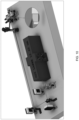
- FIG. 10 shows a drawing of an exemplary machine apparatus according to FIG. 9 ;
- FIG. 11 is a drawing showing an exemplary PIC with fused optical fibers according to the new device for attaching at least one optical fiber to a chip of the Application with optical connectors.
- fibers can be coupled to one or more optical connection points of a chip from a cleaved end of a fiber via an intermediate lens (e.g. a micro lens), or via a shaped fiber end lens of the connecting fiber itself.
- an intermediate lens e.g. a micro lens
- active alignment techniques are those which pass light through the fiber and connection to literally measure the transmission efficiency of light transmission across the connection.
- Passive alignment refers to coupling a fiber to an optical connection point by only a physical alignment of the fiber with the connection point. In passive alignment, it is not necessary to pass light through the fiber waveguide and to directly measure light transmission levels and/or optical alignment past the coupled optical junction.
- the discrete individual fibers are typically fibers of a multi-fiber cable, or equipment interconnecting single fibers, such as single fiber cables with an optomechanical connector on either end.
- a fusion apparatus with a microscope to initially mechanically align two cleaved fibers to be joined together, such as to make an inline optical splice.
- Single Fiber Fusion Splicing such methods, especially when combined with active alignment, can provide splices with losses as low as in the range of 0.05 to 0.10 dB for both single-mode and multimode fibers.
- the chip waveguide (e.g. nanowaveguide) ends have been too small compared to a typical connecting fiber to make a prior art type fusion connection as an efficient (low loss) optical coupling to an externally connected fiber.
- the nanowaveguides of today's typical chips can be hundreds of nanometers across, nearing the wavelength of light.
- connecting optical fibers are typically at least in the um diameter or cross section range.
- Well known fusion techniques of the prior art for splicing two similar diameter or cross section fibers together cannot be used.
- fusion methods such as, for example, by electrode (electrical arc) or laser can be used.
- the quality of the optical connections can be enhanced by self-alignment of the oxide taper and fiber material (e.g. glass) due to surface tension of the melted materials.
- the solution can also include providing a taper at the end of the optical fiber to be fusion coupled to the end cross section or face of the chip oxide connection taper connection point.
- a taper at the end of the optical fiber to be fusion coupled to the end cross section or face of the chip oxide connection taper connection point.
- FIG. 1 A shows a diagram including an exemplary box “A” of the chip 1030 where the optical circuitry has been provided on a substrate 1005 , such as by well-known integrated circuit and chip manufacturing techniques.
- a nanowaveguide 1003 a is to be terminated by optical coupling to an external fiber at an optical connection point show within box “A”.
- FIG. 1 B shows a diagram of one embodiment of the new system and method for attaching optical fibers to chips without need for active alignment
- the end of waveguide 1003 a has a manufactured taper (tapered nanowaveguide end 1003 b ) and overlaying (e.g. cylindrically, square, or rectangular symmetric, or planar with tapers only in the plane of the planar layer) oxide taper which matches the tapered nanowaveguide end 1003 b within, and provides an oxide taper 1006 of the oxide optical connection point at location 1017 .
- a manufactured taper tapeered nanowaveguide end 1003 b
- overlaying e.g. cylindrically, square, or rectangular symmetric, or planar with tapers only in the plane of the planar layer
- the end of tapered end 1021 to be optically coupled, and typically, mechanically fused to oxide overlay 1001 can be seen to taper to a similar diameter or cross-section dimension of the end face connection point of the oxide taper 1006 .
- the oxide taper matches the tapered nanowaveguide end, it is not necessary to match the shape, though matching the shape can slightly improve coupling efficiency.
- a circular fiber can be mechanically (e.g. fused) and optically coupled to a rectangular or square oxide taper.
- Light can be efficiently coupled from a tapered nanowaveguide end 1003 b to the oxide overlay 1001 by modal overlap.
- Geometry, width, angles, and thickness of both oxide taper and waveguide nano-taper can be set to maximize the modal overlap.
- the mode of the waveguide taper matches the mode of the oxide taper such that light transfers by efficient modal coupling.
- Tapers of nanowaveguide 1003 a can be made by any suitable means or production technique now known or future developed.
- the waveguide nano-taper can be made using techniques of photolithography, electron beam lithography, and/or other nano manufacturing techniques.
- the tapered end 1021 of optical fiber 1023 can be formed, for example, by heating and drawing, laser ablation, or mechanical grinding or ablation. Suitable techniques include, for example, laser with mechanical pull, electrical arc with mechanical pull, flame techniques (e.g. acetylene flame) with mechanical pull, etc.
- Ablation such as, for example, by laser ablation, can also be used.
- the fiber is typically cleaved by any suitable technique, typically, after the taper is formed. Fiber cleaving techniques are well-known.
- the nanowaveguide 1003 a tapered nanowaveguide end 1003 b of the chip, and/or the oxide taper 1006 which overlays the tapered nanowaveguide end 1003 b can be post process shaped by post processing steps of lithography, or laser or mechanical ablation. The exact method of forming any of the tapers is unimportant to the new system and method. Also, as described hereinbelow, the oxide taper can alternatively be adjacent to the tapered nanowaveguide ends as compared to an overlay or partial overlay.
- FIG. 1 A shows at least a part of the oxide taper as a structure extending past the edge of the substrate of chip 1030 .
- a hanging structure as used herein refers to an end of a nanowaveguide of a chip, where a portion of the substrate (typically under the nanowaveguide) near the end of the nanowaveguide to be coupled off-chip, has been removed.
- the portion of the substrate removed can be large enough to also clear, or partially clear, the oxide taper overlaying the end of a nanowaveguide of a chip to be coupled off-chip to a fiber.
- the hanging end of the nanowaveguide and oxide taper combination to be coupled off-chip can be somewhat mechanically and thermally isolated from the substrate.
- Tapered nanowaveguide end 1003 b can have a width ranging from about 50 nm wide to a few microns depending on the material system and specific wavelength of light to be coupled to or from chip 1030 .
- the oxide taper is can include a length range from about a micron to tens of microns.
- the width of the oxide taper can range from about 1 micron to about 150 microns.
- At least one or more oxide tapers can be aligned to at least one or more tapered fibers end of an off-chip fiber to be connected by passive alignment methods.
- Optical coupling by fusing is typically improved by surface tension of the fusing glass which can pull the parts into a more optimal alignment.
- there could be a better tolerance to misalignment For example, the geometry of the oxide taper and tapered end of the fiber will make for a larger mode target for coupling as compared to prior coupling methods.
- light losses across the fused section can be at least between about 0.1 dB and 1.0 dB.
- losses between about 0.01 dB and 0.1 dB can be achieved by the techniques described hereinabove by optimizing manufacturing alignment (still typically a passive alignment), materials (e.g. of the oxide taper), and dimensions, such as length width, and geometry of the tapers.
- Suitable tapers for the ends of the nanowaveguides, the oxide tapers, and/or the tapered fibered ends of the fibers include, for example, linear tapers (e.g. FIG. 1 B ), hyperbolic tangent taper, exponential taper, and s-bend tapers. Typically, the goal is to make the taper as short as practical combined with efficient light transfer (low loss). While tapers can be symmetrical about a long axis of a nanowaveguide, more typically as implemented in a planar layer of an integrated circuit, there will be a taper in the integrated layer which can be seen, for example, as viewed from above normal to a substrate, and not as viewed from a side view or side cut-away view (i.e. as viewed sideways through the layer).
- the taper on the chip side is typically manufactured by any suitable micro-fabrication technique, such as, for example, known photo-lithography techniques.
- Taper dimensions, and shapes The efficiency of light transfer between the fiber and the oxide taper typically depends on the relative dimensions of the fiber and the oxide taper. The dimensions can be optimized to balance loss, sensitivity to misalignment, and size.
- Oxide taper types include straight, inverse horn taper, and horn.
- a tapered fiber generally the inverse taper is preferred.
- either of the horn taper or the inverse horn taper may be preferred, generally with respect to mode coupling for the given modes. For example, where the mode goes from a smaller mode to a larger mode, or a larger mode to smaller mode.
- either a horn taper small to large, e.g.
- an inverse horn taper in the direction from the tapered waveguide end to the oxide taper element) or an inverse horn taper can be further defined by any suitable shape or function, such as, for example, a linear taper, a hyperbolic tangent taper, an elliptical taper, an exponential taper, or an s-bend taper.
- the nanowaveguide of the new structure of the application propagates by radiated waves via end coupling, or butt coupling, from the nanowaveguide end via the oxide taper around the nanowaveguide into an off chip optical fiber.
- end coupling or butt coupling
- Such coupling is distinguished from evanescent optical coupling of the prior art, such as where planar layers overlap, usually only on one common side of a planar waveguide.
- the overlap in such evanescent coupling is over a length larger than a cross section dimension of the waveguide (typically several cross section lengths or more).
- the oxide taper as described hereinabove matches the mode of the optical fiber to the mode of the nanowaveguide, and thus the oxide taper is an oxide taper mode converter.
- the tapered oxide section of the structure of the Application optically couples and mode matches each cleaved fiber end to each of the nanowaveguide ends of each of the at least one nanowaveguide via the oxide taper by a modal coupling, as a mode converter.
- Tapered nanowaveguide end While more typically the nanowaveguide will have a tapered end, it has also been realized that the new method and devise of the Application can be accomplished where a non-tapered nanowaveguide (i.e. a nanowaveguide with a straight taper) is optically and modally coupled into an oxide taper (e.g. with a horn, straight, or inverse horn oxide taper) and on the opposite side of the oxide taper where the oxide taper is optically and modally coupled into a fiber (with or without a fiber tapered end). Where there is a tapered nanowaveguide end, any suitable taper, including taper types and shapes described for the oxide taper can be used as appropriate to the modal coupling (e.g. if small to large, or large to small) between the tapered nanowaveguide end and the oxide taper.
- a non-tapered nanowaveguide i.e. a nanowaveguide with a straight taper
- an oxide taper e.g. with a horn, straight, or
- Example 1 In one exemplary embodiment, as illustrated by FIG. 3 , an optical fiber 1023 is tapered down to tapered end 1021 having a circular cross-section 3020 of about 4 microns in diameter and an oxide taper 1006 with a rectangular or trapezoidal cross section 3046 having a height of about 4 microns, the optimum light transfer efficiency occurs at a taper width of about 3.3 microns with a loss ⁇ 0.1 dB. In this example, the misalignment tolerance is about 1.5 microns for about a 3 dB loss threshold. Increasing the size of the mode by increasing the fiber 1023 and oxide taper 1006 dimensions improves the misalignment tolerance almost proportionately.
- the dimensions of the waveguide taper depend on the materials being used. For example, for a silicon waveguide taper (this example), the silicon waveguide taper dimensions are between about 120 nm and 170 nm.
- waveguide diameter and fiber diameter are used for convenience, there may be any suitable cross-section shapes.
- typical chip waveguides are about rectangular, square, trapezoidal, or triangular in cross section shape.
- Typical connecting fibers are circular in cross section shape, however once cleaved may have non-circular end face cross sections.
- the oxide taper 1006 provides a physical interface with low loss mode coupling in addition to a corresponding physical cross section end face fusion coupling compatible with a cleaved and tapered end of optical fiber 1023 .
- Square or rectangular cross section fibers compared to more common circular fibers, may be especially suitable for fusing to square or rectangular oxide tapers according to the structures and techniques described hereinabove.
- square or rectangular shapes including trapezoidal imperfections or distortions
- modal coupling might be optimized in some manufacturing scenarios by use of square or rectangular connecting fibers.
- Exemplary materials systems suitable for optical fibers silicon waveguide taper include silicon dioxide, glass, doped glass, silicon, and dichalcogenides.
- Typical materials for the oxide taper are deposited or grown silicon dioxide, glass, doped glass, fluoride glasses (e.g. magnesium fluoride, calcium fluoride, etc.,) silicon nitride, semiconductor materials (e.g. silicon, indium phosphide, aluminum nitride, silicon carbide, gallium arsenide, etc.) which can be deposited, grown or transferred (e.g. bonding).
- Typical materials suitable for the waveguide taper include deposited or grown silicon dioxide, glass, doped glass, fluoride glasses (e.g.
- silicon nitride silicon nitride
- semiconductor materials e.g. silicon, indium phosphide, aluminum nitride, silicon carbide, gallium arsenide, etc.
- electro-optic or nonlinear materials e.g. lithium niobate
- Typical substrates on which photonic devices are fabricated according to the structures and techniques described herein, include silicon, fused silica, glass, quartz, sapphire, gallium arsenide, indium phosphide, silicon carbide, diamond, lithium niobate.
- an optical fiber 1023 is tapered down to a tapered end 1021 having a diameter of about 4 microns.
- the fiber 1023 has a circular cross-section.
- the oxide taper 1006 is designed to match the mode of the tapered optical fiber 1023 with tapered end 1021 having a height (i.e. material thickness) of about 4 microns and a width of about 3.3 microns.
- the optical fiber tapered end 1021 and the oxide taper 1006 are fused at location 4015 according to the methods described hereinabove.
- the length of the oxide taper 1006 is optimized to minimize optical loss.
- a silicon taper is used to couple the light into the tapered nanowaveguide end 1003 b of a silicon waveguide, nanowaveguide 1003 a, having a height about 250 nm and width of about 500 nm.
- the taper dimension is about 150 nm for optimal coupling to the mode in the oxide taper, and the width of the waveguide taper slowly grows to match the about 250 nm width of the waveguide.
- FIG. 5 is a drawing illustrating another view of an optical fiber 1023 fused to an oxide taper 1006 overlaying a tapered nanowaveguide end 1003 b.
- Example 3 A chip according to the structures and methods described herein is typically fabricated by use of standard microfabrication techniques known in the art, such as, for example, lithography, etching, deposition, planarization.
- the waveguide taper is lithographically defined together with the waveguide and covered in a material such as oxide.
- the oxide taper is lithographically defined and etched into the waveguide covering.
- the substrate is then removed if necessary, via etching.
- the fiber is tapered by heating it close to its melting temperature and pulling until the desired diameter is reached. The heating is accomplished by laser radiation, electrical arc, or flame.
- the tapered fiber is then cleaved using standard techniques, such as scoring the glass while applying tension.
- the tapered fiber and oxide taper of the chip are passively aligned and fused together by melting the oxide at the interface of the tapered fiber and the oxide taper.
- FIG. 2 shows the steps of a method for attaching one or more optical fibers to a chip.
- the method includes the steps of: A) providing at least one nanowaveguide of a chip including at least one nanowaveguide end to be attached to at least one off-chip fiber respectively; B) forming at least one oxide taper over or adjacent to each of the at least one nanowaveguide end and creating at least one taper on an outer surface of each of the at least one oxide taper; C) cleaving at least one fiber end of at least one optical fiber, each cleaved fiber end of the at least one fiber end corresponding to each oxide taper of the at least one oxide taper respectively; D) aligning the chip so that an end face of each of the at least one oxide taper is mechanically aligned substantially adjacent to each corresponding cleaved fiber end; and E) fusing each of the at least one oxide taper with each of the at least one fiber end respectively to modally couple each of the nanowaveguides to each of the at least one fiber end via each of the oxide
- a device for attaching at least one optical fiber to a chip 1030 includes at least one nanowaveguide 1003 a disposed on a substrate 1005 of a chip. Each nanowaveguide 1003 a of the at least one nanowaveguide has a tapered nanowaveguide end 1003 b.
- the device also includes at least one oxide taper. Each oxide taper 1006 of the at least one oxide taper is formed on an outer surface of at least one oxide overlay 1001 and disposed over each of the tapered nanowaveguide end 1003 b respectively.
- the device also includes a at least one off-chip fiber. Each fiber 1023 of the at least one off-chip fiber has a corresponding tapered fiber end 1021 . Each tapered fiber end 1021 is fused to each oxide taper 1006 respectively to modally couple each tapered fiber end 1021 to each oxide taper 1006 by a modal coupling.
- the taper of a so manufactured structure can be seen from above (top view, normal to the chip substrate), such as for example, the taper of a tapered nanowaveguide of the chip, and/or the taper of the oxide taper transition part disposed between the tapered nanowaveguide an off-chip cleaved optical fiber.
- off-chip includes discrete interconnecting fibers, such as, for example, interconnecting between optically coupled chips within a common integrated circuit package (e.g. a hybrid integrated circuit with a two or more chips disposed within, such as, for example including an interposer chip), as well as one or more optical fibers which extend to and from an integrated circuit package.
- tapered nanowaveguide end extending into the intermediate oxide taper element
- the tapered nanowaveguide ends and the oxide taper elements may actually, or appear, to blend together, effectively not showing the tapered nanowaveguide ends within the oxide taper elements.
- Relative insertion dimensions, where the tapered nanowaveguide ends extend into the oxide taper elements can also depend on how much of the substrate is cutaway or cleared below and/or in the vicinity of the oxide taper.
- the tapered nanowaveguide ends are not disposed within the oxide taper elements during manufacture and fabrication.
- each of the tapered nanowaveguide ends of the nanowaveguides can be adjacent to and in in optical communication and modally coupled to each of the oxide tapers respectively.
- FIG. 6 A shows a drawing of a top view of another exemplary optical chip with tapered nanowaveguides, undercut oxide tapers and corresponding cleaved optical fibers.
- a fusion spot from a laser is also shown. The laser melts the ends of the oxide taper and the optical fiber to fuse them together. The laser is aimed at the region to be fused, typically from the top or side of the chip being produced.
- FIG. 6 B shows a drawing of a side view of the oxide taper modally coupled optical fibers and nanowaveguides of FIG. 6 A . In FIG. 6 B , the device has been laser fused and the coupling interface optically sealed.
- Silicon dioxide optical tapers can efficiently couple to an optical fiber on one end, and to a waveguide nanotaper on the other opposite end (e.g. FIG. 6 A , FIG. 6 B ).
- the geometry of the fiber side optimized for mode matching with the optical fiber for optimum coupling between the fiber and the oxide taper.
- the geometry of the oxide taper has been adiabatically varied to maximize the coupling into the waveguide taper.
- the device and method has been demonstrated to work with the different types of inverse nanotapers (e.g. linear taper, metamaterial taper) because the geometry matches a desired mode profile.
- the oxide taper of the Application is around the nanowaveguide end, that is, the oxide taper encircles the nanowaveguide end, including the embodiment of FIG. 6 B , where the nanowaveguide 6003 a butt couples to the oxide taper mode converter 6006 , which has a larger face area then the end of the nanowaveguide, where the oxide taper is around the end of the nanowaveguide.
- Example 4 A device according to the Application used an oxide taper 9.5 ⁇ m wide by 8 ⁇ m thick ( FIG. 1 b ) to match a standard SMF 28 cleaved fiber. Due to the physical size mismatch between the fiber and the oxide taper, the splice was reinforced with a UV curable optical adhesive.
- the refractive index of the optical adhesive (such as, for example, a Norland optical adhesive, available from Norland products of Cranbury, N.J.) was used to further tailor the properties including mode size and shape of the oxide taper mode and improve the coupling to the fiber.
- Photonic chips using the devices and methods described by the Application can be fabricated using any suitable standard, typically CMOS compatible, microfabrication techniques.
- Example 5 An about 4 ⁇ m thick layer of thermal oxide was grown on a silicon wafer and about 315 nm of silicon nitride was deposited via low pressure chemical vapor deposition.
- the waveguides were patterned using DUV optical lithography at about 254 nm using an ASML stepper. After etching in an inductively coupled reactive ion etcher (ICP-RIE) with a CHF 3 /O 2 chemistry, the devices were clad with about 4 ⁇ m of oxide using plasma enhanced chemical vapor deposition (PECVD).
- PECVD plasma enhanced chemical vapor deposition
- the oxide taper was then patterned and etched similar the waveguide step. After dicing, a portion of the silicon substrate was removed using a xenon difluoride (XeF 2 ) etch to optically isolate the oxide taper from the silicon substrate.
- XeF 2 xenon difluoride
- a portion of the substrate adjacent to the at least one oxide taper can be removed, or otherwise undercut, to further optically isolate the oxide taper from the substrate.
- FIG. 7 is a graph showing the coupling loss per facet for the device of example 4.
- the graph shows a minimum loss of 3.1 dB at 1550 nm.
- the coupling loss of 3.1 dB was demonstrated per fact between a cleaved SMF 28 optical fiber fused to a silicon nitride waveguide chip.
- the cleaved fiber was fused to the chip by heating the ends with a CO 2 laser.
- Oxide has a strong absorption at a wavelength of about 10.6 ⁇ m and the splicing leaves no residue behind.
- the laser beam was incident at an angle of about 30° to enable fusion of optical fiber arrays for future work.
- the nitride waveguide was about 1 ⁇ m wide and about 1.8 mm long nitride waveguide with about a 0.25 ⁇ m wide by about 100 ⁇ m long tapers, which were coupled to an about 50 ⁇ m long oxide taper that was about 11.5 ⁇ m wide at the waveguide side.
- Fiber to chip fusion splicing has the potential to enable high throughput optical packaging with a robust, high efficiency, and low-cost solution.
- This device and method can be fully automated to enable highly efficient fiber to chip coupling in high volume applications.
- the device and method is compatible with active and passive (using fiducials on the chip) alignment. Calculations show that the coupling loss to at least about 1 dB per facet for cleaved fibers and down to about 0.2 dB per facet using tapered or narrow core fibers.
- FIG. 8 A shows a top view of another exemplary optical chip with tapered nanowaveguides.
- FIG. 8 B shows a side view of the embodiment of FIG. 8 A with an undercut substrate region.
- an undercut alone of the substrate (typically a silicon substrate)
- that a fiber 8023 can be nearly optimally modally coupled to a nanowaveguide taper 8003 b of a nanowaveguide 8003 a where there is added an undercut, such as an exemplary about rectangular undercut 8040 , FIG. 8 B .
- the laser spot is applied directly to area to be laser fused, e.g. the lower joint mechanical coupling in FIG. 8 A .
- the laser is redirected to point to that area, typically from a side or the top of the structures to be fused together.
- the fusion process joins the optical components according to the new methods and devices of the Application.
- the purpose of the optical adhesive is not to “hold” parts together, but rather to give some mechanical protection against breakage. That is, the optical adhesive provides some mechanical support, in particular to protect against an angular deformation of the fiber with respect to the chip.
- the fracture occurs at the chip, leaving the fused coupled mechanical parts intact.
- FIG. 9 shows a schematic diagram of an exemplary machine apparatus suitable for performing the new method of the Application.
- FIG. 10 shows a drawing of an exemplary machine apparatus according to FIG. 9 .
- the exemplary machine apparatus of FIG. 8 and FIG. 9 includes a CO2 laser combined with a visible diode laser.
- the visible laser allows aiming of the CO2 laser, which is invisible to most imaging cameras.
- the CO2 beam is focused at the interface between the chip's oxide taper and the optical fiber end.
- the visible laser can be used to find the focal position of the beams.
- the chip and optical fiber can sit on translation stages to accurately align them.
- the oxide taper can change the mode to bridge different modes between the optical fiber side of the oxide taper and the slight insert or butt coupling to the nanowaveguide of the integrated circuit. That is, the oxide taper of the application which is around the nanowaveguide matches modes and can tailor the mode of light of the optical fiber to a different mode of light more suitable for the planar nanowaveguide of the integrated circuit.
- the mode from the optical fiber can be converted into a mode more suitable for the nanowaveguide, as opposed to the structures of the prior art, which merely couple the same mode from the optical fiber directly into the nanowaveguide (typically a tapered mode conversion) with less efficiency.
- a plurality of optical fibers can be efficiently optically coupled to a photonic integrated circuit, such as including the fused fiber techniques described hereinabove.
- FIG. 11 is a drawing showing an exemplary PIC 1100 with fused optical fibers according to the new device for attaching at least one optical fiber to a chip of the Application with optical connectors 1101 .
- fibers are spliced from the connector to the chip and terminate at the package with a connector 1101 so that the fibers can just be plugged into the package.
- the fused fibers have a connector on the other end opposite the fused connections to the PIC.
- the PIC can be packaged in any suitable box or package which contains the photonic chip, fibers and one or more connectors 1101 .
- a device as described hereinabove with at least one connector e.g. optical connectors 1101
- provides a PIC e.g. PIC 1100 which can be used a pluggable component.
- the connector can be any suitable generic pluggable fiber connector.
- An example of a suitable fiber connector for at least one optical fiber is the LC®/PC Single Mode Connector series, such as, for example, part no. 30126L9 available from Thorlabs Inc. of Newton, N.J.
- exemplary connectors for multiple optical fibers include, for example, the MTP Connector 12 Fiber MM available from Fiber Instrument Sales of Oriskany, N.Y., or the MTP-16 Short Spring Push Ribbon available from USCONEC of Hickory, N.C.
- a connector provides a photonic device with pluggable fibers which eliminate the bunch of fibers hanging around in disarray as well as providing a PIC based component with a pluggable installation or replacement feature. That is, a chip with a device for attaching at least one optical fiber to a chip according to the Application, can be provided as a as plug connectable or plug replaceable component.
Landscapes
- Physics & Mathematics (AREA)
- General Physics & Mathematics (AREA)
- Optics & Photonics (AREA)
- Optical Couplings Of Light Guides (AREA)
Abstract
Description
Claims (20)
Priority Applications (2)
| Application Number | Priority Date | Filing Date | Title |
|---|---|---|---|
| US17/016,768 US11789207B2 (en) | 2017-01-20 | 2020-09-10 | System and method for attaching optical fibers to chips |
| US18/369,281 US12449604B2 (en) | 2017-01-20 | 2023-09-18 | System and method for attaching optical fibers to chips |
Applications Claiming Priority (4)
| Application Number | Priority Date | Filing Date | Title |
|---|---|---|---|
| US201762448470P | 2017-01-20 | 2017-01-20 | |
| PCT/US2018/014162 WO2018136597A1 (en) | 2017-01-20 | 2018-01-18 | System and method for attaching optical fibers to chips |
| US201916479078A | 2019-07-18 | 2019-07-18 | |
| US17/016,768 US11789207B2 (en) | 2017-01-20 | 2020-09-10 | System and method for attaching optical fibers to chips |
Related Parent Applications (2)
| Application Number | Title | Priority Date | Filing Date |
|---|---|---|---|
| PCT/US2018/014162 Continuation-In-Part WO2018136597A1 (en) | 2017-01-20 | 2018-01-18 | System and method for attaching optical fibers to chips |
| US16/479,078 Continuation-In-Part US10976495B2 (en) | 2017-01-20 | 2018-01-18 | System and method for attaching optical fibers to chips |
Related Child Applications (1)
| Application Number | Title | Priority Date | Filing Date |
|---|---|---|---|
| US18/369,281 Continuation US12449604B2 (en) | 2017-01-20 | 2023-09-18 | System and method for attaching optical fibers to chips |
Publications (2)
| Publication Number | Publication Date |
|---|---|
| US20210003783A1 US20210003783A1 (en) | 2021-01-07 |
| US11789207B2 true US11789207B2 (en) | 2023-10-17 |
Family
ID=74065689
Family Applications (2)
| Application Number | Title | Priority Date | Filing Date |
|---|---|---|---|
| US17/016,768 Active US11789207B2 (en) | 2017-01-20 | 2020-09-10 | System and method for attaching optical fibers to chips |
| US18/369,281 Active US12449604B2 (en) | 2017-01-20 | 2023-09-18 | System and method for attaching optical fibers to chips |
Family Applications After (1)
| Application Number | Title | Priority Date | Filing Date |
|---|---|---|---|
| US18/369,281 Active US12449604B2 (en) | 2017-01-20 | 2023-09-18 | System and method for attaching optical fibers to chips |
Country Status (1)
| Country | Link |
|---|---|
| US (2) | US11789207B2 (en) |
Cited By (1)
| Publication number | Priority date | Publication date | Assignee | Title |
|---|---|---|---|---|
| US12449604B2 (en) * | 2017-01-20 | 2025-10-21 | University Of Rochester | System and method for attaching optical fibers to chips |
Families Citing this family (4)
| Publication number | Priority date | Publication date | Assignee | Title |
|---|---|---|---|---|
| CN113933938B (en) * | 2021-09-17 | 2022-09-23 | 南京大学 | Optical fiber-substrate-chip packaging method based on femtosecond laser processing |
| WO2023171076A1 (en) * | 2022-03-08 | 2023-09-14 | アルプスアルパイン株式会社 | Antenna device |
| CN115373082B (en) * | 2022-09-20 | 2024-10-11 | 山东大学 | End face coupler based on silicon and lithium niobate composite film |
| WO2024112600A1 (en) * | 2022-11-21 | 2024-05-30 | Photonect Interconnect Solutions, Inc. | High performance and yield for passive alignment of optical fibers |
Citations (10)
| Publication number | Priority date | Publication date | Assignee | Title |
|---|---|---|---|---|
| US20030114006A1 (en) | 2001-12-17 | 2003-06-19 | Applied Materials, Inc. | Integrated circuit waveguide |
| US7668414B2 (en) * | 2004-02-18 | 2010-02-23 | Colorchip (Israel) Ltd | System and method for the fabrication of an electro-optical module |
| US20120076465A1 (en) * | 2010-09-27 | 2012-03-29 | Alcatel-Lucent, Usa Inc. | Low loss broadband fiber coupler to optical waveguide |
| US20120093456A1 (en) | 2010-10-14 | 2012-04-19 | Universiteit Gent | Coupling Methods and Systems Using a Taper |
| US8442368B1 (en) | 2010-01-22 | 2013-05-14 | The Ohio State University Research Foundation | Cantilever couplers for intra-chip coupling to photonic integrated circuits |
| US20130322813A1 (en) | 2010-12-29 | 2013-12-05 | Socpra Sciences Et Genie S.E.C. | Low loss directional coupling between highly dissimilar optical waveguides for high refractive index integrated photonic circuits |
| US20160062039A1 (en) * | 2014-09-02 | 2016-03-03 | Tyco Electronics Corporation | Mode size converters and optical assemblies |
| US9529154B2 (en) | 2014-03-21 | 2016-12-27 | Imec Vzw | Method for optical coupling between a photonic integrated circuit and an external optical element |
| US20180180818A1 (en) * | 2016-12-22 | 2018-06-28 | Huawei Technologies Co., Ltd. | Optical Edge Coupler with Controllable Mode Field for Photonic Chip |
| US10976495B2 (en) * | 2017-01-20 | 2021-04-13 | University Of Rochester | System and method for attaching optical fibers to chips |
Family Cites Families (4)
| Publication number | Priority date | Publication date | Assignee | Title |
|---|---|---|---|---|
| US6963682B2 (en) * | 2002-03-04 | 2005-11-08 | Corning Incorporated | Beam altering fiber lens device and method of manufacture |
| FI20070664A0 (en) * | 2007-08-31 | 2007-08-31 | Valtion Teknillinen | Alignment method for fiber optic channel connection |
| US20170097470A1 (en) * | 2015-10-02 | 2017-04-06 | Jia Jiang | Optical Coupling Adaptor for Optical Signal Coupling Between Photonic Integrated Circuit and Optical Fiber |
| US11789207B2 (en) * | 2017-01-20 | 2023-10-17 | University Of Rochester | System and method for attaching optical fibers to chips |
-
2020
- 2020-09-10 US US17/016,768 patent/US11789207B2/en active Active
-
2023
- 2023-09-18 US US18/369,281 patent/US12449604B2/en active Active
Patent Citations (10)
| Publication number | Priority date | Publication date | Assignee | Title |
|---|---|---|---|---|
| US20030114006A1 (en) | 2001-12-17 | 2003-06-19 | Applied Materials, Inc. | Integrated circuit waveguide |
| US7668414B2 (en) * | 2004-02-18 | 2010-02-23 | Colorchip (Israel) Ltd | System and method for the fabrication of an electro-optical module |
| US8442368B1 (en) | 2010-01-22 | 2013-05-14 | The Ohio State University Research Foundation | Cantilever couplers for intra-chip coupling to photonic integrated circuits |
| US20120076465A1 (en) * | 2010-09-27 | 2012-03-29 | Alcatel-Lucent, Usa Inc. | Low loss broadband fiber coupler to optical waveguide |
| US20120093456A1 (en) | 2010-10-14 | 2012-04-19 | Universiteit Gent | Coupling Methods and Systems Using a Taper |
| US20130322813A1 (en) | 2010-12-29 | 2013-12-05 | Socpra Sciences Et Genie S.E.C. | Low loss directional coupling between highly dissimilar optical waveguides for high refractive index integrated photonic circuits |
| US9529154B2 (en) | 2014-03-21 | 2016-12-27 | Imec Vzw | Method for optical coupling between a photonic integrated circuit and an external optical element |
| US20160062039A1 (en) * | 2014-09-02 | 2016-03-03 | Tyco Electronics Corporation | Mode size converters and optical assemblies |
| US20180180818A1 (en) * | 2016-12-22 | 2018-06-28 | Huawei Technologies Co., Ltd. | Optical Edge Coupler with Controllable Mode Field for Photonic Chip |
| US10976495B2 (en) * | 2017-01-20 | 2021-04-13 | University Of Rochester | System and method for attaching optical fibers to chips |
Non-Patent Citations (16)
| Title |
|---|
| Barwicz, Tymon, et al., "A Novel Approach to Photonic Packaging Leveraging Existing High-Throughput Microelectronic Facilities," 2016, IEEE Journal of Selected Topics in Quantum Electronics, vol. 22, No. 6, pp. 455-466. |
| Cardenas, J., et al., "High Coupling Efficiency Etched Facet Tapers in Silicon Waveguides," IEEE Photonics Technology Letters, vol. 26, No. 23, Dec. 1, 2014 (pp. 2380-2382). |
| Cheben, Pavel, et al., Broadband polarization independent nanophotonic coupler for silicon waveguides with ultra-high efficiency, 2015, Optics Express, vol. 23, No. 17, pp. 22553-22563. |
| Chen, Long, et al., Low-Loss and Broadband Cantilever Couplers Between Standard Cleaved Fibers and High-Index-Contrast Si3N4 or Si Waveguides, 2010, IEEE Photonics Technology Letters, vol. 23, pp. 1744-1746. |
| Communication pursuant to Article 94(3) EPC issued in corresponding European Patent Application No. 18713047.1 dated Apr. 19, 2021 (4 pgs). |
| EP Communication pursuant to Article 94(3) EPC, dated Jan. 20, 2023 (3 pages). |
| Fang, Qing, et al., "Suspended optical fiber-to-waveguide mode size converter for Silicon photonics," Optics Express, vol. 18, No. 8, Apr. 12, 2010 (7763-7769). |
| ISA/European Patent Office, International Search Report and Written Opinion for Corresponding International Application No. PCT/US2018/014162, dated Jul. 9, 2018 (10 pgs). |
| Liao, Chun-Wei, et al., "Fiber-Core-Matched Three-Dimensional Adiabatic Tapered Couplers for Integrated Phototonic Devices," 2011, Journal of Lightwave Technology, vol. 29, No. 5, pp. 770-774. |
| Pal, Parama, et al., Low loss fusion splicing of micron scale silica fibers, 2008, Optics Express, vol. 16, No. 16, pp. 11568-11573. |
| Papes, Martin, et al., "Fiber-chip edge coupler with large mode size for silicon photonic wire waveguides," 2016, Optic Express, vol. 24, No. 5, pp. 5026-5038. |
| Picard, M-J, et al., Novel Spot-Size Converter for Optical Fiber to sub-μm Silicon Waveguid Coupling with Low Loss, Low Wavelength Dependence and High Tolerance to Alignment, 2015, European Conference on Optical Communication (EEOC), pp. 1-3. |
| Shimizu, Nobuo, "Fusion Splicing between Deposited Silica Waveguides and Optical Fibers," 1984, Electronics and Communications in Japan, vol. 67-C, No. 9, pp. 115-122. |
| Tseng, Hsin-Lun, et al., "High-performance silicon-on-insulator grating coupler with completely vertical emission," 2015, Optics Express, vol. 23, No. 19, pp. 24433-24439. |
| Wonfor, A., et al., "Large Port Count High-Speed Optical Switch Fabric for Use Within Datacenters [Invited]," 2011, J. Opt. Commun. Netw., vol. 3, No. 8, pp. A32-A39. |
| Wood, Michael, et al., "Compact cantilever couplers for low-loss fiber coupling to silicon photonic integrated circuits," 2012, Optics Express, vol. 20, No. 1, pp. 164-172. |
Cited By (1)
| Publication number | Priority date | Publication date | Assignee | Title |
|---|---|---|---|---|
| US12449604B2 (en) * | 2017-01-20 | 2025-10-21 | University Of Rochester | System and method for attaching optical fibers to chips |
Also Published As
| Publication number | Publication date |
|---|---|
| US20240012204A1 (en) | 2024-01-11 |
| US12449604B2 (en) | 2025-10-21 |
| US20210003783A1 (en) | 2021-01-07 |
Similar Documents
| Publication | Publication Date | Title |
|---|---|---|
| US12449604B2 (en) | System and method for attaching optical fibers to chips | |
| Tummidi et al. | Multilayer silicon nitride-based coupler integrated into a silicon photonics platform with< 1 dB coupling loss to a standard SMF over O, S, C and L optical bands | |
| WO2019055663A1 (en) | Method and apparatus for self-alignment connection of optical fiber to waveguide of photonic integrated circuit | |
| US20100232745A1 (en) | Improvements relating to waveguides | |
| US20220276452A1 (en) | Backside fiber attachment to silicon photonics chip | |
| US5351323A (en) | Optical fiber for coupling to elliptically-shaped source | |
| US10976495B2 (en) | System and method for attaching optical fibers to chips | |
| CN110542949B (en) | Optical fiber manufacturing method and heating device for silicon optical waveguide connection and coupling | |
| JP2023054292A (en) | optical connection structure | |
| US20040022495A1 (en) | Directional integrated optical power monitor and optional hermetic feedthrough | |
| US20070165982A1 (en) | Expanding single-mode fiber mode field for high power applications by fusion with multi-mode fiber | |
| CN115793138B (en) | Optical integrated devices, optical integrated circuit wafers, and methods for manufacturing optical integrated devices | |
| WO2018139214A1 (en) | Optical coupling device and method for producing same | |
| JP2003515757A (en) | Use of lasers to fusion splice optics of significantly different cross-sectional areas. | |
| US20240377588A1 (en) | Fiber array unit formation | |
| Cardenas | SYSTEM AND METHOD FOR ATTACHING OPTICAL FIBERS TO CHIPS | |
| US7280734B2 (en) | Expanding single mode fiber mode field for high power applications by fusion with multimode fiber | |
| Nauriyal et al. | Low-loss, single-shot fiber-array to chip attach using laser fusion splicing | |
| Nauriyal et al. | Packaging integrated photonic devices to increase scalability using laser fusion splicing | |
| Nauriyal et al. | Fiber to Chip Fusion Splicing for Robust, Low Loss Optical Coupling | |
| US20050152647A1 (en) | Athermal fused coupler package for optical fibers | |
| Nauriyal | Fiber to Chip Fusion Splicing for Low Loss Optical Coupling | |
| Nauriyal et al. | Multiple I/O photonic chip to fiber array packaging using fusion splicing in a single shot | |
| JP2003185874A (en) | Optical fiber coupler | |
| KR20100064277A (en) | Optical connection device between the plastic and silica optical fiber |
Legal Events
| Date | Code | Title | Description |
|---|---|---|---|
| FEPP | Fee payment procedure |
Free format text: ENTITY STATUS SET TO UNDISCOUNTED (ORIGINAL EVENT CODE: BIG.); ENTITY STATUS OF PATENT OWNER: SMALL ENTITY |
|
| FEPP | Fee payment procedure |
Free format text: ENTITY STATUS SET TO SMALL (ORIGINAL EVENT CODE: SMAL); ENTITY STATUS OF PATENT OWNER: SMALL ENTITY |
|
| STPP | Information on status: patent application and granting procedure in general |
Free format text: DOCKETED NEW CASE - READY FOR EXAMINATION |
|
| AS | Assignment |
Owner name: UNIVERSITY OF ROCHESTER, NEW YORK Free format text: ASSIGNMENT OF ASSIGNORS INTEREST;ASSIGNORS:CARDENAS, JAIME;NAURIYAL, JUNIYALI;REEL/FRAME:054076/0573 Effective date: 20201013 |
|
| STPP | Information on status: patent application and granting procedure in general |
Free format text: NON FINAL ACTION MAILED |
|
| STPP | Information on status: patent application and granting procedure in general |
Free format text: RESPONSE TO NON-FINAL OFFICE ACTION ENTERED AND FORWARDED TO EXAMINER |
|
| STPP | Information on status: patent application and granting procedure in general |
Free format text: FINAL REJECTION MAILED |
|
| STPP | Information on status: patent application and granting procedure in general |
Free format text: RESPONSE AFTER FINAL ACTION FORWARDED TO EXAMINER |
|
| STPP | Information on status: patent application and granting procedure in general |
Free format text: ADVISORY ACTION MAILED |
|
| STPP | Information on status: patent application and granting procedure in general |
Free format text: ADVISORY ACTION MAILED |
|
| STPP | Information on status: patent application and granting procedure in general |
Free format text: DOCKETED NEW CASE - READY FOR EXAMINATION |
|
| STPP | Information on status: patent application and granting procedure in general |
Free format text: NON FINAL ACTION MAILED |
|
| STPP | Information on status: patent application and granting procedure in general |
Free format text: RESPONSE TO NON-FINAL OFFICE ACTION ENTERED AND FORWARDED TO EXAMINER |
|
| STPP | Information on status: patent application and granting procedure in general |
Free format text: FINAL REJECTION MAILED |
|
| STPP | Information on status: patent application and granting procedure in general |
Free format text: NOTICE OF ALLOWANCE MAILED -- APPLICATION RECEIVED IN OFFICE OF PUBLICATIONS |
|
| STPP | Information on status: patent application and granting procedure in general |
Free format text: PUBLICATIONS -- ISSUE FEE PAYMENT RECEIVED |
|
| STPP | Information on status: patent application and granting procedure in general |
Free format text: PUBLICATIONS -- ISSUE FEE PAYMENT VERIFIED |
|
| STCF | Information on status: patent grant |
Free format text: PATENTED CASE |