US11780849B2 - Imino sulfanone inhibitors of ENPP1 - Google Patents
Imino sulfanone inhibitors of ENPP1 Download PDFInfo
- Publication number
- US11780849B2 US11780849B2 US17/306,690 US202117306690A US11780849B2 US 11780849 B2 US11780849 B2 US 11780849B2 US 202117306690 A US202117306690 A US 202117306690A US 11780849 B2 US11780849 B2 US 11780849B2
- Authority
- US
- United States
- Prior art keywords
- methyl
- imino
- sulfanone
- compound
- pharmaceutically acceptable
- Prior art date
- Legal status (The legal status is an assumption and is not a legal conclusion. Google has not performed a legal analysis and makes no representation as to the accuracy of the status listed.)
- Active
Links
Classifications
-
- C—CHEMISTRY; METALLURGY
- C07—ORGANIC CHEMISTRY
- C07D—HETEROCYCLIC COMPOUNDS
- C07D495/00—Heterocyclic compounds containing in the condensed system at least one hetero ring having sulfur atoms as the only ring hetero atoms
- C07D495/02—Heterocyclic compounds containing in the condensed system at least one hetero ring having sulfur atoms as the only ring hetero atoms in which the condensed system contains two hetero rings
- C07D495/10—Spiro-condensed systems
-
- A—HUMAN NECESSITIES
- A61—MEDICAL OR VETERINARY SCIENCE; HYGIENE
- A61K—PREPARATIONS FOR MEDICAL, DENTAL OR TOILETRY PURPOSES
- A61K31/00—Medicinal preparations containing organic active ingredients
- A61K31/33—Heterocyclic compounds
- A61K31/395—Heterocyclic compounds having nitrogen as a ring hetero atom, e.g. guanethidine or rifamycins
- A61K31/435—Heterocyclic compounds having nitrogen as a ring hetero atom, e.g. guanethidine or rifamycins having six-membered rings with one nitrogen as the only ring hetero atom
- A61K31/47—Quinolines; Isoquinolines
-
- A—HUMAN NECESSITIES
- A61—MEDICAL OR VETERINARY SCIENCE; HYGIENE
- A61K—PREPARATIONS FOR MEDICAL, DENTAL OR TOILETRY PURPOSES
- A61K31/00—Medicinal preparations containing organic active ingredients
- A61K31/33—Heterocyclic compounds
- A61K31/395—Heterocyclic compounds having nitrogen as a ring hetero atom, e.g. guanethidine or rifamycins
- A61K31/495—Heterocyclic compounds having nitrogen as a ring hetero atom, e.g. guanethidine or rifamycins having six-membered rings with two or more nitrogen atoms as the only ring heteroatoms, e.g. piperazine or tetrazines
- A61K31/50—Pyridazines; Hydrogenated pyridazines
- A61K31/502—Pyridazines; Hydrogenated pyridazines ortho- or peri-condensed with carbocyclic ring systems, e.g. cinnoline, phthalazine
-
- A—HUMAN NECESSITIES
- A61—MEDICAL OR VETERINARY SCIENCE; HYGIENE
- A61K—PREPARATIONS FOR MEDICAL, DENTAL OR TOILETRY PURPOSES
- A61K31/00—Medicinal preparations containing organic active ingredients
- A61K31/33—Heterocyclic compounds
- A61K31/395—Heterocyclic compounds having nitrogen as a ring hetero atom, e.g. guanethidine or rifamycins
- A61K31/495—Heterocyclic compounds having nitrogen as a ring hetero atom, e.g. guanethidine or rifamycins having six-membered rings with two or more nitrogen atoms as the only ring heteroatoms, e.g. piperazine or tetrazines
- A61K31/505—Pyrimidines; Hydrogenated pyrimidines, e.g. trimethoprim
- A61K31/517—Pyrimidines; Hydrogenated pyrimidines, e.g. trimethoprim ortho- or peri-condensed with carbocyclic ring systems, e.g. quinazoline, perimidine
-
- A—HUMAN NECESSITIES
- A61—MEDICAL OR VETERINARY SCIENCE; HYGIENE
- A61K—PREPARATIONS FOR MEDICAL, DENTAL OR TOILETRY PURPOSES
- A61K31/00—Medicinal preparations containing organic active ingredients
- A61K31/33—Heterocyclic compounds
- A61K31/395—Heterocyclic compounds having nitrogen as a ring hetero atom, e.g. guanethidine or rifamycins
- A61K31/54—Heterocyclic compounds having nitrogen as a ring hetero atom, e.g. guanethidine or rifamycins having six-membered rings with at least one nitrogen and one sulfur as the ring hetero atoms, e.g. sulthiame
- A61K31/541—Non-condensed thiazines containing further heterocyclic rings
-
- A—HUMAN NECESSITIES
- A61—MEDICAL OR VETERINARY SCIENCE; HYGIENE
- A61P—SPECIFIC THERAPEUTIC ACTIVITY OF CHEMICAL COMPOUNDS OR MEDICINAL PREPARATIONS
- A61P19/00—Drugs for skeletal disorders
- A61P19/02—Drugs for skeletal disorders for joint disorders, e.g. arthritis, arthrosis
-
- A—HUMAN NECESSITIES
- A61—MEDICAL OR VETERINARY SCIENCE; HYGIENE
- A61P—SPECIFIC THERAPEUTIC ACTIVITY OF CHEMICAL COMPOUNDS OR MEDICINAL PREPARATIONS
- A61P3/00—Drugs for disorders of the metabolism
- A61P3/08—Drugs for disorders of the metabolism for glucose homeostasis
- A61P3/10—Drugs for disorders of the metabolism for glucose homeostasis for hyperglycaemia, e.g. antidiabetics
-
- A—HUMAN NECESSITIES
- A61—MEDICAL OR VETERINARY SCIENCE; HYGIENE
- A61P—SPECIFIC THERAPEUTIC ACTIVITY OF CHEMICAL COMPOUNDS OR MEDICINAL PREPARATIONS
- A61P31/00—Antiinfectives, i.e. antibiotics, antiseptics, chemotherapeutics
- A61P31/04—Antibacterial agents
-
- A—HUMAN NECESSITIES
- A61—MEDICAL OR VETERINARY SCIENCE; HYGIENE
- A61P—SPECIFIC THERAPEUTIC ACTIVITY OF CHEMICAL COMPOUNDS OR MEDICINAL PREPARATIONS
- A61P31/00—Antiinfectives, i.e. antibiotics, antiseptics, chemotherapeutics
- A61P31/12—Antivirals
-
- A—HUMAN NECESSITIES
- A61—MEDICAL OR VETERINARY SCIENCE; HYGIENE
- A61P—SPECIFIC THERAPEUTIC ACTIVITY OF CHEMICAL COMPOUNDS OR MEDICINAL PREPARATIONS
- A61P35/00—Antineoplastic agents
-
- A—HUMAN NECESSITIES
- A61—MEDICAL OR VETERINARY SCIENCE; HYGIENE
- A61P—SPECIFIC THERAPEUTIC ACTIVITY OF CHEMICAL COMPOUNDS OR MEDICINAL PREPARATIONS
- A61P9/00—Drugs for disorders of the cardiovascular system
-
- C—CHEMISTRY; METALLURGY
- C07—ORGANIC CHEMISTRY
- C07D—HETEROCYCLIC COMPOUNDS
- C07D215/00—Heterocyclic compounds containing quinoline or hydrogenated quinoline ring systems
- C07D215/02—Heterocyclic compounds containing quinoline or hydrogenated quinoline ring systems having no bond between the ring nitrogen atom and a non-ring member or having only hydrogen atoms or carbon atoms directly attached to the ring nitrogen atom
- C07D215/16—Heterocyclic compounds containing quinoline or hydrogenated quinoline ring systems having no bond between the ring nitrogen atom and a non-ring member or having only hydrogen atoms or carbon atoms directly attached to the ring nitrogen atom with hetero atoms or with carbon atoms having three bonds to hetero atoms with at the most one bond to halogen, e.g. ester or nitrile radicals, directly attached to ring carbon atoms
- C07D215/20—Oxygen atoms
- C07D215/22—Oxygen atoms attached in position 2 or 4
- C07D215/233—Oxygen atoms attached in position 2 or 4 only one oxygen atom which is attached in position 4
-
- C—CHEMISTRY; METALLURGY
- C07—ORGANIC CHEMISTRY
- C07D—HETEROCYCLIC COMPOUNDS
- C07D215/00—Heterocyclic compounds containing quinoline or hydrogenated quinoline ring systems
- C07D215/02—Heterocyclic compounds containing quinoline or hydrogenated quinoline ring systems having no bond between the ring nitrogen atom and a non-ring member or having only hydrogen atoms or carbon atoms directly attached to the ring nitrogen atom
- C07D215/16—Heterocyclic compounds containing quinoline or hydrogenated quinoline ring systems having no bond between the ring nitrogen atom and a non-ring member or having only hydrogen atoms or carbon atoms directly attached to the ring nitrogen atom with hetero atoms or with carbon atoms having three bonds to hetero atoms with at the most one bond to halogen, e.g. ester or nitrile radicals, directly attached to ring carbon atoms
- C07D215/48—Carbon atoms having three bonds to hetero atoms with at the most one bond to halogen
- C07D215/54—Carbon atoms having three bonds to hetero atoms with at the most one bond to halogen attached in position 3
-
- C—CHEMISTRY; METALLURGY
- C07—ORGANIC CHEMISTRY
- C07D—HETEROCYCLIC COMPOUNDS
- C07D215/00—Heterocyclic compounds containing quinoline or hydrogenated quinoline ring systems
- C07D215/02—Heterocyclic compounds containing quinoline or hydrogenated quinoline ring systems having no bond between the ring nitrogen atom and a non-ring member or having only hydrogen atoms or carbon atoms directly attached to the ring nitrogen atom
- C07D215/16—Heterocyclic compounds containing quinoline or hydrogenated quinoline ring systems having no bond between the ring nitrogen atom and a non-ring member or having only hydrogen atoms or carbon atoms directly attached to the ring nitrogen atom with hetero atoms or with carbon atoms having three bonds to hetero atoms with at the most one bond to halogen, e.g. ester or nitrile radicals, directly attached to ring carbon atoms
- C07D215/48—Carbon atoms having three bonds to hetero atoms with at the most one bond to halogen
- C07D215/54—Carbon atoms having three bonds to hetero atoms with at the most one bond to halogen attached in position 3
- C07D215/56—Carbon atoms having three bonds to hetero atoms with at the most one bond to halogen attached in position 3 with oxygen atoms in position 4
-
- C—CHEMISTRY; METALLURGY
- C07—ORGANIC CHEMISTRY
- C07D—HETEROCYCLIC COMPOUNDS
- C07D237/00—Heterocyclic compounds containing 1,2-diazine or hydrogenated 1,2-diazine rings
- C07D237/26—Heterocyclic compounds containing 1,2-diazine or hydrogenated 1,2-diazine rings condensed with carbocyclic rings or ring systems
- C07D237/28—Cinnolines
-
- C—CHEMISTRY; METALLURGY
- C07—ORGANIC CHEMISTRY
- C07D—HETEROCYCLIC COMPOUNDS
- C07D239/00—Heterocyclic compounds containing 1,3-diazine or hydrogenated 1,3-diazine rings
- C07D239/70—Heterocyclic compounds containing 1,3-diazine or hydrogenated 1,3-diazine rings condensed with carbocyclic rings or ring systems
- C07D239/72—Quinazolines; Hydrogenated quinazolines
- C07D239/74—Quinazolines; Hydrogenated quinazolines with only hydrogen atoms, hydrocarbon or substituted hydrocarbon radicals, attached to ring carbon atoms of the hetero ring
-
- C—CHEMISTRY; METALLURGY
- C07—ORGANIC CHEMISTRY
- C07D—HETEROCYCLIC COMPOUNDS
- C07D239/00—Heterocyclic compounds containing 1,3-diazine or hydrogenated 1,3-diazine rings
- C07D239/70—Heterocyclic compounds containing 1,3-diazine or hydrogenated 1,3-diazine rings condensed with carbocyclic rings or ring systems
- C07D239/72—Quinazolines; Hydrogenated quinazolines
- C07D239/86—Quinazolines; Hydrogenated quinazolines with hetero atoms directly attached in position 4
- C07D239/88—Oxygen atoms
-
- C—CHEMISTRY; METALLURGY
- C07—ORGANIC CHEMISTRY
- C07D—HETEROCYCLIC COMPOUNDS
- C07D239/00—Heterocyclic compounds containing 1,3-diazine or hydrogenated 1,3-diazine rings
- C07D239/70—Heterocyclic compounds containing 1,3-diazine or hydrogenated 1,3-diazine rings condensed with carbocyclic rings or ring systems
- C07D239/72—Quinazolines; Hydrogenated quinazolines
- C07D239/86—Quinazolines; Hydrogenated quinazolines with hetero atoms directly attached in position 4
- C07D239/94—Nitrogen atoms
-
- C—CHEMISTRY; METALLURGY
- C07—ORGANIC CHEMISTRY
- C07D—HETEROCYCLIC COMPOUNDS
- C07D401/00—Heterocyclic compounds containing two or more hetero rings, having nitrogen atoms as the only ring hetero atoms, at least one ring being a six-membered ring with only one nitrogen atom
- C07D401/02—Heterocyclic compounds containing two or more hetero rings, having nitrogen atoms as the only ring hetero atoms, at least one ring being a six-membered ring with only one nitrogen atom containing two hetero rings
- C07D401/04—Heterocyclic compounds containing two or more hetero rings, having nitrogen atoms as the only ring hetero atoms, at least one ring being a six-membered ring with only one nitrogen atom containing two hetero rings directly linked by a ring-member-to-ring-member bond
-
- C—CHEMISTRY; METALLURGY
- C07—ORGANIC CHEMISTRY
- C07D—HETEROCYCLIC COMPOUNDS
- C07D401/00—Heterocyclic compounds containing two or more hetero rings, having nitrogen atoms as the only ring hetero atoms, at least one ring being a six-membered ring with only one nitrogen atom
- C07D401/02—Heterocyclic compounds containing two or more hetero rings, having nitrogen atoms as the only ring hetero atoms, at least one ring being a six-membered ring with only one nitrogen atom containing two hetero rings
- C07D401/06—Heterocyclic compounds containing two or more hetero rings, having nitrogen atoms as the only ring hetero atoms, at least one ring being a six-membered ring with only one nitrogen atom containing two hetero rings linked by a carbon chain containing only aliphatic carbon atoms
-
- C—CHEMISTRY; METALLURGY
- C07—ORGANIC CHEMISTRY
- C07D—HETEROCYCLIC COMPOUNDS
- C07D401/00—Heterocyclic compounds containing two or more hetero rings, having nitrogen atoms as the only ring hetero atoms, at least one ring being a six-membered ring with only one nitrogen atom
- C07D401/02—Heterocyclic compounds containing two or more hetero rings, having nitrogen atoms as the only ring hetero atoms, at least one ring being a six-membered ring with only one nitrogen atom containing two hetero rings
- C07D401/12—Heterocyclic compounds containing two or more hetero rings, having nitrogen atoms as the only ring hetero atoms, at least one ring being a six-membered ring with only one nitrogen atom containing two hetero rings linked by a chain containing hetero atoms as chain links
-
- C—CHEMISTRY; METALLURGY
- C07—ORGANIC CHEMISTRY
- C07D—HETEROCYCLIC COMPOUNDS
- C07D403/00—Heterocyclic compounds containing two or more hetero rings, having nitrogen atoms as the only ring hetero atoms, not provided for by group C07D401/00
- C07D403/02—Heterocyclic compounds containing two or more hetero rings, having nitrogen atoms as the only ring hetero atoms, not provided for by group C07D401/00 containing two hetero rings
- C07D403/04—Heterocyclic compounds containing two or more hetero rings, having nitrogen atoms as the only ring hetero atoms, not provided for by group C07D401/00 containing two hetero rings directly linked by a ring-member-to-ring-member bond
-
- C—CHEMISTRY; METALLURGY
- C07—ORGANIC CHEMISTRY
- C07D—HETEROCYCLIC COMPOUNDS
- C07D403/00—Heterocyclic compounds containing two or more hetero rings, having nitrogen atoms as the only ring hetero atoms, not provided for by group C07D401/00
- C07D403/02—Heterocyclic compounds containing two or more hetero rings, having nitrogen atoms as the only ring hetero atoms, not provided for by group C07D401/00 containing two hetero rings
- C07D403/06—Heterocyclic compounds containing two or more hetero rings, having nitrogen atoms as the only ring hetero atoms, not provided for by group C07D401/00 containing two hetero rings linked by a carbon chain containing only aliphatic carbon atoms
-
- C—CHEMISTRY; METALLURGY
- C07—ORGANIC CHEMISTRY
- C07D—HETEROCYCLIC COMPOUNDS
- C07D403/00—Heterocyclic compounds containing two or more hetero rings, having nitrogen atoms as the only ring hetero atoms, not provided for by group C07D401/00
- C07D403/02—Heterocyclic compounds containing two or more hetero rings, having nitrogen atoms as the only ring hetero atoms, not provided for by group C07D401/00 containing two hetero rings
- C07D403/12—Heterocyclic compounds containing two or more hetero rings, having nitrogen atoms as the only ring hetero atoms, not provided for by group C07D401/00 containing two hetero rings linked by a chain containing hetero atoms as chain links
-
- C—CHEMISTRY; METALLURGY
- C07—ORGANIC CHEMISTRY
- C07D—HETEROCYCLIC COMPOUNDS
- C07D405/00—Heterocyclic compounds containing both one or more hetero rings having oxygen atoms as the only ring hetero atoms, and one or more rings having nitrogen as the only ring hetero atom
- C07D405/02—Heterocyclic compounds containing both one or more hetero rings having oxygen atoms as the only ring hetero atoms, and one or more rings having nitrogen as the only ring hetero atom containing two hetero rings
- C07D405/12—Heterocyclic compounds containing both one or more hetero rings having oxygen atoms as the only ring hetero atoms, and one or more rings having nitrogen as the only ring hetero atom containing two hetero rings linked by a chain containing hetero atoms as chain links
-
- C—CHEMISTRY; METALLURGY
- C07—ORGANIC CHEMISTRY
- C07D—HETEROCYCLIC COMPOUNDS
- C07D409/00—Heterocyclic compounds containing two or more hetero rings, at least one ring having sulfur atoms as the only ring hetero atoms
- C07D409/02—Heterocyclic compounds containing two or more hetero rings, at least one ring having sulfur atoms as the only ring hetero atoms containing two hetero rings
- C07D409/04—Heterocyclic compounds containing two or more hetero rings, at least one ring having sulfur atoms as the only ring hetero atoms containing two hetero rings directly linked by a ring-member-to-ring-member bond
-
- C—CHEMISTRY; METALLURGY
- C07—ORGANIC CHEMISTRY
- C07D—HETEROCYCLIC COMPOUNDS
- C07D409/00—Heterocyclic compounds containing two or more hetero rings, at least one ring having sulfur atoms as the only ring hetero atoms
- C07D409/02—Heterocyclic compounds containing two or more hetero rings, at least one ring having sulfur atoms as the only ring hetero atoms containing two hetero rings
- C07D409/12—Heterocyclic compounds containing two or more hetero rings, at least one ring having sulfur atoms as the only ring hetero atoms containing two hetero rings linked by a chain containing hetero atoms as chain links
-
- C—CHEMISTRY; METALLURGY
- C07—ORGANIC CHEMISTRY
- C07D—HETEROCYCLIC COMPOUNDS
- C07D409/00—Heterocyclic compounds containing two or more hetero rings, at least one ring having sulfur atoms as the only ring hetero atoms
- C07D409/14—Heterocyclic compounds containing two or more hetero rings, at least one ring having sulfur atoms as the only ring hetero atoms containing three or more hetero rings
-
- C—CHEMISTRY; METALLURGY
- C07—ORGANIC CHEMISTRY
- C07D—HETEROCYCLIC COMPOUNDS
- C07D417/00—Heterocyclic compounds containing two or more hetero rings, at least one ring having nitrogen and sulfur atoms as the only ring hetero atoms, not provided for by group C07D415/00
- C07D417/02—Heterocyclic compounds containing two or more hetero rings, at least one ring having nitrogen and sulfur atoms as the only ring hetero atoms, not provided for by group C07D415/00 containing two hetero rings
- C07D417/06—Heterocyclic compounds containing two or more hetero rings, at least one ring having nitrogen and sulfur atoms as the only ring hetero atoms, not provided for by group C07D415/00 containing two hetero rings linked by a carbon chain containing only aliphatic carbon atoms
-
- C—CHEMISTRY; METALLURGY
- C07—ORGANIC CHEMISTRY
- C07D—HETEROCYCLIC COMPOUNDS
- C07D417/00—Heterocyclic compounds containing two or more hetero rings, at least one ring having nitrogen and sulfur atoms as the only ring hetero atoms, not provided for by group C07D415/00
- C07D417/14—Heterocyclic compounds containing two or more hetero rings, at least one ring having nitrogen and sulfur atoms as the only ring hetero atoms, not provided for by group C07D415/00 containing three or more hetero rings
-
- C—CHEMISTRY; METALLURGY
- C07—ORGANIC CHEMISTRY
- C07D—HETEROCYCLIC COMPOUNDS
- C07D471/00—Heterocyclic compounds containing nitrogen atoms as the only ring hetero atoms in the condensed system, at least one ring being a six-membered ring with one nitrogen atom, not provided for by groups C07D451/00 - C07D463/00
- C07D471/02—Heterocyclic compounds containing nitrogen atoms as the only ring hetero atoms in the condensed system, at least one ring being a six-membered ring with one nitrogen atom, not provided for by groups C07D451/00 - C07D463/00 in which the condensed system contains two hetero rings
- C07D471/04—Ortho-condensed systems
-
- C—CHEMISTRY; METALLURGY
- C07—ORGANIC CHEMISTRY
- C07D—HETEROCYCLIC COMPOUNDS
- C07D471/00—Heterocyclic compounds containing nitrogen atoms as the only ring hetero atoms in the condensed system, at least one ring being a six-membered ring with one nitrogen atom, not provided for by groups C07D451/00 - C07D463/00
- C07D471/02—Heterocyclic compounds containing nitrogen atoms as the only ring hetero atoms in the condensed system, at least one ring being a six-membered ring with one nitrogen atom, not provided for by groups C07D451/00 - C07D463/00 in which the condensed system contains two hetero rings
- C07D471/10—Spiro-condensed systems
-
- C—CHEMISTRY; METALLURGY
- C07—ORGANIC CHEMISTRY
- C07D—HETEROCYCLIC COMPOUNDS
- C07D487/00—Heterocyclic compounds containing nitrogen atoms as the only ring hetero atoms in the condensed system, not provided for by groups C07D451/00 - C07D477/00
- C07D487/02—Heterocyclic compounds containing nitrogen atoms as the only ring hetero atoms in the condensed system, not provided for by groups C07D451/00 - C07D477/00 in which the condensed system contains two hetero rings
- C07D487/10—Spiro-condensed systems
Definitions
- the present disclosure relates generally to inhibitors of ectonucleotide pyrophosphatase/phosphodiesterase 1 (ENPP1), compositions thereof, and methods of using said compounds and compositions thereof. More specifically, the present disclosure relates to sulfoximine-based inhibitors of ENPP1 and methods of their use for treating disease mediated by ENPP1.
- ENPP1 ectonucleotide pyrophosphatase/phosphodiesterase 1
- Ectonucleotide Pyrophosphatase/Phosphodiesterase 1 (ENPP1), also known as ARHR2, COLED, M6S1, NPP1, NPPS, PC-1, PCA1 and PDNP1, is an enzyme that hydrolyzes phosphorylated nucleotides, including adenosine triphosphate (ATP) and 2′,3′-cyclic adenosine monophosphate-guanidine monophosphate (cGAMP).
- ENPP1 consumes substrates preventing their role in resolving disease. The concomitant increase in hydrolysis products can also have detrimental effects. Therefore, inhibitors of ENNP1's enzyme activity will have a beneficial effect in certain human diseases.
- cGAMP is an activator of the immune response via the STING pathway.
- ATP activates immune cells via purinergic receptor signaling.
- ENPP1 can be expressed as a mechanism to degrade cGAMP and ATP and evade the immune response. Such expression of ENPP1 has been identified in cancers with especially poor prognosis. Therefore, ENPP1 inhibition can be an effective treatment in cancers, especially in cases where ENPP1 expression is high or cytosolic DNA levels are elevated.
- Adenosine monophosphate (AMP) is also a product of both ATP and cGAMP hydrolysis. Adenosine is generated from AMP by enzymes such as CD73, and further suppresses the immune response and supports tumor survival by adenosine receptor pathways.
- ENPP1 has also been implicated in bacterial or viral infections, insulin resistance and type II diabetes, chondrocalcinosis and osteoarthritis, calcium pyrophosphate deposition disorder (CPPD), hypophosphatasia, and soft-tissue calcification disorders such as cardiac calcification after heart injury. Therefore, ENPP1 inhibition can be used to treat any of these disorders.
- the present disclosure provides compounds of Formula (I), compositions thereof, and methods of using said compounds and compositions thereof for the treatment of diseases or conditions associated with ENPP1.
- a compound of Formula (I) is provided.
- ring A is aryl, heteroaryl, cycloalkyl, cycloalkenyl, heterocycloalkyl or heterocycloalkenyl, each of which is substituted or unsubstituted;
- R 1a and R 2a are each independently hydrogen, optionally substituted C 1-6 alkyl, optionally substituted C 3-6 cycloalkyl, optionally substituted 3-6 membered heterocycloalkyl, or optionally substituted C 1-6 haloalkyl;
- Y is —N— or —CH—
- X 1 is —CR 1b — or —N—;
- X 2 is —CR 2b — or —N—;
- X 3 is —CR 3b — or —N—;
- X 4 is —CR 4b — or —N—;
- X 5 is —CR 5b — or —N—;
- X 6 is —CR 6b — or —N—;
- R 1b -R 6b are each independently hydrogen, halogen, hydroxyl, C 1-4 alkoxy optionally substituted with one or more halo substituents, cyano, C 1-3 alkyl, C 1-3 haloalkyl, nitro, —NR 1c R 2c , —NHC(O)R 3c , or —C(O)NR 4c R 5c ;
- L is a bond, —O—, —C(O)—, —NR 6c —, or —OCR 7c —*, wherein * represents the point of attachment to
- R 1c -R 7c are each independently hydrogen or C 1-3 alkyl
- a 1 , a 2 , b 1 , and c 4 are each independently 0, 1, 2, or 3;
- b 2 , c 1 -c 3 , d 1 -d 4 , e 1 , and e 2 are each independently 1, 2, or 3.
- composition comprising a compound of Formula (I), or a pharmaceutically acceptable salt thereof, and a pharmaceutically acceptable carrier or excipient.
- a method of inhibiting ENPP1 comprising contacting a cell with an effective amount of a compound of Formula (I), or a pharmaceutically acceptable salt thereof.
- a method of treating cancer, a bacterial and/or viral infection, insulin resistance, type II diabetes, chondrocalcinosis, osteoarthritis, a soft-tissue calcification disorder, calcium pyrophosphate deposition disorder, or hypophosphatasia in a subject in need thereof comprising administering to the subject a therapeutically effective amount of a compound of Formula (I), or a pharmaceutically acceptable salt thereof.
- references to a compound of Formula (I) includes all subgroups of Formula (I) defined herein, such as Formula (I-1), (I-2), (I-3), (I-4), (I-5), (Ia), (Ia-1), (Ia-2), (Ia-3), (Ia-4), (Ia-5), (Ia-6), (Ib), (Ic), (Id), (Ie), (Ie-1), (Ie-2), (If), or (Ig), including all substructures, subgenera, preferences, embodiments, examples and particular compounds defined and/or described herein.
- references to a compound of Formula (I) and subgroups thereof such as Formula (I-1), (I-2), (I-3), (I-4), (I-5), (Ia), (Ia-1), (Ia-2), (Ia-3), (Ia-4), (Ia-5), (Ia-6), (Ib), (Ic), (Id), (Ie), (Ie-1), (Ie-2), (If), or (Ig), include ionic forms, polymorphs, pseudopolymorphs, amorphous forms, solvates, co-crystals, chelates, isomers, tautomers, oxides (e.g., N-oxides, S-oxides), esters, prodrugs, isotopes and/or protected forms thereof.
- oxides e.g., N-oxides, S-oxides
- esters e.g., prodrugs, isotopes and/or protected forms thereof.
- references to a compound of Formula (I) and subgroups thereof such as Formula (I-1), (I-2), (I-3), (I-4), (I-5), (Ia), (Ia-1), (Ia-2), (Ia-3), (Ia-4), (Ia-5), (Ia-6), (Ib), (Ic), (Id), (Ie), (Ie-1), (Ie-2), (If), or (Ig), include polymorphs, solvates, co-crystals, isomers, tautomers and/or oxides thereof.
- references to a compound of Formula (I) and subgroups thereof such as Formula (I-1), (I-2), (I-3), (I-4), (I-5), (Ia), (Ia-1), (Ia-2), (Ia-3), (Ia-4), (Ia-5), (Ia-6), (Ib), (Ic), (Id), (Ie), (Ie-1), (Ie-2), (If), or (Ig), include polymorphs, solvates, and/or co-crystals thereof.
- references to a compound of Formula (I) and subgroups thereof such as Formula (I-1), (I-2), (I-3), (I-4), (I-5), (Ia), (Ia-1), (Ia-2), (Ia-3), (Ia-4), (Ia-5), (Ia-6), (Ib), (Ic), (Id), (Ie), (Ie-1), (Ie-2), (If), or (Ig), include isomers, tautomers and/or oxides thereof.
- references to a compound of Formula (I) and subgroups thereof such as Formula (I-1), (I-2), (I-3), (I-4), (I-5), (Ia), (Ia-1), (Ia-2), (Ia-3), (Ia-4), (Ia-5), (Ia-6), (Ib), (Ic), (Id), (Ie), (Ie-1), (Ie-2), (If), or (Ig), include solvates thereof.
- Alkyl encompasses straight and branched carbon chains having the indicated number of carbon atoms, for example, from 1 to 20 carbon atoms, or 1 to 8 carbon atoms, or 1 to 6 carbon atoms.
- C 1-6 alkyl encompasses both straight and branched chain alkyl of from 1 to 6 carbon atoms.
- alkyl residue having a specific number of carbons is named, all branched and straight chain versions having that number of carbons are intended to be encompassed; thus, for example, “propyl” includes n-propyl and isopropyl; and “butyl” includes n-butyl, sec-butyl, isobutyl and t-butyl.
- alkyl groups include, but are not limited to, methyl, ethyl, propyl, isopropyl, n-butyl, sec-butyl, tert-butyl, pentyl, 2-pentyl, 3-pentyl, isopentyl, neopentyl, hexyl, 2-hexyl, 3-hexyl, and 3-methylpentyl.
- C 1-6 alkyl includes C 1 , C 2 , C 3 , C 4 , C 5 , C 6 , C 1-6 , C 2-6 , C 3-6 , C 4-6 , C 5-6 , C 1-5 , C 2-5 , C 3-5 , C 4-5 , C 1-4 , C 2-4 , C 3-4 , C 1-3 , C 2-3 , and C 1-2 alkyl.
- Alkenyl refers to an unsaturated branched or straight-chain alkyl group having the indicated number of carbon atoms (e.g., 2 to 8, or 2 to 6 carbon atoms) and at least one carbon-carbon double bond.
- the group may be in either the cis or trans configuration (Z or E configuration) about the double bond(s).
- Alkenyl groups include, but are not limited to, ethenyl, propenyl (e.g., prop-1-en-1-yl, prop-1-en-2-yl, prop-2-en-1-yl (allyl), prop-2-en-2-yl), and butenyl (e.g., but-1-en-1-yl, but-1-en-2-yl, 2-methyl-prop-1-en-1-yl, but-2-en-1-yl, but-2-en-1-yl, but-2-en-2-yl, buta-1,3-dien-1-yl, buta-1,3-dien-2-yl).
- propenyl e.g., prop-1-en-1-yl, prop-1-en-2-yl, prop-2-en-1-yl (allyl), prop-2-en-2-yl
- butenyl e.g., but-1-en-1-yl, but-1-en-2-yl, 2-methyl-prop-1-en-1-yl
- Alkynyl refers to an unsaturated branched or straight-chain alkyl group having the indicated number of carbon atoms (e.g., 2 to 8 or 2 to 6 carbon atoms) and at least one carbon-carbon triple bond.
- Alkynyl groups include, but are not limited to, ethynyl, propynyl (e.g., prop-1-yn-1-yl, prop-2-yn-1-yl) and butynyl (e.g., but-1-yn-1-yl, but-1-yn-3-yl, but-3-yn-1-yl).
- Cycloalkyl indicates a non-aromatic, fully saturated carbocyclic ring having the indicated number of carbon atoms, for example, 3 to 10, or 3 to 8, or 3 to 6 ring carbon atoms. Cycloalkyl groups may be monocyclic or polycyclic (e.g., bicyclic, tricyclic). Examples of cycloalkyl groups include cyclopropyl, cyclobutyl, cyclopentyl, and cyclohexyl, as well as bridged and caged ring groups (e.g., norbornane, bicyclo[2.2.2]octane).
- one ring of a polycyclic cycloalkyl group may be aromatic, provided the polycyclic cycloalkyl group is bound to the parent structure via a non-aromatic carbon.
- a 1,2,3,4-tetrahydronaphthalen-1-yl group (wherein the moiety is bound to the parent structure via a non-aromatic carbon atom) is a cycloalkyl group
- 1,2,3,4-tetrahydronaphthalen-5-yl is not considered a cycloalkyl group.
- Examples of polycyclic cycloalkyl groups consisting of a cycloalkyl group fused to an aromatic ring are described below.
- Cycloalkenyl indicates a non-aromatic carbocyclic ring, containing the indicated number of carbon atoms (e.g., 3 to 10, or 3 to 8, or 3 to 6 ring carbon atoms) and at least one carbon-carbon double bond.
- Cycloalkenyl groups may be monocyclic or polycyclic (e.g., bicyclic, tricyclic). Examples of cycloalkenyl groups include cyclopropenyl, cyclobutenyl, cyclopentenyl, cyclopentadienyl, and cyclohexenyl, as well as bridged and caged ring groups (e.g., bicyclo[2.2.2]octene).
- one ring of a polycyclic cycloalkenyl group may be aromatic, provided the polycyclic alkenyl group is bound to the parent structure via a non-aromatic carbon atom.
- inden-1-yl (wherein the moiety is bound to the parent structure via a non-aromatic carbon atom) is considered a cycloalkenyl group
- inden-4-yl (wherein the moiety is bound to the parent structure via an aromatic carbon atom) is not considered a cycloalkenyl group.
- polycyclic cycloalkenyl groups consisting of a cycloalkenyl group fused to an aromatic ring are described below.
- Aryl indicates an aromatic carbocyclic ring having the indicated number of carbon atoms, for example, 6 to 12 or 6 to 10 carbon atoms.
- Aryl groups may be monocyclic or polycyclic (e.g., bicyclic, tricyclic). In some instances, both rings of a polycyclic aryl group are aromatic (e.g., naphthyl). In other instances, polycyclic aryl groups may include a non-aromatic ring fused to an aromatic ring, provided the polycyclic aryl group is bound to the parent structure via an atom in the aromatic ring.
- a 1,2,3,4-tetrahydronaphthalen-5-yl group (wherein the moiety is bound to the parent structure via an aromatic carbon atom) is considered an aryl group
- 1,2,3,4-tetrahydronaphthalen-1-yl (wherein the moiety is bound to the parent structure via a non-aromatic carbon atom) is not considered an aryl group.
- aryl does not encompass or overlap with “heteroaryl”, as defined herein, regardless of the point of attachment (e.g., both quinolin-5-yl and quinolin-2-yl are heteroaryl groups).
- aryl is phenyl or naphthyl.
- aryl is phenyl. Additional examples of aryl groups comprising an aromatic carbon ring fused to a non-aromatic ring are described below.
- Heteroaryl indicates an aromatic ring containing the indicated number of atoms (e.g., 5 to 12, or 5 to 10 membered heteroaryl) made up of one or more heteroatoms (e.g., 1, 2, 3 or 4 heteroatoms) selected from N, O and S and with the remaining ring atoms being carbon. Heteroaryl groups do not contain adjacent S and O atoms. In some embodiments, the total number of S and O atoms in the heteroaryl group is not more than 2. In some embodiments, the total number of S and O atoms in the heteroaryl group is not more than 1. Unless otherwise indicated, heteroaryl groups may be bound to the parent structure by a carbon or nitrogen atom, as valency permits. For example, “pyridyl” includes 2-pyridyl, 3-pyridyl and 4-pyridyl groups, and “pyrrolyl” includes 1-pyrrolyl, 2-pyrrolyl and 3-pyrrolyl groups.
- a heteroaryl group is monocyclic.
- examples include pyrrole, pyrazole, imidazole, triazole (e.g., 1,2,3-triazole, 1,2,4-triazole, 1,2,4-triazole), tetrazole, furan, isoxazole, oxazole, oxadiazole (e.g., 1,2,3-oxadiazole, 1,2,4-oxadiazole, 1,3,4-oxadiazole), thiophene, isothiazole, thiazole, thiadiazole (e.g., 1,2,3-thiadiazole, 1,2,4-thiadiazole, 1,3,4-thiadiazole), pyridine, pyridazine, pyrimidine, pyrazine, triazine (e.g., 1,2,4-triazine, 1,3,5-triazine) and tetrazine.
- pyrrole pyrazole
- both rings of a polycyclic heteroaryl group are aromatic.
- examples include indole, isoindole, indazole, benzoimidazole, benzotriazole, benzofuran, benzoxazole, benzoisoxazole, benzoxadiazole, benzothiophene, benzothiazole, benzoisothiazole, benzothiadiazole, 1H-pyrrolo[2,3-b]pyridine, 1H-pyrazolo[3,4-b]pyridine, 3H-imidazo[4,5-b]pyridine, 3H-[1,2,3]triazolo[4,5-b]pyridine, 1H-pyrrolo[3,2-b]pyridine, 1H-pyrazolo[4,3-b]pyridine, 1H-imidazo[4,5-b]pyridine, 1H-[1,2,3]triazolo[4,5-b]pyridine, 1H-pyrrolo[2,3-c]pyridine, 1H-pyrazol
- polycyclic heteroaryl groups may include a non-aromatic ring (e.g., cycloalkyl, cycloalkenyl, heterocycloalkyl, heterocycloalkenyl) fused to a heteroaryl ring, provided the polycyclic heteroaryl group is bound to the parent structure via an atom in the aromatic ring.
- a non-aromatic ring e.g., cycloalkyl, cycloalkenyl, heterocycloalkyl, heterocycloalkenyl
- a 4,5,6,7-tetrahydrobenzo[d]thiazol-2-yl group (wherein the moiety is bound to the parent structure via an aromatic carbon atom) is considered a heteroaryl group
- 4,5,6,7-tetrahydrobenzo[d]thiazol-5-yl (wherein the moiety is bound to the parent structure via a non-aromatic carbon atom) is not considered a heteroaryl group.
- polycyclic heteroaryl groups consisting of a heteroaryl ring fused to a non-aromatic ring are described below.
- Heterocycloalkyl indicates a non-aromatic, fully saturated ring having the indicated number of atoms (e.g., 3 to 10, or 3 to 7, membered heterocycloalkyl) made up of one or more heteroatoms (e.g., 1, 2, 3 or 4 heteroatoms) selected from N, O and S and with the remaining ring atoms being carbon. Heterocycloalkyl groups may be monocyclic or polycyclic (e.g., bicyclic, tricyclic).
- heterocycloalkyl groups include oxiranyl, aziridinyl, azetidinyl, pyrrolidinyl, imidazolidinyl, pyrazolidinyl, piperidinyl, piperazinyl, morpholinyl and thiomorpholinyl. Examples include thiomorpholine S-oxide and thiomorpholine S,S-dioxide.
- one ring of a polycyclic heterocycloalkyl group may be aromatic (e.g., aryl or heteroaryl), provided the polycyclic heterocycloalkyl group is bound to the parent structure via a non-aromatic carbon or nitrogen atom.
- a 1,2,3,4-tetrahydroquinolin-1-yl group (wherein the moiety is bound to the parent structure via a non-aromatic nitrogen atom) is considered a heterocycloalkyl group
- 1,2,3,4-tetrahydroquinolin-8-yl group (wherein the moiety is bound to the parent structure via an aromatic carbon atom) is not considered a heterocycloalkyl group.
- polycyclic heterocycloalkyl groups consisting of a heterocycloalkyl group fused to an aromatic ring are described below.
- Heterocycloalkenyl indicates a non-aromatic ring having the indicated number of atoms (e.g., 3 to 10, or 3 to 7, membered heterocycloalkyl) made up of one or more heteroatoms (e.g., 1, 2, 3 or 4 heteroatoms) selected from N, O and S and with the remaining ring atoms being carbon, and at least one double bond derived by the removal of one molecule of hydrogen from adjacent carbon atoms, adjacent nitrogen atoms, or adjacent carbon and nitrogen atoms of the corresponding heterocycloalkyl.
- Heterocycloalkenyl groups may be monocyclic or polycyclic (e.g., bicyclic, tricyclic).
- heterocycloalkenyl groups include dihydrofuranyl (e.g., 2,3-dihydrofuranyl, 2,5-dihydrofuranyl), dihydrothiophenyl (e.g., 2,3-dihydrothiophenyl, 2,5-dihydrothiophenyl), dihydropyrrolyl (e.g., 2,3-dihydro-1H-pyrrolyl, 2,5-dihydro-1H-pyrrolyl), dihydroimidazolyl (e.g., 2,3-dihydro-1H-imidazolyl, 4,5-dihydro-1H-imidazolyl), pyranyl, dihydropyranyl (e.g., 3,4-dihydro-2H-pyranyl, 3,6-dihydro-2H-pyranyl), tetrahydropyridinyl (e.g., 1,2,3,4-tetrahydropyridinyl, 1,2,3,
- one ring of a polycyclic heterocycloalkenyl group may be aromatic (e.g., aryl or heteroaryl), provided the polycyclic heterocycloalkenyl group is bound to the parent structure via a non-aromatic carbon or nitrogen atom.
- a 1,2-dihydroquinolin-1-yl group (wherein the moiety is bound to the parent structure via a non-aromatic nitrogen atom) is considered a heterocycloalkenyl group
- 1,2-dihydroquinolin-8-yl group is not considered a heterocycloalkenyl group.
- Examples of polycyclic heterocycloalkenyl groups consisting of a heterocycloalkenyl group fused to an aromatic ring are described below.
- polycyclic rings consisting of an aromatic ring (e.g., aryl or heteroaryl) fused to a non-aromatic ring (e.g., cycloalkyl, cycloalkenyl, heterocycloalkyl, heterocycloalkenyl)
- a non-aromatic ring e.g., cycloalkyl, cycloalkenyl, heterocycloalkyl, heterocycloalkenyl
- indenyl 2,3-dihydro-1H-indenyl, 1,2,3,4-tetrahydronaphthalenyl, benzo[1,3]dioxolyl, tetrahydroquinolinyl, 2,3-dihydrobenzo[1,4]dioxinyl, indolinyl, isoindolinyl, 2,3-dihydro-1H-indazolyl, 2,3-dihydro-1H-benzo[d]imidazolyl, 2,
- each ring is considered an aryl, heteroaryl, cycloalkyl, cycloalkenyl, heterocycloalkyl or heterocycloalkenyl group is determined by the atom through which the moiety is bound to the parent structure.
- Halogen or “halo” refers to fluoro, chloro, bromo or iodo.
- compounds disclosed and/or described herein include all possible enantiomers, diastereomers, meso isomers and other stereoisomeric forms, including racemic mixtures, optically pure forms and intermediate mixtures thereof. Enantiomers, diastereomers, meso isomers and other stereoisomeric forms can be prepared using chiral synthons or chiral reagents, or resolved using conventional techniques. Unless specified otherwise, when the compounds disclosed and/or described herein contain olefinic double bonds or other centers of geometric asymmetry, it is intended that the compounds include both E and Z isomers. When the compounds described herein contain moieties capable of tautomerization, and unless specified otherwise, it is intended that the compounds include all possible tautomers.
- Protecting group has the meaning conventionally associated with it in organic synthesis, i.e., a group that selectively blocks one or more reactive sites in a multifunctional compound such that a chemical reaction can be carried out selectively on another unprotected reactive site, and such that the group can readily be removed after the selective reaction is complete.
- a variety of protecting groups are disclosed, for example, in T. H. Greene and P. G. M. Wuts, Protective Groups in Organic Synthesis , Third Edition, John Wiley & Sons, New York (1999).
- a “hydroxy protected form” contains at least one hydroxy group protected with a hydroxy protecting group.
- amines and other reactive groups may similarly be protected.
- pharmaceutically acceptable salt refers to a salt of any of the compounds herein which are known to be non-toxic and are commonly used in the pharmaceutical literature.
- the pharmaceutically acceptable salt of a compound retains the biological effectiveness of the compounds described herein and are not biologically or otherwise undesirable. Examples of pharmaceutically acceptable salts can be found in Berge et al., Pharmaceutical Salts, J. Pharmaceutical Sciences , January 1977, 66(1), 1-19.
- Pharmaceutically acceptable acid addition salts can be formed with inorganic acids and organic acids. Inorganic acids from which salts can be derived include, for example, hydrochloric acid, hydrobromic acid, sulfuric acid, nitric acid, and phosphoric acid.
- Organic acids from which salts can be derived include, for example, acetic acid, propionic acid, glycolic acid, pyruvic acid, lactic acid, oxalic acid, malic acid, maleic acid, malonic acid, succinic acid, fumaric acid, tartaric acid, citric acid, benzoic acid, cinnamic acid, mandelic acid, methanesulfonic acid, ethanesulfonic acid, 2-hydroxyethylsulfonic acid, p-toluenesulfonic acid, stearic acid and salicylic acid.
- Pharmaceutically acceptable base addition salts can be formed with inorganic and organic bases.
- Inorganic bases from which salts can be derived include, for example, sodium, potassium, lithium, ammonium, calcium, magnesium, iron, zinc, copper, manganese, and aluminum.
- Organic bases from which salts can be derived include, for example, primary, secondary, and tertiary amines; substituted amines including naturally occurring substituted amines; cyclic amines; and basic ion exchange resins. Examples of organic bases include isopropylamine, trimethylamine, diethylamine, triethylamine, tripropylamine, and ethanolamine.
- the pharmaceutically acceptable base addition salt is selected from ammonium, potassium, sodium, calcium, and magnesium salts.
- the free base can be obtained by basifying a solution of the acid salt.
- an addition salt particularly a pharmaceutically acceptable addition salt, may be produced by dissolving the free base in a suitable organic solvent and treating the solution with an acid, in accordance with conventional procedures for preparing acid addition salts from base compounds (see, e.g., Berge et al., Pharmaceutical Salts, J. Pharmaceutical Sciences , January 1977, 66(1), 1-19).
- bases compounds see, e.g., Berge et al., Pharmaceutical Salts, J. Pharmaceutical Sciences , January 1977, 66(1), 1-19.
- a “solvate” is formed by the interaction of a solvent and a compound.
- suitable solvents include, for example, water and alcohols (e.g., ethanol).
- Solvates include hydrates having any ratio of compound to water, such as monohydrates, dihydrates and hemi-hydrates.
- substituted means that the specified group or moiety bears one or more substituents including, but not limited to, substituents such as alkoxy, acyl, acyloxy, alkoxycarbonyl, carbonylalkoxy, acylamino, amino, aminoacyl, aminocarbonylamino, aminocarbonyloxy, cycloalkyl, cycloalkenyl, aryl, heteroaryl, aryloxy, cyano, azido, halo, hydroxyl, nitro, carboxyl, thiol, thioalkyl, alkyl, alkenyl, alkynyl, heterocycloalkyl, heterocycloalkenyl, aralkyl, aminosulfonyl, sulfonylamino, sulfonyl, oxo and the like.
- substituents such as alkoxy, acyl, acyloxy, alkoxycarbonyl, carbonylalkoxy, acylamino
- unsubstituted means that the specified group bears no substituents. Where the term “substituted” is used to describe a structural system, the substitution is meant to occur at any valency-allowed position on the system.
- a substituted group or moiety bears more than one substituent, it is understood that the substituents may be the same or different from one another.
- a substituted group or moiety bears from one to five substituents.
- a substituted group or moiety bears one substituent.
- a substituted group or moiety bears two substituents.
- a substituted group or moiety bears three substituents.
- a substituted group or moiety bears four substituents.
- a substituted group or moiety bears five substituents.
- optionally substituted alkyl encompasses both “alkyl” and “substituted alkyl” as defined herein. It will be understood by those skilled in the art, with respect to any group containing one or more substituents, that such groups are not intended to introduce any substitution or substitution patterns that are sterically impractical, synthetically non-feasible, and/or inherently unstable. It will also be understood that where a group or moiety is optionally substituted, the disclosure includes both embodiments in which the group or moiety is substituted and embodiments in which the group or moiety is unsubstituted.
- the compounds disclosed and/or described herein can be enriched isotopic forms, e.g., enriched in the content of 2 H, 3 H, 11 C, 13 C and/or 14 C.
- the compound contains at least one deuterium atom.
- deuterated forms can be made, for example, by the procedure described in U.S. Pat. Nos. 5,846,514 and 6,334,997.
- deuterated compounds may improve the efficacy and increase the duration of action of compounds disclosed and/or described herein.
- Deuterium substituted compounds can be synthesized using various methods, such as those described in: Dean, D., Recent Advances in the Synthesis and Applications of Radiolabeled Compounds for Drug Discovery and Development, Curr. Pharm.
- pharmaceutically acceptable carrier or “pharmaceutically acceptable excipient” includes any and all solvents, dispersion media, coatings, antibacterial and antifungal agents, isotonic and absorption delaying agents and the like.
- the use of such media and agents for pharmaceutically active substances is well known in the art. Except insofar as any conventional media or agent is incompatible with the active ingredient, its use in pharmaceutical compositions is contemplated. Supplementary active ingredients can also be incorporated into the pharmaceutical compositions.
- patient refers to an animal, such as a mammal, bird, or fish.
- patient or subject is a mammal. Mammals include, for example, mice, rats, dogs, cats, pigs, sheep, horses, cows and humans.
- patient, individual, or subject is a human, for example a human that has been or will be the object of treatment, observation or experiment.
- the compounds, compositions and methods described herein can be useful in both human therapy and veterinary applications.
- therapeutically effective amount refers to that amount of a compound disclosed and/or described herein that is sufficient to affect treatment, as defined herein, when administered to a patient in need of such treatment.
- a therapeutically effective amount of a compound may be an amount sufficient to treat a disease responsive to modulation (e.g., inhibition) of ENPP1.
- the therapeutically effective amount will vary depending upon, for example, the subject and disease condition being treated, the weight and age of the subject, the severity of the disease condition, the particular compound, the dosing regimen to be followed, timing of administration, the manner of administration, all of which can readily be determined by one of ordinary skill in the art.
- the therapeutically effective amount may be ascertained experimentally, for example by assaying blood concentration of the chemical entity, or theoretically, by calculating bioavailability.
- Treatment includes one or more of: inhibiting a disease or disorder; slowing or arresting the development of clinical symptoms of a disease or disorder; and/or relieving a disease or disorder (i.e., causing relief from or regression of clinical symptoms).
- the term covers both complete and partial reduction of the condition or disorder, and complete or partial reduction of clinical symptoms of a disease or disorder.
- compounds described and/or disclosed herein may prevent an existing disease or disorder from worsening, assist in the management of the disease or disorder, or reduce or eliminate the disease or disorder.
- ring A is aryl, heteroaryl, cycloalkyl, cycloalkenyl, heterocyclo alkyl or heterocycloalkenyl, each of which is substituted or unsubstituted;
- R 1a and R 2a are each independently hydrogen, optionally substituted C 1-6 alkyl, optionally substituted C 3-6 cycloalkyl, optionally substituted 3-6 membered heterocycloalkyl, or optionally substituted C 1-6 haloalkyl;
- Y is —N— or —CH—
- X 1 is —CR 1b — or —N—;
- X 2 is —CR 2b — or —N—;
- X 3 is —CR 3b — or —N—;
- X 4 is —CR 4b — or —N—;
- X 5 is —CR 5b — or —N—;
- X 6 is —CR 6b — or —N—;
- R 1b -R 6b are each independently hydrogen, halogen, hydroxyl, C 1-4 alkoxy optionally substituted with one or more halo substituents, cyano, C 1-3 alkyl, C 1-3 haloalkyl, nitro, —NR 1c R 2c , —NHC(O)R 3c , or —C(O)NR 4c R 5c ;
- L is a bond, —O—, —C(O)—, —NR 6c —, or —OCR 7c —*, wherein * represents the point of attachment to
- R 1c -R 7c are each independently hydrogen or C 1-3 alkyl
- a 1 , a 2 , b 1 , and c 4 are each independently 0, 1, 2, or 3;
- b 2 , c 1 -c 3 , d 1 -d 4 , e 1 , and e 2 are each independently 1, 2, or 3.
- the compound is not (9-imino-9-oxido-1-oxa-9 ⁇ 6 -thia-4-azaspiro[5.5]undecan-4-yl)(2-methylquinolin-4-yl)methanone.
- W is not
- W comprises a fused ring structure when W is
- A is not heterocycloalkyl when W is
- W comprises a fused ring structure when W is
- W comprises a fused ring structure when W is
- R 1b -R 6b are not morpholinyl or pyrazolyl. In some embodiments, R 1b -R 6b are not heterocycloalkyl or heteroaryl. In some embodiments, L is not —C(O)N(CH 3 )—*, wherein * represents the point of attachment to
- W is
- ring A, b 1 , and R 1a are as defined for Formula I or any variation or embodiment thereof.
- W is
- b 1 is 0. In some such embodiments, b 1 is 1. In some such embodiments, b 1 is 2. In some embodiments, b 1 is 3. In some embodiments, W is
- W is N-(2-aminoethyl)-2-aminoethyl-N-(2-aminoethyl)-2-aminoethyl-N-(2-aminoethyl)-2-aminoethyl-N-(2-aminoethyl)-2-aminoethyl-N-(2-aminoethyl)-2-aminoethyl-N-phenyl
- W is
- ring A, b 1 , and R 1a are as defined for Formula (I) or any variation or embodiment thereof.
- W is
- b 1 is 0. In some such embodiments, b 1 is 1. In some such embodiments, b 1 is 2. In some embodiments, b 1 is 3. In some embodiments, W is
- W is N-(2-aminoethyl)-2-aminoethyl-N-(2-aminoethyl)-2-aminoethyl-N-(2-aminoethyl)-2-aminoethyl-N-(2-aminoethyl)-2-aminoethyl-N-(2-aminoethyl)-2-aminoethyl-N-phenyl
- W is N-(2-aminoethyl)-2-aminoethyl-N-(2-aminoethyl)-2-aminoethyl-N-(2-aminoethyl)-2-aminoethyl-N-(2-aminoethyl)-2-aminoethyl-N-(2-aminoethyl)-2-aminoethyl-N-phenyl
- W is
- ring A, b 1 , and b 2 are as defined for Formula (I) or any variation or embodiment thereof.
- W is
- b 1 is 1 and b 2 is 2. In some embodiments, W is
- W is
- ring A, b 1 , b 2 , and R 1a are as defined for Formula (I) or an variation or embodiment thereof.
- W is
- b 1 is 1 and b 2 is 2. In some embodiments, W is
- W is N-(2-aminoethyl)-2-aminoethyl-N-(2-aminoethyl)-2-aminoethyl-N-(2-aminoethyl)-2-aminoethyl-N-(2-aminoethyl)-2-aminoethyl-N-(2-aminoethyl)-2-aminoethyl-N-phenyl
- ring A is aryl, heteroaryl, cycloalkyl, cycloalkenyl, heterocycloalkyl, or hetereocycloalkenyl, each of which is substituted or unsubstituted.
- ring A is C 6-14 aryl, 4- to 14-membered heteroaryl, C 3-10 cycloalkyl, C 3-10 cycloalkenyl, 3- to 18-membered heterocycloalkyl, or 3- to 18-membered hetereocycloalkenyl, each of which is substituted or unsubstituted.
- ring A is 4- to 14-membered heteroaryl, 3- to 18-membered heterocycloalkyl, or 3- to 18-membered hetereocycloalkenyl, each of which is substituted or unsubstituted, wherein the 4- to 14-membered heteroaryl, 3- to 18-membered heterocycloalkyl, or 3- to 18-membered hetereocycloalkenyl contains one, two, three, four, five, or six heteroatoms.
- each heteroatom is independently selected from nitrogen, oxygen, and sulfur.
- ring A is aryl (e.g., phenyl). In some embodiments, ring A is phenyl substituted with halo (e.g., fluoro). In some embodiments, ring A is heteroaryl. In some embodiments, ring A is pyridyl (e.g., 2-pyridyl or 3-pyridyl). In some embodiments, ring A is cycloalkyl (e.g., cyclopentyl). In some embodiments, ring A is heterocyloalkyl (e.g., piperidinyl). In some embodiments, ring A is
- ring A is
- ring A is substituted with one, two, three, four, five, or more substituents independently selected from halo, hydroxyl, C 3-10 cycloalkyl, or C 1-6 alkyl. In some embodiments, ring A is C 6-14 aryl substituted with halo. In some embodiments, ring A is phenyl substituted with fluoro. In some embodiments, ring A is phenyl substituted with bromo. In some embodiments, ring A is 3- to 18-membered heterocycloalkyl substituted with hydroxyl. In some embodiments, ring A is piperidinyl substituted with hydroxyl. In some embodiments, ring A is 3- to 18-membered heterocycloalkyl substituted with C 3-10 cycloalkyl. In some embodiments, ring A is piperidinyl substituted with C 3-10 cycloalkyl.
- R 1a is C 1-6 alkyl, wherein the C 1-6 alkyl is optionally substituted by halo, hydroxyl, C 1-3 alkoxy, or C 3-6 cycloalkyl.
- R 1a is C 1-6 alkyl.
- R 1a is methyl, ethyl, n-propyl, isopropyl, n-butyl, isobutyl, sec-butyl, or tert-butyl.
- R 1a is methyl.
- R 1a is C 1-6 alkyl substituted by hydroxyl.
- R 1a is methyl substituted by hydroxyl, ethyl substituted by hydroxyl, n-propyl substituted by hydroxyl, isopropyl substituted by hydroxyl, n-butyl substituted by hydroxyl, isobutyl substituted by hydroxyl, sec-butyl substituted by hydroxyl, or tert-butyl substituted by hydroxyl.
- R 1a is C 1-6 alkyl substituted by C 1-3 alkoxy.
- R 1a is methyl substituted by C 1-3 alkoxy, ethyl substituted by C 1-3 alkoxy, n-propyl substituted by C 1-3 alkoxy, isopropyl substituted by C 1-3 alkoxy, n-butyl substituted by C 1-3 alkoxy, isobutyl substituted by C 1-3 alkoxy, sec-butyl substituted by C 1-3 alkoxy, or tert-butyl substituted by C 1-3 alkoxy.
- R 1a is methyl substituted by methoxy or ethyl substituted by methoxy.
- R 1a is C 1-6 alkyl substituted by C 3-6 cycloalkyl.
- R 1a is methyl substituted by C 3-6 cycloalkyl, ethyl substituted by C 3-6 cycloalkyl, n-propyl substituted by C 3-6 cycloalkyl, isopropyl substituted by C 3-6 cycloalkyl, n-butyl substituted by C 3-6 cycloalkyl, isobutyl substituted by C 3-6 cycloalkyl, sec-butyl substituted by C 3-6 cycloalkyl, or tert-butyl substituted by C 3-6 cycloalkyl.
- R 1a is methyl substituted by cyclopropyl.
- R 1a and R 2a are hydrogen, C 1-6 alkyl, C 3-6 cycloalkyl, 3-6 membered heterocycloalkyl, or C 1-6 haloalkyl.
- R 1a and R 2a are optionally substituted with one, two, three, four, five, or more substituents each independently selected from halo, hydroxyl, C 1-3 alkoxy, C 3-6 cycloalkyl, and acyl.
- acyl is —C(O)R 1a1 , wherein R 1a1 is H or C 1-6 alkyl.
- R 1a and R 2a are optionally substituted with one, two, three, four, five, or more substituents each independently selected from fluoro, chloro, methoxy, ethoxy, cyclopropyl, and —C(O)CH 3 .
- b 1 is 0, 1, or 2. In some embodiments, b 1 is 0. In some embodiments, b 1 is 1. In some embodiments, b 1 is 2. In some embodiments, b 1 is 3.
- W is
- c 1 -c 4 , Y, and R 2a are as defined for Formula (I) or any variation or embodiment thereof.
- Y is —N—.
- Y is —CH—.
- c 1 is 2 and c 2 is 2.
- c 3 is 1 and c 4 is 1.
- c 3 is 2 and c 4 is 1.
- c 1 is 2, c 2 is 2, c 3 is 1, and c 4 is 1.
- c 1 is 2, c 2 is 2, c 3 is 2, and c 4 is 1.
- c 4 is 0.
- c 1 is 2, c 2 is 2, c 3 is 1, and c 4 is 0.
- W is N-(2-aminoethyl)-2-aminoethyl-N-(2-aminoethyl)-2-aminoethyl-N-(2-aminoethyl)-2-aminoethyl-N-(2-aminoethyl)-2-aminoethyl-N-(2-aminoethyl)-2-aminoethyl-N-phenyl
- R 2a is hydrogen, C 1-6 alkyl, C 3-6 cycloalkyl, 3-6 membered heterocycloalkyl, or C 1-6 haloalkyl. In some embodiments, R 2a is methyl. In some embodiments, R 2a is optionally substituted with one, two, three, four, five, or more groups selected from halo, hydroxyl, C 1-3 alkoxy, C 3-6 cycloalkyl, and —C(O)R 1a1 , wherein R 1a1 is H or C 1-6 alkyl. In some embodiments, R 2a is C 1-6 alkyl optionally substituted with hydroxyl.
- W is N-(2-aminoethyl)-2-aminoethyl-N-(2-aminoethyl)-2-aminoethyl-N-(2-aminoethyl)-2-aminoethyl-N-(2-aminoethyl)-2-aminoethyl-N-(2-aminoethyl)-2-aminoethyl-N-phenyl
- W is
- c 1 -c 4 , Y, b 1 , and R 2a are as defined for Formula (I) or any variation or embodiment thereof.
- Y is —N—.
- Y is —CH—.
- c 1 is 2 and c 2 is 2.
- c 3 is 1 and c 4 is 1.
- c 3 is 2 and c 4 is 1.
- c 1 is 2, c 2 is 2, c 3 is 1, and c 4 is 1.
- c 1 is 2, c 2 is 2, c 3 is 2, and c 4 is 1.
- c 1 is 2, c 2 is 2, c 3 is 2, and c 4 is 1.
- c 1 is 1 and c 2 is 1.
- c 1 is 1, c 2 is 1, c 3 is 1, and c 4 is 1.
- W is N-(2-aminoethyl)-2-aminoethyl-N-(2-aminoethyl)-2-aminoethyl-N-(2-aminoethyl)-2-aminoethyl-N-(2-aminoethyl)-2-aminoethyl-N-(2-aminoethyl)-2-aminoethyl-N-phenyl
- R 2a is hydrogen, C 1-6 alkyl, C 3-6 cycloalkyl, 3-6 membered heterocycloalkyl, or C 1-6 haloalkyl. In some embodiments, R 2a is methyl. In some embodiments, R 2a is optionally substituted with one, two, three, four, five, or more groups selected from halo, hydroxyl, C 1-3 alkoxy, C 3-6 cycloalkyl, and —C(O)R 1a1 , wherein R 1a1 is H or C 1-6 alkyl. In some embodiments, R 2a is C 1-6 alkyl optionally substituted with hydroxyl. In some embodiments, W is
- W is
- d 1 -d 4 are as defined for Formula (I) or any variation or embodiment thereof.
- d 1 is 2 and d 2 is 2.
- d 1 is 1 and d 2 is 1.
- d 3 is 2 and d 4 is 1.
- d 3 is 1 and d 4 is 1.
- d 1 is 2, d 2 is 2, d 3 is 2, and d 4 is 1.
- d 1 is 1, d 2 is 1, d 3 is 1, and d 4 is 1.
- W is
- W is
- Y, e 1 , and e 2 are as defined for Formula (I) or any variation or embodiment thereof.
- Y is —N—.
- Y is —CH—.
- e 1 is 2 and e 2 is 2.
- e 1 is 1 and e 2 is 2.
- e 1 is 3 and e 2 is 2.
- W is
- W is N-(2-aminoethyl)-2-aminoethyl-N-(2-aminoethyl)-2-aminoethyl-N-(2-aminoethyl)-2-aminoethyl-N-(2-aminoethyl)-2-aminoethyl-N-(2-aminoethyl)-2-aminoethyl-N-phenyl
- the compound of Formula (I) is a compound of Formula (Ia), (Ib), (Ic), (Id), (Ie), (If), or (Ig):
- R 1a , R 2a , Y, X 1 -X 6 , R 1b -R 6b , L, R 1c -R 6c , a 1 , a 2 , b 1 , b 2 , c 1 -c 4 , d 1 -d 4 , e 1 , and e 2 are as defined for Formula (I) or any variation or embodiment thereof.
- X 1 is —CR 1b —.
- X 1 is —N—.
- X 2 is —CR 2b —.
- X 2 is —N—.
- X 3 is —CR 3b —.
- X 3 is —N—.
- X 4 is —CR 4b —. In some embodiments, X 4 is —N—. In some embodiments, X 5 is —CR 5b —. In some embodiments, X 5 is —N—. In some embodiments, X 6 is —CR 6b —. In some embodiments, X 6 is —N—. In some embodiments, X 1 is —CR 1b —, X 2 is —CR 2b —, X 3 is —CR 3b —, X 4 is —CR 4b —, X 5 is —CR 5b —, and X 6 is —CR 6b —.
- X 1 is —N—
- X 2 is —CR 2b —
- X 3 is —CR 3b —
- X 4 is —CR 4b —
- X 5 is —CR 5b —
- X 6 is —CR 6b —.
- X 1 is —CR 1b —
- X 2 is —N—
- X 3 is —CR 3b —
- X 4 is —CR 4b —
- X 5 is —CR 5b —
- X 6 is —CR 6b —.
- X 1 is —CR 1b —
- X 2 is —CR 3b —
- X 3 is —N—
- X 4 is —CR 4b —
- X 5 is —CR 5b —
- X 6 is —CR 6b —.
- X 1 is —CR 1b —
- X 2 is —CR 2b —
- X 3 is —CR 3b —
- X 4 is —N—
- X 5 is —CR 5b —
- X 6 is —CR b —.
- X 1 is —CR 1b —
- X 2 is —CR 2b —
- X 3 is —CR 3b —
- X 4 is —CR 4b —
- X 5 is —N—
- X 6 is —CR 6b —.
- X 1 is —CR 1b —
- X 2 is —CR 2b —
- X 3 is —CR 3b —
- X 4 is —CR 4b —
- X 5 is —CR 5b —
- X 6 is —N—.
- quinolin-4-yl 1,5-naphthyridinyl-4-yl, 1,6-naphthyridinyl-4-yl, 1,7-naphthyridin-4-yl, 1,8-naphthyridin-4-yl, cinnolin-4-yl, or quinazolin-4-yl, each of which is substituted or unsubstituted.
- the quinolin-4-yl 1,5-naphthyridinyl-4-yl, 1,6-naphthyridinyl-4-yl, 1,7-naphthyridin-4-yl, 1,8-naphthyridin-4-yl, cinnolin-4-yl, or quinazolin-4-yl, each of which is substituted or unsubstituted.
- portion is 7-methoxyquinolin-4-yl.
- X 2 is R 2b and X 3 is R 3b , wherein R 2b and R 3b are methoxy.
- X 1 is Rib
- X 2 is R 2b
- X 3 is R 3b
- X 4 is R 4b , wherein R 2b and R 3b are methoxy
- Rib and R 4b are hydrogen.
- X 1 is R 1b
- X 2 is R 2b
- X 3 is R 3b
- X 4 is R 4b
- R 3b is methoxy
- Rib, R 2b , and R 4b are hydrogen.
- L is a bond, —O—, —C(O)—, —NR 6c —, or —OCR 7c —*, wherein R 6c is as defined for Formula (I) or any variation or embodiment thereof, and wherein * represents the point of attachment to
- L is a bond. In some embodiments, L is —O—. In some embodiments, L is —C(O)—. In some embodiments, L is —NR 6c —. In some embodiments, L is —NH—. In some embodiments, L is —N(CH 3 )—. In some embodiments, L is —OCR 7c —*, wherein * represents the point of attachment to
- L is —OC(CH 3 )—*.
- a 1 and a 2 are each independently 0, 1, or 2.
- a 1 is 0.
- a 1 is 1.
- a 1 is 2.
- a 2 is 0.
- a 2 is 1.
- a 2 is 2.
- a 1 is 0, and a 2 is 0.
- a 1 is 0, and a 2 is 1.
- a 1 is 0, and a 2 is 2.
- a 1 is 1, and a 2 is 0.
- a 1 is 2, and a 2 is 0.
- portion is a bond, —CH 2 —, —CH 2 CH 2 —, —O—, —OCH 2 —, —CH 2 O—, —CH 2 OCH 2 —, —C(O)—, —C(O)CH 2 —, —CH 2 C(O)—, —NH—, —NHCH 2 —, or —CH 2 NH—, wherein the left-hand side of each listed moiety is bonded to the remainder of the molecule on the side represented by the squiggly line , and the right-hand side of each listed moiety is bonded to the remainder of the molecule on the side represented by the dotted line ------.
- W is
- W is
- W is
- W is
- W is
- W is
- W is
- R 2b , R 3b , a 1 , a 2 , ring A, b 1 , and R 1a are as defined for Formula (I) or any variation or embodiment thereof.
- R 1a and b 1 are as defined for Formula (I) or any variation or embodiment thereof.
- R 1a and b 1 are as defined for Formula (I) or any variation or embodiment thereof.
- R 1a , b 1 , X 1 , X 2 , X 3 , X 4 , X 5 , and X 6 are as defined for Formula (I) or any variation or embodiment thereof.
- R 1a , b 1 , X 1 , X 2 , X 3 , X 4 , X 5 , and X 6 are as defined for Formula (I) or any variation or embodiment thereof.
- R 1a , X 1 , X 2 , X 3 , X 4 , X 5 , and X 6 are as defined for Formula (I) or any variation or embodiment thereof.
- R 2a , b 1 , X 1 , X 2 , X 3 , X 4 , X 5 , and X 6 are as defined for Formula (I) or any variation or embodiment thereof.
- R 2a , b 1 , X 1 , X 2 , X 3 , X 4 , X 5 , and X 6 are as defined for Formula (I) or any variation or embodiment thereof.
- the compound of Formula (I) is a compound of Formula (I-1):
- ring A is aryl, heteroaryl, cycloalkyl, cycloalkenyl, heterocycloalkyl or heterocycloalkenyl, each of which is substituted or unsubstituted;
- R 1a and R 2a are each independently hydrogen, C 1-6 alkyl, C 3-6 cycloalkyl, 3-6 membered heterocycloalkyl, or C 1-6 haloalkyl;
- Y is —N— or —CH—
- X 1 is —CR 1b — or —N—;
- X 2 is —CR 2b — or —N—;
- X 3 is —CR 3b — or —N—;
- X 4 is —CR 4b — or —N—;
- X 5 is —CR 5b — or —N—;
- X 6 is —CR 6b — or —N—;
- R 1b -R 6b are each independently hydrogen, halogen, hydroxyl, C 1-4 alkoxy optionally substituted with one or more halo substituents, cyano, C 1-3 alkyl, C 1-3 haloalkyl, nitro, —NR 1c R 2c , —NHC(O)R 3c , or —C(O)NR 4c R 5c ;
- L is a bond, —O—, —C(O)—, or —NR 6 —;
- R 1c -R 6c are each independently hydrogen or C 1-3 alkyl
- a 1 , a 2 , and b 1 are each independently 0, 1, or 2;
- b 2 , c 1 -c 4 , d 1 -d 4 , e 1 , and e 2 are each independently 1, 2, or 3.
- the compound of Formula (I) is a compound of Formula (I-2):
- ring A is aryl, heteroaryl, cycloalkyl, cycloalkenyl, heterocycloalkyl or heterocycloalkenyl, each of which is substituted or unsubstituted;
- R 1a and R 2a are each independently hydrogen, C 1-6 alkyl, C 3-6 cycloalkyl, 3-6 membered heterocycloalkyl, or C 1-6 haloalkyl, wherein the C 1-6 alkyl is optionally substituted by hydroxyl, C 1-3 alkoxy, or C 3-6 cycloalkyl;
- Y is —N— or —CH—
- X 1 is —CR 1b — or —N—;
- X 2 is —CR 2b — or —N—;
- X 3 is —CR 3b — or —N—;
- X 4 is —CR b — or —N—;
- X 5 is —CR 5b — or —N—;
- X 6 is —CR 6b — or —N—;
- R 1b -R 6b are each independently hydrogen, halogen, hydroxyl, C 1-4 alkoxy optionally substituted with one or more halo substituents, cyano, C 1-3 alkyl, C 1-3 haloalkyl, nitro, —NR 1c R 2c , —NHC(O)R 3c , or —C(O)NR 4c R 5c ;
- L is a bond, —O—, —C(O)—, or —NR 6c —;
- R 1c -R 6c are each independently hydrogen or C 1-3 alkyl
- a 1 , a 2 , and b 1 are each independently 0, 1, 2, or 3;
- b 2 , c 1 -c 4 , d 1 -d 4 , e 1 , and e 2 are each independently 1, 2, or 3.
- ring A is aryl, heteroaryl, cycloalkyl, cycloalkenyl, heterocycloalkyl or heterocycloalkenyl, each of which is substituted or unsubstituted;
- R 1a and R 2a are each independently hydrogen, optionally substituted C 1-6 alkyl, optionally substituted C 3-6 cycloalkyl, optionally substituted 3-6 membered heterocycloalkyl, or optionally substituted C 1-6 haloalkyl;
- Y is —N— or —CH—
- X 1 is —CR 1b — or —N—;
- X 2 is —CR 2b — or —N—;
- X 3 is —CR 3b — or —N—;
- X 4 is —CR 4b — or —N—;
- X 5 is —CR 5b — or —N—;
- X 6 is —CR 6b — or —N—;
- R 1b -R 6b are each independently hydrogen, halogen, hydroxyl, C 1-4 alkoxy optionally substituted with one or more halo substituents, cyano, C 1-3 alkyl, C 1-3 haloalkyl, nitro, —NR 1c R 2c , —NHC(O)R 3c , or —C(O)NR 4c R 5c ;
- L is —OCR 7c —*, wherein * represents the point of attachment to
- R 1c -R 5c and R 7c are each independently hydrogen or C 1-3 alkyl
- a 1 , a 2 , b 1 , and c 4 are each independently 0, 1, 2, or 3;
- b 2 , c 1 -c 3 , d 1 -d 4 , e 1 , and e 2 are each independently 1, 2, or 3.
- R 2a is hydrogen, optionally substituted C 1-6 alkyl, optionally substituted C 3-6 cycloalkyl, optionally substituted 3-6 membered heterocycloalkyl, or optionally substituted C 1-6 haloalkyl;
- Y is —N— or —CH—
- X 1 is —CR 1b — or —N—;
- X 2 is —CR 2b — or —N—;
- X 3 is —CR 3b — or —N—;
- X 4 is —CR 4b — or —N—;
- X 5 is —CR 5b — or —N—;
- X 6 is —CR 6b — or —N—;
- R 1b -R 6b are each independently hydrogen, halogen, hydroxyl, C 1-4 alkoxy optionally substituted with one or more halo substituents, cyano, C 1-3 alkyl, C 1-3 haloalkyl, nitro, —NR 1c R 2c , —NHC(O)R 3c , or —C(O)NR 4c R 5c ;
- L is a bond, —O—, —C(O)—, —NR 6c —, or —OCR 7c —*, wherein * represents the point of attachment to
- R 1c -R 7c are each independently hydrogen or C 1-3 alkyl
- a 1 , a 2 , b 1 , and c 4 are each independently 0, 1, 2, or 3;
- c 1 -c 3 are each independently 1, 2, or 3.
- ring A is aryl, heteroaryl, cycloalkyl, cycloalkenyl, heterocycloalkyl or heterocycloalkenyl, each of which is substituted or unsubstituted;
- R 1a and R 2a are each independently C 1-6 alkyl substituted with halo or 3-6 membered heterocycloalkyl substituted with acyl;
- Y is —N— or —CH—
- X 1 is —CR 1b — or —N—;
- X 2 is —CR 2b — or —N—;
- X 3 is —CR 3b — or —N—;
- X 4 is —CR 4b — or —N—;
- X 5 is —CR 5b — or —N—;
- X 6 is —CR 6b — or —N—;
- R 1b -R 6b are each independently hydrogen, halogen, hydroxyl, C 1-4 alkoxy optionally substituted with one or more halo substituents, cyano, C 1-3 alkyl, C 1-3 haloalkyl, nitro, —NR 1c R 2c , —NHC(O)R 3c , or —C(O)NR 4c R 5c ;
- L is a bond, —O—, —C(O)—, —NR 6c —, or —OCR 7c —*, wherein * represents the point of attachment to
- R 1c -R 7c are each independently hydrogen or C 1-3 alkyl
- a 1 , a 2 , b 1 , and c 4 are each independently 0, 1, 2, or 3;
- b 2 , c 1 -c 3 , d 1 -d 4 , e 1 , and e 2 are each independently 1, 2, or 3.
- any of the compounds described herein such as a compound of Formula (I), (I-1), (1-2), (1-3), (IA), (1-5), (Ia), (Ia-1), (Ia-2), (Ia-3), (Ia-4), (Ia-5), (Ia-6), (Ib), (Ic), (Id), (Ie), (Ie-1), (Ie-2), (If), or (Ig), or any variation thereof, or a compound of Table 1 may be deuterated (e.g., a hydrogen atom is replaced by a deuterium atom). In some of these variations, the compound is deuterated at a single site. In other variations, the compound is deuterated at multiple sites. Deuterated compounds can be prepared from deuterated starting materials in a manner similar to the preparation of the corresponding non-deuterated compounds. Hydrogen atoms may also be replaced with deuterium atoms using other method known in the art.
- any formula given herein such as Formula (I), (I-1), (I-2), (I-3), (I4), (I-5), (Ia), (Ia-1), (Ia-2), (Ia-3), (Ia-4), (Ia-5), (Ia-6), (Ib), (Ic), (Id), (Ie), (Ie-1), (Ie-2), (If), or (Ig), is intended to represent compounds having structures depicted by the structural formula as well as certain variations or forms.
- compounds of any formula given herein may have asymmetric centers and therefore exist in different enantiomeric or diastereomeric forms. All optical isomers and stereoisomers of the compounds of the general formula, and mixtures thereof in any ratio, are considered within the scope of the formula.
- any formula given herein is intended to represent a racemate, one or more enantiomeric forms, one or more diastereomeric forms, one or more atropisomeric forms, and mixtures thereof in any ratio.
- certain structures may exist as geometric isomers (i.e., cis and trans isomers), as tautomers, or as atropisomers.
- any formula given herein is intended to refer also to any one of hydrates, solvates, and amorphous and polymorphic forms of such compounds, and mixtures thereof, even if such forms are not listed explicitly.
- the solvent is water and the solvates are hydrates.
- compositions and methods provided herein embrace all salts and solvates of the compounds depicted here, as well as the non-salt and non-solvate form of the compound, as is well understood by the skilled artisan.
- the salts of the compounds provided herein are pharmaceutically acceptable salts.
- the compounds herein are synthetic compounds prepared for administration to an individual.
- compositions are provided containing a compound in substantially pure form.
- pharmaceutical compositions comprising a compound detailed herein and a pharmaceutically acceptable carrier.
- methods of administering a compound are provided. The purified forms, pharmaceutical compositions and methods of administering the compounds are suitable for any compound or form thereof detailed herein.
- Formula (I) includes all subformulae thereof.
- Formula (I) includes compounds of Formula (I-1), (I-2), (I-3), (I4), (I-5), (Ia), (Ia-1), (Ia-2), (Ia-3), (Ia-4), (Ia-5), (Ia-6), (Ib), (Ic), (Id), (Ie), (Ie-1), (Ie-2), (If), or (Ig).
- the compound names provided herein, including in Table 1, are provided by ChemDraw Professional 19.1.
- ChemDraw Professional 19.1 One of skilled in the art would understand that the compounds may be named or identified using various commonly recognized nomenclature systems and symbols.
- the compounds may be named or identified with common names, systematic or non-systematic names.
- the nomenclature systems and symbols that are commonly recognized in the art of chemistry include, for example, Chemical Abstract Service (CAS), ChemBioDraw Ultra, and International Union of Pure and Applied Chemistry (IUPAC).
- compositions such as pharmaceutical compositions, that include a compound disclosed and/or described herein and one or more additional medicinal agents, pharmaceutical agents, adjuvants, carriers, excipients, and the like. Suitable medicinal and pharmaceutical agents include those described herein.
- the pharmaceutical composition includes a pharmaceutically acceptable excipient or adjuvant and at least one chemical entity as described herein. Examples of pharmaceutically acceptable excipients include, but are not limited to, mannitol, lactose, starch, magnesium stearate, sodium saccharine, talcum, cellulose, sodium crosscarmellose, glucose, gelatin, sucrose, and magnesium carbonate.
- compositions such as pharmaceutical compositions that contain one or more compounds described herein, or a pharmaceutically acceptable salt thereof.
- a pharmaceutically acceptable composition comprising a compound of Formula (I), (I-1), (I-2), (I-3), (I-4), (I-5), (Ia), (Ia-1), (Ia-2), (Ia-3), (Ia-4), (Ia-5), (Ia-6), (Ib), (Ic), (Id), (Ie), (Ie-1), (Ie-2), (If), or (Ig), or a compound of Table 1, or a pharmaceutically acceptable salt thereof.
- a composition may contain a synthetic intermediate that may be used in the preparation of a compound described herein.
- the compositions described herein may contain any other suitable active or inactive agents.
- compositions described herein may be sterile or contain components that are sterile. Sterilization can be achieved by methods known in the art. Any of the compositions described herein may contain one or more compounds that are substantially pure.
- packaged pharmaceutical compositions comprising a pharmaceutical composition as described herein and instructions for using the composition to treat a patient suffering from a disease or condition described herein.
- the compounds of the present disclosure are inhibitors of ENPP1 enzymatic activity.
- the compounds and pharmaceutical compositions herein may be used to inhibit ENPP1.
- the compounds and pharmaceutical compositions herein may be used to treat or prevent a disease or condition in an individual.
- the inhibitory activity of the compounds described herein against ENPP1 may be determined and measured by methods known in the art including, but not limited to, inhibition of ENPP1 hydrolysis of 2′,3′-cGAMP (Cyclic guanosine monophosphate-adenosine monophosphate) (Mardjuki, R. et al. (2020), Journal of Biological Chemistry, 295(15), 4881-4892), inhibition of ENPP1 hydrolysis of pNP-TMP (p-nitrophenyl thymidine 5′-monophosphate), or inhibition of ENPP1 hydrolysis of pNP-AMP (p-nitrophenyl adenosine 5′-monophosphate) (Lee, S. et al. (2017), Frontiers in Pharmacology 8, 54).
- 2′,3′-cGAMP Cyclic guanosine monophosphate-adenosine monophosphate
- pNP-TMP p-nitrophenyl thymidine 5′-monophosphat
- provided herein is a method of inhibiting ENPP1 comprising contacting a cell with an effective amount of a compound or a pharmaceutical composition as described herein.
- methods of inhibiting ENPP1 comprising contacting a cell with an effective amount of a compound Formula (I), (I-1), (I-2), (I-3), (I-4), (I-5), (Ia), (Ia-1), (Ia-2), (Ia-3), (Ia-4), (Ia-5), (Ia-6), (Ib), (Ic), (Id), (Ie), (Ie-1), (Ie-2), (If), or (Ig) or a compound of Table 1, or a pharmaceutically acceptable salt thereof.
- methods of inhibiting ENPP1 comprising contacting a cell with an effective amount of a pharmaceutical composition comprising a compound a compound Formula (I), (I-1), (I-2), (I-3), (I-4), (I-5), (Ia), (Ia-1), (Ia-2), (Ia-3), (Ia-4), (Ia-5), (Ia-6), (Ib), (Ic), (Id), (Ie), (Ie-1), (Ie-2), (If), or (Ig) or a compound of Table 1, or a pharmaceutically acceptable salt thereof.
- the cell is contacted in vitro. In other variations of the aforementioned embodiments, the cell is contacted in vivo.
- the compounds and pharmaceutical compositions herein may be used to treat or prevent a disease or condition in an individual, comprising administering an effective amount of a compound or a pharmaceutical composition as described herein.
- the compounds disclosed and/or described herein may prevent a disease or disorder from developing in an individual at risk of developing the disease or disorder, or lessen the extent of a disease or disorder that may develop.
- provided herein are methods of treating or preventing a disease or condition in an individual, comprising administering to the subject a therapeutically effective amount of a compound or a pharmaceutical composition as described herein.
- methods of treating or preventing a disease or condition in an individual comprising administering to the subject a therapeutically effective amount of a compound Formula (I), (I-1), (I-2), (I-3), (I4), (I-5), (Ia), (Ia-1), (Ia-2), (Ia-3), (Ia-4), (Ia-5), (Ia-6), (Ib), (Ic), (Id), (Ie), (Ie-1), (Ie-2), (If), or (Ig) or a compound of Table 1, or a pharmaceutically acceptable salt thereof.
- kits for treating or preventing a disease or condition in an individual comprising administering to the subject a therapeutically effective amount of a pharmaceutical composition comprising a compound a compound Formula (I), (I-1), (I-2), (I-3), (I-4), (I-5), (Ia), (Ia-1), (Ia-2), (Ia-3), (Ia-4), (Ia-5), (Ia-6), (Ib), (Ic), (Id), (Ie), (Ie-1), (Ie-2), (If), or (Ig) or a compound of Table 1, or a pharmaceutically acceptable salt thereof.
- a pharmaceutical composition comprising a compound a compound Formula (I), (I-1), (I-2), (I-3), (I-4), (I-5), (Ia), (Ia-1), (Ia-2), (Ia-3), (Ia-4), (Ia-5), (Ia-6), (Ib), (Ic), (Id), (Ie), (Ie-1), (Ie-2), (If), or (Ig)
- the disease or condition is mediated by ENPP1.
- the disease or condition is cancer.
- the disease or condition is a bacterial or viral infection.
- the disease or condition is a bacterial infection.
- the disease or condition is a viral infection.
- the disease or condition is insulin resistance.
- the disease or condition is type II diabetes.
- the disease or condition is chondrocalcinosis.
- the disease or condition is osteoarthritis.
- the disease or condition is a soft-tissue calcification disorder.
- the disease or condition is cardiac calcification after heart injury.
- the disease or condition is calcium pyrophosphate deposition disorder (CPPD).
- the disease or condition is hypophosphatasia (HPP).
- provided are methods of treating or preventing cancer in a subject in need thereof comprising administering to the subject a therapeutically effective amount of at least one chemical entity as described herein.
- Also provided herein is the use of a compound of Formula (I), (I-1), (I-2), (I-3), (I-4), (I-5), (Ia), (Ia-1), (Ia-2), (Ia-3), (Ia-4), (Ia-5), (Ia-6), (Ib), (Ic), (Id), (Ie), (Ie-1), (Ie-2), (If), or (Ig), or a compound of Table 1, or a pharmaceutically acceptable salt thereof in the manufacture of a medicament for treatment of a disease in a subject.
- provided herein are methods of treating cancer, comprising administering to an individual in need thereof a compound of Formula (I), (I-1), (I-2), (I-3), (I-4), (I-5), (Ia), (Ia-1), (Ia-2), (Ia-3), (Ia-4), (Ia-5), (Ia-6), (Ib), (Ic), (Id), (Ie), (Ie-1), (Ie-2), (If), or (Ig), or a compound of Table 1, or a pharmaceutically acceptable salt thereof.
- Also provided herein is the use of a compound of Formula (I), (I-1), (I-2), (I-3), (I-4), (I-5), (Ia), (Ia-1), (Ia-2), (Ia-3), (Ia-4), (Ia-5), (Ia-6), (Ib), (Ic), (Id), (Ie), (Ie-1), (Ie-2), (If), or (Ig), or a compound of Table 1, or a pharmaceutically acceptable salt thereof in the manufacture of a medicament for treatment of a cancer.
- the provided are methods of treating a bacterial and/or viral infection in an individual, comprising administering to the individual in need thereof a compound of Formula (I), (I-1), (I-2), (I-3), (I-4), (I-5), (Ia), (Ia-1), (Ia-2), (Ia-3), (Ia-4), (Ia-5), (Ia-6), (Ib), (Ic), (Id), (Ie), (Ie-1), (Ie-2), (If), or (Ig), or a compound of Table 1, or a pharmaceutically acceptable salt thereof.
- Also provided herein is the use of a compound of Formula (I), (I-1), (I-2), (I-3), (I-4), (I-5), (Ia), (Ia-1), (Ia-2), (Ia-3), (Ia-4), (Ia-5), (Ia-6), (Ib), (Ic), (Id), (Ie), (Ie-1), (Ie-2), (If), or (Ig), or a compound of Table 1, or a pharmaceutically acceptable salt thereof in the manufacture of a medicament for treatment of a bacterial and/or viral infection.
- provided are methods of treating insulin resistance in an individual comprising administering to the individual in need thereof a compound of Formula (I), (I-1), (I-2), (I-3), (I-4), (I-5), (Ia), (Ia-1), (Ia-2), (Ia-3), (Ia-4), (Ia-5), (Ia-6), (Ib), (Ic), (Id), (Ie), (Ie-1), (Ie-2), (If), or (Ig), or a compound of Table 1, or a pharmaceutically acceptable salt thereof.
- Also provided herein is the use of a compound of Formula (I), (I-1), (I-2), (I-3), (I-4), (I-5), (Ia), (Ia-1), (Ia-2), (Ia-3), (Ia-4), (Ia-5), (Ia-6), (Ib), (Ic), (Id), (Ie), (Ie-1), (Ie-2), (If), or (Ig), or a compound of Table 1, or a pharmaceutically acceptable salt thereof in the manufacture of a medicament for treatment of a insulin resistance.
- Also provided herein is the use of a compound of Formula (I), (I-1), (I-2), (I-3), (I-4), (I-5), (Ia), (Ia-1), (Ia-2), (Ia-3), (Ia-4), (Ia-5), (Ia-6), (Ib), (Ic), (Id), (Ie), (Ie-1), (Ie-2), (If), or (Ig), or a compound of Table 1, or a pharmaceutically acceptable salt thereof in the manufacture of a medicament for treatment of type II diabetes.
- provided are methods of treating chondrocalcinosis in an individual comprising administering to the individual in need thereof a compound of Formula (I), (I-1), (I-2), (I-3), (I-4), (I-5), (Ia), (Ia-1), (Ia-2), (Ia-3), (Ia-4), (Ia-5), (Ia-6), (Ib), (Ic), (Id), (Ie), (Ie-1), (Ie-2), (If), or (Ig), or a compound of Table 1, or a pharmaceutically acceptable salt thereof.
- Also provided herein is the use of a compound of Formula (I), (I-1), (I-2), (I-3), (I-4), (I-5), (Ia), (Ia-1), (Ia-2), (Ia-3), (Ia-4), (Ia-5), (Ia-6), (Ib), (Ic), (Id), (Ie), (Ie-1), (Ie-2), (If), or (Ig), or a compound of Table 1, or a pharmaceutically acceptable salt thereof in the manufacture of a medicament for treatment of chondrocalcinosis.
- provided are methods of treating osteoarthritis in an individual comprising administering to the individual in need thereof a compound of Formula (I), (I-1), (I-2), (I-3), (I-4), (I-5), (Ia), (Ia-1), (Ia-2), (Ia-3), (Ia-4), (Ia-5), (Ia-6), (Ib), (Ic), (Id), (Ie), (Ie-1), (Ie-2), (If), or (Ig), or a compound of Table 1, or a pharmaceutically acceptable salt thereof.
- Also provided herein is the use of a compound of Formula (I), (I-1), (I-2), (I-3), (I-4), (I-5), (Ia), (Ia-1), (Ia-2), (Ia-3), (Ia-4), (Ia-5), (Ia-6), (Ib), (Ic), (Id), (Ie), (Ie-1), (Ie-2), (If), or (Ig), or a compound of Table 1, or a pharmaceutically acceptable salt thereof in the manufacture of a medicament for treatment of osteoarthritis.
- provided are methods of treating a soft-tissue calcification disorder in an individual comprising administering to the individual in need thereof a compound of Formula (I), (I-1), (I-2), (I-3), (I-4), (I-5), (Ia), (Ia-1), (Ia-2), (Ia-3), (Ia-4), (Ia-5), (Ia-6), (Ib), (Ic), (Id), (Ie), (Ie-1), (Ie-2), (If), or (Ig), or a compound of Table 1, or a pharmaceutically acceptable salt thereof.
- the soft-tissue calcification disorder is cardiac calcification after heart injury.
- the soft-tissue calcification disorder is cardiac calcification after heart injury.
- CPPD calcium pyrophosphate deposition disorder
- Also provided herein is the use of a compound of Formula (I), (I-1), (I-2), (I-3), (I-4), (I-5), (Ia), (Ia-1), (Ia-2), (Ia-3), (Ia-4), (Ia-5), (Ia-6), (Ib), (Ic), (Id), (Ie), (Ie-1), (Ie-2), (If), or (Ig), or a compound of Table 1, or a pharmaceutically acceptable salt thereof in the manufacture of a medicament for treatment of calcium pyrophosphate deposition disorder (CPPD).
- CPPD calcium pyrophosphate deposition disorder
- hypophosphatasia in an individual, comprising administering to the individual in need thereof a compound of Formula (I), (I-1), (I-2), (I-3), (I-4), (I-5), (Ia), (Ia-1), (Ia-2), (Ia-3), (Ia-4), (Ia-5), (Ia-6), (Ib), (Ic), (Id), (Ie), (Ie-1), (Ie-2), (If), or (Ig), or a compound of Table 1, or a pharmaceutically acceptable salt thereof.
- HPP hypophosphatasia
- Also provided herein is the use of a compound of Formula (I), (I-1), (I-2), (I-3), (I-4), (I-5), (Ia), (Ia-1), (Ia-2), (Ia-3), (Ia-4), (Ia-5), (Ia-6), (Ib), (Ic), (Id), (Ie), (Ie-1), (Ie-2), (If), or (Ig), or a compound of Table 1, or a pharmaceutically acceptable salt thereof in the manufacture of a medicament for treatment of hypophosphatasia (HPP).
- HPP hypophosphatasia
- a daily dose ranges from about 0.01 to 100 mg/kg of body weight; in some embodiments, from about 0.05 to 10.0 mg/kg of body weight, and in some embodiments, from about 0.10 to 1.4 mg/kg of body weight.
- the dosage range would be about from 0.7 to 7000 mg per day; in some embodiments, about from 3.5 to 700.0 mg per day, and in some embodiments, about from 7 to 100.0 mg per day.
- an exemplary dosage range for oral administration is from about 5 mg to about 500 mg per day
- an exemplary intravenous administration dosage is from about 5 mg to about 500 mg per day, each depending upon the compound pharmacokinetics.
- Administration of the compounds and compositions disclosed and/or described herein can be via any accepted mode of administration for therapeutic agents including, but not limited to, oral, sublingual, subcutaneous, parenteral, intravenous, intranasal, topical, transdermal, intraperitoneal, intramuscular, intrapulmonary, vaginal, rectal, or intraocular administration.
- the compound or composition is administered orally or intravenously.
- the compound or composition disclosed and/or described herein is administered orally.
- compositions include solid, semi-solid, liquid and aerosol dosage forms, such as tablet, capsule, powder, liquid, suspension, suppository, and aerosol forms.
- the compounds disclosed and/or described herein can also be administered in sustained or controlled release dosage forms (e.g., controlled/sustained release pill, depot injection, osmotic pump, or transdermal (including electrotransport) patch forms) for prolonged timed, and/or pulsed administration at a predetermined rate.
- sustained or controlled release dosage forms e.g., controlled/sustained release pill, depot injection, osmotic pump, or transdermal (including electrotransport) patch forms
- the compositions are provided in unit dosage forms suitable for single administration of a precise dose.
- the compounds disclosed and/or described herein can be administered either alone or in combination with one or more conventional pharmaceutical carriers or excipients (e.g., mannitol, lactose, starch, magnesium stearate, sodium saccharine, talcum, cellulose, sodium croscarmellose, glucose, gelatin, sucrose, magnesium carbonate).
- the pharmaceutical composition can also contain minor amounts of nontoxic auxiliary substances such as wetting agents, emulsifying agents, solubilizing agents, pH buffering agents and the like (e.g., sodium acetate, sodium citrate, cyclodextrine derivatives, sorbitan monolaurate, triethanolamine acetate, triethanolamine oleate).
- the pharmaceutical composition will contain about 0.005% to 95%, or about 0.5% to 50%, by weight of a compound disclosed and/or described herein.
- Actual methods of preparing such dosage forms are known, or will be apparent, to those skilled in this art; for example, see Remington's Pharmaceutical Sciences , Mack Publishing Company, Easton, Pa.
- the compositions will take the form of a pill or tablet and thus the composition may contain, along with a compounds disclosed and/or described herein, one or more of a diluent (e.g., lactose, sucrose, dicalcium phosphate), a lubricant (e.g., magnesium stearate), and/or a binder (e.g., starch, gum acacia, polyvinylpyrrolidine, gelatin, cellulose, cellulose derivatives).
- a diluent e.g., lactose, sucrose, dicalcium phosphate
- a lubricant e.g., magnesium stearate
- a binder e.g., starch, gum acacia, polyvinylpyrrolidine, gelatin, cellulose, cellulose derivatives.
- Other solid dosage forms include a powder, marume, solution or suspension (e.g., in propylene carbonate, vegetable oils or triglycerides)
- Liquid pharmaceutically administrable compositions can, for example, be prepared by dissolving, dispersing or suspending etc. a compound disclosed and/or described herein and optional pharmaceutical additives in a carrier (e.g., water, saline, aqueous dextrose, glycerol, glycols, ethanol or the like) to form a solution or suspension.
- a carrier e.g., water, saline, aqueous dextrose, glycerol, glycols, ethanol or the like
- injectables can be prepared in conventional forms, either as liquid solutions or suspensions, as emulsions, or in solid forms suitable for dissolution or suspension in liquid prior to injection.
- the percentage of the compound contained in such parenteral compositions depends, for example, on the physical nature of the compound, the activity of the compound and the needs of the subject.
- composition will comprise from about 0.2 to 2% of a compound disclosed and/or described herein in solution.
- compositions of the compounds disclosed and/or described herein may also be administered to the respiratory tract as an aerosol or solution for a nebulizer, or as a microfine powder for insufflation, alone or in combination with an inert carrier such as lactose.
- the particles of the pharmaceutical composition may have diameters of less than 50 microns, or in some embodiments, less than 10 microns.
- compositions can include a compound disclosed and/or described herein and one or more additional medicinal agents, pharmaceutical agents, adjuvants, and the like.
- additional medicinal agents include those described herein.
- the article of manufacture may comprise a container with a label.
- Suitable containers include, for example, bottles, vials, and test tubes.
- the containers may be formed from a variety of materials such as glass or plastic.
- the container may hold a pharmaceutical composition provided herein.
- the label on the container may indicate that the pharmaceutical composition is used for preventing, treating or suppressing a condition described herein, and may also indicate directions for either in vivo or in vitro use.
- kits containing a compound or composition described herein and instructions for use.
- the kits may contain instructions for use in the treatment of any disease or condition described herein in an individual in need thereof.
- a kit may additionally contain any materials or equipment that may be used in the administration of the compound or composition, such as vials, syringes, or IV bags.
- a kit may also contain sterile packaging.
- compositions described and/or disclosed herein may be administered alone or in combination with other therapies and/or therapeutic agents useful in the treatment of the aforementioned disorders.
- the compounds and compositions described and/or disclosed herein may be combined with one or more other therapies to treat the diseases or conditions described herein, including but not limited to cancer, bacterial and/or viral infections, insulin resistance, type II diabetes, chondrocalcinosis, osteoarthritis, calcium pyrophosphate deposition disorder (CPPD), hypophosphatasia, and soft-tissue calcification disorders (such as cardiac calcification after heart injury).
- cancer bacterial and/or viral infections
- insulin resistance including type II diabetes, chondrocalcinosis, osteoarthritis, calcium pyrophosphate deposition disorder (CPPD), hypophosphatasia
- CPPD calcium pyrophosphate deposition disorder
- hypophosphatasia such as cardiac calcification after heart injury
- a suitable group that may be carried through the reaction scheme and replaced as appropriate with the desired substituent.
- protecting groups may be used to protect certain functional groups (amino, carboxy, or side chain groups) from reaction conditions, and that such groups are removed under standard conditions when appropriate.
- variables are as defined above in reference to Formula (I), (I-1), (I-2), (I-3), (I-4), (I-5), (Ia), (Ia-1), (Ia-2), (Ia-3), (Ia-4), (Ia-5), (Ia-6), (Ib), (Ic), (Id), (Ie), (Ie-1), (Ie-2), (If), or (Ig).
- enantiomer of a compound may be accomplished from a corresponding mixture of enantiomers using any suitable conventional procedure for separating or resolving enantiomers.
- diastereomeric derivatives may be produced by reaction of a mixture of enantiomers, e.g. a racemate, and an appropriate chiral compound. The diastereomers may then be separated by any convenient means, for example by crystallization and the desired enantiomer recovered. In another resolution process, a racemate may be separated using chiral High Performance Liquid Chromatography. Alternatively, if desired a particular enantiomer may be obtained by using an appropriate chiral intermediate in one of the processes described.
- Chromatography, recrystallization and other conventional separation procedures may also be used with intermediates or final products where it is desired to obtain a particular isomer of a compound or to otherwise purify a product of a reaction.
- compounds provided herein may be synthesized according to Scheme 1, Scheme 2, Scheme 3, and/or Scheme 4.
- Scheme 1 outlines an exemplary route to the synthesis of compounds of general formula IV wherein the group W 1 has structure a, b, c or d.
- Compounds of general formula III are prepared from heteroaryl chlorides of general formula I and alcohols or phenols of general formula II via an Ullman-type coupling or S N Ar reaction with heat, as either a neat mixture or in a suitable solvent such as isopropanol (reaction step a).
- Compounds of general formula III are then oxidized with, for example, PhI(OAc) 2 , in the presence of an ammonia source, such as ammonium acetate, to provide compounds of general formula IV (reaction step b).
- Scheme 2 summarizes an exemplary route toward compounds of general formula VIII where A is an aryl or heteroaryl ring or bicycle.
- Brominated heteroaryls of general formula V are cross-coupled with boronic acids or boronic esters of general formula VI, wherein the group W 2 is a, b or c, by heating in the presence of a palladium catalyst, such as Pd(PPh 3 ) 4 or Pd(dppf)Cl 2 , and a base, such as Na 2 PO 4 , Na 2 CO 3 or CsCO 3 , under with heating, for example between 80 and 120° C.
- reaction step c to yield compounds of general formula VII
- Sulfoximines of general formula VIII may be prepared from compounds of general formula VII via conditions described in Scheme 1 for the preparation of general formula III (reaction step b).
- Amides of general formula XIV may be prepared from carboxylic acids of general formula XII with amines of general formula IX (wherein W 3 is e-o) via intermediate general formula XIII.
- Various standard condensation reactions may be used (reaction step e).
- carbodiimide reagents such as DCC or EDC may be employed with an acyl transfer reagent such as HOBt, HOAt, or DMAP.
- Uronium salts such as HATU or TBTU may also be used with addition of a base, such as iPr 2 NEt.
- Sulfoximines general formula XIV may be prepared from the intermediate compounds of general formula XIII via conditions described in Scheme 1 for the preparation of III (reaction step b).
- DIAD diisopropyl azodicarboxylate
- HATU (1-[Bis(dimethylamino)methylene]-1H-1,2,3-triazolo[4,5-b]pyridinium 3-oxide hexafluorophosphate
- T-buxphos-Pd-G3 [(2-Di-tert-butylphosphino-2′,4′,6′-triisopropyl-1,1′-biphenyl)-2-(2′-amino-1,1′-biphenyl)] palladium(II) methanesulfonate
- ring A is aryl, heteroaryl, cycloalkyl, cycloalkenyl, heterocycloalkyl, or heterocycloalkenyl, each of which is substituted or unsubstituted;
- R 1a and R 2a are each independently hydrogen, C 1-6 alkyl, C 3-6 cycloalkyl, 3-6 membered heterocycloalkyl, or C 1-6 haloalkyl, wherein the C 1-6 alkyl is optionally substituted by hydroxyl, C 1-3 alkoxy, or C 3-6 cycloalkyl;
- Y is —N— or —CH—
- X 1 is —CR 1b — or —N—;
- X 2 is —CR 2b — or —N—;
- X 3 is —CR 3b — or —N—;
- X 4 is —CR 4b — or —N—;
- X 5 is —CR 5b — or —N—;
- X 6 is —CR 6b — or —N—;
- R 1b -R 6b are each independently hydrogen, halogen, hydroxyl, C 1-4 alkoxy optionally substituted with one or more halo substituents, cyano, C 1-3 alkyl, C 1-3 haloalkyl, nitro, —NR 1c R 2c , —NHC(O)R 3c , or —C(O)NR 4c R 5c ;
- L is a bond, —O—, —C(O)—, or —NR 6c —;
- R 1c -R 6c are each independently hydrogen or C 1-3 alkyl
- a 1 , a 2 , and b 1 are each independently 0, 1, 2, or 3;
- b 2 , c 1 -c 4 , d 1 -d 4 , e 1 , and e 2 are each independently 1, 2, or 3.
- Step 1 A mixture of 4-fluoro-3-methoxyaniline (10 g, 71 mmol), 2,2-dimethyl-1,3-dioxane-4,6-dione (13 g, 92 mmol), trimethoxymethane (11 g, 99 mmol), and MeCN (150 mL) was degassed and purged with N 2 , and then stirred at 80° C. for 16 h under an N 2 atmosphere. The mixture was concentrated, and the residue was triturated with petroleum ether at 25° C. for 30 min. The mixture was filtered and dried to provide 5-[(4-fluoro-3-methoxy-anilino)methylene]-2,2-dimethyl-1,3-dioxane-4,6-dione (16 g).
- Step 2 A mixture of 5-[(4-fluoro-3-methoxy-anilino)methylene]-2,2-dimethyl-1,3-dioxane-4,6-dione (16 g, 53 mmol) and Dowtherm® A (80 mL) was degassed and purged with N 2 , and then the mixture was stirred at 220° C. for 3 h under N 2 atmosphere. The mixture was triturated with petroleum ether at 25° C. for 30 min and the solid mixture was filtrated and dried to provide 6-fluoro-7-methoxy-quinolin-4-ol (10 g).
- Step 3 To a mixture of 6-fluoro-7-methoxy-quinolin-4-ol (9.2 g, 48 mmol) and iPr 2 NEt (20 mL, 115 mmol) in MeCN (100 mL) was added POCl 3 (60 mL, 644 mmol). Then the mixture was degassed and purged with N 2 and stirred at 80° C. for 12 hours under an N 2 atmosphere. The reaction mixture was cooled and concentrated. The residue was dissolved into ethyl acetate (200 ml) and was washed with saturated aqueous NaHCO 3 (200 ml). The organic phase was washed with brine (150 mL), dried with Na 2 SO 4 , filtered, concentrated to provide 4-chloro-6-fluoro-7-methoxy-quinoline (9.8 g).
- 4-Chloro-7-methoxy-quinoline-6-carbonitrile was prepared in three steps from 4-amino-2-methoxy-benzonitrile in the manner described for the synthesis of intermediate 4-chloro-6-fluoro-7-methoxy-quinoline.
- Step 1 To a ⁇ 15° C. mixture of 4-fluoro-3-methoxy-aniline (15 g, 110 mmol), CH 2 Cl 2 (240 mL), and K 2 CO 3 (15 g, 110 mmol), Br 2 (5.5 mL, 110 mmol) was added slowly. After stirring for 1 h, the mixture was diluted with H 2 O (150 mL) and extracted with CH 2 Cl 2 (100 mL ⁇ 2). The organic phases were combined, extracted with brine (50 mL), dried over Na 2 SO 4 , filtered, concentrated, and triturated with CH 2 Cl 2 (40 mL) and hexane (50 mL) at 20° C. for 30 min to provide 2-bromo-4-fluoro-5-methoxy-aniline (19 g).
- Step 2 To a ⁇ 78° C. mixture of tert-butyl N-(2-bromo-4-fluoro-5-methoxy-phenyl)-N-tert-butoxycarbonyl-carbamate (20 g, 48 mmol) and THF (150 mL) was added n-BuLi (2.5 M in hexanes, 29 mL) and the mixture was stirred at ⁇ 78° C. for 1 h. Saturated aqueous NH 4 Cl (5.0 mL) was added at 0° C., followed by H 2 O (100 mL).
- Step 3 To a mixture of tert-butyl 2-(tert-butoxycarbonylamino)-5-fluoro-4-methoxybenzoate (9.0 g, 26 mmol), and CH 2 Cl 2 (50 mL) was added TFA (21 mL, 280 mmol). The mixture was stirred at 20° C. for 2 h, concentrated, diluted with H 2 O (40 mL), and extracted with EtOAc (30 mL ⁇ 2).
- Step 4 A mixture of 2-amino-5-fluoro-4-methoxy-benzoic acid (1.0 g, 5.4 mmol) and formamide (9.1 mL, 230 mmol) was stirred at 160° C. for 5 h. The mixture was combined with H 2 O (20 mL). The resulting precipitate was filtered and triturated with MeOH (8.0 mL) at 20° C. for 30 min to provide 6-fluoro-7-methoxyquinazolin-4-ol (0.42 g).
- Step 5 A mixture of 6-fluoro-7-methoxy-quinazolin-4-ol (0.40 g, 2.1 mmol) in SOCl 2 (8.0 mL) and DMF (15 mg) was stirred at 80° C. for 12 h. The mixture was concentrated to provide 4-chloro-6-fluoro-7-methoxyquinazoline hydrochloride (0.55 g).
- Step 1 Fuming nitric acid (98%, 7.5 mL, 210 mmol) was added slowly to a stirring mixture of 6,7-dimethoxyquinolin-4-ol (20 g, 97 mmol) and propionic acid (450 mL) at 20° C. The mixture was stirred at 100° C. for 6 h, then cooled to 0° C., and the resulting precipitate filtered and washed with hexane. The solids were triturated with a mixture of 1:5 MeOH/MTBE (300 mL) at 20° C. for 30 min to afford 6,7-dimethoxy-3-nitroquinolin-4-ol (22 g).
- Step 2 A mixture of 6,7-dimethoxy-3-nitroquinolin-4-ol (11 g, 44 mmol), SOCl 2 (100 mL), and DMF (0.32 g, 4.4 mmol) was stirred at 90° C. for 12 h, then was concentrated to provide 4-chloro-6,7-dimethoxy-3-nitroquinoline hydrochloride (13 g).
- Step 3 SnCl 2 ⁇ 2H 2 O (67 g, 300 mmol) was added to a mixture of 4-chloro-6,7-dimethoxy-3-nitroquinoline hydrochloride (13 g, 43 mmol), AcOH (29 mL), and EtOH (230 mL). The mixture was stirred at 80° C. for 12 h, then was concentrated, and combined with CH 2 Cl 2 (400 mL) and NaOH (4M, 80 mL). The mixture was filtered through diatomaceous earth, and concentrated to provide 4-chloro-6,7-dimethoxy-quinolin-3-amine (10 g).
- Step 4 To a 0° C. mixture of 4-chloro-6,7-dimethoxy-quinolin-3-amine (5.0 g, 21 mmol) and THF (50 mL) was added dropwise HBF 4 (40%, 9.8 mL, 63 mmol). The mixture was stirred for 30 min, and NaNO 2 (1.6 g, 23 mmol) in H 2 O (6.3 mL) was added dropwise at 0° C. The resulting mixture was stirred at 0° C. for 30 min, then it was filtered and the filtrate was stirred at 170° C. for 1 h. The reaction was concentrated and purified by silica chromatography (0-50% MeOH in CH 2 Cl 2 ) to afford 4-chloro-3-fluoro-6,7-dimethoxyquinoline (0.24 g).
- Step 1 A degassed mixture of methyl 3-hydroxy-2-nitro-benzoate (15 g, 76 mmol), iodoethane (24 g, 152 mmol), K 2 CO 3 (21 g, 152 mmol) and DMF (75 mL) was stirred at 20° C. for 12 h under an N 2 atmosphere. The mixture was poured into water (150 mL) and extracted with EtOAc (2 ⁇ 80 mL). The extracts were washed with brine (50 mL), dried over Na 2 SO 4 , and concentrated to provide methyl 3-ethoxy-2-nitrobenzoate (17 g).
- Step 2 A degassed mixture of methyl 3-ethoxy-2-nitrobenzoate (6.0 g, 27 mmol), NaOH (3.2 g, 80 mmol), H 2 O (30 mL), and THF (30 mL) was stirred at 70° C. for 1 h, then was concentrated to remove THF. The mixture was extracted with EtOAc (30 mL), then the aqueous phase was acidified with HCl (4 N) to pH 2 and extracted with EtOAc (2 ⁇ 50 mL). The extracts were washed with brine (30 mL), dried over anhydrous Na 2 SO 4 , and concentrated to provide 3-ethoxy-2-nitro-benzoic acid (5.0 g).
- Step 3 A degassed mixture of 3-ethoxy-2-nitrobenzoic acid (5.0 g, 24 mmol), MeOH (50 mL), and 10% Pd/C (2.0 g, 4.7 mmol) was stirred under H 2 (15 psi) at 20° C. for 12 h. The mixture was filtered and the filtrate was concentrated to provide compound 2-amino-3-ethoxy-benzoic acid (2.8 g).
- Step 4 A mixture of 2-amino-3-ethoxy-benzoic acid (2.8 g, 15 mmol) and formamide (2.8 g, 62 mmol) was stirred at 165° C. for 4 h. The reaction was poured into water (30 mL) and the resulting precipitate was filtered, washed with water (10 mL ⁇ 2), and dried to provide 8-ethoxyquinazolin-4-ol (1.5 g).
- Step 5 A mixture of 8-ethoxyquinazolin-4-ol (0.29 g, 1.5 mmol), SOCl 2 (5 mL, 69 mmol) and DMF (11 mg, 150 ⁇ mol) was stirred at 80° C. for 12 hours. The mixture was concentrated to provide compound 4-chloro-8-ethoxyquinazoline (0.29 g).
- Step 1 To a mixture of methyl 3-ethoxy-2-nitrobenzoate (7.5 g, 33 mmol) in EtOH (50 mL) were added Fe (19 g, 0.33 mol) and NH 4 Cl (14 g, 0.27 mol). The mixture was stirred at 70° C. for 12 h, then was filtered and the filtrate was concentrated. The residue was combined with water (50 mL) and extracted with EtOAc (2 ⁇ 50 mL). The combined extracts were washed with brine (30 mL), dried over Na 2 SO 4 , filtered, concentrated, and purified by silica chromatography (9%-17% EtOAc in petroleum ether) to provide methyl 2-amino-3-ethoxy-benzoate (6.0 g).
- Step 2 A degassed mixture of methyl 2-amino-3-ethoxy-benzoate (5.0 g, 26 mmol) and DMF-DMA (3.4 mL, 26 mmol) was stirred at 110° C. for 12 h under an N 2 atmosphere. The mixture was concentrated to provide methyl 2-[(E)-dimethylaminomethyleneamino]-3-ethoxy-benzoate (4.5 g).
- Step 3 To a mixture of CH 3 CN (1.7 mL, 32 mmol) and THF (25 mL) was added BuLi (2.5 M, 13) at ⁇ 70° C. After stirring for 0.5 h, methyl 2-[(E)-dimethylaminomethyleneamino]-3-ethoxy-benzoate (4.0 g, 16 mmol) in THF (30 mL) was added and the mixture and stirred at ⁇ 70 for 1.5 h. HOAc (3.7 mL, 64 mmol) was added, and the mixture was poured into water (30 mL) and the resulting mixture was extracted with EtOAc (2 ⁇ 30 mL). The combined extracts were washed with brine (10 mL), dried over Na 2 SO 4 , filtered, and concentrated to provide 8-ethoxy-4-hydroxy-quinoline-3-carbonitrile (2.1 g).
- BuLi 2.5 M, 13
- Step 4 A degassed mixture of 8-ethoxy-4-hydroxy-quinoline-3-carbonitrile (0.25 g, 1.2 mmol), SOCl 2 (5 mL, 69 mmol) and DMF (20 ⁇ L, 0.26 mmol) was stirred at 90° C. for 2 h under an N 2 atmosphere. The mixture was concentrated to provide 4-chloro-8-ethoxyquinoline-3-carbonitrile (0.40 g).
- Step 1 To a mixture of methyl 3-hydroxy-2-nitro-benzoate (3.0 g, 15 mmol) and DMF (30 mL) was added 65% NaH (1.4 g, 38 mmol), which was stirred at 0° C. for 0.5 h. Fluoro(iodo)methane (2.9 g, 18 mmol) was added at 25° C. and the mixture stirred for 12 h. Saturated aqueous NH 4 Cl (20 ml) was added slowly, and the mixture was filtered, concentrated, and combined with EtOAc (50 mL) and washed with H 2 O (30 ml ⁇ 3). The extracts were combined, washed with brine (20 mL), dried over Na 2 SO 4 , filtered, and concentrated to provide methyl 3-(fluoromethoxy)-2-nitro-benzoate (3.3 g).
- Step 2 Pd/C (1.0 g, 10%) was added to methyl 3-(fluoromethoxy)-2-nitro-benzoate (4.9 g, 21 mmol) and EtOH (50 mL) under an N 2 atmosphere. The suspension was degassed then stirred under an H 2 (15 psi) at 20° C. for 8 h. The mixture was filtered and the filtrate was concentrated to provide methyl 2-amino-3-(fluoromethoxy)benzoate (3.50 g).
- Steps 3-5 were run from 2-amino-3-(fluoromethoxy)benzoate in the manner described in Steps 2-4 of the synthesis of Intermediate 4-chloro-8-ethoxyquinoline-3-carbonitrile to provide 4-chloro-8-(fluoromethoxy)quinoline-3-carbonitrile.
- Step 1 A mixture of 5-fluoro-2-methoxy-aniline (4.0 g, 28 mmol) and ethyl (Z)-2-cyano-3-ethoxy-prop-2-enoate (4.8 g, 28 mmol) was stirred at 150° C. for 2 h. The resulting solid was cooled and triturated with petroleum ether (15 mL) at 20° C. for 30 min to give (E)-ethyl 2-cyano-3-((5-fluoro-2-methoxyphenyl)amino)acrylate (7.0 g).
- Step 2 A mixture of (E)-ethyl 2-cyano-3-((5-fluoro-2-methoxyphenyl)amino)acrylate (1.0 g, 3.8 mmol) and Ph 2 O (10 mL) was stirred at 250° C. for 6 h, then at 280° C. for 6 h. The mixture was cooled and the resulting precipitate was stirred with petroleum ether (30 mL) at 80° C. for 15 min and cooled to 40° C. The suspension was filtered, and the filter cake was washed with petroleum ether (5 mL ⁇ 3) to give 5-fluoro-4-hydroxy-8-methoxyquinoline-3-carbonitrile (0.58 mg).
- Step 3 A mixture of 5-fluoro-4-hydroxy-8-methoxyquinoline-3-carbonitrile (0.50 g, 2.3 mmol) and POCl 3 (3.0 mL, 32 mmol) was stirred at 120° C. for 12 h. The mixture was concentrated and saturated NaHCO 3 (5 mL) was added to adjust its pH to 8. The solids were isolated by filtration and the filter cake was washed with water (0.5 mL ⁇ 3) and petroleum ether (3 mL). This solid was triturated with MTBE (8 mL) at 70° C.
- Step 1 A degassed mixture of ethyl (E)-2-cyano-3-ethoxy-but-2-enoate (6.3 g, 34 mmol), 2-methoxyaniline (3.9 mL, 34 mmol), and EtOH (50 mL) was stirred at 90° C. for 4 h under an N 2 atmosphere. The mixture was concentrated and purified by silica chromatography (0-25% EtOAc in petroleum ether) to provide ethyl (Z)-2-cyano-3-(2-methoxyanilino)but-2-enoate (2.7 g).
- Step 2 Ethyl (Z)-2-cyano-3-(2-methoxyanilino)but-2-enoate (2.5 g, 9.0 mmol) and DOWTHERM® A (50 mL) were stirred at 280° C. for 10 h. The mixture was triturated with petroleum ether at 20° C. for 30 min to provide 4-hydroxy-8-methoxy-2-methyl-quinoline-3-carbonitrile (1.3 g).
- Step 3 A degassed mixture of 4-hydroxy-8-methoxy-2-methyl-quinoline-3-carbonitrile (0.85 g, 3 mmol), DMF (4.3 ⁇ L, 55 ⁇ mol), and SOCl 2 (10 mL) was stirred at 20° C. for 12 h under an N 2 atmosphere. The mixture was concentrated and purified by silica chromatography (0-100% EtOAc in petroleum ether) to provide 4-chloro-8-methoxy-2-methylquinoline-3-carbonitrile (0.40 g).
- Step 1 To a mixture of 2-amino-4, 5-dimethoxybenzonitrile (7.0 g, 39 mmol) and THF (70 mL) was added EtMgCl (2 M, 79 mL) slowly at 0° C. The mixture was stirred at 50° C. for 2 h, aqueous HCl was added (2 N, 80 mL), and the pH adjusted to 9 by the addition of saturated aqueous NaHCO 3 .
- Step 2 To a mixture of 1-(2-amino-4, 5-dimethoxy-phenyl) propan-1-one (3.3 g, 16 mmol), conc. HCl (53 mL), and H 2 O (6.6 mL) was added NaNO 2 (1.1 g, 16 mmol) in H 2 O (6.6 mL) slowly over 10 min at ⁇ 5° C. The mixture was stirred at ⁇ 5° C. for 1 h, then at 60° C. for 4 h. The solids were isolated by filtration and washed with H 2 O (20.0 mL ⁇ 3) and dried to provide crude 6,7-dimethoxy-3-methyl-cinnolin-4-ol (4.4 g).
- Step 3 A mixture of crude 6,7-dimethoxy-3-methyl-cinnolin-4-ol (4.3 g, 520 mmol), SOCl 2 (30 mL), and DMF (0.15 mL, 2.0 mmol) was stirred at 80° C. for 2 h under an N 2 atmosphere. The mixture was concentrated and purified by preparative HPLC (15-45% MeCN in water, 10 mM NH 4 CO 3 ) to provide 4-chloro-6,7-dimethoxy-3-methylcinnoline (1.5 g).
- Step 1 To POCl 3 (60 mL) was added 2-fluoropropanedioic acid (1 g, 8.2 mmol) and the mixture was heated to reflux for 30 min then cooled to 60° C. and 2-methoxyaniline (1.0 g, 8.2 mmol) was added slowly. The mixture was heated to 140° C. for 15 h, concentrated, and ice water (5 g) was added. After stirring for 0.5 h, ammonia was added until the pH reached 10. The resulting precipitate was collected by filtration and purified by silica chromatography (0-50% EtOAc in petroleum ether) to provide 2,4-dichloro-3-fluoro-8-methoxy-quinoline (0.38 g).
- Step 2 A mixture of 2,4-dichloro-3-fluoro-8-methoxy-quinoline (0.38 g, 1.54 mmol), H 2 O (2.5 mL), dioxane (5 mL), 10% Pd/C (0.2 g), Et 3 N (3.9 mL, 28 mmol), and formic acid (0.23 ⁇ L, 6.2 mmol) was stirred at 90° C. for 16 h. The mixture was filtered, and the filtrate was concentrated and purified by silica chromatography (0-50% EtOAc in petroleum ether) to provide 4-chloro-3-fluoro-8-methoxyquinoline (0.12 g).
- Step 1 To a mixture of 1-(2-amino-4-methoxy-phenyl)ethanone (3.5 g, 21 mmol) and THF (60 mL) was added NCS (3.1 g, 23 mmol). The mixture was stirred at 60° C. for 2 h, poured into H 2 O (60 mL) and extracted with EtOAc (2 ⁇ 40 mL). The combined extracts were washed with brine (10 mL), dried over Na 2 SO 4 , concentrated, and triturated with CH 2 Cl 2 /petroleum ether (5 mL) at 20° C. for 10 min to provide compound 1-(2-amino-5-chloro-4-methoxy-phenyl)ethanone (2.8 g).
- Step 2 A solution of NaNO 2 (0.97 g, 14 mmol) in H 2 O (7.5 mL) was added slowly to 1-(2-amino-5-chloro-4-methoxy-phenyl)ethanone (2.8 g, 14 mmol) in 12 N HCl (60 mL) at ⁇ 5° C. The mixture was stirred for 1 h, then stirred at 60° C. for 4 hours. The resulting precipitate was filtered and washed with water (20 mL ⁇ 2) to provide 6-chloro-7-methoxy-cinnolin-4-ol hydrochloride (1.8 g).
- Step 3 A degassed mixture of 6-chloro-7-methoxy-cinnolin-4-ol hydrochloride (1.8 g, 8.5 mmol), DMF (62 mg, 0.85 mmol), and SOCl 2 (49 g, 410 mmol) was stirred at 90° C. for 2 h. The mixture was concentrated provide compound 4,6-dichloro-7-methoxycinnoline hydrochloride (2.2 g).
- Step 1 A degassed mixture of 2-amino-4-methoxy-benzonitrile (10 g, 67 mmol), NCS (9.9 g, 74 mmol), and THF (150 mL) was stirred at 60° C. for 12 h under an N 2 atmosphere. The mixture was poured into saturated aqueous NaHCO 3 (100 mL) extracted with EtOAc (2 ⁇ 100 mL). The extracts were washed with brine (50 mL), dried over Na 2 SO 4 , concentrated, and purified by silica chromatography (5-25% EtOAc in petroleum ether) to provide 2-amino-5-chloro-4-methoxy-benzonitrile (7.2 g).
- Step 2 To a mixture of 2-amino-5-chloro-4-methoxy-benzonitrile (4.7 g, 26 mmol) and THF (20 mL) was added EtMgCl (2 M in THF, 52 mL). The mixture was stirred at 50° C. for 12 h, and 50 mL of 2M HCl was added slowly. Saturated aqueous NaHCO 3 was added to adjust the pH to 9, and the resulting mixture was extracted with EtOAc (2 ⁇ 80 mL).
- Step 3 A solution of NaNO 2 (1.0 g, 15 mmol) in 10 mL of H 2 O was added slowly to a mixture of 1-(2-amino-5-chloro-4-methoxy-phenyl)propan-1-one (3.2 g, 15 mmol), H 2 O (6 mL), and conc. HCl (45 mL) at ⁇ 5° C. After addition, the mixture was stirred for 1 h and then at 50° C. for 3 h. The resulting precipitate was filtered and washed with water (50 mL ⁇ 2) to provide 6-chloro-7-methoxy-3-methyl-cinnolin-4-ol (2.5 g).
- Step 4 A mixture of 6-chloro-7-methoxy-3-methyl-cinnolin-4-ol (2.5 g, 11 mmol), SOCl 2 (25 mL, 0.35 mol), DMF (40 mg, 0.55 mol) was stirred at 80° C. for 2 h, then was concentrated to provide 4,6-dichloro-7-methoxy-3-methylcinnoline hydrochloride (3.2 g).
- Step 1 To a 0° C. mixture of 1-(3-hydroxyazetidin-1-yl) ethanone (2.0 g, 17 mmol), CH 2 Cl 2 (20 mL) was added Et 3 N (7.3 mL, 52 mmol) and toluene sulfonyl chloride (5.0 g, 26 mmol). The mixture was stirred at 20° C. for 2 h, then was poured into water (30.0 mL) and extracted with EtOAc (2 ⁇ 30 mL).
- Step 2 A degassed mixture of (1-acetylazetidin-3-yl) 4-methylbenzenesulfonate (2.0 g, 7.4 mmol), DMSO (20 mL), Cs 2 CO 3 (4.8 g, 15 mmol) and 4-methoxybenzenethiol (1.8 mL, 15 mmol) was stirred at 60° C. for 12 h under an N 2 atmosphere. The mixture was poured into water (30.0 mL) and extracted with EtOAc (30.0 mL ⁇ 2).
- Step 3 To a degassed ⁇ 78° C. mixture of 1-[3-(4-methoxyphenyl)sulfanylazetidin-1-yl]ethanone (1.4 g, 6.0 mmol) and CH 2 Cl 2 (20 mL) was added BBr 3 (2.9 mL, 30 mmol). The mixture was stirred at 25° C. for 12 h under an N 2 atmosphere, MeOH (5.0 mL) added slowly, and the resulting mixture was concentrated, combined with water (10 mL), and extracted with EtOAc (10.0 mL ⁇ 2).
- Step 1 A mixture of 4-methoxybenzenethiol (0.37 g, 2.6 mmol), K 2 CO 3 (0.54 g, 3.9 mmol), DMF (5 mL), and cyclopropyl bromide (0.27 mL, 3.4 mmol) was heated to 120° C. under and Ar atmosphere overnight. After cooling, cold water and EtOAc were added. The organic phase was separated and washed with cold water (4 ⁇ ) and brine. The organic layer was dried over Na 2 SO 4 , filtered, concentrated, then purified by chromatography on silica get (1-25% EtOAc in heptane) to obtain 0.38 g of cyclopropyl(4-methoxyphenyl)sulfane.
- Step 2 To a mixture of cyclopropyl(4-methoxyphenyl)sulfane (0.36 g, 2.0 mmol) and CH 2 Cl 2 (50 mL) at 5° C. was added BBr 3 (1M in CH 2 Cl 2 , 11 mL, 11 mmol). After stirring for 2 days at room temperature, additional BBr 3 (1M in CH 2 Cl 2 , 11 mL, 11 mmol) was added and the mixture stirred overnight. Saturated aqueous NaHCO 3 was added (15 mL) followed by water, and the mixture was extracted with CH 2 Cl 2 (3 ⁇ ). The combined extracts were dried over Na 2 SO 4 , filtered and concentrated to provide 0.33 g of 4-(cyclopropylthio)phenol.
- Step 1 A mixture of 1-bromo-3,5-difluoro-benzene (3.0 mL, 26 mmol), DMF (30 mL), and 93% NaSMe (1.8 mL, 26 mmol) was stirred at 20° C. for 12 h. The mixture was poured into saturated aqueous of NH 4 Cl (50 mL) and extracted with EtOAc (50 mL ⁇ 2). The combined extracts were washed with brine (20 mL ⁇ 2), dried over Na 2 SO 4 , filtered, concentrated, and purified by silica chromatography (0 ⁇ 20% EtOAc/petroleum ether) to provide 1-bromo-3-fluoro-5-methylsulfanylbenzene (2.8 g).
- Step 2 BuLi (1.6 M, 5.4 mL) was added to 1-bromo-3-fluoro-5-methylsulfanylbenzene (1.9 g, 8.6 mmol) in THF (10 mL) at ⁇ 78° C., and the mixture was stirred at ⁇ 78° C. for 15 min. DMF (0.79 mL, 10 mmol) was added and the mixture was stirred at ⁇ 78° C. for 0.5 h. Saturated aqueous NH 4 Cl (10 mL) was added at ⁇ 78° C. and then the mixture was stirred at 25° C. for 30 min and was extracted with EtOAc (20 mL ⁇ 3).
- Step 3 LiAlH4 (0.25 g, 6.5 mmol) was added to 3-fluoro-5-methylsulfanyl-benzaldehyde (0.74 g, 4.4 mmol) in THF (20 mL) at 0° C. The mixture was stirred at 20° C. for 2 h, and 0.25 mL of H 2 O, aqueous NaOH (15%, 0.25 mL), and an additional 0.25 mL of H 2 O were added slowly in sequence. The mixture was stirred at 20° C. for 10 min then extracted with EtOAc (10 mL ⁇ 2).
- Step 1 A mixture of 4-bromofuran-2-carbaldehyde (5.0 g, 29 mmol), EtOH (9 mL), ethyl orthoformate (6.6 g, 45 mmol), and NH 4 Cl (1.5 g, 29 mmol) was stirred at 90° C. for 12 h. The mixture was concentrated, combined with 20 mL of H 2 O, and extracted with EtOAc (2 ⁇ 20 mL).
- Step 2 A solution of n-BuLi (2.5 M, 3.8 mL, 9.5 mmol) was slowly added to a stirring mixture of 4-bromo-2-(diethoxymethyl)furan (2.0 g, 8.0 mmol) and THF (20 mL) at ⁇ 70° C. The mixture was stirred at ⁇ 70° C. for 0.5 h, and (methyldisulfanyl)methane (0.91 g, 9.6 mmol) in THF (2 mL) was added. The mixture was poured to sat NH 4 Cl (30 mL) and extracted with EtOAc (2 ⁇ 30 mL). The combined extracts were washed with brine (10 mL), dried over Na 2 SO 4 , filtered, and concentrated to provide 2-(diethoxymethyl)-4-methylsulfanyl-furan (1.7 g) that was used without further purification.
- 4-bromo-2-(diethoxymethyl)furan 2.0 g, 8.0 mmol
- THF 20
- Step 3 A mixture of 2-(diethoxymethyl)-4-methylsulfanyl-furan (1.7 g, 7.9 mmol), THF (20 mL), and 2M HCl (20 mL, 40 mmol) was stirred at 20° C. for 0.5 h, then was poured into water (30 mL) and extracted with EtOAc (2 ⁇ 30 mL). The combined extracts were washed with brine (10 mL), dried over Na 2 SO 4 , and concentrated to provide 4-methylsulfanylfuran-2-carbaldehyde (1.1 g) that was used without purification.
- Step 4 To a mixture of 4-methylsulfanylfuran-2-carbaldehyde (1.1 g, 7.7 mmol) and MeOH (10 mL) was added NaBH 4 (590 mg, 15 mmol). The mixture was stirred at 25° C. for 1 h, then was concentrated, combined with H 2 O (30 mL), and extracted with EtOAc (2 ⁇ 30 mL). The extracts were combined, washed with brine (10 mL), dried over Na 2 SO 4 , filtered, concentrated, and purified by silica chromatography (10-100% EtOAc in petroleum ether) to provide (4-(methylthio)furan-2-yl)methanol (0.7 g).
- Step 1 A mixture of 3-sulfanylbenzoic acid (2.0 g, 13 mmol), DMSO (20 mL), t-BuOK (3.6 g, 32 mmol) and bromocyclopropane (1.6 mL, 20 mmol) was stirred at 80° C. for 24 h. Aqueous HCl (1 M) was added to bring the pH to 2-3, and the mixture was extracted with EtOAc (20 mL ⁇ 2). The combined extracts were washed with brine (20 mL), dried over Na 2 SO 4 , filtered, and concentrated to provide 3-cyclopropylsulfanylbenzoic acid (2.4 g).
- Step 2 To LiAlH 4 (0.86 g, 23 mmol) and THF (10 mL) was added slowly 3-cyclopropylsulfanylbenzoic acid (2.2 g, 11 mmol) in THF (20 mL) at 0° C. The mixture was stirred at 20° C. for 12 h and H 2 O (1 mL) was added slowly, followed by 15% NaOH (1 mL) and H 2 O (3 mL).
- Step 1 A degassed mixture of (1R)-1-(3-bromophenyl)ethanol (5.0 g, 25 mmol), TBDMSCl (4.5 g, 30 mmol), imidazole (2.4 g, 35 mmol), and DMF (50 mL) was stirred at 20° C. for 16 h under an N 2 atmosphere. The reaction was poured into water (60 mL) and extracted with EtOAc (2 ⁇ 60 mL).
- Step 2 A solution of BuLi (2.5 M, 13 mL) was added slowly to [(1R)-1-(3-bromophenyl)ethoxy]-tert-butyl-dimethyl-silane (7.0 g, 22 mmol) in THF (50 mL) at ⁇ 78° C. After addition, the mixture was stirred for 30 min and 1,2-dimethyldisulfane (2.2 mL, 24 mmol) was added slowly at ⁇ 78° C. The resulting mixture was stirred at 20° C. for 2 h, poured into saturated aqueous NH 4 Cl (50 mL), and extracted with EtOAc (50 mL ⁇ 2).
- Step 3 A mixture of tert-butyl-dimethyl-[(1R)-1-(3-methylsulfanylphenyl)ethoxy]silane (6.5 g, 23 mmol), EtOH (50 mL), and HCl (2 M, 50 mL) was stirred at 20° C. for 2 h. The mixture was concentrated and extracted with EtOAc (2 ⁇ 30 mL). The combined extracts were washed with brine (20 mL), dried over Na 2 SO 4 , concentrated, and purified by silica chromatography (10-25% EtOAc in petroleum ether) to provide (R)-1-(3-(methylthio)phenyl)ethan-1-ol (2.7 g).
- Step 1 A degassed mixture of 7-oxabicyclo[2.2.1]heptane (1.0 g, 10 mmol), thiourea (1.2 g, 15 mmol), p-TsOH (2.9 g, 17 mmol), EtOH (10 mL) was stirred at 90° C. for 12 h. NaOH (1.3 g, 33 mmol) and H 2 O (3 mL) were added and the mixture was stirred at 90° C. for 2 h, then was concentrated, combined with H 2 O (20 mL) and extracted with EtOAc (2 ⁇ 20 mL).
- Step 2 To a mixture of 4-[(4-hydroxycyclohexyl)disulfanyl]cyclohexanol (0.4 g, 1.5 mmol), THF (8 mL), and H 2 O (0.2 mL) was added Bu 3 P (0.34 g, 1.7 mmol). To the solution was added MeI (0.86 g, 6.1 mmol) and K 2 CO 3 (1.3 g, 9.1 mmol). The mixture was stirred at 25° C.
- Step 1 To a mixture of (1r,4r)-4-(methylthio)cyclohexan-1-ol (0.70 g, 4.8 mmol), 4-nitrobenzoic acid (1.2 g, 7.2 mmol), PPh 3 (2.5 g, 9.6 mmol), and THF (30 mL) was added DIAD (1.9 g, 9.6 mmol). The mixture was stirred at 20° C. for 12 h, poured into H 2 O (30 mL), and extracted with EtOAc (2 ⁇ 30 mL).
- Step 2 A mixture of (1s,4s)-4-(methylthio)cyclohexyl 4-nitrobenzoate (0.90 g, 3.0 mmol) in THF (9.0 mL), H 2 O (3.0 mL), and LiOH H 2 O (0.64 g, 15 mmol) was stirred at 20° C. for 2 h. The mixture was poured into water (30 mL) and extracted with EtOAc (2 ⁇ 30 mL). The combined extracts were washed with brine (10 mL), dried over Na 2 SO 4 , concentrated, and purified by silica chromatography (10-50% EtOAc in petroleum ether) to provide (1r,4s)-4-(methylthio)cyclohexanol (0.50 g).
- Step 1 To a mixture of tert-butyl 6-(hydroxymethyl)-2-azaspiro[3.3]heptane-2-carboxylate (6.0 g, 26 mmol) and CH 2 Cl 2 (30 mL) was added slowly Et 3 N (5.3 g, 53 mmol) and MsCl (3.6 g, 32 mmol) at 0° C. The mixture was stirred at 20° C. for 2 h, poured into saturated aqueous NaHCO 3 (100 mL), and extracted with EtOAc (2 ⁇ 100 mL).
- Step 2 To a mixture of tert-butyl 6-(methylsulfonyloxymethyl)-2-azaspiro[3.3]heptane-2-carboxylate (5.0 g, 16 mmol) in EtOH (50 mL) was added 20% aqueous NaSMe (10 mL, 33 mmol). The mixture was stirred at 25° C. for 2 h, then was concentrated, and extracted with EtOAc (2 ⁇ 30 mL).
- Step 3 TFA (14 mL, 190 mmol) was added to a mixture of tert-butyl 6-(methylsulfanylmethyl)-2-azaspiro[3.3]heptane-2-carboxylate (3.6 g, 14 mmol) and CH 2 Cl 2 (20 mL). The mixture was stirred at 20° C. for 12 h and was concentrated to provide 6-((methylthio)methyl)-2-azaspiro[3.3]heptane trifluoroacetate (6.8 g).
- Step 1 To a 0° C. mixture of tert-butyl 3-hydroxy-8-azaspiro[4.5]decane-8-carboxylate (4.0 g, 16 mmol), CBr 4 (7.8 g, 24 mmol), and CH 2 Cl 2 (50 mL) was added PPh 3 (6.2 g, 24 mmol). The mixture was stirred at 25° C. for 12 h, concentrated, and purified by silica chromatography (10-20% EtOAc in petroleum ether) to afford tert-butyl 3-bromo-8-azaspiro[4.5]decane-8-carboxylate (3.0 g).
- Step 2 To a mixture of tert-butyl 3-bromo-8-azaspiro[4.5]decane-8-carboxylate (3.0 g, 9.4 mmol) and EtOH (20 mL) was added 20% sodium methanethiolate in H 2 O (4.9 g, 14 mmol). The mixture was stirred at 25° C. for 2 h, concentrated to a small volume, poured into H 2 O (30 mL) and extracted with EtOAc (2 ⁇ 30 mL).
- Step 3 To a mixture of tert-butyl 3-methylsulfanyl-8-azaspiro[4.5]decane-8-carboxylate (0.26 mg, 0.91 mmol) and EtOAc (5.0 mL) was added HCl/EtOAc (4 M, 5.0 mL). The mixture was stirred at 25° C. for 2 h and concentrated to provide 2-(methylthio)-8-azaspiro[4.5]decane hydrochloride (200 mg).
- Step 1 A mixture of tert-butyl 4-(sulfanylmethyl)piperidine-1-carboxylate (1.0 g, 4.3 mmol) DMSO (15 mL), t-BuOK (1 M, 4.8 mL), and bromocyclopropane (0.58 g, 4.8 mmol) was stirred at 15° C. for 12 h.
- Step 2 To a mixture of tert-butyl 4-(cyclopropylsulfanylmethyl)piperidine-1-carboxylate (0.45 g, 1.7 mmol) and CH 2 Cl 2 (4.5 mL) was added TFA (2.3 g, 20 mmol). The mixture was stirred at 15° C. for 2 h, then was concentrated, combined with toluene (10 mL) and then concentrated again to provide 4-(cyclopropylsulfanylmethyl)piperidine trifluoroacetate (0.45 g).
- Step 1 To a mixture of 60% NaH (0.40 g, 10 mmol) and DMSO (10 mL) was added trimethyl sulfoxonium iodide (2.2 g, 10 mmol) at 20° C. After addition, the mixture was stirred for 2 h, and tert-butyl 4-oxopiperidine-1-carboxylate (2.0 g, 10 mmol) in DMSO (10 mL) was added slowly. The resulting mixture was stirred at 55° C. for 2 h, diluted with H 2 O and extracted with MTBE (30 mL ⁇ 2).
- Step 2 To a mixture of tert-butyl 1-oxa-6-azaspiro[2.5]octane-6-carboxylate (1.5 g, 7.0 mmol) and EtOH (10 mL) was added 20% NaSMe in water (3.4 mL, 11 mmol). The mixture was stirred at 20° C. for 2 h, concentrated, diluted with H 2 O (30 mL) and extracted with EtOAc (20 mL ⁇ 2). The combined extracts were washed with brine (20 mL), dried over Na 2 SO 4 , filtered, and concentrated to provide tert-butyl 4-hydroxy-4-(methylsulfanylmethyl)piperidine-1-carboxylate (1.8 g).
- Step 3 To a mixture of tert-butyl 4-hydroxy-4-(methylsulfanylmethyl)piperidine-1-carboxylate (1.8 g, 6.9 mmol) in EtOAc (8.0 mL) was added 4M HCl in EtOAc (4 M, 13 mL). The mixture was stirred at 20° C. for 2 h and concentrated to provide 4-(methylsulfanylmethyl)piperidin-4-ol hydrochloride (1.3 g).
- Step 2 (Step 3) 4-((ethylthio) methyl)piperidin- 4-ol Ethanethiol, Cs 2 CO 3 HCl/ EtOAc 4-((cyclopropylthio) methyl)piperidin- 4-ol Cyclopropylthiol, NaH TFA
- Step 1 A mixture of sodium sulfide nonahydrate (5.6 g, 23 mmol), MeOH (125 mL), TsOH hydrate (7.1 g, 38 mmol) was stirred under N 2 at 0° C. for 15 min.
- Tert-butyl-1-oxa-6-azaspiro[2.5]octane-6-carboxylate (2.0 g, 9.4 mmol) in MeOH (10 mL) was then added and the mixture was stirred under N 2 at 0° C. for 1 h, then at 20° C. for 1 h.
- Saturated aqueous NaHCO 3 40 mL was added slowly at 0° C.
- Step 2 A mixture of tert-butyl 4-hydroxy-4-(mercaptomethyl)piperidine-1-carboxylate (1.2 g, 4.9 mmol), bromocyclobutane (0.60 g, 4.4 mmol), DMF (20 mL) and NaOMe (0.32 g, 5.9 mmol) was stirred at 50° C. for 5 h under an N 2 atmosphere. Saturated aqueous NH 4 Cl (40 mL) was added dropwise at 0° C., followed by brine (40 mL).
- Step 3 To a mixture of tert-butyl 4-((cyclobutylthio)methyl)-4-hydroxypiperidine-1-carboxylate (0.40 g, 1.3 mmol) and MeOH (6 mL) was added HCl/MeOH (4M, 6.9 mL). The mixture was stirred at 20° C. for 5 h, concentrated to give 4-((cyclobutylthio)methyl)piperidin-4-ol hydrochloride (0.28 g).
- Step 1 A mixture of trimethylsulfonium iodide (2.5 g, 12 mmol), DMSO (25 mL), and 60% NaH (0.60 g, 15 mmol) was stirred at 30° C. for 30 min and tert-butyl 8-oxo-5-azaspiro[2.5]octane-5-carboxylate (0.90 g, 4.0 mmol) in DMSO (5 mL) was added dropwise and the mixture was stirred at 20° C. for 12 h. Saturated aqueous NH 4 Cl (5 mL) and water (50 mL) were added.
- Step 2 A mixture of tert-butyl 5-oxa-9-azadispiro[2.0.24.43]decane-9-carboxylate (0.50 g, 2.1 mmol), EtOH (20 mL), NaSMe (0.33 g, 4.5 mmol) was stirred at 20° C. for 5 h.
- Step 3 A 0° C. mixture of tert-butyl 8-hydroxy-8-((methylthio)methyl)-5-azaspiro[2.5]octane-5-carboxylate (0.50 g, 1.7 mmol), MeOH (5 mL), and HCl (4 M in MeOH, 5 mL) was stirred as it warmed to 20° C. over 3 h. The mixture was concentrated to provide 8-((methylthio)methyl)-5-azaspiro[2.5]octan-8-ol hydrochloride (0.39 g).
- Step 1 PPh 3 (8.6 g, 32.8 mmol) and CBr 4 (10.9 g, 32.9 mmol) were added in portions into a solution of tert-butyl 4-(2-hydroxyethyl)piperidine-1-carboxylate (5.0 g, 21.8 mmol) in CH 2 Cl 2 (50 mL). After stirring at 20° C. for 20 h, the mixture was washed with brine (20 mL ⁇ 3), dried over Na 2 SO 4 , filtered, concentrated purified by silica gel chromatography (0-80% EtOAc/petroleum ether) to afford the tert-butyl 4-(2-bromoethyl)piperidine-1-carboxylate (6.0 g).
- Step 2 To a solution of tert-butyl 4-(2-bromoethyl)piperidine-1-carboxylate (1.0 g, 3.4 mmol) in EtOH (15 mL) at 20° C. was added NaSMe (1.65 g, 4.7 mmol, 20% in water) dropwise and the mixture was stirred at 20° C. for 12 h, concentrated, and dissolved in 30 mL of EtOAc. The solution was washed with brine (10 mL ⁇ 3) and concentrated and purified by silica gel chromatography (0-30% EtOAc/Petroleum ether) to afford tert-butyl 4-(2-(methylthio)ethyl)piperidine-1-carboxylate (730 mg).
- Step 3 To a solution of tert-butyl 4-(2-(methylthio)ethyl)piperidine-1-carboxylate (300 mg, 1.2 mmol) in EtOH (12 mL) at 20° C. was added PhI(OAc) 2 (1.5 g, 4.7 mmol) and NH 4 OAc (270 mg, 3.5 mmol). The mixture was stirred at 20° C. for 12 h, then concentrated, and purified by silica gel chromatography (0-100% of 33% of EtOH in EtOAc in petroleum ether) to afford the tert-butyl 4-(2-(methylsulfonimidoyl)ethyl)piperidine-1-carboxylate (310 mg).
- Step 4 To a solution of tert-butyl 4-(2-(S-methylsulfonimidoyl)ethyl)piperidine-1-carboxylate (310 mg, 1.1 mmol) in EtOAc (1.5 mL) at 20° C. was added HCl/EtOAc (4 M, 1.24 mL). The mixture was stirred at 20° C. for 2 hours, then was concentrated to give 4-(2-(methylsulfonimidoyl)ethyl)piperidine as a hydrochloride salt (260 mg) that was used without purification.
- Step 2 Synthesis of (4-((6,7-dimethoxyquinolin-4-yl)oxy)phenyl)(imino)(methyl)- ⁇ 6 -sulfanone
- Step 2 Synthesis of ⁇ 4-[(6-fluoro-7-methoxyquinolin-4-yl)oxy]phenyl ⁇ (imino)methyl- ⁇ 6 -sulfanone
- Step 2 Synthesis of imino( ⁇ 5-[(7-methoxyquinolin-4-yl)oxy]pyridin-2-yl ⁇ )methyl- ⁇ 6 -sulfanone
- Step 2 Synthesis of imino(3- ⁇ [(7-methoxyquinolin-4-yl)oxy]methyl ⁇ phenyl)methyl- ⁇ 6 -sulfanone
- reaction mixture was concentrated and purified by prep-HPLC (Kromasil C18 (250 ⁇ 50 mm ⁇ 10 um); mobile phase: [water (10 mM NH 4 HCO 3 )-MeCN]; B %: 15%-45%) to provide imino(3- ⁇ [(7-methoxyquinolin-4-yl)oxy]methyl ⁇ phenyl)methyl- ⁇ 6 -sulfanone (Compound 133) (101 mg).
- Step 3 Synthesis of 4,4,5,5-tetramethyl-2-(4-(2-(methylthio)ethyl)phenyl)-1,3,2-dioxaborolane
- Step 5 Synthesis of ⁇ 2-[4-(6,7-dimethoxyquinazolin-4-yl)phenyl]ethyl ⁇ (imino)methyl- ⁇ 6 -sulfanone
- Step 1 Synthesis of tert-butyl 8-(6,7-dimethoxyquinazolin-4-yl)-2,8-diazaspiro[4.5]decane-2-carboxylate
- Step 3 Synthesis of [8-(6,7-dimethoxyquinazolin-4-yl)-2,8-diazaspiro[4.5]decan-2-yl](imino)methyl- ⁇ 6 -sulfanone
- Step 1 A degassed mixture of 4-chloro-6-fluoro-7-methoxy-quinoline (75 g, 0.35 mol), tert-butyl 2,8-diazaspiro[4.5]decane-2-carboxylate (85 g, 0.35 mol), iPr 2 NEt (0.19 L, 1.1 mol), n-BuOH (0.75 L) was stirred at 140° C. for 12 h under an N 2 atmosphere. The mixture was concentrated and poured into H 2 O (3 L) and extracted with EtOAc (2 ⁇ 1.5 L).
- Step 2 A solution of 4M HCl in EtOAc (0.75 L) was added slowly to stirring tert-butyl 8-(6-fluoro-7-methoxy-4-quinolyl)-2,8-diazaspiro[4.5]decane-2-carboxylate (150 g, 0.36 mol) and EtOAc (0.4 L) and the mixture was stirred at 20° C. for 12 h. The mixture was concentrated, then mixed with 1 L of MeOH and AmberLyst-21 added until the pH was 9. The mixture was filtered, concentrated, and triturated with petroleum ether/EtOAc (1:1, 1 L) at 20° C. for 0.5 h to afford compound 8-(6-fluoro-7-methoxy-4-quinolyl)-2,8-diazaspiro[4.5]decane (120 g).
- Step 3 A mixture of Ph 3 PCl 2 (0.36 M, 0.53 L) and Et 3 N (29 g, 0.29 mol) was stirred at 0° C. for 0.25 h. N-[tert-butyl(dimethyl)silyl]methanesulfonamide (40 g, 190 mmol) was added at 0° C. and stirred for 0.25 h. The solution was added dropwise to a mixture of 8-(6-fluoro-7-methoxy-4-quinolyl)-2,8-diazaspiro[4.5]decane (30 g, 95 mmol), Et 3 N (19 g, 190 mmol) and CHCl 3 (0.3 L) at 0° C.
- Step 1 Synthesis of tert-butyl 7-(6,7-dimethoxyquinazolin-4-yl)-3,4-dihydroisoquinoline-2(1H)-carboxylate
- Step 2 Synthesis of [7-(6,7-dimethoxyquinolin-4-yl)-1,2,3,4-tetrahydroisoquinolin-2-yl](imino)methyl- ⁇ 6 -sulfanone
- Step 2 Synthesis of 1-imino-4-(7-methoxyquinoline-4-carbonyl)-1 ⁇ 6 -thiomorpholin-1-one
- step 1 (4- ⁇ [(6,7-dimethoxyquinazolin-4-yl)oxy]methyl ⁇ piperidin-1-yl)(imino)methyl- ⁇ 6 -sulfanone was prepared in three steps.
- step 1 tert-butyl 4-(((6,7-dimethoxyquinazolin-4-yl)oxy)methyl)piperidine-1-carboxylate was prepared from 4-chloro-6,7-dimethoxyquinazoline in the manner described to Step 1 in the synthesis of Compound 133 (Synthetic Example S-4), except DMF was used as solvent instead of EtOH.
- Step 1 To a mixture of 4-chloro-8-methoxy-quinoline-3-carbonitrile hydrochloride (4.1 g, 16 mmol) and iPrOH (80 mL) was added iPr 2 NEt (14 mL, 80 mmol) and 4-(methylsulfanylmethyl)piperidine hydrochloride (2.9 g, 16 mmol). The mixture was stirred at 90° C. for 4 h, cooled, concentrated, and triturated with H 2 O (20 mL) for 30 min and MTBE (20 mL) for 30 minutes to provide 8-methoxy-4-[4-(methylsulfanylmethyl)-1-piperidyl]quinoline-3-carbonitrile (5.4 g).
- Step 2 A mixture of 8-methoxy-4-[4-(methylsulfanylmethyl)-1-piperidyl]quinoline-3-carbonitrile (5.9 g, 18 mmol), EtOH (50 mL), PhI(OAc) 2 (17 g, 54 mmol) and NH 4 OAc (5.6 g, 72 mmol). The mixture was stirred at 20° C. for 2 h, concentrated and triturated with 1120 (30 mL) for 30 min, and purified by preparative HPLC (2-25% MeCN/water (0.23% formic acid)) to afford 8-methoxy-4-[4-[(methylsulfonimidoyl)methyl]-1-piperidyl]quinoline-3-carbonitrile (2.7 g). ESI MS m/z: 359.1 (M+H).
- Step 1 A mixture of 4-chloro-3-fluoro-6,7-dimethoxy-quinoline (0.21 g, 0.85 mmol), dioxane (1.0 mL), Cs 2 CO 3 (0.57 g, 1.7 mmol), Pd(OAc) 2 (19 mg), [1-(2-diphenylphosphanyl-1-naphthyl)-2-naphthyl]-diphenyl-phosphane (54 mg, 87 ⁇ mol), and tert-butyl 2,8-diazaspiro[4.5]decane-2-carboxylate hydrochloride (0.24 g, 0.85 mmol) was stirred at 140° C.
- Step 2 A mixture of tert-butyl 8-(3-fluoro-6,7-dimethoxy-4-quinolyl)-2,8-diazaspiro[4.5]decane-2-carboxylate (0.36 g, 0.81 mmol), EtOAc (7.0 mL), and HCl/EtOAc (4 M, 3.6 mL) was stirred at 20° C. for 2 h, then was concentrated to provide 3-fluoro-6,7-dimethoxy-4-(2,8-diazaspiro[4.5]decan-8-yl)quinoline (0.30 g).
- Step 3 A mixture of Ph 3 PCl 2 (0.36 M in CHCl 3 , 3.6 mL), CHCl 3 (8.0 mL), and Et 3 N (0.27 mg, 2.6 mmol) was stirred at 0° C. for 0.5 h. 8-(3-fluoro-6,7-dimethoxy-4-quinolyl)-2,8-diazaspiro[4.5]decane hydrochloride (0.25 mg, 0.66 mmol) was added at 0° C. and it was stirred for 0.5 h.
- N-[tert-butyl(dimethyl)silyl]methanesulfonamide (0.27 g, 1.3 mmol) and Et 3 N (0.27 g, 2.6 mmol) were added at 20° C. After stirring for 1 h, the mixture was concentrated, and 1M HCl (5.0 mL) was added to adjust the pH to 3, and H 2 O (5.0 mL) was added. The mixture was extracted with EtOAc (15 mL), and the pH of the aqueous phase was adjusted to pH 7 with saturated NaHCO 3 (5.0 mL).
- Compound 228 was prepared in the same manner as Compound 227 in Synthetic Example S-14 with 4-chloro-6, 7-dimethoxy-3-methyl-cinnoline in place of 4-chloro-3-fluoro-6,7-dimethoxy-quinoline in step 1.
- Step 1 To a 0° C. mixture of (7-methoxy-4-quinolyl)methanol (50 mg, 0.26 mmol) and 4-methylsulfanylphenol (44 mg, 0.31 mmol), and THF (2.0 mL) was added PPh 3 (140 mg, 0.53 mmol) followed by dropwise addition of DIAD (110 mg, 0.52 mmol) in THF (0.5 mL). The resulting mixture was stirred at 25° C.
- Step 2 A mixture of 7-methoxy-4-[(4-methylsulfanylphenoxy)methyl]quinoline (40 mg, 0.13 mmol), EtOH (1.00 mL), PhIOAc 2 (124 mg, 0.41 mmol), and NH 4 OAc (39 mg, 0.51 mmol) was stirred at 25° C. for 2 h.
- the reaction mixture was concentrated and purified by preparative HPLC (20-40% MeCN in water, 0.1%) to provide imino( ⁇ 4-[(7-methoxyquinolin-4-yl)methoxy]phenyl ⁇ )methyl- ⁇ 6 -sulfanone (Compound 231) (2.3 mg).
- Step 1 A mixture of 4-chloro-7-methoxyquinoline (0.5 g, 2.6 mmol), tert-butyl-1,4,6,7-tetrahydropyrazolo[4,3-c]pyridine-5-carboxylate (0.63 g, 2.8 mmol), Xantphos (0.3 g, 0.52 mmol), K 3 PO 4 (1.1 g, 5.2 mmol), Pd 2 (dba) 3 (0.24 g, 0.26 mmol), and dioxane (10 ml) was heated at 140° C. for 2 h in a microwave reactor. The mixture was poured into H 2 O (20 mL), extracted with EtOAc (20.0 mL ⁇ 2).
- Step 2 To a mixture of tert-butyl 2-(7-methoxy-4-quinolyl)-6, 7-dihydro-4H-pyrazolo[4, 3-c]pyridine-5-carboxylate (1.5 g, 3.9 mmol) and EtOAc (2.0 mL) was added HCl/EtOAc (4 M, 7.4 mL) and the mixture was stirred at 25° C. for 2 h. The mixture was concentrated, combined MeOH (20 mL) and amberlyst-21 (2.0 g) was added. The mixture was filtered and concentrated to provide 7-methoxy-4-(4, 5, 6, 7-tetrahydropyrazolo[4, 3-c]pyridin-2-yl)quinoline (1.0 g).
- Step 3 To Ph 3 PCl 2 (0.36 M, 5.0 mL) in CHCl 3 (2.0 mL) was added Et 3 N (0.37 mL, 2.7 mmol) and the mixture was stirred at 0° C. for 10 min. N-[tert-butyl(dimethyl)silyl]methanesulfonamide (0.37 g, 1.8 mmol) was added and the mixture was stirred at 0° C.
- Step 1 A mixture of 2-(1H-pyrazol-4-yl) ethanol (0.64 g, 5.7 mmol), 4-chloro-7-methoxy-quinoline (1.0 g, 5.2 mmol), tBuONa (1.5 g, 16 mmol), T-buxphosPh-G 3 (0.41 g, 0.52 mmol), and THF (10 mL) was degassed with bubbling N 2 , then was stirred at 110° C. for 12 h under an N 2 atmosphere. The mixture was poured into H 2 O (10 mL) and extracted with EtOAc (10.0 mL ⁇ 2).
- Step 2 To a 0° C. mixture of 2-[1-(7-methoxy-4-quinolyl) pyrazol-4-yl]ethanol (0.22 g, 0.82 mmol) and CH 2 Cl 2 (5.0 mL) were added PPh 3 (0.32 g, 1.2 mmol) and CBr 4 (0.41 g, 1.2 mmol). The mixture was stirred at 20° C. for 12 h, then was concentrated, poured into water (10 mL), and extracted with EtOAc (10.0 mL ⁇ 2).
- Step 3 A mixture of 4-[4-(2-bromoethyl)pyrazol-1-yl]-7-methoxy-quinoline (0.25 g, 0.75 mmol), EtOH (5 mL), aqueous NaSMe (20%, 0.48 mL, 1.5 mmol) was stirred at 20° C. for 12 h under N 2 . The mixture was poured into H 2 O (10 mL) and extracted with EtOAc (10 mL ⁇ 2).
- Step 4 A mixture of 7-methoxy-4-[4-(2-methylsulfanylethyl)pyrazol-1-yl]quinoline (0.10 g, 0.33 mmol), EtOH (2 mL), PhI(OAc) 2 (0.32 g, 1.0 mmol), and NH 4 OAc (0.10 g, 1.3 mmol) was stirred at 20° C. for 1 h.
- Step 1 To a mixture of 7-methoxyquinolin-4-ol (1.0 g, 5.7 mmol) and tert-butyl 4-hydroxypiperidine-1-carboxylate (1.2 g, 5.7 mmol) in THF (25 mL) was added PPh 3 (3.0 g, 11 mmol) followed by the dropwise addition of DIAD (2.2 mL, 11 mmol) in THF (5 mL) at 0° C. The resulting mixture was stirred at 25° C. for 12 h, then was concentrated, combined with H 2 O (20 mL) and extracted with EtOAc (20.00 mL ⁇ 2).
- Step 2 A mixture of tert-butyl 4-[(7-methoxy-4-quinolyl)oxy]piperidine-1-carboxylate (2.0 g, 5.6 mmol), EtOAc (3 mL), and 4 M HCl in EtOAc (30 mL, 120 mmol) was stirred at 25° C. for 2 h. The mixture was concentrated to provide 7-methoxy-4-(4-piperidyloxy)quinoline hydrochloride (1.9 g).
- Step 3 To a mixture of Ph 3 PCl 2 (0.36 M, 27 mL, 9.7 mmol) in CHCl 3 (10 mL) was added Et 3 N (1.4 mL, 9.6 mmol) at 0° C. The mixture was stirred for 15 min, then N-[tert-butyl(dimethyl)silyl]methanesulfonamide (2.0 g, 9.7 mmol) was added and stirred at 0° C. for 15 min. 7-methoxy-4-(4-piperidyloxy)quinoline (1.0 g, 3.9 mmol) and Et 3 N (1.35 mL, 9.7 mmol) was added at 0° C. and the resulting mixture was stirred at 20° C.
- Step 1 To a 0° C. mixture of PPh 3 OCl 2 (0.36 M, 26 mL) and CHCl 3 (26 mL) under nitrogen was added Et 3 N (1.7 mL, 12 mmol) and the mixture was stirred at 0° C. for 15 min. N-[tert-butyl(dimethyl)silyl]methanesulfonamide (0.9 g, 4.3 mmol) was added and the mixture was stirred at 0° C. for 15 min.
- reaction mixture was concentrated and purified by silica gel chromatography (0-90% THF in (1:1 EtOAc/petroleum ether)) to provide tert-butyl 2-(S-methylsulfonimidoyl)-2,7-diazaspiro[3.5]nonane-7-carboxylate (0.54 g).
- Step 2 To a mixture of tert-butyl 2-(S-methylsulfonimidoyl)-2,7-diazaspiro[3.5]nonane-7-carboxylate (0.49 g, 1.6 mmol) in CH 2 Cl 2 (20 mL) at 0° C. was added TFA (1 mL, 14 mmol). The mixture was stirred at 25° C. for 4 h, then was concentrated under to give 2-(S-methylsulfonimidoyl)-2,7-diazaspiro[3.5]nonane trifluoroacetate (0.58 mg).
- Step 3 To a mixture of 2-(S-methylsulfonimidoyl)-2,7-diazaspiro[3.5]nonane trifluoroacetate (0.33 g, 1.0 mmol) and 4-chloro-8-methoxy-quinazoline hydrochloride (0.2 g, 0.86 mmol) in isopropanol (10 mL) was added iPr 2 NEt (1.3 mL, 7.6 mmol) and the mixture was stirred at 20° C. for 12 h.
- Steps 1 & 2 A mixture of tert-butyl 6-(hydroxymethyl)-2-azaspiro[3.3]heptane-2-carboxylate (0.90 g, 3.9 mmol), CH 2 Cl 2 (15 mL) and TFA (4.5 mL, 61 mmol) was stirred at 25° C. for 2 h, then was concentrated. The resulting residue, iPrOH (25 mL), iPr 2 NEt (6.1 mL, 35 mmol), and 4-chloro-6,7-dimethoxy-quinazoline (1.6 g, 7.0 mmol) were stirred together at 80° C. for 2 h.
- the mixture was concentrated and purified by reversed-phase HPLC (basic condition) to provide [2-(6,7-dimethoxyquinazolin-4-yl)-2-azaspiro[3.3]heptan-6-yl]methanol (110 mg, 92% purity) in two batches (110 mg, 92% purity; 500 mg, 42% purity).
- Step 2 A mixture of [2-(6,7-dimethoxyquinazolin-4-yl)-2-azaspiro[3.3]heptan-6-yl]methanol (0.41 g, 1.3 mmol), CH 2 Cl 2 (10 mL), Et 3 N (0.40 g, 3.9 mmol), and MsCl (0.30 g, 2.6 mmol) was stirred at 25° C. for 12 h, then was concentration and combined with H 2 O (15 mL) and extracted with EtOAc (15 mL ⁇ 2).
- Step 4 A mixture of [2-(6,7-dimethoxyquinazolin-4-yl)-2-azaspiro[3.3]heptan-6-yl]methyl methanesulfonate (0.11 g, 1.0 eq), EtOH (5 mL), and 20% aqueous NaSMe (0.15 mL) was stirred at 25° C. for 2 h, then was concentrated, diluted with H 2 O (10 mL), and extracted with EtOAc (10 mL ⁇ 2).
- Step 5 A mixture of 6,7-dimethoxy-4-[6-(methylsulfanylmethyl)-2-azaspiro[3.3]heptan-2-yl]quinazoline (90 mg, 0.26 mmol) in EtOH (5 mL) was added DIB (251 mg, 0.78 mmol) and NH 4 OAc (80 mg, 1.0 mmol) was stirred at 20° C.
- Step 1 A degassed mixture of (4-hydroxy-7-methoxy-quinazolin-6-yl) acetate (5.0 g, 21 mmol), SOCl 2 (50 mL, 690 mmol), and DMF (0.5 mL) was stirred at 85° C. for 12 h under an N 2 atmosphere. The reaction was concentrated to provide (4-chloro-7-methoxy-quinazolin-6-yl) acetate (5.1 g).
- Step 2 A degassed mixture of (4-chloro-7-methoxy-quinazolin-6-yl) acetate (2.4 g, 9.5 mmol), tert-butyl 2,8-diazaspiro[4.5]decane-2-carboxylate (1.9 g, 7.9 mmol), Et 3 N (6.6 mL, 47 mmol), and CHCl 3 (30 mL) was stirred at 20° C. for 12 h under an N 2 atmosphere. The crude product stirred with a mixture of petroleum ether and ethyl acetate (7:1) at 20° C. for 30 min.
- Step 3 A degassed mixture of tert-butyl 8-(6-acetoxy-7-methoxy-quinazolin-4-yl)-2,8-diazaspiro[4.5]decane-2-carboxylate (2.3 g, 5.1 mmol), LiOH H 2 O (0.65 g, 15 mmol), MeOH (94 mL), and H 2 O (47 mL) was stirred at 20° C. for 12 h under an N 2 atmosphere.
- Step 4 A 0° C. mixture of tert-butyl 8-(6-hydroxy-7-methoxy-quinazolin-4-yl)-2,8-diazaspiro[4.5]decane-2-carboxylate (1.6 g, 3.9 mmol), DMF (20 mL), and 60% NaH (0.44 g, 11 mmol) was stirred for 0.5 h. Fluoroiodomethane (0.69 g, 4.3 mmol) was added and the mixture was stirred at 20° C. 12 h.
- Step 5 A mixture of tert-butyl 8-[6-(fluoromethoxy)-7-methoxy-quinazolin-4-yl]-2,8-diazaspiro [4.5]decane-2-carboxylate (1.3 g, 2.8 mmol), EtOAc (6 mL), and HCl (6 M in EtOAc, 15 mL) was stirred at 20° C. for 12 h. The mixture was concentrated to provide 4-(2,8-diazaspiro[4.5]decan-8-yl)-6-(fluoromethoxy)-7-methoxy-quinazoline hydrochloride (1.0 g).
- Step 6 N-[tert-butyl(dimethyl)silyl]methanesulfonamide (1.1 g, 5.2 mmol) was added into Ph 3 PCl 2 (0.36 M in CHCl 3 , 14 mL) at 0° C. After stirring for 0.5 h, a mixture of 4-(2,8-diazaspiro[4.5]decan-8-yl)-6-(fluoromethoxy)-7-methoxy-quinazoline (0.60 g, 1.7 mmol), CH3Cl (5 mL), Et 3 N (1.5 mL, 10 mmol) was added and the mixture was stirred at 20° C. for 12 h.
- Step 1 To a mixture of (1r,4r)-4-(methylthio)cyclohexan-1-ol (0.17 g, 1.2 mmol), 7-methoxyquinolin-4-ol (0.24 g, 1.4 mmol), PPh 3 (0.61 g, 2.3 mmol), THF (7 mL) was added DIAD (470 mg, 2.32 mmol, 2.0 eq). The mixture was stirred at 20° C. for 12 h, concentrated, and purified by silica chromatography (50-100% EtOAc in petroleum ether) to provide 7-methoxy-4-(4-methylsulfanylcyclohexoxy)quinoline (0.15 g).
- Step 2 A mixture of 7-methoxy-4-(4-methylsulfanylcyclohexoxy)quinoline (0.15 mg, 0.49 mmol), EtOH (3 mL), PhI(OAc) 2 (0.48 mg, 1.5 mmol), and NH 4 OAc (0.15 mg, 2.0 mmol). The mixture was stirred at 20° C. for 1 hour. The reaction mixture was concentrated in and purified by preparative HPLC (1-30% MeCN/water (0.2% formic acid) to provide imino(methyl)[(1s,4s)-4-[(7-methoxyquinolin-4-yl)oxy]cyclohexyl]- ⁇ 6 -sulfanone (Compound 242) (36 mg). ESI MS m/z: 335.1.
- Step 1 A mixture of DAST (1.2 g, 7.6 mmol) and CH 2 Cl 2 (10 mL) was added slowly to a stirring mixture of tert-butyl 4-hydroxy-4-(methylsulfanylmethyl)piperidine-1-carboxylate (2.0 g, 7.6 mmol) and CH 2 Cl 2 (5.0 mL) at ⁇ 70° C. After stirring at ⁇ 70° C. for 0.5 h, the resulting mixture was stirred at 20° C. for 12 h, then was poured into water (20 mL) and extracted with EtOAc (2 ⁇ 20 mL).
- Step 2 A mixture of tert-butyl 4-fluoro-4-(methylsulfanylmethyl)piperidine-1-carboxylate (0.25 g, 0.95 mmol) and HCl/EtOAc (6 M, 5.0 mL) was stirred at 20° C. for 2 h under an N 2 atmosphere. The mixture was concentrated to provide 4-fluoro-4-(methylsulfanylmethyl)piperidine hydrochloride (0.20 g).
- Step 3 To a mixture of 4-fluoro-4-(methylsulfanylmethyl)piperidine hydrochloride (0.25 g, 1.2 mmol) and iPrOH (5.0 mL) was added iPr 2 NEt (0.81 g, 6.2 mmol) and 4-chloro-8-methoxy-quinazoline (0.29 g, 1.2 mmol) and the resulting mixture was stirred at 20° C. for 2 h, then was concentrated, combined with water (30 mL), and extracted with EtOAc (2 ⁇ 30 mL).
- Step 4 A mixture of 4-[4-fluoro-4-(methylsulfanylmethyl)-1-piperidyl]-8-methoxy-quinazoline (0.47 g, 1.4 mmol), in EtOH (5.0 mL), PhI(OAc) 2 (1.4 g, 4.3 mmol), and NH 4 OAc (0.45 g, 5.7 mmol) was stirred for 2 h.
- Table 15 describes chiral separation conditions for specific examples where supercritical CO 2 is the non-polar co-solvent.
- Assay 1 Test compounds were plated in a 3 ⁇ dilution scheme in a 384 well plate. To 50 nL of test compound in DMSO was added 2.5 ⁇ L ENPP-1 ECD in Assay Buffer (Tris-HCl pH 8.0 (50 mM), NaCl (150 mM), and 0.01% Triton X-100 in water (2.5 nM final concentration). Enzyme was omitted in control wells reserved to define maximum inhibition (max). Control wells were reserved to define no inhibition (min), and DMSO was used in place of compound solution. The plate was centrifuged for 30 s, and the mixture was incubated for 30 min.
- ENPP-1 ECD in Assay Buffer Tris-HCl pH 8.0 (50 mM), NaCl (150 mM), and 0.01% Triton X-100 in water (2.5 nM final concentration. Enzyme was omitted in control wells reserved to define maximum inhibition (max). Control wells were reserved to define no inhibition (min), and
- Compound 1 had a K I of 5.1 nM.
- Compound 1 has an IC 50 of 17 nM.
- Compound 8 has an IC 50 of 6.9 nM.
- Compound 80 has an IC 50 of 1.4 nM.
- Compound 161 has an IC 50 of 1.3 nM. Additional results are summarized in Table 17 and Table 18.
- Assay 2 Compared to the conditions in Assay 1, this assay has a larger dynamic range and ensures the system is under steady-state conditions by reducing the enzyme concentration in the assay. This allows discrimination among very potent compounds and allows for conversion of IC 50 data to K I s.
- Test compounds were plated in a 3 ⁇ dilution scheme in a 384 well plate.
- To 50 nL of test compound in DMSO was added 2.5 ⁇ L ENPP-1 ECD in Assay Buffer (Tris-HCl pH 8.0 (50 mM), NaCl (150 mM), and 0.01% Triton X-100 in water (0.25 nM final ENPP-1 concentration).
- Enzyme was omitted in control wells reserved to define maximum inhibition (max).
- Control wells were reserved to define no inhibition (min), and DMSO was used in place of compound solution.
- the plate was centrifuged for 30 s, and the mixture was incubated for 30 min.
- K I (IC 50 +[E]/2)/(1+[substrate]/K M ).
- Known inhibitors of ENPP1 have the following K I s in Assay 2:
- ENPP1 is normally expressed on the human metastatic breast cancer cell line MDA-MB-231.
- Hydrolysis of the p-nitrophenyl ester of AMP (pNP-AMP), an isostere of ATP is selectively catalyzed by ENPP1 in the supernatant of MDA-MB-231 cell cultures.
- Inhibition of the hydrolysis of pNP-AMP by MDA-MB-231 at pH 7.4 and 37° C., is a good model of physiologically relevant activity of membrane-bound ENPP1 at disease-relevant expression levels.
- MDA-MB-231 cells were harvested using TypLE Express Enzyme digestion and suspended in 100 ⁇ L of Leibovitz's L-15 Medium, 20% FBS, seeding the cells in a 96-well assay plate with 4.5 ⁇ 104 cells/well. Cells were incubated at 37° C. with 1% CO 2 for 24 h. In a separate dilution plate, 2 ⁇ of top dose of compound was prepared in phenol-red free 1640 medium without FBS and then 1:3 serial diluted in the same medium. The cell culture medium of L15 medium was aspirated carefully and cells were washed with PBS once, and 50 ⁇ L per well of test compound or DMSO blank were added to the assay plate.
- Substrate mix 50 ⁇ L; 0.5 mM pNP-AMP in phenol-red free 1640 media without FBS
- pNP-AMP final concentration 0.25 mM.
- the system was incubated at 37° C. for 3 h. Release of para-nitrophenol was measured by absorbance at 405 nM on an Envision plate reader, and % Inhibition was calculated for each well as: (([max ⁇ min] ⁇ [test ⁇ min])/[max ⁇ min].
- IC 50 values were calculated from concentration vs.
- EMT6 cells (ATCC, CRL-2755TM) are maintained in vitro as a monolayer culture in Waymouth's medium supplemented with 15% heat inactivated fetal bovine serum, 100 U/mL penicillin and 100 ⁇ g/mL streptomycin at 37° C. in an atmosphere of 5% CO 2 in air.
- the tumor cells are routinely subcultured twice weekly by trypsin-EDTA treatment.
- the cells growing to a confluency around 70%-80% are harvested and counted for tumor inoculation.
- mice are randomized using block randomization by Excel based on tumor size. Animals are then dosed once daily by oral gavage (10 mL/kg) with vehicle control (0.5% methylcellulose and 1% Tween-80 in water) or test compound as suspension in vehicle. Mice are dosed continuously, for example once daily or twice daily, until individual tumors reached the experimental endpoint of 1,500 mm 3 in size, after which animals are euthanized and tumors harvested for downstream analysis.
Landscapes
- Chemical & Material Sciences (AREA)
- Organic Chemistry (AREA)
- Health & Medical Sciences (AREA)
- Life Sciences & Earth Sciences (AREA)
- General Health & Medical Sciences (AREA)
- Veterinary Medicine (AREA)
- Medicinal Chemistry (AREA)
- Public Health (AREA)
- Pharmacology & Pharmacy (AREA)
- Animal Behavior & Ethology (AREA)
- Chemical Kinetics & Catalysis (AREA)
- Nuclear Medicine, Radiotherapy & Molecular Imaging (AREA)
- General Chemical & Material Sciences (AREA)
- Epidemiology (AREA)
- Engineering & Computer Science (AREA)
- Diabetes (AREA)
- Bioinformatics & Cheminformatics (AREA)
- Oncology (AREA)
- Communicable Diseases (AREA)
- Virology (AREA)
- Emergency Medicine (AREA)
- Physical Education & Sports Medicine (AREA)
- Cardiology (AREA)
- Heart & Thoracic Surgery (AREA)
- Orthopedic Medicine & Surgery (AREA)
- Immunology (AREA)
- Rheumatology (AREA)
- Endocrinology (AREA)
- Hematology (AREA)
- Obesity (AREA)
- Pharmaceuticals Containing Other Organic And Inorganic Compounds (AREA)
- Nitrogen Condensed Heterocyclic Rings (AREA)
- Plural Heterocyclic Compounds (AREA)
- Nitrogen And Oxygen Or Sulfur-Condensed Heterocyclic Ring Systems (AREA)
- Organic Low-Molecular-Weight Compounds And Preparation Thereof (AREA)
Abstract
Description


or a pharmaceutically acceptable salt thereof, wherein:


In some embodiments, W comprises a fused ring structure when W is

where two or more rings share a bond. In some embodiments, A is not heterocycloalkyl when W is

In some embodiments, W comprises a fused ring structure when W is

where two or more rings share a bond. In some embodiments, W comprises a fused ring structure when W is


wherein ring A, b1, and R1a are as defined for Formula I or any variation or embodiment thereof. In some embodiments, W is

In some such embodiments, b1 is 0. In some such embodiments, b1 is 1. In some such embodiments, b1 is 2. In some embodiments, b1 is 3. In some embodiments, W is


In some embodiments, W is


wherein ring A, b1, and R1a are as defined for Formula (I) or any variation or embodiment thereof. In some embodiments, W is

In some such embodiments, b1 is 0. In some such embodiments, b1 is 1. In some such embodiments, b1 is 2. In some embodiments, b1 is 3. In some embodiments, W is

In some embodiments, W is

In some embodiments, W is


wherein ring A, b1, and b2 are as defined for Formula (I) or any variation or embodiment thereof. In some embodiments, W is

In some such embodiments, b1 is 1 and b2 is 2. In some embodiments, W is


wherein ring A, b1, b2, and R1a are as defined for Formula (I) or an variation or embodiment thereof. In some embodiments, W is

In some such embodiments, b1 is 1 and b2 is 2. In some embodiments, W is

In some embodiments, W is


In some embodiments, ring A

In some embodiments, ring A is


wherein ring A is

this denotes that bond shown with a squiggly line

moiety, thereby providing the moiety


wherein c1-c4, Y, and R2a are as defined for Formula (I) or any variation or embodiment thereof. In some embodiments, Y is —N—. In some embodiments, Y is —CH—. In some embodiments, c1 is 2 and c2 is 2. In some embodiments, c3 is 1 and c4 is 1. In some embodiments, c3 is 2 and c4 is 1. In some embodiments, c1 is 2, c2 is 2, c3 is 1, and c4 is 1. In some embodiments, c1 is 2, c2 is 2, c3 is 2, and c4 is 1. In some embodiments, c4 is 0. In some embodiments, c1 is 2, c2 is 2, c3 is 1, and c4 is 0.

In some embodiments, R2a is hydrogen, C1-6 alkyl, C3-6 cycloalkyl, 3-6 membered heterocycloalkyl, or C1-6 haloalkyl. In some embodiments, R2a is methyl. In some embodiments, R2a is optionally substituted with one, two, three, four, five, or more groups selected from halo, hydroxyl, C1-3 alkoxy, C3-6 cycloalkyl, and —C(O)R1a1, wherein R1a1 is H or C1-6 alkyl. In some embodiments, R2a is C1-6 alkyl optionally substituted with hydroxyl.


wherein c1-c4, Y, b1, and R2a are as defined for Formula (I) or any variation or embodiment thereof. In some embodiments, Y is —N—. In some embodiments, Y is —CH—. In some embodiments, c1 is 2 and c2 is 2. In some embodiments, c3 is 1 and c4 is 1. In some embodiments, c3 is 2 and c4 is 1. In some embodiments, c1 is 2, c2 is 2, c3 is 1, and c4 is 1. In some embodiments, c1 is 2, c2 is 2, c3 is 2, and c4 is 1. In some embodiments, c1 is 1 and c2 is 1. In some embodiments, c1 is 1, c2 is 1, c3 is 1, and c4 is 1.

In some embodiments, R2a is hydrogen, C1-6 alkyl, C3-6 cycloalkyl, 3-6 membered heterocycloalkyl, or C1-6 haloalkyl. In some embodiments, R2a is methyl. In some embodiments, R2a is optionally substituted with one, two, three, four, five, or more groups selected from halo, hydroxyl, C1-3 alkoxy, C3-6 cycloalkyl, and —C(O)R1a1, wherein R1a1 is H or C1-6 alkyl. In some embodiments, R2a is C1-6 alkyl optionally substituted with hydroxyl. In some embodiments, W is


wherein d1-d4 are as defined for Formula (I) or any variation or embodiment thereof. In some embodiments, d1 is 2 and d2 is 2. In some embodiments, d1 is 1 and d2 is 1. In some embodiments, d3 is 2 and d4 is 1. In some embodiments, d3 is 1 and d4 is 1. In some embodiments, d1 is 2, d2 is 2, d3 is 2, and d4 is 1. In some embodiments, d1 is 1, d2 is 1, d3 is 1, and d4 is 1. In some embodiments, W is


wherein Y, e1, and e2 are as defined for Formula (I) or any variation or embodiment thereof. In some embodiments, Y is —N—. In some embodiments, Y is —CH—. In some embodiments, e1 is 2 and e2 is 2. In some embodiments, e1 is 1 and e2 is 2. In some embodiments, e1 is 3 and e2 is 2. In some embodiments, W is

In some embodiments, W is


or a pharmaceutically acceptable salt thereof, wherein ring A, R1a, R2a, Y, X1-X6, R1b-R6b, L, R1c-R6c, a1, a2, b1, b2, c1-c4, d1-d4, e1, and e2 are as defined for Formula (I) or any variation or embodiment thereof.

portion is quinolin-4-yl, 1,5-naphthyridinyl-4-yl, 1,6-naphthyridinyl-4-yl, 1,7-naphthyridin-4-yl, 1,8-naphthyridin-4-yl, cinnolin-4-yl, or quinazolin-4-yl, each of which is substituted or unsubstituted. In some embodiments, the

portion is 6,7-dimethoxyquinolin-4-yl. In some embodiments, the

portion is 7-methoxyquinolin-4-yl.

portion is

some embodiments, the

portion of Formula (I) is


portion is

In some embodiments, the

portion is

In some embodiments, the

portion is

In some embodiments, the

portion is


portion is


portion of Formula (I) is


portion is


portion of Formula (I) is

In some embodiments, the

portion of Formula (I) is


portion of Formula (I) is


In some embodiments, L is a bond. In some embodiments, L is —O—. In some embodiments, L is —C(O)—. In some embodiments, L is —NR6c—. In some embodiments, L is —NH—. In some embodiments, L is —N(CH3)—. In some embodiments, L is —OCR7c—*, wherein * represents the point of attachment to

In some embodiments, L is —OC(CH3)—*.

portion is a bond, —CH2—, —CH2CH2—, —O—, —OCH2—, —CH2O—, —CH2OCH2—, —C(O)—, —C(O)CH2—, —CH2C(O)—, —NH—, —NHCH2—, or —CH2NH—, wherein the left-hand side of each listed moiety is bonded to the remainder of the molecule on the side represented by the squiggly line

and the

portion of Formula (I) is


In some embodiments, the

portion of Formula (I) is

In some embodiments, the

portion of Formula (I) is

In some embodiments, the

portion of Formula (I) is


portion of Formula (I), or a pharmaceutically acceptable salt thereof, is


In some embodiments, the

portion of Formula (I) is

In some embodiments, the

portion of Formula (I) is

In some embodiments, the

portion of Formula (I) is


and the

portion of Formula (I) is

In some embodiments, the

portion of Formula (I) is


and the

portion of Formula (I) is


and the

portion of Formula (I) is. In some embodiments, the

portion of Formula (I) is

In some embodiments, the

portion of Formula (I) is


and the
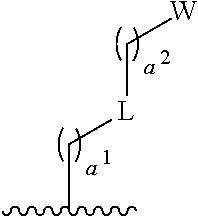
portion of Formula (I) is

In some embodiments, the

portion of Formula (I) is

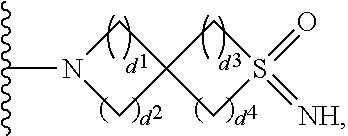
and the

portion of Formula (I) is


and the

portion of Formula (I) is


or a pharmaceutically acceptable salt thereof, wherein R2b, R3b, a1, a2, ring A, b1, and R1a are as defined for Formula (I) or any variation or embodiment thereof.

or a pharmaceutically acceptable salt thereof, wherein R1a and b1 are as defined for Formula (I) or any variation or embodiment thereof.

or a pharmaceutically acceptable salt thereof, wherein R1a and b1 are as defined for Formula (I) or any variation or embodiment thereof.

or a pharmaceutically acceptable salt thereof, wherein R1a, b1, X1, X2, X3, X4, X5, and X6 are as defined for Formula (I) or any variation or embodiment thereof.

or a pharmaceutically acceptable salt thereof, wherein R1a, b1, X1, X2, X3, X4, X5, and X6 are as defined for Formula (I) or any variation or embodiment thereof.

or a pharmaceutically acceptable salt thereof, wherein R1a, X1, X2, X3, X4, X5, and X6 are as defined for Formula (I) or any variation or embodiment thereof.

or a pharmaceutically acceptable salt thereof, wherein R2a, b1, X1, X2, X3, X4, X5, and X6 are as defined for Formula (I) or any variation or embodiment thereof.

or a pharmaceutically acceptable salt thereof, wherein R2a, b1, X1, X2, X3, X4, X5, and X6 are as defined for Formula (I) or any variation or embodiment thereof.

or a pharmaceutically acceptable salt thereof, wherein:


or a pharmaceutically acceptable salt thereof, wherein:


or a pharmaceutically acceptable salt thereof, wherein:


or a pharmaceutically acceptable salt thereof, wherein:


or a pharmaceutically acceptable salt thereof, wherein:


| TABLE 1 | ||
| Compound | ||
| No. | Structure | Name |
| 1 |
 |
(4-((6,7-dimethoxyquinolin-4- yl)oxy)phenyl)(imino)(methyl)-λ6-sulfanone |
| 1R |
 |
(R)-(4-((6,7-dimethoxyquinolin-4- yl)oxy)phenyl)(imino)(methyl)-λ6-sulfanone |
| 1S |
 |
(S)-(4-((6,7-dimethoxyquinolin-4- yl)oxy)phenyl)(imino)(methyl)-λ6-sulfanone |
| 2 |
 |
((6-(6,7-dimethoxyquinazolin-4-yl)pyridin-3- yl)methyl)(imino)(methyl)-λ6-sulfanone |
| 3 |
 |
(1-(2-(6,7-dimethoxyquinazolin-4- yl)acetyl)azetidin-3-yl)(imino)(methyl)-λ6- sulfanone |
| 4 |
 |
(1-(2-(6,7-dimethoxyquinazolin-4- yl)ethyl)azetidin-3-yl)(imino)(methyl)-λ6- sulfanone |
| 5 |
 |
(1-(2-(6,7-dimethoxyquinazolin-4- yl)ethyl)piperidin-4-yl)(imino)(methyl)-λ6- sulfanone |
| 6 |
 |
(1-imino-1-oxido-1λ6-thiomorpholino)(7- methoxyquinolin-4-yl)methanone |
| 7 |
 |
(2-(1-(6,7-dimethoxyquinazolin-4-yl)-1H- 1,2,3-triazol-4-yl)ethyl)(imino)(methyl)-λ6- sulfanone |
| 8 |
 |
(2-(1-(6,7-dimethoxyquinazolin-4-yl)piperidin- 4-yl)ethyl)(imino)(methyl)-λ6-sulfanone |
| 9 |
 |
(2-(1-(cinnolin-4-yl)piperidin-4- yl)ethyl)(imino)(methyl)-λ6-sulfanone |
| 10 |
 |
(2-fluoro-4-((7-methoxyquinolin-4- yl)oxy)phenyl)(imino)(methyl)-λ6-sulfanone |
| 11 |
 |
(3-((6,7-dimethoxyquinazolin-4- yl)methoxy)cyclopentyl)(imino)(methyl)-λ6- sulfanone |
| 12 |
 |
(3-fluoro-4-((7-methoxyquinolin-4- yl)oxy)phenyl)(imino)(methyl)-λ6-sulfanone |
| 13 |
 |
(4-(((6,7-dimethoxyquinazolin-4- yl)amino)methyl)phenyl)(imino)(methyl)-λ6- sulfanone |
| 14 |
 |
(4-(((6,7-dimethoxyquinazolin-4- yl)oxy)methyl)phenyl)(imino)(methyl)-λ6- sulfanone |
| 15 |
 |
(4-((6,7-dimethoxyquinazolin-4-yl)oxy)-2- fluorophenyl)(imino)(methyl)-λ6-sulfanone |
| 16 |
 |
(4-((6,7-dimethoxyquinazolin-4-yl)oxy)-3- fluorophenyl)(imino)(methyl)-λ6-sulfanone |
| 17 |
 |
(4-((6,7-dimethoxyquinazolin-4- yl)oxy)benzyl)(imino)(methyl)-λ6-sulfanone |
| 18 |
 |
(4-((6,7-dimethoxyquinazolin-4- yl)oxy)phenyl)(imino)(methyl)-λ6-sulfanone |
| 19 |
 |
(4-((6,7-dimethoxyquinazolin-4- yl)oxy)phenyl)(imino)(trifluoromethyl)-λ6- sulfanone |
| 20 |
 |
(4-(6,7-dimethoxyquinazolin-4- yl)benzyl)(imino)(methyl)-λ6-sulfanone |
| 21 |
 |
(4-(cinnolin-4-yl)benzyl)(imino)(methyl)-λ6- sulfanone |
| 22 |
 |
(4-(cinnolin-4-yloxy)phenyl)(imino)(methyl)- λ6-sulfanone |
| 23 |
 |
(6-((6,7-dimethoxyquinazolin-4- yl)oxy)pyridin-3-yl)(imino)(methyl)-λ6- sulfanone |
| 24 |
 |
(6,7-dimethoxyquinazolin-4-yl)(1-imino-1- oxido-1λ6-thiomorpholino)methanone |
| 25 |
 |
(7-(6,7-dimethoxyquinazolin-4-yl)-7- azaspiro[3.5]nonan-2-yl)(imino)(methyl)-λ6- sulfanone |
| 26 |
 |
1-(1-imino-1-oxido-1λ6-thiomorpholino)-2-(7- methoxyquinolin-4-yl)ethan-1-one |
| 27 |
 |
1-(6,7-dimethoxyquinazolin-4-yl)-2-(1-imino- 1-oxido-1λ6-thiomorpholino)ethan-1-one |
| 28 |
 |
1-imino-4-(2-(7-methoxyquinolin-4-yl)ethyl)- 1l6,4-thiazepane 1-oxide |
| 29 |
 |
1-imino-4-(2-(7-methoxyquinolin-4-yl)ethyl)- 1λ6-thiomorpholine 1-oxide |
| 30 |
 |
2-(1-imino-1-oxido-1λ6-thiomorpholino)-1-(7- methoxyquinolin-4-yl)ethan-1-one |
| 31 |
 |
2-(6,7-dimethoxyquinazolin-4-yl)-1-(1-imino- 1-oxido-1λ6-thiomorpholino)ethan-1-one |
| 32 |
 |
2-imino-6-((7-methoxyquinolin-4-yl)methyl)- 2λ6-thia-6-azaspiro[3.3]heptane 2-oxide |
| 33 |
 |
2-imino-7-(7-methoxyquinolin-4-yl)-2l4- isothiochromane 2-oxide |
| 34 |
 |
4-(2-(6,7-dimethoxyquinazolin-4-yl)ethyl)-1- imino-1l6,4-thiazepane 1-oxide |
| 35 |
 |
4-(2-(6,7-dimethoxyquinazolin-4-yl)ethyl)-1- imino-1λ6-thiomorpholine 1-oxide |
| 36 |
 |
6-((6,7-dimethoxyquinazolin-4-yl)methyl)-2- imino-2λ6-thia-6-azaspiro[3.3]heptane 2-oxide |
| 37 |
 |
6,7-dimethoxy-4-(2-(S-methylsulfonimidoyl)- 1,2,3,4-tetrahydroisoquinolin-7-yl)quinazoline |
| 37S |
 |
(S)-6,7-dimethoxy-4-(2-(S- methylsulfonimidoyl)-1,2,3,4- tetrahydroisoquinolin-7-yl)quinazoline |
| 37R |
 |
(R)-6,7-dimethoxy-4-(2-(S- methylsulfonimidoyl)-1,2,3,4- tetrahydroisoquinolin-7-yl)quinazoline |
| 38 |
 |
6,7-dimethoxy-4-(2-(S-methylsulfonimidoyl)- 2,7-diazaspiro[3.5]nonan-7-yl)quinazoline |
| 39 |
 |
6-fluoro-4-(4-((S- methylsulfonimidoyl)methyl)phenyl)quinoline- 3-carbonitrile |
| 40 |
 |
6-fluoro-4-(4-(2-(S- methylsulfonimidoyl)ethyl)piperidin-1- yl)quinoline-3-carbonitrile |
| 41 |
 |
6-fluoro-4-(4-(S- methylsulfonimidoyl)phenoxy)quinoline-3- carbonitrile |
| 42 |
 |
6-fluoro-7-methoxy-4-(4-((S- methylsulfonimidoyl)methyl)phenyl)quinoline- 3-carbonitrile |
| 43 |
 |
6-fluoro-7-methoxy-4-(4-(2-(S- methylsulfonimidoyl)ethyl)piperidin-1- yl)quinoline-3-carbonitrile |
| 44 |
 |
6-fluoro-7-methoxy-4-(4-(S- methylsulfonimidoyl)phenoxy)quinoline-3- carbonitrile |
| 44R |
 |
(R)-6-fluoro-7-methoxy-4-(4-(S- methylsulfonimidoyl)phenoxy)quinoline-3- carbonitrile |
| 44S |
 |
(S)-6-fluoro-7-methoxy-4-(4-(S- methylsulfonimidoyl)phenoxy)quinoline-3- carbonitrile |
| 45 |
 |
6-methoxy-4-(4-((S- methylsulfonimidoyl)methyl)phenyl)quinoline- 3-carbonitrile |
| 46 |
 |
6-methoxy-4-(4-(2-(S- methylsulfonimidoyl)ethyl)piperidin-1- yl)quinoline-3-carbonitrile |
| 47 |
 |
6-methoxy-4-(4-(S- methylsulfonimidoyl)phenoxy)quinoline-3- carbonitrile |
| 48 |
 |
6-methyl-4-(4-((S- methylsulfonimidoyl)methyl)phenyl)quinoline- 3-carbonitrile |
| 49 |
 |
6-methyl-4-(4-(2-(S- methylsulfonimidoyl)ethyl)piperidin-1- yl)quinoline-3-carbonitrile |
| 50 |
 |
6-methyl-4-(4-(S- methylsulfonimidoyl)phenoxy)quinoline-3- carbonitrile |
| 51 |
 |
7-(6,7-dimethoxyquinazolin-4-yl)-2-imino-2l4- isothiochromane 2-oxide |
| 52 |
 |
7-methoxy-4-(2-(S-methylsulfonimidoyl)- 1,2,3,4-tetrahydroisoquinolin-7-yl)quinoline |
| 52S |
 |
(S)-7-methoxy-4-(2-(S-methylsulfonimidoyl)- 1,2,3,4-tetrahydroisoquinolin-7-yl)quinoline |
| 52R |
 |
(R)-7-methoxy-4-(2-(S-methylsulfonimidoyl)- 1,2,3,4-tetrahydroisoquinolin-7-yl)quinoline |
| 53 |
 |
7-methoxy-4-(2-(S-methylsulfonimidoyl)-2,7- diazaspiro[3.5]nonan-7-yl)quinoline |
| 54 |
 |
8-(6,7-dimethoxyquinazolin-4-yl)-2-(S- methylsulfonimidoyl)-2,8- diazaspiro[4.5]decane |
| 54S |
 |
(S)-8-(6,7-dimethoxyquinazolin-4-yl)-2-(S- methylsulfonimidoyl)-2,8- diazaspiro[4.5]decane |
| 54R |
 |
(R)-8-(6,7-dimethoxyquinazolin-4-yl)-2-(S- methylsulfonimidoyl)-2,8- diazaspiro[4.5]decane |
| 55 |
 |
8-(7-methoxyquinolin-4-yl)-2-(S- methylsulfonimidoyl)-2,8- diazaspiro[4.5]decane |
| 55S |
 |
(S)-8-(7-methoxyquinolin-4-yl)-2-(S- methylsulfonimidoyl)-2,8- diazaspiro[4.5]decane |
| 55R |
 |
(R)-8-(7-methoxyquinolin-4-yl)-2-(S- methylsulfonimidoyl)-2,8- diazaspiro[4.5]decane |
| 56 |
 |
8-methoxy-4-(4-((S- methylsulfonimidoyl)methyl)phenyl)quinoline- 3-carbonitrile |
| 57 |
 |
8-methoxy-4-(4-(2-(S- methylsulfonimidoyl)ethyl)piperidin-1- yl)quinoline-3-carbonitrile |
| 58 |
 |
8-methoxy-4-(4-(S- methylsulfonimidoyl)phenoxy)quinoline-3- carbonitrile |
| 59 |
 |
cyclopropyl(4-((6,7-dimethoxyquinazolin-4- yl)oxy)phenyl)(imino)-λ6-sulfanone |
| 60 |
 |
cyclopropyl(imino)(4-((7-methoxyquinolin-4- yl)oxy)phenyl)-λ6-sulfanone |
| 60R |
 |
(R)-cyclopropyl(imino)(4-((7- methoxyquinolin-4-yl)oxy)phenyl)-λ6- sulfanone |
| 60S |
 |
(S)-cyclopropyl(imino)(4-((7- methoxyquinolin-4-yl)oxy)phenyl)-λ6- sulfanone |
| 61 |
 |
imino((6-(7-methoxyquinolin-4-yl)pyridin-3- yl)methyl)(methyl)-λ6-sulfanone |
| 62 |
 |
imino(1-(2-(7-methoxyquinolin-4- yl)acetyl)azetidin-3-yl)(methyl)-λ6-sulfanone |
| 63 |
 |
imino(1-(2-(7-methoxyquinolin-4- yl)ethyl)azetidin-3-yl)(methyl)-λ6-sulfanone |
| 64 |
 |
imino(1-(2-(7-methoxyquinolin-4- yl)ethyl)piperidin-4-yl)(methyl)-λ6-sulfanone |
| 65 |
 |
imino(2-(1-(7-methoxy-1,5-naphthyridin-4- yl)piperidin-4-yl)ethyl)(methyl)-λ6-sulfanone |
| 66 |
 |
imino(2-(1-(7-methoxy-1,6-naphthyridin-4- yl)piperidin-4-yl)ethyl)(methyl)-λ6-sulfanone |
| 67 |
 |
imino(2-(1-(7-methoxy-1,8-naphthyridin-4- yl)piperidin-4-yl)ethyl)(methyl)-λ6-sulfanone |
| 68 |
 |
imino(2-(1-(7-methoxyquinolin-4-yl)-1H- 1,2,3-triazol-4-yl)ethyl)(methyl)-λ6-sulfanone |
| 69 |
 |
imino(2-(1-(7-methoxyquinolin-4-yl)piperidin- 4-yl)ethyl)(methyl)-λ6-sulfanone |
| 70 |
 |
imino(2-(1-(8-methoxy-1,5-naphthyridin-4- yl)piperidin-4-yl)ethyl)(methyl)-λ6-sulfanone |
| 71 |
 |
imino(2-(1-(8-methoxy-1,6-naphthyridin-4- yl)piperidin-4-yl)ethyl)(methyl)-λ6-sulfanone |
| 72 |
 |
imino(2-(1-(8-methoxyquinazolin-4- yl)piperidin-4-yl)ethyl)(methyl)-λ6-sulfanone |
| 73 |
 |
imino(3-((7-methoxyquinolin-4- yl)methoxy)cyclopentyl)(methyl)-λ6-sulfanone |
| 74 |
 |
imino(4-(((7-methoxyquinolin-4- yl)amino)methyl)phenyl)(methyl)-λ6-sulfanone |
| 75 |
 |
imino(4-(((7-methoxyquinolin-4- yl)oxy)methyl)phenyl)(methyl)-λ6-sulfanone |
| 75R |
 |
(R)-imino(4-(((7-methoxyquinolin-4- yl)oxy)methyl)phenyl)(methyl)-l6-sulfanone |
| 75S |
 |
(S)-imino(4-(((7-methoxyquinolin-4- yl)oxy)methyl)phenyl)(methyl)-l6-sulfanone |
| 76 |
 |
imino(4-((7-methoxy-1,5-naphthyridin-4- yl)oxy)phenyl)(methyl)-λ6-sulfanone |
| 77 |
 |
imino(4-((7-methoxy-1,6-naphthyridin-4- yl)oxy)phenyl)(methyl)-λ6-sulfanone |
| 78 |
 |
imino(4-((7-methoxy-1,8-naphthyridin-4- yl)oxy)phenyl)(methyl)-λ6-sulfanone |
| 79 |
 |
imino(4-((7-methoxyquinolin-4- yl)oxy)benzyl)(methyl)-λ6-sulfanone |
| 80 |
 |
imino(4-((7-methoxyquinolin-4- yl)oxy)phenyl)(methyl)-λ6-sulfanone |
| 80R |
 |
(R)-imino(4-((7-methoxyquinolin-4- yl)oxy)phenyl)(methyl)-λ6-sulfanone |
| 80S |
 |
(S)-imino(4-((7-methoxyquinolin-4- yl)oxy)phenyl)(methyl)-λ6-sulfanone |
| 81 |
 |
imino(4-((7-methoxyquinolin-4- yl)oxy)phenyl)(trifluoromethyl)-λ6-sulfanone |
| 82 |
 |
imino(4-((8-methoxy-1,5-naphthyridin-4- yl)oxy)phenyl)(methyl)-λ6-sulfanone |
| 83 |
 |
imino(4-((8-methoxy-1,6-naphthyridin-4- yl)oxy)phenyl)(methyl)-λ6-sulfanone |
| 84 |
 |
imino(4-((8-methoxyquinazolin-4- yl)oxy)phenyl)(methyl)-λ6-sulfanone |
| 85 |
 |
imino(4-(7-methoxy-1,5-naphthyridin-4- yl)benzyl)(methyl)-λ6-sulfanone |
| 86 |
 |
imino(4-(7-methoxy-1,6-naphthyridin-4- yl)benzyl)(methyl)-λ6-sulfanone |
| 87 |
 |
imino(4-(7-methoxy-1,8-naphthyridin-4- yl)benzyl)(methyl)-λ6-sulfanone |
| 88 |
 |
imino(4-(7-methoxyquinolin-4- yl)benzyl)(methyl)-λ6-sulfanone |
| 89 |
 |
imino(4-(8-methoxy-1,5-naphthyridin-4- yl)benzyl)(methyl)-λ6-sulfanone |
| 90 |
 |
imino(4-(8-methoxy-1,6-naphthyridin-4- yl)benzyl)(methyl)-λ6-sulfanone |
| 91 |
 |
imino(4-(8-methoxyquinazolin-4- yl)benzyl)(methyl)-λ6-sulfanone |
| 92 |
 |
imino(6-((7-methoxyquinolin-4- yl)oxy)pyridin-3-yl)(methyl)-λ6-sulfanone |
| 93 |
 |
imino(7-(7-methoxyquinolin-4-yl)-7- azaspiro[3.5]nonan-2-yl)(methyl)-λ6-sulfanone |
| 94 |
 |
N-((1-(6,7-dimethoxyquinazolin-4- yl)piperidin-4- yl)methyl)methanesulfonimidamide |
| 94S |
 |
(S)-N-((1-(6,7-dimethoxyquinazolin-4- yl)piperidin-4- yl)methyl)methanesulfonimidamide |
| 94R |
 |
(R)-N-((1-(6,7-dimethoxyquinazolin-4- yl)piperidin-4- yl)methyl)methanesulfonimidamide |
| 95 |
 |
N-((1-(7-methoxyquinolin-4-yl)piperidin-4- yl)methyl)methanesulfonimidamide |
| 96 |
 |
4-(1-(6,7-dimethoxyquinolin-4-yl)-1H- pyrazol-4-yl)-1-imino-1λ6-thiomorpholine 1- oxide |
| 97 |
 |
4-(1-(6,7-dimethoxyquinolin-4-yl)-1H- pyrazol-4-yl)-1-iminohexahydro-1λ6-thiopyran 1-oxide |
| 98 |
 |
imino(4-(7-methoxyquinolin-4- yl)phenethyl)(methyl)-λ6-sulfanone |
| 99 |
 |
(4-(6,7-dimethoxyquinazolin-4- yl)phenethyl)(imino)(methyl)-λ6-sulfanone |
| 100 |
 |
imino(2-(6-(7-methoxyquinolin-4-yl)pyridin-3- yl)ethyl)(methyl)-λ6-sulfanone |
| 101 |
 |
imino(5-((7-methoxyquinolin-4- yl)oxy)pyridin-2-yl)(methyl)-λ6-sulfanone |
| 102 |
 |
2-imino-8-((7-methoxyquinolin-4-yl)methyl)- 2λ6-thia-8-azaspiro[4.5]decane 2-oxide |
| 103 |
 |
ethyl(imino)(4-((7-methoxyquinolin-4- yl)oxy)phenyl)-λ6-sulfanone |
| 103R |
 |
(R)-ethyl(imino)(4-((7-methoxyquinolin-4- yl)oxy)phenyl)-λ6-sulfanone |
| 103S |
 |
(S)-ethyl(imino)(4-((7-methoxyquinolin-4- yl)oxy)phenyl)-λ6-sulfanone |
| 104 |
 |
imino(4-(8-methoxyquinazolin-4- yl)phenethyl)(methyl)-λ6-sulfanone |
| 105 |
 |
2-imino-6-(7-methoxyquinolin-4-yl)-2λ6-thia- 6-azaspiro[3.3]heptane 2-oxide |
| 106 |
 |
1-imino-4-(((7-methoxyquinolin-4- yl)amino)methyl)hexahydro-λ6-thiopyran 1- oxide |
| 107 |
 |
1-imino-4-(((7-methoxyquinolin-4- yl)oxy)methyl)hexahydro-1λ6-thiopyran 1- oxide |
| 107rr |
 |
(1r,4r)-4-(((6,7-dimethoxyquinolin-4- yl)oxy)methyl)-1-iminohexahydro-1λ6- thiopyran 1-oxide |
| 107ss |
 |
(1s,4s)-4-(((6,7-dimethoxyquinolin-4- yl)oxy)methyl)-1-iminohexahydro-1λ6- thiopyran 1-oxide |
| 108 |
 |
imino((1-((7-methoxyquinolin-4- yl)methyl)azetidin-3-yl)methyl)(methyl)-λ6- sulfanone |
| 109 |
 |
imino(1-((7-methoxyquinolin-4- yl)methyl)azetidin-3-yl)(methyl)-λ6-sulfanone |
| 110 |
 |
imino(1-((7-methoxyquinolin-4- yl)methyl)piperidin-4-yl)(methyl)-λ6-sulfanone |
| 111 |
 |
1-imino-3-(((7-methoxyquinolin-4- yl)methyl)amino)tetrahydro-1H-1λ6-thiophene 1-oxide |
| 112 |
 |
1-imino-4-(((7-methoxyquinolin-4- yl)methyl)amino)hexahydro-1λ6-thiopyran 1- oxide |
| 113 |
 |
1-imino-4-(((7-methoxyquinolin-4- yl)methoxy)methyl)hexahydro-1λ6-thiopyran 1-oxide |
| 114 |
 |
{4-[(6-fluoro-7-methoxyquinolin-4- yl)oxy]phenyl}(imino)methyl-λ6-sulfanone |
| 114R |
 |
(R)-{4-[(6-fluoro-7-methoxyquinolin-4- yl)oxy]phenyl}(imino)methyl-λ6-sulfanone |
| 114S |
 |
(S)-{4-[(6-fluoro-7-methoxyquinolin-4- yl)oxy]phenyl}(imino)methyl-λ6-sulfanone |
| 115 |
 |
{4-[(6,7-dimethoxyquinolin-4-yl)oxy]-2- fluorophenyl}(imino)methyl-λ6-sulfanone |
| 116 |
 |
{4-[(6,7-dimethoxyquinolin-4-yl)oxy]-3- fluorophenyl}(imino)methyl-λ6-sulfanone |
| 117 |
 |
imino({3-[(7-methoxyquinolin-4- yl)oxy]phenyl})methyl-λ6-sulfanone |
| 118 |
 |
imino({4-[(8-methoxyquinolin-4- yl)oxy]phenyl})methyl-λ6-sulfanone |
| 119 |
 |
imino({4-[(7-methoxycinnolin-4- yl)oxy]phenyl})methyl-λ6-sulfanone |
| 120 |
 |
[cyclopropyl({4-[(6-fluoro-7- methoxyquinolin-4-yl)oxy]phenyl})imino-λ6- sulfanyl]one |
| 120R |
 |
(R)-[cyclopropyl({4-[(6-fluoro-7- methoxyquinolin-4-yl)oxy]phenyl})imino-λ6- sulfanyl]one |
| 120S |
 |
(S)-[cyclopropyl({4-[(6-fluoro-7- methoxyquinolin-4-yl)oxy]phenyl})imino-λ6- sulfanyl]one |
| 121 |
 |
4-{4-[imino(methyl)oxo-λ6- sulfanyl]phenoxy}-7-methoxyquinoline-3- carbonitrile |
| 122 |
 |
imino(2-methoxyethyl){4-[(7- methoxyquinolin-4-yl)oxy]phenyl}-λ6- sulfanone |
| 123 |
 |
(cyclopropylmethyl)(imino){4-[(7- methoxyquinolin-4-yl)oxy]phenyl}-λ6- sulfanone |
| 124 |
 |
imino({4-[(7-methoxy-2-methylquinolin-4- yl)oxy]phenyl})methyl-λ6-sulfanone |
| 125 |
 |
imino(methyl)[4-(quinolin-4-yloxy)phenyl]-λ6- sulfanone |
| 126 |
 |
{4-[(6-chloro-7-methoxyquinolin-4- yl)oxy]phenyl}(imino)methyl-λ6-sulfanone |
| 127 |
 |
{4-[(6,7-dimethoxycinnolin-4- yl)oxy]phenyl}(imino)methyl-λ6-sulfanone |
| 128 |
 |
{4-[(8-fluoro-7-methoxyquinolin-4- yl)oxy]phenyl}(imino)methyl-λ6-sulfanone |
| 129 |
 |
{5-[(6,7-dimethoxyquinolin-4-yl)oxy]pyridin- 2-yl}(imino)methyl-λ6-sulfanone |
| 130 |
 |
imino({4-[(6-methoxy-1,5-naphthyridin-4- yl)oxy]phenyl})methyl-λ6-sulfanone |
| 131 |
 |
7-fluoro-4-{4-[imino(methyl)oxo-λ6- sulfanyl]phenoxy}quinoline-3-carbonitrile |
| 132 |
 |
(2-hydroxy-2-methylpropyl)(imino){4-[(7- methoxyquinolin-4-yl)oxy]phenyl}-λ6- sulfanone |
| 133 |
 |
imino(3-{[(7-methoxyquinolin-4- yl)oxy]methyl}phenyl)methyl-λ6-sulfanone |
| 133R |
 |
(R)-imino(3-{[(7-methoxyquinolin-4- yl)oxy]methyl}phenyl)methyl-λ6-sulfanone |
| 133S |
 |
(S)-imino(3-{[(7-methoxyquinolin-4- yl)oxy]methyl}phenyl)methyl-λ6-sulfanone |
| 134 |
 |
imino(4-{[(8-methoxyquinolin-4- yl)oxy]methyl}phenyl)methyl-λ6-sulfanone |
| 135 |
 |
(3-fluoro-4-{[(7-methoxyquinolin-4- yl)oxy]methyl}phenyl)(imino)methyl-λ6- sulfanone |
| 136 |
 |
(4-{[6-fluoro-7-methoxyquinolin-4- yl)oxy]methyl}phenyl)(imino)methyl-λ6- sulfanone |
| 137 |
 |
(3-bromo-4-{[(7-methoxyquinolin-4- yl)oxy]methyl}phenyl)(imino)methyl-λ6- sulfanone |
| 138 |
 |
(4-{[(6,7-dimethoxyquinolin-4- yl)oxy]methyl}phenyl)(imino)methyl-λ6- sulfanone |
| 139 |
 |
imino({2-[1-(7-methoxyquinazolin-4- yl)piperidin-4-yl]ethyl})methyl-λ6-sulfanone |
| 140 |
 |
imino({2-[1-(8-methoxyquinolin-4- yl)piperidin-4-yl]ethyl})methyl-λ6-sulfanone |
| 141 |
 |
{2-[1-(6-chloro-7-methoxyquinolin-4- yl)piperidin-4-yl]ethyl}(imino)methyl-λ6- sulfanone |
| 141R |
 |
(R)-{2-[1-(6-chloro-7-methoxyquinolin-4- yl)piperidin-4-yl]ethyl}(imino)methyl-λ6- sulfanone |
| 141S |
 |
(S)-{2-[1-(6-chloro-7-methoxyquinolin-4- yl)piperidin-4-yl]ethyl}(imino)methyl-λ6- sulfanone |
| 142 |
 |
{2-[1-(6-chloro-7-methoxyquinazolin-4- yl)piperidin-4-yl]ethyl}(imino)methyl-λ6- sulfanone |
| 142R |
 |
(R)-{2-[1-(6-chloro-7-methoxyquinazolin-4- yl)piperidin-4-yl]ethyl}(imino)methyl-λ6- sulfanone |
| 142S |
 |
(S)-{2-[1-(6-chloro-7-methoxyquinazolin-4- yl)piperidin-4-yl]ethyl}(imino)methyl-λ6- sulfanone |
| 143 |
 |
4-(4-{2-[imino(methyl)oxo-λ6- sulfanyl]ethyl}piperidin-1-yl)-7- methoxyquinoline-3-carbonitrile |
| 144 |
 |
4-(4-{2-[imino(methyl)oxo-λ6- sulfanyl]ethyl}piperidin-1-yl)-6,7- dimethoxyquinoline-3-carbonitrile |
| 145 |
 |
{3-[1-(6,7-dimethoxyquinazolin-4- yl)piperidin-4-yl]propyl}(imino)methyl-λ6- sulfanone |
| 146 |
 |
imino({[1-(8-methoxyquinazolin-4- yl)piperidin-4-yl]methyl})methyl-λ6-sulfanone |
| 146R |
 |
(R)-imino({[1-(8-methoxyquinazolin-4- yl)piperidin-4-yl]methyl})methyl-λ6-sulfanone |
| 146S |
 |
(S)-imino({[1-(8-methoxyquinazolin-4- yl)piperidin-4-yl]methyl})methyl-λ6-sulfanone |
| 147 |
 |
{[1-(6,7-dimethoxyquinazolin-4-yl)piperidin- 4-yl]methyl}(imino)methyl-λ6-sulfanone |
| 148 |
 |
imino({[1-(7-methoxyquinolin-4-yl)piperidin- 4-yl]methyl})methyl-λ6-sulfanone |
| 149 |
 |
imino(methyl){2-[1-(quinolin-4-yl)piperidin-4- yl]ethyl}-λ6-sulfanone |
| 150 |
 |
{2-[1-(6-fluoro-7-methoxyquinolin-4- yl)piperidin-4-yl]ethyl}(imino)methyl-λ6- sulfanone |
| 151 |
 |
{2-[1-(6,7-dimethoxycinnolin-4-yl)piperidin- 4-yl]ethyl}(imino)methyl-λ6-sulfanone |
| 152 |
 |
6-chloro-4-(4-{2-[imino(methyl)oxo-λ6- sulfanyl]ethyl}piperidin-1-yl)-7- methoxyquinoline-3-carbonitrile |
| 153 |
 |
{2-[4-(6,7-dimethoxyquinazolin-4- yl)phenyl]ethyl}(imino)methyl-λ6-sulfanone |
| 154 |
 |
imino({2-[4-(8-methoxyquinazolin-4- yl)phenyl]ethyl})methyl-λ6-sulfanone |
| 155 |
 |
imino(methyl){[4-(quinolin-4- yl)phenyl]methyl}-λ6-sulfanone |
| 156 |
 |
[8-(6-chloro-7-methoxyquinolin-4-yl)-2,8- diazaspiro[4.5]decan-2-yl](imino)methyl-λ6- sulfanone |
| 156S |
 |
(S)-[8-(6-chloro-7-methoxyquinolin-4-yl)-2,8- diazaspiro[4.5]decan-2-yl](imino)methyl-λ6- sulfanone |
| 156R |
 |
(R)-[8-(6-chloro-7-methoxyquinolin-4-yl)-2,8- diazaspiro[4.5]decan-2-yl](imino)methyl-λ6- sulfanone |
| 157 |
 |
N-{[1-(6-chloro-7-methoxyquinolin-4- yl)piperidin-4- yl]methyl}methanesulfonoimidamide |
| 158 |
 |
imino[8-(7-methoxy-1,8-naphthyridin-4-yl)- 2,8-diazaspiro[4.5]decan-2-yl]methyl-λ6- sulfanone |
| 159 |
 |
[8-(6,7-dimethoxyquinazolin-4-yl)-2,8- diazaspiro[4.5]decan-2-yl](ethyl)imino-λ6- sulfanone |
| 160 |
 |
{cyclopropyl[8-(6,7-dimethoxyquinazolin-4- yl)-2,8-diazaspiro[4.5]decan-2-yl]imino-λ6- sulfanyl}one |
| 160R |
 |
(R)-{cyclopropyl[8-(6,7-dimethoxyquinazolin- 4-yl)-2,8-diazaspiro[4.5]decan-2-yl]imino-λ6- sulfanyl}one |
| 160S |
 |
(S)-{cyclopropyl[8-(6,7-dimethoxyquinazolin- 4-yl)-2,8-diazaspiro[4.5]decan-2-yl]imino-λ6- sulfanyl}one |
| 161 |
 |
[7-(6,7-dimethoxyquinolin-4-yl)-1,2,3,4- tetrahydroisoquinolin-2-yl](imino)methyl-λ6- sulfanone |
| 161S |
 |
(S)-[7-(6,7-dimethoxyquinolin-4-yl)-1,2,3,4- tetrahydroisoquinolin-2-yl](imino)methyl-λ6- sulfanone |
| 161R |
 |
(R)-[7-(6,7-dimethoxyquinolin-4-yl)-1,2,3,4- tetrahydroisoquinolin-2-yl](imino)methyl-λ6- sulfanone |
| 162 |
 |
N-{[4-(7-methoxyquinolin-4- yl)phenyl]methyl}methanesulfonoimidamide |
| 163 |
 |
imino[7-(7-methoxy-1,8-naphthyridin-4-yl)- 1,2,3,4-tetrahydroisoquinolin-2-yl]methyl-λ6- sulfanone |
| 164 |
 |
(4-{[(6,7-dimethoxyquinazolin-4- yl)oxy]methyl}piperidin-1-yl)(imino)methyl- λ6-sulfanone |
| 165 |
 |
(2-(1-(7,8-dimethoxyquinazolin-4-yl)piperidin- 4-yl)ethyl)(imino)(methyl)-l6-sulfanone |
| 166 |
 |
1-[3-({4-[(7-methoxyquinolin-4- yl)oxy]phenyl}imino-λ6-sulfanyl)azetidin-1- yl]ethan-1-one |
| 167 |
 |
imino({4-[(7-methoxyquinazolin-4- yl)oxy]phenyl})methyl-λ6-sulfanone |
| 168 |
 |
imino({4-[(7-methoxy-3-methylquinolin-4- yl)oxy]phenyl})methyl-λ6-sulfanone |
| 169 |
 |
(3-{[(6-fluoro-7-methoxyquinolin-4- yl)oxy]methyl}phenyl)(imino)methyl-λ6- sulfanone |
| 169R |
 |
(R)-(3-{[(6-fluoro-7-methoxyquinolin-4- yl)oxy]methyl}phenyl)(imino)methyl-λ6- sulfanone |
| 169S |
 |
(S)-(3-{[(6-fluoro-7-methoxyquinolin-4- yl)oxy]methyl}phenyl)(imino)methyl-λ6- sulfanone |
| 170 |
 |
imino(5-{[(7-methoxyquinolin-4- yl)oxy]methyl}furan-3-yl)methyl-λ6-sulfanone |
| 171 |
 |
4-{[(6,7-dimethoxyquinazolin-4- yl)oxy]methyl}-1-imino-1λ6-thian-1-one |
| 172 |
 |
imino(5-{[(7-methoxyquinolin-4- yl)oxy]methyl}pyridin-3-yl)methyl-λ6- sulfanone |
| 173 |
 |
(3-{[(6,7-dimethoxyquinazolin-4- yl)oxy]methyl}phenyl)(imino)methyl-λ6- sulfanone |
| 174 |
 |
imino(3-{[(7-methoxyquinazolin-4- yl)oxy]methyl}phenyl)methyl-λ6-sulfanone |
| 175 |
 |
(3-{[(6,7-dimethoxyquinolin-4- yl)oxy]methyl}phenyl)(imino)methyl-λ6- sulfanone |
| 175R |
 |
(R)-(3-{[(6,7-dimethoxyquinolin-4- yl)oxy]methyl}phenyl)(imino)methyl-λ6- sulfanone |
| 175S |
 |
(S)-(3-{[(6,7-dimethoxyquinolin-4- yl)oxy]methyl}phenyl)(imino)methyl-λ6- sulfanone |
| 176 |
 |
(3-{[(6-chloro-7-methoxyquinolin-4- yl)oxy]methyl}phenyl)(imino)methyl-λ6- sulfanone |
| 177 |
 |
(3-fluoro-5-{[(7-methoxyquinolin-4- yl)oxy]methyl}phenyl)(imino)methyl-λ6- sulfanone |
| 177R |
 |
(R)-(3-fluoro-5-{[(7-methoxyquinolin-4- yl)oxy]methyl}phenyl)(imino)methyl-λ6- sulfanone |
| 177S |
 |
(S)-(3-fluoro-5-{[(7-methoxyquinolin-4- yl)oxy]methyl}phenyl)(imino)methyl-λ6- sulfanone |
| 178 |
 |
imino({3-[(1R)-1-[(7-methoxyquinolin-4- yl)oxy]ethyl]phenyl})methyl-λ6-sulfanone |
| 178R |
 |
(R)-imino({3-[(1R)-1-[(7-methoxyquinolin-4- yl)oxy]ethyl]phenyl})methyl-λ6-sulfanone |
| 178S |
 |
(S)-imino({3-[(1R)-1-[(7-methoxyquinolin-4- yl)oxy]ethyl]phenyl})methyl-λ6-sulfanone |
| 179 |
 |
4-(4-{[imino(methyl)oxo-λ6- sulfanyl]methyl}piperidin-1-yl)-8- methoxyquinoline-3-carbonitrile |
| 179R |
 |
(R)-4-(4-{[imino(methyl)oxo-λ6- sulfanyl]methyl}piperidin-1-yl)-8- methoxyquinoline-3-carbonitrile |
| 179S |
 |
(S)-4-(4-{[imino(methyl)oxo-λ6- sulfanyl]methyl}piperidin-1-yl)-8- methoxyquinoline-3-carbonitrile |
| 180 |
 |
imino({[1-(8-methoxyquinolin-4-yl)piperidin- 4-yl]methyl})methyl-λ6-sulfanone |
| 181 |
 |
[8-(6,7-dimethoxyquinazolin-4-yl)-8- azaspiro[4.5]decan-2-yl](imino)methyl-λ6- sulfanone |
| 182 |
 |
imino({[1-(8-methoxycinnolin-4-yl)piperidin- 4-yl]methyl})methyl-λ6-sulfanone |
| 183 |
 |
{[1-(6-fluoro-8-methoxyquinazolin-4- yl)piperidin-4-yl]methyl}(imino)methyl-λ6- sulfanone |
| 183R |
 |
(R)-{[1-(6-fluoro-8-methoxyquinazolin-4- yl)piperidin-4-yl]methyl}(imino)methyl-λ6- sulfanone |
| 183S |
 |
(S)-{[1-(6-fluoro-8-methoxyquinazolin-4- yl)piperidin-4-yl]methyl}(imino)methyl-λ6- sulfanone |
| 184 |
 |
{[2-(6-fluoro-7-methoxyquinolin-4-yl)-2- azaspiro[3.3]heptan-6- yl]methyl}(imino)methyl-λ6-sulfanone |
| 184R |
 |
(R)-{[2-(6-fluoro-7-methoxyquinolin-4-yl)-2- azaspiro[3.3]heptan-6- yl]methyl}(imino)methyl-λ6-sulfanone |
| 184S |
 |
(S)-{[2-(6-fluoro-7-methoxyquinolin-4-yl)-2- azaspiro[3.3]heptan-6- yl]methyl}(imino)methyl-λ6-sulfanone |
| 185 |
 |
{[4-hydroxy-1-(8-methoxyquinazolin-4- yl)piperidin-4-yl]methyl}(imino)methyl-λ6- sulfanone |
| 185R |
 |
(R)-{[4-hydroxy-1-(8-methoxyquinazolin-4- yl)piperidin-4-yl]methyl}(imino)methyl-λ6- sulfanone |
| 185S |
 |
(S)-{[4-hydroxy-1-(8-methoxyquinazolin-4- yl)piperidin-4-yl]methyl}(imino)methyl-λ6- sulfanone |
| 186 |
 |
{[2-(6,7-dimethoxyquinolin-4-yl)-2- azaspiro[3.3]heptan-6- yl]methyl}(imino)methyl-λ6-sulfanone |
| 187 |
 |
{[1-(8-ethoxyquinazolin-4-yl)piperidin-4- yl]methyl}(imino)methyl-λ6-sulfanone |
| 188 |
 |
{[2-(6,7-dimethoxycinnolin-4-yl)-2- azaspiro[3.3]heptan-6- yl]methyl}(imino)methyl-λ6-sulfanone |
| 189 |
 |
4-(4-{[cyclopropyl(imino)oxo-λ6- sulfanyl]methyl}piperidin-1-yl)-8- methoxyquinoline-3-carbonitrile |
| 189R |
 |
(R)-4-(4-{[cyclopropyl(imino)oxo-λ6- sulfanyl]methyl}piperidin-1-yl)-8- methoxyquinoline-3-carbonitrile |
| 189S |
 |
(S)-4-(4-{[cyclopropyl(imino)oxo-λ6- sulfanyl]methyl}piperidin-1-yl)-8- methoxyquinoline-3-carbonitrile |
| 190 |
 |
cyclopropyl(imino){[1-(8-methoxyquinazolin- 4-yl)piperidin-4-yl]methyl}-λ6-sulfanone |
| 191 |
 |
cyclobutyl({[4-hydroxy-1-(8- methoxyquinazolin-4-yl)piperidin-4- yl]methyl})imino-λ6-sulfanone |
| 192 |
 |
(3-{[(6-fluoro-7-methoxyquinolin-4- yl)amino]methyl}phenyl)(imino)methyl-λ6- sulfanone |
| 193 |
 |
cyclopropyl({[4-hydroxy-1-(8- methoxyquinazolin-4-yl)piperidin-4- yl]methyl})imino-λ6-sulfanone |
| 193R |
 |
(R)-cyclopropyl({[4-hydroxy-1-(8- methoxyquinazolin-4-yl)piperidin-4- yl]methyl})imino-λ6-sulfanone |
| 194S |
 |
(S)-cyclopropyl({[4-hydroxy-1-(8- methoxyquinazolin-4-yl)piperidin-4- yl]methyl})imino-λ6-sulfanone |
| 194 |
 |
{[8-hydroxy-5-(8-methoxyquinazolin-4-yl)-5- azaspiro[2.5]octan-8- yl]methyl}(imino)methyl-λ6-sulfanone |
| 195 |
 |
ethyl({[4-hydroxy-1-(8-methoxyquinazolin-4- yl)piperidin-4-yl]methyl})imino-λ6-sulfanone |
| 195R |
 |
(R)-ethyl({[4-hydroxy-1-(8- methoxyquinazolin-4-yl)piperidin-4- yl]methyl})imino-λ6-sulfanone |
| 195S |
 |
(S)-ethyl({[4-hydroxy-1-(8- methoxyquinazolin-4-yl)piperidin-4- yl]methyl})imino-λ6-sulfanone |
| 196 |
 |
{[1-(8-ethoxyquinazolin-4-yl)-4- hydroxypiperidin-4-yl]methyl}(imino)methyl- λ6-sulfanone |
| 197 |
 |
8-ethoxy-4-(4-{[imino(methyl)oxo-λ6- sulfanyl]methyl}piperidin-1-yl)quinoline-3- carbonitrile |
| 198 |
 |
4-(4-hydroxy-4-{[imino(methyl)oxo-λ6- sulfanyl]methyl}piperidin-1-yl)-8- methoxyquinoline-3-carbonitrile |
| 198R |
 |
(R)-4-(4-hydroxy-4-{[imino(methyl)oxo-λ6- sulfanyl]methyl}piperidin-1-yl)-8- methoxyquinoline-3-carbonitrile |
| 198S |
 |
(S)-4-(4-hydroxy-4-{[imino(methyl)oxo-λ6- sulfanyl]methyl}piperidin-1-yl)-8- methoxyquinoline-3-carbonitrile |
| 199 |
 |
{[4-hydroxy-1-(8-methoxy-2- methylquinazolin-4-yl)piperidin-4- yl]methyl}(imino)methyl-λ6-sulfanone |
| 200 |
 |
8-(fluoromethoxy)-4-(4-{[imino(methyl)oxo- λ6-sulfanyl]methyl}piperidin-1-yl)quinoline-3- carbonitrile |
| 201 |
 |
4-(4-{[imino(methyl)oxo-λ6- sulfanyl]methyl}piperidin-1-yl)-8-methoxy-2- methylquinoline-3-carbonitrile |
| 202 |
 |
{[1-(3-fluoro-8-methoxyquinolin-4- yl)piperidin-4-yl]methyl}(imino)methyl-λ6- sulfanone |
| 203 |
 |
5-fluoro-4-(4-{[imino(methyl)oxo-λ6- sulfanyl]methyl}piperidin-1-yl)-8- methoxyquinoline-3-carbonitrile |
| 204 |
 |
{2-[3-(6,7-dimethoxyquinolin-4- yl)phenyl]ethyl}(imino)methyl-λ6-sulfanone |
| 205 |
 |
[8-(6-fluoro-7-methoxyquinolin-4-yl)-2,8- diazaspiro[4.5]decan-2-yl](imino)methyl-λ6- sulfanone |
| 205R |
 |
(R)-[8-(6-fluoro-7-methoxyquinolin-4-yl)-2,8- diazaspiro[4.5]decan-2-yl](imino)methyl-λ6- sulfanone |
| 205S |
 |
(S)-[8-(6-fluoro-7-methoxyquinolin-4-yl)-2,8- diazaspiro[4.5]decan-2-yl](imino)methyl-λ6- sulfanone |
| 206 |
 |
[2-(6,7-dimethoxyquinazolin-4-yl)-2,7- diazaspiro[3.5]nonan-7-yl](imino)methyl-λ6- sulfanone |
| 207 |
 |
[2-(6,7-dimethoxyquinazolin-4-yl)-2,8- diazaspiro[4.5]decan-8-yl](imino)methyl-λ6- sulfanone |
| 208 |
 |
[8-(6,7-dimethoxyquinolin-4-yl)-2,8- diazaspiro[4.5]decan-2-yl](imino)methyl-λ6- sulfanone |
| 208R |
 |
(R)-[8-(6,7-dimethoxyquinolin-4-yl)-2,8- diazaspiro[4.5]decan-2-yl](imino)methyl-λ6- sulfanone |
| 208S |
 |
(S)-[8-(6,7-dimethoxyquinolin-4-yl)-2,8- diazaspiro[4.5]decan-2-yl](imino)methyl-λ6- sulfanone |
| 209 |
 |
[9-(6,7-dimethoxyquinazolin-4-yl)-3,9- diazaspiro[5.5]undecan-3-yl](imino)methyl-λ6- sulfanone |
| 210 |
 |
6-fluoro-4-{2-[imino(methyl)oxo-λ6-sulfanyl]- 2,8-diazaspiro[4.5]decan-8-yl}-7- methoxyquinoline-3-carbonitrile |
| 211 |
 |
[8-(6,7-dimethoxycinnolin-4-yl)-2,8- diazaspiro[4.5]decan-2-yl](imino)methyl-λ6- sulfanone |
| 211R |
 |
(R)-[8-(6,7-dimethoxycinnolin-4-yl)-2,8- diazaspiro[4.5]decan-2-yl](imino)methyl-λ6- sulfanone |
| 211S |
 |
(S)-[8-(6,7-dimethoxycinnolin-4-yl)-2,8- diazaspiro[4.5]decan-2-yl](imino)methyl-λ6- sulfanone |
| 212 |
 |
[8-(6-chloro-7-methoxyquinazolin-4-yl)-2,8- diazaspiro[4.5]decan-2-yl](imino)methyl-λ6- sulfanone |
| 213 |
 |
[8-(6,7-dimethoxy-2-methylquinazolin-4-yl)- 2,8-diazaspiro[4.5]decan-2-yl](imino)methyl- λ6-sulfanone |
| 214 |
 |
imino[7-(8-methoxyquinazolin-4-yl)-1,7- diazaspiro[3.5]nonan-1-yl]methyl-λ6-sulfanone |
| 215 |
 |
imino[8-(8-methoxyquinazolin-4-yl)-2,8- diazaspiro[4.5]decan-2-yl]methyl-λ6-sulfanone |
| 216 |
 |
[7-(6,7-dimethoxyquinazolin-4-yl)-2,7- diazaspiro[4.4]nonan-2-yl](imino)methyl-λ6- sulfanone |
| 217 |
 |
imino[2-(8-methoxyquinazolin-4-yl)-2,6- diazaspiro[3.4]octan-6-yl]methyl-λ6-sulfanone |
| 218 |
 |
{cyclopropyl[8-(6-fluoro-7-methoxyquinolin- 4-yl)-2,8-diazaspiro[4.5]decan-2-yl]imino-λ6- sulfanyl}one |
| 218R |
 |
(R)-{cyclopropyl[8-(6-fluoro-7- methoxyquinolin-4-yl)-2,8- diazaspiro[4.5]decan-2-yl]imino-λ6- sulfanyl}one |
| 218S |
 |
(S)-{cyclopropyl [8-(6-fluoro-7- methoxyquinolin-4-yl)-2,8- diazaspiro[4.5]decan-2-yl]imino-λ6- sulfanyl}one |
| 219 |
 |
[8-(6-chloro-7-methoxycinnolin-4-yl)-2,8- diazaspiro[4.5]decan-2-yl](imino)methyl-λ6- sulfanone |
| 219R |
 |
(R)-[8-(6-chloro-7-methoxycinnolin-4-yl)-2,8- diazaspiro[4.5]decan-2-yl](imino)methyl-λ6- sulfanone |
| 219S |
 |
(S)-[8-(6-chloro-7-methoxycinnolin-4-yl)-2,8- diazaspiro[4.5]decan-2-yl](imino)methyl-λ6- sulfanone |
| 220 |
 |
[8-(6-chloro-7-methoxy-3-methylcinnolin-4- yl)-2,8-diazaspiro[4.5]decan-2- yl](imino)methyl-λ6-sulfanone |
| 221 |
 |
ethyl[8-(6-fluoro-7-methoxyquinazolin-4-yl)- 2,8-diazaspiro[4.5]decan-2-yl]imino-λ6- sulfanone |
| 222 |
 |
4-{6-[imino(methyl)oxo-λ6-sulfanyl]-2,6- diazaspiro[3.4]octan-2-yl}-8- methoxyquinoline-3-carbonitrile |
| 222R |
 |
(R)-4-{6-[imino(methyl)oxo-λ6-sulfanyl]-2,6- diazaspiro[3.4]octan-2-yl}-8- methoxyquinoline-3-carbonitrile |
| 222S |
 |
(S)-4-{6-[imino(methyl)oxo-λ6-sulfanyl]-2,6- diazaspiro[3.4]octan-2-yl}-8- methoxyquinoline-3-carbonitrile |
| 223 |
 |
imino[6-(8-methoxyquinazolin-4-yl)-2,6- diazaspiro[3.4]octan-2-yl]methyl-λ6-sulfanone |
| 223R |
 |
(R)-imino[6-(8-methoxyquinazolin-4-yl)-2,6- diazaspiro[3.4]octan-2-yl]methyl-λ6-sulfanone |
| 223S |
 |
(S)-imino[6-(8-methoxyquinazolin-4-yl)-2,6- diazaspiro[3.4]octan-2-yl]methyl-λ6-sulfanone |
| 224 |
 |
[8-(6-fluoro-7-methoxyquinazolin-4-yl)-2,8- diazaspiro[4.5]decan-2-yl](imino)methyl-λ6- sulfanone |
| 225 |
 |
{[8-(6-chloro-7-methoxycinnolin-4-yl)-2,8- diazaspiro[4.5]decan-2-yl](cyclopropyl)imino- λ6-sulfanyl}one |
| 226 |
 |
4-{2-[imino(methyl)oxo-λ6-sulfanyl]-2,8- diazaspiro[4.5]decan-8-yl}-7- methoxyquinoline-6-carbonitrile |
| 227 |
 |
[8-(3-fluoro-6,7-dimethoxyquinolin-4-yl)-2,8- diazaspiro[4.5]decan-2-yl](imino)methyl-λ6- sulfanone |
| 228 |
 |
[8-(6,7-dimethoxy-3-methylcinnolin-4-yl)-2,8- diazaspiro[4.5]decan-2-yl](imino)methyl-λ6- sulfanone |
| 229 |
 |
[(3R)-3-{[(6-fluoro-7-methoxyquinolin-4- yl)oxy]methyl}pyrrolidin-1-yl](imino)methyl- λ6-sulfanone |
| 229R |
 |
(R)-[(3R)-3-{[(6-fluoro-7-methoxyquinolin-4- yl)oxy]methyl}pyrrolidin-1-yl](imino)methyl- λ6-sulfanone |
| 229S |
 |
(S)-[(3R)-3-{[(6-fluoro-7-methoxyquinolin-4- yl)oxy]methyl}pyrrolidin-1-yl](imino)methyl- λ6-sulfanone |
| 230 |
 |
[(3S)-3-{[(6-fluoro-7-methoxyquinolin-4- yl)oxy]methyl}pyrrolidin-1-yl](imino)methyl- λ6-sulfanone |
| 230R |
 |
(R)-[(3S)-3-{[(6-fluoro-7-methoxyquinolin-4- yl)oxy]methyl}pyrrolidin-1-yl](imino)methyl- λ6-sulfanone |
| 230S |
 |
(S)-[(3S)-3-{[(6-fluoro-7-methoxyquinolin-4- yl)oxy]methyl}pyrrolidin-1-yl](imino)methyl- λ6-sulfanone |
| 231 |
 |
imino({4-[(7-methoxyquinolin-4- yl)methoxy]phenyl})methyl-λ6-sulfanone |
| 232 |
 |
imino({3-[(7-methoxyquinolin-4- yl)methoxy]phenyl})methyl-λ6-sulfanone |
| 233 |
 |
imino[2-(7-methoxyquinolin-4-yl)- 2H,4H,5H,6H,7H-pyrazolo[4,3-c]pyridin-5- yl]methyl-λ6-sulfanone |
| 234 |
 |
imino({2-[1-(7-methoxyquinolin-4-yl)-1H- pyrazol-4-yl]ethyl})methyl-λ6-sulfanone |
| 235 |
 |
imino({4-[(7-methoxyquinolin-4- yl)oxy]piperidin-1-yl})methyl-λ6-sulfanone |
| 236 |
 |
imino[7-(8-methoxyquinazolin-4-yl)-2,7- diazaspiro[3.5]nonan-2-yl]methyl-λ6-sulfanone |
| 237 |
 |
{[2-(6,7-dimethoxyquinazolin-4-yl)-2- azaspiro[3.3]heptan-6- yl]methyl}(imino)methyl-λ6-sulfanone |
| 237R |
 |
(R)-{[2-(6,7-dimethoxyquinazolin-4-yl)-2- azaspiro[3.3]heptan-6- yl]methyl}(imino)methyl-λ6-sulfanone |
| 237S |
 |
(S)-{[2-(6,7-dimethoxyquinazolin-4-yl)-2- azaspiro[3.3]heptan-6- yl]methyl}(imino)methyl-λ6-sulfanone |
| 238 |
 |
imino({[(3S)-1-(8-methoxyquinazolin-4- yl)pyrrolidin-3-yl]methyl})methyl-λ6- sulfanone |
| 238R |
 |
(R)-imino({[(3S)-1-(8-methoxyquinazolin-4- yl)pyrrolidin-3-yl]methyl})methyl-λ6-sulfanone |
| 238S |
 |
(S)-imino({[(3S)-1-(8-methoxyquinazolin-4- yl)pyrrolidin-3-yl]methyl})methyl-λ6- sulfanone |
| 239 |
 |
imino({[(3R)-1-(8-methoxyquinazolin-4- yl)pyrrolidin-3-yl]methyl})methyl-λ6- sulfanone |
| 239R |
 |
(R)-imino({[(3R)-1-(8-methoxyquinazolin-4- yl)pyrrolidin-3-yl]methyl})methyl-λ6- sulfanone |
| 239S |
 |
(S)-imino({[(3R)-1-(8-methoxyquinazolin-4- yl)pyrrolidin-3-yl]methyl})methyl-λ6- sulfanone |
| 240 |
 |
[8-(6,7-dimethoxyquinazolin-4-yl)-2,8- diazaspiro[4.5]decan-2-yl](2-hydroxy-2- methylpropyl)imino-λ6-sulfanone |
| 241 |
 |
{8-[6-(fluoromethoxy)-7-methoxyquinazolin- 4-yl]-2,8-diazaspiro[4.5]decan-2- yl}(imino)methyl-λ6-sulfanone |
| 242 |
 |
imino(methyl)[(1s,4s)-4-[(7-methoxyquinolin- 4-yl)oxy]cyclohexyl]-λ6-sulfanone |
| 243 |
 |
imino(methyl)[(1r,4r)-4-[(7-methoxyquinolin- 4-yl)oxy]cyclohexyl]-λ6-sulfanone |
| 244 |
 |
[cyclopropyl(3-{[(6-fluoro-7- methoxyquinolin-4- yl)oxy]methyl}phenyl)imino-λ6-sulfanyl]one |
| 245 |
 |
imino({3-[(1S)-1-[(7-methoxyquinolin-4- yl)oxy]ethyl]phenyl})methyl-λ6-sulfanone |
| 246 |
 |
imino({[1-(8-methoxyquinazolin-4-yl)-1,2,3,6- tetrahydropyridin-4-yl]methyl})methyl-λ6- sulfanone |


- 1. A compound of Formula (I)

or a pharmaceutically acceptable salt thereof, wherein:

- 2. The compound of embodiment 1, or a pharmaceutically acceptable salt thereof, wherein W is

- 3. The compound of embodiment 1, or a pharmaceutically acceptable salt thereof, wherein W is

- 4. The compound of embodiment 1, or a pharmaceutically acceptable salt thereof, wherein W is

- 5. The compound of embodiment 1, or a pharmaceutically acceptable salt thereof, wherein W is

- 6. The compound of any one of embodiments 2-5, or a pharmaceutically acceptable salt thereof, wherein A is aryl.
- 7. The compound of any one of embodiments 2-5, or a pharmaceutically acceptable salt thereof, wherein A is heteroaryl.
- 8. The compound of any one of embodiments 2-5, or a pharmaceutically acceptable salt thereof, wherein A is heterocycloalkyl.
- 9. The compound of any one of embodiments 2-5, or a pharmaceutically acceptable salt thereof, wherein A is

- 10. The compound of embodiment 3, or a pharmaceutically acceptable salt thereof, wherein A is

- 11. The compound of embodiment 5, or a pharmaceutically acceptable salt thereof, wherein A is

- 12. The compound of any one of embodiments 2-11, or a pharmaceutically acceptable salt thereof, wherein R1a is C1-6 alkyl.
- 13. The compound of embodiment 12, or a pharmaceutically acceptable salt thereof, wherein R1a is methyl.
- 14. The compound of any one of embodiments 2-13, or a pharmaceutically acceptable salt thereof, wherein b1 is 0.
- 15. The compound of any one of embodiments 2-13, or a pharmaceutically acceptable salt thereof, wherein b1 is 2.
- 16. The compound of embodiment 3, or a pharmaceutically acceptable salt thereof, wherein W is

- 17. The compound of embodiment 4, or a pharmaceutically acceptable salt thereof, wherein W is

- 18. The compound of embodiment 5, or a pharmaceutically acceptable salt thereof, wherein W is

- 19. The compound of embodiment 1, or a pharmaceutically acceptable salt thereof, wherein W is

- 20. The compound of embodiment 19, or a pharmaceutically acceptable salt thereof, wherein W is

- 21. The compound of embodiment 19 or 20, or a pharmaceutically acceptable salt thereof, wherein R2a is C1-6 alkyl.
- 22. The compound of embodiment 15, or a pharmaceutically acceptable salt thereof, wherein R2a is methyl.
- 23. The compound of embodiment 1, or a pharmaceutically acceptable salt thereof, wherein W is

- 24. The compound of embodiment 23, or a pharmaceutically acceptable salt thereof, wherein W is

- 25. The compound of embodiment 1, or a pharmaceutically acceptable salt thereof, wherein W is

- 26. The compound of embodiment 25, or a pharmaceutically acceptable salt thereof, wherein W is

- 27. The compound of any one of embodiments 1-26, or a pharmaceutically acceptable salt thereof, wherein the

portion of Formula (I) is

- 28. The compound of any one of embodiments 1-24, or a pharmaceutically acceptable salt thereof, wherein the

portion of Formula (I) is

- 29. The compound of embodiment 27 or 28, or a pharmaceutically acceptable salt thereof, wherein R2b and R3b are methoxy, and R1b and R4b are hydrogen.
- 30. The compound of embodiment 27 or 28, or a pharmaceutically acceptable salt thereof, wherein R3b is methoxy, and R1b, R2b, and R4b are hydrogen.
- 31. The compound of any one of embodiments 1-30, or a pharmaceutically acceptable salt thereof, wherein L is a bond.
- 32. The compound of any one of embodiments 1-30, or a pharmaceutically acceptable salt thereof, wherein L is —O—.
- 33. The compound of any one of embodiments 1-30, or a pharmaceutically acceptable salt thereof, wherein L is —C(O)—.
- 34. The compound of any one of embodiments 1-30, or a pharmaceutically acceptable salt thereof, wherein L is —NR6c—.
- 35. The compound of any one of embodiments 1-30, or a pharmaceutically acceptable salt thereof, wherein L is —NH—.
- 36. The compound of any one of embodiments 1-35, or a pharmaceutically acceptable salt thereof, wherein a1 is 0.
- 37. The compound of any one of embodiments 1-35, or a pharmaceutically acceptable salt thereof, wherein a1 is 1.
- 38. The compound of any one of embodiments 1-37, or a pharmaceutically acceptable salt thereof, wherein a2 is 0.
- 39. The compound of embodiment 1, or a pharmaceutically acceptable salt thereof, wherein the compound is selected from the group consisting of compounds of Table 1.
- 40. A pharmaceutical composition comprising a compound of any one of embodiments 1-39, or a pharmaceutically acceptable salt thereof, and a pharmaceutically acceptable carrier or excipient.
- 41. A method of inhibiting ENPP1 comprising contacting a cell with an effective amount of a compound of any one of embodiments 1-39, or a pharmaceutically acceptable salt thereof.
- 42. A method of treating cancer in a subject in need thereof, comprising administering to the subject a therapeutically effective amount of a compound of any one of embodiments 1-39, or a pharmaceutically acceptable salt thereof.
- 43. A method of treating a bacterial and/or viral infection in a subject in need thereof, comprising administering to the subject a therapeutically effective amount of a compound of any one of embodiments 1-39, or a pharmaceutically acceptable salt thereof.
- 44. A method of treating insulin resistance in a subject in need thereof, comprising administering to the subject a therapeutically effective amount of a compound of any one of embodiments 1-39, or a pharmaceutically acceptable salt thereof.
- 45. A method of treating type II diabetes in a subject in need thereof, comprising administering to the subject a therapeutically effective amount of a compound of any one of embodiments 1-39, or a pharmaceutically acceptable salt thereof.
- 46. A method of treating chondrocalcinosis in a subject in need thereof, comprising administering to the subject a therapeutically effective amount of a compound of any one of embodiments 1-39, or a pharmaceutically acceptable salt thereof.
- 47. A method of treating osteoarthritis in a subject in need thereof, comprising administering to the subject a therapeutically effective amount of a compound of any one of embodiments 1-39, or a pharmaceutically acceptable salt thereof.
- 48. A method of treating a soft-tissue calcification disorder in a subject in need thereof, comprising administering to the subject a therapeutically effective amount of a compound of any one of embodiments 1-39, or a pharmaceutically acceptable salt thereof.
- 49. The method of embodiment 48, wherein the soft-tissue calcification disorder is cardiac calcification after heart injury.
- 50. A method of treating calcium pyrophosphate deposition disorder in a subject in need thereof, comprising administering to the subject a therapeutically effective amount of a compound of any one of embodiments 1-39, or a pharmaceutically acceptable salt thereof.
- 51. A method of treating hypophosphatasia in a subject in need thereof, comprising administering to the subject a therapeutically effective amount of a compound of any one of embodiments 1-39, or a pharmaceutically acceptable salt thereof.


| TABLE 2 | |||
| Thiol and Base | Acid | ||
| Intermediate Name | Structure | (Step 2) | (Step 3) |
| 4-((ethylthio) methyl)piperidin- 4-ol |
 |
Ethanethiol, Cs2CO3 | HCl/ EtOAc |
| 4-((cyclopropylthio) methyl)piperidin- 4-ol |
 |
Cyclopropylthiol, NaH | TFA |


| TABLE 3 | ||
| Compound Name | Structure | Thiol |
| imino(methyl)(3-(piperidin-4- yl)propyl)-λ6-sulfanone |
 |
 |
| (4-(aminomethyl)phenyl) (imino)(methyl)-λ6-sulfanone |
 |
 |
| ((4-hydroxypiperidin-4- yl)methyl)(imino)(methyl)-λ6- sulfanone |
 |
 |


| TABLE 4 | ||||
| MS | ||||
| Cmpd | Structure | Aryl Chloride | Alcohol | (m/z) |
| 10 |
 |
 |
 |
347.0 (M + H) |
| 12 |
 |
 |
 |
347.1 (M + H) |
| 18 |
 |
 |
 |
360.0 (M + H) |
| 44 |
 |
 |
 |
372.1 (M + H) |
| 78 |
 |
 |
 |
330.0 (M + H) |
| 79 |
 |
 |
 |
343.0 (M + H) |
| 80 |
 |
 |
 |
329.0 (M + H) |
| 84 |
 |
 |
 |
330.0 (M + H) |
| 103 |
 |
 |
 |
343.0 (M + H) |
| 115 |
 |
 |
 |
377.0 (M + H) |
| 116 |
 |
 |
 |
377.1 (M + H) |
| 117 |
 |
 |
 |
329.1 (M + H) |
| 118 |
 |
 |
 |
329.0 (M + H) |
| 119 |
 |
 |
 |
330.0 (M + H) |
| 120 |
 |
 |
 |
373.0 (M + H) |
| 121 |
 |
 |
 |
354.1 (M + H) |
| 122 |
 |
 |
 |
373.1 (M + H) |
| 123 |
 |
 |
 |
369.0 (M + H) |
| 124 |
 |
 |
 |
343.0 (M + H) |
| 125 |
 |
 |
 |
299.0 (M + H) |
| 126 |
 |
 |
 |
362.9 (M + H) |
| 127 |
 |
 |
 |
360.0 (M + H) |
| 128 |
 |
 |
 |
347.0 (M + H) |
| 166 |
 |
 |
 |
412.1 (M + H) |
| 167 |
 |
 |
 |
330.0 (M + H) |


| TABLE 5 | |||||
| MS | |||||
| Cmpd | Structure | Chloro Compound | Alcohol | Base | (m/z) |
| 22 |
 |
 |
 |
CsCO3 | 300.1 (M + H) |
| 47 |
 |
 |
 |
K2CO3 | 354.1 (M + H) |
| 50 |
 |
 |
 |
K2CO3 | 338.1 (M + H) |
| 58 |
 |
 |
 |
K2CO3 | 354.1 (M + H) |
| 60 |
 |
 |
 |
CsCO3 | 355.0 (M + H) |
| 76 |
 |
 |
 |
CsCO3 | 330.1 (M + H) |
| 77 |
 |
 |
 |
CsCO3 | 330.1 (M + H) |
| 129 |
 |
 |
 |
CsCO3 | 360.1 (M + H) |
| 130 |
 |
 |
 |
CsCO3 | 330.1 (M + H) |
| 131 |
 |
 |
 |
CsCO3 | 342.1 (M + H) |
| 132 |
 |
 |
 |
CsCO3 | 387.0 (M + H) |
| 168 |
 |
 |
 |
CsCO3 | 343.1 (M + H) |


| TABLE 6 | |||||
| MS | |||||
| Cmpd | Structure | Chloro Compound | Alcohol | Solvent | (m/z) |
| 14 |
 |
 |
 |
NaH/DMF | 374.1 (M + H) |
| 75 |
 |
 |
 |
EtOH | 343.1 (M + H) |
| 107 |
 |
 |
 |
NaH/CH2Cl2 | 321.2 (M + H) |
| 134 |
 |
 |
 |
EtOH | 343.0 (M + H) |
| 135 |
 |
 |
 |
NaH/DMF | 361.0 (M + H) |
| 136 |
 |
 |
 |
NaH/DMF | 361.0 (M + H) |
| 137 |
 |
 |
 |
NaH/DMF | 422.9 (M + H) |
| 138 |
 |
 |
 |
NaH/DMF | 373.0 (M + H) |
| 169 |
 |
 |
 |
NaH/DMF | 361.1 (M + H) |
| 170 |
 |
 |
 |
NaH/DMF | 333.0 (M + H) |
| 171 |
 |
 |
 |
NaH/DMF | 352.2 (M + H) |
| 172 |
 |
 |
 |
NaH/DMF | 344.1 (M + H) |
| 173 |
 |
 |
 |
NaH/DMF | 374.0 (M + H) |
| 174 |
 |
 |
 |
NaH/DMF | 344.1 (M + H) |
| 175 |
 |
 |
 |
NaH/DMF | 373.1 (M + H) |
| 176 |
 |
 |
 |
NaH/DMF | 377.0 (M + H) |
| 177 |
 |
 |
 |
NaH/DMF | 361.1 (M + H) |
| 178 |
 |
 |
 |
NaH/DMF | 357.2 (M + H) |

| TABLE 7 | |||||
| MS | |||||
| Cmpd | Structure | Chloro Compound | Amine | Conditions | (m/z) |
| 8 |
 |
 |
 |
iPrOH | 379.1 (M + H) |
| 43 |
 |
 |
 |
iPr2NEt, nBuOH 120° C. μW | 391.1 (M + H) |
| 57 |
 |
 |
 |
iPrOH | 373.1 (M + H) |
| 69 |
 |
 |
 |
nBuOH | 348.1 (M + H) |
| 74 |
 |
 |
 |
iPr2NEt, nBuOH 140° C. | 342.0 (M + H) |
| 139 |
 |
 |
 |
iPrOH | 349.2 (M + H) |
| 140 |
 |
 |
 |
nBuOH | 348.1 (M + H) |
| 141 |
 |
 |
 |
nBuOH | 382.1 (M + H) |
| 142 |
 |
 |
 |
iPrOH | 383.0 (M + H) |
| 143 |
 |
 |
 |
CsCO3, DMF | 373.1 (M + H) |
| 144 |
 |
 |
 |
iPrOH | 403.1 (M + H) |
| 145 |
 |
 |
 |
iPrOH | 393.0 (M + H) |
| 146 |
 |
 |
 |
iPrOH | 335.0 (M + H) |
| 147 |
 |
 |
 |
iPrOH | 365.10 (M + H) |
| 148 |
 |
 |
 |
nBuOH | 334.10 (M + H) |
| 149 |
 |
 |
 |
iPr2NEt, nBuOH 120° C. μW | 318.1 (M + H) |
| 150 |
 |
 |
 |
iPr2NEt, nBuOH 120° C. μW | 366.1 (M + H) |
| 151 |
 |
 |
 |
iPr2NEt, nBuOH 120° C. | 379.1 (M + H) |
| 152 |
 |
 |
 |
iPr2NEt, iPrOH 90° C. μW | 407.0 (M + H) |
| 165 |
 |
 |
 |
iPrOH | 379.1 (M + H) |
| 196 |
 |
 |
 |
iPr2NEt, iPrOH 80° C. | 365.0 (M + H) |
| 197 |
 |
 |
 |
iPr2NEt, iPrOH 90° C. | 373.2 (M + H) |
| 198 |
 |
 |
 |
iPr2NEt, iPrOH 90° C. | 375.2 (M + H) |
| 199 |
 |
 |
 |
iPr2NEt, iPrOH 20° C. | 365.1 (M + H) |
| 200 |
 |
 |
 |
iPr2NEt, iPrOH 90° C. | 377.1 (M + H) |
| 201 |
 |
 |
 |
iPr2NEt, iPrOH 90° C. | 373.1 (M + H) |
| 202 |
 |
 |
 |
iPr2NEt, nBuOH 140° C. | 352.1 (M + H) |
| 203 |
 |
 |
 |
iPr2NEt, nBuOH 140° C. | 377.1 (M + H) |


| TABLE 8 | ||||
| MS | ||||
| Cmpd | Structure | Aryl halide | Boronate | (m/z) |
| 88 |
 |
 |
 |
327.2 (M + H) |
| 98 |
 |
 |
 |
341.1 (M + H) |
| 154 |
 |
 |
 |
342.1 (M + H) |
| 155 |
 |
 |
 |
297.1 (M + H) |
| 204 |
 |
 |
 |
371.2 (M + H) |


| TABLE 9 | |||||
| MS | |||||
| Cmpd | Structure | Aryl Halide | Amine | Cond | (m/z) |
| 53 |
 |
 |
 |
 |
361.0 (M + H) |
| 54 |
 |
 |
 |
 |
375.1 (M + H) |
| 94 |
 |
 |
 |
 |
380.1 (M + H) |
| 156 |
 |
 |
 |
 |
409.0 (M + H) |
| 157 |
 |
 |
 |
 |
383.0 (M + H) |
| 158 |
 |
 |
 |
 |
376.1 (M + H) |
| 159 |
 |
 |
 |
 |
420.1 (M + H) |
| 160 |
 |
 |
 |
 |
432.1 (M + H) |
| 206 |
 |
 |
 |
 |
392.2 (M + H) |
| 207 |
 |
 |
 |
 |
406.2 (M + H) |
| 208 |
 |
 |
 |
 |
405.1 (M + H) |
| 209 |
 |
 |
 |
 |
420.1 (M + H) |
| 210 |
 |
 |
 |
 |
418.1 (M + H) |
| 211 |
 |
 |
 |
 |
406.1 (M + H) |
| 212 |
 |
 |
 |
 |
410.2 (M + H) |
| 213 |
 |
 |
 |
 |
420.1 (M + H) |
| 214 |
 |
 |
 |
 |
362.2 (M + H) |
| 215 |
 |
 |
 |
 |
376.1 (M + H) |
| 216 |
 |
 |
 |
 |
392.2 (M + H) |
| 217 |
 |
 |
 |
 |
348.2 (M + H) |
| 218 |
 |
 |
 |
 |
419.2 (M + H) |
| 219 |
 |
 |
 |
 |
410.0 (M + H) |
| 220 |
 |
 |
 |
 |
424.0 (M + H) |
| 221 |
 |
 |
 |
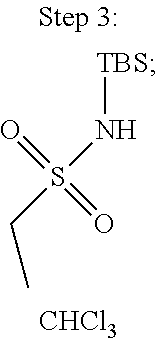 |
408.3 (M + H) |
| 222 |
 |
 |
 |
 |
372.1 (M + H) |
| 223 |
 |
 |
 |
 |
348.2 (M + H) |
| 224 |
 |
 |
 |
 |
394.1 (M + H) |
| 225 |
 |
 |
 |
 |
436.1 (M + H) |
| 226 |
 |
 |
 |
 |
400.1 (M + H) |


| TABLE 10 | ||||
| MS | ||||
| Cmpd | Structure | Aryl Halide | Boronate | (m/z) |
| 37 |
 |
 |
 |
399.0 (M + H) |
| 52 |
 |
 |
 |
368.1 (M + H) |
| 162 |
 |
 |
 |
342.0 (M + H) |
| 163 |
 |
 |
 |
369.1 (M + H) |


| TABLE 11 | ||||
| MS | ||||
| Cmpd | Structure | Aryl Halide | Alcohol | (m/z) |
| 229 |
 |
 |
 |
354.1 (M + H) |
| 230 |
 |
 |
 |
354.1 (M + H) |

| TABLE 12 | |||||
| MS | |||||
| Cmpd | Structure | Chloro Compound | Amine | Conditions | (m/z) |
| 180 |
 |
 |
 |
iPr2NEt, nBuOH 140° C. | 334.1 (M + H) |
| 181 |
 |
 |
 |
iPr2NEt, nBuOH 90° C. | 405.1 (M + H) |
| 182 |
 |
 |
 |
Cs2CO3, DMSO, 80° C. | 335.1 (M + H) |
| 183 |
 |
 |
 |
iPr2NEt, nBuOH 20° C. | 353.2 (M + H) |
| 184 |
 |
 |
 |
iPr2NEt, nBuOH 140° C. | 364.2 (M + H) |
| 185 |
 |
 |
 |
iPr2NEt, iPrOH 20° C. | 351.2 (M + H) |
| 186 |
 |
 |
 |
iPr2NEt, nBuOH 140° C. | 376.1 (M + H) |
| 187 |
 |
 |
 |
iPr2NEt, iPrOH 15° C. | 349.1 (M + H) |
| 188 |
 |
 |
 |
iPr2NEt, iPrOH 120° C. | 377.2 (M + H) |
| 189 |
 |
 |
 |
iPr2NEt, iPrOH 120° C. | 385.1 (M + H) |
| 190 |
 |
 |
 |
iPr2NEt, iPrOH 90° C. | 361.2 (M + H) |
| 191 |
 |
 |
 |
iPr2NEt, iPrOH 40° C. | 391.1 (M + H) |
| 192 |
 |
 |
 |
iPr2NEt, nBuOH 160° C. | 360.1 (M + H) |
| 193 |
 |
 |
 |
iPr2NEt, iPrOH 40° C. | 377.2 (M + H) |
| 194 |
 |
 |
 |
iPr2NEt, iPrOH, 20° C. | 377.1 (M + H) |
| 195 |
 |
 |
 |
iPr2NEt, iPrOH, 20° C. | 365.1 (M + H) |


| TABLE 13 | ||||
| MS | ||||
| Cmpd | Structure | Aryl Halide | Alcohol | (m/z) |
| 238 |
 |
 |
 |
321.0 (M + H) |
| 239 |
 |
 |
 |
321.1 (M + H) |


| TABLE 14 | ||||
| MS | ||||
| Cmpd | Structure | Aryl Hydroxide | Alcohol | (m/z) |
| 243 |
 |
 |
 |
335.0 (M + H) |
| 244 |
 |
 |
 |
387.2 (M + H) |
| 245 |
 |
 |
 |
357.1 (M + H) |

| TABLE 15 |
| SFC Separation Conditions |
| Conditions (column & polar | |||||
| Compound | co-solvent system) | First | ee % | Second | ee % |
| 1 | Phenomenex-Cellulose-2 | 1S | >99 | 1R | >99 |
| (250 mm*30 mm,10 μm) | |||||
| 55% [0.1% NH3/H2O in MeOH] | |||||
| 44 | Chiralpak (250 × 30 mm, 5 μm) | 44a | >99 | 44b | >99 |
| 40% [0.1% NH3/H2O in EtOH] | |||||
| 54 | Chiralpak AS (250 × 30 mm, 10 μm) | 54a | >99 | 54b | 99 |
| 40% [0.1% NH3/H2O in EtOH] | |||||
| 55 | Chiralpak IC (250 × 30 mm, 10 μm) | 55a | 99 | 55b | 98 |
| 57% [0.1% NH3/H2O in MeOH] | |||||
| 60 | Chiralpak IC (250 × 20 mm, 5 μm) | 60a | >99 | 60b | 99 |
| 50% [20 mM NH3 in MeOH] | |||||
| 75 | Chiralpak AS-3 (50 × 4.6 mm, 3 μm) | 75a | >99 | 75b | 99 |
| 35% [0.1% NH3/H2O in EtOH] | |||||
| 80 | Phenomenex-Cellulose-2 | 80a | >99 | 80b | 99 |
| (250 mm*50 mm,10 μm) | |||||
| 55% [0.1% NH3/H2O in MeOH] | |||||
| 103 | Chiralpak OD (250 × 30 mm, 10 μm) | 103a | >99 | 103b | >99 |
| 50% (0.1% NH3/H2O in iPrOH) | |||||
| 114 | Chiralcel OD (250 × 30 mm, 10 μm); | 114a | >99 | 114b | >99 |
| 43% [0.1% NH3/H2O iPrOH] | |||||
| 133 | Chiralpak AS (250 × 30 mm, 10 μm) | 133a | >99 | 133b | 95 |
| 45% [0.1% NH3/H2O in iPrOH] | |||||
| 141 | Chiralpak IC (250 × 30 mm, 10 μm) | 141a | 98 | 141b | 99 |
| 60% [0.1% NH3/H2O in iPrOH] | |||||
| 146 | Chiralpak AD (250 × 30 mm, 10 μm); | 146a | >99 | 146b | >99 |
| 60% [0.1% NH3/H2O in MeOH] | |||||
| 160 | Regis (S,S) Whelk-O1 (250 × 30 mm, 5 μm) | 160a | >99 | 160b | 98.5 |
| 62.5% [0.1% NH3/H2O in EtOH] | |||||
| 161 | Regis (S,S) Whelk-O1 (250 × 30 mm, 5 μm) | 161a | 83 | 161b | 90 |
| 45% [0.1% NH3/H2O in MeOH] | |||||
| 169 | Chiralpak AS (250 × 30 mm, 10 μm) | 169a | >99 | 169b | >99 |
| 45% [0.1% NH3/H2O in iPrOH] | |||||
| 175 | Chiralpak AS (250 × 30 mm, 10 μm) | 175a | >99 | 175b | >99 |
| 52% [0.1% in iPrOH] | |||||
| 177 | Chiralpak AD (250 × 30 mm, 10 μm); | 177a | >99 | 177b | 99.0 |
| 55% [0.1% NH3/H2O in EtOH] | |||||
| 178 | Chiralpak AD (250 × 30 mm, 10 μm); | 178a | >99 | 178b | 98 |
| 50% [0.1% NH3/H2O in MeOH] | |||||
| 179 | Phenomenex-Cellulose-2 | 179a | >99 | 179b | >99 |
| (250 mm*50 mm, 10 μm) | |||||
| 60% [0.1% NH3/H2O in MeOH] | |||||
| 183 | Chiralpak AD (250 × 30 mm, 10 μm); | 183a | >99 | 183b | >99 |
| 65% [0.1% NH3/H2O in EtOH] | |||||
| 184 | Phenomenex-Cellulose-2 | 184a | >99 | 184b | 97 |
| (250 mm*50 mm, 10 μm) | |||||
| 60% [0.1% NH3/H2O in MeOH] | |||||
| 185 | Chiralpak AD (250 × 30 mm, 10 μm); | 185a | >99 | 185b | >99 |
| 60% [0.1% NH3/H2O in EtOH] | |||||
| 189 | Chiralpak AD (250 × 30 mm, 10 μm); | 189a | >99 | 189b | 98.9 |
| 35% EtOH | |||||
| 193 | Phenomenex-Cellulose-2 | 193a | >99 | 193b | 98.6 |
| (250 mm*50 mm,10 μm) 60% EtOH | |||||
| 195 | Chiralpak AD (250 × 30 mm, 10 μm); | 195a | >99 | 195b | 98.7 |
| 63% [0.1% NH3/H2O in EtOH] | |||||
| 198 | Chiralpak AD (250 × 30 mm, 10 μm); | 198a | 99 | 198b | 98 |
| 46% [0.1% NH3/H2O in MeOH] | |||||
| 205 | Chiralpak AS (250 × 30 mm, 10 μm) | 205a | >99 | 205b | >99 |
| 25% [0.1% in iPrOH] | |||||
| 208 | Chiralpak AD (250 × 30 mm, 10 μm); | 208a | >99 | 208b | 97.9 |
| 46% [0.1% NH3/H2O in EtOH] | |||||
| 211 | Chiralpak AS (250 × 30 mm, 10 μm) | 211a | >99 | 211b | >99 |
| 40% [0.1% in MeOH] | |||||
| 218 | Regis (S,S) Whelk-O1 (250 × 30 mm, 5 μm) | 218a | >99 | 218b | >99 |
| 50% [0.1% NH3/H2O in EtOH] | |||||
| 219 | Phenomenex-Cellulose-2 | 219a | >99 | 219b | 95.4 |
| (250 mm*50 mm, 10 μm) | |||||
| 50% [0.1% NH3/H2O in EtOH] | |||||
| 222 | Chiralpak AS (250 × 30 mm, 10 μm) | 222a | >99 | 222b | 96.9 |
| 35% [0.1% NH3/H2O in EtOH] | |||||
| 223 | Chiralpak IG (250 × 30 mm, 10 μm); | 223a | >99 | 223b | >99 |
| 60% [0.1% NH3/H2O in EtOH] | |||||
| 229 | Chiralpak AD (250 × 30 mm, 10 μm); | 229a | >99 (de) | 229b | >99 (de) |
| 42% [0.1% NH3/H2O in iPrOH] | |||||
| 230 | Chiralpak IG (250 × 30 mm, 10 μm); | 230a | >99 | 230b | >99 |
| 50% [0.1% NH3/H2O in MeOH] | |||||
| 237 | Chiralpak AD (250 × 30 mm, 10 μm); | 237a | >99 | 237a | >99 |
| 55% [0.1% NH3/H2O in EtOH] | |||||
| 238 | Chiralpak AD (250 × 30 mm, 10 μm); | 238a | >99 | 238b | >99 |
| 60% [0.1% NH3/H2O in MeOH] | |||||
| 239 | Chiralpak IG (250 × 30 mm, 10 μm); | 239a | >99 | 239b | 97.3 |
| 60% [0.1% NH3/H2O in MeOH] | |||||
| TABLE 16 |
| 1H NMR data for examples at 400 MHz |
| Compound | Solvent | δ ppm |
| 1 | DMSO-d6 | 8.56 (d, J = 5.1 Hz, 1H), 8.02 (d, J = 8.6 Hz, 2H), 7.45-7.40 (m, |
| 4H), 6.69 (d, J = 5.1 Hz, 1H), 4.28 (s, 1H), 3.95 (s, 3H), 3.90 (s, | ||
| 3H), 3.10 (s, 3H) | ||
| 6 | DMSO-d6 | 8.88 (d, J = 4.4 Hz, 1H), 7.80 (dd, J = 33.4, 9.1 Hz, 1H), 7.47 (d, J = |
| 28.7 Hz, 1H), 7.47 (d, J = 2.6 Hz, 1H), 7.31 (dd, J = 9.1, 2.6 Hz, | ||
| 1H), 4.55-4.14 (m, 1H), 3.94 (s, 3H), 4.07-3.70 (m, 2H), 3.45 (s, | ||
| 2H), 3.28 (d, J = 19.1 Hz, 2H), 3.18-2.92 (m, 1H), 2.91-2.73 (m, | ||
| 1H). | ||
| 8 | CDCl3 | 8.67 (s, 1H), 7.24 (s, 1H), 7.09 (s, 1H), 4.20 (br d, 13.2 Hz, 2H), |
| 4.03 (s, 3H), 4.00 (s, 3H), 3.22-3.13 (m, 2H), 3.12-3.03 (m, 2H), | ||
| 3.02 (s, 3H), 2.62 (br s, 1H), 2.00-1.86 (m, 4H), 1.77 (br s, 1H), | ||
| 1.59-1.48 (m, 2H) | ||
| 10 | CDCl3 | 8.76 (d, J = 5.2 Hz, 1H), 8.07-7.98 (m, 2H), 7.48 (d, J = 2.8 Hz, |
| 1H), 7.26-7.22 (m, 1H), 7.08-7.03 (m, 1H), 7.27-7.21 (m, 1H), 6.73 | ||
| (d, J = 5.2 Hz, 1H), 3.99 (s, 3H), 3.30 (s, 3H), 3.02 (br s, 1H) | ||
| 12 | DMSO-d6 | 8.68 (d, J = 5.13 Hz, 1H), 8.19 (d, J = 9.13 Hz, 1H), 8.01 (br d, J = |
| 10.13 Hz, 1H), 7.87 (br d, J = 8.38 Hz, 1H), 7.65 (t, J = 8.07 Hz, | ||
| 1H), 7.46 (d, J = 2.00 Hz, 1H), 7.33 (dd, J = 9.13, 2.13Hz, 1H), | ||
| 6.63 (d, J = 5.13 Hz, 1H), 4.45 (br s, 1H), 3.95 (s, 3H), 3.17 (s, 3H) | ||
| 18 | DMSO-d6 | 8.56 (s, 1 H), 7.99-8.06 (m, 2 H), 7.51-7.57 (m, 3 H), 7.39 (s, 1 |
| H), 4.28 (s, 1 H), 3.97 (d, J = 6.62 Hz, 6 H), 3.12 (s, 3 H) | ||
| 22 | DMSO-d6 | 8.91 (s, 1H), 8.54 (d, J = 8.6 Hz, 1H), 8.28 (d, J = 8.2 Hz, 1H), 8.10- |
| 8.02 (m, 3H), 7.96 (ddd, J = 8.1, 7.0, 1.2 Hz, 1H), 7.58-7.51 (m, | ||
| 2H), 4.32 (s, 1H), 3.13 (s, 3H) | ||
| 26 | DMSO-d6 | δ 8.72 (d, J = 4.5 Hz, 1H), 7.95 (d, J = 9.2 Hz, 1H), 7.39 (d, J = 2.6 |
| Hz, 1H), 7.24 (dd, J = 9.3, 2.6 Hz, 1H), 7.21 (d, J = 4.6 Hz, 1H), | ||
| 4.36-4.23 (m, 2H), 4.13-4.03 (m, 2H), 3.92 (s, 3H), 3.87 (s, 1H), | ||
| 3.85-3.75 (m, 1H), 3.67-3.56 (m, 1H), 3.28-3.07 (m, 2H), 3.06- | ||
| 2.91 (m, 2H). | ||
| 43 | CDCl3 | 8.67 (s, 1H), 7.58 (d, J = 12.4 Hz, 1H), 7.47 (d, J = 8.0 Hz, 1H), |
| 4.05 (s, 3H), 3.79 (br d, J = 12.4 Hz, 2H), 3.55-3.40 (m, 2H), 3.24- | ||
| 3.13 (m, 2H), 3.05 (s, 3H), 2.05-1.93 (m, 4H), 1.85-1.75 (m, 2H), | ||
| 1.67-1.52 (m, 2H) | ||
| 44 | DMSO-d6 | 9.15 (s, 1H), 7.98-7.93 (m, 2H), 7.85-7.79 (m, 2H), 7.33-7.26 (m, |
| 2H), 4.25 (s, 1H), 4.09 (s, 3H), 3.07 (s, 3H) | ||
| 47 | DMSO-d6 | 9.06 (s, 1H), 8.15 (d, J = 9.3 Hz, 1H), 7.96 (d, J = 8.3 Hz, 2H), 7.68 |
| (dd, J = 9.3, 2.9 Hz, 1H), 7.33 (d, J = 8.4 Hz, 2H), 7.26 (d, J = 2.9 | ||
| Hz, 1H), 4.28 (s, 1H), 3.82 (s, 3H), 3.08 (s, 3H). | ||
| 50 | DMSO-d6 | 9.16 (s, 1H), 8.14 (d, J = 8.7 Hz, IH), 7.99-7.92 (sym. m, 2H), |
| 7.89 (dd, J = 8.6, 2.0 Hz, 1H), 7.84 (s, 1H), 7.35-7.26 (sym. m, | ||
| 2H), 4.27 (s, 1H), 3.08 (s, 3H), 2.51 (s, 3H) | ||
| 53 | DMSO-d6 | 8.60 (d, J = 5.2 Hz, 1 H), 8.16 (s, 1 H), 7.89 (d, J = 9.2 Hz, 1 H), |
| 7.31 (d, J = 2.4 Hz, 1 H), 7.17-7.19 (dd, J = 9.2, 2.4 Hz, 1 H), 6.84 | ||
| (d, J = 5.2 Hz, 1 H), 3.90 (s, 3 H), 3.54-3.63 (m, 4 H), 3.09 (m, 3 | ||
| H), 2.89 (s, 4 H), 1.95-1.98 (m, 4 H) | ||
| 54 | DMSO-d6 | 8.51 (s, 1H), 8.15 (s, 1H), 7.20 (s, 1H), 7.11 (s, 1H), 3.91 (m, 6H), |
| 3.67-3.52 (m, 5H), 3.33-3.22 (m, 3H), 3.17-3.07 (m, 2H), 2.79 (s, | ||
| 3H), 1.92-1.83 (m, 2H), 1.80-1.63 (m, 4H). | ||
| 55 | DMSO-d6 | 8.59 (d, J = 5.13 Hz, 1H), 8.15 (s, 1H), 7.88 (d, J = 9.26 Hz, 1H), |
| 7.31 (d, J = 2.63 Hz, 1H), 7.17 (dd, J = 9.26, 2.63 Hz, 1H), 6.86 (d, | ||
| J = 5.13 Hz, 1H), 3.89 (s, 3H), 3.35-3.24 (m, 2H), 3.19-3.06(m, | ||
| 6H), 2.80 (s, 3H), 1.87-1.72 (m, 6H) | ||
| 57 | DMSO-d6 | 8.56 (s, 1H), 7.60-7.62 (m, 1H), 7.51-7.55 (m, 1H), 7.26-7.28 (m, |
| 1H), 4.02 (s, 3H), 3.90-3.93 (m, 2H), 3.45-3.51 (m, 2H), 3.27-3.29 | ||
| (m, 2H), 3.04 (s, 3H), 1.92-1.97 (m, 4 H), 1.80-1.90 (m, 1H), 1.59- | ||
| 1.61 (m, 1H)) | ||
| 58 | DMSO-d6 | 9.17 (s, 1H), 7.94 (d, J = 8.8 Hz, 2H), 7.68 (t, J = 8.1 Hz, 1H), 7.49 |
| (t, J = 8.7 Hz, 2H), 7.29 (d, J = 8.9 Hz, 2H), 4.26 (s, 1H), 4.03 (s, | ||
| 3H), 3.07 (s, 3H) | ||
| 60 | DMSO-d6 | 8.71 (d, J = 5.2 Hz, 1H), 8.12 (d, J = 9.1 Hz, 1H), 8.02-7.95 (m, |
| 2H), 7.45 (d, J = 2.5 Hz, 1H), 7.45-7.38 (m, 2H), 7.30 (dd, J = | ||
| 9.2, 2.6 Hz, 1H), 6.72 (d, J = 5.1 Hz, 1H), 4.28 (s, 1H), 3.94 (s, | ||
| 3H), 2.75-2.65 (m, 1H), 1.17-1.09 (m, 1H), 1.03-0.87 (m, 3H) | ||
| 69 | CDCl3 | 7.38 (d, J = 2.4 Hz, 1H), 7.15-7.08 (m, 1H), 6.73 (d, J = 5.2 Hz, 1H), |
| 3.95 (s, 3H), 3.61 (br d, J = 12.4 Hz, 2H), 3.24-3.13 (m, 2H), 3.03 | ||
| (s, 3H), 2.88-2.75 (m, 2H), 2.63 (br s, 1H), 2.04-1.82 (m, 4H), | ||
| 1.65-1.58 (br s, 3H) | ||
| 72 | CDCl3 | 8.78 (s, 1H), 7.47-7.33 (m, 2H), 7.11 (d, J = 7.2 Hz, 1H), 4.35 (br d, |
| J = 13.2 Hz, 2H), 4.06 (s, 3H), 3.21-3.05 (m, 4H), 3.02 (s, 3H), 2.62 | ||
| (br s, 1H), 1.98-1.85 (m, 4H), 1.85-1.72 (m, 1H), 1.57-1.46 (m, 2H) | ||
| 74 | DMSO-d6 | 9.97-10.00 (brs, 1H), 8.62 (d, J = 5.6 Hz 1H), 8.39 (d, J = 7.6 Hz, |
| 1H), 7.90 (d, J = 8.4 Hz, 2H), 7.61 (d, J = 8.4 Hz, 2H), 7.33-7.37 | ||
| (m, 2H), 6.64 (d, J = 7.2 Hz, 1H), 4.83-4.86 (m, 2H), 4.21 (brs, | ||
| 1H), 3.92 (s, 3H), 3.02 (s, 3H) | ||
| 75 | DMSO-d6 | 8.69 (d, J = 5.25 Hz, 1 H) 8.14 (d, J = 9.13 Hz, 1 H) 8.01 (s, 1 H) 7.99 |
| (s, 1 H) 7.79 (s, 1 H) 7.77 (s, 1 H) 7.36 (d, J = 2.50 Hz, 1 H) 7.24 | ||
| (dd, J = 9.07, 2.56 Hz, 1 H) 7.02 (d, J = 5.38 Hz, 1 H) 5.52 (s, 2 H) | ||
| 3.93 (s, 3 H) 3.10 (s, 3 H). | ||
| 76 | DMSO-d6 | 8.84 (d, J = 5.0 Hz, 1H), 8.71 (d, J = 2.8 Hz, 1H), 8.01-7.94 (m, |
| 2H), 7.84 (d, J = 2.8 Hz, 1H), 7.36-7.29 (m, 2H), 7.07 (d, J = 5.1 | ||
| Hz, 1H), 4.24 (s, 1H), 4.00 (s, 3H), 3.09 (s, 3H). | ||
| 77 | DMSO-d6 | 9.42 (s, 1H), 8.82 (d, J = 5.2 Hz, 1H), 8.11-8.04 (m, 2H), 7.60- |
| 7.52 (m, 2H), 7.26 (s, 1H), 6.61 (d, J = 5.2 Hz, 1H), 4.33 (br, 1H), | ||
| 4.02 (s, 3H), 3.13 (s, 3H) | ||
| 79 | DMSO-d6 | 2.81 (s, 3 H) 3.67 (s, 1 H) 3.93 (s, 3 H) 4.43 (d, J = 3.31 Hz, 2 H) |
| 6.53 (d, J = 5.29 Hz, 1 H) 7.26-7.32 (m, 3 H) 7.41 (d, J = 2.43 Hz, 1 | ||
| H) 7.57 (d, J = 8.60 Hz, 2 H) 8.18 (d, J = 9.04 Hz, 1 H) 8.62 (d, | ||
| J = 5.07 Hz, 1 H) | ||
| 80 | DMSO-d6 | 8.69 (d, J = 5.07 Hz, 1 H), 8.10 (d, J = 9.04 Hz, 1 H), 7.98-8.04 |
| (m, 2 H), 7.37-7.49 (m, 3 H), 7.29 (dd, J = 9.15, 2.54 Hz, 1 H), | ||
| 6.69 (d, J =5.29 Hz, 1 H), 4.25 (s, 1 H), 3.93 (s, 3 H), 3.09 (s, 3 H) | ||
| 84 | DMSO-d6 | 8.71 (s, 1 H) 8.03-8.09 (m, 2 H) 7.91 (dd, J = 8.25, 1.00 Hz, 1 H) |
| 7.73 (t, J = 8.13 Hz, 1 H) 7.57-7.64 (m, 1 H) 7.57-7.65 (m, 1 H) | ||
| 7.53 (dd, J = 7.88, 0.75 Hz, 1 H) 4.30 (s, 1 H) 4.01 (s, 3 H) 3.14- | ||
| 3.15 (m, 1 H) 3.15 (d, J = 0.75 Hz, 2 H) | ||
| 88 | DMSO-d6 | 8.86 (d, J = 4.5 Hz, 1H), 7.78 (d, J = 9.2 Hz, 1H), 7.66-7.59 (m, |
| 2H), 7.59-7.52 (m, 2H), 7.48 (d, J = 2.6 Hz, 1H), 7.32 (d, J = 4.5 | ||
| Hz, 1H), 7.26 (dd, J = 9.2, 2.6 Hz, 1H), 4.57-4.42 (m, 2H), 3.94 | ||
| (s, 3H), 3.73 (s, 1H), 2.86 (s, 3H) | ||
| 98 | DMSO-d6 | 8.84 (d, J = 4.52 Hz, 1H), 7.76 (d, J = 9.29 Hz, 1H), 7.52-7.43(m, |
| 5H), 7.30-7.21(m, 2H), 3.94 (s, 3H), 3.76 (s, 1H), 3.46-3.39(m, | ||
| 2H), 3.17-3.09 (m, 2H), 2.95 (s, 3H) | ||
| 101 | DMSO-d6 | 8.75 (d, J = 2.7 Hz, 1H), 8.72 (d, J = 5.1 Hz, 1H), 8.17 (dd, J = 8.9, |
| 4.1 Hz, 2H), 7.96 (dd, J = 8.6, 2.7 Hz, 1H), 7.47 (d, J = 2.5 Hz, | ||
| 1H), 7.33 (dd, J = 9.2, 2.5 Hz, 1H), 6.77 (d, J = 5.2 Hz, 1H), 4.50 | ||
| (s, 1H), 3.95 (s, 3H), 3.20 (s, 3H) | ||
| 103 | DMSO-d6 | 8.71 (d, J = 5.2 Hz, 1H), 8.12 (d, J = 9.2 Hz, 1H), 7.97 (d, J = 8.8 Hz, |
| 2H), 7.50-7.39 (m, 3H), 7.32-7.24 (m, 1H), 6.71 (d, J = 5.2 Hz, 1H), | ||
| 4.23 (s, 1H), 3.94 (s, 3H), 3.22-3.10 (m, 2H), 1.18-1.03 (m, 3H) | ||
| 107a | DMSO-d6 | 9.05 (br d, J = 6.36 Hz, 1 H) 8.22-8.32 (m, 1 H) 7.30-7.63 (m, 3 |
| H) 4.42 (br d, J = 6.14 Hz, 2 H) 3.99 (s, 3 H) 3.75 (br s, 3 H) 3.16 | ||
| (brs, 1 H) 2.36 (br d, J = 14.69 Hz, 2 H) 2.24-2.48 (m, 1 H) 1.90 | ||
| (brd, J = 12.93 Hz, 2H) | ||
| 107b | acetone-d6 | 8.94-9.08 (m, 1 H) 8.32-8.43 (m, 1 H) 8.00 (d, J = 2.19 Hz, 1 H) |
| 7.40-7.52 (m, 2 H) 4.64-4.70 (m, 2 H) 4.04 (br d, J = 3.29 Hz, 3 | ||
| H) 3.56-3.81 (m, 4 H) 3.24-3.35 (m, 1 H) 2.50-2.71 (m, 3 H) | ||
| 2.13-2.28 (m, 2 H) | ||
| 114 | DMSO-d6 | 8.70 (d, J = 5.26 Hz, 1 H) 8.02-8.04 (m, 2 H) 7.94 (d, J = 11.84 Hz, |
| 1 H) 7.66 (d, J = 8.11 Hz, 1 H) 7.43-7.46 (m, 2 H) 6.75 (d, J = 5.26 | ||
| Hz, 1 H) 4.29 (br s, 1 H) 4.03 (s, 3 H) 3.11 (s, 3 H) | ||
| 115 | CDCl3 | 8.64 (d, J = 5.2 Hz, 1H), 8.06-7.99 (m, 1H), 7.48 (s, 1H), 7.34 (s, |
| 1H), 7.07 (br d, J = 8.8 Hz, 1H), 7.03-7.00 (m, 1H), 6.74 (d, J = 5.2 | ||
| Hz, 1H), 4.07 (s, 3H), 4.01 (s, 3H), 3.31 (s, 3H), 3.02 (br s, 1H) | ||
| 116 | DMSO-d6 | 8.54 (d, J = 5.3 Hz, 1H), 8.01 (dd, J = 2.1, 10.1 Hz, 1H), 7.86 (dd, J = |
| 1.2, 8.4 Hz, 1H), 7.63 (t, J = 8.2 Hz, 1H), 7.49 (s, 1H), 7.44 (s, | ||
| 1H), 6.62 (d, J = 5.1 Hz, 1H), 4.46 (s, 1H), 3.94 (d, J = 9.7 Hz, 6H), | ||
| 3.16 (s, 3H) | ||
| 125 | DMSO-d6 | 3.12 (s, 3 H) 4.28 (s, 1 H) 6.86 (d, J = 5.04 Hz, 1 H) 7.47 (d, J = 8.55 |
| Hz, 2 H) 7.68 (s, 1 H) 7.86 (br d, J = 1.32 Hz, 1 H) 8.04 (d, J = 8.77 | ||
| Hz, 2 H) 8.08 (d, J = 8.55 Hz, 1 H) 8.24 (d, J = 8.11 Hz, 1 H) 8.79 (d, | ||
| J = 5.04 Hz, 1 H) | ||
| 126 | DMSO-d6 | 8.73 (d, J = 5.13 Hz, 1 H) 8.26 (s, 1 H) 8.01-8.07 (m, 2 H) 7.62 (s, |
| 1 H) 7.44-7.50 (m, 2 H) 6.72 (d, J = 5.25 Hz, 1 H) 4.29 (s, 1 H) | ||
| 4.25-4.32 (m, 1 H) 4.05 (s, 2 H) 4.01-4.08 (m, 1 H) 3.12 (s, 2 H) | ||
| 3.08 -3.15 (m, 1 H) 2.50 (dt, J = 3.63, 1.81 Hz, 74 H) | ||
| 127 | DMSO-d6 | 8.71 (s, 1 H) 8.05 (d, J = 8.76 Hz, 2 H) 7.81 (s, 1 H) 7.48 (d, J = 8.76 |
| Hz, 2 H) 7.39 (s, 1 H) 4.28 (s, 1 H) 4.06 (s, 3 H) 3.98 (s, 3 H) 3.12 | ||
| (s, 3 H) | ||
| 128 | DMSO-d6 | 3.12 (d, J = 0.75 Hz, 3 H) 4.04 (s, 3 H) 4.29 (s, 1 H) 6.75 (d, J = 5.00 |
| Hz, 1 H) 7.48 (d, J = 8.76 Hz, 2 H) 7.70 (br d, J = 1.38 Hz, 1 H) 8.02- | ||
| 8.08 (m, 3 H) 8.76 (d, J = 5.00 Hz, 1 H) | ||
| 129 | DMSO-d6 | 8.74 (d, J = 2.7 Hz, 1H), 8.58 (d, J = 5.1 Hz, 1H), 8.17 (d, J = 8.6 |
| Hz, 1H), 7.94 (dd, J = 8.6, 2.7 Hz, 1H), 7.46 (d, J = 5.0 Hz, 2H), | ||
| 6.78 (d, J = 5.2 Hz, 1H), 4.49 (s, 1H), 3.96 (s, 3H), 3.92 (s, 3H), | ||
| 3.19 (s, 3H) | ||
| 130 | DMSO-d6 | 8.76 (d, J = 5.0 Hz, 1H), 8.32 (d, J = 9.1 Hz, 1H), 7.98-7.88 (m, |
| 2H), 7.35 (d, J = 5.0 Hz, 1H), 7.29 (dd, J = 9.0, 1.3 Hz, 3H), 4.22 | ||
| (s, 1H), 3.68 (s, 3H), 3.07 (s, 3H). | ||
| 131 | DMSO-d6 | 9.32 (s, 1H), 8.10 (dd, J = 8.6, 1.2 Hz, 1H), 8.03 (td, J = 8.1, 5.4 |
| Hz, 1H), 7.96-7.88 (sym. m, 2H), 7.57 (ddd, J = 11.8, 7.9, 1.2 Hz, | ||
| 1H), 7.29-7.21 (sym. m, 2H), 4.25 (s, 1H), 3.08 (s, 3H). | ||
| 133 | DMSO-d6 | 3.10 (s, 3 H) 3.90 (s, 3 H) 4.30 (s, 1 H) 5.48 (s, 2 H) 7.01 (d, J = 5.48 |
| Hz, 1 H) 7.21 (dd, J = 9.21, 2.41 Hz, 1 H) 7.34 (d, J = 2.19 Hz, 1 H) | ||
| 7.64-7.71 (m, 1 H) 7.84 (d, J = 7.45 Hz, 1 H) 7.94 (br d, J = 7.89 Hz, | ||
| 1 H) 8.06-8.14 (m, 2 H) 8.67 (d, J = 5.26 Hz, 1 H) | ||
| 134 | DMSO-d6 | 8.68 (d, J = 5.02 Hz, 1 H), 7.99 (d, J = 8.28 Hz, 2 H), 7.67-7.84 (m, |
| 3 H), 7.49 (t, J = 8.09 Hz, 1 H), 7.20 (d, J = 7.53 Hz, 1 H), 7.15 (d, | ||
| J = 5.27 Hz, 1 H), 5.50 (s, 2 H), 4.24 (s, 1 H), 3.94 (s, 3 H), 3.08 (s, | ||
| 3 H) | ||
| 139 | CDCl3 | 8.67 (s, 1H),7.75 (d, J = 9.2 Hz, 1H), 7.21 (d, J = 2.8 Hz, 1H), 7.08- |
| 7.03 (s, 1H), 4.32 (br d, J = 13.2 Hz, 2H), 3.95 (s, 3H), 3.21-3.06 (m, | ||
| 4H), 3.02 (s, 3H), 2.61 (br s, 1H), 1.98-1.85 (m, 4H), 1.85-1.71 (m, | ||
| 1H), 1.26 (s, 2H) | ||
| 140 | CDCl3 | 8.74 (d, J = 4.8 Hz, 1H), 7.58-7.49 (m, 1H), 7.42-7.38 (m, 1H), 7.01 |
| (d, J = 7.6 Hz, 1H), 6.88 (d, J = 4.8 Hz, 1H), 4.08 (s, 3H), 3.62 (br d, | ||
| J = 12.4 Hz, 2H), 3.23-3.13 (m, 2H), 3.03 (s, 3H), 2.86-2.74 (m, 2H), | ||
| 2.63 (br s, 1H), 2.02-1.85 (m, 4H), 1.66-1.56 (m, 3H) | ||
| 146 | DMSO-d6 | 8.59 (s, 1H), 7.45 (d, J = 4.4 Hz, H), 7.27-7.29 (m, 1H), 4.19-4.22 |
| (m, 2H), 3.93 (s, 3H), 3.73 (s, 1H), 3.10-3.18 (m, 4H), 2.96 (s, 3H), | ||
| 2.29-2.30 (m, 1 H), 2.02-2.09 (m, 2H), 1.51-1.57 (m, 2H) | ||
| 149 | CDCl3 | 8.66 (d, J = 5.2 Hz, 1H), 7.98 (d, J = 7.2 Hz, 1H), 7.93 (d, J = 8.4 |
| Hz, 1H), 7.72-7.65 (m, 1H), 7.55-7.49 (m, 1H), 6.96 (d, J = 5.2 Hz, | ||
| 1H), 3.62 (br s, 1H), 3.52-3.44 (m, 2H), 3.18-3.08 (m, 2H), 2.91 (s, | ||
| 3H), 2.80-2.70 (m, 2H), 2.01-1.91 (m, 2H), 1.81-1.72 (m, 2H), | ||
| 1.67-1.46 (m, 3H) | ||
| 151 | DMSO-d6 | 8.78 (s, 1 H) 7.61 (s, 1 H) 7.05 (s, 1 H) 3.99 (s, 3 H) 3.98 (s, 3 H) |
| 3.57-3.69 (m, 3 H) 3.08-3.18 (m, 2 H) 2.86-2.96 (m, 5 H) 1.89 | ||
| (brd, J = 11.13 Hz, 2H) 1.72-1.83 (m, 2 H) 1.64 (ddd, J = 10.63, | ||
| 7.07, 3.69 Hz, 1 H) 1.44-1.58 (m, 2 H) | ||
| 153 | DMSO-d6 | 9.12 (s, 1H), 7.80 (d, J = 8.07 Hz, 2H), 7.53 (d, J = 8.19 Hz, 2H), |
| 7.44 (s, 1H), 7.33 (s, 1H), 6.12-5.99 (m, 1H), 4.01 (s, 3H), 3.84 (s, | ||
| 3H), 3.45-3.41 (m, 2H), 3.15 (br dd, J = 9.23, 3.48 Hz, 2H), 2.94 (s, | ||
| 3H). | ||
| 154 | DMSO-d6 | 9.29 (s, 1H), 7.73 (d, J = 8.16 Hz, 2H), 7.63 (quin, J = 7.81 Hz, |
| 2H), 7.54 (d, J = 8.03 Hz, 2H), 7.48 (d, J = 6.53 Hz, 1H), 4.02 (s, | ||
| 3H), 3.76 (s, 1H), 3.48-3.40(m, 2H), 3.20-3.11 (m, 2H), 2.95 (s, | ||
| 3H) | ||
| 155 | CDCl3 | 7.76 (d, J = 8.0 Hz, 2H), 7.31 (d, J = 7.8 Hz, 2H), 3.67 (s, 2H), 1.97 |
| (s, 3H), 1.34 (s, 12H). | ||
| 160 | DMSO-d6 | 8.52 (d, J = 1.75 Hz, 1 H) 7.10-7.24 (m, 2 H) 3.92 (dd, J = 7.13, 1.64 |
| Hz, 6 H) 3.50-3.71 (m, 5 H) 3.15-3.25 (m, 2 H) 2.57 (br s, 1 H) | ||
| 1.68-1.89 (m, 6 H) 0.84-1.01 (m, 4 H) | ||
| 161 | DMSO-d6 | 8.71 (d, J = 4.4 Hz, 1 H), 7.46 (s, 1 H), 7.36-7.44 (m, 3 H), 7.25 |
| (d, J = 4.4 Hz, 1 H), 7.19 (s, 1 H), 4.40-4.52 (m, 2 H), 3.96 (s, 3 | ||
| H), 3.77 (s, 4 H), 3.43-3.58 (m, 2 H), 3.01 (br t, J = 5.6 Hz, 2 H), | ||
| 2.84 (s, 3 H) | ||
| 162 | DMSO-d6 | 2.88 (s, 3 H) 3.93 (s, 3 H) 4.24 (s, 2 H) 7.24 (dd, J = 9.26, 2.75 Hz, 1 |
| H) 7.28 (d, J = 4.50 Hz, 1 H) 7.45-7.51 (m, 3 H) 7.53-7.59 (m, 2 | ||
| H) 7.76 (d, J = 9.26 Hz, 1 H) 8.84 (d, J = 4.50 Hz, 1 H) | ||
| 165 | DMSO-d6 | 1.41 (q, J = 11.21 Hz, 2 H) 1.74-2.02 (m, 5 H) 3.56 (br d, J = 12.67 |
| Hz, 4 H) 3.69 (s, 3 H) 3.91 (s, 3 H) 3.97 (br t, J = 7.84 Hz, 2 H) 4.05 | ||
| (s, 3 H) 4.73 (br s, 2 H) 7.53 (d, J = 9.54 Hz, 1 H) 7.94 (d, J = 9.54 | ||
| Hz, 1 H) 8.63 (s, 1 H) | ||
| 166 | DMSO-d6 | 8.72 (d, J = 5.26 Hz, 1H), 8.10 (d, J = 9.21 Hz, 1H), 8.05-7.98(m, |
| 2H), 7.48-7.42(m, 3H), 7.33-7.26(m, 1H), 6.74 (d, J = 5.04 Hz, | ||
| 1H), 4.77 (d, J = 3.51 Hz, 1H), 4.34-4.23(m, 3H), 4.01-3.92 (m, | ||
| 5H), 1.74 (s, 3H) | ||
| 167 | DMSO-d6 | 8.69 (s, 1 H) 8.30 (d, J = 8.94 Hz, 1 H) 8.02-8.08 (m, 2 H) 7.56- |
| 7.62 (m, 2 H) 7.43 (s, 1 H) 7.42 (d, J = 8.58 Hz, 2 H) 4.32 (s, 1 H) | ||
| 4.00 (s, 3 H) 3.15 (s, 3 H) | ||
| 168 | DMSO-d6 | 8.86 (s, 1H), 7.83-7.93 (m, 2H), 7.67 (d, J = 8.8 Hz, 1H), 7.48 (d, |
| J = 2.4 Hz, 1H), 7.17-7.28 (m, 1H), 6.97-7.06 (m, 2H), 4.15 (s, 1H), | ||
| 3.92 (s, 3H), 3.04 (s, 3H), 2.21 (s, 3H) | ||
| 169 | DMSO-d6 | 8.67 (d, J = 5.25 Hz, 1 H) 8.11 (s, 1 H) 7.93 (d, J = 7.88 Hz, 1 H) 7.79- |
| 7.87 (m, 2 H) 7.64-7.70 (m, 1 H) 7.54 (d, J = 8.25 Hz, 1 H) 7.07 | ||
| (d, J = 5.25 Hz, 1 H) 5.49 (s, 2 H) 4.29 (s, 1 H) 3.99 (s, 3 H) 3.09 (s, | ||
| 3 H) | ||
| 170 | DMSO-d6 | 8.70 (d, J = 5.38 Hz, 1 H) 8.32 (s, 1 H) 8.00 (d, J = 9.13 Hz, 1 H) 7.35 |
| (d, J = 2.50 Hz, 1 H) 7.19 (dd, J = 9.13, 2.50 Hz, 1 H)7.11 (d, J = 5.38 | ||
| Hz, 1 H) 7.08 (s, 1 H) 7.07-7.09 (m, 1 H) 5.41 (s, 2 H) 4.45 (s, 1 | ||
| H) 3.91 (s, 3 H) 3.13-3.20 (m, 3 H) | ||
| 171 | DMSO-d6 | 25° C.: 8.60 (s, 1 H) 7.30 (br d, J = 9.21 Hz, 2 H) 4.29-4.49 (m, 2 |
| H) 3.92 (br d, J = 12.28 Hz, 6 H) 3.66 (s, 1 H) 3.42 (br s, 1 H) 2.94- | ||
| 3.17 (m, 4 H) 2.05-2.25 (m, 3 H) 1.68-1.89 (m, 2 H) | ||
| 80° C.: 8.60 (s, 1 H) 7.22-7.41 (m, 2 H) 4.47 (br dd, J = 10.58, 6.39 | ||
| Hz, 2 H) 3.94 (d, J = 13.01 Hz, 6 H) 3.45 (br s, 1 H) 3.25 (br s, 1 H) | ||
| 2.96-3.09 (m, 4 H) 2.04-2.28 (m, 3 H) 1.88 (q, J = 12.57 Hz, 2 H) | ||
| 172 | DMSO-d6 | 9.08 (d, J = 2.0 Hz, 1H), 9.03 (s, 1H), 8.70 (d, J = 5.2 Hz, 1H), 8.48 |
| (s, 1H), 8.09 (d, J = 9.2 Hz, 1H), 7.35 (d, J = 2.4 Hz, 1H), 7.21 (dd, | ||
| J = 9.2, 2.4 Hz, 1H), 7.05 (d, J = 5.2 Hz, 1H), 5.54 (s, 2H), 4.60 (s, | ||
| 1H), 3.91 (s, 3H), 3.20 (s, 3H). | ||
| 173 | DMSO-d6 | 8.66 (s, 1 H) 8.13 (s, 1 H) 7.91 (d, J = 7.88 Hz, 1 H) 7.82 (d, J = 7.75 |
| Hz, 1 H) 7.65 (t, J = 7.69 Hz, 1 H) 7.40 (s, 1 H) 7.34 (s, 1 H) 5.74 (s, | ||
| 2 H) 4.27 (s, 1 H) 3.96 (s, 3 H) 3.92 (s, 3 H) 3.08 (s, 3 H) | ||
| 174 | DMSO-d6 | 8.79 (s, 1 H) 8.11 (s, 1 H) 7.93 (br d, J = 7.75 Hz, 1 H) 7.83 (br d, |
| J = 7.63 Hz, 1 H) 7.59-7.74 (m, 3 H) 7.44 (d, J = 7.75 Hz, 1 H) 5.74 | ||
| (s, 2 H) 4.27 (s, 1 H) 3.97 (s, 3 H) 3.08 (s, 3 H) | ||
| 175 | DMSO-d6 | 8.54 (d, J = 5.25 Hz, 1 H) 8.18 (s, 1 H) 7.92 (br d, J = 7.50 Hz, 1 H) |
| 7.82 (br d, J = 7.75 Hz, 1 H) 7.64-7.70 (m, 1 H) 7.43 (s, 1 H) 7.33 | ||
| (s, 1 H) 7.32-7.35 (m, 1 H) 6.99 (d, J = 5.38 Hz, 1 H) 5.50 (s, 2 H) | ||
| 4.29 (s, 1 H) 3.91 (d, J = 7.13 Hz, 6 H) 3.09 (s, 3 H) | ||
| 176 | DMSO-d6 | 8.71 (d, J = 5.2 Hz, 1H), 8.09-8.18 (m, 2H), 7.95 (d, J = 8.0 Hz, |
| 1H), 7.86 (d, J = 7.6 Hz, 1H), 7.64-7.73 (m, 1H), 7.52 (s, 1H), 7.08 | ||
| (d, J = 5.6 Hz, 1H), 5.50 (s, 2H), 4.30 (s, 1H), 4.01 (s, 3H), 3.10 (s, | ||
| 3H) | ||
| 177 | MeOD | 8.61 (d, J = 5.50 Hz, 1H), 8.21 (d, J = 9.26 Hz, 1H), 8.05 (s, 1H), |
| 7.79-7.74 (m, 1H), 7.67 (br d, J = 9.01 Hz, 1H), 7.32 (d, J = 2.50 | ||
| Hz, 1H), 7.23 (dd, J = 9.19, 2.56 Hz, 1H), 6.98(d, J = 5.50 Hz, 1H), | ||
| 5.51 (s, 2H), 3.96 (s, 3 H), 3.20 (s, 3H) | ||
| 178 | DMSO-d6 | 8.54 (dd, J = 5.38, 2.13 Hz, 1 H) 8.20 (dd, J = 9.13, 1.63 Hz, 1 H) |
| 8.07 (d, J = 7.75 Hz, 1 H) 7.86 (d, J = 8.00 Hz, 1 H) 7.78 (t, J = 6.57 | ||
| Hz, 1 H) 7.60 (td, J = 7.75, 2.75 Hz, 1 H) 7.20-7.33 (m, 2 H) 6.81 | ||
| (t, J = 5.69 Hz, 1 H) 5.98 (quin, J = 5.78 Hz, 1 H) 4.23 (s, 1 H) 3.90 | ||
| (s, 3 H) 3.00-3.08 (m, 3 H) 1.68-1.76 (m, 3 H) | ||
| 179 | DMSO-d6 | 8.69 (s, 1 H) 7.54-7.62 (m, 2 H) 7.27-7.37 (m, 1 H) 3.96 (s, 3 H) |
| 3.71-3.86 (m, 3H) 3.40-3.54 (m, 2 H) 3.17 (d, J = 6.25 Hz, 2 H) | ||
| 2.98 (s, 3 H) 2.26-2.40 (m, 1 H) 2.00-2.20 (m, 2 H) 1.56-1.73 | ||
| (m, 2H) | ||
| 180 | DMSO-d6 | 8.49 (d, J = 7.00 Hz, 1 H) 7.61-7.65 (m, 2 H) 7.53 (dd, J = 5.00, 4.00 |
| Hz, 1 H) 7.24 (d, J = 7.00 Hz, 1 H) 4.17 (br d, J = 13.13 Hz, 2 H) 4.09 | ||
| (s, 3 H) 4.04 (br d, J = 6.25 Hz, 2 H) 3.81 (s, 3 H) 3.48 (br t, J = 11.82 | ||
| Hz, 2 H) 2.60-2.70 (m, 1 H) 2.10 (br t, J = 14.63 Hz, 2 H) 1.64- | ||
| 1.77 (m, 2H) | ||
| 181 | DMSO-d6 | 8.51 (s, 1 H) 7.20 (s, 1 H) 7.07-7.16 (m, 1 H) 3.86-3.99 (m, 6 H) |
| 3.46-3.75 (m, 6 H) 2.79-2.91 (m, 3 H) 1.94-2.10 (m, 3 H) 1.56- | ||
| 1.86 (m, 7H) | ||
| 182 | DMSO-d6 | 8.96 (s, 1H), 7.69-7.62 (m, 1H), 7.45 (d, J = 8.33 Hz, 1H), 7.23 (d, |
| J = 7.67 Hz, 1H), 4.02 (s, 3H), 3.74 (s, 1H), 3.66 (br d, J = 12.28 | ||
| Hz, 2H), 3.14 (d, J = 6.36 Hz, 2H), 3.04-2.97(m, 2H), 2.96 (s, 3H), | ||
| 2.29-2.18(m, 1H), 2.15-2.00(m, 2H), 1.68-1.55 (m, 2H) | ||
| 183 | DMSO-d6 | 8.58 (s, 1 H) 7.26 (dd, J = 11.07, 2.52 Hz, 1 H) 7.11 (dd, J = 9.76, |
| 2.52 Hz, 1 H) 4.13 (br d, J = 13.37 Hz, 2 H) 3.95 (s, 3 H) 3.72 (s, 1 | ||
| H) 3.05-3.20 (m, 4 H) 2.95 (s, 3 H) 2.21-2.36 (m, 1 H) 1.93- | ||
| 2.10 (m, 2H) 1.42-1.59 (m, 2 H) | ||
| 184 | DMSO-d6 | 8.39 (d, J = 5.25 Hz, 1 H) 7.71 (d, J = 13.26 Hz, 1 H) 7.44 (d, J = 8.76 |
| Hz, 1 H) 6.25 (d, J = 5.38 Hz, 1 H) 4.44 (s, 2 H) 4.29 (s, 2 H) 4.02 | ||
| (s, 3 H) 3.43-3.68 (m, 1 H) 3.25 (dd, J = 7.00, 2.00 Hz, 2 H) 2.91 | ||
| (s, 3 H) 2.74 (br t, J = 7.88 Hz, 1 H) 2.46-2.54 (m, 2 H) 2.08-2.31 | ||
| (m, 2 H) | ||
| 185 | DMSO-d6 | 8.58 (s, 1 H), 7.42-7.48 (m, 2 H), 7.26-7.27 (m, 1 H), 5.69 (br s, 1 |
| H), 4.00 (m, 3H), 3.96 (s, 3 H), 3.55 (m, 3H), 3.26-3.30 (m, 1 H), | ||
| 3.02 (s, 3 H), 1.95-0.97 (m, 2 H), 1.88-1.89 (m, 2 H) | ||
| 186 | DMSO-d6 | 8.22 (d, J = 5.2 Hz, 1 H), 7.16 (d, J = 9.2 Hz, 2 H), 6.14 (d, J = 5.2 |
| Hz, 1 H), 4.36 (s, 2 H), 4.18 (s, 2 H), 3.86 (s, 3 H), 3.85 (s, 3 H), | ||
| 3.54 (s, 1 H), 3.17 (br d, J = 4.2 Hz, 2 H), 2.82 (s, 3 H), 2.61-2.72 | ||
| (m, 2H), 2.07-2.18 (m, 2 H) | ||
| 187 | DMSO-d6 | 8.59 (s, 1H), 7.46-7.39(m, 2H), 7.25 (dd, J = 5.94, 3.06 Hz, 1H), |
| 4.23-4.13(m, 4H), 3.71 (s, 1H), 3.19-3.07 (m, 4H), 2.95 (s, 3H), | ||
| 2.29 (br s, 1H), 2.10-1.95(m, 2H), 1.52 (br d, J = 12.13 Hz, 2H), | ||
| 1.43 (t, J = 7.00 Hz, 3H) | ||
| 188 | DMSO-d6 | 8.16 (s, 1H), 7.44 (s, 1H), 7.12 (s, 1H), 4.53 (s, 2H), 4.34 (s, 2H), |
| 3.94 (d, J = 4.65 Hz, 7H), 3.55 (s, 1H), 3.19 (dd, J = 7.03, 2.63 Hz, | ||
| 2H), 2.84 (s, 3H), 2.68 (q, J = 8.07 Hz, 2H), 2.21-2.10 (m, 2H) | ||
| 189 | DMSO-d6 | 8.67 (s, 1H), 7.53-7.56 (m, 2H), 7.29-7.32 (m, 1H), 3.94 (s, 3H), |
| 3.77-3.80 (m, 2H), 3.56 (s, 1H), 3.41-3.44 (m, 2H), 3.12 (d, J = 7.0 | ||
| Hz, 2H), 2.66-2.67 (m, 1H), 2.32-2.37 (m, 1 H), 2.06-2.15 (m, 2H), | ||
| 1.63-1.66 (m, 2H), 1.05-1.14 (m, 1H), 0.89-0.94 (m, 2H), 0.82-0.87 | ||
| (m, 1H) | ||
| 190 | DMSO-d6 | 8.58 (s, 1 H) 7.45 (d, J = 4.50 Hz, 2 H) 7.24-7.30 (m, 1 H) 4.20 (br |
| d, J = 12.88 Hz, 2 H) 3.92 (s, 3 H) 3.50 (s, 1 H) 3.15 (br t, J = 12.51 | ||
| Hz, 2 H) 3.00-3.09 (m, 2 H) 2.58-2.69 (m, 1 H) 2.34 (br d, | ||
| J = 10.63 Hz, 1 H) 1.97-2.12 (m, 2 H) 1.54 (q, J = 11.67 Hz, 2 H) | ||
| 1.01-1.09 (m, 1 H) 0.81-0.94 (m, 3 H) | ||
| 191 | DMSO-d6 | 8.57 (s, 1H), 8.14 (s, 1H), 7.39-7.50 (m, 2H), 7.25-7.28 (m, 1H), |
| 3.97-4.20 (m, 3H), 3.81 (s, 3H), 3.44-3.53 (m, 1H), 3.02-3.17 (m, | ||
| 2H), 2.33-2.47 (m, 3H), 2.12-2.30 (m, 3H), 1.97-2.07(m, 2H), 1.76- | ||
| 1.90(m, 2H), 1.59-1.68(m, 2H) | ||
| 192 | DMSO-d6 | 8.24 (d, J = 5.25 Hz, 1 H) 8.13 (d, J = 13.38 Hz, 1 H) 7.88 (d, J = 8.38 |
| Hz, 2 H) 7.79 (br t, J = 6.00 Hz, 1 H) 7.58 (d, J = 8.38 Hz, 2 H) 7.36 | ||
| (d, J = 8.76 Hz, 1 H) 6.24 (d, J = 5.38 Hz, 1 H) 4.62 (d, J = 5.88 Hz, 2 | ||
| H) 4.14 (s, 1 H) 3.95 (s, 3 H) 3.03 (s, 3 H) | ||
| 193 | DMSO-d6 | 8.58 (s, 1H), 7.50-7.40(m, 2H), 7.27 (dd, J = 7.32, 1.44 Hz, 1H), |
| 5.93 (br s, 1H), 4.06-3.95 (m, 3H), 3.92 (s, 3 H), 3.55-3.43 (m, 2H), | ||
| 3.34 (s, 1H), 3.30 (br s, 1H), 2.77-2.68 (m, 1H), 2.06-1.99(m, 2H), | ||
| 1.95-1.79(m, 2H), 1.11-1.03(m, 1H), 0.98-0.82(m, 3 H) | ||
| 194 | DMSO-d6 | 8.67 (s, 1H), 7.56-7.72 (m, 3H), 6.07 (br s, 1H), 4.70 (br s, 1H), |
| 4.42-4.55 (m, 1H), 3.89-4.23 (m, 7H), 3.59 (br s, 3H), 2.54-2.60 | ||
| (m, 1H), 2.05-2.18 (m, 1H), 0.91 (br s, 1H), 0.82 (br s, 1H), 0.53 | ||
| (br s, 1H), 0.35 (br s, 1H) | ||
| 195 | DMSO-d6 | 8.50-8.64 (m, 1 H) 7.41-7.55 (m, 2 H) 7.22-7.35 (m, 1 H) 5.76- |
| 5.90 (m, 1 H) 3.97-4.02 (m, 2 H) 3.96 (br d, J = 3.50 Hz, 1 H) 3.92 | ||
| (s, 3 H) 3.42-3.55 (m, 2 H) 3.19-3.31 (m, 2 H) 3.15-3.18 (m, 1 | ||
| H) 3.11 (qd, J = 7.34, 2.00 Hz, 2 H) 1.79-2.09 (m, 4 H) 1.19-1.30 | ||
| (m, 3 H) | ||
| 196 | DMSO-d6 | 8.59 (s, 1 H) 7.40-7.49 (m, 2 H) 7.26 (dd, J = 7.44, 1.06 Hz, 1 H) |
| 5.66 (br s, 1 H) 4.18 (q, J = 7.00 Hz, 2 H) 4.00 (br s, 2 H) 3.96 (br s, | ||
| 1 H) 3.46-3.58 (m, 2 H) 3.40-3.45 (m, 1 H) 3.27 (s, 1 H) 3.03 (s, | ||
| 3 H) 1.93-2.01 (m, 2 H) 1.84-1.93 (m, 2 H) 1.43 (t, J = 6.94 Hz, 3 | ||
| H) | ||
| 197 | DMSO-d6 | 8.69 (s, 1 H) 7.48-7.64 (m, 2 H) 7.29 (dd, J = 5.69, 3.31 Hz, 1 H) |
| 4.20 (q, J = 6.92 Hz, 2 H) 3.79 (br s, 1 H) 3.75 (br d, J = 6.88 Hz, 2 | ||
| H) 3.44 (brt, J = 12.51 Hz, 2 H) 3.32 (s, 43 H)3.29 (s, 1 H)3.15 (d, | ||
| J = 6.25 Hz, 2 H) 2.97 (s, 3 H) 2.02-2.17 (m, 2 H) 1.57-1.72 (m, 2 | ||
| H) 1.44 (t, J = 6.94 Hz, 3H) | ||
| 198 | DMSO-d6 | 1.99 (br s, 2 H), 2.03-2.12 (m, 2 H), 3.05 (s, 3 H), 3.36 (s, 1 H), |
| 3.42-3.50 (m, 1 H), 3.54-3.63 (m, 2 H), 3.65-3.77 (m, 2 H), | ||
| 3.94 (s, 3 H), 4.02 (s, 1 H), 5.72 (s, 1 H), 7.30 (t, J = 4.4 Hz, 1 H), | ||
| 7.52-7.59 (m, 2 H), 8.68 (s, 1 H) | ||
| 199 | DMSO-d6 | 8.15 (s, 1 H) 7.40-7.47 (m, 1 H) 7.32-7.39 (m, 1 H) 7.21 (d, |
| J = 7.25 Hz, 1 H) 3.95 (br s, 2 H) 3.90 (s, 3 H) 3.41-3.50 (m, 2 H) | ||
| 3.39 (s, 1 H) 3.26 (s, 2 H) 3.02 (s, 3 H) 2.52 (br s, 3 H) 1.82-2.00 | ||
| (m, 4 H) | ||
| 200 | DMSO-d6 | 8.74 (s, 1 H) 7.78 (br d, J = 8.25 Hz, 1 H) 7.52-7.66 (m, 2 H) 6.10 |
| (s, 1 H) 5.96 (s, 1 H) 3.82 (br d, J = 12.76 Hz, 2 H) 3.77 (s, 1 H) 3.48 | ||
| (br t, J = 12.38 Hz, 2 H) 3.15 (br d, J = 6.13 Hz, 2 H) 2.97 (s, 3 H) | ||
| 2.01-2.19 (m, 2H) 1.64 (q, J = 10.84 Hz, 2 H) | ||
| 201 | DMSO-d6 | 7.46-7.55 (m, 2 H) 7.24-7.29 (m, 1 H) 3.93 (s, 3 H) 3.68-3.79 |
| (m, 3 H) 3.45 (br t, J = 12.38 Hz, 2 H) 3.15 (d, J = 6.38 Hz, 2 H) 2.97 | ||
| (s, 3 H) 2.68 (s, 3 H) 2.29 (br d, J = 3.50 Hz, 1 H) 2.00-2.16 (m, 2 | ||
| H) 1.63 (q, J = 11.34 Hz, 2 H) | ||
| 202 | DMSO-d6 | 7.70 (d, J = 14 Hz, 1H), 7.25-7.26 (m, 2H), 7.02-7.04 (m, 1H), |
| 4.22-4.25 (m, 2H), 3.99 (s, 3H), 3.17-3.24 (dm, 2H), 3.02-3.07 (m, | ||
| 5H), 2.32 (m, 1 H), 2.02-2.13 (m, 2H), 1.54-1.62 (m, 2H) | ||
| 203 | DMSO-d6 | 8.63 (s, 1H), 7.19-7.35 (m, 2H), 3.91 (s, 3H), 3.65-3.81 (m, 3H), |
| 3.38-3.44 (m, 2H), 3.10 (d, J = 6.4 Hz, 2H), 2.95 (s, 3H), 2.19-2.34 | ||
| (m, 1H), 1.94-2.12 (m, 2H), 1.50-1.59 (m, 2H) | ||
| 204 | DMSO-d6 | 8.70 (d, J = 4.8 Hz, 1 H), 7.48-7.55 (m, 2 H), 7.41-7.47 (m, 3 H), |
| 7.26 (d, J = 4.8 Hz, 1 H), 7.14 (s, 1 H), 3.94 (s, 3 H), 3.74 (s, 3 H), | ||
| 3.69 (s, 1 H), 3.42 (dd, J = 9.6, 6.8 Hz, 2 H), 3.31 (s, 3 H), 3.08- | ||
| 3.16 (m, 2 H), 2.89 (s, 3 H ), 2.49 (dt, J = 3.6, 1.6 Hz, 2 H) | ||
| 205 | DMSO-d6 | 8.55-8.61 (m, 1 H) 7.55-7.61 (m, 1 H) 7.45-7.51 (m, 1 H) 6.87- |
| 6.95 (m, 1 H) 3.94-3.98 (m, 3 H) 3.59-3.67 (m, 1 H) 3.21-3.30 | ||
| (m, 2 H) 2.99-3.17 (m, 6 H) 2.75-2.81 (m, 3 H) 1.70-1.86 (m, 6 H) | ||
| 206 | DMSO-d6 | 8.33 (s, 1H), 8.15 (s, 1H), 7.21 (s, 1H), 7.13 (s, 1H), 4.23 (br s, |
| 4H), 3.89 (d, J = 2.38 Hz, 6H), 3.55 (br s, 1H), 3.21-3.08 (m, 4H), | ||
| 2.74 (s, 3H), 1.87 (br t, J = 5.21 Hz, 4 H) | ||
| 207 | DMSO-d6 | 8.32 (s, 1H) 8.16 (s, 1 H) 7.54 (s, 1H) 7.12 (s, 1 H) 4.02 (br t, |
| J = 6.88 Hz, 2 H) 3.90 (d, J = 1.50 Hz, 6 H) 3.70 (s, 2 H) 3.08-3.20 | ||
| (m, 4 H) 2.75 (s, 3 H) 1.90 (br t, J = 6.88 Hz, 2 H) 1.59-1.73 (m, 4 H) | ||
| 208 | acetone-d6 | 8.50 (d, J = 5.04 Hz, 1 H) 8.15 (s, 1 H) 7.28-7.43 (m, 2 H) 6.90 (d, |
| J = 5.04 Hz, 1 H) 3.96 (d, J = 1.75 Hz, 6 H) 3.33-3.46 (m, 2 H) 3.10- | ||
| 3.32 (m, 6 H) 2.82 (s, 3 H) 1.86-2.00 (m, 6 H) | ||
| 209 | DMSO-d6 | 8.50 (s, 1H), 7.18 (s, 1H), 7.11 (s, 1H), 3.89-3.91 (s, 6H), 3.61 (m, |
| 4H), 3.09-3.16 (m, 4H), 2.73 (s, 3H), 1.60-1.65 (m, 8H) | ||
| 210 | DMSO-d6 | 8.70 (s, 1 H) 7.76 (d, J = 12.63 Hz, 1 H) 7.57 (d, J = 8.50 Hz, 1 H) |
| 4.03 (s, 3 H) 3.66 (d, J = 1.25 Hz, 1 H) 3.53-3.63 (m, 4 H) 3.27- | ||
| 3.33 (m, 2 H) 3.15-3.22 (m, 2 H) 2.82 (d, J = 1.38 Hz, 3 H) 1.76- | ||
| 1.92 (m, 6 H) | ||
| 211 | DMSO-d6 | 8.68-8.87 (m, 1 H) 7.54-7.64 (m, 1 H) 7.02-7.09 (m, 1 H) 3.90- |
| 4.05 (m, 6 H) 3.31-3.34 (m, 2 H) 3.28 (br s, 2 H) 3.09-3.21 (m, 4 | ||
| H) 2.75-2.85 (m, 3 H) 1.69-1.91 (m, 6 H) | ||
| 212 | MeOD | 8.50 (s, 1H), 7.98 (s, 1H), 7.24 (s, 1H), 4.03 (s, 3H), 3.81-3.84 (m, |
| 4H), 3.41-3.44 (m, 2H), 3.26-3.80 (m, 2H), 2.93 (s, 3H), 1.95-1.99 | ||
| (m, 2H), 1.80-1.87 (m, 4H) | ||
| 213 | DMSO-d6 | 8.15 (s, 1 H), 8.12-8.18 (m, 1 H), 7.15 (s, 1 H), 7.09 (s, 1 H), 3.91 |
| (s, 3 H), 3.89 (s, 3 H), 3.57 (br d, J = 4.0 Hz, 4 H), 3.23-3.29 (m, 2 | ||
| H), 3.09-3.16 (m, 2 H), 2.80 (s, 3 H), 2.49 (s, 3 H), 1.85 (t, J = 6.8 | ||
| Hz, 2H), 1.68-1.80 (m, 4 H) | ||
| 214 | DMSO-d6 | 8.60 (s, 1 H) 7.42-7.53 (m, 2 H) 7.28 (dd, J = 6.25, 2.74 Hz, 1 H) |
| 4.15-4.28 (m, 2 H) 3.92 (s, 3 H) 3.76 (t, J = 7.34 Hz, 2 H) 3.50- | ||
| 3.54 (m, 1 H) 2.99-3.12 (m, 2 H) 2.86 (s, 3 H) 1.98-2.28 (m, 6 H) | ||
| 215 | DMSO-d6 | 8.58 (s, 1 H) 8.15 (s, 1 H) 7.42-7.49 (m, 2 H) 7.27 (dd, J = 7.02, |
| 1.97 Hz, 1 H) 3.92 (s, 3 H) 3.63-3.71 (m, 4 H) 3.28 (br d, J = 7.02 | ||
| Hz, 2 H) 3.08-3.18 (m, 2 H) 2.80 (s, 3 H) 1.65-1.87 (m, 6 H) | ||
| 216 | DMSO-d6 | 8.32 (s, 1 H), 8.14 (s, 1 H), 7.50 (s, 1 H), 7.11 (s, 1 H), 3.94-4.09 |
| (m, 2 H), 3.89 (s, 3 H), 3.88 (s, 3 H), 3.78-3.87 (m, 2 H), 3.76 (s, 1 | ||
| H), 3.28-3.38 (m, 2 H), 3.17-3.27 (m, 2 H), 2.81 (s, 3 H), 1.86- | ||
| 2.08 (m, 4 H) | ||
| 217 | DMSO-d6 | 8.46-8.53 (m, 1 H), 8.14 (s, 1 H), 7.50-7.56 (m, 1 H), 7.47 (t, J = |
| 8.0 Hz, 1 H), 7.36 (d, J = 7.6 Hz, 1 H), 4.50 (br s, 4 H), 3.90-3.98 | ||
| (m, 4 H), 3.42-3.53 (m, 2 H), 3.28 (br d, J = 5.6 Hz, 2 H), 2.83 (s, | ||
| 3 H), 2.20 (t, J = 6.8 Hz, 2 H) | ||
| 218 | DMSO-d6 | 8.62 (d, J = 6.8 Hz, 1 H), 7.87 (d, J = 12.4 Hz, 1 H), 7.79 (d, J = 8.0 |
| Hz, 1 H), 7.15 (d, J = 7.2 Hz, 1 H), 4.04 (s, 3 H), 3.77 (br s, 3 H), | ||
| 3.61-3.71 (m, 3 H), 3.45-3.51 (m, 2 H), 3.38-3.45 (m, 1 H), | ||
| 2.52-2.54 (m, 1 H), 2.03 (t, J = 7.2 Hz, 2 H), 1.78-1.92 (m, 4 H), | ||
| 1.38-1.47 (m, 1 H), 1.32-1.37 (m, 2 H), 1.23-1.32 (m, 1 H) | ||
| 219 | DMSO-d6 | 8.91 (s, 1 H) 7.97 (s, 1 H) 7.80 (s, 1 H) 4.08 (s, 3 H) 3.60-3.65 (m, |
| 1 H) 3.35-3.43 (m, 4 H) 3.25-3.31 (m, 2 H) 3.15 (d, J = 4.13 Hz, 2 | ||
| H) 2.81 (d, J = 1.50 Hz, 3 H) 1.74-1.92 (m, 6 H) | ||
| 220 | DMSO-d6 | 8.13-8.20 (m, 1 H) 7.75-7.86 (m, 1 H) 4.06 (s, 3 H) 3.62-3.67 |
| (m, 1 H) 3.30 (br d, J = 7.25 Hz, 6 H) 3.16-3.24 (m, 2 H) 2.78- | ||
| 2.86 (m, 6H) 1.89 (t, J = 7.00 Hz, 2 H) 1.70-1.83 (m, 4 H) | ||
| 221 | DMSO-d6 | 1.37 (t, J = 7.2 Hz, 3 H), 1.73-1.89 (m, 4 H), 1.96-2.06 (m, 2 H), |
| 3.40-3.49 (m, 2 H), 3.60 (br t, J = 6.8 Hz, 2 H), 3.79-3.88 (m, 2 | ||
| H), 4.04 (s, 3 H), 4.06-4.19 (m, 4 H), 7.66 (d, J = 7.8 Hz, 1 H), | ||
| 7.97 (d, J = 12.2 Hz, 1 H), 8.82 (s, 1 H) | ||
| 222 | DMSO-d6 | 2.21 (br t, J = 6.8 Hz, 2 H), 2.81 (s, 3 H), 3.23-3.29 (m, 2 H), 3.47 |
| (br d, J = 9.2 Hz, 2 H), 3.90 (s, 3 H), 4.68-4.83 (m, 4 H), 7.25 (d, J = | ||
| 7.8 Hz, 1 H), 7.39 (t, J = 8.0 Hz, 1 H), 7.62 (d, J = 8.0 Hz, 1 H), | ||
| 8.25 (s, 1 H), 8.41 (s, 1 H) | ||
| 223 | DMSO-d6 | 8.43 (s, 1 H) 7.78 (d, J = 8.50 Hz, 1 H) 7.39 (t, J = 8.19 Hz, 1 H) 7.26 |
| (d, J = 7.88 Hz, 1 H) 4.02 (s, 2 H) 3.71 (d, J = 8.13 Hz, 2 H) 3.57 (br | ||
| s, 1 H) 2.89 (s, 3 H) 2.18 (br t, J = 6.69 Hz, 2 H) | ||
| 224 | DMSO-d6 | 1.62-1.77 (m, 4 H), 1.82 (t, J = 6.8 Hz, 2 H), 2.80 (s, 3 H), 3.06- |
| 3.15 (m, 2 H), 3.21-3.34 (m, 2 H), 3.56-3.70 (m, 4 H), 3.99 (s, 3 | ||
| H), 7.38 (d, J = 8.4 Hz, 1 H), 7.66 (d, J = 12.4 Hz, 1 H), 8.16 (s, 1 | ||
| H), 8.56 (s, 1 H) | ||
| 225 | DMSO-d6 | 8.74 (s, 1H), 8.28 (s, 1H), 7.34 (m, 1H), 4.09-4.20 (m, 7H), 3.73- |
| 3.83 (m, 2H), 3.58-3.65 (m, 2H), 3.32-3.38 (m, 1H), 2.20 (t, J = 7.2 | ||
| Hz, 2H), 1.95-2.11 (m, 4H), 1.34-1.62 (m, 4H) | ||
| 226 | DMSO-d6 | 8.71 (d, J = 5.13 Hz, 1 H) 8.33 (s, 1 H) 7.50 (s, 1 H) 6.96 (d, J = 5.25 |
| Hz, 1 H) 4.03 (s, 3 H) 3.63 (s, 1 H) 3.19-3.30 (m, 4 H) 3.14 (br d, | ||
| J = 4.50 Hz, 2 H) 2.81 (d, J = 1.38 Hz, 3 H) 1.75-1.89 (m, 6 H) | ||
| 227 | DMSO-d6 | 1.71-1.82 (m, 4H), 1.83-1.89 (m, 2 H), 2.81 (s, 3 H), 3.11-3.19 |
| (m, 2 H), 3.27-3.46 (m, 6 H), 3.65 (br s, 1 H), 3.91 (s, 3 H), 3.93 | ||
| (s, 3 H), 7.26 (s, 1 H), 7.33 (s, 1 H), 8.23 (s, 1 H), 8.54 (d, J = 4.4 | ||
| Hz, 1 H) | ||
| 228 | DMSO-d6 | 7.58 (s, 1H), 7.23 (s, 1H), 3.97 (d, J = 1.50 Hz, 6H), 3.62 (s, 1H), |
| 3.31-3.16(m, 8H), 2.80 (d, J = 9.63 Hz, 6H), 1.89 (br t, J = 7.00 Hz, | ||
| 2H), 1.83-1.68(m, 4H) | ||
| 229 | DMSO-d6 | 9.12 (d, J = 6.6 Hz, 1 H) 8.22 (t, J = 10.6 Hz, 1 H) 7.95 (d, J = 7.5 Hz, |
| 1 H) 7.51 (br d, J = 6.6 Hz, 1 H) 4.49-4.66 (m, 2 H) 4.07 (s, 3 H) | ||
| 3.82-3.91 (m, 1 H) 3.68 (s, 3 H) 3.49-3.65 (m, 2 H) 3.36-3.48 | ||
| (m, 1H) 2.99 (dt, J = 14.1, 7.1 Hz, 1 H) 2.21-2.35 (m, 1 H) 1.90- | ||
| 2.05 (m, 1H) | ||
| 229a | DMSO-d6 | 8.64 (d, J = 5.2 Hz, 1H), 7.80 (d, J = 12.0 Hz, 1H), 7.52 (d, J = 8.4 |
| Hz, 1H), 6.96 (d, J = 5.2 Hz, 1H), 4.14-4.28 (m, 2H), 3.99 (s, 3H), | ||
| 3.66 (br s, 1H), 3.46-3.56 (m, 1H), 3.20-3.31 (m, 2H), 3.02-3.14 | ||
| (m, 1H), 2.74-2.88 (m, 4H), 2.07-2.19 (m, 1H), 1.78-1.86 (m, 1H). | ||
| 229b | DMSO-d6 | 8.65 (d, J = 5.2 Hz, 1H), 7.80 (d, J = 12.0 Hz, 1H), 7.52 (d, J = 8.4 |
| Hz, 1H), 6.97 (d, J = 5.6 Hz, 1H), 4.14-4.30 (m, 2H), 3.99 (s, 3H), | ||
| 3.65 (s, 1H), 3.48-3.57 (m, 1H), 3.34-3.39 (m, 1H), 3.15-3.25 (m, | ||
| 1H), 3.05-3.12 (m, 1H), 2.74-2.86 (m, 4H), 2.06-2.19 (m, 1H), | ||
| 1.72-1.86 (m, 1H) | ||
| 230 | DMSO-d6 | 8.66 (d, J = 5.2 Hz, 1H), 7.81 (dd, J = 12.0, 4.4 Hz, 1H), 7.52 (d, J = |
| 8.4 Hz, 1H), 6.97 (d, J = 5.2 Hz, 1H), 4.17-4.30 (m, 2H), 4.10 br | ||
| s, 1H), 3.99 (s, 3H), 3.48-3.59 (m, 1H), 3.28-3.41 (m, 2H), 3.21- | ||
| 3.28 (m, 1H), 3.14-3.20 (m, 3H), 3.05-3.13 (m, 1H), 2.77-2.85 (m, | ||
| 4H), 2.09-2.19 (m, 1H), 1.79-1.82 (m, 1H) | ||
| 231 | DMSO-d6 | 8.82 (d, J = 4.4 Hz, 1 H), 8.08 (d, J = 9.2 Hz, 1 H), 7.84-7.89 (m, |
| 2 H), 7.49 (d, J = 4.4 Hz, 1 H), 7.45 (d, J = 2.8 Hz, 1 H), 7.27-7.35 | ||
| (m, 3 H), 5.72 (s, 2 H), 4.08 (s, 1 H), 3.93 (s, 3 H), 3.02 (s, 3 H) | ||
| 232 | DMSO-d6 | 8.84 (d, J = 4.4 Hz, 1 H), 8.10 (d, J = 9.2 Hz, 1 H), 7.65 (s, 1 H), |
| 7.51-7.58 (m, 3 H), 7.46 (d, J = 2.4 Hz, 1 H), 7.37-7.42 (m, 1 H), | ||
| 7.31-7.36 (m, 1 H), 5.72 (s, 2 H), 4.22 (s, 1 H), 3.94 (s, 3 H), 3.25- | ||
| 3.30 (m, 1 H), 3.06-3.10 (m, 3 H), 2.99-3.05 (m, 1 H), 2.52- | ||
| 2.56 (m, 1 H), 1.23 (s, 1 H) | ||
| 233 | DMSO-d6 | 8.88 (d, J = 4.88 Hz, 1H), 8.38 (d, J = 9.38 Hz, 1H), 8.25 (s, 1H), |
| 7.49 (d, J = 2.50 Hz, 1H), 7.45 (d, J = 4.75 Hz, 1H), 7.33 (dd, J = | ||
| 9.38, 2.63 Hz, 1H), 4.38(s, 2H), 3.95 (s, 3H), 3.78 (br s, 1H), 3.66- | ||
| 3.49(m, 2H), 2.95-2.88 (m, 2H), 2.85 (s, 3H) | ||
| 234 | DMSO-d6 | 8.85 (d, J = 5.04 Hz, 1H), 8.29-8.22 (m, 1H), 8.21-8.15 (m, 1H), |
| 7.93-7.88 (m, 1H), 7.50-7.43(m, 2H), 7.36-7.29 (m, 1H), 4.03- | ||
| 3.97(m, 3H), 3.61-3.52 (m, 2H), 3.22-3.14(m, 2H), 3.07 (s, 3H), | ||
| 1.95-1.86(m, 1H) | ||
| 235 | DMSO-d6 | 8.64 (d, J = 5.2 Hz, 1 H), 8.17 (s, 1 H), 8.09 (d, J = 9.2 Hz, 1 H), |
| 7.32 (d, J = 2.4 Hz, 1 H), 7.19 (dd, J = 9.2, 2.4 Hz, 1 H), 6.97 (d, | ||
| J = 5.2 Hz, 1 H), 4.89 (dt, J = 6.8, 3.2 Hz, 1 H), 3.90 (s, 3 H) 3.33- | ||
| 3.46 (m, 2 H) 3.18-3.31 (m, 2 H) 2.80 (s, 3 H) 2.03-2.14 (m, 2 H) | ||
| 1.90 (brd, J = 7.00 Hz, 2 H) | ||
| 236 | DMSO-d6 | 8.59 (s, 1H), 7.40-7.49 (m, 2H), 7.24-7.29 (m, 1H), 3.92 (s, 3H), |
| 3.51-3.65 (m, 9H), 2.88 (s, 3H), 1.68-2.02 (m, 4H) | ||
| 237 | DMSO-d6 | 8.33 (s, 1 H), 7.18 (s, 1 H), 7.12 (s, 1 H), 4.57 (br s, 2 H), 4.39 (br |
| s, 2 H), 3.90 (s, 6 H), 3.55 (s, 1 H), 3.19 (dd, J = 7.2, 2.4 Hz, 2 H), | ||
| 2.85 (s, 3 H), 2.65-2.74 (m, 1 H), 2.43-2.49 (m, 2 H), 2.15 (q, J = | ||
| 10.8 Hz, 2 H) | ||
| 238 | DMSO-d6 | 8.43 (s, 1H), 8.15 (s, 1H), 7.77 (d, J = 8.4 Hz, 1H), 7.35-7.40 (m, |
| 1H), 7.25 (d, J = 7.2 Hz, 1H), 4.06-4.18 (m, 1H), 3.80-3.97 (m, | ||
| 5H), 3.65-3.77 (m, 1H), 3.24-3.41 (m, 2H), 2.96 (s, 3H), 2.72-2.86 | ||
| (m, 1H), 2.21-2.32 (m, 1H), 1.71-1.88 (m, 1H) | ||
| 238a | DMSO-d6 | 8.43 (s, 1H), 7.77 (d, J = 8.4 Hz, 1H), 7.35-7.39 (m, 1H), 7.25 (d, |
| J = 7.6 Hz, 1H), 4.08-4.17 (m, 1H), 3.85-3.95 (m, 5H), 3.78 (s, 1H), | ||
| 3.67-3.76 (m, 1H), 3.32-3.39 (m, 1H), 3.14-3.29 (m, 1H), 2.96 (s, | ||
| 3H), 2.73-2.85 (m, 1H), 2.19-2.32 (m, 1H), 1.72-1.88 (m, 1H) | ||
| 238b | DMSO-d6 | 8.43 (s, 1H), 7.77 (d, J = 8.4 Hz, 1H), 7.35-7.39 (m, 1H), 7.25 (d, |
| J = 8.0 Hz, 1H), 4.08-4.12 (m, 1H), 3.83-3.95 (s, 4H), 3.61-3.82 (m, | ||
| 2H), 3.24-3.33 (m, 2H), 2.96 (s, 3H), 2.73-2.84 (m, 1H), 2.18-2.32 | ||
| (m, 1H), 1.74-1.89 (m, 1H) | ||
| 239 | DMSO-d6 | 8.43 (s, 1 H) 8.16 (s, 1 H) 7.76 (d, J = 8.63 Hz, 1 H) 7.37 (t, J = 8.25 |
| Hz, 1 H) 7.25 (d, J = 7.75 Hz, 1 H) 4.07-4.14 (m, 1 H) 3.89 (s, 6 H) | ||
| 3.65-3.75 (m, 2 H) 3.22-3.38 (m, 2 H) 2.96 (s, 3 H) 2.73-2.84 | ||
| (m, 1 H) 2.19-2.31 (m, 1 H) 1.72-1.89 (m, 1 H) | ||
| 240 | DMSO-d6 | 8.52 (s, 1 H) 7.20 (s, 1 H) 7.13 (s, 1 H) 5.74 (br s, 1H) 4.18 (br s, 1 |
| H) 3.92 (d, J = 7.00 Hz, 6 H) 3.67-3.69 (m, 1 H) 3.61 (br s, 2 H) | ||
| 3.37-3.46 (m, 4 H) 3.36-3.39 (m, 3 H) 2.98-3.22 (m, 2 H) 1.85 | ||
| (br t, J = 7.07 Hz, 2 H) 1.74 (br s, 4 H) 1.36 (s, 3 H) 1.23 (s, 3 H) | ||
| 241 | DMSO-d6 | 8.52 (s, 1 H) 7.60 (s, 1 H) 7.24 (s, 1 H) 5.93 (s, 1 H) 5.79 (s, 1 H) |
| 4.02 (s, 3 H) 3.71-3.87 (m, 4 H) 3.41 -3.51 (m, 2 H) 3.25-3.31 | ||
| (m, 2 H) 2.95 (s, 3 H) 1.99 (t, J = 7.13 Hz, 2 H) 1.80-1.93 (m, 4 H) | ||
| 242 | DMSO-d6 | 8.61 (d, J = 5.29 Hz, 1 H) 8.12-8.14 (m, 1 H) 8.06-8.11 (m, 1 H) |
| 7.25-7.30 (m, 1 H) 7.14-7.21 (m, 1 H) 6.89-6.95 (m, 1 H) 4.94- | ||
| 5.01 (m, 1 H) 3.87-3.90 (m, 3 H) 3.03-3.08 (m, 1 H) 2.81-2.85 | ||
| (m, 3 H) 2.15-2.24 (m, 2 H) 1.97 (br d, J = 9.04 Hz, 2 H) 1.61- | ||
| 1.94 (m, 5H) | ||
| 243 | DMSO-d6 | 8.58-8.69 (m, 1 H) 8.13-8.19 (m, 1 H) 7.98-8.07 (m, 1 H) 7.27- |
| 7.35 (m, 1 H) 7.14-7.23 (m, 1 H) 6.98-7.06 (m, 1 H) 4.61-4.76 | ||
| (m, 1 H) 3.87-3.95 (m, 3 H) 3.05 (tt, J = 11.80, 3.33 Hz, 1 H) 2.84- | ||
| 2.91 (m, 3 H) 2.18-2.37 (m, 4 H) 1.52-1.81 (m, 4 H) | ||
| 244 | DMSO-d6 | 8.64 (d, J = 5.26 Hz, 1 H) 8.03 (s, 1 H) 7.75-7.91 (m, 3 H) 7.63 (t, |
| J = 7.78 Hz, 1 H) 7.51 (d, J = 8.33 Hz, 1 H) 7.04 (d, J = 5.26 Hz, 1 H) | ||
| 5.47 (s, 2 H) 4.26 (s, 1 H) 3.96 (s, 3 H) 2.59-2.69 (m, 1 H) 1.04- | ||
| 1.12 (m, 1 H) 0.79-0.99 (m, 3 H) | ||
| 245 | DMSO-d6 | 8.54 (dd, J = 5.32, 2.06 Hz, 1 H) 8.20 (dd, J = 9.13, 1.38 Hz, 1 H) |
| 8.07 (br d, J = 7.50 Hz, 1 H) 7.86 (br d, J = 7.88 Hz, 1 H) 7.78 (br t, | ||
| J = 6.44 Hz, 1 H) 7.60 (td, J = 7.72, 2.69 Hz, 1 H) 7.19-7.33 (m, 2 | ||
| H) 7.19-7.33 (m, 1 H) 6.81 (t, J = 5.57 Hz, 1 H) 5.93-6.04 (m, 1 | ||
| H) 4.22 (br s, 1 H) 3.90 (s, 3 H) 3.04 (d, J = 3.88 Hz, 3 H) 1.72 (d, | ||
| J = 6.25 Hz, 3 H) | ||
| 246 | DMSO-d6 | 8.57 (s, 1 H) 7.39-7.55 (m, 2 H) 7.28 (d, J = 7.02 Hz, 1 H) 5.92 (br |
| s, 1 H) 4.27 (br s, 2 H) 3.92 (s, 3 H) 3.85 (br d, J = 8.99 Hz, 1 H) | ||
| 3.83-3.90 (m, 1 H) 3.77-3.82 (m, 1 H) 3.77-3.82 (m, 1 H) 3.74 | ||
| (br s, 1 H) 2.88 (s, 3 H) 2.57 (br s, 2 H) | ||
- 8-(3-cyano-6-fluoro-7-methoxyquinolin-4-yl)-2,8-diazaspiro[4.5]decane-2-sulfonamide, 2.9 nM;
- 4-[(6,7-dimethoxyquinolin-4-yl)oxy]benzene-1-sulfonamide, 190 nM;
- N-{4-[(6,7-dimethoxyquinolin-4-yl)oxy]phenyl}aminosulfonamide, 490 nM;
- 7-(6,7-dimethoxyquinazolin-4-yl)-1,2,3,4-tetrahydroisoquinoline-2-sulfonamide, 11 nM;
- N-{[4-(7-methoxyquinolin-4-yl)phenyl]methyl}aminosulfonamide, 29 nM;
- N-{2-[1-(6,7-dimethoxyquinazolin-4-yl)piperidin-4-yl]ethyl}aminosulfonamide, 31 nM.
- 8-(3-cyano-6-fluoro-7-methoxyquinolin-4-yl)-2,8-diazaspiro[4.5]decane-2-sulfonamide, 0.47 nM
- 4-[(6,7-dimethoxyquinolin-4-yl)oxy]benzene-1-sulfonamide, 32 nM
- N-{4-[(6,7-dimethoxyquinolin-4-yl)oxy]phenyl}aminosulfonamide, 70 nM
- N-{[4-(7-methoxyquinolin-4-yl)phenyl]methyl}aminosulfonamide, 4.9 nM
- N-{2-[1-(6,7-dimethoxyquinazolin-4-yl)piperidin-4-yl]ethyl}aminosulfonamide, 2.3 nM
- 8-(3-cyano-6-fluoro-7-methoxyquinolin-4-yl)-2,8-diazaspiro[4.5]decane-2-sulfonamide, 24 nM
- 4-[(6,7-dimethoxyquinolin-4-yl)oxy]benzene-1-sulfonamide, 380 nM
- N-{4-[(6,7-dimethoxyquinolin-4-yl)oxy]phenyl}aminosulfonamide, 920 nM
- 7-(6,7-dimethoxyquinazolin-4-yl)-1,2,3,4-tetrahydroisoquinoline-2-sulfonamide, 23 nM
- N-{[4-(7-methoxyquinolin-4-yl)phenyl]methyl}aminosulfonamide, 330 nM
- N-{2-[1-(6,7-dimethoxyquinazolin-4-yl)piperidin-4-yl]ethyl}aminosulfonamide, 120 nM
| TABLE 17 | ||||
| Assay 1 | Assay 2 | |||
| Compound | (IC50) | (KI) | ||
| 1 | B | E | ||
| 1R | A | D | ||
| 1S | B | F | ||
| 6 | A | — | ||
| 8 | C | F | ||
| 10 | B | F | ||
| 12 | B | E | ||
| 14 | B | E | ||
| 18 | B | E | ||
| 22 | A | D | ||
| 26 | A | — | ||
| 37 | C | F | ||
| 37a | — | E | ||
| 37b | — | F | ||
| 43 | C | F | ||
| 44 | B | F | ||
| 44a | B | F | ||
| 44b | A | D | ||
| 47 | B | — | ||
| 50 | A | — | ||
| 52 | B | E | ||
| 52a | — | E | ||
| 52b | — | E | ||
| 53 | B | E | ||
| 54 | C | F | ||
| 54a | C | F | ||
| 54b | C | F | ||
| 55 | C | F | ||
| 55a | C | F | ||
| 55b | B | E | ||
| 57 | B | E | ||
| 58 | B | — | ||
| 60 | C | F | ||
| 60a | C | F | ||
| 60b | B | E | ||
| 69 | B | E | ||
| 72 | B | E | ||
| 74 | B | F | ||
| 75 | C | F | ||
| 75a | C | F | ||
| 75b | A | E | ||
| 76 | A | — | ||
| 77 | B | — | ||
| 78 | — | E | ||
| 79 | B | E | ||
| 80 | C | F | ||
| 80a | C | F | ||
| 80b | B | E | ||
| 84 | A | E | ||
| 88 | B | — | ||
| 94 | C | F | ||
| 94a | — | F | ||
| 94b | — | E | ||
| 98 | B | E | ||
| 101 | B | E | ||
| 103 | C | F | ||
| 103a | A | D | ||
| 103b | C | F | ||
| 114 | C | F | ||
| 114a | C | F | ||
| 114b | B | E | ||
| 115 | B | E | ||
| 116 | B | E | ||
| 117 | B | E | ||
| 118 | B | E | ||
| 119 | B | E | ||
| 120 | C | F | ||
| 120a | C | F | ||
| 120b | B | E | ||
| 121 | — | E | ||
| 122 | — | F | ||
| 123 | — | F | ||
| 124 | — | F | ||
| 125 | B | — | ||
| 126 | B | E | ||
| 127 | B | E | ||
| 128 | B | — | ||
| 129 | B | E | ||
| 130 | A | — | ||
| 131 | A | — | ||
| 132 | — | F | ||
| 133 | C | F | ||
| 133a | C | F | ||
| 133b | A | E | ||
| 134 | A | — | ||
| 135 | C | F | ||
| 136 | C | F | ||
| 137 | B | E | ||
| 138 | B | E | ||
| 139 | B | F | ||
| 140 | B | E | ||
| 141 | C | F | ||
| 141a | — | F | ||
| 141b | — | E | ||
| 142 | C | F | ||
| 142a | — | E | ||
| 142b | — | F | ||
| 143 | — | F | ||
| 144 | — | F | ||
| 145 | — | E | ||
| 146 | — | F | ||
| 147 | — | E | ||
| 148 | — | E | ||
| 149 | A | D | ||
| 150 | C | F | ||
| 151 | C | F | ||
| 152 | C | F | ||
| 153 | B | E | ||
| 154 | A | — | ||
| 155 | A | — | ||
| 156 | — | F | ||
| 156a | — | F | ||
| 156b | — | F | ||
| 157 | — | F | ||
| 158 | — | F | ||
| 159 | — | F | ||
| 160 | — | F | ||
| 161 | C | F | ||
| 161a | — | F | ||
| 161b | — | F | ||
| 162 | B | E | ||
| 163 | — | E | ||
| 164 | — | E | ||
| 165 | A | D | ||
| TABLE 18 | |||||
| Assay 1 | Assay 2 | Assay 3 | |||
| Compound | (IC50) | (KI) | (KI, app) | ||
| 1 | 17 | 3.5 | 61 | ||
| 1R | 3200 | 330 | — | ||
| 1S | 13 | 0.87 | 45 | ||
| 6 | >30000 | — | — | ||
| 8 | 4.1 | 0.69 | 27 | ||
| 10 | 23 | 2.8 | — | ||
| 12 | 30 | 8.6 | 190 | ||
| 14 | 110 | 15 | — | ||
| 18 | 180 | 24 | — | ||
| 22 | 1200 | 310 | — | ||
| 26 | 8800 | — | — | ||
| 37 | 2.9 | 0.41 | 28 | ||
| 37a | — | 21 | — | ||
| 37b | — | 0.28 | 21 | ||
| 43 | 3.9 | 0.49 | 29 | ||
| 44 | 15 | 1.6 | 110 | ||
| 44a | 11 | 1 | 110 | ||
| 44b | 1900 | 350 | — | ||
| 47 | 180 | — | — | ||
| 50 | 2600 | — | — | ||
| 52 | 35 | 6.3 | 280 | ||
| 52a | — | 110 | — | ||
| 52b | — | 3.5 | — | ||
| 53 | 44 | 4.6 | 160 | ||
| 54 | 0.71 | 0.014 | 0.88 | ||
| 54a | 0.34 | 0.0075 | 0.32 | ||
| 54b | 7.6 | 1.3 | 130 | ||
| 55 | 2 | 0.14 | 25 | ||
| 55a | 0.76 | 0.09 | 8.7 | ||
| 55b | 45 | 7.3 | — | ||
| 57 | 31 | 5.3 | 120 | ||
| 58 | 51 | — | — | ||
| 60 | 2.8 | 0.34 | 23 | ||
| 60a | 1.3 | 0.099 | 11 | ||
| 60b | 520 | 93 | — | ||
| 69 | 55 | 10 | — | ||
| 72 | 120 | 18 | 430 | ||
| 74 | 11 | 1.7 | — | ||
| 75 | 4.4 | 0.49 | 31 | ||
| 75a | 3 | 0.38 | 22 | ||
| 75b | — | 98 | — | ||
| 76 | 23000 | — | — | ||
| 77 | 57 | — | — | ||
| 78 | — | 150 | — | ||
| 79 | 740 | 220 | — | ||
| 80 | 6.2 | 1.1 | 29 | ||
| 80a | 2.2 | 0.26 | 13 | ||
| 80b | 180 | 13 | — | ||
| 84 | 1300 | 210 | — | ||
| 88 | 920 | — | — | ||
| 94 | 6.6 | 1.3 | 83 | ||
| 94a | — | 0.78 | 46 | ||
| 94b | — | 9 | — | ||
| 98 | 140 | 25 | — | ||
| 101 | 40 | 5.4 | 300 | ||
| 103 | 9 | 1.3 | 49 | ||
| 103a | 1600 | 450 | — | ||
| 103b | 2.2 | 0.31 | 30 | ||
| 107 | — | 80 | — | ||
| 107a | — | 27 | — | ||
| 107b | — | 74 | — | ||
| 114 | 2.8 | 0.27 | 19 | ||
| 114a | 0.94 | 0.088 | 6.3 | ||
| 114b | 77 | >25 | — | ||
| 115 | 85 | 13 | — | ||
| 116 | 220 | 25 | — | ||
| 117 | 180 | 94 | — | ||
| 118 | 160 | 36 | — | ||
| 119 | 66 | 17 | — | ||
| 120 | 1.1 | 0.12 | 6.2 | ||
| 120a | 0.46 | 0.05 | 6.5 | ||
| 120b | 37 | 4.8 | — | ||
| 121 | — | 4.2 | 250 | ||
| 122 | — | 1.6 | — | ||
| 123 | — | 1.5 | 60 | ||
| 124 | — | 0.73 | 30 | ||
| 125 | 340 | 110 | — | ||
| 126 | 39 | 11 | — | ||
| 127 | 30 | 5 | 380 | ||
| 128 | 310 | — | — | ||
| 129 | 260 | 39 | — | ||
| 130 | 8100 | — | — | ||
| 131 | >30000 | — | — | ||
| 132 | — | 1.1 | 45 | ||
| 133 | 1.4 | 0.12 | 13 | ||
| 133a | 0.5 | 0.055 | 4.1 | ||
| 133b | >100 | 49 | — | ||
| 134 | 1100 | — | — | ||
| 135 | 7.8 | 1.4 | 110 | ||
| 136 | 2 | 0.32 | 29 | ||
| 137 | 200 | 38 | — | ||
| 138 | 37 | 4.6 | 140 | ||
| 139 | 15 | 2.4 | — | ||
| 140 | 880 | 180 | — | ||
| 141 | 2.1 | 0.25 | 16 | ||
| 141a | — | 0.26 | 28 | ||
| 141b | — | 31 | — | ||
| 142 | 6.3 | 1.2 | 86 | ||
| 142a | — | 25 | — | ||
| 142b | — | 0.8 | 52 | ||
| 143 | — | 1 | 180 | ||
| 144 | — | 0.28 | 19 | ||
| 145 | — | 8.7 | — | ||
| 146 | — | 0.36 | 15 | ||
| 146a | — | 0.12 | 4.5 | ||
| 146b | — | 66 | — | ||
| 147 | — | 9.9 | — | ||
| 148 | — | 56 | — | ||
| 149 | 1400 | 410 | — | ||
| 150 | 8.6 | 1.3 | 62 | ||
| 151 | 6.2 | 0.57 | 59 | ||
| 152 | 2.4 | 0.41 | 26 | ||
| 153 | 54 | 12 | — | ||
| 154 | 1800 | — | — | ||
| 155 | 14000 | — | — | ||
| 156 | — | 0.03 | 4.1 | ||
| 156a | — | 0.016 | 1.7 | ||
| 156b | — | 2.9 | — | ||
| 157 | — | 2.7 | — | ||
| 158 | — | 0.44 | — | ||
| 159 | — | 0.025 | 3.6 | ||
| 160 | — | 0.021 | 0.45 | ||
| 160a | — | 0.007 | 0.22 | ||
| 160b | — | 1.7 | — | ||
| 161 | 1.3 | 0.051 | 3.7 | ||
| 161a | — | 0.015 | 5.2 | ||
| 161b | — | 0.64 | — | ||
| 162 | 40 | 6.9 | — | ||
| 163 | — | 21 | — | ||
| 164 | — | 97 | — | ||
| 165 | >30000 | 1400 | — | ||
| 166 | — | 3.1 | 230 | ||
| 167 | — | 7.9 | — | ||
| 168 | — | 0.84 | 40 | ||
| 169 | — | 0.051 | 1.5 | ||
| 169a | — | 15 | >190 | ||
| 169b | — | 0.018 | 1.5 | ||
| 170 | — | 0.7 | 25 | ||
| 171 | — | 49 | — | ||
| 172 | — | 11 | — | ||
| 173 | — | 0.17 | 9.2 | ||
| 174 | — | 5.2 | 240 | ||
| 175 | — | 0.037 | 3.5 | ||
| 175a | — | 0.011 | 0.53 | ||
| 175b | — | 4.1 | — | ||
| 176 | — | 0.094 | 7.2 | ||
| 177 | — | 0.03 | 1.5 | ||
| 177a | — | 20 | — | ||
| 177b | — | 0.0085 | 0.48 | ||
| 178 | — | 2.6 | — | ||
| 178a | — | — | — | ||
| 178b | — | 34 | — | ||
| 179 | — | 0.048 | 3.3 | ||
| 179a | — | 9.1 | — | ||
| 179b | — | 0.014 | 0.63 | ||
| 180 | — | 16 | — | ||
| 181 | — | 0.16 | 28 | ||
| 182 | — | 3.1 | — | ||
| 183 | — | 5.2 | — | ||
| 183a | — | 2.9 | — | ||
| 183b | — | >150 | — | ||
| 184 | — | 0.13 | 5.5 | ||
| 184a | — | 0.1 | 1.7 | ||
| 184b | — | 2.5 | 58 | ||
| 185 | — | 0.028 | 0.45 | ||
| 185a | — | 0.013 | 0.32 | ||
| 185b | — | 2.8 | — | ||
| 186 | — | 0.38 | 17 | ||
| 187 | — | 0.19 | 4.4 | ||
| 188 | — | 0.074 | 6.5 | ||
| 189 | — | 0.033 | 0.45 | ||
| 189a | — | 8.8 | — | ||
| 189b | — | 0.0075 | 0.31 | ||
| 190 | — | 0.19 | 7.3 | ||
| 191 | — | 0.34 | 15 | ||
| 192 | — | 0.58 | — | ||
| 193 | — | 0.023 | 0.62 | ||
| 193a | — | 54 | — | ||
| 193b | — | 0.012 | 0.36 | ||
| 194 | — | 40 | — | ||
| 195 | — | 0.2 | — | ||
| 195a | — | 0.052 | — | ||
| 195b | — | 7.7 | — | ||
| 196 | — | 0.091 | 2.3 | ||
| 197 | — | 0.04 | 2.3 | ||
| 198 | — | 0.014 | 0.2 | ||
| 198a | — | 0.0025 | 0.086 | ||
| 198b | — | 1.2 | — | ||
| 199 | — | 0.43 | 8.8 | ||
| 200 | — | 0.019 | 0.41 | ||
| 201 | — | 0.69 | 12 | ||
| 202 | — | 370 | — | ||
| 203 | — | 1.7 | — | ||
| 204 | — | 28 | — | ||
| 205 | — | 0.032 | 2.2 | ||
| 205a | — | 5 | — | ||
| 205b | — | 0.0057 | 0.12 | ||
| 206 | — | 17 | — | ||
| 207 | — | 0.037 | 3.3 | ||
| 208 | — | 0.021 | 0.21 | ||
| 208a | — | 1.1 | 55 | ||
| 208b | — | 0.0078 | 0.16 | ||
| 209 | — | 17 | — | ||
| 210 | — | 0.024 | 2.5 | ||
| 211 | — | 0.022 | 0.97 | ||
| 211a | — | 0.023 | 2.2 | ||
| 211b | — | 0.5 | — | ||
| 212 | — | 0.047 | 4.4 | ||
| 213 | — | 0.058 | 2.8 | ||
| 214 | — | 110 | — | ||
| 215 | — | 3.8 | — | ||
| 216 | — | 5.5 | — | ||
| 217 | — | 0.29 | 8 | ||
| 218 | — | 0.022 | 0.69 | ||
| 218a | — | 0.0078 | 0.29 | ||
| 218b | — | 1.5 | — | ||
| 219 | — | 0.091 | — | ||
| 219a | — | 0.071 | 1.2 | ||
| 219b | — | 2 | — | ||
| 220 | — | 0.25 | 11 | ||
| 221 | — | 0.12 | 4.6 | ||
| 222 | — | 0.07 | 1.1 | ||
| 222a | — | 0.034 | 1.2 | ||
| 222b | — | 1.3 | — | ||
| 223 | — | 0.11 | 3.2 | ||
| 223a | — | 0.047 | 3.1 | ||
| 223b | — | 19 | 460 | ||
| 224 | — | 0.019 | 1.1 | ||
| 225 | — | 0.096 | 6.8 | ||
| 226 | — | 1.2 | 43 | ||
| 227 | — | 0.018 | 0.51 | ||
| 228 | — | 0.25 | 8.7 | ||
| 229a | — | 39 | — | ||
| 229b | — | 0.37 | 3.6 | ||
| 230a | — | 11 | — | ||
| 230b | — | 0.38 | 6.6 | ||
| 231 | — | 1.2 | 56 | ||
| 232 | — | 3.3 | — | ||
| 233 | — | >500 | — | ||
| 234 | — | >500 | — | ||
| 235 | — | 8 | — | ||
| 236 | — | 86 | >580 | ||
| 237 | — | 0.028 | 1.2 | ||
| 237a | — | 2.4 | — | ||
| 237b | — | 0.005 | 0.17 | ||
| 238a | — | 66 | 260 | ||
| 238b | — | 13 | — | ||
| 239 | — | 0.81 | 15 | ||
| 239a | — | 0.43 | 5.4 | ||
| 239b | — | 83 | — | ||
| 240 | — | 0.069 | 5.4 | ||
| 241 | — | 0.031 | 1.2 | ||
| 242 | — | >500 | — | ||
| 243 | — | 4.3 | — | ||
| 244 | — | 0.018 | 0.55 | ||
| 245 | — | 0.23 | 5.7 | ||
| 246 | — | 19 | — | ||
Claims (10)


Priority Applications (1)
| Application Number | Priority Date | Filing Date | Title |
|---|---|---|---|
| US17/306,690 US11780849B2 (en) | 2020-05-04 | 2021-05-03 | Imino sulfanone inhibitors of ENPP1 |
Applications Claiming Priority (3)
| Application Number | Priority Date | Filing Date | Title |
|---|---|---|---|
| US202063019853P | 2020-05-04 | 2020-05-04 | |
| US202063093709P | 2020-10-19 | 2020-10-19 | |
| US17/306,690 US11780849B2 (en) | 2020-05-04 | 2021-05-03 | Imino sulfanone inhibitors of ENPP1 |
Publications (2)
| Publication Number | Publication Date |
|---|---|
| US20230002406A1 US20230002406A1 (en) | 2023-01-05 |
| US11780849B2 true US11780849B2 (en) | 2023-10-10 |
Family
ID=76076501
Family Applications (1)
| Application Number | Title | Priority Date | Filing Date |
|---|---|---|---|
| US17/306,690 Active US11780849B2 (en) | 2020-05-04 | 2021-05-03 | Imino sulfanone inhibitors of ENPP1 |
Country Status (11)
| Country | Link |
|---|---|
| US (1) | US11780849B2 (en) |
| EP (1) | EP4146344A1 (en) |
| JP (1) | JP7781774B2 (en) |
| KR (1) | KR20230019431A (en) |
| CN (1) | CN115996912A (en) |
| AU (1) | AU2021268606A1 (en) |
| CA (1) | CA3182410A1 (en) |
| IL (1) | IL297929B2 (en) |
| MX (1) | MX2022013941A (en) |
| TW (1) | TW202208337A (en) |
| WO (1) | WO2021225969A1 (en) |
Cited By (1)
| Publication number | Priority date | Publication date | Assignee | Title |
|---|---|---|---|---|
| US12091412B2 (en) | 2020-06-16 | 2024-09-17 | Volastra Therapeutics, Inc. | Heterocyclic inhibitors of ENPP1 |
Families Citing this family (11)
| Publication number | Priority date | Publication date | Assignee | Title |
|---|---|---|---|---|
| WO2021225969A1 (en) | 2020-05-04 | 2021-11-11 | Volastra Therapeutics, Inc. | Imino sulfanone inhibitors of enpp1 |
| WO2021231726A1 (en) * | 2020-05-14 | 2021-11-18 | Vir Biotechnology, Inc. | Enpp1 modulators and uses thereof |
| WO2022091048A1 (en) | 2020-10-30 | 2022-05-05 | Integral Biosciences Private Limited | Ectonucleotide pyrophosphatase-phosphodiesterase-1 (enpp1) inhibitors and uses thereof |
| WO2023086638A1 (en) * | 2021-11-15 | 2023-05-19 | Vir Biotechnology, Inc. | Enpp1 modulators and uses thereof |
| JP2024545511A (en) * | 2021-12-09 | 2024-12-09 | バラ セラピューティクス,インコーポレイテッド | Inhibitors of menin-mll interaction |
| WO2023168240A1 (en) * | 2022-03-02 | 2023-09-07 | The Regents Of The University Of California | Small molecule inhibitors of enpp1 |
| EP4514331A1 (en) | 2022-04-29 | 2025-03-05 | Petragen, Inc. | Inhibitors of enpp1 and modulation of bone growth |
| WO2023225001A1 (en) * | 2022-05-16 | 2023-11-23 | Vir Biotechnology, Inc. | Naphthyridine based enpp1 modulators and uses thereof |
| WO2024028727A1 (en) * | 2022-08-01 | 2024-02-08 | Sravathi Ai Technology Private Limited | Novel ectonucleotide pyrophosphatase / phosphodiesterase 1 (enpp-1) inhibitors and uses thereof |
| WO2024127343A1 (en) * | 2022-12-16 | 2024-06-20 | Sravathi Ai Technology Private Limited | Inhibitors of ectonucleotide pyrophosphatase / phosphodiesterase 1 (enpp-1) |
| WO2025207514A1 (en) * | 2024-03-25 | 2025-10-02 | Riboscience Llc | Bicyclic heteroaryl sulfanediimine derivatives as ectonucleotide pyrophosphatase phosphodiesterase 1 inhibitors |
Citations (26)
| Publication number | Priority date | Publication date | Assignee | Title |
|---|---|---|---|---|
| WO1991008211A1 (en) | 1989-12-04 | 1991-06-13 | G.D. Searle & Co. | IMIDAZO[1,2-a]PYRIDINYLALKYL COMPOUNDS FOR TREATMENT OF NEUROTOXIC INJURY |
| US5846514A (en) | 1994-03-25 | 1998-12-08 | Isotechnika, Inc. | Enhancement of the efficacy of nifedipine by deuteration |
| US6334997B1 (en) | 1994-03-25 | 2002-01-01 | Isotechnika, Inc. | Method of using deuterated calcium channel blockers |
| EP2003132A1 (en) | 2006-04-03 | 2008-12-17 | Astellas Pharma Inc. | Hetero compound |
| WO2012032513A1 (en) | 2010-09-07 | 2012-03-15 | Bar-Ilan University | Boranophosphate derivatives for the treatment of osteoarthritis |
| WO2012116137A2 (en) | 2011-02-24 | 2012-08-30 | Emory University | Jab1 blocking compositions for ossification and methods related thereto |
| WO2014134772A1 (en) | 2013-03-04 | 2014-09-12 | Merck Sharp & Dohme Corp. | Compounds inhibiting leucine-rich repeat kinase enzyme activity |
| US20140378408A1 (en) | 2012-03-05 | 2014-12-25 | BAR-ILAN UNIVERSITY, an Israeli University | Nucleoside 5'-phosphorothioate analogues and uses thereof |
| WO2016090296A1 (en) | 2014-12-05 | 2016-06-09 | Subramaniam Ananthan | Heterocyclic compounds as biogenic amine transport modulators |
| WO2017198756A1 (en) | 2016-05-18 | 2017-11-23 | MAX-PLANCK-Gesellschaft zur Förderung der Wissenschaften e.V. | Quinoline compounds for increasing insuline release |
| WO2018119325A1 (en) | 2016-12-22 | 2018-06-28 | Mavupharma, Inc. | Compositions and methods of enhancing or augmenting type i ifn production |
| WO2019046778A1 (en) | 2017-08-31 | 2019-03-07 | Mavupharma, Inc. | Ectonucleotide pyrophosphatase-phosphodiesterase 1 (enpp-1) inhibitors and uses thereof |
| WO2019051269A1 (en) | 2017-09-08 | 2019-03-14 | The Board Of Trustees Of The Leland Stanford Junior University | Enpp1 inhibitors and their use for the treatment of cancer |
| US20190201423A1 (en) | 2017-11-17 | 2019-07-04 | The Regents Of The University Of California | Inhibitors of enpp1 and methods of using same |
| WO2019149660A1 (en) | 2018-02-02 | 2019-08-08 | Boehringer Ingelheim International Gmbh | Triazolopyrimidine derivatives for use as ghrelin o-acyl transferase (goat) inhibitors |
| WO2019177971A1 (en) | 2018-03-12 | 2019-09-19 | Mavupharma, Inc. | Ectonucleotide pyrophosphatase-phosphodiesterase 1 (enpp-1) inhibitors and uses thereof |
| US20190282703A1 (en) | 2018-03-13 | 2019-09-19 | Mavupharma, Inc. | Ectonucleotide pyrophosphatase-phosphodiesterase (enpp) conjugates and uses thereof |
| WO2019191504A1 (en) | 2018-03-30 | 2019-10-03 | Mavupharma, Inc. | Ectonucleotide pyrophosphate-phosphodiesterase (enpp) conjugates and uses thereof |
| JP2020015670A (en) | 2018-07-23 | 2020-01-30 | 公立大学法人名古屋市立大学 | ENPP1 inhibitor and use thereof |
| WO2020035052A1 (en) | 2018-08-17 | 2020-02-20 | Dizal (Jiangsu) Pharmaceutical Co., Ltd. | Pyrazine compounds and uses thereof |
| WO2020140001A1 (en) | 2018-12-28 | 2020-07-02 | Riboscience Llc | Quinazoline derivatives as ectonucleotide pyrophosphatase phosphodiesterase 1 inhibitors |
| WO2020160333A1 (en) | 2019-02-01 | 2020-08-06 | The Board Of Trustees Of The Leland Stanford Junior University | Enpp1 inhibitors and methods of modulating immune response |
| WO2020190912A1 (en) | 2019-03-19 | 2020-09-24 | Stingray Therapeutics, Inc. | Quinoline and quinazoline compounds and methods of use thereof |
| WO2021061803A1 (en) | 2019-09-23 | 2021-04-01 | Nanjing Zhengxiang Pharmaceuticals Co., Ltd. | Phosphodiesterase inhibitors and use |
| WO2021225969A1 (en) | 2020-05-04 | 2021-11-11 | Volastra Therapeutics, Inc. | Imino sulfanone inhibitors of enpp1 |
| US20230036933A1 (en) | 2020-06-16 | 2023-02-02 | Volastra Therapeutics, Inc. | Heterocyclic inhibitors of enpp1 |
Family Cites Families (2)
| Publication number | Priority date | Publication date | Assignee | Title |
|---|---|---|---|---|
| NZ536114A (en) * | 2002-03-30 | 2007-11-30 | Boehringer Ingelheim Pharma | 4-(N-phenylamino)-quinazolines / quinolines as tyrosine kinase inhibitors |
| WO2021231726A1 (en) | 2020-05-14 | 2021-11-18 | Vir Biotechnology, Inc. | Enpp1 modulators and uses thereof |
-
2021
- 2021-05-03 WO PCT/US2021/030496 patent/WO2021225969A1/en not_active Ceased
- 2021-05-03 TW TW110115908A patent/TW202208337A/en unknown
- 2021-05-03 IL IL297929A patent/IL297929B2/en unknown
- 2021-05-03 CN CN202180045961.2A patent/CN115996912A/en active Pending
- 2021-05-03 KR KR1020227042614A patent/KR20230019431A/en active Pending
- 2021-05-03 MX MX2022013941A patent/MX2022013941A/en unknown
- 2021-05-03 CA CA3182410A patent/CA3182410A1/en active Pending
- 2021-05-03 JP JP2022567606A patent/JP7781774B2/en active Active
- 2021-05-03 AU AU2021268606A patent/AU2021268606A1/en active Pending
- 2021-05-03 EP EP21727704.5A patent/EP4146344A1/en not_active Withdrawn
- 2021-05-03 US US17/306,690 patent/US11780849B2/en active Active
Patent Citations (26)
| Publication number | Priority date | Publication date | Assignee | Title |
|---|---|---|---|---|
| WO1991008211A1 (en) | 1989-12-04 | 1991-06-13 | G.D. Searle & Co. | IMIDAZO[1,2-a]PYRIDINYLALKYL COMPOUNDS FOR TREATMENT OF NEUROTOXIC INJURY |
| US5846514A (en) | 1994-03-25 | 1998-12-08 | Isotechnika, Inc. | Enhancement of the efficacy of nifedipine by deuteration |
| US6334997B1 (en) | 1994-03-25 | 2002-01-01 | Isotechnika, Inc. | Method of using deuterated calcium channel blockers |
| EP2003132A1 (en) | 2006-04-03 | 2008-12-17 | Astellas Pharma Inc. | Hetero compound |
| WO2012032513A1 (en) | 2010-09-07 | 2012-03-15 | Bar-Ilan University | Boranophosphate derivatives for the treatment of osteoarthritis |
| WO2012116137A2 (en) | 2011-02-24 | 2012-08-30 | Emory University | Jab1 blocking compositions for ossification and methods related thereto |
| US20140378408A1 (en) | 2012-03-05 | 2014-12-25 | BAR-ILAN UNIVERSITY, an Israeli University | Nucleoside 5'-phosphorothioate analogues and uses thereof |
| WO2014134772A1 (en) | 2013-03-04 | 2014-09-12 | Merck Sharp & Dohme Corp. | Compounds inhibiting leucine-rich repeat kinase enzyme activity |
| WO2016090296A1 (en) | 2014-12-05 | 2016-06-09 | Subramaniam Ananthan | Heterocyclic compounds as biogenic amine transport modulators |
| WO2017198756A1 (en) | 2016-05-18 | 2017-11-23 | MAX-PLANCK-Gesellschaft zur Förderung der Wissenschaften e.V. | Quinoline compounds for increasing insuline release |
| WO2018119325A1 (en) | 2016-12-22 | 2018-06-28 | Mavupharma, Inc. | Compositions and methods of enhancing or augmenting type i ifn production |
| WO2019046778A1 (en) | 2017-08-31 | 2019-03-07 | Mavupharma, Inc. | Ectonucleotide pyrophosphatase-phosphodiesterase 1 (enpp-1) inhibitors and uses thereof |
| WO2019051269A1 (en) | 2017-09-08 | 2019-03-14 | The Board Of Trustees Of The Leland Stanford Junior University | Enpp1 inhibitors and their use for the treatment of cancer |
| US20190201423A1 (en) | 2017-11-17 | 2019-07-04 | The Regents Of The University Of California | Inhibitors of enpp1 and methods of using same |
| WO2019149660A1 (en) | 2018-02-02 | 2019-08-08 | Boehringer Ingelheim International Gmbh | Triazolopyrimidine derivatives for use as ghrelin o-acyl transferase (goat) inhibitors |
| WO2019177971A1 (en) | 2018-03-12 | 2019-09-19 | Mavupharma, Inc. | Ectonucleotide pyrophosphatase-phosphodiesterase 1 (enpp-1) inhibitors and uses thereof |
| US20190282703A1 (en) | 2018-03-13 | 2019-09-19 | Mavupharma, Inc. | Ectonucleotide pyrophosphatase-phosphodiesterase (enpp) conjugates and uses thereof |
| WO2019191504A1 (en) | 2018-03-30 | 2019-10-03 | Mavupharma, Inc. | Ectonucleotide pyrophosphate-phosphodiesterase (enpp) conjugates and uses thereof |
| JP2020015670A (en) | 2018-07-23 | 2020-01-30 | 公立大学法人名古屋市立大学 | ENPP1 inhibitor and use thereof |
| WO2020035052A1 (en) | 2018-08-17 | 2020-02-20 | Dizal (Jiangsu) Pharmaceutical Co., Ltd. | Pyrazine compounds and uses thereof |
| WO2020140001A1 (en) | 2018-12-28 | 2020-07-02 | Riboscience Llc | Quinazoline derivatives as ectonucleotide pyrophosphatase phosphodiesterase 1 inhibitors |
| WO2020160333A1 (en) | 2019-02-01 | 2020-08-06 | The Board Of Trustees Of The Leland Stanford Junior University | Enpp1 inhibitors and methods of modulating immune response |
| WO2020190912A1 (en) | 2019-03-19 | 2020-09-24 | Stingray Therapeutics, Inc. | Quinoline and quinazoline compounds and methods of use thereof |
| WO2021061803A1 (en) | 2019-09-23 | 2021-04-01 | Nanjing Zhengxiang Pharmaceuticals Co., Ltd. | Phosphodiesterase inhibitors and use |
| WO2021225969A1 (en) | 2020-05-04 | 2021-11-11 | Volastra Therapeutics, Inc. | Imino sulfanone inhibitors of enpp1 |
| US20230036933A1 (en) | 2020-06-16 | 2023-02-02 | Volastra Therapeutics, Inc. | Heterocyclic inhibitors of enpp1 |
Non-Patent Citations (20)
Cited By (1)
| Publication number | Priority date | Publication date | Assignee | Title |
|---|---|---|---|---|
| US12091412B2 (en) | 2020-06-16 | 2024-09-17 | Volastra Therapeutics, Inc. | Heterocyclic inhibitors of ENPP1 |
Also Published As
| Publication number | Publication date |
|---|---|
| WO2021225969A1 (en) | 2021-11-11 |
| IL297929B1 (en) | 2025-11-01 |
| AU2021268606A1 (en) | 2022-12-15 |
| JP7781774B2 (en) | 2025-12-08 |
| TW202208337A (en) | 2022-03-01 |
| IL297929B2 (en) | 2026-03-01 |
| KR20230019431A (en) | 2023-02-08 |
| MX2022013941A (en) | 2023-01-24 |
| CA3182410A1 (en) | 2021-11-11 |
| US20230002406A1 (en) | 2023-01-05 |
| JP2023524821A (en) | 2023-06-13 |
| IL297929A (en) | 2023-01-01 |
| EP4146344A1 (en) | 2023-03-15 |
| CN115996912A (en) | 2023-04-21 |
Similar Documents
| Publication | Publication Date | Title |
|---|---|---|
| US20230002406A1 (en) | Imino sulfanone inhibitors of enpp1 | |
| US12162873B2 (en) | Substituted nicotinimide inhibitors of BTK for treating cancer | |
| US12233062B2 (en) | Heterocyclic derivatives useful as SHP2 inhibitors | |
| US8658794B2 (en) | 8-methyl-1-phenyl-imidazol[1,5-a]pyrazine compounds as Lck inhibitors and uses thereof | |
| US12091412B2 (en) | Heterocyclic inhibitors of ENPP1 | |
| US8569484B2 (en) | Heterocyclic urea derivatives and methods of use thereof | |
| US12540149B2 (en) | Aromatic heterocyclic compound, pharmaceutical composition, and use thereof | |
| US10968215B2 (en) | Pyrido five-element aromatic ring compound, preparation method therefor and use thereof | |
| US20250066349A1 (en) | Cyclic compounds and their use for the treatment of neurological disorders | |
| US20250066318A1 (en) | Heterocyclic compounds as dyrk1a inhibitors | |
| US20250051344A1 (en) | Bifunctional selective degraders of smarca2 and therapeutic uses thereof | |
| WO2014072930A2 (en) | Fused pyridine derivatives as antibacterial agents | |
| US20250353862A1 (en) | C-myc mrna translation modulators and uses thereof in the treatment of cancer | |
| KR20240009324A (en) | Novel bicyclic heteroaryl compounds and use thereof | |
| US20250257067A1 (en) | Compounds and compositions for treating conditions associated with calcitonin receptor and/or amylin receptor activity |
Legal Events
| Date | Code | Title | Description |
|---|---|---|---|
| FEPP | Fee payment procedure |
Free format text: ENTITY STATUS SET TO UNDISCOUNTED (ORIGINAL EVENT CODE: BIG.); ENTITY STATUS OF PATENT OWNER: SMALL ENTITY |
|
| FEPP | Fee payment procedure |
Free format text: ENTITY STATUS SET TO SMALL (ORIGINAL EVENT CODE: SMAL); ENTITY STATUS OF PATENT OWNER: SMALL ENTITY |
|
| STPP | Information on status: patent application and granting procedure in general |
Free format text: NON FINAL ACTION MAILED |
|
| STPP | Information on status: patent application and granting procedure in general |
Free format text: NOTICE OF ALLOWANCE MAILED -- APPLICATION RECEIVED IN OFFICE OF PUBLICATIONS |
|
| AS | Assignment |
Owner name: VOLASTRA THERAPEUTICS, INC., NEW YORK Free format text: ASSIGNMENT OF ASSIGNORS INTEREST;ASSIGNOR:SYMERES NETHERLANDS B.V.;REEL/FRAME:063809/0466 Effective date: 20230525 Owner name: SYMERES NETHERLANDS B.V., NETHERLANDS Free format text: ASSIGNMENT OF ASSIGNORS INTEREST;ASSIGNORS:VAN BERKOM, LEON;NIECZYPOR, PIOTR;FOLMER, RUTGER;SIGNING DATES FROM 20230517 TO 20230522;REEL/FRAME:063809/0460 Owner name: VOLASTRA THERAPEUTICS, INC., NEW YORK Free format text: ASSIGNMENT OF ASSIGNORS INTEREST;ASSIGNORS:COGAN, DEREK A.;BETTIGOLE, SARAH;SU, MICHAEL;SIGNING DATES FROM 20230503 TO 20230510;REEL/FRAME:063809/0455 |
|
| STPP | Information on status: patent application and granting procedure in general |
Free format text: PUBLICATIONS -- ISSUE FEE PAYMENT VERIFIED |
|
| STCF | Information on status: patent grant |
Free format text: PATENTED CASE |