US11773114B2 - Protective groups and methods for protecting benzoxaboroles or oxaboroles - Google Patents
Protective groups and methods for protecting benzoxaboroles or oxaboroles Download PDFInfo
- Publication number
- US11773114B2 US11773114B2 US17/833,345 US202217833345A US11773114B2 US 11773114 B2 US11773114 B2 US 11773114B2 US 202217833345 A US202217833345 A US 202217833345A US 11773114 B2 US11773114 B2 US 11773114B2
- Authority
- US
- United States
- Prior art keywords
- optionally substituted
- alkyl
- group
- nmr
- mmol
- Prior art date
- Legal status (The legal status is an assumption and is not a legal conclusion. Google has not performed a legal analysis and makes no representation as to the accuracy of the status listed.)
- Active
Links
Classifications
-
- C—CHEMISTRY; METALLURGY
- C07—ORGANIC CHEMISTRY
- C07F—ACYCLIC, CARBOCYCLIC OR HETEROCYCLIC COMPOUNDS CONTAINING ELEMENTS OTHER THAN CARBON, HYDROGEN, HALOGEN, OXYGEN, NITROGEN, SULFUR, SELENIUM OR TELLURIUM
- C07F5/00—Compounds containing elements of Groups 3 or 13 of the Periodic Table
- C07F5/02—Boron compounds
- C07F5/025—Boronic and borinic acid compounds
-
- C—CHEMISTRY; METALLURGY
- C07—ORGANIC CHEMISTRY
- C07F—ACYCLIC, CARBOCYCLIC OR HETEROCYCLIC COMPOUNDS CONTAINING ELEMENTS OTHER THAN CARBON, HYDROGEN, HALOGEN, OXYGEN, NITROGEN, SULFUR, SELENIUM OR TELLURIUM
- C07F5/00—Compounds containing elements of Groups 3 or 13 of the Periodic Table
- C07F5/02—Boron compounds
-
- C—CHEMISTRY; METALLURGY
- C07—ORGANIC CHEMISTRY
- C07F—ACYCLIC, CARBOCYCLIC OR HETEROCYCLIC COMPOUNDS CONTAINING ELEMENTS OTHER THAN CARBON, HYDROGEN, HALOGEN, OXYGEN, NITROGEN, SULFUR, SELENIUM OR TELLURIUM
- C07F5/00—Compounds containing elements of Groups 3 or 13 of the Periodic Table
- C07F5/02—Boron compounds
- C07F5/022—Boron compounds without C-boron linkages
-
- Y—GENERAL TAGGING OF NEW TECHNOLOGICAL DEVELOPMENTS; GENERAL TAGGING OF CROSS-SECTIONAL TECHNOLOGIES SPANNING OVER SEVERAL SECTIONS OF THE IPC; TECHNICAL SUBJECTS COVERED BY FORMER USPC CROSS-REFERENCE ART COLLECTIONS [XRACs] AND DIGESTS
- Y02—TECHNOLOGIES OR APPLICATIONS FOR MITIGATION OR ADAPTATION AGAINST CLIMATE CHANGE
- Y02P—CLIMATE CHANGE MITIGATION TECHNOLOGIES IN THE PRODUCTION OR PROCESSING OF GOODS
- Y02P20/00—Technologies relating to chemical industry
- Y02P20/50—Improvements relating to the production of bulk chemicals
- Y02P20/55—Design of synthesis routes, e.g. reducing the use of auxiliary or protecting groups
Definitions
- Benzoxaboroles in particular have become increasingly relevant in drug design and in the pharmaceutical industry. They are cyclic boronate ester derivatives of phenyl boronic acid, which contain a phenyl ring fused to a 5-membered oxaborole ring (Scheme 1). These compounds have enhanced reactivity resulting from ring strain about the boron center.
- Benzoxaborole-containing drugs have recently been approved by the FDA: KERYDIN® (tavaborole), an aminoacyl-transfer ribonucleic acid (tRNA) synthetase inhibitor used for the treatment of onychomycosis (toenail fungus), and EUCRISA® (crisaborole), a PDE-4 enzyme inhibitor used for the treatment of atopic dermatitis (eczema).
- Benzoxaboroles have also been shown to exhibit other types of bioactivity including antibacterial, antiviral, and anti-malarial activity.
- Benzoxaboroles are generally considered more stable than their boronic acid counterparts.
- the possibility of side reactivity arising from a more reactive p-orbital about the boron center is of concern when reacting with nucleophiles and oxidizing agents.
- a lack of organic solubility arises as substituents capable of hydrogen bonding, and/or polymerizing via condensation, are introduced on the benzoxaborole scaffold.
- boronic acids these issues are addressed with a series of widely used protecting groups, such as N-methylimidodiacetic boronic acid esters (MIDA boronates) and trifluoroborate salts.
- the invention provides a compound of formula (II) or (II′), or a salt, solvate, enantiomer, diastereoisomer or tautomer thereof:
- each occurrence of R 1 is independently selected from the group consisting of H, OH, halide, amine, carboxylic acid, C( ⁇ O)O(C 1 -C 4 )alkyl, —C( ⁇ O)NH 2 , —C( ⁇ O)NH(C 1 -C 4 )alkyl, C( ⁇ O)N((C 1 -C 4 )alkyl) 2 , —C( ⁇ NH)NH 2 , phosphoric acid, phosphonate, sulfonamide, nitro, cyano, optionally substituted C 1-6 alkyl, optionally substituted C 2-6 alkenyl, optionally substituted C 2-6 alkynyl, optionally substituted C 3 -C 8 cycloalkyl, optionally substituted C 1 -C 8 heteroalkyl, optionally substituted C 3 -C 8 heterocycloalkyl, optionally substituted C 1-6 perhaloalkyl, optionally substituted C 1-6 alkoxy, optionally substitute
- R 2 is selected from the group consisting of H, halo, optionally substituted C 1-6 alkyl, optionally substituted C 2-6 alkenyl, optionally substituted C 2-6 alkynyl, optionally substituted C 3 -C 8 cycloalkyl, optionally substituted C 1 -C 8 heteroalkyl, optionally substituted C 3 -C 8 heterocycloalkyl, and optionally substituted C 1-6 perhaloalkyl;
- each occurrence of R 3 is independently selected from the group consisting of H, OH, halide, amine, optionally substituted C 1-6 alkyl, optionally substituted C 2-6 alkenyl, optionally substituted C 2-6 alkynyl, optionally substituted C 3 -C 8 cycloalkyl, optionally substituted C 1 -C 8 heteroalkyl, optionally substituted C 3 -C 8 heterocycloalkyl, optionally substituted C 1-6 perhaloalkyl, optionally substituted C 1-6 alkoxy, optionally substituted aryl, optionally substituted aryloxy, optionally substituted heteroaryl, optionally substituted heteroaryloxy, optionally substituted benzyl, carboxylic acid, C( ⁇ O)O(C 1 -C 4 )alkyl, —C( ⁇ O)NH 2 , —C( ⁇ O)NH(C 1 -C 4 )alkyl, —C( ⁇ O)N((C 1 -C 4 )
- each occurrence of R 4 is independently selected from the group consisting of H, optionally substituted C 1-6 alkyl, optionally substituted C 3 -C 8 cycloalkyl, optionally substituted C 1 -C 8 heteroalkyl, and optionally substituted C 3 -C 8 heterocycloalkyl; and
- each occurrence of R 5 is independently selected from the group consisting of H and optionally substituted C 1-6 alkyl, halide, nitro, and nitrile.
- the invention further provides a compound of formula (I) or (I′), or a salt, solvate, enantiomer, diastereoisomer or tautomer thereof:
- each occurrence of R 1 is independently selected from the group consisting of H, halide, amine, sulfonamide, nitro, cyano, optionally substituted C 1-6 alkyl, optionally substituted C 2-6 alkenyl, optionally substituted C 3 -C 8 heterocycloalkyl, optionally substituted C 1-6 alkoxy, optionally substituted aryloxy, optionally substituted heteroaryl, and optionally substituted heteroaryloxy;
- each occurrence of R 2 is independently selected from the group consisting of H, halide, optionally substituted C 1-6 alkyl, optionally substituted C 2-6 alkenyl, optionally substituted C 2-6 alkynyl, optionally substituted C 3 -C 8 cycloalkyl, optionally substituted C 1 -C 8 heteroalkyl, optionally substituted C 3 -C 8 heterocycloalkyl, and optionally substituted C 1-6 perhaloalkyl;
- each occurrence of R 3 is independently selected from the group selected from the group consisting of H and optionally substituted C 1 -C 6 alkyl;
- each occurrence of R 4 is independently selected from the group consisting of H, optionally substituted C 1-6 alkyl, optionally substituted C 3 -C 8 cycloalkyl, optionally substituted C 1 -C 8 heteroalkyl, and optionally substituted C 3 -C 8 heterocycloalkyl.
- the invention further provides a compound, or a salt, solvate, enantiomer, diastereoisomer or tautomer thereof, selected from the group consisting of:
- each occurrence of R 1 is independently selected from the group consisting of OMe, C 1-6 alkoxy, NO 2 , CH 2 OH, CH 2 I, CHO, CN, F, Cl, Br, I, CF 3 , CH 2 Cl, CH 2 Br, C 1-6 carboxylate, C 1-6 thioether
- R x is independently selected from the group consisting of H and optionally substituted C 1-6 alkyl.
- each occurrence of R 1 is independently selected from the group consisting of H, NO 2 , CH 2 OH, CH 2 I, CHO, CN, F,
- each occurrence of R 3 is independently selected from the group consisting of H, optionally substituted C 1-6 alkyl, optionally substituted C 1-6 alkyl cyano, optionally substituted C 1-6 nitroalkyl, optionally substituted C 1-6 aminoalkyl,
- the compound is a compound of formula (Ia) or (Ia′):
- each occurrence of R 1 is independently selected from the group consisting of H, halide, amine, sulfonamide, nitro, cyano, optionally substituted C 1-6 alkyl, optionally substituted C 2-6 alkenyl, optionally substituted C 3 -C 8 heterocycloalkyl, optionally substituted C 1-6 alkoxy, optionally substituted aryloxy, optionally substituted heteroaryl, and optionally substituted heteroaryloxy;
- each occurrence of R 3 is independently selected from the group consisting of H and optionally substituted methyl;
- each occurrence of R 4 is independently selected from the group consisting of H, optionally substituted C 1-6 alkyl, optionally substituted C 3 -C 8 cycloalkyl, optionally substituted C 1 -C 8 heteroalkyl, and optionally substituted C 3 -C 8 heterocycloalkyl.
- the compound is a compound of formula (IIa) or (IIa′):
- R 2 is selected from the group consisting of H and methyl.
- the compound of formula (IIa) is a compound selected from the group consisting of:
- R 2 is selected from the group consisting of H, optionally substituted C 1-6 alkyl, and optionally substituted C 3 -C 8 cycloalkyl.
- the invention further provides a method of protecting a boronic acid group.
- the method comprises reacting a boronic acid containing compound with a compound of formula (III) or formula (IV):
- each occurrence of R 2 is independently selected from the group consisting of H, optionally substituted C 1-6 alkyl, halide, optionally substituted C 2-6 alkenyl, optionally substituted C 2-6 alkynyl, optionally substituted C 3 -C 8 cycloalkyl, optionally substituted C 1 -C 8 heteroalkyl, optionally substituted C 3 -C 8 heterocycloalkyl, and optionally substituted C 1-6 perhaloalkyl;
- each occurrence of R 4 is independently selected from the group consisting of H, optionally substituted C 1-6 alkyl, optionally substituted C 3 -C 8 cycloalkyl, optionally substituted C 1 -C 8 heteroalkyl, and optionally substituted C 3 -C 8 heterocycloalkyl; and
- each occurrence of R 5 is independently selected from the group consisting of H, halide, nitro, nitrile and optionally substituted C 1-6 alkyl.
- the boronic acid containing compound is a (benz)oxaborole.
- the (benz)oxaborole is a compound of formula:
- each occurrence of R 1 is independently selected from the group consisting of H, OH, halide, amine, carboxylic acid, C( ⁇ O)O(C 1 -C 4 )alkyl, —C( ⁇ O)NH 2 , —C( ⁇ O)NH(C 1 -C 4 )alkyl, —C( ⁇ O)N((C 1 -C 4 )alkyl) 2 , —C( ⁇ NH)NH 2 , phosphoric acid, phosphonate, sulfonamide, nitro, cyano, optionally substituted C 1-6 alkyl, optionally substituted C 2-6 alkenyl, optionally substituted C 2-6 alkynyl, optionally substituted C 3 -C 8 cycloalkyl, optionally substituted C 1 -C 8 heteroalkyl, optionally substituted C 3 -C 8 heterocycloalkyl, optionally substituted C 1-6 perhaloalkyl, optionally substituted C 1-6 alkoxy, optional
- each occurrence of R 3 is independently selected from the group consisting of H, OH, halide, amine, optionally substituted C 1-6 alkyl, optionally substituted C 2-6 alkenyl, optionally substituted C 2-6 alkynyl, optionally substituted C 3 -C 8 cycloalkyl, optionally substituted C 1 -C 8 heteroalkyl, optionally substituted C 3 -C 8 heterocycloalkyl, optionally substituted C 1-6 perhaloalkyl, optionally substituted C 1-6 alkoxy, optionally substituted aryl, optionally substituted aryloxy, optionally substituted heteroaryl, optionally substituted heteroaryloxy, optionally substituted benzyl, carboxylic acid, C( ⁇ O)O(C 1 -C 4 )alkyl, —C( ⁇ O)NH 2 , —C( ⁇ O)NH(C 1 -C 4 )alkyl, —C( ⁇ O)N((C 1 -C 4 )
- the boronic acid containing compound is selected from the group consisting of:
- the method further comprises reacting the boronic acid containing compound with a compound of formula (IIIa) or formula (IVa):
- the invention further provides a method of deprotecting a boronic acid containing compound.
- the method comprises contacting a protected (benz)oxaborole compound of the invention with an acidic solution to yield a (benz)oxaborole of formula:
- the present invention relates in part to the unexpected discovery of protective groups that can be used to reversibly protect benzoxaboroles and yield the corresponding protected complexes.
- the invention further relates to the use of these protective groups to protect benzoxaboroles.
- the articles “a” and “an” refer to one or to more than one (i.e., to at least one) of the grammatical object of the article.
- an element means one element or more than one element.
- the term “about” is understood by persons of ordinary skill in the art and varies to some extent on the context in which it is used. As used herein when referring to a measurable value such as an amount, a temporal duration, and the like, the term “about” is meant to encompass variations of 20% or ⁇ 10%, more preferably +5%, even more preferably +1%, and still more preferably ⁇ 0.1% from the specified value, as such variations are appropriate to perform the disclosed methods.
- alkenyl means, unless otherwise stated, a stable monounsaturated or di-unsaturated straight chain or branched chain hydrocarbon group having the stated number of carbon atoms. Examples include vinyl, propenyl (or allyl), crotyl, isopentenyl, butadienyl, 1,3-pentadienyl, 1,4-pentadienyl, and the higher homologs and isomers.
- a functional group representing an alkene is exemplified by —CH 2 —CH ⁇ CH 2 .
- alkoxy employed alone or in combination with other terms means, unless otherwise stated, an alkyl group having the designated number of carbon atoms, as defined above, connected to the rest of the molecule via an oxygen atom, such as, for example, methoxy, ethoxy, 1-propoxy, 2-propoxy (isopropoxy) and the higher homologs and isomers.
- oxygen atom such as, for example, methoxy, ethoxy, 1-propoxy, 2-propoxy (isopropoxy) and the higher homologs and isomers.
- a specific example is (C 1 -C 3 )alkoxy, such as, but not limited to, ethoxy and methoxy.
- alkyl by itself or as part of another substituent means, unless otherwise stated, a straight or branched chain hydrocarbon having the number of carbon atoms designated (i.e., C 1 -C 10 means one to ten carbon atoms) and includes straight, branched chain, or cyclic substituent groups. Examples include methyl, ethyl, propyl, isopropyl, butyl, isobutyl, tert-butyl, pentyl, neopentyl, hexyl, and cyclopropylmethyl.
- a selected example is (C 1 -C 6 )alkyl, such as, but not limited to, ethyl, methyl, isopropyl, isobutyl, n-pentyl, n-hexyl and cyclopropylmethyl.
- alkynyl employed alone or in combination with other terms, means, unless otherwise stated, a stable straight chain or branched chain hydrocarbon group with a triple carbon-carbon bond, having the stated number of carbon atoms. Non-limiting examples include ethynyl and propynyl, and the higher homologs and isomers.
- propargylic refers to a group exemplified by —CH 2 —C ⁇ CH.
- the term “homopropargylic” refers to a group exemplified by —CH 2 CH 2 —C ⁇ CH.
- substituted propargylic refers to a group exemplified by —CR 2 —C ⁇ CR′, wherein each occurrence of R′ is independently H, alkyl, substituted alkyl, alkenyl or substituted alkenyl, with the proviso that at least one R′ group is not hydrogen.
- substituted homopropargylic refers to a group exemplified by —CR′ 2 CR′ 2 —C ⁇ CR′, wherein each occurrence of R′ is independently H, alkyl, substituted alkyl, alkenyl or substituted alkenyl, with the proviso that at least one R′ group is not hydrogen.
- aromatic refers to a carbocycle or heterocycle with one or more polyunsaturated rings and having aromatic character, i.e. having (4n+2) delocalized ⁇ (pi) electrons, where n is an integer.
- aryl employed alone or in combination with other terms, means, unless otherwise stated, a carbocyclic aromatic system containing one or more rings (typically one, two or three rings) wherein such rings may be attached together in a pendent manner, such as a biphenyl, or may be fused, such as naphthalene. Examples include phenyl, anthracyl, and naphthyl.
- aryl-(C 1 -C 3 )alkyl refers to a functional group wherein a one to three carbon alkylene chain is attached to an aryl group, e.g., —CH 2 CH 2 -phenyl or —CH 2 -phenyl (benzyl). Specific examples are aryl-CH 2 — and aryl-CH(CH 3 )—.
- substituted aryl-(C 1 -C 3 )alkyl refers to an aryl-(C 1 -C 3 )alkyl functional group in which the aryl group is substituted. A specific example is substituted aryl(CH 2 )—.
- heteroaryl-(C 1 -C 3 )alkyl refers to a functional group wherein a one to three carbon alkylene chain is attached to a heteroaryl group, e.g., —CH 2 CH 2 -pyridyl.
- a specific example is heteroaryl-(CH 2 )—.
- substituted heteroaryl-(C 1 -C 3 )alkyl refers to a heteroaryl-(C 1 -C 3 )alkyl functional group in which the heteroaryl group is substituted.
- a specific example is substituted heteroaryl-(CH 2 )—.
- cycloalkyl by itself or as part of another substituent refers to, unless otherwise stated, a cyclic chain hydrocarbon having the number of carbon atoms designated (i.e., C 3 -C 6 refers to a cyclic group comprising a ring group consisting of three to six carbon atoms) and includes straight, branched chain or cyclic substituent groups. Examples include cyclopropyl, cyclobutyl, cyclopentyl, cyclohexyl, cycloheptyl, and cyclooctyl. Other examples are (C 3 -C 6 )cycloalkyl, such as, but not limited to, cyclopropyl, cyclobutyl, cyclopentyl and cyclohexyl.
- halide refers to a halogen atom bearing a negative charge.
- the halide anions are fluoride (F ⁇ ), chloride (Cl ⁇ ), bromide (Br ⁇ ), and iodide (I ⁇ ).
- halo or “halogen” alone or as part of another substituent refers to, unless otherwise stated, a fluorine, chlorine, bromine, or iodine atom.
- heteroalkenyl by itself or in combination with another term refers to, unless otherwise stated, a stable straight or branched chain monounsaturated or diunsaturated hydrocarbon group consisting of the stated number of carbon atoms and one or two heteroatoms selected from the group consisting of O, N, and S, and wherein the nitrogen and sulfur atoms may optionally be oxidized and the nitrogen heteroatom may optionally be quaternized. Up to two heteroatoms may be placed consecutively.
- Examples include —CH ⁇ CH—O—CH 3 , —CH ⁇ CH—CH 2 —OH, —CH 2 —CH ⁇ N—OCH 3 , —CH ⁇ CH—N(CH 3 )—CH 3 , and —CH 2 —CH ⁇ CH—CH 2 —SH.
- heteroalkyl by itself or in combination with another term refers to, unless otherwise stated, a stable straight or branched chain alkyl group consisting of the stated number of carbon atoms and one or two heteroatoms selected from the group consisting of O, N, and S, and wherein the nitrogen and sulfur atoms may be optionally oxidized and the nitrogen heteroatom may be optionally quaternized.
- the heteroatom(s) may be placed at any position of the heteroalkyl group, including between the rest of the heteroalkyl group and the fragment to which it is attached, as well as attached to the most distal carbon atom in the heteroalkyl group.
- Examples include: —O—CH 2 —CH 2 —CH 3 , —CH 2 —CH 2 —CH 2 —OH, —CH 2 —CH 2 —NH—CH 3 , —CH 2 —S—CH 2 —CH 3 , and —CH 2 CH 2 —S( ⁇ O)—CH 3 .
- Up to two heteroatoms may be consecutive, such as, for example, —CH 2 —NH—OCH 3 , or —CH 2 —CH 2 —S—S—CH 3 .
- heterocycle or “heterocyclyl” or “heterocyclic” by itself or as part of another substituent refers to, unless otherwise stated, an unsubstituted or substituted, stable, mono- or multi-cyclic heterocyclic ring system that consists of carbon atoms and at least one heteroatom selected from the group consisting of N, O, and S, and wherein the nitrogen and sulfur heteroatoms may be optionally oxidized, and the nitrogen atom may be optionally quaternized.
- the heterocyclic system may be attached, unless otherwise stated, at any heteroatom or carbon atom that affords a stable structure.
- a heterocycle may be aromatic or non-aromatic in nature. In certain embodiments, the heterocycle is a heteroaryl.
- heteroaryl or “heteroaromatic” refers to a heterocycle having aromatic character.
- a polycyclic heteroaryl may include one or more rings that are partially saturated. Examples include tetrahydroquinoline and 2,3-dihydrobenzofuryl.
- non-aromatic heterocycles include monocyclic groups such as aziridine, oxirane, thiirane, azetidine, oxetane, thietane, pyrrolidine, pyrroline, imidazoline, pyrazolidine, dioxolane, sulfolane, 2,3-dihydrofuran, 2,5-dihydrofuran, tetrahydrofuran, thiophane, piperidine, 1,2,3,6-tetrahydropyridine, 1,4-dihydropyridine, piperazine, morpholine, thiomorpholine, pyran, 2,3-dihydropyran, tetrahydropyran, 1,4-dioxane, 1,3-dioxane, homopiperazine, homopiperidine, 1,3-dioxepane, 4,7-dihydro-1,3-dioxepin and hexamethyleneoxide.
- heteroaryl groups include pyridyl, pyrazinyl, pyrimidinyl (such as, but not limited to, 2- and 4-pyrimidinyl), pyridazinyl, thienyl, furyl, pyrrolyl, imidazolyl, thiazolyl, oxazolyl, pyrazolyl, isothiazolyl, 1,2,3-triazolyl, 1,2,4-triazolyl, 1,3,4-triazolyl, tetrazolyl, 1,2,3-thiadiazolyl, 1,2,3-oxadiazolyl, 1,3,4-thiadiazolyl and 1,3,4-oxadiazolyl.
- polycyclic heterocycles include indolyl (such as, but not limited to, 3-, 4-, 5-, 6- and 7-indolyl), indolinyl, quinolyl, tetrahydroquinolyl, isoquinolyl (such as, but not limited to, 1- and 5-isoquinolyl), 1,2,3,4-tetrahydroisoquinolyl, cinnolinyl, quinoxalinyl (such as, but not limited to, 2- and 5-quinoxalinyl), quinazolinyl, phthalazinyl, 1,8-naphthyridinyl, 1,4-benzodioxanyl, coumarin, dihydrocoumarin, 1,5-naphthyridinyl, benzofuryl (such as, but not limited to, 3-, 4-, 5-, 6- and 7-benzofuryl), 2,3-dihydrobenzofuryl, 1,2-benzisoxazolyl, benzothienyl (such as
- heterocyclic and heteroaryl moieties are intended to be representative and not limiting.
- substituted refers to that an atom or group of atoms has replaced hydrogen as the substituent attached to another group.
- substituted such as in “substituted alkyl,” “substituted cycloalkyl,” “substituted alkenyl” or “substituted alkynyl” refers to alkyl, cycloalkyl, alkenyl or alkynyl, as defined above, substituted by one, two or three substituents selected from the group consisting of halogen, —OH, alkoxy, tetrahydro-2-H-pyranyl, —NH 2 , —N(CH 3 ) 2 , (1-methyl-imidazol-2-yl), pyridin-2-yl, pyridin-3-yl, pyridin-4-yl, —C( ⁇ O)OH, trifluoromethyl, —C ⁇ N, —C( ⁇ O)O(C 1 -C 4 )alkyl, —C( ⁇ O)NH 2 , —C( ⁇ O)NH
- substituted refers to any level of substitution, namely mono-, di-, tri-, tetra-, or penta-substitution, where such substitution is permitted.
- the substituents are independently selected, and substitution may be at any chemically accessible position. In certain embodiments, the substituents vary in number between one and four. In another embodiment, the substituents vary in number between one and three. In yet another embodiment, the substituents vary in number between one and two.
- the substituents are independently selected from the group consisting of C 1-6 alkyl, —OH, C 1-6 alkoxy, halo, amino, acetamido and nitro.
- the carbon chain may be branched, straight or cyclic.
- ranges throughout this disclosure, various aspects of the invention can be presented in a range format. It should be understood that the description in range format is merely for convenience and brevity and should not be construed as an inflexible limitation on the scope of the invention. Accordingly, the description of a range should be considered to have specifically disclosed all the possible sub-ranges as well as individual numerical values within that range. For example, description of a range such as from 1 to 6 should be considered to have specifically disclosed sub-ranges such as from 1 to 3, from 1 to 4, from 1 to 5, from 2 to 4, from 2 to 6, from 3 to 6 etc., as well as individual and partial numbers within that range, for example, 1, 2, 2.7, 3, 4, 5, 5.3, and 6. This applies regardless of the breadth of the range.
- the invention provides protective groups that form cyclic complexes with benzoxaboroles, thus protecting the B—OH functionality. It should be noted that the present disclosure is exemplified with benzoxaboroles and their protected forms, but is equally applicable to oxaboroles and their protected forms. As used herein, the term “(benz)oxaborole” refers to benzoxaborole and/or oxaborole. In certain non-limiting embodiments, the double bond in the oxaborole ring is saturated.
- the invention provides a compound of formula (I) or (I′), or a salt, solvate, enantiomer, diastereoisomer or tautomer thereof:
- each occurrence of R 1 is independently selected from the group consisting of H, OH, halide, amine, carboxylic acid, C( ⁇ O)O(C 1 -C 4 )alkyl, —C( ⁇ O)NH 2 , —C( ⁇ O)NH(C 1 -C 4 )alkyl, —C( ⁇ O)N((C 1 -C 4 )alkyl) 2 , —C( ⁇ NH)NH 2 , phosphoric acid, phosphonate, sulfonamide, nitro, cyano, optionally substituted C 1-6 alkyl, optionally substituted C 2-6 alkenyl, optionally substituted C 2-6 alkynyl, optionally substituted C 3 -C 8 cycloalkyl, optionally substituted C 1 -C 8 heteroalkyl, optionally substituted C 3 -C 8 heterocycloalkyl, optionally substituted C 1-6 perhaloalkyl, optionally substituted C 1-6 alkoxy, optional
- each occurrence of R 2 is independently selected from the group consisting of H, optionally substituted C 1-6 alkyl, optionally substituted C 2-6 alkenyl, optionally substituted C 2-6 alkynyl, optionally substituted C 3 -C 8 cycloalkyl, optionally substituted C 1 -C 8 heteroalkyl, optionally substituted C 3 -C 8 heterocycloalkyl, and optionally substituted C 1-6 perhaloalkyl;
- each occurrence of R 3 is independently selected from the group consisting of H, OH, halide, amine, optionally substituted C 1-6 alkyl, optionally substituted C 2-6 alkenyl, optionally substituted C 2-6 alkynyl, optionally substituted C 3 -C 8 cycloalkyl, optionally substituted C 1 -C 8 heteroalkyl, optionally substituted C 3 -C 8 heterocycloalkyl, optionally substituted C 1-6 perhaloalkyl, optionally substituted C 1-6 alkoxy, optionally substituted aryl, optionally substituted aryloxy, optionally substituted heteroaryl, optionally substituted heteroaryloxy, optionally substituted benzyl, carboxylic acid, C( ⁇ O)O(C 1 -C 4 )alkyl, —C( ⁇ O)NH 2 , —C( ⁇ O)NH(C 1 -C 4 )alkyl, —C( ⁇ O)N((C 1 -C 4 )
- each occurrence of R 4 is independently selected from the group consisting of H, optionally substituted C 1-6 alkyl, optionally substituted C 3 -C 8 cycloalkyl, optionally substituted C 1 -C 8 heteroalkyl, and optionally substituted C 3 -C 8 heterocycloalkyl.
- each occurrence of R 1 is independently selected from the group consisting of OMe, C 1-6 alkoxy, NO 2 , CH 2 OH, CH 2 I, CHO, CN, F, Cl, Br, I, CF 3 , CH 2 Cl, CH 2 Br, C 1-6 carboxylate, C 1-6 thioether
- R x is independently selected from the group consisting of H and optionally substituted C 1-6 alkyl.
- each occurrence of R 1 is independently selected from the group consisting of H, C 1-6 alkoxy NO 2 , CH 2 OH, CH 2 I, CHO, CN, F,
- each occurrence of R 1 is independently selected from the group consisting of H, halide, amine, sulfonamide, nitro, cyano, optionally substituted C 1-6 alkyl, optionally substituted C 2-6 alkenyl, optionally substituted C 3 -C 8 heterocycloalkyl, optionally substituted C 1-6 alkoxy, optionally substituted aryloxy, optionally substituted heteroaryl, optionally substituted heteroaryloxy, and optionally substituted benzyl.
- each occurrence of R 3 is independently selected from the group consisting of H, optionally substituted C 1-6 alkyl, optionally substituted C 1-6 alkyl cyano, optionally substituted C 1-6 nitroalkyl, optionally substituted C 1-6 aminoalkyl,
- each occurrence of R 3 is independently selected from the group consisting of H and optionally substituted C 1 -C 6 alkyl.
- R 3 is
- each occurrence of R 4 is independently selected from the group consisting of H, optionally substituted C 1-6 alkyl, optionally substituted C 3 -C 8 cycloalkyl, optionally substituted C 1 -C 8 heteroalkyl, and optionally substituted C 3 -C 8 heterocycloalkyl.
- the compound of formula (I) is a compound of formula (Ia) or (Ia′):
- each occurrence of R 3 is independently selected from the group consisting of H and optionally substituted methyl.
- the compound of formula (Ia) is a compound selected from the group consisting of:
- the invention provides a compound of formula (II) or (II′), or a salt, solvate, enantiomer, diastereoisomer or tautomer thereof:
- each occurrence of R 1 is independently selected from the group consisting of H, OH, halide, amine, carboxylic acid, C( ⁇ O)O(C 1 -C 4 )alkyl, —C( ⁇ O)NH 2 , —C( ⁇ O)NH(C 1 -C 4 )alkyl, —C( ⁇ O)N((C 1 -C 4 )alkyl) 2 , —C( ⁇ NH)NH 2 , phosphoric acid, phosphonate, sulfonamide, nitro, cyano, optionally substituted C 1-6 alkyl, optionally substituted C 2-6 alkenyl, optionally substituted C 2-6 alkynyl, optionally substituted C 3 -C 8 cycloalkyl, optionally substituted C 1 -C 8 heteroalkyl, optionally substituted C 3 -C 8 heterocycloalkyl, optionally substituted C 1-6 perhaloalkyl, optionally substituted C 1-6 alkoxy, optional
- R 2 is selected from the group consisting of H, halo, optionally substituted C 1-6 alkyl, optionally substituted C 2-6 alkenyl, optionally substituted C 2-6 alkynyl, optionally substituted C 3 -C 8 cycloalkyl, optionally substituted C 1 -C 8 heteroalkyl, optionally substituted C 3 -C 8 heterocycloalkyl, and optionally substituted C 1-6 perhaloalkyl;
- each occurrence of R 3 is independently selected from the group consisting of H, OH, halide, amine, optionally substituted C 1-6 alkyl, optionally substituted C 2-6 alkenyl, optionally substituted C 2-6 alkynyl, optionally substituted C 3 -C 8 cycloalkyl, optionally substituted C 1 -C 8 heteroalkyl, optionally substituted C 3 -C 8 heterocycloalkyl, optionally substituted C 1-6 perhaloalkyl, optionally substituted C 1-6 alkoxy, optionally substituted aryl, optionally substituted aryloxy, optionally substituted heteroaryl, optionally substituted heteroaryloxy, optionally substituted benzyl, carboxylic acid, C( ⁇ O)O(C 1 -C 4 )alkyl, —C( ⁇ O)NH 2 , —C( ⁇ O)NH(C 1 -C 4 )alkyl, —C( ⁇ O)N((C 1 -C 4 )
- R 4 is selected from the group consisting of H, optionally substituted C 1-6 alkyl, optionally substituted C 3 -C 8 cycloalkyl, optionally substituted C 1 -C 8 heteroalkyl, and optionally substituted C 3 -C 8 heterocycloalkyl; and
- each occurrence of R 5 is independently selected from the group consisting of H and optionally substituted C 1-6 alkyl, halide, nitro and nitrile.
- R 1 is selected from the group consisting of OMe, C 1-6 alkoxy, NO 2 , CH 2 OH, CH 2 I, CHO, CN, F, Cl, Br, I, CF 3 , CH 2 Cl, CH 2 Br, C 1-6 carboxylate, C 1-6 thioether
- R x is independently selected from the group consisting of H and optionally substituted C 1-6 alkyl.
- each occurrence of R 3 is independently selected from the group consisting of H, optionally substituted C 1-6 alkyl, optionally substituted C 1-6 alkyl cyano, optionally substituted C 1-6 nitroalkyl, optionally substituted C 1-6 aminoalkyl,
- R 3 is
- the compound of formula (II) or (II′) is a compound of formula (IIa) or
- R 2 is selected from the group consisting of H, optionally substituted C 1-6 alkyl, and optionally substituted C 3 -C 8 cycloalkyl.
- the compound of formula (IIa) is a compound selected from the group consisting of:
- R 2 is selected from the group consisting of H, optionally substituted C 1-6 alkyl, and optionally substituted C 3 -C 8 cycloalkyl.
- the compounds of formula (I)-(I′) and formula (II)-(II′) are resistant to oxidation. In other embodiments, the compounds of formula (I)-(I′) and formula (II)-(II′) are stable in aqueous solution. In yet other embodiments, the compounds of formula (I)-(I′) and formula (II)-(II′) are not degraded through column chromatography wherein the chromatography medium is silica gel.
- the compounds of formula (I)-(I′) and formula (II)-(II′) can be contacted with an acidic solution and degrade to form the respective benzoxaborole or oxaborole.
- the invention further provides methods of protecting boronic acid groups.
- the method comprises reacting the boronic acid containing compound with a compound of formula (III) or formula (IV):
- each occurrence of R 2 is independently selected from the group consisting of H, optionally substituted C 1-6 alkyl, halide, optionally substituted C 2-6 alkenyl, optionally substituted C 2-6 alkynyl, optionally substituted C 3 -C 8 cycloalkyl, optionally substituted C 1 -C 8 heteroalkyl, optionally substituted C 3 -C 8 heterocycloalkyl, and optionally substituted C 1-6 perhaloalkyl;
- each occurrence of R 4 is independently selected from the group consisting of H, optionally substituted C 1-6 alkyl, optionally substituted C 3 -C 8 cycloalkyl, optionally substituted C 1 -C 8 heteroalkyl, and optionally substituted C 3 -C 8 heterocycloalkyl; and
- each occurrence of R 5 is independently selected from the group consisting of H, halide, nitro, nitrile and optionally substituted C 1-6 alkyl.
- the boronic acid containing compound is a (benz)oxaborole. In other embodiments, the boronic acid containing compound is a (benz)oxaborole of formula:
- the benzoxaborole compound is a compound selected from the group consisting of:
- the method comprises reacting the boronic acid containing compound with a compound of formula (IIIa) or formula (IVa):
- the invention provides a method of making a compound of formula (Ia), the method comprising contacting a compound of formula (IIIa) with a (benz)oxaborole of formula:
- R 1 and R 3 are as defined elsewhere herein.
- the invention provides a method of making a compound of formula (IIa), the method comprising contacting a compound of formula (IVa) with a (benz)oxaborole of formula:
- R 1 and R 3 are as defined elsewhere herein.
- the invention provides methods of deprotecting boronic acid containing compounds, the method comprising contacting a compound of formula (I), formula (I′), formula (Ia), formula (II), formula (II′), or formula (IIa) with an acidic solution to yield a (benz)oxaborole of formula:
- R 1 and R 3 are as defined elsewhere herein.
- the methods and compounds described herein include the use of N-oxides (if appropriate), crystalline forms (also known as polymorphs), solvates, amorphous phases, and/or pharmaceutically acceptable salts of compounds having the structure of any compound of the invention, as well as metabolites and active metabolites of these compounds having the same type of activity.
- Solvates include water, ether (e.g., tetrahydrofuran, methyl tert-butyl ether) or alcohol (e.g., ethanol) solvates, acetates and the like.
- the compounds described herein exist in unsolvated form.
- the compounds of the invention exist as tautomers. All tautomers are included within the scope of the compounds recited herein.
- Compounds described herein also include isotopically-labeled compounds wherein one or more atoms is replaced by an atom having the same atomic number, but an atomic mass or mass number different from the atomic mass or mass number usually found in nature.
- isotopes suitable for inclusion in the compounds described herein include and are not limited to 2 H, 3 H, 11 C, 13 C, 14 C, 36 Cl, 18 F, 123 I, 125 I, 13 N, 15 N, 15 O, 17 O, 18 O, 32 P, and 35 S.
- Isotopically-labeled compounds are prepared by any suitable method or by processes using an appropriate isotopically-labeled reagent in place of the non-labeled reagent otherwise employed.
- the compounds described herein are labeled by other means, including, but not limited to, the use of chromophores or fluorescent moieties, bioluminescent labels, or chemiluminescent labels.
- reaction conditions including but not limited to reaction times, reaction size/volume, and experimental reagents, such as solvents, catalysts, pressures, atmospheric conditions, e.g., nitrogen atmosphere, and reducing/oxidizing agents, with art-recognized alternatives and using no more than routine experimentation, are within the scope of the present application.
- range such as from 1 to 6 should be considered to have specifically disclosed sub-ranges such as from 1 to 3, from 1 to 4, from 1 to 5, from 2 to 4, from 2 to 6, from 3 to 6, and so on, as well as individual numbers within that range, for example, 1, 2, 2.7, 3, 4, 5, 5.3, and 6. This applies regardless of the breadth of the range.
- Mass spectra were obtained on a Thermo-Fisher Exactive Orbitrap Mass Spectrometer using Matrix-Assistant Inlet Ionization (MAII) as an ionization source (3-nitrobenzonitrile matrix).
- MAII Matrix-Assistant Inlet Ionization
- 2 Thin layer chromatography was performed on Sorbtech Silica XG Aluminum-backed TLC plates. TLC plates were visualized under a UV lamp (short and long wave). Flash column chromatography was performed with Sorbtech silica (Porosity 60 ⁇ , Particle size 40-63 ⁇ m, 230 ⁇ 400 mesh). Columns that were run with triethyl amine (TEA) were neutralized with 2-3 column volumes of stated mobile phase before loading sample. The protected complexes are very hygroscopic. Solids that have absorbed moisture from the air may be dissolved in a minimum volume of acetone, precipitated with hexane, and concentrated to afford a
- N-methylsalicylidenimine (2) N-methylsalicylidenimine (2).
- Salicylaldehyde (6 mL, 56 mmol) was dissolved in absolute EtOH (150 mL) in a round-bottom flask.
- EtOH 150 mL
- MeNH 2 33 wt % in EtOH, 14 mL, 112 mmol
- the yellow mixture was stirred at room temperature for 8 hours and solvent was removed to afford a yellow oil 2 (7.6 g, Quant.) that was used without further purification.
- DIBAL-H reduction of nitrile (6) To a round-bottom flask containing 5b (212 mg, 0.865 mmol) was added DCM (7 mL) and the solution was cooled to ⁇ 78° C. DIBAL-H (1M in Hexane, 1.3 mL, 1.3 mmol) was added dropwise via syringe over 15 minutes. After addition, the reaction was stirred for 30 minutes at ⁇ 78° C. and then warmed to RT over 8 hours. The reaction was quenched with EtOAc (12 mL) and 1M HCl (8 mL), which also promoted deprotection.
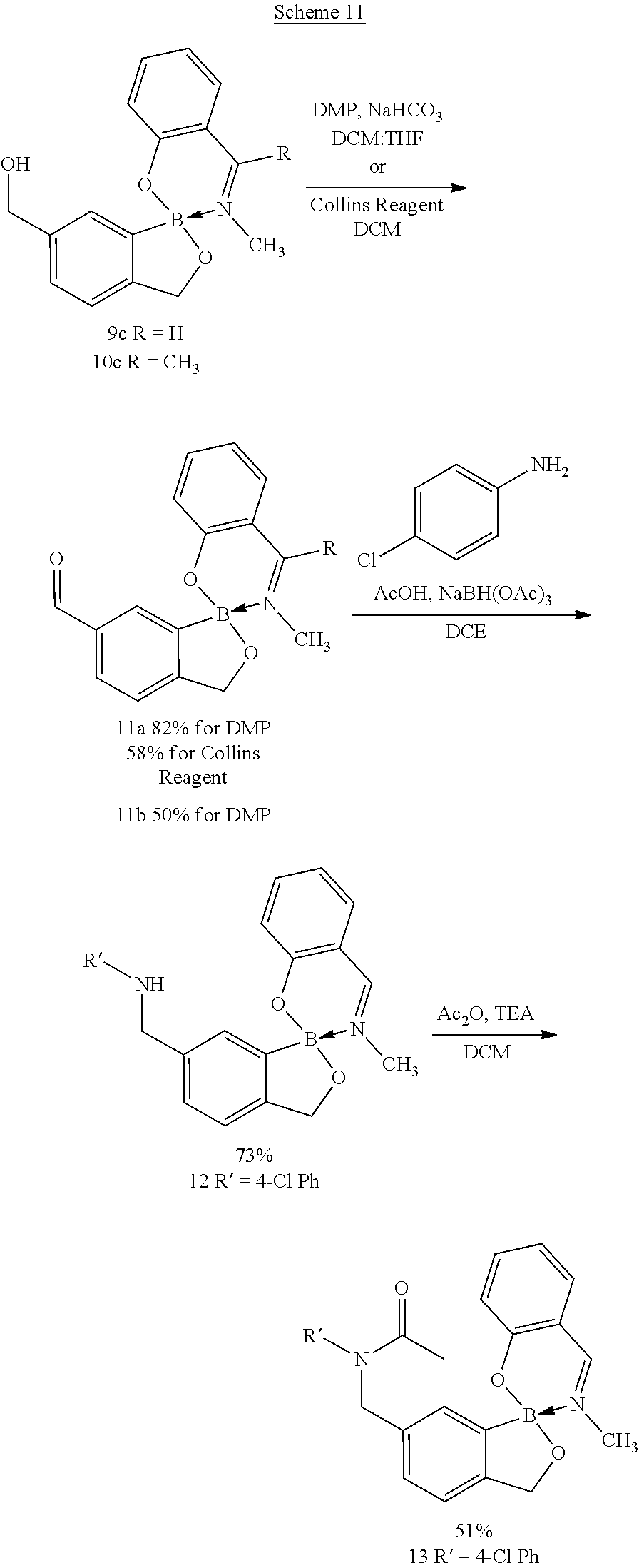
- Dess-Martin Oxidation of Salicylimine-protected aldehyde 11a.
- a round-bottom flask containing a stirbar was charged with Dess-Martin periodinane (550 mg, 1.29 mmol), anhydrous NaHCO 3 (259 mg, 3.08 mmol), and 9c (305 mg, 1.08 mmol).
- Dry DCM (10 mL) and dry THE (4 mL) were added to the round-bottom flask at room temperature and the mixture was stirred at room temperature for 4 hours. The reaction was quenched with saturated Na 2 S 2 O 4 (6 mL), stirred for 5 minutes, and transferred to a separatory funnel. The layers were separated and the aqueous layer was extracted with DCM (2 ⁇ 15 mL).
- DIBAL-H diisobutylaluminum hydride
Landscapes
- Chemical & Material Sciences (AREA)
- Organic Chemistry (AREA)
- Pharmaceuticals Containing Other Organic And Inorganic Compounds (AREA)
Abstract
Description


wherein:

wherein:


wherein each occurrence of Rx is independently selected from the group consisting of H and optionally substituted C1-6 alkyl.


wherein:

wherein R2 is selected from the group consisting of H and methyl.


wherein R2 is selected from the group consisting of H, optionally substituted C1-6 alkyl, and optionally substituted C3-C8 cycloalkyl.


wherein:


wherein;

wherein each occurrence of Rx is independently selected from the group consisting of H and optionally substituted C1-6 alkyl.


wherein both nitrogens on the piperazine are bound to independently selected compounds of formula (I) or (I′), thereby linking two compounds of formula (I) or (I′) through the R3 substituent.


wherein;

wherein each occurrence of Rx is independently selected from the group consisting of H and optionally substituted C1-6 alkyl.


wherein both nitrogens on the piperazine are bound to independently selected compounds of formula (II) or (II′), thereby linking two compounds of formula (II) or (II′) through the R3 substituent.
In certain embodiments, the compound of formula (II) or (II′) is a compound of formula (IIa) or

wherein R2 is selected from the group consisting of H, optionally substituted C1-6 alkyl, and optionally substituted C3-C8 cycloalkyl.


wherein R2 is selected from the group consisting of H, optionally substituted C1-6 alkyl, and optionally substituted C3-C8 cycloalkyl.

wherein

wherein R1 and R3 are as defined elsewhere herein. In yet other embodiments, the benzoxaborole compound is a compound selected from the group consisting of:


wherein R1 and R3 are as defined elsewhere herein.

wherein R1 and R3 are as defined elsewhere herein.

wherein R1 and R3 are as defined elsewhere herein.

N-methylsalicylidenimine (2). Salicylaldehyde (6 mL, 56 mmol) was dissolved in absolute EtOH (150 mL) in a round-bottom flask. To the mixture was added a solution of MeNH2 (33 wt % in EtOH, 14 mL, 112 mmol) and the reaction immediately became a bright yellow color. The yellow mixture was stirred at room temperature for 8 hours and solvent was removed to afford a yellow oil 2 (7.6 g, Quant.) that was used without further purification. 1H NMR (CDCl3, 400 MHz) δ 3.48 (s, 3H), 6.86 (t, 1H), 6.94 (d, 1H), 7.24 (d, 1H), 7.29 (t, 1H), 8.34 (s, 1H), 13.4 (br s, 1H).

2-[1-(methylimino)ethyl]phenol (3). 2′-hydroxyacetophenone (5 mL, 41.5 mmol) was added to a round-bottom flask and dissolved in absolute EtOH (120 mL). A solution of MeNH2 (33 wt % in EtOH, 16 mL, 128 mmol) was added and the mixture was heated to 50° C. for 5 hrs. The reaction was cooled to room temperature and stirred overnight. The solvent was removed to afford a yellow solid 3 (6.2 g, Quant.), which was used without further purification. 1H NMR (CDCl3, 400 MHz) δ 2.34 (s, 3H), 3.34 (s, 3H), 6.75 (t, 1H), 6.92 (d, 1H), 7.29 (t, 1H), 7.49 (d, 1H).
Synthesis of Benzoxaboroles




Claims (7)


Priority Applications (1)
| Application Number | Priority Date | Filing Date | Title |
|---|---|---|---|
| US17/833,345 US11773114B2 (en) | 2018-03-09 | 2022-06-06 | Protective groups and methods for protecting benzoxaboroles or oxaboroles |
Applications Claiming Priority (4)
| Application Number | Priority Date | Filing Date | Title |
|---|---|---|---|
| US201862640916P | 2018-03-09 | 2018-03-09 | |
| PCT/US2019/021552 WO2019173814A1 (en) | 2018-03-09 | 2019-03-11 | Protective groups and methods for protecting benzoxaboroles or oxaboroles |
| US202016978909A | 2020-09-08 | 2020-09-08 | |
| US17/833,345 US11773114B2 (en) | 2018-03-09 | 2022-06-06 | Protective groups and methods for protecting benzoxaboroles or oxaboroles |
Related Parent Applications (2)
| Application Number | Title | Priority Date | Filing Date |
|---|---|---|---|
| US16/978,909 Division US11427603B2 (en) | 2018-03-09 | 2019-03-11 | Protective groups and methods for protecting benzoxaboroles or oxaboroles |
| PCT/US2019/021552 Division WO2019173814A1 (en) | 2018-03-09 | 2019-03-11 | Protective groups and methods for protecting benzoxaboroles or oxaboroles |
Publications (2)
| Publication Number | Publication Date |
|---|---|
| US20220298179A1 US20220298179A1 (en) | 2022-09-22 |
| US11773114B2 true US11773114B2 (en) | 2023-10-03 |
Family
ID=67846345
Family Applications (2)
| Application Number | Title | Priority Date | Filing Date |
|---|---|---|---|
| US16/978,909 Active 2039-05-20 US11427603B2 (en) | 2018-03-09 | 2019-03-11 | Protective groups and methods for protecting benzoxaboroles or oxaboroles |
| US17/833,345 Active US11773114B2 (en) | 2018-03-09 | 2022-06-06 | Protective groups and methods for protecting benzoxaboroles or oxaboroles |
Family Applications Before (1)
| Application Number | Title | Priority Date | Filing Date |
|---|---|---|---|
| US16/978,909 Active 2039-05-20 US11427603B2 (en) | 2018-03-09 | 2019-03-11 | Protective groups and methods for protecting benzoxaboroles or oxaboroles |
Country Status (2)
| Country | Link |
|---|---|
| US (2) | US11427603B2 (en) |
| WO (1) | WO2019173814A1 (en) |
Families Citing this family (1)
| Publication number | Priority date | Publication date | Assignee | Title |
|---|---|---|---|---|
| US11427603B2 (en) * | 2018-03-09 | 2022-08-30 | University Of The Sciences | Protective groups and methods for protecting benzoxaboroles or oxaboroles |
Citations (10)
| Publication number | Priority date | Publication date | Assignee | Title |
|---|---|---|---|---|
| US4265664A (en) | 1978-05-12 | 1981-05-05 | Chemie Linz Aktiengesellschaft | Spirocyclic boron compounds, a process for their manufacture and their use as a flame-retardant additive |
| US5147914A (en) | 1990-04-24 | 1992-09-15 | Chemie Linz Gesellschaft M.B.H. | Use of spirocyclic boric acid esters as flame retardants in plastics |
| US5384410A (en) | 1993-03-24 | 1995-01-24 | The Du Pont Merck Pharmaceutical Company | Removal of boronic acid protecting groups by transesterification |
| WO1995033754A1 (en) | 1994-06-09 | 1995-12-14 | Zeneca Limited | Oxaboroles and salts thereof, and their use as biocides |
| US8168614B2 (en) | 2006-02-16 | 2012-05-01 | Anacor Pharmaceuticals, Inc. | Boron-containing small molecules as anti-inflammatory agents |
| US8338601B2 (en) | 2008-09-26 | 2012-12-25 | Board Of Trustees Of The University Of Illinois | Slow release of organoboronic acids in cross-coupling reactions |
| WO2013084199A1 (en) | 2011-12-07 | 2013-06-13 | Universidade De Lisboa | Boron heterocycles as new inhibitors of human neutrophil elastase |
| US20140275601A1 (en) | 2013-03-14 | 2014-09-18 | Wisconsin Alumni Research Foundation | Protecting groups for boronic acids |
| US10130096B2 (en) | 2011-10-07 | 2018-11-20 | Syngenta Participations Ag | Method for protecting useful plants or plant propagation material |
| US11427603B2 (en) * | 2018-03-09 | 2022-08-30 | University Of The Sciences | Protective groups and methods for protecting benzoxaboroles or oxaboroles |
-
2019
- 2019-03-11 US US16/978,909 patent/US11427603B2/en active Active
- 2019-03-11 WO PCT/US2019/021552 patent/WO2019173814A1/en not_active Ceased
-
2022
- 2022-06-06 US US17/833,345 patent/US11773114B2/en active Active
Patent Citations (11)
| Publication number | Priority date | Publication date | Assignee | Title |
|---|---|---|---|---|
| US4265664A (en) | 1978-05-12 | 1981-05-05 | Chemie Linz Aktiengesellschaft | Spirocyclic boron compounds, a process for their manufacture and their use as a flame-retardant additive |
| US5147914A (en) | 1990-04-24 | 1992-09-15 | Chemie Linz Gesellschaft M.B.H. | Use of spirocyclic boric acid esters as flame retardants in plastics |
| US5384410A (en) | 1993-03-24 | 1995-01-24 | The Du Pont Merck Pharmaceutical Company | Removal of boronic acid protecting groups by transesterification |
| WO1995033754A1 (en) | 1994-06-09 | 1995-12-14 | Zeneca Limited | Oxaboroles and salts thereof, and their use as biocides |
| US5880188A (en) | 1994-06-09 | 1999-03-09 | Zeneca Limited | Oxaboroles and salts thereof, and their use as biocides |
| US8168614B2 (en) | 2006-02-16 | 2012-05-01 | Anacor Pharmaceuticals, Inc. | Boron-containing small molecules as anti-inflammatory agents |
| US8338601B2 (en) | 2008-09-26 | 2012-12-25 | Board Of Trustees Of The University Of Illinois | Slow release of organoboronic acids in cross-coupling reactions |
| US10130096B2 (en) | 2011-10-07 | 2018-11-20 | Syngenta Participations Ag | Method for protecting useful plants or plant propagation material |
| WO2013084199A1 (en) | 2011-12-07 | 2013-06-13 | Universidade De Lisboa | Boron heterocycles as new inhibitors of human neutrophil elastase |
| US20140275601A1 (en) | 2013-03-14 | 2014-09-18 | Wisconsin Alumni Research Foundation | Protecting groups for boronic acids |
| US11427603B2 (en) * | 2018-03-09 | 2022-08-30 | University Of The Sciences | Protective groups and methods for protecting benzoxaboroles or oxaboroles |
Non-Patent Citations (14)
Also Published As
| Publication number | Publication date |
|---|---|
| US20220298179A1 (en) | 2022-09-22 |
| WO2019173814A1 (en) | 2019-09-12 |
| US20200407375A1 (en) | 2020-12-31 |
| US11427603B2 (en) | 2022-08-30 |
Similar Documents
| Publication | Publication Date | Title |
|---|---|---|
| US20220298179A1 (en) | Protective groups and methods for protecting benzoxaboroles or oxaboroles | |
| AU2008309269A1 (en) | Novel histone deacetylase inhibitors | |
| JP4476810B2 (en) | Chemical intermediate | |
| HK1202533A1 (en) | Intermediates of ticagrelor and the preparation methods and for the preparation of ticagrelor | |
| CN115175913B (en) | Substituted bistricycles and pharmaceutical compositions and uses thereof | |
| KR20190022533A (en) | METHOD OF PRODUCING IRON COMPLEX AND METHOD OF PRODUCING ESTER COMPOUND USING IRON COMPLEX | |
| CN107814757B (en) | Method for synthesizing polysubstituted pyrrole derivative | |
| WO2013005621A1 (en) | Palladium complex and method for producing same, method for producing vinyl ether compound, and method for collecting palladium complex | |
| US20090253918A1 (en) | Novel intermediate for glyt1 inhibitor | |
| JP6682968B2 (en) | Method for producing epoxy compound | |
| CN103554064B (en) | The preparation method of 3-hydroxyl oxygen heterocycle butane | |
| WO2024038356A1 (en) | Synthesis of substituted 1-aryl-1'-heteroaryl compounds and substituted 1,1'-biheteroaryl compounds, and analogues thereof | |
| WO2012173572A1 (en) | Stereoselective synthesis of highly substituted enamides | |
| US20180057484A1 (en) | Processes and intermediates for the preparation of a pde10 inhibitor | |
| CN114315679B (en) | Martinib chiral preparation method of intermediate | |
| CA2974449C (en) | Process for the production of 2-[4-(cyclopropanecarbonyl)phenyl]-2-methyl-propanenitrile | |
| WO2019178480A1 (en) | Pyrazole-containing macrophage migration inhibitory factor inhibitors | |
| CN111556861A (en) | Preparation method of jasmonate compound | |
| US10889599B2 (en) | 1,1-diborylalkyl-1-metal compounds, preparation method thereof, and their applications toward synthesis of 1,1-diboronate ester compounds | |
| CN113816955B (en) | RET kinase inhibitor intermediate and preparation method thereof | |
| US12180182B2 (en) | (Di)amination of activated allene compounds, derivatives thereof, and methods for synthesis of the same | |
| CN109265311B (en) | Phenyl fluorene derivative and preparation method and application thereof | |
| JP4659240B2 (en) | Method for producing hydroxyaldehyde | |
| US20240025839A1 (en) | Method of synthesis | |
| CN119638647A (en) | Process for preparing oxetan-2-ylmethylamine or salts thereof |
Legal Events
| Date | Code | Title | Description |
|---|---|---|---|
| FEPP | Fee payment procedure |
Free format text: ENTITY STATUS SET TO UNDISCOUNTED (ORIGINAL EVENT CODE: BIG.); ENTITY STATUS OF PATENT OWNER: SMALL ENTITY |
|
| FEPP | Fee payment procedure |
Free format text: ENTITY STATUS SET TO SMALL (ORIGINAL EVENT CODE: SMAL); ENTITY STATUS OF PATENT OWNER: SMALL ENTITY |
|
| STPP | Information on status: patent application and granting procedure in general |
Free format text: DOCKETED NEW CASE - READY FOR EXAMINATION |
|
| AS | Assignment |
Owner name: UNIVERSITY OF THE SCIENCES, PENNSYLVANIA Free format text: ASSIGNMENT OF ASSIGNORS INTEREST;ASSIGNORS:TOMSHO, JOHN W.;GAMRAT, JAMES M.;REEL/FRAME:063193/0978 Effective date: 20190327 Owner name: SAINT JOSEPH'S UNIVERSITY, PENNSYLVANIA Free format text: MERGER;ASSIGNOR:UNIVERSITY OF THE SCIENCES;REEL/FRAME:063194/0176 Effective date: 20220531 |
|
| STPP | Information on status: patent application and granting procedure in general |
Free format text: NOTICE OF ALLOWANCE MAILED -- APPLICATION RECEIVED IN OFFICE OF PUBLICATIONS |
|
| STPP | Information on status: patent application and granting procedure in general |
Free format text: PUBLICATIONS -- ISSUE FEE PAYMENT RECEIVED |
|
| STPP | Information on status: patent application and granting procedure in general |
Free format text: PUBLICATIONS -- ISSUE FEE PAYMENT VERIFIED |
|
| STCF | Information on status: patent grant |
Free format text: PATENTED CASE |