US11765191B2 - Information processing device and information processing method - Google Patents

Information processing device and information processing method Download PDF

Info

Publication number
US11765191B2
US11765191B2 US18/137,168 US202318137168A US11765191B2 US 11765191 B2 US11765191 B2 US 11765191B2 US 202318137168 A US202318137168 A US 202318137168A US 11765191 B2 US11765191 B2 US 11765191B2
Authority
US
United States
Prior art keywords
time
anomaly
detection
end condition
detection log
Prior art date
Legal status (The legal status is an assumption and is not a legal conclusion. Google has not performed a legal analysis and makes no representation as to the accuracy of the status listed.)
Active
Application number
US18/137,168
Other versions
US20230262080A1 (en
Inventor
Kou Ishii
Kaoru Yokota
Yuishi Torisaki
Toshihisa Nakano
Jun Anzai
Current Assignee (The listed assignees may be inaccurate. Google has not performed a legal analysis and makes no representation or warranty as to the accuracy of the list.)
Panasonic Automotive Systems Co Ltd
Original Assignee
Panasonic Intellectual Property Management Co Ltd
Priority date (The priority date is an assumption and is not a legal conclusion. Google has not performed a legal analysis and makes no representation as to the accuracy of the date listed.)
Filing date
Publication date
Application filed by Panasonic Intellectual Property Management Co Ltd filed Critical Panasonic Intellectual Property Management Co Ltd
Assigned to PANASONIC INTELLECTUAL PROPERTY MANAGEMENT CO., LTD. reassignment PANASONIC INTELLECTUAL PROPERTY MANAGEMENT CO., LTD. ASSIGNMENT OF ASSIGNORS INTEREST (SEE DOCUMENT FOR DETAILS). Assignors: ANZAI, JUN, ISHII, KOU, TORISAKI, YUISHI, YOKOTA, KAORU, NAKANO, TOSHIHISA
Publication of US20230262080A1 publication Critical patent/US20230262080A1/en
Application granted granted Critical
Publication of US11765191B2 publication Critical patent/US11765191B2/en
Assigned to PANASONIC AUTOMOTIVE SYSTEMS CO., LTD. reassignment PANASONIC AUTOMOTIVE SYSTEMS CO., LTD. ASSIGNMENT OF ASSIGNORS INTEREST (SEE DOCUMENT FOR DETAILS). Assignors: PANASONIC INTELLECTUAL PROPERTY MANAGEMENT CO., LTD.
Active legal-status Critical Current
Anticipated expiration legal-status Critical

Links

Images

Classifications

    • HELECTRICITY
    • H04ELECTRIC COMMUNICATION TECHNIQUE
    • H04LTRANSMISSION OF DIGITAL INFORMATION, e.g. TELEGRAPHIC COMMUNICATION
    • H04L63/00Network architectures or network communication protocols for network security
    • H04L63/14Network architectures or network communication protocols for network security for detecting or protecting against malicious traffic
    • H04L63/1408Network architectures or network communication protocols for network security for detecting or protecting against malicious traffic by monitoring network traffic
    • H04L63/1425Traffic logging, e.g. anomaly detection
    • HELECTRICITY
    • H04ELECTRIC COMMUNICATION TECHNIQUE
    • H04LTRANSMISSION OF DIGITAL INFORMATION, e.g. TELEGRAPHIC COMMUNICATION
    • H04L63/00Network architectures or network communication protocols for network security
    • H04L63/14Network architectures or network communication protocols for network security for detecting or protecting against malicious traffic
    • H04L63/1408Network architectures or network communication protocols for network security for detecting or protecting against malicious traffic by monitoring network traffic
    • H04L63/1416Event detection, e.g. attack signature detection
    • GPHYSICS
    • G06COMPUTING OR CALCULATING; COUNTING
    • G06FELECTRIC DIGITAL DATA PROCESSING
    • G06F21/00Security arrangements for protecting computers, components thereof, programs or data against unauthorised activity
    • G06F21/50Monitoring users, programs or devices to maintain the integrity of platforms, e.g. of processors, firmware or operating systems
    • G06F21/55Detecting local intrusion or implementing counter-measures

Definitions

  • the present disclosure relates to an information processing device and an information processing method.
  • Patent Literature (PTL) 1 discloses a vehicle safety system including a cyber watchman provided inside each of vehicles and a cyber hub provided outside each of the vehicles.
  • the cyber watchman is connected to an in-vehicle communication network and obtains communication traffic data via the in-vehicle communication network.
  • the cyber hub receives, from the cyber watchman, the communication traffic data obtained by the cyber watchman via, for example, a communication network such as the Internet. This enables the cyber hub to collect communication traffic data from each of the vehicles and obtain high-level information for protecting the vehicles against vehicle cyber attacks.
  • the present disclosure provides an information processing device and other related techniques capable of improving upon the above related art.
  • An information processing device includes: an obtainer that obtains, from an anomaly detection sensor that detects an anomaly in a network, a detection log related to the anomaly in the network and the detection time of the anomaly indicated in the detection log; an occurrence time determiner that determines the occurrence time of an attack on the network based on the obtained detection time, and records the determined occurrence time; an end time determiner that determines the expected end time of the attack on the network based on the obtained detection log, and records the determined expected end time; a condition determiner that determines an end condition for the attack on the network based on the obtained detection log; and a holder that holds the determined end condition.
  • the condition determiner When a new detection log is obtained before the held end condition is satisfied, the condition determiner further updates the held end condition or adds a new end condition to the holder based on the obtained new detection log.
  • the end time determiner determines, as the expected end time, a time when the held end condition is satisfied, and when a plurality of end conditions are held by the holder, the end time determiner determines, as the expected end time, the latest time among times at each of which a different one of the plurality of end conditions is satisfied.
  • An information processing method includes: obtaining, from an anomaly detection sensor that detects an anomaly in a network, a detection log related to the anomaly in the network and the detection time of the anomaly indicated in the detection log; determining the occurrence time of an attack on the network based on the obtained detection time, and recording the determined occurrence time; determining the expected end time of the attack on the network based on the obtained detection log, and recording the determined expected end time; determining an end condition for the attack on the network based on the obtained detection log; and holding the determined end condition.
  • the determining of the end condition further includes: when a new detection log is obtained before the held end condition is satisfied, updating the held end condition or adding a new end condition based on the obtained new detection log.
  • determining, as the expected end time, a time when the held end condition is satisfied, and when a plurality of end conditions are held determining, as the expected end time, the latest time among times at each of which a different one of the plurality of end conditions is satisfied.
  • FIG. 1 is a configuration diagram illustrating one example of an information processing device according to an embodiment.
  • FIG. 2 is a diagram illustrating one example of a table according to the embodiment.
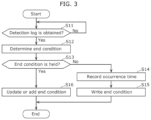
  • FIG. 3 is a flowchart illustrating one example of the operation of determining an end condition and recording an occurrence time performed by an information processing device according to the embodiment.
  • FIG. 4 is a diagram for explaining the operation of determining an end condition.
  • FIG. 5 is a diagram for explaining the operation of recording an occurrence time.
  • FIG. 6 is a diagram for explaining the operation of adding an end condition.
  • FIG. 7 is a diagram for explaining the operation of updating an end condition.
  • FIG. 8 is a flowchart illustrating one example of the operation of recording an expected end time performed by an information processing device according to the embodiment.
  • FIG. 9 is a diagram for explaining the operation of removing an end condition.
  • FIG. 10 is a diagram for explaining the operation of recording an expected end time.
  • FIG. 11 is a flowchart illustrating one example of an information processing method according to another embodiment.
  • the system disclosed in PTL 1 mentioned above does not disclose a method for identifying a period (e.g., a period of time) in which an attack on an in-vehicle communication network (hereinafter also referred to as a network) occurred. Extracting such a network attack period from a massive amount of communication traffic data increases the processing load of a cyber hub (a server).
  • a cyber hub a server
  • the following describes an information processing device and other related techniques capable of reducing the processing load generated when extracting a network attack period.
  • FIG. 1 is a configuration diagram illustrating one example of information processing device 10 according to an embodiment.
  • FIG. 1 illustrates also anomaly detection sensor 100 communicably connected to information processing device 10 .
  • Anomaly detection sensor 100 is a sensor that detects an anomaly in a mobile body which occurs when the mobile body is attacked.
  • anomaly detection sensor 100 is a sensor that detects an anomaly in a network (e.g., an in-vehicle network) which occurs when the network for the mobile body is attacked.
  • An anomaly in a network may be an anomaly in a network communication or an anomaly in a device (e.g., an electronic control unit (ECU) or any other equivalent device) connected to the network.
  • ECU electronice control unit
  • An anomaly in a network communication may be, for instance, an anomaly in the amount of network communication, an anomaly in a message ID included in a message flowing via the network (to be specific, an anomaly that a message ID is an unauthorized ID), or an anomaly in message transmission intervals.
  • An anomaly in a device connected to the network is, for example, an anomaly such as malfunction of the device.
  • Anomaly detection sensor 100 is, for example, an intrusion detection system (IDS) ECU and is connected to a network or a device connected to the network. When detecting an anomaly in the network, anomaly detection sensor 100 generates a detection log related to the anomaly and transmits the detection log to information processing device 10 .
  • IDS intrusion detection system
  • the detection log includes, for instance, the type of the detected anomaly, information on anomaly detection sensor 100 that has detected the anomaly, and a detection time when the anomaly was detected.
  • a plurality of anomaly detection sensors 100 may be provided and each of the plurality of anomaly detection sensors 100 may transmit a detection log.
  • the detection log need not include a detection time, and anomaly detection sensor 100 may transmit a detection time to information processing device 10 as information different from a detection log.
  • a mobile body is, for example, a vehicle, but is not limited to a vehicle and may be the mobility of, for instance, construction equipment, agricultural machinery, a vessel, a railroad train, or an aircraft.
  • Information processing device 10 is a computer that processes a detection log transmitted from anomaly detection sensor 100 , to record occurrence time and expected end time of an attack on the network.
  • Information processing device 10 is mounted on, for instance, a vehicle provided with anomaly detection sensor 100 , and outputs the recorded occurrence time and expected end time to a server communicably connected to, for instance, the vehicle.
  • Information processing device 10 includes a processor, memory, a communication interface, etc.
  • the memory is, for instance, read-only memory (ROM) or random access memory (RAM), and can store a program executed by the processor.
  • Information processing device 10 includes obtainer 11 , table 12 , condition determiner 13 , holder 14 , end time determiner 15 , occurrence time determiner 16 , and recorder 17 .
  • Condition determiner 13 end time determiner 15 , and occurrence time determiner 16 are implemented by, for instance, a processor that executes the program stored in the memory.
  • Obtainer 11 is implemented by a communication interface.
  • Table 12 is stored in the memory.
  • Holder 14 and recorder 17 are implemented by memory.
  • Memory that stores the program, memory that stores table 12 , and memory implementing holder 14 and recorder 17 may be separate memories or one memory.
  • Information processing device 10 may be a server communicably connected to, for instance, a vehicle provided with anomaly detection sensor 100 .
  • the elements composing information processing device 10 may be separately placed in a plurality of servers, or information processing device 10 may be an information processing system.
  • Table 12 is a table in which the type of an anomaly is associated in advance with the expected end time of a network attack caused when the anomaly occurred. Table 12 will be described with reference to FIG. 2 .
  • FIG. 2 is a diagram illustrating one example of table 12 according to the embodiment.
  • the type of an anomaly, a detection location indicating anomaly detection sensor 100 that has detected the anomaly, and the expected end time of a network attack caused when the anomaly occurred are associated with one another, for example.
  • an anomaly of type A is an anomaly detected by sensor 1 , and a network attack is expected to be ended when x seconds elapse after the detection of the anomaly.
  • An anomaly of type B is an anomaly detected by sensor 1 , and a network attack is expected to be ended when x seconds elapse after the detection of the anomaly.
  • An anomaly of type C is an anomaly detected by sensor 2 , and a network attack is expected to be ended when y seconds elapse after the detection of the anomaly.
  • sensor 1 is anomaly detection sensor 100 that monitors network communications
  • the anomaly of type A is an anomaly in the amount of network communication while the anomaly of type B is an anomaly in a message flowing via the network.
  • sensor 2 is anomaly detection sensor 100 that monitors a device connected to the network, and the anomaly of type C is, for instance, an anomaly such as malfunction of the device.
  • Such table 12 is used for determining an expected end condition (hereinafter also referred to as an end condition) for an attack on the network.
  • Condition determiner 13 determines the end condition of a network attack based on a detection log obtained by obtainer 11 . The details of the operation performed by condition determiner 13 will be described later.
  • Holder 14 holds an end condition determined by condition determiner 13 .
  • Various types of anomalies may occur due to a network attack.
  • one anomaly detection sensor 100 may generate a detection log for each of the anomalies that have occurred and obtainer 11 may obtain a plurality of detection logs from that one anomaly detection sensor 100 .
  • a plurality of anomaly detection sensors 100 may detect anomalies due to network attacks.
  • obtainer 11 may obtain a plurality of detection logs from the plurality of anomaly detection sensors 100 .
  • Holder 14 may hold an end condition for each of the obtained detection logs. In other words, holder 14 may hold a plurality of end conditions.
  • End time determiner 15 determines the expected end time of a network attack based on a detection log obtained by obtainer 11 , and records the determined expected end time on recorder 17 . The details of the operation performed by end time determiner 15 will be described later.
  • Occurrence time determiner 16 determines the occurrence time of a network attack based on a detection time obtained by obtainer 11 , and records the determined occurrence time on recorder 17 . The details of the operation performed by occurrence time determiner 16 will be described later.
  • Recorder 17 records the occurrence time of a network attack determined by occurrence time determiner 16 , and records the expected end time of the network attack determined by end time determiner 15 .
  • the recorded occurrence time and expected end time are output to a device (e.g., a server) connected to information processing device 10 and are used for attack analysis.
  • FIG. 3 is a flowchart illustrating one example of the operation of determining an end condition and recording an occurrence time performed by information processing device 10 according to the embodiment.
  • condition determiner 13 determines whether obtainer 11 has obtained a detection log (step S 11 ). When obtainer 11 has not obtained any detection log (No in step S 11 ), condition determiner 13 repeats the process in step S 11 until obtainer 11 obtains a detection log.
  • condition determiner 13 determines the end condition of a network attack based on the obtained detection log (step S 12 ). The operation of determining an end condition performed by condition determiner 13 will be described with reference to FIG. 4 .
  • FIG. 4 is a diagram for explaining the operation of determining an end condition.
  • Condition determiner 13 can therefore determine the end condition based on table 12 and the type of an anomaly indicated in a detection log obtained by obtainer 11 . Specifically, condition determiner 13 consults table 12 for the detection log obtained by obtainer 11 , and determines the end condition of the network attack that caused the anomaly indicated in the detection log. As illustrated in FIG.
  • anomaly detection sensor 100 detects an anomaly of type A at time t1, and obtainer 11 obtains a detection log related to the anomaly of type A and detection time t1 of the anomaly. Since a network attack that caused the anomaly indicated in the detection log obtained by obtainer 11 is expected to end when x seconds elapse after the detection of the anomaly of type A, as indicated in table 12 , condition determiner 13 determines time t1+x resulting from adding x seconds to detection time t1, as the end condition of the network attack.
  • condition determiner 13 sets a severe condition (e.g., determines the end condition such that the expected end time of the network attack is delayed). Condition determiner 13 may thus determine the end condition based on a parameter included in an obtained detection log.
  • condition determiner 13 sets a severe condition (e.g., determines the end condition such that the expected end time of the network attack is delayed). Condition determiner 13 may thus determine the end condition based on the obtainment status of other detection log when a detection log is obtained.
  • occurrence time determiner 16 determines, in the next step, whether any end condition is held by holder 14 (step S 13 ).
  • occurrence time determiner 16 determines, as the occurrence time of the network attack, the detection time, which is obtained while no end condition is held by holder 14 , of the anomaly indicated in the detection log, and records the determined occurrence time on recorder 17 (step S 14 ). The operation of recording an occurrence time performed by occurrence time determiner 16 will be described with reference to FIG. 5 .
  • FIG. 5 is a diagram for explaining the operation of recording an occurrence time.
  • Anomaly detection sensor 100 detects an anomaly of type A at time t1 and obtainer 11 obtains a detection log related to the anomaly of type A and detection time t1 of the anomaly. Since no end condition is held by holder 14 , occurrence time determiner 16 determines, as the occurrence time of a network attack, detection time t1, which is obtained while no end condition is held by holder 14 , of the anomaly indicated in the detection log, and records the determined occurrence time on recorder 17 . Since a state in which no end condition is held by holder 14 is a state in which no network attack is being made, it is possible to determine, as the occurrence time of a network attack, the detection time of an anomaly indicated in a detection log obtained in that state.
  • condition determiner 13 writes, in the next step, the end condition determined in step S 12 into holder 14 (step S 15 ).
  • the end condition is thus held by holder 14 .
  • the end condition held by holder 14 is removed from holder 14 when satisfied, which will be described later in detail.
  • condition determiner 13 updates the held end condition or adds a new end condition to holder 14 based on the obtained new detection log (step S 16 ).
  • the operation of adding a new end condition performed by condition determiner 13 will be described with reference to FIG. 6
  • the operation of updating an end condition performed by condition determiner 13 will be described with reference to FIG. 7 .
  • FIG. 6 is a diagram for explaining the operation of adding an end condition.
  • anomaly detection sensor 100 detects an anomaly of type A at time t1 and end condition (i.e., end time) t1+x is held by holder 14 . It is also assumed that after the detection of the anomaly of type A, anomaly detection sensor 100 detects an anomaly of type B at time t2 and a new detection log is obtained before end condition t1+x held by holder 14 is satisfied. In this case, condition determiner 13 determines new end condition t2+x based on the obtained new detection log (specifically by consulting table 12 for the new detection log), and adds new end condition t2+x to holder 14 .
  • condition determiner 13 determines new end condition t3+y based on the obtained new 10 detection log (specifically by consulting table 12 for the new detection log), and adds new end condition t3+y to holder 14 .
  • FIG. 7 is a diagram for explaining the operation of updating an end condition.
  • condition determiner 13 determines new end condition t4+x based on the obtained new log (specifically by consulting table 12 for the new detection log). Since end condition t4+x is an end condition regarding type A that is same as the type of end condition t1+x held by holder 14 , condition determiner 13 updates end condition t1+x held by holder 14 to end condition t4+x.
  • FIG. 8 is a flowchart illustrating one example of the operation of recording an expected end time performed by information processing device 10 according to the embodiment. The operation shown in FIG. 3 and the operation shown in FIG. 8 are performed in parallel.
  • End time determiner 15 determines whether an end condition held by holder 14 is satisfied (step S 21 ). When the end condition held by holder 14 is not satisfied (No in step S 21 ), end time determiner 15 repeats the process in step S 21 until the end condition held by holder 14 is satisfied.
  • end time determiner 15 removes the satisfied end condition from holder 14 (step S 22 ). The operation of removing a satisfied end condition performed by end time determiner 15 will be described with reference to FIG. 9 .
  • FIG. 9 is a diagram for explaining the operation of removing an end condition.
  • end condition t1+x regarding an anomaly of type A As illustrated at lower left in FIG. 9 , it is assumed that end condition t1+x regarding an anomaly of type A, end condition t2+x regarding an anomaly of type B, and end condition t3+y regarding an anomaly of type C are already held by holder 14 .
  • end time determiner 15 removes satisfied end condition t1+x from holder 14 .
  • end time determiner 15 determines, in the next step, whether any end condition is held by holder 14 (step S 23 ). As illustrated at lower right in FIG. 9 , when end conditions are held by holder 14 (Yes in step S 23 ), processes in steps S 21 and S 22 are performed for each of the end conditions held by holder 14 , and the processes in steps S 21 through S 23 are repeated until no end condition is held by holder 14 .
  • end time determiner 15 determines, as the expected end time of the network attack, a time when the last satisfied (stated differently, last removed) end condition among the end conditions held by holder 14 is satisfied, and records the determined expected end time on recorder 17 (step S 24 ). The operation of recording an expected end time performed by end time determiner 15 will be described with reference to FIG. 10 .
  • FIG. 10 is a diagram for explaining the operation of recording an expected end time.
  • end condition t4+x regarding an anomaly of type A is held by holder 14 .
  • end time determiner 15 removes satisfied end condition t4+x from holder 14 .
  • holder 14 no longer holds any end conditions, as illustrated at lower right in FIG. 10 , and end time determiner 15 determines, as the expected end time of a network attack, time t4+x when the last satisfied end condition t4+x is satisfied, and records expected end time t4+x on recorder 17 .
  • End time determiner 15 thus determines, as the expected end time of a network attack, a time when a held end condition is satisfied. Specifically, when a plurality of end conditions are held by holder 14 , end time determiner 15 determines, as the expected end time, a time when the last removed end condition is satisfied, that is, the latest time among times at each of which a different one of the plurality of end conditions is satisfied. When an end condition is held by holder 14 while no end condition is held by holder 14 and no new detection log is obtained before the held end condition is satisfied, end time determiner 15 determines, as the expected end time, a time when the held end condition is satisfied, and records the determined expected end time on recorder 17 .
  • a time when an end condition is satisfied may be a time when a predetermined time elapses after a detection log is obtained, or a time when a counter, which counts up after a detection log is obtained, indicates a value greater than a predetermined threshold value, or a time when a predetermined detection log is obtained.
  • the predetermined time may be determined, for example, in accordance with an anomaly type, for instance.
  • the predetermined threshold value is determined in accordance with, for example, an anomaly type and the count-up cycle of the counter.
  • the predetermined detection log may be, for example, a detection log that indicates normal and is regularly transmitted when anomaly detection sensor 100 does not detect any anomalies, and end time determiner 15 may determine, as the expected end time of a network attack, a time when a detection log indicating normal is obtained a predetermined number of times.
  • Information processing device 10 includes: obtainer 11 that obtains, from anomaly detection sensor 100 that detects an anomaly in a network, a detection log related to the anomaly in the network and the detection time of the anomaly indicated in the detection log; occurrence time determiner 16 that determines the occurrence time of an attack on the network based on the obtained detection time, and records the determined occurrence time; and end time determiner 15 that determines the expected end time of the attack on the network based on the obtained detection log, and records the determined expected end time.
  • the occurrence time and expected end time of a network attack are automatically recorded based on a detection log and a detection time obtained from anomaly detection sensor 100 . It is therefore possible to easily extract the period of the network attack based on the recorded occurrence time and expected end time. Accordingly, the processing load generated when extracting a network attack period can be reduced.
  • information processing device 10 may further include: condition determiner 13 that determines an end condition for the attack on the network based on the obtained detection log; and holder 14 that holds the determined end condition.
  • End time determiner 15 may determine, as the expected end time, a time when the held end condition is satisfied.
  • condition determiner 13 may further update the held end condition or add a new end condition to holder 14 based on the obtained new detection log.
  • anomaly detection sensor 100 detects again an anomaly of the same type as or detects an anomaly of different type from an anomaly indicated in a detection log corresponding to the end condition already held by holder 14 .
  • the end condition is updated based on a new detection log related to the detected anomaly.
  • anomaly detection sensor 100 detects an anomaly of a different type from an anomaly indicated in a detection log corresponding to an end condition already held by holder 14 , a new end condition corresponding to a new detection log related to the detected anomaly is added to holder 14 . Accordingly, when a plurality of anomalies of different types or the same type occur due to network attacks, it is possible for holder 14 to manage end conditions regarding one or more anomalies caused by the network attacks.
  • end time determiner 15 may determine, as the expected end time, the latest time among times at each of which a different one of the plurality of end conditions is satisfied.
  • end time determiner 15 may further remove a satisfied end condition from holder 14 .
  • occurrence time determiner 16 may determine, as the occurrence time, the detection time of the anomaly indicated in the detection log, where the detection time is obtained while the end condition is not held by holder 14 .
  • a state in which no end condition is held by holder 14 is a state in which no network attack is being made, it is possible to determine, as the occurrence time of a network attack, the detection time of an anomaly indicated in a detection log obtained in that state.
  • condition determiner 13 may determine the end condition based on the type of the anomaly indicated in the obtained detection log, a parameter included in the obtained detection log, or the obtainment status of other detection log when the detection log is obtained.
  • the end condition of a network attack may differ depending on, for example, the type of an anomaly indicated in a detection log. The end condition can be therefore determined based on the type of an anomaly indicated in a detection log.
  • the end condition of a network attack may differ depending on, for example, a parameter included in a detection log. The end condition can be therefore determined based on a parameter included in a detection log.
  • the end condition of a network attack may differ depending on, for example, the obtainment status of other detection log when a detection log is obtained. The end condition can be therefore determined based on the obtainment status of other detection log when a detection log is obtained.
  • a time when the end condition is satisfied may be (i) a time when a predetermined time elapses after the detection log is obtained, (ii) a time when a counter, which counts up after the detection log is obtained, indicates a value greater than a predetermined threshold value, or (iii) a time when a predetermined detection log is obtained.
  • a time when the end condition is satisfied can be thus determined.
  • information processing device 10 may output the recorded occurrence time and the recorded expected end time, or an instruction that is in accordance with the recorded occurrence time and the recorded expected end time.
  • information processing device 10 outputs recorded occurrence time and expected end time to a device (e.g., a server) connected to information processing device 10 , so that the device can utilize the output occurrence time and expected end time to derive or identify the occurrence period (continuation time) of a cyber attack with less processing load.
  • information processing device 10 outputs, for example, an instruction, which is in accordance with recorded occurrence time and expected end time, to derive or identify the occurrence period of a cyber attack to a device connected to information processing device 10 , so that the device can derive or identify the occurrence period of a cyber attack with less processing load.
  • information processing device 10 includes table 12 and condition determiner 13
  • information processing device 10 need not include table 12 and condition determiner 13 .
  • an end condition may not be determined based on an obtained detection log, and a predetermined end condition may be held by holder 14 .
  • the present disclosure can be realized not only as information processing device 10 , but also as an information processing method that includes steps (processes) performed by each of elements included in information processing device 10 .
  • FIG. 11 is a flowchart illustrating one example of an information processing method according to another embodiment.
  • the information processing method includes the following processes: obtaining, from anomaly detection sensor 100 that detects an anomaly in a network, a detection log related to the anomaly in the network and the detection time of the anomaly indicated in the detection log (step S 31 ); determining the occurrence time of an attack on the network based on the obtained detection time, and recording the determined occurrence time (step S 32 ); and determining the expected end time of the attack on the network based on the obtained detection log, and recording the determined expected end time (step S 33 ).
  • steps in the information processing method may be executed by a computer (computer system).
  • the present disclosure can be realized as a program for causing a computer to execute the steps included in the information processing method.
  • the present disclosure can be realized as a non-transitory computer-readable recording medium such as a CD-ROM on which the program is recorded.
  • Each of elements included in information processing device 10 according to the embodiment may be realized as a dedicated or general circuit.
  • Each of elements included in information processing device 10 according to the embodiment may be implemented by an integrated circuit (IC) through large-scale integration (LSI).
  • IC integrated circuit
  • LSI large-scale integration
  • the integrated circuit is not realized limitedly through LSI and may be realized by a dedicated circuit or a general processor. It is also possible to employ a field-programmable gate array (FPGA) which is programmable or a reconfigurable processor in which the connections or settings of the circuit cells within the LSI can be reconfigured.
  • FPGA field-programmable gate array
  • the present disclosure is applicable to, for example, devices that monitor in-vehicle networks, for instance.

Landscapes

  • Engineering & Computer Science (AREA)
  • Computer Security & Cryptography (AREA)
  • Computer Hardware Design (AREA)
  • General Engineering & Computer Science (AREA)
  • Computing Systems (AREA)
  • Computer Networks & Wireless Communication (AREA)
  • Signal Processing (AREA)
  • Software Systems (AREA)
  • Theoretical Computer Science (AREA)
  • Physics & Mathematics (AREA)
  • General Physics & Mathematics (AREA)
  • Data Exchanges In Wide-Area Networks (AREA)

Abstract

An information processing device includes: an obtainer that obtains, from an anomaly detection sensor that detects an anomaly in a network, a detection log related to the anomaly in the network and the detection time of the anomaly indicated in the detection log; an occurrence time determiner that determines the occurrence time of an attack on the network based on the obtained detection time, and records the determined occurrence time; and an end time determiner that determines the expected end time of the attack on the network based on the obtained detection log, and records the determined expected end time.

Description

CROSS REFERENCE TO RELATED APPLICATIONS
This is a continuation application of PCT International Application No. PCT/JP2021/036918 filed on Oct. 6, 2021, designating the United States of America, which is based on and claims priority of Japanese Patent Application No. 2020-179027 filed on Oct. 26, 2020.
FIELD
The present disclosure relates to an information processing device and an information processing method.
BACKGROUND
Patent Literature (PTL) 1 discloses a vehicle safety system including a cyber watchman provided inside each of vehicles and a cyber hub provided outside each of the vehicles. The cyber watchman is connected to an in-vehicle communication network and obtains communication traffic data via the in-vehicle communication network. The cyber hub receives, from the cyber watchman, the communication traffic data obtained by the cyber watchman via, for example, a communication network such as the Internet. This enables the cyber hub to collect communication traffic data from each of the vehicles and obtain high-level information for protecting the vehicles against vehicle cyber attacks.
SUMMARY
The system disclosed in PTL 1 mentioned above can be improved upon.
In view of this, the present disclosure provides an information processing device and other related techniques capable of improving upon the above related art.
An information processing device according to one aspect of the present disclosure includes: an obtainer that obtains, from an anomaly detection sensor that detects an anomaly in a network, a detection log related to the anomaly in the network and the detection time of the anomaly indicated in the detection log; an occurrence time determiner that determines the occurrence time of an attack on the network based on the obtained detection time, and records the determined occurrence time; an end time determiner that determines the expected end time of the attack on the network based on the obtained detection log, and records the determined expected end time; a condition determiner that determines an end condition for the attack on the network based on the obtained detection log; and a holder that holds the determined end condition. When a new detection log is obtained before the held end condition is satisfied, the condition determiner further updates the held end condition or adds a new end condition to the holder based on the obtained new detection log. The end time determiner determines, as the expected end time, a time when the held end condition is satisfied, and when a plurality of end conditions are held by the holder, the end time determiner determines, as the expected end time, the latest time among times at each of which a different one of the plurality of end conditions is satisfied.
An information processing method according to one aspect of the present disclosure includes: obtaining, from an anomaly detection sensor that detects an anomaly in a network, a detection log related to the anomaly in the network and the detection time of the anomaly indicated in the detection log; determining the occurrence time of an attack on the network based on the obtained detection time, and recording the determined occurrence time; determining the expected end time of the attack on the network based on the obtained detection log, and recording the determined expected end time; determining an end condition for the attack on the network based on the obtained detection log; and holding the determined end condition. The determining of the end condition further includes: when a new detection log is obtained before the held end condition is satisfied, updating the held end condition or adding a new end condition based on the obtained new detection log. In the determining and recording of the expected end time, determining, as the expected end time, a time when the held end condition is satisfied, and when a plurality of end conditions are held, determining, as the expected end time, the latest time among times at each of which a different one of the plurality of end conditions is satisfied.
With the information processing device according to one aspect of the present disclosure and other related techniques, further improvement can be achieved.
BRIEF DESCRIPTION OF DRAWINGS
These and other advantages and features of the present disclosure will become apparent from the following description thereof taken in conjunction with the accompanying drawings that illustrate a specific embodiment of the present disclosure.
FIG. 1 is a configuration diagram illustrating one example of an information processing device according to an embodiment.
FIG. 2 is a diagram illustrating one example of a table according to the embodiment.
FIG. 3 is a flowchart illustrating one example of the operation of determining an end condition and recording an occurrence time performed by an information processing device according to the embodiment.
FIG. 4 is a diagram for explaining the operation of determining an end condition.
FIG. 5 is a diagram for explaining the operation of recording an occurrence time.
FIG. 6 is a diagram for explaining the operation of adding an end condition.
FIG. 7 is a diagram for explaining the operation of updating an end condition.
FIG. 8 is a flowchart illustrating one example of the operation of recording an expected end time performed by an information processing device according to the embodiment.
FIG. 9 is a diagram for explaining the operation of removing an end condition.
FIG. 10 is a diagram for explaining the operation of recording an expected end time.
FIG. 11 is a flowchart illustrating one example of an information processing method according to another embodiment.
DESCRIPTION OF EMBODIMENT Embodiment
The system disclosed in PTL 1 mentioned above does not disclose a method for identifying a period (e.g., a period of time) in which an attack on an in-vehicle communication network (hereinafter also referred to as a network) occurred. Extracting such a network attack period from a massive amount of communication traffic data increases the processing load of a cyber hub (a server).
In view of this, the following describes an information processing device and other related techniques capable of reducing the processing load generated when extracting a network attack period.
[Configuration of Information Processing Device]
Hereinafter, an information processing device according to an embodiment will be described with reference to the drawings.
FIG. 1 is a configuration diagram illustrating one example of information processing device 10 according to an embodiment. FIG. 1 illustrates also anomaly detection sensor 100 communicably connected to information processing device 10.
Anomaly detection sensor 100 is a sensor that detects an anomaly in a mobile body which occurs when the mobile body is attacked. Specifically, anomaly detection sensor 100 is a sensor that detects an anomaly in a network (e.g., an in-vehicle network) which occurs when the network for the mobile body is attacked. An anomaly in a network may be an anomaly in a network communication or an anomaly in a device (e.g., an electronic control unit (ECU) or any other equivalent device) connected to the network. An anomaly in a network communication may be, for instance, an anomaly in the amount of network communication, an anomaly in a message ID included in a message flowing via the network (to be specific, an anomaly that a message ID is an unauthorized ID), or an anomaly in message transmission intervals. An anomaly in a device connected to the network is, for example, an anomaly such as malfunction of the device. Anomaly detection sensor 100 is, for example, an intrusion detection system (IDS) ECU and is connected to a network or a device connected to the network. When detecting an anomaly in the network, anomaly detection sensor 100 generates a detection log related to the anomaly and transmits the detection log to information processing device 10. The detection log includes, for instance, the type of the detected anomaly, information on anomaly detection sensor 100 that has detected the anomaly, and a detection time when the anomaly was detected. For example, a plurality of anomaly detection sensors 100 may be provided and each of the plurality of anomaly detection sensors 100 may transmit a detection log. The detection log need not include a detection time, and anomaly detection sensor 100 may transmit a detection time to information processing device 10 as information different from a detection log.
A mobile body is, for example, a vehicle, but is not limited to a vehicle and may be the mobility of, for instance, construction equipment, agricultural machinery, a vessel, a railroad train, or an aircraft.
Information processing device 10 is a computer that processes a detection log transmitted from anomaly detection sensor 100, to record occurrence time and expected end time of an attack on the network. Information processing device 10 is mounted on, for instance, a vehicle provided with anomaly detection sensor 100, and outputs the recorded occurrence time and expected end time to a server communicably connected to, for instance, the vehicle. Information processing device 10 includes a processor, memory, a communication interface, etc. The memory is, for instance, read-only memory (ROM) or random access memory (RAM), and can store a program executed by the processor. Information processing device 10 includes obtainer 11, table 12, condition determiner 13, holder 14, end time determiner 15, occurrence time determiner 16, and recorder 17. Condition determiner 13, end time determiner 15, and occurrence time determiner 16 are implemented by, for instance, a processor that executes the program stored in the memory. Obtainer 11 is implemented by a communication interface. Table 12 is stored in the memory. Holder 14 and recorder 17 are implemented by memory. Memory that stores the program, memory that stores table 12, and memory implementing holder 14 and recorder 17 may be separate memories or one memory. Information processing device 10 may be a server communicably connected to, for instance, a vehicle provided with anomaly detection sensor 100. The elements composing information processing device 10 may be separately placed in a plurality of servers, or information processing device 10 may be an information processing system.
Obtainer 11 obtains, from anomaly detection sensor 100 that detects an anomaly in a network, a detection log related to the anomaly in the network and the detection time of the anomaly indicated in the detection log. For example, obtainer 11 obtains a detection log from anomaly detection sensor 100 and obtains a detection time included in the detection log.
Table 12 is a table in which the type of an anomaly is associated in advance with the expected end time of a network attack caused when the anomaly occurred. Table 12 will be described with reference to FIG. 2 .
FIG. 2 is a diagram illustrating one example of table 12 according to the embodiment.
In table 12, the type of an anomaly, a detection location indicating anomaly detection sensor 100 that has detected the anomaly, and the expected end time of a network attack caused when the anomaly occurred are associated with one another, for example. As illustrated in FIG. 2 , an anomaly of type A is an anomaly detected by sensor 1, and a network attack is expected to be ended when x seconds elapse after the detection of the anomaly. An anomaly of type B is an anomaly detected by sensor 1, and a network attack is expected to be ended when x seconds elapse after the detection of the anomaly. An anomaly of type C is an anomaly detected by sensor 2, and a network attack is expected to be ended when y seconds elapse after the detection of the anomaly. For example, sensor 1 is anomaly detection sensor 100 that monitors network communications, and the anomaly of type A is an anomaly in the amount of network communication while the anomaly of type B is an anomaly in a message flowing via the network. For example, sensor 2 is anomaly detection sensor 100 that monitors a device connected to the network, and the anomaly of type C is, for instance, an anomaly such as malfunction of the device.
Such table 12 is used for determining an expected end condition (hereinafter also referred to as an end condition) for an attack on the network.
Condition determiner 13 determines the end condition of a network attack based on a detection log obtained by obtainer 11. The details of the operation performed by condition determiner 13 will be described later.
Holder 14 holds an end condition determined by condition determiner 13. Various types of anomalies may occur due to a network attack. In this case, one anomaly detection sensor 100 may generate a detection log for each of the anomalies that have occurred and obtainer 11 may obtain a plurality of detection logs from that one anomaly detection sensor 100. Alternatively, a plurality of anomaly detection sensors 100 may detect anomalies due to network attacks. In this case, obtainer 11 may obtain a plurality of detection logs from the plurality of anomaly detection sensors 100. Holder 14 may hold an end condition for each of the obtained detection logs. In other words, holder 14 may hold a plurality of end conditions.
End time determiner 15 determines the expected end time of a network attack based on a detection log obtained by obtainer 11, and records the determined expected end time on recorder 17. The details of the operation performed by end time determiner 15 will be described later.
Occurrence time determiner 16 determines the occurrence time of a network attack based on a detection time obtained by obtainer 11, and records the determined occurrence time on recorder 17. The details of the operation performed by occurrence time determiner 16 will be described later.
Recorder 17 records the occurrence time of a network attack determined by occurrence time determiner 16, and records the expected end time of the network attack determined by end time determiner 15. The recorded occurrence time and expected end time are output to a device (e.g., a server) connected to information processing device 10 and are used for attack analysis.
[Operations of Information Processing Device]
Next, operations performed by information processing device 10 will be described in detail with reference to FIG. 3 through FIG. 10 .
First, the operation of determining an end condition and recording an occurrence time performed by information processing device 10 will be described with reference to FIG. 3 .
FIG. 3 is a flowchart illustrating one example of the operation of determining an end condition and recording an occurrence time performed by information processing device 10 according to the embodiment.
First, condition determiner 13 determines whether obtainer 11 has obtained a detection log (step S11). When obtainer 11 has not obtained any detection log (No in step S11), condition determiner 13 repeats the process in step S11 until obtainer 11 obtains a detection log.
When obtainer 11 has obtained a detection log (Yes in step S11), condition determiner 13 determines the end condition of a network attack based on the obtained detection log (step S12). The operation of determining an end condition performed by condition determiner 13 will be described with reference to FIG. 4 .
FIG. 4 is a diagram for explaining the operation of determining an end condition.
There is a case, for example, where the end condition of a network attack differs depending on the type of an anomaly indicated in a detection log. In this case, the expected end time of the network attack can be predetermined for each anomaly type, as shown in table 12. Condition determiner 13 can therefore determine the end condition based on table 12 and the type of an anomaly indicated in a detection log obtained by obtainer 11. Specifically, condition determiner 13 consults table 12 for the detection log obtained by obtainer 11, and determines the end condition of the network attack that caused the anomaly indicated in the detection log. As illustrated in FIG. 4 , it is assumed that anomaly detection sensor 100 detects an anomaly of type A at time t1, and obtainer 11 obtains a detection log related to the anomaly of type A and detection time t1 of the anomaly. Since a network attack that caused the anomaly indicated in the detection log obtained by obtainer 11 is expected to end when x seconds elapse after the detection of the anomaly of type A, as indicated in table 12, condition determiner 13 determines time t1+x resulting from adding x seconds to detection time t1, as the end condition of the network attack.
There is a case, for example, where the end condition of a network attack differs depending on a parameter included in a detection log. In this case, it may be better that the end condition differs between the case where the amount of network communication as the parameter included in the detection log is large and the case where the amount of network communication is small. For example, when the amount of communication is large, condition determiner 13 sets a severe condition (e.g., determines the end condition such that the expected end time of the network attack is delayed). Condition determiner 13 may thus determine the end condition based on a parameter included in an obtained detection log.
There is a case, for example, where the end condition of a network attack differs depending on the obtainment status of other detection log when a detection log is obtained. For example, when other detection log indicating that an anomaly is occurring in a device connected to the network has already been obtained when a detection log is obtained, it may be better to set an end condition different from an end condition set for the case where no such other detection log has been obtained. When other detection log indicating that an anomaly is occurring in a device connected to the network has already been obtained, for example, condition determiner 13 sets a severe condition (e.g., determines the end condition such that the expected end time of the network attack is delayed). Condition determiner 13 may thus determine the end condition based on the obtainment status of other detection log when a detection log is obtained.
Referring back to the description with reference to FIG. 3 , occurrence time determiner 16 determines, in the next step, whether any end condition is held by holder 14 (step S13).
When no end condition is held by holder 14 (No in step S13), occurrence time determiner 16 determines, as the occurrence time of the network attack, the detection time, which is obtained while no end condition is held by holder 14, of the anomaly indicated in the detection log, and records the determined occurrence time on recorder 17 (step S14). The operation of recording an occurrence time performed by occurrence time determiner 16 will be described with reference to FIG. 5 .
FIG. 5 is a diagram for explaining the operation of recording an occurrence time.
As illustrated in FIG. 5 , it is assumed that no end condition is held by holder 14. Anomaly detection sensor 100 detects an anomaly of type A at time t1 and obtainer 11 obtains a detection log related to the anomaly of type A and detection time t1 of the anomaly. Since no end condition is held by holder 14, occurrence time determiner 16 determines, as the occurrence time of a network attack, detection time t1, which is obtained while no end condition is held by holder 14, of the anomaly indicated in the detection log, and records the determined occurrence time on recorder 17. Since a state in which no end condition is held by holder 14 is a state in which no network attack is being made, it is possible to determine, as the occurrence time of a network attack, the detection time of an anomaly indicated in a detection log obtained in that state.
Referring back to the description with reference to FIG. 3 , condition determiner 13 writes, in the next step, the end condition determined in step S12 into holder 14 (step S15). The end condition is thus held by holder 14. The end condition held by holder 14 is removed from holder 14 when satisfied, which will be described later in detail.
When a new detection log is obtained in step S11 while an end condition is held by holder 14 (Yes in step S13), that is, after an end condition is written into holder 14 in step S15 and before the end condition is satisfied (i.e., before the end condition is removed), condition determiner 13 updates the held end condition or adds a new end condition to holder 14 based on the obtained new detection log (step S16). The operation of adding a new end condition performed by condition determiner 13 will be described with reference to FIG. 6 , and the operation of updating an end condition performed by condition determiner 13 will be described with reference to FIG. 7 .
FIG. 6 is a diagram for explaining the operation of adding an end condition.
As illustrated in FIG. 6 , it is assumed that anomaly detection sensor 100 detects an anomaly of type A at time t1 and end condition (i.e., end time) t1+x is held by holder 14. It is also assumed that after the detection of the anomaly of type A, anomaly detection sensor 100 detects an anomaly of type B at time t2 and a new detection log is obtained before end condition t1+x held by holder 14 is satisfied. In this case, condition determiner 13 determines new end condition t2+x based on the obtained new detection log (specifically by consulting table 12 for the new detection log), and adds new end condition t2+x to holder 14. It is further assumed that after the detection of the anomaly of type B, anomaly detection sensor 100 detects an anomaly of type C at time t3, and a new detection log is obtained before end conditions t1+x and t2+x held by holder 14 are satisfied. In this case, condition determiner 13 determines new end condition t3+y based on the obtained new 10 detection log (specifically by consulting table 12 for the new detection log), and adds new end condition t3+y to holder 14.
FIG. 7 is a diagram for explaining the operation of updating an end condition.
As illustrated at lower left in FIG. 7 , it is assumed that end condition t1+x regarding an anomaly of type A, end condition t2+x regarding an anomaly of type B, and end condition t3+y regarding an anomaly of type C are already held by holder 14. It is also assumed that anomaly detection sensor 100 detects an anomaly of type A at time t4, and a new detection log is obtained before each of the end conditions held by holder 14 is satisfied. In this case, condition determiner 13 determines new end condition t4+x based on the obtained new log (specifically by consulting table 12 for the new detection log). Since end condition t4+x is an end condition regarding type A that is same as the type of end condition t1+x held by holder 14, condition determiner 13 updates end condition t1+x held by holder 14 to end condition t4+x.
Next, the operation of recording an expected end time performed by information processing device 10 will be described with reference to FIG. 8 .
FIG. 8 is a flowchart illustrating one example of the operation of recording an expected end time performed by information processing device 10 according to the embodiment. The operation shown in FIG. 3 and the operation shown in FIG. 8 are performed in parallel.
End time determiner 15 determines whether an end condition held by holder 14 is satisfied (step S21). When the end condition held by holder 14 is not satisfied (No in step S21), end time determiner 15 repeats the process in step S21 until the end condition held by holder 14 is satisfied.
When the end condition held by holder 14 is satisfied (Yes in step S21), end time determiner 15 removes the satisfied end condition from holder 14 (step S22). The operation of removing a satisfied end condition performed by end time determiner 15 will be described with reference to FIG. 9 .
FIG. 9 is a diagram for explaining the operation of removing an end condition.
As illustrated at lower left in FIG. 9 , it is assumed that end condition t1+x regarding an anomaly of type A, end condition t2+x regarding an anomaly of type B, and end condition t3+y regarding an anomaly of type C are already held by holder 14. When the time indicates t1+x and end condition t1+x is satisfied, end time determiner 15 removes satisfied end condition t1+x from holder 14.
Referring back to the description with reference to FIG. 8 , end time determiner 15 determines, in the next step, whether any end condition is held by holder 14 (step S23). As illustrated at lower right in FIG. 9 , when end conditions are held by holder 14 (Yes in step S23), processes in steps S21 and S22 are performed for each of the end conditions held by holder 14, and the processes in steps S21 through S23 are repeated until no end condition is held by holder 14.
When no end condition is held by holder 14 (No in step S23), end time determiner 15 determines, as the expected end time of the network attack, a time when the last satisfied (stated differently, last removed) end condition among the end conditions held by holder 14 is satisfied, and records the determined expected end time on recorder 17 (step S24). The operation of recording an expected end time performed by end time determiner 15 will be described with reference to FIG. 10 .
FIG. 10 is a diagram for explaining the operation of recording an expected end time.
As illustrated at lower left in FIG. 10 , it is assumed that end condition t4+x regarding an anomaly of type A is held by holder 14. When the time indicates t4+x and end condition t4+x is satisfied, end time determiner 15 removes satisfied end condition t4+x from holder 14. With this, holder 14 no longer holds any end conditions, as illustrated at lower right in FIG. 10 , and end time determiner 15 determines, as the expected end time of a network attack, time t4+x when the last satisfied end condition t4+x is satisfied, and records expected end time t4+x on recorder 17.
End time determiner 15 thus determines, as the expected end time of a network attack, a time when a held end condition is satisfied. Specifically, when a plurality of end conditions are held by holder 14, end time determiner 15 determines, as the expected end time, a time when the last removed end condition is satisfied, that is, the latest time among times at each of which a different one of the plurality of end conditions is satisfied. When an end condition is held by holder 14 while no end condition is held by holder 14 and no new detection log is obtained before the held end condition is satisfied, end time determiner 15 determines, as the expected end time, a time when the held end condition is satisfied, and records the determined expected end time on recorder 17.
A time when an end condition is satisfied may be a time when a predetermined time elapses after a detection log is obtained, or a time when a counter, which counts up after a detection log is obtained, indicates a value greater than a predetermined threshold value, or a time when a predetermined detection log is obtained. The predetermined time may be determined, for example, in accordance with an anomaly type, for instance. The predetermined threshold value is determined in accordance with, for example, an anomaly type and the count-up cycle of the counter. The predetermined detection log may be, for example, a detection log that indicates normal and is regularly transmitted when anomaly detection sensor 100 does not detect any anomalies, and end time determiner 15 may determine, as the expected end time of a network attack, a time when a detection log indicating normal is obtained a predetermined number of times.
[Summary]
Information processing device 10 includes: obtainer 11 that obtains, from anomaly detection sensor 100 that detects an anomaly in a network, a detection log related to the anomaly in the network and the detection time of the anomaly indicated in the detection log; occurrence time determiner 16 that determines the occurrence time of an attack on the network based on the obtained detection time, and records the determined occurrence time; and end time determiner 15 that determines the expected end time of the attack on the network based on the obtained detection log, and records the determined expected end time.
With this, the occurrence time and expected end time of a network attack are automatically recorded based on a detection log and a detection time obtained from anomaly detection sensor 100. It is therefore possible to easily extract the period of the network attack based on the recorded occurrence time and expected end time. Accordingly, the processing load generated when extracting a network attack period can be reduced.
For example, information processing device 10 may further include: condition determiner 13 that determines an end condition for the attack on the network based on the obtained detection log; and holder 14 that holds the determined end condition. End time determiner 15 may determine, as the expected end time, a time when the held end condition is satisfied.
There is a case, for example, where the end condition of a network attack that caused an anomaly differs depending on the type of an anomaly indicated in a detection log. In view of this, by determining the end condition based on an obtained detection log and determining, as the expected end time of the network attack, a time when the end condition is satisfied, it is possible to determine the expected end time that is in accordance with the type of an anomaly indicated in the obtained detection log.
For example, when a new detection log is obtained before the held end condition is satisfied, condition determiner 13 may further update the held end condition or add a new end condition to holder 14 based on the obtained new detection log.
Various types of anomalies may occur due to network attacks. There is a case that before an end condition already held by holder 14 is satisfied, anomaly detection sensor 100 detects again an anomaly of the same type as or detects an anomaly of different type from an anomaly indicated in a detection log corresponding to the end condition already held by holder 14. In view of this, when anomaly detection sensor 100 detects an anomaly of the same type as an anomaly indicated in a detection log corresponding to an end condition already held by holder 14, the end condition is updated based on a new detection log related to the detected anomaly. Alternatively, when anomaly detection sensor 100 detects an anomaly of a different type from an anomaly indicated in a detection log corresponding to an end condition already held by holder 14, a new end condition corresponding to a new detection log related to the detected anomaly is added to holder 14. Accordingly, when a plurality of anomalies of different types or the same type occur due to network attacks, it is possible for holder 14 to manage end conditions regarding one or more anomalies caused by the network attacks.
For example, when a plurality of end conditions are held by holder 14, end time determiner 15 may determine, as the expected end time, the latest time among times at each of which a different one of the plurality of end conditions is satisfied.
With this, it is possible to determine the final expected end time of an attack that may cause various types of anomalies.
For example, end time determiner 15 may further remove a satisfied end condition from holder 14.
When a plurality of end conditions are held by holder 14, by sequentially removing, from holder 14, the plurality of end conditions starting from an end condition satisfied the earliest, it is possible to determine, as the expected end time of a network attack, a time when the last removed end condition is satisfied (i.e., the latest time among times at each of which a different one of the plurality of end conditions is satisfied). Moreover, an end condition corresponding to the attack made this time can be removed from holder 14 in preparation for future new attacks.
For example, occurrence time determiner 16 may determine, as the occurrence time, the detection time of the anomaly indicated in the detection log, where the detection time is obtained while the end condition is not held by holder 14.
With this, since a state in which no end condition is held by holder 14 is a state in which no network attack is being made, it is possible to determine, as the occurrence time of a network attack, the detection time of an anomaly indicated in a detection log obtained in that state.
For example, condition determiner 13 may determine the end condition based on the type of the anomaly indicated in the obtained detection log, a parameter included in the obtained detection log, or the obtainment status of other detection log when the detection log is obtained.
The end condition of a network attack may differ depending on, for example, the type of an anomaly indicated in a detection log. The end condition can be therefore determined based on the type of an anomaly indicated in a detection log. The end condition of a network attack may differ depending on, for example, a parameter included in a detection log. The end condition can be therefore determined based on a parameter included in a detection log. The end condition of a network attack may differ depending on, for example, the obtainment status of other detection log when a detection log is obtained. The end condition can be therefore determined based on the obtainment status of other detection log when a detection log is obtained.
For example, a time when the end condition is satisfied may be (i) a time when a predetermined time elapses after the detection log is obtained, (ii) a time when a counter, which counts up after the detection log is obtained, indicates a value greater than a predetermined threshold value, or (iii) a time when a predetermined detection log is obtained.
A time when the end condition is satisfied can be thus determined.
For example, information processing device 10 may output the recorded occurrence time and the recorded expected end time, or an instruction that is in accordance with the recorded occurrence time and the recorded expected end time.
For example, information processing device 10 outputs recorded occurrence time and expected end time to a device (e.g., a server) connected to information processing device 10, so that the device can utilize the output occurrence time and expected end time to derive or identify the occurrence period (continuation time) of a cyber attack with less processing load. Alternatively, information processing device 10 outputs, for example, an instruction, which is in accordance with recorded occurrence time and expected end time, to derive or identify the occurrence period of a cyber attack to a device connected to information processing device 10, so that the device can derive or identify the occurrence period of a cyber attack with less processing load.
Other Embodiments
As described above, the foregoing has described an embodiment as an example of techniques according to the present disclosure. The techniques according to the present disclosure are not limited to this example, and are applicable to embodiments to which changes, replacements, additions, omissions, etc. have been made where necessary. For example, a variation as described below is also included as an embodiment of the present disclosure.
For example, the above embodiment has described an example in which information processing device 10 includes table 12 and condition determiner 13, but information processing device 10 need not include table 12 and condition determiner 13. For example, an end condition may not be determined based on an obtained detection log, and a predetermined end condition may be held by holder 14.
The present disclosure can be realized not only as information processing device 10, but also as an information processing method that includes steps (processes) performed by each of elements included in information processing device 10.
FIG. 11 is a flowchart illustrating one example of an information processing method according to another embodiment.
As illustrated in FIG. 9 , the information processing method includes the following processes: obtaining, from anomaly detection sensor 100 that detects an anomaly in a network, a detection log related to the anomaly in the network and the detection time of the anomaly indicated in the detection log (step S31); determining the occurrence time of an attack on the network based on the obtained detection time, and recording the determined occurrence time (step S32); and determining the expected end time of the attack on the network based on the obtained detection log, and recording the determined expected end time (step S33).
For example, steps in the information processing method may be executed by a computer (computer system). The present disclosure can be realized as a program for causing a computer to execute the steps included in the information processing method.
Furthermore, the present disclosure can be realized as a non-transitory computer-readable recording medium such as a CD-ROM on which the program is recorded.
    • In the case where the present disclosure is realized as a program (software), for example, each of the steps is executed by the program being executed using hardware resources such as a CPU, memory, and an input/output circuit in the computer. In other words, each of the steps is executed by the CPU obtaining data from, for instance, the memory or the input/output circuit to perform computing, and outputting the computing result to, for instance, the memory or the input/output circuit.
Each of elements included in information processing device 10 according to the embodiment may be realized as a dedicated or general circuit.
Each of elements included in information processing device 10 according to the embodiment may be implemented by an integrated circuit (IC) through large-scale integration (LSI).
The integrated circuit is not realized limitedly through LSI and may be realized by a dedicated circuit or a general processor. It is also possible to employ a field-programmable gate array (FPGA) which is programmable or a reconfigurable processor in which the connections or settings of the circuit cells within the LSI can be reconfigured.
Furthermore, if other technologies that improve upon or are derived from semiconductor technology enable integration technology to replace LSI circuits, then naturally it is also possible to integrate each of elements included in information processing device 10 using that technology.
Forms obtained by various modifications to the foregoing embodiment that can be conceived by those skilled in the art as well as forms realized by discretionarily combining elements and functions in the embodiment within the scope of the essence of the present disclosure are also included in the present disclosure.
While embodiment and variations thereof have been described herein above, it is to be appreciated that various changes in form and detail may be made without departing from the spirit and scope of the present disclosure as presently or hereafter claimed.
Further Information about Technical Background to this Application
The disclosures of the following patent applications each including specification, drawings, and claims are incorporated herein by reference in their entirety: Japanese Patent Application No. 2020-179027 filed on Oct. 26, 2020, and PCT International Application No. PCT/JP2021/036918 filed on Oct. 6, 2021.
Industrial Applicability
The present disclosure is applicable to, for example, devices that monitor in-vehicle networks, for instance.
Claims (6)

The invention claimed is:
1. An information processing device comprising:
an obtainer that obtains, from an anomaly detection sensor that detects an anomaly in a network, a detection log related to the anomaly in the network and a detection time of the anomaly indicated in the detection log;
an occurrence time determiner that determines an occurrence time of an attack on the network based on the detection time obtained, and records the occurrence time determined;
an end time determiner that determines an expected end time of the attack on the network based on the detection log obtained, and records the expected end time determined;
a condition determiner that determines an end condition for the attack on the network based on the detection log obtained; and
a holder that holds the end condition determined, wherein
when a new detection log is obtained before the end condition held is satisfied, the condition determiner further updates the end condition held or adds a new end condition to the holder based on the new detection log obtained, and
the end time determiner determines, as the expected end time, a time when the end condition held is satisfied, and when a plurality of end conditions are held by the holder, the end time determiner determines, as the expected end time, a latest time among times at each of which a different one of the plurality of end conditions is satisfied.
2. The information processing device according to claim 1, wherein
the end time determiner further removes a satisfied end condition from the holder.
3. The information processing device according to claim 1, wherein
the occurrence time determiner determines, as the occurrence time, the detection time of the anomaly indicated in the detection log, the detection time being obtained while the end condition is not held by the holder.
4. The information processing device according to claim 1, wherein
the condition determiner determines the end condition based on a type of the anomaly indicated in the detection log obtained, a parameter included in the detection log obtained, or an obtainment status of an other detection log when the detection log is obtained.
5. The information processing device according to claim 1, wherein
a time when the end condition is satisfied is (i) a time when a predetermined time elapses after the detection log is obtained, (ii) a time when a counter, which counts up after the detection log is obtained, indicates a value greater than a predetermined threshold value, or (iii) a time when a predetermined detection log is obtained.
6. The information processing device according to claim 1, wherein
the information processing device outputs the occurrence time recorded and the expected end time recorded, or an instruction that is in accordance with the occurrence time recorded and the expected end time recorded.
US18/137,168 2020-10-26 2023-04-20 Information processing device and information processing method Active US11765191B2 (en)

Applications Claiming Priority (3)

Application Number Priority Date Filing Date Title
JP2020-179027 2020-10-26
JP2020179027 2020-10-26
PCT/JP2021/036918 WO2022091720A1 (en) 2020-10-26 2021-10-06 Information processing device, information processing method, and program

Related Parent Applications (1)

Application Number Title Priority Date Filing Date
PCT/JP2021/036918 Continuation WO2022091720A1 (en) 2020-10-26 2021-10-06 Information processing device, information processing method, and program

Publications (2)

Publication Number Publication Date
US20230262080A1 US20230262080A1 (en) 2023-08-17
US11765191B2 true US11765191B2 (en) 2023-09-19

Family

ID=81382378

Family Applications (1)

Application Number Title Priority Date Filing Date
US18/137,168 Active US11765191B2 (en) 2020-10-26 2023-04-20 Information processing device and information processing method

Country Status (4)

Country Link
US (1) US11765191B2 (en)
JP (1) JP7291909B2 (en)
DE (1) DE112021005651B4 (en)
WO (1) WO2022091720A1 (en)

Families Citing this family (4)

* Cited by examiner, † Cited by third party
Publication number Priority date Publication date Assignee Title
JP7517223B2 (en) * 2021-03-29 2024-07-17 株式会社デンソー Attack analysis device, attack analysis method, and attack analysis program
US12367441B2 (en) * 2021-10-28 2025-07-22 Risklens, Llc Method and apparatus for determining effectiveness of cybersecurity risk controls
CN115412363B (en) * 2022-09-13 2024-06-28 杭州迪普科技股份有限公司 Abnormal flow log processing method and device
JP2024041334A (en) * 2022-09-14 2024-03-27 株式会社デンソー Attack analysis device, attack analysis method, and attack analysis program

Citations (8)

* Cited by examiner, † Cited by third party
Publication number Priority date Publication date Assignee Title
JPS6382724U (en) 1986-11-18 1988-05-31
JP2004046742A (en) 2002-07-15 2004-02-12 Ntt Data Corp Attack analysis device, sensor, attack analysis method and program
US20150195297A1 (en) * 2014-01-06 2015-07-09 Argus Cyber Security Ltd. Global automotive safety system
US20160381066A1 (en) * 2015-06-29 2016-12-29 Argus Cyber Security Ltd. System and method for content based anomaly detection in an in-vehicle communication network
US20170013005A1 (en) * 2015-06-29 2017-01-12 Argus Cyber Security Ltd. System and method for consistency based anomaly detection in an in-vehicle communication network
US20210067528A1 (en) * 2018-10-17 2021-03-04 Panasonic Intellectual Property Corporation Of America Information processing apparatus, information processing method, and recording medium
US20210360008A1 (en) * 2020-05-15 2021-11-18 Toyota Jidosha Kabushiki Kaisha Vehicle abnormality detection device and vehicle abnormality detection method
US20210397504A1 (en) * 2020-06-17 2021-12-23 Denso Corporation Log transmission controller

Family Cites Families (3)

* Cited by examiner, † Cited by third party
Publication number Priority date Publication date Assignee Title
US10649449B2 (en) * 2013-03-04 2020-05-12 Fisher-Rosemount Systems, Inc. Distributed industrial performance monitoring and analytics
JP6555559B1 (en) 2018-06-15 2019-08-07 パナソニックIpマネジメント株式会社 Electronic control device, monitoring method, program, and gateway device
EP4135261B1 (en) 2018-10-17 2024-04-17 Panasonic Intellectual Property Corporation of America Information processing device, information processing method, and program

Patent Citations (12)

* Cited by examiner, † Cited by third party
Publication number Priority date Publication date Assignee Title
JPS6382724U (en) 1986-11-18 1988-05-31
JP2004046742A (en) 2002-07-15 2004-02-12 Ntt Data Corp Attack analysis device, sensor, attack analysis method and program
US20150195297A1 (en) * 2014-01-06 2015-07-09 Argus Cyber Security Ltd. Global automotive safety system
US20150191135A1 (en) 2014-01-06 2015-07-09 Argus Cyber Security Ltd. Bus watchman
JP2015136107A (en) 2014-01-06 2015-07-27 アーガス サイバー セキュリティ リミテッド Global automobile safety system
JP6382724B2 (en) 2014-01-06 2018-08-29 アーガス サイバー セキュリティ リミテッド Global car safety system
US20160381066A1 (en) * 2015-06-29 2016-12-29 Argus Cyber Security Ltd. System and method for content based anomaly detection in an in-vehicle communication network
US20170013005A1 (en) * 2015-06-29 2017-01-12 Argus Cyber Security Ltd. System and method for consistency based anomaly detection in an in-vehicle communication network
US20200186560A1 (en) * 2015-06-29 2020-06-11 Argus Cyber Security Ltd. System and method for time based anomaly detection in an in-vehicle communication network
US20210067528A1 (en) * 2018-10-17 2021-03-04 Panasonic Intellectual Property Corporation Of America Information processing apparatus, information processing method, and recording medium
US20210360008A1 (en) * 2020-05-15 2021-11-18 Toyota Jidosha Kabushiki Kaisha Vehicle abnormality detection device and vehicle abnormality detection method
US20210397504A1 (en) * 2020-06-17 2021-12-23 Denso Corporation Log transmission controller

Non-Patent Citations (2)

* Cited by examiner, † Cited by third party
Title
International Search Report (ISR) from International Searching Authority (Japan Patent Office) in International Pat. Appl. No. PCT/JP2021/036918, dated Nov. 22, 2021, together with an English language translation.
Written Opinion (WO) from International Searching Authority (Japan Patent Office) in International Pat. Appl. No. PCT/JP2021/036918, dated Nov. 22, 2021, together with an English language translation.

Also Published As

Publication number Publication date
JP7291909B2 (en) 2023-06-16
JPWO2022091720A1 (en) 2022-05-05
WO2022091720A1 (en) 2022-05-05
DE112021005651B4 (en) 2024-04-25
US20230262080A1 (en) 2023-08-17
DE112021005651T5 (en) 2023-09-21

Similar Documents

Publication Publication Date Title
US11765191B2 (en) Information processing device and information processing method
US11277427B2 (en) System and method for time based anomaly detection in an in-vehicle communication
US20240073233A1 (en) System and method for providing security to in-vehicle network
JP7641900B2 (en) Intrusion route analysis device and intrusion route analysis method
US11252180B2 (en) System and method for content based anomaly detection in an in-vehicle communication network
JP7612711B2 (en) Attack analysis device, attack analysis method, and program
JP2018026791A (en) Frame transmission blocking device, frame transmission blocking method, and on-vehicle network system
CN113691432A (en) Automobile CAN network message monitoring method and device, computer equipment and storage medium
CN114600423B (en) Analytical device and analytical method
US20240223581A1 (en) Detection rule output method, security system, and detection rule output device
JP2019174426A (en) Abnormality detection device, abnormality detection method, and program
US11841942B2 (en) Anomaly detection device and anomaly detection method
US20220103583A1 (en) Information transmission device, server, and information transmission method
JP2021179935A (en) Vehicular abnormality detection device and vehicular abnormality detection method
US20230319085A1 (en) Attack path generation method and attack path generation device
US12537831B2 (en) Threat information deploying system, threat information deploying method, and recording medium
US11330013B2 (en) Method and device for monitoring data communications
US11405411B2 (en) Extraction apparatus, extraction method, computer readable medium
KR102204655B1 (en) A mitigation method against message flooding attacks for secure controller area network by predicting attack message retransfer time
US20180316700A1 (en) Data security inspection mechanism for serial networks
US11474889B2 (en) Log transmission controller
US12261868B2 (en) On-vehicle device and log management method
KR102204656B1 (en) A mitigation system against message flooding attacks for secure controller area network by predicting transfer delay of normal can message
EP4597344A1 (en) Attack analysis device, attack analysis method, and attack analysis program
CN112751822B (en) Communication apparatus, operation method, abnormality determination apparatus, abnormality determination method, and storage medium

Legal Events

Date Code Title Description
FEPP Fee payment procedure

Free format text: ENTITY STATUS SET TO UNDISCOUNTED (ORIGINAL EVENT CODE: BIG.); ENTITY STATUS OF PATENT OWNER: LARGE ENTITY

AS Assignment

Owner name: PANASONIC INTELLECTUAL PROPERTY MANAGEMENT CO., LTD., JAPAN

Free format text: ASSIGNMENT OF ASSIGNORS INTEREST;ASSIGNORS:ISHII, KOU;YOKOTA, KAORU;TORISAKI, YUISHI;AND OTHERS;SIGNING DATES FROM 20230310 TO 20230313;REEL/FRAME:064320/0286

STPP Information on status: patent application and granting procedure in general

Free format text: PUBLICATIONS -- ISSUE FEE PAYMENT VERIFIED

STCF Information on status: patent grant

Free format text: PATENTED CASE

AS Assignment

Owner name: PANASONIC AUTOMOTIVE SYSTEMS CO., LTD., JAPAN

Free format text: ASSIGNMENT OF ASSIGNORS INTEREST;ASSIGNOR:PANASONIC INTELLECTUAL PROPERTY MANAGEMENT CO., LTD.;REEL/FRAME:066703/0216

Effective date: 20240207