US11740385B2 - Quantitative assessment method, apparatus, and device for global stability of surrounding rocks of underground caverns - Google Patents

Quantitative assessment method, apparatus, and device for global stability of surrounding rocks of underground caverns Download PDF

Info

Publication number
US11740385B2
US11740385B2 US18/077,004 US202218077004A US11740385B2 US 11740385 B2 US11740385 B2 US 11740385B2 US 202218077004 A US202218077004 A US 202218077004A US 11740385 B2 US11740385 B2 US 11740385B2
Authority
US
United States
Prior art keywords
rating
surrounding rocks
cavern
stability
interval
Prior art date
Legal status (The legal status is an assumption and is not a legal conclusion. Google has not performed a legal analysis and makes no representation as to the accuracy of the status listed.)
Active, expires
Application number
US18/077,004
Other versions
US20230176245A1 (en
Inventor
Dingping Xu
Quan Jiang
Xiating FENG
Shaojun Li
Xiuyang Liu
Guangliang FENG
Shuling Huang
Current Assignee (The listed assignees may be inaccurate. Google has not performed a legal analysis and makes no representation or warranty as to the accuracy of the list.)
Wuhan Institute of Rock and Soil Mechanics of CAS
Original Assignee
Wuhan Institute of Rock and Soil Mechanics of CAS
Priority date (The priority date is an assumption and is not a legal conclusion. Google has not performed a legal analysis and makes no representation as to the accuracy of the date listed.)
Filing date
Publication date
Application filed by Wuhan Institute of Rock and Soil Mechanics of CAS filed Critical Wuhan Institute of Rock and Soil Mechanics of CAS
Assigned to INSTITUTE OF ROCK AND SOIL MECHANICS, CHINESE ACADEMY OF SCIENCES reassignment INSTITUTE OF ROCK AND SOIL MECHANICS, CHINESE ACADEMY OF SCIENCES ASSIGNMENT OF ASSIGNORS INTEREST (SEE DOCUMENT FOR DETAILS). Assignors: Feng, Guangliang, FENG, Xiating, HUANG, SHULING, JIANG, QUAN, LI, SHAOJUN, LIU, Xiuyang, XU, DINGPING
Publication of US20230176245A1 publication Critical patent/US20230176245A1/en
Application granted granted Critical
Publication of US11740385B2 publication Critical patent/US11740385B2/en
Active legal-status Critical Current
Adjusted expiration legal-status Critical

Links

Images

Classifications

    • GPHYSICS
    • G06COMPUTING OR CALCULATING; COUNTING
    • G06QINFORMATION AND COMMUNICATION TECHNOLOGY [ICT] SPECIALLY ADAPTED FOR ADMINISTRATIVE, COMMERCIAL, FINANCIAL, MANAGERIAL OR SUPERVISORY PURPOSES; SYSTEMS OR METHODS SPECIALLY ADAPTED FOR ADMINISTRATIVE, COMMERCIAL, FINANCIAL, MANAGERIAL OR SUPERVISORY PURPOSES, NOT OTHERWISE PROVIDED FOR
    • G06Q50/00Information and communication technology [ICT] specially adapted for implementation of business processes of specific business sectors, e.g. utilities or tourism
    • G06Q50/08Construction
    • GPHYSICS
    • G06COMPUTING OR CALCULATING; COUNTING
    • G06QINFORMATION AND COMMUNICATION TECHNOLOGY [ICT] SPECIALLY ADAPTED FOR ADMINISTRATIVE, COMMERCIAL, FINANCIAL, MANAGERIAL OR SUPERVISORY PURPOSES; SYSTEMS OR METHODS SPECIALLY ADAPTED FOR ADMINISTRATIVE, COMMERCIAL, FINANCIAL, MANAGERIAL OR SUPERVISORY PURPOSES, NOT OTHERWISE PROVIDED FOR
    • G06Q10/00Administration; Management
    • G06Q10/06Resources, workflows, human or project management; Enterprise or organisation planning; Enterprise or organisation modelling
    • G06Q10/063Operations research, analysis or management
    • G06Q10/0639Performance analysis of employees; Performance analysis of enterprise or organisation operations
    • G06Q10/06393Score-carding, benchmarking or key performance indicator [KPI] analysis
    • GPHYSICS
    • G01MEASURING; TESTING
    • G01VGEOPHYSICS; GRAVITATIONAL MEASUREMENTS; DETECTING MASSES OR OBJECTS; TAGS
    • G01V99/00Subject matter not provided for in other groups of this subclass
    • EFIXED CONSTRUCTIONS
    • E02HYDRAULIC ENGINEERING; FOUNDATIONS; SOIL SHIFTING
    • E02DFOUNDATIONS; EXCAVATIONS; EMBANKMENTS; UNDERGROUND OR UNDERWATER STRUCTURES
    • E02D1/00Investigation of foundation soil in situ
    • E02D1/08Investigation of foundation soil in situ after finishing the foundation structure
    • GPHYSICS
    • G06COMPUTING OR CALCULATING; COUNTING
    • G06QINFORMATION AND COMMUNICATION TECHNOLOGY [ICT] SPECIALLY ADAPTED FOR ADMINISTRATIVE, COMMERCIAL, FINANCIAL, MANAGERIAL OR SUPERVISORY PURPOSES; SYSTEMS OR METHODS SPECIALLY ADAPTED FOR ADMINISTRATIVE, COMMERCIAL, FINANCIAL, MANAGERIAL OR SUPERVISORY PURPOSES, NOT OTHERWISE PROVIDED FOR
    • G06Q50/00Information and communication technology [ICT] specially adapted for implementation of business processes of specific business sectors, e.g. utilities or tourism
    • G06Q50/02Agriculture; Fishing; Forestry; Mining
    • GPHYSICS
    • G06COMPUTING OR CALCULATING; COUNTING
    • G06QINFORMATION AND COMMUNICATION TECHNOLOGY [ICT] SPECIALLY ADAPTED FOR ADMINISTRATIVE, COMMERCIAL, FINANCIAL, MANAGERIAL OR SUPERVISORY PURPOSES; SYSTEMS OR METHODS SPECIALLY ADAPTED FOR ADMINISTRATIVE, COMMERCIAL, FINANCIAL, MANAGERIAL OR SUPERVISORY PURPOSES, NOT OTHERWISE PROVIDED FOR
    • G06Q99/00Subject matter not provided for in other groups of this subclass
    • GPHYSICS
    • G01MEASURING; TESTING
    • G01VGEOPHYSICS; GRAVITATIONAL MEASUREMENTS; DETECTING MASSES OR OBJECTS; TAGS
    • G01V20/00Geomodelling in general

Definitions

  • the present application relates to the technical field of geotechnical engineering, in particular to a quantitative assessment method, apparatus, and device for the global stability of surrounding rocks of underground caverns.
  • the present application provides a quantitative assessment method, apparatus, and device for global stability of surrounding rocks of underground caverns configured for global stability assessment of surrounding rocks of underground caverns, and provides a concrete, practical and effective quantitative assessment method.
  • the present application provides a quantitative assessment method for the global stability of surrounding rocks of underground caverns.
  • the method includes:
  • the target underground cavern into different independent cavern units or cavern sections;
  • dividing, according to the initial data, the target underground cavern into different independent cavern units or cavern sections includes:
  • the preset stability assessment strategy evaluates from eight aspects: a basic quality index of the surrounding rock, an uniaxial compressive strength of the surrounding rock, a local stability condition of the surrounding rock, a relaxation/damage condition of the surrounding rock, a combined relationship between the initial maximum principal stress direction of the surrounding rock and the cavern axis, a combined relationship between a main structural plane and the cavern axis, groundwater and other influencing factors.
  • the local stability condition of the surrounding rock is specifically evaluated from four aspects: a local deformation stability of the surrounding rock, block stability of the surrounding rock, a collapse tendency of the surrounding rock and a rockburst tendency of the surrounding rock.
  • rating, according to a preset stability assessment strategy, the eight factors influencing the stability of surrounding rocks of cavern units or the cavern sections respectively, as a global stability assessment result of the target underground cavern includes:
  • accumulating ratings of the eight influencing factors, and confirming accumulated ratings as stability assessment results of respective cavern units or cavern sections includes:
  • corresponding ranges are set for defined ranges involved in the cavern units or cavern sections and rating ranges involved in the rating according to a survey and design stage and a construction stage.
  • the present application provides a quantitative assessment apparatus for the global stability of surrounding rocks of underground caverns.
  • the apparatus includes:
  • an extracting unit configured to extract, after determining an assessment task for global stability of a surrounding rock of a target underground cavern, initial data of the target underground cavern;
  • a dividing unit configured to divide, according to the initial data, the target underground cavern into different independent cavern units or cavern sections;
  • a rating unit configured to rate, according to a preset stability assessment strategy, the eight factors influencing the stability of surrounding rocks of cavern units or the cavern sections respectively, as a global stability assessment result of the target underground cavern.
  • dividing, according to the initial data, the target underground cavern into different independent cavern units or cavern sections includes:
  • the preset stability assessment strategy evaluates from eight aspects: a basic quality index of the surrounding rock, an uniaxial compressive strength of the surrounding rock, a local stability condition of the surrounding rock, a relaxation/damage condition of the surrounding rock, a combined relationship between the initial maximum principal stress direction of the surrounding rock and the cavern axis, a combined relationship between a main structural plane and the cavern axis, groundwater and other influencing factors.
  • the local stability condition of the surrounding rock is specifically evaluated from four aspects: a local deformation stability of the surrounding rock, a block stability of the surrounding rock, a collapse tendency of the surrounding rock and a rockburst tendency of the surrounding rock.
  • the rating unit is specifically configured to:
  • the rating unit is specifically configured to:
  • corresponding ranges are set for defined ranges involved in the cavern units or cavern sections and rating ranges involved in the rating according to a survey and design stage and a construction stage.
  • the present application provides a quantitative assessment device for the global stability of surrounding rocks of underground caverns, which includes a processor and a memory, a computer program is stored in the memory, and the processor executes the method according to the first aspect or any possible implementation of the first aspect of the present application when calling the computer program in the memory.
  • the present application provides a computer-readable storage medium, and the computer-readable storage medium stores various instructions which are suitable for being loaded by a processor to execute the method according to the first aspect or any possible implementation of the first aspect of the present application.
  • the present application firstly divides the target underground cavern to be subjected to stability assessment into different independent cavern units or cavern sections according to the initial data and carries out multi-factor assessment processing on the global stability of surrounding rocks of these cavern units or cavern sections according to the preset stability assessment strategy to obtain the global stability assessment results of the surrounding rock of the cavern units or cavern sections.
  • the global stability state of the surrounding rock of the underground cavern can be quickly, effectively, and accurately judged, and a concrete, practical and effective quantitative assessment solution is realized and provides strong data guidance for engineering practice work involved in the underground cavern.
  • FIG. 1 is a flowchart of a quantitative assessment method for the global stability of surrounding rocks of underground caverns of the present application
  • FIG. 2 is a scenario schematic diagram of a quantitative assessment method for global stability of surrounding rocks of underground caverns of the present application
  • FIG. 3 is a structural schematic diagram of a quantitative assessment apparatus for global stability of surrounding rocks of underground caverns of the present application.
  • FIG. 4 is a structural schematic diagram of a quantitative assessment device for the global stability of surrounding rocks of underground caverns of the present application.
  • Names or numbers of the steps in the present application do not mean that the steps in the method process must be executed in the time/logical sequence indicated by the names or numbers.
  • the execution sequence of the named or numbered process steps can be changed according to the technical purpose to be achieved, as long as the same or similar technical effects can be achieved.
  • the division of the modules in the present application is only a logical division. In actual implementation, there may exist other division manners. For example, multiple modules may be combined or integrated into another system, or some features may be ignored or not executed.
  • the mutual coupling or direct coupling, or communication connection shown or discussed may be indirect coupling or communication connection by certain interfaces and modules, or electrical connection, or the connection of other forms, which is not limited by the present application.
  • the modules or sub-modules described as separate components may or may not be physically separate, may or may not be physical modules, or may be distributed to multiple circuit modules. Part or all of the modules may be selected according to actual needs to achieve the objectives of the solutions of the present application.
  • the quantitative assessment method and apparatus for global stability of surrounding rocks of underground caverns and the computer-readable storage medium can provide a concrete, practical and effective quantitative assessment solution for the global stability of surrounding rocks of underground caverns.
  • An execution subject of the quantitative assessment method for the global stability of surrounding rocks of underground caverns mentioned in the present application may be the quantitative assessment apparatus for the global stability of surrounding rocks of underground caverns, or different types of quantitative assessment devices for the global stability of surrounding rocks of underground caverns, such as servers, physical hosts or User Equipment (UE) integrated with such a quantitative assessment apparatus for the global stability of surrounding rocks of underground caverns.
  • the quantitative assessment apparatus for the global stability of surrounding rocks of underground caverns may be implemented by hardware or software, and the UE may be a terminal device such as a smart phone, a tablet computer, a notebook computer, a desktop computer, or a Personal Digital Assistant (PDA).
  • PDA Personal Digital Assistant
  • the quantitative assessment and processing device for the global stability of surrounding rocks of underground caverns may be set using a device cluster.
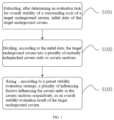
  • FIG. 1 shows a flowchart of the quantitative assessment method for the global stability of surrounding rocks of underground caverns of the present application.
  • the quantitative assessment method for the global stability of surrounding rocks of underground caverns according to the present application may specifically include the following steps S 101 to S 103 :
  • initial data of the target underground cavern are extracted.
  • the assessment for the global stability of the surrounding rock of the target underground cavern of the present application is based on small-unit cavern units or cavern sections of the target underground cavern.
  • the current assessment object that is, the target underground cavern can be divided into different independent cavern units or cavern sections under a preset similar judgment standard at an early stage of task execution, and these cavern units or cavern sections are used as assessment objects of the global stability of the surrounding rock.
  • the division of the target underground cavern is based on the initial data, and the initial data is easy to understand, is preliminary data of the target underground cavern when the task for the global stability of the surrounding rock is initiated and provides data basis for subsequent division.
  • the initial data may be directly carried in task data, or extracted from local or other devices storing the data.
  • the target underground cavern is divided into different independent cavern units or cavern sections according to the initial data.
  • the division of the target underground cavern may specifically include:
  • the initial maximum principal stress value, the buried depth, and the included angle between the initial maximum principal stress direction and the cavern axis belong to the category of “initial ground stress”;
  • the dimension, the cavern axis orientation, and the use functions belong to the category of “cavern scale and layout”.
  • these cavern units or cavern sections may be independently subjected to assessment processing for the global stability of the surrounding rock.
  • assessment strategy involved in the stability assessment processing may be pre-configured with corresponding assessment content according to the assessment requirements in practical application.
  • the preset stability assessment strategy may specifically rate from eight aspects (influencing factors): a basic quality index of the surrounding rock, an uniaxial compressive strength of the surrounding rock, a local stability condition of the surrounding rock, a relaxation/damage condition of the surrounding rock, a combined relationship between the initial maximum principal stress direction of the surrounding rock and the cavern axis, a combined relationship between a main structural plane and the cavern axis, groundwater and other influencing factors.
  • influencing factors a basic quality index of the surrounding rock, an uniaxial compressive strength of the surrounding rock, a local stability condition of the surrounding rock, a relaxation/damage condition of the surrounding rock, a combined relationship between the initial maximum principal stress direction of the surrounding rock and the cavern axis, a combined relationship between a main structural plane and the cavern axis, groundwater and other influencing factors.
  • the local stability rating of the surrounding rock of the same unit or cavern section of a single failure type may take the lowest value of all ratings of this type, and the local stability rating of the surrounding rock of the same unit or cavern section may take the rating corresponding to the most unfavorable type of each failure type.
  • the ratings of eight influencing factors may also be accumulated, and the accumulated ratings are confirmed as the global stability assessment results of the surrounding rock of respective cavern units or cavern sections, as the global stability assessment result of the target underground cavern.
  • weight values may also be configured for eight influencing factors involved in the stability assessment process, to finally obtain the global stability ratings of the surrounding rock of different cavern units or sections.
  • the stability assessment result based on the ratings may also include other contents, to better indicate specific stability degrees, and the stability degrees may be divided according to the specific ratings.
  • the process of obtaining the stability assessment result based on the ratings may specifically include:
  • the global stability classifications of the surrounding rock of the underground cavern is divided into four classifications: stable, basically stable, understable and unstable respectively;
  • the highest value of the global stability rating of the surrounding rock of the underground cavern may be 100, and the lowest value may be 0.
  • the upper and lower limits of the rating interval corresponding to the global stability classification of the surrounding rock of the underground cavern are up to the nearest multiple of 10 based on the sum of the upper and lower limits of the rating interval of each influencing factor.
  • the corresponding ranges may also be set according to two different stages, that is, a survey and design stage and a construction stage. Therefore, in practical application, the stability assessment processing performed in the present application can be accurately adapted to the survey and design stage and the construction stage, thereby avoiding the problem of different assessment results for the global stability of the surrounding rock caused by different survey depths and detection depths of engineering geological conditions in different stages, and possible changes of an excavation and support design solution.
  • the above content may also be understood in combination with a scenario schematic diagram of the quantitative assessment method for the global stability of surrounding rocks of underground caverns in the present application shown in FIG. 2 .
  • the present application firstly divides the target underground cavern to be subjected to stability assessment into different independent cavern units or cavern sections according to the initial data, and carries out multi-factor assessment processing on the global stability of the surrounding rock of these cavern units or cavern sections according to the preset stability assessment strategy to obtain the global stability assessment results of the surrounding rock of the cavern units or cavern sections.
  • the global stability state of the surrounding rock of the underground cavern can be quickly, effectively, and accurately judged, and a concrete, practical and effective quantitative assessment solution is realized and provides strong data guidance for engineering practice work involved in the underground cavern.
  • the present application also provides a quantitative assessment apparatus for the global stability of surrounding rocks of underground caverns from the perspective of functional modules.
  • FIG. 3 is a structural schematic diagram of the quantitative assessment apparatus for the global stability of surrounding rocks of underground caverns.
  • the quantitative assessment apparatus 300 for the global stability of surrounding rocks of underground caverns may specifically include the following structures:
  • an extracting unit 301 configured to extract, after determining an assessment task for global stability of a surrounding rock of a target underground cavern, initial data of the target underground cavern;
  • a dividing unit 302 configured to divide, according to the initial data, the target underground cavern into different independent cavern units or cavern sections;
  • a rating unit 303 configured to rate, according to a preset stability assessment strategy, the eight factors influencing the stability of surrounding rocks of cavern units or the cavern sections respectively, as a global stability assessment result of the target underground cavern.
  • the dividing unit is specifically configured to:
  • the preset stability assessment strategy evaluates from eight aspects: a basic quality index of the surrounding rock, an uniaxial compressive strength of the surrounding rock, a local stability condition of the surrounding rock, a relaxation/damage condition of the surrounding rock, a combined relationship between the initial maximum principal stress direction of the surrounding rock and the cavern axis, a combined relationship between a main structural plane and the cavern axis, groundwater and other influencing factors.
  • the local stability condition of the surrounding rock is specifically evaluated from four aspects: a local deformation stability of the surrounding rock, a block stability of the surrounding rock, a collapse tendency of the surrounding rock, and a rockburst tendency of the surrounding rock.
  • the rating unit 303 is specifically configured to:
  • the rating unit 303 is specifically configured to:
  • corresponding ranges are set for defined ranges involved in the cavern units or cavern sections and rating ranges involved in the rating according to a survey and design stage and a construction stage.
  • the present application also provides a quantitative assessment device for the global stability of surrounding rocks of underground caverns from the perspective of a hardware structure.
  • FIG. 4 shows a structural schematic diagram of the quantitative assessment device for the global stability of surrounding rocks of underground caverns of the present application.
  • the quantitative assessment device for the global stability of surrounding rocks of underground caverns of the present application may include a processor 401 , a memory 402 , and an input and output device 403 .
  • the processor 401 is configured to implement respective steps of the quantitative assessment method for the global stability of surrounding rocks of underground caverns in the corresponding embodiment of FIG. 1 when executing a computer program stored in the memory 402 .
  • the processor 401 is configured to realize the functions of respective units in the corresponding embodiment of FIG. 3 when executing the computer program stored in the memory 402
  • the memory 402 is configured to store the computer program required by the processor 401 to execute the quantitative assessment method for the global stability of surrounding rocks of underground caverns in the corresponding embodiment of FIG. 1 .
  • the computer program may be divided into one or more modules/units, which are stored in the memory 402 and executed by the processor 401 to complete the present application.
  • the one or more modules/units may be a series of computer program instruction segments capable of finishing specific functions, and the instruction segments are configured to describe the execution process of the computer program in a computer apparatus.
  • the quantitative assessment device for the global stability of surrounding rocks of underground caverns may include, but not limited to, the processor 401 , the memory 402 , and the input and output device 403 .
  • the illustration is only an example of the quantitative assessment device for the global stability of surrounding rocks of underground caverns, and does not constitute a limitation on the quantitative assessment device for the global stability of surrounding rocks of underground caverns.
  • the device may include more or less components than those illustrated, or combine some components or different components.
  • the quantitative assessment device for the global stability of surrounding rocks of underground caverns may also include a network access device, a bus, etc.
  • the processor 401 , the memory 402 and the input and output device 403 are connected through the bus.
  • the processor 401 may be a Central Processing Unit (CPU), or other general-purpose processors, a Digital Signal Processor (DSP), an Application Specific Integrated Circuit (ASIC), a Field-Programmable Gate Array (FPGA) or other programmable logic devices, discrete gate or transistor logic devices, discrete hardware components, etc.
  • the general-purpose processor may be a microprocessor or the processor may be any conventional processor, etc.
  • the processor is a control center of the quantitative assessment device for the global stability of surrounding rocks of underground caverns, and connects all parts of the whole device with various interfaces and lines.
  • the memory 402 may be configured to store the computer program and/or modules, and the processor 401 realizes various functions of the computer apparatus by running or executing the computer program and/or modules stored in the memory 402 and calling the data stored in the memory 402 .
  • the memory 402 may mainly include a storage program area and a storage data area, wherein the storage program area may store an operating system, an application program required by at least one function, etc.; the storage data area may store data created by the use of the quantitative assessment device for the global stability of surrounding rocks of underground caverns.
  • the memory may include a high-speed random access memory and may also include a non-volatile memory, such as a hard disk, a memory, a plug-in hard disk, a Smart Media Card (SMC), a Secure Digital (SD) card, a Flash Card, at least one disk memory device, a flash memory device, or other volatile solid-state memory devices.
  • a non-volatile memory such as a hard disk, a memory, a plug-in hard disk, a Smart Media Card (SMC), a Secure Digital (SD) card, a Flash Card, at least one disk memory device, a flash memory device, or other volatile solid-state memory devices.
  • the processor 401 When configured to execute the computer program stored in the memory 402 , the processor 401 may specifically realize the following functions:
  • the target underground cavern into different independent cavern units or cavern sections;
  • the present application provides a computer-readable storage medium, in which various instructions are stored, and the instructions can be loaded by a processor to execute the steps of the quantitative assessment method for the global stability of surrounding rocks of underground caverns in the corresponding embodiment of FIG. 1 .
  • the instructions can be loaded by a processor to execute the steps of the quantitative assessment method for the global stability of surrounding rocks of underground caverns in the corresponding embodiment of FIG. 1 .
  • the specific operation please refer to the descriptions of the quantitative assessment method for the global stability of surrounding rocks of underground caverns in the corresponding embodiment of FIG. 1 , which will not be repeated here.
  • the computer-readable storage medium may include a Read Only Memory (ROM), a Random Access Memory (RAM), a magnetic disk or optical disk, etc.
  • ROM Read Only Memory
  • RAM Random Access Memory
  • magnetic disk or optical disk etc.
  • the instructions stored in the computer-readable storage medium may execute the steps of the quantitative assessment method for the global stability of surrounding rocks of underground caverns in the corresponding embodiment of FIG. 1 , the beneficial effects that can be achieved by the quantitative assessment method for the global stability of surrounding rocks of underground caverns in the corresponding embodiment of FIG. 1 can be realized, and the previous descriptions are referred for details, and will not be repeated here.

Landscapes

  • Business, Economics & Management (AREA)
  • Engineering & Computer Science (AREA)
  • Human Resources & Organizations (AREA)
  • Physics & Mathematics (AREA)
  • General Physics & Mathematics (AREA)
  • General Business, Economics & Management (AREA)
  • Strategic Management (AREA)
  • Theoretical Computer Science (AREA)
  • Economics (AREA)
  • Life Sciences & Earth Sciences (AREA)
  • Tourism & Hospitality (AREA)
  • Marketing (AREA)
  • Health & Medical Sciences (AREA)
  • General Health & Medical Sciences (AREA)
  • Primary Health Care (AREA)
  • General Life Sciences & Earth Sciences (AREA)
  • Entrepreneurship & Innovation (AREA)
  • Mining & Mineral Resources (AREA)
  • Educational Administration (AREA)
  • Development Economics (AREA)
  • Geophysics (AREA)
  • Marine Sciences & Fisheries (AREA)
  • Analytical Chemistry (AREA)
  • Agronomy & Crop Science (AREA)
  • Animal Husbandry (AREA)
  • Game Theory and Decision Science (AREA)
  • Operations Research (AREA)
  • Chemical & Material Sciences (AREA)
  • Quality & Reliability (AREA)
  • Soil Sciences (AREA)
  • Paleontology (AREA)
  • Civil Engineering (AREA)
  • General Engineering & Computer Science (AREA)
  • Structural Engineering (AREA)
  • Devices Affording Protection Of Roads Or Walls For Sound Insulation (AREA)
  • Geophysics And Detection Of Objects (AREA)
  • Investigation Of Foundation Soil And Reinforcement Of Foundation Soil By Compacting Or Drainage (AREA)

Abstract

The present application provides a quantitative assessment method, apparatus and device for global stability of surrounding rocks of underground caverns, which are configured to provide a concrete, practical and effective quantitative assessment solution for a global stability state of the surrounding rocks of the underground caverns. The quantitative assessment method for global stability of surrounding rocks of underground caverns includes: extracting, after determining an assessment task for the global stability of the surrounding rock of a target underground cavern, initial data of the target underground cavern; dividing, according to the initial data, the target underground cavern into different independent cavern units or cavern sections; and rating, according to a preset stability assessment strategy, the eight factors influencing the stability of surrounding rocks of cavern units or the cavern sections are rated respectively, as a global stability assessment result of the target underground cavern.

Description

TECHNICAL FIELD
The present application relates to the technical field of geotechnical engineering, in particular to a quantitative assessment method, apparatus, and device for the global stability of surrounding rocks of underground caverns.
BACKGROUND
With the rapid development of the national economy, the demand for energy exploitation and underground space development in China presents explosive growth, so the construction of underground caverns tends to be normal. Global stability assessment of surrounding rocks of underground caverns has increasingly become an unavoidable technical problem in the development and utilization of underground spaces.
However, in the research process of existing related arts, the inventors found that up to now, there is no comprehensive, fast, effective, and standardized quantitative assessment technology for the global stability of surrounding rocks of underground caverns.
SUMMARY
The present application provides a quantitative assessment method, apparatus, and device for global stability of surrounding rocks of underground caverns configured for global stability assessment of surrounding rocks of underground caverns, and provides a concrete, practical and effective quantitative assessment method.
In the first aspect, the present application provides a quantitative assessment method for the global stability of surrounding rocks of underground caverns. The method includes:
extracting, after determining an assessment task for global stability of a surrounding rock of a target underground cavern, initial data of the target underground cavern;
dividing, according to the initial data, the target underground cavern into different independent cavern units or cavern sections; and
rating, according to a preset stability assessment strategy, the eight factors influencing the stability of surrounding rocks of cavern units or the cavern sections respectively, as a global stability assessment result of the target underground cavern.
In combination with the first aspect of the present application, in a first possible implementation of the first aspect of the present application, dividing, according to the initial data, the target underground cavern into different independent cavern units or cavern sections includes:
dividing, according to geological structures, rock mass structure types, lithology, initial maximum principal stress values, buried depths, included angles between initial maximum principal stress directions and a cavern axis, dimensions, a cavern axis orientation and use functions of different positions carried in the initial data, the target underground cavern into different independent cavern units or cavern sections in a preset similar judgment range.
In combination with the first aspect of the present application, in a second possible implementation of the first aspect of the present application, the preset stability assessment strategy evaluates from eight aspects: a basic quality index of the surrounding rock, an uniaxial compressive strength of the surrounding rock, a local stability condition of the surrounding rock, a relaxation/damage condition of the surrounding rock, a combined relationship between the initial maximum principal stress direction of the surrounding rock and the cavern axis, a combined relationship between a main structural plane and the cavern axis, groundwater and other influencing factors.
In combination with the second possible implementation of the first aspect of the present application, in a third possible implementation of the first aspect of the present application, the local stability condition of the surrounding rock is specifically evaluated from four aspects: a local deformation stability of the surrounding rock, block stability of the surrounding rock, a collapse tendency of the surrounding rock and a rockburst tendency of the surrounding rock.
In combination with the first aspect of the present application, in a fourth possible implementation of the first aspect of the present application, rating, according to a preset stability assessment strategy, the eight factors influencing the stability of surrounding rocks of cavern units or the cavern sections respectively, as a global stability assessment result of the target underground cavern includes:
rating, according to the preset stability assessment strategy, the eight factors influencing the stability of the surrounding rock of cavern units or the cavern sections respectively; and
accumulating ratings of the eight influencing factors, and confirming accumulated ratings as stability assessment results of respective cavern units or cavern sections, as the global stability assessment result of the target underground cavern.
In combination with the fourth possible implementation of the first aspect of the present application, in a fifth possible implementation of the first aspect of the present application, accumulating ratings of the eight influencing factors, and confirming accumulated ratings as stability assessment results of respective cavern units or cavern sections includes:
accumulating the ratings of the eight influencing factors;
determining, based on preset global stability classifications of the surrounding rock of the underground cavern and rating ranges thereof, target global stability classifications corresponding to the accumulated rating values, the global stability classifications of the surrounding rock of the cavern units or cavern sections being divided into four classifications: stable, basically stable, understable, and unstable; and
confirming the accumulated rating values and the target global stability classifications as the stability assessment results of respective cavern units or cavern sections, as the global stability assessment result of the target underground cavern.
In combination with the first aspect of the present application, in a sixth possible implementation of the first aspect of the present application, corresponding ranges are set for defined ranges involved in the cavern units or cavern sections and rating ranges involved in the rating according to a survey and design stage and a construction stage.
In a second aspect, the present application provides a quantitative assessment apparatus for the global stability of surrounding rocks of underground caverns. The apparatus includes:
an extracting unit configured to extract, after determining an assessment task for global stability of a surrounding rock of a target underground cavern, initial data of the target underground cavern;
a dividing unit configured to divide, according to the initial data, the target underground cavern into different independent cavern units or cavern sections; and
a rating unit configured to rate, according to a preset stability assessment strategy, the eight factors influencing the stability of surrounding rocks of cavern units or the cavern sections respectively, as a global stability assessment result of the target underground cavern.
In combination with the first aspect of the present application, in the first possible implementation of the first aspect of the present application, dividing, according to the initial data, the target underground cavern into different independent cavern units or cavern sections includes:
dividing, according to geological structures, rock mass structure types, lithology, initial maximum principal stress values, buried depths, included angles between initial maximum principal stress directions and a cavern axis, dimensions, a cavern axis orientation and use functions of different positions carried in the initial data, the target underground cavern into different independent cavern units or cavern sections in a preset similar judgment range.
In combination with the second aspect of the present application, in a second possible implementation of the second aspect of the present application, the preset stability assessment strategy evaluates from eight aspects: a basic quality index of the surrounding rock, an uniaxial compressive strength of the surrounding rock, a local stability condition of the surrounding rock, a relaxation/damage condition of the surrounding rock, a combined relationship between the initial maximum principal stress direction of the surrounding rock and the cavern axis, a combined relationship between a main structural plane and the cavern axis, groundwater and other influencing factors.
In combination with the second possible implementation of the second aspect of the present application, in a third possible implementation of the second aspect of the present application, the local stability condition of the surrounding rock is specifically evaluated from four aspects: a local deformation stability of the surrounding rock, a block stability of the surrounding rock, a collapse tendency of the surrounding rock and a rockburst tendency of the surrounding rock.
In combination with the second aspect of the present application, in a fourth possible implementation of the second aspect of the present application, the rating unit is specifically configured to:
rate, according to the preset stability assessment strategy, the eight factors influencing the stability of the surrounding rock of cavern units or the cavern sections respectively; and
accumulate ratings of the eight influencing factors, and confirm accumulated rating values as stability assessment results of respective cavern units or cavern sections, as the global stability assessment result of the target underground cavern.
In combination with the fourth possible implementation of the second aspect of the present application, in a fifth possible implementation of the second aspect of the present application, the rating unit is specifically configured to:
accumulate the ratings of the eight influencing factors;
determine, based on preset global stability classifications of the surrounding rock of the underground cavern and rating ranges thereof, target global stability classifications corresponding to the accumulated ratings, the global stability classifications of the surrounding rock of the cavern units or cavern sections being divided into four classifications: stable, basically stable, understable, and unstable; and
confirm the accumulated ratings and the target global stability classifications as the stability assessment results of respective cavern units or cavern sections, as the global stability assessment result of the target underground cavern.
In combination with the second aspect of the present application, in a sixth possible implementation of the second aspect of the present application, corresponding ranges are set for defined ranges involved in the cavern units or cavern sections and rating ranges involved in the rating according to a survey and design stage and a construction stage.
In a third aspect, the present application provides a quantitative assessment device for the global stability of surrounding rocks of underground caverns, which includes a processor and a memory, a computer program is stored in the memory, and the processor executes the method according to the first aspect or any possible implementation of the first aspect of the present application when calling the computer program in the memory.
In a fourth aspect, the present application provides a computer-readable storage medium, and the computer-readable storage medium stores various instructions which are suitable for being loaded by a processor to execute the method according to the first aspect or any possible implementation of the first aspect of the present application.
From the above content, it can be seen that the present application has the following beneficial effects:
For the assessment of the global stability of surrounding rocks of underground caverns, the present application firstly divides the target underground cavern to be subjected to stability assessment into different independent cavern units or cavern sections according to the initial data and carries out multi-factor assessment processing on the global stability of surrounding rocks of these cavern units or cavern sections according to the preset stability assessment strategy to obtain the global stability assessment results of the surrounding rock of the cavern units or cavern sections. In this assessment process, the global stability state of the surrounding rock of the underground cavern can be quickly, effectively, and accurately judged, and a concrete, practical and effective quantitative assessment solution is realized and provides strong data guidance for engineering practice work involved in the underground cavern.
BRIEF DESCRIPTION OF DRAWINGS
In order to describe the technical solutions in the embodiments of the present application more clearly, the following briefly introduces the accompanying drawings required for describing the embodiments. The accompanying drawings in the following description are merely some embodiments of the present application, and those ordinary skilled in the art may still derive other drawings from these accompanying drawings without creative efforts.
FIG. 1 is a flowchart of a quantitative assessment method for the global stability of surrounding rocks of underground caverns of the present application;
FIG. 2 is a scenario schematic diagram of a quantitative assessment method for global stability of surrounding rocks of underground caverns of the present application;
FIG. 3 is a structural schematic diagram of a quantitative assessment apparatus for global stability of surrounding rocks of underground caverns of the present application; and
FIG. 4 is a structural schematic diagram of a quantitative assessment device for the global stability of surrounding rocks of underground caverns of the present application.
DETAILED DESCRIPTION OF EMBODIMENTS
The technical solutions in the embodiments of the present application will be clearly and completely described below in combination with the accompanying drawings in the embodiments of the present application. It is obvious that the described embodiments are only part but not all of the embodiments of the present application. All other embodiments obtained by those skilled in the art without creative efforts based on the embodiments in the present application are within the protection scope of the present application.
The terms such as “first” and “second” in the description and claims of the present application and the above drawings are configured to distinguish similar objects and are not necessarily configured to describe a specific order or sequence. It should be understood that the data used in this way can be interchanged under appropriate circumstances so that the embodiments described here can be implemented in a sequence other than those illustrated or described here. In addition, the terms “include” and “have” and any variations thereof are intended to cover non-exclusive inclusions. For example, the processes, methods, systems, products, or devices that include a series of steps or modules are not necessarily limited to those steps or modules that are listed but may include other steps or modules that are not clearly listed or inherent to these processes, methods, products or devices. Names or numbers of the steps in the present application do not mean that the steps in the method process must be executed in the time/logical sequence indicated by the names or numbers. The execution sequence of the named or numbered process steps can be changed according to the technical purpose to be achieved, as long as the same or similar technical effects can be achieved.
The division of the modules in the present application is only a logical division. In actual implementation, there may exist other division manners. For example, multiple modules may be combined or integrated into another system, or some features may be ignored or not executed. In addition, the mutual coupling or direct coupling, or communication connection shown or discussed may be indirect coupling or communication connection by certain interfaces and modules, or electrical connection, or the connection of other forms, which is not limited by the present application. Besides, the modules or sub-modules described as separate components may or may not be physically separate, may or may not be physical modules, or may be distributed to multiple circuit modules. Part or all of the modules may be selected according to actual needs to achieve the objectives of the solutions of the present application.
Before introducing the quantitative assessment method for global stability of surrounding rocks of underground caverns according to the present application, the background content involved in the present application is firstly introduced.
The quantitative assessment method and apparatus for global stability of surrounding rocks of underground caverns and the computer-readable storage medium can provide a concrete, practical and effective quantitative assessment solution for the global stability of surrounding rocks of underground caverns.
An execution subject of the quantitative assessment method for the global stability of surrounding rocks of underground caverns mentioned in the present application may be the quantitative assessment apparatus for the global stability of surrounding rocks of underground caverns, or different types of quantitative assessment devices for the global stability of surrounding rocks of underground caverns, such as servers, physical hosts or User Equipment (UE) integrated with such a quantitative assessment apparatus for the global stability of surrounding rocks of underground caverns. The quantitative assessment apparatus for the global stability of surrounding rocks of underground caverns may be implemented by hardware or software, and the UE may be a terminal device such as a smart phone, a tablet computer, a notebook computer, a desktop computer, or a Personal Digital Assistant (PDA). The quantitative assessment and processing device for the global stability of surrounding rocks of underground caverns may be set using a device cluster.
Next, the quantitative assessment method for the global stability of surrounding rocks of underground caverns according to the present application is introduced firstly.
Firstly, referring to FIG. 1 , FIG. 1 shows a flowchart of the quantitative assessment method for the global stability of surrounding rocks of underground caverns of the present application. The quantitative assessment method for the global stability of surrounding rocks of underground caverns according to the present application may specifically include the following steps S101 to S103:
S101, after determining an assessment task for the global stability of the surrounding rock of a target underground cavern, initial data of the target underground cavern are extracted.
It can be understood that the assessment for the global stability of the surrounding rock of the target underground cavern of the present application is based on small-unit cavern units or cavern sections of the target underground cavern. Under this principle, after the assessment task for the global stability of the surrounding rock of the target underground cavern is triggered, the current assessment object, that is, the target underground cavern can be divided into different independent cavern units or cavern sections under a preset similar judgment standard at an early stage of task execution, and these cavern units or cavern sections are used as assessment objects of the global stability of the surrounding rock.
The division of the target underground cavern is based on the initial data, and the initial data is easy to understand, is preliminary data of the target underground cavern when the task for the global stability of the surrounding rock is initiated and provides data basis for subsequent division.
It should be noted that the initial data may be directly carried in task data, or extracted from local or other devices storing the data.
S102, the target underground cavern is divided into different independent cavern units or cavern sections according to the initial data.
In the division processing of the target underground cavern, the principle of similarity is followed, and the cavern units or cavern sections with similar properties on an engineering geological unit are divided into different independent cavern units or cavern sections.
As a practical implementation, in the present application, the division of the target underground cavern may specifically include:
according to geological structures, rock mass structure types, lithology, initial maximum principal stress values, buried depths, included angles between initial maximum principal stress directions and a cavern axis, dimensions, a cavern axis orientation and use functions of different positions carried in the initial data, dividing different positions of the target underground cavern into different independent cavern units or cavern sections within a preset similar judgment range.
the initial maximum principal stress value, the buried depth, and the included angle between the initial maximum principal stress direction and the cavern axis belong to the category of “initial ground stress”; and
the dimension, the cavern axis orientation, and the use functions belong to the category of “cavern scale and layout”.
In addition to classifying the categories of influencing factors, in practical application, a similar judgment range suitable for each category may also be configured.
S103, according to a preset stability assessment strategy, the eight factors influencing the global stability of surrounding rocks of the cavern units or cavern sections are rated respectively, as the global stability assessment result of the target underground cavern.
After it is determined that the target underground cavern will be divided into multiple cavern units or cavern sections, these cavern units or cavern sections may be independently subjected to assessment processing for the global stability of the surrounding rock.
It can be understood that the assessment strategy involved in the stability assessment processing here may be pre-configured with corresponding assessment content according to the assessment requirements in practical application.
As another practical implementation, in the present application, the preset stability assessment strategy may specifically rate from eight aspects (influencing factors): a basic quality index of the surrounding rock, an uniaxial compressive strength of the surrounding rock, a local stability condition of the surrounding rock, a relaxation/damage condition of the surrounding rock, a combined relationship between the initial maximum principal stress direction of the surrounding rock and the cavern axis, a combined relationship between a main structural plane and the cavern axis, groundwater and other influencing factors.
The local stability rating of the surrounding rock of the same unit or cavern section of a single failure type may take the lowest value of all ratings of this type, and the local stability rating of the surrounding rock of the same unit or cavern section may take the rating corresponding to the most unfavorable type of each failure type.
For a single cavern unit or cavern section, after eight influencing factors are rated by the preset stability assessment strategy, the ratings of eight influencing factors may also be accumulated, and the accumulated ratings are confirmed as the global stability assessment results of the surrounding rock of respective cavern units or cavern sections, as the global stability assessment result of the target underground cavern.
In addition, it is easy to understand that, in practical application, corresponding weight values may also be configured for eight influencing factors involved in the stability assessment process, to finally obtain the global stability ratings of the surrounding rock of different cavern units or sections.
Of course, for different influencing factors or even different cavern units or cavern sections involved in the stability assessment process, in practical application, different adaptation strategies and inclination strategies may also be configured according to different requirements, so that the global stability ratings of the surrounding rock of different cavern units or cavern sections can be finally obtained, and more accurate determination and presentation effects can be obtained according to actual situations.
In addition, the stability assessment result based on the ratings may also include other contents, to better indicate specific stability degrees, and the stability degrees may be divided according to the specific ratings.
For example, as yet another practical implementation, the process of obtaining the stability assessment result based on the ratings may specifically include:
accumulating ratings of the eight influencing factors;
determining, based on the preset global stability classifications of the surrounding rock of the underground cavern and rating ranges thereof, a target global stability classification corresponding to the accumulated rating, the global stability classifications of the surrounding rock of the underground cavern is divided into four classifications: stable, basically stable, understable and unstable respectively; and
confirming the accumulated ratings and the target global stability classifications as the global stability assessment results of the surrounding rock of respective cavern units or cavern sections, as the global stability assessment result of the target underground cavern.
It can be understood that under this setting, in addition to the basic ratings (accumulated ratings), the global stability classifications are also introduced, so that the specific stability degree of the target underground cavern can be indicated in combination with the ratings and the global stability classifications in an intuitive and concrete presentation way.
As yet another example, in the practical application of the present application, the highest value of the global stability rating of the surrounding rock of the underground cavern may be 100, and the lowest value may be 0.
In addition, the upper and lower limits of the rating interval corresponding to the global stability classification of the surrounding rock of the underground cavern are up to the nearest multiple of 10 based on the sum of the upper and lower limits of the rating interval of each influencing factor.
In addition, for the above content, for defined ranges involved by the cavern units or cavern sections, or the rating ranges (corresponding to the stability assessment strategy) involved in rating, in yet another practical implementation, the corresponding ranges may also be set according to two different stages, that is, a survey and design stage and a construction stage. Therefore, in practical application, the stability assessment processing performed in the present application can be accurately adapted to the survey and design stage and the construction stage, thereby avoiding the problem of different assessment results for the global stability of the surrounding rock caused by different survey depths and detection depths of engineering geological conditions in different stages, and possible changes of an excavation and support design solution.
Specifically, the above content (including respective exemplary implementations) may also be understood in combination with a scenario schematic diagram of the quantitative assessment method for the global stability of surrounding rocks of underground caverns in the present application shown in FIG. 2 .
Generally speaking, it can be seen from the above content that, for the assessment of the global stability of surrounding rocks of underground caverns, the present application firstly divides the target underground cavern to be subjected to stability assessment into different independent cavern units or cavern sections according to the initial data, and carries out multi-factor assessment processing on the global stability of the surrounding rock of these cavern units or cavern sections according to the preset stability assessment strategy to obtain the global stability assessment results of the surrounding rock of the cavern units or cavern sections. In this assessment process, the global stability state of the surrounding rock of the underground cavern can be quickly, effectively, and accurately judged, and a concrete, practical and effective quantitative assessment solution is realized and provides strong data guidance for engineering practice work involved in the underground cavern.
The above is the introduction of the quantitative assessment method for the global stability of surrounding rocks of underground caverns according to the present application. To better implement the quantitative assessment method for the global stability of surrounding rocks of underground caverns according to the present application, the present application also provides a quantitative assessment apparatus for the global stability of surrounding rocks of underground caverns from the perspective of functional modules.
Referring to FIG. 3 , FIG. 3 is a structural schematic diagram of the quantitative assessment apparatus for the global stability of surrounding rocks of underground caverns. In the present application, the quantitative assessment apparatus 300 for the global stability of surrounding rocks of underground caverns may specifically include the following structures:
an extracting unit 301 configured to extract, after determining an assessment task for global stability of a surrounding rock of a target underground cavern, initial data of the target underground cavern;
a dividing unit 302 configured to divide, according to the initial data, the target underground cavern into different independent cavern units or cavern sections; and
a rating unit 303 configured to rate, according to a preset stability assessment strategy, the eight factors influencing the stability of surrounding rocks of cavern units or the cavern sections respectively, as a global stability assessment result of the target underground cavern.
In yet another exemplary implementation, the dividing unit is specifically configured to:
divide, according to geological structures, rock mass structure types, lithology, initial maximum principal stress values, buried depths, included angles between initial maximum principal stress directions and a cavern axis, dimensions, a cavern axis orientation and use functions of different positions carried in the initial data, the target underground cavern into different independent cavern units or cavern sections in a preset similar judgment range.
In yet another exemplary implementation, the preset stability assessment strategy evaluates from eight aspects: a basic quality index of the surrounding rock, an uniaxial compressive strength of the surrounding rock, a local stability condition of the surrounding rock, a relaxation/damage condition of the surrounding rock, a combined relationship between the initial maximum principal stress direction of the surrounding rock and the cavern axis, a combined relationship between a main structural plane and the cavern axis, groundwater and other influencing factors.
In yet another exemplary implementation, the local stability condition of the surrounding rock is specifically evaluated from four aspects: a local deformation stability of the surrounding rock, a block stability of the surrounding rock, a collapse tendency of the surrounding rock, and a rockburst tendency of the surrounding rock.
In yet another exemplary implementation, the rating unit 303 is specifically configured to:
rate, according to the preset stability assessment strategy, the eight factors influencing the stability of the surrounding rock of cavern units or the cavern sections respectively; and
accumulate ratings of the eight influencing factors, and confirm accumulated ratings as stability assessment results of respective cavern units or cavern sections, as the global stability assessment result of the target underground cavern.
In yet another exemplary implementation, the rating unit 303 is specifically configured to:
accumulate the ratings of the eight influencing factors;
determine, based on preset global stability classifications of the surrounding rock of the underground cavern and rating ranges thereof, target global stability classifications corresponding to the accumulated ratings, the global stability classifications of the surrounding rock of the cavern units or cavern sections being divided into four classifications: stable, basically stable, understable and unstable; and
confirm the accumulated ratings and the target global stability classifications as the stability assessment results of respective cavern units or cavern sections, as the global stability assessment result of the target underground cavern.
In yet another exemplary implementation, corresponding ranges are set for defined ranges involved in the cavern units or cavern sections and rating ranges involved in the rating according to a survey and design stage and a construction stage.
The present application also provides a quantitative assessment device for the global stability of surrounding rocks of underground caverns from the perspective of a hardware structure. Referring to FIG. 4 , FIG. 4 shows a structural schematic diagram of the quantitative assessment device for the global stability of surrounding rocks of underground caverns of the present application. Specifically, the quantitative assessment device for the global stability of surrounding rocks of underground caverns of the present application may include a processor 401, a memory 402, and an input and output device 403. The processor 401 is configured to implement respective steps of the quantitative assessment method for the global stability of surrounding rocks of underground caverns in the corresponding embodiment of FIG. 1 when executing a computer program stored in the memory 402. Alternatively, the processor 401 is configured to realize the functions of respective units in the corresponding embodiment of FIG. 3 when executing the computer program stored in the memory 402, and the memory 402 is configured to store the computer program required by the processor 401 to execute the quantitative assessment method for the global stability of surrounding rocks of underground caverns in the corresponding embodiment of FIG. 1 .
Exemplarily, the computer program may be divided into one or more modules/units, which are stored in the memory 402 and executed by the processor 401 to complete the present application. The one or more modules/units may be a series of computer program instruction segments capable of finishing specific functions, and the instruction segments are configured to describe the execution process of the computer program in a computer apparatus.
The quantitative assessment device for the global stability of surrounding rocks of underground caverns may include, but not limited to, the processor 401, the memory 402, and the input and output device 403. Those skilled in the art may understand that the illustration is only an example of the quantitative assessment device for the global stability of surrounding rocks of underground caverns, and does not constitute a limitation on the quantitative assessment device for the global stability of surrounding rocks of underground caverns. The device may include more or less components than those illustrated, or combine some components or different components. For example, the quantitative assessment device for the global stability of surrounding rocks of underground caverns may also include a network access device, a bus, etc. The processor 401, the memory 402 and the input and output device 403 are connected through the bus.
The processor 401 may be a Central Processing Unit (CPU), or other general-purpose processors, a Digital Signal Processor (DSP), an Application Specific Integrated Circuit (ASIC), a Field-Programmable Gate Array (FPGA) or other programmable logic devices, discrete gate or transistor logic devices, discrete hardware components, etc. The general-purpose processor may be a microprocessor or the processor may be any conventional processor, etc. The processor is a control center of the quantitative assessment device for the global stability of surrounding rocks of underground caverns, and connects all parts of the whole device with various interfaces and lines.
The memory 402 may be configured to store the computer program and/or modules, and the processor 401 realizes various functions of the computer apparatus by running or executing the computer program and/or modules stored in the memory 402 and calling the data stored in the memory 402. The memory 402 may mainly include a storage program area and a storage data area, wherein the storage program area may store an operating system, an application program required by at least one function, etc.; the storage data area may store data created by the use of the quantitative assessment device for the global stability of surrounding rocks of underground caverns. In addition, the memory may include a high-speed random access memory and may also include a non-volatile memory, such as a hard disk, a memory, a plug-in hard disk, a Smart Media Card (SMC), a Secure Digital (SD) card, a Flash Card, at least one disk memory device, a flash memory device, or other volatile solid-state memory devices.
When configured to execute the computer program stored in the memory 402, the processor 401 may specifically realize the following functions:
extracting, after determining an assessment task for global stability of a surrounding rock of a target underground cavern, initial data of the target underground cavern;
dividing, according to the initial data, the target underground cavern into different independent cavern units or cavern sections; and
rating, according to a preset stability assessment strategy, the eight factors influencing the stability of surrounding rocks of cavern units or the cavern sections respectively, as a global stability assessment result of the target underground cavern.
Those skilled in the art may clearly understand that for the convenience and conciseness of descriptions, specific working processes of the quantitative assessment apparatus and device and corresponding units for the global stability of surrounding rocks of underground caverns described above may refer to the descriptions of the quantitative assessment method for the global stability of surrounding rocks of underground caverns in the corresponding embodiment as shown in FIG. 1 , and the details will not be repeated here.
Those ordinary skilled in the art may understand that all or part of the steps in the various methods of the above embodiments may be completed by instructions, or controlling related hardware by the instructions, and the instructions may be stored in a computer-readable storage medium and loaded and executed by a processor.
Therefore, the present application provides a computer-readable storage medium, in which various instructions are stored, and the instructions can be loaded by a processor to execute the steps of the quantitative assessment method for the global stability of surrounding rocks of underground caverns in the corresponding embodiment of FIG. 1 . For the specific operation, please refer to the descriptions of the quantitative assessment method for the global stability of surrounding rocks of underground caverns in the corresponding embodiment of FIG. 1 , which will not be repeated here.
The computer-readable storage medium may include a Read Only Memory (ROM), a Random Access Memory (RAM), a magnetic disk or optical disk, etc.
Since the instructions stored in the computer-readable storage medium may execute the steps of the quantitative assessment method for the global stability of surrounding rocks of underground caverns in the corresponding embodiment of FIG. 1 , the beneficial effects that can be achieved by the quantitative assessment method for the global stability of surrounding rocks of underground caverns in the corresponding embodiment of FIG. 1 can be realized, and the previous descriptions are referred for details, and will not be repeated here.
The quantitative assessment method, apparatus and device for the global stability of surrounding rocks of underground caverns and the computer-readable storage medium according to the present disclosure have been described in detail above. Specific examples are configured herein to explain the principles and implementations of the present application. The descriptions of the above embodiments are only configured to help to understand the method and the core idea of the present application.
Meanwhile, for those ordinary skilled in the art, there will be changes in the specific implementations and the application scope according to the idea of the present application. In summary, the content of the description should not be understood as a limitation on the present application.

Claims (3)

What is claimed is:
1. A quantitative assessment method for global stability of surrounding rocks of underground-caverns, comprising:
extracting initial data of a target underground cavern, wherein the initial data comprises: geological structures, rock mass structure types, lithology, initial maximum principal stress values, buried depths, included angles between initial maximum principal stress directions and a cavern axis, dimensions, a cavern axis orientation and use functions of different positions of the target underground cavern;
dividing, according to the initial data, the target underground cavern into different independent cavern units or cavern sections; and
rating, according to a preset stability assessment strategy, seven factors influencing a stability of surrounding rocks of the cavern units or the cavern sections respectively, as a global stability assessment result of the target underground cavern;
said dividing, according to the initial data, the target underground cavern into the different independent cavern units or cavern sections comprising:
dividing, according to the initial data, the target underground cavern into the different dividing, according to the initial data, the target underground cavern into the different independent cavern units or cavern sections in a preset similar judgment range;
the preset stability assessment strategy evaluating from the seven factors: a basic quality (BQ) index of the surrounding rocks, an uniaxial compressive strength Rc of the surrounding rocks, a local stability condition of the surrounding rocks, a relaxation/damage condition of the surrounding rocks, a combined relationship between the initial maximum principal stress directions of the surrounding rocks and the cavern axis, a combined relationship between a main structural plane and the cavern axis, and groundwater;
the local stability condition of the surrounding rocks being specifically evaluated from four aspects: a local deformation stability of the surrounding rocks, a block stability of the surrounding rocks, a collapse tendency of the surrounding rocks and a rockburst tendency of the surrounding rocks;
said rating, according to the preset stability assessment strategy, the seven factors influencing the stability of the surrounding rocks of the cavern units or the cavern sections respectively, as the global stability assessment result of the target underground cavern comprising:
rating, according to the preset stability assessment strategy, the seven factors influencing the stability of the surrounding rocks of the cavern units or the cavern sections respectively; and
accumulating the ratings of the seven factors, and confirming the accumulated ratings as stability assessment results of respective cavern units or cavern sections, as the global stability assessment result of the target underground cavern;
said accumulating the ratings of the seven factors, and said confirming the accumulated ratings as the stability assessment results of the respective cavern units or cavern sections comprising:
accumulating the ratings of the seven factors;
determining, based on preset global stability classifications of the surrounding rocks of the target underground cavern and rating ranges thereof, target global stability classifications corresponding to the accumulated ratings, the preset global stability classifications of the surrounding rocks of the target underground cavern being divided into four classifications: stable, basically stable, understable and unstable; and
confirming the accumulated ratings and the target global stability classifications as the stability assessment results of the respective cavern units or cavern sections, and as the global stability assessment result of the target underground cavern;
during the rating, the BQ index of the surrounding rocks comprises:
Class I, BQ>550, Class II, 550≥BQ>450, and a corresponding rating interval of a rating S1 of the BQ index of the surrounding rocks is 20≥S1≥15; Class III, 450≥BQ>350 and the corresponding rating interval of the rating S1 of the BQ index of the surrounding rocks is 15≥S1≥10; Class IV, 350≥BQ>250 and the corresponding rating interval of the rating S1 of the BQ index of the surrounding rocks is 10≥S1≥5; Class V, 250≥BQ, and the corresponding rating interval of the rating S1 of the BQ index of the surrounding rocks is 5>S1≥0;
wherein the rating S1 of the BQ index of the surrounding rocks is linearly interpolated from a lower limit of the corresponding rating interval of the rating S1 of the BQ index of the surrounding rocks to an upper limit of the corresponding rating interval of the rating S1 of the BQ index of the surrounding rocks according to the BQ index of the surrounding rocks; when there is no BQ index monitoring data available, the rating S1 of the BQ index of the surrounding rocks is performed according to qualitative description of surrounding rocks characteristics of a site; when the BQ index of the surrounding rocks is Class I, the rating S1 of the BQ index of the surrounding rocks is 20; when the surrounding rocks are hard and brittle and have a brittle failure tendency, the rating S1 of the BQ index of the surrounding rocks is linearly interpolated from the upper limit of the corresponding rating interval of the rating S1 of the BQ index of the surrounding rocks to the lower limit of the corresponding rating interval of the rating S1 of the BQ index of the surrounding rocks according to the BQ index;
during the rating, rock strength Rcmax of the surrounding rocks comprises:
Rcmax≥7, and a corresponding rating interval of a rating S2 of the rock strength Rcmax of the surrounding rocks is 20≥S2≥15; 7>Rcmax≥4, and the corresponding rating interval of the rating S2 of the rock strength Rcmax of the surrounding rocks is 15>S2≥10; 4>Rcmax≥2, and the corresponding rating interval of the rating S2 of the rock strength Rcmax of the surrounding rocks is 10>S2≥5; 2>Rcmax, and the corresponding rating interval of the rating S2 of the rock strength Rcmax of the surrounding rocks is 5>S2≥0;
wherein the rating S2 of the rock strength Rcmax of the surrounding rocks is linearly interpolated from a lower limit of the corresponding rating interval of the rating S2 of the rock strength Rcmax of the surrounding rocks to an upper limit of the corresponding rating interval of the rating S2 of the rock strength Rcmax of the surrounding rocks according to the rock strength Rcmax of the uniaxial compressive strength Rc of the surrounding rocks to a maximum principal stress σmax of an initial ground stress; Rcmax>10, and the rating S2 of the rock strength Rcmax of the surrounding rocks is 20; Rcmax<1, and the rating S2 of the rock strength Rcmax of the surrounding rocks is 0;
during the rating, the local stability condition of the surrounding rocks comprises:
stable, and a corresponding rating interval of a rating S3 of the local stability condition of the surrounding rocks is 20≥S3≥15; basically stable, and the corresponding rating interval of the rating S3 of the local stability condition of the surrounding rocks is 15>S3≥10; understable, and the corresponding rating interval of the rating S3 of the local stability condition of the surrounding rocks is 10>S3≥5; unstable, and the corresponding rating interval of the rating S3 of the local stability condition of the surrounding rocks is 5>S3≥0; wherein the rating S3 of the local stability condition of the surrounding rocks of a single failure type of a cavern unit or cavern section takes a lowest value in all ratings of the single failure type;
during the rating, the relaxation/damage condition of the surrounding rocks comprises:
3 meters (m)≥Dr or 0.15≥Dr/B, and a corresponding rating interval of a rating S4 of the relaxation/damage condition of the surrounding rocks is 10≥S4≥8; 6 m≥Dr≥3 m or 0.3≥Dr/B>0.15, and the corresponding rating interval of the rating S4 of the relaxation/damage condition of the surrounding rocks is 8≥S4≥5; 9 m≥Dr>6 m or 0.45≥Dr/B>0.3, and the corresponding rating interval of the rating S4 of the relaxation/damage condition of the surrounding rocks is 5>S4≥2; Dr>9 m or Dr/B>0.45, and the corresponding rating interval of the rating S4 of the relaxation/damage condition of the surrounding rocks is 2>S4≥0;
wherein a damage zone depth Dr standard is adopted when a cavern span B>20 m, and a depth-cavern span ratio DI/B standard is adopted for others; Dr takes an average value of a maximum relaxation/damage depth of a monitoring/analysis section or area; the rating S4 of the relaxation/damage condition of the surrounding rocks is linearly interpolated from an upper limit of the corresponding rating interval of the rating S4 of the relaxation/damage condition of the surrounding rocks to a lower limit of the corresponding rating interval of the rating S4 of the relaxation/damage condition of the surrounding rocks according to a value of Dr or Dr/B; when Dr≥12 m or Dr/B≥0.6, the rating S4 of the relaxation/damage condition of the surrounding rocks is 0; in a survey and design stage, Dr is predicted by numerical calculation integrated with a damage assessment index or similar physical simulation; in a construction stage, Dr is obtained by an acoustic wave velocity test, borehole imaging or numerical calculation integrated with the damage assessment index; when a disturbance degree of a construction to the surrounding rocks is a target level, the rating S4 of the relaxation/damage condition of the surrounding rocks takes the lower limit of the corresponding rating interval of the rating S4 of the relaxation/damage condition of the surrounding rocks where the Dr standard or the Dr/B standard is located; when the local stability condition of the surrounding rocks takes an assessment result of the local deformation stability or the collapse tendency, the rating S4 of the relaxation/damage condition of the surrounding rocks is 0;
during the rating, the combined relationship between the initial maximum principal stress directions of the surrounding rocks and the cavern axis comprises:
20°≥γ, and a corresponding rating interval of a rating S5 of the combined relationship between the initial maximum principal stress directions of the surrounding rocks and the cavern axis is 10≥S5≥8; 40°≥γ>20°, and the corresponding rating interval of the rating S5 of the combined relationship between the initial maximum principal stress directions of the surrounding rocks and the cavern axis is 8>S5≥6; 70°≥γ>45°, and the corresponding rating interval of the rating S5 of the combined relationship between the initial maximum principal stress directions of the surrounding rocks and the cavern axis is 6>S5>3; γ>70°, and the corresponding rating interval of the rating S5 of the combined relationship between the initial maximum principal stress directions of the surrounding rocks and the cavern axis is 3>S5>0; wherein the rating S5 of the combined relationship between the initial maximum principal stress directions of the surrounding rocks and the cavern axis is linearly interpolated from an upper limit of the corresponding rating interval of the rating S5 of the combined relationship between the initial maximum principal stress directions of the surrounding rocks and the cavern axis to a lower limit of the corresponding rating interval of the rating S5 of the combined relationship between the initial maximum principal stress directions of the surrounding rocks and the cavern axis according to a value of γ, γ refers to an included angle between an initial maximum principal stress direction of the surrounding rocks and the cavern axis, and γ is an acute angle;
during the rating, the combined relationship between the main structural plane and the cavern axis comprises:
α≥60°, β>70°, and a corresponding rating of a rating S6 of the combined relationship between the main structural plane and the cavern axis is side wall S6=8 and vault S6=10; α≥60°, 70°>β≥45°, and the corresponding rating of the rating S6 of the combined relationship between the main structural plane and the cavern axis is the side wall S6=6 and the vault S6=8; α≥60°, 45°>β≥20°, and the corresponding rating of the rating S6 of the combined relationship between the main structural plane and the cavern axis is the side wall S6=8 and the vault S6=6; α≥60°, 20°>β, the corresponding rating of the rating S6 of the combined relationship between the main structural plane and the cavern axis is the side wall S6=10 and the vault S6=2, a is an included angle between a direction of the main structural plane and the cavern axis, and B is a dip angle of the main structural plane;
60°>α≥30°, β≥70°, and the corresponding rating of the rating S6 of the combined relationship between the main structural plane and the cavern axis is the side wall S6=6 and the vault S6=8; 60°>α≥30°, 70°>β≥45°, and the corresponding rating of the rating S6 of the combined relationship between the main structural plane and the cavern axis is the side wall S6=2 and the vault S6=6; 60°>α≥300, 45°>β≥20°, and the corresponding rating of the rating S6 of the combined relationship between the main structural plane and the cavern axis is the side wall S6=8 and the vault S6=2; 60°>α≥30°, 20°>β, and the corresponding rating of the rating S6 of the combined relationship between the main structural plane and the cavern axis is the side wall S6=10 and the vault S6=0;
30°>α, β≥70°, the corresponding rating of the rating S6 of the combined relationship between the main structural plane and the cavern axis is the side wall S6=2 and the vault S6=6; 30°>α, 70°>β≥45°, and the corresponding rating of the rating S6 of the combined relationship between the main structural plane and the cavern axis is the side wall S6=0 and the vault S6=2; 30°>α, 45°>β≥20°, and the corresponding rating of the rating S6 of the combined relationship between the main structural plane and the cavern axis is the side wall S6=6 and the vault S6=0; 30°>α, 20°>β, and the corresponding rating of the rating S6 of the combined relationship between main structural plane refers to discontinuities comprising a fault, a dislocation zone, a bedding plane, fissure, an altered fracture zone, and a dike zone which run through the target underground cavern and have a scale of Class II or below; when the main structural plane is exposed in the vault and the side wall at a same time, the rating S6 of the combined relationship between the main structural plane and the cavern axis takes a lowest value of the main structural plane when exposed in the vault and the main structural plane when exposed in the side wall; when there are multiple groups of main structural planes, the rating S6 of the combined relationship between the main structural plane and the cavern axis takes a lowest of all main structural planes; if there is no main structural plane influencing the stability of the surrounding rocks of the cavern units or the cavern sections, the rating S6 of the combined relationship between the main structural plane and the cavern axis is 10;
during the rating, the groundwater comprises:
10≥Q, dry without water seepage, and a corresponding rating interval of a rating S7 of the groundwater is 5≥S7≥4; 25≥Q>10, wet or dripping water, and the corresponding rating interval of the rating S7 of the groundwater is 4>S7≥3; 125≥Q>25, rain or linear water, and the corresponding rating interval of the rating S7 of the groundwater is 3>S7≥1; Q>125, gushing water, the corresponding rating interval of the rating S7 of the groundwater is 1>S7≥0;
wherein a unit of water quantity Q per 10 m cavern length is a liter per minute (L/min)·10 m; the rating S7 of the groundwater is linearly interpolated from an upper limit of the corresponding rating interval of the rating S7 of the groundwater to a lower limit of the corresponding rating interval of the rating S7 of the groundwater according to a common logarithm of Q; when there is no Q monitoring data available, the rating S7 of the groundwater is performed according to a description of a groundwater output state; when 250≥Q, the rating S7 of the groundwater is 0; in the survey and design stage, the lower limit of the corresponding rating interval of the rating S7 of the groundwater is selected according to a buried condition of the groundwater of the site;
during the rating, the local deformation stability of the surrounding rocks in the local stability condition of the surrounding rocks comprises:
stable, a corresponding rating interval of a rating S9 of the local deformation stability of the surrounding rocks is 20≥S9≥15, a classification standard in the survey and design stage is
Uallow 3 U ,
 a classification standard in the construction stage is 0.2 millimeters per day (mm/d)≥v or
Uallow 3 U
 for five consecutive days; basically stable, the corresponding rating interval of the rating S9 of the local deformation stability of the surrounding rocks is 15>S9≥10, the classification standard in the survey and design stage is
2 Uallow 3 U > Uallow 3 ,
 and the classification standard in the construction stage is 0.5 mm/d≥v>0.2 mm/d or
2 Uallow 3 U > Uallow 3
 for five consecutive days; understable, the corresponding rating interval of the rating S9 of the local deformation stability of the surrounding rocks is 10>S9≥5, the classification standard in the survey and design stage is
Uallow U > 2 Uallow 3 ,
 and the classification standard in the construction stage is 0.5 mm/d<v≤1 mm/d or
Uallow U > 2 Uallow 3
 for five consecutive days; or unstable, the corresponding rating interval of the rating S9 of the local deformation stability of the surrounding rocks is 5>S9≥0, the classification standard in the survey and design stage is U>Uallow, and the classification standard in the construction stage is v>1 mm/d or U>Uallow for five consecutive days;
wherein U, v and Uallow are a relative displacement, a deformation rate and an allowable relative displacement value of measuring points in key parts of the target underground cavern respectively; a value of Uallow should be in accordance with technical specifications of rock and soil anchor stock and shotcrete support engineering; the rating S9 of the local deformation stability of the surrounding rocks is linearly interpolated from an upper limit of the corresponding rating interval of the rating S9 of the local deformation stability of the surrounding rocks to a lower limit of the corresponding rating interval of the rating S9 of the local deformation stability of the surrounding rocks according to a value of U or v; the rating S9 of the local deformation stability of the surrounding rocks is 0 when v>2 mm/d in five consecutive days or U>1.3Uallow; when double standards of U and v are adopted for rating, an assessment result of the double standards of U and v with a lowest rating is taken;
during the rating, the block stability of the surrounding rocks in the local stability condition of the surrounding rocks comprises:
stable, a corresponding rating interval of a rating S10 of the block stability of the surrounding rocks is 20≥S10≥15, and the classification standard is Fs≥Fs allow; basically stable, the corresponding rating interval of the rating S10 of the block stability of the surrounding rocks is 15>S10≥10, and the classification standard is Fs_allow>Fs≥0.9Fs_allow; understable, the corresponding rating interval of the rating S10 of the block stability of the surrounding rocks is 10>S10≥5, and the classification standard is 0.9Fs_allow>Fs>1.0; unstable, the corresponding rating interval of the rating S10 of the block stability of the surrounding rocks is 5>S10≥0, and the classification standard is 1.0>Fs;
wherein the rating S10 of the block stability of the surrounding rocks is linearly interpolated from a lower limit of the corresponding rating interval of the rating S10 of the block stability of the surrounding rocks to an upper limit of the corresponding rating interval of the rating S10 of the block stability of the surrounding rocks according to a block safety factor Fs; when Fs>1.1Fs_allow, the rating S10 of the block stability of the surrounding rocks is 20; when a potential unstable block volume V>30 m3, the rating S10 of the block stability of the surrounding rocks is the lower limit of the corresponding rating interval of the rating S10 of the block stability of the surrounding rocks where the rating S10 of the block stability of the surrounding rocks is located; an allowable block safety factor Fs_allow is a minimum safety factor according to a design code of an underground powerhouse of a hydropower station;
during the rating, the collapse tendency of the surrounding rocks in the local stability condition of the surrounding rocks comprises:
very little, a corresponding rating interval of a rating S11 of the collapse tendency of the surrounding rocks is 20≥S11≥15, the classification standard in the survey and design stage is 1 m≥H, and the classification standard in the construction stage is 1 m≥H or 10 m3≥V; slight, the corresponding rating interval of the rating S11 of the collapse tendency of the surrounding rocks is 15>S11≥10, the classification standard in the survey and design stage is 3 m≥H>1 m, and the classification standard in the construction stage is 3 m>H>1 m or 30 m3≥V>10 m3; medium, the corresponding rating interval of the rating S11 of the collapse tendency of the surrounding rocks is 10>S11≥5, the classification standard in the survey and design stage is 6 m≥H>3 m, and the classification standard in the construction stage is 6 m≥H>3 m or 100 m3≥V>30 m3; strong, the corresponding rating interval of the rating S11 of the collapse tendency of the surrounding rocks is 5>S11≥0, the classification standard in the survey and design stage is H>6 m, and the classification standard in the construction stage is H>6 m or V>100 m3;
wherein the rating S11 of the collapse tendency of the surrounding rocks is linearly interpolated from an upper limit of the corresponding rating interval of the rating S11 of the collapse tendency of the surrounding rocks to a lower limit of the corresponding rating interval of the rating S11 of the collapse tendency of the surrounding rocks according to a collapse height H or a common logarithm of a collapse volume V; when H≥9 m or V≥300 m3, the rating S11 of the collapse tendency of the surrounding rocks is 0; when double standards of H and V are adopted for rating, an assessment result of the double standards of H and V with a lowest rating is taken;
during the rating, the rockburst tendency of the surrounding rocks in the local stability condition of the surrounding rocks comprises:
very little, a corresponding rating interval of a rating S12 of the rockburst tendency of the surrounding rocks is 20≥S12≥15, the classification standard in the survey and design stage is 0.3≥σθ/Rc, and the classification standard in the construction stage is 0.3≥σθ/Rc≥0 or 0.1 m>Df; slight, the corresponding rating interval of the rating S12 of the rockburst tendency of the surrounding rocks is 15>S12≥10, the classification standard in the survey and design stage is 0.5≥σθ/Rc>0.3, and the classification standard in the construction stage is 0.5≥σθ/Rc>0.3 or 0.5 m≥Df>0.1 m; medium, the corresponding rating interval of the rating S12 of the rockburst tendency of the surrounding rocks is 10>S12≥5, the classification standard in the survey and design stage is 0.7≥σθ/Rc>0.5, and the classification standard in the construction stage is 0.7≥σθ/Rc>0.5 or 1 m≥Df>0.5 m; strong, the corresponding rating interval of the rating S12 of the rockburst tendency of the surrounding rocks is 5>S12≥0, the classification standard in the survey and design stage is σθ/Rc>0.7, and the classification standard in the construction stage is σθ/Rc>0.7 or Df>1 m;
wherein the rating S12 of the rockburst tendency of the surrounding rocks is linearly interpolated from an upper limit of the corresponding rating interval of the rating S12 of the rockburst tendency of the surrounding rocks to a lower limit of the corresponding rating interval of the rating S12 of the rockburst tendency of the surrounding rocks according to a ratio σθ/Rc of a tangential compressive stress σθ of the surrounding rocks to the uniaxial compressive strength Rc of the surrounding rocks, or linearly interpolated from the upper limit of the corresponding rating interval of the rating S12 of the rockburst tendency of the surrounding rocks to the lower limit of the corresponding rating interval of the rating S12 of the rockburst tendency of the surrounding rocks according to a spalling/brittle failure depth Df; when σθ/Rc≥0.9 or Df≥3 m, the rating S12 of the rockburst tendency of the surrounding rocks is 0; when double standards of σθ/Rc and Df are configured for rating, an assessment result of the double standards of σθ/Rc and Df with a lowest rating is taken; and σθ is obtained by an elastic numerical calculation result of underground cavern excavation; and
during the rating, the stability assessment results of the respective cavern units or cavern sections comprise:
stable, a corresponding rating interval of a rating S of the stability assessment results of the respective cavern units or cavern sections is 100≥S≥80; basically stable, the corresponding rating interval of the rating S of the stability assessment results of the respective cavern units or cavern sections is 80>S≥60; understable, the corresponding rating interval of the rating S of the stability assessment results of the respective cavern units or cavern sections is 60>S≥30; unstable, the corresponding rating interval of the rating S of the stability assessment results of the respective cavern units or cavern sections is S<30;
wherein the quantitative assessment method further comprises: guiding an excavation operation on the target underground cavern according to the global stability assessment result of the target underground cavern.
2. A quantitative assessment device for the global stability of the surrounding rocks of the underground cavern, comprising a processor and a memory, wherein a computer program is stored in the memory, and the processor executes the quantitative assessment method according to claim 1 when calling the computer program in the memory.
3. A non-transitory computer-readable storage medium, wherein the non-transitory computer-readable storage medium stores various instructions which are suitable for being loaded by a processor to execute the quantitative assessment method according to claim 1.
US18/077,004 2021-12-08 2022-12-07 Quantitative assessment method, apparatus, and device for global stability of surrounding rocks of underground caverns Active 2042-12-07 US11740385B2 (en)

Applications Claiming Priority (3)

Application Number Priority Date Filing Date Title
CN2021114873427 2021-12-08
CN202111487342.7 2021-12-08
CN202111487342.7A CN113888063B (en) 2021-12-08 2021-12-08 Quantitative evaluation method, device and equipment for overall stability of surrounding rock of underground cavern

Publications (2)

Publication Number Publication Date
US20230176245A1 US20230176245A1 (en) 2023-06-08
US11740385B2 true US11740385B2 (en) 2023-08-29

Family

ID=79015859

Family Applications (1)

Application Number Title Priority Date Filing Date
US18/077,004 Active 2042-12-07 US11740385B2 (en) 2021-12-08 2022-12-07 Quantitative assessment method, apparatus, and device for global stability of surrounding rocks of underground caverns

Country Status (2)

Country Link
US (1) US11740385B2 (en)
CN (1) CN113888063B (en)

Families Citing this family (15)

* Cited by examiner, † Cited by third party
Publication number Priority date Publication date Assignee Title
CN116794724A (en) * 2023-06-15 2023-09-22 东南大学 Quantitative evaluation method for surrounding rock explosion tendency under multiple disturbance
CN116522692B (en) * 2023-07-04 2023-09-19 中国矿业大学(北京) In-situ detection and classification method of surrounding rock structure characteristics in underground engineering
CN117131568B (en) * 2023-07-24 2024-05-03 重庆蟠龙抽水蓄能电站有限公司 Underground cavern roof arch deformation control standard establishment method based on rock mass limit strain
CN117332240B (en) * 2023-12-01 2024-04-16 中铁四局集团有限公司 Rock burst prediction model construction method, storage medium, rock burst prediction method and system
CN118070372B (en) * 2023-12-07 2024-08-09 长江勘测规划设计研究有限责任公司 Main plant span optimization and scale quantitative evaluation method and system for underground power station
CN118604297B (en) * 2024-05-06 2025-03-04 中煤科工开采研究院有限公司 Comprehensive evaluation method for surrounding rock characteristics
CN118566464B (en) * 2024-05-06 2025-03-28 中煤科工开采研究院有限公司 Methods for judging the stability of surrounding rock
CN118424138B (en) * 2024-07-05 2024-09-13 兰州有色冶金设计研究院有限公司 Mine roadway deformation monitoring method and system
CN118941097B (en) * 2024-10-14 2025-02-11 山东省地震工程研究院 Geological survey data extraction method
CN118940389B (en) * 2024-10-15 2025-01-28 四川大学 Tunnel bolt support fine intervention method and product based on multi-source monitoring information
CN119397655A (en) * 2024-11-11 2025-02-07 中交一公局集团有限公司 Stability assessment method for large-section subway station excavation construction based on core rock column reinforcement method
CN119648778B (en) * 2024-11-22 2025-12-12 三峡大学 Rock mass quality evaluation method and system
CN120849759B (en) * 2025-09-23 2025-12-16 中国科学院武汉岩土力学研究所 Comprehensive evaluation method and related equipment for the long-term stability of deeply buried caverns
CN120874489B (en) * 2025-09-28 2026-02-03 中国电建集团成都勘测设计研究院有限公司 Underground cavern axis optimization method
CN121145327B (en) * 2025-11-19 2026-02-03 中国电建集团成都勘测设计研究院有限公司 Design Method and System for Spacing Between Large Underground Powerhouse and Main Transformer Room in High Geostress Environment

Citations (4)

* Cited by examiner, † Cited by third party
Publication number Priority date Publication date Assignee Title
US20110015907A1 (en) * 2009-07-20 2011-01-20 Crawford Brian R Petrophysical Method For Predicting Plastic Mechanical Properties In Rock Formations
CN107066660A (en) * 2016-12-27 2017-08-18 中国石油天然气集团公司 A kind of underground natural gas storage tank borehole wall stability analysis method
CN111666624A (en) 2020-06-15 2020-09-15 中铁隧道局集团有限公司 Method for evaluating stability of surrounding rock of large-span underground cavern under non-support condition
CN113153348A (en) * 2020-10-23 2021-07-23 中国电建集团华东勘测设计研究院有限公司 Method for comparing and selecting underground cavern group arrangement schemes under high ground stress condition

Family Cites Families (3)

* Cited by examiner, † Cited by third party
Publication number Priority date Publication date Assignee Title
CN107764323B (en) * 2017-10-09 2019-10-22 北京科技大学 A method for real-time monitoring and early warning of danger in multi-parameter closed areas
CN111794803B (en) * 2020-06-10 2021-12-21 新汶矿业集团设计研究院有限公司 Method for monitoring filling effect and evaluating stability of gob-side entry retaining in filling mining
CN111929424B (en) * 2020-08-21 2021-08-06 中铁隧道局集团有限公司 Large-span underground cavern hard surrounding rock sub-classification method based on size effect

Patent Citations (4)

* Cited by examiner, † Cited by third party
Publication number Priority date Publication date Assignee Title
US20110015907A1 (en) * 2009-07-20 2011-01-20 Crawford Brian R Petrophysical Method For Predicting Plastic Mechanical Properties In Rock Formations
CN107066660A (en) * 2016-12-27 2017-08-18 中国石油天然气集团公司 A kind of underground natural gas storage tank borehole wall stability analysis method
CN111666624A (en) 2020-06-15 2020-09-15 中铁隧道局集团有限公司 Method for evaluating stability of surrounding rock of large-span underground cavern under non-support condition
CN113153348A (en) * 2020-10-23 2021-07-23 中国电建集团华东勘测设计研究院有限公司 Method for comparing and selecting underground cavern group arrangement schemes under high ground stress condition

Non-Patent Citations (4)

* Cited by examiner, † Cited by third party
Title
CNIPA, Notification of a First Office Action for CN202111487342.7, dated Feb. 28, 2022.
CNIPA, Notification to grant patent right for invention in CN202111487342.7, dated May 19, 2022.
Institute of Rock and Soil Mechanics, Chinese Academy of Sciences (Applicant), Reply to Notification of a First Office Action for CN202111487342.7, w/ replacement claims, dated Mar. 30, 2022.
Institute of Rock and Soil Mechanics, Chinese Academy of Sciences (Applicant), Supplemental Reply to Notification of a First Office Action for CN202111487342.7, w/ (allowed)replacement claims, dated Apr. 28, 2022.

Also Published As

Publication number Publication date
CN113888063B (en) 2022-07-12
CN113888063A (en) 2022-01-04
US20230176245A1 (en) 2023-06-08

Similar Documents

Publication Publication Date Title
US11740385B2 (en) Quantitative assessment method, apparatus, and device for global stability of surrounding rocks of underground caverns
CN109598102B (en) Method, device, equipment and medium for predicting the danger degree of rock burst in coal mine
US20230324574A1 (en) Stereoscopic identification method and apparatus for disturbance stress evolution process of underground cave surrounding rock
US20190085684A1 (en) Method, device and terminal for determining borehole cross-sectional shape
CN103234826B (en) Schist anisotropic elasticity modulus measurements method
CN112906239B (en) Comprehensive pipe rack safety state evaluation method and device, processor and storage medium
CN109800508A (en) The calculation method and terminal device of the empty top plate thickness at rock-socketed piles end
CN115980847A (en) A gas content prediction method, device, computer equipment and storage medium
Huang et al. A Copula‐Based Method for Estimating Shear Strength Parameters of Rock Mass
Masoumi et al. Reliable monitoring of embankment dams with optimal selection of geotechnical instruments
CN116415328B (en) Calculation method and device for tunnel primary support construction position
WO2019056536A1 (en) Wellbore cross section shape measurement method, device and terminal
CN113466939B (en) Micro-motion exploration method and micro-motion exploration system
CN116072232B (en) Method, device, equipment and storage medium for determining relative permeability curve
CN114518592B (en) Rock mass monitoring system, rock mass stability analysis method and device
CN113514890B (en) A method, device and equipment for predicting formation pressure coefficient using seismic data
CN114330894B (en) Brittle failure grade prediction method under high ground stress seepage
WO2024082793A1 (en) Method and apparatus for predicting extension length of in-situ tectonic fracture
CN119333118A (en) Method and system for determining the type of reservoir fracture network around a well using pressure recovery well test data
CN115387796B (en) A formation state early warning method, device, equipment and storage medium
CN102645668A (en) Advanced geological prediction device and application method using blasting signal in drilling and blasting construction
CN114578713A (en) Attitude control method and device for push bench
Qi et al. Comprehensive evaluation method of stope stability and its application in deep metal mine
CN120974807B (en) Foundation pit construction deformation detection method and system for adjacent existing lines
CN112267870A (en) Method and device for detecting corrosion probability of well pipe column

Legal Events

Date Code Title Description
AS Assignment

Owner name: INSTITUTE OF ROCK AND SOIL MECHANICS, CHINESE ACADEMY OF SCIENCES, CHINA

Free format text: ASSIGNMENT OF ASSIGNORS INTEREST;ASSIGNORS:XU, DINGPING;JIANG, QUAN;FENG, XIATING;AND OTHERS;REEL/FRAME:062089/0584

Effective date: 20221129

FEPP Fee payment procedure

Free format text: ENTITY STATUS SET TO UNDISCOUNTED (ORIGINAL EVENT CODE: BIG.); ENTITY STATUS OF PATENT OWNER: SMALL ENTITY

FEPP Fee payment procedure

Free format text: ENTITY STATUS SET TO SMALL (ORIGINAL EVENT CODE: SMAL); ENTITY STATUS OF PATENT OWNER: SMALL ENTITY

STPP Information on status: patent application and granting procedure in general

Free format text: NOTICE OF ALLOWANCE MAILED -- APPLICATION RECEIVED IN OFFICE OF PUBLICATIONS

STCF Information on status: patent grant

Free format text: PATENTED CASE