US11727463B2 - Systems and methods of image-based neural network apparel recommendation - Google Patents
Systems and methods of image-based neural network apparel recommendation Download PDFInfo
- Publication number
- US11727463B2 US11727463B2 US16/594,257 US201916594257A US11727463B2 US 11727463 B2 US11727463 B2 US 11727463B2 US 201916594257 A US201916594257 A US 201916594257A US 11727463 B2 US11727463 B2 US 11727463B2
- Authority
- US
- United States
- Prior art keywords
- outfit
- fashion items
- items
- server
- image
- Prior art date
- Legal status (The legal status is an assumption and is not a legal conclusion. Google has not performed a legal analysis and makes no representation as to the accuracy of the status listed.)
- Active, expires
Links
Images




Classifications
-
- G—PHYSICS
- G06—COMPUTING OR CALCULATING; COUNTING
- G06Q—INFORMATION AND COMMUNICATION TECHNOLOGY [ICT] SPECIALLY ADAPTED FOR ADMINISTRATIVE, COMMERCIAL, FINANCIAL, MANAGERIAL OR SUPERVISORY PURPOSES; SYSTEMS OR METHODS SPECIALLY ADAPTED FOR ADMINISTRATIVE, COMMERCIAL, FINANCIAL, MANAGERIAL OR SUPERVISORY PURPOSES, NOT OTHERWISE PROVIDED FOR
- G06Q30/00—Commerce
- G06Q30/06—Buying, selling or leasing transactions
- G06Q30/0601—Electronic shopping [e-shopping]
- G06Q30/0631—Recommending goods or services
-
- G—PHYSICS
- G06—COMPUTING OR CALCULATING; COUNTING
- G06Q—INFORMATION AND COMMUNICATION TECHNOLOGY [ICT] SPECIALLY ADAPTED FOR ADMINISTRATIVE, COMMERCIAL, FINANCIAL, MANAGERIAL OR SUPERVISORY PURPOSES; SYSTEMS OR METHODS SPECIALLY ADAPTED FOR ADMINISTRATIVE, COMMERCIAL, FINANCIAL, MANAGERIAL OR SUPERVISORY PURPOSES, NOT OTHERWISE PROVIDED FOR
- G06Q30/00—Commerce
- G06Q30/06—Buying, selling or leasing transactions
- G06Q30/0601—Electronic shopping [e-shopping]
- G06Q30/0641—Electronic shopping [e-shopping] utilising user interfaces specially adapted for shopping
- G06Q30/0643—Electronic shopping [e-shopping] utilising user interfaces specially adapted for shopping graphically representing goods, e.g. 3D product representation
-
- G—PHYSICS
- G06—COMPUTING OR CALCULATING; COUNTING
- G06T—IMAGE DATA PROCESSING OR GENERATION, IN GENERAL
- G06T11/00—Two-dimensional [2D] image generation
-
- G—PHYSICS
- G06—COMPUTING OR CALCULATING; COUNTING
- G06T—IMAGE DATA PROCESSING OR GENERATION, IN GENERAL
- G06T7/00—Image analysis
- G06T7/10—Segmentation; Edge detection
- G06T7/11—Region-based segmentation
-
- G—PHYSICS
- G06—COMPUTING OR CALCULATING; COUNTING
- G06T—IMAGE DATA PROCESSING OR GENERATION, IN GENERAL
- G06T7/00—Image analysis
- G06T7/70—Determining position or orientation of objects or cameras
Definitions
- style transfer systems can transfer the style of one image onto another image. These systems use a reference style image, and an image for the style to be transferred to. For example, an image of a van Gogh painting can be used as a reference style image, and the style can be applied to another image provided by a user. In another example, a user can provide an amateur headshot image, and a style transfer system can apply the style of a particular professional headshot image to the amateur headshot image.
- FIG. 1 shows an example method of generating recommendations showing outfit alternatives, and stylizing an image of a person to show the generated outfit alternatives on the person, based on a received imaged that includes the person with clothing and/or fashion items according to an implementation of the disclosed subject matter.
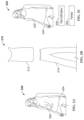
- FIG. 2 A shows an example image of a clothed person to generate outfit recommendations for according to an embodiment of the disclosed subject matter.
- FIG. 2 B shows an example of a clothing item that may be part of a recommended outfit according to an implementation of the disclosed subject matter.
- FIG. 2 C shows an image of a person with the recommended outfit of FIG. 2 B according to an implementation of the disclosed subject matter.
- FIG. 3 shows an example generative adversarial network (GAN) to generate outfit options and generate photo-realistic images of the person wearing the generated outfits according to an implementation of the disclosed subject matter.
- GAN generative adversarial network
- FIG. 4 shows a computer system according to an implementation of the disclosed subject matter.
- FIG. 5 shows a network configuration according to an implementation of the disclosed subject matter.
- Implementations of the disclosed subject matter provide systems and methods of generating recommendations showing outfit alternatives, and stylizing an image of a person to show the generated outfit alternatives on the person, based on a received imaged that includes a person with clothing and/or fashion items. Implementations of the disclosed subject matter provide fashion item parsing (e.g., the parsing of apparel and accessories in an image) and similarity searches in one or more databases of preferences (e.g., how often each product was accessed) to generate possible outfit variations.
- fashion item parsing e.g., the parsing of apparel and accessories in an image
- similarity searches in one or more databases of preferences (e.g., how often each product was accessed) to generate possible outfit variations.
- Implementations of the disclosed subject matter may determine a person's pose in an image, and segment the image into individual fashion items (e.g., shirt, shoes, handbag, belt, jewelry, and the like).
- a search may be performed for similar style outfits using a similarity search.
- the search components may be weighted based on which items have been viewed, clicked, purchased, or the like in the past.
- an image re-stylization may be applied at the pixel level of the corresponding pieces of an input image (i.e., the original image) including the person, producing images that include outfit recommendations.
- the user may select, customize, and/or purchase one or more of the recommended outfits.
- Implementations of the disclosed subject matter improve upon traditional style transfer from one image to another by presenting fashion items and/or coordinated outfits that may be of interest to a user based on an input image and/or the user's tastes and/or preferences, and by generating photorealistic images of the user in the same pose as the input image with the recommended outfits.
- FIG. 1 shows an example method 100 of determining similar fashion items and re-styling an image based on determined fashion items recommendations, based on a received imaged that includes a person with clothing and/or fashion items according to an implementation of the disclosed subject matter.
- a server e.g., central component 600 and/or second computer 700 shown in FIG. 4 , and/or databases system databases 1200 a - 1200 d shown in FIG. 5
- the clothes and/or fashion items may include, for example, a dress, skirt, blouse, shirt, pants, jacket, suit, tie, hat, scarf, belt, shoes, bag, jewelry, or the like.
- FIG. 2 A shows image 200 which includes an example image of a clothed person, which may be used by method 100 to generate outfit recommendations.
- the server may determine a pose of the person in the image, and may segment the image into one or more first fashion items at operation 120 .
- the first fashion items may be, for example, a shirt, pants, skirt, dress, sweater, jacket, hat, socks, shoes, belt, tie, scarf, purse, bag, jewelry, or the like.
- the outfit of the person in the image 200 of FIG. 2 A may be segmented to identify shirt 202 and pants 204 .
- the segmentation at operation 120 may include, for example, determine a semantic segmentation of the pixels of the person shown the image 200 , and determine keypoints of the person's body.
- the server may determine one or more second fashion items using a similarity search at operation 130 .
- the second fashion items may be may be, for example, a shirt, pants, sweater, blouse, dress, skirt, jacket, hat, socks, shoes, belt, tie, scarf, purse, bag, jewelry, or the like that are similar to the corresponding first fashion items based on style, color, pattern, or the like.
- the server may search at least one storage device (e.g., storage 710 shown in FIG. 4 and/or databases system databases 1200 a - 1200 d shown in FIG. 5 ) communicatively coupled to the server based on the one or more first fashion items.
- the server may search the at least one storage device, which may include a catalog, for fashion items that may be similar to the shirt 202 and/or the pants 204 shown in FIG. 2 A .
- the similarity may be based on color, style, size, fabric, fashion item type (e.g., pants, shirt, socks, shoes, belt, hat, gloves, scarf, hat, shorts, skirt, dress, suit, jacket, jewelry, or the like), material, pattern, or the like.
- the search may locate items in the catalog that are stylistically similar to the shirt 202 and/or pants 204 , and/or may find items that other users have purchased that appear similar to the shirt 202 and/or the pants 204 .
- the similarity search may include weighting components of the one or more first fashion items by a predetermined amount.
- the components may be weighted based on an amount at which the one or more fashion items have been viewed, the amount at which the one or more fashion items have been selected, and/or the amount at which the one or more fashion items have been purchased.
- the server may generate at least one outfit proposal based on the one or more second fashion items.
- image 210 of FIG. 2 B may have at least a portion of an outfit proposal generated by the server that includes shirt 212 and/or pants 214 .
- the outfit shown in image 210 may include fashion items that may be paired together in a style that may be similar to that of the fashion items shown in the initial image that includes the clothed person. That is, the shirt 212 and/or the pants 214 of the outfit proposal in image 210 may be stylistically similar to the shirt 204 and/or the pants 204 shown in image 200 .
- the generated at least one outfit proposal may be based on at least one of a style profile of a user, and/or a database of items that are complementary to one another.
- the style profile of the user may include at least one of the one or more fashion items that have been viewed by the user, the one or more fashion items that have been selected by the user, and/or the one or more fashion items have been purchased by the user.
- the items of the at least one outfit proposal may be equivalent items to the one or more first fashion items, and/or complementary items to the one or more first fashion items.
- the server may perform a re-stylization of corresponding portions of the image of the clothed person at operation 150 .
- the server may generate recommended outfit images based on at least one outfit proposal, such as the outfit proposal shown in image 210 of FIG. 2 B .
- the re-stylization may include generating one or more images of the person in the recommended outfit images.
- the re-stylization may be performed using the systems and methods disclosed in U.S. patent application Ser. No. 16/658,206 (now, U.S. Pat. No. 11,250,572), entitled “Systems and Methods of Generating Photorealistic Garment Transferrance in Images”, which is incorporated by reference herein in its entirety.
- the server may use a masked version of the received image, at least one semantic segmentation image, and one or more fashion item images to generating an image that includes the person with the fashion items of the recommended outfit.
- the server may transmit the outfit images for display.
- the images may be transmitted via a communications network between the server and a computer (e.g., to computer 500 shown in FIG. 4 ) of a user to be displayed (e.g., on user display 520 shown in FIG. 4 ).
- the images generated in operation 150 and transmitted at operation 160 may be shown, for example, in display 220 shown in FIG. 2 C .
- Image 220 of FIG. 2 C may show the person of image 200 re-stylized with the outfit that includes shirt 212 and/or pants 214 of image 210 shown in FIG. 2 B . That is, the shirt 212 and/or pants 214 may be re-stylized as shirt 222 and/or pants 224 to create a photorealistic image of the apparel items fitted to the person.
- the server may receive a selection, such as for other outfit options 226 shown in FIG. 2 B , for one or more the recommended outfit images (e.g., the shirt 222 and/or pants 224 ) to customize the recommended outfit images.
- the color, pattern, size, or the like may be changed based on input from the user (e.g., received via user input 560 of computer 500 shown in FIG. 4 ).
- the server may receive selection 228 (e.g., via user input 560 of computer 500 shown in FIG. 4 ) to purchase an outfit displayed in the one or more recommended outfit images.
- the shirt 222 and/or pants 224 may be purchased, or the customized shirt 222 and/or pants 224 (e.g., customized for color, pattern, size, or the like) may be purchased.
- FIG. 3 shows an example generative adversarial network (GAN) 300 to generate outfit options and generate photo-realistic images of the person wearing the outfit options according to an implementation of the disclosed subject matter.
- the GAN 300 may be implemented on a server (e.g., central component 600 and/or second computer 700 shown in FIG. 4 , and/or databases system databases 1200 a - 1200 d shown in FIG. 5 ) and/or a computer (e.g., computer 500 shown in FIG. 4 ).
- the GAN 300 may receive a target image 310 , for example, as part of operation 110 shown in FIG. 1 and described above.
- the target image 310 may be received from computer 500 shown in FIG. 4 .
- the GAN may segment fashion items from the received target image 310 so as to identify the fashion items being worn by the person in the target image 310 .
- the segmentation performed by the GAN at 320 may be at least part of operation 120 shown in FIG. 1 and described above.
- GAN 300 may receive a user preference query 330 , which may include information regarding styles, sizes, colors, patterns, fabric type, fashion items, accessories, or the like that may be used to generate outfit options.
- the preference query 330 may be received, for example, from user input 560 of computer 500 shown in FIG. 4 .
- the segmentation information and the user preference query information may be combined and/or used to identify product results at 340 , such as by performing the similarity search 130 shown in FIG. 1 and described above.
- the identified product results 340 may be similar preferred products by the user and/or others with style preferences that are similar to the user.
- Generator network 350 of GAN 300 may determine the possible combinations of fashion items identified from the product results 340 .
- the generator network 350 may generate the outfit proposals by, for example, using operation 140 shown in FIG. 1 and described above.
- the generator network 350 may generate images of the person in the target image 310 with the determined combinations, by, for example using the operation 150 described above to re-style the image.
- Photorealistic images of the determined combination of outfits may be generated and displayed at 360 .
- FIG. 4 is an example computer 500 suitable for implementing implementations of the presently disclosed subject matter.
- the computer 500 may be a single computer in a network of multiple computers.
- the computer 500 may be used to provide the initial image of the clothed person, outfit recommendations (e.g., image 200 shown in FIG. 2 A ), and/or photorealistic images of the person with the recommended outfits on the display 520 .
- the computer 500 may communicate with a central or distributed component 600 (e.g., server, cloud server, database, cluster, application server, neural network system, or the like).
- a central or distributed component 600 e.g., server, cloud server, database, cluster, application server, neural network system, or the like.
- the central component 600 may communicate with one or more other computers such as the second computer 700 , which may include a storage device 710 .
- the second computer 700 may be a server, cloud server, neural network system, or the like.
- the storage 710 may use any suitable combination of any suitable volatile and non-volatile physical storage mediums, including, for example, hard disk drives, solid state drives, optical media, flash memory, tape drives, registers, and random access memory, or the like, or any combination thereof.
- the storage 710 of the second computer 700 can store data (e.g., one or more image of an electronic catalog with fashion items, user style preference information, user viewing history of fashion item, user purchase history of fashion items, or the like). Further, if the systems shown in FIGS. 4 - 5 are multitenant systems, the storage can be organized into separate log structured merge trees for each instance of a database for a tenant. Alternatively, contents of all records on a particular server or system can be stored within a single log structured merge tree, in which case unique tenant identifiers associated with versions of records can be used to distinguish between data for each tenant as disclosed herein. More recent transactions can be stored at the highest or top level of the tree and older transactions can be stored at lower levels of the tree. Alternatively, the most recent transaction or version for each record (i.e., contents of each record) can be stored at the highest level of the tree and prior versions or prior transactions at lower levels of the tree.
- data e.g., one or more image of an electronic catalog with fashion items, user style preference information, user viewing
- the information obtained to and/or from a central component 600 can be isolated for each computer such that computer 500 cannot share information with central component 600 (e.g., for security and/or testing purposes).
- computer 500 can communicate directly with the second computer 700 .
- the computer 500 may include a bus 510 which interconnects major components of the computer 500 , such as a central processor 540 , a memory 570 (typically RAM, but which can also include ROM, flash RAM, or the like), an input/output controller 580 , a user display 520 , such as a display or touch screen via a display adapter, a user input interface 560 , which may include one or more controllers and associated user input or devices such as a keyboard, mouse, Wi-Fi/cellular radios, touchscreen, microphone/speakers and the like, and may be communicatively coupled to the I/O controller 580 , fixed storage 530 , such as a hard drive, flash storage, Fibre Channel network, SAN device, SCSI device, and the like, and a removable media component 550 operative to control and receive an optical disk, flash drive, and the like.
- a bus 510 which interconnects major components of the computer 500 , such as a central processor 540 , a memory 570 (typically RAM
- the bus 510 may enable data communication between the central processor 540 and the memory 570 , which may include read-only memory (ROM) or flash memory (neither shown), and random access memory (RAM) (not shown), as previously noted.
- the RAM may include the main memory into which the operating system, development software, testing programs, and application programs are loaded.
- the ROM or flash memory can contain, among other code, the Basic Input-Output system (BIOS) which controls basic hardware operation such as the interaction with peripheral components.
- BIOS Basic Input-Output system
- Applications resident with the computer 500 may be stored on and accessed via a computer readable medium, such as a hard disk drive (e.g., fixed storage 530 ), an optical drive, floppy disk, or other storage medium 550 .
- the fixed storage 530 can be integral with the computer 500 or can be separate and accessed through other interfaces.
- the fixed storage 530 may be part of a storage area network (SAN).
- a network interface 590 can provide a direct connection to a remote server via a telephone link, to the Internet via an internet service provider (ISP), or a direct connection to a remote server via a direct network link to the Internet via a POP (point of presence) or other technique.
- the network interface 590 can provide such connection using wireless techniques, including digital cellular telephone connection, Cellular Digital Packet Data (CDPD) connection, digital satellite data connection or the like.
- CDPD Cellular Digital Packet Data
- the network interface 590 may enable the computer to communicate with other computers and/or storage devices via one or more local, wide-area, or other networks, as shown in FIGS. 4 - 5 .
- FIGS. 4 - 5 need not be present to practice the present disclosure.
- the components can be interconnected in different ways from that shown. Code to implement the present disclosure can be stored in computer-readable storage media such as one or more of the memory 570 , fixed storage 530 , removable media 550 , or on a remote storage location.
- FIG. 5 shows an example network arrangement according to an implementation of the disclosed subject matter.
- the database systems 1200 a - d may store, for example, one or more electronic catalogs of fashion items that may be used to make outfit recommendations, user style preferences, user purchase history, user viewing history of the fashion items, or the like.
- the one or more of the database systems 1200 a - d may be located in different geographic locations.
- Each of database systems 1200 can be operable to host multiple instances of a database, where each instance is accessible only to users associated with a particular tenant.
- Each of the database systems can constitute a cluster of computers along with a storage area network (not shown), load balancers and backup servers along with firewalls, other security systems, and authentication systems.
- Some of the instances at any of database systems 1200 a - d may be live or production instances processing and committing transactions received from users and/or developers, and/or from computing elements (not shown) for receiving and providing data for storage in the instances.
- One or more of the database systems 1200 a - d may include at least one storage device, such as in FIG. 5 .
- the storage can include memory 570 , fixed storage 530 , removable media 550 , and/or a storage device included with the central component 600 and/or the second computer 700 .
- the tenant can have tenant data stored in an immutable storage of the at least one storage device associated with a tenant identifier.
- the one or more servers shown in FIGS. 4 - 5 can store the data (e.g., images of products of the electronic catalog and the like) in the immutable storage of the at least one storage device (e.g., a storage device associated with central component 600 , the second computer 700 , and/or the database systems 1200 a - 1200 d ) using a log-structured merge tree data structure.
- the data e.g., images of products of the electronic catalog and the like
- the at least one storage device e.g., a storage device associated with central component 600 , the second computer 700 , and/or the database systems 1200 a - 1200 d
- the systems and methods of the disclosed subject matter can be for single tenancy and/or multitenancy systems.
- Multitenancy systems can allow various tenants, which can be, for example, developers, users, groups of users, and/or organizations, to access their own records (e.g., tenant data and the like) on the server system through software tools or instances on the server system that can be shared among the various tenants.
- the contents of records for each tenant can be part of a database containing that tenant. Contents of records for multiple tenants can all be stored together within the same database, but each tenant can only be able to access contents of records which belong to, or were created by, that tenant.
- This may allow a database system to enable multitenancy without having to store each tenants' contents of records separately, for example, on separate servers or server systems.
- the database for a tenant can be, for example, a relational database, hierarchical database, or any other suitable database type. All records stored on the server system can be stored in any suitable structure, including, for example, a log structured merge (LSM)
- a multitenant system can have various tenant instances on server systems distributed throughout a network with a computing system at each node.
- the live or production database instance of each tenant may have its transactions processed at one computer system.
- the computing system for processing the transactions of that instance may also process transactions of other instances for other tenants.
- implementations of the presently disclosed subject matter can include or be implemented in the form of computer-implemented processes and apparatuses for practicing those processes. Implementations also can be implemented in the form of a computer program product having computer program code containing instructions implemented in non-transitory and/or tangible media, such as hard drives, solid state drives, USB (universal serial bus) drives, CD-ROMs, or any other machine readable storage medium, wherein, when the computer program code is loaded into and executed by a computer, the computer becomes an apparatus for practicing implementations of the disclosed subject matter.
- Implementations also can be implemented in the form of computer program code, for example, whether stored in a storage medium, loaded into and/or executed by a computer, or transmitted over some transmission medium, such as over electrical wiring or cabling, through fiber optics, or via electromagnetic radiation, wherein when the computer program code is loaded into and executed by a computer, the computer becomes an apparatus for practicing implementations of the disclosed subject matter.
- the computer program code segments configure the microprocessor to create specific logic circuits.
- a set of computer-readable instructions stored on a computer-readable storage medium can be implemented by a general-purpose processor, which can transform the general-purpose processor or a device containing the general-purpose processor into a special-purpose device configured to implement or carry out the instructions.
- Implementations can be implemented using hardware that can include a processor, such as a general purpose microprocessor and/or an Application Specific Integrated Circuit (ASIC) that implements all or part of the techniques according to implementations of the disclosed subject matter in hardware and/or firmware.
- the processor can be coupled to memory, such as RAM, ROM, flash memory, a hard disk or any other device capable of storing electronic information.
- the memory can store instructions adapted to be executed by the processor to perform the techniques according to implementations of the disclosed subject matter.
Landscapes
- Business, Economics & Management (AREA)
- Engineering & Computer Science (AREA)
- Accounting & Taxation (AREA)
- Finance (AREA)
- Physics & Mathematics (AREA)
- Theoretical Computer Science (AREA)
- General Physics & Mathematics (AREA)
- Development Economics (AREA)
- General Business, Economics & Management (AREA)
- Strategic Management (AREA)
- Marketing (AREA)
- Economics (AREA)
- Computer Vision & Pattern Recognition (AREA)
- Processing Or Creating Images (AREA)
Abstract
Description
Claims (12)
Priority Applications (1)
| Application Number | Priority Date | Filing Date | Title |
|---|---|---|---|
| US16/594,257 US11727463B2 (en) | 2019-10-07 | 2019-10-07 | Systems and methods of image-based neural network apparel recommendation |
Applications Claiming Priority (1)
| Application Number | Priority Date | Filing Date | Title |
|---|---|---|---|
| US16/594,257 US11727463B2 (en) | 2019-10-07 | 2019-10-07 | Systems and methods of image-based neural network apparel recommendation |
Publications (2)
| Publication Number | Publication Date |
|---|---|
| US20210103970A1 US20210103970A1 (en) | 2021-04-08 |
| US11727463B2 true US11727463B2 (en) | 2023-08-15 |
Family
ID=75274294
Family Applications (1)
| Application Number | Title | Priority Date | Filing Date |
|---|---|---|---|
| US16/594,257 Active 2041-01-05 US11727463B2 (en) | 2019-10-07 | 2019-10-07 | Systems and methods of image-based neural network apparel recommendation |
Country Status (1)
| Country | Link |
|---|---|
| US (1) | US11727463B2 (en) |
Cited By (4)
| Publication number | Priority date | Publication date | Assignee | Title |
|---|---|---|---|---|
| US20220121701A1 (en) * | 2009-12-24 | 2022-04-21 | Nikon Corporation | Retrieval support system, retrieval support method and retrieval support program |
| US20230410390A1 (en) * | 2022-06-17 | 2023-12-21 | Tata Consultancy Services Limited | Method and system for generating color variants for fashion apparels |
| US12248974B1 (en) | 2024-01-31 | 2025-03-11 | Phia Holdings Inc. | System and method for recommending resale alternatives for retail items |
| US12340410B1 (en) | 2024-01-31 | 2025-06-24 | Phia Holdings Inc. | System and method for recommending resale alternatives for retail goods |
Families Citing this family (6)
| Publication number | Priority date | Publication date | Assignee | Title |
|---|---|---|---|---|
| US11854069B2 (en) * | 2021-07-16 | 2023-12-26 | Snap Inc. | Personalized try-on ads |
| US12443420B2 (en) | 2021-10-26 | 2025-10-14 | Salesforce, Inc. | Automatic image conversion |
| US12265947B2 (en) | 2022-07-07 | 2025-04-01 | Salesforce, Inc. | Region-specific content creation |
| US11989858B2 (en) | 2022-09-30 | 2024-05-21 | Salesforce, Inc. | Systems and methods of determining margins of an image for content insertion to form a composite image |
| CN116402590B (en) * | 2023-06-06 | 2023-09-15 | 武汉纺织大学 | A personalized clothing mall system and recommendation method based on artificial intelligence |
| US12625903B1 (en) * | 2024-12-03 | 2026-05-12 | Serendipity One Inc. | Method for presenting interactive information, electronic device and storage medium |
Citations (12)
| Publication number | Priority date | Publication date | Assignee | Title |
|---|---|---|---|---|
| US20160203525A1 (en) * | 2015-01-12 | 2016-07-14 | Ebay Inc. | Joint-based item recognition |
| US20170278135A1 (en) * | 2016-02-18 | 2017-09-28 | Fitroom, Inc. | Image recognition artificial intelligence system for ecommerce |
| US20180032818A1 (en) * | 2016-07-27 | 2018-02-01 | International Business Machines Corporation | Providing a personalized fitting room experience |
| US20190066140A1 (en) * | 2017-08-22 | 2019-02-28 | Nat Mani | Intelligent and interactive shopping engine |
| US20190132715A1 (en) * | 2017-11-02 | 2019-05-02 | BisiMobile Inc. | Determining storage for objects of various sizes while maximizing utilization and access |
| US20190244407A1 (en) * | 2016-08-10 | 2019-08-08 | Zeekit Online Shopping Ltd. | System, device, and method of virtual dressing utilizing image processing, machine learning, and computer vision |
| US20200143454A1 (en) * | 2018-08-06 | 2020-05-07 | Rajesh Kumar Saligrama Ananthanarayana | Computer vision based methods and systems of universal fashion ontology fashion rating and recommendation |
| US20200375293A1 (en) * | 2017-03-07 | 2020-12-03 | Original, Inc. | Methods and systems for customized garment and outfit design generation |
| US10902051B2 (en) * | 2018-04-16 | 2021-01-26 | Microsoft Technology Licensing, Llc | Product identification in image with multiple products |
| US10963939B1 (en) * | 2018-08-27 | 2021-03-30 | A9.Com, Inc. | Computer vision based style profiles |
| US11026461B2 (en) * | 2018-02-27 | 2021-06-08 | Levi Strauss & Co. | Substituting an existing collection in an apparel management system |
| US11037222B1 (en) * | 2018-08-27 | 2021-06-15 | A9.Com, Inc. | Dynamic recommendations personalized by historical data |
-
2019
- 2019-10-07 US US16/594,257 patent/US11727463B2/en active Active
Patent Citations (12)
| Publication number | Priority date | Publication date | Assignee | Title |
|---|---|---|---|---|
| US20160203525A1 (en) * | 2015-01-12 | 2016-07-14 | Ebay Inc. | Joint-based item recognition |
| US20170278135A1 (en) * | 2016-02-18 | 2017-09-28 | Fitroom, Inc. | Image recognition artificial intelligence system for ecommerce |
| US20180032818A1 (en) * | 2016-07-27 | 2018-02-01 | International Business Machines Corporation | Providing a personalized fitting room experience |
| US20190244407A1 (en) * | 2016-08-10 | 2019-08-08 | Zeekit Online Shopping Ltd. | System, device, and method of virtual dressing utilizing image processing, machine learning, and computer vision |
| US20200375293A1 (en) * | 2017-03-07 | 2020-12-03 | Original, Inc. | Methods and systems for customized garment and outfit design generation |
| US20190066140A1 (en) * | 2017-08-22 | 2019-02-28 | Nat Mani | Intelligent and interactive shopping engine |
| US20190132715A1 (en) * | 2017-11-02 | 2019-05-02 | BisiMobile Inc. | Determining storage for objects of various sizes while maximizing utilization and access |
| US11026461B2 (en) * | 2018-02-27 | 2021-06-08 | Levi Strauss & Co. | Substituting an existing collection in an apparel management system |
| US10902051B2 (en) * | 2018-04-16 | 2021-01-26 | Microsoft Technology Licensing, Llc | Product identification in image with multiple products |
| US20200143454A1 (en) * | 2018-08-06 | 2020-05-07 | Rajesh Kumar Saligrama Ananthanarayana | Computer vision based methods and systems of universal fashion ontology fashion rating and recommendation |
| US10963939B1 (en) * | 2018-08-27 | 2021-03-30 | A9.Com, Inc. | Computer vision based style profiles |
| US11037222B1 (en) * | 2018-08-27 | 2021-06-15 | A9.Com, Inc. | Dynamic recommendations personalized by historical data |
Non-Patent Citations (1)
| Title |
|---|
| Han, X. (2018). Deep learning for fashion and forensics (Order No. 10842589). Available from ProQuest Dissertations & Theses Global. (2118074055). Retrieved from https://www.proquest.com/dissertations-theses/deep-learning-fashion-forensics/docview/2118074055/se-2 (Year: 2018). * |
Cited By (5)
| Publication number | Priority date | Publication date | Assignee | Title |
|---|---|---|---|---|
| US20220121701A1 (en) * | 2009-12-24 | 2022-04-21 | Nikon Corporation | Retrieval support system, retrieval support method and retrieval support program |
| US20230410390A1 (en) * | 2022-06-17 | 2023-12-21 | Tata Consultancy Services Limited | Method and system for generating color variants for fashion apparels |
| US12374001B2 (en) * | 2022-06-17 | 2025-07-29 | Tata Consultancy Services Limited | Method and system for generating color variants for fashion apparels |
| US12248974B1 (en) | 2024-01-31 | 2025-03-11 | Phia Holdings Inc. | System and method for recommending resale alternatives for retail items |
| US12340410B1 (en) | 2024-01-31 | 2025-06-24 | Phia Holdings Inc. | System and method for recommending resale alternatives for retail goods |
Also Published As
| Publication number | Publication date |
|---|---|
| US20210103970A1 (en) | 2021-04-08 |
Similar Documents
| Publication | Publication Date | Title |
|---|---|---|
| US20210103970A1 (en) | Systems and methods of image-based neural network apparel recommendation | |
| US11250572B2 (en) | Systems and methods of generating photorealistic garment transference in images | |
| JP6825141B2 (en) | Fashion coordination recommendation methods and devices, electronic devices, storage media | |
| US10242396B2 (en) | Automatic color palette based recommendations for affiliated colors | |
| US11216861B2 (en) | Color based social networking recommendations | |
| KR102045017B1 (en) | apparatus and method for generating designs based on images and text | |
| US9542704B2 (en) | Automatic image-based recommendations using a color palette | |
| US9679532B2 (en) | Automatic image-based recommendations using a color palette | |
| US9652868B2 (en) | Automatic color palette based recommendations | |
| US9727620B2 (en) | System and method for item and item set matching | |
| US20210103969A1 (en) | Systems and methods of multicolor search of images | |
| US20150379732A1 (en) | Automatic image-based recommendations using a color palette | |
| US20150379006A1 (en) | Automatic image-based recommendations using a color palette | |
| US20150379739A1 (en) | Automatic color palette based recommendations | |
| US20150379001A1 (en) | Automatic color validation of image metadata | |
| CA2960234A1 (en) | Image feature data extraction and use | |
| KR20200046924A (en) | The Automatic Recommendation System and Method of the Fashion Coordination | |
| KR20190128143A (en) | Apparatus and method for generating designs based on image and text | |
| CN106294420A (en) | The method and device of business object collocation information is provided | |
| CN105224775A (en) | Based on the method and apparatus that picture processing is arranged in pairs or groups to clothes | |
| CN108109049A (en) | Clothing matching Forecasting Methodology, device, computer equipment and storage medium | |
| US20230059006A1 (en) | Fashion product recommendation method, apparatus, and system | |
| CN109949116A (en) | Apparel matching recommendation method, device, storage medium and mobile terminal | |
| KR102622779B1 (en) | Method, system and non-transitory computer-readable recording medium for tagging attribute-related keywords to product images | |
| KR20190092910A (en) | Method and system for coordination searching based on coordination of a plurality of objects in image |
Legal Events
| Date | Code | Title | Description |
|---|---|---|---|
| AS | Assignment |
Owner name: SALESFORCE.COM, INC., CALIFORNIA Free format text: ASSIGNMENT OF ASSIGNORS INTEREST;ASSIGNORS:SOLLAMI, MICHAEL;ZHANG, YANG;REEL/FRAME:050637/0613 Effective date: 20190926 |
|
| FEPP | Fee payment procedure |
Free format text: ENTITY STATUS SET TO UNDISCOUNTED (ORIGINAL EVENT CODE: BIG.); ENTITY STATUS OF PATENT OWNER: LARGE ENTITY |
|
| STPP | Information on status: patent application and granting procedure in general |
Free format text: NON FINAL ACTION MAILED |
|
| STPP | Information on status: patent application and granting procedure in general |
Free format text: RESPONSE TO NON-FINAL OFFICE ACTION ENTERED AND FORWARDED TO EXAMINER |
|
| STPP | Information on status: patent application and granting procedure in general |
Free format text: FINAL REJECTION MAILED |
|
| STPP | Information on status: patent application and granting procedure in general |
Free format text: RESPONSE AFTER FINAL ACTION FORWARDED TO EXAMINER |
|
| STPP | Information on status: patent application and granting procedure in general |
Free format text: ADVISORY ACTION MAILED |
|
| STPP | Information on status: patent application and granting procedure in general |
Free format text: NON FINAL ACTION MAILED |
|
| STPP | Information on status: patent application and granting procedure in general |
Free format text: RESPONSE TO NON-FINAL OFFICE ACTION ENTERED AND FORWARDED TO EXAMINER |
|
| STPP | Information on status: patent application and granting procedure in general |
Free format text: PUBLICATIONS -- ISSUE FEE PAYMENT VERIFIED |
|
| STCF | Information on status: patent grant |
Free format text: PATENTED CASE |
|
| AS | Assignment |
Owner name: SALESFORCE, INC., CALIFORNIA Free format text: CHANGE OF NAME;ASSIGNOR:SALESFORCE.COM, INC.;REEL/FRAME:069717/0444 Effective date: 20220325 |