US11726386B2 - Plasmon coupling materials, methods of making plasmon coupling materials, methods of using plasmon coupling materials and systems and devices that include plasmon coupling materials - Google Patents
Plasmon coupling materials, methods of making plasmon coupling materials, methods of using plasmon coupling materials and systems and devices that include plasmon coupling materials Download PDFInfo
- Publication number
- US11726386B2 US11726386B2 US17/221,013 US202117221013A US11726386B2 US 11726386 B2 US11726386 B2 US 11726386B2 US 202117221013 A US202117221013 A US 202117221013A US 11726386 B2 US11726386 B2 US 11726386B2
- Authority
- US
- United States
- Prior art keywords
- harmonically
- particles
- paired
- particle
- paired set
- Prior art date
- Legal status (The legal status is an assumption and is not a legal conclusion. Google has not performed a legal analysis and makes no representation as to the accuracy of the status listed.)
- Active, expires
Links
- 239000000463 material Substances 0.000 title abstract description 30
- 238000010168 coupling process Methods 0.000 title description 19
- 238000005859 coupling reaction Methods 0.000 title description 19
- 238000000034 method Methods 0.000 title description 19
- 230000008878 coupling Effects 0.000 title description 17
- 239000002245 particle Substances 0.000 claims abstract description 153
- 239000002105 nanoparticle Substances 0.000 claims abstract description 133
- 238000005259 measurement Methods 0.000 claims abstract description 16
- 230000027756 respiratory electron transport chain Effects 0.000 claims abstract description 9
- 238000010521 absorption reaction Methods 0.000 claims description 24
- 229910052737 gold Inorganic materials 0.000 claims description 23
- 230000003287 optical effect Effects 0.000 claims description 21
- 239000000758 substrate Substances 0.000 claims description 21
- 239000010949 copper Substances 0.000 claims description 20
- 239000004065 semiconductor Substances 0.000 claims description 15
- 229910052802 copper Inorganic materials 0.000 claims description 13
- XOLBLPGZBRYERU-UHFFFAOYSA-N tin dioxide Chemical compound O=[Sn]=O XOLBLPGZBRYERU-UHFFFAOYSA-N 0.000 claims description 12
- -1 copper chalcogenides Chemical class 0.000 claims description 11
- VYPSYNLAJGMNEJ-UHFFFAOYSA-N Silicium dioxide Chemical compound O=[Si]=O VYPSYNLAJGMNEJ-UHFFFAOYSA-N 0.000 claims description 9
- 229910052782 aluminium Inorganic materials 0.000 claims description 8
- 229910052797 bismuth Inorganic materials 0.000 claims description 8
- 229910052733 gallium Inorganic materials 0.000 claims description 8
- 229910052738 indium Inorganic materials 0.000 claims description 8
- 229910052745 lead Inorganic materials 0.000 claims description 8
- 239000013110 organic ligand Substances 0.000 claims description 8
- 229910052763 palladium Inorganic materials 0.000 claims description 8
- 229910052697 platinum Inorganic materials 0.000 claims description 8
- 229910052709 silver Inorganic materials 0.000 claims description 8
- 229910052716 thallium Inorganic materials 0.000 claims description 8
- 229910052718 tin Inorganic materials 0.000 claims description 8
- 150000001875 compounds Chemical class 0.000 claims description 7
- 238000005424 photoluminescence Methods 0.000 claims description 7
- 230000010287 polarization Effects 0.000 claims description 7
- GWEVSGVZZGPLCZ-UHFFFAOYSA-N Titan oxide Chemical compound O=[Ti]=O GWEVSGVZZGPLCZ-UHFFFAOYSA-N 0.000 claims description 6
- 239000003989 dielectric material Substances 0.000 claims description 6
- ZQXIMYREBUZLPM-UHFFFAOYSA-N 1-aminoethanethiol Chemical compound CC(N)S ZQXIMYREBUZLPM-UHFFFAOYSA-N 0.000 claims description 5
- 239000002253 acid Substances 0.000 claims description 5
- 229910052681 coesite Inorganic materials 0.000 claims description 5
- 229910052906 cristobalite Inorganic materials 0.000 claims description 5
- 150000004662 dithiols Chemical class 0.000 claims description 5
- 239000003446 ligand Substances 0.000 claims description 5
- 229910052682 stishovite Inorganic materials 0.000 claims description 5
- 229910052905 tridymite Inorganic materials 0.000 claims description 5
- 239000012190 activator Substances 0.000 claims description 4
- 238000012377 drug delivery Methods 0.000 claims description 4
- 239000000377 silicon dioxide Substances 0.000 claims description 4
- PNEYBMLMFCGWSK-UHFFFAOYSA-N aluminium oxide Inorganic materials [O-2].[O-2].[O-2].[Al+3].[Al+3] PNEYBMLMFCGWSK-UHFFFAOYSA-N 0.000 claims description 3
- 125000005365 aminothiol group Chemical group 0.000 claims description 3
- 229910052593 corundum Inorganic materials 0.000 claims description 3
- PJXISJQVUVHSOJ-UHFFFAOYSA-N indium(III) oxide Inorganic materials [O-2].[O-2].[O-2].[In+3].[In+3] PJXISJQVUVHSOJ-UHFFFAOYSA-N 0.000 claims description 3
- 229910001845 yogo sapphire Inorganic materials 0.000 claims description 3
- DHBXNPKRAUYBTH-UHFFFAOYSA-N 1,1-ethanedithiol Chemical compound CC(S)S DHBXNPKRAUYBTH-UHFFFAOYSA-N 0.000 claims description 2
- JRNVQLOKVMWBFR-UHFFFAOYSA-N 1,2-benzenedithiol Chemical compound SC1=CC=CC=C1S JRNVQLOKVMWBFR-UHFFFAOYSA-N 0.000 claims description 2
- VRVRGVPWCUEOGV-UHFFFAOYSA-N 2-aminothiophenol Chemical compound NC1=CC=CC=C1S VRVRGVPWCUEOGV-UHFFFAOYSA-N 0.000 claims description 2
- DYAOREPNYXXCOA-UHFFFAOYSA-N 2-sulfanylundecanoic acid Chemical compound CCCCCCCCCC(S)C(O)=O DYAOREPNYXXCOA-UHFFFAOYSA-N 0.000 claims description 2
- DKIDEFUBRARXTE-UHFFFAOYSA-N 3-mercaptopropanoic acid Chemical compound OC(=O)CCS DKIDEFUBRARXTE-UHFFFAOYSA-N 0.000 claims description 2
- QGRVXEOIASZLIL-UHFFFAOYSA-N 3-phenylbenzene-1,2-dithiol Chemical compound SC1=CC=CC(C=2C=CC=CC=2)=C1S QGRVXEOIASZLIL-UHFFFAOYSA-N 0.000 claims description 2
- GLOYGJPNNKTDIG-UHFFFAOYSA-N SC=1N=NSC=1S Chemical compound SC=1N=NSC=1S GLOYGJPNNKTDIG-UHFFFAOYSA-N 0.000 claims description 2
- WMJOEMPHTXKYBN-UHFFFAOYSA-N amino(phenyl)methanethiol Chemical compound NC(S)C1=CC=CC=C1 WMJOEMPHTXKYBN-UHFFFAOYSA-N 0.000 claims description 2
- 229920001223 polyethylene glycol Polymers 0.000 claims description 2
- 125000003396 thiol group Chemical class [H]S* 0.000 claims description 2
- 238000002198 surface plasmon resonance spectroscopy Methods 0.000 abstract description 10
- 239000000203 mixture Substances 0.000 abstract description 4
- 229910052955 covellite Inorganic materials 0.000 description 85
- 239000010931 gold Substances 0.000 description 76
- OMZSGWSJDCOLKM-UHFFFAOYSA-N copper(II) sulfide Chemical compound [S-2].[Cu+2] OMZSGWSJDCOLKM-UHFFFAOYSA-N 0.000 description 64
- 239000010408 film Substances 0.000 description 64
- 239000010410 layer Substances 0.000 description 50
- 239000011521 glass Substances 0.000 description 34
- 239000000523 sample Substances 0.000 description 31
- YXFVVABEGXRONW-UHFFFAOYSA-N Toluene Chemical compound CC1=CC=CC=C1 YXFVVABEGXRONW-UHFFFAOYSA-N 0.000 description 24
- 230000000694 effects Effects 0.000 description 20
- PCHJSUWPFVWCPO-UHFFFAOYSA-N gold Chemical compound [Au] PCHJSUWPFVWCPO-UHFFFAOYSA-N 0.000 description 15
- LFQSCWFLJHTTHZ-UHFFFAOYSA-N Ethanol Chemical compound CCO LFQSCWFLJHTTHZ-UHFFFAOYSA-N 0.000 description 13
- 229910052751 metal Inorganic materials 0.000 description 13
- 239000002184 metal Substances 0.000 description 13
- 230000004044 response Effects 0.000 description 8
- 238000002474 experimental method Methods 0.000 description 7
- CCCMONHAUSKTEQ-UHFFFAOYSA-N octadec-1-ene Chemical compound CCCCCCCCCCCCCCCCC=C CCCMONHAUSKTEQ-UHFFFAOYSA-N 0.000 description 7
- 239000011541 reaction mixture Substances 0.000 description 7
- HEDRZPFGACZZDS-UHFFFAOYSA-N Chloroform Chemical compound ClC(Cl)Cl HEDRZPFGACZZDS-UHFFFAOYSA-N 0.000 description 6
- 238000002835 absorbance Methods 0.000 description 6
- 239000000126 substance Substances 0.000 description 6
- 230000005540 biological transmission Effects 0.000 description 5
- UFULAYFCSOUIOV-UHFFFAOYSA-N cysteamine Chemical compound NCCS UFULAYFCSOUIOV-UHFFFAOYSA-N 0.000 description 5
- 238000000151 deposition Methods 0.000 description 5
- 230000008021 deposition Effects 0.000 description 5
- 238000001514 detection method Methods 0.000 description 5
- QGLWBTPVKHMVHM-KTKRTIGZSA-N (z)-octadec-9-en-1-amine Chemical compound CCCCCCCC\C=C/CCCCCCCCN QGLWBTPVKHMVHM-KTKRTIGZSA-N 0.000 description 4
- UUEWCQRISZBELL-UHFFFAOYSA-N 3-trimethoxysilylpropane-1-thiol Chemical compound CO[Si](OC)(OC)CCCS UUEWCQRISZBELL-UHFFFAOYSA-N 0.000 description 4
- MHAJPDPJQMAIIY-UHFFFAOYSA-N Hydrogen peroxide Chemical compound OO MHAJPDPJQMAIIY-UHFFFAOYSA-N 0.000 description 4
- QAOWNCQODCNURD-UHFFFAOYSA-N Sulfuric acid Chemical compound OS(O)(=O)=O QAOWNCQODCNURD-UHFFFAOYSA-N 0.000 description 4
- 238000003917 TEM image Methods 0.000 description 4
- 230000015572 biosynthetic process Effects 0.000 description 4
- 239000013078 crystal Substances 0.000 description 4
- 238000011161 development Methods 0.000 description 4
- 239000002082 metal nanoparticle Substances 0.000 description 4
- 238000001314 profilometry Methods 0.000 description 4
- 230000007704 transition Effects 0.000 description 4
- 238000001392 ultraviolet--visible--near infrared spectroscopy Methods 0.000 description 4
- 229910021591 Copper(I) chloride Inorganic materials 0.000 description 3
- OKKJLVBELUTLKV-UHFFFAOYSA-N Methanol Chemical compound OC OKKJLVBELUTLKV-UHFFFAOYSA-N 0.000 description 3
- 238000000137 annealing Methods 0.000 description 3
- 230000008033 biological extinction Effects 0.000 description 3
- 238000006243 chemical reaction Methods 0.000 description 3
- OXBLHERUFWYNTN-UHFFFAOYSA-M copper(I) chloride Chemical compound [Cu]Cl OXBLHERUFWYNTN-UHFFFAOYSA-M 0.000 description 3
- 238000013016 damping Methods 0.000 description 3
- 230000005684 electric field Effects 0.000 description 3
- 230000005284 excitation Effects 0.000 description 3
- 238000003384 imaging method Methods 0.000 description 3
- 230000003993 interaction Effects 0.000 description 3
- 239000002159 nanocrystal Substances 0.000 description 3
- 230000008569 process Effects 0.000 description 3
- 238000003786 synthesis reaction Methods 0.000 description 3
- WRIDQFICGBMAFQ-UHFFFAOYSA-N (E)-8-Octadecenoic acid Natural products CCCCCCCCCC=CCCCCCCC(O)=O WRIDQFICGBMAFQ-UHFFFAOYSA-N 0.000 description 2
- BTOOAFQCTJZDRC-UHFFFAOYSA-N 1,2-hexadecanediol Chemical compound CCCCCCCCCCCCCCC(O)CO BTOOAFQCTJZDRC-UHFFFAOYSA-N 0.000 description 2
- LQJBNNIYVWPHFW-UHFFFAOYSA-N 20:1omega9c fatty acid Natural products CCCCCCCCCCC=CCCCCCCCC(O)=O LQJBNNIYVWPHFW-UHFFFAOYSA-N 0.000 description 2
- QSBYPNXLFMSGKH-UHFFFAOYSA-N 9-Heptadecensaeure Natural products CCCCCCCC=CCCCCCCCC(O)=O QSBYPNXLFMSGKH-UHFFFAOYSA-N 0.000 description 2
- CSCPPACGZOOCGX-UHFFFAOYSA-N Acetone Chemical compound CC(C)=O CSCPPACGZOOCGX-UHFFFAOYSA-N 0.000 description 2
- IJGRMHOSHXDMSA-UHFFFAOYSA-N Atomic nitrogen Chemical compound N#N IJGRMHOSHXDMSA-UHFFFAOYSA-N 0.000 description 2
- 229910000530 Gallium indium arsenide Inorganic materials 0.000 description 2
- 240000002329 Inga feuillei Species 0.000 description 2
- CTQNGGLPUBDAKN-UHFFFAOYSA-N O-Xylene Chemical compound CC1=CC=CC=C1C CTQNGGLPUBDAKN-UHFFFAOYSA-N 0.000 description 2
- 239000005642 Oleic acid Substances 0.000 description 2
- ZQPPMHVWECSIRJ-UHFFFAOYSA-N Oleic acid Natural products CCCCCCCCC=CCCCCCCCC(O)=O ZQPPMHVWECSIRJ-UHFFFAOYSA-N 0.000 description 2
- NINIDFKCEFEMDL-UHFFFAOYSA-N Sulfur Chemical compound [S] NINIDFKCEFEMDL-UHFFFAOYSA-N 0.000 description 2
- 238000002441 X-ray diffraction Methods 0.000 description 2
- 238000003491 array Methods 0.000 description 2
- 238000012512 characterization method Methods 0.000 description 2
- 238000004140 cleaning Methods 0.000 description 2
- 230000007423 decrease Effects 0.000 description 2
- 238000013461 design Methods 0.000 description 2
- 229910003460 diamond Inorganic materials 0.000 description 2
- 239000010432 diamond Substances 0.000 description 2
- 239000003814 drug Substances 0.000 description 2
- 239000003574 free electron Substances 0.000 description 2
- QXJSBBXBKPUZAA-UHFFFAOYSA-N isooleic acid Natural products CCCCCCCC=CCCCCCCCCC(O)=O QXJSBBXBKPUZAA-UHFFFAOYSA-N 0.000 description 2
- 238000004519 manufacturing process Methods 0.000 description 2
- 238000012986 modification Methods 0.000 description 2
- 230000004048 modification Effects 0.000 description 2
- 239000002077 nanosphere Substances 0.000 description 2
- ZQPPMHVWECSIRJ-KTKRTIGZSA-N oleic acid Chemical compound CCCCCCCC\C=C/CCCCCCCC(O)=O ZQPPMHVWECSIRJ-KTKRTIGZSA-N 0.000 description 2
- 230000037361 pathway Effects 0.000 description 2
- 229920000642 polymer Polymers 0.000 description 2
- 231100000812 repeated exposure Toxicity 0.000 description 2
- 238000001878 scanning electron micrograph Methods 0.000 description 2
- 238000004626 scanning electron microscopy Methods 0.000 description 2
- 230000000638 stimulation Effects 0.000 description 2
- 238000003756 stirring Methods 0.000 description 2
- 238000012546 transfer Methods 0.000 description 2
- XLYOFNOQVPJJNP-UHFFFAOYSA-N water Substances O XLYOFNOQVPJJNP-UHFFFAOYSA-N 0.000 description 2
- 239000008096 xylene Substances 0.000 description 2
- BNRRFUKDMGDNNT-JQIJEIRASA-N (e)-16-methylheptadec-2-enoic acid Chemical compound CC(C)CCCCCCCCCCCC\C=C\C(O)=O BNRRFUKDMGDNNT-JQIJEIRASA-N 0.000 description 1
- HIXDQWDOVZUNNA-UHFFFAOYSA-N 2-(3,4-dimethoxyphenyl)-5-hydroxy-7-methoxychromen-4-one Chemical compound C=1C(OC)=CC(O)=C(C(C=2)=O)C=1OC=2C1=CC=C(OC)C(OC)=C1 HIXDQWDOVZUNNA-UHFFFAOYSA-N 0.000 description 1
- SUJAHSWBPFLDLP-UHFFFAOYSA-N 6-cycloundecyl-7-diazocycloundecene Chemical compound [N-]=[N+]=C1CCCCC=CCCCC1C1CCCCCCCCCC1 SUJAHSWBPFLDLP-UHFFFAOYSA-N 0.000 description 1
- JBRZTFJDHDCESZ-UHFFFAOYSA-N AsGa Chemical compound [As]#[Ga] JBRZTFJDHDCESZ-UHFFFAOYSA-N 0.000 description 1
- 241000252506 Characiformes Species 0.000 description 1
- 229910002531 CuTe Inorganic materials 0.000 description 1
- 229910001218 Gallium arsenide Inorganic materials 0.000 description 1
- 229910003803 Gold(III) chloride Inorganic materials 0.000 description 1
- 229910000673 Indium arsenide Inorganic materials 0.000 description 1
- 241000220225 Malus Species 0.000 description 1
- FOIXSVOLVBLSDH-UHFFFAOYSA-N Silver ion Chemical compound [Ag+] FOIXSVOLVBLSDH-UHFFFAOYSA-N 0.000 description 1
- JCURBQMROXDOLQ-KVVVOXFISA-N [S].CCCCCCCC\C=C/CCCCCCCCN Chemical compound [S].CCCCCCCC\C=C/CCCCCCCCN JCURBQMROXDOLQ-KVVVOXFISA-N 0.000 description 1
- 239000006096 absorbing agent Substances 0.000 description 1
- 239000000654 additive Substances 0.000 description 1
- 230000000996 additive effect Effects 0.000 description 1
- 239000000853 adhesive Substances 0.000 description 1
- 230000001070 adhesive effect Effects 0.000 description 1
- 230000002776 aggregation Effects 0.000 description 1
- 238000004220 aggregation Methods 0.000 description 1
- 150000001335 aliphatic alkanes Chemical class 0.000 description 1
- 150000001412 amines Chemical class 0.000 description 1
- 238000013459 approach Methods 0.000 description 1
- 230000002238 attenuated effect Effects 0.000 description 1
- 238000003287 bathing Methods 0.000 description 1
- 230000008901 benefit Effects 0.000 description 1
- 150000001555 benzenes Chemical class 0.000 description 1
- 238000012984 biological imaging Methods 0.000 description 1
- 238000004061 bleaching Methods 0.000 description 1
- 210000004204 blood vessel Anatomy 0.000 description 1
- 239000006227 byproduct Substances 0.000 description 1
- 238000004364 calculation method Methods 0.000 description 1
- 238000005266 casting Methods 0.000 description 1
- 238000005119 centrifugation Methods 0.000 description 1
- 239000002800 charge carrier Substances 0.000 description 1
- 230000005591 charge neutralization Effects 0.000 description 1
- 239000003153 chemical reaction reagent Substances 0.000 description 1
- 239000000084 colloidal system Substances 0.000 description 1
- BWFPGXWASODCHM-UHFFFAOYSA-N copper monosulfide Chemical compound [Cu]=S BWFPGXWASODCHM-UHFFFAOYSA-N 0.000 description 1
- 230000001808 coupling effect Effects 0.000 description 1
- 230000003247 decreasing effect Effects 0.000 description 1
- 230000007547 defect Effects 0.000 description 1
- 239000008367 deionised water Substances 0.000 description 1
- 229910021641 deionized water Inorganic materials 0.000 description 1
- 230000001419 dependent effect Effects 0.000 description 1
- 238000005137 deposition process Methods 0.000 description 1
- 239000000539 dimer Substances 0.000 description 1
- 238000006471 dimerization reaction Methods 0.000 description 1
- RTZKZFJDLAIYFH-UHFFFAOYSA-N ether Substances CCOCC RTZKZFJDLAIYFH-UHFFFAOYSA-N 0.000 description 1
- 230000001747 exhibiting effect Effects 0.000 description 1
- 238000013401 experimental design Methods 0.000 description 1
- 238000000605 extraction Methods 0.000 description 1
- 230000002349 favourable effect Effects 0.000 description 1
- 238000007306 functionalization reaction Methods 0.000 description 1
- RJHLTVSLYWWTEF-UHFFFAOYSA-K gold trichloride Chemical compound Cl[Au](Cl)Cl RJHLTVSLYWWTEF-UHFFFAOYSA-K 0.000 description 1
- ZFGJFDFUALJZFF-UHFFFAOYSA-K gold(3+);trichloride;trihydrate Chemical compound O.O.O.Cl[Au](Cl)Cl ZFGJFDFUALJZFF-UHFFFAOYSA-K 0.000 description 1
- 230000005283 ground state Effects 0.000 description 1
- 239000012535 impurity Substances 0.000 description 1
- WPYVAWXEWQSOGY-UHFFFAOYSA-N indium antimonide Chemical compound [Sb]#[In] WPYVAWXEWQSOGY-UHFFFAOYSA-N 0.000 description 1
- RPQDHPTXJYYUPQ-UHFFFAOYSA-N indium arsenide Chemical compound [In]#[As] RPQDHPTXJYYUPQ-UHFFFAOYSA-N 0.000 description 1
- 239000000543 intermediate Substances 0.000 description 1
- PNDPGZBMCMUPRI-UHFFFAOYSA-N iodine Chemical compound II PNDPGZBMCMUPRI-UHFFFAOYSA-N 0.000 description 1
- 210000000554 iris Anatomy 0.000 description 1
- 239000007788 liquid Substances 0.000 description 1
- 238000011068 loading method Methods 0.000 description 1
- 230000007246 mechanism Effects 0.000 description 1
- 229910052752 metalloid Inorganic materials 0.000 description 1
- 150000002738 metalloids Chemical class 0.000 description 1
- 239000002086 nanomaterial Substances 0.000 description 1
- 229910052757 nitrogen Inorganic materials 0.000 description 1
- 229910052756 noble gas Inorganic materials 0.000 description 1
- 238000005457 optimization Methods 0.000 description 1
- 150000007530 organic bases Chemical class 0.000 description 1
- 230000035515 penetration Effects 0.000 description 1
- 238000000634 powder X-ray diffraction Methods 0.000 description 1
- 230000005855 radiation Effects 0.000 description 1
- 230000009467 reduction Effects 0.000 description 1
- 238000012552 review Methods 0.000 description 1
- 239000010979 ruby Substances 0.000 description 1
- 229910001750 ruby Inorganic materials 0.000 description 1
- 229910052594 sapphire Inorganic materials 0.000 description 1
- 239000010980 sapphire Substances 0.000 description 1
- 229920006395 saturated elastomer Polymers 0.000 description 1
- 229910052711 selenium Inorganic materials 0.000 description 1
- 230000035945 sensitivity Effects 0.000 description 1
- 229910052710 silicon Inorganic materials 0.000 description 1
- 239000010703 silicon Substances 0.000 description 1
- 239000002904 solvent Substances 0.000 description 1
- 125000006850 spacer group Chemical group 0.000 description 1
- 230000003595 spectral effect Effects 0.000 description 1
- 238000004611 spectroscopical analysis Methods 0.000 description 1
- 238000001228 spectrum Methods 0.000 description 1
- RVEZZJVBDQCTEF-UHFFFAOYSA-N sulfenic acid Chemical class SO RVEZZJVBDQCTEF-UHFFFAOYSA-N 0.000 description 1
- 230000002889 sympathetic effect Effects 0.000 description 1
- 238000012360 testing method Methods 0.000 description 1
- 239000010409 thin film Substances 0.000 description 1
- 238000000427 thin-film deposition Methods 0.000 description 1
- 150000003573 thiols Chemical class 0.000 description 1
Images




Classifications
-
- G—PHYSICS
- G02—OPTICS
- G02F—OPTICAL DEVICES OR ARRANGEMENTS FOR THE CONTROL OF LIGHT BY MODIFICATION OF THE OPTICAL PROPERTIES OF THE MEDIA OF THE ELEMENTS INVOLVED THEREIN; NON-LINEAR OPTICS; FREQUENCY-CHANGING OF LIGHT; OPTICAL LOGIC ELEMENTS; OPTICAL ANALOGUE/DIGITAL CONVERTERS
- G02F1/00—Devices or arrangements for the control of the intensity, colour, phase, polarisation or direction of light arriving from an independent light source, e.g. switching, gating or modulating; Non-linear optics
- G02F1/35—Non-linear optics
- G02F1/353—Frequency conversion, i.e. wherein a light beam is generated with frequency components different from those of the incident light beams
-
- B—PERFORMING OPERATIONS; TRANSPORTING
- B82—NANOTECHNOLOGY
- B82Y—SPECIFIC USES OR APPLICATIONS OF NANOSTRUCTURES; MEASUREMENT OR ANALYSIS OF NANOSTRUCTURES; MANUFACTURE OR TREATMENT OF NANOSTRUCTURES
- B82Y10/00—Nanotechnology for information processing, storage or transmission, e.g. quantum computing or single electron logic
-
- B—PERFORMING OPERATIONS; TRANSPORTING
- B82—NANOTECHNOLOGY
- B82Y—SPECIFIC USES OR APPLICATIONS OF NANOSTRUCTURES; MEASUREMENT OR ANALYSIS OF NANOSTRUCTURES; MANUFACTURE OR TREATMENT OF NANOSTRUCTURES
- B82Y15/00—Nanotechnology for interacting, sensing or actuating, e.g. quantum dots as markers in protein assays or molecular motors
-
- B—PERFORMING OPERATIONS; TRANSPORTING
- B82—NANOTECHNOLOGY
- B82Y—SPECIFIC USES OR APPLICATIONS OF NANOSTRUCTURES; MEASUREMENT OR ANALYSIS OF NANOSTRUCTURES; MANUFACTURE OR TREATMENT OF NANOSTRUCTURES
- B82Y20/00—Nanooptics, e.g. quantum optics or photonic crystals
-
- G—PHYSICS
- G02—OPTICS
- G02F—OPTICAL DEVICES OR ARRANGEMENTS FOR THE CONTROL OF LIGHT BY MODIFICATION OF THE OPTICAL PROPERTIES OF THE MEDIA OF THE ELEMENTS INVOLVED THEREIN; NON-LINEAR OPTICS; FREQUENCY-CHANGING OF LIGHT; OPTICAL LOGIC ELEMENTS; OPTICAL ANALOGUE/DIGITAL CONVERTERS
- G02F2203/00—Function characteristic
- G02F2203/10—Function characteristic plasmon
Definitions
- Hybrid structures comprising metallic and semiconductor nanoparticles can exhibit enhanced surface plasmon resonances (SPR) due to dipole-dipole interactions that couple an excitonic state of the semiconductor to the plasmonic resonance of the metal. While the plasmonic effects of metal nanoparticles on energy transfer have been explored, the effect of plasmonic coupling of harmonically resonant metal and semi-metallic nanoparticles is relatively unexplored.
- SPR surface plasmon resonances
- the present disclosure provides for harmonically paired set of particles, systems or devices including the harmonically paired set of particles, methods of use, and methods of making.
- the present disclosure provides for a structure, comprising: a harmonically paired set of particles, wherein the particles are separated by a dielectric layer, where the dielectric layer is of a thickness such that direct electron transfer does not occur between the harmonically paired set of particles.
- the harmonically paired set of particles can have a plasmonic resonance of one of the paired particles that is coincident with the harmonics of the plasmonic resonance of the other of the paired particles.
- the harmonically paired set of particles can include a first particle and a second particle.
- the first particle is selected from the group consisting of: Au, Ag, Al, Cu, Pt, Pd, Ga, In, Tl, Sn, Pb, and Bi and the second particle is selected from the group consisting of: CuS, ZnO, Sn-doped In 2 O 3 (ITO), In-doped SnO 2 , compound III-V semiconductors, compound III-V semiconductors, and copper chalcogenides.
- the first particle is selected from the group consisting of: Au, Ag, Al, Cu, Pt, Pd, Ga, In, Tl, Sn, Pb, and Bi and the first particle is selected from the group consisting of: Au, Ag, Al, Cu, Pt, Pd, Ga, In, Tl, Sn, Pb, and Bi, where the first particle and the second particle are not the same.
- the dielectric layer can be about 3 to 500 nm thick and the first particle and the second particle independently have a longest dimension of about 4 to 20 nm.
- the dielectric layer can be made of a ligand that is a bi-functional organic ligand.
- the bi-functional organic ligand is selected from: aminoethanethiol and mercapto-acids, dithiols, and the amino-thiols.
- the dielectric layer can be made of an inorganic dielectric material.
- the inorganic dielectric material is selected from: SiO 2 , TiO 2 , SnO 2 , and Al 2 O 3 .
- the structure including the harmonically paired set of particles can be an optical component such as: filter, optically selective switch, optically selective reflector, non-phase matched harmonic generator, parametric up- or down-converter, tunable beam deflector, or functionalized absorber-activator pair for drug delivery.
- an optical component such as: filter, optically selective switch, optically selective reflector, non-phase matched harmonic generator, parametric up- or down-converter, tunable beam deflector, or functionalized absorber-activator pair for drug delivery.
- the present disclosure provides for a harmonically paired nanoparticle system comprising: a substrate, a harmonically paired set of particles disposed adjacent the substrate, and a dichroic plate, wherein the particles of the harmonically paired set of particles are separated by a dielectric layer, where the dielectric layer is of a thickness such that direct electron transfer does not occur between the harmonically paired set of particles.
- the harmonically paired set of particles include those described above and herein.
- the substrate can be transmissive or reflective.
- the present disclosure provides for a measurement system comprising: a laser, a focusing optic system, a harmonically paired nanoparticle system, a filter, and a detector; wherein the laser directs a laser light onto the focusing optic system which directs the laser light onto the harmonically paired nanoparticle system, wherein the harmonically paired nanoparticle system up converts the laser light, wherein the filter allows select harmonics to pass to the detector, where the detector detects the select harmonics; wherein the harmonically paired nanoparticle system comprises a substrate, a harmonically paired set of particles disposed adjacent the substrate, and a dichroic plate, wherein the particles of the harmonically paired set of particles are separated by a dielectric layer, where the dielectric layer is of a thickness such that direct electron transfer does not occur between the harmonically paired set of particles.
- FIG. 1 A illustrates TEM and schematics of CuS nanoparticles.
- FIG. 1 B illustrates TEM and schematic of Au nanoparticles.
- FIG. 1 C illustrates schematic of the film deposition process.
- FIG. 2 A illustrates UV-vis-NIR spectrophotometry of typical nanoparticle films deposited on glass microscope slides. The fundamental of the laser and the second harmonic in the SHG experiments are denoted by grey lines.
- FIG. 2 B illustrates profilometry traces of Au only film (orange), CuS only film (green), bare glass (grey), and hybrid Au—CuS nanoparticle film (blue). Low positions correspond to bare glass where the nanoparticle films have been wiped away.
- FIG. 3 A illustrates the SHG experimental design.
- FIG. 3 B illustrates the intensity of the second harmonic light generated versus the input laser intensity for each film type: Au only (orange), CuS only (green) and both (blue).
- FIG. 3 C illustrates the second harmonic generation intensity as the focal plane is moved in the z-direction through the front surface, middle, and back surface of a glass slide, doubly functionalized with hybrid nanoparticle films. Z-scan of hybrid film sample.
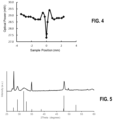
- FIG. 5 illustrates an X-Ray diffractogram of covellite nanoparticles with ICSD Card No. 63327 reference lines.
- FIGS. 6 A- 6 C illustrate SEM images of fabrication process of hybrid nanoparticle films.
- FIG. 6 A illustrates bare, unfunctionalized glass microscope slide after cleaning.
- FIG. 6 B illustrates the sample surface with Au nanoparticle layer.
- FIG. 6 C illustrates the hybrid film deposited without DBU treatment leading to aggregation and deposition of CuS islands.
- FIG. 6 D illustrates the final film containing both Au and CuS nanoparticles connected by linker molecule 2-aminoethanethiol.
- FIGS. 7 A- 7 B illustrate the intensity vs. wavelength spectrum of ( FIG. 7 A ) laser without spectral attenuation and ( FIG. 7 B ) second harmonic signal from BBO crystal with laser fundamental attenuated by filter. Dashed lines correspond to peak laser emission at 1050 nm.
- FIGS. 8 A- 8 B illustrates the peak lock-in amplifier (LIA) signal of ( FIG. 8 A ) the same sample spot for consecutive laser exposures, each exposure had a duration of 10 minutes.
- FIG. 8 B illustrates the peak LIA voltage after the annealing effect is no longer observable in a sample with less nanoparticle loading than that shown in FIG. 8 A .
- LIA peak lock-in amplifier
- FIGS. 9 A and 9 B illustrates hybrid samples taken at different spots on the same sample.
- FIG. 10 A illustrates the z-scan layout of the experiment, showing the coordinates of the front and back surface of the glass slide.
- FIG. 10 B illustrates a schematic showing the incident, transmitted and reflected beams at the film-glass interfaces.
- FIG. 11 illustrates the calculation of one-photon absorption (arbitrary units) as a function of distance from the focal plane in the hybrid gold-covellite structures, using the equation for l(z) given above and assuming a laser wavelength of 1050 nm.
- the z axis is scaled in mm, and the Rayleigh range is 0.529 ⁇ m, for a focal-spot radius of 13.5 ⁇ m.
- the laser is assumed incident from the left.
- FIG. 12 illustrates (left) a UV-Vis for Cu 2 Se (lowest line on right side of graph), Cu 2-x Se (top line on the right side of the graph), and Cu 2-x Se (middle line on the right side of the graph) and a TEM image (right) of hybrid particles (scale bar is 20 nm).
- FIG. 13 illustrates a graph of an example of SHG enhancement observed in hybrid Au@SiO 2 —CuS (top line on right side of graph) as opposed to the Au@SiO 2 along (bottom line on right side of graph, flat line).
- FIG. 14 illustrates a harmonically paired nanoparticle system having a reflective geometry.
- FIG. 15 is a schematic of a measurement system for up-conversion using harmonically paired set of particles, for example using the harmonically paired nanoparticle system shown in FIG. 14 .
- Embodiments of the present disclosure will employ, unless otherwise indicated, techniques of chemistry, polymer chemistry, material science, and the like, which are within the skill of the art. Such techniques are explained fully in the literature.
- the present disclosure provides for materials (e.g., films, mixtures, and colloidally suspended solutions) including two types of particles (e.g., nanoparticles) that exhibit harmonic surface plasmon resonances (SPR) and these are referred to as harmonically paired set of particles. This is the condition that the resonance of one particle is at a harmonic of the other. These materials can exhibit enhanced harmonic generation, and/or multiphoton photoluminescence compared to the sum of the output from the component parts of the film.
- Embodiments of the present disclosure can be used in chemical detection, biological detection or imaging, therapeutics, theranostics, and the like.
- both second and third harmonic generation and multiphoton photoluminescence are enhanced in the bilayer films compared to films of the individual nanoparticle components.
- the SPR of the Au is at the second harmonic of the CuS SPR, while other particle systems can operate at any even-order harmonics, such as the fourth and sixth. Odd-order harmonics (e.g., third and fifth) can be generated as well.
- the present disclosure provides for harmonically paired sets of particles that can be included in substrates or suspended in solution as well as systems and devices that include the harmonically paired set of particles.
- the particles are separated by a dielectric layer, where the dielectric layer has a thickness such that direct electron transfer does not occur between the harmonically paired set of particles.
- the structure can be an optical component within a system, for example a measurement system.
- the optical component can be a filter, an optically selective switch, an optically selective reflector, a non-phase matched harmonic generator, a parametric up- or down-converter, a tunable beam deflector, or a functionalized absorber-activator pair for drug delivery.
- the measurement system can be used to measure harmonic generation, photoluminescence, polarization, nonlinear absorption, and nonlinear index of refraction.
- the harmonically paired set of particles has a plasmonic resonance of one of the paired particles that is coincident with the harmonics of the plasmonic resonance of the other of the paired particles. Details regarding how the harmonically paired set of particles can be made are provided in Example 1.
- the harmonically paired set of particles can include a first particle and a second particle.
- the first particle is a metal and the second particle is a semiconductor.
- the first particle can be: Au, Ag, Al, Cu, Pt, Pd, Ga, In, Tl, Sn, Pb, and Bi
- the second particle can be: CuS, ZnO, Sn-doped In 2 O 3 (ITO), In-doped SnO 2 , compound III-V semiconductors, compound III-V semiconductors, and copper chalcogenides.
- the second particle can be AlN, GaN, AlP, GaP, InP, AlAs, GaAs, InAs, InSb, and ternary compounds involving a mix of these elements.
- the copper chalcogenides can be: CuS, Cu 2-x S, CuInS 2 , CuGaS 2 , Cu 2-x Se, Cu(InGa)S 2 , Cu(InGa)Se 2 , or CuTe.
- the first particle can be a first metal and the second particle can be a second metal, where the first metal and the second metal are different.
- the first metal and the second metal can be independently selected from: Au, Ag, Al, Cu, Pt, Pd, Ga, In, Tl, Sn, Pb, and Bi.
- the first particle and the second particle can independently have a longest dimension (e.g., radius, length, etc) of about 2 to 50 nm, about 4 to 50 nm, about 4 to 30 nm, or about 4 to 20 nm.
- the first particle and the second particle can independently be spherical, elliptical, or polyhedral in geometry.
- the dielectric layer, disposed between the first particle and the second particle can be made of a ligand that is a bi-functional organic ligand.
- the bi-functional organic ligand can be: aminoethanethiol and mercapto-acids, mercapto-alcohols, dithiols, and the amino-thiols.
- the bi-functional organic ligand can be: mercaptopropionic acid, mercapto alkyl-acids, mercapto alkyl-alcohols, mercaptoundecanoic acid, mecapto-phenylacetic acid, ethanedithiol, an alkyl-dithiol, benzenedithiol, poly(ethylene glycol) dithiol, biphenyldithiol, toluenedithiol, thiadiazoledithiol, aminoethanethiol, an amino-alkylthiols, aminothiophenol, and aminobenzylmercaptan.
- the dielectric layer can be made of an inorganic dielectric material, for example a metal or metalloid oxide.
- the inorganic dielectric material can be: SiO 2 , TiO 2 , SnO 2 , diamond, and Al 2 O 3 .
- the dielectric layer can have a thickness of about 3 to 500 nm, about 3 to 400 nm, about 3 to 300 nm, about 3 to 200 nm, about 2 to 100 nm, or about 3 to 50 nm, where the dielectric layer has a thickness such that direct electron transfer does not occur between the harmonically paired set of particles.
- the thickness will vary depending upon the type of first particle, the type of second particle and the material of the dielectric layer.
- the first particles are in a first layer and the second particles are in a second layer and the dielectric layer is positioned between the first layer and the second layer.
- the first layer or the second layer are adjacent a surface of a substrate.
- the substrate can be a material that has transmissive properties (e.g. greater than 70% transmissivity, greater than 80% transmissivity, greater than 90% transmissivity, greater than 95% transmissivity, or about 100% transmissivity), for example glass.
- the substrate can be a material that is reflective, for example a mirror.
- the surface of the substrate can be flat or curved, smooth or rough. Additional details are provided in FIGS. 14 and 15 .
- a plurality of harmonically paired set of particles are within a first mixed layer.
- Each harmonically paired set of particles includes a first particle and a second particle, where each harmonically paired set of particles has its own dielectric layer independent of the dielectric layer of other harmonically paired set of particles.
- a plurality of harmonically paired set of particles can be disposed in a material such as a polymer that has transmissive properties (e.g. greater than 70% transmissivity, greater than 80% transmissivity, greater than 90% transmissivity, greater than 95% transmissivity, or about 100% transmissivity).
- the first mixed layer is adjacent a surface of a substrate (e.g., having transmissive properties or reflective properties).
- a plurality of harmonically paired set of particles are within a colloidally suspended solution.
- Each harmonically paired set of particles includes a first particle and a second particle connected to one another by its own dielectric layer independent of the dielectric layer of other harmonically paired set of particles.
- the solution can water, alcohol, ether, acetone, alkanes, or benzene derivatives.
- This system might be implemented when one would want to determine where things are accumulating in a flowing system. For example, this can occur in a pipeline or a human blood vessel.
- the nanoparticles are injected in and then you scan with the fundamental harmonic across the system and wherever you get second harmonic signal back is where the nanoparticles ended up, be that a cancerous tissue or a blockage in a pipe, etc.
- the harmonically paired set of particles exhibit greater harmonic generation, multiphoton photoluminescence, or both as compared to the sum of the output from the component parts of the harmonically paired set of particles.
- the second harmonic of the harmonically paired set of particles is greater than the second harmonic sum of the output from the component parts of the harmonically paired set of particles.
- the third harmonic of the harmonically paired set of particles is greater than the third harmonic sum of the output from the component parts of the harmonically paired set of particles.
- the even harmonics of the harmonically paired set of particles is greater than the corresponding even harmonics sum of the output from the component parts of the harmonically paired set of particles.
- the harmonically paired nanoparticle can be included in a device or system.
- the first particles can be in a first layer and the second particles can be in a second layer and the dielectric layer is positioned between the first layer and the second layer.
- FIG. 14 illustrates a harmonically paired nanoparticle system or structure having a reflective geometry (in the alternative, this can have a transmissive geometry).
- the large red arrow represents incident fundamental harmonic light that is upconverted by the harmonically paired set of particles as represented by the semiconductor layer (second particle), spacer layer (dielectric layer), and metal nanoparticle (first particle) layer into the green arrow.
- the dichroic plate selectively allows the upconverted light to pass out of the system, but not the fundamental harmonic.
- the reflector is a mirror for both the fundamental and higher harmonics.
- the reflector can be replaced with a transmissive material such as glass or similarly transmissive material.
- the harmonically paired nanoparticle system of FIG. 14 can be incorporated into various types of systems and devices (e.g., filters, optically selective switches, optically selective reflectors, non-phase matched harmonic generators, parametric up- or down-converters, tunable beam deflectors, or functionalized absorber-activator pair for drug delivery).
- FIG. 15 is a schematic of a measurement system or device for up-conversion using harmonically paired set of particles, for example using the harmonically paired nanoparticle system shown in FIG. 14 . It should be noted that additional components not depicted can be added after the focusing optics to perform a series of modulations on an optical signal.
- the measurement system or device shown in FIG. 15 for measuring the upconverted light produced by harmonically paired nanoparticle films can include a laser, focusing optic system, a harmonically paired nanoparticle system, a filter, and a detector.
- the laser can be pulsed or continuous wave and excites the fundamental harmonic plasmon resonance of the paired nanoparticles.
- the laser can include Ti:sapphire, Nd:glass, optical parametric amplifiers, free electron, Nd:YAG, ruby, He—Ne, gas-phase Iodine, Er:YAG, Er:Glass, and noble gas lasers.
- the focusing optic system focusing the laser on the harmonically paired nanoparticle system.
- the focusing optic system can include one or more of a polarizer, irises, a plano- or bi-convex lens, an achromatic lens, a beam chopper, or a parabolic mirror.
- the harmonically paired nanoparticle system can include one such as that described in FIG. 14 .
- the filter can be a bandpass filter centered on the harmonics of interest, a long pass filter, or a paired long-pass and short-pass filter centered on the harmonics of interest.
- the detector can detect the harmonics of interest.
- the detector can be a photomultiplier tube, a Si charge-coupled device (CCD), an InGaAs detector, a Ge detector, or silicon/InGaAs avalanche photodiodes.
- the measurement system of FIG. 15 can be used to measure the nonlinear optical properties of materials, such as harmonic generation, optical rectification, multiple photon photoluminescence, nonlinear absorbance and index of refraction, and the polarization dependence of these properties.
- the measurement system can be used in chemical detection, biological detection or imaging, therapeutics, theranostics, and the like in various environments such as traditional chemical detection and biology as well as in analytic systems (e.g., flow systems) and mechanical systems.
- the enhancement exhibits a threshold with an onset near 4 GW/cm 2 .
- the 60 nm thick hybrid films were nine times more efficient per unit thickness in second harmonic production than beta-barium borate (BBO).
- BBO beta-barium borate
- the films also exhibit modest third-order nonlinear absorption.
- the nanoscale effect of broken inversion symmetry at surfaces allows for generation of second harmonic photons from materials that would normally be unable to participate in second order nonlinear phenomena, due to their centrosymmetry. That is, the second order susceptibility, which is negligible in bulk centrosymmetric materials, becomes significant in nanoscale structures due to the broken symmetry created by the surface 1 .
- Localized surface plasmon resonance (LSPR) can further enhance the effect of the broken symmetry.
- the second-order nonlinear response of gold and silver nanoparticles that exhibit LSPR has been well explored, including the effects of placing them in ordered arrays 2-4 and coupling 5,6 nanoparticles as well as by plasmon resonance 7 , Fano resonances 8 , and specific nanoparticle geometries 9,10 .
- Hybrid structures comprising metallic and semiconductor nanoparticles are known to exhibit enhanced SHG 11-13 due to dipole-dipole interactions that couple an excitonic state of the semiconductor to the plasmonic resonance of the metal 14 .
- hybrid structures that couple the plasmonic state of the semiconductor to the plasmonic resonance of the metal.
- the second harmonic of the plasmonic state of one nanoparticle matches the fundamental plasmonic resonance of another nanoparticle material.
- the Au nanoparticles will serve to increase two photon emission from the CuS nanoparticles by increasing the density of states, thereby increasing the probability of transition (Purcell enhancement).
- Semiconducting covellite exhibits metal-like electronic properties due to an intrinsically high concentration of holes (h + ). These holes act as positive charge carriers, giving covellite a p-type character 20 and a plasmon resonance that absorbs strongly from 900-1600 nm. Plasmonic states have been used as intermediates in two-photon absorption 21 , and in all-in-one plasmonic and excitonic systems for second harmonic generation. In this semiconductor, the second harmonic of the bluest portion of the plasmon resonance overlaps with the excitonic absorption (onset 2.5 eV, 500 nm). A three-fold enhancement of SHG was demonstrated at an excitation wavelength of 855 nm, where this plasmonic-exitonic energy-matching condition occurs 21 .
- This method resembles approaches taken in de signing hybrid nanoparticle systems, in which the excitonic state of the semiconductor couples to the plasmonic state of the metallic nanoparticle. Excitations of lower energy, such as the 1050 nm light used here, are not sufficient to produce an excitonic state via the second harmonic of the plasmon resonance.
- Toluene (C 7 H 8 , 99.9%) was purchased from Fischer Chemical. Sulfuric acid (H 2 SO 4 , 95%) was purchased from EMD. (3mercaptopropyl)trimethoxysilane (C 6 H 16 O 3 SSi) was purchased from Alfa Aesar. All chemicals were used as purchased.
- CuS nanoparticle synthesis 20 A mixture of 16 mL of 1-octadecene, 3.95 mL of oleylamine, and 432 ⁇ L of oleic acid was placed in a 50 mL 3-arm round bottom flask and degassed under vacuum at 130° C. for 30 min. The flask was filled with nitrogen and 99.3 mg, 1.00 mmol of CuCl was added to the flask. The reaction mixture was then held under N 2 for 5 min at 130° C., with vigorous stirring producing a blue solution. In an Erlenmeyer flask, 161.2 mg, 5.00 mmol of sulfur powder was dissolved in 5 mL of oleylamine on a hotplate at 60° C.
- Au nanoparticle synthesis 22 34.8 mg, 0.102 mmol of AuCl 3 ⁇ XH 2 O, 99.6 mg, 0.385 mmol of 1,2-hexadecanediol, 5 mL of 1-octadecene, and 1 mL of oleylamine were combined in a 50 mL 3-arm round bottom flask.
- the reaction mixture was heated to 70° C. and degassed under vacuum and vigorous stirring for 30 min. Vacuum was then replaced by N 2 and heated to 110° C. for 5 min.
- the reaction mixture turned dark wine red and was allowed to cool to room temperature.
- the reaction mixture was then cleaned and separated with 35 mL of ethanol and centrifugation at 8000 rpm for 5 minutes. This process was repeated twice: once with 35 mL of ethanol and once with 15 ml of methanol and 20 ml of ethanol.
- Fischer Scientific glass microscope slides (3 cm ⁇ 1 cm ⁇ 1 mm) were sectioned into four parts with a diamond tipped scribe. The glass sections were cleaned by placing them in a petri dish with 30 mL of piranha solution (1:4 H 2 O 2 :H 2 SO 4 ) for 10 min on each side 23 . The glass sections were then rinsed with deionized water and dried in an oven for 10 min at 107° C. Cleaned glass sections were exposed on both sides for 40 min to a toluene (70%)/chloroform (30%) bath into which 40 ⁇ L of (3-mercaptopropyl)trimethoxysilane was added immediately after the glass slides were placed in the bath 24 .
- the sections were rinsed with toluene and dried with a stream N 2 and placed in an oven for 7 min.
- the functionalized glass sections were then held vertically (to expose both sides of the glass) in a gold nanoparticle deposition bath with 30 mL of xylene and 44.2 ⁇ mol of Au nanoparticles (aliquot re-dispersed in toluene from synthesis assuming 100% yield) for 24 h.
- the slides were held vertically in a bath containing 2-aminoethanethiol saturated in 30 mL of ethanol for 24 h. In order to prevent surface charging, the slides were then placed in a 1% (volume) solution of the base diazobicycloundec-7-ene (DBU) in toluene for 1 h. Finally, the slides were placed in a bath of 250 ⁇ mol of CuS nanoparticles dispersed in 30 mL of xylene for 48 h. For samples containing only CuS nanoparticles, the Au nanoparticle and 2-aminoethanethiol deposition steps were skipped, proceeding instead straight from (3-mercaptopropyl)trimethoxysilane to CuS nanoparticles.
- DBU base diazobicycloundec-7-ene
- Powder X-ray diffraction (XRD) patterns were acquired in a Rigaku SmartLab X-ray diffractometer with a CuK ⁇ source and a D/teX Ultra 250 detector. The operating voltage was 40 kV and current was 44 mA. Samples were prepared by drop casting concentrated nanoparticle colloids onto glass microscope slides. Scanning electron microscopy (SEM) was performed with a Zeiss Merlin SEM at 1.10 kV with the InLens secondary electron detector. Contact stylus profilometry was performed on a Bruker Dektak 150 with 6 mg stylus force.
- SEM Scanning electron microscopy
- the laser beam was mechanically chopped at a frequency of 265 Hz, with a duty cycle of 20%; thus, each exposure of the sample lasts roughly 750 ⁇ s.
- the laser beam was focused on the sample by a lens with a measured focal length of 3.5 cm.
- the intensity of the laser was adjusted by varying the angle between crossed polarizers, producing output intensity in accordance with the Malus' law.
- a 720 nm short pass filter (OD 2) was placed between the sample and detector to further reduce any transmitted primary beam while still allowing the second harmonic to reach the detector.
- a 0.5 mm thick crystal of ⁇ -barium borate (BBO) was used to generate a reference SHG signal to align and calibrate the optics.
- the detector was a photomultiplier tube (PMT, Hamamatsu, RU-9880U110) operating at 1 kV. This PMT is most sensitive near the second harmonic wavelength (560 nm); the sensitivity at the wavelength of the IR laser is more than three orders of magnitude lower.
- PMT photomultiplier tube
- Disk-shaped CuS nanoparticles were synthesized using standard solvothermal procedures based on existing literature 20,22 .
- the copper sulfide nanoparticles were confirmed as stoichiometric covellite CuS by XRD ( FIG. 5 ), belonging to the centrosymmetric space group P6 3 /mmc.
- TEM micrographs show the disk-like geometry of the CuS nanoparticles ( FIG. 1 a ) with a hexagonal shape.
- the CuS nanoparticles have an average width of 14 ⁇ 3 nm and an average thickness of 4.9 ⁇ 1.0 nm as measured from the TEM images. This anisotropic geometry causes the formation of both transverse and longitudinal plasmon modes in the CuS nanoparticles; however, the CuS nanoparticles only exhibit one broad, intense extinction band due to overlapping and convolution of the two features.
- the sphere-like Au nanoparticles were synthesized by established procedures and have an average diameter of 6.6 ⁇ 0.8 nm as measured from the TEM images.
- the isotropic shape facilitates the dominance of only one plasmon resonance centered at 560 nm ( FIG. 2 a ).
- a weak additional plasmon peak in the NIR is observed in Au nanoparticle films, which can be attributed to dimerization of the Au nanoparticles and the development of a longitudinal plasmon mode in the dimer.
- a facile bath method as diagramed in FIG. 1 c , was developed to coat both sides of a glass substrate with layers of Au and CuS particles.
- the surfaces of the substrate were first silanized with (3-mercaptopropyl)trimethoxysilane to create functionalized surfaces that present organothiols to solution.
- the functionalized glass substrate Upon bathing the functionalized glass substrate in an Au nanoparticle solution, the strong affinity of Au nanoparticles for thiols caused a layer of Au nanoparticle to coat the glass.
- FIG. 6 SEM micrographs ( FIG. 6 ) show an even coverage of Au nanoparticles on the glass surface.
- the nanoparticle films were exposed to 80 fs pulses of laser radiation at 1050 nm to induce the generation of second harmonic light at 525 nm.
- the SHG was measured with a photomultiplier tube.
- Spectroscopy supports this conclusion by demonstrating attenuation of the fundamental beam and the presence of a second harmonic peak when a second harmonic generating material is placed in the beamline. The intensity of the beam was varied, and the intensity of the visible light monitored. All nanoparticle films—CuS, Au and the hybrid Au/CuS—demonstrated the classic supralinear response of nonlinear second harmonic generation ( FIG. 3 b ).
- Clues to the origin of the upconverted photons can be obtained by scanning the sample through the focal plane of the laser.
- the position of the sample is zeroed when the center of the glass slide is at the focal plane.
- maxima in SHG yield do not occur there but rather when the front or back surfaces of the glass are approximately in the focal plane.
- two peaks result in the Z-scan.
- the integrated SHG yields for the two maxima in FIG. 3 c are roughly equal, as would be expected from the material symmetry.
- the gold nanoparticle film produced a strong SHG response consistent with literature reports ( FIG. 3 b ) 2,9,25 .
- the small size of the gold nanoparticles (D Au 6.6 nm) means that nonlinear polarization is dominated by the surface dipolar contribution 26 .
- ⁇ surf, ⁇ is the reduction of the susceptibility tensor to a single element corresponding to the perpendicular surface term.
- P surf, ⁇ (r, ⁇ ) and E ex, ⁇ (r, ⁇ ) are the polarization and electric field perpendicular to the nanoparticle surface, respectively 26 .
- the second order polarization, and thus the intensity of second-harmonic light that is generated is dependent on the local electric field at the pump-laser frequency.
- the SHG response of the CuS films was modest, nearly 15 ⁇ less than that of the gold films at the strongest laser intensity employed.
- two photon absorption is not sufficient to excite valence band electrons of CuS into the conduction band, thus, two photon absorption can only proceed into mid-band gap surface or trap states 27 . Therefore, Covellite has a small intrinsic two photon absorption at 1050 nm.
- metallic gold nanoparticles have high two photon absorption through interband transitions with many free electrons. The larger two photon absorption cross section supports the much stronger SHG response observed for Au over CuS.
- the hybrid films produced a very strong SHG response that is 1.8 ⁇ greater than that Au films, and nearly 30 ⁇ greater than that of the CuS films. Importantly, the emission from the hybrid films is still greater than the incoherent sum of the two components. This suggests that there is an emergent, non-resonant coupling between the Au and CuS nanoparticles.
- the hybrid has a large density of states at the ground state (both Au and CuS contribute), fundamental (from CuS), and at the second harmonic (From Au).
- Fermi's golden rule two photon absorption and emission become enhanced through increased transition probability due to the increased density of states. This improves the competitiveness of radiative pathways against non-radiative pathways, namely plasmon damping from scattering off of bulk defects and surfaces scattering, which occurs on the 10 s of fs time scale.
- FIG. 3 b The effect of this Purcell enhancement in resonant nanoparticles is depicted in FIG. 3 b .
- the sample with only metallic nanoparticles and the hybrid samples have similar second harmonic efficiencies until a threshold region is reached at approximately 4 GW/cm 2 . Above that threshold, the enhancement effect due to the presence of the CuS nanoparticles becomes substantial, and the effect of the enhancement increases as the fundamental harmonic intensity increases.
- the required onset for the enhancement is because the density of states contributed by the CuS is less than that of the Au to the hybrid system; the extinction coefficient of Au nanoparticle plasmons is two orders of magnitude larger than that of CuS nanoparticle plasmons 28,29 . It is therefore only at the larger intensities that CuS absorbs enough to significantly contribute to the SHG.
- AEF I Au - CuS / P Au - CuS I Au / P Au where I is the SHG intensity and p is the surface density of Au nanoparticles.
- the enhancement effect strengthens as the input intensity increases.
- the AEF was 1.74.
- the intensity of the laser fundamental was measured as a hybrid film sample moved through the focal plane, demonstrated in FIG. 4 .
- the initial rise in intensity near the focal plane is evidence of a bleaching nonlinearity in the semiconducting CuS nanoparticles, but the effect is ultimately overwhelmed at higher intensities closer to the focal plane by the absorptive nonlinearity of the gold nanoparticles.
- the third order nonlinear absorption in the hybrid films is a modest effect, with a maximum optical power decrease of about 6%.
- the efficiency of second harmonic generation from the hybrid nanoparticle films was compared to that of ⁇ -barium borate (BBO), a conventional nonlinear crystal.
- BBO ⁇ -barium borate
- For a laser intensity above the enhancement threshold (6.64 GW/cm 2 ) when the intensity of SH light produced is normalized to sample thickness and laser power squared, the hybrid nanoparticle film outperforms BBO (9.3:1). Optimization of the films and nanocrystal placement is expected to further increase this design's performance over BBO.
- Nanoparticle films containing only Au and CuS nanoparticles were also evaluated.
- the Au nanoparticles produced more SH than BBO (5.4:1), and the CuS nanoparticles produced less SH than BBO (0.69:1). This result emphasizes the relative second order inactivity of CuS nanoparticles when stimulated at 1050 nm.
- the top two figures are of hybrid samples taken at different spots on the same sample.
- Film inhomogeneities suggested by the results of the profilometry and confirmed in SEM imaging of the hybrid films, produced changes in nonlinear absorptive response as discussed in FIGS. 10 A and 10 B . Additionally, a laser-beam induced annealing effect on the film was demonstrated upon repeated exposure of the sample to the laser. Initial decreases in SHG efficiency leveled off after several exposures to the laser, as shown in FIG. 8 A- 8 B . These inhomogeneities were compensated for by controlling the placement of the focal spot on the sample and ensuring pre-measurement exposure to the laser.
- This example demonstrates that plasmonic nanocrystals in close proximity can couple to enhance non-linear optical properties such as second harmonic generation.
- Au nanospheres have a plasmon resonance at the second harmonic of the fundamental plasmonic resonance of CuS nanoparticles.
- Mixed nanoparticle films demonstrated an analytic enhancement factor of 1.74, exhibiting greater SH yield than the sum of either nanoparticle film alone. This suggests that there is a coupling effect between the plasmon resonance of the CuS nanoparticles and the Au nanoparticles.
- These materials also exhibit greater SHG efficiency per unit thickness than BBO, a high-performance nonlinear crystal.
- phase matching is not required, allowing for a larger angle tolerance in the SHG response. This development in nanocrystal-based nonlinear optical materials will allow for reduced size of optical components, reaching toward the domain of planar nano-optical devices.
- FIG. 4 B the asymmetry of glass slide's SHG intensity when moving along focal plane is shown.
- the absorbance effect is studied to study the asymmetry.
- a gaussian beam with beam waist of width w 0 passes through the films on each face of the glass slide.
- the film absorbance A can be calculated from the absorbance data in FIG. 2 A .
- the absorbance a of the sample in which the laser passes through films on both sides of the sample is approximately 0.2.
- the geometry of the experiment is shown in FIG. 10 A .
- the 60 nm thick films on either face can be treated as if they were infinitely thin, i.e., effectively d-function absorbers.
- the film positions are z 1 and z 2 , and the beam waist as a function of z is given by
- the maximum intensity according to FIG. 3 was 6.65 GW/cm 2 and the wavelength of the laser was 1050 nm.
- the unit cell of gold has a volume of 0.0679 nm 3 , leading to
- the presence of the insulating layer prevents damping of the plasmon resonance of the CuS by the Au component.
- the copper chalcogenide had a plasmon resonance in the NIR (blue trace, top line on far right of graph) that was removed when the gold caps were added to the nanoparticle (green trace, middle line on far right of graph).
- FIG. 2 A shows that second harmonic experiments were disclosed in that document, they were not in the heterostructure film with organic dielectric ligand, nor was there direct comparison between heterostructure nanoparticles and single plasmon (at fundamental) nanoparticles.
- ratios, concentrations, amounts, and other numerical data may be expressed herein in a range format. It is to be understood that such a range format is used for convenience and brevity, and thus, should be interpreted in a flexible manner to include not only the numerical values explicitly recited as the limits of the range, but also to include all the individual numerical values or sub-ranges encompassed within that range as if each numerical value and sub-range is explicitly recited.
- a concentration range of “about 0.1% to about 5%” should be interpreted to include not only the explicitly recited concentration of about 0.1 wt % to about 5 wt %, but also include individual concentrations (e.g., 1%, 2%, 3%, and 4%) and the sub-ranges (e.g., 0.5%, 1.1%, 2.2%, 3.3%, and 4.4%) within the indicated range.
- the term “about” can include traditional rounding according to significant figures of the numerical value.
- the phrase “about ‘x’ to ‘y’” includes “about ‘x’ to about ‘y’”.
Landscapes
- Physics & Mathematics (AREA)
- Nonlinear Science (AREA)
- General Physics & Mathematics (AREA)
- Optics & Photonics (AREA)
- Optical Modulation, Optical Deflection, Nonlinear Optics, Optical Demodulation, Optical Logic Elements (AREA)
Abstract
Description
where I is the SHG intensity and p is the surface density of Au nanoparticles. The enhancement effect strengthens as the input intensity increases. At our experimental maximum laser intensity (6.64 GW/cm2), the AEF was 1.74.
- (1) Bachelier, G.; Russier-Antoine, I.; Benichou, E.; Jonin, C.; Brevet, P.-F. Multipolar Second-Harmonic Generation in Noble Metal Nanoparticles. J. Opt. Soc. Am. B 2008, 25 (6), 955. https://doi.org/10.1364/josab.25.000955.
- (2) McMahon, M. D.; Ferrara, D.; Bowie, C. T.; Lopez, R.; Haglund, R. F. Second Harmonic Generation from Resonantly Excited Arrays of Gold Nanoparticles. Appl. Phys. B Lasers Opt. 2007, 87 (2), 259-265. https://doi.org/10.1007/s00340-006-2569-3.
- (3) Li, K.; Stockman, M. I.; Bergman, D. J. Enhanced Second Harmonic Generation in a Self-Similar Chain of Metal Nanospheres. Phys. Rev. B—Condens. Matter Mater. Phys. 2005, 72 (15), 1-4. https://doi.org/10.1103/PhysRevB.72.153401.
- (4) Fontana, J.; Maldonado, M.; Charipar, N.; Trammell, S. A.; Nita, R.; Naciri, J.; Pique, A.; Ratna, B.; Gomes, A. S. L. Linear and Nonlinear Optical Characterization of Self-Assembled, Large-Area Gold Nanosphere Metasurfaces with Sub-Nanometer Gaps: Errata. Opt. Express 2018, 26 (8), 9614. https://doi.org/10.1364/oe.26.009614.
- (5) Shaviv, E.; Banin, U. Synergistic Effects on Second Harmonic Generation of Hybrid CdSe—Au Nanoparticles. ACS Nano 2010, 4 (3), 1529-1538. https://doi.org/10.1021/nn901778k.
- (6) Danckwerts, M.; Novotny, L. Optical Frequency Mixing at Coupled Gold Nanoparticles. Phys. Rev. Lett. 2007, 98 (2), 1-4. https://doi.org/10.1103/PhysRevLett.98.026104.
- (7) Hubert, C.; Billot, L.; Adam, P. M.; Bachelot, R.; Royer, P.; Grand, J.; Gindre, D.; Dorkenoo, K. D.; Fort, A. Role of Surface Plasmon in Second Harmonic Generation from Gold Nanorods. Appl. Phys. Lett. 2007, 90 (18), 88-91. https://doi.org/10.1063/1.2734503.
- (8) Martin, O. J. F. Augmenting Second Harmonic Generation Using Fano Resonances in Plasmonic Systems. 2013. https://doi.org/10.1021/nl400636z.
- (9) Zhang, Y.; Grady, N. K.; Ayala-Orozco, C.; Halas, N. J. Three-Dimensional Nanostructures as Highly Efficient Generators of Second Harmonic Light. Nano Lett. 2011, 11 (12), 5519-5523. https://doi.org/10.1021/n12033602.
- (10) Celebrano, M.; Wu, X.; Baselli, M.; Großmann, S.; Biagioni, P.; Locatelli, A.; Angelis, C. De; Cerullo, G.; Osellame, R.; Hecht, B.; et al. Mode Matching in Multiresonant Plasmonic Nanoantennas for Enhanced Second Harmonic Generation. Nat. Nanotechnol. 2015, 10 (5), 412-417. https://doi.org/10.1038/nnano.2015.69.
- (11) Jais, P. M.; Von Bilderling, C.; Bragas, A. V. Plasmon-Enhanced Second Harmonic Generation in Semiconductor Quantum Dots Close to Metal Nanoparticles. Pap. Phys. 2011, 3 (0), 1-5. https://doi.org/10.4279/pip.030002.
- (12) Grinblat, G.; Rahmani, M.; Cortes, E.; Caldarola, M.; Comedi, D.; Maier, S. A.; Bragas, A. V. High-Efficiency Second Harmonic Generation from a Single Hybrid Zno Nanowire/Au Plasmonic Nano-Oligomer. Nano Lett. 2014, 14 (11), 6660-6665. https://doi.org/10.1021/nl503332f.
- (13) Linnenbank, H.; Grynko, Y.; Förstner, J.; Linden, S. Second Harmonic Generation Spectroscopy on Hybrid Plasmonic/Dielectric Nanoantennas. Light Sci. Appl. 2016, 5 (1), e16013-e16013. https://doi.org/10.1038/lsa.2016.13.
- (14) Singh, M. R. Enhancement of the Second-Harmonic Generation in a Quantum Dot-Metallic Nanoparticle Hybrid System. Nanotechnology 2013, 24 (12). https://doi.org/i0.1088/0957-4484/24/12/125701.
- (15) Chang, R.; Leung, P. T.; Tsai, D. P. Effects of Gain Medium on the Plasmonic Enhancement of Forster Resonance Energy Transfer in the Vicinity of a Metallic Particle or Cavity. Opt. Express 2014, 22 (22), 27451. https://doi.org/10.1364/oe.22.027451.
- (16) Liaw, J. W.; Chen, B. R.; Kuo, M. K. Plasmon-Mediated Excitation Modulation of FRET by Silver Nanoshell. Microelectron. Eng. 2015, 138, 122-127. https://doi.org/10.1016/j.mee.2015.03.024.
- (17) Szmacinski, H.; Ray, K.; Lakowicz, J. R. Effect of Plasmonic Nanostructures and Nanofilms on Fluorescence Resonance Energy Transfer. J. Biophotonics 2009, 2 (4), 243-252. https://doi.org/10.1002/jbio.200910003.
- (18) Tong, L.; Cobley, C. M.; Chen, J.; Xia, Y.; Cheng, J. X. Bright Three-Photon Luminescence from Gold/Silver Alloyed Nanostructures for Bioimaging with Negligible Photothermal Toxicity. Angew. Chemie—Int. Ed. 2010, 49 (20), 3485-3488. https://doi.org/10.1002/anie.201000440.
- (19) Bardhan, R.; Lal, S.; Joshi, A.; Halas, N. J. Imaging and Treatment of Cancer. 2011, 44 (10). https://doi.org/10.1021/ar200023x.
- (20) Xie, Y.; Carbone, L.; Nobile, C.; Grillo, V.; D'Agostino, S.; Della Sala, F.; Giannini, C.; Altamura, D.; Oelsner, C.; Kryschi, C.; et al. Metallic-like Stoichiometric Copper Sulfide Nanocrystals: Phase- and Shape-Selective Synthesis, near-Infrared Surface Plasmon Resonance Properties, and Their Modeling. ACS Nano 2013, 7 (8), 7352-7369. https://doi.org/10.1021/nn403035s.
- (21) Marin, B. C.; Hsu, S. W.; Chen, L.; Lo, A.; Zwissler, D. W.; Liu, Z.; Tao, A. R. Plasmon-Enhanced Two-Photon Absorption in Photoluminescent Semiconductor Nanocrystals. ACS Photonics 2016, 3 (4), 526-531. https://doi.org/10.1021/acsphotonics.6b00037.
- (22) Motl, N. E.; Ewusi-annan, E.; Sines, I. T.; Jensen, L.; Schaak, R. E. Experimental Determination of Composition and Correlation with Theory. J. Phys. Chem. C 2010, 19263-19269.
- (23) Brzoska, J. B.; Shahidzadeh, N.; Rondelez, F. Evidence of a Transition Temperature for the Optimum Deposition of Grafted Monolayer Coatings. Nature 1992, 360 (6406), 719-721. https://doi.org/10.1038/360719a0.
- (24) Goss, C. A.; Deborah, C. H.; Majda, M. Application of (3-Mercaptopropyl)Trimethoxysilane as a Molecular Adhesive in the Fabrication of Vapor-Deposited Gold Electrodes on Glass Substrates. Anal. Chem. 1990, No. 63, 85-88.
- (25) Palomba, S.; Danckwerts, M.; Novotny, L. Nonlinear Plasmonics with Gold Nanoparticle Antennas. J. Opt. A Pure Appl. Opt. 2009, 11 (11). https://doi.org/10.1088/1464-4258/11/11/114030.
- (26) Bachelier, G.; Butet, J.; Russier-Antoine, I.; Jonin, C.; Benichou, E.; Brevet, P. F. Origin of Optical Second-Harmonic Generation in Spherical Gold Nanoparticles: Local Surface and Nonlocal Bulk Contributions. Phys. Rev. B—Condens. Matter Mater. Phys. 2010, 82 (23), 1-5. https://doi.org/10.1103/PhysRevB.82.235403.
- (27) Ludwig, J.; An, L.; Pattengale, B.; Kong, Q.; Zhang, X.; Xi, P.; Huang, J. Ultrafast Hole Trapping and Relaxation Dynamics in p-Type CuS Nanodisks. 2015. https://doi.org/10.1021/acs.jpclett.5b01078.
- (28) Liu, X.; Atwater, M.; Wang, J.; Huo, Q. Extinction Coefficient of Gold Nanoparticles with Different Sizes and Different Capping Ligands. Colloids Surfaces B Biointerfaces 2007, 58 (1), 3-7. https://doi.org/10.1016/j.colsurfb.2006.08.005.
- (29) Xiao, L.; Wu, J.; Ran, J.; Liu, Y.; Qiu, W.; Lu, F.; Shao, F.; Tang, D.; Peng, P. Near-Infrared Radiation Absorption Properties of Covellite (CuS) Using First-Principles Calculations. AIP Adv. 2016, 6 (8). https://doi.org/10.1063/1.4962299.
Supplemental Information for Example 1
Model of Film Absorbance
where we have implicitly assumed that there is no scattering, so that the transmission T and absorption A sum to 1.
Where δ is half the thickness of the microscope slide, 0.5 mm.
This is to be compared with the experimental SHG yield for the gold film (see the black trace in
Claims (20)
Priority Applications (1)
| Application Number | Priority Date | Filing Date | Title |
|---|---|---|---|
| US17/221,013 US11726386B2 (en) | 2020-04-02 | 2021-04-02 | Plasmon coupling materials, methods of making plasmon coupling materials, methods of using plasmon coupling materials and systems and devices that include plasmon coupling materials |
Applications Claiming Priority (2)
| Application Number | Priority Date | Filing Date | Title |
|---|---|---|---|
| US202063004160P | 2020-04-02 | 2020-04-02 | |
| US17/221,013 US11726386B2 (en) | 2020-04-02 | 2021-04-02 | Plasmon coupling materials, methods of making plasmon coupling materials, methods of using plasmon coupling materials and systems and devices that include plasmon coupling materials |
Publications (2)
| Publication Number | Publication Date |
|---|---|
| US20210311370A1 US20210311370A1 (en) | 2021-10-07 |
| US11726386B2 true US11726386B2 (en) | 2023-08-15 |
Family
ID=77921602
Family Applications (1)
| Application Number | Title | Priority Date | Filing Date |
|---|---|---|---|
| US17/221,013 Active 2041-11-22 US11726386B2 (en) | 2020-04-02 | 2021-04-02 | Plasmon coupling materials, methods of making plasmon coupling materials, methods of using plasmon coupling materials and systems and devices that include plasmon coupling materials |
Country Status (1)
| Country | Link |
|---|---|
| US (1) | US11726386B2 (en) |
Families Citing this family (2)
| Publication number | Priority date | Publication date | Assignee | Title |
|---|---|---|---|---|
| CN114572941B (en) * | 2022-03-01 | 2023-07-21 | 北京师范大学 | A method for preparing copper chalcogenide heterojunction nanomaterials with excellent LSPR absorption intensity and spectral stability |
| US20240176206A1 (en) * | 2022-11-29 | 2024-05-30 | Kla Corporation | Interface-based thin film metrology using second harmonic generation |
Citations (2)
| Publication number | Priority date | Publication date | Assignee | Title |
|---|---|---|---|---|
| US20060034729A1 (en) * | 2004-05-19 | 2006-02-16 | Vladimir Poponin | Optical sensor with layered plasmon structure for enhanced detection of chemical groups by SERS |
| US9513226B2 (en) * | 2012-08-14 | 2016-12-06 | The Regents Of The University Of California | Nanochip based surface plasmon resonance sensing devices and techniques |
-
2021
- 2021-04-02 US US17/221,013 patent/US11726386B2/en active Active
Patent Citations (2)
| Publication number | Priority date | Publication date | Assignee | Title |
|---|---|---|---|---|
| US20060034729A1 (en) * | 2004-05-19 | 2006-02-16 | Vladimir Poponin | Optical sensor with layered plasmon structure for enhanced detection of chemical groups by SERS |
| US9513226B2 (en) * | 2012-08-14 | 2016-12-06 | The Regents Of The University Of California | Nanochip based surface plasmon resonance sensing devices and techniques |
Non-Patent Citations (29)
Also Published As
| Publication number | Publication date |
|---|---|
| US20210311370A1 (en) | 2021-10-07 |
Similar Documents
| Publication | Publication Date | Title |
|---|---|---|
| Wang et al. | Molecular electronic plasmonics | |
| Zhang et al. | Simultaneous surface-enhanced resonant Raman and fluorescence spectroscopy of monolayer MoSe2: determination of ultrafast decay rates in nanometer dimension | |
| Huang et al. | Tailored emission spectrum of 2D semiconductors using plasmonic nanocavities | |
| Zhou et al. | Silver nanoshell plasmonically controlled emission of semiconductor quantum dots in the strong coupling regime | |
| Greybush et al. | Plasmon-enhanced upconversion luminescence in single nanophosphor–nanorod heterodimers formed through template-assisted self-assembly | |
| Scott et al. | Two photon absorption in II–VI semiconductors: the influence of dimensionality and size | |
| Córdova-Castro et al. | Anisotropic plasmonic CuS nanocrystals as a natural electronic material with hyperbolic optical dispersion | |
| Ferrari et al. | Wavelength-dependent nonlinear optical properties of Ag nanoparticles dispersed in a glass host | |
| Han et al. | Large nonlinear absorption in coated Ag2S/CdS nanoparticles by inverse microemulsion | |
| He et al. | Two-and three-photon absorption and frequency upconverted emission of silicon quantum dots | |
| Luu et al. | Two-color surface plasmon polariton enhanced upconversion in NaYF4: Yb: Tm nanoparticles on Au nanopillar arrays | |
| Liu et al. | Fabrication of Si/Au core/shell nanoplasmonic structures with ultrasensitive surface-enhanced Raman scattering for monolayer molecule detection | |
| Mondal et al. | Ultrafast charge transfer and trapping dynamics in a colloidal mixture of similarly charged CdTe quantum dots and silver nanoparticles | |
| Patra et al. | Nonlinear absorption and refraction of highly monodisperse and luminescent ZnTe quantum dots and their self-assembled nanostructures: implications for optoelectronic devices | |
| Irimpan et al. | Luminescence tuning and enhanced nonlinear optical properties of nanocomposites of ZnO–TiO2 | |
| Lin et al. | Core/alloyed-shell quantum dot robust solid films with high optical gains | |
| US11726386B2 (en) | Plasmon coupling materials, methods of making plasmon coupling materials, methods of using plasmon coupling materials and systems and devices that include plasmon coupling materials | |
| Angeloni et al. | Disentangling the Role of Shape, Ligands, and Dielectric Constants in the Absorption Properties of Colloidal CdSe/CdS Nanocrystals | |
| Resta et al. | Spatially confined CdS NCs in situ synthesis through laser irradiation of suitable unimolecular precursor-doped polymer | |
| Shen et al. | Hierarchical optical antenna: Gold nanoparticle-modified photonic crystal for highly-sensitive label-free DNA detection | |
| Guvenc et al. | Strong plasmon–exciton coupling in colloidal halide perovskite nanocrystals near a metal film | |
| Yang et al. | Silicon particle as a nanocavity for stable emission of quantum dots | |
| Das et al. | Ultrafast carrier dynamics in 2D–2D hybrid structures of functionalized GO and CdSe nanoplatelets | |
| Kohan et al. | Optical field coupling in ZnO nanorods decorated with silver plasmonic nanoparticles | |
| Ma et al. | Second harmonic generation from an individual all-dielectric nanoparticle: resonance enhancement versus particle geometry |
Legal Events
| Date | Code | Title | Description |
|---|---|---|---|
| FEPP | Fee payment procedure |
Free format text: ENTITY STATUS SET TO UNDISCOUNTED (ORIGINAL EVENT CODE: BIG.); ENTITY STATUS OF PATENT OWNER: SMALL ENTITY |
|
| FEPP | Fee payment procedure |
Free format text: ENTITY STATUS SET TO SMALL (ORIGINAL EVENT CODE: SMAL); ENTITY STATUS OF PATENT OWNER: SMALL ENTITY |
|
| AS | Assignment |
Owner name: VANDERBILT UNIVERSITY, TENNESSEE Free format text: ASSIGNMENT OF ASSIGNORS INTEREST;ASSIGNORS:MACDONALD, JANET E.;HAGLUND, RICHARD F., JR.;SPEAR, NATHAN JAMES;AND OTHERS;SIGNING DATES FROM 20210426 TO 20210714;REEL/FRAME:057133/0932 |
|
| STPP | Information on status: patent application and granting procedure in general |
Free format text: DOCKETED NEW CASE - READY FOR EXAMINATION |
|
| STPP | Information on status: patent application and granting procedure in general |
Free format text: AWAITING TC RESP, ISSUE FEE PAYMENT VERIFIED |
|
| STCF | Information on status: patent grant |
Free format text: PATENTED CASE |