US11715134B2 - Content compliance system - Google Patents
Content compliance system Download PDFInfo
- Publication number
- US11715134B2 US11715134B2 US16/431,668 US201916431668A US11715134B2 US 11715134 B2 US11715134 B2 US 11715134B2 US 201916431668 A US201916431668 A US 201916431668A US 11715134 B2 US11715134 B2 US 11715134B2
- Authority
- US
- United States
- Prior art keywords
- content
- directives
- brand
- selected brand
- compliance
- Prior art date
- Legal status (The legal status is an assumption and is not a legal conclusion. Google has not performed a legal analysis and makes no representation as to the accuracy of the status listed.)
- Active, expires
Links
Images


Classifications
-
- G—PHYSICS
- G06—COMPUTING OR CALCULATING; COUNTING
- G06Q—INFORMATION AND COMMUNICATION TECHNOLOGY [ICT] SPECIALLY ADAPTED FOR ADMINISTRATIVE, COMMERCIAL, FINANCIAL, MANAGERIAL OR SUPERVISORY PURPOSES; SYSTEMS OR METHODS SPECIALLY ADAPTED FOR ADMINISTRATIVE, COMMERCIAL, FINANCIAL, MANAGERIAL OR SUPERVISORY PURPOSES, NOT OTHERWISE PROVIDED FOR
- G06Q30/00—Commerce
- G06Q30/02—Marketing; Price estimation or determination; Fundraising
- G06Q30/0241—Advertisements
- G06Q30/0276—Advertisement creation
-
- G—PHYSICS
- G06—COMPUTING OR CALCULATING; COUNTING
- G06N—COMPUTING ARRANGEMENTS BASED ON SPECIFIC COMPUTATIONAL MODELS
- G06N20/00—Machine learning
-
- G—PHYSICS
- G06—COMPUTING OR CALCULATING; COUNTING
- G06Q—INFORMATION AND COMMUNICATION TECHNOLOGY [ICT] SPECIALLY ADAPTED FOR ADMINISTRATIVE, COMMERCIAL, FINANCIAL, MANAGERIAL OR SUPERVISORY PURPOSES; SYSTEMS OR METHODS SPECIALLY ADAPTED FOR ADMINISTRATIVE, COMMERCIAL, FINANCIAL, MANAGERIAL OR SUPERVISORY PURPOSES, NOT OTHERWISE PROVIDED FOR
- G06Q10/00—Administration; Management
- G06Q10/06—Resources, workflows, human or project management; Enterprise or organisation planning; Enterprise or organisation modelling
- G06Q10/063—Operations research, analysis or management
- G06Q10/0637—Strategic management or analysis, e.g. setting a goal or target of an organisation; Planning actions based on goals; Analysis or evaluation of effectiveness of goals
-
- G—PHYSICS
- G06—COMPUTING OR CALCULATING; COUNTING
- G06Q—INFORMATION AND COMMUNICATION TECHNOLOGY [ICT] SPECIALLY ADAPTED FOR ADMINISTRATIVE, COMMERCIAL, FINANCIAL, MANAGERIAL OR SUPERVISORY PURPOSES; SYSTEMS OR METHODS SPECIALLY ADAPTED FOR ADMINISTRATIVE, COMMERCIAL, FINANCIAL, MANAGERIAL OR SUPERVISORY PURPOSES, NOT OTHERWISE PROVIDED FOR
- G06Q30/00—Commerce
- G06Q30/02—Marketing; Price estimation or determination; Fundraising
- G06Q30/0201—Market modelling; Market analysis; Collecting market data
- G06Q30/0204—Market segmentation
-
- G—PHYSICS
- G06—COMPUTING OR CALCULATING; COUNTING
- G06Q—INFORMATION AND COMMUNICATION TECHNOLOGY [ICT] SPECIALLY ADAPTED FOR ADMINISTRATIVE, COMMERCIAL, FINANCIAL, MANAGERIAL OR SUPERVISORY PURPOSES; SYSTEMS OR METHODS SPECIALLY ADAPTED FOR ADMINISTRATIVE, COMMERCIAL, FINANCIAL, MANAGERIAL OR SUPERVISORY PURPOSES, NOT OTHERWISE PROVIDED FOR
- G06Q30/00—Commerce
- G06Q30/02—Marketing; Price estimation or determination; Fundraising
- G06Q30/0241—Advertisements
- G06Q30/0251—Targeted advertisements
- G06Q30/0269—Targeted advertisements based on user profile or attribute
Definitions
- the company/brand may use a creative agency which provides content for the brand's advertising campaign.
- the content may include text, images, and/or sounds.
- the company may initially specify some general subjective goals for the campaign.
- the campaign may have an overall objective and a general theme.
- the company also may want the campaign directed to a specific audience, such as millennials.
- the company may inform the creative agency of these general subjective goals.
- the creative agency generates content based on these campaign goals.
- the company and creative agency then go through multiple iterations of modifying the content to conform with the campaign goals.
- the company also may specify other campaign requirements and goals not previously communicated to the creative agency. This iterative process of reviewing and editing content is time consuming and expensive.
- FIG. 1 depicts an example content compliance system.
- FIG. 2 depicts example operations performed by the content compliance system.
- FIG. 3 depicts example algorithms used for comparing brand directives with content.
- FIG. 4 - 9 depict example brand directives displayed by the content compliance system.
- FIG. 10 - 12 depict example compliance results generated by the content compliance system.
- FIG. 13 depicts an example content scheduler provided by the content compliance system.
- FIG. 14 depicts an example computer system used for implementing the content compliance system.
- a content compliance system uses Artificial Intelligence (AI) to generate objective verification which checks if content complies with brand campaign criteria.
- AI Artificial Intelligence
- the content compliance system may force the company to select specific brand criteria listed on a user interface. The selected brand criteria are then readily displayed to the creative agency.
- the content compliance system compares the selected brand criteria with content generated by the creative agency.
- the content compliance system uses AI algorithms to generate a compliance score that provides a real-time objective indication of the compliance of the creative content with the selected brand criteria.
- the creative agency can then modify the creative content and receive a real-time updated compliance score.
- This machine learning based compliance system provides real-time objective feedback regarding brand criteria compliance that reduces the overall development time for what was previously thought to be a subjective content review process. Thus, brand campaigns can be launched in less time and less expensively.
- FIG. 1 shows a content compliance system 100 that may include a content compliance engine 104 that operates a user interface 122 on a user computing device 120 .
- content compliance system 100 may operate on a server computing system 102 also referred to as “the cloud”.
- user computing device 120 may be a personal computer, laptop, tablet, smart phone, etc. that communicates with content compliance system 100 over the Internet.
- content compliance system 100 may be any software applications that operate on any computing system, and possibly on the same computing system as user computing device 120 .
- Content compliance engine 104 displays a list of brand directives 108 on user interface 122 .
- content compliance engine 104 may display a set of possible objectives 108 A for the campaign, a set of possible audiences 108 B for the campaign, a set of possible themes 108 C for the campaign, and a content format 108 D for the campaign.
- Compliance engine 104 may force the company/brand to select some combination of brand directives 108 . This provides the advantage of forcing the company to clearly specify objective identifiable items for including in the campaign content.
- Content compliance engine 104 may store the selected brand directives 108 in a database 110 .
- the creative agency may access content compliance system 100 .
- Compliance engine 104 may display a list of the previously selected brand directives 108 on user interface 122 .
- the creative agency creates content 124 that tries to comply with selected brand directives 108 .
- the creative agency may create text 124 A that communicates the selected objectives 108 A and themes 108 C in a manner that engages the selected audience 108 B and uses the selected content format 108 D.
- Content 124 may also include pictures, videos, images, etc. 124 B and/or a company logo 124 C that comply with content format 108 D and any other selected brand directives 108 .
- Compliance engine 104 parses content 124 and compares the parsed content with selected brand directives 108 .
- compliance engine 104 uses machine learning algorithms 106 and any other known natural language processing to identify different messages, phrases, subjects, images, tones, attributes, brands, sentiment, or any other content that may be associated with any of selected brand directives 108 .
- Other known software programs can identify formatting used in content 124 , such as different types, sizes, colors positions, actions, etc. of objects in content 124 .
- Example software programs are described at https://arxiv.org/abs/1512.00567 and https://pjreddie.com/media/files/papers/YOLOv3.pdf which are incorporated by reference in their entireties and used for training task specific models.
- Content compliance system 100 also may store a set of suggested phrases 112 for different types of brand directives 108 .
- Suggested phrases 112 may have been used and tested in previous campaigns and determined to generate high engagement with different audiences and/or determined to be effective in achieving other brand directives 108 .
- a certain phrase “With research we have found” may have been determined through benchmarking to produce high engagement with millennials.
- Content compliance system 100 may store “With research we have found” as one of suggested phrases 112 associated with a millennials category in audience 108 B.
- compliance engine 104 may use suggested phrases 112 to determine compliance of content 124 with brand directives 108 .
- brand directives 108 may include millennials in audience 108 B.
- Compliance engine 104 may use natural language processing to determine if any phrases in content 124 are similar to the suggested phrases 112 associated with millennials.
- Content compliance engine 104 generates compliance results 126 based on the comparison of content 124 with selected brand directives 108 . For example, as part of compliance results 126 , compliance engine 104 may count and display a compliance score 126 A that identifies the number of selected brand directives 108 contained in content 124 .
- Compliance results 126 also may include a resonance level 126 B that indicates a high, medium, or low level of resonance of content 124 with the selected audience.
- Compliance engine 104 may generate resonance level 126 B based on the similarity of phrases in content 124 with suggested phrases 112 associated with the selected audience. Other factors taken into account when determining the resonance level 126 B may include objectives 108 A, themes 108 C, content format 108 D, images 124 B or any other brand directives 108 in content 124 that has been determined to generate user engagement.
- compliance engine 104 may display individual compliance indicators 126 C and 126 D showing if particular brand directives 108 exist in content 124 .
- compliance indicator 126 C shows that content 124 contains the objectives 108 A selected in brand directives 108
- compliance indicator 126 D shows that content 124 does not comply with audience 108 B selected in brand directives 108 .
- compliance results 126 can be generated by compliance engine 104 in real-time as soon as content 124 is generated.
- the creative agency can then use compliance results 126 to modify content 124 in real-time to increase compliance score 126 A and resonance score 126 B.
- the creative agency can also view individual compliance indicators 126 C and 126 D to determine what specific brand directives 108 are not currently included in content 124 .
- the creative agency may repeatedly modify and resubmit content 124 to compliance system 100 until compliance results 126 reach an acceptable compliance score 126 A and resonance level 126 B.
- compliance engine 104 may be programmed with compliance threshold scores, such as 90% compliance with all brand directives 108 and a high resonance level with viewers. Compliance engine 104 may automatically display a message on user interface 122 when content 124 reaches the acceptable compliance thresholds.
- the creative agency may submit content 124 to the brand for final approval or may publish content 124 on any identified media channels, such as posting content 124 on one or more social media websites.
- content compliance system 100 provides substantial time savings by reducing the number of iterations needed to produce content 124 that complies with brand directives 108 .
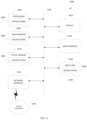
- FIG. 2 shows an example process performed by content compliance system 100 .
- content compliance system 100 receives brand directives 108 selected by the company/brand.
- content compliance system 100 may display a list of brand directives 108 on a user interface that the company may select.
- content compliance system 100 receives content 124 created by the creative agency. Compliance system 100 may display a summary of the selected brand directives 108 to the creative agency via the user interface. The creative agency then produces content 124 based on the displayed brand directives 108 .
- compliance system 100 compares content 124 produced by the creative agency with brand directives 108 selected by the company/brand. As explained above, known machine learning algorithms are used to determine if content 124 contains selected brand directives 108 .
- compliance system 100 outputs compliance results 126 based on comparisons 154 of content 124 with brand directives 108 .
- compliance system 100 may generate a compliance score 126 A identifying the number of selected compliance directives 108 contained in the content 124 , generate a resonance level 126 B indicating how well content 124 will resonate with the viewing audience, and display compliance indicators 126 C and 126 D identifying which specific compliance directives 108 are contained in content 124 .
- compliance system 100 determines if content 124 is complaint with the brand directives. For example, compliance system 100 may determine if compliance score 126 A and resonance level 126 B is above particular threshold levels. If compliance results 126 are above the threshold numbers or percentages, compliance system 100 may publish the content in operation 160 . For example, compliance system 100 may post content 124 on a social media network selected by the company/brand as one of brand directives 108 . Alternatively, compliance system 100 may send content 124 to the company/brand for a final review prior to publishing in operation 160 .
- compliance system 100 may send content 124 back to the creative agency and/or notify the creative agency that content 124 requires further editing.
- the creative agency edits content 124 in operation 152 and resubmits the edited content to compliance system 100 for another comparison with brand directives 108 in operation 154 .
- This iterative automated review process repeats until content 124 meets a specified compliance level in operation 158 .
- FIG. 3 shows in more detail how compliance system 100 compares content 124 with brand directives 108 .
- a first set of deep learning algorithms 170 may classify content 124 on a message level and compare any identified messages in content 124 with brand directives 108 .
- a second set of sequence labeling algorithms 172 may classify content 124 on a phrase level and compare any identified phrases in content 124 with brand directives 108 .
- compliance system 100 may use any other natural language learning algorithms 174 known to those to those skilled in the art to detect any other selected brand directives 108 in content 124 .
- Deep learning algorithms may refer any machine learning algorithm with multiple non-linear layers that can learn feature hierarchies.
- Another example deep learning algorithm is word2vec that may generate multi-dimensional word vectors from content 124 and brand directives 108 .
- Content vectors in the same multi-dimensional space location as brand directive vectors may indicate the brand directive 108 is contained in content 124 .
- FIG. 4 shows in more detail user interface 122 operated by content compliance system 100 .
- Compliance system 100 may display a guideline section 180 that the company/brand can use to select different brand directives 108 .
- Guidelines section 180 may include a checklist 182 of which brand directives 108 have been selected. The company/brand can quickly view checklist 182 to determine which brand directives 108 still need to be selected.
- a summary section 184 identifies which specific brand directives 108 were selected by the company/brand. Brand directives 108 described below are just examples and any combination of any number of brand directives 108 may be used by compliance system 100 .
- brand directive 108 A may include different selectable objectives/goals 186 .
- Example selectable objectives/goals 186 may include: provide information and support, generate brand awareness, establish though leadership, inspire trust and loyalty, develop community, demand generation, increase sales.
- Brand directive 108 B may include different selectable audiences 188 that include: generation Z, millennials, generation X, boomers, silent generation, economic buyer, champion, technical buyer, and practitioner.
- Generation Z may be between ages 15-20
- millennials may be between ages 21-34
- generation X may be between ages 35-49
- boomers may be between ages 50-64
- silent generation may be over age 65.
- the economic buyer may evaluate a return on investment (ROI), a champion may be looking for implementation of a solution, a technical buyer may evaluate feasibility, and the practitioner may evaluate a user experience.
- ROI return on investment
- a champion may be looking for implementation of a solution
- a technical buyer may evaluate feasibility
- the practitioner may evaluate a user experience.
- all of these are just examples of any audience 188 where a brand may want to direct content.
- FIG. 5 shows additional selectable brand directives 108 that compliance system 100 may display on user interface 122 .
- a brand directive 108 E may identify selectable customer journey stages 190 for establishing with people viewing content 124 including: awareness, consideration, experience, purchase, ownership, and loyalty.
- a brand directive 108 F may identify different selectable channels 192 for publishing content 124 including social media platforms such as: Facebook®, Twitter®, Instagram®, LinkedIn®, YouTube®, etc.
- a brand directive 108 C may identify different themes 194 for content 124 including: adventure, collectivism, health, etc.
- FIG. 6 shows additional selectable brand directives 108 D and 108 G that compliance system 100 may display on user interface 122 .
- Brand directive 108 D may identify different selectable formats 196 for content 124 .
- a long-form text format 196 may include research papers, whitepapers, reports or any other documents over a certain number of words.
- a short-form text format 196 may include short blog posts, or any other text under a certain number of words.
- a short-form video format 196 may include videos less than a certain time length.
- a long-form video format 196 may include videos over a certain time length.
- a static images format 196 may include photos and infographics.
- An animated graphic interchange format (GIF) 196 may include bitmap images that form animation.
- Brand directive 108 G may identify different tones 198 for content 124 , such as proud, nostalgia, and encouragement.
- FIG. 7 shows brand directives 108 H for different selectable brand guidelines and formatting.
- a first selectable brand guideline may be a brand name 200 to use in content 124 .
- Other brand guidelines may select a particular logo 202 and location 204 for displaying brand logo 202 in content 124 .
- Other brand guidelines may select a color 206 to use for logo 202 and a typography 208 and color 210 to use with brand name 200 .
- FIG. 8 shows different selectable brand directives 108 I associated with brand personalities 210 .
- brand personalities 210 may include openness 210 A, conscientiousness 210 B, extraversion 210 C, agreeable 210 D, and emotional range 210 E.
- a selectable low openness 210 A may be associated with inventive/curious and a selectable high openness 210 A may be associated with consistent/cautious.
- a selectable low conscientiousness 210 B may be associated with efficient/organized and a selectable high conscientiousness 210 B may be associated with easy-going/careless.
- a selectable low extraversion 210 C may be associated with outgoing/energetic and a selectable high extraversion 210 C may be associated with solitary/reserved.
- a selectable low agreeable 210 D may be associated with friendly/compassionate and a selectable high agreeable 210 D may be associated with challenging/detached.
- a selectable low emotional range 210 E may be associated with sensitive/nervous and a selectable high emotional range 210 E may be associated with secure/confident. More information about this can be found at https://en.wikipedia.org/wiki/Big_Five_personality_traits which is incorporated in its entirety.
- FIG. 9 shows selectable brand directives 108 J associated with creative guidelines.
- Creative guidelines may include a creative type 212 , objects 214 , activities 216 , a gender 218 , scenes 220 , and a focal point 222 .
- Creative type 212 may include photographs, graphic/illustrations, or some other type of media.
- Objects 214 may include any object the company/brand would like to show in content 124 , such as a shoe, adult, food, beverages, etc.
- Activities 216 to show in content 124 may include for example: basketball, physical fitness, cycling, etc.
- Gender 218 identifies the gender for a person for displaying in content 124 .
- Scenes 220 may include any scene that should be displayed in content 124 , such as a morning scene, city scene, hills scene, etc.
- Focal point 222 may identify a person, a single product, multiple products, or any other object that will serve as the focal point of content 124 .
- FIG. 10 shows a page 224 containing content 124 created by the creative agency based on the selected brand directives.
- the creative agency has the advantage of viewing defined brand directives 108 when creating content 124 .
- FIG. 10 also shows a page 226 sent back from compliance engine 104 in FIG. 1 that includes compliance results 126 for content 124 .
- compliance results 126 include compliance score 126 A indicating 6 out of 10 selected brand directives 108 are contained in content 124 .
- Compliance results 126 also include resonance sore 126 B indicating a likelihood of high resonance/engagement of content 124 with the viewing audience.
- FIGS. 11 and 12 show additional compliance results 126 for specific selected brand directives 108 .
- Compliance system 100 may display all brand directives 108 selected by the company/brand on user interface 122 .
- Compliance system 100 may display a check mark or some other indicator when the selected brand directive 108 is identified in content 124 .
- user interface 122 shows that compliance system 100 detected identified thought leadership goal 186 in content 124 .
- Compliance system 100 also determined content 124 was adequately directed to selected millennial audience 188 but was not adequately directed to generation X audience 188 .
- Compliance system 100 determined content 124 did not contain data needed for posting on selected LinkedIn® and Twitter® channels 192 .
- Compliance results 126 also show that content 124 does not include selected long-form text, short-form video, and animated GIFs 196 .
- Compliance results 126 may identify any other selected brand directive 108 , such as tones 198 , customer journey stages 190 , and themes 194 .
- Compliance system 100 also may display suggestive phrases 112 for the different selected brand directives 108 .
- different phrases may be associated with different brand directives 108 .
- particular phrases 112 may increase engagement with particular audiences or with all audiences.
- Compliance system 100 may display suggestive phrases 112 with the associated brand directives 108 . For example, compliance system 100 may determine current content 124 will not highly engage the generation X audience. Prior benchmarking may have determined suggestive phrases 112 in FIG. 11 provide high engagement rates with a generation X audience. The creative agency may add one or more suggestive phrases 112 into content 124 to increase generation X engagement. Compliance system 100 compares revised content 124 with selected brand directives 108 and may determine revised content 124 will more likely have an increased engagement rate with generation X audience 188 .
- FIG. 12 shows additional brand directives 108 J selected by the company/brand, such as specific creative types 212 , objects 214 , activities 216 , gender 218 , scenes 220 , and focal point 222 .
- Compliance system 100 identifies which selected creative guideline directives 108 J are contained in content 124 .
- content 124 contains a graphic or illustration, shoes, an activity involved with basketball, and a male.
- Compliance results 126 also indicates that content 124 does not contain a road scene selected as one of brand directives 108 J, but does contain people as a focal point.
- FIG. 13 shows a scheduling feature of compliance system 100 .
- Compliance system 100 may display a calendar 240 on user interface 122 . Either the company/brand or the creative agency may select what day and times to post content 124 on previously selected media channels 108 F ( FIG. 5 ). Compliance system 100 also may recommend days and times for posting content 124 . For example, compliance system 100 may determine from previous benchmarking that more engagement with a selected audience, such as Millennials, increase on certain days or at certain times of the day. Compliance system 100 may identify the selected audience brand directive 108 B and automatically post content 124 at the previously determined highest engagement times for the identified audience.
- the content compliance engine 104 and scheme used for identifying compliance of content with selected campaign directives provides a substantial improvement in computer technology and operation by more efficiently processing and storing content in a database system in real time to then more quickly determine if and where specific data items are located in electronic documents.
- FIG. 14 shows a computing device 1000 that may be used for operating content compliance system 100 and performing any combination of operations discussed above.
- the computing device 1000 may operate in the capacity of a server or a client machine in a server-client network environment, or as a peer machine in a peer-to-peer (or distributed) network environment.
- computing device 1000 may be a personal computer (PC), a tablet, a Personal Digital Assistant (PDA), a cellular telephone, a smart phone, a web appliance, or any other machine or device capable of executing instructions 1006 (sequential or otherwise) that specify actions to be taken by that machine.
- PC personal computer
- PDA Personal Digital Assistant
- computing device 1000 may include any collection of devices or circuitry that individually or jointly execute a set (or multiple sets) of instructions to perform any one or more of the operations discussed above.
- Computing device 1000 may be part of an integrated control system or system manager, or may be provided as a portable electronic device configured to interface with a networked system either locally or remotely via wireless transmission.
- Processors 1004 may comprise a central processing unit (CPU), a graphics processing unit (GPU), programmable logic devices, dedicated processor systems, micro controllers, or microprocessors that may perform some or all of the operations described above. Processors 1004 may also include, but may not be limited to, an analog processor, a digital processor, a microprocessor, multi-core processor, processor array, network processor, etc.
- CPU central processing unit
- GPU graphics processing unit
- programmable logic devices dedicated processor systems
- micro controllers microprocessors that may perform some or all of the operations described above.
- Processors 1004 may also include, but may not be limited to, an analog processor, a digital processor, a microprocessor, multi-core processor, processor array, network processor, etc.
- Processors 1004 may execute instructions or “code” 1006 stored in any one of memories 1008 , 1010 , or 1020 .
- the memories may store data as well. Instructions 1006 and data can also be transmitted or received over a network 1014 via a network interface device 1012 utilizing any one of a number of well-known transfer protocols.
- Memories 1008 , 1010 , and 1020 may be integrated together with processing device 1000 , for example RAM or FLASH memory disposed within an integrated circuit microprocessor or the like.
- the memory may comprise an independent device, such as an external disk drive, storage array, or any other storage devices used in database systems.
- the memory and processing devices may be operatively coupled together, or in communication with each other, for example by an I/O port, network connection, etc. such that the processing device may read a file stored on the memory.
- Some memory may be “read only” by design (ROM) by virtue of permission settings, or not.
- Other examples of memory may include, but may be not limited to, WORM, EPROM, EEPROM, FLASH, etc. which may be implemented in solid state semiconductor devices.
- Other memories may comprise moving parts, such a conventional rotating disk drive. All such memories may be “machine-readable” in that they may be readable by a processing device.
- Computer-readable storage medium may include all of the foregoing types of memory, as well as new technologies that may arise in the future, as long as they may be capable of storing digital information in the nature of a computer program or other data, at least temporarily, in such a manner that the stored information may be “read” by an appropriate processing device.
- the term “computer-readable” may not be limited to the historical usage of “computer” to imply a complete mainframe, mini-computer, desktop, wireless device, or even a laptop computer. Rather, “computer-readable” may comprise storage medium that may be readable by a processor, processing device, or any computing system. Such media may be any available media that may be locally and/or remotely accessible by a computer or processor, and may include volatile and non-volatile media, and removable and non-removable media.
- Computing device 1000 can further include a video display 1016 , such as a liquid crystal display (LCD) or a cathode ray tube (CRT) and a user interface 1018 , such as a keyboard, mouse, touch screen, etc. All of the components of computing device 1000 may be connected together via a bus 1002 and/or network.
- a video display 1016 such as a liquid crystal display (LCD) or a cathode ray tube (CRT)
- a user interface 1018 such as a keyboard, mouse, touch screen, etc. All of the components of computing device 1000 may be connected together via a bus 1002 and/or network.
Landscapes
- Business, Economics & Management (AREA)
- Engineering & Computer Science (AREA)
- Strategic Management (AREA)
- Development Economics (AREA)
- Finance (AREA)
- Accounting & Taxation (AREA)
- Entrepreneurship & Innovation (AREA)
- Theoretical Computer Science (AREA)
- Economics (AREA)
- Physics & Mathematics (AREA)
- General Physics & Mathematics (AREA)
- General Business, Economics & Management (AREA)
- Human Resources & Organizations (AREA)
- Marketing (AREA)
- Game Theory and Decision Science (AREA)
- Educational Administration (AREA)
- Data Mining & Analysis (AREA)
- Software Systems (AREA)
- Operations Research (AREA)
- Quality & Reliability (AREA)
- Tourism & Hospitality (AREA)
- Artificial Intelligence (AREA)
- Computer Vision & Pattern Recognition (AREA)
- Evolutionary Computation (AREA)
- Medical Informatics (AREA)
- Computing Systems (AREA)
- General Engineering & Computer Science (AREA)
- Mathematical Physics (AREA)
- Management, Administration, Business Operations System, And Electronic Commerce (AREA)
- User Interface Of Digital Computer (AREA)
Abstract
Description
Claims (23)
Priority Applications (2)
| Application Number | Priority Date | Filing Date | Title |
|---|---|---|---|
| US16/431,668 US11715134B2 (en) | 2019-06-04 | 2019-06-04 | Content compliance system |
| US18/332,580 US12518301B2 (en) | 2019-06-04 | 2023-06-09 | Content compliance system |
Applications Claiming Priority (1)
| Application Number | Priority Date | Filing Date | Title |
|---|---|---|---|
| US16/431,668 US11715134B2 (en) | 2019-06-04 | 2019-06-04 | Content compliance system |
Related Child Applications (2)
| Application Number | Title | Priority Date | Filing Date |
|---|---|---|---|
| US18/332,580 Continuation-In-Part US12518301B2 (en) | 2019-06-04 | 2023-06-09 | Content compliance system |
| US18/332,580 Continuation US12518301B2 (en) | 2019-06-04 | 2023-06-09 | Content compliance system |
Publications (2)
| Publication Number | Publication Date |
|---|---|
| US20200387937A1 US20200387937A1 (en) | 2020-12-10 |
| US11715134B2 true US11715134B2 (en) | 2023-08-01 |
Family
ID=73651626
Family Applications (2)
| Application Number | Title | Priority Date | Filing Date |
|---|---|---|---|
| US16/431,668 Active 2040-07-09 US11715134B2 (en) | 2019-06-04 | 2019-06-04 | Content compliance system |
| US18/332,580 Active US12518301B2 (en) | 2019-06-04 | 2023-06-09 | Content compliance system |
Family Applications After (1)
| Application Number | Title | Priority Date | Filing Date |
|---|---|---|---|
| US18/332,580 Active US12518301B2 (en) | 2019-06-04 | 2023-06-09 | Content compliance system |
Country Status (1)
| Country | Link |
|---|---|
| US (2) | US11715134B2 (en) |
Cited By (2)
| Publication number | Priority date | Publication date | Assignee | Title |
|---|---|---|---|---|
| US20220156318A1 (en) * | 2020-11-17 | 2022-05-19 | Bria Artificial Intelligence Ltd. | Propagating changes from one visual content to a portfolio of visual contents |
| US20250061406A1 (en) * | 2023-08-16 | 2025-02-20 | Geekbot LTD | Systems and methods for using artificial intelligence models to generate a time series distribution of text units |
Families Citing this family (8)
| Publication number | Priority date | Publication date | Assignee | Title |
|---|---|---|---|---|
| US11669860B2 (en) * | 2019-12-11 | 2023-06-06 | Google Llc | Methods, systems, and media for automated compliance determination of content items |
| US12339765B2 (en) * | 2022-09-08 | 2025-06-24 | Accenture Global Solutions Limited | Sentiment analysis using magnitude of entities |
| US12591913B2 (en) | 2023-02-23 | 2026-03-31 | Constructor Technology Ag | System and method for machine learning-based brand advertising rate calculation in a video |
| JP2024120221A (en) * | 2023-02-24 | 2024-09-05 | キヤノン株式会社 | Information processing device, control method thereof, and program |
| US12315360B2 (en) * | 2023-07-13 | 2025-05-27 | Royce Hutain | Gender reveal system |
| US20250200610A1 (en) * | 2023-12-13 | 2025-06-19 | Nbcuniversal Media, Llc | Creative gateway |
| US20250272318A1 (en) * | 2024-02-23 | 2025-08-28 | Salomon Zirdok | Systems and methods of provisioning digital content in accordance with a regulation |
| US20250384507A1 (en) * | 2024-06-14 | 2025-12-18 | Zafar TOOR | Systems and methods for reviewing and analyzing information subject to enforcement or regulation |
Citations (36)
| Publication number | Priority date | Publication date | Assignee | Title |
|---|---|---|---|---|
| US6078924A (en) | 1998-01-30 | 2000-06-20 | Aeneid Corporation | Method and apparatus for performing data collection, interpretation and analysis, in an information platform |
| US20030236834A1 (en) * | 2002-06-20 | 2003-12-25 | Linda Gottfried | A multimedia system for sharing brand information keeps history of modifications of production information by consumers to allow recreating multimedia interface in its previous formats |
| US20040059736A1 (en) | 2002-09-23 | 2004-03-25 | Willse Alan R. | Text analysis techniques |
| US20060129446A1 (en) | 2004-12-14 | 2006-06-15 | Ruhl Jan M | Method and system for finding and aggregating reviews for a product |
| US20070244888A1 (en) | 2005-10-03 | 2007-10-18 | Powerreviews, Inc. | Affinity attributes for product assessment |
| US20070294281A1 (en) | 2006-05-05 | 2007-12-20 | Miles Ward | Systems and methods for consumer-generated media reputation management |
| US20080133488A1 (en) | 2006-11-22 | 2008-06-05 | Nagaraju Bandaru | Method and system for analyzing user-generated content |
| US20080154883A1 (en) | 2006-08-22 | 2008-06-26 | Abdur Chowdhury | System and method for evaluating sentiment |
| US20090164417A1 (en) | 2004-09-30 | 2009-06-25 | Nigam Kamal P | Topical sentiments in electronically stored communications |
| US20090282019A1 (en) | 2008-05-12 | 2009-11-12 | Threeall, Inc. | Sentiment Extraction from Consumer Reviews for Providing Product Recommendations |
| US20090319342A1 (en) | 2008-06-19 | 2009-12-24 | Wize, Inc. | System and method for aggregating and summarizing product/topic sentiment |
| US20100094878A1 (en) | 2005-09-14 | 2010-04-15 | Adam Soroca | Contextual Targeting of Content Using a Monetization Platform |
| US20100262454A1 (en) | 2009-04-09 | 2010-10-14 | SquawkSpot, Inc. | System and method for sentiment-based text classification and relevancy ranking |
| US20110145064A1 (en) * | 2009-09-11 | 2011-06-16 | Vitrue, Inc. | Systems and methods for managing content associated with multiple brand categories within a social media system |
| US20110258049A1 (en) | 2005-09-14 | 2011-10-20 | Jorey Ramer | Integrated Advertising System |
| US20120179752A1 (en) | 2010-09-10 | 2012-07-12 | Visible Technologies, Inc. | Systems and methods for consumer-generated media reputation management |
| US20130290142A1 (en) | 2007-08-31 | 2013-10-31 | Ebay Inc. | System and method for product review information generation and management |
| US20150066803A1 (en) | 2013-08-27 | 2015-03-05 | International Business Machines Corporation | Quantitative product feature analysis |
| US9105036B2 (en) | 2012-09-11 | 2015-08-11 | International Business Machines Corporation | Visualization of user sentiment for product features |
| US20150262313A1 (en) | 2014-03-12 | 2015-09-17 | Microsoft Corporation | Multiplicative incentive mechanisms |
| US20160063093A1 (en) | 2014-08-27 | 2016-03-03 | Facebook, Inc. | Keyword Search Queries on Online Social Networks |
| US20160117737A1 (en) | 2014-10-28 | 2016-04-28 | Adobe Systems Incorporated | Preference Mapping for Automated Attribute-Selection in Campaign Design |
| US20160189165A1 (en) * | 2014-12-30 | 2016-06-30 | Facebook, Inc. | Reviewing displayed advertisements for compliance with one or more advertising policies enforced by an online system |
| US20160267377A1 (en) | 2015-03-12 | 2016-09-15 | Staples, Inc. | Review Sentiment Analysis |
| US20170068648A1 (en) | 2015-09-04 | 2017-03-09 | Wal-Mart Stores, Inc. | System and method for analyzing and displaying reviews |
| WO2017062884A1 (en) * | 2015-10-09 | 2017-04-13 | Leadtrain, Inc. | Systems and methods for engineering and publishing compliant content |
| US20190043075A1 (en) * | 2017-08-03 | 2019-02-07 | Facebook, Inc. | Systems and methods for providing applications associated with improving qualitative ratings based on machine learning |
| US20190115008A1 (en) | 2017-10-17 | 2019-04-18 | International Business Machines Corporation | Automatic answer rephrasing based on talking style |
| US20190317994A1 (en) | 2018-04-16 | 2019-10-17 | Tata Consultancy Services Limited | Deep learning techniques based multi-purpose conversational agents for processing natural language queries |
| US20190325626A1 (en) * | 2018-04-18 | 2019-10-24 | Sawa Labs, Inc. | Graphic design system for dynamic content generation |
| US10509863B1 (en) | 2018-01-04 | 2019-12-17 | Facebook, Inc. | Consumer insights analysis using word embeddings |
| US20200004825A1 (en) | 2018-06-27 | 2020-01-02 | Microsoft Technology Licensing, Llc | Generating diverse smart replies using synonym hierarchy |
| US20200167417A1 (en) | 2018-11-26 | 2020-05-28 | International Business Machines Corporation | Transformation of chat logs for chat flow prediction |
| US10685183B1 (en) | 2018-01-04 | 2020-06-16 | Facebook, Inc. | Consumer insights analysis using word embeddings |
| US10949406B1 (en) * | 2019-03-25 | 2021-03-16 | Amazon Technologies, Inc. | Compliance lifecycle management for cloud-based resources |
| US11049133B1 (en) * | 2016-06-20 | 2021-06-29 | Amazon Technologies, Inc. | Automated server-based content delivery |
-
2019
- 2019-06-04 US US16/431,668 patent/US11715134B2/en active Active
-
2023
- 2023-06-09 US US18/332,580 patent/US12518301B2/en active Active
Patent Citations (42)
| Publication number | Priority date | Publication date | Assignee | Title |
|---|---|---|---|---|
| US6078924A (en) | 1998-01-30 | 2000-06-20 | Aeneid Corporation | Method and apparatus for performing data collection, interpretation and analysis, in an information platform |
| US20030236834A1 (en) * | 2002-06-20 | 2003-12-25 | Linda Gottfried | A multimedia system for sharing brand information keeps history of modifications of production information by consumers to allow recreating multimedia interface in its previous formats |
| US20040059736A1 (en) | 2002-09-23 | 2004-03-25 | Willse Alan R. | Text analysis techniques |
| US7877345B2 (en) | 2004-09-30 | 2011-01-25 | Buzzmetrics, Ltd. | Topical sentiments in electronically stored communications |
| US20090164417A1 (en) | 2004-09-30 | 2009-06-25 | Nigam Kamal P | Topical sentiments in electronically stored communications |
| US20060129446A1 (en) | 2004-12-14 | 2006-06-15 | Ruhl Jan M | Method and system for finding and aggregating reviews for a product |
| US20110258049A1 (en) | 2005-09-14 | 2011-10-20 | Jorey Ramer | Integrated Advertising System |
| US20130304581A1 (en) | 2005-09-14 | 2013-11-14 | Jumptap, Inc. | Syndication of behavioral and third party datum from a monetization platform |
| US20100094878A1 (en) | 2005-09-14 | 2010-04-15 | Adam Soroca | Contextual Targeting of Content Using a Monetization Platform |
| US20070244888A1 (en) | 2005-10-03 | 2007-10-18 | Powerreviews, Inc. | Affinity attributes for product assessment |
| US7720835B2 (en) | 2006-05-05 | 2010-05-18 | Visible Technologies Llc | Systems and methods for consumer-generated media reputation management |
| US20070294281A1 (en) | 2006-05-05 | 2007-12-20 | Miles Ward | Systems and methods for consumer-generated media reputation management |
| US20080154883A1 (en) | 2006-08-22 | 2008-06-26 | Abdur Chowdhury | System and method for evaluating sentiment |
| US20080133488A1 (en) | 2006-11-22 | 2008-06-05 | Nagaraju Bandaru | Method and system for analyzing user-generated content |
| US20130290142A1 (en) | 2007-08-31 | 2013-10-31 | Ebay Inc. | System and method for product review information generation and management |
| US20090282019A1 (en) | 2008-05-12 | 2009-11-12 | Threeall, Inc. | Sentiment Extraction from Consumer Reviews for Providing Product Recommendations |
| US20090319342A1 (en) | 2008-06-19 | 2009-12-24 | Wize, Inc. | System and method for aggregating and summarizing product/topic sentiment |
| US20100262454A1 (en) | 2009-04-09 | 2010-10-14 | SquawkSpot, Inc. | System and method for sentiment-based text classification and relevancy ranking |
| US20110145064A1 (en) * | 2009-09-11 | 2011-06-16 | Vitrue, Inc. | Systems and methods for managing content associated with multiple brand categories within a social media system |
| US20120179752A1 (en) | 2010-09-10 | 2012-07-12 | Visible Technologies, Inc. | Systems and methods for consumer-generated media reputation management |
| US20160179959A1 (en) | 2010-09-10 | 2016-06-23 | Clifford Mosley | Systems and methods for consumer-generated media reputation management |
| US10229090B2 (en) | 2010-09-10 | 2019-03-12 | Cision Us Inc. | Systems and methods for consumer-generated media reputation management |
| US9105036B2 (en) | 2012-09-11 | 2015-08-11 | International Business Machines Corporation | Visualization of user sentiment for product features |
| US20150066803A1 (en) | 2013-08-27 | 2015-03-05 | International Business Machines Corporation | Quantitative product feature analysis |
| US20150262313A1 (en) | 2014-03-12 | 2015-09-17 | Microsoft Corporation | Multiplicative incentive mechanisms |
| US20160063093A1 (en) | 2014-08-27 | 2016-03-03 | Facebook, Inc. | Keyword Search Queries on Online Social Networks |
| US20160117737A1 (en) | 2014-10-28 | 2016-04-28 | Adobe Systems Incorporated | Preference Mapping for Automated Attribute-Selection in Campaign Design |
| US20160189165A1 (en) * | 2014-12-30 | 2016-06-30 | Facebook, Inc. | Reviewing displayed advertisements for compliance with one or more advertising policies enforced by an online system |
| US20160267377A1 (en) | 2015-03-12 | 2016-09-15 | Staples, Inc. | Review Sentiment Analysis |
| US20170068648A1 (en) | 2015-09-04 | 2017-03-09 | Wal-Mart Stores, Inc. | System and method for analyzing and displaying reviews |
| US10140646B2 (en) | 2015-09-04 | 2018-11-27 | Walmart Apollo, Llc | System and method for analyzing features in product reviews and displaying the results |
| WO2017062884A1 (en) * | 2015-10-09 | 2017-04-13 | Leadtrain, Inc. | Systems and methods for engineering and publishing compliant content |
| US11049133B1 (en) * | 2016-06-20 | 2021-06-29 | Amazon Technologies, Inc. | Automated server-based content delivery |
| US20190043075A1 (en) * | 2017-08-03 | 2019-02-07 | Facebook, Inc. | Systems and methods for providing applications associated with improving qualitative ratings based on machine learning |
| US20190115008A1 (en) | 2017-10-17 | 2019-04-18 | International Business Machines Corporation | Automatic answer rephrasing based on talking style |
| US10509863B1 (en) | 2018-01-04 | 2019-12-17 | Facebook, Inc. | Consumer insights analysis using word embeddings |
| US10685183B1 (en) | 2018-01-04 | 2020-06-16 | Facebook, Inc. | Consumer insights analysis using word embeddings |
| US20190317994A1 (en) | 2018-04-16 | 2019-10-17 | Tata Consultancy Services Limited | Deep learning techniques based multi-purpose conversational agents for processing natural language queries |
| US20190325626A1 (en) * | 2018-04-18 | 2019-10-24 | Sawa Labs, Inc. | Graphic design system for dynamic content generation |
| US20200004825A1 (en) | 2018-06-27 | 2020-01-02 | Microsoft Technology Licensing, Llc | Generating diverse smart replies using synonym hierarchy |
| US20200167417A1 (en) | 2018-11-26 | 2020-05-28 | International Business Machines Corporation | Transformation of chat logs for chat flow prediction |
| US10949406B1 (en) * | 2019-03-25 | 2021-03-16 | Amazon Technologies, Inc. | Compliance lifecycle management for cloud-based resources |
Non-Patent Citations (7)
| Title |
|---|
| Dong-Guk Shin, An expectation-driven response understanding paradigm, in IEEE Transactions on Knowledge and Data Engineering, vol. 6, No. 3, pp. 430-443, Jun. 1994, doi: 10.1109/69.334859 (1994). |
| Lexalytics, Sentiment Analysis Explained, Feb. 16, 2019, https://web.archive.org/web/20190216125755/ https://www.lexalytics.com/technology/sentiment-analysis, pp. 1-13 (Year: 2019). * |
| Redmon, et al., "YOLOv3: An Incremental Improvement", Dec. 23, 2018, University of Washington; URL: https://web.archive.org/web/20181223120043/https://pjreddie.com/media/files/papers/YOLOv3.pdf>; 6 pages. |
| Szegedy et al., "Rethinking the Inception Architecture for Computer Vision", Cornell University, Dec. 11, 2015; URL: https://arxiv.org/abs/1512.00567; 10 pages. |
| Wikipedia "Big Five Personality Trains", Dec. 28, 2018: URL: https://web.archive.org/web/20181228053946/https://en.wikipedia.org/wiki/Big_Five_personaiity_traits>; 39 pages. |
| Wikipedia "Dependency Grammar", Dec. 28, 2018, URL: https://web.archive.org/web/20181228023401/https://en.wikipedia.org/wiki/Dependency_grammar; 8 pages. |
| Wikipedia "Named-entity Recognition", Dec. 28, 2018; URL: https://web.archive.org/web/20181228221205/https://en.wikipedia.org/wiki/Named-entity_recognition; 6 pages. |
Cited By (3)
| Publication number | Priority date | Publication date | Assignee | Title |
|---|---|---|---|---|
| US20220156318A1 (en) * | 2020-11-17 | 2022-05-19 | Bria Artificial Intelligence Ltd. | Propagating changes from one visual content to a portfolio of visual contents |
| US12182910B2 (en) * | 2020-11-17 | 2024-12-31 | Bria Artificial Intelligence Ltd. | Propagating changes from one visual content to a portfolio of visual contents |
| US20250061406A1 (en) * | 2023-08-16 | 2025-02-20 | Geekbot LTD | Systems and methods for using artificial intelligence models to generate a time series distribution of text units |
Also Published As
| Publication number | Publication date |
|---|---|
| US12518301B2 (en) | 2026-01-06 |
| US20200387937A1 (en) | 2020-12-10 |
| US20230325889A1 (en) | 2023-10-12 |
Similar Documents
| Publication | Publication Date | Title |
|---|---|---|
| US12518301B2 (en) | Content compliance system | |
| US10579717B2 (en) | Systems and methods for identifying and inserting emoticons | |
| US11803872B2 (en) | Creating meta-descriptors of marketing messages to facilitate in delivery performance analysis, delivery performance prediction and offer selection | |
| US10991012B2 (en) | Creative brief-based content creation | |
| US10861077B1 (en) | Machine, process, and manufacture for machine learning based cross category item recommendations | |
| CN110325986B (en) | Article processing method, device, server and storage medium | |
| US20140189476A1 (en) | Image manipulation for web content | |
| US20140298364A1 (en) | Recommendations for media content based on emotion | |
| US10853766B2 (en) | Creative brief schema | |
| US9202142B1 (en) | Automatic assessment of books to determine suitability for audio book conversion | |
| Leonidou et al. | Rational versus emotional appeals in newspaper advertising: Copy, art, and layout differences | |
| US12056721B2 (en) | Method and system for programmatic analysis of consumer sentiment with regard to attribute descriptors | |
| CN106796583A (en) | System and method for recognizing and advising emoticon | |
| CN112733042A (en) | Recommendation information generation method, related device and computer program product | |
| CN112749327B (en) | Content push method and device | |
| US20170063775A1 (en) | Automated message introspection and optimization using cognitive services | |
| Cai et al. | What drives consumers to post more photos in online reviews? A trait activation theory perspective | |
| Ismail | Understanding the factors that affect the adoption of innovative high-technology brands: The case of apple iPhone in Malaysia | |
| US20150113386A1 (en) | Generation of introductory information page | |
| Gary | Examining the interplay of information, emotions, and behavior: PLS-ANN analysis | |
| JP2021068238A (en) | Program, device and method for selecting items based on compensated effects, and item effect estimation program | |
| US20210012478A1 (en) | System and method for assessing quality of media files | |
| US20250086678A1 (en) | Design creation support apparatus, design creation support method, and design creation support program | |
| JP6342027B1 (en) | Providing device, providing method, and providing program | |
| US10423987B2 (en) | Dynamic generation and layout of media assets in a campaign management system |
Legal Events
| Date | Code | Title | Description |
|---|---|---|---|
| FEPP | Fee payment procedure |
Free format text: ENTITY STATUS SET TO UNDISCOUNTED (ORIGINAL EVENT CODE: BIG.); ENTITY STATUS OF PATENT OWNER: LARGE ENTITY |
|
| FEPP | Fee payment procedure |
Free format text: ENTITY STATUS SET TO SMALL (ORIGINAL EVENT CODE: SMAL); ENTITY STATUS OF PATENT OWNER: LARGE ENTITY |
|
| FEPP | Fee payment procedure |
Free format text: ENTITY STATUS SET TO UNDISCOUNTED (ORIGINAL EVENT CODE: BIG.); ENTITY STATUS OF PATENT OWNER: LARGE ENTITY |
|
| FEPP | Fee payment procedure |
Free format text: PETITION RELATED TO MAINTENANCE FEES GRANTED (ORIGINAL EVENT CODE: PTGR); ENTITY STATUS OF PATENT OWNER: LARGE ENTITY |
|
| STPP | Information on status: patent application and granting procedure in general |
Free format text: DOCKETED NEW CASE - READY FOR EXAMINATION |
|
| AS | Assignment |
Owner name: SPRINKLR, INC., NEW YORK Free format text: ASSIGNMENT OF ASSIGNORS INTEREST;ASSIGNORS:SHETH, DEVARSH;PATEL, YOGIN;SINGHAL, ANISH;AND OTHERS;REEL/FRAME:054668/0698 Effective date: 20201007 |
|
| AS | Assignment |
Owner name: TPG SPECIALTY LENDING, INC., NEW YORK Free format text: ASSIGNMENT OF ASSIGNORS INTEREST;ASSIGNOR:SPRINKLR, INC.;REEL/FRAME:056608/0874 Effective date: 20200520 |
|
| STPP | Information on status: patent application and granting procedure in general |
Free format text: NON FINAL ACTION MAILED |
|
| STPP | Information on status: patent application and granting procedure in general |
Free format text: RESPONSE TO NON-FINAL OFFICE ACTION ENTERED AND FORWARDED TO EXAMINER |
|
| STPP | Information on status: patent application and granting procedure in general |
Free format text: FINAL REJECTION MAILED |
|
| STPP | Information on status: patent application and granting procedure in general |
Free format text: DOCKETED NEW CASE - READY FOR EXAMINATION |
|
| STPP | Information on status: patent application and granting procedure in general |
Free format text: NON FINAL ACTION MAILED |
|
| STPP | Information on status: patent application and granting procedure in general |
Free format text: RESPONSE TO NON-FINAL OFFICE ACTION ENTERED AND FORWARDED TO EXAMINER |
|
| STPP | Information on status: patent application and granting procedure in general |
Free format text: FINAL REJECTION MAILED |
|
| AS | Assignment |
Owner name: SPRINKLR, INC., NEW YORK Free format text: RELEASE BY SECURED PARTY;ASSIGNOR:SIXTH STREET SPECIALTY LENDING, INC. (F/K/A TPG SPECIALITY LENDING, INC.);REEL/FRAME:062489/0762 Effective date: 20230125 |
|
| AS | Assignment |
Owner name: SILICON VALLEY BANK, AS ADMINISTRATIVE AGENT, CALIFORNIA Free format text: SUPPLEMENT TO PATENT SECURITY AGREEMENT;ASSIGNOR:SPRINKLR, INC.;REEL/FRAME:062635/0819 Effective date: 20230131 |
|
| STPP | Information on status: patent application and granting procedure in general |
Free format text: PUBLICATIONS -- ISSUE FEE PAYMENT VERIFIED |
|
| STCF | Information on status: patent grant |
Free format text: PATENTED CASE |