US11715021B2 - Variable embedding method and processing system - Google Patents
Variable embedding method and processing system Download PDFInfo
- Publication number
- US11715021B2 US11715021B2 US16/444,472 US201916444472A US11715021B2 US 11715021 B2 US11715021 B2 US 11715021B2 US 201916444472 A US201916444472 A US 201916444472A US 11715021 B2 US11715021 B2 US 11715021B2
- Authority
- US
- United States
- Prior art keywords
- variable
- variables
- multivalued
- embedding
- graph
- Prior art date
- Legal status (The legal status is an assumption and is not a legal conclusion. Google has not performed a legal analysis and makes no representation as to the accuracy of the status listed.)
- Active, expires
Links
Images




Classifications
-
- G—PHYSICS
- G06—COMPUTING OR CALCULATING; COUNTING
- G06N—COMPUTING ARRANGEMENTS BASED ON SPECIFIC COMPUTATIONAL MODELS
- G06N5/00—Computing arrangements using knowledge-based models
- G06N5/01—Dynamic search techniques; Heuristics; Dynamic trees; Branch-and-bound
-
- G—PHYSICS
- G06—COMPUTING OR CALCULATING; COUNTING
- G06N—COMPUTING ARRANGEMENTS BASED ON SPECIFIC COMPUTATIONAL MODELS
- G06N5/00—Computing arrangements using knowledge-based models
- G06N5/02—Knowledge representation; Symbolic representation
-
- G—PHYSICS
- G06—COMPUTING OR CALCULATING; COUNTING
- G06N—COMPUTING ARRANGEMENTS BASED ON SPECIFIC COMPUTATIONAL MODELS
- G06N10/00—Quantum computing, i.e. information processing based on quantum-mechanical phenomena
-
- G—PHYSICS
- G06—COMPUTING OR CALCULATING; COUNTING
- G06N—COMPUTING ARRANGEMENTS BASED ON SPECIFIC COMPUTATIONAL MODELS
- G06N10/00—Quantum computing, i.e. information processing based on quantum-mechanical phenomena
- G06N10/60—Quantum algorithms, e.g. based on quantum optimisation, quantum Fourier or Hadamard transforms
-
- G—PHYSICS
- G06—COMPUTING OR CALCULATING; COUNTING
- G06N—COMPUTING ARRANGEMENTS BASED ON SPECIFIC COMPUTATIONAL MODELS
- G06N3/00—Computing arrangements based on biological models
- G06N3/02—Neural networks
- G06N3/04—Architecture, e.g. interconnection topology
- G06N3/044—Recurrent networks, e.g. Hopfield networks
-
- G—PHYSICS
- G06—COMPUTING OR CALCULATING; COUNTING
- G06N—COMPUTING ARRANGEMENTS BASED ON SPECIFIC COMPUTATIONAL MODELS
- G06N3/00—Computing arrangements based on biological models
- G06N3/02—Neural networks
- G06N3/04—Architecture, e.g. interconnection topology
- G06N3/047—Probabilistic or stochastic networks
Definitions
- the present disclosure relates to a method for embedding a variable in a hardware graph and a processing system.
- the present inventors have developed a technique for solving at high speed an optimization problem for searching for a global optimum value of an evaluation function configured by combining multiple variables together.
- dedicated hardware has been generally developed.
- a variable embedding method for solving a large-scale problem using dedicated hardware by dividing variables of a problem graph into partial problems and by repeating an optimization process of the partial problems when an interaction of the variables of an optimization problem is expressed in the problem graph, includes: determining whether a duplicate allocation of the variables of the optimization problem to the vertices of the hardware graph is required when embedding at least a part of all the variables into the vertices of the hardware graph; and selecting one of the variables requiring no duplicate allocation and embedding selected variable in one of the vertices of the hardware graph without using another one of the variables requiring the duplicate allocation as one of the variables of the partial problem.
- FIG. 1 A is an electric configuration diagram according to a first embodiment
- FIG. 1 B is a functional configuration diagram
- FIG. 2 is a diagram showing a division image from an optimization problem to a partial problem
- FIG. 3 is a flowchart showing a solution derivation process of the optimization problem.
- FIG. 4 is a flowchart showing a variable embedding process
- FIG. 5 is an illustrative diagram of a process of embedding a variable into a hardware graph (Part 1);
- FIG. 6 is an illustrative diagram of the process of embedding the variable into the hardware graph (Part 2);
- FIG. 7 A is an illustrative diagram of a method of embedding a complete graph into a hardware graph according to a second embodiment
- FIG. 7 B is an illustrative diagram of the process of embedding the variable into the hardware graph (Part 3);
- FIG. 8 is a flowchart showing a process of reserving a vertex of the hardware graph
- FIG. 9 A is an illustrative diagram of a process of reserving a vertex in a chimera graph (Part 1);
- FIG. 9 B is an illustrative diagram of the process of reserving the vertex in the chimera graph (Part 2);
- FIG. 10 A is an illustrative diagram of the process of reserving the vertex in the chimera graph (Part 3);
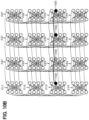
- FIG. 10 B is an illustrative diagram of the process of reserving the vertex in the chimera graph (Part 4);
- FIG. 11 is a flowchart showing a solution derivation process of an optimization problem according to a third embodiment
- FIG. 12 is a diagram illustrating the content of a problem graph
- FIG. 13 is an illustrative diagram of an embedding order in the problem graph
- FIG. 14 is a problem graph of a multivalued problem expressed using a binary variable according to a fourth embodiment
- FIG. 15 is an illustrative diagram of a selection method for selecting a binary variable (Part 1);
- FIG. 16 is an illustrative diagram of the selection method for selecting the binary variable (Part 2);
- FIG. 17 is a flowchart showing a process of embedding a multivalued variable
- FIG. 18 is an illustrative diagram showing a selection priority order of binary variables
- FIG. 19 is a flowchart showing a conversion process to the two-choice optimization problem according to a fifth embodiment.
- FIG. 20 is a diagram illustrating the content of a conversion process to the two-choice optimization problem.
- a conceivable hardware has a specific fixed architecture and can solve the combinatorial optimization problem at higher speed than that of conventional general purpose computers. Since the hardware of the above type has the specific fixed architecture, there are several constraints to solve the combinatorial optimization problem.
- a first constraint resides in that there is a limit to the absolute number of variables that can be processed at one time.
- a second constraint resides in that there is a limit on the number of interactions between the variables. In order to efficiently process the optimization problem using the dedicated hardware, it is required to execute the processing under such constraint conditions.
- variable embedding process is divided into a first half and a second half.
- first half all variables in a given problem are embedded while allowing multiple variables to be allocated to the vertices of the hardware graph in an overlapping manner.
- second half only one variable is allocated to each vertex on the hardware graph.
- the present inventors have confirmed that when the conceivable technique described above is employed, a large amount of processing time is required particularly in the second half of the processing. This is because in this conceivable technique, the variables are embedded in the first half while permitting duplication, and therefore there is a need to correct the duplication in the second half. Therefore, it takes a long time to complete all those processes. In particular, when there is a need to repeatedly embed a large-scale problem into a hardware graph while dividing the problem into partial problems as in the above conceivable technique, it is important to shorten the processing time per time in order to shorten the overall processing time.
- a method for embedding a variable in a hardware graph and a processing system which are capable of shortening a processing time.
- the processing can be performed without taking time for the process of resolving the duplicate allocation, and the processing time can be reduced.
- a route in which a vertex to which a variable is not allocated on the hardware graph is set as a starting point and a vertex allocated to an embedded variable adjacent to the variable to be additionally embedded is set as an ending point can be configured on the hardware graph using only an unused vertex.
- a variable to be additionally embedded or a coupled embedded variable is appropriately embedded for each vertex on the path, so that the variable can be embedded in the hardware graph while reproducing an interaction between the variables in the problem graph.
- the path is as short as possible, the number of vertices on the hardware graph to be used can be reduced, as a result of which a method of obtaining the shortest path with the use of a Dijkstra's method or the like is conceivable.
- variable embedding method and a processing system will be described with reference to the drawings.
- portions having the same function or similar function are denoted by the same reference numerals among the embodiments, and descriptions of configurations having the same or similar function, their functions, cooperative operations, and the like will be omitted as necessary.
- FIGS. 1 A to 6 show illustrative diagrams of a first embodiment.
- a quantum ising machine 1 shown in FIG. 1 A is configured with the use of a function-specific ising type hardware 2 , configures an interaction between multiple variables X as a physical constraint of the hardware, and performs a simulation by simulating the same situation as the optimization problem with the use of a quantum mechanical property of a material.
- the ising type hardware 2 is configured by a quantum processor which is dedicated hardware formed by a specific fixed architecture.
- the ising type hardware 2 can be represented by a hardware graph G 2 having a large number of vertices V (V 1 to V 9 ) in an array on virtual hardware and having constraints on an interaction between the vertices V (V 1 to V 9 ) of the virtual hardware.
- V vertices
- V 1 to V 9 vertices
- the constraint of the interaction between those vertices V may be, for example, as shown in the FIG. 1 A , an example in which only the vertices V adjacent to each other in vertical and horizontal directions (for example, between the V 1 and the V 2 , between the V 2 and the V 3 , between the V 1 and the V 4 , . . . ) are coupled to each other, and the other vertices V are not coupled to each other.
- a unit cell C having the multiple vertices V coupled to each other so as to constrain the entire coupling or partial interaction may be configured, and a hardware graph G 2 having the unit cells C for multiple grids may be applied, in which case, the coupling of the vertices V between adjacent grids may be constrained.
- the chimera graph is a hardware graph G 2 including unit cells C (for example, C 11 , C 12 , C 21 , and C 22 ) having n ⁇ m vertices V in the vertical and horizontal directions (corresponding to a first direction and a second direction), for example, and including multiple grids in the vertical and horizontal directions.
- unit cells C for example, C 11 , C 12 , C 21 , and C 22
- n ⁇ m vertices V in the vertical and horizontal directions corresponding to a first direction and a second direction
- the unit cells C will be given subscripts as necessary.
- some or all of the unit cells C may be collectively referred to as unit cells C.
- the chimera graph is configured by coupling vertices V 11 to V 14 on a first column of each unit cell C to vertices V 21 to V 24 on a second column, and coupling the vertices V configuring each unit cell C to the corresponding vertices V of the unit cells C adjacent to each other in succession in the vertical and horizontal directions.
- the chimera graph is a hardware graph G 2 with constraints that other parts than those described above become uncoupled. A coupling relationship of the chimera graph shown on a right side of FIG. 5 will be described in detail.
- the chimera graph includes multiple grids of unit cells C 11 to C 22 along the vertical and horizontal directions in which each of the multiple vertices V 11 to V 14 on a first column are respectively coupled to the multiple vertices V 21 to V 24 on a second column, the multiple vertices V 11 to V 14 on the first column are not coupled to each other, and the multiple vertices V 21 to V 24 on the second column are uncoupled to each other.
- the vertices V 11 to V 14 on the first column of the unit cells C 11 and C 12 are coupled to each other along the vertical direction
- the vertices V 21 to V 24 on the second column of the unit cells C 11 and C 21 are coupled to each other along the horizontal direction.
- the computer 3 shown in FIG. 1 A configures a variable embedding device, which is a device having a function for embedding a variable X in a form adapted to the ising type hardware 2 of the quantum ising machine 1 .
- the computer 3 is configured by a general purpose computer in which a CPU 4 , a memory 5 such as a ROM and a RAM, and an input and output interface 6 are connected to each other by a bus.
- the memory 5 is used as a non-transitory tangible storage medium.
- the computer 3 executes a variable embedding program stored in the memory 5 by the CPU 4 , searches for a method of embedding an optimal variable X by executing various procedures, and embeds the variable X in the ising type hardware 2 of the quantum ising machine 1 .
- the optimization process executed by the quantum ising machine 1 indicates a process of assuming a search space configured by a Euclidean space having one or more n dimensions, and obtaining a minimum value of the evaluation function H generated by multiple requests or constraints, or the variable X satisfying the condition that the evaluation function H becomes the minimum value, that is, an optimal solution, in the search space.
- the evaluation function H represents a function by a mathematical expression generated by multiple requirements and constraints and derived based on one or more n variables X, and may include, for example, an arbitrary polynomial, rational function, irrational function, exponential function, logarithmic function, or a combination of addition, subtraction, division, or the like.
- each variable in the n-dimensional problem is referred to as X 1 , X 2 , . . . , Xn, and some of those variables or each variable is collectively referred to as a variable X, if necessary.
- the computer 3 has various functions such as a determination unit 7 and an embedding unit 8 as functions realized by executing programs stored in the memory 5 .
- FIG. 2 shows an image which divides a large-scale problem (original problem) of the optimization problem of the evaluation function H into partial problems
- FIG. 3 shows a series of solution derivation methods of the optimization problem executed by the computer 3 and the quantum ising machine 1 by a flowchart.
- the problem graph G 1 represents a relationship between the interactions of the variables X obtained by the request or the constraint on the evaluation function H as a result of the computer 3 analyzing the evaluation function H.
- An example of the problem graph G 1 is shown on a left side of FIG. 5 .
- the problem graph G 1 shows an example in which a variable X 1 is coupled to variables X 2 to X 9 , and the other variables X 2 to X 9 are uncoupled from each other.
- the computer 3 embeds the variable X configuring the problem graph G 1 in the hardware graph G 2 of the ising type hardware 2 (S 2 ).
- the vertices V corresponding to the same variable X must configure partial graphs coupled with each other on the hardware graph G 2 .
- the variable X coupled in the problem graph G 1 must have at least one coupling on the hardware graph G 2 . If this rule is not satisfied, the processing cannot be performed appropriately on the quantum ising machine 1 . For that reason, the computer 3 is required to appropriately perform the embedding process of the variable X.
- FIG. 4 shows a flowchart of the variable X embedding process.
- the computer 3 embeds the variable X in the hardware graph G 2 of the quantum ising machine 1 .
- the processes of S 11 to S 14 are repeated until the end condition is satisfied.
- the ending condition is that the unembedded variable X disappears, or as a result of repeating the processes S 11 to S 14 up to a predetermined upper limit number of times, it is determined that the variable X cannot be additionally embedded.
- FIG. 5 shows an example in which the computer 3 embeds the variable X of the problem graph G 1 in the hardware graph G 2 of the quantum ising machine 1 .
- the hardware graph G 2 uses the chimera graph described above as shown on the right side of FIG. 5 .
- the computer 3 randomly selects the variables X 1 to X 9 , and embeds the variables X in the hardware graph G 2 in order from the selected variable X.
- the variables X 1 to X 9 are randomly selected and embedded, but in this example, in order to facilitate understanding of the description, an example in which the variables X 1 to X 9 are embedded in order is shown.
- the computer 3 embeds the variables X 2 to X 9 .
- all of the variables X 2 to X 9 need to be coupled with the variable X 1 .
- the variables X 2 to X 6 selected prior to the variables X 7 to X 9 are embedded in the vertex V coupled to the variable X 1 (refer to the right side of FIG. 5 ).
- the variables X 7 to X 9 cannot be coupled with the variable X 1 unless the variables X 2 to X 6 are allocated in duplicate to the embedded vertex V, it is determined in S 15 that the end condition is satisfied, and the processing ends without embedding the variables X 7 to X 9 .
- the quantum ising machine 1 shifts to the process of FIG. 3 and executes the optimization process (S 3 ).
- the quantum ising machine 1 substitutes the variables X 1 to X 6 as partial variables into the evaluation function H in the optimization process, and obtains the values of the variables X 1 to X 6 so that the evaluation function H satisfies a condition (optimization condition) lower than a predetermined value by using a gradient method or another optimization method (solution derivation process of the partial problem).
- the quantum ising machine 1 determines the optimum values of the variables X 1 to X 6 on condition that a predetermined time has elapsed since the start of the processing or that the processing has been repeated for a predetermined number of trials or more, and updates the variables X 1 to X 6 (S 4 ). In that case, as the other variables X 7 to X 9 , the quantum ising machine 1 may obtain an evaluation value of the evaluation function H using a fixed value. This makes it possible to solve the partial problems.
- the computer 3 randomly selects the variable X again in S 2 and embeds the selected variable X in the hardware graph G 2 , the quantum ising machine 1 executes the optimization process by the variables X, determines the optimum value of the combination of the variables X, and updates the variable X in S 4 .
- the optimum value of the variable X obtained as the optimum value before the processing (in this example, the variables X 1 to X 6 ) may be used.
- the variable X that has not been selected once may be set to a fixed value and processed.
- the quantum ising machine 1 determines that the ending condition is satisfied on the condition that a predetermined time has elapsed from the start of the processing or that the processing has been repeated a predetermined number of times or more (YES in S 5 ), and outputs the result of the variable X, the evaluation value of the evaluation function H, or the like.
- the entire optimization problem can be solved.
- the original problem can be divided into partial problems and solved as shown in an image in FIG. 2 .
- the variables X 1 to X 9 of the problem graph G 1 can be divided into partial problems that can be embedded in the hardware graph G 2 , and the partial problem optimization process can be repeated to solve the large-scale optimization problem.
- FIG. 5 shows an example in which the number of variables X in the problem graph G 1 is nine for simplification of the description. For that reason, only a part of the vertex V on the hardware graph G 2 can be used.
- the computer 3 executes the embedding process described above, so that more vertices V on the hardware graph G 2 can be used and variables X of larger partial problems can be embedded.
- FIG. 6 shows a comparative example in which the technique disclosed in Patent Literature 2, for example, is applied and duplicate allocation is allowed.
- the variables X 2 to X 6 can be embedded in the hardware graph G 2 without duplicate allocation.
- the variables X 7 to X 9 are embedded in the vertices V 21 to V 23 by being allocated in an overlapping manner.
- the computer 3 determines whether or not duplicate allocation is required when performing the embedding process of the variable X (S 12 ), and selects the unnecessary variables X 1 to X 6 of the duplicate allocation and embeds the selected variables X 1 to 6 in the vertex V of the hardware graph G 2 , without using the variables X 7 to X 9 that require duplicate allocation as the variables X of the partial problem.
- This makes it possible to perform the processing without allowing the duplicate allocation as shown in the prior art, and makes it unnecessary to perform the processing for resolving the duplicate allocation at all, thereby being capable of drastically reducing the processing time.
- FIGS. 7 to 10 show additional illustrative diagrams of a second embodiment.
- a computer 3 functions as a reservation unit, a selection unit, a prohibition unit, an associating unit, and a cancel unit by executing a program stored in a memory 5 .
- the variable X configuring the large partial problem can be embedded on the hardware graph G 2 by using only the variable X that does not require the duplicate allocation.
- FIG. 5 when there are a large number of variables X 1 coupled to a large number of variables X 2 to X 9 in a problem graph G 1 , a growth of a partial problem stops before the vertex V on a hardware graph G 2 is exhausted.
- the computer 3 When embedding each variable X on the hardware graph G 2 , the computer 3 desirably selects at least one of the vertices V included in the partial graph on the hardware graph G 2 allocated to each variable X, couples the selected vertex V with the hardware graph G 2 , prohibits embedding of the variable X other than the corresponding variable X for the vertex V following a direction in which the number of coupling with other variables X can be efficiently increased on the hardware graph G 2 , and leaves room for extending the coupled partial graph of the corresponding variable X on the hardware graph G 2 .
- the operation is referred to as “reservation”.
- FIG. 8 shows a flowchart of the process of embedding into the vertex V on the hardware graph G 2 .
- the computer 3 sets a reservation method (associating method) using a method of embedding the variable X of a complete graph G 1 a in the hardware graph G 2 (as a reference) (S 21 ).
- a specific reservation method differs depending on the type of the hardware graph G 2 . It is desirable to use (that is, refer to) a method of embedding the variables X of the complete graph G 1 a (refer to FIG. 7 A ) having the largest number of coupling among the variables assumed as the problem graph G 1 in the hardware graph G 2 .
- FIG. 7 A shows a common method of embedding the complete graph G 1 a in the hardware graph G 2 (chimera graph) in order to make a process of setting the reservation method easier to understand, and graphs coupled to each other by bold lines represent coupled partial graphs allocated to respective variables.
- Variables X 1 to X 4 of the complete graph G 1 a are embedded in a partial graph that includes vertices V 21 to V 24 of a unit cell C 11 .
- Variables X 5 to X 8 are embedded in a partial graph that includes the vertex V 21 to V 24 of a unit cell C 22 .
- Variables X 9 to X 12 are embedded in a partial graph that includes the vertices V 21 to V 24 of a unit cell C 33 .
- the partial graphs coupled to each other on the hardware graph G 2 have structures in which the unit cells C are coupled to each other in the vertical direction and the horizontal direction.
- the computer 3 associates the variables X 1 to X 12 with each vertex V tracked in a direction crossing the unit cell C in S 21 with the use of (with reference to) the method of embedding the variables X 1 to X 12 .
- the computer 3 associates the vertex V included in the unit cell C in the vertical direction and/or the horizontal direction corresponding to a certain vertex V in S 21 .
- a vertex V 21 of the unit cell C 11 (embedded vertex V of a variable X 1 ) indicated in a right drawing of FIG. 7 A is denoted with vertices V 11 and V 21 of the unit cells C to be associated with the hardware graph G 2
- a vertex V 22 (embedded vertex V of a variable X 6 ) indicated in the right drawing of FIG. 7 A is denoted with vertices V 12 and V 22 of the unit cells C to be associated with the hardware graph G 2 .
- the computer 3 associates the vertices V 11 of the unit cells C 11 , C 12 , C 13 , and so on, and also associates the vertices V 21 of the unit cells C 21 , C 31 , and so on with the vertex V 21 of the unit cell C 11 on the hardware graph G 2 . Further, the computer 3 associates the vertex V 22 of the unit cell C 22 with the vertices V 12 of the unit cell C 22 , C 23 , and so on, and also associates the vertices V 22 of the unit cell C 31 , C 41 , and so on, with the vertex V 22 of the unit cell C 22 on the hardware graph G 2 .
- the computer 3 may use (refer to) such a method of embedding the variable X of the complete graph G 1 a in the hardware graph G 2 , and may associate the vertices V using a part of the embedding method.
- FIG. 9 A , FIG. 9 B , FIG. 10 A , and FIG. 10 B illustrate examples showing a chimera graph with 2 ⁇ 4 vertices V coupled unit cell C as multiple grid minutes of 4 ⁇ 4 as the hardware graph G 2 , in which the vertices V on the hardware graph G 2 are associated with each other.
- FIGS. 10 A and 10 B show examples of associating with the vertices V tracing in a direction extending in the horizontal direction.
- the computer 3 may associate the vertex V 11 (corresponding to a first vertex) of a unit cell C 11 selected as a base point with the vertices V 11 (corresponding to second vertices) of the unit cells C 12 , C 13 , C 14 , and so on coupled continuously in the adjacent direction (in this case, the vertical direction), or as shown in the FIG. 9 B , the computer 3 may associate a vertex V 13 (corresponding to the first vertex) of a unit cell C 33 selected as the base point with vertices V 13 (corresponding to the second vertex) of unit cells C 31 , C 32 , and C 34 coupled continuously in the adjacent direction (in this case, the vertical direction).
- the computer 3 may associate the vertex V 21 (corresponding to a first vertex) of the unit cell C 11 selected as a base point with the vertices V 21 (corresponding to second vertices) of the unit cells C 21 , C 31 , and C 41 coupled continuously in the adjacent horizontal direction, or as shown in the FIG. 10 B , the computer 3 may associate a vertex V 22 (corresponding to the second vertex) of a unit cell C 23 selected as the base point with the vertices V 22 (corresponding to the second vertices) of unit cells C 13 , C 33 , and C 43 coupled continuously in the adjacent horizontal direction.
- the computer 3 selects a variable X (S 22 in FIG. 8 ), determines whether or not a duplicate allocation is required (S 23 ), and if the duplicate allocation is required, the computer 3 embeds no variable X (S 24 ), but even if the computer 3 embeds the variable X (S 25 ) when the duplicate allocation is not required, the computer 3 subsequently selects one or more of the vertices V embedded with the variable X (S 26 ), and reserves another vertex V with the selected vertex V as a base point (S 27 ).
- the computer 3 determines whether or not the embedding prohibition to the reserved vertex V is released (canceled) (S 28 ), releases (cancels) the reservation if the reservation is canceled (S 29 ), determines whether or not the end condition is satisfied (S 30 ), returns the process to S 22 if the condition is not satisfied, and selects the variable X again to execute the processing of S 23 to S 30 .
- the computer 3 embeds the variable X 1 in the vertex V 11 of the unit cell C 11 on the hardware graph G 2 , for example, when the vertices V 11 of the unit cells C 12 , C 13 , and C 14 is associated with each other as shown in FIG. 9 A in S 21 , for example, the computer 3 can reserve each vertex V 11 (corresponding to the second vertex) of the unit cells C 12 , C 13 , and so on continuously coupled in the vertical direction to the vertex V 11 of the unit cell C 11 as embedding of the variable X 1 (S 26 to S 27 ).
- the vertex V 11 of the unit cell C 11 is embedded by the variable X 1 on the hardware graph G 2
- the vertex V 11 of the unit cell C 12 is reserved and reserved for the variable X 1 .
- only the variable X 1 is allowed to be embedded in the vertex V 11 of the unit cell C 12 until all the variables X 2 to X 9 are embedded.
- the computer 3 selects the variables X 2 to X 9 in this order after the embedding process of the variable X 1 and embeds the variable X 2 to X 9 in the vertex V of the hardware graph G 2 , the computer 3 embeds the variable X 2 to X 5 in this order in the vertex V 21 to V 24 coupled to the vertex V 11 of the unit cell C 11 , as shown on a right side of the FIG. 7 B .
- the computer 3 embeds the variable X 6 in the hardware graph G 2 , the vertex V 11 of the unit cell C 12 is reserved for the variable X 1 , and the embedding of the variable X 6 in the vertex V 11 of the unit cell C 12 is prohibited. For that reason, the computer 3 embeds the variable X 1 in the vertex V 11 of the unit cell C 12 , and embeds the variable X 6 in the vertex V 21 of the unit cell C 12 .
- variable X 1 is embedded in the vertex V 11 of the unit cell C 12 , whereby the variable X that can be coupled with the variable X 1 can be increased, and the variables X 7 to X 9 can be embedded in the vertices V 22 to V 24 of the unit cell C 12 , respectively.
- variable X is embedded while leaving room to extend the partial graph on the hardware graph G 2 , thereby being capable of embedding the variables X 1 to X 9 without performing the duplicate allocation.
- the reservation of the variable X 1 is focused on, but when the variables X 2 to X 9 are additionally embedded, the reservation of the vertex V is executed for all the variables X in S 25 to S 27 .
- the computer 3 may cancel the reservation of the variable X when the reservation is to be canceled (S 28 to S 29 ). This makes it possible to efficiently grow the partial problem even in the problem graph G 1 having a large number of coupling.
- the quantum ising machine 1 executes the optimization process in the same manner as S 3 in FIG. 3 , thereby being capable of quickly and accurately obtaining the optimum values of all the variables X 1 to X 9 .
- the nine variables X 1 to X 9 are used to simplify the description. For that reason, although a simple example in which all the variables X 1 to X 9 can be embedded in the hardware graph G 2 in the embedding process of one routine has been shown, in reality, a large-scale problem (original problem) of the optimization problem is solved with the use of a larger number of variables X.
- a partial problem is solved by embedding a part of the variable X in one embedding process of the large number of variables X. Even in such a case, with the application of the embedding method described in the present embodiment, more variables X can be embedded in the vertex V than in the first embodiment described above. For that reason, the hardware resources can be effectively utilized, and a calculation time of the optimum value can be shortened.
- the vertices V of the hardware graph G 2 are associated (the reservation method is set) based on the embedding method when embedding the complete graph G 1 a in the hardware graph G 2 (S 21 ), at least one vertex V coupled by the partial graph is selected from the vertices V on the hardware graph G 2 (S 26 ), and the vertex V 11 of the unit cell C 12 , which is coupled from the vertex V 11 of the selected unit cell C 11 and which increases the coupling with the other variables X 2 to X 9 , is reserved in correspondence with the variable X 1 to be embedded in S 25 based on the content of the associating (the reservation method) when embedding each variable X in the hardware graph G 2 (S 27 ), thereby prohibiting the embedding of the other variables X 2 to X 9 other than the variable X 1 to be embedded.
- the vertex V to be associated is determined in advance based on the embedding method of the complete graph G 1 a having the highest coupling level in the problem graph G 1 , the partial problem can be expanded and grown even if the original problem of the optimization problem is a problem having a high coupling concentration. For that reason, when solving the whole large-scale problem (original problem) by repeatedly solving the partial problem, a larger number of variables X can be embedded in the vertex V when solving one partial problem even in comparison with the method of the first embodiment, and a time for solving the original problem can be reduced.
- the hardware graph G 2 having another structure may be used, and the vertex V to be associated may be determined based on the method of embedding the complete graph G 1 a in each hardware graph G 2 .
- FIGS. 11 to 13 show additional illustrative diagrams of a third embodiment.
- a computer 3 deriving a correlation of variables X of an evaluation function H
- the variables X in the problem graph G 1 are coupled to each other in a lattice shape as shown in FIG. 12 .
- the computer 3 and a quantum ising machine 1 will be described on the assumption that the embedding process of the variable X according to the first embodiment and the associating process and the reservation process on a hardware graph G 2 described according to the second embodiment are executed.
- the computer 3 functions as a prohibition unit, a cancel unit, and a selection unit by executing a program stored in a memory 5 .
- the computer 3 inputs a problem graph G 1 (S 31 ), randomly selects the variable X of the problem graph G 1 (S 32 ), and embeds the selected variable X in the hardware graph G 2 (S 33 ).
- the vertex V of another unit cell C corresponding to the vertex V is reserved and secured.
- the hardware graph G 2 is configured by the chimera graph shown in FIG. 9 or FIG.
- the vertices V 11 of unit cells C 12 , C 13 , and so on which are coupled from the vertex V 11 of the selected unit cell C 11 and which increases the coupling to other variables X are reserved in correspondence with the variable Xa to be embedded.
- the vertices V 11 of the unit cells C 12 , C 13 , and so on are reserved and reserved corresponding to the variables Xa, and the embedding of other variables X (for example, Xb, Xc) is prohibited.
- the computer 3 selects the embedded variable Xa in the problem graph G 1 (S 34 ), selects the unembedded variable Xb coupled to the embedded variable Xa (S 35 ), and embeds the variable Xb in the hardware graph G 2 (S 36 ).
- FIG. 12 shows candidates for the embedded variable Xa and the variable Xb to be added during processing.
- the computer 3 selects a variable Xb to be coupled to the embedded variable Xa in S 35 , and embeds the variable Xb in the hardware graph G 2 in S 36 .
- the computer 3 does not embed the variable of the duplicate allocation in the hardware graph G 2 , but embeds the variable in the hardware graph G 2 unless the variable is not the duplicate allocation.
- the computer 3 determines whether or not the embedding process of all the variables Xb coupled to the embedded variable Xa has been completed (S 37 ), and if not completed (NO in S 37 ), the computer 3 selects the variable Xb in S 35 until there is no more variable Xb coupled to the embedded variable Xa, and embeds the variable Xb in S 36 . When the variable Xb disappears (YES in S 37 ), the computer 3 releases the prohibition of embedding into the reserved vertex V in association with the embedded variable Xa (S 38 ).
- the embedding of the other variable X other than the embedded variable Xa is prohibited for the specific vertex V of the hardware graph G 2 in S 33 , the embedding of the other variable X in the vertex V reserved for the embedded variable Xa selected in S 34 is prohibited until immediately before the computer 3 executes the processing of S 38 , but after the processing of S 38 is executed, the other variable X can be embedded.
- the unembedded variable Xb or Xc at that point can be embedded in the hardware graph G 2 using the vertex V whose reservation has been released (canceled) in S 38 , and the hardware graph G 2 can be efficiently used. Then, the computer 3 repeatedly executes the processes of S 34 to S 38 until the end condition is satisfied.
- the end condition at that time is that the embedded variable Xa disappears, the unembedded variables Xb, Xc disappear, the trials are repeated a predetermined number of times or more, and the like.
- FIG. 13 A specific example of the processing contents of S 35 to S 39 is shown in FIG. 13 .
- the computer 3 selects one embedded variable Xa and selects a variable Xb coupled to the embedded variable Xa, and after embedding all of the coupled variables Xb, the computer 3 cancels the reservation of the vertex V of the hardware graph G 2 corresponding to the selected embedded variable Xa.
- the computer 3 selects another embedded variable Xa, and further selects an unembedded variable Xb coupled to the other embedded variable Xa. This makes it possible to embed the unembedded variables Xb and Xc while canceling the reservation set in the hardware graph G 2 , and makes it possible to increase the number of embedded variables X in the partial problem solution derivation processing as compared with the second embodiment.
- the computer 3 updates the variable X based on the processing result of the quantum ising machine 1 (S 41 ), and determines whether or not the end condition is satisfied (S 42 ). If the end condition is not satisfied, the process returns to S 32 , and the computer 3 repeatedly executes the process again from the point where the variable X of the problem graph G 1 is newly selected.
- the computer 3 outputs the solution of the variable X when the end condition of Step S 42 is satisfied (S 43 ).
- the end condition of S 42 the same condition as the end condition in S 5 according to the first embodiment may be used, and therefore a description of the end condition in S 42 will be omitted.
- the computer 3 selects one embedded variable Xa, and cancels the reservation after completing the embedding process of all the variables Xb coupled to the embedded variable Xa on the problem graph G 1 .
- This makes it possible to execute the embedding process of the variable Xb while efficiently canceling the reservation in the hardware graph G 2 , and makes it possible to effectively utilize the hard resource by reducing the reserved vertices V.
- more variables Xb and Xc can be embedded in the hardware graph G 2 in one partial problem solution derivation process.
- the computer 3 selects an additional embedded variable X
- the computer 3 selects an independent variable Xc that does not interact with the embedded variable Xa because the variable X is selected from the embedded variables Xb that have been coupled to the already embedded variable Xa.
- the variable X can be embedded in the hardware graph G 2 while leaving the structure of the problem graph G 1 which hardly performs the optimization such as frustration.
- FIGS. 14 to 18 show additional illustrative diagrams of a fourth embodiment.
- a method of embedding variables when multivalued problems are expressed with the use of one-hot (one-hot) display will be described, but the same reference numerals are given to the same portions as those in embodiments described above, particularly, those of the first embodiment, and a description of the same portions will be omitted, and a description will be given focusing on portions different from those of the embodiments described above.
- the computer 3 has various functions as an invalidation processing unit and a conversion unit as functions realized by executing a program stored in the memory 5 .
- a one-hot display method has been known as a typical method for binary representation of large-scale problems using multivalued variables S 1 to S N .
- some or all of the variables of the multivalued variables S 1 to S N will be referred to as a multivalued variable S i as required.
- an evaluation function H 0 of a one-dimensional Pots (Potts) model is represented in Expression (1), but the evaluation function H 0 is not limited to this example.
- the evaluation function H 0 in Expression (1) represents an optimization problem in which one state out of the Q states from 1 to Q is selected by the multivalued variable S i such that the evaluation function H 0 is the smallest under the constraint that the multivalued variable S i can take Q states from 1 to Q.
- Expression (2) described below represents a transformation expression obtained by transforming the evaluation function H 0 of Expression (1) using the binary variable x i based on the one-hot constraint.
- FIG. 14 shows a problem graph G 1 of the optimization problem related to the evaluation function H 0 of Expression (2).
- the optimization problem related to the evaluation function H 0 are displayed one-hot, there are N ⁇ Q binary variables x i for expressing the evaluation function H 0 as shown in FIG. 14 .
- the evaluation function H 0 is lowered, so that the optimization can be further performed.
- the one-hot constraint represents a constraint in which only one hot state value “1” appears in the binary variables x i representing the respective multivalued variables S i and a second term on the right side of the evaluation function H 0 represents this constraint.
- the second term on the right side of the evaluation function H 0 indicates a constraint term added so that the evaluation function H 0 becomes the lowest when only one binary variable x i is set as the hot state value “1” in each multivalued variable S i .
- the ⁇ of the second term on the right side of Expression (2) is a parameter representing a ratio of an influence of the first term on the right side and the second term on the right side of Expression (2), and if the parameter ⁇ is set to be large, the influence of the second term on the right side can be increased, the constraint condition that only one binary variable x i is set to the hot state value “1” can be strengthened. Conversely, when the parameter ⁇ is set to be small, the influence of the first term on the right side of Expression (2) can be increased.
- the search for an optimal solution cannot be efficiently performed unless the partial problem is selected to include as many solutions as possible that satisfy the one-hot constraint.
- the computer 3 partially selects the binary variable x i in which all cold state values are “0” in one multivalued variable S i , there is only one solution satisfying the one-hot constraint as shown in FIG. 15 .
- a partial selection variable Sa of the binary variable x i shown in FIG. 15 Refer to a partial selection variable Sa of the binary variable x i shown in FIG. 15 .
- the optimal solution of the partial problem is fixed to the solution corresponding to the binary variable x i , all of which are set to the cold state value “0”. In other words, this makes it impossible to search for a better solution of the whole binary variable x i .
- the computer 3 can be configured to include a large number of states in which the partial problem satisfies the one-hot constraint by selecting the binary variable x i as the variable of the partial problem so as to include the binary variable x i having the hot state value “1”. Refer to the partial selection variables Sb 1 and Sb 2 and Sb 3 of the binary variable x i shown in FIG. 16 . This makes it possible to efficiently search for a more accurate solution satisfying the one-hot constraint by optimizing the partial problem.
- FIG. 17 shows a flowchart of the process of embedding the binary variables x i corresponding to FIG. 4 of the embodiment described above.
- the computer 3 When the computer 3 embeds the binary variable x i in the hardware graph G 2 of quantum ising machine 1 , the computer 3 randomly selects one multivalued variable S i from the multivalued variable S 1 to S N and embeds the binary variable x i allocated to the selected multivalued variable S i (S 61 ). In this example, an i-th multivalued variable S i is selected.
- the computer 3 selects the multivalued variable S i in S 61 , determines NO in the end condition of S 70 to be described later, and returns the process to S 61 , and then selects the multivalued variable S j , which is an unembedded multivalued variable S j (where j is i ⁇ 1 or i+1) adjacently coupled to the embedded multivalued variable S i on the problem graph G 1 .
- the computer 3 determines the embedding order of the binary variable x i with respect to the hardware graph G 2 in S 62 .
- the priorities with which the computer 3 embeds the binary variables x i in the hardware graph G 2 are desirably determined on the basis of the following constraints:
- the binary variable x i to be first embedded by the computer 3 in the multivalued variable S i is preferably a binary variable x i adjacently coupled to the already embedded binary variable x i (where j is i ⁇ 1 or i+1).
- the computer 3 may select the binary variable x i having the hot state value “1” as the highest priority among the binary variables x i satisfying the coupling condition, and select the binary variable x i having the cold state value “0” as the next priority.
- the binary variable x i to be embedded in the second and subsequent multivalued variable S i by the computer 3 has the binary variable x i set to the hot state value “1” as the highest priority, and the binary variable x i set to the cold state value “0” as the next priority.
- the computer 3 desirably preferentially embeds the binary variable x i adjacently coupled to the embedded binary variable x j in the binary variable x i satisfying the condition of the cold state value “0”, and selects the binary variable x j adjacently uncoupled from the embedded binary variable x i as the next priority.
- a specific example of the priority will be described later.
- the computer 3 determines whether or not a duplicate allocation occurs when the binary variable x i is embedded in the hardware graph G 2 in S 64 .
- the computer 3 does not embed the binary variable x i in the hardware graph G 2 in S 65 if the duplicate allocation is required.
- the computer 3 embeds the binary variable x i in the hardware graph G 2 in S 66 . If the duplicate allocation is not required, the computer 3 reserves another vertex V of the hardware graph G 2 with the vertex V in which the binary variable x i is embedded as a base point, as described in the above embodiment.
- the computer 3 determines in S 65 that the binary variable x is not to be embedded if the duplicate allocation is required when embedding the target binary variable x i in the hardware graph G 2 , but if the binary variable x i that is not to be embedded is the hot state value “1”, it is preferable that the computer 3 invalidates, that is, cancels the embedding of the multivalued variable S i selected in S 69 , and the process proceeds to the process of embedding the following multivalued variable S j .
- the binary variable x i of the hot state value “1” cannot be embedded in the hardware graph G 2 , only the binary variable x i that satisfies the cold state value “0” can be embedded.
- the multivalued variable S i including only one state satisfying the one-hot constraint in the partial problem can be eliminated from the partial problem.
- the computer 3 determines whether or not the process of embedding all the binary variables x i allocated to the multivalued variable S i selected in S 61 has been completed, and repeats the processing of S 63 to S 66 until the process of embedding all the binary variables x i has been completed.
- the computer 3 shifts to S 70 as it is and continues the processing.
- the computer 3 invalidates, that is, cancels the embedding of all the selected multivalued variables S i in S 69 .
- the computer 3 cancels the reservation of the hardware resources of the quantum ising machine 1 by removing the already embedded binary variables x i from the vertex V of the hardware graph G 2 and canceling the reservation of the other vertices V. This makes it possible to exclude the multivalued variable S i that does not satisfy the one-hot constraint from the variables representing the partial problems.
- the computer 3 determines whether or not the end condition is satisfied in S 70 , and repeats the process from the point of selecting another multivalued variable S j adjacently coupled to the multivalued variable S i (where j is i ⁇ 1 or i+1) until the end condition is satisfied.
- the computer 3 determines that the end condition is satisfied in S 70 , and terminates the embedding of the other multivalued variable S j .
- the quantum ising machine 1 executes the optimization processing in S 3 of FIG. 3 .
- the quantum ising machine 1 optimizes the partial problems embedded in the optimization process with the use of a gradient method or another optimization method, and obtains the value of the binary variable x i so as to satisfy the optimization condition that the evaluation function H 0 is lower than a predetermined value.
- the quantum ising machine 1 determines and updates the optimum value of the binary variable x i on the condition that a predetermined time has elapsed since the process starts or that the process has been repeated a predetermined number of times or more of trials (S 4 ).
- the evaluation value of the evaluation function H 0 may be obtained with the use of a fixed value such as an optimal solution or an initial value obtained so far as another non-embeddable binary variable x i . This makes it possible to solve the partial problems.
- the quantum ising machine 1 executes the optimization process by the binary variables x i , determines the optimum value of the combination of the binary variables x i , and updates the binary variables x i in S 4 .
- the binary variables x i not selected at that time it is preferable to use the optimum value of the binary variables x i obtained as the optimum value before the above processing.
- the binary variables x i in the multivalued variable S i that has not been selected once is preferably set to a fixed value and processed.
- the quantum ising machine 1 determines that the end condition is satisfied on the condition that a predetermined period of time has elapsed since the process starts or that the process has been repeated a predetermined number of times or more of trials (YES in S 5 ), and outputs the result of the multivalued variables S i or the evaluation value of the evaluation function H 0 .
- the entire optimization problem can be solved. With repetition of the processing in this manner, the original problem can be divided into the partial problems and solved.
- Step S 62 when the binary variable x i is embedded in the hardware graph G 2 will be described.
- the binary variables x 1 (1) and x 1 (2) which have been embedded in the vertices V of the hardware graph G 2 , are denoted by “Z 1 ”.
- FIG. 18 shows priorities “1st” to “4th” when the computer 3 embeds the binary variables x 2 (1) , x 2 (2) , x 2 (3) , and x 2 (4) in the multivalued variable S 2 adjacently coupled to the multivalued variable S 1 .
- the binary variable x 2 to be embedded first is the binary variable x 2 coupled to the embedded binary variable x 1 . It is desirable that the binary variable x 2 having the hot state value “1” is given the highest priority among the binary variables x 2 .
- the binary variables x 2 (1) and x 2 (2) coupled to the embedded binary variable x 1 are both cold state values “0”, any one of the binary variables x 2 (1) and x 2 (2) may be selected, but the binary variable x 2 (1) is randomly selected.
- the binary variable x i having the hot state value of “1” is given the highest priority and the binary variable x i having the cold state value of “0” is given the next priority as the binary variable x i to be embedded in the second or later.
- the binary variable x 2 (4) is set to the hot state value “1”
- the binary variable x 2 (4) of the hot state value “1” is set as a second embedding target.
- the computer 3 preferentially embeds the binary variable x i coupled to the embedded binary variable x j among the binary variables x i satisfying the condition of the cold state value “0”. For that reason, in an example shown in FIG.
- the binary variable x 2 (2) is set as a third embedding target.
- the computer 3 selects a binary variable x i which is not coupled to the embedded binary variable x j as the following priority.
- the binary variable x 2 (3) is set as a final embedding target. It is desirable to embed the binary variables x i in this order.
- each of the multivalued variables S i includes a state satisfying the multiple one-hot constraints as a partial problem so as to be able to efficiently search for a solution with higher accuracy.
- the computer 3 preferentially embeds the binary variable x 2 (1) coupled to the embedded binary variable x 1 (1) on the problem graph G 1 in the binary variable x 2 representing the multivalued variable S 2 . Then, a partial problem can be constructed so as to include as many interactions as possible between the multivalued variables S i and S j coupled to each other on the problem graph G 1 .
- the computer 3 preferentially embeds the binary variable x 2 (4) satisfying the condition of the hot state value “1” in the binary variable x 2 representing the multivalued variable S 2 . Then, the computer 3 can preferentially embed the binary variable x 2 (4) having the hot state value “1” in the hardware graph G 2 .
- the computer 3 determines that the binary variable x i designated as the hot state value “1” is non-embeddable, the computer 3 disables the embedding of the entire multivalued variable S i represented by the binary variable x i and removes the previously embedded binary variable x i from the vertex V of the hardware graph G 2 .
- This makes it possible to exclude, from the partial problems, the multivalued variable S i having only one state satisfying the one-hot constraint in the partial problems.
- the computer 3 can cancel the reservation of the hardware resources of the quantum ising machine 1 .
- the computer 3 determines that two or more of the binary variables x i of all the selected multivalued variables S i cannot be embedded, the computer 3 invalidates the embedding of the entire multivalued variables S i represented by the binary variables x i , and removes the previously embedded binary variables x i from the vertices V of the hardware graph G 2 .
- the computer 3 can eliminate the multivalued variables S i in which both the hot state value “1” and the cold state value “0” are non-embeddable from the partial problem, and can eliminate the multivalued variable S i having only one state satisfying the one-hot constraint in the partial problem from the partial problem.
- FIGS. 19 and 20 show additional illustrative diagrams of a fifth embodiment.
- the evaluation function H 0 may be configured as in Expression (2) using a parameter ⁇
- the variable definition of a ratio of the influence of a second term on the right side of Expression (2) by the parameter ⁇ increases the possibility that a solution in which the quantum ising machine 1 does not satisfy the one-hot constraint is derived as a solution of the entire optimization problem.
- the parameter ⁇ is adjusted to an optimum value, there is a possibility that the calculation throughput is further increased.
- the computer 3 may convert into a two-choice optimization problem selecting the multivalued states “1” to “Q” of the multivalued variables S i by two choices prior to implementing the partial problem on the quantum ising machine 1 .
- the computer 3 executes the process of converting into the two-choice optimization problem in advance, so that a partial problem in which the solution of the multivalued variable S i that does not satisfy the one-hot constraint is eliminated can be implemented in the quantum ising machine 1 .
- the constraint corresponding to the second term on the right side of Expression (2) can be eliminated, and the parameter ⁇ of the second term on the right side of Expression (2) does not need to be defined by a variable.
- the computer 3 and the quantum ising machine 1 execute the optimization process of the cost part corresponding to the first term on the right side of Expression (2), thereby being capable of obtaining the optimal solution of the binary variable x i , and being capable of greatly reducing the calculation throughput.
- the computer 3 implements the partial problem related to the two-choice optimization problem in the quantum ising machine 1 and executes the optimization process.
- the computer 3 sequentially selects the multivalued variables S 1 to S N in S 51 , and randomly selects the destination candidates of the hot state value “1” in the multivalued variable S i selected in S 52 .
- the computer 3 repeats the processes of Steps S 51 to S 53 for all the multivalued variables S 1 to S N , and finally, as shown in S 54 , can convert into a two-choice optimization problem selecting whether to maintain the current multivalued states “1” to “Q” of the multivalued variable S i , or to transition the current multivalued states “1” to “Q”, by two choices
- FIG. 20 shows a specific example.
- the computer 3 randomly selects one of the multivalued states “2” to “Q” as candidates for the transition destination. If the computer 3 selects the multivalued state “3” as the transition destination, the determination of whether the multivalued variable S i is set to the current multivalued state “1” or the multivalued state “3” as the transition destination is left to the quantum ising machine 1 .
- the multivalued variable S i can be converted into a two-choice optimization problem of two-chose between maintenance of the current multivalued state “1” and transition to the multivalued state “3”.
- the two-choice optimization problem be constructed so that at least one of the current multivalued state “1” of one multivalued variable S i and the multivalued state “3” of the transition destination becomes the same state as at least one of the current multivalued state of another multivalued variable S j to be coupled to one multivalued variable S i and the multivalued state of the transition destination. Then, when the quantum ising machine 1 optimizes the two-choice optimization problems, the binary variable x i for optimizing the evaluation function H 0 can be efficiently obtained.
- the binary variable x i may be selected so that the current binary state value (hot state value “1” or the cold state value “0”) or the binary state value of the transition destination different from the current binary state value becomes the same as at least one of the current binary state value of the binary variable x j adjacently coupled or the binary state value of the transition destination different from the current binary state value so that the two-choice optimization problem includes the state in which the binary state value of the binary variable x j becomes the same binary state value as that of the binary variable x j coupled on the problem graph G 1 .
- the computer 3 recognizes that the evaluation function H 0 becomes smaller when the multivalued variables S i and S j which are adjacently coupled to each other on the problem graph G 1 are in different multivalued states, it is desirable to configure the two-choice optimization problem such that one or both of the current multivalued state “1” of one multivalued variable S i or the multivalued state “3” of the transition destination become multivalued states different from both the current multivalued state of the other adjacent multivalued variable S j and the multivalued state of the transition destination. Then, when the quantum ising machine 1 optimizes the two-choice optimization problem, the binary variable x i satisfying the condition in which the evaluation function H 0 is optimized can be obtained with high accuracy.
- the binary variable x i may be selected so that the current binary state value (hot state value “1” or the cold state value “0”) or the binary state value of the transition destination different from the current binary state value becomes different from both of the current binary state value of the binary variable x j adjacently coupled and the binary state value of the transition destination so that the two-choice optimization problem includes the binary state value of the binary variable x j which is different from the binary variable x j coupled on the problem graph G 1 .
- the computer 3 implements the partial problem by embedding the partial problem of the two-choice optimization problem defined by the two-choice variable y i into hardware graph G 2 .
- the quantum ising machine 1 then optimizes the partial problem of the embedded two-choice optimization problem and determines the two-choice variable y i .
- the computer 3 updates the binary variable x i with reference to the outputs of the two-choice variable y i by the quantum ising machine 1 which minimizes the partial problem, and the current binary states of the variables and the binary states of the transition destinations.
- the optimal solution of the entire binary variable x i can be obtained by generating the two-choice optimization problems by the computer 3 and the ising machine 1 and repeating the update process of the binary variable x i .
- the computer 3 In optimizing the multivalued variable S i of the multivalued problem, the computer 3 converts the multivalued problem into the two-choice optimization problem selecting the multivalued states “1” to “Q” by the multivalued variable S i by two choices, and then partially embeds the two-choice variable y i of the two-choice optimization problem in the vertex V of the hardware graph G 2 .
- the computer 3 executes the process of converting into the two-choice optimization problem in advance, thereby being capable of configuring the partial problem in which the solution of the multivalued variable S i that does not satisfy the one-hot constraint is eliminated, as a result of which the calculation throughput can be greatly reduced.
- the partial problem includes only a state in which the one-hot constraint is satisfied, there is no need to adjust the parameter ⁇ for determining the strength of the one-hot constraint.
- the evaluation function H 0 when the evaluation function H 0 is further optimized when the multivalued variables S i and S j adjacently coupled to each other on the problem graph G 1 are set to the same multivalued state, it is desirable to configure the two-choice optimization problem such that at least one of the current multivalued state of one multivalued variable S i and the multivalued state of the transition destination is set to the same state as that of the current multivalued state of adjacent other multivalued variable S j or the multivalued state of the transition destination. This allows the evaluation function H 0 to be more optimized when the quantum ising machine 1 optimizes the two-choice optimization problem.
- the evaluation function H 0 when the evaluation function H 0 is more optimized when the multivalued variables S i and S j which are adjacently coupled to each other on the problem graph G 1 are in the different multivalued states, it is desirable to configure the two-choice optimization problem such that one or both of the current multivalued state of one multivalued variable S i and the multivalued state of the transition destination becomes a multivalued state different from both of the current multivalued state of the adjacent other multivalued variable S j and the multivalued state of the transition destination.
- This allows the evaluation function H 0 to be more optimized when the quantum ising machine 1 optimizes the two-choice optimization problem.
- the present disclosure is not limited to the embodiments described above, and for example, the following modifications or extensions are possible.
- the hardware graph G 2 has been described using, but is not limited to, the chimera graph.
- the one-hot constraint in which only one hot state value “1” (corresponding to the first value) is provided has been described as an example, but on the contrary, the present disclosure may be applied to the one-cold constraint in which only one cold state value “0” (corresponding to a first value) is provided.
- Expression (2) is exemplified as the evaluation expression of the evaluation function H 0 , but when one-cold display is applied, it is preferable to convert the expression in the second term as in Expression (3) below.
- any binary variable x i may be used as long as the binary variable x i can be displayed so that the first value differs from all other second values.
- the hot state value “1” corresponds to the first value
- the cold state value “0” corresponds to the second value.
- the cold state value “0” corresponds to the first value
- the hot state value “1” corresponds to the second value.
- the controllers and methods described in the present disclosure may be implemented by a special purpose computer created by configuring a memory and a processor programmed to execute one or more particular functions embodied in computer programs.
- the controllers and methods described in the present disclosure may be implemented by a special purpose computer created by configuring a processor provided by one or more special purpose hardware logic circuits.
- the controllers and methods described in the present disclosure may be implemented by one or more special purpose computers created by configuring a combination of a memory and a processor programmed to execute one or more particular functions and a processor provided by one or more hardware logic circuits.
- the computer programs may be stored, as instructions being executed by a computer, in a tangible non-transitory computer-readable medium.
- a flowchart or the processing of the flowchart in the present application includes sections (also referred to as steps), each of which is represented, for instance, as S 1 . Further, each section can be divided into several sub-sections while several sections can be combined into a single section. Furthermore, each of thus configured sections can be also referred to as a device, module, or means.
Landscapes
- Engineering & Computer Science (AREA)
- Theoretical Computer Science (AREA)
- Physics & Mathematics (AREA)
- General Physics & Mathematics (AREA)
- Software Systems (AREA)
- Artificial Intelligence (AREA)
- Computing Systems (AREA)
- General Engineering & Computer Science (AREA)
- Data Mining & Analysis (AREA)
- Mathematical Physics (AREA)
- Evolutionary Computation (AREA)
- Computational Linguistics (AREA)
- Computational Mathematics (AREA)
- Condensed Matter Physics & Semiconductors (AREA)
- Mathematical Analysis (AREA)
- Mathematical Optimization (AREA)
- Pure & Applied Mathematics (AREA)
- Image Processing (AREA)
- Editing Of Facsimile Originals (AREA)
- Complex Calculations (AREA)
Abstract
Description
Claims (22)
Applications Claiming Priority (4)
| Application Number | Priority Date | Filing Date | Title |
|---|---|---|---|
| JP2018117045 | 2018-06-20 | ||
| JP2018-117045 | 2018-06-20 | ||
| JP2019-058504 | 2019-03-26 | ||
| JP2019058504A JP7182173B2 (en) | 2018-06-20 | 2019-03-26 | Variable embedding method and processing system |
Publications (2)
| Publication Number | Publication Date |
|---|---|
| US20190392326A1 US20190392326A1 (en) | 2019-12-26 |
| US11715021B2 true US11715021B2 (en) | 2023-08-01 |
Family
ID=68982043
Family Applications (1)
| Application Number | Title | Priority Date | Filing Date |
|---|---|---|---|
| US16/444,472 Active 2042-06-01 US11715021B2 (en) | 2018-06-20 | 2019-06-18 | Variable embedding method and processing system |
Country Status (2)
| Country | Link |
|---|---|
| US (1) | US11715021B2 (en) |
| CA (1) | CA3046768C (en) |
Families Citing this family (3)
| Publication number | Priority date | Publication date | Assignee | Title |
|---|---|---|---|---|
| JP2020182283A (en) * | 2019-04-24 | 2020-11-05 | 株式会社日立製作所 | System operation support system and system operation support method |
| WO2020227721A1 (en) * | 2019-05-09 | 2020-11-12 | Kyle Jamieson | Quantum optimization for multiple input and multiple output (mimo) processing |
| JP2021144351A (en) * | 2020-03-10 | 2021-09-24 | 富士通株式会社 | Information processor, path generation method and path generation program |
Citations (8)
| Publication number | Priority date | Publication date | Assignee | Title |
|---|---|---|---|---|
| US8266697B2 (en) * | 2006-03-04 | 2012-09-11 | 21St Century Technologies, Inc. | Enabling network intrusion detection by representing network activity in graphical form utilizing distributed data sensors to detect and transmit activity data |
| US20140250288A1 (en) * | 2012-12-18 | 2014-09-04 | D-Wave Systems Inc. | Systems and methods that formulate embeddings of problems for solving by a quantum processor |
| US20140324933A1 (en) * | 2012-12-18 | 2014-10-30 | D-Wave Systems Inc. | Systems and methods that formulate problems for solving by a quantum processor using hardware graph decomposition |
| US20150006443A1 (en) | 2013-06-28 | 2015-01-01 | D-Wave Systems Inc. | Systems and methods for quantum processing of data |
| US20160335558A1 (en) * | 2014-04-23 | 2016-11-17 | D-Wave Systems Inc. | Quantum processor with instance programmable qubit connectivity |
| US20170255629A1 (en) | 2016-03-02 | 2017-09-07 | D-Wave Systems Inc. | Systems and methods for analog processing of problem graphs having arbitrary size and/or connectivity |
| US20180137083A1 (en) * | 2016-11-11 | 2018-05-17 | 1Qb Information Technologies Inc. | Method and system for setting parameters of a discrete optimization problem embedded to an optimization solver and solving the embedded discrete optimization problem |
| US20190087388A1 (en) * | 2017-03-13 | 2019-03-21 | Universities Space Research Association | System and method to hardcode interger linear optimization problems on physical implementations of the ising model |
-
2019
- 2019-06-17 CA CA3046768A patent/CA3046768C/en active Active
- 2019-06-18 US US16/444,472 patent/US11715021B2/en active Active
Patent Citations (9)
| Publication number | Priority date | Publication date | Assignee | Title |
|---|---|---|---|---|
| US8266697B2 (en) * | 2006-03-04 | 2012-09-11 | 21St Century Technologies, Inc. | Enabling network intrusion detection by representing network activity in graphical form utilizing distributed data sensors to detect and transmit activity data |
| US20140250288A1 (en) * | 2012-12-18 | 2014-09-04 | D-Wave Systems Inc. | Systems and methods that formulate embeddings of problems for solving by a quantum processor |
| US20140324933A1 (en) * | 2012-12-18 | 2014-10-30 | D-Wave Systems Inc. | Systems and methods that formulate problems for solving by a quantum processor using hardware graph decomposition |
| US9501747B2 (en) | 2012-12-18 | 2016-11-22 | D-Wave Systems Inc. | Systems and methods that formulate embeddings of problems for solving by a quantum processor |
| US20150006443A1 (en) | 2013-06-28 | 2015-01-01 | D-Wave Systems Inc. | Systems and methods for quantum processing of data |
| US20160335558A1 (en) * | 2014-04-23 | 2016-11-17 | D-Wave Systems Inc. | Quantum processor with instance programmable qubit connectivity |
| US20170255629A1 (en) | 2016-03-02 | 2017-09-07 | D-Wave Systems Inc. | Systems and methods for analog processing of problem graphs having arbitrary size and/or connectivity |
| US20180137083A1 (en) * | 2016-11-11 | 2018-05-17 | 1Qb Information Technologies Inc. | Method and system for setting parameters of a discrete optimization problem embedded to an optimization solver and solving the embedded discrete optimization problem |
| US20190087388A1 (en) * | 2017-03-13 | 2019-03-21 | Universities Space Research Association | System and method to hardcode interger linear optimization problems on physical implementations of the ising model |
Non-Patent Citations (5)
| Title |
|---|
| Booth et al., "Partitioning Optimization Problems for Hybrid Classical/Quantum Execution," D-Wave Technical Report Series, 14-1006A-A, Jan. 9, 2017, D-Wave Systems Inc. |
| Cai et al., "A practical heuristic for finding graph minors," Jun. 12, 2014, pp. 1-16, D-Wave Systems Inc. |
| Hamilton et al., "Identifying the minor set cover of dense connected bipartite graphs via random matching edge sets," Dec. 21, 2016, pp. 1-9, Quantum Computing Institute, Oak Ridge National Laboratory, Tennessee, 37821, USA. |
| Hayato Ushijima-Mwesigwa et al., Graph Partitioning using Quantum Annealing on the D-Wave System, Nov. 2017, 8 pages (Year: 2017). * |
| Vicky Choi, Minor-Embedding in Adiabatic Quantum Computation: I. The Parameter Setting Problem, Apr. 30, 2008, D-Wave Systems Inc., 17 pages (Year: 2008). * |
Also Published As
| Publication number | Publication date |
|---|---|
| CA3046768A1 (en) | 2019-12-20 |
| US20190392326A1 (en) | 2019-12-26 |
| CA3046768C (en) | 2021-09-07 |
Similar Documents
| Publication | Publication Date | Title |
|---|---|---|
| JP7182173B2 (en) | Variable embedding method and processing system | |
| JP7413580B2 (en) | Generating integrated circuit floorplans using neural networks | |
| US11715021B2 (en) | Variable embedding method and processing system | |
| JP4227304B2 (en) | Outline wiring method and apparatus, and recording medium storing outline wiring program | |
| JP6610278B2 (en) | Machine learning apparatus, machine learning method, and machine learning program | |
| CN107402745B (en) | Mapping method and device of data flow graph | |
| US20100318476A1 (en) | Rule processing method and apparatus providing automatic user input selection | |
| JPWO2018143019A1 (en) | Information processing apparatus, information processing method, and program | |
| US20210201141A1 (en) | Neural network optimization method, and neural network optimization device | |
| US11461656B2 (en) | Genetic programming for partial layers of a deep learning model | |
| JPH09204310A (en) | Judgment rule correction device and judgment rule correction method | |
| CN110020456B (en) | Method for gradually generating FPGA implementation by using similarity search based on graph | |
| JP2001052041A (en) | Method and system for obtaining design parameters that satisfy multiple constraints and optimize multiple goal functions | |
| CN119045832B (en) | Method and apparatus for processing operators | |
| US20210279575A1 (en) | Information processing apparatus, information processing method, and storage medium | |
| WO2018016299A1 (en) | Estimated distance calculator, estimated distance calculation method, estimated distance calculation program, and automatic planner | |
| JP5509952B2 (en) | Simulation method, simulation apparatus, program, and storage medium | |
| JP7508838B2 (en) | Partial extraction device, part extraction method, and program | |
| CN115685668A (en) | Secondary imaging layout splitting method and system and computer readable storage medium | |
| JP2016118867A (en) | Processing device, processing method, and program | |
| CN119358634B (en) | Transfer training method and device for text generation model based on sorting constraints | |
| US8347069B2 (en) | Information processing device, information processing method and computer readable medium for determining a processing sequence of processing elements | |
| Keng et al. | Reinforcement Learning-Driven Window Selection for Enhanced Window-Based Rip-up and Reroute in Chip Detailed Routing | |
| JP4470110B2 (en) | High-level synthesis method and system | |
| JP5070893B2 (en) | Data element processing apparatus and program |
Legal Events
| Date | Code | Title | Description |
|---|---|---|---|
| FEPP | Fee payment procedure |
Free format text: ENTITY STATUS SET TO UNDISCOUNTED (ORIGINAL EVENT CODE: BIG.); ENTITY STATUS OF PATENT OWNER: LARGE ENTITY |
|
| AS | Assignment |
Owner name: DENSO CORPORATION, JAPAN Free format text: ASSIGNMENT OF ASSIGNORS INTEREST;ASSIGNORS:OKADA, SHUNTARO;TERABE, MASAYOSHI;OHZEKI, MASAYUKI;REEL/FRAME:049611/0075 Effective date: 20190619 Owner name: TOHOKU UNIVERSITY, JAPAN Free format text: ASSIGNMENT OF ASSIGNORS INTEREST;ASSIGNORS:OKADA, SHUNTARO;TERABE, MASAYOSHI;OHZEKI, MASAYUKI;REEL/FRAME:049611/0075 Effective date: 20190619 |
|
| STPP | Information on status: patent application and granting procedure in general |
Free format text: DOCKETED NEW CASE - READY FOR EXAMINATION |
|
| STPP | Information on status: patent application and granting procedure in general |
Free format text: NON FINAL ACTION MAILED |
|
| STPP | Information on status: patent application and granting procedure in general |
Free format text: RESPONSE TO NON-FINAL OFFICE ACTION ENTERED AND FORWARDED TO EXAMINER |
|
| STPP | Information on status: patent application and granting procedure in general |
Free format text: FINAL REJECTION MAILED |
|
| STPP | Information on status: patent application and granting procedure in general |
Free format text: PUBLICATIONS -- ISSUE FEE PAYMENT VERIFIED |
|
| STCF | Information on status: patent grant |
Free format text: PATENTED CASE |