US11713362B2 - Depolymerizer and recycled rubber - Google Patents

Depolymerizer and recycled rubber Download PDF

Info

Publication number
US11713362B2
US11713362B2 US17/135,344 US202017135344A US11713362B2 US 11713362 B2 US11713362 B2 US 11713362B2 US 202017135344 A US202017135344 A US 202017135344A US 11713362 B2 US11713362 B2 US 11713362B2
Authority
US
United States
Prior art keywords
rubber
depolymerizer
sheet
butadiene
double bonds
Prior art date
Legal status (The legal status is an assumption and is not a legal conclusion. Google has not performed a legal analysis and makes no representation as to the accuracy of the status listed.)
Active, expires
Application number
US17/135,344
Other versions
US20220204656A1 (en
Inventor
Yi-Ting WEI
Jyh-Horng Wu
Yao-Zu WU
Ming-Tsong LEU
Current Assignee (The listed assignees may be inaccurate. Google has not performed a legal analysis and makes no representation or warranty as to the accuracy of the list.)
Industrial Technology Research Institute ITRI
Original Assignee
Industrial Technology Research Institute ITRI
Priority date (The priority date is an assumption and is not a legal conclusion. Google has not performed a legal analysis and makes no representation as to the accuracy of the date listed.)
Filing date
Publication date
Application filed by Industrial Technology Research Institute ITRI filed Critical Industrial Technology Research Institute ITRI
Priority to US17/135,344 priority Critical patent/US11713362B2/en
Assigned to INDUSTRIAL TECHNOLOGY RESEARCH INSTITUTE reassignment INDUSTRIAL TECHNOLOGY RESEARCH INSTITUTE ASSIGNMENT OF ASSIGNORS INTEREST (SEE DOCUMENT FOR DETAILS). Assignors: LEU, MING-TSONG, WEI, Yi-ting, WU, JYH-HORNG, WU, YAO-ZU
Priority to TW110100391A priority patent/TWI784386B/en
Priority to CN202110173182.2A priority patent/CN114685697B/en
Publication of US20220204656A1 publication Critical patent/US20220204656A1/en
Application granted granted Critical
Publication of US11713362B2 publication Critical patent/US11713362B2/en
Active legal-status Critical Current
Adjusted expiration legal-status Critical

Links

Classifications

    • CCHEMISTRY; METALLURGY
    • C08ORGANIC MACROMOLECULAR COMPOUNDS; THEIR PREPARATION OR CHEMICAL WORKING-UP; COMPOSITIONS BASED THEREON
    • C08FMACROMOLECULAR COMPOUNDS OBTAINED BY REACTIONS ONLY INVOLVING CARBON-TO-CARBON UNSATURATED BONDS
    • C08F136/00Homopolymers of compounds having one or more unsaturated aliphatic radicals, at least one having two or more carbon-to-carbon double bonds
    • C08F136/02Homopolymers of compounds having one or more unsaturated aliphatic radicals, at least one having two or more carbon-to-carbon double bonds the radical having only two carbon-to-carbon double bonds
    • C08F136/04Homopolymers of compounds having one or more unsaturated aliphatic radicals, at least one having two or more carbon-to-carbon double bonds the radical having only two carbon-to-carbon double bonds conjugated
    • C08F136/06Butadiene
    • CCHEMISTRY; METALLURGY
    • C08ORGANIC MACROMOLECULAR COMPOUNDS; THEIR PREPARATION OR CHEMICAL WORKING-UP; COMPOSITIONS BASED THEREON
    • C08CTREATMENT OR CHEMICAL MODIFICATION OF RUBBERS
    • C08C19/00Chemical modification of rubber
    • C08C19/20Incorporating sulfur atoms into the molecule
    • CCHEMISTRY; METALLURGY
    • C08ORGANIC MACROMOLECULAR COMPOUNDS; THEIR PREPARATION OR CHEMICAL WORKING-UP; COMPOSITIONS BASED THEREON
    • C08CTREATMENT OR CHEMICAL MODIFICATION OF RUBBERS
    • C08C19/00Chemical modification of rubber
    • C08C19/08Depolymerisation
    • CCHEMISTRY; METALLURGY
    • C08ORGANIC MACROMOLECULAR COMPOUNDS; THEIR PREPARATION OR CHEMICAL WORKING-UP; COMPOSITIONS BASED THEREON
    • C08CTREATMENT OR CHEMICAL MODIFICATION OF RUBBERS
    • C08C19/00Chemical modification of rubber
    • C08C19/085Devulcanisation
    • CCHEMISTRY; METALLURGY
    • C08ORGANIC MACROMOLECULAR COMPOUNDS; THEIR PREPARATION OR CHEMICAL WORKING-UP; COMPOSITIONS BASED THEREON
    • C08CTREATMENT OR CHEMICAL MODIFICATION OF RUBBERS
    • C08C19/00Chemical modification of rubber
    • C08C19/12Incorporating halogen atoms into the molecule
    • C08C19/18Incorporating halogen atoms into the molecule by reaction with hydrocarbons substituted by halogen
    • CCHEMISTRY; METALLURGY
    • C08ORGANIC MACROMOLECULAR COMPOUNDS; THEIR PREPARATION OR CHEMICAL WORKING-UP; COMPOSITIONS BASED THEREON
    • C08CTREATMENT OR CHEMICAL MODIFICATION OF RUBBERS
    • C08C19/00Chemical modification of rubber
    • C08C19/30Addition of a reagent which reacts with a hetero atom or a group containing hetero atoms of the macromolecule
    • CCHEMISTRY; METALLURGY
    • C08ORGANIC MACROMOLECULAR COMPOUNDS; THEIR PREPARATION OR CHEMICAL WORKING-UP; COMPOSITIONS BASED THEREON
    • C08FMACROMOLECULAR COMPOUNDS OBTAINED BY REACTIONS ONLY INVOLVING CARBON-TO-CARBON UNSATURATED BONDS
    • C08F236/00Copolymers of compounds having one or more unsaturated aliphatic radicals, at least one having two or more carbon-to-carbon double bonds
    • C08F236/02Copolymers of compounds having one or more unsaturated aliphatic radicals, at least one having two or more carbon-to-carbon double bonds the radical having only two carbon-to-carbon double bonds
    • C08F236/04Copolymers of compounds having one or more unsaturated aliphatic radicals, at least one having two or more carbon-to-carbon double bonds the radical having only two carbon-to-carbon double bonds conjugated
    • C08F236/14Copolymers of compounds having one or more unsaturated aliphatic radicals, at least one having two or more carbon-to-carbon double bonds the radical having only two carbon-to-carbon double bonds conjugated containing elements other than carbon and hydrogen
    • CCHEMISTRY; METALLURGY
    • C08ORGANIC MACROMOLECULAR COMPOUNDS; THEIR PREPARATION OR CHEMICAL WORKING-UP; COMPOSITIONS BASED THEREON
    • C08JWORKING-UP; GENERAL PROCESSES OF COMPOUNDING; AFTER-TREATMENT NOT COVERED BY SUBCLASSES C08B, C08C, C08F, C08G or C08H
    • C08J11/00Recovery or working-up of waste materials
    • C08J11/04Recovery or working-up of waste materials of polymers
    • C08J11/10Recovery or working-up of waste materials of polymers by chemically breaking down the molecular chains of polymers or breaking of crosslinks, e.g. devulcanisation
    • C08J11/18Recovery or working-up of waste materials of polymers by chemically breaking down the molecular chains of polymers or breaking of crosslinks, e.g. devulcanisation by treatment with organic material
    • C08J11/28Recovery or working-up of waste materials of polymers by chemically breaking down the molecular chains of polymers or breaking of crosslinks, e.g. devulcanisation by treatment with organic material by treatment with organic compounds containing nitrogen, sulfur or phosphorus
    • CCHEMISTRY; METALLURGY
    • C08ORGANIC MACROMOLECULAR COMPOUNDS; THEIR PREPARATION OR CHEMICAL WORKING-UP; COMPOSITIONS BASED THEREON
    • C08LCOMPOSITIONS OF MACROMOLECULAR COMPOUNDS
    • C08L17/00Compositions of reclaimed rubber
    • CCHEMISTRY; METALLURGY
    • C08ORGANIC MACROMOLECULAR COMPOUNDS; THEIR PREPARATION OR CHEMICAL WORKING-UP; COMPOSITIONS BASED THEREON
    • C08LCOMPOSITIONS OF MACROMOLECULAR COMPOUNDS
    • C08L9/00Compositions of homopolymers or copolymers of conjugated diene hydrocarbons
    • C08L9/02Copolymers with acrylonitrile
    • CCHEMISTRY; METALLURGY
    • C08ORGANIC MACROMOLECULAR COMPOUNDS; THEIR PREPARATION OR CHEMICAL WORKING-UP; COMPOSITIONS BASED THEREON
    • C08JWORKING-UP; GENERAL PROCESSES OF COMPOUNDING; AFTER-TREATMENT NOT COVERED BY SUBCLASSES C08B, C08C, C08F, C08G or C08H
    • C08J2317/00Characterised by the use of reclaimed rubber
    • YGENERAL TAGGING OF NEW TECHNOLOGICAL DEVELOPMENTS; GENERAL TAGGING OF CROSS-SECTIONAL TECHNOLOGIES SPANNING OVER SEVERAL SECTIONS OF THE IPC; TECHNICAL SUBJECTS COVERED BY FORMER USPC CROSS-REFERENCE ART COLLECTIONS [XRACs] AND DIGESTS
    • Y02TECHNOLOGIES OR APPLICATIONS FOR MITIGATION OR ADAPTATION AGAINST CLIMATE CHANGE
    • Y02WCLIMATE CHANGE MITIGATION TECHNOLOGIES RELATED TO WASTEWATER TREATMENT OR WASTE MANAGEMENT
    • Y02W30/00Technologies for solid waste management
    • Y02W30/50Reuse, recycling or recovery technologies
    • Y02W30/62Plastics recycling; Rubber recycling

Definitions

  • the technical field relates to recycled rubber, and in particular it relates to a depolymerizer for recycled rubber.
  • the current methods of processing waste rubber include recycling and reproduction.
  • existing methods of recycling and reproduction have poor quality, bad environment of the reproduction factory, and high energy consumption. Accordingly, a depolymerizer should be developed that can reduce the energy needed for the recycling process, enhance the rubber's reproduction quality, and increase the applicability of depolymerized rubber.
  • One embodiment of the disclosure provides a depolymerizer being formed by grafting thiol groups on parts of double bonds of a polymer of a linear conjugated diene monomer, wherein the linear conjugated diene monomer is 1,3-butadiene, isoprene, 1,3-pentadiene, 2,3-dimethyl-1,3-butadiene, 2-methyl-1,3-pentadiene, 2,3-dimethyl-1,3-pentadiene, 2-phenyl-1,3-butadiene, or 4,5-diethyl-1,3-octadiene.
  • the linear conjugated diene monomer is 1,3-butadiene, isoprene, 1,3-pentadiene, 2,3-dimethyl-1,3-butadiene, 2-methyl-1,3-pentadiene, 2,3-dimethyl-1,3-pentadiene, 2-phenyl-1,3-butadiene, or 4,5-diethy
  • the depolymerizer is poly(1,3-butadiene) having thiol groups grafted on parts of the double bonds, and the depolymerizer has a chemical structure of
  • the depolymerizer has a weight average molecular weight of 1000 to 400000.
  • One embodiment of the disclosure provides a recycled rubber, being formed by depolymerizing 100 parts by weight of rubber using 0.5 to 10 parts by weight of a depolymerizer, wherein the depolymerizer is formed by grafting thiol groups on parts of double bonds of a polymer of a linear conjugated diene monomer, wherein the linear conjugated diene monomer is 1,3-butadiene, isoprene, 1,3-pentadiene, 2,3-dimethyl-1,3-butadiene, 2-methyl-1,3-pentadiene, 2,3-dimethyl-1,3-pentadiene, 2-phenyl-1,3-butadiene, or 4,5-diethyl-1,3-octadiene.
  • the depolymerizer is poly(1,3-butadiene) having thiol groups grafted on parts of the double bonds, and the depolymerizer has a chemical structure of
  • the rubber includes poly(cis-1,3-butadiene) rubber, polystyrene-butadiene rubber, nitrile rubber, buna rubber, ethylene propylene rubber, butyl rubber, or a combination thereof.
  • the depolymerizer has a weight average molecular weight of 1000 to 400000.
  • One embodiment of the disclosure provides a depolymerizer being formed by grafting thiol groups on parts of double bonds of a polymer of a linear conjugated diene monomer.
  • the linear conjugated diene monomer is 1,3-butadiene, isoprene, 1,3-pentadiene, 2,3-dimethyl-1,3-butadiene, 2-methyl-1,3-pentadiene, 2,3-dimethyl-1,3-pentadiene, 2-phenyl-1,3-butadiene, or 4,5-diethyl-1,3-octadiene.
  • poly(1,3-butadine) the polymer of the linear conjugated diene monomer, as an example, the poly(1,3-butadine) is firstly reacted with thioacetic acid, thereby grafting thioacetic acid on parts of double bonds of the poly(1,3-butadine).
  • alkaline such as sodium hydroxide aqueous solution can be adopted to deprotect the thioacetic acid grafted on the double bonds, thereby forming the thiol groups (grafted on the double bonds).
  • the ratio is the ratio of the thiol groups grafted on double bonds of the poly(1,3-butadiene). If the ratio of the thiol groups grafted on double bonds is too low, the depolymerization effect for the vulcanized rubber will be poor, and the mechanical properties of the recycled rubber will be lowered. If the ratio of the thiol groups grafted on double bonds is high, the mechanical properties of the recycled rubber will be better. However, the maximum ratio (0.67:1) is limited to conventional equipment and reaction conditions. In the above formula, the ratio of m and n depends on the polymerization mechanism (e.g. 1,4-addition or 1,2-addition), which can be determined by the copolymerization factors in practice.
  • the polymerization mechanism e.g. 1,4-addition or 1,2-addition
  • polyisoprene Take polyisoprene as an example, the polyisoprene is firstly reacted with thioacetic acid, thereby grafting thioacetic acid on parts of double bonds of the polyisoprene.
  • alkaline such as sodium hydroxide aqueous solution can be adopted to deprotect the thioacetic acid grafted on the double bonds, thereby forming the thiol groups (grafted on the double bonds).
  • alkaline such as sodium hydroxide aqueous solution
  • m, n, a, a′, b, and b′ are defined as above.
  • poly(1,3-pentadiene) Take poly(1,3-pentadiene) as an example, the poly(1,3-pentadiene) is firstly reacted with thioacetic acid, thereby grafting thioacetic acid on parts of double bonds of the poly(1,3-pentadiene).
  • alkaline such as sodium hydroxide aqueous solution can be adopted to deprotect the thioacetic acid grafted on the double bonds, thereby forming the thiol groups (grafted on the double bonds).
  • alkaline such as sodium hydroxide aqueous solution
  • m, n, a, a′, b, and b′ are defined as above.
  • poly(2,3-dimethyl-1,3-butadiene) Take poly(2,3-dimethyl-1,3-butadiene) as an example, the poly(2,3-dimethyl-1,3-butadiene) is firstly reacted with thioacetic acid, thereby grafting thioacetic acid on parts of double bonds of the poly(2,3-dimethyl-1,3-butadiene).
  • alkaline such as sodium hydroxide aqueous solution can be adopted to deprotect the thioacetic acid grafted on the double bonds, thereby forming the thiol groups (grafted on the double bonds).
  • alkaline such as sodium hydroxide aqueous solution
  • m, n, a, a′, b, and b′ are defined as above.
  • poly(2-methyl-1,3-pentadiene) Take poly(2-methyl-1,3-pentadiene) as an example, the poly(2-methyl-1,3-pentadiene) is firstly reacted with thioacetic acid, thereby grafting thioacetic acid on parts of double bonds of the poly(2-methyl-1,3-pentadiene).
  • alkaline such as sodium hydroxide aqueous solution can be adopted to deprotect the thioacetic acid grafted on the double bonds, thereby forming the thiol groups (grafted on the double bonds).
  • alkaline such as sodium hydroxide aqueous solution
  • m, n, a, a′, b, and b′ are defined as above.
  • poly(2,3-dimethyl-1,3-pentadiene) Take poly(2,3-dimethyl-1,3-pentadiene) as an example, the poly(2,3-dimethyl-1,3-pentadiene) is firstly reacted with thioacetic acid, thereby grafting thioacetic acid on parts of double bonds of the poly(2,3-dimethyl-1,3-pentadiene).
  • alkaline such as sodium hydroxide aqueous solution can be adopted to deprotect the thioacetic acid grafted on the double bonds, thereby forming the thiol groups (grafted on the double bonds).
  • alkaline such as sodium hydroxide aqueous solution
  • m, n, a, a′, b, and b′ are defined as above.
  • poly(2-phenyl-1,3-butadiene) Take poly(2-phenyl-1,3-butadiene) as an example, the poly(2-phenyl-1,3-butadiene) is firstly reacted with thioacetic acid, thereby grafting thioacetic acid on parts of double bonds of the poly(2-phenyl-1,3-butadiene).
  • alkaline such as sodium hydroxide aqueous solution can be adopted to deprotect the thioacetic acid grafted on the double bonds, thereby forming the thiol groups (grafted on the double bonds).
  • alkaline such as sodium hydroxide aqueous solution
  • m, n, a, a′, b, and b′ are defined as above.
  • poly(4,5-diethyl-1,3-octadiene) Take poly(4,5-diethyl-1,3-octadiene) as an example, the poly(4,5-diethyl-1,3-octadiene) is firstly reacted with thioacetic acid, thereby grafting thioacetic acid on parts of double bonds of the poly(4,5-diethyl-1,3-octadiene).
  • alkaline such as sodium hydroxide aqueous solution can be adopted to deprotect the thioacetic acid grafted on the double bonds, thereby forming the thiol groups (grafted on the double bonds).
  • alkaline such as sodium hydroxide aqueous solution
  • m, n, a, a′, b, and b′ are defined as above.
  • thioacetic acid can be replaced with thiobenzoic acid (Ph-C( ⁇ O)—SH) or the like, and the sodium hydroxide can be replaced with potassium hydroxide or the like.
  • the depolymerizer has a weight average molecular weight of 1000 to 400000. If the weight average molecular weight of the depolymerizer is too low, the depolymerizer will be easily cracked and volatilized to produce a lot of stench. If the weight average molecular weight of the depolymerizer is too high, the recycled rubber will have a poor depolymerization effect and a poor mechanical strength.
  • One embodiment of the disclosure provides a recycled rubber, being formed by depolymerizing 100 parts by weight of rubber and 0.5 to 10 parts by weight of the described depolymerizer. If the depolymerizer amount is too low, the depolymerization effect cannot be improved. High depolymerizer amount may result in an excellent depolymerization quality. If the depolymerizer amount is too high, the depolymerization effect cannot be increased more.
  • the waste rubber and the depolymerizer can be mixed by a known method in this field, such as thermo mechanical mixing. The thermo mechanical mixing steps often include mechanical processing in a mixer or an extruder at a depolymerization reaction temperature for a proper time length.
  • the proper time length of the thermo mechanical processing depends on the operation conditions, component volume, and component properties.
  • the thermo mechanical processing period can be 1 minute to 60 minutes.
  • the depolymerization reaction temperature is 120° C. to 350° C. If the depolymerization reaction temperature is too low, the depolymerization period will be extended or even fail to depolymerize the rubber. If the depolymerization reaction temperature is too high, it will over depolymerize to degrade the properties of the recycled rubber (e.g. lowering the tensile strength and the elongation rate).
  • the rubber includes poly(cis-1,3-butadiene) rubber, polystyrene-butadiene rubber, nitrile rubber, buna rubber, ethylene propylene rubber, butyl rubber, or a combination thereof.
  • the recycled rubber can be further vulcanized.
  • sulfur or another vulcanizer can be added to vulcanize the recycled rubber on the basis of the requirements, thereby further modifying the properties of the recycled rubber to achieve the required specifications of the product.
  • the recycled rubber and the fresh rubber can be mixed to use.
  • m:n is about 98:2.
  • (a+a′+b+b′):(m+n) is about 0.5:1, which is the ratio of the thioacetic acid grafted onto the double bonds of the poly(1,3-butadiene) (calculated from the 1 H NMR spectrum).
  • the reaction is so-called de-protection reaction. After the reaction, the poly(1,3-butadiene) having thiol groups grafted on parts of the double bonds could be obtained.
  • the above solution was extracted by de-ionized water, and the organic phase of the extraction was collected. Most of the solvent of the organic phase was removed by rotator pump.
  • the concentrated solution was stood in hood for 72 hours, and then put into a vacuum oven to be vacuumed and baked at 50° C. for 72 hours, thereby obtaining a white yellow bulk product.
  • the white yellow bulk product was cracked to obtain white yellow powder.
  • the product was identified by NMR to verify the ratio of thiol group grafted onto the double bonds of the poly(1,3-butadiene) (e.g. (a+a′+b+b′):(m+n) was about 0.5:1.
  • nitrile rubber formula for roller (commercially available from Chunfa Hitech Industrial Co., Ltd., free of PVC, identified by IR) was hot-pressed and vulcanized at 150° C. for 20 minutes by a hot press machine to form a sheet.
  • the vulcanized sheet was analyzed to measure its tensile strength (9.54 MPa) and elongation ratio (480%).
  • nitrile rubber formula for roller (commercially available from Chunfa Hitech Industrial Co., Ltd., free of PVC, identified by IR) was hot-pressed and vulcanized at 150° C. for 20 minutes by a hot press machine to obtain a sheet.
  • the sheet was cracked to obtain scraps of waste nitrile rubber with a diameter of about 2 cm.
  • 40 g of the waste nitrile rubber and 3 phr of the depolymerizer (product of Synthesis Example 1) were added into a plastometer (Plasti-corder PL2000) for being depolymerized at 210° C. and 70 rpm for 15 minutes to obtain a recycled rubber.
  • the depolymerization was repeated 3 times to obtain about 120 g of the recycled rubber.
  • the recycled rubber was refined by double rollers at 40° C. and 30 rpm for 8 minutes to obtain a sheet.
  • 100 g of the sheet was vulcanized by adding vulcanizing agent according to JIS standard (JIS K6313-2012), and the vulcanized sheet was analyzed to measure its tensile strength (3.91 MPa) and elongation rate (248%).
  • nitrile rubber formula for roller 120 g was hot-pressed and vulcanized at 150° C. for 20 minutes by a hot press machine to obtain a sheet. The sheet was cracked to obtain scraps of waste nitrile rubber with a diameter of about 2 cm. 40 g of the waste nitrile rubber and 3 phr of the AK79 (Aktiplast, commercially available from RheinChemie) were added into a plastometer (Plasti-corder PL2000) for being depolymerized at 210° C. and 70 rpm for 15 minutes to obtain a recycled rubber.
  • Aktiplast Aktiplast, commercially available from RheinChemie
  • the depolymerization was repeated 3 times to obtain about 120 g of the recycled rubber.
  • the recycled rubber was refined by double rollers at 40° C. and 30 rpm for 8 minutes to obtain a sheet.
  • 100 g of the sheet was vulcanized by adding vulcanizing agent according to JIS standard (JIS K6313-2012), and the vulcanized sheet was analyzed to measure its tensile strength (1.56 MPa) and elongation rate (91%).
  • nitrile rubber formula for roller (commercially available from Chunfa Hitech Industrial Co., Ltd., free of PVC, identified by IR) was hot-pressed and vulcanized at 150° C. for 20 minutes by a hot press machine to obtain a sheet.
  • the sheet was cracked to obtain scraps of waste nitrile rubber with a diameter of about 2 cm.
  • 40 g of the waste nitrile rubber and 3 phr of the PiTong 22 (commercially available from commercially available from ShunLi) were added into a plastometer (Plasti-corder PL2000) for being depolymerized at 210° C. and 70 rpm for 15 minutes to obtain a recycled rubber.
  • the depolymerization was repeated 3 times to obtain about 120 g of the recycled rubber.
  • the recycled rubber was refined by double rollers at 40° C. and 30 rpm for 8 minutes to obtain a sheet.
  • 100 g of the sheet was vulcanized by adding vulcanizing agent according to JIS standard (JIS K6313-2012), and the vulcanized sheet was analyzed to measure its tensile strength (3.03 MPa) and elongation rate (177%).
  • the recycled rubber formed by depolymerizing the waste nitrile rubber with the depolymerizer of Synthesis Example 1 had a mechanical strength being about 50% of that of the fresh rubber.
  • the recycled rubber formed by depolymerizing the waste nitrile rubber with the commercially available depolymerizer had a mechanical strength being 20% to 40% of that of the fresh rubber.
  • nitrile rubber formula for roller 120 g was hot-pressed and vulcanized at 150° C. for 20 minutes by a hot press machine to obtain a sheet. The sheet was cracked to obtain scraps of waste nitrile rubber with a diameter of about 2 cm. 40 g of the waste nitrile rubber and 0.5 phr of the depolymerizer (product of Synthesis Example 1) were added into a plastometer (Plasti-corder PL2000) for being depolymerized at 210° C. and 70 rpm for 15 minutes to obtain a recycled rubber.
  • the depolymerization was repeated 3 times to obtain about 120 g of the recycled rubber.
  • the recycled rubber was refined by double rollers at 40° C. and 30 rpm for 8 minutes to obtain a sheet.
  • 100 g of the sheet was vulcanized by adding vulcanizing agent according to JIS standard (JIS K6313-2012), and the vulcanized sheet was analyzed to measure its tensile strength (3.05 MPa) and elongation rate (186%).
  • nitrile rubber formula for roller (commercially available from Chunfa Hitech Industrial Co., Ltd., free of PVC, identified by IR) was hot-pressed and vulcanized at 150° C. for 20 minutes by a hot press machine to obtain a sheet.
  • the sheet was cracked to obtain scraps of waste nitrile rubber with a diameter of about 2 cm.
  • 40 g of the waste nitrile rubber and 1 phr of the depolymerizer (product of Synthesis Example 1) were added into a plastometer (Plasti-corder PL2000) for being depolymerized at 210° C. and 70 rpm for 15 minutes to obtain a recycled rubber.
  • the depolymerization was repeated 3 times to obtain about 120 g of the recycled rubber.
  • the recycled rubber was refined by double rollers at 40° C. and 30 rpm for 8 minutes to obtain a sheet.
  • 100 g of the sheet was vulcanized by adding vulcanizing agent according to JIS standard (JIS K6313-2012), and the vulcanized sheet was analyzed to measure its tensile strength (3.26 MPa) and elongation rate (217%).
  • nitrile rubber formula for roller (commercially available from Chunfa Hitech Industrial Co., Ltd., free of PVC, identified by IR) was hot-pressed and vulcanized at 150° C. for 20 minutes by a hot press machine to obtain a sheet.
  • the sheet was cracked to obtain scraps of waste nitrile rubber with a diameter of about 2 cm.
  • 40 g of the waste nitrile rubber and 2 phr of the depolymerizer (product of Synthesis Example 1) were added into a plastometer (Plasti-corder PL2000) for being depolymerized at 210° C. and 70 rpm for 15 minutes to obtain a recycled rubber.
  • the depolymerization was repeated 3 times to obtain about 120 g of the recycled rubber.
  • the recycled rubber was refined by double rollers at 40° C. and 30 rpm for 8 minutes to obtain a sheet.
  • 100 g of the sheet was vulcanized by adding vulcanizing agent according to JIS standard (JIS K6313-2012), and the vulcanized sheet was analyzed to measure its tensile strength (3.35 MPa) and elongation rate (213%).
  • nitrile rubber formula for roller (commercially available from Chunfa Hitech Industrial Co., Ltd., free of PVC, identified by IR) was hot-pressed and vulcanized at 150° C. for 20 minutes by a hot press machine to obtain a sheet.
  • the sheet was cracked to obtain scraps of waste nitrile rubber with a diameter of about 2 cm.
  • 40 g of the waste nitrile rubber and 3 phr of the depolymerizer (product of Synthesis Example 1) were added into a plastometer (Plasti-corder PL2000) for being depolymerized at 210° C. and 70 rpm for 15 minutes to obtain a recycled rubber.
  • the depolymerization was repeated 3 times to obtain about 120 g of the recycled rubber.
  • the recycled rubber was refined by double rollers at 40° C. and 30 rpm for 8 minutes to obtain a sheet.
  • 100 g of the sheet was vulcanized by adding vulcanizing agent according to JIS standard (JIS K6313-2012), and the vulcanized sheet was analyzed to measure its tensile strength (3.9 MPa) and elongation rate (248%).
  • the higher addition amount of the depolymerizer could enhance the mechanical strength of the recycled rubber.
  • the enhancement effect slowed down as the addition amount increases.
  • Example 1-1 90 parts of the nitrile rubber formula in Example 1-1 and 10 parts by weight of the recycled rubber in Example 1-2 were refined by double rollers at 40° C. and 30 rpm for 8 minutes to obtain a sheet.
  • 100 g of the sheet was vulcanized by adding vulcanizing agent according to JIS standard (JIS K6313-2012), and the vulcanized sheet was analyzed to measure its tensile strength (8.70 MPa) and elongation rate (409%).
  • Example 1-1 80 parts of the nitrile rubber formula in Example 1-1 and 20 parts by weight of the recycled rubber in Example 1-2 were refined by double rollers at 40° C. and 30 rpm for 8 minutes to obtain a sheet. 100 g of the sheet was vulcanized by adding vulcanizing agent according to JIS standard (JIS K6313-2012), and the vulcanized sheet was analyzed to measure its tensile strength (8.42 MPa) and elongation rate (401%).
  • JIS standard JIS K6313-2012
  • Example 1-1 70 parts of the nitrile rubber formula in Example 1-1 and 30 parts by weight of the recycled rubber in Example 1-2 were refined by double rollers at 40° C. and 30 rpm for 8 minutes to obtain a sheet. 100 g of the sheet was vulcanized by adding vulcanizing agent according to JIS standard (JIS K6313-2012), and the vulcanized sheet was analyzed to measure its tensile strength (8.21 MPa) and elongation rate (403%).
  • JIS standard JIS K6313-2012
  • Example 1-1 60 parts of the nitrile rubber formula in Example 1-1 and 40 parts by weight of the recycled rubber in Example 1-2 were refined by double rollers at 40° C. and 30 rpm for 8 minutes to obtain a sheet. 100 g of the sheet was vulcanized by adding vulcanizing agent according to JIS standard (JIS K6313-2012), and the vulcanized sheet was analyzed to measure its tensile strength (7.42 MPa) and elongation rate (353%).
  • JIS standard JIS K6313-2012
  • Example 1-1 50 parts of the nitrile rubber formula in Example 1-1 and 50 parts by weight of the recycled rubber in Example 1-2 were refined by double rollers at 40° C. and 30 rpm for 8 minutes to obtain a sheet. 100 g of the sheet was vulcanized by adding vulcanizing agent according to JIS standard (JIS K6313-2012), and the vulcanized sheet was analyzed to measure its tensile strength (7.06 MPa) and elongation rate (360%).
  • JIS standard JIS K6313-2012
  • Example 1-1 9.54 480 100% 100% (fresh rubber)
  • Example 3-1 8.70 409 91% 85% (10% recycled rubber)
  • Example 3-2 8.42 401 88% 83% (20% recycled rubber)
  • Example 3-3 8.21 403 86% 84% (30% recycled rubber)
  • Example 3-4 7.42 353 78% 74% (40% recycled rubber)
  • Example 3-5 7.06 360 74% 75% (50% recycled rubber)

Landscapes

  • Chemical & Material Sciences (AREA)
  • Health & Medical Sciences (AREA)
  • Chemical Kinetics & Catalysis (AREA)
  • Medicinal Chemistry (AREA)
  • Polymers & Plastics (AREA)
  • Organic Chemistry (AREA)
  • General Chemical & Material Sciences (AREA)
  • Life Sciences & Earth Sciences (AREA)
  • Sustainable Development (AREA)
  • Addition Polymer Or Copolymer, Post-Treatments, Or Chemical Modifications (AREA)
  • Compositions Of Macromolecular Compounds (AREA)
  • Manufacture Of Porous Articles, And Recovery And Treatment Of Waste Products (AREA)

Abstract

A depolymerizer is formed by grafting thiol groups on parts of the double bonds of a polymer of linear conjugated diene monomer. The linear conjugated diene monomer can be 1,3-butadiene, isoprene, 1,3-pentadiene, 2,3-dimethyl-1,3-butadiene, 2-methyl-1,3-pentadiene, 2,3-dimethyl-1,3-pentadiene, 2-phenyl-1,3-butadiene, or 4,5-diethyl-1,3-octadiene. The depolymerizer has a weight average molecular weight of 1000 to 400000.

Description

TECHNICAL FIELD
The technical field relates to recycled rubber, and in particular it relates to a depolymerizer for recycled rubber.
BACKGROUND
The current methods of processing waste rubber include recycling and reproduction. However, existing methods of recycling and reproduction have poor quality, bad environment of the reproduction factory, and high energy consumption. Accordingly, a depolymerizer should be developed that can reduce the energy needed for the recycling process, enhance the rubber's reproduction quality, and increase the applicability of depolymerized rubber.
SUMMARY
One embodiment of the disclosure provides a depolymerizer being formed by grafting thiol groups on parts of double bonds of a polymer of a linear conjugated diene monomer, wherein the linear conjugated diene monomer is 1,3-butadiene, isoprene, 1,3-pentadiene, 2,3-dimethyl-1,3-butadiene, 2-methyl-1,3-pentadiene, 2,3-dimethyl-1,3-pentadiene, 2-phenyl-1,3-butadiene, or 4,5-diethyl-1,3-octadiene.
In some embodiments, the depolymerizer is poly(1,3-butadiene) having thiol groups grafted on parts of the double bonds, and the depolymerizer has a chemical structure of
Figure US11713362-20230801-C00001

wherein (a+a′+b+b′):(m+n)=0.01:1 to 0.67:1.
In some embodiments, the depolymerizer has a weight average molecular weight of 1000 to 400000.
One embodiment of the disclosure provides a recycled rubber, being formed by depolymerizing 100 parts by weight of rubber using 0.5 to 10 parts by weight of a depolymerizer, wherein the depolymerizer is formed by grafting thiol groups on parts of double bonds of a polymer of a linear conjugated diene monomer, wherein the linear conjugated diene monomer is 1,3-butadiene, isoprene, 1,3-pentadiene, 2,3-dimethyl-1,3-butadiene, 2-methyl-1,3-pentadiene, 2,3-dimethyl-1,3-pentadiene, 2-phenyl-1,3-butadiene, or 4,5-diethyl-1,3-octadiene.
In some embodiments, the depolymerizer is poly(1,3-butadiene) having thiol groups grafted on parts of the double bonds, and the depolymerizer has a chemical structure of
Figure US11713362-20230801-C00002

wherein (a+a′+b+b′):(m+n)=0.01:1 to 0.67:1.
In some embodiments, the rubber includes poly(cis-1,3-butadiene) rubber, polystyrene-butadiene rubber, nitrile rubber, buna rubber, ethylene propylene rubber, butyl rubber, or a combination thereof.
In some embodiments, the depolymerizer has a weight average molecular weight of 1000 to 400000.
A detailed description is given in the following embodiments.
DETAILED DESCRIPTION
In the following detailed description, for purposes of explanation, numerous specific details are set forth in order to provide a thorough understanding of the disclosed embodiments. It will be apparent, however, that one or more embodiments may be practiced without these specific details.
One embodiment of the disclosure provides a depolymerizer being formed by grafting thiol groups on parts of double bonds of a polymer of a linear conjugated diene monomer. In some embodiments, the linear conjugated diene monomer is 1,3-butadiene, isoprene, 1,3-pentadiene, 2,3-dimethyl-1,3-butadiene, 2-methyl-1,3-pentadiene, 2,3-dimethyl-1,3-pentadiene, 2-phenyl-1,3-butadiene, or 4,5-diethyl-1,3-octadiene. Take poly(1,3-butadine), the polymer of the linear conjugated diene monomer, as an example, the poly(1,3-butadine) is firstly reacted with thioacetic acid, thereby grafting thioacetic acid on parts of double bonds of the poly(1,3-butadine).
Figure US11713362-20230801-C00003
Subsequently, alkaline such as sodium hydroxide aqueous solution can be adopted to deprotect the thioacetic acid grafted on the double bonds, thereby forming the thiol groups (grafted on the double bonds).
Figure US11713362-20230801-C00004
In the above formula, (a+a′+b+b′):(m+n)=0.01:1to 0.67:1, and the ratio is the ratio of the thiol groups grafted on double bonds of the poly(1,3-butadiene). If the ratio of the thiol groups grafted on double bonds is too low, the depolymerization effect for the vulcanized rubber will be poor, and the mechanical properties of the recycled rubber will be lowered. If the ratio of the thiol groups grafted on double bonds is high, the mechanical properties of the recycled rubber will be better. However, the maximum ratio (0.67:1) is limited to conventional equipment and reaction conditions. In the above formula, the ratio of m and n depends on the polymerization mechanism (e.g. 1,4-addition or 1,2-addition), which can be determined by the copolymerization factors in practice.
Take polyisoprene as an example, the polyisoprene is firstly reacted with thioacetic acid, thereby grafting thioacetic acid on parts of double bonds of the polyisoprene.
Figure US11713362-20230801-C00005

Subsequently, alkaline such as sodium hydroxide aqueous solution can be adopted to deprotect the thioacetic acid grafted on the double bonds, thereby forming the thiol groups (grafted on the double bonds). In the following formula, m, n, a, a′, b, and b′ are defined as above.
Figure US11713362-20230801-C00006
Take poly(1,3-pentadiene) as an example, the poly(1,3-pentadiene) is firstly reacted with thioacetic acid, thereby grafting thioacetic acid on parts of double bonds of the poly(1,3-pentadiene).
Figure US11713362-20230801-C00007
Subsequently, alkaline such as sodium hydroxide aqueous solution can be adopted to deprotect the thioacetic acid grafted on the double bonds, thereby forming the thiol groups (grafted on the double bonds). In the following formula, m, n, a, a′, b, and b′ are defined as above.
Figure US11713362-20230801-C00008
Take poly(2,3-dimethyl-1,3-butadiene) as an example, the poly(2,3-dimethyl-1,3-butadiene) is firstly reacted with thioacetic acid, thereby grafting thioacetic acid on parts of double bonds of the poly(2,3-dimethyl-1,3-butadiene).
Figure US11713362-20230801-C00009
Subsequently, alkaline such as sodium hydroxide aqueous solution can be adopted to deprotect the thioacetic acid grafted on the double bonds, thereby forming the thiol groups (grafted on the double bonds). In the following formula, m, n, a, a′, b, and b′ are defined as above.
Figure US11713362-20230801-C00010
Take poly(2-methyl-1,3-pentadiene) as an example, the poly(2-methyl-1,3-pentadiene) is firstly reacted with thioacetic acid, thereby grafting thioacetic acid on parts of double bonds of the poly(2-methyl-1,3-pentadiene).
Figure US11713362-20230801-C00011
Subsequently, alkaline such as sodium hydroxide aqueous solution can be adopted to deprotect the thioacetic acid grafted on the double bonds, thereby forming the thiol groups (grafted on the double bonds). In the following formula, m, n, a, a′, b, and b′ are defined as above.
Figure US11713362-20230801-C00012
Take poly(2,3-dimethyl-1,3-pentadiene) as an example, the poly(2,3-dimethyl-1,3-pentadiene) is firstly reacted with thioacetic acid, thereby grafting thioacetic acid on parts of double bonds of the poly(2,3-dimethyl-1,3-pentadiene).
Figure US11713362-20230801-C00013
Subsequently, alkaline such as sodium hydroxide aqueous solution can be adopted to deprotect the thioacetic acid grafted on the double bonds, thereby forming the thiol groups (grafted on the double bonds). In the following formula, m, n, a, a′, b, and b′ are defined as above.
Figure US11713362-20230801-C00014
Take poly(2-phenyl-1,3-butadiene) as an example, the poly(2-phenyl-1,3-butadiene) is firstly reacted with thioacetic acid, thereby grafting thioacetic acid on parts of double bonds of the poly(2-phenyl-1,3-butadiene).
Figure US11713362-20230801-C00015
Subsequently, alkaline such as sodium hydroxide aqueous solution can be adopted to deprotect the thioacetic acid grafted on the double bonds, thereby forming the thiol groups (grafted on the double bonds). In the following formula, m, n, a, a′, b, and b′ are defined as above.
Figure US11713362-20230801-C00016
Take poly(4,5-diethyl-1,3-octadiene) as an example, the poly(4,5-diethyl-1,3-octadiene) is firstly reacted with thioacetic acid, thereby grafting thioacetic acid on parts of double bonds of the poly(4,5-diethyl-1,3-octadiene).
Figure US11713362-20230801-C00017
Subsequently, alkaline such as sodium hydroxide aqueous solution can be adopted to deprotect the thioacetic acid grafted on the double bonds, thereby forming the thiol groups (grafted on the double bonds). In the following formula, m, n, a, a′, b, and b′ are defined as above.
Figure US11713362-20230801-C00018
It should be understood that the thioacetic acid can be replaced with thiobenzoic acid (Ph-C(═O)—SH) or the like, and the sodium hydroxide can be replaced with potassium hydroxide or the like.
In some embodiments, the depolymerizer has a weight average molecular weight of 1000 to 400000. If the weight average molecular weight of the depolymerizer is too low, the depolymerizer will be easily cracked and volatilized to produce a lot of stench. If the weight average molecular weight of the depolymerizer is too high, the recycled rubber will have a poor depolymerization effect and a poor mechanical strength.
One embodiment of the disclosure provides a recycled rubber, being formed by depolymerizing 100 parts by weight of rubber and 0.5 to 10 parts by weight of the described depolymerizer. If the depolymerizer amount is too low, the depolymerization effect cannot be improved. High depolymerizer amount may result in an excellent depolymerization quality. If the depolymerizer amount is too high, the depolymerization effect cannot be increased more. For example, the waste rubber and the depolymerizer can be mixed by a known method in this field, such as thermo mechanical mixing. The thermo mechanical mixing steps often include mechanical processing in a mixer or an extruder at a depolymerization reaction temperature for a proper time length. The proper time length of the thermo mechanical processing depends on the operation conditions, component volume, and component properties. For example, the thermo mechanical processing period can be 1 minute to 60 minutes. In one embodiment, the depolymerization reaction temperature is 120° C. to 350° C. If the depolymerization reaction temperature is too low, the depolymerization period will be extended or even fail to depolymerize the rubber. If the depolymerization reaction temperature is too high, it will over depolymerize to degrade the properties of the recycled rubber (e.g. lowering the tensile strength and the elongation rate).
In some embodiments, the rubber includes poly(cis-1,3-butadiene) rubber, polystyrene-butadiene rubber, nitrile rubber, buna rubber, ethylene propylene rubber, butyl rubber, or a combination thereof.
In some embodiments, the recycled rubber can be further vulcanized. For example, sulfur or another vulcanizer can be added to vulcanize the recycled rubber on the basis of the requirements, thereby further modifying the properties of the recycled rubber to achieve the required specifications of the product. In addition, the recycled rubber and the fresh rubber can be mixed to use.
Below, exemplary embodiments will be described in detail so as to be easily realized by a person having ordinary knowledge in the art. The inventive concept may be embodied in various forms without being limited to the exemplary embodiments set forth herein. Descriptions of well-known parts are omitted for clarity.
EXAMPLES Synthesis Example 1
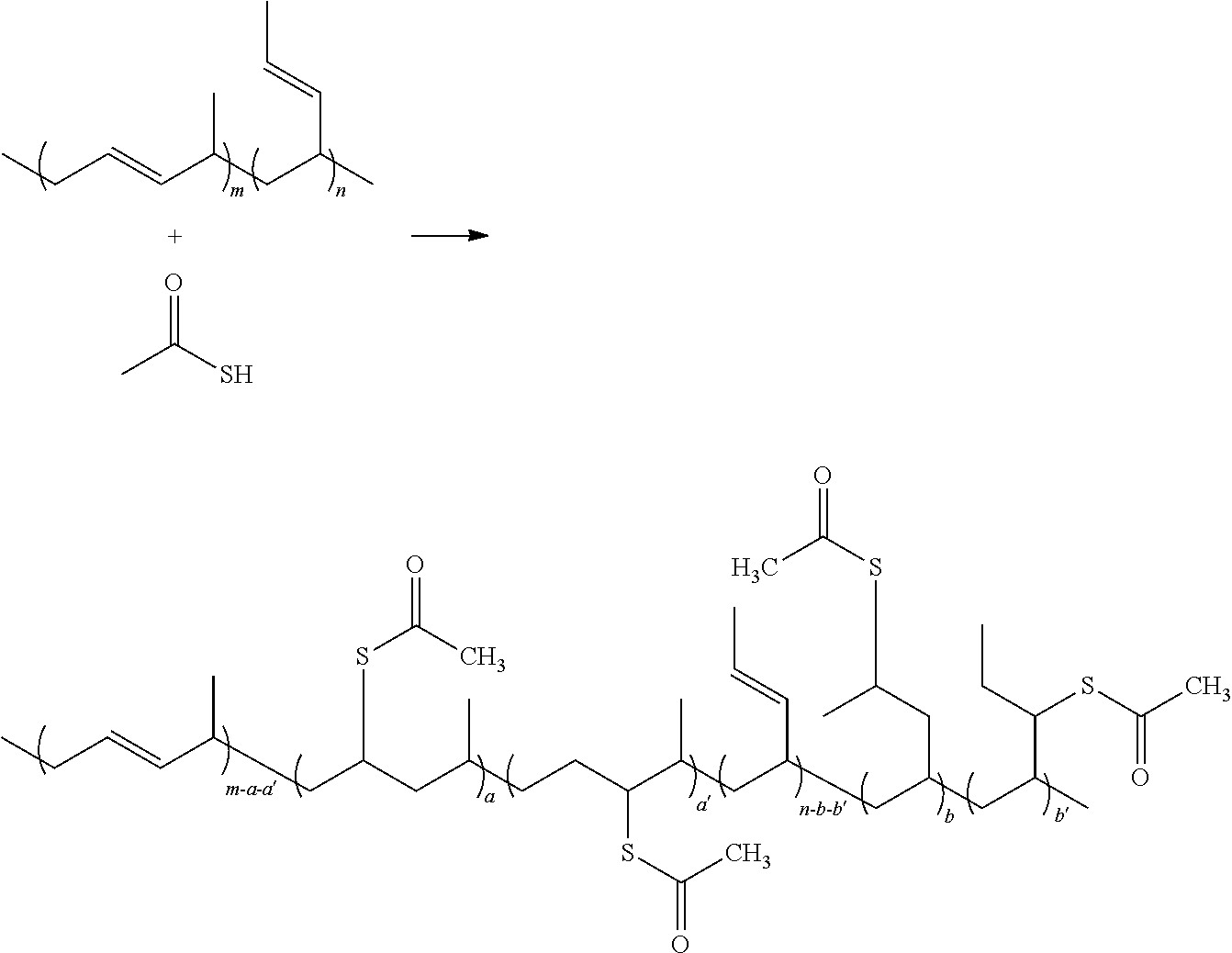
30 g of poly(1,3-butadiene) (TAIPOL BRO150L, 98%-cis, commercially available from TSRC corporation) was added to 300 mL of toluene, and then heated to 80° C. to reflux and stir for 24 hours to completely dissolve the poly(1,3-butadiene). 8.0 mL of thioacetic acid was added to the poly(1,3-butadiene) solution, and then stirred and reflux at 80° C. to react for 48 hours. After the reaction finished, the solution color was changed from color-less to yellow. The reaction is shown below:
Figure US11713362-20230801-C00019

In the above formula, m:n is about 98:2. (a+a′+b+b′):(m+n) is about 0.5:1, which is the ratio of the thioacetic acid grafted onto the double bonds of the poly(1,3-butadiene) (calculated from the 1H NMR spectrum).
Subsequently, 50 mL of NaOH aqueous solution was added to the above solution, and then reflux at 80° C. for 24 hours. The solution color was changed from yellow to white. The reaction is shown below:
Figure US11713362-20230801-C00020

The reaction is so-called de-protection reaction. After the reaction, the poly(1,3-butadiene) having thiol groups grafted on parts of the double bonds could be obtained.
The reaction result was then poured into 600 mL of de-ionized water to stir, then neutralized (e.g. pH=7) by 1M HCl, and then stirred for 1 hour. The above solution was extracted by de-ionized water, and the organic phase of the extraction was collected. Most of the solvent of the organic phase was removed by rotator pump. The concentrated solution was stood in hood for 72 hours, and then put into a vacuum oven to be vacuumed and baked at 50° C. for 72 hours, thereby obtaining a white yellow bulk product. The white yellow bulk product was cracked to obtain white yellow powder. The product was identified by NMR to verify the ratio of thiol group grafted onto the double bonds of the poly(1,3-butadiene) (e.g. (a+a′+b+b′):(m+n) was about 0.5:1.
Example 1-1
100 g of nitrile rubber formula for roller (commercially available from Chunfa Hitech Industrial Co., Ltd., free of PVC, identified by IR) was hot-pressed and vulcanized at 150° C. for 20 minutes by a hot press machine to form a sheet. The vulcanized sheet was analyzed to measure its tensile strength (9.54 MPa) and elongation ratio (480%).
Example 1-2
120 g of nitrile rubber formula for roller (commercially available from Chunfa Hitech Industrial Co., Ltd., free of PVC, identified by IR) was hot-pressed and vulcanized at 150° C. for 20 minutes by a hot press machine to obtain a sheet. The sheet was cracked to obtain scraps of waste nitrile rubber with a diameter of about 2 cm. 40 g of the waste nitrile rubber and 3 phr of the depolymerizer (product of Synthesis Example 1) were added into a plastometer (Plasti-corder PL2000) for being depolymerized at 210° C. and 70 rpm for 15 minutes to obtain a recycled rubber. The depolymerization was repeated 3 times to obtain about 120 g of the recycled rubber. The recycled rubber was refined by double rollers at 40° C. and 30 rpm for 8 minutes to obtain a sheet. 100 g of the sheet was vulcanized by adding vulcanizing agent according to JIS standard (JIS K6313-2012), and the vulcanized sheet was analyzed to measure its tensile strength (3.91 MPa) and elongation rate (248%).
Example 1-3
120 g of nitrile rubber formula for roller (commercially available from Chunfa Hitech Industrial Co., Ltd., free of PVC, identified by IR) was hot-pressed and vulcanized at 150° C. for 20 minutes by a hot press machine to obtain a sheet. The sheet was cracked to obtain scraps of waste nitrile rubber with a diameter of about 2 cm. 40 g of the waste nitrile rubber and 3 phr of the AK79 (Aktiplast, commercially available from RheinChemie) were added into a plastometer (Plasti-corder PL2000) for being depolymerized at 210° C. and 70 rpm for 15 minutes to obtain a recycled rubber. The depolymerization was repeated 3 times to obtain about 120 g of the recycled rubber. The recycled rubber was refined by double rollers at 40° C. and 30 rpm for 8 minutes to obtain a sheet. 100 g of the sheet was vulcanized by adding vulcanizing agent according to JIS standard (JIS K6313-2012), and the vulcanized sheet was analyzed to measure its tensile strength (1.56 MPa) and elongation rate (91%).
Example 1-4
120 g of nitrile rubber formula for roller (commercially available from Chunfa Hitech Industrial Co., Ltd., free of PVC, identified by IR) was hot-pressed and vulcanized at 150° C. for 20 minutes by a hot press machine to obtain a sheet. The sheet was cracked to obtain scraps of waste nitrile rubber with a diameter of about 2 cm. 40 g of the waste nitrile rubber and 3 phr of the PiTong 22 (commercially available from commercially available from ShunLi) were added into a plastometer (Plasti-corder PL2000) for being depolymerized at 210° C. and 70 rpm for 15 minutes to obtain a recycled rubber. The depolymerization was repeated 3 times to obtain about 120 g of the recycled rubber. The recycled rubber was refined by double rollers at 40° C. and 30 rpm for 8 minutes to obtain a sheet. 100 g of the sheet was vulcanized by adding vulcanizing agent according to JIS standard (JIS K6313-2012), and the vulcanized sheet was analyzed to measure its tensile strength (3.03 MPa) and elongation rate (177%).
TABLE 1
Mechanical
strength Compared to
Tensile fresh rubber
strength Elongation Tensile Elongation
(MPa) rate (%) strength % rate %
Example 1-1 9.54 480 100% 100%
(Fresh rubber)
Example 1-2 3.9 248  41%  52%
(Depolymerizer of
Synthesis Example 1)
Example 1-3 1.56  91  16%  19%
(AK79)
Example 1-4 3.03 177  32%  37%
(PiTong 22)
Accordingly, the recycled rubber formed by depolymerizing the waste nitrile rubber with the depolymerizer of Synthesis Example 1 had a mechanical strength being about 50% of that of the fresh rubber. The recycled rubber formed by depolymerizing the waste nitrile rubber with the commercially available depolymerizer had a mechanical strength being 20% to 40% of that of the fresh rubber.
Example 2-1
120 g of nitrile rubber formula for roller (commercially available from Chunfa Hitech Industrial Co., Ltd., free of PVC, identified by IR) was hot-pressed and vulcanized at 150° C. for 20 minutes by a hot press machine to obtain a sheet. The sheet was cracked to obtain scraps of waste nitrile rubber with a diameter of about 2 cm. 40 g of the waste nitrile rubber and 0.5 phr of the depolymerizer (product of Synthesis Example 1) were added into a plastometer (Plasti-corder PL2000) for being depolymerized at 210° C. and 70 rpm for 15 minutes to obtain a recycled rubber. The depolymerization was repeated 3 times to obtain about 120 g of the recycled rubber. The recycled rubber was refined by double rollers at 40° C. and 30 rpm for 8 minutes to obtain a sheet. 100 g of the sheet was vulcanized by adding vulcanizing agent according to JIS standard (JIS K6313-2012), and the vulcanized sheet was analyzed to measure its tensile strength (3.05 MPa) and elongation rate (186%).
Example 2-2
120 g of nitrile rubber formula for roller (commercially available from Chunfa Hitech Industrial Co., Ltd., free of PVC, identified by IR) was hot-pressed and vulcanized at 150° C. for 20 minutes by a hot press machine to obtain a sheet. The sheet was cracked to obtain scraps of waste nitrile rubber with a diameter of about 2 cm. 40 g of the waste nitrile rubber and 1 phr of the depolymerizer (product of Synthesis Example 1) were added into a plastometer (Plasti-corder PL2000) for being depolymerized at 210° C. and 70 rpm for 15 minutes to obtain a recycled rubber. The depolymerization was repeated 3 times to obtain about 120 g of the recycled rubber. The recycled rubber was refined by double rollers at 40° C. and 30 rpm for 8 minutes to obtain a sheet. 100 g of the sheet was vulcanized by adding vulcanizing agent according to JIS standard (JIS K6313-2012), and the vulcanized sheet was analyzed to measure its tensile strength (3.26 MPa) and elongation rate (217%).
Example 2-3
120 g of nitrile rubber formula for roller (commercially available from Chunfa Hitech Industrial Co., Ltd., free of PVC, identified by IR) was hot-pressed and vulcanized at 150° C. for 20 minutes by a hot press machine to obtain a sheet. The sheet was cracked to obtain scraps of waste nitrile rubber with a diameter of about 2 cm. 40 g of the waste nitrile rubber and 2 phr of the depolymerizer (product of Synthesis Example 1) were added into a plastometer (Plasti-corder PL2000) for being depolymerized at 210° C. and 70 rpm for 15 minutes to obtain a recycled rubber. The depolymerization was repeated 3 times to obtain about 120 g of the recycled rubber. The recycled rubber was refined by double rollers at 40° C. and 30 rpm for 8 minutes to obtain a sheet. 100 g of the sheet was vulcanized by adding vulcanizing agent according to JIS standard (JIS K6313-2012), and the vulcanized sheet was analyzed to measure its tensile strength (3.35 MPa) and elongation rate (213%).
Example 2-4
120 g of nitrile rubber formula for roller (commercially available from Chunfa Hitech Industrial Co., Ltd., free of PVC, identified by IR) was hot-pressed and vulcanized at 150° C. for 20 minutes by a hot press machine to obtain a sheet. The sheet was cracked to obtain scraps of waste nitrile rubber with a diameter of about 2 cm. 40 g of the waste nitrile rubber and 3 phr of the depolymerizer (product of Synthesis Example 1) were added into a plastometer (Plasti-corder PL2000) for being depolymerized at 210° C. and 70 rpm for 15 minutes to obtain a recycled rubber. The depolymerization was repeated 3 times to obtain about 120 g of the recycled rubber. The recycled rubber was refined by double rollers at 40° C. and 30 rpm for 8 minutes to obtain a sheet. 100 g of the sheet was vulcanized by adding vulcanizing agent according to JIS standard (JIS K6313-2012), and the vulcanized sheet was analyzed to measure its tensile strength (3.9 MPa) and elongation rate (248%).
TABLE 2
Mechanical
strength Compared to
Tensile fresh rubber
strength Elongation Tensile Elongation
(MPa) rate (%) strength % rate %
Example 1-1 9.54 480 100% 100%
(fresh rubber)
Example 2-1 3.05 186  32%  39%
(0.5 phr depolymerizer)
Example 2-2 3.26 217  34%  45%
(1 phr depolymerizer)
Example 2-3 3.35 213  35%  44%
(2 phr depolymerizer)
Example 2-4 3.90 248  41%  52%
(3 phr depolymerizer)
Accordingly, the higher addition amount of the depolymerizer could enhance the mechanical strength of the recycled rubber. However, the enhancement effect slowed down as the addition amount increases.
Example 3-1
90 parts of the nitrile rubber formula in Example 1-1 and 10 parts by weight of the recycled rubber in Example 1-2 were refined by double rollers at 40° C. and 30 rpm for 8 minutes to obtain a sheet. 100 g of the sheet was vulcanized by adding vulcanizing agent according to JIS standard (JIS K6313-2012), and the vulcanized sheet was analyzed to measure its tensile strength (8.70 MPa) and elongation rate (409%).
Example 3-2
80 parts of the nitrile rubber formula in Example 1-1 and 20 parts by weight of the recycled rubber in Example 1-2 were refined by double rollers at 40° C. and 30 rpm for 8 minutes to obtain a sheet. 100 g of the sheet was vulcanized by adding vulcanizing agent according to JIS standard (JIS K6313-2012), and the vulcanized sheet was analyzed to measure its tensile strength (8.42 MPa) and elongation rate (401%).
Example 3-3
70 parts of the nitrile rubber formula in Example 1-1 and 30 parts by weight of the recycled rubber in Example 1-2 were refined by double rollers at 40° C. and 30 rpm for 8 minutes to obtain a sheet. 100 g of the sheet was vulcanized by adding vulcanizing agent according to JIS standard (JIS K6313-2012), and the vulcanized sheet was analyzed to measure its tensile strength (8.21 MPa) and elongation rate (403%).
Example 3-4
60 parts of the nitrile rubber formula in Example 1-1 and 40 parts by weight of the recycled rubber in Example 1-2 were refined by double rollers at 40° C. and 30 rpm for 8 minutes to obtain a sheet. 100 g of the sheet was vulcanized by adding vulcanizing agent according to JIS standard (JIS K6313-2012), and the vulcanized sheet was analyzed to measure its tensile strength (7.42 MPa) and elongation rate (353%).
Example 3-5
50 parts of the nitrile rubber formula in Example 1-1 and 50 parts by weight of the recycled rubber in Example 1-2 were refined by double rollers at 40° C. and 30 rpm for 8 minutes to obtain a sheet. 100 g of the sheet was vulcanized by adding vulcanizing agent according to JIS standard (JIS K6313-2012), and the vulcanized sheet was analyzed to measure its tensile strength (7.06 MPa) and elongation rate (360%).
TABLE 3
Mechanical
strength Compared to
Tensile fresh rubber
strength Elongation Tensile Elongation
(MPa) rate (%) strength % rate %
Example 1-1 9.54 480 100% 100%
(fresh rubber)
Example 3-1 8.70 409  91%  85%
(10% recycled rubber)
Example 3-2 8.42 401  88%  83%
(20% recycled rubber)
Example 3-3 8.21 403  86%  84%
(30% recycled rubber)
Example 3-4 7.42 353  78%  74%
(40% recycled rubber)
Example 3-5 7.06 360  74%  75%
(50% recycled rubber)
Accordingly, addition of the recycled rubber would lower the mechanical strength, but still maintain a certain degree to be used again.
It will be apparent to those skilled in the art that various modifications and variations can be made to the disclosed methods and materials. It is intended that the specification and examples be considered as exemplary only, with the true scope of the disclosure being indicated by the following claims and their equivalents.

Claims (5)

What is claimed is:
1. A depolymerizer, having a chemical structure of
Figure US11713362-20230801-C00021
wherein (a+a′+b+b′):(m+n)=0.01:1 to 0.67:1, a>0, a′>0, b>0, and b′>0.
2. The depolymerizer as claimed in claim 1, having a weight average molecular weight of 1000 to 400000.
3. A recycled rubber, being formed by
depolymerizing 100 parts by weight of rubber using 0.5 to 10 parts by weight of a depolymerizer,
wherein the depolymerizer has a chemical structure of
Figure US11713362-20230801-C00022
wherein (a+a′+b+b′):(m+n)=0.01:1 to 0.67:1, a′>0 b>0, and b′>0.
4. The recycled rubber as claimed in claim 3, wherein the rubber comprises poly(cis-1,3-butadiene) rubber, polystyrene-butadiene rubber, nitrile rubber, buna rubber, ethylene propylene rubber, butyl rubber, or a combination thereof.
5. The recycled rubber as claimed in claim 3, wherein the depolymerizer has a weight average molecular weight of 1000 to 400000.
US17/135,344 2020-12-28 2020-12-28 Depolymerizer and recycled rubber Active 2041-08-04 US11713362B2 (en)

Priority Applications (3)

Application Number Priority Date Filing Date Title
US17/135,344 US11713362B2 (en) 2020-12-28 2020-12-28 Depolymerizer and recycled rubber
TW110100391A TWI784386B (en) 2020-12-28 2021-01-06 Depolymerizer and recycled rubber
CN202110173182.2A CN114685697B (en) 2020-12-28 2021-02-08 Depolymerization agent and recycled rubber

Applications Claiming Priority (1)

Application Number Priority Date Filing Date Title
US17/135,344 US11713362B2 (en) 2020-12-28 2020-12-28 Depolymerizer and recycled rubber

Publications (2)

Publication Number Publication Date
US20220204656A1 US20220204656A1 (en) 2022-06-30
US11713362B2 true US11713362B2 (en) 2023-08-01

Family

ID=82118887

Family Applications (1)

Application Number Title Priority Date Filing Date
US17/135,344 Active 2041-08-04 US11713362B2 (en) 2020-12-28 2020-12-28 Depolymerizer and recycled rubber

Country Status (3)

Country Link
US (1) US11713362B2 (en)
CN (1) CN114685697B (en)
TW (1) TWI784386B (en)

Citations (22)

* Cited by examiner, † Cited by third party
Publication number Priority date Publication date Assignee Title
GB575546A (en) 1943-03-17 1946-02-22 Us Rubber Co Process for reclaiming scrap vulcanized rubber
US2469529A (en) 1946-06-05 1949-05-10 Us Rubber Co Process of reclaiming vulcanized rubber scrap
US4440816A (en) * 1980-07-14 1984-04-03 Owens-Corning Fiberglas Corporation Rubber-modified asphalt composition
US5159123A (en) * 1991-05-02 1992-10-27 Texaco Chemical Company Synthesis of hydroxyl-terminated polybutadienes using glycol ether acetate solvents
WO2001023464A1 (en) 1999-09-28 2001-04-05 Dsm N.V. Process for devulcanizing a rubber
CN101113140A (en) 2006-07-26 2008-01-30 宋同银 Vulcanized rubber regeneration activator and preparation method and uses thereof
TW200829613A (en) 2006-07-24 2008-07-16 Asahi Kasei Chemicals Corp Modified conjugated diene polymer and method for producing the same
US7425584B2 (en) 2004-11-29 2008-09-16 Alberta Research Council Catalytic devulcanization of rubber
US20090082475A1 (en) 2007-09-20 2009-03-26 Zhang Yuncan Process for devulcanization of rubber
CN101759869A (en) 2009-12-24 2010-06-30 朝阳好优达橡塑助剂有限公司 Waste vulcanized rubber reclaiming agent composition
CN102050960A (en) 2010-11-30 2011-05-11 胥乾 Efficient scrap rubber regeneration activator and preparation method thereof
US8283438B2 (en) 2007-10-15 2012-10-09 California Institute Of Technology Functionalized polymers using protected thiols
CN103435842A (en) 2013-08-29 2013-12-11 中胶橡胶资源再生(青岛)有限公司 Reclaiming agent, reclaimed rubber and preparation method of reclaimed rubber
TW201414776A (en) 2006-12-11 2014-04-16 Sf材料公司 Recycled rubber and method
WO2014084727A1 (en) 2012-11-27 2014-06-05 Recybem B.V. A method of devulcanizing a rubber vulcanizate
US20140370305A1 (en) 2013-06-12 2014-12-18 Maria Celeste Tria Patternable materials and methods of use
US20140366759A1 (en) 2013-06-12 2014-12-18 Maria Celeste Tria Patterned materials and methods of making them
CN104761581A (en) 2015-02-05 2015-07-08 安徽金马橡胶助剂有限公司 Reclaimed rubber activator sulfo synthetic method
CN105733021A (en) 2016-03-09 2016-07-06 中胶橡胶资源再生(青岛)有限公司 Reclaiming activator for rubber and preparation method of reclaiming activator
US9458303B1 (en) 2013-12-04 2016-10-04 University Of Louisville Research Foundation, Inc. Recycling of styrene butadiene rubber and like materials
US20170190806A1 (en) 2011-02-04 2017-07-06 Lanxess Deutschland Gmbh Functionalised nitrile rubbers and the production thereof
TWI717105B (en) 2019-11-18 2021-01-21 財團法人工業技術研究院 Recycled rubber

Family Cites Families (1)

* Cited by examiner, † Cited by third party
Publication number Priority date Publication date Assignee Title
WO2014088091A1 (en) * 2012-12-06 2014-06-12 横浜ゴム株式会社 Thioester-modified polymer, method for producing same, and rubber composition containing same

Patent Citations (26)

* Cited by examiner, † Cited by third party
Publication number Priority date Publication date Assignee Title
GB575546A (en) 1943-03-17 1946-02-22 Us Rubber Co Process for reclaiming scrap vulcanized rubber
US2469529A (en) 1946-06-05 1949-05-10 Us Rubber Co Process of reclaiming vulcanized rubber scrap
US4440816A (en) * 1980-07-14 1984-04-03 Owens-Corning Fiberglas Corporation Rubber-modified asphalt composition
US5159123A (en) * 1991-05-02 1992-10-27 Texaco Chemical Company Synthesis of hydroxyl-terminated polybutadienes using glycol ether acetate solvents
WO2001023464A1 (en) 1999-09-28 2001-04-05 Dsm N.V. Process for devulcanizing a rubber
US7425584B2 (en) 2004-11-29 2008-09-16 Alberta Research Council Catalytic devulcanization of rubber
TW200829613A (en) 2006-07-24 2008-07-16 Asahi Kasei Chemicals Corp Modified conjugated diene polymer and method for producing the same
CN101113140B (en) 2006-07-26 2012-01-11 宋同银 Vulcanized rubber regeneration activator and preparation method and uses thereof
CN101113140A (en) 2006-07-26 2008-01-30 宋同银 Vulcanized rubber regeneration activator and preparation method and uses thereof
TW201414776A (en) 2006-12-11 2014-04-16 Sf材料公司 Recycled rubber and method
US20090082475A1 (en) 2007-09-20 2009-03-26 Zhang Yuncan Process for devulcanization of rubber
US8283438B2 (en) 2007-10-15 2012-10-09 California Institute Of Technology Functionalized polymers using protected thiols
CN101759869A (en) 2009-12-24 2010-06-30 朝阳好优达橡塑助剂有限公司 Waste vulcanized rubber reclaiming agent composition
CN101759869B (en) 2009-12-24 2011-06-15 朝阳好优达橡塑助剂有限公司 Waste vulcanized rubber reclaiming agent composition
CN102050960A (en) 2010-11-30 2011-05-11 胥乾 Efficient scrap rubber regeneration activator and preparation method thereof
US20170190806A1 (en) 2011-02-04 2017-07-06 Lanxess Deutschland Gmbh Functionalised nitrile rubbers and the production thereof
US10011664B2 (en) 2011-02-04 2018-07-03 Arlanxeo Deutschland Gmbh Functionalized nitrile rubbers and the production thereof
WO2014084727A1 (en) 2012-11-27 2014-06-05 Recybem B.V. A method of devulcanizing a rubber vulcanizate
US20140366759A1 (en) 2013-06-12 2014-12-18 Maria Celeste Tria Patterned materials and methods of making them
US20140370305A1 (en) 2013-06-12 2014-12-18 Maria Celeste Tria Patternable materials and methods of use
CN103435842A (en) 2013-08-29 2013-12-11 中胶橡胶资源再生(青岛)有限公司 Reclaiming agent, reclaimed rubber and preparation method of reclaimed rubber
US9458303B1 (en) 2013-12-04 2016-10-04 University Of Louisville Research Foundation, Inc. Recycling of styrene butadiene rubber and like materials
CN104761581A (en) 2015-02-05 2015-07-08 安徽金马橡胶助剂有限公司 Reclaimed rubber activator sulfo synthetic method
CN105733021A (en) 2016-03-09 2016-07-06 中胶橡胶资源再生(青岛)有限公司 Reclaiming activator for rubber and preparation method of reclaiming activator
CN105733021B (en) 2016-03-09 2019-04-02 中胶橡胶资源再生(青岛)有限公司 A kind of rubber regenerative activating agent and preparation method thereof
TWI717105B (en) 2019-11-18 2021-01-21 財團法人工業技術研究院 Recycled rubber

Non-Patent Citations (9)

* Cited by examiner, † Cited by third party
Title
Ghaisas et al., "Blends of Plasticized Poly(vinyl chloride) and Waste Flexible Poly(vinyl chloride) with Waste Nitrile Rubber Powder," Journal of Applied Polymer Science, vol. 91, 2004, pp. 1552-1558 (8 pages total).
Johnson et al., "Product recovery decisions within the context of Extended Producer Responsiblity," Journal of Engineering and Technology Management, vol. 34, 2014 (published online Dec. 12, 2013), pp. 9-28.
Masaki et al., "Devulcanization of Nitrile Butadiene Rubber in Nitrobenzene," Journal of Applied Polymer Science, vol. 91, 2004, pp. 3342-3353.
Oecd, "Extended Producer Responsibility: Updated guidance for efficient waste management," OECD Policy Highlights—Extended Producer Responsibility, Sep. 2016, pp. 1-6 (8 pages total).
Salzman, "Sustainable Consumption and the Law," Environmental Law, vol. 27, pp. 1243-1294.
Schaeffer, Jr., et al., "Data for General, Organic, and Physical Chemistry," 1989, 63 pages.
Taiwanese Office Action and Search Report for Taiwanese Application No. 110100391, dated Mar. 21, 2022.
Tipanna et al., "Composites of Waste, Ground Rubber Particles and Poly(vinyl chloride)," Rubber Chemistry and Technology, vol. 70, No. 5, 1997, pp. 815-819.
Viglianisi et al., "Chain Breaking Antioxidant Activity of Heavy (S, Se, Te) Chalcogens Substituted Polyphenols," Antioxidants, vol. 8, No. 10, 487, 2019, pp. 1-22.

Also Published As

Publication number Publication date
TW202225197A (en) 2022-07-01
TWI784386B (en) 2022-11-21
CN114685697B (en) 2024-03-19
US20220204656A1 (en) 2022-06-30
CN114685697A (en) 2022-07-01

Similar Documents

Publication Publication Date Title
US6399706B1 (en) Microgel-containing rubber compounds which comprise sulfur-containing organosilicon compounds
JP5696151B2 (en) Nitrile rubber and its production in organic solvents
JP2014521799A (en) Method for producing nitrile rubber in organic solvents
CN100577690C (en) Rubber-like hydrogenated vinyl-polybutadiene
CN107325208B (en) Preparation method of single-component silane-terminated liquid fluorine sealant
AU649935B2 (en) Blend of rubber latices containing a hydrogenated rubber latex
CA2792840A1 (en) Process for the production of water and solvent-free nitrile rubbers
CN113372504A (en) Fluorine-containing hydrogenated nitrile rubber material and preparation method and application thereof
US11713362B2 (en) Depolymerizer and recycled rubber
US3646166A (en) Butyl rubber reaction products
US8389638B2 (en) Multifunctional additive grafted rubber and process for the preparation thereof
EP3822308B1 (en) Recycled rubber
CN107337763B (en) Production process of high styrene rubber
US2646422A (en) Cured chlorosulfonated interpolymers of the diolefins
CN111019046A (en) A kind of preparation method of nitrile rubber
WO2016181410A2 (en) Latex composition for preparation of sulfur and accelerator free dipped article field of invention
US7655725B2 (en) Process for the preparation of a hydrogenated polymer
JP2022510814A (en) Process for Producing PEG Acrylate-HNBR Copolymer
US12291631B2 (en) Reclaiming agent and reclaimed rubber
US20140357801A1 (en) Nitrile rubbers coupled via bisdihydropyrazole groups, production thereof and use thereof
US5231143A (en) High-temperature oil-resistant elastomers
CN117777740A (en) Petroleum-based rubber plasticizer and application thereof
CN117946461A (en) Preparation method of emulsion polymerized styrene-butadiene rubber
CN110511300A (en) A kind of halogenated trans-butadiene-isoprene copolymer rubber and its preparation method and application
CN121005817A (en) Modified nitrile butadiene rubber, its preparation method, and nitrile butadiene rubber compositions and vulcanizates containing the same.

Legal Events

Date Code Title Description
FEPP Fee payment procedure

Free format text: ENTITY STATUS SET TO UNDISCOUNTED (ORIGINAL EVENT CODE: BIG.); ENTITY STATUS OF PATENT OWNER: LARGE ENTITY

AS Assignment

Owner name: INDUSTRIAL TECHNOLOGY RESEARCH INSTITUTE, TAIWAN

Free format text: ASSIGNMENT OF ASSIGNORS INTEREST;ASSIGNORS:WEI, YI-TING;WU, JYH-HORNG;WU, YAO-ZU;AND OTHERS;REEL/FRAME:054769/0006

Effective date: 20201223

STPP Information on status: patent application and granting procedure in general

Free format text: DOCKETED NEW CASE - READY FOR EXAMINATION

STPP Information on status: patent application and granting procedure in general

Free format text: NON FINAL ACTION MAILED

STPP Information on status: patent application and granting procedure in general

Free format text: RESPONSE TO NON-FINAL OFFICE ACTION ENTERED AND FORWARDED TO EXAMINER

STPP Information on status: patent application and granting procedure in general

Free format text: PUBLICATIONS -- ISSUE FEE PAYMENT VERIFIED

STCF Information on status: patent grant

Free format text: PATENTED CASE