US11713361B2 - Hydrogenation catalyst compositions and their use for hydrogenation of nitrile rubber - Google Patents
Hydrogenation catalyst compositions and their use for hydrogenation of nitrile rubber Download PDFInfo
- Publication number
- US11713361B2 US11713361B2 US17/048,370 US201917048370A US11713361B2 US 11713361 B2 US11713361 B2 US 11713361B2 US 201917048370 A US201917048370 A US 201917048370A US 11713361 B2 US11713361 B2 US 11713361B2
- Authority
- US
- United States
- Prior art keywords
- alkyl
- hydrogenation
- aryl
- catalyst
- hydrogen
- Prior art date
- Legal status (The legal status is an assumption and is not a legal conclusion. Google has not performed a legal analysis and makes no representation as to the accuracy of the status listed.)
- Active, expires
Links
Images

Classifications
-
- B—PERFORMING OPERATIONS; TRANSPORTING
- B01—PHYSICAL OR CHEMICAL PROCESSES OR APPARATUS IN GENERAL
- B01J—CHEMICAL OR PHYSICAL PROCESSES, e.g. CATALYSIS OR COLLOID CHEMISTRY; THEIR RELEVANT APPARATUS
- B01J31/00—Catalysts comprising hydrides, coordination complexes or organic compounds
- B01J31/02—Catalysts comprising hydrides, coordination complexes or organic compounds containing organic compounds or metal hydrides
- B01J31/0234—Nitrogen-, phosphorus-, arsenic- or antimony-containing compounds
- B01J31/0235—Nitrogen containing compounds
- B01J31/0237—Amines
-
- B—PERFORMING OPERATIONS; TRANSPORTING
- B01—PHYSICAL OR CHEMICAL PROCESSES OR APPARATUS IN GENERAL
- B01J—CHEMICAL OR PHYSICAL PROCESSES, e.g. CATALYSIS OR COLLOID CHEMISTRY; THEIR RELEVANT APPARATUS
- B01J31/00—Catalysts comprising hydrides, coordination complexes or organic compounds
- B01J31/02—Catalysts comprising hydrides, coordination complexes or organic compounds containing organic compounds or metal hydrides
- B01J31/0201—Oxygen-containing compounds
- B01J31/0204—Ethers
-
- B—PERFORMING OPERATIONS; TRANSPORTING
- B01—PHYSICAL OR CHEMICAL PROCESSES OR APPARATUS IN GENERAL
- B01J—CHEMICAL OR PHYSICAL PROCESSES, e.g. CATALYSIS OR COLLOID CHEMISTRY; THEIR RELEVANT APPARATUS
- B01J31/00—Catalysts comprising hydrides, coordination complexes or organic compounds
- B01J31/02—Catalysts comprising hydrides, coordination complexes or organic compounds containing organic compounds or metal hydrides
- B01J31/0215—Sulfur-containing compounds
- B01J31/0218—Sulfides
-
- B—PERFORMING OPERATIONS; TRANSPORTING
- B01—PHYSICAL OR CHEMICAL PROCESSES OR APPARATUS IN GENERAL
- B01J—CHEMICAL OR PHYSICAL PROCESSES, e.g. CATALYSIS OR COLLOID CHEMISTRY; THEIR RELEVANT APPARATUS
- B01J31/00—Catalysts comprising hydrides, coordination complexes or organic compounds
- B01J31/02—Catalysts comprising hydrides, coordination complexes or organic compounds containing organic compounds or metal hydrides
- B01J31/0215—Sulfur-containing compounds
- B01J31/0222—Sulfur-containing compounds comprising sulfonyl groups
-
- B—PERFORMING OPERATIONS; TRANSPORTING
- B01—PHYSICAL OR CHEMICAL PROCESSES OR APPARATUS IN GENERAL
- B01J—CHEMICAL OR PHYSICAL PROCESSES, e.g. CATALYSIS OR COLLOID CHEMISTRY; THEIR RELEVANT APPARATUS
- B01J31/00—Catalysts comprising hydrides, coordination complexes or organic compounds
- B01J31/02—Catalysts comprising hydrides, coordination complexes or organic compounds containing organic compounds or metal hydrides
- B01J31/0234—Nitrogen-, phosphorus-, arsenic- or antimony-containing compounds
- B01J31/0255—Phosphorus containing compounds
- B01J31/0257—Phosphorus acids or phosphorus acid esters
- B01J31/0258—Phosphoric acid mono-, di- or triesters ((RO)(R'O)2P=O), i.e. R= C, R'= C, H
-
- B—PERFORMING OPERATIONS; TRANSPORTING
- B01—PHYSICAL OR CHEMICAL PROCESSES OR APPARATUS IN GENERAL
- B01J—CHEMICAL OR PHYSICAL PROCESSES, e.g. CATALYSIS OR COLLOID CHEMISTRY; THEIR RELEVANT APPARATUS
- B01J31/00—Catalysts comprising hydrides, coordination complexes or organic compounds
- B01J31/02—Catalysts comprising hydrides, coordination complexes or organic compounds containing organic compounds or metal hydrides
- B01J31/0234—Nitrogen-, phosphorus-, arsenic- or antimony-containing compounds
- B01J31/0255—Phosphorus containing compounds
- B01J31/0267—Phosphines or phosphonium compounds, i.e. phosphorus bonded to at least one carbon atom, including e.g. sp2-hybridised phosphorus compounds such as phosphabenzene, the other atoms bonded to phosphorus being either carbon or hydrogen
-
- B—PERFORMING OPERATIONS; TRANSPORTING
- B01—PHYSICAL OR CHEMICAL PROCESSES OR APPARATUS IN GENERAL
- B01J—CHEMICAL OR PHYSICAL PROCESSES, e.g. CATALYSIS OR COLLOID CHEMISTRY; THEIR RELEVANT APPARATUS
- B01J31/00—Catalysts comprising hydrides, coordination complexes or organic compounds
- B01J31/16—Catalysts comprising hydrides, coordination complexes or organic compounds containing coordination complexes
- B01J31/22—Organic complexes
- B01J31/2204—Organic complexes the ligands containing oxygen or sulfur as complexing atoms
- B01J31/2208—Oxygen, e.g. acetylacetonates
- B01J31/2217—At least one oxygen and one nitrogen atom present as complexing atoms in an at least bidentate or bridging ligand
-
- B—PERFORMING OPERATIONS; TRANSPORTING
- B01—PHYSICAL OR CHEMICAL PROCESSES OR APPARATUS IN GENERAL
- B01J—CHEMICAL OR PHYSICAL PROCESSES, e.g. CATALYSIS OR COLLOID CHEMISTRY; THEIR RELEVANT APPARATUS
- B01J31/00—Catalysts comprising hydrides, coordination complexes or organic compounds
- B01J31/16—Catalysts comprising hydrides, coordination complexes or organic compounds containing coordination complexes
- B01J31/22—Organic complexes
- B01J31/2204—Organic complexes the ligands containing oxygen or sulfur as complexing atoms
- B01J31/2208—Oxygen, e.g. acetylacetonates
- B01J31/2226—Anionic ligands, i.e. the overall ligand carries at least one formal negative charge
- B01J31/2243—At least one oxygen and one nitrogen atom present as complexing atoms in an at least bidentate or bridging ligand
-
- B—PERFORMING OPERATIONS; TRANSPORTING
- B01—PHYSICAL OR CHEMICAL PROCESSES OR APPARATUS IN GENERAL
- B01J—CHEMICAL OR PHYSICAL PROCESSES, e.g. CATALYSIS OR COLLOID CHEMISTRY; THEIR RELEVANT APPARATUS
- B01J31/00—Catalysts comprising hydrides, coordination complexes or organic compounds
- B01J31/16—Catalysts comprising hydrides, coordination complexes or organic compounds containing coordination complexes
- B01J31/22—Organic complexes
- B01J31/2265—Carbenes or carbynes, i.e.(image)
- B01J31/2269—Heterocyclic carbenes
- B01J31/2273—Heterocyclic carbenes with only nitrogen as heteroatomic ring members, e.g. 1,3-diarylimidazoline-2-ylidenes
-
- B—PERFORMING OPERATIONS; TRANSPORTING
- B01—PHYSICAL OR CHEMICAL PROCESSES OR APPARATUS IN GENERAL
- B01J—CHEMICAL OR PHYSICAL PROCESSES, e.g. CATALYSIS OR COLLOID CHEMISTRY; THEIR RELEVANT APPARATUS
- B01J31/00—Catalysts comprising hydrides, coordination complexes or organic compounds
- B01J31/16—Catalysts comprising hydrides, coordination complexes or organic compounds containing coordination complexes
- B01J31/22—Organic complexes
- B01J31/2265—Carbenes or carbynes, i.e.(image)
- B01J31/2278—Complexes comprising two carbene ligands differing from each other, e.g. Grubbs second generation catalysts
-
- B—PERFORMING OPERATIONS; TRANSPORTING
- B01—PHYSICAL OR CHEMICAL PROCESSES OR APPARATUS IN GENERAL
- B01J—CHEMICAL OR PHYSICAL PROCESSES, e.g. CATALYSIS OR COLLOID CHEMISTRY; THEIR RELEVANT APPARATUS
- B01J31/00—Catalysts comprising hydrides, coordination complexes or organic compounds
- B01J31/16—Catalysts comprising hydrides, coordination complexes or organic compounds containing coordination complexes
- B01J31/22—Organic complexes
- B01J31/2282—Unsaturated compounds used as ligands
- B01J31/2295—Cyclic compounds, e.g. cyclopentadienyls
-
- C—CHEMISTRY; METALLURGY
- C08—ORGANIC MACROMOLECULAR COMPOUNDS; THEIR PREPARATION OR CHEMICAL WORKING-UP; COMPOSITIONS BASED THEREON
- C08C—TREATMENT OR CHEMICAL MODIFICATION OF RUBBERS
- C08C19/00—Chemical modification of rubber
- C08C19/02—Hydrogenation
-
- C—CHEMISTRY; METALLURGY
- C08—ORGANIC MACROMOLECULAR COMPOUNDS; THEIR PREPARATION OR CHEMICAL WORKING-UP; COMPOSITIONS BASED THEREON
- C08L—COMPOSITIONS OF MACROMOLECULAR COMPOUNDS
- C08L15/00—Compositions of rubber derivatives
- C08L15/005—Hydrogenated nitrile rubber
-
- B—PERFORMING OPERATIONS; TRANSPORTING
- B01—PHYSICAL OR CHEMICAL PROCESSES OR APPARATUS IN GENERAL
- B01J—CHEMICAL OR PHYSICAL PROCESSES, e.g. CATALYSIS OR COLLOID CHEMISTRY; THEIR RELEVANT APPARATUS
- B01J2231/00—Catalytic reactions performed with catalysts classified in B01J31/00
- B01J2231/50—Redistribution or isomerisation reactions of C-C, C=C or C-C triple bonds
- B01J2231/54—Metathesis reactions, e.g. olefin metathesis
- B01J2231/543—Metathesis reactions, e.g. olefin metathesis alkene metathesis
-
- B—PERFORMING OPERATIONS; TRANSPORTING
- B01—PHYSICAL OR CHEMICAL PROCESSES OR APPARATUS IN GENERAL
- B01J—CHEMICAL OR PHYSICAL PROCESSES, e.g. CATALYSIS OR COLLOID CHEMISTRY; THEIR RELEVANT APPARATUS
- B01J2231/00—Catalytic reactions performed with catalysts classified in B01J31/00
- B01J2231/60—Reduction reactions, e.g. hydrogenation
- B01J2231/64—Reductions in general of organic substrates, e.g. hydride reductions or hydrogenations
- B01J2231/641—Hydrogenation of organic substrates, i.e. H2 or H-transfer hydrogenations, e.g. Fischer-Tropsch processes
- B01J2231/643—Hydrogenation of organic substrates, i.e. H2 or H-transfer hydrogenations, e.g. Fischer-Tropsch processes of R2C=O or R2C=NR (R= C, H)
-
- B—PERFORMING OPERATIONS; TRANSPORTING
- B01—PHYSICAL OR CHEMICAL PROCESSES OR APPARATUS IN GENERAL
- B01J—CHEMICAL OR PHYSICAL PROCESSES, e.g. CATALYSIS OR COLLOID CHEMISTRY; THEIR RELEVANT APPARATUS
- B01J2231/00—Catalytic reactions performed with catalysts classified in B01J31/00
- B01J2231/60—Reduction reactions, e.g. hydrogenation
- B01J2231/64—Reductions in general of organic substrates, e.g. hydride reductions or hydrogenations
- B01J2231/641—Hydrogenation of organic substrates, i.e. H2 or H-transfer hydrogenations, e.g. Fischer-Tropsch processes
- B01J2231/645—Hydrogenation of organic substrates, i.e. H2 or H-transfer hydrogenations, e.g. Fischer-Tropsch processes of C=C or C-C triple bonds
-
- B—PERFORMING OPERATIONS; TRANSPORTING
- B01—PHYSICAL OR CHEMICAL PROCESSES OR APPARATUS IN GENERAL
- B01J—CHEMICAL OR PHYSICAL PROCESSES, e.g. CATALYSIS OR COLLOID CHEMISTRY; THEIR RELEVANT APPARATUS
- B01J2531/00—Additional information regarding catalytic systems classified in B01J31/00
- B01J2531/001—General concepts, e.g. reviews, relating to catalyst systems and methods of making them, the concept being defined by a common material or method/theory
- B01J2531/002—Materials
- B01J2531/007—Promoter-type Additives
-
- B—PERFORMING OPERATIONS; TRANSPORTING
- B01—PHYSICAL OR CHEMICAL PROCESSES OR APPARATUS IN GENERAL
- B01J—CHEMICAL OR PHYSICAL PROCESSES, e.g. CATALYSIS OR COLLOID CHEMISTRY; THEIR RELEVANT APPARATUS
- B01J2531/00—Additional information regarding catalytic systems classified in B01J31/00
- B01J2531/80—Complexes comprising metals of Group VIII as the central metal
- B01J2531/82—Metals of the platinum group
- B01J2531/821—Ruthenium
-
- C—CHEMISTRY; METALLURGY
- C08—ORGANIC MACROMOLECULAR COMPOUNDS; THEIR PREPARATION OR CHEMICAL WORKING-UP; COMPOSITIONS BASED THEREON
- C08C—TREATMENT OR CHEMICAL MODIFICATION OF RUBBERS
- C08C19/00—Chemical modification of rubber
Definitions
- This invention relates to novel hydrogenation catalyst compositions obtainable from reacting metal-based complex hydrogenation catalysts with specific co-catalysts and to a process for selectively hydrogenating nitrile rubbers in the presence of such novel hydrogenation catalyst compositions.
- acrylonitrile-butadiene rubber or “nitrile rubber”, also named as “NBR” for short, shall be interpreted broadly and refers to rubbers which are copolymers or terpolymers of at least one ⁇ , ⁇ -unsaturated nitrile, at least one conjugated diene and, if desired, one or more further copolymerizable monomers.
- Hydrogenated NBR also referred to as “HNBR” for short, is produced commercially by hydrogenation of NBR. Accordingly, the selective hydrogenation of the carbon-carbon double bonds in the diene-based polymer must be conducted without affecting the nitrile groups and other functional groups (such as carboxyl groups when other copolymerizable monomers were introduced into the polymer chains) in the polymer chains.
- HNBR is a specialty rubber which has very good heat resistance, an excellent resistance to ozone and chemicals and also an excellent oil resistance.
- the abovementioned physical and chemical properties of HNBR are associated with very good mechanical properties, in particular a high abrasion resistance. For this reason, HNBR has found wide use in a variety of applications.
- HNBR is used, for example, for seals, hoses, belts and damping elements in the automobile sector, also for stators, oil well seals and valve seals in the field of oil exploration and also for numerous parts in the aircraft industry, the electronics industry, mechanical engineering and shipbuilding.
- a hydrogenation conversion higher than 95%, or a residual double bond (RDB) content ⁇ 5%, without cross-linking during the hydrogenation reaction and a gel level of less than about 2.5% in the resultant HNBR is a threshold that ensures high-performance applications of HNBR in these areas and guarantees excellent processability of the final product.
- the degree of hydrogenation of the copolymerized diene units in HNBR may vary in the range from 50 to 100%, however, the desired hydrogenation degree is from about 80 to about 100%, preferably from about 90 to about 99.9%.
- Commercial grades of HNBR typically have a remaining level of unsaturation below 18% and a content of acrylonitrile of roughly up to about 50%.
- NBR non-reactive metal-oxide-semiconductor
- the catalysts used are usually based on rhodium, ruthenium or palladium, but it is also possible to use platinum, iridium, rhenium, osmium, cobalt or copper either as metal or preferably in the form of metal compounds (see e.g. U.S. Pat. No. 3,700,637).
- Suitable catalysts and solvents for a hydrogenation in the homogeneous phase are known.
- Ru-based complexes are also good catalysts for polymer solution hydrogenation, and the price for Ru metal is even cheaper.
- Ru—PPh 3 complexes and RuHCl(CO)L 2 (L is a bulky phosphine) catalyst systems lead to quantitative hydrogenation of NBR as disclosed in Journal of Molecular Catalysis A: Chemical, 1997, 126(2-3), 115-131). During such hydrogenation it is not necessary to add a free phosphine ligand to maintain the catalyst activity. However, they are prone to gel formation and may cause a certain degree of cross-linking during hydrogenation.
- Ru or Os catalysts are active catalysts for hydrogenation only, not for metathesis reactions. Therefore, these types of Ru or Os catalysts cannot be used for NBR metathesis/degradation to produce NBR with reduced molecular weight.
- HNBR HNBR with a low Mooney viscosity is difficult to manufacture by the direct hydrogenation of commercially available NBR.
- the relatively high Mooney viscosity places restrictions on the processability of HNBR.
- Many applications would ideally use HNBR grades with a lower molecular weight and a lower Mooney viscosity. This would give a decisive improvement in processability.
- the Mooney viscosity range of marketed HNBR is limited by the lower limit of the Mooney viscosity of the NBR starting material.
- the molar mass of the NBR feedstock to be used for the hydrogenation cannot be reduced at will since otherwise work-up in the NBR industrial plants available is no longer possible because the rubber becomes too sticky.
- the lowest Mooney viscosity of an NBR feedstock which can be worked up without difficulties in an established industrial plant is in a range of about 30 Mooney units (ML1+4 at 100° C.).
- the Mooney viscosity of the hydrogenated nitrile rubber obtained using such an NBR feedstock is in the order of 55 Mooney units (ML1+4 at 100° C.).
- the Mooney viscosity is determined in accordance with ASTM standard D 1646.
- a nitrile rubber is reacted in a first step in the presence of a coolefine and a specific catalyst based on osmium, ruthenium, molybdenum or tungsten complexes and hydrogenated in a second step.
- the hydrogenated nitrile rubbers obtained may have a weight average molecular weight (Mw) in the range from 30,000 to 250,000 g/mol, a Mooney viscosity (ML 1+4 at 100° C.) in the range from 3 to 50 MU and a polydispersity index PDI of less than 2.5.
- Mw weight average molecular weight
- ML 1+4 at 100° C. Mooney viscosity
- PDI polydispersity index
- Ru-based metathesis catalysts like e.g. Grubbs I (benzylidene bis(tricyclohexylphosphine) dichloro ruthenium), Grubbs II (benzylidene [1,3-bis(2,4,6-trimethylphenyl)-2-imidazolidinyliden]tricyclohexylphosphin dichloro ruthenium), Grubbs III (benzylidene [1,3-bis(2,4,6-trimethylphenyl)-2-imidazolidin-ylidene]dichloro-bis(3-bromopyridine)ruthenium), Hoveyda-Grubbs II ([1,3-bis-(2,4,6-trimethylphenyl)-2-imidazolidinyliden]dichloro(o-isopropoxyphenylmethylen) ruthenium) (see e.g. US-A-2008/0064882) and
- the catalytic activity of the catalyst is stopped with ethylvinylether.
- the molar ratio of the complex catalyst to the cocatalyst was 1:(15-60).
- EVE Ethyl-vinyl-ether
- WO-A-03/062253 discloses metal complexes which are useful as catalyst components in olefin metathesis reactions. However, the use of the complex catalysts for hydrogenation or the use of co-catalysts for the suppression of the metathesis reaction is not disclosed
- HNBR can be prepared by hydrogenation of NBR in the presence of a catalyst composition which is obtained by contacting a metathesis catalyst with a specific co-catalyst wherein such contacting or pretreatment of the catalyst with the co-catalyst is conducted either separately or following a metathesis reaction in-situ in the reaction mixture before the addition of hydrogen.
- the metathesis activity of the catalyst is controlled by contacting the catalyst with the co-catalyst and thereby preparing the catalyst composition according to the invention.
- the molecular weight of the HNBR obtained by the hydrogenation using the catalyst composition according to the invention is comparable to the original NBR feedstock. However, it is unknown whether this concept is applicable for other complex catalysts with different ligand structures.
- the present invention relates to novel hydrogenation catalyst compositions which are obtainable by contacting a complex hydrogenation catalyst with at least one co-catalyst in a molar ratio of the complex hydrogenation catalyst to the co-catalyst in a range of from 1:(20-550).
- the invention further on relates to a process of hydrogenating a nitrile rubber comprising
- a specific embodiment of the present invention relates to an alternative process which comprises firstly subjecting a nitrile rubber to a molecular weight degradation in a metathesis reaction by contacting the nitrile rubber in the absence or presence of a co-olefin with a complex hydrogenation catalyst, then
- the process advantageously allows to perform a hydrogenation of nitrile rubber without a simultaneous metathetic degradation of the nitrile rubber, if a hydrogenation catalyst composition is used which has been obtained by treating the metathesis complex hydrogenation catalyst with a co-catalyst first.
- a hydrogenation catalyst composition which has been obtained by treating the metathesis complex hydrogenation catalyst with a co-catalyst first.
- the present process allows a hydrogenation of nitrile rubbers in a controlled manner, i.e. under formation of hydrogenated nitrile rubber with a tailor made molecular weight in a commercially attractive fashion. It is possible to keep the molecular weight of the nitrile rubber constant during hydrogenation.
- the present process allows in a specific embodiment to take advantage of using one and the same catalyst for a metathesis reaction in a first step, then adding the co-catalyst to the reaction mixture of the metathesis reaction, thereby preparing the novel hydrogenation catalyst composition and thereafter hydrogenating the metathesized nitrile rubber in a second step.
- the co-catalyst can be added at any degree of metathesis to the reaction mixture containing the metathesis complex hydrogenation catalyst and therefore allows to prepare tailor-made hydrogenated nitrile rubbers in a commercially attractive fashion. Additionally the hydrogenation process of the present invention allows to use the complex hydrogenation catalyst in a very low concentration, so that there is no need to remove or recycle the transition metal based catalyst after the hydrogenation.
- the hydrogenation catalyst composition prepared and used according to the present invention is characterized by its high hydrogenation activity. High hydrogenation degrees may be achieved in short reaction times. In particular the hydrogenation activity of the hydrogenation catalyst composition is higher than the hydrogenation activity of the corresponding complex hydrogenation catalyst only used as such for NBR hydrogenation.
- FIG. 1 Hydrogenation degree of the (H)NBR samples during the hydrogenation process in Example 1, 2 and 5.
- substituted used for the purposes of the present patent application means that a hydrogen atom on an indicated radical or atom has been replaced by one of the groups indicated in each case, with the proviso that the valency of the atom indicated is not exceeded and the substitution leads to a stable compound.
- the complex hydrogenation catalyst to be used in the complex composition and the hydrogenation process relates to a complex hydrogenation catalyst of the general formulae (IA) and (IB), wherein:
- the catalysts of the general formulae (IA) and (IB) are known in principle. Representatives of this class of compounds are e.g. the catalysts described in WO03/062253. These catalysts are either commercially available or can be prepared as described in the reference cited.
- R 1 is an electron donating complex ligand, which could be linked or not linked with R 2 to form a cyclic structure.
- R 1 is a phosphine, sulfonated phosphine, phosphate, phosphinite, phosphonite, arsine, stibine, ether, amine, amide, sulfonate, sulfoxide, carboxyl, nitrosyl, pyridine, thioether, imidazoline or imidazolidine ligand (the latter two also being jointly referred to as “Im” ligand(s)).
- phosphinite includes, for example, phenyl diphenylphosphinite, cyclohexyl dicyclohexylphosphinite, isopropyl diisopropylphosphinite and methyl diphenylphosphinite.
- phosphite includes, for example, triphenyl phosphite, tricyclohexyl phosphite, tri-tert-butyl phosphite, triisopropyl phosphite and methyl diphenyl phosphite.
- substitute includes, for example, triphenylstibine, tricyclohexylstibine and trimethylstibine.
- sulfonate includes, for example, trifluoromethanesulfonate, tosylate and mesylate.
- sulfoxide includes, for example, (CH 3 ) 2 S( ⁇ O) and (C 6 H 5 ) 2 S ⁇ O.
- thioether includes, for example, CH 3 SCH 3 , C 6 H 5 SCH 3 , CH 3 OCH 2 CH 2 SCH 3 and tetrahydrothiophene.
- pyridine is used as a collective term for all nitrogen-containing ligands as are mentioned by, for example, Grubbs in WO-A-03/011455.
- examples are: pyridine, picolines (including ⁇ -, ⁇ - and ⁇ -picoline), lutidines (including 2,3-, 2,4-, 2,5-, 2,6-, 3,4- and 3,5-lutidine), collidine (2,4,6-trimethylpyridine), trifluoromethylpyridine, phenylpyridine, 4-(dimethylamino)pyridine, chloropyridines, bromopyridines, nitropyridines, quinoline, pyrimidine, pyrrole, imidazole and phenylimidazole.
- R 1 is an imidazoline or imidazolidine ligand (also jointly referred to as “Im” in this application unless indicated otherwise), this usually has a structure corresponding to the general formulae (IIa) or (IIb),
- R 8 , R 9 , R 10 , and R 11 can independently of one another, be substituted by one or more substituents, preferably straight-chain or branched C 1 -C 10 -alkyl, C 3 -C 8 -cycloalkyl, C 1 -C 10 -alkoxy or C 6 -C 24 -aryl, C 2 -C 20 heteroaryl, C 2 -C 20 heterocyclic, and a functional group selected from the group consisting of hydroxy, thiol, thioether, ketone, aldehyde, ester, ether, amine, imine, amide, nitro, carboxylic acid, disulphide, carbonate, isocyanate, carbodiimide, carboalkoxy, carbamate and halogen, where these abovementioned substituents, to the extent chemically possible, may in turn be substituted by one or more substituents, preferably selected from the group consisting of halogen, in particular chlorine
- R 1 is an imidazoline or imidazolidine ligand in the catalysts of the general formulae (IA) or (IB)
- R 8 and R 9 may be substituted by one or more further substituents selected from the group consisting of straight-chain or branched C 1 -C 10 -alkyl or C 1 -C 10 -alkoxy, C 3 -C 8 -cycloalkyl, C 6 -C 24 -aryl, and a functional group selected from the group consisting of hydroxy, thiol, thioether, ketone, aldehyde, ester, ether, amine, imine, amide, nitro, carboxylic acid, disulphide, carbonate, isocyanate, carbodiimide, carboalkoxy, carbamate and halogen, wherein all these substituents may in turn be substituted by one or more substituents, preferably selected from the group consisting of halogen, in particular chlorine or bromine, C 1 -C 5 -alkyl, C 1 -C 5 -alkoxy and phenyl.
- substituents preferably selected from the group consisting of
- R 1 is an imidazoline or imidazolidine ligand in the catalysts of the general formulae (IA) or (IB)
- R 10 and R 11 may be substituted by one or more further substituents selected from the group consisting of straight-chain or branched C 1 -C 10 -alkyl or C 1 -C 10 -alkoxy, C 3 -C 8 -cycloalkyl, C 6 -C 24 -aryl, and a functional group selected from the group consisting of hydroxy, thiol, thioether, ketone, aldehyde, ester, ether, amine, imine, amide, nitro, carboxylic acid, disulphide, carbonate, isocyanate, carbodiimide, carboalkoxy, carbamate and halogen, wherein all these substituents may in turn be substituted by one or more substituents, preferably selected from the group consisting of halogen, in particular chlorine or bromine, C 1 -C 5 -alkyl, C 1 -C 5 -alkoxy and phenyl.
- substituents preferably selected from the group consisting of
- imidazoline and imidazolidine ligands have the following structures (IIIa) to (IIIu), where “Ph” means in each case phenyl, “Bu” means butyl, “Mes” represents in each case 2,4,6-trimethylphenyl, “Dipp” means in all cases 2,6-diisopropylphenyl and “Dimp” means 2,6-dimethylphenyl.
- R 1 may have the general formula (IIc) and (IId)
- R 8 , R 9 , R 10 , R 12 , R 13 and R 14 may be substituted also by one or more further substituents selected from the group consisting of straight-chain or branched C 1 -C 5 -alkyl, in particular methyl, C 1 -C 5 -alkoxy, aryl and a functional group selected from the group consisting of hydroxy, thiol, thioether, ketone, aldehyde, ester, ether, amine, imine, amide, nitro, carboxylic acid, disulphide, carbonate, isocyanate, carbodiimide, carboalkoxy, carbamate and halogen.
- the ligand R 1 has the general formula (IId) wherein
- the ligand R 1 has the general formula (IId)
- the ligand R 1 possesses general formula (IId) it most preferably represents PPh 3 , P(p-Tol) 3 , P(o-Tol) 3 , PPh(CH 3 ) 2 , P(CF 3 ) 3 , P(p-FC 6 H 4 ) 3 , P(p-CF 3 C 6 H 4 ) 3 , P(C 6 H 4 —SO 3 Na) 3 , P(CH 2 C 6 H 4 —SO 3 Na) 3 , P(isopropyl) 3 , P(CHCH 3 (CH 2 CH 3 )) 3 , P(cyclopentyl) 3 , P(cyclohexyl) 3 , P(neopentyl) 3 or P(neophenyl) 3 .
- R 2 is an anionic ligand.
- anionic ligand for the ligand R 2 is conventional in the art and preferably being consistent with the definition given in U.S. Pat. No. 5,977,393.
- R 2 represents hydrogen, halogen, pseudohalogen, straight-chain or branched C 1 -C 3 -alkyl, C 6 -C 24 -aryl, C 1 -C 20 -alkoxy, C 6 -C 24 -aryloxy, C 3 -C 20 -alkyldiketonate, C 6 -C 24 -aryldiketonate, C 1 -C 20 -carboxylate, C 1 -C 20 -alkylsulfonate, C 6 -C 24 -arylsulfonate, C 1 -C 2 -alkylthiol, C 6 -C 24 -arylthiol, C 1 -C 2 -alkylsulfonyl or C 1 -C 20 -alkylsulfinyl.
- R 2 can also be substituted by one or more further substituents, for example by halogen, preferably fluorine, C 1 -C 10 -alkyl, C 1 -C 10 -alkoxy or C 6 -C 24 -aryl, where these groups, too, may in turn also be substituted by one or more substituents selected from the group consisting of halogen, preferably fluorine, C 1 -C 5 -alkyl, C 1 -C 5 -alkoxy and phenyl.
- halogen preferably fluorine, C 1 -C 10 -alkyl, C 1 -C 10 -alkoxy or C 6 -C 24 -aryl
- R 2 is halogen, in particular fluorine, chlorine, bromine or iodine, benzoate, C 1 -C 5 -carboxylate, C 1 -C 5 -alkyl, phenoxy, C 1 -C 5 -alkoxy, C 1 -C 5 -alkylthiol, C 6 -C 24 -arylthiol, C 6 -C 24 -aryl or C 1 -C 5 -alkylsulfonate.
- fluorine chlorine, bromine or iodine
- R 2 is halogen, in particular chlorine, CF 3 COO, CH 3 COO, CFH 2 COO, (CH 3 ) 3 CO, (CF 3 ) 2 (CH 3 )CO, (CF 3 )(CH 3 ) 2 CO, PhO (phenoxy), MeO (methoxy), EtO (ethoxy), tosylate (p-CH 3 —C 6 H 4 —SO 3 ), mesylate (CH 3 SO 3 ) or trifluoromethanesulfonate (CF 3 SO 3 ).
- An alternative embodiment consists of each of R 3 and R 4 being a phenyl group.
- R 3 and R 4 together form a fused aromatic ring system having the formula (VI)
- the complex hydrogenation catalyst to be used in the complex composition and the hydrogenation process relates to a complex hydrogenation catalyst of the general formulae (IA) or (IB), wherein:
- the complex hydrogenation catalyst of the hydrogenation catalyst composition is
- the co-catalyst has the general formula (1) CH 2 ⁇ CRR′ (1) in which R and R′ are identical or different and shall mean hydrogen,
- all alkyl, cycloalkyl, alkenyl, alkynyl, aryl, or heteroaryl moieties in R 1 , R 2 , R 3 , R 4 , R 5 , R 6 , R 7 , R 8 or R 9 may optionally be further substituted by one or more alkyl, halogen, alkoxy, alkenyloxy, aryl or heteroaryl substituents.
- All aforementioned moities, in particular the alkyl, alkenyl and/or alkynyl moieties can be either straight chain or branched to the extent chemically plausible.
- the above proviso that the valency of the atom indicated is not exceeded and the substitution leads to a stable compound shall be fulfilled.
- R and R′ represent OR 1
- both such R 1 can be linked to each other and together represent a divalent group —(C(R 2 ) 2 ) q — with q being 2, 3, 4 or 5 and R 2 being identical or different and having the meanings defined regarding formula (1) above.
- a cyclic structure is formed by the divalent group together with the two oxygen atoms to which it the divalent group is bound and the adjacent vinylic carbon atom.
- the hydrogenation catalyst composition is obtained using at least one, preferably one, co-catalyst having the general formula (1) CH 2 ⁇ CRR′ (1) in which R is hydrogen and R′ shall mean,
- the hydrogenation catalyst composition is obtained using at least one, preferably one, co-catalyst having the general formula (1) CH 2 ⁇ CRR′ (1) in which R and R′ are identical or different and shall mean
- the hydrogenation catalyst composition is obtained using at least one, preferably one, co-catalyst having the above depicted general formula (1) wherein CH 2 ⁇ CRR′ (1) in which R is hydrogen and R′ shall mean
- the hydrogenation catalyst composition is obtained using at least one, preferably one, co-catalyst having the above depicted general formula (1) wherein CH 2 ⁇ CRR′ (1) in which R and R′ are identical or different and shall mean
- the hydrogenation catalyst composition is obtained using one co-catalyst having the above depicted general formulae (1) wherein CH 2 ⁇ CRR′ (1) in which R is hydrogen and R′ represents
- the alkyl, cycloalkyl, alkenyl, alkynyl, aryl, or heteroaryl moieties in R 1 , R 2 , R 3 , R 4 , R 5 , R 6 , R 7 , R 8 or R 9 may optionally be further substituted by one or more C 1 -C 6 -alkyl, C 5 -C 6 -cycloalkyl, C 2 -C 6 -alkenyl, C 2 -C 6 -alkynyl, phenyl, imidazolyl, triazolyl, or pyridinyl moieties. All aforementioned substituents, in particular the alkyl, alkenyl and/or alkynyl moieties can be either straight chain or branched to the extent chemically plausible.
- a co-catalyst is used for the preparation of the novel hydrogenation catalyst compositions in which R and R′ both represent OR′ where such R 1 together form a divalent group as defined above, wherein such specific co-catalysts have the following formulae with R 6 having the same meaning as outlined for general formula (1).
- the hydrogenation catalyst composition is obtainable by contacting a complex hydrogenation catalyst and a co-catalyst in a range of from 1:(20-550) with hydrogen.
- the preparation of the novel hydrogenation catalyst composition in step a) of the present process is performed at an appropriate temperature.
- the choice of the temperature is influenced by the nature of the co-catalyst and the boiling temperature thereof.
- this preparation step a) is performed at a temperature in the range of from ⁇ 20° C. to 160° C., preferably in the range of from 10° C. to 80° C.
- the suitable time for the catalyst pretreatment using vinyl-containing substance ranges from about 1 minute to 48 hours.
- the ratio of complex hydrogenation catalyst to co-catalyst is 1:(20-550), preferably 1:(20-500), more preferably 1:(25-475), even more preferably 1:(25-450) and most preferably 1:(30-450).
- the preparation of the hydrogenation catalyst composition can be carried out in the presence or absence of a suitable solvent which does not deactivate the catalyst used and also does not have an adverse effect on the hydrogenation in any other way.
- a suitable solvent which does not deactivate the catalyst used and also does not have an adverse effect on the hydrogenation in any other way.
- an organic solvent is used to dissolve the complex hydrogenation catalyst.
- More preferred solvents include, but are not restricted to, dichloromethane, benzene, toluene, methyl ethyl ketone, acetone, tetrahydrofuran, tetrahydropyran, dioxane, cyclohexane and chlorobenzene.
- the particularly preferred solvents are chlorobenzene and methyl ethyl ketone.
- the vinyl compound is added to the solution of the complex hydrogenation catalyst.
- novel hydrogenation catalyst composition is performed before hydrogen is brought into the reaction system.
- step a) of the present process Thereafter the hydrogenation of the nitrile rubber is carried out by bringing the nitrile rubber into contact with hydrogen and the hydrogenation catalyst composition formed in step a) of the present process.
- the hydrogenation is preferably carried out at a temperature in the range of from 60° C. to 200° C., preferably from 80° C. to 180° C., most preferably from 100° C. to 160° C. and at a hydrogen pressure in the range of 0.5 MPa to 35 MPa, more preferably of 3.0 MPa to 10 MPa.
- the hydrogenation time of the nitrile rubber is from 10 minutes to 24 hours, preferably from 15 minutes to 20 hours, more preferably from 30 minutes to 12 hours, even more preferably from 1 hour to 8 hours and most preferably from 1 hour to 4 hours.
- the amount of the hydrogenation catalyst composition which is present in the hydrogenation step b) based on the nitrile rubber can be chosen in a broad range, preferably so that from 1 to 1,000 ppm of ruthenium or osmium, preferably from 2 to 500 ppm, in particular from 5 to 250 ppm, are present based on the nitrile rubber used.
- tandem process comprises performing a metathesis step before the above described steps a) and b).
- Such alternative process comprises firstly subjecting a nitrile rubber to a molecular weight degradation in a metathesis reaction comprising contacting the nitrile rubber in the absence or presence of a co-olefin with a complex hydrogenation catalyst based on ruthenium or osmium as central metal and bearing at least one ligand which is bound to the ruthenium or osmium central metal in a carbene-like fashion, then
- the NBR metathesis as first step of the tandem method can be carried out in the absence or presence of a co-olefin.
- This co-olefin is preferably a straight-chain or branched C 2 -C 16 -olefin.
- Suitable co-olefins are, for example, ethylene, propylene, isobutene, styrene, 1-hexene and 1-octene. Particular preference is given to using 1-hexene or 1-octene.
- the amount of co-olefin is preferably in the range 0.2 to 20% by weight, based on the nitrile rubber used. If the co-olefin is a gas, as in the case of, for example, ethylene, the amount of co-olefin is selected so that a pressure in the range 1 ⁇ 10 5 Pa to 1 ⁇ 10 7 Pa, preferably a pressure in the range from 5.2 ⁇ 10 5 Pa to 4 ⁇ 10 6 Pa, is established in the reaction vessel at room temperature.
- the metathesis reaction can be carried out in a suitable solvent which does not deactivate the catalyst used and also does not have an adverse effect on the reaction in any other way.
- suitable solvents include, but are not restricted to, dichloromethane, benzene, toluene, methyl ethyl ketone, acetone, tetrahydrofuran, tetrahydropyran, dioxane, cyclohexane and chlorobenzene.
- the particularly preferred solvent is chlorobenzene.
- the co-olefin itself can function as solvent, e.g. in the case of 1-hexene, the addition of a further additional solvent can be dispensed with.
- the amount of catalyst based on the nitrile rubber used in the metathesis step of the tandem method according to the invention depends on the nature and the catalytic activity of the specific complex hydrogenation catalyst.
- the amount of catalyst used is usually from 1 to 1,000 ppm of noble metal, preferably from 2 to 500 ppm, in particular from 5 to 250 ppm, based on the nitrile rubber used.
- the concentration of the nitrile rubber used in the reaction mixture of the metathesis is not critical, but it should naturally be ensured that the reaction is not adversely affected by an excessively high viscosity of the reaction mixture and the associated mixing problems.
- the concentration of NBR in the reaction mixture is preferably in the range from 1 to 25% by weight, particularly preferably in the range from 5 to 20% by weight, based on the total reaction mixture.
- the metathetic degradation is usually carried out at a temperature in the range from 10° C. to 150° C., preferably at a temperature in the range from 20° C. to 80° C.
- the metathesis reaction time depends on a number of factors, for example on the type of NBR, the type of catalyst, the catalyst concentration and co-olefin concentration used and the reaction temperature.
- the progress of the cross-metathesis can be monitored by standard analytical methods, e.g. by GPC measurements or by determination of the viscosity.
- the reaction is typically allowed to be conducted for about 15 minutes to six hours under normal conditions. It is also possible to perform the metathesis reaction until the reaction ceases by deactivation of the catalyst.
- the reaction mixture containing the metathesis catalyst is taken and brought into contact with the co-catalyst having the general formula (1) or (2).
- the co-catalyst is simply added to the reaction mixture, preferably in the same solvent in which the metathesis was performed.
- the appropriate temperature for the preparation of the novel hydrogenation catalyst composition after the metathesis in the tandem method can also be chosen in the range of from ⁇ 20° C. to 160° C., preferably in the range of from 10° C. to 80° C.
- the suitable time for the preparation of the hydrogenation catalyst composition for the subsequent hydrogenation reaction in such tandem reaction using the vinyl-group containing co-catalyst ranges from about 5 minutes to 48 hours. The preferred time ranges from 10 minutes to 12 hours.
- the subsequent hydrogenation of the nitrile rubber can be carried in the same manner as described above for the hydrogenation reaction.
- One major advantage of the present invention resides in the fact that the hydrogenation catalyst composition used is very active, so that the catalyst residue in the final HNBR products can be low enough to make the catalyst metal removal or recycle step alleviated or even unnecessary.
- the catalysts used during the process of the present invention may be removed. Such removal can be performed e.g. by using ion-exchange resins as described in EP-A-2 072 532 A1 and EP-A-2 072 533 A1.
- the reaction mixture obtained after the completion of the hydrogenation reaction can be taken and treated with an ion-exchange resin at e.g. 100° C. for 48 hours under nitrogen and then be precipitated in cold methanol.
- the nitrile rubber used in the process of the present invention is a copolymer or terpolymer of at least one ⁇ , ⁇ -unsaturated nitrile, at least one conjugated diene and, if desired, one or more further copolymerizable monomers.
- the conjugated diene can be of any nature. Preference is given to using (C 4 -C 6 ) conjugated dienes. Particular preference is given to 1,3-butadiene, isoprene, 2,3-dimethylbutadiene, piperylene or mixtures thereof. Very particular preference is given to 1,3-butadiene and isoprene or mixtures thereof. Especial preference is given to 1,3-butadiene.
- ⁇ , ⁇ -unsaturated nitrile it is possible to use any known ⁇ , ⁇ -unsaturated nitrile, preferably a (C 3 -C 5 ) ⁇ , ⁇ -unsaturated nitrile such as acrylonitrile, methacrylonitrile, ethacrylonitrile or mixtures thereof. Particular preference is given to acrylonitrile.
- a particularly preferred nitrile rubber used in the process of this invention is thus a copolymer having repeating units derived from acrylonitrile and 1,3-butadiene.
- the hydrogenated nitrile rubber may comprise repeating units of one or more further copolymerizable monomers known in the art, e.g. ⁇ , ⁇ -unsaturated (preferably mono-unsaturated) monocarboxylic acids, their esters and amides, ⁇ , ⁇ -unsaturated (preferably mono-unsaturated) dicarboxylic acids, their mono-oder diesters, as well as the respective anhydrides or amides of said ⁇ , ⁇ -unsaturated dicarboxylic acids.
- ⁇ , ⁇ -unsaturated (preferably mono-unsaturated) monocarboxylic acids e.g. ⁇ , ⁇ -unsaturated (preferably mono-unsaturated) monocarboxylic acids, their esters and amides
- ⁇ , ⁇ -unsaturated (preferably mono-unsaturated) dicarboxylic acids e.g. ⁇ , ⁇ -unsaturated (preferably mono-unsaturated) dicarboxylic acids, their esters
- ⁇ , ⁇ -unsaturated monocarboxylic acids acrylic acid and methacrylic acid are preferably used.
- Esters of ⁇ , ⁇ -unsaturated monocarboxylic acids may also be used, in particular alkyl esters, alkoxyalkyl esters, aryl esters, cycloalkylesters, cyanoalkyl esters, hydroxyalkyl esters, and fluoroalkyl esters.
- alkyl esters C 1 -C 18 alkyl esters of the ⁇ , ⁇ -unsaturated monocarboxylic acids are preferably used, more preferably C 1 -C 18 alkyl esters of acrylic acid or methacrylic acid, such as methylacrylate, ethylacrylate, propylacrylate, n-butylacrylate, tert.-butylacrylate, 2-ethyl-hexylacrylate, n-dodecylacrylate, methylmethacrylate, ethylmethacrylate, propylmethacrylate, n-butylmethacrylate, tert.-butylmethacrylate and 2-ethylhexyl-methacrylate.
- acrylic acid or methacrylic acid such as methylacrylate, ethylacrylate, propylacrylate, n-butylacrylate, tert.-butylacrylate, 2-ethyl-hexylacryl
- alkoxyalkyl esters C 2 -C 18 alkoxyalkyl esters of ⁇ , ⁇ -unsaturated monocarboxylic acids are preferably used, more preferably alkoxyalkylester of acrylic acid or methacrylic acid such as methoxy methyl(meth)acrylate, methoxy ethyl(meth)acrylate, ethoxyethyl(meth)acrylateandmethoxyethyl(meth)acrylate.
- aryl esters preferably C 6 -C 14 -aryl-, more preferably C 6 -C 10 -aryl esters and most preferably the aforementioned aryl esters of acrylates and methacrylates.
- cycloalkyl esters preferably C 5 -C 12 -, more preferably C 6 -C 12 -cyclo-alkyl and most preferably the aforementioned cycloalkyl acrylates and methacrylates are used.
- cyanoalkyl esters in particular cyanoalkyl acrylates or cyanoalkyl methacrylates, with 2 to 12 C atoms in the cyanoalkyl group, preferably ⁇ -cyanoethyl acrylate, ⁇ -cyanoethyl acrylate or cyanobutyl methacrylate.
- hydroxyalkyl esters are used, in particular hydroxyalkyl acrylates and hydroxyalkyl methacrylates with 1 to 12 C-atoms in the hydroxylalkyl group, preferably 2-hydroxyethyl acrylate, 2-hydroxyethyl methacrylate or 3-hydroxypropyl acrylate.
- fluorobenzyl esters in particular fluorobenzyl acrylates or fluorobenzyl methacrylates, preferably trifluoroethyl acrylate and tetrafluoropropyl methacrylate.
- Substituted amino group containing acrylates and methacrylates may also be used like dimethylaminomethyl acrylate and diethylaminoethylacrylate.
- esters of the ⁇ , ⁇ -unsaturated carboxylic acids may also be used, like e.g. poly-ethyleneglycol(meth)acrylate, polypropyleneglycole(meth)acrylate, glycidyl(meth)acrylate, epoxy(meth)acrylate, N-(2-hydroxyethyl)acrylamide, N-(2-hydroxymethyl)acrylamide or urethane(meth)acrylate.
- Furthon ⁇ , ⁇ -unsaturated dicarboxylic acids may be used, preferably maleic acid, fumaric acid, crotonic acid, itaconic acid, citraconic acid and mesaconic acid.
- anhydrides of ⁇ , ⁇ -unsaturated dicarboxylic acids are used, preferably maleic anhydride, itaconic anhydride, itaconic anhydride, citraconic anhydride and mesaconic anhydride.
- mono- or diesters of ⁇ , ⁇ -unsaturated dicarboxylic acids can be used.
- Suitable alkyl esters are e.g. C 1 -C 10 -alkyl, preferably ethyl-, n-propyl-, iso-propyl, n-butyl-, tert.-butyl, n-pentyl-oder n-hexyl mono- or diesters.
- Suitable alkoxyalkyl esters are e.g. C 2 -C 12 alkoxyalkyl-, preferably C 3 -C 3 -alkoxyalkyl mono- or diesters.
- Suitable hydroxyalkyl esters are e.g.
- Suitable cycloalkyl esters are e.g. C 5 -C 12 -cycloalkyl-, preferably C 6 -C 12 -cycloalkyl mono- or diesters.
- Suitable alkylcycloalkyl esters are e.g. C 6 -C 12 -alkylcycloalkyl-, preferably C 7 -C 10 -alkylcycloalkyl mono- or diesters.
- Suitable aryl esters are e.g. C 6 -C 14 -aryl, preferably C 6 -C 10 -aryl mono- or diesters.
- ⁇ , ⁇ -ethylenically unsaturated dicarboxylic acid monoester monomers include
- ⁇ , ⁇ -ethylenically unsaturated dicarboxylic acid diester monomers the analoguos diesters based on the above explicitely mentioned mono ester monomers may be used, wherein, however, the two organic groups linked to the C ⁇ O group via the oxygen atom may be identical or different.
- vinyl aromatic monomers like styrol, ⁇ -methylstyrol and vinylpyridine, as well as non-conjugated dienes like 4-cyanocyclohexene and 4-vinylcyclohexene, as well as alkines like 1- or 2-butine may be used.
- R is hydrogen or branched or unbranched C 1 -C 20 -alkyl, preferably methyl, ethyl, butyl or ethylhexyl, n is 1 to 8, preferably 2 to 8, more preferably 2 to 5 and most preferably 3 and R 1 is hydrogen or CH 3 — may be used.
- (meth)acrylate in the context of this invention represents “acrylate” and “methacrylate”.
- R 1 radical in the general formula (I) is CH 3 —
- the molecule is a methacrylate.
- PEG acrylate is also abbreviated to PEG-X-(M)A where “X” represents the number of repeat ethylene glycol units, “MA” represents methacrylate and “A” represents acrylate.
- Acrylate monomers derived from PEG acrylates of the general formula (I) are referred to as “PEG acrylate monomers”.
- Preferred PEG acrylate monomers are selected from the following formulae no. 1 to no. 10, where n is 1, 2, 3, 4, 5, 6, 7 or 8, preferably 2, 3, 4, 5, 6, 7 or 8, more preferably 3, 4, 5, 6, 7 or 8 and most preferably 3:
- Polyethylene glycol acrylate (Formula no. 1) Polyethylene glycol methacrylate (Formula no. 2) Methoxy polyethylene glycol acrylate (Formula no. 3) Methoxy polyethylene glycol methacrylate (Formula no. 4) Ethoxy polyethylene glycol acrylate (Formula no. 5) Ethoxy polyethylene glycol methacrylate (Formula no. 6) Butoxy polyethylene glycol acrylate (Formula no. 7) Butoxy polyethylene glycol methacrylate (Formula no. 8) Ethylhexoxy polyethylene glycol acrylate (Formula no. 9) Ethylhexoxy polyethylene glycol methacrylate (Formula no. 10)
- methoxy polyethylene glycol acrylate (formula no. 3) are, for example, poly(ethylene glycol) methyl ether acrylate, acrloyl-PEG, methoxy-PEG acrylate, methoxy poly(ethylene glycol) monoacrylate, poly(ethylene glycol) monomethyl ether monoacrylate or mPEG acrylate.
- the proportions of conjugated diene and ⁇ , ⁇ -unsaturated nitrile in the NBR polymers to be used can vary within wide ranges.
- the proportion of the conjugated diene or the sum of conjugated dienes is usually in the range from 40 to 90% by weight, preferably in the range from 60 to 85% by weight, based on the total polymer.
- the proportion of ⁇ , ⁇ -unsaturated nitrile or the sum of ⁇ , ⁇ -unsaturated nitriles is usually from 10 to 60% by weight, preferably from 15 to 40% by weight, based on the total polymer.
- the proportions of the monomers in each case add up to 100% by weight.
- the additional monomers can be present in amounts of from 0 to 40% by weight, preferably from 0.1 to 40% by weight, particularly preferably from 1 to 30% by weight, based on the total polymer. In this case, corresponding proportions of the conjugated diene or dienes and/or the ⁇ , ⁇ -unsaturated nitrile or nitriles are replaced by proportions of the additional monomers, with the proportions of all monomers in each case adding up to 100% by weight.
- Nitrile rubbers which can be used for the purposes of the invention are also commercially available, e.g. as products from the product range of the Perbunan® and Krynac® grades of ARLANXEO Deutschland GmbH.
- the nitrile rubbers to be hydrogenated have a Mooney viscosity (ML1+4 at 100° C.), measured in accordance with ASTM standard D 1646, in the range from 1 to 75, and preferably from 5 to 50.
- the weight average molecular weight Mw is in the range 2,000-500,000 g/mol, preferably in the range 20,000-400,000 g/mol.
- the molecular weight of the hydrogenated nitrile rubber obtained after the hydrogenation is comparable to the original NBR feedstock and not further reduced during hydrogenation.
- a hydrogenated nitrile rubber with a weight average molecular weight Mw in the range 2,000-500,000 g/mol, preferably in the range 20,000-400,000 g/mol is obtained.
- the Mooney viscosity (ML1+4 at 100° C.), measured in accordance with ASTM standard D 1646, of the hydrogenated nitrile rubbers is in the range from 1 to 150, preferably from 10 to 100.
- the polydispersity PDI Mw/Mn, where Mw is the weight average molecular weight and Mn is the number average molecular weight, in the range 1 to 5 and preferably in the range 1.5 to 4.
- hydrogenation is a reaction of the double bonds present in the starting nitrile rubber to an extent of at least 50%, preferably 70-100%, more preferably 80-100%; even more preferably 90-100%
- the nitrile rubber is firstly degraded using at least one ruthenium- or osmium-based catalyst in the absence or in the presence of a co-olefin.
- the vinyl compound of general formula (1) is either added when the metathesis reaction has ceased or gone to completion or added before in order to stop the metathesis at a certain degree.
- the hydrogenation can be carried out to afford hydrogenated nitrile rubber by introducing hydrogen gas.
- the metathesis degree can be fully controlled and the molecular weight of the final hydrogenated nitrile rubber is adjustable as desired.
- the nitrile rubbers subjected to metathesis in the tandem method may typically have a Mooney viscosity (ML1+4 at 100° C.), measured in accordance with ASTM standard D 1646, in the range from 30 to 75, and preferably from 30 to 50.
- the weight average molecular weight Mw is in the range 150,000-500,000 g/mol, preferably in the range 180,000-400,000 g/mol.
- Catalysts (1) to (3) were purchased from Umicore AG & Co. KG.
- the nitrile butadiene rubber used in the examples has the properties outlined in Table 1.
- Nitrile Butadiene Rubber (“ACN” means acrylonitrile) ACN Mooney content viscosity [% by ML(1 + 4) Mn Mw NBR weight] 100° C. [MU] [g/mol] [g/mol] PDI Perbunan ® 34 29 77,101 255,395 3.31 3431 F
- EVE Ethyl vinyl ether
- the apparent molecular weight Mn and Mw were determined by a Waters GPC system equipped with a Waters 1515 high performance liquid chromatography pump, a Waters 717plus autosampler, a PL gel 10 ⁇ m mixed B column and a Waters 2414 RI detector.
- the GPC test was carried out at 40° C. at 1 mL/min of flow rate with THF as the eluent, and the GPC column was calibrated with narrow PS standard samples.
- FT-IR Test The spectrum of nitrile rubber before, during and after the hydrogenation reaction was recorded on a Perkin Elmer spectrum 100 FT-IR spectrometer. The solution of the nitrile butadiene rubber in MCB was cast onto a KBr disk and dried to form a film for the test. The hydrogenation conversion is determined by the FT-IR analysis according to the ASTM D 5670-95 method.
- PDI polydispersity index
- Example 1* (Comparison Example, Using Catalyst (1) without EVE Pretreatment)
- Catalyst (1) (10.8 mg) was dissolved in 15 mL degassed MCB in a flask.
- the catalyst solution in the flask was transferred into the reactor via syringe.
- Hydrogenation was conducted under 8.27 MPa of hydrogen pressure and 800 rpm of agitation speed. Samples were taken from the reactor at intervals for FT-IR analysis to determine the hydrogenation degree. After 5 hours of hydrogenation, the hydrogenation degree reached 85.0%.
- Catalyst (1) (10.8 mg) was dissolved in 15 g degassed MCB in a flask. Ethyl vinyl ether (0.375 mL) was injected into the flask and the solution was stirred for 12 hours at 20° C. A solution of 36 g Perbunan® 3431 F in 247.5 g MCB (Perbunan® 3431 F concentration of 15 wt. %) was bubbled with nitrogen in a 600 mL Parr autoclave for 30 minutes, and then heated to 138° C. The catalyst solution in the flask was transferred into the reactor via syringe. Hydrogenation was conducted under 8.27 MPa of hydrogen pressure and 800 rpm of agitation speed.
- Catalyst (2) (10.8 mg) was dissolved in 15 g degassed MCB in a flask. Ethyl vinyl ether (0.375 mL) was injected into the flask and the solution was stirred for 12 hours. A solution of 36 g Perbunan®3431 F in 247.5 g MCB (Perbunan®3431 F concentration of 15 wt. %) was bubbled with nitrogen in a 600 mL Parr autoclave for 30 minutes, and then heated to 138° C. The catalyst solution in the flask was transferred into the reactor via syringe. Hydrogenation was conducted under 8.27 MPa of hydrogen pressure and 800 rpm of agitation speed.
- Example 4 (Inventive; Using Catalyst (1) with EVE as Co-Catalyst Added after Metathesis, Prior to the Hydrogenation Reaction)
- Catalyst (1) (10.8 mg) was dissolved in 15 mL degassed MCB in a flask.
- Example 5* (Comparison Example; Using Catalyst (3))
- Inventive examples 2 and 3 show, that the hydrogenation degree after pretreatment with co-catalyst EVE is higher compared the comparative example 1 without pretreatment with co-catalyst EVE.
- the molecular weight of the HNBR and the PDI are within a comparable range.
- Inventive example 4 was first treated with the catalyst (1) without pretreatment which leads to lowered molecular weight and lowered PDI. The reaction was stopped by addition of EVE and then, the NBR was hydrogenated with a higher degree than the comparative example 1.
- Comparative example 5 shows the hydrogenation using a well known hydrogenation catalyst without metathesis activity for comparison.
- the inventive examples 2, 3 and 4 all show a higher hydrogenation degree after 5 hours than this standard Wilkinson hydrogenation catalyst.
Landscapes
- Chemical & Material Sciences (AREA)
- Chemical Kinetics & Catalysis (AREA)
- Organic Chemistry (AREA)
- Engineering & Computer Science (AREA)
- Materials Engineering (AREA)
- Inorganic Chemistry (AREA)
- Health & Medical Sciences (AREA)
- Medicinal Chemistry (AREA)
- Polymers & Plastics (AREA)
- General Chemical & Material Sciences (AREA)
- Addition Polymer Or Copolymer, Post-Treatments, Or Chemical Modifications (AREA)
- Catalysts (AREA)
Abstract
Description

-
- a) preparing the hydrogenation catalyst composition according to the invention by contacting a complex hydrogenation catalyst with at least one co-catalyst in a molar ratio of the complex hydrogenation catalyst to the co-catalyst in the range of 1:(20-550) and thereafter
- b) hydrogenating the nitrile rubber with hydrogen in the presence of the novel hydrogenation catalyst composition.
-
- a) preparing the hydrogenation catalyst composition according to the invention by contacting the complex hydrogenation catalyst which is present in the reaction mixture after the metathesis reaction with at least one co-catalyst in a molar ratio of the complex hydrogenation catalyst to the co-catalyst in the range of 1:(20-550) and thereafter
- b) hydrogenating the nitrile rubber with hydrogen in the presence of the novel catalyst composition.

- M is a metal selected from the group consisting of
groups - z is selected from the group consisting of oxygen, sulphur, selenium, NR″″, PR″″, AsR″″ and SbR″″; R″, R″′ and R″″ are each a radical independently selected from the group consisting of hydrogen, C1-6 alkyl, C3-8 cycloalkyl, C1-6 alkyl-C1-6 alkoxysilyl, C1-6 alkyl-aryloxysilyl, C1-6 alkyl-C3-10 cycloalkoxysilyl, aryl and heteroaryl, or R″ and R″′ together form an aryl or heteroaryl radical, each said radical (when different from hydrogen) being optionally substituted with one or more, preferably 1 to 3, substituents R5 each independently selected from the group consisting of halogen atoms, C1-6 alkyl, C1-6 alkoxy, aryl, alkylsulfonate, arylsulfonate, alkylphosphonate, arylphosphonate, C1-6 alkyl-C1-6 alkoxysilyl, C1-6 alkyl-aryloxysilyl, C1-6 alkyl-C3-10 cycloalkoxysilyl, alkylammonium and arylammonium;
- R′ is either as defined for R″, R″′ and R″″ when included in a compound having the general formula (IA) or, when included in a compound having the general formula (IB), is selected from the group consisting of C1-6 alkylene and C3-8 cycloalkylene, the said alkylene or cycloalkylene group being optionally substituted with one or more substituents R5;
- R1 is an electron donating complex ligand, which could be linked or not linked with R2 to form a cyclic structure;
- R2 is an anionic ligand;
- R3 and R4 are each hydrogen or a radical selected from the group consisting of C1-20 alkyl, C2-20 alkenyl, C2-20 alkynyl, C1-20 carboxylate, C1-20 alkoxy, C2-20 alkenyloxy, C2-20 alkynyloxy, aryl, aryloxy, C1-20 alkoxycarbonyl, C1-8 alkylthio, C1-20 alkylsulfonyl, C1-20 alkylsulfinyl C1-20 alkylsulfonate, arylsulfonate, C1-20 alkylphosphonate, arylphosphonate, C1-20 alkylammonium and arylammonium;
- R′ and one of R3 and R4 may be bonded to each other to form a bidentate ligand;
- R″ and R″″ may be bonded to each other to form an aliphatic ring system including a heteroatom selected from the group consisting of nitrogen, phosphorous, arsenic and antimony;
- R3 and R4 together may form a fused aromatic ring system, and
- y represents the number of sp2 carbon atoms between M and the carbon atom bearing R3 and R4 and is an integer from 0 to 3 inclusive, salts, solvates and enantiomers thereof.

where
- R8, R9, R10 and R11 are identical or different and represent hydrogen, straight-chain or branched C1-C30-alkyl, C3-C20-cycloalkyl, C2-C20-alkenyl, C2-C20-alkynyl, C6-C24-aryl, C7-C25-alkaryl, C2-C20 heteroaryl, C2-C20 heterocyclyl, C1-C20-alkoxy, C2-C20-alkenyloxy, C2-C20-alkynyloxy, C6-C20-aryloxy, C2-C20-alkoxycarbonyl, C1-C20-alkylthio, C6-C20-arylthio, —Si(R)3, —O—Si(R)3, —O—C(═O)R, C(═O)R, —C(═O)N(R)2, —NR—C(═O)—N(R)2, —SO2N(R)2, —S(═O)R, —S(═O)2R, —O—S(═O)2R, halogen, nitro or cyano; wherein in all above occurences relating to the meanings of R8, R9, R10 and R11 the group R is identical or different and represents hydrogen, alkyl, cycloalkyl, alkenyl, alkynyl, aryl or heteroaryl.

- R8 and R9 are identical or different and preferably represent hydrogen, C6-C24-aryl, straight-chain or branched C1-C10-alkyl, or form a cycloalkyl or aryl structure together with the carbon atoms to which they are bound.
- R8 and R9 are identical and are selected from the group consisting of hydrogen, methyl, propyl, butyl and phenyl.
- R10 and R11 are identical or different and preferably represent straight-chain or branched C1-C10-alkyl, C3-C10-cycloalkyl, C6-C24-aryl, particularly preferably phenyl, C1-C10-alkylsulfonate, C6-C10-arylsulfonate.
- R10 and R11 are identical and are selected from the group consisting of i-propyl, neopentyl, adamantyl, phenyl, 2,6-diisopropylphenyl, 2,6-dimethylphenyl, or 2,4,6-trimethylphenyl.


wherein
- R8, R9 and R10 may have all general, preferred, more preferred and most preferred meanings as defined above in relation to general formulae (IIa) and (IIb), and
- R12, R13 and R14 are identical or different and may represent alkyl, cycloalkyl, alkoxy, aryl, aryloxy, or a heterocyclic group.
- R12, R13 and R14 are identical or different, even more preferably identical, and can represent C1-C20 alkyl, C3-C8-cycloalkyl, C1-C20 alkoxy, C6-C20 aryl, C6-C20 aryloxy, C2-C20 heteroaryl or a C2-C20 heterocyclic group;
-
- wherein
- R12, R13 and R14 are identical and each selected from the group consisting of methyl, ethyl, n-propyl, isopropyl, n-butyl, sec-butyl, tert-butyl, n-pentyl, 1-methylbutyl, 2-methylbutyl, 3-methylbutyl, neopentyl, 1-ethylpropyl, n-hexyl, neophenyl, cyclopropyl, cyclobutyl, cyclopentyl, cyclohexyl, cycloheptyl cyclooctyl, phenyl, biphenyl, naphthyl, phenanthrenyl, anthracenyl, tolyl, 2,6-dimethylphenyl, and trifluoromethyl.


- M is ruthenium or osmium, most preferably ruthenium;
- z is selected from the group consisting of oxygen, sulphur, selenium, NR″″, PR″″, AsR″″ and SbR″″; R″, R′ and R″ ″ are each a radical independently selected from the group consisting of hydrogen, C1-6 alkyl, C3-8 cycloalkyl, C1-6 alkyl-C1-6 alkoxysilyl, C1-6 alkyl-aryloxysilyl, C1-6 alkyl-C3-10 cycloalkoxysilyl, aryl and heteroaryl, or R″ and R′ together form an aryl or heteroaryl radical, each said radical (when different from hydrogen) being optionally substituted with one or more, preferably 1 to 3, substituents R5 each independently selected from the group consisting of halogen atoms, C1-6 alkyl, C1-6 alkoxy, aryl, alkylsulfonate, arylsulfonate, alkylphosphonate, arylphosphonate, C1-6 alkyl-C1-6 alkoxysilyl, C1-6 alkyl-aryloxysilyl, C1-6 alkyl-C3-10 cycloalkoxysilyl, alkylammonium and arylammonium;
- R′ is either methyl, phenyl or substituted phenyl (e.g. dimethyl bromo phenyl or diisopropylphenyl) when included in a compound having the general formula (IA) or, is methylene or benzylidene when included in a compound having the general formula (IB);
- R1 is an electron donating complex ligand, which could be linked or not linked with R2 to form a cyclic structure;
- R2 is an anionic ligand;
- R3 and R4 are each hydrogen or a radical selected from the group consisting of C1-20 alkyl, C2-20 alkenyl, C2-20 alkynyl, C1-20 carboxylate, C1-20 alkoxy, C2-20 alkenyloxy, C2-20 alkynyloxy, aryl, aryloxy, C1-20 alkoxycarbonyl, C1-8 alkylthio, C1-20 alkylsulfonyl, C1-20 alkylsulfinyl C1-20 alkylsulfonate, arylsulfonate, C1-20 alkylphosphonate, arylphosphonate, C1-20 alkylammonium and arylammonium;
- R′ and one of R3 and R4 may be bonded to each other to form a bidentate ligand;
- R″ and R″″ may be bonded to each other to form an aliphatic ring system including a heteroatom selected from the group consisting of nitrogen, phosphorous, arsenic and antimony;
- R3 and R4 together may form a having the formula (VI)

and
- y represents the number of sp2 carbon atoms between M and the carbon atom bearing R3 and R4 and is 0 or 1.
-
- i) [1,3-Bis(2,4,6-trimethylphenyl)-2-imidazolidinylidene]-[2-[[(4-methylphenyl)imino]methyl]-4-nitro-phenolyl]chloro-[3-phenyl-indenylidene]ruthenium(II) or
- ii) [1,3-Bis(2,4,6-trimethylphenyl)-2-imidazolidinylidene]-[2-[[(2-methylphenyl)imino]methyl]-phenolyl]-[3-phenyl-1H-inden-1-ylidene](chloro)ruthenium(II).
CH2═CRR′ (1)
in which R and R′ are identical or different and shall mean hydrogen,
- OR1 wherein R1 shall mean alkyl, cycloalkyl, alkenyl, alkynyl, aryl, or heteroaryl, C(═O)(R2), —C(═O)N(R2)2, —[(CH2)n—X]mR2, —[(CH2)n—X]m—CH═CH2, or —(CH2)p—C(R3)2R4 wherein
- X is identical or different and means oxygen (O) or NR2
- R2 are identical or different and represent H, alkyl, cycloalkyl, alkenyl, alkynyl, aryl, or heteroaryl,
- R3 are identical or different and represent C1-C8 alkyl or —(CH2)n—O—CH═CH2,
- R4 represents (CH2)p—O—CH═CH2,
- n is in the range of from 1 to 5,
- m is in the range of from 1 to 10,
- p is in the range of from 0 to 5,
- or where in the alternative, if R and R′ both represent a group OR1, both R1 may be linked to each other and together represent a divalent group —(C(R2)2)q— with q being 2, 3 or 4 and R2 being identical or different and having the above defined meanings,
- SR5, SOR5, SO2R5 wherein R5 represents alkyl, cycloalkyl, alkenyl, alkynyl, aryl, or heteroaryl,
- N(R6R7), P(R6R7) wherein R6 and R7 are identical or different and shall mean alkyl, cycloalkyl, alkenyl, alkynyl, aryl, heteroaryl, —C(═O)(R2), or where in the alternative R6 and R7 may form together with such N or P atom to which they both are linked at the same time a saturated, unsaturated or aromatic cyclic structure with 4 to 7 carbon atoms in the cyclic structure wherein one, two or three of said carbon atoms can be replaced by a moiety selected from oxygen, sulfur, nitrogen, N—R8 or P—R8 wherein R8 shall mean alkyl, cycloalkyl, alkenyl, alkynyl, aryl, or heteroaryl, or
- P(═O)(OR9)2 in which R9 are identical or different and shall mean alkyl, cycloalkyl, alkenyl, alkynyl, aryl, heteroaryl,
however, under the proviso that R and R′ must not both represent hydrogen at the same time.
CH2═CRR′ (1)
in which R is hydrogen and R′ shall mean,
- OR1 wherein R1 shall mean C1-C16-alkyl, C3-C10-cycloalkyl, C2-C16-alkenyl, C2-C20-alkynyl, C6-C24-aryl, C6-C24-heteroaryl, —C(═O)(R2), —C(═O)N(R2)2, —[(CH2)nX]mR2, —[(CH2)nX]m—CH═CH2, or —(CH2)p—C(R3)2R4,
- wherein
- X is identical or different and oxygen (O) or NR2,
- R2 are identical or different and represent H, C1-C16-alkyl, C3-C10-cycloalkyl, C2-C16-alkenyl, C2-C20-alkynyl, C6-C24-aryl, or C3-C20-heteroaryl,
- R3 are identical or different and represent C1-C4 alkyl or —(CH2)n—O—CH═CH2,
- R4 represents (CH2)p—O—CH═CH2,
- n is in the range of from 1 to 4,
- m is in the range of from 1 to 5,
- p is in the range of from 0 to 5,
- SR5, SOR5, SO2R5 wherein R5 represents C1-C16-alkyl, C3-C10-cycloalkyl, C2-C16-alkenyl, C2-C20-alkynyl, C6-C24-aryl, or C6-C24-heteroaryl,
- N(R6R7), P(R6R7) wherein R6 and R7 are identical or different and shall mean C1-C16-alkyl, C3-C10-cycloalkyl, C2-C16-alkenyl, C2-C20-alkynyl, C6-C24-aryl, or C6-C24-heteroaryl, —C(═O)(R2), or
- where in the alternative R6 and R7 may form together with such N or P atom to which they both are linked at the same time a saturated, unsaturated or aromatic cyclic structure with 4 to 7 carbon atoms in the cyclic structure wherein one, two or three of said carbon atoms can be replaced by a moiety selected from oxygen, sulfur, nitrogen, N—R8 or P—R8 wherein R8 shall mean C1-C16-alkyl, C3-C10-cycloalkyl, C2-C16-alkenyl, C2-C20-alkynyl, C6-C24-aryl, or C6-C24-heteroaryl, or
- P(═O)(OR9)2 in which R9 are identical or different and shall mean C1-C16-alkyl, C3-C10-cycloalkyl, C2-C16-alkenyl, C2-C20-alkynyl, C6-C24-aryl, or C6-C24-heteroaryl.
CH2═CRR′ (1)
in which R and R′ are identical or different and shall mean
- OR1 wherein R1 shall mean C1-C16-alkyl, C3-C10-cycloalkyl, C2-C16-alkenyl, C2-C20-alkynyl, C6-C24-aryl, C6-C24-heteroaryl, —C(═O)(R2), —C(═O)N(R2)2, —[(CH2)nX]mR2, —[(CH2)nX]m—CH═CH2, or —(CH2)p—C(R3)2R4
- wherein
- X is identical or different and oxygen (O) or NR2,
- R2 are identical or different and represent H, C1-C16-alkyl, C3-C10-cycloalkyl, C2-C16-alkenyl, C2-C20-alkynyl, C6-C24-aryl, or C3-C20-heteroaryl,
- R3 are identical or different and represent C1-C4 alkyl or —(CH2)n—O—CH═CH2,
- R4 represents (CH2)p—O—CH═CH2,
- n is in the range of from 1 to 4,
- m is in the range of from 1 to 5,
- p is in the range of from 0 to 5,
- or where in the alternative, if R and R′ both represent a group OR1, both R1 may be linked to each other and together represent a divalent group —(C(R2)2)q— with q being 2, 3 or 4 and R2 being identical or different and having the above defined meanings,
- SR5, SOR5, SO2R5 wherein R5 represents C1-C16-alkyl, C3-C10-cycloalkyl, C2-C16-alkenyl, C2-C20-alkynyl, C6-C24-aryl, or C6-C24-heteroaryl,
- N(R6R7), P(R6R7) wherein R6 and R7 are identical or different and shall mean C1-C16-alkyl, C3-C10-cycloalkyl, C2-C16-alkenyl, C2-C20-alkynyl, C6-C24-aryl, or C6-C24-heteroaryl, —C(═O)(R2), or
- where in the alternative R6 and R7 may form together with such N or P atom to which they both are linked at the same time a saturated, unsaturated or aromatic cyclic structure with 4 to 7 carbon atoms in the cyclic structure wherein one, two or three of said carbon atoms can be replaced by a moiety selected from oxygen, sulfur, nitrogen, N—R8 or P—R8 wherein R8 shall mean C1-C16-alkyl, C3-C10-cycloalkyl, C2-C16-alkenyl, C2-C20-alkynyl, C6-C24-aryl, or C6-C24-heteroaryl, or
- P(═O)(OR9)2 in which R9 are identical or different and shall mean C1-C16-alkyl, C3-C10-cycloalkyl, C2-C16-alkenyl, C2-C20-alkynyl, C6-C24-aryl, or C6-C24-heteroaryl.
CH2═CRR′ (1)
in which R is hydrogen and R′ shall mean
- OR1 wherein R1 shall mean C1-C12-alkyl, C5-C8-cycloalkyl, C2-C12-alkenyl, C2-C12-alkynyl, C6-C14-aryl, C6-C14-heteroaryl, —C(═O)(R2), —C(═O)N(R2)2, —[(CH2)nX]mR2, —[(CH2)nX]m—CH═CH2, or —(CH2)p—C(R3)2R4
- wherein
- X is identical or different and oxygen (O) or NR2,
- R2 are identical or different and represent H, C1-C12-alkyl, C5-C8-cycloalkyl, C2-C12-alkenyl, C2-C12-alkynyl, C6-C14-aryl, or C3-C14-heteroaryl,
- R3 are identical or different and represent methyl, ethyl or —(CH2)n—O—CH═CH2,
- R4 represents (CH2)p—O—CH═CH2,
- n is 1, 2 or 3
- m is 1, 2, 3, or 4,
- p is 0, 1, 2, 3 or 4,
- SR5, SOR5, SO2R5 wherein R5 represents C1-C12-alkyl, C5-C8-cycloalkyl, C2-C12-alkenyl, C2-C12-alkynyl, C6-C14-aryl, or C3-C14-heteroaryl,
- N(R6R7), P(R6R7)
- wherein R6 and R7 are identical or different and shall mean C1-C12-alkyl, C5-C8-cycloalkyl, C2-C12-alkenyl, C2-C12-alkynyl, C6-C14-aryl, or C6-C14-heteroaryl, —C(═O)(R2), or
- where in the alternative R6 and R7 may form together with such N or P atom to which they both are linked at the same time a saturated, unsaturated or aromatic cyclic structure with 4 to 5 carbon atoms in the cyclic structure wherein one or two of said carbon atoms can be replaced by a moiety selected from oxygen, sulfur, nitrogen, N—R8 or P—R8 wherein R8 shall mean C1-C12-alkyl, C5-C8-cycloalkyl, C2-C12-alkenyl, C2-C12-alkynyl, C6-C14-aryl, or C3-C14-heteroaryl,
- P(═O)(OR9)2 in which R9 are identical or different and shall mean C1-C12-alkyl, C5-C8-cycloalkyl, C2-C12-alkenyl, C2-C12-alkynyl, C6-C14-aryl, or C6-C14-heteroaryl.
CH2═CRR′ (1)
in which R and R′ are identical or different and shall mean
- OR1 wherein R1 shall mean C1-C12-alkyl, C5-C8-cycloalkyl, C2-C12-alkenyl, C2-C12-alkynyl, C6-C14-aryl, C6-C14-heteroaryl, —C(═O)(R2), —C(═O)N(R2)2, —[(CH2)nX]mR2, —[(CH2)nX]m—CH═CH2, or —(CH2)p—C(R3)2R4
- wherein
- X is identical or different and oxygen (O) or NR2,
- R2 are identical or different and represent H, C1-C12-alkyl, C5-C8-cycloalkyl, C2-C12-alkenyl, C2-C12-alkynyl, C6-C14-aryl, or C3-C14-heteroaryl,
- R3 are identical or different and represent methyl, ethyl or —(CH2)n—O—CH═CH2,
- R4 represents (CH2)p—O—CH═CH2,
- n is 1, 2 or 3
- m is 1, 2, 3, or 4,
- p is 0, 1, 2, 3 or 4,
- or where in the alternative, if R and R′ both represent a group OR1, both R1 may be linked to each other and together represent a divalent group —(C(R2)2)q— with q being 2, or 3 and R2 being identical or different and representing hydrogen or C1-C4 alkyl,
- SR5, SOR5, SO2R5 wherein R5 represents C1-C12-alkyl, C5-C8-cycloalkyl, C2-C12-alkenyl, C2-C12-alkynyl, C6-C14-aryl, or C3-C14-heteroaryl,
- N(R6R7), P(R6R7) wherein R6 and R7 are identical or different and shall mean C1-C12-alkyl, C5-C8-cycloalkyl, C2-C12-alkenyl, C2-C12-alkynyl, C6-C14-aryl, or C6-C14-heteroaryl, —C(═O)(R2), or
- where in the alternative R6 and R7 may form together with such N or P atom to which they both are linked at the same time a saturated, unsaturated or aromatic cyclic structure with 4 to 5 carbon atoms in the cyclic structure wherein one or two of said carbon atoms can be replaced by a moiety selected from oxygen, sulfur, nitrogen, N—R8 or P—R8 wherein R8 shall mean C1-C12-alkyl, C5-C8-cycloalkyl, C2-C12-alkenyl, C2-C12-alkynyl, C6-C14-aryl, or C3-C14-heteroaryl,
- P(═O)(OR9)2 in which R9 are identical or different and shall mean C1-C12-alkyl, C5-C8-cycloalkyl, C2-C12-alkenyl, C2-C12-alkynyl, C6-C14-aryl, or C6-C14-heteroaryl.
CH2═CRR′ (1)
in which R is hydrogen and R′ represents
- OR1 wherein R1 shall mean C1-C6-alkyl, C5-C8-cycloalkyl, C2-C6-alkenyl, C2-C6-alkynyl, phenyl, imidazolyl, triazolyl, or pyridinyl, —C(═O)(R2), —C(═O)N(R2)2, —[(CH2)nO]mR2, —[(CH2)nO]m—CH═CH2, or —(CH2)p—C(R3)2R4
- wherein
- R2 are identical or different and represent H, C1-C6-alkyl, C5-C8-cycloalkyl, C2-C8-alkenyl, C2-C8-alkynyl, phenyl, imidazolyl, triazolyl, or pyridinyl,
- R3 are identical or different and represent methyl, ethyl or —(CH2)n—O—CH═CH2,
- R4 represents (CH2)p—O—CH═CH2,
- n is 1, or 2,
- m is 1, 2, or 3, and
- p is 0, 1, or 3.


b) hydrogenating the nitrile rubber with hydrogen in the presence of the hydrogenation catalyst composition.
Metathesis Step of the Tandem Method:


-
- maleic acid monoalkyl esters, preferably monomethyl maleate, monoethyl maleate, monopropyl maleate, and mono n-butyl maleate;
- maleic acid monocycloalkyl esters, preferably monocyclopentyl maleate, monocyclohexyl maleate, and monocycloheptyl maleate;
- maleic acid monoalkylcycloalkyl esters, preferably monomethylcyclopentyl maleate, and monoethylcyclohexyl maleate;
- maleic acid monoaryl ester, preferably monophenyl maleate;
- maleic acid mono benzyl ester, preferably monobenzyl maleate;
- fumaric acid monoalkyl esters, preferably monomethyl fumarate, monoethyl fumarate, monopropyl fumarate, and mono n-butyl fumarate;
- fumaric acid monocycloalkyl esters, preferably monocyclopentyl fumarate, monocyclohexyl fumarate, and monocycloheptyl fumarate;
- fumaric acid monoalkylcycloalkyl esters, preferably monomethylcyclopentyl fumarate, and monoethylcyclohexyl fumarate;
- fumaric acid monoaryl ester, preferably monophenyl fumarate;
- fumaric acid mono benzyl ester, preferably monobenzyl fumarate;
- citraconic acid monoalkyl esters, preferably monomethyl citraconate, monoethyl citraconate, monopropyl citraconate, and mono n-butyl citraconate;
- citraconic acid monocycloalkyl esters, preferably monocyclopentyl citraconate, monocyclohexyl citraconate, and monocycloheptyl citraconate;
- citraconic acid monoalkylcycloalkyl esters, preferably monomethylcyclopentyl citraconate, and monoethylcyclohexyl citraconate;
- citraconic acid mono aryl ester, preferably monophenyl citraconate;
- citraconic acid mono benzyl ester, preferably monobenzyl citraconate;
- itaconic acid mono alkyl esters, preferably monomethyl itaconate, monoethyl itaconate, monopropyl itaconate, and mono n-butyl itaconate;
- itaconic acid monocycloalkyl esters, preferably monocyclopentyl itaconate, monocyclohexyl itaconate, and monocycloheptyl itaconate;
- itaconic acid monoalkylcycloalkyl esters, preferably monomethylcyclopentyl itaconate, and monoethylcyclohexyl itaconate;
- itaconic acid mono aryl ester, preferably monophenyl itaconate;
- itaconic acid mono benzyl ester, preferably monobenzyl itaconate.

where R is hydrogen or branched or unbranched C1-C20-alkyl, preferably methyl, ethyl, butyl or ethylhexyl, n is 1 to 8, preferably 2 to 8, more preferably 2 to 5 and most preferably 3 and R1 is hydrogen or CH3— may be used.
| Polyethylene glycol acrylate (Formula no. 1) |
 |
| Polyethylene glycol methacrylate (Formula no. 2) |
 |
| Methoxy polyethylene glycol acrylate (Formula no. 3) |
 |
| Methoxy polyethylene glycol methacrylate (Formula no. 4) |
 |
| Ethoxy polyethylene glycol acrylate (Formula no. 5) |
 |
| Ethoxy polyethylene glycol methacrylate (Formula no. 6) |
 |
| Butoxy polyethylene glycol acrylate (Formula no. 7) |
 |
| Butoxy polyethylene glycol methacrylate (Formula no. 8) |
 |
| Ethylhexoxy polyethylene glycol acrylate (Formula no. 9) |
 |
| Ethylhexoxy polyethylene glycol methacrylate (Formula no. 10) |
 |

where
- R1 is hydrogen or methyl group, and
- R2, R3, R4, R5 are identical or different and may represent H, C1-C12 alkyl, cycloalkyl, alkoxyalkyl, hydroxyalkyl, expoxyalkyl, aryl, heteroaryl.


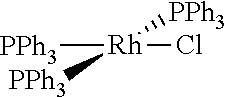
Nitrile Butadiene Rubber Used in the Examples:
| TABLE 1 |
| Nitrile Butadiene Rubber (NBR) used (“ACN” means acrylonitrile) |
| ACN | Mooney | ||||
| content | viscosity | ||||
| [% by | ML(1 + 4) | Mn | Mw | ||
| NBR | weight] | 100° C. [MU] | [g/mol] | [g/mol] | PDI |
| Perbunan ® | 34 | 29 | 77,101 | 255,395 | 3.31 |
| 3431 F | |||||
| TABLE 2 |
| Examples 1 to 7 (for all examples: hydrogenation temperature: 138° C. and pressure: 8.27 MPa) |
| Ex |
| 1* | 2 | 3 | 4 | 5* | ||
| NBR Perbunan ® | Amount [g] | 36 | 36 | 36 | 36 | 36 |
| 3431 F | ||||||
| MCB | Amount [g] | 247.5 + 15 | 247.5 + 15 | 247.5 + 15 | 247.5 + 15 | 247.5 + 15 |
| Catalyst | No. | (1) | (1) | (2) | (1) | (3) |
| Amount [mg] | 10.8 | 10.8 | 10.8 | 10.8 | 21.6 | |
| [phr] | 0.03 | 0.03 | 0.03 | 0.03 | 0.06 | |
| Co-catalyst | Type | — | EVE | EVE | EVE | PPh3 |
| Amount | — | 0.375 ml | 0.375 ml | 0.375 ml | 0.36 g | |
| Co-catalyst | Molar ratio | — | 321:1 | 307:1 | 321:1 | 59:1 |
| to catalyst | ||||||
| Pretreatment | Time [h] | 0 | 12 | 12 | 0.5 | 0 |
| Hydrogenation | Time [h] | 5 | 5 | 3 | 5 | 5 |
| Degree [%] | 85.0 | 98.1 | 98.9 | 97.3 | 96.6 | |
| HNBR | Mn [g/mol] | 59.471 | 64.283 | 57.556 | 63.095 | — |
| Mw [g/mol] | 178.552 | 186.381 | 170.413 | 161.141 | — | |
| PDI | 3 | 2.9 | 2.95 | 2.76 | — | |
| *comparative examples | ||||||
Claims (18)


CH2═CRR′ (1)


Applications Claiming Priority (4)
| Application Number | Priority Date | Filing Date | Title |
|---|---|---|---|
| WOPCT/CN2018/083913 | 2018-04-20 | ||
| CN2018083913 | 2018-04-20 | ||
| CNPCT/CN2018/083913 | 2018-04-20 | ||
| PCT/EP2019/059228 WO2019201730A1 (en) | 2018-04-20 | 2019-04-11 | Hydrogenation catalyst compositions and their use for hydrogenation of nitrile rubber |
Publications (2)
| Publication Number | Publication Date |
|---|---|
| US20210198385A1 US20210198385A1 (en) | 2021-07-01 |
| US11713361B2 true US11713361B2 (en) | 2023-08-01 |
Family
ID=66349485
Family Applications (1)
| Application Number | Title | Priority Date | Filing Date |
|---|---|---|---|
| US17/048,370 Active 2040-03-26 US11713361B2 (en) | 2018-04-20 | 2019-04-11 | Hydrogenation catalyst compositions and their use for hydrogenation of nitrile rubber |
Country Status (6)
| Country | Link |
|---|---|
| US (1) | US11713361B2 (en) |
| EP (1) | EP3781309A1 (en) |
| JP (1) | JP7433237B2 (en) |
| CN (1) | CN112004598B (en) |
| TW (1) | TW201943458A (en) |
| WO (1) | WO2019201730A1 (en) |
Families Citing this family (2)
| Publication number | Priority date | Publication date | Assignee | Title |
|---|---|---|---|---|
| CN116174037A (en) * | 2021-11-26 | 2023-05-30 | 沈阳化工研究院有限公司 | Catalyst and preparation method for selective partial hydrogenation of conjugated diene polymer |
| CN119144068B (en) * | 2023-06-15 | 2026-01-06 | 中国石油化工股份有限公司 | Hydrogenated nitrile butadiene rubber and its compositions, vulcanized rubber |
Citations (12)
| Publication number | Priority date | Publication date | Assignee | Title |
|---|---|---|---|---|
| CA2329844A1 (en) | 2000-12-28 | 2002-06-28 | Bayer Inc. | Esbo enhanced hydrogenation |
| EP1329455A1 (en) | 2002-01-22 | 2003-07-23 | Universiteit Gent | Metal carbene complexes, methods and intermediates for making them and their use in metathesis reactions |
| WO2003062253A1 (en) | 2002-01-22 | 2003-07-31 | Universiteit Gent | Metal complexes for use in metathesis |
| CN101463103A (en) | 2007-12-17 | 2009-06-24 | 朗盛公司 | Hydrogenation of a diene-based polymer latex |
| EP2484700A1 (en) | 2011-02-04 | 2012-08-08 | LANXESS Deutschland GmbH | Functionalised nitrile rubbers and their manufacture |
| CN102974772A (en) | 2012-12-07 | 2013-03-20 | 齐齐哈尔轨道交通装备有限责任公司 | Shaft box mold of rail wagon bogie |
| JP2013057295A (en) | 2011-09-08 | 2013-03-28 | Kubota Corp | Bearing device for idle gear of engine |
| WO2013056461A1 (en) | 2011-10-21 | 2013-04-25 | Lanxess Deutschland Gmbh | Catalyst compositions and their use for hydrogenation of nitrile rubber |
| CN103224591A (en) | 2013-04-24 | 2013-07-31 | 北京化工大学 | Bimetallic catalytic hydrogenation method of nitrile rubber |
| CN104024279A (en) | 2011-10-21 | 2014-09-03 | 朗盛德国有限责任公司 | Catalyst Compositions And Their Use For Hydrogenation Of Nitrile Rubber |
| WO2014198658A1 (en) | 2013-06-09 | 2014-12-18 | Lanxess Deutschland Gmbh | Ruthenium- or osmium-based complex catalysts |
| US20150025199A1 (en) * | 2011-10-21 | 2015-01-22 | Lanxess Deutschland Gmbh | Catalyst compositions and their use for hydrogenation of nitrile rubber |
Family Cites Families (10)
| Publication number | Priority date | Publication date | Assignee | Title |
|---|---|---|---|---|
| US3700637A (en) | 1970-05-08 | 1972-10-24 | Shell Oil Co | Diene-nitrile rubbers |
| US5977393A (en) | 1997-11-21 | 1999-11-02 | California Institute Of Technology | Schiff base derivatives of ruthenium and osmium olefin metathesis catalysts |
| CA2350280A1 (en) | 2001-06-12 | 2002-12-12 | Bayer Inc. | Low molecular weight hydrogenated nitrile rubber |
| TW593386B (en) | 2001-06-12 | 2004-06-21 | Bayer Inc | Process for the preparation of low molecular weight hydrogenated nitrile rubber |
| CA2455893C (en) | 2001-08-01 | 2011-01-18 | California Institute Of Technology | Hexacoordinated ruthenium or osmium metal carbene metathesis catalysts |
| ATE538139T1 (en) | 2005-08-30 | 2012-01-15 | Lanxess Deutschland Gmbh | USE OF CATALYSTS FOR METATHESIC DEGRADATION OF NITRILE RUBBER |
| EP2072532A1 (en) | 2007-12-21 | 2009-06-24 | Lanxess Deutschland GmbH | A process for removing iron-residues, rhodium- and ruthenium-containing catalyst residues from optionally hydrogenated nitrile rubber |
| CA2646056A1 (en) | 2007-12-21 | 2009-06-21 | Lanxess Deutschland Gmbh | A process for removing ruthenium-containing catalyst residues from optionally hydrogenated nitrile rubber |
| EP2418225A1 (en) | 2010-08-09 | 2012-02-15 | LANXESS Deutschland GmbH | Partially hydrated nitrile rubbers |
| WO2013153988A1 (en) | 2012-04-13 | 2013-10-17 | 株式会社ダイセル | Diepoxy compound and method for producing same |
-
2019
- 2019-04-11 EP EP19720779.8A patent/EP3781309A1/en active Pending
- 2019-04-11 JP JP2020552327A patent/JP7433237B2/en active Active
- 2019-04-11 CN CN201980026413.8A patent/CN112004598B/en active Active
- 2019-04-11 US US17/048,370 patent/US11713361B2/en active Active
- 2019-04-11 WO PCT/EP2019/059228 patent/WO2019201730A1/en not_active Ceased
- 2019-04-18 TW TW108113540A patent/TW201943458A/en unknown
Patent Citations (15)
| Publication number | Priority date | Publication date | Assignee | Title |
|---|---|---|---|---|
| CA2329844A1 (en) | 2000-12-28 | 2002-06-28 | Bayer Inc. | Esbo enhanced hydrogenation |
| EP1329455A1 (en) | 2002-01-22 | 2003-07-23 | Universiteit Gent | Metal carbene complexes, methods and intermediates for making them and their use in metathesis reactions |
| WO2003062253A1 (en) | 2002-01-22 | 2003-07-31 | Universiteit Gent | Metal complexes for use in metathesis |
| CN101463103A (en) | 2007-12-17 | 2009-06-24 | 朗盛公司 | Hydrogenation of a diene-based polymer latex |
| EP2484700A1 (en) | 2011-02-04 | 2012-08-08 | LANXESS Deutschland GmbH | Functionalised nitrile rubbers and their manufacture |
| JP2013057295A (en) | 2011-09-08 | 2013-03-28 | Kubota Corp | Bearing device for idle gear of engine |
| WO2013056461A1 (en) | 2011-10-21 | 2013-04-25 | Lanxess Deutschland Gmbh | Catalyst compositions and their use for hydrogenation of nitrile rubber |
| WO2013057295A2 (en) | 2011-10-21 | 2013-04-25 | Lanxess Deutschland Gmbh | Catalyst compositions and their use for hydrogenation of nitrile rubber |
| CN104024279A (en) | 2011-10-21 | 2014-09-03 | 朗盛德国有限责任公司 | Catalyst Compositions And Their Use For Hydrogenation Of Nitrile Rubber |
| US20140249277A1 (en) | 2011-10-21 | 2014-09-04 | Lanxess Deutschland Gmbh | Catalyst compositions and their use for hydrogenation of nitrile rubber |
| US20150025199A1 (en) * | 2011-10-21 | 2015-01-22 | Lanxess Deutschland Gmbh | Catalyst compositions and their use for hydrogenation of nitrile rubber |
| CN102974772A (en) | 2012-12-07 | 2013-03-20 | 齐齐哈尔轨道交通装备有限责任公司 | Shaft box mold of rail wagon bogie |
| CN103224591A (en) | 2013-04-24 | 2013-07-31 | 北京化工大学 | Bimetallic catalytic hydrogenation method of nitrile rubber |
| WO2014198658A1 (en) | 2013-06-09 | 2014-12-18 | Lanxess Deutschland Gmbh | Ruthenium- or osmium-based complex catalysts |
| US20160122376A1 (en) * | 2013-06-09 | 2016-05-05 | Lanxess Deutschland Gmbh | Ruthenium- or osmium-based complex catalysts |
Non-Patent Citations (12)
| Title |
|---|
| Charles E. Diesendruck et al: "The Versatile Alkylidene Moiety in Ruthenium Olefin Metathesis Catalysts", European Journal of Inorganic Chemistry, vol. 2009, No. 28, Aug. 28, 2009, pp. 4185-4203, XP055068279. |
| CHARLES E. DIESENDRUCK, TZUR EYAL, LEMCOFF N. GABRIEL: "The Versatile Alkylidene Moiety in Ruthenium Olefin Metathesis Catalysts", EUROPEAN JOURNAL OF INORGANIC CHEMISTRY, vol. 2009, no. 28, 1 October 2009 (2009-10-01), pages 4185 - 4203, XP055068279, ISSN: 14341948, DOI: 10.1002/ejic.200900526 |
| International Search Report and Written Opinion of the International Searching Authority for corresponding application PCT/EP2019/059228 dated Oct. 10, 2019. |
| International Search Report and Written Opinion of the International Searching Authority for related application PCT/CN2018/083913 dated Jan. 24, 2019. |
| Jennifer Julis et al: "Selective ethenolysis and oestrogenicity of compounds from cashew nut shell liquid", Green Chemistry, vol. 16, No. 5, Jan. 1, 2014, pp. 2846-2856, XP055428440, GB. |
| JENNIFER JULIS, STUART A. BARTLETT, SABRINA BAADER, NICOLA BERESFORD, EDWIN J. ROUTLEDGE, CATHERINE S. J. CAZIN, DAVID J. COLE-HAM: "Selective ethenolysis and oestrogenicity of compounds from cashew nut shell liquid", GREEN CHEMISTRY, ROYAL SOCIETY OF CHEMISTRY, GB, vol. 16, no. 5, 1 January 2014 (2014-01-01), GB , pages 2846 - 2856, XP055428440, ISSN: 1463-9262, DOI: 10.1039/C4GC00111G |
| Louie J et al: "Metathesis of Electron-Rich Olefins: Structure and Reactivity of Electron-Rich Carbene Complexes", Organometallics, American Chemical Society, US, vol. 21, No. 11, May 27, 2002 , pp. 2153-2164, XP001103815, ISSN: 0276-7333, DOI: 10.1021/0M011037A. |
| LOUIE J, GRUBBS R H: "METATHESIS OF ELECTRON-RICH OLEFINS: STRUCTURE AND REACTIVITY OF ELECTRON-RICH CARBENE COMPLEXES", ORGANOMETALLICS, AMERICAN CHEMICAL SOCIETY, vol. 21, no. 11, 27 May 2002 (2002-05-27), pages 2153 - 2164, XP001103815, ISSN: 0276-7333, DOI: 10.1021/om011037a |
| M. Sanford, et al.: Mechanism and activity of Ruthenium Olefin Metathesis catalysts, Journal of American Chem Soc., 2001, 123, pp. 6543-6554. |
| P. Martin, et al.: "A detailed study of the Hydrogenation of nitrile-butadiene rubber and other substrates catalyzed by RU(II) Complexes", Journal of Molecular Catalysis, 1997, 126, pp. 115-131. |
| S. Drouin, et al.: "Organometallics", AMerican Chemical Society, 2001, vol. 20, No. 26, pp. 5495-5497. |
| Stijn Monsaert et al: "A highly controllable latent Ruthenium Schiff base olefin metathesis catalyst: catalyst activation and mechanistic studies", Journal of Polymer Science, Part A: Polymer Chemistry, John Wiley & Sons, Inc, US, vol. 48, No. 2, Jan. 15, 2010, pp. 302-3010. |
Also Published As
| Publication number | Publication date |
|---|---|
| US20210198385A1 (en) | 2021-07-01 |
| CN112004598A (en) | 2020-11-27 |
| TW201943458A (en) | 2019-11-16 |
| JP2021519681A (en) | 2021-08-12 |
| WO2019201730A1 (en) | 2019-10-24 |
| CN112004598B (en) | 2024-07-19 |
| WO2019201730A4 (en) | 2020-01-23 |
| JP7433237B2 (en) | 2024-02-19 |
| EP3781309A1 (en) | 2021-02-24 |
Similar Documents
| Publication | Publication Date | Title |
|---|---|---|
| US10500578B2 (en) | Catalyst compositions and their use for hydrogenation of nitrile rubber | |
| US10508156B2 (en) | Catalyst compositions and their use for hydrogenation of nitrile rubber | |
| US10000584B2 (en) | Hydrogenation of nitrile rubber | |
| US9605088B2 (en) | Catalyst compositions and their use for hydrogenation of nitrile rubber | |
| US9598506B2 (en) | Catalyst compositions and their use for hydrogenation of nitrile rubber | |
| US20210198385A1 (en) | Hydrogenation catalyst compositions and their use for hydrogenation of nitrile rubber | |
| US11312791B2 (en) | Hydrogenation of nitrile rubber |
Legal Events
| Date | Code | Title | Description |
|---|---|---|---|
| FEPP | Fee payment procedure |
Free format text: ENTITY STATUS SET TO UNDISCOUNTED (ORIGINAL EVENT CODE: BIG.); ENTITY STATUS OF PATENT OWNER: LARGE ENTITY |
|
| STPP | Information on status: patent application and granting procedure in general |
Free format text: APPLICATION UNDERGOING PREEXAM PROCESSING |
|
| AS | Assignment |
Owner name: ARLANXEO DEUTSCHLAND GMBH, GERMANY Free format text: ASSIGNMENT OF ASSIGNORS INTEREST;ASSIGNORS:GAO, NIAN;WEI, ZHENLI;LIU, QINGCHUN;SIGNING DATES FROM 20200911 TO 20201023;REEL/FRAME:054698/0500 |
|
| STPP | Information on status: patent application and granting procedure in general |
Free format text: DOCKETED NEW CASE - READY FOR EXAMINATION |
|
| STPP | Information on status: patent application and granting procedure in general |
Free format text: NON FINAL ACTION MAILED |
|
| STPP | Information on status: patent application and granting procedure in general |
Free format text: PUBLICATIONS -- ISSUE FEE PAYMENT VERIFIED |
|
| STCF | Information on status: patent grant |
Free format text: PATENTED CASE |