US11707452B2 - Modulators of alpha-synuclein proteolysis and associated methods of use - Google Patents
Modulators of alpha-synuclein proteolysis and associated methods of use Download PDFInfo
- Publication number
- US11707452B2 US11707452B2 US16/545,983 US201916545983A US11707452B2 US 11707452 B2 US11707452 B2 US 11707452B2 US 201916545983 A US201916545983 A US 201916545983A US 11707452 B2 US11707452 B2 US 11707452B2
- Authority
- US
- United States
- Prior art keywords
- optionally substituted
- alkyl
- substituted
- group
- ulm
- Prior art date
- Legal status (The legal status is an assumption and is not a legal conclusion. Google has not performed a legal analysis and makes no representation as to the accuracy of the status listed.)
- Active, expires
Links
Images


Classifications
-
- A—HUMAN NECESSITIES
- A61—MEDICAL OR VETERINARY SCIENCE; HYGIENE
- A61K—PREPARATIONS FOR MEDICAL, DENTAL OR TOILETRY PURPOSES
- A61K31/00—Medicinal preparations containing organic active ingredients
- A61K31/33—Heterocyclic compounds
- A61K31/395—Heterocyclic compounds having nitrogen as a ring hetero atom, e.g. guanethidine or rifamycins
- A61K31/41—Heterocyclic compounds having nitrogen as a ring hetero atom, e.g. guanethidine or rifamycins having five-membered rings with two or more ring hetero atoms, at least one of which being nitrogen, e.g. tetrazole
- A61K31/425—Thiazoles
- A61K31/427—Thiazoles not condensed and containing further heterocyclic rings
-
- C—CHEMISTRY; METALLURGY
- C07—ORGANIC CHEMISTRY
- C07D—HETEROCYCLIC COMPOUNDS
- C07D417/00—Heterocyclic compounds containing two or more hetero rings, at least one ring having nitrogen and sulfur atoms as the only ring hetero atoms, not provided for by group C07D415/00
- C07D417/14—Heterocyclic compounds containing two or more hetero rings, at least one ring having nitrogen and sulfur atoms as the only ring hetero atoms, not provided for by group C07D415/00 containing three or more hetero rings
-
- A—HUMAN NECESSITIES
- A61—MEDICAL OR VETERINARY SCIENCE; HYGIENE
- A61K—PREPARATIONS FOR MEDICAL, DENTAL OR TOILETRY PURPOSES
- A61K31/00—Medicinal preparations containing organic active ingredients
- A61K31/33—Heterocyclic compounds
- A61K31/395—Heterocyclic compounds having nitrogen as a ring hetero atom, e.g. guanethidine or rifamycins
- A61K31/40—Heterocyclic compounds having nitrogen as a ring hetero atom, e.g. guanethidine or rifamycins having five-membered rings with one nitrogen as the only ring hetero atom, e.g. sulpiride, succinimide, tolmetin, buflomedil
- A61K31/403—Heterocyclic compounds having nitrogen as a ring hetero atom, e.g. guanethidine or rifamycins having five-membered rings with one nitrogen as the only ring hetero atom, e.g. sulpiride, succinimide, tolmetin, buflomedil condensed with carbocyclic rings, e.g. carbazole
- A61K31/4035—Isoindoles, e.g. phthalimide
-
- A—HUMAN NECESSITIES
- A61—MEDICAL OR VETERINARY SCIENCE; HYGIENE
- A61K—PREPARATIONS FOR MEDICAL, DENTAL OR TOILETRY PURPOSES
- A61K31/00—Medicinal preparations containing organic active ingredients
- A61K31/33—Heterocyclic compounds
- A61K31/395—Heterocyclic compounds having nitrogen as a ring hetero atom, e.g. guanethidine or rifamycins
- A61K31/41—Heterocyclic compounds having nitrogen as a ring hetero atom, e.g. guanethidine or rifamycins having five-membered rings with two or more ring hetero atoms, at least one of which being nitrogen, e.g. tetrazole
- A61K31/4245—Oxadiazoles
-
- A—HUMAN NECESSITIES
- A61—MEDICAL OR VETERINARY SCIENCE; HYGIENE
- A61K—PREPARATIONS FOR MEDICAL, DENTAL OR TOILETRY PURPOSES
- A61K31/00—Medicinal preparations containing organic active ingredients
- A61K31/33—Heterocyclic compounds
- A61K31/395—Heterocyclic compounds having nitrogen as a ring hetero atom, e.g. guanethidine or rifamycins
- A61K31/435—Heterocyclic compounds having nitrogen as a ring hetero atom, e.g. guanethidine or rifamycins having six-membered rings with one nitrogen as the only ring hetero atom
- A61K31/4353—Heterocyclic compounds having nitrogen as a ring hetero atom, e.g. guanethidine or rifamycins having six-membered rings with one nitrogen as the only ring hetero atom ortho- or peri-condensed with heterocyclic ring systems
- A61K31/437—Heterocyclic compounds having nitrogen as a ring hetero atom, e.g. guanethidine or rifamycins having six-membered rings with one nitrogen as the only ring hetero atom ortho- or peri-condensed with heterocyclic ring systems the heterocyclic ring system containing a five-membered ring having nitrogen as a ring hetero atom, e.g. indolizine, beta-carboline
-
- A—HUMAN NECESSITIES
- A61—MEDICAL OR VETERINARY SCIENCE; HYGIENE
- A61K—PREPARATIONS FOR MEDICAL, DENTAL OR TOILETRY PURPOSES
- A61K31/00—Medicinal preparations containing organic active ingredients
- A61K31/33—Heterocyclic compounds
- A61K31/395—Heterocyclic compounds having nitrogen as a ring hetero atom, e.g. guanethidine or rifamycins
- A61K31/435—Heterocyclic compounds having nitrogen as a ring hetero atom, e.g. guanethidine or rifamycins having six-membered rings with one nitrogen as the only ring hetero atom
- A61K31/44—Non condensed pyridines; Hydrogenated derivatives thereof
- A61K31/4427—Non condensed pyridines; Hydrogenated derivatives thereof containing further heterocyclic ring systems
- A61K31/4439—Non condensed pyridines; Hydrogenated derivatives thereof containing further heterocyclic ring systems containing a five-membered ring with nitrogen as a ring hetero atom, e.g. omeprazole
-
- A—HUMAN NECESSITIES
- A61—MEDICAL OR VETERINARY SCIENCE; HYGIENE
- A61K—PREPARATIONS FOR MEDICAL, DENTAL OR TOILETRY PURPOSES
- A61K31/00—Medicinal preparations containing organic active ingredients
- A61K31/33—Heterocyclic compounds
- A61K31/395—Heterocyclic compounds having nitrogen as a ring hetero atom, e.g. guanethidine or rifamycins
- A61K31/495—Heterocyclic compounds having nitrogen as a ring hetero atom, e.g. guanethidine or rifamycins having six-membered rings with two or more nitrogen atoms as the only ring heteroatoms, e.g. piperazine or tetrazines
- A61K31/496—Non-condensed piperazines containing further heterocyclic rings, e.g. rifampin, thiothixene or sparfloxacin
-
- A—HUMAN NECESSITIES
- A61—MEDICAL OR VETERINARY SCIENCE; HYGIENE
- A61K—PREPARATIONS FOR MEDICAL, DENTAL OR TOILETRY PURPOSES
- A61K31/00—Medicinal preparations containing organic active ingredients
- A61K31/33—Heterocyclic compounds
- A61K31/395—Heterocyclic compounds having nitrogen as a ring hetero atom, e.g. guanethidine or rifamycins
- A61K31/54—Heterocyclic compounds having nitrogen as a ring hetero atom, e.g. guanethidine or rifamycins having six-membered rings with at least one nitrogen and one sulfur as the ring hetero atoms, e.g. sulthiame
- A61K31/541—Non-condensed thiazines containing further heterocyclic rings
-
- A—HUMAN NECESSITIES
- A61—MEDICAL OR VETERINARY SCIENCE; HYGIENE
- A61K—PREPARATIONS FOR MEDICAL, DENTAL OR TOILETRY PURPOSES
- A61K47/00—Medicinal preparations characterised by the non-active ingredients used, e.g. carriers or inert additives; Targeting or modifying agents chemically bound to the active ingredient
- A61K47/50—Medicinal preparations characterised by the non-active ingredients used, e.g. carriers or inert additives; Targeting or modifying agents chemically bound to the active ingredient the non-active ingredient being chemically bound to the active ingredient, e.g. polymer-drug conjugates
- A61K47/51—Medicinal preparations characterised by the non-active ingredients used, e.g. carriers or inert additives; Targeting or modifying agents chemically bound to the active ingredient the non-active ingredient being chemically bound to the active ingredient, e.g. polymer-drug conjugates the non-active ingredient being a modifying agent
- A61K47/54—Medicinal preparations characterised by the non-active ingredients used, e.g. carriers or inert additives; Targeting or modifying agents chemically bound to the active ingredient the non-active ingredient being chemically bound to the active ingredient, e.g. polymer-drug conjugates the non-active ingredient being a modifying agent the modifying agent being an organic compound
- A61K47/555—Medicinal preparations characterised by the non-active ingredients used, e.g. carriers or inert additives; Targeting or modifying agents chemically bound to the active ingredient the non-active ingredient being chemically bound to the active ingredient, e.g. polymer-drug conjugates the non-active ingredient being a modifying agent the modifying agent being an organic compound pre-targeting systems involving an organic compound, other than a peptide, protein or antibody, for targeting specific cells
-
- A—HUMAN NECESSITIES
- A61—MEDICAL OR VETERINARY SCIENCE; HYGIENE
- A61P—SPECIFIC THERAPEUTIC ACTIVITY OF CHEMICAL COMPOUNDS OR MEDICINAL PREPARATIONS
- A61P25/00—Drugs for disorders of the nervous system
- A61P25/28—Drugs for disorders of the nervous system for treating neurodegenerative disorders of the central nervous system, e.g. nootropic agents, cognition enhancers, drugs for treating Alzheimer's disease or other forms of dementia
-
- C—CHEMISTRY; METALLURGY
- C07—ORGANIC CHEMISTRY
- C07D—HETEROCYCLIC COMPOUNDS
- C07D401/00—Heterocyclic compounds containing two or more hetero rings, having nitrogen atoms as the only ring hetero atoms, at least one ring being a six-membered ring with only one nitrogen atom
- C07D401/14—Heterocyclic compounds containing two or more hetero rings, having nitrogen atoms as the only ring hetero atoms, at least one ring being a six-membered ring with only one nitrogen atom containing three or more hetero rings
-
- C—CHEMISTRY; METALLURGY
- C07—ORGANIC CHEMISTRY
- C07D—HETEROCYCLIC COMPOUNDS
- C07D409/00—Heterocyclic compounds containing two or more hetero rings, at least one ring having sulfur atoms as the only ring hetero atoms
- C07D409/14—Heterocyclic compounds containing two or more hetero rings, at least one ring having sulfur atoms as the only ring hetero atoms containing three or more hetero rings
-
- C—CHEMISTRY; METALLURGY
- C07—ORGANIC CHEMISTRY
- C07D—HETEROCYCLIC COMPOUNDS
- C07D413/00—Heterocyclic compounds containing two or more hetero rings, at least one ring having nitrogen and oxygen atoms as the only ring hetero atoms
- C07D413/14—Heterocyclic compounds containing two or more hetero rings, at least one ring having nitrogen and oxygen atoms as the only ring hetero atoms containing three or more hetero rings
-
- C—CHEMISTRY; METALLURGY
- C07—ORGANIC CHEMISTRY
- C07D—HETEROCYCLIC COMPOUNDS
- C07D495/00—Heterocyclic compounds containing in the condensed system at least one hetero ring having sulfur atoms as the only ring hetero atoms
- C07D495/02—Heterocyclic compounds containing in the condensed system at least one hetero ring having sulfur atoms as the only ring hetero atoms in which the condensed system contains two hetero rings
- C07D495/04—Ortho-condensed systems
-
- C—CHEMISTRY; METALLURGY
- C07—ORGANIC CHEMISTRY
- C07D—HETEROCYCLIC COMPOUNDS
- C07D513/00—Heterocyclic compounds containing in the condensed system at least one hetero ring having nitrogen and sulfur atoms as the only ring hetero atoms, not provided for in groups C07D463/00, C07D477/00 or C07D499/00 - C07D507/00
- C07D513/02—Heterocyclic compounds containing in the condensed system at least one hetero ring having nitrogen and sulfur atoms as the only ring hetero atoms, not provided for in groups C07D463/00, C07D477/00 or C07D499/00 - C07D507/00 in which the condensed system contains two hetero rings
- C07D513/04—Ortho-condensed systems
Definitions
- Patent Application Publication No. 2018/0215731 A1; and International Patent Application No. PCT/US2016/023258, filed Mar. 18, 2016, published as International Patent Application Publication No. WO2016/149668, are incorporated herein by reference in their entirety. Furthermore, all references cited herein are incorporated by reference herein in their entirety.
- bifunctional compounds comprising a target protein binding moiety and an E3 ubiquitin ligase binding moiety, and associated methods of use.
- the bifunctional compounds are useful as modulators of targeted ubiquitination, especially with respect to ⁇ -synuclein, which is degraded and/or otherwise inhibited by bifunctional compounds according to the present disclosure.
- E3 ubiquitin ligases confer substrate specificity for ubiquitination, and therefore, are more attractive therapeutic targets than general proteasome inhibitors due to their specificity for certain protein substrates.
- the development of ligands of E3 ligases has proven challenging, in part due to the fact that they must disrupt protein-protein interactions.
- recent developments have provided specific ligands which bind to these ligases.
- Hetero-bifunctional small molecule compounds such as those that are described in U.S. Patent Application Publications 2015-0291562 and 2014-0356322 (incorporated herein by reference), function to recruit target proteins to an E3 ubiquiuin ligase, leading to poly-ubiquitylation of the target protein and its subsequent intracellular degradation via the proteasome.
- These compounds are comprised of a target protein ligand connected by a chemical linker to an E3 ligase binding moiety. Over the past decade, such compounds have been shown to degrade a variety of target proteins. These compounds provide the ability to turn weak ligands into highly potent degraders, convert promiscuous ligands into selective degraders, and use allosteric sites to degrade proteins.
- the present disclosure describes bifunctional compounds which function to recruit endogenous proteins to an E3 ubiquitin ligase for degradation, and methods of using the same.
- the present disclosure provides bifunctional or proteolysis targeting chimeric (PROTAC) compounds, which find utility as modulators of targeted ubiquitination of a variety of polypeptides and other proteins, which are then degraded and/or otherwise inhibited by the bifunctional compounds as described herein.
- An advantage of the compounds provided herein is that a broad range of pharmacological activities is possible, consistent with the degradation/inhibition of targeted polypeptides from virtually any protein class or family.
- a disease condition such as a disease or disorder associated with accumulation or aggregation of ⁇ -synuclein.
- diseases or disorders include, but are not limited to, ⁇ -synucleinopathies or neurological or neurodegenerative diseases or disorders, such as. Parkinson Disease (PD), Alzheimer's Disease (AD), dementia (e.g., dementia with Lewy bodies), or multiple system atrophy.
- PD Parkinson Disease
- AD Alzheimer's Disease
- dementia e.g., dementia with Lewy bodies
- multiple system atrophy e.g., dementia with Lewy bodies
- the disclosure provides bifunctional or PROTAC compounds, which comprise an E3 ubiquitin ligase binding moiety (i.e., a ligand for an E3 ubquitin ligase or “ULM” group), and a moiety that binds a target protein (i.e., a protein/polypeptide targeting ligand or “PTM” group) such that the target protein/polypeptide is placed in proximity to the ubiquitin ligase to effect degradation (and inhibition) of that protein.
- E3 ubiquitin ligase binding moiety i.e., a ligand for an E3 ubquitin ligase or “ULM” group
- a target protein i.e., a protein/polypeptide targeting ligand or “PTM” group
- the ULM ubiquitination ligase modulator
- VHL Von Hippel-Lindau E3 ubiquitin ligase
- CLM cereblon E3 ubiquitin ligase binding moiety
- MDM2 mouse double minute 2 homolog
- E3 ubiquitin ligase binding moiety MLM
- IAP E3 ubiquitin ligase binding moiety i.e., a “ILM”.
- the structure of the bifunctional compound can be depicted as:
- PTM and ULM moieties e.g., VLM, CLM, MLM or ILM
- their number as illustrated herein is provided by way of example only and is not intended to limit the compounds in any way.
- the bifunctional compounds as described herein can be synthesized such that the number and position of the respective functional moieties can be varied as desired.
- the bifunctional compound further comprises a chemical linker (“L”).
- L a chemical linker
- PTM is a protein/polypeptide targeting moiety.
- L is a linker, e.g., a bond or a chemical group coupling PTM to ULM
- ULM is a IAP E3 ubiquitin ligase binding moiety, or a Von Hippel-Lindau E3 ubiquitin ligase (VHL) binding moiety (VLM), or a cereblon E3 ubiquitin ligase binding moiety (CLM), or a mouse double minute 2 homolog (MDM2) E3 ubiquitin ligase binding moiety (MLM).
- VHL Von Hippel-Lindau E3 ubiquitin ligase
- CLM cereblon E3 ubiquitin ligase binding moiety
- MDM2 mouse double minute 2 homolog
- the structure of the bifunctional compound can be depicted as:
- PTM is a protein/polypeptide targeting moiety
- L is a linker (e.g., a bond or a chemical linker group) coupling the PTM and at least one of VLM, CLM, MLM, ILM, or a combination thereof
- VLM is Von Hippel-Lindau E3 ubiquitin ligase binding moiety that binds to VHL E3 ligase
- CLM is cereblon E3 ubiquitin ligase binding moiety that binds to cereblon
- MLM is an MDM2 E3 ubiquitin ligase binding moiety that binds MDM2
- ILM is a IAP binding moiety that binds to IAP.
- the ILM is an AVPI tetrapeptide fragment.
- the ILM of the bifunctional compound comprises the amino acids alanine (A), valine (V), proline (P), and isoleucine (I) or their unnatural mimetics, respectively.
- the amino acids of the AVPI tetrapeptide fragment are connected to each other through amide bonds (i.e., —C(O)NH— or —NHC(O)—).
- the compounds as described herein comprise multiple independently selected ULMs, multiple PTMs, multiple chemical linkers or a combination thereof.
- ILM comprises chemical moieties such as those described herein.
- VLM can be hydroxyproline or a derivative thereof.
- other contemplated VLMs are included in U.S. Patent Application Publication No. 2014/03022523, which as discussed above, is incorporated herein in its entirety.
- the CLM comprises a chemical group derived from an imide, a thioimide, an amide, or a thioamide.
- the chemical group is a phthalimido group, or an analog or derivative thereof.
- the CLM is thalidomide, lenalidomide, pomalidomide, analogs thereof, isosteres thereof, or derivatives thereof.
- Other contemplated CLMs are described in U.S. Patent Application Publication No. 2015/0291562, which is incorporated herein in its entirety.
- MLM can be nutlin or a derivative thereof.
- other contemplated MLMs are included in U.S. patent application Ser. No. 15/206,497 filed 11 Jul. 2016, which as discussed above, is incorporated herein in its entirety.
- the MLM of the bifunctional compound comprises chemical moieties such as substituted imidazolines, substituted spiro-indolinones, substituted pyrrolidines, substituted piperidinones, substituted morpholinones, substituted pyrrolopyrimidines, substituted imidazolopyridines, substituted thiazoloimidazoline, substituted pyrrolopyrrolidinones, and substituted isoquinolinones.
- the MLM comprises the core structures mentioned above with adjacent bis-aryl substitutions positioned as cis- or trans-configurations.
- “L” is a bond.
- the linker “L” is a connector with a linear non-hydrogen atom number in the range of 1 to 20.
- the connector “L” can contain, but not limited to the functional groups such as ether, amide, alkane, alkene, alkyne, ketone, hydroxyl, carboxylic acid, thioether, sulfoxide, and sulfone.
- the linker can contain aromatic, heteroaromatic, cyclic, bicyclic and tricyclic moieties. Substitution with halogen, such as Cl, F, Br and I can be included in the linker. In the case of fluorine substitution, single or multiple fluorines can be included.
- VLM is a derivative of trans-3-hydroxyproline, where both nitrogen and carboxylic acid in trans-3-hydroxyproline are functionalized as amides.
- CLM is a derivative of piperidine-2,6-dione, where piperidine-2,6-dione can be substituted at the 3-position, and the 3-substitution can be bicyclic hetero-aromatics with the linkage as C—N bond or C—C bond.
- Examples of CLM can be, but not limited to, pomalidomide, lenalidomide and thalidomide and their derivatives.
- the description provides therapeutic compositions comprising an effective amount of a compound as described herein or salt form thereof, and a pharmaceutically acceptable carrier.
- the therapeutic compositions modulate protein degradation and/or inhibition in a patient or subject, for example, an animal such as a human, and can be used for treating or ameliorating disease states or conditions which are modulated through the degraded/inhibited protein.
- the therapeutic compositions as described herein may be used to effectuate the degradation of proteins of interest for the treatment or amelioration of a disease, e.g. ⁇ -synucleinopathies or a neurodegenerative disease or disorder.
- the present disclosure provides a method of ubiquitinating/degrading a target protein in a cell.
- the method comprises administering a bifunctional compound as described herein comprising an ILM and a PTM, a PTM and a VLM, or a PTM and a CLM, or a PTM and a MLM, preferably linked through a linker moiety, as otherwise described herein, wherein the VLM/ILM/CLM/MLM is coupled to the PTM through a linker to target protein that binds to PTM for degradation.
- the PTM can be coupled to VLM or CLM or MLM or ILM through a linker to target a protein or polypeptide for degradation.
- Degradation of the target protein will occur when the target protein is placed in proximity to the E3 ubiquitin ligase, thus resulting in degradation/inhibition of the effects of the target protein and the control of protein levels.
- the control of protein levels afforded by the present disclosure provides treatment of a disease state or condition, which is modulated through the target protein by lowering the level of that protein in the cells of a patient.
- the description provides methods for treating or ameliorating a disease, disorder or symptom thereof in a subject or a patient, e.g., an animal such as a human, comprising administering to a subject in need thereof a composition comprising an effective amount, e.g., a therapeutically effective amount, of a compound as described herein or salt form thereof, and a pharmaceutically acceptable carrier, wherein the composition is effective for treating or ameliorating the disease or disorder or symptom thereof in the subject.
- a composition comprising an effective amount, e.g., a therapeutically effective amount, of a compound as described herein or salt form thereof, and a pharmaceutically acceptable carrier, wherein the composition is effective for treating or ameliorating the disease or disorder or symptom thereof in the subject.
- the description provides methods for identifying the effects of the degradation of proteins of interest in a biological system using compounds according to the present disclosure.
- FIGS. 1 A and 1 B Illustration of general principle for PROTAC function
- PTM protein targeting moiety
- ULM ubiquitin ligase binding moiety
- L linker moiety
- the E3 ubiquitin ligase is complexed with an E2 ubiquitin-conjugating protein, and either alone or via the E2 protein catalyzes attachment of ubiquitin (dark circles) to a lysine on the target protein via an isopeptide bond.
- the poly-ubiquitinated protein (far right) is then targeted for degradation by the proteosomal machinery of the cell.
- FIGS. 2 A and 2 B Pre-formed alpha-synuclein fibrils ( ⁇ -syn PFFs) were added to TREX tetracycline inducible HEK293 cells that overexpress A53T mutant ⁇ -syn to induce detergent-insoluble aggregates as measured by WESTM (capillary protein separation and immunoblot analysis).
- FIG. 2 A shows detection of total ⁇ -syn using MJFR1 antibody by WESTM analysis.
- Lanes 20 and 23 show control uninduced sarkosyl insoluble (SI) and soluble lysates, respectively.
- Total ⁇ -syn A53T expression was induced by doxycycline (Dox) and the resulting sarkosyl insoluble versus soluble fraction was characterized by examination of MJFR1 immunoreactivity and is shown in lane 22 compared to 25.
- Doxycycline (Dox) induced ⁇ -syn A53T cells were treated with pre-formed fibrils (PFFs) to produce higher order oligomeric ⁇ -syn A53T in the sarkosyl insoluble and soluble fractions, shown in lanes 21 and 24, respectively.
- PFFs pre-formed fibrils
- FIG. 3 Targeted degradation of sarkosyl-insoluble ⁇ -synuclein via exemplary bifunctional degradation compounds.
- Targeted degradation of sarkosyl insoluble (SI) ⁇ -synuclein via bifunctional degradation compounds was assessed by MJFR1 immunoreactivity by WESTM following treatment of PFF induced A53T ⁇ -synuclein overexpressing HEK293 cells with 1 ⁇ M bifunctional compound to DMSO vehicle control lane (lane 3).
- the molecular weight ladder lane 1 and uninduced A53T ⁇ -synuclein lane 2 is shown.
- Bifunctional degrading compounds in lanes 5 (Exemplary Compound 25), 7 (Exemplary Compound 13), 8 (Exemplary Compound 12), and 9 (Exemplary Compound 9) resulted in cytotoxicity (data not shown) at the concentration tested and did not see a decrease in sarkosyl insoluble ⁇ -synuclein.
- FIG. 4 Development of a conformational specific ELISA for ⁇ -Synuclein aggregates.
- Conformational specific ⁇ -synuclein ELISA was developed by coating High Binding 96-well ELISA plates with MJFF-14-6-4-2 antibody (Corning; Abeam).
- PFF oligomeric synuclein or monomeric synuclein were made as described in Graef et al., 2019 (full citation included below) and dilution curves were generated with the highest standard concentration of 600 ng/ml.
- MJFF-14-6-4-2 secondary antibody previously conjugated to alkaline phosphatase (AP; Novus Biologicals) was added to the ELISA plates for detection.
- Specificity for oligomeric ⁇ -synuclein is shown in squares compared to monomer in triangles. The linear range for detection of oligomeric ⁇ -synuclein is about 2 to about 150 ng/ml.
- FIG. 5 Exemplary ⁇ -synuclein targeting bifunctional degrader compounds induce degradation of oligomeric ⁇ -synuclein.
- Targeted degradation of sarkosyl insoluble (SI) ⁇ -synuclein via exemplary bifunctional compounds was assessed by MJFF-14-6-4-2 conformation specific ELISA following treatment of PFF induced A53T ⁇ -synuclein overexpressing HEK293 cells with 1 ⁇ M bifunctional compounds compared to DMSO vehicle control lanes.
- FIGS. 6 A and 6 B ⁇ -Synuclein bifunctional degradation compound activity requires the E3 ligase activity for effective degradation.
- Pre-formed alpha-synuclein fibrils ⁇ -syn PFFs
- TREX tetracycline inducible HEK293 cells that overexpress A53T mutant ⁇ -syn to induce detergent-insoluble oligomers as measured by Oligomer ELISA.
- Doxycycline induced ⁇ -syn A53T cells were treated with PFFs to produce higher order oligomeric ⁇ -syn A53T in the sarkosyl insoluble fraction and SI ⁇ -syn oligomers were detected by ELISA, as described in below.
- Exemplary bifunctional degradation compounds 7 and 23 at 1 uM concentration used to generate the data shown in bars 1 and 3, reduced sarkosyl insoluble ⁇ -syn.
- Fifteen-fold excess E3 ligase ligands, VHL Ligand and Cereblon Ligand, shown in FIG. 6 B used to generate the data shown in bars 2 and 4, when co-incubated with the exemplary bifunctional compound treatment effectively competed the activity of the exemplary bifunctional compound to induce targeted degradation of ⁇ -syn.
- compositions and methods that relate to the surprising and unexpected discovery that an E3 ubiquitin ligase protein (e.g., inhibitors of apoptosis proteins (IAP), a Von Hippel-Lindau E3 ubiquitin ligase (VHL), a cereblon E3 ubiquitin ligase, or a mouse double minute 2 homolog (MDM2) E3 ubiquitin ligase) ubiquitinates a target protein once it and the target protein are placed in proximity by a bifunctional or chimeric construct that binds the E3 ubiquitin ligase protein and the target protein.
- IAP inhibitors of apoptosis proteins
- VHL Von Hippel-Lindau E3 ubiquitin ligase
- MDM2 mouse double minute 2 homolog
- the present disclosure provides such compounds and compositions comprising an E3 ubiquintin ligase binding moiety (“ULM”) coupled to a protein target binding moiety (“PTM”), which result in the ubiquitination of a chosen target protein, which leads to degradation of the target protein by the proteasome (see FIG. 1 ).
- ULM E3 ubiquintin ligase binding moiety
- PTM protein target binding moiety
- the present disclosure also provides a library of compositions and the use thereof.
- the present disclosure provides compounds which comprise a ligand, e.g., a small molecule ligand (i.e., having a molecular weight of below 2,000, 1,000, 500, or 200 Daltons), which is capable of binding to a ubiquitin ligase, such as IAP. VHL. MDM2, or cereblon.
- a ligand e.g., a small molecule ligand (i.e., having a molecular weight of below 2,000, 1,000, 500, or 200 Daltons)
- the compounds also comprise a moiety that is capable of binding to target protein, in such a way that the target protein is placed in proximity to the ubiquitin ligase to effect degradation (and/or inhibition) of that protein.
- Small molecule can mean, in addition to the above, that the molecule is non-peptidyl, that is, it is not generally considered a peptide, e.g., comprises fewer than 4, 3, or 2 amino acids.
- the PTM, ULM or PROTAC molecule can be a small molecule.
- a reference to “A and/or B”, when used in conjunction with open-ended language such as “comprising” can refer, in one embodiment, to A only (optionally including elements other than B); in another embodiment, to B only (optionally including elements other than A); in yet another embodiment, to both A and B (optionally including other elements); etc.
- the phrase “at least one.” in reference to a list of one or more elements should be understood to mean at least one element selected from anyone or more of the elements in the list of elements, but not necessarily including at least one of each and every element specifically listed within the list of elements and not excluding any combinations of elements in the list of elements.
- This definition also allows that elements may optionally be present other than the elements specifically identified within the list of elements to which the phrase “at least one” refers, whether related or unrelated to those elements specifically identified.
- “at least one of A and B” (or, equivalently.
- “at least one of A or B,” or, equivalently “at least one of A and/or B”) can refer, in one embodiment, to at least one, optionally including more than one, A, with no B present (and optionally including elements other than B); in another embodiment, to at least one, optionally including more than one, B, with no A present (and optionally including elements other than A); in yet another embodiment, to at least one, optionally including more than one, A, and at least one, optionally including more than one, B (and optionally including other elements); etc.
- co-administration and “co-administering” or “combination therapy” refer to both concurrent administration (administration of two or more therapeutic agents at the same time) and time varied administration (administration of one or more therapeutic agents at a time different from that of the administration of an additional therapeutic agent or agents), as long as the therapeutic agents are present in the patient to some extent, preferably at effective amounts, at the same time.
- one or more of the present compounds described herein are coadministered in combination with at least one additional bioactive agent, especially including an anti-neurodegenerative agent.
- the co-administration of compounds results in synergistic activity and/or therapy, including anti-neurodegenerative activity.
- anti-neurodegenerative agent or “additional anti-neurodegenerative agent” is used to describe an anti-neurodegenerative agent, which may be combined with PROTAC compounds according to the present description to treat neurodenerative diseases.
- compound refers to any specific chemical compound disclosed herein and includes tautomers, regioisomers, geometric isomers, and where applicable, stereoisomers, including optical isomers (enantiomers) and other stereoisomers (diastereomers) thereof, as well as pharmaceutically acceptable salts and derivatives, including prodrug and/or deuterated forms thereof where applicable, in context.
- Deuterated small molecules contemplated are those in which one or more of the hydrogen atoms contained in the drug molecule have been replaced by deuterium.
- the term compound generally refers to a single compound, but also may include other compounds such as stereoisomers, regioisomers and/or optical isomers (including racemic mixtures) as well as specific enantiomers or enantiomerically enriched mixtures of disclosed compounds.
- the term also refers, in context to prodrug forms of compounds which have been modified to facilitate the administration and delivery of compounds to a site of activity. It is noted that in describing the present compounds, numerous substituents and variables associated with same, among others, are described. It is understood by those of ordinary skill that molecules which are described herein are stable compounds as generally described hereunder. When the bond is shown, both a double bond and single bond are represented or understood within the context of the compound shown and well-known rules for valence interactions.
- ubiquitin ligase refers to a family of proteins that facilitate the transfer of ubiquitin to a specific substrate protein, targeting the substrate protein for degradation.
- IAP an E3 ubiquitin ligase protein that alone or in combination with an E2 ubiquitin-conjugating enzyme causes the attachment of ubiquitin to a lysine on a target protein, and subsequently targets the specific protein substrates for degradation by the proteasome.
- E3 ubiquitin ligase alone or in complex with an E2 ubiquitin conjugating enzyme is responsible for the transfer of ubiquitin to targeted proteins.
- the ubiquitin ligase is involved in polyubiquitination such that a second ubiquitin is attached to the first; a third is attached to the second, and so forth.
- Polyubiquitination marks proteins for degradation by the proteasome.
- Mono-ubiquitinated proteins are not targeted to the proteasome for degradation, but may instead be altered in their cellular location or function, for example, via binding other proteins that have domains capable of binding ubiquitin.
- different lysines on ubiquitin can be targeted by an E3 to make chains. The most common lysine is Lys48 on the ubiquitin chain. This is the lysine used to make polyubiquitin, which is recognized by the proteasome.
- patient or “subject” is used throughout the specification to describe an animal, preferably a human or a domesticated animal, to whom treatment, including prophylactic treatment, with the compositions according to the present disclosure is provided.
- patient refers to that specific animal, including a domesticated animal such as a dog or cat or a farm animal such as a horse, cow, sheep, etc.
- patient refers to a human patient unless otherwise stated or implied from the context of the use of the term.
- the description provides compounds comprising an E3 ubiquitin ligase binding moiety (“ULM”) that is an IAP E3 ubiquitin ligase binding moiety (an “ILM”), a cereblon E3 ubiquitin ligase binding moiety (a “CLM”), a Von Hippel-Lindae E3 ubiquitin ligase (VHL) binding moiety (VLM), and/or a mouse double minute 2 homologue (MDM2) E3 ubiquitin ligase binding moiety (MLM).
- ULM E3 ubiquitin ligase binding moiety
- ILM IAP E3 ubiquitin ligase binding moiety
- CLM Cerblon E3 ubiquitin ligase binding moiety
- VHL Von Hippel-Lindae E3 ubiquitin ligase binding moiety
- MDM2 mouse double minute 2 homologue
- the ULM is coupled to a target protein binding moiety (PTM) via a chemical linker (L) according to the structure: PTM-L-ULM (A) wherein L is a bond or a chemical linker group, ULM is a E3 ubiquitin ligase binding moiety, and PTM is a target protein binding moiety.
- L is a bond or a chemical linker group
- ULM is a E3 ubiquitin ligase binding moiety
- PTM is a target protein binding moiety.
- the number and/or relative positions of the moieties in the compounds illustrated herein is provided by way of example only. As would be understood by the skilled artisan, compounds described herein can be synthesized with any desired number and/or relative position of the respective functional moieties.
- ULM is inclusive of all ULMs, including those that bind IAP (i.e., ILMs), MDM2 (i.e., MLM), cereblon (i.e., CLM), and VHL (i.e., VLM).
- ILM is inclusive of all possible IAP E3 ubiquitin ligase binding moieties
- MLM is inclusive of all possible MDM2 E3 ubiquitin ligase binding moieties
- VLM is inclusive of all possible VHL binding moieties
- CLM is inclusive of all cereblon binding moieties.
- the present disclosure provides bifunctional or multifunctional compounds (e.g., PROTACs) useful for regulating protein activity by inducing the degradation of a target protein.
- the compound comprises an ILM or a VLM or a CLM or a MLM coupled, e.g., linked covalently, directly or indirectly, to a moiety that binds a target protein (i.e., a protein targeting moiety or a “PTM”).
- the ILM/VLM/CLM/MLM and PTM are joined or coupled via a chemical linker (L).
- the ILM binds the IAP E3 ubiquitin ligase
- the VLM binds VHL.
- CLM binds the cereblon E3 ubiquitin ligase
- MLM binds the MDM2 E3 ubiquitin ligase
- PTM recognizes a target protein and the interaction of the respective moieties with their targets facilitates the degradation of the target protein by placing the target protein in proximity to the ubiquitin ligase protein.
- An exemplary bifunctional compound can be depicted as: PTM-ILM (B) PTM-CLM (C) PTM-VLM (D) PTM-MLM (E)
- the bifunctional compound further comprises a chemical linker (“L”).
- L a chemical linker
- the bifunctional compound can be depicted as: PTM-L-ILM (F) PTM-L-CLM (G) PTM-L-VLM (H) PTM-L-MLM (I)
- the PTM is a protein/polypeptide targeting moiety
- the L is a chemical linker
- the ILM is a IAP E3 ubiquitin ligase binding moiety
- the CLM is a cereblon E3 ubiquitin ligase binding moiety
- the VLM is a VHL binding moiety
- the MLM is a MDM2 E3 ubiquitin ligase binding moiety.
- the ULM (e.g., a ILM, a CLM, a VLM, or a MLM) shows activity or binds to the E3 ubiquitin ligase (e.g., IAP E3 ubiquitin ligase, cereblon E3 ubiquitin ligase. VHL, or MDM2 E3 ubiquitin ligase) with an IC 50 of less than about 200 ⁇ M.
- the IC 50 can be determined according to any method known in the art, e.g., a fluorescent polarization assay.
- the bifunctional compounds described herein demonstrate an activity with an IC 50 of less than about 100, 50, 10, 1, 0.5, 0.1, 0.05, 0.01, 0.005, 0.001 mM, or less than about 100, 50, 10, 1, 0.5, 0.1, 0.05, 0.01, 0.005, 0.001 ⁇ M, or less than about 100, 50, 10, 1, 0.5, 0.1, 0.05, 0.01, 0.005, 0.001 nM, or less than about 100, 50, 10, 1, 0.5, 0.1, 0.05, 0.01, 0.005, 0.001 ⁇ M.
- the compounds as described herein comprise multiple PTMs (targeting the same or different protein targets), multiple ULMs, one or more ULMs (i.e., moieties that bind specifically to multiple/different E3 ubiquitin ligase, e.g., VHL, IAP, cereblon, and/or MDM2) or a combination thereof.
- the PTMs and ULMs e.g., ILM. VLM, CLM, and/or MLM
- the ULMs can be for the same E3 ubiquintin ligase or each respective ULM can bind specifically to a different E3 ubiquitin ligase.
- the PTMs can bind the same target protein or each respective PTM can bind specifically to a different target protein.
- the ULMs are identical.
- the compound comprising a plurality of ULMs e.g., ULM, ULM′, etc.
- the compound comprising a plurality of ULMs further comprises multiple PTMs.
- the PTMs are the same or, optionally, different.
- the respective PTMs may bind the same protein target or bind specifically to a different protein target.
- the compound may comprise a plurality of ULMs and/or a plurality of ULM's.
- the compound comprising at least two different ULMs, a plurality of ULMs, and/or a plurality of ULM's further comprises at least one PTM coupled to a ULM or a ULM′ directly or via a chemical linker or both.
- a compound comprising at least two different ULMs can further comprise multiple PTMs.
- the PTMs are the same or, optionally, different.
- wherein the PTMs are different the respective PTMs may bind the same protein target or bind specifically to a different protein target.
- the PTM itself is a ULM (or ULM′), such as an ILM, a VLM, a CLM, a MLM, an ILM′, a VLM′, a CLM′, and/or a MLM′.
- the description provides the compounds as described herein including their enantiomers, diastereomers, solvates and polymorphs, including pharmaceutically acceptable salt forms thereof, e.g., acid and base salt forms.
- the ILM can comprise an alanine-valine-proline-isoleucine (AVPI) tetrapeptide fragment or an unnatural mimetic thereof.
- AVPI alanine-valine-proline-isoleucine
- the ILM is selected from the group consisting of chemical structures represented by Formulas (I), (II), (III), (IV), and (V):
- P1, P2, P3, and P4 of Formula (II) correlate with A, V, P, and I, respectively, of the AVPI tetrapeptide fragment or an unnatural mimetic thereof.
- each of Formulas (I) and (III) through (V) have portions correlating with A, V, P, and I of the AVPI tetrapeptide fragment or an unnatural mimetic thereof.
- the ILM can have the structure of Formula (VI), which is a derivative of IAP antagonists described in WO Pub. No. 2008/014236, or an unnatural mimetic thereof:
- the ILM can have the structure of Formula (VIII), which is based on the IAP ligrands described in Ndubaku, C., et al. Antagonism of c-IAP and XIAP proteins is required for efficient induction of cell death by small-molecule IAP antagonists, ACS Chem. Biol., 557-566, 4 (7) (2009), or an unnatural mimetic thereof:
- each of A1 and A2 of Formula (VIII) is independently selected from optionally substituted monocyclic, fused rings, aryls and hetoroaryls;
- R of Formula (VIII) is selected from H or Me.
- the linker group L is attached to A1 of Formula (VIII). In another embodiment, the linker group L is attached to A2 of Formula (VIII).
- the ILM is selected from the group consisting of
- the ILM can have the structure of Formula (IX), which is derived from the chemotypes cross-referenced in Mannhold. R., et al. IAP antagonists: promising candidates for cancer therapy. Drug Discov. Today, 15 (5-6), 210-9 (2010), or an unnatural mimetic thereof:
- R 1 is selected from alkyl, cycloalkyl and heterocycloalkyl and, most preferably, from isopropyl, tert-butyl, cyclohexyl and tetrahydropyranyl, and R 2 of Formula (IX) is selected from —OPh or H.
- the ILM can have the structure of Formula (X), which is derived from the chemotypes cross-referenced in Mannhold, R., et al. IAP antagonists: promising candidates for cancer therapy. Drug Discov. Today, 15 (5-6), 210-9 (2010), or an unnatural mimetic thereof:
- R 1 of Formula (X) is selected from H, —CH 2 OH, —CH 2 CH 2 OH, —CH 2 NH 2 , —CH 2 CH 2 NH 2 ;
- X of Formula (X) is selected from S or CH 2 ;
- R 2 of Formula (X) is selected from:
- R 3 and R 4 of Formula (X) are independently selected from H or Me
- the ILM can have the structure of Formula (XI), which is derived from the chemotypes cross-referenced in Mannhold, R., et al. IAP antagonists: promising candidates for cancer therapy. Drug Discov. Today, 15 (5-6), 210-9 (2010), or an unnatural mimetic thereof:
- R 1 of Formula (XI) is selected from H or Me
- R 2 of Formula (XI) is selected from H or
- the ILM can have the structure of Formula (XII), which is derived from the chemotypes cross-referenced in Mannhold, R., et al. IAP antagonists: promising candidates for cancer therapy. Drug Discov. Today, 15 (5-6), 210-9 (2010), or an unnatural mimetic thereof:
- R 1 of Formula (XII) is selected from:
- R 2 of Formula (XII) is selected from:
- the IAP E3 ubiquitin ligase binding moiety is selected from the group consisting of:
- the ILM can have the structure of Formula (XIII), which is based on the IAP ligands summarized in Flygare, J. A., et al. Small-molecule pan-IAP antagonists: a patent review. Expert Opin. Ther. Pat., 20 (2), 251-67 (2010), or an unnatural mimetic thereof:
- Z of Formula (XIII) is absent or O;
- R 1 of Formula (XIII) is selected from:
- X is selected from CH 2 and O;
- the ILM can have the structure of Formula (XIV), which is based on the IAP ligands summarized in Flygare, J. A., et al. Small-molecule pan-IAP antagonists: a patent review, Expert Opin. Ther. Pat., 20 (2), 251-67 (2010), or an unnatural mimetic thereof:
- Z of Formula (XIV) is absent or O;
- the ILM is selected from the group consisting of:
- the ILM can have the structure of Formula (XV), which was a derivative of the IAP ligand described in WO Pub. No. 2008/128171, or an unnatural mimetic thereof:
- Z of Formula (XV) is absent or O;
- R 1 of Formula (XV) is selected from:
- R 2 of Formula (XV) selected from H, alkyl, or acyl
- the ILM has the following structure:
- the ILM can have the structure of Formula (XVI), which is based on the IAP ligand described in WO Pub. No. 2006/069063, or an unnatural mimetic thereof:
- Formula (XVI) is a 5- or 6-membered nitrogen-containing heteroaryl; more preferably, 5-membered nitrogen-containing heteroaryl, and most preferably thiazole; and Ar of Formula (XVI) is an aryl or a heteroaryl.
- the ILM can have the structure of Formula (XVII), which is based on the IAP ligands described in Cohen, F, et al., Antogonists of inhibitors of apoptosis proteins based on thiazole amide isosteres, Bioorg. Med. Chem. Lett., 20(7), 2229-33 (2010), or an unnatural mimetic thereof:
- R 1 of Formula (XVII) is selected from the group halogen (e.g. fluorine), cyano,
- X of Formula (XVII) is selected from the group O or CH 2 .
- the ILM can have the structure of Formula (XVIII), which is based on the IAP ligands described in Cohen. F, et al., Antogonists of inhibitors of apoptosis proteins based on thiazole amide isosteres, Bioorg. Med. Chem. Lett., 20(7), 2229-33 (2010), or an unnatural mimetic thereof:
- R of Formula (XVIII) is selected from alkyl, aryl, heteroaryl, arylalkyl, heteroarylalkyl or halogen (in variable substitution position).
- the ILM can have the structure of Formula (XIX), which is based on the IAP ligands described in Cohen, F, et al., Antogonists of inhibitors of apoptosis proteins based on thiazole amide isosteres , Bioorg. Med. Chem. Lett., 20(7), 2229-33 (2010), or an unnatural mimetic thereof:
- the ILM of the composition is selected from the group consisting of:
- the ILM of the composition is selected from the group consisting of:
- the ILM can have the structure of Formula (XX), which is based on the IAP ligands described in WO Pub. No. 2007/101347, or an unnatural mimetic thereof:
- X of Formula (XX) is selected from CH 2 , O, NH, or S.
- the ILM can have the structure of Formula (XXI), which is based on the IAP ligands described in U.S. Pat. Nos. 7,345,081 and 7,419,975, or an unnatural mimetic thereof:
- R 2 of Formula (XXI) is selected from:
- R 5 of Formula (XXI) is selected from:
- W of Formula (XXI) is selected from CH or N;
- the ILM of the compound is selected from the group consisting of:
- the ILM can have the structure of Formula (XXII) or (XXIV), which are derived from the IAP ligands described in WO Pub. No. 2015/006524 and Perez H L, Discovery of potent heterodimeric antagonists of inhibitor of apoptosis proteins ( IAPs ) with sustained antitumor activity . J. Med. Chem. 58(3), 1556-62 (2015), or an unnatural mimetic thereof, and the chemical linker to linker group L as shown:
- R 7 and R 8 are selected from the H or Me
- R 5 and R 6 are selected from the group comprising:
- R 3 and R 4 are selected from the group comprising:
- the ILM can have the structure of Formula (XXV), (XXVI), (XXVII), or (XXVIII), which are derived from the IAP ligands described in WO Pub. No. 2014/055461 and Kim, K S, Discovery of tetrahydroisoquinoline - based bivalent heterodimeric IAP antagonists . Bioorg. Med. Chem. Lett. 24(21), 5022-9 (2014), or an unnatural mimetic thereof, and the chemical linker to linker group L as shown:
- the ILM can have the structure of Formula (XXIX) or (XXX), which are derived from the IAP ligands described in WO Pub. No. 2013/071039, or an unnatural mimetic thereof:
- each Y is selected from:
- the ILM can have the structure of Formula (XXXI), which are derived from the IAP ligands described in WO Pub. No. 2013/071039, or an unnatural mimetic thereof:
- the ILM can have the structure of Formula (XXXII), which are derived from the IAP ligands described in WO Pub. No. 2013/071039, or an unnatural mimetic thereof:
- the ILM can have the structure of Formula (XLIII), which is derived from the IAP ligands described in WO Pub. No. 2013/071039, or an unnatural mimetic thereof:
- the ILM can have the structure of Formula (XXXIV), which is derived from the IAP ligands described in WO Pub. No. 2013/071039, or an unnatural mimetic thereof:
- the ILM can have the structure of Formula (XXXV), (XXXVI) or (XXXVII), which is derived from the IAP ligands described in Vamos, M., et al., Expedient synthesis of highly potent antagonists of inhibitor of apoptosis proteins ( IAPs ) with unique selectivity for ML - IAP , ACS Chem. Biol., 8(4), 725-32 (2013), or an unnatural mimetic thereof:
- R 2 of Formulas (XXXV) and (XXXVII) are independently selected from H or ME;
- R 3 and R 4 of Formula (XXXV) are independently selected from H or ME;
- X of Formulas (XXXV) and (XXXVII) is independently selected from O or S;
- R 1 of Formulas (XXXV) and (XXXVII) is selected from:
- the ILM has a structure according to Formula (XXXVIII):
- R 3 and R 4 of Formula (XXXVIII) are independently selected from H or ME;
- the ILM has a structure and attached to a linker group L as shown below:
- the ILM can have the structure of Formula (XXXIX) or (XL), which is based on the IAP ligands described in Hennessy, E J, et al., Discovery of aminopiperidine - based Smac mimetics as IAP antagonists , Bioorg. Med. Chem. Lett., 22(4), 1960-4 (2012), or an unnatural mimetic thereof:
- R 1 of Formulas (XXXIX) and (XL) is selected from:
- R 2 of Formulas (XXXIX) and (XL) is selected from H or Me;
- R 3 of Formulas (XXXIX) and (XL) is selected from:
- X of is selected from H, halogen, methyl, methoxy, hydroxy, nitro or trifluoromethyl.
- the ILM can have the structure of and be chemically linked to the linker as shown in Formula (XLI) or (XLII), or an unnatural mimetic thereof:
- the ILM can have the structure of Formula (XLIII), which is based on the IAP ligands described in Cohen. F, et al., Orally bioavailable antagonists of inhibitor of apoptosis proteins based on an azabicyclooctane scaffold , J. Med. Chem., 52(6), 1723-30 (2009), or an unnatural mimetic thereof:
- R1 of Formulas (XLIII) is selected from:
- the ILM is represented by the following structure:
- the ILM is selected from the group consisting of, and which the chemical link between the ILM and linker group L is shown:
- the ILM is selected from the group consisting of the structures below, which are based on the IAP ligands described in Asano. M, et al., Design, sterioselective synthesis, and biological evaluation of novel tri - cyclic compounds as inhibitor of apoptosis proteins ( IAP ) antagonists , Bioorg. Med. Chem., 21(18): 5725-37 (2013), or an unnatural mimetic thereof:
- the ILM is selected from the group consisting of, and which the chemical link between the ILM and linker group L is shown:
- the ILM can have the structure of Formula (LVIII), which is based on the IAP ligands described in Asano, M, et al., Design, sterioselective synthesis, and biological evaluation of novel tri - cyclic compounds as inhibitor of apoptosis proteins ( IAP ) antagonists , Bioorg. Med. Chem., 21(18): 5725-37 (2013), or an unnatural mimetic thereof:
- X of Formula (XLIV) is one or two substituents independently selected from H, halogen or cyano.
- the ILM can have the structure of and be chemically linked to the linker group L as shown in Formula (XLV) or (XLVI), or an unnatural mimetic thereof:
- X of Formula (XLV) and (XLVI) is one or two substituents independently selected from H, halogen or cyano, and; and L of Formulas (XLV) and (XLVI) is a linker group as described herein.
- the ILM can have the structure of Formula (XLVII), which is based on the IAP ligands described in Ardecky, R J, et al., Design, synthesis and evaluation of inhibitor of apoptosis ( IAP ) antagonists that are highly selective for the BIR 2 domain of XIAP , Bioorg. Med. Chem., 23(14): 4253-7 (2013), or an unnatural mimetic thereof:
- XLVII Formula
- R 2 of Formula (LXI) is selected from:
- the ILM can have the structure of and be chemically linked to the linker group L as shown in Formula (XLVIII) or (XLIX), or an unnatural mimetic thereof:
- Formulas (XLVIII) and (XLIX) is a natural or unnatural amino acid; and L of Formulas (XLVIII) and (XLIX) is a linker group as described herein.
- the ILM can have the structure selected from the group consisting of, which is based on the IAP ligands described in Wang. J, et al., Discovery of novel second mitochondrial - derived activator of caspase mimetics as selective inhibitor or apoptosis protein inhibitors , J. Pharmacol. Exp. Ther., 349(2): 319-29 (2014), or an unnatural mimetic thereof:
- the ILM has a structure according to Formula (L), which is based on the IAP ligands described in Hird, A W, et al., Structure-based design and synthesis of tricyclic IAP (Inhibitors of Apoptosis Proteins) inhibitors. Bioorg. Med. Chem. Lett., 24(7): 1820-4 (2014), or an unnatural mimetic thereof:
- R of Formula (L) is selected from the group consisting of:
- the ILM of the compound has a chemical structure selected from the group consisting of:
- alkyl shall mean within its context a linear, branch-chained or cyclic fully saturated hydrocarbon radical or alkyl group, preferably a C 1 -C 10 , more preferably a C 1 -C 6 , alternatively a C 1 -C 3 alkyl group, which may be optionally substituted.
- alkyl groups are methyl, ethyl, n-butyl, sec-butyl, n-hexyl, n-heptyl, n-octyl, n-nonyl, n-decyl, isopropyl, 2-methylpropyl, cyclopropyl, cyclopropylmethyl, cyclobutyl, cyclopentyl, cyclopen-tylethyl, cyclohexylethyl and cyclohexyl, among others.
- the alkyl group is end-capped with a halogen group (At, Br, Cl, F, or I).
- compounds according to the present disclosure which may be used to covalently bind to dehalogenase enzymes.
- These compounds generally contain a side chain (often linked through a polyethylene glycol group) which terminates in an alkyl group which has a halogen substituent (often chlorine or bromine) on its distal end which results in covalent binding of the compound containing such a moiety to the protein.
- alkenyl refers to linear, branch-chained or cyclic C 2 -C 10 (preferably C 2 -C 6 ) hydrocarbon radicals containing at least one C ⁇ C bond.
- Alkynyl refers to linear, branch-chained or cyclic C 2 -C 10 (preferably C 2 -C 6 ) hydrocarbon radicals containing at least one C—C bond.
- alkylene when used, refers to a —(CH 2 ) n — group (n is an integer generally from 0-6), which may be optionally substituted.
- the alkylene group preferably is substituted on one or more of the methylene groups with a C 1 -C 6 alkyl group (including a cyclopropyl group or a t-butyl group), but may also be substituted with one or more halo groups, preferably from 1 to 3 halo groups or one or two hydroxyl groups, O—(C 1 -C 6 alkyl) groups or amino acid sidechains as otherwise disclosed herein.
- an alkylene group may be substituted with a urethane or alkoxy group (or other group) which is further substituted with a polyethylene glycol chain (of from 1 to 10, preferably 1 to 6, often 1 to 4 ethylene glycol units) to which is substituted (preferably, but not exclusively on the distal end of the polyethylene glycol chain) an alkyl chain substituted with a single halogen group, preferably a chlorine group.
- a polyethylene glycol chain of from 1 to 10, preferably 1 to 6, often 1 to 4 ethylene glycol units
- the alkylene (often, a methylene) group may be substituted with an amino acid sidechain group such as a sidechain group of a natural or unnatural amino acid, for example, alanine, 3-alanine, arginine, asparagine, aspartic acid, cysteine, cystine, glutamic acid, glutamine, glycine, phenylalanine, histidine, isoleucine, lysine, leucine, methionine, proline, serine, threonine, valine, tryptophan or tyrosine.
- an amino acid sidechain group such as a sidechain group of a natural or unnatural amino acid, for example, alanine, 3-alanine, arginine, asparagine, aspartic acid, cysteine, cystine, glutamic acid, glutamine, glycine, phenylalanine, histidine, isoleucine, lysine, leucine, methionine, proline
- unsubstituted shall mean substituted only with hydrogen atoms.
- a range of carbon atoms which includes C 0 means that carbon is absent and is replaced with H.
- a range of carbon atoms which is C 0 -C 6 includes carbons atoms of 1, 2, 3, 4, 5 and 6 and for C 0 , H stands in place of carbon.
- substituted or “optionally substituted” shall mean independently (i.e., where more than substituent occurs, each substituent is independent of another substituent) one or more substituents (independently up to five substitutents, preferably up to three substituents, often 1 or 2 substituents on a moiety in a compound according to the present disclosure and may include substituents which themselves may be further substituted) at a carbon (or nitrogen) position anywhere on a molecule within context, and includes as substituents hydroxyl, thiol, carboxyl, cyano (C ⁇ N), nitro (NO 2 ), halogen (preferably, 1, 2 or 3 halogens, especially on an alkyl, especially a methyl group such as a trifluoromethyl), an alkyl group (preferably, C 1 -C 10 , more preferably, C 1 -C 6 ), aryl (especially phenyl and substituted phenyl for example benzyl or benzoyl), alkoxy group (
- Substituents according to the present disclosure may include, for example —SiR 1 R 2 R 3 groups where each of R 1 and R 2 is as otherwise described herein and R 3 is H or a C 1 -C 6 alkyl group, preferably R 1 , R 2 , R 3 in this context is a C 1 -C 3 alkyl group (including an isopropyl or t-butyl group).
- Each of the above-described groups may be linked directly to the substituted moiety or alternatively, the substituent may be linked to the substituted moiety (preferably in the case of an aryl or heteraryl moiety) through an optionally substituted —(CH 2 ) m — or alternatively an optionally substituted —(OCH 2 ) m —, —(OCH 2 CH 2 ) m — or —(CH 2 CH 2 O) m — group, which may be substituted with any one or more of the above-described substituents.
- Alkylene groups —(CH 2 ) m — or —(CH 2 ) n — groups or other chains such as ethylene glycol chains, as identified above, may be substituted anywhere on the chain.
- Preferred substitutents on alkylene groups include halogen or C 1 -C 6 (preferably C 1 -C 3 ) alkyl groups, which may be optionally substituted with one or two hydroxyl groups, one or two ether groups (O—C 1 -C 6 groups), up to three halo groups (preferably F), or a sideshain of an amino acid as otherwise described herein and optionally substituted amide (preferably carboxamide substituted as described above) or urethane groups (often with one or two C 0 -C 6 alkyl substitutents, which group(s) may be further substituted).
- the alkylene group (often a single methylene group) is substituted with one or two optionally substituted C 1 -C 6 alkyl groups, preferably C 1 -C 4 alkyl group, most often methyl or O-methyl groups or a sidechain of an amino acid as otherwise described herein.
- a moiety in a molecule may be optionally substituted with up to five substituents, preferably up to three substituents. Most often, in the present disclosure moieties which are substituted are substituted with one or two substituents.
- substituted (each substituent being independent of any other substituent) shall also mean within its context of use C 1 -C 6 alkyl, C 1 -C 6 alkoxy, halogen, amido, carboxamido, sulfone, including sulfonamide, keto, carboxy, C 1 -C 6 ester (oxyester or carbonylester), C 1 -C 6 keto, urethane —O—C(O)—NR 1 R 2 or —N(R 1 )—C(O)—O—R 1 , nitro, cyano and amine (especially including a C 1 -C 6 alkylene-NR 1 R 2 , a mono- or di-C 1 -C 6 alkyl substituted amines which may be optionally substituted with one or two hydroxyl groups).
- substituents will include for example, —NH—, —NHC(O)—, —O—. ⁇ O, —(CH 2 ) m — (here, m and n are in context, 1, 2, 3, 4, 5 or 6), —S—, —S(O)—, SO 2 — or —NH—C(O)—NH—, —(CH 2 ) n OH, —(CH 2 ) n SH, —(CH 2 ) n COOH, C 1 -C 6 alkyl, —(CH 2 ) n O—(C 1 -C 6 alkyl), —(CH 2 ) n C(O)—(C 1 -C 6 alkyl), —(CH 2 ) n OC(O)—(C 1 -C 6 alkyl), —(CH 2 ) n C(O)O—(C 1 -C 6 alkyl), —(CH 2 ) n C(O)O—(C
- R 1 and R 2 are each, within context, H or a C 1 -C 6 alkyl group (which may be optionally substituted with one or two hydroxyl groups or up to three halogen groups, preferably fluorine).
- substituted shall also mean, within the chemical context of the compound defined and substituent used, an optionally substituted aryl or heteroaryl group or an optionally substituted heterocyclic group as otherwise described herein.
- Alkylene groups may also be substituted as otherwise disclosed herein, preferably with optionally substituted C 1 -C 6 alkyl groups (methyl, ethyl or hydroxymethyl or hydroxyethyl is preferred, thus providing a chiral center), a sidechain of an amino acid group as otherwise described herein, an amido group as described hereinabove, or a urethane group O—C(O)—NR 1 R 2 group where R 1 and R 2 are as otherwise described herein, although numerous other groups may also be used as substituents.
- Various optionally substituted moieties may be substituted with 3 or more substituents, preferably no more than 3 substituents and preferably with 1 or 2 substituents.
- aryl or “aromatic”, in context, refers to a substituted (as otherwise described herein) or unsubstituted monovalent aromatic radical having a single ring (e.g., benzene, phenyl, benzyl) or condensed rings (e.g., naphthyl, anthracenyl, phenanthrenyl, etc.) and can be bound to the compound according to the present disclosure at any available stable position on the ring(s) or as otherwise indicated in the chemical structure presented.
- Other examples of aryl groups, in context, may include heterocyclic aromatic ring systems.
- heteroaryl groups having one or more nitrogen, oxygen, or sulfur atoms in the ring (moncyclic) such as imidazole, furyl, pyrrole, furanyl, thiene, thiazole, pyridine, pyrimidine, pyrazine, triazole, oxazole or fused ring systems such as indole, quinoline, indolizine, azaindolizine, benzofurazan, etc., among others, which may be optionally substituted as described above.
- heteroaryl groups include nitrogen-containing heteroaryl groups such as pyrrole, pyridine, pyridone, pyridazine, pyrimidine, pyrazine, pyrazole, imidazole, triazole, triazine, tetrazole, indole, isoindole, indolizine, azaindolizine, purine, indazole, quinoline, dihydroquinoline, tetrahydroquinoline, isoquinoline, dihydroisoquinoline, tetrahydroisoquinoline, quinolizine, phthalazine, naphthyridine, quinoxaline, quinazoline, cinnoline, pteridine, imidazopyridine, imidazotriazine, pyrazinopyridazine, acridine, phenanthridine, carbazole, carbazoline, pyrimidine, phenanthroline
- substituted aryl refers to an aromatic carbocyclic group comprised of at least one aromatic ring or of multiple condensed rings at least one of which being aromatic, wherein the ring(s) are substituted with one or more substituents.
- an aryl group can comprise a substituent(s) selected from: —(CH 2 ) n OH, —(CH 2 ) n —O—(C 1 -C 6 )alkyl, —(CH 2 ) n —O—(CH 2 ) n —(C 1 -C 5 )alkyl, —(CH 2 ) n —C(O)(C 0 -C 6 ) alkyl, —(CH 2 ) n —C(O)O(C 0 -C 6 )alkyl, —(CH 2 ) n —OC(O)(C 0 -C 6 )alkyl, amine, mono- or di-(C 1 -C 6 alkyl) amine wherein the alkyl group on the amine is optionally substituted with 1 or 2 hydroxyl groups or up to three halo (preferably F, Cl) groups.
- OH, COOH, C 1 -C 6 alkyl, preferably CH 3 , CF 3 , OMe, OCF 3 , NO 2 , or CN group each of which may be substituted in ortho-, meta- and/or para-positions of the phenyl ring, preferably para-
- an optionally substituted phenyl group (the phenyl group itself is preferably connected to a PTM group, including a ULM group, via a linker group), and/or at least one of F, Cl, OH, COOH, CH 3 , CF 3 , OMe, OCF 3 , NO 2 , or CN group (in ortho-, meta- and/or para-positions of the phenyl ring, preferably para-), a naphthyl group, which may be optionally substituted, an optionally substituted heteroaryl, preferably an optionally substituted isoxazole including a methylsubstituted isoxazole, an optionally substituted o
- Carboxyl denotes the group —C(O)OR, where R is hydrogen, alkyl, substituted alkyl, aryl, substituted aryl, heteroaryl or substituted heteroaryl, whereas these generic substituents have meanings which are identical with definitions of the corresponding groups defined herein.
- heteroaryl or “hetaryl” can mean but is in no way limited to an optionally substituted quinoline (which may be attached to the pharmacophore or substituted on any carbon atom within the quinoline ring), an optionally substituted indole (including dihydroindole), an optionally substituted indolizine, an optionally substituted azaindolizine (2, 3 or 4-azaindolizine) an optionally substituted benzimidazole, benzodiazole, benzoxofuran, an optionally substituted imidazole, an optionally substituted isoxazole, an optionally substituted oxazole (preferably methyl substituted), an optionally substituted diazole, an optionally substituted triazole, a tetrazole, an optionally substituted benzofuran, an optionally substituted thiophene, an optionally substituted thiazole (preferably methyl and/or thiol substituted), an optionally substituted is
- aralkyl and heteroarylalkyl refer to groups that comprise both aryl or, respectively, heteroaryl as well as alkyl and/or heteroalkyl and/or carbocyclic and/or heterocycloalkyl ring systems according to the above definitions.
- arylalkyl refers to an aryl group as defined above appended to an alkyl group defined above.
- the arylalkyl group is attached to the parent moiety through an alkyl group wherein the alkyl group is one to six carbon atoms.
- the aryl group in the arylalkyl group may be substituted as defined above.
- Heterocycle refers to a cyclic group which contains at least one heteroatom, e.g., N, O or S, and may be aromatic (heteroaryl) or non-aromatic.
- heteroaryl moieties are subsumed under the definition of heterocycle, depending on the context of its use. Exemplary heteroaryl groups are described hereinabove.
- heterocyclics include: azetidinyl, benzimidazolyl, 1,4-benzodioxanyl, 1,3-benzodioxolyl, benzoxazolyl, benzothiazolyl, benzothienyl, dihydroimidazolyl, dihydropyranyl, dihydrofuranyl, dioxanyl, dioxolanyl, ethyleneurea, 1,3-dioxolane, 1,3-dioxane, 1,4-dioxane, furyl, homopiperidinyl, imidazolyl, imidazolinyl, imidazolidinyl, indolinyl, indolyl, isoquinolinyl, isothiazolidinyl, isothiazolyl, isoxazolidinyl, isoxazolyl, morpholinyl, naphthyridinyl, oxazolidinyl, oxazo
- Heterocyclic groups can be optionally substituted with a member selected from the group consisting of alkoxy, substituted alkoxy, cycloalkyl, substituted cycloalkyl, cycloalkenyl, substituted cycloalkenyl, acyl, acylamino, acyloxy, amino, substituted amino, aminoacyl, aminoacyloxy, oxyaminoacyl, azido, cyano, halogen, hydroxyl, keto, thioketo, carboxy, carboxyalkyl, thioaryloxy, thioheteroaryloxy, thioheterocyclooxy, thiol, thioalkoxy, substituted thioalkoxy, aryl, aryloxy, heteroaryl, heteroaryloxy, heterocyclic, heterocyclooxy, hydroxyamino, alkoxyamino, nitro, —SO-alkyl, —SO-substituted alkyl, —SOary
- heterocyclic groups can have a single ring or multiple condensed rings.
- nitrogen heterocycles and heteroaryls include, but are not limited to, pyrrole, imidazole, pyrazole, pyridine, pyrazine, pyrimidine, pyridazine, indolizine, isoindole, indole, indazole, purine, quinolizine, isoquinoline, quinoline, phthalazine, naphthylpyridine, quinoxaline, quinazoline, cinnoline, pteridine, carbazole, carboline, phenanthridine, acridine, phenanthroline, isothiazole, phenazine, isoxazole, phenoxazine, phenothiazine, imidazolidine, imidazoline, piperidine, piperazine, indoline, morpholino, piperidinyl, tetrahydrofur
- heterocyclic also includes bicyclic groups in which any of the heterocyclic rings is fused to a benzene ring or a cyclohexane ring or another heterocyclic ring (for example, indolyl, quinolyl, isoquinolyl, tetrahydroquinolyl, and the like).
- cycloalkyl can mean but is in no way limited to univalent groups derived from monocyclic or polycyclic alkyl groups or cycloalkanes, as defined herein, e.g., saturated monocyclic hydrocarbon groups having from three to twenty carbon atoms in the ring, including, but not limited to, cyclopropyl, cyclobutyl, cyclopentyl, cyclohexyl, cycloheptyl and the like.
- substituted cycloalkyl can mean but is in no way limited to a monocyclic or polycyclic alkyl group and being substituted by one or more substituents, for example, amino, halogen, alkyl, substituted alkyl, carbyloxy, carbylmercapto, aryl, nitro, mercapto or sulfo, whereas these generic substituent groups have meanings which are identical with definitions of the corresponding groups as defined in this legend.
- Heterocycloalkyl refers to a monocyclic or polycyclic alkyl group in which at least one ring carbon atom of its cyclic structure being replaced with a heteroatom selected from the group consisting of N, O, S or P.
- Substituted heterocycloalkyl refers to a monocyclic or polycyclic alkyl group in which at least one ring carbon atom of its cyclic structure being replaced with a heteroatom selected from the group consisting of N, O, S or P and the group is containing one or more substituents selected from the group consisting of halogen, alkyl, substituted alkyl, carbyloxy, carbylmercapto, aryl, nitro, mercapto or sulfo, whereas these generic substituent group have meanings which are identical with definitions of the corresponding groups as defined in this legend.
- hydrocarbyl shall mean a compound which contains carbon and hydrogen and which may be fully saturated, partially unsaturated or aromatic and includes aryl groups, alkyl groups, alkenyl groups and alkynyl groups.
- lower alkyl refers to methyl, ethyl or propyl
- lower alkoxy refers to methoxy, ethoxy or propoxy.
- the W, X, Y, Z, G, G′, R, R′, R′′, Q1-Q4, A, and Rn can independently be covalently coupled to a linker and/or a linker to which is attached one or more PTM.
- the MLM of the bifunctional compound comprises chemical moieties such as substituted imidazolines, substituted spiro-indolinones, substituted pyrrolidines, substituted piperidinones, substituted morpholinones, substituted pyrrolopyrimidines, substituted imidazolopyridines, substituted thiazoloimidazoline, substituted pyrrolopyrrolidinones, and substituted isoquinolinones.
- chemical moieties such as substituted imidazolines, substituted spiro-indolinones, substituted pyrrolidines, substituted piperidinones, substituted morpholinones, substituted pyrrolopyrimidines, substituted imidazolopyridines, substituted thiazoloimidazoline, substituted pyrrolopyrrolidinones, and substituted isoquinolinones.
- the MLM comprises the core structures mentioned above with adjacent bis-aryl substitutions positioned as cis- or trans-configurations.
- the MLM comprises part of structural features as in RG7112, RG7388, SAR405838.
- MLM is a derivative of substituted imidazoline represented as Formula (A-1), or thiazoloimidazoline represented as Formula (A-2), or spiro indolinone represented as Formula (A-3), or pyrollidine represented as Formula (A-4), or piperidinone/morphlinone represented as Formula (A-5), or isoquinolinone represented as Formula (A-6), or pyrollopyrimidine/imidazolopyridine represented as Formula (A-7), or pyrrolopyrrolidinone/imidazolopyrrolidinone represented as Formula (A-8).
- the heterocycles in R f and R g of Formula (A-1) through Formula (A-8) are substituted pyrrolidine, substituted piperidine, substituted piperizine.
- MLMs include those shown below as well as those ‘hybrid’ molecules that arise from the combination of 1 or more of the different features shown in the molecules below.
- PROTACs can be prepared to target a particular protein for degradation, where ‘L” is a connector (i.e. a linker group), and “PTM” is a ligand binding to a target protein.
- the description provides a bifunctional molecule comprising a structure selected from the group consisting of:
- the description provides bifunctional or chimeric molecules with the structure: PTM-L-MLM, wherein PTM is a protein target binding moiety coupled to an MLM by L, wherein L is a bond (i.e., absent) or a chemical linker.
- the MLM has a structure selected from the group consisting of A-1-1, A-1-2, A-1-3, and A-1-4:
- R1′ and R2′ of Formulas A-1-1 throught A-1-4 are independently selected from the group consisting of F, Cl, Br, I, acetylene, CN, CF 3 and NO 2 ;
- R3′ is selected from the group consisting of —OCH 3 , —OCH 2 CH 3 , —OCH 2 CH 2 F, —OCH 2 CH 2 OCH 3 , and —OCH(CH 3 ) 2 ;
- R4′ of Formulas A-1-1 throught A-1-4 is selected from the group consisting of H, halogen, —CH 3 .
- the linker connection position of Formulas A-1-1 throught A-1-4 is at least one of R4′ or R6′ or both.
- R6′ of Formulas A-1-1 throught A-1-4 is independently selected from the group consisting of H,
- the linker of Formula A-4-1 through A-4-6 is attached to at least one of R1′, R2′, R3′, R4′, R5′, R6′, or a combination thereof.
- the description provides bifunctional or chimeric molecules with the structure: PTM-L-MLM, wherein PTM is a protein target binding moiety coupled to an MLM by L, wherein L is a bond (i.e., absent) or a chemical linker.
- the MLM has a structure selected from the group consisting of A-4-1, A-4-2, A-4-3. A-4-4. A-4-5, and A-4-6:
- the alkyl, alkoxy or the like can be a lower alkyl or lower alkoxy.
- the linker connection position of Formula A-4-1 through A-4-6 is at least one of Z, R8′, R9′, R10′, R11′′, R12′′, or R1′′.
- the method used to design chimeric molecules as presented in A-1-1 through A-1-4, A-4-1 through A-4-6 can be applied to MLM with formula A-2, A-3, A-5, A-6. A-7 and A-8, wherein the solvent exposed area in the MLM can be connected to linker “L” which will be attached to target protein ligand “PTM”, to construct PROTACs.
- Exemplary MDM2 binding moieties include, but not limited, the following:
- the description provides compounds useful for binding and/or inhibiting cereblon.
- the compound is selected from the group consisting of chemical structures:
- the CLM comprises a chemical structure selected from the group:
- the CLM or ULM comprises a chemical structure selected from the group:
- the W, X, Y, Z, G, G′, R, R′, R′′, Q1-Q4, A, and Rn of Formulas (a) through (g) can independently be covalently coupled to a linker and/or a linker to which is attached one or more PTM, ULM, CLM or CLM′ groups.
- the CLM comprises from 1 to 4 R groups independently selected functional groups or atoms, for example O, OH, N, C1-C6 alkyl, C1-C6 alkoxy, -alkyl-aryl (e.g., an -alkyl-aryl comprising at least one of C1-C6 alkyl, C4-C7 aryl, or a combination thereof), aryl (e.g., C5-C7 aryl), amine, amide, or carboxy, and optionally, one of which is modified to be covalently joined to a PTM, a chemical linker group (L), a ULM, CLM (or CLM′) or combination thereof.
- R groups independently selected functional groups or atoms, for example O, OH, N, C1-C6 alkyl, C1-C6 alkoxy, -alkyl-aryl (e.g., an -alkyl-aryl comprising at least one of C1-C6 alkyl, C4
- the CLM is represented by the following structures with the dashed lines indicating linker attachment points:
- CLMs include those shown below as well as those “hybrid” molecules that arise from the combination of 1 or more of the different features shown in the molecules below.
- the CLM comprises a chemical structure selected from the group:
- the CLM or CLM′ is covalently joined to a PTM, a chemical linker group (L), a ULM, a CLM, a CLM′, or a combination thereof via an R group (such as, R, R 1 , R 2 , R 3 , R 4 or R′), W, X, or a Q group (such as, Q 1 , Q 2 , Q 3 , Q 4 , or Q 5 ).
- R group such as, R, R 1 , R 2 , R 3 , R 4 or R′
- W X
- Q group such as, Q 1 , Q 2 , Q 3 , Q 4 , or Q 5
- the CLM or CLM′ is covalently joined to a PTM, a chemical linker group (L), a ULM, a CLM, a CLM′, or a combination thereof via W, X, R, R 1 , R 2 , R 3 , R 4 , R 5 , R′, Q 1 , Q 2 , Q 3 , Q 4 , and Q 5 .
- the W, X, R 1 , R 2 , R 3 , R 4 , R′, Q 1 , Q 2 , Q 3 . Q 4 , and Q 5 can independently be covalently coupled to a linker and/or a linker to which is attached to one or more PTM, ULM, ULM′, CLM or CLM′ groups.
- CLMs include those shown below as well as “hybrid” molecules or compounds that arise from combining 1 or more features of the following compounds:
- cycloalkyl e.g., a C3-C6 cycloalkyl
- aryl e.g., C5-C7 aryl
- optionally substituted cycloalkyl optionally substituted heterocyclyl, —P(O)(OR′)R′′, —P(O)R′R′′, —OP(O)(OR′)R′′, —OP(O)R′R′′, —Cl, —F, —Br, —I, —CF 3 , —CN, —NR′SO 2 NR′R′′, —NR′CONR′R′′, —CONR′COR′′, —NR′C( ⁇ N—CN)NR′R′′, —C( ⁇ N—CN)NR′R′′, —NR′C( ⁇ N—CN)R′′, —NR′C( ⁇ N—CN)R′′, —NR′C( ⁇ N—CN)R′′, —NR′C( ⁇ N—CN
- At least one R e.g., at least one of OH, NH 2 , C1-C6 alkyl, C1-C6 alkoxy, -alkyl-aryl (e.g., an -alkyl-aryl comprising at least one of C1-C6 alkyl, C4-C7 aryl, or a combination thereof), aryl (e.g., C5-C7 aryl), amine, amide, or carboxy) is modified to be covalently joined to a PTM, a chemical linker group (L), a ULM, a CLM′ (e.g., CLM′ is an additional CLM that has the same or different structure as a first CLM), or a combination thereof.
- the W, R 1 , R 2 , Q 1 , Q 2 , Q 3 , Q 4 , and R can independently be covalently coupled to a linker and/or a linker to which is attached one or more PTM, ULM, ULM′, CLM or CLM′ groups.
- the R 1 , R 2 , Q 1 , Q 2 , Q 3 , Q 4 , and R can independently be covalently coupled to a linker and/or a linker to which is attached one or more PTM.
- ULM ULM′, CLM or CLM′ groups.
- the Q 1 , Q 2 , Q 3 , Q 4 , and R can independently be covalently coupled to a linker and/or a linker to which is attached one or more PTM, ULM, ULM′, CLM or CLM′ groups.
- R is modified to be covalently joined to the linker group (L), a PTM, a ULM, a second CLM having the same chemical structure as the CLM, a CLM′, a second linker, or any multiple or combination thereof.
- the CLM is selected from:
- R′ is a halogen and R 1 is as described in any aspect or embodiment described herein.
- CLM can be imides that bind to cereblon E3 ligase. These imides and linker attachment point can be but not limited to the following structures:
- ULM is VLM and comprises a chemical structure selected from the group ULM-a:
- T is selected from the group of an optionally substituted alkyl, —(CH 2 ) n — group, wherein each one of the methylene groups is optionally substituted with one or two substituents selected from the group of halogen, methyl, optionally substituted alkoxy, a linear or branched C 1 -C 6 alkyl group optionally substituted by 1 or more halogen, C(O) NR 1 R 1a , or NR 1 R 1a or R 1 and R 1a are joined to form an optionally substituted heterocycle, or —OH groups or an amino acid side chain optionally substituted; and n is 0 to 6, often 0, 1, 2, or 3, preferably 0 or 1.
- W 4 of Formula ULM-a is
- W 5 is optionally substituted (e.g., W 5 is an optionally substituted phenyl, an optionally substituted napthyl, or an optionally substituted 5-10 membered heteroaryl); and R 14a , R 14b , are each independently selected from the group of H, haloalkyl, or optionally substituted alkyl.
- W 5 of Formula ULM-a is selected from the group of a phenyl or a 5-10 membered heteroaryl
- R 15 of Formula ULM-a is selected from the group of H, halogen, CN, OH, NO 2 , N R 14a R 14b , OR 14a , CONR 14a R 14b , NR 14a COR 14b , SO 2 NR 14a R 14b , NR 14a SO 2 R 14b , optionally substituted alkyl, optionally substituted haloalkyl, optionally substituted haloalkoxy, optionally substituted aryl, optionally substituted heteroaryl, optionally substituted cycloalkyl, or optionally substituted cycloheteroalkyl.
- W 4 substituents for use in the present disclosure also include specifically (and without limitation to the specific compound disclosed) the W 4 substituents which are found in the identified compounds disclosed herein. Each of these W 4 substituents may be used in conjunction with any number of W 3 substituents which are also disclosed herein.
- ULM-a is optionally substituted by 0-3 R P groups in the pyrrolidine moiety.
- R P is independently H, halo, —OH, C 1-3 alkyl, C ⁇ O.
- the W 3 , W 4 of Formula ULM-a can independently be covalently coupled to a linker which is attached one or more PTM groups.
- the dashed line indicates the site of attachment of at least one PTM, another ULM (ULM′) or a chemical linker moiety coupling at least one PTM or a ULM′ or both to ULM.
- ULM is VHL and is represented by the structure:
- R 15 of Formula ULM-b is
- R 17 is H, halo, optionally substituted C 3-6 cycloalkyl, optionally substituted C 1-6 alkyl, optionally substituted C 1-6 alkenyl, and C 1-6 haloalkyl; and Xa is S or O.
- R 17 of Formula ULM-b is selected from the group methyl, ethyl, isopropyl, and cyclopropyl.
- R 15 of Formula ULM-b is selected from the group consisting of:
- R 11 of Formula ULM-b is selected from the group consisting of:
- ULM has a chemical structure selected from the group of:
- ULM comprises a group according to the chemical structure:
- R 15 of Formula ULM-f is selected from the group consisting of H, halogen, Cl, CN, OH, NO 2 , optionally substituted heteroaryl, optionally substituted aryl;
- the ULM is selected from the following structures:
- n 0 or 1.
- the ULM is selected from the following structures:
- ULM-c1 through ULM-c15 and ULM-d1 through ULM-d9 is optionally substituted with fluorine, lower alkyl and alkoxy groups, and wherein the dashed line indicates the site of attachment of at least one PTM, another ULM (ULM′) or a chemical linker moiety coupling at least one PTM or a ULM′ or both to ULM-a.
- the phenyl ring in ULM-a1 through ULM-a15 can be functionalized as the ester to make it a part of the prodrug.
- ULM-c1 through ULM-c15 and ULM-d1 through ULM-d9, respectively, comprises an ester-linked prodrug moiety.
- ULM and where present. ULM′ are each independently a group according to the chemical structure:
- the ULM and when present, ULM′ are each independently a group according to the chemical structure:
- the ULM and when present, ULM′, are each independently according to the chemical structure:
- R 1′ of ULM-g through ULM-i is preferably a hydroxyl group or a group which may be metabolized to a hydroxyl or carboxylic group, such that the compound represents a prodrug form of an active compound.
- Exemplary preferred R 1 groups include, for example, —(CH 2 ) n OH, (CH 2 ) n —O—(C 1 -C 6 )alkyl group, —(CH 2 ) n COOH, —(CH 2 O) n H, an optionally substituted —(CH 2 ) n OC(O)—(C 1 -C 6 alkyl), or an optionally substituted —(CH 2 ) n C(O)—O—(C 1 -C 6 alkyl), wherein n is 0 or 1.
- R 1′ is or contains a carboxylic acid group, a hydroxyl group or an amine group
- the hydroxyl group, carboxylic acid group or amine may be further chemically modified to provide a covalent link to a linker group to which the PTM group (including a ULM′ group) is bonded;
- X and X′, where present, of ULM-g and ULM-h are preferably a C ⁇ O, C ⁇ S, —S(O) group or a S(O) 2 group, more preferably a C ⁇ O group;
- R 2′ of ULM-g through ULM-i is preferably an optionally substituted —NR 1 -T-Aryl, an optionally substituted —NR 1 -T-Heteroaryl group or an optionally substituted —NR 1 -T-Heterocycle, where R 1 is H or CH 3 , preferably H and T is an optionally substituted —(CH 2 ) n — group, wherein each one of the methylene groups may be optionally substituted with one or two substituents, preferably selected from halogen, an amino acid sidechain as otherwise described herein or a C 1 -C 3 alkyl group, preferably one or two methyl groups, which may be optionally substituted; and n is 0 to 6, often 0, 1, 2 or 3, preferably 0 or 1.
- T may also be a —(CH 2 O) n — group, a —(OCH 2 ) n — group, a —(CH 2 CH 2 O) n — group, a —(OCH 2 CH 2 ) n — group, all of which groups are optionally substituted.
- Preferred Aryl groups for R 2′ of ULM-g through ULM-i include optionally substituted phenyl or naphthyl groups, preferably phenyl groups, wherein the phenyl or naphthyl group is connected to a PTM (including a ULM′ group) with a linker group and/or optionally substituted with a halogen (preferably F or Cl), an amine, monoalkyl- or dialkyl amine (preferably, dimethylamine), F, Cl, OH, COOH, C 1 -C 6 alkyl, preferably CH 3 , CF 3 , OMe, OCF 3 , NO 2 , or CN group (each of which may be substituted in ortho-, meta- and/or para-positions of the phenyl ring, preferably para-), an optionally substituted phenyl group (the phenyl group itself is optionally connected to a PTM group, including a ULM′, with a linker group), and/or optionally substitute
- Preferred heteroaryl groups for R 2′ of ULM-g through ULM-i include an optionally substituted quinoline (which may be attached to the pharmacophore or substituted on any carbon atom within the quinoline ring), an optionally substituted indole, an optionally substituted indolizine, an optionally substituted azaindolizine, an optionally substituted benzofuran, including an optionally substituted benzofuran, an optionally substituted isoxazole, an optionally substituted thiazole, an optionally substituted isothiazole, an optionally substituted thiophene, an optionally substituted pyridine (2-, 3, or 4-pyridine), an optionally substituted imidazole, an optionally substituted pyrrole, an optionally substituted diazole, an optionally substituted triazole, a tetrazole, an optionally substituted oximidazole, or a group according to the chemical structure:
- Preferred heterocycle groups for R 2′ of ULM-g through ULM-i include tetrahydrofuran, tetrahydrothiene, tetrahydroquinoline, piperidine, piperazine, pyrrollidine, morpholine, oxane or thiane, each of which groups may be optionally substituted, or a group according to the chemical structure:
- R 2′ substituents of ULM-g through ULM-i also include specifically (and without limitation to the specific compound disclosed) the R 2 substituents which are found in the identified compounds disclosed herein (which includes the specific compounds which are disclosed in the present specification, and the figures which are attached hereto). Each of these R 2′ substituents may be used in conjunction with any number of R 3 substituents which are also disclosed herein.
- R 3′ of ULM-g through ULM-i is preferably an optionally substituted -T-Aryl, an optionally substituted-T-Heteroaryl, an optionally substituted -T-Heterocycle, an optionally substituted-NR 1 -T-Aryl, an optionally substituted —NR 1 -T-Heteroaryl or an optionally substituted-NR 1 -T-Heterocycle, where R 1 is H or a C 1 -C 3 alkyl group, preferably H or CH 3 , T is an optionally substituted —(CH 2 ) n — group, wherein each one of the methylene groups may be optionally substituted with one or two substituents, preferably selected from halogen, a C 1 -C 3 alkyl group or the sidechain of an amino acid as otherwise described herein, preferably methyl, which may be optionally substituted; and n is 0 to 6, often 0, 1, 2, or 3 preferably 0 or 1.
- T may also be a —(CH 2 O) n — group, a —(OCH 2 ) n — group, a —(CH 2 CH 2 O) n — group, a —(OCH 2 CH 2 ) n — group, each of which groups is optionally substituted.
- Preferred aryl groups for R 3′ of ULM-g through ULM-i include optionally substituted phenyl or naphthyl groups, preferably phenyl groups, wherein the phenyl or naphthyl group is optionally connected to a PTM group (including a ULM′ group) via a linker group and/or optionally substituted with a halogen (preferably F or Cl), an amine, monoalkyl- or dialkyl amine (preferably, dimethylamine), an amido group (preferably a —(CH 2 ) m —NR 1 C(O)R 2 group where m, R 1 and R 2 are the same as above), a halo (often F or Cl), OH, CH 3 , CF 3 .
- a halogen preferably F or Cl
- an amine, monoalkyl- or dialkyl amine preferably, dimethylamine
- an amido group preferably a —(CH 2 ) m —NR 1 C(O)
- R 5 is a C 1 -C 6 alkyl group, an optionally substituted aryl, heteroaryl or heterocycle group or a —(CH 2 ) m NR 1 R 2 group), each of which may be substituted in ortho-, meta- and/or para-positions of the phenyl ring, preferably para-), or an Aryl (preferably phenyl), Heteroaryl or Heterocycle.
- said substituent phenyl group is an optionally substituted phenyl group (i.e., the substituent phenyl group itself is preferably substituted with at least one of F, Cl, OH, SH, COOH, CH 3 , CF 3 , OMe, OCF 3 , NO 2 , CN or a linker group to which is attached a PTM group (including a ULM′ group), wherein the substitution occurs in ortho-, meta- and/or para-positions of the phenyl ring, preferably para-), a naphthyl group, which may be optionally substituted including as described above, an optionally substituted heteroaryl (preferably an optionally substituted isoxazole including a methylsubstituted isoxazole, an optionally substituted oxazole including a methylsubstituted oxazole, an optionally substituted thiazole including a methyl substituted thiazole, an optionally substituted pyrrole including a
- Preferred Heteroaryl groups for R 3′ of ULM-g through ULM-i include an optionally substituted quinoline (which may be attached to the pharmacophore or substituted on any carbon atom within the quinoline ring), an optionally substituted indole (including dihydroindole), an optionally substituted indolizine, an optionally substituted azaindolizine (2, 3 or 4-azaindolizine) an optionally substituted benzimidazole, benzodiazole, benzoxofuran, an optionally substituted imidazole, an optionally substituted isoxazole, an optionally substituted oxazole (preferably methyl substituted), an optionally substituted diazole, an optionally substituted triazole, a tetrazole, an optionally substituted benzofuran, an optionally substituted thiophene, an optionally substituted thiazole (preferably methyl and/or thiol substituted), an optionally substituted iso
- Preferred heterocycle groups for R 3′ of ULM-g through ULM-i include tetrahydroquinoline, piperidine, piperazine, pyrrollidine, morpholine, tetrahydrofuran, tetrahydrothiophene, oxane and thiane, each of which groups may be optionally substituted or a group according to the chemical structure:
- R 3′ substituents of ULM-g through ULM-i also include specifically (and without limitation to the specific compound disclosed) the R 3′ substituents which are found in the identified compounds disclosed herein (which includes the specific compounds which are disclosed in the present specification, and the figures which are attached hereto). Each of these R 3′ substituents may be used in conjunction with any number of R 2′ substituents, which are also disclosed herein.
- R 2′ of ULM-g through ULM-i is an optionally substituted —NR 1 —X R2′ -alkyl group, —NR 1 —X R2′ -Aryl group; an optionally substituted —NR 1 —X R2′ -HET, an optionally substituted —NR 1 —X R2′ -Aryl-HET or an optionally substituted —NR 1 —X R2′ -HET-Aryl.
- Each of said groups may be optionally connected to a PTM group (including a ULM′ group) via a linker group.
- R 3′ of ULM-g through ULM-i is an optionally substituted —(CH 2 ) n —(V) n′ —(CH 2 ) n —(V) n′ —R S3′ group, an optionally substituted-(CH 2 ) n —N(R 1′ )(C ⁇ O) m′ —(V) n′ —R SY′ group, an optionally substituted —X R3′ -alkyl group, an optionally substituted —X R3′ -Aryl group; an optionally substituted —X R3′ -HET group, an optionally substituted —X R3′ -Aryl-HET group or an optionally substituted —X R3′ -HET-Aryl group,
- R 3′ of ULM-g through ULM-i is —(CH 2 ) n -Aryl, —(CH 2 CH 2 O)-Aryl, —(CH 2 ) n -HET or —(CH 2 CH 2 O) n -HET,
- preferred compounds include those according to the chemical structure:
- the ethyl ether group is preferably meta-substituted on the phenyl moiety
- a morpholino group (linked to the carbonyl at the 2- or 3-position
- bifunctional compounds comprising a ubiquitin E3 ligase binding moiety (ULM), wherein ULM is a group according to the chemical structure:
- each R 9 and R 10 of ULM-j is independently H; optionally substituted alkyl, optionally substituted cycloalkyl, optionally substituted hydroxyalkyl, optionally substituted thioalkyl, a disulphide linked ULM, optionally substituted heteroaryl, or haloalkyl; or R 9 , R 10 , and the carbon atom to which they are attached form an optionally substituted cycloalkyl;
- J is O
- R 7 is H
- each R 14 is H
- o is 0.
- E is C ⁇ O and M is
- R 11 is optionally substituted heterocyclic or
- each R 18 is independently halo, optionally substituted alkoxy, cyano, optionally substituted alkyl, haloalkyl, or haloalkoxy; and p is 0, 1, 2, 3, or 4.
- ULM and where present, ULM′ are each independently a group according to the chemical structure:
- R 17 of ULM-k is alkyl (e.g., methyl) or cycloalkyl (e.g., cyclopropyl).
- ULM and where present, ULM′ are each independently a group according to the chemical structure:
- R 30 of ULM-k is H or an optionally substituted alkyl.
- ULM and where present. ULM′ are each independently a group according to the chemical structure:
- q of ULM-k is 1 or 2;
- R 21 of ULM-k is H or optionally substituted alkyl
- R 22 of ULM-k is H, optionally substituted alkyl, optionally substituted alkoxy, or haloalkyl.
- R 11 of ULM-j or ULM-k is selected from the group consisting of:
- R 11 of ULM-j or ULM-k is selected from the group consisting of:
- ULM (or when present ULM′) is a group according to the chemical structure:
- ULM and where present, ULM′ are each independently a group according to the chemical structure:
- ULM and where present, ULM′ are each independently n group according to the chemical structure:
- the ULM (or when present, ULM′) as described herein may be a pharmaceutically acceptable salt, enantiomer, diastercomer, solvate or polymorph thereof.
- the ULM (or when present, ULM′) as described herein may be coupled to a PTM directly via a bond or by a chemical linker.
- the ULM moiety is selected from the group consisting of:
- VLM may be connected to a PTM via a linker, as described herein, at any appropriate location, including, e.g., an aryl, heteroary, phenyl, or phenyl of an indole group, optionally via any appropriate functional group, such as an amine, ester, ether, alkyl, or alkoxy.
- a linker as described herein, at any appropriate location, including, e.g., an aryl, heteroary, phenyl, or phenyl of an indole group, optionally via any appropriate functional group, such as an amine, ester, ether, alkyl, or alkoxy.
- the compounds as described herein include one or more PTMs chemically linked or coupled to one or more ULMs (e.g., at least one of CLM, VLM, MLM, ILM, or a combination thereof) via a chemical linker (L).
- the linker group L is a group comprising one or more covalently connected structural units (e.g., -A 1 . . . , (A L ) q - or -(A L ) q -), wherein A L 1 is a group coupled to PTM, and (A L ) q is a group coupled to ULM.
- the linker (L) to ULM (e.g., VLM, ILM. CLM, or MLM) connection or coupling is a stable L-ULM connection.
- any subsequent heteroatom, if present, is separated by at least one single carbon atom (e.g., —CH 2 —), such as with an acetal or aminal group.
- the linker group L is a bond or a chemical linker group represented by the formula -(A L ) q -, wherein A is a chemical moiety and q is an integer from 1-100 (e.g., 1, 2, 3, 4, 5, 6, 7, 8, 9, 10, 11, 12, 13, 14, 15, 16, 17, 18, 19, 20, 21, 22, 23, 24, 25, 26, 27, 28, 29, 30, 31, 32, 33, 34, 35, 36, 37, 38, 39, 40, 41, 42, 43, 44, 45, 46, 47, 48, 49, 50, 51, 52, 53, 54, 55, 56, 57, 58, 59, 60, 61, 62, 63, 64, 65, 66, 67, 68, 69, 70, 71, 72, 73, 74, 75, 76, 77, 78, 79, 80, 81, 82, 83, 84, 85, 86, 87, 88, 89, 90, 91, 92, 93, 94, 95, 96
- the linker group L is a bond or a chemical linker group represented by the formula -(A L ) q -, wherein A is a chemical moiety and q is an integer from 1-100, and wherein L is covalently bound to the PTM and the ULM, and provides for sufficient binding of the PTM to the protein target and the ULM to an E3 ubiquitin ligase to result in target protein ubiquitination.
- the linker group L is -(A L ) q -, wherein:
- q of the linker is an integer greater than or equal to 0. In certain embodiments, q is an integer greater than or equal to 1.
- (A L ) q is a group which is A L 1 and (A L ) q wherein the units A L are couple a PTM to a ULM.
- (A L ) q is a group which is connected to A L 1 and to a ULM.
- the structure of the linker group L is -A L 1 -, and A L 1 is a group which is connected to a ULM moiety and a PTM moiety.
- the unit A L of linker (L) comprises a group represented by a general structure selected from the group consisting of:
- the unit A L of linker (L) comprises a group represented by a general structure selected from the group consisting of:
- the unit A L of linker (L) comprises a group represented by a general structure selected from the group consisting of:
- the unit A′ of linker (L) is selected from:
- N* of the heterocycloalkyl is shared with the PTM or the ULM or is linked to the PTM or the ULM via a bond.
- the unit A L of the linker (L) includes a group selected from:
- the unit A L of linker (L) comprises a group represented by a general structure selected from the group consisting of:
- n, o, p, q, and r of the linker are independently 0, 1, 2, 3, 4, 5, 6, 7, 8, 9, 10, 11, 12, 13, 14, 15, 16, 17, 18, 19, 20;
- R of the linker is H, methyl and ethyl
- X of the linker is H and F
- m of the linker can be 2, 3, 4, 5
- each n and m of the linker can independently be 0, 1, 2, 3, 4, 5, 6, 7, 8, 9, 10, 11, 12, 13, 14, 15, 16, 17, 18, 19, or 20 (e.g., 0, 1, 2, 3, 4, 5, or 6).
- the unit A L of linker (L) is selected from the group consisting of:
- each m and n is independently selected from 0-20 (e.g., 0-6, 0, 1, 2, 3, 4, 5, 6, 7, 8, 9, 10, 11, 12, 13, 14, 15, 16, 17, 18, 19, or 20).
- the unit A L of linker (L) is selected from the group consisting of:
- each m, n, o, p, q, r, and s is independently 0, 1, 2, 3, 4, 5, 6, 7, 8, 9, 10, 11, 12, 13, 14, 15, 16, 17, 18, 19, or 20.
- the unit A L of linker (L) is selected from the group consisting of:
- the linker (L) comprises a structure selected from, but not limited to the structure shown below, where a dashed line indicates the attachment point to the PTM or ULM moieties:
- the linker (L) comprises a structure selected from, but not limited to the structure shown below, where a dashed line indicates the attachment point to the PTM or ULM moieties:
- the linker group is optionally substituted (poly)ethyleneglycol having between 1 and about 100 ethylene glycol units (e.g., 1, 2, 3, 4, 5, 6, 7, 8, 9, 10, 11, 12, 13, 14, 15, 16, 17, 18, 19, 20, 21, 22, 23, 24, 25, 26, 27, 28, 29, 30, 31, 32, 33, 34, 35, 36, 37, 38, 39, 40, 41, 42, 43, 44, 45, 46, 47, 48, 49, 50, etc., ethylene glycol units), between about 1 and about 50 ethylene glycol units, between 1 and about 25 ethylene glycol units, between about 1 and 10 ethylene glycol units, between 1 and about 8 ethylene glycol units and 1 and 6 ethylene glycol units, between 2 and 4 ethylene glycol units, or optionally substituted alkyl groups interdispersed with optionally substituted, O, N, S.
- ethylene glycol units e.g., 1, 2, 3, 4, 5, 6, 7, 8, 9, 10, 11, 12, 13, 14, 15, 16, 17, 18, 19, 20, 21, 22, 23, 24, 25, 26, 27, 28, 29, 30, 31, 32, 33, 34, 35, 36
- the linker is substituted with an aryl, phenyl, benzyl, alkyl, alkylene, or heterocycle group. In certain embodiments, the linker may be asymmetric or symmetrical.
- the linker group may be any suitable moiety as described herein.
- the linker is a substituted or unsubstituted polyethylene glycol group ranging in size from about 1 to about 12 ethylene glycol units, between 1 and about 10 ethylene glycol units, about 2 about 6 ethylene glycol units, between about 2 and 5 ethylene glycol units, between about 2 and 4 ethylene glycol units.
- the linker (L) includes an optionally substituted C 1 -C 50 alkyl (e.g., C 1 , C 2 , C 3 , C 4 , C 5 , C 6 , C 7 , C 8 , C 9 , C 10 , C 11 , C 12 , C 13 , C 14 , C 15 , C 16 , C 17 , C 18 , C 19 , C 20 , C 21 , C 22 , C 23 , C 24 , C 25 , C 26 , C 27 , C 28 , C 29 , C 30 , C 31 , C 32 , C 33 , C 34 , C 35 , C 36 , C 37 , C 38 , C 39 , C 40 , C 41 , C 42 , C 43 , C 44 , C 45 , C 46 , C 47 , C 48 , C 49 , or C 50 alkyl), wherein each carbon is optionally substituted with (1) a heteroatom selected from C 1 -C 50 al
- the linker (L) does not have heteroatom-heteroatom bonding (e.g., no heteroatoms are covalently linker or adjacently located).
- the linker (L) includes an optionally substituted C 1 -C 50 alkyl (e.g., C 1 , C 2 , C 3 , C 4 , C 5 , C 6 , C 7 , C 8 , C 9 , C 10 , C 11 , C 12 , C 13 , C 14 , C 15 , C 16 , C 17 , C 18 , C 19 , C 20 , C 21 , C 22 , C 23 , C 24 , C 25 , C 26 , C 27 , C 28 , C 29 , C 30 , C 31 , C 32 , C 33 , C 34 , C 35 , C 36 , C 37 , C 38 , C 39 , C 40 , C 41 , C 42 , C 43 , C 44 , C 45 , C 46 , C 47 , C 48 , C 49 , or C 50 alkyl), wherein:
- the linker (L) includes about 1 to about 50 (e.g., 1, 2, 3, 4, 5, 6, 7, 8, 9, 10, 11, 12, 13, 14, 15, 16, 17, 18, 19, 20, 21, 22, 23, 24, 25, 26, 27, 28, 29, 30, 31, 32, 33, 34, 35, 36, 37, 38, 39, 40, 41, 42, 43, 44, 45, 46, 47, 48, 49, or 50) alkylene glycol units that are optionally substituted, wherein carbon or oxygen may be substituted with a heteroatom selected from N, S, P, or Si atoms with an appropriate number of hydrogens to complete valency.
- the linker (L) has a chemical structure selected from:
- carbon or oxygen may be substituted with a heteroatom selected from N, S, P, or Si atoms with an appropriate number of hydrogens to complete valency, and m, n, o, p, q, r, and s are independently selected from 0, 1, 2, 3, 4, 5, 6, 7, 8, 9, 10, 11, 12, 13, 14, 15, 16, 17, 18, 19, and 20.
- the present disclosure is directed to a compound which comprises a PTM group as described above, which binds to a target protein or polypeptide (e.g., ⁇ -synuclein), which is ubiquitinated by an ubiquitin ligase and is chemically linked directly to the ULM group or through a linker moiety L, or PTM is alternatively a ULM′ group which is also a ubiquitin ligase binding moiety, which may be the same or different than the ULM group as described above and is linked directly to the ULM group directly or through the linker moiety; and L is a linker moiety as described above which may be present or absent and which chemically (covalently) links ULM to PTM, or a pharmaceutically acceptable salt, enantiomer, stereoisomer, solvate or polymorph thereof.
- a target protein or polypeptide e.g., ⁇ -synuclein
- PTM is alternatively a ULM′ group which is also a
- the linker group L is a group comprising one or more covalently connected structural units independently selected from the group consisting of:
- the X is selected from the group consisting of O, N, S, S(O) and SO 2 ; n is integer from 1 to 5; R L1 is hydrogen or alkyl,
- aryl or heteroaryl is a mono- or bicyclic aryl or heteroaryl optionally substituted with 1-3 substituents selected from alkyl, halogen, haloalkyl, hydroxy, alkoxy or cyano;
- the linker group L comprises up to 10 covalently connected structural units, as described above.
- the linker is independently covalently bonded to the ULM group and the PTM group preferably through an amide, ester, thioester, keto group, carbamate (urethane), carbon or ether, each of which groups may be inserted anywhere on the ULM group and PTM group to provide maximum binding of the ULM group on the ubiquitin ligase and the PTM group on the target protein to be degraded.
- the linker may be linked to an optionally substituted alkyl, alkylene, alkene or alkyne group, an aryl group or a heterocyclic group on the ULM and/or PTM groups.
- the PTM group is a group, which binds to target proteins.
- Targets of the PTM group are numerous in kind and are selected from proteins that are expressed in a cell such that at least a portion of the sequences is found in the cell and may bind to a PTM group.
- the term “protein” includes oligopeptides and polypeptide sequences of sufficient length that they can bind to a PTM group according to the present disclosure. Any protein in a eukaryotic system or a microbial system, including a virus, bacteria or fungus, as otherwise described herein, are targets for ubiquitination mediated by the compounds according to the present disclosure.
- the target protein is a eukaryotic protein.
- PTM groups include, for example, any moiety which binds to a protein specifically (binds to a target protein) and includes the following non-limiting examples of small molecule target protein moieties: Hsp90 inhibitors. ⁇ -synuclein inhibitor or ligand, kinase inhibitors, HDM2 & MDM2 inhibitors, compounds targeting Human BET Bromodomain-containing proteins, HDAC inhibitors, human lysine methyltransferase inhibitors, angiogenesis inhibitors, nuclear hormone receptor compounds, immunosuppressive compounds, and compounds targeting the aryl hydrocarbon receptor (AHR), among numerous others.
- Hsp90 inhibitors ⁇ -synuclein inhibitor or ligand, kinase inhibitors, HDM2 & MDM2 inhibitors, compounds targeting Human BET Bromodomain-containing proteins, HDAC inhibitors, human lysine methyltransferase inhibitors, angiogenesis inhibitors, nuclear hormone receptor compounds, immunosuppressive compounds, and compounds targeting the ary
- Such small molecule target protein binding moieties also include pharmaceutically acceptable salts, enantiomers, solvates and polymorphs of these compositions, as well as other small molecules that may target a protein of interest.
- These binding moieties are linked to the ubiquitin ligase binding moiety preferably through a linker in order to present a target protein (to which the protein target moiety is bound) in proximity to the ubiquitin ligase for ubiquitination and degradation.
- target proteins may include, for example, structural proteins, receptors, enzymes, cell surface proteins, proteins pertinent to the integrated function of a cell, including proteins involved in catalytic activity, aromatase activity, motor activity, helicase activity, metabolic processes (anabolism and catabolism), antioxidant activity, proteolysis, biosynthesis, proteins with kinase activity, oxidoreductase activity, transferase activity, hydrolase activity, lyase activity, isomerase activity, ligase activity, enzyme regulator activity, signal transducer activity, structural molecule activity, binding activity (protein, lipid carbohydrate), receptor activity, cell motility, membrane fusion, cell communication, regulation of biological processes, development, cell differentiation, response to stimulus, behavioral proteins, cell adhesion proteins, proteins involved in cell death, proteins involved in transport (including protein transporter activity, nuclear
- Proteins of interest can include proteins from eukaryotes and prokaryotes including humans as targets for drug therapy, other animals, including domesticated animals, microbials for the determination of targets for antibiotics and other antimicrobials and plants, and even viruses, among numerous others.
- the present disclosure may be used to treat a number of disease states and/or conditions, including any disease state and/or condition in which proteins are dysregulated and where a patient would benefit from the degradation and/or inhibition of proteins.
- the description provides therapeutic compositions comprising an effective amount of a compound as described herein or salt form thereof, and a pharmaceutically acceptable carrier, additive or excipient, and optionally an additional bioactive agent.
- the therapeutic compositions modulate protein degradation in a patient or subject, for example, an animal such as a human, and can be used for treating or ameliorating disease states or conditions which are modulated through the degraded protein.
- the therapeutic compositions as described herein may be used to effectuate the degradation of proteins of interest for the treatment or amelioration of a disease, e.g., ⁇ -synucleinopathies or neurological neurodegenerative disease or disorder.
- the disease is Parkinson's Disease, Alzheimer's Disease, dementia (e.g., dementia with Lewy bodies), or multiple system atrophy.
- the present disclosure relates to a method for treating a disease state or ameliorating the symptoms of a disease or condition in a subject in need thereof by degrading a protein or polypeptide through which a disease state or condition is modulated comprising administering to said patient or subject an effective amount, e.g., a therapeutically effective amount, of at least one compound as described hereinabove, optionally in combination with a pharmaceutically acceptable carrier, additive or excipient, and optionally an additional bioactive agent, wherein the composition is effective for treating or ameliorating the disease or disorder or symptom thereof in the subject.
- an effective amount e.g., a therapeutically effective amount, of at least one compound as described hereinabove, optionally in combination with a pharmaceutically acceptable carrier, additive or excipient, and optionally an additional bioactive agent, wherein the composition is effective for treating or ameliorating the disease or disorder or symptom thereof in the subject.
- the method according to the present disclosure may be used to treat a large number of disease states or conditions including neurological or neurodegenerative diseases or disorders, by virtue of the administration of effective amounts of at least one compound described herein.
- the disease state or condition may be a disease caused by a microbial agent or other exogenous agent such as a virus, bacteria, fungus, protozoa or other microbe or may be a disease state, which is caused by overexpression of a protein, which leads to a disease state and/or condition.
- the description provides methods for identifying the effects of the degradation of proteins of interest in a biological system using compounds according to the present disclosure.
- target protein is used to describe a protein or polypeptide, which is a target for binding to a compound according to the present disclosure and degradation by ubiquitin ligase hereunder.
- small molecule target protein binding moieties also include pharmaceutically acceptable salts, enantiomers, solvates and polymorphs of these compositions, as well as other small molecules that may target a protein of interest.
- These binding moieties are linked to at least one ULM group (e.g. VLM, CLM, ILM, and/or MLM) through at least one linker group L.
- Target proteins which may be bound to the protein target moiety and degraded by the ligase to which the ubiquitin ligase binding moiety is bound, include any protein or peptide, including fragments thereof, analogues thereof, and/or homologues thereof.
- Target proteins include proteins and peptides having any biological function or activity including structural, regulatory, hormonal, enzymatic, genetic, immunological, contractile, storage, transportation, and signal transduction. More specifically, a number of drug targets for human therapeutics represent protein targets to which protein target moiety may be bound and incorporated into compounds according to the present disclosure. These include proteins which may be used to restore function in numerous polygenic diseases, including for example B7.1 and B7. TINFRlm, TNFR2, NADPH oxidase.
- BclIBax and other partners in the apotosis pathway C5a receptor, HMG-CoA reductase, PDE V phosphodiesterase type, PDE IV phosphodiesterase type 4, PDE I, PDEII, PDEIII, squalene cyclase inhibitor.
- CXCR1, CXCR2, nitric oxide (NO) synthase cyclo-oxygenase 1, cyclo-oxygenase 2, 5HT receptors, dopamine receptors, G Proteins, i.e., Gq, histamine receptors, 5-lipoxygenase, tryptase serine protease, thymidylate synthase, purine nucleoside phosphorylase.
- GAPDH trypanosomal glycogen phosphorylase, Carbonic anhydrase, chemokine receptors, JAW STAT, RXR and similar, HIV 1 protease, HIV 1 integrase, influenza, neuramimidase, hepatitis B reverse transcriptase, sodium channel, multi drug resistance (MDR), protein P-glycoprotein (and MRP), tyrosine kinases.
- CD23 ⁇ -synuclein.
- CD124 tyrosine kinase p56 lck, CD4, CD5.
- IL-2 receptor IL-1 receptor
- TNF-alphaR ICAM1
- Cat+ channels VCAM, VLA-4 integrin, selectins, CD40/CD40L, newokinins and receptors, inosine monophosphate dehydrogenase, p38 MAP Kinase, Ras/Raf/MEK/ERK pathway, interleukin-1 converting enzyme, caspase, HCV, NS3 protease, HCV NS3 RNA helicase, glycinamide ribonucleotide formyl transferase, rhinovirus 3C protease, herpes simplex virus-1 (HSV-I), protease, cytomegalovirus (CMV) protease, poly (ADP-ribose) polymerase, cyclin dependent kinases, vascular endothelial growth factor, oxytocin receptor, microsomal transfer protein inhibitor, bile acid transport inhibitor, 5 alpha reductase inhibitors
- Additional protein targets include, for example, ecdysone 20-monooxygenase, ion channel of the GABA gated chloride channel, acetylcholinesterase, voltage-sensitive sodium channel protein, calcium release channel, and chloride channels. Still further target proteins include Acetyl-CoA carboxylase, adenylosuccinate synthetase, protoporphyrinogen oxidase, and enolpyruvylshikimate-phosphate synthase.
- protein target moiety or PTM is used to describe a small molecule which binds to a target protein or other protein or polypeptide of interest and places/presents that protein or polypeptide in proximity to an ubiquitin ligase such that degradation of the protein or polypeptide by ubiquitin ligase may occur.
- Non-limiting examples of small molecule target protein binding moieties include haloalkane halogenase inhibitors, Hsp90 inhibitors, ⁇ -synuclein inhibitor or ligand, kinase inhibitors, MDM2 inhibitors, compounds targeting Human BET Bromodomain-containing proteins, HDAC inhibitors, human lysine methyltransferase inhibitors, angiogenesis inhibitors, immunosuppressive compounds, and compounds targeting the aryl hydrocarbon receptor (AHR), among numerous others.
- the compositions described below exemplify some of the members of the small molecule target proteins.
- compositions described herein exemplify some of the members of these types of small molecule target protein binding moieties.
- Such small molecule target protein binding moieties also include pharmaceutically acceptable salts, enantiomers, solvates and polymorphs of these compositions, as well as other small molecules that may target a protein of interest. References which are cited herein below are incorporated by reference herein in their entirety.
- the PTM is represented by Formulas I PTM through VIII PTM (e.g., I PTM , IA PTM , IB PTM , II PTM , IIA PTM , IIB PTM , IIIA PTM , IIIB PTM , IIIC PTM , IIID PTM , IV PTM , IV PTM , IVB PTM , IVC PTM , IVD PTM , V PTM , VA PTM , VB PTM , VC PTM , VI PTM , VIA PTM , VIB PTM , VIC PTM , VID PTM , VIE PTM , VII PTM , VIIA PTM , VIIB PTM , VIIC PTM , VIID PTM , VIII PTM , VIIIA PTM , VIIIB PTM , VIIIC PTM , VIIID PTM , VIIIE PTM , IX PTM , IXA PTM , IXB PTM , IXB PTM
- the PTM is selected according to formulas I PTM through VIII PTM (e.g., I PTM , IA PTM , IB PTM , II PTM , IIA PTM , IIB PTM , IIIA PTM , IIIB PTM , IIIC PTM , IIID PTM , IV PTM , IVA PTM , IVB PTM , IVC PTM , IVD PTM , V PTM , VA PTM , VB PTM , VC PTM , VI PTM , VIA PTM , VIB PTM , VIC PTM , VID PTM , VIE PTM , VII PTM , VIIA PTM , VIIB PTM , VIIC PTM , VIID PTM , VIII PTM , VIIIA PTM , VIIIB PTM , VIIIC PTM , VIIID PTM , VIIIE PTM , IX PTM , IXA PTM , IXB
- Preferred compounds of the current invention can be synthesized via typical transition metal-mediated aryl-aryl or aryl-alkenyl coupling approaches known to those skilled in the art and exemplified in the scheme below.
- heterocyclic ring systems e.g., AB to C
- fused heterocyclic ring systems i.e., AB, ABC
- AB, ABC fused heterocyclic ring systems
- B of Formula I PTM , IA PTM , or IB PTM includes or is optionally substituted
- C of Formula IA PTM includes or is optionally substituted
- At least one (e.g., A, C, or A and C) of A and C of Formula I PTM , IB PTM , V PTM , VA PTM , and VB PTM includes or is optionally substituted
- Formula II PTM , IIA PTM , or IIBP PTM includes or is optionally substituted
- C of Formula II PTM , IIA PTM , IIB PTM includes or is optionally substituted
- C of Formula IIC PTM includes or is optionally substituted
- III PTM , IIIA PTM , or IIIB PTM includes or is optionally substituted
- C of Formula IIIA PTM , IIIB PTM , IIIC PTM , and IIID PTM includes optionally substituted
- D of Formula IIIA PTM , IIB PTM , IIIC PTM , and IIID PTM includes optionally substituted
- C of Formula IIIA PTM IIIB PTM , IIIC PTM , or IIID PTM includes or is optionally substitute
- D of Formula IIIC PTM or IIID PTM includes or is optionally substituted
- each of D of Formula IIIC PTM or IIID PTM includes or is optionally substituted
- C of Formula IIIC PTM or IIID PTM includes or is optionally substituted
- C of Formula IV PTM , IVA PTM , IVB PTM , or IVC PTM includes or is optionally substituted
- D of Formula IV PTM , IVB PTM , IVC PTM , or IVD PTM includes or is optionally substituted
- D of Formula IV PTM , IVB PTM , IVC PTM , or IVD PTM includes or is optionally substituted
- a of Formulas V PTM , VA PTM , or VB PTM includes or is optionally substituted
- C of Formulas V PTM , VA PTM , or VB PTM includes or is optionally substituted
- a of Formulas VA PTM includes or is optionally substituted
- C of Formulas VA PTM includes or is optionally substituted
- B of Formulas V PTM , VA PTM , or VB PTM includes or is optionally substituted
- VIE PTM includes or is optionally substituted
- VIE PTM includes or is optionally substituted
- a of Formula VII PTM , VIIA PTM , VIIB PTM , VIIC PTM , or VIID PTM includes or is optionally substituted
- D of Formula VII PTM , VIIA PTM , VIIB PTM , VIIC PTM , or VIID PTM includes or is optionally substituted
- a of Formula VII PTM , VIIA PTM , VIIB PTM , VIIC PTM , or VIID PTM includes or is optionally substituted
- D of Formula VII PTM , VIIA PTM , VIIB PTM , VIIC PTM , or VIID PTM includes or is optionally substituted
- B of Formula VII PTM , VIIA PTM , VIIB PTM , VIIC PTM , or VIID PTM includes or is optionally substituted
- C of Formula VII PTM , VIIA PTM , VIIB PTM , VIIC PTM , or VIID PTM includes or is optionally substituted
- a of Formula IX PTM , IXA PTM , IXB PTM , IXC PTM , IXD PTM , or IXE PTM includes or is optionally substituted
- B of Formula IX PTM , IXA PTM , IXB PTM , IXC PTM , IXD PTM , or IXE PTM includes or is optionally substituted
- E of Formula IX PTM , IXA PTM , IXB PTM , IXC PTM , IXD PTM , or IXE PTM includes or is optionally substituted
- IX PTM , IXA PTM , IXB PTM t, IXC PTM , IXD PTM , or IXE PTM includes or is optionally substituted
- the PTM is selected from an optionally substituted:
- - - - indicates the point of attachment of a chemical linker moiety or a ULM (e.g., VLM or CLM) (e.g., the - - - indicates the point of attachment of a chemical linker moiety or a ULM (e.g., VLM or CLM) via any cyclic group (e.g., A, B, C, or D) directly or via a functional group or atom).
- the PTM is selected from:
- - - - indicates the point of attachment of a chemical linker moiety or a ULM (e.g., VLM or CLM).
- a chemical linker moiety e.g., VLM or CLM.
- the PTM is selected from:
- - - - indicates the point of attachment of a chemical linker moiety or a ULM (e.g., VLM or CLM).
- a chemical linker moiety e.g., VLM or CLM.
- compositions comprising combinations of an effective amount of at least one bifunctional compound as described herein, and one or more of the compounds otherwise described herein, all in effective amounts, in combination with a pharmaceutically effective amount of a carrier, additive or excipient, represents a further aspect of the present disclosure.
- the present disclosure includes, where applicable, the compositions comprising the pharmaceutically acceptable salts, in particular, acid or base addition salts of compounds as described herein.
- the acids which are used to prepare the pharmaceutically acceptable acid addition salts of the aforementioned base compounds useful according to this aspect are those which form non-toxic acid addition salts, i.e., salts containing pharmacologically acceptable anions, such as the hydrochloride, hydrobromide, hydroiodide, nitrate, sulfate, bisulfate, phosphate, acid phosphate, acetate, lactate, citrate, acid citrate, tartrate, bitartrate, succinate, maleate, fumarate, gluconate, saccharate, benzoate, methanesulfonate, ethanesulfonate, benzenesulfonate, p-toluenesulfonate and pamoate [i.e., 1,1′-methylene-bis-(2-hydroxy-3 naphtho
- Pharmaceutically acceptable base addition salts may also be used to produce pharmaceutically acceptable salt forms of the compounds or derivatives according to the present disclosure.
- the chemical bases that may be used as reagents to prepare pharmaceutically acceptable base salts of the present compounds that are acidic in nature are those that form non-toxic base salts with such compounds.
- Such non-toxic base salts include, but are not limited to those derived from such pharmacologically acceptable cations such as alkali metal cations (e.g., potassium and sodium) and alkaline earth metal cations (e.g., calcium, zinc and magnesium), ammonium or water-soluble amine addition salts such as N-methylglucamine-(meglumine), and the lower alkanolammonium and other base salts of pharmaceutically acceptable organic amines, among others.
- alkali metal cations e.g., potassium and sodium
- alkaline earth metal cations e.g., calcium, zinc and magnesium
- ammonium or water-soluble amine addition salts such as N-methylglucamine-(meglumine)
- the lower alkanolammonium and other base salts of pharmaceutically acceptable organic amines among others.
- the compounds as described herein may, in accordance with the disclosure, be administered in single or divided doses by the oral, parenteral or topical routes.
- Administration of the active compound may range from continuous (intravenous drip) to several oral administrations per day (for example Q.I.D.) and may include oral, topical, parenteral, intramuscular, intravenous, sub-cutaneous, transdermal (which may include a penetration enhancement agent), buccal, sublingual and suppository administration, among other routes of administration.
- Enteric coated oral tablets may also be used to enhance bioavailability of the compounds from an oral route of administration. The most effective dosage form will depend upon the pharmacokinetics of the particular agent chosen as well as the severity of disease in the patient.
- compositions comprising an effective amount of compound as described herein, optionally in combination with a pharmaceutically acceptable carrier, additive or excipient.
- Compounds according to the present disclosure may be administered in immediate release, intermediate release or sustained or controlled release forms. Sustained or controlled release forms are preferably administered orally, but also in suppository and transdermal or other topical forms. Intramuscular injections in liposomal form may also be used to control or sustain the release of compound at an injection site.
- compositions as described herein may be formulated in a conventional manner using one or more pharmaceutically acceptable carriers and may also be administered in controlled-release formulations.
- Pharmaceutically acceptable carriers that may be used in these pharmaceutical compositions include, but are not limited to, ion exchangers, alumina, aluminum stearate, lecithin, serum proteins, such as human serum albumin, buffer substances such as phosphates, glycine, sorbic acid, potassium sorbate, partial glyceride mixtures of saturated vegetable fatty acids, water, salts or electrolytes, such as prolamine sulfate, disodium hydrogen phosphate, potassium hydrogen phosphate, sodium chloride, zinc salts, colloidal silica, magnesium trisilicate, polyvinyl pyrrolidone, cellulose-based substances, polyethylene glycol, sodium carboxymethylcellulose, polyacrylates, waxes, polyethylene-polyoxypropylene-block polymers, polyethylene glycol and wool fat.
- compositions as described herein may be administered orally, parenterally, by inhalation spray, topically, rectally, nasally, buccally, vaginally or via an implanted reservoir.
- parenteral as used herein includes subcutaneous, intravenous, intramuscular, intra-articular, intra-synovial, intrasternal, intrathecal, intrahepatic, intralesional and intracranial injection or infusion techniques.
- the compositions are administered orally, intraperitoneally or intravenously.
- Sterile injectable forms of the compositions as described herein may be aqueous or oleaginous suspension. These suspensions may be formulated according to techniques known in the art using suitable dispersing or wetting agents and suspending agents.
- the sterile injectable preparation may also be a sterile injectable solution or suspension in a non-toxic parenterally-acceptable diluent or solvent, for example as a solution in 1, 3-butanediol.
- the acceptable vehicles and solvents that may be employed are water, Ringer's solution and isotonic sodium chloride solution.
- sterile, fixed oils are conventionally employed as a solvent or suspending medium. For this purpose, any bland fixed oil may be employed including synthetic mono- or di-glycerides.
- Fatty acids such as oleic acid and its glyceride derivatives are useful in the preparation of injectables, as are natural pharmaceutically-acceptable oils, such as olive oil or castor oil, especially in their polyoxyethylated versions.
- oils such as olive oil or castor oil, especially in their polyoxyethylated versions.
- These oil solutions or suspensions may also contain a long-chain alcohol diluent or dispersant, such as Ph. Helv or similar alcohol.
- compositions as described herein may be orally administered in any orally acceptable dosage form including, but not limited to, capsules, tablets, aqueous suspensions or solutions.
- carriers which are commonly used include lactose and corn starch.
- Lubricating agents such as magnesium stearate, are also typically added.
- useful diluents include lactose and dried corn starch.
- aqueous suspensions are required for oral use, the active ingredient is combined with emulsifying and suspending agents. If desired, certain sweetening, flavoring or coloring agents may also be added.
- compositions as described herein may be administered in the form of suppositories for rectal administration.
- suppositories for rectal administration.
- a suitable non-irritating excipient which is solid at room temperature but liquid at rectal temperature and therefore will melt in the rectum to release the drug.
- suitable non-irritating excipient include cocoa butter, beeswax and polyethylene glycols.
- compositions as described herein may also be administered topically. Suitable topical formulations are readily prepared for each of these areas or organs. Topical application for the lower intestinal tract can be effected in a rectal suppository formulation (see above) or in a suitable enema formulation. Topically-acceptable transdermal patches may also be used.
- the pharmaceutical compositions may be formulated in a suitable ointment containing the active component suspended or dissolved in one or more carriers.
- Carriers for topical administration of the compounds of this disclosure include, but are not limited to, mineral oil, liquid petrolatum, white petrolatum, propylene glycol, polyoxyethylene, polyoxypropylene compound, emulsifying wax and water.
- the compounds may be coated onto a stent which is to be surgically implanted into a patient in order to inhibit or reduce the likelihood of occlusion occurring in the stent in the patient.
- the pharmaceutical compositions can be formulated in a suitable lotion or cream containing the active components suspended or dissolved in one or more pharmaceutically acceptable carriers.
- suitable carriers include, but are not limited to, mineral oil, sorbitan monostearate, polysorbate 60, cetyl esters wax, cetearyl alcohol, 2-octyldodecanol, benzyl alcohol and water.
- the pharmaceutical compositions may be formulated as micronized suspensions in isotonic, pH adjusted sterile saline, or, preferably, as solutions in isotonic, pH adjusted sterile saline, either with our without a preservative such as benzylalkonium chloride.
- the pharmaceutical compositions may be formulated in an ointment such as petrolatum.
- compositions as described herein may also be administered by nasal aerosol or inhalation.
- Such compositions are prepared according to techniques well-known in the art of pharmaceutical formulation and may be prepared as solutions in saline, employing benzyl alcohol or other suitable preservatives, absorption promoters to enhance bioavailability, fluorocarbons, and/or other conventional solubilizing or dispersing agents.
- compositions should be formulated to contain between about 0.05 milligram to about 750 milligrams or more, more preferably about 1 milligram to about 600 milligrams, and even more preferably about 10 milligrams to about 500 milligrams of active ingredient, alone or in combination with at least one other compound according to the present disclosure.
- a specific dosage and treatment regimen for any particular patient will depend upon a variety of factors, including the activity of the specific compound employed, the age, body weight, general health, sex, diet, time of administration, rate of excretion, drug combination, and the judgment of the treating physician and the severity of the particular disease or condition being treated.
- a patient or subject in need of therapy using compounds according to the methods described herein can be treated by administering to the patient (subject) an effective amount of the compound according to the present disclosure including pharmaceutically acceptable salts, solvates or polymorphs, thereof optionally in a pharmaceutically acceptable carrier or diluent, either alone, or in combination with other known therapeutic agents as otherwise identified herein.
- These compounds can be administered by any appropriate route, for example, orally, parenterally, intravenously, intradermally, subcutaneously, or topically, including transdermally, in liquid, cream, gel, or solid form, or by aerosol form.
- the active compound is included in the pharmaceutically acceptable carrier or diluent in an amount sufficient to deliver to a patient a therapeutically effective amount for the desired indication, without causing serious toxic effects in the patient treated.
- a preferred dose of the active compound for all of the herein-mentioned conditions is in the range from about 10 ng/kg to 300 mg/kg, preferably 0.1 to 100 mg/kg per day, more generally 0.5 to about 25 mg per kilogram body weight of the recipient/patient per day.
- a typical topical dosage will range from 0.01-5% wt/wt in a suitable carrier.
- the compound is conveniently administered in any suitable unit dosage form, including but not limited to one containing less than 1 mg, 1 mg to 3000 mg, preferably 5 to 500 mg of active ingredient per unit dosage form.
- An oral dosage of about 25-250 mg is often convenient.
- the active ingredient is preferably administered to achieve peak plasma concentrations of the active compound of about 0.00001-30 mM, preferably about 0.1-30 ⁇ M. This may be achieved, for example, by the intravenous injection of a solution or formulation of the active ingredient, optionally in saline, or an aqueous medium or administered as a bolus of the active ingredient. Oral administration is also appropriate to generate effective plasma concentrations of active agent.
- the concentration of active compound in the drug composition will depend on absorption, distribution, inactivation, and excretion rates of the drug as well as other factors known to those of skill in the art. It is to be noted that dosage values will also vary with the severity of the condition to be alleviated. It is to be further understood that for any particular subject, specific dosage regimens should be adjusted over time according to the individual need and the professional judgment of the person administering or supervising the administration of the compositions, and that the concentration ranges set forth herein are exemplary only and are not intended to limit the scope or practice of the claimed composition.
- the active ingredient may be administered at once, or may be divided into a number of smaller doses to be administered at varying intervals of time.
- Oral compositions will generally include an inert diluent or an edible carrier. They may be enclosed in gelatin capsules or compressed into tablets. For the purpose of oral therapeutic administration, the active compound or its prodrug derivative can be incorporated with excipients and used in the form of tablets, troches, or capsules. Pharmaceutically compatible binding agents, and/or adjuvant materials can be included as part of the composition.
- the tablets, pills, capsules, troches and the like can contain any of the following ingredients, or compounds of a similar nature: a binder such as microcrystalline cellulose, gum tragacanth or gelatin; an excipient such as starch or lactose, a dispersing agent such as alginic acid, Primogel, or corn starch; a lubricant such as magnesium stearate or Sterotes; a glidant such as colloidal silicon dioxide; a sweetening agent such as sucrose or saccharin; or a flavoring agent such as peppermint, methyl salicylate, or orange flavoring.
- a binder such as microcrystalline cellulose, gum tragacanth or gelatin
- an excipient such as starch or lactose, a dispersing agent such as alginic acid, Primogel, or corn starch
- a lubricant such as magnesium stearate or Sterotes
- a glidant such as colloidal silicon dioxide
- the active compound or pharmaceutically acceptable salt thereof can be administered as a component of an elixir, suspension, syrup, wafer, chewing gum or the like.
- a syrup may contain, in addition to the active compounds, sucrose as a sweetening agent and certain preservatives, dyes and colorings and flavors.
- the active compound or pharmaceutically acceptable salts thereof can also be mixed with other active materials that do not impair the desired action, or with materials that supplement the desired action, such as anti-neurodegenerative agents, among others.
- one or more compounds according to the present disclosure are coadministered with another bioactive agent, such as an anti-neurogenerative agent, as otherwise described herein.
- Solutions or suspensions used for parenteral, intradermal, subcutaneous, or topical application can include the following components: a sterile diluent such as water for injection, saline solution, fixed oils, polyethylene glycols, glycerine, propylene glycol or other synthetic solvents; antibacterial agents such as benzyl alcohol or methyl parabens; antioxidants such as ascorbic acid or sodium bisulfite; chelating agents such as ethylenediaminetetraacetic acid; buffers such as acetates, citrates or phosphates and agents for the adjustment of tonicity such as sodium chloride or dextrose.
- the parental preparation can be enclosed in ampoules, disposable syringes or multiple dose vials made of glass or plastic.
- preferred carriers are physiological saline or phosphate buffered saline (PBS).
- the active compounds are prepared with carriers that will protect the compound against rapid elimination from the body, such as a controlled release formulation, including implants and microencapsulated delivery systems.
- a controlled release formulation including implants and microencapsulated delivery systems.
- Biodegradable, biocompatible polymers can be used, such as ethylene vinyl acetate, polyanhydrides, polyglycolic acid, collagen, polyorthoesters, and polylactic acid. Methods for preparation of such formulations will be apparent to those skilled in the art.
- Liposomal suspensions may also be pharmaceutically acceptable carriers. These may be prepared according to methods known to those skilled in the art, for example, as described in U.S. Pat. No. 4,522,811 (which is incorporated herein by reference in its entirety).
- liposome formulations may be prepared by dissolving appropriate lipid(s) (such as stearoyl phosphatidyl ethanolamine, stearoyl phosphatidyl choline, arachadoyl phosphatidyl choline, and cholesterol) in an inorganic solvent that is then evaporated, leaving behind a thin film of dried lipid on the surface of the container. An aqueous solution of the active compound are then introduced into the container. The container is then swirled by hand to free lipid material from the sides of the container and to disperse lipid aggregates, thereby forming the liposomal suspension.
- appropriate lipid(s) such as stearoyl phosphatidyl ethanolamine, stearoyl phosphat
- the description provides therapeutic compositions comprising an effective amount of a compound as described herein or salt form thereof, and a pharmaceutically acceptable carrier.
- the therapeutic compositions modulate protein degradation in a patient or subject, for example, an animal such as a human, and can be used for treating or ameliorating disease states or conditions which are modulated through the degraded protein.
- treat refers to any action providing a benefit to a patient for which the present compounds may be administered, including the treatment of any disease state or condition which is modulated through the protein to which the present compounds bind.
- Disease states or conditions including ⁇ -synucleinopathies, neurological or neurodegenerative disease or disorder, which may be treated using compounds according to the present disclosure are set forth hereinabove.
- the description provides therapeutic compositions as described herein for effectuating the degradation of proteins of interest for the treatment or amelioration of a disease.
- a disease e.g. ⁇ -synucleinopathies or neurological or neurodegenerative diseases or disorders, such as Parkinson Disease, Alzheimer's Disease, dementia (e.g., dementia with Lewy bodies), or multiple system atrophy.
- the disease is Parkinson's Disease, dementia, or multiple system atrophy.
- the description provides a method of ubiquitinating/degrading a target protein in a cell.
- the method comprises administering a bifunctional compound as described herein comprising, e.g., a ULM and a PTM, preferably linked through a linker moiety, as otherwise described herein, wherein the ULM is coupled to the PTM and wherein the ULM recognizes a ubiquitin pathway protein (e.g., an ubiquitin ligase, such as an E3 ubiquitin ligase including cereblon, VHL, IAP, and/or MDM2) and the PTM recognizes the target protein such that degradation of the target protein will occur when the target protein is placed in proximity to the ubiquitin ligase, thus resulting in degradation/inhibition of the effects of the target protein and the control of protein levels.
- a ubiquitin pathway protein e.g., an ubiquitin ligase, such as an E3 ubiquitin ligase including cereblon, VHL, IAP, and/or MDM2
- the PTM recognizes the target protein such that degradation of the
- control of protein levels afforded by the present disclosure provides treatment of a disease state or condition, which is modulated through the target protein by lowering the level of that protein in the cell, e.g., cell of a patient.
- the method comprises administering an effective amount of a compound as described herein, optionally including a pharmaceutically acceptable excipient, carrier, adjuvant, another bioactive agent or combination thereof.
- the description provides methods for treating or ameliorating a disease, disorder or symptom thereof in a subject or a patient, e.g., an animal such as a human, comprising administering to a subject in need thereof a composition comprising an effective amount, e.g., a therapeutically effective amount, of a compound as described herein or salt form thereof, and a pharmaceutically acceptable excipient, carrier, adjuvant, another bioactive agent or combination thereof, wherein the composition is effective for treating or ameliorating the disease or disorder or symptom thereof in the subject.
- a composition comprising an effective amount, e.g., a therapeutically effective amount, of a compound as described herein or salt form thereof, and a pharmaceutically acceptable excipient, carrier, adjuvant, another bioactive agent or combination thereof, wherein the composition is effective for treating or ameliorating the disease or disorder or symptom thereof in the subject.
- the description provides methods for identifying the effects of the degradation of proteins of interest in a biological system using compounds according to the present disclosure.
- the present disclosure is directed to a method of treating a human patient in need for a disease state or condition modulated through a protein where the degradation of that protein will produce a therapeutic effect in the patient, the method comprising administering to a patient in need an effective amount of a compound according to the present disclosure, optionally in combination with another bioactive agent.
- the disease state or condition may be a disease caused by a microbial agent or other exogenous agent such as a virus, bacteria, fungus, protozoa or other microbe or may be a disease state, which is caused by overexpression of a protein, which leads to a disease state and/or condition
- disease state or condition is used to describe any disease state or condition wherein protein dysregulation (i.e., the amount of protein expressed in a patient is elevated) occurs and where degradation of one or more proteins in a patient may provide beneficial therapy or relief of symptoms to a patient in need thereof. In certain instances, the disease state or condition may be cured.
- Disease states or conditions which may be treated using compounds according to the present disclosure include, for example, asthma, autoimmune diseases such as multiple sclerosis, various cancers, ciliopathies, cleft palate, diabetes, heart disease, hypertension, inflammatory bowel disease, mental retardation, mood disorder, obesity, refractive error, infertility.
- Angelman syndrome Canavan disease, Coeliac disease, Charcot-Marie-Tooth disease.
- Cystic fibrosis Duchenne muscular dystrophy, Haemochromatosis, Haemophilia, Klinefelter's syndrome, Neurofibromatosis, Phenylketonuria, Polycystic kidney disease, (PKD1) or 4 (PKD2) Prader-Willi syndrome, Sickle-cell disease. Tay-Sachs disease. Turner syndrome.
- pharmaceutically acceptable salt is used throughout the specification to describe, where applicable, a salt form of one or more of the compounds described herein which are presented to increase the solubility of the compound in the gastic juices of the patient's gastrointestinal tract in order to promote dissolution and the bioavailability of the compounds.
- Pharmaceutically acceptable salts include those derived from pharmaceutically acceptable inorganic or organic bases and acids, where applicable. Suitable salts include those derived from alkali metals such as potassium and sodium, alkaline earth metals such as calcium, magnesium and ammonium salts, among numerous other acids and bases well known in the pharmaceutical art. Sodium and potassium salts are particularly preferred as neutralization salts of the phosphates according to the present disclosure.
- pharmaceutically acceptable derivative is used throughout the specification to describe any pharmaceutically acceptable prodrug form (such as an ester, amide other prodrug group), which, upon administration to a patient, provides directly or indirectly the present compound or an active metabolite of the present compound.
- the synthetic realization and optimization of the bifunctional molecules as described herein may be approached in a step-wise or modular fashion.
- identification of compounds that bind to the target molecules can involve high or medium throughput screening campaigns if no suitable ligands are immediately available. It is not unusual for initial ligands to require iterative design and optimization cycles to improve suboptimal aspects as identified by data from suitable in vitro and pharmacological and/or ADMET assays. Part of the optimization/SAR campaign would be to probe positions of the ligand that are tolerant of substitution and that might be suitable places on which to attach the linker chemistry previously referred to herein. Where crystallographic or NMR structural data are available, these can be used to focus such a synthetic effort.
- PTMs and ULMs e.g. ILMs, VLMs. CLMs, and/or ILMs
- Linker moieties can be synthesized with a range of compositions, lengths and flexibility and functionalized such that the PTM and ULM groups can be attached sequentially to distal ends of the linker.
- a library of bifunctional molecules can be realized and profiled in in vitro and in vivo pharmacological and ADMET/PK studies.
- the final bifunctional molecules can be subject to iterative design and optimization cycles in order to identify molecules with desirable properties.
- protecting group strategies and/or functional group interconversions may be required to facilitate the preparation of the desired materials.
- FGIs functional group interconversions
- This description also provides methods for the control of protein levels with a cell. This is based on the use of compounds as described herein, which are known to interact with a specific target protein such that degradation of a target protein in vivo will result in the control of the amount of protein in a biological system, preferably to a particular therapeutic benefit.
- the description provides the following exemplary compounds 1-135 of Tables 1 and 2, including salts, prodrugs, polymorphs, analogs, derivatives, and deuterated forms thereof:
Landscapes
- Health & Medical Sciences (AREA)
- Chemical & Material Sciences (AREA)
- Organic Chemistry (AREA)
- Life Sciences & Earth Sciences (AREA)
- Medicinal Chemistry (AREA)
- Pharmacology & Pharmacy (AREA)
- Animal Behavior & Ethology (AREA)
- General Health & Medical Sciences (AREA)
- Public Health (AREA)
- Veterinary Medicine (AREA)
- Epidemiology (AREA)
- Engineering & Computer Science (AREA)
- Bioinformatics & Cheminformatics (AREA)
- Neurosurgery (AREA)
- Biomedical Technology (AREA)
- Neurology (AREA)
- Molecular Biology (AREA)
- Immunology (AREA)
- Chemical Kinetics & Catalysis (AREA)
- Psychiatry (AREA)
- Hospice & Palliative Care (AREA)
- General Chemical & Material Sciences (AREA)
- Nuclear Medicine, Radiotherapy & Molecular Imaging (AREA)
- Pharmaceuticals Containing Other Organic And Inorganic Compounds (AREA)
- Plural Heterocyclic Compounds (AREA)
- Medicines That Contain Protein Lipid Enzymes And Other Medicines (AREA)
- Medicinal Preparation (AREA)
Abstract
Description


where PTM is a protein/polypeptide targeting moiety. L is a linker, e.g., a bond or a chemical group coupling PTM to ULM, and ULM is a IAP E3 ubiquitin ligase binding moiety, or a Von Hippel-Lindau E3 ubiquitin ligase (VHL) binding moiety (VLM), or a cereblon E3 ubiquitin ligase binding moiety (CLM), or a mouse

wherein: PTM is a protein/polypeptide targeting moiety; “L” is a linker (e.g., a bond or a chemical linker group) coupling the PTM and at least one of VLM, CLM, MLM, ILM, or a combination thereof; VLM is Von Hippel-Lindau E3 ubiquitin ligase binding moiety that binds to VHL E3 ligase; CLM is cereblon E3 ubiquitin ligase binding moiety that binds to cereblon; MLM is an MDM2 E3 ubiquitin ligase binding moiety that binds MDM2; and ILM is a IAP binding moiety that binds to IAP.
PTM-L-ULM (A)
wherein L is a bond or a chemical linker group, ULM is a E3 ubiquitin ligase binding moiety, and PTM is a target protein binding moiety. The number and/or relative positions of the moieties in the compounds illustrated herein is provided by way of example only. As would be understood by the skilled artisan, compounds described herein can be synthesized with any desired number and/or relative position of the respective functional moieties.
PTM-ILM (B)
PTM-CLM (C)
PTM-VLM (D)
PTM-MLM (E)
PTM-L-ILM (F)
PTM-L-CLM (G)
PTM-L-VLM (H)
PTM-L-MLM (I)

wherein:
-
- R1 for Formulas (I), (II), (III), (IV), and (V) is selected from H or alkyl;
- R2 for Formulas (I), (II), (III), (IV), and (V) is selected from H or alkyl;
- R3 for Formulas (I), (II), (III), (IV), and (V) is selected from H, alkyl, cycloalkyl and heterocycloalkyl;
- R5 and R6 for Formulas (I), (II), (III), (IV), and (V) are independently selected from H, alkyl, cycloalkyl, heterocycloalkyl, or more preferably, R5 and R6 taken together for Formulas (I), (II), (III), (IV), and (V) form a pyrrolidine or a piperidine ring further optionally fused to 1-2 cycloalkyl, heterocycloalkyl, aryl or heteroaryl rings, each of which can then be further fused to another cycloalkyl, heterocycloalkyl, aryl or heteroaryl ring;
- R3 and R5 for Formulas (I), (II), (III), (IV), and (V) taken together can form a 5-8-membered ring further optionally fused to 1-2 cycloalkyl, heterocycloalkyl, aryl or heteroaryl rings;
- R7 for Formulas (I), (II), (III), (IV), and (V) is selected from cycloalkyl, cycloalkylalkyl, heterocycloalkyl, heterocycloalkylalkyl, aryl, aryl-C(O)—R4, arylalkyl, heteroaryl, heteroaryl-C(O)—R4, heteroaryl-R4, heteroaryl-naphthalene, C(O)NH—R4, or heteroarylalkyl, each one further optionally substituted with 1-3 substituents selected from halogen, alkyl, haloalkyl, hydroxyl, alkoxy, cyano, (hetero)cycloalkyl, (hetero)aryl, —C(O)NH—R4, or —C(O)—R4; and
- R4 is selected from alkyl, cycloalkyl, heterocycloalkyl, cycloalkylalkyl, heterocycloalkylalkyl, aryl, arylalkyl, heteroaryl, heteroarylalkyl, further optionally substituted with 1-3 substituents as described above.

wherein:
-
- R1 of Formula (VI) is, independently selected from H, C1-C4-alky, C1-C4-alkenyl, C1-C4-alkynyl or C3-C10-cycloalkyl which are unsubstituted or substituted;
- R2 of Formula (VI) is, independently selected from H, C1-C4-alkyl, C1-C4-alkenyl, C1-C4-alkynyI or C3-C10-cycloalkyl which are unsubstituted or substituted;
- R3 of Formula (VI) is, independently selected from H, —CF3, —C2H5, C1-C4-alkyl, C1-C4-alkenyl, C1-C4-alkynyl, —CH2—Z or any R2 and R3 together form a heterocyclic ring; each Z of Formula (VI) is, independently selected from H, —OH, F, Cl, —CH3, —CF3, —CH2Cl, —CH2F or —CH2OH;
- R4 of Formula (VI) is, independently selected from C1-C16 straight or branched alkyl, C1-C16-alkenyl, C1-C6-alkynyl, C3-C10-cycloalkyl, —(CH2)0-6—Z, —(CH2)0-6-aryl, and —(CH2)0-6-het, wherein alkyl, cycloalkyl, and phenyl are unsubstituted or substituted;
- R5 of Formula (VI) is, independently selected from H, C1-10-alkyl, aryl, phenyl, C3-7-cycloalkyl, —(CH2)1-6—C3-7-cycloalkyl, —C1-10-alkyl-aryl, —(CH2)0-6—C3-7-cycloalkyl-(CH2)0-6-phenyl, —(CH2)0-4—CH[(CH2)1-4-phenyl]2, indanyl, —C(O)—C1-10-alkyl, —C(O)—(CH2)1-6—C3-7-cycloalkyl, —C(O)—(CH2)0-6-phenyl, —(CH2)0-6—C(O)-phenyl, —(CH2)0-6-het, —C(O)—(CH2)1-6-het, or R5 is selected from a residue of an amino acid, wherein the alkyl, cycloalkyl, phenyl, and aryl substituents are unsubstituted or substituted;
- Z1 of Formula (VI) is, independently selected from —N(R10)—C(O)—C1-10-alkyl, —N(R10)—C(O)—(CH2)0-6—C3-7-cycloalkyl, —N(R10)—C(O)—(CH2)0-6-phenyl, —N(R10)—C(O)(CH2)1-6-het, —C(O)—N(R11)(R12), —C(O)—O—C1-10-alkyl, —C(O)—O—(CH2)1-6—C3-7-cycloalkyl, —C(O)—O—(CH2)0-6-phenyl, —C(O)—O—(CH2)1-6-het, —O—C(O)—C1-10-alkyl, —O—C(O)—(CH2)1-6—C3-7-cycloalkyl, —O—C(O)—(CH2)0-6-phenyl, —O—C(O)—(CH2)1-6-het, wherein alkyl, cycloalkyl, and phenyl are unsubstituted or substituted;
- het of Formula (VI) is, independently selected from a 5-7 member heterocyclic ring containing 1-4 heteroatoms selected from N, O, and S, or an 8-12 member fused ring system including at least one 5-7 member heterocyclic ring containing 1, 2, or 3 heteroatoms selected from N, O, and S, which heterocyclic ring or fused ring system is unsubstituted or substituted on a carbon or nitrogen atom;
- R10 of Formula (VI) is selected from H, —CH3, —CF3, —CH2OH, or —CH2C1;
- R11 and R12 of Formula (VI) are independently selected from H, C1-4-alkyl, C3-7-cycloalkyl, —(CH2)1-6—C3-7-cycloakyl, (CH2)0-6-phenyl, wherein alkyl, cycloalkyl, and phenyl are unsubstituted or substituted; or R11 and R12 together with the nitrogen form het, and U of Formula (VI) is, independently, as shown in Formula (VII):

wherein:
-
- each n of Formula (VII) is, independently selected from 0 to 5;
- X of Formula (VII) is selected from the group —CH and N;
- Ra and Rb, of Formula (VII) are independently selected from the group O, S, or N atom or C0-8-alkyl wherein one or more of the carbon atoms in the alkyl chain are optionally replaced by a heteroatom selected from O, S, or N, and where each alkyl is, independently, either unsubstituted or substituted;
- Rd of Formula (VII) is selected from the group Re-Q-(Rf)p(Rg)q, and Ar1-D-Ar2;
- Rc of Formula (VII) is selected from the group H or any Rc and Rd together form a cycloalkyl or het; where if Rc and Rd form a cycloalkyl or het, R5 is attached to the formed ring at a C or N atom;
- p and q of Formula (VII) are independently selected from 0 or 1;
- Re of Formula (VII) is selected from the group C1-8-alkyl and alkylidene, and each Re is either unsubstituted or substituted;
- Q is selected from the group N, O, S, S(O), and S(O)2;
- Ar1 and Ar2 of Formula (VII) are independently selected from the group of substituted or unsubstituted aryl and het;
- Rf and Rg of Formula (VII) are independently selected from H, —C1-10-alkyl, C1-10-alkylaryl, —OH, —O—C1-10-alkyl, —(CH2)0-6—C3-7-cycloalky, —O—(CH2)0-6-aryl, phenyl, aryl, phenyl-phenyl, —(CH2)1-6-het, —O—(CH2)1-6-het, —OR13, —C(O)—R13, —C(O)—N(R13)(R14), —N(R13)(R14), —S—R13, —S(O)—R13, —S(O)2—R13, —S(O)2— NR13R14, —NR13—S(O)2—R14, —S—C1-10-alkyl, aryl-C1-4-alkyl, or het-C1-4-alkyl, wherein alkyl, cycloalkyl, het, and aryl are unsubstituted or substituted, —SO2—C1-2-alkyl, —SO2—C1-2-alkylphenyl, —O—C1-4-alkyl, or any Rg and Rf together form a ring selected from het or aryl;
- D of Formula (VII) is selected from the group —CO—, —C(O)—C1-7-alkylene or arylene, —CF2—, —O—, —S(O)r where r is 0-2, 1,3-dioxalane, or C1-7-alkyl-OH; where alkyl, alkylene, or arylene are unsubstituted or substituted with one or more halogens. OH, —O—C1-6-alkyl, —S—C1-6-alkyl, or —CF3; or each D is, independently selected from N(Rh);
- Rh is selected from the group H, unsubstituted or substituted C1-7-alkyl, aryl, unsubstituted or substituted —O—(C1-7-cycloalkyl), —C(O)—C1-10-alkyl, —C(O)—C0-10-alkyl-aryl, —C—O—C01-10-alkyl, —C—O—C0-10-alkyl-aryl, —SO2—C1-10-alkyI, or —SO2—(C0-10-alkylaryl);
- R6, R7, R8, and R9 of Formula (VII) are, independently, selected from the group H, —C1-10-alkyl, —C1-10-alkoxy, aryl-C1-10-alkoxy, —OH, —O—C1-10-alkyl, —(CH2)0-6—C3-7-cycloalkyl, —O—(CH2)0-6-aryl, phenyl, —(CH2)1-6-het, —O—(CH2)1-6-het, —OR13, —C(O)—R13, —C(O)—N(R13)(R14), —N(R13)(R14), —S—R13, —S(O)—R13, —S(O)2— R13, —S(O)2—NR13R14, or —NR13—S(O)2—R14; wherein each alkyl, cycloalkyl, and aryl is unsubstituted or substituted; and any R6, R7, R8, and R9 optionally together form a ring system;
- R13 and R14 of Formula (VII) are independently selected from the group H, C1-10-alkyl, —(CH2)0-6—C3-7-cycloalkyl, —(CH2)0-6—(CH)0-1-(aryl)1-2, —C(O)—C1-10-alkyl, —C(O)—(CH2)1-6—C1-7-cycloalkyl, —C(O)—O—(CH2)0-6-aryl, —C(O)—(CH2)0-6—O-fluorenyl, —C(O)—NH—(CH2)0-6-aryl, —C(O)—(CH2)0-6-aryl, —C(O)—(CH2)0-6-het, —C(S)—C1-10-alkyl, —C(S)—(CH2)1-6—C3-7-cycloalkyl, —C(S)—O—(CH2)0-6-aryl, —C(S)—(CH2)0-6—O-fluorenyl, —C(S)—NH—(CH2)0-6-aryl, —C(S)—(CH2)0-6-aryl, or —C(S)—(CH2)1-6-het, wherein each alkyl, cycloalkyl, and aryl is unsubstituted or substituted: or any R13 and R14 together with a nitrogen atom form het;
- wherein alkyl substituents of R13 and R14 of Formula (VII) are unsubstituted or substituted and when substituted, are substituted by one or more substituents selected from C1-10-alkyl, halogen, OH, —O—C1-6-alkyl, —S—C1-6-alkyl, and —CF3; and substituted phenyl or aryl of R13 and R14 are substituted by one or more substituents selected from halogen, hydroxyl, C1-4-alkyl, C1-4-alkoxy, nitro, —CN, —O—C(O)—C1-4-alkyl, and —C(O)—O—C1-4-aryl; or a pharmaceutically acceptable salt or hydrate thereof.


wherein:
R1 of Formula (XII) is selected from:

and
R2 of Formula (XII) is selected from:


wherein:


is selected from H, alkyl, or aryl;

is a nitrogen-containing heteroaryl.

wherein:
-
- R3 and R4 of Formula (XIV) are independently selected from H or Me;
- R1 of Formula (XIV) is selected from:


is selected from H, alkyl, or aryl;

is selected from CH2 and O; and

is a nitrogen-containing heteraryl.


wherein:


is selected from H, alkyl, or aryl;

is selected from CH2 and O; and

is a nitrogen-containing heteraryl; and


-
- R2 of Formula (XVI) is selected from alkyl, cycloalkyl and heterocycloalkyl; more preferably, from isopropyl, tert-butyl, cyclohexyl and tetrahydropyranyl, most preferably from cyclohexyl;

of Formula (XVI) is a 5- or 6-membered nitrogen-containing heteroaryl; more preferably, 5-membered nitrogen-containing heteroaryl, and most preferably thiazole; and Ar of Formula (XVI) is an aryl or a heteroaryl.


wherein

is a 6-member nitrogen heteroaryl.


wherein:


and

are independently a mono- or bicyclic fused aryl or heteroaryl.


wherein:
-
- R1 of Formula (XXII), (XXIII) or (XXIV) is selected from optionally substituted alkyl, optionally substituted cycloalkyl, optionally substituted cycloalkylalkyl, optionally substituted heterocyclyl, optionally substituted arylalkyl or optionally substituted aryl;
- R2 of Formula (XXII), (XXIII) or (XXIV) is selected from optionally substituted alkyl, optionally substituted cycloalkyl, optionally substituted cycloalkylalkyl, optionally substituted heterocyclyl, optionally substituted arylalkyl or optionally substituted aryl;
- or alternatively.
- R1 and R2 of Formula (XXII), (XXIII) or (XXIV) are independently selected from optionally substituted thioalkyl wherein the substituents attached to the S atom of the thioalkyl are optionally substituted alkyl, optionally substituted branched alkyl, optionally substituted heterocyclyl, —(CH2)vCOR20, —CH2CHR21COR22 or —CH2R23,
- wherein:
- v is an integer from 1-3;
- R20 and R22 of —(CH2)vCOR20 and —CH2R23 are independently selected from OH, NR24R25 or OR26;
- R21 of —CH2CHR21COR2 is selected from NR24R25;
- R23 of —CH2R23 is selected from optionally substituted aryl or optionally substituted heterocyclyl, wherein the optional substituents include alkyl and halogen;
- R24 of NR24R25 is selected from hydrogen or optionally substituted alkyl;
- R25 of NR24R25 is selected from hydrogen, optionally substituted alkyl, optionally substituted branched alkyl, optionally substituted arylalkyl, optionally substituted heterocyclyl, —CH2(OCH2CH2O)mCH3, or a polyamine chain, such as spermine or spermidine;
- R26 of OR26 is selected from optionally substituted alkyl, wherein the optional substituents are OH, halogen or NH2; and
- m is an integer from 1-8;
- R3 and R4 of Formula (XXII), (XXIII) or (XXIV) are independently optionally substituted alkyl, optionally substituted cycloalkyl, optionally substituted aryl, optionally substituted arylalkyl, optionally substituted arylalkoxy, optionally substituted heteroaryl, optionally substituted heterocyclyl, optionally substituted heteroarylalkyl or optionally substituted heterocycloalkyl, wherein the substituents are alkyl, halogen or OH;
- R5, R6, R7 and R8 of Formula (XXII), (XXIII) or (XXIV) are independently hydrogen, optionally substituted alkyl or optionally substituted cycloalkyl; and/or a pharmaceutically acceptable salt, tautomer or stereoisomer thereof.


wherein:
-
- R2 of Formula (XXV) through (XXVIII) is selected from H, an optionally substituted alkyl, optionally substituted cycloalkyl, optionally substituted cycloalkylalkyl, optionally substituted heterocyclyl, optionally substituted arylalkyl or optionally substituted aryl;
- or alternatively;
- R1 and R2 of Formula (XXV) through (XXVIII) are independently selected from H, an optionally substituted thioalkyl —CR60R61SR70 wherein R60 and R61 are selected from H or methyl, and R70 is an optionally substituted alkyl, optionally substituted branched alkyl, optionally substituted heterocyclyl, —(CH2)vCOR20, —CH2CHR21COR22 or —CH2R23;
- wherein:
- v is an integer from 1-3;
- R20 and R22 of —(CH2)vCOR20 and —CH2CHR21COR22 are independently selected from OH, NR24R25 or OR26;
- R21 of —CH2CHR21COR22 is selected from NR24R25;
- R23 of —CH2R23 is selected from an optionally substituted aryl or optionally substituted heterocyclyl, where the optional substituents include alkyl and halogen;
- R24 of NR24R25 is selected from hydrogen or optionally substituted alkyl;
- R25 of NR24R25 is selected from hydrogen, optionally substituted alkyl, optionally substituted branched alkyl, optionally substituted arylalkyl, optionally substituted heterocyclyl. —CH2CH2(OCH2CH2)mCH3, or a polyamine chain —[CH2CH2(CH2)δNH]ψCH2CH2(CH2)
ω rNH2, such as spermine or spermidine, - wherein δ=0-2, ψ=1-3,
ω =0-2; - R26 of OR26 is an optionally substituted alkyl, wherein the optional substituents are OH, halogen or NH2;
- m is an integer from 1-8;
- R6 and R8 of Formula (XXV) through (XXVIII) are independently selected from hydrogen, optionally substituted alkyl or optionally substituted cycloalkyl; and
- R31 of Formulas (XXV) through (XXVIII) is selected from alkyl, aryl, arylalkyl, heteroaryl or heteroarylalkyl optionally further substituted, preferably selected form the group consisting of:


wherein:
-
- R43 and R44 of Formulas (XXIX) and (XXX) are independently selected from hydrogen, alkyl, aryl, arylalkyl, heteroaryl, heteroarylalkyl, cycloalkyl, cycloalkylalkyl further optionally substituted, and
- R6 and R8 of Formula (XXIX) and (XXX) are independently selected from hydrogen, optionally substituted alkyl or optionally substituted cycloalkyl.
- each X of Formulas (XXIX) and (XXX) is independently selected from:


-
- each Z of Formulas (XXIX) and (XXX) is selected from

wherein each

represents a point of attachment to the compound; and
each Y is selected from:


represents a point of attachment to a —C═O portion of the compound:

represents a point of attachment to an amino portion of the compound;

represents a first point of attachment to Z;

represents a second point of attachment to Z; and
-
- A is selected from —C(O)R3 or

or a tautomeric form of any of the foregoing, wherein:
-
- R3 of —C(O)R3 is selected from OH, NHCN, NHSO2R10, NHOR11 or N(R12)(R13);
- R10 and R11 of NHSO2R10 and NHOR11 are independently selected from —C1-C4 alkyl, cycloalkyl, aryl, heteroaryl, or heterocycloalkyl, any of which are optionally substituted, and hydrogen;
- each of R12 and R13 of N(R12)(R13) are independently selected from hydrogen, —C1-C4 alkyl, —(C1-C4 alkylene)-NH—(C1-C4 alkyl), benzyl, —(C1-C4 alkylene)-C(O)OH,
- (C1-C4 alkylene)-C(O)CH3, —CH(benzyl)-COOH, —C1-C4 alkoxy, and
- (C1-C4 alkylene)-O—(C1-C4 hydroxyalkyl); or R12 and R13 of N(R12)(R13) are taken together with the nitrogen atom to which they are commonly bound to form a saturated heterocyclyl optionally comprising one additional heteroatom selected from N, O and S, and wherein the saturated heterocycle is optionally substituted with methyl.

wherein:
-
- W1 of Formula (XXXI) is selected from O, S, N—RA, or C(R8a)(R8b);
- W2 of Formula (XXXI) is selected from O, S, N—RA, or C(R8c)(R8d); provided that W1 and W2 are not both O, or both S;
- R1 of Formula (XXXI) is selected from H, C1-C6alkyl, C3-C6cycloalkyl, —C1-C6alkyl-(substituted or unsubstituted C3-C6cycloalkyl), substituted or unsubstituted aryl, substituted or unsubstituted heteroaryl, —C1-C6alkyl-(substituted or unsubstituted aryl), or —C1-C6alkyl-(substituted or unsubstituted heteroaryl);
- when X1 is selected from O, N—RA, S, S(O), or S(O)2, then X2 is C(R2aR2b);
- or:
- X1 of Formula (XXXI) is selected from CR2cR2d and X2 is CR2aR2b, and R2c and R2a together form a bond:
- or:
- X1 and X2 of Formula (XXXI) are independently selected from C and N, and are members of a fused substituted or unsubstituted saturated or partially saturated 3-10 membered cycloalkyl ring, a fused substituted or unsubstituted saturated or partially saturated 3-10 membered heterocycloalkyl ring, a fused substituted or unsubstituted 5-10 membered aryl ring, or a fused substituted or unsubstituted 5-10 membered heteroaryl ring;
- or:
- X1 of Formula (XXXI) is selected from CH2 and X2 is C═O, C═C(RC)2, or C═NRC; where each Rc is independently selected from H, —CN, —OH, alkoxy, substituted or unsubstituted C1-C6alkyl, substituted or unsubstituted C3-C6cycloalkyl, substituted or unsubstituted C2-C5heterocycloalkyl, substituted or unsubstituted aryl, substituted or unsubstituted heteroaryl, —C1-C6alkyl-(substituted or unsubstituted C3-C6cycloalkyl), —C1-C6alkyl-(substituted or unsubstituted C2-C5heterocycloalkyl), —C1-C6alkyl-(substituted or unsubstituted aryl), or —C1-C6alkyl-(substituted or unsubstituted heteroaryl);
- RA of N—RA is selected from H, C1-C6alkyl, —C(═O)C1-C2alkyl, substituted or unsubstituted aryl, or substituted or unsubstituted heteroaryl;
- R2a, R2b, R2c, R2d of CR2cR2d and CR2aR2b are independently selected from H, substituted or unsubstituted C1-C6alkyl, substituted or unsubstituted C1-C6heteroalkyl, substituted or unsubstituted C3-C6cycloalkyl, substituted or unsubstituted C2-C5heterocycloalkyl, substituted or unsubstituted aryl, substituted or unsubstituted heteroaryl, —C1-C6alkyl-(substituted or unsubstituted C3-C6cycloalkyl), —C1-C6alkyl-(substituted or unsubstituted C2-C5heterocycloalkyl), —C1-C6alkyl-(substituted or unsubstituted aryl), —C1-C6alkyl-(substituted or unsubstituted heteroaryl) and —C(═O)RB;
- RB of —C(═O)RB is selected from substituted or unsubstituted C1-C6alkyl, substituted or unsubstituted C3-C6cycloalkyl, substituted or unsubstituted C2-C5heterocycloalkyl, substituted or unsubstituted aryl, substituted or unsubstituted heteroaryl, —C1-C6alkyl-(substituted or unsubstituted C3-C6cycloalkyl), —C1-C6alkyl-(substituted or unsubstituted C2-C5heterocycloalkyl), —C1-C6alkyl-(substituted or unsubstituted aryl), —C1-C6alkyl-(substituted or unsubstituted heteroaryl), or —NRDRE;
- RD and RE of NRDRE are independently selected from H, substituted or unsubstituted C1-C6alkyl, substituted or unsubstituted C3-C6cycloalkyl, substituted or unsubstituted C2-C5heterocycloalkyl, substituted or unsubstituted aryl, substituted or unsubstituted heteroaryl, —C1-C6alkyl-(substituted or unsubstituted C3-C6cycloalkyl), —C1-C6alkyl-(substituted or unsubstituted C2-C5heterocycloalkyl), —C1-C6alkyl-(substituted or unsubstituted aryl), or —C1-C6alkyl-(substituted or unsubstituted heteroaryl);
- m of Formula (XXXI) is selected from 0, 1 or 2;
- —U— of Formula (XXXI) is selected from —NHC(═O)—, —C(═O)NH—, —NHS(═O)2—, —S(═O)2NH—, —NHC(═O)NH—, —NH(C═O)O—, —O(C═O)NH—, or —NHS(═O)2NH—;
- R3 of Formula (XXXI) is selected from C1-C3alkyl, or C1-C3fluoroalkyl;
- R4 of Formula (XXXI) is selected from —NHR5, —N(R5)2, —N+(R5)3 or —OR5;
- each R5 of —NHR5, —N(R5)2, —N+(R5)3 and —OR5 is independently selected from H, C1-C3alkyl, C1-C3haloalkyl, C1-C3heteroalkyl and —C1-C3alkyl-(C3-C5cycloalkyl);
- or:
- R3 and R5 of Formula (XXXI) together with the atoms to which they are attached form a substituted or unsubstituted 5-7 membered ring;
- or:
- R3 of Formula (XXXI) is bonded to a nitrogen atom of U to form a substituted or unsubstituted 5-7 membered ring;
- R6 of Formula (XXXI) is selected from —NHC(═O)R7, —C(═O)NHR7, —NHS(═O)2R7, —S(═O)2NHR7; —NHC(═O)NHR7, —NHS(═O)2NHR7, —(C1-C3alkyl)-NHC(═O)R7, —(C1-C3alkyl)-C(═O)NHR7, —(C1-C3alkyl)-NHS(═O)2R7, —(C1-C3alkyl)-S(═O)2NHR7; —(C1-C3alkyl)-NHC(═O)NHR7, —(C1-C3alkyl)-NHS(═O)2NHR7, substituted or unsubstituted C2-C10heterocycloalkyl, or substituted or unsubstituted heteroaryl;
- each R7 of —NHC(═O)R7, —C(═O)NHR7, —NHS(═O)2R7, —S(═O)2NHR7; —NHC(═O)NHR7, —NHS(═O)2NHR7, —(C1-C3alkyl)-NHC(═O)R7, —(C1-C3alkyl)-C(═O)NHR7, —(C1-C3alkyl)-NHS(═O)2R7, —(C1-C3alkyl)-S(═O)2NHR7; —(C1-C3alkyl)-NHC(═O)NHR7, —(C1-C3alkyl)-NHS(═O)2NHR7 is independently selected from C1-C6alkyl, C1-C6haloalkyl, C1-C6heteroalkyl, a substituted or unsubstituted C3-C10cycloalkyl, a substituted or unsubstituted C2-C10heterocycloalkyl, a substituted or unsubstituted aryl, a substituted or unsubstituted heteroaryl, —C1-C6alkyl-(substituted or unsubstituted C3-C10cycloalkyl), —C1-C6alkyl-(substituted or unsubstituted C2-C10heterocycloalkyl, —C1-C6alkyl-(substituted or unsubstituted aryl), —C1-C6alkyl-(substituted or unsubstituted heteroaryl), —(CH2)p-CH(substituted or unsubstituted aryl)2, —(CH2)p—CH(substituted or unsubstituted heteroaryl)2, —(CH2)p—CH(substituted or unsubstituted aryl)(substituted or unsubstituted heteroaryl), -(substituted or unsubstituted aryl)-(substituted or unsubstituted aryl), -(substituted or unsubstituted aryl)-(substituted or unsubstituted heteroaryl), -(substituted or unsubstituted heteroaryl)-(substituted or unsubstituted aryl), or -(substituted or unsubstituted heteroaryl)-(substituted or unsubstituted heteroaryl);
- p of R7 is selected from 0, 1 or 2;
- R8a, R8b, R8c, and R8d of C(R8a)(R8b) and C(R8c)(R8d) are independently selected from H, C1-C6alkyl, C1-C6fluoroalkyl, C1-C6 alkoxy, C1-C6heteroalkyl, and substituted or unsubstituted aryl;
- or:
- R8a and R8d are as defined above, and R8b and R8c together form a bond;
- or:
- R8a and R8d are as defined above, and R8b and R8c together with the atoms to which they are attached form a substituted or unsubstituted fused 5-7 membered saturated, or partially saturated carbocyclic ring or heterocyclic ring comprising 1-3 heteroatoms selected from S, O and N, a substituted or unsubstituted fused 5-10 membered aryl ring, or a substituted or unsubstituted fused 5-10 membered heteroaryl ring comprising 1-3 heteroatoms selected from S, O and N;
- or:
- R8c and R8d are as defined above, and R8a and R8b together with the atoms to which they are attached form a substituted or unsubstituted saturated, or partially saturated 3-7 membered spirocycle or heterospirocycle comprising 1-3 heteroatoms selected from S, O and N;
- or:
- R8a and R8b are as defined above, and R8c and R8d together with the atoms to which they are attached form a substituted or unsubstituted saturated, or partially saturated 3-7 membered spirocycle or heterospirocycle comprising 1-3 heteroatoms selected from S, O and N;
- where each substituted alkyl, heteroalkyl, fused ring, spirocycle, heterospirocycle, cycloalkyl, heterocycloalkyl, aryl or heteroaryl is substituted with 1-3 R9; and
- each R9 of R8a, R8b, R8c and R8d is independently selected from halogen, —OH, —SH, (C═O), CN, C1-C4alkyl, C1-C4fluoroalkyl, C1-C4 alkoxy, C1-C4 fluoroalkoxy, —NH2, —NH(C1-C4alkyl), —NH(C1-C4alkyl)2, —C(═O)OH, —C(═O)NH2, —C(═O)C1-C3alkyl, —S(═O)2CH3, —NH(C1-C4alkyl)-OH, —NH(C1-C4alkyl)-O—(C1-C4alkyl), —O(C1-C4alkyl)-NH2; —O(C1-C4alkyl)-NH—(C1-C4alkyl), and —O(C1-C4alkyl)-N—(C1-C4alkyl)2, or two R9 together with the atoms to which they are attached form a methylene dioxy or ethylene dioxy ring substituted or unsubstituted with halogen, —OH, or C1-C3alkyl.

wherein:
-
- W1 of Formula (XXXII) is O, S, N—RA, or C(R8a)(R8b);
- W2 of Formula (XXXII) is O, S, N—RA, or C(R8c)(R8d); provided that W1 and W2 are not both O, or both S;
- R1 of Formula (XXXII) is selected from H, C1-C6alkyl, C3-C6cycloalkyl, —C1-C6alkyl-(substituted or unsubstituted C3-C6cycloalkyl), substituted or unsubstituted aryl, substituted or unsubstituted heteroaryl, —C1-C6alkyl-(substituted or unsubstituted aryl), or —C1-C6alkyl-(substituted or unsubstituted heteroaryl);
- when X1 of Formula (XXXII) is N—RA, then X2 is C═O, or CR2cR2d, and X3 is CR2aR2b;
- or:
- when X1 of Formula (XXXII) is selected from S, S(O), or S(O)2, then X2 is CR2cR2d, and X3 is CR2aR2b;
- or:
- when X1 of Formula (XXXII) is O, then X2 is CR2cR2d and N—RA and X3 is CR2aR2b;
- or:
- when X1 of Formula (XXXII) is CH3, then X2 is selected from O, N—RA, S, S(O), or S(O)2, and X3 is CR2aR2b;
- when X1 of Formula (XXXII) is CR2eR2f and X2 is CR2cR2d, and R2e and R2f together form a bond, and X3 of Formula (XXXII) is CR2aR2b;
- or:
- X1 and X3 of Formula (XXXII) are both CH2 and X2 of Formula (XXXII) is C═O, C—C(RC)2, or C═NRC; where each RC is independently selected from H, —CN, —OH, alkoxy, substituted or unsubstituted C1-C6alkyl, substituted or unsubstituted C3-C6cycloalkyl, substituted or unsubstituted C2-C5heterocycloalkyl, substituted or unsubstituted aryl, substituted or unsubstituted heteroaryl, —C1-C6alkyl-(substituted or unsubstituted C3-C6cycloalkyl), —C1-C6alkyl-(substituted or unsubstituted C2-C5heterocycloalkyl), —C1-C6alkyl-(substituted or unsubstituted aryl), or —C1-C6alkyl-(substituted or unsubstituted heteroaryl);
- or:
- X1 and X2 of Formula (XXXII) are independently selected from C and N, and are members of a fused substituted or unsubstituted saturated or partially saturated 3-10 membered cycloalkyl ring, a fused substituted or unsubstituted saturated or partially saturated 3-10 membered heterocycloalkyl ring, a fused substituted or unsubstituted 5-10 membered aryl ring, or a fused substituted or unsubstituted 5-10 membered heteroaryl ring, and X3 is CR2aR2b;
- or:
- X2 and X3 of Formula (XXXII) are independently selected from C and N, and are members of a fused substituted or unsubstituted saturated or partially saturated 3-10 membered cycloalkyl ring, a fused substituted or unsubstituted saturated or partially saturated 3-10 membered heterocycloalkyl ring, a fused substituted or unsubstituted 5-10 membered aryl ring, or a fused substituted or unsubstituted 5-10 membered heteroaryl ring, and X1 of Formula (XXXII) is CR2eR2f;
- RA of N—RA is selected from H, C1-C6alkyl, —C(═O)C1-C2alkyl, substituted or unsubstituted aryl, or substituted or unsubstituted heteroaryl;
- R2a, R2b, R2c, R2d, R2e, and R2f of CR2cR2d, CR2aR2b and CR2eR2f are independently selected from H, substituted or unsubstituted C1-C6alkyl, substituted or unsubstituted C1-C6heteroalkyl, substituted or unsubstituted C3-C6cycloalkyl, substituted or unsubstituted C2-C5heterocycloalkyl, substituted or unsubstituted aryl, substituted or unsubstituted heteroaryl, —C1-C6alkyl-(substituted or unsubstituted C3-C6cycloalkyl), —C1-C6alkyl-(substituted or unsubstituted C2-C5heterocycloalkyl), —C1-C6alkyl-(substituted or unsubstituted aryl), —C1-C6alkyl-(substituted or unsubstituted heteroaryl) and —C(═O)RB;
- RB of —C(═O)RB is selected from substituted or unsubstituted C1-C6alkyl, substituted or unsubstituted C3-C6cycloalkyl, substituted or unsubstituted C2-C5heterocycloalkyl, substituted or unsubstituted aryl, substituted or unsubstituted heteroaryl, —C1-C6alkyl-(substituted or unsubstituted C3-C6cycloalkyl), —C1-C6alkyl-(substituted or unsubstituted C2-C5heterocycloalkyl), —C1-C6alkyl-(substituted or unsubstituted aryl), —C1-C6alkyl-(substituted or unsubstituted heteroaryl), or —NRDRE;
- RD and RE of NRDRE are independently selected from H, substituted or unsubstituted C1-C6alkyl, substituted or unsubstituted C3-C6cycloalkyl, substituted or unsubstituted C2-C5heterocycloalkyl, substituted or unsubstituted aryl, substituted or unsubstituted heteroaryl, —C1-C6alkyl-(substituted or unsubstituted C3-C6cycloalkyl), —C1-C6alkyl-(substituted or unsubstituted C2-C5heterocycloalkyl), —C1-C6alkyl-(substituted or unsubstituted aryl), or —C1-C6alkyl-(substituted or unsubstituted heteroaryl);
- m of Formula (XXXII) is selected from 0, 1 or 2;
- —U— of Formula (XXXII) is selected from —NHC(═O)—, —C(═O)NH—, —NHS(═O)2—, —S(═O)2NH—, —NHC(═O)NH—, —NH(C═O)O—, —O(C═O)NH—, or —NHS(═O)2NH—;
- R3 of Formula (XXXII) is selected from C1-C3alkyl, or C1-C3fluoroalkyl;
- R4 of Formula (XXXII) is selected from —NHR5, —N(R5)2, —N+(R5)3 or —OR5;
- each R5 of —NHR5, —N(R5)2, —N+(R5)3 and —OR5 is independently selected from H, C1-C3alkyl. C1-C3haloalkyl, C1-C3heteroalkyl and —C1-C3alkyl-(C3-C5cycloalkyl);
- or:
- R3 and R5 of Formula (XXXII) together with the atoms to which they are attached form a substituted or unsubstituted 5-7 membered ring;
- or:
- R3 of Formula (XXXII) is bonded to a nitrogen atom of U to form a substituted or unsubstituted 5-7 membered ring;
- R6 of Formula (XXXII) is selected from —NHC(═O)R7, —C(═O)NHR7, —NHS(═O)2R7. —S(═O)2NHR7; —NHC(═O)NHR7, —NHS(═O)2NHR7, —(C1-C3alkyl)-NHC(═O)R7, —(C1-C3alkyl)-C(═O)NHR7, —(C1-C3alkyl)-NHS(═O)2R7, —(C1-C3alkyl)-S(═O)2NHR7; —(C1-C3alkyl)-NHC(═O)NHR7, —(C1-C3alkyl)-NHS(═O)2NHR7, substituted or unsubstituted C2-C10heterocycloalkyl, or substituted or unsubstituted heteroaryl;
- each R7 of —NHC(═O)R7, —C(═O)NHR7, —NHS(═O)2R7, —S(═O)2NHR7; —NHC(═O)NHR7, —NHS(═O)2NHR7, —(C1-C3alkyl)-NHC(═O)R7, —(C1-C3alkyl)-C(═O)NHR7, —(C1-C3alkyl)-NHS(═O)2R7, —(C1-C3alkyl)-S(═O)2NHR7; —(C1-C3alkyl)-NHC(═O)NHR7, —(C1-C3alkyl)-NHS(═O)2NHR7 is independently selected from C1-C6alkyl, C1-C6haloalkyl, C1-C6heteroalkyl, a substituted or unsubstituted C3-C10cycloalkyl, a substituted or unsubstituted C2-C10heterocycloalkyl, a substituted or unsubstituted aryl, a substituted or unsubstituted heteroaryl, —C1-C6alkyl-(substituted or unsubstituted C3-C10cycloalkyl), —C1-C6alkyl-(substituted or unsubstituted C2-C10heterocycloalkyl, —C1-C6alkyl-(substituted or unsubstituted aryl), —C1-C6alkyl-(substituted or unsubstituted heteroaryl), —(CH2)p-CH(substituted or unsubstituted aryl)2, —(CH2)p—CH(substituted or unsubstituted heteroaryl)2, —(CH2)p—CH(substituted or unsubstituted aryl)(substituted or unsubstituted heteroaryl), -(substituted or unsubstituted aryl)-(substituted or unsubstituted aryl), -(substituted or unsubstituted aryl)-(substituted or unsubstituted heteroaryl), -(substituted or unsubstituted heteroaryl)-(substituted or unsubstituted aryl), or -(substituted or unsubstituted heteroaryl)-(substituted or unsubstituted heteroaryl);
- p of R7 is selected from 0, 1 or 2;
- R8a, R8b, R8c, and R8d of C(R8a)(R8b) and C(R8c)(R8d) are independently selected from H, C1-C6alkyl, C1-C6fluoroalkyl, C1-C6 alkoxy, C1-C6heteroalkyl, and substituted or unsubstituted aryl;
- or:
- R8a and R8d are as defined above, and R8b and R8c together form a bond;
- or:
- R8a and R8d are as defined above, and R8b and R8c together with the atoms to which they are attached form a substituted or unsubstituted fused 5-7 membered saturated, or partially saturated carbocyclic ring or heterocyclic ring comprising 1-3 heteroatoms selected from S, O and N, a substituted or unsubstituted fused 5-10 membered aryl ring, or a substituted or unsubstituted fused 5-10 membered heteroaryl ring comprising 1-3 heteroatoms selected from S, O and N;
- or:
- R8c and R8d are as defined above, and R8a and R8b together with the atoms to which they are attached form a substituted or unsubstituted saturated, or partially saturated 3-7 membered spirocycle or heterospirocycle comprising 1-3 heteroatoms selected from S, O and N;
- or:
- R8a and R8b are as defined above, and R8c and R8d together with the atoms to which they are attached form a substituted or unsubstituted saturated, or partially saturated 3-7 membered spirocycle or heterospirocycle comprising 1-3 heteroatoms selected from S, O and N;
- where each substituted alkyl, heteroalkyl, fused ring, spirocycle, heterospirocycle, cycloalkyl, heterocycloalkyl, aryl or heteroaryl is substituted with 1-3 R9; and
- each R9 of R8a, R8b, R8c and R8d is independently selected from halogen, —OH, —SH, (C═O). CN, C1-C4alkyl, C1-C4fluoroalkyl, C1-C4 alkoxy, C1-C4 fluoroalkoxy, —NH2, —NH(C1-C4alkyl), —NH(C1-C4alkyl)2, —C(═O)OH, —C(═O)NH2, —C(═O)C1-C3alkyl, —S(═O)2CH3, —NH(C1-C4alkyl)-OH, —NH(C1-C4alkyl)-O—(C1-C4alkyl), —O(C1-C4alkyl)-NH2; —O(C1-C4alkyl)-NH—(C1-C4alkyl), and —O(C1-C4alkyl)-N—(C1-C4alkyl)2, or two R9 together with the atoms to which they are attached form a methylene dioxy or ethylene dioxy ring substituted or unsubstituted with halogen, —OH, or C1-C3alkyl.

wherein:
-
- W1 of Formula (XXXIII) is selected from O, S, N—RA, or C(R8a)(R8b);
- W2 of Formula (XXXIII) is selected from O, S, N—RA, or C(R8c)(R8d); provided that W1 and W2 are not both O, or both S;
- R1 of Formula (XXXIII) is selected from H, C1-C6alkyl, C3-C6cycloalkyl, —C1-C6alkyl-(substituted or unsubstituted C3-C6cycloalkyl), substituted or unsubstituted aryl, substituted or unsubstituted heteroaryl, —C1-C6alkyl-(substituted or unsubstituted aryl), or —C1-C6alkyl-(substituted or unsubstituted heteroaryl);
- when X1 of Formula (XXXIII) is selected from N—RA, S, S(O), or S(O)2, then X2 of Formula (XXXIII) is CR2cR2d, and X3 of Formula (XXXIII) is CR2aR2b;
- or:
- when X1 of Formula (XXXIII) is O, then X1 of Formula (XXXIII) is selected from O, N—RA, S, S(O), or S(O)2, and X3 of Formula (XXXIII) is CR2aR2b;
- or:
- when X1 of Formula (XXXIII) is CR2eR2f and X2 of Formula (XXXIII) is CR2cR2d, and R2e and R2c together form a bond, and X3 of Formula (XXXIII) is CR2aR2b;
- or:
- X1 and X2 of Formula (XXXIII) are independently selected from C and N, and are members of a fused substituted or unsubstituted saturated or partially saturated 3-10 membered cycloalkyl ring, a fused substituted or unsubstituted saturated or partially saturated 3-10 membered heterocycloalkyl ring, a fused substituted or unsubstituted 5-10 membered aryl ring, or a fused substituted or unsubstituted 5-10 membered heteroaryl ring, and X3 of Formula (XXXIII) is CR2aR2b;
- or:
- X2 and X3 of Formula (XXXIII) are independently selected from C and N, and are members of a fused substituted or unsubstituted saturated or partially saturated 3-10 membered cycloalkyl ring, a fused substituted or unsubstituted saturated or partially saturated 3-10 membered heterocycloalkyl ring, a fused substituted or unsubstituted 5-10 membered aryl ring, or a fused substituted or unsubstituted 5-10 membered heteroaryl ring, and X1 of Formula (XXXIII) is CR2eR2f;
- RA of N—RA is H, C1-C6alkyl, —C(═O)C1-C2alkyl, substituted or unsubstituted aryl, or substituted or unsubstituted heteroaryl;
- R2a, R2b, R2c, R2d, R2e, and R2f of CR2cR2d, CR2aR2b and CR2eR2f are independently selected from H, substituted or unsubstituted C1-C6alkyl, substituted or unsubstituted C1-C6heteroalkyl, substituted or unsubstituted C3-C6cycloalkyl, substituted or unsubstituted C2-C5heterocycloalkyl, substituted or unsubstituted aryl, substituted or unsubstituted heteroaryl, —C1-C6alkyl-(substituted or unsubstituted C3-C6cycloalkyl), —C1-C6alkyl-(substituted or unsubstituted C2-C5heterocycloalkyl), —C1-C6alkyl-(substituted or unsubstituted aryl), —C1-C6alkyl-(substituted or unsubstituted heteroaryl) and —C(═O)RB:
- RB of —C(═O)RB is substituted or unsubstituted C1-C6alkyl substituted or unsubstituted C3-C6cycloalkyl, substituted or unsubstituted C2-C5heterocycloalkyl, substituted or unsubstituted aryl, substituted or unsubstituted heteroaryl, —C1-C6alkyl-(substituted or unsubstituted C3-C6cycloalkyl), —C1-C6alkyl-(substituted or unsubstituted C2-C5heterocycloalkyl), —C1-C6alkyl-(substituted or unsubstituted aryl), —C1-C6alkyl-(substituted or unsubstituted heteroaryl), or —NRDRE;
- RD and RE of NRDRE are independently selected from H, substituted or unsubstituted C1-C6alkyl, substituted or unsubstituted C3-C6cycloalkyl, substituted or unsubstituted C2-C5heterocycloalkyl, substituted or unsubstituted aryl, substituted or unsubstituted heteroaryl, —C1-C6alkyl-(substituted or unsubstituted C3-C6cycloalkyl), —C1-C6alkyl-(substituted or unsubstituted C2-C5heterocycloalkyl), —C1-C6alkyl-(substituted or unsubstituted aryl), or —C1-C6alkyl-(substituted or unsubstituted heteroaryl);
- m of Formula (XXXIII) is 0, 1 or 2;
- —U— of Formula (XXXIII) is —NHC(═O)—, —C(═O)NH—, —NHS(═O)2—, —S(═O)2NH—, —NHC(═O)NH—, —NH(C═O)O—, —O(C═O)NH—, or —NHS(═O)2NH—;
- R3 of Formula (XXXIII) is C1-C3alkyl, or C1-C3fluoroalkyl;
- R4 of Formula (XXXIII) is —NHR5, —N(R5)2, —N+(R8)3 or —OR5;
- each R5 of —NHR5, —N(R5)2, —N+(R5)3 and —OR5 is independently selected from H, C1-C3alkyl. C1-C3haloalkyl, C1-C3heteroalkyl and —C1-C3alkyl-(C3-C5cycloalkyl);
- or:
- R3 and R5 of Formula (XXXIII) together with the atoms to which they are attached form a substituted or unsubstituted 5-7 membered ring;
- or:
- R3 of Formula (XXXIII) is bonded to a nitrogen atom of U to form a substituted or unsubstituted 5-7 membered ring;
- R6 of Formula (XXXIII) is selected from —NHC(═O)R7, —C(═O)NHR7, —NHS(═O)2R7, —S(═O)2NHR7; —NHC(═O)NHR7, —NHS(═O)2NHR7, —(C1-C3alkyl)-NHC(═O)R7, —(C1-C3alkyl)-C(═O)NHR7, —(C1-C3alkyl)-NHS(═O)2R7, —(C1-C3alkyl)-S(═O)2NHR7; —(C1-C3alkyl)-NHC(═O)NHR7, —(C1-C3alkyl)-NHS(═O)2NHR7, substituted or unsubstituted C2-C10heterocycloalkyl, or substituted or unsubstituted heteroaryl;
- each R7 of —NHC(═O)R7, —C(═O)NHR7, —NHS(═O)2R7, —S(═O)2NHR7; —NHC(═O)NHR7, —NHS(═O)2NHR7, —(C1-C3alkyl)-NHC(═O)R7, —(C1-C3alkyl)-C(═O)NHR7, —(C1-C3alkyl)-NHS(═O)2R7, —(C1-C3alkyl)-S(═O)2NHR7; —(C1-C3alkyl)-NHC(═O)NHR7, —(C1-C3alkyl)-NHS(═O)2NHR7 is independently selected from C1-C6alkyl, C1-C6haloalkyl, C1-C6heteroalkyl, a substituted or unsubstituted C3-C10cycloalkyl, a substituted or unsubstituted C2-C10heterocycloalkyl, a substituted or unsubstituted aryl, a substituted or unsubstituted heteroaryl, —C1-C6alkyl-(substituted or unsubstituted C3-C10cycloalkyl), —C1-C6alkyl-(substituted or unsubstituted C2-C10heterocycloalkyl, —C1-C6alkyl-(substituted or unsubstituted aryl), —C1-C6alkyl-(substituted or unsubstituted heteroaryl), —(CH2)p-CH(substituted or unsubstituted aryl)2, —(CH2)p—CH(substituted or unsubstituted heteroaryl)2, —(CH2)p—CH(substituted or unsubstituted aryl)(substituted or unsubstituted heteroaryl), -(substituted or unsubstituted aryl)-(substituted or unsubstituted aryl), -(substituted or unsubstituted aryl)-(substituted or unsubstituted heteroaryl), -(substituted or unsubstituted heteroaryl)-(substituted or unsubstituted aryl), or -(substituted or unsubstituted heteroaryl)-(substituted or unsubstituted heteroaryl);
- p of R7 is 0, 1 or 2;
- R8a, R8b, R8c, and R8d of C(R8a)(R8b) and C(R8c)(R8d) are independently selected from H, C1-C6alkyl, C1-C6fluoroalkyl, C1-C6 alkoxy, C1-C6heteroalkyl, and substituted or unsubstituted aryl;
- or:
- R8a and R8d are as defined above, and R8b and R8c together form a bond;
- or:
- R8a and R8d are as defined above, and R8b and R8c together with the atoms to which they are attached form a substituted or unsubstituted fused 5-7 membered saturated, or partially saturated carbocyclic ring or heterocyclic ring comprising 1-3 heteroatoms selected from S, O and N, a substituted or unsubstituted fused 5-10 membered aryl ring, or a substituted or unsubstituted fused 5-10 membered heteroaryl ring comprising 1-3 heteroatoms selected from S, O and N;
- or:
- R8c and R8d are as defined above, and R8a and R8b together with the atoms to which they are attached form a substituted or unsubstituted saturated, or partially saturated 3-7 membered spirocycle or heterospirocycle comprising 1-3 heteroatoms selected from S, O and N;
- or:
- R8a and R8b are as defined above, and R8c and R8d together with the atoms to which they are attached form a substituted or unsubstituted saturated, or partially saturated 3-7 membered spirocycle or heterospirocycle comprising 1-3 heteroatoms selected from S, O and N;
- where each substituted alkyl, heteroalkyl, fused ring, spirocycle, heterospirocycle, cycloalkyl, heterocycloalkyl, aryl or heteroaryl is substituted with 1-3 R9; and
- each R9 of R8a, R8b, R8c and R8d is independently selected from halogen, —OH, —SH, (C═O), CN, C1-C4alkyl, C1-C4fluoroalkyl, C1-C4 alkoxy, C1-C4 fluoroalkoxy, —NH2, —NH(C1-C4alkyl), —NH(C1-C4alkyl)2, —C(═O)OH, —C(═O)NH2, —C(═O)C1-C3alkyl, —S(═O)2CH3, —NH(C1-C4alkyl)-OH, —NH(C1-C4alkyl)-O—(C1-C4alkyl), —O(C1-C4alkyl)-NH2; —O(C1-C4alkyl)-NH—(C1-C4alkyl), and —O(C1-C4alkyl)-N—(C1-C4alkyl)2, or two R9 together with the atoms to which they are attached form a methylene dioxy or ethylene dioxy ring substituted or unsubstituted with halogen, —OH, or C1-C3alkyl.

wherein:
-
- W1 of Formula (XXIV) is selected from O, S, N—RA, or C(R8a)(R8b);
- W2 of Formula (XXIV) is selected from O, S, N—RA, or C(R8c)(R8d); provided that W1 and W2 are not both O, or both S;
- W3 of Formula (XXIV) is selected from O, S, N—RA, or C(R8e)(R8f), providing that the ring comprising W1, W2, and W3 does not comprise two adjacent oxygen atoms or sulfur atoms;
- R1 of Formula (XXIV) is selected from H, C1-C6alkyl, C3-C6cycloalkyl, —C1-C6alkyl-(substituted or unsubstituted C3-C6cycloalkyl), substituted or unsubstituted aryl, substituted or unsubstituted heteroaryl, —C1-C6alkyl-(substituted or unsubstituted aryl), or —C1-C6alkyl-(substituted or unsubstituted heteroaryl);
- when X1 of Formula (XXIV) is O, then X2 of Formula (XXIV) is selected from CR2cR2d and N—RA, and X3 of Formula (XXIV) is CR2aR2b;
- or:
- when X1 of Formula (XXIV) is CH2, then X2 of Formula (XXIV) is selected from O, N—RA, S, S(O), or S(O)2, and X3 of Formula (XXIV) is CR2aR2b;
- or:
- when X1 of Formula (XXIV) is CR2eR2f and X2 of Formula (XXIV) is CR2cR2d, and R2e and R2c together form a bond, and X3 of Formula (XXIV) is CR2aR2b;
- or:
- X1 and X3 of Formula (XXIV) are both CH2 and X2 of Formula (XXIV) is C═O, C═C(RC)2, or C═NRC; where each RC is independently selected from H, —CN, —OH, alkoxy, substituted or unsubstituted C1-C6alkyl, substituted or unsubstituted C3-C6cycloalkyl, substituted or unsubstituted C2-C5heterocycloalkyl, substituted or unsubstituted aryl, substituted or unsubstituted heteroaryl, —C1-C6alkyl-(substituted or unsubstituted C3-C6cycloalkyl), —C1-C6alkyl-(substituted or unsubstituted C2-C5heterocycloalkyl), —C1-C6alkyl-(substituted or unsubstituted aryl), or —C1-C6alkyl-(substituted or unsubstituted heteroaryl);
- or:
- X1 and X2 of Formula (XXIV) are independently selected from C and N, and are members of a fused substituted or unsubstituted saturated or partially saturated 3-10 membered cycloalkyl ring, a fused substituted or unsubstituted saturated or partially saturated 3-10 membered heterocycloalkyl ring, a fused substituted or unsubstituted 5-10 membered aryl ring, or a fused substituted or unsubstituted 5-10 membered heteroaryl ring, and X3 of Formula (XXIV) is CR2aR2b;
- or:
- X2 and X3 of Formula (XXIV) are independently selected from C and N, and are members of a fused substituted or unsubstituted saturated or partially saturated 3-10 membered cycloalkyl ring, a fused substituted or unsubstituted saturated or partially saturated 3-10 membered heterocycloalkyl ring, a fused substituted or unsubstituted 5-10 membered aryl ring, or a fused substituted or unsubstituted 5-10 membered heteroaryl ring, and X1 of Formula (XXIV) is CR2eR2f;
- RA of N—RA is selected from H, C1-C6alkyl, —C(═O)C1-C2alkyl, substituted or unsubstituted aryl, or substituted or unsubstituted heteroaryl;
- R2a, R2b, R2c, R2d, R2e, and R2f of CR2cR2d, CR2aR2b and CR2cR2f are independently selected from H, substituted or unsubstituted C1-C6alkyl, substituted or unsubstituted C1-C6heteroalkyl, substituted or unsubstituted C3-C6cycloalkyl, substituted or unsubstituted C2-C5heterocycloalkyl, substituted or unsubstituted aryl, substituted or unsubstituted heteroaryl, —C1-C6alkyl-(substituted or unsubstituted C3-C6cycloalkyl), —C1-C6alkyl-(substituted or unsubstituted C2-C5heterocycloalkyl), —C1-C6alkyl-(substituted or unsubstituted aryl), —C1-C6alkyl-(substituted or unsubstituted heteroaryl) and —C(═O)R;
- RB of —C(═O)RB is selected from substituted or unsubstituted C1-C6alkyl, substituted or unsubstituted C3-C6cycloalkyl, substituted or unsubstituted C2-C5heterocycloalkyl, substituted or unsubstituted aryl, substituted or unsubstituted heteroaryl, —C1-C6alkyl-(substituted or unsubstituted C3-C6cycloalkyl), —C1-C6alkyl-(substituted or unsubstituted C2-C5heterocycloalkyl), —C1-C6alkyl-(substituted or unsubstituted aryl), —C1-C6alkyl-(substituted or unsubstituted heteroaryl), or —NRDRE;
- RD and RE of NRDRE are independently selected from H, substituted or unsubstituted C1-C6alkyl, substituted or unsubstituted C3-C6cycloalkyl, substituted or unsubstituted C2-C5heterocycloalkyl, substituted or unsubstituted aryl, substituted or unsubstituted heteroaryl, —C1-C6alkyl-(substituted or unsubstituted C3-C6cycloalkyl), —C1-C6alkyl-(substituted or unsubstituted C2-C5heterocycloalkyl), —C1-C6alkyl-(substituted or unsubstituted aryl), or —C1-C6alkyl-(substituted or unsubstituted heteroaryl);
- m of Formula (XXIV) is selected from 0, 1 or 2;
- —U— of Formula (XXIV) is selected from —NHC(═O)—, —C(═O)NH—, —NHS(═O)2—, —S(═O)2NH—, —NHC(═O)NH—, —NH(C═O)O—, —O(C═O)NH—, or —NHS(═O)2NH—;
- R3 of Formula (XXIV) is selected from C1-C3alkyl, or C1-C3fluoroalkyl;
- R4 of Formula (XXIV) is selected from —NHR5, —N(R5)2, —N+(R5)3 or —OR5;
- each R5 of —NHR5, —N(R5)2, —N+(R8)3 and —OR5 is independently selected from H, C1-C3alkyl, C1-C3haloalkyl, C1-C3heteroalkyl and —C1-C3alkyl-(C3-C5cycloalkyl);
- or:
- R3 and R5 of Formula (XXIV) together with the atoms to which they are attached form a substituted or unsubstituted 5-7 membered ring;
- or:
- R3 of Formula (XXIV) is bonded to a nitrogen atom of U to form a substituted or unsubstituted 5-7 membered ring;
- R6 of Formula (XXIV) is selected from —NHC(═O)R7, —C(═O)NHR7, —NHS(═O)2R7, —S(═O)2NHR7; —NHC(═O)NHR7, —NHS(═O)2NHR7, —(C1-C3alkyl)-NHC(═O)R7, —(C1-C3alkyl)-C(═O)NHR7, —(C1-C3alkyl)-NHS(═O)2R7, —(C1-C3alkyl)-S(═O)2NHR7; —(C1-C3alkyl)-NHC(═O)NHR7, —(C1-C3alkyl)-NHS(═O)2NHR7, substituted or unsubstituted C2-C10heterocycloalkyl, or substituted or unsubstituted heteroaryl;
- each R7 of —NHC(═O)R7, —C(═O)NHR7, —NHS(═O)2R7, —S(═O)2NHR7; —NHC(═O)NHR7, —NHS(═O)2NHR7, —(C1-C3alkyl)-NHC(═O)R7, —(C1-C3alkyl)-C(═O)NHR7, —(C1-C3alkyl)-NHS(═O)2R7, —(C1-C3alkyl)-S(═O)2NHR7; —(C1-C3alkyl)-NHC(═O)NHR7, —(C1-C3alkyl)-NHS(═O)2NHR7 is independently selected from C1-C6alkyl, C1-C6haloalkyl, C1-C6heteroalkyl, a substituted or unsubstituted C3-C10cycloalkyl, a substituted or unsubstituted C2-C10heterocycloalkyl, a substituted or unsubstituted aryl, a substituted or unsubstituted heteroaryl, —C1-C6alkyl-(substituted or unsubstituted C3-C10cycloalkyl), —C1-C6alkyl-(substituted or unsubstituted C2-C10heterocycloalkyl, —C1-C6alkyl-(substituted or unsubstituted aryl), —C1-C6alkyl-(substituted or unsubstituted heteroaryl), —(CH2)p—CH(substituted or unsubstituted aryl)2, —(CH2)p—CH(substituted or unsubstituted heteroaryl)2, —(CH2)p—CH(substituted or unsubstituted aryl)(substituted or unsubstituted heteroaryl), -(substituted or unsubstituted aryl)-(substituted or unsubstituted aryl), -(substituted or unsubstituted aryl)-(substituted or unsubstituted heteroaryl), -(substituted or unsubstituted heteroaryl)-(substituted or unsubstituted aryl), or -(substituted or unsubstituted heteroaryl)-(substituted or unsubstituted heteroaryl);
- p of R7 is selected from 0, 1 or 2;
- R8a, R8b, R8c, R8d, R8e, and R8f of C(R8a)(R8b), C(R8c)(R8d) and C(R8e)(R8f) are independently selected from H, C1-C6alkyl, C1-C6fluoroalkyl, C1-C6 alkoxy, C1-C6heteroalkyl, and substituted or unsubstituted aryl;
- or:
- R8a, R8d, R8e, and R8f of C(R8a)(R8b), C(R8c)(R8d) and C(R8e)(R8f) are as defined above, and R8b and R8c together form a bond;
- or:
- R8a, R8b, R8d, and R8f of C(R8a)(R8b), C(R8c)(R8d) and C(R8e)(R8f) are as defined above, and R8c and R8e together form a bond;
- or:
- R8a, R8d, R8e, and R8f of C(R8a)(R8b), C(R8c)(R8d) and C(R8e)(R8f) are as defined above, and R8b and R8c together with the atoms to which they are attached form a substituted or unsubstituted fused 5-7 membered saturated, or partially saturated carbocyclic ring or heterocyclic ring comprising 1-3 heteroatoms selected from S, O and N, a substituted or unsubstituted fused 5-10 membered aryl ring, or a substituted or unsubstituted fused 5-10 membered heteroaryl ring comprising 1-3 heteroatoms selected from S, O and N;
- or:
- R8a, R8b, R8d, and R8f of C(R8a)(R8b), C(R8c)(R8d) and C(R8c)(R8f) are as defined above, and R8c and R8e together with the atoms to which they are attached form a substituted or unsubstituted fused 5-7 membered saturated, or partially saturated carbocyclic ring or heterocyclic ring comprising 1-3 heteroatoms selected from S, O and N, a substituted or unsubstituted fused 5-10 membered aryl ring, or a substituted or unsubstituted fused 5-10 membered heteroaryl ring comprising 1-3 heteroatoms selected from S, O and N;
- or:
- R8c, R8d, R8e, and R8f of C(R8c)(R8d) and C(R8e)(R8f) are as defined above, and R8a and R8b together with the atoms to which they are attached form a substituted or unsubstituted saturated, or partially saturated 3-7 membered spirocycle or heterospirocycle comprising 1-3 heteroatoms selected from S, O and N;
- or:
- R8a, R8b, R8e, and R8f of C(R8a)(R8b) and C(R8e)(R8f) are as defined above, and R8c and R2d together with the atoms to which they are attached form a substituted or unsubstituted saturated, or partially saturated 3-7 membered spirocycle or heterospirocycle comprising 1-3 heteroatoms selected from S, O and N;
- or:
- R8a, R8b, R8c, and R8d of C(R8a)(R8b) and C(R8c)(R8d) are as defined above, and R8e and R8f together with the atoms to which they are attached form a substituted or unsubstituted saturated, or partially saturated 3-7 membered spirocycle or heterospirocycle comprising 1-3 heteroatoms selected from S, O and N;
- or:
- where each substituted alkyl, heteroalkyl, fused ring, spirocycle, heterospirocycle, cycloalkyl, heterocycloalkyl, aryl or heteroaryl is substituted with 1-3 R9; and
- each R9 of R8a, R8b, R8c, R8d, R8e, and R8f is independently selected from halogen, —OH, —SH, (C═O), CN, C1-C4alkyl, C1-C4fluoroalkyl, C1-C4 alkoxy, C1-C4 fluoroalkoxy, —NH2, —NH(C1-C4alkyl), —NH(C1-C4alkyl)2, —C(═O)OH, —C(═O)NH2, —C(═O)C1-C3alkyl, —S(═O)2CH3, —NH(C1-C4alkyl)-OH, —NH(C1-C4alkyl)-O—(C1-C4alkyl), —O(C1-C4alkyl)-NH2; —O(C1-C4alkyl)-NH—(C1-C4alkyl), and —O(C1-C4alkyl)-N—(C1-C4alkyl)2, or two R9 together with the atoms to which they are attached form a methylene dioxy or ethylene dioxy ring substituted or unsubstituted with halogen, —OH, or C1-C3alkyl.

wherein:


wherein R3 and R4 of Formula (XXXVIII) are independently selected from H or ME;

is a 5-member heterocycle selected from:


of Formula (XXXVIII) is


wherein:


wherein:


is selected from H, fluoro, methyl or methoxy.


wherein X of Formula (XLIV) is one or two substituents independently selected from H, halogen or cyano.

wherein X of Formula (XLV) and (XLVI) is one or two substituents independently selected from H, halogen or cyano, and; and L of Formulas (XLV) and (XLVI) is a linker group as described herein.

wherein:

of Formula (LXI) is a natural or unnatural amino acid; and
R2 of Formula (LXI) is selected from:


of Formulas (XLVIII) and (XLIX) is a natural or unnatural amino acid; and L of Formulas (XLVIII) and (XLIX) is a linker group as described herein.


wherein R of Formula (L) is selected from the group consisting of:


is selected from H or Me;
R2 of

is selected from alkyl or cycloalkyl;
X of

is 1-2 substitutents independently selected from halogen, hydroxy, methoxy, nitro and trifluoromethyl
Z of

is O or NH;
HET of

is mono- or fused bicyclic heteroaryl; and
- - - of Formula (L) is an optional double bond.


wherein:
-
- Sc is CHRSS, NRURE, or O;
- RHET is H, CN, NO2, halo (preferably Cl or F), optionally substituted C1-C6 alkyl (preferably substituted with one or two hydroxyl groups or up to three halo groups (e.g. CF3), optionally substituted O(C1-C6 alkyl) (preferably substituted with one or two hydroxyl groups or up to three halo groups) or an optionally substituted acetylenic group —C≡C—Ra where Ra is H or a C1-C6 alkyl group (preferably C1-C3 alkyl);
- RSS is H, CN, NO2, halo (preferably F or Cl), optionally substituted C1-C6 alkyl (preferably substituted with one or two hydroxyl groups or up to three halo groups), optionally substituted O—(C1-C6 alkyl) (preferably substituted with one or two hydroxyl groups or up to three halo groups) or an optionally substituted —C(O)(C1-C6 alkyl) (preferably substituted with one or two hydroxyl groups or up to three halo groups);
- RURE is H, a C1-C6 alkyl (preferably H or C1-C3 alkyl) or a —C(O)(C1-C6 alkyl), each of which groups is optionally substituted with one or two hydroxyl groups or up to three halogen, preferably fluorine groups, or an optionally substituted heterocycle, for example piperidine, morpholine, pyrrolidine, tetrahydrofuran, tetrahydrothiophene, piperidine, piperazine, each of which is optionally substituted, and
- YC is N or C—RYC, where RYC is H, OH, CN, NO2, halo (preferably Cl or F), optionally substituted C1-C6 alkyl (preferably substituted with one or two hydroxyl groups or up to three halo groups (e.g. CF3), optionally substituted O(C1-C6 alkyl) (preferably substituted with one or two hydroxyl groups or up to three halo groups) or an optionally substituted acetylenic group —C≡C—Ra where Ra is H or a C1-C6 alkyl group (preferably C1-C3 alkyl).

wherein above Formula (A-1) through Formula (A-8):
-
- X of Formula (A-1) through Formula (A-8) is selected from the group consisting of carbon, oxygen, sulfur, sulfoxide, sulfone, and N—Ra;
- Ra is independently H or an alkyl group with
carbon number 1 to 6;
- Ra is independently H or an alkyl group with
- Y and Z of Formula (A-1) through Formula (A-8) are independently carbon or nitrogen;
- A, A′ and A″ of Formula (A-1) through Formula (A-8) are independently selected from C, N, O or S, can also be one or two atoms forming a fused bicyclic ring, or a 6.5- and 5,5-fused aromatic bicyclic group;
- R1, R2 of Formula (A-1) through Formula (A-8) are independently selected from the group consisting of an aryl or heteroaryl group, a heteroaryl group having one or two heteroatoms independently selected from sulfur or nitrogen, wherein the aryl or heteroaryl group can be mono-cyclic or bi-cyclic, or unsubstituted or substituted with one to three substituents independently selected from the group consisting of:
- halogen, —CN, C1 to C6 alkyl group, C3 to C6 cycloalkyl, —OH, alkoxy with 1 to 6 carbons, fluorine substituted alkoxy with 1 to 6 carbons, sulfoxide with 1 to 6 carbons, sulfone with 1 to 6 carbons, ketone with 2 to 6 carbons, amides with 2 to 6 carbons, and dialkyl amine with 2 to 6 carbons;
- R3, R4 of Formula (A-1) through Formula (A-8) are independently selected from the group consisting of H, methyl and C1 to C6 alkyl;
- R5 of Formula (A-1) through Formula (A-8) is selected from the group consisting of an aryl or heteroaryl group, a heteroaryl group having one or two heteroatoms independently selected from sulfur or nitrogen, wherein the aryl or heteroaryl group can be mono-cyclic or bi-cyclic, or unsubstituted or substituted with one to three substituents independently selected from the group consisting of:
- halogen, —CN, C1 to C6 alkyl group, C3 to C6 cycloalkyl, —OH, alkoxy with 1 to 6 carbons, fluorine substituted alkoxy with 1 to 6 carbons, sulfoxide with 1 to 6 carbons, sulfone with 1 to 6 carbons, ketone with 2 to 6 carbons, amides with 2 to 6 carbons, dialkyl amine with 2 to 6 carbons, alkyl ether (C2 to C6), alkyl ketone (C3 to C6), morpholinyl, alkyl ester (C3 to C6), alkyl cyanide (C3 to C6);
- R6 of Formula (A-1) through Formula (A-8) is H or —C(═O)Rb, wherein
- Rb of Formula (A-1) through Formula (A-8) is selected from the group consisting of alkyl, cycloalkyl, mono-, di- or tri-substituted aryl or heteroaryl, 4-morpholinyl, 1-(3-oxopiperazunyl), 1-piperidinyl, 4-N—Rc-morpholinyl, 4-Rc-1-piperidinyl, and 3-Rc-1-piperidinyl, wherein
- Rc of Formula (A-1) through Formula (A-8) is selected from the group consisting of alkyl, fluorine substituted alkyl, cyano alkyl, hydroxyl-substituted alkyl, cycloalkyl, alkoxyalkyl, amide alkyl, alkyl sulfone, alkyl sulfoxide, alkyl amide, aryl, heteroaryl, mono-, bis- and tri-substituted aryl or heteroaryl. CH2CH2Rd, and CH2CH2CH2Rd, wherein
- Rd of Formula (A-1) through Formula (A-8) is selected from the group consisting of alkoxy, alkyl sulfone, alkyl sulfoxide, N-substituted carboxamide, —NHC(O)-alkyl, —NH—SO2-alkyl, aryl, substituted aryl, heteroaryl, substituted heteroaryl;
- R7 of Formula (A-1) through Formula (A-8) is selected from the group consisting of H. C1 to C6 alkyl, cyclic alkyl, fluorine substituted alkyl, cyano substituted alkyl, 5- or 6-membered hetero aryl or aryl, substituted 5- or 6-membered hetero aryl or aryl;
- R8 of Formula (A-1) through Formula (A-8) is selected from the group consisting of —Re—C(O)—Rf, —Re-alkoxy, —Re-aryl, —Re-heteroaryl, and —Re—C(O)—Rf—C(O)—Rg, wherein:
- Re of Formula (A-1) through Formula (A-8) is an alkylene with 1 to 6 carbons, or a bond;
- Rf of Formula (A-1) through Formula (A-8) is a substituted 4- to 7-membered heterocycle;
- Rg of Formula (A-1) through Formula (A-8) is selected from the group consisting of aryl, hetero aryl, substituted aryl or heteroaryl, and 4- to 7-membered heterocycle;
- R9 of Formula (A-1) through Formula (A-8) is selected from the group consisting of a mono-, bis- or tri-substituent on the fused bicyclic aromatic ring in Formula (A-3), wherein the substitutents are independently selected from the group consisting of halogen, alkene, alkyne, alkyl, unsubstituted or substituted with Cl or F;
- R10 of Formula (A-1) through Formula (A-8) is selected from the group consisting of an aryl or heteroaryl group, wherein the heteroaryl group can contain one or two heteroatoms as sulfur or nitrogen, aryl or heteroaryl group can be mono-cyclic or bi-cyclic, the aryl or heteroaryl group can be unsubstituted or substituted with one to three substituents, including a halogen, F, Cl, —CN, alkene, alkyne, C1 to C6 alkyl group, C1 to C6 cycloalkyl, —OH, alkoxy with 1 to 6 carbons, fluorine substituted alkoxy with 1 to 6 carbons, sulfoxide with 1 to 6 carbons, sulfone with 1 to 6 carbons, ketone with 2 to 6 carbons;
- R11 of Formula (A-1) through Formula (A-8) is —C(O)—N(Rh)(Ri), wherein Rh and Ri are selected from groups consisting of the following:
- H; optionally substituted linear or branched C1 to C6 alkyl; alkoxy substituted alkyl; mono- and di-hydroxy substituted alkyl (e.g., a C3 to C6), sulfone substituted alkyl; optionally substituted aryl; optionally substituted heteraryl; mono-, bis- or tri-substituted aryl or heteroaryl; phenyl-4-carboxylic acid; substituted phenyl-4-carboxylic acid, alkyl carboxylic acid; optionally substituted heteroaryl carboxylic acid; alkyl carboxylic acid; fluorine substituted alkyl carboxylic acid; optionally substituted cycloalky, 3-hydroxycyclobutane, 4-hydroxycyclohehexane, aryl substituted cycloalkyl; heteroaryl substituted cycloalkyl; or Rh and Ri taken together form a ring;
- R12 and R13 of Formula (A-1) through Formula (A-8) are independently selected from H, lower alkyl (C1 to C6), lower alkenyl (C2 to C6), lower alkynyl (C2 to C6), cycloalkyl (4, 5 and 6-membered ring), substituted cycloalkyl, cycloalkenyl, substituted cycloalkenyl, 5- and 6-membered aryl and heteroaryl, R12 and R13 can be connected to form a 5- and 6-membered ring with or without substitution on the ring;
- R14 of Formula (A-1) through Formula (A-8) is selected from the group consisting of alkyl, substituted alkyl, alkenyl, substituted alkenyl, aryl, substituted aryl, heteroaryl, substituted heteroaryl, heterocycle, substituted heterocycle, cycloalkyl, substituted cycloalkyl, cycloalkenyl and substituted cycloalkenyl;
- R15 of Formula (A-1) through Formula (A-8) is CN;
- R16 of Formula (A-1) through Formula (A-8) is selected from the group consisting of C1-6 alkyl, C1-6 cycloalkyl, C2-6 alkenyl, C1-6 alkyl or C3-6 cycloalkyl with one or multiple hydrogens replaced by fluorine, alkyl or cycloalkyl with one CH2 replaced by S(═O), —S, or —S(═O)2, alkyl or cycloalkyl with terminal CH3 replaced by S(═O)2N(alkyl)(alkyl), —C(═O)N(alkyl)(alkyl), —N(alkyl)S(═O)2(alkyl), —C(═O)2(alkyl), —O(alkyl), C1-6 alkyl or alkyl-cycloalkyl with hydron replaced by hydroxyl group, a 3 to 7 membered cycloalkyl or heterocycloalkyl, optionally containing a —(C═O)— group, or a 5 to 6 membered aryl or heteroaryl group, which heterocycloalkyl or heteroaryl group can contain from one to three heteroatoms independently selected from O, N or S, and the cycloalkyl, heterocycloalkyl, aryl or heteroaryl group can be unsubstituted or substituted with from one to three substituents independently selected from halogen, C1-6 alkyl groups, hydroxylated C1-6 alkyl, C1-6 alkyl containing thioether, ether, sulfone, sulfoxide, fluorine substituted ether or cyano group;
- R17 of Formula (A-1) through Formula (A-8) is selected from the group consisting of (CH2)nC(O)NRkRl, wherein Rk and Rl are independently selected from H, C1-6 alkyl, hydrxylated C1-6 alkyl, C1-6 alkoxy alkyl, C1-6 alkyl with one or multiple hydrogens replaced by fluorine, C1-6 alkyl with one carbon replaced by S(O). S(O)(O), C1-6 alkoxyalkyl with one or multiple hydrogens replaced by fluorine, C1-6 alkyl with hydrogen replaced by a cyano group, 5 and 6 membered aryl or heteroaryl, alkyl aryl with alkyl group containing 1-6 carbons, and alkyl heteroaryl with alkyl group containing 1-6 carbons, wherein the aryl or heteroaryl group can be further substituted;
- R18 of Formula (A-1) through Formula (A-8) is selected from the group consisting of substituted aryl, heteroaryl, alkyl, cycloalkyl, the substitution is preferably —N(C1-4 alkyl)(cycloalkyl), —N(C1-4 alkyl)alkyl-cycloalkyl, and —N(C1-4 alkyl)[(alkyl)-(heterocycle-substituted)-cycloalkyl];
- R19 of Formula (A-1) through Formula (A-8) is selected from the group consisting of aryl, heteroaryl, bicyclic heteroaryl, and these aryl or heteroaryl groups can be substituted with halogen, C1-6 alkyl, C1-6 cycloalkyl, CF3, F, CN, alkyne, alkyl sulfone, the halogen substitution can be mon-bis- or tri-substituted;
- R20 and R21 of Formula (A-1) through Formula (A-8) are independently selected from C1-6 alkyl, C1-6 cycloalkyl. C1-6 alkoxy, hydoxylated C1-6 alkoxy, and fluorine substituted C1-6 alkoxy, wherein R20 and R21 can further be connected to form a 5, 6 and 7-membered cyclic or heterocyclic ring, which can further be substituted;
- R22 of Formula (A-1) through Formula (A-8) is selected from the group consisting of H, C1-6 alkyl, C1-6 cycloalkyl, carboxylic acid, carboxylic acid ester, amide, reverse amide, sulfonamide, reverse sulfonamide, N-acyl urea, nitrogen-containing 5-membered heterocycle, the 5-membered heterocycles can be further substituted with C1-6 alkyl, alkoxy, fluorine-substituted alkyl. CN, and alkylsulfone;
- R23 of Formula (A-1) through Formula (A-8) is selected from aryl, heteroaryl, —O-aryl, —O— heteroaryl, —O-alkyl, —O-alkyl-cycloalkyl, —NH-alkyl, —NH-alkyl-cycloalkyl, —N(H)-aryl, —N(H)-heteroaryl, —N(alkyl)-aryl, —N(alkyl)-heteroaryl, the aryl or heteroaryl groups can be substituted with halogen, C1-6 alkyl, hydoxylated C1-6 alkyl, cycloalkyl, fluorine-substituted C1-6 alkyl, CN, alkoxy, alkyl sulfone, amide and sulfonamide;
- R24 of Formula (A-1) through Formula (A-8) is selected from the group consisting of —CH2—(C1-6 alkyl), —CH2-cycloalkyl, —CH2-aryl. CH2-heteroaryl, where alkyl, cycloalkyl, aryl and heteroaryl can be substituted with halogen, alkoxy, hydoxylated alkyl, cyano-substituted alkyl, cycloalyl and substituted cycloalkyl;
- R25 of Formula (A-1) through Formula (A-8) is selected from the group consisting of C1-6 alkyl, C1-6 alkyl-cycloalkyl, alkoxy-substituted alkyl, hydroxylated alkyl, aryl, heteroaryl, substituted aryl or heteroaryl, 5, 6, and 7-membered nitrogen-containing saturated heterocycles, 5,6-fused and 6,6-fused nitrogen-containing saturated heterocycles and these saturated heterocycles can be substituted with C1-6 alkyl, fluorine-substituted C1-6 alkyl, alkoxy, aryl and heteroaryl group;
- R26 of Formula (A-1) through Formula (A-8) is selected from the group consisting of C1-6 alkyl, C3-6 cycloalkyl, the alkyl or cycloalkyl can be substituted with —OH, alkoxy, fluorine-substituted alkoxy, fluorine-substituted alkyl, —NH2, —NH-alkyl, NH—C(O)alkyl, —NH—S(O)2-alkyl, and —S(O)2-alkyl;
- R27 of Formula (A-1) through Formula (A-8) is selected from the group consisting of aryl, heteroaryl, bicyclic heteroaryl, wherein the aryl or heteroaryl groups can be substituted with C1-6 alkyl, alkoxy, NH2, NH-alkyl, halogen, or —CN, and the substitution can be independently mono-, bis- and tri-substitution;
- R28 of Formula (A-1) through Formula (A-8) is selected from the group consisting of aryl, 5 and 6-membered heteroaryl, bicyclic heteroaryl, cycloalkyl, saturated heterocycle such as piperidine, piperidinone, tetrahydropyran, N-acyl-piperidine, wherein the cycloalkyl, saturated heterocycle, aryl or heteroaryl can be further substituted with —OH, alkoxy, mono-, bis- or tri-substitution including halogen, —CN, alkyl sulfone, and fluorine substituted alkyl groups; and
- R1″ of Formula (A-1) through Formula (A-8) is selected from the group consisting of H, alkyl, aryl substituted alkyl, alkoxy substituted alkyl, cycloalkyl, aryl-substituted cycloalkyl, and alkoxy substituted cycloalkyl.
- X of Formula (A-1) through Formula (A-8) is selected from the group consisting of carbon, oxygen, sulfur, sulfoxide, sulfone, and N—Ra;

wherein X, Ra, Y, Z, A, A′, A″, R1, R2, R3, R4, R5, R6, Rb, Rc, Rd, R7, Re, Rf, Rg, R9, R10, R11, R12, R13, R14, R15, R16, R17, Rk, Rl, R18, R19, R20, R21, R22, R23R24, R25, R26, R27, R28, and R1″, are as defined herein with regard to Formulas (A-1) through (A-8).

wherein:
R1′ and R2′ of Formulas A-1-1 throught A-1-4 (i.e., A-1-1. A-1-2, A-1-3, and A-1-4) are independently selected from the group consisting of F, Cl, Br, I, acetylene, CN, CF3 and NO2;
R3′ is selected from the group consisting of —OCH3, —OCH2CH3, —OCH2CH2F, —OCH2CH2OCH3, and —OCH(CH3)2;
R4′ of Formulas A-1-1 throught A-1-4 is selected from the group consisting of H, halogen, —CH3. —CF3, —OCH3, —C(CH3)3, —CH(CH3)2, -cyclopropyl, —CN, —C(CH3)2OH, —C(CH3)2OCH2CH3, —C(CH3)2CH2OH, —C(CH3)2CH2OCH2CH3, —C(CH3)2CH2OCH2CH2OH, —C(CH3)2CH2OCH2CH3, —C(CH3)2CN, —C(CH3)2C(O)CH3, —C(CH3)2C(O)NHCH3, —C(CH3)2C(O)N(CH3)2, —SCH3, —SCH2CH3, —S(O)2CH3, —S(O2)CH2CH3, —NHC(CH3)3, —N(CH3)2, pyrrolidinyl, and 4-morpholinyl;
R5′ of Formulas A-1-1 throught A-1-4 is selected from the group consisting of halogen, -cyclopropyl, —S(O)2CH3, —S(O)2CH2CH3, 1-pyrrolidinyl, —NH2, —N(CH3)2, and —NHC(CH3)3; and
R6′ of Formulas A-1-1 throught A-1-4 is selected from the structures presented below where the linker connection point is indicated as “*”.
Beside R6′ as the point for linker attachment, R4′ can also serve as the linker attachment position. In the case that R4′ is the linker connection site, linker will be connected to the terminal atom of R4′ groups shown above.


and wherein “*” indicates the point of attachment of the linker.


wherein:
-
- R7′ of Formula A-4-1 through A-4-6 (i.e., A-4-1. A-4-2, A-4-3, A-4-4. A-4-5, and A-4-6) is one or more (e.g., 1, 2, 3, or 4) halogens;
- R8′ of Formula A-4-1 through A-4-6 is one or more groups (e.g., 1, 2, 3, or 4 groups) selected from the group consisting of H, —F, —Cl, —Br, —I, —CN, —NO2, ethynyl, cyclopropyl, methyl, ethyl, isopropyl, vinyl, methoxy, ethoxy, isopropoxy, —OH, other C1-6 alkyl, other C1-6 alkenyl, and C1-6 alkynyl, mono-, di- or tri-substituted:
- R9′ of Formula A-4-1 through A-4-6 is selected from the group consisting of alkyl, substituted alkyl, alkenyl, substituted alkenyl, alkynyl, substituted alkynyl, aryl, substituted aryl, hetero aryl, substituted heteroaryl, cycloalkyl, substituted cycloalkyl, alkenyl, and substituted cycloalkenyl;
- Z of Formula A-4-1 through A-4-6 is selected from the group consisting of H, —OCH3, —OCH2CH3, and halogen;
- R10′ and R11′ of Formula A-4-1 through A-4-6 are each independently selected from the group consisting of H, (CH2)n—R′, (CH2)n—NR′R″, (CH2)n—NR′COR″, (CH2)n—NR′SO2R″, (CH2)n—COOH, (CH2)—COOR′, (CH), —CONR′R″, (CH2)n—OR′, (CH2)n—SR′, (CH2)n—SOR′, (CH2)n—CH(OH)—R′, (CH2), —COR′, (CH2)n—SO2R′, (CH2)n—SONR′R″, (CH2)n—SO2NR′R″, (CH2CH2O)m—(CH2)n—R′, (CH2CH2O)m—(CH2)n—OH, (CH2CH2O)m—(CH2)n—OR′, (CH2CH2O)m—(CH2)n—NR′R″, (CH2CH2O)m—(CH2)n—NR′COR″, (CH2CH2O)m(CH2)n—NR′SO2R″, (CH2CH2O)m(CH2)n—COOH, (CH2CH2O)m(CH2)n—COOR′, (CH2CH2O)m—(CH2)n—CONR′R″, (CH2CH2O)m—(CH2), —SO2R′, (CH2CH2O)m—(CH2)n—COR′, (CH2CH2O)m—(CH2)n—SONR′R″, (CH2CH2O)m—(CH2)n—SO2NR′R″, (CH2)p—(CH2CH2O)m—(CH2)nR′, (CH2)p—(CH2CH2O)m—(CH2)n—OH, (CH2)p—(CH2CH2O)m—(CH2)n—OR′, (CH2)p—(CH2CH2O)m—(CH2)n—NR′R″, (CH2)p—(CH2CH2O)m—(CH2)n—NR′COR″, (CH2)p—(CH2CH2O)m—(CH2)n—NR′SO2R″, (CH2)p—(CH2CH2O)m—(CH2)n—COOH, (CH2)p—(CH2CH2O)m—(CH2)n—COOR′, (CH2)p—(CH2CH2O)m—(CH2)n—CONR′R″, (CH2)p—(CH2CH2O)m—(CH2)n—SO2R′, (CH2)n—(CH2CH2O)m—(CH2)n—COR′, (CH2)p—(CH2CH2O)m—(CH2)n—SONR′R″, (CH2)p—(CH2CH2O)m—(CH2)n—SO2NR′R″, Aryl-(CH2)n—COOH, and heteroaryl-alkyl-CO-alkyl-NR′R″m, wherein the alkyl may be substituted with OR′, and heteroaryl-(CH2)n-heterocycle wherein the heterocycle may optionally be substituted with alkyl, hydroxyl, COOR′ and COR′; wherein R′ and R″ are selected from H, alkyl, alkyl substituted with halogen, hydroxyl, NH2, NH(alkyl), N(alkyl)2, oxo, carboxy, cycloalkyl and heteroaryl;
- m, n, and p are independently 0 to 6;
- R12′ of Formula A-4-1 through A-4-6 is selected from the group consisting of —O-(alkyl), —O-(alkyl)-akoxy, —C(O)-(alkyl), —C(OH)-alkyl-alkoxy, —C(O)—NH-(alkyl), —C(O)—N-(alkyl)2, —S(O)-(alkyl), S(O)2-(alkyl), —C(O)-(cyclic amine), and —O-aryl-(alkyl), —O-aryl-(alkoxy);
- R1″ of Formula A-4-1 through A-4-6 is selected from the group consisting of H, alkyl, aryl substituted alkyl, alkoxy substituted alkyl, cycloalkyl, aryl-substituted cycloalkyl, and alkoxy substituted cycloalkyl.

(derivatized where a linker group L or a -(L-MLM) group is attached, for example, at the methoxy group or as a hydroxyl group);

(derivatized where a linker group L or a -(L-MLM) group is attached, for example, at the methoxy group or hydroxyl group);

(derivatized where a linker group L or a -(L-MLM) group is attached, for example, via the methoxy group or as a hydroxyl group); and


wherein:
-
- W of Formulas (a) through (f) [e.g., (a1), (b), (c), (d1), (e), (f), (a2), (d2), (a3), and (a4)] is independently selected from the group CH2, O, CHR, C═O, SO2, NH, N, optionally substituted cyclopropyl group, optionally substituted cyclobutyl group, and N-alkyl;
- W3 is selected from C or N;
- X of Formulas (a) through (f) is independently selected from the group absent. O, S and CH2;
- Y of Formulas (a) through (f) is independently selected from the group CH2, —C—CR′, NH. N-alkyl, N-aryl, N-heteroaryl, N-cycloalkyl, N-heterocyclyl, O, and S;
- Z of Formulas (a) through (f) is independently selected from the group absent, O, S or CH2 except that both X and Z cannot be absent or CH2;
- G and G′ of Formulas (a) through (f) are independently selected from the group H, optionally substituted linear or branched alkyl (e.g., optionally substituted with R′), OH, R′OCOOR. R′OCONRR″, CH2-heterocyclyl optionally substituted with R′, and benzyl optionally substituted with R′;
- Q1-Q4 of Formulas (a) through (f) represent a carbon C substituted with a group independently selected from H, R, N or N-oxide:
- A of Formulas (a) through (f) is independently selected from the group H, optionally substituted linear or branched alkyl, cycloalkyl, Cl and F;
- R of Formulas (a) through (f) comprises, but is not limited to: —CONR′R″, —OR′, —NR′R″, —SR′, —SO2R′, —SO2NR′R″, —CR′R″—, —CR′NR′R″—, (—CR′O)n·R″, optionally substituted heterocyclyl (e.g., optionally substituted C3-C7 heterocyclyl), optionally substituted-aryl (e.g., an optionally substituted C5-C7 aryl), optionally substituted alkyl-aryl (e.g., an alkyl-aryl comprising at least one of an optionally substituted C1-C6 alkyl, an optionally substituted C5-C7 aryl, or combinations thereof), optionally substituted-heteroaryl (e.g., an optionally substituted C5-C7 heteroaryl), unsubstituted or substituted linear or branched alkyl (e.g., a C1-C6 linear or branched alkyl optionally substituted with one or more halogen, cycloalkyl (e.g., a C3-C6 cycloalkyl), or aryl (e.g., C5-C7 aryl)), optionally substituted alkoxyl group (e.g., a methoxy, ethoxy, butoxy, propoxy, pentoxy, or hexoxy; wherein the alkoxyl may be substituted with one or more halogen, alkyl, haloalky, fluoroalkyl, cycloalkyl (e.g., a C3-C6 cycloalkyl), or aryl (e.g., C5-C7 aryl)), optionally substituted

(e.g., optionally substituted with one or more halogen, alkyl, haloalky, fluoroalkyl, cycloalkyl (e.g., a C3-C6 cycloalkyl), or aryl (e.g., C5-C7 aryl)), optionally substituted

(e.g., optionally substituted with one or more halogen, alkyl, haloalky, fluoroalkyl, cycloalkyl (e.g., a C3-C6 cycloalkyl), or aryl (e.g., C5-C7 aryl)), optionally substituted-cycloalkyl, optionally substituted-heterocyclyl, —P(O)(OR′)R″, —P(O)R′R″, —OP(O)(OR′)R″, —OP(O)R′R″, —Cl, —F, —Br, —I, —CF3, —CN, —NR′SO2NR′R″, —NR′CONR′R″, —CONR′COR″, —NR′C(═N—CN)NR′R″, —C(═N—CN)NR′R″, —NR′C(═N—CN)R″, —NR′C(—C—NO2)NR′R″, —SO2NR′COR″, —NO2, —CO2R′, —C(C═N—OR′)R″, —CR′═CR′R″, —CCR′, —S(C═O)(C═N—R′)R″, —SF5 and —OCF3, wherein at least one R is a functional group or atom independently selected from, for example, O, OH, N, NH, NH2, C1-C6 alkyl, C1-C6 alkoxy, optionally substituted heterocyclyl (e.g., optionally substituted C3-C7 heterocyclyl), -alkyl-aryl (e.g., an -alkyl-aryl comprising at least one of C1-C6 alkyl, C4-C7 aryl, or a combination thereof), optionally substituted aryl (e.g., optionally substituted C5-C7 aryl), optionally substituted heteroaryl aryl (e.g., optionally substituted C5-C7 heteroaryl), amine, amide, or carboxy);
-
- each of x, y, and z are independently 0, 1, 2, 3, 4, 5, or 6;
- R′ and R″ of Formulas (a) through (f) are independently selected from a H, optionally substituted alkyl, optionally substituted cycloalkyl, optionally substituted aryl, optionally substituted heteroaryl, optionally substituted heterocyclic, —C(═O)R, optionally substituted heterocyclyl;
- n′ and n of Formulas (a) through (f) are each independently an integer from 1-10 (e.g. 1-4, 1, 2, 3, 4, 5, 6, 7, 8, 9, or 10);
- represents a single bond or a double bond; and

- of Formulas (a) through (f) represents a bond that may be stereospecific ((R) or (S)) or non-stereospecific.


wherein:
-
- W of Formulas (a) through (f) [e.g., (a1), (b), (c), (d1), (e), (f), (a2), (d2), (a3), and (a4)] is independently selected from the group CH2, O, CHR, C═O, SO2, NH, N, optionally substituted cyclopropyl group, optionally substituted cyclobutyl group, and N-alkyl;
- X of Formulas (a) through (f) is independently selected from the group absent, O, S and CH2;
- Y of Formulas (a) through (f) is independently selected from the group CH2, —C═CR′, NH, N-alkyl, N-aryl, N-hetaryl, N-cycloalkyl, N-heterocyclyl, O, and S;
- Z of Formulas (a) through (f) is independently selected from the group absent, O, S or CH2 except that both X and Z cannot be absent or CH2;
- G and G′ of Formulas (a) through (f) are independently selected from the group H, optionally substituted linear or branched alkyl (e.g., optionally substituted with R′), OH, R′OCOOR. R′OCONRR″, CH2-heterocyclyl optionally substituted with R′, and benzyl optionally substituted with R′;
- Q1-Q4 of Formulas (a) through (f) represent a carbon C substituted with a group independently selected from H, R, N or N-oxide:
- A of Formulas (a) through (f) is independently selected from the group H, optionally substituted linear or branched alkyl, cycloalkyl, Cl and F;
- R of Formulas (a) through (f) comprises, but is not limited to: —CONR′R″, —OR′, —NR′R″, —SR′, —SO2R′, —SO2NR′R″, —CR′R″—, —CR′NR′R″—, (—CR′O)n·R″, optionally substituted-aryl (e.g., an optionally substituted C5-C7 aryl), optionally substituted alkyl-aryl (e.g., an alkyl-aryl comprising at least one of an optionally substituted C1-C6 alkyl, an optionally substituted C5-C7 aryl, or combinations thereof), optionally substituted heteroaryl (e.g., an optionally substituted C5-C7 aryl), -optionally substituted linear or branched alkyl (e.g., a C1-C6 linear or branched alkyl optionally substituted with one or more halogen, cycloalkyl (e.g., a C3-C6 cycloalkyl), or aryl (e.g., C5-C7 aryl)), optionally substituted alkoxyl group (e.g., a methoxy, ethoxy, butoxy, propoxy, pentoxy, or hexoxy; wherein the alkoxyl may be substituted with one or more halogen, alkyl, haloalky, fluoroalkyl, cycloalkyl (e.g., a C3-C6 cycloalkyl), or aryl (e.g., C5-C7 aryl)), optionally substitute

(e.g., optionally substituted with one or more halogen, alkyl, haloalky, fluoroalkyl, cycloalkyl (e.g., a C3-C6 cycloalkyl), or aryl (e.g., C5-C7 aryl)), optionally substituted

(e.g., optionally substituted with one or more halogen, alkyl, haloalky, fluoroalkyl, cycloalkyl (e.g., a C3-C6 cycloalkyl), or aryl (e.g., C5-C7 aryl)), optionally substituted-cycloalkyl (e.g., optionally substituted C3-C7 cycloalkyl), optionally substituted-heterocyclyl (e.g., optionally substituted C3-C7 heterocyclyl), —P(O)(OR′)R″, —P(O)R′R″, —OP(O)(OR′)R″, —OP(O)R′R″, —Cl, —F, —Br, —I, —CF3, —CN, —NR′SO2NR′R″, —NR′CONR′R″, —CONR′COR″, —NR′C(═N—CN)NR′R″, —C(═N—CN)NR′R″, —NR′C(═N—CN)R″, —NR′C(═C—NO2)NR′R″, —SO2NR′COR″, —NO2, —CO2R′, —C(C═N—OR′)R″, —CR′═CR′R″, —CCR′, —S(C═O)(C═N—R′)R″, —SF5 and —OCF3, wherein at least one R (e.g., at least one of O, OH, N, NH, NH2, C1-C6 alkyl, C1-C6 alkoxy, optionally substituted-cycloalkyl (e.g., optionally substituted C3-C7 cycloalkyl), optionally substituted-heterocyclyl (e.g., optionally substituted C3-C7 heterocyclyl), -alkyl-aryl (e.g., an -alkyl-aryl comprising at least one of C1-C6 alkyl, C4-C7 aryl, or a combination thereof), optionally substituted aryl (e.g., optionally substituted C5-C7 aryl), optionally substituted heteroaryl aryl (e.g., optionally substituted C5-C7 heteroaryl), amine, amide, or carboxy) is modified to be covalently joined to a PTM, a chemical linker group (L), a ULM, a CLM′ (e.g., CLM′ is an additional CLM that has the same or different structure as a first CLM), or a combination thereof;
-
- each of x, y, and z are independently 0, 1, 2, 3.4, 5, or 6;
- R′ and R″ of Formulas (a) through (f) are independently selected from a H, optionally substituted linear or branched alkyl, optionally substituted cycloalkyl, optionally substituted aryl, optionally substituted heteroaryl, optionally substituted heterocyclic, —C(═O)R, optionally substituted heterocyclyl;
- n and n′ of Formulas (a) through (f) are each independently an integer from 1-10;
- represents a single bond or a double bond; and
- of Formulas (a) through (f) represents a bond that may be stereospecific ((R) or (S)) or non-stereospecific.

wherein:
-
- W of Formula (g) is independently selected from the group CH2, O, C═O, NH, and N-alkyl;
- A of Formula (g) is selected from a H, methyl, or optionally substituted linear or branched alkyl;
- R of Formula (g) is independently selected from a H, O, OH, N, NH, NH2, methyl, optionally substituted linear or branched alkyl (e.g., optionally substituted linear or branched C1-C6 alkyl), optionally substituted C1-C6 alkoxy, optionally substituted heterocyclyl (e.g., optionally substituted C3-C7 heterocyclyl), optionally substituted -alkyl-aryl (e.g., an -alkyl-aryl comprising at least one of C1-C6 alkyl, C4-C7 aryl, or a combination thereof), optionally substituted aryl (e.g., optionally substituted C5-C7 aryl), optionally substituted heteroaryl aryl (e.g., optionally substituted C5-C7 heteroaryl), amine, amide, or carboxy); n of Formulas (g) represent an integer from 1 to 4 (e.g., 1, 2, 3, or 4), wherein at least one R (e.g., at least one of O, OH, N, NH, NH2, C1-C6 alkyl, C1-C6 alkoxy, optionally substituted heterocyclyl (e.g., C3-C7 heterocyclyl), -alkyl-aryl (e.g., an -alkyl-aryl comprising at least one of C1-C6 alkyl, C4-C7 aryl, or a combination thereof), aryl (e.g., C5-C7 aryl), amine, amide, or carboxy) is modified to be covalently joined to a PTM, a chemical linker group (L), a ULM, CLM (or CLM′) or combination thereof; and
- of Formula (g) represents a bond that may be stereospecific ((R) or (S)) or non-stereospecific.


wherein:
-
- W is independently selected from CH2, CHR, C═O, SO2, NH, and N-alkyl;
- Q1, Q2, Q3, Q4, Q5 are each independently represent a carbon C or N substituted with a group independently selected from R′, N or N-oxide:
- R1 is selected from absent. H, OH, CN, C1-C3 alkyl, C═O;
- R2 is selected from the group absent, H, OH, CN, C1-C3 alkyl, CHF2, CF3, CHO. C(═O)NH2;
- R3 is selected from H, alkyl (e.g., C1-C6 or C1-C3 alkyl), substituted alkyl (e.g., substituted C1-C6 or C1-C3 alkyl), alkoxy (e.g., C1-C6 or C1-C3 alkoxyl), substituted alkoxy (e.g., substituted C1-C6 or C1-C3 alkoxyl);
- R4 is selected from H, alkyl, substituted alkyl;
- R5 and R6 are each independently H, halogen, C(═O)R′, CN, OH, CF3;
- X is C, CH, C═O, or N:
- X1 is C═O, N, CH, or CH2;
- R′ is selected from H, halogen, amine, alkyl (e.g., C1-C3 alkyl), substituted alkyl (e.g., substituted C1-C3 alkyl), alkoxy (e.g., C1-C3 alkoxyl), substituted alkoxy (e.g., substituted C1-C3 alkoxyl), NR2R3, C(═O)OR2, optionally substituted phenyl;
- n is 0-4;
- is a single or double bond; and

- the CLM is covalently joined to a PTM, a chemical linker group (L), a ULM, CLM (or CLM′) or combination thereof.


wherein:
-
- W is independently selected from the group CH2, CHR, C═O, SO2, NH, and N-alkyl:
- R1 is selected from the group absent. H, CH, CN, C1-C3 alkyl;
- R2 is H or a C1-C3 alkyl:
- R3 is selected from H, alkyl, substituted alkyl, alkoxy, substituted alkoxy;
- R4 is methyl or ethyl;
- R5 is H or halo;
- R6 is H or halo;
- R′ is H or an attachment point for a PTM, a PTM′, a chemical linker group (L), a ULM, a CLM, a CLM′,
- Q1 and Q2 are each independently C or N substituted with a group independently selected from H or C1-C3 alkyl;
- is a single or double bond;

- R comprises a functional group or an atom, e.g., a functional group or atom selected from: CONR′R″, —OR′, —NR′R″, —SR′, —SO2R′, —SO2NR′R″, —CR′R″—, —CR′NR′R″—, (—CR′O)n·R″, optionally substituted heterocyclyl, optionally substituted -aryl (e.g., an optionally substituted C5-C7 aryl), optionally substituted alkyl-aryl (e.g., an alkyl-aryl comprising at least one of an optionally substituted C1-C6 alkyl, an optionally substituted C5-C7 aryl, or combinations thereof), optionally substituted heteroaryl (e.g., an optionally substituted C5-C7 aryl), -optionally substituted linear or branched alkyl (e.g., a C1-C6 linear or branched alkyl optionally substituted with one or more halogen, cycloalkyl (e.g., a C3-C6 cycloalkyl), or aryl (e.g., C5-C7 aryl)), optionally substituted alkoxyl group (e.g., a methoxy, ethoxy, butoxy, propoxy, pentoxy, or hexoxy; wherein the alkoxyl may be substituted with one or more halogen, alkyl, haloalky, fluoroalkyl, cycloalkyl (e.g., a C3-C6 cycloalkyl), or aryl (e.g., C5-C7 aryl)), optionally substituted

(e.g., optionally substituted with one or more halogen, alkyl, haloalky, fluoroalkyl, cycloalkyl (e.g., a C3-C6 cycloalkyl), or aryl (e.g., C5-C7 aryl)), optionally substituted

(e.g., optionally substituted with one or more halogen, alkyl, haloalky, fluoroalkyl, cycloalkyl (e.g., a C3-C6 cycloalkyl), or aryl (e.g., C5-C7 aryl)), optionally substituted cycloalkyl, optionally substituted heterocyclyl, —P(O)(OR′)R″, —P(O)R′R″, —OP(O)(OR′)R″, —OP(O)R′R″, —Cl, —F, —Br, —I, —CF3, —CN, —NR′SO2NR′R″, —NR′CONR′R″, —CONR′COR″, —NR′C(═N—CN)NR′R″, —C(═N—CN)NR′R″, —NR′C(═N—CN)R″, —NR′C(═C—NO2)NR′R″, —SO2NR′COR″, —NO2, —CO2R′, —C(C═N—OR′)R″, —CR′═CR′R″, —CCR′, —S(C—O)(C═N—R′)R″, —SF5 and —OCF3.


wherein R′ is a halogen and R1 is as described in any aspect or embodiment described herein.


wherein:
-
- a dashed line indicates the attachment of at least one PTM, another ULM or VLM or MLM or ILM or CLM (i.e., ULM′ or VLM′ or CLM′ or ILM′ or MLM′), or a chemical linker moiety coupling at least one PTM, a ULM′ or a VLM′ or a CLM′ or a ILM′ or a MLM′ to the other end of the linker;
- X1, X2 of Formula ULM-a are each independently selected from the group of a bond, O, NRY3, CRY3RY4, C═O, C═S, SO, and SO2;
- RY3, RY4 of Formula ULM-a are each independently selected from the group of H, linear or branched C1-6 alkyl, optionally substituted by 1 or more halo, optionally substituted C1-6 alkoxyl (e.g., optionally substituted by 0-3 RP groups);
- RP of Formula ULM-a
is - W3 of Formula ULM-a is selected from the group of an optionally substituted T, an optionally substituted -T-N(R1aR1b)X3, optionally substituted -T-N(R1aR1b), optionally substituted -T-Aryl, an optionally substituted -T-Heteroaryl, an optionally substituted T-biheteroaryl, an optionally substituted -T-Heterocycle, an optionally substituted -T-biheterocycle, an optionally substituted —NR1-T-Aryl, an optionally substituted —NR1-T-Heteroaryl or an optionally substituted —NR1-T-Heterocycle;
- X3 of Formula ULM-a is C═O, R′, R1a, R1b;
- each of R1, R1a, R1b is independently selected from the group consisting of H, linear or branched C1-C6 alkyl group optionally substituted by 1 or more halo or —OH groups, RY3C═O, RY3C═S, RY3SO, RY3SO2, N(RY3RY4)C═O, N(RY3RY4)C═S, N(RY3RY4)SO, and N(RY3RY4)SO2;
- T of Formula ULM-a is selected from the group of an optionally substituted alkyl, —(CH2)n— group, wherein each one of the methylene groups is optionally substituted with one or two substituents selected from the group of halogen, methyl, optionally substituted alkoxy, a linear or branched C1-C6 alkyl group optionally substituted by 1 or more halogen, C(O) NR1R1a, or NR1R1a or R1 and R1a are joined to form an optionally substituted heterocycle, or —OH groups or an amino acid side chain optionally substituted;
- n is 0 to 6, often 0, 1, 2, or 3, preferably 0 or 1;
- W4 of Formula ULM-a is an optionally substituted —NR1-T-Aryl wherein the aryl group may be optionally substituted with an optionally substituted 5-6 membered heteroaryl or aryl, an optionally substituted —NR1-T-Heteroaryl group or an optionally substituted —NR1-T-Heterocycle, where —NR1 is covalently bonded to X2 and R1 is H or CH3, preferably H.

wherein: W5 is optionally substituted (e.g., W5 is an optionally substituted phenyl, an optionally substituted napthyl, or an optionally substituted 5-10 membered heteroaryl); and R14a, R14b, are each independently selected from the group of H, haloalkyl, or optionally substituted alkyl.

wherein:
-
- W3 of Formula ULM-b is selected from the group of an optionally substituted aryl, optionally substituted heteroaryl, or

-
- R9 and R10 of Formula ULM-b are independently hydrogen, optionally substituted alkyl, optionally substituted cycloalkyl, optionally substituted hydroxyalkyl, optionally substituted heteroaryl, or haloalkyl, or R9, R10, and the carbon atom to which they are attached form an optionally substituted cycloalkyl;
- R11 of Formula ULM-b is selected from the group of an optionally substituted heterocyclic, optionally substituted alkoxy, optionally substituted heteroaryl, optionally substituted aryl,

-
- R12 of Formula ULM-b is selected from the group of H or optionally substituted alkyl;
- R13 of Formula ULM-b is selected from the group of H, optionally substituted alkyl, optionally substituted alkylcarbonyl, optionally substituted (cycloalkyl)alkylcarbonyl, optionally substituted aralkylcarbonyl, optionally substituted arylcarbonyl, optionally substituted (heterocyclyl)carbonyl, or optionally substituted aralkyl;
- R14a, R14b of Formula ULM-b, are each independently selected from the group of H, haloalkyl, or optionally substituted alkyl;
- W5 of Formula ULM-b is selected from the group of an optionally substituted phenyl or an optionally substituted 5-10 membered heteroaryl,
- R15 of Formula ULM-b is selected from the group of H, halogen. CN, OH, NO2, N R14aR14b, OR14a, CONR14aR14b, NR14aCOR14b, SO2NR14aR14b, NR14a SO2R14b, optionally substituted alkyl, optionally substituted haloalkyl, optionally substituted haloalkoxy, optionally substituted aryl, optionally substituted heteroaryl, optionally substituted cycloalkyl, or optionally substituted cycloheteroalkyl;
- each R16 of Formula ULM-b is independently selected from the group of H, CN, halo, optionally substituted alkyl, optionally substituted haloalkyl, hydroxy, or optionally substituted haloalkoxy;
- o of Formula ULM-b is 0, 1, 2, 3, or 4;
- R18 of Formula ULM-b is independently selected from the group of H, halo, optionally substituted alkoxy, cyano, optionally substituted alkyl, haloalkyl, haloalkoxy or a linker; and
- p of Formula ULM-b is 0, 1, 2, 3, or 4, and wherein the dashed line indicates the site of attachment of at least one PTM, another ULM (ULM′) or a chemical linker moiety coupling at least one PTM or a ULM′ or both to ULM.

wherein R17 is H, halo, optionally substituted C3-6cycloalkyl, optionally substituted C1-6alkyl, optionally substituted C1-6alkenyl, and C1-6haloalkyl; and Xa is S or O.


wherein:
-
- R1 of Formulas ULM-c, ULM-d, and ULM-e is H, ethyl, isopropyl, tert-butyl, sec-butyl, cyclopropyl, cyclobutyl, cyclopentyl, or cyclohexyl; optionally substituted alkyl, optionally substituted hydroxyalkyl, optionally substituted heteroaryl, or haloalkyl;
- R14a of Formulas ULM-c. ULM-d, and ULM-e is H, haloalkyl, optionally substituted alkyl, methyl, fluoromethyl, hydroxymethyl, ethyl, isopropyl, or cyclopropyl;
- R15 of Formulas ULM-c, ULM-d, and ULM-e is selected from the group consisting of H, halogen. CN, OH, NO2, optionally substituted heteroaryl, optionally substituted aryl, optionally substituted alkyl, optionally substituted haloalkyl, optionally substituted haloalkoxy, optionally substituted cycloalkyl, or optionally substituted cycloheteroalkyl (each optionally substituted);
- X of Formulas ULM-c, ULM-d, and ULM-e is C. CH2, or C═O
- R3 of Formulas ULM-c. ULM-d, and ULM-e is absent or an optionally substituted 5 or 6 membered heteroaryl; and
- the dashed line indicates the site of attachment of at least one PTM, another ULM (ULM′) or a chemical linker moiety coupling at least one PTM or a ULM′ or both to ULM.

wherein:
-
- R14a of Formula ULM-f is H, haloalkyl, optionally substituted alkyl, methyl, fluoromethyl, hydroxymethyl, ethyl, isopropyl, or cyclopropyl;
- R9 of Formula ULM-f is H;
- R10 of Formula ULM-f is H, ethyl, isopropyl, tert-butyl, sec-butyl, cyclopropyl, cyclobutyl, cyclopentyl, or cyclohexyl;
- R11 of Formula ULM-f is


or optionally substituted heteroaryl;
-
- p of Formula ULM-f is 0, 1, 2, 3, or 4;
- each R18 of Formula ULM-f is independently halo, optionally substituted alkoxy, cyano, optionally substituted alkyl, haloalkyl, haloalkoxy or a linker;
- R12 of Formula ULM-f is H, C═O;
- R13 of Formula ULM-f is H, optionally substituted alkyl, optionally substituted alkylcarbonyl, optionally substituted (cycloalkyl)alkylcarbonyl, optionally substituted aralkylcarbonyl, optionally substituted arylcarbonyl, optionally substituted (heterocyclyl)carbonyl, or optionally substituted aralkyl.

and
-
- wherein the dashed line of Formula ULM-f indicates the site of attachment of at least one PTM, another ULM (ULM′) or a chemical linker moiety coupling at least one PTM or a ULM′ or both to ULM.


wherein n is 0 or 1.


wherein:
-
- R1′ of ULM-g is an optionally substituted C1-C6 alkyl group, an optionally substituted —(CH2)nOH, an optionally substituted —(CH2)nSH, an optionally substituted (CH2)n—O—(C1-C6)alkyl group, an optionally substituted (CH2)n—WCOCW—(C0-C6)alkyl group containing an epoxide moiety WCOCW where each W is independently H or a C1-C3 alkyl group, an optionally substituted —(CH2)nCOOH, an optionally substituted —(CH2)nC(O)—(C1-C6 alkyl), an optionally substituted —(CH2)nNHC(O)—R1, an optionally substituted —(CH2)nC(O)—NR1R2, an optionally substituted —(CH2)nOC(O)—NR1R2, —(CH2O)nH, an optionally substituted —(CH2)nOC(O)—(C1-C6 alkyl), an optionally substituted —(CH2)nC(O)—O—(C1-C6 alkyl), an optionally substituted —(CH2O)nCOOH, an optionally substituted —(OCH2)nO—(C1-C6 alkyl), an optionally substituted —(CH2O)nC(O)—(C1-C6 alkyl), an optionally substituted —(OCH2)nNHC(O)—R1, an optionally substituted —(CH2O)nC(O)—NR1R2, —(CH2CH2O)nH, an optionally substituted —(CH2CH2O)nCOOH, an optionally substituted —(OCH2CH2)nO—(C1-C6 alkyl), an optionally substituted —(CH2CH2O)nC(O)—(C1-C6 alkyl), an optionally substituted —(OCH2CH2)nNHC(O)—R1, an optionally substituted —(CH2CH2O)nC(O)—NR1R2, an optionally substituted —SO2RS, an optionally substituted S(O)RS, NO2, CN or halogen (F, Cl, Br, I, preferably F or Cl);
- R1 and R2 of ULM-g are each independently H or a C1-C6 alkyl group which may be optionally substituted with one or two hydroxyl groups or up to three halogen groups (preferably fluorine);
- RS of ULM-g is a C1-C6 alkyl group, an optionally substituted aryl, heteroaryl or heterocycle group or a —(CH2)mNR1R2 group;
- X and X′ of ULM-g are each independently C═O, C═S, —S(O). S(O)2, (preferably X and X′ are both C═O);
- R2′ of ULM-g is an optionally substituted —(CH2)n—(C═O)(NR1)v(SO2)walkyl group, an optionally substituted —(CH2)n—(C═O)u(NR1)v(SO2)wNR1NR2N group, an optionally substituted —(CH2)n—(C═O)u(NR1)v(SO2)w-Aryl, an optionally substituted —(CH2)n—(C═O)u(NR1)v(SO2)w-Heteroaryl, an optionally substituted —(CH2)n—(C═O)vNR1(SO2)w-Heterocycle, an optionally substituted —NR1—(CH2)u—C(O)u(NR1)v(SO2)w-alkyl, an optionally substituted —NR1—(CH2)n—C(O)u(NR1)v(SO2)w— NR1NR2N, an optionally substituted —NR1—(CH2)n—C(O)u(NR1)(SO2)w—NR1C(O)R1N, an optionally substituted —NR1—(CH2)n—(C═O)u(NR1)vSO2)w-Aryl, an optionally substituted —NR1—(CH2)n—(C═O)u(NR1)v(SO2)w-Heteroaryl or an optionally substituted —NR1—(CH2)n—(C═O)vNR1(SO2)w-Heterocycle, an optionally substituted —XR2′-alkyl group; an optionally substituted —XR2′-Aryl group; an optionally substituted —XR2′-Heteroaryl group; an optionally substituted —XR2′-Heterocycle group; an optionally substituted;
- R3′ of ULM-g is an optionally substituted alkyl, an optionally substituted —(CH2)n—(O)u(NR1)v(SO2)w-alkyl, an optionally substituted —(CH2)n—C(O)u(NR1)v(SO2)w—NR1NR2N, an optionally substituted —(CH2)n—C(O)u(NR1)v(SO2)w—NR1C(O)R1N, an optionally substituted —(CH2)u—C(O)u(NR1)v(SO2)w—C(O)NR1R2, an optionally substituted —(CH2)n—C(O)u(NR1)v(SO2)w-Aryl, an optionally substituted —(CH2)n—C(O)u(NR1)v(SO2)w-Heteroaryl, an optionally substituted —(CH2)n—C(O)u(NR1)v(SO2)w-Heterocycle, an optionally substituted —NR—(CH2)—C(O)u(NR1)v(SO2)w-alkyl, an optionally substituted —NR1—(CH2)n—C(O)u(NR1)(SO2)w— NR1NR2N, an optionally substituted —NR1—(CH2)n—C(O)u(NR1)v(SO2)w—NR1C(O)R1N, an optionally substituted —NR1—(CH2)n—C(O)u(NR1)v(SO2)w-Aryl, an optionally substituted —NR1—(CH2)n—C(O)u(NR1)v(SO2)w-Heteroaryl, an optionally substituted —NR1—(CH2)n—C(O)u(NR1)v(SO2)w-Heterocycle, an optionally substituted —O—(CH2)n—(C═O)u(NR1)v(SO2)N-alkyl, an optionally substituted —O—(CH2)n—(C═O)(NR1)v(SO2)w—NR1NR2N, an optionally substituted —O—(CH2)n—(C═O)u(NR1)v(SO2)w—NR1C(O)R1N, an optionally substituted —O—(CH2)n—(C═O)u(NR1)v(SO2)w-Aryl, an optionally substituted —O—(CH2)n—(C═O)u(NR1)v(SO2)w-Heteroaryl or an optionally substituted —O—(CH2)n—(C═O)u(NR1)v(SO2)w-Heterocycle; —(CH2)n—(V)n′—(CH2)n—(V)n′-alkyl group, an optionally substituted —(CH2)n—(V)n′—(CH2)n—(V)n′-Aryl group, an optionally substituted —(CH2)n—(V)n—(CH2)n—(V)n′-Heteroaryl group, an optionally substituted —(CH2)n—(V)n′—(CH2)n—(V)n′-Heterocycle group, an optionally substituted —(CH2)n—N(R1′)(C═O)m′—(V)n′-alkyl group, an optionally substituted —(CH2)n—N(R1′)(C═O)m′—(V)n′-Aryl group, an optionally substituted —(CH2)n—N(R1′)(C═O)m′—(V)n-Heteroaryl group, an optionally substituted —(CH2)n—N(R1′)(C═O)m′—(V)n′-Heterocycle group, an optionally substituted —XR3′-alkyl group; an optionally substituted —XR3′-Aryl group; an optionally substituted —XR3′-Heteroaryl group; an optionally substituted —XR3′-Heterocycle group; an optionally substituted;
- R1N and R2N of ULM-g are each independently H, C1-C6 alkyl which is optionally substituted with one or two hydroxyl groups and up to three halogen groups or an optionally substituted —(CH2)n-Aryl, —(CH2)-Heteroaryl or —(CH2)n-Heterocycle group;
- V of ULM-g is O, S or NR1;
- R1 of ULM-g is the same as above;
- R1 and R1′ of ULM-g are each independently H or a C1-C3 alkyl group;
- XR2′ and XR3′ of ULM-g are each independently an optionally substituted —CH2)n—, —CH2)n—CH(Xv)═CH(Xv)-(cis or trans), —CH2)n—CH≡CH—, —(CH2CH2O)n— or a C3-C6 cycloalkyl group, where Xv is H, a halo or a C1-C3 alkyl group which is optionally substituted;
- each m of ULM-g is independently 0, 1, 2, 3, 4, 5, 6;
- each m′ of ULM-g is independently 0 or 1;
- each n of ULM-g is independently 0, 1, 2, 3, 4, 5, 6;
- each n′ of ULM-g is independently 0 or 1;
- each u of ULM-g is independently 0 or 1;
- each v of ULM-g is independently 0 or 1;
- each w of ULM-g is independently 0 or 1; and
- any one or more of R1′, R2′, R3, X and X′ of ULM-g is optionally modified to be covalently bonded to the PTM group through a linker group when PTM is not ULM′, or when PTM is ULM′, any one or more of R1′, R2′, R3′, X and X′ of each of ULM and ULM′ are optionally modified to be covalently bonded to each other directly or through a linker group, or a pharmaceutically acceptable salt, stereoisomer, solvate or polymorph thereof.

wherein:
-
- each of R1′, R2′ and R3′ of ULM-h are the same as above and X is C═O, C═S, —S(O) group or a S(O)2 group, more preferably a C═O group, and
- any one or more of R1′, R2′ and R3′ of ULM-h are optionally modified to bind a linker group to which is further covalently bonded to the PTM group when PTM is not ULM′, or when PTM is ULM′, any one or more of R1′, R2′, R3′ of each of ULM and ULM′ are optionally modified to be covalently bonded to each other directly or through a linker group, or
- a pharmaceutically acceptable salt, enantiomer, diastereomer, solvate or polymorph thereof.

wherein:
-
- any one or more of R1′, R2′ and R3′ of ULM-I are optionally modified to bind a linker group to which is further covalently bonded to the PTM group when PTM is not ULM′, or when PTM is ULM′, any one or more of R1′, R2′, R3′ of each of ULM and ULM′ are optionally modified to be covalently bonded to each other directly or through a linker group, or
- a pharmaceutically acceptable salt, enantiomer, diastereomer, solvate or polymorph thereof.

wherein:
-
- Sc of ULM-g through ULM-i is CHRSS, NRURE, or O;
- RHET of ULM-g through ULM-i is H, CN, NO2, halo (preferably Cl or F), optionally substituted C1-C6 alkyl (preferably substituted with one or two hydroxyl groups or up to three halo groups (e.g. CF3), optionally substituted O(C1-C6 alkyl) (preferably substituted with one or two hydroxyl groups or up to three halo groups) or an optionally substituted acetylenic group —C≡C—Ra where Ra is H or a C1-C6 alkyl group (preferably C1-C3 alkyl);
- RSS of ULM-g through ULM-i is H, CN, NO2, halo (preferably F or Cl), optionally substituted C1-C6 alkyl (preferably substituted with one or two hydroxyl groups or up to three halo groups), optionally substituted O—(C1-C6 alkyl) (preferably substituted with one or two hydroxyl groups or up to three halo groups) or an optionally substituted —C(O)(C1-C6 alkyl) (preferably substituted with one or two hydroxyl groups or up to three halo groups);
- RURE of ULM-g through ULM-i is H, a C1-C6 alkyl (preferably H or C1-C3 alkyl) or a —C(O)(C1-C6 alkyl) each of which groups is optionally substituted with one or two hydroxyl groups or up to three halogen, preferably fluorine groups, or an optionally substituted phenyl group, an optionally substituted heteroaryl, or an optionally substituted heterocycle, preferably for example piperidine, morpholine, pyrrolidine, tetrahydrofuran);
- RPRO of ULM-g through ULM-i is H, optionally substituted C1-C6 alkyl or an optionally substituted aryl (phenyl or napthyl), heteroaryl or heterocyclic group selected from the group consisting of oxazole, isoxazole, thiazole, isothiazole, imidazole, diazole, oximidazole, pyrrole, pyrollidine, furan, dihydrofuran, tetrahydrofuran, thiene, dihydrothiene, tetrahydrothiene, pyridine, piperidine, piperazine, morpholine, quinoline, (each preferably substituted with a C1-C3 alkyl group, preferably methyl or a halo group, preferably F or Cl), benzofuran, indole, indolizine, azaindolizine;
- RPRO1 and RPRO2 of ULM-g through ULM-i are each independently H, an optionally substituted C1-C3 alkyl group or together form a keto group; and
- each n of ULM-g through ULM-i is independently 0, 1, 2, 3, 4, 5, or 6 (preferably 0 or 1), or an optionally substituted heterocycle, preferably tetrahydrofuran, tetrahydrothiene, piperidine, piperazine or morpholine (each of which groups when substituted, are preferably substituted with a methyl or halo (F, Br, Cl), each of which groups may be optionally attached to a PTM group (including a ULM′ group) via a linker group.

of ULM-g through ULM-i is a

group,
where RPRO and n of ULM-g through ULM-i are the same as above.

wherein:
-
- Sc of ULM-g through ULM-i is CHRSS, NRURE, or O;
- RHET of ULM-g through ULM-i is H, CN, NO2, halo (preferably Cl or F), optionally substituted C1-C6 alkyl (preferably substituted with one or two hydroxyl groups or up to three halo groups (e.g. CF3), optionally substituted O(C1-C6 alkyl) (preferably substituted with one or two hydroxyl groups or up to three halo groups) or an optionally substituted acetylenic group —C≡C—Ra where Ra of ULM-g through ULM-i is H or a C1-C6 alkyl group (preferably C1-C3 alkyl);
- RSS of ULM-g through ULM-i is H, CN, NO2, halo (preferably F or Cl), optionally substituted C1-C6 alkyl (preferably substituted with one or two hydroxyl groups or up to three halo groups), optionally substituted O—(C1-C6 alkyl) (preferably substituted with one or two hydroxyl groups or up to three halo groups) or an optionally substituted —C(O)(C1-C6 alkyl) (preferably substituted with one or two hydroxyl groups or up to three halo groups):
- RURE of ULM-g through ULM-i is H, a C1-C6 alkyl (preferably H or C1-C3 alkyl) or a —C(O)(C1-C6 alkyl), each of which groups is optionally substituted with one or two hydroxyl groups or up to three halogen, preferably fluorine groups, or an optionally substituted heterocycle, for example piperidine, morpholine, pyrrolidine, tetrahydrofuran, tetrahydrothiophene, piperidine, piperazine, each of which is optionally substituted, and
- YC of ULM-g through ULM-i is N or C—RYC, where RYC is H, OH, CN, NO2, halo (preferably Cl or F), optionally substituted C1-C6 alkyl (preferably substituted with one or two hydroxyl groups or up to three halo groups (e.g. CF3), optionally substituted O(C1-C6 alkyl) (preferably substituted with one or two hydroxyl groups or up to three halo groups) or an optionally substituted acetylenic group —C≡C—Ra where Ra is H or a C1-C6 alkyl group (preferably C1-C3 alkyl), each of which groups may be optionally connected to a PTM group (including a ULM′ group) via a linker group.

-
- preferably, a

group,
wherein:
-
- RPRO of ULM-g through ULM-i is H, optionally substituted C1-C6 alkyl or an optionally substituted aryl, heteroaryl or heterocyclic group;
- RPRO1 and RPRO2 of ULM-g through ULM-i are each independently H, an optionally substituted C1-C3 alkyl group or together form a keto group and
- each n of ULM-g through ULM-i is independently 0, 1, 2, 3, 4, 5, or 6 (often 0 or 1), each of which groups may be optionally connected to a PTM group (including a ULM′ group) via a linker group.

wherein:
-
- Sc of ULM-g through ULM-i is CHRSS, NRURE, or O;
- RHET of ULM-g through ULM-i is H, CN, NO2, halo (preferably Cl or F), optionally substituted C1-C6 alkyl (preferably substituted with one or two hydroxyl groups or up to three halo groups (e.g. CF3), optionally substituted O(C1-C6 alkyl) (preferably substituted with one or two hydroxyl groups or up to three halo groups) or an optionally substituted acetylenic group —C≡C—Ra where Ra is H or a C1-C6 alkyl group (preferably C1-C3 alkyl);
- RSS of ULM-g through ULM-i is H, CN, NO2, halo (preferably F or Cl), optionally substituted C1-C6 alkyl (preferably substituted with one or two hydroxyl groups or up to three halo groups), optionally substituted O—(C1-C6 alkyl) (preferably substituted with one or two hydroxyl groups or up to three halo groups) or an optionally substituted —C(O)(C1-C6 alkyl) (preferably substituted with one or two hydroxyl groups or up to three halo groups);
- RURE of ULM-g through ULM-i is H, a C1-C6 alkyl (preferably H or C1-C3 alkyl) or a —C(O)(C1-C6 alkyl), each of which groups is optionally substituted with one or two hydroxyl groups or up to three halogen, preferably fluorine groups, or an optionally substituted heterocycle, for example piperidine, morpholine, pyrrolidine, tetrahydrofuran, tetrahydrothiophene, piperidine, piperazine, each of which is optionally substituted, and
- YC of ULM-g through ULM-i is N or C—RYC, where RYC is H, OH, CN, NO2, halo (preferably Cl or F), optionally substituted C1-C6 alkyl (preferably substituted with one or two hydroxyl groups or up to three halo groups (e.g. CF3), optionally substituted O(C1-C6 alkyl) (preferably substituted with one or two hydroxyl groups or up to three halo groups) or an optionally substituted acetylenic group —C≡C—Ra where Ra is H or a C1-C6 alkyl group (preferably C1-C3 alkyl). Each of said heteroaryl groups may be optionally connected to a PTM group (including a ULM′ group) via a linker group.

preferably, a

group,
wherein:
-
- RPRO of ULM-g through ULM-i is H, optionally substituted C1-C6 alkyl or an optionally substituted aryl (phenyl or napthyl), heteroaryl or heterocyclic group selected from the group consisting of oxazole, isoxazole, thiazole, isothiazole, imidazole, diazole, oximidazole, pyrrole, pyrollidine, furan, dihydrofuran, tetrahydrofuran, thiene, dihydrothiene, tetrahydrothiene, pyridine, piperidine, piperazine, morpholine, quinoline, (each preferably substituted with a C1-C3 alkyl group, preferably methyl or a halo group, preferably F or Cl), benzofuran, indole, indolizine, azaindolizine;
- RPRO1 and RPRO2 of ULM-g through ULM-i are each independently H, an optionally substituted C1-C3 alkyl group or together form a keto group, and
- each n of ULM-g through ULM-i is 0, 1, 2, 3, 4, 5, or 6 (preferably 0 or 1), wherein each of said Heterocycle groups may be optionally connected to a PTM group (including a ULM′ group) via a linker group.
-
- R1 of ULM-g through ULM-i is H or a C1-C3 alkyl group (preferably H);
- XR2′ of ULM-g through ULM-i is an optionally substituted —CH2)n—, —CH2)—CH(Xv)═CH(Xv)-(cis or trans), —(CH2)n—CH≡CH—, —(CH2CH2O)n— or a C3-C6 cycloalkyl group; and
- Xv of ULM-g through ULM-i is H, a halo or a C1-C3 alkyl group which is optionally substituted with one or two hydroxyl groups or up to three halogen groups;
- Alkyl of ULM-g through ULM-i is an optionally substituted C1-C10 alkyl (preferably a C1-C6 alkyl) group (in certain preferred embodiments, the alkyl group is end-capped with a halo group, often a Cl or Br);
- Aryl of ULM-g through ULM-i is an optionally substituted phenyl or naphthyl group (preferably, a phenyl group); and
- HET of ULM-g through ULM-i is an optionally substituted oxazole, isoxazole, thiazole, isothiazole, imidazole, diazole, oximidazole, pyrrole, pyrollidine, furan, dihydrofuran, tetrahydrofuran, thiene, dihydrothiene, tetrahydrothiene, pyridine, piperidine, piperazine, morpholine, benzofuran, indole, indolizine, azaindolizine, quinoline (when substituted, each preferably substituted with a C1-C3 alkyl group, preferably methyl or a halo group, preferably F or Cl) or a group according to the chemical structure:

-
- Sc of ULM-g through ULM-i is CHRSS, NRURE, or O;
- RHET of ULM-g through ULM-i is H, CN, NO2, halo (preferably Cl or F), optionally substituted C1-C6 alkyl (preferably substituted with one or two hydroxyl groups or up to three halo groups (e.g. CF3), optionally substituted O(C1-C6 alkyl) (preferably substituted with one or two hydroxyl groups or up to three halo groups) or an optionally substituted acetylenic group —C≡C—Ra where Ra is H or a C1-C6 alkyl group (preferably C1-C3 alkyl);
- RSS of ULM-g through ULM-i is H, CN, NO2, halo (preferably F or Cl), optionally substituted C1-C6 alkyl (preferably substituted with one or two hydroxyl groups or up to three halo groups), optionally substituted O—(C1-C6 alkyl) (preferably substituted with one or two hydroxyl groups or up to three halo groups) or an optionally substituted —C(O)(C1-C6 alkyl) (preferably substituted with one or two hydroxyl groups or up to three halo groups);
- RURE of ULM-g through ULM-i is H, a C1-C6 alkyl (preferably H or C1-C3 alkyl) or a —C(O)(C1-C6 alkyl), each of which groups is optionally substituted with one or two hydroxyl groups or up to three halogen, preferably fluorine groups, or an optionally substituted heterocycle, for example piperidine, morpholine, pyrrolidine, tetrahydrofuran, tetrahydrothiophene, piperidine, piperazine, each of which is optionally substituted;
- YC of ULM-g through ULM-i is N or C—RYC, where RYC is H, OH, CN, NO2, halo (preferably Cl or F), optionally substituted C1-C6 alkyl (preferably substituted with one or two hydroxyl groups or up to three halo groups (e.g. CF3), optionally substituted O(C1-C6 alkyl) (preferably substituted with one or two hydroxyl groups or up to three halo groups) or an optionally substituted acetylenic group —C≡C—Ra where Ra is H or a C1-C6 alkyl group (preferably C1-C3 alkyl);
- RPRO of ULM-g through ULM-i is H, optionally substituted C1-C6 alkyl or an optionally substituted aryl (phenyl or napthyl), heteroaryl or heterocyclic group selected from the group consisting of oxazole, isoxazole, thiazole, isothiazole, imidazole, diazole, oximidazole, pyrrole, pyrollidine, furan, dihydrofuran, tetrahydrofuran, thiene, dihydrothiene, tetrahydrothiene, pyridine, piperidine, piperazine, morpholine, quinoline, (each preferably substituted with a C1-C3 alkyl group, preferably methyl or a halo group, preferably F or Cl), benzofuran, indole, indolizine, azaindolizine;
- RPRO1 and RPRO2 of ULM-g through ULM-i are each independently H, an optionally substituted C1-C3 alkyl group or together form a keto group, and
- each n of ULM-g through ULM-i is independently 0, 1, 2, 3, 4, 5, or 6 (preferably 0 or 1).
-
- RS3′ is an optionally substituted alkyl group (C1-C10, preferably C1-C6 alkyl), an optionally substituted Aryl group or a HET group;
- R1′ is H or a C1-C3 alkyl group (preferably H);
- V is O, S or NR1′;
- XR3′ is —(CH2)n—, —(CH2CH2O)n—, —CH2)n—CH(Xv)═CH(Xv)-(cis or trans), —CH2)n—CH═CH—, or a C3-C6 cycloalkyl group, all optionally substituted;
- Xv is H, a halo or a C1-C3 alkyl group which is optionally substituted with one or two hydroxyl groups or up to three halogen groups;
- Alkyl is an optionally substituted C1-C10 alkyl (preferably a C1-C6 alkyl) group (in certain preferred embodiments, the alkyl group is end-capped with a halo group, often a Cl or Br);
- Aryl is an optionally substituted phenyl or napthyl group (preferably, a phenyl group); and
- HET is an optionally substituted oxazole, isoxazole, thiazole, isothiazole, imidazole, diazole, oximidazole, pyrrole, pyrollidine, furan, dihydrofuran, tetrahydrofuran, thiene, dihydrothiene, tetrahydrothiene, pyridine, piperidine, piperazine, morpholine, benzofuran, indole, indolizine, azaindolizine, quinoline (when substituted, each preferably substituted with a C1-C3 alkyl group, preferably methyl or a halo group, preferably F or Cl), or a group according to the chemical structure:

-
- Sc of ULM-g through ULM-i is CHRSS, NRURE, or O;
- RHET of ULM-g through ULM-i is H, CN, NO2, halo (preferably Cl or F), optionally substituted C1-C6 alkyl (preferably substituted with one or two hydroxyl groups or up to three halo groups (e.g. CF3), optionally substituted O(C1-C6 alkyl) (preferably substituted with one or two hydroxyl groups or up to three halo groups) or an optionally substituted acetylenic group —C≡C—Ra where Ra is H or a C1-C6 alkyl group (preferably C1-C3 alkyl);
- RSS of ULM-g through ULM-i is H, CN, NO2, halo (preferably F or Cl), optionally substituted C1-C6 alkyl (preferably substituted with one or two hydroxyl groups or up to three halo groups), optionally substituted O—(C1-C6 alkyl) (preferably substituted with one or two hydroxyl groups or up to three halo groups) or an optionally substituted —C(O)(C1-C6 alkyl) (preferably substituted with one or two hydroxyl groups or up to three halo groups);
- RURE of ULM-g through ULM-i is H, a C1-C6 alkyl (preferably H or C1-C3 alkyl) or a —C(O)(C0-C6 alkyl), each of which groups is optionally substituted with one or two hydroxyl groups or up to three halogen, preferably fluorine groups, or an optionally substituted heterocycle, for example piperidine, morpholine, pyrrolidine, tetrahydrofuran, tetrahydrothiophene, piperidine, piperazine, each of which is optionally substituted;
- YC of ULM-g through ULM-i is N or C—RYC, where RYC is H, OH, CN, NO2, halo (preferably Cl or F), optionally substituted C1-C6 alkyl (preferably substituted with one or two hydroxyl groups or up to three halo groups (e.g. CF3), optionally substituted O(C1-C6 alkyl) (preferably substituted with one or two hydroxyl groups or up to three halo groups) or an optionally substituted acetylenic group —C≡C— Ra where Ra is H or a C1-C6 alkyl group (preferably C1-C3 alkyl);
- RPRO of ULM-g through ULM-i is H, optionally substituted C1-C6 alkyl or an optionally substituted aryl (phenyl or napthyl), heteroaryl or heterocyclic group selected from the group consisting of oxazole, isoxazole, thiazole, isothiazole, imidazole, diazole, oximidazole, pyrrole, pyrollidine, furan, dihydrofuran, tetrahydrofuran, thiene, dihydrothiene, tetrahydrothiene, pyridine, piperidine, piperazine, morpholine, quinoline, (each preferably substituted with a C1-C3 alkyl group, preferably methyl or a halo group, preferably F or Cl), benzofuran, indole, indolizine, azaindolizine;
- RPRO1 and RPRO2 of ULM-g through ULM-i are each independently H, an optionally substituted C1-C3 alkyl group or together form a keto group;
- each n of ULM-g through ULM-i is independently 0, 1, 2, 3, 4, 5, or 6 (preferably 0 or 1):
- each m′ of ULM-g through ULM-i is 0 or 1; and
- each n′ of ULM-g through ULM-i is 0 or 1;
- wherein each of said compounds, preferably on the alkyl, Aryl or Het groups, is optionally connected to a PTM group (including a ULM′ group) via a linker.
-
- said Aryl of ULM-g through ULM-i is phenyl which is optionally substituted with one or two substitutents, wherein said substituent(s) is preferably selected from —(CH2)nOH, C1-C6 alkyl which itself is further optionally substituted with CN, halo (up to three halo groups). OH, —(CH2)nO(C1-C6)alkyl, amine, mono- or di-(C1-C6 alkyl) amine wherein the alkyl group on the amine is optionally substituted with 1 or 2 hydroxyl groups or up to three halo (preferably F, Cl) groups, or
- said Aryl group of ULM-g through ULM-i is substituted with —(CH2)nOH, —(CH2)n—O—(C1-C6)alkyl, —(CH2)n—O—(CH2)n—(C1-C6)alkyl, —(CH2)n—C(O)(C0-C6) alkyl, —(CH2)n—C(O)O(C0-C6)alkyl, —(CH2)n—OC(O)(C0-C6)alkyl, amine, mono- or di-(C1-C6 alkyl) amine wherein the alkyl group on the amine is optionally substituted with 1 or 2 hydroxyl groups or up to three halo (preferably F, Cl) groups, CN, NO2, an optionally substituted —(CH2)n—(V)n; —CH2)n—(V)m′—(C1-C6)alkyl group, a —(V)m′—(CH2CH2O)n—R1′ group where V is O, S or NR1′, R1′ is H or a C1-C3 alkyl group (preferably H) and RPEG is H or a C1-C6 alkyl group which is optionally substituted (including being optionally substituted with a carboxyl group), or
- said Aryl group of ULM-g through ULM-i is optionally substituted with a heterocycle, including a heteroaryl, selected from the group consisting of oxazole, isoxazole, thiazole, isothiazole, imidazole, diazole, oximidazole, pyrrole, pyrollidine, furan, dihydrofuran, tetrahydrofuran, thiene, dihydrothiene, tetrahydrothiene, pyridine, piperidine, piperazine, morpholine, quinoline, benzofuran, indole, indolizine, azaindolizine, (when substituted each preferably substituted with a C1-C3 alkyl group, preferably methyl or a halo group, preferably F or Cl), or a group according to the chemical structure:

-
- Sc of ULM-g through ULM-i is CHRSS, NRURE, or O;
- RHET of ULM-g through ULM-i is H, CN, NO2, halo (preferably Cl or F), optionally substituted C1-C6 alkyl (preferably substituted with one or two hydroxyl groups or up to three halo groups (e.g. CF3), optionally substituted O(C1-C6 alkyl) (preferably substituted with one or two hydroxyl groups or up to three halo groups) or an optionally substituted acetylenic group —C≡C—Ra where Ra is H or a C1-C6 alkyl group (preferably C1-C3 alkyl);
- RSS of ULM-g through ULM-i is H, CN, NO2, halo (preferably F or Cl), optionally substituted C1-C6 alkyl (preferably substituted with one or two hydroxyl groups or up to three halo groups), optionally substituted O—(C1-C6 alkyl) (preferably substituted with one or two hydroxyl groups or up to three halo groups) or an optionally substituted —C(O)(C1-C6 alkyl) (preferably substituted with one or two hydroxyl groups or up to three halo groups);
- RURE of ULM-g through ULM-i is H, a C1-C6 alkyl (preferably H or C1-C3 alkyl) or a —C(O)(C0-C6 alkyl), each of which groups is optionally substituted with one or two hydroxyl groups or up to three halogen, preferably fluorine groups, or an optionally substituted heterocycle, for example piperidine, morpholine, pyrrolidine, tetrahydrofuran, tetrahydrothiophene, piperidine, piperazine, each of which is optionally substituted;
- YC of ULM-g through ULM-i is N or C—RYC, where RYC is H, OH, CN, NO2, halo (preferably Cl or F), optionally substituted C1-C6 alkyl (preferably substituted with one or two hydroxyl groups or up to three halo groups (e.g. CF3), optionally substituted O(C1-C6 alkyl) (preferably substituted with one or two hydroxyl groups or up to three halo groups) or an optionally substituted acetylenic group —C≡C—Ra where Ra is H or a C1-C6 alkyl group (preferably C1-C3 alkyl);
- RPRO of ULM-g through ULM-i is H, optionally substituted C1-C6 alkyl or an optionally substituted aryl (phenyl or napthyl), heteroaryl or heterocyclic group selected from the group consisting of oxazole, isoxazole, thiazole, isothiazole, imidazole, diazole, oximidazole, pyrrole, pyrollidine, furan, dihydrofuran, tetrahydrofuran, thiene, dihydrothiene, tetrahydrothiene, pyridine, piperidine, piperazine, morpholine, quinoline, (each preferably substituted with a C1-C3 alkyl group, preferably methyl or a halo group, preferably F or Cl), benzofuran, indole, indolizine, azaindolizine;
- RPRO1 and RPRO2 of ULM-g through ULM-i are each independently H, an optionally substituted C1-C3 alkyl group or together form a keto group;
- HET of ULM-g through ULM-i is preferably oxazole, isoxazole, thiazole, isothiazole, imidazole, diazole, oximidazole, pyrrole, pyrollidine, furan, dihydrofuran, tetrahydrofuran, thiene, dihydrothiene, tetrahydrothiene, pyridine, piperidine, piperazine, morpholine, quinoline, (each preferably substituted with a C1-C3 alkyl group, preferably methyl or a halo group, preferably F or Cl), benzofuran, indole, indolizine, azaindolizine, or a group according to the chemical structure:

-
- Sc of ULM-g through ULM-i is CHRSS, NRURE, or O;
- RHET of ULM-g through ULM-i is H, CN, NO2, halo (preferably Cl or F), optionally substituted C1-C6 alkyl (preferably substituted with one or two hydroxyl groups or up to three halo groups (e.g. CF3), optionally substituted O(C1-C6 alkyl) (preferably substituted with one or two hydroxyl groups or up to three halo groups) or an optionally substituted acetylenic group —C≡C—Ra where Ra is H or a C1-C6 alkyl group (preferably C1-C3 alkyl);
- RSS of ULM-g through ULM-i is H, CN, NO2, halo (preferably F or Cl), optionally substituted C1-C6 alkyl (preferably substituted with one or two hydroxyl groups or up to three halo groups), optionally substituted O—(C1-C6 alkyl) (preferably substituted with one or two hydroxyl groups or up to three halo groups) or an optionally substituted —C(O)(C1-C6 alkyl) (preferably substituted with one or two hydroxyl groups or up to three halo groups);
- RURE of ULM-g through ULM-i is H, a C1-C6 alkyl (preferably H or C1-C3 alkyl) or a —C(O)(C0-C6 alkyl), each of which groups is optionally substituted with one or two hydroxyl groups or up to three halogen, preferably fluorine groups, or an optionally substituted heterocycle, for example piperidine, morpholine, pyrrolidine, tetrahydrofuran, tetrahydrothiophene, piperidine, piperazine, each of which is optionally substituted;
- YC of ULM-g through ULM-i is N or C—RYC, where RYC is H, OH, CN, NO2, halo (preferably Cl or F), optionally substituted C1-C6 alkyl (preferably substituted with one or two hydroxyl groups or up to three halo groups (e.g. CF3), optionally substituted O(C1-C6 alkyl) (preferably substituted with one or two hydroxyl groups or up to three halo groups) or an optionally substituted acetylenic group —C≡C—Ra where Ra is H or a C1-C6 alkyl group (preferably C1-C3 alkyl):
- RPRO of ULM-g through ULM-i is H, optionally substituted C1-C6 alkyl or an optionally substituted aryl, heteroaryl or heterocyclic group;
- RPRO1 and RPRO2 of ULM-g through ULM-i are each independently H, an optionally substituted C1-C3 alkyl group or together form a keto group;
- each m′ of ULM-g through ULM-i is independently 0 or 1; and
- each n of ULM-g through ULM-i is independently 0, 1, 2, 3, 4, 5, or 6 (preferably 0 or 1).
- wherein each of said compounds, preferably on said Aryl or HET groups, is optionally connected to a PTM group (including a ULM′ group) via a linker group.

wherein:
-
- R1′ of ULM-i is OH or a group which is metabolized in a patient or subject to OH;
- R2′ of ULM-i is a —NH—CH2-Aryl-HET (preferably, a phenyl linked directly to a methyl substituted thiazole);
- R3′ of ULM-i is a —CHRCR3′—NH—C(O)—R3P1 group or a —CHRCR3′—R3P2 group;
- RCR3′ of ULM-i is a C1-C4 alkyl group, preferably methyl, isopropyl or tert-butyl;
- R3P1 of ULM-i is C1-C3 alkyl (preferably methyl), an optionally substituted oxetane group (preferably methyl substituted, a —(CH2)nOCH3 group where n is 1 or 2 (preferably 2), or a

group (the ethyl ether group is preferably meta-substituted on the phenyl moiety), a morpholino group (linked to the carbonyl at the 2- or 3-position;
-
- R3P2 of ULM-i is a

group:
-
- Aryl of ULM-i is phenyl;
- HET of ULM-i is an optionally substituted thiazole or isothiazole; and
- RHET of ULM-i is H or a halo group (preferably H);
- or a pharmaceutically acceptable salt, stereoisomer, solvate or polymorph thereof, wherein each of said compounds is optionally connected to a PTM group (including a ULM′ group) via a linker group.

wherein:
-
- each R5 and R6 of ULM-j is independently OH, SH, or optionally substituted alkyl or R5, R6, and the carbon atom to which they are attached form a carbonyl;
- R7 of ULM-j is H or optionally substituted alkyl;
- E of ULM-j is a bond, C═O, or C═S;
- G of ULM-j is a bond, optionally substituted alkyl, —COOH or C=J;
- J of ULM-j is O or N—R8;
- R8 of ULM-j is H, CN, optionally substituted alkyl or optionally substituted alkoxy;
- M of ULM-j is optionally substituted aryl, optionally substituted heteroaryl, optionally substituted heterocyclic or

each R9 and R10 of ULM-j is independently H; optionally substituted alkyl, optionally substituted cycloalkyl, optionally substituted hydroxyalkyl, optionally substituted thioalkyl, a disulphide linked ULM, optionally substituted heteroaryl, or haloalkyl; or R9, R10, and the carbon atom to which they are attached form an optionally substituted cycloalkyl;
-
- R11 of ULM-j is optionally substituted heterocyclic, optionally substituted alkoxy, optionally substituted heteroaryl, optionally substituted aryl, or

-
- R12 of ULM-j is H or optionally substituted alkyl;
- R13 of ULM-j is H, optionally substituted alkyl, optionally substituted alkylcarbonyl, optionally substituted (cycloalkyl)alkylcarbonyl, optionally substituted aralkylcarbonyl, optionally substituted arylcarbonyl, optionally substituted (heterocyclyl)carbonyl, or optionally substituted aralkyl; optionally substituted (oxoalkyl)carbamate,
- each R14 of ULM-j is independently H, haloalkyl, optionally substituted cycloalkyl, optionally substituted alkyl or optionally substituted heterocycloalkyl:
- R15 of ULM-j is H, optionally substituted heteroaryl, haloalkyl, optionally substituted aryl, optionally substituted alkoxy, or optionally substituted heterocyclyl;
- each R16 of ULM-j is independently halo, optionally substituted alkyl, optionally substituted haloalkyl, CN, or optionally substituted haloalkoxy;
- each R25 of ULM-j is independently H or optionally substituted alkyl; or both R25 groups can be taken together to form an oxo or optionally substituted cycloalkyl group;
- R23 of ULM-j is H or OH:
- Z1, Z2, Z3, and Z4 of ULM-j are independently C or N; and
- o of ULM-j is 0, 1, 2, 3, or 4, or a pharmaceutically acceptable salt, stereoisomer, solvate or polymorph thereof.


and M is


and R1 is

each R18 is independently halo, optionally substituted alkoxy, cyano, optionally substituted alkyl, haloalkyl, or haloalkoxy; and p is 0, 1, 2, 3, or 4.

wherein:
-
- G of ULM-k is C=J, J is O;
- R7 of ULM-k is H;
- each R14 of ULM-k is H;
- o of ULM-k is 0;
- R15 of ULM-k is

and
-
- R17 of ULM-k is H, halo, optionally substituted cycloalkyl, optionally substituted alkyl, optionally substituted alkenyl, and haloalkyl.

wherein:
-
- G of ULM-k is C=J, J is O;
- R7 of ULM-k is H;
- each R14 of ULM-k is H;
- o of ULM-k is 0; and
- R15 of ULM-k is selected from the group consisting of:

wherein R30 of ULM-k is H or an optionally substituted alkyl.

wherein:
-
- E of ULM-k is C═O;
- M of ULM-k is

and
-
- R11 of ULM-k is selected from the group consisting of:


wherein E of ULM-k is C—O;
R11 of ULM-k is

and
M of ULM-k is

q of ULM-k is 1 or 2;
-
- R20 of ULM-k is H, optionally substituted alkyl, optionally substituted cycloalkyl, optionally substituted aryl, or

R21 of ULM-k is H or optionally substituted alkyl; and
R22 of ULM-k is H, optionally substituted alkyl, optionally substituted alkoxy, or haloalkyl.


wherein:
-
- X of ULM-l is O or S;
- Y of ULM-l is H, methyl or ethyl;
- R17 of ULM-l is H, methyl, ethyl, hydoxymethyl or cyclopropyl;
- M of ULM-l is optionally substituted aryl, optionally substituted heteroaryl, or

-
- R9 of ULM-l is H:
- R10 of ULM-l is H, optionally substituted alkyl, optionally substituted haloalkyl, optionally substituted heteroaryl, optionally substituted aryl, optionally substituted hydroxyalkyl, optionally substituted thioalkyl or cycloalkyl;
- R11 of ULM-l is optionally substituted heteroaromatic, optionally substituted heterocyclic, optionally substituted aryl or

-
- R12 of ULM-l is H or optionally substituted alkyl; and
- R13 of ULM-l is H, optionally substituted alkyl, optionally substituted alkylcarbonyl, optionally substituted (cycloalkyl)alkylcarbonyl, optionally substituted aralkylcarbonyl, optionally substituted arylcarbonyl, optionally substituted (heterocyclyl)carbonyl, or optionally substituted aralkyl; optionally substituted (oxoalkyl)carbamate.

wherein:
-
- Y of ULM-m is H, methyol or ethyl
- R9 of ULM-m is H;
- R10 is isopropyl, tert-butyl, sec-butyl, cyclopentyl, or cyclohexyl;
- R1I of ULM-m is optionally substituted amide, optionally substituted isoindolinone, optionally substituted isooxazole, optionally substituted heterocycles.

wherein:
-
- R17 of ULM-n is methyl, ethyl, or cyclopropyl; and
- R9, R10, and R11 of ULM-n are as defined above. In other instances, R9 is H; and
- R10 of ULM-n is H, alkyl, or cycloalkyl (preferably, isopropyl, tert-butyl, sec-butyl, cyclopentyl, or cyclohexyl).


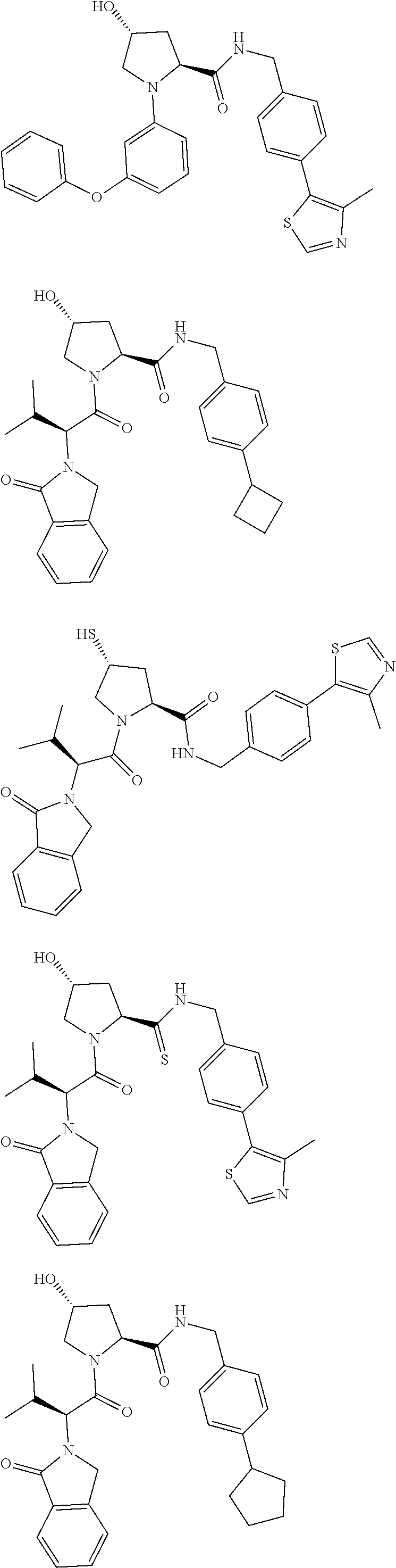


wherein the VLM may be connected to a PTM via a linker, as described herein, at any appropriate location, including, e.g., an aryl, heteroary, phenyl, or phenyl of an indole group, optionally via any appropriate functional group, such as an amine, ester, ether, alkyl, or alkoxy.
Exemplary Linkers
-
- (AL)q is a group which is connected to at least one of a ULM (such as a CLM or a VLM), PTM moiety, or a combination thereof;
- q of the linker is an integer greater than or equal to 1 (e.g., 1, 2, 3, 4, 5, 6, 7, 8, 9, 10, 11, 12, 13, 14, 15, 16, 17, 18, 19, 20, 21, 22, 23, 24, 25, 26, 27, 28, 29, 30, 31, 32, 33, 34, 35, 36, 37, 38, 39, 40, 41, 42, 43, 44, 45, 46, 47, 48, 49, 50, 51, 52, 53, 54, 55, 56, 57, 58, 59, 60, 61, 62, 63, 64, 65, 66, 67, 68, 69, 70, 71, 72, 73, 74, 75, 76, 77, 78, 79, 80, 81, 82, 83, 84, 85, 86, 87, 88, 89, 90, 91, 92, 93, 94, 95, 96, 97, 98, 99, or 100);
- each AL is independently selected from the group consisting of, a bond, CRL1RL2, O, S, SO, SO2, NRL3, SO2NRL3, SONRL3, CONRL3, NRL3CONRL4, NRL3SO2NRL4, CO, CRL1═CR12, C≡C, SiRL1RL2, P(O)RL1, P(O)ORL1, NR13C(═NCN)NRLA, NRL3C(═NCN), NRL3C(═CNO2)NRL4, C3-11cycloalkyl optionally substituted with 0-6 RL1 and/or RL2 groups, C5-13 spirocycloalkyl optionally substituted with 0-9 RL1 and/or RL2 groups, C3-11heterocyclyl optionally substituted with 0-6 RL1 and/or RL2 groups, C5-13 spiroheterocycloalkyl optionally substituted with 0-8 RL1 and/or RL2 groups, aryl optionally substituted with 0-6 RL1 and/or RL2 groups, heteroaryl optionally substituted with 0-6 RL1 and/or RL2 groups, where RL1 or RL2, each independently are optionally linked to other groups to form cycloalkyl and/or heterocyclyl moiety, optionally substituted with 0-4 RL5 groups; and
- RL1, RL2, RL3, RL4 and RL5 are, each independently, H, halo, C1-8alkyl, OC1-8alkyl, SC1-8alkyl, NHC1-8alkyl, N(C1-8alkyl)2, C3-11cycloalkyl, aryl, heteroaryl, C3-11heterocyclyl, OC1-8cycloalkyl, SC1-8cycloalkyl, NHC1-8cycloalkyl, N(C1-8cycloalkyl)2, N(C1-8cycloalkyl)(C1-8alkyl), OH, NH2, SH, SO2C1-8alkyl, P(O)(OC1-8alkyl)(C1-8alkyl), P(O)(OC1-8alkyl)2, CC—C1-8alkyl, CCH, CH═CH(C1-8alkyl), C(C1-8alkyl)═CH(C1-8alkyl), C(C1-8alkyl)-C(C1-8alkyl)2, Si(OH)3, Si(C1-8alkyl)3, Si(OH)(C1-8alkyl)2, COC1-8alkyl, CO2H, halogen, CN, CF3, CHF2, CH2F, NO2, SF5, SO2NHC1-8alkyl, SO2N(C1-8alkyl)2, SONHC1-8alkyl, SON(C1-8alkyl)2, CONHC1-8alkyl, CON(C1-8alkyl)2, N(C1-8alkyl)CONH(C1-8alkyl), N(C1-8alkyl)CON(C1-8alkyl)2, NHCONH(C1-8alkyl), NHCON(C1-8alkyl)2, NHCONH2, N(C1-8 alkyl)SO2NH(C1-8alkyl), N(C1-8alkyl) SO2N(C1-8alkyl)2, NH SO2NH(C1-8alkyl), NH SO2N(C1-8alkyl)2, NH SO2NH2.
-
- NR(CH2)n-(lower alkyl)-, —NR(CH2)n-(lower alkoxyl)-, —NR(CH2)n-(lower alkoxyl)-OCH2—, —NR(CH2)n-(lower alkoxyl)-(lower alkyl)-OCH2—, —NR(CH2)n-(cycloalkyl)-(lower alkyl)-OCH2—, —NR(CH2)n-(hetero cycloalkyl)-, —NR(CH2CH2O)n-(lower alkyl)-O—CH2—, —NR(CH2CH2O)n-(hetero cycloalkyl)-O—CH2—, —NR(CH2CH2O)n-Aryl-O—CH2—, —NR(CH2CH2O)n-(hetero aryl)-O—CH2—, —NR(CH2CH2O)n-(cyclo alkyl)-O-(hetero aryl)-O—CH2—, —NR(CH2CH2O)n-(cyclo alkyl)-O-Aryl-O—CH2—, —NR(CH2CH2O)n-(lower alkyl)-NH-Aryl-O—CH2—, —NR(CH2CH2O)n-(lower alkyl)-O-Aryl-CH2, —NR(CH2CH2O)n-cycloalkyl-O-Aryl-, —NR(CH2CH2O)n-cycloalkyl-O-(heteroaryl)l-, —NR(CH2CH2)n-(cycloalkyl)-O-(heterocycle)-CH2, —NR(CH2CH2)n-(heterocycle)-(heterocycle)-CH2, —N(R1R2)-(heterocycle)-CH2; where
- n of the linker can be 0 to 10;
- R of the linker can be H, lower alkyl;
- R1 and R2 of the linker can form a ring with the connecting N.


wherein:
-
- each m, n, o, p, q, r, and s are independently selected from 0, 1, 2, 3, 4, 5, 6, 7, 8, 9, 10, 11, 12, 13, 14, 15, 16, 17, 18, 19, and 20; and
- N* of the heterocycloalkyl is shared with the PTM or the ULM or is linked to the PTM or the ULM via a bond.

wherein:
-
- each m, n, o, p, q, r, and s are independently selected from 0, 1, 2, 3, 4, 5, 6, 7, 8, 9, 10, 11, 12, 13, 14, 15, 16, 17, 18, 19, and 20; and
- N* of the heterocycloalkyl is shared with the PTM or the ULM or is linked to the PTM or the ULM via a bond


wherein N* of the heterocycloalkyl is shared with the PTM or the ULM or is linked to the PTM or the ULM via a bond.


-
- —N(R)—(CH2)m—O(CH2)n—O(CH2)o—O(CH2)p—O(CH2)q—O(CH2)r—OCH2—, —O—(CH2)m—O(CH2)n—O(CH2)o—O(CH2)p—O(CH2)q—O(CH2)r—OCH2—, —O—(CH2)m—O(CH2)n—O(CH2)o—OCH2)p—O(CH2)q—O(CH2)r—O—; —N(R)(CH2)m—(CH2)n—O(CH2)o—OCH2)p—O(CH2)q—O(CH2)r—O—; —(CH2)m—O(CH2)n—O(CH2)o—O(CH2)p—O(CH2)q—O(CH2)r—O—; —(CH2)m—O(CH2)n—O(CH2)o—O(CH2)p—O(CH2)q—O(CH2)r—OCH2—;


wherein

where m of the linker can be 2, 3, 4, 5


wherein each m and n is independently selected from 0-20 (e.g., 0-6, 0, 1, 2, 3, 4, 5, 6, 7, 8, 9, 10, 11, 12, 13, 14, 15, 16, 17, 18, 19, or 20).


wherein each m, n, o, p, q, r, and s is independently 0, 1, 2, 3, 4, 5, 6, 7, 8, 9, 10, 11, 12, 13, 14, 15, 16, 17, 18, 19, or 20.


wherein:
-
- WL1 and WL2 are each independently absent, a 4-8 membered ring with 0-4 heteroatoms, optionally substituted with RQ, each RQ is independently a H, halo, OH, CN, CF3, optionally substituted linear or branched C1-C6 alkyl, optionally substituted linear or branched C1-C6 alkoxy, or 2 RQ groups taken together with the atom they are attached to, form a 4-8 membered ring system containing 0-4 heteroatoms;
- YL1 is each independently a bond, optionally substituted linear or branched C1-C6 alkyl and optionally one or more C atoms are replaced with O; or optionally substituted linear or branched C1-C6 alkoxy;
- n is 0-10; and

indicates the attachment point to the PTM or ULM moieties.

wherein:
-
- WL1 and WL2 are each independently absent, aryl, heteroaryl, alicyclic, heterocyclic, C1-6 alkyl and optionally one or more C atoms are replaced with O, C1-6 alkene and optionally one or more C atoms are replaced with O, C1-6 alkyne and optionally one or more C atoms are replaced with O, bicyclic, biaryl, biheteroaryl, or biheterocyclic, each optionally substituted with RQ, each RQ is independently a H, halo, OH, CN, CF3, hydroxyl, nitro, C ≡CH, C2-6 alkenyl, C2-6 alkynyl, optionally substituted linear or branched C1-C6 alkyl, optionally substituted linear or branched C1-C6 alkoxy, optionally substituted OC1-3alkyl (e.g., optionally substituted by 1 or more —F). OH, NH2, NRY1RY2, CN, or 2 RQ groups taken together with the atom they are attached to, form a 4-8 membered ring system containing 0-4 heteroatoms;
- YL1 is each independently a bond, NRYL1, O, S, NRYL2, CRYL1RYL2, C═O, C═S, SO, SO2, C1-C6 alkyl (linear, branched, optionally substituted) and optionally one or more C atoms are replaced with O; C1-C6 alkoxy (linear, branched, optionally substituted);
- QL is a 3-6 membered alicyclic or aromatic ring with 0-4 heteroatoms, optionally bridged, optionally substituted with 0-6 RQ, each RQ is independently H, optionally substituted linear or branched C1-6 alkyl (e.g., optionally substituted by 1 or more halo or C1-6 alkoxyl), or 2 RQ groups taken together with the atom they are attached to, form a 3-8 membered ring system containing 0-2 heteroatoms;
- RYL1, RYL2 are each independently H, OH, optionally substituted linear or branched C1-6 alkyl (e.g., optionally substituted by 1 or more halo or C1-6 alkoxyl), or R1, R2 together with the atom they are attached to, form a 3-8 membered ring system containing 0-2 heteroatoms:
- n is 0-10; and

indicates the attachment point to the PTM or ULM moieties.
-
- each carbon is optionally substituted with CRL1RL2, O, S, SO, SO2, NRL3, SO2NRL3, SONRL3, CONRL3, NRL3CONRL4, NRL3SO2NRL4, CO, CRL1═CRL2, C≡C. SiRL1RL2, P(O)RL1. P(O)ORL1, NRL3C(═NCN)NRL4, NRL3C(═NCN), NRL3C(═CNO2)NR4, C3-11cycloalkyl optionally substituted with 0-6 RL1 and/or RL2 groups, C5-13 spirocycloalkyl optionally substituted with 0-9 RL1 and/or R12 groups, C3-11 heteocyclyl optionally substituted with 0-6 RL1 and/or RL2 groups. C5-13 spiroheterocyclyl optionally substituted with 0-8 RL1 and/or RL2 groups, aryl optionally substituted with 0-6 RL1 and/or RL2 groups, heteroaryl optionally substituted with 0-6 RL1 and/or RL2 groups, where RL1 or RL2, each independently are optionally linked to other groups to form cycloalkyl and/or heterocyclyl moiety, optionally substituted with 0-4 R5 groups; and
- RL1, RL2, RL3, RL4 and RL5 are, each independently. H, halo, C1-8alkyl, OC1-8alkyl, SC1-8alkyl, NHC1-8alkyl, N(C1-8alkyl)2, C3-11cycloalkyl, aryl, heteroaryl, C3-11heterocyclyl, OC3-8cycloalkyl, SC3-8cycloalkyl, NHC3-8acycloalkyl, N(C3-8cycloalkyl)2, N(C3-8cycloalkyl)(C1-8alkyl), OH, NH2, SH, SO2C1-8alkyl, P(O)(OC1-8alkyl)(C1-8alkyl). P(O)(OC1-8alkyl)2, CC—C1-8alkyl, CCH, CH═CH(C1-alkyl), C(C1-8alkyl)═CH(C1-8alkyl), C(C1-8alkyl)═C(C1-8alkyl)2, Si(OH)3, Si(C1-8alkyl)3, Si(OH)(C1-8alkyl)2, COC1-8alkyl, CO2H, halogen, CN, CF3, CHF2, CH2F, NO2, SF5, SO2NHC1-8alkyl, SO2N(C1-8alkyl)2, SONHC1-8alkyl, SON(C1-8alkyl)2, CONHC1-8alkyl, CON(C1-8alkyl)2, N(C1-8alkyl)CONH(C1-8alkyl), N(C1-8alkyl)CON(C1-8alkyl)2, NHCONH(C1-8alkyl), NHCON(C1-8alkyl)2, NHCONH2, N(C1-8alkyl)SO2NH(C1-8alkyl), N(C1-8alkyl) SO2N(C1-8alkyl)2, NH SO2NH(C1-8alkyl), NH SO2N(C1-8alkyl)2, NH SO2NH2. In any aspect or embodiment described herein, the linker (L) does not have heteroatom-heteroatom bonding (e.g., no heteroatoms are covalently linker or adjacently located).


wherein carbon or oxygen may be substituted with a heteroatom selected from N, S, P, or Si atoms with an appropriate number of hydrogens to complete valency, and m, n, o, p, q, r, and s are independently selected from 0, 1, 2, 3, 4, 5, 6, 7, 8, 9, 10, 11, 12, 13, 14, 15, 16, 17, 18, 19, and 20.

The X is selected from the group consisting of O, N, S, S(O) and SO2; n is integer from 1 to 5;
RL1 is hydrogen or alkyl,

is a mono- or bicyclic aryl or heteroaryl optionally substituted with 1-3 substituents selected from alkyl, halogen, haloalkyl, hydroxy, alkoxy or cyano;

is a mono- or bicyclic cycloalkyl or a heterocycloalkyl optionally substituted with 1-3 substituents selected from alkyl, halogen, haloalkyl, hydroxy, alkoxy or cyano; and the phenyl ring fragment can be optionally substituted with 1, 2 or 3 substituents selected from the group consisting of alkyl, halogen, haloalkyl, hydroxy, alkoxy and cyano. In an embodiment, the linker group L comprises up to 10 covalently connected structural units, as described above.


wherein:
-
- A, B, C, D, and E are independently an optionally substituted 5- or 6-membered aryl or heteroaryl rings (e.g., a 5- or 6-membered aryl or heteroaryl, each optionally substituted with 1, 2, 3, or 4 substituents selected from H, alkyl, O, N, halogen, haloalkyl, alkoxy, hydroxy, carbonyl, amino, alkylamino, dialkylamino, cyano, nitro, —SO2—) or an optionally substituted 4- to 7-membered cycloalkyl or heterocycloalkyl (e.g., an 4- to 7-membered cycloalkyl or heterocycloalkyl, optionally substituted with 1, 2, 3, or 4 substituted selected from H, alkyl such as a C1-C6 alkyl, O, N, halogen, haloalkyl, such as a C1-C6 haloalkyl, alkoxy, hydroxy, carbonyl, amino, alkylamino, dialkylamino, cyano, nitro, —SO2—), wherein contact between circles indicates ring fusion and each of M3 and M4 may be attached to A1 or B1 (i.e., M3 may be attached to A1 or attached to B1) or D1 and E (i.e., M4 may be attached to D1 or attached to E);
- M1, M2 and M3 are independently selected from: a single bond; O—; —S—; —NR100—; —SO2—; —S(O)—; —SO2NH—; —C(O)—; —C(O)NH—; an optionally substituted alkyl wherein a carbon of the alkyl group may be replaced with a group independently selected from —O—, —S—, —NR100—, —SO2—, —S(O)—, —SO2NH—, —C(O)— or —C(O)NH— (e.g., the alkyl group is optionally substituted by a halogen, amino, alkyl or a haloalkyl, such as a C1-C6 alkyl or haloalkyl), an alkenyl fragment (e.g., —CH═CH—), an alkynyl fragment (e.g., —C≡C—), a two to four carbon conjugated alkenyl or alkynyl fragments (e.g., —CH═CH—CH═CH—, —C≡C—C≡C—, or —CH═CH—C≡C—), or an alkyl group (e.g., —CH2—), wherein at least one of the carbon of the alkenyl or alkynyl group may be part of A, B, C, or D:
- each R100 is independently selected from H, an optionally substituted alkyl (e.g., optionally substituted C1-C6 alkyl), an optionally substituted haloalkyl (e.g., optionally substituted C1-C6 haloalkyl); and
- - - - indicates the attachment of a chemical linker moiety or a ULM (e.g., VLM or CLM).


or optionally substituted

wherein - - - indicates a point of attachment with a chemical linker moiety or a ULM.

or optionally substituted

(e.g., as optionally substituted

or optionally substituted

wherein - - - indicate the attachment points of the fusion with B.


of Formula IIPTM, IIAPTM, or IIBPPTM includes or is optionally substituted

optionally substituted

optionally substituted

optionally substituted

optionally substituted

optionally substituted

optionally substituted

optionally substituted

optionally substituted

optionally substituted

optionally substituted

optionally substituted

optionally substituted

optionally substituted

optionally substituted

optionally substituted

optionally substituted

or optionally substituted

wherein - - - indicates a point of attachment with C, the chemical linker moiety, or a ULM.

optionally substituted

optionally substituted

optionally substituted

optionally substituted optionally substituted

optionally substituted

optionally substituted

optionally substituted

optionally substituted

optionally substituted

optionally substituted

optionally substituted

optionally substituted

optionally substituted

optionally substituted

optionally substituted

optionally substituted

optionally substituted

optionally substitute

optionally substituted

wherein - - - indicates a point of attachment with A, B, the chemical linker moiety, or a ULM.

optionally substituted

optionally substituted

optionally substituted

optionally substituted

optionally substituted

optionally substituted

optionally substituted

optionally substituted

optionally substituted

optionally substituted

optionally substituted

optionally substituted

optionally substituted

optionally substituted

optionally substituted

optionally substituted

optionally substituted

or optionally substituted

wherein - - - indicates a point of attachment with C, the chemical linker moiety, or the ULM.

of Formula IIIPTM, IIIAPTM, or IIIBPTM includes or is optionally substituted

optionally substituted

optionally substituted

or optionally substituted

wherein - - - indicates a point of attachment with C or D.

optionally substituted

optionally substituted

optionally substituted

optionally substituted

optionally substituted

optionally substituted

or optionally substituted

wherein - - - indicates a point of attachment with A or B.

optionally substituted

optionally substituted

optionally substituted

optionally substitute

optionally substituted

optionally substituted

or optionally substituted

wherein - - - indicates a point of attachment with A or B.

optionally substituted

optionally substituted

optionally substituted

optionally substituted
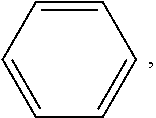
optionally substituted

wherein - - - indicates a point of attachment to A or B.

or optionally substituted

wherein - - - indicates a point of attachment to A or B.

or optionally substituted

wherein - - - indicates a point of attachment to A or B.

optionally substituted

optionally substituted

or optionally substituted

wherein - - - indicates a point of attachment to A or B.

of Formula IVPTM, IVAPTM, IVBPTM, IVCPTM, or IVDPTM includes or is optionally substituted

optionally substituted

optionally substituted

or optionally substituted

wherein - - - indicates a point of attachment with C, the chemical linker moiety, or ULM.

optionally substituted

optionally substituted

or optionally substituted

wherein - - - indicates a point of attachment with C.

optionally substituted

optionally substituted

or optionally substituted

wherein - - - indicates a point of attachment with C.

optionally substituted

optionally substituted

or optionally substituted

wherein - - - indicates a point of attachment with C.

optionally substituted

optionally substituted

optionally substituted

or optionally substituted

wherein - - - indicates a point of attachment with B.

optionally substitute

optionally substituted

optionally substituted

or optionally substituted

wherein - - - indicates a point of attachment with B.

or optionally substituted

wherein - - - indicates a point of attachment with B.

optionally substituted

or optionally substituted

wherein - - - indicates a point of attachment with B, the chemical linker moiety, or ULM.

optionally substituted

wherein - - - indicates a point of attachment with A or C.

of Formula VIPTM, VIAPTM, VIBPTM, VICPTM, VIDPTM, or VIEPTM includes or is optionally substituted

optionally substituted

optionally substituted

or optionally substituted

wherein - - - indicates a point of attachment with C.

of Formula VIPTM, VIAPTM, VIBPTM, VICPTM, VIDPTM, VIEPTM, VIIIPTM, VIIIAPTM, VIIIBPTM, VIIICPTM, VIIIDPTM, or VIIIEPTM is optionally substituted

optionally substituted

optionally substituted

or optionally substituted

wherein - - - indicates a point of attachment with C.

of Formula VIPTM, VIAPTM, VIBPTM, VICPTM, VIDPTM, or VIEPTM includes or is optionally substituted

optionally substituted

optionally substituted

or optionally substituted

wherein - - - indicates a point of attachment with C; and

of Formula VIPTM, VIAPTM, VIBPTM, VICPTM, VIDPTM, VIEPTM, VIIIPTM, VIIIAPTM, VIIIBPTM, VIIICPTM, VIIIDPTM, or VIIIEPTM is optionally substituted

optionally substituted K

optionally substituted

or optionally substituted

wherein - - - indicates a point of attachment with C.

optionally substituted

optionally substitute

optionally substituted

optionally substituted

optionally substituted

optionally substituted

optionally substituted

optionally substituted

optionally substituted

optionally substituted

optionally substituted

optionally substituted

optionally substituted

optionally substituted

optionally substituted

optionally substitute

wherein - - - indicates a point of attachment B.

optionally substituted

optionally substituted

optionally substituted

optionally substituted

optionally substituted

optionally substituted

optionally substituted

optionally substituted

optionally substituted

optionally substituted

optionally substituted

optionally substituted

optionally substituted

optionally substituted

or optionally substituted

optionally substituted

wherein - - - indicates a point of attachment C.

optionally substituted

optionally substituted

optionally substituted

optionally substituted

optionally substituted

optionally substituted

optionally substituted

optionally substituted

optionally substituted

optionally substituted

optionally substituted or optionally substituted

herein - - - indicates a point of attachment B; and D of Formula VIIPTM, VIIAPTM, VIIBPTM, VIICPTM, or VIIDPTM includes or is optionally substituted

optionally substituted

optionally substituted

optionally substituted

optionally substituted

wherein - - - indicates a point of attachment C.

optionally substituted

optionally substituted

or optionally substituted

wherein - - - indicates a point of attachment A or C.

optionally substituted

optionally substituted

or optionally substituted

wherein - - - indicates a point of attachment B or D.


optionally substituted

or optionally substituted

wherein - - - indicates a point of attachment A or D.

of Formula VIIIPTM, VIIIAPTM, VIIIBPTM, VIIICPTM, VIIIDPTM, or VIIIEPTM is optionally substituted

or optionally substituted

wherein - - - indicates a point of attachment with A or D.

optionally substituted

or optionally substituted

wherein - - - indicates a point of attachment with B.

or optionally substituted

wherein - - - indicates a point of attachment with A or C.

optionally substituted

optionally substituted

optionally substituted

optionally substituted

optionally substituted

optionally substituted

optionally substituted

optionally substituted

optionally substituted

optionally substituted

or optionally substituted

wherein - - - indicates a point of attachment with D.

of Formula IXPTM, IXAPTM, IXBPTM t, IXCPTM, IXDPTM, or IXEPTM includes or is optionally substituted

optionally substituted

optionally substituted optionally

substituted

optionally substituted

optionally substituted

optionally substituted

or optionally substituted

wherein - - - indicates a point of attachment with B or E.


wherein - - - indicates the point of attachment of a chemical linker moiety or a ULM (e.g., VLM or CLM) (e.g., the - - - indicates the point of attachment of a chemical linker moiety or a ULM (e.g., VLM or CLM) via any cyclic group (e.g., A, B, C, or D) directly or via a functional group or atom).


wherein - - - indicates the point of attachment of a chemical linker moiety or a ULM (e.g., VLM or CLM).


wherein - - - indicates the point of attachment of a chemical linker moiety or a ULM (e.g., VLM or CLM).


Into a 8-mL sealed tube, was placed N-(1-(1H-indol-3-yl)hexan-2-yl)-2-(piperazin-1-yl)thiazole-5-carboxamide (103 mg, 0.25 mmol, 1.0 equiv), tert-butyl 2-(2-(2-(2-(tosyloxy)ethoxy)ethoxy)ethoxy)acetate (157 mg, 0.38 mmol, 1.5 equiv), CH3CN (3 mL), and DIEA (1 mL). The reaction mixture was stirred overnight at 80° C., in an oil bath. The reaction mixture was concentrated under vacuum. The residue was purified by silica gel column chromatography eluting with ethyl acetate/petroleum ether=0 to 100% within 40 min. This resulted in tert-butyl 2-(2-(2-(2-(4-(5-((1-(1H-indol-3-yl)hexan-2-yl)carbamoyl)thiazol-2-yl)-piperazin-1-yl)ethoxy)ethoxy)ethoxy)acetate (69 mg) as a light yellow solid.


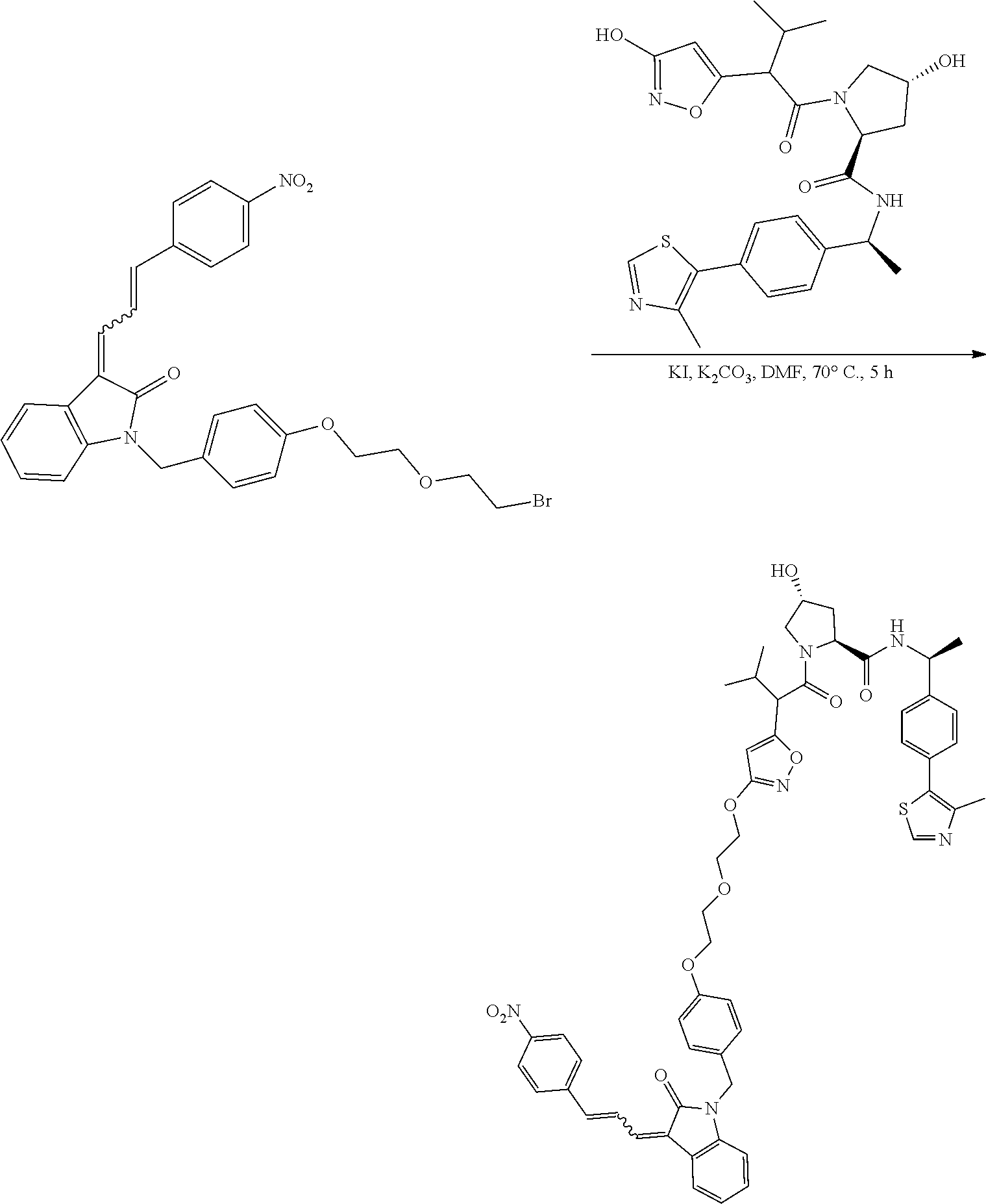


| TABLE 1 |
| Exemplary Compounds of the Present Disclosure |
| Ex. | |||
| No. | | Compound Name | |
| 1 |
 |
(2S,4R)-1-((S)-3,3- dimethyl-2-(2-(2-(2-((2- (4-(methylamino)phenyl) benzo[d]thiazol-6- yl)oxy)ethoxy)ethoxy) acetamido)butanoyl)-4- hydroxy-N-((S)-1-(4-(4- methylthiazol-5- yl)phenyl)ethyl)pyrrolidine- 2- |
| 2 |
 |
(2S,4R)-1-((S)-2-(tert- butyl)-14-((2-(4- (methylamino)phenyl) benzo[d]thiazol-6-yl)oxy)-4- oxo-6,9,12-trioxa-3- azatetradecanoyl)-4- hydroxy-N-((S)-1-(4-(4- methylthiazol-5- yl)phenyl)ethyl)pyrrolidine- 2- |
| 3 |
 |
(2S,4R)-1-((S)-2-(tert- butyl)-17-((2-(4- (methylamino)phenyl) benzo[d]thiazol-6-yl)oxy)-4- oxo-6,9,12,15-tetraoxa-3- azaheptadecanoyl)-4- hydroxy-N-((S)-1-(4-(4- methylthiazol-5- yl)phenyl)ethyl)pyrrolidine- 2- |
| 4 |
 |
(2S,4R)-1-((S)-2-(tert- butyl)-20-((2-(4- (methylamino)phenyl) benzo[d]thiazol-6-yl)oxy)-4- oxo-6,9,12,15,18- pentaoxa-3-azaicosanoyl)- 4-hydroxy-N-((S)-1-(4-(4- methylthiazol-5- yl)phenyl)ethyl)pyrrolidine- 2- |
| 5 |
 |
(2S,4R)-1-((S)-2-(tert- butyl)-23-((2-(4- (methylamino)phenyl) benzo[d]thiazol-6-yl)oxy)-4- oxo-6,9,12,15,18,21- hexaoxa-3- azatricosanoyl)-4- hydroxy-N-((S)-1-(4-(4- methylthiazol-5- yl)phenyl)ethyl)pyrrolidine- 2- |
| 6 |
 |
(2S,4R)-1-((S)-3,3- dimethyl-2-(2-(2-(2-(4- (((Z)-3-((E)-3-(4- nitrophenyl)allylidene)-2- oxoindolin-1- yl)methyl)phenoxy)ethoxy) ethoxy)acetamido)butanoyl)- 4-hydroxy-N-((S)-1-(4-(4- methylthiazol-5- yl)phenyl)ethyl)pyrrolidine- 2- |
| 7 |
 |
(2S,4R)-1-((S)-3,3- dimethyl-2-(2-(2-(2-(4- (((E)-3-((E)-3-(4- nitrophenyl)allylidene)-2- oxoindolin-1- yl)methyl)phenoxy)ethoxy) ethoxy)acetamido)butanoyl)- 4-hydroxy-N-((S)-1-(4-(4- methylthiazol-5- yl)phenyl)ethyl)pyrrolidine- 2- |
| 8 |
 |
(2S,4R)-1-((S)-3,3- dimethyl-2-(2-(2-(2-((7- nitro-10H-phenothiazin-3- yl)oxy)ethoxy)ethoxy) acetamido)butanoyl)-4- hydroxy-N-((S)-1-(4-(4- methylthiazol-5- yl)phenyl)ethyl)pyrrolidine- 2- |
| 9 |
 |
(2S,4R)-1-((S)-2-(tert- butyl)-14-((7-nitro-10H- phenothiazin-3-yl)oxy)-4- oxo-6,9,12-trioxa-3- azatetradecanoyl)-4- hydroxy-N-((S)-1-(4-(4- methylthiazol-5- yl)phenyl)ethyl)pyrrolidine- 2- |
| 10 |
 |
(2S,4R)-1-((S)-2-(tert- butyl)-17-((7-nitro-10H- phenothiazin-3-yl)oxy)-4- oxo-6,9,12,15-tetraoxa-3- azaheptadecanoyl)-4- hydroxy-N-((S)-1-(4-(4- methylthiazol-5- yl)phenyl)ethyl)pyrrolidine- 2- |
| 11 |
 |
(2S,4R)-1-((S)-2-(tert- butyl)-20-((7-nitro-10H- phenothiazin-3-yl)oxy)-4- oxo-6,9,12,15,18- pentaoxa-3-azaicosanoyl)- 4-hydroxy-N-((S)-1-(4-(4- methylthiazol-5- yl)phenyl)ethyl)pyrrolidine- 2- |
| 12 |
 |
(2S,4R)-1-((S)-2-(tert- butyl)-23-((7-nitro-10H- phenothiazin-3-yl)oxy)-4- oxo-6,9,12,15,18,21- hexaoxa-3- azatricosanoyl)-4-hydroxy- N-((S)-1-(4-(4-methylthiazol- 5-yl)phenyl)ethyl)pyrrolidine- 2- |
| 13 |
 |
2-(2,6-dioxopiperidin-3- yl)-5-(2-(2-(2-(2-((7-nitro- 10H-phenothiazin-3- yl)oxy)ethoxy)ethoxy) ethoxy)ethoxy)isoindoline- 1,3-dione |
| 14 |
 |
2-(2,6-dioxopiperidin-3- yl)-5-((14-((7-nitro-10H- phenothiazin-3-yl)oxy)- 3,6,9,12- tetraoxatetradecyl)oxy) isoindoline-1,3-dione |
| 15 |
 |
5-(2-(2-(2-((3-(10H- phenothiazin-10- yl)propyl)(methyl)amino) ethoxy)ethoxy)ethoxy)-2- (2,6-dioxopiperidin-3- yl)isoindoline-1,3-dione |
| 16 |
 |
2-(2,6-dioxopiperidin-3- yl)-5-((12-methyl-15- (10H-phenothiazin-10-yl)- 3,6,9-trioxa-12- azapentadecyl)oxy) isoindoline-1,3-dione |
| 17 |
 |
2-(2,6-dioxopiperidin-3- yl)-5-(4-(3-((1-(4-(6- methoxybenzo[d]thiazol- 2-yl)phenyl)azetidin-3- yl)oxy)propyl)piperazin-1- yl)isoindoline-1,3-dione |
| 18 |
 |
2-(2,6-dioxopiperidin-3- yl)-5-(4-(2-(4-((1r,3r)-3- ((7-nitro-10H- phenothiazin-3- yl)oxy)cyclobutoxy)piperidin- 1-yl)ethyl)piperazin-1- yl)isoindoline-1,3-dione |
| 19 |
 |
2-(2,6-dioxopiperidin-3- yl)-5-((5-(4-((1r,3r)-3-((7- nitro-10H-phenothiazin-3- yl)oxy)cyclobutoxy) piperidin-1- yl)pentyl)oxy)isoindoline- 1,3- |
| 20 |
 |
5-(2-(2-(2-(2-((7- (dimethylamino)-10H- phenothiazin-3- yl)oxy)ethoxy)ethoxy) ethoxy)ethoxy)-2-(2,6- dioxopiperidin-3- yl)isoindoline-1,3- |
| 21 |
 |
5-((14-((7- (dimethylamino)-10H- phenothiazin-3-yl)oxy)- 3,6,9,12- tetraoxatetradecyl)oxy)-2- (2,6-dioxopiperidin-3- yl)isoindoline-1,3- |
| 22 |
 |
5-((5-(4-((1-(3-(10H- phenothiazin-10- yl)propyl)azetidin-3- yl)oxy)piperidin-1- yl)pentyl)oxy)-2-(2,6- dioxopiperidin-3- yl)isoindoline-1,3- |
| 23 |
 |
5-(4-(2-(4-((1-(3-(10H- phenothiazin-10- yl)propyl)azetidin-3- yl)oxy)piperidin-1- yl)ethyl)piperazin-1-yl)-2- (2,6-dioxopiperidin-3- yl)isoindoline-1,3- |
| 24 |
 |
5-(4-(3-((1r,3r)-3-((2-(4- (dimethylamino)phenyl) benzo[d]thiazol-6- yl)oxy)cyclobutoxy)propyl) piperazin-1-yl)-2-(2,6- dioxopiperidin-3- yl)isoindoline-1,3- |
| 25 |
 |
2-(2,6-dioxopiperidin-3- yl)-5-((5-(4-((1-(4-(6- methoxybenzo[d]thiazol- 2-yl)phenyl)azetidin-3- yl)oxy)piperidin-1- yl)pentyl)oxy)isoindoline- 1,3-dione |
| 26 |
 |
2-(2,6-dioxopiperidin-3- yl)-5-(4-(2-(4-((1-(4-(6- methoxybenzo[d]thiazol- 2-yl)phenyl)azetidin-3- yl)oxy)piperidin-1- yl)ethyl)piperazin-1- yl)isoindoline-1,3-dione |
| 27 |
 |
5-((5-(4-((1r,3r)-3-((2-(4- (dimethylamino)phenyl) benzo[d]thiazol-6- yl)oxy)cyclobutoxy)piperidin- 1-yl)pentyl)oxy)-2- (2,6-dioxopiperidin-3- yl)isoindoline-1,3-dione |
| 28 |
 |
5-(4-(3-((1-(3-(10H- phenothiazin-10- yl)propyl)azetidin-3- yl)oxy)propyl)piperazin-1- yl)-2-(2,6-dioxopiperidin- 3-yl)isoindoline-1,3-dione |
| 29 |
 |
5-(4-(2-(4-((1r,3r)-3-((2- (4-(dimethylamino)phenyl) benzo[d]thiazol-6- yl)oxy)cyclobutoxy)piperidin- 1-yl)ethyl)piperazin-1- yl)-2-(2,6-dioxopiperidin-3- yl)isoindoline-1,3-dione |
| 30 |
 |
2-(2,6-dioxopiperidin-3- yl)-5-(4-(3-((1r,3r)-3-((7- nitro-10H-phenothiazin-3- yl)oxy)cyclobutoxy)propyl) piperazin-1-yl)isoindoline- 1,3-dione |
| 31 |
 |
2-(2,6-dioxopiperidin-3- yl)-5-((5-(4-((1r,3r)-3-(4- (((Z)-3-((E)-3-(4- nitrophenyl)allylidene)-2- oxoindolin-1- yl)methyl)phenoxy) cyclobutoxy)piperidin-1- yl)pentyl)oxy)isoindoline- 1,3-dione |
| 32 |
 |
2-(2,6-dioxopiperidin-3- yl)-5-((5-(4-((1r,3r)-3-(4- (((Z)-3-((E)-3-(4- nitrophenyl)allylidene)-2- oxoindolin-1- yl)methyl)phenoxy) cyclobutoxy)piperidin-1- yl)pentyl)oxy)isoindoline- 1,3-dione |
| 33 |
 |
(2S,4R)-1-((S)-3,3- dimethyl-2-(2-((5-(4- ((1r,3r)-3-((7-nitro-10H- phenothiazin-3- yl)oxy)cyclobutoxy)piperidin- 1-yl)pentyl)oxy)acetamido) butanoyl)-4-hydroxy-N- ((S)-1-(4-(4-methylthiazol-5- yl)phenyl)ethyl)pyrrolidine- 2-carboxamide |
| 34 |
 |
(2S,4R)-1-((S)-3,3- dimethyl-2-(2-(4-(2-(4- ((1r,3r)-3-((7-nitro-10H- phenothiazin-3-yl)oxy) cyclobutoxy)piperidin-1- yl)ethyl)piperazin-1-yl) acetamido)butanoyl)-4- hydroxy-N-((S)-1-(4-(4- methylthiazol-5- yl)phenyl)ethyl)pyrrolidine- 2-carboxamide |
| 35 |
 |
(2S,4R)-1-((S)-2-(tert-butyl)- 14-((2-((E)-2-(2- methoxypyridin-4- yl)vinyl)quinolin-6- yl)oxy)-4-oxo-6,9,12- trioxa-3- azatetradecanoyl)-4- hydroxy-N-((S)-1-(4-(4- methylthiazol-5- yl)phenyl)ethyl)pyrrolidine- 2-carboxamide |
| 36 |
 |
(E)-2-(2,6-dioxopiperidin-3- yl)-5-(2-(2-(2-(2-((2-(2- (2-methoxypyridin-4- yl)vinyl)quinolin-6- yl)oxy)ethoxy)ethoxy) ethoxy)ethoxy)isoindoline- 1,3-dione |
| 37 |
 |
|
| 38 |
 |
|
| 39 |
 |
|
| 40 |
 |
|
| 41 |
 |
|
| 42 |
 |
|
| 43 |
 |
|
| 44 |
 |
|
| 45 |
 |
|
| 46 |
 |
|
| 47 |
 |
(E)-2-(2,6-dioxopiperidin-3- yl)-5-(2-(2-(2-((2-(2-(2- methoxypyridin-4- yl)vinyl)quinolin-6- yl)oxy)ethoxy)ethoxy) ethoxy)isoindoline-1,3-dione |
| 48 |
 |
(2S,4R)-1-((S)-2-(tert- butyl)-17-((2-((E)-2-(2- methoxypyridin-4- yl)vinyl)quinolin-6- yl)oxy)-4-oxo-6,9,12,15- tetraoxa-3- azaheptadecanoyl)-4- hydroxy-N-((S)-1-(4-(4- methylthiazol-5- yl)phenyl)ethyl)pyrrolidine- 2-carboxamide |
| 49 |
 |
N-(1-(1H-indol-3- yl)hexan-2-yl)-2-(4-((S)- 13-((2S,4R)-4-hydroxy-2- (((S)-1-(4-(4- methylthiazol-5- yl)phenyl)ethyl)carbamoyl) pyrrolidine-1-carbonyl)- 14,14-dimethyl-11-oxo- 3,6,9-trioxa-12- azapentadecyl)piperazin- 1-yl)thiazole-5-carboxamide |
| 50 |
 |
N-(1-(1H-indol-3-yl)hexan- 2-yl)-2-(4-((S)-16-((2S,4R)- 4-hydroxy-2-(((S)-1-(4-(4- methylthiazol-5-yl)phenyl) ethyl)carbamoyl) pyrrolidine-1-carbonyl)- 17,17-dimethyl-14-oxo- 3,6,9,12-tetraoxa-15- azaoctadecyl)piperazin-1- yl)thiazole-5-carboxamide |
| 51 |
 |
N-(1-(1H-indol-3- yl)hexan-2-yl)-2-(4-((S)- 19-((2S,4R)-4-hydroxy-2- (((S)-1-(4-(4- methylthiazol-5- yl)phenyl)ethyl) carbamoyl)pyrrolidine-1- carbonyl)-20,20-dimethyl- 17-oxo-3,6,9,12,15- pentaoxa-18-azahenicosyl) piperazin-1-yl)thiazole-5- carboxamide |
| 52 |
 |
N-(1-(1H-indol-3-yl)hexan- 2-yl)-2-(4-(2-(2-(2-((2-(2,6- dioxopiperidin-3-yl)-1,3- dioxoisoindolin-5- yl)oxy)ethoxy)ethoxy)ethyl) piperazin-1-yl)thiazole-5- carboxamide |
| 53 |
 |
N-(1-(1H-indol-3- yl)hexan-2-yl)-2-(4-(2-(2- (2-(2-((2-(2,6- dioxopiperidin-3-yl)-1,3- dioxoisoindolin-5- yl)oxy)ethoxy)ethoxy)ethoxy) ethyl)piperazin-1- yl)thiazole-5-carboxamide |
| 54 |
 |
N-(1-(1H-indol-3- yl)hexan-2-yl)-2-(4-(14- ((2-(2,6-dioxopiperidin-3- yl)-1,3-dioxoisoindolin-5- yl)oxy)-3,6,9,12- tetraoxatetradecyl)piperazin- 1-yl)thiazole-5-carboxamide |
| 55 |
 |
N-(1-(1H-indol-3- yl)hexan-2-yl)-2-(4-(4-(2- (2-(2-(((S)-1-((2S,4R)-4- hydroxy-2-(((S)-1-(4-(4- methylthiazol-5- yl)phenyl)ethyl)carbamoyl) pyrrolidin-1-yl)-3,3- dimethyl-1-oxobutan-2- yl)amino)-2- oxoethoxy)ethoxy)ethoxy) phenyl)piperazin-1- yl)thiazole-5-carboxamide |
| 56 |
 |
N-(1-(1H-indol-3- yl)hexan-2-yl)-2-(4-(4- (((S)-13-((2S,4R)-4- hydroxy-2-(((S)-1-(4-(4- methylthiazol-5- yl)phenyl)ethyl)carbamoyl) pyrrolidine-1-carbonyl)- 14,14-dimethyl-11-oxo- 3,6,9-trioxa-12- azapentadecyl)oxy)phenyl) piperazin-1-yl)thiazole-5- carboxamide |
| 57 |
 |
N-(1-(1H-indol-3- yl)hexan-2-yl)-2-(4-(4-(2- (2-((2-(2,6-dioxopiperidin- 3-yl)-1,3-dioxoisoindolin- 5-yl)oxy)ethoxy)ethoxy) phenyl)piperazin-1- yl)thiazole-5-carboxamide |
| 58 |
 |
N-(1-(1H-indol-3- yl)hexan-2-yl)-2-(4-(4-(2- (2-(2-((2-(2,6- dioxopiperidin-3-yl)-1,3- dioxoisoindolin-5- yl)oxy)ethoxy)ethoxy) ethoxy)phenyl)piperazin-1- yl)thiazole-5-carboxamide |
| 59 |
 |
2-(2,6-dioxopiperidin-3- yl)-5-(2-(2-(4-(((E)-3-((E)- 3-(4-nitrophenyl)allylidene)- 2-oxoindolin-1- yl)methyl)phenoxy)ethoxy) ethoxy)isoindoline-1,3- |
| 60 |
 |
2-(2,6-dioxopiperidin-3- yl)-5-(2-(2-(4-(((Z)-3- ((E)-3-(4- nitrophenyl)allylidene)-2- oxoindolin-1- yl)methyl)phenoxy)ethoxy) ethoxy)isoindoline-1,3- dione |
| 61 |
 |
2-(2,6-dioxopiperidin-3- yl)-5-(2-(2-(2-(4-(((E)-3- ((E)-3-(4- nitrophenyl)allylidene)-2- oxoindolin-1- yl)methyl)phenoxy)ethoxy) ethoxy)ethoxy)isoindoline- 1,3-dione |
| 62 |
 |
2-(2,6-dioxopiperidin-3- yl)-5-(2-(2-(2-(4-(((Z)-3- ((E)-3-(4- nitrophenyl)allylidene)-2- oxoindolin-1- yl)methyl)phenoxy)ethoxy) ethoxy)ethoxy)isoindoline- 1,3-dione |
| 63 |
 |
2-(2,6-dioxopiperidin-3- yl)-5-(2-(2-(2-(2-(4-(((E)- 3-((E)-3-(4- nitrophenyl)allylidene)-2- oxoindolin-1- yl)methyl)phenoxy)ethoxy) ethoxy)ethoxy)ethoxy) isoindoline-1,3-dione |
| 64 |
 |
2-(2,6-dioxopiperidin-3- yl)-5-(2-(2-(2-(2-(4-(((Z)- 3-((E)-3-(4- nitrophenyl)allylidene)-2- oxoindolin-1- yl)methyl)phenoxy)ethoxy) ethoxy)ethoxy)ethoxy) isoindoline-1,3-dione |
| 65 |
 |
(2S,4R)-4-hydroxy-1-((S)- 3-methyl-2-(3-(2-(2-(4- (((E)-3-((E)-3-(4- nitrophenyl)allylidene)-2- oxoindolin-1- yl)methyl)phenoxy)ethoxy) ethoxy)isoxazol-5- yl)butanoyl)-N-((S)-1-(4- (4-methylthiazol-5- yl)phenyl)ethyl)pyrrolidine- 2- |
| 66 |
 |
(2S,4R)-4-hydroxy-1-((R)- 3-methyl-2-(3-(2-(2-(4- (((E)-3-((E)-3-(4- nitrophenyl)allylidene)-2- oxoindolin-1- yl)methyl)phenoxy)ethoxy) ethoxy)isoxazol-5- yl)butanoyl)-N-((S)-1-(4- (4-methylthiazol-5- yl)phenyl)ethyl)pyrrolidine- 2-carboxamide |
| 67 |
 |
(2S,4R)-4-hydroxy-1-((S)- 3-methyl-2-(3-(2-(2-(4- (((Z)-3-((E)-3-(4- nitrophenyl)allylidene)-2- oxoindolin-1- yl)methyl)phenoxy)ethoxy) ethoxy)isoxazol-5- yl)butanoyl)-N-((S)-1-(4- (4-methylthiazol-5- yl)phenyl)ethyl)pyrrolidine- 2-carboxamide |
| 68 |
 |
(2S,4R)-4-hydroxy-1-((R)- 3-methyl-2-(3-(2-(2-(4- (((Z)-3-((E)-3-(4- nitrophenyl)allylidene)-2- oxoindolin-1- yl)methyl)phenoxy)ethoxy) ethoxy)isoxazol-5- yl)butanoyl)-N-((S)-1-(4- (4-methylthiazol-5- yl)phenyl)ethyl)pyrrolidine- 2-carboxamide |
| 69 |
 |
(2S,4R)-4-hydroxy-1-((S)- 3-methyl-2-(3-(2-(2-(2-(2- (4-(((E)-3-((E)-3-(4- nitrophenyl)allylidene)-2- oxoindolin-1- yl)methyl)phenoxy)ethoxy) ethoxy)ethoxy)ethoxy) isoxazol-5-yl)butanoyl)-N- ((S)-1-(4-(4- methylthiazol-5- yl)phenyl)ethyl)pyrrolidine- 2-carboxamide |
| 70 |
 |
(2S,4R)-4-hydroxy-1-((R)- 3-methyl-2-(3-(2-(2-(2-(2- (4-(((E)-3-((E)-3-(4- nitrophenyl)allylidene)-2- oxoindolin-1- yl)methyl)phenoxy)ethoxy) ethoxy)ethoxy)ethoxy) isoxazol-5-yl)butanoyl)-N- ((S)-1-(4-(4- methylthiazol-5- yl)phenyl)ethyl)pyrrolidine- 2-carboxamide |
| 71 |
 |
(2S,4R)-4-hydroxy-1-((S)- 3-methyl-2-(3-(2-(2-(2-(2- (4-(((Z)-3-((E)-3-(4- nitrophenyl)allylidene)-2- oxoindolin-1- yl)methyl)phenoxy)ethoxy) ethoxy)ethoxy)ethoxy) isoxazol-5-yl)butanoyl)-N- ((S)-1-(4-(4- methylthiazol-5- yl)phenyl)ethyl)pyrrolidine- 2-carboxamide |
| 72 |
 |
(2S,4R)-4-hydroxy-1-((R)- 3-methyl-2-(3-(2-(2-(2-(2- (4-(((Z)-3-((E)-3-(4- nitrophenyl)allylidene)-2- oxoindolin-1- yl)methyl)phenoxy)ethoxy) ethoxy)ethoxy)ethoxy) isoxazol-5-yl)butanoyl)-N- ((S)-1-(4-(4- methylthiazol-5- yl)phenyl)ethyl)pyrrolidine- 2-carboxamide |
| 73 |
 |
(2S,4R)-4-hydroxy-1-(S)- 3-methyl-2-(3-(2-(2-(2-(4- (((E)-3-((E)-3-(4- nitrophenyl)allylidene)-2- oxoindolin-1- yl)methyl)phenoxy)ethoxy) ethoxy)ethoxy)isoxazol-5- yl)butanoyl)-N-((S)-1- (4-(4-methylthiazol-5- yl)phenyl)ethyl)pyrrolidine- 2-carboxamide |
| 74 |
 |
(2S,4R)-4-hydroxy-1-((R)- 3-methyl-2-(3-(2-(2-(2-(4- (((E)-3-((E)-3-(4- nitrophenyl)allylidene)-2- oxoindolin-1- yl)methyl)phenoxy)ethoxy) ethoxy)ethoxy)isoxazol- 5-yl)butanoyl)-N-((S)-1- (4-(4-methylthiazol-5- yl)phenyl)ethyl)pyrrolidine- 2-carboxamide |
| 75 |
 |
(2S,4R)-4-hydroxy-1-((S)- 3-methyl-2-(3-(2-(2-(2-(4- (((Z)-3-((E)-3-(4- nitrophenyl)allylidene)-2- oxoindolin-1- yl)methyl)phenoxy)ethoxy) ethoxy)ethoxy)isoxazol-5- yl)butanoyl)-N-((S)-1- (4-(4-methylthiazol-5- yl)phenyl)ethyl)pyrrolidine- 2-carboxamide |
| 76 |
 |
(2S,4R)-4-hydroxy-1-((R)- 3-methyl-2-(3-(2-(2-(2-(4- (((Z)-3-((E)-3-(4- nitrophenyl)allylidene)-2- oxoindolin-1- yl)methyl)phenoxy)ethoxy) ethoxy)ethoxy)isoxazol-5- yl)butanoyl)-N-((S)-1- (4-(4-methylthiazol-5- yl)phenyl)ethyl)pyrrolidine- 2-carboxamide |
| 77 |
 |
2-(2,6-dioxopiperidin-3- yl)-5-(4-(3-((1r,3r)-3-(4- (((E)-3-((E)-3-(4- nitrophenyl)allylidene)-2- oxoindolin-1- yl)methyl)phenoxy) cyclobutoxy)propyl) piperazin-1-yl)isoindoline- 1,3-dione |
| 78 |
 |
2-(2,6-dioxopiperidin-3- yl)-5-(4-(3-((1r,3r)-3-(4- (((Z)-3-((E)-3-(4- nitrophenyl)allylidene)-2- oxoindolin-1- yl)methyl)phenoxy) cyclobutoxy)propyl) piperazin-1-yl)isoindoline- 1,3-dione |
| 79 |
 |
2-(2,6-dioxopiperidin-3- yl)-5-(4-(2-(4-((1r,3r)-3- (4-(((E)-3-((E)-3-(4- nitrophenyl)allylidene)-2- oxoindolin-1- yl)methyl)phenoxy) cyclobutoxy)piperidin-1- yl)ethyl)piperazin-1- yl)isoindoline-1,3- |
| 80 |
 |
2-(2,6-dioxopiperidin-3- yl)-5-(4-(2-(4-((1r,3r)-3- (4-(((Z)-3-((E)-3-(4- nitrophenyl)allylidene)-2- oxoindolin-1- yl)methyl)phenoxy) cyclobutoxy)piperidin-1- yl)ethyl)piperazin-1- yl)isoindoline-1,3-dione |
| 81 |
 |
(2S,4R)-4-hydroxy-1-((S)- 3-methyl-2-(3-(4-(2-(1-(7- nitro-10H-phenothiazin-3- yl)piperidin-4- yl)ethyl)piperazin-1- yl)isoxazol-5- yl)butanoyl)-N-((S)-1-(4- (4-methylthiazol-5- yl)phenyl)ethyl)pyrrolidine- 2-carboxamide |
| 82 |
 |
(2S,4R)-4-hydroxy-1-((R)- 3-methyl-2-(3-(4-(2-(1-(7- nitro-10H-phenothiazin-3- yl)piperidin-4- yl)ethyl)piperazin-1- yl)isoxazol-5- yl)butanoyl)-N-((S)-1-(4- (4-methylthiazol-5- yl)phenyl)ethyl)pyrrolidine- 2-carboxamide |
| 83 |
 |
2-(2,6-dioxopiperidin-3- yl)-5-(4-(2-(1-(7-nitro- 10H-phenothiazin-3- yl)piperidin-4- yl)ethyl)piperazin-1- yl)isoindoline-1,3-dione |
| 84 |
 |
(2S,4R)-4-hydroxy-1-((S)- 3-methyl-2-(3-(4-(3- ((1r,3S)-3-((7-nitro-10H- phenothiazin-3- yl)oxy)cyclobutoxy) propyl)piperazin-1-yl) isoxazol-5-yl)butanoyl)- N-((S)-1-(4-(4- methylthiazol-5-yl)phenyl) ethyl)pyrrolidine-2- carboxamide |
| 85 |
 |
(2S,4R)-4-hydroxy-1-((R)- 3-methyl-2-(3-(4-(3- ((1r,3R)-3-((7-nitro-10H- phenothiazin-3- yl)oxy)cyclobutoxy) propyl)piperazin-1-yl) isoxazol-5-yl)butanoyl)- N-((S)-1-(4-(4- methylthiazol-5- yl)phenyl)ethyl)pyrrolidine- 2-carboxamide |
| 86 |
 |
|
| 87 |
 |
|
| 88 |
 |
|
| 89 |
 |
|
| 90 |
 |
|
| 91 |
 |
|
| 92 |
 |
|
| 93 |
 |
|
| 94 |
 |
|
| 95 |
 |
|
| 96 |
 |
|
| 97 |
 |
|
| 98 |
 |
|
| 99 |
 |
|
| 100 |
 |
|
| 101 |
 |
|
| 102 |
 |
|
| 103 |
 |
|
| 104 |
 |
|
| 105 |
 |
|
| 106 |
 |
|
| 107 |
 |
|
| 108 |
 |
|
| 109 |
 |
|
| 110 |
 |
|
| 111 |
 |
|
| 112 |
 |
|
| 113 |
 |
|
| 114 |
 |
|
| 115 |
 |
|
| 116 |
 |
|
| 117 |
 |
|
| 118 |
 |
|
| 119 |
 |
|
| 120 |
 |
|
| 121 |
 |
|
| 122 |
 |
|
| 123 |
 |
|
| 124 |
 |
|
| 125 |
 |
|
| 126 |
 |
|
| 127 |
 |
|
| 128 |
 |
|
| 129 |
 |
|
| 130 |
 |
|
| 131 |
 |
|
| 132 |
 |
|
| 133 |
 |
|
| 134 |
 |
|
| 135 |
 |
|
| TABLE 2 |
| Target Protein Degradation via Exemplary Compounds |
| of the Present Disclosure |
| Protein | |||
| Degra- | MH + | ||
| Ex. | dation | (1) | |
| No. | at 1 | μM † | NMR transcript |
| 1 | A | 829.3 | 1H NMR (400 MHz, DMSO-d6): |
| δ = 8.98 (s, 1H), 8.52-8.39 (m, 1H), | |||
| 7.83-7.71 (m, 3H), | |||
| 7.64-7.58 (m, 1H), 7.46-7.31 (m, 5H), | |||
| 7.07 (dd, J = 2.4, 8.8 | |||
| Hz, 1H), 6.67-6.59 (m, 2H), 6.41 | |||
| (m, 1H), 5.17 (s, 1H), 4.89 | |||
| (m, , 1H), 4.55 (d, J = 9.4 Hz, 1H), | |||
| 4.45 (t, J = 8.4 Hz, 1H), | |||
| 4.31-4.16 (m, 3H), 4.00-3.93 | |||
| (m, 2H), 3.86-3.78 (m, 2H), | |||
| 3.70-3.54 (m, 6H), 2.75 (d, J = 4.8 | |||
| Hz, 3H), 2.44 (s, 3H), 2.05 | |||
| (m, 1H), 1.82-1.72 (m, 1H), 1.50-1.27 | |||
| (m, 3H), 0.93 (s, 9H) | |||
| 2 | B | 873.3 | 1H NMR (400 MHz, DMSO-d6): |
| δ = 8.99 (s, 1H), 8.45 (d, J = 7.6 Hz, | |||
| 1H), 7.85-7.73 (m, 3H), | |||
| 7.62 (d, J = 2.4 Hz, 1H), 7.47-7.33 | |||
| (m, 5H), 7.07 (dd, J = 2.4, | |||
| 8.8 Hz, 1H), 6.64 (d, J = 8.8 Hz, | |||
| 2H), 6.41 (m, 1H), 5.15 (s, | |||
| 1H), 4.90 (m, 1H), 4.56 (d, J = 9.6 | |||
| Hz, 1H), 4.45 (t, J = 8.4 Hz, | |||
| 1H), 4.33-4.14 (m, 3H), 4.00-3.91 | |||
| (m, 2H), 3.83-3.75 (m, | |||
| 2H), 3.67-3.55 (m, 10H), 2.75 | |||
| (d, J = 4.8 Hz, 3H), 2.45 (s, | |||
| 3H), 2.06 (m, 1H), 1.78 (m, 1H), 1.49-1.31 | |||
| (m, 3H), 0.94 (s, 9H) | |||
| 3 | B | 917.4 | 1H NMR (400 MHz, DMSO-d6): |
| δ = 8.98 (s, 1H), 8.53-8.38 (m, 1H), | |||
| 7.81-7.71 (m, 3H), | |||
| 7.62 (d, J = 2.4 Hz, 1H), 7.47-7.31 | |||
| (m, 5H), 7.06 (m, 1H), | |||
| 6.41 (d, J = 4.8 Hz, 1H), 5.15 (s, 1H), | |||
| 4.89 (t, J = 7.2 Hz, 1H), | |||
| 4.54 (d, J = 9.6 Hz, 1H), 4.44 | |||
| (t, J = 8.0 Hz, 1H), 4.28 (s, 1H), | |||
| 4.21-4.12 (m, 2H), 3.95 (s, 2H), | |||
| 3.81-3.74 (m, 2H), 3.63- | |||
| 3.54 (m, 14H), 2.74 (d, J = 5.2 Hz, | |||
| 3H), 2.44 (s, 3H), 2.04 (m, | |||
| 1H), 1.82-1.70 (m, 1H), | |||
| 1.50-1.31 (m, 3H), 0.93 (s, 9H) | |||
| 4 | A | 961.4 | 1H NMR (400 MHz, DMSO-d6): |
| δ = 8.97 (s, 1H), 8.50-8.40 (m, 1H), | |||
| 7.82-7.72 (m, 3H), | |||
| 7.61 (d, J = 2.4 Hz, 1H), 7.47-7.30 | |||
| (m, 5H), 7.05 (m, 1H), | |||
| 6.62 (d, J = 8.8 Hz, 2H), 6.45-6.37 | |||
| (m, 1H), 5.14 (s, 1H), 4.89 | |||
| (t, J = 7.2 Hz, 1H), 4.53 (d, J = 9.6 | |||
| Hz, 1H), 4.43 (t, J = 8.0 Hz, | |||
| 1H), 4.27 (s, 1H), 4.19-4.11 (m, 2H), | |||
| 3.95 (s, 2H), 3.83- | |||
| 3.73 (m, 2H), 3.62-3.50 (m, 18H), | |||
| 2.74 (d, J = 5.0 Hz, 3H), | |||
| 2.44 (s, 3H), 2.10-2.00 (m, 1H), | |||
| 1.81-1.70 (m, 1H), 1.48- | |||
| 1.32 (m, 3H), 0.93 (s, 9H) | |||
| 5 | A | 1005.4 | 1H NMR (400 MHz, DMSO-d6): |
| δ = 8.97 (s, 1H), 8.44 (d, J = 7.6 Hz, | |||
| 1H), 7.83-7.70 (m, 3H), | |||
| 7.61 (d, J = 2.4 Hz, 1H), 7.46-7.32 | |||
| (m, 5H), 7.05 (m, 1H), | |||
| 6.63 (d, J = 8.8 Hz, 2H), 6.40 (q, | |||
| J = 4.8 Hz, 1H), 5.15 (s, 1H), | |||
| 4.90 (t, J = 7.2 Hz, 1H), 4.54 (d, | |||
| J = 9.5 Hz, 1H), 4.44 (t, J = 8.4 | |||
| Hz, 1H), 4.27 (s, 1H), 4.19-4.11 | |||
| (m, 2H), 3.95 (s, 2H), 3.80- | |||
| 3.72 (m, 2H), 3.61-3.49 (m, 22H), | |||
| 2.74 (d, J = 4.8 Hz, 3H), | |||
| 2.44 (s, 3H), 2.04 (m, 1H), 1.76 | |||
| (m, 1H), 1.48-1.33 (m, 3H), | |||
| 0.93 (s, 9H) | |||
| 6 | B | 971.4 | 1H NMR: (400 MHz, DMSO-d6) |
| δ: 9.00-8.96 (m, 1H), 8.79-8.66 | |||
| (m, 1H), 8.55-8.43 (m, | |||
| 5H), 8.32-8.23 (m, 2H), 8.15-8.06 | |||
| (m, 2H), 8.02-7.84 (m, | |||
| 1H), 7.76-7.66 (m, 1H), 7.56 (d, | |||
| J = 15.2 Hz, 1H), 7.49-7.22 | |||
| (m, 9H), 7.11-7.02 (m, 1H), | |||
| 7.01-6.96 (m, 1H), 6.94-6.88 | |||
| (m, 2H), 5.19 (s, 1H), 4.93-4.85 | |||
| (m, 3H), 4.53 (d, J = 9.8 Hz, | |||
| 1H), 4.44 (t, J = 8.0 Hz, 1H), | |||
| 4.28 (s, 1H), 4.13-4.05 (m, 2H), | |||
| 3.98-3.91 (m, 2H), 3.79-3.73 | |||
| (m, 2H), 3.61-3.49 (m, 4H), | |||
| 2.46-2.42 (m, 3H), 2.11-1.97 | |||
| (m, 1H), 1.81-1.73 (m, 1H), | |||
| 1.41-1.23 (m, 3H), 0.91 (s, 9H) | |||
| 7 | B | 971.4 | 1H NMR: (400 MHz, DMSO-d6) |
| δ: 8.98 (s, 1H), 8.71 (dd, J = 11.2, | |||
| 15.6 Hz, 1H), 8.52-8.41 | |||
| (m, 2H), 8.33-8.22 (m, 2H), | |||
| 7.90-7.82 (m, 2H), 7.77-7.64 | |||
| (m, 2H), 7.48-7.19 (m, 9H), | |||
| 7.06-6.95 (m, 2H), 6.94-6.87 | |||
| (m, 2H), 5.16 (s, 1H), 4.98-4.80 | |||
| (m, 3H), 4.53 (d, J = 9.6 Hz, | |||
| 1H), 4.44 (t, J = 8.0 Hz, 1H), 4.28 | |||
| (s, 1H), 4.12-4.04 (m, 2H), | |||
| 3.99-3.88 (m, 2H), 3.80-3.71 (m, 2H), | |||
| 3.62-3.50 (m, 3H), | |||
| 2.45 (s, 3H), 2.12-1.96 (m, 1H), | |||
| 1.76 (ddd, J = 4.4, 8.4, 12.8 | |||
| Hz, 1H), 1.47-1.27 (m, 3H), 0.91 (s, 9H) | |||
| 8 | C | 833.2 | 1H NMR (400 MHz, DMSO-d6): |
| δ = 9.43 (s, 1H), 8.98 (s, 1H), | |||
| 8.51-8.36 (m, 1H), 7.83 (dd, | |||
| J = 2.4, 8.8 Hz, 1H), 7.71 (d, | |||
| J = 2.4 Hz, 1H), 7.49-7.30 (m, | |||
| 5H), 6.70-6.55 (m, 4H), 5.15 | |||
| (s, 1H), 4.96-4.83 (m, 1H), | |||
| 4.59-4.50 (m, 1H), 4.44 (t, J = 8.0 | |||
| Hz, 1H), 4.32-4.22 (m, | |||
| 1H), 4.07-3.89 (m, 4H), 3.77-3.67 | |||
| (m, 2H), 3.66-3.53 (m, | |||
| 6H), 2.45 (s, 3H), 2.11-1.99 (m, 1H), | |||
| 1.82-1.71 (m, 1H), | |||
| 1.49-1.32 (m, 3H), 0.97-0.88 (m, 9H). | |||
| 9 | D | 877.3 | 1H NMR (400 MHz, DMSO-d6): |
| δ = 9.41 (s, 1H), 8.97 (s, 1H), | |||
| 8.55-8.33 (m, 1H), 7.82 (dd, | |||
| J = 2.4, 9.2 Hz, 1H), 7.70 (d, | |||
| J = 2.4 Hz, 1H), 7.46-7.31 (m, | |||
| 5H), 6.71-6.52 (m, 4H), 5.16-5.10 | |||
| (m, 1H), 4.89 (t, J = 7.2 | |||
| Hz, 1H), 4.54 (d, J = 9.6 Hz, 1H), | |||
| 4.43 (t, J = 8.4 Hz, 1H), 4.28 | |||
| (d, J = 1.2 Hz, 1H), 4.06-3.89 | |||
| (m, 4H), 3.72-3.65 (m, 2H), | |||
| 3.63-3.52 (m, 10H), 2.44 (s, 3H), | |||
| 2.09-1.99 (m, 1H), 1.76 | |||
| (d, J = 4.0 Hz, 1H), 1.48-1.31 | |||
| (m, 3H), 0.93 (s, 9H). | |||
| 10 | 921.3 | 1H NMR (400 MHz, DMSO-d6): | |
| δ = 9.43 (s, 1H), 8.97 (s, 1H), | |||
| 8.50-8.41 (m, 1H), 7.82 (m, | |||
| 1H), 7.70 (d, J = 2.4 Hz, 1H), | |||
| 7.46-7.32 (m, 5H), 6.68-6.55 | |||
| (m, 4H), 5.14 (s, 1H), 4.89 (m, 1H), | |||
| 4.54 (d, J = 9.6 Hz, 1H), | |||
| 4.43 (t, J = 8.4 Hz, 1H), 4.28 (s, 1H), | |||
| 4.02-3.88 (m, 4H), | |||
| 3.71-3.64 (m, 2H), 3.62-3.51 (m, 14H), | |||
| 2.44 (s, 3H), 2.08-1.99 | |||
| (m, 1H), 1.75 (d, J = 4.4 Hz, 1H), | |||
| 1.36 (d, J = 7.2 Hz, 3H), 0.93 | |||
| (s, 9H). | |||
| 11 | D | 965.3 | 1H NMR (400 MHz, DMSO-d6): |
| δ = 9.43 (s, 1H), 8.98 (s, 1H), | |||
| 8.56-8.34 (m, 1H), 7.82 (dd, | |||
| J = 2.4, 8.8 Hz, 1H), 7.70 (d, | |||
| J = 2.4 Hz, 1H), 7.47-7.30 (m, | |||
| 5H), 6.69-6.55 (m, 4H), 5.14 (s, 1H), | |||
| 4.90 (t, J = 7.2 Hz, 1H), | |||
| 4.54 (d, J = 9.2 Hz, 1H), 4.44 (t, | |||
| J = 8.0 Hz, 1H), 4.28 (s, 1H), | |||
| 4.04-3.89 (m, 4H), 3.70-3.65 | |||
| (m, 2H), 3,63-3.48 (m, 18H), | |||
| 2.45 (s, 3H), 2.10-2.00 (m, 1H), | |||
| 1.83-1.71 (m, 1H), 1.50- | |||
| 1.31 (m, 3H), 0.93 (s, 9H). | |||
| 12 | D | 1009.4 | 1H NMR (400 MHz, DMSO-d6): |
| δ = 9.43 (s, 1H), 8.98 (s, 1H), | |||
| 8.55-8.32 (m, 1H), 7.82 (dd, | |||
| J = 2.4, 8.8 Hz, 1H), 7.71 (d, | |||
| J = 2.4 Hz, 1H), 7.47-7.32 (m, | |||
| 5H), 6.68-6.56 (m, 4H), 5.19-5.11 | |||
| (m, 1H), 4.90 (t, J = 7.2 | |||
| Hz, 1H), 4.54 (d, J = 9.6 Hz, 1H), | |||
| 4.48-4.39 (m, 1H), 4.28 (s, | |||
| 1H), 4.02-3.89 (m, 4H), 3.71-3.65 | |||
| (m, 2H), 3.63-3.48 (m, | |||
| 22H), 2.45 (s, 3H), 2.09-2.00 (m, | |||
| 1H), 1.82-1.71 (m, 1H), | |||
| 1.37 (d, J = 7.0 Hz, 3H), 0.93 (s, 9H), | |||
| 13 | 693.3 | 1H NMR (400 MHz, CDCl3): | |
| δ: 7.80 (dd, J = 2.8, 8.8 Hz, 1H), | |||
| 7.52 (d, J = 8.4 Hz, 1H), | |||
| 7.67 (J = 2.8 Hz, 1H), 7.37 (d, | |||
| J = 2.4 Hz, 1H), 7.29 (dd, J = | |||
| 2.4, 8.4 Hz, 1H), 6.60-6.57 (m, | |||
| 1H), 6.55-6.52 (m, 2H), | |||
| 6.50 (d, J = 2.4 Hz, 1H), 5.12 (dd, | |||
| J = 5.2, 12.4 Hz, 1H), | |||
| 4.27-4.25 (m, 2H), 4.04-4.02 | |||
| (m, 2H), 3.91-3.88 (m, 2H), | |||
| 3.81-3.78 (m, 2H), 3.73-3.65 | |||
| (m, 8H), 2.89-2.88 (m, 1H), | |||
| 2.79-2.70 (m, 2H), 2.15-2.11 (m, 1H). | |||
| 14 | B | 737.3 | 1H NMR (400 MHz, DMSO): |
| δ: 11.11 (br s, 1H), 9.49 (br s, 1H), | |||
| 8.49 (br s, 1H), 7.82 (br d, | |||
| J = 8.6 Hz, 2H), 7.69 (br s, 1H), | |||
| 7.44 (s, 1H), 7.36 (br d, J = | |||
| 7.8 Hz, 1H), 6.66-6.61 (m, 4H), | |||
| 5.12 (br dd, J = 4.6, 13.0 | |||
| Hz, 1H), 4.31 (br s, 2H), 3.99 | |||
| (br s, 2H), 3.79 (br s, 2H), 3.68 | |||
| (br s, 2H), 3.62-3.47 (m, 1.2H), | |||
| 2.95-2.84 (m, 1H), 2.64- | |||
| 2.54 (m, 2H), 2.06 (br d, J = 16.5 Hz, 1H). | |||
| 15 | B | 659.4 | 1H NMR (400 MHz, DMSO-d6): |
| δ: 11.10 (s, 1H), 8.18 (s, 1H), 7.80 | |||
| (d, J = 8.3 Hz, 1H), 7.42 | |||
| (d, J = 2.2 Hz, 1H), 7.32 (dd, | |||
| J = 2.3, 8.3 Hz, 1H), 7.22-7.15 | |||
| (m, 2H), 7.12 (dd, J = 1.5, 7.6 Hz, | |||
| 2H), 7.01 (d, J = 7.7 Hz, | |||
| 2H), 6.92 (dt, J = 0.9, 7.5 Hz, 2H), | |||
| 5.12 (dd, J = 5.4, 12.9 Hz, | |||
| 1H), 4.34-4.19 (m, 2H), 3.89 | |||
| (t, J = 6.7 Hz, 2H), 3.80-3.69 | |||
| (m, 2H), 3.59-3.51 (m, 2H), | |||
| 3.48-3.37 (m, 4H), 2.97-2.79 | |||
| (m, 1H), 2.64-2.51 (m, 2H), | |||
| 2.49-2.45 (m, 4H), 2.18 (s, | |||
| 3H), 2.10-1.98 (m, 1H), 1.78 | |||
| (quin, J = 6.7 Hz, 2H). | |||
| 16 | C | 703.4 | 1H NMR (400 MHz, DMSO-d6): |
| δ: 11.10 (s, 1H), 7.82 (d, J = 8.3 | |||
| Hz, 1H), 7.43 (d, J = 1.8 Hz, | |||
| 1H), 7.34 (dd, J = 2.2, 8.4 Hz, | |||
| 1H), 7.24-7.10 (m, 4H), 7.02 | |||
| (d, J = 8.3 Hz, 2H), 6.99-6.88 | |||
| (m, 2H), 5.12 (dd, J = 5.3, | |||
| 12.9 Hz, 1H), 4.35-4.20 (m, 2H), | |||
| 3.90 (br t, J = 6.4 Hz, 2H), | |||
| 3.81-3.70 (m, 2H), 3.61-3.37 | |||
| (m, 10H), 2.98-2.82 (m, 1H), | |||
| 2.59 (br d, J = 16.8 Hz, 3H), | |||
| 2.41 (br s, 3H), 2.30-1.99 (m, | |||
| 4H), 1.81 (br s, 2H). | |||
| 17 | 695.5 | 1H NMR (400 MHz, DMSO-d6): | |
| δ 11.04 (s, 1H), 7.83-7.80 | |||
| (m, 3H), 7.68-7.68 (m, 2H), | |||
| 7.33-7.23 (m, 2H), 7.08-7.05 (m, | |||
| 1H), 6.54-6.52 (m, 2H), 5.06 (d, | |||
| J = 12.7, 5.4 Hz, 1H), 4.46- | |||
| 4.44 (m, 1H), 4.18-4.14 (m, 2H), | |||
| 3.83 (s, 3H), 3.75-3.71 (m, | |||
| 2H), 3.43-3.48 (m, 6H) 2.89-2.83 | |||
| (m, 1H), 2.60-2.56 (m, | |||
| 6H), 2.54-2.50 (m, 2H), 2.07-1.99 | |||
| (m, 1H), 1.75-1.73 (m, 2H) | |||
| 18 | C | 782.5 | 1H NMR (400 MHz, DMSO-d6): |
| δ: 11.06 (s, 1H), 9.45-9.32 (m, 1H), | |||
| 8.23 (s, 1H), 7.83 (dd, J = | |||
| 2.6, 8.9 Hz, 2H), 7.73-7.59 (m, 2H), | |||
| 7.33 (s, 1H), 7.25 (br | |||
| d, J = 8.7 Hz, 1H), 6.62 (dd, | |||
| J = 2.4, 8.8 Hz, 2H), 6.55-6.46 | |||
| (m, 1H), 6.44 (d, J = 2.7 Hz, 1H), | |||
| 5.06 (dd, J = 5.4, 12.7 Hz, | |||
| 1H), 4.70 (br s, 1H), 4.27 (br t, | |||
| J = 6.5 Hz, 1H), 3.42 (br s, | |||
| 8H), 2.94-2.82 (m, 1H), 2.72 | |||
| (br s, 2H), 2.60 (br s, 3H), 2.44 | |||
| (br s, 4H), 2.30 (br d, J = 6.0 | |||
| Hz, 3H), 2.10-1.97 (m, 3H), | |||
| 1.75 (br s, 2H), 1.39 (br d, d, | |||
| J = 8.7 Hz, 2H) | |||
| 19 | B | 756.6 | 1H NMR (400 MHz, DMSO-d6): |
| δ: 11.11 (br s, 1H), 9.41 (s, 1H), | |||
| 8.21 (s, 1H), 7.83 (dd, J = | |||
| 1.6, 9.8 Hz, 2H), 7.71 (d, J = | |||
| 2.6 Hz, 1H), 7.42 (d, J = 2.2 Hz, | |||
| 1H), 7.34 (dd, J = 2.3, 8.4 Hz, 1H), | |||
| 6.62 (dd, J = 2.2, 8.8 Hz, | |||
| 2H), 6.53-6.48 (m, 1H), 6.43 (d, | |||
| J = 2.7 Hz, 1H), 5.12 (dd, | |||
| J = 5.4, 12.8 Hz, 1H), 4.80-4.57 | |||
| (m, 1H), 4.31-4.22 (m, 1H), | |||
| 4.17 (t, J = 6.4 Hz, 2H), 3.27 (br d, | |||
| J = 9.0 Hz, 1H), 2.97- | |||
| 2.81 (m, 2H), 2.71 (br d, J = 10.5 | |||
| Hz, 2H), 2.64-2.54 (m, | |||
| 2H), 2.30-2.21 (m, 5H), 2.09-1.95 | |||
| (m, 3H), 1.77 (Br d, J = | |||
| 6.4 Hz, 4H), 1.53-1.35 (m, 6H) | |||
| 20 | 691.5 | 1H NMR (400 MHz, DMSO): 11.12 | |
| (s, 1H), 8.35 (s, 1H), 7.96 | |||
| (br s, 1H), 7.82 (br d, J = 8.2 Hz, 1H), | |||
| 7.45 (s, 1H), 7.36 (br d, | |||
| J = 8.4 Hz, 1H), 6.61-6.52 (m, 3H), | |||
| 6.46 (br d, J = 7.3 Hz, 1H), | |||
| 6.36 (br s, 1H), 5.12 (br dd, | |||
| J = 5.1, 12.8 Hz, 1H) 4.30 (br s, | |||
| 2H), 3.96 (br s, 2H), 3.78 (br s, 2H), | |||
| 3.67 (br s, 2H), 3.61- | |||
| 3.54 (m, 8H), 2.93-2.84 (m, 1H), | |||
| 2.74 (s, 6H), 2.64-2.56 (m, | |||
| 2H), 2.11-1.99 (m, 1H). | |||
| 21 | B | 735.6 | 1H NMR (400 MHz, DMSO): |
| δ = 11.10 (s, 1H), 7.95 (br s, | |||
| 1H), 7.82 (d, J = 8.3 Hz, 1H), | |||
| 7.44 (s, 1H), 7.36 (br d, J = 8.2 | |||
| Hz, 1H), 6.58-6.47 (m, 4H), | |||
| 6.36 (br s, 1H), 5.12 (dd, J = | |||
| 5.2, 12.9 Hz, 1H), 4.30 (br s, 2H), | |||
| 3.96 (br s, 2H), 3.78 (br s, | |||
| 2H), 3.67 (br s, 2H), 3.61-3.52 | |||
| (m, 8H), 3.32 (br s, 6H), | |||
| 2.94-2.80 (m, 1H), 2.75 (br s, 4H), | |||
| 2.63-2.52 (m, 2H), 2.06- | |||
| 2.03 (m, 1H). | |||
| 22 | B | 738.6 | 1H NMR (400 MHz, DMSO-d6): |
| δ: 11.13 (s, 1H), 10.18 (br s, 1H), | |||
| 9.65 (br s, 1H), 7.85 (br d, | |||
| J = 8.2 Hz, 1H), 7.42 (s, 1H), 7.34 | |||
| (br d, J = 8.4 Hz, 1H), 7.26- | |||
| 7.17 (m, 4H), 7.07 (br d, J = 7.9 Hz, | |||
| 2H), 6.99 (t, J = 7.4 Hz, | |||
| 2H), 5.12 (br dd, J = 4.9, 12.7 Hz, | |||
| 1H), 4.39 (br s, 2H), 4.19 | |||
| (br s, 3H), 4.05 (br s, 1H), 3.94 (br s, | |||
| 2H), 3.86 (br s, 1H), | |||
| 3.74 (br s, 1H), 3.50 (br d, J = 11.9 | |||
| Hz, 2H), 3.36-3.18 (m, | |||
| 3H), 3.06 (br s, 2H), 3.00 (br s, | |||
| 1H), 2.96-2.83 (m, 2H), | |||
| 2.63-2.53 (m, 1H), 2.45-2.20 | |||
| (m, 1H), 2.04 (br d, J = 7.1 Hz, | |||
| 2H), 1.87 (br d, J = 13.9 Hz, 3H), | |||
| 1.79 (br s, 2H), 1.70 (br s, | |||
| 2H), 1.65-1.51 (m, 1H), 1.45 | |||
| (br d, J = 6.2 Hz, 2H). | |||
| 23 | B | 764.7 | 1H NMR (400 MHz, methanol-d4): |
| δ: 8.40 (s, 2H), 7.70 (d, J = 8.6 Hz, | |||
| 1H), 7.37 (d, J = 2.2 Hz, | |||
| 1H), 7.26-7.16 (m, 5H), 7.04-6.95 | |||
| (m, 4H), 5.07 (dd, J = | |||
| 5.4, 12.4 Hz, 1H), 4,36 (quin, | |||
| J = 5.8 Hz, 1H), 4,03 (br t, J = | |||
| 6.4 Hz, 4H), 3.63-3.45 (m, 7H), | |||
| 3.29-3.20 (m, 2H), 3.14- | |||
| 2.96 (m, 6H), 2.91-2.66 (m, 9H), | |||
| 2.14-2.07 (m, 1H), 2.03- | |||
| 1.93 (m, 4H), 1.80 (td, J = 3.4, 7.0 Hz, 2H). | |||
| 24 | D | 723.6 | 1H NMR (300 MHz, DMSO-d6): |
| δ 11.08 (s, 1H), 7.83-7.80 | |||
| (m, 3H), 7.78-7.66 (m, 1H), 7.46 | |||
| (s, 1H), 7.34-7.27 (m, 1H), | |||
| 7.24 (m, 1H), 7.00-6.96 (m, 1H), | |||
| 6.82-6.79 (m, 2H), 5.10-5.04 | |||
| (m, 2H), 4.90-4.88 (m, 1H), 4.18 | |||
| (s, 1H), 3.44-3.39 (m, 4H), | |||
| 3.37-3.32 (m, 2H), 3.01 (m, 6H), | |||
| 2.88-2.84 (m, 1H), 2.60-2.58 | |||
| (m, 2H), 2.50-2.40 (m, 9H), 2.34-2.32 | |||
| (m, 1H), 2.03-1.99 (m, | |||
| 2H) | |||
| 25 | D | 738.6 | 1H NMR (300 MHz, DMSO-d6): |
| δ 11.17 (s, 1H), 7.85-7.81 | |||
| (m, 4H), 7.64 (s, 1H), 7.43 (s, 1H), | |||
| 7.37-7.34 (m, 1H), 7.09- | |||
| 7.06 (m, 1H), 6.53 (d, J = 6 Hz, 2.H), | |||
| 5.14-5.10 (m, 1.H), 4.59- | |||
| 4.57 (m, 1H), 4.21-4.16 (m, 4H), | |||
| 3.85 (s, 3H), 3.60-3.71 (m, | |||
| 2H), 2.94-2.91 (m, 1H), 2.89-2.79 | |||
| (m, 3H), 2.28-2.25 (m, | |||
| 2H), 2.07-1.98 (m, 3H), 1.79-1.76 | |||
| (m, 4H), 1.35-1.49 (m, | |||
| 6H), 1.21-1.29 (m, 2H) | |||
| 26 | B | 764.6 | 1H NMR (300 MHz, DMSO-d6): |
| δ 11.08 (s, 1H), 7.85-7.81 | |||
| (m, 3H), 7.69-7.64 (m, 2H), 7.34 | |||
| (s, 1H), 7.25 (d, J = 6 Hz, | |||
| 1H), 7.09-7.07 (m, 1H), 6.53 | |||
| (d, J = 6 Hz, 2H), 5.10-5.05 (m, | |||
| 1H), 4.59-4.57 (m, 1H), 4.22-4.18 | |||
| (m, 2H), 3.85 (s, 3H), 3.71- | |||
| 3.68 (m, 2H), 3.43-3.32 (m, 4H), | |||
| 2.94-2.92 (m, 1H), 2.89- | |||
| 2.84 (m, 2H), 2.77-2.75 (m, 7H), | |||
| 2.68-2.34 (m, 4H), 2.11-2.04 | |||
| (m, 3H), 1.79-1.89 (m, 2H), | |||
| 1.40-1.55 (m, 2H). | |||
| 27 | D | 766.6 | H NMR (300 MHz, CDCl3 ): δ |
| 7.90-7.74 (m, 4H), 7.31-7.25 | |||
| (m, 1H), 7.17-7.14 (m, 2H), 6.94-6.92 | |||
| (m, 1H), 6.74-6.71 (m, | |||
| 2H), 4.95-4.85 (m, 2H), 4.38-4.37 | |||
| (m, 1H), 4.06 (s, 2H), 3.33- | |||
| 3.23 (m, 1H), 3.09-3.03 (m, 6H), | |||
| 2.96-2.60 (m, 5H), 2.47-2.36 | |||
| (m, 6H), 2.11-2.01 (m, 3H), 1.99-1.97 | |||
| (m, 4H), 1.84-1.49 (m, | |||
| 6H). | |||
| 28 | 695.6 | ||
| 29 | 792.7 | H NMR (400 MHz, CD3OD): δ | |
| 8.11 (d, J = 9.6 Hz, 3H), | |||
| 7.91(d, J = 8.8 Hz, 1H), 7.76 | |||
| (d, J = 8.4 Hz, 1H), 7.54-7.48 | |||
| (m, 3H), 7.38 (d, J = 8 Hz, 1H), | |||
| 7.31 (d, J = 8.8 Hz, 2H), | |||
| 7.21 (d, J = 9.2 Hz, 1H), 5.12-5.07 | |||
| (m, 1H), 4.99 (s, 1H), | |||
| 4.44-4.41 (m, 1H), 3.84-3.70 (m, 9H), | |||
| 3.65-3.62 (m, 2H), | |||
| 3.49-342 (m, 4H), 3.25 (s, 6H), | |||
| 2.88-2.69 (m, 3H), 2.60-2.51 | |||
| (m, 4H), 2.27-2.26 (m, 1H), 2.14-2.12 | |||
| (m, 3H), 1.93-1.91 (m, | |||
| 1H). | |||
| 30 | B | 713.5 | 1H NMR (400 MHz, DMSO-d6): |
| δ: 11.08 (br s, 1H), 9.41 (s, | |||
| 1H), 8.2.3 (s, 1H), 7.82 (dd, J = 2.6, | |||
| 8.9 Hz, 1H), 7.73-7.61 | |||
| (m, 2H), 7.34 (d, J = 2.0 Hz, 1H), | |||
| 7.26 (br d, J = 8.7 Hz, 1H), | |||
| 6.63 (d, J = 9.2 Hz, 2H), 6.56-6.49 | |||
| (m, 1H), 6.44 (d, J = 2.6 | |||
| Hz, 1H), 5.07 (dd, J = 5.4, 13.0 Hz, | |||
| 1H), 4.76-4.66 (m, 1H), | |||
| 4.17-4.06 (m, 1H), 3.37-3.32 | |||
| (m, 8H), 2.98-2.78 (m, 2H), | |||
| 2.58 (br d, J = 16.8 Hz, 2H), | |||
| 2.43-2.29 (m, 5H), 2.28-2.19 | |||
| (m, 2H), 2.08-1.96 (m, 1H), 1.69 | |||
| (quin, J = 6.6 Hz, 2H) | |||
| 31 | C | 894.7 | 1H NMR (400 MHz, CDCl3) δ: |
| 12.25 (br s, 1H), 8.30 (d, J = | |||
| 8.7 Hz, 2H), 8.10 (br s, 1H), | |||
| 7.84-7.70 (m, 5H), 7.55 (d, J = | |||
| 12.1 Hz, 1H), 7.32 (s, 1H), | |||
| 7.27-7.13 (m, 4H), 7.10 (br t, J = | |||
| 7.5 Hz, 1H), 6.84-6.67 (m, 3H), | |||
| 5.01-4.87 (m, 3H), 4.86- | |||
| 4.74 (m, 1H), 4.38-4.24 (m, 1H), | |||
| 4.09 (br t, J = 5.8 Hz, 2H), | |||
| 3.71 (br s, 1H), 3.45 (br d, | |||
| J = 9.4 Hz, 2H), 3.08-2.63 (m, | |||
| 8H), 2.50-2.30 (m, 3H), 2.25-2.11 | |||
| (m, 3H), 2.05 (br d, J = | |||
| 14.4 Hz, 2H), 1.92-1.88 (m, 4H), | |||
| 1.57 (br s, 2H). | |||
| 32 | 894.7 | 1H NMR(400 MHz, CDCl3) δ: | |
| 8.84 (dd, J = 11.6, 15.7 Hz, | |||
| 1H), 8.25 (d, J = 8.7 Hz, 2H), | |||
| 8.13 (br s, 1H), 7.85-7.70 (m, | |||
| 3H), 7.49 (d, J = 7.5 Hz, 1H), | |||
| 7.37-7.32 (m, 2H), 7.26-7.15 | |||
| (m, 3H), 7.11-7.01 (m, 2H), | |||
| 6.81-6.70 (m, 3H), 5.00-4.89 | |||
| (m, 3H), 4.81-4.74 (m, 1H), | |||
| 4.38-4.23 (m, 1H), 4.10 (t, J = | |||
| 6.3 Hz, 2H), 3.42 (br s, 2H), | |||
| 2.96-2.71 (m, 5H), 2.55-2.35 | |||
| (m, 5H), 2.21-2.09 (m, 2H), | |||
| 2.03-1.82 (m, 5H), 1.55-1.43 | |||
| (m, 2H), 1.40-1.23 (m, 3H), | |||
| 0.98-0.74 (m, 1H). | |||
| 33 | 984.8 | ||
| 34 | A | 1010.8 | 1H NMR (400 MHz, DMSO-d6) |
| δ : 9.40 (s, 1H), 8.98 (s, 1H), | |||
| 8.44 (d, J = 7.6 Hz, 1H), 8.23 | |||
| (s, 2H), 7.82 (dd, J = 2.8, 8.8 | |||
| Hz, 1H), 7.72-7.69 (m, 1H), | |||
| 7.46-7.41 (m, 2H), 7.39-7.34 | |||
| (m, 2H), 6.62 (dd, J = 2.4, 8.8 Hz, | |||
| 2H), 6.53-6.48 (m, 1H), | |||
| 6.43 (d, J = 2.8 Hz, 1H), 4.89 (br t, | |||
| J = 7.2 Hz, 1H), 4.69 (br | |||
| d, J = 3.6 Hz, 1H), 4.52-4.38 | |||
| (m, 2H), 4.31-4.21 (m, 2H), | |||
| 3.56 (br s, 1H), 3.02 (br d, J = 16.8 | |||
| Hz, 1H), 2.92-2.85 (m, | |||
| 1H), 2.71 (br s, 1H), 2.46-2.35 | |||
| (m, 16H), 2.29 (br d, J = 6.8 | |||
| Hz, 5H), 2.13-1.95 (m, 4H), 1.75 | |||
| (br s, 3H), 1.38 (br d, J = | |||
| 7.2 Hz, 5H), 0.93 (s, 9H). | |||
| 35 | B | 895.4 | 1H NMR (400 MHz, DMSO-d6) |
| δ: 8.98 (s, 1 H), 8.42 (dd, | |||
| J = 8.00, 3.60 Hz, 2 H), 8.21 (d, | |||
| J = 5.20 Hz, 1 H), 7.97 (dd, | |||
| J = 8.80, 6.40 Hz, 2 H), 7.81-7.67 | |||
| (m, 2 H), 7.51 (dd, | |||
| J = 9.20, 2.80 Hz, 1 H), 7.47 (d, | |||
| J = 2.40 Hz, 1 H), 7.43-7.39 | |||
| (m, 2 H), 7.39-7.30 (m, 4 H), | |||
| 7.09 (s, 1 H), 4.89 (t, J = 7.20 | |||
| Hz, 1 H), 4.55 (d, J = 9.60 Hz, | |||
| 2 H), 4.29-4.26 (m, 4 H), | |||
| 3.96 (s, 2 H), 3.89 (s, 3 H), | |||
| 3.86-3.82 (m, 2 H), 3.68-3.64 | |||
| (m, 2 H), 3.63-3.57 (m, 8 H), | |||
| 2.44 (s, 3 H), 2.09-2.00 (m, | |||
| 1 H), 1.81-1.72 (m, 1 H), 1.34 | |||
| (d, J = 7.20 Hz, 3 H),0.93 (s, | |||
| 9H). | |||
| 36 | D | 667.2 | 1H NMR: (400 MHz, DMSO-d6) |
| δ : 11.12 (s, 1H), 8.39- | |||
| 8.32 (m, 1H), 8.21 (d, J = 5.4 | |||
| Hz, 1H), 7.99-7.88 (m, 2H), | |||
| 7.82-7.63 (m, 3H), 7.50-7.40 | |||
| (m, 3H), 7.37-7.30 (m, 2H), | |||
| 7.08 (s, 1H), 5.14-5.07 (m, 1H), | |||
| 4.28-4.25 (m, 4H), 3.89 (s, | |||
| 3H), 3.84-3.80 (m, 2H), 3.79-3.74 | |||
| (m, 2H), 3.65-3.53 (m, | |||
| 8H), 2.95-2.79 (m, 1H), 2.64-2.51 | |||
| (m, 2H), 2.10-1.95 (m, | |||
| 1H) | |||
| 47 | C | 667.2 | 1H NMR: (400 MHz, DMSO-d6) δ: |
| 11.11 (s, 1H), 8.30 (d, J = | |||
| 8.8 Hz, 1H), 8.20 (d, J = 5.6 Hz, | |||
| 1H), 7.92 (d, J = 9.2 Hz, 1H), | |||
| 7.87 (d, J = 8.8 Hz, 1H), 7.80 | |||
| (d, J = 8.4 Hz, 1H), 7.74-7.64 | |||
| (m, 2H), 7.46-7.42 (m, 2H), 7.40 | |||
| (d, J = 2.8 Hz, 1H), 7.36- | |||
| 7.32 (m, 2H), 7.08 (s, 1H), 5.11 | |||
| (dd, J = 5.2, 13.2 Hz, 1H), | |||
| 4.32-4.28 (m, 2H), 4.26-4.23 (m, | |||
| 2H), 3.89 (s, 3H), 3.85- | |||
| 3.82 (m, 2H), 3.82-3.78 (m, 2H), | |||
| 3.65 (s, 4H), 2.92-2.83 | |||
| (m, 1H), 2.62-2.53 (m, 2H), | |||
| 2.07-1.99 (m, 1H) | |||
| 48 | 939.4 | 1H NMR: (400 MHz, DMSO-d6) | |
| δ: 8.98 (s, 1H), 8.48-8.39 | |||
| (m, 2H), 8.22 (d, J = 5.6 Hz, 1H), | |||
| 7.99 (d, J = 9.2 Hz, 2H), | |||
| 7.84-7.76 (m, 1H), 7.74-7.66 (m, | |||
| 1H), 7.53 (dd, J = 2.4, 9.2 | |||
| Hz, 1H), 7.49 (d, J = 2.4 Hz, 1H), | |||
| 7.45-7.37 (m, 3H), 7.37- | |||
| 7.30 (m, 4H), 7.09 (s, 1H), 4.94-4.85 | |||
| (m, 6H), 4.54 (d, J = | |||
| 9.6 Hz, 1H), 4.44 (t, J = 8.4 Hz, 1H), | |||
| 4.30-4.25 (m, 3H), 3.95 | |||
| (s, 2H), 3.89 (s, 3H), 3.86-3.81 | |||
| (m, 2H), 3.65-3.59 (m, 4H), | |||
| 3.57 (d, J = 2.4 Hz, 6H), 2.44 | |||
| (s, 3H), 2.09-2.00 (m, 1H), | |||
| 1.77 (ddd, J = 4.6, 8.4, 13.2 Hz, 1H), | |||
| 1.35 (d, J = 7.2 Hz, 3H), | |||
| 0.93 (s, 9H) | |||
| 49 | 1028.5 | 1H NMR (400 MHz, methanol-d4) | |
| δ 8.85 (s, 1H), 7.68 (s, 1H), | |||
| 7.58 (d, J = 7.9 Hz, 1H), 7.46-7.33 | |||
| (m, 4H), 7.30 (d, J = 8.1 | |||
| Hz, 1H), 7.05 (q, J = 5.5, 3.7 Hz, | |||
| 2H), 6.97 (t, J = 7.4 Hz, | |||
| 1H), 5.00 (q, J = 7.0 Hz, 1H), | |||
| 4.69 (s, 1.H), 4.62-4.54 (m, 1H), | |||
| 4.43 (s, 1H), 4.27 (dd, J = 9.5, | |||
| 5.0 Hz, 1H), 4.12-4.03 (m, | |||
| 2H), 3.84 (d, J = 11.1 Hz, 1H), | |||
| 3.78-3.57 (m, 11H), 3.57-3.50 | |||
| (m, 4H), 2.96 (d, J = 6.6 Hz, 2H), | |||
| 2.71-2.64 (m, 6H), 2.46 (s, | |||
| 3H), 2.25-2.15 (m, 1H), 2.05-1.90 | |||
| (m, 1H), 1.69-1.60 (m, | |||
| 1H), 1.60-1.50 (m, 4H), 1.41-1.25 | |||
| (m, 5H), 1.07-1.01 (m, | |||
| 9H), 0.85 (t, J = 6.7 Hz, 3H). | |||
| 50 | 1072.5 | 1H NMR (400 MHz, methanol-d4) | |
| δ 8.86 (d, J = 1.8 Hz, 1H), | |||
| 7.69 (s, 1H), 7.59 (d, J = 7.9 Hz, | |||
| 1H), 7.48-7.35 (m, 4H), | |||
| 7.31 (d, J = 8.1 Hz, 1H), 7.11-7.02 | |||
| (m, 2H), 7.0:2-6.94 (m, | |||
| 1H), 5.02 (q, J = 7.0 Hz, 1H), 4.70 | |||
| (s, 1H), 4.63-4.54 (m, | |||
| 1H), 4.44 (s, 1H), 4.28 (dd, J = 9.4, | |||
| 5.0 Hz, 1H), 4.06 (d, J = | |||
| 4.0 Hz, 2H), 3.85 (d, J = 11.0 Hz, | |||
| 1H), 3.80-3.61 (m, 12H), | |||
| 3.55 (t, J = 5.2 Hz, 5H), 2.98 (d, | |||
| J = 6.7 Hz, 2H), 2.72-2.64 | |||
| (m, 2H), 2.68 (s, 5H), 2.48 (s, 3H), | |||
| 2.21 (t, J = 10.0 Hz, 1H), | |||
| 1.98 (ddd, J = 13.3, 9.1, 4.4 Hz, | |||
| 1H), 1.55 (dd, J = 21.7, 7.0 | |||
| Hz, 3H), 1.37-1.28 (m, 1H), | |||
| 1.05 (d, J = 7.3 Hz, 9H), 0.87 | |||
| (t, J = 6.9 Hz, 3H). | |||
| 51 | 1116.5 | 1H NMR (400 MHz, chloroform-d) | |
| δ 8.69 (s, 1H), 8.46 (d, J = | |||
| 14.8 Hz, 1H), 7.64 (d, J = 7.8 Hz, | |||
| 1H), 7.51 (d, J = 7.9 Hz, | |||
| 1H), 7.39 (qd, J = 12.1, 10.1, 6.7 Hz, | |||
| 7H), 7.20 (t, J = 7.5 Hz, | |||
| 1H), 7.13 (t, J = 7.4 Hz, 1H), 7.06 | |||
| (t, J = 2.2 Hz, 1H), 5.10 (p, | |||
| J = 7.0 Hz, 1H), 4.76 (t, J = 7.8 Hz, | |||
| 1H), 4.61-4.55 (m, 1H), | |||
| 4.50 (s, 1H), 4.45-4.37 (m, 1H), | |||
| 4.10-3.94 (m, 3H), 3.71- | |||
| 3.57 (m, 20H), 3.56 (s, 2H), | |||
| 3.13-2.96 (m, 2H), 2.69 (d, J = | |||
| 10.3 Hz, 4H), 2.55 (s, 4H), 2.06 | |||
| (td, J = 12.0, 11.1, 5.9 Hz, | |||
| 2H), 1.68-1.60 (m, 2H), 1.49 (d, | |||
| J = 6.9 Hz, 4H), 1.45-1.25 | |||
| (m, 9H), 1.08 (s, 8H), 0.89 (q, | |||
| J = 6.4 Hz, 5H), 0.09 (s, 15H). | |||
| 52 | 800.3 | 1H NMR (400 MHz, DMSO-d6) | |
| δ 11.12 (s, 1H), 10.76 (s, | |||
| 1H), 7.94 (d, J = 8.5 Hz, 1H), | |||
| 7.87-7.78 (m, 2H), 7.58 (d, J = | |||
| 7.8 Hz, 1H), 7.47 (d, J = 2.2 Hz, | |||
| 1H), 7.38 (dd, J = 8.3, 2.3 | |||
| Hz, 1H), 7.31 (d, J = 8.1 Hz, 1H), | |||
| 7.12-7.01 (m, 2H), 6.96 (t, | |||
| J = 7.0 Hz, 1H), 5.12 (dd, J = 13.0, | |||
| 5,4 Hz, 1H), 4.36-4.29 (m, | |||
| 2H), 4.18-4.09 (m, 1H), 3.83-3.77 | |||
| (m, 2H), 3.61 (dd, J = 5.7, | |||
| 3.2 Hz, 2H), 3.54 (t, J = 4.5 Hz, 4H), | |||
| 3.46-3.38 (m, 4H), 3.30- | |||
| 3.29 (m, 2H), 2.94-2.86 (m, 3H), | |||
| 2.70-2.52 (m, 4H), 2.48-2.49 | |||
| (m, 2H), 2.08-2.01 (m, 1H), | |||
| 1.60-1.40 (m, 2H), 1.40-1.15 (m, | |||
| 4H), 0.81 (t, J = 6.9 Hz, 3H). | |||
| 53 | 844.4 | 1H NMR (400 MHz, DMSO-d6) | |
| δ 11.11 (s, 1H), 10.75 (s, | |||
| 1H), 7.94 (d, J = 8.6 Hz, 1.H), | |||
| 7.87-7.78 (m, 2H), 7.58 (d, J = | |||
| 7.8 Hz, 1H), 7.46 (d, J = 2.1 Hz, | |||
| 1H), 7.37 (dd, J = 8.3, 2.2 = | |||
| Hz, 1H), 7.31 (d, J = 8.0 Hz, 1H), | |||
| 7.10 (d, J = 2.1 Hz, 1H), | |||
| 7.05 (t, J = 7.0 Hz, 1H), 6.96 (t, | |||
| J = 7.4 Hz, 1H), 5.12 (dd, J = | |||
| 12.9, 5.4 Hz, 1H), 4.35-4.29 | |||
| (m, 2H), 3.83-3.76 (m, 3H), | |||
| 3.64-3.49 (m, 11H), 3.41 (d, | |||
| J = 4.9 Hz, 4H), 2.86 (ddd, J = | |||
| 32.1, 14.5, 7.2 Hz, 5H), 2.58 (s, 1H), | |||
| 2.09-2.01 (m, 1H), | |||
| 1.24 (dd, J = 14.6, 8.5 Hz, 3H), | |||
| 0.81 (t, J = 6.9 Hz, 2H). | |||
| 54 | 884.4 | 1H NMR (400 MHz, DMSO-d6) | |
| δ 11.12 (s, 1H), 10.76 (d, J = | |||
| 2.4 Hz, 1H), 7.95 (d, J = 8.5 Hz, | |||
| 1H), 7.87-7.76 (m, 2H), | |||
| 7.58 (d, J = 7.9 Hz, 1H), 7.46 | |||
| (d, J = 2.3 Hz, 1H), 7.37 (dd, J = | |||
| 8.3, 2.3 Hz, 1H), 7.31 (d, J = 8.1 | |||
| Hz, 1H), 7.10 (d, J = 2.3 | |||
| Hz, 1H), 7.08-7.00 (m, 1H), | |||
| 6.96 (t, J = 7.4 Hz, 1H), 5.12 | |||
| (dd, J = 12.9, 5.4 Hz, 1H), | |||
| 4.35-4.28 (m, 2H), 3.82-3.76 | |||
| (m, 2H), 3.64-3.51 (m, 6H), 3.42 | |||
| (d, J = 10.3 Hz, 1H), 2.86 | |||
| (tdd, J = 21.2, 12.9, 6.9 Hz, 3H), | |||
| 2.65-2.57 (m, 1H), 2.54 (d, | |||
| J = 8.5 Hz, 2H), 2.10-1.97 (m, | |||
| 1H), 1.56-1.42 (m, 1H), | |||
| 1.23 (tq, J = 11.6, 5.7, 4.3 Hz, | |||
| 3H), 0.87-0.77 (m, 3H). | |||
| 55 | 1076.5 | 1H NMR (300 MHz, DMSO-d6) | |
| δ 8.70 (s, 1H), 8.25 (s, 1H), | |||
| 7.70-7.62 (m, 1H), 7.52-7.32 (m, | |||
| 8H), 7.25-7.05 (m, 5H), | |||
| 6.99-6.89 (m, 2H), 5.80-5.65 | |||
| (m, 1H), 5.15-5.05 (m, 1H), | |||
| 4.80-4.73 (m, 1H), 4.60-4.35 | |||
| (m, 3H), 4.20-4.10 (m, 3H), | |||
| 4.05-3.99 (m, 2H), 3.90-3.68 | |||
| (m, 10H), 3.65-3.58 (m, 1H), | |||
| 3.25 (s, 4H), 3.11-3.00 (m, 2H), | |||
| 2.65 (s, 4H), 2.15-2.05 (m, | |||
| 2H), 1.70-1.60 (m, 2H),1.55-1.25 | |||
| (m, 6H), 1.05 (s, 9H), 0.95- | |||
| 0.80 (m, 5H). | |||
| 56 | 1120.5 | 1H NMR (300 MHz, DMSO-d6) δ | |
| (ppm): 10.75 (s, 1H), 8.98 | |||
| (s, 1H), 8.45-8.42 (m, 1H), 7.99-7.97 | |||
| (m, 1H), 7.82 (s, 1H), | |||
| 7.60-7.57 (m, 1H), 7.46-7.28 (m, | |||
| 6H), 7.10 (s, 1H), 7.06-7.04 | |||
| (m, 1H), 6.98-6.90 (m, 3H), | |||
| 6.88-6.80 (m, 2H), 5.15-5.11(m, | |||
| 1H), 4.93-4.89(m, 1H), 4.57-4.53 | |||
| (m, 1H), 4.47-4.43 (m, 1H), | |||
| 4.28 (s, 1H), 4.19-4.06 (m, 1H), | |||
| 4.05-3.95(m, 4H), 3.74-3.68 | |||
| (m, 2H), 3.60(s, 14H), 3.12 (s, 4H), | |||
| 2.95-2.80 (m, 2H), 2.45 | |||
| (s, 3H), 2.10-1.97 (m, 1H), 1.83-1.72 | |||
| (m, 1H), 1.60-1.46 (m, | |||
| 3H), 1.40-1.34 (m, 3H), 1.31-1.15 | |||
| (m, 6H), 0.95 (s, 9H). | |||
| 57 | 848.3 | 1H NMR (400 MHz, DMSO-d6) | |
| δ (ppm): 11.13 (s, 1H), 10.77 | |||
| (s, 1H), 7.99 (s, 1H), 7.90-7.84 (m, | |||
| 2H), 7.59 (s, 1H), 7.47 (s, | |||
| 1H), 7.38 (s, 1H), 7.33 (s, 1H), | |||
| 7.11 (s, 1H), 7.06 (s, 1H), | |||
| 6.96-6.80 (m, 3H), 6.86-6.83 (m, | |||
| 2H), 5.13 (s, 1H), 4.40-4.35 | |||
| (m, 2H), 4.10-4.06 (m, 3H), | |||
| 3.90-3.84 (m, 2H), 3.81-3.79 (m, | |||
| 2H), 3.64-3.51 (m, 4H), 3.17-3.05 | |||
| (m, 4H), 2.92-2.85 (m, | |||
| 2H), 2.85 (s, 1H), 2.65 (s, 1H), | |||
| 2.07 (s, 1H), 1.53-1.49 (m, | |||
| 2H), 1.45-1.22 (m, 5H), | |||
| 0.88-0.82 (m, 3H). | |||
| 58 | 892.4 | 1H NMR (300 MHz, DMSO-d6) | |
| δ 11.13 (s, 1H), 10.78 (s, | |||
| 1H), 8.04-8.00 (m, 1H), 7.90-7.80 | |||
| (m, 2H), 7.62-7.59 (m, | |||
| 1H), 7.48 (s, 1H), 7.41-7.30 | |||
| (m, 2H), 7.16-7.02 (m, 2H), 7.00- | |||
| 6.82 (m, 5H), 5.20-5.10 (m, 1H), | |||
| 4.33 (s, 2H), 4.20-4.10 (m, | |||
| 1H), 4.02 (s, 2H), 3.85-3.55 (m, | |||
| 12H), 3.22-3.05 (m, 4H), | |||
| 3.00-2.80 (m, 3H), 2.75-2.65 | |||
| (m, 2H), 2.10-2.00 (m, 1H), | |||
| 1.60-1.45 (m, 2H), 1.40-1.15 | |||
| (m, 4H), 0.83 (s, 3H). | |||
| 59 | 743.2 | 1H NMR (400 MHz, DMSO-d6) | |
| δ 11.09 (s, 1H), 8.26 (d, 2H), | |||
| 8.15-8.05 (m, 3H), 7.96 (t, 1H), | |||
| 7.80 (d, 1H), 7.56 (d, 1H), | |||
| 7.45 (d, 2H), 7.37-7.15 (m, 4H), | |||
| 7.07 (t, 1H), 6.97 (d, 1H), | |||
| 6.88 (d, 2H), 5.15-5.06 (m, 1H), | |||
| 4.88 (s, 2H), 4.31 (s, 2H), | |||
| 4.10-4.03 (m, 2H), 3.80 (dd, 4H), | |||
| 2.88 (t, 1H), 2.59 (d, 1H), | |||
| 2.03 (d, 1H), 1.23 (s, 1H). | |||
| 60 | 743.2 | 1H NMR (300 MHz, DMSO-d6) | |
| δ 11.10 (s, 1H), 8.75-8.60 (m, | |||
| 1H), 8.26 (d, 2H), 7.88-7.74 (m, 3H), | |||
| 7.73-7.60 (m, 2H) 7.46- | |||
| 7.12 (m, 6H), 7.06-6.83 (m, 4H), | |||
| 5.16-5.04 (m, 1H), 4.86 (s, | |||
| 2H), 4.29 (s, 2H), 4.04 (d, 2H), | |||
| 3.85-3.74 (m, 4H), 2.90-2.80 | |||
| (m, 1H), 2.65-2.51 (m, 2H), | |||
| 2.11-1.91 (m, 1H). | |||
| 61 | 787.7 | 1H NMR (300 MHz, DMSO-d6) | |
| δ 11.13 (s, 1H), 8.30-8.26 (m, | |||
| 2H), 8.16-8.04 (m, 3H), 8.00-7.92 | |||
| (m, 1H), 7.84-7.80 (m, | |||
| 1H), 7.60-7.53 (m, 1H), 7.50-7.40 | |||
| (m, 2H), 7.38-7.30 (m, | |||
| 1H), 7.30-7.20 (m, 4H), 7.13-7.04 | |||
| (m, 1H), 7.02-6.97 (m, | |||
| 1H), 6.95-6.88 (m, 2H), 5.15-5.06 | |||
| (m, 1H), 4.90 (s, 2H), 4.32- | |||
| 4.25 (m, 2H) 4.08-4.00 (m, 2H), | |||
| 3.83-3.70 (m, 4H), 3.60 (s, | |||
| 4H), 3.30 (s, 2H), 2.93-2.80 | |||
| (m, 1H), 2.10-1.99 (m, 1H). | |||
| 62 | 787.1 | 1H NMR (300 MHz, DMSO-d6) | |
| δ 11.13 (s, 1H), 8.78-8.65 | |||
| (m, 1H), 8.30-8.26 (m, 2H), | |||
| 7.91-7.80 (m, 3H), 7.79-7.65 (m, | |||
| 2H), 7.45 (s, 1H), 7.38-7.20 (m, 5H), | |||
| 7.05-6.95 (m, 2H), 6.90- | |||
| 6.85 (m, 2H), 5.15-5.06 (m, 1H), | |||
| 4.90(s, 2H) 4.32-4.25 (m, | |||
| 2H), 4.08-4.00 (m, 2H), 3.80-3.68 | |||
| (m, 4H), 3.60 (s, 4H),2.93- | |||
| 2.80 (m, 1H), 2.65-2.65(m, 1H), | |||
| 2.10-2.00 (m, 2H). | |||
| 63 | 831.2 | 1H NMR (400 MHz, DMSO-d6) | |
| δ 11.10 (s, 1H), 8.28-8.24 (m, | |||
| 2H), 8.16-8.09 (m, 3H), 7.99 | |||
| (s, 1H), 7.68 (s, 1H), 7.58 (s, | |||
| 1H), 7.50-7.41 (m, 2H), 7.34 (s, | |||
| 1H), 7.30-7.26 (m, 3H), 7.09 | |||
| (s, 1H), 7.01 (s, 1H), 6.88-6.92 | |||
| (m, 2H) 5.08(s, 1H), 4.92- | |||
| 4.82 (m, 2H), 4.32-4.24 (m, 2H), | |||
| 4.05-3.98 (m, 2H), 3.80-3.73 | |||
| (m, 2H), 3.72-3.66(m, 2H), | |||
| 3.60-3.48 (m, 8H), 2.95-2.83 (s, | |||
| 1H), 2.63-2.54 (m, 2H), 2.02 (s, 1H). | |||
| 64 | 831.2 | 1H NMR (400 MHz, DMSO-d6) | |
| δ 11.11 (s, 1H), 8.71 (s, 1H), | |||
| 8.37-8.30 (m, 2H), 7.94-7.85 | |||
| (m, 2H), 7.81 (s, 1H), 7.72-7.60 | |||
| (m, 2H), 7.44 (s, 1H), 7.37-7.29 | |||
| (m, 2H) 7.28-7.20 (m, 3H), | |||
| 7.05 (s, 1H), 6.98 (s, 1H), | |||
| 6.91-6.82 (m, 2H), 5.13 | |||
| (m, 1H), 4.89 (s, 2H), 4.28 (t, 2H), | |||
| 4.04 (t, 2H), 3.80-3.76 | |||
| (m, 4H), 3.58-3.49 (m, 8H), 2.85 | |||
| (s, 1H), 2.60 (s, 1H), 2.09- | |||
| 2.00 (m, 3H). | |||
| 65 | 967.2 | 1H NMR (400 MHz, DMSO-d6) | |
| δ (ppm): 8.99 (d, 1H), 8.36- | |||
| 8.25 (m, 3H), 8.17-8.07 (m, 3H), | |||
| 8.04-7.93 (m, 1H), 7.58 (d, | |||
| 1H), 7.51-7.38 (m, 3H), 7.35-7.22 | |||
| (m, 5H), 7.08 (t, 1H), 7.02- | |||
| 6.95 (m, 1H), 6.94-6.86 (m, 2H), | |||
| 6.09 (s, 1H), 5.12 (d, 1H), | |||
| 4.89 (s, 3H), 4.43 (t, 1H), 4.25 | |||
| (s, 3H), 4.04 (t, 2H), 3.81-3.72 | |||
| (m, 5H), 3.59-3.52 (m, 1H), | |||
| 3.50-3.43 (m, 4H), 2.46 (d, 3H), | |||
| 2.29-2.20 (m, 1H), 2.05 (s, 1H), | |||
| 1.82-1.73 (m, 1H), 1.49-1.31 | |||
| (m, 3H), 0.96 (d, 2H), 0.82 (d, 4H). | |||
| 66 | 967.2 | 1H NMR (400 MHz, DMSO-d6) | |
| δ (ppm): 9.00 (s, 1H), 8.43 | |||
| (d, 1H), 8.28 (d, 2H), 8.12 (dd, | |||
| 3H), 8.04-7.93 (m, 1H), 7.63- | |||
| 7.42 (m, 4H), 7.41-7.18 (m, 5H), | |||
| 7.09 (t, 1H), 7.00 (d, 1H), | |||
| 6.91 (d, 2H), 6.02 (d, 1.H), 5.11 | |||
| (d, 1H), 4.92 (d, 3H), 4.38 (t, | |||
| 1H), 4.28 (s, 3H), 4.06 (d, 2H), | |||
| 3.87-3.61 (m, 6H), 3.48-3.41 | |||
| (m, 2H), 2.47 (s, 3H), 2.24 (s, 1H), | |||
| 2.05-1.98 (m, 1H), 1.96- | |||
| 1.71 (m, 1H), 1.50-1.19 (m, 4H), | |||
| 1.04-0.67 (m, 6H). | |||
| 67 | 967.2 | 1H NMR (400 MHz, DMSO-d6) | |
| δ 9.00 (d, 1H), 8,77-8.66 (m, | |||
| 1H), 8.37-8.27 (m, 3H), 7.88 (d, | |||
| 2H), 7.71 (dd, 2H), 7,45-7.36 | |||
| (m, 3H), 7.36-7.26 (m, 5H), | |||
| 7.08-6.95 (m, 2H), 6.90 (d, 2H), | |||
| 6.12 (d, 1H), 5.12 (d, 1H), 4.89 | |||
| (s, 3H), 4.43 (t, 1H), 4.25 (s, | |||
| 3H), 4.05 (s, 2H), 3.75 (s, 5H), | |||
| 3.58-3.39 (m, 3H), 2.46 (d, | |||
| 4H), 2.39-2.20 (m, 2H), 2.05 (s, | |||
| 1H), 1.92-1.71 (m, 1H),1.50- | |||
| 1.29 (m, 3H), 0.88-0.71 (m, 4H). | |||
| 68 | 967.2 | 1H NMR (400 MHz, DMSO-d6) | |
| δ 9.00 (s, 1H), 8.77-8.66 (m, | |||
| 1H), 8.43 (d, 1H), 8.30 (d, 2H), | |||
| 7.88 (d, 2H), 7.77-7.65 (m, | |||
| 2H), 7.51-7.33 (m, 5H), 7.32-7.21 | |||
| (m, 3H), 7.08-6.96 (m, | |||
| 2H), 6.92 (d, 2H), 6.10 (s, 1H), | |||
| 5.10 (d, 1H), 4.93 (d, 1H), | |||
| 5.04-4.86 (m, 3H), 4.38 (t, 1H), | |||
| 4.31-4.24 (m, 3H), 4.10-4.04 | |||
| (m, 2.H), 3.82-3.75 (m, 4H), | |||
| 3.74-3.62 (m, 2H), 3.50-3.41 (m, | |||
| 1H), 2.47 (s, 3H), 2.24 (s, 1H), | |||
| 2.03 (s, 1H), 1.8-1.76 (m, 1H), | |||
| 1.39 (d, 3H), 0.96 (d, 3H), 0.81 (dd, 3H). | |||
| 69 | 1055.2 | 1H NMR (400 MHz, DMSO-d6) | |
| δ 8.99 (d, 1H), 8.38-8.21 (m, | |||
| 3H), 8.19-8.04 (m, 3H), 7.94-8.05 | |||
| (m, 1H), 7.58 (d, J = 15.2 | |||
| Hz, 1H), 7.50-7.36 (m, 4H), | |||
| 7.32-7.21 (m, 5H), 7.08 (t, J = | |||
| 7.6 Hz, 1H), 6.99 (d, J = 7.9 Hz, | |||
| 1H), 6.92-6.81 (m, 2H), 6.10 | |||
| (s, 1H), 5.12 (d, J = 3.6 Hz, 1H), | |||
| 4.90 (s, 3H), 4.43 (t, J = 7.8 | |||
| Hz, 1H), 4.35-4.12 (m, 3H), | |||
| 4.21 (d, J = 2.9 Hz, 2H), 3.82- | |||
| 3.62 (m, 5H), 3.59-3.44 (m, 11H), | |||
| 2.46-2.40 (m, 3H), 2.32- | |||
| 2.18 (m, 1H), 1.46 (d, J = 6.9 | |||
| Hz, 1H), 1.35 (d, J = 7.0 Hz, | |||
| 3H), 0.97 (d, J = 6.6 Hz, 2H), | |||
| 0.83 (d, J = 6.7 Hz, 3H), 0.76 | |||
| (d, J = 6.7 Hz, 1H). | |||
| 70 | 1055.2 | 1H NMR (400 MHz, DMSO-d6) | |
| δ 9.00 (s, 1H), 8.43 (d, J = | |||
| 7.6 Hz, 1H), 8.31-8.24 (m, 2H), | |||
| 8.12 (dd, J = 14.3, 8.2 Hz, | |||
| 3H), 7.99 (dd, J = 15.3, 12.2 Hz, | |||
| 1H), 7.58 (d, J = 15.2 Hz, | |||
| 1H), 7.51-7.41 (m, 3H), | |||
| 7.41-7.34 (m, 2H), 7.33-7.23 (m, | |||
| 3H), 7.09 (t, J = 7.6 Hz, 1H), 7.00 | |||
| (d, J = 7.9 Hz, 1H), 6.91 | |||
| (dd, J = 8.9, 2.6 Hz, 2H), 6.11 | |||
| (s, 1H), 5.11 (d, J = 3.7 Hz, | |||
| 1H), 5.00-4.81(m, 3H), 4.39 (t, | |||
| J = 7.8 Hz, 1H), 4.34-4.21 (m, | |||
| 3H), 4.05 (t, J = 4.7 Hz, 2H), | |||
| 3.75-3.62 (m, 6H), 3.63-3.50 | |||
| (m, 8H), 3.42 (d, J = 9.9 Hz, 1H), | |||
| 2.47 (s, 3H), 2.30-2.12 | |||
| (m, 1H), 2.04 (t, J = 10.3 Hz, 1H), | |||
| 1.82-1.75 (m , 1H), 1.38 (d, | |||
| J = 7.0 Hz, 3H), 0.97 (t, J = 6.7 Hz, | |||
| 3H), 0.81 (dd, J = 15.6, | |||
| 6.7 Hz, 3H). | |||
| 71 | 1055.2 | 1H NMR (400 MHz, DMSO-d6) | |
| δ 8.99 (d, J = 9.2 Hz, 1H), | |||
| 8.72 (dd, J = 15.8, 11.5 Hz, 1H), | |||
| 8.32 (dd, J = 15.7, 8.3 Hz, | |||
| 3H), 7.88 (d, J = 8.8 Hz, 2H), | |||
| 7.78-7.62 (m, 2H), 7.52- | |||
| 7.35(m, 1H),7.34-7.19 (m, 5H), | |||
| 7.04-6.98 (m, 2H), 6.91 (dd, J = | |||
| 9.0, 2.9 Hz, 2H), 6.10 (s, 1H), 5.12 | |||
| (d, J = 3.6 Hz, 1H), 4.89 | |||
| (s, 3H), 4.43 (t, J = 7.8 Hz, 1H), | |||
| 4.32-4.12 (m, 3H), 4.04 (t, J = | |||
| 4.8 Hz, 2H), 3.79-3.64 (m, 5H), | |||
| 3.59-3.42 (m, 10H), | |||
| 2.46 (d, J = 7.7 Hz, 3H), 2.31-2.23 | |||
| (m, 1H), 2.05 (s, 1H), | |||
| 1.82-1.74 (m, 1H), 1.49-1.31 (m, | |||
| 3H), 1.03-0.97 (d, J = 7.0 | |||
| Hz, 2H), 0.83 (d, J = 6.7 Hz, 3H), | |||
| 0.76 (d, J = 6.7 Hz, 1H). | |||
| 72 | 1055.2 | 1H NMR (400 MHz, DMSO-d6) | |
| δ 9.00 (s, 1H), 8.72 (dd, J = | |||
| 15.7, 11.5 Hz, 1H), 8.43 (d, J = | |||
| 7.6 Hz, 1H), 8.30 (d, J = 8.6 | |||
| Hz, 2H), 7.88 (d, J = 8.6 Hz, 2H), | |||
| 7.73-7.69 (m, 2H), 7.45 (d, | |||
| J = 8.0 Hz, 2H), 7.40-7.23 (m, 6H), | |||
| 7.04-6.99 (m, 2H), 6.91 | |||
| (d, J = 8.6 Hz, 2H), 6.10 (s, 1H), | |||
| 5.11 (d, J = 3.8 Hz, 1H), | |||
| 4.95-4.85 (m, 3H), 4.38 (t, J = | |||
| 7.9 Hz, 1H), 4.29-4.17 (m, | |||
| 3H), 4.05 (t, J = 4.7 Hz, 2H), | |||
| 3.80-3.66 (m, 5H), 3.6-3.50 (m, | |||
| 8H), 3.48-3.36 (m, 2H), 2.47 (s, | |||
| 3H), 2.30-2.17(m, 1H), 2.09- | |||
| 1.98 (m, 1H), 1.97-1.74(m, 1H), | |||
| 1.38 (d, J = 7.0 Hz, 3H), 0.97 | |||
| (t, J = 6.9 Hz, 3H), 0.81 (dd, | |||
| J = 15.7, 6.7 Hz, 3H) | |||
| 73 | 1011.2 | 1H NMR (400 MHz, DMSO-d6) | |
| δ 8.98 (d, 1H), 8.35-8.23 (m, | |||
| 3H), 8.10 (m, 3H), 8.03-7.91 (m, | |||
| 1H), 7.60-7.37 (m, 4H), | |||
| 7.34-7.21 (m, 5H), 7.10-6.94 (m, | |||
| 2H), 6.93-6.84 (m, 2H), 6.08 | |||
| (s, 1.H), 5.10 (d, 1H), 4.92-4.82 | |||
| (m, 3H), 4.54-4.38 (m, 1H), | |||
| 4.27-4.17 (m, 3H), 4.07-3.99 | |||
| (m, 2H), 3.37-3.64 (m, 5H), | |||
| 3.60-3.39 (m, 6H), 2.45 (d, J = | |||
| 8.4 Hz, 3H), 2.31-2.18 (m, | |||
| 1H), 2.10-1.99 (m, 1H), 1.81-1.71 | |||
| (m, 1H), 1.47-1.30 (m, | |||
| 3H), 0.95 (d, 2H), 0.85-0.69 (m, 4H). | |||
| 74 | 1011.2 | 1H NMR (400 MHz, DMSO-d6) | |
| δ 8.98 (s, 1H), 8.50-8.20 (m, | |||
| 3H), 8.16-8.06 (m, 3H), 8.03-7.92 | |||
| (m, 1H), 7.62-7.32 (m, | |||
| 6H), 7.31-7.20 (m, 3H), 7.13-6.95 | |||
| (m, 2H), 6.93-6.86 (m, | |||
| 2H), 6.09 (s, 1H), 5.09 (d, 1H), | |||
| 4.96-4.86 (m, 3H), 4.37 (t, | |||
| 1H), 4.29-4.19 (m, 3H), 4.04 | |||
| (dd, 2H), 3.79-3.61 (m, 6H), | |||
| 3.57 (s, 4H), 3.48-3.39 (m, 1H), | |||
| 2.45 (s, 3H), 2.37-2.11 (m, | |||
| 1H), 2.07-1.97 (m, 1H), 1.83-1.72 | |||
| (m, 1H), 1.50-1.29 (m, | |||
| 3H), 0.95 (t, 3H), 0.85-0.75 (m, 3H). | |||
| 75 | 1011.2 | 1H NMR (400 MHz, DMSO-d6) | |
| δ 8.98 (d, 1H), 8.76-8.64 (m, | |||
| 1H), 8.35-8.23 (m, 3H), 7.90-7.83 | |||
| (m, 2H), 7.75-7.64 (m, | |||
| 2H), 7.50-7.18 (m, 8H), 7.05-6.93 | |||
| (m, 2H), 6.93-6.85 (m, | |||
| 2H), 6.11 (d, 1H), 5.10 (d, 1H), | |||
| 5.04-4.93 (m, 1H), 4.96-4.78 | |||
| (m, 3H), 4.54-438 (m, 1H), 4.28-4.16 | |||
| (m, 3H), 4.02 (dd, 2H), | |||
| 3.77-3.64 (m, 5H), 3.59-3.51 (m, | |||
| 6H), 2.45 (d, 3H), 2.31-2.18 | |||
| (m, 1H), 2.09-1.99 (m, 1H), | |||
| 1.81-1.71 (m, 1H), 1.49-1.28 (m, | |||
| 3H), 0.95 (d, 2H), 0.86-0.67 (m, 4H). | |||
| 76 | 1011.2 | 1H NMR (400 MHz, DMSO-d6) | |
| δ 8.98 (s, 1H), 8.76-8.65 (m, | |||
| 1H), 8.44-8.24 (m, 3H), 7.91-7.84 | |||
| (m, 2H), 7.76-7.64 (m, | |||
| 2H), 7.48-7.19 (m, 8H), 7.07-6.94 | |||
| (m, 2H), 6.94-6.86 (m, | |||
| 2H), 6.10-5.91 (m, 1H), 5.12-5.06 | |||
| (m, 1H), 4.95-4.85 (m, | |||
| 3H), 4.41-4.32 (m, 1H), 4.31-4.18 | |||
| (m, 3H), 4.07-4.00 (m, | |||
| 2H), 3.74-3.60 (m, 5H), 3.57 (s, 4H), | |||
| 3.49-3.39 (m, 1H), 2.48- | |||
| 2.43 (m, 4H), 2.35-2.15 (m, 1H), | |||
| 2.09-1.97 (m, 1H), 1.83-1.72 | |||
| (m, 1H), 1.47-1.31 (m, 3H), 0.99-0.91 | |||
| (m, 3H), 0.85-0.75 (m, | |||
| 3H). | |||
| 77 | 1H NMR (400 MHz, DMSO-d6) | ||
| δ 11.08 (s, 1H), 8.30-8.23 | |||
| (m, 2H), 8.17-8.05 (m, 3H), | |||
| 8.03-7.91 (m, 1H), 7.70-7.64 | |||
| (m, 1H), 7.61-7.52 (m, 1H), | |||
| 7.49-7.42 (m, 1H), 7.36-7.19 | |||
| (m, 5H), 7.12-7.04 (m, 1H), | |||
| 7.04-6.97 (m, 1H), 6.80-6.74 | |||
| (m, 2H), 5.11-5.02 (m, 1H), | |||
| 4.88 (s, 2H), 4.81-4.73 (m, | |||
| 1H), 4.16-4.06 (m, 1H), | |||
| 3.45-3.38 (m, 4H), 3.32-3.26 (m, | |||
| 7H), 2.95-2.81 (m, 1H), | |||
| 2.63-2.52 (m, 1H), 2.42-2.32 (m, | |||
| 4H), 2.30-2.19 (m, 2H), 2.05-1.97 | |||
| (m, 1H), 1.72-1.64 (m, | |||
| 2H). | |||
| 78 | 1H NMR (400 MHz, DMSO-d6) | ||
| δ 11.08 (s, 1H), 8.75-8.64 | |||
| (m, 1H), 8.32-8.23 (m, 2H), | |||
| 7.90-7.83 (m, 2H), 7.75-7.63 | |||
| (m, 3H), 7.39-7.15 (m, 6H), | |||
| 7.07-6.95 (m, 2H), 6.81-6.74 | |||
| (m, 2H), 5.11-5.02 (m, 1H), | |||
| 4.87 (s, 2H), 4.82-4.72 (m, | |||
| 1H), 4.17-4.06 (m, 1H), 3.42 | |||
| (s, 4H), 3.31 (s, 5H), 2.95- | |||
| 2.81 (m, 1H), 2.63-2.51 (m, | |||
| 2H), 2.42-2.31 (m, 4H), 2.10- | |||
| 1.97 (m, 2H), 2.07 (s, 1H), | |||
| 2.05-1.96 (m, 1H), 1.74-1.64 | |||
| (m, 2H). | |||
| 79 | 1H NMR (400 MHz, DMSO-d6) | ||
| δ 11.10 (s, 1H), 8.28 (d, J = | |||
| 8.7 Hz, 2H), 8.12 (dd, J = 14.5, | |||
| 8.1 Hz, 3H), 7.99 (dd, J = | |||
| 15.3, 12.2 Hz, 1H), 7.68 (d, | |||
| J = 8.5 Hz, 1H), 7.42-7.21 (m, | |||
| 5H), 7.09 (t, J = 7.6 Hz, 1H), | |||
| 7.01 (d, J = 7.9 Hz, 1H), 6.77 | |||
| (d, J = 8.5 Hz, 2H), 5.08 (dd, | |||
| J = 13.0, 5.4 Hz, 1H), 4.89 (s, | |||
| 2H), 4.81-4.67(m, 1H), | |||
| 4.32-4.24 (m, 1H), 3.58- | |||
| 3.40(m, 4H), 3.32-3.22(m, 4H), | |||
| 2.99-2.83 (m, 1H), 2.73 (s, | |||
| 2H), 2,64-2.52 (m, 2H), 2.43 (s, | |||
| 4H), 2.41-2.26 (m, 4H), | |||
| 2.11-1.91(m, 3H), 1.77 (d, J = | |||
| 12.0 Hz, 2H), 1.39 (d, J = 10.7 | |||
| Hz, 2H), 1.25 (s, 1H). | |||
| 80 | 1H NMR (400 MHz, DMSO-d6) | ||
| δ 11.10 (s, 1H), 8.77-8.65 | |||
| (m, 1H), 8.33-8.25 (m, 2H), | |||
| 7.91-7.85 (m, 2H), 7.78-7.61 | |||
| (m, 3H), 7.40-7.22 (m, 6H), | |||
| 7.09-6.97 (m, 2H), 6.81-6.75 | |||
| (m, 2H), 5.13-5.04 (m, 1H), 4.89 | |||
| (s, 2H), 4.82-4.69 (m, | |||
| 1H), 4.32-4.24 (m, 1H), 3.41 | |||
| (s, 5H), 3.35 (s, 2H), 2.97- | |||
| 2.56 (m, 4H), 2.44 (s, 4H), | |||
| 2.39-2.26 (m, 4H), 2.04 (s, 3H), | |||
| 1.81-1.74 (m, 2H), 1.43-1.36 (m, 3H). | |||
| † A = less than 35% protein remaining relative to DMSO control; | |||
| B = between 35 and 70% protein remaining relative to DMSO control; | |||
| C = between 70 and 120% protein present relative to DMSO control; | |||
| D = more than 120% protein present relative to DMSO control. | |||
- 1, Crew A P, Raina K, Dong H, Qian Y, Wang J., Vigil D, Serebrenik Y V, Hamman B D, Morgan A, Ferraro C. Siu K, Neklesa T K, Winkler J D, Coleman K G. Crews C M. Identification and Characterization of Von Hippel-Lindau-Rccruiting Proteolysis Targeting Chimeras (PROTACs) of TANK-Binding
Kinase 1. J Med Chem. 2018 Jan. 25:61(2):583-598. - 2. Lu J, Qian Y. Alticri M, Dong H, Wang J, Raina K, Hines J. Winkler J D. Crew A P, Coleman K, Crews C M. Hijacking the E3 Ubiquitin Ligase Cereblon to Efficiently Target BRD4. Chem Biol. 2015 Jun. 18; 22(6):755-63.
- 3. Bondeson D P. Mares A, Smith I E, Ko E, Campos S, Miah A H. Mulholland K E, Routly N, Buckley D L. Gustafson J L, Zinn N, Grandi P. Shimamura S. Bergamini G, Faelth-Savitski M, Bantscheff M, Cox C, Gordon D A, Willard R R, Flanagan J J, Casillas L N. Votta B J, den Besten W, Famm K, Kruidenier L, Carter P S, Harling J D, Churcher I, Crews C M. Catalytic in vivo protein knockdown by small-molecule PROTACs. Nat Chem Biol. 2015 August; 11(8):611-7.
- 4. Tomoshige S, Nomura S, Ohgane K. Hashimoto Y. Ishikawa M. Degradation of huntingtin mediated by a hybrid molecule composed of IAP antagonist linked to phenyldiazenyl benzothiazole derivative. Bioorg Med Chem Lett. 2018 Feb. 15; 28(4):707-710.
- 5. Lu M, Liu T, Jiao Q. Ji J. Tao M. Liu Y. You Q. Jiang Z. Discovery of a Keap1-dependent peptide PROTAC to knockdown Tau by ubiquitination-proteasome degradation pathway. Eur J Med Chem. 2018 Feb. 25; 146:251-259.
- 6. Bondeson D P, Smith B E. Burslem G M. Buhimschi A D. Hines J. Jaime-Figueroa S, Wang J. Hamman B D, Ishchenko A, Crews C M. Lessons in PROTAC Design from Selective Degradation with a Promiscuous Warhead. Cell Chem Biol. 2018 Jan. 18; 25(1):78-87.e5.
- 7. Falkenburger B H. Saridaki T, Dinter E. Cellular models for Parkinson's disease. J Neurochem. 2016 October; 139 Suppl 1:121-130.
- 8. McLean P J, Kawamata H. Hyman B T. Alpha-synuclein-enhanced green fluorescent protein fusion proteins form proteasome sensitive inclusions in primary neurons. Neuroscience. 2001; 104(3):901-12.
- 9. Luk K C, Song C, O'Brien P. Stieber A. Branch J R, Brunden K R. Trojanowski J Q, Lee V M. Exogenous alpha-synuclein fibrils seed the formation of Lewy body-like intracellular inclusions in cultured cells. Proc Natl Acad Sci USA. 2009 Nov. 24; 106(47):20051-6.
- 10. Waxman E A, Giasson B I. A novel, high-efficiency cellular model of fibrillar alpha-synuclein inclusions and the examination of mutations that inhibit amyloid formation. J Neurochem. 2010 April; 113(2):374-88.
- 11, Nonaka T. Watanabe S T. Iwatsubo T, Hasegawa M. Seeded aggregation and toxicity of alpha-synuclein and tau: cellular models of neurodegenerative diseases. J Biol Chem. 2010 Nov. 5; 285(45):34885-98.
- 12, Schmid A W, Fauvet B, Moniatte M, Lashuel H A, Alpha-synuclein post-translational modifications as potential biomarkers for Parkinson disease and other synucleinopathies. Mol Cell Proteomics. 2013 December; 12(12):3543-58.
- 13, Peng C. Gathagan R J, Covell D J, Medellin C. Stieber A. Robinson J L. Zhang B, Pitkin R M. Olufemi M F, Luk K C. Trojanowski J Q, Lee V M. Cellular milieu imparts distinct pathological α-synuclein strains in α-synucleinopathies. Nature. 2018 May 9.
- 14. Kovalevich J. Langford D. Considerations for the use of SH-SY5Y neuroblastoma cells in neurobiology. Methods Mol Biol. 2013:1078:9-21.
- 15. Lassen L B, Gregersen E. Isager A K. Betzer C. Kofoed R H. Jensen P H. ELISA method to detect α-synuclein oligomers in cell and animal models. PLoS One. 2018 Apr. 26; 13(4):e0196056.
- 16, Nielsen S B, Macchi F. Raccosta S. Langkilde A E, Giehm L, Kyrsting A. Svane A S. Manno M. Christiansen G, Nielsen N C, Oddershede L. Vestergaard B. Otzen D E. Wildtype and A30P mutant alpha-synuclein form different fibril structures. PLoS One. 2013 Jul. 4; 8(7):e67713.
- 17, Polinski N K, Volpicelli-Daley L A, Sortwell C E, Luk K C, Cremades N, Gottler L M, Froula J, Duffy M F, Lee V M Y, Martinez T N, Dave K D. Best Practices for Generating and Using Alpha-Synuclein Pre-Formed Fibrils to Model Parkinson's Disease in Rodents. J Parkinsons Dis. 2018; 8(2):303-322.
- 18, Poster from the Michael J Fox Foundation (2017). The Michael J. Fox Foundation's Efforts to Generate, Characterize, and Promote the Use of a Variety of Preclinical Models of Parkinson's Disease.
- 19. Fares M B, Maco B, Oueslati A, Rockenstein E. Ninkina N, Buchman V L, Masliah E. Lashuel H A. Induction of de novo α-synuclein fibrillization in a neuronal model for Parkinson's disease. Proc Natl Acad Sci USA. 2016 Feb. 16:113(7): E912-21.
- 20. Luk K C, Covell D J, Kehm V M, Zhang B, Song I Y, Byrne M D, Pitkin R M. Decker S C, Trojanowski J Q, Lee V M. Molecular and Biological Compatibility with Host Alpha-Synuclein Influences Fibril Pathogenicity. Cell Rep. 2016 Sep. 20; 16(12):3373-3387.
- 21. Luk K C, Kehm V, Carroll J. Zhang B. O'Brien P, Trojanowski J Q. Lee V M. Pathological alpha-synuclein transmission initiates Parkinson-like neurodegeneration in nontransgenic mice. Science. 2012 Nov. 16; 338(6109):949-53.
- 22. Luk K C. Kehm V M, Zhang B. O'Brien P, Trojanowski J Q. Lee V M. Intracerebral inoculation of pathological α-synuclein initiates a rapidly progressive neurodegenerative alpha-synucleinopathy in mice. J Exp Med. 2012 May 7; 209(5):975-86.
- 23. Jones D R, Delenclos M, Baine A T. DeTure M, Murray, M E, Dickson, D W, and McLean P J, 2015 Neuropathol Exp Neurol. Transmission of Soluble and Insoluble α-Synuclein to Mice.
- 24. Wolff M, Mittag J J. Herling T W, De Genst E, Dobson C M, Knowles T P,
Braun D. Buell 25. A K. 2016, Sci Reports. Quantitative thermophoretic study of disease-related protein aggregates - 25. Graef J D. Hoque N. Polson P. Yang L. Iben L, Cao Y. Devidze N. Ahlijanian M, Meredith J. 2018 Characterization of pathology-inducing α-synuclein species from human diseased brain tissue, www.biorxiv.org/content/biorxiv/early/2019/03/25/588335.full.pdf
Claims (19)
ULM-L-PTM,


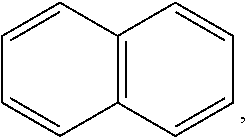


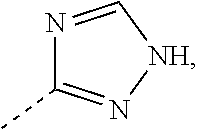




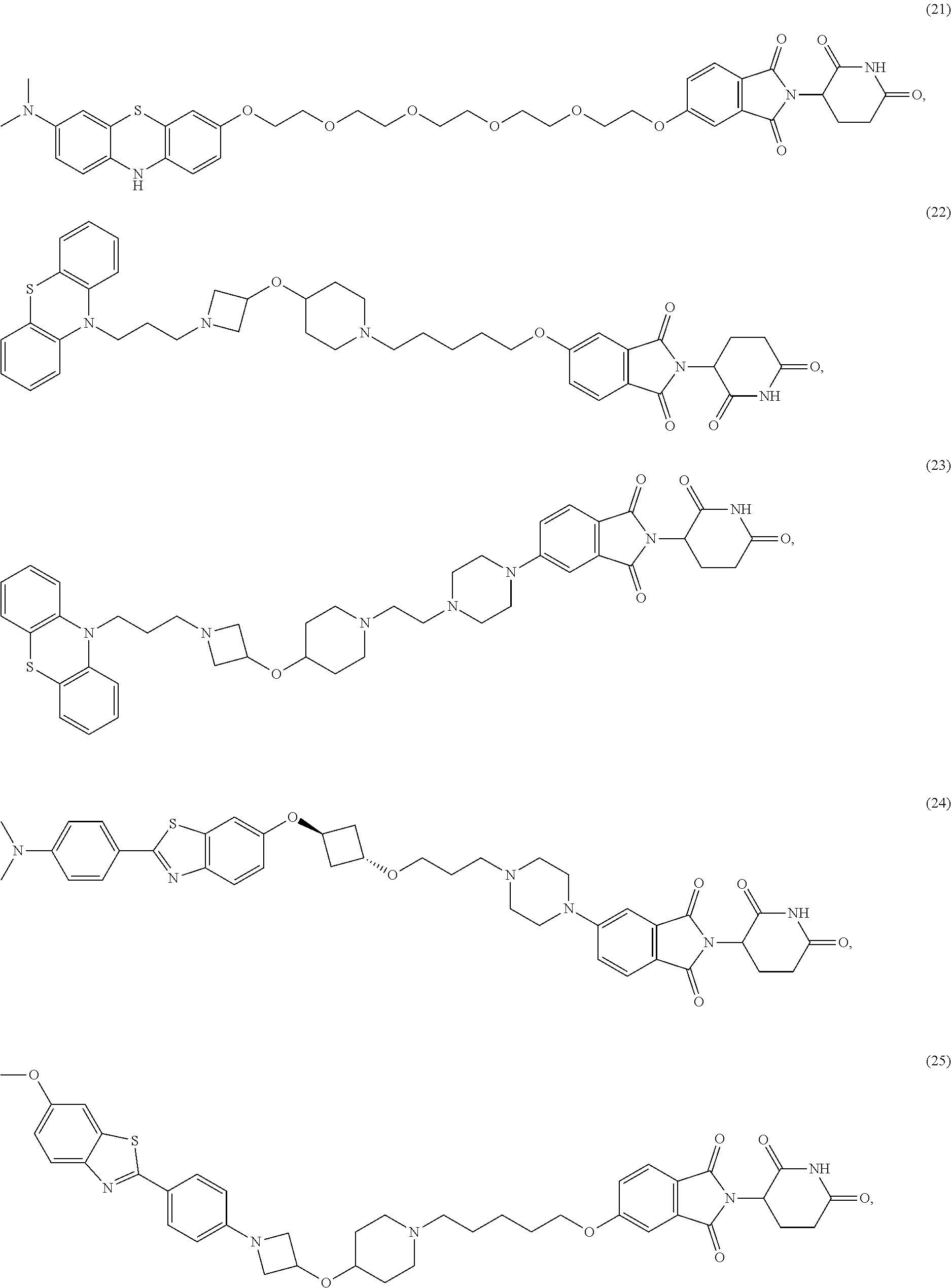


Priority Applications (2)
| Application Number | Priority Date | Filing Date | Title |
|---|---|---|---|
| US16/545,983 US11707452B2 (en) | 2018-08-20 | 2019-08-20 | Modulators of alpha-synuclein proteolysis and associated methods of use |
| US18/309,867 US12594264B2 (en) | 2018-08-20 | 2023-09-18 | Modulators of alpha-synuclein proteolysis and associated methods of use |
Applications Claiming Priority (2)
| Application Number | Priority Date | Filing Date | Title |
|---|---|---|---|
| US201862719937P | 2018-08-20 | 2018-08-20 | |
| US16/545,983 US11707452B2 (en) | 2018-08-20 | 2019-08-20 | Modulators of alpha-synuclein proteolysis and associated methods of use |
Related Child Applications (1)
| Application Number | Title | Priority Date | Filing Date |
|---|---|---|---|
| US18/309,867 Division US12594264B2 (en) | 2018-08-20 | 2023-09-18 | Modulators of alpha-synuclein proteolysis and associated methods of use |
Publications (2)
| Publication Number | Publication Date |
|---|---|
| US20200085793A1 US20200085793A1 (en) | 2020-03-19 |
| US11707452B2 true US11707452B2 (en) | 2023-07-25 |
Family
ID=67841220
Family Applications (2)
| Application Number | Title | Priority Date | Filing Date |
|---|---|---|---|
| US16/545,983 Active 2039-11-16 US11707452B2 (en) | 2018-08-20 | 2019-08-20 | Modulators of alpha-synuclein proteolysis and associated methods of use |
| US18/309,867 Active US12594264B2 (en) | 2018-08-20 | 2023-09-18 | Modulators of alpha-synuclein proteolysis and associated methods of use |
Family Applications After (1)
| Application Number | Title | Priority Date | Filing Date |
|---|---|---|---|
| US18/309,867 Active US12594264B2 (en) | 2018-08-20 | 2023-09-18 | Modulators of alpha-synuclein proteolysis and associated methods of use |
Country Status (5)
| Country | Link |
|---|---|
| US (2) | US11707452B2 (en) |
| EP (1) | EP3841100A1 (en) |
| JP (2) | JP7297053B2 (en) |
| CN (1) | CN112912376A (en) |
| WO (1) | WO2020041331A1 (en) |
Cited By (2)
| Publication number | Priority date | Publication date | Assignee | Title |
|---|---|---|---|---|
| US12448399B2 (en) | 2023-01-26 | 2025-10-21 | Arvinas Operations, Inc. | Cereblon-based KRAS degrading PROTACs and uses related thereto |
| US12552783B2 (en) | 2018-04-04 | 2026-02-17 | Arvinas Operations, Inc. | Modulators of proteolysis and associated methods of use |
Families Citing this family (55)
| Publication number | Priority date | Publication date | Assignee | Title |
|---|---|---|---|---|
| DK2767532T3 (en) | 2012-12-21 | 2016-09-12 | Nat Inst For Quantum And Radiological Science And Tech | New connection for reproduction of tau protein heavy in the brain. |
| US20180228907A1 (en) | 2014-04-14 | 2018-08-16 | Arvinas, Inc. | Cereblon ligands and bifunctional compounds comprising the same |
| MX2019005007A (en) | 2016-11-01 | 2019-07-18 | Arvinas Inc | PROTAC TARGETED AT TAU PROTEIN AND ASSOCIATED METHODS OF USE. |
| CN111372585A (en) | 2017-11-16 | 2020-07-03 | C4医药公司 | Degradants and degrons for target protein degradation |
| EP3773576A4 (en) | 2018-03-26 | 2021-12-29 | C4 Therapeutics, Inc. | Cereblon binders for the degradation of ikaros |
| EP3781156A4 (en) | 2018-04-16 | 2022-05-18 | C4 Therapeutics, Inc. | SPIROCYCLIC COMPOUNDS |
| TW201946624A (en) | 2018-05-09 | 2019-12-16 | 新旭生技股份有限公司 | Heteroaryl compounds and uses thereof |
| JP7297053B2 (en) * | 2018-08-20 | 2023-06-23 | アルビナス・オペレーションズ・インコーポレイテッド | Alpha-Synuclein Protein-Targeted Proteolysis Targeting Chimeric (PROTAC) Compounds with E3 Ubiquitin Ligase Binding Activity to Treat Neurodegenerative Diseases |
| CA3119773A1 (en) | 2018-11-30 | 2020-06-04 | Kymera Therapeutics, Inc. | Irak degraders and uses thereof |
| WO2020210630A1 (en) | 2019-04-12 | 2020-10-15 | C4 Therapeutics, Inc. | Tricyclic degraders of ikaros and aiolos |
| PH12022500002A1 (en) | 2019-06-28 | 2023-04-03 | Kymera Therapeutics Inc | Irak degraders and uses thereof |
| WO2021011868A1 (en) | 2019-07-17 | 2021-01-21 | Kymera Therapeutics, Inc. | Irak degraders and uses thereof |
| EP3999182A1 (en) | 2019-07-17 | 2022-05-25 | Arvinas Operations, Inc. | Tau-protein targeting compounds and associated methods of use |
| UA129778C2 (en) | 2019-10-28 | 2025-07-30 | Мерк Шарп Енд Доум Елелсі | LOW-MOLECULAR INHIBITORS OF G12C-MUTANT KRAS |
| CN114728071B (en) | 2019-11-13 | 2024-12-06 | 新旭生技股份有限公司 | Compounds for degrading TAU protein aggregates and uses thereof |
| EP4067343A4 (en) | 2019-11-29 | 2024-01-03 | Taiho Pharmaceutical Co., Ltd. | Novel phenol compound or salt thereof |
| WO2021119159A1 (en) | 2019-12-10 | 2021-06-17 | Kymera Therapeutics, Inc. | Irak degraders and uses thereof |
| KR20220145325A (en) | 2019-12-17 | 2022-10-28 | 카이메라 쎄라퓨틱스 인코포레이티드 | IRAK disintegrants and uses thereof |
| JP7644139B2 (en) * | 2020-03-21 | 2025-03-11 | アルヴィナス・オペレーションズ・インコーポレイテッド | Indazole-based compounds and related methods of use |
| GB202007106D0 (en) | 2020-05-14 | 2020-07-01 | Ucl Business Plc | Cyclosporine analogues |
| AU2021293907A1 (en) * | 2020-06-17 | 2023-01-19 | Dana-Farber Cancer Institute, Inc. | Targeted aberrant alpha-synuclein species and induced ubiquitination and proteosomal clearance via co-recruitment of an E3-ligase system |
| US12129265B2 (en) | 2020-07-21 | 2024-10-29 | Ankh Life Sciences Limited | Therapeutic agents and uses thereof |
| IL300397A (en) | 2020-08-05 | 2023-04-01 | C4 Therapeutics Inc | Compounds for targeted degradation of ret |
| CN116801908A (en) * | 2020-10-14 | 2023-09-22 | 丹娜法伯癌症研究院 | Chimeric conjugates for degrading viral and host proteins and methods of use |
| EP4255568A1 (en) | 2020-12-03 | 2023-10-11 | Baylor College of Medicine | Novel ripk1 kinase targeting protacs and methods of use thereof |
| CN112480081B (en) * | 2020-12-07 | 2022-02-22 | 沈阳药科大学 | Difunctional molecular compound for inducing SHP2 protein degradation based on Cereblan ligand |
| AU2022207648A1 (en) | 2021-01-13 | 2023-07-27 | Monte Rosa Therapeutics Ag | Isoindolinone compounds |
| US12171768B2 (en) | 2021-02-15 | 2024-12-24 | Kymera Therapeutics, Inc. | IRAK4 degraders and uses thereof |
| CN116867494A (en) | 2021-02-15 | 2023-10-10 | 凯麦拉医疗公司 | IRAK4 degraders and their uses |
| EP4337259A1 (en) * | 2021-05-14 | 2024-03-20 | Aprinoia Therapeutics Limited | Compounds for degrading alpha-synuclein aggregates and uses thereof |
| CN115504963A (en) * | 2021-06-22 | 2022-12-23 | 苏州开拓药业股份有限公司 | A c-Myc protein degradation agent |
| CN117940435A (en) * | 2021-07-16 | 2024-04-26 | Ac免疫有限公司 | Novel compounds for diagnosing TDP-43 proteinopathies |
| WO2023039010A1 (en) * | 2021-09-08 | 2023-03-16 | Academia Sinica | Compounds and their uses for treating neurodegenerative disease |
| EP4147723A1 (en) | 2021-09-09 | 2023-03-15 | Booster Therapeutics GmbH | Bifunctional molecules as proteasome stimulators for improved targeted protein degradation, and their uses as targeted boosting degraders (tarbods) |
| EP4398941A1 (en) | 2021-09-09 | 2024-07-17 | Booster Therapeutics GmbH | Bifunctional molecules as proteasome stimulators for improved targeted protein degradation, and their uses as targeted boosting degraders (tarbods) |
| CA3236265A1 (en) | 2021-10-29 | 2023-05-04 | William Leong | Irak4 degraders and synthesis thereof |
| CN115894450B (en) * | 2021-11-30 | 2023-09-12 | 山东如至生物医药科技有限公司 | Novel polycyclic compound and composition and application thereof |
| WO2023111580A1 (en) * | 2021-12-16 | 2023-06-22 | University Of Dundee | Targeted degradation of alpha-synuclein |
| TW202346281A (en) * | 2022-01-21 | 2023-12-01 | 瑞典商阿斯特捷利康公司 | Compounds and their use in treating cancer |
| CN114573570B (en) * | 2022-02-21 | 2023-05-30 | 中山大学 | Alpha-synuclein targeting compound, and preparation method and application thereof |
| CA3249074A1 (en) | 2022-06-06 | 2023-12-14 | C4 Therapeutics, Inc. | Bicyclic-substituted glutarimide cereblon binders |
| WO2023241644A1 (en) * | 2022-06-15 | 2023-12-21 | 杭州多域生物技术有限公司 | Five-membered ring-fused six-membered compound, preparation method therefor, and pharmaceutical composition and use thereof |
| CN115650957B (en) * | 2022-09-16 | 2023-12-15 | 中山大学 | Proteolytic chimeras targeting alpha-synuclein and application thereof |
| EP4428134A1 (en) | 2023-03-10 | 2024-09-11 | Dark Blue Therapeutics Ltd | Protac degraders of mllt1 and/or mllt3 |
| WO2024251876A1 (en) * | 2023-06-07 | 2024-12-12 | KRæFTENS BEKæMPELSE | PROTACs AND HyT-PD MOLECULES FOR TARGETED PROTEIN DEGRADATION OF DCAF15 AND THEIR USE IN THE TREATMENT OF AMYLOIDOSIS |
| WO2025011624A1 (en) * | 2023-07-11 | 2025-01-16 | Etern Biopharma (Shanghai) Co., Ltd. | Bifunctional compounds for androgen receptor degradation and methods of use |
| WO2025019590A2 (en) * | 2023-07-18 | 2025-01-23 | The General Hospital Corporation | Proteolysis targeting chimeras for treating neurodegeneration |
| WO2025019819A2 (en) * | 2023-07-20 | 2025-01-23 | Merck Sharp & Dohme Llc | Small molecule protein degraders of kras g12d mutant |
| CN121773112A (en) | 2023-08-17 | 2026-03-31 | 海思科医药集团股份有限公司 | Cyano aromatic ring derivative and application thereof in medicine |
| GB202314126D0 (en) | 2023-09-15 | 2023-11-01 | Univ Oxford Innovation Ltd | Compound and method |
| AU2024361909A1 (en) | 2023-10-20 | 2026-03-26 | Merck Sharp & Dohme Llc | Small molecule inhibitors of kras proteins |
| EP4667467A1 (en) | 2024-06-21 | 2025-12-24 | Dark Blue Therapeutics Ltd | Protac degraders of mllt1 and/or mllt3 |
| WO2025262297A1 (en) | 2024-06-21 | 2025-12-26 | Dark Blue Therapeutics Ltd | Protac degraders of mllt1 and/or mllt3 |
| EP4667466A1 (en) | 2024-06-21 | 2025-12-24 | Dark Blue Therapeutics Ltd | Protac degraders of mllt1 and/or mllt3 |
| WO2026060321A1 (en) | 2024-09-13 | 2026-03-19 | Olema Pharmaceuticals, Inc. | Kat6 degrader compounds and method thereof |
Citations (150)
| Publication number | Priority date | Publication date | Assignee | Title |
|---|---|---|---|---|
| WO1998003502A1 (en) | 1996-07-24 | 1998-01-29 | Celgene Corporation | Substituted 2(2,6-dioxopiperidin-3-yl)phthalimides and -1-oxoisoindolines and method of reducing tnf-alpha levels |
| WO2000066119A1 (en) | 1999-05-05 | 2000-11-09 | Merck & Co., Inc. | Novel prolines as antimicrobial agents |
| US6306663B1 (en) | 1999-02-12 | 2001-10-23 | Proteinex, Inc. | Controlling protein levels in eucaryotic organisms |
| WO2002066512A1 (en) | 2001-02-16 | 2002-08-29 | E.I. Dupont De Nemours And Company | Angiogenesis-inhibitory tripeptides, compositions and their methods of use |
| WO2002100845A1 (en) | 2001-06-11 | 2002-12-19 | Agouron Pharmaceuticals, Inc. | Hv protease inhibitors, compositions containing the same, their pharmaceutical uses and materials for their synthesis |
| US20030096841A1 (en) | 2000-12-27 | 2003-05-22 | Robarge Michael J. | Isoindole-imide compounds, compositions, and uses thereof |
| US6670348B1 (en) | 1997-05-14 | 2003-12-30 | Sloan-Kettering Institute For Cancer Research | Methods and compositions for destruction of selected proteins |
| WO2005016326A2 (en) | 2003-07-11 | 2005-02-24 | The Government Of The United States Of America As Represented By The Secretary Of The Department Of Health And Human Services | Analogs of thalidomide as potential angiogenesis inhibitors |
| WO2005097791A1 (en) | 2004-04-07 | 2005-10-20 | Novartis Ag | Inhibitors of iap |
| US7030141B2 (en) | 2001-11-29 | 2006-04-18 | Christopher Franklin Bigge | Inhibitors of factor Xa and other serine proteases involved in the coagulation cascade |
| US7041298B2 (en) | 2000-09-08 | 2006-05-09 | California Institute Of Technology | Proteolysis targeting chimeric pharmaceutical |
| US20060128632A1 (en) | 2002-07-02 | 2006-06-15 | Sharma Sushil K | Peptide inhibitors of smac protein binding to inhibitor of apoptosis proteins (iap) |
| WO2006069063A1 (en) | 2004-12-20 | 2006-06-29 | Genentech, Inc. | Pyrrolidine inhibitors of iap |
| CN1844118A (en) | 2005-04-07 | 2006-10-11 | 天津和美生物技术有限公司 | Piperidine-2,6-dione derivatives that inhibit the release of tumor necrosis factor from cells |
| WO2006113942A2 (en) | 2005-04-20 | 2006-10-26 | Schering Corporation | Method of inhibiting cathepsin activity |
| US7208157B2 (en) | 2000-09-08 | 2007-04-24 | California Institute Of Technology | Proteolysis targeting chimeric pharmaceutical |
| US7244851B2 (en) | 2004-07-02 | 2007-07-17 | Genentech, Inc. | Inhibitors of IAP |
| WO2007101347A1 (en) | 2006-03-07 | 2007-09-13 | Aegera Therapeutics Inc. | Bir domain binding compounds |
| WO2007106670A2 (en) | 2006-03-03 | 2007-09-20 | Novartis Ag | N-formyl hydroxylamine compounds |
| WO2007115289A2 (en) | 2006-04-05 | 2007-10-11 | Novartis Ag | Combinations comprising bcr-abl/c-kit/pdgf-r tk inhibitors for treating cancer |
| WO2007130626A2 (en) | 2006-05-05 | 2007-11-15 | The Regents Of The University Of Michigan | Bivalent smac mimetics and the uses thereof |
| WO2008011392A2 (en) | 2006-07-20 | 2008-01-24 | Ligand Pharmacueticals Incorporated | Proline urea ccr1 antagonists for the treatment of autoimmune diseases or inflammation |
| WO2008014236A1 (en) | 2006-07-24 | 2008-01-31 | Tetralogic Pharmaceuticals Corporation | Dimeric iap inhibitors |
| US7345081B2 (en) | 2004-03-23 | 2008-03-18 | Genentech, Inc. | Azabicyclo-octane inhibitors of IAP |
| US20080214501A1 (en) | 2006-11-03 | 2008-09-04 | Pharmacyclics, Inc. | Bruton's tyrosine kinase activity probe and method of using |
| WO2008109057A1 (en) | 2007-03-02 | 2008-09-12 | Dana-Farber Cancer Institute, Inc. | Organic compounds and their uses |
| WO2008128171A2 (en) | 2007-04-13 | 2008-10-23 | The Regents Of The University Of Michigan | Diazo bicyclic smac mimetics and the uses thereof |
| WO2008128121A1 (en) | 2007-04-12 | 2008-10-23 | Joyant Pharmaceuticals, Inc. | Smac mimetic dimers and trimers useful as anti-cancer agents |
| US20080269140A1 (en) | 2004-01-16 | 2008-10-30 | The Regents Of The University Of Michigan | Conformationally Constrained Smac Mimetics and the Uses Thereof |
| WO2008134679A1 (en) | 2007-04-30 | 2008-11-06 | Genentech, Inc. | Inhibitors of iap |
| WO2009015254A1 (en) | 2007-07-25 | 2009-01-29 | Bristol-Myers Squibb Company | Triazine kinase inhibitors |
| US7517906B2 (en) | 2005-02-25 | 2009-04-14 | Tetralogic Pharmaceuticals Corporation | Dimeric IAP inhibitors |
| WO2009060292A2 (en) | 2007-11-09 | 2009-05-14 | Universita'degli Studi Di Milano | Smac mimetic compounds as apoptosis inducers |
| RU2008112221A (en) | 2005-08-31 | 2009-10-10 | Селджин Корпорейшн (Us) | COMPOUNDS OF A NUMBER OF ISOINDOLIMIDES, THEIR COMPOSITIONS AND METHODS OF APPLICATION |
| JP2010502627A (en) | 2006-08-30 | 2010-01-28 | セルジーン・コーポレーション | 5-substituted isoindoline compounds |
| US20100203012A1 (en) | 2007-05-30 | 2010-08-12 | Aegera Therapeutics, Inc. | Iap bir domain binding compounds |
| WO2010107485A1 (en) | 2009-03-17 | 2010-09-23 | The Trustees Of Columbia University In The City Of New York | E3 ligase inhibitors |
| WO2010141805A1 (en) | 2009-06-05 | 2010-12-09 | Janssen Pharmaceutica Nv | Heterocyclic amides as modulators of trpa1 |
| WO2011008260A2 (en) | 2009-07-13 | 2011-01-20 | President And Fellows Of Harvard College | Bifunctional stapled polypeptides and uses thereof |
| US7915293B2 (en) | 2003-05-30 | 2011-03-29 | Rigel Pharmaceuticals, Inc. | Ubiquitin ligase inhibitors |
| US20110195043A1 (en) | 2009-10-28 | 2011-08-11 | Sun Haizhou | Dimeric Smac Mimetics |
| US20110196150A1 (en) | 2010-02-11 | 2011-08-11 | Hon-Wah Man | Arylmethoxy Isoindoline Derivatives and Compositions Comprising and Methods of Using the Same |
| US20110230457A1 (en) | 2009-12-22 | 2011-09-22 | Novartis Ag | Substituted Isoquinolinones and Quinazolinones |
| WO2012003281A2 (en) | 2010-06-30 | 2012-01-05 | Brandeis University | Small-molecule-targeted protein degradation |
| WO2012007409A1 (en) | 2010-07-12 | 2012-01-19 | F. Hoffmann-La Roche Ag | N-substituted pyrrolidines |
| WO2012040527A2 (en) | 2010-09-24 | 2012-03-29 | The Regents Of The University Of Michigan | Deubiquitinase inhibitors and methods for use of the same |
| RU2448101C2 (en) | 2006-08-30 | 2012-04-20 | Селджин Корпорейшн | 5-substituted isoindoline compounds |
| WO2012078559A2 (en) | 2010-12-07 | 2012-06-14 | Yale University | Small-molecule hydrophobic tagging of fusion proteins and induced degradation of same |
| WO2012090104A1 (en) | 2010-12-31 | 2012-07-05 | Kareus Therapeutics, Sa | Methods and compositions for designing novel conjugate therapeutics |
| RU2011121567A (en) | 2008-10-29 | 2012-12-10 | Селджин Корпорейшн | ISOINDOLINE COMPOUNDS FOR USE IN TREATMENT OF CANCER |
| WO2013071035A1 (en) | 2011-11-09 | 2013-05-16 | Ensemble Therapeutics | Macrocyclic compounds for inhibition of inhibitors of apoptosis |
| WO2013071039A1 (en) | 2011-11-09 | 2013-05-16 | Ensemble Therapeutics | Macrocyclic compounds for inhibition of inhibitors of apoptosis |
| WO2013106535A1 (en) | 2012-01-10 | 2013-07-18 | Nimbus Iris, Inc. | Irak inhibitors and uses thereof |
| WO2013106643A2 (en) | 2012-01-12 | 2013-07-18 | Yale University | Compounds & methods for the enhanced degradation of targeted proteins & other polypeptides by an e3 ubiquitin ligase |
| WO2013106646A2 (en) | 2012-01-12 | 2013-07-18 | Yale University | Compounds and methods for the inhibition of vcb e3 ubiquitin ligase |
| WO2013170147A1 (en) | 2012-05-11 | 2013-11-14 | Yale University | Compounds useful for promoting protein degradation and methods using same |
| WO2013175417A1 (en) | 2012-05-24 | 2013-11-28 | Novartis Ag | Pyrrolopyrrolidinone compounds |
| WO2013176698A1 (en) | 2012-05-22 | 2013-11-28 | Eli Lilly And Company | Carboline and carbazole based imaging agents for detecting neurological dysfunction |
| WO2013178570A1 (en) | 2012-05-30 | 2013-12-05 | F. Hoffmann-La Roche Ag | Substituted pyrrolidine-2-carboxamides |
| WO2014011712A1 (en) | 2012-07-10 | 2014-01-16 | Bristol-Myers Squibb Company | Iap antagonists |
| WO2014020502A2 (en) | 2012-07-31 | 2014-02-06 | Novartis Ag | Markers associated with human double minute 2 inhibitors |
| WO2014025759A1 (en) | 2012-08-09 | 2014-02-13 | Bristol-Myers Squibb Company | Iap antagonists |
| WO2014038606A1 (en) | 2012-09-06 | 2014-03-13 | 第一三共株式会社 | Crystal of dispiropyrrolidine derivative |
| CN103688176A (en) | 2011-04-29 | 2014-03-26 | 细胞基因公司 | Methods for the treatment of cancer and inflammatory diseases using cereblon as a predictor |
| WO2014047024A1 (en) | 2012-09-18 | 2014-03-27 | Bristol-Myers Squibb Company | Iap antagonists |
| WO2014055461A1 (en) | 2012-10-02 | 2014-04-10 | Bristol-Myers Squibb Company | Iap antagonists |
| WO2014074658A1 (en) | 2012-11-09 | 2014-05-15 | Bristol-Myers Squibb Company | Macrocyclic compounds for inhibition of inhibitors of apoptosis |
| WO2014100071A2 (en) | 2012-12-20 | 2014-06-26 | Merck Sharp & Dohme Corp. | Substituted pyrrolopyrimidines as hdm2 inhibitors |
| WO2014100065A1 (en) | 2012-12-20 | 2014-06-26 | Merck Sharp & Dohme Corp. | Substituted imidazopyridines as hdm2 inhibitors |
| WO2014107713A1 (en) | 2013-01-07 | 2014-07-10 | Sanofi | Combination of a hdm2 antagonist and a mek inhibitor for use in treating cancer |
| WO2014108452A1 (en) | 2013-01-11 | 2014-07-17 | Glaxosmithkline Intellectual Property Development Limited | Proteolysis targeting chimeras (protacs) directed to the modulation of the estrogen receptor |
| WO2014123418A1 (en) | 2013-02-06 | 2014-08-14 | Hq Medical (Netherlands) B.V. | Groundbreaking platform technology for specific binding to necrotic cells |
| US20140235629A1 (en) | 2011-09-27 | 2014-08-21 | Amgen Inc. | Heterocyclic compounds as mdm2 inhibitors for the treatment of cancer |
| US20140243372A1 (en) | 2013-02-28 | 2014-08-28 | Amgen Inc. | Benzoic acid derivative mdm2 inhibitor for the treatment of cancer |
| WO2014151863A1 (en) | 2013-03-14 | 2014-09-25 | Amgen Inc. | Heteroaryl acid morpholinone compounds as mdm2 inhibitors for the treatment of cancer |
| WO2015000868A1 (en) | 2013-07-03 | 2015-01-08 | Glaxosmithkline Intellectual Property Development Limited | Novel compounds |
| WO2015006524A1 (en) | 2013-07-12 | 2015-01-15 | Bristol-Myers Squibb Company | Iap antagonists |
| WO2015097621A2 (en) | 2013-12-23 | 2015-07-02 | Novartis Ag | Pharmaceutical combinations |
| WO2015116663A1 (en) | 2014-01-29 | 2015-08-06 | Neuropore Therapies, Inc. | Heteroarly amides as inhibitors of protein aggregation |
| US20150291562A1 (en) | 2014-04-14 | 2015-10-15 | Arvinas, Inc. | Imide-based modulators of proteolysis and associated methods of use |
| WO2015173225A1 (en) | 2014-05-13 | 2015-11-19 | F. Hoffmann-La Roche Ag | Deuterated heterocyclic compounds and their use as imaging agents |
| US20150344473A1 (en) | 2014-06-03 | 2015-12-03 | Gilead Sciences, Inc. | Tank-binding kinase inhibitor compounds |
| US20160022642A1 (en) | 2014-07-25 | 2016-01-28 | Yale University | Compounds Useful for Promoting Protein Degradation and Methods Using Same |
| EP2985285A1 (en) | 2014-08-11 | 2016-02-17 | Yale University | Estrogen-related receptor alpha based protac compounds and associated methods of use |
| US20160058872A1 (en) | 2014-04-14 | 2016-03-03 | Arvinas, Inc. | Imide-based modulators of proteolysis and associated methods of use |
| WO2016105518A1 (en) | 2014-12-23 | 2016-06-30 | Dana-Farber Cancer Institute, Inc. | Methods to induce targeted protein degradation through bifunctional molecules |
| US20160214972A1 (en) | 2015-01-20 | 2016-07-28 | Arvinas, Inc. | Compounds and methods for the targeted degradation of androgen receptor |
| US20160243247A1 (en) | 2014-12-23 | 2016-08-25 | Dana-Farber Cancer Institute, Inc. | Methods to induce targeted protein degradation through bifunctional molecules |
| US9447070B2 (en) | 2006-08-30 | 2016-09-20 | Celgene Corporation | 5-substituted isoindoline compounds |
| US20160272639A1 (en) | 2015-03-18 | 2016-09-22 | Arvinas, Inc. | Compounds and methods for the enhanced degradation of targeted proteins |
| WO2016146985A1 (en) | 2015-03-13 | 2016-09-22 | University Of Dundee | Derivatives of 1-[(cyclopentyl or 2-pyrrolidinyl)carbonylaminomethyl]-4-(1,3-thiazol-5-yl) benzene which are useful for the treatment of proliferative, autoimmune or inflammatory diseases |
| WO2016172134A2 (en) | 2015-04-22 | 2016-10-27 | Glaxosmithkline Intellectual Property Development Limited | Novel compounds |
| WO2016169989A1 (en) | 2015-04-22 | 2016-10-27 | Glaxosmithkline Intellectual Property Development Limited | Iap e3 ligase directed proteolysis targeting chimeric molecules |
| WO2016197114A1 (en) | 2015-06-05 | 2016-12-08 | Arvinas, Inc. | Tank-binding kinase-1 protacs and associated methods of use |
| US20160368911A1 (en) | 2013-07-03 | 2016-12-22 | Glaxosmithkline Intellectual Property Development Limited | Benzothiophene derivatives as estrogen receptor inhibitors |
| US20170008904A1 (en) | 2015-07-10 | 2017-01-12 | Arvinas, Inc. | Mdm2-based modulators of proteolysis and associated methods of use |
| WO2017007612A1 (en) | 2015-07-07 | 2017-01-12 | Dana-Farber Cancer Institute, Inc. | Methods to induce targeted protein degradation through bifunctional molecules |
| WO2017011590A1 (en) | 2015-07-13 | 2017-01-19 | Arvinas, Inc. | Alanine-based modulators of proteolysis and associated methods of use |
| WO2017020010A1 (en) | 2015-07-29 | 2017-02-02 | Neuropore Therapies, Inc. | Bis-heteroaryl derivatives as modulators of protein aggregation |
| WO2017024318A1 (en) | 2015-08-06 | 2017-02-09 | Dana-Farber Cancer Institute, Inc. | Targeted protein degradation to attenuate adoptive t-cell therapy associated adverse inflammatory responses |
| WO2017024317A2 (en) | 2015-08-06 | 2017-02-09 | Dana-Farber Cancer Institute, Inc. | Methods to induce targeted protein degradation through bifunctional molecules |
| WO2017030814A1 (en) | 2015-08-19 | 2017-02-23 | Arvinas, Inc. | Compounds and methods for the targeted degradation of bromodomain-containing proteins |
| WO2017046036A1 (en) | 2015-09-14 | 2017-03-23 | Glaxosmithkline Intellectual Property Development Limited | Compounds for the modulation of rip2 kinase activity |
| US20170121321A1 (en) | 2015-11-02 | 2017-05-04 | Yale University | Proteolysis Targeting Chimera Compounds and Methods of Preparing and Using Same |
| WO2017117473A1 (en) | 2015-12-30 | 2017-07-06 | Dana-Farber Cancer Institute, Inc. | Bifunctional molescules for her3 degradation and methods of use |
| WO2017117474A1 (en) | 2015-12-30 | 2017-07-06 | Dana-Farber Cancer Institute, Inc. | Bifunctional compounds for her3 degradation and methods of use |
| WO2017153601A1 (en) | 2016-03-11 | 2017-09-14 | Ac Immune Sa | Bicyclic compounds for diagnosis and therapy |
| WO2017161119A1 (en) | 2016-03-16 | 2017-09-21 | H. Lee Moffitt Cancer Center & Research Institute, Inc. | Small molecules against cereblon to enhance effector t cell function |
| US20170281784A1 (en) | 2016-04-05 | 2017-10-05 | Arvinas, Inc. | Protein-protein interaction inducing technology |
| WO2017176957A1 (en) | 2016-04-06 | 2017-10-12 | The Regents Of The University Of Michigan | Mdm2 protein degraders |
| WO2017176958A1 (en) | 2016-04-06 | 2017-10-12 | The Regents Of The University Of Michigan | Monofunctional intermediates for ligand-dependent target protein degradation |
| WO2017185034A1 (en) | 2016-04-22 | 2017-10-26 | Dana-Farber Cancer Institute, Inc. | Degradation of cyclin-dependent kinase 8 (cdk8) by conjugation of cdk8 inhibitors with e3 ligase ligand and methods of use |
| WO2017185036A1 (en) | 2016-04-22 | 2017-10-26 | Dana Farber Cancer Institute, Inc. | Bifunctional molecules for degradation of egfr and methods of use |
| WO2017185031A1 (en) | 2016-04-22 | 2017-10-26 | Dana-Farber Cancer Institute, Inc. | Degradation of cyclin-dependent kinase 4/6 (cdk4/6) by conjugation of cdk4/6 inhibitors with e3 ligase ligand and methods of use |
| WO2017185023A1 (en) | 2016-04-22 | 2017-10-26 | Dana-Farber Cancer Institute, Inc. | Degradation of cyclin-dependent kinase 9 (cdk9) by conjugation of cdk9 inhibitors with e3 ligase ligand and methods of use |
| WO2017197051A1 (en) | 2016-05-10 | 2017-11-16 | C4 Therapeutics, Inc. | Amine-linked c3-glutarimide degronimers for target protein degradation |
| US20170327469A1 (en) | 2015-01-20 | 2017-11-16 | Arvinas, Inc. | Compounds and methods for the targeted degradation of androgen receptor |
| WO2017197055A1 (en) | 2016-05-10 | 2017-11-16 | C4 Therapeutics, Inc. | Heterocyclic degronimers for target protein degradation |
| WO2017197056A1 (en) | 2016-05-10 | 2017-11-16 | C4 Therapeutics, Inc. | Bromodomain targeting degronimers for target protein degradation |
| WO2017223452A1 (en) | 2016-06-23 | 2017-12-28 | Dana-Farber Cancer Institute, Inc. | Degradation of bromodomain-containing protein 9 (brd9) by conjugation of brd9 inhibitors with e3 ligase ligand and methods of use |
| WO2017223415A1 (en) | 2016-06-23 | 2017-12-28 | Dana-Farber Cancer Institute, Inc. | Degradation of tripartite motif-containing protein 24 (trim24) by conjugation of trim24 inhibitors with e3 ligase ligand and methods of use |
| US20180015087A1 (en) | 2016-07-13 | 2018-01-18 | Araxes Pharma Llc | Conjugates of cereblon binding compounds and g12c mutant kras, hras or nras protein modulating compounds and methods of use thereof |
| US20180072711A1 (en) | 2016-09-15 | 2018-03-15 | Arvinas, Inc. | Indole derivatives as estrogen receptor degraders |
| WO2018052945A1 (en) | 2016-09-13 | 2018-03-22 | The Regents Of The University Of Michigan | Fused 1,4-oxazepines as bet protein degraders |
| WO2018052949A1 (en) | 2016-09-13 | 2018-03-22 | The Regents Of The University Of Michigan | Fused 1,4-diazepines as bet protein degraders |
| WO2018064589A1 (en) | 2016-09-29 | 2018-04-05 | Dana-Farber Cancer Institute, Inc. | Targeted protein degradation using a mutant e3 ubiquitin ligase |
| US20180099940A1 (en) | 2016-10-11 | 2018-04-12 | Arvinas, Inc. | Compounds and methods for the targeted degradation of androgen receptor |
| US20180125821A1 (en) | 2016-11-01 | 2018-05-10 | Arvinas, Inc. | Tau-protein targeting protacs and associated methods of use |
| WO2018089736A1 (en) | 2016-11-10 | 2018-05-17 | Dana-Farber Cancer Institute, Inc. | Degradation of protein kinases by conjugation of protein kinase inhibitors with e3 ligase ligand and methods of use |
| WO2018098288A1 (en) | 2016-11-22 | 2018-05-31 | Dana-Farber Cancer Institute, Inc. | Degradation of bruton's tyrosine kinase (btk) by conjugation of btk inhibitors with e3 ligase ligand and methods of use |
| WO2018098275A1 (en) | 2016-11-22 | 2018-05-31 | Dana-Farber Cancer Institute, Inc. | Degradation of bruton's tyrosine kinase (btk) by conjugation of btk inhibitors with e3 ligase ligand and methods of use |
| WO2018098280A1 (en) | 2016-11-22 | 2018-05-31 | Dana-Farber Cancer Institute, Inc. | Degradation of protein kinases by conjugation of protein kinase inhibitors with e3 ligase ligand and methods of use |
| US20180155322A1 (en) | 2016-12-01 | 2018-06-07 | Arvinas, Inc. | Tetrahydronaphthalene and tetrahydroisoquinoline derivatives as estrogen receptor degraders |
| WO2018106870A1 (en) | 2016-12-08 | 2018-06-14 | Icahn School Of Medicine At Mount Sinai | Compositions and methods for treating cdk4/6-mediated cancer |
| US20180177750A1 (en) | 2016-12-24 | 2018-06-28 | Arvinas, Inc. | Compounds and methods for the targeted degradation of enhancer of zeste homolog 2 polypeptide |
| US20180179183A1 (en) | 2016-12-23 | 2018-06-28 | Arvinas, Inc. | Compounds and methods for the targeted degradation of rapidly accelerated fibrosarcoma polypeptides |
| US20180193470A1 (en) | 2016-12-23 | 2018-07-12 | Arvinas, Inc. | Egfr proteolysis targeting chimeric molecules and associated methods of use |
| WO2018138088A1 (en) | 2017-01-26 | 2018-08-02 | Ucb Biopharma Sprl | Bicyclic bis-heteroaryl derivatives as modulators of protein aggregation |
| US20180215731A1 (en) | 2017-01-31 | 2018-08-02 | Arvinas, Inc. | Cereblon ligands and bifunctional compounds comprising the same |
| WO2018138086A1 (en) | 2017-01-26 | 2018-08-02 | Ucb Biopharma Sprl | Bis-heteroaryl derivatives as modulators of protein aggregation |
| WO2018148440A1 (en) | 2017-02-08 | 2018-08-16 | Dana-Farber Cancer Institute, Inc. | Regulating chimeric antigen receptors |
| US20180228907A1 (en) | 2014-04-14 | 2018-08-16 | Arvinas, Inc. | Cereblon ligands and bifunctional compounds comprising the same |
| US20180237418A1 (en) | 2017-01-26 | 2018-08-23 | Arvinas, Inc. | Modulators of estrogen receptor proteolysis and associated methods of use |
| US20180256586A1 (en) | 2016-12-23 | 2018-09-13 | Arvinas, Inc. | Compounds and methods for the targeted degradation of fetal liver kinase polypeptides |
| US20180353501A1 (en) | 2017-06-09 | 2018-12-13 | Arvinas, Inc. | Modulators of proteolysis and associated methods of use |
| WO2019014429A1 (en) | 2017-07-12 | 2019-01-17 | Dana-Farber Cancer Institute, Inc. | Compounds for tau protein degradation |
| WO2019042444A1 (en) | 2017-09-03 | 2019-03-07 | 上海美志医药科技有限公司 | Compound for inhibiting and degrading tyrosine protein kinase alk |
| US20190151295A1 (en) | 2017-11-17 | 2019-05-23 | Arvinas, Inc. | Compounds and methods for the targeted degradation of interleukin-1 receptor-associated kinase 4 polypeptides |
| WO2019121661A1 (en) | 2017-12-21 | 2019-06-27 | F. Hoffmann-La Roche Ag | Radiolabeled compounds |
| WO2019195201A1 (en) | 2018-04-01 | 2019-10-10 | Arvinas Operations, Inc. | Brm targeting compounds and associated methods of use |
Family Cites Families (4)
| Publication number | Priority date | Publication date | Assignee | Title |
|---|---|---|---|---|
| US9875607B2 (en) * | 2011-07-13 | 2018-01-23 | Igt | Methods and apparatus for providing secure logon to a gaming machine using a mobile device |
| CA2988414C (en) * | 2015-06-04 | 2023-09-26 | Arvinas, Inc. | Imide-based modulators of proteolysis and associated methods of use |
| EP3346910A4 (en) * | 2015-09-09 | 2019-05-15 | Ubiome Inc. | METHOD AND SYSTEM FOR DIAGNOSES DERIVED FROM MICROBIOMA AND THERAPEUTIC AGENTS AGAINST ECZEMA |
| JP7297053B2 (en) * | 2018-08-20 | 2023-06-23 | アルビナス・オペレーションズ・インコーポレイテッド | Alpha-Synuclein Protein-Targeted Proteolysis Targeting Chimeric (PROTAC) Compounds with E3 Ubiquitin Ligase Binding Activity to Treat Neurodegenerative Diseases |
-
2019
- 2019-08-20 JP JP2021510057A patent/JP7297053B2/en active Active
- 2019-08-20 US US16/545,983 patent/US11707452B2/en active Active
- 2019-08-20 EP EP19762583.3A patent/EP3841100A1/en not_active Withdrawn
- 2019-08-20 WO PCT/US2019/047291 patent/WO2020041331A1/en not_active Ceased
- 2019-08-20 CN CN201980068974.4A patent/CN112912376A/en active Pending
-
2023
- 2023-02-28 JP JP2023029776A patent/JP2023081908A/en active Pending
- 2023-09-18 US US18/309,867 patent/US12594264B2/en active Active
Patent Citations (169)
| Publication number | Priority date | Publication date | Assignee | Title |
|---|---|---|---|---|
| WO1998003502A1 (en) | 1996-07-24 | 1998-01-29 | Celgene Corporation | Substituted 2(2,6-dioxopiperidin-3-yl)phthalimides and -1-oxoisoindolines and method of reducing tnf-alpha levels |
| US6670348B1 (en) | 1997-05-14 | 2003-12-30 | Sloan-Kettering Institute For Cancer Research | Methods and compositions for destruction of selected proteins |
| US6306663B1 (en) | 1999-02-12 | 2001-10-23 | Proteinex, Inc. | Controlling protein levels in eucaryotic organisms |
| WO2000066119A1 (en) | 1999-05-05 | 2000-11-09 | Merck & Co., Inc. | Novel prolines as antimicrobial agents |
| US7041298B2 (en) | 2000-09-08 | 2006-05-09 | California Institute Of Technology | Proteolysis targeting chimeric pharmaceutical |
| US7208157B2 (en) | 2000-09-08 | 2007-04-24 | California Institute Of Technology | Proteolysis targeting chimeric pharmaceutical |
| US20030096841A1 (en) | 2000-12-27 | 2003-05-22 | Robarge Michael J. | Isoindole-imide compounds, compositions, and uses thereof |
| WO2002066512A1 (en) | 2001-02-16 | 2002-08-29 | E.I. Dupont De Nemours And Company | Angiogenesis-inhibitory tripeptides, compositions and their methods of use |
| WO2002100845A1 (en) | 2001-06-11 | 2002-12-19 | Agouron Pharmaceuticals, Inc. | Hv protease inhibitors, compositions containing the same, their pharmaceutical uses and materials for their synthesis |
| US7030141B2 (en) | 2001-11-29 | 2006-04-18 | Christopher Franklin Bigge | Inhibitors of factor Xa and other serine proteases involved in the coagulation cascade |
| US20060128632A1 (en) | 2002-07-02 | 2006-06-15 | Sharma Sushil K | Peptide inhibitors of smac protein binding to inhibitor of apoptosis proteins (iap) |
| US7915293B2 (en) | 2003-05-30 | 2011-03-29 | Rigel Pharmaceuticals, Inc. | Ubiquitin ligase inhibitors |
| WO2005016326A2 (en) | 2003-07-11 | 2005-02-24 | The Government Of The United States Of America As Represented By The Secretary Of The Department Of Health And Human Services | Analogs of thalidomide as potential angiogenesis inhibitors |
| US20080269140A1 (en) | 2004-01-16 | 2008-10-30 | The Regents Of The University Of Michigan | Conformationally Constrained Smac Mimetics and the Uses Thereof |
| US7345081B2 (en) | 2004-03-23 | 2008-03-18 | Genentech, Inc. | Azabicyclo-octane inhibitors of IAP |
| WO2005097791A1 (en) | 2004-04-07 | 2005-10-20 | Novartis Ag | Inhibitors of iap |
| US7419975B2 (en) | 2004-04-07 | 2008-09-02 | Novartis Ag | Organic compounds |
| US7244851B2 (en) | 2004-07-02 | 2007-07-17 | Genentech, Inc. | Inhibitors of IAP |
| WO2006069063A1 (en) | 2004-12-20 | 2006-06-29 | Genentech, Inc. | Pyrrolidine inhibitors of iap |
| US7517906B2 (en) | 2005-02-25 | 2009-04-14 | Tetralogic Pharmaceuticals Corporation | Dimeric IAP inhibitors |
| CN1844118A (en) | 2005-04-07 | 2006-10-11 | 天津和美生物技术有限公司 | Piperidine-2,6-dione derivatives that inhibit the release of tumor necrosis factor from cells |
| US20080051432A1 (en) | 2005-04-07 | 2008-02-28 | Hesheng Zhang | Piperidine-2, 6-dione derivatives and their use as tumor necrosis factor inhibitors |
| WO2006113942A2 (en) | 2005-04-20 | 2006-10-26 | Schering Corporation | Method of inhibiting cathepsin activity |
| RU2008112221A (en) | 2005-08-31 | 2009-10-10 | Селджин Корпорейшн (Us) | COMPOUNDS OF A NUMBER OF ISOINDOLIMIDES, THEIR COMPOSITIONS AND METHODS OF APPLICATION |
| WO2007106670A2 (en) | 2006-03-03 | 2007-09-20 | Novartis Ag | N-formyl hydroxylamine compounds |
| WO2007101347A1 (en) | 2006-03-07 | 2007-09-13 | Aegera Therapeutics Inc. | Bir domain binding compounds |
| WO2007115289A2 (en) | 2006-04-05 | 2007-10-11 | Novartis Ag | Combinations comprising bcr-abl/c-kit/pdgf-r tk inhibitors for treating cancer |
| WO2007130626A2 (en) | 2006-05-05 | 2007-11-15 | The Regents Of The University Of Michigan | Bivalent smac mimetics and the uses thereof |
| WO2008011392A2 (en) | 2006-07-20 | 2008-01-24 | Ligand Pharmacueticals Incorporated | Proline urea ccr1 antagonists for the treatment of autoimmune diseases or inflammation |
| WO2008014236A1 (en) | 2006-07-24 | 2008-01-31 | Tetralogic Pharmaceuticals Corporation | Dimeric iap inhibitors |
| US9447070B2 (en) | 2006-08-30 | 2016-09-20 | Celgene Corporation | 5-substituted isoindoline compounds |
| JP2010502627A (en) | 2006-08-30 | 2010-01-28 | セルジーン・コーポレーション | 5-substituted isoindoline compounds |
| RU2448101C2 (en) | 2006-08-30 | 2012-04-20 | Селджин Корпорейшн | 5-substituted isoindoline compounds |
| US20080214501A1 (en) | 2006-11-03 | 2008-09-04 | Pharmacyclics, Inc. | Bruton's tyrosine kinase activity probe and method of using |
| WO2008109057A1 (en) | 2007-03-02 | 2008-09-12 | Dana-Farber Cancer Institute, Inc. | Organic compounds and their uses |
| WO2008128121A1 (en) | 2007-04-12 | 2008-10-23 | Joyant Pharmaceuticals, Inc. | Smac mimetic dimers and trimers useful as anti-cancer agents |
| WO2008128171A2 (en) | 2007-04-13 | 2008-10-23 | The Regents Of The University Of Michigan | Diazo bicyclic smac mimetics and the uses thereof |
| WO2008134679A1 (en) | 2007-04-30 | 2008-11-06 | Genentech, Inc. | Inhibitors of iap |
| US20100203012A1 (en) | 2007-05-30 | 2010-08-12 | Aegera Therapeutics, Inc. | Iap bir domain binding compounds |
| WO2009015254A1 (en) | 2007-07-25 | 2009-01-29 | Bristol-Myers Squibb Company | Triazine kinase inhibitors |
| WO2009060292A2 (en) | 2007-11-09 | 2009-05-14 | Universita'degli Studi Di Milano | Smac mimetic compounds as apoptosis inducers |
| RU2011121567A (en) | 2008-10-29 | 2012-12-10 | Селджин Корпорейшн | ISOINDOLINE COMPOUNDS FOR USE IN TREATMENT OF CANCER |
| WO2010107485A1 (en) | 2009-03-17 | 2010-09-23 | The Trustees Of Columbia University In The City Of New York | E3 ligase inhibitors |
| WO2010141805A1 (en) | 2009-06-05 | 2010-12-09 | Janssen Pharmaceutica Nv | Heterocyclic amides as modulators of trpa1 |
| WO2011008260A2 (en) | 2009-07-13 | 2011-01-20 | President And Fellows Of Harvard College | Bifunctional stapled polypeptides and uses thereof |
| US20120270800A1 (en) | 2009-07-13 | 2012-10-25 | President And Fellows Of Harvard College | Bifunctional stapled polypeptides and uses thereof |
| US20110195043A1 (en) | 2009-10-28 | 2011-08-11 | Sun Haizhou | Dimeric Smac Mimetics |
| US20110230457A1 (en) | 2009-12-22 | 2011-09-22 | Novartis Ag | Substituted Isoquinolinones and Quinazolinones |
| US20110196150A1 (en) | 2010-02-11 | 2011-08-11 | Hon-Wah Man | Arylmethoxy Isoindoline Derivatives and Compositions Comprising and Methods of Using the Same |
| RU2012138709A (en) | 2010-02-11 | 2014-03-20 | Селджин Корпорейшн | DERIVATIVES OF ARYLMETOXY OF ISOINDOLINE AND COMPOSITIONS INCLUDING THEM, AND WAYS OF THEIR APPLICATION |
| WO2012003281A2 (en) | 2010-06-30 | 2012-01-05 | Brandeis University | Small-molecule-targeted protein degradation |
| WO2012007409A1 (en) | 2010-07-12 | 2012-01-19 | F. Hoffmann-La Roche Ag | N-substituted pyrrolidines |
| WO2012040527A2 (en) | 2010-09-24 | 2012-03-29 | The Regents Of The University Of Michigan | Deubiquitinase inhibitors and methods for use of the same |
| US20140302523A1 (en) | 2010-12-07 | 2014-10-09 | Yale University | Small-Molecule Hydrophobic Tagging of Fusion Proteins and Induced Degradation of Same |
| US20170307614A1 (en) | 2010-12-07 | 2017-10-26 | Yale University | Small-Molecule Hydrophobic Tagging of Fusion Proteins and Induced Degradation of Same |
| US9632089B2 (en) | 2010-12-07 | 2017-04-25 | Yale University | Small-molecule hydrophobic tagging of fusion proteins and induced degradation of same |
| US9500653B2 (en) | 2010-12-07 | 2016-11-22 | Yale University | Small-molecule hydrophobic tagging of fusion proteins and induced degradation of same |
| WO2012078559A2 (en) | 2010-12-07 | 2012-06-14 | Yale University | Small-molecule hydrophobic tagging of fusion proteins and induced degradation of same |
| WO2012090104A1 (en) | 2010-12-31 | 2012-07-05 | Kareus Therapeutics, Sa | Methods and compositions for designing novel conjugate therapeutics |
| CN103688176A (en) | 2011-04-29 | 2014-03-26 | 细胞基因公司 | Methods for the treatment of cancer and inflammatory diseases using cereblon as a predictor |
| US20140235629A1 (en) | 2011-09-27 | 2014-08-21 | Amgen Inc. | Heterocyclic compounds as mdm2 inhibitors for the treatment of cancer |
| WO2013071035A1 (en) | 2011-11-09 | 2013-05-16 | Ensemble Therapeutics | Macrocyclic compounds for inhibition of inhibitors of apoptosis |
| WO2013071039A1 (en) | 2011-11-09 | 2013-05-16 | Ensemble Therapeutics | Macrocyclic compounds for inhibition of inhibitors of apoptosis |
| WO2013106535A1 (en) | 2012-01-10 | 2013-07-18 | Nimbus Iris, Inc. | Irak inhibitors and uses thereof |
| WO2013106643A2 (en) | 2012-01-12 | 2013-07-18 | Yale University | Compounds & methods for the enhanced degradation of targeted proteins & other polypeptides by an e3 ubiquitin ligase |
| US20140356322A1 (en) | 2012-01-12 | 2014-12-04 | Yale University | Compounds & Methods for the Enhanced Degradation of Targeted Proteins & Other Polypeptides by an E3 Ubiquitin Ligase |
| WO2013106646A2 (en) | 2012-01-12 | 2013-07-18 | Yale University | Compounds and methods for the inhibition of vcb e3 ubiquitin ligase |
| US20150119435A1 (en) | 2012-05-11 | 2015-04-30 | Yale University | Compounds useful for promoting protein degradation and methods using same |
| WO2013170147A1 (en) | 2012-05-11 | 2013-11-14 | Yale University | Compounds useful for promoting protein degradation and methods using same |
| WO2013176698A1 (en) | 2012-05-22 | 2013-11-28 | Eli Lilly And Company | Carboline and carbazole based imaging agents for detecting neurological dysfunction |
| WO2013175417A1 (en) | 2012-05-24 | 2013-11-28 | Novartis Ag | Pyrrolopyrrolidinone compounds |
| WO2013178570A1 (en) | 2012-05-30 | 2013-12-05 | F. Hoffmann-La Roche Ag | Substituted pyrrolidine-2-carboxamides |
| WO2014011712A1 (en) | 2012-07-10 | 2014-01-16 | Bristol-Myers Squibb Company | Iap antagonists |
| WO2014020502A2 (en) | 2012-07-31 | 2014-02-06 | Novartis Ag | Markers associated with human double minute 2 inhibitors |
| WO2014025759A1 (en) | 2012-08-09 | 2014-02-13 | Bristol-Myers Squibb Company | Iap antagonists |
| WO2014038606A1 (en) | 2012-09-06 | 2014-03-13 | 第一三共株式会社 | Crystal of dispiropyrrolidine derivative |
| WO2014047024A1 (en) | 2012-09-18 | 2014-03-27 | Bristol-Myers Squibb Company | Iap antagonists |
| WO2014055461A1 (en) | 2012-10-02 | 2014-04-10 | Bristol-Myers Squibb Company | Iap antagonists |
| WO2014074658A1 (en) | 2012-11-09 | 2014-05-15 | Bristol-Myers Squibb Company | Macrocyclic compounds for inhibition of inhibitors of apoptosis |
| WO2014100065A1 (en) | 2012-12-20 | 2014-06-26 | Merck Sharp & Dohme Corp. | Substituted imidazopyridines as hdm2 inhibitors |
| WO2014100071A2 (en) | 2012-12-20 | 2014-06-26 | Merck Sharp & Dohme Corp. | Substituted pyrrolopyrimidines as hdm2 inhibitors |
| WO2014107713A1 (en) | 2013-01-07 | 2014-07-10 | Sanofi | Combination of a hdm2 antagonist and a mek inhibitor for use in treating cancer |
| WO2014108452A1 (en) | 2013-01-11 | 2014-07-17 | Glaxosmithkline Intellectual Property Development Limited | Proteolysis targeting chimeras (protacs) directed to the modulation of the estrogen receptor |
| WO2014123418A1 (en) | 2013-02-06 | 2014-08-14 | Hq Medical (Netherlands) B.V. | Groundbreaking platform technology for specific binding to necrotic cells |
| WO2014134201A1 (en) | 2013-02-28 | 2014-09-04 | Amgen Inc. | A benzoic acid derivative mdm2 inhibitor for the treatment of cancer |
| US20140243372A1 (en) | 2013-02-28 | 2014-08-28 | Amgen Inc. | Benzoic acid derivative mdm2 inhibitor for the treatment of cancer |
| WO2014151863A1 (en) | 2013-03-14 | 2014-09-25 | Amgen Inc. | Heteroaryl acid morpholinone compounds as mdm2 inhibitors for the treatment of cancer |
| WO2015000868A1 (en) | 2013-07-03 | 2015-01-08 | Glaxosmithkline Intellectual Property Development Limited | Novel compounds |
| US20160368911A1 (en) | 2013-07-03 | 2016-12-22 | Glaxosmithkline Intellectual Property Development Limited | Benzothiophene derivatives as estrogen receptor inhibitors |
| US20160136230A1 (en) | 2013-07-03 | 2016-05-19 | Glaxosmithkline Intellectual Property Development Limited | Novel compounds |
| WO2015006524A1 (en) | 2013-07-12 | 2015-01-15 | Bristol-Myers Squibb Company | Iap antagonists |
| WO2015097621A2 (en) | 2013-12-23 | 2015-07-02 | Novartis Ag | Pharmaceutical combinations |
| WO2015116663A1 (en) | 2014-01-29 | 2015-08-06 | Neuropore Therapies, Inc. | Heteroarly amides as inhibitors of protein aggregation |
| US20180228907A1 (en) | 2014-04-14 | 2018-08-16 | Arvinas, Inc. | Cereblon ligands and bifunctional compounds comprising the same |
| US20150291562A1 (en) | 2014-04-14 | 2015-10-15 | Arvinas, Inc. | Imide-based modulators of proteolysis and associated methods of use |
| US20160058872A1 (en) | 2014-04-14 | 2016-03-03 | Arvinas, Inc. | Imide-based modulators of proteolysis and associated methods of use |
| WO2015160845A2 (en) | 2014-04-14 | 2015-10-22 | Arvinas, Inc. | Imide-based modulators of proteolysis and associated methods of use |
| WO2015173225A1 (en) | 2014-05-13 | 2015-11-19 | F. Hoffmann-La Roche Ag | Deuterated heterocyclic compounds and their use as imaging agents |
| US20150344473A1 (en) | 2014-06-03 | 2015-12-03 | Gilead Sciences, Inc. | Tank-binding kinase inhibitor compounds |
| US20160022642A1 (en) | 2014-07-25 | 2016-01-28 | Yale University | Compounds Useful for Promoting Protein Degradation and Methods Using Same |
| US20160045607A1 (en) | 2014-08-11 | 2016-02-18 | Yale University | Estrogen-related receptor alpha based protac compounds and associated methods of use |
| EP2985285A1 (en) | 2014-08-11 | 2016-02-17 | Yale University | Estrogen-related receptor alpha based protac compounds and associated methods of use |
| US20160243247A1 (en) | 2014-12-23 | 2016-08-25 | Dana-Farber Cancer Institute, Inc. | Methods to induce targeted protein degradation through bifunctional molecules |
| WO2016105518A1 (en) | 2014-12-23 | 2016-06-30 | Dana-Farber Cancer Institute, Inc. | Methods to induce targeted protein degradation through bifunctional molecules |
| US20170327469A1 (en) | 2015-01-20 | 2017-11-16 | Arvinas, Inc. | Compounds and methods for the targeted degradation of androgen receptor |
| US20160214972A1 (en) | 2015-01-20 | 2016-07-28 | Arvinas, Inc. | Compounds and methods for the targeted degradation of androgen receptor |
| WO2016146985A1 (en) | 2015-03-13 | 2016-09-22 | University Of Dundee | Derivatives of 1-[(cyclopentyl or 2-pyrrolidinyl)carbonylaminomethyl]-4-(1,3-thiazol-5-yl) benzene which are useful for the treatment of proliferative, autoimmune or inflammatory diseases |
| US20160272639A1 (en) | 2015-03-18 | 2016-09-22 | Arvinas, Inc. | Compounds and methods for the enhanced degradation of targeted proteins |
| WO2016169989A1 (en) | 2015-04-22 | 2016-10-27 | Glaxosmithkline Intellectual Property Development Limited | Iap e3 ligase directed proteolysis targeting chimeric molecules |
| WO2016172134A2 (en) | 2015-04-22 | 2016-10-27 | Glaxosmithkline Intellectual Property Development Limited | Novel compounds |
| US20180147202A1 (en) | 2015-06-05 | 2018-05-31 | Arvinas, Inc. | TANK-BINDING KINASE-1 PROTACs AND ASSOCIATED METHODS OF USE |
| WO2016197114A1 (en) | 2015-06-05 | 2016-12-08 | Arvinas, Inc. | Tank-binding kinase-1 protacs and associated methods of use |
| WO2017007612A1 (en) | 2015-07-07 | 2017-01-12 | Dana-Farber Cancer Institute, Inc. | Methods to induce targeted protein degradation through bifunctional molecules |
| US20170008904A1 (en) | 2015-07-10 | 2017-01-12 | Arvinas, Inc. | Mdm2-based modulators of proteolysis and associated methods of use |
| WO2017011590A1 (en) | 2015-07-13 | 2017-01-19 | Arvinas, Inc. | Alanine-based modulators of proteolysis and associated methods of use |
| US20170037004A1 (en) | 2015-07-13 | 2017-02-09 | Arvinas, Inc. | Alanine-based modulators of proteolysis and associated methods of use |
| WO2017020010A1 (en) | 2015-07-29 | 2017-02-02 | Neuropore Therapies, Inc. | Bis-heteroaryl derivatives as modulators of protein aggregation |
| WO2017024318A1 (en) | 2015-08-06 | 2017-02-09 | Dana-Farber Cancer Institute, Inc. | Targeted protein degradation to attenuate adoptive t-cell therapy associated adverse inflammatory responses |
| WO2017024317A2 (en) | 2015-08-06 | 2017-02-09 | Dana-Farber Cancer Institute, Inc. | Methods to induce targeted protein degradation through bifunctional molecules |
| WO2017024319A1 (en) | 2015-08-06 | 2017-02-09 | Dana-Farber Cancer Institute, Inc. | Tunable endogenous protein degradation |
| US20170065719A1 (en) | 2015-08-19 | 2017-03-09 | Arvinas, Inc. | Compounds and methods for the targeted degradation of bromodomain-containing proteins |
| WO2017030814A1 (en) | 2015-08-19 | 2017-02-23 | Arvinas, Inc. | Compounds and methods for the targeted degradation of bromodomain-containing proteins |
| WO2017046036A1 (en) | 2015-09-14 | 2017-03-23 | Glaxosmithkline Intellectual Property Development Limited | Compounds for the modulation of rip2 kinase activity |
| US20170121321A1 (en) | 2015-11-02 | 2017-05-04 | Yale University | Proteolysis Targeting Chimera Compounds and Methods of Preparing and Using Same |
| WO2017079267A1 (en) | 2015-11-02 | 2017-05-11 | Yale University | Proteolysis targeting chimera compounds and methods of preparing and using same |
| WO2017117473A1 (en) | 2015-12-30 | 2017-07-06 | Dana-Farber Cancer Institute, Inc. | Bifunctional molescules for her3 degradation and methods of use |
| WO2017117474A1 (en) | 2015-12-30 | 2017-07-06 | Dana-Farber Cancer Institute, Inc. | Bifunctional compounds for her3 degradation and methods of use |
| WO2017153601A1 (en) | 2016-03-11 | 2017-09-14 | Ac Immune Sa | Bicyclic compounds for diagnosis and therapy |
| WO2017161119A1 (en) | 2016-03-16 | 2017-09-21 | H. Lee Moffitt Cancer Center & Research Institute, Inc. | Small molecules against cereblon to enhance effector t cell function |
| US20170281784A1 (en) | 2016-04-05 | 2017-10-05 | Arvinas, Inc. | Protein-protein interaction inducing technology |
| WO2017176958A1 (en) | 2016-04-06 | 2017-10-12 | The Regents Of The University Of Michigan | Monofunctional intermediates for ligand-dependent target protein degradation |
| WO2017176957A1 (en) | 2016-04-06 | 2017-10-12 | The Regents Of The University Of Michigan | Mdm2 protein degraders |
| WO2017185034A1 (en) | 2016-04-22 | 2017-10-26 | Dana-Farber Cancer Institute, Inc. | Degradation of cyclin-dependent kinase 8 (cdk8) by conjugation of cdk8 inhibitors with e3 ligase ligand and methods of use |
| WO2017185023A1 (en) | 2016-04-22 | 2017-10-26 | Dana-Farber Cancer Institute, Inc. | Degradation of cyclin-dependent kinase 9 (cdk9) by conjugation of cdk9 inhibitors with e3 ligase ligand and methods of use |
| WO2017185036A1 (en) | 2016-04-22 | 2017-10-26 | Dana Farber Cancer Institute, Inc. | Bifunctional molecules for degradation of egfr and methods of use |
| WO2017185031A1 (en) | 2016-04-22 | 2017-10-26 | Dana-Farber Cancer Institute, Inc. | Degradation of cyclin-dependent kinase 4/6 (cdk4/6) by conjugation of cdk4/6 inhibitors with e3 ligase ligand and methods of use |
| WO2017197051A1 (en) | 2016-05-10 | 2017-11-16 | C4 Therapeutics, Inc. | Amine-linked c3-glutarimide degronimers for target protein degradation |
| WO2017197055A1 (en) | 2016-05-10 | 2017-11-16 | C4 Therapeutics, Inc. | Heterocyclic degronimers for target protein degradation |
| WO2017197056A1 (en) | 2016-05-10 | 2017-11-16 | C4 Therapeutics, Inc. | Bromodomain targeting degronimers for target protein degradation |
| WO2017223452A1 (en) | 2016-06-23 | 2017-12-28 | Dana-Farber Cancer Institute, Inc. | Degradation of bromodomain-containing protein 9 (brd9) by conjugation of brd9 inhibitors with e3 ligase ligand and methods of use |
| WO2017223415A1 (en) | 2016-06-23 | 2017-12-28 | Dana-Farber Cancer Institute, Inc. | Degradation of tripartite motif-containing protein 24 (trim24) by conjugation of trim24 inhibitors with e3 ligase ligand and methods of use |
| US20180015087A1 (en) | 2016-07-13 | 2018-01-18 | Araxes Pharma Llc | Conjugates of cereblon binding compounds and g12c mutant kras, hras or nras protein modulating compounds and methods of use thereof |
| WO2018052949A1 (en) | 2016-09-13 | 2018-03-22 | The Regents Of The University Of Michigan | Fused 1,4-diazepines as bet protein degraders |
| WO2018052945A1 (en) | 2016-09-13 | 2018-03-22 | The Regents Of The University Of Michigan | Fused 1,4-oxazepines as bet protein degraders |
| US20180072711A1 (en) | 2016-09-15 | 2018-03-15 | Arvinas, Inc. | Indole derivatives as estrogen receptor degraders |
| WO2018064589A1 (en) | 2016-09-29 | 2018-04-05 | Dana-Farber Cancer Institute, Inc. | Targeted protein degradation using a mutant e3 ubiquitin ligase |
| US20180099940A1 (en) | 2016-10-11 | 2018-04-12 | Arvinas, Inc. | Compounds and methods for the targeted degradation of androgen receptor |
| US20180125821A1 (en) | 2016-11-01 | 2018-05-10 | Arvinas, Inc. | Tau-protein targeting protacs and associated methods of use |
| WO2018089736A1 (en) | 2016-11-10 | 2018-05-17 | Dana-Farber Cancer Institute, Inc. | Degradation of protein kinases by conjugation of protein kinase inhibitors with e3 ligase ligand and methods of use |
| WO2018098288A1 (en) | 2016-11-22 | 2018-05-31 | Dana-Farber Cancer Institute, Inc. | Degradation of bruton's tyrosine kinase (btk) by conjugation of btk inhibitors with e3 ligase ligand and methods of use |
| WO2018098275A1 (en) | 2016-11-22 | 2018-05-31 | Dana-Farber Cancer Institute, Inc. | Degradation of bruton's tyrosine kinase (btk) by conjugation of btk inhibitors with e3 ligase ligand and methods of use |
| WO2018098280A1 (en) | 2016-11-22 | 2018-05-31 | Dana-Farber Cancer Institute, Inc. | Degradation of protein kinases by conjugation of protein kinase inhibitors with e3 ligase ligand and methods of use |
| US20180155322A1 (en) | 2016-12-01 | 2018-06-07 | Arvinas, Inc. | Tetrahydronaphthalene and tetrahydroisoquinoline derivatives as estrogen receptor degraders |
| WO2018106870A1 (en) | 2016-12-08 | 2018-06-14 | Icahn School Of Medicine At Mount Sinai | Compositions and methods for treating cdk4/6-mediated cancer |
| US20180193470A1 (en) | 2016-12-23 | 2018-07-12 | Arvinas, Inc. | Egfr proteolysis targeting chimeric molecules and associated methods of use |
| US20180256586A1 (en) | 2016-12-23 | 2018-09-13 | Arvinas, Inc. | Compounds and methods for the targeted degradation of fetal liver kinase polypeptides |
| US20180179183A1 (en) | 2016-12-23 | 2018-06-28 | Arvinas, Inc. | Compounds and methods for the targeted degradation of rapidly accelerated fibrosarcoma polypeptides |
| US20180177750A1 (en) | 2016-12-24 | 2018-06-28 | Arvinas, Inc. | Compounds and methods for the targeted degradation of enhancer of zeste homolog 2 polypeptide |
| US20180237418A1 (en) | 2017-01-26 | 2018-08-23 | Arvinas, Inc. | Modulators of estrogen receptor proteolysis and associated methods of use |
| WO2018138086A1 (en) | 2017-01-26 | 2018-08-02 | Ucb Biopharma Sprl | Bis-heteroaryl derivatives as modulators of protein aggregation |
| WO2018138088A1 (en) | 2017-01-26 | 2018-08-02 | Ucb Biopharma Sprl | Bicyclic bis-heteroaryl derivatives as modulators of protein aggregation |
| US20180215731A1 (en) | 2017-01-31 | 2018-08-02 | Arvinas, Inc. | Cereblon ligands and bifunctional compounds comprising the same |
| WO2018148440A1 (en) | 2017-02-08 | 2018-08-16 | Dana-Farber Cancer Institute, Inc. | Regulating chimeric antigen receptors |
| US20180353501A1 (en) | 2017-06-09 | 2018-12-13 | Arvinas, Inc. | Modulators of proteolysis and associated methods of use |
| WO2019014429A1 (en) | 2017-07-12 | 2019-01-17 | Dana-Farber Cancer Institute, Inc. | Compounds for tau protein degradation |
| WO2019042444A1 (en) | 2017-09-03 | 2019-03-07 | 上海美志医药科技有限公司 | Compound for inhibiting and degrading tyrosine protein kinase alk |
| US20190151295A1 (en) | 2017-11-17 | 2019-05-23 | Arvinas, Inc. | Compounds and methods for the targeted degradation of interleukin-1 receptor-associated kinase 4 polypeptides |
| WO2019121661A1 (en) | 2017-12-21 | 2019-06-27 | F. Hoffmann-La Roche Ag | Radiolabeled compounds |
| WO2019195201A1 (en) | 2018-04-01 | 2019-10-10 | Arvinas Operations, Inc. | Brm targeting compounds and associated methods of use |
Non-Patent Citations (137)
| Title |
|---|
| Ahn, et al., "HIF-lalpha peptide derivatives with modifications at the hydroxyproline residue as activators of HIF-lalpha", Bioorg Med Chem Lett. 19(15), 2009, 4403-4405. |
| Ardecky, RJ, et al., "Design, synthesis and evaluation of inhibitor of apoptosis protein (IAP) antagonists that are highly selective for the BIR2 domain of XIAP", Bioorg. Med. Chem., 23(14): 4253-4257 (2013). |
| Asano M, et al., "Design, sterioselective synthesis, and biological evaluation of novel tri-cyclic compounds as inhibitor of apoptosis proteins (IAP) antagonists", Bioorg. Med. Chem., 21(18): 5725-5737 (2013). |
| Banker et al. (1997). * |
| Bargagna-Mohan, et al., "Use of PROTACS as molecular probes of angiogenesis", Bioorg Med Chem Left. 15(11) 2005, 2724-2727. |
| Bohnert, et al., Plasma Protein Binding: From Discovery to Development, Journal of Pharmaceutical Sciences, vol. 102, No. 9, Sep. 2013, 2953-2994. |
| Bondeson DP, et al. (2018) "Lessons in PROTAC Design from Selective Degradation with a Promiscuous Warhead." Cell Chem Biol 25(1):78-87 e75. |
| Bondeson, et al., (2017) "Targeted Protein Degradation by Small Molecules." Annu Rev Pharmacol Toxicol 57:107-123. |
| Bondeson, et al., "Catalytic in vivo protein knockdown by small-molecule PROTACS", National Chem Biol. 11(8) Aug. 2015, 611-617. |
| Buckley, et al., "HaloPROTACS: use of small molecule PROTACS to induce degradation of HaloTag fusion proteins", ACS Chem Biol. 10(8), 2015, 1831-1837. |
| Buckley, et al., "Small-molecule inhibitors of the interaction between the E3 ligase VHL and HIF1a", Angew Chem Int Ed Engl.51(46), Nov. 12, 2012, 11463-11467. |
| Buckley, et al., "Targeting the von Hippel-Lindau E3 ubiquitin ligase using small molecules to disrupt the VHL/HIF-1α interaction", Journal of the American Chemical Society, Feb. 27, 2012, 134(10): 4465-4468. |
| Burslem GM, et al. (2018) "The Advantages of Targeted Protein Degradation Over Inhibition: An RTK Case Study." Cell Chem Biol 25(1):67-77 e63. |
| Burslem, et al., (2017) "Small-Molecule Modulation of Protein Homeostasis." Chem Rev 117(17):11269-11301. |
| Capitosti, S., et al., "Thalidomide analogues demonstrate dual inhibition of both angiogenesis and prostate cancer", Bioorganic & Medicinal Chemistry 12, (2004) 327-336. |
| Carmony, KC, et al., "PROTAC-Induced Proteolytic Targeting", Methods Mol. Biol., 2012, vol. 832, pp. 627-638. |
| CAS Registry No. 1004933-70-3, which entered STN on Feb. 21, 2008. |
| CAS Registry No. 1226974-40-8, indexed in the Registry file on STN CAS Online Jun. 4, 2010. |
| CAS Registry No. 871986-52-6 entered STN Jan. 16, 2006. |
| CAS RN 1542127-97-8 STN Entry, Feb. 11, 2014. |
| Chan, et al., (2018) "Impact of Target Warhead and Linkage Vector on Inducing Protein Degradation: Comparison of Bromodomain and Extra-Terminal (BET) Degraders Derived from Triazolodiazepine (JQ1) and Tetrahydroquinoline (I-BET726) BET Inhibitor Scaffolds." J Med Chem 61(2):504-513. |
| Chene, P., et al., "Inhibiting the p53-MDM2 interaction: an important target for cancer therapy" Nat. Rev. Cancer (2003), 3, 102-109. |
| Churcher I (2018) "Protac-Induced Protein Degradation in Drug Discovery: Breaking the Rules or Just Making New Ones?" J Med Chem 61(2):444-452. |
| Cohen, F, et al., "Orally bioavailable antagonists of inhibitor of apoptosis proteins based on an azabicyclooctane scaffold", J. Med. Chem., 52(6), 1723-1730 (2009). |
| Cohen, F. et al., "Antogonists of inhibitors of apoptosis proteins based on thiazole amide isosteres", Bioorg. Med. Chem. Lett., 20(7), 2229-2233 (2010). |
| Contino-Pepin, Christiane, et al., "Preliminary biological evaluations of new thalidomide analogues for multiple sclerosis application", Bioorganic & Medicinal Chemistry Letter 19 (2009), 878-881. |
| Corson, et al., "Design and applications of bifunctional small molecules: why two heads are better than one", ACS Chemical Biology vol. 3 No. 11, pp. 677-692; Nov. 21, 2008. |
| Crew AP, et al. (2018) "Identification and Characterization of Von Hippel-Lindau-Recruiting Proteolysis Targeting Chimeras (PROTACs) of TANK-Binding Kinase 1." J Med Chem 61(2):583-598. |
| Crews, C. M., "Targeting the undruggable proteome: the small molecules of my dreams", Chem Biol 17, 551-555, doi:S1074-5521(10)00196-1 [pii] 10.1016/j.chembiol.2010.05.011 (2010). |
| Cromm, et al., (2017) "Targeted Protein Degradation: from Chemical Biology to Drug Discovery." Cell Chem Biol 24(9):1181-1190. |
| Cyrus, et al., "Jostling for position: optimizing linker location in the design of estrogen receptor-targeting PROTACs", Chem Med Chem. 5(7), Jul. 5, 2010, 979-985. |
| Cyrus, K. et al., "Impact of Linker Length on the Activity of PROTACs," Mol. Biosyst., 2011, vol. 7, No. 2, pp. 359-364. |
| Cyrus, K. et al., "Two-Headed PROTAC: An Effective New Tool for Targeted Protein Degradation," Chembiochem., 2010, vol. 11, pp. 1531-1534. |
| Di, J et al. "Reactivation of p53 by inhibiting Mdm2 E3 Ligase: a novel antitumor approach", Current Cancer Drug Targets (2011), 11(8), 987-994. |
| Ding, Q, et al., "Discovery of RG7388, apotent and selective p53-MDM2 inhibitor in clinical development", J Med Chem. Jul. 25, 2013; 56(14):5979-83. doi: 10.1021/jm400487c. Epub Jul. 16, 2013. PubMed PMID: 23808545 (J. Med. Chem. (2013) 56, 5979-5983 Ding, et al). |
| Dixon, S. J. et al., "Identifying druggable disease-modifying gene products",. Curr Opin Chem Biol 13, 549-555, doi:S1367-5931(09)00107-0 [pii] 10.1016/j.cbpa.2009.08.003 (2009). |
| Estrada, A.A., et al., Discovery of highly potent, selective, and brain-penetrable leucine-rich repeat kinase 2 (LRRK2) small molecule inhibitors, J. Med. Chem. 2012, 55, 22, 9416-9433 (Sep. 17, 2012). |
| Fischer, et al., "Structure of the DDB1-DRBN E3 Ubiquitin ligase in complex with thalidomide", Nature, vol. 000, pp. 1-5 (2014). |
| Flygare, J.A., et al. "Small-molecule pan-IAP antagonists: a patent review", Expert Opin. Ther. Pat., 20 (2), 251-267 (2010). |
| Gadd, M.S., et al., "Structural basis of PROTAC cooperative recognition for selective protein degradation", Nat Chem Biol 13, 514-521 (2017). |
| Galdeano, et al., "Structure-guided design and optimization of small molecules targeting the protein-protein interaction between the von hippel-lindau (VHL) E3 ubiquitin ligase and the Hypoxia inducible factor (HIF) alpha subunit with in vitro nanomolar affinities", Journal Med Chem, Aug. 2014, vol. 57, pp. 8657-8663. |
| Golub, et al., "Molecular classification of cancer: class discovery and class prediction by gene expression monitoring", Science 286, 531-537 (1991). |
| Gosink, M et al., "Redirecting the specificity of ubiquitination by modifying ubiquitin-conjugating enzymes", Pro. Natl. Acad Sci, vol. 92, pp. 9117-9121, 1995. |
| Han, Xin, et al., Discovery of ARD-69 as a Highly Potent Proteolysis Targeting Chimera (PROTAC) Degrader of Androgen Receptor (AR) for the Treatment of Prostate Cancer, Journal of Medicinal Chemistry 2019 62 (2), 941-964, DOI: 10.1021/acs.jmedchem.8b01631. |
| Harrington, et al., Cellular Models of Aggregation-dependent Template-directed Proteolysis to Characterize Tau Aggregation Inhibitors for Treatment of Alzheimer Disease, The Journal of Biological Chemistry vol. 290, No. 17, pp. 10862-10875, Apr. 24, 2015. |
| Haupt, Y. et al., "Mdm2 promotes the rapid degradation of p53", Nature 387, 296-299 (1997). |
| Hennessy, EJ, et al., "Discovery of aminopiperidine-based Smac mimetics as IAP antagonists", Bioorg. Med. Chem. Lett., 22(4), 1690-1694 (2012). |
| Hines, J., et al., "Posttranslational protein knockdown coupled to receptor tyrosine kinase activation with phosphoPROTACs", Proc Natl Acad Sci USA 110, 8942-8947 (2013). |
| Hird, AW, et al., "Structure-based design and synthesis of tricyclic IAP (Inhibitors of Apoptosis Proteins) inhibitors", Bioorg. Med. Chem. Lett., 24(7): 1820-1824 (2014). |
| Hon, et al., "Structural basis for the recognition of hydroxyproline in Hlf-1 alpha by pVHL", Nature 417, Jun. 27, 2002, 975-978. |
| Hu, Jiantao, et al., Discovery of ERD-308 as a Highly Potent Proteolysis Targeting Chimera (PROTAC) Degrader of Estrogen Receptor (ER), DOI: 10.1021/acs.jmedchem.8b01572, Journal of Medicinal Chemistry, vol. 62, pp. 1420-1442, 2019, http://dx.doi.org/10.1021/acs.jmedchem.8b01572. |
| Huang HT, et al. (2018) "A Chemoproteomic Approach to Query the Degradable Kinome Using a Multi-kinase Degrader." Cell Chem Biol 25(1):88-99 e86. |
| Huang, et al., (2016) "Drugging the undruggables: exploring the ubiquitin system for drug development." Cell Res 26(4):484-498. |
| Hughes, et al., (2017) "Molecular recognition of ternary complexes: a new dimension in the structure-guided design of chemical degraders." Essays Biochem 61(5):505-516. |
| International Preliminary Report on Patentabilty for PCT/US2019/047291 dated Feb. 23, 2021. |
| Itoh, et al., "Development of target protein selective degradation inducer for protein knockdown," Bioorg. Med. Chem., 2011, 19, 3229-3241. |
| Itoh, et al., "Protein knockdown using methyl bestatin-ligand hybrid molecules: design and synthesis of inducers of ubiquitination-mediated degradation of cellular retinoic acid-binding proteins," J. AM. Chem. Soc., 2010, 132, 5820-5826. |
| Ivan, M., et al., "HIFa Targeted for VHL-Mediated Destruction by Proline Hydroxylation: Implications for O2 Sensing", Science, vol. 292, No. 5516, pp. 464-468, 2001. |
| Jang, E.R. et al., "Targeted Degradation of Proteins by PROTACs," Curr. Protoc. Chem. Biol., 2010, vol. 2, No. 2, pp. 71-87. |
| Kim, K.S., "Discovery of tetrahydroisoquinoline-based bivalent heterodimeric IAP antagonists", Bioorg. Med. Chem. Lett. 24(21), 5022-5029 (2014). |
| Knott, Edward (1955). "Compounds containing sulphur chromophores. Part I. The action of bases on heterocyclic sulphide quarternary salts", Journal of The Chemical Society (resumed). 10.1039/jr9550000916. 949-954. |
| Kronke, et al., "Lenalidomide Causes Selective Degradation of IKZF1 and IKZF3 in Multiple Myeloma Cells", Science 343, 301-305 (2014). |
| Lai, A.C., et al., "Modular PROTAC Design for the Degradation of Oncogenic BCR-ABL", Angew Chem Int Ed Engl 55, 807-810 (2016). |
| Lai, et al., (2017) "Induced protein degradation: an emerging drug discovery paradigm." Nat Rev Drug Discov 16(2):101-114. |
| Lala, et al., "Role of nitric oxide in tumor progression: Lessons from experimental tumors", Cancer and Metastasis Reviews 17:91-106 (1998). |
| Lebraud, H., et al., "Protein Degradation by In-Cell Self-Assembly of Proteolysis Targeting Chimeras", ACS Central Science, 2, 927-934 (2016). |
| Lee, et al., "Targeted Degradation of the Aryl Hydrocarbon Receptor by the PROTAC Approach: A Useful Chemical Genetic Tool", ChemBioChem vol. 8, Issue 17, pp. 2058-2062, Nov. 23, 2007. |
| Levine, et al., Targeting the androgen receptor with steroid conjugates, J. Med. Chem., vol. 57., No. 20. pp. 8224-8237, (2014). |
| Li, et al., Thiadiazole—a Promising Structure in Medicinal Chemistry, ChemMedChem 2013, 8, 27-41 (Jan. 2013). |
| Li, Yan, et al., "Single polymer-drug conjugate carrying two drugs for fixed-dose co-delivery", Medicinal Chemistry, 2014, vol. 4(10): 676-683. |
| Liu, K., et al., "Design and biological characterization of hybrid compounds of curcumin and thalidomide for multiple myeloma", Org. Biomol. Chem. 2013, 11, 4757-4763. |
| Lopez-Girona, A. et al., Cereblon is a direct protein target for immunomodulatory and antiproliferative activities of lenalidomide and pomalidomide, Leukemia 26: 2326-2335, 2012. |
| Lu, et al., "Hijacking the E3 ubiquitin ligase cereblon to efficiently target BRD4", Chem Biol 22(6), 2015, 755-763. |
| Lu, et al., "The myeloma drug lenalidomide promotes the cereblon-dependent destruction of ikaros proteins", Science 343, 305-309 (2014). |
| Maniaci C, et al. (2017) "Homo-PROTACs: bivalent small-molecule dimerizers of the VHL E3 ubiquitin ligase to induce self-degradation." Nat Commun 8(1):830 1-13. |
| Mannhold, R., et al., "IAP antagonists: promising candidates for cancer therapy", Drug Discov. Today, 15 (5-6), 210-219 (2010). |
| MEDLINE Plus Trusted Health Information for You, www.nlm.nih.gov/medlineplus/cancer.html pp. 1-10, (2007). |
| Min, Jung-hyun, et al., "Structure of an HIV-1-alpha—pVHL complex: hydroxyproline recognition in signaling", Jun. 7, 2002, 296: 1886-1889. |
| Miyazaki, M., et al., "Discovery of DS-5272 as a promising candidate: a potent and orally active p53-MDM2 interaction inhibitor", Bioorg. Med. Chem. Lett. (2015) 23, 2360-2367. |
| Muller, G., et al., "Amino-Substituted Thalodomide Analogs: Potent Inhibitors of TNF-α Production", Bioorganic & Medicinal Chemistry Letters 9 (1999) 1625-1630. |
| Ndubaku, C, et al., "Antagonism of c-IAP and XIAP proteins is required for efficient induction of cell death by small-molecule IAP antagonists", ACS Chem Biol. Jul. 17, 2009;4(7):557-566. |
| Neklesa, T.K., et al., "Chemical biology: Greasy tags for protein removal", Nature 487, 308-309 (2012). |
| Neklesa, Targeted protein degradation by PROTACs. Pharmacology & Therapeutics 174, 138-144 (2017). |
| Nikolovska-Coleska, et al., "Interaction of a cyclic, Bivalent Smac Mimetic with the X-linked inhibitor of apoptosis protein", Biochemistry, 2008, 47(37), pp. 9811-9824. |
| Noguchi-Yachide, et al., BET Bromodomain as a Target of Epigenitic Therapy, Chemical and Pharmaceutical Bulletin, Jun. 1, 2016, vol. 64, Iss 6, pp. 540-547. |
| Ohoka, N. et al. SNIPER(TACC3) induces cytoplasmic vacuolization and sensitizes cancer cells to Bortezomib. Cancer Sci. 108, 1032-1041 (2017). |
| Oost, T.K. et al., "Discovery of potent antagonists of the antiapoptotic protein XIAP for the treatment of cancer", Journal of Medicinal Chemistry 2004, 47, 4417-4426. |
| Ottis P, et al. (2017) "Assessing Different E3 Ligases for Small Molecule Induced Protein Ubiquitination and Degradation." ACS Chem Biol 12(10):2570-2578. |
| Ottis, et al., (2017) "Proteolysis-Targeting Chimeras: Induced Protein Degradation as a Therapeutic Strategy." ACS Chem Biol 12(4):892-898. |
| Perez, HL,"Discovery of potent heterodimeric antagonists of inhibitor of apoptosis proteins (IAPs) with sustained antitumor activity", J. Med. Chem. 58(3), 1556-1562 (2015). |
| Pickhardt, et al., Identification of small molecule inhibitors of Tau aggregation by targeting monomeric Tau as a potential therapeutic approach for Tauopathies, Curr Alzheimer Res. 2015 ; 12(9): 814-828, (Author manuscript; available in PMC Aug. 8, 2016). |
| Powell, C. E. et al. Chemically Induced Degradation of Anaplastic Lymphoma Kinase (ALK). J. Med. Chem. 61, 4249-4255 (2018). |
| Puppala, D. et al., "Development of an Aryl Hydrocarbon Receptor Antagonist Using the Proteolysis-Targeting chimeric Molecules Approach: A Potential Tool for Chemoprevention," Mol. Pharmacol., 2008, vol. 73, No. 4, pp. 1064-1071. |
| Raina et al., "Chemical Inducers of Targeted Protein Degradation," The Journal of Biological Chemistry, 2010, vol. 285, No. 15, pp. 11057-11060. |
| Raina, et al., (2017) "Targeted protein knockdown using small molecule degraders." Curr Opin Chem Biol 39:46-53. |
| Raina, K., et al., "PROTAC-induced BET protein degradation as a therapy for castration-resistant prostate cancer", Proc Natl Acad Sci USA 113, 7124-7129 (2016). |
| Rapoport, et al. (2002) Tau is essential to β-amyloid-induced neurotoxicity, Apr. 30, 2002, PNAS, vol. 99, No. 9, 6364-6369. |
| Rautio, J., Inhibitors of LRRK2 Kinase Activity To Probe the Treatment Option in Parkinson's Disease, J. Med. Chem. 2012, 55, 9414-9415 (Oct. 18, 2012). |
| Remillard D, et al. (2017) "Degradation of the BAF Complex Factor BRD9 by Heterobifunctional Ligands." Angew Chem Int Ed Engl 56(21):5738-5743. |
| Rew, Y, et al., "Discovery of AM-7209, a potent and selective 4-amidobenzoic acid inhibitor of the MDM2-p53 interaction", J Med Chem. Dec. 26, 2014;57(24):10499-10511. doi: 10.1021/jm501550p. Epub Dec. 4, 2014. PubMed PMID: 25384157. |
| Rodriguez-Gonzalez, et al., "Targeting steroid hormone receptors for ubiquitination and degradation in breast and prostate cancer", Oncogene. 27(57), Dec. 4, 2008, 7201-7211. |
| Rotili, D., et al., "Photoactivable peptides for identifying enzyme-substrate and protein-protein interactions", Chem Commun (Carob) 47(5), Feb. 2011, 1488-1490. |
| Rott, Ruth; et al., "α-Synuclein Ubiquitination and Novel Therapeutic Targets for Parkinson's Disease", CNS & Neurological Disorders—Drug Targets, vol. 13, No. 4, 2014, pp. 630-637(8). |
| Ruchelman, A., et al., "Isosteric analogs of lenalidominde and pomalidomide: Synthesis and biological activity", Bioorganic & Medicinal Chemistry Letters 23 (2013) 360-365. |
| Sakamoto, et al., "Development of Protacs to target cancer-promoting proteins for ubiquitination and degradation", Mol Cell Proteomics. 2(12), Dec. 2003, 1350-1358. |
| Sakamoto, et al., "Protacs: chimeric molecules that target proteins to the Skp 1-Cullin-F box complex for ubiquitination and degradation", Proc Natl Acad Sci U S A.98(15), Jul. 17, 2001, 8554-8559. |
| Salami, J. & Crews, C. M. Waste disposal—An attractive strategy for cancer therapy. Science 355, 1163-1167 (2017). |
| Schiedel, M., et al., "Chemically Induced Degradation of Sirtuin 2 (Sirt2) by a Proteolysis Targeting Chimera (PROTAC) Based on Sirtuin Rearranging Ligands (SirReals)", J Med Chem. (2017), 61:482-491. |
| Schneekloth, et al., "Chemical Genetic Control of Protein Levels: Selective in Vivo Targeted Degradation", J Am Chem Soc. 126(12), Mar. 31, 2004, 3748-3754. |
| Schneekloth, et al., Targeted intracellular protein degradation induced by a small molecule: En route to chemical proteomics, Bioorg. Med. Chem. Lett. 18 (2008) 5904-5908. |
| Smith, et al., "Targeted Intracellular Protein Degradation Induced by a Small Molecule: En Route to Chemical Proteomics", Bioorg Med Chem Lett. 18(22), Nov. 15, 2008, 5904-5908. |
| Stanton, et al., (2018) "Chemically induced proximity in biology and medicine." Science 359(6380). |
| Stewart, Scott G., et al., "Efforts toward elucidating Thalidomide's molecular target: An Expedient Synthesis of the first Thalidomide Biotin Analogue" Org. Biomol., Chem., 2010, 8, 4059-4062. |
| STN transcript excerpt Nov. 24, 2017 "Compounds containing sulfur Chromophores v. Complex cyanines". |
| Stoppler, Melissa Conrad., Endometriosis [online], "Endometriosis Definition and Facts" URL http://www.medicinenet.com/endometriosis/article.htm, retrieved on Apr. 5, 2017. |
| Stoppler, Melissa Conrad., Endometriosis [online], "What about surgery for Endometriosis?" URL http://www.medicinenet.com/endometriosis/article.htm, retrieved on Apr. 5, 2017. |
| Sun, B. et al. BET protein proteolysis targeting chimera (PROTAC) exerts potent lethal activity against mantle cell lymphoma cells. Leukemia 32, 343-352 (2018). |
| Sun, D, et al., "Discovery of AMG 232, a potent, selective, and orally bioavailable MDM2-p53 inhibitor in clinical development", J Med Chem. Feb. 27, 2014;57(4):1454-72. doi: 10.1021/jm401753e. Epub Feb. 5, 2014. PubMed PMID: 24456472. |
| Sun, et al., "Potent bivalent Smac mimetics: effect of the linker on binding to inhibitor apoptosis proteins (IAPs) and anticancer activity", J. Med. Chem. 53, 3306-3318 (2011). |
| Tomoshige S, Nomura S, Ohgane K, Hashimoto Y, Ishikawa M. Degradation of huntingtin mediated by a hybrid molecule composed of IAP antagonist linked to phenyldiazenyl benzothiazole derivative. Bioorg Med Chem Lett. Feb. 15, 2018;28(4):707-710. |
| Toure, et al., (2016) "Small-Molecule PROTACS: New Approaches to Protein Degradation." Angew Chem Int Ed Engl 55(6):1966-1973. |
| Turk, B. E., "Binding of thalidomide to alphal-acid glycoprotein may be involved in its inhibition of tumor necrosis factor alpha production", Proc. Natl. Acad. Sci. U.S.A. 1996, 93, 7552-7556. |
| Vamos M., et al., "Expedient synthesis of highly potent antagonists of inhibitor of apoptosis proteins (IAPs) with unique selectivity for ML-IAP", ACS Chem. Biol., 8(4), 725-732 (2013). |
| Van Molle, et al., "Dissecting fragment-based lead discovery at the von Hippel-Lindau protein:hypoxia inducible factor 1a protein-protein interface", Chem Biol. 19(10), Oct. 26, 2012, 1300-1312. |
| Vassilev, et al., "In vivo activation of the p53 pathway by small-molecule antagonists of MDM2", Science 303, Feb. 6, 2004, 844-848. |
| Vazquez, A. et al., "The genetics of the p53 pathway, apoptosis and cancer therapy", Nat. Rev. Drug. Dis., 7, 979-982 (2008). |
| Vippagunta et al. (2001). * |
| Vu, B. et al. "Discovery of RG7112: a small-molecule MDM2 inhibitor in clinical development", ACS Med. Chem. Lett. (2013)4, 466-469. |
| Wang J, et al., "Discovery of novel second mitochondrial-derived activator of caspase mimetics as selective inhibitor or apoptosis protein inhibitors", J. Pharmacol. Exp. Ther., 349(2): 319-29 (2014). |
| Wang, S., et al. "Small-molecule inhibitors of the MDM2-p53 protein-protein interaction (MDM2 inhibitors) in clinical trials for cancer treatment", J. Med. Chem. (2015) 58, 1038-1052. |
| Wang, S., et al. "Temporal activation of p53 by a specific MDM2 inhibitor is selectively toxic to tumors and leads to complete tumor growth inhabitation", PNAS USA (2008) 105, 3933-3938. |
| Winter, et al., "Phthalimide Conjugation as a strategy for in vivo target protein degradation", Science, 2015 vol. 348 (6241), pp. 1376-1381 [Pub online: May 21, 2015]. |
| Wolff et al. (1997). * |
| Zengerle, et al., "Selective Small Molecule Induced Degradation of the BET Bromodomain Protein BRD4" ACS Chemical Biology, Jun. 2, 2015, vol. 10, pp. 1770-1777. |
| Zhang B.et al., "Small-molecule MDM2-p53 inhibitors: recent advances", Future Med. Chem. (2015) 7, 631-645. |
| Zhang, D. et al., "Targeted Degradation of Proteins by Small Molecules: A Novel Tool for Functional Proteomics," comb Chem. High Throughput Screen., 2004, vol. 7, No. 7, pp. 689-697. |
| Zhou, B., et al. "Discovery of a Small-Molecule Degrader of Bromodomain and Extra-Terminal (BET) Proteins with Picomolar Cellular Potencies and Capable of Achieving Tumor Regression", J Med Chem. 61(2), 462-481 (2018) (DOI:10.1021/acs.jmedchem.6b01816) (2017). |
Cited By (2)
| Publication number | Priority date | Publication date | Assignee | Title |
|---|---|---|---|---|
| US12552783B2 (en) | 2018-04-04 | 2026-02-17 | Arvinas Operations, Inc. | Modulators of proteolysis and associated methods of use |
| US12448399B2 (en) | 2023-01-26 | 2025-10-21 | Arvinas Operations, Inc. | Cereblon-based KRAS degrading PROTACs and uses related thereto |
Also Published As
| Publication number | Publication date |
|---|---|
| CN112912376A (en) | 2021-06-04 |
| US12594264B2 (en) | 2026-04-07 |
| WO2020041331A1 (en) | 2020-02-27 |
| US20200085793A1 (en) | 2020-03-19 |
| JP2021534213A (en) | 2021-12-09 |
| JP2023081908A (en) | 2023-06-13 |
| EP3841100A1 (en) | 2021-06-30 |
| US20240091204A1 (en) | 2024-03-21 |
| JP7297053B2 (en) | 2023-06-23 |
Similar Documents
| Publication | Publication Date | Title |
|---|---|---|
| US12594264B2 (en) | Modulators of alpha-synuclein proteolysis and associated methods of use | |
| US11857519B2 (en) | Compounds and methods for the targeted degradation of enhancer of zeste homolog 2 polypeptide | |
| US20250320195A1 (en) | Tetrahydronaphthalene and tetrahydroisoquinoline derivatives as estrogen receptor degraders | |
| US20220323457A1 (en) | Modulators of bcl6 proteolysis and associated methods of use | |
| US20250114356A1 (en) | Indazole based compounds and associated methods of use | |
| US10723717B2 (en) | Compounds and methods for the targeted degradation of rapidly accelerated fibrosarcoma polypeptides | |
| US10604506B2 (en) | Modulators of estrogen receptor proteolysis and associated methods of use | |
| US12473294B2 (en) | Selective modulators of mutant LRRK2 proteolysis and associated methods of use | |
| US20260115296A1 (en) | Compounds and methods for the targeted degradation of rapidly accelerated fibrosarcoma polypeptides | |
| JP2018526429A (en) | Methods of using imide-based modifiers of protein degradation and related | |
| US20200121684A1 (en) | Modulators of btk proteolysis and methods of use |
Legal Events
| Date | Code | Title | Description |
|---|---|---|---|
| FEPP | Fee payment procedure |
Free format text: ENTITY STATUS SET TO UNDISCOUNTED (ORIGINAL EVENT CODE: BIG.); ENTITY STATUS OF PATENT OWNER: SMALL ENTITY |
|
| AS | Assignment |
Owner name: ARVINAS OPERATIONS, INC., CONNECTICUT Free format text: ASSIGNMENT OF ASSIGNORS INTEREST;ASSIGNORS:CREW, ANDREW P.;DONG, HANQING;BERLIN, MICHAEL;AND OTHERS;SIGNING DATES FROM 20190819 TO 20190909;REEL/FRAME:050462/0188 |
|
| FEPP | Fee payment procedure |
Free format text: ENTITY STATUS SET TO SMALL (ORIGINAL EVENT CODE: SMAL); ENTITY STATUS OF PATENT OWNER: SMALL ENTITY |
|
| STPP | Information on status: patent application and granting procedure in general |
Free format text: NON FINAL ACTION MAILED |
|
| STPP | Information on status: patent application and granting procedure in general |
Free format text: RESPONSE TO NON-FINAL OFFICE ACTION ENTERED AND FORWARDED TO EXAMINER |
|
| STPP | Information on status: patent application and granting procedure in general |
Free format text: NON FINAL ACTION MAILED |
|
| STPP | Information on status: patent application and granting procedure in general |
Free format text: RESPONSE TO NON-FINAL OFFICE ACTION ENTERED AND FORWARDED TO EXAMINER |
|
| STPP | Information on status: patent application and granting procedure in general |
Free format text: NON FINAL ACTION MAILED |
|
| STPP | Information on status: patent application and granting procedure in general |
Free format text: RESPONSE TO NON-FINAL OFFICE ACTION ENTERED AND FORWARDED TO EXAMINER |
|
| STPP | Information on status: patent application and granting procedure in general |
Free format text: FINAL REJECTION MAILED |
|
| STPP | Information on status: patent application and granting procedure in general |
Free format text: DOCKETED NEW CASE - READY FOR EXAMINATION |
|
| STPP | Information on status: patent application and granting procedure in general |
Free format text: EX PARTE QUAYLE ACTION MAILED |
|
| STPP | Information on status: patent application and granting procedure in general |
Free format text: DOCKETED NEW CASE - READY FOR EXAMINATION |
|
| STPP | Information on status: patent application and granting procedure in general |
Free format text: PUBLICATIONS -- ISSUE FEE PAYMENT VERIFIED |
|
| STCF | Information on status: patent grant |
Free format text: PATENTED CASE |
|
| FEPP | Fee payment procedure |
Free format text: ENTITY STATUS SET TO UNDISCOUNTED (ORIGINAL EVENT CODE: BIG.); ENTITY STATUS OF PATENT OWNER: LARGE ENTITY |