US11673884B2 - Matrix metalloproteinase (MMP) inhibitors and methods of use thereof - Google Patents

Matrix metalloproteinase (MMP) inhibitors and methods of use thereof Download PDF

Info

Publication number
US11673884B2
US11673884B2 US17/097,314 US202017097314A US11673884B2 US 11673884 B2 US11673884 B2 US 11673884B2 US 202017097314 A US202017097314 A US 202017097314A US 11673884 B2 US11673884 B2 US 11673884B2
Authority
US
United States
Prior art keywords
compound
mmol
mmp
mixture
hydrogen
Prior art date
Legal status (The legal status is an assumption and is not a legal conclusion. Google has not performed a legal analysis and makes no representation as to the accuracy of the status listed.)
Active, expires
Application number
US17/097,314
Other versions
US20210171509A1 (en
Inventor
Wenjin Yang
Kai-Wei Chang
Current Assignee (The listed assignees may be inaccurate. Google has not performed a legal analysis and makes no representation or warranty as to the accuracy of the list.)
Foresee Pharmaceuticals Co Inc
Foresee Pharmaceuticals USA Inc
Original Assignee
Foresee Pharmaceuticals Co Inc
Priority date (The priority date is an assumption and is not a legal conclusion. Google has not performed a legal analysis and makes no representation as to the accuracy of the date listed.)
Filing date
Publication date
Application filed by Foresee Pharmaceuticals Co Inc filed Critical Foresee Pharmaceuticals Co Inc
Priority to US17/097,314 priority Critical patent/US11673884B2/en
Assigned to FORESEE PHARMACEUTICALS CO., LTD. reassignment FORESEE PHARMACEUTICALS CO., LTD. ASSIGNMENT OF ASSIGNORS INTEREST (SEE DOCUMENT FOR DETAILS). Assignors: CHANG, KAI-WEI, YANG, WENJIN
Publication of US20210171509A1 publication Critical patent/US20210171509A1/en
Priority to US18/309,031 priority patent/US12503460B2/en
Application granted granted Critical
Publication of US11673884B2 publication Critical patent/US11673884B2/en
Assigned to FORESEE PHARMACEUTICALS USA, INC. reassignment FORESEE PHARMACEUTICALS USA, INC. ASSIGNMENT OF ASSIGNORS INTEREST (SEE DOCUMENT FOR DETAILS). Assignors: FORESEE PHARMACEUTICALS CO., LTD.
Active legal-status Critical Current
Adjusted expiration legal-status Critical

Links

Classifications

    • CCHEMISTRY; METALLURGY
    • C07ORGANIC CHEMISTRY
    • C07DHETEROCYCLIC COMPOUNDS
    • C07D403/00Heterocyclic compounds containing two or more hetero rings, having nitrogen atoms as the only ring hetero atoms, not provided for by group C07D401/00
    • C07D403/14Heterocyclic compounds containing two or more hetero rings, having nitrogen atoms as the only ring hetero atoms, not provided for by group C07D401/00 containing three or more hetero rings
    • AHUMAN NECESSITIES
    • A61MEDICAL OR VETERINARY SCIENCE; HYGIENE
    • A61KPREPARATIONS FOR MEDICAL, DENTAL OR TOILETRY PURPOSES
    • A61K31/00Medicinal preparations containing organic active ingredients
    • A61K31/33Heterocyclic compounds
    • A61K31/395Heterocyclic compounds having nitrogen as a ring hetero atom, e.g. guanethidine or rifamycins
    • A61K31/435Heterocyclic compounds having nitrogen as a ring hetero atom, e.g. guanethidine or rifamycins having six-membered rings with one nitrogen as the only ring hetero atom
    • A61K31/44Non condensed pyridines; Hydrogenated derivatives thereof
    • A61K31/4427Non condensed pyridines; Hydrogenated derivatives thereof containing further heterocyclic ring systems
    • AHUMAN NECESSITIES
    • A61MEDICAL OR VETERINARY SCIENCE; HYGIENE
    • A61KPREPARATIONS FOR MEDICAL, DENTAL OR TOILETRY PURPOSES
    • A61K31/00Medicinal preparations containing organic active ingredients
    • A61K31/33Heterocyclic compounds
    • A61K31/395Heterocyclic compounds having nitrogen as a ring hetero atom, e.g. guanethidine or rifamycins
    • A61K31/435Heterocyclic compounds having nitrogen as a ring hetero atom, e.g. guanethidine or rifamycins having six-membered rings with one nitrogen as the only ring hetero atom
    • A61K31/44Non condensed pyridines; Hydrogenated derivatives thereof
    • A61K31/4427Non condensed pyridines; Hydrogenated derivatives thereof containing further heterocyclic ring systems
    • A61K31/4439Non condensed pyridines; Hydrogenated derivatives thereof containing further heterocyclic ring systems containing a five-membered ring with nitrogen as a ring hetero atom, e.g. omeprazole
    • AHUMAN NECESSITIES
    • A61MEDICAL OR VETERINARY SCIENCE; HYGIENE
    • A61KPREPARATIONS FOR MEDICAL, DENTAL OR TOILETRY PURPOSES
    • A61K31/00Medicinal preparations containing organic active ingredients
    • A61K31/33Heterocyclic compounds
    • A61K31/395Heterocyclic compounds having nitrogen as a ring hetero atom, e.g. guanethidine or rifamycins
    • A61K31/435Heterocyclic compounds having nitrogen as a ring hetero atom, e.g. guanethidine or rifamycins having six-membered rings with one nitrogen as the only ring hetero atom
    • A61K31/44Non condensed pyridines; Hydrogenated derivatives thereof
    • A61K31/4427Non condensed pyridines; Hydrogenated derivatives thereof containing further heterocyclic ring systems
    • A61K31/444Non condensed pyridines; Hydrogenated derivatives thereof containing further heterocyclic ring systems containing a six-membered ring with nitrogen as a ring heteroatom, e.g. amrinone
    • CCHEMISTRY; METALLURGY
    • C07ORGANIC CHEMISTRY
    • C07DHETEROCYCLIC COMPOUNDS
    • C07D401/00Heterocyclic compounds containing two or more hetero rings, having nitrogen atoms as the only ring hetero atoms, at least one ring being a six-membered ring with only one nitrogen atom
    • C07D401/14Heterocyclic compounds containing two or more hetero rings, having nitrogen atoms as the only ring hetero atoms, at least one ring being a six-membered ring with only one nitrogen atom containing three or more hetero rings
    • CCHEMISTRY; METALLURGY
    • C07ORGANIC CHEMISTRY
    • C07DHETEROCYCLIC COMPOUNDS
    • C07D405/00Heterocyclic compounds containing both one or more hetero rings having oxygen atoms as the only ring hetero atoms, and one or more rings having nitrogen as the only ring hetero atom
    • C07D405/14Heterocyclic compounds containing both one or more hetero rings having oxygen atoms as the only ring hetero atoms, and one or more rings having nitrogen as the only ring hetero atom containing three or more hetero rings
    • CCHEMISTRY; METALLURGY
    • C07ORGANIC CHEMISTRY
    • C07DHETEROCYCLIC COMPOUNDS
    • C07D409/00Heterocyclic compounds containing two or more hetero rings, at least one ring having sulfur atoms as the only ring hetero atoms
    • C07D409/14Heterocyclic compounds containing two or more hetero rings, at least one ring having sulfur atoms as the only ring hetero atoms containing three or more hetero rings
    • CCHEMISTRY; METALLURGY
    • C12BIOCHEMISTRY; BEER; SPIRITS; WINE; VINEGAR; MICROBIOLOGY; ENZYMOLOGY; MUTATION OR GENETIC ENGINEERING
    • C12YENZYMES
    • C12Y304/00Hydrolases acting on peptide bonds, i.e. peptidases (3.4)
    • C12Y304/24Metalloendopeptidases (3.4.24)
    • C12Y304/24065Macrophage elastase (3.4.24.65), i.e. metalloelastase

Definitions

  • MMPs Matrix metalloproteinases
  • connective tissue which relates to a few disease processes such as rheumatoid arthritis, osteoarthritis, gastric ulceration, asthma, emphysema, and tumor metastasis. Therefore, inhibition of one or more MMPs may be of benefit in these diseases.
  • MMP-12 Human macrophage elastase
  • MMP-12 Human macrophage elastase
  • MMP-12 exhibits all the characteristics of other MMPs, but is preferentially produced from macrophages infiltrating into tissues where injury or remodeling is occurring, and degrades extracellular matrix. For example, increased levels of MMP-12 have been observed during the onset of emphysema. Additionally, an MMP-12 knock-out mouse model showed no development of emphysema after being exposed for a lengthy period of time to cigarette smoke (Hautamkai et al. Science, 1997, 277: 2002-2004). These data suggest that MMP-12 plays a role in disease progression of emphysema.
  • MMP-12 has profibrotic activities in the lung and liver (Madala et al. J Immunol 2010; 184:3955-3963).
  • MMP-12 may also contribute to Idiopathic pulmonary fibrosis (IPF) pathogenesis by cleaving extracellular matrix (ECM) proteins, as BALF levels of a type IV collagen fragment generated by MMP-12 are increased in patients with IPF (Sand et al. PLoS One 2013; 8:e84934), and human MMP-12 can cleave a number of human ECM proteins in vitro (Owen et al. J Leukoc Biol 1999; 65:137-150).
  • IPF Idiopathic pulmonary fibrosis
  • ECM extracellular matrix
  • inhibitors of MMP-12 may be useful in the treatment of pulmonary diseases, such as chronic obstructive pulmonary disease (COPD), emphysema, asthma, acute lung injury, idiopathic pulmonary fibrosis (IPF), liver fibrosis and nonalcoholic steatohepatitis (NASH).
  • COPD chronic obstructive pulmonary disease
  • emphysema emphysema
  • asthma chronic lung injury
  • IPF idiopathic pulmonary fibrosis
  • liver fibrosis fibrosis
  • NASH nonalcoholic steatohepatitis
  • MMP-12 has been shown to be secreted from alveolar macrophages of smokers (Shapiro et al., Journal of Biological Chemistry, 1993, 268: 23824), in foam cells in atherosclerotic lesions (Matsumoto et al., Am. J. Pathol., 1998, 153: 109), and in a nephritis rat model (Kaneko et al., J. Immunol., 2003, 170:3377). MMP-12 also plays a role in coronary artery disease (Jormsjo et al., Circulation Research, 2000, 86: 998).
  • MMP-12 was also shown to be upregulated in inflammatory bowel disease (IBD) patients as well as in a T-cell mediated model of colitis and contribute to epithelial degradation and MMP-12 ⁇ / ⁇ mice were protected against TNBS induced colitis (Pender et al., Ann N Y Acad Sci. 2006, 1072:386-8.).
  • Epithelial and stromal MMP-12 along with MMP-3 and -7 have been also upregulated in pouch mucosa of pediatric onset UC, suggesting that the expression of MMPs pediatric UC pouch in the long-term shares characteristics with IBD (Makitalo et al., World J Gastroenterol. 2012, 18(30):4028-36).
  • IBD inflammatory bowel disease
  • MMP-12 inhibitors are known (see e.g., International Patent Application Publication WO 00/40577; European Patent Application Publication EP 1 288 199 A1; U.S. Pat. No. 6,352,9761, and U.S. Patent Application Publication No. 2004/0072871; and European Patent Application Publication EP1394159).
  • hydantoin derivatives A particular class of MMP inhibitors that have been described are the hydantoin derivatives.
  • International Patent Application Publication WO 02/096426 describes hydantoin derivatives of the general formula:
  • MMP inhibitors which are also described as MMP inhibitors, particularly for TACE and aggrecanase.
  • Some of the disclosed compounds showed MMP inhibitory activities, including MMP-12 inhibitory activity.
  • Hydantoin derivatives are a useful class of MMP inhibitors. However, there is a need in the art to identify hydantoin derivatives having improved specificity, potency, and pharmacological properties.
  • the application satisfies this need by providing hydantoin derivatives having high activity and specificity for MMPs, particularly for macrophage elastase (MMP-12).
  • a compound of formula (I), or a tautomer, stereoisomer, pharmaceutically acceptable salt, or solvate thereof wherein ring A is a 5- to 6-membered monocyclic heteroaryl having 1 to 3 heteroatoms independently selected from O, S and N, wherein the 5- to 6-membered monocyclic heteroaryl is optionally substituted with alkyl.
  • n 1 and R 2 is —CH 3 .
  • ring A is pyridinyl, furanyl, thienyl, or N-methyl pyrazolyl
  • R 1 is hydrogen, —CH 3 or —CH 2 CH 3 ;
  • R 2 is —CH 3 , —C(O)NH 2 , —CH 2 OH, —OCH 3 , or —OH;
  • each of R 3 , R 4 , and R 5 is hydrogen
  • X is S or O
  • Q is CH or N
  • n 1.
  • composition comprising a compound of formula as described herein, and at least one pharmaceutically acceptable carrier.
  • MMP-12 macrophage elastase
  • MMP-12 macrophage elastase
  • a method of treating a disease mediated by macrophage elastase (MMP-12) in a subject in need thereof comprising administering to the subject a compound or pharmaceutical composition as described herein.
  • MMP-12 macrophage elastase
  • the disease is selected from the group consisting of asthma, chronic obstructive pulmonary disease (COPD), emphysema, acute lung injury, and idiopathic pulmonary fibrosis (IPF), sarcoidosis, systemic sclerosis, liver fibrosis, nonalcoholic steatohepatitis (NASH), arthritis, cancer, heart disease, Inflammatory bowel disease (IBD), acute kidney injury (AKI), chronic kidney disease (CKD), Alport syndrome, and nephritis.
  • COPD chronic obstructive pulmonary disease
  • emphysema acute lung injury
  • IPF idiopathic pulmonary fibrosis
  • Sarcoidosis systemic sclerosis
  • liver fibrosis liver fibrosis
  • NASH nonalcoholic steatohepatitis
  • arthritis cancer
  • cancer heart disease
  • IBD Inflammatory bowel disease
  • AKI acute kidney injury
  • CKD chronic kidney disease
  • Alport syndrome and ne
  • MMP-12 macrophage elastase
  • MMP-12 macrophage elastase
  • the disease is selected from the group consisting of asthma, chronic obstructive pulmonary disease (COPD), emphysema, acute lung injury, and idiopathic pulmonary fibrosis (IPF), sarcoidosis, systemic sclerosis, liver fibrosis, nonalcoholic steatohepatitis (NASH), arthritis, cancer, heart disease, Inflammatory bowel disease (IBD), acute kidney injury (AKI), chronic kidney disease (CKD), Alport syndrome, and nephritis.
  • COPD chronic obstructive pulmonary disease
  • emphysema acute lung injury
  • IPF idiopathic pulmonary fibrosis
  • Sarcoidosis systemic sclerosis
  • liver fibrosis liver fibrosis
  • NASH nonalcoholic steatohepatitis
  • arthritis cancer
  • cancer heart disease
  • IBD Inflammatory bowel disease
  • AKI acute kidney injury
  • CKD chronic kidney disease
  • Alport syndrome and ne
  • MMP-12 macrophage elastase
  • MMP-12 macrophage elastase
  • the disease is selected from the group consisting of asthma, chronic obstructive pulmonary disease (COPD), emphysema, acute lung injury, and idiopathic pulmonary fibrosis (IPF), sarcoidosis, systemic sclerosis, liver fibrosis, nonalcoholic steatohepatitis (NASH), arthritis, cancer, heart disease, Inflammatory bowel disease (IBD), acute kidney injury (AKI), chronic kidney disease (CKD), Alport syndrome, and nephritis.
  • COPD chronic obstructive pulmonary disease
  • emphysema acute lung injury
  • IPF idiopathic pulmonary fibrosis
  • Sarcoidosis systemic sclerosis
  • liver fibrosis liver fibrosis
  • NASH nonalcoholic steatohepatitis
  • arthritis cancer
  • cancer heart disease
  • IBD Inflammatory bowel disease
  • AKI acute kidney injury
  • CKD chronic kidney disease
  • Alport syndrome and ne
  • a method of preparing a pharmaceutical composition described herein comprising combining a compound as described herein, or a tautomer, stereoisomer, pharmaceutically acceptable salt, or solvate thereof, and at least one pharmaceutically acceptable carrier.
  • the term “at least” preceding a series of elements is to be understood to refer to every element in the series.
  • the phrase “at least A, B, and C” means that each of A, B, and C is present.
  • the term “at least one of” preceding a series of elements is to be understood to refer to a single element in the series or any combination of two or more elements in the series.
  • the phrase “at least one of A, B, and C” means that only A is present, only B is present, only C is present, both A and B are present, both A and C are present, both B and C are present, or each of A, B, and C is present.
  • “at least one of” preceding a series of elements can also encompass situations in which any one or more of the elements is present in greater than one instance, e.g., “at least one of A, B, and C” can also encompass situations in which A is present in duplicate alone or further in combination with any one or more of elements B and C.
  • the conjunctive term “and/or” between multiple recited elements is understood as encompassing both individual and combined options. For instance, where two elements are conjoined by “and/or,” a first option refers to the applicability of the first element without the second. A second option refers to the applicability of the second element without the first. A third option refers to the applicability of the first and second elements together. Any one of these options is understood to fall within the meaning, and therefore satisfy the requirement of the term “and/or” as used herein. Concurrent applicability of more than one of the options is also understood to fall within the meaning, and therefore satisfy the requirement of the term “and/or.”
  • any numerical value such as a concentration or a concentration range described herein, are to be understood as being modified in all instances by the term “about.”
  • a numerical value typically includes ⁇ 10% of the recited value.
  • the recitation of “10-fold” includes 9-fold and 11-fold.
  • the use of a numerical range expressly includes all possible subranges, all individual numerical values within that range, including integers within such ranges and fractions of the values unless the context clearly indicates otherwise.
  • subject means any animal, preferably a mammal, most preferably a human, to whom will be or has been treated by a method according to an embodiment of the application.
  • mammal encompasses any mammal. Examples of mammals include, but are not limited to, cows, horses, sheep, pigs, cats, dogs, mice, rats, rabbits, guinea pigs, non-human primates (NHPs) such as monkeys or apes, humans, etc., more preferably a human.
  • pharmaceutically acceptable salt(s) means those salts of a compound of interest that are safe and effective for topical use in mammals and that possess the desired biological activity.
  • Pharmaceutically acceptable salts include salts of acidic or basic groups present in the specified compounds.
  • Pharmaceutically acceptable acid addition salts include, but are not limited to, hydrochloride, hydrobromide, hydroiodide, nitrate, sulfate, bisulfate, phosphate, acid phosphate, isonicotinate, carbonate, bicarbonate, acetate, lactate, salicylate, citrate, tartrate, propionate, butyrate, pyruvate, oxalate, malonate, pantothenate, bitartrate, ascorbate, succinate, maleate, gentisinate, fumarate, gluconate, glucaronate, saccharate, formate, benzoate, glutamate, methanesulfonate, ethanesulfonate, benzensulfonate
  • Suitable base salts include, but are not limited to, aluminum, calcium, lithium, magnesium, potassium, sodium, zinc, bismuth, and diethanolamine salts.
  • Suitable base salts include, but are not limited to, aluminum, calcium, lithium, magnesium, potassium, sodium, zinc, bismuth, and diethanolamine salts.
  • alkyl means a saturated, monovalent, unbranched or branched hydrocarbon chain.
  • An alkyl group can be unsubstituted or substituted with one or more suitable substituents.
  • alkyl groups include, but are not limited to, methyl (Me), ethyl (Et), propyl (e.g., n-propyl, isopropyl), butyl (e.g., n-butyl, isobutyl, tert-butyl), and pentyl (e.g., n-pentyl, isopentyl, neopentyl), etc.
  • An alkyl group can have a specified number of carbon atoms.
  • C 1 to C 10 alkyl or “C 1-10 alkyl” is intended to include C 1 , C 2 , C 3 , C 4 , C 5 , C 6 , C 7 , C 8 , C 9 , and C 10 alkyl groups.
  • C 1 to C 4 alkyl or “C 1-4 alkyl” denotes alkyl having one to four carbon atoms.
  • alkoxy refers to an —O-alkyl group, wherein alkyl is as defined above.
  • An alkoxy group is attached to the parent molecule through an oxygen atom.
  • An alkoxy group can have a specified number of carbon atoms.
  • C 1 to C 10 alkoxy or “C 1-10 alkoxy” is intended to include C 1 , C 2 , C 3 , C 4 , C 5 , C 6 , C 7 , C 8 , C 9 , and C 10 alkoxy groups.
  • C 1 to C 6 alkoxy or “C 1-6 alkoxy” denotes alkoxy having 1 to 6 carbon atoms.
  • alkoxy examples include, but are not limited to, methoxy, ethoxy, propoxy (e.g., n-propoxy, isopropoxy), butoxy (e.g., n-butoxy, isobutoxy, tert-butoxy), pentyloxy (e.g., n-pentyloxy, isopentyloxy, neopentyloxy), etc.
  • An alkoxy group can be unsubstituted or substituted with one or more suitable substituents.
  • alkylthio or “thioalkoxy” represents an alkyl group as defined above attached through a sulfur bridge, for example, —S— methyl, —S-ethyl, etc.
  • Representative examples of alkylthio include, but are not limited to, —SCH 3 , —SCH 2 CH 3 , etc.
  • halogen means fluorine, chlorine, bromine, or iodine.
  • halo means fluoro (—F), chloro bromo (—Br), and iodo (—I).
  • Haloalkyl is intended to include both branched and straight-chain saturated aliphatic hydrocarbon groups substituted with one or more halogen atoms.
  • haloalkyl include, but are not limited to, fluoromethyl, difluoromethyl, trifluoromethyl, chloromethyl, dichloromethyl, trichloromethyl, pentafluoroethyl, pentachloroethyl, 2,2,2-trifluoroethyl, heptafluoropropyl, and heptachloropropyl.
  • hydroxy and “hydroxyl” can be used interchangeably, and refer to —OH.
  • cyano refers to —CN.
  • alkylamino refers to an amino group in which one or both of the hydrogen atoms attached to nitrogen is substituted with an alkyl group.
  • alkylamino includes methylamino (—NHCH 3 ), dimethylamino (—N(CH 3 ) 2 ), —NHCH 2 CH 3 , etc.
  • aminoalkyl as used herein is intended to include both branched and straight-chain saturated aliphatic hydrocarbon groups substituted with one or more amino groups.
  • C 1-4 aminoalkyl is intended to include C 1 , C 2 , C 3 , and C 4 alkyl groups substituted with one or more amino groups.
  • Representative examples of aminoalkyl groups include, but are not limited to, —CH 2 NH 2 , —CH 2 CH 2 NH 2 , and —CH 2 CH(NH 2 )CH 3 .
  • amidos refers to —C(O)N(R) 2 , wherein each R is independently an alkyl group or a hydrogen.
  • amidos include, but are not limited to, —C(O)NH 2 , —C(O)NHCH 3 , and —C(O)N(CH 3 ) 2 .
  • hydroxylalkyl and “hydroxyalkyl” are used interchangeably, and refer to an alkyl group substituted with one or more hydroxyl groups.
  • the alkyl can be a branched or straight-chain aliphatic hydrocarbon. Examples of hydroxylalkyl include, but are not limited to, hydroxylmethyl (—CH 2 OH), hydroxylethyl (—CH 2 CH 2 OH), etc.
  • aryl as used herein is a group that contains any carbon-based aromatic group including, but not limited to, phenyl, naphthyl, anthracenyl, phenanthranyl, and the like.
  • Aryl moieties are well known and described, for example, in Lewis, R. J., ed., Hawley's Condensed Chemical Dictionary, 13 th Edition, John Wiley & Sons, Inc., New York (1997).
  • An aryl group can be substituted or unsubstituted with one or more suitable substituents.
  • An aryl group can be a single ring structure (i.e., monocyclic) or comprise multiple ring structures (i.e., polycyclic, e.g., bicyclic or tricyclic) that are fused ring structures.
  • an aryl group can be a monocyclic aryl group, e.g., phenyl.
  • heteroaryl includes stable monocyclic and polycyclic aromatic hydrocarbons that contain at least one heteroatom ring member such as sulfur, oxygen, or nitrogen.
  • Heteroaryl can be monocyclic or polycyclic, e.g., bicyclic or tricyclic.
  • Each ring of a heteroaryl group containing a heteroatom can contain one or two oxygen or sulfur atoms and/or from one to four nitrogen atoms provided that the total number of heteroatoms in each ring is four or less and each ring has at least one carbon atom.
  • the fused rings completing the bicyclic group can contain only carbon atoms and can be saturated, partially saturated, or unsaturated.
  • Heteroaryl groups which are polycyclic, e.g., bicyclic or tricyclic must include at least one fully aromatic ring but the other fused ring or rings can be aromatic or non-aromatic.
  • the heteroaryl group can be attached at any available nitrogen or carbon atom of any ring of the heteroaryl group.
  • the term “heteroaryl” refers to 5- or 6-membered monocyclic groups and 9- or 10-membered bicyclic groups which have at least one heteroatom (O, S, or N) in at least one of the rings, wherein the heteroatom-containing ring preferably has 1, 2, or 3 heteroatoms, more preferably 1 or 2 heteroatoms, selected from O, S, and/or N.
  • a heteroaryl group can be unsubstituted, or substituted with one or more suitable substituents.
  • the nitrogen heteroatom(s) of a heteroaryl can be substituted or unsubstituted.
  • the nitrogen and sulfur heteroatom(s) of a heteroaryl can optionally be oxidized (i.e., N ⁇ O and S(O) r , wherein r is 0, 1 or 2).
  • Exemplary monocyclic heteroaryl groups include, but are not limited to, pyrrolyl, pyrazolyl, pyrazolinyl, imidazolyl, oxazolyl, isoxazolyl, thiazolyl, thiadiazolyl, isothiazolyl, furanyl, thiophenyl, oxadiazolyl, pyridinyl, pyrazinyl, pyrimidinyl, pyridazinyl, and triazinyl.
  • Exemplary bicyclic heteroaryl groups include, but are not limited to, indolyl, benzothiazolyl, benzodioxolyl, benzoxazolyl, benzothienyl, quinolinyl, tetrahydroisoquinolinyl, isoquinolinyl, benzimidazolyl, benzopyranyl, indolizinyl, benzofuranyl, chromonyl, coumarinyl, benzopyranyl, cinnolinyl, quinoxalinyl, indazolyl, pyrrolopyridinyl, furopyridinyl, dihydroisoindolyl, and tetrahydroquinolinyl.
  • substituted as used herein with respect to any organic radical (e.g., alkyl, heteroaryl, etc.) means that at least one hydrogen atom is replaced with a non-hydrogen group, provided that all normal valencies are maintained and that the substitution results in a stable compound.
  • that group can have one or more substituents, preferably from one to five substituents, more preferably from one to three substituents, most preferably from one to two substituents, independently selected from the list of substituents.
  • substituents preferably from one to five substituents, more preferably from one to three substituents, most preferably from one to two substituents, independently selected from the list of substituents.
  • independently when used in reference to substituents, means that when more than one of such substituents is possible, such substituents can be the same or different from each other.
  • substituents include, but are not limited to, alkyl, halo, alkoxy, amido, alkythio, amine, alkylamine, aminoalkyl, hydroxyalkyl, hydroxyl, carboxyl, etc., such as C 1-4 alkyl, C 1-3 alkoxy, —OH, —COOH, —F, —Cl, —C(O)NHCH 3 , —C(O)N(CH 3 ) 2 .
  • any variable occurs more than one time in any constituent or formula for a compound, its definition at each occurrence is independent of its definition at every other occurrence.
  • a group is shown to be substituted with 0-3 R groups, then said group can be optionally substituted with up to three R groups, and at each occurrence, R is selected independently from the definition of R.
  • optionally substituted heteroaryl means that a substituent group can be, but need not be, present, and such a description includes the situation of the heteroaryl group being substituted by a suitable substituent and the heteroaryl group being not substituted by any substituent.
  • any chemical formulas with bonds shown only as solid lines and not as solid wedged or hashed wedged bonds, or otherwise indicated as having a particular configuration (e.g., R or S) around one or more atoms contemplates each possible stereoisomer, or mixture of two or more stereoisomers.
  • the stereochemistry of a structure is not specified, the structure is intended to encompass all individual stereoisomers and mixtures thereof.
  • Stereoisomers includes enantiomers and diastereomers. Enantiomers are stereoisomers that are non-super-imposable mirror images of each other.
  • a 1:1 mixture of a pair of enantiomers is a racemate or racemic mixture.
  • Diastereomers or diastereoisomers are stereoisomers that are not enantiomers, i.e., they are not related as mirror images, and occur when two or more stereoisomers of a compound have different configurations at one or more of the equivalent stereocenters and are not mirror images of each other.
  • Substituent groups e.g., alkyl, heterocyclyl, etc. can contain stereocenters in either the R or S configuration.
  • stereochemically pure isomeric forms of the compounds described herein i.e., a single enantiomer or a single diastereomer
  • mixtures thereof including their racemates include a specific stereoisomer.
  • R when a compound is for instance specified as (R), this means that the compound is substantially free of the (S) isomer.
  • Compounds described herein can be used as racemic mixtures, enantiomerically or diastereomerically enriched mixtures, or as enantiomerically or diastereomerically pure individual stereoisomers.
  • Stereochemically pure isomeric forms can be obtained by techniques known in the art in view of the present disclosure.
  • diastereoisomers can be separated by physical separation methods such as fractional crystallization and chromatographic techniques, and enantiomers can be separated from each other by the selective crystallization of the diastereomeric salts with optically active acids or bases or by chiral chromatography.
  • Pure stereoisomers can also be prepared synthetically from appropriate stereochemically pure starting materials, or by using stereoselective reactions.
  • tautomer refers to compounds that are interchangeable forms of a particular compound structure and that vary in the displacement of hydrogen atoms and electrons. Tautomers are constitutional isomers of chemical compounds that readily interconvert, usually resulting in relocation of a proton (hydrogen). Thus, two structures can be in equilibrium through the movement of pi electrons and an atom (usually hydrogen). All tautomeric forms and mixtures of tautomers of the compounds described herein are included with the scope of the application.
  • solvate means a physical association, e.g., by hydrogen bonding, of a compound of the application with one or more solvent molecules.
  • the solvent molecules in the solvate can be present in a regular arrangement and/or a non-ordered arrangement.
  • the solvate can comprise either a stoichiometric or nonstoichiometric amount of the solvent molecules.
  • Solvate encompasses both solution-phase and isolable solvates.
  • Compounds described herein can form solvates with water (i.e., hydrates) or common organic solvents. Exemplary solvates include, but are not limited to, hydrates, ethanolates, methanolates, and isopropanolates. Methods of solvation are generally known in the art.
  • isotopes of atoms occurring in the compounds of the application.
  • Isotopes include those atoms having the same atomic number but different mass numbers.
  • isotopes of hydrogen include deuterium ( 2 H) and tritium ( 3 H).
  • Isotopes of carbon include 13 C and 14 C.
  • Isotopically-labeled compounds can generally be prepared by conventional techniques known to those skilled in the art or by processes analogous to those described herein, using an appropriate isotopically-labeled reagent in place of the non-labeled reagent otherwise employed.
  • the name of a compound is intended to encompass all possible existing isomeric forms (e.g., enantiomers, diastereomers, racemate or racemic mixture, or any mixture thereof), and tautomers of the compound.
  • ring A is an optionally substituted heteroaryl
  • Q is CR 2 or N
  • R 1 is hydrogen or alkyl
  • each R 2 is independently hydrogen, alkyl, halo, hydroxyl, haloalkyl, alkoxy, alkylthio, amino, amido, alkylamino, aminoalkyl, cyano, hydroxyalkyl, —(CH 2 ) p C(O)OR 6 , or —(CH 2 ) p OC(O)R 6 ;
  • R 3 is hydrogen, halo, or alkyl
  • each R 4 and R 5 is independently hydrogen or alkyl
  • each R 6 is independently hydrogen or alkyl, wherein the alkyl is unsubstituted or substituted with one or more groups independently selected from amine, hydroxyl, halo, and alkoxy;
  • X is S or O
  • Y is:
  • n 1, 2, 3 or 4;
  • p 0, 1, 2, 3, 4, or 5.
  • n is 1, such that there is one R 2 substituent.
  • the R 2 group is attached at the meta position of the ring relative to the bond to variable Y.
  • a compound of formula (I), or a tautomer, stereoisomer, pharmaceutically acceptable salt, or solvate thereof wherein n is 1 and R 2 is C 1-3 alkoxy (e.g., —OCH 3 , —OCH 2 CH 2 CH 3 , —OCH 2 CH 3 , —OCH(CH 3 ) 2 ), C 1-4 alkyl (e.g., —CH 3 , —CH 2 CH 3 , —CH 2 CH(CH 3 ) 2 ), —CH 2 OH, —OH, —COOH, —C(O)NH 2 , —C(O)NHCH 3 , or —CH 2 OC(O)CH(NH 2 )CH(CH 3 ) 2 , —C(O)NH 2 , or —C(O)NHCH 3 .
  • R 2 is —CH 3 , —C(O)NH 2 , —CH 2 OH, —OCH(CH 3 ) 2
  • R 2 is —CH 3 , —C(O)NH 2 , —CH 2 OH, —OCH 3 , or —OH, and is preferably —CH 3 .
  • the chiral carbon atom of the hydantoin moiety can be unsubstituted (i.e., R 1 is hydrogen) or substituted.
  • R 1 substituent is preferably alkyl.
  • Preferred alkyl groups for substitution of the chiral carbon atom of the hydantoin moiety include C 1-4 alkyl groups, preferably C 1-2 alkyl groups, such as methyl and ethyl.
  • X is S or O.
  • n 1
  • ring A is a 5- to 6-membered monocyclic heteroaryl having 1 to 3 heteroatoms independently selected from O, S, and N, wherein the 5- to 6-membered monocyclic heteroaryl is optionally substituted with alkyl, preferably optionally substituted with methyl.
  • ring A is an optionally substituted 5- or 6-membered heteroaryl having 1-2 heteroatoms selected from N, S, and O.
  • ring A is a 5-membered heteroaryl ring, such as furanyl, imidazolyl, thienyl, oxazolyl, or pyrazolyl.
  • ring A is a 6-membered heteroaryl, such as pyridinyl or pyridinyl N-oxide. Any positional or regioisomer of the heteroaryl ring can be used, meaning that the hydantoin moiety and X linker can be connected to the heteroaryl at any substitutable carbon atom on the heteroaryl ring.
  • ring A is a 5-membered heteroaryl ring containing 1 heteroatom
  • the hydantoin moiety and X linker can be connected to the 5-membered heteroaryl ring in a 2, 3-substitution pattern, a 2, 4-substitution pattern, a 2, 5-substitution pattern, a 3, 4-substitution pattern, etc., relative to the heteroatom.
  • ring A is a 6-membered heteroaryl ring containing one heteroatom
  • the hydantoin moiety and X linker can be connected to the 6-membered heteroaryl ring in a 2, 3-substitution pattern, a 2, 4-substitution pattern, a 2, 5-substitution pattern, a 2, 6-substitution pattern, a 3, 4-substitution pattern, etc., relative to the heteroatom.
  • Ring A can be substituted on any substitutable carbon atom of an aryl or heteroaryl ring, or any substitutable heteroatom, e.g., nitrogen atom, of a heteroaryl ring.
  • ring A can be substituted with an alkyl group, e.g., methyl, including substitution with a methyl group for instance on a nitrogen atom of a heteroaryl ring, e.g., imidazolyl or pyrazolyl.
  • a compound of formula (I), or a tautomer, stereoisomer, pharmaceutically acceptable salt, or solvate thereof wherein ring A is a 5- to 6-membered monocyclic heteroaryl having 1 to 2 heteroatoms independently selected from O, S, and N, wherein the 5- to 6-membered monocyclic heteroaryl is optionally substituted with alkyl, preferably optionally substituted with methyl.
  • a compound of formula (I), or a tautomer, stereoisomer, pharmaceutically acceptable salt, or solvate thereof wherein ring A is a 5- to 6-membered monocyclic heteroaryl having 1 heteroatom selected from O, S, and N, wherein the 5- to 6-membered monocyclic heteroaryl is optionally substituted with alkyl, preferably optionally substituted with methyl.
  • ring A is pyridinyl
  • R 1 is hydrogen, —CH 3 or —CH 2 CH 3 ;
  • R 2 is —CH 3 , —C(O)NH 2 , —CH 2 OH, —OCH 3 , or —OH;
  • each of R 3 , R 4 , and R 5 is hydrogen
  • X is S or O
  • Q is CH or N
  • n 1.
  • ring A is furanyl
  • R 1 is hydrogen, —CH 3 or —CH 2 CH 3 ;
  • R 2 is —CH 3 , —C(O)NH 2 , —CH 2 OH, —OCH 3 , or —OH;
  • each of R 3 , R 4 , and R 5 is hydrogen
  • X is S or O
  • Q is CH or N
  • n 1.
  • ring A is thienyl
  • R 1 is hydrogen, —CH 3 or —CH 2 CH 3 ;
  • R 2 is —CH 3 , —C(O)NH 2 , —CH 2 OH, —OCH 3 , or —OH;
  • each of R 3 , R 4 , and R 5 is hydrogen
  • X is S or O
  • Q is CH or N
  • n 1.
  • ring A is N-methyl pyrazolyl
  • R 1 is hydrogen, —CH 3 or —CH 2 CH 3 ;
  • R 2 is —CH 3 , —C(O)NH 2 , —CH 2 OH, —OCH 3 , or —OH;
  • each of R 3 , R 4 , and R 5 is hydrogen
  • X is S or O
  • Q is CH or N
  • n 1.
  • Exemplary compounds of the application include, but are not limited to, compounds listed in Table 1 below, and any tautomer, stereoisomer, pharmaceutically acceptable salt or solvate thereof.
  • Stereochemically pure isomeric forms of the compounds described herein can be derived from the corresponding stereochemically pure isomeric forms of the appropriate starting materials, intermediates, or reagents. For example, if a specific stereoisomer is desired, the compound can be synthesized by stereospecific methods of preparation, which typically employ stereochemically pure starting materials or intermediate compounds.
  • starting materials can be suitably selected so that the ultimately desired substituent groups will be carried through (i.e., be stable over the course of the synthesis) the reaction scheme with or without protection as appropriate to yield the desired product.
  • Int-K is reacted with (NH 4 ) 2 CO 3 and potassium cyanide (KCN) in aqueous alcohol to obtain embodiments of the compounds of formula (I) described herein.
  • Int-O organic solvent
  • Int-N organic solvent
  • Ph 3 triphenylphospine
  • Ph 3 palladium catalyst
  • the mixture is stirred and then extracted to obtain Int-R.
  • Int-J organic solvent
  • base e.g., K 2 CO 3
  • Int-S is reacted with (NH 4 ) 2 CO 3 and potassium cyanide (KCN) in aqueous alcohol to obtain embodiments of the compounds of formula (I) described herein.
  • KCN potassium cyanide
  • Nitrogen atoms of the hydantoin moiety of compounds of the application can be alkylated by reacting compounds prepared according to any one of the above General Schemes with sodium hydride and alkyl iodide (e.g., CH 3 I).
  • Compounds in which X is S(O) or SO 2 can be prepared by reacting compounds prepared according to any one of the above General Schemes with m-CPBA.
  • salts of the compounds described herein can be synthesized from the parent compound containing an acidic or basic moiety by conventional chemical methods. Generally, such salts can be prepared by reacting the free acid or base forms of these compounds with a stoichiometric amount of the appropriate acid or base in water or in an organic solvent, or in a mixture of water and an organic solvent. Examples of suitable organic solvents include, but are not limited to, ether, ethyl acetate, ethanol, isopropanol, and acetonitrile.
  • compositions comprising a compound described herein, or a tautomer, stereoisomer, pharmaceutically acceptable salt, or solvate thereof.
  • compositions of the application can also comprise a pharmaceutically acceptable carrier.
  • a pharmaceutically acceptable carrier is non-toxic and should not interfere with the efficacy of the active ingredient.
  • Pharmaceutically acceptable carriers can include one or more excipients such as binders, disintegrants, swelling agents, suspending agents, emulsifying agents, wetting agents, lubricants, flavorants, sweeteners, preservatives, dyes, solubilizers and coatings.
  • excipients such as binders, disintegrants, swelling agents, suspending agents, emulsifying agents, wetting agents, lubricants, flavorants, sweeteners, preservatives, dyes, solubilizers and coatings.
  • the precise nature of the carrier or other material can depend on the route of administration, e.g., intramuscular, intradermal, subcutaneous, oral, intravenous, cutaneous, intramucosal (e.g., gut), intranasal or intraperitoneal routes.
  • suitable carriers and additives include water, glycols, oils, alcohols, preservatives, coloring agents and the like.
  • suitable carriers and additives include starches, sugars, diluents, granulating agents, lubricants, binders, disintegrating agents and the like.
  • the aqueous solution/suspension can comprise water, glycols, oils, emollients, stabilizers, wetting agents, preservatives, aromatics, flavors, and the like as suitable carriers and additives.
  • compositions of the application can be formulated in any matter suitable for administration to a subject to facilitate administration and improve efficacy, including, but not limited to, oral (enteral) administration and parenteral injections.
  • the parenteral injections include intravenous injection or infusion, subcutaneous injection, intradermal injection, and intramuscular injection.
  • Compositions of the application can also be formulated for other routes of administration including transmucosal, ocular, rectal, long acting implantation, sublingual administration, under the tongue, from oral mucosa bypassing the portal circulation, inhalation, or intranasal.
  • compositions are formulated for oral administration.
  • a method of preparing a pharmaceutical composition comprising combining a compound of the application or a tautomer, stereoisomer, pharmaceutically acceptable salt, or solvate thereof, with at least one pharmaceutically acceptable carrier.
  • Pharmaceutical compositions can be prepared by any method known in the art in view of the present disclosure, and one of ordinary skill in the art will be familiar with such techniques used to prepare pharmaceutical compositions.
  • a pharmaceutical composition according to the application can be prepared by mixing a compound of the application with one or more pharmaceutically acceptable carriers according to conventional pharmaceutical compounding techniques, including but not limited to, conventional admixing, dissolving, granulating, emulsifying, encapsulating, entrapping and lyophilizing processes.
  • MMP matrix metalloproteinase
  • MMPs Matrix metalloproteinases
  • matrixins are a group of enzymes that in concert are responsible for the degradation of most extracellular matrix proteins during organogenesis, growth and normal tissue turnover.
  • MMPs are calcium-dependent zinc-containing endopeptidases, and belong to a larger family of proteases known as the metzincin superfamily.
  • MMPs are capable of degrading extracellular matrix proteins, but can also process a number of bioactive molecules, and are known to be involved in, e.g., cleavage of cell surface receptors, release of apoptotic ligands, and chemokine/cytokine inactivation.
  • MMPs are also thought to play a major role in cell behaviors such as cell proliferation, migration (adhesion/dispersion), differentiation, angiogenesis, apoptosis, and host defense.
  • the MMPs are inhibited by specific endogenous tissue inhibitors of metalloproteinases (TIMPs), which comprise a family of four protease inhibitors: TIMP-1, TIMP-2, TIMP-3, and TIMP-4.
  • TIMP-1 tissue inhibitors of metalloproteinases
  • MMPs include, but are not limited to, MMP-1 (Interstitial collagenase), MMP-2 (gelatinase-A), MMP-3 (stromelysin 1), MMP-7 (matrilysin), MMP-8 (neutrophil collagenase), MMP-9 (gelatinase-B), MMP-10 (stromelysin 2), MMP-11 (stromelysin 3), MMP-12 (macrophage elastase), MMP-13 (collagenase 3), MMP-14 (MT1-MMP), etc.
  • MMP-1 Interstitial collagenase
  • MMP-2 gelatinase-A
  • MMP-3 stromelysin 1
  • MMP-7 mitrilysin
  • MMP-8 neutraltrophil collagenase
  • MMP-9 gelatinase-B
  • MMP-10 stromelysin 2
  • MMP-11 stromelysin 3
  • MMP-12 microphage elastase
  • compounds described herein are capable of inhibiting macrophage elastase (MMP-12) and/or treating diseases mediated by MMP-12.
  • MMP-12 also known as macrophage metalloelastase (MME) or macrophage elastase (ME)
  • MME macrophage metalloelastase
  • ME macrophage elastase
  • compounds described herein are capable of selectively inhibiting MMP-12.
  • the terms “selective,” “selectivity,” and “selectively” when used with reference to binding or inhibiting the activity of a particular MMP mean that a compound binds or inhibits the activity of a particular MMP to a greater extent than said compound binds or inhibits the activity of other MMPs.
  • a compound that has selectivity for MMP-12 inhibits the activity of MMP-12 to a greater extent than other MMPs, e.g., MMP-1, MMP-2, MMP-3, MMP-7, MMP-8, MMP-9, MMP-10, MMP-13, MMP-14, etc.
  • a compound that is selective for MMP-12 inhibits the activity of MMP-12 by at least about 10-fold, 100-fold, or 1000-fold greater than one or more other MMPs, and preferably inhibits the activity of MMP-12 by at least about 1000-fold greater than at least one other MMP, such as MMP-1 or MMP-7.
  • a method of treating a disease mediated by MMP-12 comprises administering to the subject a therapeutically effective amount of a compound described herein or a tautomer, stereoisomer, pharmaceutically acceptable salt, or solvate thereof, or a pharmaceutical composition described herein.
  • the terms “treat,” “treating,” and “treatment” are all intended to refer to an amelioration or reversal of at least one measurable physical parameter related to a disease mediated by MMP-12, which is not necessarily discernible in the subject, but can be discernible in the subject.
  • the terms “treat,” “treating,” and “treatment,” can also refer to causing regression, preventing the progression, or at least slowing down the progression of a disease mediated by MMP-12.
  • “treat,” “treating,” and “treatment” refer to an alleviation, prevention of the development or onset, or reduction in the duration of one or more symptoms associated with a disease mediated by MMP-12.
  • “treat,” “treating,” and “treatment” refer to prevention of the recurrence of a disease mediated by MMP-12. In a particular embodiment, “treat,” “treating,” and “treatment” refer to an increase in the survival of a subject having a disease mediated by MMP-12. In a particular embodiment, “treat,” “treating,” and “treatment” refer to elimination of a disease mediated by MMP-12 in the subject.
  • a therapeutically effective amount means an amount of a composition or compound that elicits a biological or medicinal response in a tissue system or subject that is being sought by a researcher, veterinarian, medical doctor or other conditions, which can include alleviation of the symptoms of the disease or disorder being treated.
  • a therapeutically effective amount can vary depending upon a variety of factors, such as the physical condition of the subject, age, weight, health, etc.; and the particular disease to be treated.
  • a therapeutically effective amount can readily be determined by one of ordinary skill in the art in view of the present disclosure.
  • a therapeutically effective amount refers to the amount of a composition or compound described herein which is sufficient to inhibit MMP-12 or treat a disease mediated by MMP-12.
  • Diseases mediated by MMP-12 that can be treated according to the methods described herein include, but are not limited to, asthma, chronic obstructive pulmonary disease (COPD), emphysema, acute lung injury, idiopathic pulmonary fibrosis (IPF), sarcoidosis, systemic sclerosis, liver fibrosis, nonalcoholic steatohepatitis (NASH), arthritis, cancer, heart disease, inflammatory bowel disease (IBD), acute kidney injury (AKI), chronic kidney disease (CKD), Alport syndrome, and nephritis.
  • COPD chronic obstructive pulmonary disease
  • IPF idiopathic pulmonary fibrosis
  • NASH nonalcoholic steatohepatitis
  • arthritis cancer
  • heart disease inflammatory bowel disease
  • AKI acute kidney injury
  • Embodiment 1 is a compound of formula (I):
  • ring A is an optionally substituted heteroaryl
  • Q is CR 2 or N
  • R 1 is hydrogen or alkyl
  • each R 2 is independently hydrogen, alkyl, halo, hydroxyl, haloalkyl, alkoxy, alkylthio, amino, amido, alkylamino, aminoalkyl, cyano, hydroxyalkyl, —(CH 2 ) p C(O)OR 6 , or —(CH 2 ) p OC(O)R 6 ;
  • R 3 is hydrogen, halo, or alkyl
  • each R 4 and R 5 is independently hydrogen or alkyl
  • each R 6 is independently hydrogen or alkyl, wherein the alkyl is unsubstituted or substituted with one or more groups independently selected from amino, hydroxyl, halo, and alkoxy;
  • X is S or O
  • Y is:
  • n 1, 2, 3 or 4;
  • p 0, 1, 2, 3, 4, or 5.
  • Embodiment 2 is the compound of embodiment 1, wherein ring A is a 5- to 6-membered monocyclic heteroaryl having 1 to 3 heteroatoms independently selected from O, S and N, wherein the 5- to 6-membered monocyclic heteroaryl is optionally substituted with alkyl.
  • Embodiment 3 is the compound of embodiment 1 or embodiment 2, wherein ring A is a five or six membered monocyclic heteroaryl having 1-2 heteroatoms independently selected from N, S, and O, wherein the 5- to 6-membered monocyclic heteroaryl is optionally substituted with alkyl.
  • Embodiment 4 is the compound of embodiment 2 or 3, wherein the 5- to 6-membered monocyclic heteroaryl is optionally substituted with —CH 3 .
  • Embodiment 5 is the compound of any one of embodiments 1-4, wherein ring A is furanyl.
  • Embodiment 6 is the compound of any one of embodiments 1-4, wherein ring A is pyridinyl.
  • Embodiment 7 is the compound of any one of embodiments 1-4, wherein ring A is thienyl.
  • Embodiment 8 is the compound of any one of embodiments 1-4, wherein ring A is N-methyl pyrazolyl.
  • Embodiment 9 is the compound of any one of embodiments 1-4, wherein ring A is:
  • Embodiment 10 is the compound of embodiment 5, being a compound of formula (II):
  • Embodiment 11 is the compound of embodiment 6, being a compound of formula (III):
  • Embodiment 12 is the compound of embodiment 7, being a compound of formula (IV):
  • Embodiment 13 is the compound of embodiment 8, being a compound of formula (V):
  • Embodiment 14 is the compound of any one of embodiments 1 to 13, wherein R 1 is hydrogen.
  • Embodiment 15 is the compound of any one of embodiments 1 to 13, wherein R 1 is C 1-4 alkyl.
  • Embodiment 16 is the compound of embodiment 15, wherein R 1 is —CH 3 or —CH 2 CH 3 .
  • Embodiment 17 is the compound of any one of embodiments 1-16, wherein R 3 is hydrogen.
  • Embodiment 18 is the compound of any one of embodiments 1-17, wherein R 4 is hydrogen.
  • Embodiment 19 is the compound of any one of embodiments 1-18, wherein R 5 is hydrogen.
  • Embodiment 20 is the compound of any one of embodiments 1-19, wherein X is S.
  • Embodiment 21 is the compound of any one of embodiments 1-19, wherein X is O.
  • Embodiment 22 is the compound of any one of embodiments 1-21, wherein Q is N.
  • Embodiment 23 is the compound of any one of embodiments 1-22, wherein
  • Embodiment 24 is the compound of any one of embodiments 1-21, wherein Q is CR 2 .
  • Embodiment 25 is the compound of any one of embodiments 1-24, wherein R 2 is C 1-3 alkoxy (e.g., -OCH 3 , —OCH 2 CH 2 CH 3 , —OCH 2 CH 3 , —OCH(CH 3 ) 2 ), C 1-4 alkyl (e.g., —CH 3 , —CH 2 CH 3 , —CH 2 CH(CH 3 ) 2 ), —CH 2 OH, —OH, —COOH, —C(O)NH 2 , —C(O)NHCH 3 , or —CH 2 OC(O)CH(NH 2 )CH(CH 3 ) 2 , —C(O)NH 2 , or —C(O)NHCH 3 .
  • R 2 is C 1-3 alkoxy (e.g., -OCH 3 , —OCH 2 CH 2 CH 3 , —OCH 2 CH 3 , —OCH(CH 3 ) 2 ), C
  • Embodiment 26 is the compound of embodiment 25, wherein R 2 is —CH 3 , —C(O)NH 2 , —CH 2 OH, —OCH 3 , or OH.
  • Embodiment 27 is the compound of embodiment 26, wherein R 2 is —CH 3 .
  • Embodiment 28 is the compound of any one of embodiments 1 to 27, wherein R 2 is —CH 3 .
  • Embodiment 29 is the compound of any one of embodiments 1-21, wherein
  • Embodiment 30 is the compound of any one of embodiments 1-29, wherein Y is:
  • Embodiment 31 is the compound of any one of embodiments 1-29, wherein Y is:
  • Embodiment 32 is the compound of embodiment 1, wherein:
  • ring A is pyridinyl
  • R 1 is hydrogen, —CH 3 or —CH 2 CH 3 ;
  • R 2 is —CH 3 , —C(O)NH 2 , —CH 2 OH, —OCH 3 , or —OH;
  • each of R 3 , R 4 , and R 5 is hydrogen
  • X is S or O
  • Q is CH or N
  • n 1.
  • Embodiment 33 is the compound of embodiment 1, wherein:
  • ring A is furanyl
  • R 1 is hydrogen, —CH 3 or —CH 2 CH 3 ;
  • R 2 is —CH 3 , —C(O)NH 2 , —CH 2 OH, —OCH 3 , or —OH;
  • each of R 3 , R 4 , and R 5 is hydrogen
  • X is S or O
  • Q is CH or N
  • n 1.
  • Embodiment 34 is the compound of embodiment 1, wherein:
  • ring A is thienyl
  • R 1 is hydrogen, —CH 3 or —CH 2 CH 3 ;
  • R 2 is —CH 3 , —C(O)NH 2 , —CH 2 OH, —OCH 3 , or —OH;
  • each of R 3 , R 4 , and R 5 is hydrogen
  • X is S or O
  • Q is CH or N
  • n 1.
  • Embodiment 35 is the compound of embodiment 1:
  • ring A is N-methyl pyrazolyl
  • R 1 is hydrogen, —CH 3 or —CH 2 CH 3 ;
  • R 2 is —CH 3 , —C(O)NH 2 , —CH 2 OH, —OCH 3 , or —OH;
  • each of R 3 , R 4 , and R 5 is hydrogen
  • X is S or O
  • Q is CH or N
  • n 1.
  • Embodiment 36 is a compound selected from the group consisting of:
  • Embodiment 37 is the compound of embodiment 36, or a pharmaceutically acceptable salt thereof.
  • Embodiment 38 is a pharmaceutical composition comprising the compound of any one of embodiments 1-37, and at least one pharmaceutically acceptable carrier.
  • Embodiment 39 is a method of inhibiting macrophage elastase (MMP-12) in a subject in need thereof, the method comprising administering to the subject the pharmaceutical composition of embodiment 38.
  • MMP-12 macrophage elastase
  • Embodiment 40 is a method of treating a disease mediated by macrophage elastase (MMP-12) in a subject in need thereof, the method comprising administering to the subject the pharmaceutical composition of embodiment 38.
  • MMP-12 macrophage elastase
  • Embodiment 41 is the method of embodiment 40, wherein the disease is selected from the group consisting of asthma, chronic obstructive pulmonary disease (COPD), emphysema, acute lung injury, idiopathic pulmonary fibrosis (IPF), sarcoidosis, systemic sclerosis, liver fibrosis, nonalcoholic steatohepatitis (NASH), arthritis, cancer, heart disease, inflammatory bowel disease (IBD), acute kidney injury (AKI), chronic kidney disease (CKD), Alport syndrome, and nephritis.
  • COPD chronic obstructive pulmonary disease
  • IPF idiopathic pulmonary fibrosis
  • NASH nonalcoholic steatohepatitis
  • IBD inflammatory bowel disease
  • AKI acute kidney injury
  • CKD chronic kidney disease
  • Alport syndrome and nephritis.
  • Embodiment 42 is the compound of any one of embodiments 1-37, or the pharmaceutical composition of embodiment 38 for use in inhibiting macrophage elastase (MMP-12).
  • MMP-12 macrophage elastase
  • Embodiment 43 is the compound of any one of embodiments 1-37, or the pharmaceutical composition of embodiment 38 for use treating a disease mediated by macrophage elastase (MMP-12).
  • MMP-12 macrophage elastase
  • Embodiment 44 is the compound or composition for use of embodiment 43, wherein the disease is selected from the group consisting of asthma, chronic obstructive pulmonary disease (COPD), emphysema, acute lung injury, idiopathic pulmonary fibrosis (IPF), sarcoidosis, systemic sclerosis, liver fibrosis, nonalcoholic steatohepatitis (NASH), arthritis, cancer, heart disease, inflammatory bowel disease (IBD), acute kidney injury (AKI), chronic kidney disease (CKD), Alport syndrome, and nephritis.
  • COPD chronic obstructive pulmonary disease
  • IPF idiopathic pulmonary fibrosis
  • NASH nonalcoholic steatohepatitis
  • IBD inflammatory bowel disease
  • AKI acute kidney injury
  • CKD chronic kidney disease
  • Alport syndrome and nephritis.
  • Embodiment 45 is use of the compound of any one of embodiments 1-37, or the pharmaceutical composition of embodiment 38 in the manufacture of a medicament for inhibiting macrophage elastase (MMP-12).
  • MMP-12 macrophage elastase
  • Embodiment 46 is use of the compound of any one of embodiments 1-37, or the pharmaceutical composition of embodiment 38 in the manufacture of a medicament for treating a disease mediated by macrophage elastase (MMP-12).
  • MMP-12 macrophage elastase
  • Embodiment 47 is use of embodiment 46, wherein wherein the disease is selected from the group consisting of asthma, chronic obstructive pulmonary disease (COPD), emphysema, acute lung injury, idiopathic pulmonary fibrosis (IPF), sarcoidosis, systemic sclerosis, liver fibrosis, nonalcoholic steatohepatitis (NASH), arthritis, cancer, heart disease, inflammatory bowel disease (IBD), acute kidney injury (AKI), chronic kidney disease (CKD), Alport syndrome, and nephritis.
  • COPD chronic obstructive pulmonary disease
  • IPF idiopathic pulmonary fibrosis
  • NASH nonalcoholic steatohepatitis
  • IBD inflammatory bowel disease
  • AKI acute kidney injury
  • CKD chronic kidney disease
  • Alport syndrome and nephritis.
  • Embodiment 48 is a method of preparing the pharmaceutical composition of embodiment 38, comprising combining the compound or a pharmaceutically acceptable salt thereof with at least one pharmaceutically acceptable carrier.
  • LDA lithium diisopropyl amide
  • EA refers to ethyl acetate
  • PE refers to petroleum ether
  • THF tetrahydrofuran
  • DEAD refers to diethyl azodicarboxylate
  • TBAB refers to tetrabutylammonium bromide
  • DCM dichloromethane
  • HOBT refers to hydroxybenzotriazole
  • LAH refers to lithium aluminum hydride
  • Tf 2 O refers to trifluoromethanesulfonic anhydride
  • TLC refers to thin layer chromatography
  • Prep-TLC refers to preparatory thin layer chromatography
  • TMS-I refers to trimethylsilyl iodide
  • DMF dimethylformamide
  • HG-II and “Hoveyda-Grubbs II” refer to (1,3-Bis-(2,4,6-trimethylphenyl)-2-imidazolidinylidene)dichloro(o-isopropoxyphenylmethylene)ruthenium;
  • EDCI refers to 1-Ethyl-3-(3-dimethylaminopropyl)carbodiimide
  • DMAP refers to 4-Dimethylaminopyridine
  • Prep-HPLC refers to preparative high performance liquid chromatography
  • DHP refers to dihydropyran
  • DPPF refers to 1,1′-Bis(diphenylphosphino)ferrocene
  • DIEA diisopropylethylamine
  • AI-1a (13.9 g, 63.11 mmol, 1.0 eq) in DCM (500 mL) was added TEA (20.63 g, 189.34 mmol, 3 eq) and (CF 3 SO 2 ) 2 O (19.59 g, 69.42 mmol, 1.1 eq) at ⁇ 78° C. under nitrogen atmosphere.
  • TEA 20.63 g, 189.34 mmol, 3 eq
  • (CF 3 SO 2 ) 2 O (19.59 g, 69.42 mmol, 1.1 eq)
  • the mixture was stirred at ⁇ 78° C. for 2 h under nitrogen atmosphere.
  • the mixture was warmed to 0° C. and quenched with saturated Na 2 CO 3 (200 mL) solution.
  • the organic phases were washed with brine, dried over anhydrous Na 2 SO 4 and concentrated under reduced pressure.
  • the residue was purified by silica gel chromatography to afford AI-1b (9.7
  • AI-1c (1.6 g, 23.3 mmol, 1.0 eq) in methanol (100 mL) was added K 2 CO 3 (3.22 g, 23.3 mmol, 3 eq). The mixture was stirred at room temperature for 2 h under nitrogen atmosphere. Then the mixture was quenched with H 2 O (100 mL), and extracted with ethyl acetate (50 mL*3). The combined organic phases were washed with brine, dried over anhydrous Na 2 SO 4 and concentrated under reduced pressure. The residue was purified by silica gel chromatography to afford AI-1d (1.37 g, 99%).
  • AI-2a 1.3 g, 5.65 mmol, 1.0 eq
  • DCM 50 mL
  • 2-methyl-4-vinylpyridine 0.74 g, 6.21 mmol, 1.1 eq
  • HG-II 354 g, 0.57 mmol, 0.1 eq
  • the mixture was stirred at 50° C. for 14 h under nitrogen atmosphere.
  • the mixture was diluted with DCM (100 mL) and washed with brine, dried over anhydrous Na 2 SO 4 and concentrated under reduced pressure.
  • the residue was purified by silica gel chromatography to afford AI-2b (0.3 g, 16%).
  • AI-4a (1.8 g, 3.83 mmol, 1.0 eq) in MeOH (40 mL) was stirred at room temperature for 2 h. The reaction mixture was concentrated under reduced pressure. The residue was diluted with ethyl acetate (50 mL) and washed with water and brine. The organic layer was dried over anhydrous Na 2 SO 4 and concentrated under reduced pressure. The residue was purified by silica gel chromatography to afford AI-4b (0.9 g, 50%).
  • AI-4d 0.2 g, 0.61 mmol, 1.0 eq
  • methanol 10 mL
  • Pd/C 20 mg
  • the mixture was stirred under hydrogen atmosphere (20 psi) at room temperature for 16 h. After filtering, the filtrate was concentrated to give AI-4e (170 mg, 84%) without further purification.
  • AI-8a (26.3 g, 0.154 mol, 1.0 eq) in acetone (300 mL) was added CrO 3 (30.8 g, 0.308 mol, 2.0 eq). The mixture was stirred at room temperature for 5 h. Then the mixture was filtered and the filtrate was concentrated under reduced pressure. The residue was purified by silica gel chromatography to afford AI-8b (16.0 g, 62%)
  • the enzyme and compounds were pre-incubated on a shaker to mix in wells. After an hour of mixing, fluorogenic substrate was added to each well. Reaction without enzyme was used as a blank control in the plate. The plate was then fed into a plate reader to measure fluorescence intensity at Excitation/Emission wavelengths of 340 nm/440 nm every 10 mins for at least 1 hour at 37° C. The IC 50 of each compound in MMP-12 inhibition was determined by using a readout obtained at time point 30 minutes. The results for each compound tested are show in Table 1.
  • the MMP selectivity assay was performed by using other recombinant human MMPs, including MMP-1, MMP-2, MMP-3, MMP-7, MMP-8, MMP-9, MMP-10, MMP-12, MMP-13, and MMP-14.

Landscapes

  • Chemical & Material Sciences (AREA)
  • Organic Chemistry (AREA)
  • Health & Medical Sciences (AREA)
  • Medicinal Chemistry (AREA)
  • Pharmacology & Pharmacy (AREA)
  • Epidemiology (AREA)
  • Life Sciences & Earth Sciences (AREA)
  • Animal Behavior & Ethology (AREA)
  • General Health & Medical Sciences (AREA)
  • Public Health (AREA)
  • Veterinary Medicine (AREA)
  • Pharmaceuticals Containing Other Organic And Inorganic Compounds (AREA)
  • Plural Heterocyclic Compounds (AREA)
  • Medicines That Contain Protein Lipid Enzymes And Other Medicines (AREA)

Abstract

Hydantoin based compounds of formula (I) useful as inhibitors of matrix metalloproteinases (MMPs), particularly macrophage elastase (MMP-12) are described. Also described are related compositions and methods of using the compounds to inhibit MMP-12 and treat diseases mediated by MMP-12, such as asthma, chronic obstructive pulmonary disease (COPD), emphysema, acute lung injury, idiopathic pulmonary fibrosis (IPF), sarcoidosis, systemic sclerosis, liver fibrosis, nonalcoholic steatohepatitis (NASH), arthritis, cancer, heart disease, inflammatory bowel disease (IBD), acute kidney injury (AKI), chronic kidney disease (CKD), Alport syndrome, and nephritis.

Description

CROSS REFERENCE TO RELATED APPLICATION
This application claims priority to U.S. Provisional Patent Application No. 62/935,358, filed Nov. 14, 2019, the disclosure of which is incorporated herein by reference.
BACKGROUND OF THE INVENTION
Matrix metalloproteinases (MMPs) are a superfamily of proteinase enzymes that are important for the degradation of most extracellular matrix proteins during organogenesis, growth, and normal tissue turnover. MMPs are also believed to be important in the uncontrolled breakdown of connective tissue, which relates to a few disease processes such as rheumatoid arthritis, osteoarthritis, gastric ulceration, asthma, emphysema, and tumor metastasis. Therefore, inhibition of one or more MMPs may be of benefit in these diseases.
Human macrophage elastase (MMP-12) is a particular MMP. MMP-12 exhibits all the characteristics of other MMPs, but is preferentially produced from macrophages infiltrating into tissues where injury or remodeling is occurring, and degrades extracellular matrix. For example, increased levels of MMP-12 have been observed during the onset of emphysema. Additionally, an MMP-12 knock-out mouse model showed no development of emphysema after being exposed for a lengthy period of time to cigarette smoke (Hautamkai et al. Science, 1997, 277: 2002-2004). These data suggest that MMP-12 plays a role in disease progression of emphysema. The involvement of MMP-12 in the development of chronic asthma has also been suggested based on studies in an MMP-12 deficient model of asthma (Warner et al. Am J Pathol. 2004; 165(6): 1921-1930). In the Fas-induced model of acute lung injury, MMP12-deficient mice are protected from developing pulmonary fibrosis (Matute-Bello et al., Am J Respir Cell Mol Biol. 2007; 37(2): 210-221). In a model of pulmonary and hepatic fibrosis induced by Schistosoma mansoni infection, MMP-12 has profibrotic activities in the lung and liver (Madala et al. J Immunol 2010; 184:3955-3963). MMP-12 may also contribute to Idiopathic pulmonary fibrosis (IPF) pathogenesis by cleaving extracellular matrix (ECM) proteins, as BALF levels of a type IV collagen fragment generated by MMP-12 are increased in patients with IPF (Sand et al. PLoS One 2013; 8:e84934), and human MMP-12 can cleave a number of human ECM proteins in vitro (Owen et al. J Leukoc Biol 1999; 65:137-150). Together, these results suggest that inhibitors of MMP-12 may be useful in the treatment of pulmonary diseases, such as chronic obstructive pulmonary disease (COPD), emphysema, asthma, acute lung injury, idiopathic pulmonary fibrosis (IPF), liver fibrosis and nonalcoholic steatohepatitis (NASH).
MMP-12 has been shown to be secreted from alveolar macrophages of smokers (Shapiro et al., Journal of Biological Chemistry, 1993, 268: 23824), in foam cells in atherosclerotic lesions (Matsumoto et al., Am. J. Pathol., 1998, 153: 109), and in a nephritis rat model (Kaneko et al., J. Immunol., 2003, 170:3377). MMP-12 also plays a role in coronary artery disease (Jormsjo et al., Circulation Research, 2000, 86: 998). MMP-12 was also shown to be upregulated in inflammatory bowel disease (IBD) patients as well as in a T-cell mediated model of colitis and contribute to epithelial degradation and MMP-12−/− mice were protected against TNBS induced colitis (Pender et al., Ann N Y Acad Sci. 2006, 1072:386-8.). Epithelial and stromal MMP-12 along with MMP-3 and -7 have been also upregulated in pouch mucosa of pediatric onset UC, suggesting that the expression of MMPs pediatric UC pouch in the long-term shares characteristics with IBD (Makitalo et al., World J Gastroenterol. 2012, 18(30):4028-36). Taken together, these observations suggest that MMP-12 could be a target for treatment of these diseases.
In view of the involvement of MMP-12 in a number of diseases, attempts have been made to prepare inhibitors of MMP-12. A number of MMP-12 inhibitors are known (see e.g., International Patent Application Publication WO 00/40577; European Patent Application Publication EP 1 288 199 A1; U.S. Pat. No. 6,352,9761, and U.S. Patent Application Publication No. 2004/0072871; and European Patent Application Publication EP1394159).
A particular class of MMP inhibitors that have been described are the hydantoin derivatives. For example, International Patent Application Publication WO 02/096426 describes hydantoin derivatives of the general formula:
Figure US11673884-20230613-C00002

which are disclosed as being active as MMP inhibitors, particularly against tumor necrosis factor-alpha converting enzyme (TACE) and aggrecanase. A feature of the disclosed structures of these derivatives is a spiro-linkage between the hydantoin ring and its side chain. U.S. Patent Application Publication No. 2004/0067996 and International Patent Application Publication WO 2004/108086 describe similar hydantoin derivatives of the general formula:
Figure US11673884-20230613-C00003

which are also described as MMP inhibitors, particularly for TACE and aggrecanase.
International Patent Application Publication WO 02/074752 describes the synthesis of MMP inhibitors and International Patent Application Publication WO 2004/020415 discloses MMP-12 inhibitors, which are hydantoin derivatives of the general formula:
Figure US11673884-20230613-C00004

respectively. Some of the disclosed compounds showed MMP inhibitory activities, including MMP-12 inhibitory activity.
More recently, inhibitors of MMP-12 have been described in U.S. Pat. No. 7,179,831, which are hydantoin derivatives of the general formula:
Figure US11673884-20230613-C00005
Hydantoin derivatives are a useful class of MMP inhibitors. However, there is a need in the art to identify hydantoin derivatives having improved specificity, potency, and pharmacological properties.
BRIEF SUMMARY OF THE INVENTION
The application satisfies this need by providing hydantoin derivatives having high activity and specificity for MMPs, particularly for macrophage elastase (MMP-12).
In a general aspect, provided is a compound of formula (I):
Figure US11673884-20230613-C00006

or a tautomer, stereoisomer, pharmaceutically acceptable salt, or solvate thereof,
wherein:
    • ring A is an optionally substituted heteroaryl;
    • Q is CR2 or N;
    • R1 is hydrogen or alkyl;
    • each R2 is independently hydrogen, alkyl, halo, hydroxyl, haloalkyl, alkoxy, alkylthio, amino, amido, alkylamino, aminoalkyl, cyano, hydroxyalkyl, —(CH2)pC(O)OR6, or —(CH2)pOC(O)R6;
    • R3 is hydrogen, halo, or alkyl;
    • each R4 and R5 is independently hydrogen or alkyl;
    • each R6 is independently hydrogen or alkyl, wherein the alkyl is unsubstituted or substituted with one or more groups independently selected from amino, hydroxyl, halo, and alkoxy;
    • X is S or O;
    • Y is:
Figure US11673884-20230613-C00007
    • n is 1, 2, 3 or 4; and
    • p is 0, 1, 2, 3, 4, or 5.
In an embodiment, provided is a compound of formula (I), or a tautomer, stereoisomer, pharmaceutically acceptable salt, or solvate thereof, wherein ring A is a 5- to 6-membered monocyclic heteroaryl having 1 to 3 heteroatoms independently selected from O, S and N, wherein the 5- to 6-membered monocyclic heteroaryl is optionally substituted with alkyl.
In an embodiment, provided is a compound of formula (I), or a tautomer, stereoisomer, pharmaceutically acceptable salt, or solvate thereof, wherein ring A is pyridinyl, furanyl, thienyl, or N-methyl pyrazolyl.
In an embodiment, provided is a compound of formula (I), or a tautomer, stereoisomer, pharmaceutically acceptable salt, or solvate thereof, wherein ring A is:
Figure US11673884-20230613-C00008
In an embodiment, provided is a compound of formula (I), or a tautomer, stereoisomer, pharmaceutically acceptable salt, or solvate thereof, wherein R1 is hydrogen or C1-4.
In an embodiment, provided is a compound of formula (I), or a tautomer, stereoisomer, pharmaceutically acceptable salt, or solvate thereof, wherein R2 is —CH3.
In an embodiment, provided is a compound of formula (I), or a tautomer, stereoisomer, pharmaceutically acceptable salt, or solvate thereof, wherein n is 1 and R2 is —CH3.
In an embodiment, provided is a compound of formula (I), or a tautomer, stereoisomer, pharmaceutically acceptable salt, or solvate thereof, wherein R3 is hydrogen.
In an embodiment, provided is a compound of formula (I), or a tautomer, stereoisomer, pharmaceutically acceptable salt, or solvate thereof, wherein each of R4 and R5 is hydrogen.
In an embodiment, provided is a compound of formula (I), or a tautomer, stereoisomer, pharmaceutically acceptable salt, or solvate thereof, wherein X is S.
In an embodiment, provided is a compound of formula (I), or a tautomer, stereoisomer, pharmaceutically acceptable salt, or solvate thereof, wherein X is O.
In an embodiment, provided is a compound of formula (I), or a tautomer, stereoisomer, pharmaceutically acceptable salt, or solvate thereof, wherein Q is N.
In an embodiment, provided is a compound of formula (I), or a tautomer, stereoisomer, pharmaceutically acceptable salt, or solvate thereof, wherein Y is:
Figure US11673884-20230613-C00009
In an embodiment, provided is a compound of formula (I), or a tautomer, stereoisomer, pharmaceutically acceptable salt, or solvate thereof, wherein Y is:
Figure US11673884-20230613-C00010
In an embodiment, provided is a compound of formula (I), or a tautomer, stereoisomer, pharmaceutically acceptable salt, or solvate thereof, wherein:
Figure US11673884-20230613-C00011
In an embodiment, provided is a compound of formula (I), or a tautomer, stereoisomer, pharmaceutically acceptable salt, or solvate thereof, wherein:
ring A is pyridinyl, furanyl, thienyl, or N-methyl pyrazolyl;
R1 is hydrogen, —CH3 or —CH2CH3;
R2 is —CH3, —C(O)NH2, —CH2OH, —OCH3, or —OH;
each of R3, R4, and R5 is hydrogen;
X is S or O;
Y is
Figure US11673884-20230613-C00012
Q is CH or N; and
n is 1.
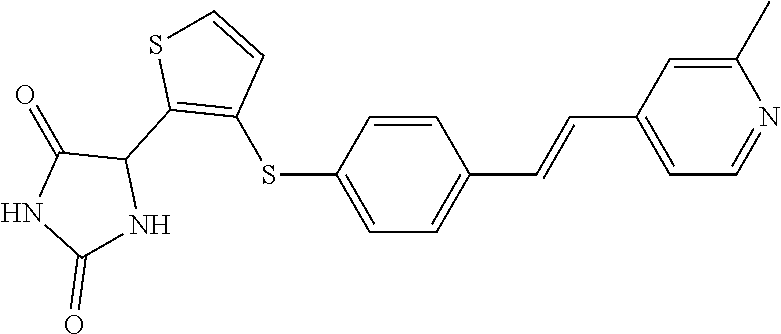
In an embodiment, provided is a compound selected from the group consisting of:
Figure US11673884-20230613-C00013

or a tautomer, stereoisomer, pharmaceutically acceptable salt, or hydrate thereof.
In another general aspect, provided is a pharmaceutical composition comprising a compound of formula as described herein, and at least one pharmaceutically acceptable carrier.
In other general aspects, provided are methods of inhibiting macrophage elastase (MMP-12) in a subject in need thereof, and methods of treating a disease mediated by macrophage elastase (MMP-12) in a subject in need thereof.
In an embodiment, provided is a method of inhibiting macrophage elastase (MMP-12) in a subject in need thereof, comprising administering to the subject a compound or pharmaceutical composition as described herein.
In an embodiment, provided is a method of treating a disease mediated by macrophage elastase (MMP-12) in a subject in need thereof, comprising administering to the subject a compound or pharmaceutical composition as described herein.
In some embodiments, the disease is selected from the group consisting of asthma, chronic obstructive pulmonary disease (COPD), emphysema, acute lung injury, and idiopathic pulmonary fibrosis (IPF), sarcoidosis, systemic sclerosis, liver fibrosis, nonalcoholic steatohepatitis (NASH), arthritis, cancer, heart disease, Inflammatory bowel disease (IBD), acute kidney injury (AKI), chronic kidney disease (CKD), Alport syndrome, and nephritis.
Also provided is a compound as described herein, or a tautomer, stereoisomer, pharmaceutically acceptable salt, or solvate thereof, or a composition thereof for use in a method of inhibiting macrophage elastase (MMP-12), or treating a disease mediated by macrophage elastase (MMP-12). In some embodiments, the disease is selected from the group consisting of asthma, chronic obstructive pulmonary disease (COPD), emphysema, acute lung injury, and idiopathic pulmonary fibrosis (IPF), sarcoidosis, systemic sclerosis, liver fibrosis, nonalcoholic steatohepatitis (NASH), arthritis, cancer, heart disease, Inflammatory bowel disease (IBD), acute kidney injury (AKI), chronic kidney disease (CKD), Alport syndrome, and nephritis.
Also provided is use of a compound as described herein, or a tautomer, stereoisomer, pharmaceutically acceptable salt, or solvate thereof, or a composition thereof, in the manufacture of a medicament for inhibiting macrophage elastase (MMP-12) or treating a disease mediated by macrophage elastase (MMP-12). In some embodiments, the disease is selected from the group consisting of asthma, chronic obstructive pulmonary disease (COPD), emphysema, acute lung injury, and idiopathic pulmonary fibrosis (IPF), sarcoidosis, systemic sclerosis, liver fibrosis, nonalcoholic steatohepatitis (NASH), arthritis, cancer, heart disease, Inflammatory bowel disease (IBD), acute kidney injury (AKI), chronic kidney disease (CKD), Alport syndrome, and nephritis.
In yet another general aspect, provided is a method of preparing a pharmaceutical composition described herein, comprising combining a compound as described herein, or a tautomer, stereoisomer, pharmaceutically acceptable salt, or solvate thereof, and at least one pharmaceutically acceptable carrier.
DETAILED DESCRIPTION OF THE INVENTION
Various publications, articles and patents are cited or described in the background and throughout the specification; each of these references is herein incorporated by reference in its entirety. Discussion of documents, acts, materials, devices, articles or the like which has been included in the present specification is for the purpose of providing context for the invention. Such discussion is not an admission that any or all of these matters form part of the prior art with respect to any inventions disclosed or claimed.
Unless defined otherwise, all technical and scientific terms used herein have the same meaning as commonly understood to one of ordinary skill in the art to which this invention pertains. Otherwise, certain terms used herein have the meanings as set forth in the specification. All patents, published patent applications and publications cited herein are incorporated by reference as if set forth fully herein.
It must be noted that as used herein and in the appended claims, the singular forms “a,” “an,” and “the” include plural reference unless the context clearly dictates otherwise.
Unless otherwise indicated, the term “at least” preceding a series of elements is to be understood to refer to every element in the series. For example, the phrase “at least A, B, and C” means that each of A, B, and C is present. The term “at least one of” preceding a series of elements is to be understood to refer to a single element in the series or any combination of two or more elements in the series. For example, the phrase “at least one of A, B, and C” means that only A is present, only B is present, only C is present, both A and B are present, both A and C are present, both B and C are present, or each of A, B, and C is present. Depending on the context, “at least one of” preceding a series of elements can also encompass situations in which any one or more of the elements is present in greater than one instance, e.g., “at least one of A, B, and C” can also encompass situations in which A is present in duplicate alone or further in combination with any one or more of elements B and C.
Throughout this specification and the claims which follow, unless the context requires otherwise, the word “comprise”, and variations such as “comprises” and “comprising”, will be understood to imply the inclusion of a stated integer or step or group of integers or steps but not the exclusion of any other integer or step or group of integer or step. When used herein the term “comprising” can be substituted with the term “containing” or “including” or sometimes when used herein with the term “having.”
When used herein “consisting of” excludes any element, step, or ingredient not specified in the claim element. When used herein, “consisting essentially of” does not exclude materials or steps that do not materially affect the basic and novel characteristics of the claim. Any of the aforementioned terms of “comprising”, “containing”, “including”, and “having”, whenever used herein in the context of an aspect or embodiment of the application can be replaced with the term “consisting of” or “consisting essentially of” to vary scopes of the disclosure.
As used herein, the conjunctive term “and/or” between multiple recited elements is understood as encompassing both individual and combined options. For instance, where two elements are conjoined by “and/or,” a first option refers to the applicability of the first element without the second. A second option refers to the applicability of the second element without the first. A third option refers to the applicability of the first and second elements together. Any one of these options is understood to fall within the meaning, and therefore satisfy the requirement of the term “and/or” as used herein. Concurrent applicability of more than one of the options is also understood to fall within the meaning, and therefore satisfy the requirement of the term “and/or.”
Unless otherwise stated, any numerical value, such as a concentration or a concentration range described herein, are to be understood as being modified in all instances by the term “about.” Thus, a numerical value typically includes ±10% of the recited value. For example, the recitation of “10-fold” includes 9-fold and 11-fold. As used herein, the use of a numerical range expressly includes all possible subranges, all individual numerical values within that range, including integers within such ranges and fractions of the values unless the context clearly indicates otherwise.
As used herein, “subject” means any animal, preferably a mammal, most preferably a human, to whom will be or has been treated by a method according to an embodiment of the application. The term “mammal” as used herein, encompasses any mammal. Examples of mammals include, but are not limited to, cows, horses, sheep, pigs, cats, dogs, mice, rats, rabbits, guinea pigs, non-human primates (NHPs) such as monkeys or apes, humans, etc., more preferably a human.
The phrase “pharmaceutically acceptable salt(s)” means those salts of a compound of interest that are safe and effective for topical use in mammals and that possess the desired biological activity. Pharmaceutically acceptable salts include salts of acidic or basic groups present in the specified compounds. Pharmaceutically acceptable acid addition salts include, but are not limited to, hydrochloride, hydrobromide, hydroiodide, nitrate, sulfate, bisulfate, phosphate, acid phosphate, isonicotinate, carbonate, bicarbonate, acetate, lactate, salicylate, citrate, tartrate, propionate, butyrate, pyruvate, oxalate, malonate, pantothenate, bitartrate, ascorbate, succinate, maleate, gentisinate, fumarate, gluconate, glucaronate, saccharate, formate, benzoate, glutamate, methanesulfonate, ethanesulfonate, benzensulfonate, p-toluenesulfonate and pamoate (i.e., 1,1′-methylene-bis-(2-hydroxy-3-naphthoate)) salts. Certain compounds used in the application can form pharmaceutically acceptable salts with various amino acids. Suitable base salts include, but are not limited to, aluminum, calcium, lithium, magnesium, potassium, sodium, zinc, bismuth, and diethanolamine salts. For a review on pharmaceutically acceptable salts see Berge et al., 661 Pharm. Sci. 1-19 (1977), incorporated herein by reference.
As used herein, the term “alkyl” means a saturated, monovalent, unbranched or branched hydrocarbon chain. An alkyl group can be unsubstituted or substituted with one or more suitable substituents. Examples of alkyl groups include, but are not limited to, methyl (Me), ethyl (Et), propyl (e.g., n-propyl, isopropyl), butyl (e.g., n-butyl, isobutyl, tert-butyl), and pentyl (e.g., n-pentyl, isopentyl, neopentyl), etc. An alkyl group can have a specified number of carbon atoms. When numbers appear in a subscript after the symbol “C”, the subscript defines with more specificity the number of carbon atoms that a particular alkyl can contain. For example, “C1 to C10 alkyl” or “C1-10 alkyl” is intended to include C1, C2, C3, C4, C5, C6, C7, C8, C9, and C10 alkyl groups. Additionally, for example, “C1 to C4 alkyl” or “C1-4 alkyl” denotes alkyl having one to four carbon atoms.
The term “alkoxy” as used herein refers to an —O-alkyl group, wherein alkyl is as defined above. An alkoxy group is attached to the parent molecule through an oxygen atom. An alkoxy group can have a specified number of carbon atoms. For example, “C1 to C10 alkoxy” or “C1-10 alkoxy” is intended to include C1, C2, C3, C4, C5, C6, C7, C8, C9, and C10 alkoxy groups. Additionally, for example, “C1 to C6 alkoxy” or “C1-6 alkoxy” denotes alkoxy having 1 to 6 carbon atoms. Examples of alkoxy include, but are not limited to, methoxy, ethoxy, propoxy (e.g., n-propoxy, isopropoxy), butoxy (e.g., n-butoxy, isobutoxy, tert-butoxy), pentyloxy (e.g., n-pentyloxy, isopentyloxy, neopentyloxy), etc. An alkoxy group can be unsubstituted or substituted with one or more suitable substituents. Similarly, “alkylthio” or “thioalkoxy” represents an alkyl group as defined above attached through a sulfur bridge, for example, —S— methyl, —S-ethyl, etc. Representative examples of alkylthio include, but are not limited to, —SCH3, —SCH2CH3, etc.
As used herein, the term “halogen” means fluorine, chlorine, bromine, or iodine. Correspondingly, the term “halo” means fluoro (—F), chloro bromo (—Br), and iodo (—I).
“Haloalkyl” is intended to include both branched and straight-chain saturated aliphatic hydrocarbon groups substituted with one or more halogen atoms. Examples of haloalkyl include, but are not limited to, fluoromethyl, difluoromethyl, trifluoromethyl, chloromethyl, dichloromethyl, trichloromethyl, pentafluoroethyl, pentachloroethyl, 2,2,2-trifluoroethyl, heptafluoropropyl, and heptachloropropyl.
The terms “hydroxy” and “hydroxyl” can be used interchangeably, and refer to —OH.
The term “carboxy” refers to —COOH.
The term “cyano” refers to —CN.
The term “amino” refers to —NH2. The term “alkylamino” refers to an amino group in which one or both of the hydrogen atoms attached to nitrogen is substituted with an alkyl group. For example, alkylamino includes methylamino (—NHCH3), dimethylamino (—N(CH3)2), —NHCH2CH3, etc.
The term “aminoalkyl” as used herein is intended to include both branched and straight-chain saturated aliphatic hydrocarbon groups substituted with one or more amino groups. For example, “C1-4 aminoalkyl” is intended to include C1, C2, C3, and C4 alkyl groups substituted with one or more amino groups. Representative examples of aminoalkyl groups include, but are not limited to, —CH2NH2, —CH2CH2NH2, and —CH2CH(NH2)CH3.
As used herein, “amido” refers to —C(O)N(R)2, wherein each R is independently an alkyl group or a hydrogen. Examples of amidos include, but are not limited to, —C(O)NH2, —C(O)NHCH3, and —C(O)N(CH3)2.
The terms “hydroxylalkyl” and “hydroxyalkyl” are used interchangeably, and refer to an alkyl group substituted with one or more hydroxyl groups. The alkyl can be a branched or straight-chain aliphatic hydrocarbon. Examples of hydroxylalkyl include, but are not limited to, hydroxylmethyl (—CH2OH), hydroxylethyl (—CH2CH2OH), etc.
The term “aryl” as used herein is a group that contains any carbon-based aromatic group including, but not limited to, phenyl, naphthyl, anthracenyl, phenanthranyl, and the like. Aryl moieties are well known and described, for example, in Lewis, R. J., ed., Hawley's Condensed Chemical Dictionary, 13th Edition, John Wiley & Sons, Inc., New York (1997). An aryl group can be substituted or unsubstituted with one or more suitable substituents. An aryl group can be a single ring structure (i.e., monocyclic) or comprise multiple ring structures (i.e., polycyclic, e.g., bicyclic or tricyclic) that are fused ring structures. For example, an aryl group can be a monocyclic aryl group, e.g., phenyl.
As used herein, the term “heteroaryl” includes stable monocyclic and polycyclic aromatic hydrocarbons that contain at least one heteroatom ring member such as sulfur, oxygen, or nitrogen. Heteroaryl can be monocyclic or polycyclic, e.g., bicyclic or tricyclic. Each ring of a heteroaryl group containing a heteroatom can contain one or two oxygen or sulfur atoms and/or from one to four nitrogen atoms provided that the total number of heteroatoms in each ring is four or less and each ring has at least one carbon atom. For bicyclic heteroaryl groups, the fused rings completing the bicyclic group can contain only carbon atoms and can be saturated, partially saturated, or unsaturated. Heteroaryl groups which are polycyclic, e.g., bicyclic or tricyclic must include at least one fully aromatic ring but the other fused ring or rings can be aromatic or non-aromatic. The heteroaryl group can be attached at any available nitrogen or carbon atom of any ring of the heteroaryl group. Preferably, the term “heteroaryl” refers to 5- or 6-membered monocyclic groups and 9- or 10-membered bicyclic groups which have at least one heteroatom (O, S, or N) in at least one of the rings, wherein the heteroatom-containing ring preferably has 1, 2, or 3 heteroatoms, more preferably 1 or 2 heteroatoms, selected from O, S, and/or N. A heteroaryl group can be unsubstituted, or substituted with one or more suitable substituents. The nitrogen heteroatom(s) of a heteroaryl can be substituted or unsubstituted. The nitrogen and sulfur heteroatom(s) of a heteroaryl can optionally be oxidized (i.e., N→O and S(O)r, wherein r is 0, 1 or 2).
Exemplary monocyclic heteroaryl groups include, but are not limited to, pyrrolyl, pyrazolyl, pyrazolinyl, imidazolyl, oxazolyl, isoxazolyl, thiazolyl, thiadiazolyl, isothiazolyl, furanyl, thiophenyl, oxadiazolyl, pyridinyl, pyrazinyl, pyrimidinyl, pyridazinyl, and triazinyl. Exemplary bicyclic heteroaryl groups include, but are not limited to, indolyl, benzothiazolyl, benzodioxolyl, benzoxazolyl, benzothienyl, quinolinyl, tetrahydroisoquinolinyl, isoquinolinyl, benzimidazolyl, benzopyranyl, indolizinyl, benzofuranyl, chromonyl, coumarinyl, benzopyranyl, cinnolinyl, quinoxalinyl, indazolyl, pyrrolopyridinyl, furopyridinyl, dihydroisoindolyl, and tetrahydroquinolinyl.
In accordance with convention used in the art:
Figure US11673884-20230613-C00014

is used in structural formulas herein to depict the bond that is the point of attachment of the moiety or substituent to the core, backbone, or parent molecule structure.
When a bond to a substituent is shown to cross a bond connecting two atoms in a ring, then such substituent can be bonded to any atom on the ring.
The term “substituted” as used herein with respect to any organic radical (e.g., alkyl, heteroaryl, etc.) means that at least one hydrogen atom is replaced with a non-hydrogen group, provided that all normal valencies are maintained and that the substitution results in a stable compound. When a particular group is “substituted,” that group can have one or more substituents, preferably from one to five substituents, more preferably from one to three substituents, most preferably from one to two substituents, independently selected from the list of substituents. The term “independently” when used in reference to substituents, means that when more than one of such substituents is possible, such substituents can be the same or different from each other. Examples of suitable substituents include, but are not limited to, alkyl, halo, alkoxy, amido, alkythio, amine, alkylamine, aminoalkyl, hydroxyalkyl, hydroxyl, carboxyl, etc., such as C1-4 alkyl, C1-3 alkoxy, —OH, —COOH, —F, —Cl, —C(O)NHCH3, —C(O)N(CH3)2.
When any variable occurs more than one time in any constituent or formula for a compound, its definition at each occurrence is independent of its definition at every other occurrence. Thus, for example, if a group is shown to be substituted with 0-3 R groups, then said group can be optionally substituted with up to three R groups, and at each occurrence, R is selected independently from the definition of R.
The terms “optional” or “optionally” mean that the event or circumstance described subsequently can, but need not, occur, and such a description includes the situation in which the event or circumstance does or does not occur. For example, “optionally substituted heteroaryl” means that a substituent group can be, but need not be, present, and such a description includes the situation of the heteroaryl group being substituted by a suitable substituent and the heteroaryl group being not substituted by any substituent.
One skilled in the art will recognize that in certain embodiments compounds described herein can have one or more asymmetric carbon atoms in their structure. As used herein, any chemical formulas with bonds shown only as solid lines and not as solid wedged or hashed wedged bonds, or otherwise indicated as having a particular configuration (e.g., R or S) around one or more atoms, contemplates each possible stereoisomer, or mixture of two or more stereoisomers. In other words, if the stereochemistry of a structure is not specified, the structure is intended to encompass all individual stereoisomers and mixtures thereof. Stereoisomers includes enantiomers and diastereomers. Enantiomers are stereoisomers that are non-super-imposable mirror images of each other. A 1:1 mixture of a pair of enantiomers is a racemate or racemic mixture. Diastereomers (or diastereoisomers) are stereoisomers that are not enantiomers, i.e., they are not related as mirror images, and occur when two or more stereoisomers of a compound have different configurations at one or more of the equivalent stereocenters and are not mirror images of each other. Substituent groups (e.g., alkyl, heterocyclyl, etc.) can contain stereocenters in either the R or S configuration.
Thus, included within the scope of the application are the stereochemically pure isomeric forms of the compounds described herein (i.e., a single enantiomer or a single diastereomer) as well as mixtures thereof including their racemates. When a specific stereoisomer is identified, this means that the stereoisomer is substantially free, i.e., associated with less than 50%, preferably less than 20%, more preferably less than 5%, in particular less than 2% and most preferably less than 1% of the other stereoisomers. For example, when a compound is for instance specified as (R), this means that the compound is substantially free of the (S) isomer. Compounds described herein can be used as racemic mixtures, enantiomerically or diastereomerically enriched mixtures, or as enantiomerically or diastereomerically pure individual stereoisomers.
Stereochemically pure isomeric forms can be obtained by techniques known in the art in view of the present disclosure. For example, diastereoisomers can be separated by physical separation methods such as fractional crystallization and chromatographic techniques, and enantiomers can be separated from each other by the selective crystallization of the diastereomeric salts with optically active acids or bases or by chiral chromatography. Pure stereoisomers can also be prepared synthetically from appropriate stereochemically pure starting materials, or by using stereoselective reactions.
Compounds described herein can also form tautomers. The term “tautomer” refers to compounds that are interchangeable forms of a particular compound structure and that vary in the displacement of hydrogen atoms and electrons. Tautomers are constitutional isomers of chemical compounds that readily interconvert, usually resulting in relocation of a proton (hydrogen). Thus, two structures can be in equilibrium through the movement of pi electrons and an atom (usually hydrogen). All tautomeric forms and mixtures of tautomers of the compounds described herein are included with the scope of the application.
Compounds described herein can exist in solvated and unsolvated forms. The term “solvate” means a physical association, e.g., by hydrogen bonding, of a compound of the application with one or more solvent molecules. The solvent molecules in the solvate can be present in a regular arrangement and/or a non-ordered arrangement. The solvate can comprise either a stoichiometric or nonstoichiometric amount of the solvent molecules. “Solvate” encompasses both solution-phase and isolable solvates. Compounds described herein can form solvates with water (i.e., hydrates) or common organic solvents. Exemplary solvates include, but are not limited to, hydrates, ethanolates, methanolates, and isopropanolates. Methods of solvation are generally known in the art.
Also included within the scope of the application are all isotopes of atoms occurring in the compounds of the application. Isotopes include those atoms having the same atomic number but different mass numbers. By way of general example and without limitation, isotopes of hydrogen include deuterium (2H) and tritium (3H). Isotopes of carbon include 13C and 14C. Isotopically-labeled compounds can generally be prepared by conventional techniques known to those skilled in the art or by processes analogous to those described herein, using an appropriate isotopically-labeled reagent in place of the non-labeled reagent otherwise employed.
As used herein, the name of a compound is intended to encompass all possible existing isomeric forms (e.g., enantiomers, diastereomers, racemate or racemic mixture, or any mixture thereof), and tautomers of the compound.
Compounds
In a general aspect, provided herein is a compound of formula (I):
Figure US11673884-20230613-C00015

or a tautomer, stereoisomer, pharmaceutically acceptable salt, or solvate thereof,
wherein:
ring A is an optionally substituted heteroaryl;
Q is CR2 or N;
R1 is hydrogen or alkyl;
each R2 is independently hydrogen, alkyl, halo, hydroxyl, haloalkyl, alkoxy, alkylthio, amino, amido, alkylamino, aminoalkyl, cyano, hydroxyalkyl, —(CH2)pC(O)OR6, or —(CH2)pOC(O)R6;
R3 is hydrogen, halo, or alkyl;
each R4 and R5 is independently hydrogen or alkyl;
each R6 is independently hydrogen or alkyl, wherein the alkyl is unsubstituted or substituted with one or more groups independently selected from amine, hydroxyl, halo, and alkoxy;
X is S or O;
Y is:
Figure US11673884-20230613-C00016
n is 1, 2, 3 or 4; and
p is 0, 1, 2, 3, 4, or 5.
In an embodiment, provided is a compound of formula (I), or a tautomer, stereoisomer, pharmaceutically acceptable salt, or solvate thereof, wherein Q is N.
In an embodiment, provided is a compound of formula (I), or a tautomer, stereoisomer, pharmaceutically acceptable salt, or solvate thereof, wherein Q is CR2.
In an embodiment, provided is a compound of formula (I), or a tautomer, stereoisomer, pharmaceutically acceptable salt, or solvate thereof, wherein R2 of the moiety
Figure US11673884-20230613-C00017
if present, can be attached at any position of the ring. Preferably, n is 1, such that there is one R2 substituent. In other preferred embodiments, the R2 group is attached at the meta position of the ring relative to the bond to variable Y.
In an embodiment, provided is a compound of formula (I), or a tautomer, stereoisomer, pharmaceutically acceptable salt, or solvate thereof, wherein n is 1 and R2 is C1-3 alkoxy (e.g., —OCH3, —OCH2CH2CH3, —OCH2CH3, —OCH(CH3)2), C1-4 alkyl (e.g., —CH3, —CH2CH3, —CH2CH(CH3)2), —CH2OH, —OH, —COOH, —C(O)NH2, —C(O)NHCH3, or —CH2OC(O)CH(NH2)CH(CH3)2, —C(O)NH2, or —C(O)NHCH3. Preferably R2 is —CH3, —C(O)NH2, —CH2OH, —OCH3, or OH.
In an embodiment, provided is a compound of formula (I), or a tautomer, stereoisomer, pharmaceutically acceptable salt, or solvate thereof, wherein R2 is —CH3, —C(O)NH2, —CH2OH, —OCH3, or —OH.
In an embodiment, provided is a compound of formula (I), or a tautomer, stereoisomer, pharmaceutically acceptable salt, or solvate thereof, wherein R2 is —CH3.
In an embodiment, provided is a compound of formula (I), or a tautomer, stereoisomer, pharmaceutically acceptable salt, or solvate thereof, wherein R3 is hydrogen.
In an embodiment, provided is a compound of formula (I), or a tautomer, stereoisomer, pharmaceutically acceptable salt, or solvate thereof, wherein:
Figure US11673884-20230613-C00018
In an embodiment, provided is a compound of formula (I), or a tautomer, stereoisomer, pharmaceutically acceptable salt, or solvate thereof, wherein:
Figure US11673884-20230613-C00019

wherein R2 is —CH3, —C(O)NH2, —CH2OH, —OCH3, or —OH, and is preferably —CH3.
In an embodiment, provided is a compound of formula (I), or a tautomer, stereoisomer, pharmaceutically acceptable salt, or solvate thereof, wherein
Figure US11673884-20230613-C00020
According to embodiments of the application, the chiral carbon atom of the hydantoin moiety can be unsubstituted (i.e., R1 is hydrogen) or substituted. When substituted, the R1 substituent is preferably alkyl. Preferred alkyl groups for substitution of the chiral carbon atom of the hydantoin moiety include C1-4 alkyl groups, preferably C1-2 alkyl groups, such as methyl and ethyl.
In an embodiment, provided is a compound of formula (I), or a tautomer, stereoisomer, pharmaceutically acceptable salt, or solvate thereof, wherein R1 is hydrogen.
In an embodiment, provided is a compound of formula (I), or a tautomer, stereoisomer, pharmaceutically acceptable salt, or solvate thereof, wherein R1 is C1-4 alkyl.
In an embodiment, provided is a compound of formula (I), or a tautomer, stereoisomer, pharmaceutically acceptable salt, or solvate thereof, wherein R1 is —CH3 or —CH2CH3.
In an embodiment, provided is a compound of formula (I), or a tautomer, stereoisomer, pharmaceutically acceptable salt, or solvate thereof, wherein R4 is hydrogen or —CH3 and R5 is —CH3.
In an embodiment, provided is a compound of formula (I), or a tautomer, stereoisomer, pharmaceutically acceptable salt, or solvate thereof, wherein each of R4 and R5 is hydrogen.
According to embodiments of the application, X is S or O.
In an embodiment, provided is a compound of formula (I), or a tautomer, stereoisomer, pharmaceutically acceptable salt, or solvate thereof, wherein X is O.
In an embodiment, provided is a compound of formula (I), or a tautomer, stereoisomer, pharmaceutically acceptable salt, or solvate thereof, wherein X is S.
In an embodiment, provided is a compound of formula (I), or a tautomer, stereoisomer, pharmaceutically acceptable salt, or solvate thereof, wherein Y is:
Figure US11673884-20230613-C00021
In an embodiment, provided is a compound of formula (I), or a tautomer, stereoisomer, pharmaceutically acceptable salt, or solvate thereof, wherein Y is:
Figure US11673884-20230613-C00022
In an embodiment, provided is a compound of formula (I), or a tautomer, stereoisomer, pharmaceutically acceptable salt, or solvate thereof, wherein n is 1.
In an embodiment, provided is a compound of formula (I), or a tautomer, stereoisomer, pharmaceutically acceptable salt, or solvate thereof, wherein ring A is pyridinyl N-oxide.
In an embodiment, provided is a compound of formula (I), or a tautomer, stereoisomer, pharmaceutically acceptable salt, or solvate thereof, wherein ring A is a 5- to 6-membered monocyclic heteroaryl having 1 to 3 heteroatoms independently selected from O, S, and N, wherein the 5- to 6-membered monocyclic heteroaryl is optionally substituted with alkyl, preferably optionally substituted with methyl. Preferably, ring A is an optionally substituted 5- or 6-membered heteroaryl having 1-2 heteroatoms selected from N, S, and O. In particular embodiments, ring A is a 5-membered heteroaryl ring, such as furanyl, imidazolyl, thienyl, oxazolyl, or pyrazolyl. In other particular embodiments, ring A is a 6-membered heteroaryl, such as pyridinyl or pyridinyl N-oxide. Any positional or regioisomer of the heteroaryl ring can be used, meaning that the hydantoin moiety and X linker can be connected to the heteroaryl at any substitutable carbon atom on the heteroaryl ring. For example, when ring A is a 5-membered heteroaryl ring containing 1 heteroatom, the hydantoin moiety and X linker can be connected to the 5-membered heteroaryl ring in a 2, 3-substitution pattern, a 2, 4-substitution pattern, a 2, 5-substitution pattern, a 3, 4-substitution pattern, etc., relative to the heteroatom. As another illustrative example, when ring A is a 6-membered heteroaryl ring containing one heteroatom, the hydantoin moiety and X linker can be connected to the 6-membered heteroaryl ring in a 2, 3-substitution pattern, a 2, 4-substitution pattern, a 2, 5-substitution pattern, a 2, 6-substitution pattern, a 3, 4-substitution pattern, etc., relative to the heteroatom.
In some embodiments, provided is a compound of formula (I), or a tautomer, stereoisomer, pharmaceutically acceptable salt, or solvate thereof, wherein ring A is substituted. Ring A can be substituted on any substitutable carbon atom of an aryl or heteroaryl ring, or any substitutable heteroatom, e.g., nitrogen atom, of a heteroaryl ring. For example, ring A can be substituted with an alkyl group, e.g., methyl, including substitution with a methyl group for instance on a nitrogen atom of a heteroaryl ring, e.g., imidazolyl or pyrazolyl.
In an embodiment, provided is a compound of formula (I), or a tautomer, stereoisomer, pharmaceutically acceptable salt, or solvate thereof, wherein ring A is a 5- to 6-membered monocyclic heteroaryl having 1 to 2 heteroatoms independently selected from O, S, and N, wherein the 5- to 6-membered monocyclic heteroaryl is optionally substituted with alkyl, preferably optionally substituted with methyl.
In an embodiment, provided is a compound of formula (I), or a tautomer, stereoisomer, pharmaceutically acceptable salt, or solvate thereof, wherein ring A is a 5- to 6-membered monocyclic heteroaryl having 1 heteroatom selected from O, S, and N, wherein the 5- to 6-membered monocyclic heteroaryl is optionally substituted with alkyl, preferably optionally substituted with methyl.
In an embodiment, provided is a compound of formula (I), or a tautomer, stereoisomer, pharmaceutically acceptable salt, or solvate thereof, wherein ring A is pyridinyl.
In an embodiment, provided is a compound of formula (I), or a tautomer, stereoisomer, pharmaceutically acceptable salt, or solvate thereof, wherein ring A is furanyl.
In an embodiment, provided is a compound of formula (I), or a tautomer, stereoisomer, pharmaceutically acceptable salt, or solvate thereof, wherein ring A is thienyl.
In an embodiment, provided is a compound of formula (I), or a tautomer, stereoisomer, pharmaceutically acceptable salt, or solvate thereof, wherein ring A is pyrazolyl optionally substituted with methyl.
In an embodiment, provided is a compound of formula (I), or a tautomer, stereoisomer, pharmaceutically acceptable salt, or solvate thereof, wherein ring A is N-methyl pyrazolyl.
In an embodiment, provided is a compound of formula (I), or a tautomer, stereoisomer, pharmaceutically acceptable salt, or solvate thereof, wherein ring A is:
Figure US11673884-20230613-C00023
In some embodiments, wherein ring A is furanyl, provided is a compound of formula (II):
Figure US11673884-20230613-C00024

or a tautomer, stereoisomer, pharmaceutically acceptable salt, or solvate thereof, wherein each of the variables are as defined above for the compound of formula (I).
In some embodiments, wherein ring A is pyridinyl, provided is a compound of formula (III):
Figure US11673884-20230613-C00025

or a tautomer, stereoisomer, pharmaceutically acceptable salt, or solvate thereof,
wherein each of the variables are as defined above for the compound of formula (I).
In some embodiments, wherein ring A is thienyl, provided is a compound of formula (IV):
Figure US11673884-20230613-C00026

or a tautomer, stereoisomer, pharmaceutically acceptable salt, or solvate thereof, wherein each of the variables are as defined above for the compound of formula (I).
In some embodiments, wherein ring A is N-methyl pyrazolyl, provided is a compound of formula (V):
Figure US11673884-20230613-C00027

or a tautomer, stereoisomer, pharmaceutically acceptable salt, or solvate thereof, wherein each of the variables are as defined above for the compound of formula (I).
In certain embodiments, provided is a compound of formula (I), or a tautomer, stereoisomer, pharmaceutically acceptable salt, or solvate thereof, wherein:
ring A is pyridinyl;
R1 is hydrogen, —CH3 or —CH2CH3;
R2 is —CH3, —C(O)NH2, —CH2OH, —OCH3, or —OH;
each of R3, R4, and R5 is hydrogen;
X is S or O;
Y is
Figure US11673884-20230613-C00028
Q is CH or N; and
n is 1.
In certain embodiments, provided is a compound of formula (I), or a tautomer, stereoisomer, pharmaceutically acceptable salt, or solvate thereof, wherein:
ring A is furanyl;
R1 is hydrogen, —CH3 or —CH2CH3;
R2 is —CH3, —C(O)NH2, —CH2OH, —OCH3, or —OH;
each of R3, R4, and R5 is hydrogen;
X is S or O;
Y is
Figure US11673884-20230613-C00029
Q is CH or N; and
n is 1.
In certain embodiments, provided is a compound of formula (I), or a tautomer, stereoisomer, pharmaceutically acceptable salt, or solvate thereof, wherein:
ring A is thienyl;
R1 is hydrogen, —CH3 or —CH2CH3;
R2 is —CH3, —C(O)NH2, —CH2OH, —OCH3, or —OH;
each of R3, R4, and R5 is hydrogen;
X is S or O;
Y is
Figure US11673884-20230613-C00030
Q is CH or N; and
n is 1.
In certain embodiments, provided is a compound of formula (I), or a tautomer, stereoisomer, pharmaceutically acceptable salt, or solvate thereof, wherein:
ring A is N-methyl pyrazolyl;
R1 is hydrogen, —CH3 or —CH2CH3;
R2 is —CH3, —C(O)NH2, —CH2OH, —OCH3, or —OH;
each of R3, R4, and R5 is hydrogen;
X is S or O;
Y is
Figure US11673884-20230613-C00031
Q is CH or N; and
n is 1.
Exemplary compounds of the application include, but are not limited to, compounds listed in Table 1 below, and any tautomer, stereoisomer, pharmaceutically acceptable salt or solvate thereof. The MMP-12 IC50 values were determined according to the assay described in Example 1 below. The IC50 values are reported as follows: A=less than 1 nM, B=1 nM to 10 nM, C=10 nM to 100 nM, D=greater than 100 nM.
TABLE 1
Exemplary Compounds of the Application
Compound Analytical Data (LCMS, MMP-12
ID Structure NMR, etc.) IC50 (nM)
AC-1
Figure US11673884-20230613-C00032
1H NMR (400 MHz, CD3OD) δ: 8.20 (d, J = 4.0 Hz, 1H), 7.66-7.57 (m, 5H), 7.01 (s, 1H), 6.93 (d, J = 4.0 Hz, 1H), 6.64 (s, 1H), 5.49 (s, 1H), 2.44 (s, 3H); m/z (ESI+) (M + H)+ = 390.15, (M − H)− = 388.20; HPLC tR = 5.035 min. C
AC-2
Figure US11673884-20230613-C00033
1H NMR (400 MHz, CD3OD) δ: 8.313 (d, J = 5.2 Hz, 1H), 7.671 (d, J = 2.0 Hz, 1H), 7.525 (d, J = 8.4 Hz, 2H), 7.384-7.356 (m, 3H), 7.233 (d, J = 8.4 Hz, 2H), 7.113 (d, J = 16.4 Hz, 1H), 6.491 (d, J = 2.0 Hz, 1H), 5.492 (s, 1H), 2.512 (s, 3H); m/z (ESI+) (M + H)+ = 392.10, A
(M − H)− =
390.05; HPLC tR =
4.796 min.
AC-3
Figure US11673884-20230613-C00034
1H-NMR (400 MHz DMSO) δ: 10.948 (s, 1H), 8.439 (s, 1H), 8.369 (d, J = 5.2 Hz, 1H), 7.840 (d, J = 2.0 Hz, 1H), 7.550 (d, J = 8.4 Hz, 2H), 7.466-7.373 (m, 3H), 7.309 (d, J = 4.8 Hz, 1H), 7.164-7.127 (m, 3H), 6.517 (d, J = 2.0 Hz, 1H), 2.432 (s, 3H), 2.190- 2.126 (m, 2H), 0.856-0.819 (m, 3H); m/z (ESI+) A
(M + H)+ = 420.20,
(M − H)− =
418.10; HPLC tR =
5.021 min.
AC-4
Figure US11673884-20230613-C00035
1H NMR (400 MHz, CD3OD) δ: 8.432 (s, 1H), 8.418 (d, J = 5.2 Hz, 1H), 8.301 (d, J = 5.6 Hz, 1H), 7.650 (d, J = 8.4 Hz, 2H), 7.555 (d, J = 8.0 Hz, 2H), 7.417 (s, 1H), 7.330 (d, J = 4.8 Hz, 1H), 7.003 (d, J = 5.6 Hz, 1H), 5.613 (s, 1H), 2.531 (s, 3H); m/z (ESI+) (M + H)+ = 401.10; HPLC B
tR = 4.598 min.
AC-5
Figure US11673884-20230613-C00036
1H-NMR (400 MHz DMSO) δ: 10.998 (s, 1H), 8.413-8.403 (m, 3H), 8.321 (d, J = 5.2 Hz, 1H), 7.738 (d, J = 8.0 Hz, 2H), 7.516 (s, 1H), 7.493-7.473 (m, 3H), 7.417 (s, 1H), 7.353 (d, J = 5.6 Hz, 1H), 7.298 (s, 1H), 7.257 (s, 1H), 6.844 (d, J = 5.6 Hz, 1H), 5.513 (s, 1H), 2.464 (s, A
3H); m/z (ESI+) (M + H)+ =
403.20, (M − H)− = 401.25;
HPLC tR = 3.779 min.
AC-6
Figure US11673884-20230613-C00037
1H NMR (400 MHz, CD3OD) δ: 8.492 (s, 1H), 8.413 (d, J = 5.2 Hz, 1H), 8.336 (d, J = 5.2 Hz, 1H), 7.729 (d, J = 8 4 Hz, 2H), 7.505-7.381 (m, 4H), 7.159-7.118 (m, 3H), 6.817 (d, J = 6.0 Hz, 1H), 5.416 (s, 1H), 2.525 (s, 3H); m/z (ESI+) (M + H)+ = 387.20; HPLC tR = 3.425 min. A
AC-7
Figure US11673884-20230613-C00038
1H NMR (400 MHz, CD3OD) δ: 8.514 (s, 1H), 8.441-8.393 (m, 2H), 7.667 (d, J = 7.2 Hz, 2H), 7.402 (s, 1H), 7.316 (d, J = 5.2 Hz, 1H), 7.179 (d, J = 6.8 Hz, 2H), 6.849 (d, J = 5.6 Hz, 1H), 5.423 (s, 1H), 2.527 (s, 3H); m/z (ESI+) (M + H)+ = 385.15; HPLC tR = 5.652 min. B
AC-8
Figure US11673884-20230613-C00039
1H NMR (400 MHz, CDCl3) δ: 8.641 (s, 1H), 8.476 (d, J = 5.6 Hz, 1H), 8.205 (d, J = 5.2 Hz, 1H), 7.581 (d, J = 8.4 Hz, 2H), 7.454-7.375 (m, 5H), 7.087 (d, J = 16.4 Hz, 1H), 6.845 (d, J = 5.6 Hz, IH), 2.695 (s, 3H), 2.417-2.305 (m, 2H), 1.038 (t, J = 7.6 Hz, 3H); m/z (ESI+) (M + H)+ = A
431.35, (M − H)− = 429.25;
HPLC tR = 6.062 min.
AC-9
Figure US11673884-20230613-C00040
1H NMR (400 MHz, MeOD) δ: 8.389 (d, J = 5.2 Hz, 1H), 7.603 (d, J = 5.2 Hz, 1H), 7.444 (d, J = 8.4 Hz, 2H), 7.375 (s, 1H), 7.277 (d, J = 5.2 Hz, 1H), 7.191 (d, J = 8.4 Hz, 2H), 7.044 (d, J = 5.2 Hz, 1H), 5.719 (s, 1H), 2.519 (s, 3H); m/z (ESI+) (M + H)+ = 406.15, (M − H)− = 404.05; A
HPLC tR = 5.671 min
AC-10
Figure US11673884-20230613-C00041
1H NMR (400 MHz, DMSO-d6) δ: 10.956 (s, 1H), 8.570 (s, 1H), 8.410 (d, J = 5.2 Hz, 1H), 7.729 (d, J = 5.6 Hz, 1H), 7.600 (d, J = 8.4 Hz, 2H), 7.503 (d, J = 16.4 Hz, 1H), 7.411 (s, 1H), 7.347 (d, J = 5.2 Hz, 1H), 7.227 (d, J = 8.4 Hz, 2H), 7.202 (d, J = 16.4 Hz, 1H), 7.050 (d, J = 5.2 A
Hz, 1H), 5.662 (s, 1H),
2.474 (s, 3H); m/z (ESI+)
(M + H)+ = 408.20,
(M − H)− =
406.15; HPLC tR =
5.657 min.
AC-11
Figure US11673884-20230613-C00042
1H NMR (400 MHz, DMSO-d6) δ: 11.013 (s, 1H), 8.442 (d, J = 5.2 Hz, 1H), 8.255 (s, 1H), 7.660 (s, 1H), 7.434 (d, J = 8.4 Hz, 2H), 7.348 (s, 1H), 7.260 (d, J = 5.2 Hz, 1H), 7.065 (d, J = 8.4 Hz, 2H), 5.603 (s, 1H), 3.847 (s, 3H), 2.437 (s, 3H); m/z (ESI+) (M + H)+ = 404.20, A
(M − H)− = 402.05;
HPLC tR = 5.182 min.
AC-12
Figure US11673884-20230613-C00043
1H NMR (400 MHz, DMSO-d6) δ: 11.038 (s, 1H), 8.360 (d, J = 5.2 Hz, 1H), 8.271 (s, 1H), 7.631 (s, 1H), 7.499 (d, J = 8.4 Hz, 2H), 7.444 (d, J = 16.4 Hz, 1H), 7.364 (s, 1H), 7.299 (d, J = 5.2 Hz, 1H), 7.130 (d, J= 16.8 Hz, 1H), 7.067 (d, J = 8.4 Hz, 2H), 5.605 (s, 1H), 3.832 (s, 3H), 2.428 (s, 3H); m/z A
(ESI+) (M + H)+ = 406.25,
(M − H)− = 404.20;
HPLC tR = 5.260 min.
Compounds of the application can be prepared by any number of processes as described generally below and more specifically illustrated by the exemplary examples, which follow herein. The compounds provided herein as prepared in the processes described below can be synthesized in the form of mixtures of stereoisomers (e.g., enantiomers, diastereomers), including racemic mixtures of enantiomers, that can be separated from one another using art-known resolution procedures, for instance including liquid chromatography using a chiral stationary phase. Additionally or alternatively, stereochemically pure isomeric forms of the compounds described herein can be derived from the corresponding stereochemically pure isomeric forms of the appropriate starting materials, intermediates, or reagents. For example, if a specific stereoisomer is desired, the compound can be synthesized by stereospecific methods of preparation, which typically employ stereochemically pure starting materials or intermediate compounds.
By way of illustration, but not as a limitation, embodiments of compounds of formula (I), wherein Y is
Figure US11673884-20230613-C00044

can be prepared according any one of General Schemes 1-3; and embodiments of compounds of formula (II), wherein Y is
Figure US11673884-20230613-C00045

can be prepared according to any one of General Schemes 4-6. One of ordinary skill in the art will recognize that, to obtain various compounds of formula (I) as described herein, starting materials can be suitably selected so that the ultimately desired substituent groups will be carried through (i.e., be stable over the course of the synthesis) the reaction scheme with or without protection as appropriate to yield the desired product. Alternatively, it may be necessary or desirable to employ, in place of the ultimately desired substituent, a suitable group that may be carried through (i.e., be stable over the course of the synthesis) the reaction scheme and replaced as appropriate with the desired substituent.
Figure US11673884-20230613-C00046
(CF3SO2)2O is added to a solution of Int-A in an organic solvent to obtain Int-B. Then, 4,4,5,5-tetramethyl-2-vinyl-1,3,2-dioxaborolane and palladium catalyst are added to a solution of Int-B. After completion of the reaction, the mixture is extracted to obtain Int-G. To a solution of Int-G, Int-H and a catalyst are added to obtain Int-I. Then, Int-I is reacted with (NH4)2CO3 and potassium cyanide (KCN) in aqueous alcohol to obtain embodiments of the compounds of formula (I) described herein.
Figure US11673884-20230613-C00047
To a solution of Int-K in organic solvent, Int-J and K2CO3 are added and the mixture is stirred. The reaction mixture is extracted to obtain Int-L. Int-H and a palladium catalyst are added to a solution of Int-L and the reaction mixture is stirred followed by extraction to obtain Int-I. Then, Int-I is reacted with (NH4)2CO3 and potassium cyanide (KCN) in aqueous alcohol as described above for General Scheme 2 to obtain embodiments of the compounds of formula (I) described herein.
Figure US11673884-20230613-C00048
To a solution of Int-O is organic solvent is added Int-H, triphenylphospine (PPh3) and palladium(II) acetate. The mixture is stirred and then extracted to obtain Int-P. To a solution of Int-P in an organic solvent is added Int-J and base (e.g., K2CO3). The mixture is extracted to obtain Int-Q. Then Int-Q is reacted with (NH4)2CO3 and potassium cyanide (KCN) in aqueous alcohol to obtain embodiments of the compounds of formula (I) described herein.
Figure US11673884-20230613-C00049
(CF3SO2)2O is added to a solution of Int-A in an organic solvent to obtain Int-B. Then, ethynyltrimethylsilane and palladium catalyst are added to a solution of Int-B. After completion of the reaction, the mixture is extracted to obtain Int-D. To a solution of Int-D, Int-T and base (e.g., K2CO3) are added to obtain Int-F. Then, Int-F is reacted with (NH4)2CO3 and potassium cyanide (KCN) in aqueous alcohol to obtain embodiments of the compounds of formula (I) described herein.
Figure US11673884-20230613-C00050
To a solution of Int-K in organic solvent, Int-J and K2CO3 are added and the mixture is stirred. The reaction mixture is extracted to obtain Int-L. Int-N and a palladium catalyst are added to a solution of Int-L and the reaction mixture is stirred followed by extraction to obtain Int-M. Then, Int-M is reacted with (NH4)2CO3 and potassium cyanide (KCN) in aqueous alcohol to obtain embodiments of the compounds of formula (I) described herein.
Figure US11673884-20230613-C00051
To a solution of Int-O is organic solvent is added Int-N, triphenylphospine (PPh3) and palladium catalyst. The mixture is stirred and then extracted to obtain Int-R. To a solution of Int-R in an organic solvent is added Int-J and base (e.g., K2CO3). The mixture is extracted to obtain Int-S. Then Int-S is reacted with (NH4)2CO3 and potassium cyanide (KCN) in aqueous alcohol to obtain embodiments of the compounds of formula (I) described herein.
Nitrogen atoms of the hydantoin moiety of compounds of the application can be alkylated by reacting compounds prepared according to any one of the above General Schemes with sodium hydride and alkyl iodide (e.g., CH3I). Compounds in which X is S(O) or SO2 can be prepared by reacting compounds prepared according to any one of the above General Schemes with m-CPBA.
Pharmaceutically acceptable salts of the compounds described herein can be synthesized from the parent compound containing an acidic or basic moiety by conventional chemical methods. Generally, such salts can be prepared by reacting the free acid or base forms of these compounds with a stoichiometric amount of the appropriate acid or base in water or in an organic solvent, or in a mixture of water and an organic solvent. Examples of suitable organic solvents include, but are not limited to, ether, ethyl acetate, ethanol, isopropanol, and acetonitrile.
Compositions
Another aspect of the application relates to a pharmaceutical composition comprising a compound described herein, or a tautomer, stereoisomer, pharmaceutically acceptable salt, or solvate thereof.
Compositions of the application can also comprise a pharmaceutically acceptable carrier. A pharmaceutically acceptable carrier is non-toxic and should not interfere with the efficacy of the active ingredient. Pharmaceutically acceptable carriers can include one or more excipients such as binders, disintegrants, swelling agents, suspending agents, emulsifying agents, wetting agents, lubricants, flavorants, sweeteners, preservatives, dyes, solubilizers and coatings. The precise nature of the carrier or other material can depend on the route of administration, e.g., intramuscular, intradermal, subcutaneous, oral, intravenous, cutaneous, intramucosal (e.g., gut), intranasal or intraperitoneal routes. For liquid injectable preparations, for example, suspensions and solutions, suitable carriers and additives include water, glycols, oils, alcohols, preservatives, coloring agents and the like. For solid oral preparations, for example, powders, capsules, caplets, gelcaps and tablets, suitable carriers and additives include starches, sugars, diluents, granulating agents, lubricants, binders, disintegrating agents and the like. For nasal sprays/inhalant mixtures, the aqueous solution/suspension can comprise water, glycols, oils, emollients, stabilizers, wetting agents, preservatives, aromatics, flavors, and the like as suitable carriers and additives.
Compositions of the application can be formulated in any matter suitable for administration to a subject to facilitate administration and improve efficacy, including, but not limited to, oral (enteral) administration and parenteral injections. The parenteral injections include intravenous injection or infusion, subcutaneous injection, intradermal injection, and intramuscular injection. Compositions of the application can also be formulated for other routes of administration including transmucosal, ocular, rectal, long acting implantation, sublingual administration, under the tongue, from oral mucosa bypassing the portal circulation, inhalation, or intranasal.
In particular embodiments, compositions are formulated for oral administration.
In yet another aspect, provided is a method of preparing a pharmaceutical composition comprising combining a compound of the application or a tautomer, stereoisomer, pharmaceutically acceptable salt, or solvate thereof, with at least one pharmaceutically acceptable carrier. Pharmaceutical compositions can be prepared by any method known in the art in view of the present disclosure, and one of ordinary skill in the art will be familiar with such techniques used to prepare pharmaceutical compositions. For example, a pharmaceutical composition according to the application can be prepared by mixing a compound of the application with one or more pharmaceutically acceptable carriers according to conventional pharmaceutical compounding techniques, including but not limited to, conventional admixing, dissolving, granulating, emulsifying, encapsulating, entrapping and lyophilizing processes.
Methods of Use
Also provided herein are methods of inhibiting a matrix metalloproteinase (MMP), and treating diseases mediated by MMPs using the compounds and pharmaceutical compositions described herein.
Matrix metalloproteinases (MMPs), also known as matrixins, are a group of enzymes that in concert are responsible for the degradation of most extracellular matrix proteins during organogenesis, growth and normal tissue turnover. MMPs are calcium-dependent zinc-containing endopeptidases, and belong to a larger family of proteases known as the metzincin superfamily. MMPs are capable of degrading extracellular matrix proteins, but can also process a number of bioactive molecules, and are known to be involved in, e.g., cleavage of cell surface receptors, release of apoptotic ligands, and chemokine/cytokine inactivation. MMPs are also thought to play a major role in cell behaviors such as cell proliferation, migration (adhesion/dispersion), differentiation, angiogenesis, apoptosis, and host defense. The MMPs are inhibited by specific endogenous tissue inhibitors of metalloproteinases (TIMPs), which comprise a family of four protease inhibitors: TIMP-1, TIMP-2, TIMP-3, and TIMP-4. Examples of MMPs include, but are not limited to, MMP-1 (Interstitial collagenase), MMP-2 (gelatinase-A), MMP-3 (stromelysin 1), MMP-7 (matrilysin), MMP-8 (neutrophil collagenase), MMP-9 (gelatinase-B), MMP-10 (stromelysin 2), MMP-11 (stromelysin 3), MMP-12 (macrophage elastase), MMP-13 (collagenase 3), MMP-14 (MT1-MMP), etc.
In a preferred embodiment, compounds described herein are capable of inhibiting macrophage elastase (MMP-12) and/or treating diseases mediated by MMP-12. MMP-12, also known as macrophage metalloelastase (MME) or macrophage elastase (ME), is encoded by the MMP12 gene in humans. In other embodiments, compounds described herein are capable of selectively inhibiting MMP-12. The terms “selective,” “selectivity,” and “selectively” when used with reference to binding or inhibiting the activity of a particular MMP, mean that a compound binds or inhibits the activity of a particular MMP to a greater extent than said compound binds or inhibits the activity of other MMPs. For example, a compound that has selectivity for MMP-12 inhibits the activity of MMP-12 to a greater extent than other MMPs, e.g., MMP-1, MMP-2, MMP-3, MMP-7, MMP-8, MMP-9, MMP-10, MMP-13, MMP-14, etc.
According to embodiments of the application, a compound that is selective for MMP-12 inhibits the activity of MMP-12 by at least about 10-fold, 100-fold, or 1000-fold greater than one or more other MMPs, and preferably inhibits the activity of MMP-12 by at least about 1000-fold greater than at least one other MMP, such as MMP-1 or MMP-7.
Also provided herein are methods of treating a disease mediated by MMP-12. According to embodiments of the application, a method of treating a disease mediated by MMP-12 comprises administering to the subject a therapeutically effective amount of a compound described herein or a tautomer, stereoisomer, pharmaceutically acceptable salt, or solvate thereof, or a pharmaceutical composition described herein.
As used herein, the terms “treat,” “treating,” and “treatment” are all intended to refer to an amelioration or reversal of at least one measurable physical parameter related to a disease mediated by MMP-12, which is not necessarily discernible in the subject, but can be discernible in the subject. The terms “treat,” “treating,” and “treatment,” can also refer to causing regression, preventing the progression, or at least slowing down the progression of a disease mediated by MMP-12. In a particular embodiment, “treat,” “treating,” and “treatment” refer to an alleviation, prevention of the development or onset, or reduction in the duration of one or more symptoms associated with a disease mediated by MMP-12. In a particular embodiment, “treat,” “treating,” and “treatment” refer to prevention of the recurrence of a disease mediated by MMP-12. In a particular embodiment, “treat,” “treating,” and “treatment” refer to an increase in the survival of a subject having a disease mediated by MMP-12. In a particular embodiment, “treat,” “treating,” and “treatment” refer to elimination of a disease mediated by MMP-12 in the subject.
As used herein, “a therapeutically effective amount” means an amount of a composition or compound that elicits a biological or medicinal response in a tissue system or subject that is being sought by a researcher, veterinarian, medical doctor or other conditions, which can include alleviation of the symptoms of the disease or disorder being treated. A therapeutically effective amount can vary depending upon a variety of factors, such as the physical condition of the subject, age, weight, health, etc.; and the particular disease to be treated. A therapeutically effective amount can readily be determined by one of ordinary skill in the art in view of the present disclosure.
In particular embodiments of the application, a therapeutically effective amount refers to the amount of a composition or compound described herein which is sufficient to inhibit MMP-12 or treat a disease mediated by MMP-12. Diseases mediated by MMP-12 that can be treated according to the methods described herein include, but are not limited to, asthma, chronic obstructive pulmonary disease (COPD), emphysema, acute lung injury, idiopathic pulmonary fibrosis (IPF), sarcoidosis, systemic sclerosis, liver fibrosis, nonalcoholic steatohepatitis (NASH), arthritis, cancer, heart disease, inflammatory bowel disease (IBD), acute kidney injury (AKI), chronic kidney disease (CKD), Alport syndrome, and nephritis.
EMBODIMENTS
Embodiment 1 is a compound of formula (I):
Figure US11673884-20230613-C00052

or a tautomer, stereoisomer, pharmaceutically acceptable salt, or solvate thereof,
wherein:
ring A is an optionally substituted heteroaryl;
Q is CR2 or N;
R1 is hydrogen or alkyl;
each R2 is independently hydrogen, alkyl, halo, hydroxyl, haloalkyl, alkoxy, alkylthio, amino, amido, alkylamino, aminoalkyl, cyano, hydroxyalkyl, —(CH2)pC(O)OR6, or —(CH2)pOC(O)R6;
R3 is hydrogen, halo, or alkyl;
each R4 and R5 is independently hydrogen or alkyl;
each R6 is independently hydrogen or alkyl, wherein the alkyl is unsubstituted or substituted with one or more groups independently selected from amino, hydroxyl, halo, and alkoxy;
X is S or O;
Y is:
Figure US11673884-20230613-C00053
n is 1, 2, 3 or 4; and
p is 0, 1, 2, 3, 4, or 5.
Embodiment 2 is the compound of embodiment 1, wherein ring A is a 5- to 6-membered monocyclic heteroaryl having 1 to 3 heteroatoms independently selected from O, S and N, wherein the 5- to 6-membered monocyclic heteroaryl is optionally substituted with alkyl.
Embodiment 3 is the compound of embodiment 1 or embodiment 2, wherein ring A is a five or six membered monocyclic heteroaryl having 1-2 heteroatoms independently selected from N, S, and O, wherein the 5- to 6-membered monocyclic heteroaryl is optionally substituted with alkyl.
Embodiment 4 is the compound of embodiment 2 or 3, wherein the 5- to 6-membered monocyclic heteroaryl is optionally substituted with —CH3.
Embodiment 5 is the compound of any one of embodiments 1-4, wherein ring A is furanyl.
Embodiment 6 is the compound of any one of embodiments 1-4, wherein ring A is pyridinyl.
Embodiment 7 is the compound of any one of embodiments 1-4, wherein ring A is thienyl.
Embodiment 8 is the compound of any one of embodiments 1-4, wherein ring A is N-methyl pyrazolyl.
Embodiment 9 is the compound of any one of embodiments 1-4, wherein ring A is:
Figure US11673884-20230613-C00054
Embodiment 10 is the compound of embodiment 5, being a compound of formula (II):
Figure US11673884-20230613-C00055

or a tautomer, stereoisomer, pharmaceutically acceptable salt, or solvate thereof,
wherein each of the variables are as defined above for the compound of formula (I).
Embodiment 11 is the compound of embodiment 6, being a compound of formula (III):
Figure US11673884-20230613-C00056

or a tautomer, stereoisomer, pharmaceutically acceptable salt, or solvate thereof,
wherein each of the variables is as defined in the compound of formula (I).
Embodiment 12 is the compound of embodiment 7, being a compound of formula (IV):
Figure US11673884-20230613-C00057

or a tautomer, stereoisomer, pharmaceutically acceptable salt, or solvate thereof,
wherein each of the variables is as defined in the compound of formula (I).
Embodiment 13 is the compound of embodiment 8, being a compound of formula (V):
Figure US11673884-20230613-C00058

or a tautomer, stereoisomer, pharmaceutically acceptable salt, or solvate thereof,
wherein each of the variables are as defined above for the compound of formula (I).
Embodiment 14 is the compound of any one of embodiments 1 to 13, wherein R1 is hydrogen.
Embodiment 15 is the compound of any one of embodiments 1 to 13, wherein R1 is C1-4 alkyl.
Embodiment 16 is the compound of embodiment 15, wherein R1 is —CH3 or —CH2CH3.
Embodiment 17 is the compound of any one of embodiments 1-16, wherein R3 is hydrogen.
Embodiment 18 is the compound of any one of embodiments 1-17, wherein R4 is hydrogen.
Embodiment 19 is the compound of any one of embodiments 1-18, wherein R5 is hydrogen.
Embodiment 20 is the compound of any one of embodiments 1-19, wherein X is S.
Embodiment 21 is the compound of any one of embodiments 1-19, wherein X is O.
Embodiment 22 is the compound of any one of embodiments 1-21, wherein Q is N.
Embodiment 23 is the compound of any one of embodiments 1-22, wherein
Figure US11673884-20230613-C00059
Embodiment 24 is the compound of any one of embodiments 1-21, wherein Q is CR2.
Embodiment 25 is the compound of any one of embodiments 1-24, wherein R2 is C1-3 alkoxy (e.g., -OCH3, —OCH2CH2CH3, —OCH2CH3, —OCH(CH3)2), C1-4 alkyl (e.g., —CH3, —CH2CH3, —CH2CH(CH3)2), —CH2OH, —OH, —COOH, —C(O)NH2, —C(O)NHCH3, or —CH2OC(O)CH(NH2)CH(CH3)2, —C(O)NH2, or —C(O)NHCH3.
Embodiment 26 is the compound of embodiment 25, wherein R2 is —CH3, —C(O)NH2, —CH2OH, —OCH3, or OH.
Embodiment 27 is the compound of embodiment 26, wherein R2 is —CH3.
Embodiment 28 is the compound of any one of embodiments 1 to 27, wherein R2 is —CH 3.
Embodiment 29 is the compound of any one of embodiments 1-21, wherein
Figure US11673884-20230613-C00060
Embodiment 30 is the compound of any one of embodiments 1-29, wherein Y is:
Figure US11673884-20230613-C00061
Embodiment 31 is the compound of any one of embodiments 1-29, wherein Y is:
Figure US11673884-20230613-C00062
Embodiment 32 is the compound of embodiment 1, wherein:
ring A is pyridinyl;
R1 is hydrogen, —CH3 or —CH2CH3;
R2 is —CH3, —C(O)NH2, —CH2OH, —OCH3, or —OH;
each of R3, R4, and R5 is hydrogen;
X is S or O;
Y is
Figure US11673884-20230613-C00063
Q is CH or N; and
n is 1.
Embodiment 33 is the compound of embodiment 1, wherein:
ring A is furanyl;
R1 is hydrogen, —CH3 or —CH2CH3;
R2 is —CH3, —C(O)NH2, —CH2OH, —OCH3, or —OH;
each of R3, R4, and R5 is hydrogen;
X is S or O;
Y is
Figure US11673884-20230613-C00064
Q is CH or N; and
n is 1.
Embodiment 34 is the compound of embodiment 1, wherein:
ring A is thienyl;
R1 is hydrogen, —CH3 or —CH2CH3;
R2 is —CH3, —C(O)NH2, —CH2OH, —OCH3, or —OH;
each of R3, R4, and R5 is hydrogen;
X is S or O;
Y is
Figure US11673884-20230613-C00065
Q is CH or N; and
n is 1.
Embodiment 35 is the compound of embodiment 1:
ring A is N-methyl pyrazolyl;
R1 is hydrogen, —CH3 or —CH2CH3;
R2 is —CH3, —C(O)NH2, —CH2OH, —OCH3, or —OH;
each of R3, R4, and R5 is hydrogen;
X is S or O;
Y is
Figure US11673884-20230613-C00066
Q is CH or N; and
n is 1.
Embodiment 36 is a compound selected from the group consisting of:
Figure US11673884-20230613-C00067
or a tautomer, stereoisomer, pharmaceutically acceptable salt, or hydrate thereof.
Embodiment 37 is the compound of embodiment 36, or a pharmaceutically acceptable salt thereof.
Embodiment 38 is a pharmaceutical composition comprising the compound of any one of embodiments 1-37, and at least one pharmaceutically acceptable carrier.
Embodiment 39 is a method of inhibiting macrophage elastase (MMP-12) in a subject in need thereof, the method comprising administering to the subject the pharmaceutical composition of embodiment 38.
Embodiment 40 is a method of treating a disease mediated by macrophage elastase (MMP-12) in a subject in need thereof, the method comprising administering to the subject the pharmaceutical composition of embodiment 38.
Embodiment 41 is the method of embodiment 40, wherein the disease is selected from the group consisting of asthma, chronic obstructive pulmonary disease (COPD), emphysema, acute lung injury, idiopathic pulmonary fibrosis (IPF), sarcoidosis, systemic sclerosis, liver fibrosis, nonalcoholic steatohepatitis (NASH), arthritis, cancer, heart disease, inflammatory bowel disease (IBD), acute kidney injury (AKI), chronic kidney disease (CKD), Alport syndrome, and nephritis.
Embodiment 42 is the compound of any one of embodiments 1-37, or the pharmaceutical composition of embodiment 38 for use in inhibiting macrophage elastase (MMP-12).
Embodiment 43 is the compound of any one of embodiments 1-37, or the pharmaceutical composition of embodiment 38 for use treating a disease mediated by macrophage elastase (MMP-12).
Embodiment 44 is the compound or composition for use of embodiment 43, wherein the disease is selected from the group consisting of asthma, chronic obstructive pulmonary disease (COPD), emphysema, acute lung injury, idiopathic pulmonary fibrosis (IPF), sarcoidosis, systemic sclerosis, liver fibrosis, nonalcoholic steatohepatitis (NASH), arthritis, cancer, heart disease, inflammatory bowel disease (IBD), acute kidney injury (AKI), chronic kidney disease (CKD), Alport syndrome, and nephritis.
Embodiment 45 is use of the compound of any one of embodiments 1-37, or the pharmaceutical composition of embodiment 38 in the manufacture of a medicament for inhibiting macrophage elastase (MMP-12).
Embodiment 46 is use of the compound of any one of embodiments 1-37, or the pharmaceutical composition of embodiment 38 in the manufacture of a medicament for treating a disease mediated by macrophage elastase (MMP-12).
Embodiment 47 is use of embodiment 46, wherein wherein the disease is selected from the group consisting of asthma, chronic obstructive pulmonary disease (COPD), emphysema, acute lung injury, idiopathic pulmonary fibrosis (IPF), sarcoidosis, systemic sclerosis, liver fibrosis, nonalcoholic steatohepatitis (NASH), arthritis, cancer, heart disease, inflammatory bowel disease (IBD), acute kidney injury (AKI), chronic kidney disease (CKD), Alport syndrome, and nephritis.
Embodiment 48 is a method of preparing the pharmaceutical composition of embodiment 38, comprising combining the compound or a pharmaceutically acceptable salt thereof with at least one pharmaceutically acceptable carrier.
EXAMPLES
The following examples of the application are to further illustrate the nature of the application. It should be understood that the following examples do not limit the application and the scope of the application is to be determined by the appended claims.
Methods of Synthesis
Unless indicated otherwise, the abbreviations for chemical reagents and synthesis conditions have their ordinary meaning known in the art as follows:
“LDA” refers to lithium diisopropyl amide;
“EA” refers to ethyl acetate;
“PE” refers to petroleum ether;
“r.t.” and “rt” refer to room temperature;
“THF” refers to tetrahydrofuran;
“DEAD” refers to diethyl azodicarboxylate;
“TBAB” refers to tetrabutylammonium bromide;
“DCM” refers to dichloromethane;
“HOBT” refers to hydroxybenzotriazole;
“LAH” refers to lithium aluminum hydride;
“Tf2O” refers to trifluoromethanesulfonic anhydride′
“TLC” refers to thin layer chromatography;
“Prep-TLC” refers to preparatory thin layer chromatography;
“TMS-I” refers to trimethylsilyl iodide;
“Hex” refers to hexanes;
“DMF” refers to dimethylformamide;
“h” refers to hours;
“HG-II” and “Hoveyda-Grubbs II” refer to (1,3-Bis-(2,4,6-trimethylphenyl)-2-imidazolidinylidene)dichloro(o-isopropoxyphenylmethylene)ruthenium;
“EDCI” refers to 1-Ethyl-3-(3-dimethylaminopropyl)carbodiimide;
“DMAP” refers to 4-Dimethylaminopyridine;
“Prep-HPLC” refers to preparative high performance liquid chromatography;
“DHP” refers to dihydropyran;
“DPPF” refers to 1,1′-Bis(diphenylphosphino)ferrocene; and
“DIEA” refers to diisopropylethylamine.
Example 1: Preparation of Compound AC-1
Figure US11673884-20230613-C00068
Figure US11673884-20230613-C00069
To a solution of AI-1a (13.9 g, 63.11 mmol, 1.0 eq) in DCM (500 mL) was added TEA (20.63 g, 189.34 mmol, 3 eq) and (CF3SO2)2O (19.59 g, 69.42 mmol, 1.1 eq) at −78° C. under nitrogen atmosphere. The mixture was stirred at −78° C. for 2 h under nitrogen atmosphere. Then the mixture was warmed to 0° C. and quenched with saturated Na2CO3 (200 mL) solution. The organic phases were washed with brine, dried over anhydrous Na2SO4 and concentrated under reduced pressure. The residue was purified by silica gel chromatography to afford AI-1b (9.7 g, 44%).
To a solution of AI-1b (5.48 g, 15.57 mmol, 1.0 eq) and ethynyltrimethylsilane (1.84 g, 18.68 mmol, 1.1 eq) in DMF (150 mL) was added TEA (4.72 g, 46.71 mmol, 3 eq), Pd(dppf)2Cl2 (1.4 g, 2 mmol, 0.2 eq) and CuI (0.29 g, 1.56 mmol, 0.1 eq) under nitrogen atmosphere. The mixture was stirred at 80° C. for 2 h under nitrogen atmosphere. Then the mixture was quenched with saturated NH4Cl (300 mL) solution and extracted with ethyl acetate (100 mL*3). The combined organic phases were washed with brine, dried over anhydrous Na2SO4 and concentrated under reduced pressure. The residue was purified by silica gel chromatography to afford AI-1c (1.6 g, 34%).
To a mixture of AI-1c (1.6 g, 23.3 mmol, 1.0 eq) in methanol (100 mL) was added K2CO3 (3.22 g, 23.3 mmol, 3 eq). The mixture was stirred at room temperature for 2 h under nitrogen atmosphere. Then the mixture was quenched with H2O (100 mL), and extracted with ethyl acetate (50 mL*3). The combined organic phases were washed with brine, dried over anhydrous Na2SO4 and concentrated under reduced pressure. The residue was purified by silica gel chromatography to afford AI-1d (1.37 g, 99%).
To a solution of AI-1d (1.17 g, 5.13 mmol, 1.0 eq) and 4-bromo-2-methylpyridine (0.88 g, 5.13 mmol, 1.0 eq) in DMF (30 mL) was added TEA (1.55 g, 15.3 mmol, 3 eq), Pd(dppf)2Cl2 (0.38 g, 0.51 mmol, 0.1 eq) and CuI (97 mg, 0.51 mmol, 0.1 eq) under nitrogen atmosphere. The mixture was stirred at 80° C. for 16 h under nitrogen atmosphere. Then the mixture was quenched with saturated NH4Cl (100 mL) solution, and extracted with ethyl acetate (30 mL*3). The combined organic phases were washed with brine, dried over anhydrous Na2SO4 and concentrated under reduced pressure. The residue was purified by silica gel chromatography to afford AI-1e (0.8 g, 49%).
To a solution of AI-1e (800 mg, 2.5 mmol, 1.0 eq) in MeOH (20 mL) was added (NH4)2CO3 (963 mg, 10.03 mmol, 4.0 eq) and KCN (326 mg, 5.02 mmol, 2.0 eq). The mixture was stirred at 45° C. for 16 h. To the reaction was added 3 M HCl to adjust pH=1-2 and stirred at room temperature for 1 h. Then a saturated aqueous solution of NaHCO3 was added to adjust pH=7-8 and the reaction was extracted with ethyl acetate. The organic layer was washed with brine, dried over anhydrous Na2SO4 and concentrated under reduced pressure. The residue was purified by silica gel chromatography to give AC-1 (300 mg, 58%) as a yellow solid.
Example 2: Preparation of Compound AC-2
Figure US11673884-20230613-C00070
To a solution of AI-1b (2.5 g, 7.12 mmol, 1.0 eq) in dioxane/H2O (5/1, 60 mL) was successively added 4,4,5,5-tetramethyl-2-vinyl-1,3,2-dioxaborolane (1.2 g, 7.83 mmol, 1.1 eq), Pd(dppf)2Cl2 (0.52 g, 0.71 mmol, 0.1 eq) and CsF (2.8 g, 15.45 mmol, 2 eq) under nitrogen atmosphere. The mixture was stirred at 85° C. for 16 h. Then the reaction was cooled to room temperature and quenched with H2O (50 mL) and extracted with ethyl acetate (30 mL*3). The combined organic phases were washed with brine, dried over anhydrous Na2SO4 and concentrated under reduced pressure. The residue was purified by silica gel chromatography to afford AI-2a (1.3 g, 79%).
To a solution of AI-2a (1.3 g, 5.65 mmol, 1.0 eq) in DCM (50 mL) was added 2-methyl-4-vinylpyridine (0.74 g, 6.21 mmol, 1.1 eq) and HG-II (354 g, 0.57 mmol, 0.1 eq). The mixture was stirred at 50° C. for 14 h under nitrogen atmosphere. Then the mixture was diluted with DCM (100 mL) and washed with brine, dried over anhydrous Na2SO4 and concentrated under reduced pressure. The residue was purified by silica gel chromatography to afford AI-2b (0.3 g, 16%).
To a solution of AI-2b (330 mg, 1.0 mmol, 1.0 eq) in MeOH (10 mL) was added (NH4)2CO3 (393 mg, 4 mmol, 4.0 eq) and KCN (133 mg, 2.0 mmol, 2.0 eq). The mixture was stirred at 45° C. for 16 h. The reaction was added with 3 M HCl to adjust pH=1-2 and stirred at room temperature for 1 h, then saturated aqueous of NaHCO3 was added to adjust pH=7-8 and the reaction was extracted with ethyl acetate. The organic layer was washed with brine, dried over anhydrous Na2SO4 and concentrated under reduced pressure. The residue was purified by silica gel chromatography to give AC-2 (116 mg, 29%) as a yellow solid.
Example 3: Preparation of Compound AC-3
Figure US11673884-20230613-C00071
To a solution of 3-bromofuran-2-carbaldehyde (5 g, 30.9 mmol, 1.0 eq) and isoamylene (9 mL, 77.2 mmol, 2.5 eq) in tert-butanol (50 mL) was added a solution of NaClO2 (8.1 g, 89.6 mmol, 3.0 eq) and NaH2PO4.2H2O (10.3 g, 67.9 mmol, 2.2 eq) in H2O (70 mL) slowly. The mixture was stirred at room temperature for 16 h. The mixture was concentrated under reduced pressure and diluted with H2O. Then 1 M HCl was added to the mixture to adjust pH=1 and filtered to afford compound FI-2.1 (6.2 g, 100%).
To a mixture of compound FI-2.1 (5 g, 26.46 mmol, 1.0 eq) and TEA (8 g, 79.37 mmol, 3.0 eq) was added N,O-dimethylhydroxylamine (5.16 g, 52.91 mmol, 2.0 eq), HOBT (3.93 g, 29.1 mmol, 1.1 eq) and EDCI (6.06 g, 31.75 mmol, 1.2 eq). The mixture was stirred for 5 h. Then the mixture was diluted with water and extracted with ethyl acetate. The organic phase was dried over anhydrous Na2SO4 and concentrated under reduced pressure. The residue was purified by silica gel chromatography to afford compound FI-2.2 (4.3 g, 67%).
To a mixture of compound FI-2.2 (1 g, 4.29 mmol, 1.0 eq) in dry THF (10 mL) was added EtMgBr (1.0 mol/L in THF, 8.6 mL, 8.58 mmol, 2.0 eq) dropwise at 0° C. under nitrogen atmosphere. The mixture was stirred at 0° C. for 1 h. The reaction was quenched with saturated aqueous NH4Cl and extracted with ethyl acetate (3×50 mL). The combined organic layers were washed with brine and water, dried over Na2SO4 and concentrated under vacuum. The residue was purified by column chromatography on a silica gel to give compound FI-2a2 (0.6 g, 69%).
To a mixture of FI-2a2 (600 mg, 2.97 mmol, 1.0 eq) and 4-mercaptophenol (450 mg, 2.97 mmol, 1.0 eq) in THF (10 mL) was added NaH (143 mg, 3.56 mmol, 1.2 eq) at 0° C. The mixture was allowed to warm to room temperature and stirred for 16 h under nitrogen atmosphere. Then the mixture was concentrated to half solvent and then 2 N HCl was added to adjust pH=6. The reaction was filtered and the filtrate was concentrated. The residue was purified by column chromatography on a silica gel to give AI-3a (750 mg, 99%).
To a solution of AI-3a (3.7 g, 14.9 mmol, 1.0 eq) in DCM (150 mL) was added TEA (4.52 g, 44.75 mmol, 3 eq) and (CF3SO2)2O (6.3 g, 22.37 mmol, 1.5 eq) at −78° C. under nitrogen atmosphere. The mixture was stirred at −78° C. for 2 h under nitrogen atmosphere. Then the mixture was warmed to 0° C. and quenched with saturated Na2CO3 (200 mL) solution. The organic phases were washed with brine, dried over anhydrous Na2SO4 and concentrated under reduced pressure. The residue was purified by silica gel chromatography to afford AI-3b (4.05 g, 71%).
To a solution of AI-3b (4.05 g, 10.65 mmol, 1.0 eq) in dioxane/H2O (5/1, 100 mL) was successively added 4,4,5,5-tetramethyl-2-vinyl-1,3,2-dioxaborolane (1.8 g, 11.72 mmol, 1.1 eq), Pd(dppf)2Cl2 (0.78 g, 1.06 mmol, 0.1 eq) and CsF (3.24 g, 21.3 mmol, 2 eq) under nitrogen atmosphere. The mixture was stirred at 85° C. for 16 h. Then the reaction was cooled to room temperature and quenched with H2O (200 mL) and extracted with ethyl acetate (60 mL*3). The combined organic phases were washed with brine, dried over anhydrous Na2SO4 and concentrated under reduced pressure. The residue was purified by silica gel chromatography to afford AI-3c (2.37 g, 86%).
To a solution of AI-3c (2.37 g, 9.18 mmol, 1.0 eq) in DCM (100 mL) was added 2-methyl-4-vinylpyridine (1.2 g, 10.1 mmol, 1.0 eq) and HG-II (575 mg, 0.9 mmol, 0.1 eq). The mixture was stirred at 50° C. for 14 h under nitrogen atmosphere. Then the mixture was diluted with DCM (100 mL) and washed with brine, dried over anhydrous Na2SO4 and concentrated under reduced pressure. The residue was purified by silica gel chromatography to afford AI-3d (0.55 g, 17%).
To a solution of AI-3d (550 mg, 1.57 mmol, 1.0 eq) in MeOH/H2O (12 mL, 5/1) was added (NH4)2CO3 (605 mg, 6.3 mmol, 4.0 eq) and KCN (204 mg, 3.15 mmol, 2.0 eq). The mixture was stirred at 45° C. for 16 h. The reaction was added with 3 M HCl to adjust pH=1-2 and stirred at room temperature for 1 h. Then a saturated aqueous solution of NaHCO3 was added to adjust pH=7-8 and extracted with ethyl acetate. The organic layer was washed with brine, dried over anhydrous Na2SO4 and concentrated under reduced pressure. The residue was purified by silica gel chromatography to give AC-3 (90 mg, 13%) as a yellow solid.
Example 4: Preparation of Compound AC-4
Figure US11673884-20230613-C00072
To a solution of 4-aminothiophenol (10 g, 79.87 mmol, 1.0 eq) in H2O (80 mL) was successively added HCl (80 mL), H2SO4 (30 mL) and NaNO2 (6.6 g, 95.84 mmol, 1.2 eq) at 0° C. The mixture was stirred at 0° C. for 0.5 h. Then urea (0.46 g, 7.99 mmol, 0.1 eq) was added. After 15 min, a solution of KI (26.5 g, 159.74 mmol, 2.0 eq) in H2O (1.5 L) was drop wise added at 0° C. The mixture was stirred at 0° C. for 5 h. Then the mixture was extracted with ethyl acetate. The organic layer was washed with brine, dried over anhydrous Na2SO4 and concentrated under reduced pressure. The residue was purified by silica gel chromatography to afford AI-4a (7.3 g, 39%).
A mixture of AI-4a (1.8 g, 3.83 mmol, 1.0 eq) in MeOH (40 mL) was stirred at room temperature for 2 h. The reaction mixture was concentrated under reduced pressure. The residue was diluted with ethyl acetate (50 mL) and washed with water and brine. The organic layer was dried over anhydrous Na2SO4 and concentrated under reduced pressure. The residue was purified by silica gel chromatography to afford AI-4b (0.9 g, 50%).
To a solution of AI-4b (230 mg, 1 mmol, 1.0 eq) in DMF (10 mL) was added 4-chloronicotinaldehyde (140 mg, 1 mmol, 1.0 eq) and K2CO3 (276 mg, 2 mmol, 2.0 eq). The mixture was stirred at room temperature for 16 h. Then water (30 mL) was added and extracted with ethyl acetate (20 mL×3). The organic layer was washed with brine, dried over anhydrous Na2SO4 and concentrated under reduced pressure. The residue was purified by silica gel chromatography to afford AI-4c (0.3 g, 88%).
To a solution of AI-4c (1 g, 2.9 mmol, 1.0 eq) and 4-ethynyl-2-methylpyridine (0.41 g, 3.5 mmol, 1.2 eq) in TEA (1.19 g, 0.29 mmol, 0.1 eq) was added Pd(Ph3P)2Cl2 (0.21 g, 0.29 mmol, 0.1 eq) and CuI (0.06 g, 0.29 mmol, 0.1 eq) under nitrogen atmosphere. The mixture was stirred at room temperature for 16 h under nitrogen atmosphere. Then the mixture was quenched with saturated NH4Cl solution. The mixture was extracted with ethyl acetate. The combined organic phases were washed with brine, dried over anhydrous Na2SO4 and concentrated under reduced pressure. The residue was purified by silica gel chromatography to afford AI-4d (0.8 g, 83%).
To a solution of AI-4d (0.2 g, 0.61 mmol, 1.0 eq) in methanol (10 mL) was added Pd/C (20 mg). The mixture was stirred under hydrogen atmosphere (20 psi) at room temperature for 16 h. After filtering, the filtrate was concentrated to give AI-4e (170 mg, 84%) without further purification.
To a solution of compound AI-4e (130 mg, 0.39 mmol, 1.0 eq) in MeOH (3 mL) was added (NH4)2CO3 (151 mg, 1.57 mmol, 4.0 eq) and KCN (50 mg, 0.78 mmol, 2.0 eq). The mixture was stirred at 45° C. for 16 h. The reaction was added with 3 M HCl to adjust pH=1-2 and stirred at room temperature for 1 h, then a saturated aqueous solution of NaHCO3 was added to adjust pH=7-8 and extracted with ethyl acetate. The organic layer was washed with brine, dried over anhydrous Na2SO4 and concentrated under reduced pressure. The residue was purified by prep-TLC to give AC-4 (64 mg, 41%) as a white solid.
Example 5: Preparation of Compound AC-5
Figure US11673884-20230613-C00073
To a solution of compound AI-4c (1.1 g, 3.22 mmol, 1.0 eq) in toluene (70 mL) was successively added 2-methyl-4-vinylpyridine (0.77 g, 6.45 mmol, 2.0 eq), PPh3 (84 mg, 0.32 mmol, 0.1 eq), TEA (0.98 g, 9.67 mmol, 3 eq) and Pd(OAc)2 (84 mg, 0.32 mmol, 0.1 eq) under nitrogen atmosphere. The mixture was stirred at 100° C. for 16 h. Then the reaction was cooled to room temperature and quenched with saturated NH4Cl solution. The mixture was extracted with ethyl acetate. The combined organic phases were washed with brine, dried over anhydrous Na2SO4 and concentrated under reduced pressure. The residue was purified by silica gel chromatography to afford AI-5a (0.24 g, 23%).
To a solution of AI-5a (220 mg, 0.66 mmol, 1.0 eq) in MeOH (6 mL) was added (NH4)2CO3 (254 mg, 2.65 mmol, 4.0 eq) and KCN (86 mg, 1.32 mmol, 2.0 eq). The mixture was stirred at 45° C. for 16 h. The reaction was added 3 M HCl to adjust pH=1-2 and stirred at room temperature for 1 h, then a saturated aqueous solution of NaHCO3 was added to adjust pH=7-8 and extracted with ethyl acetate. The organic layer was washed with brine, dried over anhydrous Na2SO4 and concentrated under reduced pressure. The residue was purified by prep-TLC to give AC-5 (60 mg, 23%) as a white solid.
Example 6: Preparation of Compound AC-6
Figure US11673884-20230613-C00074
To a solution of 4-iodophenol (0.5 g, 2.27 mmol, 1.0 eq) in DMF (70 mL) was successively added 2-methyl-4-vinylpyridine (0.3 g, 2.5 mmol, 1.1 eq), PPh3 (60 mg, 0.23 mmol, 0.1 eq), TEA (0.74 g, 6.81 mmol, 3 eq) and Pd(OAc)2 (51 mg, 0.23 mmol, 0.1 eq) under nitrogen atmosphere. The mixture was stirred at 110° C. for 2 h. Then the reaction was cooled to room temperature and quenched with saturated NH4Cl solution. The mixture was extracted with ethyl acetate. The combined organic phases were washed with brine, dried over anhydrous Na2SO4 and concentrated under reduced pressure. The residue was purified by silica gel chromatography to afford compound AI-6a (0.31 g, 64%).
To a solution of compound AI-6a (0.94 g, 4.45 mmol, 1.0 eq) in DMF (50 mL) was added 4-chloronicotinaldehyde (0.63 g, 3.82 mmol, 1.0 eq) and K2CO3 (1.22 g, 8.9 mmol, 2 eq). The mixture was stirred at 80° C. for 4 h. Then the mixture was diluted with water (100 mL) and extracted with ethyl acetate (50 mL*3). The organic layer was washed with brine, dried over anhydrous Na2SO4 and concentrated under reduced pressure. The residue was purified by silica gel chromatography to afford compound AI-6b (0.7 g, 49%).
To a solution of compound AI-6b (1.95 g, 6.16 mmol, 1.0 eq) in MeOH (30 mL) was added (NH4)2CO3 (2.37 g, 24.65 mmol, 4.0 eq) and KCN (0.8 g, 12.32 mmol, 2.0 eq). The mixture was stirred at 45° C. for 16 h. To the reaction was added 3 M HCl to adjust pH=1-2 and stirred at room temperature for 1 h, then saturated aqueous of NaHCO3 was added to adjust pH=7-8 and extracted with ethyl acetate. The organic layer was washed with brine, dried over anhydrous Na2SO4 and concentrated under reduced pressure. The residue was purified by silica gel chromatography to give AI-6 (1.49 g, 61%) as a white solid.
Example 7: Synthesis of Compound AC-7
Figure US11673884-20230613-C00075
To a solution of 4-iodophenol (2.2 g, 10 mmol, 1.0 eq) and 4-ethynyl-2-methylpyridine (1.29 g, 11 mmol, 1.1 eq) in DMF (30 mL) was added TEA (3.2 g, 30 mmol, 3 eq), Pd(Ph3P)2Cl2 (1.4 g, 2 mmol, 0.2 eq) and CuI (0.38 g, 2 mmol, 0.2 eq) under nitrogen atmosphere. The mixture was stirred at room temperature for 3 h under nitrogen atmosphere. Then the mixture was quenched with saturated NH4Cl (50 mL) solution. The mixture was extracted with ethyl acetate (30 mL*3). The combined organic phases were washed with brine, dried over anhydrous Na2SO4 and concentrated under reduced pressure. The residue was purified by silica gel chromatography to afford AI-7a (1.05 g, 45%).
To a solution of AI-7a (0.8 g, 3.82 mmol, 1.0 eq) in DMF (40 mL) was added 4-chloronicotinaldehyde (0.54 g, 3.82 mmol, 1.0 eq) and K2CO3 (1.05 g, 7.64 mmol, 2 eq). The mixture was stirred at 80° C. for 4 h. Then the mixture was diluted with water (100 mL) and extracted with ethyl acetate (50 mL*3). The organic layer was washed with brine, dried over anhydrous Na2SO4 and concentrated under reduced pressure. The residue was purified by silica gel chromatography to afford AI-7b (0.45 g, 37%).
To a solution of AI-7b (520 mg, 1.65 mmol, 1.0 eq) in MeOH (15 mL) was added (NH4)2CO3 (635 mg, 6.6 mmol, 4.0 eq) and KCN (215 mg, 3.3 mmol, 2.0 eq). The mixture was stirred at 45° C. for 16 h. The reaction was added with 3 M HCl to adjust pH=1-2 and stirred at room temperature for 1 h. Then a saturated aqueous solution of NaHCO3 was added to adjust pH=7-8 and the reaction was extracted with ethyl acetate. The organic layer was washed with brine, dried over anhydrous Na2SO4 and concentrated under reduced pressure. The residue was purified by silica gel chromatography to give AC-7 (370 mg, 58%) as a white solid.
Example 8: Preparation of Compound AC-8
Figure US11673884-20230613-C00076
Figure US11673884-20230613-C00077
To a mixture of 4-chloropyridine (100 g, 0.667 mol, 1.0 eq) in dry THF (1 L) was quickly added LDA (2 M in THF, 733.26 mL, 1.467 mol, 2.2 eq) at −78° C. under nitrogen atmosphere. The mixture was stirred at −78° C. for 1 h. Then propionaldehyde (74.1 g, 0.999 mol, 1.5 eq) was added dropwise and the mixture was stirred for 1 h. TLC analysis of the reaction mixture showed full conversion to the desired product. The reaction was quenched with a saturated aqueous solution of NH4Cl and extracted with ethyl acetate (EA) (3×500 mL). The organic layer was washed with brine and water, dried over Na2SO4 and concentrated in vacuum. The residue was purified by column chromatography on a silica gel (PE:EA, 3:1) to give AI-8a (45 g, 48%).
To a mixture of AI-8a (26.3 g, 0.154 mol, 1.0 eq) in acetone (300 mL) was added CrO3 (30.8 g, 0.308 mol, 2.0 eq). The mixture was stirred at room temperature for 5 h. Then the mixture was filtered and the filtrate was concentrated under reduced pressure. The residue was purified by silica gel chromatography to afford AI-8b (16.0 g, 62%)
To a mixture of AI-8b (1 g, 4.67 mmol, 1.0 eq) and 4-mercaptophenol (590 mg, 4.67 mmol, 1.0 eq) in DMF (50 mL) was added K2CO3 (1.29 g, 9.34 mmol, 2 eq). The mixture was stirred at room temperature for 16 h under nitrogen atmosphere. Then the mixture was quenched with H2O (100 mL) and extracted with ethyl acetate (50 mL*3). The combined organic phases were washed with brine, dried over anhydrous Na2SO4 and concentrated under reduced pressure. The residue was purified by silica gel chromatography to afford AI-8c (1.2 g, 99%).
To a solution of AI-8c (2.37 g, 6.5 mmol, 1.0 eq) in DCM (50 mL) was added TEA (2.05 g, 19.5 mmol, 3 eq) and (CF3SO2)2O (2.01 g, 7.15 mmol, 1.1 eq) at −78° C. under nitrogen atmosphere. The mixture was stirred at −78° C. for 2 h under nitrogen atmosphere. Then the mixture was warmed to 0° C. and quenched with saturated Na2CO3 (20 mL) solution. The organic phases were washed with brine, dried over anhydrous Na2SO4 and concentrated under reduced pressure. The residue was purified by silica gel chromatography to afford AI-8d (2.1 g, 82%).
To a solution of AI-8d (2.1 g, 5.36 mmol, 1.0 eq) in dioxane/H2O (5/1, 60 mL) was successively added 4,4,5,5-tetramethyl-2-vinyl-1,3,2-dioxaborolane (0.9 g, 5.9 mmol, 1.1 eq), Pd(dppf)2Cl2 (0.05 g, 0.53 mmol, 0.1 eq) and CsF (2.07 g, 10.72 mmol, 2 eq) under nitrogen atmosphere. The mixture was stirred at 85° C. for 12 h. Then the reaction was cooled to room temperature and quenched with H2O (50 mL) and extracted with ethyl acetate (30 mL*3). The combined organic phases were washed with brine, dried over anhydrous Na2SO4 and concentrated under reduced pressure. The residue was purified by silica gel chromatography to afford AI-8e (1.36 g, 94%).
To a solution of AI-8e (0.6 g, 2.27 mmol, 1.0 eq) in DMF (70 mL) was successively added 4-bromo-2-methylpyridine (0.3 g, 2.5 mmol, 1.1 eq), PPh3 (60 mg, 0.23 mmol, 0.1 eq), TEA (0.74 g, 6.81 mmol, 3 eq) and Pd(OAc)2 (51 mg, 0.23 mmol, 0.1 eq) under nitrogen atmosphere. The mixture was stirred at 110° C. for 2 h. Then the reaction was cooled to room temperature and quenched with saturated NH4Cl solution. The mixture was extracted with ethyl acetate. The combined organic phases were washed with brine, dried over anhydrous Na2SO4 and concentrated under reduced pressure. The residue was purified by silica gel chromatography to afford AI-8f (0.3 g, 64%).
To a solution of AI-8f (300 mg, 0.83 mmol, 1.0 eq) in MeOH/H2O (12 mL, 5/1) was added (NH4)2CO3 (320 mg, 3.32 mmol, 4.0 eq) and KCN (106 mg, 1.68 mmol, 2.0 eq). The mixture was stirred at 45° C. for 16 h. The reaction was added with 3 M HCl to adjust pH=1-2 and stirred at room temperature for 1 h. Then a saturated aqueous solution of NaHCO3 was added to adjust pH=7-8 and the reaction was extracted with ethyl acetate. The organic layer was washed with brine, dried over anhydrous Na2SO4 and concentrated under reduced pressure. The residue was purified by Prep-HPLC to give AC-8 (29.5 mg, 8%).
Example 9: Preparation of Compound AC-9
Figure US11673884-20230613-C00078
Figure US11673884-20230613-C00079
To a solution of 3-bromothiophene-2-carbaldehyde (10.0 g, 52.3 mol, 1.0 eq) in DMF (100 mL) was added 4-mercaptophenol (7.93 g, 62.8 mol, 1.2 eq) and K2CO3 (21.04 g, 157.0 mol, 3.0 eq) at rt under nitrogen atmosphere. The mixture was stirred at rt for 16 h. The reaction was quenched with ice water (300 mL) and extracted with EA (3×100 mL). The combined organic layers were washed with brine, dried over Na2SO4 and concentrated in vacuum. The residue was purified by column chromatography on a silica gel (PE/EA: 1/1) to give compound AI-9a (12.3 g, 99%).
To a solution of compound AI-9a (7.6 g, 32.2 mmol, 1.0 eq) in DCM (150 mL) was added Tf2O (13.6 g, 48.24 mmol, 1.5 eq) and DIEA (12.47 g, 96.6 mol, 3.0 eq) at 78° C. under nitrogen atmosphere. The mixture was stirred at −78° C. for 4 h. Then the reaction was filtered and quenched with ice water (200 mL). The mixture was extracted with ethyl acetate (50 mL×3). The combined organic layers were washed with brine, dried over anhydrous Na2SO4 and concentrated under reduced pressure. The residue was purified by column chromatography on silica gel (PE/EA: 1/1) to afford compound AI-9b (8.2 g, 69%).
To a solution of compound AI-9b (10.0 g, 27.1 mmol, 1.0 eq) in toluene (150 mL) was added ethane-1,2-diol (16.85 g, 271.5 mmol, 10.0 eq) and TsOH (0.51 g, 2.7 mol, 0.1 eq) at rt. The mixture was stirred under reflux for 4 h. Then the reaction was cooled to room temperature and quenched with ice water (200 mL). The solution was extracted with ethyl acetate (100 mL×2). The combined organic layers were dried over anhydrous Na2SO4 and concentrated under reduced pressure. The residue was purified by column chromatography on a silica gel (DCM/EA: 1/1) to afford compound AI-9c (11.1 g, 99%)
To a mixture of compound AI-9c (6.0 g, 14.5 mmol, 1.0 eq), 4-ethynyl-2-methylpyridine (1.87 g, 15.9 mmol, 1.1 eq), CuI (0.26 g, 1.4 mmol, 0.1 eq) and TEA (4.39 g, 43.5 mol, 3 eq) in DMF (70 mL) was added Pd(dppf)Cl2 (1.02 g, 1.4 mmol, 0.1 eq) under nitrogen atmosphere. The mixture was stirred at 110° C. for 16 h. Then the reaction was cooled to room temperature and quenched with ice water (200 mL). The solution was extracted with ethyl acetate (100 mL×3). The combined organic layers were dried over anhydrous Na2SO4 and concentrated under reduced pressure. The residue was purified by column chromatography on a silica gel (DCM/EA: 1/1) to afford compound AI-9d (2.9 g, 52%)
A solution of compound AI-9d (3.88 g, 10.2 mmol, 1.0 eq) in HCOOH (40 mL) was stirred at 100° C. for 4 h. The mixture was concentrated under reduced pressure. The residue was diluted with saturated NaHCO3 aqueous (100 mL), extracted with EA (50 mL×3). The combined organic layers were washed with brine, dried over Na2SO4 and concentrated. The residue was purified by column chromatography on a silica gel (DCM:EA=1:1) to afford compound AI-9e (2.93 g, 85%)
To a solution of compound AI-9e (2.93 g, 8.7 mmol, 1.0 eq) in EtOH/H2O (30 mL/30 mL) was added (NH4)2CO3 (3.39 g, 34.9 mmol, 4.0 eq) and KCN (1.0 g, 17.4 mmol, 2.0 eq). The reaction mixture was stirred at room temperature for 16 h. The mixture was diluted with H2O (100 mL), extracted with EA (50 mL×3). The combined organic layers were washed with brine, dried over Na2SO4 and concentrated. The residue was purified by column chromatography on a silica gel (DCM:EA=1:1) to afford compound AC-9 (278 mg, 7%) as a yellow solid.
Example 10: Preparation of Compound AC-10
Figure US11673884-20230613-C00080
To a mixture of compound AI-9c (5.1 g, 12.4 mmol, 1.0 eq), 4,4,5,5-tetramethyl-2-vinyl-1,3,2-dioxaborolane (3.82 g, 24.8 mmol, 2.0 eq), CsF (4.15 g, 24.8 mmol, 2.0 eq) in dioxane/H2O (90 mL/10 mL) was added Pd(dppf)Cl2 (0.91 g, 1.2 mmol, 0.1 eq) under nitrogen atmosphere. The mixture was stirred at 85° C. for 16 h. Then the reaction was cooled to room temperature and quenched with ice water (200 mL). The solution was extracted with ethyl acetate (50 mL×3). The combined organic layers were dried over anhydrous Na2SO4 and concentrated under reduced pressure. The residue was purified by column chromatography on a silica gel (PE/EA: 1/1) to afford compound AI-10a (2.24 g, 62%)
To a mixture of compound AI-10a (1.15 g, 4.0 mmol, 1.0 eq), 2-methyl-4-vinylpyridine (0.48 g, 4.0 mmol, 1.0 eq) in DCM (100 mL) was added Hoveyda-Grubbs II (0.25 g, 0.4 mmol, 0.1 eq) under nitrogen atmosphere. The mixture was stirred at 50° C. for 16 h. Then the reaction was cooled to room temperature and quenched with ice water (100 mL). The solution was extracted with ethyl acetate (50 mL×3). The combined organic layers were dried over anhydrous Na2SO4 and concentrated under reduced pressure. The residue was purified by column chromatography on a silica gel (DCM/EA: 1/1) to afford compound AI-10b (0.34 g, 22%)
A solution of compound AI-10b (1.34 g, 3.5 mmol, 1.0 eq) in HCOOH (30 mL) was stirred at 100° C. for 4 h. The mixture was concentrated under reduced pressure. The residue was diluted with saturated NaHCO3 aqueous (100 mL) and extracted with EA (50 mL×3). The combined organic layers were washed with brine, dried over Na2SO4 and concentrated. The residue was purified by column chromatography on a silica gel (DCM:EA=1:1) to afford compound AI-10c (1.0 g, 84%)
To a solution of compound AI-10c (1.2 g, 3.6 mmol, 1.0 eq) in EtOH/H2O (15 mL/15 mL) was added (NH4)2CO3 (1.38 g, 14.2 mmol, 4.0 eq) and KCN (0.41 g, 7.2 mmol, 2.0 eq). The reaction mixture was stirred at room temperature for 16 h. The mixture was diluted with H2O (50 mL), extracted with EA (50 mL×3). The combined organic layers were washed with brine, dried over Na2SO4 and concentrated. The residue was purified by column chromatography on a silica gel (DCM:EA=1:1) to afford compound AC-10 (147 mg, 10%) as a yellow solid.
Example 11: Preparation of Compound AC-11
Figure US11673884-20230613-C00081
Figure US11673884-20230613-C00082
To a solution of 1-methyl-1H-pyrazole (10.0 g, 0.12 mol, 1.0 eq) in dry THF (100 mL) was added n-BuLi (2.5 M in hexane, 58 mL, 0.15 mol, 1.2 eq) at −78° C. under nitrogen atmosphere. The mixture was stirred at −78° C. for 1 h. Then DMF (18.5 mL, 0.24 mol, 2.0 eq) was added dropwise and the mixture was stirred for 1 h. TLC analysis of the reaction mixture showed full conversion to the desired product. The reaction was quenched with saturated aqueous of NH4Cl and extracted with EA (3×500 mL). The combined organic layers were washed with brine, dried over Na2SO4 and concentrated in vacuum. The residue was purified by column chromatography on a silica gel (PE/EA: 1/1) to give compound AI-11a (7.7 g, 57%).
To a solution of AI-11a (8.0 g, 72.65 mmol, 1.0 eq) in DMF (80 mL) was added NBS (12.86 g, 108.98 mmol, 1.5 eq). The mixture was stirred at room temperature for 16 h under nitrogen atmosphere. Then the mixture was filtered and quenched with ice water (200 mL). The mixture was extracted with ethyl acetate (100 mL×3). The combined organic layers were dried over anhydrous Na2SO4 and concentrated under reduced pressure. The residue was purified by column chromatography on silica gel (PE/EA: 1/1) to afford compound AI-11b (6.4 g, 46%).
To a mixture of compound AI-11b (5.7 g, 30.16 mmol, 1.0 eq), 4-mercaptophenol (4.19 g, 33.17 mmol, 1.1 eq), DPPF (0.25 g, 3.02 mmol, 0.1 eq) and DIEA (5.84 g, 45.24 mol, 1.5 eq) in toluene (60 mL) was added Pd2(dba)3 (1.22 g, 2.11 mmol, 0.07 eq) under nitrogen atmosphere. The mixture was stirred at 110° C. for 16 h. Then the reaction was filtered and quenched with ice water (100 mL). The mixture was extracted with ethyl acetate (50 mL×3). The combined organic layers were dried over anhydrous Na2SO4 and concentrated under reduced pressure. The residue was purified by column chromatography on a silica gel (DCM/EA: 1/1) to afford compound AI-11c (7.1 g, 99%)
To a solution of compound AI-11c (7.1 g, 30.3 mmol, 1.0 eq) in DCM (150 mL) was added Tf2O (12.83 g, 45.46 mmol, 1.5 eq) and DIEA (11.73 g, 90.9 mol, 3.0 eq) at −78° C. under nitrogen atmosphere. The mixture was stirred at −78° C. for 3 h. Then the reaction was filtered and quenched with ice water (200 mL). The mixture was extracted with ethyl acetate (50 mL×3). The combined organic layers were washed with brine, dried over anhydrous Na2SO4 and concentrated under reduced pressure. The residue was purified by column chromatography on a silica gel (PE/EA: 1/1) to afford compound AI-11d (9.3 g, 83%).
To a mixture of compound AI-11d (1.1 g, 3.0 mmol, 1.0 eq), 4-ethynyl-2-methylpyridine (0.35 g, 3.0 mmol, 1.0 eq), CuI (57 mg, 0.3 mmol, 0.1 eq) and TEA (0.91 g, 9.0 mol, 3 eq) in toluene (20 mL) was added Pd(dppf)Cl2 (0.22 g, 0.3 mmol, 0.1 eq) under nitrogen atmosphere. The mixture was stirred at 110° C. for 16 h. Then the reaction was cooled to room temperature and quenched with ice water (100 mL). The solution was extracted with ethyl acetate (50 mL×3). The combined organic layers were dried over anhydrous Na2SO4 and concentrated under reduced pressure. The residue was purified by column chromatography on a silica gel (DCM/EA: 1/1) to afford compound AI-11e (0.38 g, 37%)
To a solution of compound AI-11e (0.49 g, 1.47 mmol, 1.0 eq) in MeOH (10 mL) was added (NH4)2CO3 (0.57 g, 5.88 mmol, 4.0 eq) and KCN (0.19 g, 2.94 mmol, 2.0 eq). The reaction mixture was stirred at 40° C. overnight under nitrogen atmosphere. The mixture was diluted with H2O (50 mL), extracted with EA (30 mL×3). The combined organic layers were washed with brine, and dried over Na2SO4 and concentrated. The residue was purified by column chromatography on a silica gel (DCM:EA=1:1) to afford compound AC-11 (0.31 g, 52%) as a gray solid.
Example 12: Preparation of Compound AC-12
Figure US11673884-20230613-C00083
To a mixture of compound AI-11d (5.0 g, 13.65 mmol, 1.0 eq), 4,4,5,5-tetramethyl-2-vinyl-1,3,2-dioxaborolane (4.2 g, 27.3 mmol, 2.0 eq), CsF (4.15 g, 27.3 mmol, 2.0 eq) in dioxane/H2O (90 mL/10 mL) was added Pd(dppf)Cl2 (1.98 g, 2.7 mmol, 0.1 eq) under nitrogen atmosphere. The mixture was stirred at 85° C. for 16 h. Then the reaction was cooled to room temperature and quenched with ice water (100 mL). The solution was extracted with ethyl acetate (50 mL×3). The combined organic layers were dried over anhydrous Na2SO4 and concentrated under reduced pressure. The residue was purified by column chromatography on a silica gel (PE/EA: 1/1) to afford compound AI-12a (2.4 g, 71%)
To a mixture of compound AI-12a (4.8 g, 19.6 mmol, 1.0 eq), 2-methyl-4-vinylpyridine (4.68 g, 39.3 mmol, 2.0 eq) in DCM (100 mL) was added Hoveyda-Grubbs II (0.99 g, 2.0 mmol, 0.1 eq) under nitrogen atmosphere. The mixture was stirred at 50° C. for 16 h. Then the reaction was cooled to room temperature and quenched with ice water (100 mL). The solution was extracted with ethyl acetate (50 mL×3). The combined organic layers were dried over anhydrous Na2SO4 and concentrated under reduced pressure. The residue was purified by column chromatography on a silica gel (DCM/EA: 1/1) to afford compound AI-12b (0.7 g, 10%)
To a solution of compound AI-12b (0.7 g, 2.09 mmol, 1.0 eq) in MeOH (10 mL) was added (NH4)2CO3 (0.81 g, 8.35 mmol, 4.0 eq) and KCN (0.27 g, 4.17 mmol, 2.0 eq). The reaction mixture was stirred at 40° C. overnight under nitrogen atmosphere. The mixture was diluted with H2O (50 mL), extracted with EA (30 mL×3). The combined organic layers were washed with brine, dried over Na2SO4 and concentrated. The residue was purified by column chromatography on silica gel (DCM:EA=1:1) to afford compound AC-12 (51 mg, 6%) as a yellow solid.
Biological Testing
Example 1: MMP Inhibitory Assays
The inhibitory effect of compounds on the rate of cleaving fluorogenic MMP substrate (Enzo, BML-P128) by recombinant human MMP-12 catalytic domain (Enzo, BML-SE138) was carried out by methods known in the art. Briefly, to each well of a 96-well black opaque plate, all the reagents were sequentially added by pipetting, and the final reaction contained 4 nM of recombinant human MMP-12 catalytic domain, 4 μM of fluorogenic MMP substrate, and various concentrations (0.057 nM to 1,000 nM) of tested compound dilutions in HEPES buffer (pH 7.5) containing 10 mM of CaCl2, 0.01% Brij® 35 (polyoxyethylene (23) lauryl ether), and 0.1 mg/ml of BSA.
The enzyme and compounds were pre-incubated on a shaker to mix in wells. After an hour of mixing, fluorogenic substrate was added to each well. Reaction without enzyme was used as a blank control in the plate. The plate was then fed into a plate reader to measure fluorescence intensity at Excitation/Emission wavelengths of 340 nm/440 nm every 10 mins for at least 1 hour at 37° C. The IC50 of each compound in MMP-12 inhibition was determined by using a readout obtained at time point 30 minutes. The results for each compound tested are show in Table 1.
Example 2: Selectivity Assay
The MMP selectivity assay was performed by using other recombinant human MMPs, including MMP-1, MMP-2, MMP-3, MMP-7, MMP-8, MMP-9, MMP-10, MMP-12, MMP-13, and MMP-14. The IC50 of the compounds for the other recombinant human MMPs was determined as described above in Example 1, and are shown in Table 2. The IC50 values are reported as follows: A=less than 1 nM, B=1 nM to 10 nM, C=10 nM to 100 nM, D=greater than 100 nM.
TABLE 2
Selectivity Profile of Some Compounds
Target: AC-01 AC-02 AC-03 AC-04 AC-05 AC-06 AC-07 AC-09 AC-10 AC-11 AC-12
MMP 1 D D D D D D D D D D D
MMP 2 D B B D C C D C B C B
MMP 3 D C C D D D D D C D D
MMP 7 D D D D D D D D D D D
MMP 8 D C B D D C D C B C C
MMP 9 D C C D D D D D C D D
MMP 10 D D C D D D D D D D D
MMP 12 C A A B A A B A A A A
MMP 13 D C C D D D D D B D C
MMP 14 D D D D D D D D D D D
REFERENCES
  • 1. U.S. Pat. No. 7,179,831
  • 2. WO 02/096426
  • 3. US 2004/0067996
  • 4. WO 2004/108086
  • 5. WO 02/074752
  • 6. WO 2004/020415
  • 7. US 20190352287
  • 8. US 20190352288
  • 9. EP1676846
  • 10. WO/2008/065393
  • 11. U.S. Pat. No. 7,700,604

Claims (20)

We claim:
1. A compound of formula (I):
Figure US11673884-20230613-C00084
or a tautomer, stereoisomer, pharmaceutically acceptable salt, or hydrate thereof, wherein:
ring A is an optionally substituted heteroaryl;
Q is CR2 or N;
R1 is hydrogen or alkyl;
each R2 is independently hydrogen, alkyl, halo, hydroxyl, haloalkyl, alkoxy, alkylthio, amino, amido, alkylamino, aminoalkyl, cyano, hydroxyalkyl, —(CH2)pC(O)OR6, or —(CH2)pOC(O)R6;
R3 is hydrogen, halo, or alkyl;
each R4 and R5 is independently hydrogen or alkyl;
each R6 is independently hydrogen or alkyl, wherein the alkyl is unsubstituted or substituted with one or more groups independently selected from amino, hydroxyl, halo, and alkoxy;
X is S or O;
Y is:
Figure US11673884-20230613-C00085
n is 1, 2, 3 or 4; and
p is 0, 1, 2, 3, 4, or 5.
2. The compound of claim 1, wherein ring A is a 5- to 6-membered monocyclic heteroaryl having 1 to 3 heteroatoms independently selected from O, S and N, wherein the 5- to 6-membered monocyclic heteroaryl is optionally substituted with alkyl.
3. The compound of claim 1, wherein ring A is pyridinyl, furanyl, thienyl, or N-methyl pyrazolyl.
4. The compound of claim 1, wherein ring A is:
Figure US11673884-20230613-C00086
5. The compound of claim 1, wherein R1 is hydrogen or C1-4 alkyl.
6. The compound of claim 1, wherein n is 1 and R2 is —CH3.
7. The compound of claim 1, wherein R3 is hydrogen.
8. The compound of claim 1, wherein each of R4 and R5 is hydrogen.
9. The compound of claim 1, wherein X is S.
10. The compound of claim 1, wherein X is O.
11. The compound of claim 1, wherein Q is N.
12. The compound of claim 1, wherein Y is:
Figure US11673884-20230613-C00087
13. The compound of claim 1, wherein Y is:
Figure US11673884-20230613-C00088
14. The compound of claim 1, wherein:
Figure US11673884-20230613-C00089
15. The compound of claim 1, wherein:
ring A is pyridinyl, furanyl, thienyl, or N-methyl pyrazolyl;
R1 is hydrogen, —CH3 or —CH2CH3;
R2 is —CH3, —C(O)NH2, —CH2OH, —OCH3, or —OH;
each of R3, R4, and R5 is hydrogen;
X is S or O;
Figure US11673884-20230613-C00090
Y is
Q is CH or N; and
n is 1.
16. A compound selected from the group consisting of:
Figure US11673884-20230613-C00091
or a tautomer, stereoisomer, pharmaceutically acceptable salt, or hydrate thereof.
17. The compound of claim 16, or a pharmaceutically acceptable salt thereof.
18. A pharmaceutical composition comprising the compound of claim 1, and at least one pharmaceutically acceptable carrier.
19. A method of inhibiting macrophage elastase (MMP-12) in a subject in need thereof, the method comprising administering to the subject the pharmaceutical composition of claim 18.
20. A method of treating a disease mediated by macrophage elastase (MMP-12) in a subject in need thereof, the method comprising administering to the subject the pharmaceutical composition of claim 18, wherein the disease is selected from the group consisting of asthma, chronic obstructive pulmonary disease (COPD), a emphysema, acute lung injury, idiopathic pulmonary fibrosis (IPF), sarcoidosis, systemic sclerosis, liver fibrosis, nonalcoholic steatohepatitis (NASH), arthritis, cancer, heart disease, inflammatory bowel disease (IBD), acute kidney injury (AKI), chronic kidney disease (CKD), Alport syndrome, and nephritis.
US17/097,314 2019-11-14 2020-11-13 Matrix metalloproteinase (MMP) inhibitors and methods of use thereof Active 2041-02-21 US11673884B2 (en)

Priority Applications (2)

Application Number Priority Date Filing Date Title
US17/097,314 US11673884B2 (en) 2019-11-14 2020-11-13 Matrix metalloproteinase (MMP) inhibitors and methods of use thereof
US18/309,031 US12503460B2 (en) 2019-11-14 2023-04-28 Matrix metalloproteinase (MMP) inhibitors and methods of use thereof

Applications Claiming Priority (2)

Application Number Priority Date Filing Date Title
US201962935358P 2019-11-14 2019-11-14
US17/097,314 US11673884B2 (en) 2019-11-14 2020-11-13 Matrix metalloproteinase (MMP) inhibitors and methods of use thereof

Related Child Applications (1)

Application Number Title Priority Date Filing Date
US18/309,031 Continuation US12503460B2 (en) 2019-11-14 2023-04-28 Matrix metalloproteinase (MMP) inhibitors and methods of use thereof

Publications (2)

Publication Number Publication Date
US20210171509A1 US20210171509A1 (en) 2021-06-10
US11673884B2 true US11673884B2 (en) 2023-06-13

Family

ID=75912339

Family Applications (3)

Application Number Title Priority Date Filing Date
US17/755,983 Pending US20230014855A1 (en) 2019-11-14 2020-11-13 Matrix metalloproteinase (mmp) inhibitors and methods of use thereof
US17/097,314 Active 2041-02-21 US11673884B2 (en) 2019-11-14 2020-11-13 Matrix metalloproteinase (MMP) inhibitors and methods of use thereof
US18/309,031 Active US12503460B2 (en) 2019-11-14 2023-04-28 Matrix metalloproteinase (MMP) inhibitors and methods of use thereof

Family Applications Before (1)

Application Number Title Priority Date Filing Date
US17/755,983 Pending US20230014855A1 (en) 2019-11-14 2020-11-13 Matrix metalloproteinase (mmp) inhibitors and methods of use thereof

Family Applications After (1)

Application Number Title Priority Date Filing Date
US18/309,031 Active US12503460B2 (en) 2019-11-14 2023-04-28 Matrix metalloproteinase (MMP) inhibitors and methods of use thereof

Country Status (16)

Country Link
US (3) US20230014855A1 (en)
EP (1) EP4058437B9 (en)
JP (1) JP7653986B2 (en)
KR (1) KR20220100933A (en)
CN (1) CN115667227B (en)
AU (1) AU2020381485B2 (en)
BR (1) BR112022009131A2 (en)
CA (1) CA3158234A1 (en)
DK (1) DK4058437T3 (en)
ES (1) ES3009421T3 (en)
FI (1) FI4058437T3 (en)
HU (1) HUE069818T2 (en)
PL (1) PL4058437T3 (en)
PT (1) PT4058437T (en)
TW (1) TW202132282A (en)
WO (1) WO2021097190A1 (en)

Citations (3)

* Cited by examiner, † Cited by third party
Publication number Priority date Publication date Assignee Title
US7179831B2 (en) 2004-08-19 2007-02-20 Quest Pharmaceutical Services 5-[3-(4-benzyloxyphenylthio)-fur-2-yl]-imidazolidin-2, 4-dione and analogues as inhibitors of macrophage elastase
US8153673B2 (en) 2001-03-15 2012-04-10 Astrazeneca Ab Metalloproteinase inhibitors
US20190352287A1 (en) 2018-05-15 2019-11-21 Foresee Pharmaceuticals Co., Ltd. Matrix metalloproteinase (mmp) inhibitors and methods of use thereof

Family Cites Families (5)

* Cited by examiner, † Cited by third party
Publication number Priority date Publication date Assignee Title
GB0221246D0 (en) * 2002-09-13 2002-10-23 Astrazeneca Ab Compounds
US7041693B2 (en) * 2002-10-04 2006-05-09 Bristol-Myers Squibb Company Hydantoin derivatives as inhibitors of matrix metalloproteinases and/or TNF-α converting enzyme (TACE)
KR20070032787A (en) * 2004-07-16 2007-03-22 쉐링 코포레이션 Hydantoin derivatives for the treatment of inflammatory diseases
CN101528691B (en) 2006-08-22 2014-11-26 兰贝克赛实验室有限公司 Matrix metalloproteinase inhibitors
NZ751777A (en) 2016-08-19 2020-08-28 Foresee Pharmaceuticals Co Ltd Pharmaceutical composition and methods of uses

Patent Citations (3)

* Cited by examiner, † Cited by third party
Publication number Priority date Publication date Assignee Title
US8153673B2 (en) 2001-03-15 2012-04-10 Astrazeneca Ab Metalloproteinase inhibitors
US7179831B2 (en) 2004-08-19 2007-02-20 Quest Pharmaceutical Services 5-[3-(4-benzyloxyphenylthio)-fur-2-yl]-imidazolidin-2, 4-dione and analogues as inhibitors of macrophage elastase
US20190352287A1 (en) 2018-05-15 2019-11-21 Foresee Pharmaceuticals Co., Ltd. Matrix metalloproteinase (mmp) inhibitors and methods of use thereof

Non-Patent Citations (3)

* Cited by examiner, † Cited by third party
Title
International Search Report dated Feb. 5, 2021 in PCT/US2020/060387.
PubChem-CID-137751984, Create Date: Apr. 16, 2019 (Apr. 16, 2019), p. 2, Fig.
Written Opinion dated Feb. 5, 2021 in PCT/US2020/060387.

Also Published As

Publication number Publication date
US12503460B2 (en) 2025-12-23
US20230014855A1 (en) 2023-01-19
TW202132282A (en) 2021-09-01
HUE069818T2 (en) 2025-04-28
AU2020381485A8 (en) 2022-07-14
JP2023502093A (en) 2023-01-20
CA3158234A1 (en) 2021-05-20
WO2021097190A1 (en) 2021-05-20
ES3009421T3 (en) 2025-03-26
PT4058437T (en) 2025-02-10
AU2020381485A1 (en) 2022-06-16
CN115667227A (en) 2023-01-31
EP4058437A4 (en) 2023-11-22
KR20220100933A (en) 2022-07-18
DK4058437T3 (en) 2025-01-20
EP4058437A1 (en) 2022-09-21
JP7653986B2 (en) 2025-03-31
EP4058437B1 (en) 2024-10-16
FI4058437T3 (en) 2025-01-21
BR112022009131A2 (en) 2022-07-26
CN115667227B (en) 2024-11-01
EP4058437B9 (en) 2025-01-15
US20230365543A1 (en) 2023-11-16
US20210171509A1 (en) 2021-06-10
PL4058437T3 (en) 2025-05-05
AU2020381485B2 (en) 2025-08-14

Similar Documents

Publication Publication Date Title
US12215096B2 (en) Matrix metalloproteinase (MMP) inhibitors and methods of use thereof
US12503460B2 (en) Matrix metalloproteinase (MMP) inhibitors and methods of use thereof
RU2840074C1 (en) Matrix metalloproteinase (mmp) inhibitors and methods of use thereof
HK40107395A (en) Matrix metalloproteinase (mmp) inhibitors and methods of use thereof
RU2797558C2 (en) Matrix metalloproteinase (mmp) inhibitors and methods of their application
HK40050775B (en) Matrix metalloproteinase (mmp) inhibitors and methods of use thereof
HK40050775A (en) Matrix metalloproteinase (mmp) inhibitors and methods of use thereof
HK40050772B (en) Matrix metalloproteinase (mmp) inhibitors and methods of use thereof
HK40050772A (en) Matrix metalloproteinase (mmp) inhibitors and methods of use thereof

Legal Events

Date Code Title Description
FEPP Fee payment procedure

Free format text: ENTITY STATUS SET TO UNDISCOUNTED (ORIGINAL EVENT CODE: BIG.); ENTITY STATUS OF PATENT OWNER: SMALL ENTITY

FEPP Fee payment procedure

Free format text: ENTITY STATUS SET TO SMALL (ORIGINAL EVENT CODE: SMAL); ENTITY STATUS OF PATENT OWNER: SMALL ENTITY

AS Assignment

Owner name: FORESEE PHARMACEUTICALS CO., LTD., TAIWAN

Free format text: ASSIGNMENT OF ASSIGNORS INTEREST;ASSIGNORS:YANG, WENJIN;CHANG, KAI-WEI;REEL/FRAME:054800/0442

Effective date: 20201229

Owner name: FORESEE PHARMACEUTICALS CO., LTD., TAIWAN

Free format text: ASSIGNMENT OF ASSIGNOR'S INTEREST;ASSIGNORS:YANG, WENJIN;CHANG, KAI-WEI;REEL/FRAME:054800/0442

Effective date: 20201229

STPP Information on status: patent application and granting procedure in general

Free format text: APPLICATION DISPATCHED FROM PREEXAM, NOT YET DOCKETED

STPP Information on status: patent application and granting procedure in general

Free format text: DOCKETED NEW CASE - READY FOR EXAMINATION

STPP Information on status: patent application and granting procedure in general

Free format text: NON FINAL ACTION MAILED

STPP Information on status: patent application and granting procedure in general

Free format text: RESPONSE TO NON-FINAL OFFICE ACTION ENTERED AND FORWARDED TO EXAMINER

STPP Information on status: patent application and granting procedure in general

Free format text: NON FINAL ACTION MAILED

STCF Information on status: patent grant

Free format text: PATENTED CASE

AS Assignment

Owner name: FORESEE PHARMACEUTICALS USA, INC., DELAWARE

Free format text: ASSIGNMENT OF ASSIGNORS INTEREST;ASSIGNOR:FORESEE PHARMACEUTICALS CO., LTD.;REEL/FRAME:067058/0109

Effective date: 20240408

Owner name: FORESEE PHARMACEUTICALS USA, INC., DELAWARE

Free format text: ASSIGNMENT OF ASSIGNOR'S INTEREST;ASSIGNOR:FORESEE PHARMACEUTICALS CO., LTD.;REEL/FRAME:067058/0109

Effective date: 20240408

CC Certificate of correction