US11670995B2 - Method and apparatus for operating a dual rotor electrical machine - Google Patents
Method and apparatus for operating a dual rotor electrical machine Download PDFInfo
- Publication number
- US11670995B2 US11670995B2 US17/001,905 US202017001905A US11670995B2 US 11670995 B2 US11670995 B2 US 11670995B2 US 202017001905 A US202017001905 A US 202017001905A US 11670995 B2 US11670995 B2 US 11670995B2
- Authority
- US
- United States
- Prior art keywords
- theta
- modulator
- angular position
- stator
- shaft
- Prior art date
- Legal status (The legal status is an assumption and is not a legal conclusion. Google has not performed a legal analysis and makes no representation as to the accuracy of the status listed.)
- Active, expires
Links
Images




Classifications
-
- H—ELECTRICITY
- H02—GENERATION; CONVERSION OR DISTRIBUTION OF ELECTRIC POWER
- H02K—DYNAMO-ELECTRIC MACHINES
- H02K16/00—Machines with more than one rotor or stator
- H02K16/02—Machines with one stator and two or more rotors
-
- H—ELECTRICITY
- H02—GENERATION; CONVERSION OR DISTRIBUTION OF ELECTRIC POWER
- H02P—CONTROL OR REGULATION OF ELECTRIC MOTORS, ELECTRIC GENERATORS OR DYNAMO-ELECTRIC CONVERTERS; CONTROLLING TRANSFORMERS, REACTORS OR CHOKE COILS
- H02P6/00—Arrangements for controlling synchronous motors or other dynamo-electric motors using electronic commutation dependent on the rotor position; Electronic commutators therefor
- H02P6/14—Electronic commutators
- H02P6/16—Circuit arrangements for detecting position
- H02P6/18—Circuit arrangements for detecting position without separate position detecting elements
-
- G—PHYSICS
- G01—MEASURING; TESTING
- G01D—MEASURING NOT SPECIALLY ADAPTED FOR A SPECIFIC VARIABLE; ARRANGEMENTS FOR MEASURING TWO OR MORE VARIABLES NOT COVERED IN A SINGLE OTHER SUBCLASS; TARIFF METERING APPARATUS; MEASURING OR TESTING NOT OTHERWISE PROVIDED FOR
- G01D5/00—Mechanical means for transferring the output of a sensing member; Means for converting the output of a sensing member to another variable where the form or nature of the sensing member does not constrain the means for converting; Transducers not specially adapted for a specific variable
- G01D5/12—Mechanical means for transferring the output of a sensing member; Means for converting the output of a sensing member to another variable where the form or nature of the sensing member does not constrain the means for converting; Transducers not specially adapted for a specific variable using electric or magnetic means
- G01D5/14—Mechanical means for transferring the output of a sensing member; Means for converting the output of a sensing member to another variable where the form or nature of the sensing member does not constrain the means for converting; Transducers not specially adapted for a specific variable using electric or magnetic means influencing the magnitude of a current or voltage
- G01D5/20—Mechanical means for transferring the output of a sensing member; Means for converting the output of a sensing member to another variable where the form or nature of the sensing member does not constrain the means for converting; Transducers not specially adapted for a specific variable using electric or magnetic means influencing the magnitude of a current or voltage by varying inductance, e.g. by a movable armature
- G01D5/22—Mechanical means for transferring the output of a sensing member; Means for converting the output of a sensing member to another variable where the form or nature of the sensing member does not constrain the means for converting; Transducers not specially adapted for a specific variable using electric or magnetic means influencing the magnitude of a current or voltage by varying inductance, e.g. by a movable armature differentially influencing two coils
- G01D5/2291—Linear or rotary variable differential transformers (LVDTs/RVDTs) having a single primary coil and two secondary coils
-
- G—PHYSICS
- G01—MEASURING; TESTING
- G01R—MEASURING ELECTRIC VARIABLES; MEASURING MAGNETIC VARIABLES
- G01R29/00—Arrangements for measuring or indicating electric quantities not covered by groups G01R19/00 - G01R27/00
- G01R29/08—Measuring electromagnetic field characteristics
- G01R29/0807—Measuring electromagnetic field characteristics characterised by the application
- G01R29/0814—Field measurements related to measuring influence on or from apparatus, components or humans, e.g. in ESD, EMI, EMC, EMP testing, measuring radiation leakage; detecting presence of micro- or radiowave emitters; dosimetry; testing shielding; measurements related to lightning
-
- H—ELECTRICITY
- H02—GENERATION; CONVERSION OR DISTRIBUTION OF ELECTRIC POWER
- H02K—DYNAMO-ELECTRIC MACHINES
- H02K11/00—Structural association of dynamo-electric machines with electric components or with devices for shielding, monitoring or protection
- H02K11/20—Structural association of dynamo-electric machines with electric components or with devices for shielding, monitoring or protection for measuring, monitoring, testing, protecting or switching
- H02K11/21—Devices for sensing speed or position, or actuated thereby
-
- H—ELECTRICITY
- H02—GENERATION; CONVERSION OR DISTRIBUTION OF ELECTRIC POWER
- H02K—DYNAMO-ELECTRIC MACHINES
- H02K21/00—Synchronous motors having permanent magnets; Synchronous generators having permanent magnets
- H02K21/12—Synchronous motors having permanent magnets; Synchronous generators having permanent magnets with stationary armatures and rotating magnets
- H02K21/14—Synchronous motors having permanent magnets; Synchronous generators having permanent magnets with stationary armatures and rotating magnets with magnets rotating within the armatures
-
- H—ELECTRICITY
- H02—GENERATION; CONVERSION OR DISTRIBUTION OF ELECTRIC POWER
- H02P—CONTROL OR REGULATION OF ELECTRIC MOTORS, ELECTRIC GENERATORS OR DYNAMO-ELECTRIC CONVERTERS; CONTROLLING TRANSFORMERS, REACTORS OR CHOKE COILS
- H02P17/00—Arrangements for controlling dynamo-electric gears
-
- H—ELECTRICITY
- H02—GENERATION; CONVERSION OR DISTRIBUTION OF ELECTRIC POWER
- H02P—CONTROL OR REGULATION OF ELECTRIC MOTORS, ELECTRIC GENERATORS OR DYNAMO-ELECTRIC CONVERTERS; CONTROLLING TRANSFORMERS, REACTORS OR CHOKE COILS
- H02P23/00—Arrangements or methods for the control of AC motors characterised by a control method other than vector control
- H02P23/14—Estimation or adaptation of motor parameters, e.g. rotor time constant, flux, speed, current or voltage
-
- H—ELECTRICITY
- H02—GENERATION; CONVERSION OR DISTRIBUTION OF ELECTRIC POWER
- H02P—CONTROL OR REGULATION OF ELECTRIC MOTORS, ELECTRIC GENERATORS OR DYNAMO-ELECTRIC CONVERTERS; CONTROLLING TRANSFORMERS, REACTORS OR CHOKE COILS
- H02P6/00—Arrangements for controlling synchronous motors or other dynamo-electric motors using electronic commutation dependent on the rotor position; Electronic commutators therefor
- H02P6/14—Electronic commutators
- H02P6/16—Circuit arrangements for detecting position
Definitions
- Example embodiments relate, in general, to methods and apparatuses for operating electrical machines including synchronous permanent magnets.
- an inner rotor includes a number of permanent magnet pole pairs, and a modulating rotor includes a number of modulating ferromagnetic segments.
- Some example embodiments provide methods, apparatus, and/or computer-readable mediums for calculating stator field position(s) from inner rotor and modulator positions.
- Some example embodiments enable the dual rotor electrical machine to be run in a speed mode and/or a torque mode.
- Some example embodiments include methods, apparatuses, and computer-readable mediums for operating a dual rotor electrical machine.
- a system comprising a dual rotor electrical machine including a stator, an inner rotor including a first number of permanent magnet pole pairs, and a modulator including a second number of modulating segments, and a controller configured to execute non-transitory machine readable instructions that, when executed by the controller, cause the system to determine a virtual position of an electromagnetic field of the stator based on a weighted sum of an angular position of the inner rotor and an angular position of the modulator, wherein weights in the weighted sum are based on the first number and the second number.
- FIGS. 1 - 9 b represent non-limiting, example embodiments as described herein.
- FIG. 1 illustrates a relation between mechanical and electrical rotation positions illustrating a stepping effect
- FIG. 2 illustrates a dual rotor electrical machine, according to some example embodiments
- FIG. 3 illustrates a system for controlling a dual rotor electrical machine, according to some example embodiments
- FIG. 4 illustrates a system for controlling a dual rotor electrical machine, according to some example embodiments
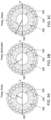
- FIGS. 5 a - 5 c illustrate a dual rotor electrical machine along with angles Theta_Rotor, Theta_Modulator, and Theta_Stator, according to some example embodiments;
- FIG. 6 a illustrates a side-view of a dual rotor electrical machine along with attached shafts, according to some example embodiments
- FIG. 6 b illustrates a parametric view of a dual rotor electrical machine illustrating angles of attached shafts, according to some example embodiments
- FIG. 7 illustrates a relation between mechanical and electrical rotation positions, according to some example embodiments.
- FIG. 8 illustrates a method of operating a dual rotor electrical machine, according to some example embodiments.
- FIGS. 9 a and 9 b illustrate alternate views of the dual rotor electrical machine of FIGS. 6 a and 6 b.
- Such existing hardware may include one or more Central Processing Units (CPUs), Digital Signal Processors (DSPs), Application-Specific-Integrated-Circuits (ASICs), Field Programmable Gate Arrays (FPGAs), computers or the like.
- CPUs Central Processing Units
- DSPs Digital Signal Processors
- ASICs Application-Specific-Integrated-Circuits
- FPGAs Field Programmable Gate Arrays
- module or the term ‘controller’ may be replaced with the term ‘circuit.’
- module may refer to, be part of, or include processor hardware (shared, dedicated, or group) that executes code and memory hardware (shared, dedicated, or group) that stores code executed by the processor hardware.
- the module may include one or more interface circuits.
- the interface circuits may include wired or wireless interfaces that are connected to a local area network (LAN), the Internet, a wide area network (WAN), or combinations thereof.
- LAN local area network
- WAN wide area network
- the functionality of any given module of the present disclosure may be distributed among multiple modules that are connected via interface circuits.
- At least one embodiment of the invention relates to a non-transitory computer-readable storage medium comprising electronically readable control information stored thereon, configured such that when the storage medium is used in a controller, at least one embodiment of the method is carried out.
- any of the aforementioned methods may be embodied in the form of a program.
- the program may be stored on a non-transitory computer readable medium and is adapted to perform any one of the aforementioned methods when run on a computer device (a device including a processor).
- the non-transitory, tangible computer readable medium is adapted to store information and is adapted to interact with a data processing facility or computer device to execute the program of any of the above-mentioned embodiments and/or to perform the method of any of the above-mentioned embodiments.
- the computer readable medium or storage medium may be a built-in medium installed inside a computer device main body or a removable medium arranged so that it can be separated from the computer device main body.
- the term computer-readable medium, as used herein, does not encompass transitory electrical or electromagnetic signals propagating through a medium (such as on a carrier wave); the term computer-readable medium is therefore considered tangible and non-transitory.
- various information regarding stored images for example, property information, may be stored in any other form, or it may be provided in other ways.
- code may include software, firmware, and/or microcode, and may refer to programs, routines, functions, classes, data structures, and/or objects.
- Shared processor hardware encompasses a single microprocessor that executes some or all code from multiple modules.
- Group processor hardware encompasses a microprocessor that, in combination with additional microprocessors, executes some or all code from one or more modules.
- References to multiple microprocessors encompass multiple microprocessors on discrete dies, multiple microprocessors on a single die, multiple cores of a single microprocessor, multiple threads of a single microprocessor, or a combination of the above.
- Shared memory hardware encompasses a single memory device that stores some or all code from multiple modules.
- Group memory hardware encompasses a memory device that, in combination with other memory devices, stores some or all code from one or more modules.
- memory hardware is a subset of the term computer-readable medium.
- the term computer-readable medium does not encompass transitory electrical or electromagnetic signals propagating through a medium (such as on a carrier wave); the term computer-readable medium is therefore considered tangible and non-transitory.
- Non-limiting examples of the non-transitory computer-readable medium include, but are not limited to, rewriteable non-volatile memory devices (including, for example flash memory devices, erasable programmable read-only memory devices, or a mask read-only memory devices); volatile memory devices (including, for example static random access memory devices or a dynamic random access memory devices); magnetic storage media (including, for example an analog or digital magnetic tape or a hard disk drive); and optical storage media (including, for example a CD, a DVD, or a Blu-ray Disc).
- Examples of the media with a built-in rewriteable non-volatile memory include but are not limited to memory cards; and media with a built-in ROM, including but not limited to ROM cassettes; etc.
- various information regarding stored images for example, property information, may be stored in any other form, or it may be provided in other ways.
- Some example embodiments relate to a determination of a virtual position of a stator electromagnetic field in a dual rotor electric machine.
- the virtual position of the stator electromagnetic field may be based on the position of the inner rotor and on the position of the modulator.
- the rotation of the inner rotor, and separately the rotation of the modulator, do not necessarily lead to an equal rotation of the corresponding stator electromagnetic field.
- the position, speed and/or direction of the stator electromagnetic field may only be obtained by superpositioning the two rotation positions of the inner rotor and the modulator. This superpositioning may lead to a number of problems.
- a formula and/or an equation may be used to calculate the stator field position from two rotor field position resolvers.
- the position resolvers typically give a reading of between 0 and 360 degrees, resetting to 0 every 360 degrees.
- the electromagnetic field of the stator may not be aligned with the electromagnetic field of the rotor and/or of the modulator.
- the Stator electrical position may have abnormal behavior, e.g. may have a Stepping Effect, at a rotational position of 360 degrees.
- a system including a dual rotor electrical machine.
- the dual rotor electrical machine comprises a stator, an inner rotor including a first number of permanent magnet pole pairs, and a modulator including a second number of modulating segments.
- the system includes a controller configured to execute non-transitory machine readable instructions that, when executed by the controller, cause the system to determine a virtual position of an electromagnetic field of the stator based on a weighted sum of an angular position of the inner rotor and an angular position of the modulator, wherein weights in the weighted sum are based on the first number and the second number.
- the controller is configured to execute machine readable instructions to control the dual rotor electrical machine based on the determined virtual position of the electromagnetic field of the stator.
- the controller is configured execute machine readable instructions to synchronize the electromagnetic field of the stator with an electromagnetic field associated with the rotor and the modulator.
- the controller is configured to execute machine readable instructions to operate the dual rotor electrical machine according to at least one of a speed mode or a torque mode.
- the dual rotor electrical machine is configured to operate as at least one of a motor or a generator.
- the system includes a first position resolver, the first position resolver configured to obtain the angular position of the inner rotor, and configured to provide the angular position to the controller.
- the system includes a second position resolver, the second position resolver configured to obtain the angular position of the modulator, and configured to provide the angular position of the modulator to the controller.
- the system includes a first shaft connected to the modulator, the first shaft having a first shaft angular position, where a first gear ratio is a ratio of a number of gears on the first shaft to a number of gears on the modulator.
- the controller is configured to execute machine readable instructions to determine the virtual position based on the first shaft angular and on the first gear ratio.
- the system includes a second shaft connected to the inner rotor, the second shaft having a second shaft angular position, where a second gear ratio is a ratio of a number of gears on the second shaft to a number of gears on the inner rotor.
- the controller is configured to execute machine readable instructions to determine the virtual position based on the second shaft angular position and the second gear ratio.
- the system includes a first shaft connected to the modulator, the first shaft having a first shaft angular position where a first gear ratio is a ratio of a number of gears on the first shaft to a number of gears on the modulator, and a second shaft connected to the inner rotor, the second shaft having a second shaft angular position, where a second gear ratio is a ratio of a number of gears on the second shaft to a number of gears on the inner rotor.
- the controller is configured to execute machine readable instructions to determine the virtual position based on the first shaft angular position, the first gear ratio, the second shaft angular position, and the second gear ratio.
- C_3 is a value between 0 degrees and 360 degrees.
- At least one of a position offset calibration run at startup of the dual rotor electrical machine determines C_3, or a factory and/or a dealer determines C_3.
- a method for operating a dual rotor electrical machine including a stator, an inner rotor including a first number of permanent magnet pole pairs, and a modulator including a second number of modulating segments and corresponding modulating rings.
- the method includes obtaining a first angular position of the inner rotor, obtaining a second angular position of the modulator, and determining a virtual position of an electromagnetic field of the stator, the virtual position based on a weighted sum of the first angular position and the second angular position, wherein weights in the weighted sum are based on the first number and the second number.
- the method includes controlling the dual rotor electrical machine based on the determined virtual position of the electromagnetic field of the stator.
- the method includes synchronizing the electromagnetic field of the stator with an electromagnetic field associated with the rotor and the modulator.
- the method includes operating the dual rotor electrical machine according to at least one of a speed mode or a torque mode.
- the method includes operating the dual rotor electrical machine as at least one of a motor or a generator.
- the obtaining the first angular position includes obtaining the first angular position from a first position resolver adjacent to the inner rotor.
- the obtaining the second angular position includes, obtaining the second angular position from a second position resolver adjacent to the modulator.
- the determining the virtual position includes, determining the virtual position based on a first shaft angular position and a first gear ratio, where the first gear ratio is a ratio of a number of gears on the first shaft to a number of gears on the modulator, the first shaft connected to the modulator.
- the determining the virtual position includes, determining the virtual position based on a second shaft angular position and a second gear ratio, where a second gear ratio is a ratio of a number of gears on the second shaft to a number of gears on the inner rotor, the second shaft connected to inner rotor.
- the determining the virtual position includes, determining the virtual position based on a first shaft angular position and a first gear ratio of a first shaft connected to the modulator and based on a second shaft angular position and a second gear ratio of a second shaft connected to inner rotor, where the first gear ratio is a ratio of a number of gears on the first shaft to a number of gears on the modulator and the second gear ratio is a ratio of a number of gears on the second shaft to a number of gears on the inner rotor.
- At least one of a position offset calibration run at startup of the dual rotor electrical machine determines C_3, or a factory and/or a dealer determines C_3.
- C_3 is a value between 0 degrees and 360 degrees.
- a non-transitory computer readable medium when executed by a controller in a system including a dual rotor electrical machine having a stator, an inner rotor including a first number of permanent magnet pole pairs, and a modulator including a second number of modulating segments and corresponding modulating rings, is configured to cause the system to obtain a first angular position of the inner rotor, obtain a second angular position of the modulator, and determine a virtual position of an electromagnetic field of the stator, the virtual position based on a weighted sum of the first angular position and the second angular position, wherein weights in the weighted sum are based on the first number and the second number.
- the non-transitory computer readable medium when executed by the controller, is configured to cause the system to control the dual rotor electrical machine based on the virtual position.
- the non-transitory computer readable medium when executed by the controller, is configured to cause the system to, synchronize the electromagnetic field of the stator with an electromagnetic field associated with the rotor and the modulator.
- the non-transitory computer readable medium when executed by the controller, is configured to cause the system to operate the dual rotor electrical machine according to at least one of a speed mode or a torque mode.
- the non-transitory computer readable medium when executed by the controller, is configured to cause the system to operate the dual rotor electrical machine as at least one of a motor or a generator.
- the non-transitory computer readable medium when executed by the controller, is configured to cause the system to obtain the first angular position from a first position resolver adjacent to the inner rotor.
- the non-transitory computer readable medium when executed by the controller, is configured to cause the system to obtain the first position from a second position resolver adjacent to the modulator.
- the non-transitory computer readable medium when executed by the controller, is configured to cause the system to determine the virtual position based on a first shaft angular position and a first gear ratio, where the first gear ratio is a ratio of a number of gears on the first shaft to a number of gears on the modulator, the first shaft connected to the modulator.
- the non-transitory computer readable medium when executed by the controller, is configured to cause the system to determine the virtual position based on a second shaft angular position and a second gear ratio, where the second gear ratio is a ratio of a number of gears on the second shaft to a number of gears on the inner rotor, the second shaft connected to the inner rotor.
- the non-transitory computer readable medium when executed by the controller, is configured to cause the system to determine the virtual position based on a first shaft angular position and a first gear ratio of a first shaft connected to the modulator and based on a second shaft angular position and a second gear ratio of a second shaft connected to inner rotor.
- At least one of a position offset calibration run at startup of the dual rotor electrical machine determines C_3, or a factory and/or a dealer determines C_3.
- C_3 is a value between 0 degrees and 360 degrees.
- FIG. 2 illustrates a dual rotor electrical machine according to some example embodiments.
- a dual rotor electrical machine 310 may include a stator cooling jacket 320 , a stator 330 , conductive coils 340 , a modulator 390 including non-magnetic or weak magnetic segments 350 and modulating ferromagnetic segments 360 , and an inner rotor 380 including permanent magnets having magnets radially polarized inside to outside as in magnet portion 370 a and outside to inside as in magnet portion 370 b.
- the stator cooling jacket 320 may cool the stator 330 ; however, example embodiments are not limited thereto.
- the stator 330 may be physically stationary, e.g. may be physically stationary during operation of the dual rotor electrical machine 310 .
- example embodiments are not limited thereto, and the stator 330 may be physically mobile, and/or may physically rotate.
- the modulator 390 may include a number of ferromagnetic modulating segments 360 corresponding to a number of non-magnetic or weak magnetic segments 350 .
- a number of modulating segments 360 may be an integer n3.
- n3 may be a constant associated with the modulator 390 .
- the dual rotor electrical machine 310 may have individual components replaced, and different modulators 390 may have a different number of non-magnetic or weak magnetic segments 350 .
- n3 is thirteen; however, example embodiments are not limited thereto, and n3 may be an integer greater than thirteen, or an integer greater than zero and less than thirteen.
- n3 may be one, two, three, four, five, six, seven, eight, nine, ten, eleven, twelve, thirteen, fourteen, fifteen, etc.
- the modulating segments 360 may be composed of a ferromagnetic material, e.g. may be composed of a material that is attractive to a magnetic force.
- the modulating segments 360 may be composed of a material containing iron.
- the non-magnetic or weak magnetic segments 350 may be composed of a non-ferromagnetic material, e.g. may be composed of a material that is not attracted to a magnetic force.
- Around the modulating segments 360 there may be at least one of air, a composite material, or a plastic.
- the inner rotor 380 may include pairs of permanent magnets.
- each pair of permanent magnet may include a magnet radially polarized inside to outside as in magnetic portion 370 a and a magnets radially polarized outside to inside as in magnetic portion 370 b.
- magnetic portion 370 a and the magnetic portion 370 b there may be other arrangements of the magnetic portion 370 a and the magnetic portion 370 b .
- the inner rotor 380 may comprise one or more inner magnetic-field modulating members, (inner) permanent magnets, (inner) permanent magnet pole pairs, and ferrous, iron core or permeability-modulating members that can alter, direct or focus electromagnetic fields, magnetic induction, and/or their components.
- the modulator 390 may be referred to as an outer rotor that may comprise one or more magnetic-field modulating segments, such as (outer) permanent magnets, (outer) permanent magnet pole pairs, and ferrous, iron core or permeability-modulating members that can alter, direct or focus electromagnetic fields, magnetic induction, or their components.
- the modulator 390 may be referred to as an outer rotor, or a combination of an inner rotor and an outer rotor, which can be configured to be rotatable with respect to each other on a synchronous rotational basis (e.g., synchronous rotational operational mode permanent magnets of the inner rotor and the outer rotor) and/or an asynchronous rotational basis (e.g., during any alignment phase for synchronous rotational operational mode of the permanent magnets of the inner rotor and outer rotor).
- a synchronous rotational basis e.g., synchronous rotational operational mode permanent magnets of the inner rotor and the outer rotor
- an asynchronous rotational basis e.g., during any alignment phase for synchronous rotational operational mode of the permanent magnets of the inner rotor and outer rotor
- a number of permanent magnet pole pairs may be an integer n1.
- n1 may be a constant associated with the inner rotor 380 .
- the dual rotor electrical machine 310 may have individual components replaced, and different inner rotors 380 may have a different number of permanent magnet pole pairs.
- n1 is nine; however, example embodiments are not limited thereto, and n1 may be an integer greater than nine, or an integer greater than zero and less than nine.
- n1 may be one, two, three, four, five, six, seven, eight, nine, ten, eleven, twelve, thirteen, fourteen, fifteen, etc.
- a determination of the number n1 of permanent magnet pole pairs may include placement of a compass next to the inner rotor 380 , rotating the inner rotor 380 through a full 360 degree rotation, and counting the number of 180 degree changes of direction of the compass needle per one revolution of the inner rotor 380 .
- the number of 180 degree changes of direction of the compass needle divided by 2 per one rotation of the inner rotor 380 may correspond to the number n1 of permanent magnet pole pairs.
- the number n1 of permanent magnet pole pairs may be determined based on a two-dimensional measurement map of the radial intensity of the magnetic field around the inner rotor 380 .
- the number n1 of permanent magnet pole pairs may correspond to a number of distinct peaks or valleys within the two-dimensional measurement map of the radial intensity of the magnetic field around the inner rotor 380 .
- the number n3 of modulating segments 360 may be the same as, or may be different from, the number n1 of pairs of permanent magnets corresponding to magnets radially polarized inside to outside as in magnetic portion 370 a and magnets radially polarized outside to inside as in magnetic portion 370 b . Furthermore, the number n3 of modulating segments 360 may be relatively prime with the number n1 of pairs of permanent magnets. However, example embodiments are not limited thereto.
- the stator 330 may be operated with AC current, e.g. may be operated with three-phase current.
- three-phase current may be applied to the conductive coils 340 , creating a magnetic field.
- An inductive force may be generated based on the magnetic field generated by the three-phase current applied to the conductive coils 340 .
- a three-phase current may be generated in the conductive coils 340 by rotation of the modulator 390 and the magnetic pole pairs including magnets radially polarized inside to outside as in magnetic portion 370 a and magnets radially polarized outside to inside as in magnetic portion 370 b within the inner rotor 380 .
- a frequency of the three-phase current may be, but is not limited to be, 60 Hz.
- a frequency of the three-phase current may be, but is not limited to be, 50 Hz.
- Example embodiments are not limited thereto.
- An inductive force generated by the magnetic field created by the three-phase current applied to the conductive coils 340 comprising the stator 330 may induce a rotation of the modulator 390 and the inner rotor 380 .
- the modulator 390 and inner rotor 380 may rotate based on the inductive force around the conductive coils 340 .
- FIG. 3 illustrates a system for operating a dual rotor electrical machine.
- FIG. 3 a system 200 for operating a dual rotor electrical machine 310 with a controller 210 is illustrated.
- the controller 210 may be or may include circuitry for operating the dual rotor electrical machine 310 .
- the controller 210 may include processing circuitry such as hardware including logic circuits; a hardware/software combination such as a processor executing software; or a combination thereof.
- the processing circuitry more specifically may include, but is not limited to, a central processing unit (CPU), an arithmetic logic unit (ALU), a digital signal processor, a microcomputer, a field programmable gate array (FPGA), a System-on-Chip (SoC), a programmable logic unit, a microprocessor, application-specific integrated circuit (ASIC), etc.
- the controller 210 may include features such as those described in U.S. Pat. No. 9,442,029, the entire contents of which are herein incorporated by reference.
- the controller 210 may receive angular position information from position resolvers 230 , may determine a virtual position of a stator included in the dual rotor electrical machine 310 based on the angular information received from the position resolvers 230 , and may control the dual rotor electrical machine 310 based on the determined virtual position.
- the controller 210 may issue commands to the dual rotor electrical machine 310 .
- the controller 210 may issue a command to the dual rotor electrical machine 310 to control the dual rotor electrical machine 310 based on the determined virtual position of the stator within the dual rotor electrical machine 310 .
- the commands may correspond to current commands.
- the commands may correspond to frequency commands.
- the dual rotor electrical machine 310 may operate based on the commands from the controller 210 .
- the dual rotor electrical machine 310 may operate as either a motor to generate mechanical energy, or as a generator to generate electrical energy.
- the dual rotor electrical machine 310 may operate in at least one of a speed mode or torque mode. In the speed mode, the dual rotor electrical machine 310 operates such that the stator operates at a given (fundamental) frequency. In the torque mode, the dual rotor electrical machine 310 operates such that the stator provides a given torque.
- the controller 210 may operate to generate, prepare, and use Id/Iq lookup tables based on the determined virtual position. Alternatively or additionally, the controller 210 may perform field weakening operations based on the determined virtual position. Alternatively or additionally, the controller 210 may perform position offset calibrations based on the determined virtual position.
- the position resolvers 230 may determine a position for each of the inner rotor and the modulator adjacent to the dual rotor electrical machine 310 . There may be two positon resolvers 230 within the system 200 ; however, example embodiments are not limited thereto.
- the position resolvers 230 may obtain the angular positions of the inner rotor and the modulator, respectively, and may provide the angular positions to the controller 210 .
- the position resolvers 230 may determine the angular positions of the inner rotor and/or the modulator in dual rotor electrical machine 310 , and may be attached to, e.g. directly attached to, or adjacent to, the modulator and/or the inner rotor of the dual rotor electrical machine 310 . Alternatively or additionally, the position resolvers 230 may not be attached to or adjacent to the dual rotor electrical machine 310 .
- the controller 210 may receive position information from the position resolvers 230 .
- the controller 210 may receive position information over a channel from the position resolvers 230 .
- the channel may be or may include a wired channel or another communication channel between the controller 210 and the position resolvers 230 .
- the controller 210 may issue commands, e.g. instructions, to the dual rotor electrical machine 310 .
- the controller 210 may issue the commands through a channel to the dual rotor electrical machine 310 .
- the channel may be or may include a wired channel, or another communication channel between the controller 210 and the dual rotor electrical machine 310 .
- the controller 210 determines the virtual position of the electromagnetic field around the stator within the dual rotor electrical machine 310 .
- the electromagnetic field around the stator may be rotating.
- the controller 210 From the determined virtual position of the electromagnetic field around the stator, the controller 210 operates the dual rotor electrical machine 310 as if the dual rotor electrical machine 310 were a single rotor electrical machine. For example, from a point of view of the stator, the stator only experiences a single rotating electromagnetic field. The stator acts independent of whether the rotating electromagnetic field is created by a single rotating component or by two rotating components. Accordingly, operation of the dual rotor electrical machine 310 may be performed as if the dual rotor electrical machine 310 were a single rotor machine.
- FIG. 4 illustrates a system for controlling a dual rotor electrical machine, according to some example embodiments.
- a system 250 according FIG. 4 may operate similarly to the system 200 as shown in FIG. 3 . Descriptions of common features may be omitted for brevity.
- a system 250 may include a controller 210 , a dual rotor electrical machine 310 , one or more position resolvers 230 connected to the dual rotor electrical machine 310 , shafts Shaft1 and Shaft2 connected to the dual rotor electrical machine 310 , and one or more position resolvers 240 connected to or adjacent to either or both of shafts Shaft1 and Shaft2.
- the position resolvers 230 may be connected to and/or adjacent to the inner rotor 380 and/or the modulator 390 described above, and the position resolvers 240 may be connected to and/or adjacent to the shafts Shaft1 and Shaft2.
- the position resolvers 240 may determine a position of shaft Shaft1 and/or shaft Shaft2. As illustrated in more detail below with reference to FIG. 6 a and FIG. 9 a .
- shaft Shaft1 may be connected to the modulator 390
- shaft Shaft2 may be connected to the inner rotor 380 .
- FIGS. 5 a - 5 c illustrate a dual rotor electrical machine along with angles Theta_Rotor, Theta_Modulator, and Theta_Stator, according to some example embodiments.
- FIG. 6 a illustrates a side-view of a dual rotor electrical machine 310 along with shafts Shaft1 and Shaft2 attached to the dual rotor electrical machine 310 , according to some example embodiments.
- FIG. 6 b illustrates a parametric view of a dual rotor electrical machine 310 , according to some example embodiments.
- At least one position resolver 230 adjacent to/connected to the inner rotor 380 may determine an angle Theta_Rotor of the inner rotor 380 to FIG. 5 a .
- the angle Theta_Rotor may be based on an angle measured from a polar axis of the inner rotor 380 .
- the polar axis of Theta_Rotor may be horizontal; however, example embodiments are not limited thereto.
- Theta_Rotor may be an angle measured in degrees between 0 and 360; however, example embodiments are not limited thereto, and
- Theta_Rotor may be an angle measured in other units, for example, measured in radians between 0 and 2*pi.
- At least one position resolver 230 adjacent to/connected to the modulator 390 may determine an angle Theta_Modulator.
- the angle Theta_Modulator may be based on an angle measured from a polar axis of the modulator 390 .
- the polar axis of Theta_Modulator may be horizontal; however, example embodiments are not limited thereto. Furthermore the polar axis of Theta_Modulator may be the same, or different, from the polar axis of Theta_Rotor.
- Theta_Modulator may be an angle measured in degrees between 0 and 360; however, example embodiments are not limited thereto, and Theta_Modulator may be an angle measured in other units, for example, measured in radians between 0 and 2*pi.
- a virtual angle Theta_Stator may be associated with an electromagnetic magnetic field of the stator 330 .
- the virtual angle Theta_Stator may be determined based on the angle Theta_Rotor, the angle Theta_Modulator, the number n1 of pairs of portions 370 a and portions 370 b referred to above with reference to FIG. 2 , and the number n3 of modulating segments 360 referred to above with reference to FIG. 2 .
- Theta_Stator may be an angle measured in degrees between 0 and 360; however, example embodiments are not limited thereto, and Theta_Stator may be an angle measured in other units, for example, measured in radians between 0 and 2*pi.
- the virtual angle Theta_Stator may be based on a position offset C_3.
- the position offset C_3 may correspond to an “integration constant.”
- the position offset C_3 may be an angle measured in degrees between 0 degrees and 360 degrees.
- the position offset C_3 may be an angle measured in degrees between 0 and 360/n1.
- the position offset C_3 corresponds to an “integration constant” whose multiplication and/or division leads to another constant that can be absorbed into the equations. If Theta_Rotor and Theta_Modulator are measured in radians, then position offset C_3 may be an angle measured in radians between 0 and 2pi, or between 0 and 2pi/n1.
- the position offset C_3 may be determined, e.g. may be determined with a position offset calibration run at startup of the dual rotor electrical machine 310 . Alternatively, a factory and/or a dealer may determine the position offset C_3 based on empirical data.
- C_3 is set to zero, example embodiments are not limited thereto.
- C_3 may be determined by forcing the modulator 390 to be stationary, then applying a rotating electromagnetic field to the stator 330 .
- the inner rotor 380 will rotate.
- C_3 may be obtained by applying a constant torque to the inner rotor 380 , varying C_3, and measuring current through the stator 380 .
- C_3 may correspond to a value having a minimal or low current through the stator 380 .
- each of, or at least one of, n1 or n3 may be considered constants; however, example embodiments are not limited thereto.
- each of, or at least one of, Theta_Rotor, Theta_Modulator, and Theta_Stator may be considered variables; however, example embodiments are not limited thereto.
- Equation 1 may be thought of as an equation for Theta_Stator based on a weighted sum of Theta_Rotor and Theta_Modulator. Weights within the weighted sum are based on the number n1 of permanent magnet pole pairs and the number n3 of modulating segments.
- a position Theta_Stator of the magnetic field of the stator 330 may include finite decimal fractions.
- a stepping effect may be present in operation of a dual rotor electrical machine 310 with such an equation, because of the non-whole numbers 1.75 and/or 2.75.
- C_3′ corresponds to C_3 multiplied by (n3 ⁇ n1).
- the controller 210 may obtain the virtual position Theta_Stator of the resulting magnetic field.
- the controller 210 may operate the dual rotor electrical machine 310 .
- the controller 210 may operate the dual rotor electrical machine 310 to rotate the electromagnetic field created by the stator 320 at a frequency corresponding to the given speed.
- the controller 210 may operate the dual rotor electrical machine 310 to apply a set (or, alternatively, variable or predetermined) torque at the stator 320 .
- the dual rotor electrical machine 310 may have shafts Shaft1 and Shaft2 connected thereto.
- Shaft Shaft1 may be connected to the modulator 390 .
- Shaft Shaft2 may be connected to the inner rotor 380 .
- shaft Shaft1 may be at an angle Theta_Shaft1.
- shaft Shaft2 may be at an angle Theta_Shaft2.
- angles Theta_Shaft1 and Theta_Shaft2 may be determined by position resolvers.
- at least one position resolver 240 may determine the angular position Theta_Shaft1.
- at least one position resolver 240 may determine the angular position Theta_Shaft2.
- the controller 210 may obtain either or both of the position Theta_Rotor and Theta_Modulator from position resolvers 230 .
- the controller 210 may obtain either or both of the positions Theta_Shaft1 and Theta_Shaft2 of shafts Shaft1 and Shaft2 from position resolvers 240 connected to shafts Shaft1 and Shaft2.
- the controller 210 may determine the virtual position of the stator 330 based on the positions of either or both of Theta_Shaft1 or Theta_Shaft2, along with either or both of the gear ratios Ratio_Shaft1 and Ratio_Shaft2.
- the equations may be multiplied by a denominator of that ratio. Simplifying equations such as Equation 1, Equation 2, Equation 3, Equation 4, or Equation 5 by dividing by common factors may be beneficial.
- each of, or at least one of, Ratio_Shaft1 and Ratio_Shaft2 may be considered constants; however, example embodiments are not limited thereto.
- each of, or at least one of, Theta_Shaft1 and Theta_Shaft2 may be considered variables; however, example embodiments are not limited thereto.
- FIG. 7 illustrates a relation between mechanical and electrical rotation positions of the dual rotor electrical machine 310 , according to some example embodiments.
- stator positions may be determined according to example embodiments described above.
- the stator electrical position at 360 degrees does not have the same abnormal Stepping Effect as is present in FIG. 1 .
- the electromagnetic field of the stator 330 above may be aligned with the electromagnetic fields of the inner rotor 380 and/or the modulator 390 .
- FIG. 8 illustrates a method of operating a dual rotor electrical machine 310 according to some example embodiments.
- the position Theta_Rotor may be obtained.
- the position Theta_Rotor may be obtained based on a first position resolver.
- step S 502 the position Theta_Modulator may be obtained.
- the position Theta_Modulator may be obtained based on a second position resolver.
- step S 503 the number n3 of modulating segments may be obtained.
- This number n3 may be fixed within any given dual rotor electrical machine 310 ; however, example embodiments are not limited thereto.
- step S 504 the number n1 of pole pairs in the inner rotor 380 may be obtained.
- This number n1 may be fixed within any given dual rotor electrical machine 310 ; however, example embodiments are not limited thereto.
- step S 505 the virtual field position Theta_Stator may be determined.
- the virtual field position Theta_Stator may be determined based on equation 1.
- the dual rotor electrical machine 310 may be operated based on the determined Theta_Stator. For example, at least one of a current command, a voltage command, or a torque command applied to the dual rotor electrical machine 310 may be based on the determined Theta_Stator.
- a stepping effect may be reduced or eliminated, thus simplifying operation of the dual rotor electrical machine 310 .
- FIG. 8 illustrates operations presented in order, no order is meant to be implied by the operations in FIG. 8 .
- the obtaining of Theta_Modulator may be done before, or at the same time as, the obtaining of Theta_Rotor.
- the obtaining of the number of modeling segments n3 and/or the number of permanent magnet pole pairs n1 may be done before, or at the same time as, or later than, the obtaining of either or both of Theta_Modulator and/or of Theta_Rotor.
- FIGS. 9 a and 9 b are alternate views of the dual rotor machine of FIGS. 6 a and 6 b , according to some example embodiments.
- a dual rotor electric machine 310 may be connected to a first shaft Shaft1 and to a second shaft Shaft2, and may include stator 330 , the inner rotor 380 , and the modulator 390 .
- the first shaft Shaft1 may be connected to the modulator 390 . There may be a ratio RatioShaft1 of gears between the first shaft Shaft1 and the modulator 390 .
- the second shaft Shaft2 may be connected to the inner rotor 380 . There may be a ratio RatioShaft2 of gears (not illustrated) between the second shaft Shaft2 and the inner rotor 380 .
- the dual rotor electrical machine suddenly may be operated like a single rotor permanent magnet synchronous machine, including, but not limited to be, at least one of speed mode operation, torque mode operation, Id/Iq lookup tables, field weakening operation, or position offset calibration.
Landscapes
- Engineering & Computer Science (AREA)
- Power Engineering (AREA)
- Physics & Mathematics (AREA)
- General Physics & Mathematics (AREA)
- Microelectronics & Electronic Packaging (AREA)
- Electromagnetism (AREA)
- Control Of Ac Motors In General (AREA)
Abstract
Description
Theta_Stator=−(n1/(n3−n1))*Theta_Rotor+((n1/(n3−n1))+1)*Theta_Modulator+C_3,
where Theta_Stator is the virtual position, Theta_Rotor is the angular position of the inner rotor, Theta_Modulator is the angular position of the modulator, n1 is the first number of permanent magnet pole pairs, n3 is the second number of modulating segments, and C_3 is a position offset.
Theta_Stator=−(n1/(n3−n1))*Theta_Rotor+((n3/(n3−n1))+1)*Ratio_Shaft1*Theta_Shaft1+C_3,
where Theta_Shaft1 is the first shaft angular position, Ratio_Shaft1 is the first gear ratio, Theta_Stator is the virtual position, Theta_Rotor is the angular position of the inner rotor, n1 is the first number of permanent magnet pole pairs, n3 is the second number of modulating segments, and C_3 is a position offset.
Theta_Stator=−(n1/(n3−n1))*Ratio_Shaft2*Theta_Shaft2+((n3/(n3−n1))+1)*Theta_Modulator+C_3,
where Theta_Shaft2 is the second shaft angular position, Ratio_Shaft2 is the second gear ratio, Theta_Stator is the virtual position, Theta_Modulator is the angular position of the modulator, n1 is the first number of permanent magnet pole pairs, n3 is the second number of modulating segments, and C_3 is a position offset.
Theta_Stator=−(n1/(n3−n1))*Ratio_Shaft2*Theta_Shaft2+((n3/(n3−n1))+1)*Ratio_Shaft1*Theta_Shaft1+C_3,
where Theta_Shaft1 is the first shaft angular position, Ratio_Shaft1 is the first gear ratio, Theta_Shaft2 is the second shaft angular position, Ratio_Shaft1 is the second gear ratio, Theta_Stator is the virtual position, n1 is the first number of permanent magnet pole pairs, n3 is the second number of modulating segments, and C_3 is a position offset.
Theta_Stator=−(n1/(n3−n1))*Theta_Rotor+((n1/(n3−n1))+1)*Theta_Modulator+C_3,
where Theta_Stator is the virtual position, Theta_Rotor is the angular position of the inner rotor, Theta_Modulator is the angular position of the modulator, n1 is the first number of permanent magnet pole pairs, n3 is the second number of modulating segments, and C_3 is a position offset.
Theta_Stator=−(n1/(n3−n1))*Theta_Rotor+((n3/(n3−n1))+1)*Ratio_Shaft1*Theta_Shaft1+C_3,
where Theta_Shaft1 is the first shaft angular position, Ratio_Shaft1 is the first gear ratio, Theta_Stator is the virtual position, Theta_Rotor is the angular position of the inner rotor, n1 is the first number of permanent magnet pole pairs, n3 is the second number of modulating segments, and C_3 is a position offset.
Theta_Stator=−(n1/(n3−n1))*Ratio_Shaft2*Theta_Shaft2+((n3/(n3−n1))+1)*Theta_Modulator+C_3,
where Theta_Shaft2 is the second shaft angular position, Ratio_Shaft2 is the second gear ratio, Theta_Stator is the virtual position, Theta_Modulator is the angular position of the modulator, n1 is the first number of permanent magnet pole pairs, n3 is the second number of modulating segments, and C_3 is a position offset.
Theta_Stator=−(n1/(n3−n1))*Ratio_Shaft2*Theta_Shaft2+((n3/(n3−n1))+1)*Theta_Ratio_Shaft2*Theta_Shaft2+C_3,
where Theta_Shaft1 is the first shaft angular position, Ratio_Shaft1 is the first gear ratio, Theta_Shaft2 is the second shaft angular position, Ratio_Shaft1 is the second gear ratio, Theta_Stator is the virtual position, n1 is the first number of permanent magnet pole pairs, n3 is the second number of modulating segments, and C_3 is a position offset.
Theta_Stator=−(n1/(n3−n1))*Theta_Rotor+((n1/(n3−n1))+1)*Theta_Modulator+C_3,
where Theta_Stator is the virtual position, Theta_Rotor is the angular position of the inner rotor, Theta_Modulator is the angular position of the modulator, n1 is the first number of permanent magnet pole pairs, n3 is the second number of modulating segments, and C_3 is a position offset.
Theta_Stator=−(n1/(n3−n1))*Theta_Rotor+((n3/(n3−n1))+1)*Ratio_Shaft1*Theta_Shaft1+C_3,
where Theta_Shaft1 is the first shaft angular position, Ratio_Shaft1 is the first gear ratio, Theta_Stator is the virtual position, Theta_Rotor is the angular position of the inner rotor, n1 is the first number of permanent magnet pole pairs, n3 is the second number of modulating segments, and C_3 is a position offset.
Theta_Stator=−(n1/(n3−n1))*Ratio_Shaft2*Theta_Shaft2+((n3/(n3−n1))+1)*Theta_Modulator+C_3,
where Theta_Shaft2 is the second shaft angular position, Ratio_Shaft2 is the second gear ratio, Theta_Stator is the virtual position, Theta_Modulator is the angular position of the modulator, n1 is the first number of permanent magnet pole pairs, n3 is the second number of modulating segments, and C_3 is a position offset.
Theta_Stator=−(n1/(n3−n1))*Ratio_Shaft1*Theta_Shaft1+((n3/(n3−n1))+1)*Theta_Shaft2*Theta_Shaft2+C_3,
where Theta_Shaft1 is the first shaft angular position, Ratio_Shaft1 is the first gear ratio, Theta_Shaft2 is the second shaft angular position, Ratio_Shaft1 is the second gear ratio, Theta_Stator is the virtual position, n1 is the first number of permanent magnet pole pairs, n3 is the second number of modulating segments, and C_3 is a position offset.
Theta_Stator=−(n1/(n3−n1))*Theta_Rotor+((n3/(n3−n1))+1)*Theta_Modulator+C_3 (Equation 1).
Theta_Stator=−(7/(11−7))*Theta_Rotor+((7/(11−7))+1)*Theta_Modulator+C_3, or
Theta_Stator=−1.75*Theta_Rotor+2.75*Theta_Modulator+C_3
(n3−n1)*Theta_Stator=−n1*Theta_Rotor+n3*Theta_Modulator+C_3′ (Equation 2).
4*Theta_Stator=−7*Theta_Rotor+11*Theta_Modulator+C_3′
Theta_Stator=−(n1/(n3−n1))*Theta_Rotor+((n3/(n3−n1))+1)*Ratio_Shaft1*Theta_Shaft1+C_3 (Equation 3).
4*Theta_Stator=−7*Theta_Rotor−23.1*Theta_Shaft1+C_3
40*Theta_Stator=−70*Theta_Rotor−231*Theta_Shaft1+C_3
Theta_Stator=−(n1/(n3−n1))*Ratio_Shaft2*Theta_Shaft2+((n3/(n3−n1))+1)*Theta_Modulator+C_3 (Equation 4).
Theta_Stator=−(n1/(n3−n1))*Ratio_Shaft2*Theta_Shaft2+((n3/(n3−n1))+1)*Theta_Ratio_Shaft2*Theta_Shaft2+C_3 (Equation 5).
Claims (20)
Theta_Stator=−(n1/(n3−n1))*Theta_Rotor+((n3/(n3−n1))+1)*Ratio_Shaft1*Theta_Shaft1+C_3,
Theta_Stator=−(n1/(n3−n1))*Ratio_Shaft2*Theta_Shaft2+((n3/(n3−n1))+1)*Theta_Modulator+C_3,
Theta_Stator=−(n1/(n3−n1))*Ratio_Shaft2*Theta_Shaft2+((n3/(n3−n1))+1)*Theta_Ratio_Shaft2*Theta_Shaft2+C_3,
Theta_Stator=−(n1/(n3−n1))*Theta_Rotor+((n1/(n3−n1))+1)*Theta_Modulator+C_3,
Priority Applications (2)
| Application Number | Priority Date | Filing Date | Title |
|---|---|---|---|
| US17/001,905 US11670995B2 (en) | 2020-01-31 | 2020-08-25 | Method and apparatus for operating a dual rotor electrical machine |
| EP20214636.1A EP3859967B1 (en) | 2020-01-31 | 2020-12-16 | Method and apparatus for operating a dual rotor electrical machine |
Applications Claiming Priority (2)
| Application Number | Priority Date | Filing Date | Title |
|---|---|---|---|
| US202062968624P | 2020-01-31 | 2020-01-31 | |
| US17/001,905 US11670995B2 (en) | 2020-01-31 | 2020-08-25 | Method and apparatus for operating a dual rotor electrical machine |
Publications (2)
| Publication Number | Publication Date |
|---|---|
| US20210242761A1 US20210242761A1 (en) | 2021-08-05 |
| US11670995B2 true US11670995B2 (en) | 2023-06-06 |
Family
ID=73855117
Family Applications (1)
| Application Number | Title | Priority Date | Filing Date |
|---|---|---|---|
| US17/001,905 Active 2041-08-11 US11670995B2 (en) | 2020-01-31 | 2020-08-25 | Method and apparatus for operating a dual rotor electrical machine |
Country Status (2)
| Country | Link |
|---|---|
| US (1) | US11670995B2 (en) |
| EP (1) | EP3859967B1 (en) |
Cited By (1)
| Publication number | Priority date | Publication date | Assignee | Title |
|---|---|---|---|---|
| US12385556B2 (en) | 2023-05-11 | 2025-08-12 | Deere & Company | Transmission arrangement and agricultural towing vehicle |
Families Citing this family (1)
| Publication number | Priority date | Publication date | Assignee | Title |
|---|---|---|---|---|
| WO2025128591A1 (en) * | 2023-12-11 | 2025-06-19 | Fluxworks, Inc. | Electric machine cooling system |
Citations (12)
| Publication number | Priority date | Publication date | Assignee | Title |
|---|---|---|---|---|
| US7466053B1 (en) | 2008-04-10 | 2008-12-16 | Vladimir Radev | Dual-rotor electric traction motor |
| DE102017209246A1 (en) | 2016-06-10 | 2017-12-14 | Deere & Company | Magnetic epicyclic gearbox with variable characteristics |
| US20180278139A1 (en) * | 2015-12-17 | 2018-09-27 | Hitachi Metals, Ltd. | Magnetic Transmission |
| DE102017208985A1 (en) | 2017-05-29 | 2018-11-29 | Deere & Company | Magnetic epicyclic gearbox with variable torque |
| EP3410587A1 (en) | 2017-05-31 | 2018-12-05 | Deere & Company | Magnetic epicyclic gear with variable characteristics |
| EP3480493A1 (en) | 2017-11-07 | 2019-05-08 | Deere & Company | Differential assembly |
| US20190190413A1 (en) * | 2017-12-20 | 2019-06-20 | Samsung Electronics Co., Ltd. | Motor and washing machine having the same |
| EP3513997A1 (en) | 2018-01-22 | 2019-07-24 | Deere & Company | Vehicle with an arrangement for dynamically adjusting forward motion |
| EP3543058A1 (en) | 2018-03-22 | 2019-09-25 | Deere & Company | Power take-off shaft transmission |
| US20190356206A1 (en) * | 2018-05-18 | 2019-11-21 | Kohler Co. | Dual axis motor |
| DE102018212143A1 (en) | 2018-07-20 | 2020-01-23 | Deere & Company | Agricultural work machine |
| US20210175785A1 (en) * | 2019-12-05 | 2021-06-10 | Whirlpool Corporation | Direct drive electric motor having stator and magnet configurations for improved torque capability |
Family Cites Families (1)
| Publication number | Priority date | Publication date | Assignee | Title |
|---|---|---|---|---|
| US9442029B2 (en) | 2013-12-27 | 2016-09-13 | Deere & Company | Methods of torque estimation and compensation and systems thereof |
-
2020
- 2020-08-25 US US17/001,905 patent/US11670995B2/en active Active
- 2020-12-16 EP EP20214636.1A patent/EP3859967B1/en active Active
Patent Citations (23)
| Publication number | Priority date | Publication date | Assignee | Title |
|---|---|---|---|---|
| US7466053B1 (en) | 2008-04-10 | 2008-12-16 | Vladimir Radev | Dual-rotor electric traction motor |
| US20180278139A1 (en) * | 2015-12-17 | 2018-09-27 | Hitachi Metals, Ltd. | Magnetic Transmission |
| DE102017209246A1 (en) | 2016-06-10 | 2017-12-14 | Deere & Company | Magnetic epicyclic gearbox with variable characteristics |
| DE102017206413A1 (en) | 2016-06-10 | 2017-12-14 | Deere & Company | Power-split continuously variable transmission system |
| US10385946B2 (en) | 2016-06-10 | 2019-08-20 | Deere & Company | Powertrain system and method for operating a powertrain |
| US10578194B2 (en) | 2016-06-10 | 2020-03-03 | Deere & Company | Powertrain system and method for operating a powertrain |
| EP3255761B1 (en) | 2016-06-10 | 2020-07-01 | Deere & Company | Drivetrain system and method for operating same |
| DE102017208985A1 (en) | 2017-05-29 | 2018-11-29 | Deere & Company | Magnetic epicyclic gearbox with variable torque |
| EP3410588A1 (en) | 2017-05-29 | 2018-12-05 | Deere & Company | Magnetic epicyclic gear with variable torque |
| EP3410587A1 (en) | 2017-05-31 | 2018-12-05 | Deere & Company | Magnetic epicyclic gear with variable characteristics |
| DE102017219758A1 (en) | 2017-11-07 | 2019-05-09 | Deere & Company | differential assembly |
| US20190136953A1 (en) | 2017-11-07 | 2019-05-09 | Deere & Company | Differential arrangement and method of influencing the overall torque of a shaft using a differential arrangement |
| EP3480493A1 (en) | 2017-11-07 | 2019-05-08 | Deere & Company | Differential assembly |
| US20190190413A1 (en) * | 2017-12-20 | 2019-06-20 | Samsung Electronics Co., Ltd. | Motor and washing machine having the same |
| US20190225079A1 (en) | 2018-01-22 | 2019-07-25 | Deere & Company | Vehicle, system for dynamic adjustment of a lead of an axle of a vehicle, and method of dynamically adjusting a lead of an axle of a vehicle |
| DE102018200953A1 (en) | 2018-01-22 | 2019-07-25 | Deere & Company | Vehicle with an arrangement for the dynamic adaptation of the flow |
| EP3513997A1 (en) | 2018-01-22 | 2019-07-24 | Deere & Company | Vehicle with an arrangement for dynamically adjusting forward motion |
| EP3543058A1 (en) | 2018-03-22 | 2019-09-25 | Deere & Company | Power take-off shaft transmission |
| DE102018204405A1 (en) | 2018-03-22 | 2019-09-26 | Deere & Company | PTO |
| US20190289771A1 (en) | 2018-03-22 | 2019-09-26 | Deere & Company | Power take-off transmission |
| US20190356206A1 (en) * | 2018-05-18 | 2019-11-21 | Kohler Co. | Dual axis motor |
| DE102018212143A1 (en) | 2018-07-20 | 2020-01-23 | Deere & Company | Agricultural work machine |
| US20210175785A1 (en) * | 2019-12-05 | 2021-06-10 | Whirlpool Corporation | Direct drive electric motor having stator and magnet configurations for improved torque capability |
Non-Patent Citations (6)
| Title |
|---|
| Extended European Search Report and Written Opinion issued in European Patent Application No. 20214636.1, dated Jun. 1, 2021, in 08 pages. |
| Nekkalapu Sameer, et al. "Design and Optimization of Dual Rotor Motor For Electric Vehicle Application," IEEE International Conference on Power Electronics, Drives and Energy Systems (PEDES), pp. 1-5, 2014. |
| Sun Le et al, Analysis and control of Complementary Magnetic-Geared Dual-Rotor Motor, IEEE Transactions on Industrial Electronics, IEEE Service Center, Retrieved from the Internet <URL: https://ieeexplore.ieee.org/document/7493601>, Nov. 1, 2016, pp. 6715-6725, 10.1109/TIE.2016.2581768. |
| Sun Le et al, Motion Control and Performance Evaluation of a Magnetic-Geared Dual-Rotor Motor in Hybrid Powertrain, IEEE Transactions on Industrial Electronics, IEEE Service Center, Retrieved from the Internet <URL: https://ieeexplore.ieee.org/document/7740097/metrics#metrics>, Mar. 1, 2017, pp. 1863-1872, 10.1109/TIE.2016.2627018. |
| Sun Le et al: "Analysis and Control of Complementary Magnetic-Geared Dual-Rotor Motor", IEEE Transactions on Industrial Electronics, IEEE Service Center, Piscataway, NJ, USA, vol. 63, No. 11, Nov. 1, 2016 (Nov. 1, 2016), pp. 6715-6725 (Year: 2016). * |
| Sun Le et al: "Motion Control and Performance Evaluation of a Magnetic-Geared Dual-Rotor Motor in Hybrid Powertrain", IEEE Transactions on Industrial Electronics, IEEE Service Center, Piscataway, Nd, USA, vol. 64, No. 3, Mar. 1, 2017 (Mar. 1, 2017), pp. 1863-1872 (Year: 2017). * |
Cited By (1)
| Publication number | Priority date | Publication date | Assignee | Title |
|---|---|---|---|---|
| US12385556B2 (en) | 2023-05-11 | 2025-08-12 | Deere & Company | Transmission arrangement and agricultural towing vehicle |
Also Published As
| Publication number | Publication date |
|---|---|
| EP3859967B1 (en) | 2025-01-01 |
| EP3859967A1 (en) | 2021-08-04 |
| US20210242761A1 (en) | 2021-08-05 |
Similar Documents
| Publication | Publication Date | Title |
|---|---|---|
| US10281299B2 (en) | Angle sensor, a bearing unit, electrical motor, a control system and error-check system | |
| US4255696A (en) | Synchronous motor system | |
| US20210242761A1 (en) | Method and apparatus for operating a dual rotor electrical machine | |
| Nasiri-Gheidari et al. | Performance evaluation of disk type variable reluctance resolvers | |
| US11699967B2 (en) | Electric machine with integrated point field detectors and system for multi-parameter sensing | |
| US20160268876A1 (en) | Electric motor | |
| CN105978235B (en) | Rotation angle detection apparatus | |
| JP2003287441A (en) | Rotational position detector | |
| Gilson et al. | 2-D analytical subdomain model for high-speed permanent-magnet machines | |
| JP6582216B2 (en) | Control method for three-phase brushless DC motor and motor control apparatus using the control method | |
| Chadebec et al. | Rotor fault detection of electrical machines by low frequency magnetic stray field analysis | |
| JPH10288537A (en) | Variable reluctance resolver | |
| Marinova et al. | Harmonic analysis of the magnetic field of a coaxial magnetic gear | |
| WO2025210960A1 (en) | Multi-rotation angle detection device | |
| Benšic et al. | Position estimation of active magnetic bearing shaft using auxiliary coils | |
| Jafarboland et al. | Analytical modelling of the effect of pole offset on the output parameters of BLDC motor | |
| Epifanov et al. | Electromagnetic torque and its ripples in a unipolar brushless torque motor with permanent magnets | |
| JP2000316266A (en) | Variable magnetoresistive position detector | |
| Biernat | Coil-turn short-circuit of PMSM influence on the transformed phase voltage frequency pattern. | |
| JP2019105478A (en) | Stator structure of strain sensor | |
| Kalender et al. | Design and determination of stator geometry for axial flux permanent magnet free rod rotor synchronous motor | |
| Chen et al. | A novel model of magnetic eddy-current coupling based on the magnetic equivalent circuit method | |
| JPS60162920A (en) | Resolver device using magnetism sensing element | |
| Ebrahimi | Torque estimation in rotating electrical machines | |
| CN115280664A (en) | Sensor magnet, rotor, motor |
Legal Events
| Date | Code | Title | Description |
|---|---|---|---|
| FEPP | Fee payment procedure |
Free format text: ENTITY STATUS SET TO UNDISCOUNTED (ORIGINAL EVENT CODE: BIG.); ENTITY STATUS OF PATENT OWNER: LARGE ENTITY |
|
| STPP | Information on status: patent application and granting procedure in general |
Free format text: DOCKETED NEW CASE - READY FOR EXAMINATION |
|
| AS | Assignment |
Owner name: DEERE & COMPANY, ILLINOIS Free format text: ASSIGNMENT OF ASSIGNORS INTEREST;ASSIGNORS:LANG, MATTHIAS;TREMEL, CHRIS J.;REEK, CHRISTOPHER;REEL/FRAME:054256/0886 Effective date: 20201019 |
|
| AS | Assignment |
Owner name: DEERE & COMPANY, ILLINOIS Free format text: CONFIRMATORY ASSIGNMENT;ASSIGNORS:LANG, MATTHIAS;TREMEL, CHRIS J.;REEK, CHRISTOPHER;REEL/FRAME:058909/0588 Effective date: 20220121 |
|
| STPP | Information on status: patent application and granting procedure in general |
Free format text: NON FINAL ACTION MAILED |
|
| STCF | Information on status: patent grant |
Free format text: PATENTED CASE |