US11668736B2 - Method for determining sensitivity coefficients of an electric power network using metering data - Google Patents
Method for determining sensitivity coefficients of an electric power network using metering data Download PDFInfo
- Publication number
- US11668736B2 US11668736B2 US17/438,739 US202017438739A US11668736B2 US 11668736 B2 US11668736 B2 US 11668736B2 US 202017438739 A US202017438739 A US 202017438739A US 11668736 B2 US11668736 B2 US 11668736B2
- Authority
- US
- United States
- Prior art keywords
- voltage
- sensitivity coefficients
- nodal
- electric power
- current
- Prior art date
- Legal status (The legal status is an assumption and is not a legal conclusion. Google has not performed a legal analysis and makes no representation as to the accuracy of the status listed.)
- Active, expires
Links
- 230000035945 sensitivity Effects 0.000 title claims abstract description 104
- 238000000034 method Methods 0.000 title claims abstract description 70
- 238000012545 processing Methods 0.000 claims description 17
- 238000004891 communication Methods 0.000 claims description 16
- 238000012544 monitoring process Methods 0.000 claims description 15
- 238000007476 Maximum Likelihood Methods 0.000 claims description 12
- 230000008859 change Effects 0.000 claims description 12
- 238000002347 injection Methods 0.000 claims description 9
- 239000007924 injection Substances 0.000 claims description 9
- 230000001360 synchronised effect Effects 0.000 claims description 9
- 238000000611 regression analysis Methods 0.000 claims description 3
- 239000000872 buffer Substances 0.000 claims description 2
- 230000003936 working memory Effects 0.000 claims 1
- 238000005259 measurement Methods 0.000 abstract description 47
- 238000003012 network analysis Methods 0.000 abstract description 6
- 239000011159 matrix material Substances 0.000 description 24
- 238000009826 distribution Methods 0.000 description 5
- 230000008901 benefit Effects 0.000 description 4
- 238000012417 linear regression Methods 0.000 description 3
- 238000004519 manufacturing process Methods 0.000 description 3
- 238000005457 optimization Methods 0.000 description 3
- 230000009471 action Effects 0.000 description 2
- 238000004458 analytical method Methods 0.000 description 2
- 238000013459 approach Methods 0.000 description 2
- 238000004422 calculation algorithm Methods 0.000 description 2
- 238000004364 calculation method Methods 0.000 description 2
- 230000001413 cellular effect Effects 0.000 description 2
- 238000001816 cooling Methods 0.000 description 2
- 238000010438 heat treatment Methods 0.000 description 2
- 238000007726 management method Methods 0.000 description 2
- WHXSMMKQMYFTQS-UHFFFAOYSA-N Lithium Chemical compound [Li] WHXSMMKQMYFTQS-UHFFFAOYSA-N 0.000 description 1
- RTAQQCXQSZGOHL-UHFFFAOYSA-N Titanium Chemical compound [Ti] RTAQQCXQSZGOHL-UHFFFAOYSA-N 0.000 description 1
- 230000001154 acute effect Effects 0.000 description 1
- 230000032683 aging Effects 0.000 description 1
- 230000004075 alteration Effects 0.000 description 1
- 230000005540 biological transmission Effects 0.000 description 1
- 230000008878 coupling Effects 0.000 description 1
- 238000010168 coupling process Methods 0.000 description 1
- 238000005859 coupling reaction Methods 0.000 description 1
- 238000009795 derivation Methods 0.000 description 1
- 238000010586 diagram Methods 0.000 description 1
- 230000000694 effects Effects 0.000 description 1
- 238000005516 engineering process Methods 0.000 description 1
- 238000001914 filtration Methods 0.000 description 1
- 238000005206 flow analysis Methods 0.000 description 1
- 239000004615 ingredient Substances 0.000 description 1
- 229910052744 lithium Inorganic materials 0.000 description 1
- 238000011068 loading method Methods 0.000 description 1
- 230000001681 protective effect Effects 0.000 description 1
- 238000003860 storage Methods 0.000 description 1
Images



Classifications
-
- G—PHYSICS
- G01—MEASURING; TESTING
- G01R—MEASURING ELECTRIC VARIABLES; MEASURING MAGNETIC VARIABLES
- G01R19/00—Arrangements for measuring currents or voltages or for indicating presence or sign thereof
- G01R19/25—Arrangements for measuring currents or voltages or for indicating presence or sign thereof using digital measurement techniques
- G01R19/2513—Arrangements for monitoring electric power systems, e.g. power lines or loads; Logging
-
- Y—GENERAL TAGGING OF NEW TECHNOLOGICAL DEVELOPMENTS; GENERAL TAGGING OF CROSS-SECTIONAL TECHNOLOGIES SPANNING OVER SEVERAL SECTIONS OF THE IPC; TECHNICAL SUBJECTS COVERED BY FORMER USPC CROSS-REFERENCE ART COLLECTIONS [XRACs] AND DIGESTS
- Y02—TECHNOLOGIES OR APPLICATIONS FOR MITIGATION OR ADAPTATION AGAINST CLIMATE CHANGE
- Y02E—REDUCTION OF GREENHOUSE GAS [GHG] EMISSIONS, RELATED TO ENERGY GENERATION, TRANSMISSION OR DISTRIBUTION
- Y02E60/00—Enabling technologies; Technologies with a potential or indirect contribution to GHG emissions mitigation
Definitions
- the present invention concerns a method for determining sensitivity coefficients of an electric power network comprising a set of physical nodes and a set of physical branches, without the knowledge of the network parameters.
- the present invention is more specifically directed to a method for determining current sensitivity coefficients of a plurality of branches of an electric power network with respect to nodal active and reactive power variations at nodes of the network.
- the invention is optionally further directed to a unified method suited for determining both current and voltage sensitivity coefficients.
- the sensitivity coefficients of a power network are symptomatic of the specificities of the network's behavior. Accordingly, once sensitivity coefficients have been determined, the availability of this data can be made of use for various power network analysis and control applications.
- a further challenge to the analysis of distribution networks is that it is often the case that no accurate and up-to-date model of the network is available.
- a network model contains information such as for example: series and shunt impedances or conductances of branches, etc.
- the inaccuracy of such a model can be due to imperfect knowledge of the network topology (e.g. frequent changes of topology) and/or inaccurate network parameters (e.g. aging/damage of infrastructure, neglecting impedance of fuses/joints/connections).
- the automatic identification of network characteristics based on measurements of electrical quantities is very important for many smart grid applications, specifically for those applications with plug and play functionality.
- the network current and voltage sensitivity coefficients both contain important information on the network's behavior and its characteristics.
- the current sensitivity coefficients reflect the variations of current at a particular branch with respect to power variations at all nodes and the voltage sensitivity coefficients reflect the variations of voltage at a particular node with respect to power variations at all nodes.
- the sensitivity coefficients are used in many power system-related analysis and control approaches.
- patent document WO 2015/193199 A1 teaches to calculate the sensitivity coefficients using both the information of the network model and measurements.
- the network model information is used to construct the admittance matrix (or impedance matrix).
- network analysis methods based on power flow analysis and its derivations e.g. Jacobian matrix are used to calculate the sensitivity coefficients using the network admittance matrix and measurements.
- Patent document WO 2017/182918 A1 discloses a method for determining mutual voltage sensitivity coefficients between a plurality of measuring nodes of an electric power network.
- the method comprises a step of performing multiple parametric regression analysis and uses an error correlation matrix taking into account negative first order autocorrelation to determine the mutual voltage sensitivity coefficients.
- This prior art method is based on the implicit assumption that only a single voltage measurement, a single current measurement and a single value of the phase difference between the voltage and the current suffice for determining the active power and the reactive power at a measuring node.
- WO 2017/182918 A1 teaches that the time intervals separating successive measurements are preferably between 60 ms and 3 seconds. This corresponds to a measurement with relatively high reporting frequency, which might not be unavailable in the case of many monitoring infrastructures.
- the invention achieves this object and others by providing a method for determining sensitivity coefficients of an electric power network according to the appended claim 1 .
- An electric power network comprises a set of physical nodes and a set of physical branches, each branch being arranged for connecting one node to another node.
- the electric power network further comprises a monitoring infrastructure comprising metering units provided at a selection of physical nodes of the network (in the following disclosure, physical nodes of the network that are equipped with at least one metering unit are called “measuring nodes”).
- metering units are arranged to measure the voltage at a particular node (called the nodal voltage) and currents (called branch currents) flowing into or out of that particular node, the branch currents can either be currents flowing through branches that are incident on that particular node or currents associated with power injections at that particular node.
- the flows of active and reactive power through a branch that is incident on a particular measuring node are calculated from the nodal voltage and the branch current through that particular branch. Furthermore, the net sum of all the active branch power flowing into or out of a node is called the nodal active power. Similarly, the net sum of all the reactive power flowing into or out of a node is called the nodal reactive power. It follows that the active/reactive power consumed or produced at a particular node (i.e. the nodal active power and the nodal reactive power) can be calculated from the active and reactive branch powers respectively.
- the method of the invention allows for computing matrices of coefficients corresponding to the current sensitivities at particular branches (referred to as the selected branches) with respect to the variations of the nodal active and reactive powers at all of the measuring nodes in an electric power network, without requiring the knowledge of the network parameters. Knowledge of these current sensitivity coefficients allows in turn to predict the current changes at any one of the selected branches, when the amount of power consumed or produced at particular measuring node changes. This knowledge can then be used, for instance, for the power network analysis and/or the control of the network currents.
- the method of the invention additionally determines mutual voltage sensitivity coefficients linking the nodal voltage variations at each one of the measuring nodes of the electric power network to the nodal active and reactive power variations at all measuring nodes of the network.
- the method of the invention allows to determine the mutual voltage sensitivity coefficients in addition to the current sensitivity coefficients without requiring any extra measured data.
- the voltages at different location in the network change as well.
- the change in power affects some nodes in the network more than others.
- the preferred implementation of the method of the invention allows for computing matrices of coefficients corresponding to the voltage sensitivities linking the nodal voltage variations at each one of the measuring nodes to the nodal active and reactive power variations at all measuring nodes in an electric power network, without requiring the knowledge of the network parameters. Knowledge of these voltage sensitivity coefficients allows in turn to predict the voltage changes at any particular measuring node, when the amount of power consumed or produced at particular measuring nodes changes. This knowledge can then be used, for instance, for the power network analysis and/or the control of the network voltages.
- the metering units at each one of said measuring nodes are arranged to measure timestamped sets of data comprising a mean value of the nodal voltage and mean values of the branch currents averaged over at least half a period of the AC power, and respective phase differences between the branch currents and the nodal voltage, and further to compute timestamped active branch powers and timestamped reactive branch powers from the nodal voltage, the branch currents and the phase differences contained in each timestamped set of data.
- PMUs Phasor Measurement Units
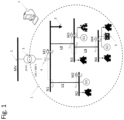
- FIG. 1 is a schematic representation of an exemplary power distribution network that is used to explain particular implementation of the method of invention
- FIGS. 2 , 3 , and 4 show three alternative allocations of metering devices to the same exemplary electrical network, a well as the different resulting voltage and current sensitivity coefficient matrices;
- FIG. 5 shows an electrical network operating in islanding mode, as well as the corresponding voltage and current sensitivity coefficient matrices
- FIGS. 6 A, 6 B and 6 C show different measuring configurations, as well an exemplary way of calculating the nodal power for each one of these configurations;
- FIG. 7 is a flowchart depicting a first particular implementation of the method of the invention for determining the voltage and current sensitivity coefficients for an electric power network
- FIG. 8 is a flowchart depicting a second particular implementation of the method of the invention for determining the voltage and current sensitivity coefficients for an electric power network.
- FIG. 9 is a flowchart depicting a third particular implementation of the method of the invention for determining the voltage and current sensitivity coefficients for an electric power network.
- FIG. 10 shows an exemplary network used to determine the voltage and current sensitivity coefficients by means of the method of the invention.
- the subject matter of the present invention is a method for determining sensitivity coefficients of an electric power network. Accordingly, as the field to which the invention applies is that of electric power networks, an exemplary network will first be described. Actual ways in which the method can operate will be explained afterward.
- FIG. 1 is schematic representation of an exemplary low-voltage AC power distribution network (referenced 1 ) that is composed of 57 residential blocks, 9 agricultural buildings and supplies in total 88 customers.
- the low-voltage network 1 (230/400 Volts, 50 Hz) is linked to a medium voltage network 2 by a substation transformer 3 .
- Table I below gives an idea of possible characteristics for the substation transformer in this particular example:
- the substation transformer is connected to network 1 through a switch 4 and a first node N 1 .
- several feeder lines branch out from the node N 1 .
- One of these feeder lines (referenced L 1 ) is arranged to link a residential block to the low-voltage network via a second node N 2 .
- Another feeder line (referenced L 2 ) is arranged to link three residential and one agricultural building to the low-voltage network via a third node N 3 .
- the remaining residential blocks and agricultural buildings can be linked to the node N 1 by other feeder lines that are not explicitly shown in FIG. 1 (but are represented as a whole by a single arrow referenced 5 ). As can be seen in FIG.
- a feeder line L 3 connects the node N 3 to a forth node (referenced N 4 ). Two residential blocks are connected to the node N 4 .
- Table II (next page) is intended to give an idea of possible characteristics for the feeder lines L 1 , L 2 , and L 3 used in this particular example:
- the network 1 further comprises three decentralized power plants.
- a first power plant (referenced G 1 ) is a photovoltaic power plant connected to the node N 3
- a second power plant (referenced G 2 ) is a photovoltaic power plant connected to the node N 4
- the third power plant (referenced G 3 ) is a diesel powered generator, which is linked to the node N 2 .
- the third power plant is arranged to serve as a voltage reference generator when the power network 1 is operating in islanding mode.
- Table IIIA and IIIB (below) are intended to give an idea of possible characteristics for the three decentralized power plants used in this particular example:
- FIG. 1 also shows a battery pack (referenced 6 ) that is connected to the node N 4 of the network 1 .
- the combined presence of the three decentralized power plants, the battery pack 6 and the switch 4 offers the possibility of temporarily islanding the low-voltage network 1 .
- Table IV bellow is intended to give an idea of possible characteristics for the battery pack 6 used in this particular example:
- the physical environment within which the method of the invention is implemented also comprises a monitoring infrastructure.
- the monitoring infrastructure comprises metering units (referenced M 1 through M 4 ) provided at a selection of nodes of the network (in the following text, nodes of the network that are equipped with at least one metering unit are called “measuring nodes”). Measurements carried out by a group of metering units can be aggregated (for instance, the data of several smart meters downstream of a node can be aggregated and considered simply as originating from that particular measuring node).
- the exemplary low-voltage AC power network 1 illustrated in FIG. 1 is a three-phase electric power network.
- a preferred implementation of the invention provides that the voltage and current are measured independently for each one of the three phases, and that the respective active and reactive powers are measured as well. This can be accomplished either by equipping each measuring node in the network with three single-phase metering units, or alternatively by using metering units designed for measuring three different phases independently.
- FIG. 1 shows four metering units (referenced M 1 through M 4 ) located at four different measuring nodes.
- the metering units of the nodes N 1 through N 4 are each arranged for measuring, locally, at least a nodal voltage, a branch current flowing into or out of the node, and a phase difference between the nodal voltage and the branch current.
- the metering units are arranged for measuring several branch currents flowing through different branches that are incident on the node.
- the first metering unit M 1 is arranged to measure the nodal voltage of node N 1 and the branch currents through the switch 4 as well as through the feeder line L 1 .
- the second metering unit M 2 is arranged to measure the nodal voltage of node N 2 and the branch current through the feeder line L 1 .
- the third metering unit M 3 is arranged to measure the nodal voltage of node N 3 and the branch currents through the feeder lines L 2 and L 3 .
- the fourth metering unit M 4 is arranged to measure the nodal voltage of node N 4 and the branch current through the feeder line L 3 .
- each of the nodes N 1 , N 2 , N 2 and N 4 is a measuring node.
- the monitoring infrastructure further comprises a communication infrastructure arranged for allowing communication between the metering units and at least one processing unit 7 .
- the processing unit 7 is represented in the form of a computer placed at a distance from the network 1 .
- the processing unit could be located at one of the measuring nodes.
- the processing unit forms a part of one of the metering units.
- the communication infrastructure does not comprise a dedicated transmission network but relies on the commercial cellular network provided by a mobile operator.
- the communication infrastructure for the monitoring infrastructure could implement any type of communication that a person skilled in the art would consider adequate (including power line communication for example).
- FIG. 7 is a flowchart depicting a first exemplary implementation of the method of the invention. According to this exemplary implementation, the method is used for determining both the voltage and the current sensitivity coefficients of an electric power network.
- the particularly undetailed flow chart of FIG. 7 comprises three boxes.
- the first box (referenced 01 ) generally represents a task consisting in acquiring a succession of values for the nodal voltages V n , the branch currents I b , the nodal active powers P n , and the nodal reactive powers Q n at a plurality of measuring nodes in an electrical power network.
- the method of the invention uses a monitoring infrastructure arranged to measure the nodal voltages V n at each measuring node and the branch currents I b flowing into or out of the measuring nodes, and to calculate the nodal active powers P n and the nodal reactive powers Q n at several measuring nodes in the network repeatedly over a time period ⁇ .
- the electric power network is an AC power network
- the measured values for the voltage and the current are not instantaneous values, but average values (preferably RMS or TRMS values) measured over between at least a half period of the AC power and at most over 1-hour duration, preferably over between 3 periods of the AC power and 15-minutes duration.
- the active power and reactive power at each branch is then computed from locally measured values of the nodal voltage, the branch currents and the respective phase differences between the nodal voltage and branch currents. Then, the active/reactive power consumed or produced at a particular node (i.e. the nodal active power and the nodal reactive power) can be computed.
- the nodal active power is equal to the net sum of all the active power flowing through branches incident on that particular node
- the nodal reactive power is equal to the net sum of all the reactive power flowing through the same branches.
- the active and reactive powers of node 1 correspond to the aggregated production and consumption at node 1 .
- the expression “a power injection” can mean either the power produced by a generator connected to a particular node or the power consumed by a user who is connected to said particular node.
- the nodal powers are given by the net sum of the power injections L 1 , L 2 , and L 3 .
- the metering unit M 1 at node 1 directly measures the currents I L1 , I L2 and I L3 associated with the nodal injections and computes the corresponding power injections P L1 (M1) , Q L1 (M1) , P L2 (M1) , Q L2 (M1) , P L3 (M1) and Q L3 (M1) .
- the metering unit M 1 at node 1 measures the branch powers P bA (M1) , P bB (M1) and P bC (M1) flowing through branches A, B C respectively.
- P n1 P bA (M1) +P bB (M1) +P bC (M1) .
- the metering unit M 1 measures the branch current I bA (M1) flowing through branch A and computes the branch power P bA (M1)
- the metering unit M 2 measures the branch current I bB (M2) flowing through branch B and computes the branch power P bb (M2)
- the metering unit M 3 measures the branch current flowing I bC (M3) through branch C and computes the branch power P bC (M3) .
- branches B and C which are both incident on node 1 at one of their ends, are incident at their other end on node 1 and node 2 respectively.
- some knowledge of the topology of the network is necessary in order to implement this strategy, although no further information is required.
- the currents flowing into or out of node 1 through branch B and Branch C are respectively equal to the branch current I bB (M2) measured by the metering unit M 2 at node 2 and to the branch current I bC (M3) measured by the metering unit M 3 at node 3 .
- FIGS. 6 A, 6 B and 6 C we can summarize that there are two basic ways to compute the active and reactive nodal powers.
- a first way, described with reference to FIG. 6 A consists in computing each power injection at a particular node, and then calculating the nodal power of that particular node as the net sum of the power injections.
- the other way, described with reference to FIGS. 6 B and 6 C consists in computing all the branch powers flowing into or out of a particular node through branches of the network that are incident on that particular node, and then calculating the nodal power of that particular node as the net sum of the branch powers.
- FIGS. 2 , 3 , and 4 show the same exemplary network comprising four nodes and four branches including one transformer and three feeder lines.
- FIG. 2 illustrates an exemplary case where 4 metering units have been allocated to the network (1 for at each physical node). As shown, the metering device at node 1 , 2 , 3 , and 4 measure the voltage of the corresponding nodes and the current flowing through the branches A, B, C, and D, respectively.
- FIG. 3 shows another case where only 3 metering units have been allocated to the network.
- the metering device at node 1 , 2 , and 4 measure the voltage of the corresponding nodes and the current flowing through branches A, B, and D, respectively. However, there is no metering unit arranged at the remaining node.
- FIG. 4 shows another case where only 3 metering units have been allocated to the network. Similar to the previous case, the metering device at node 1 , 2 , and 4 measure the voltage of the corresponding nodes and the current flowing through branches A, B, and D, respectively. However, the metering device at node 1 also measures the current of the branch C.
- FIGS. 2 , 3 , and 4 each further contain the voltage and current sensitivity coefficient matrices corresponding to the illustrated deployment of metering units. In the case of FIG.
- the voltage sensitivity coefficient matrix is a 4 ⁇ 4 matrix (measuring nodes ⁇ measuring nodes) and the current sensitivity coefficient matrix is a 4 ⁇ 4 matrix (measuring nodes ⁇ selected branches).
- the voltage and current sensitivity coefficient matrices are 3 ⁇ 3 matrices reflecting the sensitivity coefficients between the metering units.
- the voltage sensitivity coefficient matrix is a 3 ⁇ 3 matrix (measuring nodes ⁇ measuring nodes) and the current sensitivity coefficient matrix is a 3 ⁇ 4 matrix (measuring nodes ⁇ selected branches).
- the method of the invention can also be used to determine the sensitivity coefficients when the network is operated in the islanding mode.
- FIG. 5 shows the network disconnected from the main grid by “switch” and operated in the islanding mode.
- generator “G 1 ” is capable of controlling the network in the islanding operation mode and the node that the generator is connected to (“node 2 ”) is considered as the slack node.
- the metering unit at “node 1 ” does not measure any current in branch A since the “switch” is open.
- the voltage sensitivity coefficient matrix is a 3 ⁇ 3 matrix (measuring nodes ⁇ measuring nodes) and the current sensitivity coefficient matrix is a 3 ⁇ 3 matrix (measuring nodes ⁇ selected branches).
- the metering units arranged at different network nodes are able to provide timestamped voltage, current and power measurements with a time interval that can lie between 60-ms and 1-hour.
- the measurement data are timestamped by using a time reference signal, for instance GPS or NTP.
- a time reference signal for instance GPS or NTP.
- the different metering units in the network are synchronized by means of the Network Time Protocol (NTP) via the cellular network that serves as a communication network for the communication infrastructure.
- NTP Network Time Protocol
- Advantages of NTP are that it is easy to implement and readily available almost everywhere.
- a known disadvantage of NTP is that it is not extremely precise.
- experience shows that the synchronization provided by NTP is good enough for the method of the invention to produce satisfactory results.
- NTP is not the only synchronization method usable with the method of the invention.
- the metering units can use a common time reference or a GPS synchronization.
- the task of measuring the voltage of a particular measuring node, of measuring the currents through branches that are incident on that particular measuring node, and further of measuring the respective phase differences between the measured voltage and the currents is carried by different metering units, which preferably also take care of the consequent calculation of the active and reactive powers.
- the different metering units are synchronized to the extent discussed above.
- the metering units measure the current repeatedly, preferably at regular intervals, within a given time window.
- the number of successive measurements is preferably comprised between 200 and 5000 measurements, preferably between 1000 and 3000 measurements, for instance 2000 measurements.
- the optimal number of measurements tends to increase as a function of the number of measuring nodes and branches.
- the optimal number of measurements tends to decrease with improving accuracy of the measurements provided by the metering units, as well as with improving accuracy of the synchronization between the metering units.
- the second box (referenced 02 ) in the flow chart of FIG. 7 represents the task of computing, for each measuring node, concomitant variations of the nodal voltage and of the current and of the active and reactive powers, and further of compiling tables of the variations of the voltage at each one of the measuring nodes in relation to concomitant variations of the active and reactive powers at all measuring nodes as well as the variations of the current at each selected branch in relation to concomitant variations of the active and reactive powers at all measuring nodes.
- Concomitant variations of the measured voltage and current and of the active and reactive powers can be computed by subtracting from each set of concomitant values of the voltage, the current, the active power, and the reactive power respectively, the precedent values of the same variables. In other words, if two measurements by the same metering unit are available at times t and t+ ⁇ t:
- the metering units could be PMUs synchronized by means of a permanent link to a common time reference (for example the GPS).
- a common time reference for example the GPS.
- both the amplitude and the phase of the voltage and current are measured.
- the measured voltage and current given by ⁇ tilde over (V) ⁇ n (t) and ⁇ b (t), can be treated as a complex number, and the difference between two consecutive measurements can also be treated as a complex number.
- variations of the voltage and current are preferably computed as the modulus of the complex number corresponding to the difference between two consecutive measurements, or in other words, as the magnitude of the difference between two consecutive phasors.
- the processing unit first accesses the communication network and downloads the timestamped values for the nodal voltages ⁇ tilde over (V) ⁇ n (t), the selected branch currents (t), the nodal active power ⁇ tilde over (P) ⁇ n (t), and the nodal reactive power (t) from the buffers of the different metering units.
- the processing unit then computes variations of the measured voltage, of the current, and of the active and the reactive powers by subtracting from each downloaded value of the voltage, of the current, of the active power and of the reactive power respectively, the value of the same variable carrying the immediately preceding timestamp.
- times t ⁇ t 1 , . . . , t m ⁇ refer to timestamps provided by different metering units.
- I 1 (t 1 ) and I B (t 1 ) were computed from measurements out of different metering units, and that according to the first exemplary implementation their respective clocks were synchronized using NTP, measurements at time t should therefore be understood as meaning measurements at time t ⁇ a standard NTP synchronization error.
- the processing unit then associates the timestamped variations of the selected branch currents ⁇ (t) with the timestamped variations of the nodal active power ⁇ tilde over (P) ⁇ n (t) and the timestamped variation of the nodal reactive power ⁇ (t) at all measuring nodes at the same measuring time.
- the result can be represented as a set of B tables (where B stands for the number of selected branches) each table containing the variations of the current at a particular one of the selected branches b in relation to concomitant variations of the nodal active power and the nodal reactive power at all measuring nodes 1 to N.
- the processing unit further associates each variation of the nodal voltage at one particular measuring node ⁇ tilde over (V) ⁇ n (t) with the variations of the nodal active power ⁇ tilde over (P) ⁇ n (t) and the variation of the nodal reactive power ⁇ (t) at all measuring nodes at the same measuring time (where t ⁇ t 1 , . . . , t n ⁇ stands for a particular measuring time or timestamp).
- the result can be represented as a set of N tables each containing the variations of the voltage at one particular measuring node n in relation to concomitant variations of the nodal active power and the nodal reactive power at all measuring nodes 1 to N.
- the third box (referenced 03 ) in the flow chart of FIG. 7 represents the task of statistically estimating the voltage sensitivity coefficients linking the nodal voltage variations measured at a particular node to the nodal active and reactive powers at all measuring nodes as well as estimating the current sensitivity coefficients linking the branch current variations at a particular one of the selected branches to the nodal active and reactive powers at all measuring nodes.
- the set of voltage sensitivity coefficients obtained from the data of Table V and the set of current sensitivity coefficients obtained from the data of Table VI are preferably obtained by means of the Maximum Likelihood Estimation (MLE) method.
- the voltage sensitivity coefficients can be grouped in such a way as to form a voltage sensitivity coefficient matrix and the current sensitivity coefficients can be grouped in such a way as to form a current sensitivity coefficient matrix.
- the voltage sensitivity coefficients KVP nn and KVQ nn can be interpreted as estimations of the values of the partial derivatives given below
- the voltage variation at node n given by ⁇ tilde over (V) ⁇ n , can be determined by equation (2) and using the nodal active and reactive power changes at all nodes n given by ⁇ tilde over (P) ⁇ n (t) and ⁇ tilde over (Q) ⁇ n (t).
- ⁇ ⁇ V ⁇ n ⁇ ( t ) ⁇ n ⁇ KVP nn ⁇ ⁇ ⁇ P ⁇ n ⁇ ( t ) + ⁇ n ⁇ KVQ nn ⁇ ⁇ ⁇ Q ⁇ n ⁇ ( t ) ( 2 )
- the current sensitivity coefficients KIP bn and KIQ bn can be interpreted as estimations of the values of the partial derivatives given below.
- the current variation at branch b given by ⁇ b , can be determined by equation (4) and using the nodal active and reactive power changes at all nodes n given by ⁇ tilde over (P) ⁇ n (t) and ⁇ tilde over (Q) ⁇ n (t).
- ⁇ ⁇ I ⁇ b ⁇ ( t ) ⁇ n ⁇ KIP bn ⁇ ⁇ ⁇ P ⁇ n ⁇ ( t ) + ⁇ n ⁇ KIQ bn ⁇ ⁇ ⁇ Q ⁇ n ⁇ ( t ) ( 4 )
- the voltage sensitivity coefficients of each measuring node can be obtained as the result of following optimization problem or its convex reformulation:
- the current sensitivity coefficients of each selected branch can be obtained as the result of following optimization problem or its convex reformulation:
- the objectives of the optimization problems in (5) and (6) are the k-norm function ⁇ ⁇ k , where k can be equal to 1 representing the absolute value for the objective function ( ⁇ ⁇ 1 or
- the minimization of the absolute value in the objective function can be reformulated as a convex and linear objective function.
- the active power variation (t) and the reactive power variation (t) can be considered as the measurements with noise and corresponding terms can be incorporated into the objective functions.
- each measured voltage variation equals the corresponding estimated voltage variation plus/minus an error term, as given in (7), where ⁇ n (t) is the error term.
- each measured current variation equals the corresponding estimated current variation plus/minus an error term, as given in (8), where ⁇ b (t) is the error term.
- ⁇ ⁇ tilde over (V) ⁇ n ( t ) ⁇ V n ( t ) ⁇ n ( t ) (7)
- ⁇ ⁇ b ( t ) ⁇ I b ( t ) ⁇ b ( t ) (8)
- the Maximum Likelihood Estimation takes negative first-order autocorrelation into account. This means that the MLE assumes that a substantial negative correlation exists between the errors ⁇ n (t) and ⁇ n (t+ ⁇ t), where t and t+ ⁇ t are two consecutive time-steps.
- the expression a “substantial correlation” is intended to mean a correlation, the magnitude of which is at least 0.3, is preferably at least 0.4, and is approximately equal 0.5 in the most favored case.
- the MLE further assumes that no substantial correlation exists between the errors from two non-consecutive time-steps.
- the expression “no substantial correlation” is intended to mean a correlation, the magnitude of which is less than 0.3, preferably less than 0.2, and approximately equal to 0.0 in the most favored case. Accordingly, the correlation between the errors in two non-consecutive time steps is contained in the interval between ⁇ 0.3 and 0.3, preferably in the interval between ⁇ 0.2 and 0.2, and it is approximately equal to 0.0 in the most favored case.
- the number of successive measurements is m, there are m ⁇ 1 error terms ⁇ n (t) for each metering unit, and
- FIG. 8 is a flowchart depicting a particular variant of the implementation illustrated by the flowchart of FIG. 7 .
- the Maximum Likelihood Estimation is implemented in the form of multiple linear regression.
- the particular type of multiple linear regression that is implemented is “generalized least squares”.
- the generalized least squares method allows obtaining the voltage sensitivity coefficient matrices analytically by solving the equation (9) for each measuring node.
- the generalized least squares method allows obtaining the current sensitivity coefficient matrices analytically by solving the equation (10) for each selected branch.
- KVP nn ,KVQ nn ( ⁇ ( ⁇ tilde over (P) ⁇ n , ) T ⁇ mm ⁇ 1 ⁇ ( ⁇ tilde over (P) ⁇ n , )) ⁇ 1 ( ⁇ ( ⁇ tilde over (P) ⁇ n , )) T ⁇ mm ⁇ 1 ⁇ tilde over (V) ⁇ n (9)
- KIP bn ,KIQ bn ) ( ⁇ ( ⁇ tilde over (P) ⁇ n , ) T ⁇ mm ⁇ 1 ⁇ ( ⁇ tilde over (P) ⁇ n , )) ⁇ 1 ( ⁇ ( ⁇ tilde over (P) ⁇ n , )) ⁇ 1 ⁇ mm ⁇ 1 ⁇ (10)
- ⁇ mm is the correlation matrix for taking the impact of measurement noise into account with first order autocorrelation.
- the results of the generalized least square multiple linear regression method is the same as the Maximum Likelihood Estimation (MLE) if the error, i.e. ⁇ n (t), follows a multivariate normal distribution with a known covariance matrix.
- the error correlation matrices ⁇ mm are preferably not preloaded into the processing unit, but created only once the table of the variations of the measured voltage (Table V) and of the measured current (Table VI) have been created (box 02 ). Indeed, the size of the (m ⁇ 1) by (m ⁇ 1) error correlation matrices is determined by the length m ⁇ 1 of the table of the variations of the measured current.
- the variant of FIG. 8 comprises an additional box 02 A not present in FIG. 7 . Box 02 A comprises the task of creating the error correlation matrix for the metering unit. The presence of this additional box after box 02 has the advantage of allowing for adapting the method to the case where the set of data associated with one particular timestamp is missing.
- the entries in the main diagonal of each one of the N (m ⁇ 1) by (m ⁇ 1) correlation matrices are all chosen equal to 1.
- the entries in both the first diagonal below, and the first diagonal above this are all comprised between 0.7 and ⁇ 0.3, and finally all other entries are comprised between ⁇ 0.3 and 0.3.
- the correlation coefficients of the errors between two non-consecutive time-steps are equal to zero, and the correlation coefficients of the errors between two consecutive time-steps are assumed to be ⁇ 0.5.
- the error correlation matrices correspond to the tridiagonal matrix shown below:
- FIG. 9 is a flowchart depicting another particular variant of the implementation illustrated by the flowchart of FIG. 7 .
- the distinctive feature of the variant of FIG. 9 is that it comprises an additional step making it possible in particular to filter out voltage variations that are caused in the upper-level grid.
- the low-voltage network 1 is linked to a medium-voltage network 2 by a substation transformer 3 .
- the transformer is connected to network 1 through a switch 4 and a first node N 1 .
- the low-voltage network 1 can thus be disconnected from the main portion of the grid by means of the switch 4 .
- the condition in which a portion of the utility grid (in the illustrated example, network 1 of FIG. 1 ) becomes temporarily isolated from the main grid but remains energized by its own distributed generation resources (in the illustrated example, G 1 , G 2 , G 3 and 6 in FIG. 1 ) is known as “islanding operation”. Islanding may occur accidentally or deliberately. Intentional islanding operation may be desired in cases where the central grid is prone to reliability problems. In this case, the interconnection is designed to permit the particular portion of the grid to continue operating autonomously and provide uninterrupted service to local customers during outages on the main grid. Usually, protective devices must be reconfigured automatically when transitioning between islanded and grid-connected modes.
- any change in voltage supplied to the substation transformer 3 by the medium-voltage network 2 has an impact on the voltages at all the measuring nodes in network 1 .
- this voltage can be considered as a reference.
- the voltage levels in the medium-voltage network can also experience changes.
- the causes for these changes are, for the most part, completely unrelated to events in the connected low-voltage network.
- the level of the voltage that the substation transformer would output if it was an ideal transformer, having zero impedance is referred to as the “slack voltage” of the transformer.
- the slack voltage of the transformer is “pegged” to the voltage supplied to the substation transformer by the medium-voltage network 2 , or in other words that, in the case of an ideal transformer, the ratio of the output voltage over the input voltage is constant.
- the first metering unit M 1 connects the substation transformer 3 with the node N 1 of network 1 .
- the voltage measured by the metering unit of node M 1 is the output voltage from the substation transformer. Furthermore, the measured current and phase difference are also those at the output of the transformer. Knowing the impedance of the transformer (Zcc), the slack voltage is calculated based on the output voltage, the output current and the phase difference between the two.
- V slack ( t )
- box “ 01 A” represents the task accomplished by the monitoring infrastructure or system of loading method parameters.
- the method parameters comprise a measurement schedule, information as to which metering unit is located at the output of the transformer, as well as to the value of the impedance Zcc of the transformer. Using this information the slack voltage is computed. This task is accomplished either by the processing unit, or directly by the metering unit located at the output of the transformer (node M 1 in FIG. 1 ).
- the slack-voltage is computed repeatedly, preferably each time the metering unit of the first node M 1 measures the voltage, the current and the phase difference.
- the different computed values for the slack voltage can “inherit” the timestamps associated with the respective sets of data from which the values were computed.
- the timestamped values of the slack-voltage are subsequently subtracted from the voltages measured at the same time at every measuring node. This subsequent computation can be done either by the processing unit, or by the metering units at each measuring node.
- the method of the invention can be implemented for an electric power network capable of transitioning between an islanded and a grid-connected mode of operation.
- the electric power network of FIG. 1 one can observe that, according to the illustrated example, it is the status of the switch 4 that determines in which mode the network 1 is presently operating.
- the monitoring infrastructure loads a number of method parameters.
- the method parameters comprise a measurement schedule, information as to which metering unit is located at the output of the transformer, as well as to the value of the impedance of the transformer.
- the method parameters also comprise the “open” or “closed” status of the switch 4 and the value of the impedance of the diesel powered generator (Xd).
- the actions of computing and of subtracting the slack voltage of the transformer is implemented whenever the electric power network is operating in a grid-connected mode.
- the method of the present example computes and subtracts the slack voltage of the generator from the voltages measured at the same time at every measuring node.
- the monitoring infrastructure has access to the status of the switch 4 .
- the “open” or “closed” status is loaded into the system with the other method parameters. It should be understood however that the current status of the circuit breaker could alternatively be readable online at any time.
- box “ 01 A” represents the task of computing the slack voltage.
- This task can be accomplished either by the processing unit or directly by the metering unit located at the output of the transformer (node M 1 in FIG. 1 ).
- the successive computed values of the slack voltage are then used in order to compute variations of the slack voltage.
- the variations of the slack voltage are computed simply by subtracting from each value of the slack voltage, the precedent value of the same variable.
- the computed variations of the slack voltage are subsequently subtracted from the variations of the voltage measured at the same time at every measuring node. This subsequent computation can be done either by the processing unit or by the metering units at each measuring node.
- FIG. 10 shows the single-line diagram of a network with four metering units.
- the corresponding voltage and current sensitivity coefficient matrices are calculated by means of Maximum Likelihood Estimation method as explained above.
- the computed voltage sensitivity coefficient matrices are the following:
- K ⁇ VP [ 0 . 0 ⁇ 1 ⁇ 2 ⁇ 0 0 . 0 ⁇ 1 ⁇ 2 ⁇ 0 0 . 0 ⁇ 1 ⁇ 2 ⁇ 0 0 . 0 ⁇ 1 ⁇ 2 ⁇ 0 0 . 0 ⁇ 1 ⁇ 2 ⁇ 0 0 . 0 ⁇ 5 ⁇ 9 ⁇ 8 0 . 0 ⁇ 9 ⁇ 4 ⁇ 6 0 0 ⁇ 1 ⁇ 2 ⁇ 0 0 . 0 ⁇ 1 ⁇ 2 ⁇ 0 0 . 0 ⁇ 5 ⁇ 7 ⁇ 3 0 . 2 ⁇ 7 ⁇ 9 ⁇ 9 0 .
- KVQ [ 0 . 0 ⁇ 3 ⁇ 4 ⁇ 8 0 . 0 ⁇ 3 ⁇ 4 ⁇ 8 0 . 0 ⁇ 3 ⁇ 4 ⁇ 8 0 . 0 ⁇ 3 ⁇ 4 ⁇ 8 0 . 0 ⁇ 4 ⁇ 1 ⁇ 3 0 . 0 ⁇ 3 ⁇ 4 ⁇ 8 0 . 0 ⁇ 9 ⁇ 6 ⁇ 3 0 . 0 ⁇ 7 ⁇ 7 ⁇ 2 0 .
- the computed current sensitivity coefficient matrices are the following:
- K ⁇ IP [ 4 . 1 ⁇ 1 ⁇ 7 ⁇ 7 4 . 0 ⁇ 7 ⁇ 0 ⁇ 2 4 . 0 ⁇ 2 ⁇ 7 ⁇ 9 4 . 0 ⁇ 8 ⁇ 8 ⁇ 2 0 . 0 ⁇ 0 ⁇ 0 ⁇ 0 4 . 0 ⁇ 0 ⁇ 4 ⁇ 4 4 . 0 ⁇ 2 ⁇ 6 ⁇ 7 0 . 0 ⁇ 0 ⁇ 0 ⁇ 0 0 0 . 0 ⁇ 0 ⁇ 0 0 0 . 0 ⁇ 0 ⁇ 0 0 0 0 0 0 0 0 0 0 0 0 0 0 0 ⁇ 0 0 0 0 0 0 ⁇ 0 0 4 . 1 ⁇ 2 ⁇ 8 ⁇ 8 0 .
- the determined voltage and current sensitivity coefficients reflect the important behavior and characteristics of the power network, and they can be further used for various power network analysis, grid control, energy management, and grid planning applications.
- the determined sensitivity coefficients can be used for the optimal control of distributed controllable resources, such as PV production, e-mobility consumption, heating/cooling consumption, battery storage systems, by specifying explicit active power and reactive power set-points for the controllable resources while the impacts of the control action on the nodal voltages and the branch currents are properly taken into account.
- the required active power change at node 2 can be calculated using the determined sensitivity coefficients (KVP), as following:
- the determined current sensitivity coefficients allows evaluating the impact of power changes on the branch currents.
- the knowledge of the voltage and current sensitivity coefficients allows determining the active and reactive power set-points of the controllable resources while ensuring the voltages and the currents across the network are within the acceptable limits.
- the model-less estimation of the voltage and current sensitivity coefficients enables plug and play grid optimal control.
Landscapes
- Engineering & Computer Science (AREA)
- Power Engineering (AREA)
- Physics & Mathematics (AREA)
- General Physics & Mathematics (AREA)
- Remote Monitoring And Control Of Power-Distribution Networks (AREA)
Abstract
Description
-
- Only time-stamped voltage, current, active power, and reactive power measurements are needed.
- Synchrophasor measurements are not needed (only magnitudes of the electrical quantities are required and there is no need to the phasors and highly synchronized measurements).
- There is no need for a model of the network and/or network parameters.
- The method allows to implement a unified approach for the calculation of the voltage sensitivity coefficients and the current sensitivity coefficients.
- The sensitivity coefficients are calculated using a limited amount of measurement data, for instance 2000 data points with 60-ms time step corresponding to 120 seconds or 2000 data points with 15-min time step corresponding to less than 21 days.
- The algorithm is robust to the presence of noise in the measurements.
- In the case where only a limited number of physical nodes of the electric power network are measuring nodes (i.e. nodes that are equipped with at least one measurement devices), the method determines the voltage and current sensitivity coefficients between the measuring nodes. In other words, the algorithm does not need to place measurement devices everywhere in the network.
| TABLE I | |||||||
| Power | Uin | Uout | Coupling | Ucc | X/R | ||
| 250 kVA | 20 kV | 230/400 V | DYn11 | 4.1% | 2.628 | ||
| TABLE II | ||||
| R/X | C | |||
| Cable type | Length | [Ohm/km] | [μF/km] | |
| |
1 kV 4 × 240 mm2 AL | 48 m | 0.096; 0.072 | 0.77 |
| |
1 kV 4 × 240 mm2 AL | 145 m | 0.096; 0.072 | 0.77 |
| |
1 kV 4 × 150 mm2 AL | 65 m | 0.2633; 0.078 | 0.73 |
| TABLE IIIA | |||||
| Rated | |||||
| PV | Number | Voltage | power | ||
| Generators | of inverters | [kV] | [kVA] | ||
| G1 | 12 3-phase inverters | 0.4 | 196 | ||
| |
3 3-phase inverters | 0.4 | 30 | ||
| TABLE IIIB | |||||
| Synchronous | Rated | ||||
| Diesel | Voltage | reactance | power | ||
| Generator | [kV] | [Ω] | [kVA] | ||
| G3 | 0.4 | 3.2 | 50 | ||
One can observe that, according to the present example, the photovoltaic power plants G1 and G2 provide a maximum power of 226 kVA.
| TABLE IV | ||
| Type | Energy | |
| (technology) | c-rate | [kWh] |
| |
1 | 40 |
-
- a voltage variation Δ{tilde over (V)}n(t) is computed for each measuring node as Δ{tilde over (V)}n(t)={tilde over (V)}n(t+Δt)−{tilde over (V)}n(t);
- a current variation ΔĨb(t) is computed for each selected branch as ΔĨb(t)=(t+Δt)−
 (t);
(t); - an active power variation Δ{acute over (P)}n(t) is computed for each measuring node as Δ{tilde over (P)}n(t)={tilde over (P)}n(t+Δt)−{tilde over (P)}n(t);
- a reactive power variation Δ{tilde over (Q)}n(t) is computed for each measuring node as Δ(t)=
 (t+Δt)−(t);
- where n∈{1, . . . , N}, specifies a metering unit arranged at the n-th measuring node, and b∈{1, . . . , B} specifies the b-th selected branch. It should further be noted that, in the present description, quantities that correspond to measurements are denoted with tilde (i.e. {tilde over (V)}, Ĩ, {tilde over (P)}, and {tilde over (Q)}).
| TABLE V | ||
| Branch | ||
| current | ||
| variation | Nodal active power variation | Nodal reactive power variation |
| ΔIb (t1) | ΔP1 (t1) | ΔP2 (t1) | . . . | ΔPN (t1) | ΔQ1 (t1) | ΔQ2 (t1) | . . . | ΔQN (t1) |
| ΔIb (t2) | ΔP1 (t2) | ΔP2 (t2) | . . . | ΔPN (t2) | ΔQ1 (t2) | ΔQ2 (t2) | . . . | ΔQN (t2) |
| . | . | . | . | . | . | |||
| . | . | . | . | . | . | |||
| . . . | . | . | . | . | . | . | ||
| ΔIb (tm) | ΔP1 (tm) | ΔP2 (tm) | . . . | ΔPN (tm) | ΔQ1 (tm) | ΔQ2 (tm) | . . . | ΔQN (tm) |
| TABLE VI | ||
| Nodal | ||
| voltage | ||
| variation | Nodal active power variation | Nodal reactive power variation |
| ΔVn (t1) | ΔP1 (t1) | ΔP2 (t1) | . . . | ΔPN (t1) | ΔQ1 (t1) | ΔQ2 (t1) | . . . | ΔQN (t1) |
| ΔVn (t2) | ΔP1 (t2) | ΔP2 (t2) | . . . | ΔPN (t2) | ΔQ1 (t2) | ΔQ2 (t2) | . . . | ΔQN (t2) |
| . | . | . | . | . | . | |||
| . | . | . | . | . | . | |||
| . . . | . | . | . | . | . | . | ||
| ΔVn (tm) | ΔP1 (tm) | ΔP2 (tm) | . . . | ΔPN (tm) | ΔQ1 (tm) | ΔQ2 (tm) | . . . | ΔQN (tm) |
In other words, knowing the voltage sensitivity coefficients, the voltage variation at node n, given by Δ{tilde over (V)}n, can be determined by equation (2) and using the nodal active and reactive power changes at all nodes n given by Δ{tilde over (P)}n(t) and Δ{tilde over (Q)}n(t).
In other words, knowing the current sensitivity coefficients, the current variation at branch b, given by ΔĨb, can be determined by equation (4) and using the nodal active and reactive power changes at all nodes n given by Δ{tilde over (P)}n(t) and Δ{tilde over (Q)}n(t).
where


where


Δ{tilde over (V)} n(t)=ΔV n(t)±ωn(t) (7)
ΔĨ b(t)=ΔI b(t)±ωb(t) (8)
-
- therefore (m−1)×(m−1) error correlation terms.
(KVP nn ,KVQ nn)=(Δ({tilde over (P)} n,
(KIP bn ,KIQ bn)=(Δ({tilde over (P)} n,
where Σmm is the correlation matrix for taking the impact of measurement noise into account with first order autocorrelation.
V slack(t)=|
-
- where variables and factors corresponding to complex numbers are denoted with a bar (e.g.,
Z CC).
- where variables and factors corresponding to complex numbers are denoted with a bar (e.g.,
In other words, by changing the active power at
ΔV 1 =ΔP 2 ×KVP 12=87.26×0.0120=1.0471[V]
ΔV 2 =ΔP 2 ×KV P 22=87.26×0.0598=5.2181[V]
ΔV 3 =ΔP 2 ×KV P 32=87.26×0.0573=5.0000[V]
ΔV 4 =ΔP 2 ×KVP 42=87.26×0.0120=1.0471[V]
Furthermore, the determined current sensitivity coefficients allows evaluating the impact of power changes on the branch currents. For the abovementioned example, the impacts of 87.26 [kW] of the active power change at
ΔI 1 =ΔP 2 ×KIP 12=87.26×4.0702=355.2[A]
ΔI 2 =ΔP 2 ×KIP 22=87.26×4.0044=349.4[A]
ΔI 3 =ΔP 2 ×KIP 32=87.26×0=0[A]
ΔI 4 =ΔP 2 ×KIP 42=87.26×0=0[A]
If the current flow in
I 1 new =I 1 old =ΔI 1=1000+355.2=1355.2[A]
Claims (14)


Applications Claiming Priority (4)
| Application Number | Priority Date | Filing Date | Title |
|---|---|---|---|
| EP19162669 | 2019-03-13 | ||
| EP19162669.6A EP3709031B1 (en) | 2019-03-13 | 2019-03-13 | Method for determining sensitivity coefficients of an electric power network using metering data |
| EP19162669.6 | 2019-03-13 | ||
| PCT/IB2020/050693 WO2020183252A1 (en) | 2019-03-13 | 2020-01-29 | Method for determining sensitivity coefficients of an electric power network using metering data |
Publications (2)
| Publication Number | Publication Date |
|---|---|
| US20220155353A1 US20220155353A1 (en) | 2022-05-19 |
| US11668736B2 true US11668736B2 (en) | 2023-06-06 |
Family
ID=65812104
Family Applications (1)
| Application Number | Title | Priority Date | Filing Date |
|---|---|---|---|
| US17/438,739 Active 2040-04-24 US11668736B2 (en) | 2019-03-13 | 2020-01-29 | Method for determining sensitivity coefficients of an electric power network using metering data |
Country Status (4)
| Country | Link |
|---|---|
| US (1) | US11668736B2 (en) |
| EP (1) | EP3709031B1 (en) |
| CA (1) | CA3132924A1 (en) |
| WO (1) | WO2020183252A1 (en) |
Families Citing this family (5)
| Publication number | Priority date | Publication date | Assignee | Title |
|---|---|---|---|---|
| CN115000967B (en) * | 2022-07-01 | 2025-12-09 | 国网安徽省电力有限公司 | Power grid power flow sensitivity calculation method based on data driving mode covariance analysis |
| CN115173494A (en) * | 2022-07-21 | 2022-10-11 | 南京南瑞继保电气有限公司 | Power distribution network side active rapid control method and device and electronic equipment |
| CN115275987A (en) * | 2022-07-22 | 2022-11-01 | 浙江工业大学 | Optimal network partitioning method based on cluster partitioning |
| CN117313304B (en) * | 2023-05-16 | 2024-03-08 | 上海交通大学 | Gaussian mixture model method for analyzing overall sensitivity of power flow of power distribution network |
| CN118916632A (en) * | 2024-07-17 | 2024-11-08 | 华北电力大学 | Heterogeneous power supply power system correction participation analysis method based on impedance model |
Citations (6)
| Publication number | Priority date | Publication date | Assignee | Title |
|---|---|---|---|---|
| DE4329103A1 (en) | 1993-08-30 | 1995-03-16 | Licentia Gmbh | Method for state estimation of electrical power transmission networks |
| WO2015193199A1 (en) | 2014-06-20 | 2015-12-23 | University College Dublin National University Of Ireland, Dublin | Method for controlling power distribution |
| WO2017182918A1 (en) | 2016-04-22 | 2017-10-26 | Depsys Sa | Method of determining mutual voltage sensitivity coefficients between a plurality of measuring nodes of an electric power network |
| CN107577870A (en) | 2017-09-04 | 2018-01-12 | 天津大学 | The distribution network voltage power sensitivity robust estimation method measured based on synchronized phasor |
| US10333346B2 (en) * | 2016-05-02 | 2019-06-25 | Nec Corporation | Resiliency controller for voltage regulation in microgrids |
| US20200287388A1 (en) * | 2017-09-12 | 2020-09-10 | Depsys Sa | Method for estimating the topology of an electric power network using metering data |
-
2019
- 2019-03-13 EP EP19162669.6A patent/EP3709031B1/en active Active
-
2020
- 2020-01-29 CA CA3132924A patent/CA3132924A1/en active Pending
- 2020-01-29 WO PCT/IB2020/050693 patent/WO2020183252A1/en not_active Ceased
- 2020-01-29 US US17/438,739 patent/US11668736B2/en active Active
Patent Citations (7)
| Publication number | Priority date | Publication date | Assignee | Title |
|---|---|---|---|---|
| DE4329103A1 (en) | 1993-08-30 | 1995-03-16 | Licentia Gmbh | Method for state estimation of electrical power transmission networks |
| WO2015193199A1 (en) | 2014-06-20 | 2015-12-23 | University College Dublin National University Of Ireland, Dublin | Method for controlling power distribution |
| WO2017182918A1 (en) | 2016-04-22 | 2017-10-26 | Depsys Sa | Method of determining mutual voltage sensitivity coefficients between a plurality of measuring nodes of an electric power network |
| US20200003811A1 (en) * | 2016-04-22 | 2020-01-02 | Depsys Sa | Method of determining mutual voltage sensitivity coefficients between a plurality of measuring nodes of an electric power network |
| US10333346B2 (en) * | 2016-05-02 | 2019-06-25 | Nec Corporation | Resiliency controller for voltage regulation in microgrids |
| CN107577870A (en) | 2017-09-04 | 2018-01-12 | 天津大学 | The distribution network voltage power sensitivity robust estimation method measured based on synchronized phasor |
| US20200287388A1 (en) * | 2017-09-12 | 2020-09-10 | Depsys Sa | Method for estimating the topology of an electric power network using metering data |
Non-Patent Citations (1)
| Title |
|---|
| International Search Report and Written Opinion of the ISA for PCT/IB2020/050693, dated Mar. 23, 2020, 10 pages. |
Also Published As
| Publication number | Publication date |
|---|---|
| CA3132924A1 (en) | 2020-09-17 |
| WO2020183252A1 (en) | 2020-09-17 |
| US20220155353A1 (en) | 2022-05-19 |
| EP3709031B1 (en) | 2021-12-15 |
| EP3709031A1 (en) | 2020-09-16 |
Similar Documents
| Publication | Publication Date | Title |
|---|---|---|
| US11346868B2 (en) | Method of determining mutual voltage sensitivity coefficients between a plurality of measuring nodes of an electric power network | |
| US11668736B2 (en) | Method for determining sensitivity coefficients of an electric power network using metering data | |
| US11205901B2 (en) | Method for estimating the topology of an electric power network using metering data | |
| Venkata et al. | Microgrid protection: Advancing the state of the art | |
| Jayasekara et al. | An optimal management strategy for distributed storages in distribution networks with high penetrations of PV | |
| EP3410554B1 (en) | Distribution system analysis using meter data | |
| US20120022713A1 (en) | Power Flow Simulation System, Method and Device | |
| US10078318B2 (en) | Composable method for explicit power flow control in electrical grids | |
| US8103467B2 (en) | Determination of distribution transformer voltages based on metered loads | |
| Novosel et al. | Benefits of synchronized-measurement technology for power-grid applications | |
| Skok et al. | Applications based on PMU technology for improved power system utilization | |
| Novosel et al. | Benefits of PMU technology for various applications | |
| CN114336634A (en) | Load flow calculation method, device and equipment of power grid system | |
| Muthiah et al. | Distribution phasor measurement units (PMUs) in smart power systems | |
| JP7545591B2 (en) | CONTROL METHOD, COMPUTER PROGRAM PRODUCT, CONTROL SYSTEM, AND USE | |
| Khatami et al. | Measurement-based locational marginal pricing in active distribution systems | |
| Gong | Development of an improved on-line voltage stability index using synchronized phasor measurement | |
| Zhang et al. | Hierarchical generation rescheduling and robust load shedding scheme considering the uncertainty of distributed generators | |
| US10627437B2 (en) | Method of estimating a system value | |
| Olivier | Solutions for Integrating Photovoltaic Panels Into Low-voltage Distribution Networks | |
| Eichler | Next generation network analysis applications for secure and economic integration of distributed renewable generation in distribution grids | |
| Banka et al. | Hardware-in-the-loop test bench for investigation of der integration strategies within a multi-agent-based environment | |
| Mustafa | DER Utilization for Voltage-Sag Mitigation by Applying Different Network Partitioning Techniques | |
| Ivanova | Optimal PMU placement in active distribution networks | |
| Wan et al. | Method for alleviating voltage limit violations using combined DC optimisation and AC power flow technique |
Legal Events
| Date | Code | Title | Description |
|---|---|---|---|
| AS | Assignment |
Owner name: DEPSYS SA, SWITZERLAND Free format text: ASSIGNMENT OF ASSIGNORS INTEREST;ASSIGNORS:ALIZADEH-MOUSAVI, OMID;JATON, JOEL;REEL/FRAME:057463/0828 Effective date: 20210902 |
|
| FEPP | Fee payment procedure |
Free format text: ENTITY STATUS SET TO UNDISCOUNTED (ORIGINAL EVENT CODE: BIG.); ENTITY STATUS OF PATENT OWNER: LARGE ENTITY |
|
| FEPP | Fee payment procedure |
Free format text: ENTITY STATUS SET TO SMALL (ORIGINAL EVENT CODE: SMAL); ENTITY STATUS OF PATENT OWNER: LARGE ENTITY |
|
| STPP | Information on status: patent application and granting procedure in general |
Free format text: DOCKETED NEW CASE - READY FOR EXAMINATION |
|
| AS | Assignment |
Owner name: OCTOPUS ENERGY GROUP LIMITED, UNITED KINGDOM Free format text: ASSIGNMENT OF ASSIGNORS INTEREST;ASSIGNOR:DEPSYS SA;REEL/FRAME:062221/0354 Effective date: 20221021 |
|
| AS | Assignment |
Owner name: KRAKENFLEX LIMITED, UNITED KINGDOM Free format text: ASSIGNMENT OF ASSIGNORS INTEREST;ASSIGNOR:OCTOPUS ENERGY GROUP LIMITED;REEL/FRAME:062233/0508 Effective date: 20221208 |
|
| FEPP | Fee payment procedure |
Free format text: ENTITY STATUS SET TO UNDISCOUNTED (ORIGINAL EVENT CODE: BIG.); ENTITY STATUS OF PATENT OWNER: LARGE ENTITY |
|
| STCF | Information on status: patent grant |
Free format text: PATENTED CASE |
|
| AS | Assignment |
Owner name: KRAKEN TECHNOLOGIES LIMITED, UNITED KINGDOM Free format text: ASSIGNMENT OF ASSIGNORS INTEREST;ASSIGNOR:KRAKENFLEX LIMITED;REEL/FRAME:067106/0299 Effective date: 20240412 |