US11656158B2 - Production of nanoparticulate compressed tablets (pellets) from synthetic or natural materials using a specially developed grinding and compressing method - Google Patents
Production of nanoparticulate compressed tablets (pellets) from synthetic or natural materials using a specially developed grinding and compressing method Download PDFInfo
- Publication number
- US11656158B2 US11656158B2 US16/619,501 US201816619501A US11656158B2 US 11656158 B2 US11656158 B2 US 11656158B2 US 201816619501 A US201816619501 A US 201816619501A US 11656158 B2 US11656158 B2 US 11656158B2
- Authority
- US
- United States
- Prior art keywords
- nanopowder
- compressed tablets
- pellets
- dried
- pressing
- Prior art date
- Legal status (The legal status is an assumption and is not a legal conclusion. Google has not performed a legal analysis and makes no representation as to the accuracy of the status listed.)
- Active, expires
Links
Images

Classifications
-
- G—PHYSICS
- G01—MEASURING; TESTING
- G01N—INVESTIGATING OR ANALYSING MATERIALS BY DETERMINING THEIR CHEMICAL OR PHYSICAL PROPERTIES
- G01N1/00—Sampling; Preparing specimens for investigation
- G01N1/28—Preparing specimens for investigation including physical details of (bio-)chemical methods covered elsewhere, e.g. G01N33/50, C12Q
- G01N1/286—Preparing specimens for investigation including physical details of (bio-)chemical methods covered elsewhere, e.g. G01N33/50, C12Q involving mechanical work, e.g. chopping, disintegrating, compacting, homogenising
-
- C—CHEMISTRY; METALLURGY
- C04—CEMENTS; CONCRETE; ARTIFICIAL STONE; CERAMICS; REFRACTORIES
- C04B—LIME, MAGNESIA; SLAG; CEMENTS; COMPOSITIONS THEREOF, e.g. MORTARS, CONCRETE OR LIKE BUILDING MATERIALS; ARTIFICIAL STONE; CERAMICS; REFRACTORIES; TREATMENT OF NATURAL STONE
- C04B35/00—Shaped ceramic products characterised by their composition; Ceramics compositions; Processing powders of inorganic compounds preparatory to the manufacturing of ceramic products
- C04B35/622—Forming processes; Processing powders of inorganic compounds preparatory to the manufacturing of ceramic products
- C04B35/626—Preparing or treating the powders individually or as batches ; preparing or treating macroscopic reinforcing agents for ceramic products, e.g. fibres; mechanical aspects section B
- C04B35/62605—Treating the starting powders individually or as mixtures
- C04B35/62695—Granulation or pelletising
-
- G—PHYSICS
- G01—MEASURING; TESTING
- G01N—INVESTIGATING OR ANALYSING MATERIALS BY DETERMINING THEIR CHEMICAL OR PHYSICAL PROPERTIES
- G01N1/00—Sampling; Preparing specimens for investigation
- G01N1/28—Preparing specimens for investigation including physical details of (bio-)chemical methods covered elsewhere, e.g. G01N33/50, C12Q
- G01N1/44—Sample treatment involving radiation, e.g. heat
-
- B—PERFORMING OPERATIONS; TRANSPORTING
- B22—CASTING; POWDER METALLURGY
- B22F—WORKING METALLIC POWDER; MANUFACTURE OF ARTICLES FROM METALLIC POWDER; MAKING METALLIC POWDER; APPARATUS OR DEVICES SPECIALLY ADAPTED FOR METALLIC POWDER
- B22F1/00—Metallic powder; Treatment of metallic powder, e.g. to facilitate working or to improve properties
- B22F1/05—Metallic powder characterised by the size or surface area of the particles
- B22F1/054—Nanosized particles
- B22F1/056—Submicron particles having a size above 100 nm up to 300 nm
-
- B—PERFORMING OPERATIONS; TRANSPORTING
- B22—CASTING; POWDER METALLURGY
- B22F—WORKING METALLIC POWDER; MANUFACTURE OF ARTICLES FROM METALLIC POWDER; MAKING METALLIC POWDER; APPARATUS OR DEVICES SPECIALLY ADAPTED FOR METALLIC POWDER
- B22F1/00—Metallic powder; Treatment of metallic powder, e.g. to facilitate working or to improve properties
- B22F1/07—Metallic powder characterised by particles having a nanoscale microstructure
-
- B—PERFORMING OPERATIONS; TRANSPORTING
- B22—CASTING; POWDER METALLURGY
- B22F—WORKING METALLIC POWDER; MANUFACTURE OF ARTICLES FROM METALLIC POWDER; MAKING METALLIC POWDER; APPARATUS OR DEVICES SPECIALLY ADAPTED FOR METALLIC POWDER
- B22F2998/00—Supplementary information concerning processes or compositions relating to powder metallurgy
- B22F2998/10—Processes characterised by the sequence of their steps
-
- G—PHYSICS
- G01—MEASURING; TESTING
- G01N—INVESTIGATING OR ANALYSING MATERIALS BY DETERMINING THEIR CHEMICAL OR PHYSICAL PROPERTIES
- G01N1/00—Sampling; Preparing specimens for investigation
- G01N1/28—Preparing specimens for investigation including physical details of (bio-)chemical methods covered elsewhere, e.g. G01N33/50, C12Q
- G01N1/286—Preparing specimens for investigation including physical details of (bio-)chemical methods covered elsewhere, e.g. G01N33/50, C12Q involving mechanical work, e.g. chopping, disintegrating, compacting, homogenising
- G01N2001/2866—Grinding or homogeneising
-
- G—PHYSICS
- G01—MEASURING; TESTING
- G01N—INVESTIGATING OR ANALYSING MATERIALS BY DETERMINING THEIR CHEMICAL OR PHYSICAL PROPERTIES
- G01N1/00—Sampling; Preparing specimens for investigation
- G01N1/28—Preparing specimens for investigation including physical details of (bio-)chemical methods covered elsewhere, e.g. G01N33/50, C12Q
- G01N2001/2893—Preparing calibration standards
Definitions
- the invention relates to a compressed tablet/pellet producing method for nanoparticulate compressed tablets/pellets from synthetic and/or natural materials comprising the steps of:
- the invention relates to a pressed tablet or a pellet and uses thereof.
- micro-analytical methods for element concentration determinations directly on solids are becoming more and more universally applicable and are widely used, e.g. in research, for the quality assurance of materials or for exploration in the mining industry.
- homogeneous natural materials such as crystals
- Homogeneous synthetic glasses can only be produced with difficulty, and not from all substances.
- SRM standard reference materials
- SRMs must be as homogeneous at any point that microanalysis with e.g. 1 ⁇ m to 100 ⁇ m spatial resolution always yield the same result within a given confidence interval, and the same goes for trace and ultra-trace elements, which is however extremely difficult, expensive and complex, to find such homogeneous materials in nature or produce them technically.
- Stable pressed tablets made of powders have so far been produced only with the addition of binders.
- the object of the invention is to demonstrate new possibilities for producing homogeneous standards for a variety of materials.
- Compressed tablets/pellets of synthetic or natural materials are to be produce on the basis of a newly developed grinding and pressing method.
- the compressed tablet/pellet producing method for nanoparticulate compressed tablets/pellets from synthetic and/or natural materials comprises the steps of:
- Nanoparticles are produced with this “top-down” principle, which can be pressed into stable tablets without need for addition of binders.
- the very small particle sizes ensure excellent homogeneity down to the micrometer range.
- the nano-tablets also offer better properties for measurements with X-ray fluorescence (X-ray scanner) than previously used powder compacts. This makes the tablets a new universal material that can be studied using a variety of micro-analysis techniques and therefore has great potential for being a certifiable standard reference material for both elemental and isotopic compositions.
- the present manufacturing process includes an ultra-fine grinding, also performed under the term “top-down” principle, to nanoparticles, followed by freeze-drying, and the compression of the nanopowder s in particular with stylus or sapphire disks in a preferably programmable high-pressure press.
- the present process enables the preparation of stable, compressed tablets (pellets) made of synthetic and/or natural materials, which are transformed into nanoparticles, according to the top-down principle, whereby also very complex composite materials can be transformed.
- the nanoparticulate powder is formed with particle sizes of 30-150 nm with D90 ⁇ 1 ⁇ m.
- the extremely small particle size allows a very good homogenization of substances e.g. substance mixtures (10-100 ⁇ m scale).
- the pressing of the aliquot is preferably carried out in a high-pressure press in the working range of 2 to 80 t, 3 to 40 or in particular 5 to 20 t.
- pressing in the high-pressure press with polished sapphire, glass and e.g. or diamond disks form-fit adapted to the range of application may preferably be effected by pressing tools.
- a sapphire disk can be placed between the powder and press-die.
- the wet grinding may be done with a liquid, wherein the liquid may be water, de-ionized water and/or an organic solvent.
- the essential parameters that vary depending on the material are the amount of water and the grinding time, with other parameters such as speed of rotation (acceleration) etc. also possibly being varied.
- the following grinding protocols for geological/environmental materials are listed:
- compressed tablets/pellets prepared according to one of the foregoing compressed tablet/pellet producing methods for nanoparticulate compressed tablets/pellets from synthetic and/or natural materials, are likewise worthy of protection.
- the foregoing compressed tablets/pellets prepared by any of the foregoing compressed tablet/pellet producing methods for nanoparticulate compressed tablets/pellets from synthetic and/or natural materials, can be used as a medium for direct solid analysis.
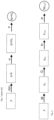
- FIG. 1 a schematic representation of an embodiment of the manufacturing method known in the prior art
- FIG. 2 a schematic representation of an embodiment of the manufacturing method disclosed herein.
- FIG. 1 a schematic representation of an embodiment of the manufacturing method known in the prior art is shown.
- the starting material p is first of all finely ground ( ⁇ 75 ⁇ m) and subsequently mixed A(b) with a binder b, for example cellulose, wax, boric acid, organic compounds, etc. and homogenized H. Subsequently, an aliquot thereof (p+b) H is pressed P in a high pressure hydraulic press at 5 to 20 t to form a tablet or pellet t(p+b) H .
- a binder b for example cellulose, wax, boric acid, organic compounds, etc.
- FIG. 2 shows a schematic representation of an embodiment of the manufacturing method disclosed herein.
- a grinding cup for example made of agate, under a so-called clean bench in a particle-free atmosphere.
- the grinding cup already contains a certain amount of grinding balls made of agate, whereby diameter and total mass of the balls depends on the material (grinding protocol).
- the grinding time is material-specific and has been optimized for a number of materials (grinding protocol). This produces particles with particle sizes in the nanometer range (30-150 nm, D 90 ⁇ 1 ⁇ m).
- the ready-ground nanopowder p M is rinsed from the balls and the grinding bowl with DIW as a suspension and transferred with a pipette into a pre-cleaned plastic cup.
- the plastic cup with the suspension (about 50-100 ml) is snap frozen at ⁇ 80° C. and then dried in a freeze dryer G over 72-96 h.
- the dried nanopowder p MG H is transferred into a hand-mortar made of agate and re-homogenized H.
- the re-homogenized nanopowder p MG H is weighed in the pressing tool (about 600 mg for a tablet of 13 mm diameter), then this is placed in a programmable hydraulic tablet press and then the powder is compressed P with 10 t/cm 2 (for 13 mm diameter; press protocol) for 1 minute.
- a sapphire disc is placed between powder p MG and punch.
- tablets t p MGH with different diameters (e.g. 5, 10, 13, 32 mm) are produced.
Landscapes
- Chemical & Material Sciences (AREA)
- Engineering & Computer Science (AREA)
- Ceramic Engineering (AREA)
- Manufacturing & Machinery (AREA)
- Immunology (AREA)
- Analytical Chemistry (AREA)
- Pathology (AREA)
- General Physics & Mathematics (AREA)
- Physics & Mathematics (AREA)
- Health & Medical Sciences (AREA)
- Life Sciences & Earth Sciences (AREA)
- General Health & Medical Sciences (AREA)
- Biochemistry (AREA)
- Materials Engineering (AREA)
- Organic Chemistry (AREA)
- Inorganic Chemistry (AREA)
- Structural Engineering (AREA)
- Analysing Materials By The Use Of Radiation (AREA)
- Medicinal Preparation (AREA)
- Sampling And Sample Adjustment (AREA)
Abstract
Description
-
- producing an analytically finely ground powder with grain size<75 μm,
and - compressing at least an aliquot thereof into a tablet/pellet in a high pressure press.
- producing an analytically finely ground powder with grain size<75 μm,
-
- Problem of Analytical Chemistry:
-
- Glass:
-
- Metals:
-
- Minerals:
-
- Powder Pressed Tablets:
-
- producing an analytically finely ground powder with grain size<75 μm,
and - compressing at least an aliquot thereof into a tablet/pellet in a high pressure press,
wherein between the above-mentioned steps - first a wet grinding of fine-ground powder is carried out in a grinding arrangement, jet-mill grinding arrangement and/or high-energy ball mill grinding arrangement to produce a ground material;
- subsequently, a transferring and drying, thermal drying or freeze-drying of the ground material to a nanopowder occurs
and - then a re-homogenizing of the dried nanopowder takes place,
wherein - the at least one aliquot for pressing of the dried and re-homogenized nanopowder is selected,
- compressing takes place without addition of binder,
and - a nanoparticulate powder with grain sizes D90<1 μm is formed.
- producing an analytically finely ground powder with grain size<75 μm,
-
- ores, fly ash: 30 min, 10 ml D.I. water
- basalt (mafic rocks): 45 min, 5 ml D.I. water
- carbonate/phosphate: 15 min, 10 ml D.I. water
- granite, etc.: 60 min, 5 ml D.I. water
- ultramafic rocks: 45 min, 5 ml D.I. water
-
- in order to form mechanically stable tablets of undiluted original powder, due to the very high cohesion of the nanoparticles no addition of binder is necessary any longer, and accordingly no dilution e.g. material change of the original material occurs;
- due to the extremely small particle size of the nanoparticles<100 nm, there is a very low heterogeneity in analyses with spatial resolution in the range of 1-100 μm;
- it is the ideal opportunity to homogenize natural or synthetic materials;
- mixing and homogenization of different solids is possible;
- the stability in a high vacuum and under high-energy radiation (electron beam, ion beam) is given;
- the surface is extremely flat and smooth (roughness<30-150 nm); compacts are ultra-homogeneous, stable and have an extremely smooth and even surface;
- extremely homogeneous solids, also manufactured according to ISO and REMCO guidelines, suitable as certified standard reference materials (SRM) for a variety of materials for elemental and isotopic composition;
- addresses the world's extreme lack of homogeneous solids, which can be used as a micro-SRM;
- is suitable for many micro-analysis methods with X-ray, laser, electron and ion beams, the very big problem of the worldwide lack of homogeneous SRM is thereby solved;
- self contained analysis methods for the elemental analysis of solids on the basically to ultra pure trace element compositions are possible, wherein wet laboratories with hazardous materials can be dispensed with;
- dispensing with addition of grinding or pressing aids;
- homogeneous mixture of different materials as nanopowder without phase separation.
- A addition of a binder b
- B binder
- G freeze drying
- H rehomogenizing
- M grinding process e.g. wet grinding
- P pressing
- P powder, analytically finely ground
- pM powder, ground
- pMG nanopowder e.g. powder, ground and freeze-dried
- pMGH homogenized nanopowder e.g. powder, ground, freeze-dried and re-homogenized
- p+b powder with binder
- (p+b)H powder with binder, homogenized
- t pellet, tablet
Claims (7)
Applications Claiming Priority (3)
| Application Number | Priority Date | Filing Date | Title |
|---|---|---|---|
| DE102017112691.0A DE102017112691B4 (en) | 2017-06-08 | 2017-06-08 | Production of nanoparticulate pressed tablets (pellets) from synthetic or natural materials using a specially developed grinding and pressing process |
| DE102017112691.0 | 2017-06-08 | ||
| PCT/DE2018/100533 WO2018224092A1 (en) | 2017-06-08 | 2018-06-05 | Production of nanoparticulate compressed tablets (pellets) from synthetic or natural materials using a specially developed grinding and compressing method |
Publications (2)
| Publication Number | Publication Date |
|---|---|
| US20200140341A1 US20200140341A1 (en) | 2020-05-07 |
| US11656158B2 true US11656158B2 (en) | 2023-05-23 |
Family
ID=62814761
Family Applications (1)
| Application Number | Title | Priority Date | Filing Date |
|---|---|---|---|
| US16/619,501 Active 2040-01-05 US11656158B2 (en) | 2017-06-08 | 2018-06-05 | Production of nanoparticulate compressed tablets (pellets) from synthetic or natural materials using a specially developed grinding and compressing method |
Country Status (6)
| Country | Link |
|---|---|
| US (1) | US11656158B2 (en) |
| EP (1) | EP3635362B1 (en) |
| AU (1) | AU2018279770B2 (en) |
| CA (1) | CA3066477C (en) |
| DE (1) | DE102017112691B4 (en) |
| WO (1) | WO2018224092A1 (en) |
Families Citing this family (2)
| Publication number | Priority date | Publication date | Assignee | Title |
|---|---|---|---|---|
| WO2024186797A1 (en) * | 2023-03-07 | 2024-09-12 | Gtf, Llc | Method of processing hops plants into pellets, feedstock, and fertilizer |
| US11782040B1 (en) * | 2023-05-12 | 2023-10-10 | Michele Glinn | Cannabis potency testing method |
Citations (4)
| Publication number | Priority date | Publication date | Assignee | Title |
|---|---|---|---|---|
| WO2004077521A2 (en) | 2003-02-26 | 2004-09-10 | The Regents Of The University Of California | Ceramic materials reinforced with single-wall carbon nanotubes as electrical conductors |
| EP1621526A1 (en) | 2004-07-02 | 2006-02-01 | Consorzio Interuniversitario Nazionale per la Scienza e Tecnologia dei Materiali (INSTM) | A method of preparing nanostructured composite ceramic materials |
| WO2006024098A1 (en) | 2004-09-01 | 2006-03-09 | Advanced Nanotechnology Limited | A zirconia ceramic |
| US20080135798A1 (en) | 2006-12-07 | 2008-06-12 | Jae Ho Jeon | Nano-Size Lead-Free Piezoceramic Powder and Method of Synthesizing the Same |
-
2017
- 2017-06-08 DE DE102017112691.0A patent/DE102017112691B4/en not_active Expired - Fee Related
-
2018
- 2018-06-05 EP EP18736786.7A patent/EP3635362B1/en active Active
- 2018-06-05 US US16/619,501 patent/US11656158B2/en active Active
- 2018-06-05 CA CA3066477A patent/CA3066477C/en active Active
- 2018-06-05 WO PCT/DE2018/100533 patent/WO2018224092A1/en not_active Ceased
- 2018-06-05 AU AU2018279770A patent/AU2018279770B2/en active Active
Patent Citations (4)
| Publication number | Priority date | Publication date | Assignee | Title |
|---|---|---|---|---|
| WO2004077521A2 (en) | 2003-02-26 | 2004-09-10 | The Regents Of The University Of California | Ceramic materials reinforced with single-wall carbon nanotubes as electrical conductors |
| EP1621526A1 (en) | 2004-07-02 | 2006-02-01 | Consorzio Interuniversitario Nazionale per la Scienza e Tecnologia dei Materiali (INSTM) | A method of preparing nanostructured composite ceramic materials |
| WO2006024098A1 (en) | 2004-09-01 | 2006-03-09 | Advanced Nanotechnology Limited | A zirconia ceramic |
| US20080135798A1 (en) | 2006-12-07 | 2008-06-12 | Jae Ho Jeon | Nano-Size Lead-Free Piezoceramic Powder and Method of Synthesizing the Same |
Non-Patent Citations (5)
| Title |
|---|
| Aurelie Cardin: "High trhoughput method for the development of bulk lead free piezoelectric ceramics", Jun. 24, 2009 (Jun. 24, 2009), Retrieved from the Internet: https://scidok.sulb.uni-saarland.de/bitstream/20.500.11880/22639/1/dissACardin_210609.pdf (retrieved on Sep. 25, 2018), DOI: 10.22028/D291-22583 XP055509903, pp. 32-42; figure 12, p. 120-p. 124; figure 84; table 12, pp. 132-136; figure 95. |
| Bao et al., Development of pressed sulfide powder tablets for in situ sulfur and lead isotope measurement using LA-MC-ICP-MS, International Journal of Mass Spectrometry 421 (2017) 255-262 (Year: 2017). * |
| Dieter Garbe-Schoenberg et al. "Nano-particulate powder tablets for LAICP-MS", Journal of Analytical Atomic Spectrometry, vol. 39, No. 6, Jan. 1, 2014 (Jan. 1, 2014), pp. 990-1000, DOI: 10.1039/C4JA00007B, ISSN: 0267-9477, XP055509904, 2. Experimental; figure 1, 3. Results and Discussion; figure 2. |
| DIETER GARBE-SCHöNBERG, SAMUEL MüLLER: "Nano-particulate pressed powder tablets for LA-ICP-MS", JOURNAL OF ANALYTICAL ATOMIC SPECTROMETRY, ROYAL SOCIETY OF CHEMISTRY, vol. 29, no. 6, 1 January 2014 (2014-01-01), pages 990 - 1000, XP055509904, ISSN: 0267-9477, DOI: 10.1039/C4JA00007B |
| International Search Report dated Oct. 5, 2018, in International Application No. PCT/DE2018/100533. |
Also Published As
| Publication number | Publication date |
|---|---|
| EP3635362B1 (en) | 2025-04-30 |
| EP3635362C0 (en) | 2025-04-30 |
| DE102017112691A1 (en) | 2018-12-13 |
| WO2018224092A1 (en) | 2018-12-13 |
| AU2018279770A1 (en) | 2019-12-19 |
| AU2018279770B2 (en) | 2021-01-28 |
| CA3066477A1 (en) | 2018-12-13 |
| CA3066477C (en) | 2021-12-14 |
| EP3635362A1 (en) | 2020-04-15 |
| DE102017112691B4 (en) | 2020-02-27 |
| US20200140341A1 (en) | 2020-05-07 |
Similar Documents
| Publication | Publication Date | Title |
|---|---|---|
| Garbe-Schönberg et al. | Nano-particulate pressed powder tablets for LA-ICP-MS | |
| Rasmussen et al. | Synthetic amorphous silicon dioxide (NM-200, NM-201, NM-202, NM-203, NM-204): characterisation and physico-chemical properties | |
| Labotka et al. | Coupled cation and oxygen-isotope exchange between alkali feldspar and aqueous chloride solution | |
| Marguí et al. | Sample preparation for X-ray fluorescence analysis | |
| CA3066477C (en) | Production of nanoparticulate compressed tablets (pellets) from synthetic or natural materials using a specially developed grinding and compressing method | |
| CN112964775B (en) | Manufacturing method of target for LA-ICP-MS analysis | |
| CN110231355A (en) | A method of preparing micro-sized metal powder transmission electron microscope film sample | |
| KR20220090504A (en) | Solid electrolyte and electrode mixture using same, solid electrolyte layer, solid battery | |
| Huber et al. | Radionuclide desorption kinetics on synthetic Zn/Ni-labeled montmorillonite nanoparticles | |
| CN114047246A (en) | Rock or mineral standard substance for realizing matrix matching and preparation and application thereof | |
| Zhan et al. | Nanoscale mapping of optical band gaps using monochromated electron energy loss spectroscopy | |
| Injuk et al. | Specimen preparation | |
| van Kooten et al. | Is there a genetic relationship between chondrules and matrix? | |
| Stefaniak et al. | Size-selective poorly soluble particulate reference materials for evaluation of quantitative analytical methods | |
| Budnik et al. | Nanoscale 3D tomography by in-flight fluorescence spectroscopy of atoms sputtered by a focused ion beam | |
| TWI683018B (en) | IZO target material and its manufacturing method | |
| Nesterenko et al. | Elemental analysis of nanodiamonds by inductively coupled plasma hyphenated methods | |
| Brodusch et al. | Ionic liquid‐based observation technique for nonconductive materials in the scanning electron microscope: Application to the characterization of a rare earth ore | |
| Lv et al. | Rapid Sintering Method for Preparing Matrix-Matched Reference Materials in LA-MC-ICP-MS–An Example of Hafnium | |
| Chakrabarti et al. | Doppler broadening measurements of the electron-positron annihilation radiation in nanocrystalline ZrO2 | |
| Kim et al. | Size characterization of incinerator fly ash using sedimentation/steric field-flow fractionation | |
| Feng et al. | Characteristics of colloids generated during the corrosion of nuclear waste glasses in groundwater | |
| CN118140127A (en) | Methods for the preparation, detection and analysis of synthetic polymers using an automated mineralogy system | |
| CN1548949A (en) | Quantitative method for elements contained in sample with active metal | |
| CN104458372A (en) | Sample preparation method of mixed material containing soft metal |
Legal Events
| Date | Code | Title | Description |
|---|---|---|---|
| FEPP | Fee payment procedure |
Free format text: ENTITY STATUS SET TO UNDISCOUNTED (ORIGINAL EVENT CODE: BIG.); ENTITY STATUS OF PATENT OWNER: SMALL ENTITY |
|
| FEPP | Fee payment procedure |
Free format text: ENTITY STATUS SET TO SMALL (ORIGINAL EVENT CODE: SMAL); ENTITY STATUS OF PATENT OWNER: SMALL ENTITY |
|
| AS | Assignment |
Owner name: CHRISTIAN-ALBRECHTS-UNIVERSITAET ZU KIEL, GERMANY Free format text: ASSIGNMENT OF ASSIGNORS INTEREST;ASSIGNORS:GARBE-SCHOENBERG, CARL-DIETER;MUELLER, SAMUEL;NORDSTAD, SIMON;SIGNING DATES FROM 20191209 TO 20191216;REEL/FRAME:051343/0521 |
|
| STPP | Information on status: patent application and granting procedure in general |
Free format text: DOCKETED NEW CASE - READY FOR EXAMINATION |
|
| STPP | Information on status: patent application and granting procedure in general |
Free format text: NON FINAL ACTION MAILED |
|
| STPP | Information on status: patent application and granting procedure in general |
Free format text: RESPONSE TO NON-FINAL OFFICE ACTION ENTERED AND FORWARDED TO EXAMINER |
|
| STPP | Information on status: patent application and granting procedure in general |
Free format text: FINAL REJECTION MAILED |
|
| STCF | Information on status: patent grant |
Free format text: PATENTED CASE |
|
| MAFP | Maintenance fee payment |
Free format text: PAYMENT OF MAINTENANCE FEE, 4TH YR, SMALL ENTITY (ORIGINAL EVENT CODE: M2551); ENTITY STATUS OF PATENT OWNER: SMALL ENTITY Year of fee payment: 4 |