US11653306B2 - Wake-up signal sub-grouping for enhanced machine type communication (EMTC) and narrowband internet of things (NB-IoT) - Google Patents

Wake-up signal sub-grouping for enhanced machine type communication (EMTC) and narrowband internet of things (NB-IoT) Download PDF

Info

Publication number
US11653306B2
US11653306B2 US17/267,140 US201917267140A US11653306B2 US 11653306 B2 US11653306 B2 US 11653306B2 US 201917267140 A US201917267140 A US 201917267140A US 11653306 B2 US11653306 B2 US 11653306B2
Authority
US
United States
Prior art keywords
wus
group
time domain
wuss
iot
Prior art date
Legal status (The legal status is an assumption and is not a legal conclusion. Google has not performed a legal analysis and makes no representation as to the accuracy of the status listed.)
Active
Application number
US17/267,140
Other versions
US20210314869A1 (en
Inventor
Qiaoyang Ye
Debdeep CHATTERJEE
Gregory Morozov
Current Assignee (The listed assignees may be inaccurate. Google has not performed a legal analysis and makes no representation or warranty as to the accuracy of the list.)
Apple Inc
Original Assignee
Apple Inc
Priority date (The priority date is an assumption and is not a legal conclusion. Google has not performed a legal analysis and makes no representation as to the accuracy of the date listed.)
Filing date
Publication date
Application filed by Apple Inc filed Critical Apple Inc
Priority to US17/267,140 priority Critical patent/US11653306B2/en
Publication of US20210314869A1 publication Critical patent/US20210314869A1/en
Application granted granted Critical
Publication of US11653306B2 publication Critical patent/US11653306B2/en
Active legal-status Critical Current
Anticipated expiration legal-status Critical

Links

Images

Classifications

    • HELECTRICITY
    • H04ELECTRIC COMMUNICATION TECHNIQUE
    • H04WWIRELESS COMMUNICATION NETWORKS
    • H04W52/00Power management, e.g. Transmission Power Control [TPC] or power classes
    • H04W52/02Power saving arrangements
    • H04W52/0209Power saving arrangements in terminal devices
    • H04W52/0212Power saving arrangements in terminal devices managed by the network, e.g. network or access point is leader and terminal is follower
    • H04W52/0216Power saving arrangements in terminal devices managed by the network, e.g. network or access point is leader and terminal is follower using a pre-established activity schedule, e.g. traffic indication frame
    • HELECTRICITY
    • H04ELECTRIC COMMUNICATION TECHNIQUE
    • H04WWIRELESS COMMUNICATION NETWORKS
    • H04W52/00Power management, e.g. Transmission Power Control [TPC] or power classes
    • H04W52/02Power saving arrangements
    • H04W52/0209Power saving arrangements in terminal devices
    • H04W52/0225Power saving arrangements in terminal devices using monitoring of external events, e.g. the presence of a signal
    • H04W52/0229Power saving arrangements in terminal devices using monitoring of external events, e.g. the presence of a signal where the received signal is a wanted signal
    • H04W52/0235Power saving arrangements in terminal devices using monitoring of external events, e.g. the presence of a signal where the received signal is a wanted signal where the received signal is a power saving command
    • HELECTRICITY
    • H04ELECTRIC COMMUNICATION TECHNIQUE
    • H04JMULTIPLEX COMMUNICATION
    • H04J13/00Code division multiplex systems
    • HELECTRICITY
    • H04ELECTRIC COMMUNICATION TECHNIQUE
    • H04LTRANSMISSION OF DIGITAL INFORMATION, e.g. TELEGRAPHIC COMMUNICATION
    • H04L67/00Network arrangements or protocols for supporting network services or applications
    • H04L67/14Session management
    • H04L67/143Termination or inactivation of sessions, e.g. event-controlled end of session
    • H04L67/145Termination or inactivation of sessions, e.g. event-controlled end of session avoiding end of session, e.g. keep-alive, heartbeats, resumption message or wake-up for inactive or interrupted session
    • HELECTRICITY
    • H04ELECTRIC COMMUNICATION TECHNIQUE
    • H04WWIRELESS COMMUNICATION NETWORKS
    • H04W72/00Local resource management
    • H04W72/04Wireless resource allocation
    • H04W72/044Wireless resource allocation based on the type of the allocated resource
    • H04W72/0446Resources in time domain, e.g. slots or frames
    • HELECTRICITY
    • H04ELECTRIC COMMUNICATION TECHNIQUE
    • H04WWIRELESS COMMUNICATION NETWORKS
    • H04W4/00Services specially adapted for wireless communication networks; Facilities therefor
    • H04W4/70Services for machine-to-machine communication [M2M] or machine type communication [MTC]
    • HELECTRICITY
    • H04ELECTRIC COMMUNICATION TECHNIQUE
    • H04WWIRELESS COMMUNICATION NETWORKS
    • H04W52/00Power management, e.g. Transmission Power Control [TPC] or power classes
    • H04W52/02Power saving arrangements
    • H04W52/0209Power saving arrangements in terminal devices
    • H04W52/0212Power saving arrangements in terminal devices managed by the network, e.g. network or access point is leader and terminal is follower
    • H04W52/0219Power saving arrangements in terminal devices managed by the network, e.g. network or access point is leader and terminal is follower where the power saving management affects multiple terminals
    • YGENERAL TAGGING OF NEW TECHNOLOGICAL DEVELOPMENTS; GENERAL TAGGING OF CROSS-SECTIONAL TECHNOLOGIES SPANNING OVER SEVERAL SECTIONS OF THE IPC; TECHNICAL SUBJECTS COVERED BY FORMER USPC CROSS-REFERENCE ART COLLECTIONS [XRACs] AND DIGESTS
    • Y02TECHNOLOGIES OR APPLICATIONS FOR MITIGATION OR ADAPTATION AGAINST CLIMATE CHANGE
    • Y02DCLIMATE CHANGE MITIGATION TECHNOLOGIES IN INFORMATION AND COMMUNICATION TECHNOLOGIES [ICT], I.E. INFORMATION AND COMMUNICATION TECHNOLOGIES AIMING AT THE REDUCTION OF THEIR OWN ENERGY USE
    • Y02D30/00Reducing energy consumption in communication networks
    • Y02D30/70Reducing energy consumption in communication networks in wireless communication networks

Definitions

  • NR new radio
  • 3GPP Third Generation Partnership Project
  • LTE Long Term Evolution
  • RATs new Radio Access Technologies
  • FIG. 1 is a block diagram illustrating a system employable at a UE (User Equipment) or BS that facilitates communication of WUS(s) (Wake Up Signal(s)) based on UE sub-groups, according to various aspects described herein.
  • UE User Equipment
  • WUS(s) Wike Up Signal(s)
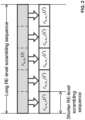
  • FIG. 2 is a diagram illustrating an example approach to UE-group WUS sequence generation, according to various aspects discussed herein.
  • FIG. 3 is a diagram illustrating an example of separate time and frequency domain OCCs (Orthogonal Cover Codes) for a WUS, in various aspects.
  • OCCs Orthogonal Cover Codes
  • FIG. 4 is a diagram illustrating an example of multiplexing of Rel-15 and Rel-16 WUS for LTE eMTC, according to embodiments discussed herein.
  • FIG. 5 is a diagram illustrating an example of multiplexing of Rel-15 and Rel-16 WUS for LTE NB-IoT, according to various embodiments discussed herein.
  • Embodiments described herein can be implemented into a system using any suitably configured hardware and/or software.
  • embodiments discussed herein can facilitate the communication of WUS(s) (Wake Up Signal(s)) based on UE sub-groups for eMTC and/or NB-IoT.
  • WUS(s) Wike Up Signal(s)
  • FIG. 1 illustrated is a block diagram of a system 100 employable at a UE (User Equipment) (e.g., as system 100 1 ) or a BS (Base Station) (e.g., as system 100 2 ) that facilitates communication of WUS(s) (Wake Up Signal(s)) based on UE sub-groups, in embodiments.
  • UE User Equipment
  • BS Base Station
  • WUS(s) Wike Up Signal(s)
  • System 100 can include processor(s) 110 comprising processing circuitry and associated interface(s) (e.g., a communication interface for communicating with communication circuitry 120 , a memory interface for communicating with memory 130 , etc.), communication circuitry 120 (e.g., comprising circuitry for wired and/or wireless connection(s), e.g., transmitter circuitry (e.g., associated with one or more transmit chains) and/or receiver circuitry (e.g., associated with one or more receive chains), wherein transmitter circuitry and receiver circuitry can employ common and/or distinct circuit elements, or a combination thereof), and a memory 130 (which can comprise any of a variety of storage mediums and can store instructions and/or data associated with one or more of processor(s) 110 or transceiver circuitry 120 ).
  • processor(s) 110 comprising processing circuitry and associated interface(s) (e.g., a communication interface for communicating with communication circuitry 120 , a memory interface for communicating with memory 130 , etc.)
  • communication circuitry 120 e.g
  • system 100 can be included within a user equipment (UE).
  • system 100 2 can be included within an Evolved Universal Terrestrial Radio Access Network (E-UTRAN) Node B (Evolved Node B, eNodeB, or eNB), next generation Node B (gNodeB or gNB) or other base station or TRP (Transmit/Receive Point) in a wireless communications network, wherein processor(s) 110 2 , communication circuitry 120 2 , and memory 130 2 can be in a single device or can be included in different devices, such as part of a distributed architecture.
  • E-UTRAN Evolved Universal Terrestrial Radio Access Network
  • Node B Evolved Node B, eNodeB, or eNB
  • next generation Node B gNodeB or gNB
  • TRP Transmit/Receive Point
  • signaling from a UE to a BS can be generated by processor(s) 110 1 , transmitted by communication circuitry 120 1 , received by communication circuitry 120 2 , and processed by processor(s) 110 2
  • signaling from a BS to a UE can be generated by processor(s) 110 2 , transmitted by communication circuitry 120 2 , received by communication circuitry 120 1 , and processed by processor(s) 110 1 .
  • a Rel-16 NB (NarrowBand)-IoT (Internet of Things) Wl also has a targeted enhancement for further development to specify support of UE-group WUS: “Improved DL transmission efficiency and/or UE power consumption: Specify support for UE-group wake-up signal (WUS) [RAN1, RAN2, RAN4].”
  • WUS communication can be sent and received according to a design discussed herein that can support UE-group WUS for both Rel-16 eMTC and NB-IoT.
  • the following discussion begins with a brief overview of the design of WUS in Rel-15 eMTC and NB-IoT.
  • WUS or DTX Discontinuous Transmission was introduced in Rel-15 eMTC and NB-IoT for idle mode, where WUS can be transmitted when there is at least one UE in the associated paging group to be woken up.
  • the WUS is a 1-PRB signal.
  • WUS is a 2-PRB signal with NB-IoT WUS repeated in the frequency domain over 2 continuous PRBs.
  • the WUS occupies the last 11 symbols in a subframe, and can be repeated to achieve certain coverage.
  • the number of repetitions can be configured via a scaling factor between a maximum WUS duration and Rmax of MPDCCH (MTC-PDCCH (Physical Downlink Control Channel)) candidate for paging.
  • MTC-PDCCH Physical Downlink Control Channel
  • a non-zero gap from the end of a configured maximum WUS duration to the associated PO is configurable by higher layer.
  • n f_start_PO is the first frame of the first PO to which the WUS is associated
  • n s_start_PO is the first slot of the first PO to which the WUS is associated
  • Rel-15 eMTC and NB-IoT e.g., which can apply to legacy UEs that do not support group-based WUSs
  • one WUS applies to all the UEs associated to the corresponding PO(s).
  • various embodiments discussed herein can support sub-grouping of WUS, whereby UE power saving can be further improved over existing (e.g., Rel-15) systems by reducing the probability of waking up a UE when the paging is for another UE associated to the same PO.
  • Various embodiments discussed herein can communicate WUS according to a design for WUS sub-grouping for Rel-16 eMTC and NB-IoT discussed herein.
  • details of this design include features and techniques that can be employed for: (1) Configuration and capability for UE-group WUS; (2) Determination of the UE-groups; and (3) Multiplexing of WUS for different UE groups.
  • UE-group WUS can be enabled and/or disabled by higher layer signaling.
  • the cell-specific signaling e.g. SIB1 (System Information Block Type 1)-BR (Bandwidth Reduced) or SIBx-BR with x>1 for eMTC, and SIB1-NB or SIBy-NB with y>1 for NB-IoT
  • SIB1 System Information Block Type 1
  • Bandwidth Reduced SIBx-BR with x>1 for eMTC
  • SIB1-NB or SIBy-NB with y>1 for NB-IoT can be used for the configuration.
  • the supported number of UE groups can be 1, 2, 3, 4, or greater.
  • the maximum number of UE groups that can be supported by eMTC and NB-IoT can be different, for example, up to 4 UE groups for eMTC and up to 2 UE groups in NB-IoT.
  • the number of UE groups can be fixed in the 3GPP specification. In other embodiments, the number of UE groups can be configured by higher layer signaling (e.g., via SIB as mentioned above).
  • the UE capability can also be addressed in a variety of ways, depending on the embodiment.
  • the UE can signal its capability regarding support of UE-group WUS via an existing capability reporting procedure.
  • the Rel-16 UEs supporting the feature of WUS can support the UE-group WUS.
  • the groups can depend on a UE_ID (UE Identifier, e.g., IMSI (International Mobile Subscriber Identity)).
  • UE_ID UE Identifier, e.g., IMSI (International Mobile Subscriber Identity)
  • the UE_ID can be IMSI mod 4096 for NB-IoT and IMSI mod 16384 for eMTC, similar to what is used to calculate the PO in Rel-13 NB-IoT and eMTC, respectively.
  • the number of UE groups is N G .
  • the UE group ID for a UE can be determined (e.g., via processor(s) 110 1 and/or processor(s) 110 2 ) by UE_ID mod N G .
  • the UE group ID for a UE can be floor(UE_ID/N/Ns/Nn) mod N G , where N and Ns are defined as above, and Nn is the number of paging narrowbands in system information.
  • any of the above options can be combined with the use of a hashed version of the UE_ID (UE_ID_hashed) to better distribute the UEs across the WUS sub-groups.
  • UE_ID_hashed (A*UE_ID) mod D, where A and D are prime numbers, e.g., those defined for EPDCCH (Enhanced PDCCH (Physical Downlink Control Channel)) as in 3GPP TS 36.213.
  • the UE group ID for a UE can be determined by floor(UE_ID_H/T eDRX,H ) mod N G , or floor(UE_ID_H/T eDRx,H /4) mod N G , where UE_ID H is 10 most significant bits of the Hashed ID for eMTC (e.g., wherein UE_ID H and its relationship to the Hashed ID can be as discussed in 3GPP TS 36.304 for MPDCCH) and 12 most significant bits of the Hashed ID for NB-IoT (e.g., wherein UE_ID H and its relationship to the Hashed ID can be as discussed in 3GPP TS 36.304 for NPDCCH), and T eDRX,H is the eDRX (extended DRX) cycle of the UE in Hyper-frames. This can be used when UE is configured with eDRX.
  • the groups can depend on C-RNTI (Cell-RNTI (Radio Network Temporary Identifier)) assigned for the UE before it goes to Idle mode.
  • C-RNTI Cell-RNTI (Radio Network Temporary Identifier)
  • the UE group ID can be C-RNTI mod N G .
  • a common wake-up indication for all UE groups can be defined. This can be used for SI updates and direct indication information.
  • the WUS can be designed to support N G +1 cases, such that N G +1 distinguishable WUS can be multiplexed before the corresponding PO are supported.
  • the WUS sequence and resources allocated for Rel-15 UEs can be used for common wake-up indication.
  • the power saving for Rel-16 UEs can be reduced, since the common wake-up indication will be sent as long as there is at least one Rel-15 UE to wake up in the corresponding PO.
  • the WUS sequences and the resources allocated for Rel-15 WUS can be used for WUS indication of one UE group for Rel-16 UEs. In such embodiments, it would be equivalent to assign a sub-group of Rel-16 UEs and all Rel-15 UEs associated to the corresponding PO to the same group.
  • WUS sequences and/or the set of time/frequency resources for the WUS that are different from Rel-15 WUS can be used for all the Rel-16 UE groups and the common wake-up indication for all Rel-16 UE groups.
  • both the Rel-15 WUS and the WUS for common indication of all Rel-16 UE groups can be sent to wake up all Rel-15 and Rel-16 UEs associated to the corresponding PO.
  • Various embodiments can employ one of the following multiplexing techniques for the WUS of different UE groups.
  • the WUS for different UE groups or common indication can be multiplexed in frequency domain.
  • the WUS occupies 2 PRBs in the frequency domain, while there are 6 PRBs available in each narrowband. Up to 3 WUS can be multiplexed in the frequency domain within the narrowband.
  • a mapping from PRB 0, 2 and 4 to the lowest PRB location of WUS for UE group 0, UE group 1 and common indication can be defined.
  • mapping can be fixed in the specification, e.g., PRB 0 for UE group 0, PRB 2 for UE group 1, PRB 4 for common WUS indication, etc.
  • the mapping can be configured by higher layer signaling.
  • UE group 1 and common WUS indication could be indicated by higher layer signaling.
  • a lowest PRB location for common WUS indication can be configured by higher layer (e.g., the PRBs for Rel-15 WUS), while other PRBs can be allocated in order for UE groups.
  • the PRBs with smaller indexes can be for UE group 0, while the PRBs with larger indexes can be for UE group 1.
  • UE group 0 and UE group 1 in embodiments can be replaced by UE groups i, i+1, i+X ⁇ 1, and UE groups i+X, i+X+1, i+2X ⁇ 1, respectively.
  • the UE groups i, i+1, i+X ⁇ 1 cam be allocated to the same set of PRBs and distinguishable by different sequences.
  • UE groups i+X, i+X+1, i+2X ⁇ 1 can be allocated to the same set of PRBs and distinguishable by different sequences, where X is the number of WUS that can be multiplexed in the code domain.
  • different narrowbands can be configured to multiplex WUS for more UE groups associated to the same PO.
  • N NB can be configured, which allows the support of up to 3N NB UE groups.
  • the narrowband associated to a UE group can be signaled by higher layer, e.g., as a part of the UE-group WUS configuration.
  • the NBs across which the WUS sub-groups corresponding to a paging NB (PNB) can be distributed are the same as the set of NBs for paging monitoring, following, for example, an ascending order of indexing of each 2-PRB sets within each of the PNBs with wrap-around, such that for a sequence of PNBs (s j , s j+1 , . . . , s j+n . . . , s j+Nn ⁇ 1 ), the WUS-frequency-domain resources can be identified as (0, 1, 2, . . .
  • frequency retuning can be employed for switching from the narrowband to monitor WUS to the narrowband for paging monitoring.
  • the configured gap duration between the end of the maximum WUS duration to the start of associated PO can be used for the frequency retuning.
  • multiple NB-IoT DL carriers can be configured to multiplex WUS for different UE groups in the frequency domain.
  • the NB-IoT DL carrier associated to the UE group can be configured by higher layer, e.g., as a part of the UE-group WUS configuration.
  • the NB-IoT DL carrier associated to a UE group for WUS monitoring can be determined similar to the determination of paging carrier in the case of NB-IoT paging with multiple carriers.
  • N wus NB-IoT DL carriers with WUS
  • N wus can be greater than Nn, where Nn is the number of NB-IoT DL carriers associated with paging.
  • frequency retuning can facilitate switching from the DL carrier to monitor WUS to the DL carrier for paging monitoring.
  • the configured gap duration between the end of maximum WUS duration to the start of associated PO can be used for the frequency retuning.
  • different WUS sequences can be defined for different UE groups and/or common WUS indication.
  • time-domain cyclic shifts can be used.
  • 4 cyclic shifts ⁇ 0, 33, 66, 99 ⁇ can be used.
  • 2 or 3 cyclic shifts can be used, e.g. ⁇ 0, 66 ⁇ or ⁇ 33, 99 ⁇ for 2 cyclic shifts, and ⁇ 0, 44, 88 ⁇ can be used for 3 cyclic shifts.
  • cyclic shift of 0 the sequence is the same as Rel-15 WUS. Which cyclic shifts to be used for which UE group can be fixed in the specification, or configured by higher layer.
  • the initialization of Gold sequence for Rel-15 WUS can be modified to include the UE group ID.
  • G ID is the UE group ID.
  • equation (1) with the update of UE group ID is just one example, and other ways to carry the UE_ID information in WUS sequence can also be employed in various embodiments.
  • the UE group ID G ID , the cell ID N ID cell and the variables determining the start of the WUS in the time domain, e.g., n f_start_Po and n s_start_PO
  • equation (2) can be combined in a non-linear manner in the expression for c init_wus as shown in equation (2):
  • multipliers e.g., which can be a power of 2
  • c init_wus e.g., which can be a power of 2
  • N grp UE is the total number of UE groups.
  • a particular WUS sequence can be generated by selecting a proper part of length (2 ⁇ 132M) from the long scrambling sequence.
  • the scrambling sequence for WUS for a UE group with ID v, v 0, 1, . . .
  • FIG. 2 illustrated is a diagram of an example approach to UE-group WUS sequence generation, in aspects discussed herein.
  • the UE group WUS sequence can be defined by equations (5):
  • n f_start_PO is the first frame of the first PO to which the MWUS is associated
  • n s_start_PO is the first slot of the first PO to which the MWUS is associated.
  • TD OCC Time Domain OCC
  • the TD OCC has a length equal to 11.
  • CSs cyclic shifts
  • frequency domain OCCs can be applied to every subframe containing WUS (e.g., each subcarrier signal of every OFDM symbol can be pre-multiplied by the corresponding symbol from the FD OCC) as also shown in FIG. 3 .
  • some embodiments can employ columns of the matrix G of equation (8) as different FD OCCs corresponding to different UE groups:
  • the UE group sequence can be defined as in equations (9):
  • the starting subframe of WUS transmission for a UE group can be the latest subframe such that there are Lwus BL (Bandwidth reduced Low complexity)/CE (Coverage Enhanced) DL subframes before the start of next WUS to be transmitted for another UE group associated to the same PO, and there are Lgap subframes from the start of the associated PO, where Lwus is the configured maximum WUS duration, and Lgap is the configured gap between the end of maximum WUS duration to the start of associated PO for the UE. If it is the last WUS to be transmitted before the associated PO, the start of the WUS can be the latest subframe such that there are Lwus BL/CE DL subframes followed by Lgap subframes before the start of the associated PO.
  • Lwus BL Bandwidth reduced Low complexity
  • CE Crossage Enhanced
  • the starting subframe of WUS transmission for a UE group can be the latest subframe such that there is a total of Lwus NB-IoT DL subframes and subframes carrying SIB1-NB before the start of next WUS to be transmitted for another UE group associated to the same PO, and there are Lgap subframes from the start of the associated PO, where Lwus is the configured maximum WUS duration, and Lgap is the configured gap between the end of maximum WUS duration to the start of associated PO for the UE.
  • the start of the WUS is the latest subframe such that there is a total of Lwus NB-IoT DL subframes and subframes carrying SIB1-NB followed by Lgap subframes before the start of the associated PO.
  • the NB-IoT UE can assume there are at least 10 NB-IoT DL subframes between the end of WUS and first associated PO, as in Rel-15 design.
  • the multiplexing of WUS in time domain can be combined with above embodiments (e.g., multiplexing in frequency and/or code domain).
  • two set of time resources can be configured for WUS of different UE groups associated to the same PO, and on top of it, 2 cyclic shifts can be used.
  • WUS for two Rel-16 UE groups can be multiplexed via cyclic shifts in the first set of time domain resources, while common WUS indication and WUS for Rel-15 UEs can be multiplexed in the second set of time domain resources.
  • the second set of time domain resources can be configured in the same way as in Rel-15 WUS time resource configuration, and cyclic shift of 0 can be used for the WUS for Rel-15 UEs (i.e., legacy UEs which do not support group WUSs).
  • legacy Rel-15 WUS can be transmitted in a separated time resource without further multiplexing with other WUS via frequency and/or code division multiplexing (FDM and/or CDM, respectively). All other WUS can be transmitted in a different time resource and can be further multiplexed using FDM and/or CDM.
  • FDM and/or CDM frequency and/or code division multiplexing
  • FIG. 5 illustrated is a diagram showing an example of multiplexing of Rel-15 and Rel-16 WUS for LTE NB-IoT, according to various embodiments discussed herein.
  • the gap between the WUS and the start of associated PO can be quite large, especially when the configured maximum WUS duration is large, which can impact the UE power saving gain.
  • the time domain multiplexing can be supported only when the maximum WUS duration is limited, e.g., no more than a threshold, e.g., 16 or 32 for eMTC and 256 or 512 for NB-IoT.
  • the threshold can be fixed in the specification or can be configurable.
  • eMTC Besides the up to 3 possible WUS multiplexed in frequency domain, X different WUS sequences can be introduced for UE sub-grouping, and Y different WUS locations in the time domain can be configured for UE sub-grouping. Thus, up to 3*X*Y UE groups can be supported. Similarly, for NB-IoT, with X different WUS sequences and Y different sets of time domain resources for WUS, up to X*Y UE groups can be supported.
  • the number of UE groups that can be supported can be 1 or 2 less than 3*X*Y for eMTC and X*Y for NB-IoT, which can provide the remaining ones for common WUS indication and/or WUS for Rel-15 UEs.
  • Table 1 shows the configuration for MTC Wake-Up Signal (MWUS) as defined in Rel-15 (TS 36.331) and broadcasted in a cell as part of a SI message.
  • MWUS MTC Wake-Up Signal
  • MWUS WUS-Config-r15 SEQUENCE ⁇ maxDurationFactor-r15 ENUMERATED ⁇ one32th, one16th, one8th, one4th ⁇ , numPOs-r15 ENUMERATED ⁇ n1, n2, n4, spare1 ⁇ DEFAULT n1, freqLocation-r15 ENUMERATED ⁇ n0, n2, n4, spare1 ⁇ , timeOffsetDRX-r15 ENUMERATED ⁇ ms40, ms80, ms160, ms240 ⁇ , timeOffset-eDRX-Short-r15 ENUMERATED ⁇ ms40, ms80, ms160, ms240 ⁇ , timeOffset-eDRX-Long-r15 ENUMERATED ⁇ ms1000, ms2000 ⁇ OPTIONAL -- Need OP ⁇ WUS-Config field descriptions freqLocation Frequency location of WUS within paging narrowband
  • Value n0 corresponds to WUS in the 1st and 2nd PRB
  • value n2 represents the 3rd and 4th PRB
  • value n4 represents the 5th and 6th PRB.
  • Value one 32th corresponds to Rmax * 1/32, value one16th corresponds to Rmax * 1/16 and so on.
  • numPOs Number of consecutive Paging Occasions (PO) mapped to one WUS, applicable to UEs configured to use extended DRX, see TS 36.304 [4].
  • Value n1 corresponds to 1 PO
  • value n2 corresponds to 2 POs and so on.
  • timeOffsetDRX Minimum time gap in milliseconds from the end of the configured maximum WUS duration to the first associated PO, see TS 36.211 [21].
  • Value ms40 corresponds to 40 ms
  • value ms80 corresponds to 80 ms and so on.
  • timeOffset-eDRX-Short When eDRX is used, the short non-zero gap in milliseconds from the end of the configured maximum WUS duration to the associated PO, see TS 36.211 [21].
  • Value ms40 corresponds to 40 ms
  • value ms80 corresponds to 80 ms and so on.
  • E-UTRAN configures timeOffset-eDRX-Short to a value longer than or equal to timeOffsetDRX.
  • timeOffset-eDRX-Long When eDRX is used, the long non-zero gap in milliseconds from the end of the configured maximum WUS duration to the associated PO, see TS 36.211 [21].
  • Value ms1000 corresponds to 1000 ms and value ms2000 corresponds to 2000 ms. If the field is absent, UE uses timeOffset-eDRX-Short for monitoring WUS.
  • SIB signaling can configure additional WUS configurations corresponding to different WUS transmissions associated with one or a set of consecutive POs.
  • the following can be applied to any other choice of WUS sequence generation as well.
  • the configuration for each new WUS group can comprise one or more of:
  • the maximum number of groups can be configured via SIB signaling.
  • the total number of WUS groups indicated by the network can optionally comprise the common group-WUS, and the exact number of UE-groups for WUS can be determined by the UEs based on information on whether the common group-WUS is configured or not in the cell.
  • (C) maxDurationFactor indicating the maximum number of repetitions of the WUS.
  • this factor is specified as the same as indicated for the Rel-15 WUS configuration.
  • a single value of the maxDurationFactor can be configured as a common value for all non-Rel-15 WUS groups.
  • the maxDurationFactor value can be configured for each new WUS group.
  • a new parameter timeLocationIndex can be configured for each new WUS group to indicate the location of the WUS with respect to the PO or with respect to the Rel-15 WUS starting subframe.
  • the maximum value of timeLocationIndex can be specified as either 2 or 3 (for eMTC) and as 1 or 2 (for NB-IoT).
  • the relative location for new WUS occasions can be determined based on the timeLocationIndex value and the maxDurationFactor for Rel-15 WUS.
  • Indication of common group-WUS can be implemented by reserving one of the group indices as a common group-WUS, wherein all Rel-16 UEs supporting this feature are expected to monitor for WUS in addition to monitoring for WUS in their respective UE-group (as determined by UE-ID).
  • Such a common group-WUS can be optionally configured by the eNB, and when present, it can be configured to overlap with one of the UE-groups in physical time-frequency resources.
  • Examples herein can include subject matter such as a method, means for performing acts or blocks of the method, at least one machine-readable medium including executable instructions that, when performed by a machine (e.g., a processor with memory, an application-specific integrated circuit (ASIC), a field programmable gate array (FPGA), or the like) cause the machine to perform acts of the method or of an apparatus or system for concurrent communication using multiple communication technologies according to embodiments and examples described.
  • a machine e.g., a processor with memory, an application-specific integrated circuit (ASIC), a field programmable gate array (FPGA), or the like
  • Example 1 is an apparatus configured to be employed in a UE (User Equipment), comprising: a memory interface; and processing circuitry configured to: determine a WUS group of a plurality of WUS groups, wherein the WUS group is associated with a first group WUS (Wake Up Signal) of a plurality of group WUSs; determine a starting subframe for the first group WUS; and monitor the starting subframe for the first group WUS, wherein the UE is configured to communicate via one or more of eMTC (enhanced Machine Type Communication) or NB (NarrowBand)-IoT (Internet of Things).
  • eMTC enhanced Machine Type Communication
  • NB NarrowBand
  • Example 2 comprises the subject matter of any variation of any of example(s) 1, wherein the processing circuitry is further configured to process higher layer signaling that configures one or more parameters of the WUS group.
  • Example 3 comprises the subject matter of any variation of any of example(s) 1, wherein the processing circuitry is configured to determine the WUS group based on a UE ID (Identifier) of the UE.
  • the processing circuitry is configured to determine the WUS group based on a UE ID (Identifier) of the UE.
  • Example 4 comprises the subject matter of any variation of any of example(s) 3, wherein the UE ID is an IMSI (International Mobile Subscriber Identity) of the UE.
  • IMSI International Mobile Subscriber Identity
  • Example 5 comprises the subject matter of any variation of any of example(s) 1, wherein physical resources for the first group WUS are multiplexed in a frequency domain with one or more other group WUSs of the plurality of group WUSs.
  • Example 6 comprises the subject matter of any variation of any of example(s) 5, wherein the UE is a BL (Bandwidth reduced Low complexity)/CE (Coverage Enhanced) DL UE, and wherein the physical resources for the first group WUS are within a first narrowband of a plurality of configured narrowbands.
  • the UE is a BL (Bandwidth reduced Low complexity)/CE (Coverage Enhanced) DL UE
  • the physical resources for the first group WUS are within a first narrowband of a plurality of configured narrowbands.
  • Example 7 comprises the subject matter of any variation of any of example(s) 5, wherein the UE is a NB (NarrowBand)-IoT (Internet of Things) UE, and wherein the physical resources for the first group WUS are within a first carrier of a plurality of configured carriers.
  • NB NarrowBand
  • IoT Internet of Things
  • Example 8 comprises the subject matter of any variation of any of example(s) 1, wherein physical resources for the first group WUS are multiplexed in a time domain with one or more other group WUSs of the plurality of group WUSs.
  • Example 9 comprises the subject matter of any variation of any of example(s) 8, wherein the physical resources for the first group WUS are multiplexed in the time domain with a WUS for one or more other UEs that do not support group WUSs.
  • Example 10 comprises the subject matter of any variation of any of example(s) 1, wherein physical resources for the first group WUS are shared with one or more other group WUSs of the plurality of group WUSs, and wherein the first group WUS and the one or more other group WUSs are multiplexed using quasi-orthogonal codes.
  • Example 11 comprises the subject matter of any variation of any of example(s) 1, wherein physical resources for the first group WUS are multiplexed with one or more other group WUSs of the plurality of group WUSs in at least two of a frequency domain, a time domain, or a code domain.
  • Example 12 comprises the subject matter of any variation of any of example(s) 1, wherein a sequence of the first group WUS is generated based on a RE-level Gold sequence generated based on Na that is longer than the sequence of the first group WUS, wherein N grp UE is the number of WUS groups in the plurality of WUS groups.
  • Example 13 comprises the subject matter of any variation of any of example(s) 12, wherein the sequence of the first group WUS is a subsequence of the RE-level Gold sequence generated based on N grp UE , wherein the subsequence is shorter than the RE-level Gold sequence generated based on N grp UE .
  • Example 14 comprises the subject matter of any variation of any of example(s) 1, wherein a sequence of the first group WUS is generated based on a sequence a WUS for one or more other UEs that do not support group WUSs and on a first time domain OCC (Orthogonal Cover Code) of length 11 applied to all subframes carrying the first group WUS.
  • OCC Orthogonal Cover Code
  • Example 15 comprises the subject matter of any variation of any of example(s) 14, wherein the sequence of the first group WUS is generated based on a first frequency domain OCC of length 12 applied to each OFDM (Orthogonal Frequency Division Multiplexing) symbol of all the subframes carrying the first group WUS.
  • OFDM Orthogonal Frequency Division Multiplexing
  • Example 16 comprises the subject matter of any variation of any of example(s) 15, wherein the first time domain OCC is one of N grp UE different time domain OCCs, wherein the first frequency domain OCC is one of N grp UE different frequency domain OCCs, and wherein N grp UE is the number of WUS groups in the plurality of WUS groups.
  • Example 17 is an apparatus configured to be employed in a gNB (next generation Node B), comprising: a memory interface; and processing circuitry configured to: determine a WUS group of a plurality of WUS groups, wherein the WUS group is associated with a first group WUS (Wake Up Signal) of a plurality of group WUSs; determine a starting subframe for the first group WUS; generate a sequence for the first group WUS; and map the sequence for the first group WUS to one or more consecutive subframes beginning in the starting subframe for the first group WUS, wherein the first group WUS is associated with one or more of eMTC (enhanced Machine Type Communication) or NB (NarrowBand)-IoT (Internet of Things).
  • eMTC enhanced Machine Type Communication
  • NB NarrowBand
  • Example 18 comprises the subject matter of any variation of any of example(s) 17, wherein the processing circuitry is configured to generate the sequence for the first group WUS based on a RE-level Gold sequence generated based on N grp UE that is longer than the sequence of the first group WUS, wherein N grp UE is the number of WUS groups in the plurality of WUS groups.
  • Example 19 is a machine readable medium comprising instructions that, when executed, cause a User Equipment (UE) to: determine a WUS group of a plurality of WUS groups, wherein the WUS group is associated with a first group WUS (Wake Up Signal) of a plurality of group WUSs; determine a starting subframe for the first group WUS; and monitor the starting subframe for the first group WUS, wherein the UE is configured to communicate via one or more of eMTC (enhanced Machine Type Communication) or NB (NarrowBand)-IoT (Internet of Things).
  • eMTC enhanced Machine Type Communication
  • NB NarrowBand
  • Example 20 comprises the subject matter of any variation of any of example(s) 19, wherein the instructions, when executed, further cause the UE to process higher layer signaling that configures one or more parameters of the WUS group.
  • Example 21 comprises an apparatus comprising means for executing any of the described operations of examples 1-20.
  • Example 22 comprises a machine readable medium that stores instructions for execution by a processor to perform any of the described operations of examples 1-20.
  • Example 23 comprises an apparatus comprising: a memory interface; and processing circuitry configured to: perform any of the described operations of examples 1-20.

Landscapes

  • Engineering & Computer Science (AREA)
  • Computer Networks & Wireless Communication (AREA)
  • Signal Processing (AREA)
  • Health & Medical Sciences (AREA)
  • Cardiology (AREA)
  • General Health & Medical Sciences (AREA)
  • Mobile Radio Communication Systems (AREA)

Abstract

Techniques discussed herein can facilitate communication of group-based WUS(s) (Wake Up Signal(s)) for eMTC (enhanced Machine Type Communication) and/or NB (NarrowBand)-IoT (Internet of Things). One example embodiment is an apparatus configured to be employed in a UE (User Equipment), comprising: a memory interface; and processing circuitry configured to: determine a WUS group of a plurality of WUS groups, wherein the WUS group is associated with a first group WUS (Wake Up Signal) of a plurality of group WUSs; determine a starting subframe for the first group WUS; and monitor the starting subframe for the first group WUS, wherein the UE is configured to communicate via one or more of eMTC or NB (NarrowBand)-IoT.

Description

REFERENCE TO RELATED APPLICATIONS
This application is a National Phase entry application of International Patent Application No. PCT/US2016/045606 filed Aug. 8, 2019, which claims priority to U.S. Provisional Patent Applications No. 62/717,172 filed Aug. 10, 2018, entitled “WAKE-UP SIGNAL SUB-GROUPING FOR REL-16 EMTC AND NB-IOT”, No. 62/739,063 filed Sep. 28, 2018, entitled “WAKE-UP SIGNAL SUB-GROUPING FOR REL-16 EMTC AND NB-IOT”, and No. 62/829,588 filed Apr. 4, 2019, entitled “WAKE-UP SIGNAL SUB-GROUPING FOR REL-16 EMTC AND NB-IOT”, and is hereby incorporated by reference in its entirety.
BACKGROUND
Mobile communication has evolved significantly from early voice systems to today's highly sophisticated integrated communication platform. The next generation wireless communication system, 5G (or new radio (NR)) will provide access to information and sharing of data anywhere, anytime by various users and applications. NR is expected to be a unified network/system that target to meet vastly different and sometime conflicting performance dimensions and services. Such diverse multi-dimensional requirements are driven by different services and applications. In general, NR will evolve based on 3GPP (Third Generation Partnership Project) LTE (Long Term Evolution)-Advanced with additional potential new Radio Access Technologies (RATs) to enrich people lives with better, simple and seamless wireless connectivity solutions. NR will enable everything connected by wireless and deliver fast, rich contents and services.
BRIEF DESCRIPTION OF THE DRAWINGS
FIG. 1 is a block diagram illustrating a system employable at a UE (User Equipment) or BS that facilitates communication of WUS(s) (Wake Up Signal(s)) based on UE sub-groups, according to various aspects described herein.
FIG. 2 is a diagram illustrating an example approach to UE-group WUS sequence generation, according to various aspects discussed herein.
FIG. 3 is a diagram illustrating an example of separate time and frequency domain OCCs (Orthogonal Cover Codes) for a WUS, in various aspects.
FIG. 4 is a diagram illustrating an example of multiplexing of Rel-15 and Rel-16 WUS for LTE eMTC, according to embodiments discussed herein.
FIG. 5 is a diagram illustrating an example of multiplexing of Rel-15 and Rel-16 WUS for LTE NB-IoT, according to various embodiments discussed herein.
DETAILED DESCRIPTION
Embodiments described herein can be implemented into a system using any suitably configured hardware and/or software. In various aspects, embodiments discussed herein can facilitate the communication of WUS(s) (Wake Up Signal(s)) based on UE sub-groups for eMTC and/or NB-IoT.
Referring to FIG. 1 , illustrated is a block diagram of a system 100 employable at a UE (User Equipment) (e.g., as system 100 1) or a BS (Base Station) (e.g., as system 100 2) that facilitates communication of WUS(s) (Wake Up Signal(s)) based on UE sub-groups, in embodiments. System 100 can include processor(s) 110 comprising processing circuitry and associated interface(s) (e.g., a communication interface for communicating with communication circuitry 120, a memory interface for communicating with memory 130, etc.), communication circuitry 120 (e.g., comprising circuitry for wired and/or wireless connection(s), e.g., transmitter circuitry (e.g., associated with one or more transmit chains) and/or receiver circuitry (e.g., associated with one or more receive chains), wherein transmitter circuitry and receiver circuitry can employ common and/or distinct circuit elements, or a combination thereof), and a memory 130 (which can comprise any of a variety of storage mediums and can store instructions and/or data associated with one or more of processor(s) 110 or transceiver circuitry 120). In various aspects, system 100 can be included within a user equipment (UE). In BS aspects, system 100 2 can be included within an Evolved Universal Terrestrial Radio Access Network (E-UTRAN) Node B (Evolved Node B, eNodeB, or eNB), next generation Node B (gNodeB or gNB) or other base station or TRP (Transmit/Receive Point) in a wireless communications network, wherein processor(s) 110 2, communication circuitry 120 2, and memory 130 2 can be in a single device or can be included in different devices, such as part of a distributed architecture. In embodiments, signaling from a UE to a BS can be generated by processor(s) 110 1, transmitted by communication circuitry 120 1, received by communication circuitry 120 2, and processed by processor(s) 110 2, while signaling from a BS to a UE can be generated by processor(s) 110 2, transmitted by communication circuitry 120 2, received by communication circuitry 120 1, and processed by processor(s) 110 1.
In a 3GPP (Third Generation Partnership Project) Rel-16 (Release 16) eMTC (enhanced MTC (Machine Type Communication)) Wl (Work Item), one targeted enhancement for further development is to support a UE (User Equipment)-group wake-up signal (WUS) to improve UE power saving: “Improved DL transmission efficiency and/or UE power consumption:Specify support for UE-group wake-up signal (WUS) [RAN1 (Radio Access Network WG1 (Working Group 1)), RAN2, RAN4].”
Similarly, a Rel-16 NB (NarrowBand)-IoT (Internet of Things) Wl also has a targeted enhancement for further development to specify support of UE-group WUS: “Improved DL transmission efficiency and/or UE power consumption: Specify support for UE-group wake-up signal (WUS) [RAN1, RAN2, RAN4].”
In various embodiments, WUS communication can be sent and received according to a design discussed herein that can support UE-group WUS for both Rel-16 eMTC and NB-IoT. The following discussion begins with a brief overview of the design of WUS in Rel-15 eMTC and NB-IoT. WUS or DTX (Discontinuous Transmission) was introduced in Rel-15 eMTC and NB-IoT for idle mode, where WUS can be transmitted when there is at least one UE in the associated paging group to be woken up.
For frequency domain resource configuration, in NB-IoT, the WUS is a 1-PRB signal. On the other hand, in eMTC, WUS is a 2-PRB signal with NB-IoT WUS repeated in the frequency domain over 2 continuous PRBs.
For time domain resource configuration, the WUS occupies the last 11 symbols in a subframe, and can be repeated to achieve certain coverage. The number of repetitions can be configured via a scaling factor between a maximum WUS duration and Rmax of MPDCCH (MTC-PDCCH (Physical Downlink Control Channel)) candidate for paging. A non-zero gap from the end of a configured maximum WUS duration to the associated PO (Paging Occasion) is configurable by higher layer.
WUS sequence design can employ a length-131 ZC (Zadoff_Chu) sequence and Gold sequence for RE (Resource Element)-level scrambling as follows: “The WUS sequence w(m) in subframe x=0, 1, . . . , M−1 is defined by
w ( m ) = θ n f , n s ( m ) · e j π u n ( n + 1 ) 1 3 1 m = 0 , 1 , , 131 m = m + 132 x n = m mod 132 θ n f , n s ( m ) = { 1 , if c n f , n s ( 2 m ) = 0 and c n f , n s ( 2 m + 1 ) = 0 - 1 , if c n f , n s ( 2 m ) = 0 and c n f , n s ( 2 m + 1 ) = 1 j , if c n f , n s ( 2 m ) = 1 and c n f , n s ( 2 m + 1 ) = 0 - j , if c n f , n s ( 2 m ) = 1 and c n f , n s ( 2 m + 1 ) = 1 u = ( N ID cell mod 126 ) + 3
where M is the actual duration of WUS.
The scrambling sequence cn f ,n s (i), i=0, 1, . . . , 2·132M−1 is given by clause 7.2 in [3GPP TS 36.211], and [can] be initialized at the start of the WUS with
c init _ WUS = ( N ID cell + 1 ) ( ( 1 0 n f _ start _ PO + n s_ start _ PO 2 ) mod 2048 + 1 ) 2 9 + N ID cell
where nf_start_PO is the first frame of the first PO to which the WUS is associated, and ns_start_PO is the first slot of the first PO to which the WUS is associated.”
In Rel-15 eMTC and NB-IoT (e.g., which can apply to legacy UEs that do not support group-based WUSs), one WUS applies to all the UEs associated to the corresponding PO(s). In contrast, various embodiments discussed herein can support sub-grouping of WUS, whereby UE power saving can be further improved over existing (e.g., Rel-15) systems by reducing the probability of waking up a UE when the paging is for another UE associated to the same PO.
Various embodiments discussed herein can communicate WUS according to a design for WUS sub-grouping for Rel-16 eMTC and NB-IoT discussed herein. In particular, details of this design include features and techniques that can be employed for: (1) Configuration and capability for UE-group WUS; (2) Determination of the UE-groups; and (3) Multiplexing of WUS for different UE groups.
Configuration and Capability: For configuration of UE-group WUS, in various embodiments, UE-group WUS can be enabled and/or disabled by higher layer signaling. In one example, the cell-specific signaling (e.g. SIB1 (System Information Block Type 1)-BR (Bandwidth Reduced) or SIBx-BR with x>1 for eMTC, and SIB1-NB or SIBy-NB with y>1 for NB-IoT) can be used for the configuration. The supported number of UE groups can be 1, 2, 3, 4, or greater. In one example embodiment, the maximum number of UE groups that can be supported by eMTC and NB-IoT can be different, for example, up to 4 UE groups for eMTC and up to 2 UE groups in NB-IoT.
In some embodiments, the number of UE groups can be fixed in the 3GPP specification. In other embodiments, the number of UE groups can be configured by higher layer signaling (e.g., via SIB as mentioned above).
UE capability can also be addressed in a variety of ways, depending on the embodiment. In some embodiments, the UE can signal its capability regarding support of UE-group WUS via an existing capability reporting procedure. In other embodiments, the Rel-16 UEs supporting the feature of WUS can support the UE-group WUS.
Determination of UE Sub-Groups: In various embodiments, the groups can depend on a UE_ID (UE Identifier, e.g., IMSI (International Mobile Subscriber Identity)). In some such embodiments, the UE_ID can be IMSI mod 4096 for NB-IoT and IMSI mod 16384 for eMTC, similar to what is used to calculate the PO in Rel-13 NB-IoT and eMTC, respectively. In the following discussion, the number of UE groups is NG.
In some example embodiments, the UE group ID for a UE can be determined (e.g., via processor(s) 110 1 and/or processor(s) 110 2) by UE_ID mod NG.
Alternatively, in other example embodiments, the UE group ID for a UE can be floor(UE_ID/N) mod NG, where N=min(T, nB), T is the DRX cycle of the UE as defined in TS 3GPP 36.304, and nB can be 4T, 2T, T, T/2, T/4, T/8, T/16, T/32, T/64, T/128, T/256, and for NB-IoT also T/612 and T/1024.
In other example embodiments, the UE group ID for a UE can be determined by floor(UE_ID/N/Ns) mod NG, where N is defined as above, and Ns=max(1, nB/T).
In other example embodiments, for eMTC, the UE group ID for a UE can be floor(UE_ID/N/Ns/Nn) mod NG, where N and Ns are defined as above, and Nn is the number of paging narrowbands in system information. For NB-IoT, the UE group ID for a UE can be floor(UE_ID/N/Ns/W) mod NG, where N and Ns are defined as above, and W is the total weight of all NB-IoT paging carriers (i.e., W=W(0)+W(1)+ . . . +W(Nn−1)).
In other embodiments, any of the above options can be combined with the use of a hashed version of the UE_ID (UE_ID_hashed) to better distribute the UEs across the WUS sub-groups. For instance, UE_ID_hashed=(A*UE_ID) mod D, where A and D are prime numbers, e.g., those defined for EPDCCH (Enhanced PDCCH (Physical Downlink Control Channel)) as in 3GPP TS 36.213.
In other embodiments, the UE group ID for a UE can be determined by floor(UE_ID_H/TeDRX,H) mod NG, or floor(UE_ID_H/TeDRx,H/4) mod NG, where UE_ID H is 10 most significant bits of the Hashed ID for eMTC (e.g., wherein UE_ID H and its relationship to the Hashed ID can be as discussed in 3GPP TS 36.304 for MPDCCH) and 12 most significant bits of the Hashed ID for NB-IoT (e.g., wherein UE_ID H and its relationship to the Hashed ID can be as discussed in 3GPP TS 36.304 for NPDCCH), and TeDRX,H is the eDRX (extended DRX) cycle of the UE in Hyper-frames. This can be used when UE is configured with eDRX.
In other embodiments, the groups can depend on C-RNTI (Cell-RNTI (Radio Network Temporary Identifier)) assigned for the UE before it goes to Idle mode. For example, the UE group ID can be C-RNTI mod NG.
Design of WUS for Support of UE Sub-Groups: In some embodiments, a common wake-up indication for all UE groups can be defined. This can be used for SI updates and direct indication information. In such embodiments, the WUS can be designed to support NG+1 cases, such that NG+1 distinguishable WUS can be multiplexed before the corresponding PO are supported.
In some example embodiments, the WUS sequence and resources allocated for Rel-15 UEs (e.g., legacy UEs which do support group WUSs) can be used for common wake-up indication. In such embodiments, the power saving for Rel-16 UEs can be reduced, since the common wake-up indication will be sent as long as there is at least one Rel-15 UE to wake up in the corresponding PO.
In other example embodiments, the WUS sequences and the resources allocated for Rel-15 WUS can be used for WUS indication of one UE group for Rel-16 UEs. In such embodiments, it would be equivalent to assign a sub-group of Rel-16 UEs and all Rel-15 UEs associated to the corresponding PO to the same group.
In other example embodiments, WUS sequences and/or the set of time/frequency resources for the WUS that are different from Rel-15 WUS can be used for all the Rel-16 UE groups and the common wake-up indication for all Rel-16 UE groups. With this example, for cases of SI updates or direct indication information, both the Rel-15 WUS and the WUS for common indication of all Rel-16 UE groups can be sent to wake up all Rel-15 and Rel-16 UEs associated to the corresponding PO.
Various embodiments can employ one of the following multiplexing techniques for the WUS of different UE groups.
In some embodiments, the WUS for different UE groups or common indication can be multiplexed in frequency domain. In Rel-15 eMTC, the WUS occupies 2 PRBs in the frequency domain, while there are 6 PRBs available in each narrowband. Up to 3 WUS can be multiplexed in the frequency domain within the narrowband. A mapping from PRB 0, 2 and 4 to the lowest PRB location of WUS for UE group 0, UE group 1 and common indication can be defined.
In some embodiments, mapping can be fixed in the specification, e.g., PRB 0 for UE group 0, PRB 2 for UE group 1, PRB 4 for common WUS indication, etc.
Alternatively, in other embodiments, the mapping can be configured by higher layer signaling. In other words, which is the lowest PRB location for UE group 0, UE group 1 and common WUS indication could be indicated by higher layer signaling.
In other embodiments, a lowest PRB location for common WUS indication can be configured by higher layer (e.g., the PRBs for Rel-15 WUS), while other PRBs can be allocated in order for UE groups. For example, the PRBs with smaller indexes can be for UE group 0, while the PRBs with larger indexes can be for UE group 1.
In cases where frequency domain multiplexing and code domain multiplexing (as discussed below) are both used, UE group 0 and UE group 1 in embodiments can be replaced by UE groups i, i+1, i+X−1, and UE groups i+X, i+X+1, i+2X−1, respectively. The UE groups i, i+1, i+X−1 cam be allocated to the same set of PRBs and distinguishable by different sequences. Similarly, UE groups i+X, i+X+1, i+2X−1 can be allocated to the same set of PRBs and distinguishable by different sequences, where X is the number of WUS that can be multiplexed in the code domain.
On top of the frequency domain multiplexing within one narrowband, different narrowbands can be configured to multiplex WUS for more UE groups associated to the same PO. For example, NNB can be configured, which allows the support of up to 3NNB UE groups. The narrowband associated to a UE group can be signaled by higher layer, e.g., as a part of the UE-group WUS configuration. Alternatively, the NBs across which the WUS sub-groups corresponding to a paging NB (PNB) can be distributed are the same as the set of NBs for paging monitoring, following, for example, an ascending order of indexing of each 2-PRB sets within each of the PNBs with wrap-around, such that for a sequence of PNBs (sj, sj+1, . . . , sj+n . . . , sj+Nn−1), the WUS-frequency-domain resources can be identified as (0, 1, 2, . . . , (Nn*3−1)) such that resource indices #0, #1, #2 belong to NB Sj, #3, #4, #5 belong to NB Sj+1, etc. Thus, determination of the UE-sub-group automatically leads to identification of the corresponding NB and the particular 2-PRB set within the NB to monitor for WUS.
In such embodiment, frequency retuning can be employed for switching from the narrowband to monitor WUS to the narrowband for paging monitoring. In one example, the configured gap duration between the end of the maximum WUS duration to the start of associated PO can be used for the frequency retuning.
For NB-IoT, multiple NB-IoT DL carriers can be configured to multiplex WUS for different UE groups in the frequency domain. The NB-IoT DL carrier associated to the UE group can be configured by higher layer, e.g., as a part of the UE-group WUS configuration. Alternatively, the NB-IoT DL carrier associated to a UE group for WUS monitoring can be determined similar to the determination of paging carrier in the case of NB-IoT paging with multiple carriers. That is, for Nwus NB-IoT DL carriers with WUS, the UE group (and thus the carrier for WUS monitoring) can be given as the carrier with the smallest n that satisfies floor(UE_ID/N/Ns) mod W<W(0)+W(1)+ . . . +W(n), where W=W(0)+W(1)++W(Nwus−1). In such embodiments, to realize additional frequency domain multiplexing beyond the paging carriers, Nwus can be greater than Nn, where Nn is the number of NB-IoT DL carriers associated with paging.
In such embodiments, frequency retuning can facilitate switching from the DL carrier to monitor WUS to the DL carrier for paging monitoring. For example, like eMTC techniques discussed above, the configured gap duration between the end of maximum WUS duration to the start of associated PO can be used for the frequency retuning.
In other embodiments, different WUS sequences can be defined for different UE groups and/or common WUS indication.
In some example embodiments, time-domain cyclic shifts can be used. For example, similar to NSSS, 4 cyclic shifts {0, 33, 66, 99} can be used. Alternatively, 2 or 3 cyclic shifts can be used, e.g. {0, 66} or {33, 99} for 2 cyclic shifts, and {0, 44, 88} can be used for 3 cyclic shifts. With cyclic shift of 0, the sequence is the same as Rel-15 WUS. Which cyclic shifts to be used for which UE group can be fixed in the specification, or configured by higher layer.
Alternatively, in other example embodiments, the initialization of Gold sequence for Rel-15 WUS can be modified to include the UE group ID. For example, the scrambling sequence cn f ,n s (i), i=0, 1, . . . , 2·132M−1 is given by clause 7.2 in 3GPP TS 36.211, and can be initialized at the start of the WUS with equation (1):
c init _ WUS = ( N ID cell + 1 ) ( ( 1 0 n f _ start _ PO + n s_ start _ PO 2 ) mod 2048 + 1 ) 2 9 + N ID cell + G ID ( 1 )
where GID is the UE group ID. However, equation (1) with the update of UE group ID is just one example, and other ways to carry the UE_ID information in WUS sequence can also be employed in various embodiments. In another example, the UE group ID GID, the cell ID NID cell and the variables determining the start of the WUS in the time domain, (e.g., nf_start_Po and ns_start_PO) can be combined in a non-linear manner in the expression for cinit_wus as shown in equation (2):
c init _ WUS = ( N ID cell + 1 ) ( ( 1 0 n f _ start _ PO + n s_ start _ PO 2 ) mod 2048 + 1 ) 2 9 + N ID cell + G ID ( 2 )
In some other examples, different multipliers (e.g., which can be a power of 2), can be applied to individual terms of the expression for cinit_wus as illustrated in equation (3):
c init _ WUS = ( N ID cell + 1 ) ( G ID + 1 ) ( ( 10 n f _ start _ PO + n s_ start _ PO 2 ) mod 2048 + 1 ) 2 12 + N ID cell · 2 3 + G ID ( 3 )
Another technique that can be employed in embodiments to generate different WUS sequences for multiple UE groups is to generate a long scrambling sequence cn f ,n s (i), i=0, 1, . . . , 2·132M·Ngrp UE−1 using the same initialization value cinit_wus in clause 7.2 of 36.211. Here Ngrp UE is the total number of UE groups. Then, a particular WUS sequence can be generated by selecting a proper part of length (2·132M) from the long scrambling sequence. Thus, the scrambling sequence for WUS for a UE group with ID v, v=0, 1, . . . , Ngrp UE−1, can be determined as in equation (4):
c n f ,n s ,v(i′)=c n f ,n s (i′+2·132M·v),i′=0,1, . . . ,2·132M−1.  (4)
In such embodiments, the WUS with group ID v=0 corresponds to the legacy Rel-15 WUS. Referring to FIG. 2 , illustrated is a diagram of an example approach to UE-group WUS sequence generation, in aspects discussed herein.
Thus, the UE group WUS sequence can be defined by equations (5):
w v ( m ) = θ n f , n s , v ( m ) · e - j π un ( n + 1 ) 1 3 1 v = 0 , 1 , , N grp UE - 1 m = 0 , 1 , , 132 M - 1 n = m mod 132 θ n f , n s , v ( m ) = { 1 , if c n f , n s , v ( 2 m ) = 0 and c n f , n s , v ( 2 m + 1 ) = 0 - 1 , if c n f , n s , v ( 2 m ) = 0 and c n f , n s , v ( 2 m + 1 ) = 1 j , if c n f , n s , v ( 2 m ) = 1 and c n f , n s , v ( 2 m + 1 ) = 0 - j , if c n f , n s , v ( 2 m ) = 1 and c n f , n s , v ( 2 m + 1 ) = 1 u = ( N ID cell mod 126 ) + 3 ( 5 )
where M is the transmitted number of WUS subframes, 1≤M≤MWUSmax, where MWUSmax is the maximum number of WUS subframes as defined in 3GPP TS 36.213.
The scrambling sequence cn f ,n s ,v(i′)=cn f ,n s (i′+2·132M·v), i′=0, 1, . . . , 2·132M−1, where the scrambling sequence cn f ,n s (i), i=0, 1, . . . , 2·132M·Ngrp UE−1, per clause 7.2 of 36.211, and can be initialized at the start of the WUS per equation (6):
c init _ WUS = ( N ID cell + 1 ) ( ( 1 0 n f _ start _ PO + n s_ start _ PO 2 ) mod 2048 + 1 ) 2 9 + N ID cell ( 6 )
where nf_start_PO is the first frame of the first PO to which the MWUS is associated, and ns_start_PO is the first slot of the first PO to which the MWUS is associated.
Low mutual cross-correlation is one of design targets for UE-group WUS sequences. Generally, sequences with low cross-correlation are better distinguishable from each other at the UE receiver. Therefore, in various embodiments an orthogonal cover codes in the time domain can be used on top of Rel-15 WUS sequence w(m). Referring to FIG. 3 , illustrated is an example diagram showing separate time and frequency domain OCCs (Orthogonal Cover Codes) for a WUS, according to various aspects discussed herein. In the example of FIG. 3 , for each subframe of WUS signal, the time domain OCC (TD OCC) is applied (e.g., all subcarrier signals from each OFDM symbol can be pre-multiplied by the corresponding symbol from the TD OCC).
Since the WUS signal occupies 11 OFDM symbols of a subframe, the TD OCC has a length equal to 11. In some embodiments, the Barker code of length 11 can be used as TD OCC, where the Barker code is as in equation (7):
a(l)=[1 1 1 −1 −1 −1 1 −1 1 1 −1]  (7)
In such scenarios, different cyclic shifts (CSs) of the base Barker code can be used to produce a set of unique TD OCCs corresponding to different UE groups.
In addition to TD OCCs, in the same or other embodiments, frequency domain OCCs (FD OCCs) can be applied to every subframe containing WUS (e.g., each subcarrier signal of every OFDM symbol can be pre-multiplied by the corresponding symbol from the FD OCC) as also shown in FIG. 3 . As an example, some embodiments can employ columns of the matrix G of equation (8) as different FD OCCs corresponding to different UE groups:
G = [ 1 1 1 1 1 1 1 1 1 1 1 1 1 - 1 - 1 - 1 1 - 1 - 1 1 - 1 1 1 1 1 1 - 1 - 1 - 1 1 - 1 - 1 1 - 1 1 1 1 1 1 - 1 - 1 - 1 1 - 1 - 1 1 - 1 1 1 1 1 1 - 1 - 1 - 1 1 - 1 - 1 1 - 1 1 - 1 1 1 1 - 1 - 1 - 1 1 - 1 - 1 1 1 1 - 1 1 1 1 - 1 - 1 - 1 1 - 1 - 1 1 - 1 1 - 1 1 1 1 - 1 - 1 - 1 1 - 1 1 - 1 - 1 1 - 1 1 1 1 - 1 - 1 - 1 1 1 1 - 1 - 1 1 - 1 1 1 1 - 1 - 1 - 1 1 - 1 1 - 1 - 1 1 - 1 1 1 1 - 1 - 1 1 - 1 - 1 1 - 1 - 1 1 - 1 1 1 1 - 1 ] ( 8 )
Therefore, the UE group sequence can be defined as in equations (9):
w v ( m ) = w ( m ) · a ( ( m 1 2 + v ) mod 11 ) · g v ( m mod 12 ) , v = 0 , 1 , , N g r p U E - 1 , m = 0 , 1 , , 132 M - 1 , ( 9 )
where a(l) is the length-11 Barker code and gv is the v-th column from matrix G. w(m) is the legacy Rel-15 WUS sequences already defined in the technical specification.
In other embodiments, different time domain resources can be configured for different UE groups associated to the same PO. In Rel-15, time domain resources for WUS are determined by the configurable maximum WUS duration and the configurable gap between the end of the maximum WUS duration to the start of the associated PO. To support multiplexing of WUS for different UE groups in time domain, one or more of the following techniques can be employed.
For eMTC, the starting subframe of WUS transmission for a UE group can be the latest subframe such that there are Lwus BL (Bandwidth reduced Low complexity)/CE (Coverage Enhanced) DL subframes before the start of next WUS to be transmitted for another UE group associated to the same PO, and there are Lgap subframes from the start of the associated PO, where Lwus is the configured maximum WUS duration, and Lgap is the configured gap between the end of maximum WUS duration to the start of associated PO for the UE. If it is the last WUS to be transmitted before the associated PO, the start of the WUS can be the latest subframe such that there are Lwus BL/CE DL subframes followed by Lgap subframes before the start of the associated PO.
For NB-IoT, similar to eMTC, the starting subframe of WUS transmission for a UE group can be the latest subframe such that there is a total of Lwus NB-IoT DL subframes and subframes carrying SIB1-NB before the start of next WUS to be transmitted for another UE group associated to the same PO, and there are Lgap subframes from the start of the associated PO, where Lwus is the configured maximum WUS duration, and Lgap is the configured gap between the end of maximum WUS duration to the start of associated PO for the UE. If it is the last WUS to be transmitted before the associated PO, the start of the WUS is the latest subframe such that there is a total of Lwus NB-IoT DL subframes and subframes carrying SIB1-NB followed by Lgap subframes before the start of the associated PO. In addition, the NB-IoT UE can assume there are at least 10 NB-IoT DL subframes between the end of WUS and first associated PO, as in Rel-15 design.
The multiplexing of WUS in time domain can be combined with above embodiments (e.g., multiplexing in frequency and/or code domain). For example, two set of time resources can be configured for WUS of different UE groups associated to the same PO, and on top of it, 2 cyclic shifts can be used. With this method, WUS for two Rel-16 UE groups can be multiplexed via cyclic shifts in the first set of time domain resources, while common WUS indication and WUS for Rel-15 UEs can be multiplexed in the second set of time domain resources. For backward compatibility, the second set of time domain resources can be configured in the same way as in Rel-15 WUS time resource configuration, and cyclic shift of 0 can be used for the WUS for Rel-15 UEs (i.e., legacy UEs which do not support group WUSs).
Referring to FIG. 4 , illustrated is an example diagram showing multiplexing of Rel-15 and Rel-16 WUS for LTE eMTC, in embodiments. In some embodiments, to maintain WUS detection performance for legacy Rel-15 UEs, legacy Rel-15 WUS can be transmitted in a separated time resource without further multiplexing with other WUS via frequency and/or code division multiplexing (FDM and/or CDM, respectively). All other WUS can be transmitted in a different time resource and can be further multiplexed using FDM and/or CDM. This multiplexing strategy allows applying power boosting to the legacy WUS transmission. In addition, it avoids interference within the serving cell from the new WUS associated with the same PO as the legacy WUS.
For NB-IoT scenarios, a similar approach can be reused, but taking into account that an NB-IoT carrier bandwidth is equal to one Physical Resource Block (PRB), thereby giving substantially reducing FDM opportunity. Referring to FIG. 5 , illustrated is a diagram showing an example of multiplexing of Rel-15 and Rel-16 WUS for LTE NB-IoT, according to various embodiments discussed herein.
With time domain multiplexing, the gap between the WUS and the start of associated PO can be quite large, especially when the configured maximum WUS duration is large, which can impact the UE power saving gain. Thus, in one example, the time domain multiplexing can be supported only when the maximum WUS duration is limited, e.g., no more than a threshold, e.g., 16 or 32 for eMTC and 256 or 512 for NB-IoT. The threshold can be fixed in the specification or can be configurable.
As discussed above, different combinations of above embodiments can be supported. For example, for eMTC, besides the up to 3 possible WUS multiplexed in frequency domain, X different WUS sequences can be introduced for UE sub-grouping, and Y different WUS locations in the time domain can be configured for UE sub-grouping. Thus, up to 3*X*Y UE groups can be supported. Similarly, for NB-IoT, with X different WUS sequences and Y different sets of time domain resources for WUS, up to X*Y UE groups can be supported. In some examples, the number of UE groups that can be supported can be 1 or 2 less than 3*X*Y for eMTC and X*Y for NB-IoT, which can provide the remaining ones for common WUS indication and/or WUS for Rel-15 UEs.
Given the different multiplexing options and possible combinations, the overall configuration of multiple MWUS transmissions for different UE groups is summarized below; various embodiments can be employed to improve configuration flexibility.
Table 1 shows the configuration for MTC Wake-Up Signal (MWUS) as defined in Rel-15 (TS 36.331) and broadcasted in a cell as part of a SI message.
TABLE 1
Rel-15 MWUS
WUS-Config-r15 ::= SEQUENCE {
maxDurationFactor-r15 ENUMERATED {one32th, one16th, one8th, one4th},
numPOs-r15 ENUMERATED {n1, n2, n4, spare1} DEFAULT n1,
freqLocation-r15 ENUMERATED {n0, n2, n4, spare1},
timeOffsetDRX-r15 ENUMERATED {ms40, ms80, ms160, ms240},
timeOffset-eDRX-Short-r15 ENUMERATED {ms40, ms80, ms160, ms240},
timeOffset-eDRX-Long-r15 ENUMERATED {ms1000, ms2000} OPTIONAL --
Need OP
}
WUS-Config field descriptions
freqLocation
Frequency location of WUS within paging narrowband for BL UEs and UEs in CE.
Value n0 corresponds to WUS in the 1st and 2nd PRB, value n2 represents the 3rd and 4th
PRB, and value n4 represents the 5th and 6th PRB.
maxDurationFactor
Parameter “alpha” in TS 36.211 [21]. Maximum WUS duration, expressed as a ratio of
Rmax associated with Type 1-CSS, see TS 36.211 [21]. Value one 32th corresponds to
Rmax * 1/32, value one16th corresponds to Rmax * 1/16 and so on.
The value considered by the UE is : maxDuration = Max (signalled value * Rmax, 1) where
Rmax is the value of mpdcch-NumRepetitionPaging for the carrier.
numPOs
Number of consecutive Paging Occasions (PO) mapped to one WUS, applicable to UEs
configured to use extended DRX, see TS 36.304 [4]. Value n1 corresponds to 1 PO,
value n2 corresponds to 2 POs and so on.
timeOffsetDRX
Minimum time gap in milliseconds from the end of the configured maximum WUS duration
to the first associated PO, see TS 36.211 [21]. Value ms40 corresponds to 40 ms,
value ms80 corresponds to 80 ms and so on.
timeOffset-eDRX-Short
When eDRX is used, the short non-zero gap in milliseconds from the end of the configured
maximum WUS duration to the associated PO, see TS 36.211 [21].
Value ms40 corresponds to 40 ms, value ms80 corresponds to 80 ms and so on.
E-UTRAN configures timeOffset-eDRX-Short to a value longer than or equal
to timeOffsetDRX.
timeOffset-eDRX-Long
When eDRX is used, the long non-zero gap in milliseconds from the end of the configured
maximum WUS duration to the associated PO, see TS 36.211 [21].
Value ms1000 corresponds to 1000 ms and value ms2000 corresponds to 2000 ms.
If the field is absent, UE uses timeOffset-eDRX-Short for monitoring WUS.
Accordingly, in an example, SIB signaling can configure additional WUS configurations corresponding to different WUS transmissions associated with one or a set of consecutive POs. In the following, as an example WUS sequence generation is assumed to be by performing scrambling with different parts of a longer Gold sequence cn f ,n s (i), i=0, 1, . . . , 2·132M·Ngrp UE−1, as described above. However, the following can be applied to any other choice of WUS sequence generation as well.
The configuration for each new WUS group can comprise one or more of:
(A) WUS group ID (v), the range of which can be specified as 0 through 4 (i.e., Ngrp UE=5) for eMTC and 0 through 3 (i.e., Ngrp UE=4) for NB-IoT respectively. Alternatively, the maximum number of groups can be configured via SIB signaling. In aspects, v=0 can be reserved for the Rel-15 WUS. The total number of WUS groups indicated by the network can optionally comprise the common group-WUS, and the exact number of UE-groups for WUS can be determined by the UEs based on information on whether the common group-WUS is configured or not in the cell.
(B) Starting PRB within a narrowband (0, 2, 4) (applicable only for eMTC).
(C) maxDurationFactor, indicating the maximum number of repetitions of the WUS. In an example, this factor is specified as the same as indicated for the Rel-15 WUS configuration. Alternatively, a single value of the maxDurationFactor can be configured as a common value for all non-Rel-15 WUS groups. As yet another alternative, the maxDurationFactor value can be configured for each new WUS group.
(D) timeOffset values from the PO (and thereby, the starting subframe) for the new WUS groups can be indicated in various ways described below in (1), (i), and (ii).
(1) For scenarios wherein at least all the new WUS have the same maxDurationFactor, a new parameter timeLocationIndex can be configured for each new WUS group to indicate the location of the WUS with respect to the PO or with respect to the Rel-15 WUS starting subframe. Thus, a value of timeLocationIndex=0 can indicate the location for this group is the latest WUS occasion before the PO, timeLocationIndex=1 can indicate the location for this group is right before the very last WUS occasion, and so on. In an example, the maximum value of timeLocationIndex can be specified as either 2 or 3 (for eMTC) and as 1 or 2 (for NB-IoT).
(i) If the Rel-15 WUS is assumed as the last WUS transmission before the PO, the relative location for new WUS occasions can be determined based on the timeLocationIndex value and the maxDurationFactor for Rel-15 WUS.
(ii) Generalizing (i), wherein each group is configured separately with maxDurationFactor and timeLocationIndex values, all UEs using the UE-group-WUS feature can calculate the corresponding starting subframe for each WUS group.
Indication of common group-WUS can be implemented by reserving one of the group indices as a common group-WUS, wherein all Rel-16 UEs supporting this feature are expected to monitor for WUS in addition to monitoring for WUS in their respective UE-group (as determined by UE-ID). In an example, the group ID v=(Ngrp UE−1) can be used to identify the common group-WUS. Alternatively, v=1 can be used. Such a common group-WUS can be optionally configured by the eNB, and when present, it can be configured to overlap with one of the UE-groups in physical time-frequency resources.
Examples herein can include subject matter such as a method, means for performing acts or blocks of the method, at least one machine-readable medium including executable instructions that, when performed by a machine (e.g., a processor with memory, an application-specific integrated circuit (ASIC), a field programmable gate array (FPGA), or the like) cause the machine to perform acts of the method or of an apparatus or system for concurrent communication using multiple communication technologies according to embodiments and examples described.
Example 1 is an apparatus configured to be employed in a UE (User Equipment), comprising: a memory interface; and processing circuitry configured to: determine a WUS group of a plurality of WUS groups, wherein the WUS group is associated with a first group WUS (Wake Up Signal) of a plurality of group WUSs; determine a starting subframe for the first group WUS; and monitor the starting subframe for the first group WUS, wherein the UE is configured to communicate via one or more of eMTC (enhanced Machine Type Communication) or NB (NarrowBand)-IoT (Internet of Things).
Example 2 comprises the subject matter of any variation of any of example(s) 1, wherein the processing circuitry is further configured to process higher layer signaling that configures one or more parameters of the WUS group.
Example 3 comprises the subject matter of any variation of any of example(s) 1, wherein the processing circuitry is configured to determine the WUS group based on a UE ID (Identifier) of the UE.
Example 4 comprises the subject matter of any variation of any of example(s) 3, wherein the UE ID is an IMSI (International Mobile Subscriber Identity) of the UE.
Example 5 comprises the subject matter of any variation of any of example(s) 1, wherein physical resources for the first group WUS are multiplexed in a frequency domain with one or more other group WUSs of the plurality of group WUSs.
Example 6 comprises the subject matter of any variation of any of example(s) 5, wherein the UE is a BL (Bandwidth reduced Low complexity)/CE (Coverage Enhanced) DL UE, and wherein the physical resources for the first group WUS are within a first narrowband of a plurality of configured narrowbands.
Example 7 comprises the subject matter of any variation of any of example(s) 5, wherein the UE is a NB (NarrowBand)-IoT (Internet of Things) UE, and wherein the physical resources for the first group WUS are within a first carrier of a plurality of configured carriers.
Example 8 comprises the subject matter of any variation of any of example(s) 1, wherein physical resources for the first group WUS are multiplexed in a time domain with one or more other group WUSs of the plurality of group WUSs.
Example 9 comprises the subject matter of any variation of any of example(s) 8, wherein the physical resources for the first group WUS are multiplexed in the time domain with a WUS for one or more other UEs that do not support group WUSs.
Example 10 comprises the subject matter of any variation of any of example(s) 1, wherein physical resources for the first group WUS are shared with one or more other group WUSs of the plurality of group WUSs, and wherein the first group WUS and the one or more other group WUSs are multiplexed using quasi-orthogonal codes.
Example 11 comprises the subject matter of any variation of any of example(s) 1, wherein physical resources for the first group WUS are multiplexed with one or more other group WUSs of the plurality of group WUSs in at least two of a frequency domain, a time domain, or a code domain.
Example 12 comprises the subject matter of any variation of any of example(s) 1, wherein a sequence of the first group WUS is generated based on a RE-level Gold sequence generated based on Na that is longer than the sequence of the first group WUS, wherein Ngrp UE is the number of WUS groups in the plurality of WUS groups.
Example 13 comprises the subject matter of any variation of any of example(s) 12, wherein the sequence of the first group WUS is a subsequence of the RE-level Gold sequence generated based on Ngrp UE, wherein the subsequence is shorter than the RE-level Gold sequence generated based on Ngrp UE.
Example 14 comprises the subject matter of any variation of any of example(s) 1, wherein a sequence of the first group WUS is generated based on a sequence a WUS for one or more other UEs that do not support group WUSs and on a first time domain OCC (Orthogonal Cover Code) of length 11 applied to all subframes carrying the first group WUS.
Example 15 comprises the subject matter of any variation of any of example(s) 14, wherein the sequence of the first group WUS is generated based on a first frequency domain OCC of length 12 applied to each OFDM (Orthogonal Frequency Division Multiplexing) symbol of all the subframes carrying the first group WUS.
Example 16 comprises the subject matter of any variation of any of example(s) 15, wherein the first time domain OCC is one of Ngrp UE different time domain OCCs, wherein the first frequency domain OCC is one of Ngrp UE different frequency domain OCCs, and wherein Ngrp UE is the number of WUS groups in the plurality of WUS groups.
Example 17 is an apparatus configured to be employed in a gNB (next generation Node B), comprising: a memory interface; and processing circuitry configured to: determine a WUS group of a plurality of WUS groups, wherein the WUS group is associated with a first group WUS (Wake Up Signal) of a plurality of group WUSs; determine a starting subframe for the first group WUS; generate a sequence for the first group WUS; and map the sequence for the first group WUS to one or more consecutive subframes beginning in the starting subframe for the first group WUS, wherein the first group WUS is associated with one or more of eMTC (enhanced Machine Type Communication) or NB (NarrowBand)-IoT (Internet of Things).
Example 18 comprises the subject matter of any variation of any of example(s) 17, wherein the processing circuitry is configured to generate the sequence for the first group WUS based on a RE-level Gold sequence generated based on Ngrp UE that is longer than the sequence of the first group WUS, wherein Ngrp UE is the number of WUS groups in the plurality of WUS groups.
Example 19 is a machine readable medium comprising instructions that, when executed, cause a User Equipment (UE) to: determine a WUS group of a plurality of WUS groups, wherein the WUS group is associated with a first group WUS (Wake Up Signal) of a plurality of group WUSs; determine a starting subframe for the first group WUS; and monitor the starting subframe for the first group WUS, wherein the UE is configured to communicate via one or more of eMTC (enhanced Machine Type Communication) or NB (NarrowBand)-IoT (Internet of Things).
Example 20 comprises the subject matter of any variation of any of example(s) 19, wherein the instructions, when executed, further cause the UE to process higher layer signaling that configures one or more parameters of the WUS group.
Example 21 comprises an apparatus comprising means for executing any of the described operations of examples 1-20.
Example 22 comprises a machine readable medium that stores instructions for execution by a processor to perform any of the described operations of examples 1-20.
Example 23 comprises an apparatus comprising: a memory interface; and processing circuitry configured to: perform any of the described operations of examples 1-20.
The above description of illustrated embodiments of the subject disclosure, including what is described in the Abstract, is not intended to be exhaustive or to limit the disclosed embodiments to the precise forms disclosed. While specific embodiments and examples are described herein for illustrative purposes, various modifications are possible that are considered within the scope of such embodiments and examples, as those skilled in the relevant art can recognize.
In particular regard to the various functions performed by the above described components or structures (assemblies, devices, circuits, systems, etc.), the terms (including a reference to a “means”) used to describe such components are intended to correspond, unless otherwise indicated, to any component or structure which performs the specified function of the described component (e.g., that is functionally equivalent), even though not structurally equivalent to the disclosed structure which performs the function in the herein illustrated exemplary implementations. In addition, while a particular feature may have been disclosed with respect to only one of several implementations, such feature can be combined with one or more other features of the other implementations as may be desired and advantageous for any given or particular application.

Claims (20)

What is claimed is:
1. An apparatus configured to be employed in a UE (User Equipment) comprising
processing circuitry configured to:
determine a starting subframe for a first time domain resource for monitoring a first group WUS (Wake Up Signal) of a plurality of group WUSs as a latest subframe such that there is a total of Lwus NB-IoT downlink subframes and subframes carrying system information block 1 (SIB1)-NB before a start of a second time domain resource for another group WUS for a same paging occasion (PO), wherein there are Lgap subframes from an end of the second time domain resource to the start of the PO, and wherein Lwus is a configured maximum WUS duration; and
monitor the starting subframe on the first time domain resource for the first group WUS.
2. The apparatus of claim 1, wherein the processing circuitry is further configured to process higher layer signaling that configures one or more parameters of the first group WUS.
3. The apparatus of claim 1, wherein the processing circuitry is configured to determine a WUS group based on a UE ID (Identifier) of the UE.
4. The apparatus of claim 3, wherein the UE ID is based on a modulo function of an IMSI (International Mobile Subscriber Identity) of the UE.
5. The apparatus of claim 1, wherein physical resources for the first group WUS are multiplexed in a frequency domain with one or more other group WUSs of the plurality of group WUSs.
6. The apparatus of claim 5, wherein the UE is a BL (Bandwidth reduced Low complexity)/CE (Coverage Enhanced) DL UE, and wherein the physical resources for the first group WUS are within a first narrowband of a plurality of configured narrowbands.
7. The apparatus of claim 5, wherein the UE is a NB (Narrowband)-IoT (Internet of Things) UE, and wherein the physical resources for the first group WUS are within a first carrier of a plurality of configured carriers.
8. The apparatus of claim 1, wherein physical resources for the first group WUS are multiplexed in a time domain with one or more other group WUSs of the plurality of group WUSs.
9. The apparatus of claim 8, wherein the physical resources for the first group WUS are multiplexed in the time domain with a WUS for one or more other UEs that do not support group WUSs.
10. The apparatus of claim 1, wherein physical resources for the first group WUS are shared with one or more other group WUSs of the plurality of group WUSs, and wherein the first group WUS and the one or more other group WUSs are multiplexed using quasi-orthogonal codes.
11. The apparatus of claim 1, wherein physical resources for the first group WUS are multiplexed with one or more other group WUSs of the plurality of group WUSs in at least two of a frequency domain, a time domain, or a code domain.
12. The apparatus of claim 1, wherein Lgap is a configured minimum gap between an end of a maximum WUS signal duration and a start of the PO.
13. An apparatus configured to be employed in a base station, comprising
processing circuitry configured to:
determine a starting subframe for a first time domain resource for monitoring a first group WUS as a latest subframe such that there is a total of Lwus NB-IoT downlink subframes and subframes carrying system information block 1 (SIB1)-NB before a start of a second time domain resource for another group WUS for a same paging occasion (PO), wherein there are Lgap subframes from an end of the second time domain resource to the start of the PO, and wherein Lwus is a configured maximum WUS duration;
generate a sequence for the first group WUS; and
map the sequence for the first group WUS to one or more subframes beginning in the starting subframe on the first time domain resource for the first group WUS.
14. The apparatus of claim 13, wherein Lgap is a configured minimum gap between an end of a maximum WUS signal duration and a start of the PO.
15. A machine readable medium comprising instructions that, when executed, cause a User Equipment (UE) to:
determine a starting subframe for a first time domain resource for monitoring a first group WUS as a latest subframe such that there is a total of Lwus NB-IoT downlink subframes and subframes carrying system information block 1 (SIB1)-NB before a start of a second time domain resource for another group WUS for a same paging occasion (PO), wherein there are Lgap subframes from an end of the second time domain resource to the start of the PO, and wherein Lwus is a configured maximum WUS duration; and
monitor the starting subframe on the first time domain resource for the first group WUS.
16. The machine readable medium of claim 15, wherein the instructions, when executed, further cause the UE to process higher layer signaling that configures one or more parameters of the first WUS group.
17. The machine readable medium of claim 15, wherein Lgap is a configured minimum gap between an end of a maximum WUS signal duration and a start of the PO.
18. The machine readable medium of claim 15, wherein the instructions, when executed, further cause the UE to process higher layer signaling that configures one or more parameters of the first group WUS.
19. The machine readable medium of claim 15, wherein the instructions, when executed, further cause the UE to determine a WUS group based on a UE ID (Identifier) of the UE.
20. The a machine readable medium of claim 19, wherein the UE ID is based on a modulo function of an IMSI (International Mobile Subscriber Identity) of the UE.
US17/267,140 2018-08-10 2019-08-08 Wake-up signal sub-grouping for enhanced machine type communication (EMTC) and narrowband internet of things (NB-IoT) Active US11653306B2 (en)

Priority Applications (1)

Application Number Priority Date Filing Date Title
US17/267,140 US11653306B2 (en) 2018-08-10 2019-08-08 Wake-up signal sub-grouping for enhanced machine type communication (EMTC) and narrowband internet of things (NB-IoT)

Applications Claiming Priority (5)

Application Number Priority Date Filing Date Title
US201862717172P 2018-08-10 2018-08-10
US201862739063P 2018-09-28 2018-09-28
US201962829588P 2019-04-04 2019-04-04
PCT/US2019/045606 WO2020033618A1 (en) 2018-08-10 2019-08-08 Wake-up signal sub-grouping for enhanced machine type communication (emtc) and narrowband internet of things (nb-iot)
US17/267,140 US11653306B2 (en) 2018-08-10 2019-08-08 Wake-up signal sub-grouping for enhanced machine type communication (EMTC) and narrowband internet of things (NB-IoT)

Publications (2)

Publication Number Publication Date
US20210314869A1 US20210314869A1 (en) 2021-10-07
US11653306B2 true US11653306B2 (en) 2023-05-16

Family

ID=69415586

Family Applications (1)

Application Number Title Priority Date Filing Date
US17/267,140 Active US11653306B2 (en) 2018-08-10 2019-08-08 Wake-up signal sub-grouping for enhanced machine type communication (EMTC) and narrowband internet of things (NB-IoT)

Country Status (3)

Country Link
US (1) US11653306B2 (en)
CN (1) CN112514464B (en)
WO (1) WO2020033618A1 (en)

Cited By (1)

* Cited by examiner, † Cited by third party
Publication number Priority date Publication date Assignee Title
US20220303894A1 (en) * 2019-10-03 2022-09-22 Telefonaktiebolaget Lm Ericsson (Publ) Rotation of Group Wake-Up Signal

Families Citing this family (11)

* Cited by examiner, † Cited by third party
Publication number Priority date Publication date Assignee Title
WO2019149109A1 (en) 2018-02-01 2019-08-08 华为技术有限公司 System message updating method, device and system
US12058617B2 (en) * 2018-05-11 2024-08-06 Qualcomm Incorporated Methods and apparatus for a group wake up signal
EP3834501B1 (en) * 2018-08-10 2023-10-04 Telefonaktiebolaget Lm Ericsson (Publ) Wake-up signal configuration
US11924763B2 (en) * 2018-11-01 2024-03-05 Telefonaktiebolaget Lm Ericsson (Publ) Wake-up signalling in a wireless communication system
CN111436096B (en) * 2019-01-11 2023-11-24 中兴通讯股份有限公司 Method and device for sending group wake-up signal
CN115278837A (en) * 2019-03-29 2022-11-01 中兴通讯股份有限公司 Method, device and storage medium for waking up terminal
CN113728686B (en) * 2019-04-04 2024-11-19 苹果公司 Wake-up signal subgroup for REL-16 EMTC and NB-IOT
WO2020220354A1 (en) * 2019-04-30 2020-11-05 华为技术有限公司 Communication method and device
US11722911B2 (en) * 2020-07-23 2023-08-08 Qualcomm Incorporated Coverage enhancement indication via wake-up signaling
US20240381248A1 (en) * 2023-05-08 2024-11-14 Dell Products, L.P. Radio function aware dynamic transmission procedures for network energy saving
WO2025065676A1 (en) * 2023-09-28 2025-04-03 Shenzhen Tcl New Technology Co., Ltd. User equipment, base station, and wireless communication method for lp-wus

Citations (8)

* Cited by examiner, † Cited by third party
Publication number Priority date Publication date Assignee Title
WO2011116849A1 (en) 2010-03-26 2011-09-29 Panasonic Corporation Group-based paging for machine-type-communication (mtc) devices
US20120275365A1 (en) 2011-04-29 2012-11-01 Nicholas William Anderson Receiving messages in connection with lte wakeup
US20190166556A1 (en) * 2017-11-28 2019-05-30 Qualcomm Incorporated Wake up signaling technique
US20190349856A1 (en) * 2018-05-11 2019-11-14 Qualcomm Incorporated Methods and apparatus for a group wake up signal
US20200169982A1 (en) * 2017-08-11 2020-05-28 Telefonaktiebolaget Lm Ericsson (Publ) Technique for Idle Mode Paging in a Radio Communicaiton between a Network Node and a Radio Device
US20200367168A1 (en) * 2018-01-26 2020-11-19 Lg Electronics Inc. Method for transmitting/receiving signal in wireless communication system and device therefor
US20210136687A1 (en) * 2017-07-27 2021-05-06 Sharp Kabushiki Kaisha Base station, user equipment, and related methods
US20210227467A1 (en) * 2018-05-21 2021-07-22 Beijing Xiaomi Mobile Software Co., Ltd. Method and device for transmitting wake-up signal, and method and device for paging demodulation

Patent Citations (8)

* Cited by examiner, † Cited by third party
Publication number Priority date Publication date Assignee Title
WO2011116849A1 (en) 2010-03-26 2011-09-29 Panasonic Corporation Group-based paging for machine-type-communication (mtc) devices
US20120275365A1 (en) 2011-04-29 2012-11-01 Nicholas William Anderson Receiving messages in connection with lte wakeup
US20210136687A1 (en) * 2017-07-27 2021-05-06 Sharp Kabushiki Kaisha Base station, user equipment, and related methods
US20200169982A1 (en) * 2017-08-11 2020-05-28 Telefonaktiebolaget Lm Ericsson (Publ) Technique for Idle Mode Paging in a Radio Communicaiton between a Network Node and a Radio Device
US20190166556A1 (en) * 2017-11-28 2019-05-30 Qualcomm Incorporated Wake up signaling technique
US20200367168A1 (en) * 2018-01-26 2020-11-19 Lg Electronics Inc. Method for transmitting/receiving signal in wireless communication system and device therefor
US20190349856A1 (en) * 2018-05-11 2019-11-14 Qualcomm Incorporated Methods and apparatus for a group wake up signal
US20210227467A1 (en) * 2018-05-21 2021-07-22 Beijing Xiaomi Mobile Software Co., Ltd. Method and device for transmitting wake-up signal, and method and device for paging demodulation

Non-Patent Citations (15)

* Cited by examiner, † Cited by third party
Title
"3GPP TS 36.211 v.14.2.0", Apr. 2017, pp. 1-196 (Year: 2017). *
"Discussion on Wake up signal configuration." Source: Samsung. Agenda Item: 6.2.7.1.1.2. 3GPP TSG RAN WG1 Meeting #93. Busan, Korea, May 21-25, 2018. R1-1806687.
"New WID on REL-16 enhancements for NB-IoT." Source: Ericsson, Huawei. Agenda Item: 10.1.3. 3GPP TSG RAN Meeting #80, La Jolla, USA, Jun. 11-14, 2018. RP-181451.
"New WID on Rel-16 MTC enhancements for LTE." Source: Ericsson. Agenda Item: 10.1.3. 3GPP TSG RAN Meeting #80, La Jolla, USA, Jun. 11-14, 2018. RP-181450.
"Sidelink"; 3GPP TS 36.211 V15.2.0; Release 15; Jun. 2018; p. 187-236.
"UE Procedures Related to Sidelink"; 3GPP TS 36.213 V13.10.0; Release 13; p. 344-381.
"Wake-up signal configurations and procedures for NB-Iot." Source: Ericsson. Agenda Item: 6.2.7.1.1.2. 3GPP TSG-RAN WG1 Meeting #93, Busan, Korea, May 20-24, 2018. R1-1805855.
"Wake-up signal configurations and procedures." Source: Nokia, Nokia Shanghai Bell. Agenda Item: 6.2.7.1.1.2. 3GPP TSG RAN WG1 Meeting #93, Busan, Korea, May 21-25, 2018. R1-1806159.
International Preliminary Report on Patentability dated Feb. 16, 2021 for International Application No. PCT/US2019/045606.
International Search Report dated Nov. 29, 2019 for International Application No. PCT/US2019/045606.
LTE; Evoloved Universal Terrestrial Radio Access (E-UTRA); Physical channels and modulation (3GPP TS 36.211 version 14.2.0 Release 14). ETSI TS 136 211 V14.2.0 (Apr. 2017).
R1-1806159, "Wake-up signal configurations and procedures" May 21-25, 2018, pp. 1-6 (Year: 2018). *
R1-1807109, "Detailed design for Wake-up signal sequence", May 21-25, pp. 1-12 (Year: 2018). *
Technical Specification; 3GPP TS 36.300 V15.2.0; 3rd Generation Partnership Project; Technical Specification Group Radio Access Network; Evolved Universal Terrestrial Radio Access (E-UTRA) and Evolved Universal Terrestrial Radio Access Network (E-UTRAN); Overall Description; Stage 2 (Release 15); Jun. 2018; p. 1-357.
Technical Specification; 3GPP TS 36.304 V15.0.0; 3rd Generation Partnership Project; Technical Specification Group Radio Access Network; Evolved Universal Terrestrial Radio Access (E-UTRA); User Equipment (UE) Procedures in idle Mode; Release 15; Jun. 2018; p. 1-52.

Cited By (2)

* Cited by examiner, † Cited by third party
Publication number Priority date Publication date Assignee Title
US20220303894A1 (en) * 2019-10-03 2022-09-22 Telefonaktiebolaget Lm Ericsson (Publ) Rotation of Group Wake-Up Signal
US12089156B2 (en) * 2019-10-03 2024-09-10 Telefonaktiebolaget Lm Ericsson (Publ) Rotation of group wake-up signal

Also Published As

Publication number Publication date
WO2020033618A1 (en) 2020-02-13
CN112514464B (en) 2025-02-18
CN112514464A (en) 2021-03-16
US20210314869A1 (en) 2021-10-07
WO2020033618A9 (en) 2021-01-07

Similar Documents

Publication Publication Date Title
US11653306B2 (en) Wake-up signal sub-grouping for enhanced machine type communication (EMTC) and narrowband internet of things (NB-IoT)
US12120639B2 (en) Performing discontinuous reception (DRX) operation based on downlink control information (DCI)
KR102527068B1 (en) Method and apparatus for configuring dm-rs for v2x
US10873489B2 (en) Method of transmitting and receiving device-to-device UE signal in wireless communication system and apparatus therefor
US11039478B2 (en) Method for performing initial access in wireless communication system, and apparatus therefor
US10644850B2 (en) Method and apparatus for uplink signal transmission
US10123292B2 (en) Method and apparatus for transmitting and receiving signal for device-to-device terminal in wireless communication system
CN112953692B (en) Method and apparatus for resolving conflicting signals
US11722959B2 (en) Method and device for transmitting/receiving wireless signal in wireless communication system
CN111586861B (en) Random access method, equipment and system
US20190174525A1 (en) Method for transmitting scheduling request in wireless communication system, and apparatus therefor
US10314036B2 (en) Method and apparatus for transmitting data by device-to-device terminal in wireless communication system
US8830931B2 (en) Method for transmitting sounding reference signals in a wireless communication system, and apparatus for same
US20160323917A1 (en) Method and mtc device for performing random access procedure according to plurality of parameter sets
CN110583091A (en) Method and device for performing random access process
CN104094536A (en) Method for transmitting and receiving MBSFN sub-frame and apparatus therefor
US8873415B2 (en) Method for transmitting sounding reference signal in wireless communication system and apparatus for same
KR20170037489A (en) Method and apparatus for configuring dm-rs for v2x
US20190349987A1 (en) Method for performing contention-based non-orthogonal multiple access in wireless communication system, and device for same
US10973047B2 (en) Method and apparatus for supporting variable bandwidth
US10517016B2 (en) Method for determining size of transmission block of uplink signal in wireless communication system and apparatus therefor
KR20240162013A (en) Method and apparatus for configuring dm-rs for v2x
US20230379121A1 (en) Method performed by user equipment, and user equipment

Legal Events

Date Code Title Description
FEPP Fee payment procedure

Free format text: ENTITY STATUS SET TO UNDISCOUNTED (ORIGINAL EVENT CODE: BIG.); ENTITY STATUS OF PATENT OWNER: LARGE ENTITY

STPP Information on status: patent application and granting procedure in general

Free format text: DOCKETED NEW CASE - READY FOR EXAMINATION

STPP Information on status: patent application and granting procedure in general

Free format text: NON FINAL ACTION MAILED

STPP Information on status: patent application and granting procedure in general

Free format text: RESPONSE TO NON-FINAL OFFICE ACTION ENTERED AND FORWARDED TO EXAMINER

STPP Information on status: patent application and granting procedure in general

Free format text: NOTICE OF ALLOWANCE MAILED -- APPLICATION RECEIVED IN OFFICE OF PUBLICATIONS

STPP Information on status: patent application and granting procedure in general

Free format text: DOCKETED NEW CASE - READY FOR EXAMINATION

STCF Information on status: patent grant

Free format text: PATENTED CASE