US11653260B2 - Method for signaling in a cellular telecommunications network - Google Patents
Method for signaling in a cellular telecommunications network Download PDFInfo
- Publication number
- US11653260B2 US11653260B2 US14/778,567 US201414778567A US11653260B2 US 11653260 B2 US11653260 B2 US 11653260B2 US 201414778567 A US201414778567 A US 201414778567A US 11653260 B2 US11653260 B2 US 11653260B2
- Authority
- US
- United States
- Prior art keywords
- cell
- terminal
- base station
- open
- network identifier
- Prior art date
- Legal status (The legal status is an assumption and is not a legal conclusion. Google has not performed a legal analysis and makes no representation as to the accuracy of the status listed.)
- Active, expires
Links
- 238000000034 method Methods 0.000 title claims abstract description 66
- 230000001413 cellular effect Effects 0.000 title claims abstract description 43
- 230000011664 signaling Effects 0.000 title claims description 61
- 238000004891 communication Methods 0.000 claims abstract description 36
- 230000002452 interceptive effect Effects 0.000 claims abstract description 27
- 230000005540 biological transmission Effects 0.000 claims description 50
- 238000004590 computer program Methods 0.000 claims description 10
- 238000013500 data storage Methods 0.000 claims description 4
- 230000007774 longterm Effects 0.000 claims description 3
- 230000010267 cellular communication Effects 0.000 claims 5
- 102100036044 Conserved oligomeric Golgi complex subunit 4 Human genes 0.000 description 14
- 101000876012 Homo sapiens Conserved oligomeric Golgi complex subunit 4 Proteins 0.000 description 14
- 101001104102 Homo sapiens X-linked retinitis pigmentosa GTPase regulator Proteins 0.000 description 14
- 208000036448 RPGR-related retinopathy Diseases 0.000 description 14
- 201000000467 X-linked cone-rod dystrophy 1 Diseases 0.000 description 14
- 238000012360 testing method Methods 0.000 description 6
- 238000001514 detection method Methods 0.000 description 4
- 238000012545 processing Methods 0.000 description 4
- 230000008901 benefit Effects 0.000 description 3
- 238000007726 management method Methods 0.000 description 3
- 230000001629 suppression Effects 0.000 description 3
- 108010015046 cell aggregation factors Proteins 0.000 description 2
- 238000010586 diagram Methods 0.000 description 2
- 230000000694 effects Effects 0.000 description 2
- 239000000835 fiber Substances 0.000 description 2
- 230000006870 function Effects 0.000 description 2
- 230000003287 optical effect Effects 0.000 description 2
- 230000006978 adaptation Effects 0.000 description 1
- 125000004122 cyclic group Chemical group 0.000 description 1
- 238000005265 energy consumption Methods 0.000 description 1
- 239000000284 extract Substances 0.000 description 1
- 238000003780 insertion Methods 0.000 description 1
- 230000037431 insertion Effects 0.000 description 1
- 238000004377 microelectronic Methods 0.000 description 1
- 238000003672 processing method Methods 0.000 description 1
- 238000012795 verification Methods 0.000 description 1
Images


Classifications
-
- H—ELECTRICITY
- H04—ELECTRIC COMMUNICATION TECHNIQUE
- H04J—MULTIPLEX COMMUNICATION
- H04J11/00—Orthogonal multiplex systems, e.g. using WALSH codes
- H04J11/0023—Interference mitigation or co-ordination
- H04J11/005—Interference mitigation or co-ordination of intercell interference
-
- H—ELECTRICITY
- H04—ELECTRIC COMMUNICATION TECHNIQUE
- H04J—MULTIPLEX COMMUNICATION
- H04J11/00—Orthogonal multiplex systems, e.g. using WALSH codes
- H04J11/0023—Interference mitigation or co-ordination
- H04J11/0026—Interference mitigation or co-ordination of multi-user interference
- H04J11/003—Interference mitigation or co-ordination of multi-user interference at the transmitter
-
- H—ELECTRICITY
- H04—ELECTRIC COMMUNICATION TECHNIQUE
- H04W—WIRELESS COMMUNICATION NETWORKS
- H04W28/00—Network traffic management; Network resource management
- H04W28/02—Traffic management, e.g. flow control or congestion control
- H04W28/04—Error control
-
- H04W72/042—
-
- H—ELECTRICITY
- H04—ELECTRIC COMMUNICATION TECHNIQUE
- H04W—WIRELESS COMMUNICATION NETWORKS
- H04W72/00—Local resource management
- H04W72/20—Control channels or signalling for resource management
- H04W72/23—Control channels or signalling for resource management in the downlink direction of a wireless link, i.e. towards a terminal
-
- H04W72/082—
-
- H—ELECTRICITY
- H04—ELECTRIC COMMUNICATION TECHNIQUE
- H04W—WIRELESS COMMUNICATION NETWORKS
- H04W72/00—Local resource management
- H04W72/50—Allocation or scheduling criteria for wireless resources
- H04W72/54—Allocation or scheduling criteria for wireless resources based on quality criteria
- H04W72/541—Allocation or scheduling criteria for wireless resources based on quality criteria using the level of interference
Definitions
- the invention relates to the general field of telecommunications.
- the invention thus has a favored, but not limiting, application in the context of LTE (Long Term Evolution) cellular mobile telecommunications networks as defined by the 3GPP (Third Generation Partnership Project), and notably on the downlink, i.e. in the direction of communication from the base station (or eNodeB) toward the mobile terminals (or UE for User Equipment).
- LTE Long Term Evolution
- 3GPP Third Generation Partnership Project
- interference of SU-MIMO and MU-MIMO type can notably be treated using a precoding technique applied to emission.
- This method consists in the application of complex weightings to the streams of data emitted by the antennas of the base station so as to attribute particular spatial properties thereto (for example a favored direction).
- this precoding it would be possible to separate in space the streams intended for one and the same terminal (in the SU-MIMO case) or to different terminals (in the MU-MIMO case) in order to allow the receiver terminal to detect each stream with a reduced interference from the other streams.
- the intercellular interference can be reduced via the use of so-called CoMP (for Coordinated MultiPoint) techniques, aiming to coordinate the allocation of resources and the precoding implemented by the base stations controlling the neighbor cells of a given cell, so as to minimize the interference created on this cell by its neighbor cells.
- CoMP Coordinated MultiPoint
- the most effective precoding techniques used to reduce MU-MIMO interference and/or intercellular interference require precise knowledge at the emitter of the transmission channel of the different terminals. Such knowledge is generally not available at the base station (eNodeB), because it requires considerable signaling on the feedback link between each terminal and the base station.
- the information relating to the knowledge of the channel is generally quantified. There follows a loss of precision so that the interference is not in practice totally suppressed by precoding: a non-negligible proportion of residual interference subsists, which affects the terminal performance.
- non-linear receivers implementing interference cancellation such as for example MMSE-SIC receivers (for Successive Interference Cancellation).
- MMSE-SIC receivers for Successive Interference Cancellation
- a receiver estimates the interfering stream of data (corresponding to interference of MU-MIMO or intercellular type) for example by implementing a step of (channel) decoding of the signal of the corresponding interferer. Then based on this estimate of the stream, on the estimate of the channel of the interferer and on the knowledge of the transmission parameters allocated to this interferer, the receiver reconstructs the interfering signals received by the terminal. The reconstructed interfering signal is then subtracted from the signal received by the terminal, the signal thus cleansed of the interference being then used to detect the useful signal intended for the terminal.
- SIC non-linear receivers can process one or more interfering data streams intended for one or more so-called interferer terminals.
- the process of cancelling the interference implemented by these non-linear receivers requires the knowledge of the transmission parameters of the interferer(s) and particularly, in the context of an LTE telecommunications network, of the modulation and coding scheme associated with each interferer, of the physical resource blocks (PRB), where applicable of the dedicated pilot sequence (known as DMRS for DeModulation Reference Signal) if it is used, and of the Radio Network Temporary Identifier (RNTI) allocated uniquely to the interferer terminal to identify it on the cell to which it is attached.
- PRB physical resource blocks
- DMRS dedicated pilot sequence
- RNTI Radio Network Temporary Identifier
- MMSE-SIC receivers with interference channel decoding are commonly considered to process SU-MIMO interference, since the terminal equipped with the MMSE-SIC receiver has access to all the transmission parameters of the various streams that are transmitted thereto.
- their use for processing downlink MU-MIMO and intercellular interference is more complex.
- the transmission parameters are allocated to each terminal by the base station controlling the cell to which the terminal is attached. They are, with the exception of the RNTI identifier, communicated to each terminal via a dedicated Physical Downlink Control Channel named PDCCH.
- PDCCH Physical Downlink Control Channel
- the RNTI identifier is signaled to the terminal in a dedicated signaling message, and more specifically in a configuration message transmitted over the PDSCH channel (Physical Downlink Shared Channel) managed by the upper layers of the network, and particularly by the RRC (for Radio Resource Control) layer.
- PDSCH channel Physical Downlink Shared Channel
- RRC Radio Resource Control
- the PDCCH channel is organized according to several possible formats, known as DCI (for Downlink Control Information) format,
- DCI Downlink Control Information
- a DCI format includes several fields, each field bearing a particular item of information (e.g. transport block or PRB (Physical Resource Block) allocated (one or two transport blocks can be allocated), Modulation and Coding Schemes (or MCSs) allocated for each transport block, etc.).
- the information bits of a PDCCH channel i.e. the bits of the DCI format
- a CRC Cyclic Redundancy Check
- the peculiarity of this CRC code is that is it scrambled with the RNTI identifier of the terminal to which the PDCCH channel is intended.
- the terminal can validate that the PDCCH channel it is decoding is indeed addressed to it. Specifically, if another terminal (which possesses a different RNTI identifier) attempts to verify the validity of the PDCCH channel using this other RNTI identifier, the verification of the CRC code returns an error thereto.
- the information bits as well as the bits of the CRC are then encoded using a convolutional code, then scrambled by a sequence specific to the cell, before being modulated in QPSK then transmitted.
- the effective rate of the convolutional code which depends on the rate of the code as well as the data rate adaptation carried out at the output of the encoder to adapt the number of coded bits to the resources available, is adapted to the protection level required by the radio conditions of the terminal to which the PDCCH channel is intended.
- a PDCCH channel intended for a terminal that is in good radio conditions does not need much protection and is transmitted with a high effective rate, or in other words over a low number of resources.
- a terminal in poor radio conditions is allocated a PDCCH channel with a low effective rate, and occupying a higher number of resources.
- the resources occupied by a PDCCH channel allocated to a terminal are not known in advance by the latter.
- the terminal must therefore test a set of possible resource combinations, and for each candidate combination attempt to decode a PDCCH channel potentially transmitted over these resources with its RNTI identifier, to determine if it is intended for it.
- All the candidate resources for a given terminal is called a search space, and described in document 3GPP TS 36.213 v11.0.0 entitled “Evolved Universal Radio Access; Physical Layer Procedures (Release 11)”, September 2012, in section 9.1.1 in particular.
- the position of the search space depends in particular on the value of the RNTI.
- the “victim” terminal For each interfering cell, the “victim” terminal most examine each PDCCH channel likely to have been transmitted over search space resources corresponding to different values of RNTI, until all the PDCCH channels effectively transmitted are found. As the victim terminal does not have knowledge of the RNTI identifiers allocated to the other terminals, a test of all the possible RNTI values must be carried out Once all the PDCCH transmitted by the interfering cell in question are decoded, the victim terminal can know which are the terminals of this cell that are transmitted on the same resources as it and which represent interferers for it. In addition, the victim terminal has access to the transmission parameters of its interferers and can thus cancel their interference using an MMSE-SIC technique.
- the document WO 2010/108136 proposes a method making it possible to facilitate the cancellation of intercellular interference in a mobile telecommunications network, and particularly in an LTE network.
- This method consists in dividing all the RNTI temporary identifiers available for a cell into two subsets: a first subset of RNTI identifiers (that will be named in “open” RNTIs in the remainder of this document) intended for terminals liable (i.e. likely or capable) to cause interference, and a second subset of RNTI identifiers intended for terminals liable to suffer interference.
- the open RNTI identifiers of the first subset are published (i.e. broadcast), so as to be known to the terminals of the neighbor cells.
- Each open RNTI identifier uniquely identifies a terminal.
- a base station of a cell wishing to perform the transmission from a PDCCH channel toward an interferer terminal decodable by a terminal of a neighbor cell can use to do this an open RNTI identifier.
- the decoding of the PDCCH channels by a terminal that is a victim of interference to acquire the transmission parameters of its interferers is therefore facilitated since it can be limited to open RNTIs published by the cells, as well as to the corresponding search spaces.
- Document WO 2010/108136 proposes to signal to a terminal that one (or more) open RNTI identifier has or have been allocated to it by sending this open RNTI identifier to it via the PDCCH control channel or via a shared physical channel PDSCH (Physical Downlink Shared CHannel). On receiving this identifier, the terminal in question can then decode the PDCCH channels that are intended for it using the open RNTI identifier that has been allocated to it.
- PDSCH Physical Downlink Shared CHannel
- a signaling of an open RNTI via a PDCCH channel involves adding the 16 bits of the open RNTI to the DCI format of this PDCCH channel, which diminishes the coverage of the PDCCH channel, particularly when the terminal is at the edge of the cell and is already using the most robust DCI format (i.e. that which occupies the maximum number of resources that can be allocated to a PDCCH channel).
- an open RNTI identifier uniquely identifies an interferer terminal.
- the number of terminals served by a base station of a cell can be high (several tens or even hundreds of terminals).
- the attribution of a large number of open RNTI identifiers by a base station of a cell thus leads to high computational complexity for the decoding of the associated PDCCH channels, as well as high energy consumption for the terminals implementing a successive interference cancellation method.
- the invention notably makes it possible to palliate the aforementioned drawbacks by proposing a signaling method, intended to be implemented by a base station of a cellular telecommunications network, this base station controlling at least one cell of the network, the signaling method comprising:
- the invention also provides a base station of a cellular telecommunications network, controlling at least one cell of the network and comprising:
- interferer terminal capable of interfering with a communication established by another terminal or “victim” terminal
- the transmissions towards the interferer terminal originating from the cell to which it is attached constitute interference signals for the communication established by the victim terminal.
- the term “publication of the open temporary network identifier” is understood to mean the fact of bearing this open temporary network identifier to the knowledge of the other terminals, in other words to make it public or broadcast it, so that these terminals can decode the associated PDCCH physical channel with this identifier and intended for said single terminal (in other words, coded with this identifier), and thus determine the transmission parameters allocated to the terminal(s) to which this open temporary network identifier is allocated, in order to suppress the interference generated by the latter, for example using a successive interference cancellation method.
- the step of publishing the open temporary network identifier can in particular comprise broadcasting this identifier to the terminals attached to the cell controlled by the base station, for example via system information broadcast by the base station within this cell.
- This variant allows the terminals attached to the same cell as the interferer terminal to quickly identify the transmission parameters of this terminal (i.e. the resources allocated to this terminal) and thus be able to eliminate the MU-MIMO interference generated by this interferer terminal.
- the step of publishing the open temporary network identifier can comprise broadcasting this identifier to the terminals attached to at least one other cell controlled by the some base station, and neighbor of the cell serving the interferer terminal.
- the publishing of the open temporary network identifier can comprise broadcasting this identifier to at least one other base station controlling a neighbor cell of the cell serving the interferer terminal (typically to the neighbor cell(s) serving the interfered terminal(s)).
- This variant is particularly suitable for the suppression of intercellular interference.
- the publication of the open network identifier to the terminals of the cell or of the neighbor cell(s) is performed independently of their status vis-a-vis the interferer terminals.
- the invention is applicable to the suppression of MU-MIMO interference as to the suppression of intercellular interference.
- This additional code is inserted as is it in a field of the physical control channel.
- the physical control channel including the additional code is encoded with the open temporary network identifier.
- This additional code makes it possible to indicate, in each control channel encoded using the open temporary identifier, for which interferer terminal among the plurality of interferer terminals this control channel is intended, with limited resources.
- the method according to the invention can designate in each transmission time interval (or TTI), to which terminal among the plurality of interferer terminals sharing a same open temporary identifier, is allocated this identifier for this TTI.
- the invention thus makes it possible to avoid having to frequently reallocate (for example in each TTI) an open RNTI identifier among several interferer terminals as a function of the status (interferer or not) that the base station attributes them.
- a gain in signaling terms is another result thereof.
- the solution proposed by the invention is consequently very flexible and makes it possible to adapt to a rapid evolution in the interferer/non-interferer status of the terminals, in other word to a rapid evolution in the decisions taken by the base station concerning the interferer terminals that it serves with an open temporary identifier.
- the terminals of the neighbor cells can easily and efficiently implement an SIC receiver.
- the size of the additional code depends on the number of interferer terminals sharing the some open temporary identifier. However, in practice it is of a size far smaller than the size of a temporary network identifier used to identify a terminal among several terminals on a network. For information purposes, for an LTE network, such an identifier (RNTI) is represented by 16 bits.
- the invention thus makes it possible to manage a larger number of interferer terminals while limiting the number of required open temporary identifiers, and thus the complexity of the decoding induced at the victim terminals.
- the open temporary network identifier and the code are sent to the interferer terminal by way of at least one configuration message, i.e. a message containing information for configuring the terminal.
- a configuration message is conventionally a signaling message managed by the upper layers of the network, typically by the radio resource management layer of the network. It can in particular by emitted over a shared physical channel (e.g. PDSCH channel in an LTE network).
- an additional code to designate, within the plurality of interferer terminals, the interferer terminal for which the control channel is intended is transparent for the victim terminals implementing an interference cancellation.
- This additional code has no importance for a victim terminal, as it is not involved in the transmission parameters allocated to the interferer terminal for which this control channel is intended. No additional complexity results from the presence of these codes in the physical control channels for the victim terminals, as the latter do not use them.
- the invention thus has a favored but non-limiting application when the cellular telecommunications network is an LTE network and:
- the code in the insertion step, is inserted into a field of a DCI (Downlink Control Information) format as defined in the document 3GPP TS 36.212, entitled “Evolved Universal Terrestrial Radio Access (E-UTRA); Multiplexing and channel coding”, v11.1.0, Release 11, December 2012, if this field is not used.
- DCI Downlink Control Information
- the code is inserted into a field of a 2, 2A, 2B, 2C or 2D DCI format.
- the field into which the code is inserted is for example a “Modulation and coding scheme” (MCS) field of 2, 2A, 2B, 2C or 2D DCI format: this field is intended to indicate the modulation and encoding scheme applied to the second transport block and is unused if a single transport block is transmitted.
- MCS Modulation and coding scheme
- the invention can in this way be implemented easily using fields and formats already used in the LTE standard.
- the code can be inserted into a field specifically provided for this purpose.
- the signaling method further comprises a step of allocating to the interferer terminal a dedicated temporary network identifier reserved for this interferer terminal and identifying it uniquely on the cell of the network to which it is attached.
- the interferer terminal is allocated at a given moment two temporary network identifiers, its dedicated identifier which is independent of its status of potential interferer, and an open identifier published to the other terminals.
- the interferer terminal is always accessible by the base station via its dedicated temporary identifier.
- This can be particularly advantageous when the interferer terminal is not interfering with another terminal in a given TTI and it is thus not necessary to serve it using an open temporary identifier that is published to the other terminals, whereas another terminal sharing the same open temporary identifier happens to be an interferer terminal in this TTI and it is therefore useful to serve it using this shared temporary identifier.
- the invention relies not only on the base station implementing a signaling method to allocate to an interferer terminal an open temporary identifier and an additional code, and inform the interferer terminal of this attribution, but also on the interferer terminal proper which is capable of determining from the additional code that a control channel is intended for it and extracting from this control channel the transmission parameters that are allocated to it for communicating.
- the invention thus also provides a communication method, intended to be implemented by an interferer terminal attached to a cell of a cellular telecommunications network, this cell being controlled by a base station, the interferer terminal being capable of interfering with at least one communication established by another terminal of said cell or of a neighbor cell to this cell, the communication method comprising:
- the invention also concerns a terminal attached to a cell of a cellular telecommunications network, said cell being controlled by a base station, this terminal being capable of interfering with at least one communication established by another terminal attached to said cell and/or to a neighbor cell of said cell, and comprising:
- the invention also provides a system of a cellular telecommunications network comprising:
- the communication method, the terminal and the system boast advantages similar to the base station and the signaling method.
- the various steps of the signaling method and the communication method are determined by computer program instructions.
- another aim of the invention is a computer program on an data storage medium, this program being able to be implemented in a base station or more generally in a computer, this program including instructions suitable for the implementation of the steps of a signaling method as described above.
- Another aim of the invention is a computer program on an data storage medium, this program being capable of being implemented in a terminal or more generally in a computer, this program including instructions suitable for the implementation of the steps of a communication method as described above.
- Each of these programs can use any programming language, and be in the form of source code, object code, or intermediate code between source code and object code, such as in a partly compiled form, or in any other desirable form.
- Another aim of the invention is a computer readable data storage medium readable by a computer, and including instructions for a computer program as mentioned above.
- the data medium can be any entity or device capable of storing the program.
- the medium can include storage means, such as a ROM, for example a CD ROM or a microelectronic circuit ROM, or else magnetic recording means, for example a floppy disc or a hard disc.
- the data medium can be a transmissible medium such as an electrical or optical signal, which can be conveyed via an electrical or optical cable, by radio or by other means.
- the program in accordance with the invention can in particular be downloaded on a network of Internet type.
- the data medium can be an integrated circuit wherein the program is incorporated, the circuit being suitable for executing or for being used in the execution of the method in question.
- the signaling method, the communication method, the base station, the terminal and the system in accordance with the invention have in combination all or part of the aforementioned features.
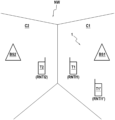
- FIG. 1 schematically represents a system of a telecommunications network, a base station and a terminal in accordance with the invention, in a particular embodiment
- FIGS. 2 and 3 schematically represent the hardware architecture of the base station and the terminal illustrated in FIG. 1 ;
- FIG. 4 represents, in the form of a block diagram, the main steps of a signaling method in accordance with the invention in a particular embodiment wherein it is implemented by the base station in FIG. 1 ;
- FIG. 5 represents, in the form of a block diagram, the main steps of a communication method in accordance with the invention in a particular embodiment wherein it is implemented by the terminal in FIG. 1 .
- FIG. 1 shows, in its environment, a system 1 of a cellular telecommunications network NW, in accordance with the invention, in a particular embodiment.
- the cellular telecommunications network NW is an LTE mobile network, as defined by 3GPP.
- Each cell of the network NW is controlled by a base station (or eNodeB) serving the various terminals (or UEs for User Equipments) attached to the cell.
- FIG. 1 two cells C 1 and C 2 of the cell network NW are represented in FIG. 1 , the cell C 1 being controlled by the base station BS 1 and the cell C 2 being controlled by the base station BS 2 .
- Each base station serves one or more terminals present in the cell(s) that it controls.
- a terminal T 1 and a terminal T 1 ′ are attached to the cell C 1 and served by the base station BS 1
- a terminal T 2 attached to the cell C 2 and served by the base station BS 2 .
- each terminal attached to a cell is allocated a temporary network identifier known as RNTI by the base station controlling this cell, in order to communicate over the network NW.
- this RNTI identifier is a dedicated identifier, i.e. reserved to the terminal and which identifies it uniquely on the cell to which it is attached.
- the base station BS 1 attributes a dedicated temporary network identifier RNTI1 to the terminal T 1 and a dedicated temporary network identifier RNTI1′ to the terminal and the base station BS 2 allocates a dedicated temporary network identifier RNTI2 to the terminal T 2 .
- the terminal T 1 is capable of interfering with communications on the network NW of the terminal T 1 ′ attached to the same cell as it, i.e. the cell C 1 (by creating MU-MIMO interference for example), as well as communications over the network NW of the terminal T 2 attached to the cell C 2 (intercellular interference).
- the terminal T 1 ′ and the terminal T 2 are the victims of interference generated by transmissions originating from the base station BS 1 and intended for terminal T 1 .
- a terminal can be an interferer terminal for certain terminals (i.e. the transmissions from the network toward this interferer terminal constitute interference for the communications established by these terminals), and undergo interference (i.e. be interfered on) generated by other terminals (i.e. by the transmissions from the network toward these other terminals).
- the system 1 comprises:
- the terminals T 1 , T 1 ′ and T 2 can be terminals of any kind capable of communicating over the LTE network NW, such as for example mobile phones, smartphones, laptop computers etc.
- the terminals T 1 , T 1 ′ and T 2 are all LTE terminals in accordance with the invention, each equipped with a non-linear receiver of MMSE-SIC type, or in other words a non-linear receiver employing a successive interference cancellation technique.
- Such receivers are known per se and will not be further described here: thus, by may of example, they may be non-linear receivers employing hard decision channel decoding, or non-linear receivers employing soft decision turbo (or iterative) channel decoding, as notably described in the contribution R1-090232, 3GPP TSG RAN WG1, of January 2009 entitled “Comparing performance, complexity and latency of SC-FDMA SIC and OFDM MLD”.
- these terminals have the hardware architecture of a computer, as illustrated in FIG. 2 .
- each terminal notably comprises a processor 3 , a read-only memory 4 , a random-access memory 5 , a non-volatile memory 6 and means 7 for communicating over the LTE telecommunications network NW, known per se.
- the read-only memory 4 of each terminal forms a storage medium in accordance with the invention, readable by the processor 3 and on which is stored a computer program including instructions for executing the steps of a communication method in accordance with the invention, the steps of which will be described later with reference to FIG. 5 in a particular embodiment.
- This computer program defines, in an equivalent way, software and functional modules of the terminals T 1 , T 1 ′ and T 2 capable of executing the various steps of the method of communication and of interacting with the components of the terminals described previously with reference to FIG.
- a module for receiving configuration messages originating from the upper layers of the network NW and more precisely from the radio resource management layer also known as RRC layer, containing an open RNTI temporary identifier and an additional code, a module for decoding a PDCCH physical channel using the open RNTI temporary identifier, a module for verifying that this PDCCH physical channel comprises the additional code and a module for using the transmission resources allocated in the PDCCH physical channel when the latter comprises the additional code.
- RRC layer radio resource management layer also known as RRC layer
- all terminals able to communicate over the network NW are not necessarily in accordance with the invention, in other words, configured so as to be able to decode the open temporary identifiers allocated by their respective base station in order to allow the other terminals to cancel the interference that they generate.
- T 1 is in accordance with the invention, and that the terminals T 1 ′ and T 2 are able to decode a PDCCH channel coded using an open RNTI temporary identifier allocated by the base station BS 1 to terminal T 1 , and to apply an interference cancellation method to the interfering signals emitted by the base station BS 1 intended for the terminal T 1 using the transmission parameters obtained by decoding the PDCCH channel emitted by the base station BS 1 over the cell C 1 .
- the base station BS 1 is in accordance with the invention.
- These communication means 12 in particular allow it to communicate first with the terminals attached to the cell C 1 and secondly with the base stations of the neighbor cells, such as for example with the base station BS 2 of the cell C 2 .
- the read-only memory 9 of the base station BS 1 forms a storage medium in accordance with the invention, readable by the processor 8 and on which is stored a computer program including instructions for executing the steps of a signaling method in accordance with the invention, the steps of which will be described later with reference to FIG. 4 in a particular embodiment.
- This computer program defines, in an equivalent way, software and functional modules of the base station capable of executing the various steps of the method of signaling and of interacting with the components of the base station BS 1 described previously with reference to FIG. 3 , such as notably a module for allocating to an interferer terminal (e.g. T 1 ), an open temporary identifier RNTI, shared by a predetermined number of interferer terminals attached to the cell C 1 , and a code making it possible to identify the interferer terminal among the plurality of interferer terminals, a module for publishing this open temporary network identifier to the terminals of cell C 1 and/or the base stations of the neighbor cells (e.g.
- an interferer terminal e.g. T 1
- an open temporary identifier RNTI shared by a predetermined number of interferer terminals attached to the cell C 1
- a code making it possible to identify the interferer terminal among the plurality of interferer terminals
- a module for publishing this open temporary network identifier to the terminals of cell C 1
- a module for sending at least one RRC signaling message to the interferer terminal comprising the open temporary network identifier and the code allocated to the interferer terminal a module for inserting the code into a field of a PDCCH physical channel allocating transmission resources to the interferer terminal, a module for encoding the PDCCH physical channel using the open RNTI identifier allocated to the interferer terminal, and a module for sending the encoded PDCCH physical channel over the cellular network NW.
- FIGS. 4 and 5 the main steps of a method for signaling and a method for communicating in accordance with the invention, in a particular embodiment wherein these steps are implemented respectively by the base station BS 1 and by the terminal T 1 in FIG. 1 .
- the terminal T 1 is an interferer terminal, in other words that it is capable of interfering with the communications established by other terminals over the network NW.
- the base station BS 1 selects, from among all the RNTI temporary identifiers available for the cell C 1 , a subset of so-called “open” RNTI identifiers, intended to be published to the neighbor cells and the terminals of cell C 1 (step E 10 in FIG. 4 ).
- the selected subset corresponds to a range comprising a limited number of contiguous RNTI identifiers, for example 1, 4, 8 or 16 identifiers.
- each open RNTI identifier selected is intended to be shared by a group of K terminals identified as potential interferer terminals by the base station BS 1 .
- the base station BS 1 publishes (i.e. broadcasts) the selected open RNTI identifiers, to the base stations of the neighbor cells of the cell C 1 and particularly to the base station BS 2 (step E 20 ).
- the term “publication” is understood to mean the fact of bearing the open RNTI temporary identifiers to the knowledge of other terminals, in other words making them public, so as to facilitate the decoding by these other terminals of the PDCCH physical channels associated with these identifiers (in other words, encoded with these identifiers), and thus determine the transmission parameters allocated to the terminals to which these open temporary network identifiers are allocated, in order to suppress the interference generated by them.
- This publication is done by the base station BS 1 via the sending of a signaling message containing the list of selected open RNTI identifiers.
- This signaling message can be emitted by the base station BS 1 to the base stations of the neighbor cells over the interface X2 of the LTE network NW, conditional on the definition of a new appropriate message.
- the interface X2 is known to those skilled in the art: its role is to allow the transport of data packets and items of control information between the base stations of the network NW. It is particularly defined in the 3GPP document 36.423.
- the base station BS 1 can emit the signaling message containing the list of selected open RNTI identifiers, over a connection of fiber point-to-point type established with the base stations of the neighbor cells (and in particular with the base station BS 2 ).
- the base station BS 1 transmits a signaling message containing the list of open RNTI identifiers of the cell C 1 to the terminals of the cells that it controls and which are neighbors of the cell C 1 .
- the base station BS 1 relies for example on the signaling managed by the RRC layer for managing the radio resources of the network.
- This RRC layer is notably defined in document 3GPP TS 36.331 entitled “Evolved Universal Terrestrial Radio Access (E-UTRA); Radio Resource Control (RRC); Protocol Specification”, Release 11, December 2012.
- the RRC signaling message sent by the base station BS 1 is emitted over a shared physical channel PDSCH. In this way, no network interface is necessary for this signaling.
- the selection of a range of contiguous open RNTI identifiers allows more spectrally efficient signaling. Specifically, to signal the list of open RNTI identifiers selected by the base station BS 1 , it suffices that the signaling message emitted by the base station BS 1 contains a number indicating the number of the first open RNTI identifier of the range, and of a number indicating the number of open RNTI identifiers selected by the base station BS 1 .
- the signaling message emitted by the base station BS 1 to the base stations of the neighbor cells contains each open RNTI identifier selected by the base station BS 1 and coded on 16 bits.
- the list of open RNTI identifiers selected by the base station BS 1 is received by the base stations of the neighbor cells, and notably by the base station BS 2 .
- the base station BS 2 (as well as the other base stations) then publishes in turn the list of open RNTI identifiers selected by the base station BS 1 , to the terminals attached to the cell C 2 , in a signaling message.
- This signaling message is for example a RRC signaling message emitted by the base station BS 2 over a shared physical channel PDSCH.
- the base station BS 1 also publishes the selected open RNTI identifiers to the mobile terminals of its cell C 1 , for example by sending an RRC signaling message.
- the base station BS 1 also allocates a dedicated temporary RNTI identifier to each terminal attached to its cell C 1 (step E 30 ).
- it allocates the temporary identifier RNTI1 to the terminal T 1 .
- This identifier RNTI1 is, unlike the open RNTI identifiers selected in step E 10 , reserved for the terminal T 1 , in other words, it uniquely identifies the terminal T 1 on the cell C 1 .
- the base station BS 1 can send to the terminal T 1 , PDCCH physical channels coded using this identifier RNTI1, to signal particularly to it the transmission parameters that it has allocated to it (notably including the modulation and coding scheme, the physical resource blocks PRB, the dedicated DMRS pilot sequence allocated) and the terminal T 1 can decode the PDCCH physical channels that are intended for it and are encoded using this identifier RNTI1 and use the transmission parameters contained in these PDCCH physical channels to communicate over the network NW.
- PDCCH physical channels coded using this identifier RNTI1 to signal particularly to it the transmission parameters that it has allocated to it (notably including the modulation and coding scheme, the physical resource blocks PRB, the dedicated DMRS pilot sequence allocated) and the terminal T 1 can decode the PDCCH physical channels that are intended for it and are encoded using this identifier RNTI1 and use the transmission parameters contained in these PDCCH physical channels to communicate over the network NW.
- the base station BS 1 determines that the terminal T 1 is capable of creating interference toward neighbor cells (i.e. the transmissions from the base station BS 1 towards the terminal T 1 are capable of interfering with the communications of the terminals of the neighbor cells), and particularly toward the terminals of the cell BS 2 (step E 40 ), for example because the terminal T 1 requests a radio resource-consuming service over a fairly long time period (e.g. stream broadcasting service) and will therefore occupy a wide bandwidth over a long time. In other words, it detects that the terminal T 1 is an interferer terminal in the sense of the invention.
- other criteria can be considered at the base station BS 1 for detecting that a terminal is capable of interfering with the communications of the terminals of the neighbor cells of cell C 1 (or even of cell C 1 ) such as for example the fact that the terminal is at the edge of the cell, etc.
- criteria are described in particular in the document WO 2010/108136.
- the base station BS 1 can detect that a terminal is capable of interfering with the communications of the terminals of the neighbor cells of the cell C 1 using an exchange of information with the base stations controlling these neighbor cells. This detection can be carried out in each TTI when the base stations communicate over a connection of point-to-point fiber type.
- the neighbor base station BS 2 can inform the base station BS 1 of the planned use of certain radio resources by the terminal T 2 in a future TTI, so that the base station BS 1 knows that if it uses these resources for the terminal T 1 in this future TTI, the transmission to the terminal T 1 will create intercellular interference for the terminal T 2 .
- the base station BS 1 allocates to the terminal T 1 an open RNTI identifier, denoted RNTIo1, chosen from among the open RNTI identifiers selected in step E 10 , and broadcast to the base stations of the neighbor cells to cell C 1 (step E 50 ).
- this identifier RNTIo1 is allocated to the terminal T 1 in addition to its dedicated temporary identifier RNTI1.
- the base station BS 1 also allocates to the terminal T 1 , in this step E 50 , an additional distinguishing code COD1, in order to be able to identify the terminal T 1 among the plurality of interferer terminals sharing the open identifier RNTIo1.
- this configuration message is an RRC signaling message managed by the RRC radio resource control (i.e. management) layer of the network.
- This RRC configuration message is received by the terminal T 1 (step F 20 in FIG. 5 ). From that point, the terminal T 1 must monitor, firstly the search space corresponding to its dedicated identifier RNTI1, and secondly, the search space corresponding to its open identifier RNTIo1: in other words, it must decode all the PDCCH channels emitted by the base station BS 1 and encoded either with the dedicated identifier RNTI1, or with the open identifier RNTIo1. Note however that only PDCCH channels containing the additional code COD1 are intended for the terminal T 1 .
- the base station can inform the terminal T 1 of the transmission parameters (and equivalently, the network resources) that it allocates to it (particularly the modulation and coding schemes MCS and the PRB blocks), in a PDCCH physical channel encoded with the open identifier RNTIo1 and transmitted over the search space associated with this open identifier RNTIo1.
- the base station BS 1 inserts into this PDCCH channel encoded using the open identifier RNTIo1, the additional code COD1 in a field of the DCI format of the PDCCH channel (step E 70 ).
- the code COD1 can be inserted into an unused field of the DCI format if such a field exists.
- the field “Modulation and coding scheme (or MCS)” of the DCI format 2, 2A, 2B, 2C or 2D defined in the document 3GPP IS 36.212 corresponding to the second MCS modulation and coding scheme normally intended for the second transport block can be used to insert the code COD1.
- MCS Modulation and coding scheme
- the number K of interferer terminals that can share a same open identifier results from a compromise between complexity, necessary signaling resources, and interference cancellation technique performance, while also ensuring that this number is compatible with the definition of the DCI format that can be used for the PDCCH physical channels.
- each PDCCH channel intended for an open RNTI identifier is preferably formed with a high number of elements or CCE (for Control Channel Element) (in an LTE network, according to the level of protection of the considered PDCCH channel, a PDCCH channel can generally be formed of 1, 2, 4 or 8 CCEs).
- CCE Control Channel Element
- the terminal T 1 monitors for each transmission time interval (ITT), the search space corresponding to the open identifier RNTIo1 (in addition to the search space corresponding to its dedicated identifier RNTI1).
- the terminal T 1 decodes this PDCCH control channel using the identifier RNTIo1, in a manner known per se (step F 40 ).
- the terminal T 1 verifies that the code COD1 is present in the PDCCH channel thus decoded (test step F 50 ), in the field of the DCI format provided for this purpose.
- step F 50 If the code COD1 is not present in this field (“no” reply to the test step F 50 ), this means that the PDCCH channel received is not intended for the terminal T 1 .
- the terminal T 1 therefore does not take into account the information contained in the PDCCH channel (and particularly the transmission parameters included in this channel) (step F 60 ).
- step F 70 uses the resources designated by these transmission parameters when't communicates over the network NW (step F 70 ).
- the cell C 2 serves the terminal T 2 , capable of implementing a MMSE-SIC receiver as previously described.
- the terminal T 2 has moreover been informed by the base station BS 2 of the list of open identifiers (containing particularly the open identifier RNTIo1) selected by the base station BS 1 and intended for the interferer terminals of the cell C 1 capable of interfering with the communications of other terminals (including in particular those of the cell C 2 ).
- the base station BS 2 of the list of open identifiers (containing particularly the open identifier RNTIo1) selected by the base station BS 1 and intended for the interferer terminals of the cell C 1 capable of interfering with the communications of other terminals (including in particular those of the cell C 2 ).
- the terminal T 2 decodes, using its dedicated temporary identifier RNTI2 (allocated by the base station BS 2 in a manner known per se, the PDCCH channels that are transmitted to it in the TTI over the search space associated with this identifier.
- the terminal T 2 detecting that data are intended for it in this TTI, attempts to decode the PDCCH channels that may have been transmitted by the base station BS 1 on the search spaces corresponding to the open identifiers of which it has been informed, and particularly over the search space corresponding to the identifier RNTIo1.
- this decoding advantageously allows the terminal T 2 to identify the transmission parameters allocated to the terminal T 1 over this TTI, and to determine if the resources used by the terminal T 1 to communicate over the network NW deduced from these parameters coincide or correspond (in part only or totally) with the resources that it uses itself to communicate.
- This decoding allows the terminal T 2 to determine whether or not the terminal T 1 is an interferer and if it must attempt to cancel the interference generated by T 1 using its MMSE-SIC receiver, taking into account the transmission parameters allocated to the terminal T 1 for this same TTI.
- the terminal T 2 can then, using the knowledge of these transmission parameters, decode the interfering signal of the terminal T 1 with success then cancel the corresponding interference which makes it possible to improve the quality of its radio link for the detection of the useful signal that is intended for it.
- the invention facilitates the application of interference cancellation techniques in the case where an intercellular interference exists between two terminals, and this with a reasonable complexity in terms of signaling.
- the field of the DCI format containing the code COD1 has no effect on the terminal 12 since it is not involved in the capacity of decoding the PDCCH channel by the terminal T 2 or in the specification of the transmission parameters of the terminal T 1 for which this PDCCH is intended.
- the terminal T 2 can thus receive a better instantaneous data rate in this TTI than if it had only employed one linear receiver.
- all the terminals of the cell C 1 do not necessarily consume enough resources to generate interference damaging to the communications of the terminal T 2 , and that therefore needs cancelling. Specifically, if the terminal T 2 is served on a high number of PRB resource blocks (for example 25) but is only interfered on by the transmission of one PRB resource block from the cell C 1 to the terminal 11 , this interference causes few damage and does not necessarily require the application of an MMSE-SIC receiver to reduce it.
- the terminals that do not need to receive a PDCCH channel decodable by other terminals can be constantly served on their dedicated RNTI identifier. These terminals can be advantageously configured not to have to search their PDCCH channel according to open temporary network identifiers, which makes it possible to save on their battery consumption.
- the example illustrated with reference to FIGS. 1 - 5 concerns the cancellation of intercellular interference between two terminals T 1 and 12 served by base stations BS 1 and BS 2 controlling separate neighbor cells C 1 and C 2 .
- the invention is also applicable in a context in which one seeks to cancel an interference of MU-MIMO type generated within one and the same cell (for example by the communications from the terminal T 1 on the communications of the terminal T 1 ′). Similar steps to those described previously for the cancellation of intercellular interference can then be employed, providing the publication of the list of open RNTI identifiers to the terminals attached to the cell C 1 (such as for example to the terminal T 1 ′).
- the invention is also applicable in a context in which both intercellular interference and MU-MIMO interference must be cancelled.
Landscapes
- Engineering & Computer Science (AREA)
- Computer Networks & Wireless Communication (AREA)
- Signal Processing (AREA)
- Mobile Radio Communication Systems (AREA)
Abstract
Description
-
- SU-MIMO interference (for Single User-Multiple Input Multiple Output) related to the use of multiple transmitting and receiving antennas, and which corresponds to the interference generated between MIMO data streams allocated to one and the same terminal;
- MU-MIMO interference (for Multiple User-Multiple Input Multiple Output) which corresponds to the interference generated between MIMO data streams allocated to different terminals; and
- Intercellular interference, generated between signals emitted by different cells and intended for different terminals.
-
- a step of allocating (i.e. attributing), to an interferer terminal attached to this cell and being identified by the base station as being capable of (i.e. likely to) interfering with at least one communication established by another terminal attached to this cell or to a neighbor cell:
- of a so-called open temporary network identifier, intended to be shared by a predetermined number of interferer terminals attached to the cell controlled by the base station; and
- of a code making it possible to identify the interferer terminal among this predetermined number of interferer terminals;
- a step of publishing this open temporary network identifier;
- a step of sending to the interferer terminal, in at least one configuration message, the open temporary network identifier and the code that are allocated to it; and
- a step of inserting this code, in a field of a physical control channel allocating resources for transmitting over the cellular network to the interferer terminal, this physical channel being encoded using the open temporary network identifier allocated to the interferer terminal and emitted over the cellular network.
- a step of allocating (i.e. attributing), to an interferer terminal attached to this cell and being identified by the base station as being capable of (i.e. likely to) interfering with at least one communication established by another terminal attached to this cell or to a neighbor cell:
-
- a module for allocating, to an interferer terminal attached to this cell and identified as being capable of interfering with at least one communication established by another terminal attached to said cell or to a neighbor cell:
- of a so-called open temporary network identifier, intended to be shared by a predetermined number of interferer terminals attached to the cell controlled by the base station; and
- of a code making it possible to identify the interferer terminal among this predetermined number of interferer terminals;
- a module for publishing this open temporary network identifier;
- a module for sending to the interferer terminal, in at least one configuration message, of the open temporary network identifier and the code allocated to the interferer terminal;
- a module for inserting this code, in a field of a physical control channel allocating resources for transmitting over the cellular network to the interferer terminal;
- a module for encoding this physical channel using the open temporary network identifier allocated to the interferer terminal; and
- a module for emitting this physical channel over the cellular network.
- a module for allocating, to an interferer terminal attached to this cell and identified as being capable of interfering with at least one communication established by another terminal attached to said cell or to a neighbor cell:
-
- the open temporary network identifier is an RNTI identifier;
- the physical control channel is a PDCCH channel; and
- the configuration message is an RRC (Radio Resource Control) signaling message.
-
- a step of receiving at least one configuration message originating from the base station, comprising a so-called open temporary network identifier published or intended to be published by the base station and a code allocated to the interferer terminal;
- a step of decoding a physical control channel allocating resources for transmitting over the cellular network using said open temporary network identifier;
- a step of verifying the presence of the code allocated to the interferer terminal in he decoded physical channel; and
- if the code is present in the decoded physical channel, a step of using the transmission resources allocated in this channel to communicate over the cellular network.
-
- a module for receiving at least one configuration message originating from the base station, comprising a so-called open temporary network identifier published or intended to be published by the base station and a code allocated to the terminal;
- a module for decoding a physical control channel allocating resources for transmitting over the cellular network using the open temporary network identifier;
- a module for verifying the presence of the code allocated to the terminal in the decoded physical channel; and
- a module, activated if the code is present in the decoded physical channel, for using the transmission resources allocated in this channel to communicate over the cellular network.
-
- a base station in accordance with the invention controlling at least one cell of the cellular telecommunications network;
- an interferer terminal in accordance with the invention attached to this cell; and
- a terminal interfered on by the transmission from the base station to this interferer terminal, this interfered terminal being attached to the cell of the interferer terminal or to a cell of the network neighbor of this cell, and being capable of implementing an interference cancellation technique using the open temporary network identifier allocated to the interferer terminal and published by the base station.
-
- at least one base station in accordance with the invention controlling at least one cell of the cellular telecommunications network. This base station is in the example considered here the base station BS1 that controls the cell C1;
- at least one interferer terminal attached to this cell, namely, in the example considered in
FIG. 1 , the terminal T1; and - at least one terminal interfered on by this interferer terminal, and attached to the cell of the interferer terminal or to a neighbor cell of the network: in the case here, two interfered terminals are considered, namely terminals T1′ and T2.
Claims (18)
Applications Claiming Priority (3)
| Application Number | Priority Date | Filing Date | Title |
|---|---|---|---|
| FR1352453A FR3003718A1 (en) | 2013-03-19 | 2013-03-19 | METHOD OF SIGNALING IN A CELLULAR TELECOMMUNICATIONS NETWORK |
| FR1352453 | 2013-03-19 | ||
| PCT/FR2014/050644 WO2014147345A1 (en) | 2013-03-19 | 2014-03-19 | Method for signalling in a cellular telecommunications network |
Publications (2)
| Publication Number | Publication Date |
|---|---|
| US20160286431A1 US20160286431A1 (en) | 2016-09-29 |
| US11653260B2 true US11653260B2 (en) | 2023-05-16 |
Family
ID=48979874
Family Applications (1)
| Application Number | Title | Priority Date | Filing Date |
|---|---|---|---|
| US14/778,567 Active 2035-04-08 US11653260B2 (en) | 2013-03-19 | 2014-03-19 | Method for signaling in a cellular telecommunications network |
Country Status (4)
| Country | Link |
|---|---|
| US (1) | US11653260B2 (en) |
| EP (1) | EP2976925B1 (en) |
| FR (1) | FR3003718A1 (en) |
| WO (1) | WO2014147345A1 (en) |
Families Citing this family (4)
| Publication number | Priority date | Publication date | Assignee | Title |
|---|---|---|---|---|
| FR3003719A1 (en) | 2013-03-19 | 2014-09-26 | France Telecom | METHOD OF SIGNALING IN A CELLULAR TELECOMMUNICATIONS NETWORK |
| CN106664153A (en) * | 2014-07-22 | 2017-05-10 | 株式会社Ntt都科摩 | Base station and user device |
| FR3080252A1 (en) * | 2018-04-11 | 2019-10-18 | Orange | METHODS AND DEVICES FOR MULTIPLE ATTACHMENT OF A MOBILE TERMINAL TO ACCESS POINTS IN SHARED RISK GROUPS |
| FR3122962A1 (en) * | 2021-05-12 | 2022-11-18 | Orange | Signaling information transmission method, receiving method, corresponding base station, terminal and computer program. |
Citations (11)
| Publication number | Priority date | Publication date | Assignee | Title |
|---|---|---|---|---|
| WO2009121025A2 (en) | 2008-03-27 | 2009-10-01 | Qualcomm Incorporated | Methods of sending control information for users sharing the same resource |
| US20100035621A1 (en) | 2007-03-15 | 2010-02-11 | Sung Duck Chun | Method for transmitting/receiving data in a mobile communication system |
| WO2010036006A2 (en) | 2008-09-24 | 2010-04-01 | Lg Electronics Inc. | Method of transmitting control signal in multi-cell cooperative wireless communication system |
| WO2010108136A1 (en) | 2009-03-20 | 2010-09-23 | Qualcomm Incorparated | Apparatus and methods for intercell interference cancellation via rnti |
| US20110044282A1 (en) * | 2008-08-13 | 2011-02-24 | Dong Youn Seo | Method and device for allocating identifiers to user equipment in cellular system |
| US20110124360A1 (en) | 2007-12-21 | 2011-05-26 | Telefonaktiebolaget L M Ericssson (Publ) | Methods and Arrangements in a Mobile Telecommunications Network |
| US20120243462A1 (en) | 2009-12-22 | 2012-09-27 | Fujitsu Limited | Transmission in a communication system using relay nodes |
| US20120317242A1 (en) * | 2010-01-05 | 2012-12-13 | Hongfei Du | Communication method for machine-type-communication and equipment thereof |
| US20130039202A1 (en) * | 2010-02-12 | 2013-02-14 | Panasonic Corporation | Component carrier (de)activation in communication systems using carrier aggregation |
| US20130107816A1 (en) * | 2011-10-28 | 2013-05-02 | Nokia Corporation | Allocating Control Data to User Equipment |
| US20160157277A1 (en) | 2013-03-19 | 2016-06-02 | Orange | A method for signaling in a cellular telecommunications network |
Family Cites Families (1)
| Publication number | Priority date | Publication date | Assignee | Title |
|---|---|---|---|---|
| US9277531B2 (en) * | 2012-02-01 | 2016-03-01 | Nokia Solutions And Networks Oy | Downlink inter-cell interference cancellation with cell aggregation coordinated multi-point |
-
2013
- 2013-03-19 FR FR1352453A patent/FR3003718A1/en not_active Withdrawn
-
2014
- 2014-03-19 EP EP14716896.7A patent/EP2976925B1/en active Active
- 2014-03-19 WO PCT/FR2014/050644 patent/WO2014147345A1/en not_active Ceased
- 2014-03-19 US US14/778,567 patent/US11653260B2/en active Active
Patent Citations (12)
| Publication number | Priority date | Publication date | Assignee | Title |
|---|---|---|---|---|
| US20100035621A1 (en) | 2007-03-15 | 2010-02-11 | Sung Duck Chun | Method for transmitting/receiving data in a mobile communication system |
| US20110124360A1 (en) | 2007-12-21 | 2011-05-26 | Telefonaktiebolaget L M Ericssson (Publ) | Methods and Arrangements in a Mobile Telecommunications Network |
| WO2009121025A2 (en) | 2008-03-27 | 2009-10-01 | Qualcomm Incorporated | Methods of sending control information for users sharing the same resource |
| US20110044282A1 (en) * | 2008-08-13 | 2011-02-24 | Dong Youn Seo | Method and device for allocating identifiers to user equipment in cellular system |
| WO2010036006A2 (en) | 2008-09-24 | 2010-04-01 | Lg Electronics Inc. | Method of transmitting control signal in multi-cell cooperative wireless communication system |
| WO2010108136A1 (en) | 2009-03-20 | 2010-09-23 | Qualcomm Incorparated | Apparatus and methods for intercell interference cancellation via rnti |
| US20100255852A1 (en) * | 2009-03-20 | 2010-10-07 | Qualcomm Incorporated | Apparatus and methods for intercell interference cancellation via rnti |
| US20120243462A1 (en) | 2009-12-22 | 2012-09-27 | Fujitsu Limited | Transmission in a communication system using relay nodes |
| US20120317242A1 (en) * | 2010-01-05 | 2012-12-13 | Hongfei Du | Communication method for machine-type-communication and equipment thereof |
| US20130039202A1 (en) * | 2010-02-12 | 2013-02-14 | Panasonic Corporation | Component carrier (de)activation in communication systems using carrier aggregation |
| US20130107816A1 (en) * | 2011-10-28 | 2013-05-02 | Nokia Corporation | Allocating Control Data to User Equipment |
| US20160157277A1 (en) | 2013-03-19 | 2016-06-02 | Orange | A method for signaling in a cellular telecommunications network |
Non-Patent Citations (8)
| Title |
|---|
| 3GPP, "Coordinated Multi-Point operation for LTE physical layer aspects", (Release 11), Document TR 36.819 v11.1.0; Dec. 2011; pp. 69. |
| 3GPP, "Evolved Universal Radio Access (E-UTRA): Physical Layer Procedures (Release 11)", Document TS 36.213 v11.0.0, Release 11, Sep. 2012, Section 9.1.1.; pp. 143. |
| 3GPP, "Evolved Universal Terrestrial Radio Access (E-UTRA); Multiplexing and channel coding", Document TS 36.212 v11.1.0, Release 11, Dec. 2012; pp. 82. |
| 3GPP, "Evolved Universal Terrestrial Radio Access (E-UTRA); Radio Resource Control (RRC); Protocol Specification", (Release 11), Document TS 36.331 v11.2.0, Release 11, Dec. 2012; pp. 340. |
| 3GPP, "Evolved Universal Terrestrial Radio Access Network (E-UTRAN); X2 application protocol (X2AP)" (Release 11), Document TS 36.423 v11.4.0, Mar. 2013; pp. 144. |
| International Search Report dated Jul. 25, 2014 for International Application No. PCT/FR2014/050634 filed Mar. 19, 2014, 5 pages. |
| International Search Report dated Jul. 25, 2014 for International Application No. PCT/FR2014/050644 filed Mar. 19, 2014, 5 pages. |
| NOKIA Siemens Networks, R1-090232: "Comparing performance, complexity and latency of SC-FDMA SIC and OFDM MLD", 3GPP TSG RAN WG1 Meeting, Ljublyana, Slovenia, Jan. 12-16, 2009 Agenda Item 12.1; pp. 14. |
Also Published As
| Publication number | Publication date |
|---|---|
| FR3003718A1 (en) | 2014-09-26 |
| EP2976925A1 (en) | 2016-01-27 |
| WO2014147345A1 (en) | 2014-09-25 |
| US20160286431A1 (en) | 2016-09-29 |
| EP2976925B1 (en) | 2017-05-03 |
Similar Documents
| Publication | Publication Date | Title |
|---|---|---|
| US9888502B2 (en) | Method for signaling in a cellular telecommunications network | |
| US10117130B2 (en) | Method for cancelling a data transmission of a neighboring cell | |
| CN103095444B (en) | Based on the method and apparatus of multi-user MIMO transmissions sending and receiving Downlink Control Information | |
| US11122645B2 (en) | Systems and methods for constellation superposition | |
| JP2023082031A (en) | Network signaling for network-assisted interference cancellation and suppression | |
| US10050692B2 (en) | Method and system of advanced interference cancellation on PDSCH at the UE | |
| JP6045606B2 (en) | LTE extensions for small packet transmission | |
| US20180019794A1 (en) | Systems and methods for downlink control information for multiple-user superposition transmission | |
| US10985863B2 (en) | Method and apparatus for transmitting transport block, and method and apparatus for receiving transport block | |
| US11444721B2 (en) | Data segmentation method, apparatus, and terminal | |
| CN105144816A (en) | A method for network-assisted codeword-level interference cancellation | |
| WO2016171062A1 (en) | Terminal device and base station device | |
| US11653260B2 (en) | Method for signaling in a cellular telecommunications network | |
| WO2016181861A1 (en) | Terminal device and base station device | |
| US20240243882A1 (en) | Transmission of signalling information | |
| CN106488572A (en) | The control information method of sending and receiving of the multiuser MIMO of supercomposed coding |
Legal Events
| Date | Code | Title | Description |
|---|---|---|---|
| AS | Assignment |
Owner name: ORANGE, FRANCE Free format text: ASSIGNMENT OF ASSIGNORS INTEREST;ASSIGNOR:HARDOUIN, ERIC;REEL/FRAME:043595/0794 Effective date: 20160623 |
|
| STPP | Information on status: patent application and granting procedure in general |
Free format text: FINAL REJECTION MAILED |
|
| STPP | Information on status: patent application and granting procedure in general |
Free format text: RESPONSE AFTER FINAL ACTION FORWARDED TO EXAMINER |
|
| STPP | Information on status: patent application and granting procedure in general |
Free format text: ADVISORY ACTION MAILED |
|
| STPP | Information on status: patent application and granting procedure in general |
Free format text: DOCKETED NEW CASE - READY FOR EXAMINATION |
|
| STPP | Information on status: patent application and granting procedure in general |
Free format text: NON FINAL ACTION MAILED |
|
| STPP | Information on status: patent application and granting procedure in general |
Free format text: RESPONSE TO NON-FINAL OFFICE ACTION ENTERED AND FORWARDED TO EXAMINER |
|
| STPP | Information on status: patent application and granting procedure in general |
Free format text: ADVISORY ACTION MAILED |
|
| STPP | Information on status: patent application and granting procedure in general |
Free format text: DOCKETED NEW CASE - READY FOR EXAMINATION |
|
| STPP | Information on status: patent application and granting procedure in general |
Free format text: RESPONSE TO NON-FINAL OFFICE ACTION ENTERED AND FORWARDED TO EXAMINER |
|
| STPP | Information on status: patent application and granting procedure in general |
Free format text: FINAL REJECTION MAILED |
|
| STPP | Information on status: patent application and granting procedure in general |
Free format text: RESPONSE AFTER FINAL ACTION FORWARDED TO EXAMINER |
|
| STPP | Information on status: patent application and granting procedure in general |
Free format text: ADVISORY ACTION MAILED |
|
| STPP | Information on status: patent application and granting procedure in general |
Free format text: DOCKETED NEW CASE - READY FOR EXAMINATION |
|
| STPP | Information on status: patent application and granting procedure in general |
Free format text: NON FINAL ACTION MAILED |
|
| STPP | Information on status: patent application and granting procedure in general |
Free format text: RESPONSE TO NON-FINAL OFFICE ACTION ENTERED AND FORWARDED TO EXAMINER |
|
| STPP | Information on status: patent application and granting procedure in general |
Free format text: FINAL REJECTION MAILED |
|
| STCV | Information on status: appeal procedure |
Free format text: NOTICE OF APPEAL FILED |
|
| STPP | Information on status: patent application and granting procedure in general |
Free format text: RESPONSE TO NON-FINAL OFFICE ACTION ENTERED AND FORWARDED TO EXAMINER |
|
| STCF | Information on status: patent grant |
Free format text: PATENTED CASE |