US11651234B2 - Method, device and system for estimating causality among observed variables - Google Patents
Method, device and system for estimating causality among observed variables Download PDFInfo
- Publication number
- US11651234B2 US11651234B2 US16/140,880 US201816140880A US11651234B2 US 11651234 B2 US11651234 B2 US 11651234B2 US 201816140880 A US201816140880 A US 201816140880A US 11651234 B2 US11651234 B2 US 11651234B2
- Authority
- US
- United States
- Prior art keywords
- observed variables
- causal
- observed
- causality
- fitting
- Prior art date
- Legal status (The legal status is an assumption and is not a legal conclusion. Google has not performed a legal analysis and makes no representation as to the accuracy of the status listed.)
- Active, expires
Links
Images





Classifications
-
- G—PHYSICS
- G06—COMPUTING OR CALCULATING; COUNTING
- G06N—COMPUTING ARRANGEMENTS BASED ON SPECIFIC COMPUTATIONAL MODELS
- G06N5/00—Computing arrangements using knowledge-based models
- G06N5/04—Inference or reasoning models
- G06N5/046—Forward inferencing; Production systems
-
- G—PHYSICS
- G06—COMPUTING OR CALCULATING; COUNTING
- G06N—COMPUTING ARRANGEMENTS BASED ON SPECIFIC COMPUTATIONAL MODELS
- G06N5/00—Computing arrangements using knowledge-based models
- G06N5/02—Knowledge representation; Symbolic representation
- G06N5/022—Knowledge engineering; Knowledge acquisition
-
- G—PHYSICS
- G06—COMPUTING OR CALCULATING; COUNTING
- G06N—COMPUTING ARRANGEMENTS BASED ON SPECIFIC COMPUTATIONAL MODELS
- G06N5/00—Computing arrangements using knowledge-based models
- G06N5/02—Knowledge representation; Symbolic representation
-
- G—PHYSICS
- G06—COMPUTING OR CALCULATING; COUNTING
- G06F—ELECTRIC DIGITAL DATA PROCESSING
- G06F16/00—Information retrieval; Database structures therefor; File system structures therefor
- G06F16/90—Details of database functions independent of the retrieved data types
- G06F16/901—Indexing; Data structures therefor; Storage structures
- G06F16/9024—Graphs; Linked lists
-
- G—PHYSICS
- G06—COMPUTING OR CALCULATING; COUNTING
- G06N—COMPUTING ARRANGEMENTS BASED ON SPECIFIC COMPUTATIONAL MODELS
- G06N20/00—Machine learning
-
- G—PHYSICS
- G06—COMPUTING OR CALCULATING; COUNTING
- G06N—COMPUTING ARRANGEMENTS BASED ON SPECIFIC COMPUTATIONAL MODELS
- G06N5/00—Computing arrangements using knowledge-based models
- G06N5/01—Dynamic search techniques; Heuristics; Dynamic trees; Branch-and-bound
-
- G—PHYSICS
- G06—COMPUTING OR CALCULATING; COUNTING
- G06F—ELECTRIC DIGITAL DATA PROCESSING
- G06F2216/00—Indexing scheme relating to additional aspects of information retrieval not explicitly covered by G06F16/00 and subgroups
- G06F2216/03—Data mining
-
- G—PHYSICS
- G06—COMPUTING OR CALCULATING; COUNTING
- G06N—COMPUTING ARRANGEMENTS BASED ON SPECIFIC COMPUTATIONAL MODELS
- G06N7/00—Computing arrangements based on specific mathematical models
- G06N7/01—Probabilistic graphical models, e.g. probabilistic networks
Definitions
- the present disclosure generally relates to the field of data mining, and more specifically, relates to a method, device and system for estimating causality among observed variables.
- the causal structure learning focuses on restoring automatically the complicated underlying operation mechanism of the system and reproducing the data generation procedure based on observed data.
- the causal structure learning technology has been already applied to multiple fields, such as pharmacy, manufacture, market analysis and the like, so as to have a deep insight into the essence of the system, further guide decision-making and create value.
- causal structure learning various types of models can be used, wherein the commonly used models includes, for example, structural equation model, Boolean satisfiablity causal model and Bayesian network causal model.
- the structural equation model is a popular method applied to the causal structure learning at present, and for example, a LiNGAM model, CAM model, ANM model and the like, which all belong to the structural equation model.
- this type of model relies on a heuristic method to learn causal sequence knowledge, thereby causing an accuracy loss of the causal structure learning.
- Boolean satisfiablity causal model is a new method of causal structure learning proposed in recent year, which accurately determines the causal structure based on Boolean logic reasoning.
- the type of method is constrained by the logic reasoning complexity problem, and cannot be applied to observe complicated causal structure learning with a higher observed variable dimension due to poor learning timeliness.
- the Bayesian network causal model is another method used widely.
- the legacy Bayesian causal learning supports a high accuracy solution of the causal structure using an accurate reasoning algorithm.
- the legacy Bayesian network causal model is only suitable for the causality learning with an intermediate or low dimension, but hardly adapted to complicated causal structure learning with a high dimension.
- an additional algorithm is often required to accelerate the reasoning procedure.
- the solution includes first receiving observation data, then modeling a sparse causal structure based on fitting inconsistencies when fitting is performed using observed variables and a sparse constraint, and performing causal reasoning using an A* Lasso search. Besides, by setting a threshold value of a number of causal sequences, the search space of an optimal causal sequence search can be narrowed and the causal reasoning can be accelerated.
- the existing causal modeling methods are very sensitive to estimation errors of various observed variables, and the accuracy of the causal structure learning is remarkably reduced when there is a big deviation in value magnitudes of the observed variables or there is an error in estimation of the variables.
- the existing reasoning algorithm is temporally complicated, being unable to support complicated causal structure learning with a high observed variable dimension.
- the present disclosure provides a method, device and system for estimating causality among observed variables, so as to eliminate or alleviate at least partly the problems in the prior art.
- a causality objective function for the plurality of observed variables is determined, based on fitting inconsistencies when fitting is performed using the observed variables and a sparse constraint of a causal network structure of the observed variables.
- the fitting inconsistencies are adjusted based on weighting factors of the observed variables, and a weighting factor of an observed variable indicates a minimum underestimate value of cost required for fitting a target variable using all other observed variables than the observed variable.
- the causality among the plurality of observed variables is estimated by using the observations data to optimally solve the causality objective function for the plurality of observed variables through sparse causal reasoning under a directed acyclic graph constraint.
- a device for estimating causality among observed variables can comprise: an objective function determining module and a causal reasoning module.
- the objective function determining module is configured for, in response to receiving observation data of a plurality of observed variables, determining a causality objective function for the plurality of observed variables, based on fitting inconsistencies when fitting is performed using the observed variables and a sparse constraint for a causal network structure of the observed variables.
- the fitting inconsistencies are adjusted based on weighting factors of the observed variables, wherein a weighting factor of an observed variable indicates a minimum underestimate value of cost required for fitting a target variable using all other observed variables than the observed variable.
- the causal reasoning module is configured for estimating the causality among the plurality of observed variables by using the observations data to optimally solve the causality objective function for the plurality of observed variables through sparse causal reasoning under a directed acyclic graph constraint.
- a system for estimating causality among observed variables can comprise: a processor and a memory having one or more computer program codes stored therein, which, when executed by the processor, causes the processor to perform steps of the method in accordance with the first aspect of the present disclosure.
- a computer readable storage medium having computer program codes stored therein, which, when executed by a processor, causes the computer device to perform steps of the method in accordance with the first aspect of the present disclosure.
- a computer program product having computer program codes stored thereon, which, when loaded to a computer device, causes the computer device to perform steps of the method in accordance with the first aspect of the present disclosure.
- a difference among value magnitudes of observed variables is remarkably decreased and thus a sensitivity caused by an observed variable estimation error can be reduced.
- a search space cutting technology based on a variable group sequence relationship can be used to further cut the search space, thereby solving the optimization problem more quickly.
- FIG. 1 schematically illustrates a solution of estimating causality in the prior art
- FIG. 2 schematically illustrates a flowchart of a method for estimating causality among observed variables according to an embodiment of the present disclosure
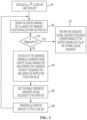
- FIG. 3 schematically illustrates a flowchart of a method for sparse causality reasoning according to an embodiment of the present disclosure
- FIG. 4 schematically illustrates a flowchart of a method for sparse causality reasoning according to another embodiment of the present disclosure
- FIG. 5 schematically illustrates a flowchart of a method for generating a variable group sequence relationship according to an embodiment of the present disclosure
- FIGS. 6 A to 6 C schematically illustrate an example parent relationship diagram, strongly connected components and a new directed acyclic graph in a procedure of generating a variable group sequence relationship according to an embodiment of the present disclosure
- FIG. 7 schematically illustrates a flowchart of a device for estimating causality among observed variables according to an embodiment of the present disclosure.
- FIG. 8 schematically illustrates a diagram of a system for estimating causality among observed variables according to an embodiment of the present disclosure.
- the terms “include/comprise/contain” and its variants are to be read as open-ended terms, which mean “include/comprise/contain, but not limited thereto.”
- the term “based on” is to be read as “based at least in part on.”
- the term “an embodiment” is to be read as “at least one example embodiment;” and the term “another embodiment” is to be read as “at least one further embodiment.” Other definitions of terms would be included hereinafter.
- the existing causal modeling method is quite sensitive to estimation errors of different observations variables, and an accuracy of causal structure learning is significantly reduced when there is a big deviation in the value magnitudes of the observed variables or there is an error for variable estimation.
- the existing reasoning algorithms are unable to support complicated causal structure learning with a high observed variable dimension, due to high time complexity thereof.
- a novel method, device and system for estimating causality so as to at least partly alleviate the above problem.
- it is proposed to adjust, using weighting factors of observed variables, fitting inconsistencies when fitting is performed using observed variables, wherein a weighting factor of an observed variable indicates a minimum underestimate value of cost required for fitting a target variable using all other observed variables than the observed variable.
- the sensitivity caused by the error of the observed variable estimation is reduced accordingly.
- a novel causal reasoning procedure is also proposed based thereon so as to solve the objective function of the observed variables, and a new search space cutting method based on a variable group sequence relationship is also provided to accelerate the causal reasoning procedure.
- FIG. 2 schematically illustrates a flowchart of a method of estimating causality among observed variables according to one embodiment of the present disclosure.
- a causality objective function for the plurality of observed variables is determined based on fitting inconsistencies when fitting is performed using the observed variables and a sparse constraint for a causality network structure of the observed variables.
- the fitting inconsistencies are adjusted based on weighting factors of the observed variables, wherein a weight factor of an observed variable indicates a minimum underestimate value of cost required for fitting a target variable using all other observed variables than the observed variable.
- An observation database can be set, which stores therein system observation data X, X ⁇ R N ⁇ D , where X is a matrix of N*D, N is a number of observation samples, and D is a dimension of the observed variable or a number of observed variables.
- Data in the observation database may be data from a third party or data collected in other manners.
- the data can be pre-processed in advance, by preprocessing such as integration, data reduction, noise reduction, and the like, of the original data. These preprocessing operations are known in the present field, which will not be elaborated herein.
- a causality objective function for the plurality of observed variables can be configured, based on fitting inconsistencies when fitting is performed using observed variables and a sparse constraint for a causality network structure of the observed variables.
- the fitting inconsistencies are adjusted using weighting factors of observed variables (which may be also called as variable weighting factors for short), so as to adjust the magnitudes of the fitting inconsistencies into a range of comparable values, thereby lowering the sensitivity caused by the estimation error.
- An example causality objective function is given below, in which robust modeling is performed for a sparse causality structure using a log likelihood, variable weighting factors and L0 sparse constraint of the observation data.
- w j min ⁇ j , S ⁇ ( ⁇ j ) ⁇ V ⁇ ⁇ ⁇ ⁇ v j ⁇ ⁇ ⁇ x j - x - j ⁇ ⁇ j ⁇ 2 2 + ⁇ j ′ ⁇ ⁇ ⁇ j ⁇ 0 ( Equation ⁇ ⁇ 2 ) the first item in the equation is fitting inconsistency adjusted using the variable weighting factor w j , and the second item is a sparse constraint for a causal structure network characterizing causality among observed variables, where, x j ⁇ R N is a vector comprised of N observation values for describing an observed variable X j ; x ⁇ j ⁇ R N ⁇ (D ⁇ 1) indicates all data in the observation data, except the X j variable, and each column in the matrix corresponds to a respective variable X 1 , .
- ⁇ j ⁇ R D ⁇ 1 is a parameter to be estimated for describing causality strength between the variable X 3 and other variables;
- ⁇ A ⁇ 2 2 indicates squaring an L2 norm of a vector A;
- ⁇ A ⁇ 0 indicates an L0 norm of a vector A;
- the constraint G ⁇ DAG is used for constraining a causal network structure as a directed acyclic graph;
- ⁇ j is a hyperparameter for setting a sparse constraint strength when causal estimation is performed for the observed variable X j ;
- w j is a hyperparameter which is a variable weighting factor for reducing sensitivity to estimation error of the observed variable X j .
- the fitting inconsistency is adjusted using the variable weighting factor w j , and specifically, a division operation is performed for the original fitting inconsistency and the variable weighting factor.
- adjustment can also be performed in other similar manners so long as a similar effect can be obtained.
- the computing of the variable weighting factor is performed using a structure similar to the original objective function (an objective function without variable weighting factor adjustment) to compute a minimum underestimate value of cost required for fitting a target variable using all other variables in a case of not considering the variable x j , but the directed acyclic graph constraint is not used in computing the variable weighting factor, so as to obtain the underestimate value of the cost.
- the variable weighting factor can be determined in other similar manner so long as the similar effect can be achieved.
- variable weighting factor w j By utilizing the variable weighting factor w j , fitting inconsistencies can be converted to have comparable magnitudes, so as to eliminate the sensitivity of the objective function caused by the variable estimation error so that it is more robust.
- the L0 sparse constraint is used therein.
- the present invention is not limited thereto, and in practice it is also possible to use an L1 sparse constraint in the objective function (1).
- the L1 sparse constraint when implementing dimensionality reduction, not only removes factors not related to the target, but also probably removes factors related to the target, thus affecting the accuracy of the sparse dimensionality reduction; in contrast, the L0 sparse constraint can correct the deficiency.
- step 202 the causality among the plurality of observed variables is estimated by optimally solving the causality objective function for the plurality of observed variables under the directed acyclic graph constraint through sparse causal reasoning with the observation data.
- a legacy method can be employed to convert it into an optimal causal sequence recursive solving problem.
- the converted recursive problem can be described as follows:
- the present disclosure extends the legacy A* search algorithm and provides a new extended A* search algorithm.
- the extended A* search algorithm is also referred to as an A* FoBa algorithm for searching an optimal causal sequence generation path in a causal sequence diagram space, herein.
- the h( ) function should satisfy two characteristics: consistency and admissibility.
- Q s ) is true, for any two arbitrary nodes Q s and Q s ′, Q s ′ [Q s ,x j ].
- the admissibility means that the estimation h(Q s ) of the cost required from the current node Q s to the target node should be an underestimation of the real cost.
- Equation (6) it can be seen from the Equation (6) that, in the A* FoBa search algorithm, the h function and the g function are different from those in the legacy A* search algorithm, and determine a cost consumed from a starting node to the current node (g function) and a predicted cost from the current node to the target node (h function), based on the fitting inconsistencies adjusted by variable weighting factors and the sparse constraint for the causal network structure of the observed variables.
- the causal sequence set CLOSE is provided for storing a set of sorted sequences based on which new candidate causal sequences are already generated, the set of sorted sequences can be initialized as an empty set during initialization.
- the sorted variable set Q s is a set of sorted variables, and can be initialized as an empty set during initialization.
- step 302 the sorted variable set Q s with the minimum ⁇ function value is extracted from the OPEN set, and it is determined in step 303 whether the h function of Q s is 0 or not, i.e., whether a path for reaching the target node has been found. If it is 0, the candidate causal sequence corresponding to the minimum ⁇ function value is returned as the optimal causal sequence; otherwise, the method goes to step 304 . For an initial execution, there is no sorted variable set in the OPEN set, and at this time, the method goes to step 304 to generate a new set of sorted variables.
- a new sorted causal set and a respective candidate causal sequence can be generated and a respective f(Q s ′) can be learned.
- step 306 the Q s having the minimum ⁇ function value extracted previously is transferred from the OPEN set to the CLOSE set, i.e., the Q s and its related information are removed from the OPEN set and added to the CLOSE set.
- the method jumps to step 302 for continuing execution.
- steps 301 to 305 can be repeated until the sorted variable set with the h function being 0 is obtained, and the candidate causal sequence corresponding thereto is returned as the optimal causal sequence.
- the OPEN set is empty at an initial execution, and at this time, new sorted observed variable sets ⁇ v 1 ⁇ , ⁇ v 2 ⁇ and ⁇ v 3 ⁇ are generated for the respective observed variables v 1 , v 2 and v 3 , so as to obtain respective candidate causal sequences and learning the respective f(Q s ′).
- the generated candidate causal sequences will be placed into the OPEN set.
- the sorted variable set with the minimum ⁇ function value for example ⁇ v 2 ⁇
- the h function value thereof is determined, which is not 0 at this time, and then for example, two sorted sets ⁇ v 1 , v 2 ⁇ and ⁇ v 2 , v 3 ⁇ and respective candidate causal sequences v 2 , v 1 and v 2 , v 3 , as well as respective f(Q s ′) are generated.
- ⁇ v 2 ⁇ and its related information are removed from the OPEN set and placed into the CLOSE set.
- a sequence with the minimum ⁇ function for example ⁇ v 2 , v 3 ⁇ , is further selected from the OPEN set, the sorted set ⁇ v 1 , v 2 , v 3 ⁇ and the respective candidate causal sequence v 2 , v 3 , v 1 , as well as the respective f(Q s ′) are further generated, and ⁇ v 2 , v 3 ⁇ and its related information are transferred from the OPEN set to the CLOSET set.
- a sequence with the minimum ⁇ function is further selected, it is ⁇ v 1 , v 2 , v 3 ⁇ at this time and its h function is zero.
- the respective candidate causal sequence v 2 , v 3 , v 1 can be returned as the optimal causal sequence, so as to complete the search procedure.
- search space cutting can be used in the search procedure of the iterative operation to accelerate the sparse causality reasoning.
- search space cutting based on a threshold value in the prior art
- a search space cutting based on a variable group sequence relationship in the present disclose.
- the variable group sequence relationship G 1 G 2 . . . G k is introduced and the sequence diagram search space is cut with the variable group sequence relationship.
- FIG. 4 illustrates an example flowchart of an A*FoBa search method in a case of using search space cutting.
- steps 401 to 407 in FIG. 4 are identical to steps 301 to 307 in FIG. 3 and thus will not be elaborated herein; their difference lies in adding, between steps 404 and 405 , a step 408 of search space cutting based on a variable group sequence relationship.
- the candidate causal sequence ⁇ Qs′ is further checked in step 408 using the variable group sequence relationship, to determine whether it is conflicted with the variable group sequence relationship.
- step 405 the newly generated candidate causal sequence is added to the OPEN set.
- the method skips over step 405 and perform step 406 directly. In this manner, the search space can be cut to accelerate the optimum solving procedure.
- variable group sequence relationship can be acquired in various manners.
- the variable group relationship can also be acquired through automatic learning on the observation data. An example method of automatically learning variable group sequence relationship will be described below with reference to FIG. 5 .
- step 501 for each observed variable v i (i ⁇ 1, . . . , D ⁇ ), its potential optimal parent node set POP i can be acquired.
- Various methods can be used to acquire the potential optimal parent node set of each observed variable.
- the legacy A* search sparse regression algorithm, A* Lasso search algorithm, and the like can be used.
- the A* FoBa sparse regression algorithm as provided in the present disclosure can also be used to acquire the set.
- the specific manner of acquiring the optimal parent node set is known in the art, which will be not elaborated herein.
- a parent relationship diagram is generated based on the optimal parent node set ⁇ POPS 1 , . . . , POPS D ⁇ acquired in step 501 .
- each observed variable can be converted into a node in the diagram, and for each observed variable V p ⁇ POPS i , an edge directed from V p to V i can be generated to describe that V p is a potential parent node of V i .
- FIG. 6 A illustrates an example of a parent relationship diagram according to an embodiment of the present disclosure, in which 6 variables are involved.
- the strongly connected component is a set of nodes that can form a loop circuit and cannot form a loop circuit with other nodes or strongly connected components.
- FIG. 6 B schematically illustrates strongly connected components SCC 1 and SCC 2 extracted from the parent relationship diagram as illustrated in FIG. 6 A .
- step 504 the parent relationship diagram in step 502 is converted into a new directed acyclic graph G new , based on the generated strongly connected components SSC.
- An example method includes converting each strongly connected component SSC i into a new node N i , and if in the parent relationship diagram, there is any node in the SSC i directed to the node in the SSC j , an edge directed from N i to N j is added to the G new .
- FIG. 6 C illustrates a new directed acyclic graph generated based on the strongly connected components in FIG. 6 B .
- the two strongly connected components SSC 1 and SSC 2 in FIG. 6 B are converted to two new nodes N 1 and N 2 , respectively.
- step 505 strongly connected components of the directed acyclic graph are extracted, and its sequence relationship is taken as the variable group sequence relationship.
- SCC 1 SCC 2 can be obtained for the new directed acyclic graph as illustrated in FIG. 6 C .
- variable group sequence relationship for performing search space cutting can be obtained.
- present invention is not limited thereto, and any other manner capable of obtaining the variable group sequence relationship is also feasible.
- the search space can be cut by using a space cutting technology based on a variable group sequence relationship to accelerate the solving of the optimization problem.
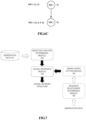
- FIG. 7 illustrates a block diagram of an example device 700 for estimating causality among observed variables according to the present disclosure.
- the device 700 includes an objective function determining module 702 and a causal reasoning module 703 .
- the objective function determining module 702 can be configured, in response to receiving observation data of an observed variable, to determine a causality objective function for the plurality of observed variables, based on fitting inconsistencies when fitting is performed using the observed variables and a sparse constraint for a causal network structure of the observed variables.
- the fitting inconsistencies are adjusted based on weighting factors of the observed variables, and a weighting factor of an observed variable indicates a minimum underestimate value of cost required for fitting a target variable using all other observed variables than the observed variable.
- An observation database 701 can be set, which stores therein observation data X, X ⁇ R N ⁇ D , wherein X indicates a matrix of N*D, N indicates a number of observation samples, and D indicates a dimension of the observed variables or a number of observed variables.
- Data in the observation database may be data from a third party or data collected in other manners. Moreover, the data can be preprocessed data.
- the causal reasoning module 703 is configured to estimate causality among the plurality of observed variables by using the observation data to optimally solve the causality objective function for the plurality of observed variables through sparse causal reasoning under a directed acyclic graph constraint.
- the causal reasoning module 703 is configured to convert sparse causal reasoning for a variable model of the plurality of observed variables into an optimal causal sequence recursive solving problem.
- the causal reasoning module 703 can be configured to determine a cost consumed from a starting node to the current node (a value of g function) and a predicted cost from the current node to a target node (a value of h function), based on the adjusted fitting inconsistencies and a sparse constraint for a causal network structure of the observed variables.
- a cost consumed from a starting node to the current node a value of g function
- a predicted cost from the current node to a target node a value of h function
- the sparse constraint may be an L0 sparse constraint.
- the device 700 can further include a search space cutting module 704 which is configured, in a procedure of the optimal causal sequence recursive solving, to determine whether a new candidate causal sequence generated is conflicted with a predetermined variable group sequence relationship, and to discard the generated new candidate causal sequence if it is determined there is a conflict.
- search space cutting one may refer to the above description with reference to FIG. 4 .
- the predetermined variable group sequence relationship may be given by an expert. In another embodiment of the present disclosure, the predetermined variable group sequence relationship can be automatically determined based on observation data.
- the device 700 can further include a sequence relationship determining module 705 .
- the sequence relationship determining module 705 can be configured to automatically determine the predetermined variable group sequence relationship by: for each of the observed variables, obtaining a potential optimal parent node set thereof; generating a parent relationship graph based on the acquired optimal parent node set; extracting strongly connected components from the parent relationship graph; converting the parent relationship graph into a new directed acyclic graph by converting each of the strongly connected components into a new node and adding a respective edge between the respective new nodes when two strongly connected components are connected in the parent relationship graph; and extracting a sequence relationship between strongly connected components in the directed acyclic graph as the predetermined variable group sequence relationship.
- the variable group sequence relationship For automatically determining the variable group sequence relationship, one may refer to the above description with reference to FIG. 5 .
- FIG. 8 schematically illustrates a diagram of a system for estimating causality among observed variables according to an embodiment of the present disclosure.
- a system for implementing causality estimation of the present invention will be described below with reference to FIG. 8 .
- the computer system as illustrated in FIG. 8 includes a central processing unit (CPU) 801 , a random access memory (RAM) 802 , a read-only memory (ROM) 803 , a system bus 804 , a hard disk controller 805 , a keyboard controller 806 , a serial interface controller 804 , a parallel interface controller 808 , a display controller 809 , a hard disk 810 , a keyboard 811 , a serial external device 812 , a parallel external device 813 and a display 814 .
- CPU central processing unit
- RAM random access memory
- ROM read-only memory
- system bus 804 a hard disk controller 805 , a keyboard controller 806 , a serial interface controller 804 , a parallel interface controller 808 , a display controller 809 , a hard disk 810 , a keyboard 811 , a serial external device 812 , a parallel external device 813 and a display 814 .
- the CPU 801 connected with the system bus 804 are the CPU 801 , the RAM 802 , the ROM 803 , the hard disk controller 805 , the keyboard controller 806 , the serial interface controller 807 , the parallel interface controller 808 and the display controller 809 .
- the hard disk 810 is connected to the hard disk controller 805
- the keyboard 811 is connected to the keyboard controller 806
- the serial external device 812 is connected to the serial interface controller 807
- the parallel external device 813 is connected to the parallel interface controller 808
- the display 814 is connected to the display controller 809 .
- the memory can store one or more codes therein which, when executed by the computer, causes the CPU to perform steps of the method as proposed in the embodiments of the present disclosure, for example those embodiments as described above with reference to FIGS. 2 to 6 .
- FIG. 8 the structural block diagram as illustrated in FIG. 8 is merely provided as an example, rather than limitation on the present disclosure. In some cases, some devices can be added or reduced therefrom according to requirements.
- the embodiments of the present disclosure can be implemented by software, hardware or a combination of software and hardware.
- the hardware portion can be implemented using a dedicated logic; and the software portion can be stored in the memory and executed by an appropriate instruction executing system, for example a microprocessor or dedicated design hardware.
- a computer executable instruction and/or a control code contained in the processor can be implemented using a computer executable instruction and/or a control code contained in the processor, and for example, such code is provided on a carrier medium such as a disk, a CD or DVD-ROM, a programmable memory such as a read only memory (firmware), or a data carrier such as an optical or electronic signal carrier.
- a carrier medium such as a disk, a CD or DVD-ROM, a programmable memory such as a read only memory (firmware), or a data carrier such as an optical or electronic signal carrier.
- the device and components thereof in the present embodiment can be implemented by a hardware circuit such as a large-scale integrated circuit or gate array, a semiconductor such as a logic chip, transistor and the like, or a programmable hardware device such as a field programmable gate array, programmable logic device and the like, or can be implemented by software executed by various types of processors, or can be implemented by a combination of the above hardware circuit and software, for example firmware.
- a hardware circuit such as a large-scale integrated circuit or gate array, a semiconductor such as a logic chip, transistor and the like, or a programmable hardware device such as a field programmable gate array, programmable logic device and the like, or can be implemented by software executed by various types of processors, or can be implemented by a combination of the above hardware circuit and software, for example firmware.
Landscapes
- Engineering & Computer Science (AREA)
- Theoretical Computer Science (AREA)
- General Engineering & Computer Science (AREA)
- Software Systems (AREA)
- Data Mining & Analysis (AREA)
- Physics & Mathematics (AREA)
- General Physics & Mathematics (AREA)
- Evolutionary Computation (AREA)
- Computing Systems (AREA)
- Mathematical Physics (AREA)
- Artificial Intelligence (AREA)
- Computational Linguistics (AREA)
- Databases & Information Systems (AREA)
- Computer Vision & Pattern Recognition (AREA)
- Medical Informatics (AREA)
- Management, Administration, Business Operations System, And Electronic Commerce (AREA)
Abstract
Description
the first item in the equation is fitting inconsistency adjusted using the variable weighting factor wj, and the second item is a sparse constraint for a causal structure network characterizing causality among observed variables, where,
xj∈RN is a vector comprised of N observation values for describing an observed variable Xj;
x−j∈RN×(D−1) indicates all data in the observation data, except the Xj variable, and each column in the matrix corresponds to a respective variable X1, . . . , Xj−1, Xj+1, . . . , XD;
βj∈RD−1 is a parameter to be estimated for describing causality strength between the variable X3 and other variables;
∥A∥2 2 indicates squaring an L2 norm of a vector A;
∥A∥0 indicates an L0 norm of a vector A;
the constraint G∈DAG is used for constraining a causal network structure as a directed acyclic graph;
λj is a hyperparameter for setting a sparse constraint strength when causal estimation is performed for the observed variable Xj; and
wj is a hyperparameter which is a variable weighting factor for reducing sensitivity to estimation error of the observed variable Xj.
wherein, V indicates a set of all observed variables, U indicates a set of observed variables having not been sorted, and π1 U indicates a variable belonging to the variable set U and ranked first in a causal sequence. S(βi) indicates a support set of vectors βj.
ƒ(Q s)=g(Q s)+h(Q s) (Equation 5)
wherein, g(Qs) indicates a cost consumed from a starting node via the node Qs to the current node, and h(Qs) indicates a predicted cost from the current node to the target node, and wherein g(Qs) and h(Qs) can be computed through the following equation, respectively:
OPEN={(Q s,ƒ(Q s),ΠQ
wherein Qs is a set of sorted variables, ƒ(Qs) is denoted by the above equation (5), and ΠQ
ƒ(Q s′)=g(Q s′)+h(Q s′)=g(Q s)+h(Q s)+FoBaScore(v|Q s)−FoBaScore(v|V\{v}) (Equation 9)
OPEN={(Q s′,ƒ(Q s′),ΠQs′=[ Q s ,v]}

Claims (13)
Applications Claiming Priority (2)
| Application Number | Priority Date | Filing Date | Title |
|---|---|---|---|
| CN201710917705.3 | 2017-09-30 | ||
| CN201710917705.3A CN109598346A (en) | 2017-09-30 | 2017-09-30 | For estimating the causal methods, devices and systems between observational variable |
Publications (2)
| Publication Number | Publication Date |
|---|---|
| US20190102680A1 US20190102680A1 (en) | 2019-04-04 |
| US11651234B2 true US11651234B2 (en) | 2023-05-16 |
Family
ID=65896155
Family Applications (1)
| Application Number | Title | Priority Date | Filing Date |
|---|---|---|---|
| US16/140,880 Active 2041-12-23 US11651234B2 (en) | 2017-09-30 | 2018-09-25 | Method, device and system for estimating causality among observed variables |
Country Status (2)
| Country | Link |
|---|---|
| US (1) | US11651234B2 (en) |
| CN (1) | CN109598346A (en) |
Cited By (1)
| Publication number | Priority date | Publication date | Assignee | Title |
|---|---|---|---|---|
| US20230273932A1 (en) * | 2022-02-25 | 2023-08-31 | Beijing Baidu Netcom Science Technology Co., Ltd. | Method for discovering causality from data, electronic device and storage medium |
Families Citing this family (20)
| Publication number | Priority date | Publication date | Assignee | Title |
|---|---|---|---|---|
| US20210056449A1 (en) * | 2018-05-16 | 2021-02-25 | Nec Corporation | Causal relation estimating device, causal relation estimating method, and causal relation estimating program |
| US11232175B2 (en) * | 2019-03-28 | 2022-01-25 | Nec Corporation | Method, system, and computer program product for determining causality |
| CN111861519B (en) * | 2019-04-24 | 2024-10-29 | 日本电气株式会社 | Method, apparatus and medium for data processing |
| CN110084376B (en) * | 2019-04-30 | 2021-05-14 | 成都四方伟业软件股份有限公司 | Method and device for automatically separating data into boxes |
| US11861508B2 (en) | 2019-06-06 | 2024-01-02 | Nec Corporation | Causal analysis |
| US11415975B2 (en) * | 2019-09-09 | 2022-08-16 | General Electric Company | Deep causality learning for event diagnosis on industrial time-series data |
| US11973658B2 (en) * | 2020-06-03 | 2024-04-30 | Nippon Telegraph And Telephone Corporation | Model construction apparatus, estimation apparatus, model construction method, estimation method and program |
| US20220092473A1 (en) * | 2020-09-18 | 2022-03-24 | Samsung Display Co., Ltd. | System and method for performing tree-based multimodal regression |
| CN114080609A (en) * | 2020-11-18 | 2022-02-22 | 阿里巴巴集团控股有限公司 | Nonlinear causal modeling based on coding knowledge |
| CN114580388A (en) * | 2020-12-01 | 2022-06-03 | 腾讯科技(深圳)有限公司 | Data processing method, object prediction method, related device and storage medium |
| JP7706939B2 (en) * | 2021-05-31 | 2025-07-14 | Astemo株式会社 | Improvement system, improvement method |
| CN113723611B (en) * | 2021-09-07 | 2024-03-29 | 平安银行股份有限公司 | Business factor generation method, device, equipment and medium based on causal inference |
| CN114186096B (en) * | 2021-12-10 | 2024-11-22 | 北京达佳互联信息技术有限公司 | Information processing method and device |
| CN115034379B (en) * | 2022-05-13 | 2025-12-23 | 华为技术有限公司 | Causal relationship determination method and related equipment |
| CN114971345B (en) * | 2022-06-08 | 2023-04-18 | 东南大学 | Quality measuring method, equipment and storage medium for built environment |
| CN115171773B (en) * | 2022-07-14 | 2026-01-09 | 山东大学 | Causal network discovery system based on reinforcement learning |
| CN115610704B (en) * | 2022-09-27 | 2023-09-29 | 哈尔滨工业大学 | Orbit changing method, device and medium that can realize flyby observation mission in orbit |
| CN119271980A (en) * | 2024-09-25 | 2025-01-07 | 中国地质大学(武汉) | Precision correction and downscaling method of multi-source precipitation data based on causality constraints |
| CN120109332B (en) * | 2025-05-09 | 2025-09-09 | 深圳市立泰能源科技有限公司 | Deep learning-based marine lithium battery BMS control method and system |
| CN121581246B (en) * | 2026-01-27 | 2026-05-01 | 咸阳师范学院 | Intelligent agriculture remote supervision method based on Internet of things |
Citations (2)
| Publication number | Priority date | Publication date | Assignee | Title |
|---|---|---|---|---|
| US20150360052A1 (en) * | 2014-06-17 | 2015-12-17 | Swiss Summit Service Center SA | System and computer program product for radiation inverse treatment planning |
| US9559914B1 (en) * | 2014-07-14 | 2017-01-31 | Amazon Technologies, Inc. | Computing instance placement |
-
2017
- 2017-09-30 CN CN201710917705.3A patent/CN109598346A/en active Pending
-
2018
- 2018-09-25 US US16/140,880 patent/US11651234B2/en active Active
Patent Citations (2)
| Publication number | Priority date | Publication date | Assignee | Title |
|---|---|---|---|---|
| US20150360052A1 (en) * | 2014-06-17 | 2015-12-17 | Swiss Summit Service Center SA | System and computer program product for radiation inverse treatment planning |
| US9559914B1 (en) * | 2014-07-14 | 2017-01-31 | Amazon Technologies, Inc. | Computing instance placement |
Non-Patent Citations (2)
| Title |
|---|
| Winship, Christopher, and Stephen L. Morgan. "The estimation of causal effects from observational data." Annual review of sociology (1999): 659-706. (Year: 1999). * |
| Xiang, Jing, and Seyoung Kim. "A\Ast Lasso for Learning a Sparse Bayesian Network Structure for Continuous Variables." Advances in neural information processing systems. 2013. (Year: 2013). * |
Cited By (2)
| Publication number | Priority date | Publication date | Assignee | Title |
|---|---|---|---|---|
| US20230273932A1 (en) * | 2022-02-25 | 2023-08-31 | Beijing Baidu Netcom Science Technology Co., Ltd. | Method for discovering causality from data, electronic device and storage medium |
| US11947552B2 (en) * | 2022-02-25 | 2024-04-02 | Beijing Baidu Netcom Science Technology Co., Ltd. | Method for discovering causality from data, electronic device and storage medium |
Also Published As
| Publication number | Publication date |
|---|---|
| CN109598346A (en) | 2019-04-09 |
| US20190102680A1 (en) | 2019-04-04 |
Similar Documents
| Publication | Publication Date | Title |
|---|---|---|
| US20190102680A1 (en) | Method, device and system for estimating causality among observed variables | |
| US11341424B2 (en) | Method, apparatus and system for estimating causality among observed variables | |
| US10917425B2 (en) | Graph structure model training and junk account identification | |
| US10360517B2 (en) | Distributed hyperparameter tuning system for machine learning | |
| US10163061B2 (en) | Quality-directed adaptive analytic retraining | |
| US11093826B2 (en) | Efficient determination of optimized learning settings of neural networks | |
| US10762163B2 (en) | Probabilistic matrix factorization for automated machine learning | |
| US20170372229A1 (en) | Method and apparatus for managing machine learning process | |
| US20230281363A1 (en) | Optimal materials and devices design using artificial intelligence | |
| US7421380B2 (en) | Gradient learning for probabilistic ARMA time-series models | |
| US20160275398A1 (en) | Cardinality estimation using artificial neural networks | |
| US20160210681A1 (en) | Product recommendation device, product recommendation method, and recording medium | |
| US20190102688A1 (en) | Method, device and system for estimating causality among observed variables | |
| US20210034928A1 (en) | Combinatorial bayesian optimization using a graph cartesian product | |
| US10769157B2 (en) | Method and system for mapping attributes of entities | |
| US8750604B2 (en) | Image recognition information attaching apparatus, image recognition information attaching method, and non-transitory computer readable medium | |
| US20220129764A1 (en) | Anomaly detection apparatus, anomaly detection method, and computer-readable medium | |
| US11983633B2 (en) | Machine learning predictions by generating condition data and determining correct answers | |
| US11017316B2 (en) | Optimal experimental design based on mutual information and submodularity | |
| JP2020181578A (en) | Method, device, and medium for data processing | |
| Gupta et al. | Machine learning algorithms | |
| US11922165B2 (en) | Parameter vector value proposal apparatus, parameter vector value proposal method, and parameter optimization method | |
| Cotter et al. | Ensemble transport adaptive importance sampling | |
| US20100070435A1 (en) | Computationally Efficient Probabilistic Linear Regression | |
| CN117436540A (en) | Related device for a model training method |
Legal Events
| Date | Code | Title | Description |
|---|---|---|---|
| AS | Assignment |
Owner name: NEC CORPORATION, JAPAN Free format text: ASSIGNMENT OF ASSIGNORS INTEREST;ASSIGNORS:LIU, CHUNCHEN;FENG, LU;WEI, WENJUAN;REEL/FRAME:046961/0889 Effective date: 20180925 |
|
| FEPP | Fee payment procedure |
Free format text: ENTITY STATUS SET TO UNDISCOUNTED (ORIGINAL EVENT CODE: BIG.); ENTITY STATUS OF PATENT OWNER: LARGE ENTITY |
|
| STPP | Information on status: patent application and granting procedure in general |
Free format text: APPLICATION DISPATCHED FROM PREEXAM, NOT YET DOCKETED |
|
| STPP | Information on status: patent application and granting procedure in general |
Free format text: DOCKETED NEW CASE - READY FOR EXAMINATION |
|
| STPP | Information on status: patent application and granting procedure in general |
Free format text: NON FINAL ACTION MAILED |
|
| STPP | Information on status: patent application and granting procedure in general |
Free format text: RESPONSE TO NON-FINAL OFFICE ACTION ENTERED AND FORWARDED TO EXAMINER |
|
| STPP | Information on status: patent application and granting procedure in general |
Free format text: FINAL REJECTION MAILED |
|
| STPP | Information on status: patent application and granting procedure in general |
Free format text: DOCKETED NEW CASE - READY FOR EXAMINATION |
|
| STCF | Information on status: patent grant |
Free format text: PATENTED CASE |