US11648002B2 - Anchor delivery systems - Google Patents
Anchor delivery systems Download PDFInfo
- Publication number
- US11648002B2 US11648002B2 US17/203,881 US202117203881A US11648002B2 US 11648002 B2 US11648002 B2 US 11648002B2 US 202117203881 A US202117203881 A US 202117203881A US 11648002 B2 US11648002 B2 US 11648002B2
- Authority
- US
- United States
- Prior art keywords
- anchor
- tip
- sleeve
- outer shaft
- handle
- Prior art date
- Legal status (The legal status is an assumption and is not a legal conclusion. Google has not performed a legal analysis and makes no representation as to the accuracy of the status listed.)
- Active, expires
Links
- 210000000988 bone and bone Anatomy 0.000 abstract description 56
- 238000003780 insertion Methods 0.000 abstract description 13
- 230000037431 insertion Effects 0.000 abstract description 13
- 230000000007 visual effect Effects 0.000 abstract description 6
- 230000001054 cortical effect Effects 0.000 abstract description 5
- 230000002708 enhancing effect Effects 0.000 abstract 1
- 238000002360 preparation method Methods 0.000 description 12
- 230000008439 repair process Effects 0.000 description 10
- 230000006835 compression Effects 0.000 description 6
- 238000007906 compression Methods 0.000 description 6
- 239000000463 material Substances 0.000 description 5
- 210000001519 tissue Anatomy 0.000 description 5
- 239000011800 void material Substances 0.000 description 3
- 230000008901 benefit Effects 0.000 description 2
- 238000004891 communication Methods 0.000 description 2
- 230000007246 mechanism Effects 0.000 description 2
- 238000000034 method Methods 0.000 description 2
- 210000004872 soft tissue Anatomy 0.000 description 2
- 238000009987 spinning Methods 0.000 description 2
- 239000004696 Poly ether ether ketone Substances 0.000 description 1
- RTAQQCXQSZGOHL-UHFFFAOYSA-N Titanium Chemical compound [Ti] RTAQQCXQSZGOHL-UHFFFAOYSA-N 0.000 description 1
- 230000002745 absorbent Effects 0.000 description 1
- 239000002250 absorbent Substances 0.000 description 1
- 230000009471 action Effects 0.000 description 1
- 230000003213 activating effect Effects 0.000 description 1
- JUPQTSLXMOCDHR-UHFFFAOYSA-N benzene-1,4-diol;bis(4-fluorophenyl)methanone Chemical compound OC1=CC=C(O)C=C1.C1=CC(F)=CC=C1C(=O)C1=CC=C(F)C=C1 JUPQTSLXMOCDHR-UHFFFAOYSA-N 0.000 description 1
- 230000008859 change Effects 0.000 description 1
- 238000001035 drying Methods 0.000 description 1
- 238000002347 injection Methods 0.000 description 1
- 239000007924 injection Substances 0.000 description 1
- 238000009434 installation Methods 0.000 description 1
- 230000007794 irritation Effects 0.000 description 1
- 230000014759 maintenance of location Effects 0.000 description 1
- 230000013011 mating Effects 0.000 description 1
- 238000005259 measurement Methods 0.000 description 1
- 239000002184 metal Substances 0.000 description 1
- 229910052751 metal Inorganic materials 0.000 description 1
- 150000002739 metals Chemical class 0.000 description 1
- 239000002991 molded plastic Substances 0.000 description 1
- 238000004806 packaging method and process Methods 0.000 description 1
- 229920002530 polyetherether ketone Polymers 0.000 description 1
- 229920000642 polymer Polymers 0.000 description 1
- 230000001681 protective effect Effects 0.000 description 1
- 238000012552 review Methods 0.000 description 1
- 238000010079 rubber tapping Methods 0.000 description 1
- 229920006395 saturated elastomer Polymers 0.000 description 1
- 229910001220 stainless steel Inorganic materials 0.000 description 1
- 239000010935 stainless steel Substances 0.000 description 1
- 238000001356 surgical procedure Methods 0.000 description 1
- 229910000811 surgical stainless steel Inorganic materials 0.000 description 1
- 230000017423 tissue regeneration Effects 0.000 description 1
- 239000010936 titanium Substances 0.000 description 1
- 229910052719 titanium Inorganic materials 0.000 description 1
Images


Classifications
-
- A—HUMAN NECESSITIES
- A61—MEDICAL OR VETERINARY SCIENCE; HYGIENE
- A61B—DIAGNOSIS; SURGERY; IDENTIFICATION
- A61B17/00—Surgical instruments, devices or methods
- A61B17/04—Surgical instruments, devices or methods for suturing wounds; Holders or packages for needles or suture materials
- A61B17/0401—Suture anchors, buttons or pledgets, i.e. means for attaching sutures to bone, cartilage or soft tissue; Instruments for applying or removing suture anchors
-
- A—HUMAN NECESSITIES
- A61—MEDICAL OR VETERINARY SCIENCE; HYGIENE
- A61B—DIAGNOSIS; SURGERY; IDENTIFICATION
- A61B17/00—Surgical instruments, devices or methods
- A61B17/04—Surgical instruments, devices or methods for suturing wounds; Holders or packages for needles or suture materials
- A61B17/0469—Suturing instruments for use in minimally invasive surgery, e.g. endoscopic surgery
-
- A—HUMAN NECESSITIES
- A61—MEDICAL OR VETERINARY SCIENCE; HYGIENE
- A61B—DIAGNOSIS; SURGERY; IDENTIFICATION
- A61B17/00—Surgical instruments, devices or methods
- A61B17/04—Surgical instruments, devices or methods for suturing wounds; Holders or packages for needles or suture materials
- A61B17/0491—Sewing machines for surgery
-
- A—HUMAN NECESSITIES
- A61—MEDICAL OR VETERINARY SCIENCE; HYGIENE
- A61B—DIAGNOSIS; SURGERY; IDENTIFICATION
- A61B17/00—Surgical instruments, devices or methods
- A61B17/16—Instruments for performing osteoclasis; Drills or chisels for bones; Trepans
- A61B17/1655—Instruments for performing osteoclasis; Drills or chisels for bones; Trepans for tapping
-
- A—HUMAN NECESSITIES
- A61—MEDICAL OR VETERINARY SCIENCE; HYGIENE
- A61B—DIAGNOSIS; SURGERY; IDENTIFICATION
- A61B17/00—Surgical instruments, devices or methods
- A61B17/56—Surgical instruments or methods for treatment of bones or joints; Devices specially adapted therefor
- A61B17/58—Surgical instruments or methods for treatment of bones or joints; Devices specially adapted therefor for osteosynthesis, e.g. bone plates, screws or setting implements
- A61B17/68—Internal fixation devices, including fasteners and spinal fixators, even if a part thereof projects from the skin
- A61B17/84—Fasteners therefor or fasteners being internal fixation devices
- A61B17/86—Pins or screws or threaded wires; nuts therefor
- A61B17/8645—Headless screws, e.g. ligament interference screws
-
- A—HUMAN NECESSITIES
- A61—MEDICAL OR VETERINARY SCIENCE; HYGIENE
- A61B—DIAGNOSIS; SURGERY; IDENTIFICATION
- A61B17/00—Surgical instruments, devices or methods
- A61B17/56—Surgical instruments or methods for treatment of bones or joints; Devices specially adapted therefor
- A61B17/58—Surgical instruments or methods for treatment of bones or joints; Devices specially adapted therefor for osteosynthesis, e.g. bone plates, screws or setting implements
- A61B17/88—Osteosynthesis instruments; Methods or means for implanting or extracting internal or external fixation devices
- A61B17/8875—Screwdrivers, spanners or wrenches
- A61B17/8877—Screwdrivers, spanners or wrenches characterised by the cross-section of the driver bit
- A61B17/888—Screwdrivers, spanners or wrenches characterised by the cross-section of the driver bit the driver bit acting on the central region of the screw head
-
- A—HUMAN NECESSITIES
- A61—MEDICAL OR VETERINARY SCIENCE; HYGIENE
- A61B—DIAGNOSIS; SURGERY; IDENTIFICATION
- A61B90/00—Instruments, implements or accessories specially adapted for surgery or diagnosis and not covered by any of the groups A61B1/00 - A61B50/00, e.g. for luxation treatment or for protecting wound edges
- A61B90/39—Markers, e.g. radio-opaque or breast lesions markers
-
- A—HUMAN NECESSITIES
- A61—MEDICAL OR VETERINARY SCIENCE; HYGIENE
- A61B—DIAGNOSIS; SURGERY; IDENTIFICATION
- A61B17/00—Surgical instruments, devices or methods
- A61B17/56—Surgical instruments or methods for treatment of bones or joints; Devices specially adapted therefor
- A61B17/58—Surgical instruments or methods for treatment of bones or joints; Devices specially adapted therefor for osteosynthesis, e.g. bone plates, screws or setting implements
- A61B17/68—Internal fixation devices, including fasteners and spinal fixators, even if a part thereof projects from the skin
- A61B17/84—Fasteners therefor or fasteners being internal fixation devices
- A61B17/86—Pins or screws or threaded wires; nuts therefor
- A61B17/8605—Heads, i.e. proximal ends projecting from bone
- A61B17/861—Heads, i.e. proximal ends projecting from bone specially shaped for gripping driver
- A61B17/8615—Heads, i.e. proximal ends projecting from bone specially shaped for gripping driver at the central region of the screw head
-
- A—HUMAN NECESSITIES
- A61—MEDICAL OR VETERINARY SCIENCE; HYGIENE
- A61B—DIAGNOSIS; SURGERY; IDENTIFICATION
- A61B17/00—Surgical instruments, devices or methods
- A61B17/56—Surgical instruments or methods for treatment of bones or joints; Devices specially adapted therefor
- A61B17/58—Surgical instruments or methods for treatment of bones or joints; Devices specially adapted therefor for osteosynthesis, e.g. bone plates, screws or setting implements
- A61B17/68—Internal fixation devices, including fasteners and spinal fixators, even if a part thereof projects from the skin
- A61B17/84—Fasteners therefor or fasteners being internal fixation devices
- A61B17/86—Pins or screws or threaded wires; nuts therefor
- A61B17/864—Pins or screws or threaded wires; nuts therefor hollow, e.g. with socket or cannulated
-
- A—HUMAN NECESSITIES
- A61—MEDICAL OR VETERINARY SCIENCE; HYGIENE
- A61B—DIAGNOSIS; SURGERY; IDENTIFICATION
- A61B17/00—Surgical instruments, devices or methods
- A61B17/56—Surgical instruments or methods for treatment of bones or joints; Devices specially adapted therefor
- A61B17/58—Surgical instruments or methods for treatment of bones or joints; Devices specially adapted therefor for osteosynthesis, e.g. bone plates, screws or setting implements
- A61B17/68—Internal fixation devices, including fasteners and spinal fixators, even if a part thereof projects from the skin
- A61B17/84—Fasteners therefor or fasteners being internal fixation devices
- A61B17/86—Pins or screws or threaded wires; nuts therefor
- A61B17/869—Pins or screws or threaded wires; nuts therefor characterised by an open form, e.g. wire helix
-
- A—HUMAN NECESSITIES
- A61—MEDICAL OR VETERINARY SCIENCE; HYGIENE
- A61B—DIAGNOSIS; SURGERY; IDENTIFICATION
- A61B17/00—Surgical instruments, devices or methods
- A61B2017/0042—Surgical instruments, devices or methods with special provisions for gripping
-
- A—HUMAN NECESSITIES
- A61—MEDICAL OR VETERINARY SCIENCE; HYGIENE
- A61B—DIAGNOSIS; SURGERY; IDENTIFICATION
- A61B17/00—Surgical instruments, devices or methods
- A61B17/04—Surgical instruments, devices or methods for suturing wounds; Holders or packages for needles or suture materials
- A61B17/0401—Suture anchors, buttons or pledgets, i.e. means for attaching sutures to bone, cartilage or soft tissue; Instruments for applying or removing suture anchors
- A61B2017/0409—Instruments for applying suture anchors
-
- A—HUMAN NECESSITIES
- A61—MEDICAL OR VETERINARY SCIENCE; HYGIENE
- A61B—DIAGNOSIS; SURGERY; IDENTIFICATION
- A61B17/00—Surgical instruments, devices or methods
- A61B17/04—Surgical instruments, devices or methods for suturing wounds; Holders or packages for needles or suture materials
- A61B17/0401—Suture anchors, buttons or pledgets, i.e. means for attaching sutures to bone, cartilage or soft tissue; Instruments for applying or removing suture anchors
- A61B2017/0412—Suture anchors, buttons or pledgets, i.e. means for attaching sutures to bone, cartilage or soft tissue; Instruments for applying or removing suture anchors having anchoring barbs or pins extending outwardly from suture anchor body
-
- A—HUMAN NECESSITIES
- A61—MEDICAL OR VETERINARY SCIENCE; HYGIENE
- A61B—DIAGNOSIS; SURGERY; IDENTIFICATION
- A61B17/00—Surgical instruments, devices or methods
- A61B17/04—Surgical instruments, devices or methods for suturing wounds; Holders or packages for needles or suture materials
- A61B17/0401—Suture anchors, buttons or pledgets, i.e. means for attaching sutures to bone, cartilage or soft tissue; Instruments for applying or removing suture anchors
- A61B2017/0414—Suture anchors, buttons or pledgets, i.e. means for attaching sutures to bone, cartilage or soft tissue; Instruments for applying or removing suture anchors having a suture-receiving opening, e.g. lateral opening
-
- A—HUMAN NECESSITIES
- A61—MEDICAL OR VETERINARY SCIENCE; HYGIENE
- A61B—DIAGNOSIS; SURGERY; IDENTIFICATION
- A61B17/00—Surgical instruments, devices or methods
- A61B17/04—Surgical instruments, devices or methods for suturing wounds; Holders or packages for needles or suture materials
- A61B17/0401—Suture anchors, buttons or pledgets, i.e. means for attaching sutures to bone, cartilage or soft tissue; Instruments for applying or removing suture anchors
- A61B2017/044—Suture anchors, buttons or pledgets, i.e. means for attaching sutures to bone, cartilage or soft tissue; Instruments for applying or removing suture anchors with a threaded shaft, e.g. screws
-
- A—HUMAN NECESSITIES
- A61—MEDICAL OR VETERINARY SCIENCE; HYGIENE
- A61B—DIAGNOSIS; SURGERY; IDENTIFICATION
- A61B17/00—Surgical instruments, devices or methods
- A61B17/04—Surgical instruments, devices or methods for suturing wounds; Holders or packages for needles or suture materials
- A61B17/0401—Suture anchors, buttons or pledgets, i.e. means for attaching sutures to bone, cartilage or soft tissue; Instruments for applying or removing suture anchors
- A61B2017/0445—Suture anchors, buttons or pledgets, i.e. means for attaching sutures to bone, cartilage or soft tissue; Instruments for applying or removing suture anchors cannulated, e.g. with a longitudinal through-hole for passage of an instrument
-
- A—HUMAN NECESSITIES
- A61—MEDICAL OR VETERINARY SCIENCE; HYGIENE
- A61B—DIAGNOSIS; SURGERY; IDENTIFICATION
- A61B17/00—Surgical instruments, devices or methods
- A61B17/04—Surgical instruments, devices or methods for suturing wounds; Holders or packages for needles or suture materials
- A61B17/0401—Suture anchors, buttons or pledgets, i.e. means for attaching sutures to bone, cartilage or soft tissue; Instruments for applying or removing suture anchors
- A61B2017/0446—Means for attaching and blocking the suture in the suture anchor
-
- A—HUMAN NECESSITIES
- A61—MEDICAL OR VETERINARY SCIENCE; HYGIENE
- A61B—DIAGNOSIS; SURGERY; IDENTIFICATION
- A61B17/00—Surgical instruments, devices or methods
- A61B17/04—Surgical instruments, devices or methods for suturing wounds; Holders or packages for needles or suture materials
- A61B17/0401—Suture anchors, buttons or pledgets, i.e. means for attaching sutures to bone, cartilage or soft tissue; Instruments for applying or removing suture anchors
- A61B2017/0446—Means for attaching and blocking the suture in the suture anchor
- A61B2017/0448—Additional elements on or within the anchor
- A61B2017/045—Additional elements on or within the anchor snug fit within the anchor
-
- A—HUMAN NECESSITIES
- A61—MEDICAL OR VETERINARY SCIENCE; HYGIENE
- A61B—DIAGNOSIS; SURGERY; IDENTIFICATION
- A61B90/00—Instruments, implements or accessories specially adapted for surgery or diagnosis and not covered by any of the groups A61B1/00 - A61B50/00, e.g. for luxation treatment or for protecting wound edges
- A61B90/06—Measuring instruments not otherwise provided for
- A61B2090/062—Measuring instruments not otherwise provided for penetration depth
-
- A—HUMAN NECESSITIES
- A61—MEDICAL OR VETERINARY SCIENCE; HYGIENE
- A61B—DIAGNOSIS; SURGERY; IDENTIFICATION
- A61B90/00—Instruments, implements or accessories specially adapted for surgery or diagnosis and not covered by any of the groups A61B1/00 - A61B50/00, e.g. for luxation treatment or for protecting wound edges
- A61B90/08—Accessories or related features not otherwise provided for
- A61B2090/0801—Prevention of accidental cutting or pricking
-
- A—HUMAN NECESSITIES
- A61—MEDICAL OR VETERINARY SCIENCE; HYGIENE
- A61B—DIAGNOSIS; SURGERY; IDENTIFICATION
- A61B90/00—Instruments, implements or accessories specially adapted for surgery or diagnosis and not covered by any of the groups A61B1/00 - A61B50/00, e.g. for luxation treatment or for protecting wound edges
- A61B90/08—Accessories or related features not otherwise provided for
- A61B2090/0807—Indication means
-
- A—HUMAN NECESSITIES
- A61—MEDICAL OR VETERINARY SCIENCE; HYGIENE
- A61B—DIAGNOSIS; SURGERY; IDENTIFICATION
- A61B90/00—Instruments, implements or accessories specially adapted for surgery or diagnosis and not covered by any of the groups A61B1/00 - A61B50/00, e.g. for luxation treatment or for protecting wound edges
- A61B90/08—Accessories or related features not otherwise provided for
- A61B2090/0807—Indication means
- A61B2090/0811—Indication means for the position of a particular part of an instrument with respect to the rest of the instrument, e.g. position of the anvil of a stapling instrument
-
- A—HUMAN NECESSITIES
- A61—MEDICAL OR VETERINARY SCIENCE; HYGIENE
- A61B—DIAGNOSIS; SURGERY; IDENTIFICATION
- A61B90/00—Instruments, implements or accessories specially adapted for surgery or diagnosis and not covered by any of the groups A61B1/00 - A61B50/00, e.g. for luxation treatment or for protecting wound edges
- A61B90/39—Markers, e.g. radio-opaque or breast lesions markers
- A61B2090/3904—Markers, e.g. radio-opaque or breast lesions markers specially adapted for marking specified tissue
- A61B2090/3916—Bone tissue
-
- A—HUMAN NECESSITIES
- A61—MEDICAL OR VETERINARY SCIENCE; HYGIENE
- A61B—DIAGNOSIS; SURGERY; IDENTIFICATION
- A61B90/00—Instruments, implements or accessories specially adapted for surgery or diagnosis and not covered by any of the groups A61B1/00 - A61B50/00, e.g. for luxation treatment or for protecting wound edges
- A61B90/39—Markers, e.g. radio-opaque or breast lesions markers
- A61B2090/3937—Visible markers
-
- A—HUMAN NECESSITIES
- A61—MEDICAL OR VETERINARY SCIENCE; HYGIENE
- A61B—DIAGNOSIS; SURGERY; IDENTIFICATION
- A61B90/00—Instruments, implements or accessories specially adapted for surgery or diagnosis and not covered by any of the groups A61B1/00 - A61B50/00, e.g. for luxation treatment or for protecting wound edges
- A61B90/39—Markers, e.g. radio-opaque or breast lesions markers
- A61B2090/3937—Visible markers
- A61B2090/395—Visible markers with marking agent for marking skin or other tissue
-
- A—HUMAN NECESSITIES
- A61—MEDICAL OR VETERINARY SCIENCE; HYGIENE
- A61B—DIAGNOSIS; SURGERY; IDENTIFICATION
- A61B90/00—Instruments, implements or accessories specially adapted for surgery or diagnosis and not covered by any of the groups A61B1/00 - A61B50/00, e.g. for luxation treatment or for protecting wound edges
- A61B90/39—Markers, e.g. radio-opaque or breast lesions markers
- A61B2090/397—Markers, e.g. radio-opaque or breast lesions markers electromagnetic other than visible, e.g. microwave
Definitions
- Typical anchors may be pound-in or screw-in type anchors, or combination anchors having a pound-in distal tip and a screw-in proximal anchor.
- combination pound-in/screw-in type anchors can be problematic due to several issues.
- One issue is the lack of prominent visual landmarks available to provide feedback to the user on the insertion progress of the anchor. This problem occurs both during the initial pound-in phase of the distal tip as well as during the subsequent screw-in phase of the proximal anchor.
- Another issue is that some current pound-in/screw-in type anchors include an internal locking plug advanceable within the tip for locking sutures within the tip eyelet. In some cases, insufficient suture retention by the locking plug can allow for the sutures to slip, and thus for the repair construct to loosen and fail.
- anchor delivery systems for combination pound-in/screw-in type anchors which include markings on the surfaces of the delivery device.
- the markings consist of countdown markers on the driver tip which are visually exposed to the user through openings or fenestrations in the screw-in portion of the anchor.
- the countdown markers create a countdown sequence for the user, which advantageously provides visual feedback to the user on the progress of the anchor's insertion.
- a suture-locking plug that is deformable within the anchor tip, and thereby enhances suture entrapment within the tip of the anchor.
- a compliant component of the handle places the handle components in tension, thereby absorbing built-in axial looseness within the handle.
- the handle further comprises a spin cavity which allows for free spin of the inserter shaft to finalize insertion of the screw-in anchor into bone when the screw-in anchor has not been fully seated flush with or below the cortical bone surface.
- a length of internal threads of the delivery device is selected to allow the screw-in anchor to rotate for several turns without threading into the bone while still allowing sufficient axial travel of the screw-in anchor to fully seat into bone. Also disclosed are instruments that can be used by the surgeon to loosen the plug in the anchor tip, allowing for removal of the anchor tip from the repair suture, and to mark the site of a prepared bone hole for easy identification.
- anchor delivery systems of this disclosure may include one or more of the following, in any suitable combination.
- the anchor delivery system of this disclosure includes a sleeve body having a proximal end, a distal end, and a plurality of turns of a screw thread extending between the proximal and distal ends.
- the sleeve body defines an internal volume communicating with a region exterior to the sleeve body through at least one set of axially-aligned openings defined by the sleeve body between adjacent turns of the plurality of turns of screw thread along a length of the sleeve body.
- a delivery device has an elongated shaft having a proximal portion and a distal portion. The distal portion includes at least one ridge defined by first and second sides of the shaft.
- At least one of the first and second sides has a series of axially-aligned markings extending along a length of the at least one of the first and second sides.
- each marking of the series of axially-aligned markings of the delivery device is visible through a respective opening of the at least one set of axially-aligned openings of the sleeve body, providing a user with visual feedback on insertion progress of the sleeve body into bone.
- the internal volume of the sleeve body includes at least one slot extending between the proximal and distal ends of the sleeve body.
- the at least one ridge of the delivery device is engageable with the at least one slot of the sleeve body.
- the at least one slot is four slots. Each slot is spaced about 90° around a surface of the internal volume of the sleeve body from another slot.
- the at least one set of axially-aligned openings is two sets of axially-aligned openings, and the at least one slot is positioned between the two sets of axially-aligned openings.
- the at least one set of axially-aligned openings is four sets of axially-aligned openings. Each set of axially-aligned openings is spaced about 90° around a circumference of the sleeve body from another set of axially-aligned openings.
- the at least one ridge is four ridges. Each ridge is spaced about 90° around a surface of the shaft of the delivery device from another ridge.
- the at least one set of axially-aligned markings is a set of numerals. In examples, the set of numerals includes five numerals which count down in a stepwise fashion by odd numbers from the distal end to the proximal end of the shaft.
- the set of numerals includes four numerals which count down in a stepwise fashion by even numbers from the distal end to the proximal end of the shaft.
- the at least one set of axially-aligned openings is five axially-aligned openings. In other examples, the at least one set of axially-aligned openings is four axially-aligned openings.
- the anchor delivery system of this disclosure includes a tip having a distal portion and a proximal portion.
- the proximal portion defines a cavity therein with a wall of the cavity having threads.
- An eyelet is defined in the distal portion of the tip in communication with the cavity.
- a plug has a threaded outer portion and an internal cannulation configured for receipt of an inner shaft of a delivery device. The plug is disposed within the cavity of the tip such that threads of the threaded outer portion are engaged with the threads of the cavity. The plug is rotatable and axially moveable through the cavity by rotation of the inner shaft to engage a suture threaded through the eyelet.
- a length of the inner shaft is selected such that a gap is formed between a distal end of the inner shaft and a distal end of the cannulation.
- the gap provides a crushable zone such that a distal end of the plug is deformable when the plug is engaged with the suture in the eyelet.
- a proximal portion of the plug extends from the cavity of the tip.
- the tip is coupled to an intermediate shaft of the delivery device such that the inner shaft extends through the intermediate shaft.
- the plug includes a non-threaded outer portion. The non-threaded outer portion is distal to the threaded outer portion.
- the anchor delivery system of this disclosure includes a handle assembly including a handle grip.
- An outer shaft extends from a distal end of the handle assembly.
- a proximal end of the outer shaft is coupled to an outer shaft hub.
- a sleeve advancement member is at least partially disposed within the handle assembly.
- a proximal end of the sleeve advancement member defines a rotatable knob adjacent a proximal end of the handle assembly.
- a distal end of the sleeve advancement member is operatively coupled to the outer shaft hub such that rotation of the rotatable knob causes rotational movement of the outer shaft.
- a drive housing is at least partially disposed within the sleeve advancement member.
- An anti-rotation member is coupled to the handle grip and the drive housing for preventing rotation of the handle grip during rotation of the rotatable knob.
- a length and stiffness of the anti-rotation member is selected to force the drive housing, the sleeve advancement member and the handle grip into axial contact to eliminate axial looseness in the handle assembly.
- an anchor delivery system of this disclosure includes a handle assembly including a handle grip.
- An outer shaft extends from a distal end of the handle assembly.
- a proximal end of the outer shaft is coupled to an outer shaft hub.
- a sleeve advancement member is at least partially disposed within the handle assembly.
- a proximal end of the sleeve advancement member defines a rotatable knob adjacent a proximal end of the handle assembly.
- a distal end of the sleeve advancement member is operatively coupled to a center housing having internal threads configured to engage outer threads on the outer shaft hub, such that rotation of the rotatable knob causes rotational movement of the outer shaft.
- the outer shaft hub is configured to freely rotate within a non-threaded portion of the center housing.
- the system includes an anti-rotation member coupled to the handle grip and a drive housing at least partially disposed within the sleeve advancement member. The anti-rotation member is configured to prevent rotation of the handle grip during rotation of the rotatable knob.
- an anchor delivery system of this disclosure includes a handle assembly including a handle grip.
- a first shaft is coupled to the handle assembly.
- a proximal end of the first shaft coupled to a hub and a distal end of the first shaft is coupled to an anchor sleeve.
- a second shaft extends through the first shaft.
- a distal end of the second shaft is coupled to a tip having a proximal portion and a distal portion.
- a sleeve advancement member is at least partially disposed within the handle assembly.
- a proximal end of the sleeve advancement member defines a rotatable knob adjacent a proximal end of the handle assembly.
- a distal end of the sleeve advancement member is operatively coupled to a center housing having internal threads configured to engage outer threads on the hub such that rotation of the rotatable knob causes rotational movement of the first shaft.
- a length of the internal threads of the center housing is selected to exceed a distance between a distal end of the anchor sleeve and the distal portion of the tip.
- FIGS. 1 A and 1 B illustrate a prior art anchor delivery system
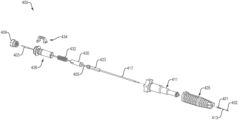
- FIG. 2 A illustrates an anchor sleeve portion of an anchor delivery system of this disclosure in an exploded view
- FIGS. 2 B and 2 C are detailed illustrations of the anchor sleeve portion of FIG. 2 A in an assembled view
- FIGS. 3 A and 3 B are detailed illustrations of a distal tip portion of another example of an anchor delivery system of this disclosure in a cross-sectional view;
- FIG. 4 A illustrates another example of an anchor delivery system of this disclosure in an exploded view
- FIGS. 4 B and 4 C illustrate the handle assembly of the anchor delivery system of FIG. 4 A in cross-sectional views
- FIGS. 5 A and 5 B illustrate another handle assembly of the anchor delivery system of this disclosure
- FIGS. 6 A and 6 B illustrate an unlocking instrument for use with the anchor delivery systems of this disclosure
- FIGS. 6 C and 6 D illustrate the use of the unlocking instrument of FIGS. 6 A and 6 B ;
- FIGS. 7 A-C illustrate a hole preparation tool for use with the anchor delivery systems of this disclosure.
- FIGS. 7 D-G illustrate the use of the hole preparation tool of FIGS. 7 A-C .
- the terms “about” and “substantially” are used to represent the inherent degree of uncertainty that may be attributed to any quantitative comparison, value, measurement, or other representation.
- the terms “about” and “substantially” are also used herein to represent the degree by which a quantitative representation may vary from a stated reference without resulting in a change in the basic function of the subject matter at issue.
- “Comprise,” “include,” and/or plural forms of each are open ended and include the listed parts and can include additional parts that are not listed.
- “And/or” is open-ended and includes one or more of the listed parts and combinations of the listed parts.
- FIGS. 1 A and 1 B depict a prior art anchor delivery system 100 for securing a tissue to bone.
- the anchor delivery system 100 generally includes a screw-in type anchor sleeve 101 and a pound-in type tip 102 .
- the anchor sleeve 101 includes a plurality of turns of a screw thread 104 having a plurality of openings 106 between turns of the plurality of turns of a screw thread 104 for allowing bony ingrowth from the bone into an internal volume defined within the plurality of turns of a screw thread 104 .
- the tip 102 includes a suture capture member, such as a plug (not shown), advanceable through an internal cavity of the tip 102 to lock one or more sutures in an eyelet 102 a extending through the tip 102 .
- the tip 102 may include barbs 108 protruding therefrom to improve pullout strength of the tip 102 .
- the tip 102 may be smooth-sided.
- the anchor sleeve 101 , the tip 102 and the plug can be constructed from polymers (e.g., PEEK), bioabsorbable materials, metals (e.g., surgical steel, titanium), or any other suitable material.
- the anchor sleeve 101 and the tip 102 can be installed into bone using a delivery device 115 .
- the delivery device 115 generally includes an outer shaft 117 for engaging with the anchor sleeve 101 , an inner shaft 103 for engaging with the plug of the tip 102 , and a handle assembly 107 for holding and operating the delivery device 115 .
- the delivery device 115 can also include one or more intermediate shafts 105 to provide additional stiffness when pounding in the tip 102 .
- the internal volume of the anchor sleeve 101 may comprise longitudinal ribs to engage grooves or slots 108 extending along the outer shaft 117 .
- the outer shaft 117 may comprise longitudinal ribs (not shown) to engage recesses extending through the internal volume of the anchor sleeve 101 .
- the anchor sleeve 101 is screwed or otherwise advanced by the outer shaft 117 into bone over a proximal end of the tip 102 by rotation of a sleeve advancement member 111 .
- a suture capture knob 109 is operatively coupled to a proximal end of the inner shaft 103 such that rotating or twisting the suture capture knob 109 causes the inner shaft 103 to advance the plug within the eyelet 102 a of the tip 102 . Additional non-limiting examples of anchor delivery systems can be found in U.S. Pat. No. 9,526,488, to Smith & Nephew, Inc. (Memphis, Tenn.), the entire contents of which are incorporated herein by reference.
- the anchor delivery system 200 may be used to insert an anchor sleeve 201 and a tip, such as tip 102 , into bone.
- the anchor delivery system 200 includes a delivery device 215 having an outer shaft 217 for engaging with the anchor sleeve 201 .
- the anchor sleeve 201 comprises a substantially cylindrical sleeve body 210 having a proximal end 210 a , a distal end 210 b , and a plurality of turns of a screw thread 204 extending between the proximal end 210 a and the distal end 210 b .
- the distal end 210 b of the sleeve body 210 can include a non-threaded portion, as shown.
- the sleeve body 210 defines an internal volume 212 which communicates with an exterior of the sleeve body 210 through at least one set axially-aligned openings 206 defined by the portions of the sleeve body 210 extending between adjacent turns of the screw thread 204 .
- four sets of axially-aligned openings 206 are defined by the sleeve body 210 .
- more or fewer than four sets of axially-aligned openings 206 are contemplated by this disclosure.
- Each set of axially-aligned openings 206 are spaced about 90° from another set of axially-aligned openings 206 around a circumference of the sleeve body 210 .
- the sleeve body 210 also includes at least one slot 216 disposed within the internal volume 212 and extending between the proximal end 210 a and the distal end 210 b of the sleeve body 210 .
- the sleeve body 210 includes four slots 216 . However, more or fewer than four slots 216 are contemplated by this disclosure. Each slot 216 is spaced about 90° from another slot 216 around a surface of the interior volume 212 and is disposed between adjacent sets of axially-aligned openings 206 .
- the outer shaft 217 of the delivery device 215 includes a proximal portion 217 a and a distal portion 217 b .
- An outer surface of the distal portion 217 b includes a plurality of ridges 220 extending a length of the distal portion 217 b .
- the distal portion 217 b includes four ridges 220 .
- Each ridge 220 is spaced about 90° from another ridge 220 around an outer surface of the outer shaft 217 and is defined by two substantially flat sides 222 , 224 extending along a length of the ridge 220 .
- Side 224 includes a first set of axially-aligned, laser-marked numerals 214
- side 222 includes a second set of axially-aligned, laser-marked numerals 218 , the purpose of which will be described in more detail below.
- Each ridge 220 is configured to engage a respective slot 216 of the anchor body 210 when the distal portion 217 b of the delivery device 215 is inserted into the interior volume 212 of the anchor body 210 .
- FIG. 2 B a detailed view of the sleeve body 210 and the distal portion 217 b of the delivery device 215 is shown in an assembled view.
- the first set of laser marked numerals 214 which may be five numerals 214 , on the side 224 of the delivery device 215 , are visible through a first set of axially-aligned openings 206 of the sleeve body 210 .
- the first set of numerals 214 count down in a stepwise fashion by odd numbers (e.g., 9, 7, 5, 3, 1) from the distal end 210 b to the proximal end 210 a of the sleeve body 210 .
- odd numbers e.g. 9, 7, 5, 3, 1
- FIG. 2 C shows the sleeve body 210 of FIG. 2 B rotated clockwise by about 1 ⁇ 8 of a turn.
- the second set of laser marked numerals 218 which may be four numerals, on the side 222 of the delivery device 215 , are visible through a second set of axially-aligned openings 206 of the sleeve body 210 .
- the second set of numerals 218 count down in a stepwise fashion by even numbers (e.g., 8, 6, 4, 2) from the distal end 210 b to the proximal end 210 a of the sleeve body 210 .
- the first set of numerals 214 and second set of numerals 218 give the user visual feedback that the sleeve body 210 is inserting into bone, rather than merely free-spinning.
- a third set of laser marked numerals which may be five numerals, on an opposite side of the delivery device 215 from side 224 , would be visible through a third set of axially-aligned openings 206 of the sleeve body 210 .
- the third set of numerals would count down in a stepwise fashion by odd numbers from the distal end 210 b to the proximal end 210 a of the sleeve body 210 . If the sleeve body 210 of FIG.
- a fourth set of laser marked numerals which may be four numerals, on an opposite side of the delivery device 215 from side 222 , would be visible through a fourth set of axially-aligned openings 206 of the sleeve body 210 .
- the fourth set of numerals would count down in a stepwise fashion by even numbers from the distal end 210 b to the proximal end 210 a of the sleeve body 210 .
- other visual markings could be used to indicate the insertion progress of the anchor body 210 into bone.
- the markings could be a sequence of alternating characters, such as dots and dashes.
- the markings could be a sequence of dots of changing size, number and/or shape.
- the markings could be a series of dash lines with a changing azimuth angle.
- the tip 302 includes a distal portion 302 c and a proximal portion 302 b .
- a tip cavity 302 d is defined within the proximal portion 302 b of the tip 302 and is configured to receive the plug 313 through an opening in the proximal portion 302 b .
- the eyelet 302 a extends through the distal portion 302 c of the tip 302 and is in communication with the tip cavity 302 d .
- a distal end of the tip 302 may be pointed as shown, for creation of a bone hole. However, it contemplated by this disclosure that the distal end of the tip 302 may be blunt in cases where a bone hole is created prior to insertion of the tip 302 .
- the plug 313 includes an internal cannulation 313 b extending through the plug 313 , while an outer surface of the plug 313 includes threads 313 a . In examples, the threads 313 a extend an entire length of the plug 313 . In other examples, as shown, only a proximal portion of the plug 313 is threaded, while a distal portion of the plug 313 is unthreaded.
- the tip cavity 302 d includes threads 302 e that engage the threads 313 a of the plug 313 upon insertion of a portion of the plug 313 into the tip cavity 302 d .
- the remainder of the plug 313 extends outside of the tip cavity 302 d.
- the proximal portion 302 b of the tip 302 when engaged with the delivery device, the proximal portion 302 b of the tip 302 is coupled to the intermediate shaft 305 , and the inner shaft 303 extends through the intermediate shaft 305 for engagement with the internal cannulation 313 b of the plug 313 .
- the internal cannulation 313 b of the plug 313 and a mating portion of the inner shaft 303 having a corresponding geometry, such as a hexagonal shape.
- sutures 319 attached to soft tissue are placed through the eyelet 302 a of the tip 302 .
- a length of the inner shaft 303 is selected such that a gap or void 330 ( FIG.
- the void 330 may be empty of material, or may be filled with a material having a lower density than the plug 313 .
- the void 330 thus provides a crushable zone at the distal end of the plug 313 which allows the distal end of the plug 313 to be deformable.
- the tip 302 is placed within a bone hole (not shown) via axial advancement, such as malleting, of the delivery device.
- the suture capture knob 109 of the delivery device 115 ( FIG.
- the plug 313 is rotated to move the plug 313 via the inner shaft 303 distally into the eyelet 302 a where the plug 313 encounters the sutures 319 .
- the plug 313 and the inner shaft 303 are descended further into the eyelet 302 a , the plug 313 impinges on the sutures 319 with a force sufficient to deform the distal end of the plug 313 around the sutures 319 , thus allowing for more surface contact between the sutures 319 and the plug 313 .
- the increased surface contact between the plug 313 and the sutures 319 advantageously allows for more friction and holding force on the sutures 319 by the plug 313 within the eyelet 302 a.
- FIG. 4 A an example of an anchor delivery system 400 of this disclosure is shown in a perspective, exploded view.
- the anchor delivery system 400 may be used to insert an anchor sleeve 401 and a tip 402 into bone.
- the anchor delivery system 400 includes an outer shaft 417 for engaging with the sleeve 401 , and an intermediate shaft 405 extending through the outer shaft 417 for engaging with the tip 402 .
- a proximal end of the outer shaft 417 is coupled to an outer shaft hub 423 .
- the outer shaft hub 423 in turn is configured to be threadingly coupled to a center housing 430 .
- the anchor delivery system 400 also includes a drive housing 426 for holding the intermediate shaft 405 .
- the anchor delivery system 400 furthermore includes a suture capture knob 409 coupled to the inner shaft 403 for advancing the plug 413 within the tip 402 , a sleeve advancement member 411 for screwing the anchor sleeve 401 into bone, and a handle grip 425 for holding and/or maneuvering the anchor delivery system 400 during insertion of the anchor sleeve 401 into bone.
- a spring 432 is configured to be disposed within the drive housing 426 to allow a relative motion between the outer shaft 417 and the inner shaft 403 , thereby absorbing at least a portion of the impact forces exerted on the sleeve 401 during the pounding-in of the tip structure 402 .
- the anchor delivery system 400 may also include an anti-rotation feature, such as a bridge 434 , which is described in more detail below.
- FIG. 4 B shows the internal components of the handle assembly 407 of the delivery device 415 of FIG. 4 A in a cross-sectional view.
- FIG. 4 B shows the sleeve advancement member 411 and the handle grip 425 .
- a proximal end of the sleeve advancement member 411 defines a rotatable knob 411 a extending outside of the handle grip 425 near the proximal end of the handle assembly 407 .
- a proximal portion 430 a of the center housing 430 may have internal threads 430 c for engaging threads 423 a on an outer surface of the outer shaft hub 423 .
- a distal portion 430 b of the center housing 430 may be unthreaded, forming a “spin cavity” 436 , the purpose of which will be described in more detail below.
- the outer shaft hub 423 can be further engaged with a distal end 411 b of the sleeve advancement member 411 .
- twisting or rotating the sleeve advancement member 411 via the rotatable knob 411 a rotates the outer shaft hub 423 , thereby causing the outer shaft hub 423 to advance distally along the threads 430 c of the center housing 430 and, consequently, to cause the outer shaft 417 to advance the sleeve 401 into engagement with bone and/or the tip 402 .
- the bridge 434 is configured to stabilize the handle grip 425 to the drive housing 426 , preventing the handle grip 425 from rotating during rotation of the sleeve advancement member 411 .
- the bridge 434 , the drive housing 426 , the sleeve advancement member 411 and the handle grip 425 have built-in axial clearances to prevent these components from binding during use. Therefore, in the handle assembly 407 of this disclosure, a length of the bridge 434 is selected to place the bridge 434 in compression, like a spring. This compression causes the axial clearances between the components to be absorbed as the drive housing 426 , the sleeve advancement member 411 and the handle grip 425 are forced into axial contact.
- the force generated by the bridge 434 being placed in compression forces the drive housing 426 and the handle grip 425 away from each other.
- the force generated by the bridge 434 being placed in compression is counteracted in the flexure joint between the sleeve advancement member 411 and the drive housing 426 , and in the flexure joint between the handle grip 425 and the sleeve advancement member 411 .
- the quantity of the axial force exerted by the bridge 434 is a function of the amount of built-in interference between the bridge 434 and the other components and by the stiffness of the bridge 434 .
- a stiffness of the bridge 434 is selected such that a range of acceptable, non-zero axial loads are generated by the handle assembly 407 with the currently defined component tolerances.
- the outer shaft hub 423 is configured to fully unthread from the threads of the center housing 430 and freely rotate within the spin cavity 436 .
- the free rotation of the outer shaft hub 423 within the spin cavity 436 may be sufficient to complete the insertion of the anchor sleeve 401 into bone. It is further contemplated that the threads may be entirely eliminated from both of the center housing 430 and the outer shaft hub 423 , and that the free spinning of the outer shaft hub 423 within the center housing 430 is sufficient to insert the anchor sleeve 401 into bone.
- FIG. 5 A another example of a handle assembly 507 of this disclosure is shown in a cross-sectional view.
- a length L of the threads 530 c of the center housing 530 is selected to exceed a staging distance D between the distal end of the anchor sleeve 501 and the distal portion 502 c of the tip 502 ( FIG. 5 B ).
- the length L of the threads 530 c allows the anchor sleeve 501 to undergo more handle-driven advancement, helping to address the issue of leaving the anchor sleeve 501 proud of the bone or tissue.
- the user first inserts the tip 502 into a bone hole.
- the anchor sleeve 501 rotates without inserting into bone, the mechanical action of the delivery device 515 will withdraw the intermediate shaft 505 from the bone hole.
- the tip 502 because the tip 502 has been released from the intermediate shaft 505 , the tip 502 generally remains at its fully deployed, distal location.
- the threads 530 c of the center housing 530 can be longer or shorter as long as the total length L of the threads 530 c exceeds the distance D between the anchor sleeve 501 and the distal portion 502 c of the tip 502 .
- FIG. 6 A an example of an unlocking instrument 600 of this disclosure for use with the anchor delivery systems 100 , 200 , 400 is shown in a side view.
- the unlocking instrument 600 is configured for removing a tip 602 from a suture 619 after the tip 602 has been deployed into bone.
- the unlocking instrument 600 has a similar working length to the working lengths of the anchor delivery systems 100 , 200 , 400 described above.
- the unlocking instrument 600 comprises a handle 625 and a shaft 603 extending from the handle 625 .
- the handle 625 is made for single-use and is comprised of injection molded plastic. In other examples, the handle 625 is reusable and comprised of stainless steel.
- a distal end of the shaft 603 comprises a hex feature 660 configured to mate with the hexagonal cannulation 613 b of the plug 613 ( FIG. 6 B ).
- the unlocking instrument 600 is used to loosen the contact between the plug 613 and the suture 619 secured within the tip 602 , allowing for removal of the tip 602 from the suture 619 .
- an instrument such as a grasper tool 662 is introduced into a repair site in which, for example, the anchor sleeve 601 has broken after insertion into bone.
- the tip 602 is held with the grasper tool 662 to stabilize the tip 602 during removal of the plug 613 .
- the unlocking instrument 600 is then inserted into the proximal end 602 b of the tip 602 .
- the hex feature 660 of the unlocking instrument 600 is then engaged with the cannulation 613 b of the plug 613 .
- the unlocking instrument 600 is rotated to loosen the contact between the plug 613 and the suture 619 which has been threaded through the eyelet 602 a .
- the user can use the grasper tool 662 (or other means) to hold and slide the tip 602 off of the suture 619 and retrieve the tip 602 from the repair site. The user is then free to use a replacement anchor sleeve/tip with the suture 619 to complete the repair.
- the unlocking instrument 600 could also include a mechanism (not shown) for gripping the tip 602 during removal of the plug 613 .
- FIGS. 7 A and 7 B an example of a hole preparation tool 700 of this disclosure for use with the anchor delivery systems 100 , 200 , 400 is shown in a side view ( FIG. 7 A ) and a detailed view ( FIG. 7 B ).
- the hole preparation tool 700 includes a handle grip 725 and a shaft 717 extending from the handle grip 725 .
- the shaft 717 includes a distal pointed tip 742 for piercing bone.
- a threaded portion 701 of the hole preparation tool 700 may include a plurality of turns of a screw thread 704 for pre-tapping a bone hole before insertion of a threaded anchor sleeve.
- the hole preparation tool 700 also includes a marking element 738 disposed around the shaft 717 adjacent to a proximal end 710 a of the threaded portion 701 .
- the marking element 738 comprises an absorbent material pre-saturated with surgical ink.
- the marking element 738 has an annular shape, as shown. However, the disclosure contemplates other suitable shapes of the marking element 738 , including two half-annuli. As shown in FIG. 7 C , to protect the tip 742 from puncturing surrounding packaging and to protect the marking element 738 from drying out, a protective cap 740 covers the tip 742 as well as the marking element 738 of the bone preparation tool 700 .
- FIGS. 7 D-G illustrate an example using the hole preparation tool 700 in a surgical repair.
- a surgeon first inserts the tip 742 of the hole preparation tool 700 into bone 744 .
- the surgeons rotates the hole preparation tool 700 to advance the threaded portion 701 into the bone 744 until the marking element 738 comes into contact with the surface of the bone 744 .
- the marking element 738 marks the bone 744 with ink. As shown in FIG.
- the surgeon then unthreads the hole preparation tool 700 and removes it from the repair site, leaving behind a prepared bone hole 746 and an ink mark 748 identifying the location of the prepared bone hole 746 ( FIG. 7 G ).
- the disclosure also contemplates other methods of marking the bone hole 746 , including using radio-frequency energy.
Landscapes
- Health & Medical Sciences (AREA)
- Life Sciences & Earth Sciences (AREA)
- Surgery (AREA)
- General Health & Medical Sciences (AREA)
- Veterinary Medicine (AREA)
- Biomedical Technology (AREA)
- Heart & Thoracic Surgery (AREA)
- Medical Informatics (AREA)
- Molecular Biology (AREA)
- Animal Behavior & Ethology (AREA)
- Nuclear Medicine, Radiotherapy & Molecular Imaging (AREA)
- Public Health (AREA)
- Engineering & Computer Science (AREA)
- Orthopedic Medicine & Surgery (AREA)
- Rheumatology (AREA)
- Oral & Maxillofacial Surgery (AREA)
- Pathology (AREA)
- Neurology (AREA)
- Dentistry (AREA)
- Surgical Instruments (AREA)
Abstract
Description
Claims (5)
Priority Applications (1)
| Application Number | Priority Date | Filing Date | Title |
|---|---|---|---|
| US17/203,881 US11648002B2 (en) | 2020-03-23 | 2021-03-17 | Anchor delivery systems |
Applications Claiming Priority (3)
| Application Number | Priority Date | Filing Date | Title |
|---|---|---|---|
| US202062993322P | 2020-03-23 | 2020-03-23 | |
| US202063009632P | 2020-04-14 | 2020-04-14 | |
| US17/203,881 US11648002B2 (en) | 2020-03-23 | 2021-03-17 | Anchor delivery systems |
Publications (2)
| Publication Number | Publication Date |
|---|---|
| US20210290218A1 US20210290218A1 (en) | 2021-09-23 |
| US11648002B2 true US11648002B2 (en) | 2023-05-16 |
Family
ID=74844730
Family Applications (1)
| Application Number | Title | Priority Date | Filing Date |
|---|---|---|---|
| US17/203,881 Active 2041-11-04 US11648002B2 (en) | 2020-03-23 | 2021-03-17 | Anchor delivery systems |
Country Status (5)
| Country | Link |
|---|---|
| US (1) | US11648002B2 (en) |
| EP (1) | EP3884876B1 (en) |
| JP (1) | JP7651318B2 (en) |
| CN (1) | CN113425349B (en) |
| AU (1) | AU2021201202B2 (en) |
Families Citing this family (2)
| Publication number | Priority date | Publication date | Assignee | Title |
|---|---|---|---|---|
| US11554197B2 (en) * | 2018-11-20 | 2023-01-17 | BioMark, LLC | Device with an open cell element |
| US20240057990A1 (en) * | 2022-08-22 | 2024-02-22 | Anika Therapeutics, Inc. | Suture anchor |
Citations (6)
| Publication number | Priority date | Publication date | Assignee | Title |
|---|---|---|---|---|
| US20100016869A1 (en) * | 2008-07-17 | 2010-01-21 | Smith & Nephew, Inc. | Surgical Devices |
| US20100069923A1 (en) * | 2008-09-18 | 2010-03-18 | Smith & Nephew, Inc. | Suture Anchor Inserter |
| US20140277129A1 (en) * | 2013-03-15 | 2014-09-18 | Smith & Nephew, Inc. | Fenestrated locking suture anchor assembly |
| US20140277128A1 (en) * | 2013-03-15 | 2014-09-18 | Kurt Hamilton MOORE | Ratcheting inserter device and suture anchor arrangement |
| US20170172562A1 (en) * | 2015-12-16 | 2017-06-22 | Conmed Corporation | Knotless suture anchor and deployment device |
| US20190350577A1 (en) * | 2018-05-18 | 2019-11-21 | Biomet Manufacturing, Llc | Anchoring system and method for securing a suture to a pre-drilled hole |
Family Cites Families (15)
| Publication number | Priority date | Publication date | Assignee | Title |
|---|---|---|---|---|
| US6030162A (en) | 1998-12-18 | 2000-02-29 | Acumed, Inc. | Axial tension screw |
| US20100179573A1 (en) * | 2006-10-31 | 2010-07-15 | Core Essence Orthopaedics, Llc | Medical device and procedure for attaching tissue to bone |
| CN102596056B (en) * | 2009-11-10 | 2015-11-25 | 史密夫和内修有限公司 | Lock sutural anchoring assembly |
| JP2013510659A (en) * | 2009-11-10 | 2013-03-28 | スミス アンド ネフュー インコーポレーテッド | Tissue repair device |
| US9775702B2 (en) * | 2010-03-10 | 2017-10-03 | Smith & Nephew, Inc. | Composite interference screws and drivers |
| US9308080B2 (en) * | 2010-03-10 | 2016-04-12 | Smith & Nephew Inc. | Composite interference screws and drivers |
| AU2011227190B2 (en) | 2010-03-18 | 2016-04-14 | Smith & Nephew, Inc. | A device for use during ligament reconstruction surgery |
| AU2012230845B2 (en) * | 2011-03-22 | 2016-09-08 | Richard Lunn | Anchor system and delivery device for use therewith |
| US9265494B2 (en) * | 2011-12-20 | 2016-02-23 | Medos International Sarl | Knotless instability anchor |
| ES2563758T3 (en) | 2012-06-18 | 2016-03-16 | Biedermann Technologies Gmbh & Co. Kg | Bone anchor |
| MX2016011559A (en) * | 2014-03-06 | 2017-04-13 | Smith & Nephew Inc | Two-piece knotless suture anchor. |
| WO2016154406A1 (en) * | 2015-03-24 | 2016-09-29 | Smith & Nephew, Inc. | Bone anchor system having movable medial eyelet |
| US10617406B2 (en) * | 2015-06-30 | 2020-04-14 | Smith & Nephew, Inc. | Suture anchor system with threaded plug |
| US9924935B2 (en) * | 2015-10-23 | 2018-03-27 | Smith & Nephew, Inc. | Suture anchor assembly with slip fit tip |
| US10820915B2 (en) * | 2018-03-06 | 2020-11-03 | Medos International Sarl | Methods, systems, and devices for instability repair |
-
2021
- 2021-02-24 AU AU2021201202A patent/AU2021201202B2/en active Active
- 2021-02-26 EP EP21159774.5A patent/EP3884876B1/en active Active
- 2021-03-02 CN CN202110230156.9A patent/CN113425349B/en active Active
- 2021-03-03 JP JP2021033401A patent/JP7651318B2/en active Active
- 2021-03-17 US US17/203,881 patent/US11648002B2/en active Active
Patent Citations (6)
| Publication number | Priority date | Publication date | Assignee | Title |
|---|---|---|---|---|
| US20100016869A1 (en) * | 2008-07-17 | 2010-01-21 | Smith & Nephew, Inc. | Surgical Devices |
| US20100069923A1 (en) * | 2008-09-18 | 2010-03-18 | Smith & Nephew, Inc. | Suture Anchor Inserter |
| US20140277129A1 (en) * | 2013-03-15 | 2014-09-18 | Smith & Nephew, Inc. | Fenestrated locking suture anchor assembly |
| US20140277128A1 (en) * | 2013-03-15 | 2014-09-18 | Kurt Hamilton MOORE | Ratcheting inserter device and suture anchor arrangement |
| US20170172562A1 (en) * | 2015-12-16 | 2017-06-22 | Conmed Corporation | Knotless suture anchor and deployment device |
| US20190350577A1 (en) * | 2018-05-18 | 2019-11-21 | Biomet Manufacturing, Llc | Anchoring system and method for securing a suture to a pre-drilled hole |
Also Published As
| Publication number | Publication date |
|---|---|
| EP3884876A2 (en) | 2021-09-29 |
| AU2021201202B2 (en) | 2026-02-19 |
| EP3884876A3 (en) | 2021-11-10 |
| EP3884876B1 (en) | 2025-01-08 |
| CN113425349B (en) | 2026-03-24 |
| CN113425349A (en) | 2021-09-24 |
| JP7651318B2 (en) | 2025-03-26 |
| US20210290218A1 (en) | 2021-09-23 |
| AU2021201202A1 (en) | 2021-10-07 |
| JP2021146209A (en) | 2021-09-27 |
Similar Documents
| Publication | Publication Date | Title |
|---|---|---|
| US10610214B2 (en) | Threaded suture anchor | |
| US8409251B2 (en) | Suture anchor and driver | |
| US5941882A (en) | Medical screw particularly for surgery and emplacement tool | |
| US6685728B2 (en) | Threaded suture anchor and method of use | |
| US6447546B1 (en) | Apparatus and method for fusing opposing spinal vertebrae | |
| US7713285B1 (en) | Method and apparatus for suture anchors with a vertical eyelet | |
| JP6169351B2 (en) | Knotted suture anchor | |
| US6666877B2 (en) | Apparatus and method for securing suture to bone | |
| AU2002367551A1 (en) | Threaded suture anchor and method of use | |
| EP2772212B1 (en) | Instrument for inserting a bone anchoring element and system of such an instrument and a polyaxial bone anchoring element | |
| AU2004202440A1 (en) | Push-in suture anchor, insertion tool, and method for inserting a push-in suture anchor | |
| EP1797828B1 (en) | Threaded suture anchor with starting pitch | |
| JP6542917B2 (en) | Suture anchor system with threaded plug | |
| US20070021751A1 (en) | Bone anchor | |
| EP3884876B1 (en) | Anchor delivery systems | |
| EP4051131B1 (en) | Healicoil knotless distal tip and plug transmission | |
| US20080154313A1 (en) | Device For Introducing An Anchor Element Into A Bone | |
| JP7123529B2 (en) | Prevents overdriving of expandable anchors | |
| US20250064495A1 (en) | Bone anchor | |
| CA2567407C (en) | Threaded suture anchor and method of use |
Legal Events
| Date | Code | Title | Description |
|---|---|---|---|
| FEPP | Fee payment procedure |
Free format text: ENTITY STATUS SET TO UNDISCOUNTED (ORIGINAL EVENT CODE: BIG.); ENTITY STATUS OF PATENT OWNER: LARGE ENTITY |
|
| AS | Assignment |
Owner name: SMITH & NEPHEW ASIA PACIFIC PTE. LIMITED, SINGAPORE Free format text: ASSIGNMENT OF ASSIGNORS INTEREST;ASSIGNOR:SMITH & NEPHEW, INC.;REEL/FRAME:055794/0379 Effective date: 20210325 Owner name: SMITH & NEPHEW ORTHOPAEDICS AG, SWITZERLAND Free format text: ASSIGNMENT OF ASSIGNORS INTEREST;ASSIGNOR:SMITH & NEPHEW, INC.;REEL/FRAME:055794/0379 Effective date: 20210325 Owner name: SMITH & NEPHEW, INC., TENNESSEE Free format text: ASSIGNMENT OF ASSIGNORS INTEREST;ASSIGNOR:SMITH & NEPHEW, INC.;REEL/FRAME:055794/0379 Effective date: 20210325 Owner name: SMITH & NEPHEW, INC., TENNESSEE Free format text: ASSIGNMENT OF ASSIGNORS INTEREST;ASSIGNOR:BLOUGH, REBECCA A.;REEL/FRAME:055794/0290 Effective date: 19901217 Owner name: SMITH & NEPHEW, INC., TENNESSEE Free format text: ASSIGNMENT OF ASSIGNORS INTEREST;ASSIGNORS:HOUSMAN, MARK EDWIN;ROGERS, JON-PAUL;HAMILTON, JASON;AND OTHERS;SIGNING DATES FROM 20200330 TO 20210211;REEL/FRAME:055794/0250 |
|
| STPP | Information on status: patent application and granting procedure in general |
Free format text: DOCKETED NEW CASE - READY FOR EXAMINATION |
|
| STPP | Information on status: patent application and granting procedure in general |
Free format text: NON FINAL ACTION MAILED |
|
| STCF | Information on status: patent grant |
Free format text: PATENTED CASE |