US11643443B2 - Electrically conductive protein nanofibers and biofilms - Google Patents
Electrically conductive protein nanofibers and biofilms Download PDFInfo
- Publication number
- US11643443B2 US11643443B2 US15/777,070 US201615777070A US11643443B2 US 11643443 B2 US11643443 B2 US 11643443B2 US 201615777070 A US201615777070 A US 201615777070A US 11643443 B2 US11643443 B2 US 11643443B2
- Authority
- US
- United States
- Prior art keywords
- csga
- amyloid
- mutant
- protein
- curli
- Prior art date
- Legal status (The legal status is an assumption and is not a legal conclusion. Google has not performed a legal analysis and makes no representation as to the accuracy of the status listed.)
- Active, expires
Links
- 108090000623 proteins and genes Proteins 0.000 title claims abstract description 133
- 102000004169 proteins and genes Human genes 0.000 title claims abstract description 116
- 239000002121 nanofiber Substances 0.000 title abstract description 26
- 238000000034 method Methods 0.000 claims abstract description 52
- 108090000765 processed proteins & peptides Proteins 0.000 claims description 261
- 102000004196 processed proteins & peptides Human genes 0.000 claims description 201
- 229920001184 polypeptide Polymers 0.000 claims description 199
- 125000003118 aryl group Chemical group 0.000 claims description 104
- 150000007523 nucleic acids Chemical group 0.000 claims description 104
- 241000894006 Bacteria Species 0.000 claims description 99
- 150000001413 amino acids Chemical class 0.000 claims description 82
- 108091028043 Nucleic acid sequence Proteins 0.000 claims description 57
- 102000037865 fusion proteins Human genes 0.000 claims description 46
- 108020001507 fusion proteins Proteins 0.000 claims description 46
- -1 Sup35 Proteins 0.000 claims description 44
- 108090000051 Plastocyanin Proteins 0.000 claims description 40
- 230000027455 binding Effects 0.000 claims description 39
- 239000012634 fragment Substances 0.000 claims description 37
- 241000588724 Escherichia coli Species 0.000 claims description 31
- 108060007223 rubredoxin Proteins 0.000 claims description 28
- 102000004190 Enzymes Human genes 0.000 claims description 22
- 108090000790 Enzymes Proteins 0.000 claims description 22
- 229940088598 enzyme Drugs 0.000 claims description 22
- 102000010750 Metalloproteins Human genes 0.000 claims description 21
- 108010063312 Metalloproteins Proteins 0.000 claims description 21
- 108010029942 microperoxidase Proteins 0.000 claims description 19
- HNDVDQJCIGZPNO-YFKPBYRVSA-N L-histidine Chemical compound OC(=O)[C@@H](N)CC1=CN=CN1 HNDVDQJCIGZPNO-YFKPBYRVSA-N 0.000 claims description 18
- QIVBCDIJIAJPQS-VIFPVBQESA-N L-tryptophane Chemical compound C1=CC=C2C(C[C@H](N)C(O)=O)=CNC2=C1 QIVBCDIJIAJPQS-VIFPVBQESA-N 0.000 claims description 18
- QIVBCDIJIAJPQS-UHFFFAOYSA-N Tryptophan Natural products C1=CC=C2C(CC(N)C(O)=O)=CNC2=C1 QIVBCDIJIAJPQS-UHFFFAOYSA-N 0.000 claims description 18
- 239000010931 gold Substances 0.000 claims description 18
- HNDVDQJCIGZPNO-UHFFFAOYSA-N histidine Natural products OC(=O)C(N)CC1=CN=CN1 HNDVDQJCIGZPNO-UHFFFAOYSA-N 0.000 claims description 18
- OUYCCCASQSFEME-QMMMGPOBSA-N L-tyrosine Chemical compound OC(=O)[C@@H](N)CC1=CC=C(O)C=C1 OUYCCCASQSFEME-QMMMGPOBSA-N 0.000 claims description 17
- PCHJSUWPFVWCPO-UHFFFAOYSA-N gold Chemical compound [Au] PCHJSUWPFVWCPO-UHFFFAOYSA-N 0.000 claims description 17
- 229910052737 gold Inorganic materials 0.000 claims description 17
- OUYCCCASQSFEME-UHFFFAOYSA-N tyrosine Natural products OC(=O)C(N)CC1=CC=C(O)C=C1 OUYCCCASQSFEME-UHFFFAOYSA-N 0.000 claims description 17
- WRQSUCJAKAMYMQ-YFKPBYRVSA-N (2s)-2-(thiophen-3-ylamino)propanoic acid Chemical compound OC(=O)[C@H](C)NC=1C=CSC=1 WRQSUCJAKAMYMQ-YFKPBYRVSA-N 0.000 claims description 16
- WTOFYLAWDLQMBZ-UHFFFAOYSA-N 2-azaniumyl-3-thiophen-2-ylpropanoate Chemical compound OC(=O)C(N)CC1=CC=CS1 WTOFYLAWDLQMBZ-UHFFFAOYSA-N 0.000 claims description 15
- 102000013455 Amyloid beta-Peptides Human genes 0.000 claims description 15
- 108010090849 Amyloid beta-Peptides Proteins 0.000 claims description 15
- NNRZVBFMEBWXBX-QMMMGPOBSA-N (2s)-2-(2-diazohydrazinyl)-3-phenylpropanoic acid Chemical compound [N-]=[N+]=NN[C@H](C(=O)O)CC1=CC=CC=C1 NNRZVBFMEBWXBX-QMMMGPOBSA-N 0.000 claims description 14
- 102000018832 Cytochromes Human genes 0.000 claims description 14
- 108010052832 Cytochromes Proteins 0.000 claims description 14
- 108010060630 Lactoglobulins Proteins 0.000 claims description 14
- 102000016943 Muramidase Human genes 0.000 claims description 14
- 108010014251 Muramidase Proteins 0.000 claims description 14
- 108010062010 N-Acetylmuramoyl-L-alanine Amidase Proteins 0.000 claims description 14
- 229960000274 lysozyme Drugs 0.000 claims description 14
- 239000004325 lysozyme Substances 0.000 claims description 14
- 235000010335 lysozyme Nutrition 0.000 claims description 14
- 102000008133 Iron-Binding Proteins Human genes 0.000 claims description 13
- 108010035210 Iron-Binding Proteins Proteins 0.000 claims description 13
- COLNVLDHVKWLRT-QMMMGPOBSA-N L-phenylalanine Chemical compound OC(=O)[C@@H](N)CC1=CC=CC=C1 COLNVLDHVKWLRT-QMMMGPOBSA-N 0.000 claims description 13
- CBQJSKKFNMDLON-JTQLQIEISA-N N-acetyl-L-phenylalanine Chemical compound CC(=O)N[C@H](C(O)=O)CC1=CC=CC=C1 CBQJSKKFNMDLON-JTQLQIEISA-N 0.000 claims description 13
- 108010034748 copper-binding protein Proteins 0.000 claims description 13
- COLNVLDHVKWLRT-UHFFFAOYSA-N phenylalanine Natural products OC(=O)C(N)CC1=CC=CC=C1 COLNVLDHVKWLRT-UHFFFAOYSA-N 0.000 claims description 13
- 230000001717 pathogenic effect Effects 0.000 claims description 9
- 102000000119 Beta-lactoglobulin Human genes 0.000 claims 3
- 230000001580 bacterial effect Effects 0.000 abstract description 23
- 239000000463 material Substances 0.000 abstract description 15
- 239000000835 fiber Substances 0.000 description 215
- 235000018102 proteins Nutrition 0.000 description 103
- 210000004027 cell Anatomy 0.000 description 62
- 108020004707 nucleic acids Proteins 0.000 description 47
- 102000039446 nucleic acids Human genes 0.000 description 47
- 230000001939 inductive effect Effects 0.000 description 30
- 230000035772 mutation Effects 0.000 description 27
- 230000004927 fusion Effects 0.000 description 25
- 229910052751 metal Inorganic materials 0.000 description 25
- 230000014509 gene expression Effects 0.000 description 22
- 239000013612 plasmid Substances 0.000 description 22
- 239000013598 vector Substances 0.000 description 21
- 238000004519 manufacturing process Methods 0.000 description 20
- 239000002184 metal Substances 0.000 description 20
- 239000010409 thin film Substances 0.000 description 19
- 230000032258 transport Effects 0.000 description 18
- 239000010408 film Substances 0.000 description 16
- 230000000813 microbial effect Effects 0.000 description 16
- DTQVDTLACAAQTR-UHFFFAOYSA-N trifluoroacetic acid Substances OC(=O)C(F)(F)F DTQVDTLACAAQTR-UHFFFAOYSA-N 0.000 description 15
- IQFVPQOLBLOTPF-HKXUKFGYSA-L congo red Chemical compound [Na+].[Na+].C1=CC=CC2=C(N)C(/N=N/C3=CC=C(C=C3)C3=CC=C(C=C3)/N=N/C3=C(C4=CC=CC=C4C(=C3)S([O-])(=O)=O)N)=CC(S([O-])(=O)=O)=C21 IQFVPQOLBLOTPF-HKXUKFGYSA-L 0.000 description 14
- 230000006870 function Effects 0.000 description 14
- 238000000746 purification Methods 0.000 description 14
- RAXXELZNTBOGNW-UHFFFAOYSA-N imidazole Natural products C1=CNC=N1 RAXXELZNTBOGNW-UHFFFAOYSA-N 0.000 description 12
- 102000008857 Ferritin Human genes 0.000 description 11
- 108050000784 Ferritin Proteins 0.000 description 11
- 238000008416 Ferritin Methods 0.000 description 11
- 102000008192 Lactoglobulins Human genes 0.000 description 11
- 125000000539 amino acid group Chemical group 0.000 description 11
- 239000003795 chemical substances by application Substances 0.000 description 10
- 239000002070 nanowire Substances 0.000 description 10
- 239000000758 substrate Substances 0.000 description 10
- 230000015572 biosynthetic process Effects 0.000 description 9
- 239000000203 mixture Substances 0.000 description 9
- 239000000243 solution Substances 0.000 description 9
- 102000009091 Amyloidogenic Proteins Human genes 0.000 description 8
- 108010048112 Amyloidogenic Proteins Proteins 0.000 description 8
- 108020004414 DNA Proteins 0.000 description 8
- 108010076504 Protein Sorting Signals Proteins 0.000 description 8
- 239000000411 inducer Substances 0.000 description 8
- BPHPUYQFMNQIOC-NXRLNHOXSA-N isopropyl beta-D-thiogalactopyranoside Chemical compound CC(C)S[C@@H]1O[C@H](CO)[C@H](O)[C@H](O)[C@H]1O BPHPUYQFMNQIOC-NXRLNHOXSA-N 0.000 description 8
- 238000004626 scanning electron microscopy Methods 0.000 description 8
- 230000028327 secretion Effects 0.000 description 8
- 239000000126 substance Substances 0.000 description 8
- 238000005516 engineering process Methods 0.000 description 7
- 239000012528 membrane Substances 0.000 description 7
- 230000027756 respiratory electron transport chain Effects 0.000 description 7
- 239000000523 sample Substances 0.000 description 7
- 238000001878 scanning electron micrograph Methods 0.000 description 7
- 241000894007 species Species 0.000 description 7
- XLYOFNOQVPJJNP-UHFFFAOYSA-N water Chemical compound O XLYOFNOQVPJJNP-UHFFFAOYSA-N 0.000 description 7
- 239000011324 bead Substances 0.000 description 6
- 230000008901 benefit Effects 0.000 description 6
- FPPNZSSZRUTDAP-UWFZAAFLSA-N carbenicillin Chemical compound N([C@H]1[C@H]2SC([C@@H](N2C1=O)C(O)=O)(C)C)C(=O)C(C(O)=O)C1=CC=CC=C1 FPPNZSSZRUTDAP-UWFZAAFLSA-N 0.000 description 6
- 229960003669 carbenicillin Drugs 0.000 description 6
- 238000003384 imaging method Methods 0.000 description 6
- 238000010348 incorporation Methods 0.000 description 6
- 230000001965 increasing effect Effects 0.000 description 6
- 238000005259 measurement Methods 0.000 description 6
- 125000003275 alpha amino acid group Chemical group 0.000 description 5
- 230000032770 biofilm formation Effects 0.000 description 5
- 150000001875 compounds Chemical class 0.000 description 5
- 238000001493 electron microscopy Methods 0.000 description 5
- 238000001914 filtration Methods 0.000 description 5
- 230000012010 growth Effects 0.000 description 5
- 239000001963 growth medium Substances 0.000 description 5
- 230000006698 induction Effects 0.000 description 5
- 244000005700 microbiome Species 0.000 description 5
- 239000000178 monomer Substances 0.000 description 5
- 230000002062 proliferating effect Effects 0.000 description 5
- 239000002904 solvent Substances 0.000 description 5
- 239000000725 suspension Substances 0.000 description 5
- 102000052866 Amino Acyl-tRNA Synthetases Human genes 0.000 description 4
- 108700028939 Amino Acyl-tRNA Synthetases Proteins 0.000 description 4
- 101100480489 Arabidopsis thaliana TAAC gene Proteins 0.000 description 4
- 238000002965 ELISA Methods 0.000 description 4
- 241001494297 Geobacter sulfurreducens Species 0.000 description 4
- WQZGKKKJIJFFOK-GASJEMHNSA-N Glucose Natural products OC[C@H]1OC(O)[C@H](O)[C@@H](O)[C@@H]1O WQZGKKKJIJFFOK-GASJEMHNSA-N 0.000 description 4
- XUIMIQQOPSSXEZ-UHFFFAOYSA-N Silicon Chemical compound [Si] XUIMIQQOPSSXEZ-UHFFFAOYSA-N 0.000 description 4
- 108020005038 Terminator Codon Proteins 0.000 description 4
- 238000003556 assay Methods 0.000 description 4
- 238000001035 drying Methods 0.000 description 4
- 238000002149 energy-dispersive X-ray emission spectroscopy Methods 0.000 description 4
- 239000013604 expression vector Substances 0.000 description 4
- 239000008103 glucose Substances 0.000 description 4
- 235000013336 milk Nutrition 0.000 description 4
- 239000008267 milk Substances 0.000 description 4
- 210000004080 milk Anatomy 0.000 description 4
- 239000002105 nanoparticle Substances 0.000 description 4
- 239000008363 phosphate buffer Substances 0.000 description 4
- 229920000642 polymer Polymers 0.000 description 4
- 229910052710 silicon Inorganic materials 0.000 description 4
- 239000010703 silicon Substances 0.000 description 4
- 238000003786 synthesis reaction Methods 0.000 description 4
- 238000013518 transcription Methods 0.000 description 4
- 230000035897 transcription Effects 0.000 description 4
- 239000013603 viral vector Substances 0.000 description 4
- 229920001817 Agar Polymers 0.000 description 3
- 108010007337 Azurin Proteins 0.000 description 3
- 108091003079 Bovine Serum Albumin Proteins 0.000 description 3
- RYGMFSIKBFXOCR-UHFFFAOYSA-N Copper Chemical compound [Cu] RYGMFSIKBFXOCR-UHFFFAOYSA-N 0.000 description 3
- 102000053602 DNA Human genes 0.000 description 3
- LFQSCWFLJHTTHZ-UHFFFAOYSA-N Ethanol Chemical compound CCO LFQSCWFLJHTTHZ-UHFFFAOYSA-N 0.000 description 3
- 108010044394 Hemerythrin Proteins 0.000 description 3
- 102000001554 Hemoglobins Human genes 0.000 description 3
- 108010054147 Hemoglobins Proteins 0.000 description 3
- 102000010445 Lactoferrin Human genes 0.000 description 3
- 108010063045 Lactoferrin Proteins 0.000 description 3
- 102000036675 Myoglobin Human genes 0.000 description 3
- 108010062374 Myoglobin Proteins 0.000 description 3
- 239000004098 Tetracycline Substances 0.000 description 3
- 102000004338 Transferrin Human genes 0.000 description 3
- 108090000901 Transferrin Proteins 0.000 description 3
- 241000700605 Viruses Species 0.000 description 3
- 238000001261 affinity purification Methods 0.000 description 3
- 239000008272 agar Substances 0.000 description 3
- 206010002022 amyloidosis Diseases 0.000 description 3
- 230000008436 biogenesis Effects 0.000 description 3
- 230000001851 biosynthetic effect Effects 0.000 description 3
- 229940098773 bovine serum albumin Drugs 0.000 description 3
- 210000004899 c-terminal region Anatomy 0.000 description 3
- 125000001314 canonical amino-acid group Chemical group 0.000 description 3
- 230000008859 change Effects 0.000 description 3
- 238000006243 chemical reaction Methods 0.000 description 3
- 229910052802 copper Inorganic materials 0.000 description 3
- 239000010949 copper Substances 0.000 description 3
- 230000000694 effects Effects 0.000 description 3
- 230000002708 enhancing effect Effects 0.000 description 3
- 230000007613 environmental effect Effects 0.000 description 3
- 239000000446 fuel Substances 0.000 description 3
- 238000010353 genetic engineering Methods 0.000 description 3
- 108060003552 hemocyanin Proteins 0.000 description 3
- 125000000487 histidyl group Chemical group [H]N([H])C(C(=O)O*)C([H])([H])C1=C([H])N([H])C([H])=N1 0.000 description 3
- 239000012535 impurity Substances 0.000 description 3
- CSSYQJWUGATIHM-IKGCZBKSSA-N l-phenylalanyl-l-lysyl-l-cysteinyl-l-arginyl-l-arginyl-l-tryptophyl-l-glutaminyl-l-tryptophyl-l-arginyl-l-methionyl-l-lysyl-l-lysyl-l-leucylglycyl-l-alanyl-l-prolyl-l-seryl-l-isoleucyl-l-threonyl-l-cysteinyl-l-valyl-l-arginyl-l-arginyl-l-alanyl-l-phenylal Chemical compound C([C@H](N)C(=O)N[C@@H](CCCCN)C(=O)N[C@@H](CS)C(=O)N[C@@H](CCCNC(N)=N)C(=O)N[C@@H](CCCNC(N)=N)C(=O)N[C@@H](CC=1C2=CC=CC=C2NC=1)C(=O)N[C@@H](CCC(N)=O)C(=O)N[C@@H](CC=1C2=CC=CC=C2NC=1)C(=O)N[C@@H](CCCNC(N)=N)C(=O)N[C@@H](CCSC)C(=O)N[C@@H](CCCCN)C(=O)N[C@@H](CCCCN)C(=O)N[C@@H](CC(C)C)C(=O)NCC(=O)N[C@@H](C)C(=O)N1CCC[C@H]1C(=O)N[C@@H](CO)C(=O)N[C@@H]([C@@H](C)CC)C(=O)N[C@@H]([C@@H](C)O)C(=O)N[C@@H](CS)C(=O)N[C@@H](C(C)C)C(=O)N[C@@H](CCCNC(N)=N)C(=O)N[C@@H](CCCNC(N)=N)C(=O)N[C@@H](C)C(=O)N[C@@H](CC=1C=CC=CC=1)C(O)=O)C1=CC=CC=C1 CSSYQJWUGATIHM-IKGCZBKSSA-N 0.000 description 3
- 229940078795 lactoferrin Drugs 0.000 description 3
- 235000021242 lactoferrin Nutrition 0.000 description 3
- 239000011159 matrix material Substances 0.000 description 3
- 239000002609 medium Substances 0.000 description 3
- 230000002438 mitochondrial effect Effects 0.000 description 3
- 239000002086 nanomaterial Substances 0.000 description 3
- 230000003287 optical effect Effects 0.000 description 3
- 239000004417 polycarbonate Substances 0.000 description 3
- 229920000515 polycarbonate Polymers 0.000 description 3
- 239000000047 product Substances 0.000 description 3
- 108020001580 protein domains Proteins 0.000 description 3
- 230000005855 radiation Effects 0.000 description 3
- 230000004044 response Effects 0.000 description 3
- 230000002441 reversible effect Effects 0.000 description 3
- 150000003839 salts Chemical class 0.000 description 3
- 238000001338 self-assembly Methods 0.000 description 3
- 239000006228 supernatant Substances 0.000 description 3
- 229960002180 tetracycline Drugs 0.000 description 3
- 229930101283 tetracycline Natural products 0.000 description 3
- 235000019364 tetracycline Nutrition 0.000 description 3
- 150000003522 tetracyclines Chemical class 0.000 description 3
- 108091006107 transcriptional repressors Proteins 0.000 description 3
- 239000012581 transferrin Substances 0.000 description 3
- 230000003612 virological effect Effects 0.000 description 3
- 108091032973 (ribonucleotides)n+m Proteins 0.000 description 2
- BYEAHWXPCBROCE-UHFFFAOYSA-N 1,1,1,3,3,3-hexafluoropropan-2-ol Chemical compound FC(F)(F)C(O)C(F)(F)F BYEAHWXPCBROCE-UHFFFAOYSA-N 0.000 description 2
- IJGRMHOSHXDMSA-UHFFFAOYSA-N Atomic nitrogen Chemical compound N#N IJGRMHOSHXDMSA-UHFFFAOYSA-N 0.000 description 2
- 241000699802 Cricetulus griseus Species 0.000 description 2
- BCCRXDTUTZHDEU-VKHMYHEASA-N Gly-Ser Chemical group NCC(=O)N[C@@H](CO)C(O)=O BCCRXDTUTZHDEU-VKHMYHEASA-N 0.000 description 2
- KFZMGEQAYNKOFK-UHFFFAOYSA-N Isopropanol Chemical compound CC(C)O KFZMGEQAYNKOFK-UHFFFAOYSA-N 0.000 description 2
- 108010054278 Lac Repressors Proteins 0.000 description 2
- BQCADISMDOOEFD-UHFFFAOYSA-N Silver Chemical compound [Ag] BQCADISMDOOEFD-UHFFFAOYSA-N 0.000 description 2
- 229910000831 Steel Inorganic materials 0.000 description 2
- 239000000370 acceptor Substances 0.000 description 2
- 230000009471 action Effects 0.000 description 2
- 238000004458 analytical method Methods 0.000 description 2
- 230000006696 biosynthetic metabolic pathway Effects 0.000 description 2
- 230000003197 catalytic effect Effects 0.000 description 2
- 230000006037 cell lysis Effects 0.000 description 2
- 238000010367 cloning Methods 0.000 description 2
- 238000004891 communication Methods 0.000 description 2
- 238000001124 conductive atomic force microscopy Methods 0.000 description 2
- 238000012258 culturing Methods 0.000 description 2
- 230000003247 decreasing effect Effects 0.000 description 2
- 238000010494 dissociation reaction Methods 0.000 description 2
- 230000005593 dissociations Effects 0.000 description 2
- 238000002474 experimental method Methods 0.000 description 2
- 238000007380 fibre production Methods 0.000 description 2
- 125000000524 functional group Chemical group 0.000 description 2
- 150000004676 glycans Chemical class 0.000 description 2
- PJJJBBJSCAKJQF-UHFFFAOYSA-N guanidinium chloride Chemical compound [Cl-].NC(N)=[NH2+] PJJJBBJSCAKJQF-UHFFFAOYSA-N 0.000 description 2
- 238000002744 homologous recombination Methods 0.000 description 2
- 230000006801 homologous recombination Effects 0.000 description 2
- 239000005556 hormone Substances 0.000 description 2
- 229940088597 hormone Drugs 0.000 description 2
- 230000002779 inactivation Effects 0.000 description 2
- 238000011534 incubation Methods 0.000 description 2
- 239000010842 industrial wastewater Substances 0.000 description 2
- 229930027917 kanamycin Natural products 0.000 description 2
- 229960000318 kanamycin Drugs 0.000 description 2
- SBUJHOSQTJFQJX-NOAMYHISSA-N kanamycin Chemical compound O[C@@H]1[C@@H](O)[C@H](O)[C@@H](CN)O[C@@H]1O[C@H]1[C@H](O)[C@@H](O[C@@H]2[C@@H]([C@@H](N)[C@H](O)[C@@H](CO)O2)O)[C@H](N)C[C@@H]1N SBUJHOSQTJFQJX-NOAMYHISSA-N 0.000 description 2
- 229930182823 kanamycin A Natural products 0.000 description 2
- 230000004060 metabolic process Effects 0.000 description 2
- 238000012986 modification Methods 0.000 description 2
- 230000004048 modification Effects 0.000 description 2
- 238000010369 molecular cloning Methods 0.000 description 2
- 238000010899 nucleation Methods 0.000 description 2
- 235000015097 nutrients Nutrition 0.000 description 2
- 239000010815 organic waste Substances 0.000 description 2
- 239000002245 particle Substances 0.000 description 2
- 150000002993 phenylalanine derivatives Chemical class 0.000 description 2
- 229920000301 poly(3-hexylthiophene-2,5-diyl) polymer Polymers 0.000 description 2
- 229920001282 polysaccharide Polymers 0.000 description 2
- 239000005017 polysaccharide Substances 0.000 description 2
- 239000011148 porous material Substances 0.000 description 2
- 238000011027 product recovery Methods 0.000 description 2
- 238000012216 screening Methods 0.000 description 2
- 229910052709 silver Inorganic materials 0.000 description 2
- 239000004332 silver Substances 0.000 description 2
- 238000002415 sodium dodecyl sulfate polyacrylamide gel electrophoresis Methods 0.000 description 2
- 239000010959 steel Substances 0.000 description 2
- 150000003431 steroids Chemical class 0.000 description 2
- 238000012360 testing method Methods 0.000 description 2
- 108700020534 tetracycline resistance-encoding transposon repressor Proteins 0.000 description 2
- 230000002103 transcriptional effect Effects 0.000 description 2
- 239000003656 tris buffered saline Substances 0.000 description 2
- 235000012431 wafers Nutrition 0.000 description 2
- YYTDJPUFAVPHQA-VKHMYHEASA-N (2s)-2-amino-3-(2,3,4,5,6-pentafluorophenyl)propanoic acid Chemical class OC(=O)[C@@H](N)CC1=C(F)C(F)=C(F)C(F)=C1F YYTDJPUFAVPHQA-VKHMYHEASA-N 0.000 description 1
- NEMHIKRLROONTL-QMMMGPOBSA-N (2s)-2-azaniumyl-3-(4-azidophenyl)propanoate Chemical compound OC(=O)[C@@H](N)CC1=CC=C(N=[N+]=[N-])C=C1 NEMHIKRLROONTL-QMMMGPOBSA-N 0.000 description 1
- ZXSBHXZKWRIEIA-JTQLQIEISA-N (2s)-3-(4-acetylphenyl)-2-azaniumylpropanoate Chemical compound CC(=O)C1=CC=C(C[C@H](N)C(O)=O)C=C1 ZXSBHXZKWRIEIA-JTQLQIEISA-N 0.000 description 1
- 101710097814 13 kDa protein Proteins 0.000 description 1
- QFVHZQCOUORWEI-UHFFFAOYSA-N 4-[(4-anilino-5-sulfonaphthalen-1-yl)diazenyl]-5-hydroxynaphthalene-2,7-disulfonic acid Chemical compound C=12C(O)=CC(S(O)(=O)=O)=CC2=CC(S(O)(=O)=O)=CC=1N=NC(C1=CC=CC(=C11)S(O)(=O)=O)=CC=C1NC1=CC=CC=C1 QFVHZQCOUORWEI-UHFFFAOYSA-N 0.000 description 1
- 102000002260 Alkaline Phosphatase Human genes 0.000 description 1
- 108020004774 Alkaline Phosphatase Proteins 0.000 description 1
- SEENCPBCCMFLFQ-PTKYJSHISA-N C(C)(=O)N[C@@H](CC1=CC=CC=C1)C(=O)O.S1C=C(C=C1)N[C@@H](C)C(=O)O Chemical compound C(C)(=O)N[C@@H](CC1=CC=CC=C1)C(=O)O.S1C=C(C=C1)N[C@@H](C)C(=O)O SEENCPBCCMFLFQ-PTKYJSHISA-N 0.000 description 1
- 108020004705 Codon Proteins 0.000 description 1
- 108091035707 Consensus sequence Proteins 0.000 description 1
- 102000004127 Cytokines Human genes 0.000 description 1
- 108090000695 Cytokines Proteins 0.000 description 1
- SNPQGCDJHZAVOB-SOMABOLJSA-N D-glucosyl-N-tetracosanoylsphinganine Chemical compound CCCCCCCCCCCCCCCCCCCCCCCC(=O)N[C@H]([C@H](O)CCCCCCCCCCCCCCC)COC1O[C@H](CO)[C@@H](O)[C@H](O)[C@H]1O SNPQGCDJHZAVOB-SOMABOLJSA-N 0.000 description 1
- SHZGCJCMOBCMKK-UHFFFAOYSA-N D-mannomethylose Natural products CC1OC(O)C(O)C(O)C1O SHZGCJCMOBCMKK-UHFFFAOYSA-N 0.000 description 1
- 241000353621 Eilat virus Species 0.000 description 1
- 241000196324 Embryophyta Species 0.000 description 1
- 241000672609 Escherichia coli BL21 Species 0.000 description 1
- 241001646716 Escherichia coli K-12 Species 0.000 description 1
- 102100040968 Ferritin, mitochondrial Human genes 0.000 description 1
- 101710180955 Ferritin, mitochondrial Proteins 0.000 description 1
- SXRSQZLOMIGNAQ-UHFFFAOYSA-N Glutaraldehyde Chemical compound O=CCCCC=O SXRSQZLOMIGNAQ-UHFFFAOYSA-N 0.000 description 1
- 239000004471 Glycine Substances 0.000 description 1
- 108010093488 His-His-His-His-His-His Proteins 0.000 description 1
- 108091006054 His-tagged proteins Proteins 0.000 description 1
- SHZGCJCMOBCMKK-JFNONXLTSA-N L-rhamnopyranose Chemical compound C[C@@H]1OC(O)[C@H](O)[C@H](O)[C@H]1O SHZGCJCMOBCMKK-JFNONXLTSA-N 0.000 description 1
- PNNNRSAQSRJVSB-UHFFFAOYSA-N L-rhamnose Natural products CC(O)C(O)C(O)C(O)C=O PNNNRSAQSRJVSB-UHFFFAOYSA-N 0.000 description 1
- GUBGYTABKSRVRQ-QKKXKWKRSA-N Lactose Natural products OC[C@H]1O[C@@H](O[C@H]2[C@H](O)[C@@H](O)C(O)O[C@@H]2CO)[C@H](O)[C@@H](O)[C@H]1O GUBGYTABKSRVRQ-QKKXKWKRSA-N 0.000 description 1
- 101710175625 Maltose/maltodextrin-binding periplasmic protein Proteins 0.000 description 1
- 102100025169 Max-binding protein MNT Human genes 0.000 description 1
- 101710164418 Movement protein TGB2 Proteins 0.000 description 1
- OVRNDRQMDRJTHS-FMDGEEDCSA-N N-acetyl-beta-D-glucosamine Chemical compound CC(=O)N[C@H]1[C@H](O)O[C@H](CO)[C@@H](O)[C@@H]1O OVRNDRQMDRJTHS-FMDGEEDCSA-N 0.000 description 1
- 108700026244 Open Reading Frames Proteins 0.000 description 1
- 101710116435 Outer membrane protein Proteins 0.000 description 1
- 229930040373 Paraformaldehyde Natural products 0.000 description 1
- 241001377010 Pila Species 0.000 description 1
- 229940124158 Protease/peptidase inhibitor Drugs 0.000 description 1
- 241001115170 Pyrococcus furiosus DSM 3638 Species 0.000 description 1
- 101710123256 Pyrrolysine-tRNA ligase Proteins 0.000 description 1
- 108010008281 Recombinant Fusion Proteins Proteins 0.000 description 1
- 102000007056 Recombinant Fusion Proteins Human genes 0.000 description 1
- 102000009661 Repressor Proteins Human genes 0.000 description 1
- 241001223867 Shewanella oneidensis Species 0.000 description 1
- 241001538194 Shewanella oneidensis MR-1 Species 0.000 description 1
- FOIXSVOLVBLSDH-UHFFFAOYSA-N Silver ion Chemical compound [Ag+] FOIXSVOLVBLSDH-UHFFFAOYSA-N 0.000 description 1
- FAPWRFPIFSIZLT-UHFFFAOYSA-M Sodium chloride Chemical compound [Na+].[Cl-] FAPWRFPIFSIZLT-UHFFFAOYSA-M 0.000 description 1
- 101710137500 T7 RNA polymerase Proteins 0.000 description 1
- YTPLMLYBLZKORZ-UHFFFAOYSA-N Thiophene Chemical group C=1C=CSC=1 YTPLMLYBLZKORZ-UHFFFAOYSA-N 0.000 description 1
- 108020004566 Transfer RNA Proteins 0.000 description 1
- 102000004142 Trypsin Human genes 0.000 description 1
- 108090000631 Trypsin Proteins 0.000 description 1
- 108700005077 Viral Genes Proteins 0.000 description 1
- 238000002835 absorbance Methods 0.000 description 1
- 238000010521 absorption reaction Methods 0.000 description 1
- 238000000862 absorption spectrum Methods 0.000 description 1
- 239000002253 acid Substances 0.000 description 1
- 230000004913 activation Effects 0.000 description 1
- 101150063416 add gene Proteins 0.000 description 1
- 239000000853 adhesive Substances 0.000 description 1
- 230000001070 adhesive effect Effects 0.000 description 1
- 238000001042 affinity chromatography Methods 0.000 description 1
- 230000004931 aggregating effect Effects 0.000 description 1
- 230000002776 aggregation Effects 0.000 description 1
- 238000004220 aggregation Methods 0.000 description 1
- 238000013019 agitation Methods 0.000 description 1
- 125000005262 alkoxyamine group Chemical class 0.000 description 1
- WQZGKKKJIJFFOK-PHYPRBDBSA-N alpha-D-galactose Chemical compound OC[C@H]1O[C@H](O)[C@H](O)[C@@H](O)[C@H]1O WQZGKKKJIJFFOK-PHYPRBDBSA-N 0.000 description 1
- 150000003862 amino acid derivatives Chemical class 0.000 description 1
- 239000002647 aminoglycoside antibiotic agent Substances 0.000 description 1
- 229960000723 ampicillin Drugs 0.000 description 1
- AVKUERGKIZMTKX-NJBDSQKTSA-N ampicillin Chemical compound C1([C@@H](N)C(=O)N[C@H]2[C@H]3SC([C@@H](N3C2=O)C(O)=O)(C)C)=CC=CC=C1 AVKUERGKIZMTKX-NJBDSQKTSA-N 0.000 description 1
- 230000003941 amyloidogenesis Effects 0.000 description 1
- 239000003242 anti bacterial agent Substances 0.000 description 1
- 229940088710 antibiotic agent Drugs 0.000 description 1
- 238000013459 approach Methods 0.000 description 1
- PYMYPHUHKUWMLA-WDCZJNDASA-N arabinose Chemical compound OC[C@@H](O)[C@@H](O)[C@H](O)C=O PYMYPHUHKUWMLA-WDCZJNDASA-N 0.000 description 1
- PYMYPHUHKUWMLA-UHFFFAOYSA-N arabinose Natural products OCC(O)C(O)C(O)C=O PYMYPHUHKUWMLA-UHFFFAOYSA-N 0.000 description 1
- 238000000429 assembly Methods 0.000 description 1
- 230000000712 assembly Effects 0.000 description 1
- 230000002238 attenuated effect Effects 0.000 description 1
- 230000003190 augmentative effect Effects 0.000 description 1
- 239000003782 beta lactam antibiotic agent Substances 0.000 description 1
- SRBFZHDQGSBBOR-UHFFFAOYSA-N beta-D-Pyranose-Lyxose Natural products OC1COC(O)C(O)C1O SRBFZHDQGSBBOR-UHFFFAOYSA-N 0.000 description 1
- 239000012620 biological material Substances 0.000 description 1
- 230000005540 biological transmission Effects 0.000 description 1
- 230000003592 biomimetic effect Effects 0.000 description 1
- 230000000903 blocking effect Effects 0.000 description 1
- 239000000872 buffer Substances 0.000 description 1
- 239000007978 cacodylate buffer Substances 0.000 description 1
- 150000001720 carbohydrates Chemical class 0.000 description 1
- 125000003178 carboxy group Chemical group [H]OC(*)=O 0.000 description 1
- 239000000969 carrier Substances 0.000 description 1
- 150000001768 cations Chemical class 0.000 description 1
- 230000015861 cell surface binding Effects 0.000 description 1
- 239000001913 cellulose Substances 0.000 description 1
- 229920002678 cellulose Polymers 0.000 description 1
- 238000005119 centrifugation Methods 0.000 description 1
- 238000012512 characterization method Methods 0.000 description 1
- 125000003636 chemical group Chemical group 0.000 description 1
- 238000003776 cleavage reaction Methods 0.000 description 1
- 230000000112 colonic effect Effects 0.000 description 1
- 230000000295 complement effect Effects 0.000 description 1
- 239000002299 complementary DNA Substances 0.000 description 1
- 239000002131 composite material Substances 0.000 description 1
- 229920001940 conductive polymer Polymers 0.000 description 1
- 230000021615 conjugation Effects 0.000 description 1
- 238000010276 construction Methods 0.000 description 1
- XTVVROIMIGLXTD-UHFFFAOYSA-N copper(II) nitrate Chemical compound [Cu+2].[O-][N+]([O-])=O.[O-][N+]([O-])=O XTVVROIMIGLXTD-UHFFFAOYSA-N 0.000 description 1
- 101150112550 csgA gene Proteins 0.000 description 1
- 239000008367 deionised water Substances 0.000 description 1
- 229910021641 deionized water Inorganic materials 0.000 description 1
- 238000012217 deletion Methods 0.000 description 1
- 230000037430 deletion Effects 0.000 description 1
- 238000013461 design Methods 0.000 description 1
- 238000001514 detection method Methods 0.000 description 1
- 238000001085 differential centrifugation Methods 0.000 description 1
- 239000012470 diluted sample Substances 0.000 description 1
- 238000004090 dissolution Methods 0.000 description 1
- 238000009510 drug design Methods 0.000 description 1
- 239000011532 electronic conductor Substances 0.000 description 1
- 230000003619 fibrillary effect Effects 0.000 description 1
- 239000002657 fibrous material Substances 0.000 description 1
- 239000012530 fluid Substances 0.000 description 1
- 238000002189 fluorescence spectrum Methods 0.000 description 1
- 238000003682 fluorination reaction Methods 0.000 description 1
- 229930182830 galactose Natural products 0.000 description 1
- 239000000499 gel Substances 0.000 description 1
- 238000012239 gene modification Methods 0.000 description 1
- 230000002068 genetic effect Effects 0.000 description 1
- 230000005017 genetic modification Effects 0.000 description 1
- 235000013617 genetically modified food Nutrition 0.000 description 1
- 239000011521 glass Substances 0.000 description 1
- 125000003630 glycyl group Chemical group [H]N([H])C([H])([H])C(*)=O 0.000 description 1
- 229960000789 guanidine hydrochloride Drugs 0.000 description 1
- 238000003306 harvesting Methods 0.000 description 1
- 150000002410 histidine derivatives Chemical class 0.000 description 1
- 230000002209 hydrophobic effect Effects 0.000 description 1
- 230000001976 improved effect Effects 0.000 description 1
- 238000000338 in vitro Methods 0.000 description 1
- 238000001727 in vivo Methods 0.000 description 1
- 230000000977 initiatory effect Effects 0.000 description 1
- 230000010354 integration Effects 0.000 description 1
- 230000003993 interaction Effects 0.000 description 1
- 230000008863 intramolecular interaction Effects 0.000 description 1
- 150000002500 ions Chemical class 0.000 description 1
- XEEYBQQBJWHFJM-UHFFFAOYSA-N iron Substances [Fe] XEEYBQQBJWHFJM-UHFFFAOYSA-N 0.000 description 1
- 238000004654 kelvin probe force microscopy Methods 0.000 description 1
- 125000000468 ketone group Chemical group 0.000 description 1
- 239000008101 lactose Substances 0.000 description 1
- 239000007788 liquid Substances 0.000 description 1
- 238000001294 liquid chromatography-tandem mass spectrometry Methods 0.000 description 1
- 230000033001 locomotion Effects 0.000 description 1
- 239000012139 lysis buffer Substances 0.000 description 1
- 238000013507 mapping Methods 0.000 description 1
- 239000003550 marker Substances 0.000 description 1
- 108020004999 messenger RNA Proteins 0.000 description 1
- 238000012269 metabolic engineering Methods 0.000 description 1
- 230000011987 methylation Effects 0.000 description 1
- 238000007069 methylation reaction Methods 0.000 description 1
- 238000012544 monitoring process Methods 0.000 description 1
- 238000002703 mutagenesis Methods 0.000 description 1
- 231100000350 mutagenesis Toxicity 0.000 description 1
- 229950006780 n-acetylglucosamine Drugs 0.000 description 1
- 229910052757 nitrogen Inorganic materials 0.000 description 1
- 230000006911 nucleation Effects 0.000 description 1
- 230000005693 optoelectronics Effects 0.000 description 1
- 230000003204 osmotic effect Effects 0.000 description 1
- 230000001590 oxidative effect Effects 0.000 description 1
- 229920002866 paraformaldehyde Polymers 0.000 description 1
- 230000001575 pathological effect Effects 0.000 description 1
- 230000037361 pathway Effects 0.000 description 1
- 238000000059 patterning Methods 0.000 description 1
- 239000000137 peptide hydrolase inhibitor Substances 0.000 description 1
- 230000000737 periodic effect Effects 0.000 description 1
- 239000003208 petroleum Substances 0.000 description 1
- 230000004962 physiological condition Effects 0.000 description 1
- 239000013600 plasmid vector Substances 0.000 description 1
- 229920000767 polyaniline Polymers 0.000 description 1
- 108091033319 polynucleotide Proteins 0.000 description 1
- 102000040430 polynucleotide Human genes 0.000 description 1
- 239000002157 polynucleotide Substances 0.000 description 1
- 238000001556 precipitation Methods 0.000 description 1
- 238000012545 processing Methods 0.000 description 1
- 238000000159 protein binding assay Methods 0.000 description 1
- 238000001742 protein purification Methods 0.000 description 1
- 238000010379 pull-down assay Methods 0.000 description 1
- 238000011002 quantification Methods 0.000 description 1
- 230000018612 quorum sensing Effects 0.000 description 1
- ZAHRKKWIAAJSAO-UHFFFAOYSA-N rapamycin Natural products COCC(O)C(=C/C(C)C(=O)CC(OC(=O)C1CCCCN1C(=O)C(=O)C2(O)OC(CC(OC)C(=CC=CC=CC(C)CC(C)C(=O)C)C)CCC2C)C(C)CC3CCC(O)C(C3)OC)C ZAHRKKWIAAJSAO-UHFFFAOYSA-N 0.000 description 1
- 239000011541 reaction mixture Substances 0.000 description 1
- 238000003259 recombinant expression Methods 0.000 description 1
- 230000022532 regulation of transcription, DNA-dependent Effects 0.000 description 1
- 230000010076 replication Effects 0.000 description 1
- 238000011160 research Methods 0.000 description 1
- 229920002477 rna polymer Polymers 0.000 description 1
- 230000007017 scission Effects 0.000 description 1
- 229960002930 sirolimus Drugs 0.000 description 1
- QFJCIRLUMZQUOT-HPLJOQBZSA-N sirolimus Chemical compound C1C[C@@H](O)[C@H](OC)C[C@@H]1C[C@@H](C)[C@H]1OC(=O)[C@@H]2CCCCN2C(=O)C(=O)[C@](O)(O2)[C@H](C)CC[C@H]2C[C@H](OC)/C(C)=C/C=C/C=C/[C@@H](C)C[C@@H](C)C(=O)[C@H](OC)[C@H](O)/C(C)=C/[C@@H](C)C(=O)C1 QFJCIRLUMZQUOT-HPLJOQBZSA-N 0.000 description 1
- 239000011780 sodium chloride Substances 0.000 description 1
- IHQKEDIOMGYHEB-UHFFFAOYSA-M sodium dimethylarsinate Chemical compound [Na+].C[As](C)([O-])=O IHQKEDIOMGYHEB-UHFFFAOYSA-M 0.000 description 1
- 238000000935 solvent evaporation Methods 0.000 description 1
- 229960000268 spectinomycin Drugs 0.000 description 1
- UNFWWIHTNXNPBV-WXKVUWSESA-N spectinomycin Chemical compound O([C@@H]1[C@@H](NC)[C@@H](O)[C@H]([C@@H]([C@H]1O1)O)NC)[C@]2(O)[C@H]1O[C@H](C)CC2=O UNFWWIHTNXNPBV-WXKVUWSESA-N 0.000 description 1
- 238000004544 sputter deposition Methods 0.000 description 1
- 238000010561 standard procedure Methods 0.000 description 1
- 230000003637 steroidlike Effects 0.000 description 1
- 101150024821 tetO gene Proteins 0.000 description 1
- 125000001544 thienyl group Chemical group 0.000 description 1
- 239000003053 toxin Substances 0.000 description 1
- 231100000765 toxin Toxicity 0.000 description 1
- 108700012359 toxins Proteins 0.000 description 1
- 108091006106 transcriptional activators Proteins 0.000 description 1
- 238000012546 transfer Methods 0.000 description 1
- 230000009261 transgenic effect Effects 0.000 description 1
- 238000013519 translation Methods 0.000 description 1
- 238000006692 trifluoromethylation reaction Methods 0.000 description 1
- 239000012588 trypsin Substances 0.000 description 1
- 238000003828 vacuum filtration Methods 0.000 description 1
- 238000005406 washing Methods 0.000 description 1
- 238000001262 western blot Methods 0.000 description 1
- 239000002132 β-lactam antibiotic Substances 0.000 description 1
- 150000003952 β-lactams Chemical class 0.000 description 1
Images



Classifications
-
- C—CHEMISTRY; METALLURGY
- C07—ORGANIC CHEMISTRY
- C07K—PEPTIDES
- C07K14/00—Peptides having more than 20 amino acids; Gastrins; Somatostatins; Melanotropins; Derivatives thereof
- C07K14/195—Peptides having more than 20 amino acids; Gastrins; Somatostatins; Melanotropins; Derivatives thereof from bacteria
- C07K14/24—Peptides having more than 20 amino acids; Gastrins; Somatostatins; Melanotropins; Derivatives thereof from bacteria from Enterobacteriaceae (F), e.g. Citrobacter, Serratia, Proteus, Providencia, Morganella, Yersinia
- C07K14/245—Escherichia (G)
-
- C—CHEMISTRY; METALLURGY
- C07—ORGANIC CHEMISTRY
- C07K—PEPTIDES
- C07K14/00—Peptides having more than 20 amino acids; Gastrins; Somatostatins; Melanotropins; Derivatives thereof
- C07K14/195—Peptides having more than 20 amino acids; Gastrins; Somatostatins; Melanotropins; Derivatives thereof from bacteria
-
- C—CHEMISTRY; METALLURGY
- C07—ORGANIC CHEMISTRY
- C07K—PEPTIDES
- C07K14/00—Peptides having more than 20 amino acids; Gastrins; Somatostatins; Melanotropins; Derivatives thereof
- C07K14/37—Peptides having more than 20 amino acids; Gastrins; Somatostatins; Melanotropins; Derivatives thereof from fungi
- C07K14/39—Peptides having more than 20 amino acids; Gastrins; Somatostatins; Melanotropins; Derivatives thereof from fungi from yeasts
- C07K14/395—Peptides having more than 20 amino acids; Gastrins; Somatostatins; Melanotropins; Derivatives thereof from fungi from yeasts from Saccharomyces
-
- C—CHEMISTRY; METALLURGY
- C07—ORGANIC CHEMISTRY
- C07K—PEPTIDES
- C07K14/00—Peptides having more than 20 amino acids; Gastrins; Somatostatins; Melanotropins; Derivatives thereof
- C07K14/435—Peptides having more than 20 amino acids; Gastrins; Somatostatins; Melanotropins; Derivatives thereof from animals; from humans
- C07K14/46—Peptides having more than 20 amino acids; Gastrins; Somatostatins; Melanotropins; Derivatives thereof from animals; from humans from vertebrates
- C07K14/47—Peptides having more than 20 amino acids; Gastrins; Somatostatins; Melanotropins; Derivatives thereof from animals; from humans from vertebrates from mammals
-
- C—CHEMISTRY; METALLURGY
- C07—ORGANIC CHEMISTRY
- C07K—PEPTIDES
- C07K14/00—Peptides having more than 20 amino acids; Gastrins; Somatostatins; Melanotropins; Derivatives thereof
- C07K14/435—Peptides having more than 20 amino acids; Gastrins; Somatostatins; Melanotropins; Derivatives thereof from animals; from humans
- C07K14/46—Peptides having more than 20 amino acids; Gastrins; Somatostatins; Melanotropins; Derivatives thereof from animals; from humans from vertebrates
- C07K14/47—Peptides having more than 20 amino acids; Gastrins; Somatostatins; Melanotropins; Derivatives thereof from animals; from humans from vertebrates from mammals
- C07K14/4701—Peptides having more than 20 amino acids; Gastrins; Somatostatins; Melanotropins; Derivatives thereof from animals; from humans from vertebrates from mammals not used
- C07K14/4711—Alzheimer's disease; Amyloid plaque core protein
-
- C—CHEMISTRY; METALLURGY
- C07—ORGANIC CHEMISTRY
- C07K—PEPTIDES
- C07K14/00—Peptides having more than 20 amino acids; Gastrins; Somatostatins; Melanotropins; Derivatives thereof
- C07K14/435—Peptides having more than 20 amino acids; Gastrins; Somatostatins; Melanotropins; Derivatives thereof from animals; from humans
- C07K14/46—Peptides having more than 20 amino acids; Gastrins; Somatostatins; Melanotropins; Derivatives thereof from animals; from humans from vertebrates
- C07K14/47—Peptides having more than 20 amino acids; Gastrins; Somatostatins; Melanotropins; Derivatives thereof from animals; from humans from vertebrates from mammals
- C07K14/4701—Peptides having more than 20 amino acids; Gastrins; Somatostatins; Melanotropins; Derivatives thereof from animals; from humans from vertebrates from mammals not used
- C07K14/4717—Plasma globulins, lactoglobulin
-
- C—CHEMISTRY; METALLURGY
- C12—BIOCHEMISTRY; BEER; SPIRITS; WINE; VINEGAR; MICROBIOLOGY; ENZYMOLOGY; MUTATION OR GENETIC ENGINEERING
- C12N—MICROORGANISMS OR ENZYMES; COMPOSITIONS THEREOF; PROPAGATING, PRESERVING, OR MAINTAINING MICROORGANISMS; MUTATION OR GENETIC ENGINEERING; CULTURE MEDIA
- C12N9/00—Enzymes; Proenzymes; Compositions thereof; Processes for preparing, activating, inhibiting, separating or purifying enzymes
- C12N9/0004—Oxidoreductases (1.)
- C12N9/0065—Oxidoreductases (1.) acting on hydrogen peroxide as acceptor (1.11)
-
- C—CHEMISTRY; METALLURGY
- C12—BIOCHEMISTRY; BEER; SPIRITS; WINE; VINEGAR; MICROBIOLOGY; ENZYMOLOGY; MUTATION OR GENETIC ENGINEERING
- C12N—MICROORGANISMS OR ENZYMES; COMPOSITIONS THEREOF; PROPAGATING, PRESERVING, OR MAINTAINING MICROORGANISMS; MUTATION OR GENETIC ENGINEERING; CULTURE MEDIA
- C12N9/00—Enzymes; Proenzymes; Compositions thereof; Processes for preparing, activating, inhibiting, separating or purifying enzymes
- C12N9/14—Hydrolases (3)
- C12N9/24—Hydrolases (3) acting on glycosyl compounds (3.2)
- C12N9/2402—Hydrolases (3) acting on glycosyl compounds (3.2) hydrolysing O- and S- glycosyl compounds (3.2.1)
- C12N9/2462—Lysozyme (3.2.1.17)
-
- C—CHEMISTRY; METALLURGY
- C12—BIOCHEMISTRY; BEER; SPIRITS; WINE; VINEGAR; MICROBIOLOGY; ENZYMOLOGY; MUTATION OR GENETIC ENGINEERING
- C12Y—ENZYMES
- C12Y111/00—Oxidoreductases acting on a peroxide as acceptor (1.11)
- C12Y111/01—Peroxidases (1.11.1)
- C12Y111/01007—Peroxidase (1.11.1.7), i.e. horseradish-peroxidase
-
- C—CHEMISTRY; METALLURGY
- C12—BIOCHEMISTRY; BEER; SPIRITS; WINE; VINEGAR; MICROBIOLOGY; ENZYMOLOGY; MUTATION OR GENETIC ENGINEERING
- C12Y—ENZYMES
- C12Y302/00—Hydrolases acting on glycosyl compounds, i.e. glycosylases (3.2)
- C12Y302/01—Glycosidases, i.e. enzymes hydrolysing O- and S-glycosyl compounds (3.2.1)
- C12Y302/01017—Lysozyme (3.2.1.17)
-
- C—CHEMISTRY; METALLURGY
- C07—ORGANIC CHEMISTRY
- C07K—PEPTIDES
- C07K2319/00—Fusion polypeptide
-
- C—CHEMISTRY; METALLURGY
- C07—ORGANIC CHEMISTRY
- C07K—PEPTIDES
- C07K2319/00—Fusion polypeptide
- C07K2319/20—Fusion polypeptide containing a tag with affinity for a non-protein ligand
-
- C—CHEMISTRY; METALLURGY
- C07—ORGANIC CHEMISTRY
- C07K—PEPTIDES
- C07K2319/00—Fusion polypeptide
- C07K2319/20—Fusion polypeptide containing a tag with affinity for a non-protein ligand
- C07K2319/21—Fusion polypeptide containing a tag with affinity for a non-protein ligand containing a His-tag
-
- C—CHEMISTRY; METALLURGY
- C07—ORGANIC CHEMISTRY
- C07K—PEPTIDES
- C07K2319/00—Fusion polypeptide
- C07K2319/20—Fusion polypeptide containing a tag with affinity for a non-protein ligand
- C07K2319/23—Fusion polypeptide containing a tag with affinity for a non-protein ligand containing a GST-tag
-
- C—CHEMISTRY; METALLURGY
- C07—ORGANIC CHEMISTRY
- C07K—PEPTIDES
- C07K2319/00—Fusion polypeptide
- C07K2319/70—Fusion polypeptide containing domain for protein-protein interaction
- C07K2319/735—Fusion polypeptide containing domain for protein-protein interaction containing a domain for self-assembly, e.g. a viral coat protein (includes phage display)
-
- Y—GENERAL TAGGING OF NEW TECHNOLOGICAL DEVELOPMENTS; GENERAL TAGGING OF CROSS-SECTIONAL TECHNOLOGIES SPANNING OVER SEVERAL SECTIONS OF THE IPC; TECHNICAL SUBJECTS COVERED BY FORMER USPC CROSS-REFERENCE ART COLLECTIONS [XRACs] AND DIGESTS
- Y02—TECHNOLOGIES OR APPLICATIONS FOR MITIGATION OR ADAPTATION AGAINST CLIMATE CHANGE
- Y02E—REDUCTION OF GREENHOUSE GAS [GHG] EMISSIONS, RELATED TO ENERGY GENERATION, TRANSMISSION OR DISTRIBUTION
- Y02E60/00—Enabling technologies; Technologies with a potential or indirect contribution to GHG emissions mitigation
- Y02E60/30—Hydrogen technology
- Y02E60/50—Fuel cells
Definitions
- the technology described herein relates to engineered protein-based materials, nanofibers, and biofilms from bacterial amyloid structures known as curli fibers that are capable of mediating long-range electron transport.
- Protein-based materials capable of mediating long-range electron transport have been investigated for their use in a wide range of modern optoelectronic technologies, including biosensors, light harvesting systems, microbial fuel cells, electrobiosynthetic devices, and other electronic devices. See Pant, D. et al. Bioelectrochemical systems (BES) for sustainable energy production and product recovery from organic wastes and industrial wastewaters. RSC Adv. 2, 1248-63 (2012). These materials can be classified into two categories with complementary advantages—naturally occurring systems and engineered biomolecular systems.
- Shewanella oneidensis MR-1 nanowires are outer membrane and periplasmic extensions of the extracellular electron transport components. Proceedings of the National Academy of Sciences 111, 12883-12888 (2014). However, despite their considerable advantages, these naturally occurring systems can be difficult to improve upon using rational design due to inherent difficulties in genetically engineering the host organisms, a lack of structural information regarding their conductive extracellular appendages, and their confinement to the use of naturally occurring amino acids as functional groups.
- a method of producing a genetically modified bacterium comprising genetically altering a bacterium to include a nucleic acid sequence encoding a mutant amyloid polypeptide having a series of aligned aromatic groups, wherein the nucleic acid sequence is under the control of a promoter to express the mutant amyloid polypeptide.
- a method of producing a genetically modified bacterium comprising genetically altering a bacterium to include a nucleic acid sequence encoding a fusion protein comprising an amyloid polypeptide fused to a redox active domain, wherein the nucleic acid sequence is under the control of a promoter to express the fusion protein.
- the amyloid polypeptide is selected from the group consisting of CsgA, CspA, a beta-lactoglobulin, a lysozyme, Sup35, and an amyloid-beta peptide. In one embodiment, the amyloid polypeptide is CsgA.
- the redox active domain is selected from the group consisting of: a metalloprotein, a redox enzyme, a binding domain, and a stimuli-responsive peptide.
- the redox active domain is selected from the group consisting of: plastocyanin, an oxygen-carrier protein, a microperoxidase, a cytochrome, a copper-binding protein, an iron-binding protein, a gold-binding domain, a metalloenzyme, rubredoxin, and a fragment thereof.
- the redox active domain comprises plastocyanin or a fragment thereof.
- the redox active domain comprises rubredoxin or a fragment thereof.
- the bacterium is E. coli . In one embodiment, the bacterium is non-pathogenic.
- the aromatic group is present on a standard amino acid or a nonstandard amino acid. In one embodiment, the aromatic group is present on a standard amino acid selected from the group consisting of phenylalanine, tryptophan, tyrosine and histidine. In one embodiment, the aromatic group is present on a nonstandard amino acid selected from the group consisting of 2-thienylalanine, 3-thienylalanine, acetylphenylalanine and azidophenylalanine.
- the mutant amyloid polypeptide further comprises a redox active domain.
- the methods described herein further provide genetically altering the bacterium to include second nucleic acid sequence encoding a fusion protein comprising an amyloid polypeptide fused to a redox active domain.
- the amyloid polypeptide is selected from the group consisting of CsgA, CspA, a beta-lactoglobulin, a lysozyme, Sup35, and an amyloid-beta peptide.
- the redox active domain is selected from the group consisting of: a metalloprotein, a redox enzyme, a binding domain, and a stimuli-responsive peptide.
- the redox active domain is selected from the group consisting of: plastocyanin, an oxygen-carrier protein, a microperoxidase, a cytochrome, a copper-binding protein, an iron-binding protein, a gold-binding domain, a metalloenzyme, rubredoxin, and a fragment thereof.
- the redox active domain comprises plastocyanin or a fragment thereof.
- the redox active domain comprises rubredoxin or a fragment thereof.
- an electrically conductive biofilm comprising proliferating a genetically-altered bacterium comprising a nucleic acid sequence encoding a mutant amyloid polypeptide having a series of aligned aromatic groups, to produce a population of genetically-altered bacteria expressing the nucleic acid sequence, and allowing the bacteria to form a biofilm comprising an amyloid-based structure formed from a plurality of mutant amyloid polypeptides, wherein the amyloid-based structure comprises a series of aligned aromatic groups forming electrically conductive pi-pi stacking along the length of the amyloid-based structure.
- the amyloid-based structure comprises a curli fiber.
- an electrically conductive biofilm comprising proliferating a genetically-altered bacterium comprising a nucleic acid sequence encoding a fusion protein, wherein the fusion protein comprises an amyloid polypeptide fused to a redox active domain, to produce a population of genetically-altered bacteria expressing the nucleic acid sequence, and allowing the bacteria to form a biofilm comprising an amyloid-based structure formed from a plurality of fusion proteins, wherein the amyloid-based structure comprises a network of metal centers that mediate electron hopping between the metal centers.
- the amyloid-based structure comprises a curli fiber.
- the amyloid polypeptide is selected from the group consisting of CsgA, CspA, a beta-lactoglobulin, a lysozyme, Sup35, and an amyloid-beta peptide. In one embodiment, the amyloid polypeptide is CsgA.
- the redox active domain is selected from the group consisting of a metalloprotein, a redox enzyme, a binding domain, and a stimuli-responsive peptide.
- the redox active domain is selected from the group consisting of plastocyanin, an oxygen-carrier protein, a microperoxidase, a cytochrome, a copper-binding protein, an iron-binding protein, a gold-binding domain, a metalloenzyme, rubredoxin, and a fragment thereof.
- the redox active domain comprises plastocyanin or a fragment thereof.
- the redox active domain comprises rubredoxin or a fragment thereof.
- the bacterium is E. coli . In one embodiment, the bacterium is non-pathogenic.
- the aromatic group is present on a standard amino acid or a nonstandard amino acid. In one embodiment, the aromatic group is present on a standard amino acid selected from the group consisting of phenylalanine, tryptophan, tyrosine and histidine. In one embodiment, the aromatic group is present on a nonstandard amino acid selected from the group consisting of 2-thienylalanine, 3-thienylalanine, acetylphenylalanine and azidophenylalanine.
- the genetically modified bacterium further comprises a second nucleic acid sequence encoding a fusion protein comprising an amyloid polypeptide fused to a redox active domain.
- the aligned aromatic groups form a pi-pi stack aligned in a geometric configuration selected from the group consisting of sandwich-type pi-stacks, t-shaped pi-stacks, parallel-displaced pi-stacks.
- an electrically conductive amyloid-based structure from a genetically-modified bacterium comprising proliferating a genetically-altered bacterium, wherein the genetically-altered bacterium comprises a nucleic acid sequence encoding a mutant amyloid polypeptide having a series of aligned aromatic groups, to produce a population of genetically-altered bacteria expressing the nucleic acid sequence, and allowing the population of genetically-altered bacteria to produce an amyloid-based structure formed from a plurality of the mutant amyloid polypeptides, wherein the amyloid-based structure comprises a series of aligned aromatic groups forming electrically conductive pi-pi stacking along the length of the amyloid-based structures.
- the amyloid-based structure comprises a curli fiber.
- an electrically conductive amyloid-based structure from a genetically-modified bacterium comprising proliferating a genetically-altered bacterium comprising a nucleic acid sequence encoding a fusion protein comprising an amyloid polypeptide fused to a redox active domain, to produce a population of genetically-altered bacteria expressing the nucleic acid sequence, allowing the population of genetically-altered bacteria to produce an amyloid-based structure formed from a plurality of the fusion proteins, wherein the amyloid-based structure comprises a network of metal centers that mediate electron hopping between the metal centers.
- the amyloid-based structure comprises a curli fiber.
- the amyloid polypeptide is selected from the group consisting of CsgA, CspA, a beta-lactoglobulin, a lysozyme, Sup35, and an amyloid-beta peptide. In one embodiment, the amyloid polypeptide is CsgA.
- the redox active domain is selected from the group consisting of a metalloprotein, a redox enzyme, a binding domain, and a stimuli-responsive peptide.
- the redox active domain is selected from the group consisting of plastocyanin, an oxygen-carrier protein, a microperoxidase, a cytochrome, a copper-binding protein, an iron-binding protein, a gold-binding domain, a metalloenzyme, rubredoxin, and a fragment thereof.
- the redox active domain comprises plastocyanin or a fragment thereof.
- the redox active domain comprises rubredoxin or a fragment thereof.
- the bacterium is E. coli . In one embodiment, the bacterium is non-pathogenic.
- the aromatic group is present on a standard amino acid or a nonstandard amino acid. In one embodiment, the aromatic group is present on a standard amino acid selected from the group consisting of phenylalanine, tryptophan, tyrosine and histidine. In one embodiment, the aromatic group is present on a nonstandard amino acid selected from the group consisting of 2-thienylalanine, 3-thienylalanine, acetylphenylalanine and azidophenylalanine.
- the genetically-modified bacterium further comprises a second nucleic acid sequence encoding a fusion protein comprising an amyloid polypeptide fused to a redox active domain.
- a genetically-modified bacterium comprising a nucleic acid sequence encoding a mutant amyloid protein having a series of aligned aromatic groups, wherein the nucleic acid sequence is under the control of a promoter to express the mutant amyloid protein.
- a genetically-modified bacterium comprising a nucleic acid sequence encoding a fusion protein comprising an amyloid polypeptide fused to a redox active domain, wherein the nucleic acid sequence is under the control of a promoter to express the fusion protein.
- non-naturally occurring mutant amyloid polypeptide having a series of aligned aromatic groups.
- the amyloid polypeptide is selected from the group consisting of CsgA, CspA, a beta-lactoglobulin, a lysozyme, Sup35, and an amyloid-beta peptide. In one embodiment, the amyloid polypeptide is CsgA.
- the aromatic group is present on a standard amino acid or a nonstandard amino acid. In one embodiment, the aromatic group is present on a standard amino acid selected from the group consisting of phenylalanine, tryptophan, tyrosine and histidine. In one embodiment, the aromatic group is present on a nonstandard amino acid selected from the group consisting of 2-thienylalanine, 3-thienylalanine, acetylphenylalanine and azidophenylalanine.
- the mutant amyloid polypeptide further comprises a redox active domain.
- the redox active domain is selected from the group consisting of a metalloprotein, a redox enzyme, a binding domain, and a stimuli-responsive peptide.
- the redox active domain is selected from the group consisting of plastocyanin, an oxygen-carrier protein, a microperoxidase, a cytochrome, a copper-binding protein, an iron-binding protein, a gold-binding domain, a metalloenzyme, rubredoxin, and a fragment thereof.
- the redox active domain comprises plastocyanin or a fragment thereof.
- the redox active domain comprises rubredoxin or a fragment thereof.
- a fusion protein comprising an amyloid polypeptide fused to a redox active domain.
- the amyloid polypeptide is selected from the group consisting of CsgA, CspA, a beta-lactoglobulin, a lysozyme, Sup35, and an amyloid-beta peptide.
- the amyloid polypeptide is CsgA.
- the redox active domain is selected from the group consisting of a metalloprotein, a redox enzyme, a binding domain, and a stimuli-responsive peptide.
- the redox active domain is selected from the group consisting of plastocyanin, an oxygen-carrier protein, a microperoxidase, a cytochrome, a copper-binding protein, an iron-binding protein, a gold-binding domain, a metalloenzyme, rubredoxin, and a fragment thereof.
- the redox active domain comprises plastocyanin or a fragment thereof.
- the redox active domain comprises rubredoxin or a fragment thereof.
- the amyloid polypeptide comprises a series of aligned aromatic groups.
- the aromatic group is present on a standard amino acid or a nonstandard amino acid.
- the aromatic group is present on a standard amino acid selected from the group consisting of phenylalanine, tryptophan, tyrosine and histidine. In one embodiment, the aromatic group is present on a nonstandard amino acid selected from the group consisting of 2-thienylalanine, 3-thienylalanine, acetylphenylalanine and azidophenylalanine.
- a non-naturally occurring amyloid-based structure formed from a plurality of non-naturally occurring mutant amyloid polypeptides having a series of aligned aromatic groups, wherein the amyloid-based structure has a series of aligned aromatic groups forming electrically conductive pi-pi stacking along the length of the amyloid-based structure.
- the amyloid-based structure comprises a curli fiber.
- a non-naturally occurring amyloid-based structure formed from a plurality of fusion proteins comprising an amyloid polypeptide fused to a redox active domain, wherein the amyloid-based structure comprises a network of metal centers that mediate electron hopping between the metal centers.
- the amyloid-based structure comprises a curli fiber.
- a biofilm comprising a non-naturally occurring amyloid-based structure described herein.
- the amyloid-based structure comprises a curli fiber.
- nucleic acid sequence encoding a mutant amyloid polypeptide described herein.
- nucleic acid sequence encoding a fusion protein described herein.
- nucleic acid sequence encoding a non-naturally occurring mutant amyloid polypeptide having a series of aligned aromatic groups.
- the aromatic group is present on a standard amino acid or a nonstandard amino acid. In one embodiment, the aromatic group is present on a standard amino acid selected from the group consisting of phenylalanine, tryptophan, tyrosine and histidine. In one embodiment, the aromatic group is present on a nonstandard amino acid selected from the group consisting of 2-thienylalanine, 3-thienylalanine, acetylphenylalanine and azidophenylalanine.
- the amyloid polypeptide further comprising a redox active domain.
- the redox active domain is selected from the group consisting of a metalloprotein, a redox enzyme, a binding domain, and a stimuli-responsive peptide.
- the redox active domain is selected from the group consisting of plastocyanin, an oxygen-carrier protein, a microperoxidase, a cytochrome, a copper-binding protein, an iron-binding protein, a gold-binding domain, a metalloenzyme, rubredoxin, and a fragment thereof.
- the redox active domain comprises plastocyanin or a fragment thereof.
- the redox active domain comprises rubredoxin or a fragment thereof.
- nucleic acid sequence encoding a fusion protein comprising an amyloid polypeptide fused to a redox active domain.
- the amyloid polypeptide is selected from the group consisting of CsgA, CspA, a beta-lactoglobulin, a lysozyme, Sup35, and an amyloid-beta peptide.
- the redox active domain is selected from the group consisting of a metalloprotein, a redox enzyme, a binding domain, and a stimuli-responsive peptide.
- the redox active domain is selected from the group consisting of plastocyanin, an oxygen-carrier protein, a microperoxidase, a cytochrome, a copper-binding protein, an iron-binding protein, a gold-binding domain, a metalloenzyme, rubredoxin, and a fragment thereof.
- the redox active domain comprises plastocyanin or a fragment thereof.
- the redox active domain comprises rubredoxin or a fragment thereof.
- the amyloid polypeptide comprises a series of aligned aromatic groups.
- the aromatic group is present on a standard amino acid or a nonstandard amino acid.
- the aromatic group is present on a standard amino acid selected from the group consisting of phenylalanine, tryptophan, tyrosine and histidine.
- the aromatic group is present on a nonstandard amino acid selected from the group consisting of 2-thienylalanine, 3-thienylalanine, acetylphenylalanine and azidophenylalanine.
- nucleic acid sequence described herein.
- nucleic acid sequence is operably-linked to an inducible promoter.
- nucleic acid is operably-linked to a constitutive promoter.
- a bacterium comprising a nucleic acid sequence, or a vector comprising a nucleic acid sequence described herein.
- a biofilm comprising a bacterium expressing a nucleic acid sequence encoding a non-naturally occurring mutant amyloid polypeptide having a series of aligned aromatic groups.
- a biofilm comprising a bacterium expressing a nucleic acid sequence encoding a fusion protein comprising an amyloid polypeptide fused to a redox active domain.
- Embodiments of the present disclosure are directed to engineered or genetically-altered microorganisms, such as E. coli , that produce amyloid-based structures that include moieties suited to electron transport through pi-stacking induced electron delocalization, such as amino acid sides having aromatic side chains.
- the genetically-altered microorganism is engineered to produce an amyloid fiber characterized by electron transfer along the amyloid fiber.
- E. coli is engineered to produce curli protein nanofibers characterized by electron transfer along the curli protein nanofibers.
- amyloid fibers e.g., curli fibers
- ⁇ - ⁇ stacking are created.
- amino acid residues in an amyloid polypeptide are identified and mutated to amino acids having aromatic side chains without altering the basic amyloid structure of the curli fiber.
- Any amyloid protein may be used as described herein.
- Exemplary amyloid proteins include, but are not limited to CsgA, CspA, beta-lactoglobulin, lysozyme, Sup35, or an amyloid-beta peptide.
- the amyloid protein is a protein capable of forming beta-helical amyloid assemblies.
- the amino acid residues identified for mutation are aligned along the five repeats of the beta-helix structure of CsgA. The conjugated side-chains of aligned aromatic residues, or their non-natural or nonstandard amino acid derivatives interact to form ⁇ -stacks and induce electron delocalization.
- Useful amino acids may be standard amino acids or nonstandard amino acids, canonical amino acids or non-canonical amino acids.
- Exemplary nonstandard amino acids include but are not limited to a histidine or phenylalanine derivative, e.g., 2-thienylalanine, 3-thienylalanine acetylphenylalanine, azidophenylalanine, or an amino acid comprising a side chain comprising a monomer of a polymer such as poly(3-hexylthiophene-2,5-diyl) (P3HT) or polyaniline.
- the histidine or phenylalanine derivative comprises a side chain similar to histidine or phenylalanine (respectively) but with improved electron delocalization or electron transfer properties.
- the microorganism produces protein fibers using a biosynthetic pathway with the protein fibers having aromatic amino acids along the fiber length and oriented to provide pi-pi stacking for electron transport.
- the protein fibers are electrically conductive.
- the protein fibers are curli fibers produced by bacteria.
- self-assembling amyloid-based curli fibers which often grow to be >10 ⁇ m in length, provide long-range electron transport between bacterial cells and with abiotic electrode surfaces. Aspects of the present disclosure may utilize materials and methods described in Barnhart, M. M. & Chapman, M. R. Curli Biogenesis and Function. Annu. Rev. Microbiol. 60, 131-147 (2006) hereby incorporated by reference in its entirety.
- Embodiments of the present disclosure are directed to engineered or genetically altered microorganisms, such as E. coli , that produce amyloid-based structures that have attached thereto peptide domains including metal centers that facilitate transmission of electrons from one metal center to the next.
- the amyloid-based structure is formed by fusion proteins comprising an amyloid polypeptide (e.g., CsgA) and a redox active domain.
- the amyloid-based structure is a curli fiber, formed for example by CsgA fused to one or more peptide domains including metal centers.
- the amyloid-based structure comprises a plurality of fusion proteins comprising an amyloid polypeptide and a redox active domain.
- the redox active domain comprises a metal center.
- the redox active domain does not comprise a metal-binding peptide.
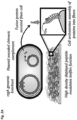
- the amyloid-based structure comprises a series of aligned metal centers which allow electrons to move from one metal center to another, thereby making the amyloid curli fiber electrically conductive.
- the amyloid based fiber is a curli fiber formed by fusion proteins comprising a CsgA polypeptide and a redox active domain.
- the one or more peptide domains including metal centers are aligned in a manner, given the structure of the curli fiber, to allow electrons to move from one metal center to the next, thereby making the curli fiber electrically conductive.
- conductive peptides form a close-packed network allowing for electron hopping from one subunit to the next. Electron hopping or movement from one subunit to the next occurs between protein domains with metal coordination centers such as ferritin, cytochromes or heme-like proteins.
- the protein domains with metal coordination centers are plastocyanin or rubredoxin.
- amyloid based structures formed by a plurality of mutant amyloid polypeptides having a series of aligned aromatic groups.
- the basic unit of a curli fiber for example CsgA, includes one or more aromatic groups, for example aromatic amino acids and when the CsgA units are combined into a curli fiber.
- the one or more aromatic groups are aligned in a manner, given the structure of the amyloid-based structure (e.g., a curli fiber), to create pi-pi stacking for electron transport.
- Aromatic rings form a ⁇ - ⁇ (pi-pi) stacking network along the amyloid-based structures (e.g., curli fibers), which induces interchain electron delocalization.
- amyloid-based structures e.g., curli fibers
- charges are spread (or delocalized) across p-orbitals of the rings, and across side chains.
- an exogenous nucleic acid encoding the fiber subunit e.g., a mutant amyloid polypeptide
- the one or more aromatic amino acids e.g., a CsgA subunit for a curli fiber
- the endogenous nucleic acid encoding for the fiber subunit may be removed from the bacterium.
- the endogenous nucleic acid encoding for the fiber subunit, e.g., the curli fiber subunit CsgA may be genetically altered or modified or mutated to comprise one or more aromatic amino acids.
- the amyloid polypeptide e.g., CsgA
- the amyloid polypeptide may be referred to as a mutant amyloid polypeptide a modified amyloid polypeptide or an altered amyloid polypeptide (e.g., mutant CsgA or modified CsgA or altered CsgA).
- a series of aligned residues in an amyloid polypeptide are identified and mutated to aromatic amino acids within the helix structure of the amyloid polypeptide (e.g., the five pseudo-repeats of the CsgA helix structure).
- the aromatic residues interact and form ⁇ -stacks leading to electron delocalization and optical phenomena.
- biofilms comprising the mutant amyloid polypeptide or amyloid-based structures comprising the mutant amyloid polypeptide (e.g., CsgA-based curli fibers) are included.
- the mutant amyloid polypeptide or amyloid-based structures comprising the mutant amyloid polypeptide are isolated from bacteria.
- the amyloid-based structures e.g., mutant CsgA-based curli fibers
- the amyloid-based structures comprising a mutant amyloid polypeptide may also include moieties providing charged, amphiphilic or hydrophobic properties.
- the amyloid-based structures e.g., mutant CsgA-based curli fibers
- mutant amyloid polypeptide comprising one or more aligned aromatic groups, wherein said amyloid polypeptides form amyloid-based structures having modified hydrophilicity or hydrophobicity, as compared to an amyloid-based structure formed by wild-type amyloid polypeptide.
- the mutant amyloid polypeptide comprises several amino acid replacements, whereby aromatic amino acids are incorporated into the protein such that upon folding a side of the protein comprises aromatic amino acids.
- one side of the protein comprises aligned aromatic amino acids and the other side of the protein is unchanged.
- the mutant amyloid polypeptide forms an amyloid-based structure with modified fluorescent ability (e.g., increased fluorescent ability) as compared to an amyloid-based structure formed of wild-type amyloid polypeptide.
- the mutant amyloid polypeptide forms an amyloid-based structure with modified charge (e.g., positive charge or negative charge) as compared to an amyloid-based structure formed of wild-type amyloid polypeptide.
- the mutant amyloid polypeptide forms an amyloid-based structure with modified fluorescent ability (e.g., increased fluorescent ability) as compared to an amyloid-based structure formed of wild-type amyloid polypeptide.
- the mutant amyloid polypeptide forms an amyloid-based structure with modified electric conductivity ability (e.g., increased conductivity ability) as compared to an amyloid-based structure formed of wild-type amyloid polypeptide.
- mutant CsgA modified to include one or more aromatic groups wherein the mutant CsgA modifies the hydrophilicity/hydrophobicity of a curli fiber comprising the mutant CsgA, are provided.
- mutant CsgA is provided where a full side of the protein is mutated to aromatic residues (for example stacks 4 and 5 together, or stacks 1, 2 and 3 together) while the other side of the protein is unchanged. This produces amphiphilic fibers compared to wild type curli fibers.
- mutant CsgA modified to include one or more aromatic groups wherein the mutant CsgA modifies the fluorescent ability of a curli fiber comprising the mutant CsgA, are provided.
- mutant CsgA is provided which produce curli fibers having increased fluorescence as compared to the fluorescence of wild type curli fibers that do not comprise mutant CsgA.
- mutant CsgA modified to include charged groups wherein the mutant CsgA modifies or creates a negative or positive charge in a curli fiber comprising the mutant CsgA as compared to the charge of a curli fiber that does not comprise the mutant CsgA are provided.
- an amyloid polypeptide comprising a mutation to include one or more nonstandard amino acids
- the mutant amyloid polypeptide e.g., mutant CsgA
- an amyloid based structure e.g., a curli fiber
- the nonstandard amino acids provide properties to the curli fibers that are different from the properties of amyloid-based structures formed by wild-type amyloid polypeptides (e.g., wild-type curli fibers).
- curli fibers comprising CsgA mutated to contain azidophenylalanine and acetylphenylalanine may be used to perform bio-orthogonal covalent chemistry (e.g., click chemistry reactions using azidophenylalanine, and reactions between the ketone group of acetylphenylalanine and alkoxyamine derivatives).
- bio-orthogonal covalent chemistry e.g., click chemistry reactions using azidophenylalanine, and reactions between the ketone group of acetylphenylalanine and alkoxyamine derivatives.
- a bacterium as described herein can proliferate and express the nucleic acid encoding the mutant amyloid polypeptide (e.g., mutant CsgA) to a produce amyloid-based structure (e.g., curli fibers) having aromatic amino acids along the length of the amyloid-based structure (e.g., curli fiber) and oriented in a manner to provide pi-pi stacking for electron transport along the length of the fiber.
- the amyloid-based structures comprising a mutant amyloid polypeptide or a fusion protein described herein form an electrically conductive biofilm.
- the mutant amyloid polypeptide or fusion protein described herein may be attached, connected or fused to an electrical conductivity enhancing protein to further enhance the electrical conductivity of the amyloid-based structure beyond the pi-pi stacking of the aromatic groups along the length of the amyloid-based structure.
- the curli fiber may form an electrically conductive biofilm.
- the mutant CsgA may be attached, connected or fused to an electrical conductivity enhancing protein to further enhance the electrical conductivity of the curli fiber beyond the pi-pi stacking of the aromatic groups along the length of the curli fiber.
- Embodiments of the present disclosure are directed to methods of genetically modifying a bacterium to include a nucleic acid that encodes a mutant amyloid polypeptide (e.g., a mutant CsgA protein) including one or more aromatic amino acids not present in wild type CsgA for expression within the bacterium.
- methods of genetically modifying a bacterium to include a nucleic acid encoding a fusion protein comprising an amyloid polypeptide and a redox active domain are provided herein.
- Such genetic modification may be accomplished by mutation of an endogenous nucleic acid sequence encoding the wild-type amyloid polypeptide (e.g., wild-type CsgA) or introduction of an exogenous nucleic acid encoding a mutant amyloid polypeptide or a fusion protein described herein (e.g., a mutant CsgA) using methods known to those of skill in the art.
- an endogenous nucleic acid sequence encoding the wild-type amyloid polypeptide e.g., wild-type CsgA
- introduction of an exogenous nucleic acid encoding a mutant amyloid polypeptide or a fusion protein described herein e.g., a mutant CsgA
- aspects of the present disclosure may utilize materials and methods described in: Cherny, I. & Gazit, E. Amyloids: Not Only Pathological Agents but Also Ordered Nanomaterials.
- such systems can be modified with one or more molecules in order to enhance their electron transport properties.
- aspects of the present disclosure may utilize Vargas, M. et al. Aromatic Amino Acids Required for Pili Conductivity and Long-Range Extracellular Electron Transport in Geobacter sulfurreducens. mBio 4, e00105-13-e00105-13 (2013); Malvankar, N. S., Tuominen, M. T. & Lovley, D. R. Comment on ‘On electrical conductivity of microbial nanowires and biofilms’ by S. M. Strycharz-Glaven, R. M. Snider, A. Guiseppi-Elie and L. M. Tender, Energy Environ.
- the conductive fibers and biofilms disclosed herein may be combined with other bacteria to produce hybrid biofilms with enhanced long-range conductivity so as to provide efficient bioelectrosynthetic systems and microbial fuel cells.
- Other applications of conductive curli fibers include biosensors, fabrication of conductive electrodes and materials (e.g., free-standing electrodes, solution-processable electrodes, biocompatible electrodes, etc.), and fabrication of composites with other nanomaterials.
- FIGS. 1 A- 1 B depict a biosynthetic conductive nanowire concept overview.
- FIG. 1 A is a comparison between the electrically conductive systems produced by natural organisms, and chemical synthesis or recombinant expression.
- FIG. 1 B schematically depicts variants of the major curli subunit (CsgA) containing periodically spaced aromatic amino acid residues (indicated with “*”). During biofilm formation, these variants will be secreted and assembled into functional curli fibers containing the aromatic side chains aligned to yield a network of conductive nanowires.
- CsgA major curli subunit
- * aromatic amino acid residues
- FIGS. 2 A- 2 D depict the Biofilm Integrated Nanofiber Display (BIND) as a method for analyzing curli fibers including mutant CsgA having one or more aromatic amino acids or aromatic group side claims.
- FIG. 2 A depicts ⁇ csgA strain of E. coli transformed with a plasmid encoding for CsgA appended to a heterologous peptide domain. These domains are displayed throughout the biofilm and imbue it with non-natural functions.
- FIG. 2 B depicts images of curli fibers displaying a silver binding peptide that can template the growth of silver nanoparticles (middle, right), whereas the wild-type curli network cannot (left).
- FIG. 2 C depicts images of curli fibers displaying a steel binding peptide (right) that enable biofilm adhesion to a steel coupon, whereas cells producing wild-type curli (middle) or no curli (left) do not adhere.
- FIG. 2 D schematically depicts curli fibers displaying a conjugation domain that can site selectively immobilize proteins or arbitrary size, including enzymes.
- FIGS. 3 A- 3 B schematically depict a proposed plan for CsgA engineering.
- FIG. 3 A is a schematic of a CsgA protein sequence. Alignment shows pseudo-repeat sequences with sites of proposed mutations (Series 1, 2). All five residues will be mutated simultaneously to one of the following aromatic amino acids: tyrosine, tryptophan, histidine, or 3-thienylalanine (through non-standard amino acid incorporation).
- FIG. 3 B depicts a homology model of CsgA protein depicting a histidine mutant from Series 2. Adjacent CsgA monomers in an assembled curli fiber are depicted. Histidine residues are also depicted. The average distance between neighboring histidine residues is 5.1 ⁇ .
- FIGS. 4 A and 4 B depict CsgA with a His-tag in the pET1d plasmid and the corresponding nucleic acid and amino acid sequences.
- FIG. 4 A is a schematic representation of CsgA with his-tag in the pET21d plasmid.
- FIG. 4 B is a schematic representation and corresponding nucleic acid and amino acid sequences of wild-type CsgA with a C-terminal His-tag.
- the depicted open reading frame also includes a SEC signal peptide, an N22 peptide, and a linker serine-glycine linker sequence (SEQ ID NOs: 1 and 2).
- FIGS. 5 A, 5 B, 5 C, and 5 D schematically depict a biomimetic approach for the synthesis of conductive curli nanofibers.
- FIGS. 6 A- 6 B shows Congo Red binding to CsgA mutants and fusions.
- FIG. 7 shows electron microscopy of curli fibers produced by mutant and control bacteria.
- FIG. 8 depicts the amounts of curli fibers produced by mutant and control bacteria, as quantitated by a Congo Red binding assay.
- FIG. 9 depicts the amounts of curli fibers produced by mutant bacteria that express CsgA under the control of an inducible promoter.
- FIG. 10 depicts a Congo Red spot test showing curli fiber formation by mutant and control bacteria.
- FIG. 11 depicts the fluorescence intensity of wild-type and mutant curli fibers.
- FIG. 12 shows electron microscopy of mutant and control curli fibers that have been isolated and purified.
- FIG. 13 shows the residual impurities after purification of mutant and control curli fibers.
- FIGS. 14 A and 14 B depicts the purification of curli nanofiber thin films, and measurement of thin film electrical properties.
- FIGS. 15 A and 15 B depict dropcast films of curli fibers, or single curli fibers on substrates and electrodes.
- FIG. 15 A depicts wild-type curli fibers dropcast on plasma-treated silicon wafers at decreasing concentrations (from left to right) of 1.5, 0.75, 0.15 and 0.015 mg/mL, from 1:1 HFIP:TFA mixtures. Prior to dropcasting, fibers were sonicated for 1 hr in HFIP and TFA. Samples were imaged using scanning electron microscopy (SEM).
- FIG. 15 B depicts high magnification scanning electron microscopy (SEM) images showing single fibers for diluted samples.
- FIGS. 16 A and 16 B depict (SEM) images of dropcast films formed using dilute solutions of curli fibers comprising CsgA fused to either ferritin domain, plastocyanin or rubredoxin ( FIG. 16 A ) or curli fibers comprising mutant CsgA ( FIG. 16 B ) can be dissolved/disassembled in HFIP/TFA and reassembled on a substrate.
- SEM images of dispersed mutant and fusion curli fibers, after dissolution/disassembly in 1:1 HFIP:TFA, and reassembly by dropcasting and solvent evaporation on a silicon substrate are shown.
- FIGS. 17 A- 17 C depict curli fibers comprising CsgA fused to a 36 amino acid linker and -plastocyanin and 10 mM copper nitrate on 10 ⁇ m polycarbonate membrane.
- Energy-dispersive X-ray spectroscopy (EDX) of CsgA-plastocyanin fusions showing the presence of copper in the samples.
- EDX was used to perform elemental mapping on fibers, after filtration purification on polycarbonate filter membranes. Copper was detected at a weight percent of 0.49 for CsgA-plastocyanin fusions. Samples were coated with 5 nm of Pt/Pd prior to imaging. Fe signal is detected mainly in the pores of the filter membrane and comes from the SEM holder.
- FIGS. 18 A and 18 B depict wild-type curli fiber plus NiNTA on 10 ⁇ m polycarbonate membrane.
- FIGS. 19 A and 19 B depict SEM images of dropcast films formed using curli fibers comprising CsgA fused to plastocyanin overlayed on commercial Micrux interdigitated electrodes. Samples were coated with 5 nm of Pt/Pd prior to imaging.
- FIG. 19 A depicts the top surface morphology of the film.
- FIG. 19 B depicts the scratch in the film at the film-electrode interface showing the fibrous cross-section and the good contact between the fibers and the gold electrode.
- FIGS. 20 A and 20 B depict SEM images of dropcast films formed using curli fibers comprising CsgA fused to plastocyanin on commercial Micrux interdigitated electrodes. Samples were not coated with Pt/Pd prior to imaging.
- FIG. 20 A depicts CsgA-plastocyanin fibers dropcast at a dilute 0.1 mg/mL concentration on interdigitated electrodes. SEM images show fibrous surface morphology.
- FIG. 20 B depicts CsgA-plastocyanin fibers dropcast at 10 mg/mL on interdigitated electrodes. Full coverage of the electrode is observed. Fibers form a thick film.
- FIGS. 21 A and 21 B depict current-voltage curves for curli fibers comprising CsgA-fused to plastocyanin relative to wild-type curli fibers and control proteins.
- Protein fibers and control proteins at 5 mg/mL in 1:1 HFIP:TFA mixture were dropcast on commercial Micrux interdigitated electrodes with 10 ⁇ m spacing. Prior to dropcasting, electrodes were cleaned with isopropanol and were plasma-treated. After drying of the fiber solution, electrodes were rinsed with deionized water and dried in air. A probe station was used to measure current-voltage curves.
- FIG. 21 A depicts the current-voltage curves for curli fibers comprising CsgA fused to plastocyanin (“plastocyanin”), hexafluoro-2-propanol: trifluoroacetic acid solvent control (“HFIP:TFA”); curli fibers comprising wild-type CsgA (“WT”); milk control (“Milk”); or bovine serum albumin control (“BSA”); or non-coated electrodes (“Blank”).
- FIG. 21 B depicts current-voltage curves for control proteins: curli fibers comprising wild-type CsgA (“WT”); milk control (“Milk”); or bovine serum albumin control (“BSA”).
- FIGS. 22 A- 22 C depict additional current-voltage curves for curli fibers comprising CsgA fused to plastocyanin.
- FIG. 22 A depicts a current-voltage curve of a scan from ⁇ 2 V to +2 V.
- FIG. 22 B depicts a current-voltage curve of a scan from ⁇ 20 V to +20 V.
- FIG. 22 C depicts a current-voltage curve of a scan from 0 to 20 V, and back from 20 V to 0 V showing little hysteresis between the forward and reverse scans.
- FIG. 23 depicts current-voltage curves for curli fibers comprising CsgA fused to plastocyanin and for curli fibers comprising CsgA fused to ferritin relative to wild-type curli fibers and control proteins dropcast on commercial Micrux electrodes (10 ⁇ m spacing) from 1:1 hexafluoro-2-propanol: trifluoroacetic acid solvent control (HFIP:TFA), dried and rinsed with water. Curli fibers or control proteins were dropped at the indicated concentration (where indicated). Current-voltage curves were measured from 0 V to 20 V using a probe station.
- HFIP trifluoroacetic acid solvent control
- FIG. 24 depicts current-voltage curves of various pi-stack-containing curli fibers. 5 mg/mL solution of curli fiber in 1:1 HFIP:TFA were dropcast on commercial Micrux interdigitated electrodes (10 ⁇ m spacing), rinsed with water after drying, and dried in air. Current-voltage curves were measured from 0 V to 20 V using a probe station.
- FIG. 25 depicts current voltage curves of curli fibers comprising CsgA mutant containing Trp at positions of stack 1 (“Trp stack 1”) relative to curli fibers comprising wild-type CsgA (“WT”) and BSA control (“BSA”).
- Trp stack 1 positions of stack 1
- WT wild-type CsgA
- BSA control BSA control
- aspects of the present disclosure are directed to the use of a bacterium capable of producing an amyloid-based structure (e.g., a bacterium with a curli fiber-producing capability) to produce amyloid-based structures (e.g., curli fibers) having mutant amyloid units (e.g., a fusion protein or mutant amyloid polypeptide described herein including mutant CsgA units) which comprise one or more aromatic groups or aromatic side chains or aromatic amino acids.
- the aromatic groups are aligned along the length of the amyloid-based structure (e.g., curli fiber) to allow for electrical conductance or for electron transporting via pi-pi stacking.
- methods of the present invention use the curli fiber production systems of a bacterium, such as E. coli .
- Curli fibers are the primary proteinaceous structural component of E. coli biofilms. They are highly robust functional amyloid nanofibers with a diameter of ⁇ 4-7 nm that exist as extended tangled networks encapsulating the cells. Curli fibers are formed from the extracellular self-assembly of CsgA, a small secreted 13-kDa protein. Chapman, M. R. et al. Role of Escherichia coli curli operons in directing amyloid fiber formation. Science 295, 851-855 (2002).
- a homologous outer-membrane protein, CsgB nucleates CsgA assembly and also anchors the nanofibers to the bacterial surface.
- Detached curli fibers can also exist as non-cell associated structural components of the ECM.
- the curli genes exist as two divergently transcribed operons (csgBAC and csgDEFG), whose seven products mediate the structure (CsgA), nucleation (CsgB), processing (CsgE, F), secretion (CsgC, G), and direct transcriptional regulation (CsgD) of curli nanofibers.
- This curli secretion system is considered a distinct secretion system of its own in gram-negative bacterium and is named the Type-VIII secretion system (T8SS). See Desvaux et al., Trends Microbiol. 17, 139-45 (2009) hereby incorporated by reference in its entirety. According to one aspect, other useful bacteria with suitable secretions systems known to those of skill in the art may be used to produce the electrically conductive curli fibers of the present disclosure.
- CsgA refers to the major structural subunit of curli.
- the sequences of CsgA and its homologs are known in a number of species, e.g. the sequence of E. coli CsgA is known (encoded by csgA (NCBI Gene ID NO: 949055); SEQ ID NO: 44 (polypeptide)).
- CsgA polypeptide (NCBI Ref Seq: NP_415560) (SEQ ID NO: 44) mkllkvaaiaaivfsgsalagvvpqyggggnhggggnnsgpnselniyqy gggnsalalqtdarnsdltitqhgggngadvgqgsddssidltqrgfgns atldqwngknsemtvkqfgggngaavdqtasnssvnvtqvgfgnatahq y
- CsgA refers to E. coli CsgA.
- CsgA refers to a polypeptide having at least 80% homology to SEQ ID NO: 44 (e.g., 80% or greater homology, 90% or greater homology, or 95% or greater homology), e.g. naturally occurring mutations or variants of CsgA, homologs of CsgA, or engineered mutations or variants of CsgA.
- CsgA refers to a polypeptide comprising an amino acid sequence having at least 80%, 81%, 82%, 83% 84%, 85%, 86%, 87%, 88%, 89%, 90%, 91%, 92%, 93%, 94%, 95%, 96%, 97%, 98%, 99%, or 100% identity to the amino acid sequence of SEQ ID NO: 44.
- amyloid polypeptides such as CsgA
- CsgA self-assembling protein domains
- amyloid-based structures e.g., curli fibers
- ⁇ -stacks can occur when conjugated molecules are a few angstroms apart (e.g., between 4 to 7 angstroms apart).
- the spacing between the beta sheets of CsgA is in the range of 4.6 angstroms, which allows for proper spacing between the aromatic side chains to form a ⁇ -stack (see, e.g., Duelholm et al. (2011) Biochemistry 50(39): 8281-90.
- Various types of ⁇ -stack geometric configurations are formed using the mutant amyloid polypeptides described herein (e.g., mutant CsgA polypeptides) described herein.
- mutation of an amyloid polypeptide (e.g., CsgA) with at least one amino acid having an aromatic residue results in sandwich-type ⁇ -stacks (also known as parallel rings).
- mutation of an amyloid polypeptide (e.g., CsgA) with at least one amino acid having an aromatic residue results in t-shaped ⁇ -stacks (also known as perpendicular rings).
- mutation of an amyloid polypeptide (e.g., CsgA) with at least one amino acid having an aromatic residue results in parallel-displaced ⁇ -stacks (also known as offset rings).
- ⁇ -stacks can be formed using any combination of amino acid residues having an aromatic side chain.
- the ⁇ -stack is formed using amino acid residues of the same type.
- the ⁇ -stack is formed using amino acid residues of different types (e.g., 2, 3, 4, 5, 6, 7, 8, 9 types of amino acid residues (e.g., natural or non-natural amino acid residues)).
- the amyloid-based structures e.g., curli fibers
- pre-fabricated substrates e.g., interdigitated electrodes
- the amyloid-based structures e.g., curli fibers
- electrodes can be drawn directly onto filter membranes onto which the amyloid-based structures (e.g., curli fibers) have been directly purified, as described herein.
- bacteria are modified to include a nucleic acid encoding a mutant amyloid polypeptide (e.g., a mutant CsgA) having one or more aromatic groups or aromatic side chains or aromatic amino acids.
- the nucleic acid encoding a mutant amyloid polypeptide (e.g., a mutant CsgA) may be exogenous and introduced into the bacterium using methods known to those of skill in the art.
- the nucleic acid encoding a mutant amyloid polypeptide may result from mutation of the endogenous nucleic acid encoding an amyloid polypeptide (e.g., CsgA) using methods known to those of skill in the art.
- the modified bacteria secrete the mutant amyloid polypeptide (e.g., mutant CsgA) which results in the production of an amyloid-based structure (e.g. a curli fiber), and optionally the production of a biofilm comprising the mutant amyloid polypeptide (e.g., mutant CsgA) being the subunit of the curli fiber.
- the electrically conductive amyloid-based structures e.g., curli fibers
- methods are provided for engineering a bacteria to produce the electrically conductive extracellular amyloid fibers.
- mutant amyloid polypeptide e.g., mutant CsgA
- the mutant amyloid polypeptide is nucleated to form an amyloid at the cell surface, and then continues to polymerize into long fibers that eventually encapsulate the cells and provide the biofilm with structural support, with the amyloid-based structure (e.g., curli fiber) and the resulting biofilm being electrically conductive.
- aspects of the present disclosure are directed to a method of producing a genetically-modified bacterium including genetically altering a bacterium to include a nucleic acid sequence encoding a mutant amyloid polypeptide (e.g., a CsgA protein) having a series of aligned aromatic groups, wherein the nucleic acid sequence is under the control of a promoter to express the mutant amyloid polypeptide (e.g., CsgA protein).
- the bacterium is E. coli .
- the bacterium is non-pathogenic.
- the bacterium is pathogenic.
- the bacterium is an attenuated bacterium.
- the aromatic group is present on a standard amino acid or a nonstandard amino acid. According to one aspect, the aromatic group is present on a standard amino acid selected from the group consisting of phenylalanine, tryptophan, tyrosine and histidine. According to one aspect, the aromatic group is present on a nonstandard amino acid selected from the group consisting of 2-thienylalanine, 3-thienylalanine, acetylphenylalanine or azidophenylalanine.
- the nucleic acid sequence further encodes a redox active domain (e.g., one or more of a metalloprotein, redox enzyme, binding domain or stimuli-responsive peptide) fused to the mutant amyloid polypeptide (e.g., a mutant CsgA protein).
- a redox active domain e.g., one or more of a metalloprotein, redox enzyme, binding domain or stimuli-responsive peptide
- the mutant amyloid polypeptide e.g., a mutant CsgA protein
- the nucleic acid sequence further encodes one or more of plastocyanin, an oxygen-carrier protein (e.g., hemoglobin, myoglobin, hemerythrin, and hemocyanin), a microperoxidase, a cytochrome, a copper-binding protein (e.g., azurin), an iron-binding protein (e.g., ferritin, lactoferrin, and transferrin), a metal-binding domain (e.g., a gold-binding domain), a metalloenzyme, or rubredoxin, or fragments thereof, fused to the mutant amyloid polypeptide (e.g., a CsgA protein).
- an oxygen-carrier protein e.g., hemoglobin, myoglobin, hemerythrin, and hemocyanin
- a microperoxidase e.g., cytochrome
- a copper-binding protein e.g., azurin
- a genetically-modified bacterium whereby the bacterium is genetically altered to include a nucleic acid sequence encoding fusion protein, wherein the fusion protein comprises a redox active domain (e.g., one or more of a metalloprotein, redox enzyme, binding domain or stimuli-responsive peptide) fused to an amyloid polypeptide (e.g., a wild type or mutant CsgA protein (e.g., a mutant CsgA protein described herein)).
- a redox active domain e.g., one or more of a metalloprotein, redox enzyme, binding domain or stimuli-responsive peptide
- amyloid polypeptide e.g., a wild type or mutant CsgA protein (e.g., a mutant CsgA protein described herein).
- exemplary redox active domains are described herein.
- aspects of the present disclosure are directed to a method of making an electrically conductive biofilm comprising proliferating a genetically-altered bacterial cell comprising a nucleic acid sequence encoding a mutant amyloid polypeptide (e.g., a mutant CsgA protein) having a series of aligned aromatic groups to produce a population of genetically-altered bacterial cells expressing the nucleic acid sequence and forming a biofilm from curli fibers formed from a plurality of the mutant amyloid polypeptides (e.g., mutant CsgA proteins), wherein the curli fibers have a series of aligned aromatic groups forming electrically conductive pi-pi stacking along the length of the curli fibers.
- a mutant amyloid polypeptide e.g., a mutant CsgA protein
- the bacterium is E. coli . In one embodiment, the bacterium is non-pathogenic. In one embodiment, the bacterium is pathogenic. According to one aspect, the aromatic group is present on a standard amino acid or a nonstandard amino acid. According to one aspect, the aromatic group is present on a standard amino acid selected from the group consisting of phenylalanine, tryptophan, tyrosine and histidine. According to one aspect, the aromatic group is present on a nonstandard amino acid selected from the group consisting of 2-thienylalanine, 3-thienylalanine, acetylphenylalanine or azidophenylalanine.
- the nucleic acid sequence further encodes a redox active domain (e.g., one or more of a metalloprotein, redox enzyme, binding domain or stimuli-responsive peptide) fused to the mutant amyloid protein (e.g., the mutant CsgA protein).
- a redox active domain e.g., one or more of a metalloprotein, redox enzyme, binding domain or stimuli-responsive peptide
- the nucleic acid further encodes one or more of plastocyanin, an oxygen-carrier protein (e.g., hemoglobin, myoglobin, hemerythrin, and hemocyanin), a microperoxidase, a cytochrome, a copper-binding protein (e.g., azurin), an iron-binding protein (e.g., ferritin, lactoferrin, and transferrin), a metal-binding domain (e.g., a gold-binding domain), a metalloenzyme, or rubredoxin, or fragments thereof, fused to the mutant amyloid polypeptide (e.g., a mutant CsgA protein described herein).
- an oxygen-carrier protein e.g., hemoglobin, myoglobin, hemerythrin, and hemocyanin
- a microperoxidase e.g., cytochrome
- a copper-binding protein e.g., a
- aspects of the present disclosure are directed to a method of making electrically conductive amyloid-based structures (e.g., curli fibers) from a genetically-modified bacterium including providing the genetically modified bacterium in culture media conditions, wherein the genetically-modified bacterium includes a nucleic acid sequence encoding a mutant amyloid polypeptide (e.g., a mutant CsgA protein) having a series of aligned aromatic groups, wherein the nucleic acid sequence is under the control of a promoter to express the mutant amyloid polypeptide (e.g., a mutant CsgA protein), expressing the nucleic acid sequence to produce the mutant amyloid polypeptide (e.g., the mutant CsgA protein), and forming an amyloid-based structure (e.g., a curli fiber) from a plurality of the mutant amyloid polypeptides, wherein the amyloid-based structures (e.g., curli fibers) have a series of
- the bacterium is E. coli . According to one aspect, the bacterium is non-pathogenic. According to one aspect, the aromatic group is present on a standard amino acid or a nonstandard amino acid. According to one aspect, the aromatic group is present on a standard amino acid selected from the group consisting of phenylalanine, tryptophan, tyrosine and histidine. According to one aspect, the aromatic group is present on a nonstandard amino acid selected from the group consisting of 2-thienylalanine, 3-thienylalanine, acetylphenylalanine or azidophenylalanine.
- the nucleic acid sequence further encodes a redox active domain (e.g., one or more of a metalloprotein, redox enzyme, binding domain or stimuli-responsive peptide) fused to the mutant amyloid polypeptide (e.g., mutant CsgA protein).
- a redox active domain e.g., one or more of a metalloprotein, redox enzyme, binding domain or stimuli-responsive peptide
- the nucleic acid further encodes one or more of plastocyanin, an oxygen-carrier protein (e.g., hemoglobin, myoglobin, hemerythrin, and hemocyanin), a microperoxidase, a cytochrome, a copper-binding protein (e.g., azurin), an iron-binding protein (e.g., ferritin, lactoferrin, and transferrin), a metal-binding domain (e.g., a gold-binding domain), a metalloenzyme, or rubredoxin, or fragments thereof, fused to the mutant CsgA protein.
- an oxygen-carrier protein e.g., hemoglobin, myoglobin, hemerythrin, and hemocyanin
- a microperoxidase e.g., cytochrome
- a copper-binding protein e.g., azurin
- an iron-binding protein e.g., ferr
- redox active domains e.g., metalloproteins or domains thereof.
- a polypeptide described herein comprises an redox active domain fused to the C-terminal of an amyloid polypeptide (e.g., a wild-type or mutant CsgA protein described herein).
- a polypeptide e.g., a fusion protein or a mutant amyloid polypeptide described herein
- a polypeptide described herein comprises a linker disposed between the amyloid polypeptide and the polypeptide to which it is fused (e.g., a redox active domain). In some embodiments, a polypeptide described herein comprises a linker disposed between the amyloid polypeptide and the polypeptide to which it is fused (e.g., a redox active domain). In some embodiments, the linker is a flexible linker. In some embodiments, the flexible linker is a glycine-serine flexible linker.
- the glycine-serine flexible linker is GSGGSGGSGGSG (SEQ ID NO: 61)
- the linker is an inflexible linker.
- the linker is between 5 and 100 amino acids in length.
- the linker is 5, 10, 15, 20, 25, 30, 35, 40, 45, 50, 55, 60, 65, 70, 75, 80, 85, 90, 95, or 100 amino acids in length.
- the linker is 12, 24, 36, 48, 60, 72, or 96 amino acid residues in length.
- the linker is 36 amino acid residues in length.
- the linker is a linker described herein. The linker length may be modified to affect electron transfer within an amyloid-based structure (e.g., a curli fiber).
- a polypeptide described herein comprises a signal sequence to facilitate to transport of the protein to the extracellular milieu.
- the signal peptide is disposed at the N-terminal of the polypeptide. Any signal peptide known in the art may be used to facilitate the export of the protein to the extracellular milieu.
- the signal peptide is a Sec signal peptide.
- the signal peptide is cleaved. In some embodiments, the signal peptide is not cleaved.
- a polypeptide described herein (e.g., a fusion protein or a mutant amyloid polypeptide described herein) comprises a peptide tag.
- the linker is a glycine-serine linker.
- the peptide tag is a His-tag.
- the peptide tag is a myc-tag.
- the peptide tag is a GST-tag.
- the peptide tag is a V5 tag. The peptide tag may be disposed at the N-terminal, C-terminal or within the mutant amyloid polypeptide or fusion protein described herein.
- the mutant amyloid polypeptide (e.g., mutant CsgA protein) and/or fusion protein (e.g., CsgA protein fused to a redox active domain) described herein further comprises a linker disposed between the peptide tag and the mutant amyloid polypeptide and/or between the fusion protein and the peptide tag.
- the linker is a flexible linker.
- the linker is a non-flexible linker. Any linker described herein may be disposed between the peptide tag and the polypeptides described herein.
- Curli fiber purification methods include, for example, affinity chromatography purification (e.g. poly-histidine-tagged-based affinity purification), purification from SDS-PAGE gels, and salt precipitation and sequential differential centrifugation (see, e.g., Chapman et al., Science, 295(5556):851-855 (2002); Zhou et al., Experimental Manipulation of the Microbial Functional Amyloid Called Curli. In Bacterial Cell Surfaces: Methods and Protocols , Delcour, H. A., Ed.
- curli fibers may be purified using vacuum filtration, as described, for example, in Dorval Courchesne et al. ACS Biomaterials Science & Engineering Article ASAP, doi: 10.1021/acsbiomaterials.6b00437 (2016), the entire contents of which are incorporated herein by reference.
- aspects of the present disclosure are directed to a genetically-modified bacterium comprising a nucleic acid sequence encoding a mutant amyloid polypeptide (e.g., a mutant CsgA protein) having a series of aligned aromatic groups, wherein the nucleic acid sequence is under the control of a promoter to express the mutant amyloid polypeptide.
- aspects of the present disclosure are directed to a non-naturally-occurring mutant amyloid polypeptides (e.g., a mutant CsgA protein) having a series of aligned aromatic groups.
- aspects of the present disclosure are directed to a non-naturally occurring amyloid-based structure (e.g., a curli fiber) formed from a plurality of mutant amyloid polypeptides (e.g., mutant CsgA proteins) forming a series of aligned aromatic groups, wherein the amyloid-based structure (e.g., curli fiber) has a series of aligned aromatic groups forming electrically-conductive pi-pi stacking along the length of the amyloid-based structures.
- aspects of the present disclosure are directed to a nucleic acid sequence encoding a non-naturally occurring mutant amyloid polypeptide (e.g., a CsgA protein) having a series of aligned aromatic groups.
- aspects of the present disclosure are directed to a vector comprising a nucleic acid sequence encoding a non-naturally occurring mutant amyloid polypeptide (e.g., a mutant CsgA protein) having a series of aligned aromatic groups.
- aspects of the present disclosure are directed to a bacterium including a nucleic acid sequence encoding a non-naturally occurring mutant amyloid polypeptide (e.g., a mutant CsgA protein) having a series of aligned aromatic groups.
- aspects of the present disclosure are directed to a bacterium including a vector comprising a nucleic acid sequence encoding a non-naturally occurring mutant amyloid polypeptide (e.g., a mutant CsgA protein) having a series of aligned aromatic groups.
- aspects of the present disclosure are directed to a bacterium expressing a nucleic acid sequence encoding a non-naturally occurring mutant amyloid polypeptide (e.g., a mutant CsgA protein) having a series of aligned aromatic groups.
- aspects of the present disclosure are directed to a biofilm including a bacterium expressing a nucleic acid sequence encoding a non-naturally occurring mutant amyloid polypeptide (e.g., a mutant CsgA protein) having a series of aligned aromatic groups.
- a non-naturally occurring mutant amyloid polypeptide e.g., a mutant CsgA protein
- a “vector” includes a nucleic acid construct designed for delivery to a host cell or transfer between different host cells.
- a vector can be viral or non-viral. Many vectors useful for transferring genes into target cells are available, e.g. the vectors may be episomal, e.g., plasmids, virus derived vectors or may be integrated into the target cell genome, through homologous recombination or random integration.
- a vector can be an expression vector.
- An “expression vector” can be a vector that has the ability to incorporate and express heterologous nucleic acid fragments in a cell.
- An expression vector may comprise additional elements, for example, the expression vector may have two replication systems, thus allowing it to be maintained in two organisms.
- the nucleic acid incorporated into the vector can be operatively linked to an expression control sequence when the expression control sequence controls and regulates the transcription and translation of that polynucleotide sequence.
- a nucleic acid encoding a mutant amyloid polypeptide e.g., a mutant CsgA protein
- a redox active domain e.g., a metalloprotein, redox enzyme, binding domain or stimuli-responsive peptide
- a nucleic acid encoding a fusion protein comprising an amyloid polypeptide fused to a redox active domain e.g., a metalloprotein, redox enzyme, binding domain or stimuli-responsive peptide
- a nucleic acid encoding a fusion protein comprising an amyloid polypeptide fused to a redox active domain e.g., a metalloprotein, redox enzyme, binding domain or stimuli-responsive peptide
- Plasmid vectors can include, but are not limited to, pBR322, pBR325, pACYC177, pACYC184, pUC8, pUC9, pUC18, pUC19, pLG339, pR290, pKC37, pKC101, SV 40, pBluescript II SK+/ ⁇ or KS+/ ⁇ (see “Stratagene Cloning Systems” Catalog (1993) from Stratagene, La Jolla, Calif, which is hereby incorporated by reference), pQE, pIH821, pGEX, pET series (see Studier et. al., “Use of T7 RNA Polymerase to Direct Expression of Cloned Genes,” Gene Expression Technology, vol. 185 (1990), which is hereby incorporated by reference in its entirety).
- a “viral vector” may be a nucleic acid vector construct that includes at least one element of viral origin and has the capacity to be packaged into a viral vector particle.
- the viral vector can contain a transgenic gene in place of non-essential viral genes.
- the vector and/or particle may be utilized for the purpose of transferring any nucleic acids into cells either in vitro or in vivo.
- Numerous viral vectors are known in the art and can be used as carriers of a nucleic acid into a cell, e.g. lambda vector system gt11, gt WES.tB, Charon 4.
- the nucleic acid encoding a polypeptide described herein can be constitutively expressed. In some embodiments, the nucleic acid encoding a polypeptide described herein can be operably-linked to a constitutive promoter. In some embodiments, the nucleic acid encoding a polypeptide described herein can be operably-linked to a constitutive promoter. In some embodiments, the nucleic acid encoding a polypeptide described herein can be inducibly-expressed. In some embodiments, the nucleic acid encoding a a polypeptide described herein can be can be operably-linked to an inducible promoter.
- nucleic acid encoding a polypeptide described herein can be can be operably linked to an inducible promoter. In some embodiments, the nucleic acid encoding a polypeptide described herein can be can be operably linked to a native CsgA promoter.
- an “inducible promoter” may be one that is characterized by initiating or enhancing transcriptional activity when in the presence of, influenced by, or contacted by an inducer or inducing agent than when not in the presence of, under the influence of, or in contact with the inducer or inducing agent.
- An “inducer” or “inducing agent” may be endogenous, or a normally exogenous compound or protein that is administered in such a way as to be active in inducing transcriptional activity from the inducible promoter.
- the inducer or inducing agent e.g., a chemical, a compound or a protein
- can itself be the result of transcription or expression of a nucleic acid sequence e.g., an inducer can be a transcriptional repressor protein
- an inducer can be a transcriptional repressor protein
- inducible promoters include but are not limited to, the lac operon promoter, a nitrogen-sensitive promoter, an IPTG-inducible promoter, a salt-inducible promoter, and tetracycline, steroid-responsive promoters, rapamycin responsive promoters and the like.
- Inducible promoters for use in prokaryotic systems are well known in the art, see, e.g. the beta.-lactamase and lactose promoter systems (Chang et al., Nature, 275: 615 (1978, which is incorporated herein by reference); Goeddel et al., Nature, 281: 544 (1979), which is incorporated herein by reference), the arabinose promoter system, including the araBAD promoter (Guzman et al., J. Bacteriol., 174: 7716-7728 (1992), which is incorporated herein by reference; Guzman et al., J.
- An inducible promoter useful in the methods and systems as disclosed herein can be induced by one or more physiological conditions, such as changes in pH, temperature, radiation, osmotic pressure, saline gradients, cell surface binding, and the concentration of one or more extrinsic or intrinsic inducing agents.
- the extrinsic inducer or inducing agent may comprise amino acids and amino acid analogs, saccharides and polysaccharides, nucleic acids, protein transcriptional activators and repressors, cytokines, toxins, petroleum-based compounds, metal containing compounds, salts, ions, enzyme substrate analogs, hormones, and combinations thereof.
- the inducible promoter is activated or repressed in response to a change of an environmental condition, such as the change in concentration of a chemical, metal, temperature, radiation, nutrient or change in pH.
- an inducible promoter useful in the methods and systems as disclosed herein can be a phage inducible promoter, nutrient inducible promoter, temperature inducible promoter, radiation inducible promoter, metal inducible promoter, hormone inducible promoter, steroid inducible promoter, and/or hybrids and combinations thereof.
- Appropriate environmental inducers can include, but are not limited to, exposure to heat (i.e., thermal pulses or constant heat exposure), various steroidal compounds, divalent cations (including Cu 2+ and Zn 2+ ), galactose, tetracycline, IPTG (isopropyl- ⁇ -D thiogalactoside), as well as other naturally occurring and synthetic inducing agents and gratuitous inducers.
- Inducible promoters useful in the methods and systems as disclosed herein also include those that are repressed by “transcriptional repressors” that are subject to inactivation by the action of environmental, external agents, or the product of another gene. Such inducible promoters may also be termed “repressible promoters” where it is required to distinguish between other types of promoters in a given module or component of the biological switch converters described herein. Preferred repressors for use in the present invention are sensitive to inactivation by physiologically benign agent.
- a lac repressor protein is used to control the expression of a promoter sequence that has been engineered to contain a lacO operator sequence
- treatment of the host cell with IPTG will cause the dissociation of the lac repressor from the engineered promoter containing a lacO operator sequence and allow transcription to occur.
- a tet repressor is used to control the expression of a promoter sequence that has been engineered to contain a tetO operator sequence
- treatment of the host cell with tetracycline will cause the dissociation of the tet repressor from the engineered promoter and allow transcription of the sequence downstream of the engineered promoter to occur.
- a bacterial cell of the methods and compositions described herein can be any of any species.
- the bacterial cells are of a species and/or strain which is amenable to culture and genetic manipulation.
- the bacterial cell can be a gram-positive bacterial cell.
- the bacterial cell can be a gram-negative bacterial cell.
- the parental strain of the bacterial cell of the technology described herein can be a strain optimized for protein expression.
- Non-limiting examples of bacterial species and strains suitable for use in the present technologies include Escherichia coli, E. coli BL21, E. coli Tuner, E. coli Rosetta, E. coli JM101, and derivatives of any of the foregoing.
- Bacterial strains for protein expression are commercially available, e.g. EXPRESSTM Competent E. coli (Cat. No. C2523; New England Biosciences; Ipswich, Mass.).
- the cell is an E. coli cell.
- a bacterium as described herein includes a mutation and/or deletion of the wild-type amyloid polypeptide gene (e.g., a gene encoding CsgA or CspA), e.g. such that the cell does not express wild-type amyloid polypeptide protein (e.g., CsgA).
- the nucleic acid encoding a polypeptide described herein is introduced into a cell by homologous recombination.
- the nucleic acid encoding a mutant amyloid polypeptide replaces the endogenous amyloid polypeptide-encoding gene in the cell.
- a mutant amyloid polypeptide e.g., a mutant CsgA protein alone or being connected to a redox active domain (e.g., a metalloprotein, redox enzyme, binding domain or stimuli-responsive peptide) replaces the endogenous amyloid polypeptide-encoding gene in the cell.
- a biofilm comprising an engineered microbial cell comprising one or more mutant amyloid polypeptides or fusion proteins described herein (e.g., a CsgA polypeptide having one or more aromatic groups that are not present in wild type CsgA polypeptide) and/or comprising a vector or nucleic acid encoding such a polypeptide.
- a biofilm comprising an amyloid-based structure (e.g., a curli fiber) comprising a mutant amyloid polypeptide or a fusion protein described herein.
- a “biofilm” refers to a mass of microorganisms which can adhere to or is adhering to a surface.
- a biofilm comprises a matrix of extracellular polymeric substances, including, but not limited to extracellular DNA, proteins, glyopeptides, and polysaccharides.
- the nature of a biofilm, such as its structure and composition, can depend on the particular species of bacteria present in the biofilm. Bacteria present in a biofilm are commonly genetically or phenotypically different than corresponding bacteria not in a biofilm, such as isolated bacteria or bacteria in a colony.
- the technology described herein relates to a biofilm that is produced by culturing an engineered microbial cell described herein under conditions suitable for the production of a biofilm.
- the engineered bacterial cell expresses a recombinant mutant amyloid polypeptide having a series of aligned aromatic groups.
- the engineered bacterial cell expresses a recombinant fusion protein comprising an amyloid polypeptide and a redox active domain.
- the engineered bacterial cell comprises an engineered CsgA polypeptide (and/or comprising a vector or nucleic acid encoding such a polypeptide) under conditions suitable for the production of a biofilm.
- Conditions suitable for the production of a biofilm can include, but are not limited to, conditions under which the microbial cell is capable of logarithmic growth and/or polypeptide synthesis. Conditions may vary depending upon the species and strain of microbial cell selected. Conditions for the culture of microbial cells are well known in the art. Biofilm production can also be induced and/or enhanced by methods well known in the art, e.g. contacting cells with subinhibitory concentrations of beta-lactam or aminoglycoside antibiotics, exposing cells to fluid flow, contacting cells with exogenous poly-N-acetylglucosamine (PNAG), or contacting cells with quorum sensing signal molecules. In some embodiments, conditions suitable for the production of a biofilm can also include conditions which increase the expression and secretion of CsgA, e.g., by exogenously expressing CsgD.
- PNAG poly-N-acetylglucosamine
- the biofilm can comprise a cell which produced the biofilm. In some embodiments, the biofilm comprises a mutant amyloid polypeptide described herein. In some embodiments, the biofilm comprises a fusion protein comprising an amyloid polypeptide fused to a redox active domain. In some embodiments, the biofilm comprises an amyloid-based structure formed by a plurality of mutant amyloid polypeptides described herein. In some embodiments, the biofilm comprises an amyloid-based structure comprising a mutant amyloid polypeptide described herein. In some embodiments, the biofilm comprises a fusion protein comprising an amyloid polypeptide fused to a redox active domain.
- the biofilm comprises an amyloid-based structure formed by a plurality of fusion proteins, wherein each fusion protein comprises an amyloid polypeptide fused to a redox active domain.
- the biofilm comprises an amyloid-based structure comprising a fusion protein described herein.
- a composition includes an engineered CsgA polypeptide which includes CsgA having one or more aromatic groups not present in the wild type CsgA, as described herein. When expressed by a cell capable of forming curli, e.g.
- CsgA units will be assembled to form curli filaments, e.g. polymeric chains of CsgA.
- filaments of the polypeptide can be present in the composition.
- the filaments can be part of a proteinaceous network, e.g. multiple filaments which can be, e.g. interwoven, overlapping, and/or in contact with each other.
- the proteinaceous network can comprise additional biofilm components, e.g. materials typically found in an E. coli biofilm.
- biofilm components can include biofilm proteins (e.g. FimA, FimH, Ag43, AidA, and/or TibA) and/or non-proteinaceous biofilm components (e.g. cellulose, PGA and/or colonic acid).
- the composition can further comprise an engineered microbial cell comprising an engineered CsgA polypeptide and/or comprising a vector or nucleic acid encoding such a polypeptide, as described herein.
- protein and “polypeptide” are used interchangeably herein to designate a series of amino acid residues, connected to each other by peptide bonds between the alpha-amino and carboxy groups of adjacent residues.
- protein and “polypeptide” refer to a polymer of amino acids, including modified amino acids (e.g., phosphorylated, glycated, glycosylated, etc.) and amino acid analogs, regardless of its size or function.
- Protein and “polypeptide” are often used in reference to relatively large polypeptides, whereas the term “peptide” is often used in reference to small polypeptides, but usage of these terms in the art overlaps.
- polypeptide proteins and “polypeptide” are used interchangeably herein when referring to a gene product and fragments thereof.
- exemplary polypeptides or proteins include gene products, naturally occurring proteins, homologs, orthologs, paralogs, fragments and other equivalents, variants, fragments, and analogs of the foregoing.
- amyloid polypeptide refers to an polypeptide capable of aggregating to form a structure having fibrillar morphology.
- the amyloid polypeptides form an amyloid-based structure which typically consists of ⁇ -strands which are perpendicular to the fiber axis and ⁇ sheets which stack parallel to the fiber axis.
- the amyloid polypeptide is selected from the group consisting of CsgA, CspA, a beta-lactoglobulin, a lysozyme, Sup35, and an amyloid-beta peptide, or a functional fragment thereof.
- amyloid-based structure or “amyloid-based fiber” as used herein refers to an polymeric aggregate of amyloid polypeptides.
- the amyloid-based structure forms a structure of fibrillary morphology.
- the amyloid-based structure is a curli fiber.
- the amyloid-based structure is formed by a heterogeneous population of amyloid polypeptides.
- the amyloid-based structure is formed by a homogenous population of amyloid polypeptides.
- amyloid-based structure may be formed by any population of amyloid polypeptides, including but not limited to, CsgA, CspA, a beta-lactoglobulin, a lysozyme, Sup35, and an amyloid-beta peptide.
- nucleic acid or “nucleic acid sequence” may be any molecule, preferably a polymeric molecule, incorporating units of ribonucleic acid, deoxyribonucleic acid or an analog thereof.
- the nucleic acid can be either single-stranded or double-stranded.
- a single-stranded nucleic acid can be one nucleic acid strand of a denatured double-stranded DNA. Alternatively, it can be a single-stranded nucleic acid not derived from any double-stranded DNA.
- the nucleic acid can be DNA.
- nucleic acid can be RNA.
- Suitable nucleic acid molecules are DNA, including genomic DNA or cDNA. Other suitable nucleic acid molecules are RNA, including mRNA.
- a method has been developed to repurpose the amyloid curli fibers of E. coli as a customizable nanomaterial, such as an electrically conductive fiber material or biofilm.
- This method called Biofilm Integrated Nanofiber Display (BIND) uses straightforward genetic manipulation to append functional heterologous sequences to the CsgA protein, or a mutant as described herein, such as a redox active domain (e.g., a metalloprotein, redox enzyme, binding domain or stimuli-responsive peptide) fused to the mutant CsgA protein ( FIG. 2 A ).
- a redox active domain e.g., a metalloprotein, redox enzyme, binding domain or stimuli-responsive peptide
- the result is a programmable and completely biosynthetic system for creating living materials with a wide range of defined functions, including electrical conductivity.
- functions include enhanced adhesion to abiotic surfaces, the ability to template the growth of inorganic nanoparticles, and the ability to site-specifically immobilize enzymes to yield a catalytic surface ( FIGS. 2 B- 2 D ).
- FIGS. 2 B- 2 D See Botyanszki, Z., Tay, P. K. R., Nguyen, P. Q., Nussbaumer, M. G. & Joshi, N. S. Engineered catalytic biofilms: Site-specific enzyme immobilization onto E. coli curli nanofibers. Biotechnol. Bioeng.
- the CsgA sequence already consists mainly of 5 pseudo-repeats of a consensus sequence based on a Ser-X 5 -Gln-X 4 -Asn-X 5 -Gln motif (SEQ ID NO: 90; FIG. 3 A ).
- SEQ ID NO: 90 Ser-X 5 -Gln-X 4 -Asn-X 5 -Gln motif
- the CsgA structure is quite malleable in terms of preserving its ability to assemble into amyloid fibers and can even participate in cross-seeding with a number of other amyloidogenic proteins.
- a series of mutants that contain up to 5 mutations (1 per repeat) is created that result in the alignment of aromatic amino acids on the exterior of the CsgA ⁇ -helix ( FIG. 3 B ).
- a representative example of one mutant containing 5 aligned histidine residues demonstrates their alignment in two consecutive CsgA monomers. Histidine is used as an example because it is isosteric with 3-thienylalanine, but other aromatic amino acids that are purported to be involved in long range EET in the G. sulfurreducens PilA nanowire (i.e., tyrosine and tryptophan) are also exemplary.
- the CsgA mutants are expressed recombinantly from a system developed that includes a plasmid containing a synthetic curli operon in an engineered strain containing the entire curli operon deleted.
- the amyloid production in each mutant is monitored using a standard plate-based Congo Red assay.
- a diagnostic device has been created to enable simultaneous monitoring of ⁇ 100s of bacterial colonies using time-lapse photography, facilitating the rapid identification of “hits” from relatively large libraries of E. coli variants.
- the hits are subsequently characterized using whole cell ELISA, TEM, and SEM on intact biofilms to confirm the identity and morphology of the mutant amyloid fibers.
- AFM of purified curli fibers is also conducted to confirm fiber dimensions.
- the variants are subjected to growth curve analyses to approximate the effects of the mutations on organismal fitness. Growth rates comparable to cells recombinantly producing the wild-type CsgA sequence are considered acceptable.
- natural aromatic amino acids are sufficient to convey a base level of electronic conductance.
- non-standard amino acid residues are sufficient to convey a base level of electronic conductance.
- an orthogonal set of tRNAs and aminoacyl-tRNA synthetases are used to specifically incorporate synthetic amino acids. See Xiao, H. et al. Genetic Incorporation of Histidine Derivatives Using an Engineered PyrrolysyltRNA Synthetase.
- the proposed mutations exhibit an average distance of 5.11 ⁇ between their respective ⁇ -carbons.
- the modified curli fibers are purified using standard protocols and measure their absorbance and fluorescence spectra under oxidizing and reducing conditions. See Tian, P. et al. Structure of a Functional Amyloid Protein Subunit Computed Using Sequence Variation. J Am Chem Soc 137, 22-25 (2015); Wang, X. & Chapman, M. R. Sequence Determinants of Bacterial Amyloid Formation. J Mol Biol 380, 570-580 (2008) hereby incorporated by reference in its entirety.
- the readout for delocalization is red-shifted in emission wavelength coupled with a decrease in intensity.
- Conductivity is measured directly by conductive AFM (ORCA) measurements on purified curli fibers.
- ORCA conductive AFM
- 96-well plates with an embedded array of addressable electrodes are used (Applied Biophysics, Inc.) to monitor bulk conductivity in intact biofilms.
- Biosynthetically produced conductive nanofibers are useful for several applications independently. Biosynthetically produced conductive nanofibers are also useful to mediate electron transport between electrodes and bacteria with the ability to use electrons directly as terminal electron acceptors in their metabolism. This is accomplished by using methods analogous to genetic engineering of the pili synthesized by microbes naturally, heterologously expressing the conductive curli fibers in the electroactive bacteria, or co-culturing two different bacterial species. According to one aspect of hybrid biofilm formation, the conductive matrix is created by engineered E. coli in an initial step, followed by colonization of the matrix with a different E. coli strain that has been specifically engineered to use external electrodes as terminal acceptors in its metabolism. See Jensen, H. M. et al. Engineering of a synthetic electron conduit in living cells. Proc. Natl. Acad. Sci. USA 107, 19213-8 (2010) hereby incorporated by reference in its entirety.
- the CsgA gene was isolated from E. coli K12 and cloned in a pET21d plasmid, under the control of the T7 promoter. A six his tag was added to the N-terminus of CsgA to allow for protein purification. Aromatic amino acid mutations were introduced in CsgA using gBlocks gene fragments (Integrated DNA Technologies) containing the point mutations, and isothermal Gibson assembly. Protein expression was performed in PQN4, an E. coli strain derived from LSR10, in which the curli operon was knocked out to prevent any background expression level of wild-type curli fibers.
- Mutations introduced in CsgA are referred to by residue number for single mutations, or by stacks for groups of four or five residues mutated together.
- the residues selected for mutations corresponding to each stack are listed below. The numbering begins at the first glycine residues in the N22 peptide (it excludes the Sec peptide). Residues selected for mutations face outward (exposed to the solvent), and are located in the ⁇ -sheets of CsgA. Each stack represents an aligned series of residues useful in forming pi-stacks.
- each stack was simultaneously mutated to tyrosine. Then, for stack 1, the residues were also simultaneously mutated to tryptophan, phenylalanine or histidine, or to a non-natural amino acid. In addition, all five stacks were mutated together to tyrosine (23 mutations) in a single mutant.
- EXPECTED MOLECULAR WEIGHT BEFORE PROTEIN SEEQUENCE INCLUDING SEC PEPTIDE
- SEC PEPTIDE Stack 1-Tyr MKLLKVAAIAAIVFSGSALA GVVPQYGGGGNHGG 169452 Sec peptide GGNNSGPNSYLNIYQYGGGNSALALQTDARNSYLT is underlined; ITQHGGGNGADVGQGSDDSYIDLTQRGFGNSATLD linker and QWNGKNSYMTVKQFGGGNGAAVDQTASNSYVNV His-tag TQVGFGNNATAHQY GSGGSGGSGGSGHHHHHH * sequences are (SEQ ID NO: 13) italicized.
- biofilms producing curli can be grown on agar plates, or in liquid medium.
- Transformed PQN4 cells are streaked onto Luria-Bertani (LB) agar plates containing 100ug/mL carbenicillin and 0.5% glucose (to prevent activation of the T7 promoter). Colonies are picked from the plates and 5 mL cultures are inoculated (in LB containing and 100ug/mL carbenicillin). Cultures are grown overnight at 37° C. The overnight cultures are diluted 100 times in fresh LB medium with 100ug/mL carbenicillin and 2% glucose, and grown at 37° C. until they reach an optical density (OD) at 600 nm of 0.6 to 0.8.
- OD optical density
- Cells are pelleted at 4000 ⁇ g, and gently resuspended in an induction medium (LB without glucose, containing 0.4 mM IPTG and 100 ug/mL carbenicillin). Protein expression is allowed to occur at 30° C. overnight.
- induction medium LB without glucose, containing 0.4 mM IPTG and 100 ug/mL carbenicillin. Protein expression is allowed to occur at 30° C. overnight.
- biofilm formation in solution follows the same procedure as for fibers containing only natural amino acids, except that no glucose is used at any step, and carbenicillin is replaced by a combination of two antibiotics selected specifically for each vector used.
- Carbenicillin or ampicillin is used for pBbB8a
- kanamycin is used for pBbB8k plasmids, in combination with the appropriate selection marker for pKB-pylHRS (kanamycin) or pEVOL (spectinomycin) plasmids.
- the non-natural amino acid of interest is added to the culture medium at a final concentration ranging between 1 mM and 10 mM.
- Congo red assays Two types were performed. 1) Agar plates containing LB, Congo red, coomassie blue and carbenicilling, with or without IPTG, were prepared. 5 to 10 ul of biofilm-forming cultures were spotted onto the plates at an OD 600 nm of 0.6 to 0.8 and incubated for one to two days. The incubation was done at room temperature for plates with IPTG (induced expression), and at 37° C. for plates without IPTG. 2) Congo red spin-down assay were performed to quantify the relative expression levels of the mutants. 1 mL of cultures that were induced with IPTG or simply grown overnight were centrifuged at 4000 ⁇ g for 10 minutes and resuspended gently in phosphate buffer.
- Curli fibers can be separated from bacteria using cell lysis and his-tag affinity purification, or using constructs without CsgB proteins to secrete CsgA directly in the culture medium and collecting the produced CsgA using Ni NTA beads.
- Ni NTA beads are added directly to the culture medium at the time of induction.
- the beads After overnight expression, the beads are allowed to settle down in a conical flask, and then separated from the supernatant and bacteria by pipetting the bottom layer. As described before, the beads are added to a column, from which CsgA can be eluted.
- SEM samples are prepared by filtering biofilms in suspension onto Nucleopore filters (0.22 um pore size, GE Healthcare Bio-Sciences) under vacuum. The filters are then washed with 0.1M sodium cacodylate buffer, and fixed with 2% glutaraldehyde and 2% paraformaldehyde for 2h at room temperature. They are then washed with water, and an increasing ethanol step gradient, before drying in a critical point dryer and sputtering with 5 nm of Pt/Pd.
- FIG. 5 A shows small peptide domains containing metal centers fused to CsgA (e.g., via SpyCatcher-SpyTag binding), thereby forming a close-packed network of conductive peptides allowing for electron hopping.
- FIG. 5 B shows CsgA mutants wherein aromatic rings form a ⁇ - ⁇ stacking network along the fibers, which induces interchain electron delocalization.
- FIG. 5 C depicts an example of a fusion protein of CsgA with a small protein or domain containing a metal center, in this case, CsgA fused to plastocyanin.
- FIG. 5 D depicts the series or stacks of aligned amino acid residues in the five pseudo-repeats of the CsgA ⁇ -helix structure that have been identified and mutated to aromatic amino acids.
- the aromatic residues are expected to interact and form ⁇ -stacks, leading to electron delocalization and optical phenomena.
- FIG. 6 A an amyloid-specific dye, Congo Red, binds to curli nanofibers produced by bacteria having CsgA mutations and CsgA fusions (CsgA-plastocyanin and CsgA-rubredoxin), indicating the formation of curli nanofibers.
- FIG. 6 B illustrates that biofilm formation was observed with all CsgA-fusions and mutants.
- Congo Red a dye that binds specifically to amyloid fibers, was also used to detect the formation of curli fibers. As shown in FIG. 8 , all biofilms with aromatic amino acid mutations express curli fibers significantly more than control biofilms without plasmid encoding CsgA.
- FIG. 9 shows that all bacteria with aromatic amino acid mutations produce curli nanofibers, whether or not a CsgA inducible promoter was induced, based on a Congo Red pull-down assay and ELISA using an anti-his antibody. Expression levels vary with or without induction.
- a Congo Red spot test shows that mutant and control bacteria produce curli fibers. Curli fibers were produced, whether or not CsgA was under the control of an IPTG-inducible promoter, and the promoter was induced.
- curli fibers composed of CsgA mutants e.g., stack 1 tyrosine or tryptophan mutants, exhbit increase fluorescence relative to wild-type control curli fibers.
- His-tagged CsgA monomers and fibers were isolated using an affinity column, as described herein. About 1-2 mg of proteins was purified per 500 ml of culture. Isolated CsgA monomers spontaneously re-assemble into fibers in buffer. Electron microscopy was used to assess morphology of isolate, purified mutant curli fibers relative to a wild-type control. As shown in FIG. 12 , purified mutant fibers exhibit slightly different aggregation behavior relative to wild-type control.
- FIG. 13 shows that some impurities remain after purification of mutant and control curli fibers.
- filtration purification was used to purify wild-type and mutant curli nanofiber thin films, and curli nanofiber films made from CsgA fusions, including CsgA-plastocyanin fusion.
- the electrical properties of these thin films were then measured.
- FIG. 14 B silver interdigitated electrodes were drawn directly onto dried curli films deposited on filter membranes. Resistance and current-voltage curves were then measured to determine which of the protein films were conductive.
- Purified films made using CsgA fusions to rubredoxin, plastocyanin, and mitochondrial ferritin were tested, as were purified films made using CsgA mutants, e.g., tyrosine stack mutants and tryptophan stack mutants.
- curli fibers comprising mutant CsgA or CsgA fused to a redox active domain may be used to form thin films
- curli fibers comprising wild-type CsgA or curli fibers comprising mutant CsgA or CsgA fused to a redox active domain were dropcast from a 1:1 HFIP:TFA solution onto substrates to form thin films. After dropcasting, samples were rinsed with DI water and dried in air. The morphology of some amyloid fibers has been studied and described previously (see, e.g., Jordens et al. (2011) Biomacromolecules 12(1): 187-93; Abraham et al.
- FIG. 15 B Images of individual curli fibers are shown in FIG. 15 B .
- Curli fibers comprising CsgA fused to either ferritin domain, plastocyanin or rubredoxin, or curli fibers comprising mutant CsgA were also dropcast onto silicon substrate to form thin films as described above, and characterized using SEM.
- FIGS. 16 A and 16 B thin films were successfully formed using both types of curli fibers. The films were also further deposited on glass and stained with Congo Red to confirm the presence of amyloid fibers.
- FIGS. 20 A and 20 B SEM images of the interface between the film and the electrode showed a fibrous cross-section and good contact between the fibers and the gold electrode.
- the surface morphology of the thin films formed on interdigitated electrodes was further characterized using SEM with samples that were not coated with Pt/Pd prior to imaging.
- FIGS. 20 A and 20 B thin films formed using curli fibers comprising CsgA fused to plastocyanin formed thick films that fully covered the electrode.
- FIGS. 21 , 23 , 24 , 25 The engineered curli fibers with the highest current at a given voltage or steepest curves correspond to curli fibers with the highest conductivity.
- ⁇ 2 V to +2 V, and ⁇ 30 V to +30 V sweeps were also performed ( FIGS. 22 A and 22 B ).
- a forward and reverse sweep from 0 V to 20 V, and 20 V to 0 V was also recorded and shows little hysteresis between forward and reverse measurements ( FIG. 22 C ).
Landscapes
- Chemical & Material Sciences (AREA)
- Health & Medical Sciences (AREA)
- Organic Chemistry (AREA)
- Life Sciences & Earth Sciences (AREA)
- Genetics & Genomics (AREA)
- General Health & Medical Sciences (AREA)
- Biochemistry (AREA)
- Zoology (AREA)
- Medicinal Chemistry (AREA)
- Molecular Biology (AREA)
- Engineering & Computer Science (AREA)
- Bioinformatics & Cheminformatics (AREA)
- Wood Science & Technology (AREA)
- Gastroenterology & Hepatology (AREA)
- Biophysics (AREA)
- Proteomics, Peptides & Aminoacids (AREA)
- General Engineering & Computer Science (AREA)
- Microbiology (AREA)
- Biomedical Technology (AREA)
- Toxicology (AREA)
- Biotechnology (AREA)
- Mycology (AREA)
- Neurology (AREA)
- Micro-Organisms Or Cultivation Processes Thereof (AREA)
- Peptides Or Proteins (AREA)
Abstract
Description
| CsgA polypeptide (NCBI Ref Seq: NP_415560) |
| (SEQ ID NO: 44) |
| mkllkvaaiaaivfsgsalagvvpqyggggnhggggnnsgpnselniyqy |
| gggnsalalqtdarnsdltitqhgggngadvgqgsddssidltqrgfgns |
| atldqwngknsemtvkqfgggngaavdqtasnssvnvtqvgfgnnatahq |
| y |
| Plastocyanin, PetE-Prochlorococcus marinus subsp. |
| marinus str. CCMP1375 (NCBI Reference Sequence: |
| NP_875473.1) |
| (SEQ ID NO: 55) |
| MISSLRSALSACFALLLVLAFGVASAQAKTVEVKLGTDAGMLAFEPSSVT |
| ISTGDSVKFVNNKLAPHNAVFEGHEELSHPDLAFAPGESWQETFTEAGTY |
| DYYCEPHRGAGMVGKVVVN |
| Ferritin, mitochondrial [Cricetulus griseus |
| (Chinese hamster)] (NCBI Reference Sequence: |
| XP_003507127) |
| (SEQ ID NO: 56) |
| MLSGFWFFSKHIGPALMSLPRVLHRCTVPQCLASRYPLLPASPRRLLASV |
| ASSQGSDGTARVRHNFHPDSEAAINHQINMELYASYVYLSMAYYFSRDDV |
| ALYNFSKSFLRQSLEEREHAEKLMKLQNQRGGRICLQDIKKPEQDDWESG |
| LRAMECALLLEKSVNQSLLDLHTLASEKGDPHLCDFLETHYLNEQVKSIK |
| ELGDHVHNLVTMGAPAVGLAEYLFDKHTLGSESKH |
| Rubredoxin [Pyrococcus furiosus DSM 3638] (NCBI |
| Reference Sequence: WP_011012426.1) |
| (SEQ ID NO: 57) |
| MAKWVCKICGYIYDEDAGDPDNGISPGTKFEELPDDWVCPICGAPKSEFE |
| KLED |
| Microperoxidase-8 (MP-8) |
| (SEQ ID NO: 58) |
| AQCHTVE |
| Microperoxidase-9 (MP-9) |
| (SEQ ID NO: 59) |
| AQCHTVEK |
| Microperoxidase-11 (MP-11) |
| (SEQ ID NO: 60) |
| QKCAQCHTVE |
| TABLE 1 |
| gBlock gene fragments used to produce the CsgA mutants with stacked aromatic |
| residues or fusions comprising redox active domains (e.g., metalloproteins or |
| domains thereof), and corresponding primers used to linearize the plasmids. NSAA |
| stands for non-standard amino acid. |
| PRIMERS USED TO | ||
| LINEARIZE THE | ||
| PLASMID BEFORE | ||
| GIBSON ASSEMBLY | ||
| CONSTRUCT | GBLOCK GENE FRAGMENT (5′ TO 3′) | (5′ TO 3′) |
| Stack 1-Tyr | ACGGTGGTGGCGGTAATAATAGCGGCCCAAATTCTTA | Fwd: |
| TCTGAACATTTACCAGTACGGTGGCGGTAACTCTGCA | GTGACTCAGGTT | |
| CTTGCTCTGCAAACTGATGCCCGTAACTCTTACTTGAC | GGCTTTGGTAAC | |
| TATTACCCAGCATGGCGGCGGTAATGGTGCAGATGTT | AACGCGACCG | |
| GGTCAGGGCTCAGATGACAGCTATATCGATCTGACCC | (SEQ ID NO: 82) | |
| AACGTGGCTTCGGTAACAGCGCTACTCTTGATCAGTG | Rev: | |
| GAACGGCAAAAATTCTTATATGACGGTTAAACAGTTC | GAATTTGGGCCG | |
| GGTGGTGGCAACGGTGCTGCAGTTGACCAGACTGCAT | CTATTATTACCG | |
| CTAACTCCTACGTCAACGTGACTCAGGTTGGCTTTGG | CCACCA (SEQ ID | |
| TAAC (SEQ ID NO: 3) | NO: 83) | |
| Stack 2-Tyr | GGTAATAATAGCGGCCCAAATTCTGAGCTGTACATTT | Fwd: |
| ACCAGTACGGTGGCGGTAACTCTGCACTTGCTCTGCA | GTGACTCAGGTT | |
| AACTGATGCCCGTAACTCTGACTTGTATATTACCCAG | GGCTTTGGTAAC | |
| CATGGCGGCGGTAATGGTGCAGATGTTGGTCAGGGCT | AACGCGACCG | |
| CAGATGACAGCTCAATCTATCTGACCCAACGTGGCTT | (SEQ ID NO: 82) | |
| CGGTAACAGCGCTACTCTTGATCAGTGGAACGGCAAA | Rev: | |
| AATTCTGAAATGTATGTTAAACAGTTCGGTGGTGGCA | GAATTTGGGCCG | |
| ACGGTGCTGCAGTTGACCAGACTGCATCTAACTCCTC | CTATTATTACCG | |
| CGTCTACGTGACTCAGGTTGGCTTTGGTAACAACGCG | CCACCA (SEQ ID | |
| (SEQ ID NO: 4) | NO: 83) | |
| Stack 3-Tyr | ACTGATGCCCGTAACTCTGACTTGACTATTTACCAGC | Fwd: |
| ATGGCGGCGGTAATGGTGCAGATGTTGGTCAGGGCTC | CAGGTTGGCTTT | |
| AGATGACAGCTCAATCGATCTGTACCAACGTGGCTTC | GGTAACAACGCG | |
| GGTAACAGCGCTACTCTTGATCAGTGGAACGGCAAAA | ACCGCTCATCAG | |
| ATTCTGAAATGACGGTTTATCAGTTCGGTGGTGGCAA | (SEQ ID NO: 84) | |
| CGGTGCTGCAGTTGACCAGACTGCATCTAACTCCTCC | Rev: | |
| GTCAACGTGTATCAGGTTGGCTTTGGTAACAACGCGA | TAGTCAAGTCAG | |
| CCGCT (SEQ ID NO: 5) | AGTTACGGGCAT | |
| CAGTTT (SEQ ID | ||
| NO: 85) | ||
| Stack 4-Tyr | TACCAGTACGGTGGCGGTAACTCTGCACTTTATCTGC | Fwd: |
| AAACTGATGCCCGTAACTCTGACTTGACTATTACCCA | CAGTACGGCTCT | |
| GCATGGCGGCGGTAATGGTGCATATGTTGGTCAGGGC | GGTGGCTCTGGT | |
| TCAGATGACAGCTCAATCGATCTGACCCAACGTGGCT | GGCTCT (SEQ ID | |
| TCGGTAACAGCGCTTATCTTGATCAGTGGAACGGCAA | NO: 86) | |
| AAATTCTGAAATGACGGTTAAACAGTTCGGTGGTGGC | Rev: | |
| AACGGTGCTTATGTTGACCAGACTGCATCTAACTCCT | AAGTGCAGAGTT | |
| CCGTCAACGTGACTCAGGTTGGCTTTGGTAACAACGC | ACCGCCACCGTA | |
| GTATGCTCATCAGTACGGcTCTGGTGGcTCTGGT (SEQ | CTGG (SEQ ID | |
| ID NO: 6) | NO: 87) | |
| Stack 5-Tyr | TACGGTGGCGGTAACTCTGCACTTGCTCTGTATACTG | Fwd: |
| ATGCCCGTAACTCTGACTTGACTATTACCCAGCATGG | GACTGCATCTAA | |
| CGGCGGTAATGGTGCAGATGTTTATCAGGGCTCAGAT | CTCCTCCGTCAA | |
| GACAGCTCAATCGATCTGACCCAACGTGGCTTCGGTA | CGTGAC (SEQ ID | |
| ACAGCGCTACTCTTTATCAGTGGAACGGCAAAAATTC | NO: 88) | |
| TGAAATGACGGTTAAACAGTTCGGTGGTGGCAACGGT | Rev: | |
| GCTGCAGTTTACCAGACTGCATCTAACTCCTCCGTCA | AAGTGCAGAGTT | |
| ACGTG (SEQ ID NO: 7) | ACCGCCACCGTA | |
| CTGG (SEQ ID | ||
| NO: 87) | ||
| Stack 1-Trp | ||
| ACGGTGGTGGCGGTAATAATAGCGGCCCAAATTCTTG | Fwd: | |
| GCTGAACATTTACCAGTACGGTGGCGGTAACTCTGCA | GTGACTCAGGTT | |
| CTTGCTCTGCAAACTGATGCCCGTAACTCTTGGTTGAC | GGCTTTGGTAAC | |
| TATTACCCAGCATGGCGGCGGTAATGGTGCAGATGTT | AACGCGACCG | |
| GGTCAGGGCTCAGATGACAGCTGGATCGATCTGACCC | (SEQ ID NO: 82) | |
| AACGTGGCTTCGGTAACAGCGCTACTCTTGATCAGTG | Rev: | |
| GAACGGCAAAAATTCTTGGATGACGGTTAAACAGTTC | GAATTTGGGCCG | |
| GGTGGTGGCAACGGTGCTGCAGTTGACCAGACTGCAT | CTATTATTACCG | |
| CTAACTCCTGGGTCAACGTGACTCAGGTTGGCTTTGG | CCACCA (SEQ ID | |
| TAAC (SEQ ID NO: 8) | NO: 83) | |
| Stack 2-Trp | GGTAATAATAGCGGCCCAAATTCTGAGCTGTGGA | Fwd: |
| TTTACCAGTACGGTGGCGGTAACTCTGCACTTGC | GTGACTCAGGT | |
| TCTGCAAACTGATGCCCGTAACTCTGACTTGTGG | TGGCTTTGGTA | |
| ATTACCCAGCATGGCGGCGGTAATGGTGCAGATG | ACAACGCGACC | |
| TTGGTCAGGGCTCAGATGACAGCTCAATCTGGCT | G (SEQ ID NO: | |
| GACCCAACGTGGCTTCGGTAACAGCGCTACTCTT | 82) | |
| GATCAGTGGAACGGCAAAAATTCTGAAATGTGG | Rev: | |
| GTTAAACAGTTCGGTGGTGGCAACGGTGCTGCAG | GAATTTGGGCC | |
| TTGACCAGACTGCATCTAACTCCTCCGTCTGGGT | GCTATTATTAC | |
| GACTCAGGTTGGCTTTGGTAACAACGCG (SEQ ID | CGCCACCA | |
| NO: 62) | (SEQ ID NO: 83) | |
| Stack 3-Trp | ACTGATGCCCGTAACTCTGACTTGACTATTTGGC | Fwd: |
| AGCATGGCGGCGGTAATGGTGCAGATGTTGGTCA | CAGGTTGGCTT | |
| GGGCTCAGATGACAGCTCAATCGATCTGTGGCAA | TGGTAACAACG | |
| CGTGGCTTCGGTAACAGCGCTACTCTTGATCAGT | CGACCGCTCAT | |
| GGAACGGCAAAAATTCTGAAATGACGGTTTGGC | CAG (SEQ ID | |
| AGTTCGGTGGTGGCAACGGTGCTGCAGTTGACCA | NO: 89) | |
| GACTGCATCTAACTCCTCCGTCAACGTGTGGCAG | Rev: | |
| GTTGGCTTTGGTAACAACGCGACCGCT (SEQ ID | TAGTCAAGTCA | |
| NO: 63) | GAGTTACGGGC | |
| ATCAGTTT (SEQ | ||
| ID NO: 85) | ||
| Stack 4-Trp | TACCAGTACGGTGGCGGTAACTCTGCACTTTGGC | Fwd: |
| TGCAAACTGATGCCCGTAACTCTGACTTGACTAT | CAGTACGGCTC | |
| TACCCAGCATGGCGGCGGTAATGGTGCATGGGTT | TGGTGGCTCTG | |
| GGTCAGGGCTCAGATGACAGCTCAATCGATCTGA | GTGGCTCT (SEQ | |
| CCCAACGTGGCTTCGGTAACAGCGCTTGGCTTGA | ID NO: 86) | |
| TCAGTGGAACGGCAAAAATTCTGAAATGACGGTT | Rev: | |
| AAACAGTTCGGTGGTGGCAACGGTGCTTGGGTTG | AAGTGCAGAGT | |
| ACCAGACTGCATCTAACTCCTCCGTCAACGTGAC | TACCGCCACCG | |
| TCAGGTTGGCTTTGGTAACAACGCGTGGGCTCAT | TACTGG (SEQ | |
| CAGTACGGcTCTGGTGGcTCTGGT (SEQ ID NO: 64) | ID NO: 87) | |
| Stack 5-Trp | TACGGTGGCGGTAACTCTGCACTTGCTCTGTGGA | Fwd: |
| CTGATGCCCGTAACTCTGACTTGACTATTACCCA | GACTGCATCTA | |
| GCATGGCGGCGGTAATGGTGCAGATGTTTGGCAG | ACTCCTCCGTC | |
| GGCTCAGATGACAGCTCAATCGATCTGACCCAAC | AACGTGAC | |
| GTGGCTTCGGTAACAGCGCTACTCTTTGGCAGTG | (SEQ ID NO: 88) | |
| GAACGGCAAAAATTCTGAAATGACGGTTAAACA | Rev: | |
| GTTCGGTGGTGGCAACGGTGCTGCAGTTTGGCAG | AAGTGCAGAGT | |
| ACTGCATCTAACTCCTCCGTCAACGTG (SEQ ID | TACCGCCACCG | |
| NO: 65) | TACTGG (SEQ | |
| ID NO: 87) | ||
| Stack 1-Phe | ACGGTGGTGGCGGTAATAATAGCGGCCCAAATTCTTT | Fwd: |
| TCTGAACATTTACCAGTACGGTGGCGGTAACTCTGCA | GTGACTCAGGTT | |
| CTTGCTCTGCAAACTGATGCCCGTAACTCTTTCTTGAC | GGCTTTGGTAAC | |
| TATTACCCAGCATGGCGGCGGTAATGGTGCAGATGTT | AACGCGACCG | |
| GGTCAGGGCTCAGATGACAGCTTTATCGATCTGACCC | (SEQ ID NO: 82) | |
| AACGTGGCTTCGGTAACAGCGCTACTCTTGATCAGTG | Rev: | |
| GAACGGCAAAAATTCTTTTATGACGGTTAAACAGTTC | GAATTTGGGCCG | |
| GGTGGTGGCAACGGTGCTGCAGTTGACCAGACTGCAT | CTATTATTACCG | |
| CTAACTCCTTCGTCAACGTGACTCAGGTTGGCTTTGGT | CCACCA (SEQ ID | |
| AAC (SEQ ID NO: 9) | NO: 83) | |
| Stack 1-His | ACGGTGGTGGCGGTAATAATAGCGGCCCAAATTCTCA | Fwd: |
| TCTGAACATTTACCAGTACGGTGGCGGTAACTCTGCA | GTGACTCAGGTT | |
| CTTGCTCTGCAAACTGATGCCCGTAACTCTCACTTGAC | GGCTTTGGTAAC | |
| TATTACCCAGCATGGCGGCGGTAATGGTGCAGATGTT | AACGCGACCG | |
| GGTCAGGGCTCAGATGACAGCCATATCGATCTGACCC | (SEQ ID NO: 82) | |
| AACGTGGCTTCGGTAACAGCGCTACTCTTGATCAGTG | Rev: | |
| GAACGGCAAAAATTCTCATATGACGGTTAAACAGTTC | GAATTTGGGCCG | |
| GGTGGTGGCAACGGTGCTGCAGTTGACCAGACTGCAT | CTATTATTACCG | |
| CTAACTCCCACGTCAACGTGACTCAGGTTGGCTTTGG | CCACCA (SEQ ID | |
| TAAC (SEQ ID NO: 10) | NO: 83) | |
| Stack 1,2,3,4 | ACGGTGGTGGCGGTAATAATAGCGGCCCAAATTCTTA | Fwd: |
| and 5-Tyr | TCTGTATATTTACCAGTACGGTGGCGGTAACTCTGCA | CAGTACGGCTCT |
| CTTTATCTGTATACTGATGCCCGTAACTCTTACTTGTA | GGTGGCTCTGGT | |
| TATTTATCAGCATGGCGGCGGTAATGGTGCATATGTT | GGCTCT (SEQ ID | |
| TATCAGGGCTCAGATGACAGCTATATCTATCTGTATC | NO: 86) | |
| AACGTGGCTTCGGTAACAGCGCTTATCTTTATCAGTG | Rev: | |
| GAACGGCAAAAATTCTTATATGTATGTTTATCAGTTC | GAATTTGGGCCG | |
| GGTGGTGGCAACGGTGCTTATGTTTATCAGACTGCAT | CTATTATTACCG | |
| CTAACTCCTACGTCTATGTGTATCAGGTTGGCTTTGGT | CCACCA (SEQ ID | |
| AACAACGCGTATGCTCATCAGTACGGcTCTGGTGGcTC | NO: 83) | |
| TGGT (SEQ ID NO: 11) | ||
| Stack- | ACGGTGGTGGCGGTAATAATAGCGGCCCAAATTCTTA | Fwd: |
| NSAA | GCTGAACATTTACCAGTACGGTGGCGGTAACTCTGCA | GTGACTCAGGTT |
| CTTGCTCTGCAAACTGATGCCCGTAACTCTTAGTTGAC | GGCTTTGGTAAC | |
| TATTACCCAGCATGGCGGCGGTAATGGTGCAGATGTT | AACGCGACCG | |
| GGTCAGGGCTCAGATGACAGCTAGATCGATCTGACCC | (SEQ ID NO: 82) | |
| AACGTGGCTTCGGTAACAGCGCTACTCTTGATCAGTG | Rev: | |
| GAACGGCAAAAATTCTTAGATGACGGTTAAACAGTTC | GAATTTGGGCCG | |
| GGTGGTGGCAACGGTGCTGCAGTTGACCAGACTGCAT | CTATTATTACCG | |
| CTAACTCCTAGGTCAACGTGACTCAGGTTGGCTTTGG | CCACCA (SEQ ID | |
| TAAC (SEQ ID NO: 12) | NO: 83) | |
| Microperoxi- | GTAACAACGCGACCGCTCATCAGTACGGTGGATC | |
| dase-8 fusion | TGGTAGCAGCGGCTCTGGTGGTTCTGGGGGCGGA | |
| AGTGGCTCCTCTGGGAGCGGGGGGTCGGGTGGT | ||
| GGCTCGGGTTCATCTGGTAGTGGCGGTTCGGGTT | ||
| GCGCGCAGTGCCATACCGTGGAAGGcTCTGGTGG | ||
| cTCTGGTGGcTCTGGcGGCAGCGGGCAtCACCACC | ||
| ACCATCATTAATACATCATTTGTATTACAGAAAC | ||
| AGGGC (SEQ ID NO: 66) | ||
| Microperoxi- | TAACAACGCGACCGCTCATCAGTACGGTGGATCT | |
| dase-9 fusion | GGTAGCAGCGGCTCTGGTGGTTCTGGGGGCGGA | |
| AGTGGCTCCTCTGGGAGCGGGGGGTCGGGTGGT | ||
| GGCTCGGGTTCATCTGGTAGTGGCGGTTCGGGTT | ||
| GCGCGCAGTGCCATACCGTGGAAAAAGGcTCTGG | ||
| TGGcTCTGGTGGcTCTGGcGGCAGCGGGCAtCACC | ||
| ACCACCATCATTAATACATCATTTGTATTACAGA | ||
| AACAGGGC (SEQ ID NO: 67) | ||
| Microperoxi- | ACAACGCGACCGCTCATCAGTACGGTGGATCTGG | |
| adse-11 fusion | TAGCAGCGGCTCTGGTGGTTCTGGGGGCGGAAGT | |
| GGCTCCTCTGGGAGCGGGGGGTCGGGTGGTGGCT | ||
| CGGGTTCATCTGGTAGTGGCGGTTCGGGTGTGCA | ||
| GAAATGCGCGCAGTGCCATACCGTGGAAGGcTCT | ||
| GGTGGcTCTGGTGGcTCTGGcGGCAGCGGGCAtCA | ||
| CCACCACCATCATTAATACATCATTTGTATTACA | ||
| G (SEQ ID NO: 68) | ||
| Plastocyanin | ACAACGCGACCGCTCATCAGTACGGTGGATCTGG | |
| fusion | TAGCAGCGGCTCTGGTGGTTCTGGGGGCGGAAGT | |
| GGCTCCTCTGGGAGCGGGGGGTCGGGTGGTGGCT | ||
| CGGGTTCATCTGGTAGTGGCGGTTCGGGTATGAT | ||
| TTCCTCGCTTCGCTCAGCGCTATCTGCATGTTTTG | ||
| CATTGCTTTTGGTGCTTGCCTTTGGAGTTGCATCC | ||
| GCACAAGCTAAAACAGTTGAAGTAAAACTAGGA | ||
| ACTGATGCTGGAATGCTTGCATTCGAACCCAGCT | ||
| CTGTAACCATAAGTACTGGCGACTCTGTGAAGTT | ||
| TGTCAACAACAAACTTGCTCCTCACAATGCAGTT | ||
| TTTGAAGGTCATGAAGAATTAAGTCATCCTGACC | ||
| TTGCTTTTGCTCCTGGCGAAAGCTGGCAAGAAAC | ||
| TTTTACAGAAGCAGGTACATATGACTATTACTGC | ||
| GAGCCTCATAGAGGAGCAGGGATGGTCGGGAAA | ||
| GTAGTTGTTAACGGcTCTGGTGGcTCTGGTGGcTC | ||
| TGGcGGCAGCGGGCAtCACCACCACCATCATTAAT | ||
| ACATCATTTGTATTACAGAAACAGGGC (SEQ ID | ||
| NO: 69) | ||
| Mitochondrial | AACGCGACCGCTCATCAGTACGGTGGATCTGGTA | |
| ferritin | GCAGCGGCTCTGGTGGTTCTGGGGGCGGAAGTG | |
| fusion | GCTCCTCTGGGAGCGGGGGGTCGGGTGGTGGCTC | |
| GGGTTCATCTGGTAGTGGCGGTTCGGGTATGCTG | ||
| TCTGGTTTCTGGTTCTTCTCCAAGCACATCGGCCC | ||
| TGCATTGATGTCCTTGCCCCGTGTGCTACACAGG | ||
| TGCACTGTCCCACAGTGTTTGGCCTCCAGGTATC | ||
| CTTTACTACCCGCCTCCCCTCGACGTCTGCTGGCC | ||
| TCGGTGGCCTCCTCCCAGGGCTCTGATGGAACTG | ||
| CCAGGGTGCGCCACAACTTTCACCCAGACTCTGA | ||
| GGCAGCCATCAACCACCAAATCAACATGGAGCTT | ||
| TACGCATCCTACGTGTACCTGTCCATGGCCTACT | ||
| ACTTCTCCAGGGATGATGTGGCCTTGTACAACTT | ||
| CTCCAAGTCTTTCCTTCGCCAGTCGCTGGAGGAG | ||
| AGGGAGCATGCAGAGAAGCTAATGAAGCTGCAG | ||
| AACCAACGCGGAGGCCGGATCTGCCTCCAGGAT | ||
| ATCAAGAAGCCAGAGCAAGATGACTGGGAGAGC | ||
| GGACTGCGGGCCATGGAATGTGCTCTGCTCCTGG | ||
| AAAAGAGTGTAAACCAGTCGCTGCTGGACCTGC | ||
| ATACTCTGGCCTCAGAAAAAGGAGATCCTCATTT | ||
| GTGCGACTTTCTGGAAACACACTACCTGAATGAG | ||
| CAGGTGAAGTCTATCAAAGAATTAGGTGACCAC | ||
| GTGCACAACTTAGTCACCATGGGGGCTCCAGCTG | ||
| TTGGCCTAGCGGAGTACCTTTTTGACAAGCACAC | ||
| CCTTGGAAGTGAGAGCAAGCACGGcTCTGGTGGc | ||
| TCTGGTGGcTCTGGcGGCAGCGGGCAtCACCACCA | ||
| CCATCATTAATACATCATTTGTATTAC (SEQ ID | ||
| NO: 70) | ||
| Rubredoxin | AACGCGACCGCTCATCAGTACGGTGGATCTGGTA | |
| fusion | GCAGCGGCTCTGGTGGTTCTGGGGGCGGAAGTG | |
| GCTCCTCTGGGAGCGGGGGGTCGGGTGGTGGCTC | ||
| GGGTTCATCTGGTAGTGGCGGTTCGGGTATGGCA | ||
| AAGTGGGTTTGTAAGATATGCGGATACATATATG | ||
| ATGAAGATGCAGGAGATCCAGACAATGGTATTTC | ||
| TCCTGGAACTAAGTTTGAGGAGCTACCAGATGAT | ||
| TGGGTTTGCCCCATTTGTGGGGCTCCAAAAAGTG | ||
| AATTTGAAAAGTTAGAAGATGGcTCTGGTGGcTCT | ||
| GGTGGcTCTGGcGGCAGCGGGCAtCACCACCACCA | ||
| TCATTAATACATCATTTGTATTACAGAAACAGGG | ||
| C (SEQ ID NO: 71) | ||
| TABLE 2 |
| Protein sequence and expected molecular weight of the mutants containing stacked |
| aromatic amino acids or fusions comprising redox active domains (e.g., |
| metalloproteins or domains thereof). The Sec peptide (underlined) has a molecular |
| weight of 1974.5 Da, which should be subtracted from the molecular weight of the |
| protein after CsgA is secreted outside of the cell, as Sec is cleaved. The |
| molecular weight of wild-type CsgA with his-tag and Sec peptide is 16677 Da. The |
| Sec peptide in each of the protein sequences below is underlined. |
| His-tags (and corresponding flexible linkers) are italicized. The flexible linkers |
| between fusion proteins are also italicized. |
| EXPECTED | ||
| MOLECULAR | ||
| WEIGHT BEFORE | ||
| PROTEIN SEEQUENCE (INCLUDING SEC PEPTIDE) | CLEAVAGE OF THE | |
| CONSTRUCT | FOR HIS-TAGGED PROTEINS | SEC PEPTIDE (DA) |
| Stack 1-Tyr | MKLLKVAAIAAIVFSGSALAGVVPQYGGGGNHGG | 169452 |
| Sec peptide | GGNNSGPNSYLNIYQYGGGNSALALQTDARNSYLT | |
| is underlined; | ITQHGGGNGADVGQGSDDSYIDLTQRGFGNSATLD | |
| linker and | QWNGKNSYMTVKQFGGGNGAAVDQTASNSYVNV | |
| His-tag | TQVGFGNNATAHQYGSGGSGGSGGSGHHHHHH* | |
| sequences are | (SEQ ID NO: 13) | |
| italicized. | ||
| Stack 2-Tyr | MKLLKVAAIAAIVFSGSALAGVVPQYGGGGNHGG | 16947 |
| Sec peptide | GGNNSGPNSELYIYQYGGGNSALALQTDARNSDLY | |
| is underlined; | ITQHGGGNGADVGQGSDDSSIYLTQRGFGNSATLD | |
| linker and | QWNGKNSEMYVKQFGGGNGAAVDQTASNSSVYV | |
| His-tag | TQVGFGNNATAHQYGSGGSGGSGGSGHHHHHH* | |
| sequences are | (SEQ ID NO: 14) | |
| italicized. | ||
| Stack 3-Tyr | MKLLKVAAIAAIVFSGSALAGVVPQYGGGGNHGG | 16897 |
| Sec peptide | GGNNSGPNSELNIYQYGGGNSALALQTDARNSDLT | |
| is underlined; | IYQHGGGNGADVGQGSDDSSIDLYQRGFGNSATLD | |
| linker and | QWNGKNSEMTVYQFGGGNGAAVDQTASNSSVNV | |
| His-tag | YQVGFGNNATAHQYGSGGSGGSGGSGHHHHHH* | |
| sequences are | (SEQ ID NO: 15) | |
| italicized. | ||
| Stack 4-Tyr | MKLLKVAAIAAIVFSGSALAGVVPQYGGGGNHGG | 17033 |
| Sec peptide | GGNNSGPNSELNIYQYGGGNSALYLQTDARNSDLT | |
| is underlined; | ITQHGGGNGAYVGQGSDDSSIDLTQRGFGNSAYLD | |
| linker and | QWNGKNSEMTVKQFGGGNGAYVDQTASNSSVNV | |
| His-tag | TQVGFGNNAYAHQYGSGGSGGSGGSGHHHHHH* | |
| sequences are | (SEQ ID NO: 16) | |
| italicized. | ||
| Stack 5-Tyr | MKLLKVAAIAAIVFSGSALAGVVPQYGGGGNHGG | 16914 |
| Sec peptide | GGNNSGPNSELNIYQYGGGNSALALYTDARNSDLT | |
| is underlined; | ITQHGGGNGADVYQGSDDSSIDLTQRGFGNSATLY | |
| linker and | QWNGKNSEMTVKQFGGGNGAAVYQTASNSSVNV | |
| His-tag | TQVGFGNNATAHQYGSGGSGGSGGSGHHHHHH* | |
| sequences are | (SEQ ID NO: 17) | |
| italicized. | ||
| Stack 1-Trp | MKLLKVAAIAAIVFSGSALAGVVPQYGGGGNHGG | 17060 |
| Sec peptide | GGNNSGPNSWLNIYQYGGGNSALALQTDARNSWL | |
| is underlined; | TITQHGGGNGADVGQGSDDSWIDLTQRGFGNSATL | |
| linker and | DQWNGKNSWMTVKQFGGGNGAAVDQTASNSWV | |
| His-tag | NVTQVGFGNNATAHQYGSGGSGGSGGSGHHHHHH | |
| sequences are | * (SEQ ID NO: 18) | |
| italicized. | ||
| Stack 2-Trp | MKLLKVAAIAAIVFSGSALAGVVPQYGGGGNHGG | 17062 |
| GGNNSGPNSELWIYQYGGGNSALALQTDARNSDL | ||
| WITQHGGGNGADVGQGSDDSSIWLTQRGFGNSAT | ||
| LDQWNGKNSEMWVKQFGGGNGAAVDQTASNSSV | ||
| WVTQVGFGNNATAHQYGSGGSGGSGGSGHHHHH | ||
| H (SEQ ID NO: 72) | ||
| Stack 3-Trp | MKLLKVAAIAAIVFSGSALAGVVPQYGGGGNHGG | 16990 |
| GGNNSGPNSELNIYQYGGGNSALALQTDARNSDLT | ||
| IWQHGGGNGADVGQGSDDSSIDLWQRGFGNSATL | ||
| DQWNGKNSEMTVWQFGGGNGAAVDQTASNSSVN | ||
| VWQVGFGNNATAHQYGSGGSGGSGGSGHHHHHH | ||
| (SEQ ID NO: 73) | ||
| Stack 4-Trp | MKLLKVAAIAAIVFSGSALAGVVPQYGGGGNHGG | 17148 |
| GGNNSGPNSELNIYQYGGGNSALWLQTDARNSDL | ||
| TITQHGGGNGAWVGQGSDDSSIDLTQRGFGNSAW | ||
| LDQWNGKNSEMTVKQFGGGNGAWVDQTASNSSV | ||
| NVTQVGFGNNAWAHQYGSGGSGGSGGSGHHHHH | ||
| H (SEQ ID NO: 74) | ||
| Stack 5-Trp | MKLLKVAAIAAIVFSGSALAGVVPQYGGGGNHGG | 17006 |
| GGNNSGPNSELNIYQYGGGNSALALWTDARNSDL | ||
| TITQHGGGNGADVWQGSDDSSIDLTQRGFGNSATL | ||
| WQWNGKNSEMTVKQFGGGNGAAVWQTASNSSV | ||
| NVTQVGFGNNATAHQYGSGGSGGSGGSGHHHHHH | ||
| (SEQ ID NO: 75) | ||
| Stack 1-Phe | MKLLKVAAIAAIVFSGSALAGVVPQYGGGGNHGG | 16865 |
| Sec peptide | GGNNSGPNSFLNIYQYGGGNSALALQTDARNSFLTI | |
| is underlined; | TQHGGGNGADVGQGSDDSFIDLTQRGFGNSATLD | |
| linker and | QWNGKNSFMTVKQFGGGNGAAVDQTASNSFVNV | |
| His-tag | TQVGFGNNATAHQYGSGGSGGSGGSGHHHHHH* | |
| sequences are | (SEQ ID NO: 19) | |
| italicized. | ||
| Stack 1-His | MKLLKVAAIAAIVFSGSALAGVVPQYGGGGNHGG | 16815 |
| Sec peptide | GGNNSGPNSHLNIYQYGGGNSALALQTDARNSHLT | |
| is underlined; | ITQHGGGNGADVGQGSDDSHIDLTQRGFGNSATLD | |
| linker and | QWNGKNSHMTVKQFGGGNGAAVDQTASNSHVNV | |
| His-tag | TQVGFGNNATAHQYGSGGSGGSGGSGHHHHHH* | |
| sequences are | (SEQ ID NO: 20) | |
| italicized. | ||
| | MKLLKVAAIAAIVFSGSALAGVVPQYGGGGNHGG | 18031 |
| and 5-Tyr | GGNNSGPNSYLYIYQYGGGNSALYLYTDARNSYL | |
| Sec peptide | YIYQHGGGNGAYVYQGSDDSYIYLYQRGFGNSAY | |
| is underlined; | LYQWNGKNSYMYVYQFGGGNGAYVYQTASNSYV | |
| linker and | YVYQVGFGNNAYAHQYGSGGSGGSGGSGHHHHH | |
| His-tag | H* (SEQ ID NO: 21) | |
| sequences are | ||
| italicized. | ||
| Microperoxi- | MKLLKVAAIAAIVFSGSALAGVVPQYGGGGNHGG | 20052 |
| dase-8 fusion | GGNNSGPNSELNIYQYGGGNSALALQTDARNSDLT | |
| ITQHGGGNGADVGQGSDDSSIDLTQRGFGNSATLD | ||
| QWNGKNSEMTVKQFGGGNGAAVDQTASNSSVNV | ||
| TQVGFGNNATAHQYGGSGSSGSGGSGGGSGSSGSG | ||
| GSGGGSGSSGSGGSGCAQCHTVEGSGGSGGSGGSG | ||
| HHHHHH (SEQ ID NO: 76) | ||
| Microperoxi- | MKLLKVAAIAAIVFSGSALAGVVPQYGGGGNHGG | 20181 |
| dase-9 fusion | GGNNSGPNSELNIYQYGGGNSALALQTDARNSDLT | |
| ITQHGGGNGADVGQGSDDSSIDLTQRGFGNSATLD | ||
| QWNGKNSEMTVKQFGGGNGAAVDQTASNSSVNV | ||
| TQVGFGNNATAHQYGGSGSSGSGGSGGGSGSSGSG | ||
| GSGGGSGSSGSGGSGCAQCHTVEKGSGGSGGSGGS | ||
| GHHHHHH (SEQ ID NO: 77) | ||
| Microperoxi- | MKLLKVAAIAAIVFSGSALAGVVPQYGGGGNHGG | 20408 |
| dase-11 fusion | GGNNSGPNSELNIYQYGGGNSALALQTDARNSDLT | |
| ITQHGGGNGADVGQGSDDSSIDLTQRGFGNSATLD | ||
| QWNGKNSEMTVKQFGGGNGAAVDQTASNSSVNV | ||
| TQVGFGNNATAHQYGGSGSSGSGGSGGGSGSSGSG | ||
| GSGGGSGSSGSGGSGVQKCAQCHTVEGSGGSGGSG | ||
| GSGHHHHHH (SEQ ID NO: 78) | ||
| Plastocyanin | MKLLKVAAIAAIVFSGSALAGVVPQYGGGGNHGG | 31772 |
| fusion | GGNNSGPNSELNIYQYGGGNSALALQTDARNSDLT | |
| ITQHGGGNGADVGQGSDDSSIDLTQRGFGNSATLD | ||
| QWNGKNSEMTVKQFGGGNGAAVDQTASNSSVNV | ||
| TQVGFGNNATAHQYGGSGSSGSGGSGGGSGSSGSG | ||
| GSGGGSGSSGSGGSGMISSLRSALSACFALLLVLAFG | ||
| VASAQAKTVEVKLGTDAGMLAFEPSSVTISTGDSV | ||
| KFVNNKLAPHNAVFEGHEELSHPDLAFAPGESWQE | ||
| TFTEAGTYDYYCEPHRGAGMVGKVVVNGSGGSGG | ||
| SGGSGHHHHHH (SEQ ID NO: 79) | ||
| Mitochondrial | MKLLKVAAIAAIVFSGSALAGVVPQYGGGGNHGG | 45821 |
| ferritin | GGNNSGPNSELNIYQYGGGNSALALQTDARNSDLT | |
| fusion | ITQHGGGNGADVGQGSDDSSIDLTQRGFGNSATLD | |
| QWNGKNSEMTVKQFGGGNGAAVDQTASNSSVNV | ||
| TQVGFGNNATAHQYGGSGSSGSGGSGGGSGSSGSG | ||
| GSGGGSGSSGSGGSGMLSGFWFFSKHIGPALMSLPR | ||
| VLHRCTVPQCLASRYPLLPASPRRLLASVASSQGSD | ||
| GTARVRHNFHPDSEAAINHQINMELYASYVYLSMA | ||
| YYFSRDDVALYNFSKSFLRQSLEEREHAEKLMKLQ | ||
| NQRGGRICLQDIKKPEQDDWESGLRAMECALLLEK | ||
| SVNQSLLDLHTLASEKGDPHLCDFLETHYLNEQVK | ||
| SIKELGDHVHNLVTMGAPAVGLAEYLFDKHTLGSE | ||
| SKHGSGGSGGSGGSGHHHHHH (SEQ ID NO: 80) | ||
| Rubredoxin | MKLLKVAAIAAIVFSGSALAGVVPQYGGGGNHGG | 25190 |
| fusion | GGNNSGPNSELNIYQYGGGNSALALQTDARNSDLT | |
| ITQHGGGNGADVGQGSDDSSIDLTQRGFGNSATLD | ||
| QWNGKNSEMTVKQFGGGNGAAVDQTASNSSVNV | ||
| TQVGFGNNATAHQYGGSGSSGSGGSGGGSGSSGSG | ||
| GSGGGSGSSGSGGSGMAKWVCKICGYIYDEDAGDP | ||
| DNGISPGTKFEELPDDWVCPICGAPKSEFEKLEDGS | ||
| GGSGGSGGSGHHHHHH (SEQ ID NO: 81) | ||
In an alternative embodiment, the mutant may lack the Sec peptide (underlined sequence). In an alternative embodiment, the mutant may lack the His tag.
- 1. Pant, D. et al. Bioelectrochemical systems (BES) for sustainable energy production and product recovery from organic wastes and industrial wastewaters. RSC Adv. 2, 1248-1263 (2012).
- 2. Erable, B., Duteanu, N. M., Ghangrekar, M. M., Dumas, C. & Scott, K. Application of electroactive biofilms. Biofouling 26, 57-71 (2010).
- 3. Michener, J. K., Thodey, K., Liang, J. C. & Smolke, C. D. Applications of genetically-encoded biosensors for the construction and control of biosynthetic pathways. Metabolic Engineering 14, 212-222 (2012).
- 4. Vargas, M. et al. Aromatic Amino Acids Required for Pili Conductivity and Long-Range Extracellular Electron Transport in Geobacter sulfurreducens.
mBio 4, e00105-13-e00105-13 (2013). - 5. Pirbadian, S. et al. Shewanella oneidensis MR-1 nanowires are outer membrane and periplasmic extensions of the extracellular electron transport components. Proceedings of the National Academy of Sciences 111, 12883-12888 (2014).
- 6. Cherny, I. & Gazit, E. Amyloids: Not Only Pathological Agents but Also Ordered Nanomaterials. Angew Chem Int Edit 47, 4062-4069 (2008).
- 7. Culver, J. N. et al. Plant virus directed fabrication of nanoscale materials and devices. Virology 479-480, 200-212 (2015).
- 8. Fischlechner, M. & Donath, E. Viruses as Building Blocks for Materials and Devices. Angew Chem Int Edit 46, 3184-3193 (2007).
- 9. Ulijn, R. V. & Woolfson, D. N. Peptide and protein based materials in 2010: from design and structure to function and application. Chem. Soc. Rev. 39, 3349 (2010).
- 10. Rodríguez-Ropero, F., Zanuy, D., Assfeld, X. & Alemán, C. Modeling an Electronic Conductor Based on Natural Peptide Sequences.
Biomacromolecules 10, 2338-2343 (2009). - 11. Hamley, I. W. et al. Self-Assembly of a Designed Amyloid Peptide Containing the Functional Thienylalanine Unit. J. Phys. Chem. B 114, 10674-10683 (2010).
- 12. Barnhart, M. M. & Chapman, M. R. Curli Biogenesis and Function. Annu. Rev. Microbiol. 60, 131-147 (2006).
- 13. Malvankar, N. S., Tuominen, M. T. & Lovley, D. R. Comment on ‘On electrical conductivity of microbial nanowires and biofilms’ by S. M. Strycharz-Glaven, R. M. Snider, A. Guiseppi-Elie and L. M. Tender, Energy Environ. Sci., 2011, 4, 4366. Energy Environ. Sci. 5, 6247 (2012).
- 14. Strycharz-Glaven, S. M. & Tender, L. M. Reply to the ‘Comment on “On electrical conductivity of microbial nanowires and biofilms”’ by N. S. Malvankar, M. T. Tuominen and D. R. Lovley, Energy Environ. Sci., 2012, 5, DOI: 10.1039/c2ee02613a. Energy Environ. Sci. 5, 6250 (2012).
- 15. Strycharz-Glaven, S. M., Snider, R. M., Guiseppi-Elie, A. & Tender, L. M. On the electrical conductivity of microbial nanowires and biofilms. Energy Environ. Sci. 4, 4366 (2011).
- 16. Botyanszki, Z., Tay, P. K. R., Nguyen, P. Q., Nussbaumer, M. G. & Joshi, N. S. Engineered catalytic biofilms: Site-specific enzyme immobilization onto E. coli curli nanofibers. Biotechnol. Bioeng. n/a-n/a (2015).
- 17. Nguyen, P. Q., Botyanszki, Z., Tay, P. K. R. & Joshi, N. S. Programmable biofilm-based materials from engineered curli nanofibres.
Nature Communications 5, 1-10 (1AD). - 18. Zhong, C. et al. Strong underwater adhesives made by self-assembling multi-protein nanofibres. Nature Nanotech 1-9 (2014).
- 19. Van Gerven, N. et al. Secretion and functional display of fusion proteins through the curli biogenesis pathway. Molecular Microbiology 91, 1022-1035 (2014).
- 20. Chen, A. Y. et al. Synthesis and patterning of tunable multiscale materials with engineered cells. Nat Mater (2014).
- 21. Xiao, H. et al. Genetic Incorporation of Histidine Derivatives Using an Engineered PyrrolysyltRNA Synthetase. ACS Chemical Biology 9, 1092-1096 (2014).
- 22. Lajoie, M. J., Rovner, A. J., Goodman, D. B. & Aerni, H. R. Genomically recoded organisms expand biological functions. Science (2013).
- 23. Mottishaw, J. D. & Sun, H. Effects of Aromatic Trifluoromethylation, Fluorination, and Methylation on Intermolecular π-π Interactions. J. Phys. Chem. A 117, 7970-7979 (2013).
- 24. Amit, M., Cheng, G., Hamley, I. W. & Ashkenasy, N. Conductance of amyloid β based peptide filaments: structure-function relations. Soft Matter 8, 8690 (2012).
- 25. Del Mercato, L. L. et al. Charge transport and intrinsic fluorescence in amyloid-like fibrils. Proceedings of the National Academy of Sciences 104, 18019-18024 (2007).
- 26. Amdursky, N. Enhanced solid-state electron transport via tryptophan containing peptide networks. Phys. Chem. Chem. Phys. 15, 13479 (2013).
- 27. Tian, P. et al. Structure of a Functional Amyloid Protein Subunit Computed Using Sequence Variation. J Am Chem Soc 137, 22-25 (2015).
- 28. Wang, X. & Chapman, M. R. Sequence Determinants of Bacterial Amyloid Formation. J Mol Biol 380, 570-580 (2008).
- 29. Jensen, H. M. et al. Engineering of a synthetic electron conduit in living cells. Proc Natl Acad Sci USA 107, 19213-19218 (2010).
Claims (17)
Priority Applications (1)
| Application Number | Priority Date | Filing Date | Title |
|---|---|---|---|
| US15/777,070 US11643443B2 (en) | 2015-11-19 | 2016-11-18 | Electrically conductive protein nanofibers and biofilms |
Applications Claiming Priority (4)
| Application Number | Priority Date | Filing Date | Title |
|---|---|---|---|
| US201562257441P | 2015-11-19 | 2015-11-19 | |
| US201662338715P | 2016-05-19 | 2016-05-19 | |
| US15/777,070 US11643443B2 (en) | 2015-11-19 | 2016-11-18 | Electrically conductive protein nanofibers and biofilms |
| PCT/US2016/062743 WO2017087786A1 (en) | 2015-11-19 | 2016-11-18 | Electrically conductive protein nanofibers and biofilms |
Publications (2)
| Publication Number | Publication Date |
|---|---|
| US20180334483A1 US20180334483A1 (en) | 2018-11-22 |
| US11643443B2 true US11643443B2 (en) | 2023-05-09 |
Family
ID=58717887
Family Applications (1)
| Application Number | Title | Priority Date | Filing Date |
|---|---|---|---|
| US15/777,070 Active 2038-03-21 US11643443B2 (en) | 2015-11-19 | 2016-11-18 | Electrically conductive protein nanofibers and biofilms |
Country Status (3)
| Country | Link |
|---|---|
| US (1) | US11643443B2 (en) |
| CA (1) | CA3005351A1 (en) |
| WO (1) | WO2017087786A1 (en) |
Families Citing this family (3)
| Publication number | Priority date | Publication date | Assignee | Title |
|---|---|---|---|---|
| FR3099648B1 (en) * | 2019-07-30 | 2023-01-13 | Centre Nat Rech Scient | Ion exchange membrane |
| EP3878360A1 (en) * | 2020-03-10 | 2021-09-15 | Commissariat à l'Energie Atomique et aux Energies Alternatives | Amyloid fibers based electrodes |
| DE102021206479A1 (en) * | 2021-06-23 | 2022-12-29 | Volkswagen Aktiengesellschaft | Use of electrically conductive proteins as a conductive additive in an electrode paste |
Citations (3)
| Publication number | Priority date | Publication date | Assignee | Title |
|---|---|---|---|---|
| WO2014176311A1 (en) | 2013-04-23 | 2014-10-30 | President And Fellows Of Harvard College | Genetic reprogramming of bacterial biofilms |
| US20140336357A1 (en) * | 2010-08-30 | 2014-11-13 | Board Of Trustees Of Michigan State University | Microbial nanowires |
| US20180111968A1 (en) * | 2011-05-31 | 2018-04-26 | Massachusetts Institute Of Technology | Cell-directed synthesis of multifunctional nanopatterns and nanomaterials |
-
2016
- 2016-11-18 CA CA3005351A patent/CA3005351A1/en not_active Abandoned
- 2016-11-18 WO PCT/US2016/062743 patent/WO2017087786A1/en not_active Ceased
- 2016-11-18 US US15/777,070 patent/US11643443B2/en active Active
Patent Citations (3)
| Publication number | Priority date | Publication date | Assignee | Title |
|---|---|---|---|---|
| US20140336357A1 (en) * | 2010-08-30 | 2014-11-13 | Board Of Trustees Of Michigan State University | Microbial nanowires |
| US20180111968A1 (en) * | 2011-05-31 | 2018-04-26 | Massachusetts Institute Of Technology | Cell-directed synthesis of multifunctional nanopatterns and nanomaterials |
| WO2014176311A1 (en) | 2013-04-23 | 2014-10-30 | President And Fellows Of Harvard College | Genetic reprogramming of bacterial biofilms |
Non-Patent Citations (3)
| Title |
|---|
| Dorval et al. Abstract Citation on line Mar. 30, 2016. (Year: 2016). * |
| International Preliminary Report on Patentability for Application No. PCT/US2016/062743, dated May 31, 2018. 11 pages. |
| International Search Report for Application No. PCT/US2016/062743, dated Apr. 25, 2017. 5 pages. |
Also Published As
| Publication number | Publication date |
|---|---|
| CA3005351A1 (en) | 2017-05-26 |
| US20180334483A1 (en) | 2018-11-22 |
| WO2017087786A1 (en) | 2017-05-26 |
Similar Documents
| Publication | Publication Date | Title |
|---|---|---|
| US11352397B2 (en) | Genetic reprogramming of bacterial biofilms | |
| US11286491B2 (en) | Biosynthetic amyloid-based materials displaying functional protein sequences | |
| Nguyen et al. | Programmable biofilm-based materials from engineered curli nanofibres | |
| Liu et al. | Biological synthesis of high-conductive pili in aerobic bacterium Pseudomonas aeruginosa | |
| US11365225B2 (en) | Method of making recombinant silk and silk-amyloid hybrid proteins using bacteria | |
| Azam et al. | Type III secretion as a generalizable strategy for the production of full‐length biopolymer‐forming proteins | |
| US11643443B2 (en) | Electrically conductive protein nanofibers and biofilms | |
| WO2010009614A1 (en) | Secretion expression of antibiotic peptide cad in bacillus subtilis and expression system of recombination bacillus subtilis | |
| KR20220100901A (en) | Artificial nanopores and related uses and methods | |
| US20230040959A1 (en) | Expression of electrically conductive protein nanowires in escherichia coli | |
| US20230279059A1 (en) | Novel bacterial protein fibers | |
| US10995114B2 (en) | Scalable production of genetically engineered nanofibrous macroscopic materials via filtration | |
| KR100313135B1 (en) | Expression Vectors Comprising a Gene Encoding OmpC Derived from E.coli as Cell Surface Anchoring Motif | |
| US12351805B2 (en) | Method of making recombinant silk and silk-amyloid hybrid proteins using bacteria | |
| CN114574412B (en) | Bacillus subtilis engineering bacterium for expressing MccJ25 and construction method and application thereof | |
| WO2025046122A1 (en) | Alpha-helical protein nanofibrils | |
| CN113372428B (en) | Branchiostoma belcheri C-type lectin BjCTL4 gene and application thereof | |
| WO2024079161A1 (en) | Metal-binding bacterial protein fibers | |
| CN118546260A (en) | Recombinant collagen with high temperature resistance and preparation method and application thereof | |
| CN118325870A (en) | A kind of ultra-broad-spectrum high-stability lyase and its preparation method and application | |
| Tseng | Evaluating the GspC protein in substrate specificity of Ralstonia solanacearum type II secretion |
Legal Events
| Date | Code | Title | Description |
|---|---|---|---|
| FEPP | Fee payment procedure |
Free format text: ENTITY STATUS SET TO UNDISCOUNTED (ORIGINAL EVENT CODE: BIG.); ENTITY STATUS OF PATENT OWNER: SMALL ENTITY |
|
| FEPP | Fee payment procedure |
Free format text: ENTITY STATUS SET TO SMALL (ORIGINAL EVENT CODE: SMAL); ENTITY STATUS OF PATENT OWNER: SMALL ENTITY |
|
| AS | Assignment |
Owner name: PRESIDENT AND FELLOWS OF HARVARD COLLEGE, MASSACHUSETTS Free format text: ASSIGNMENT OF ASSIGNORS INTEREST;ASSIGNORS:COURCHESNE, NOEMIE-MANUELLE DORVAL;JOSHI, NEEL SATISH;SIGNING DATES FROM 20170206 TO 20170208;REEL/FRAME:046010/0338 Owner name: PRESIDENT AND FELLOWS OF HARVARD COLLEGE, MASSACHU Free format text: ASSIGNMENT OF ASSIGNORS INTEREST;ASSIGNORS:COURCHESNE, NOEMIE-MANUELLE DORVAL;JOSHI, NEEL SATISH;SIGNING DATES FROM 20170206 TO 20170208;REEL/FRAME:046010/0338 |
|
| STPP | Information on status: patent application and granting procedure in general |
Free format text: DOCKETED NEW CASE - READY FOR EXAMINATION |
|
| STPP | Information on status: patent application and granting procedure in general |
Free format text: NON FINAL ACTION MAILED |
|
| STCB | Information on status: application discontinuation |
Free format text: ABANDONED -- FAILURE TO RESPOND TO AN OFFICE ACTION |
|
| STCC | Information on status: application revival |
Free format text: WITHDRAWN ABANDONMENT, AWAITING EXAMINER ACTION |
|
| STPP | Information on status: patent application and granting procedure in general |
Free format text: NON FINAL ACTION MAILED |
|
| STPP | Information on status: patent application and granting procedure in general |
Free format text: RESPONSE TO NON-FINAL OFFICE ACTION ENTERED AND FORWARDED TO EXAMINER |
|
| STPP | Information on status: patent application and granting procedure in general |
Free format text: FINAL REJECTION MAILED |
|
| STPP | Information on status: patent application and granting procedure in general |
Free format text: RESPONSE AFTER FINAL ACTION FORWARDED TO EXAMINER |
|
| STPP | Information on status: patent application and granting procedure in general |
Free format text: DOCKETED NEW CASE - READY FOR EXAMINATION |
|
| STPP | Information on status: patent application and granting procedure in general |
Free format text: NON FINAL ACTION MAILED |
|
| STPP | Information on status: patent application and granting procedure in general |
Free format text: RESPONSE TO NON-FINAL OFFICE ACTION ENTERED AND FORWARDED TO EXAMINER |
|
| STCF | Information on status: patent grant |
Free format text: PATENTED CASE |