US11639343B2 - Compounds targeting and degrading BCR-ABL protein and its antitumor application - Google Patents
Compounds targeting and degrading BCR-ABL protein and its antitumor application Download PDFInfo
- Publication number
- US11639343B2 US11639343B2 US17/015,319 US202017015319A US11639343B2 US 11639343 B2 US11639343 B2 US 11639343B2 US 202017015319 A US202017015319 A US 202017015319A US 11639343 B2 US11639343 B2 US 11639343B2
- Authority
- US
- United States
- Prior art keywords
- amino
- piperazin
- dioxopiperidin
- carboxamide
- benzyl
- Prior art date
- Legal status (The legal status is an assumption and is not a legal conclusion. Google has not performed a legal analysis and makes no representation as to the accuracy of the status listed.)
- Active
Links
Images


Classifications
-
- A—HUMAN NECESSITIES
- A61—MEDICAL OR VETERINARY SCIENCE; HYGIENE
- A61K—PREPARATIONS FOR MEDICAL, DENTAL OR TOILETRY PURPOSES
- A61K47/00—Medicinal preparations characterised by the non-active ingredients used, e.g. carriers or inert additives; Targeting or modifying agents chemically bound to the active ingredient
- A61K47/50—Medicinal preparations characterised by the non-active ingredients used, e.g. carriers or inert additives; Targeting or modifying agents chemically bound to the active ingredient the non-active ingredient being chemically bound to the active ingredient, e.g. polymer-drug conjugates
- A61K47/51—Medicinal preparations characterised by the non-active ingredients used, e.g. carriers or inert additives; Targeting or modifying agents chemically bound to the active ingredient the non-active ingredient being chemically bound to the active ingredient, e.g. polymer-drug conjugates the non-active ingredient being a modifying agent
- A61K47/54—Medicinal preparations characterised by the non-active ingredients used, e.g. carriers or inert additives; Targeting or modifying agents chemically bound to the active ingredient the non-active ingredient being chemically bound to the active ingredient, e.g. polymer-drug conjugates the non-active ingredient being a modifying agent the modifying agent being an organic compound
- A61K47/55—Medicinal preparations characterised by the non-active ingredients used, e.g. carriers or inert additives; Targeting or modifying agents chemically bound to the active ingredient the non-active ingredient being chemically bound to the active ingredient, e.g. polymer-drug conjugates the non-active ingredient being a modifying agent the modifying agent being an organic compound the modifying agent being also a pharmacologically or therapeutically active agent, i.e. the entire conjugate being a codrug
-
- A—HUMAN NECESSITIES
- A61—MEDICAL OR VETERINARY SCIENCE; HYGIENE
- A61K—PREPARATIONS FOR MEDICAL, DENTAL OR TOILETRY PURPOSES
- A61K31/00—Medicinal preparations containing organic active ingredients
- A61K31/33—Heterocyclic compounds
- A61K31/395—Heterocyclic compounds having nitrogen as a ring hetero atom, e.g. guanethidine or rifamycins
- A61K31/495—Heterocyclic compounds having nitrogen as a ring hetero atom, e.g. guanethidine or rifamycins having six-membered rings with two or more nitrogen atoms as the only ring heteroatoms, e.g. piperazine or tetrazines
- A61K31/496—Non-condensed piperazines containing further heterocyclic rings, e.g. rifampin, thiothixene or sparfloxacin
-
- A—HUMAN NECESSITIES
- A61—MEDICAL OR VETERINARY SCIENCE; HYGIENE
- A61K—PREPARATIONS FOR MEDICAL, DENTAL OR TOILETRY PURPOSES
- A61K31/00—Medicinal preparations containing organic active ingredients
- A61K31/33—Heterocyclic compounds
- A61K31/395—Heterocyclic compounds having nitrogen as a ring hetero atom, e.g. guanethidine or rifamycins
- A61K31/495—Heterocyclic compounds having nitrogen as a ring hetero atom, e.g. guanethidine or rifamycins having six-membered rings with two or more nitrogen atoms as the only ring heteroatoms, e.g. piperazine or tetrazines
- A61K31/4965—Non-condensed pyrazines
- A61K31/497—Non-condensed pyrazines containing further heterocyclic rings
-
- A—HUMAN NECESSITIES
- A61—MEDICAL OR VETERINARY SCIENCE; HYGIENE
- A61K—PREPARATIONS FOR MEDICAL, DENTAL OR TOILETRY PURPOSES
- A61K31/00—Medicinal preparations containing organic active ingredients
- A61K31/33—Heterocyclic compounds
- A61K31/395—Heterocyclic compounds having nitrogen as a ring hetero atom, e.g. guanethidine or rifamycins
- A61K31/495—Heterocyclic compounds having nitrogen as a ring hetero atom, e.g. guanethidine or rifamycins having six-membered rings with two or more nitrogen atoms as the only ring heteroatoms, e.g. piperazine or tetrazines
- A61K31/505—Pyrimidines; Hydrogenated pyrimidines, e.g. trimethoprim
- A61K31/506—Pyrimidines; Hydrogenated pyrimidines, e.g. trimethoprim not condensed and containing further heterocyclic rings
-
- A—HUMAN NECESSITIES
- A61—MEDICAL OR VETERINARY SCIENCE; HYGIENE
- A61P—SPECIFIC THERAPEUTIC ACTIVITY OF CHEMICAL COMPOUNDS OR MEDICINAL PREPARATIONS
- A61P1/00—Drugs for disorders of the alimentary tract or the digestive system
-
- A—HUMAN NECESSITIES
- A61—MEDICAL OR VETERINARY SCIENCE; HYGIENE
- A61P—SPECIFIC THERAPEUTIC ACTIVITY OF CHEMICAL COMPOUNDS OR MEDICINAL PREPARATIONS
- A61P35/00—Antineoplastic agents
-
- A—HUMAN NECESSITIES
- A61—MEDICAL OR VETERINARY SCIENCE; HYGIENE
- A61P—SPECIFIC THERAPEUTIC ACTIVITY OF CHEMICAL COMPOUNDS OR MEDICINAL PREPARATIONS
- A61P35/00—Antineoplastic agents
- A61P35/02—Antineoplastic agents specific for leukemia
-
- C—CHEMISTRY; METALLURGY
- C07—ORGANIC CHEMISTRY
- C07D—HETEROCYCLIC COMPOUNDS
- C07D401/00—Heterocyclic compounds containing two or more hetero rings, having nitrogen atoms as the only ring hetero atoms, at least one ring being a six-membered ring with only one nitrogen atom
- C07D401/14—Heterocyclic compounds containing two or more hetero rings, having nitrogen atoms as the only ring hetero atoms, at least one ring being a six-membered ring with only one nitrogen atom containing three or more hetero rings
-
- C—CHEMISTRY; METALLURGY
- C07—ORGANIC CHEMISTRY
- C07D—HETEROCYCLIC COMPOUNDS
- C07D417/00—Heterocyclic compounds containing two or more hetero rings, at least one ring having nitrogen and sulfur atoms as the only ring hetero atoms, not provided for by group C07D415/00
- C07D417/14—Heterocyclic compounds containing two or more hetero rings, at least one ring having nitrogen and sulfur atoms as the only ring hetero atoms, not provided for by group C07D415/00 containing three or more hetero rings
-
- C—CHEMISTRY; METALLURGY
- C07—ORGANIC CHEMISTRY
- C07K—PEPTIDES
- C07K19/00—Hybrid peptides, i.e. peptides covalently bound to nucleic acids, or non-covalently bound protein-protein complexes
-
- C—CHEMISTRY; METALLURGY
- C07—ORGANIC CHEMISTRY
- C07K—PEPTIDES
- C07K5/00—Peptides containing up to four amino acids in a fully defined sequence; Derivatives thereof
- C07K5/04—Peptides containing up to four amino acids in a fully defined sequence; Derivatives thereof containing only normal peptide links
- C07K5/06—Dipeptides
- C07K5/06008—Dipeptides with the first amino acid being neutral
- C07K5/06017—Dipeptides with the first amino acid being neutral and aliphatic
- C07K5/06034—Dipeptides with the first amino acid being neutral and aliphatic the side chain containing 2 to 4 carbon atoms
-
- A—HUMAN NECESSITIES
- A61—MEDICAL OR VETERINARY SCIENCE; HYGIENE
- A61K—PREPARATIONS FOR MEDICAL, DENTAL OR TOILETRY PURPOSES
- A61K38/00—Medicinal preparations containing peptides
-
- A—HUMAN NECESSITIES
- A61—MEDICAL OR VETERINARY SCIENCE; HYGIENE
- A61K—PREPARATIONS FOR MEDICAL, DENTAL OR TOILETRY PURPOSES
- A61K45/00—Medicinal preparations containing active ingredients not provided for in groups A61K31/00 - A61K41/00
- A61K45/06—Mixtures of active ingredients without chemical characterisation, e.g. antiphlogistics and cardiaca
Definitions
- the present disclosure relates to the compounds targeting and degrading BCR-ABL fusion protein and their use in antitumor.
- Chromosomal heterotopy also known as the Philadelphia chromosome translocation or the Philadelphia chromosome (PH)
- Philadelphia chromosome 9 is manifested as the translocation between the long arm of chromosome 9 and the length of chromosome 22, so that the Abelson leukemia virus 1 gene located on chromosome 9 is translocated to the fracture on chromosome 22 from the clustered gene, forming the BCR-ABL fusion gene.
- This characteristic chromosomal heterotopia exists in most chronic myeloid leukemia (CML), some acute lymphoblastic leukemia (all) and a few acute myeloid leukemia (AML).
- CML chronic myeloid leukemia
- all acute lymphoblastic leukemia
- AML acute myeloid leukemia
- BCR-ABL fusion protein has a sustained activation of tyrosine kinase activity (TK), which can activate downstream signaling pathways, including RAS, Janus kinase (JAK)/signal transcriber and activators of transcription (STAT) and phosphatidylinositol-3-kinase (PI-3K) can promote cell proliferation, reduce the dependence of growth factor, and inhibit apoptosis, which can lead to malignant transformation of cells. It is the root cause of Ph + leukemia (Philadelphia chromosome-positive leukemia).
- TKIs tyrosine kinase inhibitors
- Gleevec is the first molecular targeted drug for the treatment of cancer, which was approved for marketing in the United States in 2001. As the first TKI inhibitor for BCR-ABL protein, Gleevec has become the first-line drug for the treatment of CML [7]. The mechanism of function is to replace ATP in BCR-ABL fusion protein structure. Gleevec makes tyrosine kinase catalytic center site unable to combine with ATP, and competitively inhibits BCR-ABL phosphorylation and substrate phosphorylation. Finally, Gleevec inhibits the proliferation of BCR-ABL positive leukemia cells and promotes their apoptosis.
- Dasatinib is a dual kinase inhibitor of BCR-ABL tyrosine kinase and Src family kinase. Previous research shown that the occurrence of Ph + leukemia depends on the dual activation of Src kinase and BCR-ABL kinase [12]. Dasatinib can inhibit both tyrosine kinase and Src kinase and can penetrate the blood-brain barrier. It was used to treat CML and Ph + all by the US FDA on Jun. 28, 2006. Different from imatinib, the inhibitory effect of Dasatinib does not depend on conformation.
- Dasatinib can also inhibit the spontaneous phosphorylation of Src kinase protein in a variety of human tumor cells, which is also effective for some solid tumors [13].
- Bosudinib a powerful dual inhibitor of protein kinase SRC-ABL, can effectively inhibit wild-type BCR-ABL and most imatinib-resistant BCR-ABL mutations (Except for V299L and T315I).
- the FDA approved Bosudinib mainly for the treatment of CML patients with intolerance or resistance to imatinib in the chronic, accelerated or cataclysmic phase, and clinical studies showed that it is also effective for some solid tumors [14].
- TKI can overcome the problem of drug resistance, it is impossible to clear CML leukemic stem cells by TKI alone [16], which is the root of disease recurrence, so CML patients need to take drugs for a long time.
- a theoretical hypothesis that TKI can not clear CML leukemia stem cells is that although TKI can inhibit the kinase activity of BCR-ABL in leukemia stem cells, BCR-ABL can play a role of non-kinase activity, as a scaffold protein “protein scaffold” to start compensatory signal pathway and help leukemia stem cells survive [17]. Therefore, the treatment strategy of BCR-ABL degradation may be able to effectively remove CML leukemic stem cells, which solves the problem of patients requiring long-term medication and the secondary drug resistance caused by this problem.
- Ubiquitin mediated protein degradation pathway controls the selective degradation of most proteins in eukaryotic cells. In this pathway, proteins are first labeled by ubiquitin and then recognized and degraded by the proteasome. Ubiquitin protein ligase (E3) binds directly to protein, which determines the specificity of degradation [18]. It is a new model of drug development to design protein degrading targeting drug (PROTAD) by using the ubiquitination process in vivo. PROTAD small-molecule drugs use the ubiquitin-proteasome system inherent in cells to regulate target protein degradation [19].
- PROTAD can be combined with the target protein and E3 ubiquitin ligase at the same time, making the target protein that could not be combined with E3 ubiquitin, and then recognized and degraded by the proteasome.
- PROTAD can target proteins without obvious active sites, such as transcription factors and scaffolds, which are often difficult to design small molecular inhibitors by traditional methods [ 20 ]. Therefore, PROTAD has a very broad application prospect.
- ER- ⁇ estrogen-related receptor ⁇
- CRABP-II cell retinoid-binding protein
- BRD4 BRD4
- the present disclosure also provides a pharmaceutical composition, containing the compound of formula (I) as described herein or a pharmaceutically acceptable salt thereof, and at least one pharmaceutically acceptable carrier.
- the present disclosure also provides the compound of formula (I), or a pharmaceutically acceptable salt thereof for use as a medicament:
- the present disclosure also provides the compound of formula (I), or a pharmaceutically acceptable salt thereof for use in the prevention and/or treatment of a cancer.
- the present disclosure also provides the use of the compound of formula (I) or a pharmaceutically acceptable salt thereof for the preparation of a medicament for preventing and/or treating a cancer.
- the present disclosure also provides a method of treating or preventing a cancer, comprising administering to a subject in need a therapeutically effective amount of a compound of formula (I), or a pharmaceutically acceptable salt thereof, or a pharmaceutical composition according to the present invention.
- FIG. 1 shows the results of the degradation activity of a series of PROTAD compounds according to embodiments of the present disclosure (the (1)-(27) and (30)-(35) in FIG. 1 ) on BCR-ABL and c-ABL proteins compared with the comparative examples (the (28) and (29) in FIG. 1 ), as detected by the Western-blot method.
- FIG. 2 shows the degradation activity of Dasa-Lin-VHL compound (SIAIS151178) according to an embodiment of the present disclosure against BCR-ABL resistant mutan.
- FIG. 3 shows the effect of Dasa-Lin-VHL compound (SIAIS151178) according to an embodiment of the present disclosure on BCR-ABL + K562 cell transplanted mouse model.
- FIG. 4 shows the degradation activity of Dasa-Lin-VHL compound (SIAIS151178) according to an embodiment of the present disclosure on BCR-ABL protein in vivo.
- the present disclosure provides the compound of formula (I):
- the Bcr-abl-TKIs is covalently bonded to the group LIN via group A, and ULM covalently binds to the group LIN;
- Bcr-abl-TKIs is a Bcr-abl tyrosine kinase inhibitor or their analogs with the same function;
- LIN is a linker, which is a linear or branched alkylene chain, wherein the linear or branched alkylene chain is optionally interrupted one or more times (e.g., 1-20, 1-15, 1-10, 1-9, 1-8, 1-7,1-6, 1-5, 1-4, 1-3, or 1-2 times, or 1 time) by one or more selected from the group consisting of —O—, —CONH—, —NHCO—, —NH—, alkynylene, alkenylene, cycloalkylene, arylene, heterocyclylene or heteroarylene or any combination thereof, wherein the linear or branched alkylene chain is optionally substituted with one or more substituents;
- ULM is a small molecule ligand with ubiquitination function on VHL or CRBN protease
- the group A is —CO—.
- the Bcr-abl-TKIs represents the compound moiety represented by the following general formula:
- R 1 , R 2 , R 3 , R 4 , R 5 , R 6 , R 7 , R 8 , R 9 , R 10 , R 11 , and R 12 each independently represent alkyl or H.
- R 1 , R 2 , R 3 , R 4 , R 5 , R 6 , R 7 , R 8 , R 9 , R 10 , R 11 , and R 12 each independently represent linear or branched chain C 1-10 alkyl or H.
- the C 1-10 alkyl is preferably C 1-9 alkyl, more preferably C 1-8 alkyl, still more preferably C 2-8 alkyl, more preferably C 1-7 alkyl, even more preferably C 1-6 alkyl, C 1-5 alkyl, C 1-4 alkyl, or C 1-3 alkyl.
- Representative examples include, but are not limit to, methyl, ethyl, n-propyl, isopropyl, n-butyl, isobutyl, sec-butyl, tert-butyl, n-pentyl, isopentyl, neopentyl and tert-pentyl.
- the ULM represents the structure of formula (II):
- X is —CH 2 — or —CO—
- Y is —CH 2 —, —NH— or —O—
- Z 1 is carbonyl or Z 1 is absent.
- the ULM represents the structure of formula (III):
- Z 2 is carbonyl or Z 2 is absent.
- the LIN is methylene or linear or branched C 2 -C 30 alkylene chain (preferably C 2 -C 29 alkylene chain, C 2 -C 28 alkylene chain, C 2 -C 27 alkylene chain, C 2 -C 26 alkylene chain, C 2 -C 25 alkylene chain, C 2 -C 24 alkylene chain, C 2 -C 23 alkylene chain, C 2 -C 22 alkylene chain, C 2 -C 21 alkylene chain, C 2 -C 2 alkylene chain, C 2 -C 19 alkylene chain, C 2 -C 18 alkylene chain, C 2 -C 17 alkylene chain, C 2 -C 16 alkylene chain, C 2 -C 15 alkylene chain, C 2 -C 14 alkylene chain, C 2 -C 13 alkylene chain, C 2 -C 12 alkylene chain, C 2 -C 11 alkylene chain, C 2 -C 10 alkylene chain, C 2 -C 30 alkylene
- the LIN represents:
- R 13 , R 14 , R 15 , R 16 , R 17 , R 18 , R 19 , R 20 , R 21 , R 22 , R 23 , R 24 , R 25 , R 26 , R 27 , R 28 , R 29 , R 30 , R 31 , R 32 , R 33 , R 34 , R 35 , R 36 , R 37 , and R 38 each independently represent H, a linear or branched C 1 -C 10 alkyl or C 3 -C 10 cycloalkyl, wherein in the same group LIN, R 13 , R 14 , R 15 , and R 16 are not H at the same time, R 17 , R 18 , R 19 , R 20 , R 21 , and R 22 are not H at the same time, R 23 , R 24 , R 25 , R 26 , R 27 , R 28 , R 29 , R 30 , R 31 , R 32 , R 33 , and R 34 are not H at the same
- n1, n2, n3, n4, n5, n6, m1, and m2 are each independently an integer of 1, 2, 3, 4, 5, 6, 7, 8, 9, 10, 11, 12, 13, 14, 15, 16, 17, 18, 19, or 20.
- the LIN represents —(CH 2 ) n1 —(O(CH 2 ) n2 ) m1 —, or —(CH 2 ) n1 —(O(CH 2 ) n2 ) m1 —O—(CH 2 ) n3 —, wherein n1, n2, n3, and m1 each independently represent an integer of 1, 2, 3, 4, 5, 6, 7, 8, 9, 10, 11, 12, 13, 14, 15, 16, 17, 18, 19 or 20; wherein the LIN is optionally substituted by one or more substituents, the substituents are selected from the group consisting of hydroxyl, amino, mercapto and halogen.
- the LIN represents:
- the LIN represents a linear or branched C 1 -C 20 alkylene chain optionally substituted by one or more substituents, wherein the substituents are selected from the group consisting of hydroxyl, amino, mercapto and halogen. In one embodiment of the present disclosure, the LIN represents:
- the LIN represents a linear or branched alkylene chain optionally substituted one or more times (e.g., 1-20, 1-15, 1-10, 1-9, 1-8, 1-7, 1-6, 1-5, 1-4, 1-3, or 1-2 times, or 1 time) by one or more substituents selected from the group consisting of hydroxyl, amino, mercapto and halogen.
- the LIN is a linear or branched C 1 -C 3 alkylene chain (preferably C 1 -C 29 alkylene chain, C 1 -C 28 alkylene chain, C 1 -C 27 alkylene chain, C 1 -C 26 alkylene chain, C 1 -C 25 alkylene chain, C 1 -C 24 alkylene chain, C 1 -C 23 alkylene chain, C 1 -C 22 alkylene chain, C 1 -C 21 alkylene chain, C 1 -C 20 alkylene chain, C 1 -C 19 alkylene chain, C 1 -C 18 alkylene chain, C 1 -C 17 alkylene chain, C 1 -C 16 alkylene chain, C 1 -C 15 alkylene chain, C 1 -C 14 alkylene chain, C 1 -C 13 alkylene chain, C 1 -C 12 alkylene chain, C 1 -C 1 alkylene chain, C 1 -C 10 alkylene chain, C 1 -
- the number of the substituents may be, such as, 1-30, 1-25, 1-20, or 1-15, 1-10, 1-9, 1-8, 1-7, 1-6, 1-5, 1-4, 1-3, or 1-2, or 20, 19, 18, 17, 16, 15, 14, 13, 12, 11, 10, 9, 8, 7, 6, 5, 4, 3, 2, or 1.
- the LIN represents a linear or branched alkylene chain interrupted one or more times (e.g., 1-20, 1-15, 1-10, 1-9, 1-8, 1-7, 1-6, 1-5, 1-4, 1-3, or 1-2 times, or 1 time) by one or more substituents selected from the group consisting of heterocyclylene, heteroarylene groups, or any combination thereof, or —(CH 2 ) n1 —(O(CH 2 ) n2 ) m1 — in which carbon chain is interrupted one or more times (e.g., 1-20, 1-15, 1-10, 1-9, 1-8, 1-7, 1-6, 1-5, 1-4, 1-3, or 1-2 times, or 1 time) by one or more selected from the group consisting of arylene, heterocyclylene, heteroarylene, or any combination thereof, wherein n1, n2, and m1 each independently represent an integer of 1, 2, 3, 4, 5, 6, 7, 8, 9, 10, 11, 12, 13, 14, 15, 16, 17, 18, 19 or 20
- n1, n2, n3, n4, n5, n6, m1, and m2 each independently represent an integer of 1, 2, 3, 4, 5, 6, 7, 8, 9, 10, 11, 12, 13, 14, 15, 16, 17, 18, 19, 20, 21, 22, 23, 24, 25, 26, 27, 28, 29, or30.
- the LIN represents:
- the LIN represents —(CH 2 ) n1 —(CONH—(CH 2 ) n2 ) m1 —, —(CH 2 ) n1 —(CONH—(CH 2 ) n2 ) m1 —O—(CH 2 ) n3 —, or —(CH 2 ) n1 —(O(CH 2 ) n2 ) m1 —O—(CH 2 ) n3 —CONH—(CH 2 ) n4 —(O(CH 2 ) n5 ) m2 —O—(CH 2 ) n6 —; wherein n1, n2, n3, n4, n5, n6, m1, and m2 each independently represent an integer of 1, 2, 3, 4, 5, 6, 7, 8, 9, 10, 11, 12, 13, 14, 15, 16, 17, 18, 19 or 20; wherein the LIN is optionally substituted by one or more substituents selected from the group consisting of hydroxyl
- the LIN represents —(CH 2 ) n1 —NHCO—(CH 2 ) n2 —, wherein n1 and n2 are each independently the integer of 1, 2, 3, 4, 5, 6, 7, 8, 9, 10, 11, 12, 13, 14, 15, 16, 17, 18, 19, 20, 21, 22, 23, 24, 25, 26, 27, 28, 29 or 30; wherein the LIN is optionally substituted by one or more substituents selected from the group consisting of hydroxyl, amino, mercapto and halogen.
- the LIN is —(CH 2 ) n1 —NHCO—(CH 2 ) n2 —, wherein n1 and n2 are each independently the integer of 1, 2, 3, 4, 5, 6, 7, 8, 9, 10, 11, 12, 13, 14, 15, 16, 17, 18, 19, 20, 21, 22, 23, 24, 25, 26, 27, 28, 29 or 30.
- the LIN is —CH 2 NHCOCH 2 —, —(CH 2 ) 2 NHCO(CH 2 ) 2 —, —(CH 2 ) 3 NHCO(CH 2 ) 3 —, —(CH 2 ) 4 NHCO(CH 2 ) 4 —, —(CH 2 ) 5 NHCO(CH 2 ) 5 —, —(CH 2 ) 6 NHCO(CH 2 ) 6 —, —(CH 2 ) 6 NHCO(CH 2 ) 6 —, —(CH 2 NHCO(CH 2 ) 7 —, —(CH 2 ) 8 NHCO(CH 2 ) 8 —, —(CH 2 ) 9 NHCO(CH 2 ) 9 —, —(CH 2 ) 10 NHCO(CH 2 ) 10 —, —(CH 2 ) 11 NHCO(CH 2 ) 11 —, —(CH 2 ) 12 NHCO(CH 2 )
- the LIN is a linear or branched alkylene chain interrupted one or more times (e.g., 1-20, 1-15, 1-10, 1-9, 1-8, 1-7, 1-6, 1-5, 1-4, 1-3, or 1-2 times, or 1 time) by one or more alkenylene groups; wherein the LIN is optionally substituted by one or more substituents selected from the group consisting of hydroxyl, amino, mercapto and halogen.
- the LIN is —(CH 2 ) n1 —CH ⁇ CH—(CH 2 ) n2 —, wherein n1 and n2 are each independently the integer of 1, 2, 3, 4, 5, 6, 7, 8, 9, 10, 11, 12, 13, 14, 15, 16, 17, 18, 19, 20, 21, 22, 23, 24, 25, 26, 27, 28, 29 or 30.
- the LIN is a linear or branched alkylene chain interrupted one or more times (e.g., 1-20, 1-15, 1-10, 1-9, 1-8, 1-7, 1-6, 1-5, 1-4, 1-3, or 1-2 times, or 1 time) by one or more alkynylene groups; wherein the LIN is optionally substituted by one or more substituents selected from the group consisting of hydroxyl, amino, mercapto and halogen.
- the LIN is —(CH 2 ) n1 —C ⁇ C—(CH 2 ) n2 — or —(CH 2 ) n1 —C ⁇ C—C ⁇ C—(CH 2 ) n2 —, wherein n1 and n2 are each independently the integer of 1, 2, 3, 4, 5, 6, 7, 8, 9, 10, 11, 12, 13, 14, 15, 16, 17, 18, 19, 20, 21, 22, 23, 24, 25, 26, 27, 28, 29 or 30.
- the compound of formula (I) may be also a compound of formula (IV):
- the compound of formula (I) may be also a compound of formula (V):
- the compound of formula (I) may be also a compound of formula (VI):
- the compound of formula (I) may be also a compound of formula (VII):
- the compound of formula (I) may be also a compound of formula (VIII):
- the compound of formula (I) may be also a compound of formula (IX)
- the compound of formula (I) may have a stereo configuration and can therefore exist in more than one stereoisomer form.
- the present disclosure also relates to compounds of formula (I) having a stereo configuration in pure or substantially pure isomeric form, e.g., greater than about 90% enantiomeric/diastereomeric excess (“ee”), such as greater than about 95% ee or 97% ee, or greater than about 99% ee, and mixtures thereof, including racemic mixtures.
- ee enantiomeric/diastereomeric excess
- the purification of said isomers and the separation of said isomeric mixtures may be achieved by standard techniques known in the art (e.g., column chromatography, preparative TLC, preparative HPLC, asymmetric synthesis (for example, by using chiral intermediates) and/or chiral resolution and the like).
- the present disclosure also provides a pharmaceutical composition, including, as an active ingredient, the compound of formula (I) according to the present disclosure or a pharmaceutically acceptable salt thereof, and a pharmaceutically acceptable carrier.
- the pharmaceutical composition further includes at least one additional agent for treating or preventing a cancer.
- the compound of formula (I) according to the present disclosure or a pharmaceutical acceptable salt thereof is for use as a medicament.
- the compound of formula (I) according to the present disclosure or a pharmaceutical acceptable salt thereof is used for treating and/or preventing a cancer.
- the cancer is selected from the group consisting of: Ph + chronic myeloid leukemia (CML) (the CML relate to chronic phase (CP), accelerated phase (AP) and acute blast crisis (BC) patient); Ph + acute lymphoblastic leukemia (ALL); PDGFR (platelet-derived growth factor receptor) gene rearrangement-related myelodysplastic/myeloproliferative diseases (MDS/MPD); aggressive systemic mastocytosis (ASM); Hypereosinophilic Syndrome (HES); Chronic Eosinophilic Leukemia (CEL); Dermatofibrosarcoma protuberans (DFSP); and (Kit + ) gastrointestinal stromal tumor (GIST).
- CML chronic myeloid leukemia
- ALL Ph + acute lymphoblastic leukemia
- PDGFR platelet-derived growth factor receptor gene rearrangement-related myelodysplastic/myeloproliferative diseases (MDS/MPD)
- ASM aggressive systemic mastocytosis
- HES Hyper
- the Ph + chronic myeloid leukemia (CML) is in the phase of chronic, accelerated, or acute.
- the compound of formula (I) according to the present disclosure and a pharmaceutically acceptable salt thereof can be used as a medicament in the form of a pharmaceutical composition for gastrointestinal or parenteral administration.
- the pharmaceutical composition can be prepared according to any method known to those skilled in the art, through optionally combining the compound of formula (I) or a pharmaceutically acceptable salt thereof with other substances of medical vaule, together with suitable, non-toxic, inert, therapeutically compatible solid or liquid carrier materials and (if necessary) commonly used pharmaceutical adjuvants to produce an appropriate desired formulation for administration.
- the content of the active ingredient compound is sufficient to generate the desired effect on the process of disease or conditions.
- the pharmaceutical composition can be prepared into varities of dosage forms after sterilization based on available mehods known in the pharmaceutical field.
- the pharmaceutical composition according to the present disclosure can be formulated into powders, lozenges, tablets (such as conventional tablets, dispersible tablets, orally disintegrating tablets), granules, pills, emulsions, aqueous or oily suspensions, capsules (such as soft capsules, hard capsules, enteric capsules); or an injectable solution suitable for intravenous, intramuscular, intraluminal, intra-tissue, intradermal or subcutaneous administration (e.g., a sterile injection solution prepared using water, Ringer's solution or isotonic sodium chloride solution, etc., as a carrier or solvent based on available methods known in the art), etc.; or sprays, troches, or suppositories suitable for topical administration or absorption through the skin or mucous membranes, etc.
- tablets such as conventional tablets, dispersible tablets, orally disintegrating tablets
- the compound of formula (I) according to the present disclosure or a pharmaceutically acceptable salt thereof can be used for preparing a medicament for treating and/or preventing a cancer.
- the cancer is selected from the group consisting of: Ph + chronic myeloid leukemia (CML) (the CML relating to chronic phase (CP), accelerated phase (AP) and acute blast crisis (BC) patients); Ph + acute lymphoblastic leukemia (ALL); PDGFR (platelet-derived growth factor receptor) gene rearrangement-related myelodysplastic/myeloproliferative diseases (MDS/MPD); aggressive systemic mastocytosis (ASM); Hypereosinophilic Syndrome (HES); Chronic Eosinophilic Leukemia (CEL); Dermatofibrosarcoma protuberans (DFSP); and (Kit + ) gastrointestinal stromal tumor (GIST).
- the Ph + chronic myeloid leukemia (CML) is in a sub-eloid leukemia (CML relating to chronic phase (CP),
- the present disclosure also provides the method of treatment or prevention of a cancer in a subject, comprising adiministering to the subject a therapeutically effective amount of the compound of fomular (I) accordign to the present disclosure, or a pharmaceutically acceptable salt thereof, or the pharmaceutical composition thereof.
- the cancer is selected from the group consisting of: Ph + chronic myeloid leukemia (CML) (the CML relating to chronic phase (CP), accelerated phase (AP) and acute blast crisis (BC) patient); Ph + acute lymphoblastic leukemia (ALL); PDGFR (platelet-derived growth factor receptor) gene rearrangement-related myelodysplastic/myeloproliferative diseases (MDS/MPD); aggressive systemic mastocytosis (ASM); Hypereosinophilic Syndrome (HES); Chronic Eosinophilic Leukemia (CEL); Dermatofibrosarcoma protuberans (DFSP); and (Kit + ) gastrointestinal stromal tumor (GIST).
- CML chronic myeloid leukemia
- ALL Ph + acute lymphoblastic leukemia
- PDGFR platelet-derived growth factor receptor
- ASM aggressive systemic mastocytosis
- HES Hypereosinophilic Syndrome
- CEL Chronic Eosinophilic Leukemia
- DFSP Derma
- the compound of formula (I) or a pharmaceutically acceptable salt thereof, or the pharmaceutical composition can be administered via any suitable routes, such as by at least one route selected from the group consisting of nasal administration, inhalation administration, topical administration, oral administration, oral mucosal administration, rectal administration, pleural cavity administration, peritoneal administration, vaginal administration, intramuscular administration, subcutaneous, transdermal, epidural, intrathecal, and intravenous administration to the subject.
- the term “about” used herein refers to approximately, roughly, approximately, or around. When the term “about” is used in combination with a numerical range, it modifies that range by extending the boundaries above and below the stated numerical value. For example, the term “about” used herein may modify a numerical value above and below the stated value by a variance of, for example, ⁇ 20%, or ⁇ 15%, or ⁇ 10%, ⁇ 5%, or ⁇ 1%.
- absent used herein in combination with a substituent(s) or group(s) means that the substituent(s) or group(s) is not present. In other words, when the substituent(s) or group(s) is not present, it becomes a bond or a bond connector.
- the substituent(s) or group(s) when the group Z is absent, the ULM moiety is directly covalently bonded (or connected) to the LIN.
- the term “interrupted” of “the linear or branched alkylene chain interrupted . . . by . . . ” used alone or in combination has a definition known in the art, i.e., can refer to there is a group as defined herein (e.g., a group selected from the group consisting of O, C(O)NH, NHC(O), NH, alkynylene, alkenylene, cycloalkylene, arylene, heterocyclylene, or heteroarylene group, or any combination thereof, as described herein) inserted between any two adjacent carbon atoms in the backbone chain of the linear or branched alkylene chain.
- a group as defined herein e.g., a group selected from the group consisting of O, C(O)NH, NHC(O), NH, alkynylene, alkenylene, cycloalkylene, arylene, heterocyclylene, or heteroarylene group, or any combination thereof, as described herein
- the term “the linear or branched alkylene chain interrupted one or more times by one or more “O” radicals” used alone or in combination refers to one or more pairs of any two adjacent carbon atoms in the backbone chain of the linear or branched alkylene chain are inserted therebetween with the —O— radical, to from a linear or branched oxaalkylene radical containing one or more (e.g., 1-10, 1-8, 1-7, 1-6, 1-5, 1-4, 1-3, 1-2, or 1) “—CH 2 —O—CH 2 —” fragments.
- R 1 , R 2 , R 3 , and R 4 are as defined above.
- a bond interrupted by a wavy line shows the point of attachment of the radical depicted.
- ULM can represents a structure of formula (II)
- X is —CH 2 — or —CO—
- Y is —CH 2 —, —NH— or —O—
- Z 1 is carbonyl or Z 1 is absent, which is an analog derived from CRBN ubiquitin ligase small molecule ligand thalidomide, lenalidomide or pomalidomide.
- ULM can represents a structure of formula(III)
- Z 2 is carbonyl or Z 1 is absent, which is an analog derived from VHL-1 (chemical name: (2S,4R)-1-((S)-2-amino-3,3-dimethylbutanoyl)-4-hydroxy-N-(4-(4-methylthiazol-5-yl)benzyl)pyrrolidine-2-carboxamide).
- the compound of formula (I) is also referred to as PROTAD compound, PROTAD (small) molecule, or degrader (or a degradation agent), which can be used interchangeably.
- LIN and “linker” are used interchangeably, and both of them refer to the linker group (LIN) of the compound of formula (I).
- halogen atom or “halogen” used individually or in combination refers to fluorine, chlorine, bromine or iodine, and preferably F, Cl or Br.
- alkyl used individually or in combination refers to a linear or branched alkyl group.
- C x -C y alkyl (x and y are each an integer) refers to a linear or branched alkyl group containing x to y carbon atoms.
- C 1-10 alkyl used individually or in combination refers to a linear or branched alkyl group containing 1 to 10 carbon atoms.
- the C 1-10 alkyl group of the present disclosure is preferably a C 1-9 alkyl group, more preferably a C 1-8 alkyl group, still more preferably a C 2-8 alkyl group, more preferably a C 1-7 alkyl group, and even more preferably a C 1-6 alkyl, C 1-5 alkyl, or C 1-4 alkyl.
- the representative examples include, but are not limit to, methyl, ethyl, n-propyl, isopropyl, n-butyl, isobutyl, sec-butyl, tert-butyl, pentyl, isopentyl, neopentyl, tert-pentyl, hexyl, heptyl, octyl, nonyl and decyl.
- C 1-3 alkyl group in the present disclosure refers to an alkyl group containing 1 to 3 carbon atoms, and its representative examples include methyl, ethyl, n-propyl and isopropyl.
- alkylene (which is used interchangeably with alkylene chain) used individually or in combination refers to a linear or branched divalent saturated hydrocarbon group composed of carbon and hydrogen atoms.
- C x -C y alkylene or “C x-y alkylene” (x and y are each an integer) refers to a linear or branched alkylene group containing from x to y carbon atoms.
- the C 1 -C 30 alkylene group is preferably C 1 -C 29 alkylene group, C 1 -C 28 alkylene group, C 1 -C 27 alkylene group, C 1 -C 26 alkylene group, C 1 -C 25 alkylene group, C 1 -C 24 alkylene group, C 1 -C 23 alkylene, C 1 -C 22 alkylene, C 1 -C 21 alkylene, C 1 -C 20 alkylene, C 1 -C 19 alkylene, C 1 -C 18 alkylene, C 1 -C 17 alkylene, C 1 -C 16 alkylene, C 1 -C 15 alkylene, C 1 -C 14 alkylene, C 1 -C 13 alkylene, C 1 -C 12 alkylene, C 1 -C 11 alkylene, C 1 -C 10 alkylene, C 1 -C 9 alkylene, C 1 -C 8 alkylene, C 1 -C 7 alkylene,
- Representative examples include, but are not limit to, methylene, ethylene, propylene, isopropylidene, butylene, isobutylene, sec-butylene, tert-butylene, pentylene, isopentylene, neopentylene, tert-pentylene, hexylene, heptylene, octylene, nonylene, decylene, undecylene, dodecylene, tridecylene, tetradecylene, pentadecylene, hexadecylene, heptadecylene, octadecylene, nonadecylene, eicosylene, heneicosylene, docosylene, tricosylene, tetracosylene, pentacosylene, hexacosylene, peptacosylene, octacosylene, nonacosylene, and triacontylene.
- arylene used individually or in combination refers to a divalent aromatic hydrocarbon group containing 5 to 14 carbon atoms and optionally one or more fused rings, such as phenylene or naphthylene or fluorenylene group.
- the “arylene” as defined herein is an optionally substituted arylene.
- the substituted arylene refers to an arylene group optionally substituted 1 to 3 times by one or more substituents selected from the group consisting of C 1-3 alkyl, C 1-3 alkoxy, halogen, amino, hydroxyl, or any combination thereof.
- C 1-3 alkoxy used individually or in combination refers to a linear or branched alkoxy group containing from 1 to 3 carbon atoms.
- Representative examples of C 1-3 alkoxy include, but are not limit to, methoxy, ethoxy, n-propoxy and isopropoxy.
- cycloalkyl used individually or in combination refers to a saturated or partially unsaturated (e.g., containing one or more double bonds, but not having a completely conjugated 7-electron system) monovalent monocyclic or bicyclic cyclic hydrocarbon radical, which may include fused, bridged, or spiro ring system, having from 3 to 12 carbon atoms, e.g., having from 3 to 10 carbon atoms, or from 3 to 8 carbon atoms, or from 3 to 6 carbon atoms.
- C 3 -C 10 cycloalkyl refers to a saturated or partially unsaturated (e.g., containing one or more double bonds, but not having a completely conjugated 7-electron system) monovalent monocyclic or bicyclic cyclic hydrocarbon radical, which may include fused, bridged, or spiro ring system, having from 3 to 10 carbon atoms.
- Representative examples include, but are not limit to, cyclopropyl, cyclobutyl, cyclopentyl, cyclopentenyl, cyclohexyl, cyclohexenyl, cycloheptyl, cyclooctyl, decalinyl, octahydropentalenyl, octahydro-1H-indenyl, and spiro-cycloalkyl.
- the cycloalkyl group may be unsubstituted or substituted.
- a substituted cycloalkyl group refers to a cycloalkyl group optionally substituted 1-3 times by a substituent(s) (that is, the cycloalkyl group optionally has 1-3 same or different substituent(s)).
- the substituent can be any one optionally selected from the group consisting of C 1-3 alkyl, C 1-3 alkoxy, cyano, trifluoromethyl, heterocyclyl, halogen, amino, hydroxyl, or any combination thereof.
- cycloalkylene used individually or in combination refers to a saturated and partially unsaturated (e.g., containing one or more double bonds, but not having a fully conjugated ⁇ -electron system) divalent monocyclic or bicyclic cyclic hydrocarbon group, which may include fused, bridged, or spiro ring system, having from 3 to 12 carbon atoms, e.g., having from 3 to 10 carbon atoms, or from 3 to 8 carbon atoms, or from 3 to 6 carbon atoms.
- Representative examples include, but are not limit to, cyclopropylene, cyclobutylene, cyclopentylene, cyclopentenylene, cyclohexylene, cyclohexenylene, cycloheptylene, cyclooctylene, decalinylene, octahydropentalenylene, octahydro-1H-indenylene, and spiro-cycloalkylene.
- the cycloalkylene group may be unsubstituted or substituted.
- a substituted cycloalkylene group refers to a cycloalkylene group optionally substituted 1-3 times by a substituent(s) (that is, the cycloalkylene group optionally has 1-3 same or different substituent(s)).
- the substituent can be any one optionally selected from the group consisting of C 1-3 alkyl, C 1-3 alkoxy, cyano, trifluoromethyl, heterocyclyl, halogen, amino, hydroxyl, or any combination thereof.
- heteroarylene used individually or in combination refers to a 5- to 10-membered monocyclic or bicyclic divalent aromatic ring group containing one or more (e.g., from 1 to 6, or from 1 to 5, or from 1 to 4, or from 1 to 3) heteroatoms independently selected from the group consisting of oxygen, nitrogen, and sulfur.
- heteroarylene groups include, but are not limited to, furanylene, oxazolylene, isoxazolylene, oxadiazolylene, thienylene, thiazolylene, isothiazolylene, thiadiazolylene, pyrrolylene, imidazolylene, triazolylene, pyridylene, pyrimidinylene, pyridazinylene, pyrazinylene, indolylene, isoindolylene, benzofuranylene, isobenzofuranylene, benzothienylene, indazolylene, benzimidazolylene, benzoxazolylene, benzoisoxazolylene, benzothiazolylene, benzoisothiazolylene, benzotriazolylene, benzo[2,1,3]oxadiazolylene, benzo[2,1,3]thiadiazolylene, benzo[1,2,3]thiadiazolylene, quinolylene, nap
- the heteroarylene group may be unsubstituted or substituted.
- a substituted heteroarylene group refers to a heteroarylene group optionally substituted 1-3 times by a substituent(s) (that is, the heteroarylene group optionally has 1-3 same or different substituent(s)).
- the substituent can be any one optionally selected from the group consisting of C 13 alkyl, C 13 alkoxy, cyano, trifluoromethyl, heterocyclyl, halogen, amino, hydroxyl, or any combination thereof.
- heterocyclylene used individually or in combination refers to a 4- to 6-membered saturated monocyclic divalent cyclic hydrocarbon group containing one or more (e.g., from 1 to 4, or from 1 to 3, or from 1 to 2, or 1) heteroatoms independently selected from the group consisting of sulfur, oxygen, and nitrogen.
- heterocyclylene group examples include, but are not limited to, azetidinylene, oxetanylene, pyrrolidinylene, imidazolidylene, pyrazolidylene, triazolylene, tetrahydrofuranylene, tetrahydrothienylene, tetrahydrothiopyranylene, oxazolidinylene, thiazolidinylene, piperidinylene, piperazinylene, morpholinylene, thiomorpholinylene, and dioxanylene.
- the heterocyclylene group may be unsubstituted or substituted as explicitly defined.
- a substituted heterocycloalkylene refers to a heterocycloalkylene group optionally substituted 1-3 times by a substituent(s) (that is, the heterocycloalkylene group optionally has 1-3 same or different substituent(s)).
- the substituent can be any one optionally selected from the group consisting of C 1-3 alkyl, C 1-3 alkoxy, cyano, trifluoromethyl, heterocyclyl, halogen, amino, hydroxyl, or any combination thereof.
- alkynylene used individually or in combination refers to a linear or branched divalent hydrocarbon group containing one or more carbon-carbon triple bonds and containing from 2 to 10 (e.g., from 2 to 6, or from 2 to 4, or from 2 to 3, or 2) carbon atoms.
- alkynylene group include, but are not limit to, ethynylene, 1-propynylene, 1-butynylene, and 1,3-diynylene.
- alkenylene used individually or in combination refers to a linear or branched divalent hydrocarbon group containing one or more carbon-carbon double bonds and containing from 2 to 10 carbon atoms (preferably from 2 to 6, more preferably from 2 to 4, or from 2 to 3, or 2 carbon atoms).
- alkynylene preferably include, but are not limit to, vinylidene (e.g., —CH ⁇ CH—), 1-propenylene, and 1-butenylene.
- salts or pharmaceutically acceptable salts, enantiomers, stereoisomers, solvates, polymorphs of the compound of formula (I) according to the disclosure are also encompassed within the scope of this invention.
- the salt or pharmaceutically acceptable salt of the compound of formula (I) refers to non-toxic inorganic or organic acid and/or base addition salts. Examples include, but are not limited to, sulfate, hydrochloride, citrate, maleate, sulfonate, or p-toluenesulfonate, etc.
- pharmaceutically acceptable carrier refers to pharmaceutically acceptable materials, such as fillers, stabilizers, dispersants, suspending agents, diluents, excipients, thickeners, solvents or encapsulating materials, the useful compounds in the present disclosure are carried or transported to a subject or administrating it to a subject so that it can perform its desired effect.
- a building blocks can be carried or transported from one organ or part of body to another organ or part of body. Therefore, both carriers and the other element of preparations are not only compatible but also no harmful to a subject, and the carriers also must be “acceptable”.
- materials can be served as pharmaceutically acceptable carriers including sodium carboxymethyl cellulose, ethyl cellulose and cellulose acetate; powdered tragacanth; malt; gelatin; talc; excipients such as cocoa butter and suppository waxes; oils such as peanut oil, cottonseed oil, safflower oil, sesame oil, olive oil, corn oil, and soybean oil; glycols, such as propylene glycol; polyols, such as glycerol, sorbitol, mannitol, and polyethylene glycol; esters, such as ethyl oleate and ethyl laurate; agar; Buffers, such as magnesium hydroxide and aluminum hydroxide; surfactant phosphate buffer solutions; and other non-toxic compatible substances are used in the pharmaceutical preparations.
- pharmaceutically acceptable carriers including sodium carboxymethyl cellulose, ethyl cellulose and cellulose acetate; powdered tragacanth; malt; gelatin
- the “therapeutically effective amount” of the compound according to the present disclosure depends on the age, sex and weight of a subject, the current medical condition of he subject and cancer progression in the treatment of subject. Those skilled in this art can determine a suitable dose based on these and other factors.
- room temperature refers to ambient temperature, such as a temperature of 20-30° C.
- the developed compounds belong to a protein degradation targeting small molecule compound, which is mainly comprised of four moieties, the first moiety: BCR-ABL-TKIs are compounds with BCR-ABL tyrosine kinase inhibited activity; the second moiety: the LIN being a link unit; the third moiety: the ULM being a small molecule ligand for VHL or CRBN proteases with ubiquitination; and the four moiety: the group A being carbonyl group that covalently binds to BCR-ABL-TKIs and LIN, in addition, the LIN is also covalently bonded to ULM.
- BCR-ABL-TKIs are compounds with BCR-ABL tyrosine kinase inhibited activity
- the second moiety the LIN being a link unit
- the third moiety the ULM being a small molecule ligand for VHL or CRBN proteases with ubiquitination
- the four moiety the group A
- the small molecule PROTAD targeting BCR-ABL protein can degrade and eliminate the pathogenic BCR-ABL fusion protein, so that in one aspect, it can achieve genetic or molecular biological remission to subject with Ph + leukemia, in another aspect, it is also of great significance to overcome the resistance of targeted drugs.
- the designed and developed small molecule PROTAD can also degrade other tyrosine kinase receptors, such as KIT, SRC protein kinase and PDGFR etc., which also show potential treatment value for these targets relevant cancer.
- TMS tetramethylsilane
- LRMS spectra were measured on a AB Triple 4600, the preparative HPLC was performed in a SHIMADZU LC-20AP, HPLC purity was measured on a SHIMADZU LC-30AP or Waters 1525.
- the target products were purified by flash column chromatography (silica gel: 200-300 mesh) or C18 reverse phase preparative HPLC column. All reactions were carried out under room temperature except as otherwise noted. These reactions were monitored by TLC or LC-MS.
- reaction solvents and reagents were treated as follows:
- reaction solvents such as DCM, DMF, NMP, anhydrous ethanol and methanol etc., were purchased from Chinese Sinopharm Group;
- the reverse phase preparative HPLC used e.g., deionized water and acetonitrile as eluent;
- reaction mixture was then cooled to room temperature, the reaction solvent was removed under the reduced pressure, the mixture was then poured into 20% NaHCO 3 aqueous (20 mL) followed by extracted with EtOAc (4 ⁇ 50 mL), the combined organic layers were washed with brine (20 mL), dried over Na 2 SO 4 , and concentrated under reduced pressure, the residue was subjected to flash column chromatography with DCM/MeOH (10:1) to afford compound SIAIS151151 as a light brown solid (0.55 g, 50% yield).
- reaction mixture was then cooled to room temperature, poured into 90% NaCl aqueous followed by extraction with EtOAc (4 ⁇ 50 mL), the combined organic layers were washed with water (2 ⁇ 30 mL) and brine (20 mL), dried over Na 2 SO 4 , and concentrated under reduced pressure, the residue was subjected to flash column chromatography with PE/EtOAc (1:1) to afford intermediate; the obtained intermediate and 88% HCOOH (20 mL) were added to a 50 mL of round-bottom flask, and then the mixture was stirred for 12 h at room temperature. The reaction solvent was removed under reduced pressure, then the residue was treated by addition of water, freeze-drying to afford target compound HO 2 C-LIN-ULM.
- reaction mixture was then cooled to room temperature, the mixture was then poured into 90% NaCl aqueous followed by extracted with EtOAc (4 ⁇ 50 mL), the combined organic layers were washed with water (2 ⁇ 30 mL) and brine (20 mL), dried over Na 2 SO 4 , and concentrated under reduced pressure, the residue was subjected to flash column chromatography with PE/EtOAc (1:1) to afford analog; the obtained analog and 88% HCOOH (20 mL) were added to a 50 mL of round-bottom flask, and then the mixture was stirred for 12 h at room temperature. The reaction solvent was removed under the reduced pressure, then the residue was treated by addition of water, freeze-drying to afford target compound HO 2 C-LIN-ULM.
- Step 1 Based on Scheme 8, Preparation of 6,6′-((oxybis(ethane-2,1-diyl))bis(oxy))dihexanoic acid (SIAIS171082B)
- Step 2 Based on Scheme 8, Preparation of 6,6′-((oxybis(ethane-2,1-diyl))bis(oxy))dihexanoyl chloride (SIAIS171104A)
- Step 3 Based on Scheme 8, Preparation of 6-(2-((6-((2-(2,6-dioxopiperidin-3-yl)-1,3-dioxoisoindolin-4-yl)amino)-6-oxohexyl)oxy)ethoxy)ethoxy)hexanoic acid (SIAIS171104B)
- Step 1 Based on Scheme 9, Preparation of 4-((2-aminoethyl)amino)-2-(2,6-dioxopiperidin-3-yl)isoindoline-1,3-dione (SIAIS151103)
- reaction mixture was then cooled to room temperature, the mixture was poured into 90% NaCl aqueous, followed by extraction with EtOAc (4 ⁇ 50 mL), the combined organic layers were washed with water (2 ⁇ 30 mL) and brine (20 mL), dried over Na 2 SO 4 , and concentrated under reduced pressure, the residue was subjected to flash column chromatography with PE/EtOAc (1:1) to afford analog; the obtained analog and 88% HCOOH (20 mL) were added to a 50 mL of round-bottom flask, and then the mixture was stirred for 12 h at room temperature.
- Step 1 Based on Scheme 9, Preparation of 4-((2-(2-aminoethoxy)ethyl)amino)-2-(2,6-dioxopiperidin-3-yl)isoindoline-1,3-dione (SIAIS151012B)
- reaction mixture was then cooled to room temperature, the mixture was then poured into 90% NaCl aqueous followed by extracted with EtOAc (4 ⁇ 50 mL), the combined organic layers were washed with water (2 ⁇ 30 mL) and brine (20 mL), dried over Na 2 SO 4 , and concentrated to dryness under reduced pressure, the residue was subjected to flash column chromatography with PE/EtOAc (1:1) to afford intermediate; the obtained intermediate and 88% HCOOH (20 mL) were added to a 50 mL of round-bottom flask, and then the mixture was stirred for 12 h at room temperature.
- Step 3 Based on Scheme 16, Preparation of (2S,4R)-1-((S)-2-(tert-butyl)-22-chloro-4-oxo-10,13,16-trioxa-3-azadocosanoyl)-4-hydroxy-N-(4-(4-methylthiazol-5-yl)benzyl)pyrrolidine-2-carboxamide (SIAIS180114)
- Step 1 Based on Scheme 18, Preparation of 2-(2,6-dioxopiperidin-3-yl)-4-hydroxyisoindoline-1,3-dione (SIAIS180151)
- Step 2 Based on Scheme 18, Preparation of tert-butyl 2-((2-(2,6-dioxopiperidin-3-yl)-1,3-dioxoisoindolin-4-yl)oxy)acetate (SIAIS180152)
- Step 3 based on scheme 18, preparation of 2-((2-(2,6-dioxopiperidin-3-yl)-1,3-dioxoisoindolin-4-yl)oxy)acetic acid (SIAIS172101B)
- Example 1 Preparation of N-(2-chloro-6-methylphenyl)-2-((6-(4-(3-(2-((2-(2,6-dioxopiperidin-3-yl)-1,3-dioxoisoindolin-4-yl)amino)ethoxy)propanoyl)piperazin-1-yl)-2-methylpyrimidin-4-yl)amino)thiazole-5-carboxamide (SIAIS151063)
- Example 8 Preparation of N-(2-chloro-6-methylphenyl)-2-((6-(4-(4-((2-(2,6-dioxopiperidin-3-yl)-1,3-dioxoisoindolin-4-yl)amino)butanoyl)piperazin-1-yl)-2-methylpyrimidin-4-yl)amino)thiazole-5-carboxamide (SIAIS151070)
- Example 17 Preparation of N-(2-chloro-6-methylphenyl)-2-((6-(4-(2-(2-(2-(((S)-1-((2S,4R)-4-hydroxy-2-((4-(4-methylthiazol-5-yl)benzyl)carbamoyl)pyrrolidin-1-yl)-3,3-dimethyl-1-oxobutan-2-yl)amino)-2-oxoethoxy)ethoxy)acetyl)piperazin-1-yl)-2-methylpyrimidin-4-yl)amino)thiazole-5-carboxamide (SIAIS151076)
- Example 18 Preparation of N-(2-chloro-6-methylphenyl)-2-((6-(4-((S)-15-((2S,4R)-4-hydroxy-2-((4-(4-methylthiazol-5-yl)benzyl)carbamoyl)pyrrolidine-1-carbonyl)-16,16-dimethyl-13-oxo-4,7,10-trioxa-14-azaheptadecanoyl)piperazin-1-yl)-2-methylpyrimidin-4-yl)amino)thiazole-5-carboxamide (SIAIS151077)
- Example 25 Preparation of N-(2-chloro-6-methylphenyl)-2-((6-(4-(8-(((S)-1-((2S,4R)-4-hydroxy-2-((4-(4-methylthiazol-5-yl)benzyl)carbamoyl)pyrrolidin-1-yl)-3,3-dimethyl-1-oxobutan-2-yl)amino)-8-oxooctanoyl)piperazin-1-yl)-2-methylpyrimidin-4-yl)amino)thiazole-5-carboxamide (SIAIS151178)
- Example 28 Preparation of N-(2-chloro-6-methylphenyl)-2-((6-(4-(14-(((S)-1-((2S,4R)-4-hydroxy-2-((4-(4-methylthiazol-5-yl)benzyl)carbamoyl)pyrrolidin-1-yl)-3,3-dimethyl-1-oxobutan-2-yl)amino)-14-oxotetradecanoyl)piperazin-1-yl)-2-methylpyrimidin-4-yl)amino)thiazole-5-carboxamide (SIAIS164193)
- Example 29 Preparation of N-(2-chloro-6-methylphenyl)-2-((6-(4-(16-(((S)-1-((2S,4R)-4-hydroxy-2-((4-(4-methylthiazol-5-yl)benzyl)carbamoyl)pyrrolidin-1-yl)-3,3-dimethyl-1-oxobutan-2-yl)amino)-16-oxohexadecanoyl)piperazin-1-yl)-2-methylpyrimidin-4-yl)amino)thiazole-5-carboxamide (SIAIS164194)
- Example 32 Preparation of N-(2-chloro-6-methylphenyl)-2-((6-(4-(4-((2-(2-((2-(2,6-dioxopiperidin-3-yl)-1,3-dioxoisoindolin-4-yl)amino)ethoxy)ethyl)amino)-4-oxobutanoyl)piperazin-1-yl)-2-methylpyrimidin-4-yl)amino)thiazole-5-carboxamide (SIAIS164132)
- Example 36 Preparation of N1-(5-(4-(6-((5-((2-chloro-6-methylphenyl)carbamoyl)thiazol-2-yl)amino)-2-methylpyrimidin-4-yl)piperazin-1-yl)-5-oxopentyl)-N10-((S)-1-((2S,4R)-4-hydroxy-2-((4-(4-methylthiazol-5-yl)benzyl)carbamoyl)pyrrolidin-1-yl)-3,3-dimethyl-1-oxobutan-2-yl)decanediamide (SIAIS184032)
- Example 40 Preparation of 4-((2,4-dichloro-5-methoxyphenyl)amino)-7-(3-(4-(3-(2-((2-(2,6-dioxopiperidin-3-yl)-1,3-dioxoisoindolin-4-yl)amino)ethoxy)propanoyl)piperazin-1-yl)propoxy)-6-methoxyquinoline-3-carbonitrile (SIAIS151157)
- Example 41 Preparation of 4-((2,4-dichloro-5-methoxyphenyl)amino)-7-(3-(4-(3-(2-(2-((2-(2,6-dioxopiperidin-3-yl)-1,3-dioxoisoindolin-4-yl)amino)ethoxy)ethoxy)propanoyl)piperazin-1-yl)propoxy)-6-methoxyquinoline-3-carbonitrile (SIAIS151158)
- Example 42 Preparation of 4-((2,4-dichloro-5-methoxyphenyl)amino)-7-(3-(4-(3-(2-(2-(2-((2-(2,6-dioxopiperidin-3-yl)-1,3-dioxoisoindolin-4-yl)amino)ethoxy)ethoxy)propanoyl)piperazin-1-yl)propoxy)-6-methoxyquinoline-3-carbonitrile (SIAIS151159)
- Example 43 Preparation of 4-((2,4-dichloro-5-methoxyphenyl)amino)-7-(3-(4-(1-((2-(2,6-dioxopiperidin-3-yl)-1,3-dioxoisoindolin-4-yl)amino)-3,6,9,12-tetraoxapentadecan-15-oyl)piperazin-1-yl)propoxy)-6-methoxyquinoline-3-carbonitrile (SIAIS151160)
- Example 44 Preparation of 4-((2,4-dichloro-5-methoxyphenyl)amino)-7-(3-(4-(1-((2-(2,6-dioxopiperidin-3-yl)-1,3-dioxoisoindolin-4-yl)amino)-3,6,9,12,15-pentaoxaoctadecan-18-oyl)piperazin-1-yl)propoxy)-6-methoxyquinoline-3-carbonitrile (SIAIS151161)
- Example 45 Preparation of 4-((2,4-dichloro-5-methoxyphenyl)amino)-7-(3-(4-((2-(2,6-dioxopiperidin-3-yl)-1,3-dioxoisoindolin-4-yl)glycyl)piperazin-1-yl)propoxy)-6-methoxyquinoline-3-carbonitrile (SIAIS151164)
- Example 46 Preparation of 4-((2,4-dichloro-5-methoxyphenyl)amino)-7-(3-(4-(3-((2-(2,6-dioxopiperidin-3-yl)-1,3-dioxoisoindolin-4-yl)amino)propanoyl)piperazin-1-yl)propoxy)-6-methoxyquinoline-3-carbonitrile (SIAIS151165)
- Example 48 Preparation of 4-((2,4-dichloro-5-methoxyphenyl)amino)-7-(3-(4-(5-((2-(2,6-dioxopiperidin-3-yl)-1,3-dioxoisoindolin-4-yl)amino)pentanoyl)piperazin-1-yl)propoxy)-6-methoxyquinoline-3-carbonitrile (SIAIS151163)
- Example 49 Preparation of 4-((2,4-dichloro-5-methoxyphenyl)amino)-7-(3-(4-(6-((2-(2,6-dioxopiperidin-3-yl)-1,3-dioxoisoindolin-4-yl)amino)hexanoyl)piperazin-1-yl)propoxy)-6-methoxyquinoline-3-carbonitrile (SIAIS151166)
- Example 50 Preparation of 4-((2,4-dichloro-5-methoxyphenyl)amino)-7-(3-(4-(7-((2-(2,6-dioxopiperidin-3-yl)-1,3-dioxoisoindolin-4-yl)amino)heptanoyl)piperazin-1-yl)propoxy)-6-methoxyquinoline-3-carbonitrile (SIAIS151167)
- Example 51 Preparation of 3-(4-(3-((3-cyano-4-((2,4-dichloro-5-methoxyphenyl)amino)-6-methoxyquinolin-7-yl)oxy)propyl)piperazin-1-yl)-N-(2-(2,6-dioxopiperidin-3-yl)-1-oxoisoindolin-4-yl)-3-oxopropanamide (SIAIS164104)
- Example 52 Preparation of 4-(4-(3-((3-cyano-4-((2,4-dichloro-5-methoxyphenyl)amino)-6-methoxyquinolin-7-yl)oxy)propyl)piperazin-1-yl)-N-(2-(2,6-dioxopiperidin-3-yl)-1-oxoisoindolin-4-yl)-4-oxobutanamide (SIAIS164105)
- Example 53 Preparation of 5-(4-(3-((3-cyano-4-((2,4-dichloro-5-methoxyphenyl)amino)-6-methoxyquinolin-7-yl)oxy)propyl)piperazin-1-yl)-N-(2-(2,6-dioxopiperidin-3-yl)-1-oxoisoindolin-4-yl)-5-oxopentanamide (SIAIS164106)
- Example 54 Preparation of (2S,4R)-1-((S)-2-(tert-butyl)-16-(4-(3-((3-cyano-4-((2,4-dichloro-5-methoxyphenyl)amino)-6-methoxyquinolin-7-yl)oxy)propyl)piperazin-1-yl)-4,16-dioxo-7,10,13-trioxa-3-azahexadecanoyl)-4-hydroxy-N-(4-(4-methylthiazol-5-yl)benzyl)pyrrolidine-2-carboxamide (SIAIS172082)
- Example 58 Preparation of (2S,4R)-1-((S)-2-(5-(4-(3-((3-cyano-4-((2,4-dichloro-5-methoxyphenyl)amino)-6-methoxyquinolin-7-yl)oxy)propyl)piperazin-1-yl)-5-oxopentanamido)-3,3-dimethylbutanoyl)-4-hydroxy-N-(4-(4-methylthiazol-5-yl)benzyl)pyrrolidine-2-carboxamide (SIAIS172073)
- Example 62 Preparation of (2S,4R)-1-((S)-2-(9-(4-(3-((3-cyano-4-((2,4-dichloro-5-methoxyphenyl)amino)-6-methoxyquinolin-7-yl)oxy)propyl)piperazin-1-yl)-9-oxononanamido)-3,3-dimethylbutanoyl)-4-hydroxy-N-(4-(4-methylthiazol-5-yl)benzyl)pyrrolidine-2-carboxamide (SIAIS172077)
- Example 65 Preparation of 4-(4-(3-((3-cyano-4-((2,4-dichloro-5-methoxyphenyl)amino)-6-methoxyquinolin-7-yl)oxy)propyl)piperazin-1-yl)-N-(2-((2-(2,6-dioxopiperidin-3-yl)-1,3-dioxoisoindolin-4-yl)amino)ethyl)-4-oxobutanamide (SIAIS164136)
- Example 66 Preparation of 4-((4-(3-(2-((2-(2,6-dioxopiperidin-3-yl)-1,3-dioxoisoindolin-4-yl)amino)ethoxy)propanoyl)piperazin-1-yl)methyl)-N-(4-methyl-3-((4-(pyridin-3-yl)pyrimidin-2-yl)amino)phenyl)benzamide (SIAIS1197001)
- compound (SIAIS1197001) was obtained by coupling reaction of demethylated-imatinib analog with HO 2 C-LIN-ULM analog (SIAIS151001) as a yellow solid (13.3 mg, 38% yield).
- Example 67 Preparation of 4-((4-(3-(2-(2-((2-(2,6-dioxopiperidin-3-yl)-1,3-dioxoisoindolin-4-yl)amino)ethoxy)ethoxy)propanoyl)piperazin-1-yl)methyl)-N-(4-methyl-3-((4-(pyridin-3-yl)pyrimidin-2-yl)amino)phenyl)benzamide (SIAIS1197015)
- Example 68 Preparation of 4-((4-(3-(2-(2-(2-((2-(2,6-dioxopiperidin-3-yl)-1,3-dioxoisoindolin-4-yl)amino)ethoxy)ethoxy)ethoxy)propanoyl)piperazin-1-yl)methyl)-N-(4-methyl-3-((4-(pyridin-3-yl)pyrimidin-2-yl)amino)phenyl)benzamide (SIAIS1197017)
- Example 69 Preparation of 4-((4-(1-((2-(2,6-dioxopiperidin-3-yl)-1,3-dioxoisoindolin-4-yl)amino)-3,6,9,12-tetraoxapentadecan-15-oyl)piperazin-1-yl)methyl)-N-(4-methyl-3-((4-(pyridin-3-yl)pyrimidin-2-yl)amino)phenyl)benzamide (SIAIS1197019)
- Example 70 Preparation of 4-((4-(1-((2-(2,6-dioxopiperidin-3-yl)-1,3-dioxoisoindolin-4-yl)amino)-3,6,9,12,15-pentaoxaoctadecan-18-oyl)piperazin-1-yl)methyl)-N-(4-methyl-3-((4-(pyridin-3-yl)pyrimidin-2-yl)amino)phenyl)benzamide (SIAIS1197021)
- compound (SIAIS1197021) was obtained by coupling reaction of demethylated-imatinib analog with HO 2 C-LIN-ULM analog (SIAIS151007) as a yellow solid (9.5 mg, 21% yield).
- Example 71 Preparation of 4-((4-((2-(2,6-dioxopiperidin-3-yl)-1,3-dioxoisoindolin-4-yl)glycyl)piperazin-1-yl)methyl)-N-(4-methyl-3-((4-(pyridin-3-yl)pyrimidin-2-yl)amino)phenyl)benzamide (SIAIS1197003)
- Example 72 Preparation of 4-((4-(3-((2-(2,6-dioxopiperidin-3-yl)-1,3-dioxoisoindolin-4-yl)amino)propanoyl)piperazin-1-yl)methyl)-N-(4-methyl-3-((4-(pyridin-3-yl)pyrimidin-2-yl)amino)phenyl)benzamide (SIAIS1197005)
- compound (SIAIS1197005) was obtained by coupling reaction of demethylated-imatinib analog with HO 2 C-LIN-ULM analog (SIAIS151026) as a yellow solid (16.8 mg, 50% yield).
- Example 73 Preparation of 4-((4-(4-((2-(2,6-dioxopiperidin-3-yl)-1,3-dioxoisoindolin-4-yl)amino)butanoyl)piperazin-1-yl)methyl)-N-(4-methyl-3-((4-(pyridin-3-yl)pyrimidin-2-yl)amino)phenyl)benzamide (SIAIS1197007)
- compound (SIAIS1197007) was obtained by coupling reaction of demethylated-imatinib analog with HO 2 C-LIN-ULM analog (SIAIS151019) as a yellow solid (14 mg, 40% yield).
- Example 74 Preparation of 4-((4-(5-((2-(2,6-dioxopiperidin-3-yl)-1,3-dioxoisoindolin-4-yl)amino)pentanoyl)piperazin-1-yl)methyl)-N-(4-methyl-3-((4-(pyridin-3-yl)pyrimidin-2-yl)amino)phenyl)benzamide (SIAIS1197009)
- compound (SIAIS1197009) was obtained by coupling reaction of demethylated-imatinib analog with HO 2 C-LIN-ULM analog (SIAIS151020) as a yellow solid (14.8 mg, 43% yield).
- Example 75 Preparation of 4-((4-(6-((2-(2,6-dioxopiperidin-3-yl)-1,3-dioxoisoindolin-4-yl)amino)hexanoyl)piperazin-1-yl)methyl)-N-(4-methyl-3-((4-(pyridin-3-yl)pyrimidin-2-yl)amino)phenyl)benzamide (SIAIS1197011)
- Example 76 Preparation of 4-((4-(7-((2-(2,6-dioxopiperidin-3-yl)-1,3-dioxoisoindolin-4-yl)amino)heptanoyl)piperazin-1-yl)methyl)-N-(4-methyl-3-((4-(pyridin-3-yl)pyrimidin-2-yl)amino)phenyl)benzamide (SIAIS1197095)
- Example 80 Preparation of (2S,4R)-1-((S)-2-(tert-butyl)-19-(4-(4-((4-methyl-3-((4-(pyridin-3-yl)pyrimidin-2-yl)amino)phenyl)carbamoyl)benzyl)piperazin-1-yl)-4,19-dioxo-7,10,13,16-tetraoxa-3-azanonadecanoyl)-4-hydroxy-N-(4-(4-methylthiazol-5-yl)benzyl)pyrrolidine-2-carboxamide (SIAIS1197039)
- Example 82 Preparation of (2S,4R)-1-((S)-3,3-dimethyl-2-(4-(4-(4-((4-methyl-3-((4-(pyridin-3-yl)pyrimidin-2-yl)amino)phenyl)carbamoyl)benzyl)piperazin-1-yl)-4-oxobutanamido)butanoyl)-4-hydroxy-N-(4-(4-methylthiazol-5-yl)benzyl)pyrrolidine-2-carboxamide (SIAIS074027)
- Example 84 Preparation of (2S,4R)-1-((S)-3,3-dimethyl-2-(6-(4-(4-((4-methyl-3-((4-(pyridin-3-yl)pyrimidin-2-yl)amino)phenyl)carbamoyl)benzyl)piperazin-1-yl)-6-oxohexanamido)butanoyl)-4-hydroxy-N-(4-(4-methylthiazol-5-yl)benzyl)pyrrolidine-2-carboxamide (SIAIS074029)
- Example 88 Preparation of (2S,4R)-1-((S)-3,3-dimethyl-2-(10-(4-(4-((4-methyl-3-((4-(pyridin-3-yl)pyrimidin-2-yl)amino)phenyl)carbamoyl)benzyl)piperazin-1-yl)-10-oxodecanamido)butanoyl)-4-hydroxy-N-(4-(4-methylthiazol-5-yl)benzyl)pyrrolidine-2-carboxamide (SIAIS074033)
- BCR-ABL (+) k562-cell human chronic myeloid leukemia cells purchased from American Type Culture Collection (ATCC);
- U937 cell Human monocytic leukemia cell line
- ATCC American Type Culture Collection
- HEK293 cell Human embryonic kidney cell
- ATCC American Type Culture Collection
- Cells were cultured in a 37° C. incubator with 5% C 02 .
- the complete medium for cells is RPMI 640, contained 10% fetal bovine serum, and the final concentration of penicillin and streptomycin was 100 u/ml. Before the experiment, all cell lines were examined as negative by the Mycoplasma test kit.
- Cells were seeded in 100 L RPMI 1640 complete medium with 2000-5000 cells/well. Set 10 concentrations from high to low, three times gradient dilution of the compound to be tested from the highest concentration of 10 ⁇ M. Then take 100 ⁇ L of diluted PROTAD compound and add it to the inoculated 100 ⁇ L cells. After 48 hours of drug treatment, the cell activity is measured based on the reagent operation instructions of CCK-8. The negative control is DMSO, and the positive control is a commercial inhibitor. After 2 hours of treatment with CCK-8, the O.D.450 value was measured using a microplate reader.
- cell inhibition rate % (control group O.D.value ⁇ experimental group O.D.value)/control group O.D.value*100%, and further the inhibition curve was plotted by Prism Graphpad software and and the IC 50 values of the compounds were calculated.
- the series PROTAD compounds in this disclosure can significantly inhibit the proliferation of BCR-ABL positive K562 cells (as shown in Table 2), and have no significant proliferation inhibition effect on other cell lines not driven by BCR-ABL gene, such as U937 cells or HEK293 cells. It showed that the PROTAD compounds of the present disclosure have significant proliferation inhibition activity and good selectivity.
- the IC 50 values of all the compounds are less than 100 nM. It is exciting that the IC 50 of PROTAD compound designed and synthesized by us is as low as 1.47 nM, while the IC 50 of Dasatinib is 0.4 nM, and the inhibitory effect on tumor cell growth is very close to that of Dasatinib.
- IC 50 values of the compounds in the examples of the present disclosure for inhibiting the proliferation of tumor cells were determined by CCK-8.
- IC 50 , nM Proliferative inhibitory activity
- K562 U937 HEK293 BCR ⁇ (BCR ⁇ (BCR ⁇ Compound ABL+) ABL ⁇ ) ABL ⁇ )
- Cell seed K562 cells were added to the 24 well plates, with a cell density of 3 ⁇ 10 5 /ml and a total volume of 1.5 ml; Five concentration gradients, 1 nm, 10 nm, 100 nm, 1 ⁇ M, and 10 ⁇ M, were respectively set for PROTAD series compounds and comparative examples compounds (Dasa-6-2-2-6-VHL, Dasa-6-2-6-CRBN).
- DMSO and commercial maternal inhibitors were added as negative and positive controls.
- DMSO and commercial maternal inhibitors (Dasatinib, Bosutinib, and imatinib) were added as negative and positive controls.
- DMSO and commercial maternal inhibitors were added as negative and positive controls.
- the cells were collected in 1.5 ml ep tube, centrifuged at 3000 rpm for 3 minutes, and then added 30 ⁇ L PBS and 30 ul 2 ⁇ SDS to cell precipitated, lysate Heat at 100° C. for 5 minutes, then place on ice for 5 minutes, centrifuged at 10000 rpm for 5 minutes, and take the supernatant as the total protein extracted.
- the protein concentration was determined by the Bradford method. After each sample was at the same concentration, bromophenol blue was added as the sample indicator.
- Electrophoresis the starting voltage of the BioRad electrophoresis instrument was 80V, and as the dye enters the separation gel, the voltage was adjusted to 120V;
- DC 50 concentration required to degrade protein by half
- the Dasa-Lin-VHL system compound designed and synthesized in this disclosure is the first report that it can effectively degrade BCR-ABL and c-ABL protein, while the Dasa-6-2-2-6-vhl compound of Comparative Example 1 cannot degrade BCR-ABL protein; (3) The degradation activity of the designed and synthesized Dasa-Lin-VHL system compound is more effective than that of the reported comparative compound Dasa-6-2-2-6-crbn. All the original blotting results are shown in FIG. 1 .
- BCR-ABL c-ABL Compound (DC 50 , nM) (DC 50 , nM) Dasatinib NA NA Bosutinib NA NA Imatinib NA NA SIAIS171114 10-100 10-100 SIAIS151063 1-10 1-10 SIAIS151064 1-10 10-100 SIAIS151067 1-10 10-100 SIAIS151068 1-10 10-100 SIAIS151069 1-10 10-100 SIAIS151072 ⁇ 1 1-10 SIAIS172150 10-100 10-100 SIAIS184128 1-10 1-10 SIAIS151070 1-10 1-10 SIAIS151071 ⁇ 1 1-10 SIAIS151075 1-10 1-10 SIAIS151181 1-10 1-10 SIAIS184053 10-100 10-100 SIAIS164108 10-100 10-100 SIAIS164109 100-1000 100-1000 SIAIS164110 10-100 10-100 SIAIS184052 1-10 10-100 SIAIS151078 100-1000
- Cell seed Established cells are added to the 24 well plates, with a cell density of 3 ⁇ 10 5 /ml and a total volume of 1.5 ml; Four concentration gradients, 10 nm, 100 nm, 1 ⁇ M, and 10 ⁇ M, are respectively set for PROTAD series compounds. At the same time, DMSO and the small molecular inhibitors Dasatinib were added as negative and positive controls, respectively. After 24 hours of drug treatment, the cells were collected in 1.5 ml ep tube, centrifuged at 3000 rpm for 3 minutes, and then added 30 ⁇ L PBS and 30 ⁇ L 2 ⁇ SDS to cell precipitated, lysate Heat at 100° C.
- SIAS151178 on the mutational BCR-ABL protein was detected by Western blotting.
- SIAIS151178 a compound of Dasa-Lin-VHL system designed and synthesized in this disclosure, can significantly degrade the mutant forms of BCR-ABL-G250E/V299L/F317L/F317V in a dose-dependent manner.
- K562 Luc cells the target fragment of luciferase was cloned into lentivirus vector Plenti-IRES-ZSGREEN, and a K562-Luc cell line stably expressing luciferase was established on K562 cells by using lentivirus infection system.
- mice 5*106 k562 Luc cells were inoculated into the subcutaneous of immunodeficient NOD-SCID mice. After 2 weeks, the tumor volume of mice was nearly 200 mm 3 . The mice were randomly divided into 5 groups. Vehicle group, the three-dose treatment groups (5, 15, 45 mg/kg) of SIAIS151178 (a compound of Dasa-Lin-VHL system designed and synthesized in this disclosure), and the treatment group of Dasatinib (an inhibitor), were administered for 2 weeks, during which the tumor size and weight change of mice were measured regularly. At the same time, the mice were imaged in vivo to observe the tumor-bearing condition. Then stop the administration and observe the recurrence of the tumor.
- SIAIS151178 a compound of Dasa-Lin-VHL system designed and synthesized in this disclosure
- Dasatinib an inhibitor
- FIG. 3 In vivo experiment ( FIG. 3 ) showed that the small molecule SIAIS151178 of PROTAD in Dasa-Lin-VHL system can inhibit the growth of K562 cell transplantation tumor in a dose-dependent manner, and the dose concentration of 15 mg/kg can cause tumor decrease. During the experiment period, SIAIS151178 had no significant effect on the bodyweight of mice, and no obvious toxic and side effects were found, indicating that the PROTAD small molecule showed good antitumor activity and safety.
- PROTAD series compounds of the present disclosure have been preliminarily screened by using K562 cell line.
- the PROTAD series compounds of the present disclosure can significantly inhibit the proliferation of BCR-ABL positive cell lines, but have no obvious inhibitory activity on non BCR-ABL driven cell lines, showing excellent cell proliferation inhibitory activity and selectivity.
- the Dasa-Lin-VHL system compound designed and synthesized in this disclosure is the first report, which can effectively degrade BCR-ABL and c-ABL protein, while the Dasa-6-2-2-6-vhl compound of Comparative Example 1 cannot degrade BCR-ABL protein;
- SIAIS151178 a Dasa-Lin-VHL system compound designed and synthesized in this present disclosure
- SIAIS151178 can degrade wild-type BCR-ABL and some clinically relevant mutant proteins in vitro. In vivo, it can degrade BCR-ABL, inhibit the BCR-ABL signal pathway, and significantly inhibit the growth of tumor.
- SIAIS151178 can also degrade other tyrosine kinase receptors, such as Src protein kinase, kit, PDGFR, and so on, which also has potential value for the treatment of these related tumors.
- BCR-ABL inhibitors Although the clinical application of BCR-ABL inhibitors has greatly improved the prognosis of Ph + CML patients, patients still face two main problems: they need to take medicine for a long time, which brings a great economic burden but also faces the problem of acquired drug resistance. Although TKI can induce apoptosis of CML leukemic cells, it fail to kill CML leukemic progenitor cells. In addition to the kinase function, BCR-ABL can also be used as a scaffold protein to recruit protein complexes. Therefore, knockdown of BCR-ABL protein has therapeutic significance.
- the PROTAD compound of this disclosure can degrade BCR-ABL protein, to some extent, it may clear leukemic stem cells, delay the occurrence of drug resistance, and can also degrade the mutant forms related to drug resistance, which is of great significance to solve the problem of drug withdrawal and recurrence and drug resistance of TKI in the clinic.
- This study provides a new treatment strategy for Philadelphia chromosome-positive leukemia and other solid tumor patients.
Landscapes
- Chemical & Material Sciences (AREA)
- Organic Chemistry (AREA)
- Health & Medical Sciences (AREA)
- Life Sciences & Earth Sciences (AREA)
- General Health & Medical Sciences (AREA)
- Medicinal Chemistry (AREA)
- Public Health (AREA)
- Pharmacology & Pharmacy (AREA)
- Veterinary Medicine (AREA)
- Animal Behavior & Ethology (AREA)
- Nuclear Medicine, Radiotherapy & Molecular Imaging (AREA)
- Chemical Kinetics & Catalysis (AREA)
- General Chemical & Material Sciences (AREA)
- Epidemiology (AREA)
- Hematology (AREA)
- Oncology (AREA)
- Engineering & Computer Science (AREA)
- Biochemistry (AREA)
- Bioinformatics & Cheminformatics (AREA)
- Molecular Biology (AREA)
- Biophysics (AREA)
- Proteomics, Peptides & Aminoacids (AREA)
- Genetics & Genomics (AREA)
- Plural Heterocyclic Compounds (AREA)
- Pharmaceuticals Containing Other Organic And Inorganic Compounds (AREA)
Abstract

Description

or a salt, enantiomer, stereoisomer, solvate, or polymorph thereof, wherein BCR-ABL-TKIs, LIN, ULM, the moiety A and all substituents arevas defined in the detailed description of the present invention.


wherein R1, R2, R3, R4, R5, R6, R7, R8, R9, R10, R11, and R12 each independently represent alkyl or H.

wherein X is —CH2— or —CO—, Y is —CH2—, —NH— or —O—, and Z1 is carbonyl or Z1 is absent.

wherein Z2 is carbonyl or Z2 is absent.


wherein the group A, LIN, X, Y, Z1, R1, R2, R3, and R4 are as defined above, including the definitions in all embodiments thereof.

wherein the group A, LIN, Z2, R1, R2, R3, and R4 are as defined above, including the definitions in all embodiments thereof.

wherein the group A, LIN, X, Y, Z1, R5, R6, R7, and R8 are as defined above, including the definitions in all embodiments thereof.

wherein the group A, LIN, Z2, R5, R6, R7, and R8 are as defined above, including the definitions in all embodiments thereof.

wherein the group A, LIN, X, Y, Z1, R9, R10, R11, and R12 are as defined above, including the definitions in all embodiments thereof.

wherein the group A, LIN, Z2, R9, R10, R11, and R12 are as defined above, including the definitions in all embodiments thereof.
| TABLE 1 |
| The structure of compounds and its name |
| Compound | ||
| No. | Structure of compound | Name of the compound |
| SIAIS171 114 |
 |
N-(2-chloro-6-methylphenyl)- 2-((6-(4-(6-(2-(2-((6-((2-(2,6- dioxopiperidin-3-yl)-1,3- dioxoisoindolin-4-yl)amino)- 6- oxohexyl)oxy)ethoxy)ethoxy) hexanoyl)piperazin-1-yl)-2- methylpyrimidin-4- yl)amino)thiazole-5- carboxamide |
 |
N-(2-chloro-6-methylphenyl)- 2-((6-(4-(6-(2-(2-((6-((2-(2,6- dioxopiperidin-3-yl)-1,3- dioxoisoindolin-4- yl)amino)hexyl)oxy)ethoxy) ethoxy)hexanoyl)piperazin-1- yl)-2-methylpyrimidin-4- yl)amino)thiazole-5- carboxamide | |
| SIAIS151 063 |
 |
N-(2-chloro-6-methylphenyl)- 2-((6-(4-(3-(2-((2-(2,6- dioxopiperidin-3-yl)-1,3- dioxoisoindolin-4- yl)amino)ethoxy)propanoyl) piperazin-1-yl)-2- methylpyrimidin-4- yl)amino)thiazole-5- carboxamide |
 |
N-(2-chloro-6-methylphenyl)- 2-((6-(4-(3-(3-(2-(2,6- dioxopiperidin-3-yl)-1,3- dioxoisoindolin-4- yl)propoxy)propanoyl)piperazin- 1-yl)-2-methylpyrimidin-4- yl)amino)thiazole-5- carboxamide | |
 |
N-(2-chloro-6-methylphenyl)- 2-((6-(4-(3-(2-((2-(2,6- dioxopiperidin-3-yl)-1,3- dioxoisoindolin-4- yl)oxy)ethoxy)propanoyl)piper- azin-1-yl)-2-methylpyrimidin- 4-yl)amino)thiazole-5- carboxamide | |
| SIAIS151 064 |
 |
N-(2-chloro-6-methylphenyl)- 2-((6-(4-(3-(2-(2-((2-(2,6- dioxopiperidin-3-yl)-1,3- dioxoisoindolin-4- yl)amino)ethoxy)ethoxy)pro- panoyl)piperazin-1-yl)-2- methylpyrimidin-4- yl)amino)thiazole-5- carboxamide |
 |
N-(2-chloro-6-methylphenyl)- 2-((6-(4-(3-(2-(3-(2-(2,6- dioxopiperidin-3-yl)-1,3- dioxoisoindolin-4- yl)propoxy)ethoxy)propanoyl) piperazin-1-yl)-2- methylpyrimidin-4- yl)amino)thiazole-5- carboxamide | |
 |
N-(2-chloro-6-methylphenyl)- 2-((6-(4-(3-(2-(2-((2-(2,6- dioxopiperidin-3-yl)-1,3- dioxoisoindolin-4- yl)oxy)ethoxy)ethoxy) propanoyl)piperazin-1-yl)-2- methylpyrimidin-4- yl)amino)thiazole-5- carboxamide | |
| SIAIS151 067 |
 |
N-(2-chloro-6-methylphenyl)- 2-((6-(4-(3-(2-(2-(2-((2-(2,6- dioxopiperidin-3-yl)-1,3- dioxoisoindolin-4- yl)amino)ethoxy)ethoxy)ethoxy) propanoyl)piperazin-1-yl)-2- methylpyrimidin-4- yl)amino)thiazole-5- carboxamide |
| SIAIS151 068 |
 |
N-(2-chloro-6-methylphenyl)- 2-((6-(4-(1-((2-(2,6- dioxopiperidin-3-yl)-1,3- dioxoisoindolin-4-yl)amino)- 3,6,9,12-tetraoxapentadecan- 15-oyl)piperazin-1-yl)-2- methylpyrimidin-4- yl)amino)thiazole-5- carboxamide |
 |
N-(2-chloro-6-methylphenyl)- 2-((6-(4-(16-(2-(2,6- dioxopiperidin-3-yl)-1,3- dioxoisoindolin-4-yl)- 4,7,10,13- tetraoxahexadecanoyl)piperazin- 1-yl)-2-methylpyrimidin-4- yl)amino)thiazole-5- carboxamide | |
 |
N-(2-chloro-6-methylphenyl)- 2-((6-(4-(1-((2-(2,6- dioxopiperidin-3-yl)-1,3- dioxoisoindolin-4-yl)oxy)- 3,6,9,12-tetraoxapentadecan- 15-oyl)piperazin-1-yl)-2- methylpyrimidin-4- yl)amino)thiazole-5- carboxamide | |
| SIAIS151 069 |
 |
N-(2-chloro-6-methylphenyl)- 2-((6-(4-(1-((2-(2,6- dioxopiperidin-3-yl)-1,3- dioxoisoindolin-4-yl)amino)- 3,6,9,12,15- pentaoxaoctadecan-18- oyl)piperazin-1-yl)-2- methylpyrimidin-4- yl)amino)thiazole-5- carboxamide |
| SIAIS151 072 |
 |
N-(2-chloro-6-methylphenyl)- 2-((6-(4-((2-(2,6- dioxopiperidin-3-yl)-1,3- dioxoisoindolin-4- yl)glycyl)piperazin-1-yl)-2- methylpyrimidin-4- yl)amino)thiazole-5- carboxamide |
| SIAIS172 150 |
 |
N-(2-chloro-6-methylphenyl)- 2-((6-(4-(3-(2-(2,6- dioxopiperidin-3-yl)-1,3- dioxoisoindolin-4- yl)propanoyl)piperazin-1-yl)- 2-methylpyrimidin-4- yl)amino)thiazole-5- carboxamide |
| SIAIS184 128 |
 |
N-(2-chloro-6-methylphenyl)- 2-((6-(4-(2-((2-(2,6- dioxopiperidin-3-yl)-1,3- dioxoisoindolin-4- yl)oxy)acetyl)piperazin-1-yl)- 2-methylpyrimidin-4- yl)amino)thiazole-5- carboxamide |
| SIAIS151 074 |
 |
N-(2-chloro-6-methylphenyl)- 2-((6-(4-(3-((2-(2,6- dioxopiperidin-3-yl)-1,3- dioxoisoindolin-4- yl)amino)propanoyl)piperazin- 1-yl)-2-methylpyrimidin-4- yl)amino)thiazole-5- carboxamide |
| SIAIS151 070 |
 |
N-(2-chloro-6-methylphenyl)- 2-((6-(4-(4-((2-(2,6- dioxopiperidin-3-yl)-1,3- dioxoisoindolin-4- yl)amino)butanoyl)piperazin- 1-yl)-2-methylpyrimidin-4- yl)amino)thiazole-5- carboxamide |
 |
N-(2-chloro-6-methylphenyl)- 2-((6-(4-(5-(2-(2,6- dioxopiperidin-3-yl)-1,3- dioxoisoindolin-4- yl)pentanoyl)piperazin-1-yl)- 2-methylpyrimidin-4- yl)amino)thiazole-5- carboxamide | |
 |
N-(2-chloro-6-methylphenyl)- 2-((6-(4-(4-((2-(2,6- dioxopiperidin-3-yl)-1,3- dioxoisoindolin-4- yl)oxy)butanoyl)piperazin-1- yl)-2-methylpyrimidin-4- yl)amino)thiazole-5- carboxamide | |
| SIAIS151 071 |
 |
N-(2-chloro-6-methylphenyl)- 2-((6-(4-(5-((2-(2,6- dioxopiperidin-3-yl)-1,3- dioxoisoindolin-4- yl)amino)pentanoyl)piperazin- 1-yl)-2-methylpyrimidin-4- yl)amino)thiazole-5- carboxamide |
| SIAIS151 075 |
 |
N-(2-chloro-6-methylphenyl)- 2-((6-(4-(6-((2-(2,6- dioxopiperidin-3-yl)-1,3- dioxoisoindolin-4- yl)amino)hexanoyl)piperazin- 1-yl)-2-methylpyrimidin-4- yl)araino)thiazole-5- carboxamide |
 |
N-(2-chloro-6-methylphenyl)- 2-((6-(4-(7-(2-(2,6- dioxopiperidin-3-yl)-1,3- dioxoisoindolin-4- yl)heptanoyl)piperazin-1-yl)- 2-methylpyrimidin-4- yl)amino)thiazole-5- carboxamide | |
 |
N-(2-chloro-6-methylphenyl)- 2-((6-(4-(6-((2-(2,6- dioxopiperidin-3-yl)-1,3- dioxoisoindolin-4- yl)oxy)hexanoyl)piperazin-1- yl)-2-methylpyrimidin-4- yl)amino)thiazole-5- carboxamide | |
| SIAIS151 181 |
 |
N-(2-chloro-6-methylphenyl)- 2-((6-(4-(7-((2-(2,6- dioxopiperidin-3-yl)-1,3- dioxoisoindolin-4- yl)amino)heptanoyl)piperazin- 1-yl)-2-methylpyrimidin-4- yl)amino)thiazole-5- carboxamide |
 |
N-(2-chloro-6-methylphenyl)- 2-((6-(4-(8-((2-(2,6- dioxopiperidin-3-yl)-1,3- dioxoisoindolin-4- yl)amino)octanoyl)piperazin- 1-yl)-2-methylpyrimidin-4- yl)amino)thiazole-5- carboxamide | |
 |
N-(2-chloro-6-methylphenyl)- 2-((6-(4-(9-(2-(2,6- dioxopiperidin-3-yl)-1,3- dioxoisoindolin-4- yl)nonanoyl)piperazin-1-yl)-2- methylpyrimidin-4- yl)amino)thiazole-5- carboxamide | |
 |
N-(2-chloro-6-methylphenyl)- 2-((6-(4-(8-((2-(2,6- dioxopiperidin-3-yl)-1,3- dioxoisoindolin-4- yl)oxy)octanoyl)piperazin-1- yl)-2-methylpyrimidin-4- yl)amino)thiazole-5- carboxamide | |
| SIAIS184 053 |
 |
N-(2-chloro-6-methylphenyl)- 2-((6-(4-(5-((2-(2,6- dioxopiperidin-3-yl)-1,3- dioxoisoindolin-4-yl)amino)- 5-oxopentanoyl)piperazin-1- yl)-2-methylpyrimidin-4- yl)amino)thiazole-5- carboxamide |
 |
N-(2-chloro-6-methylphenyl)- 2-((6-(4-(6-((2-(2,6- dioxopiperidin-3-yl)-1,3- dioxoisoindolin-4-yl)amino)- 6-oxohexanoyl)piperazin-1- yl)-2-methylpyrimidin-4- yl)amino)thiazole-5- carboxamide | |
 |
N-(2-chloro-6-methylphenyl)- 2-((6-(4-(7-((2-(2,6- dioxopiperidin-3-yl)-1,3- dioxoisoindolin-4-yl)amino)- 7-oxoheptanoyl)piperazin-1- yl)-2-methylpyrimidin-4- yl)amino)thiazole-5- carboxamide | |
 |
N-(2-chloro-6-methylphenyl)- 2-((6-(4-(8-((2-(2,6- dioxopiperidin-3-yl)-1,3- dioxoisoindolin-4-yl)amino)- 8-oxooctanoyl)piperazin-1-yl)- 2-methylpyrimidin-4- yl)amino)thiazole-5- carboxamide | |
| SIAIS164 133 |
 |
N-(2-chloro-6-methylphenyl)- 2-((6-(4-(4-((2-((2-(2,6- dioxopiperidin-3-yl)-1,3- dioxoisoindolin-4- yl)amino)ethyl)amino)-4- oxobutanoyl)piperazin-1-yl)- 2-methylpyrimidin-4- yl)amino)thiazole-5- carboxamide |
| SIAIS164 132 |
 |
N-(2-chloro-6-methylphenyl)- 2-((6-(4-(4-((2-(2-((2-(2,6- dioxopiperidin-3-yl)-1,3- dioxoisoindolin-4- yl)amino)ethoxy)ethyl)amino)- 4-oxobutanoyl)piperazin-1- yl)-2-methylpyrimidin-4- yl)amino)thiazole-5- carboxamide |
| SIAIS164 108 |
 |
N-(2-chloro-6-methylphenyl)- 2-((6-(4-(3-((2-(2,6- dioxopiperidin-3-yl)-1- oxoisoindolin-4-yl)amino)-3- oxopropanoyl)piperazin-1-yl)- 2-methylpyrimidin-4- yl)amino)thiazole-5- carboxamide |
| SIAIS164 109 |
 |
N-(2-chloro-6-methylphenyl)- 2-((6-(4-(4-((2-(2,6- dioxopiperidin-3-yl)-1- oxoisoindolin-4-yl)amino)-4- oxobutanoyl)piperazin-1-yl)- 2-methylpyrimidin-4- yl)amino)thiazole-5- carboxamide |
| SIAIS164 110 |
 |
N-(2-chloro-6-methylphenyl)- 2-((6-(4-(5-((2-(2,6- dioxopiperidin-3-yl)-1- oxoisoindolin-4-yl)amino)-5- oxopentanoyl)piperazin-1-yl)- 2-methylpyrimidin-4- yl)amino)thiazole-5- carboxamide |
| SIAIS164 181 |
 |
N-(2-chloro-6-methylphenyl)- 2-((6-(4-(6-((2-(2,6- dioxopiperidin-3-yl)-1- oxoisoindolin-4-yl)amino)-6- oxohexanoyl)piperazin-1-yl)- 2-methylpyrimidin-4- yl)amino)thiazole-5- carboxamide |
| SIAIS164 182 |
 |
N-(2-chloro-6-methylphenyl)- 2-((6-(4-(7-((2-(2,6- dioxopiperidin-3-yl)-1- oxoisoindolin-4-yl)amino)-7- oxoheptanoyl)piperazin-1-yl)- 2-methylpyrimidin-4- yl)amino)thiazole-5- carboxamide |
 |
N-(2-chloro-6-methylphenyl)- 2-((6-(4-(8-((2-(2,6- dioxopiperidin-3-yl)-1- oxoisoindolin-4-yl)amino)-8- oxooctanoyl)piperazin-1-yl)-2- methylpyrimidin-4- yl)amino)thiazole-5- carboxamide | |
 |
N-(2-chloro-6-methylphenyl)- 2-((6-(4-(9-((2-(2,6- dioxopiperidin-3-yl)-1- oxoisoindolin-4-yl)amino)-9- oxononanoyl)piperazin-1-yl)- 2-methylpyrimidin-4- yl)amino)thiazole-5- carboxamide | |
 |
N-(2-chloro-6-methylphenyl)- 2-((6-(4-(10-((2-(2,6- dioxopiperidin-3-yl)-1- oxoisoindolin-4-yl)amino)-10- oxodecanoyl)piperazin-1-yl)- 2-methylpyrimidin-4- yl)amino)thiazole-5- carboxamide | |
 |
N-(2-chloro-6-methylphenyl)- 2-((6-(4-(11-((2-(2,6- dioxopiperidin-3-yl)-1- oxoisoindolin-4-yl)amino)-11- oxoundecanoyl)piperazin-1- yl)-2-methylpyrimidin-4- yl)amino)thiazole-5- carboxamide | |
 |
N-(2-chloro-6-methylphenyl)- 2-((6-(4-(3-((2-(2,6- dioxopiperidin-3-yl)-1- oxoisoindolin-4- yl)amino)propanoyl)piperazin- 1-yl)-2-methylpyrimidin-4- yl)amino)thiazole-5- carboxamide | |
 |
N-(2-chloro-6-methylphenyl)- 2-((6-(4-(4-(2-(2,6- dioxopiperidin-3-yl)-1- oxoisoindolin-4- yl)butanoyl)piperazin-1-yl)-2- methylpyrimidin-4- yl)amino)thiazole-5- carboxamide | |
 |
N-(2-chloro-6-methylphenyl)- 2-((6-(4-(3-((2-(2,6- dioxopiperidin-3-yl)-1- oxoisoindolin-4- yl)oxy)propanoyl)piperazin-1- yl)-2-methylpyrimidin-4- yl)amino)thiazole-5- carboxamide | |
 |
N-(2-chloro-6-methylphenyl)- 2-((6-(4-(4-((2-(2,6- dioxopiperidin-3-yl)-1- oxoisoindolin-4- yl)amino)butanoyl)piperazin- 1-yl)-2-methylpyrimidin-4- yl)amino)thiazole-5- carboxamide | |
 |
N-(2-chloro-6-methylphenyl)- 2-((6-(4-(5-(2-(2,6- dioxopiperidin-3-yl)-1- oxoisoindolin-4- yl)pentanoyl)piperazin-1-yl)- 2-methylpyrimidin-4- yl)amino)thiazole-5- carboxamide | |
 |
N-(2-chloro-6-methylphenyl)- 2-((6-(4-(4-((2-(2,6- dioxopiperidin-3-yl)-1- oxoisoindolin-4- yl)oxy)butanoyl)piperazin-1- yl)-2-methylpyrimidin-4- yl)amino)thiazole-5- carboxamide | |
| SIAIS184 052 |
 |
N-(2-chloro-6-methylphenyl)- 2-((6-(4-(5-((2-(2,6- dioxopiperidin-3-yl)-1- oxoisoindolin-4- yl)amino)pentanoyl)piperazin- 1-yl)-2-methylpyrimidin-4- yl)amino)thiazole-5- carboxamide |
 |
N-(2-chloro-6-methylphenyl)- 2-((6-(4-(6-(2-(2,6- dioxopiperidin-3-yl)-1- oxoisoindolin-4- yl)hexanoyl)piperazin-1-yl)-2- methylpyrimidin-4- yl)amino)thiazole-5- carboxamide | |
 |
N-(2-chloro-6-methylphenyl)- 2-((6-(4-(5-((2-(2,6- dioxopiperidin-3-yl)-1- oxoisoindolin-4- yl)oxy)pentanoyl)piperazin-1- yl)-2-methylpyrimidin-4- yl)amino)thiazole-5- carboxamide | |
 |
N-(2-chloro-6-methylphenyl)- 2-((6-(4-(6-((2-(2,6- dioxopiperidin-3-yl)-1- oxoisoindolin-4- yl)amino)hexanoyl)piperazin- 1-yl)-2-methylpyrimidin-4- yl)amino)thiazole-5- carboxamide | |
 |
N-(2-chloro-6-methylphenyl)- 2-((6-(4-(7-((2-(2,6- dioxopiperidin-3-yl)-1- oxoisoindolin-4- yl)amino)heptanoyl)piperazin- 1-yl)-2-methylpyrimidin-4- yl)amino)thiazole-5- carboxamide | |
 |
N-(2-chloro-6-methylphenyl)- 2-((6-(4-(8-(2-(2,6- dioxopiperidin-3-yl)-1- oxoisoindolin-4- yl)octanoyl)piperazin-1-yl)-2- methylpyrimidin-4- yl)amino)thiazole-5- carboxamide | |
 |
N-(2-chloro-6-methylphenyl)- 2-((6-(4-(7-((2-(2,6- dioxopiperidin-3-yl)-1- oxoisoindolin-4- yl)oxy)heptanoyl)piperazin-1- yl)-2-methylpyrimidin-4- yl)amino)thiazole-5- carboxamide | |
| SIAIS180 147 |
 |
N-(2-chloro-6-methylphenyl)- 2-((6-(4-((S)-3-((2S,4R)-4- hydroxy-2-((4-(4- methylthiazol-5-yl) benzyl)carbamoyl)pyrrolidine- 1-carbonyl)-2,2-dimethyl- 5-oxo-11,14,17-trioxa-4- azatricosan-23-oyl)piperazin- 1-yl)-2-methylpyrimidin-4- yl)amino)thiazole-5- carboxamide |
 |
N-(2-chloro-6-methylphenyl)- 2-((6-(4-((S)-3-((2S,4R)-4- hydroxy-2-((4-(4- methylthiazol-5-yl) benzyl)carbamoyl)pyrrolidine- 1-carbonyl)-2,2-dimethyl- 11,14,17-trioxa-4-azatricosan- 23-oyl)piperazin-1-yl)-2- methylpyrimidin-4- yl)amino)thiazole-5- carboxamide | |
| SIAIS151 080 |
 |
N-(2-chloro-6-methylphenyl)- 2-((6-(4-(2-(2-(2-(((S)-1- ((2S,4R)-4-hydroxy-2-((4-(4- methylthiazol-5-yl) benzyl)carbamoyl)pyrrolidine- 1-yl)-3,3-dimethyl-1- oxobutan-2-yl)amino)-2- oxoethoxy)ethoxy)acetyl)piper- azin-1-yl)-2-methylpyrimidin- 4-yl)amino)thiazole-5- carboxamide |
| SIAIS151 076 |
 |
N-(2-chloro-6-methylphenyl)- 2-((6-(4-(2-(2-(2-(((S)-1- ((2S,4R)-4-hydroxy-2-((4-(4- methylthiazol-5-yl) benzyl)carbamoyl)pyrrolidin- 1-yl)-3,3-dimethyl-1- oxobutan-2-yl)amino)-2- oxoethoxy)ethoxy)acetyl)piper- azin-1-yl)-2-methylpyrimidin- 4-yl)amino)thiazole-5- carboxamide |
| SIAIS151 077 |
 |
N-(2-chloro-6-methylphenyl)- 2-((6-(4-((S)-15-((2S,4R)-4- hydroxy-2-((4-(4- methylthiazol-5-yl) benzyl)carbamoyl)pyrrolidine- 1-carbonyl)-16,16- dimethyl-13-oxo-4,7,10- trioxa-14- azaheptadecanoyl)piperazin-1- yl)-2-methylpyrimidin-4- yl)amino)thiazole-5- carboxamide |
| SIAIS151 078 |
 |
N-(2-chloro-6-methylphenyl)- 2-((6-(4-((S)-18-((2S,4R)-4- hydroxy-2-((4-(4- methylthiazol-5-yl) benzyl)carbamoyl)pyrrolidine- 1-carbonyl)-19,19- dimethyl-16-oxo-4,7,10,13- tetraoxa-17- azaicosanoyl)piperazin-1-yl)- 2-methylpyrimidin-4- yl)amino)thiazole-5- carboxamide |
| SIAIS151 079 |
 |
N-(2-chloro-6-methylphenyl)- 2-((6-(4-((S)-21-((2S,4R)-4- hydroxy-2-((4-(4- methylthiazol-5-yl) benzyl)carbamoyl)pyrrolidine- 1-carbonyl)-22,22- dimethyl-19-oxo-4,7,10,13,16- pentaoxa-20- azatricosanoyl)piperazin-1-yl)- 2-methylpyrimidin-4- yl)amino)thiazole-5- carboxamide |
 |
N-(2-chloro-6-methylphenyl)- 2-((6-(4-(2-(2-(2-(((S)-1- ((2S,4R)-4-hydroxy-2-((4-(4- methylthiazol-5-yl) benzyl)carbamoyl)pyrrolidin- 1-yl)-3,3-dimethyl-1- oxobutan-2- yl)amino)ethoxy)ethoxy)acetyl) piperazin-1-yl)-2- methylpyrimidin-4- yl)amino)thiazole-5- carboxamide | |
 |
N-(2-chloro-6-methylphenyl)- 2-((6-(4-(3-(2-(3-(((S)-1- ((2S,4R)-4-hydroxy-2-((4-(4- methylthiazol-5-yl) benzyl)carbamoyl)pyrrolidin- 1-yl)-3,3-dimethyl-1- oxobutan-2- yl)amino)propoxy)ethoxy) propanoyl)piperazin-1-yl)-2- methylpyrimidin-4- yl)amino)thiazole-5- carboxamide | |
 |
N-(2-chloro-6-methylphenyl)- 2-((6-(4-((S)-15-((2S,4R)-4- hydroxy-2-((4-(4- methylthiazol-5-yl) benzyl)carbamoyl)pyrrolidine- 1-carbonyl)-16,16- dimethyl-4,7,10-trioxa-14- azaheptadecanoyl)piperazin-1- yl)-2-methylpyrimidin-4- yl)amino)thiazole-5- carboxamide | |
 |
N-(2-chloro-6-methylphenyl)- 2-((6-(4-((S)-18-((2S,4R)-4- hydroxy-2-((4-(4- methylthiazol-5-yl) benzyl)carbamoyl)pyrrolidine- 1-carbonyl)-19,19- dimethyl-4,7,10,13-tetraoxa- 17-azaicosanoyl)piperazin-1- yl)-2-methylpyrimidin-4- yl)amino)thiazole-5- carboxamide | |
| SIAIS151 174 |
 |
N-(2-chloro-6-methylphenyl)- 2-((6-(4-(4-(((S)-1-((2S,4R)-4- hydroxy-2-((4-(4- methylthiazol-5-yl) benzyl)carbamoyl)pyrrolidin- 1-yl)-3,3-dimethyl-1- oxobutan-2-yl)amino)-4- oxobutanoyl)piperazin-1-yl)- 2-methylpyrimidin-4- yl)amino)thiazole-5- carboxamide |
| SIAIS151 175 |
 |
N-(2-chloro-6-methylphenyl)- 2-((6-(4-(5-(((S)-1-((2S,4R)-4- hydroxy-2-((4-(4- methylthiazol-5-yl) benzyl)carbamoyl)pyrrolidin- 1-yl)-3,3-dimethyl-1- oxobutan-2-yl)amino)-5- oxopentanoyl)piperazin-1-yl)- 2-methylpyrimidin-4- yl)amino)thiazole-5- carboxamide |
| SIAIS151 176 |
 |
N-(2-chloro-6-methylphenyl)- 2-((6-(4-(6-(((S)-1-((2S,4R)-4- hydroxy-2-((4-(4- methylthiazol-5-yl) benzyl)carbamoyl)pyrrolidin- 1-yl)-3,3-dimethyl-1- oxobutan-2-yl)amino)-6- oxohexanoyl)piperazin-1-yl)- 2-methylpyrimidin-4- yl)amino)thiazole-5- carboxamide |
 |
N-(2-chloro-6-methylphenyl)- 2-((6-(4-(6-(((S)-1-((2S,4R)-4- hydroxy-2-((4-(4- methylthiazol-5-yl) benzyl)carbamoyl)pyrrolidin- 1-yl)-3,3-dimethyl-1- oxobutan-2- yl)amino)hexanoyl)piperazin- 1-yl)-2-methylpyrimidin-4- yl)amino)thiazole-5- carboxamide | |
| SIAIS151 177 |
 |
N-(2-chloro-6-methylphenyl)- 2-((6-(4-(7-(((S)-1-((2S,4R)-4- hydroxy-2-((4-(4- methylthiazol-5-yl) benzyl)carbamoyl)pyrrolidin- 1-yl)-3,3-dimethyl-1- oxobutan-2-yl)amino)-7- oxoheptanoyl)piperazin-1-yl)- 2-methylpyrimidin-4- yl)amino)thiazole-5- carboxamide |
 |
N-(2-chloro-6-methylphenyl)- 2-((6-(4-(7-(((S)-1-((2S,4R)-4- hydroxy-2-((4-(4- methylthiazol-5-yl) benzyl)carbamoyl)pyrrolidin- 1-yl)-3,3-dimethyl-1- oxobutan-2- yl)amino)heptanoyl)piperazin- 1-yl)-2-methylpyrimidin-4- yl)amino)thiazole-5- carboxamide | |
| SIAIS151 178 |
 |
N-(2-chloro-6-methylphenyl)- 2-((6-(4-(8-(((S)-1-((2S,4R)-4- hydroxy-2-((4-(4- methylthiazol-5-yl) benzyl)carbamoyl)pyrrolidin- 1-yl)-3,3-dimethyl-1- oxobutan-2-yl)amino)-8- oxooctanoyl)piperazin-1-yl)-2- methylpyrimidin-4- yl)amino)thiazole-5- carboxamide |
 |
N-(2-chloro-6-methylphenyl)- 2-((6-(4-(8-(((S)-1-((2S,4R)-4- hydroxy-2-((4-(4- methylthiazol-5-yl) benzyl)carbamoyl)pyrrolidin- 1-yl)-3,3-dimethyl-1- oxobutan-2- yl)amino)octanoyl)piperazin- 1-yl)-2-methylpyrimidin-4- yl)amino)thiazole-5- carboxamide | |
| SIAIS151 179 |
 |
N-(2-chloro-6-methylphenyl)- 2-((6-(4-(9-(((S)-1-((2S,4R)-4- hydroxy-2-((4-(4- methylthiazol-5-yl) benzyl)carbamoyl)pyrrolidin- 1-yl)-3,3-dimethyl-1- oxobutan-2-yl)amino)-9- oxononanoyl)piperazin-1-yl)- 2-methylpyrimidin-4- yl)amino)thiazole-5- carboxamide |
 |
N-(2-chloro-6-methylphenyl)- 2-((6-(4-(9-(((S)-1-((2S,4R)-4- hydroxy-2-((4-(4- methylthiazol-5-yl) benzyl)carbamoyl)pyrrolidin- 1-yl)-3,3-dimethyl-1- oxobutan-2- yl)amino)nonanoyl)piperazin- 1-yl)-2-methylpyrimidin-4- yl)amino)thiazole-5- carboxamide | |
| SIAIS151 180 |
 |
N-(2-chloro-6-methylphenyl)- 2-((6-(4-(10-(((S)-1-((2S,4R)- 4-hydroxy-2-((4-(4- methylthiazol-5-yl) benzyl)carbamoyl)pyrrolidin- 1-yl)-3,3-dimethyl-1- oxobutan-2-yl)amino)-10- oxodecanoyl)piperazin-1-yl)- 2-methylpyrimidin-4- yl)amino)thiazole-5- carboxamide |
 |
N-(2-chloro-6-methylphenyl)- 2-((6-(4-(11-(((S)-1-((2S,4R)- 4-hydroxy-2-((4-(4- methylthiazol-5-yl) benzyl)carbamoyl)pyrrolidin- 1-yl)-3,3-dimethyl-1- oxobutan-2-yl)amino)-11- oxoundecanoyl)piperazin-1- yl)-2-methylpyrimidin-4- yl)amino)thiazole-5- carboxamide | |
 |
N-(2-chloro-6-methylphenyl)- 2-((6-(4-(12-(((S)-1-((2S,4R)- 4-hydroxy-2-((4-(4- methylthiazol-5-yl) benzyl)carbamoyl)pyrrolidin- 1-yl)-3,3-dimethyl-1- oxobutan-2-yl)amino)-12- oxododecanoyl)piperazin-1- yl)-2-methylpyrimidin-4- yl)amino)thiazole-5- carboxamide | |
 |
N-(2-chloro-6-methylphenyl)- 2-((6-(4-(13-(((S)-1-((2S,4R)- 4-hydroxy-2-((4-(4- methylthiazol-5-yl) benzyl)carbamoyl)pyrrolidin- 1-yl)-3,3-dimethyl-1- oxobutan-2-yl)amino)-13- oxotridecanoyl)piperazin-1- yl)-2-methylpyrimidin-4- yl)amino)thiazole-5- carboxamide | |
| SIAIS164 193 |
 |
N-(2-chloro-6-methylphenyl)- 2-((6-(4-(14-(((S)-1-((2S,4R)- 4-hydroxy-2-((4-(4- methylthiazol-5-yl) benzyl)carbamoyl)pyrrolidin- 1-yl)-3,3-dimethyl-1- oxobutan-2-yl)amino)-14- oxotetradecanoyl)piperazin-1- yl)-2-methylpyrimidin-4- yl)amino)thiazole-5- carboxamide |
 |
N-(2-chloro-6-methylphenyl)- 2-((6-(4-(15-(((S)-1-((2S,4R)- 4-hydroxy-2-((4-(4- methylthiazol-5-yl) benzyl)carbamoyl)pyrrolidin- 1-yl)-3,3-dimethyl-1- oxobutan-2-yl)amino)-15- oxopentadecanoyl)piperazin- 1-yl)-2-methylpyrimidin-4- yl)amino)thiazole-5- carboxamide | |
 |
N-(2-chloro-6-methylphenyl)- 2-((6-(4-(15-(((S)-1-((2S,4R)- 4-hydroxy-2-((4-(4- methylthiazol-5-yl) benzyl)carbamoyl)pyrrolidin- 1-yl)-3,3-dimethyl-1- oxobutan-2- yl)amino)pentadecanoyl)piper- azin-1-yl)-2-methylpyrimidin- 4-yl)amino)thiazole-5- carboxamide | |
| SIAIS164 194 |
 |
N-(2-chloro-6-methylphenyl)- 2-((6-(4-(16-(((S)-1-((2S,4R)- 4-hydroxy-2-((4-(4- methylthiazol-5-yl) benzyl)carbamoyl)pyrrolidin- 1-yl)-3,3-dimethyl-1- oxobutan-2-yl)amino)-16- oxohexadecanoyl)piperazin-1- yl)-2-methylpyrimidin-4- yl)amino)thiazole-5- carboxamide |
| SIAIS184 032 |
 |
N1-(5-(4-(6-((5-((2-chloro-6- methylphenyl)carbamoyl) thiazol-2-yl)amino)-2- methylpyrimidin-4- yl)piperazin-1-yl)-5- oxopentyl)-N10-((S)-1- ((2S,4R)-4-hydroxy-2-((4-(4- methylthiazol-5-yl) benzyl)carbamoyl)pyrrolidin- 1-yl)-3,3-dimethyl-1- oxobutan-2-yl)decanediamide |
| SIAIS164 134 |
 |
N-(2-chloro-6-methylphenyl)- 2-((6-(4-(4-(1-(4-(((S)-1- ((2S,4R)-4-hydroxy-2-((4-(4- methylthiazol-5-yl) benzyl)carbamoyl)pyrrolidin- 1-yl)-3,3-dimethyl-1- oxobutan-2-yl)amino)-4- oxobutyl)-1H-1,2,3-triazol-4- yl)butanoyl)piperazin-1-yl)-2- methylpyrimidin-4- yl)amino)thiazole-5- carboxamide |
 |
6-(2-(2-((6-(4-(3-((3-cyano-4- ((2,4-dichloro-5- methoxyphenyl)amino)-6- methoxyquinolin-7- yl)oxy)propyl)piperazin-1-yl)- 6- oxohexyl)oxy)ethoxy)ethoxy)- N-(2-(2,6-dioxopiperidin-3- yl)-1,3-dioxoisoindolin-4- yl)hexanamide | |
 |
4-((2,4-dichloro-5- methoxyphenyl)amino)-7-(3- (4-(6-(2-(2-((6-((2-(2,6- dioxopiperidin-3-yl)-1,3- dioxoisoindolin-4- yl)amino)hexyl)oxy)ethoxy) ethoxy)hexanoyl)piperazin-1- yl)propoxy)-6- methoxyquinoline-3- carbonitrile | |
| SIAIS151 157 |
 |
4-((2,4-dichloro-5- methoxyphenyl)amino)-7-(3- (4-(3-(2-((2-(2,6- dioxopiperidin-3-yl)-1,3- dioxoisoindolin-4- yl)amino)ethoxy)propanoyl) piperazin-1-yl)propoxy)-6- methoxyquinoline-3- carbonitrile |
 |
4-((2,4-dichloro-5- methoxyphenyl)amino)-7-(3- (4-(3-(2-((2-(2,6- dioxopiperidin-3-yl)-1,3- dioxoisoindolin-4- yl)oxy)ethoxy)propanoyl) piperazin-1-yl)propoxy)-6- methoxyquinoline-3- carbonitrile | |
 |
4-((2,4-dichloro-5- methoxyphenyl)amino)-7-(3- (4-(3-(3-(2-(2,6- dioxopiperidin-3-yl)-1,3- dioxoisoindolin-4-yl) propoxy)propanoyl)piperazin- 1-yl)propoxy)-6- methoxyquinoline-3- carbonitrile | |
| SIAIS151 158 |
 |
4-((2,4-dichloro-5- methoxyphenyl)amino)-7-(3- (4-(3-(2-(2-((2-(2,6- dioxopiperidin-3-yl)-1,3- dioxoisoindolin-4-yl)amino) ethoxy)ethoxy)propanoyl) piperazin-1-yl)propoxy)- 6-methoxyquinoline-3- carbonitrile |
 |
4-((2,4-dichloro-5- methoxyphenyl)amino)-7-(3- (4-(3-(2-(3-(2-(2,6- dioxopiperidin-3-yl)-1,3- dioxoisoindolin-4- yl)propoxy)ethoxy)propanoyl) piperazin-1-yl)propoxy)-6- methoxyquinoline-3- carbonitrile | |
 |
4-((2,4-dichloro-5- methoxyphenyl)amino)-7-(3- (4-(3-(2-(2-((2-(2,6- dioxopiperidin-3-yl)-1,3- dioxoisoindolin-4-yl) oxy)ethoxy)ethoxy)propanoyl) piperazin-1-yl)propoxy)-6- methoxyquinoline-3- carbonitrile | |
| SIAIS151 159 |
 |
4-((2,4-dichloro-5- methoxyphenyl)amino)-7-(3- (4-(3-(2-(2-(2-((2-(2,6- dioxopiperidin-3-yl)-1,3- dioxoisoindolin-4-yl) amino)ethoxy)ethoxy)ethoxy) propanoyl)piperazin-1- yl)propoxy)-6- methoxyquinoline-3- carbonitrile |
 |
4-((2,4-dichloro-5- methoxyphenyl)amino)-7-(3- (4-(3-(2-(2-(3-(2-(2,6- dioxopiperidin-3-yl)-1,3- dioxoisoindolin-4- yl)propoxy)ethoxy)ethoxy) propanoyl)piperazin-1- yl)propoxy)-6- methoxyquinoline-3- carbonitrile | |
 |
4-((2,4-dichloro-5- methoxyphenyl)amino)-7-(3- (4-(3-(2-(2-(2-((2-(2,6- dioxopiperidin-3-yl)-1,3- dioxoisoindolin-4- yl)oxy)ethoxy)ethoxy)ethoxy) propanoyl)piperazin-1- yl)propoxy)-6- methoxyquinoline-3- carbonitrile | |
| SIAIS151 160 |
 |
4-((2,4-dichloro-5- methoxyphenyl)amino)-7-(3- (4-(1-((2-(2,6-dioxopiperidin- 3-yl)-1,3-dioxoisoindolin-4- yl)amino)-3,6,9,12- tetraoxapentadecan-15- oyl)piperazin-1-yl)propoxy)-6- methoxyquinoline-3- carbonitrile |
 |
4-((2,4-dichloro-5- methoxyphenyl)amino)-7-(3- (4-(16-(2-(2,6-dioxopiperidin- 3-yl)-1,3-dioxoisoindolin-4- yl)-4,7,10,13- tetraoxahexadecanoyl)piper- azin-1-yl)propoxy)-6- methoxyquinoline-3- carbonitrile | |
 |
4-((2,4-dichloro-5- methoxyphenyl)amino)-7-(3- (4-(1-((2-(2,6-dioxopiperidin- 3-yl)-1,3-dioxoisoindolin-4- yl)oxy)-3,6,9,12- tetraoxapentadecan-15- oyl)piperazin-1-yl)propoxy)-6- methoxyquinoline-3- carbonitrile | |
| SIAIS151 161 |
 |
4-((2,4-dichloro-5- methoxyphenyl)amino)-7-(3- (4-(1-((2-(2,6-dioxopiperidin- 3-yl)-1,3-dioxoisoindolin-4- yl)amino)-3,6,9,12,15- pentaoxaoctadecan-18- oyl)piperazin-1-yl)propoxy)-6- methoxyquinoline-3- carbonitrile |
| SIAIS151 164 |
 |
4-((2,4-dichloro-5- methoxyphenyl)amino)-7-(3- (4-((2-(2,6-dioxopiperidin-3- yl)-1,3-dioxoisoindolin-4- yl)glycyl)piperazin-1- yl)propoxy)-6- methoxyquinoline-3- carbonitrile |
 |
4-((2,4-dichloro-5- methoxyphenyl)amino)-7-(3- (4-(2-((2-(2,6-dioxopiperidin- 3-yl)-1,3-dioxoisoindolin-4- yl)oxy)acetyl)piperazin-1- yl)propoxy)-6- methoxyquinoline-3- carbonitrile | |
 |
4-((2,4-dichloro-5- methoxyphenyl)amino)-7-(3- (4-(3-(2-(2,6-dioxopiperidin-3- yl)-1,3-dioxoisoindolin-4- yl)propanoyl)piperazin-1- yl)propoxy)-6- methoxyquinoline-3- carbonitrile | |
| SIAIS151 165 |
 |
4-((2,4-dichloro-5- methoxyphenyl)amino)-7-(3- (4-(3-((2-(2,6-dioxopiperidin- 3-yl)-1,3-dioxoisoindolin-4- yl)amino)propanoyl)piperazin- 1-yl)propoxy)-6- methoxyquinoline-3- carbonitrile |
| SIAIS151 162 |
 |
4-((2,4-dichloro-5- methoxyphenyl)amino)-7-(3- (4-(4-((2-(2,6-dioxopiperidin- 3-yl)-1,3-dioxoisoindolin-4- yl)amino)butanoyl)piperazin- 1-yl)propoxy)-6- methoxyquinoline-3- carbonitrile |
 |
4-((2,4-dichloro-5- methoxyphenyl)amino)-7-(3- (4-(4-((2-(2,6-dioxopiperidin- 3-yl)-1,3-dioxoisoindolin-4- yl)oxy)butanoyl)piperazin-1- yl)propoxy)-6- methoxyquinoline-3- carbonitrile | |
 |
4-((2,4-dichloro-5- methoxyphenyl)amino)-7-(3- (4-(5-(2-(2,6-dioxopiperidin-3- yl)-1,3-dioxoisoindolin-4- yl)pentanoyl)piperazin-1- yl)propoxy)-6- methoxyquinoline-3- carbonitrile | |
| SIAIS151 163 |
 |
4-((2,4-dichloro-5- methoxyphenyl)amino)-7-(3- (4-(5-((2-(2,6-dioxopiperidin- 3-yl)-1,3-dioxoisoindolin-4- yl)amino)pentanoyl)piperazin- 1-yl)propoxy)-6- methoxyquinoline-3- carbonitrile |
 |
4-((2,4-dichloro-5- methoxyphenyl)amino)-7-(3- (4-(5-((2-(2,6-dioxopiperidin- 3-yl)-1,3-dioxoisoindolin-4- yl)oxy)pentanoyl)piperazin-1- yl)propoxy)-6- methoxyquinoline-3- carbonitrile | |
 |
4-((2,4-dichloro-5- methoxyphenyl)amino)-7-(3- (4-(6-(2-(2,6-dioxopiperidin-3- yl)-1,3-dioxoisoindolin-4- yl)hexanoyl)piperazin-1- yl)propoxy)-6- methoxyquinoline-3- carbonitrile | |
| SIAIS151 166 |
 |
4-((2,4-dichloro-5- methoxyphenyl)amino)-7-(3- (4-(6-((2-(2,6-dioxopiperidin- 3-yl)-1,3-dioxoisoindolin-4- yl)amino)hexanoyl)piperazin- 1-yl)propoxy)-6- methoxyquinoline-3- carbonitrile |
| SIAIS151 167 |
 |
4-((2,4-dichloro-5- methoxyphenyl)amino)-7-(3- (4-(7-((2-(2,6-dioxopiperidin- 3-yl)-1,3-dioxoisoindolin-4- yl)amino)heptanoyl)piperazin- 1-yl)propoxy)-6- methoxyquinoline-3- carbonitrile |
 |
4-((2,4-dichloro-5- methoxyphenyl)amino)-7-(3- (4-(8-((2-(2,6-dioxopiperidin- 3-yl)-1,3-dioxoisoindolin-4- yl)amino)octanoyl)piperazin- 1-yl)propoxy)-6- methoxyquinoline-3- carbonitrile | |
 |
4-((2,4-dichloro-5- methoxyphenyl)amino)-7-(3- (4-(9-(2-(2,6-dioxopiperidin-3- yl)-1,3-dioxoisoindolin-4- yl)nonanoyl)piperazin-1- yl)propoxy)-6- methoxyquinoline-3- carbonitrile | |
 |
4-((2,4-dichloro-5- methoxyphenyl)amino)-7-(3- (4-(8-((2-(2,6-dioxopiperidin- 3-yl)-1,3-dioxoisoindolin-4- yl)oxy)octanoyl)piperazin-1- yl)propoxy)-6- methoxyquinoline-3- carbonitrile | |
| SIAIS164 136 |
 |
4-(4-(3-((3-cyano-4-((2,4- dichloro-5- methoxyphenyl)amino)-6- methoxyquinolin-7- yl)oxy)propyl)piperazin-1-yl)- N-(2-((2-(2,6-dioxopiperidin- 3-yl)-1,3-dioxoisoindolin-4- yl)amino)ethyl)-4- oxobutanamide |
| SIAIS164 104 |
 |
3-(4-(3-((3-cyano-4-((2,4- dichloro-5- methoxyphenyl)amino)-6- methoxyquinolin-7- yl)oxy)propyl)piperazin-1-yl)- N-(2-(2,6-dioxopiperidin-3- yl)-1-oxoisoindolin-4-yl)-3- oxopropanamide |
| SIAIS164 105 |
 |
4-(4-(3-((3-cyano-4-((2,4- dichloro-5- methoxyphenyl)amino)-6- methoxyquinolin-7- yl)oxy)propyl)piperazin-1-yl)- N-(2-(2,6-dioxopiperidin-3- yl)-1-oxoisoindolin-4-yl)-4- oxobutanamide |
| SIAIS164 106 |
 |
5-(4-(3-((3-cyano-4-((2,4- dichloro-5- methoxyphenyl)amino)-6- methoxyquinolin-7- yl)oxy)propyl)piperazin-1-yl)- N-(2-(2,6-dioxopiperidin-3- yl)-1-oxoisoindolin-4-yl)-5- oxopentanamide |
 |
6-(4-(3-((3-cyano-4-((2,4- dichloro-5- methoxyphenyl)amino)-6- methoxyquinolin-7- yl)oxy)propyl)piperazin-1-yl)- N-(2-(2,6-dioxopiperidin-3- yl)-1-oxoisoindolin-4-yl)-6- oxohexanamide | |
 |
7-(4-(3-((3-cyano-4-((2,4- dichloro-5- methoxyphenyl)amino)-6- methoxyquinolin-7- yl)oxy)propyl)piperazin-1-yl)- N-(2-(2,6-dioxopiperidin-3- yl)-1-oxoisoindolin-4-yl)-7- oxoheptanamide | |
 |
8-(4-(3-((3-cyano-4-((2,4- dichloro-5- methoxyphenyl)amino)-6- methoxyquinolin-7- yl)oxy)propyl)piperazin-1-yl)- N-(2-(2,6-dioxopiperidin-3- yl)-1-oxoisoindolin-4-yl)-8- oxooctanamide | |
 |
9-(4-(3-((3-cyano-4-((2,4- dichloro-5- methoxyphenyl)amino)-6- methoxyquinolin-7- yl)oxy)propyl)piperazin-1-yl)- N-(2-(2,6-dioxopiperidin-3- yl)-1-oxoisoindolin-4-yl)-9- oxononanamide | |
 |
10-(4-(3-((3-cyano-4-((2,4- dichloro-5- methoxyphenyl)amino)-6- methoxyquinolin-7- yl)oxy)propyl)piperazin-1-yl)- N-(2-(2,6-dioxopiperidin-3- yl)-1-oxoisoindolin-4-yl)-10- oxodecanamide | |
 |
11-(4-(3-((3-cyano-4-((2,4- dichloro-5- methoxyphenyl)amino)-6- methoxyquinolin-7- yl)oxy)propyl)piperazin-1-yl)- N-(2-(2,6-dioxopiperidin-3- yl)-1-oxoisoindolin-4-yl)-11- oxoundecanamide | |
 |
4-((2,4-dichloro-5- methoxyphenyl)amino)-7-(3- (4-(3-((2-(2,6-dioxopiperidin- 3-yl)-1-oxoisoindolin-4- yl)amino)propanoyl)piperazin- 1-yl)propoxy)-6- methoxyquinoline-3- carbonitrile | |
 |
4-((2,4-dichloro-5- methoxyphenyl)amino)-7-(3- (4-(4-((2-(2,6-dioxopiperidin- 3-yl)-1-oxoisoindolin-4- yl)amino)butanoyl)piperazin- 1-yl)propoxy)-6- methoxyquinoline-3- carbonitrile | |
 |
4-((2,4-dichloro-5- methoxyphenyl)amino)-7-(3- (4-(5-((2-(2,6-dioxopiperidin- 3-yl)-1-oxoisoindolin-4- yl)amino)pentanoyl)piperazin- 1-yl)propoxy)-6- methoxyquinoline-3- carbonitrile | |
 |
4-((2,4-dichloro-5- methoxyphenyl)amino)-7-(3- (4-(6-((2-(2,6-dioxopiperidin- 3-yl)-1-oxoisoindolin-4- yl)amino)hexanoyl)piperazin- 1-yl)propoxy)-6- methoxyquinoline-3- carbonitrile | |
 |
4-((2,4-dichloro-5- methoxyphenyl)amino)-7-(3- (4-(7-((2-(2,6-dioxopiperidin- 3-yl)-1-oxoisoindolin-4- yl)amino)heptanoyl)piperazin- 1-yl)propoxy)-6- methoxyquinoline-3- carbonitrile | |
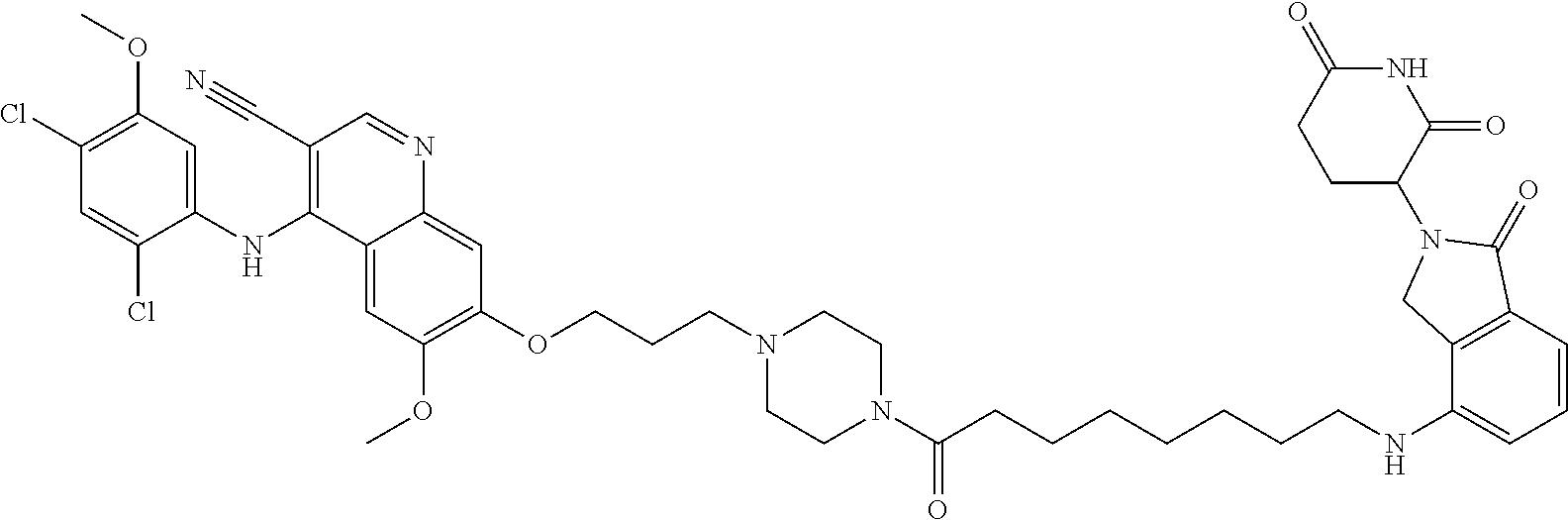 |
4-((2,4-dichloro-5- methoxyphenyl)amino)-7-(3- (4-(8-((2-(2,6-dioxopiperidin- 3-yl)-1-oxoisoindolin-4- yl)amino)octanoyl)piperazin- 1-yl)propoxy)-6- methoxyquinoline-3- carbonitrile | |
 |
4-((2,4-dichloro-5- methoxyphenyl)amino)-7-(3- (4-(9-((2-(2,6-dioxopiperidin- 3-yl)-1-oxoisoindolin-4- yl)amino)nonanoyl)piperazin- 1-yl)propoxy)-6- methoxyquinoline-3- carbonitrile | |
 |
4-((2,4-dichloro-5- methoxyphenyl)amino)-7-(3- (4-(3-((2-(2,6-dioxopiperidin- 3-yl)-1-oxoisoindolin-4- yl)oxy)propanoyl)piperazin-1- yl)propoxy)-6- methoxyquinoline-3- carbonitrile | |
 |
4-((2,4-dichloro-5- methoxyphenyl)amino)-7-(3- (4-(4-((2-(2,6-dioxopiperidin- 3-yl)-1-oxoisoindolin-4- yl)oxy)butanoyl)piperazin-1- yl)propoxy)-6- methoxyquinoline-3- carbonitrile | |
 |
4-((2,4-dichloro-5- methoxyphenyl)amino)-7-(3- (4-(5-((2-(2,6-dioxopiperidin- 3-yl)-1-oxoisoindolin-4- yl)oxy)pentanoyl)piperazin-1- yl)propoxy)-6- methoxyquinoline-3- carbonitrile | |
 |
4-((2,4-dichloro-5- methoxyphenyl)amino)-7-(3- (4-(6-((2-(2,6-dioxopiperidin- 3-yl)-1-oxoisoindolin-4- yl)oxy)hexanoyl)piperazin-1- yl)propoxy)-6- methoxyquinoline-3- carbonitrile | |
 |
4-((2,4-dichloro-5- methoxyphenyl)amino)-7-(3- (4-(7-((2-(2,6-dioxopiperidin- 3-yl)-1-oxoisoindolin-4- yl)oxy)heptanoyl)piperazin-1- yl)propoxy)-6- methoxyquinoline-3- carbonitrile | |
 |
4-((2,4-dichloro-5- methoxyphenyl)amino)-7-(3- (4-(8-((2-(2,6-dioxopiperidin- 3-yl)-1-oxoisoindolin-4- yl)oxy)octanoyl)piperazin-1- yl)propoxy)-6- methoxyquinoline-3- carbonitrile | |
 |
4-((2,4-dichloro-5- methoxyphenyl)amino)-7-(3- (4-(9-((2-(2,6-dioxopiperidin- 3-yl)-1-oxoisoindolin-4- yl)oxy)nonanoyl)piperazin-1- yl)propoxy)-6- methoxyquinoline-3- carbonitrile | |
 |
4-((2,4-dichloro-5- methoxyphenyl)amino)-7-(3- (4-(8-(2-(2,6-dioxopiperidin-3- yl)-1-oxoisoindolin-4- yl)octanoyl)piperazin-1- yl)propoxy)-6- methoxyquinoline-3- carbonitrile | |
 |
4-((2,4-dichloro-5- methoxyphenyl)amino)-7-(3- (4-(9-(2-(2,6-dioxopiperidin-3- yl)-1-oxoisoindolin-4- yl)nonanoyl)piperazin-1- yl)propoxy)-6- methoxyquinoline-3- carbonitrile | |
 |
4-((2,4-dichloro-5- methoxyphenyl)amino)-7-(3- (4-(3-(2-((2-(2,6- dioxopiperidin-3-yl)-1- oxoisoindolin-4- yl)amino)ethoxy)propanoyl) piperazin-1-yl)propoxy)-6- methoxyquinoline-3- carbonitrile | |
 |
4-((2,4-dichloro-5- methoxyphenyl)amino)-7-(3- (4-(4-(2-((2-(2,6- dioxopiperidin-3-yl)-1- oxoisoindolin-4- yl)amino)ethoxy)butanoyl) piperazin-1-yl)propoxy)-6- methoxyquinoline-3- carbonitrile | |
 |
4-((2,4-dichloro-5- methoxyphenyl)amino)-7-(3- (4-(2-(2-(2-((2-(2,6- dioxopiperidin-3-yl)-1- oxoisoindolin-4- yl)amino)ethoxy)ethoxy)acetyl) piperazin-1-yl)propoxy)-6- methoxyquinoline-3- carbonitrile | |
 |
4-((2,4-dichloro-5- methoxyphenyl)amino)-7-(3- (4-(3-(2-(2-((2-(2,6- dioxopiperidin-3-yl)-1- oxoisoindolin-4-yl)amino) ethoxy)ethoxy)propanoyl) piperazin-1-yl)propoxy)- 6-methoxyquinoline-3- carbonitrile | |
 |
4-((2,4-dichloro-5- methoxyphenyl)amino)-7-(3- (4-(4-(3-(2-(2,6- dioxopiperidin-3-yl)-1- oxoisoindolin-4-yl) propoxy)butanoyl)piperazin- 1-yl)propoxy)-6- methoxyquinoline-3- carbonitrile | |
 |
4-((2,4-dichloro-5- methoxyphenyl)amino)-7-(3- (4-(2-(2-(3-(2-(2,6- dioxopiperidin-3-yl)-1- oxoisoindolin-4- yl)propoxy)ethoxy)acetyl) piperazin-1-yl)propoxy)-6- methoxyquinoline-3- carbonitrile | |
 |
(2S,4R)-1-((S)-2-(tert-butyl)- 22-(4-(3-((3-cyano-4-((2,4- dichloro-5- methoxyphenyl)amino)-6- methoxyquinolin-7- yl)oxy)propyl)piperazin-1-yl)- 4,22-dioxo-10,13,16-trioxa-3- azadocosanoyl)-4-hydroxy-N- (4-(4-methylthiazol-5- yl)benzyl)pyrrolidine-2- carboxamide | |
 |
(2S,4R)-1-((S)-2-(tert-butyl)- 22-(4-(3-((3-cyano-4-((2,4- dichloro-5- methoxyphenyl)amino)-6- methoxyquinolin-7- yl)oxy)propyl)piperazin-1-yl)- 22-oxo-10,13,16-trioxa-3- azadocosanoyl)-4-hydroxy-N- (4-(4-methylthiazol-5- yl)benzyl)pyrrolidine-2- carboxamide | |
 |
(2S,4R)-1-((S)-2-(2-(2-(2-(4- (3-((3-cyano-4-((2,4-dichloro- 5-methoxyphenyl)amino)-6- methoxyquinolin-7- yl)oxy)propyl)piperazin-1-yl)- 2- oxoethoxy)ethoxy)acetamido)- 3,3-dimethylbutanoyl)-4- hydroxy-N-(4-(4- methylthiazol-5- yl)benzyl)pyrrolidine-2- carboxamide | |
 |
(2S,4R)-1-((S)-2-(3-(2-(3-(4- (3-((3-cyano-4-((2,4-dichloro- 5-methoxyphenyl)amino)-6- methoxyquinolin-7- yl)oxy)propyl)piperazin-1-yl)- 3-oxopropoxy) ethoxy)propanamido)- 3,3-dimethylbutanoyl)-4- hydroxy-N-(4-(4- methylthiazol-5- yl)benzyl)pyrrolidine-2- carboxamide | |
 |
(2S,4R)-1-((S)-2-((3-(2-(3-(4- (3-((3-cyano-4-((2,4-dichloro- 5-methoxyphenyl)amino)-6- methoxyquinolin-7- yl)oxy)propyl)piperazin-1-yl)- 3-oxopropoxy) ethoxy)propyl)amino)- 3,3-dimethylbutanoyl)-4- hydroxy-N-(4-(4- methylthiazol-5- yl)benzyl)pyrrolidine-2- carboxamide | |
| SIAIS172 082 |
 |
(2S,4R)-1-((S)-2-(tert-butyl)- 16-(4-(3-((3-cyano-4-((2,4- dichloro-5- methoxyphenyl)amino)-6- methoxyquinolin-7- yl)oxy)propyl)piperazin-1-yl)- 4,16-dioxo-7,10,13-trioxa-3- azahexadecanoyl)-4-hydroxy- N-(4-(4-methylthiazol-5- yl)benzyl)pyrrolidine-2- carboxamide |
 |
(2S,4R)-1-((S)-2-(tert-butyl)- 16-(4-(3-((3-cyano-4-((2,4- dichloro-5- methoxyphenyl)amino)-6- methoxyquinolin-7- yl)oxy)propyl)piperazin-1-yl)- 16-oxo-7,10,13-trioxa-3- azahexadecanoyl)-4-hydroxy- N-(4-(4-methylthiazol-5- yl)benzyl)pyrrolidine-2- carboxamide | |
| SIAIS172 083 |
 |
(2S,4R)-1-((S)-2-(tert-butyl)- 19-(4-(3-((3-cyano-4-((2,4- dichloro-5- methoxyphenyl)amino)-6- methoxyquinolin-7- yl)oxy)propyl)piperazin-1-yl)- 4,19-dioxo-7,10,13,16- tetraoxa-3-azanonadecanoyl)- 4-hydroxy-N-(4-(4- methylthiazol-5- yl)benzyl)pyrrolidine-2- carboxamide |
| SIAIS172 084 |
 |
(2S,4R)-1-((S)-2-(tert-butyl)- 22-(4-(3-((3-cyano-4-((2,4- dichloro-5- methoxyphenyl)amino)-6- methoxyquinolin-7- yl)oxy)propyl)piperazin-1-yl)- 4,22-dioxo-7,10,13,16,19- pentaoxa-3-azadocosanoyl)-4- hydroxy-N-(4-(4- methylthiazol-5- yl)benzyl)pyrrolidine-2- carboxamide |
| SIAIS172 072 |
 |
(2S,4R)-1-((S)-2-(4-(4-(3-((3- cyano-4-((2,4-dichloro-5- methoxyphenyl)amino)-6- methoxyquinolin-7- yl)oxy)propyl)piperazin-1-yl)- 4-oxobutanamido)-3,3- dimethylbutanoyl)-4-hydroxy- N-(4-(4-methylthiazol-5- yl)benzyl)pyrrolidine-2- carboxamide |
| SIAIS172 073 |
 |
(2S,4R)-1-((S)-2-(5-(4-(3-((3- cyano-4-((2,4-dichloro-5- methoxyphenyl)amino)-6- methoxyquinolin-7- yl)oxy)propyl)piperazin-1-yl)- 5-oxopentanamido)-3,3- dimethylbutanoyl)-4-hydroxy- N-(4-(4-methylthiazol-5- yl)benzyl)pyrrolidine-2- carboxamide |
| SIAIS172 074 |
 |
(2S,4R)-1-((S)-2-(6-(4-(3-((3- cyano-4-((2,4-dichloro-5- methoxyphenyl)amino)-6- methoxyquinolin-7- yl)oxy)propyl)piperazin-1-yl)- 6-oxohexanamido)-3,3- dimethylbutanoyl)-4-hydroxy- N-(4-(4-methylthiazol-5- yl)benzyl)pyrrolidine-2- carboxamide |
 |
(2S,4R)-1-((S)-2-((6-(4-(3-((3- cyano-4-((2,4-dichloro-5- methoxyphenyl)amino)-6- methoxyquinolin-7- yl)oxy)propyl)piperazin-1-yl)- 6-oxohexyl)amino)-3,3- dimethylbutanoyl)-4-hydroxy- N-(4-(4-methylthiazol-5- yl)benzyl)pyrrolidine-2- carboxamide | |
| SIAIS172 075 |
 |
(2S,4R)-1-((S)-2-(7-(4-(3-((3- cyano-4-((2,4-dichloro-5- methoxyphenyl)amino)-6- methoxyquinolin-7- yl)oxy)propyl)piperazin-1-yl)- 7-oxoheptanamido)-3,3- dimethylbutanoyl)-4-hydroxy- N-(4-(4-methylthiazol-5- yl)benzyl)pyrrolidine-2- carboxamide |
 |
(2S,4R)-1-((S)-2-((7-(4-(3-((3- cyano-4-((2,4-dichloro-5- methoxyphenyl)amino)-6- methoxyquinolin-7- yl)oxy)propyl)piperazin-1-yl)- 7-oxoheptyl)amino)-3,3- dimethylbutanoyl)-4-hydroxy- N-(4-(4-methylthiazol-5- yl)benzyl)pyrrolidine-2- carboxamide | |
| SIAIS172 076 |
 |
(2S,4R)-1-((S)-2-(8-(4-(3-((3- cyano-4-((2,4-dichloro-5- methoxyphenyl)amino)-6- methoxyquinolin-7- yl)oxy)propyl)piperazin-1-yl)- 8-oxooctanamido)-3,3- dimethylbutanoyl)-4-hydroxy- N-(4-(4-methylthiazol-5- yl)benzyl)pyrrolidine-2- carboxamide |
 |
(2S,4R)-1-((S)-2-((8-(4-(3-((3- cyano-4-((2,4-dichloro-5- methoxyphenyl)amino)-6- methoxyquinolin-7- yl)oxy)propyl)piperazin-1-yl)- 8-oxooctyl)amino)-3,3- dimethylbutanoyl)-4-hydroxy- N-(4-(4-methylthiazol-5- yl)benzyl)pyrrolidine-2- carboxamide | |
| SIAIS172 077 |
 |
(2S,4R)-1-((S)-2-(9-(4-(3-((3- cyano-4-((2,4-dichloro-5- methoxyphenyl)amino)-6- methoxyquinolin-7- yl)oxy)propyl)piperazin-1-yl)- 9-oxononanamido)-3,3- dimethylbutanoyl)-4-hydroxy- N-(4-(4-methylthiazol-5- yl)benzyl)pyrrolidine-2- carboxamide |
| SIAIS172 078 |
 |
(2S,4R)-1-((S)-2-(10-(4-(3- ((3-cyano-4-((2,4-dichloro-5- methoxyphenyl)amino)-6- methoxyquinolin-7- yl)oxy)propyl)piperazin-1-yl)- 10-oxodecanamido)-3,3- dimethylbutanoyl)-4-hydroxy- N-(4-(4-methylthiazol-5- yl)benzyl)pyrrolidine-2- carboxamide |
| SIAIS172 079 |
 |
(2S,4R)-1-((S)-2-(11-(4-(3- ((3-cyano-4-((2,4-dichloro-5- methoxyphenyl)amino)-6- methoxyquinolin-7- yl)oxy)propyl)piperazin-1-yl) 11-oxoundecanamido)-3,3- dimethylbutanoyl)-4-hydroxy- N-(4-(4-methylthiazol-5- yl)benzyl)pyrrolidine-2- carboxamide |
 |
(2S,4R)-1-((S)-2-((11-(4-(3- ((3-cyano-4-((2,4-dichloro-5- methoxyphenyl)amino)-6- methoxyquinolin-7- yl)oxy)propyl)piperazin-1-yl)- 11-oxoundecyl)amino)-3,3- dimethylbutanoyl)-4-hydroxy- N-(4-(4-methylthiazol-5- yl)benzyl)pyrrolidine-2- carboxamide | |
 |
(2S,4R)-1-((S)-2-(14-(4-(3- ((3-cyano-4-((2,4-dichloro-5- methoxyphenyl)amino)-6- methoxyquinolin-7- yl)oxy)propyl)piperazin-1-yl)- 14-oxotetradecanamido)-3,3- dimethylbutanoyl)-4-hydroxy- N-(4-(4-methylthiazol-5- yl)benzyl)pyrrolidine-2- carboxamide | |
 |
(2S,4R)-1-((S)-2-(16-(4-(3- ((3-cyano-4-((2,4-dichloro-5- methoxyphenyl)amino)-6- methoxyquinolin-7- yl)oxy)propyl)piperazin-1-yl) 16-oxohexadecanamido)-3,3- dimethylbutanoyl)-4-hydroxy- N-(4-(4-methylthiazol-5- yl)benzyl)pyrrolidine-2- carboxamide | |
 |
4-((4-(6-(2-(2-((6-((2-(2,6- dioxopiperidin-3-yl)-1,3- dioxoisoindolin-4-yl)amino)- 6- oxohexyl)oxy)ethoxy)ethoxy) hexanoyl)piperazin-1- yl)methyl)-N-(4-methyl-3-((4- (pyridin-3-yl)pyrimidin-2- yl)amino)phenyl)benzamide | |
 |
4-((4-(6-(2-(2-((6-((2-(2,6- dioxopiperidin-3-yl)-1,3- dioxoisoindolin-4- yl)amino)hexyl)oxy)ethoxy) ethoxy)hexanoyl)piperazin-1- yl)methyl)-N-(4-methyl-3-((4- (pyridin-3-yl)pyrimidin-2- yl)amino)phenyl)benzamide | |
| SIAIS119 7001 |
 |
4-((4-(3-(2-((2-(2,6- dioxopiperidin-3-yl)-1,3- dioxoisoindolin-4- yl)amino)ethoxy)propanoyl) piperazin-1-yl)methyl)-N-(4- methyl-3-((4-(pyridin-3- yl)pyrimidin-2- yl)amino)phenyl)benzamide |
| SIAIS119 7015 |
 |
4-((4-(3-(2-(2-((2-(2,6- dioxopiperidin-3-yl)-1,3- dioxoisoindolin-4-yl)amino) ethoxy)ethoxy)propanoyl) piperazin-1-yl)methyl)- N-(4-methyl-3-((4-(pyridin-3- yl)pyrimidin-2- yl)amino)phenyl)benzamide |
| SIAIS119 7017 |
 |
4-((4-(3 -(2-(2-(2-((2-(2,6- dioxopiperidin-3-yl)-1,3- dioxoisoindolin-4- yl)amino)ethoxy)ethoxy) ethoxy)propanoyl)piperazin-1- yl)methyl)-N-(4-methyl-3-((4- (pyridin-3-yl)pyrimidin-2- yl)amino)phenyl)benzamide |
| SIAIS119 7019 |
 |
4-((4-(1-((2-(2,6- dioxopiperidin-3-yl)-1,3- dioxoisoindolin-4-yl)amino)- 3,6,9,12-tetraoxapentadecan- 15-oyl)piperazin-1-yl)methyl)- N-(4-methyl-3-((4-(pyridin-3- yl)pyrimidin-2- yl)amino)phenyl)benzamide |
| SIAIS119 7021 |
 |
4-((4-(1-((2-(2,6- dioxopiperidin-3-yl)-1,3- dioxoisoindolin-4-yl)amino)- 3,6,9,12,15- pentaoxaoctadecan-18- oyl)piperazin-1-yl)methyl)-N- (4-methyl-3-((4-(pyridin-3- yl)pyrimidin-2- yl)amino)phenyl)benzamide |
 |
4-((4-(3-(3-(2-(2,6- dioxopiperidin-3-yl)-1,3- dioxoisoindolin-4-yl) propoxy)propanoyl)piperazin- 1-yl)methyl)-N-(4-methyl-3- ((4-(pyridin-3-yl)pyrimidin-2- yl)amino)phenyl)benzamide | |
 |
4-((4-(3-(2-(3-(2-(2,6- dioxopiperidin-3-yl)-1,3- dioxoisoindolin-4- yl)propoxy)ethoxy)propanoyl) piperazin-1-yl)methyl)-N-(4- methyl-3-((4-(pyridin-3- yl)pyrimidin-2- yl)amino)phenyl)benzamide | |
 |
4-((4-(3-(2-(2-(3-(2-(2,6- dioxopiperidin-3-yl)-1,3- dioxoisoindolin-4- yl)propoxy)ethoxy)ethoxy) propanoyl)piperazin-1- yl)methyl)-N-(4-methyl-3-((4- (pyridin-3-yl)pyrimidin-2- yl)amino)phenyl)benzamide | |
| SIAIS119 7003 |
 |
4-((4-((2-(2,6-dioxopiperidin- 3-yl)-1,3-dioxoisoindolin-4- yl)glycyl)piperazin-1- yl)methyl)-N-(4-methyl-3-((4- (pyridin-3-yl)pyrimidin-2- yl)amino)phenyl)benzamide |
| SIAIS119 7005 |
 |
4-((4-(3-((2-(2,6- dioxopiperidin-3-yl)-1,3- dioxoisoindolin-4- yl)amino)propanoyl)piperazin- 1-yl)methyl)-N-(4-methyl-3- ((4-(pyridin-3-yl)pyrimidin-2- yl)amino)phenyl)benzamide |
| SIAIS119 7007 |
 |
4-((4-(4-((2-(2,6- dioxopiperidin-3-yl)-1,3- dioxoisoindolin-4- yl)amino)butanoyl)piperazin- 1-yl)methyl)-N-(4-methyl-3- ((4-(pyridin-3-yl)pyrimidin-2- yl)amino)phenyl)benzamide |
| SIAIS119 7009 |
 |
4-((4-(5-((2-(2,6- dioxopiperidin-3-yl)-1,3- dioxoisoindolin-4- yl)amino)pentanoyl)piperazin- 1-yl)methyl)-N-(4-methyl-3- ((4-(pyridin-3-yl)pyrimidin-2- yl)amino)phenyl)benzamide |
| SIAIS119 7011 |
 |
4-((4-(6-((2-(2,6- dioxopiperidin-3-yl)-1,3- dioxoisoindolin-4- yl)amino)hexanoyl)piperazin- 1-yl)methyl)-N-(4-methyl-3- ((4-(pyridin-3-yl)pyrimidin-2- yl)amino)phenyl)benzamide |
| SIAIS119 7095 |
 |
4-((4-(7-((2-(2,6- dioxopiperidin-3-yl)-1,3- dioxoisoindolin-4- yl)amino)heptanoyl)piperazin- 1-yl)methyl)-N-(4-methyl-3- ((4-(pyridin-3-yl)pyrimidin-2- yl)amino)phenyl)benzamide |
 |
4-((4-(8-((2-(2,6- dioxopiperidin-3-yl)-1,3- dioxoisoindolin-4- yl)amino)octanoyl)piperazin- 1-yl)methyl)-N-(4-methyl-3- ((4-(pyridin-3-yl)pyrimidin-2- yl)amino)phenyl)benzamide | |
 |
4-((4-(5-(2-(2,6- dioxopiperidin-3-yl)-1,3- dioxoisoindolin-4- yl)pentanoyl)piperazin-1- yl)methyl)-N-(4-methyl-3-((4- (pyridin-3-yl)pyrimidin-2- yl)amino)phenyl)benzamide | |
 |
4-((4-(6-(2-(2,6- dioxopiperidin-3-yl)-1,3- dioxoisoindolin-4- yl)hexanoyl)piperazin-1- yl)methyl)-N-(4-methyl-3-((4- (pyridin-3-yl)pyrimidin-2- yl)amino)phenyl)benzamide | |
 |
4-((4-(7-(2-(2,6- dioxopiperidin-3-yl)-1,3- dioxoisoindolin-4- yl)heptanoyl)piperazin-1- yl)methyl)-N-(4-methyl-3-((4- (pyridin-3-yl)pyrimidin-2- yl)amino)phenyl)benzamide | |
 |
4-((4-(8-(2-(2,6- dioxopiperidin-3-yl)-1,3- dioxoisoindolin-4- yl)octanoyl)piperazin-1- yl)methyl)-N-(4-methyl-3-((4- (pyridin-3-yl)pyrimidin-2- yl)amino)phenyl)benzamide | |
 |
4-((4-(9-(2-(2,6- dioxopiperidin-3-yl)-1,3- dioxoisoindolin-4- yl)nonanoyl)piperazin-1- yl)methyl)-N-(4-methyl-3-((4- (pyridin-3-yl)pyrimidin-2- yl)amino)phenyl)benzamide | |
 |
4-((4-(4-((2-(2,6- dioxopiperidin-3-yl)-1- oxoisoindolin-4-yl)amino)-4- oxobutanoyl)piperazin-1- yl)methyl)-N-(4-methyl-3-((4- (pyridin-3-yl)pyrimidin-2- yl)amino)phenyl)benzamide | |
 |
4-((4-(5-((2-(2,6- dioxopiperidin-3-yl)-1- oxoisoindolin-4-yl)amino)-5- oxopentanoyl)piperazin-1- yl)methyl)-N-(4-methyl-3-((4- (pyridin-3-yl)pyrimidin-2- yl)amino)phenyl)benzamide | |
 |
4-((4-(6-((2-(2,6- dioxopiperidin-3-yl)-1- oxoisoindolin-4-yl)amino)-6- oxohexanoyl)piperazin-1- yl)methyl)-N-(4-methyl-3-((4- (pyridin-3-yl)pyrimidin-2- yl)amino)phenyl)benzamide | |
 |
4-((4-(7-((2-(2,6- dioxopiperidin-3-yl)-1- oxoisoindolin-4-yl)amino)-7- oxoheptanoyl)piperazin-1- yl)methyl)-N-(4-methyl-3-((4- (pyridin-3-yl)pyrimidin-2- yl)amino)phenyl)benzamide | |
 |
4-((4-(8-((2-(2,6- dioxopiperidin-3-yl)-1- oxoisoindolin-4-yl)amino)-8- oxooctanoyl)piperazin-1- yl)methyl)-N-(4-methyl-3-((4- (pyridin-3-yl)pyrimidin-2- yl)amino)phenyl)benzamide | |
 |
4-((4-(9-((2-(2,6- dioxopiperidin-3-yl)-1- oxoisoindolin-4-yl)amino)-9- oxononanoyl)piperazin-1- yl)methyl)-N-(4-methyl-3-((4- (pyridin-3-yl)pyrimidin-2- yl)amino)phenyl)benzamide | |
 |
4-((4-(10-((2-(2,6- dioxopiperidin-3-yl)-1- oxoisoindolin-4-yl)amino)-10- oxodecanoyl)piperazin-1- yl)methyl)-N-(4-methyl-3-((4- (pyridin-3-yl)pyrimidin-2- yl)amino)phenyl)benzamide | |
 |
(2S,4R)-1-((S)-2-(tert-butyl)- 22-(4-(4-((4-methyl-3-((4- (pyridin-3-yl)pyrimidin-2- yl)amino)phenyl)carbamoyl) benzyl)piperazin-1-yl)-4,22- dioxo-10,13,16-trioxa-3- azadocosanoyl)-4-hydroxy-N- (4-(4-methylthiazol-5- yl)benzyl)pyrrolidine-2- carboxamide | |
 |
(2S,4R)-1-((S)-2-(tert-butyl)- 22-(4-(4-((4-methyl-3-((4- (pyridin-3-yl)pyrimidin-2- yl)amino)phenyl)carbamoyl) benzyl)piperazin-1-yl)-22-oxo- 10,13,16-trioxa-3- azadocosanoyl)-4-hydroxy-N- (4-(4-methylthiazol-5- yl)benzyl)pyrrolidine-2- carboxamide | |
| SIAIS119 7043 |
 |
(2S,4R)-1-((S)-3,3-dimethyl- 2-(2-(2-(2-(4-(4-((4-methyl-3- ((4-(pyridin-3-yl)pyrimidin-2- yl)amino)phenyl)carbamoyl) benzyl)piperazin-1-yl)-2- oxoethoxy)ethoxy)acetamido) butanoyl)-4-hydroxy-N-(4-(4- methylthiazol-5- yl)benzyl)pyrrolidine-2- carboxamide |
| SIAIS119 7029 |
 |
(2S,4R)-1-((S)-3,3-dimethyl- 2-(3-(2-(3-(4-(4-((4-methyl-3- ((4-(pyridin-3-yl)pyrimidin-2- yl)amino)phenyl)carbamoyl) benzyl)piperazin-1-yl)-3- oxopropoxy)ethoxy)propana- mido)butanoyl)-4-hydroxy-N- (4-(4-methylthiazol-5- yl)benzyl)pyrrolidine-2- carboxamide |
 |
(2S,4R)-1-((S)-3,3-dimethyl- 2-((3-(2-(3-(4-(4-((4-methyl-3- ((4-(pyridin-3-yl)pyrimidin-2- yl)amino)phenyl)carbamoyl) benzyl)piperazin-1-yl)-3- oxopropoxy)ethoxy)propyl) amino)butanoyl)-4-hydroxy-N- (4-(4-methylthiazol-5- yl)benzyl)pyrrolidine-2- carboxamide | |
| SIAIS119 7031 |
 |
(2S,4R)-1-((S)-2-(tert-butyl)- 16-(4-(4-((4-methyl-3-((4- (pyridin-3-yl)pyrimidin-2- yl)amino)phenyl)carbamoyl) benzyl)piperazin-1-yl)-4,16- dioxo-7,10,13-trioxa-3- azahexadecanoyl)-4-hydroxy- N-(4-(4-methylthiazol-5- yl)benzyl)pyrrolidine-2- carboxamide |
| SIAIS119 7039 |
 |
(2S,4R)-1-((S)-2-(tert-butyl)- 19-(4-(4-((4-methyl-3-((4- (pyridin-3-yl)pyrimidin-2- yl)amino)phenyl)carbamoyl) benzyl)piperazin-1-yl)-4,19- dioxo-7,10,13,16-tetraoxa-3- azanonadecanoyl)-4-hydroxy- N-(4-(4-methylthiazol-5- yl)benzyl)pyrrolidine-2- carboxamide |
| SIAIS119 7041 |
 |
(2S,4R)-1-((S)-2-(tert-butyl)- 22-(4-(4-((4-methyl-3-((4- (pyridin-3-yl)pyrimidin-2- yl)amino)phenyl)carbamoyl) benzyl)piperazin-1-yl)-4,22- dioxo-7,10,13,16,19-pentaoxa- 3-azadocosanoyl)-4-hydroxy- N-(4-(4-methylthiazol-5- yl)benzyl)pyrrolidine-2- carboxamide |
| SIAIS074 027 |
 |
(2S,4R)-1-((S)-3,3-dimethyl- 2-(4-(4-(4-((4-methyl-3-((4- (pyridin-3-yl)pyrimidin-2- yl)amino)phenyl)carbamoyl) benzyl)piperazin-1-yl)-4- oxobutanamido)butanoyl)-4- hydroxy-N-(4-(4- methylthiazol-5- yl)benzyl)pyrrolidine-2- carboxamide |
| SIAIS074 028 |
 |
(2S,4R)-1-((S)-3,3-dimethyl- 2-(5-(4-(4-((4-methyl-3-((4- (pyridin-3-yl)pyrimidin-2- yl)amino)phenyl)carbamoyl) benzyl)piperazin-1-yl)-5- oxopentanamido)butanoyl)-4- hydroxy-N-(4-(4- methylthiazol-5- yl)benzyl)pyrrolidine-2- carboxamide |
| SIAIS074 029 |
 |
(2S,4R)-1-((S)-3,3-dimethyl- 2-(6-(4-(4-((4-methyl-3-((4- (pyridin-3-yl)pyrimidin-2- yl)amino)phenyl)carbamoyl) benzyl)piperazin-1-yl)-6- oxohexanamido)butanoyl)-4- hydroxy-N-(4-(4- methylthiazol-5- yl)benzyl)pyrrolidine-2- carboxamide |
| SIAIS074 030 |
 |
(2S,4R)-1-((S)-3,3-dimethyl- 2-(7-(4-(4-((4-methyl-3-((4- (pyridin-3-yl)pyrimidin-2- yl)amino)phenyl)carbamoyl) benzyl)piperazin-1-yl)-7- oxoheptanamido)butanoyl)-4- hydroxy-N-(4-(4- methylthiazol-5- yl)benzyl)pyrrolidine-2- carboxamide |
| SIAIS074 031 |
 |
(2S,4R)-1-((S)-3,3-dimethyl- 2-(8-(4-(4-((4-methyl-3-((4- (pyridin-3-yl)pyrimidin-2- yl)amino)phenyl)carbamoyl) benzyl)piperazin-1-yl)-8- oxooctanamido)butanoyl)-4- hydroxy-N-(4-(4- methylthiazol-5- yl)benzyl)pyrrolidine-2- carboxamide |
| SIAIS074 032 |
 |
(2S,4R)-1-((S)-3,3-dimethyl- 2-(9-(4-(4-((4-methyl-3-((4- (pyridin-3-yl)pyrimidin-2- yl)amino)phenyl)carbamoyl) benzyl)piperazin-1-yl)-9- oxononanamido)butanoyl)-4- hydroxy-N-(4-(4- methylthiazol-5- yl)benzyl)pyrrolidine-2- carboxamide |
| SIAIS074 033 |
 |
(2S,4R)-1-((S)-3,3-dimethyl- 2-(10-(4-(4-((4-methyl-3-((4- (pyridin-3-yl)pyrimidin-2- yl)amino)phenyl)carbamoyl) benzyl)piperazin-1-yl)-10- oxodecanamido)butanoyl)-4- hydroxy-N-(4-(4- methylthiazol-5- yl)benzyl)pyrrolidine-2- carboxamide |
| SIAIS074 034 |
 |
(2S,4R)-1-((S)-3,3-dimethyl- 2-(11-(4-(4-((4-methyl-3-((4- (pyridin-3-yl)pyrimidin-2- yl)amino)phenyl)carbamoyl) benzyl)piperazin-1-yl)-11- oxoundecanamido)butanoyl)- 4-hydroxy-N-(4-(4- methylthiazol-5- yl)benzyl)pyrrolidine-2- carboxamide |
 |
(2S,4R)-1-((S)-3,3-dimethyl- 2-(14-(4-(4-((4-methyl-3-((4- (pyridin-3-yl)pyrimidin-2- yl)amino)phenyl)carbamoyl) benzyl)piperazin-1-yl)-14- oxotetradecanamido)butanoyl)- 4-hydroxy-N-(4-(4- methylthiazol-5- yl)benzyl)pyrrolidine-2- carboxamide | |
 |
(2S,4R)-1-((S)-3,3-dimethyl- 2-(16-(4-(4-((4-methyl-3-((4- (pyridin-3-yl)pyrimidin-2- yl)amino)phenyl)carbamoyl) benzyl)piperazin-1-yl)-16- oxohexadecanamido)butanoyl)- 4-hydroxy-N-(4-(4- methylthiazol-5- yl)benzyl)pyrrolidine-2- carboxamide | |
 |
(2S,4R)-1-((S)-3,3-dimethyl- 2-((7-(4-(4-((4-methyl-3-((4- (pyridin-3-yl)pyrimidin-2- yl)amino)phenyl)carbamoyl) benzyl)piperazin-1-yl)-7- oxoheptyl)amino)butanoyl)-4- hydroxy-N-(4-(4- methylthiazol-5- yl)benzyl)pyrrolidine-2- carboxamide | |
 |
(2S,4R)-1-((S)-3,3-dimethyl- 2-((8-(4-(4-((4-methyl-3-((4- (pyridin-3-yl)pyrimidin-2- yl)amino)phenyl)carbamoyl) benzyl)piperazin-1-yl)-8- oxooctyl)amino)butanoyl)-4- hydroxy-N-(4-(4- methylthiazol-5- yl)benzyl)pyrrolidine-2- carboxamide | |
 |
(2S,4R)-1-((S)-3,3-dimethyl- 2-((9-(4-(4-((4-methyl-3-((4- (pyridin-3-yl)pyrimidin-2- yl)amino)phenyl)carbamoyl) benzyl)piperazin-1-yl)-9- oxononyl)amino)butanoyl)-4- hydroxy-N-(4-(4- methylthiazol-5- yl)benzyl)pyrrolidine-2- carboxamide | |

can be obtained by removing the methyl group on the piperazine ring of imatinib, wherein R1, R2, R3, and R4 are as defined above.


can be obtained by removing the hydroxyethyl group on the piperazine ring of Dasatinib, wherein R5, R6, R7, and R8 are as defined above.


can be obtained by removing the methyl group on the piperazine ring of the Bosutinib, wherein R9, R10, R11, and R12 are as defined above


means that the chemical moiety represented by formula (Ia), which is covalently bonded to the group A of the compound of formula (I) via the N atom of piperazinyl.

wherein X is —CH2— or —CO—, Y is —CH2—, —NH— or —O—, and Z1 is carbonyl or Z1 is absent, which is an analog derived from CRBN ubiquitin ligase small molecule ligand thalidomide, lenalidomide or pomalidomide.


wherein Z2 is carbonyl or Z1 is absent, which is an analog derived from VHL-1 (chemical name: (2S,4R)-1-((S)-2-amino-3,3-dimethylbutanoyl)-4-hydroxy-N-(4-(4-methylthiazol-5-yl)benzyl)pyrrolidine-2-carboxamide).

- Boc Tert-butoxycarbonyl
- n-BuOH 1-Butanol
- tBuOH Tert-Butanol
- Con. Concentration
- DCM Dichloromethane
-
DME 1,2-Dimethoxyethane - DMF N,N-dimethyl formamide
- DMSO Dimethylsulfoxide
- DIPEA N,N-diisopropylethylamine
- EDCI N-(3-dimethylaminopropyl)-N′-ethylcarbodiimide hydrochloride
- ESI Electrospray ionization
- equiv Equivalent
- EtOH Ethanol
- HATU 1-[Bis(dimethylamino)methylene]-1H-1,2,3-triazolo[4,5-b]pyridinium 3-oxid hexafluorophosphate
- HOAT 1-Hydroxy-7-azabenotriazole
- HPLC High performance liquid chromatography
- HRMS High-resolution mass spectrometer
- LC-MS Liquid chromatograph mass spectrometer
- LRMS Low-resolution mass spectrometer
- LC Liquid chromatograph
- Me Methyl-
- MeCN Acetonitrile
- MeOH Methanol
- MS Mass spectrometer
- MW Microwave
- NMM N-methylmorpholine
- NMP 1-methyl-2-pyrrolidinone
- 1H NMR 1H-nuclear magnetic resonance spectrum
- rt Room temperature
- TFA Trifluoroacetic acid
- THF Tetrahydrofuran
- TLC Thin-Layer chromatography
- TMS Trimethylsilyl-
- HO2C-LIN-ULM Linker covalent with ULM(Ubiquitin Ligase binding Moiety) formed analog
- PROTAD Proteolysis Targeting Drug


| Reagents and Anti-body | Suppliers | ||
| RPMI1640 | Gibco | ||
| Fetal bovine serum | Gibco | ||
| Penicillin-Streptomycin | Gibco | ||
| DMSO | Sigma-Aldrich | ||
| Dasatinib | Selleck | ||
| Cell counting Kit-8 (CCK-8) Cell | Dojindo | ||
| Proliferation-Toxicity Test Kit | |||
| MG-132 | Merck Millipore | ||
| Carfilzomib (PR-171) | Selleck | ||
| Pierce Detergent | Thermo Scientific | ||
| Compatible Bradford | |||
| Assay Kit (#23246) | |||
| Western Blot Blocking | Takara | ||
| Buffer (Fish Gelatin) | |||
| Immobilon western | Merck Millipore | ||
| chemilum HRP substrate | |||
| c-Abl (#2862S) | Cell Signaling | ||
| phospho-c-Abl (Y245) (#2861S) | Technology | ||
| CRKL (#3182S) | |||
| phospho- CRKL(#3181S) | |||
| C-Kit(#3074S) | |||
| phospho-CRKL (Y207) (#3181S) | |||
| STAT5 (#9363S) | |||
| phospho-STAT5 (Y694) (#4322S) | |||
| β-Actin (13E5) (#5125S) | |||
| Anti-rabbit IgG HRP- | |||
| linked (#7074S) | |||
| TABLE 2 |
| IC50 values of the compounds in the examples of |
| the present disclosure for inhibiting the proliferation |
| of tumor cells were determined by CCK-8. |
| (IC50, nM) Proliferative | ||
| inhibitory activity (IC50, nM) |
| K562 | U937 | HEK293 | |||
| (BCR− | (BCR− | (BCR− | |||
| Compound | ABL+) | ABL−) | ABL−) | ||
| Dasatinib | 0.47 | NA | NA | ||
| Bosutinib | 29.63 | NA | |||
| Imatinib | 205.5 | NA | NA | ||
| SIAIS171114 | 2.57 | NA | NA | ||
| SIAIS151063 | 2.7 | 275.7 | 972.2 | ||
| SIAIS151064 | 8.054 | NA | NA | ||
| SIAIS151067 | 14.75 | NA | NA | ||
| SIAIS151068 | 40.4 | NA | NA | ||
| SIAIS151069 | 31.9 | NA | NA | ||
| SIAIS151072 | 1.223 | NA | NA | ||
| SIAIS172150 | 2.84 | NA | NA | ||
| SIAIS184128 | 7 | NA | NA | ||
| SIAIS151074 | 6.8 | NA | NA | ||
| SIAIS151070 | 5.5 | NA | NA | ||
| SIAIS151071 | 0.55 | NA | NA | ||
| SIAIS151075 | 0.03 | NA | NA | ||
| SIAIS151181 | 1.47 | NA | NA | ||
| SIAIS184053 | 16.5 | NA | NA | ||
| SIAIS164108 | 12.25 | NA | NA | ||
| SIAIS164109 | 7.08 | NA | NA | ||
| SIAIS164110 | 1.03 | NA | NA | ||
| SIAIS184052 | 4.2 | NA | NA | ||
| SIAIS180147 | 14.9 | NA | NA | ||
| SIAIS151080 | 2240 | NA | NA | ||
| SIAIS151076 | 670 | NA | NA | ||
| SIAIS151077 | 3430 | NA | NA | ||
| SIAIS151078 | 2160 | NA | NA | ||
| SIAIS151079 | 1610 | NA | NA | ||
| SIAIS151174 | 78 | NA | NA | ||
| SIAIS151175 | 87 | NA | 3894 | ||
| SIAIS151176 | 89 | NA | NA | ||
| SIAIS151177 | 37.6 | NA | NA | ||
| SIAIS151178 | 41.3 | NA | NA | ||
| SIAIS151179 | 22.4 | NA | NA | ||
| SIAIS151180 | 14.3 | NA | NA | ||
| SIAIS164193 | 14.4 | NA | NA | ||
| SIAIS164194 | 32.3 | NA | NA | ||
| SIAIS184032 | 72 | NA | NA | ||
| SIAIS164134 | 12 | NA | NA | ||
| SIAIS164136 | 77.58 | NA | NA | ||
| SIAIS151158 | 3133 | NA | NA | ||
| SIAIS151159 | 4258 | NA | NA | ||
| SIAIS151160 | 4646 | NA | NA | ||
| SIAIS151161 | 7259 | NA | NA | ||
| SIAIS151162 | 712.4 | NA | NA | ||
| SIAIS151163 | 126.2 | NA | NA | ||
| SIAIS151166 | 894 | NA | NA | ||
| SIAIS151167 | 3654 | NA | NA | ||
| SIAIS164136 | 77.58 | NA | NA | ||
| SIAIS164104 | 811 | NA | NA | ||
| SIAIS164105 | 459.3 | NA | NA | ||
| SIAIS164106 | 438.2 | NA | NA | ||
| Note: | |||||
| NA: means that the highest concentration of 10 μM has no obvious inhibition on proliferation. | |||||
II. Determination of the Degradation Concentration (DC50) of PROTAD Compounds to the Target Protein
| TABLE 3 |
| Degradation results of PROTAD compound |
| in the examples of the present disclosure |
| on BCR-ABL and c-ABL protein |
| BCR-ABL | c-ABL | |
| Compound | (DC50, nM) | (DC50, nM) |
| Dasatinib | NA | NA |
| Bosutinib | NA | NA |
| Imatinib | NA | NA |
| SIAIS171114 | 10-100 | 10-100 |
| SIAIS151063 | 1-10 | 1-10 |
| SIAIS151064 | 1-10 | 10-100 |
| SIAIS151067 | 1-10 | 10-100 |
| SIAIS151068 | 1-10 | 10-100 |
| SIAIS151069 | 1-10 | 10-100 |
| SIAIS151072 | <1 | 1-10 |
| SIAIS172150 | 10-100 | 10-100 |
| SIAIS184128 | 1-10 | 1-10 |
| SIAIS151070 | 1-10 | 1-10 |
| SIAIS151071 | <1 | 1-10 |
| SIAIS151075 | 1-10 | 1-10 |
| SIAIS151181 | 1-10 | 1-10 |
| SIAIS184053 | 10-100 | 10-100 |
| SIAIS164108 | 10-100 | 10-100 |
| SIAIS164109 | 100-1000 | 100-1000 |
| SIAIS164110 | 10-100 | 10-100 |
| SIAIS184052 | 1-10 | 10-100 |
| SIAIS151078 | 100-1000 | >1000 |
| SIAIS151174 | 100-1000 | 100-1000 |
| SIAIS151175 | 10-100 | 100-1000 |
| SIAIS151176 | 10-100 | 100-1000 |
| SIAIS151177 | 1-10 | 10-100 |
| SIAIS151178 | 1-10 | 10-100 |
| SIAIS151179 | 10-100 | 100-1000 |
| SIAIS151180 | 1-10 | 10-100 |
| SIAIS151158 | 10-100 | 10-100 |
| SIAIS151159 | 10-100 | 10-100 |
| SIAIS151160 | 10-100 | 10-100 |
| SIAIS151161 | 100-1000 | 100-1000 |
| SIAIS151164 | 10-100 | 10-100 |
| SIAIS151162 | 10-100 | 10-100 |
| SIAIS151163 | 10-100 | 10-100 |
| SIAIS151166 | 10-100 | 10-100 |
| SIAIS151167 | 10-100 | 10-100 |
| SIAIS164136 | 1-10 | 1-10 |
| SIAIS164105 | 10-100 | 10-100 |
| SIAIS1197039 | 1000-1000 | 1000-1000 |
| SIAIS074031 | 100-1000 | 100-1000 |
| Note: | ||
| NA: the highest concentration of 10 μm does not show significant degradation. | ||
III. Degradation Activity of PROTAD Compound SIAIS151178 to BCR-ABL Having Drug Resistance Mutants
- 1. Nowell, P. C., The minute chromosome (Phl) in chronic granulocytic leukemia. Blut, 1962. 8: p. 65-6.
- 2. Rowley, J. D., Letter: A new consistent chromosomal abnormality in chronic myelogenous leukaemia identified by quinacrine fluorescence and Giemsa staining. Nature, 1973. 243 (5405): p. 290-3.
- 3. Kurzrock, R., et al., Philadelphia chromosome-positive leukemias: from basic mechanisms to molecular therapeutics. Ann Intern Med, 2003. 138(10): p. 819-30.
- 4. Kantarjian, H., et al., Hematologic and cytogenetic responses to imatinib mesylate in chronic myelogenous leukemia. N Engl J Med, 2002. 346(9): p. 645-52.
- 5. Mauro, M. J. and B. J. Druker, STI571: targeting BCR-ABL as therapy for CML. Oncologist, 2001. 6(3): p. 233-8.
- 6. Leoni, V. and A. Biondi, Tyrosine kinase inhibitors in BCR-ABL positive acute lymphoblastic leukemia. Haematologica, 2015. 100(3): p. 295-9.
- 7. Buchdunger, E., A. Matter, and B. J. Druker, Bcr-Abl inhibition as a modality of CML therapeutics. Biochim Biophys Acta, 2001. 1551(1): p. M11-8.
- 8. O'Hare, T., C. A. Eide, and M. W. Deininger, Bcr-Abl kinase domain mutations, drug resistance, and the road to a cure for chronic myeloid leukemia. Blood, 2007. 110(7): p. 2242-9.
- 9. Quintas-Cardama, A., et al., Dasatinib (BMS-354825) is active in Philadelphia chromosome-positive chronic myelogenous leukemia after imatinib and nilotinib (AMN107) therapy failure. Blood, 2007. 109(2): p. 497-9.
- 10. Kantarjian, H. M., et al., Nilotinib (formerly AMN107), a highly selective BCR-ABL tyrosine kinase inhibitor, is effective in patients with Philadelphia chromosome-positive chronic myelogenous leukemia in chronic phase following imatinib resistance and intolerance. Blood, 2007. 110(10): p. 3540-6.
- 11. Cortes, J., Bosutinib in the treatment of chronic myelogenous leukemia. Clin Adv Hematol Oncol, 2012. 10(11): p. 736-7.
- 12. Li, S., Src-family kinases in the development and therapy of Philadelphia chromosome-positive chronic myeloid leukemia and acute lymphoblastic leukemia. Leuk Lymphoma, 2008. 49(1): p. 19-26.
- 13. Araujo, J. and C. Logothetis, Dasatinib: a potent SRC inhibitor in clinical development for the treatment of solid tumors. Cancer Treat Rev, 2010. 36(6): p. 492-500.
- 14. Daud, A. I., et al., Phase I study of bosutinib, a src/abl tyrosine kinase inhibitor, administered to patients with advanced solid tumors. Clin Cancer Res, 2012. 18(4): p. 1092-100.
- 15. Poch Martell, M., et al., Ponatinib in the therapy of chronic myeloid leukemia. Expert Rev Hematol, 2016. 9(10): p. 923-32.
- 16. Konig, H., et al., Enhanced BCR-ABL kinase inhibition does not result in increased inhibition of downstream signaling pathways or increased growth suppression in CML progenitors. Leukemia, 2008. 22(4): p. 748-55.
- 17. Ichim, C. V., Kinase-independent mechanisms of resistance of leukemia stem cells to tyrosine kinase inhibitors. Stem Cells Transl Med, 2014. 3(4): p. 405-15.
- 18. Komander, D. and M. Rape, The ubiquitin code. Annu Rev Biochem, 2012. 81: p. 203-29.
- 19. Sakamoto, K. M., Protacs for treatment of cancer. Pediatr Res, 2010. 67(5): p. 505-8.
- 20. Lu, J., et al., Hijacking the E3 Ubiquitin Ligase Cereblon to Efficiently Target BRD4. Chem Biol, 2015. 22(6): p. 755-63.
- 21. Bondeson, D. P., et al., Catalytic in vivo protein knockdown by small-molecule PROTACs. Nat Chem Biol, 2015. 11(8): p. 611-7.
- 22. Itoh, Y., et al., Development of target protein-selective degradation inducer for protein knockdown. Bioorg Med Chem, 2011. 19(10): p. 3229-41.
- 23. Lai, A. C., et al., Modular PROTAC Design for the Degradation of Oncogenic BCR-ABL. Angew Chem Int Ed Engl, 2016. 55(2): p. 807-10.
Claims (29)


Applications Claiming Priority (3)
| Application Number | Priority Date | Filing Date | Title |
|---|---|---|---|
| CN201810196369 | 2018-03-09 | ||
| CN201810196369.2 | 2018-03-09 | ||
| PCT/CN2019/077535 WO2019170150A1 (en) | 2018-03-09 | 2019-03-08 | Protein degradation targeting bcr-abl compound and antitumor application thereof |
Related Parent Applications (1)
| Application Number | Title | Priority Date | Filing Date |
|---|---|---|---|
| PCT/CN2019/077535 Continuation WO2019170150A1 (en) | 2018-03-09 | 2019-03-08 | Protein degradation targeting bcr-abl compound and antitumor application thereof |
Publications (2)
| Publication Number | Publication Date |
|---|---|
| US20200407342A1 US20200407342A1 (en) | 2020-12-31 |
| US11639343B2 true US11639343B2 (en) | 2023-05-02 |
Family
ID=67846904
Family Applications (1)
| Application Number | Title | Priority Date | Filing Date |
|---|---|---|---|
| US17/015,319 Active US11639343B2 (en) | 2018-03-09 | 2020-09-09 | Compounds targeting and degrading BCR-ABL protein and its antitumor application |
Country Status (3)
| Country | Link |
|---|---|
| US (1) | US11639343B2 (en) |
| CN (1) | CN110240629B (en) |
| WO (1) | WO2019170150A1 (en) |
Families Citing this family (10)
| Publication number | Priority date | Publication date | Assignee | Title |
|---|---|---|---|---|
| CN112707900B (en) * | 2019-10-24 | 2022-06-10 | 上海科技大学 | Protein degrading agents and their use in the treatment of disease |
| CN111100127B (en) * | 2020-01-07 | 2021-07-06 | 中南大学湘雅医院 | Bifunctional organic compound and its preparation method and application |
| CN113527329A (en) * | 2020-04-22 | 2021-10-22 | 上海中医药大学附属龙华医院 | Selenium-containing compound and medical application thereof |
| JP2024504932A (en) | 2021-01-13 | 2024-02-02 | モンテ ローザ セラピューティクス, インコーポレイテッド | isoindolinone compound |
| CN113354619B (en) * | 2021-06-24 | 2024-03-19 | 皖南医学院 | A compound targeting ubiquitination and degradation of tyrosinase and its preparation method and application |
| CN114044775B (en) * | 2021-08-30 | 2023-04-07 | 杭州医学院 | Compound for target ubiquitination induction of BCR-ABL protein degradation and application thereof |
| CA3240524A1 (en) * | 2021-12-08 | 2023-06-15 | Gluetacs Therapeutics (Shanghai) Co., Ltd. | LIGAND COMPOUNDS FOR UBIQUITIN LIGASE E3, PROTEIN DEGRADING AGENTS DEVELOPED ON THE BASIS OF LIGAND COMPOUNDS, AND THEIR USES |
| CN116396288B (en) * | 2022-01-04 | 2026-04-03 | 上海科技大学 | Protein degraders developed based on BCL-2 family protein ligand compounds and their applications |
| CN114853751B (en) * | 2022-05-13 | 2024-01-16 | 郑州大学第一附属医院 | Group of phenothiazine derivatives and application thereof |
| WO2025240852A1 (en) * | 2024-05-16 | 2025-11-20 | St. Jude Children's Research Hospital, Inc. | Therapeutic compositions and methods thereof |
Citations (6)
| Publication number | Priority date | Publication date | Assignee | Title |
|---|---|---|---|---|
| CN104736569A (en) | 2012-01-12 | 2015-06-24 | 耶鲁大学 | Compounds and methods for enhancing degradation of target proteins and other polypeptides by E3 ubiquitin ligases |
| US20150291562A1 (en) | 2014-04-14 | 2015-10-15 | Arvinas, Inc. | Imide-based modulators of proteolysis and associated methods of use |
| WO2016149668A1 (en) | 2015-03-18 | 2016-09-22 | Arvinas, Inc. | Compounds and methods for the enhanced degradation of targeted proteins |
| WO2017079267A1 (en) | 2015-11-02 | 2017-05-11 | Yale University | Proteolysis targeting chimera compounds and methods of preparing and using same |
| WO2017117474A1 (en) | 2015-12-30 | 2017-07-06 | Dana-Farber Cancer Institute, Inc. | Bifunctional compounds for her3 degradation and methods of use |
| WO2018098288A1 (en) | 2016-11-22 | 2018-05-31 | Dana-Farber Cancer Institute, Inc. | Degradation of bruton's tyrosine kinase (btk) by conjugation of btk inhibitors with e3 ligase ligand and methods of use |
Family Cites Families (1)
| Publication number | Priority date | Publication date | Assignee | Title |
|---|---|---|---|---|
| US20150119435A1 (en) * | 2012-05-11 | 2015-04-30 | Yale University | Compounds useful for promoting protein degradation and methods using same |
-
2019
- 2019-03-08 WO PCT/CN2019/077535 patent/WO2019170150A1/en not_active Ceased
- 2019-03-08 CN CN201910175266.2A patent/CN110240629B/en active Active
-
2020
- 2020-09-09 US US17/015,319 patent/US11639343B2/en active Active
Patent Citations (8)
| Publication number | Priority date | Publication date | Assignee | Title |
|---|---|---|---|---|
| CN104736569A (en) | 2012-01-12 | 2015-06-24 | 耶鲁大学 | Compounds and methods for enhancing degradation of target proteins and other polypeptides by E3 ubiquitin ligases |
| US10730862B2 (en) | 2012-01-12 | 2020-08-04 | Yale University | Compounds and methods for the enhanced degradation of targeted proteins and other polypeptides by an E3 ubiquitin ligase |
| US20150291562A1 (en) | 2014-04-14 | 2015-10-15 | Arvinas, Inc. | Imide-based modulators of proteolysis and associated methods of use |
| CN106458993A (en) | 2014-04-14 | 2017-02-22 | 阿尔维纳斯股份有限公司 | Imide-based proteolysis modulators and related methods of use |
| WO2016149668A1 (en) | 2015-03-18 | 2016-09-22 | Arvinas, Inc. | Compounds and methods for the enhanced degradation of targeted proteins |
| WO2017079267A1 (en) | 2015-11-02 | 2017-05-11 | Yale University | Proteolysis targeting chimera compounds and methods of preparing and using same |
| WO2017117474A1 (en) | 2015-12-30 | 2017-07-06 | Dana-Farber Cancer Institute, Inc. | Bifunctional compounds for her3 degradation and methods of use |
| WO2018098288A1 (en) | 2016-11-22 | 2018-05-31 | Dana-Farber Cancer Institute, Inc. | Degradation of bruton's tyrosine kinase (btk) by conjugation of btk inhibitors with e3 ligase ligand and methods of use |
Non-Patent Citations (27)
| Title |
|---|
| "Corrections", The New England Journal of Medicine, vol. 346, No. 24, Jun. 2002, pp. 1923 (1 page). |
| Araujo, John and Christopher Logothetis, "Dasatinib: A potent SRC inhibitor in clinical development for the treatment of solid tumors", Cancer Treatment Reviews, ScienceDirect, Elsevier Ltd., vol. 36, 2010, pp. 492-500 (9 pages). |
| Bondeson, Daniel P. et al., "Catalytic in vivo protein knockdown by small-molecule PROTACs", Nature Chemical Biology, Nature America, Inc., Jun. 2015 (9 pages). |
| Buchdunger, Elisabeth et al., "Bcr-Abl inhibition as a modality of CML therapeutics", Biochimica et Biophysica Acta, Elsevier Science B.V., vol. 1551, 2001, pp. M11-M18 (8 pages). |
| Cortes, Jorge, "Bosutinib in the Treatment of Chronic Myelogenous Leukemia", Advances in LLM: Current Developments in the Management of Leukemia, Lymphoma, and Myeloma, Ed. Susan O'Brien, Clinical Advances in Hematology & Oncology, vol. 10, Issue 11, Nov. 2012, pp. 736-737 (2 pages). |
| Datta et al. Crystal structures of drugs: Advances in determination, prediction, and engineering; 2004, Nature Reviews, vol. 3, pp. 42-57. * |
| Daud, Adil I. et al., "Phase I Study of Bosutinib, a Src/Abl Tyrosine Kinase Inhibitor, Administered to Patients with Advanced Solid Tumors", Cancer Therapy: Clinical, Clinical Cancer Research, American Association for Cancer Research, vol. 18, No. 4, Feb. 2012, pp. 1092-1100 (9 pages). |
| Golub et al., Science, vol. 286, Oct. 15, 1999, pp. 531-537. * |
| Ichim, Christine Victoria, "Kinase-Independent Mechanisms of Resistance of Leukemia Stem Cells to Tyrosine Kinase Inhibitors", Stems Cells Translational Medicine, AlphaMed Press, vol. 3, Mar. 2014, pp. 405-415 (11 pages). |
| International Search Report with English translation issued in corresponding International Application No. PCT/CN2019/077535, dated Jun. 14, 2019 (11 pages). |
| Itoh, Yukihiro et al., "Development of target protein-selective degradation inducer for protein knockdown", Bioorganic & Medicinal Chemistry, ScienceDirect, Elsevier Ltd., vol. 19, Mar. 2011, pp. 3229-3241 (13 pages). |
| Kantarjian, Hagop M. et al., "Nilotinib (formerly AMN107), a highly selective BCR-ABL tyrosine kinase inhibitor, is effective in patients with Philadelphia chromosome-positive chronic myelogenous leukemia in chronic phase following imatinib resistance and intolerance", Clinical Trials and Observations, Blood, The American Society of Hematology, vol. 110, No. 10, Nov. 2007, pp. 3540-3546 (8 pages). |
| Komander, David and Michael Rape, "The Ubiquitin Code", Annual Review of Biochemistry, Annual Reviews, vol. 81, Apr. 2012, pp. 203-229 (27 pages). |
| Konig, H et al., "Enhanced BCR-ABL kinase inhibition does not result in increased inhibition of downstream signaling pathways or increased growth suppression in CML progenitors", Leukemia, Nature Publishing Group, vol. 22, Feb. 2008, pp. 748-755 (8 pages). |
| Kurzrock, Razelle et al., "Philadelphia Chromosome-Positive Leukemias: From Basic Mechanisms to Molecular Therapeutics", Annals of Internal Medicine, American College of Physicians, vol. 138, No. 10, May 2003, pp. 819-E831 (13 pages). |
| Lai, Ashton C. et al., "Modular PROTAC Design for the Degredation of Oncogenic BCR-ABL", Angewandte Chemie International Edition, Wiley Online Library, Wiley-VCH Verlag GmbH & Co. KGaA, vol. 55, 2016, pp. 807-810 (4 pages). |
| Leoni, Veronica and Andrea Biondi, "Tyrosine kinase inhibitors in BCR-ABL positive acute lymphoblastic leukemia", Editorials, Haematologica, vol. 100, No. 3, 2015, pp. 295-299 (5 pages). |
| Li, Shaoguang, "Src-family kinases in the development and therapy of Philadelphia chromosome-positive chronic myeloid leukemia and acute lymphoblastic leukemia", Leukemia & Lymphoma, Informa UK Ltd., vol. 49, No. 1, Jan. 2008, pp. 19-26 (8 pages). |
| Lu, Jing et al., "Hijacking the E3 Ubiquitin Ligase Cereblon to Efficiently Target BRD4", Chemisty & Biology, CellPress, Elsevier Ltd, vol. 22, Jun. 2015, pp. 1-9 (10 pages). |
| Martell, Marc Poch et al., "Ponatinib in the therapy of Chronic Myeloid Leukemia", Expert Review of Hematology, Taylor & Francis, Sep. 2016 (39 pages). |
| Mauro, Michael J. and Brian J. Druker, "STI571: Targeting BCR-ABL as Therapy for CML", The Oncologist, AlphaMed Press, vol. 6, 2001, pp. 233-238 (6 pages). |
| Nowell, Peter C., "Übersicht: The minute Chromosome (PH1) in chronic granulocytic Leukemia", Blut: Zeitschrift für Blutforschung, Eds. G. Blumenthal et al., vol. 8, No. 2, Apr. 1962, pp. 65-66 (2 pages). |
| O'Hare, Thomas et al., "Bcr-Abl kinase domain mutations, drug resistance, and the road to a cure for chronic myeloid leukemia", Blood, The American Society of Hematology, vol. 110, No. 7, Oct. 2007, pp. 2242-2249 (8 pages). |
| Quintas-Cardama, Alfonso et al., "Dasatinib (BMS-354825) is active in Philadelphia chromosome-positive chronic myelogenous leukemia after imatinib and nilotinib (AMN107) therapy failure", Clinical Trials and Observations, Blood, The American Society of Hematology, vol. 109, No. 2, Jan. 2007, pp. 497-499 (4 pages). |
| Rowly, Janet D., "A New Consistent Chromosomal Abnormality in Chronic Myelogenous Leukaemia identified by Quinacrine Fluorescence and Giemsa Staining", Nature, Nature Publishing Group, vol. 243, Jun. 1973, pp. 290-293 (4 pages). |
| Sakamoto, Kathleen, "Protacs for Treatment of Cancer", Pediatric Research, International Pediatric Research Foundation, Inc, vol. 67, No. 5, 2010, pp. 505-508 (4 pages). |
| Written Opinion with English translation issued in corresponding International Application No. PCT/CN2019/0//535, dated Jun. 14, 2019 (15 pages). |
Also Published As
| Publication number | Publication date |
|---|---|
| CN110240629B (en) | 2023-10-03 |
| US20200407342A1 (en) | 2020-12-31 |
| WO2019170150A1 (en) | 2019-09-12 |
| CN110240629A (en) | 2019-09-17 |
Similar Documents
| Publication | Publication Date | Title |
|---|---|---|
| US20200407342A1 (en) | Compounds targeting and degrading bcr-abl protein and its antitumor application | |
| US11771709B2 (en) | ALK protein degradation agent and anti-tumor application thereof | |
| US20250064837A1 (en) | Target protein degradation compounds, their anti-tumor use, their intermediates and use of intermediates | |
| US12110295B2 (en) | WD40 repeat domain protein 5 (WDR5) degradation/disruption compounds and methods of use | |
| US12390532B2 (en) | ALK protein regulator and anti-tumor application thereof | |
| JP6921101B2 (en) | Protein kinase inhibitor and its preparation method and pharmaceutical use | |
| US20230391765A1 (en) | Heterobifunctional compounds as degraders of enl | |
| US12582645B2 (en) | Chemokine CXCR4 receptor modulators and uses related thereto | |
| CA3105121A1 (en) | Protein tyrosine kinase 6 (ptk6) degradation / disruption compounds and methods of use | |
| JP2005504771A (en) | Piperazinone compounds as antitumor and anticancer agents and treatment methods | |
| US20250288683A1 (en) | Tetrahydroisoquinoline heterobifunctional bcl-xl degraders | |
| US11542274B1 (en) | Therapeutic compounds and methods of use thereof | |
| CN115697972B (en) | Receptor-interacting protein 1 inhibitors including piperazine heterocyclic amide ureas | |
| CN102802628A (en) | Substituted 4-hydroxypyrimidine-5-carboxamides | |
| US20250263415A1 (en) | Tertiary amide derivatives substituted with 4-membered ring structure | |
| CN118812536A (en) | Triazolopyrimidine compounds and their application in medicine |
Legal Events
| Date | Code | Title | Description |
|---|---|---|---|
| FEPP | Fee payment procedure |
Free format text: ENTITY STATUS SET TO UNDISCOUNTED (ORIGINAL EVENT CODE: BIG.); ENTITY STATUS OF PATENT OWNER: SMALL ENTITY |
|
| FEPP | Fee payment procedure |
Free format text: ENTITY STATUS SET TO SMALL (ORIGINAL EVENT CODE: SMAL); ENTITY STATUS OF PATENT OWNER: SMALL ENTITY |
|
| STPP | Information on status: patent application and granting procedure in general |
Free format text: APPLICATION DISPATCHED FROM PREEXAM, NOT YET DOCKETED |
|
| STPP | Information on status: patent application and granting procedure in general |
Free format text: DOCKETED NEW CASE - READY FOR EXAMINATION |
|
| STPP | Information on status: patent application and granting procedure in general |
Free format text: NON FINAL ACTION MAILED |
|
| STPP | Information on status: patent application and granting procedure in general |
Free format text: RESPONSE TO NON-FINAL OFFICE ACTION ENTERED AND FORWARDED TO EXAMINER |
|
| STPP | Information on status: patent application and granting procedure in general |
Free format text: NON FINAL ACTION MAILED |
|
| STPP | Information on status: patent application and granting procedure in general |
Free format text: RESPONSE TO NON-FINAL OFFICE ACTION ENTERED AND FORWARDED TO EXAMINER |
|
| STPP | Information on status: patent application and granting procedure in general |
Free format text: NOTICE OF ALLOWANCE MAILED -- APPLICATION RECEIVED IN OFFICE OF PUBLICATIONS |
|
| AS | Assignment |
Owner name: SHANGHAITECH UNIVERSITY, CHINA Free format text: ASSIGNMENT OF ASSIGNORS INTEREST;ASSIGNORS:YANG, XIAOBAO;JIANG, BIAO;YIN, QIANQIAN;AND OTHERS;REEL/FRAME:062010/0617 Effective date: 20200907 |
|
| STCF | Information on status: patent grant |
Free format text: PATENTED CASE |