US11636237B2 - Compressing binary geometry files for structural products - Google Patents
Compressing binary geometry files for structural products Download PDFInfo
- Publication number
- US11636237B2 US11636237B2 US16/863,592 US202016863592A US11636237B2 US 11636237 B2 US11636237 B2 US 11636237B2 US 202016863592 A US202016863592 A US 202016863592A US 11636237 B2 US11636237 B2 US 11636237B2
- Authority
- US
- United States
- Prior art keywords
- component parts
- geometry file
- binary
- binary geometry
- structural product
- Prior art date
- Legal status (The legal status is an assumption and is not a legal conclusion. Google has not performed a legal analysis and makes no representation as to the accuracy of the status listed.)
- Active, expires
Links
Images


Classifications
-
- G—PHYSICS
- G06—COMPUTING OR CALCULATING; COUNTING
- G06F—ELECTRIC DIGITAL DATA PROCESSING
- G06F30/00—Computer-aided design [CAD]
- G06F30/10—Geometric CAD
- G06F30/15—Vehicle, aircraft or watercraft design
-
- G—PHYSICS
- G06—COMPUTING OR CALCULATING; COUNTING
- G06F—ELECTRIC DIGITAL DATA PROCESSING
- G06F8/00—Arrangements for software engineering
- G06F8/40—Transformation of program code
- G06F8/52—Binary to binary
-
- G—PHYSICS
- G06—COMPUTING OR CALCULATING; COUNTING
- G06T—IMAGE DATA PROCESSING OR GENERATION, IN GENERAL
- G06T17/00—Three-dimensional [3D] modelling for computer graphics
- G06T17/20—Finite element generation, e.g. wire-frame surface description, tesselation
-
- G—PHYSICS
- G06—COMPUTING OR CALCULATING; COUNTING
- G06T—IMAGE DATA PROCESSING OR GENERATION, IN GENERAL
- G06T9/00—Image coding
- G06T9/001—Model-based coding, e.g. wire frame
Definitions
- the present disclosure relates generally to data compression and, in particular, to compressing binary geometry files for structural products such as aircraft or other vehicles.
- CAD computer aided design
- a 3D model of a large and complex structure such as an aircraft presents its own challenges.
- the 3D model of a modern aircraft composed of millions of individual parts may be greater than 4 terabytes in size.
- the size of the 3D model and limitations of computing hardware make it difficult, if even possible, to view all of the parts at one time. Unless the user has access to a super-computer, which is not commonly available, the user cannot view the entire aircraft at one time.
- Compression technology exists to enable the user to view an entire aircraft on a personal computer, tablet computer or the like.
- a 3D model of an aircraft can be compressed into a file size of around 8 gigabytes.
- existing compression technology may nonetheless be inadequate or even impractical for airlines who operate large fleets (e.g., more than 20 airplanes) to store and manage all the files of 3D models for their fleet in order for their mechanics to have them available to use in a timely manner. Therefore, it would be desirable to have a system and method that takes into account at least some of the issues discussed above, as well as other possible issues.
- Example implementations of the present disclosure are directed to data compression and, in particular, to compressing binary geometry files for structural products such as aircraft or other vehicles.
- Example implementations make use of the repetitive nature component parts of a structural product, or across instances of a structural production.
- a master binary geometry file may be used to store only one model for each component part of a structural product or across instances of the structural product.
- a binary geometry file for the structural product may then be compressed using a substitution coding technique in which instances of the component part may be substituted for a reference to the component part in the master binary geometry file.
- the present disclosure thus includes, without limitation, the following example implementations.
- Some example implementations provide a method of compressing one or more binary geometry files for one or more structural products, the method comprising accessing a binary geometry file that contains a geometric model of a structural product that is formed of component parts, the geometric model including an assembly of geometric models of instances of the component parts; identifying the component parts of the structural product; generating a master binary geometry file for the structural product that contains geometric models of the component parts, the master binary geometry file containing only one geometric model of each component part; applying the binary geometry file to a coder that generates a corresponding compressed binary geometry file, the coder searching the binary geometry file for the geometric models of the instances of the component parts, and substituting references to respective ones of the geometric models of the component parts in the master binary geometry file; and storing the master binary geometry file and the corresponding compressed binary geometry file in persistent storage.
- the structural product includes multiple instances of a component part
- the assembly of the geometric models of the instances of the component parts includes a geometric model of each of the multiple instances of the component part
- the coder substituting the references to the respective ones of the geometric models includes the coder substituting a reference to the one geometric model of the component part in the master binary geometry file, for the geometric model of each of the multiple instances of the component part.
- accessing the binary geometry file includes accessing multiple binary geometry files for multiple instances of a type of the structural product, wherein applying the binary geometry file includes applying the multiple binary geometry files to the coder that generates respective corresponding compressed binary geometry files, and wherein storing the master binary geometry file and the corresponding compressed binary geometry file includes storing the master binary geometry file and the respective corresponding compressed binary geometry files.
- the multiple instances of the type of the structural product are formed of respective component parts at least some but not all of which are common to the type of the structural product, wherein identifying the component parts includes identifying the respective component parts of the multiple instances of the type of the structural product, and wherein generating the master binary geometry file includes generating the master binary geometry file that contains geometric models of the respective component parts, the master binary geometry file containing only one geometric model of each of those of the respective component parts that are common to the type of the structural product.
- At least some but not all of the respective component parts are common to more than one but not all of the multiple instances of the type of the structural product
- generating the master binary geometry file includes generating the master binary geometry file that contains only one geometric model of each of those of the respective component parts that are common to more than one but not all of the multiple instances of the type of the structural product.
- the method further comprises accessing a binary three-dimensional (3D) geometry file that contains a 3D model of the structural product, the 3D model including an assembly of 3D models of the instances of the component parts; producing an approximation of the 3D model of the structural product and thereby approximations of the 3D models of the instances of the component parts, including: tessellating the 3D model of the structural product and thereby the 3D models of the instances of the component parts, to approximate the 3D model and thereby the 3D models with respective 3D meshes composed of faces defined by a plurality of vertices; and removing at least some of the plurality of vertices, and thereby reducing in number the plurality of faces; and storing the approximation of the 3D model of the structural product as the geometric model in the binary geometry file, and the approximations of the 3D models of the instances of the component parts as the geometric models in the binary geometry
- the corresponding compressed binary geometry file includes the references to the respective ones of the geometric models of the component parts in the master binary geometry file, and commands that define relationships and positions of the geometric models in the assembly of the geometric models of the instances of the component parts
- the method further comprises accessing the corresponding compressed binary geometry file from the persistent storage; rendering the geometric model of the structural product from the compressed binary geometry file, including: accessing the respective ones of the geometric models of the component parts in the master binary geometry file, using the references in the corresponding compressed binary geometry file; rendering the geometric models of the instances of the component parts, according to the respective ones of the geometric models of the component parts; and assembling the geometric models of the instances of the component parts, according to the commands in the corresponding compressed binary geometry file.
- Some example implementations provide an apparatus for compressing one or more binary geometry files for one or more structural products, the apparatus comprising a memory configured to store computer-readable program code; and processing circuitry configured to access the memory, and execute the computer-readable program code to cause the apparatus to at least perform the method of any preceding example implementation, or any combination of any preceding example implementations.
- Some example implementations provide a computer-readable storage medium for compressing one or more binary geometry files for one or more structural products, the computer-readable storage medium being non-transitory and having computer-readable program code stored therein that, in response to execution by processing circuitry, causes an apparatus to at least perform the method of any preceding example implementation, or any combination of any preceding example implementations.
- FIG. 1 illustrates an aircraft according to some example implementations of the present disclosure
- FIGS. 2 A, 2 B and 2 C illustrate a system for compressing one or more binary geometry files for one or more structural products such as aircraft, according to some example implementations
- FIGS. 3 A, 3 B, 3 C and 3 D are flowcharts illustrating various operations in a method of compressing one or more binary geometry files for one or more structural products such as aircraft, according to some example implementations.
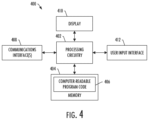
- FIG. 4 illustrates an apparatus according to some example implementations.
- a feature may be described as being above another feature (unless specified otherwise or clear from context) may instead be below, and vice versa; and similarly, features described as being to the left of another feature else may instead be to the right, and vice versa.
- the “or” of a set of operands is the “inclusive or” and thereby true if and only if one or more of the operands is true, as opposed to the “exclusive or” which is false when all of the operands are true.
- “[A] or [B]” is true if [A] is true, or if [B] is true, or if both [A] and [B] are true.
- the articles “a” and “an” mean “one or more,” unless specified otherwise or clear from context to be directed to a singular form.
- Like reference numerals refer to like elements throughout.
- Example implementations of the present disclosure relate generally to data compression and, in particular, to compressing binary geometry files for structural products.
- Example implementations will be primarily described in conjunction with aircraft, but it should be understood that example implementations may be utilized in conjunction with a variety of other structural products. Examples of suitable structural products that may benefit from example implementations include vehicles including aircraft, as well as spacecraft, watercraft, motor vehicles, railed vehicles and the like. Furthermore, it should be understood that unless otherwise specified, the terms “data,” “content,” “digital content,” “information,” and similar terms may be at times used interchangeably.
- FIG. 1 illustrates one type of aircraft 100 that may benefit from example implementations of the present disclosure.
- the aircraft includes an airframe 102 with a fuselage 104 , wings 106 and tail 108 .
- the aircraft also includes a plurality of high-level systems 110 such as a propulsion system.
- the propulsion system includes two wing-mounted engines 112 .
- the propulsion system can include other arrangements, for example, engines carried by other portions of the aircraft including the fuselage and/or the tail.
- the high-level systems may also include an electrical system 114 , hydraulic system 116 and/or environmental system 118 . Any number of other systems may be included.
- FIGS. 2 A, 2 B and 2 C illustrate a system 200 for compressing one or more binary geometry files for one or more structural products such as aircraft 100 , according to some example implementations.
- the system may include any of a number of different subsystems (each an individual system) for performing one or more functions or operations.
- the system includes at least one source 202 of data.
- the source includes a memory, storage or the like that may be located at a single source or distributed across multiple sources.
- the data may be stored in a number of different manners, such as in a database or flat files of any of a number of different types or formats.
- the data includes a binary geometry file 204 that contains a geometric model 206 of a structural product such as an aircraft.
- a suitable geometric model is a three-dimensional (3D) model of the structural product.
- This 3D model may be a 3D computer-aided design (CAD) model or other similar model (sometimes referred to as a solid model) composed of 3D objects.
- CAD computer-aided design
- the 3D model and its 3D objects may represent the structural product as a collection of “primitives” such as edges, faces, points (e.g., vertices) and the like, which may be arranged into polygons or other arithmetically-derived structures to reflect the geometry of surfaces, volumes or elements of the structural product.
- the structural product may be defined by a “boundary” representation, or collection of polygons that demarcate the space occupied by the structural product, which may include sub-collections of polygons that demarcate spaces occupied by respective elements of the structural product.
- the 3D model may use hundreds of thousands of polygons.
- the structural product is formed of component parts
- the geometric model 206 includes an assembly of geometric models 208 of instances of the component parts.
- a structural product may be composed of a number of component parts that are unique part designs, which may be identified by respective part numbers. These component parts exist independent of their instantiantions in the structural product.
- An instance of a component part is a unique copy or representation of the component part, and some are identified by serial number.
- a structural product therefore includes an assembly of instances of its component parts, and may include multiple instances of one or more of its component parts.
- the assembly of the geometric models of the instances of the component parts includes a geometric model of each of the multiple instances of the component part.
- the system 200 of example implementations of the present disclosure includes a file compression engine 210 generally configured to compress the binary geometry file 204 that contains the geometric model 206 of the structural product.
- the file compression engine is configured to access the binary geometry file, and identify the component parts of the structural product.
- the file compression engine is configured to generate a master binary geometry file 212 for the structural product that contains geometric models 214 of the component parts.
- the master binary geometry file contains only one geometric model of each component part (although the structural product may include more than one instance of a component part).
- the file compression engine 210 is configured to apply the binary geometry file 204 to a coder 216 configured to generate a corresponding compressed binary geometry file 218 .
- the coder is configured to search the binary geometry file for the geometric models 208 of the instances of the component parts, and substitute references 220 to respective ones of the geometric models 214 of the component parts in the master binary geometry file 212 .
- the file compression engine is then configured to store the master binary geometry file 212 and the corresponding compressed binary geometry file in persistent storage 222 .
- the structural product may include multiple instances of a component part
- the assembly of the geometric models 208 of the instances of the component parts may include a geometric model of each of the multiple instances of the component part.
- the coder 216 is configured to substitute a reference 220 to the one geometric model 214 of the component part in the master binary geometry file 212 , for the geometric model of each of the multiple instances of the component part.
- the corresponding compressed binary geometry file 218 (if not also the binary geometry file 204 ) also includes commands 224 that define relationships and positions of the geometric models in the assembly of the geometric models of the instances of the component parts.
- the file compression engine 210 is configured to access multiple binary geometry files 204 for multiple instances of a type of the structural product, such as multiple instances of a model of aircraft or other vehicle.
- the multiple binary geometry files may be for multiple aircraft of a fleet of a particular model of aircraft.
- These multiple instances may be formed of respective component parts some of which are considered standard equipment, and others considered optional equipment. At least some but not all of the respective component parts, then, may be common to the type of the structural product. Similarly, at least some but not all of the respective component parts may be common to more than one but not all of the multiple instances of the type of the structural product.
- the file compression engine 210 is configured to identify the respective component parts of the multiple instances of the type of the structural product.
- the file compression engine is configured to generate the master binary geometry file 212 that contains geometric models 214 of the respective component parts.
- the master binary geometry file contains only one geometric model of each of those of the respective component parts that are common to the type of the structural product (e.g., standard equipment). Additionally or alternatively, in some examples, the master binary geometry file contains only one geometric model of each of those of the respective component parts that are common to more than one but not all of the multiple instances of the type of the structural product (e.g., optional equipment).
- the file compression engine 210 is configured to apply the multiple binary geometry files to the coder 216 that is configured to generate respective corresponding compressed binary geometry files 218 .
- the file compression engine then, is configured to store the master binary geometry file 212 and the respective corresponding compressed binary geometry files (in the persistent storage 222 ).
- the system 200 further includes a modeler 226 configured to access a binary 3D geometry file 228 (one or more) that contains a 3D model 230 of the structural product.
- the 3D model includes an assembly of 3D models 232 of the instances of the component parts.
- the modeler 226 is configured to produce an approximation of the 3D model 230 of the structural product and thereby approximations of the 3D models 232 of the instances of the component parts.
- the modeler is configured to store the approximation of the 3D model of the structural product as the geometric model 206 in the binary geometry file 204 , and the approximations of the 3D models of the instances of the component parts as the geometric models 208 in the binary geometry file.
- the modeler is configured to tessellate the 3D model of the structural product and thereby the 3D models of the instances of the component parts, to approximate the 3D model and thereby the 3D models with respective 3D meshes.
- the 3D meshes are composed of faces defined by a plurality of vertices, and the modeler is configured to remove at least some of the plurality of vertices, and thereby reduce in number the plurality of faces.
- the system 200 further includes a renderer 234 configured to access the corresponding compressed binary geometry file 218 from the persistent storage 222 , and render the geometric model 206 of the structural product from the compressed binary geometry file.
- the renderer is configured to access the respective ones of the geometric models 214 of the component parts in the master binary geometry file 212 , using the references in the corresponding compressed binary geometry file.
- the renderer is configured to render the geometric models 208 of the instances of the component parts, according to the respective ones of the geometric models of the component parts; and assemble the geometric models of the instances of the component parts, according to the commands 224 in the corresponding compressed binary geometry file.
- FIGS. 3 A, 3 B, 3 C and 3 D are flowcharts illustrating various operations in a method 300 of compressing one or more binary geometry files for one or more structural products, according to example implementations of the present disclosure.
- the method includes accessing a binary geometry file 204 that contains a geometric model 206 of a structural product that is formed of component parts, the geometric model including an assembly of geometric models 208 of instances of the component parts.
- the method includes identifying the component parts of the structural product, and generating a master binary geometry file 212 for the structural product that contains geometric models 214 of the component parts.
- the master binary geometry file contains only one geometric model of each component part.
- the method 300 includes applying the binary geometry file 204 to a coder 216 that generates a corresponding compressed binary geometry file 218 , as shown at block 308 .
- the coder searches the binary geometry file for the geometric models 208 of the instances of the component parts, and substituting references 220 to respective ones of the geometric models 214 of the component parts in the master binary geometry file 212 , as shown at blocks 310 and 312 .
- the structural product includes multiple instances of a component part, and the assembly of the geometric models of the instances of the component parts includes a geometric model of each of the multiple instances of the component part.
- the coder substitutes a reference to the one geometric model of the component part in the master binary geometry file, for the geometric model of each of the multiple instances of the component part, as shown at block 314 .
- the method further includes storing the master binary geometry file and the corresponding compressed binary geometry file in persistent storage 222 , as shown at block 316 .
- multiple binary geometry files 204 for multiple instances of a type of the structural product are accessed, as shown at block 302 M of FIG. 3 B .
- the multiple instances of the type of the structural product are formed of respective component parts at least some but not all of which are common to the type of the structural product.
- the respective component parts of the multiple instances of the type of the structural product are identified, as shown at block 304 M.
- Generating the master binary geometry file 212 includes generating the master binary geometry file that contains geometric models 214 of the respective component parts, as shown at block 306 M.
- the master binary geometry file contains only one geometric model of each of those of the respective component parts that are common to the type of the structural product.
- the multiple binary geometry files 204 are applied to the coder 216 that generates respective corresponding compressed binary geometry files 218 , as shown at block 308 M.
- the master binary geometry file 212 and the respective corresponding compressed binary geometry files then, are stored in the persistent storage 222 , as shown at block 316 M.
- the master binary geometry file 212 that is generated contains only one geometric model of each of those of the respective component parts that are common to more than one but not all of the multiple instances of the type of the structural product, as shown at block 318 M.
- the method 300 further includes accessing a binary three-dimensional (3D) geometry file 228 that contains a 3D model 230 of the structural product, as shown at block 320 .
- the 3D model includes an assembly of 3D models 232 of the instances of the component parts.
- the method then also includes producing an approximation of the 3D model of the structural product and thereby approximations of the 3D models of the instances of the component parts, as shown at block 322 .
- This approximation includes tessellating the 3D model of the structural product and thereby the 3D models of the instances of the component parts, to approximate the 3D model and thereby the 3D models with respective 3D meshes composed of faces defined by a plurality of vertices, as shown at block 324 .
- the approximation also includes removing at least some of the plurality of vertices, and thereby reducing in number the plurality of faces, as shown at block 326 .
- the approximation of the 3D model of the structural product is stored as the geometric model 206 in the binary geometry file 204 , as are the approximations of the 3D models of the instances of the component parts as the geometric models 208 in the binary geometry file, as shown at block 328 .
- the corresponding compressed binary geometry file 218 includes the references 220 to the respective ones of the geometric models 214 of the component parts in the master binary geometry file 212 , and commands 224 that define relationships and positions of the geometric models in the assembly of the geometric models 208 of the instances of the component parts.
- the method 300 further includes accessing the corresponding compressed binary geometry file from the persistent storage 222 , and rendering the geometric model 206 of the structural product from the compressed binary geometry file, as shown at blocks 330 and 332 . Rendering the geometric model includes accessing the respective ones of the geometric models of the component parts in the master binary geometry file, using the references in the corresponding compressed binary geometry file, as shown at block 334 .
- the geometric models of the instances of the component parts are rendered according to the respective ones of the geometric models of the component parts, and the geometric models of the instances of the component parts are assembled, according to the commands in the corresponding compressed binary geometry file, as shown at blocks 336 and 338 .
- the system 200 and its subsystems including the source 202 , file compression engine 210 , coder 216 , persistent storage 222 , modeler 226 and/or renderer 234 may be implemented by various means.
- Means for implementing the system and its subsystems may include hardware, alone or under direction of one or more computer programs from a computer-readable storage medium.
- one or more apparatuses may be configured to function as or otherwise implement the system and its subsystems shown and described herein.
- the respective apparatuses may be connected to or otherwise in communication with one another in a number of different manners, such as directly or indirectly via a wired or wireless network or the like.
- FIG. 4 illustrates an apparatus 400 according to some example implementations of the present disclosure.
- an apparatus of example implementations of the present disclosure may comprise, include or be embodied in one or more fixed or portable electronic devices. Examples of suitable electronic devices include a smartphone, tablet computer, laptop computer, desktop computer, workstation computer, server computer or the like.
- the apparatus may include one or more of each of a number of components such as, for example, processing circuitry 402 (e.g., processor unit) connected to a memory 404 (e.g., storage device).
- processing circuitry 402 e.g., processor unit
- memory 404 e.g., storage device
- the processing circuitry 402 may be composed of one or more processors alone or in combination with one or more memories.
- the processing circuitry is generally any piece of computer hardware that is capable of processing information such as, for example, data, computer programs and/or other suitable electronic information.
- the processing circuitry is composed of a collection of electronic circuits some of which may be packaged as an integrated circuit or multiple interconnected integrated circuits (an integrated circuit at times more commonly referred to as a “chip”).
- the processing circuitry may be configured to execute computer programs, which may be stored onboard the processing circuitry or otherwise stored in the memory 404 (of the same or another apparatus).
- the processing circuitry 402 may be a number of processors, a multi-core processor or some other type of processor, depending on the particular implementation. Further, the processing circuitry may be implemented using a number of heterogeneous processor systems in which a main processor is present with one or more secondary processors on a single chip. As another illustrative example, the processing circuitry may be a symmetric multi-processor system containing multiple processors of the same type. In yet another example, the processing circuitry may be embodied as or otherwise include one or more ASICs, FPGAs or the like. Thus, although the processing circuitry may be capable of executing a computer program to perform one or more functions, the processing circuitry of various examples may be capable of performing one or more functions without the aid of a computer program. In either instance, the processing circuitry may be appropriately programmed to perform functions or operations according to example implementations of the present disclosure.
- the memory 404 is generally any piece of computer hardware that is capable of storing information such as, for example, data, computer programs (e.g., computer-readable program code 406 ) and/or other suitable information either on a temporary basis and/or a permanent basis.
- the memory may include volatile and/or non-volatile memory, and may be fixed or removable. Examples of suitable memory include random access memory (RAM), read-only memory (ROM), a hard drive, a flash memory, a thumb drive, a removable computer diskette, an optical disk, a magnetic tape or some combination of the above.
- Optical disks may include compact disk-read only memory (CD-ROM), compact disk-read/write (CD-R/W), DVD or the like.
- the memory may be referred to as a computer-readable storage medium.
- the computer-readable storage medium is a non-transitory device capable of storing information, and is distinguishable from computer-readable transmission media such as electronic transitory signals capable of carrying information from one location to another.
- Computer-readable medium as described herein may generally refer to a computer-readable storage medium or computer-readable transmission medium.
- the processing circuitry 402 may also be connected to one or more interfaces for displaying, transmitting and/or receiving information.
- the interfaces may include a communications interface 408 (e.g., communications unit) and/or one or more user interfaces.
- the communications interface may be configured to transmit and/or receive information, such as to and/or from other apparatus(es), network(s) or the like.
- the communications interface may be configured to transmit and/or receive information by physical (wired) and/or wireless communications links. Examples of suitable communication interfaces include a network interface controller (NIC), wireless NIC (WNIC) or the like.
- NIC network interface controller
- WNIC wireless NIC
- the user interfaces may include a display 410 and/or one or more user input interfaces 412 (e.g., input/output unit).
- the display may be configured to present or otherwise display information to a user, suitable examples of which include a liquid crystal display (LCD), light-emitting diode display (LED), plasma display panel (PDP) or the like.
- the user input interfaces may be wired or wireless, and may be configured to receive information from a user into the apparatus, such as for processing, storage and/or display. Suitable examples of user input interfaces include a microphone, image or video capture device, keyboard or keypad, joystick, touch-sensitive surface (separate from or integrated into a touchscreen), biometric sensor or the like.
- the user interfaces may further include one or more interfaces for communicating with peripherals such as printers, scanners or the like.
- program code instructions may be stored in memory, and executed by processing circuitry that is thereby programmed, to implement functions of the systems, subsystems, tools and their respective elements described herein.
- any suitable program code instructions may be loaded onto a computer or other programmable apparatus from a computer-readable storage medium to produce a particular machine, such that the particular machine becomes a means for implementing the functions specified herein.
- These program code instructions may also be stored in a computer-readable storage medium that can direct a computer, a processing circuitry or other programmable apparatus to function in a particular manner to thereby generate a particular machine or particular article of manufacture.
- the instructions stored in the computer-readable storage medium may produce an article of manufacture, where the article of manufacture becomes a means for implementing functions described herein.
- the program code instructions may be retrieved from a computer-readable storage medium and loaded into a computer, processing circuitry or other programmable apparatus to configure the computer, processing circuitry or other programmable apparatus to execute operations to be performed on or by the computer, processing circuitry or other programmable apparatus.
- Retrieval, loading and execution of the program code instructions may be performed sequentially such that one instruction is retrieved, loaded and executed at a time. In some example implementations, retrieval, loading and/or execution may be performed in parallel such that multiple instructions are retrieved, loaded, and/or executed together. Execution of the program code instructions may produce a computer-implemented process such that the instructions executed by the computer, processing circuitry or other programmable apparatus provide operations for implementing functions described herein.
- an apparatus 400 may include a processing circuitry 402 and a computer-readable storage medium or memory 404 coupled to the processing circuitry, where the processing circuitry is configured to execute computer-readable program code 406 stored in the memory. It will also be understood that one or more functions, and combinations of functions, may be implemented by special purpose hardware-based computer systems and/or processing circuitry which perform the specified functions, or combinations of special purpose hardware and program code instructions.
Landscapes
- Engineering & Computer Science (AREA)
- Physics & Mathematics (AREA)
- Theoretical Computer Science (AREA)
- Geometry (AREA)
- General Physics & Mathematics (AREA)
- General Engineering & Computer Science (AREA)
- Software Systems (AREA)
- Computational Mathematics (AREA)
- Aviation & Aerospace Engineering (AREA)
- Mathematical Analysis (AREA)
- Mathematical Optimization (AREA)
- Pure & Applied Mathematics (AREA)
- Computer Hardware Design (AREA)
- Evolutionary Computation (AREA)
- Automation & Control Theory (AREA)
- Computer Graphics (AREA)
- Multimedia (AREA)
- Processing Or Creating Images (AREA)
- Image Generation (AREA)
Abstract
Description
Claims (20)
Priority Applications (1)
| Application Number | Priority Date | Filing Date | Title |
|---|---|---|---|
| US16/863,592 US11636237B2 (en) | 2020-04-30 | 2020-04-30 | Compressing binary geometry files for structural products |
Applications Claiming Priority (1)
| Application Number | Priority Date | Filing Date | Title |
|---|---|---|---|
| US16/863,592 US11636237B2 (en) | 2020-04-30 | 2020-04-30 | Compressing binary geometry files for structural products |
Publications (2)
| Publication Number | Publication Date |
|---|---|
| US20210342499A1 US20210342499A1 (en) | 2021-11-04 |
| US11636237B2 true US11636237B2 (en) | 2023-04-25 |
Family
ID=78292976
Family Applications (1)
| Application Number | Title | Priority Date | Filing Date |
|---|---|---|---|
| US16/863,592 Active 2040-12-03 US11636237B2 (en) | 2020-04-30 | 2020-04-30 | Compressing binary geometry files for structural products |
Country Status (1)
| Country | Link |
|---|---|
| US (1) | US11636237B2 (en) |
Citations (4)
| Publication number | Priority date | Publication date | Assignee | Title |
|---|---|---|---|---|
| US5870094A (en) * | 1995-08-04 | 1999-02-09 | Sun Microsystems, Inc. | System and method for transferring compressed three-dimensional graphics data |
| US8542911B1 (en) * | 1998-06-26 | 2013-09-24 | Carl Phillip Korobkin | Photogrammetry engine for model construction |
| US20160342713A1 (en) * | 2015-05-21 | 2016-11-24 | Autodesk, Inc. | Providing design dna of a non-biological product |
| US20170365086A1 (en) * | 2016-06-17 | 2017-12-21 | The Boeing Company | Multiple-pass rendering of a digital three-dimensional model of a structure |
-
2020
- 2020-04-30 US US16/863,592 patent/US11636237B2/en active Active
Patent Citations (5)
| Publication number | Priority date | Publication date | Assignee | Title |
|---|---|---|---|---|
| US5870094A (en) * | 1995-08-04 | 1999-02-09 | Sun Microsystems, Inc. | System and method for transferring compressed three-dimensional graphics data |
| US8542911B1 (en) * | 1998-06-26 | 2013-09-24 | Carl Phillip Korobkin | Photogrammetry engine for model construction |
| US20160342713A1 (en) * | 2015-05-21 | 2016-11-24 | Autodesk, Inc. | Providing design dna of a non-biological product |
| US20170365086A1 (en) * | 2016-06-17 | 2017-12-21 | The Boeing Company | Multiple-pass rendering of a digital three-dimensional model of a structure |
| US10417803B2 (en) | 2016-06-17 | 2019-09-17 | The Boeing Company | Multiple-pass rendering of a digital three-dimensional model of a structure |
Non-Patent Citations (8)
Also Published As
| Publication number | Publication date |
|---|---|
| US20210342499A1 (en) | 2021-11-04 |
Similar Documents
| Publication | Publication Date | Title |
|---|---|---|
| US10950021B2 (en) | AI-driven design platform | |
| US10417803B2 (en) | Multiple-pass rendering of a digital three-dimensional model of a structure | |
| US9177418B1 (en) | System and method for converting computer aided design data into a three dimensional model | |
| CN110008495B (en) | Design of 3D finite element meshes for 3D parts containing lattice structures | |
| EP3321817B1 (en) | Querying a database based on a parametric view function | |
| CA2834084C (en) | Panoptic visualization of a three-dimensional representation of a complex system | |
| EP3264286B1 (en) | Querying a database with morphology criterion | |
| AU2013263764B2 (en) | Panoptic visualization of elements of a complex system using a model viewer | |
| EP3667544B1 (en) | Designing a structural product | |
| JP2013137746A (en) | Computer support design model analysis system | |
| CA2834524C (en) | Panoptic visualization of elements of a complex system using localization of a point on a physical instance of the complex system | |
| CN101438321A (en) | Method for improving the performance in processing an interprocess digital mockup | |
| US12147745B2 (en) | Engineering analysis of a structural product | |
| US11416646B2 (en) | Integrated development environment to establish a digital thread in the lifecycle of a structural product | |
| US20200380079A1 (en) | System and part design based on structured requirements | |
| US20210342499A1 (en) | Compressing binary geometry files for structural products | |
| EP3188014B1 (en) | Management of a plurality of graphic cards | |
| US10163186B2 (en) | Management of a plurality of graphic cards | |
| JP2019181936A (en) | Quester evaluation of addition production of vehicle component | |
| US20230245503A1 (en) | Smart digital twin for monitoring a machine | |
| US20230004692A1 (en) | Electromagnetic effects analysis on a structural section of an aircraft | |
| US20220405441A1 (en) | Designing a structural product including structural analysis and post-processing | |
| US20260050700A1 (en) | Enterprise digital mock-up | |
| US20090089019A1 (en) | Apparatus and methods for generating a point representation of a structure | |
| Calkins et al. | Automobile Conceptual “Design Support System”(AutoDSS) |
Legal Events
| Date | Code | Title | Description |
|---|---|---|---|
| FEPP | Fee payment procedure |
Free format text: ENTITY STATUS SET TO UNDISCOUNTED (ORIGINAL EVENT CODE: BIG.); ENTITY STATUS OF PATENT OWNER: LARGE ENTITY |
|
| AS | Assignment |
Owner name: THE BOEING COMPANY, ILLINOIS Free format text: ASSIGNMENT OF ASSIGNORS INTEREST;ASSIGNORS:FLOYD, JOSEPH F.;EAMES, PATRICK J.;HADLEY, BRENT L.;AND OTHERS;SIGNING DATES FROM 20200421 TO 20200430;REEL/FRAME:052560/0316 |
|
| STPP | Information on status: patent application and granting procedure in general |
Free format text: DOCKETED NEW CASE - READY FOR EXAMINATION |
|
| STPP | Information on status: patent application and granting procedure in general |
Free format text: NON FINAL ACTION MAILED |
|
| STPP | Information on status: patent application and granting procedure in general |
Free format text: RESPONSE TO NON-FINAL OFFICE ACTION ENTERED AND FORWARDED TO EXAMINER |
|
| STPP | Information on status: patent application and granting procedure in general |
Free format text: FINAL REJECTION MAILED |
|
| STPP | Information on status: patent application and granting procedure in general |
Free format text: RESPONSE AFTER FINAL ACTION FORWARDED TO EXAMINER |
|
| STPP | Information on status: patent application and granting procedure in general |
Free format text: DOCKETED NEW CASE - READY FOR EXAMINATION |
|
| STPP | Information on status: patent application and granting procedure in general |
Free format text: NOTICE OF ALLOWANCE MAILED -- APPLICATION RECEIVED IN OFFICE OF PUBLICATIONS |
|
| STCF | Information on status: patent grant |
Free format text: PATENTED CASE |