US11634432B2 - mTORC1 modulators and uses thereof - Google Patents
mTORC1 modulators and uses thereof Download PDFInfo
- Publication number
- US11634432B2 US11634432B2 US17/683,549 US202217683549A US11634432B2 US 11634432 B2 US11634432 B2 US 11634432B2 US 202217683549 A US202217683549 A US 202217683549A US 11634432 B2 US11634432 B2 US 11634432B2
- Authority
- US
- United States
- Prior art keywords
- alkyl
- optionally substituted
- compound
- independently selected
- salt
- Prior art date
- Legal status (The legal status is an assumption and is not a legal conclusion. Google has not performed a legal analysis and makes no representation as to the accuracy of the status listed.)
- Active
Links
Classifications
-
- C—CHEMISTRY; METALLURGY
- C07—ORGANIC CHEMISTRY
- C07D—HETEROCYCLIC COMPOUNDS
- C07D498/00—Heterocyclic compounds containing in the condensed system at least one hetero ring having nitrogen and oxygen atoms as the only ring hetero atoms
- C07D498/12—Heterocyclic compounds containing in the condensed system at least one hetero ring having nitrogen and oxygen atoms as the only ring hetero atoms in which the condensed system contains three hetero rings
- C07D498/18—Bridged systems
-
- A—HUMAN NECESSITIES
- A61—MEDICAL OR VETERINARY SCIENCE; HYGIENE
- A61P—SPECIFIC THERAPEUTIC ACTIVITY OF CHEMICAL COMPOUNDS OR MEDICINAL PREPARATIONS
- A61P3/00—Drugs for disorders of the metabolism
- A61P3/08—Drugs for disorders of the metabolism for glucose homeostasis
- A61P3/10—Drugs for disorders of the metabolism for glucose homeostasis for hyperglycaemia, e.g. antidiabetics
-
- A—HUMAN NECESSITIES
- A61—MEDICAL OR VETERINARY SCIENCE; HYGIENE
- A61K—PREPARATIONS FOR MEDICAL, DENTAL OR TOILETRY PURPOSES
- A61K31/00—Medicinal preparations containing organic active ingredients
- A61K31/33—Heterocyclic compounds
- A61K31/395—Heterocyclic compounds having nitrogen as a ring hetero atom, e.g. guanethidine or rifamycins
- A61K31/435—Heterocyclic compounds having nitrogen as a ring hetero atom, e.g. guanethidine or rifamycins having six-membered rings with one nitrogen as the only ring hetero atom
- A61K31/439—Heterocyclic compounds having nitrogen as a ring hetero atom, e.g. guanethidine or rifamycins having six-membered rings with one nitrogen as the only ring hetero atom the ring forming part of a bridged ring system, e.g. quinuclidine
-
- A—HUMAN NECESSITIES
- A61—MEDICAL OR VETERINARY SCIENCE; HYGIENE
- A61P—SPECIFIC THERAPEUTIC ACTIVITY OF CHEMICAL COMPOUNDS OR MEDICINAL PREPARATIONS
- A61P13/00—Drugs for disorders of the urinary system
- A61P13/12—Drugs for disorders of the urinary system of the kidneys
-
- A—HUMAN NECESSITIES
- A61—MEDICAL OR VETERINARY SCIENCE; HYGIENE
- A61P—SPECIFIC THERAPEUTIC ACTIVITY OF CHEMICAL COMPOUNDS OR MEDICINAL PREPARATIONS
- A61P25/00—Drugs for disorders of the nervous system
- A61P25/14—Drugs for disorders of the nervous system for treating abnormal movements, e.g. chorea, dyskinesia
- A61P25/16—Anti-Parkinson drugs
-
- A—HUMAN NECESSITIES
- A61—MEDICAL OR VETERINARY SCIENCE; HYGIENE
- A61P—SPECIFIC THERAPEUTIC ACTIVITY OF CHEMICAL COMPOUNDS OR MEDICINAL PREPARATIONS
- A61P25/00—Drugs for disorders of the nervous system
- A61P25/28—Drugs for disorders of the nervous system for treating neurodegenerative disorders of the central nervous system, e.g. nootropic agents, cognition enhancers, drugs for treating Alzheimer's disease or other forms of dementia
-
- A—HUMAN NECESSITIES
- A61—MEDICAL OR VETERINARY SCIENCE; HYGIENE
- A61P—SPECIFIC THERAPEUTIC ACTIVITY OF CHEMICAL COMPOUNDS OR MEDICINAL PREPARATIONS
- A61P7/00—Drugs for disorders of the blood or the extracellular fluid
Definitions
- Rapamycin an FDA approved compound, inhibits mTOR signaling, leading to extension of lifespan in a number of species, yet it can induce adverse effects, such as peripheral edema, hypercholesterolemia, muscosal ulcerations, abdominal pain, headache, nausea, diarrhea, pain, constipation, hypertriglyceridemia, hypertension, increased creatinine, fever, urinary tract infection, anemia, arthralgia, and thrombocytopenia. Given the complications associated with rapamycin, new agents are needed.
- the present disclosure provides a compound represented by the structure of Formula I:
- the disclosure provides a method of treating disease comprising chronically administering a compound or salt of Formula (I), (IA), (IB), (IC), (ID), (IE), (IF), or (IG), to a subject in need thereof.
- the disclosure provides a method of treating disease, wherein the disease is selected from a chronic disease.
- the chronic disease may be selected from a disease wherein mTORC1 is hyperactivated.
- the chronic disease may be selected from a disease wherein the the chronic disease would benefit from mTORC1 inhibition.
- the chronic disease may be selected from neurodegenerative disease, a neurocutaneous disease, a neurodevelopmental disorder, mTORopathies, tauopathies, cognitive disorders, epilepsies, autism spectrum disorders, autoimmune diseases, metabolic diseases, cancer, diseases of impaired autophagy, infectious diseases, cardiovascular diseases, muscular atrophy, inflammatory diseases, kidney diseases, pulmonary diseases, eye disorders or diseases of aging that result in hyperactivation of mTORC1 including reduced immune activity in the elderly.
- the chronic disease may be an mTORopathy, e.g., Tuberous Sclerosis.
- the disclosure provides a method of treating a disease, wherein the compound may be a compound or salt of Formula (I), (IA), (IB), (IC), (ID), (IE), (IF), or (IG).
- the compound may be a compound or salt of Formula (I), (IA), (IB), (IC), (ID), (IE), (IF), or (IG).
- the disclosure provides a method of treating disease comprising administering, e.g., chronically administering, a compound or salt of Formula (X), (XA), (XB), (XC), (XD), (XE), (XF), or (XG), to a subject in need thereof.
- administering e.g., chronically administering, a compound or salt of Formula (X), (XA), (XB), (XC), (XD), (XE), (XF), or (XG)
- the disclosure provides a method of treating disease, wherein the disease is selected from a chronic disease.
- the chronic disease may be selected from a disease wherein mTORC1 is hyperactivated.
- the chronic disease may be selected from a disease wherein the the chronic disease would benefit from mTORC1 inhibition.
- the chronic disease may be selected from neurodegenerative disease, a neurocutaneous disease, a neurodevelopmental disorder, mTORopathies, tauopathies, cognitive disorders, epilepsies, autism spectrum disorders, autoimmune diseases, metabolic diseases, cancer, diseases of impaired autophagy, infectious diseases, cardiovascular diseases, muscular atrophy, inflammatory diseases, kidney diseases, pulmonary diseases, eye disorders or diseases of aging that result in hyperactivation of mTORC1 including reduced immune activity in the elderly.
- the chronic disease may be an mTORopathy, e.g., Tuberous Sclerosis.
- the disclosure provides a method of treating a disease, wherein the compound may be a compound or salt of Formula (X), (XA), (XB), (XC), (XD), (XE), (XF), or (XG).
- the present disclosure provides a compound represented by the structure of Formula L:
- 3- to 10-membered heterocycle, and C 3-10 carbocycle wherein the 3- to 10-membered heterocycle and C 3-10 carbocycle are each optionally substituted with one or more substituents independently selected from R 33 ;
- the disclosure provides a method of treating disease comprising chronically administering a compound or salt of Formula (L), (LA), (LB), (LC), (LD), (LE), (LF), or (LG) to a subject in need thereof.
- the disclosure provides a method of treating disease, wherein the disease is selected from a chronic disease.
- the chronic disease may be selected from a disease wherein mTORC1 is hyperactivated.
- the chronic disease may be selected from a disease wherein the the chronic disease would benefit from mTORC1 inhibition.
- the chronic disease may be selected from neurodegenerative disease, a neurocutaneous disease, a neurodevelopmental disorder, mTORopathies, tauopathies, cognitive disorders, epilepsies, autism spectrum disorders, autoimmune diseases, metabolic diseases, cancer, diseases of impaired autophagy, infectious diseases, cardiovascular diseases, muscular atrophy, inflammatory diseases, kidney diseases, pulmonary diseases, eye disorders or diseases of aging that result in hyperactivation of mTORC1 including reduced immune activity in the elderly.
- the chronic disease may be an mTORopathy, e.g., Tuberous Sclerosis.
- the disclosure provides a method of treating a disease, wherein the compound may be a compound or salt of Formula (L), (LA), (LB), (LC), (LD), (LE), (LF), or (LG).
- C x-y when used in conjunction with a chemical moiety, such as alkyl, alkenyl, or alkynyl is meant to include groups that contain from x to y carbons in the chain.
- C 1-6 alkyl refers to saturated hydrocarbon groups, including straight-chain alkyl and branched-chain alkyl groups that contain from 1 to 6 carbons.
- —C x-y alkylene- refers to a substituted or unsubstituted alkylene chain with from x to y carbons in the alkylene chain.
- —C 1-6 alkylene- may be selected from methylene, ethylene, propylene, butylene, pentylene, and hexylene, any one of which is optionally substituted.
- C x-y alkenyl and “C x-y alkynyl” refer to unsaturated aliphatic groups analogous in length and possible substitution to the alkyls described above, but that contain at least one double or triple bond, respectively.
- the term —C x-y alkenylene- refers to a substituted or unsubstituted alkenylene chain with from x to y carbons in the alkenylene chain.
- —C 2-6 alkenylene- may be selected from ethenylene, propenylene, butenylene, pentenylene, and hexenylene, any one of which is optionally substituted.
- An alkenylene chain may have one double bond or more than one double bond in the alkenylene chain.
- the term —C x-y alkynylene- refers to a substituted or unsubstituted alkynylene chain with from x to y carbons in the alkynylene chain.
- —C 2-6 alkynylene- may be selected from ethynylene, propynylene, butynylene, pentynylene, and hexynylene, any one of which is optionally substituted.
- An alkynylene chain may have one triple bond or more than one triple bond in the alkynylene chain.
- Alkylene refers to a straight divalent hydrocarbon chain linking the rest of the molecule to a radical group, consisting solely of carbon and hydrogen, containing no unsaturation, and preferably having from one to twelve carbon atoms, for example, methylene, ethylene, propylene, butylene, and the like.
- the alkylene chain is attached to the rest of the molecule through a single bond and to the radical group through a single bond.
- the points of attachment of the alkylene chain to the rest of the molecule and to the radical group are through the terminal carbons respectively.
- An alkylene chain may be optionally substituted by one or more substituents such as those substituents described herein.
- Alkenylene refers to a straight divalent hydrocarbon chain linking the rest of the molecule to a radical group, consisting solely of carbon and hydrogen, containing at least one carbon-carbon double bond, and preferably having from two to twelve carbon atoms.
- the alkenylene chain is attached to the rest of the molecule through a single bond and to the radical group through a single bond.
- the points of attachment of the alkenylene chain to the rest of the molecule and to the radical group are through the terminal carbons respectively.
- An alkenylene chain may be optionally substituted by one or more substituents such as those substituents described herein.
- Alkynylene refers to a straight divalent hydrocarbon chain linking the rest of the molecule to a radical group, consisting solely of carbon and hydrogen, containing at least one carbon-carbon triple bond, and preferably having from two to twelve carbon atoms.
- the alkynylene chain is attached to the rest of the molecule through a single bond and to the radical group through a single bond. The points of attachment of the alkynylene chain to the rest of the molecule and to the radical group are through the terminal carbons respectively.
- An alkynylene chain may be optionally substituted by one or more substituents such as those substituents described herein.
- Carbocycle refers to a saturated, unsaturated or aromatic ring in which each atom of the ring is carbon.
- Carbocycle may include 3- to 10-membered monocyclic rings, 6- to 12-membered bicyclic rings, and 6- to 12-membered bridged rings. Each ring of a bicyclic carbocycle may be selected from saturated, unsaturated, and aromatic rings.
- the carbocycle is an aryl.
- the carbocycle is a cycloalkyl.
- the carbocycle is a cycloalkenyl.
- an aromatic ring e.g., phenyl
- a saturated or unsaturated ring e.g., cyclohexane, cyclopentane, or cyclohexene.
- Any combination of saturated, unsaturated and aromatic bicyclic rings, as valence permits, are included in the definition of carbocyclic.
- Exemplary carbocycles include cyclopentyl, cyclohexyl, cyclohexenyl, adamantyl, phenyl, indanyl, and naphthyl.
- Bicyclic carbocycles may be fused, bridged or spiro-ring systems.
- a carbocycle may be optionally substituted by one or more substituents such as those substituents described herein.
- the term “heterocycle” as used herein refers to a saturated, unsaturated or aromatic ring comprising one or more heteroatoms. Exemplary heteroatoms include N, O, Si, P, B, and S atoms. Heterocycles include 3- to 10-membered monocyclic rings, 6- to 12-membered bicyclic rings, and 6- to 12-membered bridged rings. Each ring of a bicyclic heterocycle may be selected from saturated, unsaturated, and aromatic rings.
- the heterocycle may be attached to the rest of the molecule through any atom of the heterocycle, valence permitting, such as a carbon or nitrogen atom of the heterocycle.
- the heterocycle is a heteroaryl. In some embodiments, the heterocycle is a heterocycloalkyl. In an exemplary embodiment, a heterocycle, e.g., pyridyl, may be fused to a saturated or unsaturated ring, e.g., cyclohexane, cyclopentane, or cyclohexene.
- heterocycles include pyrrolidinyl, pyrrolyl, imidazolyl, pyrazolyl, triazolyl, piperidinyl, pyridinyl, pyrimidinyl, pyridazinyl, pyrazinyl, thiophenyl, oxazolyl, thiazolyl, morpholinyl, indazolyl, indolyl, and quinolinyl.
- Bicyclic heterocycles may be fused, bridged or spiro-ring systems.
- a heterocycle may be optionally substituted by one or more substituents such as those substituents described herein.
- heteroaryl includes aromatic single ring structures, preferably 5- to 7-membered rings, more preferably 5- to 6-membered rings, whose ring structures include at least one heteroatom, preferably one to four heteroatoms, more preferably one or two heteroatoms.
- heteroaryl also includes polycyclic ring systems having two or more rings in which two or more atoms are common to two adjoining rings wherein at least one of the rings is heteroaromatic, e.g., the other rings can be aromatic or non-aromatic carbocyclic, or heterocyclic.
- Heteroaryl groups include, for example, pyrrole, furan, thiophene, imidazole, oxazole, thiazole, pyrazole, pyridine, pyrazine, pyridazine, and pyrimidine, and the like.
- substituted refers to moieties having substituents replacing a hydrogen on one or more carbons or substitutable heteroatoms, e.g., an NH or NH 2 of a compound. It will be understood that “substitution” or “substituted with” includes the implicit proviso that such substitution is in accordance with permitted valence of the substituted atom and the substituent, and that the substitution results in a stable compound, i.e., a compound which does not spontaneously undergo transformation such as by rearrangement, cyclization, elimination, etc.
- substituted refers to moieties having substituents replacing two hydrogen atoms on the same carbon atom, such as substituting the two hydrogen atoms on a single carbon with an oxo, imino or thioxo group.
- substituted is contemplated to include all permissible substituents of organic compounds.
- the permissible substituents include acyclic and cyclic, branched and unbranched, carbocyclic and heterocyclic, aromatic and non-aromatic substituents of organic compounds.
- the permissible substituents can be one or more and the same or different for appropriate organic compounds.
- substituents may include any substituents described herein, for example: halogen, hydroxy, oxo ( ⁇ O), thioxo ( ⁇ S), cyano (—CN), nitro (—NO 2 ), imino ( ⁇ N—H), oximo ( ⁇ N—OH), hydrazino ( ⁇ N—NH 2 ), —R b —OR a , —R b —OC(O)—R a , —R b —OC(O)—OR a , —R b —OC(O)—N(R a ) 2 , —R b —N(R a ) 2 , —R b —C(O)R a , —R b —C(O)OR a , —R b —C(O)N(R a ) 2 , —R b —O—R c —C(O)N(R a )
- parenteral administration and “administered parenterally” as used herein means modes of administration other than enteral and topical administration, usually by injection, and includes, without limitation, intravenous, intramuscular, intraarterial, intrathecal, intracapsular, intraorbital, intracardiac, intradermal, intraperitoneal, transtracheal, subcutaneous, subcuticular, intraarticular, subcapsular, subarachnoid, intraspinal and intrasternal injection and infusion.
- phrases “pharmaceutically acceptable” is employed herein to refer to those compounds, materials, compositions, and/or dosage forms which are, within the scope of sound medical judgment, suitable for use in contact with the tissues of human beings and animals without excessive toxicity, irritation, allergic response, or other problem or complication, commensurate with a reasonable benefit/risk ratio.
- phrases “pharmaceutically acceptable excipient” or “pharmaceutically acceptable carrier” as used herein means a pharmaceutically acceptable material, composition or vehicle, such as a liquid or solid filler, diluent, excipient, solvent or encapsulating material. Each carrier must be “acceptable” in the sense of being compatible with the other ingredients of the formulation and not injurious to the patient.
- materials which can serve as pharmaceutically acceptable carriers include: (1) sugars, such as lactose, glucose and sucrose; (2) starches, such as corn starch and potato starch; (3) cellulose, and its derivatives, such as sodium carboxymethyl cellulose, ethyl cellulose and cellulose acetate; (4) powdered tragacanth; (5) malt; (6) gelatin; (7) talc; (8) excipients, such as cocoa butter and suppository waxes; (9) oils, such as peanut oil, cottonseed oil, safflower oil, sesame oil, olive oil, corn oil and soybean oil; (10) glycols, such as propylene glycol; (11) polyols, such as glycerin, sorbitol, mannitol and polyethylene glycol; (12) esters, such as ethyl oleate and ethyl laurate; (13) agar; (14) buffering agents, such as magnesium hydroxide and aluminum hydroxide;
- subject may be used interchangeably and refer to humans, the as well as non-human mammals (e.g., non-human primates, canines, equines, felines, porcines, bovines, ungulates, lagomorphs, and the like).
- the subject can be a human (e.g., adult male, adult female, adolescent male, adolescent female, male child, female child) under the care of a physician or other health worker in a hospital, as an outpatient, or other clinical context.
- the subject may not be under the care or prescription of a physician or other health worker.
- a subject in need thereof refers to a subject, as described infra, that suffers from, or is at risk for, a pathology to be prophylactically or therapeutically treated with a compound or salt described herein.
- administer are defined as providing a composition to a subject via a route known in the art, including but not limited to intravenous, intraarterial, oral, parenteral, buccal, topical, transdermal, rectal, intramuscular, subcutaneous, intraosseous, transmucosal, or intraperitoneal routes of administration.
- oral routes of administering a composition can be used.
- administer should be understood to mean providing a compound of the invention or a prodrug of a compound of the invention to the individual in need.
- the term “effective amount” or “therapeutically effective amount” refers to that amount of a compound or salt described herein that is sufficient to effect the intended application including but not limited to disease treatment, as defined below.
- the therapeutically effective amount may vary depending upon the intended application (in vitro or in vivo), or the subject and disease condition being treated, e.g., the weight and age of the subject, the severity of the disease condition, the manner of administration and the like, which can readily be determined by one of ordinary skill in the art.
- the term can also apply to a dose that can induce a particular response in target cells, e.g., reduction of proliferation or down regulation of activity of a target protein.
- the specific dose can vary depending on the particular compounds chosen, the dosing regimen to be followed, whether it is administered in combination with other compounds, timing of administration, the tissue to which it is administered, and the physical delivery system in which it is carried.
- treatment refers to an approach for obtaining beneficial or desired results with respect to a disease, disorder, or medical condition including, but not limited to, a therapeutic benefit and/or a prophylactic benefit.
- treatment or treating involves administering a compound or composition disclosed herein to a subjetc.
- a therapeutic benefit may include the eradication or amelioration of the underlying disorder being treated.
- a therapeutic benefit may be achieved with the eradication or amelioration of one or more of the physiological symptoms associated with the underlying disorder, such as observing an improvement in the subject, notwithstanding that the subject may still be afflicted with the underlying disorder.
- the compositions are administered to a subject at risk of developing a particular disease, or to a subject reporting one or more of the physiological symptoms of a disease, even though a diagnosis of this disease may not have been made.
- Treating can include, for example, reducing, delaying or alleviating the severity of one or more symptoms of the disease or condition, or it can include reducing the frequency with which symptoms of a disease, defect, disorder, or adverse condition, and the like, are experienced by a patient. Treating can be used herein to refer to a method that results in some level of treatment or amelioration of the disease or condition, and can contemplate a range of results directed to that end, including but not restricted to prevention of the condition entirely.
- the term “prevent” or “preventing” as related to a disease or disorder may refer to a compound that, in a statistical sample, reduces the occurrence of the disorder or condition in the treated sample relative to an untreated control sample, or delays the onset or reduces the severity of one or more symptoms of the disorder or condition relative to the untreated control sample.
- a prophylactic effect includes delaying or eliminating the appearance of a disease or condition, delaying or eliminating the onset of symptoms of a disease or condition, slowing, halting, or reversing the progression of a disease or condition, or any combination thereof.
- selective inhibition or “selectively inhibit” as referred to a biologically active agent refers to the agent's ability to preferentially reduce the target signaling activity as compared to off-target signaling activity, via direct or interact interaction with the target.
- mTOR mechanistic target of rapamycin
- mTOR complex 1 mTORC1
- mTORC1 positively regulates cell growth and proliferation by promoting many anabolic processes, including biosynthesis of proteins, lipids and organelles, and by limiting catabolic processes such as autophagy.
- Much of the knowledge about mTORC1 function comes from the use of the bacterial macrolide rapamycin.
- Rapamycin is believed to inhibit mTORC1 directly and mTORC2 indirectly upon chronic treatment. Recent evidence has revealed that inhibition of mTORC1 is responsible for effects related to lifespan extension, while inhibition of mTORC2 is uncoupled from longevity and is responsible for several of the adverse effects of rapamycin, such as impaired insulin sensitivity, glucose homeostasis, and lipid dysregulation.
- rapamycin and related rapalogs reveal that these compounds form binary complexes with FKB binding proteins such as FKBP12 and FKBP51.
- This binary complex can allosterically inhibit the functionality of mTORC1 by binding to the FRB domain of mTOR.
- FKBP12 and FKBP51 direct binding assays provide a method to assess the relative binding affinity of rapalogs to the specified FKBP. While not wishing to be bound by any particular mechanistic theory, it may be preferred that binding of a rapalog to an FKB protein, e.g., FKBP12 or FKBP51, is similar, equivalent or stronger relative to rapamycin binding to said FKB protein.
- the ternary complex formation assay provides a method to assess the relative binding affinity of the rapalog/FKB binary complex to the FRB domain of mTOR. Different binding affinities for mTOR exhibited by rapalog/FKB complexes may result in different pharmacology and safety profiles relative to the known rapalogs, rapamycin and everolimus.
- the disclosure provides compounds and salts thereof, and methods of use for the treatment of diseases.
- compounds described herein are referred to as rapalogs which refers to the shared core structure of the compounds described herein relative to rapamycin.
- the compounds described herein display similar direct binding properties, e.g., similar or improved FKB binding, relative to known compounds, such as rapamycin and everolimus.
- the compounds described herein display altered ternary binding affinity, e.g. diminished binding affinity to the FRB domain of mTOR, relative to known compounds, such as rapamycin or everolimus.
- compounds or salts of the disclosure are evaluated for direct binding to FKBP12 and/or FKBP51. In certain embodiments, compounds or salts of the disclosure are evaluated for termary complex formation with MTORC1 and FKBP12. In certain embodiments, a compound or salt thereof has potent binding to FKBP12 and/or FKBP51.
- compounds of the disclosure are grouped in Compound Groups 1, 2, and 3. Each of these compound groups describes distinct chemical structure groupings. Any duplication of variables in one group relative to another group is not intended to imply interchangeability for that variable with a variable of one of the other groups. For example, the description of R 1 in compounds of Group 1 applies only to compounds of Group 1 and not to Group 2 or Group 3.
- the present disclosure provides a compound represented by the structure of Formula I:
- 3- to 10-membered heterocycle, and C 3-10 carbocycle wherein the 3- to 10-membered heterocycle and C 3-10 carbocycle are each optionally substituted with one or more substituents independently selected from: hydroxy, halogen, —CN, —NO 2 , ⁇ O, C 1 -C 6 alkyl, C 1 -C 6 haloalkyl, C 1 -C 6 hydroxyalkyl, C 1 -C 6 alkoxy, C 1 -C 6 alkoxy, 3- to 10-membered heterocycle, and C 3-10 carbocycle, wherein the 3- to 10-membered heterocycle and C 3-10 carbocycle are each optionally substituted with one or more substituents independently selected from hydroxy, halogen, —CN, —NO 2 , C 1 -C 6 alkyl, C 1 -C 6 haloalkyl, C 1 -C 6 hydroxyalkyl, and C 1 -C 6 alkoxy;
- the compound of Formula (I) is represented by Formula (IZ):
- 3- to 10-membered heterocycle, and C 3-10 carbocycle wherein the 3- to 10-membered heterocycle and C 3-10 carbocycle are each optionally substituted with one or more substituents independently selected from: hydroxy, halogen, —CN, —NO 2 , ⁇ O, C 1 -C 6 alkyl, C 1 -C 6 haloalkyl, C 1 -C 6 hydroxyalkyl, C 1 -C 6 alkoxy, C 1 -C 6 alkoxy, 3- to 10-membered heterocycle, and C 3-10 carbocycle, wherein the 3- to 10-membered heterocycle and C 3-10 carbocycle are each optionally substituted with one or more substituents independently selected from hydroxy, halogen, —CN, —NO 2 , C 1 -C 6 alkyl, C 1 -C 6 haloalkyl, C 1 -C 6 hydroxyalkyl, and C 1 -C 6 alkoxy;
- the compound of Formula (I) is represented by Formula (IA):
- the compound of Formula (I) is represented by Formula (IB):
- the compound of Formula (I) is represented by Formula (IC):
- the compound of Formula (I) is represented by Formula (ID):
- the compound of Formula (I) is represented by Formula (IE):
- the compound of Formula (I) is represented by Formula (IF):
- the compound of Formula (I) is represented by Formula (IG):
- R 51′ is represented by R 51 .
- R 100′ is represented by R 100 .
- R 4′ is R 4 .
- R 100 and R 110′ come together with the nitrogen to which they are bound form a 3-10-membered heteroaryl optionally substituted with one or more substituents independently selected from: hydroxy, halogen, —CN, —NO 2 , C 1 -C 6 alkyl, C 1 -C 6 haloalkyl, C 1 -C 6 hydroxyalkyl, and C 1 -C 6 alkoxy.
- R 100 and R 110′ together with the nitrogen to which they are bound form a 3-10-membered heterocycle optionally substituted with one or more substituents independently selected from: hydroxy, halogen, —CN, —NO 2 , C 1 -C 6 alkyl, C 1 -C 6 haloalkyl, C 1 -C 6 hydroxyalkyl, and C 1 -C 6 alkoxy, wherein when R 1 is hydroxy, the ring formed by R 100 and R 110 is not unsubstituted morpholine.
- R 100 and R 110′ come together with the nitrogen to which they are bound form a 3-5 membered saturated heterocycle optionally substituted with one or more substituents independently selected from: hydroxy, halogen, —CN, —NO 2 , C 1 -C 6 alkyl, C 1 -C 6 haloalkyl, C 1 -C 6 hydroxyalkyl, and C 1 -C 6 alkoxy.
- R 1 is hydroxy, R 4 is not
- R 4 is not
- R 4 is not
- R 4 is not
- R 4 is not
- R 4 may not be
- R 100 and R 110′ do not come together with the nitrogen to which they are bound to form a 3-10-membered ring.
- R 4 is
- R 100 is selected from the same moiety as R 110 , for example, R 100 is ethyl and R 110 is ethyl. In some embodiments, R 100 is different than R 110 . In some embodiments, R 100 is H.
- R 110 is selected from: —(CH 2 —CH 2 -G) y -V; and C 1-10 alkyl optionally substituted with one or more substituents independently selected from halogen, —OR 31 , —SR 31 , —N(R 31 ) 2 , —C(O)R 31 , —C(O)N(R 31 ) 2 , —N(R 31 )C(O)R 31 , —C(O)OR 31 , —OC(O)R 31 , —S(O)R 31 , —S(O) 2 R 31 , —P(O)(OR 31 ) 2 , —OP(O)(OR 31 ) 2 , —NO 2 , —CN, C 3-20 carbocycle and 3- to 20-membered heterocycle.
- R 4 is
- R 110 is selected from —(CH 2 —CH 2 -G) y -V.
- y of —(CH 2 —CH 2 -G) y -V is 1 to 1000.
- y is 1 to 800.
- y is 1 to 500.
- y is 1 to 300.
- y is 1 to 100.
- y is 1 to 50.
- y is 1 to 25.
- y is 3 to 1000.
- y is 10 to 1000.
- y is 50 to 1000.
- y is 100 to 1000.
- y is 200 to 1000.
- y is 500 to 1000. In some embodiments, y of —(CH 2 —CH 2 -G) y -V for R 110 is 3 to 10. In some embodiments, y of —(CH 2 —CH 2 -G) y -V for R 110 is 5 to 10. In some embodiments, y is 1, 2, 3, 4, 5, 6, 7, 8, 9, 10, 11, 12, 13, 14, 15, 16, 17, 18, 19, 20, 25, or 100.
- R 4 is
- R 110 is selected from —(CH 2 —CH 2 -G) y -V, wherein G of —(CH 2 —CH 2 -G) y -V is —O—.
- each G of —(CH 2 —CH 2 -G) y -V for R 110 is —NR 32 —.
- each R 32 of —NR 32 — is independently selected from hydrogen; and C 1-10 alkyl, each of which is optionally substituted with one or more substituents independently selected from halogen, —OH, C 1-10 alkyl, —C 1-10 haloalkyl, and —O—C 1-10 alkyl.
- R 4 is
- R 110 is selected from —(CH 2 —CH 2 -G) y -V, wherein each V of R 110 is optionally substituted —C 1 -C 10 alkyl. In some embodiments, each V of R 110 is optionally substituted —C 1 -C 6 alkyl.
- the —C 1 -C 6 alkyl on V of R 110 is optionally substituted with one or more substituents independently selected from halogen, —OR 30 , —N(R 30 ) 2 , —(O—CH 2 —(CH 2 ) p ) n —W, —SR + , —C(O)R 30 , —C(O)N(R 30 ) 2 , —N(R 30 )C(O)R 30 , —C(O)OR 30 , —OC(O)R 30 , —S(O)R 30 , —S(O) 2 R 30 , —P(O)(OR 30 ) 2 , —OP(O)(OR 30 ) 2 , —NO 2 , ⁇ O, ⁇ S, ⁇ N(R 30 ), and —CN.
- substituents independently selected from halogen, —OR 30 , —N(R 30 ) 2 , —(O—
- —C 1 -C 6 alkyl on V of R 110 is substituted with one or more substituents independently selected from —OR 30 and —N(R 30 ) 2 .
- the —C 1 -C 6 alkyl on V of R 110 is substituted with one or more —N(R 30 ) 2 .
- the —C 1 -C 6 alkyl on V of R 110 is substituted with one or more —OR 30 .
- each R 30 is selected from hydrogen; and C 1-5 alkyl, C 3-6 carbocycle, and 3- to 6-membered heterocycle, each of which is optionally substituted with one or more substituents independently selected from halogen, —OH, —CN, —NO 2 , —NH 2 , ⁇ O, ⁇ S, C 1-10 alkyl, —C 1-10 haloalkyl, and —O—C 1-10 alkyl.
- R 4 is
- the nitrogen to which they are bound form a 3-, 4-, 5-, 7-, or 8-membered heterocycle optionally substituted with one or more substituents independently selected from: hydroxy, halogen, —CN, —NO 2 , C 1 -C 6 alkyl, C 1 -C 6 haloalkyl, C 1 -C 6 hydroxyalkyl, and C 1 -C 6 alkoxy.
- the 3- to 8-heterocycle is unsaturated. In some embodiments, the 3- to 8-heterocycle is saturated.
- R 4 is
- R 100 and R 110 together with the nitrogen to which they are bound form a 3-10-membered heterocycle optionally substituted with one or more substituents independently selected from: hydroxy, halogen, —CN, —NO 2 , C 1 -C 6 alkyl, C 1 -C 6 haloalkyl, C 1 -C 6 hydroxyalkyl, and C 1 -C 6 alkoxy, wherein when R 1 is hydroxy, the ring formed by R 100 and R 110 is not unsubstituted morpholine, and wherein when one of R 6 and R 7 are selected from hydroxy and C 1 -C 6 alkoxy or when R 6 and R 7 come together to form
- the 3-10-membered heterocycle formed by R 100 and R 110 is further optionally substituted with one or more ⁇ O.
- R 4 is
- R 100 and R 110 together with the nitrogen to which they are bound form a 3-10-membered heterocycle optionally substituted with one or more substituents independently selected from: hydroxy, halogen, —CN, —NO 2 , C 1 -C 6 alkyl, C 1 -C 6 haloalkyl, C 1 -C 6 hydroxyalkyl, and C 1 -C 6 alkoxy, wherein when R 1 is hydroxy, the ring formed by R 100 and R 110 is substituted morpholine, and wherein when one of R 6 and R 7 are selected from hydroxy and C 1 -C 6 alkoxy or when R 6 and R 7 come together to form
- the 3-10-membered heterocycle formed by R 100 and R 110 is further optionally substituted with one or more ⁇ O.
- R 4 is
- the heterocycle may be selected from a 3-10-membered heterocycle, 3-8-membered heterocycle, 3-6-membered heterocycle, 3-5-membered heterocycle, 4-10-membered heterocycle, 4-8-membered heterocycle, 4-6-membered heterocycle, and 4-5-membered heterocycle, any of which is optionally substituted with one or more substituents independently selected from: hydroxy, halogen, —CN, —NO 2 , C 1 -C 6 alkyl, C 1 -C 6 haloalkyl, C 1 -C 6 hydroxyalkyl, ⁇ O, and C 1 -C 6 alkoxy.
- the heterocycle is optionally substituted with one or more substituents selected from hydroxy, halogen, —CN, —NO 2 , C 1 -C 6 alkyl, C 1 -C 6 haloalkyl, C 1 -C 6 hydroxyalkyl, and C 1 -C 6 alkoxy.
- the heterocycle is optionally substituted with one or more substituents selected from hydroxy, C 1 -C 6 alkyl, C 1 -C 6 haloalkyl, C 1 -C 6 hydroxyalkyl, ⁇ O, and C 1 -C 6 alkoxy.
- the heterocycle is unsaturated.
- the heterocycle is saturated.
- the heterocycle is aromatic. In some embodiments, the heterocycle further comprises at least a second heteroatom. In some embodiments, the second heteroatom is selected from nitrogen, oxygen, and sulfur. In some embodiments, the second heteroatom is selected from nitrogen and sulfur. In some embodiments, the second heteroatom is selected from oxygen and sulfur. In some embodiments, the second heteroatom is selected from nitrogen and oxygen. In some embodiments, the second hetereoatom is sulfur. In some embodiments, the second heteroatom is nitrogen. In some embodiments, the second heteroatom is oxygen.
- R 4 is
- R 100 and R 110 together with the nitrogen to which they are bound form a 3-10-membered heterocycle optionally substituted with one or more substituents independently selected from: hydroxy, halogen, —CN, —NO 2 , C 1 -C 6 alkyl, C 1 -C 6 haloalkyl, C 1 -C 6 hydroxyalkyl, and C 1 -C 6 alkoxy, wherein when R 1 is hydroxy, the ring formed by R 100 and R 110 is not
- the 3-10-membered heterocycle formed by R 100 and R 110 is further optionally substituted with one or more ⁇ O.
- R 4 is
- R 4 is
- R 4 is
- R 4 is
- azetidine, 1,2-thiazetidine, isothiazolidine, and imidazolidine each of which is optionally substituted with one or more substituents independently selected from: hydroxy, halogen, —CN, —NO 2 , C 1 -C 6 alkyl, C 1 -C 6 haloalkyl, C 1 -C 6 hydroxyalkyl, C 1 -C 6 alkoxy, ⁇ O, when one of R 6 and R 7 are selected from hydroxy and C 1 -C 6 alkoxy or when R 6 and R 7 come together to form
- substituents independently selected from: hydroxy, halogen, —CN, —NO 2 , C 1 -C 6 alkyl, C 1 -C 6 haloalkyl, C 1 -C 6 hydroxyalkyl, C 1 -C 6 alkoxy, ⁇ O, when one of R 6 and R 7 are selected from hydroxy and C 1 -C 6 alkoxy or when R 6 and R 7 come together to
- R 4 is
- R 6 and R 7 are selected from hydroxy and C 1 -C 6 alkoxy or R 6 and R 7 come together to form
- R 4 is
- R 6 and R 7 are selected from hydroxy and C 1 -C 6 alkoxy or when R 6 and R 7 come together to form
- R 4 is
- R 1 is not selected from
- R 4 is
- R 4 is
- R 4 is
- R 4 is
- azetidine-2-one come together with the nitrogen to which they are bound form an azetidine-2-one, thizetidine 1,1-dioxide, or isothiazolidine 1,1-dioxide, any of which is substituted with one or more substituents independently selected from: hydroxy, halogen, —CN, —NO 2 , C 1 -C 6 alkyl, C 1 -C 6 haloalkyl, C 1 -C 6 hydroxyalkyl, and C 1 -C 6 alkoxy.
- R 4 is
- R 100 is hydrogen or C 1-10 alkyl
- R 110 is selected from —(CH 2 —CH 2 -G) y -V, —S(O)R 51 , —S(O) 2 R 51 , —C(O)R 51 , —C(O)N(R 51 ) 2 , and —C(O)OR 51 ; or R 100 and R 110 together with the nitrogen to which they are bound form a 3-10-membered heterocycle optionally substituted with one or more substituents selected from: hydroxy, halogen, —CN, —NO 2 , C 1 -C 6 alkyl, C 1 -C 6 haloalkyl, C 1 -C 6 hydroxyalkyl, and C 1 -C 6 alkoxy, and ⁇ O.
- R 4 is
- R 100 is hydrogen or C 1-10 alkyl; and R 110 is selected from —(CH 2 —CH 2 -G) y -V, —S(O)R 51 , and —S(O) 2 R 51 ; or R 100 and R 110 together with the nitrogen to which they are bound form a 3-10-membered heterocycle optionally substituted with one or more substituents selected from: hydroxy, halogen, —CN, —NO 2 , C 1 -C 6 alkyl, C 1 -C 6 haloalkyl, C 1 -C 6 hydroxyalkyl, and C 1 -C 6 alkoxy, and ⁇ O.
- R 4 is
- R 100 is hydrogen or C 1-10 alkyl; and R 110 is selected from —S(O)R 51 , and —S(O) 2 R 51 ; or R 100 and R 110 together with the nitrogen to which they are bound form a 3-10-membered heterocycle optionally substituted with one or more substituents selected from: hydroxy, halogen, —CN, —NO 2 , C 1 -C 6 alkyl, C 1 -C 6 haloalkyl, C 1 -C 6 hydroxyalkyl, and C 1 -C 6 alkoxy, and ⁇ O.
- R 4 is
- R 100 is hydrogen or C 1-10 alkyl; and R 110 is selected from —S(O)R 51 , and —S(O) 2 R 51 ; or R 100 and R 110 together with the nitrogen to which they are bound form a 3-10-membered heterocycle optionally substituted with one or more substituents selected from: hydroxy, halogen, —CN, —NO 2 , C 1 -C 6 alkyl, C 1 -C 6 haloalkyl, C 1 -C 6 hydroxyalkyl, and C 1 -C 6 alkoxy, and ⁇ O.
- R 51 is independently selected at each occurrence from —((CH 2 ) q —CH 2 -D) z -T and optionally substituted C 5-30 alkyl; wherein q is independently selected at at each occurrence from 1 to 6, each D is independently selected from —O—, —NR 32 —, —S—, or —SO 2 —; each z is selected from 1-20; and each T is selected from hydrogen and optionally substituted —C 1 -C 6 alkyl.
- R 51 is independently selected at each occurrence from —((CH 2 ) q —CH 2 -D) z -T. In some embodiments, R 51 , is optionally substituted C 5-30 alkyl. In some embodiments, q is independently selected at at each occurrence from 1 to 6, 1 to 5, 1 to 4, 1 to 3, or 1 to 2. In some embodiments, q is 1 to 5. In some embodiments, q is 1 to 4. In some embodiments, q is 1 to 3. In some embodiments, q is 1 to 2. In some embodiments, q is 6. In some embodiments, q is 5. In some embodiments, q is 4. In some embodiments, q is 3. In some embodiments, q is 2. In some embodiments, q is 1.
- D is independently selected at each occurrence from —O—, —NR 32 —, or —SO 2 —. In some embodiments, D is independently selected at each occurrence from —O—, —NR 32 —, or —SO 2 —. In some embodiments, D is independently selected at each occurrence from —O— or —NR 32 . In some embodiments, D is independently selected at each occurrence from —O—. In some embodiments, z is selected from 1 to 500. In some embodiments, z is selected from 1 to 50. In some embodiments, z is selected from 1 to 300. In some embodiments, z is selected from 3 to 500. In some embodiments, z is selected from 3 to 250.
- z is selected from 3 to 50. In some embodiments, z is selected from 3 to 25. In some embodiments, z is selected from 3 to 20. In some embodiments, z is selected from 3 to 10. In some embodiments, z is selected from 3. In some embodiments, z is selected from 20.
- T is is selected from hydrogen and optionally substituted —C 1 -C 6 alkyl. In some embodiments, T is hydrogen. In some embodiments, T is selected from optionally substituted —C 1 -C 6 alkyl. In some embodiments, T is selected from unsubstituted —C 1 -C 6 alkyl. In some embodiments, R 32 of —NR 32 — is selected from hydrogen and C 1-10 alkyl. In some embodimens, R 4 is selected from
- R 32 of —NR 32 — is hydrogen. In some embodiments, R 32 of —NR 32 — is selected from C 1-10 alkyl.
- R 51 is independently selected at each occurrence from —((CH 2 ) q —CH 2 -D) z -T and optionally substituted C 5-30 alkyl; wherein q is independently selected at at each occurrence from 1 to 6, each D is independently selected from —O—, —NR 32 —, —S—, or —SO 2 —; each z is selected from 1-20; and each T is selected from hydrogen and optionally substituted —C 1 -C 6 alkyl.
- R 51 is independently selected at each occurrence from —((CH 2 ) q —CH 2 -D) z -T and optionally substituted C 5-30 alkyl; wherein q is independently selected at at each occurrence from 1 to 6, each D is independently selected from —O—, —NR 32 —, —S—, or —SO 2 —; each z is selected from 3-20; and each T is selected from hydrogen and optionally substituted —C 1 -C 6 alkyl. In some embodiments, R 51 is optionally substituted C 5-30 alkyl.
- R 51 is selected C 5-30 alkyl, is selected from optionally substituted C 5-25 alkyl, optionally substituted C 5-20 alkyl, optionally substituted C 5-15 alkyl, and optionally substituted C 5-10 alkyl. In some embodiments, R 51 is optionally substituted C 5-10 alkyl.
- the C 5-30 alkyl is optionally substituted with one or more substituents selected from halogen, —OR 30 , —N(R 30 ) 2 , —(O—CH 2 —(CH 2 ) p ) n —W, —C(O)R 30 , —C(O)N(R 30 ) 2 , —N(R 30 )C(O)R 30 , —C(O)OR 30 , —OC(O)R 30 , —S(O)R 30 , —S(O) 2 R 30 , —P(O)(OR 30 ) 2 , —OP(O)(OR 30 ) 2 , —NO 2 , ⁇ O, ⁇ S, ⁇ N(R 30 ), and —CN.
- substituents selected from halogen, —OR 30 , —N(R 30 ) 2 , —(O—CH 2 —(CH 2 ) p ) n —W
- the C 5-30 alkyl is optionally substituted with one or more substituents selected from —OR 30 , —N(R 30 ) 2 , —C(O)R 30 , —C(O)N(R 30 ) 2 , —N(R 30 )C(O)R 30 , —C(O)OR 30 , —OC(O)R 30 , —S(O)R 30 , —S(O) 2 R 30 , —NO 2 , and —CN.
- the C 5-30 alkyl is optionally substituted with one or more substituents selected from —OR 30 .
- each R 30 is independently selected at each occurrence from hydrogen and C 1-10 alkyl. In some embodiments, R 30 of —OR 30 is independently selected from hydrogen and C 1-10 alkyl. In some embodiments, R 30 of —OR 30 is independently selected from C 1-10 alkyl.
- R 51 is selected from a C 3-8 carbocycle. In some embodiments, R 51 , is a C 3-6 carbocycle. In some embodiments, R 51 , is selected from a C 3-6 cycloalkyl.
- R 4 is
- R 100 is hydrogen or C 1-10 alkyl; and R 110 is selected from —S(O) 2 R 51 ; or R 100 and R 110 together with the nitrogen to which they are bound form a 3-10-membered heterocycle optionally substituted with one or more substituents selected from: hydroxy, halogen, —CN, —NO 2 , C 1 -C 6 alkyl, C 1 -C 6 haloalkyl, C 1 -C 6 hydroxyalkyl, and C 1 -C 6 alkoxy, and ⁇ O.
- R 100 and R 110 are each further independently selected from —SR 31 , —N(R 31 ) 2 , —C(O)R 31 , —C(O)N(R 31 ) 2 , —N(R 31 )C(O)R 31 , —C(O)OR 31 , —OC(O)R 31 , —S(O)R 31 , —S(O) 2 R 31 , —P(O)(OR 31 ) 2 , —OP(O)(OR 31 ) 2 , —NO 2 , —CN, optionally substituted C 3-20 carbocycle and optionally substituted 3- to 20-membered heterocycle, when R 1 is not hydroxy.
- R 100 and R 110 are each further independently selected from —S(O)R 31 , —S(O) 2 R 31 , —NO 2 , —CN, optionally substituted C 3-20 carbocycle and optionally substituted 3- to 20-membered heterocycle, when R 1 is not hydroxy.
- R 100 and R 110 are each further independently selected from —S(O)R 31 and —S(O) 2 R 31 , when R 1 is not hydroxy.
- each R 31 is independently selected at each occurrence from hydrogen; and C 1-10 alkyl, wherein the C 1-10 alkyl is optionally substituted with one or more substituents independently selected from halogen, —OH, —CN, —NO 2 , —NH 2 , ⁇ O, ⁇ S, C 1-10 alkyl, —C 1-10 haloalkyl, and —O—C 1-10 alkyl.
- the C 1-10 alkyl is optionally substituted with one or more substituents independently selected from —O—C 1-10 alkyl.
- R 4 is
- R 120 of R 4 is selected from: hydrogen, —(CH 2 —CH 2 -G) y -V; and C 3-10 alkyl optionally substituted with one or more substituents independently selected from halogen, —OR 31 , —SR 31 , —N(R 31 ) 2 , —C(O)R 31 , —C(O)N(R 31 ) 2 , —N(R 31 )C(O)R 31 , —C(O)OR 31 , —OC(O)R 31 , —NO 2 , —CN, C 3-20 carbocycle, and 3- to 20-membered heterocycle; and C 3-20 saturated carbocycle and 3- to 20-membered heterocycle each of which is optionally substituted with one or more substituents independently selected from halogen, —OR 31 , —SR 31 , —N(R 31 ) 2 , —C(O)R 31 , —C(O)N(R 31
- R 4 is
- R 120 of R 4 is hydrogen
- R 4 is
- R 120 of R 4 is —(CH 2 —CH 2 -G) y -V.
- R 4 is
- R 120 of R 4 is C 3-10 alkyl optionally substituted with one or more substituents independently selected from halogen, —OR 31 , —SR 31 , —N(R 31 ) 2 , —C(O)R 31 , —C(O)N(R 31 ) 2 , —N(R 31 )C(O)R 31 , —C(O)OR 31 , —OC(O)R 31 , —NO 2 , —CN, C 3-20 carbocycle, and 3- to 20-membered heterocycle.
- R 120 of R 4 is C 3-10 alkyl, optionally substituted with one or more substituents independently selected from —OR 31 , —SR 31 , and —N(R 31 ) 2 , wherein each R 31 is independently selected from hydrogen, and C 1-10 alkyl, C 2-10 alkenyl, C 2-10 alkynyl, C 3-10 carbocycle, and 3- to 10-membered heterocycle.
- R 4 is
- R 120 of R 4 is C 1-2 alkyl substituted with one or more substituents independently selected from halogen, —OR 31 , —N(R 31 ) 2 , —C(O)R 31 , —C(O)N(R 31 ) 2 , —N(R 31 )C(O)R 31 , —C(O)OR 31 , —OC(O)R 31 , —S(O)R 31 , —S(O) 2 R 31 , —P(O)(OR 31 ) 2 , —OP(O)(OR 31 ) 2 , —NO 2 , —CN, C 3-20 carbocycle and 3- to 20-membered heterocycle.
- R 4 is
- R 120 is selected from —(CH 2 —CH 2 -G) y -V, wherein y of —(CH 2 —CH 2 -G) y -V for R 120 is 1 to 1000.
- y is 1 to 800.
- y is 1 to 500.
- y is 1 to 300.
- y is 1 to 100.
- y is 1 to 50.
- y is 1 to 25.
- y is 3 to 1000.
- y is 10 to 1000.
- y is 50 to 1000.
- y is 100 to 1000.
- y is 200 to 1000.
- y is 500 to 1000. In some embodiments, y of —(CH 2 —CH 2 -G) y -V for R 120 is 3 to 10. In some embodiments, y of —(CH 2 —CH 2 -G) y -V for R 120 is 5 to 10. In some embodiments, y is 1, 2, 3, 4, 5, 6, 7, 8, 9, 10, 11, 12, 13, 14, 15, 16, 17, 18, 19, 20, 25, or 100.
- R 2 is selected from hydrogen and an optionally substituted C 1 -C 6 alkoxy, wherein substituents are independently selected at each occurrence from hydroxy, halogen, —CN, —NO 2 , and C 1 -C 6 alkoxy. In some embodiments, R 2 is selected from hydrogen and an optionally substituted C 1 -C 6 alkoxy, wherein substituents are independently selected at each occurrence from hydroxy, halogen, —NO 2 , and C 1 -C 6 alkoxy.
- R 2 is selected from hydrogen and C 1 -C 6 alkoxy. In some embodiments, R 2 is selected from hydrogen and —OMe. In some embodiments, R 2 is —OMe.
- R 3 is selected from hydrogen and an optionally substituted C 1 -C 6 alkoxy, wherein the substituents are independently selected at each occurrence from hydroxy and C 1 -C 6 alkoxy. In some embodiments, R 3 is selected from hydrogen and C 1 -C 6 alkoxy.
- R 3 is selected from C 1 -C 6 alkoxy. In some embodiments, R 3 is —OMe.
- R 5 is selected from hydrogen, hydroxy, and an optionally substituted C 1 -C 6 alkoxy, wherein substituents are independently selected at each occurrence from hydroxy, halogen, —CN, —NO 2 , and C 1 -C 6 alkoxy.
- R 5 is, hydroxy.
- R 6 and R 7 are each independently selected from hydrogen and hydroxy. In some embodiments, R 6 and R 7 are each hydrogen. In some embodiments, R 6 is hydrogen and R 7 hydroxy. In some embodiments, R 6 and R 7 come together to form
- R 1 is selected from
- R 1 is selected from
- R 1 is selected from hydroxy.
- R 1 is selected from
- R 1 is selected from
- R 1 is selected from —OH.
- R 1 is selected from: —OH,
- R 1 is selected from: —OH,
- R 1 is an optionally substituted 3- to 10-membered heterocycle.
- the optionally substituted heterocycle is 3-, 4-, 5-, 6-, 7-, 8-, 9-, or a 10-membered heterocycle.
- the optionally substituted 3- to 10-membered heterocycle is a 3- or 4-membered heterocycle, a 5- or 6-membered heterocycle, a 7- or 8-membered heterocycle, or a 9- or 10-membered heterocycle.
- R 1 is an optionally substituted 5- to 6-membered heterocycle comprising at least 1 heteroatom that is selected from oxygen, nitrogen, sulfur, boron, phoshprous, silicon, selenium, and any combination thereof.
- the optionally substituted 5- to 6-membered heterocycle comprises at least 1 heteroatom that is selected from oxygen, nitrogen, sulfur, and any combination thereof.
- the optionally substituted 5- to 6-membered heterocycle of R 1 comprises at least 1 nitrogen. In some embodiments, the optionally substituted 5- to 6-membered heterocycle of R 1 is selected from
- any of which is optionally substituted with one or more substituents independently selected from: hydroxy, halogen, —CN, —NO 2 , ⁇ O, C 1 -C 6 alkyl, C 1 -C 6 haloalkyl, C 1 -C 6 hydroxyalkyl, C 1 -C 6 alkoxy, 3- to 10-membered heterocycle, and C 3-10 carbocycle, wherein the 3- to 10-membered heterocycle and C 3-10 carbocycle are each optionally substituted with one or more substituents independently selected from hydroxy, halogen, —CN, —NO 2 , C 1 -C 6 alkyl, C 1 -C 6 haloalkyl, C 1 -C 6 hydroxyalkyl, and C 1 -C 6 alkoxy.
- the one or more substituents are independently selected from hydroxy, ⁇ O, C 1 -C 6 alkyl, 3- to 8-membered heterocycle, and C 3-8 carbocycle, wherein the 3- to 8-membered heterocycle and C 3-8 carbocycle are each optionally substituted with one or more substituents independently selected from hydroxy, halogen, —CN, —NO 2 , C 1 -C 6 alkyl, C 1 -C 6 haloalkyl, C 1 -C 6 hydroxyalkyl, and C 1 -C 6 alkoxy.
- R 1 is
- R 22 of R 1 is selected from optionally substituted C 1 -C 6 alkyl, and —P( ⁇ O)(R 24 ) 2 .
- R 22 of R 1 is hydrogen.
- R 22 of R 1 is —P( ⁇ O)(R 24 ) 2 , and R 24 is selected from optionally substituted C 1-10 alkyl. In some embodiments, R 1 is
- R 22 of R 1 is C 1 -C 6 alkyl optionally substituted with one or more substituents selected from —N(R 30 ) 2 , —(O—CH 2 —(CH 2 ) p ) n —W, —OR 30 , optionally substituted C 3-10 carbocycle, and optionally substituted 3- to 10-membered heterocycle, and R 30 is selected from hydrogen and optionally substituted C 1-10 alkyl.
- R 22 of R 1 is C 1 -C 6 alkyl substituted with one or more substituents selected from —N(R 30 ) 2 , —(O—CH 2 —(CH 2 ) p ) n —W, and —OR 30 .
- R 22 of R 1 is C 1 -C 6 alkyl substituted with one or more substituents selected from —N(R 30 ) 2 .
- R 1 is
- R 22 of R 1 is C 1 -C 6 alkyl substituted with one or more substituents selected from —(O—CH 2 —(CH 2 ) p ) n —W, wherein n is 1 to 1000. In some embodiments, n is 1 to 800. In some embodiments, n is 1 to 500. In some embodiments, n is 1 to 300. In some embodiments, n is 1 to 100. In some embodiments, n is 1 to 50. In some embodiments, n is 1 to 25. In some embodiments, n is 3 to 1000.
- n is 10 to 1000. In some embodiments, n is 50 to 1000. In some embodiments, n is 100 to 1000. In some embodiments, n is 200 to 1000. In some embodiments, n is 500 to 1000. In some embodiments, n is 1, 2, 3, 4, 5, 6, 7, 8, 9, 10, 11, 12, 13, 14, 15, 16, 17, 18, 19, 20, 25, or 100. In some embodiments, p is 1 to 1000. In some embodiments, p is 1 to 800. In some embodiments, p is 1 to 500. In some embodiments, p is 1 to 300. In some embodiments, p is 1 to 100. In some embodiments, p is 1 to 50. In some embodiments, p is 1 to 25. In some embodiments, p is 3 to 1000.
- p is 10 to 1000. In some embodiments, p is 50 to 1000. In some embodiments, p is 100 to 1000. In some embodiments, p is 200 to 1000. In some embodiments, p is 500 to 1000. In some embodiments, p is 1, 2, 3, 4, 5, 6, 7, 8, 9, 10, 11, 12, 13, 14, 15, 16, 17, 18, 19, 20, 25, or 100.
- R 22 of R 1 is C 1 -C 6 alkyl substituted with one or more substituents selected from —(O—CH 2 —(CH 2 ) p ) n —W, and —OR 30 .
- R 1 is selected from:
- R 22 of R 1 is C 1 -C 6 alkyl substituted with substituents selected from an optionally substituted C 3-10 carbocycle.
- the optionally substituted C 3-10 carbocycle is selected from a C 3-6 carbocycle.
- the C 3-6 carbocycle is unsaturated.
- the C 3-6 carbocycle is saturated.
- the optionally substituted C 3-6 carbocycle is selected from
- R 22 of R 1 is C 1 -C 6 alkyl substituted with phenyl. In some embodiments, R 1 is selected from:
- R 22 of R 1 is C 1 -C 6 alkyl substituted with one or more substituents selected from an optionally substituted 3- to 6-membered heterocycle.
- the optionally substituted 3- to 6-membered heterocycle comprises at least one heteroatom selected from N, O, S, and any combination thereof.
- R 22 is C 1 -C 6 alkyl substituted with one or more substituents selected from optionally substituted 3- to 8-membered heterocycle. In some embodiments, R 22 is C 2 -C 3 alkyl substituted with one or more substituents selected from optionally substituted 3- to 8-membered heterocycle.
- R 22 of R 1 is C 1 -C 6 alkyl substituted with one or more substituents selected from an optionally substituted 3- to 8-membered heterocycle wherein the optionally substituted 3- to 8-membered heterocycle comprises at least one heteroatom selected from N and O.
- the 3- to 8-membered heterocycle of R 22 is saturated.
- the 3- to 8-membered heterocycle of R 22 is substituted with one or more substituents selected from —S(O) 2 R 30 , C 1-6 alkyl and —OR 30 .
- R 30 of —S(O) 2 R 30 is selected from C 1-10 alkyl and R 30 of —OR 30 is selected from hydrogen and C 1-6 alkyl.
- R 22 of R 1 is C 1 -C 6 alkyl substituted with one or more substituents selected from an optionally substituted 3- to 6-membered heterocycle wherein the optionally substituted 3- to 6-membered heterocycle comprises at least one heteroatom selected from N and O.
- the 3- to 6-membered heterocycle is substituted with one or more substituents selected from optionally substituted C 1-6 alkyl and —OR 30 .
- R 1 is selected from:
- R 1 is selected from:
- R 1 is selected from:
- R 1 is
- R 20 of R 1 is selected from hydrogen and optionally substituted C 1 -C 3 alkyl.
- R 21 of R 1 is selected from hydrogen and optionally substituted C 1 -C 3 alkyl.
- R 21 of R 1 is an optionally substituted C 1-10 alkyl.
- R 21 of R 1 is C 1-10 alkyl substituted with one or more substituents selected from —OR 30 , —N(R 30 ) 2 , —(O—CH 2 —(CH 2 ) p ) n —W, optionally substituted C 3-10 carbocycle and optionally substituted 3- to 10-membered heterocycle.
- R 1 is selected from:
- R 1 is
- R 21 of R 1 is an optionally substituted 3- to 7-membered heterocycle.
- the 3- to 7-membered heterocycle is substituted with one or more substituents selected from —OR 30 and optionally substituted C 1-10 alkyl.
- R 1 is selected from:
- R 1 is
- R 23 of R 1 is an optionally substituted C 1 -C 6 alkyl.
- C 1 -C 6 alkyl is substituted with one or more substituents selected from —OR 30 , —N(R 30 ) 2 , optionally substituted C 1-10 alkyl, optionally substituted C 3-10 carbocycle and 3- to 10-membered heterocycle.
- R 1 is selected from:
- R 23 of R 1 is an optionally substituted 3- to 7-membered heterocycle.
- the 3- to 7-membered heterocycle is substituted with one or more substituents selected from optionally substituted C 1-10 alkyl.
- R 1 is selected from:
- R 1 is selected from:
- R 1 is selected from:
- R 1 is selected from:
- R 1 is selected from:
- R 1 is selected from:
- R 1 is selected from
- R 2 is selected from hydrogen and an optionally substituted C 1 -C 6 alkoxy, such as R 2 is a C 1 -C 6 alkoxy group, and preferably R 2 is —OCH 3 ;
- R 3 is selected from an optionally substituted C 1 -C 6 alkoxy group, such as R 3 is a C 1 -C 6 alkoxy group, and preferably R 3 is —OCH 3 ;
- R 4′ is selected from
- R 5 is selected from hydroxy, and an optionally substituted C 1 -C 6 alkoxy, such as R 5 is a C 1 -C 6 alkoxy group, and preferably R 5 is hydroxy;
- R 22 is selected from C 1 -C 6 alkyl, such as R 22 is a C 2 -C 4 alkyl, wherein the C 1 -C 6 alkyl or C 2 -C 4 alkyl is substituted with an optionally substituted saturated 3- to 8-membered heterocycle, oxo, —O—C 1-10 alkyl, —NR 30 —S(O) 2 R 30 , —SO 2 —N(R 30 ) 2 , or —S(O) 2 R 30 , wherein the substitutents on the 3- to 8-membered saturated heterocycle of R 22 are independently selected from —NR 52 —SO 2 —R 30 , —SO 2 —N(R 52 ) 2 , —S(O) 2 R 30 , C 1-6 alkyl, C 1-6 hydroxyalkyl, and —OR 30 , and wherein R 30 of —S(O) 2 R 30 is selected from C 1-10 alkyl and R 30 of —OR 30 is
- R 100 is selected from hydrogen and C 1-10 alkyl
- R 110′ is selected from —S(O) 2 R 51′ , wherein R 51′ is selected from substituted C 1-4 alkyl, —((CH 2 ) q —CH 2 -D) z -T, optionally substituted C 1-30 alkyl, optionally substituted C 3-8 carbocyle, and optionally substituted 3-10 membered heterocycle;
- R 52 is selected from hydrogen and C 1-10 alkyl
- R 30 is independently selected at each occurrence from hydrogen; C 1-10 alkyl, C 2-10 alkenyl, C 2-10 alkynyl, C 3-10 carbocycle, and 3- to 10-membered heterocycle, each of which is optionally substituted with one or more substituents independently selected from halogen, —OH, —CN, —NO 2 , —NH 2 , ⁇ O, ⁇ S, C 1-10 alkyl, —C 1-10 haloalkyl, —O—C 1-10 alkyl, C 2-10 alkenyl, C 2-10 alkynyl, C 3-10 carbocycle, and 3- to 10-membered heterocycle;
- q is selected from 1 to 6;
- each z is selected from 1-20;
- each T is selected from hydrogen and optionally substituted —C 1 -C 6 alkyl.
- R 51′ is independently selected at each occurrence from —((CH 2 ) q —CH 2 -D) z -T, optionally substituted C 1-30 alkyl, optionally substituted C 3-8 carbocyle, and optionally substituted 3-10 membered heterocycle. In some embodiments, R 51′ is independently selected at each occurrence from —((CH 2 ) q —CH 2 -D) z -T, optionally substituted C 3-8 carbocyle, and optionally substituted 3-10 membered heterocycle. In some embodiments, R 51′ is independently selected at each occurrence from —((CH 2 ) q —CH 2 -D) z -T, C 3-8 carbocyle, and 3-10 membered heterocycle.
- R 51′ is selected from —((CH 2 ) q —CH 2 -D) z -T.
- R 51′ is selected from C 1-30 alkyl.
- R 51′ is selected from unsubsustituted C 1-30 alkyl.
- R 51′ is selected from C 3-8 carbocyle.
- R 51′ is selected from unsubstituted C 3-6 carbocyle.
- R 51′ is selected from C 3-5 carbocyle.
- R 51′ is selected from 3-6 membered heterocycle. In some embodiments, R 51′ is selected from unsubstituted 3-6 membered heterocycle. In some embodiments, q is selected from 1 to 6. In som embodiments, each D is independently selected from —O—. In some embodiments, z is selected from 1-10. In some embodiments, T is selected from hydrogen and C 1 -C 6 alkyl. In some embodiments, the optional substituents of R 51′ on optionally substituted C 1-30 alkyl, optionally substituted C 3-8 carbocyle, and optionally substituted 3-10 membered heterocycle are independently selected at each occurrence from:
- R 22 is C 1 -C 6 alkyl substituted with one or more substituents selected from —(O—CH 2 —(CH 2 ) p ) n —W and —OR 30 ; and R 4′ is selected from
- R 100 is selected from: hydrogen and C 1-10 alkyl; and R 110′ is selected from: —S(O)R 51′ and —S(O) 2 R 51′ , preferably S(O) 2 R 51′ .
- R 1 is selected from: —OH and
- R 1 is
- R 22 is selected from optionally substituted C 1 -C 6 alkyl, preferably an optionally substituted C 2-4 alkyl. In some embodiments, R 22 is an optionally substituted C 2-3 alkyl.
- R 1 is
- R 22 is selected from substituted C 1 -C 6 alkyl, preferably a substituted C 2-4 alkyl.
- the substituents on R 22 are independently selected from —OR 30 , —(O—CH 2 —(CH 2 ) p ) n —W, —S(O)R 30 , —S(O) 2 R 30 , ⁇ O, ⁇ S, ⁇ N(R 30 ), and —CN.
- the optional substituents on R 22 are independently selected from —OR 30 , —S(O) 2 R 30 , and ⁇ O.
- R 30 of —OR 30 and —S(O) 2 R 30 are independently selected from hydrogen and C 1-10 alkyl, wherein the C 1-10 alkyl is optionally substituted with one or more substituents independently selected from halogen, —OH, —CN, —NO 2 , —NH 2 , ⁇ O, ⁇ S, —C 1-10 haloalkyl, —O—C 1-10 alkyl, C 2-10 alkenyl, C 2-10 alkynyl, C 3-10 carbocycle, and 3- to 10-membered heterocycle.
- R 30 of —OR 30 and —S(O) 2 R 30 is independently selected at each occurrence from hydrogen and C 1-10 alkyl.
- R 1 is selected from
- R 1 is selected from
- R 4′ is
- R 110′ of the compound or salt of Formula (I), (IA), (IB), (IC), (ID), (IE), (IF), or (IG) R 110′ of
- R 51′ is independently selected at each occurrence from substituted C 1-4 alkyl, optionally substituted C 3-8 carbocyle, optionally substituted 3-10 membered heterocycle, —((CH 2 ) q —CH 2 -D) z -T and optionally substituted C 5-30 alkyl.
- R 51′ is independently selected at each occurrence from substituted C 1-4 alkyl, optionally substituted C 3-8 carbocyle, —((CH 2 ) q —CH 2 -D) z -T and optionally substituted C 5-30 alkyl.
- R 51′ is independently selected at each occurrence from substituted C 1-4 alkyl, optionally substituted C 3-8 carbocyle, and —((CH 2 ) q —CH 2 -D) z -T.
- R 51′ is independently selected at each occurrence from substituted C 1-4 alkyl, optionally substituted C 3-8 carbocyle, optionally substituted 3-10 membered heterocycle, —((CH 2 ) q —CH 2 -D) z -T and optionally substituted C 5-30 alkyl.
- z is 3-10.
- z is 3-8.
- z is 4-8.
- z is 5-10.
- R 51′ independently selected at each occurrence from substituted C 1-4 alkyl, optionally substituted C 3-6 carbocycle and optionally substituted 3- to 6-membered heterocycle. In some cases, R 51′ independently selected at each occurrence from substituted C 1-4 alkyl, C 3-6 carbocycle and 3- to 6-membered heterocycle.
- R 51′ is independently selected at each occurrence from substituted C 1-4 alkyl, saturated C 3-6 carbocycle and saturated 5 to 6-membered heterocycle.
- R 51′ is independently selected at each occurrence from substituted C 1-4 alkyl and saturated C 3-6 carbocycle.
- the C 1-4 alkyl of R 51′ is substituted with one or more substituents independently selected from —OR 30 , C 3-10 carbocycle and 3- to 10-membered heterocycle.
- C 1-4 alkyl of R 51′ is substituted with one or more substituents selected from —OR 30 , and saturated C 3-6 carbocycle.
- the C 1-4 alkyl of R 51′ is substituted with one or more substituents independently selected from —OR 30 , and —((CH 2 ) q —CH 2 -D) z -T, wherein z is 3 to 20, D is —O—, and T is selected from hydrogen and optionally substituted —C 1 -C 6 alkyl.
- the C 1-4 alkyl of R 51′ is substituted with one or more substituents independently selected from —((CH 2 ) q —CH 2 -D) z -T, wherein z is 1 to 20, D is —O—, and T is selected from hydrogen and optionally substituted —C 1 -C 6 alkyl.
- the z of —((CH 2 ) q —CH 2 -D) z -T for R 51′ is selected from 1 to 10. In some cases, z is selected from 1 to 5. In some cases, z is selected from 3 to 5.
- R 30 of —OR 30 for R 51′ is selected from hydrogen and C 1-10 alkyl, wherein the C 1-10 alkyl is optionally substituted with one or more substituents independently selected from halogen, —OH, —CN, —NO 2 , —NH 2 , ⁇ O, ⁇ S, C 1-10 alkyl, —C 1-10 haloalkyl, and —O—C 1-10 alkyl.
- R 30 of —OR 30 for R 51′ is selected from C 1-10 alkyl wherein the C 1-10 alkyl is optionally substituted with one or more substituents independently selected from —O—C 1-10 alkyl.
- R 30 of —OR 30 for R 51′ is selected from C 1-3 alkyl wherein the C 1-10 alkyl is optionally substituted with one or more substituents independently selected from —O—C 1-3 alkyl.
- R 4 is selected from
- R 4 is selected from
- R 4 is selected from
- R 4 is selected from
- R 4 is selected from
- R 4 is selected from
- R 4 is selected from
- the compound or salt of Formula (I), (IA), (IB), (IC), (ID), (IE), (IF), or (IG) is selected from:
- the present disclosure provides a compound represented by the structure of Formula X:
- the compound of Formula (X) is represented by Formula (XA):
- the compound of Formula (X) is represented by Formula (XB):
- the compound of Formula (X) is represented by Formula (XC):
- the compound of Formula (X) is represented by Formula (XD):
- the compound of Formula (X) is represented by Formula (XE):
- the compound of Formula (X) is represented by Formula (XF):
- the compound of Formula (X) is represented by Formula (XG):
- R 1 is a carboxylic acid isotere.
- the carboxylic acid functional group can be an important constituent of a pharmacophore, however, the presence of this moiety can also be responsible for significant drawbacks, including metabolic instability, toxicity, as well as limited passive diffusion across biological membranes.
- R 1 may be selected from a carboxylic acid isostere.
- a carboxylic acid isostere is a chemical moiety that demonstrates similar or improved physical properties and biological properties relative to a carboxylic acid group.
- the carboxylic acid isostere of R 1 is selected from: ester, hydroxamic acid, hydroxamic ester, phosphonic acid, phosphinic acid, sulfonic acid, sulfinic acid, sulfone, sulfonamide, acylsulfonamide, sulfonylurea, acylurea, tetrazole, thiazolidinedione, oxazolidinedione, oxadiazol-5(4H)-one, thiadiazol-5(4H)-thione, oxathiadiazole-2-oxide, oxadiazol-5(4H)-thione, isoxazole, tetramic acid, cyclopentane 1,3-dione, cyclopentane 1,2-di
- the carboxylic acid isostere of R 1 is selected from: hydroxamic acid, hydroxamic ester, phosphonic acid, phosphinic acid, sulfonic acid, sulfinic acid, a sulfone, sulfonamide, acylsulfonamide, sulfonylurea, acylurea, tetrazole, thiazolidinedione, oxazolidinedione, oxadiazol-5(4H)-one, thiadiazol-5(4H)-thione, oxathiadiazole-2-oxide, oxadiazol-5(4H)-thione, isoxazole, tetramic acid, cyclopentane 1,3-dione, cyclopentane 1,2-dione
- R 1 of -L-R 1 is selected from: ester, carboxylic acid, hydroxamic acid, hydroxamic ester, phosphonic acid, phosphinic acid, sulfonic acid, sulfinic acid, a sulfone, sulfonamide, acylsulfonamide, sulfonylurea, acylurea, tetrazole, thiazolidinedione, oxazolidinedione, oxadiazol-5(4H)-one, thiadiazol-5(4H)-thione, oxathiadiazole-2-oxide, oxadiazol-5(4H)-thione, isoxazole, tetramic acid, cyclopentane 1,3-dione, cyclopentane
- R 1 of -L-R 1 is selected from: carboxylic acid, hydroxamic acid, hydroxamic ester, phosphonic acid, phosphinic acid, sulfonic acid, sulfinic acid, sulfonamide, a sulfone, acylsulfonamide, sulfonylurea, acylurea, tetrazole, thiazolidinedione, oxazolidinedione, oxadiazol-5(4H)-one, thiadiazol-5(4H)-thione, oxathiadiazole-2-oxide, oxadiazol-5(4H)-thione, isoxazole, tetramic acid, cyclopentane 1,3-dione, cyclopentane 1,2-d
- R 1 of -L-R 1 is selected from: carboxylic acid, hydroxamic acid, hydroxamic ester, phosphonic acid, phosphinic acid, sulfonic acid, sulfinic acid, sulfonamide, sulfone, acylsulfonamide, sulfonylurea, acylurea, tetrazole, thiazolidinedione, oxazolidinedione, oxadiazol-5(4H)-one, thiadiazol-5(4H)-thione, oxathiadiazole-2-oxide, oxadiazol-5(4H)-thione, isoxazole, tetramic acid, cyclopentane 1,3-dione, cyclopentane 1,2-di
- R 1 of -L-R 1 is selected from: ester, carboxylic acid, hydroxamic acid, hydroxamic ester, phosphonic acid, phosphinic acid, sulfonic acid, sulfinic acid, sulfonamide, sulfone, acylsulfonamide, sulfonylurea, acylurea, tetrazole, thiazolidinedione, oxazolidinedione, oxadiazol-5(4H)-one, thiadiazol-5(4H)-thione, oxathiadiazole-2-oxide, oxadiazol-5(4H)-thione, isoxazole, tetramic acid, cyclopentane 1,3-dione, cyclopentane 1,
- R 1 of -L-R 1 is carboxylic acid.
- -L-R 1 is represented by
- R 4 is not methoxy. In some embodiments, when -L-R 1 is represented by
- L is unsubstituted.
- -L-R 1 is represented by
- L is selected from C 3-8 alkylene, L is unsubstituted.
- -L-R 1 is represented by
- L is selected from C 1-2 alkylene, L is substituted.
- R 1 of -L-R 1 is an ester.
- -L-R 1 is represented by
- R 41 is selected from a C 1-6 alkyl and benzyl. In some embodiments, R 41 is a C 1-6 alkyl. In some embodiments, R 41 is a C 1-4 alkyl. In some embodiments, R 41 is a methyl. In some embodiments, R 41 is a ethyl. In some embodiments, R 41 is selected from isopropyl and t-butyl. In some embodiments, R 41 is isopropyl. In some embodiments, R 41 is n-propyl. In some embodiments, R 41 is t-butyl. In some embodiments, R 41 is n-butyl. In some embodiments, R 41 is benzyl. In some embodiments, -L-R 1 is
- -L-R 1 is
- -L-R 1 is
- L is selected from C 2-8 alkylene.
- -L-R 1 is represented by
- L is C 1 alkylene, R 4 is not methoxy.
- -L-R 1 is represented by
- R 4 is not methoxy. In some embodiments, when -L-R 1 is ethyl acetate, tert-butyl acetate, benzyl acetate or methyl 2-phenylacetate, R 4 is not methoxy. In some embodiments, when -L-R 1 is selected from
- R 4 is not methoxy. In some embodiments, when -L-R 1 is
- R 4 is not methoxy. In some embodiments, when -L-R 1 is
- R 4 is not methoxy. In some embodiments, when -L-R 1 is
- R 4 is not methoxy. In some embodiments, when -L-R 1 is
- R 4 is not methoxy.
- R 1 of -L-R 1 is hydroxamic ester.
- -L-R 1 is represented by
- -L-R 1 is represented by
- -L-R 1 is represented
- R 1 of -L-R 1 is selected from: hydroxamic acid, phosphonic acid, phosphinic acid, sulfonic acid, sulfinic acid, sulfonamide, sulfone, acylsulfonamide, sulfonylurea, acylurea, tetrazole, thiazolidinedione, oxazolidinedione, oxadiazol-5(4H)-one, thiadiazol-5(4H)-thione, oxathiadiazole-2-oxide, oxadiazol-5(4H)-thione, isoxazole, tetramic acid, cyclopentane 1,3-dione, cyclopentane 1,2-dione, squaric acid, and substituted phenol
- R 1 of -L-R 1 is hydroxamic acid.
- -L-R 1 is represented by
- -L-R 1 is represented by
- -L-R 1 is represented by
- R 1 of -L-R 1 is phosphoric acid.
- -L-R 1 is represented by
- R 1 of -L-R 1 is phosphonic acid.
- -L-R 1 is represented by
- R 1 of -L-R 1 is sulfonic acid.
- -L-R 1 is represented by
- the carboxylic acid isostere of R 1 may be a salt, for example -L-R 1 is represented by
- R 1 of -L-R 1 is sulfinic acid.
- -L-R 1 is represented by
- R 1 of -L-R 1 is sulfonamide.
- -L-R 1 is represented by
- -L-R 1 is represented by
- -L-R 1 is represented by
- R 1 of -L-R 1 is sulfone.
- -L-R 1 is represented by
- R 1 of -L-R 1 is acylsulfonamide.
- -L-R 1 is represented by
- -L-R 1 is represented by
- -L-R 1 is represented by
- R 1 of -L-R 1 is sulfonyl urea.
- -L-R 1 is represented by
- R 1 of -L-R 1 is acylurea.
- -L-R 1 is represented by
- R 1 of -L-R 1 is tetrazole.
- -L-R 1 is represented by
- R 1 of -L-R 1 is thiazolidinedione.
- -L-R 1 is represented by
- R 1 of -L-R 1 is oxazolidinedione.
- -L-R 1 is represented by
- R 1 of -L-R 1 is oxadiazol-5(4H)-one.
- -L-R 1 is represented by
- R 1 of -L-R 1 is thiadiazol-5(4H)-thione.
- -L-R 1 is represented by
- R 1 of -L-R 1 is oxathiadiazole-2-oxide.
- -L-R 1 is represented by
- R 1 of -L-R 1 is oxadiazol-5(4H)-thione.
- -L-R 1 is represented by
- R 1 of -L-R 1 is isoxazole.
- -L-R 1 is represented by
- R 1 of -L-R 1 is tetramic acid.
- -L-R 1 is represented by
- R 1 of -L-R 1 is cyclopentane 1,3-dione.
- -L-R 1 is represented by
- -L-R 1 is represented by
- -L-R 1 is represented by
- -L-R 1 is represented by
- R 1 of -L-R 1 is cyclopentane 1,2-dione.
- -L-R 1 is represented by
- R 1 of -L-R 1 is squaric acid.
- -L-R 1 is represented by
- -L-R 1 is represented by
- -L-R 1 is represented by
- -L-R 1 is represented by
- -L-R 1 is represented by
- R 1 of -L-R 1 is substituted phenol.
- the substituted phenol of -L-R 1 is optionally substituted with one or more substituents independently selected from: halogen, —S—, —S(O)—, and —S(O) 2 —.
- -L-R 1 is represented by
- the substituted phenol of -L-R 1 is substituted with one or more substituents selected from halogen.
- -L-R 1 is represented by
- -L-R 1 is represented by
- -L-R 1 is represented by
- -L-R 1 is represented by
- -L-R 1 is represented by
- -L-R 1 is represented by
- -L-R 1 is represented by
- -L-R 1 is represented by
- -L-R 1 is represented by
- -L-R 1 is represented by
- L is an optionally substituted C 1-8 alkylene.
- the optionally substituted C 1-8 alkylene is selected from methylene, ethylene, propylene, butylene, pentylene, hexylene, heptylene, and octylene.
- R 4 is not methoxy.
- L is optionally substituted by one or more substituents independently selected from halogen, —OR 30 , —N(R 30 ) 2 , —SR 30 , —C(O)R 30 , —C(O)N(R 30 ) 2 , —N(R 30 )C(O)R 30 , —C(O)OR 30 , —OC(O)R 30 , —S(O)R 30 , —S(O) 2 R 30 , —NO 2 , ⁇ O, C 1-10 alkyl, C 1-10 haloalkyl, and —CN.
- L is optionally substituted by one or more substituents independently selected from halogen, —OR 30 , —N(R 30 ) 2 , —SR 30 , —C(O)R 30 , —C(O)N(R 30 ) 2 , —(O—CH 2 —(CH 2 ) p ) n —W, —N(R 30 )C(O)R 30 , —C(O)OR 30 , —OC(O)R 30 , —S(O)R 30 , —S(O) 2 R 30 , —NO 2 , C 1-10 alkyl, C 1-10 haloalkyl, and —CN.
- L is optionally substituted by one or more substituents independently selected from halogen, —OR 30 , —N(R 30 ) 2 , —SR 30 , —C(O)R 30 , —C(O)N(R 30 ) 2 , —N(R 30 )C(O)R 30 , —C(O)OR 30 , —OC(O)R 30 , —S(O)R 30 , —S(O) 2 R 30 , —NO 2 , C 1-10 alkyl, C 1-10 haloalkyl, and —CN.
- L is unsubstituted, e.g., L is methylene, ethylene or propylene.
- L is an optionally substituted C 1-8 alkylene wherein L is optionally substituted by one or more substituents independently selected from —(O—CH 2 —(CH 2 ) p ) n —W, wherei each p is selected from 1 or 2; each n is selected from 3-7; and each W is selected from hydrogen, —OH, —C 1 -C 4 alkyl and —O(C 1 -C 4 alkyl).
- R 4 is further selected from methoxy.
- L is an optionally substituted C 3-8 alkylene selected from propylene, butylene, pentylene, hexylene, heptylene, and octylene any one of which is optionally substituted by one or more substituents independently selected from halogen, —OR 30 , —N(R 30 ) 2 , —SR 30 , —C(O)R 30 , —C(O)N(R 30 ) 2 , —N(R 30 )C(O)R 30 , —C(O)OR 30 , —OC(O)R 30 , —S(O)R 30 , —S(O) 2 R 30 , —NO 2 , ⁇ O, C 1-10 alkyl, C 1-10 haloalkyl, and —CN.
- L is optionally substituted by one or more substituents independently selected from halogen, —OR 30 , —N(R 30 ) 2 , —SR 30 , —C(O)R 30 , —C(O)N(R 30 ) 2 , —N(R 30 )C(O)R 30 , —C(O)OR 30 , —OC(O)R 30 , —S(O)R 30 , —S(O) 2 R 30 , —NO 2 , C 1-10 alkyl, C 1-10 haloalkyl, and —CN.
- L is a substituted C 1-8 alkylene.
- the substituted C 1-8 alkylene is selected from methylene, ethylene, propylene, butylene, pentylene, hexylene, heptylene, and octylene.
- R 4 is further selected from methoxy.
- L is a C 3-8 alkylene substituted with one or more substituents independently selected from halogen, —OR 30 , —N(R 30 ) 2 , —SR 30 , —C(O)R 30 , —C(O)N(R 30 ) 2 , —N(R 30 )C(O)R 30 , —C(O)OR 30 , —OC(O)R 30 , —S(O)R 30 , —S(O) 2 R 30 , —NO 2 , C 1-10 alkyl, C 1-10 haloalkyl, and —CN.
- L is a C 3-8 alkylene substituted with one or more substituents independently selected from halogen, —OR 30 , —N(R 30 ) 2 , —SR 30 , —C(O)R 30 , —C(O)N(R 30 ) 2 , —N(R 30 )C(O)R 30 , —C(O)OR 30 , —OC(O)R 30 , —S(O)R 30 , —S(O) 2 R 30 , —NO 2 , ⁇ O, C 1-10 alkyl, C 1-10 haloalkyl, and —CN.
- R 2 is selected from hydrogen and an optionally substituted C 1 -C 6 alkoxy group, wherein substituents are independently selected at each occurrence from hydroxy, halogen, —CN, —NO 2 , and C 1 -C 6 alkoxy.
- R 2 is selected from hydrogen and an optionally substituted C 1 -C 6 alkoxy, wherein substituents are independently selected at each occurrence from hydroxy, halogen, —NO 2 , and C 1 -C 6 alkoxy.
- R 2 is selected from hydrogen and C 1 -C 6 alkoxy. In some embodiments, R 2 is selected from hydrogen and —OMe. In some embodiments, R 2 is —OMe.
- R 3 is selected from hydrogen and an optionally substituted C 1 -C 6 alkoxy, wherein the substituents are independently selected at each occurrence from hydroxy and C 1 -C 6 alkoxy. In some embodiments, R 3 is selected from hydrogen and C 1 -C 6 alkoxy.
- R 3 is selected from C 1 -C 6 alkoxy. In some embodiments, R 3 is —OMe.
- R 5 is selected from hydrogen, hydroxy, and an optionally substituted C 1 -C 6 alkoxy group, wherein substituents are independently selected at each occurrence from hydroxy, halogen, —CN, —NO 2 , and C 1 -C 6 alkoxy.
- R 5 is hydroxy
- R 6 and R 7 are each independently selected from hydrogen, hydroxy, and C 1 -C 6 alkoxy. In some cases, R 6 and R 7 are each independently selected from hydrogen and hydroxy. In some embodiments, R 6 and R 7 are each hydrogen. In some embodiments, R 6 is hydrogen and R 7 is C 1 -C 6 alkoxy. In some embodiments, R 6 is hydrogen and R 7 is. In some embodiments, R 6 and R 7 come together to form
- R 4 is selected from
- R 4 is
- z is 0, 1, 2, 3, 4 or 5. In some embodiments, z is 1, 2, 3, 4 or 5. In some embodiments, z is 1, 2 or 3. In some embodiments, z is 2, 3 or 4. In some embodiments, when z is 0, R 25 is selected from: optionally substituted C 1 -C 6 alkyl, optionally substituted 3- to 10-membered heterocycle, and optionally substituted C 3-10 carbocycle. In some embodiments, when z is 1, R 25 is selected from: optionally substituted C 1 -C 6 alkyl, optionally substituted 3- to 10-membered heterocycle, and optionally substituted C 3-10 carbocycle.
- each R′ and R′′ of the compound or salt of Formula (X), (XA), (XB), (XC), (XD), (XE), (XF), or (XG) each R′ and R′′ of
- R′ and R′′ are independently selected from hydrogen, —OR 31 , and C 1-3 alkyl optionally substituted with one or more —OR 31 .
- R′ and R′′ are the same substitutent, for example R′ is methyl and R′′ is methyl or R′ is hydrogen and R′′ is hydrogen.
- each R′ and R′′ are independently selected from a different substituent, for example R′ is methyl and R′′ is ethyl.
- each R′ and R′′ are independently selected from hydrogen and C 1-3 alkyl optionally substituted with one or more —OR 31 .
- R′ and R′′ are each C 1-3 alkyl optionally substituted with one or more —OR 31 .
- R′ and R′′ are each hydrogen.
- C 1 -C 6 alkyl is selected from hydrogen, optionally substituted C 1 -C 6 alkyl, -D-(CH 2 —CH 2 -G) y -V, optionally substituted 3- to 10-membered heterocycle, and optionally substituted C 3-10 carbocycle.
- R 4 is hydrogen
- R 4 is selected from:
- R 4 is
- R 31 of —P(O)(R 31 ) 2 is a C 1-6 alkyl substituted with one or more substituents selected —OH and —O—C 1-6 alkyl.
- R 4 is represented by
- D is -D-(CH 2 —CH 2 -G) y -V.
- D is a bond.
- D is —O—.
- y of -D-(CH 2 —CH 2 -G) y -V is 1 to 1000.
- y is 1 to 800.
- y is 1 to 500.
- y is 1 to 300.
- y is 1 to 100.
- y is 1 to 50.
- y is 1 to 25, such as 1 to 10 or 1 to 8.
- y is 3 to 1000.
- y is 10 to 1000.
- y is 50 to 1000. In some embodiments, y is 100 to 1000. In some embodiments, y is 200 to 1000. In some embodiments, y is 500 to 1000. In some embodiments, y of -D-(CH 2 —CH 2 -G) y -V for R 25 is 3 to 10. In some embodiments, y of -D-(CH 2 —CH 2 -G) y -V for R 25 is 5 to 10. In some embodiments, y is 0, 1, 2, 3, 4, 5, 6, 7, 8, 9, 10, 11, 12, 13, 14, 15, 16, 17, 18, 19, 20, 25, or 100. In some embodiments, y is 1, 2, 3, 4, 5, 6, 7, 8, 9, 10, 11, 12, 13, 14, 15, 16, 17, 18, 19, 20, 25, or 100.
- R 4 is selected from
- R 4 is selected from
- D is represented by -D-(CH 2 —CH 2 -G) y -V.
- D is selected from a bond or —O—.
- D is a bond.
- D is —O—.
- when z is 0, D is a bond.
- when z is 1, D is a bond.
- when z is 2, D is a bond.
- when D is —O—, z is selected from 1, 2, 3, 4, or 5.
- D is —O—, z is selected from 2, 3, 4, or 5.
- each R 32 of —NR 32 — is independently selected from hydrogen; and C 1-10 alkyl, each of which is optionally substituted with one or more substituents independently selected from halogen, —OH, C 1-10 alkyl, —C 1-10 haloalkyl, and —O—C 1-10 alkyl.
- V is represented by -D-(CH 2 —CH 2 -G) y -V, and V is an optionally substituted C 1 -C 6 alkyl.
- the C 1 -C 6 alkyl of V is optionally substituted with one or more substituents independently selected from —(O—CH 2 —(CH 2 ) p ) n —W wherein
- V is represented by -D-(CH 2 —CH 2 -G) y -V, and V is an optionally substituted C 1 -C 6 alkyl.
- the C 1 -C 6 alkyl of V is optionally substituted with one or more substituents independently selected from halogen, —OR 30 , —N(R 30 ) 2 , —SR 30 , —C(O)R 30 , —C(O)N(R 30 ) 2 , —N(R 30 )C(O)R 30 , —C(O)OR 30 , —OC(O)R 30 , —S(O)R 30 , —S(O) 2 R 30 , —P(O)(OR 30 ) 2 , —OP(O)(OR 30 ) 2 , —NO 2 , ⁇ O, ⁇ S, ⁇ N(R 30 ), and —CN.
- V is represented by -D-(CH 2 —CH 2 -G) y -V, and V is an optionally substituted C 1 -C 6 alkyl.
- the C 1 -C 6 alkyl of V is optionally substituted with one or more substituents independently selected from halogen, —OR 30 , —N(R 30 ) 2 , —(O—CH 2 —(CH 2 ) p ) n —W, —SR 30 , —C(O)R 30 , —C(O)N(R 30 ) 2 , —N(R 30 )C(O)R 30 , —C(O)OR 30 , —OC(O)R 30 , —S(O)R 30 , —S(O) 2 R 30 , —P(O)(OR 30 ) 2 , —OP(O)(OR 30 ) 2 , —NO 2 , ⁇ O, ⁇ S, ⁇ N(R 30
- V is a substituted C 1 -C 6 alkyl with one or more substituents independently selected from —OR 30 and —N(R 30 ) 2 .
- V is a substituted C 1 -C 6 alkyl with one or more substituents independently selected from —OR 30 wherein R 30 is selected from hydrogen; and C 1-5 alkyl, C 3-6 carbocycle, and 3- to 6-membered heterocycle, each of which is optionally substituted with one or more substituents independently selected from halogen, —OH, —CN, —NO 2 , —NH 2 , ⁇ O, ⁇ S, C 1-10 alkyl, —C 1-10 haloalkyl, and —O—C 1-10 alkyl.
- the optionally substituted 3- to 6-membered heterocycle is an optionally substituted 3- to 6-membered heterocycle.
- the 3- to 6-membered heterocycle is saturated.
- the 3- to 6-membered heterocycle is unsaturated.
- the optionally substituted 3- to 6-membered heterocycle comprises at least one heteroatom selected from nitrogen, oygen, sulfur, and any combination thereof.
- the optionally substituted 3- to 6-membered heterocycle comprises at least one heteroatom selected from N and O wherein the 3- to 6-membered heterocycle is optionally substituted with C 1-6 alkyl.
- R 4 is selected from
- R 25 is an optionally substituted C 3-6 carbocycle.
- the C 3-6 carbocycle is saturated.
- C 3-6 carbocycle is unsaturated.
- R 4 is selected from:
- R 4 is
- R 4 is selected from:
- R 4 is selected from:
- R 4 is
- R 4 is
- R 4 is
- R 4 is
- R 4 is
- R 4 is selected from:
- R 4 is selected from:
- R 4 is
- R 4 is
- R 4 is
- R 4 is
- R 4 is selected from:
- R 4 is
- R 4 when R 1 is hydroxy, R 4 is not
- R 4 is not
- R 4 is selected from:
- R 4 is selected from
- R 4 is
- R 4 is
- R 4 is
- R 4 is
- R 4 is
- R 4 is
- R 4 is selected from:
- R 4 is
- R 4 is
- R 4 is
- R 4 is
- R 4 is
- R 4 is selected from:
- R 4 is from
- R 4 is
- R 4 is
- R 4 is
- R 4 is
- R 4 is
- R 4 is
- R 4 is
- R 4 is
- R 4 is
- R 4 is
- R 4 is
- R 4 is
- R 4 is
- R 4 is
- L is selected from optionally substituted C 1-6 alkylene
- L is selected from optionally substituted C 1-5 alkylene.
- R 1 is selected from a carboxylic acid, an ester, a sulfone, and a sulfonic acid.
- the ester is represented by —C(O 2 )(C 1-6 alkyl), wherein the C 1-6 alkyl is optionally substituted by one or more substituents selected from halogen, —OH, —NO 2 , ⁇ O, —O—C 1-6 alkyl andthe sulfone is represented by —S(O) 2 C 1-6 alkyl, wherein the C 1-6 alkyl is optionally substituted by one or more substituents selected from halogen, —OH, —NO 2 , ⁇ O, —O—C 1-6 alkyl.
- R 1 is selected from
- R 1 is selected from a sulfone and a sulfonic acid. In some embodiments, R 1 is selected from
- R 1 is selected from
- R 1 is selected from
- R 1 is selected from a sulfone and a ester. In some cases, R 1 is selected from
- R 4 is
- R′ and R′′ are independently selected at each occurrence from hydrogen, hydroxy, and —OR 31 , wherein R 31 is C 1-10 alkyl. In some cases, z is selected from 1, 2, and 3.
- R 25 is selected from hydrogen, and -D-(CH 2 —CH 2 -G) y -V, wherein D is —O—, G is —O—, y is 1-3, and V is selected from —C 1 -C 6 alkyl and hydrogen.
- R 4 is methoxy
- R 4 is selected from
- R 4 is selected from
- R 4 is selected from
- R 4 is selected from
- R 4 is selected from
- R 4 is selected from
- R 4 is selected from:
- R 4 is selected from
- R 4 is selected from:
- R 4 is selected from:
- R 4 is selected from:
- R 4 is selected from:
- R 4 is selected from:
- R 4 is selected from:
- R 4 is selected from:
- the compound or salt of Formula (I) is selected from:
- the present disclosure provides a compound represented by the structure of Formula (L):
- R 1 is selected from
- 3- to 10-membered heterocycle, and C 3-10 carbocycle wherein the 3- to 10-membered heterocycle and C 3-10 carbocycle are each optionally substituted with one or more substituents independently selected from R 33 ;
- R 2 is selected from hydrogen and an optionally substituted C 1 -C 6 alkoxy group, wherein substituents are independently selected at each occurrence from hydroxy, halogen, —CN, —NO 2 , C 1 -C 6 alkoxy, 3- to 10-membered heterocycle, and C 3-10 carbocycle, wherein the 3- to 10-membered heterocycle and C 3-10 carbocycle are each optionally substituted with one or more substituents independently selected from hydroxy, halogen, —CN, —NO 2 , C 1 -C 6 alkyl, C 1 -C 6 haloalkyl, C 1 -C 6 hydroxyalkyl, C 1 -C 6 alkoxy, and C 1 -C 6 alkoxy C 1 -C 6 alkyl;
- R 3 is selected from hydrogen and an optionally substituted C 1 -C 6 alkoxy group, wherein the substituents are independently selected at each occurrence from hydroxy, halogen, —CN, —NO 2 , C 1 -C 6 alkoxy group, 3- to 10-membered heterocycle, and C 3-10 carbocycle, wherein the 3- to 10-membered heterocycle and C 3-10 carbocycle, are each optionally substituted with one or more substituents independently selected from hydroxy, halogen, —CN, —NO 2 , C 1 -C 6 alkyl, C 1 -C 6 haloalkyl, C 1 -C 6 hydroxyalkyl, C 1 -C 6 alkoxy, and C 1 -C 6 alkoxy C 1 -C 6 alkyl; and
- R 5 is selected from hydrogen, hydroxy, and an optionally substituted C 1 -C 6 alkoxy group, wherein substituents are independently selected at each occurrence from hydroxy, halogen, —CN, —NO 2 , C 1 -C 6 alkoxy group, 3- to 10-membered heterocycle, and C 3-10 carbocycle, wherein the 3- to 10-membered heterocycle, and C 3-10 carbocycle are each optionally substituted with one or more substituents independently selected from hydroxy, halogen, —CN, —NO 2 , C 1 -C 6 alkyl, C 1 -C 6 haloalkyl, C 1 -C 6 hydroxyalkyl, C 1 -C 6 alkoxy, and C 1 -C 6 alkoxy C 1 -C 6 alkyl;
- R 6 and R 7 are each independently selected from hydrogen, hydroxy, and C 1-6 alkoxy; or
- R 20 is selected from hydrogen and optionally substituted C 1 -C 6 alkyl
- R 21 is selected from optionally substituted C 1 -C 6 alkyl, and optionally substituted 3 to 7-membered heterocycle;
- R 22 is selected from hydrogen, optionally substituted C 1 -C 6 alkyl, —Si(R 24 ) 3 , and —P( ⁇ O)(R 24 ) 2 ;
- R 23 is selected from optionally substituted C 1 -C 6 alkyl and optionally substituted 3 to 7-membered heterocycle;
- R 24 is optionally substituted C 1 -C 6 alkyl
- R 20 , R 21 , R 22 , R 23 , and R 24 are independently selected at each occurrence from:
- each p is selected from 1 or 2;
- each n is selected from 3 to 7;
- each W is selected from hydrogen, —OH, —C 1 -C 4 alkyl, and —O(C 1 -C 4 alkyl);
- R 30 is independently selected at each occurrence from:
- z is selected from 0-2;
- R′ and R′′ are independently selected from hydrogen, halogen, —OR 31 , and C 1-3 alkyl optionally substituted with one or more substituents independently selected from halogen and —OR 31 ;
- Ring A is selected from an optionally substituted C 3 -C 5 carbocycle and optionally substituted 3- to 5-membered heterocycle, wherein substituents on Ring A are independently selected at each occurrence from:
- R 31 is independently selected at each occurrence from hydrogen; and C 1-10 alkyl, C 2-10 alkenyl, C 2-10 alkynyl, C 3-12 carbocycle, and 3- to 12-membered heterocycle, each of which is optionally substituted with one or more substituents independently selected from halogen, —OH, —CN, —NO 2 , —NH 2 , ⁇ O, ⁇ S, C 1-10 alkyl, —C 1-10 haloalkyl, —O—C 1-10 alkyl, C 2-10 alkenyl, C 2-10 alkynyl, C 3-12 carbocycle, and 3- to 12-membered heterocycle; and
- R 33 is independently selected at each occurrence from hydroxy, halogen, —CN, —NO 2 , ⁇ O, C 1 -C 6 alkyl, C 1 -C 6 haloalkyl, C 1 -C 6 hydroxyalkyl, C 1 -C 6 alkoxy, C 1 -C 6 alkoxy C 1 -C 6 alkyl, 3- to 10-membered heterocycle, and C 3-10 carbocycle, wherein the 3- to 10-membered heterocycle and C 3-10 carbocycle are each optionally substituted with one or more substituents independently selected from hydroxy, halogen, —CN, —NO 2 , C 1 -C 6 alkyl, C 1 -C 6 haloalkyl, C 1 -C 6 hydroxyalkyl, C 1 -C 6 alkoxy, and C 1 -C 6 alkoxy C 1 -C 6 alkyl.
- the compound of Formula (L) is represented by Formula (LA):
- the compound of Formula (L) is represented by Formula (LB):
- the compound of Formula (L) is represented by Formula (LC):
- the compound of Formula (L) is represented by Formula (LD):
- the compound of Formula (L) is represented by Formula (LE):
- the compound of Formula (L) is represented by Formula (LF):
- the compound of Formula (L) is represented by Formula (LG):
- z of R 4 is selected from 0, 1, or 2. In some embodiments, z is selected from 0 and 1. In some embodiments, z is selected from 0 and 2. In some embodiments, z is selected from 1 and 2. In some embodiments, z is selected from an optionally substituted —CH 2 — and optionally substituted —CH 2 CH 2 —.
- R 4 is 0 and R 4 is represented by:
- R 4 is 1 and R 4 is represented by:
- R 4 is 2 and R 4 is represented by:
- each R′ and R′′ of the compound or salt of Formula (L), (LA), (LB), (LC), (LD), (LE), (LF), or (LG) each R′ and R′′ of
- z is 1 and R′ and R′′ are the same substitutent, for example R′ is methyl and R′′ is methyl or R′ is hydrogen and R′′ is hydrogen.
- z is 1 and R′ and R′′ are independently selected from a different substituent, for example R′ is methyl and R′′ is ethyl.
- each R′ and R′′ are independently selected from hydrogen and C 1-3 alkyl.
- each R′ and R′′ are independently selected from hydrogen, halogen, and —OR 31 .
- z is 1 and R′ and R′′ are each hydrogen.
- Ring A is selected from an optionally substituted C 3 -C 5 carbocycle, such as an optionally substituted C 3 -C 4 carbocycle, an optionally substituted C 3 carbocycle, an optionally substituted C 4 carbocycle, or an optionally substituted C 5 carbocycle.
- the optionally substituted carbocycle is unsaturated. In some embodiments, the optionally substituted carbocycle is saturated.
- Ring A is an optionally substituted 3- to 5-membered heterocycle, such as an optionally substituted 3- to 4-membered heterocycle, an optionally substituted 3-membered hetereocycle, an optionally substituted 4-membered heterocycle or an optionally substituted 5-membered heterocycle.
- the optionally substituted heterocycle is unsaturated. In some embodiments, the optionally substituted heterocycle is saturated.
- Ring A is selected from optionally substituted C 3 -C 5 carbocycle and optionally substituted 3- to 5-membered heterocycle, wherein each substituent is independently selected from: halogen, —OR 31 , —N(R 31 ) 2 , —C(O)R 31 , —C(O)N(R 31 ) 2 , N(R 31 )C(O)R 31 , —C(O)OR 31 , —OC(O)R 31 , —NO 2 , and —CN; and C 1-3 alkyl optionally substituted with one or more substituents independently selected from halogen, —OR 31 , —N(R 31 ) 2 , —C(O)R 31 , —C(O)N(R 31 ) 2 , —N(R 31 )C(O)R 31 , ——OR 31 , —N(R 31 ) 2 , —C(O)N(R 31 ) 2 , —N(R
- Ring A is selected from optionally substituted C 3 -C 5 carbocycle and optionally substituted 3- to 5-membered heterocycle, wherein one or more substituents are independently selected from: C 1-3 alkyl, which is optionally substituted with one or more —OR 31 substituents.
- Ring A is an optionally substituted C 3 -C 5 carbocycle selected from:
- any one of which is optionally substituted by one or more substituents independently selected from halogen, —OR 31 , —N(R 31 ) 2 , —C(O)R 31 , —C(O)N(R 31 ) 2 , N(R 31 )C(O)R 31 , —C(O)OR 31 , —OC(O)R 31 , —NO 2 , ⁇ O, —CN; and C 1-6 alkyl optionally substituted with one or more substituents independently selected from halogen, —OR 31 , —N(R 31 ) 2 , —C(O)R 31 , —NO 2 , ⁇ O, ⁇ S, —CN, C 3-6 carbocycle and 3- to 6-membered heterocycle.
- R 4 is
- z selected from 1 and 2. In some embodiments, z is selected from 0, 1, and 2. In some embodiments, for the compound or salt of Formula (L), (LA), (LB), (LC), (LD), (LE), (LF), or (LG), R 4 is
- R 4 is
- R 4 is selected from:
- R 4 is
- R 4 is
- R 4 is
- the C 3 -carbocycle is optionally substituted by one or more substituents independently selected from: halogen, —OR 31 , —N(R 31 ) 2 , —C(O)R 31 , —C(O)N(R 31 ) 2 , N(R 31 )C(O)R 31 , —C(O)OR 31 , —OC(O)R 31 , —NO 2 , ⁇ O, —CN; and C 1-10 alkyl, C 2-10 alkenyl, and C 2-10 alkynyl each of which is optionally substituted with one or more substituents independently selected from halogen, —OR 31 , —N(R 31 ) 2 , —C(O)R 31 , —NO 2 , ⁇ O, ⁇ S, —CN, C 3-10 carbocycle and
- the C 3 -carbocycle is substituted by one or more substituents independently selected from: halogen, —OR 31 , —N(R 31 ) 2 , —C(O)R 31 , —C(O)N(R 31 ) 2 , N(R 31 )C(O)R 31 , —C(O)OR 31 , —OC(O)R 31 , —NO 2 , ⁇ O, —CN; and C 1-10 alkyl, C 2-10 alkenyl, and C 2-10 alkynyl each of which is optionally substituted with one or more substituents independently selected from halogen, —OR 31 , —N(R 31 ) 2 , —C(O)R 31 , —NO 2 , ⁇ O, ⁇ S, —CN, C 3-10 carbocycle and 3- to
- the C 4 -carbocycle is optionally substituted by one or more substituents independently selected from: halogen, —OR 31 , —N(R 31 ) 2 , —C(O)R 31 , —C(O)N(R 31 ) 2 , N(R 31 )C(O)R 31 , —C(O)OR 31 , —OC(O)R 31 , —NO 2 , ⁇ O, —CN; and C 1-10 alkyl, C 2-10 alkenyl, and C 2-10 alkynyl each of which is optionally substituted with one or more substituents independently selected from halogen, —OR 31 , —N(R 31 ) 2 , —C(O)R 31 , —NO 2 , ⁇ O, ⁇ S, —CN, C 3-10 carbocycle and
- the C 4 -carbocycle is substituted by one or more substituents independently selected from: halogen, —OR 31 , —N(R 31 ) 2 , —C(O)R 31 , —C(O)N(R 31 ) 2 , N(R 31 )C(O)R 31 , —C(O)OR 31 , —OC(O)R 31 , —NO 2 , ⁇ O, —CN; and C 1-10 alkyl, C 2-10 alkenyl, and C 2-10 alkynyl each of which is optionally substituted with one or more substituents independently selected from halogen, —OR 31 , —N(R 31 ) 2 , —C(O)R 31 , —NO 2 , ⁇ O, ⁇ S, —CN, C 3-10 carbocycle and 3- to
- the C 5 -carbocycle is optionally substituted by one or more substituents independently selected from: halogen, —OR 31 , —N(R 31 ) 2 , —C(O)R 31 , —C(O)N(R 31 ) 2 , N(R 31 )C(O)R 31 , —C(O)OR 31 , —OC(O)R 31 , —NO 2 , ⁇ O, —CN; and C 1-10 alkyl, C 2-10 alkenyl, and C 2-10 alkynyl each of which is optionally substituted with one or more substituents independently selected from halogen, —OR 31 , —N(R 31 ) 2 , —C(O)R 31 , —NO 2 , ⁇ O, ⁇ S, —CN, C 3-10 carbocycle and
- the C 5 -carbocycle is substituted by one or more substituents independently selected from: halogen, —OR 31 , —N(R 31 ) 2 , —C(O)R 31 , —C(O)N(R 31 ) 2 , N(R 31 )C(O)R 31 , —C(O)OR 31 , —OC(O)R 31 , —NO 2 , ⁇ O, —CN; and C 1-10 alkyl, C 2-10 alkenyl, and C 2-10 alkynyl each of which is optionally substituted with one or more substituents independently selected from halogen, —OR 31 , —N(R 31 ) 2 , —C(O)R 31 , —NO 2 , ⁇ O, ⁇ S, —CN, C 3-10 carbocycle and 3- to
- Ring A is an optionally substituted 3- to 5-membered heterocycle wherein one or more substituents are independently selected from halogen, —OR 31 , —N(R 31 ) 2 , —C(O)R 31 , —C(O)N(R 31 ) 2 , N(R 31 )C(O)R 31 , —C(O)OR 31 , —OC(O)R 31 , —NO 2 , ⁇ O, —CN; and C 1-10 alkyl, C 2-10 alkenyl, and C 2-10 alkynyl each of which is optionally substituted with one or more substituents independently selected from halogen, —OR 31 , —N(R 31 ) 2 , —C(O)R 31 , —NO 2 , ⁇ O, ⁇ S, —CN, C 3-10 carb
- the 3- to 5-membered heterocycle comprises at least one heteroatom selected from oxygen, nitrogen, sulfur, boron, phoshprous, silicon, selenium, and any combination thereof. In some embodiments, the 3- to 5-membered heterocycle comprises at least one heteroatom selected from oxygen, nitrogen, and sulfur.
- Ring A is a 3-membered heterocycle wherein the heterocycle comprises one heteroatom selected from oxygen, nitrogen, and sulfur.
- Ring A is a 3-membered heterocycle optionally substituted by one or more substituents independently selected from halogen, —OR 31 , —N(R 31 ) 2 , —C(O)R 31 , —C(O)N(R 31 ) 2 , N(R 31 )C(O)R 31 , —C(O)OR 31 , —OC(O)R 31 , —NO 2 , ⁇ O, —CN; and C 1-10 alkyl, C 2-10 alkenyl, and C 2-10 alkynyl each of which is optionally substituted with one or more substituents independently selected from halogen, —OR 31 , —N(R 31 ) 2 , —C(O)R 31 , —NO 2 , ⁇ O, ⁇ S, —CN, C 3-10 carbocycle and 3- to 10-membered heterocycle.
- substituents independently selected from halogen, —OR 31 , —N(R 31 ) 2
- Ring A is a 4-membered heterocycle optionally substituted by one or more substituents independently selected from halogen, —OR 31 , —N(R 31 ) 2 , —C(O)R 31 , —C(O)N(R 31 ) 2 , N(R 31 )C(O)R 31 , —C(O)OR 31 , —OC(O)R 31 , —NO 2 , ⁇ O, —CN; and C 1-10 alkyl, C 2-10 alkenyl, and C 2-10 alkynyl each of which is optionally substituted with one or more substituents independently selected from halogen, —OR 31 , —N(R 31 ) 2 , —C(O)R 31 , —NO 2 , ⁇ O, ⁇ S, —CN, C 3-10 carbocycle and
- Ring A is an optionally substituted 4-membered heterocycle comprising 1 oxygen atom, wherein the 4-membered heterocycle is optionally substituted by one or more substituents independently selected from halogen, —OR 31 , —N(R 31 ) 2 , —C(O)R 31 , —C(O)N(R 31 ) 2 , N(R 31 )C(O)R 31 , —C(O)OR 31 , —OC(O)R 31 , —NO 2 , ⁇ O, —CN; and C 1-10 alkyl, C 2-10 alkenyl, and C 2-10 alkynyl each of which is optionally substituted with one or more substituents independently selected from halogen, —OR 31 , —N(R 31 ) 2 , —C(O)R 31 , —NO 2
- R 4 is
- R 4 is
- R 4 is
- R 4 is
- R 4 is
- Ring A is a substituted 4-membered heterocycle comprising 1 oxygen atom, wherein the 4-membered heterocycle is substituted by one or more substituents independently selected from halogen, —OR 31 , —N(R 31 ) 2 , —C(O)R 31 , —C(O)N(R 31 ) 2 , N(R 31 )C(O)R 31 , —C(O)OR 31 , —OC(O)R 31 , —NO 2 , ⁇ O, —CN; and C 1-10 alkyl, C 2-10 alkenyl, and C 2-10 alkynyl each of which is optionally substituted with one or more substituents independently selected from halogen, —OR 31 , —N(R 31 ) 2 , —C(O)R 31 , —NO 2 , ⁇
- the optionally substituted 4-membered heterocycle comprises 1 or 2 heteroatoms selected from nitrogen and sulfur.
- Ring A is an optionally substituted 4-membered heterocycle comprising 1 or 2 nitrogen atoms.
- the optionally substituted 4-membered heterocycle is selected from azetidine, 2,3-dihyroazete, azete, 1,3-diazetidine and 1,4-diazetidine, any one of which is optionally substituted by one or more substituents independently selected from halogen, —OR 31 , —N(R 31 ) 2 , —C(O)R 31 , —C(O)N(R 31 ) 2 , N(R 31 )C(O)R 31 , —C(O)OR 31 , —OC(O)R 31 , —NO 2 , ⁇ O, —CN; and C 1-10 alkyl, C 2-10 alkenyl,
- Ring A is an optionally substituted 4-membered heterocycle selected from azetidine, 1,3-diazetidine and 1,4-diazetidine, any one of which is optionally substituted by one or more substituents independently selected from halogen, —OR 31 , —N(R 31 ) 2 , —C(O)R 31 , —C(O)N(R 31 ) 2 , N(R 31 )C(O)R 31 , —C(O)OR 31 , —OC(O)R 31 , —NO 2 , ⁇ O, —CN; and C 1-10 alkyl, C 2-10 alkenyl, and C 2-10 alkynyl each of which is optionally substituted with one or more substituents independently selected from halogen, —OR 31 , —N(R 31 ) 2
- Ring A is an optionally substituted 4-membered heterocycle selected from 2,3-dihyroazete and azete, any one of which is optionally substituted by one or more substituents independently selected from halogen, —OR 31 , —N(R 31 ) 2 , —C(O)R 31 , —C(O)N(R 31 ) 2 , N(R 31 )C(O)R 31 , —C(O)OR 31 , —OC(O)R 31 , —NO 2 , ⁇ O, —CN; and C 1-10 alkyl, C 2-10 alkenyl, and C 2-10 alkynyl each of which is optionally substituted with one or more substituents independently selected from halogen, —OR 31 , —N(R 31 ) 2 , —C(O)
- Ring A is an optionally substituted azetidine, which is optionally substituted by one or more substituents independently selected from C 1-10 alkyl, each of which is optionally substituted with one or more substituents independently selected from —OR 31 .
- R 31 of —OR 31 is independently selected at each occurrence from C 1-10 alkyl and hydrogen.
- R 4 is selected from:
- R 4 is
- R 4 is
- R 4 is
- R 4 is
- R 4 is selected from:
- R 4 is
- Ring A is an optionally substituted 5-membered heterocycle comprising at least one heteroatom selected from nitrogen, oxygen, sulfur, and any combination thereof. In some embodiments, Ring A is an optionally substituted 5-membered heterocycle comprising 4 heteroatoms selected from nitrogen, oxygen, sulfur, and any combination thereof.
- Ring A is an optionally substituted 5-membered heterocycle comprising 4 nitrogen atoms.
- Ring A is an optionally substituted tetrazole, which is optionally substituted by one or more substituents independently selected from halogen, —OR 31 , —N(R 31 ) 2 , —C(O)R 31 , —C(O)N(R 31 ) 2 , N(R 31 )C(O)R 31 , —C(O)OR 31 , —OC(O)R 31 , —NO 2 , ⁇ O, —CN; and C 1-10 alkyl, C 2-10 alkenyl, and C 2-10 alkynyl each of which is optionally substituted with one or more substituents independently selected from halogen, —OR 31 , —N(R 31 ) 2 , —
- Ring A is an optionally substituted 5-membered heterocycle comprising 3 heteroatoms selected from nitrogen, oxygen, sulfur, and any combination thereof.
- Ring A is an optionally substituted 5-membered heterocycle comprising 3 heteroatoms selected from nitrogen, oxygen, and sulfur, wherein the optionally substituted 5-membered heterocycle is selected from 1,2,4-triazole, 1,2,3-triazole, 1,2,5-oxadiazole, 1,2,3-oxadiazole, 1,3,4-thiadiazole, and 1,2,5-thiadiazole, any one of which is optionally substituted by one or more substituents independently selected from halogen, —OR 31 , —N(R 31 ) 2 , —C(O)R 31 , —C(O)N(R 31 ) 2 , N(R 31 )C(O)R 31 , —C(O)OR 31 , —OC(O)R 31 , —NO 2 , ⁇ O, —CN; and C 1-10 al
- Ring A is an optionally substituted 5-membered heterocycle comprising 2 heteroatoms selected from nitrogen, oxygen, and sulfur, wherein the optionally substituted 5-membered heterocycle is selected from pyrazolidine, imidazolidine, 2-pyrazoline, 2-imidazoline, pyrazole, imidazole, 1,3-dioxolane, oxazole, isoxazole, thiazole, isothiazole, 1,2-oxathiolane, and 1,3-oxathiolane, any one of which is optionally substituted by one or more substituents independently selected from halogen, —OR 31 , —N(R 31 ) 2 , —C(O)R 31 , —C(O)N(R 31 ) 2 , N(R 31 )C(O)R 31 , —C(O)OR 31
- Ring A is a substituted 5-membered heterocycle comprising 2 oxygen atoms, wherein the optionally substituted 5-membered heterocycle is selected at each occurrence from from halogen, —OR 31 , —N(R 31 ) 2 , —C(O)R 31 , —C(O)N(R 31 ) 2 , N(R 31 )C(O)R 31 , —C(O)OR 31 , —OC(O)R 31 , —NO 2 , ⁇ O, —CN; and C 2-10 alkyl, C 2-10 alkenyl, and C 2-10 alkynyl each of which is optionally substituted with one or more substituents independently selected from halogen, —OR 31 , —N(R 31 ) 2 , —C(O)R 31 , —NO 2 , ⁇
- R 4 when R 1 is hydroxy, R 4 is not
- R 4 is not
- Ring A is an optionally substituted 5-membered heterocycle comprising 1 heteroatom selected from nitrogen, oxygen, and sulfur.
- Ring A is selected from pyrrolidine, 3-pyrroline, 2-pyrroline, 2H-pyrrole, 1H-pyrrole, tetrahydrofuran, furan, tetrahydrothiophene, and thiophene, any one of which is optionally substituted by one or more substituents independently selected from halogen, —OR 31 , —N(R 31 ) 2 , —C(O)R 31 , —C(O)N(R 31 ) 2 , N(R 31 )C(O)R 31 , —C(O)OR 31 , —OC(O)R 31 , —NO 2 , ⁇ O, —CN; and C 1-10 alkyl, C 2-10 alkenyl, and C 2-10 alkynyl each of which is optionally substituted with one or more substituents independently selected from halogen, —OR 31 , —N(R 31 ) 2 , —C(O)R 31 ,
- Ring A is an optionally substituted 5-membered heterocycle comprising 1 oxygen atom, wherein the optionally substituted 5-membered heterocycle is selected from tetrahydrofuran and furan, any one of which is optionally substituted by one or more substituents independently selected from halogen, —OR 31 , —N(R 31 ) 2 , —C(O)R 31 , —C(O)N(R 31 ) 2 , N(R 31 )C(O)R 31 , —C(O)OR 31 , —OC(O)R 31 , —NO 2 , ⁇ O, —CN; and C 1-10 alkyl, C 2-10 alkenyl, and C 2-10 alkynyl each of which is optionally substituted with one or more substituents independently selected from halogen, —OR 31 , —N
- Ring A is an optionally substituted 5-membered heterocycle is selected from tetrahydrofuran and furan which is optionally substituted by one or more substituents independently selected from halogen, —OR 31 , and C 1-10 alkyl.
- the optionally substituted 5-membered heterocycle is tetrahydrofuran which is optionally substituted by one or more substituents independently selected from halogen, —OR 31 , and C 1-10 alkyl.
- R 31 of —OR 31 is selected from hydrogen and C 1-10 alkyl.
- R 4 is selected from
- R 4 is selected from
- R 4 is
- R 4 is
- R 4 is
- R 4 is
- R 4 is
- R 4 is
- Ring A is an optionally substituted 5-membered heterocycle comprising 1 nitrogen atom, wherein the optionally substituted 5-membered heterocycle is selected from pyrrolidine, 3-pyrroline, 2-pyrroline, 2H-pyrrole, and 1H-pyrrole, any one of which is optionally substituted by one or more substituents independently selected from halogen, —OR 31 , —N(R 31 ) 2 , —C(O)R 31 , —C(O)N(R 31 ) 2 , N(R 31 )C(O)R 31 , —C(O)OR 31 , —OC(O)R 31 , —NO 2 , ⁇ O, —CN; and C 1-10 alkyl, C 2-10 alkenyl, and C 2-10 alkynyl each of which is optionally substituted with one or more substituents independently selected from halogen, —OR 31 , —N(R 31 ) 2 , —C(O)R 31 ,
- the optionally substituted 5-membered heterocycle is selected from pyrrolidine, 3-pyrroline, 2-pyrroline, 2H-pyrrole, and 1H-pyrrole, any one of which is optionally substituted by one or more substituents independently selected from halogen, —OR 31 ; and C 1-10 alkyl, each of which is optionally substituted with one or more substituents independently selected from OR 31 .
- R 31 of —OR 31 is independently selected at each occurrence from C 1-10 alkyl and hydrogen.
- R 4 is selected from:
- R 4 is
- R 4 is
- R 4 is
- R 4 is
- R 4 is
- Ring A is an optionally substituted 5-membered heterocycle comprising 1 sulfur atom, wherein the optionally substituted 5-membered heterocycle is selected from tetrahydrothiophene and thiophene, any one of which is optionally substituted by one or more substituents independently selected from halogen, —OR 31 , —N(R 31 ) 2 , —C(O)R 31 , —C(O)N(R 31 ) 2 , N(R 31 )C(O)R 31 , —C(O)OR 31 , —OC(O)R 31 , —NO 2 , ⁇ O, —CN; and C 1-10 alkyl, C 2-10 alkenyl, and C 2-10 alkynyl each of which is optionally substituted with one or more substituents independently selected from halogen, —OR 31
- the optionally substituted 5-membered heterocycle is tetrahydrothiophene which is optionally substituted by one or more substituents independently selected from —OR 31 , ⁇ O, and C 1-10 alkyl.
- R 4 is selected from
- R 4 is from
- R 4 is
- R 4 is
- R 4 is
- R 4 is
- R 4 is
- R 4 is
- R 4 is
- R 4 is
- R 4 is
- R 4 is
- R 4 is
- R 4 is
- R 4 is
- R 4 is
- R 4 is selected from is selected from
- R 2 is selected from hydrogen and an optionally substituted C 1 -C 6 alkoxy group, wherein substituents are independently selected at each occurrence from hydroxy, halogen, —CN, —NO 2 , and C 1 -C 6 alkoxy.
- R 2 is selected from hydrogen and an optionally substituted C 1 -C 6 alkoxy, wherein substituents are independently selected at each occurrence from hydroxy, halogen, —NO 2 , and C 1 -C 6 alkoxy.
- R 2 is selected from hydrogen and C 1 -C 6 alkoxy. In some embodiments, R 2 is selected from hydrogen and —OMe. In some embodiments, R 2 is —OMe.
- R 3 is selected from hydrogen and an optionally substituted C 1 -C 6 alkoxy, wherein the substituents are independently selected at each occurrence from hydroxy and C 1 -C 6 alkoxy. In some embodiments, R 3 is selected from hydrogen and C 1 -C 6 alkoxy.
- R 3 is selected from C 1 -C 6 alkoxy. In some embodiments, R 3 is —OMe.
- R 5 is selected from hydrogen, hydroxy, and an optionally substituted C 1 -C 6 alkoxy group, wherein substituents are independently selected at each occurrence from hydroxy, halogen, —CN, —NO 2 , and C 1 -C 6 alkoxy.
- R 5 is, hydroxy.
- R 6 and R 7 are each independently selected from hydrogen and hydroxy. In some embodiments, R 6 and R 7 are each hydrogen. In some embodiments, R 6 is hydrogen and R 7 hydroxy. In some embodiments, R 6 and R 7 come together to form
- R 1 is selected from
- R 1 is selected from
- R 1 is selected from hydroxy.
- R 1 is an optionally substituted 3- to 10-membered heterocycle.
- the optionally substituted heterocycle is 3-, 4-, 5-, 6-, 7-, 8-, 9-, or a 10-membered heterocycle.
- the optionally substituted 3- to 10-membered heterocycle is a 3- or 4-membered heterocycle, a 5- or 6-membered heterocycle, a 7- or 8-membered heterocycle, or a 9- or 10-membered heterocycle.
- R 1 is an optionally substituted 5- to 6-membered heterocycle comprising at least 1 heteroatom that is selected from oxygen, nitrogen, sulfur, boron, phoshprous, silicon, selenium, and any combination thereof.
- the optionally substituted 5- to 6-membered heterocycle comprises at least 1 heteroatom that is selected from oxygen, nitrogen, sulfur, and any combination thereof.
- the optionally substituted 5- to 6-membered heterocycle of R 1 comprises at least 1 heteroatom that is selected from nitrogen. In some embodiments, the optionally substituted 5- to 6-membered heterocycle of R 1 is selected from
- any of which is optionally substituted with one or more substituents independently selected from: hydroxy, halogen, —CN, —NO 2 , ⁇ O, C 1 -C 6 alkyl, C 1 -C 6 haloalkyl, C 1 -C 6 hydroxyalkyl, C 1 -C 6 alkoxy, 3- to 10-membered heterocycle, and C 3-10 carbocycle, wherein the 3- to 10-membered heterocycle and C 3-10 carbocycle are each optionally substituted with one or more substituents independently selected from hydroxy, halogen, —CN, —NO 2 , C 1 -C 6 alkyl, C 1 -C 6 haloalkyl, C 1 -C 6 hydroxyalkyl, and C 1 -C 6 alkoxy.
- the one or more substituents are independently hydroxy, ⁇ O, C 1 -C 6 alkyl, 3- to 8-membered heterocycle, and C 3-8 carbocycle, wherein the 3- to 8-membered heterocycle and C 3-8 carbocycle are each optionally substituted with one or more substituents independently selected from hydroxy, halogen, —CN, —NO 2 , C 1 -C 6 alkyl, C 1 -C 6 haloalkyl, C 1 -C 6 hydroxyalkyl, and C 1 -C 6 alkoxy.
- R 1 is
- R 22 of R 1 is selected from hydrogen, optionally substituted C 1 -C 6 alkyl, and —P( ⁇ O)(R 24 ) 2 .
- R 22 of R 1 is hydrogen.
- R 22 of R 1 is —P( ⁇ O)(R 24 ) 2 , and R 24 is selected from optionally substituted C 1-10 alkyl. In some embodiments, R 1 is
- R 22 of R 1 is C 1 -C 6 alkyl optionally substituted with one or more substituents selected from —N(R 30 ) 2 , —(O—CH 2 —(CH 2 ) p ) n —W, —OR 30 , optionally substituted C 3-10 carbocycle, and optionally substituted 3- to 10-membered heterocycle, and R 30 is selected from hydrogen and optionally substituted C 1-10 alkyl.
- R 22 of R 1 is C 1 -C 6 alkyl substituted with one or more substituents selected from —N(R 30 ) 2 , —(O—CH 2 —(CH 2 ) p ) n —W, and —OR 30 .
- R 22 of R 1 is C 1 -C 6 alkyl substituted with one or more substituents selected from —N(R 30 ) 2 .
- R 1 is
- R 22 of R 1 is C 1 -C 6 alkyl substituted with one or more substituents selected from —(O—CH 2 —(CH 2 ) p ) n —W, wherein n is 1 to 1000.
- n is 1 to 800.
- n is 1 to 500.
- n is 1 to 300.
- n is 1 to 100.
- n is 1 to 50.
- n is 1 to 25.
- n is 3 to 1000.
- n is 10 to 1000.
- n is 50 to 1000. In some embodiments, n is 100 to 1000. In some embodiments, n is 200 to 1000. In some embodiments, n is 500 to 1000. In some embodiments, n is 1, 2, 3, 4, 5, 6, 7, 8, 9, 10, 11, 12, 13, 14, 15, 16, 17, 18, 19, 20, 25, or 100. In some embodiments, p is 1 to 1000. In some embodiments, p is 1 to 800. In some embodiments, p is 1 to 500. In some embodiments, p is 1 to 300. In some embodiments, p is 1 to 100. In some embodiments, p is 1 to 50. In some embodiments, p is 1 to 25. In some embodiments, p is 3 to 1000. In some embodiments, p is 10 to 1000.
- p is 50 to 1000. In some embodiments, p is 100 to 1000. In some embodiments, p is 200 to 1000. In some embodiments, p is 500 to 1000. In some embodiments, p is 1, 2, 3, 4, 5, 6, 7, 8, 9, 10, 11, 12, 13, 14, 15, 16, 17, 18, 19, 20, 25, or 100.
- R 22 of R 1 is C 1 -C 6 alkyl substituted with one or more substituents selected from —(O—CH 2 —(CH 2 ) p ) n —W, and —OR 30 .
- R 1 is selected from:
- R 22 of R 1 is C 1 -C 6 alkyl substituted with substituents selected from an optionally substituted C 3-10 carbocycle.
- the optionally substituted C 3-10 carbocycle is selected from a C 3-6 carbocycle.
- the C 3-6 carbocycle is unsaturated.
- the C 3-6 carbocycle is saturated.
- the optionally substituted C 3-6 carbocycle is selected from
- R 22 of R 1 is C 1 -C 6 alkyl substituted with phenyl. In some embodiments, R 1 is selected from:
- R 22 of R 1 is C 1 -C 6 alkyl substituted with one or more substituents selected from an optionally substituted 3- to 6-membered heterocycle.
- the optionally substituted 3- to 6-membered heterocycle comprises at least one heteroatom selected from N, O, S, and any combination thereof.
- R 22 of R 1 is C 1 -C 6 alkyl substituted with one or more substituents selected from an optionally substituted 3- to 6-membered heterocycle wherein the optionally substituted 3- to 6-membered heterocycle comprises at least one heteroatom selected from N and O.
- the 3- to 6-membered heterocycle is substituted with one or more substituents selected from optionally substituted C 1-6 alkyl and —OR 30 .
- R 1 is selected from:
- R 1 is selected from:
- R 1 is selected from:
- R 1 is
- R 20 of R 1 is selected from hydrogen and optionally substituted C 1 -C 3 alkyl.
- R 21 of R 1 is selected from hydrogen and optionally substituted C 1 -C 3 alkyl.
- R 21 of R 1 is an optionally substituted C 1-10 alkyl.
- R 21 of R 1 is C 1-10 alkyl substituted with one or more substituents selected from —OR 30 , —N(R 30 ) 2 , —(O—CH 2 —(CH 2 ) p ) n —W, optionally substituted C 3-10 carbocycle and optionally substituted 3- to 10-membered heterocycle.
- R 1 is selected from:
- R 1 is
- R 21 of R 1 is an optionally substituted 3- to 7-membered heterocycle.
- the 3- to 7-membered heterocycle is substituted with one or more substituents selected from —OR 30 and optionally substituted C 1-10 alkyl.
- R 1 is selected from:
- R 1 is
- R 23 of R 1 is an optionally substituted C 1 -C 6 alkyl.
- C 1 -C 6 alkyl is substituted with one or more substituents selected from —OR 30 , —N(R 30 ) 2 , optionally substituted C 1-10 alkyl, optionally substituted C 3-10 carbocycle and 3- to 10-membered heterocycle.
- R 1 is selected from:
- R 23 of R 1 is an optionally substituted 3- to 7-membered heterocycle.
- the 3- to 7-membered heterocycle is substituted with one or more substituents selected from optionally substituted C 1-10 alkyl.
- R 1 is
- R 1 is selected from:
- R 1 is selected from:
- R 1 is selected from:
- R 1 is selected from:
- R 1 is selected from:
- R 1 is selected from: —OH and
- R 1 is
- R 22 is selected from optionally substituted C 1 -C 6 alkyl, preferably an optionally substituted C 2-4 alkyl. In some cases, R 1 is
- R 22 is selected from substituted C 1 -C 6 alkyl, preferably a substituted C 2-4 alkyl.
- the substituents on R 22 are independently selected from —OR 30 , —(O—CH 2 —(CH 2 ) p ) n —W, —S(O)R 30 , —S(O) 2 R 30 , ⁇ O, ⁇ S, ⁇ N(R 30 ), and —CN.
- the optional substituents on R 22 are independently selected from —OR 30 , —S(O) 2 R 30 , and ⁇ O.
- the optional substituents on R 22 are independently selected from —OR 30 , and —S(O) 2 R 30 .
- R 30 of —OR 30 and —S(O) 2 R 30 are independently selected from hydrogen and C 1-10 alkyl, wherein the C 1-10 alkyl is optionally substituted with one or more substituents independently selected from halogen, —OH, —CN, —NO 2 , —NH 2 , ⁇ O, ⁇ S, —C 1-10 haloalkyl, —O—C 1-10 alkyl, C 2-10 alkenyl, C 2-10 alkynyl, C 3-10 carbocycle, and 3- to 10-membered heterocycle.
- R 30 of —OR 30 and —S(O) 2 R 30 is independently selected at each occurrence from hydrogen and C 1-10 alkyl.
- R 1 is selected from
- R 1 is selected from
- R′ and R′′ are independently selected at each occurrence from hydrogen.
- Ring A is selected from an optionally substituted C 3 -C 5 carbocycle and optionally substituted 4- to 5-membered heterocycle, wherein optional substituents on Ring A are independently selected at each occurrence from halogen, ⁇ O, —OH, —O—C 1-3 alkyl, and —CN.
- Ring A is selected from an optionally substituted saturated C 3 -C 5 carbocycle and optionally substituted saturated 4- to 5-membered heterocycle, wherein optional substituents on Ring A are independently selected at each occurrence from halogen, ⁇ O, —OH, —O—C 1-3 alkyl, and —CN.
- the compound or salt of Formula (L), (LA), (LB), (LC), (LD), (LE), (LF), or (LG), the 4- to 5-membered heterocycle includes at least one heteroatom selected from oxygen and sulfur.
- R 4 is selected from
- R 4 is selected from
- R 4 is selected from
- Ring A is selected from an unsubstituted C 3 -C 5 carbocycle and optionally substituted 4- to 5-membered heterocycle, wherein optional substituents on the 4- to 5-membered heterocyle are independently selected at each occurrence from halogen, ⁇ O, —OH, —O—C 1-3 alkyl, and —CN.
- R 4 is selected from
- Ring A is selected from an optionally substituted C 3 -C 5 carbocycle.
- Ring A is selected from an unsubstituted C 3 -C 5 carbocycle.
- z is selected from 0 and 1.
- R 4 is selected from
- the compound or salt of Formula (L), (LA), (LB), (LC), (LD), (LE), (LF), or (LG) is selected from:
- Chemical entities having carbon-carbon double bonds or carbon-nitrogen double bonds may exist in Z- or E-form (or cis- or trans-form). Furthermore, some chemical entities may exist in various tautomeric forms. Unless otherwise specified, compounds described herein are intended to include all Z-, E- and tautomeric forms as well.
- “Isomers” are different compounds that have the same molecular formula. “Stereoisomers” are isomers that differ only in the way the atoms are arranged in space. “Enantiomers” are a pair of stereoisomers that are non-superimposable mirror images of each other. A 1:1 mixture of a pair of enantiomers is a “racemic” mixture. The term “( ⁇ )” is used to designate a racemic mixture where appropriate. “Diastereoisomers” or “diastereomers” are stereoisomers that have at least two asymmetric atoms but are not mirror images of each other. The absolute stereochemistry is specified according to the Cahn-Ingold-Prelog R-S system.
- stereochemistry at each chiral carbon can be specified by either R or S.
- Resolved compounds whose absolute configuration is unknown can be designated (+) or ( ⁇ ) depending on the direction (dextro- or levorotatory) in which they rotate plane polarized light at the wavelength of the sodium D line.
- Certain compounds described herein contain one or more asymmetric centers and can thus give rise to enantiomers, diastereomers, and other stereoisomeric forms, the asymmetric centers of which can be defined, in terms of absolute stereochemistry, as (R)- or (S)-.
- Optically active (R)- and (S)-isomers can be prepared using chiral synthons or chiral reagents, or resolved using conventional techniques.
- the optical activity of a compound can be analyzed via any suitable method, including but not limited to chiral chromatography and polarimetry, and the degree of predominance of one stereoisomer over the other isomer can be determined.
- molecules with stereocenters described herein include isomers, such as enantiomers and diastereomers, mixtures of enantiomers, including racemates, mixtures of diastereomers, and other mixtures thereof, to the extent they can be made by one of ordinary skill in the art by routine experimentation.
- the single enantiomers or diastereomers, i.e., optically active forms can be obtained by asymmetric synthesis or by resolution of the racemates or mixtures of diastereomers.
- Resolution of the racemates or mixtures of diastereomers can be accomplished, for example, by conventional methods such as crystallization in the presence of a resolving agent, or chromatography, using, for example, a chiral high-pressure liquid chromatography (HPLC) column.
- HPLC high-pressure liquid chromatography
- a mixture of two enantiomers enriched in one of the two can be purified to provide further optically enriched form of the major enantiomer by recrystallization and/or trituration.
- compositions of the disclosure may comprise two or more enantiomers or diatereomers of a compound wherein a single enantiomer or diastereomer accounts for at least about 70% by weight, at least about 80% by weight, at least about 90% by weight, at least about 98% by weight, or at least about 99% by weight or more of the total weight of all stereoisomers.
- Methods of producing substantially pure enantiomers are well known to those of skill in the art.
- a single stereoisomer e.g., an enantiomer, substantially free of its stereoisomer may be obtained by resolution of the racemic mixture using a method such as formation of diastereomers using optically active resolving agents (Stereochemistry of Carbon Compounds, (1962) by E. L. Eliel, McGraw Hill; Lochmuller (1975) J. Chromatogr., 113(3): 283-302).
- Racemic mixtures of chiral compounds can be separated and isolated by any suitable method, including, but not limited to: (1) formation of ionic, diastereomeric salts with chiral compounds and separation by fractional crystallization or other methods, (2) formation of diastereomeric compounds with chiral derivatizing reagents, separation of the diastereomers, and conversion to the pure stereoisomers, and (3) separation of the substantially pure or enriched stereoisomers directly under chiral conditions.
- Another approach for separation of the enantiomers is to use a Diacel chiral column and elution using an organic mobile phase such as done by Chiral Technologies (www.chiraltech.com) on a fee for service basis.
- a “tautomer” refers to a molecule wherein a proton shift from one atom of a molecule to another atom of the same molecule is possible.
- the compounds disclosed herein are used in different enriched isotopic forms, e.g., enriched in the content of 2 H, 3 H, 11 C, 13 C and/or 14 C.
- the compound is deuterated in at least one position.
- deuterated forms can be made by the procedure described in U.S. Pat. Nos. 5,846,514 and 6,334,997.
- deuteration can improve the metabolic stability and or efficacy, thus increasing the duration of action of drugs.
- compounds described herein are intended to include compounds which differ only in the presence of one or more isotopically enriched atoms.
- compounds having the present structures except for the replacement of a hydrogen by a deuterium or tritium, or the replacement of a carbon by 13 C- or 14 C-enriched carbon are within the scope of the present disclosure.
- the compounds of the present disclosure optionally contain unnatural proportions of atomic isotopes at one or more atoms that constitute such compounds.
- the compounds may be labeled with isotopes, such as for example, deuterium ( 2 H), tritium ( 3 H), iodine-125 ( 125 I) or carbon-14 ( 14 C).
- isotopes such as for example, deuterium ( 2 H), tritium ( 3 H), iodine-125 ( 125 I) or carbon-14 ( 14 C).
- Isotopic substitution with 2 H, 11 C, 13 C, 14 C, 15 C, 12 N, 13 N, 15 N, 16 N, 16 O, 17 O, 14 F, 15 F, 16 F, 17 F, 18 F, 33 S, 34 S, 35 S, 36 S, 35 Cl, 37 Cl, 79 Br, 81 Br, and 125 I are all contemplated. All isotopic variations of the compounds of the present invention, whether radioactive or not, are encompassed within the scope of the present invention
- the compounds disclosed herein have some or all of the 1 H atoms replaced with 2 H atoms.
- the methods of synthesis for deuterium-containing compounds are known in the art and include, by way of non-limiting example only, the following synthetic methods.
- Deuterium substituted compounds are synthesized using various methods such as described in: Dean, Dennis C.; Editor. Recent Advances in the Synthesis and Applications of Radiolabeled Compounds for Drug Discovery and Development. [In: Curr., Pharm. Des., 2000; 6(10)] 2000, 110 pp; George W.; Varma, Rajender S. The Synthesis of Radiolabeled Compounds via Organometallic Intermediates, Tetrahedron, 1989, 45(21), 6601-21; and Evans, E. Anthony. Synthesis of radiolabeled compounds, J. Radioanal. Chem., 1981, 64(1-2), 9-32.
- Deuterated starting materials are readily available and are subjected to the synthetic methods described herein to provide for the synthesis of deuterium-containing compounds.
- Large numbers of deuterium-containing reagents and building blocks are available commercially from chemical vendors, such as Aldrich Chemical Co.
- Compounds of the present invention also include crystalline and amorphous forms of those compounds, pharmaceutically acceptable salts, and active metabolites of these compounds having the same type of activity, including, for example, polymorphs, pseudopolymorphs, solvates, hydrates, unsolvated polymorphs (including anhydrates), conformational polymorphs, and amorphous forms of the compounds, as well as mixtures thereof.
- salts particularly pharmaceutically acceptable salts, of the compounds described herein.
- the compounds of the present disclosure that possess a sufficiently acidic, a sufficiently basic, or both functional groups can react with any of a number of inorganic bases, and inorganic and organic acids, to form a salt.
- compounds that are inherently charged, such as those with a quaternary nitrogen can form a salt with an appropriate counterion, e.g., a halide such as bromide, chloride, or fluoride, particularly bromide.
- compositions described herein include the use of amorphous forms as well as crystalline forms (also known as polymorphs).
- the compounds described herein may be in the form of pharmaceutically acceptable salts.
- active metabolites of these compounds having the same type of activity are included in the scope of the present disclosure.
- the compounds described herein can exist in unsolvated as well as solvated forms with pharmaceutically acceptable solvents such as water, ethanol, and the like.
- the solvated forms of the compounds presented herein are also considered to be disclosed herein.
- compounds or salts of the compounds may be prodrugs, e.g., wherein a hydroxyl in the parent compound is presented as an ester or a carbonate, or carboxylic acid present in the parent compound is presented as an ester.
- prodrug is intended to encompass compounds which, under physiologic conditions, are converted into pharmaceutical agents of the present disclosure.
- One method for making a prodrug is to include one or more selected moieties which are hydrolyzed under physiologic conditions to reveal the desired molecule.
- the prodrug is converted by an enzymatic activity of the host animal such as specific target cells in the host animal.
- esters or carbonates e.g., esters or carbonates of alcohols or carboxylic acids and esters of phosphonic acids
- Prodrugs are often useful because, in some situations, they may be easier to administer than the parent drug. They may, for instance, be bioavailable by oral administration whereas the parent is not. Prodrugs may help enhance the cell permeability of a compound relative to the parent drug. The prodrug may also have improved solubility in pharmaceutical compositions over the parent drug. Prodrugs may be designed as reversible drug derivatives, for use as modifiers to enhance drug transport to site-specific tissues or to increase drug residence inside of a cell.
- the design of a prodrug increases the lipophilicity of the pharmaceutical agent. In some embodiments, the design of a prodrug increases the effective water solubility. See, e.g., Fedorak et al., Am. J. Physiol., 269:G210-218 (1995); McLoed et al., Gastroenterol, 106:405-413 (1994); Hochhaus et al., Biomed. Chrom., 6:283-286 (1992); J. Larsen and H. Bundgaard, Int. J. Pharmaceutics, 37, 87 (1987); J. Larsen et al., Int. J.
- the present disclosure provides methods of producing the above-defined compounds.
- the compounds may be synthesized using conventional techniques.
- these compounds are conveniently synthesized from readily available starting materials.
- Synthetic chemistry transformations and methodologies useful in synthesizing the compounds described herein are known in the art and include, for example, those described in R. Larock, Comprehensive Organic Transformations (1989); T. W. Greene and P. G. M. Wuts, Protective Groups in Organic Synthesis, 2d. Ed. (1991); L. Fieser and M. Fieser, Fieser and Fieser's Reagents for Organic Synthesis (1994); and L. Paquette, ed., Encyclopedia of Reagents for Organic Synthesis (1995).
- a compound or salt of any one of the Formulas or sub Formulas described herein may be formulated in any suitable pharmaceutical formulation.
- a pharmaceutical formulation of the present disclosure typically contains an active ingredient (e.g., compound or salt of any one of the Formulas described herein) and one or more pharmaceutically acceptable excipients or carriers, including but not limited to: inert solid diluents and fillers, diluents, sterile aqueous solution and various organic solvents, permeation enhancers, antioxidents, solubilizers, and adjuvants.
- a compound or salt of any one of the Formulas or sub Formulas described herein is formulated with an agent that inhibits degradation of the compound or salt.
- the compound or salt is formulated with one or more antioxidants.
- Acceptable antioxidants include, but are not limited to, citric acid, d,I- ⁇ -tocopherol, BHA, BHT, monothioglycerol, ascorbyl palmitate, ascorbic acid, and propyl gallate.
- the formulation contains from 0.1 to 30%, from 0.5 to 25%, from 1 to 20%, from 5 to 15%, or from 7 to 12% (wt/wt) CCI-779, from 0.5 to 50%, from 1 to 40%, from 5 to 35%, from 10 to 25%, or from 15 to 20% (wt/wt) water soluble polymer, from 0.5 to 10%, 1 to 8%, or 3 to 5% (wt/wt) surfactant, and from 0.001% to 1%, 0.01% to 1%, or 0.1% to 0.5% (wt/wt) antioxidant.
- the antioxidants of the formulations of this invention will be used in concentrations ranging from 0.001% to 3% wt/wt.
- a compound or salt of any one of the Formulas or sub Formulas described herein is formulated with a pH modifying agent to maintain a pH of about 4 to about 6.
- Acceptable pH modifying agents include, but are not limited to citric acid, sodium citrate, dilute HCl, and other mild acids or bases capable of buffering a solution containing a compound or a salt of the disclosure to a pH in the range of about 4 to about 6.
- a compound or salt of any one of the Formulas or sub Formulas described herein is formulated with a chelating agent or other material capable of binding metal ions, such as ethylene diamine tetra acetic acid (EDTA) and its salts are capable of enhancing the stability of a compound or salt of any one of the Formulas described herein (e.g., Formula (I), Formula (X), Formula (L), etc.).
- a chelating agent or other material capable of binding metal ions, such as ethylene diamine tetra acetic acid (EDTA) and its salts are capable of enhancing the stability of a compound or salt of any one of the Formulas described herein (e.g., Formula (I), Formula (X), Formula (L), etc.).
- compositions may be provided in any suitable form, which may depend on the route of administration.
- the pharmaceutical composition disclosed herein can be formulated in dosage form for administration to a subject.
- the pharmaceutical composition is formulated for oral, intravenous, intraarterial, aerosol, parenteral, buccal, topical, transdermal, rectal, intramuscular, subcutaneous, intraosseous, intranasal, intrapulmonary, transmucosal, inhalation, and/or intraperitoneal administration.
- the dosage form is formulated for oral administration.
- the pharmaceutical composition can be formulated in the form of a pill, a tablet, a capsule, an inhaler, a liquid suspension, a liquid emulsion, a gel, or a powder.
- the pharmaceutical composition can be formulated as a unit dosage in liquid, gel, semi-liquid, semi-solid, or solid form.
- the amount of a compound or salt of any one of the Formulas or sub Formulas described herein will be dependent on the mammal being treated, the severity of the disorder or condition, the rate of administration, the disposition of the compound or salt of any one of the Formulas or sub Formulas described herein (e.g., Formula (I), Formula (X), Formula (L), etc.) and the discretion of the prescribing physician.
- pharmaceutically acceptable carriers of a compound or salt of any one of the Formulas or sub Formulas described herein can include a physiologically acceptable compound that is an antioxidant.
- the disclosure provides a pharmaceutical composition for oral administration containing at least one compound or salt of any one of the Formulas or sub Formulas described herein (e.g., Formula (I), Formula (X), Formula (L), etc.) and a pharmaceutical excipient suitable for oral administration.
- the composition may be in the form of a solid, liquid, gel, semi-liquid, or semi-solid.
- the composition further comprises a second agent.
- compositions of the disclosure suitable for oral administration can be presented as discrete dosage forms, such as hard or soft capsules, cachets, troches, lozenges, or tablets, or liquids or aerosol sprays each containing a predetermined amount of an active ingredient as a powder or in granules, a solution, or a suspension in an aqueous or non-aqueous liquid, an oil-in-water emulsion, or a water-in-oil liquid emulsion, or dispersible powders or granules, or syrups or elixirs.
- Such dosage forms can be prepared by any of the methods of pharmacy, which typically include the step of bringing the active ingredient(s) into association with the carrier.
- the composition are prepared by uniformly and intimately admixing the active ingredient(s) with liquid carriers or finely divided solid carriers or both, and then, if necessary, shaping the product into the desired presentation.
- a tablet can be prepared by compression or molding, optionally with one or more accessory ingredients.
- Compressed tablets can be prepared by compressing in a suitable machine the active ingredient(s) in a free-flowing form such as powder or granules, optionally mixed with an excipient such as, but not limited to, a binder, a lubricant, an inert diluent, and/or a surface active or dispersing agent.
- Molded tablets can be made by molding in a suitable machine a mixture of the powdered compound or salt of any one of the Formulas or sub Formulas described herein (e.g., Formula (I), Formula (X), Formula (L), etc.) moistened with an inert liquid diluent.
- a suitable machine a mixture of the powdered compound or salt of any one of the Formulas or sub Formulas described herein (e.g., Formula (I), Formula (X), Formula (L), etc.) moistened with an inert liquid diluent.
- the disclosure provides a pharmaceutical composition for injection containing a compound or salt of any one of the Formulas described herein (e.g., Formula (I), Formula (X), Formula (L), etc.) and a pharmaceutical excipient suitable for injection.
- a pharmaceutical composition for injection containing a compound or salt of any one of the Formulas described herein (e.g., Formula (I), Formula (X), Formula (L), etc.) and a pharmaceutical excipient suitable for injection.
- Components and amounts of agents in the composition are as described herein.
- the compound or salt of any one of the Formulas or sub Formulas described herein may be formulated for injection as aqueous or oil suspensions, emulsions, with sesame oil, corn oil, cottonseed oil, or peanut oil, as well as elixirs, mannitol, dextrose, or a sterile aqueous solution, and similar pharmaceutical vehicles.
- Aqueous solutions in saline are also conventionally used for injection.
- Ethanol, glycerol, propylene glycol, liquid polyethylene glycol, and the like (and suitable mixtures thereof), cyclodextrin derivatives, and vegetable oils may also be employed.
- the proper fluidity can be maintained, for example, by the use of a coating, such as lecithin, for the maintenance of the required particle size in the case of dispersion and by the use of surfactants.
- the prevention of the action of microorganisms can be brought about by various antibacterial and antifungal agents, for example, parabens, chlorobutanol, phenol, sorbic acid, thimerosal, and the like.
- compositions may also be prepared from a compound or salt of any one of the Formulas or sub Formulas described herein (e.g., Formula (I), Formula (X), Formula (L), etc.) and one or more pharmaceutically acceptable excipients suitable for transdermal, inhalative, sublingual, buccal, rectal, intraosseous, intraocular, intranasal, epidural, or intraspinal administration. Preparations for such pharmaceutical composition are well-known in the art.
- kits may include a compound or salt of any one of the Formulas or sub Formulas described herein (e.g., Formula (I), Formula (X), Formula (L), etc.) and one or more additional agents in suitable packaging with written material that can include instructions for use, discussion of clinical studies, listing of side effects, and the like.
- Such kits may also include information, such as scientific literature references, package insert materials, clinical trial results, and/or summaries of these and the like, which indicate or establish the activities and/or advantages of the composition, and/or which describe dosing, administration, side effects, drug interactions, or other information useful to the health care provider.
- the kit may further contain another agent.
- a compound or salt of any one of the Formulas or sub Formulas described herein e.g., Formula (I), Formula (X), Formula (L), etc.
- the agent are provided as separate compositions in separate containers within the kit.
- a compound or salt of any one of the Formulas or sub Formulas described herein (e.g., Formula (I), Formula (X), Formula (L), etc.) and the agent are provided as a single composition within a container in the kit.
- Kits described herein can be provided, marketed and/or promoted to health providers, including physicians, nurses, pharmacists, formulary officials, and the like. Kits may also, in some embodiments, be marketed directly to the consumer.
- the present disclosure provides a method of inhibiting mTORC1, comprising administering a compound or salt of any one of the Formulas or sub Formulas described herein (e.g., Formula (I), Formula (X), Formula (L), etc.).
- the present disclosure provides a method of inhibiting mTORC1 without appreciably modulating mTORC2, comprising administering a compound or salt of any one of the Formulas described herein (e.g., Formula (I), Formula (X), Formula (L), etc.).
- the compounds and salts of the disclosure do not appreciably inhibit mTORC2.
- a compound or salt of any one of the Formulas or sub Formulas described herein may show reduced side effects relative to rapamycin.
- compounds or salts of the disclosure may not appreciably impact the gastrointestinal and/or cardiac systems.
- the compounds of the disclosure may be administered in larger dosing amounts or over longer periods of time than the prescribed dosing amounts or timeframes for rapamycin.
- a compound or salt of any one of the Formulas or sub Formulas described herein may be administered daily, every other day, once a week, once every two weeks over a period of time, such as 2 months or more, 4 months or more, 6 months or more, 1 year or more, or even two years or more.
- a compound or salt of any one of the Formulas or sub Formulas described herein e.g., Formula (I), Formula (X), Formula (L), etc.
- a compound or salt of any one of the Formulas or sub Formulas described herein is administered to a subject in need thereof for the treatment and/or prevention of a tauopathy (including but not limited to Alzheimer's disease, Parkinson's disease, progressive supranuclear palsy (PSP), corticobasal degeneration, corticobasal syndrome, frontotemporal dementia, frontotemporal lobar degeneration (FTLD) including but not limited to FTLD-17, behavior variant FTD, primary progressive aphasia (semantic, agrammatic or logopenic variants), argyrophilic grain disease, Pick's disease, globular glial tauopathies, primary age-related tauopathy (including neurofibrillary tangle dementia), chronic traumatic encephalopathy (CTE)-traumatic brain injury and aging-related tau astrogliopathy), an mTORopathy (including but not limited to tuberous sclerosis complex
- a tauopathy including but not limited to Alzheimer's disease, Parkinson's disease, progressive supranu
- a compound or salt of any one of the Formulas or sub Formulas described herein is administered to a subject in need thereof for treatment and/or prevention of a tauopathy selected from the group consisting of: progressive supranuclear palsy, dementia pugilistica (chronic traumatic encephalopathy), frontotemporal dementia, lytico-bodig disease (parkinson-dementia complex of guam), tangle-predominant dementia (with nfts similar to Alzheimer's disease, but without plaques), ganglioglioma and gangliocytoma, meningioangiomatosis, subacute sclerosing panencephalitis, lead encephalopathy, tuberous sclerosis, Pick's disease, corticobasal degeneration (tau proteins are deposited in the form of inclusion bodies within swollen or “ballooned” neurons), Alzheimer's disease, Parkinson's
- a tauopathy selected from the group consisting of: progressive supranuclear palsy, dementia
- a compound or salt of any one of the Formulas or sub Formulas described herein is administered to a subject in need thereof for the treatment and/or prevention of a tauopathy selected from the group consisting of: Alzheimer's disease, Parkinson's disease, progressive supranuclear palsy (PSP), corticobasal degeneration, corticobasal syndrome, frontotemporal dementia, frontotemporal lobar degeneration (FTLD) including but not limited to FTLD-17, behavior variant FTD, primary progressive aphasia (semantic, agrammatic or logopenic variants), argyrophilic grain disease, Pick's disease, globular glial tauopathies, primary age-related tauopathy (including neurofibrillary tangle dementia), chronic traumatic encephalopathy (CTE)-traumatic brain injury and aging-related tau astrogliopathy.
- a tauopathy selected from the group consisting of: Alzheimer's disease, Parkinson's disease, progressive supranuclear palsy (PSP), cortico
- a compound or salt of any one of the Formulas or sub Formulas described herein is administered to a subject in need thereof for the treatment and/or prevention of a mTORopathy.
- the mTORopathy may be, for example, Tuberous Sclerosis, Focal Cortical Dysplasia, or a PTEN (Phosphatase and tensin homolog) disease, etc.
- the mTORopathy may be a disease or disorder described elsewhere herein.
- a compound or salt of any one of the Formulas or sub Formulas described herein is administered to a subject in need thereof for the treatment and/or prevention of cancer.
- Non-limiting examples of cancers can include Acute lymphoblastic leukemia (ALL); Acute myeloid leukemia; Adrenocortical carcinoma; Astrocytoma, childhood cerebellar or cerebral; Basal-cell carcinoma; Bladder cancer; Bone tumor, osteosarcoma/malignant fibrous histiocytoma; Brain cancer; Brain tumors, such as, cerebellar astrocytoma, malignant glioma, ependymoma, medulloblastoma, visual pathway and hypothalamic glioma; Brainstem glioma; Breast cancer; Bronchial adenomas/carcinoids; Burkitt's lymphoma; Cerebellar astrocytoma; Cervical cancer; Cholangiocarcinoma; Chondrosarcoma; Chronic lymphocytic leukemia; Chronic myelogenous leukemia; Chronic myeloproliferative disorders; Colon cancer; Cutaneous T-cell lympho
- a compound or salt of any one of the Formulas or sub Formulas described herein is administered to a subject in need thereof for the treatment and/or prevention of seizures and/or seizure related disorders.
- the seizure related disorders may include but not limited to: West syndrome, Focal Cortical Dysplasia (FCD), tuberous sclerosis complex (TSC), childhood absence epilepsy, benign focal epilepsies of childhood, juvenile myoclonic epilepsy (JME), temporal lobe epilepsy, frontal lobe epilepsy, refractory epilepsy, Lennox-Gastaut syndrome, occipital lobe epilepsy, 5 Proteus syndrome, hemi-megalocephaly syndrome (HMEG), megalocephaly syndrome (MEG), megalocephaly-capillary malformation (MCAP), megalencephalypolymicrogyria-polydactyly-hydrocephalus syndrome (MPPH) and PTEN disorders.
- FCD Focal Cortical Dysplasia
- TSC tuberous sclerosis complex
- JME childhood absence epilepsy
- benign focal epilepsies of childhood juvenile myoclonic epilepsy
- a compound according any therapeutic compound disclosed herein for use in the treatment and/or prevention of disorders that include the processes of fibrosis and/or inflammation may include but not limited to liver fibrosis (which may occur in end-stage liver disease); liver cirrhosis; liver failure due to toxicity; non-alcohol-associated hepatic steatosis or NASH; and alcohol-associated steatosis.
- liver fibrosis which may occur in end-stage liver disease
- liver cirrhosis liver failure due to toxicity
- non-alcohol-associated hepatic steatosis or NASH and alcohol-associated steatosis.
- kidney fibrosis which may occur as a result of acute kidney injury, chronic kidney disease, or diabetic nephropathy can induce kidney fibrosis and inflammation.
- the disorder may include polycystic kidney disease, ischemia/reperfusion injury, transplantation, adriamycin nephropathy, unilateral ureteral obstruction (UUO), glomerulopathy, IgA nephropathy, focal segmental glomerulosclerosis (FSGS), Lupus mesangial proliferative nephritis.
- a compound according any therapeutic compound disclosed herein for use in the treatment and/or prevention of acute or chronic organ or tissue transplant rejection for example, heart, lung, combined heart-lung, liver, kidney, pancreatic, skin or corneal transplants, prevention of graft-versus-host disease, such as following bone marrow transplantation, etc.
- a compound according any therapeutic compound disclosed herein for use in the treatment and/or prevention of autoimmune diseases and/or and inflammatory conditions include in particular inflammatory conditions with an etiology that may include an autoimmune component such as arthritis (for example rheumatoid arthritis, arthritis chronica progrediente and arthritis deformans) and rheumatic diseases.
- arthritis for example rheumatoid arthritis, arthritis chronica progrediente and arthritis deformans
- rheumatic diseases examples may include autoimmune hematological disorders (including e.g.
- hemolytic anemia aplastic anemia, pure red cell anaemia and idiopathic thrombocytopenia
- systemic lupus erythematosus polychondritis, scleroderma, Wegener granulamatosis, dermatomyositis, chronic active hepatitis, myasthenia gravis, psoriasis, Steven-Johnson syndrome, idiopathic sprue, autoimmune inflammatory bowel disease (including e. g.
- ulcerative colitis and Crohn's disease endocrine ophthalmopathy
- Graves disease sarcoidosis, multiple sclerosis, primary biliary cirrhosis, juvenile diabetes (diabetes mellitus type I), uveitis (anterior and posterior), keratoconjunctivitis sicca and vernal keratoconjunctivitis, interstitial lung fibrosis, psoriatic arthritis, glomerulonephritis (with and without nephrotic syndrome, e.g. including idiopathic nephrotic syndrome or minimal change nephropathy) and juvenile dermatomyositis.
- a compound according any therapeutic compound disclosed herein for use in the treatment and/or prevention of mitochondrial diseases or disorders is provided.
- the disclosure provides a method of treating disease characterized by hyperactivation of mTORC1.
- mTORC e.g., mTORC1
- the following references include methods for evaluating mTORC (e.g., mTORC1) activity: T. O'Reilly et al., Translational Oncology , v3, i2, p 65-79, (2010); J. Peralba, Clinical Cancer Research , v9, i8, p 2887-2892 (2003); D. R. Moore et al., Acta Physiologica , v201, i3, p 365-372 (2010); M. Dieterlen., Clinical Cytometry, v82B, i3, p 151-157, (2012); the contents of each of which are incorpoarated by reference herein.
- the disclosure provides a method of treating age-related diseases. It may be established that modulation of mTORC1 signaling may prolong lifespan and may delay the onset of age-related diseases across a wide array of organisms, ranging from flies to mammals, thus possibly providing therapeutic options for preventing or treating age-related diseases in humans.
- modulation of mTORC1 signaling may prolong lifespan and may delay the onset of age-related diseases across a wide array of organisms, ranging from flies to mammals, thus possibly providing therapeutic options for preventing or treating age-related diseases in humans.
- Mannick et al. mTOR inhibition improves immune function in the elderly, Sci Transl Med. 2014 Dec. 24; 6(268):268ra179. doi: 10.1126/scitranslmed.3009892
- mTOR inhibition improves the immune function in the elderly.
- the disclosure provides a method of treating mitochondrial diseases.
- Mitochondrial myopathy and mitochondrial stress may be mitochondrial disorders as described in Chinnery, P. F. (2015); EMBO Mol. Med. 7, 1503-1512; Koopman, W. J. et al., 10 (2016); EMBO Mol. Med. 8, 311-327 and Young, M. J., and Yound and Copeland, W. C. (2016); Curr. Opin. Genet. Dev. 38, 52-62.
- the disclosure provides a method of treating diseases of impaired autophagy.
- they may include impaired autophagies that result in mitochondrial damage, lysosomal storage diseases, cancer, Crohn's disease, etc.
- the impaired autophagies may be as described in Jiang P. & Mizushima, N., Autophagy and human diseases, Cell Research volume 24, p. 69-79 (2014).
- a compound or salt of the disclosure is used to induce heterodimerization of FKBP12 and the FRB domain of mTOR.
- Chemical Induction of Dimerization can be employed as a biological tool to spatially manipulate specific molecules, e.g., peptides and polypeptides, within cells at precise times to control a particular activity.
- Uses of CID include experimental investigations to elucidate cellular systems and therapeutic uses to regulate cell-based therapies.
- Exemplary uses include activation of cells used to promote engraftment, to treat diseases or conditions, or to control or modulate the activity of therapeutic cells that express chimeric antigen receptors or recombinant T cell receptors.
- Compounds of the disclosure maybe used in the development of inducible systems or molecular switches to control cell signaling.
- a compound or salt of any one of the Formulas or sub Formulas described herein is administered to a subject in need thereof for the treatment and/or prevention of diabetic nephropathy, kidney-related complications of type 1 diabetes and type 2 diabetes, autosomal dominant polycystic kidney disease (ADPKD), autosomal recessive polycystic kidney disease (ARPKD), kidney diseases associated with cyst formation or cystogenesis, focal segmental glomerulosclerosis (FSGS) and other diseases associated with sclerosis of the kidney (glomerulopathy, IgA nephropathy, Lupus mesangial proliferative nephritis), laminopathies, age-related macular degeneration (AMD), diabetic macular edema, diabetic retinopathy, glaucoma, age related retinal disease, immune system senescence, respiratory tract infections, urinary tract infections, heart failure, osteoarthritis,
- ADPKD autosomal dominant polycystic kidney disease
- ARPKD autosomal reces
- a compound or salt of any one of the Formulas or sub Formulas described herein is administered to a subject in need thereof for the treatment and/or prevention of Lymphangioleiomyomatosis (LAM) and/or polycystic kidney disease.
- LAM Lymphangioleiomyomatosis
- rapamycin as a dimerizing agent is limited by side effects associated with mTOR inhibition. mTOR inhibition can lead to reductions in cell growth and proliferation as well as possible immunosuppression. In contrast, compounds of the present disclosure may present an advantage over rapamycin due to the high selectivity for mTOR1 over mTOR2. mTOR2 inhibition is associated with the negative side effects affiliated with rapamycin. As the presently described compounds are selective from mTOR1 and have minimal impact on mTOR2.
- multimerize refers to the dimerization of two peptides or polypeptides, or the multimerization of more than two peptides or polypeptides, for example, the dimerization of FKBP12 and the FRB domain of mTOR.
- Inducible FKBP12/FRB-based multimerization systems can also be incorporated into chimeric antigen receptor (CAR) T cells which can be used, for example, in immunotherapy applications.
- CAR chimeric antigen receptor
- One type of immunotherapy is adoptive cell transfer in which a subject's immune cells are collected and modified ex vivo, e.g., CAR-modified T cells, to provide for specific and targeted tumor cell killing when the modified cells are returned to the body.
- T Cells from a patient's blood may be extracted and genetically engineered to express CARs on the cell surface.
- the components of a CAR typically include an extracellular, antibody-derived single chain variable fragment (scFv), which specifically recognizes a target tumor cell antigen, and one or more multicellular T-cell-derived signaling sequences fused to the scFv. Binding of the scFv region to an antigen results in activation of the T cell through the signaling domains of the CAR.
- a compound of the disclosure may be administered to a cell to activate a CAR-T cell with an FKBP12/FRB-based multimerization system.
- the disclosure provides a method of activating the growth of a cell, e.g., CAR-T cell, containing an FKBP protein fusion and an FRB fusion protein by contacting the cell with a compound or salt of any one of the Formulas described herein (e.g., Formula (I), Formula (X), Formula (L), etc.).
- a cell e.g., CAR-T cell
- a compound or salt of any one of the Formulas described herein e.g., Formula (I), Formula (X), Formula (L), etc.
- co-stimulating polypeptides may be used to enhance the activation of T Cells, and of CAR-expressing T cells against antigens, which would increase the potency of the adoptive immunotherapy.
- These treatments are used, for example, to treat tumors for elimination, and to treat cancer and blood disorders, but these therapies may have negative side effects.
- Overzealous on-target effects such as those directed at large tumor masses, can lead to cytokine storms associated with tumor lysis syndrome (TLS), cytokine release syndrome (CRS) or macrophage activation syndrome (MAS).
- TLS tumor lysis syndrome
- CRS cytokine release syndrome
- MAS macrophage activation syndrome
- an inducing ligand may be administered to the subject being treated, thereby inducing apoptosis specifically of the modified T cells.
- multimeric versions of the ligand binding domains FRB and/or FKBP12 or variants thereof, such as those described in WO 2020/076738, fused to caspase proteins and expressed in a modified therapeutic cell can serve as scaffolds that permit the spontaneous dimerization and activation of the caspase units upon recruitment through the FRB and/or FKBP12 with a chemical inducing agent such as a compound or salt of any one of the Formulas described herein (e.g., Formula (I), Formula (X), Formula (L), etc.).
- the disclosure provides a method of inhibiting the growth of a cell containing an FKBP protein fusion and an FRB fusion protein by contacting the cell with a compound a compound or salt of any one of the Formulas described herein (e.g., Formula (I), Formula (X), Formula (L), etc.).
- LCMS analysis was conducted on a Waters Acquity UPLC system consist of an Acquity i-Class Sample Manager-FL, Acquity i-Class Binary Solvent Manager and Acquity Class UPLC Column Manager.
- UV detection was achieved using an Acquity i-Class UPLC PDA detector (scanning from 210-400 nm), whereas mass detection was achieved using an Acquity QDa detector (mass scanning from 100-1250 Da; positive and negative modes simultaneously).
- Samples were prepared by dissolving (with or without sonication) into 1 mL of MeOH or MeCN. The resulting solutions were filtered through a 0.2 ⁇ m syringe filter before being submitted for analysis. All of the solvents (including formic acid) used were used as the HPLC grade.
- Method 1 0.1% v/v Formic acid in water [Eluent A]; 0.1% v/v Formic acid in MeCN [Eluent B]; Flow rate 0.8 mL/min; injection volume 2 ⁇ L and 1.5 min equilibration time between samples.
- Method 1 Compounds were purified via reverse phase column chromatography on a Gemini NX C18 (30 mm ⁇ 150 mm, 5 ⁇ m) cartridge eluting with a H 2 O (0.2% formic acid):MeCN gradient. Gradients were selected based on analytical separation.
Landscapes
- Health & Medical Sciences (AREA)
- Chemical & Material Sciences (AREA)
- Organic Chemistry (AREA)
- Engineering & Computer Science (AREA)
- Bioinformatics & Cheminformatics (AREA)
- Veterinary Medicine (AREA)
- Public Health (AREA)
- General Health & Medical Sciences (AREA)
- Medicinal Chemistry (AREA)
- Animal Behavior & Ethology (AREA)
- Life Sciences & Earth Sciences (AREA)
- Pharmacology & Pharmacy (AREA)
- Nuclear Medicine, Radiotherapy & Molecular Imaging (AREA)
- General Chemical & Material Sciences (AREA)
- Chemical Kinetics & Catalysis (AREA)
- Neurosurgery (AREA)
- Neurology (AREA)
- Biomedical Technology (AREA)
- Diabetes (AREA)
- Hematology (AREA)
- Obesity (AREA)
- Hospice & Palliative Care (AREA)
- Emergency Medicine (AREA)
- Endocrinology (AREA)
- Psychiatry (AREA)
- Psychology (AREA)
- Epidemiology (AREA)
- Urology & Nephrology (AREA)
- Pharmaceuticals Containing Other Organic And Inorganic Compounds (AREA)
- Plural Heterocyclic Compounds (AREA)
- Acyclic And Carbocyclic Compounds In Medicinal Compositions (AREA)
- Measuring Pulse, Heart Rate, Blood Pressure Or Blood Flow (AREA)
- Burglar Alarm Systems (AREA)
- Nitrogen And Oxygen Or Sulfur-Condensed Heterocyclic Ring Systems (AREA)
- Pyridine Compounds (AREA)
Abstract
Description

- R1 is selected from —OH,

- 3- to 10-membered heterocycle, and C3-10 carbocycle, wherein the 3- to 10-membered heterocycle and C3-10 carbocycle are each optionally substituted with one or more substituents independently selected from: hydroxy, halogen, —CN, —NO2, ═O, C1-C6 alkyl, C1-C6 haloalkyl, C1-C6 hydroxyalkyl, C1-C6 alkoxy, C1-C6 alkoxy, 3- to 10-membered heterocycle, and C3-10 carbocycle, wherein the 3- to 10-membered heterocycle and C3-10 carbocycle are each optionally substituted with one or more substituents independently selected from hydroxy, halogen, —CN, —NO2, C1-C6 alkyl, C1-C6 haloalkyl, C1-C6 hydroxyalkyl, and C1-C6 alkoxy;
- R2 is selected from hydrogen and an optionally substituted C1-C6 alkoxy, wherein substituents are independently selected at each occurrence from hydroxy, halogen, —CN, —NO2, C1-C6 alkoxy, 3- to 10-membered heterocycle, and C3-10 carbocycle, wherein the 3- to 10-membered heterocycle and C3-10 carbocycle are each optionally substituted with one or more substituents independently selected from hydroxy, halogen, —CN, —NO2, C1-C6 alkyl, C1-C6 haloalkyl, C1-C6 hydroxyalkyl, and C1-C6 alkoxy; R3 is selected from hydrogen and an optionally substituted C1-C6 alkoxy, wherein the substituents are independently selected at each occurrence from hydroxy, halogen, —CN, —NO2, C1-C6 alkoxy, 3- to 10-membered heterocycle, and C3-10 carbocycle, wherein the 3- to 10-membered heterocycle and C3-10 carbocycle, are each optionally substituted with one or more substituents independently selected from hydroxy, halogen, —CN, —NO2, C1-C6 alkyl, C1-C6 haloalkyl, C1-C6 hydroxyalkyl, and C1-C6 alkoxy; and
- R4′ is selected from,

- R5 is selected from hydrogen, hydroxy, and an optionally substituted C1-C6 alkoxy, wherein substituents are independently selected at each occurrence from hydroxy, halogen, —CN, —NO2, C1-C6 alkoxy, 3- to 10-membered heterocycle, and C3-10 carbocycle, wherein the 3- to 10-membered heterocycle, and C3-10 carbocycle are each optionally substituted with one or more substituents independently selected from hydroxy, halogen, —CN, —NO2, C1-C6 alkyl, C1-C6 haloalkyl, C1-C6 hydroxyalkyl, and C1-C6 alkoxy;
- R6 and R7 are each independently selected from hydrogen, hydroxy, and C1-C6 alkoxy; or R6 and R7 come together to form

- R20 is selected from hydrogen and optionally substituted C1-C6 alkyl;
- R21 is selected from optionally substituted C1-C6 alkyl, optionally substituted 3- to 10-membered heterocycle, and optionally substituted C3-10 carbocycle;
- R22 is selected from optionally substituted C1-C6 alkyl, optionally substituted 3- to 10-membered heterocycle, and optionally substituted C3-10 carbocycle, and —P(═O)(R24)2;
- R23 is selected from optionally substituted C1-C6 alkyl, optionally substituted 3- to 10-membered heterocycle, and optionally substituted C3-10 carbocycle;
- R24 is optionally substituted C1-C6 alkyl;
- R100 is selected from:
- hydrogen and —(CH2—CH2-G)y-V; and
- C1-10 alkyl, C2-10 alkenyl, C2-10 alkynyl, wherein each of which is optionally substituted with one or more substituents independently selected from halogen, —OR31, —SR31, —N(R31)2, —C(O)R31, —C(O)N(R31)2, —N(R31)C(O)R31, —C(O)OR31, —OC(O)R31, —S(O)R31, —S(O)2R31, —P(O)(OR31)2, —OP(O)(OR31)2, —NO2, —CN, C3-20 carbocycle and 3- to 20-membered heterocycle; and
- C3-20 carbocycle and 3- to 20-membered heterocycle each of which is optionally substituted with one or more substituents independently selected from halogen, —OR31, —SR31, —N(R31)2, —C(O)R31, —C(O)N(R31)2, —N(R31)C(O)R31, —C(O)OR31, —OC(O)R31, —S(O)R31, —S(O)2R31, —P(O)(OR31)2, —OP(O)(OR31)2, —NO2, ═O, ═S, ═N(R31), —CN, C1-6 alkyl, C1-6 alkyl-R31, C2-6 alkenyl, and C2-6 alkynyl;
- R110′ is selected from:
- hydrogen, —(CH2—CH2-G)y-V, —S(O)R51′, —S(O)2R51′, —C(O)R51′, —C(O)N(R51′)2, and —C(O)OR51′; and
- C1-10 alkyl, C2-10 alkenyl, C2-10 alkynyl, wherein each of which is optionally substituted with one or more substituents independently selected from halogen, —OR31, —SR31, —N(R31)2, —C(O)R31, —C(O)N(R31)2, —N(R31)C(O)R31, —C(O)OR31, —OC(O)R31, —S(O)R31, —S(O)2R31, —P(O)(OR31)2, —OP(O)(OR31)2, —NO2, —CN, C3-20 carbocycle and 3- to 20-membered heterocycle; and
- C3-20 carbocycle and 3- to 20-membered heterocycle each of which is optionally substituted with one or more substituents independently selected from halogen, —OR31, —SR31, —N(R31)2, —C(O)R31, —C(O)N(R31)2, —N(R31)C(O)R31, —C(O)OR31, —OC(O)R31, —S(O)R31, —S(O)2R31, —P(O)(OR31)2, —OP(O)(OR31)2, —NO2, ═O, ═S, ═N(R31), —CN, C1-6 alkyl, C1-6 alkyl-R31, C2-6 alkenyl, and C2-6 alkynyl; or
- R100 and R110′ together with the nitrogen to which they are bound form a 3-10-membered heterocycle optionally substituted with one or more substituents independently selected from: hydroxy, halogen, —CN, —NO2, C1-C6 alkyl, C1-C6 haloalkyl, C1-C6 hydroxyalkyl, and C1-C6 alkoxy, wherein when R1 is hydroxy, the ring formed by R100 and R110 is not unsubstituted morpholine, and wherein when one of R6 and R7 are selected from hydroxy and C1-C6 alkoxy or when R6 and R7 come together to form

- the 3-10-membered heterocycle formed by R100 and R110 is further optionally substituted with one or more ═O;
- R120 is selected from:
- hydrogen, —(CH2—CH2-G)y-V; and
- C3-10 alkyl, C2-10 alkenyl, C2-10 alkynyl, each of which is optionally substituted with one or more substituents independently selected from halogen, —OR31, —SR31, —N(R31)2, —C(O)R31, —C(O)N(R31)2, —N(R31)C(O)R31, —C(O)OR31, —OC(O)R31, —S(O)R31, —S(O)2R31, —P(O)(OR31)2, —OP(O)(OR31)2, —NO2, —CN, C3-20 carbocycle, and 3- to 20-membered heterocycle;
- C3-20 saturated carbocycle and 3- to 20-membered heterocycle each of which is optionally substituted with one or more substituents independently selected from halogen, —OR31, —SR31, —N(R31)2, —C(O)R31, —C(O)N(R31)2, —N(R31)C(O)R31, —C(O)OR31, —OC(O)R31, —S(O)R31, —S(O)2R31, —P(O)(OR31)2, —OP(O)(OR31)2, —NO2, ═O, ═S, ═N(R31), —CN, C1-6 alkyl, C1-6 alkyl-R31, C2-6 alkenyl, and C2-6 alkynyl; or
- C1-2 alkyl substituted with one or more substituents independently selected from halogen, —OR31, —N(R31)2, —C(O)R31, —C(O)N(R31)2, —N(R31)C(O)R31, —C(O)OR31, —OC(O)R31, —S(O)R31, —S(O)2R31, —P(O)(OR31)2, —OP(O)(OR31)2, —NO2, —CN, C3-20 carbocycle and 3- to 20-membered heterocycle;
- each G is independently selected from —O—, —NR32—, —S—, or —SO2—;
- each D is independently selected from —O—, —NR32—, —S—, or —SO2—;
- each y is selected from 3-20;
- each z is selected from 1-20;
- each V is selected from hydrogen and optionally substituted —C1-C6 alkyl;
- each T is selected from hydrogen and optionally substituted —C1-C6 alkyl;
- each R31 is independently selected from hydrogen, and C1-10 alkyl, C2-10 alkenyl, C2-10 alkynyl, C3-10 carbocycle, and 3- to 10-membered heterocycle, each of which is optionally substituted with one or more substituents independently selected from halogen, —OH, —CN, —NO2, —NH2, ═O, ═S, C1-10 alkyl, —C1-10 haloalkyl, —O—C1-10 alkyl, C2-10 alkenyl, C2-10 alkynyl, C3-10 carbocycle, and 3- to 10-membered heterocycle; and
- R32 is independently selected at each occurrence from: hydrogen; and C1-10 alkyl, C2-10 alkenyl, C2-10 alkynyl, C3-10 carbocycle, and 3- to 10-membered heterocycle, each of which is optionally substituted with one or more substituents independently selected from halogen, —OH, —CN, —NO2, —NH2, ═O, ═S, C1-10 alkyl, —C1-10 haloalkyl, —O—C1-10 alkyl, C2-10 alkenyl, C2-10 alkynyl, C3-10 carbocycle, and 3- to 10-membered heterocycle;
- wherein the optional substituents on R20, R21, R22, R23, R24, R51′, V, and T are independently selected at each occurrence from:
- halogen, —OR30, —N(R30)2, —(O—CH2—(CH2)p)n—W, —SR30, —C(O)R30, —C(O)N(R30)2, —N(R30)C(O)R30, —C(O)OR30, —OC(O)R30, —S(O)R30, —S(O)2R30, —P(O)(OR30)2, —OP(O)(OR30)2, —NO2, ═O, ═S, ═N(R30), and —CN;
- C1-10 alkyl, C2-10 alkenyl, C2-10 alkynyl, each of which is optionally substituted with one or more substituents independently selected from halogen, —OR30, —SR30, —N(R30)2, —C(O)R30, —C(O)N(R30)2, —N(R30)C(O)R30, —C(O)OR30, —OC(O)R30, —S(O)R30, —S(O)2R30, —P(O)(OR30)2, —OP(O)(OR30)2, —NO2, ═O, ═S, ═N(R30), —CN, C3-10 carbocycle and 3- to 10-membered heterocycle; and
- C3-10 carbocycle and 3- to 10-membered heterocycle each of which is optionally substituted with one or more substituents independently selected from halogen, —OR30, —SR30, —N(R30)2, —C(O)R30, —C(O)N(R30)2, —N(R30)C(O)R30, —C(O)OR30, —OC(O)R30, —S(O)R30, —S(O)2R30, —P(O)(OR30)2, —OP(O)(OR30)2, —NO2, ═O, ═S, ═N(R30), —CN, C1-6 alkyl, C1-6 alkyl-R30, C2-6 alkenyl, and C2-6 alkynyl;
- R30 is independently selected at each occurrence from hydrogen; C1-10 alkyl, C2-10 alkenyl, C2-10 alkynyl, C3-10 carbocycle, and 3- to 10-membered heterocycle, each of which is optionally substituted with one or more substituents independently selected from halogen, —OH, —CN, —NO2, —NH2, ═O, ═S, C1-10 alkyl, —C1-10 haloalkyl, —O—C1-10 alkyl, C2-10 alkenyl, C2-10 alkynyl, C3-10 carbocycle, and 3- to 10-membered heterocycle;
- R51′ is independently selected at each occurrence from substituted C1-4 alkyl, optionally substituted C3-8 carbocyle, optionally substituted 3-10 membered heterocycle, —((CH2)q—CH2-D)z-T and optionally substituted C5-30 alkyl;
- q is selected from 1 to 6;
- each p is selected from 1 or 2;
- each n is selected from 3-7; and
- each W is selected from hydrogen, —OH, —C1-C4 alkyl and —O(C1-C4 alkyl).

-
- or a pharmaceutically acceptable salt thereof, wherein:
- L is selected from optionally substituted C1-8 alkylene;
- R1 is a carboxylic acid or a carboxylic acid isostere;
- R2 is selected from hydrogen and an optionally substituted C1-C6 alkoxy group, wherein substituents are independently selected at each occurrence from hydroxy, halogen, —CN, —NO2, C1-C6 alkoxy, 3- to 10-membered heterocycle, and C3-10 carbocycle, wherein the 3- to 10-membered heterocycle and C3-10 carbocycle are each optionally substituted with one or more substituents independently selected from hydroxy, halogen, —CN, —NO2, C1-C6 alkyl, C1-C6 haloalkyl, C1-C6 hydroxyalkyl, C1-C6 alkoxy, and C1-C6 alkoxy C1-C6 alkyl;
- R3 is selected from hydrogen and an optionally substituted C1-C6 alkoxy group, wherein the substituents are independently selected at each occurrence from hydroxy, halogen, —CN, —NO2, C1-C6 alkoxy group, 3- to 10-membered heterocycle, and C3-10 carbocycle, wherein the 3- to 10-membered heterocycle and C3-10 carbocycle, are each optionally substituted with one or more substituents independently selected from hydroxy, halogen, —CN, —NO2, C1-C6 alkyl, C1-C6 haloalkyl, C1-C6 hydroxyalkyl, C1-C6 alkoxy, and C1-C6 alkoxy C1-C6 alkyl; and
- R4 is selected from

- and optionally substituted 3- to 10-membered heterocycle, and when L is optionally substituted C3-8 alkylene R4 is further selected from methoxy; and when -L-R1 is ethyl acetate, tert-butyl acetate, benzyl acetate, or methyl 2-phenylacetate, R4 is not methoxy;
- wherein the optionally substituted heterocycle of R4 may be substituted with one or more substituents selected from: hydroxy, halogen, —CN, —NO2, C1-C6 alkyl, C1-C6 haloalkyl, ═O, C1-C6 hydroxyalkyl, C1-C6 alkoxy, and C1-C6 alkoxy C1-C6 alkyl;
- z is 0, 1, 2, 3, 4 or 5;
- R5 is selected from hydrogen, hydroxy, and an optionally substituted C1-C6 alkoxy group, wherein substituents are independently selected at each occurrence from hydroxy, halogen, —CN, —NO2, C1-C6 alkoxy group, 3- to 10-membered heterocycle, and C3-10 carbocycle, wherein the 3- to 10-membered heterocycle, and C3-10 carbocycle are each optionally substituted with one or more substituents independently selected from hydroxy, halogen, —CN, —NO2, C1-C6 alkyl, C1-C6 haloalkyl, C1-C6 hydroxyalkyl, C1-C6 alkoxy, and C1-C6 alkoxy C1-C6 alkyl;
- R6 and R7 are each independently selected from hydrogen, hydroxy, and C1-C6 alkoxy; or R6 and R7 come together to form

- R25 is independently selected at each occurrence from hydrogen, optionally substituted C1-C6 alkyl, -D-(CH2—CH2-G)y-V, optionally substituted C3-20 carbocycle, and optionally substituted 3- to 20-membered heterocycle;
- wherein when R25 is optionally substituted C1-C6 alkyl, the substituents on C1-C6 alkyl are independently selected at each occurrence from halogen, —OH, —CN, —NO2, —NH2, ═O, ═S, —C(O)N(R31)2, —OC(O)N(R31)2, —C(O)OR31, —P(O)(R31)2, —C1-10 haloalkyl, —O—C1-10 alkyl, —O—C1-10 alkyl-CN, —O—C1-10 alkyl-C(O)OR31, C2-10 alkenyl, C2-10 alkynyl, C3-20 carbocycle, and 3- to 20-membered heterocycle;
- wherein when R25 is optionally substituted C3-20 carbocycle or optionally substituted 3- to 20-membered heterocycle, the substituents on C3-20 carbocycle and 3- to 20-membered heterocycle are independently selected at each occurrence from halogen, —OR31, —SR31, —N(R31)2, —C(O)R31, —C(O)N(R31)2, —N(R31)C(O)R31, —C(O)OR31, —OC(O)R31, —S(O)R31, —S(O)2R31, —P(O)(OR31)2, —OP(O)(OR31)2, —NO2, ═O, ═S, ═N(R31), —CN, C1-6 alkyl, C1-6 haloalkyl, C2-6 alkenyl, and C2-6 alkynyl;
- wherein D is selected from a bond or —O—;
- each G is independently selected from —O—, —NR32—, —S—, or —SO2—;
- each y is selected from 1-20;
- each V is selected from hydrogen and optionally substituted —C1-C6 alkyl;
- R30 is independently selected at each occurrence from hydrogen; C1-10 alkyl, C2-10 alkenyl, C2-10 alkynyl, C3-10 carbocycle, and 3- to 10-membered heterocycle, each of which is optionally substituted with one or more substituents independently selected from halogen, —OH, —OSi(C1-C6alkyl)3, —CN, —NO2, —NH2, ═O, ═S, C1-10 alkyl, —C1-10 haloalkyl, —O—C1-10 alkyl, C2-10 alkenyl, C2-10 alkynyl, C3-10 carbocycle, and 3- to 10-membered heterocycle;
- R′ and R″ are independently selected at each occurrence from hydrogen, halogen, —OR31, and C1-8 alkyl optionally substituted with one or more substituents independently selected from halogen and —OR31; and
- R31 is independently selected at each occurrence from hydrogen; and C1-10 alkyl, C2-10 alkenyl, C2-10 alkynyl, C3-12 carbocycle, and 3- to 12-membered heterocycle, each of which is optionally substituted with one or more substituents independently selected from halogen, —OH, —OSi(C1-C6 alkyl)3, —CN, —NO2, —NH2, ═O, ═S, C1-10 alkyl, —C1-10 haloalkyl, —O—C1-10 alkyl, —O—C1-10 alkyl-OH, C2-10 alkenyl, C2-10 alkynyl, C3-12 carbocycle, and 3- to 12-membered heterocycle.
- R32 is independently selected at each occurrence from: hydrogen; and C1-10 alkyl, C2-10 alkenyl, C2-10 alkynyl, C3-10 carbocycle, and 3- to 10-membered heterocycle, each of which is optionally substituted with one or more substituents independently selected from halogen, —OH, —CN, —NO2, —NH2, ═O, ═S, C1-10 alkyl, —C1-10 haloalkyl, —O—C1-10 alkyl, C2-10 alkenyl, C2-10 alkynyl, C3-10 carbocycle, and 3- to 10-membered heterocycle; and
- wherein the substituents on V and L are independently selected at each occurrence from:
- halogen, —OR30, —N(R30)2, —SR30, —C(O)R30, —C(O)N(R30)2, —N(R30)C(O)R30, —C(O)OR30, —OC(O)R30, —S(O)R30, —S(O)2R30, —P(O)(OR30)2, —OP(O)(OR30)2, —NO2, ═O, ═S, ═N(R30), and —CN;
- C1-10 alkyl, C2-10 alkenyl, C2-10 alkynyl, each of which is optionally substituted with one or more substituents independently selected from halogen, —OR30, —SR30, —N(R30)2, —C(O)R30, —C(O)N(R30)2, —N(R30)C(O)R30, —C(O)OR30, —OC(O)R30, —S(O)R30, —S(O)2R30, —P(O)(OR30)2, —OP(O)(OR30)2, —NO2, ═O, ═S, ═N(R30), —CN, C3-10 carbocycle and 3- to 10-membered heterocycle; and
- C3-10 carbocycle and 3- to 10-membered heterocycle each of which is optionally substituted with one or more substituents independently selected from halogen, —OR30, —SR30, —N(R30)2, —C(O)R30, —C(O)N(R30)2, —N(R30)C(O)R30, —C(O)OR30, —OC(O)R30, —S(O)R30, —S(O)2R30, —P(O)(OR30)2, —OP(O)(OR30)2, —NO2, ═O, ═S, ═N(R30), —CN, C1-6 alkyl, C1-6 alkyl-R30, C2-6 alkenyl, and C2-6 alkynyl;

-
- or a pharmaceutically acceptable salt thereof, wherein:
- R1 is selected from

3- to 10-membered heterocycle, and C3-10 carbocycle, wherein the 3- to 10-membered heterocycle and C3-10 carbocycle are each optionally substituted with one or more substituents independently selected from R33;
-
- R2 is selected from hydrogen and an optionally substituted C1-C6 alkoxy group, wherein substituents are independently selected at each occurrence from hydroxy, halogen, —CN, —NO2, C1-C6 alkoxy, 3- to 10-membered heterocycle, and C3-10 carbocycle, wherein the 3- to 10-membered heterocycle and C3-10 carbocycle are each optionally substituted with one or more substituents independently selected from hydroxy, halogen, —CN, —NO2, C1-C6 alkyl, C1-C6 haloalkyl, C1-C6 hydroxyalkyl, C1-C6 alkoxy, and C1-C6 alkoxy C1-C6 alkyl;
- R3 is selected from hydrogen and an optionally substituted C1-C6 alkoxy group, wherein the substituents are independently selected at each occurrence from hydroxy, halogen, —CN, —NO2, C1-C6 alkoxy group, 3- to 10-membered heterocycle, and C3-10 carbocycle, wherein the 3- to 10-membered heterocycle and C3-10 carbocycle, are each optionally substituted with one or more substituents independently selected from hydroxy, halogen, —CN, —NO2, C1-C6 alkyl, C1-C6 haloalkyl, C1-C6 hydroxyalkyl, C1-C6 alkoxy, and C1-C6 alkoxy C1-C6 alkyl; and
- R4 is

-
- R5 is selected from hydrogen, hydroxy, and an optionally substituted C1-C6 alkoxy group, wherein substituents are independently selected at each occurrence from hydroxy, halogen, —CN, —NO2, C1-C6 alkoxy group, 3- to 10-membered heterocycle, and C3-10 carbocycle, wherein the 3- to 10-membered heterocycle, and C3-10 carbocycle are each optionally substituted with one or more substituents independently selected from hydroxy, halogen, —CN, —NO2, C1-C6 alkyl, C1-C6 haloalkyl, C1-C6 hydroxyalkyl, C1-C6 alkoxy, and C1-C6 alkoxy C1-C6 alkyl;
- R6 and R7 are each independently selected from hydrogen, hydroxy, and C1-6 alkoxy; or
- R6 and R7 come together to form

-
- R20 is selected from hydrogen and optionally substituted C1-C6 alkyl;
- R21 is selected from optionally substituted C1-C6 alkyl, and optionally substituted 3 to 7-membered heterocycle;
- R22 is selected from hydrogen, optionally substituted C1-C6 alkyl, —Si(R24)3, and —P(═O)(R24)2;
- R23 is selected from optionally substituted C1-C6 alkyl and optionally substituted 3 to 7-membered heterocycle;
- R24 is optionally substituted C1-C6 alkyl;
- wherein the substituents on R20, R21, R22, R23, and R24, are independently selected at each occurrence from:
- halogen, —OR30, —N(R30)2, —(O—CH2—(CH2)p)n—W, —SR30, —N(R30)2, —C(O)R30, —C(O)N(R30)2, —N(R30)C(O)R30, —C(O)OR30, —OC(O)R30, —S(O)R30, —S(O)2R30, —P(O)(OR30)2, —OP(O)(OR30)2, —NO2, ═O, ═S, ═N(R30), and —CN;
- C1-10 alkyl, C2-10 alkenyl, C2-10 alkynyl, each of which is optionally substituted with one or more substituents independently selected from halogen, —OR30, —SR30, —N(R30)2, —C(O)R30, —C(O)N(R30)2, —N(R30)C(O)R30, —C(O)OR30, —OC(O)R30, —S(O)R30, —S(O)2R30, —P(O)(OR30)2, —OP(O)(OR30)2, —NO2, ═O, ═S, ═N(R30), —CN, C3-10 carbocycle and 3- to 10-membered heterocycle; and
- C3-10 carbocycle and 3- to 10-membered heterocycle each of which is optionally substituted with one or more substituents independently selected from halogen, —OR30, —SR30, —N(R30)2, —C(O)R30, —C(O)N(R30)2, —N(R30)C(O)R30, —C(O)OR30, —OC(O)R30, —S(O)R30, —S(O)2R30, —P(O)(OR30)2, —OP(O)(OR30)2, —NO2, ═O, ═S, ═N(R30), —CN, C1-6 alkyl, C1-6 alkyl-R30, C2-6 alkenyl, and C2-6 alkynyl;
- each p is selected from 1 or 2;
- each n is selected from 3 to 7;
- each W is selected from hydrogen, —OH, —C1-C4 alkyl, and —O(C1-C4 alkyl);
- R30 is independently selected at each occurrence from:
- hydrogen; and
- C1-10 alkyl, C2-10 alkenyl, C2-10 alkynyl, C3-12 carbocycle, and 3- to 12-membered heterocycle, each of which is optionally substituted with one or more substituents independently selected from halogen, —OH, —OSi(C1-C6 alkyl)3, —CN, —NO2, —NH2, ═O, ═S, C1-10 alkyl, —C1-10 haloalkyl, —O—C1-10 alkyl, C2-10 alkenyl, C2-10 alkynyl, C3-12 carbocycle, 3- to 12-membered heterocycle, and haloalkyl;
- z is selected from 0-2;
- R′ and R″ are independently selected from hydrogen, halogen, —OR31, and C1-3 alkyl optionally substituted with one or more substituents independently selected from halogen and —OR31;
- Ring A is selected from an optionally substituted C3-C5 carbocycle and optionally substituted 3- to 5-membered heterocycle, wherein substituents on Ring A are independently selected at each occurrence from:
- halogen, —OR31, —SR31, —N(R31)2, —C(O)R31, —C(O)N(R31)2, N(R31)C(O)R31, —C(O)OR31, —OC(O)R31, —S(O)R31, —S(O)2R31, —P(O)(OR31)2, —OP(O)(OR31)2, —NO2, ═O, ═S, ═N(R31), and —CN;
- C1-10 alkyl, C2-10 alkenyl, C2-10 alkynyl, each of which is optionally substituted with one or more substituents independently selected from halogen, —OR31, —SR31, —N(R31)2, —C(O)R31, —C(O)N(R31)2, —N(R31)C(O)R31, —C(O)OR31, —OC(O)R31, —S(O)R31, —S(O)2R31, —P(O)(OR31)2, —OP(O)(OR31)2, —NO2, ═O, ═S, ═N(R31), —CN, C3-10 carbocycle and 3- to 10-membered heterocycle; and
- C3-10 carbocycle and 3- to 10-membered heterocycle each of which is optionally substituted with one or more substituents independently selected from halogen, —OR31, —SR31, —N(R31)2, —C(O)R31, —C(O)N(R31)2, —N(R31)C(O)R31, —C(O)OR31, —OC(O)R31, —S(O)R31, —S(O)2R31, —P(O)(OR31)2, —OP(O)(OR31)2, —NO2, ═O, ═S, ═N(R31), —CN, C1-6 alkyl, C2-6 alkenyl, C2-6 alkynyl;
- R31 is independently selected at each occurrence from hydrogen; and C1-10 alkyl, C2-10 alkenyl, C2-10 alkynyl, C3-12 carbocycle, and 3- to 12-membered heterocycle, each of which is optionally substituted with one or more substituents independently selected from halogen, —OH, —CN, —NO2, —NH2, ═O, ═S, C1-10 alkyl, —C1-10 haloalkyl, —O—C1-10 alkyl, C2-10 alkenyl, C2-10 alkynyl, C3-12 carbocycle, and 3- to 12-membered heterocycle; and
- wherein the substituents on R20, R21, R22, R23, and R24, are independently selected at each occurrence from:
- R33 is independently selected at each occurrence from hydroxy, halogen, —CN, —NO2, ═O, C1-C6 alkyl, C1-C6 haloalkyl, C1-C6 hydroxyalkyl, C1-C6 alkoxy, C1-C6 alkoxy C1-C6 alkyl, 3- to 10-membered heterocycle, and C3-10 carbocycle, wherein the 3- to 10-membered heterocycle and C3-10 carbocycle are each optionally substituted with one or more substituents independently selected from hydroxy, halogen, —CN, —NO2, C1-C6 alkyl, C1-C6 haloalkyl, C1-C6 hydroxyalkyl, C1-C6 alkoxy, and C1-C6 alkoxy C1-C6 alkyl.

-
- or a pharmaceutically acceptable salt thereof, wherein:
- R1 is selected from —OH,

3- to 10-membered heterocycle, and C3-10 carbocycle, wherein the 3- to 10-membered heterocycle and C3-10 carbocycle are each optionally substituted with one or more substituents independently selected from: hydroxy, halogen, —CN, —NO2, ═O, C1-C6 alkyl, C1-C6 haloalkyl, C1-C6 hydroxyalkyl, C1-C6 alkoxy, C1-C6 alkoxy, 3- to 10-membered heterocycle, and C3-10 carbocycle, wherein the 3- to 10-membered heterocycle and C3-10 carbocycle are each optionally substituted with one or more substituents independently selected from hydroxy, halogen, —CN, —NO2, C1-C6 alkyl, C1-C6 haloalkyl, C1-C6 hydroxyalkyl, and C1-C6 alkoxy;
- R2 is selected from hydrogen and an optionally substituted C1-C6 alkoxy, wherein substituents are independently selected at each occurrence from hydroxy, halogen, —CN, —NO2, C1-C6 alkoxy, 3- to 10-membered heterocycle, and C3-10 carbocycle, wherein the 3- to 10-membered heterocycle and C3-10 carbocycle are each optionally substituted with one or more substituents independently selected from hydroxy, halogen, —CN, —NO2, C1-C6 alkyl, C1-C6 haloalkyl, C1-C6 hydroxyalkyl, and C1-C6 alkoxy;
- R3 is selected from hydrogen and an optionally substituted C1-C6 alkoxy, wherein the substituents are independently selected at each occurrence from hydroxy, halogen, —CN, —NO2, C1-C6 alkoxy, 3- to 10-membered heterocycle, and C3-10 carbocycle, wherein the 3- to 10-membered heterocycle and C3-10 carbocycle, are each optionally substituted with one or more substituents independently selected from hydroxy, halogen, —CN, —NO2, C1-C6 alkyl, C1-C6 haloalkyl, C1-C6 hydroxyalkyl, and C1-C6 alkoxy; and
- R4′ is selected from,

- R5 is selected from hydrogen, hydroxy, and an optionally substituted C1-C6 alkoxy, wherein substituents are independently selected at each occurrence from hydroxy, halogen, —CN, —NO2, C1-C6 alkoxy, 3- to 10-membered heterocycle, and C3-10 carbocycle, wherein the 3- to 10-membered heterocycle, and C3-10 carbocycle are each optionally substituted with one or more substituents independently selected from hydroxy, halogen, —CN, —NO2, C1-C6 alkyl, C1-C6 haloalkyl, C1-C6 hydroxyalkyl, and C1-C6 alkoxy;
- R6 and R7 are each independently selected from hydrogen, hydroxy, and C1-C6 alkoxy; or R6 and R7 come together to form

- R20 is selected from hydrogen and optionally substituted C1-C6 alkyl;
- R21 is selected from optionally substituted C1-C6 alkyl, optionally substituted 3- to 10-membered heterocycle, and optionally substituted C3-10 carbocycle;
- R22 is selected from optionally substituted C1-C6 alkyl, optionally substituted 3- to 10-membered heterocycle, and optionally substituted C3-10 carbocycle, and —P(═O)(R24)2;
- R23 is selected from optionally substituted C1-C6 alkyl, optionally substituted 3- to 10-membered heterocycle, and optionally substituted C3-10 carbocycle;
- R24 is optionally substituted C1-C6 alkyl;
- R100 is selected from:
- hydrogen and —(CH2—CH2-G)y-V; and
- C1-10 alkyl, C2-10 alkenyl, C2-10 alkynyl, wherein each of which is optionally substituted with one or more substituents independently selected from halogen, —OR31, —SR31, —N(R31)2, —C(O)R31, —C(O)N(R31)2, —N(R31)C(O)R31, —C(O)OR31, —OC(O)R31, —S(O)R31, —S(O)2R31, —P(O)(OR31)2, —OP(O)(OR31)2, —NO2, —CN, C3-20 carbocycle and 3- to 20-membered heterocycle; and
- C3-20 carbocycle and 3- to 20-membered heterocycle each of which is optionally substituted with one or more substituents independently selected from halogen, —OR31, —SR31, —N(R31)2, —C(O)R31, —C(O)N(R31)2, —N(R31)C(O)R31, —C(O)OR31, —OC(O)R31, —S(O)R31, —S(O)2R31, —P(O)(OR31)2, —OP(O)(OR31)2, —NO2, ═O, ═S, ═N(R31), —CN, C1-6 alkyl, C1-6 alkyl-R31, C2-6 alkenyl, and C2-6 alkynyl;
- R110′ is selected from:
- hydrogen, —(CH2—CH2-G)y-V, —S(O)R51′, —S(O)2R51′, —C(O)R51′, —C(O)N(R51′)2, and —C(O)OR51′; and
- C1-10 alkyl, C2-10 alkenyl, C2-10 alkynyl, wherein each of which is optionally substituted with one or more substituents independently selected from halogen, —OR31, —SR31, —N(R31)2, —C(O)R31, —C(O)N(R31)2, —N(R31)C(O)R31, —C(O)OR31, —OC(O)R31, —S(O)R31, —S(O)2R31, —P(O)(OR31)2, —OP(O)(OR31)2, —NO2, —CN, C3-20 carbocycle and 3- to 20-membered heterocycle; and
- C3-20 carbocycle and 3- to 20-membered heterocycle each of which is optionally substituted with one or more substituents independently selected from halogen, —OR31, —SR31, —N(R31)2, —C(O)R31, —C(O)N(R31)2, —N(R31)C(O)R31, —C(O)OR31, —OC(O)R31, —S(O)R31, —S(O)2R31, —P(O)(OR31)2, —OP(O)(OR31)2, —NO2, ═O, ═S, ═N(R31), —CN, C1-6 alkyl, C1-6 alkyl-R31, C2-6 alkenyl, and C2-6 alkynyl; or
- R100 and R110′ together with the nitrogen to which they are bound form a 3-10-membered heterocycle optionally substituted with one or more substituents independently selected from: hydroxy, halogen, —CN, —NO2, C1-C6 alkyl, C1-C6 haloalkyl, C1-C6 hydroxyalkyl, and C1-C6 alkoxy, wherein when R1 is hydroxy, the ring formed by R100 and R110 is not unsubstituted morpholine, and wherein when one of R6 and R7 are selected from hydroxy and C1-C6 alkoxy or when R6 and R7 come together to form

- the 3-10-membered heterocycle formed by R100 and R110 is further optionally substituted with one or more ═O;
- R120 is selected from:
- hydrogen, —(CH2—CH2-G)y-V; and
- C3-10 alkyl, C2-10 alkenyl, C2-10 alkynyl, each of which is optionally substituted with one or more substituents independently selected from halogen, —OR31, —SR31, —N(R31)2, —C(O)R31, —C(O)N(R31)2, —N(R31)C(O)R31, —C(O)OR31, —OC(O)R31, —S(O)R31, —S(O)2R31, —P(O)(OR31)2, —OP(O)(OR31)2, —NO2, —CN, C3-20 carbocycle, and 3- to 20-membered heterocycle; and
- C3-20 saturated carbocycle and 3- to 20-membered heterocycle each of which is optionally substituted with one or more substituents independently selected from halogen, —OR31, —SR31, —N(R31)2, —C(O)R31, —C(O)N(R31)2, —N(R31)C(O)R31, —C(O)OR31, —OC(O)R31, —S(O)R31, —S(O)2R31, —P(O)(OR31)2, —OP(O)(OR31)2, —NO2, ═O, ═S, ═N(R31), —CN, C1-6 alkyl, C1-6 alkyl-R31, C2-6 alkenyl, and C2-6 alkynyl; or
- C1-2 alkyl substituted with one or more substituents independently selected from halogen, —OR31, —N(R31)2, —C(O)R31, —C(O)N(R31)2, —N(R31)C(O)R31, —C(O)OR31, —OC(O)R31, —S(O)R31, —S(O)2R31, —P(O)(OR31)2, —OP(O)(OR31)2, —NO2, —CN, C3-20 carbocycle and 3- to 20-membered heterocycle;
- each G is independently selected from —O—, —NR32—, —S—, or —SO2—;
- each D is independently selected from —O—, —NR32—, —S—, or —SO2—;
- each y is selected from 3-20;
- each z is selected from 1-20;
- each V is selected from hydrogen and optionally substituted —C1-C6 alkyl;
- each T is selected from hydrogen and optionally substituted —C1-C6 alkyl;
- each R31 is independently selected from hydrogen, and C1-10 alkyl, C2-10 alkenyl, C2-10 alkynyl, C3-10 carbocycle, and 3- to 10-membered heterocycle, each of which is optionally substituted with one or more substituents independently selected from halogen, —OH, —CN, —NO2, —NH2, ═O, ═S, C1-10 alkyl, —C1-10 haloalkyl, —O—C1-10 alkyl, C2-10 alkenyl, C2-10 alkynyl, C3-10 carbocycle, and 3- to 10-membered heterocycle; and
- R32 is independently selected at each occurrence from: hydrogen; and C1-10 alkyl, C2-10 alkenyl, C2-10 alkynyl, C3-10 carbocycle, and 3- to 10-membered heterocycle, each of which is optionally substituted with one or more substituents independently selected from halogen, —OH, —CN, —NO2, —NH2, ═O, ═S, C1-10 alkyl, —C1-10 haloalkyl, —O—C1-10 alkyl, C2-10 alkenyl, C2-10 alkynyl, C3-10 carbocycle, and 3- to 10-membered heterocycle;
- wherein the optional substituents on R20, R21, R22, R23, R24, R51′, V, and T are independently selected at each occurrence from:
- halogen, —OR30, —N(R30)2, —(O—CH2—(CH2)p)n—W, —C(O)R30, —C(O)N(R30)2, —N(R30)C(O)R30, —C(O)OR30, —OC(O)R30, —S(O)R30, —S(O)2R30, —P(O)(OR30)2, —OP(O)(OR30)2, —NO2, ═O, ═S, ═N(R30), and —CN;
- C1-10 alkyl, C2-10 alkenyl, C2-10 alkynyl, each of which is optionally substituted with one or more substituents independently selected from halogen, —OR30, —SR30, —N(R30)2, —C(O)R30, —C(O)N(R30)2, —N(R30)C(O)R30, —C(O)OR30, —OC(O)R30, —S(O)R30, —S(O)2R30, —P(O)(OR30)2, —OP(O)(OR30)2, —NO2, ═O, ═S, ═N(R30), —CN, C3-10 carbocycle and 3- to 10-membered heterocycle; and
- C3-10 carbocycle and 3- to 10-membered heterocycle each of which is optionally substituted with one or more substituents independently selected from halogen, —OR30, —SR30, —N(R30)2, —C(O)R30, —C(O)N(R30)2, —N(R30)C(O)R30, —C(O)OR30, —OC(O)R30, —S(O)R30, —S(O)2R30, —P(O)(OR30)2, —OP(O)(OR30)2, —NO2, ═O, ═S, ═N(R30), —CN, C1-6 alkyl, C1-6 alkyl-R30, C2-6 alkenyl, and C2-6 alkynyl;
- R30 is independently selected at each occurrence from hydrogen; C1-10 alkyl, C2-10 alkenyl, C2-10 alkynyl, C3-10 carbocycle, and 3- to 10-membered heterocycle, each of which is optionally substituted with one or more substituents independently selected from halogen, —OH, —CN, —NO2, —NH2, ═O, ═S, C1-10 alkyl, —C1-10 haloalkyl, —O—C1-10 alkyl, C2-10 alkenyl, C2-10 alkynyl, C3-10 carbocycle, and 3- to 10-membered heterocycle;
- R51′ is independently selected at each occurrence from substituted C1-4 alkyl, optionally substituted C3-8 carbocyle, optionally substituted 3-10 membered heterocycle, —((CH2)q—CH2-D)z-T and optionally substituted C5-30 alkyl;
- q is selected from 1 to 6;
- each p is selected from 1 or 2;
- each n is selected from 3-7; and
- each W is selected from hydrogen, —OH, —C1-C4 alkyl and —O(C1-C4 alkyl).

-
- or a pharmaceutically acceptable salt thereof, wherein:
- R1 is selected from —OH,

3- to 10-membered heterocycle, and C3-10 carbocycle, wherein the 3- to 10-membered heterocycle and C3-10 carbocycle are each optionally substituted with one or more substituents independently selected from: hydroxy, halogen, —CN, —NO2, ═O, C1-C6 alkyl, C1-C6 haloalkyl, C1-C6 hydroxyalkyl, C1-C6 alkoxy, C1-C6 alkoxy, 3- to 10-membered heterocycle, and C3-10 carbocycle, wherein the 3- to 10-membered heterocycle and C3-10 carbocycle are each optionally substituted with one or more substituents independently selected from hydroxy, halogen, —CN, —NO2, C1-C6 alkyl, C1-C6 haloalkyl, C1-C6 hydroxyalkyl, and C1-C6 alkoxy;
- R2 is selected from hydrogen and an optionally substituted C1-C6 alkoxy, wherein substituents are independently selected at each occurrence from hydroxy, halogen, —CN, —NO2, C1-C6 alkoxy, 3- to 10-membered heterocycle, and C3-10 carbocycle, wherein the 3- to 10-membered heterocycle and C3-10 carbocycle are each optionally substituted with one or more substituents independently selected from hydroxy, halogen, —CN, —NO2, C1-C6 alkyl, C1-C6 haloalkyl, C1-C6 hydroxyalkyl, and C1-C6 alkoxy;
- R3 is selected from hydrogen and an optionally substituted C1-C6 alkoxy, wherein the substituents are independently selected at each occurrence from hydroxy, halogen, —CN, —NO2, C1-C6 alkoxy, 3- to 10-membered heterocycle, and C3-10 carbocycle, wherein the 3- to 10-membered heterocycle and C3-10 carbocycle, are each optionally substituted with one or more substituents independently selected from hydroxy, halogen, —CN, —NO2, C1-C6 alkyl, C1-C6 haloalkyl, C1-C6 hydroxyalkyl, and C1-C6 alkoxy; and
- R4 is selected from

- R5 is selected from hydrogen, hydroxy, and an optionally substituted C1-C6 alkoxy, wherein substituents are independently selected at each occurrence from hydroxy, halogen, —CN, —NO2, C1-C6 alkoxy, 3- to 10-membered heterocycle, and C3-10 carbocycle, wherein the 3- to 10-membered heterocycle, and C3-10 carbocycle are each optionally substituted with one or more substituents independently selected from hydroxy, halogen, —CN, —NO2, C1-C6 alkyl, C1-C6 haloalkyl, C1-C6 hydroxyalkyl, and C1-C6 alkoxy;
- R6 and R7 are each independently selected from hydrogen, hydroxy, and C1-C6 alkoxy; or R6 and R7 come together to form

- R20 is selected from hydrogen and optionally substituted C1-C6 alkyl;
- R21 is selected from optionally substituted C1-C6 alkyl, optionally substituted 3- to 10-membered heterocycle, and optionally substituted C3-10 carbocycle;
- R22 is selected from optionally substituted C1-C6 alkyl, optionally substituted 3- to 10-membered heterocycle, and optionally substituted C3-10 carbocycle, and —P(═O)(R24)2;
- R23 is selected from optionally substituted C1-C6 alkyl, optionally substituted 3- to 10-membered heterocycle, and optionally substituted C3-10 carbocycle;
- R24 is optionally substituted C1-C6 alkyl;
- R100 is selected from:
- hydrogen and —(CH2—CH2-G)y-V; and
- C1-10 alkyl, C2-10 alkenyl, C2-10 alkynyl, wherein each of which is optionally substituted with one or more substituents independently selected from halogen, —OR31, —SR31, —N(R31)2, —C(O)R31, —C(O)N(R31)2, —N(R31)C(O)R31, —C(O)OR31, —OC(O)R31, —S(O)R31, —S(O)2R31, —P(O)(OR31)2, —OP(O)(OR31)2, —NO2, —CN, C3-20 carbocycle and 3- to 20-membered heterocycle; and
- C3-20 carbocycle and 3- to 20-membered heterocycle each of which is optionally substituted with one or more substituents independently selected from halogen, —OR31, —SR31, —N(R31)2, —C(O)R31, —C(O)N(R31)2, —N(R31)C(O)R31, —C(O)OR31, —OC(O)R31, —S(O)R31, —S(O)2R31, —P(O)(OR31)2, —OP(O)(OR31)2, —NO2, ═O, ═S, ═N(R31), —CN, C1-6 alkyl, C1-6 alkyl-R31, C2-6 alkenyl, and C2-6 alkynyl;
- R110 is selected from:
- hydrogen, —(CH2—CH2-G)y-V, —S(O)R51, —S(O)2R51, —C(O)R51, —C(O)N(R51)2, and —C(O)OR51; and
- C1-10 alkyl, C2-10 alkenyl, C2-10 alkynyl, wherein each of which is optionally substituted with one or more substituents independently selected from halogen, —OR31, —SR31, —N(R31)2, —C(O)R31, —C(O)N(R31)2, —N(R31)C(O)R31, —C(O)OR31, —OC(O)R31, —S(O)R31, —S(O)2R31, —P(O)(OR31)2, —OP(O)(OR31)2, —NO2, —CN, C3-20 carbocycle and 3- to 20-membered heterocycle; and
- C3-20 carbocycle and 3- to 20-membered heterocycle each of which is optionally substituted with one or more substituents independently selected from halogen, —OR31, —SR31, —N(R31)2, —C(O)R31, —C(O)N(R31)2, —N(R31)C(O)R31, —C(O)OR31, —OC(O)R31, —S(O)R31, —S(O)2R31, —P(O)(OR31)2, —OP(O)(OR31)2, —NO2, ═O, ═S, ═N(R31), —CN, C1-6 alkyl, C1-6 alkyl-R31, C2-6 alkenyl, and C2-6 alkynyl; or
- R100 and R110 together with the nitrogen to which they are bound form a 3-10-membered heterocycle optionally substituted with one or more substituents independently selected from: hydroxy, halogen, —CN, —NO2, C1-C6 alkyl, C1-C6 haloalkyl, C1-C6 hydroxyalkyl, and C1-C6 alkoxy, wherein when R1 is hydroxy, the ring formed by R100 and R110 is not unsubstituted morpholine, and wherein when one of R6 and R7 are selected from hydroxy and C1-C6 alkoxy or when R6 and R7 come together to form

- the 3-10-membered heterocycle formed by R100 and R110 is further optionally substituted with one or more ═O;
- R120 is selected from:
- hydrogen, —(CH2—CH2-G)y-V; and
- C3-10 alkyl, C2-10 alkenyl, C2-10 alkynyl, each of which is optionally substituted with one or more substituents independently selected from halogen, —OR31, —SR31, —N(R31)2, —C(O)R31, —C(O)N(R31)2, —N(R31)C(O)R31, —C(O)OR31, —OC(O)R31, —S(O)R31, —S(O)2R31, —P(O)(OR31)2, —OP(O)(OR31)2, —NO2, —CN, C3-20 carbocycle, and 3- to 20-membered heterocycle; and
- C3-20 saturated carbocycle and 3- to 20-membered heterocycle each of which is optionally substituted with one or more substituents independently selected from halogen, —OR31, —SR31, —N(R31)2, —C(O)R31, —C(O)N(R31)2, —N(R31)C(O)R31, —C(O)OR31, —OC(O)R31, —S(O)R31, —S(O)2R31, —P(O)(OR31)2, —OP(O)(OR31)2, —NO2, ═O, ═S, ═N(R31), —CN, C1-6 alkyl, C1-6 alkyl-R31, C2-6 alkenyl, and C2-6 alkynyl; or
- C1-2 alkyl substituted with one or more substituents independently selected from halogen, —OR31, —N(R31)2, —C(O)R31, —C(O)N(R31)2, —N(R31)C(O)R31, —C(O)OR31, —OC(O)R31, —S(O)R31, —S(O)2R31, —P(O)(OR31)2, —OP(O)(OR31)2, —NO2, —CN, C3-20 carbocycle and 3- to 20-membered heterocycle;
- each G is independently selected from —O—, —NR32—, —S—, or —SO2—;
- each D is independently selected from —O—, —NR32—, —S—, or —SO2—;
- each y is selected from 3-20;
- each z is selected from 1-20;
- each V is selected from hydrogen and optionally substituted —C1-C6 alkyl;
- each T is selected from hydrogen and optionally substituted —C1-C6 alkyl;
- each R31 is independently selected from hydrogen, and C1-10 alkyl, C2-10 alkenyl, C2-10 alkynyl, C3-10 carbocycle, and 3- to 10-membered heterocycle, each of which is optionally substituted with one or more substituents independently selected from halogen, —OH, —CN, —NO2, —NH2, ═O, ═S, C1-10 alkyl, —C1-10 haloalkyl, —O—C1-10 alkyl, C2-10 alkenyl, C2-10 alkynyl, C3-10 carbocycle, and 3- to 10-membered heterocycle; and
- R32 is independently selected at each occurrence from: hydrogen; and C1-10 alkyl, C2-10 alkenyl, C2-10 alkynyl, C3-10 carbocycle, and 3- to 10-membered heterocycle, each of which is optionally substituted with one or more substituents independently selected from halogen, —OH, —CN, —NO2, —NH2, ═O, ═S, C1-10 alkyl, —C1-10 haloalkyl, —O—C1-10 alkyl, C2-10 alkenyl, C2-10 alkynyl, C3-10 carbocycle, and 3- to 10-membered heterocycle;
- wherein the optional substituents on R20, R21, R22, R23, R24, R51, V, and T are independently selected at each occurrence from:
- halogen, —OR30, —N(R30)2, —(O—CH2—(CH2)p)n—W, —SR30, —C(O)R30, —C(O)N(R30)2, —N(R30)C(O)R30, —C(O)OR30, —OC(O)R30, —S(O)R30, —S(O)2R30, —P(O)(OR30)2, —OP(O)(OR30)2, —NO2, ═O, ═S, ═N(R30), and —CN;
- C1-10 alkyl, C2-10 alkenyl, C2-10 alkynyl, each of which is optionally substituted with one or more substituents independently selected from halogen, —OR30, —SR30, —N(R30)2, —C(O)R30, —C(O)N(R30)2, —N(R30)C(O)R30, —C(O)OR30, —OC(O)R30, —S(O)R30, —S(O)2R30, —P(O)(OR30)2, —OP(O)(OR30)2, —NO2, ═O, ═S, ═N(R30), —CN, C3-10 carbocycle and 3- to 10-membered heterocycle; and
- C3-10 carbocycle and 3- to 10-membered heterocycle each of which is optionally substituted with one or more substituents independently selected from halogen, —OR30, —SR30, —N(R30)2, —C(O)R30, —C(O)N(R30)2, —N(R30)C(O)R30, —C(O)OR30, —OC(O)R30, —S(O)R30, —S(O)2R30, —P(O)(OR30)2, —OP(O)(OR30)2, —NO2, ═O, ═S, ═N(R30), —CN, C1-6 alkyl, C1-6 alkyl-R30, C2-6 alkenyl, and C2-6 alkynyl;
- R30 is independently selected at each occurrence from hydrogen; C1-10 alkyl, C2-10 alkenyl, C2-10 alkynyl, C3-10 carbocycle, and 3- to 10-membered heterocycle, each of which is optionally substituted with one or more substituents independently selected from halogen, —OH, —CN, —NO2, —NH2, ═O, ═S, C1-10 alkyl, —C1-10 haloalkyl, —O—C1-10 alkyl, C2-10 alkenyl, C2-10 alkynyl, C3-10 carbocycle, and 3- to 10-membered heterocycle;
- R51 is independently selected at each occurrence from —((CH2)q—CH2-D)z-T and optionally substituted C5-30 alkyl;
- q is selected from 1 to 6;
- each p is selected from 1 or 2;
- each n is selected from 3-7; and
- each W is selected from hydrogen, —OH, —C1-C4 alkyl and —O(C1-C4 alkyl).

or a salt thereof.

or a salt thereof.

or a salt thereof.

or a salt thereof.

or a salt thereof.

or a salt thereof.

or a salt thereof.

is represented by


and R1 is hydroxy, R4 is not

and when R6 and R7 come together to form

and R1 is

R4 is not

In some cases, R4 is not

In some cases, R4 is not

In some cases, R4 is not

In some cases, R4 may not be


In some embodiments, R100 is selected from the same moiety as R110, for example, R100 is ethyl and R110 is ethyl. In some embodiments, R100 is different than R110. In some embodiments, R100 is H. In some embodiments, R110 is selected from: —(CH2—CH2-G)y-V; and C1-10 alkyl optionally substituted with one or more substituents independently selected from halogen, —OR31, —SR31, —N(R31)2, —C(O)R31, —C(O)N(R31)2, —N(R31)C(O)R31, —C(O)OR31, —OC(O)R31, —S(O)R31, —S(O)2R31, —P(O)(OR31)2, —OP(O)(OR31)2, —NO2, —CN, C3-20 carbocycle and 3- to 20-membered heterocycle.

and R110 is selected from —(CH2—CH2-G)y-V. In some embodiments, y of —(CH2—CH2-G)y-V is 1 to 1000. In some embodiments, y is 1 to 800. In some embodiments, y is 1 to 500. In some embodiments, y is 1 to 300. In some embodiments, y is 1 to 100. In some embodiments, y is 1 to 50. In some embodiments, y is 1 to 25. In some embodiments, y is 3 to 1000. In some embodiments, y is 10 to 1000. In some embodiments, y is 50 to 1000. In some embodiments, y is 100 to 1000. In some embodiments, y is 200 to 1000. In some embodiments, y is 500 to 1000. In some embodiments, y of —(CH2—CH2-G)y-V for R110 is 3 to 10. In some embodiments, y of —(CH2—CH2-G)y-V for R110 is 5 to 10. In some embodiments, y is 1, 2, 3, 4, 5, 6, 7, 8, 9, 10, 11, 12, 13, 14, 15, 16, 17, 18, 19, 20, 25, or 100.

and R110 is selected from —(CH2—CH2-G)y-V, wherein G of —(CH2—CH2-G)y-V is —O—. In some embodiments, each G of —(CH2—CH2-G)y-V for R110 is —NR32—. In some embodiments, each R32 of —NR32— is independently selected from hydrogen; and C1-10 alkyl, each of which is optionally substituted with one or more substituents independently selected from halogen, —OH, C1-10 alkyl, —C1-10 haloalkyl, and —O—C1-10 alkyl.

and R110 is selected from —(CH2—CH2-G)y-V, wherein each V of R110 is optionally substituted —C1-C10 alkyl. In some embodiments, each V of R110 is optionally substituted —C1-C6 alkyl. In some embodiments, the —C1-C6 alkyl on V of R110 is optionally substituted with one or more substituents independently selected from halogen, —OR30, —N(R30)2, —(O—CH2—(CH2)p)n—W, —SR+, —C(O)R30, —C(O)N(R30)2, —N(R30)C(O)R30, —C(O)OR30, —OC(O)R30, —S(O)R30, —S(O)2R30, —P(O)(OR30)2, —OP(O)(OR30)2, —NO2, ═O, ═S, ═N(R30), and —CN.

and R100 and R110 of

come together with the nitrogen to which they are bound form a 3-, 4-, 5-, 7-, or 8-membered heterocycle optionally substituted with one or more substituents independently selected from: hydroxy, halogen, —CN, —NO2, C1-C6 alkyl, C1-C6 haloalkyl, C1-C6 hydroxyalkyl, and C1-C6 alkoxy. In some embodiments, the 3- to 8-heterocycle is unsaturated. In some embodiments, the 3- to 8-heterocycle is saturated.

wherein R100 and R110 together with the nitrogen to which they are bound form a 3-10-membered heterocycle optionally substituted with one or more substituents independently selected from: hydroxy, halogen, —CN, —NO2, C1-C6 alkyl, C1-C6 haloalkyl, C1-C6 hydroxyalkyl, and C1-C6 alkoxy, wherein when R1 is hydroxy, the ring formed by R100 and R110 is not unsubstituted morpholine, and wherein when one of R6 and R7 are selected from hydroxy and C1-C6 alkoxy or when R6 and R7 come together to form

the 3-10-membered heterocycle formed by R100 and R110 is further optionally substituted with one or more ═O.

wherein R100 and R110 together with the nitrogen to which they are bound form a 3-10-membered heterocycle optionally substituted with one or more substituents independently selected from: hydroxy, halogen, —CN, —NO2, C1-C6 alkyl, C1-C6 haloalkyl, C1-C6 hydroxyalkyl, and C1-C6 alkoxy, wherein when R1 is hydroxy, the ring formed by R100 and R110 is substituted morpholine, and wherein when one of R6 and R7 are selected from hydroxy and C1-C6 alkoxy or when R6 and R7 come together to form

the 3-10-membered heterocycle formed by R100 and R110 is further optionally substituted with one or more ═O.

wherein R100 and R110 together with the nitrogen to which they are bound form a heterocycle. The heterocycle may be selected from a 3-10-membered heterocycle, 3-8-membered heterocycle, 3-6-membered heterocycle, 3-5-membered heterocycle, 4-10-membered heterocycle, 4-8-membered heterocycle, 4-6-membered heterocycle, and 4-5-membered heterocycle, any of which is optionally substituted with one or more substituents independently selected from: hydroxy, halogen, —CN, —NO2, C1-C6 alkyl, C1-C6 haloalkyl, C1-C6 hydroxyalkyl, ═O, and C1-C6 alkoxy. In some embodiments, the heterocycle is optionally substituted with one or more substituents selected from hydroxy, halogen, —CN, —NO2, C1-C6 alkyl, C1-C6 haloalkyl, C1-C6 hydroxyalkyl, and C1-C6 alkoxy. In some embodiments, the heterocycle is optionally substituted with one or more substituents selected from hydroxy, C1-C6 alkyl, C1-C6 haloalkyl, C1-C6 hydroxyalkyl, ═O, and C1-C6 alkoxy. In some embodiments, the heterocycle is unsaturated. In some embodiments, the heterocycle is saturated. In some embodiments, the heterocycle is aromatic. In some embodiments, the heterocycle further comprises at least a second heteroatom. In some embodiments, the second heteroatom is selected from nitrogen, oxygen, and sulfur. In some embodiments, the second heteroatom is selected from nitrogen and sulfur. In some embodiments, the second heteroatom is selected from oxygen and sulfur. In some embodiments, the second heteroatom is selected from nitrogen and oxygen. In some embodiments, the second hetereoatom is sulfur. In some embodiments, the second heteroatom is nitrogen. In some embodiments, the second heteroatom is oxygen.

wherein R100 and R110 together with the nitrogen to which they are bound form a 3-10-membered heterocycle optionally substituted with one or more substituents independently selected from: hydroxy, halogen, —CN, —NO2, C1-C6 alkyl, C1-C6 haloalkyl, C1-C6 hydroxyalkyl, and C1-C6 alkoxy, wherein when R1 is hydroxy, the ring formed by R100 and R110 is not

and wherein when one of R6 and R7 are selected from hydroxy and C1-C6 alkoxy or when R6 and R7 come together to form

the 3-10-membered heterocycle formed by R100 and R110 is further optionally substituted with one or more ═O.

and, R100 and R110 of

come together with the nitrogen to which they are bound form an aziridine, 2H-azirine, azetidine, 2,3-dihydroazete, 1,3-diazetidine, pyrrolidine, 2-pyrroline, 2H-pyrrole, 1H-pyrrole, pyrazolidine, imidazolidine, 2-pyrazoline, 2-imidazoline, pyrazole, imidazole, 1,2,4-triazole, 1,2,3-triazole, tetrazole, oxazole, isoxazole, isothiazole, thiazole, 1,2,5-oxadiazole, 1,2,3-oxadiazole, 1,3,4-thiadiazole, 1,2,5-thiadiazole, 2,4-thiazolidinedione, succinimide, oxazine, thiomorpholine, thiazine, 2-oxazolidone, hydantoin, cytosine, thymine, uracil, thiomorpholine dioxide, piperidine, pyridine, piperazine, pyridazine, pyrimidine, pyrazine, triazine, 2,3-dihydroazepine, 2,5-dihydroazepine, 4,5-dihydroazepine, azepine, 2H-azepine, 3H-azepine, 4H-azepine, 1,2-diazepine, 1,3-dizepine, 1,4-diazepine, 1,4-thiazepine, azocane, and azocine, each of which is optionally substituted with one or more substituents independently selected from: hydroxy, halogen, —CN, —NO2, C1-C6 alkyl, C1-C6 haloalkyl, C1-C6 hydroxyalkyl, and C1-C6 alkoxy.

and, R100 and R110 of

come together with the nitrogen to which they are bound to form an aziridine, 2H-azirine, azetidine, 2,3-dihydroazete, 1,3-diazetidine, pyrrolidine, 2-pyrroline, 2H-pyrrole, 1H-pyrrole, pyrazolidine, imidazolidine, 2-pyrazoline, 2-imidazoline, pyrazole, imidazole, 1,2,4-triazole, 1,2,3-triazole, tetrazole, oxazole, isoxazole, isothiazole, thiazole, 1,2,5-oxadiazole, 1,2,3-oxadiazole, 1,3,4-thiadiazole, 1,2,5-thiadiazole, 2,4-thiazolidinedione, succinimide, oxazine, thiomorpholine, thiazine, 2-oxazolidone, hydantoin, cytosine, thymine, uracil, thiomorpholine dioxide, piperidine, pyridine, piperazine, pyridazine, pyrimidine, pyrazine, triazine, 2,3-dihydroazepine, 2,5-dihydroazepine, 4,5-dihydroazepine, azepine, 2H-azepine, 3H-azepine, 4H-azepine, 1,2-diazepine, 1,3-dizepine, 1,4-diazepine, 1,4-thiazepine, azocane, azocine, 1,2-thiazetidine, isothiazolidine, and imidazolidine, each of which is optionally substituted with one or more substituents independently selected from: hydroxy, halogen, —CN, —NO2, C1-C6 alkyl, C1-C6 haloalkyl, C1-C6 hydroxyalkyl, and C1-C6 alkoxy.

and, R100 and R110 of

come together with the nitrogen to which they are bound to form an aziridine, 2H-azirine, azetidine, 2,3-dihydroazete, 1,3-diazetidine, pyrrolidine, 2-pyrroline, 2H-pyrrole, 1H-pyrrole, pyrazolidine, imidazolidine, 2-pyrazoline, 2-imidazoline, pyrazole, imidazole, 1,2,4-triazole, 1,2,3-triazole, tetrazole, oxazole, isoxazole, isothiazole, thiazole, 1,2,5-oxadiazole, 1,2,3-oxadiazole, 1,3,4-thiadiazole, 1,2,5-thiadiazole, 2,4-thiazolidinedione, succinimide, oxazine, thiomorpholine, thiazine, 2-oxazolidone, hydantoin, cytosine, thymine, uracil, thiomorpholine dioxide, piperidine, pyridine, piperazine, pyridazine, pyrimidine, pyrazine, triazine, 2,3-dihydroazepine, 2,5-dihydroazepine, 4,5-dihydroazepine, azepine, 2H-azepine, 3H-azepine, 4H-azepine, 1,2-diazepine, 1,3-dizepine, 1,4-diazepine, 1,4-thiazepine, azocane, azocine, 1,2-thiazetidine, isothiazolidine, and imidazolidine, each of which is optionally substituted with one or more substituents independently selected from: hydroxy, halogen, —CN, —NO2, C1-C6 alkyl, C1-C6 haloalkyl, C1-C6 hydroxyalkyl, ═O, and C1-C6 alkoxy.

and, R100 and R110 of

come together with the nitrogen to which they are bound to form azetidine, 1,2-thiazetidine, isothiazolidine, and imidazolidine, each of which is optionally substituted with one or more substituents independently selected from: hydroxy, halogen, —CN, —NO2, C1-C6 alkyl, C1-C6 haloalkyl, C1-C6 hydroxyalkyl, C1-C6 alkoxy, ═O, when one of R6 and R7 are selected from hydroxy and C1-C6 alkoxy or when R6 and R7 come together to form


and, R100 and R110 of

come together with the nitrogen to which they are bound to form

and one of R6 and R7 are selected from hydroxy and C1-C6 alkoxy or R6 and R7 come together to form


and, R100 and R110 of

come together with the nitrogen to which they are bound to form

when one of R6 and R7 are selected from hydroxy and C1-C6 alkoxy or when R6 and R7 come together to form


and, R100 and R110 of

come together with the nitrogen to which they are bound to form

and R1 is not selected from


and, R100 and R110 of

come together with the nitrogen to which they are bound to form

when R1 is not selected from


and, R100 and R110 of

come together with the nitrogen to which they are bound to form

when R1 is not selected from


and, R100 and R110 of

come together with the nitrogen to which they are bound to form

when R1 is not selected from


and, R100 and R110 of

come together with the nitrogen to which they are bound form an azetidine-2-one, thizetidine 1,1-dioxide, or isothiazolidine 1,1-dioxide, any of which is substituted with one or more substituents independently selected from: hydroxy, halogen, —CN, —NO2, C1-C6 alkyl, C1-C6 haloalkyl, C1-C6 hydroxyalkyl, and C1-C6 alkoxy.

wherein R100 is hydrogen or C1-10 alkyl; and R110 is selected from —(CH2—CH2-G)y-V, —S(O)R51, —S(O)2R51, —C(O)R51, —C(O)N(R51)2, and —C(O)OR51; or R100 and R110 together with the nitrogen to which they are bound form a 3-10-membered heterocycle optionally substituted with one or more substituents selected from: hydroxy, halogen, —CN, —NO2, C1-C6 alkyl, C1-C6 haloalkyl, C1-C6 hydroxyalkyl, and C1-C6 alkoxy, and ═O.

wherein R100 is hydrogen or C1-10 alkyl; and R110 is selected from —(CH2—CH2-G)y-V, —S(O)R51, and —S(O)2R51; or R100 and R110 together with the nitrogen to which they are bound form a 3-10-membered heterocycle optionally substituted with one or more substituents selected from: hydroxy, halogen, —CN, —NO2, C1-C6 alkyl, C1-C6 haloalkyl, C1-C6 hydroxyalkyl, and C1-C6 alkoxy, and ═O.

wherein R100 is hydrogen or C1-10 alkyl; and R110 is selected from —S(O)R51, and —S(O)2R51; or R100 and R110 together with the nitrogen to which they are bound form a 3-10-membered heterocycle optionally substituted with one or more substituents selected from: hydroxy, halogen, —CN, —NO2, C1-C6 alkyl, C1-C6 haloalkyl, C1-C6 hydroxyalkyl, and C1-C6 alkoxy, and ═O.

wherein R100 is hydrogen or C1-10 alkyl; and R110 is selected from —S(O)R51, and —S(O)2R51; or R100 and R110 together with the nitrogen to which they are bound form a 3-10-membered heterocycle optionally substituted with one or more substituents selected from: hydroxy, halogen, —CN, —NO2, C1-C6 alkyl, C1-C6 haloalkyl, C1-C6 hydroxyalkyl, and C1-C6 alkoxy, and ═O.

In some embodiments, R32 of —NR32— is hydrogen. In some embodiments, R32 of —NR32— is selected from C1-10 alkyl.

wherein R100 is hydrogen or C1-10 alkyl; and R110 is selected from —S(O)2R51; or R100 and R110 together with the nitrogen to which they are bound form a 3-10-membered heterocycle optionally substituted with one or more substituents selected from: hydroxy, halogen, —CN, —NO2, C1-C6 alkyl, C1-C6 haloalkyl, C1-C6 hydroxyalkyl, and C1-C6 alkoxy, and ═O.

In some embodiments, R120 of R4 is selected from: hydrogen, —(CH2—CH2-G)y-V; and C3-10 alkyl optionally substituted with one or more substituents independently selected from halogen, —OR31, —SR31, —N(R31)2, —C(O)R31, —C(O)N(R31)2, —N(R31)C(O)R31, —C(O)OR31, —OC(O)R31, —NO2, —CN, C3-20 carbocycle, and 3- to 20-membered heterocycle; and C3-20 saturated carbocycle and 3- to 20-membered heterocycle each of which is optionally substituted with one or more substituents independently selected from halogen, —OR31, —SR31, —N(R31)2, —C(O)R31, —C(O)N(R31)2, —N(R31)C(O)R31, —C(O)OR31, —OC(O)R31, —NO2, ═O, ═S, ═N(R31), —CN, C1-6 alkyl, C1-6 alkyl-R31, C2-6 alkenyl, and C2-6 alkynyl.

and R120 of R4 is hydrogen.

and R120 of R4 is —(CH2—CH2-G)y-V.

and R120 of R4 is C3-10 alkyl optionally substituted with one or more substituents independently selected from halogen, —OR31, —SR31, —N(R31)2, —C(O)R31, —C(O)N(R31)2, —N(R31)C(O)R31, —C(O)OR31, —OC(O)R31, —NO2, —CN, C3-20 carbocycle, and 3- to 20-membered heterocycle. In some embodiments, R120 of R4 is C3-10 alkyl, optionally substituted with one or more substituents independently selected from —OR31, —SR31, and —N(R31)2, wherein each R31 is independently selected from hydrogen, and C1-10 alkyl, C2-10 alkenyl, C2-10 alkynyl, C3-10 carbocycle, and 3- to 10-membered heterocycle.

and R120 of R4 is C1-2 alkyl substituted with one or more substituents independently selected from halogen, —OR31, —N(R31)2, —C(O)R31, —C(O)N(R31)2, —N(R31)C(O)R31, —C(O)OR31, —OC(O)R31, —S(O)R31, —S(O)2R31, —P(O)(OR31)2, —OP(O)(OR31)2, —NO2, —CN, C3-20 carbocycle and 3- to 20-membered heterocycle.

and R120 is selected from —(CH2—CH2-G)y-V, wherein y of —(CH2—CH2-G)y-V for R120 is 1 to 1000. In some embodiments, y is 1 to 800. In some embodiments, y is 1 to 500. In some embodiments, y is 1 to 300. In some embodiments, y is 1 to 100. In some embodiments, y is 1 to 50. In some embodiments, y is 1 to 25. In some embodiments, y is 3 to 1000. In some embodiments, y is 10 to 1000. In some embodiments, y is 50 to 1000. In some embodiments, y is 100 to 1000. In some embodiments, y is 200 to 1000. In some embodiments, y is 500 to 1000. In some embodiments, y of —(CH2—CH2-G)y-V for R120 is 3 to 10. In some embodiments, y of —(CH2—CH2-G)y-V for R120 is 5 to 10. In some embodiments, y is 1, 2, 3, 4, 5, 6, 7, 8, 9, 10, 11, 12, 13, 14, 15, 16, 17, 18, 19, 20, 25, or 100.


and optionally substituted 3- to 10-membered heterocycle. In some embodiments, for the compound or salt of Formula (I), (IA), (IB), (IC), (ID), (IE), (IF), or (IG), R1 is selected from

In some embodiments, for the compound or salt of Formula (I), (IA), (IB), (IC), (ID), (IE), (IF), or (IG), R1 is selected from hydroxy.

optionally substituted C3-10 carbocycle and optionally substituted 3- to 10-membered heterocycle.

and optionally substituted 3- to 10-membered heterocycle.

optionally substituted 3- to 10-membered heterocycle, and optionally substituted C3-10 carbocycle.

and optionally substituted 3- to 10-membered heterocycle.

any of which is optionally substituted with one or more substituents independently selected from: hydroxy, halogen, —CN, —NO2, ═O, C1-C6 alkyl, C1-C6 haloalkyl, C1-C6 hydroxyalkyl, C1-C6 alkoxy, 3- to 10-membered heterocycle, and C3-10 carbocycle, wherein the 3- to 10-membered heterocycle and C3-10 carbocycle are each optionally substituted with one or more substituents independently selected from hydroxy, halogen, —CN, —NO2, C1-C6 alkyl, C1-C6 haloalkyl, C1-C6 hydroxyalkyl, and C1-C6 alkoxy. In some embodiments, the one or more substituents are independently selected from hydroxy, ═O, C1-C6 alkyl, 3- to 8-membered heterocycle, and C3-8 carbocycle, wherein the 3- to 8-membered heterocycle and C3-8 carbocycle are each optionally substituted with one or more substituents independently selected from hydroxy, halogen, —CN, —NO2, C1-C6 alkyl, C1-C6 haloalkyl, C1-C6 hydroxyalkyl, and C1-C6 alkoxy.

In some embodiments, for the compound or salt of Formula (I), (IA), (IB), (IC), (ID), (IE), (IF), or (IG), R22 of R1 is selected from optionally substituted C1-C6 alkyl, and —P(═O)(R24)2.


In some embodiments, R22 of R1 is C1-C6 alkyl substituted with phenyl. In some embodiments, R1 is selected from:


In some embodiments, R20 of R1 is selected from hydrogen and optionally substituted C1-C3 alkyl. In some embodiments, R21 of R1 is selected from hydrogen and optionally substituted C1-C3 alkyl. In some embodiments, R21 of R1 is an optionally substituted C1-10 alkyl. In some embodiments, R21 of R1 is C1-10 alkyl substituted with one or more substituents selected from —OR30, —N(R30)2, —(O—CH2—(CH2)p)n—W, optionally substituted C3-10 carbocycle and optionally substituted 3- to 10-membered heterocycle. In some embodiments, R1 is selected from:


wherein R21 of R1 is an optionally substituted 3- to 7-membered heterocycle. In some embodiments, the 3- to 7-membered heterocycle is substituted with one or more substituents selected from —OR30 and optionally substituted C1-10 alkyl. In some embodiments, R1 is selected from:


In some embodiments, R23 of R1 is an optionally substituted C1-C6 alkyl. In some embodiments, C1-C6 alkyl is substituted with one or more substituents selected from —OR30, —N(R30)2, optionally substituted C1-10 alkyl, optionally substituted C3-10 carbocycle and 3- to 10-membered heterocycle. In some embodiments, R1 is selected from:


-
- halogen, —OR30′, —N(R30′)2, —(O—CH2—(CH2)p)n—W, —SR30′, —C(O)R30′, —C(O)N(R30′)2, —N(R30′)C(O)R30′, —C(O)OR30′, —OC(O)R30′, —S(O)R30′, —S(O)2R30′, —P(O)(OR30′)2, —OP(O)(OR30′)2, —NO2, ═O, ═S, ═N(R30′), and —CN;
- C1-10 alkyl, C2-10 alkenyl, C2-10 alkynyl, each of which is optionally substituted with one or more substituents independently selected from halogen, —OR30′, —SR30′, —N(R30′)2, —C(O)R30′, —C(O)N(R30′)2, —N(R30′)C(O)R30′, —C(O)OR30′, —OC(O)R30′, —S(O)R30′, —S(O)2R30′, —P(O)(OR30′)2, —OP(O)(OR30′)2, —NO2, ═O, ═S, ═N(R30′), —CN, C3-10 carbocycle and 3- to 10-membered heterocycle; and
- C3-10 carbocycle and 3- to 10-membered heterocycle each of which is optionally substituted with one or more substituents independently selected from halogen, —OR30′, —SR30′, —N(R30′)2, —C(O)R30′, —C(O)N(R30′)2, —N(R30′)C(O)R30′, —C(O)OR30′, —OC(O)R30′, —S(O)R30′, —S(O)2R30′, —P(O)(OR30′)2, —OP(O)(OR30′)2, —NO2, ═O, ═S, ═N(R30′), —CN, C1-6 alkyl, C1-6 alkyl-R30′, C2-6 alkenyl, and C2-6 alkynyl.
In some embodiments, R30′ of R51′ is independently selected at each occurrence from hydrogen; C1-10 alkyl, C2-10 alkenyl, C2-10 alkynyl, C3-10 carbocycle, and 3- to 10-membered heterocycle, each of which is optionally substituted with one or more substituents independently selected from halogen, —OH, —CN, —NO2, —NH2, ═O, ═S, C1-10 alkyl, —C1-10 haloalkyl, —O—C1-10 alkyl, C2-10 alkenyl, C2-10 alkynyl, C3-10 carbocycle, and 3- to 10-membered heterocycle.
- R1 is selected from: —OH, and

- R2 is selected from hydrogen and an optionally substituted C1-C6 alkoxy, wherein substituents are independently selected at each occurrence from hydroxy, halogen, —CN, —NO2, C1-C6 alkoxy, 3- to 10-membered heterocycle, and C3-10 carbocycle, wherein the 3- to 10-membered heterocycle and C3-10 carbocycle are each optionally substituted with one or more substituents independently selected from hydroxy, halogen, —CN, —NO2, C1-C6 alkyl, C1-C6 haloalkyl, C1-C6 hydroxyalkyl, and C1-C6 alkoxy; R3 is selected from hydrogen and an optionally substituted C1-C6 alkoxy, wherein the substituents are independently selected at each occurrence from hydroxy, halogen, —CN, —NO2, C1-C6 alkoxy, 3- to 10-membered heterocycle, and C3-10 carbocycle, wherein the 3- to 10-membered heterocycle and C3-10 carbocycle, are each optionally substituted with one or more substituents independently selected from hydroxy, halogen, —CN, —NO2, C1-C6 alkyl, C1-C6 haloalkyl, C1-C6 hydroxyalkyl, and C1-C6 alkoxy; and
- R4′ is selected from,

- R5 is selected from hydrogen, hydroxy, and an optionally substituted C1-C6 alkoxy, wherein substituents are independently selected at each occurrence from hydroxy, halogen, —CN, —NO2, C1-C6 alkoxy, 3- to 10-membered heterocycle, and C3-10 carbocycle, wherein the 3- to 10-membered heterocycle, and C3-10 carbocycle are each optionally substituted with one or more substituents independently selected from hydroxy, halogen, —CN, —NO2, C1-C6 alkyl, C1-C6 haloalkyl, C1-C6 hydroxyalkyl, and C1-C6 alkoxy;
- R6 and R7 come together to form

- R22 is selected from optionally substituted C1-C6 alkyl, optionally substituted 3- to 10-membered heterocycle, and optionally substituted C3-10 carbocycle, and —P(═O)(R24)2;
- R100 is selected from:
- hydrogen and —(CH2—CH2-G)y-V; and
- C1-10 alkyl, C2-10 alkenyl, C2-10 alkynyl, wherein each of which is optionally substituted with one or more substituents independently selected from halogen, —OR31, —SR31, —N(R31)2, —C(O)R31, —C(O)N(R31)2, —N(R31)C(O)R31, —C(O)OR31, —OC(O)R31, —S(O)R31, —S(O)2R31, —P(O)(OR31)2, —OP(O)(OR31)2, —NO2, —CN, C3-20 carbocycle and 3- to 20-membered heterocycle; and
- C3-20 carbocycle and 3- to 20-membered heterocycle each of which is optionally substituted with one or more substituents independently selected from halogen, —OR31, —SR31, —N(R31)2, —C(O)R31, —C(O)N(R31)2, —N(R31)C(O)R31, —C(O)OR31, —OC(O)R31, —S(O)R31, —S(O)2R31, —P(O)(OR31)2, —OP(O)(OR31)2, —NO2, ═O, ═S, ═N(R31), —CN, C1-6 alkyl, C1-6 alkyl-R31, C2-6 alkenyl, and C2-6 alkynyl;
- R110′ is selected from:
- hydrogen, —(CH2—CH2-G)y-V, —S(O)R51′, —S(O)2R51′, —C(O)R51′, —C(O)N(R51′)2, and —C(O)OR51′; and
- C1-10 alkyl, C2-10 alkenyl, C2-10 alkynyl, wherein each of which is optionally substituted with one or more substituents independently selected from halogen, —OR31, —SR31, —N(R31)2, —C(O)R31, —C(O)N(R31)2, —N(R31)C(O)R31, —C(O)OR31, —OC(O)R31, —S(O)R31, —S(O)2R31, —P(O)(OR31)2, —OP(O)(OR31)2, —NO2, —CN, C3-20 carbocycle and 3- to 20-membered heterocycle; and
- C3-20 carbocycle and 3- to 20-membered heterocycle each of which is optionally substituted with one or more substituents independently selected from halogen, —OR31, —SR31, —N(R31)2, —C(O)R31, —C(O)N(R31)2, —N(R31)C(O)R31, —C(O)OR31, —OC(O)R31, —S(O)R31, —S(O)2R31, —P(O)(OR31)2, —OP(O)(OR31)2, —NO2, ═O, ═S, ═N(R31), —CN, C1-6 alkyl, C1-6 alkyl-R31, C2-6 alkenyl, and C2-6 alkynyl; or
- R100 and R110′ together with the nitrogen to which they are bound form a 3-10-membered heterocycle optionally substituted with one or more substituents independently selected from: hydroxy, halogen, —CN, —NO2, C1-C6 alkyl, C1-C6 haloalkyl, C1-C6 hydroxyalkyl, and C1-C6 alkoxy, wherein when R1 is hydroxy, the ring formed by R100 and R110 is not unsubstituted morpholine
- each G is independently selected from —O—, —NR32—, —S—, or —SO2—;
- each D is independently selected from —O—, —NR32—, —S—, or —SO2—;
- each y is selected from 3-20;
- each z is selected from 1-20;
- each V is selected from hydrogen and optionally substituted —C1-C6 alkyl;
- each T is selected from hydrogen and optionally substituted —C1-C6 alkyl;
- each R31 is independently selected from hydrogen, and C1-10 alkyl, C2-10 alkenyl, C2-10 alkynyl, C3-10 carbocycle, and 3- to 10-membered heterocycle, each of which is optionally substituted with one or more substituents independently selected from halogen, —OH, —CN, —NO2, —NH2, ═O, ═S, C1-10 alkyl, —C1-10 haloalkyl, —O—C1-10 alkyl, C2-10 alkenyl, C2-10 alkynyl, C3-10 carbocycle, and 3- to 10-membered heterocycle; and
- R32 is independently selected at each occurrence from: hydrogen; and C1-10 alkyl, C2-10 alkenyl, C2-10 alkynyl, C3-10 carbocycle, and 3- to 10-membered heterocycle, each of which is optionally substituted with one or more substituents independently selected from halogen, —OH, —CN, —NO2, —NH2, ═O, ═S, C1-10 alkyl, —C1-10 haloalkyl, —O—C1-10 alkyl, C2-10 alkenyl, C2-10 alkynyl, C3-10 carbocycle, and 3- to 10-membered heterocycle;
- wherein the optional substituents on R22, R51, V, and T are independently selected at each occurrence from:
- halogen, —OR30, —N(R30)2, —(O—CH2—(CH2)p)n—W, —SR30, —C(O)R30, —C(O)N(R30)2, —N(R30)C(O)R30, —C(O)OR30, —OC(O)R30, —S(O)R30, —S(O)2R30, —P(O)(OR30)2, —OP(O)(OR30)2, —NO2, ═O, ═S, ═N(R30), and —CN;
- C1-10 alkyl, C2-10 alkenyl, C2-10 alkynyl, each of which is optionally substituted with one or more substituents independently selected from halogen, —OR30, —SR30, —N(R30)2, —C(O)R30, —C(O)N(R30)2, —N(R30)C(O)R30, —C(O)OR30, —OC(O)R30, —S(O)R30, —S(O)2R30, —P(O)(OR30)2, —OP(O)(OR30)2, —NO2, ═O, ═S, ═N(R30), —CN, C3-10 carbocycle and 3- to 10-membered heterocycle; and
- C3-10 carbocycle and 3- to 10-membered heterocycle each of which is optionally substituted with one or more substituents independently selected from halogen, —OR30, —SR30, —N(R30)2, —C(O)R30, —C(O)N(R30)2, —N(R30)C(O)R30, —C(O)OR30, —OC(O)R30, —S(O)R30, —S(O)2R30, —P(O)(OR30)2, —OP(O)(OR30)2, —NO2, ═O, ═S, ═N(R30), —CN, C1-6 alkyl, C2-6 alkenyl, and C2-6 alkynyl;
- R30 is independently selected at each occurrence from hydrogen; C1-10 alkyl, C2-10 alkenyl, C2-10 alkynyl, C3-10 carbocycle, and 3- to 10-membered heterocycle, each of which is optionally substituted with one or more substituents independently selected from halogen, —OH, —CN, —NO2, —NH2, ═O, ═S, C1-10 alkyl, —C1-10 haloalkyl, —O—C1-10 alkyl, C2-10 alkenyl, C2-10 alkynyl, C3-10 carbocycle, and 3- to 10-membered heterocycle;
- R51′ is independently selected at each occurrence from optionally substituted C3-8 carbocycle, optionally substituted 3-10 membered heterocycle, —((CH2)q—CH2-D)z-T and optionally substituted C5-30 alkyl; wherein C3-10 carbocycle and 3- to 10-membered heterocycle each of which is optionally substituted with one or more substituents independently selected from halogen, —OR30, —SR30, —N(R30)2, —C(O)R30, —C(O)N(R30)2, —N(R30)C(O)R30, —C(O)OR30, —OC(O)R30, —S(O)R30, —S(O)2R30, —P(O)(OR30)2, —OP(O)(OR30)2, —NO2, ═O, ═S, ═N(R30), —CN, C1-6 alkoxy, C1-6 alkyl, C2-6 alkenyl, and C2-6 alkynyl;
- q is selected from 1 to 6;
- each p is selected from 1 or 2;
- each n is selected from 3-7; and
- each W is selected from hydrogen, —OH, —C1-C4 alkyl and —O(C1-C4 alkyl).
- R1 is selected from

- R22 is selected from optionally substituted C1-C6 alkyl;
- wherein the substituents on R22, is independently selected at each occurrence from: —S(O)R30, and —S(O)2R30, preferably —S(O)2R30;
- R2 is selected from hydrogen and an optionally substituted C1-C6 alkoxy;
- R3 is selected from hydrogen and an optionally substituted C1-C6 alkoxy;
- R4′ is selected from

- R5 is selected from hydrogen, hydroxy, and an optionally substituted C1-C6 alkoxy;
- R6 and R7 are each independently selected from hydrogen, hydroxy, and C1-C6 alkoxy; or R6 and R7 come together to form

- preferably R6 and R7 come together to form

- R100 is selected from:
- hydrogen and
- C1-10 alkyl;
- R110′ is selected from:
- —S(O)R51′ and —S(O)2R51′, preferably S(O)2R51′;
- R51′ is independently selected at each occurrence from substituted C1-4 alkyl, optionally substituted C3-8 carbocycle, optionally substituted 3-10 membered heterocycle, —((CH2)q—CH2-D)z-T and optionally substituted C5-30 alkyl;
- wherein the substituents on R51′, and T are independently selected at each occurrence from:
- halogen, —OR30, —N(R30)2, —SR30, —C(O)R30, —C(O)N(R30)2, —N(R30)C(O)R30, —C(O)OR30, —OC(O)R30, —S(O)R30, —S(O)2R30, —P(O)(OR30)2, —OP(O)(OR30)2, —NO2, ═O, ═S, ═N(R30), and —CN;
- R30 is independently selected at each occurrence from hydrogen; C1-10 alkyl, C3-6 carbocycle, and 3- to 6-membered heterocycle, each of which is optionally substituted with one or more substituents independently selected from halogen, —OH, —CN, —NO2, —NH2, ═O, ═S, C1-10 alkyl, —C1-10 haloalkyl, —O—C1-10 alkyl, C3-6 carbocycle, and 3- to 6-membered heterocycle;
- each D is independently selected from —O—;
- q is selected from 1 to 6;
- each z is selected from 1-20;
- each T is selected from hydrogen and optionally substituted —C1-C6 alkyl;

wherein R22 is C1-C6 alkyl substituted with one or more substituents selected from —(O—CH2—(CH2)p)n—W and —OR30; and R4′ is selected from

wherein R100 is selected from: hydrogen and C1-10 alkyl; and R110′ is selected from: —S(O)R51′ and —S(O)2R51′, preferably S(O)2R51′.


and R22 is selected from optionally substituted C1-C6 alkyl, preferably an optionally substituted C2-4 alkyl. In some embodiments, R22 is an optionally substituted C2-3 alkyl.

and R22 is selected from substituted C1-C6 alkyl, preferably a substituted C2-4 alkyl.


In some cases, R100 of

selected from: hydrogen and C1-10 alkyl.

is selected from: hydrogen, —S(O)R51′, and —S(O)2R51′. In some cases, R110′ of

is selected from: —S(O)2R51′.


In some cases, R4 is selected from


- R1 is selected from

- R22 is selected from optionally substituted C1-C6 alkyl;
- wherein the substituents on R22, is independently selected at each occurrence from: —S(O)R30, and —S(O)2R30, preferably —S(O)2R30, wherein R30 is independently selected at each occurrence from hydrogen and C1-10 alkyl, wherein the C1-10 alkyl is optionally substituted with one or more substituents independently selected from halogen, —OH, —CN, —NO2, —NH2, ═O, ═S, —O—C1-10 alkyl, C2-10 alkenyl, C2-10 alkynyl, C3-10 carbocycle, and 3- to 10-membered heterocycle.
- R1 is selected from —OH and

- R2 is selected from an optionally substituted C1-C6 alkoxy preferably —OCH3;
- R3 is selected from an optionally substituted C1-C6 alkoxy, preferably —OCH3; and
- R4′ is selected from,

- R5 is selected from hydroxy, and an optionally substituted C1-C6 alkoxy, preferably —OH;
- R6 and R7 are each independently selected from hydrogen, hydroxy, and C1-C6 alkoxy; or R6 and R7 come together to form

preferably

- R22 is selected from optionally substituted C1-C6 alkyl;
- R100 is selected from:
- hydrogen and
- C1-10 alkyl;
- R110′ is selected from:
- hydrogen and —S(O)2R51′, preferably —S(O)2R51′;
- wherein the optional substituents on R22, R51′, and T are independently selected at each occurrence from:
- halogen, —OR30, —N(R30)2, —(O—CH2—(CH2)p)n—W, —NO2, ═O, ═S, —S(O)2R30, and —CN;
- and
- C3-10 carbocycle and 3-6 membered heterocycle, each of which is optionally substituted with one or more substituents independently selected from halogen, —OH, —NO2, ═O, ═S, —CN, C1-6 alkyl, —O—C1-6 alkyl;
- R30 is independently selected at each occurrence from hydrogen; C1-10 alkyl, C3-10 carbocycle, and 3- to 10-membered heterocycle, each of which is optionally substituted with one or more substituents independently selected from halogen, —OH, —CN, —NO2, —NH2, ═O, ═S, C1-10 alkyl, —C1-10 haloalkyl, and —O—C1-10 alkyl;
- R51′ is independently selected at each occurrence from substituted C1-4 alkyl, optionally substituted C3-8 carbocycle, and —((CH2)q—CH2-D)z-T;
- each D is independently selected from —O—;
- each T is selected from hydrogen and optionally substituted —C1-C6 alkyl;
- z is selected from 1 to 10;
- q is selected from 1 to 6;
- each p is selected from 1 or 2;
- each n is selected from 3-7; and
- each W is selected from hydrogen, —OH, —C1-C4 alkyl and —O(C1-C4 alkyl).


Compound Group 2

-
- or a pharmaceutically acceptable salt thereof, wherein:
- L is selected from optionally substituted C1-8 alkylene;
- R1 is a carboxylic acid or a carboxylic acid isostere;
- R2 is selected from hydrogen and an optionally substituted C1-C6 alkoxy group, wherein substituents are independently selected at each occurrence from hydroxy, halogen, —CN, —NO2, C1-C6 alkoxy, 3- to 10-membered heterocycle, and C3-10 carbocycle, wherein the 3- to 10-membered heterocycle and C3-10 carbocycle are each optionally substituted with one or more substituents independently selected from hydroxy, halogen, —CN, —NO2, C1-C6 alkyl, C1-C6 haloalkyl, C1-C6 hydroxyalkyl, C1-C6 alkoxy, and C1-C6 alkoxy C1-C6 alkyl;
- R3 is selected from hydrogen and an optionally substituted C1-C6 alkoxy group, wherein the substituents are independently selected at each occurrence from hydroxy, halogen, —CN, —NO2, C1-C6 alkoxy group, 3- to 10-membered heterocycle, and C3-10 carbocycle, wherein the 3- to 10-membered heterocycle and C3-10 carbocycle, are each optionally substituted with one or more substituents independently selected from hydroxy, halogen, —CN, —NO2, C1-C6 alkyl, C1-C6 haloalkyl, C1-C6 hydroxyalkyl, C1-C6 alkoxy, and C1-C6 alkoxy C1-C6 alkyl; and
- R4 is selected from

- and optionally substituted 3- to 10-membered heterocycle, and when L is optionally substituted C3-8 alkylene R4 is further selected from methoxy; and when -L-R1 is ethyl acetate, tert-butyl acetate, benzyl acetate, or methyl 2-phenylacetate, R4 is not methoxy;
- wherein the optionally substituted heterocycle of R4 may be substituted with one or more substituents selected from: hydroxy, halogen, —CN, —NO2, C1-C6 alkyl, C1-C6 haloalkyl, ═O, C1-C6 hydroxyalkyl, C1-C6 alkoxy, and C1-C6 alkoxy C1-C6 alkyl;
- z is 0, 1, 2, 3, 4 or 5;
- R5 is selected from hydrogen, hydroxy, and an optionally substituted C1-C6 alkoxy group, wherein substituents are independently selected at each occurrence from hydroxy, halogen, —CN, —NO2, C1-C6 alkoxy group, 3- to 10-membered heterocycle, and C3-10 carbocycle, wherein the 3- to 10-membered heterocycle, and C3-10 carbocycle are each optionally substituted with one or more substituents independently selected from hydroxy, halogen, —CN, —NO2, C1-C6 alkyl, C1-C6 haloalkyl, C1-C6 hydroxyalkyl, C1-C6 alkoxy, and C1-C6 alkoxy C1-C6 alkyl;
- R6 and R7 are each independently selected from hydrogen, hydroxy, and C1-C6 alkoxy; or R6 and R7 come together to form

- R25 is independently selected at each occurrence from hydrogen, optionally substituted C1-C6 alkyl, -D-(CH2—CH2-G)y-V, optionally substituted C3-20 carbocycle, and optionally substituted 3- to 20-membered heterocycle,
- wherein when R25 is optionally substituted C1-C6 alkyl, the substituents on C1-C6 alkyl are independently selected at each occurrence from halogen, —OH, —CN, —NO2, —NH2, ═O, ═S, —C(O)N(R31)2, —OC(O)N(R31)2, —C(O)OR31, —P(O)(R31)2, —C1-10 haloalkyl, —O—C1-10 alkyl, —O—C1-10 alkyl-CN, —O—C1-10 alkyl-C(O)OR31, C2-10 alkenyl, C2-10 alkynyl, C3-20 carbocycle, and 3- to 20-membered heterocycle;
- wherein when R25 is optionally substituted C3-20 carbocycle or optionally substituted 3- to 20-membered heterocycle, the substituents on C3-20 carbocycle and 3- to 20-membered heterocycle are independently selected at each occurrence from halogen, —OR31, —SR31, —N(R31)2, —C(O)R31, —C(O)N(R31)2, —N(R31)C(O)R31, —C(O)OR31, —OC(O)R31, —S(O)R31, —S(O)2R31, —P(O)(OR31)2, —OP(O)(OR31)2, —NO2, ═O, ═S, ═N(R31), —CN, C1-6 alkyl, C1-6 haloalkyl, C2-6 alkenyl, and C2-6 alkynyl;
- wherein D is selected from a bond or —O—;
- each G is independently selected from —O—, —NR32—, —S—, or —SO2—;
- each y is selected from 1-20;
- each V is selected from hydrogen and optionally substituted —C1-C6 alkyl;
- R30 is independently selected at each occurrence from hydrogen; C1-10 alkyl, C2-10 alkenyl, C2-10 alkynyl, C3-10 carbocycle, and 3- to 10-membered heterocycle, each of which is optionally substituted with one or more substituents independently selected from halogen, —OH, —OSi(C1-C6alkyl)3, —CN, —NO2, —NH2, ═O, ═S, C1-10 alkyl, —C1-10 haloalkyl, —O—C1-10 alkyl, C2-10 alkenyl, C2-10 alkynyl, C3-10 carbocycle, and 3- to 10-membered heterocycle;
- R′ and R″ are independently selected at each occurrence from hydrogen, halogen, —OR31, and C1-8 alkyl optionally substituted with one or more substituents independently selected from halogen and —OR31; and
- R31 is independently selected at each occurrence from: hydrogen; and C1-10 alkyl, C2-10 alkenyl, C2-10 alkynyl, C3-12 carbocycle, and 3- to 12-membered heterocycle, each of which is optionally substituted with one or more substituents independently selected from halogen, —OH, —OSi(C1-C6alkyl)3, —CN, —NO2, —NH2, ═O, ═S, C1-10 alkyl, —C1-10 haloalkyl, —O—C1-10 alkyl, —O—C1-10 alkyl-OH, C2-10 alkenyl, C2-10 alkynyl, C3-12 carbocycle, and 3- to 12-membered heterocycle;
- R32 is independently selected at each occurrence from: hydrogen; and C1-10 alkyl, C2-10 alkenyl, C2-10 alkynyl, C3-10 carbocycle, and 3- to 10-membered heterocycle, each of which is optionally substituted with one or more substituents independently selected from halogen, —OH, —CN, —NO2, —NH2, ═O, ═S, C1-10 alkyl, —C1-10 haloalkyl, —O—C1-10 alkyl, C2-10 alkenyl, C2-10 alkynyl, C3-10 carbocycle, and 3- to 10-membered heterocycle; and
- wherein the substituents on V and L are independently selected at each occurrence from:
- halogen, —OR30, —N(R30)2, —SR30, —C(O)R30, —C(O)N(R30)2, —N(R30)C(O)R30, —C(O)OR30, —OC(O)R30, —S(O)R30, —S(O)2R30, —P(O)(OR30)2, —OP(O)(OR30)2, —NO2, ═O, ═S, ═N(R30), and —CN;
- C1-10 alkyl, C2-10 alkenyl, C2-10 alkynyl, each of which is optionally substituted with one or more substituents independently selected from halogen, —OR30, —SR30, —N(R30)2, —C(O)R30, —C(O)N(R30)2, —N(R30)C(O)R30, —C(O)OR30, —OC(O)R30, —S(O)R30, —S(O)2R30, —P(O)(OR30)2, —OP(O)(OR30)2, —NO2, ═O, ═S, ═N(R30), —CN, C3-10 carbocycle and 3- to 10-membered heterocycle; and
- C3-10 carbocycle and 3- to 10-membered heterocycle each of which is optionally substituted with one or more substituents independently selected from halogen, —OR30, —SR30, —N(R30)2, —C(O)R30, —C(O)N(R30)2, —N(R30)C(O)R30, —C(O)OR30, —OC(O)R30, —S(O)R30, —S(O)2R30, —P(O)(OR30)2, —OP(O)(OR30)2, —NO2, ═O, ═S, ═N(R30), —CN, C1-6 alkyl, C1-6haloalkyl, C2-6 alkenyl, and C2-6 alkynyl.

or a salt thereof.

or a salt thereof.

or a salt thereof.

or a salt thereof.

or a salt thereof.

or a salt thereof.

or a salt thereof.

In some embodiments, when -L-R1 is represented by

R4 is not methoxy. In some embodiments, when -L-R1 is represented by

L is unsubstituted. In some embodiments, when -L-R1 is represented by

and L is selected from C3-8 alkylene, L is unsubstituted. In some embodiments, when -L-R1 is represented by

and L is selected from C1-2 alkylene, L is substituted.

In some embodiments, R41 is selected from a C1-6 alkyl and benzyl. In some embodiments, R41 is a C1-6 alkyl. In some embodiments, R41 is a C1-4 alkyl. In some embodiments, R41 is a methyl. In some embodiments, R41 is a ethyl. In some embodiments, R41 is selected from isopropyl and t-butyl. In some embodiments, R41 is isopropyl. In some embodiments, R41 is n-propyl. In some embodiments, R41 is t-butyl. In some embodiments, R41 is n-butyl. In some embodiments, R41 is benzyl. In some embodiments, -L-R1 is

In some embodiments, -L-R1 is

In some embodiments, -L-R1 is

In some embodiments, when -L-R1 is represented by

L is selected from C2-8 alkylene. In some embodiments, when -L-R1 is represented by

and L is C1 alkylene, R4 is not methoxy. In some embodiments, -L-R1 is represented by

R4 is not methoxy. In some embodiments, when -L-R1 is ethyl acetate, tert-butyl acetate, benzyl acetate or methyl 2-phenylacetate, R4 is not methoxy. In some embodiments, when -L-R1 is selected from

R4 is not methoxy. In some embodiments, when -L-R1 is

R4 is not methoxy. In some embodiments, when -L-R1 is

R4 is not methoxy. In some embodiments, when -L-R1 is

R4 is not methoxy. In some embodiments, when -L-R1 is

R4 is not methoxy.

In some embodiments, -L-R1 is represented by

In some embodiments, -L-R1 is represented


In some embodiments, -L-R1 is represented by

In some embodiments, -L-R1 is represented by


In some embodiments, the carboxylic acid isostere of R1 may be a salt, for example -L-R1 is represented by


In some embodiments, -L-R1 is represented by

In some embodiments, -L-R1 is represented by


In some embodiments, -L-R1 is represented by

In some embodiments, -L-R1 is represented by


In some embodiments, -L-R1 is represented by

In some embodiments, -L-R1 is represented by

In some embodiments, -L-R1 is represented by


In some embodiments, -L-R1 is represented by

In some embodiments, -L-R1 is represented by

In some embodiments, -L-R1 is represented by

In some embodiments, -L-R1 is represented by


In some embodiments, -L-R1 is represented by

In some embodiments, -L-R1 is represented by


In some embodiments, -L-R1 is represented by

In some embodiments, -L-R1 is represented by

In some embodiments, -L-R1 is represented by


and optionally substituted 3- to 10-membered heterocycle.

In some embodiments, z is 0, 1, 2, 3, 4 or 5. In some embodiments, z is 1, 2, 3, 4 or 5. In some embodiments, z is 1, 2 or 3. In some embodiments, z is 2, 3 or 4. In some embodiments, when z is 0, R25 is selected from: optionally substituted C1-C6 alkyl, optionally substituted 3- to 10-membered heterocycle, and optionally substituted C3-10 carbocycle. In some embodiments, when z is 1, R25 is selected from: optionally substituted C1-C6 alkyl, optionally substituted 3- to 10-membered heterocycle, and optionally substituted C3-10 carbocycle.

is independently selected from hydrogen, —OR31, and C1-3 alkyl optionally substituted with one or more —OR31. In some embodiments, R′ and R″ are the same substitutent, for example R′ is methyl and R″ is methyl or R′ is hydrogen and R″ is hydrogen. In some embodiments, each R′ and R″ are independently selected from a different substituent, for example R′ is methyl and R″ is ethyl. In some embodiments, each R′ and R″ are independently selected from hydrogen and C1-3 alkyl optionally substituted with one or more —OR31. In some embodiments, R′ and R″ are each C1-3 alkyl optionally substituted with one or more —OR31. In some embodiments, R′ and R″ are each hydrogen.

is selected from hydrogen, optionally substituted C1-C6 alkyl, -D-(CH2—CH2-G)y-V, optionally substituted 3- to 10-membered heterocycle, and optionally substituted C3-10 carbocycle.

is hydrogen. In some embodiments, R4 is


is an optionally substituted C1-C6 alkyl. In some embodiments, the optionally substituted C1-C6 alkyl of R25 is substituted with one or more substituents selected from —OH and —O—C1-6 alkyl. In some embodiments, R4 is selected from:

some embodiments, R4 is


is a substituted C1-C6 alkyl with substituents selected from —P(O)(R31)2. In some embodiments, R31 of —P(O)(R31)2 is a C1-6 alkyl substituted with one or more substituents selected —OH and —O—C1-6 alkyl. In some embodiments, R4 is represented by


is -D-(CH2—CH2-G)y-V. In some embodiments, D is a bond. In some embodiments, D is —O—. In some embodiments, y of -D-(CH2—CH2-G)y-V is 1 to 1000. In some embodiments, y is 1 to 800. In some embodiments, y is 1 to 500. In some embodiments, y is 1 to 300. In some embodiments, y is 1 to 100. In some embodiments, y is 1 to 50. In some embodiments, y is 1 to 25, such as 1 to 10 or 1 to 8. In some embodiments, y is 3 to 1000. In some embodiments, y is 10 to 1000. In some embodiments, y is 50 to 1000. In some embodiments, y is 100 to 1000. In some embodiments, y is 200 to 1000. In some embodiments, y is 500 to 1000. In some embodiments, y of -D-(CH2—CH2-G)y-V for R25 is 3 to 10. In some embodiments, y of -D-(CH2—CH2-G)y-V for R25 is 5 to 10. In some embodiments, y is 0, 1, 2, 3, 4, 5, 6, 7, 8, 9, 10, 11, 12, 13, 14, 15, 16, 17, 18, 19, 20, 25, or 100. In some embodiments, y is 1, 2, 3, 4, 5, 6, 7, 8, 9, 10, 11, 12, 13, 14, 15, 16, 17, 18, 19, 20, 25, or 100.

is represented by -D-(CH2—CH2-G)y-V and G of -D-(CH2—CH2-G)y-V at each occurrence is —O—. In some embodiments, R4 is selected from

In some embodiments, R4 is selected from


is represented by -D-(CH2—CH2-G)y-V. In some embodiments, D is selected from a bond or —O—. In some embodiments, D is a bond. In some embodiments, D is —O—. In some embodiments, when z is 0, D is a bond. In some embodiments, when z is 1, D is a bond. In some embodiments, when z is 2, D is a bond. In some embodiments, when D is —O—, z is selected from 1, 2, 3, 4, or 5. In some embodiments, when D is —O—, z is selected from 2, 3, 4, or 5.

is represented by -D-(CH2—CH2)y-V and G of -D-(CH2—CH2-G)y-V at each occurrence is —NR32—. In some embodiments, each R32 of —NR32— is independently selected from hydrogen; and C1-10 alkyl, each of which is optionally substituted with one or more substituents independently selected from halogen, —OH, C1-10 alkyl, —C1-10 haloalkyl, and —O—C1-10 alkyl.

is represented by -D-(CH2—CH2-G)y-V, and V is an optionally substituted C1-C6 alkyl. In some embodiments, the C1-C6 alkyl of V is optionally substituted with one or more substituents independently selected from —(O—CH2—(CH2)p)n—W wherein
- each p is selected from 1 or 2; each n is selected from 3 to 7; each W is selected from hydrogen, —OH, —C1-C4 alkyl, and —O(C1-C4 alkyl).

is represented by -D-(CH2—CH2-G)y-V, and V is an optionally substituted C1-C6 alkyl. In some embodiments, the C1-C6 alkyl of V is optionally substituted with one or more substituents independently selected from halogen, —OR30, —N(R30)2, —SR30, —C(O)R30, —C(O)N(R30)2, —N(R30)C(O)R30, —C(O)OR30, —OC(O)R30, —S(O)R30, —S(O)2R30, —P(O)(OR30)2, —OP(O)(OR30)2, —NO2, ═O, ═S, ═N(R30), and —CN.

is represented by -D-(CH2—CH2-G)y-V, and V is an optionally substituted C1-C6 alkyl. In some embodiments, the C1-C6 alkyl of V is optionally substituted with one or more substituents independently selected from halogen, —OR30, —N(R30)2, —(O—CH2—(CH2)p)n—W, —SR30, —C(O)R30, —C(O)N(R30)2, —N(R30)C(O)R30, —C(O)OR30, —OC(O)R30, —S(O)R30, —S(O)2R30, —P(O)(OR30)2, —OP(O)(OR30)2, —NO2, ═O, ═S, ═N(R30), and —CN.

is represented by -D-(CH2—CH2-G)y-V, and V is a substituted C1-C6 alkyl with one or more substituents independently selected from —OR30 and —N(R30)2. In some embodiments, V is a substituted C1-C6 alkyl with one or more substituents independently selected from —OR30 wherein R30 is selected from hydrogen; and C1-5 alkyl, C3-6 carbocycle, and 3- to 6-membered heterocycle, each of which is optionally substituted with one or more substituents independently selected from halogen, —OH, —CN, —NO2, —NH2, ═O, ═S, C1-10 alkyl, —C1-10 haloalkyl, and —O—C1-10 alkyl.

is an optionally substituted 3- to 6-membered heterocycle. In some embodiments, the 3- to 6-membered heterocycle is saturated. In some embodiments, the 3- to 6-membered heterocycle is unsaturated. In some embodiments, the optionally substituted 3- to 6-membered heterocycle comprises at least one heteroatom selected from nitrogen, oygen, sulfur, and any combination thereof. In some embodiments, the optionally substituted 3- to 6-membered heterocycle comprises at least one heteroatom selected from N and O wherein the 3- to 6-membered heterocycle is optionally substituted with C1-6 alkyl. In some embodiments, R4 is selected from


is an optionally substituted C3-10 carbocycle. In some embodiments, R25 is an optionally substituted C3-6 carbocycle. In some embodiments, the C3-6 carbocycle is saturated. In some embodiments, C3-6 carbocycle is unsaturated. In some embodiments, R4 is selected from:


In some embodiments, R4 is

In some embodiments, R4 is

In some embodiments R4 is

In some embodiments, R4 is

In some embodiments, R4 is


In some embodiments, R4 is

In some embodiments, R4 is

In some embodiments, R4 is

In some embodiments, R4 is

In some embodiments, R4 is selected from:

In some embodiments, R4 is


In some embodiments, R4 is not


In some embodiments, R4 is selected from

In some embodiments, R4 is

In some embodiments, R4 is

In some embodiments, R4 is

In some embodiments, R4 is

In some embodiments, R4 is

In some embodiments, R4 is


In some embodiments, R4 is

In some embodiments, R4 is

In some embodiments, R4 is

In some embodiments, R4 is

In some embodiments, R4 is


In some embodiments, R4 is from

In some embodiments, R4 is

In some embodiments, R4 is

In some embodiments, R4 is

In some embodiments, R4 is

In some embodiments, R4 is

In some embodiments, R4 is

In some embodiments, R4 is

In some embodiments, R4 is

In some embodiments, R4 is

In some embodiments, R4 is

In some embodiments, R4 is

In some embodiments, R4 is

In some embodiments, R4 is

In some embodiments, R4 is

- R1 is a sulfone;
- R2 is selected from hydrogen and an optionally substituted C1-C6 alkoxy;
- R3 is selected from hydrogen and an optionally substituted C1-C6 alkoxy; and
- R4 is selected from

- and optionally substituted 3- to 10-membered heterocycle, preferably

-
- wherein the optionally substituted heterocycle of R4 may be substituted with one or more substituents selected from: hydroxy, halogen, —CN, —NO2, C1-C6 alkyl, C1-C6 haloalkyl, ═O, C1-C6 hydroxyalkyl, C1-C6 alkoxy, and C1-C6 alkoxy C1-C6 alkyl;
- z is 0, 1, 2, 3, 4 or 5;
- R5 is selected from hydrogen, hydroxy, and an optionally substituted C1-C6 alkoxy group;
- R6 and R7 are each independently selected from hydrogen, hydroxy, and C1-C6 alkoxy; or R6 and R7 come together to form

- preferably R6 and R7 come together to form


In some cases, R1 is selected from


wherein R′ and R″ are independently selected at each occurrence from hydrogen, hydroxy, and —OR31, wherein R31 is C1-10 alkyl. In some cases, z is selected from 1, 2, and 3.


In some cases, R4 is selected from


Compound Group 3

-
- or a pharmaceutically acceptable salt thereof, wherein:

3- to 10-membered heterocycle, and C3-10 carbocycle, wherein the 3- to 10-membered heterocycle and C3-10 carbocycle are each optionally substituted with one or more substituents independently selected from R33;


-
- halogen, —OR30, —N(R30)2, —(O—CH2—(CH2)p)n—W, —SR30, —N(R30)2, —C(O)R30, —C(O)N(R30)2, —N(R30)C(O)R30, —C(O)OR30, —OC(O)R30, —S(O)R30, —S(O)2R30, —P(O)(OR30)2, —OP(O)(OR30)2, —NO2, ═O, ═S, ═N(R30), and —CN;
- C1-10 alkyl, C2-10 alkenyl, C2-10 alkynyl, each of which is optionally substituted with one or more substituents independently selected from halogen, —OR30, —SR30, —N(R30)2, —C(O)R30, —C(O)N(R30)2, —N(R30)C(O)R30, —C(O)OR30, —OC(O)R30, —S(O)R30, —S(O)2R30, —P(O)(OR30)2, —OP(O)(OR30)2, —NO2, ═O, ═S, ═N(R30), —CN, C3-10 carbocycle and 3- to 10-membered heterocycle; and
- C3-10 carbocycle and 3- to 10-membered heterocycle each of which is optionally substituted with one or more substituents independently selected from halogen, —OR30, —SR30, —N(R30)2, —C(O)R30, —C(O)N(R30)2, —N(R30)C(O)R30, —C(O)OR30, —OC(O)R30, —S(O)R30, —S(O)2R30, —P(O)(OR30)2, —OP(O)(OR30)2, —NO2, ═O, ═S, ═N(R30), —CN, C1-6 alkyl, C1-6 alkyl-R30, C2-6 alkenyl, and C2-6 alkynyl;
-
- hydrogen; and
- C1-10 alkyl, C2-10 alkenyl, C2-10 alkynyl, C3-12 carbocycle, and 3- to 12-membered heterocycle, each of which is optionally substituted with one or more substituents independently selected from halogen, —OH, —OSi(C1-C6 alkyl)3, —CN, —NO2, —NH2, ═O, ═S, C1-10 alkyl, —C1-10 haloalkyl, —O—C1-10 alkyl, C2-10 alkenyl, C2-10 alkynyl, C3-12 carbocycle, 3- to 12-membered heterocycle, and haloalkyl;
-
- halogen, —OR31, —SR31, —N(R31)2, —C(O)R31, —C(O)N(R31)2, N(R31)C(O)R31, —C(O)OR31, —OC(O)R31, —S(O)R31, —S(O)2R31, —P(O)(OR31)2, —OP(O)(OR31)2, —NO2, ═O, ═S, ═N(R31), and —CN;
- C1-10 alkyl, C2-10 alkenyl, C2-10 alkynyl, each of which is optionally substituted with one or more substituents independently selected from halogen, —OR31, —SR31, —N(R31)2, —C(O)R31, —C(O)N(R31)2, —N(R31)C(O)R31, —C(O)OR31, —OC(O)R31, —S(O)R31, —S(O)2R31, —P(O)(OR31)2, —OP(O)(OR31)2, —NO2, ═O, ═S, ═N(R31), —CN, C3-10 carbocycle and 3- to 10-membered heterocycle; and
- C3-10 carbocycle and 3- to 10-membered heterocycle each of which is optionally substituted with one or more substituents independently selected from halogen, —OR31, —SR31, —N(R31)2, —C(O)R31, —C(O)N(R31)2, —N(R31)C(O)R31, —C(O)OR31, —OC(O)R31, —S(O)R31, —S(O)2R31, —P(O)(OR31)2, —OP(O)(OR31)2, —NO2, ═O, ═S, ═N(R31), —CN, C1-6 alkyl, C2-6 alkenyl, C2-6 alkynyl;

(LA) or a salt thereof.

or a salt thereof.

or a salt thereof.

or a salt thereof.

or a salt thereof.

or a salt thereof.

or a salt thereof.


is independently selected from hydrogen, halogen, —OR31, and C1-3 alkyl optionally substituted with one or more substituents independently selected from halogen and —OR31. In some embodiments, z is 1 and R′ and R″ are the same substitutent, for example R′ is methyl and R″ is methyl or R′ is hydrogen and R″ is hydrogen. In some embodiments, z is 1 and R′ and R″ are independently selected from a different substituent, for example R′ is methyl and R″ is ethyl. In some embodiments, each R′ and R″ are independently selected from hydrogen and C1-3 alkyl. In some embodiments, each R′ and R″ are independently selected from hydrogen, halogen, and —OR31. In some embodiments, z is 1 and R′ and R″ are each hydrogen.

any one of which is optionally substituted by one or more substituents independently selected from halogen, —OR31, —N(R31)2, —C(O)R31, —C(O)N(R31)2, N(R31)C(O)R31, —C(O)OR31, —OC(O)R31, —NO2, ═O, —CN; and C1-6 alkyl optionally substituted with one or more substituents independently selected from halogen, —OR31, —N(R31)2, —C(O)R31, —NO2, ═O, ═S, —CN, C3-6 carbocycle and 3- to 6-membered heterocycle.

wherein z selected from 1 and 2. In some embodiments, z is selected from 0, 1, and 2. In some embodiments, for the compound or salt of Formula (L), (LA), (LB), (LC), (LD), (LE), (LF), or (LG), R4 is

wherein z selected from 0, 1 and 2. In some embodiments, for the compound or salt of Formula (L), (LA), (LB), (LC), (LD), (LE), (LF), or (LG), R4 is

wherein z selected from 0, 1 and 2. In some embodiments, for the compound or salt of Formula (L), (LA), (LB), (LC), (LD), (LE), (LF), or (LG), R4 is selected from:

In some embodiments, R4 is

In some embodiments, R4 is

In some embodiments, R4 is


In some embodiments, R4 is

In some embodiments, R4 is

In some embodiments, R4 is

In some embodiments, R4 is

In some embodiments, R4 is


In some embodiments, R4 is

In some embodiments, R4 is

In some embodiments, R4 is

In some embodiments, R4 is

In some embodiments, R4 is selected from:

In some embodiments, R4 is


In some embodiments, R4 is not


In some embodiments, R4 is selected from

In some embodiments, R4 is

In some embodiments, R4 is

In some embodiments, R4 is

In some embodiments, R4 is

In some embodiments, R4 is

In some embodiments, R4 is


In some embodiments, R4 is

In some embodiments, R4 is

In some embodiments, R4 is

In some embodiments, R4 is

In some embodiments, R4 is


In some embodiments, R4 is from

In some embodiments, R4 is

In some embodiments, R4 is

In some embodiments, R4 is


In some embodiments, R4 is

In some embodiments, R4 is

In some embodiments, R4 is

In some embodiments, R4 is

In some embodiments, R4 is

In some embodiments, R4 is

In some embodiments, R4 is

In some embodiments, R4 is

In some embodiments, R4 is

In some embodiments, R4 is


and optionally substituted 3- to 10-membered heterocycle. In some embodiments, for the compound or salt of Formula (L), (LA), (LB), (LC), (LD), (LE), (LF), or (LG), R1 is selected from

In some embodiments, for the compound or salt of Formula (L), (LA), (LB), (LC), (LD), (LE), (LF), or (LG), R1 is selected from hydroxy.

any of which is optionally substituted with one or more substituents independently selected from: hydroxy, halogen, —CN, —NO2, ═O, C1-C6 alkyl, C1-C6 haloalkyl, C1-C6 hydroxyalkyl, C1-C6 alkoxy, 3- to 10-membered heterocycle, and C3-10 carbocycle, wherein the 3- to 10-membered heterocycle and C3-10 carbocycle are each optionally substituted with one or more substituents independently selected from hydroxy, halogen, —CN, —NO2, C1-C6 alkyl, C1-C6 haloalkyl, C1-C6 hydroxyalkyl, and C1-C6 alkoxy. In some embodiments, the one or more substituents are independently hydroxy, ═O, C1-C6 alkyl, 3- to 8-membered heterocycle, and C3-8 carbocycle, wherein the 3- to 8-membered heterocycle and C3-8 carbocycle are each optionally substituted with one or more substituents independently selected from hydroxy, halogen, —CN, —NO2, C1-C6 alkyl, C1-C6 haloalkyl, C1-C6 hydroxyalkyl, and C1-C6 alkoxy.

In some embodiments, for the compound or salt of Formula (L), (LA), (LB), (LC), (LD), (LE), (LF), or (LG), R22 of R1 is selected from hydrogen, optionally substituted C1-C6 alkyl, and —P(═O)(R24)2.


In some embodiments, R22 of R1 is C1-C6 alkyl substituted with phenyl. In some embodiments, R1 is selected from:


In some embodiments, R20 of R1 is selected from hydrogen and optionally substituted C1-C3 alkyl. In some embodiments, R21 of R1 is selected from hydrogen and optionally substituted C1-C3 alkyl. In some embodiments, R21 of R1 is an optionally substituted C1-10 alkyl. In some embodiments, R21 of R1 is C1-10 alkyl substituted with one or more substituents selected from —OR30, —N(R30)2, —(O—CH2—(CH2)p)n—W, optionally substituted C3-10 carbocycle and optionally substituted 3- to 10-membered heterocycle. In some embodiments, R1 is selected from:


wherein R21 of R1 is an optionally substituted 3- to 7-membered heterocycle. In some embodiments, the 3- to 7-membered heterocycle is substituted with one or more substituents selected from —OR30 and optionally substituted C1-10 alkyl. In some embodiments, R1 is selected from:


In some embodiments, R23 of R1 is an optionally substituted C1-C6 alkyl. In some embodiments, C1-C6 alkyl is substituted with one or more substituents selected from —OR30, —N(R30)2, optionally substituted C1-10 alkyl, optionally substituted C3-10 carbocycle and 3- to 10-membered heterocycle. In some embodiments, R1 is selected from:


In some cases, R1 is

and R22 is selected from optionally substituted C1-C6 alkyl, preferably an optionally substituted C2-4 alkyl. In some cases, R1 is

and R22 is selected from substituted C1-C6 alkyl, preferably a substituted C2-4 alkyl. In some cases, the substituents on R22 are independently selected from —OR30, —(O—CH2—(CH2)p)n—W, —S(O)R30, —S(O)2R30, ═O, ═S, ═N(R30), and —CN. In some cases, the optional substituents on R22 are independently selected from —OR30, —S(O)2R30, and ═O. In some cases, the optional substituents on R22 are independently selected from —OR30, and —S(O)2R30. In some cases, R30 of —OR30 and —S(O)2R30, are independently selected from hydrogen and C1-10 alkyl, wherein the C1-10 alkyl is optionally substituted with one or more substituents independently selected from halogen, —OH, —CN, —NO2, —NH2, ═O, ═S, —C1-10 haloalkyl, —O—C1-10 alkyl, C2-10 alkenyl, C2-10 alkynyl, C3-10 carbocycle, and 3- to 10-membered heterocycle. In some cases, R30 of —OR30 and —S(O)2R30 is independently selected at each occurrence from hydrogen and C1-10 alkyl.

In some cases, R1 is selected from


Compound Groups 1, 2, and 3

| TABLE 1 |
| UPLC-MS parameters |
| Time (min) | Eluent A (%) | Eluent B (%) |
| 0.00 | 50 | 50 |
| 10 | 0 | 100 |
| 10.10 | 50 | 50 |
| 12 | 5 | 95 |


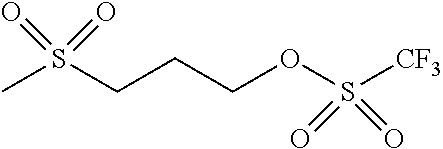


General Method 1 (C16 Sulfonamides)
| TABLE 2 |
| Compounds of Formula J with corresponding R1 and R2 substituents. Compounds of |
| Table 2 were synthesized using methods described herein, e.g., the procedures of Examples |
| 5-20, and employing the appropriate reagents. |
| C16 | ||||||
| stereochemical | SFC | t/h | ||||
| configuration | Purification | RT/ | (reaction | |||
| Compound | R1 | R2 | R/S | (Yes/No) | mins | time) |
| 1 | H |
 |
Mixp | N | 2.28 | 1 |
| 2 b |
 |
 |
S | N | 2.38 | 2 |
| 3 b |
 |
 |
R | N | 2.40 | 2 |
| 4 |
 |
 |
Mixp | N | 2.43 | 1 |
| 5 | H |
 |
R | Y | 2.10 | 2 |
| 6 | H |
 |
S | Y | 2.10 | 2 |
| 7 a |
 |
 |
Mixp | N | 2.24 | 1 |
| 8 | H |
 |
R | Y | 2.18 | 2 |
| 9 | H |
 |
S | Y | 2.17 | 2 |
| 10 b,d |
 |
 |
R | Y | 2.25 | 2 |
| 11 b,d |
 |
 |
S | Y | 2.26 | 2 |
| 12 a,d |
 |
 |
S | N | 3.54 | 2 |
| 13 |
 |
 |
Mixp | N | 2.27 | 1 |
| 14 |
 |
 |
Mixp | N | 3.29 | 1 |
| 15 |
 |
 |
Mixp | N | 2.41 | 1 |
| 16 |
 |
 |
Mixp | N | 2.13 | 1 |
| 17 |
 |
 |
Mixp | N | 2.42 | 2.5 |
| 18 b,d |
 |
 |
Mixp | N | 2.76 | 2 |
| 19 | H |
 |
R | N | 4.04 | 0.2 |
| 20 e | H |
 |
Sg | N | 4.02 | 0.2 |
| 21 c | H |
 |
Mixp | N | 3.19 | 2 |
| 22 e | H |
 |
R | N | 3.55 | 0.3 |
| 23 e | H |
 |
S | N | 3.60 | 0.3 |
| 24 | H |
 |
Mixp | N | 2.15 | 1 |
| 25 f | H |
 |
S | N | 2.12 | 1 |
| TABLE 3 |
| Characterization of compounds of Table 2 |
| Yield/ | |||
| Compound | NMR 1H NMR (400 MHz, DMSO-d6)h | % | [M + NH4]+ |
| 1 | δ 7.69-7.26 (m, 1H), 6.57-6.03 (m, 5H), 5.65- | 5.1 | 1020.7 |
| 5.48 (m, 1H), 5.35-5.04 (m, 3H), 5.03-4.92 (m, | |||
| 1H), 4.64 (t, J = 6.5 Hz, 1H), 4.11-3.73 (m, 4H), | |||
| 3.65-3.39 (m, 2H), 3.34-3.07 (m, 9H), 2.87-2.60 | |||
| (m, 3H), 2.46-1.95 (m, 8H), 1.84-1.47 (m, 12H), | |||
| 1.46-1.13 (m, 7H), 1.12-0.67 (m, 18H), 0.66-0.53 | |||
| (m, 1H). 75 out of 82 protons observed. | |||
| 2 b | δ 7.54 (d, J = 9.3 Hz, 1H), 6.55-6.00 (m, 5H), 5.48 | 2.4 | 1140.9 |
| (dd, J = 15.0, 9.2 Hz, 1H), 5.33-5.15 (m, 1H), 5.07 | |||
| (d, J = 10.1 Hz, 1H), 4.98-4.91 (m, 2H), 4.38-4.14 | |||
| (m, 2H), 4.11-3.79 (m, 4H), 3.76-3.39 (m, 14H), | |||
| 3.29-2.89 (m, 10H), 2.86-2.62 (m, 2H), 2.49-2.33 | |||
| (m, 1H), 2.31-1.81 (m, 8H), 1.81-1.18 (m, 22H), | |||
| 1.17-0.59 (m, 20H). | |||
| 3 b | δ 7.37 (d, J = 8.0 Hz, 1H), 6.46 (s, 1H), 6.46-6.31 | 1.7 | 1140.9 |
| (m, 1H), 6.23-6.03 (m, 3H), 5.60 (dd, J = 14.2, 8.6 | |||
| Hz, 1H), 5.28-5.18 (m, 2H), 5.16-5.06 (m, 1H), | |||
| 5.01-4.91 (m, 1H), 4.37-4.22 (m, 2H), 4.09-3.84 | |||
| (m, 3H), 3.79-3.61 (m, 4H), 3.59-3.38 (m, 10H), | |||
| 3.29-3.07 (m, 8H), 3.08-2.89 (m, 3H), 2.86-2.63 | |||
| (m, 2H), 2.48-2.36 (m, 1H), 2.35-1.81 (m, 8H), | |||
| 1.81-1.16 (m, 22H), 1.19-0.88 (m, 9H), 0.90-0.52 | |||
| (m, 11H). | |||
| 4 | δ 7.54-7.34 (m, 1H), 6.71-5.99 (m, 5H), 5.64- | 2.6 | 1202.8 |
| 5.44 (m, 1H), 5.42-4.90 (m, 4H), 4.32-3.79 (m, | |||
| 3H), 3.76-3.38 (m, 8H), 3.37-3.22 (m, 11H), 3.21- | |||
| 3.09 (m, 5H), 3.08-2.88 (m, 5H), 2.87-2.63 (m, | |||
| 2H), 2.47-2.28 (m, 2H), 2.27-1.80 (m, 8H), 1.79- | |||
| 1.48 (m, 11H), 1.47-0.72 (m, 21H), 0.71-0.60 (m, | |||
| 1H). 88H out of 96 protons observed. | |||
| 5 | δ 7.42 (d, J = 8.2 Hz, 1H), 6.58-6.01 (m, 5H), 5.58 | 5.8 | 1078.8 |
| (dd, J = 14.2, 8.6 Hz, 1H), 5.30-4.86 (m, 4H), 4.67- | |||
| 4.51 (m, 1H), 4.16-3.63 (m, 6H), 3.61-3.37 (m, | |||
| 2H), 3.36-3.06 (m, 9H), 3.04-2.65 (m, 6H), 2.45- | |||
| 1.86 (m, 7H), 1.82-1.45 (m, 14H), 1.46-1.09 (m, | |||
| 8H), 1.08-0.67 (m, 14H), 0.67-0.46 (m, 1H). 79 | |||
| out of 88 protons observed. | |||
| 6 | δ 7.55 (d, J = 9.4 Hz, 1H), 6.54-5.71 (m, 5H), 5.41 | 4.2 | 1078.9 |
| (dd, J = 14.9, 9.5 Hz, 1H), 5.19 (d, J = 4.6 Hz, 1H), | |||
| 5.00 (d, J = 10.1 Hz, 1H), 4.88 (m, 1H), 4.67-4.51 | |||
| (m, 1H), 4.27-3.64 (m, 6H), 3.47-3.31 (m, 1H), | |||
| 3.28-3.00 (m, 10H), 2.85-2.53 (m, 6H), 2.39-2.22 | |||
| (m, 1H), 2.22-2.07 (m, 1H), 2.05-1.78 (m, 5H), | |||
| 1.76-1.39 (m, 12H), 1.39-1.06 (m, 7H), 1.03-0.62 | |||
| (m, 14H), 0.53 (q, J = 11.9 Hz, 1H). 75 out of 88 | |||
| protons observed. | |||
| 7 a | δ 7.64-7.35 (m, 1H), 6.57-5.97 (m, 4H), 5.65- | 10.1 | 1126.8 |
| 5.36 (m, 1H), 5.34-4.99 (m, 2H), 4.99-4.85 (m, | |||
| 1H), 4.60-4.17 (m, 1H), 4.17-3.78 (m, 2H), 3.78- | |||
| 3.53 (m, 3H), 3.53-3.39 (m, 9H), 3.33-3.26 (m, | |||
| 7H), 3.25-3.20 (m, 4H), 3.20-3.10 (m, 4H), 3.07- | |||
| 2.90 (m, 3H), 2.83-2.68 (m, 1H), 2.46-2.34 (m, | |||
| 1H), 2.31-2.10 (m, 2H), 2.10-1.45 (m, 19H), 1.45- | |||
| 1.17 (m, 6H), 1.17-0.70 (m, 20H), 0.65 (q, J = 12.7 | |||
| Hz, 1H). | |||
| 8 | δ 7.39 (d, J = 8.1 Hz, 1H), 6.57-5.99 (m, 5H), 5.60 | 2.3 | 1082.8 |
| (dd, J = 14.1, 8.7 Hz, 1H), 5.33-4.89 (m, 4H), 4.72- | |||
| 4.58 (m, 1H), 4.11-3.81 (m, 4H), 3.79-3.62 (m, | |||
| 3H), 3.56-3.38 (m, 5H), 3.32-3.22 (m, 6H), 3.21- | |||
| 3.10 (m, 5H), 3.07-2.95 (m, 1H), 2.91-2.64 (m, | |||
| 3H), 2.45-1.84 (m, 6H), 1.83-1.13 (m, 19H), 1.13- | |||
| 0.69 (m, 18H), 0.66-0.47 (m, 1H). 83 of 88 protons | |||
| observed. | |||
| 9 | δ 7.56 (d, J = 9.3 Hz, 1H), 6.65-5.79 (m, 5H), 5.62- | 2.6 | 1082.8 |
| 4.82 (m, 5H), 4.73-4.55 (m, 1H), 4.30-3.77 (m, | |||
| 4H), 3.75-3.58 (m, 3H), 3.56-3.08 (m, 16H), 3.06- | |||
| 2.62 (m, 4H), 2.44-2.28 (m, 1H), 2.27-2.16 (m, | |||
| 1H), 2.12-1.84 (m, 4H), 1.82-1.11 (m, 17H), 1.11- | |||
| 0.69 (m, 14H), 0.61 (q, J = 11.9 Hz, 1H). 77 out of | |||
| 88 protons observed. | |||
| 10 b, d | δ 7.37-7.28 (m, 1H), 6.48-6.03 (m, 5H), 5.71- | 2.2 | 1064.8 |
| 5.55 (m, 1H), 5.32-4.90 (m, 4H), 4.49-4.39 (m, | |||
| 1H), 4.10-3.89 (m, 3H), 3.85-3.74 (m, 1H), 3.62- | |||
| 3.40 (m, 6H), 3.31-2.92 (m, 9H), 2.84-2.65 (m, | |||
| 2H), 2.49-2.37 (m, 1H), 2.13-1.86 (m, 6H), 1.76- | |||
| 1.23 (m, 21H), 1.15-0.74 (m, 24H), 0.69-0.57 (m, | |||
| 1H). | |||
| 11 b, d | δ 7.56 (d, J = 7.5 Hz, 1H), 6.52-6.00 (m, 5H), 5.55- | 1.5 | 1064.8 |
| 5.43 (m, 1H), 5.26 (d, J = 3.5 Hz, 1H), 5.21-4.89 | |||
| (m, 3H), 4.51-4.40 (m, 1H), 4.08-3.76 (m, 4H), | |||
| 3.67-3.39 (m, 6H), 3.36-3.33 (m, 3H), 3.31-3.22 | |||
| (m, 1H), 3.18-2.93 (m, 5H), 2.82-2.64 (m, 2H), | |||
| 2.49-2.34 (m, 2H), 2.27-2.15 (m, 2H), 2.13-1.82 | |||
| (m, 6H), 1.80-1.46 (m, 12H), 1.45-0.71 (m, 30H), | |||
| 0.70-0.59 (m, 1H). | |||
| 12 a, d | δ 7.53 (d, J = 9.5 Hz, 1H), 6.53-5.98 (m, 5H), 5.67- | 8.0 | 1106.8 |
| 4.83 (m, 5H), 4.38-3.63 (m, 9H), 3.50-3.36 (m, | |||
| 1H), 3.31-3.25 (m, 4H), 3.23-2.90 (m, 6H), 2.93- | |||
| 2.62 (m, 1H), 2.48-1.82 (m, 9H), 1.77-1.49 (m, | |||
| 13H), 1.48-1.13 (m, 8H), 1.13-0.71 (m, 25H), 0.63 | |||
| (q, J = 11.9 Hz, 1H). | |||
| 13 | δ 7.63-7.43 (m, 1H), 6.52-6.01 (m, 5H), 5.64- | 16.2 | 1096.8 |
| 5.47 (m, 1H), 5.39-5.02 (m, 3H), 4.95 (t, J = 5.9 Hz, | |||
| 1H), 4.34-4.25 (m, 2H), 4.10-3.68 (m, 4H), 3.68- | |||
| 3.36 (m, 8H), 3.30 (s, 3H), 3.25-3.07 (m, 8H), 3.06- | |||
| 2.86 (m, 2H), 2.86-2.64 (m, 1H), 2.48-2.34 (m, | |||
| 1H), 2.34-1.81 (m, 8H), 1.81-1.48 (m, 17H), 1.47- | |||
| 1.20 (m, 5H), 1.15-0.56 (m, 20H). | |||
| 14 | δ 7.67-7.33 (m, 1H), 6.52-6.44 (m, 1H), 6.40- | 12.9 | 1124.8 |
| 5.97 (m, 4H), 5.67-5.43 (m, 1H), 5.29-5.22 (m, | |||
| 1H), 5.06 (d, J = 10.2 Hz, 1H), 5.00-4.87 (m, 2H), | |||
| 4.24-4.17 (m, 3H), 4.12-4.03 (m, 2H), 4.03-3.89 | |||
| (m, 1H), 3.84 (d, J = 5.3 Hz, 1H), 3.68-3.50 (m, 3H), | |||
| 3.48-3.42 (m, 1H), 3.30-3.25 (m, 4H), 3.24-2.92 | |||
| (m, 11H), 2.85-2.62 (m, 1H), 2.45-2.12 (m, 2H), | |||
| 2.10-1.80 (m, 3H), 1.79-1.46 (m, 15H), 1.45-1.12 | |||
| (m, 8H), 1.10-0.74 (m, 16H), 0.59 (q, J = 12.2 Hz, | |||
| 1H). 83 out of 90 protons observed. | |||
| 15 | δ 7.56-7.31 (m, 1H), 6.55-5.99 (m, 5H), 5.62-5.44 | 11.8 | 1078.9 |
| (m, 1H), 5.33-5.15 (m, 2H), 5.12-5.02 (m, 1H), | |||
| 5.02-4.91 (m, 1H), 4.37-4.21 (m, 1H), 4.10-3.70 | |||
| (m, 4H), 3.64-3.37 (m, 6H), 3.32-3.21 (m, 4H), | |||
| 3.21-3.07 (m, 4H), 3.07-2.90 (m, 2H), 2.82-2.64 | |||
| (m, 1H), 2.48-2.34 (m, 1H), 2.34-1.81 (m, 8H), | |||
| 1.81-1.17 (m, 20H), 1.17-0.57 (m, 26H). | |||
| 16 | δ 7.71-7.46 (m, 1H), 6.60-6.49 (m, 1H), 6.42- | 3.6 | 1082.9 |
| 6.03 (m, 4H), 5.63-5.39 (m, 2H), 5.38-4.89 (m, | |||
| 5H), 4.54-4.46 (m, 1H), 4.12-3.77 (m, 4H), 3.76- | |||
| 3.66 (m, 1H), 3.65-3.40 (m, 7H), 3.34-2.92 (m, | |||
| 13H), 2.82-2.65 (m, 2H), 2.47-2.31 (m, 2H), 2.30- | |||
| 1.85 (m, 7H), 1.82-1.20 (m, 17H), 1.18-0.71 (m, | |||
| 18H), 0.68-0.59 (m, 1H). 86 out of 88 protons | |||
| observed. | |||
| 17 | δ 7.70-7.41 (m, 1H), 6.57-6.48 (m, 1H), 6.47- | 10.5 | 1158.9 |
| 6.05 (m, 4H), 5.64-5.01 (m, 4H), 4.95 (d, J = 5.9 Hz, | |||
| 1H), 4.12-3.67 (m, 4H), 3.68-3.40 (m, 7H), 3.32- | |||
| 2.91 (m, 18H), 2.84-2.62 (m, 1H), 2.47-2.30 (m, | |||
| 2H), 2.27-2.10 (m, 1H), 2.12-1.82 (m, 7H), 1.78- | |||
| 1.46 (m, 12H), 1.47-1.17 (m, 4H), 1.17-0.89 (m, | |||
| 11H), 0.89-0.70 (m, 13H), 0.64 (q, J = 12.4 Hz, 1H). | |||
| 18 b, d | δ 7.60-7.37 (m, 1H), 6.60-6.04 (m, 5H), 5.64- | 5.7 | 1140.7 |
| 5.38 (m, 1H), 5.32-4.90 (m, 4H), 4.11-3.72 (m, | |||
| 4H), 3.66-3.39 (m, 4H), 3.33-2.91 (m, 14H), 2.84- | |||
| 2.63 (m, 2H), 2.47-1.81 (m, 10H), 1.78-1.48 (m, | |||
| 11H), 1.47-1.19 (m, 5H), 1.18-0.69 (m, 19H), 0.68- | |||
| 0.54 (m, 1H). 81 out of 90 protons observed. | |||
| 19 | δ 7.41 (d, J = 8.2 Hz, 1H), 6.52-5.98 (m, 5H), 5.62- | 3.0 | 1076.9 |
| 4.86 (m, 5H), 4.62 (d, J = 4.4 Hz, 1H), 4.19-3.47 | |||
| (m, 7H), 3.31-2.60 (m, 11H), 2.41-1.84 (m, 8H), | |||
| 1.81-1.45 (m, 20H), 1.45-0.65 (m, 31H), 0.56 (q, | |||
| J = 12.6 Hz, 1H). | |||
| 20 e | δ 7.62 (d, J = 9.4 Hz, 1H), 6.59-6.00 (m, 5H), 5.54- | 20.0 | 1076.9 |
| 5.40 (m, 1H), 5.29 (dd, J = 8.9, 4.4 Hz, 1H), 5.06 | |||
| (d, J = 10.2 Hz, 1H), 5.01-4.90 (m, 2H), 4.68-4.60 | |||
| (m, 1H), 4.12-3.76 (m, 4H), 3.73-3.42 (m, 1H), | |||
| 3.35-3.08 (m, 10H), 3.04-2.57 (m, 4H), 2.46-1.84 | |||
| (m, 6H), 1.83-1.10 (m, 17H), 1.10-0.70 (m, 21H), | |||
| 0.60 (q, J = 12.1 Hz, 1H). 76 out of 90 protons | |||
| observed. | |||
| 21 c | δ 7.62-7.22 (m, 1H), 6.57-5.96 (m, 5H), 5.67- | 8.3 | 1048.9 |
| 5.01 (m, 4H), 4.98-4.93 (m, 2H), 4.71-4.64 (m, | |||
| 1H), 4.11-3.62 (m, 4H), 3.31-3.06 (m, 9H), 3.05- | |||
| 2.60 (m, 4H), 2.48-2.15 (m, 3H), 2.12-1.08 (m, | |||
| 29H), 1.08-0.69 (m, 21H), 0.68-0.50 (m, 1H). 84 | |||
| out of 86 protons observed. | |||
| 22 e | δ 7.45-7.26 (m, 1H), 6.75-5.99 (m, 5H), 5.76- | 6.8 | 1063.0 |
| 5.53 (m, 1H), 5.35-4.90 (m, 4H), 4.69-4.55 (m, | |||
| 1H), 4.14-3.51 (m, 5H), 3.33-3.06 (m, 8H), 3.05- | |||
| 2.88 (m, 2H), 2.87-2.63 (m, 3H), 2.46-1.97 (m, | |||
| 6H), 1.95-1.34 (m, 23H), 1.33-1.04 (m, 8H), 1.03- | |||
| 0.66 (m, 14H), 0.66-0.49 (m, 1H). 82 out of 88 | |||
| protons observed. | |||
| 23 e | δ 7.62-7.30 (m, 1H), 6.73-6.05 (m, 5H), 5.54- | 11.1 | 1062.9 |
| 5.44 (m, 1H), 5.41-5.17 (m, 2H), 5.16-5.00 (m, | |||
| 1H), 4.98-4.89 (m, 1H), 4.69-4.55 (m, 1H), 4.14- | |||
| 3.65 (m, 4H), 3.52-3.39 (m, 1H), 3.34-3.08 (m, | |||
| 9H), 2.99-2.66 (m, 4H), 2.46-2.32 (m, 2H), 2.25- | |||
| 1.81 (m, 8H), 1.80-1.35 (m, 19H), 1.34-0.68 (m, | |||
| 23H), 0.66-0.54 (m, 1H). 83 out of 88 protons | |||
| observed. | |||
| 24 | δ 7.73-7.44 (m, 1H), 6.60-5.96 (m, 5H), 5.64- | 10.9 | 1038.9 |
| 5.03 (m, 4H), 5.00-4.92 (m, 1H), 4.68-4.57 (m, | |||
| 1H), 4.12-3.67 (m, 4H), 3.65-3.47 (m, 3H), 3.45- | |||
| 3.37 (m, 1H), 3.34-3.06 (m, 11H), 3.04-2.92 (m, | |||
| 1H), 2.91-2.63 (m, 3H), 2.46-2.28 (m, 7H), 1.81- | |||
| 1.46 (m, 12H), 1.45-1.12 (m, 7H), 1.10-0.70 (m, | |||
| 15H), 0.66-0.52 (m, 1H). 77 out of 84 protons | |||
| observed. | |||
| 25 f | δ 7.58 (d, J = 9.3 Hz, 1H), 6.61-5.97 (m, 5H), 5.57- | 2.1 | 1126.7 |
| 5.36 (m, 1H), 5.31-5.22 (m, 1H), 5.08 (d, J = 10.0 | |||
| Hz, 1H), 5.01-4.86 (m, 2H), 4.60 (d, J = 4.8 Hz, 1H), | |||
| 4.27-3.91 (m, 2H), 3.86 (d, J = 5.6 Hz, 1H), 3.65 (q, | |||
| J = 6.1 Hz, 3H), 3.55-3.38 (m, 11H), 3.33-3.10 (m, | |||
| 24H), 3.05-2.94 (m, 1H), 2.90-2.64 (m, 3H), 2.45- | |||
| 2.30 (m, 1H), 2.27-1.84 (m, 5H), 1.81-1.03 (m, | |||
| 13H), 1.01-0.68 (m, 15H), 0.61 (q, J = 11.9 Hz, 1H). | |||
For Table 2 and Table 3: aAddition carried out at −40° C., then allowed to warm to RT; bAddition carried out at 0° C. then allowed to warm to RT; cMeCN solvent; d40 equivalents of sulfonamide and 5 equivalents of pTSA used; eIsomers separable by normal phase column chromatography; fPrepared following General Method 2; g6:4 C16 S:R isomeric ratio; hThe NMR characterization data shown for the compounds correspond only to the major equilibrium form observed in the deuterated solvent conditions; PMix refers to a mixture of diastereomers of an undetermined amount.

General Method 3 (C-16 Ethers)


| TABLE 4 |
| Compounds of Formula JJ with corresponding R1 and R2 substituents. Compounds of |
| Table 4 were synthesized using the methods described herein, e.g., procedures of |
| Examples 21-24, and employing the appropriate reagents. |
| C16& | RT/ | ||||
| Compound | t/ha | R1 | R2 | R/S | mins |
| 26 | 1.5 | H |
 |
Sd | 2.21 |
| 27 | 1.5 | H |
 |
Sd | 2.59 |
| 28 | 5 | H |
 |
Sd | 3.42 |
| 29 | 3 | H |
 |
Sd | 3.21 |
| 30 | 0.5 | H |
 |
Sd | 2.38 |
| 31 | 1 | H |
 |
Sd | 3.55 |
| 32 | 3 | H |
 |
Sd | 3.86 |
| 33 | 2.5 | H |
 |
Sd | 3.42 |
| 34 | 2.5 | H |
 |
Sd | 3.61 |
| 35 | 1 | H |
 |
Sd | 3.13 |
| 36 | 4 | H |
 |
S | 5.88 |
| 37 | 4 | H |
 |
R | 5.62 |
| 38 | 168b |
 |
 |
Sd | 3.59 |
| 39 | 4 | H |
 |
Sd | 4.69 |
| 40 | 5 | H |
 |
Sd | 6.27 |
| 41 | 0.5 | H |
 |
Sd | 4.74 |
| 42 | 4 |
 |
 |
S | 4.89 |
| 43 | 4 |
 |
 |
R | 4.75 |
| 44 | 6 |
 |
 |
Sd | 6.02 |
| 45 | 9 |
 |
 |
Sd | 5.89 |
| 46 | 2 |
 |
 |
S | 4.33 |
| 47 | 2 |
 |
 |
R | 4.15 |
| 48 | 1 |
 |
 |
Sd | 5.60 |
| 49 | 5.5 |
 |
 |
Sd | 6.81 |
| 50 | 3.5 |
 |
 |
S | 6.00 |
| 51 | 3.5 |
 |
 |
R | 5.61 |
| 52 | 1.5 |
 |
 |
S | 4.62 |
| 53 | 1.5 |
 |
 |
R | 4.32 |
| 54 | 2 |
 |
 |
Sd | 4.57 |
| 55 c C28 isomer (C28 S configuration) | 5 | H |
 |
Sd | 3.78 |
| 56 e |
 |
 |
Sd | 4.87 | |
| 57 e |
 |
 |
Sd | 3.51 | |
| 58 e |
 |
 |
Sd | 4.20 | |
| TABLE 5 |
| Characterization of compounds of Table 4 |
| Yield | |||
| Compound | NMR 1H NMR (400 MHz, DMSO-d6)f | (%) | [M + NH4]+ |
| 26 | δ 6.56-6.33 (m, 2H), 6.31-6.04 (m, 3H), 5.48 (dd, | 11.4 | 1035.9 |
| J = 14.7, 9.6 Hz, 1H), 5.25 (d, J = 4.5 Hz, 1H), 5.08 (d, | |||
| J = 10.2 Hz, 1H), 5.02-4.89 (m, 2H), 4.59 (d, J = 4.5 | |||
| Hz, 1H), 4.18-3.84 (m, 5H), 3.49-3.37 (m, 1H), 3.37- | |||
| 3.04 (m, 12H), 2.88-2.60 (m, 3H), 2.45-1.80 (m, | |||
| 8H), 1.81-1.08 (m, 23H), 1.09-0.90 (m, 6H), 0.90- | |||
| 0.68 (m, 13H), 0.60 (q, J = 11.9 Hz, 1H). | |||
| 27 | δ 6.51-6.34 (m, 2H), 6.27-6.02 (m, 3H), 5.46 (dd, | 38.5 | 1063.9 |
| J = 14.6, 9.6 Hz, 1H), 5.26 (d, J = 4.4 Hz, 1H), 5.09 (d, | |||
| J = 10.2 Hz, 1H), 5.04-4.92 (m, 2H), 4.63-4.54 (m, | |||
| 1H), 4.09-3.88 (m, 3H), 3.83-3.65 (m, 1H), 3.48- | |||
| 3.38 (m, 1H), 3.30-3.07 (m, 10H), 3.06-2.93 (m, 2H), | |||
| 2.90-2.62 (m, 5H), 2.46-2.33 (m, 3H), 2.31-2.14 | |||
| (m, 2H), 2.15-1.94 (m, 2H), 1.95-1.45 (m, 20H), 1.46- | |||
| 1.10 (m, 7H), 1.10-0.89 (m, 6H), 0.90-0.69 (m, | |||
| 13H), 0.60 (q, J = 11.6 Hz, 1H). | |||
| 28 | δ 6.52-6.31 (m, 2H), 6.31-6.06 (m, 3H), 5.45 (dd, | 4.0 | 1002.0 |
| J = 14.6, 9.6 Hz, 1H), 5.31-5.18 (m, 1H), 5.08 (d, J = | |||
| 10.3 Hz, 1H), 5.01-4.91 (m, 2H), 4.84-4.71 (m, 1H), | |||
| 4.59 (d, J = 4.6 Hz, 1H), 4.55-4.44 (m, 1H), 4.41- | |||
| 4.29 (m, 1H), 4.11-3.89 (m, 4H), 3.79-3.64 (m, 1H), | |||
| 3.49-3.36 (m, 1H), 3.31-2.98 (m, 9H), 2.89-2.54 | |||
| (m, 4H), 2.44-2.15 (m, 4H), 2.15-1.46 (m, 21H), 1.47- | |||
| 1.10 (m, 7H), 1.12-0.92 (m, 6H), 0.88-0.70 (m, | |||
| 13H), 0.60 (q, J = 12.0 Hz, 1H). | |||
| 29 | δ 6.52-6.32 (m, 2H), 6.30-6.00 (m, 3H), 5.60-5.37 | 3.5 | 987.9 |
| (m, 1H), 5.37-5.18 (m, 1H), 5.14-5.04 (m, 1H), 5.01- | |||
| 4.82 (m, 2H), 4.61-4.57 (m, 1H), 4.09-3.45 (m, | |||
| 10H), 3.49-3.35 (m, 1H), 3.28-3.13 (m, 8H), 2.91- | |||
| 2.63 (m, 2H), 2.47-2.16 (m, 3H), 2.14-1.95 (m, 2H), | |||
| 1.95-1.47 (m, 17H), 1.46-0.92 (m, 15H), 0.91-0.69 | |||
| (m, 13H), 0.67-0.53 (m, 1H). | |||
| 30 | δ 6.67-6.34 (m, 2H), 6.32-5.89 (m, 3H), 5.70-5.42 | 8.0 | 1049.9 |
| (m, 1H), 5.38-4.85 (m, 4H), 4.65-4.50 (m, 1H), 4.14- | |||
| 3.65 (m, 4H), 3.58-3.40 (m, 1H), 3.32-3.06 (m, | |||
| 12H), 2.95-2.55 (m, 5H), 2.47-1.95 (m, 5H), 1.94- | |||
| 1.47 (m, 15H), 1.45-0.66 (m, 22H), 0.65-0.54 (m, | |||
| 1H). 76H out of 85H observed. | |||
| 31 | δ 6.64-6.31 (m, 2H), 6.29-5.88 (m, 3H), 5.47 (dd, | 21.5 | 1002.0 |
| J = 12.2, 9.8 Hz, 1H), 5.32-5.19 (m, 1H), 5.17-4.85 | |||
| (m, 3H), 4.71-4.50 (m, 1H), 4.32-3.82 (m, 3H), 3.81- | |||
| 3.37 (m, 6H), 3.33-2.96 (m, 10H), 2.91-2.59 (m, | |||
| 3H), 2.46-2.31 (m, 2H), 2.29-1.81 (m, 6H), 1.80- | |||
| 1.36 (m, 15H), 1.34-0.69 (m, 20H), 0.61 (q, J = 11.5 | |||
| Hz, 1H). 77H out of 85H observed. | |||
| 32 | δ 6.66-6.31 (m, 2H), 6.28-5.88 (m, 3H), 5.52-5.39 | 23.0 | 1015.9 |
| (m, 1H), 5.36-4.83 (m, 4H), 4.61 (d, J = 4.4 Hz, 2H), | |||
| 4.15-3.85 (m, 3H), 3.85-3.50 (m, 5H), 3.47-3.38 | |||
| (m, 1H), 3.33-3.24 (m, 4H), 3.25-2.97 (m, 6H), 2.87- | |||
| 2.65 (m, 3H), 2.44-2.31 (m, 1H), 2.27-1.79 (m, 7H), | |||
| 1.77-1.48 (m, 15H), 1.47-1.36 (m, 3H), 1.33-1.10 | |||
| (m, 5H), 1.09-0.65 (m, 19H), 0.65-0.53 (m, 1H). 85 | |||
| out of 87 protons observed. | |||
| 33 | δ 6.48 (d, J = 1.6 Hz, 1H), 6.39 (dd, J = 14.3, 11.2 Hz, | 13.5 | 1001.9 |
| 1H), 6.27-6.05 (m, 3H), 5.46 (dd, J = 14.7, 9.6 Hz, | |||
| 1H), 5.26 (d, J = 4.5 Hz, 1H), 5.12-5.03 (m, 1H), 5.03- | |||
| 4.90 (m, 2H), 4.58 (dd, J = 4.5, 1.8 Hz, 1H), 4.12- | |||
| 3.85 (m, 4H), 3.81-3.68 (m, 2H), 3.48-3.37 (m, 1H), | |||
| 3.37-3.10 (m, 12H), 2.91-2.66 (m, 2H), 2.45-2.32 | |||
| (m, 2H), 2.31-1.95 (m, 3H), 1.95-1.48 (m, 21H), 1.48- | |||
| 0.90 (m, 13H), 0.87-0.69 (m, 13H), 0.60 (q, J = 11.7 | |||
| Hz, 1H). | |||
| 34 | δ 6.50-6.45 (m, 1H), 6.45-6.34 (m, 1H), 6.27-6.01 | 19.6 | 1001.9 |
| (m, 3H), 5.51-5.41 (m, 1H), 5.29-5.23 (m, 1H), 5.12- | |||
| 5.05 (m, 1H), 5.02-4.90 (m, 2H), 4.66-4.52 (m, | |||
| 1H), 4.07-3.98 (m, 2H), 3.97-3.87 (m, 1H), 3.84- | |||
| 3.50 (m, 5H), 3.47-3.36 (m, 2H), 3.31-3.25 (m, 4H), | |||
| 3.22-2.97 (m, 6H), 2.88-2.60 (m, 2H), 2.43-2.17 | |||
| (m, 4H), 2.13-1.97 (m, 2H), 1.96-1.78 (m, 4H), 1.76- | |||
| 1.60 (m, 10H), 1.57-1.13 (m, 11H), 1.13-0.94 (m, | |||
| 7H), 0.91-0.70 (m, 13H), 0.66-0.53 (m, 1H). | |||
| 35 | δ 6.54-6.32 (m, 2H), 6.30-6.00 (m, 3H), 5.60-5.37 | 3.8 | 987.9 |
| (m, 1H), 5.37-5.18 (m, 1H), 5.14-5.01 (m, 1H), 5.01- | |||
| 4.82 (m, 2H), 4.61-4.54 (m, 1H), 4.09-3.80 (m, | |||
| 4H), 3.73-3.59 (m, 4H), 3.51-3.37 (m, 2H), 3.28- | |||
| 3.10 (m, 9H), 2.91-2.63 (m, 2H), 2.47-2.16 (m, 2H), | |||
| 2.14-1.95 (m, 3H), 1.95-1.47 (m, 19H), 1.46-0.92 | |||
| (m, 13H), 0.91-0.69 (m, 13H), 0.67-0.53 (m, 1H). | |||
| 36 | δ 6.51-6.34 (m, 2H), 6.29-6.04 (m, 3H), 5.46 (dd, | 20.4 | 986.0 |
| J = 13.6, 9.6 Hz, 1H), 5.31-5.23 (m, 1H), 5.16-4.86 | |||
| (m, 3H), 4.65-4.54 (m, 1H), 4.13-3.85 (m, 3H), 3.81- | |||
| 3.67 (m, 1H), 3.51-3.39 (m, 1H), 3.33-3.04 (m, | |||
| 11H), 2.86-2.69 (m, 2H), 2.49-2.16 (m, 4H), 2.15- | |||
| 1.47 (m, 25H), 1.46-1.12 (m, 7H), 1.11-0.68 (m, | |||
| 19H), 0.67-0.57 (m, 1H). | |||
| 37 | δ 6.61-6.39 (m, 2H), 6.21-5.89 (m, 3H), 5.70-5.54 | 3.0 | 985.9 |
| (m, 1H), 5.37-5.28 (m, 1H), 5.27-5.07 (m, 2H), 5.03- | |||
| 4.91 (1H), 4.67-4.58 (m, 1H), 4.12-3.88 (m, 3H), | |||
| 3.84-3.70 (m, 1H), 3.64-3.49 (m, 1H), 3.33-2.99 | |||
| (m, 11H), 2.85-2.69 (m, 2H), 2.59-2.54 (m, 1H), 2.47- | |||
| 2.40 (m, 1H), 2.35-2.12 (m, 2H), 2.05-1.78 (m, | |||
| 6H), 1.77-1.46 (m, 17H), 1.45-1.06 (m, 9H), 1.05- | |||
| 0.67 (m, 19H), 0.64-0.53 (m, 1H). | |||
| 38 | δ 6.50 (s, 1H), 6.45-6.34 (m, 1H), 6.29-6.07 (m, 2H), | 8.7 | 1046.0 |
| 5.46 (dd, J = 14.7, 9.6 Hz, 1H), 5.33-5.16 (m, 1H), | |||
| 5.14-5.04 (m, 1H), 5.01-4.90 (m, 2H), 4.52-4.44 | |||
| (m, 1H), 4.08-3.90 (m, 2H), 3.82-3.53 (m, 5H), 3.53- | |||
| 3.40 (m, 5H), 3.31-3.20 (m, 5H), 3.20-2.92 (m, | |||
| 8H), 2.86-2.61 (m, 2H), 2.43-2.31 (m, 2H), 2.30- | |||
| 2.16 (m, 1H), 2.16-2.00 (m, 2H), 2.00-1.78 (m, 5H), | |||
| 1.78-1.34 (m, 16H), 1.34-1.18 (m, 4H), 1.18-0.90 | |||
| (m, 8H), 0.90-0.54 (m, 14H). | |||
| 39 | δ 6.54-6.31 (m, 2H), 6.30-6.05 (m, 3H), 5.46 (dd, | 8.2 | 971.9 |
| J = 12.4, 10.2 Hz, 1H), 5.31-5.24 (m, 1H), 5.14-4.86 | |||
| (m, 3H), 4.65-4.54 (m, 1H), 4.20-3.92 (m, 3H), 3.83- | |||
| 3.74 (m, 1H), 3.52-3.40 (m, 1H), 3.34-3.32 (m, | |||
| 3H), 3.30-2.91 (m, 7H), 2.90-2.64 (m, 3H), 2.45- | |||
| 2.05 (m, 5H), 2.04-1.82 (m, 3H), 1.80-1.47 (m, 11H), | |||
| 1.46-1.13 (m, 7H), 1.11-0.69 (m, 19H), 0.66-0.55 | |||
| (m, 1H), 0.52-0.31 (m, 2H), 0.18-0.00 (m, 2H). 79H | |||
| out of 83H observed. | |||
| 40 | δ 6.48-6.44 (m, 1H), 6.39 (dd, J = 14.4, 11.2 Hz, 1H), | 7.6 | 1000.0 |
| 6.27-6.14 (m, 1H), 6.14-6.06 (m, 2H), 5.45 (dd, J = | |||
| 14.6, 9.7 Hz, 1H), 5.26 (d, J = 4.6 Hz, 1H), 5.11 5.05 | |||
| (m, 1H), 5.01-4.90 (m, 2H), 4.59 (d, J = 4.5 Hz, 1H), | |||
| 4.11-3.98 (m, 2H), 3.95 (d, J = 4.5 Hz, 1H), 3.75 3.69 | |||
| (m, 1H), 3.48 3.41 (m, 1H), 3.32 (s, 3H), 3.25-3.05 | |||
| (m, 7H), 2.95 (dd, J = 9.2, 6.8 Hz, 1H), 2.88-2.78 (m, | |||
| 1H), 2.78-2.65 (m, 1H), 2.43-2.29 (m, 2H), 2.29- | |||
| 2.15 (m, 1H), 2.14-1.94 (m, 3H), 1.94-1.78 (m, 3H), | |||
| 1.77-1.71 (m, 3H), 1.71-1.59 (m, 9H), 1.58-1.34 | |||
| (m, 9H), 1.32-1.09 (m, 7H), 1.08-0.90 (m, 7H), 0.90- | |||
| 0..69 (m, 13H), 0.60 (q, J = 12.0 Hz, 1H). | |||
| 41 | δ 6.53-6.34 (m, 2H), 6.28-6.05 (m, 3H), 5.46 (dd, | 22.1 | 1022.0 |
| J = 12.4, 9.0 Hz, 1H), 5.32-5.24 (m, 1H), 5.09 (d, J = | |||
| 10.2 Hz, 1H), 5.05-4.87 (m, 2H), 4.65-4.55 (m, 1H), | |||
| 4.09-3.68 (m, 4H), 3.51-3.39 (m, 1H), 3.35-3.32 | |||
| (m, 3H), 3.26-3.12 (m, 7H), 2.95-2.55 (m, 5H), 2.46- | |||
| 1.96 (m, 8H), 1.95-1.13 (m, 23H), 1.12-0.68 (m, | |||
| 19H), 0.61 (dd, J = 12.4, 10.0 Hz, 1H). 82H out of 83H | |||
| observed. | |||
| 19F NMR (376 MHz, DMSO-d6) δ −81.3 (d, J = 203 | |||
| Hz), −91.3 (d, J = 203 Hz). | |||
| 42 | δ 6.51 (d, J = 1.4 Hz, 1H), 6.38 (dd, J = 14.5, 11.2 Hz, | 22.3 | 1029.9 |
| 1H), 6.27-6.05 (m, 3H), 5.45 (dd, J = 14.6, 9.6 Hz, | |||
| 1H), 5.36-5.24 (m, 1H), 5.07 (d, J = 10.1 Hz, 1H), 5.01- | |||
| 4.87 (m, 2H), 4.38-4.30 (m, 1H), 4.13-3.95 (m, | |||
| 3H), 3.83-3.71 (m, 1H), 3.63-3.39 (m, 6H), 3.33- | |||
| 3.09 (m, 6H), 3.06-2.90 (m, 4H), 2.85-2.62 (m, 1H), | |||
| 2.44-2.30 (m, 2H), 2.30-2.14 (m, 1H), 2.15-1.77 | |||
| (m, 6H), 1.77-1.46 (m, 14H), 1.46-1.13 (m, 7H), 1.13- | |||
| 0.89 (m, 9H), 0.89-0.69 (m, 13H), 0.64 (q, J = 11.9 | |||
| Hz, 1H), 0.52-0.37 (m, 2H), 0.18-0.02 (m, 2H). | |||
| 43 | δ 6.57 (s, 1H), 6.51-6.36 (m, 1H), 6.25-6.07 (m, 2H), | 9.0 | 1029.8 |
| 6.07-5.96 (m, 1H), 5.66-5.53 (m, 1H), 5.34-5.05 | |||
| (m, 3H), 5.02-4.95 (m, 1H), 4.41-4.22 (m, 1H), 4.07- | |||
| 3.87 (m, 3H), 3.79 (dd, J = 9.6, 2.2 Hz, 1H), 3.75- | |||
| 3.66 (m, 1H), 3.59-3.40 (m, 6H), 3.30-2.88 (m, 7H), | |||
| 2.83-2.66 (m, 2H), 2.55 (d, J = 9.4 Hz, 1H), 2.38- | |||
| 1.79 (m, 7H), 1.79 (s, 23H), 1.18-0.54 (m, 23H), 0.42 | |||
| (dt, J = 7.4, 2.2 Hz, 2H), 0.19-−0.04 (m, 2H). | |||
| 44 | δ 6.49 (d, J = 1.5 Hz, 1H), 6.46-6.33 (m, 1H), 6.27- | 7.6 | 1043.9 |
| 6.06 (m, 3H), 5.45 (dd, J = 14.6, 9.7 Hz, 1H), 5.28 (d, | |||
| J = 13.6 Hz, 1H), 5.08 (d, J = 10.2 Hz, 1H), 5.01-4.89 | |||
| (m, 2H), 4.39-4.30 (m, 1H), 4.10-3.93 (m, 3H), 3.79- | |||
| 3.66 (m, 1H), 3.62-3.39 (m, 7H), 3.32-2.89 (m, | |||
| 10H), 2.79-2.62 (m, 1H), 2.49-2.31 (m, 5H), 2.31- | |||
| 2.16 (m, 1H), 2.15-1.48 (m, 26H), 1.46-0.90 (m, | |||
| 12H), 0.89-0.57 (m, 14H). | |||
| 45 | δ 6.50 (s, 1H), 6.47-6.32 (m, 1H), 6.27-6.07 (m, 3H), | 11.4 | 1029.9 |
| 5.45 (dd, J = 14.4, 9.9 Hz, 1H), 5.35-5.24 (m, 1H), | |||
| 5.07 (d, J = 10.1 Hz, 1H), 5.01-4.89 (m, 2H), 4.56- | |||
| 4.44 (m, 1H), 4.10-3.90 (m, 2H), 3.78-3.66 (m, 1H), | |||
| 3.55-3.42 (m, 5H), 3.34-3.22 (m, 4H), 3.22-2.91 | |||
| (m, 8H), 2.87-2.58 (m, 2H), 2.49-2.16 (m, 4H), 2.15- | |||
| 1.77 (m, 9H), 1.75 (s, 2H), 1.73-1.46 (m, 14H), 1.46- | |||
| 1.35 (m, 2H), 1.35-0.91 (m, 11H), 0.89-0.69 (m, | |||
| 13H), 0.69-0.57 (m, 1H). | |||
| 46 | δ 6.55-6.33 (m, 2H), 6.29-6.06 (m, 3H), 5.46 (dd, | 12.7 | 1001.9 |
| J = 12.3, 10.1 Hz, 1H), 5.36-5.27 (m, 1H), 5.16-4.86 | |||
| (m, 3H), 4.49 (d, J = 2.0 Hz, 1H), 4.08-3.76 (m, 4H), | |||
| 3.56-3.38 (m, 5H), 3.34-2.93 (m, 11H), 2.77-2.67 | |||
| (m, 1H), 2.45-2.32 (m, 2H), 2.28-2.16 (m, 1H), 2.14- | |||
| 1.87 (m, 4H), 1.86-1.46 (m, 15H), 1.45-1.10 (m, | |||
| 8H), 1.09-0.91 (m, 7H), 0.90-0.68 (m, 11H), 0.67- | |||
| 0.59 (m, 1H), 0.54-0.24 (m, 4H). | |||
| 47 | δ 6.69-6.36 (m, 2H), 6.32-5.92 (m, 3H), 5.68-5.41 | 2.8 | 1001.9 |
| (m, 1H), 5.35-5.04 (m, 3H), 5.02-4.87 (m, 1H), 4.52- | |||
| 4.44 (m, 1H), 4.11-3.75 (m, 4H), 3.63-3.37 (m, | |||
| 5H), 3.34-3.28 (m, 4H), 3.21-3.10 (m, 3H), 3.09- | |||
| 2.90 (m, 3H), 2.84-2.64 (m, 2H), 2.57-2.52 (m, 1H), | |||
| 2.41-2.04 (m, 3H), 2.03-1.82 (m, 3H), 1.81-1.17 | |||
| (m, 20H), 1.16-0.68 (m, 19H), 0.67-0.54 (m, 1H), | |||
| 0.52-0.15 (m, 4H). 83H out of 85H observed. | |||
| 48 | δ 6.57-5.93 (m, 5H), 5.58-5.36 (m, 1H), 5.33-4.86 | 10.0 | 1043.9 |
| (m, 4H), 4.35-3.68 (m, 13H), 3.20-2.95 (m, 7H), 2.83- | |||
| 2.62 (m, 1H), 2.45-2.32 (m, 2H), 2.16-1.45 (m, | |||
| 19H), 1.45-0.68 (m, 30H), 0.62 (q, J = 11.8 Hz, 1H), | |||
| 0.54-0.23 (m, 4H). | |||
| 49 | δ 6.52 (s, 1H), 6.47-6.34 (m, 1H), 6.29-6.07 (m, 3H), | 10.4 | 1071.9 |
| 5.55 (dd, J = 12.4, 10.2 Hz, 1H), 5.36-5.28 (m, 1H), | |||
| 5.14-4.89 (m, 3H), 4.28-3.94 (m, 7H), 3.78-3.68 | |||
| (m, 1H), 3.42 (d, J = 7.0 Hz, 1H), 3.32-2.96 (m, 12H), | |||
| 2.83-2.64 (m, 2H), 2.47-2.16 (m, 4H), 2.15-1.90 | |||
| (m, 6H), 1.89-1.47 (m, 18H), 1.46-1.12 (m, 11H), | |||
| 1.11-0.68 (m, 18H), 0.65-0.54 (m, 1H). | |||
| 50 | δ 6.48 (s, 1H), 6.41-6.33 (m, 1H), 6.26-6.05 (m, 3H), | 6.7 | 1057.9 |
| 5.47 (dd, J = 12.4, 10.2 Hz, 1H), 5.29-5.23 (m, 1H), | |||
| 5.12-4.89 (m, 3H), 4.28-3.92 (m, 7H), 3.82-3.75 | |||
| (m, 1H), 3.49-3.39 (m, 1H), 3.31-3.07 (m, 9H), 3.06- | |||
| 2.94 (m, 3H), 2.76-2.66 (m, 1H), 2.45-2.29 (m, | |||
| 2H), 2.27-2.16 (m, 1H), 2.13-1.82 (m, 6H), 1.78- | |||
| 1.51 (m, 13H), 1.45-1.15 (m, 10H), 1.09-0.68 (m, | |||
| 20H), 0.67-0.55 (m, 1H), 0.49-0.36 (m, 2H), 0.20- | |||
| 0.04 (m, 2H). | |||
| 51 | δ 6.58-6.34 (m, 2H), 6.27-5.97 (m, 3H), 5.68-5.55 | 2.2 | 1057.9 |
| (m, 1H), 5.29-5.23 (m, 1H), 5.17-5.06 (m, 2H), 5.02- | |||
| 4.90 (m, 1H), 4.24-3.90 (m, 7H), 3.79 (d, J = 7.8 Hz, | |||
| 1H), 3.56 (d, J = 8.0 Hz, 1H), 3.29-2.92 (m, 12H), 2.81- | |||
| 2.73 (m, 1H), 2.59-2.52 (m, 1H), 2.34-2.20 (m, | |||
| 1H), 2.19-1.85 (m, 5H), 1.76-1.45 (m, 14H), 1.43- | |||
| 1.06 (m, 12H), 1.04-0.69 (m, 19H), 0.68-0.54 (m, | |||
| 1H), 0.49-0.34 (m, 2H), 0.20-0.00 (m, 2H). | |||
| 52 | δ 6.48-6.35 (m, 2H), 6.31-6.06 (m, 3H), 5.47 (dd, | 28.6 | 1015.9 |
| J = 14.8, 9.6 Hz, 1H), 5.27 (d, J = 4.4 Hz, 1H), 5.09 (d, | |||
| J = 10.2 Hz, 1H), 5.01-4.89 (m, 2H), 4.36-4.23 (m, | |||
| 1H), 4.06-3.77 (m, 4H), 3.62-3.37 (m, 7H), 3.27- | |||
| 3.11 (m, 5H), 3.10-2.87 (m, 4H), 2.78-2.65 (m, 1H), | |||
| 2.45-1.84 (m, 5H), 1.84-1.16 (m, 23H), 1.16-0.90 | |||
| (m, 10H), 0.91-0.57 (m, 13H), 0.55-0.24 (m, 4H). | |||
| 53 | δ 6.64 (s, 1H), 6.56-6.38 (m, 1H), 6.31-6.03 (m, 3H), | 5.4 | 1015.9 |
| 5.71-5.58 (m, 1H), 5.44-5.10 (m, 3H), 5.01-4.83 | |||
| (m, 1H), 4.35-4.20 (m, 1H), 4.11-3.97 (m, 1H), 3.97- | |||
| 3.77 (m, 3H), 3.59-3.37 (m, 6H), 3.22-3.11 (m, | |||
| 9H), 2.87-2.58 (m, 2H), 2.59-2.51 (m, 1H), 2.42- | |||
| 2.21 (m, 1H), 2.21-1.81 (m, 5H), 1.80-1.18 (m, 24H), | |||
| 1.17-0.60 (m, 20H), 0.53-0.20 (m, 4H). | |||
| 54 | δ 6.77-6.52 (m, 1H), 6.44-6.32 (m, 1H), 6.27-6.01 | 19.1 | 1015.8 |
| (m, 2H), 5.45 (dd, J = 14.7, 9.7 Hz, 1H), 5.37-5.20 (m, | |||
| 1H), 5.10-5.00 (m, 1H), 5.00-4.89 (m, 2H), 4.52 (t, | |||
| J = 5.3 Hz, 1H), 4.12-3.96 (m, 3H), 3.82-3.68 (m, | |||
| 1H), 3.58-3.39 (m, 5H), 3.35-3.21 (m, 4H), 3.22- | |||
| 3.09 (m, 4H), 3.09-2.89 (m, 4H), 2.79-2.68 (m, 1H), | |||
| 2.41-2.28 (m, 2H), 2.28-2.14 (m, 1H), 2.14-1.79 | |||
| (m, 6H), 1.75 (s, 2H), 1.72-1.45 (m, 11H), 1.45-1.33 | |||
| (m, 2H), 1.33-0.87 (m, 14H), 0.87-0.56 (m, 13H), | |||
| 0.48-0.36 (m, 2H), 0.18-0.00 (m, 2H). | |||
| 55 c | δ 6.46-6.34 (m, 2H), 6.30-6.05 (m, 3H), 5.44 (dd, | 14.5 | 1001.8 |
| C28 isomer | J = 14.3, 9.8 Hz, 1H), 5.02 (d, J = 4.7 Hz, 2H), 4.94 (d, | ||
| (C28 S | J = 7.6 Hz, 1H), 4.58 (d, J = 4.4 Hz, 1H), 4.09-3.96 (m, | ||
| configuration) | 2H), 3.88-3.55 (m, 5H), 3.31 (s, 13H), 2.86-2.60 (m, | ||
| 3H), 2.45-2.21 (m, 3H), 2.19-1.98 (m, 2H), 1.98- | |||
| 1.38 (m, 20H), 1.38-1.07 (m, 7H), 1.07-0.87 (m, 6H), | |||
| 0.87-0.66 (m, 13H), 0.66-0.47 (m, 1H). | |||
| 56 e | δ 6.50 (s, 1H), 6.45-6.34 (m, 1H), 6.27-6.07 (m, 3H), | 1062.0 | |
| 5.46 (dd, J = 14.7, 9.7 Hz, 1H), 5.33-5.22 (m, 1H), | |||
| 5.08 (d, J = 10.2 Hz, 1H), 5.00-4.90 (m, 2H), 4.32- | |||
| 4.15 (m, 2H), 4.15-4.04 (m, 2H), 4.05-3.93 (m, 2H), | |||
| 3.82-3.71 (m, 1H), 3.47-3.29 (m, 7H), 3.28-3.19 | |||
| (m, 6H), 3.19-3.09 (m, 5H), 3.08-2.98 (m, 1H), 2.77- | |||
| 2.68 (m, 1H), 2.42-2.30 (m, 2H), 2.28-2.16 (m, | |||
| 1H), 2.14-2.06 (m, 1H), 2.03-1.81 (m, 4H), 1.74 (s, | |||
| 3H), 1.70-1.47 (m, 10H), 1.45-1.35 (m, 2H), 1.34- | |||
| 1.09 (m, 9H), 1.08-0.87 (m, 6H), 0.89-0.70 (m, 13H), | |||
| 0.61 (q, J = 12.1 Hz, 1H). | |||
| 57 e | δ 12.68 (s, 1H), 6.65 (ddd, J = 15.7, 8.1, 1.8 Hz, 1H), | 24.4 | 1033.9 |
| 6.60-6.33 (m, 2H), 6.33-6.01 (m, 3H), 5.55 (dd, J = | |||
| 14.6, 8.6 Hz, 1H), 5.26 (d, J = 4.6 Hz, 1H), 5.23-5.15 | |||
| (m, 1H), 4.38-4.03 (m, 3H), 3.94 (dd, J = 7.0, 4.4 Hz, | |||
| 1H), 3.81-3.67 (m, 3H), 3.66-3.55 (m, 1H), 3.55- | |||
| 3.45 (m, 1H), 3.43-3.35 (m, 2H), 3.31-3.17 (m, 8H), | |||
| 3.15 (s, 3H), 3.13-3.07 (m, 1H), 3.06-2.94 (m, 1H), | |||
| 2.80-2.68 (m, 2H), 2.42-2.34 (m, 1H), 2.31-2.20 | |||
| (m, 1H), 2.18-1.89 (m, 5H), 1.77-1.38 (m, 14H), 1.38- | |||
| 1.07 (m, 8H), 1.06-0.87 (m, 16H), 0.87-0.75 (m, | |||
| 1H), 0.74-0.65 (m, 3H). | |||
| 58 e | δ 6.66 (dd, J = 15.6, 8.0 Hz, 1H), 6.48 (dd, J = 17.2, 1.6 | 71 | 1106.6 |
| Hz, 1H), 6.41 (d, J = 12.1 Hz, 1H), 6.29-6.05 (m, 4H), | |||
| 5.65-5.51 (m, 1H), 5.27-5.17 (m, 2H), 4.57 (d, J = | |||
| 4.3 Hz, 1H), 4.52-4.46 (m, 1H), 4.33-4.07 (m, 3H), | |||
| 3.99-3.91 (m, 1H), 3.75 (d, J = 7.0 Hz, 2H), 3.67- | |||
| 3.53 (m, 2H), 3.32-3.27 (m, 3H), 3.21-3.11 (m, 4H), | |||
| 3.09-3.01 (m, 3H), 2.86-2.71 (m, 3H), 2.47-2.19 | |||
| (m, 3H), 2.18-1.85 (m, 5H), 1.79-1.41 (m, 18H), 1.37- | |||
| 1.09 (m, 8H), 1.06-0.94 (m, 10H), 0.91 (d, J = 6.6 | |||
| Hz, 3H), 0.88-0.78 (m, 1H), 0.76-0.62 (m, 4H) | |||
For Table 4 and Table 5: aReaction performed according to General Method 3 unless otherwise noted. Time reported is the time stirred at 0° C. Where reaction was incomplete at end of working day, reaction was stored at −20° C. overnight, then stirring at 0° C. continued, as excessive stirring at 0° C. could lead to degradation; bAddition carried out at −40° C., then stored at −20° C. for 7 days, after which reaction was complete; cC-28 epimer, from Intermediate H; dR-isomer not isolated; eSee specific example for synthetic details; fThe NMR characterization data shown in the examples correspond only to the major equilibrium form observed under the reported deutero solvent conditions; &denotes the stereochemical configuration at C16.

General Method 4 (C-16 Ethers)
| TABLE 6 |
| Compounds of Formula JJJ with corresponding R substituents. Compounds of Table 6 |
| were synthesized using the methods described herein, e.g., the procedures of |
| Examples 25-27, and employing the appropriate reagents. |
| C16 | RT/ | ||||
| Compound | Method | R | R/S | mins | t/ha |
| 59 [Int C] | Int C |
 |
S | ||
| 60 | 4 |
 |
Sb | 4.98 | 3 |
| 61 | 5 |
 |
Sb | 3.69 | 4.5 |
| 62 | 4 |
 |
S | 5.89 | 4 |
| 63 | 4 |
 |
R | 5.72 | 4 |
| 64 | 4 |
 |
Sb | 4.69 | 1.5 |
| 65 | 6 |
 |
Se | 3.33 | 9 |
| 66 | 6 |
 |
Se | 3.28 | 10 |
| 67 c,d | 7 |
 |
S | 2.22 | 24 |
| 68 d | 6 |
 |
S | 2.47 | 16 |
| 69 d | 6 |
 |
R | 2.77 | 16 |
| 70 | 6 |
 |
S | 2.26 | 13 |
| 71 | 6 |
 |
Rf | 2.44 | 13 |
| 72 | 6 |
 |
S | 2.25 | 13 |
| 73 | 6 |
 |
Rf | 2.44 | 13 |
| TABLE 7 |
| Characterization data for compounds of Table 6 |
| Yield | |||
| Compound | NMR 1H NMR (400 MHz, DMSO-d6)g | (%) | [M + NH4]+ |
| 60 | δ 6.49 (d, J = 1.6 Hz, 1H), 6.41-6.33 (m, 1H), 6.28-5.99 | 10.9 | 1091.9 |
| (m, 3H), 5.45 (dd, J = 12.6, 10.1 Hz, 1H), 5.32-5.23 (m, | |||
| 1H), 5.12-4.84 (m, 3H), 4.15-3.92 (m, 3H), 3.82-3.74 | |||
| (m, 1H), 3.62-3.37 (m, 3H), 3.34-3.22 (m, 4H), 3.19- | |||
| 3.05 (m, 5H), 3.04-2.91 (m, 6H), 2.84-2.62 (m, 2H), | |||
| 2.43-2.29 (m, 2H), 2.22-1.78 (m, 8H), 1.72-1.45 (m, | |||
| 12H), 1.44-1.07 (m, 7H), 1.06-0.69 (m, 19H), 0.69- | |||
| 0.58 (m, 1H), 0.52-0.34 (m, 2H), 0.17-0.00 (m, 2H). | |||
| 87H out of 91H observed. | |||
| 61 | δ 6.50 (d, J = 1.5 Hz, 1H), 6.45-6.35 (m, 1H), 6.31-6.00 | 19.9 | 1096.0 |
| (m, 3H), 5.46 (dd, J = 14.7, 9.6 Hz, 1H), 5.35-5.24 (m, | |||
| 1H), 5.15-4.89 (m, 3H), 4.11-3.89 (m, 3H), 3.85-3.75 | |||
| (m, 1H), 3.66-3.50 (m, 2H), 3.48-3.36 (m, 3H), 3.32- | |||
| 3.06 (m, 13H), 3.05-2.94 (m, 5H), 2.87-2.64 (m, 2H), | |||
| 2.45-1.81 (m, 9H), 1.80-1.45 (m, 13H), 1.44-1.18 (m, | |||
| 6H), 1.17-0.71 (m, 19H), 0.68-0.57 (m, 1H). 87H out of | |||
| 91H observed. | |||
| 62 | δ 6.50 (d, J = 1.6 Hz, 1H), 6.46-6.32 (m, 1H), 6.29-6.03 | 8.2 | 1106.0 |
| (m, 3H), 5.45 (dd, J = 14.7, 9.7 Hz, 1H), 5.30 (dd, J = 8.7, | |||
| 4.7 Hz, 1H), 5.08 (d, J = 10.3 Hz, 1H), 4.99-4.89 (m, 2H), | |||
| 4.10-3.93 (m, 3H), 3.77-3.66 (m, 1H), 3.65-3.38 (m, | |||
| 5H), 3.29-2.90 (m, 14H), 2.80-2.58 (m, 2H), 2.47-2.16 | |||
| (m, 3H), 2.16-1.47 (m, 29H), 1.45-0.90 (m, 12H), 0.89- | |||
| 0.55 (m, 14H). | |||
| 63 | δ 6.62 (s, 1H), 6.51-6.37 (m, 1H), 6.25-5.98 (m, 3H), | 4.9 | 1106.0 |
| 5.66-5.53 (m, 1H), 5.35-5.27 (m, 1H), 5.24 (d, J = 10.2 | |||
| Hz, 1H), 5.15-5.07 (m, 1H), 5.01-4.95 (m, 1H), 4.08- | |||
| 3.89 (m, 4H), 3.81-3.73 (m, 1H), 3.64-3.49 (m, 4H), | |||
| 3.30-2.89 (m, 15H), 2.81-2.64 (m, 2H), 2.52-2.40 (m, | |||
| 2H), 2.33-2.11 (m, 2H), 2.04-1.19 (m, 33H), 1.18-0.55 | |||
| (m, 20H). | |||
| 64 | δ 6.62-6.27 (m, 2H), 6.21-5.92 (m, 3H), 5.47 (dd, J = | 14.2 | 1077.9 |
| 12.6, 10.1 Hz, 1H), 5.33-4.89 (m, 4H), 4.18-3.78 (m, | |||
| 4H), 3.67-3.39 (m, 3H), 3.34-2.90 (m, 16H), 2.78-2.66 | |||
| (m, 1H), 2.45-2.05 (m, 4H), 2.04-1.45 (m, 18H), 1.44- | |||
| 1.09 (m, 7H), 1.08-0.58 (m, 18H), 0.54-0.19 (m, 4H). | |||
| 85H out of 89H observed. | |||
| 65 | δ 6.49-6.33 (m, 2H), 6.29-6.02 (m, 4H), 5.46 (dd, J = | 10.5 | 1139.8 |
| 14.5, 9.6 Hz, 1H), 5.30-5.17 (m, 2H), 5.14-5.04 (m, 1H), | |||
| 5.01-4.91 (m, 2H), 4.11-3.90 (m, 3H), 3.84-3.74 (m, | |||
| 1H), 3.65-3.39 (m, 10H), 3.29-3.20 (m, 5H), 3.20-3.07 | |||
| (m, 6H), 3.08-2.92 (m, 6H), 2.84-2.61 (m, 1H), 2.47- | |||
| 1.81 (m, 8H), 1.79-1.46 (m, 12H), 1.46-0.90 (m, 17H), | |||
| 0.90-0.57 (m, 14H). | |||
| 66 | δ 6.49-6.33 (m, 2H), 6.31-6.01 (m, 3H), 5.46 (dd, J = | 9.5 | 1183.7 |
| 14.6, 9.6 Hz, 1H), 5.30-5.21 (m, 1H), 5.15-5.06 (m, 1H), | |||
| 5.01-4.91 (m, 2H), 4.12-3.89 (m, 3H), 3.86-3.71 (m, | |||
| 1H), 3.67-3.38 (m, 16H), 3.27-3.09 (m, 11H), 3.08- | |||
| 2.91 (m, 5H), 2.85-2.63 (m, 2H), 2.44-1.80 (m, 9H), | |||
| 1.81-1.48 (m, 16H), 1.44-0.90 (m, 12H), 0.90-0.56 (m, | |||
| 14H). | |||
| 67 c, d | δ 6.82-6.44 (m, 1H), 6.44-6.35 (m, 1H), 6.30-6.06 (m, | 1.2 | 1081.8 |
| 3H), 5.46 (dd, J = 14.7, 9.5 Hz, 1H), 5.30-5.24 (m, 1H), | |||
| 5.13-5.06 (m, 1H), 5.00-4.90 (m, 2H), 4.54-4.49 (m, | |||
| 1H), 4.10-3.98 (m, 2H), 4.00-3.93 (m, 1H), 3.81-3.70 | |||
| (m, 1H), 3.65-3.52 (m, 2H), 3.48-3.40 (m, 3H), 3.30- | |||
| 3.08 (m, 12H), 3.07-2.98 (m, 2H), 2.96 (s, 3H), 2.83- | |||
| 2.69 (m, 1H), 2.55-2.51 (m, 1H), 2.44-2.33 (m, 1H), | |||
| 2.28-2.17 (m, 1H), 2.14-2.06 (m, 1H), 2.06-1.83 (m, | |||
| 6H), 1.74 (s, 3H), 1.71-1.46 (m, 11H), 1.45-0.92 (m, | |||
| 13H), 0.91-0.59 (m, 14H). | |||
| 68 d | δ 6.48-6.41 (m, 1H), 6.41-6.34 (m, 1H), 6.27-6.02 (m, | 4.9 | 1095.8 |
| 3H), 5.45 (dd, J = 14.5, 9.6 Hz, 1H), 5.30-5.23 (m, 1H), | |||
| 5.12-5.05 (m, 1H), 5.00-4.96 (m, 1H), 4.96-4.90 (m, | |||
| 1H), 4.39-4.32 (m, 1H), 4.05-3.99 (m, 2H), 3.99-3.93 | |||
| (m, 1H), 3.76-3.68 (m, 1H), 3.66-3.52 (m, 3H), 3.48- | |||
| 3.38 (m, 3H), 3.29-3.22 (m, 3H), 3.18-3.08 (m, 8H), | |||
| 3.07-2.94 (m, 5H), 2.87-2.69 (m, 1H), 2.43-2.30 (m, | |||
| 2H), 2.27-2.15 (m, 1H), 2.14-2.00 (m, 2H), 1.99-1.78 | |||
| (m, 6H), 1.75 (s, 3H), 1.71-1.47 (m, 12H), 1.47-1.35 (m, | |||
| 2H), 1.34-0.89 (m, 11H), 0.89-0.53 (m, 14H). | |||
| 69 d | δ 6.60-6.51 (m, 1H), 6.51-6.35 (m, 1H), 6.31-6.00 (m, | 8.8 | 1095.8 |
| 3H), 5.64 (dd, J = 14.3, 7.9 Hz, 1H), 5.35-5.07 (m, 3H), | |||
| 5.03-4.93 (m, 1H), 4.54-4.33 (m, 1H), 4.08-3.94 (m, | |||
| 2H), 3.91 (d, J = 4.7 Hz, 1H), 3.83-3.66 (m, 1H), 3.65- | |||
| 3.51 (m, 3H), 3.50-3.40 (m, 2H), 3.38-3.32 (m, 4H), | |||
| 3.27-3.00 (m, 9H), 3.00-2.95 (m, 4H), 2.84-2.70 (m, | |||
| 1H), 2.60-2.53 (m, 1H), 2.31-2.21 (m, 1H), 2.20-2.07 | |||
| (m, 1H), 2.06-1.81 (m, 6H), 1.78-1.46 (m, 16H), 1.46- | |||
| 1.20 (m, 6H), 1.19-0.91 (m, 11H), 0.91-0.57 (m, 11H). | |||
| 70 | 6.48-6.33 (m, 2H), 6.27-6.08 (m, 3H), 5.46 (dd, J = 14.8, | 9.9 | 1125.8 |
| 9.5 Hz, 1H), 5.30-5.23 (m, 1H), 5.13-5.06 (m, 1H), 5.01- | |||
| 4.91 (m, 2H), 4.59-4.51 (m, 1H), 4.09-3.98 (m, 2H), | |||
| 3.98-3.92 (m, 1H), 3.83-3.72 (m, 1H), 3.64-3.37 (m, | |||
| 11H), 3.27-3.09 (m, 9H), 3.07-2.92 (m, 6H), 2.82-2.69 | |||
| (m, 1H), 2.44-2.35 (m, 1H), 2.28-2.15 (m, 1H), 2.14- | |||
| 1.80 (m, 8H), 1.76-1.46 (m, 12H), 1.46-1.34 (m, 2H), | |||
| 1.34-1.19 (m, 4H), 1.19-0.91 (m, 9H), 0.91-0.53 (m, | |||
| 14H). | |||
| 71 | 6.94-6.62 (m, 2H), 6.55-6.26 (m, 3H), 5.94-5.70 (m. | 9.5 | 1125.8 |
| 1H), 5.63-5.47 (m, 2H), 5.47-5.34 (m, 1H), 5.31-5.19 | |||
| (m, 1H), 4.89-4.78 (m, 1H), 4.38-4.17 (m, 3H), 4.15- | |||
| 4.02 (m, 1H), 3.94-3.81 (m, 3H), 3.81-3.73 (m, 4H), | |||
| 3.73-3.62 (m, 4H), 3.51-3.37 (m, 7H), 3.39-3.20 (m, | |||
| 7H), 3.19-2.89 (m, 2H), 2.73-2.38 (m, 1H), 2.35-2.09 | |||
| (m, 6H), 2.09-1.74 (m, 15H), 1.74-1.47 (m, 6H), 1.47- | |||
| 1.19 (m, 9H), 1.19-0.83 (m, 14H). | |||
| 72 | 6.96-6.34 (m, 2H), 6.31-6.07 (m, 3H), 5.47 (dd, J = 14.6, | 11.3 | 1169.9 |
| 9.6 Hz, 1H), 5.31-5.25 (m, 1H), 5.13-5.06 (m, 1H), 5.03- | |||
| 4.91 (m, 2H), 4. 59-4.55 (m, 1H), 4.10-3.99 (m, 2H), | |||
| 3.99-3.93 (m, 1H), 3.84-3.73 (m, 1H), 3.67-3.56 (m, | |||
| 2H), 3.56-3.46 (m, 10H), 3.46-3.39 (m, 3H), 3.26-3.09 | |||
| (m, 9H), 3.08-2.98 (m, 2H), 2.98-2.95 (m, 4H), 2.84- | |||
| 2.69 (m, 1H), 2.44-2.33 (m, 2H), 2.30-2.18 (m, 1H), | |||
| 2.14-2.01 (m, 2H), 2.01-1.85 (m, 5H), 1.75 (s, 3H), 1.72- | |||
| 1.51 (m, 9H), 1.46-1.36 (m, 2H), 1.35-1.20 (m, 4H), | |||
| 1.20-1.10 (m, 2H), 1.10-0.92 (m, 7H), 0.92-0.72 (m, | |||
| 13H), 0.65 (q, J = 11.9 Hz, 1H). | |||
| 73 | 6.59-6.52 (m, 1H), 6.50-6.33 (m, 1H), 6.28-6.01 (m, | 8.1 | 1169.9 |
| 3H), 5.67-5.42 (m, 1H), 5.29-5.06 (m, 3H), 5.04-4.92 | |||
| (m, 1H), 4.61-4.50 (m, 2H), 4.10-3.90 (m, 3H), 3.89- | |||
| 3.74 (m, 1H), 3.74-3.38 (m, 15H), 3.33-3.22 (m, 1H), | |||
| 3.24-3.08 (m, 7H), 3.10-2.91 (m, 5H), 2.81-2.63 (m, | |||
| 2H), 2.58-2.52 (m, 1H), 2.43-1.81 (m, 9H), 1.81-1.47 | |||
| (m, 16H), 1.46-1.19 (m, 3H), 1.19-0.90 (m, 8H), 0.90- | |||
| 0.54 (m, 14H). | |||
For Table 6 and Table 7: aTime stirred at 0° C. (Method 1) or room temperature (Methods 3 and 4). Where reaction was incomplete at end of working day, reaction was stored at 20° C. overnight, then stirring at listed temperature continued; bIsolated S-isomer contained up to 10% C-16 R isomer; cA third addition of FeCl3 solution was required for complete conversion. dReaction mixture cooled in ice bath for first addition of FeCl3 solution; e˜3:1 mix S:R at C-16; f˜2:3 mix S:Rat C-16; gThe NMR characterization data shown in the examples correspond only to the major equilibrium form observed under the reported deuterated solvent conditions.
- Percentaged activity/inhibition was calculated via application of the equations:
%-activity=100*((Sample−Low control)/(High control−Low control))
%-inhibition=100*(1−((Sample−Low control)/(High control−Low control))) - Sample=Assay signal (phospho-protein normalized to total protein) at respective compound concentration
- High Control=Assay signal in presence of vehicle/DMSO
- Low Control=Assay signal cells in presence of 0.1 μM (mTORC1) or 1 μM rapamycin (mTORC2)
| TABLE 8 |
| FKBP12 and FKBP51 direct binding Kd values |
| Compound | FKBP12 Kd (nM) | FKBP51 Kd (nM) | ||
| 1 | C | B | ||
| 2 | A | B | ||
| 3 | B | C | ||
| 4 | A | B | ||
| 5 | A | B | ||
| 6 | A | A | ||
| 7 | A | B | ||
| 8 | A | B | ||
| 9 | A | A | ||
| 10 | B | B | ||
| 11 | B | B | ||
| 12 | B | B | ||
| 13 | A | B | ||
| 14 | B | B | ||
| 15 | A | B | ||
| 16 | A | B | ||
| 17 | A | B | ||
| 18 | B | B | ||
| 19 | B | C | ||
| 20 | A | C | ||
| 21 | A | B | ||
| 22 | A | C | ||
| 23 | A | B | ||
| 24 | A | B | ||
| 25 | A | B | ||
| 26 | A | C | ||
| 27 | A | B | ||
| 28 | A | B | ||
| 29 | A | C | ||
| 30 | A | B | ||
| 31 | A | B | ||
| 32 | A | B | ||
| 33 | A | B | ||
| 34 | A | B | ||
| 35 | A | A | ||
| 36 | A | C | ||
| 37 | C | |||
| 38 | B | B | ||
| 39 | B | C | ||
| 40 | C | C | ||
| 41 | B | C | ||
| 42 | C | C | ||
| 43 | C | C | ||
| 44 | C | C | ||
| 45 | C | C | ||
| 46 | C | C | ||
| 47 | C | C | ||
| 48 | C | C | ||
| 49 | A | C | ||
| 50 | C | C | ||
| 51 | C | C | ||
| 52 | B | C | ||
| 53 | B | C | ||
| 54 | C | C | ||
| 55 | A | C | ||
| 56 | A | C | ||
| 57 | C | B | ||
| 58 | B | |||
| 59 | A | B | ||
| 60 | C | C | ||
| 61 | A | C | ||
| 62 | C | C | ||
| 63 | C | |||
| 64 | B | C | ||
| 65 | A | B | ||
| 66 | B | B | ||
| 67 | A | B | ||
| 68 | A | B | ||
| 69 | B | B | ||
| Rapamycin | A | A | ||
| TABLE 9 |
| FKBP12 and FKBP51 ternary complex formation Kd values |
| FKBP12 ternary | FKBP51 ternary | |||
| Compound # | complex Kd (nM) | complex Kd (nM) | ||
| 1 | B | A | ||
| 2 | A | B | ||
| 3 | C | C | ||
| 4 | A | B | ||
| 5 | C | C | ||
| 6 | C | C | ||
| 7 | A | B | ||
| 8 | B | B | ||
| 9 | A | A | ||
| 10 | B | B | ||
| 11 | B | B | ||
| 12 | B | B | ||
| 13 | B | C | ||
| 14 | C | C | ||
| 15 | A | C | ||
| 16 | B | C | ||
| 17 | B | C | ||
| 18 | B | B | ||
| 19 | C | C | ||
| 20 | B | C | ||
| 21 | C | C | ||
| 22 | C | C | ||
| 23 | C | C | ||
| 24 | B | B | ||
| 25 | B | C | ||
| 26 | C | C | ||
| 27 | C | C | ||
| 28 | C | C | ||
| 29 | C | C | ||
| 30 | C | C | ||
| 31 | C | C | ||
| 32 | B | C | ||
| 33 | C | C | ||
| 34 | C | C | ||
| 35 | C | C | ||
| 36 | B | C | ||
| 37 | B | C | ||
| 38 | C | C | ||
| 39 | B | C | ||
| 40 | B | C | ||
| 41 | C | C | ||
| 42 | B | C | ||
| 43 | A | A | ||
| 44 | A | C | ||
| 45 | A | A | ||
| 46 | B | B | ||
| 47 | A | C | ||
| 48 | B | C | ||
| 49 | B | C | ||
| 50 | B | C | ||
| 51 | B | C | ||
| 52 | A | C | ||
| 53 | A | C | ||
| 54 | A | C | ||
| 55 | B | C | ||
| 56 | B | C | ||
| 57 | B | C | ||
| 58 | B | A | ||
| 59 | A | B | ||
| 60 | A | C | ||
| 61 | A | C | ||
| 62 | A | C | ||
| 63 | B | C | ||
| 64 | A | A | ||
| 65 | B | C | ||
| 66 | C | C | ||
| 67 | B | C | ||
| 68 | A | C | ||
| 69 | B | C | ||
| TABLE 10 |
| mTORC 1 and mTORC 2 |
| Compound | mTORC1 IC50 (nM) | mTORC2 % inhibition at 1 uM |
| 1 | B | A |
| 2 | A | A |
| 3 | C | A |
| 4 | A | A |
| 5 | B | A |
| 6 | B | A |
| 7 | B | B |
| 8 | B | B |
| 9 | A | C |
| 10 | B | A |
| 11 | B | A |
| 12 | C | A |
| 13 | B | A |
| 14 | C | A |
| 15 | B | A |
| 16 | B | B |
| 17 | B | A |
| 18 | B | A |
| 19 | C | B |
| 20 | B | B |
| 21 | C | A |
| 22 | B | A |
| 23 | C | A |
| 24 | B | A |
| 25 | B | A |
| 26 | C | A |
| 27 | C | A |
| 28 | B | B |
| 29 | C | A |
| 30 | C | A |
| 31 | B | A |
| 32 | B | A |
| 33 | C | A |
| 34 | C | A |
| 35 | C | A |
| 36 | B | B |
| 37 | C | B |
| 38 | B | A |
| 39 | B | B |
| 40 | B | A |
| 41 | C | A |
| 42 | C | A |
| 43 | C | C |
| 44 | B | C |
| 45 | C | B |
| 46 | B | B |
| 47 | C | B |
| 48 | C | A |
| 49 | C | B |
| 50 | C | B |
| 51 | C | A |
| 52 | B | B |
| 53 | B | C |
| 54 | B | B |
| 55 | B | B |
| 56 | B | C |
| 57 | C | B |
| 58 | C | B |
| 59 | A | D |
| 60 | B | B |
| 61 | A | B |
| 62 | C | C |
| 63 | C | C |
| 64 | B | C |
| 65 | B | A |
| 66 | B | A |
| 67 | B | B |
| 68 | A | C |
| 69 | B | B |
| Rapamycin | A | D |
Claims (29)


Priority Applications (3)
| Application Number | Priority Date | Filing Date | Title |
|---|---|---|---|
| US17/683,549 US11634432B2 (en) | 2020-03-27 | 2022-03-01 | mTORC1 modulators and uses thereof |
| US17/832,240 US11603377B2 (en) | 2020-03-27 | 2022-06-03 | MTORC1 modulators and uses thereof |
| US18/180,517 US20240002399A1 (en) | 2020-03-27 | 2023-03-08 | Mtorc1 modulators and uses thereof |
Applications Claiming Priority (9)
| Application Number | Priority Date | Filing Date | Title |
|---|---|---|---|
| US202063001144P | 2020-03-27 | 2020-03-27 | |
| US202063001177P | 2020-03-27 | 2020-03-27 | |
| US202063001187P | 2020-03-27 | 2020-03-27 | |
| US202063019176P | 2020-05-01 | 2020-05-01 | |
| US202063054763P | 2020-07-21 | 2020-07-21 | |
| US202063054762P | 2020-07-21 | 2020-07-21 | |
| US202063054768P | 2020-07-21 | 2020-07-21 | |
| PCT/US2021/024536 WO2021195599A1 (en) | 2020-03-27 | 2021-03-26 | Mtorc1 modulators and uses thereof |
| US17/683,549 US11634432B2 (en) | 2020-03-27 | 2022-03-01 | mTORC1 modulators and uses thereof |
Related Parent Applications (1)
| Application Number | Title | Priority Date | Filing Date |
|---|---|---|---|
| PCT/US2021/024536 Continuation WO2021195599A1 (en) | 2020-03-27 | 2021-03-26 | Mtorc1 modulators and uses thereof |
Related Child Applications (2)
| Application Number | Title | Priority Date | Filing Date |
|---|---|---|---|
| US17/832,240 Continuation US11603377B2 (en) | 2020-03-27 | 2022-06-03 | MTORC1 modulators and uses thereof |
| US18/180,517 Division US20240002399A1 (en) | 2020-03-27 | 2023-03-08 | Mtorc1 modulators and uses thereof |
Publications (2)
| Publication Number | Publication Date |
|---|---|
| US20220235069A1 US20220235069A1 (en) | 2022-07-28 |
| US11634432B2 true US11634432B2 (en) | 2023-04-25 |
Family
ID=77892684
Family Applications (3)
| Application Number | Title | Priority Date | Filing Date |
|---|---|---|---|
| US17/683,549 Active US11634432B2 (en) | 2020-03-27 | 2022-03-01 | mTORC1 modulators and uses thereof |
| US17/832,240 Active 2041-03-26 US11603377B2 (en) | 2020-03-27 | 2022-06-03 | MTORC1 modulators and uses thereof |
| US18/180,517 Pending US20240002399A1 (en) | 2020-03-27 | 2023-03-08 | Mtorc1 modulators and uses thereof |
Family Applications After (2)
| Application Number | Title | Priority Date | Filing Date |
|---|---|---|---|
| US17/832,240 Active 2041-03-26 US11603377B2 (en) | 2020-03-27 | 2022-06-03 | MTORC1 modulators and uses thereof |
| US18/180,517 Pending US20240002399A1 (en) | 2020-03-27 | 2023-03-08 | Mtorc1 modulators and uses thereof |
Country Status (11)
| Country | Link |
|---|---|
| US (3) | US11634432B2 (en) |
| EP (1) | EP4126229A4 (en) |
| JP (2) | JP7606591B2 (en) |
| KR (2) | KR102805250B1 (en) |
| CN (2) | CN115776907B (en) |
| AU (2) | AU2021241718B2 (en) |
| CA (1) | CA3173722A1 (en) |
| IL (1) | IL296828A (en) |
| MX (1) | MX2022011964A (en) |
| WO (1) | WO2021195599A1 (en) |
| ZA (1) | ZA202210888B (en) |
Cited By (1)
| Publication number | Priority date | Publication date | Assignee | Title |
|---|---|---|---|---|
| US11702429B2 (en) | 2019-01-22 | 2023-07-18 | Aeovian Pharmaceuticals, Inc. | mTORC modulators and uses thereof |
Families Citing this family (5)
| Publication number | Priority date | Publication date | Assignee | Title |
|---|---|---|---|---|
| US10980784B2 (en) | 2018-06-15 | 2021-04-20 | Navitor Pharmaceuticals, Inc. | Rapamycin analogs and uses thereof |
| EP4069223A4 (en) | 2019-12-05 | 2023-12-20 | Janssen Pharmaceutica NV | Rapamycin analogs and uses thereof |
| CN115776907B (en) | 2020-03-27 | 2025-02-25 | 艾奥维安制药公司 | MTORC1 modulators and uses thereof |
| CN121426814A (en) * | 2020-07-21 | 2026-01-30 | 艾奥维安制药公司 | MTORC1 regulator and its uses |
| WO2024211738A1 (en) * | 2023-04-07 | 2024-10-10 | Regeneron Pharmaceuticals, Inc. | Selective rapamycin analogs and uses thereof |
Citations (22)
| Publication number | Priority date | Publication date | Assignee | Title |
|---|---|---|---|---|
| WO1994002136A1 (en) | 1992-07-17 | 1994-02-03 | Smithkline Beecham Corporation | Rapamycin derivatives |
| WO1995016691A1 (en) | 1993-12-17 | 1995-06-22 | Sandoz Ltd. | Rapamycin derivatives useful as immunosuppressants |
| WO2001014387A1 (en) | 1999-08-24 | 2001-03-01 | Ariad Gene Therapeutics, Inc. | 28-epirapalogs |
| WO2006136175A2 (en) | 2005-06-22 | 2006-12-28 | Lifecycle Pharma A/S | Pharmaceutical compositions comprising tacrolimus and a cyp3a4 inhibitor |
| WO2007085400A1 (en) | 2006-01-24 | 2007-08-02 | Novartis Ag | Process for the preparation of rapamycin derivatives |
| WO2009131631A1 (en) | 2008-04-14 | 2009-10-29 | Poniard Pharmaceuticals, Inc. | Rapamycin analogs as anti-cancer agents |
| US20160138027A1 (en) * | 2013-03-14 | 2016-05-19 | The Board Of Trustees Of The Leland Stanford Junior University | Treatment of diseases and conditions associated with dysregulation of mammalian target of rapamycin complex 1 (mtorc1) |
| WO2017044720A1 (en) | 2015-09-11 | 2017-03-16 | Navitor Pharmaceuticals, Inc. | Rapamycin analogs and uses thereof |
| US20170246305A1 (en) | 2014-09-11 | 2017-08-31 | The Regents Of The University Of California | mTORC1 INHIBITORS |
| EP3345601A1 (en) | 2015-09-03 | 2018-07-11 | Nippon Kayaku Kabushiki Kaisha | Pharmaceutical composition containing rapamycin or derivative thereof |
| US20180338918A1 (en) | 2017-05-24 | 2018-11-29 | Jiangsu Tasly Diyi Pharmaceutical Co., Ltd. | Temsirolimus liposome and preparation method thereof |
| US20190038840A1 (en) | 2017-08-03 | 2019-02-07 | Minhong Yu | Wireless Transmission System With Integrated Sensing Capability |
| WO2019064182A1 (en) | 2017-09-26 | 2019-04-04 | Novartis Ag | Rapamycin derivatives |
| WO2019241789A1 (en) | 2018-06-15 | 2019-12-19 | Navitor Pharmaceuticals, Inc. | Rapamycin analogs and uses thereof |
| WO2020076738A2 (en) | 2018-10-12 | 2020-04-16 | Bellicum Pharmaceuticals, Inc | Protein-binding compounds |
| WO2020128861A1 (en) | 2018-12-18 | 2020-06-25 | Novartis Ag | Rapamycin derivatives |
| WO2020154447A1 (en) | 2019-01-22 | 2020-07-30 | Aeovian Pharmaceuticals, Inc. | Mtorc modulators and uses thereof |
| EP3119425B1 (en) | 2014-03-15 | 2020-09-23 | Novartis AG | Regulatable chimeric antigen receptor |
| WO2021113665A1 (en) | 2019-12-05 | 2021-06-10 | Navitor Pharmaceuticals, Inc. | Rapamycin analogs and uses thereof |
| WO2021195599A1 (en) | 2020-03-27 | 2021-09-30 | Aeovian Pharmaceuticals, Inc. | Mtorc1 modulators and uses thereof |
| WO2022020522A2 (en) | 2020-07-21 | 2022-01-27 | Aeovian Pharmaceuticals, Inc. | Mtorc1 modulators and uses thereof |
| WO2022159976A1 (en) | 2021-01-22 | 2022-07-28 | Anakuria Therapeutics, Inc. | Rapamycin analogs and uses thereof |
Family Cites Families (4)
| Publication number | Priority date | Publication date | Assignee | Title |
|---|---|---|---|---|
| US5258389A (en) * | 1992-11-09 | 1993-11-02 | Merck & Co., Inc. | O-aryl, O-alkyl, O-alkenyl and O-alkynylrapamycin derivatives |
| US6187757B1 (en) * | 1995-06-07 | 2001-02-13 | Ariad Pharmaceuticals, Inc. | Regulation of biological events using novel compounds |
| WO1999036553A2 (en) * | 1998-01-15 | 1999-07-22 | Ariad Gene Therapeutics, Inc. | Regulation of biological events using multimeric chimeric proteins |
| CN103391780B (en) * | 2011-02-16 | 2015-08-19 | 诺瓦提斯公司 | Be used for the treatment of the compositions of the therapeutic agent of neurodegenerative disease |
-
2021
- 2021-03-26 CN CN202180038254.0A patent/CN115776907B/en active Active
- 2021-03-26 CA CA3173722A patent/CA3173722A1/en active Pending
- 2021-03-26 IL IL296828A patent/IL296828A/en unknown
- 2021-03-26 KR KR1020227036354A patent/KR102805250B1/en active Active
- 2021-03-26 CN CN202510123209.5A patent/CN119954829A/en active Pending
- 2021-03-26 WO PCT/US2021/024536 patent/WO2021195599A1/en not_active Ceased
- 2021-03-26 JP JP2023502874A patent/JP7606591B2/en active Active
- 2021-03-26 AU AU2021241718A patent/AU2021241718B2/en active Active
- 2021-03-26 EP EP21775952.1A patent/EP4126229A4/en active Pending
- 2021-03-26 MX MX2022011964A patent/MX2022011964A/en unknown
- 2021-03-26 KR KR1020257014654A patent/KR102963519B1/en active Active
-
2022
- 2022-03-01 US US17/683,549 patent/US11634432B2/en active Active
- 2022-06-03 US US17/832,240 patent/US11603377B2/en active Active
- 2022-10-03 ZA ZA2022/10888A patent/ZA202210888B/en unknown
-
2023
- 2023-03-08 US US18/180,517 patent/US20240002399A1/en active Pending
-
2024
- 2024-12-13 JP JP2024218609A patent/JP7645431B2/en active Active
-
2025
- 2025-06-25 AU AU2025204768A patent/AU2025204768C1/en active Active
Patent Citations (27)
| Publication number | Priority date | Publication date | Assignee | Title |
|---|---|---|---|---|
| WO1994002136A1 (en) | 1992-07-17 | 1994-02-03 | Smithkline Beecham Corporation | Rapamycin derivatives |
| WO1995016691A1 (en) | 1993-12-17 | 1995-06-22 | Sandoz Ltd. | Rapamycin derivatives useful as immunosuppressants |
| WO2001014387A1 (en) | 1999-08-24 | 2001-03-01 | Ariad Gene Therapeutics, Inc. | 28-epirapalogs |
| WO2006136175A2 (en) | 2005-06-22 | 2006-12-28 | Lifecycle Pharma A/S | Pharmaceutical compositions comprising tacrolimus and a cyp3a4 inhibitor |
| WO2007085400A1 (en) | 2006-01-24 | 2007-08-02 | Novartis Ag | Process for the preparation of rapamycin derivatives |
| WO2009131631A1 (en) | 2008-04-14 | 2009-10-29 | Poniard Pharmaceuticals, Inc. | Rapamycin analogs as anti-cancer agents |
| US20160138027A1 (en) * | 2013-03-14 | 2016-05-19 | The Board Of Trustees Of The Leland Stanford Junior University | Treatment of diseases and conditions associated with dysregulation of mammalian target of rapamycin complex 1 (mtorc1) |
| EP3119425B1 (en) | 2014-03-15 | 2020-09-23 | Novartis AG | Regulatable chimeric antigen receptor |
| US20170246305A1 (en) | 2014-09-11 | 2017-08-31 | The Regents Of The University Of California | mTORC1 INHIBITORS |
| EP3345601A1 (en) | 2015-09-03 | 2018-07-11 | Nippon Kayaku Kabushiki Kaisha | Pharmaceutical composition containing rapamycin or derivative thereof |
| WO2017044720A1 (en) | 2015-09-11 | 2017-03-16 | Navitor Pharmaceuticals, Inc. | Rapamycin analogs and uses thereof |
| US10683308B2 (en) | 2015-09-11 | 2020-06-16 | Navitor Pharmaceuticals, Inc. | Rapamycin analogs and uses thereof |
| US20180338918A1 (en) | 2017-05-24 | 2018-11-29 | Jiangsu Tasly Diyi Pharmaceutical Co., Ltd. | Temsirolimus liposome and preparation method thereof |
| US20190038840A1 (en) | 2017-08-03 | 2019-02-07 | Minhong Yu | Wireless Transmission System With Integrated Sensing Capability |
| WO2019064182A1 (en) | 2017-09-26 | 2019-04-04 | Novartis Ag | Rapamycin derivatives |
| US20190388401A1 (en) | 2018-06-15 | 2019-12-26 | Navitor Pharmaceuticals, Inc. | Rapamycin analogs and uses thereof |
| WO2019241789A1 (en) | 2018-06-15 | 2019-12-19 | Navitor Pharmaceuticals, Inc. | Rapamycin analogs and uses thereof |
| WO2020076738A2 (en) | 2018-10-12 | 2020-04-16 | Bellicum Pharmaceuticals, Inc | Protein-binding compounds |
| WO2020128861A1 (en) | 2018-12-18 | 2020-06-25 | Novartis Ag | Rapamycin derivatives |
| WO2020154447A1 (en) | 2019-01-22 | 2020-07-30 | Aeovian Pharmaceuticals, Inc. | Mtorc modulators and uses thereof |
| US11021492B2 (en) | 2019-01-22 | 2021-06-01 | Aeovian Pharmaceuticals, Inc. | mTORC modulators and uses thereof |
| US11230557B2 (en) | 2019-01-22 | 2022-01-25 | Aeovian Pharmaceuticals, Inc. | mTORC modulators and uses thereof |
| WO2021113665A1 (en) | 2019-12-05 | 2021-06-10 | Navitor Pharmaceuticals, Inc. | Rapamycin analogs and uses thereof |
| US20210186935A1 (en) | 2019-12-05 | 2021-06-24 | Navitor Pharmaceuticals, Inc. | Rapamycin analogs and uses thereof |
| WO2021195599A1 (en) | 2020-03-27 | 2021-09-30 | Aeovian Pharmaceuticals, Inc. | Mtorc1 modulators and uses thereof |
| WO2022020522A2 (en) | 2020-07-21 | 2022-01-27 | Aeovian Pharmaceuticals, Inc. | Mtorc1 modulators and uses thereof |
| WO2022159976A1 (en) | 2021-01-22 | 2022-07-28 | Anakuria Therapeutics, Inc. | Rapamycin analogs and uses thereof |
Non-Patent Citations (22)
| Title |
|---|
| Abdel-Magid, Ahmed F. et al. Rapalogs Potential as Practical Alternatives to Rapamycin. ACS medicinal chemistry letters vol. 10,6 843-845. May 24, 2019, doi:10.1021/acsmedchemlett.9b00215. |
| Bermejo, et al. PAMPA—a drug absorption in vitro model: 7. Comparing rat in situ, Caco-2, and PAMPA permeability of fluoroquinolones. European Journal of Pharmaceutical Sciences 21.4 (2004): 429-441. |
| Butler, Mark S. et al. Natural product and natural product derived drugs in clinical trials. Natural product reports vol. 31,11 (2014): 1612-61. doi:10.1039/c4np00064a. |
| Co-pending U.S. Appl. No. 17/553,409, inventors Tzannis; Stelios T et al., filed Dec. 16, 2021. |
| Co-pending U.S. Appl. No. 17/832,240, inventor Kincaid; John, filed Jun. 3, 2022. |
| Co-pending U.S. Application No. 202117326633, inventors Tzannis; Stelios T. et al., filed on May 21, 2021. |
| EP20745587 Extended European Search Report dated Jul. 22, 2022. |
| Grinfeld et al., Acid Catalyzed Functionalization of Rapamycin, Tetrahedron Letters, Sep. 12, 1994, 35(37):6835-6838. |
| National Center for Biotechnology Information. PubChem Compound Summary for CID 124148479. Created Date: Feb. 18, 2017. Available at https://pubchem.ncbi.nlm.nih.gov/compound/124148479. Accessed Nov. 13, 2020. |
| National Center for Biotechnology Information. PubChem Compound Summary for CID 59032415. Created Date: Aug. 19, 2012. Available at https://pubchem.ncbi.nlm.nih.gov/compound/59032415. Accessed Nov. 13, 2020. |
| PCT/US20/14671 International Search Report and Written Opinion dated May 19, 2020. |
| PCT/US2021/042644 International Search Report and Written Opinion dated Jan. 19, 2022. |
| PCT/US21/24536 International Search Report and Written Opinion dated Jun. 9, 2021. |
| U.S. Appl. No. 17/024,470 Notice of Allowance dated Feb. 18, 2021. |
| U.S. Appl. No. 17/024,470 Notice of Allowance dated Jan. 27, 2021. |
| U.S. Appl. No. 17/024,470 Office Action dated Nov. 4, 2020. |
| U.S. Appl. No. 17/024,486 Final Office Action dated Mar. 4, 2021. |
| U.S. Appl. No. 17/024,486 Notice of Allowance dated Sep. 15, 2021. |
| U.S. Appl. No. 17/024,486 Office Action dated Jan. 13, 2021. |
| U.S. Appl. No. 17/326,633 Office Action dated Sep. 29, 2022. |
| U.S. Appl. No. 17/832,240 Office Action dated Aug. 18, 2022. |
| Wong, et al. Antifungal activities of rapamycin and its derivatives, prolylrapamycin, 32-desmethylrapamycin, and 32-desmethoxyrapamycin. The Journal of antibiotics 51.5 (1998): 487-491. |
Cited By (2)
| Publication number | Priority date | Publication date | Assignee | Title |
|---|---|---|---|---|
| US11702429B2 (en) | 2019-01-22 | 2023-07-18 | Aeovian Pharmaceuticals, Inc. | mTORC modulators and uses thereof |
| US12565505B2 (en) | 2019-01-22 | 2026-03-03 | Aeovian Pharmaceuticals, Inc. | mTORC modulators and uses thereof |
Also Published As
| Publication number | Publication date |
|---|---|
| AU2021241718B2 (en) | 2025-03-27 |
| US11603377B2 (en) | 2023-03-14 |
| KR20250065937A (en) | 2025-05-13 |
| WO2021195599A1 (en) | 2021-09-30 |
| JP7645431B2 (en) | 2025-03-13 |
| CN119954829A (en) | 2025-05-09 |
| MX2022011964A (en) | 2022-12-02 |
| KR20230084095A (en) | 2023-06-12 |
| KR102805250B1 (en) | 2025-05-08 |
| AU2025204768B2 (en) | 2025-08-07 |
| EP4126229A4 (en) | 2024-04-17 |
| KR102963519B1 (en) | 2026-05-11 |
| AU2025204768C1 (en) | 2026-02-05 |
| IL296828A (en) | 2022-11-01 |
| US20220332727A1 (en) | 2022-10-20 |
| AU2025204768A1 (en) | 2025-07-17 |
| JP2025028197A (en) | 2025-02-28 |
| BR112022019508A2 (en) | 2022-11-16 |
| JP7606591B2 (en) | 2024-12-25 |
| JP2023530778A (en) | 2023-07-19 |
| US20220235069A1 (en) | 2022-07-28 |
| AU2021241718A1 (en) | 2022-10-20 |
| US20240002399A1 (en) | 2024-01-04 |
| ZA202210888B (en) | 2024-02-28 |
| CA3173722A1 (en) | 2021-09-30 |
| CN115776907A (en) | 2023-03-10 |
| EP4126229A1 (en) | 2023-02-08 |
| CN115776907B (en) | 2025-02-25 |
Similar Documents
| Publication | Publication Date | Title |
|---|---|---|
| US11603377B2 (en) | MTORC1 modulators and uses thereof | |
| US12145947B2 (en) | Pyrimidine based modulators and uses thereof | |
| AU2022231721B2 (en) | Macrocycles as modulators of cystic fibrosis transmembrane conductance regulator, pharmaceutical compositions thereof, their use in the treatment of cystic fibrosis, and process for making them | |
| WO2024259169A1 (en) | Pyrimidine based modulators and uses thereof | |
| IL323257A (en) | Kras modulators and uses thereof | |
| IL301756A (en) | Modulators of cystic fibrosis transmembrane conductance regulator | |
| US20230331737A1 (en) | Mtorc1 modulators and uses thereof | |
| TW202216719A (en) | A highly active wnt pathway inhibitor compound | |
| EP3112369A1 (en) | Fused pyrazole derivative having autotaxin inhibitory activity | |
| TW202321244A (en) | Wnt pathway inhibitor compound | |
| BR122024006050B1 (en) | mTORC1 MODULATORS AND THEIR USES | |
| BR112022019508B1 (en) | mTORC1 MODULATORS AND THEIR USES | |
| BR122024006050A2 (en) | MTORC1 MODULATORS AND THEIR USES | |
| HK40096020B (en) | Mtorc1 modulators and uses thereof | |
| HK40096020A (en) | Mtorc1 modulators and uses thereof |
Legal Events
| Date | Code | Title | Description |
|---|---|---|---|
| FEPP | Fee payment procedure |
Free format text: ENTITY STATUS SET TO UNDISCOUNTED (ORIGINAL EVENT CODE: BIG.); ENTITY STATUS OF PATENT OWNER: LARGE ENTITY |
|
| AS | Assignment |
Owner name: AEOVIAN PHARMACEUTICALS, INC., CALIFORNIA Free format text: ASSIGNMENT OF ASSIGNORS INTEREST;ASSIGNOR:KINCAID, JOHN;REEL/FRAME:060108/0677 Effective date: 20220606 |
|
| STPP | Information on status: patent application and granting procedure in general |
Free format text: EX PARTE QUAYLE ACTION MAILED |
|
| STPP | Information on status: patent application and granting procedure in general |
Free format text: RESPONSE TO EX PARTE QUAYLE ACTION ENTERED AND FORWARDED TO EXAMINER |
|
| STPP | Information on status: patent application and granting procedure in general |
Free format text: NOTICE OF ALLOWANCE MAILED -- APPLICATION RECEIVED IN OFFICE OF PUBLICATIONS |
|
| AS | Assignment |
Owner name: AEOVIAN PHARMACEUTICALS, INC., CALIFORNIA Free format text: ASSIGNMENT OF ASSIGNORS INTEREST;ASSIGNOR:KINCAID, JOHN;REEL/FRAME:062392/0542 Effective date: 20221017 |
|
| STCF | Information on status: patent grant |
Free format text: PATENTED CASE |
|
| CC | Certificate of correction |