US11629145B2 - SHP2 phosphatase inhibitors and methods of use thereof - Google Patents
SHP2 phosphatase inhibitors and methods of use thereof Download PDFInfo
- Publication number
- US11629145B2 US11629145B2 US16/344,061 US201716344061A US11629145B2 US 11629145 B2 US11629145 B2 US 11629145B2 US 201716344061 A US201716344061 A US 201716344061A US 11629145 B2 US11629145 B2 US 11629145B2
- Authority
- US
- United States
- Prior art keywords
- alkyl
- group
- halogen
- compound
- independently
- Prior art date
- Legal status (The legal status is an assumption and is not a legal conclusion. Google has not performed a legal analysis and makes no representation as to the accuracy of the status listed.)
- Active
Links
Classifications
-
- C—CHEMISTRY; METALLURGY
- C07—ORGANIC CHEMISTRY
- C07D—HETEROCYCLIC COMPOUNDS
- C07D471/00—Heterocyclic compounds containing nitrogen atoms as the only ring hetero atoms in the condensed system, at least one ring being a six-membered ring with one nitrogen atom, not provided for by groups C07D451/00 - C07D463/00
- C07D471/02—Heterocyclic compounds containing nitrogen atoms as the only ring hetero atoms in the condensed system, at least one ring being a six-membered ring with one nitrogen atom, not provided for by groups C07D451/00 - C07D463/00 in which the condensed system contains two hetero rings
- C07D471/04—Ortho-condensed systems
-
- C—CHEMISTRY; METALLURGY
- C07—ORGANIC CHEMISTRY
- C07D—HETEROCYCLIC COMPOUNDS
- C07D487/00—Heterocyclic compounds containing nitrogen atoms as the only ring hetero atoms in the condensed system, not provided for by groups C07D451/00 - C07D477/00
- C07D487/02—Heterocyclic compounds containing nitrogen atoms as the only ring hetero atoms in the condensed system, not provided for by groups C07D451/00 - C07D477/00 in which the condensed system contains two hetero rings
- C07D487/04—Ortho-condensed systems
-
- A—HUMAN NECESSITIES
- A61—MEDICAL OR VETERINARY SCIENCE; HYGIENE
- A61P—SPECIFIC THERAPEUTIC ACTIVITY OF CHEMICAL COMPOUNDS OR MEDICINAL PREPARATIONS
- A61P3/00—Drugs for disorders of the metabolism
-
- A—HUMAN NECESSITIES
- A61—MEDICAL OR VETERINARY SCIENCE; HYGIENE
- A61P—SPECIFIC THERAPEUTIC ACTIVITY OF CHEMICAL COMPOUNDS OR MEDICINAL PREPARATIONS
- A61P35/00—Antineoplastic agents
-
- A—HUMAN NECESSITIES
- A61—MEDICAL OR VETERINARY SCIENCE; HYGIENE
- A61P—SPECIFIC THERAPEUTIC ACTIVITY OF CHEMICAL COMPOUNDS OR MEDICINAL PREPARATIONS
- A61P7/00—Drugs for disorders of the blood or the extracellular fluid
-
- C—CHEMISTRY; METALLURGY
- C07—ORGANIC CHEMISTRY
- C07D—HETEROCYCLIC COMPOUNDS
- C07D491/00—Heterocyclic compounds containing in the condensed ring system both one or more rings having oxygen atoms as the only ring hetero atoms and one or more rings having nitrogen atoms as the only ring hetero atoms, not provided for by groups C07D451/00 - C07D459/00, C07D463/00, C07D477/00 or C07D489/00
- C07D491/02—Heterocyclic compounds containing in the condensed ring system both one or more rings having oxygen atoms as the only ring hetero atoms and one or more rings having nitrogen atoms as the only ring hetero atoms, not provided for by groups C07D451/00 - C07D459/00, C07D463/00, C07D477/00 or C07D489/00 in which the condensed system contains two hetero rings
- C07D491/10—Spiro-condensed systems
-
- C—CHEMISTRY; METALLURGY
- C07—ORGANIC CHEMISTRY
- C07D—HETEROCYCLIC COMPOUNDS
- C07D519/00—Heterocyclic compounds containing more than one system of two or more relevant hetero rings condensed among themselves or condensed with a common carbocyclic ring system not provided for in groups C07D453/00 or C07D455/00
Definitions
- the present invention relates to novel compounds and pharmaceutical compositions thereof, and methods for inhibiting the activity of SHP2 phosphatase with the compounds and compositions of the invention.
- Src homology region 2 (SH2)-containing protein tyrosine phosphatase 2 is a protein tyrosine phosphatase encoded by the PTPN11 gene.
- SHP2 contains two Src homology 2 (SH2) NH 2 -terminal domains and a C-terminal protein-tyrosine phosphatase domain. It is ubiquitously expressed in various tissues and cell types.
- SHP2 plays an important role in diverse signaling pathways to regulate cellular biological processes and is involved in the signaling pathways of a variety of growth factors and cytokines. Within a single signaling pathway, SHP2 can play both positive (signal enhancing) and negative (signal diminishing) roles in intracellular signaling processes.
- SHP2 is believed to function by dephosphorylating its associated signaling molecules, thereby attenuating the local signaling flow.
- the main effect of SHP2 action in most signaling pathways is to enhance signal transduction.
- SHP2 is a positive regulator of the ERK/MAPK signaling pathway, playing a key role in regulating cellular proliferation and survival.
- SHP2 is normally auto-inhibited due to intramolecular interactions between its N-terminal SH2 (N—SH2) domain and its catalytic (PTP) domain, which blocks access to the catalytic site.
- N—SH2 N-terminal SH2
- PTP catalytic
- Activating proteins that interact with the SH2 domains induce a conformational change that reverses this inhibition and allows substrate access to the catalytic site.
- Mutations in the PTPN11 gene that affect the N—SH2 or PTP domain residues involved in basal inhibition of SHP2 result in more readily activatable forms of SHP2 protein, which can lead to unregulated or increased SHP2 activity.
- Such activated mutants of SHP2 have been associated with developmental disorders such as Noonan syndrome, where nearly all mutated forms of SHP2 demonstrate increased PTP activity.
- the invention provides a compound of Formula (I), or a pharmaceutically acceptable salt thereof,
- the invention also provides pharmaceutical compositions containing the compounds described herein. Further, the invention provides a method of inhibiting SHP2 phosphatase activity in a subject by administering a therapeutically effective amount of a compound or composition described herein, to a subject, e.g., a human, in need.
- the method may include additionally administering a therapeutically effective amount of an antibody, an antibody-drug conjugate, an immunomodulator, or a histone deacetylase inhibitor.
- the invention further provides a method of treating a disorder in a subject by administering a therapeutically effective amount of a compound or composition described herein, to a subject in need thereof.
- disorders include Noonan syndrome, neutropenia, diabetes, neuroblastoma, melanoma, acute myeloid leukemia, juvenile leukemia, juvenile myelomonocytic leukemia, breast cancer, lung cancer, and colorectal cancer.
- such method may include administration of a therapeutically effective amount of an antibody, an antibody-drug conjugate, an immunomodulator, or a histone deacetylase inhibitor.
- the present invention is based, in part, on certain discoveries which are described more fully in the Examples section of the present application.
- the present invention is based, in part, on the discovery of compounds of Formula (I) and the SHP2 phosphatase inhibition exhibited by such compounds.
- Activating SHP2 mutations have been detected in juvenile myelomonocytic leukemia (e.g., Q506P), chronic myelomonocytic leukemia (e.g., Y63C), neuroblastoma (e.g., T507K), melanoma (e.g., R138Q), acute myeloid leukemia (e.g., G503V), breast cancer, lung cancer (e.g., E76V), colorectal cancer (e.g., E76G).
- juvenile myelomonocytic leukemia e.g., Q506P
- chronic myelomonocytic leukemia e.g., Y63C
- neuroblastoma e.g., T507K
- melanoma e.g., R138Q
- acute myeloid leukemia e.g., G503V
- breast cancer e.g., E76V
- the compounds and/or compositions of the invention may be effective in treating, reducing, and/or suppressing disorders related to SHP2 phosphatase activity such as, e.g., Noonan syndrome, Leopard Syndrome, diabetes, neuroblastoma, melanoma, juvenile leukemia, juvenile myelomonocytic leukemia (JMML), chronic myelomonocytic leukemia, acute myeloid leukemia, HER2-positive breast cancer, triple-negative breast cancer, ductal carcinoma of the breast, invasive ductal carcinoma of the breast, non-small cell lung cancer (including adenocarcinoma of the lung), colorectal cancer, esophageal cancer, gastric cancer, squamous-cell carcinoma of the head and neck (SCCHN), neutropenia (Kostmann's syndrome), and systemic lupus erythematosus.
- disorders related to SHP2 phosphatase activity such as, e.g., Noonan syndrome,
- compound of the invention as used herein means a compound of Formula (I) or Formula (II).
- the term is also intended to encompass salts, hydrates, tautomers, stereoisomers, and isotopic substitutions thereof.
- composition(s) of the invention means compositions comprising a compound of the invention, and salts thereof.
- the compositions of the invention may further comprise other agents such as, e.g., excipients, stabilants, lubricants, solvents, and the like.
- isomeric molecules that have the same molecular formula but differ in positioning of atoms and/or functional groups in the space. All stereoisomers of the present compounds (e.g., those which may exist due to asymmetric carbons on various substituents), including enantiomeric forms and diastereomeric forms, are contemplated within the scope of this invention.
- tautomer refers to one of two or more structural isomers which exist in equilibrium and which are readily converted from one isomeric form to another. It is understood that tautomers encompass valence tautomers and proton tautomers (also known as prototropic tautomers). Valence tautomers include interconversions by reorganization of some of the bonding electrons. Proton tautomers include interconversions via migration of a proton, such as keto-enol and imine-enamine isomerizations.
- isotopic substitution refers to the substitution of an atom with its isotope.
- isotope refers to an atom having the same atomic number as that of atoms dominant in nature but having a mass number (neutron number) different from the mass number of the atoms dominant in nature. It is understood that a compound with an isotopic substitution refers to a compound in which at least one atom contained therein is substituted with its isotope.
- Atoms that can be substituted with its isotope include, but are not limited to, hydrogen, carbon, and oxygen. Examples of the isotope of a hydrogen atom include 2 H (also represented as D) and 3 H. Examples of the isotope of a carbon atom include 13 C and 14 C. Examples of the isotope of an oxygen atom include 18 O.
- alkyl refers to a monovalent aliphatic hydrocarbon radical having a straight chain, branched chain, monocyclic moiety, or polycyclic moiety or combinations thereof, wherein the radical is optionally substituted at one or more carbons of the straight chain, branched chain, monocyclic moiety, or polycyclic moiety or combinations thereof with one or more substituents at each carbon, wherein the one or more substituents are independently C 1 -C 10 alkyl.
- alkyl groups include methyl, ethyl, propyl, isopropyl, butyl, iso-butyl, sec-butyl, tert-butyl, pentyl, hexyl, heptyl, cyclopropyl, cyclobutyl, cyclopentyl, cyclohexyl, cycloheptyl, norbornyl, and the like.
- heteroaryl or “heteroaromatic group” as used herein refers to a monocyclic aromatic 5-7 membered ring system containing one or more heteroatoms, for example one to three heteroatoms, such as nitrogen, oxygen, and sulfur, or a 8-12 membered bicyclic unsaturated or partially unsaturated ring system containing one or more heteroatoms, for example one to three heteroatoms, such as nitrogen, oxygen, and sulfur.
- said heteroaryl ring may be linked to the adjacent radical though carbon or nitrogen.
- heteroaryl rings include but are not limited to furan, thiophene, pyrrole, thiazole, oxazole, isothiazole, isoxazole, imidazole, pyrazole, triazole, pyridine or pyrimidine, tetrahydroquinoline, etc.
- heterocyclyl or “heterocyclic group” are art-recognized and refer to saturated 4-10 membered monocyclic and bicyclic ring structures, including bridged or fused rings, and whose ring structures include one to three heteroatoms, such as nitrogen, oxygen, and sulfur. Where possible, heterocyclyl rings may be linked to the adjacent radical through carbon or nitrogen.
- salts derived from inorganic or organic acids including, e.g., hydrochloric, hydrobromic, sulfuric, nitric, perchloric, phosphoric, formic, acetic, lactic, maleic, fumaric, succinic, tartaric, glycolic, salicylic, citric, methanesulfonic, benzenesulfonic, benzoic, malonic, trifluroacetic, trichloroacetic, naphthalene-2 sulfonic and other acids; and salts derived from inorganic or organic bases including, e.g., sodium, potassium, calcium, magnesium, zinc, ammonia, lysine, arginine, histidine, polyhydroxylated amines or tetrafluoroborate.
- inorganic or organic acids including, e.g., hydrochloric, hydrobromic, sulfuric, nitric, perchloric, phosphoric, formic, acetic, lactic, maleic
- Exemplary pharmaceutically acceptable salts are found, e.g., in Berge, et al. ( J. Pharm. Sci. 1977, 66(1), 1; and Gould, P. L., Int. J. Pharmaceutics 1986, 33, 201-217; (each hereby incorporated by reference in its entirety).
- Pharmaceutically acceptable salts are also intended to encompass hemi-salts, wherein the ratio of compound:acid is respectively 2:1.
- Exemplary hemi-salts are those salts derived from acids comprising two carboxylic acid groups, such as malic acid, fumaric acid, maleic acid, succinic acid, tartaric acid, glutaric acid, oxalic acid, adipic acid and citric acid.
- exemplary hemi-salts are those salts derived from diprotic mineral acids such as sulfuric acid.
- Exemplary preferred hemi-salts include, but are not limited to, hemimaleate, hemifumarate, and hemisuccinate.
- the term “about” is used herein to mean approximately, roughly, around, or in the region of. When the term “about” is used in conjunction with a numerical range, it modifies that range by extending the boundaries above and below the numerical values set forth. In general, the term “about” is used herein to modify a numerical value above and below the stated value by a variance of 20 percent up or down (higher or lower).
- an “effective amount”, “sufficient amount” or “therapeutically effective amount” as used herein is an amount of a compound that is sufficient to effect beneficial or desired results, including clinical results.
- the effective amount may be sufficient, e.g., to reduce or ameliorate the severity and/or duration of afflictions related to SHP2 phosphatase, or one or more symptoms thereof, prevent the advancement of conditions or symptoms related to afflictions related to SHP2 phosphatase, or enhance or otherwise improve the prophylactic or therapeutic effect(s) of another therapy.
- An effective amount also includes the amount of the compound that avoids or substantially attenuates undesirable side effects.
- treatment is an approach for obtaining beneficial or desired results, including clinical results.
- beneficial or desired clinical results may include, but are not limited to, alleviation or amelioration of one or more symptoms or conditions, diminution of extent of disease or affliction, a stabilized (i.e., not worsening) state of disease or affliction, preventing spread of disease or affliction, delay or slowing of disease or affliction progression, amelioration or palliation of the disease or affliction state and remission (whether partial or total), whether detectable or undetectable.
- Treatment can also mean prolonging survival as compared to expected survival if not receiving treatment.
- in need thereof refers to the need for symptomatic or asymptomatic relief from conditions related to SHP2 phosphatase activity or that may otherwise be relieved by the compounds and/or compositions of the invention.
- SHP2 phosphatase inhibitors described herein encompass compounds of Formula (I) or pharmaceutically acceptable salts thereof,
- X is N—R 66 , O, S, S(O), SO 2 , CR 13 R 14 , C(O), or C ⁇ C(R 15 R 16 );
- R 1 is phenyl, pyridyl, or imidazolyl, which is optionally substituted with one or more substituents selected from the group consisting of R 10 , —N(R 10 ) 2 , —C(O)N(R 10 ) 2 , halogen, or nitrile, wherein each R 10 is, independently, H, —(C 1 -C 6 )alkyl, or —(C 1 -C 6 )haloalkyl; wherein each R 6 is independently H or —(C 1 -C 6 )alkyl; and the moiety
- X is N—R 66 , O, S, S(O), or SO 2 ;
- R 1 is phenyl, pyridyl, or imidazolyl, which is optionally substituted with one or more substituents selected from the group consisting of —R 10 , —N(R 10 ) 2 , —C(O)N(R 10 ) 2 , halogen, or nitrile, wherein each R 10 is, independently, H, —(C 1 -C 6 )alkyl, or —(C 1 -C 6 )haloalkyl; wherein each R 6 is independently H or —(C 1 -C 6 )alkyl; and the moiety
- X is N—R 66 , O, or S;
- R 1 is phenyl, pyridyl, or imidazolyl, which is optionally substituted with one or more substituents selected from the group consisting of —R 10 , —N(R 10 ) 2 , —C(O)N(R 10 ) 2 , halogen, or nitrile, wherein each R 10 is, independently, H, —(C 1 -C 6 )alkyl, or —(C 1 -C 6 )haloalkyl; wherein each R 6 is independently H or —(C 1 -C 6 )alkyl; and the moiety
- X is CR 13 R 14 , C(O), or C ⁇ C(R 15 R 16 );
- R 1 is phenyl, pyridyl, or imidazolyl, which is optionally substituted with one or more substituents selected from the group consisting of —R 10 , —N(R 10 ) 2 , —C(O)N(R 10 ) 2 , halogen, or nitrile, wherein each R 10 is, independently, H, —(C 1 -C 6 )alkyl, or —(C 1 -C 6 )haloalkyl; wherein each R 6 is independently H or —(C 1 -C 6 )alkyl; and the moiety
- X is N—R 66 , O, S, S(O), SO 2 , CR 13 R 14 , C(O), or C ⁇ C(R 15 R 16 ). In some embodiments, X is N—R 66 , O, S, S(O), or SO 2 . In some embodiments, X is N—R 66 , O, or S. In some embodiments, X is CR 13 R 14 , C(O), or C ⁇ C(R 15 R 16 ). In some embodiments, X is N—R 66 or O. In some embodiments, X is N—R 66 or S. In some embodiments, X is O or S. In some embodiments, X is S(O) or SO 2 .
- X is N—R 66 . In some embodiments, X is O. In some embodiments, X is S. In some embodiments, X is S(O). In some embodiments, X is SO 2 . In some embodiments, X is CR 13 R 14 or C ⁇ C(R 13 R 14 ). In some embodiments, X is CR 13 R 14 or C(O). In some embodiments, X is C(O) or C ⁇ C(R 15 R 16 ). In some embodiments, X is CR 13 R 14 . In some embodiments, X is C(O). In some embodiments, X is C ⁇ C(R 15 R 16 ). In some embodiments, X is C ⁇ CH 2 . In some embodiments, X is C(H)(CH 3 ). In some embodiments, X is C(OH)(CH 3 ). In some embodiments, X is CH 2 .
- R 1 is phenyl, pyridyl, or indolyl, wherein said phenyl, pyridyl, or indolyl is optionally substituted with —R 10 , —OR 10 , —SR 10 , —N(R 10 ) 2 , —OSO 2 R 10 , —SO 2 R 10 , —C(O)N(R 10 ) 2 , halogen, or nitrile.
- X and R 1 together are a bicyclic ring system containing a nitrogen-containing 5-7 membered ring fused to an aryl or heteroaryl ring, a 8-12 membered bicyclic moiety with one saturated ring and one aromatic or heteroaromatic ring, or a nitrogen-containing 5-7 membered ring.
- R 66 together with R 1 and the nitrogen to which they are attached form a tetrahydroquinoline moiety.
- R 1 is phenyl, pyridyl, indolyl, or indolinyl, wherein said phenyl, pyridyl, indolyl or indolinyl is optionally substituted with —R 10 , —OR 10 , —SR 10 , —N(R 10 ) 2 , —OSO 2 R 10 , —SO 2 R 10 , —C(O)N(R 10 ) 2 , halogen, or nitrile.
- R 1 is H, phenyl, pyridyl, imidazolyl, indolyl, naphthyl, quinolinyl, isoquinolinyl, benzimidazolyl, indazolyl, benzotriazolyl, benzothiazolyl, benzofuranyl, pyrazolopyridyl, quinazolinyl, quinoxalinyl, or cinnolinyl.
- R 1 is phenyl. In some embodiments, R 1 is pyridyl. In some embodiments, R 1 is 2-pyridyl. In some embodiments, R 1 is 3-pyridyl. In some embodiments, R 1 is 4-pyridyl. In some embodiments, R 1 is naphthyl. In some embodiments, R 1 is 1-naphthyl. In some embodiments, R 1 is 2-naphthyl. In some embodiments, R 1 is quinolinyl. In some embodiments, R 1 is 2-quinolinyl. In some embodiments, R 1 is 3-quinolinyl. In some embodiments, R 1 is 4-quinolinyl.
- R 1 is 5-quinolinyl. In some embodiments, R 1 is 6-quinolinyl. In some embodiments, R 1 is 7-quinolinyl. In some embodiments, R 1 is 8-quinolinyl. In some embodiments, R 1 is isoquinolinyl. In some embodiments, R 1 is 1-isoquinolinyl. In some embodiments, R 1 is 3-isoquinolinyl. In some embodiments, R 1 is 4-isoquinolinyl. In some embodiments, R 1 is 5-isoquinolinyl. In some embodiments, R 1 is 6-isoquinolinyl. In some embodiments, R 1 is 7-isoquinolinyl.
- R 1 is 8-isoquinolinyl. In some embodiments, R 1 is indolyl. In some embodiments, R 1 is 2-indolyl. In some embodiments, R 1 is 3-indolyl. In some embodiments, R 1 is 4-indolyl. In some embodiments, R 1 is 5-indolyl. In some embodiments, R 1 is 6-indolyl. In some embodiments, R 1 is 7-indolyl. In some embodiments, R 1 is aryl. In some embodiments, R 1 is bicyclic aryl. In some embodiments, R 1 is heteroaryl. In some embodiments, R 1 is fused bicyclic heteroaryl.
- R 1 is phenyl, pyridyl, or indolyl, wherein said phenyl, pyridyl, or indolyl is optionally substituted with —OR 10 , halogen, or nitrile.
- R 1 is phenyl, wherein said phenyl is optionally substituted with —OR 10 , halogen, or nitrile.
- R 1 is pyridyl, wherein said pyridyl is optionally substituted with —OR 10 , halogen, or nitrile.
- R 1 is indolyl, wherein said indolyl is optionally substituted with —OR 10 , halogen, or nitrile.
- R 1 is phenyl, pyridyl, or indolyl, wherein said phenyl, pyridyl, or indolyl is optionally substituted with —OR 10 or halogen.
- R 1 is phenyl, pyridyl, or indolyl, wherein said phenyl, pyridyl, or indolyl is optionally substituted with halogen.
- R 1 is phenyl substituted with —R 10 , —OR 10 , —SR 10 , —N(R 10 ) 2 , —OSO 2 R 10 , —SO 2 R 10 , —C(O)N(R 10 ) 2 , halogen, or nitrile.
- R 1 is phenyl substituted with —R 10 .
- R 1 is phenyl substituted with —OR 10 .
- R 1 is phenyl substituted with —SR 10 .
- R 1 is phenyl substituted with —N(R 10 ) 2 .
- R 1 is phenyl substituted with —OSO 2 R 10 . In some embodiments, R 1 is phenyl substituted with —SO 2 R 10 . In some embodiments, R 1 is phenyl substituted with —C(O)N(R 10 ) 2 . In some embodiments, R 1 is phenyl substituted with halogen. In some embodiments, R 1 is phenyl substituted with nitrile.
- R 1 is pyridyl substituted with —R 10 , —OR 10 , —SR 10 , —N(R 10 ) 2 , —OSO 2 R 10 , —SO 2 R 10 , —C(O)N(R 10 ) 2 , halogen, or nitrile.
- R 1 is pyridyl substituted with —R 10 .
- R 1 is pyridyl substituted with —OR 10 .
- R 1 is pyridyl substituted with —SR 10 .
- R 1 is pyridyl substituted with —N(R 10 ) 2 .
- R 1 is pyridyl substituted with —OSO 2 R 10 . In some embodiments, R 1 is pyridyl substituted with —SO 2 R 10 . In some embodiments, R 1 is pyridyl substituted with —C(O)N(R 10 ) 2 . In some embodiments, R 1 is pyridyl substituted with halogen. In some embodiments, R 1 is pyridyl substituted with nitrile.
- R 1 is 3-pyridyl substituted with —OR 10 . In some embodiments, R 1 is 3-pyridyl substituted with —OCH 3 . In some embodiments, R 1 is 6-methoxypyrid-3-yl. In some embodiments, R 1 is 3-pyridyl substituted with halogen. In some embodiments, R 1 is 3-pyridyl substituted with Cl. In some embodiments, R 1 is 4-chloropyrid-3-yl. In some embodiments, R 1 is 2,3-dichloropyrid-4-yl. In some embodiments, R 1 is 3-chloropyrid-2-yl.
- R 1 is naphthyl substituted with —R 10 , —OR 10 , —SR 10 , —N(R 10 ) 2 , —OSO 2 R 10 , —SO R 10 , —C(O)N(R 10 ) 2 , halogen, or nitrile.
- R 1 is naphthyl substituted with —R 10 .
- R 1 is naphthyl substituted with —OR 10 .
- R 1 is naphthyl substituted with —SR 10 .
- R 1 is naphthyl substituted with —N(R 10 ) 2 .
- R 1 is naphthyl substituted with —OSO 2 R 10 . In some embodiments, R 1 is naphthyl substituted with —SO 2 R 10 . In some embodiments, R 1 is naphthyl substituted with —C(O)N(R 10 ) 2 . In some embodiments, R 1 is naphthyl substituted with halogen. In some embodiments, R 1 is naphthyl substituted with nitrile.
- R 1 is quinolinyl substituted with —R 10 , —OR 10 , —SR 10 , —N(R 10 ) 2 , —OSO 2 R 10 , —SO 2 R 10 , —C(O)N(R 10 ) 2 , halogen, or nitrile.
- R 1 is quinolinyl substituted with —R 10 .
- R 1 is quinolinyl substituted with —OR 10 .
- R 1 is quinolinyl substituted with —SR 10 .
- R 1 is quinolinyl substituted with —N(R 10 ) 2 .
- R 1 is quinolinyl substituted with —OSO 2 R 10 . In some embodiments, R 1 is quinolinyl substituted with —SO 2 R 10 . In some embodiments, R 1 is quinolinyl substituted with —C(O)N(R 10 ) 2 . In some embodiments, R 1 is quinolinyl substituted with halogen. In some embodiments, R 1 is quinolinyl substituted with nitrile.
- R 1 is isoquinolinyl substituted with —R 10 , —OR 10 , —SR 10 , —N(R 10 ) 2 , —OSO 2 R 10 , —SO 2 R 10 , —C(O)N(R 10 ) 2 , halogen, or nitrile.
- R 1 is isoquinolinyl substituted with —R 10 .
- R 1 is isoquinolinyl substituted with —OR 10 .
- R 1 is isoquinolinyl substituted with —SR 10 .
- R 1 is isoquinolinyl substituted with —N(R 10 ) 2 .
- R 1 is isoquinolinyl substituted with —OSO 2 R 10 . In some embodiments, R 1 is isoquinolinyl substituted with —SO 2 R 10 . In some embodiments, R 1 is isoquinolinyl substituted with —C(O)N(R 10 ) 2 . In some embodiments, R 1 is isoquinolinyl substituted with halogen. In some embodiments, R 1 is isoquinolinyl substituted with nitrile.
- R 1 is indolyl substituted with —R 10 , —OR 10 , —SR 10 , —N(R 10 ) 2 , —OSO 2 R 10 , —SO 2 R 10 , —C(O)N(R 10 ) 2 , halogen, or nitrile.
- R 1 is indolyl substituted with —R 10 .
- R 1 is indolyl substituted with —OR 10 .
- R 1 is indolyl substituted with —SR 10 .
- R 1 is indolyl substituted with —N(R 10 ) 2 .
- R 1 is indolyl substituted with —OSO 2 R 10 . In some embodiments, R 1 is indolyl substituted with —SO 2 R 10 . In some embodiments, R 1 is indolyl substituted with —C(O)N(R 10 ) 2 . In some embodiments, R 1 is indolyl substituted with halogen. In some embodiments, R 1 is indolyl substituted with nitrile.
- R 1 is 1-methyl-1H-indol-4-yl. In some embodiments, R 1 is 1-methyl-1H-indol-3-yl.
- R 1 is imidazol-2-yl. In some embodiments, R 1 is 1-methyl-imidazol-2-yl.
- R 66 together with R 1 and the nitrogen to which they are attached form a nitrogen ring moiety selected from the group consisting of 1,2,3,4-tetrahydroquinoline; 1,2,3,4-tetrahydro-1,5,napthyridine, dihydropyridopyrazine, benzoimidazole, benzoazepine, and dihydropyridooxazine, wherein the nitrogen ring moiety is optionally substituted with one or two substituents each independently selected from halo, CF 3 , phenyl (optionally substituted with one, two or three halo, C 1-3 alkyl or C 1-3 haloalkyl), C 1-3 alkyl, C 1-3 haloalkyl, and heteroaryl (optionally substituted with one, two or three halo, C 1-3 alkyl or C 1-3 haloalkyl).
- R 4 and R 5 are independently H, —OH, —(C 1 -C 6 )alkyl, —O(C 1 -C 6 )alkyl, —(C 1 -C 6 )alkyl-O—R 6 , —C(O)NH 2 , —N(R 6 ) 2 , halogen, —(C 1 -C 6 )alkyl-N(R 6 ) 2 , or nitrile.
- R 4 and R 5 are independently H, —OH, —(C 1 -C 3 )alkyl, —O(C 1 -C 3 )alkyl, —(C 1 -C 3 )alkyl-O—R 6 , —C(O)NH 2 , —N(R 6 ) 2 , halogen, —(C 1 -C 3 )alkyl-N(R 6 ) 2 , or nitrile.
- R 4 and R 5 are independently H, —(C 1 -C 6 )alkyl, or —(C 1 -C 6 )alkyl-N(R 6 ) 2 . In some embodiments, R 4 and R 5 are independently H, —(C 1 -C 6 )alkyl, or —(C 1 -C 4 )alkyl-N(R 6 ) 2 . In some embodiments, R 4 and R 5 are independently H, —(C 1 -C 2 )alkyl, or —(C 1 -C 4 )alkyl-N(R 6 ) 2 .
- R 4 and R 5 are independently H, —CH 3 , or —(C 1 -C 4 )alkyl-NH 2 . In some embodiments, R 4 and R 5 are independently H, —CH 3 , or —(C 1 -C 2 )alkyl-NH 2 . In some embodiments, R 4 and R 5 are independently H, —CH 3 , or —CH 2 —NH 2 . In some embodiments, R 4 and R 5 are independently —CH 3 or —(C 1 -C 4 )alkyl-NH 2 . In some embodiments, R 4 and R 5 are independently —CH 3 or —(C 1 -C 2 )alkyl-NH 2 .
- R 4 and R 5 are independently —CH 3 or —CH 2 —NH 2 . In some embodiments, R 4 and R 5 are independently —CH 3 or —CH 2 CH 2 —NH 2 . In some embodiments, R 4 and R 5 are independently H or —CH 2 —NH 2 .
- R 4 and R 5 are independently H, —(C 1 -C 6 )alkyl, or —N(R 6 ) 2 . In some embodiments, R 4 and R 5 are independently —(C 1 -C 6 )alkyl or —N(R 6 ) 2 . In some embodiments, R 4 and R 5 are independently —(C 1 -C 4 )alkyl or —N(R 6 ) 2 . In some embodiments, R 4 and R 5 are independently —(C 1 -C 2 )alkyl or —N(R 6 ) 2 . In some embodiments, R 4 and R 5 are independently —CH 3 or —N(R 6 ) 2 . In some embodiments, R 4 and R 5 are independently —CH 3 or —NH 2 . In some embodiments, R 4 and R 5 are independently —CH 3 or —NHCH 3 .
- R 4 and R 5 are independently H, —OH, or —(C 1 -C 6 )alkyl-N(R 6 ) 2 . In some embodiments, R 4 and R 5 are independently H, OH, or —(C 1 -C 4 )alkyl-N(R 6 ) 2 . In some embodiments, R 4 and R 5 are independently H, OH, or —(C 1 -C 4 )alkyl-NH 2 . In some embodiments, R 4 and R 5 are independently H, OH, or —(C 1 -C 2 )alkyl-NH 2 . In some embodiments, R 4 and R 5 are independently H, OH, or —CH 2 —NH 2 .
- R 4 and R 5 are independently OH or —(C 1 -C 4 )alkyl-NH 2 . In some embodiments, R 4 and R 5 are independently OH or —(C 1 -C 2 )alkyl-NH 2 . In some embodiments, R 4 and R 5 are independently OH or —CH 2 —NH 2 . In some embodiments, R 4 and R 5 are independently OH or —CH 2 CH 2 —NH 2 .
- R 4 and R 5 are independently —(C 1 -C 6 )alkyl, —O(C 1 -C 6 )alkyl, —(C 1 -C 6 )alkyl-O—R 6 , or —(C 1 -C 6 )alkyl-N(R 6 ) 2 , wherein said —(C 1 -C 6 )alkyl, —O(C 1 -C 6 )alkyl, —(C 1 -C 6 )alkyl-O—R 6 , or —(C 1 -C 6 )alkyl-N(R 6 ) 2 is optionally substituted with one or more substituents selected from the group consisting of —OH, —N(R 6 ) 2 , C(O), and halogen.
- R 4 and R 5 are independently —(C 1 -C 6 )alkyl, —O(C 1 -C 6 )alkyl, —(C 1 -C 6 )alkyl-O—R 6 , or —(C 1 -C 6 )alkyl-N(R 6 ) 2 , wherein said —(C 1 -C 6 )alkyl, —O(C 1 -C 6 )alkyl, —(C 1 -C 6 )alkyl-O—R 6 , or —(C 1 -C 6 )alkyl-N(R 6 ) 2 is optionally substituted with one or more substituents selected from the group consisting of —OH, —NH 2 , and fluoro.
- R 4 and R 5 are independently —(C 1 -C 6 )alkyl, —O(C 1 -C 6 )alkyl, —(C 1 -C 6 )alkyl-O—R 6 , or —(C 1 -C 6 )alkyl-N(R 6 ) 2 , wherein said —(C 1 -C 6 )alkyl, —O(C 1 -C 6 )alkyl, —(C 1 -C 6 )alkyl-O—R 6 , or —(C 1 -C 6 )alkyl-N(R 6 ) 2 is optionally substituted with one or more substituents selected from the group consisting of —OH and fluoro.
- R 4 and R 5 are independently —(C 1 -C 6 )alkyl, —O(C 1 -C 6 )alkyl, —(C 1 -C 6 )alkyl-O—R 6 , or —(C 1 -C 6 )alkyl-N(R 6 ) 2 , wherein said —(C 1 -C 6 )alkyl, —O(C 1 -C 6 )alkyl, —(C 1 -C 6 )alkyl-O—R 6 , or —(C 1 -C 6 )alkyl-N(R 6 ) 2 is optionally substituted with one or more substituents selected from the group consisting of —NH 2 and fluoro.
- R 4 and R 5 taken together with the atoms to which they are attached, form a 3-7 membered carbocyclic or heterocyclic ring.
- the 3-7 membered carbocyclic or heterocyclic ring is optionally substituted with —OH, —(C 1 -C 6 )alkyl, —O(C 1 -C 6 )alkyl, —N(R 6 ) 2 , halogen, oxo, or nitrile.
- R 4 and R 8 taken together with the atoms to which they are attached, form a 4-7 membered carbocyclic or heterocyclic ring.
- the 4-7 membered carbocyclic or heterocyclic ring is optionally substituted with —OH, —(C 1 -C 6 )alkyl, —O(C 1 -C 6 )alkyl, —N(R 6 ) 2 , halogen, oxo, or nitrile.
- R 4 is a bond
- R 4 and R 8 taken together with the atoms to which they are attached, form a 3-membered carbocyclic or heterocyclic ring.
- the 3-membered carbocyclic or heterocyclic ring is optionally substituted with —OH, —(C 1 -C 6 )alkyl, —O(C 1 -C 6 )alkyl, —N(R 6 ) 2 , halogen, oxo, or nitrile.
- R 11 and R 12 are independently H, —OH, —(C 1 -C 6 )alkyl, —O(C 1 -C 6 )alkyl, —(C 1 -C 6 )alkyl-O—R 6 , —C(O)NH 2 , —N(R 6 ) 2 , halogen, —(C 1 -C 6 )alkyl-N(R 6 ) 2 , —CO 2 H, or nitrile.
- R 11 and R 12 are independently H or —(C 1 -C 6 )alkyl.
- R 11 and R 12 are independently H or —(C 1 -C 4 )alkyl.
- R 11 and R 12 are independently H or —(C 1 -C 2 )alkyl.
- R 11 and R 12 are independently H or —CH 3 .
- R 11 and R 12 are independently —(C 1 -C 6 )alkyl, —O(C 1 -C 6 )alkyl, —(C 1 -C 6 )alkyl-O—R 6 , or —(C 1 -C 6 )alkyl-N(R 6 ) 2 , wherein said —(C 1 -C 6 )alkyl, —O(C 1 -C 6 )alkyl, —(C 1 -C 6 )alkyl-O—R 6 , or —(C 1 -C 6 )alkyl-N(R 6 ) 2 is optionally substituted with one or more substituents selected from the group consisting of —OH, —N(R 6 ) 2 , and halogen.
- R 11 and R 12 are independently —(C 1 -C 6 )alkyl, —O(C 1 -C 6 )alkyl, —(C 1 -C 6 )alkyl-O—R 6 , or —(C 1 -C 6 )alkyl-N(R 6 ) 2 , wherein said —(C 1 -C 6 )alkyl, —O(C 1 -C 6 )alkyl, or —(C 1 -C 6 )alkyl-N(R 6 ) 2 is optionally substituted with one or more substituents selected from the group consisting of —OH, —NH 2 , and fluoro.
- R 11 and R 12 are independently —(C 1 -C 6 )alkyl, —O(C 1 -C 6 )alkyl, —(C 1 -C 6 )alkyl-O—R 6 , or —(C 1 -C 6 )alkyl-N(R 6 ) 2 , wherein said —(C 1 -C 6 )alkyl, —O(C 1 -C 6 )alkyl, —(C 1 -C 6 )alkyl-O—R 6 , or —(C 1 -C 6 )alkyl-N(R 6 ) 2 is optionally substituted with one or more substituents selected from the group consisting of —OH and fluoro.
- R 11 and R 12 are independently —(C 1 -C 6 )alkyl, —O(C 1 -C 6 )alkyl, —(C 1 -C 6 )alkyl-O—R 6 , or —(C 1 -C 6 )alkyl-N(R 6 ) 2 , wherein said —(C 1 -C 6 )alkyl, —O(C 1 -C 6 )alkyl, —(C 1 -C 6 )alkyl-O—R 6 , or —(C 1 -C 6 )alkyl-N(R 6 ) 2 is optionally substituted with one or more substituents selected from the group consisting of —NH 2 and fluoro.
- each R 6 is independently H or —(C 1 -C 6 )alkyl. In some embodiments, each R 6 is independently H or —(C 1 -C 4 )alkyl. In some embodiments, each R 6 is independently H or —(C 1 -C 3 )alkyl. In some embodiments, each R 6 is independently H or —(C 1 -C 2 )alkyl. In some embodiments, each R 6 is independently H or —CH 3 . In some embodiments, each R 6 is independently —(C 1 -C 6 )alkyl. In some embodiments, each R 6 is independently —(C 1 -C 4 )alkyl.
- each R 6 is independently —(C 1 -C 2 )alkyl. In some embodiments, each R 6 is independently —CH 3 . In some embodiments, each R 6 is independently H, —CH 3 , or —CH 2 CH 3 . In some embodiments, each R 6 is independently —CH 3 or —CH 2 CH 3 .
- R 8 and R 9 are independently H, —(C 1 -C 6 )alkyl, —(C 1 -C 6 )alkyl-N(R 6 ) 2 , —OR 6 , —(C 1 -C 6 )alkyl-O—R 6 , —C(O)NH 2 , —N(R 6 ) 2 , halogen, or nitrile.
- R 8 and R 9 are independently H, —(C 1 -C 6 )alkyl, or —(C 1 -C 6 )alkyl-N(R 6 ) 2 .
- R 8 and R 9 are independently H, —(C 1 -C 6 )alkyl, or —(C 1 -C 4 )alkyl-N(R 6 ) 2 . In some embodiments, R 8 and R 9 are independently H, —(C 1 -C 2 )alkyl, or —(C 1 -C 4 )alkyl-N(R 6 ) 2 . In some embodiments, R 8 and R 9 are independently H, —CH 3 , or —(C 1 -C 4 )alkyl-NH 2 . In some embodiments, R 8 and R 9 are independently H, —CH 3 , or —(C 1 -C 2 )alkyl-NH 2 .
- R 8 and R 9 are independently H, —CH 3 , or —CH 2 —NH 2 . In some embodiments, R 8 and R 9 are independently —CH 3 or —(C 1 -C 4 )alkyl-NH 2 . In some embodiments, R 8 and R 9 are independently —CH 3 or —(C 1 -C 2 )alkyl-NH 2 . In some embodiments, R 8 and R 9 are independently —CH 3 or —CH 2 —NH 2 . In some embodiments, R 8 and R 9 are independently —CH 3 or —CH 2 —CH 2 —NH 2 . In some embodiments, R 8 and R 9 are independently H or —CH 2 —NH 2 .
- each R 10 is independently H, —(C 1 -C 10 )alkyl, —(C 1 -C 10 )heteroalkyl, or —(C 1 -C 6 )heterocycloalkyl. In some embodiments, each R 10 is independently H, —(C 1 -C 10 )alkyl, or —(C 1 -C 10 )heteroalkyl. In some embodiments, each R 10 is independently H or —(C 1 -C 4 )alkyl. In some embodiments, each R 10 is independently H or —(C 1 -C 2 )alkyl. In some embodiments, each R 10 is independently H or —CH 3 .
- each R 10 is independently —(C 1 -C 10 )alkyl. In some embodiments, each R 10 is independently —(C 1 -C 8 )alkyl. In some embodiments, each R 10 is independently —(C 1 -C 6 )alkyl. In some embodiments, each R 10 is independently —(C 1 -C 4 )alkyl. In some embodiments, each R 10 is independently —(C 1 -C 2 )alkyl. In some embodiments, each R 10 is independently —CH 3 . In some embodiments, each R 10 is independently H, —CH 3 , or —CH 2 CH 3 . In some embodiments, each R 10 is independently —CH 3 or —CH 2 CH 3 .
- each R 10 is —(C 1 -C 10 )alkyl or —(C 1 -C 10 )heteroalkyl independently substituted with one or more substituents selected from the group consisting of —OR 6 , —N(R 6 ) 2 , —C(O), and halogen.
- each R 10 is —(C 1 -C 10 )alkyl or —(C 1 -C 10 )heteroalkyl independently substituted with one or more substituents selected from the group consisting of —OR 6 , —N(R 6 ) 2 , halogen.
- each R 10 is —(C 1 -C 10 )alkyl or —(C 1 -C 10 )heteroalkyl independently substituted with one or more substituents selected from the group consisting of —OR 6 and —N(R 6 ) 2 .
- each R 10 is —(C 1 -C 10 )alkyl or —(C 1 -C 10 )heteroalkyl independently substituted with one or more substituents selected from the group consisting of —C(O), and halogen.
- each R 10 is —(C 1 -C 10 )alkyl or —(C 1 -C 10 )heteroalkyl independently substituted with one or more substituents selected from the group consisting of —N(R 6 ) 2 and —C(O). In some embodiments, each R 10 is —(C 1 -C 10 )alkyl or —(C 1 -C 10 )heteroalkyl independently substituted with one or more substituents selected from the group consisting of —OH, —NH 2 , —C(O), and halogen.
- each R 10 is —(C 1 -C 10 )alkyl or —(C 1 -C 10 )heteroalkyl independently substituted with one or more substituents selected from the group consisting of —OH, —NH 2 , and halogen. In some embodiments, each R 10 is —(C 1 -C 10 )alkyl or —(C 1 -C 10 )heteroalkyl independently substituted with one or more substituents selected from the group consisting of —OH and —NH 2 .
- each R 10 is independently substituted with one or more substituents selected from the group consisting of —OR 6 , —N(R 6 ) 2 , —C(O), and halogen. In some embodiments, each R 10 is independently substituted with one or more substituents selected from the group consisting of —OR 6 , —N(R 6 ) 2 , halogen. In some embodiments, each R 10 is independently substituted with one or more substituents selected from the group consisting of —OR 6 and —N(R 6 ) 2 . In some embodiments, each R 10 is independently substituted with one or more substituents selected from the group consisting of —C(O), and halogen.
- each R 10 is independently substituted with one or more substituents selected from the group consisting of —N(R 6 ) 2 and —C(O). In some embodiments, each R 10 is independently substituted with one or more substituents selected from the group consisting of —OH, —NH 2 , —C(O), and halogen. In some embodiments, each R 10 is independently substituted with one or more substituents selected from the group consisting of —OH, —NH 2 , and halogen. In some embodiments, each R 10 is independently substituted with one or more substituents selected from the group consisting of —OH and —NH 2 .
- each R 10 taken together with the atoms to which they are attached, form a 3-7 membered carbocyclic or heterocyclic ring.
- each R 13 and R 14 is, independently, H, —OH, —(C 1 -C 6 )alkyl, —O(C 1 -C 6 )alkyl, —(C 1 -C 6 )alkyl-O—R 6 , —C(O)NH 2 , —N(R 6 ) 2 , halogen, —(C 1 -C 6 )alkyl-N(R 6 ) 2 , —CO 2 H, or nitrile.
- each R 13 and R 14 is, independently, H, —OH, or —(C 1 -C 6 )alkyl.
- each R 13 and R 14 is, independently, H or —OH.
- each R 13 and R 14 is, independently, H or —(C 1 -C 6 )alkyl. In some embodiments, each R 13 and R 14 is, independently, —OH or —(C 1 -C 6 )alkyl. In some embodiments, each R 13 and R 14 is H. In some embodiments, each R 13 and R 14 is —OH. In some embodiments, each R 13 and R 14 is —(C 1 -C 6 )alkyl.
- R 1 is selected from the group consisting of
- R 1 is N-(2-aminoethyl)-2-aminoethyl-N-(2-aminoethyl)-2-aminoethyl-N-(2-aminoethyl)-2-aminoethyl-N-(2-aminoethyl)-2-aminoethyl-N-(2-aminoethyl)-2-aminoethyl
- R 1 is N-(2-aminoethyl)-2-aminoethyl-N-(2-aminoethyl)-2-aminoethyl-N-(2-aminoethyl)-2-aminoethyl-N-(2-aminoethyl)-2-aminoethyl-N-(2-aminoethyl)-2-aminoethyl
- R 1 is N-(2-aminoethyl)-2-aminoethyl-N-(2-aminoethyl)-2-aminoethyl-N-(2-aminoethyl)-2-aminoethyl-N-(2-aminoethyl)-2-aminoethyl-N-(2-aminoethyl)-2-aminoethyl
- R 1 is N-(2-aminoethyl)-2-aminoethyl-N-(2-aminoethyl)-2-aminoethyl-N-(2-aminoethyl)-2-aminoethyl-N-(2-aminoethyl)-2-aminoethyl-N-(2-aminoethyl)-2-aminoethyl
- R 1 is N-(2-aminoethyl)-2-aminoethyl-N-(2-aminoethyl)-2-aminoethyl-N-(2-aminoethyl)-2-aminoethyl-N-(2-aminoethyl)-2-aminoethyl-N-(2-aminoethyl)-2-aminoethyl
- R 1 is N-(2-aminoethyl)-2-aminoethyl-N-(2-aminoethyl)-2-aminoethyl-N-(2-aminoethyl)-2-aminoethyl-N-(2-aminoethyl)-2-aminoethyl-N-(2-aminoethyl)-2-aminoethyl
- R 1 is N-(2-aminoethyl)-2-aminoethyl-N-(2-aminoethyl)-2-aminoethyl-N-(2-aminoethyl)-2-aminoethyl-N-(2-aminoethyl)-2-aminoethyl-N-(2-aminoethyl)-2-aminoethyl
- R 1 is N-(2-aminoethyl)-2-aminoethyl-N-(2-aminoethyl)-2-aminoethyl-N-(2-aminoethyl)-2-aminoethyl-N-(2-aminoethyl)-2-aminoethyl-N-(2-aminoethyl)-2-aminoethyl
- R 1 is N-(2-aminoethyl)-2-aminoethyl-N-(2-aminoethyl)-2-aminoethyl-N-(2-aminoethyl)-2-aminoethyl-N-(2-aminoethyl)-2-aminoethyl-N-(2-aminoethyl)-2-aminoethyl
- R 1 is N-(2-aminoethyl)-2-aminoethyl-N-(2-aminoethyl)-2-aminoethyl-N-(2-aminoethyl)-2-aminoethyl-N-(2-aminoethyl)-2-aminoethyl-N-(2-aminoethyl)-2-aminoethyl
- R 1 is N-(2-aminoethyl)-2-aminoethyl-N-(2-aminoethyl)-2-aminoethyl-N-(2-aminoethyl)-2-aminoethyl-N-(2-aminoethyl)-2-aminoethyl-N-(2-aminoethyl)-2-aminoethyl
- R 1 is N-(2-aminoethyl)-2-aminoethyl-N-(2-aminoethyl)-2-aminoethyl-N-(2-aminoethyl)-2-aminoethyl-N-(2-aminoethyl)-2-aminoethyl-N-(2-aminoethyl)-2-aminoethyl
- R 1 is N-(2-aminoethyl)-2-aminoethyl-N-(2-aminoethyl)-2-aminoethyl-N-(2-aminoethyl)-2-aminoethyl-N-(2-aminoethyl)-2-aminoethyl-N-(2-aminoethyl)-2-aminoethyl
- R 1 is N-(2-aminoethyl)-2-aminoethyl-N-(2-aminoethyl)-2-aminoethyl-N-(2-aminoethyl)-2-aminoethyl-N-(2-aminoethyl)-2-aminoethyl-N-(2-aminoethyl)-2-aminoethyl
- R 1 is N-(2-aminoethyl)-2-aminoethyl-N-(2-aminoethyl)-2-aminoethyl-N-(2-aminoethyl)-2-aminoethyl-N-(2-aminoethyl)-2-aminoethyl-N-(2-aminoethyl)-2-aminoethyl
- R 1 is N-(2-aminoethyl)-2-aminoethyl-N-(2-aminoethyl)-2-aminoethyl-N-(2-aminoethyl)-2-aminoethyl-N-(2-aminoethyl)-2-aminoethyl-N-(2-aminoethyl)-2-aminoethyl
- R 1 is N-(2-aminoethyl)-2-aminoethyl-N-(2-aminoethyl)-2-aminoethyl-N-(2-aminoethyl)-2-aminoethyl-N-(2-aminoethyl)-2-aminoethyl-N-(2-aminoethyl)-2-aminoethyl
- R 1 is N-(2-aminoethyl)-2-aminoethyl-N-(2-aminoethyl)-2-aminoethyl-N-(2-aminoethyl)-2-aminoethyl-N-(2-aminoethyl)-2-aminoethyl-N-(2-aminoethyl)-2-aminoethyl
- R 1 is N-(2-aminoethyl)-2-aminoethyl-N-(2-aminoethyl)-2-aminoethyl-N-(2-aminoethyl)-2-aminoethyl-N-(2-aminoethyl)-2-aminoethyl-N-(2-aminoethyl)-2-aminoethyl
- R 1 is N-(2-aminoethyl)-2-aminoethyl-N-(2-aminoethyl)-2-aminoethyl-N-(2-aminoethyl)-2-aminoethyl-N-(2-aminoethyl)-2-aminoethyl-N-(2-aminoethyl)-2-aminoethyl
- R 1 is N-(2-aminoethyl)-2-aminoethyl-N-(2-aminoethyl)-2-aminoethyl-N-(2-aminoethyl)-2-aminoethyl-N-(2-aminoethyl)-2-aminoethyl-N-(2-aminoethyl)-2-aminoethyl
- R 1 is N-(2-aminoethyl)-2-aminoethyl-N-(2-aminoethyl)-2-aminoethyl-N-(2-aminoethyl)-2-aminoethyl-N-(2-aminoethyl)-2-aminoethyl-N-(2-aminoethyl)-2-aminoethyl
- R 1 is N-(2-aminoethyl)-2-aminoethyl-N-(2-aminoethyl)-2-aminoethyl-N-(2-aminoethyl)-2-aminoethyl-N-(2-aminoethyl)-2-aminoethyl-N-(2-aminoethyl)-2-aminoethyl
- R 1 is N-(2-aminoethyl)-2-aminoethyl-N-(2-aminoethyl)-2-aminoethyl-N-(2-aminoethyl)-2-aminoethyl-N-(2-aminoethyl)-2-aminoethyl-N-(2-aminoethyl)-2-aminoethyl
- R 1 is N-(2-aminoethyl)-2-aminoethyl-N-(2-aminoethyl)-2-aminoethyl-N-(2-aminoethyl)-2-aminoethyl-N-(2-aminoethyl)-2-aminoethyl-N-(2-aminoethyl)-2-aminoethyl
- R 1 is N-(2-aminoethyl)-2-aminoethyl-N-(2-aminoethyl)-2-aminoethyl-N-(2-aminoethyl)-2-aminoethyl-N-(2-aminoethyl)-2-aminoethyl-N-(2-aminoethyl)-2-aminoethyl
- R 1 is N-(2-aminoethyl)-2-aminoethyl-N-(2-aminoethyl)-2-aminoethyl-N-(2-aminoethyl)-2-aminoethyl-N-(2-aminoethyl)-2-aminoethyl-N-(2-aminoethyl)-2-aminoethyl
- R 1 is N-(2-aminoethyl)-2-aminoethyl-N-(2-aminoethyl)-2-aminoethyl-N-(2-aminoethyl)-2-aminoethyl-N-(2-aminoethyl)-2-aminoethyl-N-(2-aminoethyl)-2-aminoethyl
- R 1 is N-(2-aminoethyl)-2-aminoethyl-N-(2-aminoethyl)-2-aminoethyl-N-(2-aminoethyl)-2-aminoethyl-N-(2-aminoethyl)-2-aminoethyl-N-(2-aminoethyl)-2-aminoethyl
- R 1 is N-(2-aminoethyl)-2-aminoethyl-N-(2-aminoethyl)-2-aminoethyl-N-(2-aminoethyl)-2-aminoethyl-N-(2-aminoethyl)-2-aminoethyl-N-(2-aminoethyl)-2-aminoethyl
- R 1 is N-(2-aminoethyl)-2-aminoethyl-N-(2-aminoethyl)-2-aminoethyl-N-(2-aminoethyl)-2-aminoethyl-N-(2-aminoethyl)-2-aminoethyl-N-(2-aminoethyl)-2-aminoethyl
- R 1 is N-(2-aminoethyl)-2-aminoethyl-N-(2-aminoethyl)-2-aminoethyl-N-(2-aminoethyl)-2-aminoethyl-N-(2-aminoethyl)-2-aminoethyl-N-(2-aminoethyl)-2-aminoethyl
- R 1 is N-(2-aminoethyl)-2-aminoethyl-N-(2-aminoethyl)-2-aminoethyl-N-(2-aminoethyl)-2-aminoethyl-N-(2-aminoethyl)-2-aminoethyl-N-(2-aminoethyl)-2-aminoethyl
- R 1 is N-(2-aminoethyl)-2-aminoethyl-N-(2-aminoethyl)-2-aminoethyl-N-(2-aminoethyl)-2-aminoethyl-N-(2-aminoethyl)-2-aminoethyl-N-(2-aminoethyl)-2-aminoethyl
- R 1 is N-(2-aminoethyl)-2-aminoethyl-N-(2-aminoethyl)-2-aminoethyl-N-(2-aminoethyl)-2-aminoethyl-N-(2-aminoethyl)-2-aminoethyl-N-(2-aminoethyl)-2-aminoethyl
- R 1 is N-(2-aminoethyl)-2-aminoethyl-N-(2-aminoethyl)-2-aminoethyl-N-(2-aminoethyl)-2-aminoethyl-N-(2-aminoethyl)-2-aminoethyl-N-(2-aminoethyl)-2-aminoethyl
- R 1 is N-(2-aminoethyl)-2-aminoethyl-N-(2-aminoethyl)-2-aminoethyl-N-(2-aminoethyl)-2-aminoethyl-N-(2-aminoethyl)-2-aminoethyl-N-(2-aminoethyl)-2-aminoethyl
- R 1 is N-(2-aminoethyl)-2-aminoethyl-N-(2-aminoethyl)-2-aminoethyl-N-(2-aminoethyl)-2-aminoethyl-N-(2-aminoethyl)-2-aminoethyl-N-(2-aminoethyl)-2-aminoethyl
- R 1 is N-(2-aminoethyl)-2-aminoethyl-N-(2-aminoethyl)-2-aminoethyl-N-(2-aminoethyl)-2-aminoethyl-N-(2-aminoethyl)-2-aminoethyl-N-(2-aminoethyl)-2-aminoethyl
- R 1 is N-(2-aminoethyl)-2-aminoethyl-N-(2-aminoethyl)-2-aminoethyl-N-(2-aminoethyl)-2-aminoethyl-N-(2-aminoethyl)-2-aminoethyl-N-(2-aminoethyl)-2-aminoethyl
- R 1 is. In some embodiments, R 1 is
- R 1 is N-(2-aminoethyl)-2-aminoethyl-N-(2-aminoethyl)-2-aminoethyl-N-(2-aminoethyl)-2-aminoethyl-N-(2-aminoethyl)-2-aminoethyl-N-(2-aminoethyl)-2-aminoethyl
- R 1 is N-(2-aminoethyl)-2-aminoethyl-N-(2-aminoethyl)-2-aminoethyl-N-(2-aminoethyl)-2-aminoethyl-N-(2-aminoethyl)-2-aminoethyl-N-(2-aminoethyl)-2-aminoethyl
- R 1 is N-(2-aminoethyl)-2-aminoethyl-N-(2-aminoethyl)-2-aminoethyl-N-(2-aminoethyl)-2-aminoethyl-N-(2-aminoethyl)-2-aminoethyl-N-(2-aminoethyl)-2-aminoethyl
- R 1 is N-(2-aminoethyl)-2-aminoethyl-N-(2-aminoethyl)-2-aminoethyl-N-(2-aminoethyl)-2-aminoethyl-N-(2-aminoethyl)-2-aminoethyl-N-(2-aminoethyl)-2-aminoethyl
- R 1 is N-(2-aminoethyl)-2-aminoethyl-N-(2-aminoethyl)-2-aminoethyl-N-(2-aminoethyl)-2-aminoethyl-N-(2-aminoethyl)-2-aminoethyl-N-(2-aminoethyl)-2-aminoethyl
- R 1 is N-(2-aminoethyl)-2-aminoethyl-N-(2-aminoethyl)-2-aminoethyl-N-(2-aminoethyl)-2-aminoethyl-N-(2-aminoethyl)-2-aminoethyl-N-(2-aminoethyl)-2-aminoethyl
- R 1 is N-(2-aminoethyl)-2-aminoethyl-N-(2-aminoethyl)-2-aminoethyl-N-(2-aminoethyl)-2-aminoethyl-N-(2-aminoethyl)-2-aminoethyl-N-(2-aminoethyl)-2-aminoethyl
- the moiety is N-(2-aminoethyl)-2-aminoethyl-N-(2-aminoethyl)-2-aminoethyl-N-(2-aminoethyl)-2-aminoethyl-N-(2-aminoethyl)-2-aminoethyl-N-(2-aminoethyl)-2-aminoethyl-N-(2-aminoethyl)-2-aminoethyl-N-(2-aminoethyl)-2-aminoethyl-N-(2-aminoethyl)-2-aminoethyl-N-(2-aminoethyl)-2-aminoethyl-N-(2-aminoethyl)-2-aminoethyl-N-(2-aminoethyl)-2-aminoethyl-N
- the moiety is N-(2-aminoethyl)-2-aminoethyl-N-(2-aminoethyl)-2-aminoethyl-N-(2-aminoethyl)-2-aminoethyl-N-(2-aminoethyl)-2-aminoethyl-N-(2-aminoethyl)-2-aminoethyl-N-(2-aminoethyl)-2-aminoethyl-N-(2-aminoethyl)-2-aminoethyl-N-(2-aminoethyl)-2-aminoethyl-N-(2-aminoethyl)-2-aminoethyl-N-(2-aminoethyl)-2-aminoethyl-N-(2-aminoethyl)-2-aminoethyl-N
- R 2 the moiety shown below is referred to as R 2 .
- R 2 is
- R 2 is
- R 2 is
- R 2 is
- R 2 is
- R 2 is
- R 2 is
- R 2 is
- R 2 is
- R 2 is
- R 2 is
- R 2 is
- R 2 is
- R 2 is
- R 2 is
- R 2 is
- R 2 is
- R 2 is
- R 2 is
- R 2 is
- R 2 is
- R 2 is
- R 2 is
- R 2 is
- R 2 is
- R 2 is
- R 2 is
- R 2 is
- R 2 is
- R 2 is
- R 2 is
- R 2 is
- R 2 is
- R 2 is
- R 2 is
- R 2 is
- R 2 is
- R 2 is
- R 2 is
- R 2 is
- R 2 is
- R 2 is
- m is an integer selected from 0, 1, 2, or 3 and n is an integer selected from 0, 1, 2, or 3. In some embodiments, m is an integer selected from 0, 1, or 2 and n is an integer selected from 0, 1, or 2. In some embodiments, m is an integer selected from 0 or 1 and n is an integer selected from 0 or 1. In some embodiments, m is 0 and n is 0. In some embodiments, m is 0 and n is 1. In some embodiments, m is 0 and n is 2. In some embodiments, m is 0 and n is 3. In some embodiments, m is 1 and n is 0. In some embodiments, m is 1 and n is 1. In some embodiments, m is 1 and n is 2.
- m is 1 and n is 3. In some embodiments, m is 2 and n is 0. In some embodiments, m is 2 and n is 1. In some embodiments, m is 2 and n is 2. In some embodiments, m is 3 and n is 0. In some embodiments, m is 3 and n is 1.
- SHP2 phosphatase inhibitors described herein encompass compounds of Formula (II) or pharmaceutically acceptable salts thereof, wherein Formula (II) is represented by:
- X is selected from the group consisting of: —N—R 66 —, —O—, —CR 13 R 14 —, —C(O)—, —S(O) w — (where w is 0, 1 or 2), and —C( ⁇ C(R 15 R 16 ))—;
- q is 0 or 1
- R 1 is selected from the group consisting of phenyl, a 5-10 membered monocyclic or bicyclic heteroaryl, and a 4-7 membered heterocycle, wherein R 1 is optionally substituted with one, two or more substituents each independently selected from the group consisting of —R 10 , —N(R 6 ) 2 , —C(O)N(R 6 ) 2 , oxo, halogen, and nitrile;
- R 10 is independently selected for each occurrence from the group consisting of —(C 1 -C 6 )alkyl, —(C 1 -C 6 )haloalkyl, —(C 3 -C 6 )cycloalkyl, heterocycloalkyl, phenyl, and heteroaryl, wherein R 10 may be substituted one, two or three or more substituents each selected from the group consisting of halo, C(O)R 20 , C 1-6 alkyl and C 1-6 haloalkyl;
- R 20 is selected from the group consisting of —OH, halo, or —(C 1 -C 6 )alkyl;
- R 4 and R 5 are each independently, selected from the group consisting of H, C 1 -C 6 )alkyl, —C(O)N(R 6 ) 2 , —N(R 6 ) 2 , halogen, and nitrile, wherein said —(C 1 -C 6 )alkyl is optionally substituted with one or more substituents selected from the group consisting of —OH, —N(R 6 ) 2 , oxo, and halogen,
- R 4 and R 5 taken together with the carbon to which they are attached, form a 3-7 membered carbocyclic or heterocyclic ring, which ring is optionally substituted with one or two substituents each independently selected from the group consisting of (C 1 -C 6 )alkyl, —O(C 1 -C 6 )alkyl, —N(R 6 ) 2 , —C(O)N(R 6 ) 2 , halogen, oxo, or nitrile;
- R 6 is independently for each occurrence selected from the group consisting of H, —(C 1 -C 6 )alkyl and phenyl;
- R 66 is selected from the group consisting of H, —(C 1 -C 6 )alkyl and phenyl, or together with R 1 and the nitrogen to which they are attached form a nitrogen ring moiety selected from the group consisting of 5-7 membered monocyclic heteroaryl, a 8-12 membered bicyclic moiety with one saturated ring and one aromatic or heteroaromatic ring, a 8-12 membered bicyclic heteroaryl, and a 4-7 membered heterocycle, wherein the nitrogen ring moiety is optionally substituted with one, two or more substituents each independently selected from the group consisting of —R 10 , —OR 10 , —S(O) w R 10 (wherein w is 0, 1 or 2), —N(R 10 ) 2 , —OS(O) w —R 10 (wherein w is 0, 1, or 2), —S(O) w —N(R 10 ) 2 (wherein w is 0, 1 or 2), —
- R 13 and R 14 for each occurrence are independently selected from the group consisting of H, —OH, —(C 1 -C 6 )alkyl, —O(C 1 -C 6 )alkyl, —C(O)N(R 6 ) 2 , —N(R 6 ) 2 , halogen, —(C 1 -C 6 )alkyl-N(R 6 ) 2 , or R 13 and R 14 taken together with the carbon to which they are attached form a C 3-4 cycloalkyl, or R 1 and R 13 , together with the carbon to which they are attached, form a carbon ring moiety selected from the group consisting of phenyl, a 5-7 membered monocyclic heteroaryl, a 8-10 membered bicyclic heteroaryl, and a 5-7 membered heterocycle, wherein the carbon ring moiety is optionally substituted with one, two or more substituents each independently selected from the group consisting of —R 10 , —
- R 15 and R 16 for each occurrence are independently selected from the group consisting of H, —OH, —(C 1 -C 6 )alkyl, —O(C 1 -C 6 )alkyl, —C(O)N(R 6 ) 2 , —N(R 6 ) 2 , halogen, —(C 1 -C 6 )alkyl-N(R 6 ) 2 , or R 15 and R 16 taken together with the carbon to which they are attached may form a C 3-4 cycloalkyl.
- R 6 is hydrogen.
- R 4 and R 5 are independently selected from the group consisting of —(C 1 -C 3 )alkyl and —N(R 6 ) 2 , wherein said —(C 1 -C 3 )alkyl is optionally substituted with one or more substituents selected from the group consisting of —OH, —N(R 6 ) 2 , and halogen.
- R 4 and R 5 are independently selected from the group consisting of —NH 2 , —CH 3 , and —CH 2 NH 2 .
- q is 1.
- Examples of compounds of the invention include:
- the compounds described herein can be prepared according to known processes. Examples described herein represent synthetic schemes for preparing compounds of Formula (I) and Formula (II). These schemes are illustrative and are not meant to limit the possible techniques one skilled in the art may use to prepare compounds disclosed herein. Different methods will be evident to those skilled in the art. Additionally, the various steps in the synthesis may be performed in an alternate sequence or order to provide the compound(s). Various modifications to these methods may be envisioned by those skilled in the art to achieve similar results to that of the inventors provided below. For example, optional protecting groups can be used as described, e.g., in Greene et al., Protective Groups in Organic Synthesis (4 th ed. 2006).
- Q is independently a halogen, such as Cl, Br, I, and the like, or any other leaving group, such as OSO 2 Me, OMs, OTs, OTf, and the like
- LG is a leaving group, such as Cl, Br, I, OTs, OTf, and the like
- P is a protecting group, such as tetrahydropyran and the like.
- Alternative protecting groups that can be used are described, e.g., in Greene et al., Protective Groups in Organic Synthesis (4 th ed. 2006).
- an aryl compound such as 5 undergoes a cross-coupling reaction to provide a compound of Formula 2.
- the compound of Formula 2 then undergoes a substitution reaction with an amine such as 4, followed by removal of the protecting group to provide a compound of Formula (I) or Formula (II).
- LG is I.
- LG is Cl.
- LG is OTf or OTs.
- the cross-coupling reaction is a Buchwald-Hartwig reaction. In some embodiments, the cross-coupling reaction is a Chan-Lam coupling reaction. In some embodiments, the cross-coupling reaction is an Ullmann reaction. In some embodiments, the cross-coupling reaction is a Suzuki reaction. In some embodiments, the cross-coupling reaction is a Stille reaction. In some embodiments, the cross-coupling reaction is a Negishi reaction. In some embodiments, the cross-coupling reaction is a Hiyama reaction. Other cross-coupling reactions may be employed as would be apparent to one of ordinary skill in the art.
- the protecting group is removed under acidic conditions, such as HBr in AcOH.
- Conditions for removal of the protecting group will depend on the nature of the protecting group. Conditions for the removal of various protecting groups can be found, e.g., in Greene et al., Protective Groups in Organic Synthesis (4 th ed. 2006).
- SHP2 phosphatase enzymes can be useful in applications that benefit from inhibition of SHP2 phosphatase enzymes.
- inhibition of SHP2 phosphatase may offer a therapeutic approach for the treatment of cancer.
- Inhibition of SHP2 phosphatase also has been found to ameliorate the pathogensis of systemic lupus erythematosus.
- J. Wang et al. in J. Clin. Invest. 2016, 126, 2077-2092; and references cited therein; each of which hereby incorporated by reference in its entirety.
- compounds or compositions of the invention can be useful in suppressing tumor cell growth. In some embodiments, compounds or compositions of the invention can be useful in ameliorating the pathogenesis of systemic lupus erythematosus. In some embodiments, compounds or compositions of the invention can be useful in the treatment of various other disorders, including Noonan syndrome (NS), diabetes, neuroblastoma, melanoma, juvenile leukemia, juvenile myelomonocytic leukemia (JMML), chronic myelomonocytic leukemia, acute myeloid leukemia, HER2-positive breast cancer, triple-negative breast cancer, ductal carcinoma of the breast, invasive ductal carcinoma of the breast, non-small cell lung cancer (including adenocarcinoma of the lung), colorectal cancer (SW480, SW620, CACO2, HCT116, HT29 colon cancer cell lines), esophageal cancer, gastric cancer, squamous-cell carcinoma of the head and neck (SCCH
- compounds or compositions of the invention can be used in combination with other treatments and/or cancer therapies.
- compounds or compositions of the invention can be used in combination with, but are not limited to, antibodies, antibody-drug conjugates, kinase inhibitors, immunomodulators, and histone deacetylase inhibitors.
- the compounds or compositions of the invention can also be used in combination with other treatments and/or cancer therapies as disclosed in WO 2015/107495; and references cited therein; each of which is hereby incorporated by reference in its entirety.
- the compounds disclosed herein (or pharmaceutical compositions containing them) can be used in the treatment of one or more of the diseases mentioned herein, alone or in combination with another therapeutic agent.
- a compound of formula (I) or formula (II) can be used in combination with the following agents: BCR-ABL inhibitors: imatinib mesylate; inilotinib hydrochloride; nilotinib; dasatinib; bosutinib; ponatinib; bafetinib; danusertib; saracatinib; N-[2-[(1S,4R)-6-[[4-(Cyclobutylamino)-5-(tjifluoromethyl)-2-pyrimidinyl]amino]-1,2,3,4-tetrahydronaphthalen-1,4-imin-9-yl]-2-oxoethyl]-acetamide.
- BCR-ABL inhibitors imatinib mesylate; inilotinib hydrochloride; nilotinib; dasatinib; bosutinib; ponatinib; ba
- ALK inhibitors crizotinib; 5-chloro-N4-(2-(isopropylsulfonyl)phenyl)-N2-(2-methoxy-4-(4-(4-methylpiperazin-1-yl)piperidin-1-yl)phenyl)pyrimidine-2,4-diamine, ceritinib, alectinib, brigatinib, entrecinib.
- BRAF inhibitors vemurafenib and dabrafenib.
- FGFR inhibitors infigratinib, dovitinib, erdafitinib, BLU-554, AZD4547.
- FLT3 inhibitors sunitinib malate; midostaurin; tanutinib; sorafenib, lestaurtinib, quizartinib and crenolanib.
- MEK Inhibitors trametinib, combimetinib, binimetinib, selumetinib.
- VEGF receptor inhibitors bevacizumab, axitinib, Aflibercept, (N-methyl-2-[[3-[(E)-2-pyridin-2-ylethenyl]-1H-indazol-6-yl]sulfanyl]benzamide, brivanib alaninate ((S)—((R)-1-(4-(4-Fluoro-2-methyl-1H-indol-5-yloxy)-5-methylpyrrolo[2,1-f][1,2,4]triazin-6-yloxy)propan-2-yl)2-aminopropanoate, motesanib (N-(2,3-dihydro-3,3-dimethyl-1H-indol-6-yl)-2-[(4-pyridinylmethyl)amino]-3-pyridinecarboxamide, pasireotide, sorafenib.
- Tyrosine kinase inhibitors erlotinib hydrochloride, linifanib, sunitinib malate, pazopanib.
- Epidermal growth factor receptor (EGFR) inhibitors Gefitnib, osimertinib, cetuximab, panitumumab.
- HER2 receptor inhibitors trastuzumab, neratinib, lapatinib or lapatinib ditosylate.
- MET inhibitors crizotinib, cabozantinib.
- CD20 antibodies rituximab, tositumomab, ofatumumab.
- DNA Synthesis inhibitors capecitabine, gemcitabine hydrochloride, nelarabine, hydroxycarbamide.
- Antineoplastic agents oxaliplatin.
- HER dimerization inhibitors pertuzumab.
- Human Granulocyte colony-stimulating factor (G-CSF) modulators Filgrastim.
- Immunomodulators Afutuzumab, lenalidomide, thalidomide.
- CD40 inhibitors Dacetuzumab.
- Pro-apoptotic receptor agonists PARAs
- Dulanermin Heat Shock Protein (HSP) inhibitors Tanespimycin (17-allylamino-17-demethoxygeldanamycin).
- Hedgehog antagonists 2-chloro-N-[4-chloro-3-(2-pyridinyl)phenyl]-4-(methylsulfonyl)-benzamide.
- Proteasome inhibitors Bortezomib.
- PI3K inhibitors 4-[2-(1H-Indazol-4-yl)-6-[[4-(methylsulfonyl)piperazin-1-yl]methyl]thieno[3,2-d]pyrimidin-4-yl]mo choline, 2-Methyl-2-[4-[3-methyl-2-oxo-8-(quinolin-3-yl)-2,3-dihydroimidazo[4,5-c]quinolin-1-yl]phenyl]propionitrile, buparlisib, taselisib, idelalisib, duvelisib, TGR 1202.
- Phospholipase A2 inhibitors Anagrelide.
- BCL-2 inhibitors 4-[4-[[2-(4-chlorophenyl)-5,5-dimethyl-1-cyclohexen-1-yl]methyl]-1-piperazinyl]-N-[[4-[[(1R)-3-(4-morpholinyl)-1-[(phenylthio)methyl]propyl]amino]-3-[(trifluoromethyl)sulfonyl]phenyl]sulfonyl]benzamide.
- Aromatase inhibitors Exemestane, letrozole, anastrozole, faslodex, tamoxifen.
- Topoisomerase I inhibitors Irinotecan, topotecan hydrochloride.
- Topoisomerase II inhibitors etoposide, teniposide.
- mTOR inhibitors Temsirolimus, ridaforolimus, everolimus.
- Osteoclastic bone resorption inhibitors 1-Hydroxy-2-imidazol-1-yl-phosphonoethyl) phosphonic acid monohydrate.
- CD33 Antibody Drug Conjugates Gemtuzumab ozogamicin.
- CD22 Antibody Drug Conjugates Inotuzumab ozogamicin.
- CD20 Antibody Drug Conjugates Ibritumomab tiuxetan.
- Somatostain analogs octreotide.
- Synthetic Interleukin-11 (IL-11) oprelvekin.
- Synthetic erythropoietin Darbepoetin alfa.
- Receptor Activator for Nuclear Factor ⁇ B (RANK) inhibitors Denosumab.
- Thrombopoietin mimetic peptides Romiplostim.
- Cell growth stimulators Palifermin.
- Anti-Insulin-like Growth Factor-1 receptor (IGF-1R) antibodies Figitumumab.
- Anti-CS1 antibodies Elotuzumab.
- CD52 antibodies Alemtuzumab.
- CTLA-4 inhibitors Tremelimumab, ipilimumab.
- PD1 inhibitors Nivolumab; pembrolizumab; an immunoadhesin; Pidilizumab; and AMP-224.
- PDL1 inhibitors MSB0010718C; YW243.55.570, MPDL3280A; MEDI-4736, MSB-0010718C, or MDX-1105.
- LAG-3 inhibitors BMS-986016.
- GITR agonists GITR fusion proteins and anti-GITR antibodies.
- Histone deacetylase inhibitors (HDI): Voninostat.
- Anti-CTLA4 antibodies Tremelimumab; and Ipilimumab.
- Alkylating agents Temozolomide, dactinomycin, melphalan, altretamine carmustine, bendamustine, busulfan, carboplatin, lomustine, cisplatin, chlorambucil, cyclophosphamide, dacarbazine, altretamine, ifosfamide, procarbazine, mechlorethamine, mustine and mechloroethamine hydrochloride, streptozocin, thiotepa.
- Biologic response modifiers bacillus calmette-guerin, denileukin diftitox.
- Anti-tumor antibiotics doxorubicin, bleomycin, daunorubicin, daunorubicin liposomal, mitoxantrone, epirubicin, idarubicin, mitomycin C.
- Anti-microtubule agents Estramustine.
- Cathepsin K inhibitors Odanacatib.
- Epothilone B analogs Ixabepilone.
- TpoR agonists Eltrombopag.
- Anti-mitotic agents Docetaxel.
- Adrenal steroid inhibitors aminoglutethimide
- Anti-androgens Nilutamide
- Androgen Receptor inhibitors enzalutamide, abiraterone acetate, orteronel, galeterone, and seviteronel, bicalutamide, flutamide. Androgens: Fluoxymesterone.
- CDK1 inhibitors Alvocidib, palbociclib, ribociclib, trilaciclib, abemaciclib.
- Gonadotropin—releasing hormone (GnRH) receptor agonists Leuprolide or leuprolide acetate.
- Taxane anti-neoplastic agents Cabazitaxel (1-hydroxy ⁇ circumflex over ( ) ⁇ , 10-dimethoxy-9-oxo-5,20-epoxytax-11-ene-2a,4,13a-triyl-4-acetate-2-benzoate-13-[(2R,3 S)-3- ⁇ [(tert-butoxy)carbonyl]amino ⁇ -2-hydroxy-3-phenylpropanoate), larotaxel ((2 ⁇ ,3 ⁇ ,4 ⁇ ,5 ⁇ ,7 ⁇ ,10 ⁇ ,13 ⁇ )-4,10-bis(acetyloxy)-13-( ⁇ (2R,3S)-3-[(tert-butoxycarbonyl)amino]-2-hydroxy-3-phenylpropanoyl ⁇ oxy)-1-hydroxy-9-oxo-5,20-epoxy-7,19-cyclotax-11-en-2-yl benzoate).
- 5HT1a receptor agonists Xaliproden (also known as SR57746, 1-[2-(2-naphthyl)ethyl]-4-[3-(trifluoromethyl)phenyl]-1,2,3,6-tetrahydropyridine.
- HPC vaccines Cervarix® sold by GlaxoSmithKline, Gardasil® sold by Merck; Iron Chelating agents: Deferasinox.
- Anti-metabolites Claribine (2-chlorodeoxyadenosine), 5-fluorouracil, 6-thioguanine, pemetrexed, cytarabine, cytarabine liposomal, decitabine, hydroxyurea, fludarabine, floxuridine, cladribine, methotrexate, pentostatin.
- Bisphosphonates Pamidronate.
- Demethylating agents 5-azacitidine, decitabine.
- Plant Alkaloids Paclitaxel protein-bound; vinblastine, vincristine, vinorelbine, paclitaxel.
- Retinoids Alitretinoin, tretinoin (all-trans retinoic acid, also known as ATRA), Isotretinoin (13-cis-retinoic acid, bexarotene.
- Glucocorticosteroids Hydrocortisone (also known as cortisone, hydrocortisone sodium succinate, hydrocortisone sodium phosphate), dexamethazone ((8S,9R,10S,11S,13S,14S,16R,17R)-9-fluoro-11,17-dihydroxy-17-(2-hydroxy acetyl)-10,13,16-trimethyl-6,7,8,9,10,11,12,13,14,15,16,17-dodecahydro-3H-cyclopentatalphenanthren-3-one), prednisolone, prednisone, methylprednisolone (also known as 6-Methylprednisolone, Methylprednisolone A
- Cytokines interleukin-2 (also known as aldesleukin and IL-2), interleukin-11 (also known as oprevelkin), alpha interferon alfa (also known as IFN-alpha).
- Estrogen receptor downregulators Fulvestrant.
- Anti-estrogens tamoxifen.
- Leutinizing hormone releasing hormone (LHRH) agonists Goserelin; Progesterones: megestrol (also known as megestrol acetate); Miscellaneous cytotoxic agents: Arsenic trioxide, asparaginase (also known as L-asparaginase, Erwinia L-asparaginase).
- Anti-nausea drugs NK-1 receptor antagonists: Casopitant; and
- Immune checkpoint inhibitors refers to a group of molecules on the cell surface of CD4 and CD8 T cells Immune checkpoint molecules include, but are not limited to, Programmed Death 1 (PD-1), Cytotoxic T-Lymphocyte Antigen 4 (CTLA-4), B7H1, B7H4, OX-40, CD 137, CD40, and LAG3.
- PD-1 Programmed Death 1
- CTL-4 Cytotoxic T-Lymphocyte Antigen 4
- B7H1, B7H4, OX-40 CD 137, CD40, and LAG3.
- Immunotherapeutic agents which can act as immune checkpoint inhibitors useful in the methods of the present invention, include, but are not limited to, inhibitors of PD-L1, PD-L2, CTLA4, TIM3, LAG3, VISTA, BTLA, TIGIT, LAIR1, CD 160, 2B4 and/or TGFR beta.
- the compounds described herein can function as allosteric inhibitors and block the activation of SHP2 by targeting the auto-inhibited conformation of SHP2.
- the compounds described herein can also inhibit SHP2 function through incorporation into agents that catalyze the destruction of SHP2.
- the compounds can be incorporated into proteolysis targeting chimeras (PROTACs).
- a PROTAC is a bifunctional molecule, with one portion capable of engaging an E3 ubiquitin ligase, and the other portion having the ability to bind to a target protein meant for degradation by the cellular protein quality control machinery. Recruitment of the target protein to the specific E3 ligase results in its tagging for destruction (i.e., ubiquitination) and subsequent degradation by the proteasome. Any E3 ligase can be used.
- the portion of the PROTAC that engages the E3 ligase is connected to the portion of the PROTAC that engages the target protein via a linker which consists of a variable chain of atoms. Recruitment of SHP2 to the E3 ligase will thus result in the destruction of the SHP2 protein.
- the variable chain of atoms can include, for example, rings, heteroatoms, and/or repeating polymeric units. It can be rigid or flexible. It can be attached to the two portions described above using standard techniques.
- the compounds described herein can be linked to one end of a variable chain, while the other end of the variable chain can be bound to the E3 ligase. Recruitment of SHP2 to the ligase will thus result in the destruction of the SHP2 protein.
- compounds or compositions of the invention can be used in combination with an antibody. In some embodiments, compounds or compositions of the invention can be used in combination with an antibody-drug conjugate. In some embodiments, compounds or compositions of the invention can be used in combination with a kinase inhibitor. In some embodiments, compounds or compositions of the invention can be used in combination with an immunomodulator. In some embodiments, compounds or compositions of the invention can be used in combination with a histone deacetylase inhibitor.
- compounds of Formula (I) or Formula (II) can be administered to a subject in need of treatment at dosages ranging from about 0.0001 mg to about 100 mg/kg body weight of the subject to be treated per day, such as from about 1.0 to 10 mg/kg.
- dosages ranging from about 0.0001 mg to about 100 mg/kg body weight of the subject to be treated per day, such as from about 1.0 to 10 mg/kg.
- additional variations are within the scope of the invention.
- the compound of Formula (I) or Formula (II) can be administered alone or in combination with pharmaceutically acceptable carriers, such as diluents, fillers, aqueous solution, and even organic solvents.
- pharmaceutically acceptable carriers such as diluents, fillers, aqueous solution, and even organic solvents.
- the compound and/or compositions of the invention can be administered as a tablet, powder, lozenge, syrup, injectable solution, and the like. Additional ingredients, such as flavoring, binder, excipients, and the like are within the scope of the invention.
- compositions can contain a compound of Formula (I) or Formula (II) and/or a pharmaceutically acceptable salt thereof at a concentration ranging from about 0.01 to about 2.0 wt %, such as 0.01 to about 1 wt % or about 0.05 to about 0.5 wt %.
- the composition can be formulated as a solution, suspension, ointment, or a capsule, and the like.
- the pharmaceutical composition can be prepared as an aqueous solution and can contain additional components, such as preservatives, buffers, tonicity agents, antioxidants, stabilizers, viscosity-modifying ingredients and the like.
- the present invention provides for the use of pharmaceutical compositions and/or medicaments comprised of a compound of Formula (I) or Formula (II), or a pharmaceutically acceptable salt thereof, in a method of treating a disease state, and/or condition caused by or related to SHP2 phosphatase.
- the method of treatment comprises the steps of: i) identifying a subject in need of such treatment; (ii) providing a compound of Formula (I) or Formula (II), or a pharmaceutically acceptable salt thereof; and (iii) administering said compound of Formula (I) or Formula (II) in a therapeutically effective amount to treat, suppress and/or prevent the disease state or condition in a subject in need of such treatment.
- the method of treatment comprises the steps of: i) identifying a subject in need of such treatment; (ii) providing a composition comprising a compound of Formula (I) or Formula (II), or a pharmaceutically acceptable salt thereof; and (iii) administering said composition in a therapeutically effective amount to treat, suppress and/or prevent the disease state or condition in a subject in need of such treatment.
- the subject is an animal.
- Animals include all members of the animal kingdom, but are not limited to humans, mice, rats, cats, monkeys, dogs, horses, and swine.
- the subject is a human.
- the subject is a mouse, a rat, a cat, a monkey, a dog, a horse, or a pig.
- the compound or composition is administered orally. In some embodiments, the compound or composition is administered intravenously.
- the methods comprise administering to the subject an effective amount of a compound of Formula (I) or Formula (II), or a pharmaceutically acceptable salt thereof; or a composition comprising a compound of Formula (I) or Formula (II), or a pharmaceutically acceptable salt thereof, and a pharmaceutically acceptable carrier.
- Pharmaceutically acceptable carriers are well-known to those skilled in the art, and include, e.g., adjuvants, diluents, excipients, fillers, lubricants and vehicles.
- the carrier is a diluent, adjuvant, excipient, or vehicle.
- the carrier is a diluent, adjuvant, or excipient.
- the carrier is a diluent or adjuvant.
- the carrier is an excipient.
- the pharmaceutically acceptable carrier is chemically inert toward the active compounds and is non-toxic under the conditions of use.
- Examples of pharmaceutically acceptable carriers may include, e.g., water or saline solution, polymers such as polyethylene glycol, carbohydrates and derivatives thereof, oils, fatty acids, or alcohols.
- oils as pharmaceutical carriers include oils of petroleum, animal, vegetable or synthetic origin, such as peanut oil, soybean oil, mineral oil, sesame oil and the like.
- the pharmaceutical carriers may also be saline, gum acacia, gelatin, starch paste, talc, keratin, colloidal silica, urea, and the like.
- auxiliary, stabilizing, thickening, lubricating and coloring agents may be used.
- suitable pharmaceutical carriers are described in e.g., Remington's: The Science and Practice of Pharmacy, 22nd Ed.
- the method of treatment, prevention and/or suppression of a condition related to SHP2 phosphatase comprises the steps of: i) identifying a subject in need of such treatment; (ii) providing a compound of Formula (I) or Formula (II), or a pharmaceutically acceptable salt thereof; or a composition comprising a compound of Formula (I) or Formula (II), or a pharmaceutically acceptable salt thereof, and a pharmaceutically acceptable carrier; and (iii) administering said compound or composition in a therapeutically effective amount to treat, prevent and/or suppress the disease state or condition related to SHP2 phosphatase in a subject in need of such treatment.
- the compounds of the invention are formulated into pharmaceutical compositions for administration to subjects in a biologically compatible form suitable for administration in vivo.
- the present invention provides a pharmaceutical composition comprising a compound of Formula (I) or Formula (II) in admixture with a pharmaceutically acceptable diluent and/or carrier.
- the pharmaceutically-acceptable carrier is “acceptable” in the sense of being compatible with the other ingredients of the composition and not deleterious to the recipient thereof.
- the pharmaceutically-acceptable carriers employed herein may be selected from various organic or inorganic materials that are used as materials for pharmaceutical formulations and which are incorporated as analgesic agents, buffers, binders, disintegrants, diluents, emulsifiers, excipients, extenders, glidants, solubilizers, stabilizers, suspending agents, tonicity agents, vehicles and viscosity-increasing agents.
- Pharmaceutical additives such as antioxidants, aromatics, colorants, flavor-improving agents, preservatives, and sweeteners, may also be added.
- acceptable pharmaceutical carriers include carboxymethyl cellulose, crystalline cellulose, glycerin, gum arabic, lactose, magnesium stearate, methyl cellulose, powders, saline, sodium alginate, sucrose, starch, talc and water, among others.
- pharmaceutically acceptable means approved by a regulatory agency of the Federal or a state government or listed in the U.S. Pharmacopeia or other generally recognized pharmacopeia for use in animals, and more particularly in humans.
- Surfactants such as, e.g., detergents, are also suitable for use in the formulations.
- Specific examples of surfactants include polyvinylpyrrolidone, polyvinyl alcohols, copolymers of vinyl acetate and of vinylpyrrolidone, polyethylene glycols, benzyl alcohol, mannitol, glycerol, sorbitol or polyoxyethylenated esters of sorbitan; lecithin or sodium carboxymethylcellulose; or acrylic derivatives, such as methacrylates and others, anionic surfactants, such as alkaline stearates, in particular sodium, potassium or ammonium stearate; calcium stearate or triethanolamine stearate; alkyl sulfates, in particular sodium lauryl sulfate and sodium cetyl sulfate; sodium dodecylbenzenesulphonate or sodium dioctyl sulphosuccinate; or fatty acids, in particular those
- the compound of Formula (I) or Formula (II) and pharmaceutically acceptable carriers can be sterile.
- suitable pharmaceutical carriers may also include excipients such as starch, glucose, lactose, sucrose, gelatin, malt, rice, flour, chalk, silica gel, sodium stearate, glycerol monostearate, talc, sodium chloride, dried skim milk, glycerol, propylene, glycol, polyethylene glycol 300, water, ethanol, polysorbate 20, and the like.
- the present compositions may also contain minor amounts of wetting or emulsifying agents, or pH buffering agents.
- the pharmaceutical formulations of the present invention are prepared by methods well-known in the pharmaceutical arts.
- one or more accessory ingredients e.g., buffers, flavoring agents, surface active agents, and the like
- the choice of carrier is determined by the solubility and chemical nature of the compounds, chosen route of administration and standard pharmaceutical practice.
- the compounds and/or compositions of the present invention are administered to a human or animal subject by known procedures including oral administration, sublingual or buccal administration. In some embodiments, the compound and/or composition is administered orally.
- a formulation of the compounds of the invention may be presented in dosage forms such as capsules, tablets, powders, granules, or as a suspension or solution.
- Capsule formulations may be gelatin, soft-gel or solid. Tablets and capsule formulations may further contain one or more adjuvants, binders, diluents, disintegrants, excipients, fillers, or lubricants, each of which are known in the art.
- compositions may contain one or more optional agents such as, e.g., sweetening agents such as fructose, aspartame or saccharin; flavoring agents such as peppermint, oil of wintergreen, or cherry; coloring agents; and preservative agents, to provide a pharmaceutically palatable preparation.
- optional agents such as, e.g., sweetening agents such as fructose, aspartame or saccharin; flavoring agents such as peppermint, oil of wintergreen, or cherry; coloring agents; and preservative agents, to provide a pharmaceutically palatable preparation.
- the composition is in unit dose form such as a tablet, capsule or single-dose vial.
- Suitable unit doses i.e., therapeutically effective amounts, may be determined during clinical trials designed appropriately for each of the conditions for which administration of a chosen compound is indicated and will, of course, vary depending on the desired clinical endpoint.
- the compounds of the invention are administered to the subject in a therapeutically effective amount, e.g., to reduce or ameliorate symptoms related to SHP2 phosphatase activity in the subject.
- a therapeutically effective amount e.g., to reduce or ameliorate symptoms related to SHP2 phosphatase activity in the subject.
- the methods comprise administration of a therapeutically effective dosage of the compounds of the invention.
- the therapeutically effective dosage is at least about 0.0001 mg/kg body weight, at least about 0.001 mg/kg body weight, at least about 0.01 mg/kg body weight, at least about 0.05 mg/kg body weight, at least about 0.1 mg/kg body weight, at least about 0.25 mg/kg body weight, at least about 0.3 mg/kg body weight, at least about 0.5 mg/kg body weight, at least about 0.75 mg/kg body weight, at least about 1 mg/kg body weight, at least about 2 mg/kg body weight, at least about 3 mg/kg body weight, at least about 4 mg/kg body weight, at least about 5 mg/kg body weight, at least about 6 mg/kg body weight, at least about 7 mg/kg body weight, at least about 8 mg/kg body weight, at least about 9 mg/kg body weight, at least about 10 mg/kg body weight, at least about 15 mg/kg body weight, at least about 20 mg/kg body weight,
- the therapeutically effective dosage is in the range of about 0.1 mg to about 10 mg/kg body weight, about 0.1 mg to about 6 mg/kg body weight, about 0.1 mg to about 4 mg/kg body weight, or about 0.1 mg to about 2 mg/kg body weight.
- the therapeutically effective dosage is in the range of about 1 to 500 mg, about 2 to 150 mg, about 2 to 120 mg, about 2 to 80 mg, about 2 to 40 mg, about 5 to 150 mg, about 5 to 120 mg, about 5 to 80 mg, about 10 to 150 mg, about 10 to 120 mg, about 10 to 80 mg, about 10 to 40 mg, about 20 to 150 mg, about 20 to 120 mg, about 20 to 80 mg, about 20 to 40 mg, about 40 to 150 mg, about 40 to 120 mg or about 40 to 80 mg.
- the methods comprise a single dosage or administration (e.g., as a single injection or deposition).
- the methods comprise administration once daily, twice daily, three times daily or four times daily to a subject in need thereof for a period of from about 2 to about 28 days, or from about 7 to about 10 days, or from about 7 to about 15 days, or longer.
- the methods comprise chronic administration.
- the methods comprise administration over the course of several weeks, months, years or decades.
- the methods comprise administration over the course of several weeks.
- the methods comprise administration over the course of several months.
- the methods comprise administration over the course of several years.
- the methods comprise administration over the course of several decades.
- the dosage administered can vary depending upon known factors such as the pharmacodynamic characteristics of the active ingredient and its mode and route of administration; time of administration of active ingredient; age, sex, health and weight of the recipient; nature and extent of symptoms; kind of concurrent treatment, frequency of treatment and the effect desired; and rate of excretion. These are all readily determined and may be used by the skilled artisan to adjust or titrate dosages and/or dosing regimens.
- suitable dose ranges for oral administration of the compounds of the invention are generally about 1 mg/day to about 1000 mg/day. In some embodiments, the oral dose is about 1 mg/day to about 800 mg/day. In some embodiments, the oral dose is about 1 mg/day to about 500 mg/day. In some embodiments, the oral dose is about 1 mg/day to about 250 mg/day. In some embodiments, the oral dose is about 1 mg/day to about 100 mg/day. In some embodiments, the oral dose is about 5 mg/day to about 50 mg/day. In some embodiments, the oral dose is about 5 mg/day.
- the oral dose is about 10 mg/day. In some embodiments, the oral dose is about 20 mg/day. In some embodiments, the oral dose is about 30 mg/day. In some embodiments, the oral dose is about 40 mg/day. In some embodiments, the oral dose is about 50 mg/day. In some embodiments, the oral dose is about 60 mg/day. In some embodiments, the oral dose is about 70 mg/day. In some embodiments, the oral dose is about 100 mg/day. It will be recognized that any of the dosages listed herein may constitute an upper or lower dosage range, and may be combined with any other dosage to constitute a dosage range comprising an upper and lower limit.
- any of the compounds and/or compositions of the invention may be provided in a kit comprising the compounds and/or compositions.
- the compound and/or composition of the invention is provided in a kit.
- LCMS standard conditions were: Waters HPLC system equipped with an Alliance 2695 main module, Waters 996 diode array detector and ZQ micromass ESI-MS detector.
- Mobile phase A H 2 O (10.0 mM NH 4 HCO 2 )
- mobile phase B CH 3 CN.
- HPLC conditions were: XBridge C18 column, 4.6 ⁇ 30 mm, 3.5 ⁇ m, 0.0-0.2 mM isocratic (5% B), 0.2-2.0 mM gradient (5-100% B), 3.0-3.0 mM isocratic (100% B); flow rate: 3.0 mL/min; UV channel 254 nm.
- Semi preparative HPLC A Gilson 215 system equipped with a Waters 996 diode array detector and a Waters 2525 pump.
- Semi preparative HPLC B Waters 2767 system equipped with a Waters 996 diode array detector, 2 ⁇ Waters 515 pumps, a Waters 2525 pump and a ZQ micromass ESI-MS detector.
- Semi preparative SFC Mettler Toledo Minigram SFC equipped with a Knauer K-2501 UV detector and an Alcott Model 1719 Autosampler.
- Nuclear Magnetic resonance NMR spectra were recorded on Bruker Avance II Ultra shield spectrometer (500 MHz).
- Step a To a 100 mL round-bottomed flask, 3,5-dichloropyrazine-2-carboxylic acid (3.65 g, 18.9 mmol) and NaHCO 3 (4.70 g, 22.7 mmol) are dissolved in dimethylformamide (38 mL). Iodomethane (7.14 mL, 113 mmol) is added dropwise and the resulting mixture is stirred overnight at room temperature. The mixture is diluted in water (50 mL) and extracted with ethyl acetate (3 ⁇ 15 mL). The combined organic layers are washed with brine (4 ⁇ 10 mL), dried over anhydrous Na 2 SO 4 , filtered and concentrated under reduced pressure.
- Methyl 3,5-dichloropyrazine-2-carboxylate (3.77 g, 96%) is obtained as a yellowish solid after drying under high vacuum for 2-3 h.
- NMR 1 H 500 MHz, CDCl 3 ) ⁇ 8.57 (s, 1H), 4.03 (s, 3H).
- Step b To a 500 mL round-bottomed flask, methyl 3,5-dichloropyrazine-2-carboxylate (5.0 g, 24.2 mmol) is dissolved in a 9:1 mixture of dry tetrahydrofuran (242 mL) and methanol (27 mL). The reaction mixture is cooled to 1.5-2° C. with an ice/water bath and stirred at this temperature for 10 min A 2 M solution of lithium borohydride in THF (13.3 mL, 26.6 mmol) is then added carefully—Caution: reaction temperature must be below 4-5° C. After the end of addition, the reaction mixture is stirred for an additional 10-15 min at 0-4° C.
- Step c To a 250 mL round-bottomed flask, (3,5-dichloropyrazin-2-yl)methanol (4.3 g, 24 mmol) is dissolved in dichloromethane (100 mL). MnO 2 (20.2 g, 240 mmol) is then added in one portion and the resulting dark heterogeneous mixture is stirred for 16 h at room temperature. After this time, the reaction mixture is sonicated for 5 min, additional MnO 2 (4 g) is added to the flask and the resulting suspension is stirred for 2 h at room temperature. The mixture is then filtered over a pad of celite and the cake is rinsed with dichloromethane.
- Step d To a 50 mL round-bottomed flask, 3,5-dichloropyrazine-2-carbaldehyde (2.9 g, 16.4 mmol) is dissolved in N-methyl-2-pyrrolidone (16 mL) and hydrazine hydrate (0.78 mL, 49.2 mmol) is added dropwise. The resulting brown suspension is stirred at 65° C. for 40 min After this time, additional hydrazine hydrate (0.4 mL) is added and the mixture is stirred at 65° C. for 2 h more. The mixture is cooled to room temperature, poured into 1 M HCl solution (100 mL) and ethyl acetate (400 mL) is added.
- Step e To a 50 mL round-bottomed flask, 6-chloro-1H-pyrazolo[3,4-b]pyrazine is dissolved in acetonitrile (24 mL). N-iodosuccinimide (3.43 g, 14.5 mmol) and 48% in water tetrafluoroboric acid solution (2.8 mL, 21.7 mmol) are successively added. The resulting brown/orange mixture is then stirred at reflux for 2 h. A beige/brown precipitate has formed overtime. The mixture is cooled to room temperature, then placed into an ice/water bath for 5 min. The solid in suspension is filtered through filter paper using a Buchner funnel.
- Step f To a 50 mL round-bottomed flask, 6-chloro-3-iodo-1H-pyrazolo[3,4-b]pyrazine (850 mg, 3 mmol) is dissolved in dichloromethane (15 mL). 3,4-dihydro-2H-pyran (0.85 mL, 9.1 mmol) and p-toluene sulfonic acid monohydrate (176 mg, 0.91 mmol) are successively added to the flask. The resulting mixture is stirred at room temperature for 10 min. The mixture becomes homogeneous and darkish overtime.
- Step g To a 25 mL round-bottomed flask, 6-chloro-3-iodo-1-(tetrahydro-2H-pyran-2-yl)-1H-pyrazolo[3,4-b]pyrazine (1.0 g, 2.61 mmol), benzyl ((4-methylpiperidin-4-yl)methyl)carbamate (752 mg, 2.87 mmol) and cesium fluoride (1.2 g, 7.82 mmol) are suspended in dimethylacetamide (10 mL). The resulting heterogeneous mixture is then heated at 80° C. for 5 h. The mixture is then cooled to room temperature and poured into water (20 mL).
- Step a To a 5 mL vial, benzyl ((1-(3-iodo-1-(tetrahydro-2H-pyran-2-yl)-1H-pyrazolo[3,4-b]pyrazin-6-yl)-4-methylpiperidin-4-yl)methyl)carbamate (50 mg, 0.085 mmol) is dissolved in i-PrOH (0.9 mL). Copper iodide (16 mg, 0.085 mmol), potassium carbonate (24 mg, 0.170 mmol), ethylene glycol (10 ⁇ L, 0.17 mmol) and thiophenol (19 ⁇ L, 0.102 mmol) are successively added.
- the vial is flushed with N 2 , sealed and placed in a preheated oil bath at 100° C.
- the resulting yellow heterogeneous mixture is stirred at this temperature for 5 h.
- additional copper iodide (16 mg) and thiophenol (19 ⁇ L) are added.
- the resulting mixture is heated overnight at 100° C.
- the mixture is cooled to room temperature, filtered through a piece of cotton.
- the vial and cotton are rinsed with ethyl acetate.
- the filtrate is washed with aqueous ammonia (2 ⁇ 10 mL), brine (2 ⁇ 10 mL).
- the organic layer is then dried over anhydrous Na 2 SO 4 , filtered and concentrated under reduced pressure.
- Step b In a 10-mL round bottomed flask, benzyl ((4-methyl-1-(3-(phenylthio)-1-(tetrahydro-2H-pyran-2-yl)-1H-pyrazolo[3,4-b]pyrazin-6-yl)piperidin-4-yl)methyl)carbamate (45 mg, 0.079 mmol) is slowly dissolved in 33% hydrobromic acid in acetic acid (1 mL), at 0-4° C. The resulting yellow-orange mixture is stirred at this temperature for 5 min and allowed to progressively reach room temperature. The reaction is stirred an additional 40 min at room temperature. The mixture is slowly dropped into diethyl ether (20 mL).
- the gummy yellow precipitate formed is redissolved in water (10 mL) and layers are separated. The aqueous layer is then basified with sat. aq. Na 2 CO 3 solution (30 mL) and dichloromethane (20 mL) is added. The layers are separated and aqueous layer is back-extracted with dichloromethane (3 ⁇ 10 mL). The organic layers are combined, dried over anhydrous Na 2 SO 4 , filtered and concentrated under reduced pressure. (4-methyl-1-(3-(phenylthio)-1H-pyrazolo[3,4-b]pyrazin-6-yl)piperidin-4-yl)methanamine (17.7 mg, 64%) is obtained as an off-white solid after lyophilization.
- Step a To a 5 mL vial, benzyl ((1-(3-iodo-1-(tetrahydro-2H-pyran-2-yl)-1H-pyrazolo[3,4-b]pyrazin-6-yl)-4-methylpiperidin-4-yl)methyl)carbamate (50 mg, 0.085 mmol) is dissolved in i-PrOH (0.9 mL). Copper iodide (32 mg, 0.17 mmol), potassium carbonate (24 mg, 0.170 mmol), ethylene glycol (10 ⁇ L, 0.17 mmol) and 2-chloro-thiophenol (20 ⁇ L, 0.17 mmol) are successively added.
- the vial is flushed with N 2 , sealed and placed in a preheated oil bath at 100° C.
- the resulting yellow heterogeneous mixture is stirred at this temperature for 5 h.
- additional copper iodide (16 mg) and 2-chloro-thiophenol (19 ⁇ L) are added.
- the resulting mixture is heated overnight at 100° C.
- the mixture is cooled to room temperature, filtered through a piece of cotton.
- the vial and cotton are rinsed with ethyl acetate.
- the filtrate is washed with aqueous ammonia (2 ⁇ 10 mL), brine (2 ⁇ 10 mL).
- the organic layer is then dried over anhydrous Na 2 SO 4 , filtered and concentrated under reduced pressure.
- Step b In a 10-mL round bottomed flask, benzyl ((1-(3-((2-chlorophenyl)thio)-1-(tetrahydro-2H-pyran-2-yl)-1H-pyrazolo[3,4-b]pyrazin-6-yl)-4-methylpiperidin-4-yl)methyl)carbamate (20 mg, 0.033 mmol) is slowly dissolved in 33% hydrobromic acid in acetic acid (1 mL), at 0-4° C. The resulting yellow-orange mixture is stirred at this temperature for 5 min and allowed to progressively reach room temperature. The reaction is stirred an additional 40 min at room temperature. The mixture is slowly dropped into diethyl ether (20 mL).
- the gummy yellow precipitate formed is redissolved in water (10 mL) and layers are separated. The aqueous layer is then basified with sat. aq. Na 2 CO 3 solution (30 mL) and dichloromethane (20 mL) is added. The layers are separated and aqueous layer is back-extracted with dichloromethane (3 ⁇ 10 mL). The organic layers are combined, dried over anhydrous Na 2 SO 4 , filtered and concentrated under reduced pressure.
- the crude residue is purified by reverse phase chromatography (15 to 70% gradient of acetonitrile/10 mM aqueous ammonium formate) to give (1-(3-((2-chlorophenyl)thio)-1H-pyrazolo[3,4-b]pyrazin-6-yl)-4-methylpiperidin-4-yl)methanamine (4.1 mg, 32%) as a pale yellow solid after lyophilization.
- Step a A round bottomed flask was charged with 3,5-dichloropyrazine-2-carbonitrile (0.3 g, 1.7 mmol, 1.0 equiv), tert-butyl N-(4-methyl-4-piperidyl)carbamate (0.37 g, 1.7 mmol, 1.0 eq), and CsF (0.78 g, 5.2 mmol, 3.0 eq).
- Dimethylsulfoxide (5.7 mL) was added, and the reaction mixture was stirred at 70° C. for 2.5 hours.
- the reaction mixture was diluted with EtOAc (100 mL), washed with saturated NaHCO 3 (30 mL), H 2 O (30 mL ⁇ 2) and brine (30 mL).
- Step b The compound tert-butyl N-[1-(6-chloro-5-cyano-pyrazin-2-yl)-4-methyl-4-piperidyl] carbamate (4.0 g, 11.4 mmol, 1.0 eq), Et 3 N (5.7 g, 56.8 mmol, 7.9 mL, 5.0 eq) and (4-methoxyphenyl)methylhydrazine (3.1 g, 13.6 mmol, 1.2 eq, 2HCl) were placed into the solvent of EtOH (50.0 mL). The mixture was stirred at 90° C. for 16 hours.
- Step c A round bottomed flask was charged with tert-butyl N-[1-[3-amino-1-[(4-methoxyphenyl)methyl]pyrazolo[3,4-b]pyrazin-6-yl]-4-methyl-4-piperidyl]carbamate (8.2 g, 17.5 mmol, 1.0 eq) and NaNO 2 (1.4 g, 21.0 mmol, 1.2 eq). Acetonitrile (150 mL) was added, followed by HBr (30.0 mL, 47% purity), and the mixture was stirred at 0° C. for 1 h.
- Step a To a 5 mL vial were added 1-(3-bromo-1-(4-methoxybenzyl)-1H-pyrazolo[3,4-b]pyrazin-6-yl)-4-methylpiperidin-4-amine (50 mg, 0.12 mmol), Pd 2 dba 3 (5 mg, 5 mol %), XantPhos (7 mg, 10 mol %), 2-chloro-thiophenol (16 ⁇ L, 0.14 mmol), and N,N-diisopropylethylamine (41 ⁇ L, 0.23 mmol), followed by dioxane (0.2 mL). The resulting mixture was sealed, degassed with nitrogen, and heated under microwave irradiation at 130° C.
- Step b In a 25-mL round bottomed flask, 1-(3-((2-chlorophenyl)thio)-1-(4-methoxybenzyl)-1H-pyrazolo[3,4-b]pyrazin-6-yl)-4-methylpiperidin-4-amine (57 mg, 0.115 mmol) was slowly dissolved in 33% hydrobromic acid in acetic acid (1 mL), at room temperature. The resulting yellow-orange mixture was then placed in a preheated oil bath at 70° C. and stirred at this temperature for 45 min After this time, the mixture cooled to room temperature.
- 6-(4-(aminomethyl)-4-methylpiperidin-1-yl)-N-(2-chlorophenyl)-1H-pyrazolo[3,4-b]pyrazin-3-amine was prepared as schematically illustrated below.
- Step a To a 5 mL vial, benzyl ((1-(3-iodo-1-(tetrahydro-2H-pyran-2-yl)-1H-pyrazolo[3,4-b]pyrazin-6-yl)-4-methylpiperidin-4-yl)methyl)carbamate (70 mg, 0.119 mmol), SPhos Pd G1 (4.6 mg, 5 mol %), 2-chloroaniline (45 mg, 0.136 mmol) and potassium phosphate (50 mg, 0.237 mmol) are successively added, followed by degassed dioxane (0.6 mL) and degassed water (0.2 mL).
- Step b In a 10-mL round bottomed flask, benzyl ((1-(3-((2-chlorophenyl)amino)-1-(tetrahydro-2H-pyran-2-yl)-1H-pyrazolo[3,4-b]pyrazin-6-yl)-4-methylpiperidin-4-yl)methyl)carbamate (10 mg, 0.0169 mmol) is slowly dissolved in 33% hydrobromic acid in acetic acid (1 mL), at 0-4° C. The resulting yellow-orange mixture is stirred at this temperature for 5 min and allowed to progressively reach room temperature. The reaction is stirred an additional 70 min at room temperature.
- Step a To a 5 mL vial, 1-(3-bromo-1-(4-methoxybenzyl)-1H-pyrazolo[3,4-b]pyrazin-6-yl)-4-methylpiperidin-4-amine (50 mg, 0.12 mmol), Pd 2 dba 3 (53 mg, 0.06 mmol), XantPhos (69 mg, 0.12 mmol), 2-chloro-thiophenol (42 mg, 0.23 mmol) and N,N-diisopropylethylamine (41 ⁇ L, 0.23 mmol) are successively added, followed by dioxane (0.3 mL).
- Step b In a 25-mL round bottomed flask, 1-(1-(4-methoxybenzyl)-3-((2-(trifluoromethyl)pyridin-3-yl)thio)-1H-pyrazolo[3,4-b]pyrazin-6-yl)-4-methylpiperidin-4-amine (32 mg, 0.06 mmol) is slowly dissolved in 33% hydrobromic acid in acetic acid (1 mL), at room temperature. The resulting yellow-orange mixture is then placed in a preheated oil bath at 70° C. and stirred at this temperature for 1 h. After this time, the mixture is allowed to cool to room temperature. The mixture is slowly dropped into diethyl ether (20 mL).
- the yellow/orange precipitate formed is filtered through a piece of cotton.
- the gummy residue is redissolved in water (3-4 mL), loaded on a reverse phase chromatography column and purified using a gradient of acetonitrile/0.1% formic acid in water (0 to 50%) to give 4-methyl-1-(3-((2-(trifluoromethyl)pyridin-3-yl)thio)-1H-pyrazolo[3,4-b]pyrazin-6-yl)piperidin-4-amine (16 mg, 65%) as an off-white solid.
- MS m/z 410.2 [M+H] + .
- Step a To a 5 mL vial, 1-(3-bromo-1-(4-methoxybenzyl)-1H-pyrazolo[3,4-b]pyrazin-6-yl)-4-methylpiperidin-4-amine (70 mg, 0.16 mmol), Pd 2 dba 3 (15 mg, 0.02 mmol), XantPhos (19 mg, 0.03 mmol), 2,3-dichlorothiophenol (35 mg, 0.20 mmol) and N,N-diisopropylethylamine (57 ⁇ L, 0.33 mmol) are successively added, followed by dioxane (0.3 mL).
- the resulting mixture is sealed, degassed with N 2 and heated under microwave irradiation at 130° C. for 1 h 30. After full conversion, the mixture is filtered over a pad of celite. The cake is washed with EtOAc (20 mL) and filtrate is concentrated under reduced pressure.
- Step b In a 25-mL round bottomed flask 1-(3-((2,3-dichlorophenyl)thio)-1-(4-methoxybenzyl)-1H-pyrazolo[3,4-b]pyrazin-6-yl)-4-methylpiperidin-4-amine (45 mg, 0.08 mmol) is slowly dissolved in 33% hydrobromic acid in acetic acid (2 mL), at room temperature. The resulting yellow-orange mixture is then placed in a preheated oil bath at 70° C. and stirred at this temperature for 1 h. After this time, the mixture is allowed to cool to room temperature. The mixture is slowly dropped into diethyl ether (20 mL).
- the yellow/orange precipitate formed is filtered through a piece of cotton.
- the gummy residue is redissolved in water (3-4 mL), loaded on a reverse phase chromatography column and purified using a gradient of acetonitrile/0.1% formic acid in water (0 to 55%) to give 1-(3-((2,3-dichlorophenyl)thio)-1H-pyrazolo[3,4-b]pyrazin-6-yl)-4-methylpiperidin-4-amine (27 mg, 77%) as a pale yellow solid.
- MS m/z 409.2 [M+H] + .
- 6-(4-amino-4-methylpiperidin-1-yl)-N-(2-chloropyridin-3-yl)-1H-pyrazolo[3,4-b]pyrazin-3-amine was prepared as schematically illustrated below.
- Step a To a 5 mL vial, 1-(3-bromo-1-(4-methoxybenzyl)-1H-pyrazolo[3,4-b]pyrazin-6-yl)-4-methylpiperidin-4-amine (70 mg, 0.162 mmol), tBuXPhos Pd G1 (11.2 mg, 10 mol %), 2-chloropyridin-3-amine (63 mg, 0.487 mmol) and sodium tert-butoxide (31 mg, 0.3246 mmol) are successively added, followed by degassed toluene (0.8 mL). The resulting mixture is sealed, degassed with N 2 and heated at 100° C. overnight. After full conversion, the volatiles are evaporated under reduced pressure.
- Step b To a 5 mL vial, 6-(4-amino-4-methylpiperidin-1-yl)-N-(2-chloropyridin-3-yl)-1-(4-methoxybenzyl)-1H-pyrazolo[3,4-b]pyrazin-3-amine (5 mg, 0.0130 mmol) is slowly dissolved in 33% hydrobromic acid in acetic acid (1 mL), at 0-4° C. The resulting yellow-orange mixture is stirred at this temperature for 5 min and heated to 80° C. for 4 hours. Diethyl ether (2.5 mL) was then added to the mixture. The liquid is removed and the precipitate formed is triturated with diethyl ether (2 mL).
- the crude residue is purified by reverse phase chromatography (0 to 50% gradient of acetonitrile/10 mM aqueous ammonium formate) to 6-(4-amino-4-methylpiperidin-1-yl)-N-(2-chloropyridin-3-yl)-1H-pyrazolo[3,4-b]pyrazin-3-amine (1.3 mg, 33%) as an brownish solid after lyophilization.
- Step a 1-(3-bromo-1-(4-methoxybenzyl)-1H-pyrazolo[3,4-b]pyrazin-6-yl)-4-methylpiperidin-4-amine (50 mg, 0.12 mmol), 1-methyl-1H-imidazole-2-thiol (40 mg, 0.35 mmol), Pd 2 (dba) 3 (33 mg, 0.06 mmol) and XantPhos (67 mg, 0.12 mmol) were all added to a nitrogen flushed microwave vial. A previously degassed (by sparging) mixture of dioxane (1 mL) and DIPEA (0.04 mL, 0.23 mmol) was added to the flushed microwave vial.
- Step b To a 10 mL round bottom flask, 4-methyl-1-(3-((1-methyl-1H-imidazol-2-yl)thio)-1H-pyrazolo[3,4-b]pyrazin-6-yl)piperidin-4-amine (31.6 mg, 0.07 mmol) is slowly dissolved in 33% hydrobromic acid in acetic acid (3 mL). The resulting mixture is then heated to 80° C. for 4 hours. Diethyl ether (4 mL) was then added to the mixture to form a yellow precipitate. The liquid is removed and the precipitate formed is triturated with diethyl ether (4 mL).
- Step a To a microwave vial, benzyl ((1-(3-iodo-1-(tetrahydro-2H-pyran-2-yl)-1H-pyrazolo[3,4-b]pyrazin-6-yl)-4-methylpiperidin-4-yl)methyl)carbamate (100 mg, 0.17 mmol) is dissolved in acetonitrile (1.7 mL) and the mixture is degassed with N 2 for 10 min.
- reaction mixture is then concentrated under reduced pressure with silica to give a crude material dry pack and purified by flash chromatography using a gradient of ethyl acetate in hexanes (0 to 100%), affording benzyl ((4-methyl-1-(3-(1-phenylvinyl)-1-(tetrahydro-2H-pyran-2-yl)-1H-pyrazolo[3,4-b]pyrazin-6-yl)piperidin-4-yl)methyl)carbamate (89 mg, 93%) as a yellow oil. MS m/z 567.5 [M+H] + .
- Step b To a mixture of benzyl ((4-methyl-1-(3-(1-phenylvinyl)-1-(tetrahydro-2H-pyran-2-yl)-1H-pyrazolo[3,4-b]pyrazin-6-yl)piperidin-4-yl)methyl)carbamate (40 mg, 0.071 mmol) in acetic acid (2.7 ml) is added very slowly 33% w/w hydrogen bromide in acetic acid (0.8 mL). The resulting mixture is stirred at room temperature for 2 h. After full conversion, diethyl ether is added to the flask to form a precipitate that is isolated by filtration.
- the crude residue is purified by reverse phase chromatography using a gradient of acetonitrile in 0.1% formic acid in water (0 to 100%) to give (4-methyl-1-(3-(1-phenylvinyl)-1H-pyrazolo[3,4-b]pyrazin-6-yl)piperidin-4-yl)methanamine (16 mg, 57%) as yellow formate salt after lyophilization.
- Step a To a mixture of benzyl ((4-methyl-1-(3-(1-phenylvinyl)-1-(tetrahydro-2H-pyran-2-yl)-1H-pyrazolo[3,4-b]pyrazin-6-yl)piperidin-4-yl)methyl)carbamate (40 mg, 0.071 mmol) in methanol/ethyl acetate (0.7 mL, 1:1 ratio) was added Palladium on Carbon (7.5 mg, 7.06 ⁇ mol) and di-tert-butyl dicarbonate (31 mg, 0.141 mmol). Reaction mixture is then hydrogenated under 45 psi of H 2 for 18 h at room temperature.
- Step b To a mixture of tert-butyl ((4-methyl-1-(3-(1-phenylethyl)-1-(tetrahydro-2H-pyran-2-yl)-1H-pyrazolo[3,4-b]pyrazin-6-yl)piperidin-4-yl)methyl)carbamate (0.040 g, 0.075 mmol) in dioxane (0.37 mL) was added hydrogen chloride (4 M in dioxane) (0.94 mL). After stirring for 3 h at room temperature, volatiles are evaporated off under reduced pressure.
- Step a To a mixture of benzyl ((4-methyl-1-(3-(1-phenylvinyl)-1-(tetrahydro-2H-pyran-2-yl)-1H-pyrazolo[3,4-b]pyrazin-6-yl)piperidin-4-yl)methyl)carbamate (160 mg, 0.282 mmol) in acetonitrile (2.8 mL) was added sodium periodate (302 mg, 1.412 mmol) and osmium(VIII) oxide (90 ⁇ L, 0.014 mmol). The resulting mixture is stirred for 15 h at 60° C. The reaction was cooled to room temperature and concentrated under reduced pressure with silica to give a crude material dry pack.
- Step b To a mixture of benzyl ((1-(3-benzoyl-1-(tetrahydro-2H-pyran-2-yl)-1H-pyrazolo[3,4-b]pyrazin-6-yl)-4-methylpiperidin-4-yl)methyl)carbamate (30 mg, 0.053 mmol) in acetic acid (0.53 mL) was added 33% w/w hydrogen bromide in acetic acid (0.60 mL). The resulting mixture is stirred at room temperature for 3 h.
- reaction mixture was concentrated under reduced pressure and the crude residue was purified by reverse phase chromatography using a gradient of acetonitrile in 0.1% formic acid in water (0 to 100%) to give (6-(4-(aminomethyl)-4-methylpiperidin-1-yl)-1H-pyrazolo[3,4-b]pyrazin-3-yl)(phenyl)methanone (18 mg, 86%) as a yellow formate salt after lyophilization.
- Step a To a mixture of benzyl ((1-(3-benzoyl-1-(tetrahydro-2H-pyran-2-yl)-1H-pyrazolo[3,4-b]pyrazin-6-yl)-4-methylpiperidin-4-yl)methyl)carbamate (30 mg, 0.053 mmol) in acetic acid (0.53 mL) was added 33% w/w hydrogen bromide in acetic acid (0.60 mL). The resulting mixture is stirred at room temperature for 3 h. After full conversion, diethyl ether is added to the flask to form a precipitate that is isolated by filtration as a yellow powder. MS m/z 351.2 [M+H] + .
- Step b To a mixture of (6-(4-(aminomethyl)-4-methylpiperidin-1-yl)-1H-pyrazolo[3,4-b]pyrazin-3-yl)(phenyl)methanone hydrobromide (18 mg, 0.042 mmol) in anhydrous tetrahydrofuran (2 mL) was added methylmagnesium bromide (3 M in diethyl ether) (70 ⁇ L, 0.209 mmol). The resulting mixture is stirred for 5 h at room temperature. The reaction was quenched with a sat. aq. NaHCO 3 solution (1 mL) and diluted in DMF (1 mL). The mixture is concentrated under reduced pressure to dryness.
- Step a To a cold ( ⁇ 78° C.) solution of 2,2,6,6-tetramethylpiperidine (1.46 mL, 8.7 mmol) in THF (67 mL) was added n-BuLi (2.5 M, 3.2 mL, 8.1 mmol), then the mixture was warmed up to 0° C. and stirred for 30 min. The mixture was cooled down to ⁇ 78° C. and 2,6-dichloropyrimidine (1.0 g, 6.7 mmo) in THF (3 mL) was added dropwise to the mixture. After stirring at ⁇ 78° C.
- Step b In a round bottom flask, (1-(3,5-dichloropyrazin-2-yl)-2-phenylethanol (160 mg, 0.60 mmol) was dissolved with dichloromethane (3 mL). DessMartin periodinane (322 mg, 0.82 mmol) was added and the mixture was stirred until completion. An aqueous solution of NaHCO 3 and Na 2 S 2 O 3 was then added. The mixture was stirred until the white solid went into the aqueous phase. The aqueous layer was extracted with DCM two more times.
- Step c To a solution (1-(3,5-dichloropyrazin-2-yl)-2-phenylethanone (89 mg, 0.33 mmol) in DMAc (1.5 mL) was slowly added benzyl ((4-methylpiperidin-4-yl)methyl)carbamate (87 mg, 0.33 mmol) at 0-5° C., and finally cesium fluoride (152 mg, 1.0 mmol) was added. The mixture was stirred at 75° C. for 3 hr. Then, hydrazine monohydrate (470 ⁇ L, 1.0 mmol) was slowly added at 0-5° C. (exothermic). After complete addition, the reaction mixture was heated at 90° C. for 1-5 h.
- Step d HBr in acid acetic (33% wt %, 1.0 mL) was added dropwise to benzyl ((1-(3-benzyl-1H-pyrazolo[3,4-b]pyrazin-6-yl)-4-methylpiperidin-4-yl)methyl)carbamate (50 mg, 0.11 mmol). The mixture was stirred for 1 hr at room temperature.
- reaction mixture was diluted in DMF and water and evaporated off affording a yellow oil, which was diluted in DMF and purified by reverse phase chromatography (C18, 0 to 80% gradient of MeCN/(10 mM NH 4 HCO 3 in water, pH 10) to give (1-(3-benzyl-1H-pyrazolo[3,4-b]pyrazin-6-yl)-4-methylpiperidin-4-yl)methanamine (28 mg, 78%) as a white solid.
- 351.2 28 (400 MHz, DMSO_d 6 ): ⁇ 11.94 (s, 1H), 8.24 (s, 1H), 7.46-7.43 (m, 2H), 7.36-7.31 (m, 2H), 7.28-7.25 (m, 1H), 6.03-5.97 (m, 1H), 3.83- 3.79 (m, 2H), 3.64-3.61 (m, 2H), 1.64-1.61 (m, 3H), 1.49-1.40 (m, 4H), 1.08 (s, 3H).
- Step 1 To a flame-dried, nitrogen-flushed Biotage 0.5-2.0 mL vial equipped with a conic magnetic stirbar and a 14/20 white septa was added 1-(3-bromo-1-(4-methoxybenzyl)-1H-pyrazolo[3,4-b]pyrazin-6-yl)-4-methylpiperidin-4-amine (43 mg, 0.10 mmol, 1.0 equiv) and anhydrous dimethylsulfoxide (0.50 mL, 0.20 M). The solution was degassed by flowing nitrogen from a balloon through the solution for 5 min.
- Step 2 To a 20 mL scintillation vial was added 1-(3-(1H-benzo[d]imidazol-1-yl)-1-(4-methoxybenzyl)-1H-pyrazolo[3,4-b]pyrazin-6-yl)-4-methylpiperidin-4-amine (46 mg, 0.100 mmol, 1.0 equiv), which was dissolved in anhydrous dichloroethane (1.0 mL, 0.100 M). Then, hydrobromic acid (33% in acetic acid) (1.0 mL, excess) was added to the reaction. The vial was capped firmly with a Teflon cap, and the solution was heated to 80° C. using an oil bath and secured behind a blast shield.
- Step 1 tert-butyl (1-(3-bromo-1-(4-methoxybenzyl)-1H-pyrazolo[3,4-b]pyrazin-6-yl)-4-methylpiperidin-4-yl)carbamate (300 mg, 0.56 mmol, 1.0 eq) (prepared using tert-butyl (4-methylpiperidin-4-yl)carbamate), 1,2,3,4-tetrahydroquinoline (83 mg, 0.62 mmol, 1.1 eq), RuPhos (26 mg, 56 umol, 0.1 eq), Ruphos Pd G4 (48 mg, 56 umol, 0.1 eq), and t-BuONa (163 mg, 1.7 mmol, 3.0 eq) were added into dioxane (10 mL).
- the mixture was evacuated and backfilled with nitrogen three times before being stirred at 120° C. for 10 h.
- the mixture was concentrated in vacuo, diluted with ethyl acetate (70 mL), washed with saturated sodium bicarbonate (30 mL ⁇ 2), water (30 mL), and brine (30 mL ⁇ 2).
- Step 2-1 tert-butyl N-[1-[3-(3,4-dihydro-2H-quinolin-1-yl)-1-[4-methoxyphenyl)methyl]pyrazolo[3,4-b]pyrazin-6-yl]-4-methyl-4-piperidyl]carbamate (200 mg, 0.34 mmol, 1.0 eq) was dissolved in trifluoroacetic acid (5 mL) and trifluoromethyl sulfonic acid (0.5 mL). The reaction mixture was stirred at 100° C. for 1 h before being combined with Step 2-2 for purification.
- Step 2-2 1-[3-(3,4-dihydro-2H-quinolin-1-yl)-1-[(4-methoxyphenyl)methyl]pyrazolo[3,4-b]pyrazin-6-yl]-4-methyl-piperidin-4-amine (100 mg, 0.2 mmol, 1.0 eq) was dissolved in trifluoroacetic acid (5 mL) and trifluoromethyl sulfonic acid (0.5 mL). The mixture was stirred at 100° C. for 1 h.
- Step 2 A mixture of tert-butyl (1-(3-iodo-1-(tetrahydro-2H-pyran-2-yl)-1H-pyrazolo[3,4-b]pyrazin-6-yl)-2-methylpiperidin-4-yl)carbamate (360.0 mg, 663 ⁇ mol), 1,2,3,4-tetrahydro-1,5-naphthyridine (88.9 mg, 663 ⁇ mol), RuPhos-Pd-G4 (57.0 mg, 66.3 ⁇ mol), RuPhos (30.8 mg, 66.3 mol), and t-BuONa (190.0 mg, 2.0 mmol) in dioxane (20.0 mL) was evacuated and backfilled with nitrogen three times before being stirred at 80° C.
- Step 3 Tert-butyl ((2R,4S)-1-(3-(3,4-dihydro-1,5-naphthyridin-1(2H)-yl)-1H-pyrazolo[3,4-b]pyrazin-6-yl)-2-methylpiperidin-4-yl)carbamate (400.0 mg, 861 ⁇ mol) was added to 4N HCl/methanol (10.0 mL), the reaction mixture was stirred at 25° C. for 12 hours.
- Step 1 Tert-butyl-((1-(3-bromo-1-(4-methoxybenzyl)-1H-pyrazolo[3,4-b]pyrazin-6-yl)-3-methylpyrrolidin-3-yl)methyl)carbamate (200 mg, 376 ⁇ mol) (prepared from 3,6-dichloropyrazine-2-carbonitrile and tert-butyl ((3-methylpyrrolidin-3-yl)methyl)carbamate), 1,2,3,4-tetrahydro-1,5-naphthyridine (55.4 mg, 413 ⁇ mol), RuPhos (17.5 mg, 37.6 ⁇ mol), RuPhos-Pd-G4 (31.9 mg, 37.6 ⁇ mol), and t-BuONa (107 mg, 1.12 mmol) were combined in dioxane (10.0 mL), and the mixture was stirred at 120° C.
- Step 2 Tert-butyl ((1-(3-(3,4-dihydro-1,5-naphthyridin-1(2H)-yl)-1-(4-methoxybenzyl)-1H-pyrazolo[3,4-b]pyrazin-6-yl)-3-methylpyrrolidin-3-yl)methyl)carbamate (150 mg, 308 ⁇ mol) was taken up in trifluoroacetic acid (5 mL) and trfluoromethylsulfonic acid (0.4 mL), and the mixture was stirred at 85° C. for 30 min. LCMS showed complete consumption of the starting material, and a new peak with desired M/Z was detected.
- reaction mixture was concentrated in vacuo to give a yellow solid.
- residue was purified by prep-HPLC (eluting with acetonitrile/water/0.1% hydrochloric acid). Lyophilization yielded (1-(3-(3,4-dihydro-1,5-naphthyridin-1(2H)-yl)-1H-pyrazolo[3,4-b]pyrazin-6-yl)-3-methylpyrrolidin-3-yl)methanamine dihydrochloride (33.5 mg, 25.0% yield, HCl salt) as a yellow solid.
- Step 1 3,5-Dichloropyrazine-2-carbonitrile (500 mg, 2.9 mmol), tert-butyl ((4-methylpiperidin-4-yl)methyl)carbamate hydrochloride (655 mg, 2.9 mmol) and diisopropyl ethylamine (1.5 mL, 287 ⁇ mol) were combined in dimethyl sulfoxide (10 mL) and stirred at 70° C. for 1 h. LCMS indicated 44% of desired product formed.
- Step 2 Tert-butyl ((1-(6-chloro-5-cyanopyrazin-2-yl)-4-methylpiperidin-4-yl)methyl)carbamate (900.0 mg, 2.5 mmol), (4-methoxybenzyl)hydrazine (447.0 mg, 2.9 mmol) and triethylamine (1.7 mL, 12.2 mmol) were combined in ethanol (10.0 mL) and stirred at 90° C. for 12 h. LCMS indicated 58% of desired product formed.
- Step 3 Tert-butyl ((1-(3-amino-1-(4-methoxybenzyl)-1H-pyrazolo[3,4-b]pyrazin-6-yl)-4-methylpiperidin-4-yl)methyl)carbamate (900 mg, 1.2 mmol), sodium nitrite (153 mg, 2.2 mmol) and hydrogen bromide (5.4 mL, 48% aq, 46.5 mmol) were combined in acetonitrile (10.0 mL), and the reaction was stirred at 0° C. for 1 h. Copper(I)bromide (53.3 mg, 0.37 mmol) was added at 0° C. and then warmed to 25° C. before being stirred for another 1 h.
- Step 4 (1-(3-Bromo-1-(4-methoxybenzyl)-1H-pyrazolo[3,4-b]pyrazin-6-yl)-4-methylpiperidin-4-yl)methanamine (300 mg, 0.67 mmol), 1,2,3,4-tetrahydroquinoline (99 mg, 0.74 mmol), RuPhos (31 mg, 67 ⁇ mol), RuPhos-Pd-G4 (58 mg, 67 ⁇ mol) and t-BuONa (193 mg, 2.0 mmol) were combined in dioxane (5.0 mL), and the reaction was evacuated and refilled three times with nitrogen before being stirred at 120° C. for 12 h. LCMS indicated 43% of desired product formed.
- Step 5 (1-(3-(3,4-dihydroquinolin-1(2H)-yl)-1-(4-methoxybenzyl)-1H-pyrazolo[3,4-b]pyrazin-6-yl)-4-methylpiperidin-4-yl)methanamine (60 mg, 0.12 mmol) was added to the mixture of trifluoromethylsulfonic acid (0.2 mL) and trifluoroacetic acid (2.0 mL), and the reaction was stirred at 90° C. for 0.5 h. LCMS indicated ⁇ 52% of desired product formed.
- reaction mixture was concentrated in vacuo and purified by flash silica gel chromatography (eluting with dichloromethane and methanol) to afford 4-(3-pyridyl)-2,3-dihydro-1H-quinoxaline (0.5 g, 63.5% yield) as a black brown solid.
- Step 1 5-bromo-1,2,3,4-tetrahydroquinoline (500 mg, 2.35 mmol), 5-bromo-1,2,3,4-tetrahydroquinoline (500 mg, 2.35 mmol), Pddppf-dichloromethane adduct (97.1 mg, 0.1175 mmol) and potassium acetate (922 mg, 9.40 mmol) were dissolved in dioxane (10 mL) and stirred at 100° C. 18 h. The mixture was cooled to room temperature, diluted with ethyl acetate, and filtered through a pad of celite. Purified by silica gel chromatography (eluting with 0-100% ethyl acetate in heptanes).
- Step 2 5-(4,4,5,5-tetramethyl-1,3,2-dioxaborolan-2-yl)-1,2,3,4-tetrahydroquinoline (100 mg, 0.3858 mmol), 8-bromo-3-methyl-[1,2,4]triazolo[4,3-a]pyridine (63 mg, 0.2967 mmol), tetrakis(triphenylphosphine)Palladium (34 mg, 0.02967 mmol), and potassium carbonate (82 mg, 0.5935 mmol) were dissolved in dioxane (4 mL) and water (1 mL) and stirred at 95° C. for 3 h.
- Step 1 Tert-butyl (1-(3-iodo-1-(tetrahydro-2H-pyran-2-yl)-1H-pyrazolo[3,4-b]pyrazin-6-yl)-4-methylpiperidin-4-yl)carbamate (200.0 mg, 368.0 ⁇ mol) (Intermediate A), 3,4-dihydro-1,5-naphthyridin-2(1H)-one (162.0 mg, 1.1 mmol), CuI (7.0 mg, 36.8 ⁇ mol), potassium carbonate (152.0 mg, 1.1 mmol), and (1S,2S)—N1,N2-dimethylcyclohexane-1,2-diamine (5.2 mg, 36.8 ⁇ mol) were combined in toluene (5.0 mL), the reaction flask was evacuated and refilled 3 times with nitrogen, and the mixture was stirred at 110° C.
- Step 2 A flask was charged with tert-butyl N-[4-methyl-1-[3-(2-oxo-3,4-dihydro-1,5-naphthyridin-1-yl)-1-tetrahydropyran-2-yl-pyrazolo[3,4-b]pyrazin-6-yl]-4-piperidyl]carbamate (180.0 mg, 319.9 umol) followed by trifluoroacetic acid (2.0 mL), and the reaction mixture was stirred at 50° C. for 12 h. LCMS indicated one main desired peak formed.
- reaction mixture was concentrated in vacuo, and the residue was purified by prep-HPLC (eluting with acetonitrile/water/0.1% hydrochloric acid) to afford 1-[6-(4-amino-4-methyl-1-piperidyl)-1H-pyrazolo[3,4-b]pyrazin-3-yl]-3,4-dihydro-1,5-naphthyridin-2-one (22.0 mg, 15.9% yield, HCl salt) as a yellow solid.
- Step 1 To a solution of 5-chloro-1,2,3,4-tetrahydro-1,6-naphthyridine (150 mg, 889 ⁇ mol) and diphenylmethanimine (177 mg, 977 ⁇ mol) in toluene (5 mL) was added t-BuONa (170 mg, 1.77 mmol), Pd 2 (dba) 3 (81.3 mg, 177 ⁇ mol) and 2,2′-bis(diphenylphosphino)-1,1′-binaphthyl (110 mg, 177 ⁇ mol). The mixture was degassed and purged with nitrogen three times. The mixture was stirred at 110° C. for 12 h under a nitrogen atmosphere.
- Step 2 To a solution of tert-butyl (1-(3-bromo-1-(4-methoxybenzyl)-1H-pyrazolo[3,4-b]pyrazin-6-yl)-4-methylpiperidin-4-yl)carbamate (200 mg, 376 ⁇ mol) and N-(diphenylmethylene)-1,2,3,4-tetrahydro-1,6-naphthyridin-5-amine (117 mg, 376 ⁇ mol) in dioxane (5 mL) was added RuPhos-Pd-G4 (91.3 mg, 112 ⁇ mol), t-BuONa (72.2 mg, 752 ⁇ mol), and RuPhos (52.2 mg, 112 ⁇ mol).
- reaction mixture was purged with nitrogen for 3 min, and the reaction was stirred at 120° C. for 12 h under a nitrogen atmosphere. LCMS showed most starting material was consumed and 40% desired product was formed.
- Step 3 A solution of tert-butyl (1-(3-(5-((diphenylmethylene)amino)-3,4-dihydro-1,6-naphthyridin-1(2H)-yl)-1-(4-methoxybenzyl)-1H-pyrazolo[3,4-b]pyrazin-6-yl)-4-methylpiperidin-4-yl)carbamate (180 mg, 235 ⁇ mol) in trifluoroacetic acid (5 mL) was stirred at 80° C. for 50 h and then 100° C. for 22 h. LCMS showed most of the starting material was consumed and 22% desired product was formed. The reaction mixture was concentrated in vacuo.
- Step 1 To a solution of 6-bromo-1,2,3,4-tetrahydro-1,5-naphthyridine (30 mg, 140 ⁇ mol) and diphenylmethanimine (27.9 mg, 154 ⁇ mol) in toluene (5 mL) were added Pd 2 (dba) 3 (12.8 mg, 14.0 ⁇ mol), BINAP (8.71 mg, 14.0 ⁇ mol) and sodium tert-butoxide (26.8 mg, 280 ⁇ mol). The mixture was degassed and purged with nitrogen three times before being stirred at 110° C. for 12 h under nitrogen atmosphere. LCMS showed the starting material was consumed completely and 30% desired product was formed. The reaction mixture was concentrated in vacuo.
- Step 2 To a solution of tert-butyl ((1-(3-bromo-1-(4-methoxybenzyl)-1H-pyrazolo[3,4-b]pyrazin-6-yl)-4-methylpiperidin-4-yl)methyl)carbamate (360 mg, 659 ⁇ mol) and N-(diphenylmethylene)-5,6,7,8-tetrahydro-1,5-naphthyridin-2-amine (226 mg, 724 ⁇ mol) in dioxane (10 mL) were added RuPhos (65.9 ⁇ mol, 30.7 mg), RuPhos-Pd-G4 (65.9 ⁇ mol, 56.0 mg), and sodium tert-butoxide (1.31 mmol, 125 mg).
- reaction mixture was evacuated and backfilled with nitrogen three times.
- the reaction mixture was stirred at 100° C. for 12 h.
- LCMS showed the starting material was consumed completely and 33% desired product was formed.
- the reaction mixture was concentrated in vacuo. The residue was purified by column chromatography (eluting with dichloromethane and methanol).
- Step 3 A solution of tert-butyl ((1-(3-(6-((diphenylmethylene)amino)-3,4-dihydro-1,5-naphthyridin-1(2H)-yl)-1-(4-methoxybenzyl)-1H-pyrazolo[3,4-b]pyrazin-6-yl)-4-methylpiperidin-4-yl)methyl)carbamate (480 mg, 617 ⁇ mol) in trifluoroacetic acid (10 mL) and trifluoromethylsulfonic acid (2.0 mL) was stirred at 20° C. for 6 h. LCMS showed the starting material was consumed completely and that 41% desired product was formed.
- the reaction mixture was concentrated under reduced pressure.
- the residue was purified by prep-HPLC (eluting with acetonitrile/water/0.1% formic acid).
- 5-(6-(4-(aminomethyl)-4-methylpiperidin-1-yl)-1H-pyrazolo[3,4-b]pyrazin-3-yl)-5,6,7,8-tetrahydro-1,5-naphthyridin-2-amine (100 mg, 254 ⁇ mol, 41.3% yield) was obtained as a yellow solid.
- Step 1 Tert-butyl (1-(3-bromo-1-(4-methoxybenzyl)-1H-pyrazolo[3,4-b]pyrazin-6-yl)-4-methylpiperidin-4-yl)carbamate (0.2 g, 376.0 ⁇ mol), methyl 1,2,3,4-tetrahydroquinoline-6-carboxylate (71.9 mg, 375.0 ⁇ mol), RuPhos (17.5 mg, 37.6 ⁇ mol), RuPhos-Pd-G4 (31.9 mg, 37.6 ⁇ mol), and t-BuONa (107.0 mg, 1.1 mmol) were combined in dioxane (10 mL). The reaction mixture was evacuated and backfilled three times with nitrogen before being stirred at 120° C.
- Step 2 To methyl 1-(6-(4-((tert-butoxycarbonyl)amino)-4-methylpiperidin-1-yl)-1-(4-methoxybenzyl)-1H-pyrazolo[3,4-b]pyrazin-3-yl)-1,2,3,4-tetrahydroquinoline-6-carboxylate (160.0 mg, 249 ⁇ mol) dissolved in methanol (3.0 mL) was added sodium hydroxide (19.9 mg, 498.0 ⁇ mol) in water (1.0 mL), and the reaction mixture was stirred at 70° C. for 12 h. LCMS indicated 94% of desired product formed.
- Step 3 To a solution of 1-(6-(4-((tert-butoxycarbonyl)amino)-4-methylpiperidin-1-yl)-1-(4-methoxybenzyl)-1H-pyrazolo[3,4-b]pyrazin-3-yl)-1,2,3,4-tetrahydroquinoline-6-carboxylic acid (150.0 mg, 238.0 ⁇ mol), and HATU (180.0 mg, 476.0 ⁇ mol) in a mixture of tetrahydrofuran (12.0 mL) and dichloromethane (6.0 mL) and triethylamine (96.3 mg, 952.0 ⁇ mol) were added in one portion and stirred for 15 min.
- Step 4 Tert-butyl (1-(3-(6-carbamoyl-3,4-dihydroquinolin-1(2H)-yl)-1-(4-methoxybenzyl)-1H-pyrazolo[3,4-b]pyrazin-6-yl)-4-methylpiperidin-4-yl)carbamate (150.0 mg, 239 ⁇ mol) and trifluoromethylsulfonic acid (0.2 mL) were combined in trifluoroacetic acid (2.0 mL), and the reaction was stirred at 90° C. for 30 min. LCMS indicated 93% of desired product formed.
- the fraction containing the product was concentrated, combined with the remaining crude DMSO solution and partitioned between ethyl acetate and saturated aqueous sodium bicarbonate.
- the concentrated organic layer was dissolved in dimethylsulfoxide and purified by reverse phase HPLC (eluting with acetonitrile/water/0.1% ammonium formate). Lyophilization yielded 8-(3-(3,4-dihydro-1,5-naphthyridin-1(2H)-yl)-1H-pyrazolo[3,4-b]pyrazin-6-yl)-1-oxa-8-azaspiro[4.5]decan-4-amine (22 mg) as a yellow solid.
- Step 1 Tert-butyl ((1-(3-iodo-1-(tetrahydro-2H-pyran-2-yl)-1H-pyrazolo[3,4-b]pyrazin-6-yl)-4-methylpiperidin-4-yl)methyl)carbamate (200.0 mg, 359 ⁇ mol), methyl 1,2,3,4-tetrahydroquinoline-6-carboxylate (68.6 mg, 359 ⁇ mol), RuPhos (33.4 mg, 71.8 ⁇ mol), RuPhos-Pd-G4 (61.7 mg, 71.8 ⁇ mol) and t-BuONa (68.9 mg, 718 ⁇ mol) were combined in dioxane (15.0 mL), and the reaction mixture was evacuated and backfilled with nitrogen three times before being stirred at 70° C.
- Step 2 Methyl 1-(6-(4-(((tert-butoxycarbonyl)amino)methyl)-4-methylpiperidin-1-yl)-1-(tetrahydro-2H-pyran-2-yl)-1H-pyrazolo[3,4-b]pyrazin-3-yl)-1,2,3,4-tetrahydroquinoline-6-carboxylate (160.0 mg, 258 ⁇ mol) was dissolved in methanol (10.0 mL) for the addition of sodium hydroxide (30.9 mg, 774 ⁇ mol) and water (2.0 mL), and the reaction mixture was stirred at 70° C. for 12 h. LCMS indicated 98% of desired product formed.
- Step 3 1-(6-(4-(((Tert-butoxycarbonyl)amino)methyl)-4-methylpiperidin-1-yl)-1-(tetrahydro-2H-pyran-2-yl)-1H-pyrazolo[3,4-b]pyrazin-3-yl)-1,2,3,4-tetrahydroquinoline-6-carboxylic acid (130.0 mg, 214 ⁇ mol) was dissolved in tetrahydrofuran (10.0 mL) for the addition of ethyl chloroformatel (81.1 ⁇ L, 642 ⁇ mol) at 0° C., and the reaction mixture was stirred for 15 min Triethylamine (88.9 ⁇ L, 642 ⁇ mol) was added in one portion, and the reaction mixture was warmed to 25° C.
- Step 4 Tert-butyl ((1-(3-(6-carbamoyl-3,4-dihydroquinolin-1(2H)-yl)-1-(tetrahydro-2H-pyran-2-yl)-1H-pyrazolo[3,4-b]pyrazin-6-yl)-4-methylpiperidin-4-yl)methyl)carbamate (50.0 mg, 99.2 ⁇ mol) was added to 4N HCl/methanol (5.0 mL), and the reaction was stirred at 25° C. for 2 h. LCMS indicated 88% of desired product formed.
- reaction mixture was concentrated in vacuo and purified by prep-HPLC (eluting with acetonitrile/water/0.1% hydrochloric acid) to afford 1-(6-(4-(aminomethyl)-4-methylpiperidin-1-yl)-1H-pyrazolo[3,4-b]pyrazin-3-yl)-1,2,3,4-tetrahydroquinoline-6-carboxamide (18.0 mg, 51.8% yield, HCl salt) as a yellow solid.
- 378 82 (400 MHz, DMSO-d6) ⁇ 11.90 (s, 1H), 8.10 (s, 1H), 7.17-7.29 (m, 1H), 6.97-7.14 (m, 3H), 3.96-4.11 (m, 2H), 3.91 (br s, 2H), 3.34-3.50 (m, 2H), 2.68-2.81 (m, 2H), 1.54- 1.82 (m, 6H), 1.33 (s, 3H).
- SHP2 is allosterically activated through binding of bis-tyrosyl-phorphorylated peptides to its Src Homology 2 (SH2) domains.
- SH2 Src Homology 2
- the latter activation step leads to the release of the auto-inhibitory interface of SHP2, which in turn renders the SHP2 protein tyrosine phosphatase (PIT) active and available for substrate recognition and reaction catalysis.
- PIT protein tyrosine phosphatase
- the catalytic activity of SHP2 was monitored using the surrogate substrate DiFMUP in a prompt fluorescence assay format.
- the phosphatase reactions were performed at room temperature in 96-well black polystyrene plate, flat bottom, low flange, non-binding surface (Corning, Cat #3575) using a final reaction volume of 50 ⁇ l and the following assay buffer conditions: 60 mM HEPES, pH 7.2, 75 mM NaCl, 75 mM KCl, 1 mM EDTA 0.005% Brij-35, 5 mM DTT.
- IC 50 results for compounds of the invention are shown in examples and Table 1.
- A means an IC 50 of less than 1 ⁇ M
- B means an IC 50 equal to 1 ⁇ M but less than 10 ⁇ M
- C means an IC 50 of 10 ⁇ M or more
Landscapes
- Chemical & Material Sciences (AREA)
- Organic Chemistry (AREA)
- Health & Medical Sciences (AREA)
- Pharmacology & Pharmacy (AREA)
- Life Sciences & Earth Sciences (AREA)
- Veterinary Medicine (AREA)
- Public Health (AREA)
- General Health & Medical Sciences (AREA)
- Chemical Kinetics & Catalysis (AREA)
- General Chemical & Material Sciences (AREA)
- Medicinal Chemistry (AREA)
- Nuclear Medicine, Radiotherapy & Molecular Imaging (AREA)
- Animal Behavior & Ethology (AREA)
- Bioinformatics & Cheminformatics (AREA)
- Engineering & Computer Science (AREA)
- Hematology (AREA)
- Diabetes (AREA)
- Obesity (AREA)
- Pharmaceuticals Containing Other Organic And Inorganic Compounds (AREA)
Abstract
Description

wherein
- X is N—R66, O, S, S(O), SO2, CR13R14, —O—C(R13R14)—, —C(R13R14)O—, C(O), or C═C(R13R14);
- R1 is selected from the group consisting of a 5-10 membered monocyclic or bicyclic aryl or heteroaryl, and a 4-7 membered heterocycle, wherein R1 is optionally substituted with one or more substituents each independently selected from the group consisting of —R10, —OR10, —S(O)wR10 (wherein w is 0, 1 or 2), —N(R10)2, —OS(O)w—R10 (wherein w is 0, 1, or 2), —S(O)w—N(R10)2 (wherein w is 0, 1 or 2), —S(O)(NH)R10, —P(O)(R10)2, —C(O)R10, —C(O)N(R10)2, oxo, halogen and nitrile; wherein each R10 is independently selected from the group consisting of H, —(C1-C6)alkyl, —(C1-C6)haloalkyl, —(C3-C6)cycloalkyl, heterocycloalkyl, aryl, and heteroaryl, where R10 in turn may be substituted one or more substituents each selected from the group consisting of halo, C(O)R20, C1-6alkyl and C1-6haloalkyl; where R20 is —OH, halo, or —(C1-C6)alkyl;
- R4 and R5 are each independently, selected from the group consisting of H, —OH, —(C1-C6)alkyl, —O(C1-C6)alkyl, —(C1-C6)alkyl-O—R6, —C(O)N(R6)2, —N(R6)2, halogen, —(C1-C6)alkyl-N(R6)2, or nitrile, wherein said —(C1-C6)alkyl, —O(C1-C6)alkyl, —(C1-C6)alkyl-O—R6, or —(C1-C6)alkyl-N(R6)2 is optionally substituted with one or more substituents selected from the group consisting of —OH, —NH2, oxo, and halogen,
- or R4 and R5, taken together with the atoms to which they are attached, form a
- 3-7 membered carbocyclic or heterocyclic saturated or partially unsaturated ring, which ring is optionally substituted with —OH, —(C1-C6)alkyl, —O(C1-C6)alkyl, —N(R6)2, halogen, oxo, or nitrile;
- or R4 and R8, taken together with the atoms to which they are attached, form a 4-7 membered carbocyclic or heterocyclic ring, which ring is optionally substituted with —OH, —(C1-C6)alkyl, —O(C1-C6)alkyl, —N(R6)2, halogen, oxo, or nitrile;
- or R4 is absent, and R4 and R8, taken together with the atoms to which they are attached, form a 3-membered carbocyclic or heterocyclic ring, which ring is optionally substituted with —OH, —(C1-C6)alkyl, —O(C1-C6)alkyl, —N(R6)2, halogen, oxo, or nitrile;
- R6 is independently for each occurrence selected from the group consisting of H, —(C1-C6)alkyl and phenyl;
- R66 is selected from the group consisting of H, —(C1-C6)alkyl and phenyl, or together with R1 and the nitrogen to which they are attached form a nitrogen ring moiety selected from the group consisting of 5-7 membered monocyclic heteroaryl, a 8-12 membered bicyclic moiety with one saturated ring and one aromatic or heteroaromatic ring, a 8-12 membered bicyclic heteroaryl, and a 4-7 membered heterocycle, wherein the nitrogen ring moiety is optionally substituted with one, two or more substituents each independently selected from the group consisting of R10, —OR10, —S(O)wR10 (wherein w is 0, 1 or 2), —N(R10)2, —OS(O)w—R10 (wherein w is 0, 1 or 2), —S(O)w—N(R10)2 (wherein w is 0, 1 or 2), —S(O)(NH)R10, —P(O)(R10)2, —C(O)R10, —C(O)N(R10)2, oxo, halogen, nitrile, phenyl (optionally substituted with one, two or three halo, C1-3alkyl or C1-3haloalkyl), C1-3alkyl, C1-3haloalkyl, and heteroaryl (optionally substituted with one, two or three halo, C1-3alkyl or C1-3haloalkyl);
- R11 and R12 are, each independently selected from the group consisting of, H, —OH, —(C1-C6)alkyl, —O(C1-C6)alkyl, —(C1-C6)alkyl-O—R6, aryl, arylalkylene, heteroaryl, heteroarylalkylene, —C(O)N(R6)2, —N(R6)2, halogen, —(C1-C6)alkyl-N(R6)2, —CO2H, or nitrile, wherein said —(C1-C6)alkyl, —O(C1-C6)alkyl, —(C1-C6)alkyl-O—R6, aryl, arylalkylene, heteroaryl, heteroarylalkylene, or —(C1-C6)alkyl-N(R6)2 is optionally substituted with one or more substituents selected from the group consisting of —OH, —N(H)2, and halogen;
- or R11 and R12, taken together with the atoms to which they are attached, form a 5-7 membered heterocyclic ring;
- or R4 and R12, taken together with the atoms to which they are attached, form a 5-7 membered carbocyclic or heterocyclic ring;
- or R8 and R11, taken together with the atoms to which they are attached, form a 5-7 membered carbocyclic or heterocyclic ring;
- R8 and R9 are each independently selected from the group consisting of H, —(C1-C6)alkyl, —(C1-C6)alkyl-N(R6)2, —OR6, —(C1-C6)alkyl-O—R6, —C(O)NH2, —N(R6)2, halogen, or nitrile;
- R13 and R14 for each occurrence, are independently selected from the group consisting of H, —OH, —(C1-C6)alkyl, —O(C1-C6)alkyl, —C(O)N(R6)2, —N(R6)2, halogen, —(C1-C6)alkyl-N(R6)2, or R13 and R14 taken together with the carbon to which they are attached form a C3-4cycloalkyl, or R1 and R13, together with the carbon to which they are attached, form a carbon ring moiety selected from the group consisting of phenyl, a 5-7 membered monocyclic heteroaryl, a 8-10 membered bicyclic heteroaryl, and an a 5-7 membered heterocycle, wherein the carbon ring moiety is optionally substituted with one, two or more substituents each independently selected from the group consisting of —R10, —N(R6)2, —C(O)N(R6)2, oxo, halogen, and nitrile, where R14 is H or is absent;
- R15 and R16 for each occurrence, are independently selected from the group consisting of H, —OH, —(C1-C6)alkyl, —O(C1-C6)alkyl, —C(O)N(R6)2, —N(R6)2, halogen, —(C1-C6)alkyl-N(R6)2, or R15 and R16 taken together with the carbon to which they are attached may form a C3-4cycloalkyl;
- and each of m and n is, independently, 0, 1, 2, or 3, with m+n being at least 2 and no more than 4.
- SHP2 phosphatase inhibitors are disclosed, e.g., in WO 2015/107493; WO 2015/107494; WO 2015/107495; and J. G. Fortanet et al., in J. Med. Chem. 2016, DOI: 10.1021/acs.jmedchem.6b00680; and references cited therein. The effects of SHP2 phsophatase inhibition are described, e.g., Y.-N. P. Chen et al., in Nature, 2016, doi:10.1038/nature18621; J. Wang et al., in J. Clin. Invest. 2016, 126, 2077-2092; and references cited therein.

wherein
- X is N—R66, O, S, S(O), SO2, CR13R14, —O—C(R13R14)—, —C(R13R14)O—, C(O), or C═C(R13R14);
- R1 is selected from the group consisting of a 5-10 membered monocyclic or bicyclic aryl or heteroaryl, and a 4-7 membered heterocycle, wherein R1 is optionally substituted with one or more substituents each independently selected from the group consisting of —R10, —OR10, —S(O)wR10 (wherein w is 0, 1 or 2), —N(R10)2, —OS(O)w—R10 (wherein w is 0, 1, or 2), —S(O)w—N(R10)2 (wherein w is 0, 1 or 2), —S(O)(NH)R10, —P(O)(R10)2, —C(O)R10, —C(O)N(R10)2, oxo, halogen and nitrile; wherein each R10 is independently selected from the group consisting of H, —(C1-C6)alkyl, —(C1-C6)haloalkyl, (C3-C6)cycloalkyl, heterocycloalkyl, aryl, and heteroaryl, where R10 in turn may be substituted one or more substituents each selected from the group consisting of halo, C(O)R20, C1-6alkyl and C1-6haloalkyl; wherein R20 is —OH, halo, or —(C1-C6)alkyl;
- R4 and R5 are each independently, selected from the group consisting of H, —OH, —(C1-C6)alkyl, —O(C1-C6)alkyl, —(C1-C6)alkyl-O—R6, —C(O)N(R6)2, —N(R6)2, halogen, —(C1-C6)alkyl-N(R6)2, or nitrile, wherein said —(C1-C6)alkyl, —O(C1-C6)alkyl, —(C1-C6)alkyl-O—R6, or —(C1-C6)alkyl-N(R6)2 is optionally substituted with one or more substituents selected from the group consisting of —OH, —NH2, oxo, and halogen,
- or R4 and R5, taken together with the atoms to which they are attached, form a 3-7 membered carbocyclic or heterocyclic saturated or partially unsaturated ring, which ring is optionally substituted with —OH, —(C1-C6)alkyl, —O(C1-C6)alkyl, —N(R6)2, halogen, oxo, or nitrile;
- or R4 and R8, taken together with the atoms to which they are attached, form a 4-7 membered carbocyclic or heterocyclic ring, which ring is optionally substituted with —OH, —(C1-C6)alkyl, —O(C1-C6)alkyl, —N(R6)2, halogen, oxo, or nitrile;
- or R4 is absent, and R4 and R8, taken together with the atoms to which they are attached, form a 3-membered carbocyclic or heterocyclic ring, which ring is optionally substituted with —OH, —(C1-C6)alkyl, —O(C1-C6)alkyl, —N(R6)2, halogen, oxo, or nitrile;
- R6 is independently for each occurrence selected from the group consisting of H, —(C1-C6)alkyl and phenyl;
- R66 is selected from the group consisting of H, —(C1-C6)alkyl and phenyl, or together with R1 and the nitrogen to which they are attached form a nitrogen ring moiety selected from the group consisting of 5-7 membered monocyclic heteroaryl, a 8-12 membered bicyclic moiety with one saturated ring and one aromatic or heteroaromatic ring, a 8-12 membered bicyclic heteroaryl, and a 4-7 membered heterocycle, wherein the nitrogen ring moiety is optionally substituted with one, two or more substituents each independently selected from the group consisting of R10, —OR10, —S(O)wR10 (wherein w is 0, 1 or 2), —N(R10)2, —OS(O)w—R10 (wherein w is 0, 1, or 2), —S(O)w—N(R10)2 (wherein w is 0, 1 or 2), —S(O)(NH)R10, —P(O)(R10)2, —C(O)R10, —C(O)N(R10)2, oxo, halogen, nitrile, phenyl (optionally substituted with one, two or three halo, C1-3alkyl or C1-3haloalkyl), C1-3alkyl, C1-3haloalkyl, and heteroaryl (optionally substituted with one, two or three halo, C1-3alkyl or C1-3haloalkyl);
- R11 and R12 are, each independently selected from the group consisting of, H, —OH, —(C1-C6)alkyl, —O(C1-C6)alkyl, —(C1-C6)alkyl-O—R6, aryl, arylalkylene, heteroaryl, heteroarylalkylene, —C(O)N(R6)2, —N(R6)2, halogen, —(C1-C6)alkyl-N(R6)2, —CO2H, or nitrile, wherein said —(C1-C6)alkyl, —O(C1-C6)alkyl, —(C1-C6)alkyl-O—R6, aryl, arylalkylene, heteroaryl, heteroarylalkylene, or —(C1-C6)alkyl-N(R6)2 is optionally substituted with one or more substituents selected from the group consisting of —OH, —N(H)2, and halogen;
- or R11 and R12, taken together with the atoms to which they are attached, form a 5-7 membered heterocyclic ring;
- or R4 and R12, taken together with the atoms to which they are attached, form a 5-7 membered carbocyclic or heterocyclic ring;
- or R8 and R11, taken together with the atoms to which they are attached, form a 5-7 membered carbocyclic or heterocyclic ring;
- R8 and R9 are each independently selected from the group consisting of H, —(C1-C6)alkyl, —(C1-C6)alkyl-N(R6)2, —OR6, —(C1-C6)alkyl-O—R6, —C(O)NH2, —N(R6)2, halogen, or nitrile;
- R13 and R14 for each occurrence, are independently selected from the group consisting of H, —OH, —(C1-C6)alkyl, —O(C1-C6)alkyl, —C(O)N(R6)2, —N(R6)2, halogen, —(C1-C6)alkyl-N(R6)2, or R13 and R14 taken together with the carbon to which they are attached form a C3-4cycloalkyl, or R1 and R13, together with the carbon to which they are attached, form a carbon ring moiety selected from the group consisting of phenyl, a 5-7 membered monocyclic heteroaryl, a 8-10 membered bicyclic heteroaryl, and an a 5-7 membered heterocycle, wherein the carbon ring moiety is optionally substituted with one, two or more substituents each independently selected from the group consisting of —R10, —N(R6)2, —C(O)N(R6)2, oxo, halogen, and nitrile, where R14 is H or is absent;
- R15 and R16 for each occurrence, are independently selected from the group consisting of H, —OH, —(C1-C6)alkyl, —O(C1-C6)alkyl, —C(O)N(R6)2, —N(R6)2, halogen, —(C1-C6)alkyl-N(R6)2, or R15 and R16 taken together with the carbon to which they are attached may form a C3-4cycloalkyl;
- and each of m and n is, independently, 0, 1, 2, or 3, with m+n being at least 2 and no more than 4.


In some embodiments, R1 is

In some embodiments, R1 is

In some embodiments, R1 is

In some embodiments, R1 is

In some embodiments, R1 is

In some embodiments, R1 is

In some embodiments, R1 is

In some embodiments, R1 is

In some embodiments, R1 is

In some embodiments, R1 is

In some embodiments, R1 is

In some embodiments, R1 is

In some embodiments, R1 is

In some embodiments, R1 is

In some embodiments, R1 is

In some embodiments, R1 is

In some embodiments, R1 is

In some embodiments, R1 is

In some embodiments, R1 is

In some embodiments, R1 is

In some embodiments, R1 is

In some embodiments, R1 is

In some embodiments, R1 is

In some embodiments, R1 is

In some embodiments, R1 is

In some embodiments, R1 is

In some embodiments, R1 is

In some embodiments, R1 is

In some embodiments, R1 is

In some embodiments, R1 is

In some embodiments, R1 is

In some embodiments, R1 is

In some embodiments, R1 is

In some embodiments, R1 is

In some embodiments, R1 is

In some embodiments, R1 is

In some embodiments, R1 is

In some embodiments, R1 is

In some embodiments, R1 is

In some embodiments, R1 is. In some embodiments, R1 is

In some embodiments, R1 is

In some embodiments, R1 is

In some embodiments, R1 is

In some embodiments, R1 is

In some embodiments, R1 is

In some embodiments, R1 is

In some embodiments, R1 is


is selected from the group consisting of


is selected from the group consisting of


In some embodiments, R2 is

In some embodiments, R2 is

In some embodiments, R2 is

In some embodiments, R2 is

In some embodiments, R2 is

In some embodiments, R2 is

In some embodiments, R2 is

In some embodiments, R2 is

In some embodiments, R2 is

In some embodiments, R2 is

In some embodiments, R2 is

In some embodiments, R2 is

In some embodiments, R2 is

In some embodiments, R2 is

In some embodiments, R2 is

In some embodiments, R2 is

In some embodiments, R2 is

In some embodiments, R2 is

In some embodiments, R2 is

In some embodiments, R2 is

In some embodiments, R2 is

In some embodiments, R2 is

In some embodiments, R2 is

In some embodiments, R2 is

In some embodiments, R2 is

In some embodiments, R2 is

In some embodiments, R2 is

In some embodiments, R2 is

In some embodiments, R2 is

In some embodiments, R2 is

In some embodiments, R2 is

In some embodiments, R2 is

In some embodiments, R2 is

In some embodiments, R2 is

In some embodiments, R2 is

In some embodiments, R2 is

In some embodiments, R2 is

In some embodiments, R2 is
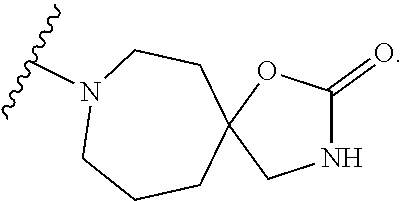
In some embodiments, R2 is

In some embodiments, R2 is

In some embodiments, R2 is

In some embodiments, R2 is


wherein


and a pharmaceutically acceptable salt or stereoisomer thereof.

where X, R1, R4, R5, R8, R9, R11, and R12 are as defined herein, Q is independently a halogen, such as Cl, Br, I, and the like, or any other leaving group, such as OSO2Me, OMs, OTs, OTf, and the like, LG is a leaving group, such as Cl, Br, I, OTs, OTf, and the like, and P is a protecting group, such as tetrahydropyran and the like. Alternative protecting groups that can be used are described, e.g., in Greene et al., Protective Groups in Organic Synthesis (4th ed. 2006).


| Compound | Structure | 1H NMR | LCMS |
| 19 |
 |
||
| 20 |
 |
(400 MHz, CD3OD): δ 8.28 (s, 1H), 7.30-7.37 (m, 2H), 7.10-7.20 (m, 3H), 4.20-4.40 (m, 2H), 3.40- 3.60 (m, 2H), 1.75-2.00 (m, 4H), 1.52 (s, 3H). | 324.9 |
| 21 |
 |
(400 MHz, CD3OD): δ 8.39 (s, 1H), 5.38 (s, 1H), 4.34 (d, J = 14.0 Hz, 2H), 3.70-3.48 (m, 5H), 3.28-3.20 (m, 1H), 2.24- 1.88 (m, 8H), 1.55 (s, 3H). | 332.1 |
| 22 |
 |
(400 MHz, DMSO_d6): δ 12.05 (s, 1H), 8.26 (s, 1H), 7.31-7.52 (m, 5H), 5.38 (s, 2H), 3.82-3.87 (m, 2H), 3.57-3.64 (m, 2H), 1.42-1.49 (m, 4H), 1.09 (s, 3H). | 339.0 |
| 23 |
 |
(400 MHz, DMSO-d6): δ ppm 8.30-8.35 (m, 2H), 6.95 (d, J = 2.20 Hz, 1H), 6.89 (dd, J = 5.74, 2.32 Hz, 1H), 6.65 (br s, 1H), 3.88 (dt, J = 13.31, 4.58 Hz, 2H), 3.61 (ddd, J = 13.18, 8.91, 4.27 Hz, 2H), 2.40 (s, 3H), 1.40-1.50 (m, 4H), 1.08 (s, 3H). | 340.2 |
| 24 |
 |
340.2 | |
| 25 |
 |
(400 MHz, DMSO-d6): δ 12.12 (br s, 1H), 8.70 (d, J = 1.46 Hz, 1H), 8.51-8.57 (m, 1H), 8.33 (s, 1H), 8.26 (s, 1H), 7.91 (br d, J = 7.81 Hz, 1H), 7.42 (dd, J = 4.88, 7.81 Hz, 1H), 5.42 (s, 2H), 3.77- 3.90 (m, 2H). 3.58-3.71 (m, 2H), 1.58 (br t, J = 5.25 Hz, 4H), 1.21 (s, 3H). | 340.2 |
| 26 |
 |
(400 MHz, DMSO-d6): δ 12.64- 12.87 (m, 1H), 8.36 (d, J = 5.13 Hz, 2H), 7.90 (d, J = 7.57 Hz, 1H), 7.65 (t, J = 8.06 Hz, 1H), 7.32 (t, J = 7.57 Hz, 1H), 7.20 (d, J = 8.54 Hz, 1H), 6.62-6.90 (m, 1H), 3.76 (br s, 4H), 1.54 (br s, 4H), 1.16 (s, 3H). | 350.2 |
| 27 |
 |
(400 MHz, DMSO-d6): δ 12.92 (s, 1H), 8.49 (dd, J = 1.95, 7.57 Hz, 1H), 8.32-8.40 (m, 2H), 7.89 (br s, 2H), 7.40 (dd, J = 5.00, 7.69 Hz, 1H), 6.51 (s, 1H), 4.11-4.21 (m, 2H), 3.43 (td, J = 6.74, 14.10 Hz, 2H), 1.70-1.79 (m, 3H), 1.38 (s, 2H). | 351.2 |
| 28 |
 |
(400 MHz, DMSO_d6): δ 11.94 (s, 1H), 8.24 (s, 1H), 7.46-7.43 (m, 2H), 7.36-7.31 (m, 2H), 7.28-7.25 (m, 1H), 6.03-5.97 (m, 1H), 3.83- 3.79 (m, 2H), 3.64-3.61 (m, 2H), 1.64-1.61 (m, 3H), 1.49-1.40 (m, 4H), 1.08 (s, 3H). | 353.1 |
| 29 |
 |
(400 MHz, DMSO-d6): δ ppm 8.32 (s, 1H), 8.08 (d, J = 5.61 Hz, 1H), 6.67 (d, J = 5.62 Hz, 1H), 3.87 (dt, J = 13.18, 4.52 Hz, 2H), 3.60 (ddd, J = 13.18, 8.79, 4.15 Hz, 2H), 2.47 (s, 3H), 2.26 (s, 3 H), 1.39-1.50 (m, 4H), 1.07 (s, 3 H). | 354.2 |
| 30 |
 |
(400 MHz, CD3OD): δ 8.20 (s, 1H), 7.93-7.95 (m, 1H), 7.68-7.71 (m, 1H), 6.67-6.71 (m, 1H), 5.39 (s, 2H), 3.92-3.98 (m, 2H), 3.68-3.74 (m, 2H), 1.65-1.75 (m, 4H), 1.29 (s, 3H). | 354.9 |
| 31 |
 |
(400 MHz, DMSO-d6): δ 12.58 (br s, 1H), 8.38 (s, 1H), 7.54-7.60 (m, 1H), 7.27-7.35 (m, 1H), 7.16-7.24 (m, 2H), 6.53 (s, 1H), 4.07-4.19 (m, 2H), 3.41-3.50 (m, 2H), 1.74 (br t, J = 5.25 Hz, 4H), 1.37 (s, 3H). | 359.2 |
| 32 |
 |
(400 MHz, DMSO-d6): δ 12.96 (s, 1H), 8.71 (s, 1H), 8.42 (s, 1H), 8.38 (d, J = 5.62 Hz, 1H), 7.98 (br s, 2H), 7.09 (d, J = 5.62 Hz, 1H), 4.11-4.21 (m, 2H), 3.45 (td, J = 6.77, 13.79 Hz, 2H), 1.76 (br t, J = 5.25 Hz, 4H), 1.38 (s, 3H). | 359.9 |
| 33 |
 |
(400 MHz, DMSO-d6): δ 12.11 (br, 1H), 8.27 (s, 1H), 7.92 (d, J = 7.6 Hz, 1H), 7.77-7.76 (m, 2H), 7.60- 7.58 (m, 1H), 5.55 (s, 2H), 3.87- 3.83 (m, 2H), 3.64-3.60 (m, 2H), 1.50-1.41 (m, 4H), 1.08 (s, 3H). | 364.0 |
| 34 |
 |
(400 MHz, DMSO-d6): δ 12.28- 12.67 (m, 1H), 8.39 (s, 1H), 8.34 (s, 1H), 7.01 (d, J = 8.79 Hz, 1H), 6.86 (d, J = 2.69 Hz, 1H), 6.82 (dd, J = 2.81, 8.91 Hz, 1H), 5.43 (br s, 2H), 3.65-3.82 (m, 4H), 1.56 (br t, J = 5.37 Hz, 4H), 1.18 (s, 3H). | 365.2 |
| 35 |
 |
(400 MHz, CD3OD): δ 8.48 (d, J = 16.0 Hz, 1H), 5.42 (d, J = 46.4 Hz, 1H), 4.40-4.36 (m, 2H), 4.05-3.91 (m, 2H), 3.63- 3.37 (m, 4H), 2.20-1.97 (m, 10H), 1.75-1.68 (m, 1H), 1.56 (s, 3H). | 374.1 |
| 36 |
 |
(400 MHz, DMSO-d6): δ 12.24 (br d, J = 4.64 Hz, 1H), 8.40 (s, 1H), 8.31 (s, 1H), 6.96 (d, J = 8.79 Hz, 1H), 6.66 (d, J = 2.69 Hz, 1H), 6.47 (dd, J = 2.69, 8.79 Hz, 1H), 5.24 (br s, 2H), 3.75- 3.86 (m, 2H), 3.64-3.74 (m, 2H), 1.56 (br t, J = 5.37 Hz, 4H), 1.19 (s, 3H). | 374.3 |
| 37 |
 |
(400 MHz, DMSO-d6) δ 8.48-8.60 (m, 1 H), 8.40 (s, 1 H), 8.25 (br s, 2 H), 6.95 (s, 1 H), 3.97 (br d, J = 13.67 Hz, 2 H), 3.51-3.70 (m, 2 H), 3.16 (s, 3 H), 1.67 (br s, 4 H), 1.28 (s, 3 H). | 374.2 |
| 38 |
 |
(400 MHz, CD3OD) δ 8.33 (d, J = 13.76 Hz, 2 H), 8.19 (d, J = 5.67 Hz, 1 H), 6.83-7.00 (m, 1 H), 5.01-5.18 (m, 1 H), 4.60 (br d, J = 13.76 Hz, 1 H), 3.67 (tt, J = 12.25, 4.08 Hz, 1 H), 3.21-3.28 (m, 1 H), 2.59-2.77 (m, 3 H), 2.13-2.28 (m, 1 H), 2.07 (dt, J = 12.55, 2.09 Hz, 1 H), 1.83 (td, J = 12.68, 5.40 Hz, 1 H), 1.56-1.71 (m, 1 H), 1.34 (d, J = 7.02 Hz, 3 H). | 374.3 |
| 39 |
 |
(400 MHz, DMSO-d6): δ ppm 8.39 (s, 1H), 8.26 (br s, 1H), 8.23 (d, J = 5.62 Hz, 1H), 6.90 (d, J = 5.62 Hz, 1H), 3.94-4.03 (m, 2H), 3.54-3.64 (m, 2H), 2.60 (s, 3H), 1.66 (br t, J = 5.25 Hz, 4H), 1.29 (s, 3H). | 374.2 |
| 40 |
 |
(400 MHz, DMSO-d6): δ 12.22 (s, 1H), 8.66 (s, 1H), 8.54 (d, J = 4.88 Hz, 1H), 8.34 (s, 1H), 7.91 (br s, 3H), 7.56 (d, J = 4.88 Hz, 1H), 6.52 (br s, 1H), 5.54 (s, 2H), 4.05-4.22 (m, 2H), 3.38-3.48 (m, 2H), 1.74 (br t, J = 5.25 Hz, 4H), 1.37 (s, 3H). | 374.2 |
| 41 |
 |
(400 MHz, DMSO-d6): δ 12.90 (s, 1H), 8.42 (s, 1H), 7.94 (br s, 2H), 7.76 (d, J = 6.10 Hz, 1H), 6.81 (br s, 2H), 6.22 (d, J = 6.10 Hz, 1H), 4.10-4.22 (m, 2H), 3.44 (td, J = 6.71, 13.92 Hz, 2H), 1.75 (br t, J = 5.13 Hz, 4H), 1.38 (s, 3H). | 375.2 |
| 42 |
 |
(400 MHz, DMSO-d6): δ 13.01 (s, 1H), 8.45 (s, 1H), 8.06 (s, 1H), 7.96 (br s, 2H), 6.58 (br dd, J = 6.35, 13.92 Hz, 2H), 6.10 (s, 1H), 4.12-4.20 (m, 2H), 3.45 (td, J = 6.62, 13.85 Hz, 2H), 1.76 (br t, J = 5.13 Hz, 4H), 1.38 (s, 3H). | 375.1 |
| 43 |
 |
(400 MHz, DMSO-d6): δ 13.08 (br, 1H), 8.19 (br, 3H), 8.01 (s, 1H), 7.96-7.94 (d, J = 6.8 Hz, 1H), 6.60- 6.57 (d, J = 7.6 Hz, 1H), 3.68-3.65 (m, 3H), 3.41-3.37 (m, 1H), 2.92 (s, 2H), 2.06-2.04 (m, 1H), 1.88-1.86 (m, 1H), 1.19 (s, 3H). | 375.1 |
| 44 |
 |
(400 MHz, DMSO-d6): δ ppm 12.78 (br s, 1 H), 8.35 (s, 1 H), 8.07 (t, J = 7.81 Hz, 1 H), 7.48 (d, J = 7.32 Hz, 1 H), 7.33 (br d, J = 8.30 Hz, 1 H), 6.87 (s, 1 H), 6.73 (s, 1 H), 6.59 (s, 1 H), 6.53 (s, 1 H), 4.09 (br d, J = 13.92 Hz, 2 H), 3.41-3.52 (m, 2 H), 1.73 (br d, J = 4.88 Hz, 3 H), 1.35 (s, 2 H). | 376.2 |
| 45 |
 |
(400 MHz, DMSO-d6): δ 8.41 (s, 1H), 8.25 (s, 1H), 7.34 (d, J = 7.57 Hz, 1H), 5.93 (d, J = 7.32 Hz, 1H), 3.88-4.07 (m, 2H), 3.52-3.67 (m, 2H), 1.65 (br s, 4H), 1.27 (s, 3H). | 376.2 |
| 46 |
 |
(400 MHz, DMSO-d6): δ 12.03 (br, 1H), 11.20 (br, 1H), 8.23 (s, 1H), 7.37 (s 2H), 7.10 (s, 2H), 6.55 (s, 1H), 5.62 (s, 2H), 3.82 (s, 2H), 3.61 (s, 2H), 1.44 (s, 4H), 1.08 (s, 3H). | 378.0 |
| 47 |
 |
(400 MHz, DMSO-d6): 8.41 (s, 1 H), 8.25-8.32 (m, 2 H), 6.77 (d, J = 6.10 Hz, 1 H), 6.27 (br s, 1H), 4.02 (s, 2 H), 3.82-3.91 (m, 2 H), 3.66-3.75 (m, 2 H), 1.60 (br t, J = 5.25 Hz, 3 H), 1.22 (s, 2 H). | 381.3 |
| 48 |
 |
(400 MHz, CD3OD): δ 8.28 (s, 1H), 7.75-7.73 (d, J = 6 Hz, 1H), 6.29-6.27 (d, J = 5.6 Hz, 1H), 4.13-4.08 (m, 2H), 3.59-3.53 (m, 2H), 2.61 (s, 2H), 1.64-1.50 (m, 4H), 1.11 (s, 1H). | 389.0 |
| 49 |
 |
(400 MHz, DMSO-d6) δ 8.40 (s, 1 H), 8.23 (d, J = 5.61 Hz, 1 H), 6.91 (d, J = 5.62 Hz, 1 H), 4.17 (br d, J = 13.43 Hz, 2 H), 3.39-3.51 (m, 2 H), 2.75 (br s, 2 H), 2.60 (s, 3 H), 1.37-1.77 (m, 4 H). | 390.2 |
| 50 |
 |
(400 MHz, DMSO-d6): δ 8.32-8.42 (m, 2H), 7.97 (d, J = 5.86 Hz, 1H), 6.69 (d, J = 5.86 Hz, 1H), 3.97 (s, 3H), 3.79-3.89 (m, 2H), 3.67-3.76 (m, 2H), 1.58 (br t, J = 5.37 Hz, 4H), 1.20 (s, 3H). | 390.2 |
| 51 |
 |
(400 MHz, DMSO-d6): δ ppm 8.91 (s, 1H), 8.68 (d, J = 5.61 Hz, 1H), 8.39 (s, 1H), 8.34 (s, 1H), 7.18 (d, J = 5.86 Hz, 1H), 3.84-3.91 (m, 2H), 3.65-3.73 (m, 2H), 1.62 (br t, J = 5.25 Hz, 4H), 1.23 (s, 3H). | 394.2 |
| 52 |
 |
(400 MHz, DMSO-d6): δ 8.24-8.22 (d, J = 5.6 Hz, 1H), 8.0 (s, 1H), 7.15-7.13 (d, J = 5.6 Hz, 1H), 3.63- 3.59 (m, 4H), 3.24-3.19 (m, 2H), 1.95-1.1.93 (m, 1H), 1.72-1.66 (m, 1H), 1.07 (s, 3H). | 393.9 |
| 53 |
 |
(400 MHz, CD3OD) δ 8.33 (s, 1 H), 8.27 (s, 1 H), 8.16 (d, J = 5.67 Hz, 1 H), 7.09 (d, J = 5.67 Hz, 1 H), 5.06- 5.15 (m, 1 H), 4.60 (br d, J = 14.57 Hz, 1 H), 3.67 (tt, J = 12.28, 4.05 Hz, 1 H), 3.21-3.28 (m, 1 H), 2.13- 2.23 (m, 1 H), 2.08 (dt, J = 12.68, 1.89 Hz, 1 H), 1.83 (td, J = 12.62, 5.53 Hz, 1 H), 1.64 (qd, J = 12.50, 4.59 Hz, 1 H), 1.34 (d, J = 7.02 Hz, 3 H). | 394.2 |
| 54 |
 |
(400 MHz, DMSO-d6): δ 8.41 (s, 1H), 8.30 (s, 1H), 8.23 (d, J = 5.62 Hz, 1H), 7.16 (d, J = 5.62 Hz, 1H), 3.89-3.98 (m, 2H), 3.59-3.68 (m, 3H), 1.64 (br t, J = 5.25 Hz, 4H), 1.26 (s, 3 H). | 394.2 |
| 55 |
 |
(400 MHz, DMSO-d6): δ 8.37 (s, 1H), 8.33 (br d, J = 5.37 Hz, 1H), 8.07 (br s, 1H), 7.76 (br s, 1H), 7.13 (d, J = 5.37 Hz, 1H), 6.54 (br s, 1H), 3.82-3.97 (m, 2H), 3.63 (ddd, J = 4.27, 8.67, 13.18 Hz, 2H), 1.35-1.58 (m, 4H), 1.08 (s, 3H). | 403.3 |
| 56 |
 |
(400 MHz, CD3OD): δ 8.3 (s, 1H), 8.18-8.16 (d, J = 7.2 Hz, 1H), 7.10-7.07 (d, J = 7.2 Hz, 1H), 4.13- 4.08 (m, 2H), 3.60-3.53 (m, 2H), 2.60 (s, 2H), 1.64-1.49 (m, 4H), 1.11 (s, 3H). | 408.0 |
| 57 |
 |
(400 MHz, DMSO-d6) δ 8.28-8.46 (m, 1 H), 8.23 (br d, J = 5.62 Hz, 1 H), 7.07-7.26 (m, 1 H), 4.18 (br d, J = 13.18 Hz, 2 H), 2.60-2.70 (m, 2 H), 1.55 (br s, 4 H). | 410.2 |
| 58 |
 |
(400 MHz, DMSO-d6): δ ppm 8.36 (s, 1H), 8.36 (s, 1H), 7.31 (d, J = 7.32 Hz, 1H), 5.40 (d, J = 7.32 Hz, 1H), 4.72 (br s, 1H), 4.05-4.17 (m, 2H), 3.82-3.96 (m, 3H), 3.62 (ddd, J = 13.18, 8.54, 4.39 Hz, 2H), 3.51 (br d, J = 10.50 Hz, 1H), 1.40- 1.54 (m, 4H), 1.08 (s, 3H). | 431.4 |
| 59 |
 |
(400 MHz, DMSO-d6): δ ppm 8.57 (s, 1H), 8.41 (s, 1H), 8.34 (s, 1H), 7.43 (s, 1H), 3.73-3.85 (m, 5H), 1.57 (br t, J = 5.37 Hz, 4H), 1.19 (s, 3H). | 440.2 |
| 60 |
 |
(400 MHz, DMSO-d6): δ 8.51 (s, 1H), 8.38 (s, 1H), 8.33 (d, J = 5.37 Hz, 2H), 8.13 (s, 1H), 6.88 (d, J = 5.62 Hz, 1H), 3.93 (s, 3H), 3.80-3.89 (m, 2H), 3.67- 3.75 (m, 2H), 1.59 (br t, J = 5.25 Hz, 4H), 1.21 (s, 3H). | 440.3 |
| 61 |
 |
(400 MHz, DMSO-d6): δ 8.29 (br d, J = 5.29 Hz, 1H), 8.11 (br s, 1H), 7.92-8.05 (m, 1H), 7.52 (br d, J = 3.33 Hz, 1H), 7.00 (br d, J = 5.48 Hz, 1H), 4.05 (br d, J = 4.70 Hz, 2H), 3.44-3.61 (m, 2H), 1.93 (br s, 2H), 1.80 (br s, 2H), 1.30-1.54 (m, 3H). | 443.3 |
| 62 |
 |
(400 MHz, DMSO-d6): δ ppm 8.37 (s, 1H), 8.32 (s, 1H), 8.05 (d, J = 5.62 Hz, 1H), 6.66 (d, J = 5.62 Hz, 1H), 3.79-3.88 (m, 2H), 3.67-3.78 (m, 6H), 3.26-3.31 (m, 4H), 1.58 (br t, J = 5.25 Hz, 4H), 1.20 (s, 3H). | 445.3 |
| 63 |
 |
(400 MHz, CDCl3) δ 7.97-8.23 (m, 2 H), 7.17-7.41 (m, 2 H), 6.95-7.09 (m, 1 H), 6.84 (br d, J = 8.54 Hz, 2 H), 5.34 (s, 2 H), 4.98 (br s, 1 H), 4.51 (br d, J = 13.42 Hz, 1 H), 3.65- 3.88 (m, 3 H), 3.53 (br d, J = 12.45 Hz, 1 H), 3.18 (br t, J = 12.57 Hz, 1 H), 1.77-1.97 (m, 2 H), 1.68 (br d, J = 7.81 Hz, 2 H), 1.31 (br d, J = 6.83 Hz, 3 H). | 514.2 |
| 64 |
 |
(400 MHz, DMSO-d6) δ 8.31-8.50 (m, 1 H), 8.14-8.29 (m, 1 H), 7.24 (d, J = 8.54 Hz, 2 H), 7.17 (d, J = 5.62 Hz, 1 H), 6.88 (d, J = 8.54 Hz, 2 H), 5.31 (s, 2 H), 4.28 (br d, J = 13.43 Hz, 2 H), 3.70 (s, 3 H), 3.41 (br t, J = 10.86 Hz, 2 H), 2.63 (s, 2 H), 1.47-1.69 (m, 4 H). | 530.2 |


| MS | |||
| Compound | Structure | Proton NMR | [M + 1] |
| 65 |
 |
1H NMR (400 MHz, DMSO- d6): δ 9.03 (s, 1H), 8.53 (s, 1H), 8.18 (d, J = 7.5 Hz, 1H) 7.79 (d, J = 7.5 Hz, 1H), 7.37 (dtd, J = 16.4, 73, 1.2 Hz, 2H), 3.91 (dt, J = 9.9, 4.7 Hz, 2H), 3.70 (ddd, J = 13.4, 8.6, 4.7 Hz, 2H), 1.55-1.45 (m, 4H), 1.11 (s, 3H). | 349.2 |
| 66 |
 |
(400 MHz, DMSO-d6): δ12.25 (s, 1H), 8.27 (s, 1H), 7.93-7.90 (d, 1H, J = 8.0 Hz), 7.20-7.17 (d, 1H, J = 7.2 Hz), 7.13-7.08 (t, 1H), 6.79-6.75 (t, 1H), 4.44-4.40 (t, 2H), 3.87-3.83 (t, 2H), 3.66-3.62 (q, 2H), 3.22-3.18(t, 2H), 1.49-1.46 (q, 4H), 1.09 (s, 3H). | 350.1 |
| 67 |
 |
(400 MHz, DMSO-d6): δ = 12.33 (br s, 1H), 8.28 (s, 1H), 7.23 (d, J = 2.0 Hz, 1H), 6.34 (d, J = 2.0 Hz, 1H), 4.25-4.36 (m, 2H), 4.15 (t, J = 6.0 Hz, 2H), 3.86 (dt, J = 13.4, 4.5 Hz, 2H), 3.61 (ddd, J = 13.2, 8.9, 4.0 Hz, 2H), 2.24 (dt, J = 11.5, 5.8 Hz, 2H), 1.29-1.61 (m, 6H), | 354.2 |
| 1.08 (s, 3H). | |||
| 68 |
 |
1HNMR (400 MHz, DMSO- d6): δ 8.38 (s, 3 H), 8.31 (s, 1H), 7.04-7.00 (m, 2H), 6.93- 6.90 (m, 1H), 6.72-6.68 (m, 1H), 4.14 (m, 2H), 3.91-3.87 (m, 2H), 3.53-3.47 (m, 2H), 2.83-2.79 (m, 2H), 2.00-1.96 (m, 2H), 1.87-1.74 (m, 4H), 1.4 (s, 3H). | 364.0 |
| 69 and 70 |
 |
1HNMR (400 MHz, DMSO- d6): δ 8.26 (s, 1H), 7.91-7.88 (m, 1H), 7.49-7.47 (m, 1H), 6.98-6.94 (m, 1H), 4.86-4.82 (m, 1H), 4.34-4.30 (m, 1H), 3.96-3.92 (m, 2H), 3.07-2.92 (m, 4H), 2.10-2.05 (m, 2H), 1.88-1.73 (m, 2H), 1.39-1.37 (m, 1H), 1.22-1.13 (m, 4H). | 365.3 |
 |
1HNMR (400 MHz, DMSO- d6): δ 8.31 (s, 1H), 7.96-7.94 (m, 1H), 7.55-7.52 (m, 1H), 7.03-6.99 (m, 1H), 4.96-4.88 (m, 1H), 4.40-4.36 (m, 1H), 4.02-3.98 (m, 2H), 3.12-2.97 (m, 4H), 2.15-2.08 (m, 2H), 1.94-1.79 (m, 2H), 1.46-1.43 (m, 1H), 1.28-1.21 (m, 4H). | ||
| 71 |
 |
(400 MHz, DMSO-d6): δ 12.99 (s, 1H), 8.16-8.21 (m, 3H), 8.12-8.14 (m, 1H), 8.09 (m, 1H), 7.97 (s, 1H), 7.57- 7.60 (m, 1H), 4.02-4.05 (m, 2H), 3.23-3.40 (m, 2H), 2.92- 2.93 (m, 2H), 2.14-2.17 (m, 1H), 2.04-2.08 (m, 1H), 1.86- 1.88 (m, 1H), 1.23 (m, 1H), | 365.0 |
| 1.19 (s, 3H). | |||
| 72 |
 |
(400 MHz, DMSO_d6): δ 13.04 (br, 1H), 8.76 (s, 1H), 8.42 (s, 1H), 8.34 (br, 3H), 8.22 (d, J = 5.2 Hz, 1H), 7.78- 7.76 (d, J = 5.2 Hz, 1H), 4.14 (s, 4H), 3.56-3.52 (m, 2H), 3.05-3.00 (m, 2H), 2.08-2.02 (m, 2H), 1.90-1.72 (m, 4H), 1.40 (s, 3H). | 365.1 |
| 73 |
 |
(400 MHz, DMSO_d6): δ 12.57 (s, 1H), 8.29 (s, 1H), 7.89-7.91 (d, 1H), 7.47-7.50 (d, 1H), 6.94-6.98 (m, 1H), 3.93-3.97 (m, 2H), 3.84-3.89 (m, 2H), 3.58-3.65 (m, 2H), 2.92-2.96 (m, 2H), 2.05-2.09 (m, 2H), 1.44-1.52 (m, 4H), 1.09 (s, 3H). | 365.1 |
| 74 |
 |
(400 MHz, DMSO_d6): δ 12.88 (br, 1H), 8.40-8.33 (m, 4H), 7.41 (s, 1H), 7.38-7.31 (m, 1H), 7.29-7.26 (m, 2H), 7.16-7.12 (m, 2H), 6.93-6.85 (m, 1H), 4.18-4.10 (m, 4H), 3.65-3.45 (m, 4H), 1.88-1.72 (m, 4H), 1.40 (s, 3H). | 365.1 |
| 75 |
 |
(400 MHz, DMSO-d6 + TFA): δ 13.92 (br, 1H), 13.38 (br, 1H), 8.48 (s, 1H), 8.33-8.27 (m, 4H), 8.11-8.08 (m, 1H), 7.01-6.98 (m, 1H), 4.19-4.03 (m, 2H), 4.03-4.01 (m, 2H), 3.56-3.52 (m, 2H), 2.96-2.92 (m, 2H), 2.11-2.07 (m, 2H), 1.85-1.78 (m, 4H), 1.40 (s, 3H). | 365.1 |
| 76 |
 |
(400 MHz, Methanol-d4): δ 8.56 (d, J = 8.0 Hz, 1H), 8.40 (s, 1H), 7.83 (d, J = 5.6 Hz, 1H), 7.40-7.33 (m, 1H), 4.95- 4.85 (m, 2H), 4.50-4.40 (m, 2H), 4.38-4.30 (m, 2H), 3.70- 3.50 (m, 2H), 1.98-1.92 (m, 4H), 1.56 (s, 3H). | 367.1 |
| 77 |
 |
(400 MHz, DMSO-d6): δ 12.95 (br, 1H), 8.40 (s, 1H), 8.10 (br, 3H), 7.82-7.80 (m, 1H), 7.36-7.33 (m, 1H), 7.05- 7.02 (m, 1H), 6.91-6.86 (m, 1H), 4.19-4.14 (m, 4H), 3.52- 3.45 (m, 2H), 2.85-2.80 (m, 2H), 1.81-1.74 (m, 4H), 1.40 (s, 3H). | 378.1 |
| 78 |
 |
(400 MHz, DMSO-d6): δ 12.51 (br, 1H), 8.26 (s, 1H), 7.04-7.00 (m, 2H), 6.95-6.85 (m, 1H), 6.72-6.63 (m, 1H), 3.98-3.84 (m, 4H), 3.55-3.40 (m, 4H), 2.85-2.77 (m, 2H), 2.00-1.93 (m, 2H), 1.50-1.44 (m, 2H), 1.35-1.27 (m, 2H), 0.95 (s, 3H). | 378.1 |
| 79 |
 |
(400 MHz, DMSO-d6): δ 12.54 (br, 1H), 8.23 (s, 1H), 7.00-6.97 (m, 1H), 6.80-6.79 (m, 1H), 6.66-6.58 (m, 2H), 4.32-4.28 (m, 1H), 3.83-3.77 (m, 2H), 3.63-3.57 (m, 2H), 2.83-2.76 (m, 2H), 1.98-1.95 (m, 1H), 1.83-1.81 (m, 1H), 1.46-1.41 (m, 4H), 1.11 (d, J = | 378.1 |
| 6.4 Hz, 3H), 1.06 (s, 3H). | |||
| 80 |
 |
(400 MHz, DMSO-d6): δ 12.54 (br, 1H), 8.23 (s, 1H), 7.00-6.97 (m, 1H), 6.80-6.79 (m, 1H), 6.66-6.58 (m, 2H), 4.32-4.28 (m, 1H), 3.83-3.77 (m, 2H), 3.63-3.57 (m, 2H), 2.83-2.76 (m, 2H), 1.98-1.95 (m, 1H), 1.83-1.81 (m, 1H), 1.46-1.41 (m, 4H), 1.11 (d, J = | 378.1 |
| 6.4 Hz, 3H), 1.06 (s, 3H). | |||
| 81 |
 |
(400 MHz, DMSO-d6) δ 11.90 (s, 1H), 8.10 (s, 1H), 7.17-7.29 (m, 1H), 6.97-7.14 (m, 3H), 3.96-4.11 (m, 2H), 3.91 (br s, 2H), 3.34-3.50 (m, 2H), 2.68-2.81 (m, 2H), 1.54- 1.82 (m, 6H), 1.33 (s, 3H). | 378 |
| 82 |
 |
(400 MHz, DMSO-d6) δ 11.90 (s, 1H), 8.10 (s, 1H), 7.17-7.29 (m, 1H), 6.97-7.14 (m, 3H), 3.96-4.11 (m, 2H), 3.91 (br s, 2H), 3.34-3.50 (m, 2H), 2.68-2.81 (m, 2H), 1.54- 1.82 (m, 6H), 1.33 (s, 3H). | 378 |
| 83 |
 |
(400 MHz, DMSO_d6): δ 8.28 (s, 1H), 7.06-7.00 (m, 2H), 6.92-6.87 (m, 1H), 6.71-6.66 (m, 1H), 3.99-3.90 (m, 1H), 3.88-3.83 (m, 2H), 3.64-3.60 (m, 2H), 3.44-3.36 (m, 2H), 2.88-2.83 (m, 1H), 2.30-2.10 (m, 1H), 1.53-1.40 (m, 4H), 1.09 (s, 3H), 1.04 (d, J =6.8 Hz, 3H). | 378.1 |
| 84 |
 |
(400 MHz, DMSO-d6): δ 13.62 (br, 1H), 8.48-8.43 (m, 4H), 7.62-7.56 (m, 1H), 7.38- 7.34 (m, 1H), 4.18-4.13 (m, 4H), 3.59-3.52 (m, 4H), 3.10- 3.02 (m, 2H), 1.93-1.75 (m, 4H), 1.41 (s, 3H). | 379.0 |
| 85 |
 |
(400 MHz, Methanol-d4): δ 8.18 (s, 1H), 7.72-7.70 (d, J = 3.6 Hz, 1H), 7.44-7.41 (d, J = 6.4 Hz, 1H), 6.73-6.69 (m, 1H), 4.1 (m, 2H), 3.92 (m, 2H), 3.54 (m, 2H), 2.95 (m, 2H), 2.60 (s, 2H), 2.16(m, 2H), 1.58 (m, 2H), 1.50 (m, 2H), 1.10 (s, 3H). | 379.1 |
| 86 |
 |
(400 MHz, DMSO-d6): δ 8.29 (s, 1H), 7.91-7.88 (m, 1H), 7.50-7.46 (m, 1H), 6.99-6.94 (m, 1H), 4.10-3.80 (m, 4H), 3.50-3.40 (m, 2H), 3.00-2.80 (m, 2H), 2.41 (s, 2H), 2.10- 2.02 (m, 2H), 1.53-1.44 (m, 2H), 1.35-1.25 (m, 2H), 0.94 (s, 3H). | 379.1 |
| 87 |
 |
(400 MHz, DMSO-d6): δ 13.17 (s, 1H), 8.41 (s, 1H), 8.06 (br, 2H), 7.41-7.44 (d, J = 7.2, 1H), 7.29 (s, 2H), 6.19-6.22 (d, J = 7.2, 1H), 4.10-4.14 (m, 2H), 3.80-3.83 (m, 2H), 3.42-3.48 (m, 2H), 2.49-2.53 (m, 2H), 2.01-2.07 (m, 1H), 1.74 (br, 4H), 1.36 (s, 3H). | 380.1 |
| 88 |
 |
(400 MHz, DMSO-d6): δ = 12.93 (br s, 1H), 9.48 (br s, 1H), 8.84 (d, J = 9.3 Hz, 1H), 8.41 (s, 1H), 8.25 (s, 1H), 3.84-4.14 (m, 4H), 3.60 (dd, J = 13.4, 6.3 Hz, 2H), 3.48-3.56 (m, 2H), 1.90-2.11 (m, 2H), 1.54-1.76 (m, 4H), 1.28 (s, 3H). | 381.3 |
| 89 |
 |
(400 MHz, DMSO-d6) 12.46 (br d, J = 4.88 Hz, 1H), 8.25 (s, 1H), 6.89 (d, J = 7.57 Hz, 1H), 6.85 (s, 1H), 6.50 (br d, J = 7.32 Hz, 1H), 3.92 (td, J = 4.58, 13.55 Hz, 2H), 3.81- 3.88 (m, 2H), 3.44 (ddd, J = 3.17, 9.83, 13.37 Hz, 2H), 2.75 (br t, J = 6.35 Hz, 2H), | 392.4 |
| 2.06 (s, 3H), 1.94 (td, J = 6.04, | |||
| 11.84 Hz, 2H), 1.42-1.56 (m, | |||
| 2H), 1.29-1.38 (m, 2H), 0.97 | |||
| (s, 3H). | |||
| 90 |
 |
(400 MHz, DMSO-d6) 12.42 (br s, 1H), 8.25 (s, 1H), 6.75- 6.84 (m, 2H), 6.60 (br d, J = 6.84 Hz, 1H), 3.89-3.97 (m, 2H), 3.79-3.84 (m, 2H), 3.44 (ddd, J = 2.93, 9.89, 13.31 Hz, 2H), 2.64-2.71 (m, 2H), 2.60 (s, 1H), 2.17 (s, 3H), 1.94-2.02 (m, 2H), 1.46-1.56 (m, 2H), | 392.4 |
| 1.32-1.42 (m, 2H), 1.00 (s, 3H). | |||
| 91 |
 |
(400 MHz, DMSO-d6) 12:31- 12.46 (m, 1H), 8.35 (s, 1H), 8.23 (s, 1H), 6.98 (d, J = 8.30 Hz, 1H), 6.83 (s, 1H), 6.71 (dd, J = 1.46, 8.30 Hz, 1H), 3.84-3.96 (m, 5H), 3.43 (ddd, J = 3.17, 9.83, 13.37 Hz, 3H), 2.75 (t, J = 6.35 Hz, 2H), 2.53 (s, 2H), 2.16 (s, 3H), 1.94 (td, | 392.3 |
| J = 6.20, 11.78 Hz, 2H), 1.46- | |||
| 1.54 (m, 2H), 1.30-1.38 (m, | |||
| 2H), 0.98 (s, 3H). | |||
| 92 |
 |
(400 MHz, CD3OD): δ8.12 (s, 1H), 7.30-7.35 (m, 4H), 7.20- 7.25 (m, 1H), 4.55-4.60 (m, 1H), 4.40-4.50 (m, 1H), 3.90- 4.10 (m, 2H), 3.60-3.70 (m, 2H), 2.90-2.98 (m, 3H), 2.00- 2.10 (m, 1H), 1.80-1.93 (m, 2H), 1.65-1.80 (m, 5H), 1.33 (s, 3H). | 392.1 |
| 93 |
 |
(400 MHz, Methanol-d4): δ 8.17 (s, 1H), 7.15-7.18 (m, 1H), 6.89-6.94 (m, 1H), 6.74- 6.81 (m, 2H), 4.07-4.11 (m, 2H), 3.91-3.94 (m, 1H), 3.85- 3.87 (m, 1H), 3.50.3.57 (m, 2H), 3.03-3.05 (m, 1H), 2.62 (s, 2H), 2.02-2.25 (m, 1H), 1.83-1.86 (m, 1H), 1.57-1.61 (m, 2H), 1.49-1.54 (m, 2H), | 392.1 |
| 1.38-1.41 (d, J = 7.2 Hz, 3H), | |||
| 1.11 (s, 3H). | |||
| 94 |
 |
(400 MHz, Methanol-d4): δ 8.16 (s, 1H), 7.15-7.18 (m, 1H), 6.89-6.93 (m, 1H), 6.74- 6.81 (m, 2H), 4.06-4.10 (m, 2H), 3.84-3.94 (m, 1H), 3.85- 3.87 (m, 1H), 3.50-3.57 (m, 2H), 3.03-3.07 (m, 1H), 2.60 (s, 2H), 2.16-2.24 (m, 1H), 1.80-1.87 (m, 1H), 1.57-1.64 (m, 2H), 1.48-1.54(m, 2H), 1.38-1.41 (d, J = 7.2 Hz, 3H), | 392.1 |
| 1.11 (s, 3H). | |||
| 95 |
 |
(400 MHz, Methanol-d4): δ 8.16 (s, 1H), 7.15-7.18 (m, 1H), 6.89-6.93 (m, 1H), 6.74- 6.81 (m, 2H), 4.06-4.10 (m, 2H), 3.84-3.94 (m, 1H), 3.85- 3.87 (m, 1H), 3.50-3.57 (m, 2H), 3.03-3.07 (m, 1H), 2.60 (s, 2H), 2.16-2.24 (m, 1H), 1.80-1.87 (m, 1H), 1.57-1.64 (m, 2H), 1.48-1.54 (m, 2H), 1.38-1.41 (d, J = 7.2 Hz, 3H), | 392.1 |
| 1.11 (s, 3H). | |||
| 96 |
 |
(400 MHz, DMSO-d6): δ 12.11 (s, 1H), 8.22 (d, J = 2.4 Hz, 1H), 7.44 (d, J = 8.8 Hz, 1H), 6.81 (s, 1H), 6-19-6.22 (d, J = 8.8 Hz, 1H), 5.42 (s, 2H), 3.89-3.99 (m, 4H), 2.90- 2.92 (m, 2H), 2.67-2.70 (m, 2H), 1.87-1.90 (m, 2H), 1.44- 1.48 (m, 2H), 1.28-1.31 (m, 2H), 0.94 (s, 3H). | 394.0 |
| 97 |
 |
(400 MHz, DMSO-d6): δ 8.29 (s, 1H), 6.94-6.87 (m, 1H), 6.81-6.78 (m, 1H), 6.55-6.50 (m, 1H), 3.93-3.84 (m, 4H), 3.46-3.41 (m, 2H), 2.79-2.75 (m, 2H), 2.42 (s, 2H), 2.01- 1.98 (m, 2H), 1.49-1.29 (m, 2H), 0.94 (s, 3H). | 396.1 |
| 98 |
 |
(400 MHz, DMSO-d6): δ 12.54 (br d, J = 2.20 Hz, 1H), 8.28 (s, 1H), 7.88 (dd, J = 4.52, 1.34 Hz, 1H), 7.47 (dd, J = 8.42, 1.34 Hz, 1H), 6.95 (dd, J = 8.30, 4.64 Hz, 1H), 4.17- 4.29 (m, 2H), 3.88-3.98 (m, 2H), 3.08-3.22 (m, 2H), 2.92 (t, J = 6.59 Hz, 2H), 2.68 (t, | 405 |
| J = 7.32 Hz, 1H), 2.01-2.10 (m, | |||
| 2H), 1.75-1.89 (m, 2H), 1.46- | |||
| 1.66 (m, 5H), 1.16-1.42 (m, 5H). | |||
| 99 |
 |
(400 MHz, DMSO-d6): δ 8.35 (s, 1H), 8.18 (br, 3H), 7.62- 7.61 (m, 1H), 7.46-7.42 (m, 1H), 6.92-6.89 (d, J = 8.8 Hz, 1H), 4.17-4.12 (m, 2H), 3.51- 3.44 (m, 2H), 2.88-2.83 (m, 2H), 2.55-2.52 (m, 1H), 2.05- 2.00 (m, 2H), 1.82-1.74 (m, 4H), 1.40 (s, 3H). | 407.2 |
| 100 |
 |
(400 MHz, DMSO-d6): δ 12.56 (br s, 1H), 8.30 (s, 1H), 7.88 (dd, J = 4.64, 1.22 Hz, 1H), 7.47 (dd, J = 8.54, 1.22 Hz, 1H), 6.95 (dd, J = 8.30, 4.64 Hz, 1H), 4.19-4.32 (m, 2H), 3.90-3.97 (m, 2H), 3.80 (td, J = 8.42, 5.13 Hz, 1H), 3.68 (q, J = 7.98 Hz, 1H), 3.18-3.28 (m, 2H), 2.89-2.97 (m, 3H), 2.01- | 407 |
| 2.19 (m, 3H), 1.57-1.73 (m, | |||
| 3H), 1.47-1.55 (m, 1H), 1.40 | |||
| (br d, J = 13.43 Hz, 1H). | |||
| 101 |
 |
(400 MHz, DMSO_d6): δ 8.39 (br, 2H), 8.31 (s, 1H), 7.35- 7.25 (m, 1H), 7.18-7.13 (m, 1H), 6.95-6.90 (m, 1H), 6.80- 6.70 (m, 1H), 4.12-4.05 (m, 2H), 4.00-3.88 (m, 4H), 3.50- 3.42 (m, 2H), 2.18 (s, 3H), 1.85-1.68 (m, 4H), 1.36 (s, 3H). | 407.1 |
| 102 |
 |
(400 MHz, DMSO-d6): δ 8.30 (s, 1H), 7.87 (br, 3H), 6.89- 6.84 (m, 1H), 6.66 (d, J = 8.4 Hz, 1H), 6.41 (d, J = 8.0 Hz, 1H), 4.05-3.96 (m, 2H), 3.76 (s, 3H), 3.51-3.44 (m, 2H), 2.79-2.77 (m, 2H), 2.69-2.65 (m, 2H), 2.53 (s, 2H), 1.96- 1.92 (m, 2H), 1.60-1.42 (m, | 408.1 |
| 4H), 1.09 (s, 3H). | |||
| 103 |
 |
(400 MHz, DMSO-d6): δ 8.32 (br, 1H), 8.10 (br, 3H), 7.61 (s, 1H), 7.44-7.42 (m, 1H), 6.92-6.90 (m, 1H), 3.96-3.88 (m, 4H), 3.51-3.46 (m, 2H), 2.90-2.72 (m, 4H), 2.12-1.90 (m, 2H), 1.65-1.40 (m, 4H), 1.09 (s, 3H). | 412.3 |
| 104 |
 |
(400 MHz, DMSO-d6): δ = 12.50 (br s, 1H), 8.65 (br d, J = 4.2 Hz, 1H), 8.25 (s, 1H), 7.86 (td, J = 7.7, 1.7 Hz, 1H), 7.48 (d, J = 7.8 Hz, 1H), 7.32- 7.39 (m, 1H), 6.93-7.04 (m, 2H), 6.71-6.79 (m, 1H), 3.74- 3.92 (m, 4H), 3.61 (ddd, J = 13.2, 9.0, 3.9 Hz, 2H), 2.73 (t, J = 6.3 Hz, 2H), 1.89 (dt, J = 11.9, 6.1 Hz, 2H), 1.33-1.55 | 441.5 |
| (m, 4H), 1.08 (s, 3H). | |||
| 105 |
 |
(400 MHz, DMSO-d6): δ = 12.54 (br s, 1H), 8.58 (d, J = 2.9 Hz, 2H), 8.28 (s, 1H), 7.81 (dt, J = 7.8, 1.8 Hz, 1H), 7.48 (dd, J = 7.6, 4.9 Hz, 1H), 6.94- 7.08 (m, 2H), 6.60-6.69 (m, 1H), 3.75-3.93 (m, 4H), 3.62 (ddd, J = 13.2, 8.9, 4.0 Hz, 2H), 2.64 (t, J = 6.3 Hz, 2H), 1.84-2.00 (m, 2H), 1.38-1.71 (m, 6H), 1.09 (s, 3H). | 441.4 |
| 106 |
 |
(400 MHz, DMSO-d6): δ = 12.48 (br s, 1H), 8.25 (s, 1H), 7.87 (s, 1H), 7.58 (s, 1H), 6.81-6.95 (m, 2H), 6.74 (dd, J = 7.1, 1.2 Hz, 1H), 3.78-3.92 (m, 6H), 3.61 (ddd, J = 13.2, 9.0, 3.9 Hz, 2H), 2.82 (t, J = 6.3 Hz, 2H), 1.93 (dt, J = 11.8, 6.2 Hz, 2H), 1.38-1.63 (m, 6H), 1.08 (s, 3H). | 444.4 |
| 107 |
 |
(400 MHz, DMSO-d6): δ = 12.51 (br s, 1H), 8.28 (s, 1H), 8.09 (s, 1H), 7.83 (s, 1H), 7.55 (d, J = 8.5 Hz, 1H), 7.24 (d, J = 8.5 Hz, 1H), 3.94-4.02 (m, 2H), 3.86 (s, 3H), 3.78-3.85 (m, 2H), 3.66 (ddd, J = 13.1, 8.4, 4.2 Hz, 2H), 2.94 (t, J = 6.5 Hz, 2H), 2.07 (quin, J = 6.0 Hz, 2H), 1.36-1.59 (m, 4H), | 445.5 |
| 1.12 (s, 3H). | |||
| 108 |
 |
(400 MHz, DMSO-d6): δ 8.33 (s, 1H), 7.98 (s, 3H), 7.36 (s, 1H), 7.19-7.22 (m, 1H), 6.98- 7.01 (m, 1H), 3.87-4.00 (m, 4H), 3.45-3.51 (m, 2H), 2.87- 2.91 (m, 2H), 2.76-2.79 (m, 2H), 2.00-2.05 (m, 2H), 1.54- 1.59 (m, 2H), 1.44-1.48 (m, 2H), 1.09 (s, 3H). | 446.2 |
| 109 |
 |
(400 MHz, DMSO-d6): δ = 12.56 (br s, 1H), 8.27 (s, 1H), 7.97 (d, J = 3.2 Hz, 1H), 7.84 (d, J = 3.4 Hz, 1H), 6.98-7.12 (m, 3H), 3.78-3.98 (m, 4H), 3.63 (ddd, J = 13.2, 8.9, 4.0 Hz, 2H), 3.02 (t, J = 6.3 Hz, 2H), 1.96 (dt, J = 11.8, 6.2 Hz, 2H), 1.37-1.56 (m, 4H), 1.09 (s, 3H). | 447.4 |
| 110 |
 |
(400 MHz, CDCl3): δ 8.12 (s, 1H), 7.43-7.33 (m, 5H), 7.20- 7.18 (d, J = 8.8 Hz, 1H), 7.09- 7.05 (m, 1H), 6.80-6.78 (d, J = 7.2 Hz, 1H), 4.01-3.97 (m, 4H), 3.49-3.43 (m, 2H), 2.74- 2.70 (m, 2H), 2.61 (s, 2H), 2.0-1.96 (m, 2H), 1.73-1.47 (m, 4H), 1.06 (s, 3H). | 454.2 |
| 111 |
 |
(400 MHz, DMSO-d6): δ 8.53- 8.60 (m, 2H), 8.29 (s, 1H), 7.80 (td, J = 1.95, 7.81 Hz, 1H), 7.46 (dd, J = 5.00, 7.69 Hz, 1H), 6.97-7.01 (m, 2H), 6.62- 6.67 (m, 1H), 3.92-4.01 (m, 2H), 3.83-3.88 (m, 2H), 3.46 (t, J = 10.01 Hz, 2H), 2.72 (s, 2H), 2.63 (t, J = 6.35 Hz, 2H), 1.90 (td, J = 6.20, 11.78 Hz, 2H), 1.49-1.58 (m, 2H), 1.37- | 455.4 |
| 1.45 (m, 2H), 1.05 (s, 3H) | |||
| 112 |
 |
(400 MHz, DMSO-d6): δ = 12.54 (br s, 1H), 8.44 (d, J = 4.9 Hz, 1H), 8.29 (d, J = 5.6 Hz, 2H), 7.34 (d, J = 4.9 Hz, 1H), 6.93-7.07 (m, 2H), 6.52 (dd, J = 6.7, 1.6 Hz, 1H), 3.85 (t, J = 5.0 Hz, 4H), 3.63 (ddd, J = 13.1, 9.0, 4.0 Hz, 2H), 2.17-2.46 (m, 2H), 2.10 (s, 3H), 1.83-1.97 (m, 2H), 1.66 (br s, 2H), 1.38-1.54 (m, 4H), 1.09 (s, 3H). | 455.5 |
| 113 |
 |
(400 MHz, DMSO-d6): δ 8.53- 8.52 (d, J = 2.0 Hz, 1H), 8.29 (s, 1H), 8.26-8.24 (m, 1H), 7.68-7.65 (d, J = 7.2 Hz, 1H), 7.41-7.35 (m, 1H), 7.31-7.25 (m, 1H), 6.73-6.65 (m, 2H), 6.82-6.77 (m, 1H), 4.10-4.05 (m, 2H), 3.95-3.75 (m, 4H), 2.40 (s, 1H), 1.50-1.40 (m, 2H), 1.35-1.20 (m, 4H), 0.95- 0.92 (m, 3H). | 456.2 |
| 114 |
 |
(400 MHz, DMSO-d6): δ 8.30 (s, 1H), 7.90 (br, 3H), 7.42- 7.37 (m, 2H), 7.29-7.24 (m, 2H), 6.98-6.95 (m, 2H), 6.64- 6.62 (m, 1H), 4.01-3.96 (m, 2H), 3.88-3.84 (m, 2H), 2.80- 2.77 (m, 2H), 2.65-2.61 (m, 2H), 2.53 (s, 2H), 1.93-1.88 (m, 2H), 1.60-1.44 (m, 4H), 1.09 (s, 3H). | 472.1 |
| 115 |
 |
(400 MHz, CDCl3): δ 8.12 (s, 1H), 7.20-7.13 (m, 3H), 7.08- 7.03 (m, 2H), 6.73-6.71 (d, J = 7.2 Hz, 1H), 4.01-3.99 (m, 4H), 3.50-3.44 (m, 2H), 2.70- 2.66 (m, 2H), 2.61 (s, 2H), 2.02-1.98 (m, 2H), 1.63-1.47 (m, 4H), 1.05 (s, 3H). | 490.1 |
| 116 |
 |
ND | 491.4 |
| 117 |
 |
(400 MHz, DMSO-d6): δ 8.30 (s, 1H), 8.04 (br, 3H), 7.39- 7.34 (m, 2H), 7.00-6.95 (m, 2H), 6.66-6.63 (m, 1H), 3.88- 3.84 (m, 2H), 3.51-3.45 (m, 2H), 2.78-2.76 (m, 2H), 2.68- 2.64 (m, 2H), 2.52 (s, 2H), 1.93-1.89 (m, 2H), 1.60-1.44 (m, 4H), 1.10 (s, 3H). | 508.2 |
| 118 |
 |
(400 MHz, DMSO-d6): Shift 12.48-12.62 (m, 1H), 8.36 (d, J = 6.84 Hz, 1H), 8.26-8.30 (m, 1H), 7.21 (d, J = 6.10 Hz, 1H), 6.97-7.08 (m, 3H), 6.72 (br dd, J = 1.10, 7.20 Hz, 1H), 3.91-3.99 (m, 2H), 3.83-3.89 (m, 2H), 3.42-3.50 (m, 2H), 2.71 (s, 3H), 2.55 (m, 2H), 1.86 (td, J = 6.20, 11.78 Hz, 2H), 1.47-1.56 (m, 2H), 1.36 (br d, J = 13.92 Hz, 2H), 0.99 (s, 3H) | 509.5 |
| 119 |
 |
||
| 120 |
 |
||
| 121 |
 |
||
| TABLE 1 |
| SHP2 IC50 Assay Results |
| Compound | SHP2 | ||
| Number | IC50 | ||
| 6 | A | ||
| 7 | A | ||
| 8 | A | ||
| 9 | A | ||
| 10 | A | ||
| 11 | A | ||
| 12 | B | ||
| 13 | C | ||
| 14 | A | ||
| 15 | B | ||
| 16 | B | ||
| 17 | B | ||
| 18 | B | ||
| 19 | A | ||
| 20 | A | ||
| 21 | C | ||
| 22 | A | ||
| 23 | A | ||
| 24 | A | ||
| 25 | B | ||
| 26 | A | ||
| 27 | A | ||
| 28 | A | ||
| 29 | A | ||
| 30 | A | ||
| 31 | A | ||
| 32 | A | ||
| 33 | A | ||
| 34 | A | ||
| 35 | B | ||
| 36 | A | ||
| 37 | A | ||
| 38 | A | ||
| 39 | A | ||
| 40 | A | ||
| 41 | A | ||
| 42 | A | ||
| 43 | A | ||
| 44 | B | ||
| 45 | A | ||
| 46 | A | ||
| 47 | A | ||
| 48 | A | ||
| 49 | A | ||
| 50 | A | ||
| 51 | A | ||
| 52 | A | ||
| 53 | A | ||
| 54 | A | ||
| 55 | A | ||
| 56 | A | ||
| 57 | A | ||
| 58 | B | ||
| 59 | A | ||
| 60 | A | ||
| 61 | A | ||
| 62 | A | ||
| 63 | C | ||
| 64 | C | ||
| 65 | B | ||
| 66 | A | ||
| 67 | A | ||
| 68 | A | ||
| 69 | A | ||
| 70 | A | ||
| 71 | A | ||
| 72 | C | ||
| 73 | A | ||
| 74 | B | ||
| 75 | B | ||
| 76 | A | ||
| 77 | A | ||
| 78 | A | ||
| 79 | A | ||
| 80 | A | ||
| 81 | B | ||
| 82 | A | ||
| 83 | B | ||
| 84 | B | ||
| 85 | B | ||
| 86 | A | ||
| 87 | B | ||
| 88 | C | ||
| 89 | B | ||
| 90 | A | ||
| 91 | A | ||
| 92 | B | ||
| 93 | A | ||
| 94 | A | ||
| 95 | A | ||
| 96 | A | ||
| 97 | A | ||
| 98 | A | ||
| 99 | A | ||
| 100 | A | ||
| 101 | A | ||
| 102 | A | ||
| 103 | A | ||
| 104 | A | ||
| 105 | A | ||
| 106 | A | ||
| 107 | A | ||
| 108 | A | ||
| 109 | A | ||
| 110 | A | ||
| 111 | A | ||
| 112 | A | ||
| 113 | A | ||
| 114 | A | ||
| 115 | A | ||
| 116 | A | ||
| 117 | A | ||
| 118 | A | ||
Claims (18)


Priority Applications (1)
| Application Number | Priority Date | Filing Date | Title |
|---|---|---|---|
| US16/344,061 US11629145B2 (en) | 2016-10-24 | 2017-10-24 | SHP2 phosphatase inhibitors and methods of use thereof |
Applications Claiming Priority (6)
| Application Number | Priority Date | Filing Date | Title |
|---|---|---|---|
| US201662411972P | 2016-10-24 | 2016-10-24 | |
| US201662425301P | 2016-11-22 | 2016-11-22 | |
| US201762511583P | 2017-05-26 | 2017-05-26 | |
| US201762519360P | 2017-06-14 | 2017-06-14 | |
| PCT/US2017/058048 WO2018081091A1 (en) | 2016-10-24 | 2017-10-24 | Pyrazolo[3,4-b]pyrazine derivatives as shp2 phosphatase inhibitors |
| US16/344,061 US11629145B2 (en) | 2016-10-24 | 2017-10-24 | SHP2 phosphatase inhibitors and methods of use thereof |
Publications (2)
| Publication Number | Publication Date |
|---|---|
| US20200062760A1 US20200062760A1 (en) | 2020-02-27 |
| US11629145B2 true US11629145B2 (en) | 2023-04-18 |
Family
ID=60263121
Family Applications (1)
| Application Number | Title | Priority Date | Filing Date |
|---|---|---|---|
| US16/344,061 Active US11629145B2 (en) | 2016-10-24 | 2017-10-24 | SHP2 phosphatase inhibitors and methods of use thereof |
Country Status (3)
| Country | Link |
|---|---|
| US (1) | US11629145B2 (en) |
| TW (2) | TW202500565A (en) |
| WO (1) | WO2018081091A1 (en) |
Cited By (3)
| Publication number | Priority date | Publication date | Assignee | Title |
|---|---|---|---|---|
| US11890281B2 (en) | 2019-09-24 | 2024-02-06 | Relay Therapeutics, Inc. | SHP2 phosphatase inhibitors and methods of making and using the same |
| US12138263B2 (en) | 2018-03-21 | 2024-11-12 | Relay Therapeutics, Inc. | Pyrazolo[3,4-b]pyrazine SHP2 phosphatase inhibitors and methods of use thereof |
| US12331056B2 (en) | 2018-03-21 | 2025-06-17 | Relay Therapeutics, Inc. | SHP2 phosphatase inhibitors and methods of use thereof |
Families Citing this family (88)
| Publication number | Priority date | Publication date | Assignee | Title |
|---|---|---|---|---|
| US11466017B2 (en) | 2011-03-10 | 2022-10-11 | Board Of Regents, The University Of Texas System | Heterocyclic inhibitors of PTPN11 |
| JO3517B1 (en) | 2014-01-17 | 2020-07-05 | Novartis Ag | N-azaspirocycloalkane substituted n-heteroaryl compounds and compositions for inhibiting the activity of shp2 |
| KR20220100719A (en) | 2015-12-10 | 2022-07-15 | 피티씨 테라퓨틱스, 인크. | Composition for treating huntington's disease |
| JP7044375B2 (en) | 2016-05-31 | 2022-03-30 | ボード オブ リージェンツ,ザ ユニバーシティ オブ テキサス システム | Heterocyclic inhibitor of PTPN11 |
| AU2017283769B2 (en) | 2016-06-14 | 2019-08-15 | Novartis Ag | Compounds and compositions for inhibiting the activity of SHP2 |
| PH12019500056B1 (en) | 2016-07-12 | 2024-01-31 | Revolution Medicines Inc | 2,5-disubstituted 3-methyl pyrazines and 2,5,6-trisubstituted 3-methyl pyrazines as allosteric shp2 inhibitors |
| WO2018057884A1 (en) | 2016-09-22 | 2018-03-29 | Relay Therapeutics, Inc. | Shp2 phosphatase inhibitors and methods of use thereof |
| TW202500565A (en) | 2016-10-24 | 2025-01-01 | 美商傳達治療有限公司 | Shp2 phosphatase inhibitors and methods of use thereof |
| EP3568204B1 (en) | 2017-01-10 | 2023-08-30 | Novartis AG | Pharmaceutical combination comprising an alk inhibitor and an shp2 inhibitor |
| BR112019015075A2 (en) | 2017-01-23 | 2020-03-10 | Revolution Medicines, Inc. | BICYCLIC COMPOUNDS AS ALLOSTIC SHP2 INHIBITORS |
| SG11201906412SA (en) | 2017-01-23 | 2019-08-27 | Revolution Medicines Inc | Pyridine compounds as allosteric shp2 inhibitors |
| US11591336B2 (en) | 2017-05-26 | 2023-02-28 | D. E. Shaw Research, Llc | Substituted pyrazolo[3,4-b]pyrazines as SHP2 phosphatase inhibitors |
| AU2018282154B2 (en) | 2017-06-05 | 2022-04-07 | Ptc Therapeutics, Inc. | Compounds for treating huntington's disease |
| CA3067591A1 (en) | 2017-06-28 | 2019-01-03 | Ptc Therapeutics, Inc. | Methods for treating huntington's disease |
| WO2019005993A1 (en) | 2017-06-28 | 2019-01-03 | Ptc Therapeutics, Inc. | Methods for treating huntington's disease |
| JP7356414B2 (en) | 2017-09-07 | 2023-10-04 | レヴォリューション・メディスンズ,インコーポレイテッド | SHP2 inhibitor compositions and methods for treating cancer |
| CN118684652A (en) | 2017-09-11 | 2024-09-24 | 克鲁松制药公司 | Octahydrocyclopenta[c]pyrrole allosteric inhibitors of SHP2 |
| WO2019067843A1 (en) * | 2017-09-29 | 2019-04-04 | Relay Therapeutics, Inc. | Pyrazolo[3,4-b]pyrazine derivatives as shp2 phosphatase inhibitors |
| SG11202002941WA (en) | 2017-10-12 | 2020-04-29 | Revolution Medicines Inc | Pyridine, pyrazine, and triazine compounds as allosteric shp2 inhibitors |
| CA3084058A1 (en) | 2017-12-15 | 2019-06-20 | Revolution Medicines, Inc. | Polycyclic compounds as allosteric shp2 inhibitors |
| KR102753101B1 (en) | 2018-03-02 | 2025-01-09 | 오츠카 세이야쿠 가부시키가이샤 | pharmaceutical compounds |
| KR102724968B1 (en) | 2018-03-21 | 2024-10-31 | 수조우 푸허 바이오파마 컴퍼니 리미티드 | SHP2 inhibitors and uses thereof |
| AU2019243048A1 (en) | 2018-03-27 | 2020-10-15 | Ptc Therapeutics, Inc. | Compounds for treating Huntington's disease |
| JP7297871B2 (en) | 2018-05-02 | 2023-06-26 | ナビール ファーマ,インコーポレイティド | Substituted heterocyclic inhibitors of PTPN11 |
| BR112020026534A2 (en) | 2018-06-27 | 2021-03-23 | Ptc Therapeutics, Inc. | HETEROARYL COMPOUNDS FOR THE TREATMENT OF HUNTINGTON'S DISEASE |
| IL279688B2 (en) | 2018-06-27 | 2025-01-01 | Ptc Therapeutics Inc | Heterocyclic and heteroaryl compounds for treating huntington's disease |
| WO2020005882A1 (en) | 2018-06-27 | 2020-01-02 | Ptc Therapeutics, Inc. | Heteroaryl compounds for treating huntington's disease |
| SG11202100719YA (en) | 2018-07-24 | 2021-02-25 | Taiho Pharmaceutical Co Ltd | Heterobicyclic compounds for inhibiting the activity of shp2 |
| WO2020033828A1 (en) | 2018-08-10 | 2020-02-13 | Board Of Regents, The University Of Texas System | 6-(4-amino-3-methyl-2-oxa-8-azaspiro[4.5]decan-8-yl)-3-(2,3-dichlorophenyl)-2-methylpyrimidin-4(3h)-one derivatives and related compounds as ptpn11 (shp2) inhibitors for treating cancer |
| WO2020061103A1 (en) | 2018-09-18 | 2020-03-26 | Nikang Therapeutics, Inc. | Fused tricyclic ring derivatives as src homology-2 phosphatase inhibitors |
| JP7449282B2 (en) * | 2018-10-17 | 2024-03-13 | アレイ バイオファーマ インコーポレイテッド | Protein tyrosine phosphatase inhibitors |
| EP3889153A4 (en) | 2018-11-30 | 2022-09-07 | Tuojie Biotech (Shanghai) Co., Ltd. | PYRIMIDINE AND PENTAGONAL HETEROCYCLE DERIVATIVE OF NITROGEN, METHOD FOR THE PREPARATION AND MEDICAL APPLICATIONS |
| EP3935049A1 (en) | 2019-03-07 | 2022-01-12 | Merck Patent GmbH | Carboxamide-pyrimidine derivatives as shp2 antagonists |
| IL320682A (en) | 2019-04-02 | 2025-07-01 | Array Biopharma Inc | Protein tyrosine phosphatase inhibitors |
| US11001561B2 (en) | 2019-04-08 | 2021-05-11 | Merck Patent Gmbh | Pyrimidinone derivatives as SHP2 antagonists |
| CN114245794B (en) | 2019-05-13 | 2024-09-13 | Ptc医疗公司 | Compounds for treating Huntington's disease |
| CN114126620B (en) | 2019-05-13 | 2024-12-31 | 传达治疗有限公司 | FGFR inhibitors and methods of use thereof |
| CA3144284A1 (en) | 2019-06-28 | 2020-12-30 | Tuojie Biotech (Shanghai) Co., Ltd. | Pyrimidine five-membered nitrogen heterocyclic derivative, preparation method thereof and pharmaceutical use thereof |
| EP3772513A1 (en) | 2019-08-09 | 2021-02-10 | C.N.C.C.S. S.c.a.r.l. Collezione Nazionale Dei Composti Chimici e Centro Screening | Shp2 inhibitors |
| GB201911928D0 (en) | 2019-08-20 | 2019-10-02 | Otsuka Pharma Co Ltd | Pharmaceutical compounds |
| PE20230249A1 (en) | 2019-11-08 | 2023-02-07 | Revolution Medicines Inc | BICYCLIC HETEROARYL COMPOUNDS AND THEIR USES |
| EP4076667A1 (en) | 2019-12-20 | 2022-10-26 | Erasca, Inc. | Tricyclic pyridones and pyrimidones |
| US20230109839A1 (en) | 2020-01-07 | 2023-04-13 | Sumitomo Pharma Co., Ltd. | Therapeutic agent for tauopathies |
| EP4110338A1 (en) | 2020-02-28 | 2023-01-04 | Novartis AG | A triple pharmaceutical combination comprising dabrafenib, an erk inhibitor and a shp2 inhibitor |
| CN115362149B (en) * | 2020-04-26 | 2024-05-14 | 贝达药业股份有限公司 | SHP2 inhibitor, composition and application thereof |
| KR20230042600A (en) | 2020-06-18 | 2023-03-28 | 레볼루션 메디슨즈, 인크. | Methods of Delaying, Preventing, and Treating Acquired Resistance to RAS Inhibitors |
| CA3187757A1 (en) | 2020-09-03 | 2022-03-24 | Ethan AHLER | Use of sos1 inhibitors to treat malignancies with shp2 mutations |
| AU2021345111B2 (en) | 2020-09-15 | 2025-11-27 | Revolution Medicines, Inc. | Indole derivatives as Ras inhibitors in the treatment of cancer |
| MX2023003338A (en) | 2020-09-23 | 2023-06-14 | Erasca Inc | Tricyclic pyridones and pyrimidones. |
| US20230107642A1 (en) | 2020-12-18 | 2023-04-06 | Erasca, Inc. | Tricyclic pyridones and pyrimidones |
| EP4039685A1 (en) | 2021-02-08 | 2022-08-10 | Irbm S.P.A. | Azabicyclic shp2 inhibitors |
| EP4067358A1 (en) | 2021-04-02 | 2022-10-05 | C.N.C.C.S. S.c.a.r.l. Collezione Nazionale Dei Composti Chimici e Centro Screening | (s)-1-(5-((pyridin-3-yl)thio)pyrazin-2-yl)-4'h,6'h-spiro[piperidine-4,5'-pyrrolo[1,2-b]pyrazol]-4'-amine derivatives and similar compounds as shp2 inhibitors for the treatment of e.g. cancer |
| AR125782A1 (en) | 2021-05-05 | 2023-08-16 | Revolution Medicines Inc | RAS INHIBITORS |
| CR20230558A (en) | 2021-05-05 | 2024-01-24 | Revolution Medicines Inc | RAS INHIBITORS FOR CANCER TREATMENT |
| EP4334324A1 (en) | 2021-05-05 | 2024-03-13 | Revolution Medicines, Inc. | Covalent ras inhibitors and uses thereof |
| WO2022259157A1 (en) | 2021-06-09 | 2022-12-15 | Novartis Ag | A triple pharmaceutical combination comprising dabrafenib, trametinib and a shp2 inhibitor |
| TW202317100A (en) | 2021-06-23 | 2023-05-01 | 瑞士商諾華公司 | Pharmaceutical combinations comprising a kras g12c inhibitor and uses thereof for the treatment of cancers |
| EP4395769A1 (en) | 2021-09-01 | 2024-07-10 | Novartis AG | Pharmaceutical combinations comprising a tead inhibitor and uses thereof for the treatment of cancers |
| CN118019743A (en) * | 2021-09-28 | 2024-05-10 | 甘李药业股份有限公司 | Compounds useful as SHP2 inhibitors and preparation methods and uses thereof |
| CN118119622A (en) * | 2021-09-29 | 2024-05-31 | 微境生物医药科技(上海)有限公司 | Condensed ring compounds as SHP2 inhibitors |
| AR127308A1 (en) | 2021-10-08 | 2024-01-10 | Revolution Medicines Inc | RAS INHIBITORS |
| CN114213417B (en) * | 2021-11-16 | 2023-08-22 | 郑州大学 | Pyrazolo six-membered nitrogen heterocyclic compound and its synthesis method and application |
| WO2023172940A1 (en) | 2022-03-08 | 2023-09-14 | Revolution Medicines, Inc. | Methods for treating immune refractory lung cancer |
| KR20250040894A (en) | 2022-05-25 | 2025-03-25 | 이케나 온콜로지, 인코포레이티드 | MEK inhibitors and uses thereof |
| AU2023285116A1 (en) | 2022-06-10 | 2024-12-19 | Revolution Medicines, Inc. | Macrocyclic ras inhibitors |
| CN119451674A (en) * | 2022-06-15 | 2025-02-14 | Ptc医疗公司 | Heterocyclic and heteroaryl compounds for the treatment of Huntington's disease |
| EP4345101A1 (en) | 2022-09-29 | 2024-04-03 | Irbm S.P.A. | Azole derivatives as shp2 inhibitors |
| AU2024241633A1 (en) | 2023-03-30 | 2025-11-06 | Revolution Medicines, Inc. | Compositions for inducing ras gtp hydrolysis and uses thereof |
| EP4688790A1 (en) | 2023-04-07 | 2026-02-11 | Revolution Medicines, Inc. | Macrocyclic ras inhibitors |
| WO2024211663A1 (en) | 2023-04-07 | 2024-10-10 | Revolution Medicines, Inc. | Condensed macrocyclic compounds as ras inhibitors |
| WO2024216016A1 (en) | 2023-04-14 | 2024-10-17 | Revolution Medicines, Inc. | Crystalline forms of a ras inhibitor |
| AU2024252105A1 (en) | 2023-04-14 | 2025-10-16 | Revolution Medicines, Inc. | Crystalline forms of ras inhibitors, compositions containing the same, and methods of use thereof |
| CN121712509A (en) | 2023-05-04 | 2026-03-20 | 锐新医药公司 | Combination therapy for RAS related diseases or conditions |
| US20250049810A1 (en) | 2023-08-07 | 2025-02-13 | Revolution Medicines, Inc. | Methods of treating a ras protein-related disease or disorder |
| IL327306A (en) | 2023-10-12 | 2026-05-01 | Revolution Medicines Inc | Macrocyclic ras inhibitors |
| WO2025171296A1 (en) | 2024-02-09 | 2025-08-14 | Revolution Medicines, Inc. | Ras inhibitors |
| WO2025240847A1 (en) | 2024-05-17 | 2025-11-20 | Revolution Medicines, Inc. | Ras inhibitors |
| WO2025255438A1 (en) | 2024-06-07 | 2025-12-11 | Revolution Medicines, Inc. | Methods of treating a ras protein-related disease or disorder |
| WO2025265060A1 (en) | 2024-06-21 | 2025-12-26 | Revolution Medicines, Inc. | Therapeutic compositions and methods for managing treatment-related effects |
| WO2026015790A1 (en) | 2024-07-12 | 2026-01-15 | Revolution Medicines, Inc. | Methods of treating a ras related disease or disorder |
| WO2026015825A1 (en) | 2024-07-12 | 2026-01-15 | Revolution Medicines, Inc. | Use of ras inhibitor for treating pancreatic cancer |
| WO2026015801A1 (en) | 2024-07-12 | 2026-01-15 | Revolution Medicines, Inc. | Methods of treating a ras related disease or disorder |
| WO2026015796A1 (en) | 2024-07-12 | 2026-01-15 | Revolution Medicines, Inc. | Methods of treating a ras related disease or disorder |
| WO2026050446A1 (en) | 2024-08-29 | 2026-03-05 | Revolution Medicines, Inc. | Ras inhibitors |
| WO2026072904A2 (en) | 2024-09-26 | 2026-04-02 | Revolution Medicines, Inc. | Compositions and methods for treating lung cancer |
| WO2026090116A2 (en) | 2024-10-21 | 2026-04-30 | Revolution Medicines, Inc. | Ras inhibitors |
| WO2026090245A1 (en) | 2024-10-22 | 2026-04-30 | Revolution Medicines, Inc. | Use of ras inhibitors for treating cancer |
| US20260108528A1 (en) | 2024-10-22 | 2026-04-23 | Revolution Medicines, Inc. | Methods of treating a ras protein-related disease or disorder |
Citations (55)
| Publication number | Priority date | Publication date | Assignee | Title |
|---|---|---|---|---|
| WO2004111060A1 (en) | 2003-06-13 | 2004-12-23 | Aegera Therapeutics Inc. | IMIDAZO[2,1-b]-1,3,4-THIADIAZOLE SULFOXIDES AND SULFONES |
| WO2010011666A2 (en) | 2008-07-21 | 2010-01-28 | University Of South Florida | Indoline scaffold shp-2 inhibitors and cancer treatment method |
| WO2010097798A1 (en) | 2009-02-25 | 2010-09-02 | Urifer Ltd. | 6-phenyl-2-[((piperidin-4-ylmethyl)-piperazin-1yl) or piperazin 1-ylmethyl)-piperidin-1-yl)]-imidazo[2,1-b][1,3,4]thiadiazole derivatives and their use |
| WO2010121212A2 (en) | 2009-04-17 | 2010-10-21 | H. Lee Moffit Cancer Center And Research Institute, Inc. | Indoline scaffold shp-2 inhibitors and method of treating cancer |
| US20110130396A1 (en) | 2008-07-29 | 2011-06-02 | Guenter Hoelzemann | Imidazothiadiazole derivatives |
| WO2011130396A1 (en) | 2010-04-14 | 2011-10-20 | Dak Americas, Llc | Ultra-high iv polyester for extrusion blow molding and method for its production |
| WO2015107493A1 (en) | 2014-01-17 | 2015-07-23 | Novartis Ag | 1 -pyridazin-/triazin-3-yl-piper(-azine)/idine/pyrolidine derivatives and and compositions thereof for inhibiting the activity of shp2 |
| WO2015107495A1 (en) | 2014-01-17 | 2015-07-23 | Novartis Ag | N-azaspirocycloalkane substituted n-heteroaryl compounds and compositions for inhibiting the activity of shp2 |
| WO2015107494A1 (en) | 2014-01-17 | 2015-07-23 | Novartis Ag | 1 -(triazin-3-yi_/pyridazin-3-yl)-piper(-azine)idine derivatives and compositions thereof for inhibiting the activity of shp2 |
| WO2016203404A1 (en) | 2015-06-19 | 2016-12-22 | Novartis Ag | Compounds and compositions for inhibiting the activity of shp2 |
| WO2016203406A1 (en) | 2015-06-19 | 2016-12-22 | Novartis Ag | Compounds and compositions for inhibiting the activity of shp2 |
| WO2017156397A1 (en) | 2016-03-11 | 2017-09-14 | Board Of Regents, The University Of Texas Sysytem | Heterocyclic inhibitors of ptpn11 |
| CN107286150A (en) | 2016-04-11 | 2017-10-24 | 中国科学院上海有机化学研究所 | N heterocycle compounds, its intermediate, preparation method, pharmaceutical composition and application |
| US20170342078A1 (en) | 2016-05-31 | 2017-11-30 | Board Of Regents, The University Of Texas System | Heterocyclic inhibitors of ptpn11 |
| WO2017211303A1 (en) | 2016-06-07 | 2017-12-14 | Jacobio Pharmaceuticals Co., Ltd. | Novel heterocyclic derivatives useful as shp2 inhibitors |
| WO2018013597A1 (en) | 2016-07-12 | 2018-01-18 | Revolution Medicines, Inc. | 2,5-disubstituted 3-methyl pyrazines and 2,5,6-trisubstituted 3-methyl pyrazines as allosteric shp2 inhibitors |
| WO2018057884A1 (en) | 2016-09-22 | 2018-03-29 | Relay Therapeutics, Inc. | Shp2 phosphatase inhibitors and methods of use thereof |
| WO2018081091A1 (en) | 2016-10-24 | 2018-05-03 | Relay Therapeutics, Inc. | Pyrazolo[3,4-b]pyrazine derivatives as shp2 phosphatase inhibitors |
| US20180251471A1 (en) | 2015-06-19 | 2018-09-06 | Zhuoliang Chen | Compounds and compositions for inhibiting the activity of shp2 |
| WO2018172984A1 (en) | 2017-03-23 | 2018-09-27 | Jacobio Pharmaceuticals Co., Ltd. | Novel heterocyclic derivatives useful as shp2 inhibitors |
| WO2018218133A1 (en) | 2017-05-26 | 2018-11-29 | Relay Therapeutics, Inc. | Pyrazolo[3,4-b]pyrazine derivatives as shp2 phosphatase inhibitors |
| US20190077792A1 (en) | 2017-09-11 | 2019-03-14 | Krouzon Pharmaceuticals, Inc. | Octahydrocyclopenta[c]pyrrole Allosteric Inhibitors of SHP2 |
| WO2019051084A1 (en) | 2017-09-07 | 2019-03-14 | Revolution Medicines, Inc. | Shp2 inhibitor compositions and methods for treating cancer |
| WO2019067843A1 (en) | 2017-09-29 | 2019-04-04 | Relay Therapeutics, Inc. | Pyrazolo[3,4-b]pyrazine derivatives as shp2 phosphatase inhibitors |
| WO2019075265A1 (en) | 2017-10-12 | 2019-04-18 | Revolution Medicines, Inc. | Pyridine, pyrazine, and triazine compounds as allosteric shp2 inhibitors |
| WO2019118909A1 (en) | 2017-12-15 | 2019-06-20 | Revolution Medicines, Inc. | Polycyclic compounds as allosteric shp2 inhibitors |
| TW201925186A (en) | 2017-12-06 | 2019-07-01 | 大陸商北京加科思新藥研發有限公司 | Novel heterocyclic derivatives useful as SHP2 inhibitors |
| CN110143949A (en) | 2018-05-09 | 2019-08-20 | 北京加科思新药研发有限公司 | Novel heterocyclic derivatives useful as SHP2 inhibitors |
| WO2019158019A1 (en) | 2018-02-13 | 2019-08-22 | 上海青煜医药科技有限公司 | Pyrimidine-fused cyclic compound, preparation method therefor and application thereof |
| WO2019165073A1 (en) | 2018-02-21 | 2019-08-29 | Relay Therapeutics, Inc. | Shp2 phosphatase inhibitors and methods of use thereof |
| WO2019167000A1 (en) | 2018-03-02 | 2019-09-06 | Otsuka Pharmaceutical Co., Ltd. | Pharmaceutical compounds |
| WO2019183364A1 (en) | 2018-03-21 | 2019-09-26 | Relay Therapeutics, Inc. | Pyrazolo[3,4-b]pyrazine shp2 phosphatase inhibitors and methods of use thereof |
| US20190290649A1 (en) | 2018-03-21 | 2019-09-26 | Synblia Therapeutics, Inc. | Shp2 inhibitors and uses thereof |
| WO2019183367A1 (en) | 2018-03-21 | 2019-09-26 | Relay Therapeutics, Inc. | Shp2 phosphatase inhibitors and methods of use thereof |
| WO2019199792A1 (en) | 2018-04-10 | 2019-10-17 | Revolution Medicines, Inc. | Shp2 inhibitor compositions, methods for treating cancer and methods for identifying a subject with shp2 mutations |
| WO2019233810A1 (en) | 2018-06-04 | 2019-12-12 | Bayer Aktiengesellschaft | Inhibitors of shp2 |
| US20190389867A1 (en) | 2018-05-02 | 2019-12-26 | Board Of Regents, The University Of Texas System | Substituted heterocyclic inhibitors of ptpn11 |
| US20200002330A1 (en) | 2016-06-14 | 2020-01-02 | Novartis Ag | Compounds and compositions for inhibiting the activity of shp2 |
| US20200017511A1 (en) | 2017-01-23 | 2020-01-16 | Revolution Medicines, Inc. | Bicyclic compounds as allosteric shp2 inhibitors |
| US20200017517A1 (en) | 2017-01-23 | 2020-01-16 | Revolution Medicines, Inc. | Pyridine compounds as allosteric shp2 inhibitors |
| WO2020022323A1 (en) | 2018-07-24 | 2020-01-30 | Taiho Pharmaceutical Co., Ltd. | Heterobicyclic compounds for inhibiting the activity of shp2 |
| US20200048249A1 (en) | 2018-08-10 | 2020-02-13 | Board Of Regents, The University Of Texas System | Ptpn11 inhibitors |
| WO2020065453A1 (en) | 2018-09-29 | 2020-04-02 | Novartis Ag | Process of manufacture of a compound for inhibiting the activity of shp2 |
| WO2020063760A1 (en) | 2018-09-26 | 2020-04-02 | Jacobio Pharmaceuticals Co., Ltd. | Novel heterocyclic derivatives useful as shp2 inhibitors |
| WO2020065452A1 (en) | 2018-09-29 | 2020-04-02 | Novartis Ag | Manufacture of compounds and compositions for inhibiting the activity of shp2 |
| US20200108071A1 (en) | 2018-10-03 | 2020-04-09 | Gilead Sciences, Inc. | Imidazopyrimidine derivatives |
| WO2020073945A1 (en) | 2018-10-10 | 2020-04-16 | 江苏豪森药业集团有限公司 | Bicyclic derivative inhibitor, preparation method therefor, and application thereof |
| WO2020076723A1 (en) | 2018-10-08 | 2020-04-16 | Revolution Medicines, Inc. | Shp2 inhibitor compositions for use in treating cancer |
| WO2020073949A1 (en) | 2018-10-10 | 2020-04-16 | 江苏豪森药业集团有限公司 | Regulator of nitrogen-containing heteroaromatic derivatives, preparation method therefor and use thereof |
| US20200115389A1 (en) | 2018-09-18 | 2020-04-16 | Nikang Therapeutics, Inc. | Fused tricyclic ring derivatives as src homology-2 phosphatase inhibitors |
| WO2020081848A1 (en) | 2018-10-17 | 2020-04-23 | Array Biopharma Inc. | Protein tyrosine phosphatase inhibitors |
| WO2020094018A1 (en) | 2018-11-06 | 2020-05-14 | 上海奕拓医药科技有限责任公司 | Spiro aromatic ring compound and application thereof |
| WO2020094104A1 (en) | 2018-11-07 | 2020-05-14 | 如东凌达生物医药科技有限公司 | Nitrogen-containing fused heterocyclic shp2 inhibitor compound, preparation method, and use |
| CN111153899A (en) | 2018-11-08 | 2020-05-15 | 四川科伦博泰生物医药股份有限公司 | Substituted pyridine compound, preparation method and application thereof |
| US20210085677A1 (en) | 2019-09-24 | 2021-03-25 | Relay Therapeutics, Inc. | Shp2 phosphatase inhibitors and methods of making and using the same |
-
2017
- 2017-10-23 TW TW113108211A patent/TW202500565A/en unknown
- 2017-10-23 TW TW106136340A patent/TWI848901B/en active
- 2017-10-24 US US16/344,061 patent/US11629145B2/en active Active
- 2017-10-24 WO PCT/US2017/058048 patent/WO2018081091A1/en not_active Ceased
Patent Citations (71)
| Publication number | Priority date | Publication date | Assignee | Title |
|---|---|---|---|---|
| WO2004111060A1 (en) | 2003-06-13 | 2004-12-23 | Aegera Therapeutics Inc. | IMIDAZO[2,1-b]-1,3,4-THIADIAZOLE SULFOXIDES AND SULFONES |
| WO2010011666A2 (en) | 2008-07-21 | 2010-01-28 | University Of South Florida | Indoline scaffold shp-2 inhibitors and cancer treatment method |
| US20110130396A1 (en) | 2008-07-29 | 2011-06-02 | Guenter Hoelzemann | Imidazothiadiazole derivatives |
| WO2010097798A1 (en) | 2009-02-25 | 2010-09-02 | Urifer Ltd. | 6-phenyl-2-[((piperidin-4-ylmethyl)-piperazin-1yl) or piperazin 1-ylmethyl)-piperidin-1-yl)]-imidazo[2,1-b][1,3,4]thiadiazole derivatives and their use |
| WO2010121212A2 (en) | 2009-04-17 | 2010-10-21 | H. Lee Moffit Cancer Center And Research Institute, Inc. | Indoline scaffold shp-2 inhibitors and method of treating cancer |
| WO2011130396A1 (en) | 2010-04-14 | 2011-10-20 | Dak Americas, Llc | Ultra-high iv polyester for extrusion blow molding and method for its production |
| US20170015680A1 (en) | 2014-01-17 | 2017-01-19 | Novartis Ag | N-azaspirocycloalkane substituted n-heteroaryl compounds and compositions for inhibiting the activity of shp2 |
| WO2015107493A1 (en) | 2014-01-17 | 2015-07-23 | Novartis Ag | 1 -pyridazin-/triazin-3-yl-piper(-azine)/idine/pyrolidine derivatives and and compositions thereof for inhibiting the activity of shp2 |
| WO2015107495A1 (en) | 2014-01-17 | 2015-07-23 | Novartis Ag | N-azaspirocycloalkane substituted n-heteroaryl compounds and compositions for inhibiting the activity of shp2 |
| WO2015107494A1 (en) | 2014-01-17 | 2015-07-23 | Novartis Ag | 1 -(triazin-3-yi_/pyridazin-3-yl)-piper(-azine)idine derivatives and compositions thereof for inhibiting the activity of shp2 |
| US20170204080A1 (en) | 2014-01-17 | 2017-07-20 | Novartis Ag | 1-pyridazin-/triazin-3-yl-piper(-azine)/idine/pyrolidine derivatives and compositions thereof for inhibiting the activity of shp2 |
| US20170001975A1 (en) | 2014-01-17 | 2017-01-05 | Novartis Ag | 1-(triazin-3-yl/pyridazin-3-yl)-piper(-azine)idine derivatives and compositions therefor for inhibiting the activity of shp2 |
| WO2016203406A1 (en) | 2015-06-19 | 2016-12-22 | Novartis Ag | Compounds and compositions for inhibiting the activity of shp2 |
| US20180251471A1 (en) | 2015-06-19 | 2018-09-06 | Zhuoliang Chen | Compounds and compositions for inhibiting the activity of shp2 |
| WO2016203404A1 (en) | 2015-06-19 | 2016-12-22 | Novartis Ag | Compounds and compositions for inhibiting the activity of shp2 |
| US20190185475A1 (en) | 2015-06-19 | 2019-06-20 | Novartis Ag | Compounds and compositions for inhbiting the activity of shp2 |
| US20180186770A1 (en) | 2015-06-19 | 2018-07-05 | Zhuoliang Chen | Compounds and compositions for inhibiting the activity of shp2 |
| WO2017156397A1 (en) | 2016-03-11 | 2017-09-14 | Board Of Regents, The University Of Texas Sysytem | Heterocyclic inhibitors of ptpn11 |
| CN107286150A (en) | 2016-04-11 | 2017-10-24 | 中国科学院上海有机化学研究所 | N heterocycle compounds, its intermediate, preparation method, pharmaceutical composition and application |
| US20170342078A1 (en) | 2016-05-31 | 2017-11-30 | Board Of Regents, The University Of Texas System | Heterocyclic inhibitors of ptpn11 |
| WO2017210134A1 (en) | 2016-05-31 | 2017-12-07 | Board Of Regents, University Of Texas System | Heterocyclic inhibitors of ptpn11 |
| US20190270746A1 (en) * | 2016-05-31 | 2019-09-05 | Board Of Regents, The University Of Texas System | Heterocyclic inhibitors of ptpn11 |
| US10280171B2 (en) | 2016-05-31 | 2019-05-07 | Board Of Regents, The University Of Texas System | Heterocyclic inhibitors of PTPN11 |
| US20190127378A1 (en) | 2016-06-07 | 2019-05-02 | Jacobio Pharmaceuticals Co., Ltd. | Novel heterocyclic ring derivatives useful as shp2 inhibitors |
| WO2017211303A1 (en) | 2016-06-07 | 2017-12-14 | Jacobio Pharmaceuticals Co., Ltd. | Novel heterocyclic derivatives useful as shp2 inhibitors |
| US20200002330A1 (en) | 2016-06-14 | 2020-01-02 | Novartis Ag | Compounds and compositions for inhibiting the activity of shp2 |
| WO2018013597A1 (en) | 2016-07-12 | 2018-01-18 | Revolution Medicines, Inc. | 2,5-disubstituted 3-methyl pyrazines and 2,5,6-trisubstituted 3-methyl pyrazines as allosteric shp2 inhibitors |
| US20190210977A1 (en) | 2016-07-12 | 2019-07-11 | Revolution Medicines, Inc. | 2,5-disubstituted 3-methyl pyrazines and 2,5,6-trisubstituted 3-methyl pyrazines as allosteric shp2 inhibitors |
| US20190307745A1 (en) | 2016-09-22 | 2019-10-10 | Relay Therapeutics, Inc. | Shp2 phosphatase inhibitors and methods of use thereof |
| WO2018057884A1 (en) | 2016-09-22 | 2018-03-29 | Relay Therapeutics, Inc. | Shp2 phosphatase inhibitors and methods of use thereof |
| WO2018081091A1 (en) | 2016-10-24 | 2018-05-03 | Relay Therapeutics, Inc. | Pyrazolo[3,4-b]pyrazine derivatives as shp2 phosphatase inhibitors |
| US20200017511A1 (en) | 2017-01-23 | 2020-01-16 | Revolution Medicines, Inc. | Bicyclic compounds as allosteric shp2 inhibitors |
| US20200017517A1 (en) | 2017-01-23 | 2020-01-16 | Revolution Medicines, Inc. | Pyridine compounds as allosteric shp2 inhibitors |
| WO2018172984A1 (en) | 2017-03-23 | 2018-09-27 | Jacobio Pharmaceuticals Co., Ltd. | Novel heterocyclic derivatives useful as shp2 inhibitors |
| US20200172546A1 (en) | 2017-05-26 | 2020-06-04 | Relay Therapeutics, Inc. | Pyrazolo[3,4-b]pyrazine derivatives as shp2 phosphatase inhibitors |
| WO2018218133A1 (en) | 2017-05-26 | 2018-11-29 | Relay Therapeutics, Inc. | Pyrazolo[3,4-b]pyrazine derivatives as shp2 phosphatase inhibitors |
| WO2019051084A1 (en) | 2017-09-07 | 2019-03-14 | Revolution Medicines, Inc. | Shp2 inhibitor compositions and methods for treating cancer |
| US20190077792A1 (en) | 2017-09-11 | 2019-03-14 | Krouzon Pharmaceuticals, Inc. | Octahydrocyclopenta[c]pyrrole Allosteric Inhibitors of SHP2 |
| US20200253969A1 (en) | 2017-09-29 | 2020-08-13 | Relay Therapeutics, Inc. | Pyrazolo[3,4-b]pyrazine derivatives as shp2 phosphatase inhibitors |
| WO2019067843A1 (en) | 2017-09-29 | 2019-04-04 | Relay Therapeutics, Inc. | Pyrazolo[3,4-b]pyrazine derivatives as shp2 phosphatase inhibitors |
| WO2019075265A1 (en) | 2017-10-12 | 2019-04-18 | Revolution Medicines, Inc. | Pyridine, pyrazine, and triazine compounds as allosteric shp2 inhibitors |
| TW201925186A (en) | 2017-12-06 | 2019-07-01 | 大陸商北京加科思新藥研發有限公司 | Novel heterocyclic derivatives useful as SHP2 inhibitors |
| WO2019118909A1 (en) | 2017-12-15 | 2019-06-20 | Revolution Medicines, Inc. | Polycyclic compounds as allosteric shp2 inhibitors |
| WO2019158019A1 (en) | 2018-02-13 | 2019-08-22 | 上海青煜医药科技有限公司 | Pyrimidine-fused cyclic compound, preparation method therefor and application thereof |
| US20200392161A1 (en) | 2018-02-21 | 2020-12-17 | Relay Therapeutics, Inc. | Shp2 phosphatase inhibitors and methods of use thereof |
| WO2019165073A1 (en) | 2018-02-21 | 2019-08-29 | Relay Therapeutics, Inc. | Shp2 phosphatase inhibitors and methods of use thereof |
| WO2019167000A1 (en) | 2018-03-02 | 2019-09-06 | Otsuka Pharmaceutical Co., Ltd. | Pharmaceutical compounds |
| US20190290649A1 (en) | 2018-03-21 | 2019-09-26 | Synblia Therapeutics, Inc. | Shp2 inhibitors and uses thereof |
| WO2019183367A1 (en) | 2018-03-21 | 2019-09-26 | Relay Therapeutics, Inc. | Shp2 phosphatase inhibitors and methods of use thereof |
| WO2019183364A1 (en) | 2018-03-21 | 2019-09-26 | Relay Therapeutics, Inc. | Pyrazolo[3,4-b]pyrazine shp2 phosphatase inhibitors and methods of use thereof |
| US10934302B1 (en) | 2018-03-21 | 2021-03-02 | Relay Therapeutics, Inc. | SHP2 phosphatase inhibitors and methods of use thereof |
| US20210069188A1 (en) | 2018-03-21 | 2021-03-11 | Relay Therapeutics, Inc. | Pyrazolo[3,4-b]pyrazine shp2 phosphatase inhibitors and methods of use thereof |
| WO2019199792A1 (en) | 2018-04-10 | 2019-10-17 | Revolution Medicines, Inc. | Shp2 inhibitor compositions, methods for treating cancer and methods for identifying a subject with shp2 mutations |
| US20190389867A1 (en) | 2018-05-02 | 2019-12-26 | Board Of Regents, The University Of Texas System | Substituted heterocyclic inhibitors of ptpn11 |
| CN110143949A (en) | 2018-05-09 | 2019-08-20 | 北京加科思新药研发有限公司 | Novel heterocyclic derivatives useful as SHP2 inhibitors |
| WO2019233810A1 (en) | 2018-06-04 | 2019-12-12 | Bayer Aktiengesellschaft | Inhibitors of shp2 |
| WO2020022323A1 (en) | 2018-07-24 | 2020-01-30 | Taiho Pharmaceutical Co., Ltd. | Heterobicyclic compounds for inhibiting the activity of shp2 |
| US20200048249A1 (en) | 2018-08-10 | 2020-02-13 | Board Of Regents, The University Of Texas System | Ptpn11 inhibitors |
| US20200115389A1 (en) | 2018-09-18 | 2020-04-16 | Nikang Therapeutics, Inc. | Fused tricyclic ring derivatives as src homology-2 phosphatase inhibitors |
| WO2020063760A1 (en) | 2018-09-26 | 2020-04-02 | Jacobio Pharmaceuticals Co., Ltd. | Novel heterocyclic derivatives useful as shp2 inhibitors |
| WO2020065452A1 (en) | 2018-09-29 | 2020-04-02 | Novartis Ag | Manufacture of compounds and compositions for inhibiting the activity of shp2 |
| WO2020065453A1 (en) | 2018-09-29 | 2020-04-02 | Novartis Ag | Process of manufacture of a compound for inhibiting the activity of shp2 |
| US20200108071A1 (en) | 2018-10-03 | 2020-04-09 | Gilead Sciences, Inc. | Imidazopyrimidine derivatives |
| WO2020076723A1 (en) | 2018-10-08 | 2020-04-16 | Revolution Medicines, Inc. | Shp2 inhibitor compositions for use in treating cancer |
| WO2020073949A1 (en) | 2018-10-10 | 2020-04-16 | 江苏豪森药业集团有限公司 | Regulator of nitrogen-containing heteroaromatic derivatives, preparation method therefor and use thereof |
| WO2020073945A1 (en) | 2018-10-10 | 2020-04-16 | 江苏豪森药业集团有限公司 | Bicyclic derivative inhibitor, preparation method therefor, and application thereof |
| WO2020081848A1 (en) | 2018-10-17 | 2020-04-23 | Array Biopharma Inc. | Protein tyrosine phosphatase inhibitors |
| WO2020094018A1 (en) | 2018-11-06 | 2020-05-14 | 上海奕拓医药科技有限责任公司 | Spiro aromatic ring compound and application thereof |
| WO2020094104A1 (en) | 2018-11-07 | 2020-05-14 | 如东凌达生物医药科技有限公司 | Nitrogen-containing fused heterocyclic shp2 inhibitor compound, preparation method, and use |
| CN111153899A (en) | 2018-11-08 | 2020-05-15 | 四川科伦博泰生物医药股份有限公司 | Substituted pyridine compound, preparation method and application thereof |
| US20210085677A1 (en) | 2019-09-24 | 2021-03-25 | Relay Therapeutics, Inc. | Shp2 phosphatase inhibitors and methods of making and using the same |
Non-Patent Citations (44)
| Title |
|---|
| Aceto, N. et al., "Tyrosine phosphatase SHP2 promotes breast cancer progression and maintains tumor-initiating cells via activation of key transcription factors and a positive feedback signaling loop," Nature Medicine, 18(4):529-538, (2012). |
| Bentires-Alj, M. et al., "Activating Mutations of the Noonan Syndrome-Associated SHP2/PTPN11 Gene in Human Solid Tumors and Adult Acute Myelogenous Leukemia," Cancer Res., 64:8816-8820, (2004). |
| Berge, et al., "Pharmaceutical Salts," J. Pharm. Sci., 66(1):1, (1977). |
| Bollu et al., "Molecular Pathways: Targeting Protein Tyrosine Phosphatases in Cancer," Clin Cancer Res. 23(9): 2136-2142, (May 1, 2017). |
| Cai, P. et al., "Expression and clinical significance of tyrosine phosphatase SHP-2 in colon cancer," Biomedicine & Pharmacotherapy, 68:285-290, (2014). |
| Chen, Y.-N.P. et al., "Allosteric inhibition of SHP2 phosphatase inhibits cancers driven by receptor tyrosine kinases," Nature, 535:158-152, (2016). |
| Chloe, Copin et al. "Snar Versus Buchwald-Hartwig Amination/Amidation in the Imidazo[2,1-b] [1,3,4]thiadiazole Series," European Journal of Organic Chemistry, vol. 2015, No. 31, Sep. 29, 2015, pp. 6932-6942. |
| Furcht, C.M. et al., "Diminished functional role and altered localization of SHP2 in non-small cell lung cancer cells with EGFR-activating mutations," Oncogene, 32:2346-2355, (2013). |
| Gould, P.L., "Salt selection for basic drugs," Int J. Pharmaceutics, 33:201-217, (1986). |
| Grossman, K.S. et al., "The tyrosine phosphatase Shp2 in development and cancer," Adv. Cancer Res., 106:53-89, (2010). |
| Hackam, et al., "Translation of Research Evidence from Animals to Humans," JAMA, 296(14):1731-1732, (2006). |
| Hellmuth et al., Specific inhibitors of the protein tyrosine phosphatase Shp2 identified by high-throughput docking. PNAS, 2008, 105, 7275-7280. * |
| Horig, H., Pullman, W. From bench to clinic and back: Perspective on the 1st IQPC Translational Research conference. Journal of Translational Medicine. Dec. 2004, 2, 44. * |
| Jordan, V.C., "Tamoxifen: A Most Unlikely Pioneering Medicine," Nature Reviews: Drug Discovery, 2:205-213, (2003). |
| Jorge, Fortanet et al. "Allosteric Inhibition of SHP2: Identification of a Potent, Selective, and Orally Efficacious Phosphatase Inhibitor," J. Med. Chem. 2016, 59, 17, pp. 7773-7782. |
| Krasavin M et al. "Tert-Butyl Isocyanide Revisited as a Convertible Reagent in the Groebke-Blackburn Reaction," Tetrahedron Letters, Elsevier, Amsterdam, NL, vol. 49, No. 51, Dec. 15, 2008, pp. 7318-7321. |
| Larochelle, Jonathan et al. "Identification of An Allosteric Benzothiazolopyrimidone Inhibitor of the Oncogenic Protein Tyrosine Phosphatase SHP2," Bioorganic & Medicinal Chemistry, vol. 25, No. 24, Oct. 20, 2017, pp. 6479-6485. |
| Lazo et al., "New Approaches to Difficult Drug Targets: the Phosphatase Story," SLAS Discovery, vol. 22(9), 1071-1083, (2017). |
| Saifidin, Safarov et al. "Preparation of 5-Bromo-6-phenylimidazo(2,l-b)(l,3,4)thiadiazol-2-ylamines," Journal of Heterocyclic Chemistry, Wiley-Blackwell Publishing, Inc, Us, vol. 45, No. 1, Jan. 1, 2008, pp. 299-302. |
| Schafer, S., Kolkhof, P. Failure is an option: learning from unsuccessful proof-of-concept trials. Drug Discovery Today. Nov. 2008, 13, 913-916. * |
| Schneeberger, V.E. et al., "Inhibition of Shp2 suppresses mutant EGFR-induced lung tumors in transgenic mouse model of lung adenocarcinoma," Oncotarget, 6:6191-6202, (2015). |
| Shen, Jiayi et al. "3-Aminopyrazolopyrazine Derivatives as Spleen Tyrosine Kinase Inhibitors," Hemical Biology & Drug Design, vol. 88, No. 5, 2016, pp. 690-698. |
| Temple, Kayla et al. "Identification of the Minimum PAR4 Inhibitor Pharmacophore and Optimization of a Series of 2-Methoxy-6-Arylimidazo[2,1-b][1,3,4]Thiadiazoles," Bioorganic & Medicinal Chemistry Letters, Pergamon, Amsterdam, NL, vol. 26, No. 22, 11 Oct. 11, 2016, pp. 5481-5486. |
| U.S. Appl. No. 16/335,933, Final Office Action dated Aug. 26, 2020. |
| U.S. Appl. No. 16/335,933, Non-Final Office Action dated Jan. 8, 2020. |
| U.S. Appl. No. 16/616,361, filed Nov. 22, 2019. |
| U.S. Appl. No. 16/616,361, Non-Final Office Action dated May 13, 2021. |
| U.S. Appl. No. 16/616,361, Requirement for Restriction/Election dated Oct. 30, 2020. |
| U.S. Appl. No. 16/651,733, Non-Final Office Action dated Jul. 23, 2021. |
| U.S. Appl. No. 16/886,105, Notice of Allowance dated Nov. 4, 2020. |
| U.S. Appl. No. 16/886,105, Notice of Allowance dated Sep. 9, 2020. |
| Wang, J. et al., "Inhibition of SHP2 ameliorates the pathogenesis of systemic lupus erythematosus," The Journal of Clinical Invest. 126:2077-2092, (2016). |
| WIPO Application No. PCT/US2017/052950, PCT International Preliminary Report on Patentability dated Mar. 26, 2019. |
| WIPO Application No. PCT/US2017/052950, PCT International Search Report and Written Opinion of the International Searching Authority dated Mar. 29, 2018. |
| WIPO Application No. PCT/US2017/058048, PCT International Preliminary Report on Patentability dated Apr. 30, 2019. |
| WIPO Application No. PCT/US2017/058048, PCT International Search Report and Written Opinion of the International Searching Authority dated May 3, 2018. |
| WIPO Application No. PCT/US2018/034614, PCT International Preliminary Report on Patentability dated Nov. 26, 2019. |
| WIPO Application No. PCT/US2018/034614, PCT International Search Report and Written Opinion of the International Searching Authority dated Nov. 29, 2018. |
| WIPO Application No. PCT/US2018/053322, PCT International Preliminary Report on Patentability dated Mar. 31, 2020. |
| WIPO Application No. PCT/US2018/053322, PCT International Search Report and Written Opinion of the International Searching Authority dated Apr. 4, 2019. |
| WIPO Application No. PCT/US2019/023389, PCT International Preliminary Report on Patentability dated Sep. 22, 2020. |
| WIPO Application No. PCT/US2019/023389, PCT International Search Report and Written Opinion of the International Searching Authority dated May 10, 2019. |
| WIPO Application No. PCT/US2020/052118, PCT International Search Report and Written Opinion of the International Searching Authority dated Dec. 14, 2020. |
| Yokoi, Taiyo et al. "Quantitative Structure-Activity Relationship of Substituted Imidazothiadiazoles for Their Binding Against the Ecdysone Receptor of Sf-9 Cells," Bioorganic & Medicinal Chemistry Letters, vol. 27, No. 23, Oct. 13, 2017, pp. 5305-5309. |
Cited By (3)
| Publication number | Priority date | Publication date | Assignee | Title |
|---|---|---|---|---|
| US12138263B2 (en) | 2018-03-21 | 2024-11-12 | Relay Therapeutics, Inc. | Pyrazolo[3,4-b]pyrazine SHP2 phosphatase inhibitors and methods of use thereof |
| US12331056B2 (en) | 2018-03-21 | 2025-06-17 | Relay Therapeutics, Inc. | SHP2 phosphatase inhibitors and methods of use thereof |
| US11890281B2 (en) | 2019-09-24 | 2024-02-06 | Relay Therapeutics, Inc. | SHP2 phosphatase inhibitors and methods of making and using the same |
Also Published As
| Publication number | Publication date |
|---|---|
| TW202500565A (en) | 2025-01-01 |
| US20200062760A1 (en) | 2020-02-27 |
| TWI848901B (en) | 2024-07-21 |
| TW201819386A (en) | 2018-06-01 |
| WO2018081091A1 (en) | 2018-05-03 |
Similar Documents
| Publication | Publication Date | Title |
|---|---|---|
| US12138263B2 (en) | Pyrazolo[3,4-b]pyrazine SHP2 phosphatase inhibitors and methods of use thereof | |
| US20200062760A1 (en) | Shp2 phosphatase inhibitors and methods of use thereof | |
| US11529347B2 (en) | SHP2 phosphatase inhibitors and methods of use thereof | |
| US12331056B2 (en) | SHP2 phosphatase inhibitors and methods of use thereof | |
| EP4306529B1 (en) | Fgfr inhibitors and methods of use thereof | |
| CN113227103B (en) | Trisubstituted heteroaryl derivatives as SRC homolog-2 phosphatase inhibitors | |
| US20260078127A1 (en) | Heterobicyclic amides as inhibitors of cd38 | |
| US11591336B2 (en) | Substituted pyrazolo[3,4-b]pyrazines as SHP2 phosphatase inhibitors | |
| US20200392161A1 (en) | Shp2 phosphatase inhibitors and methods of use thereof | |
| WO2023287896A1 (en) | Tricyclic compounds as inhibitors of kras | |
| EP3952870B1 (en) | Phosphatidylinositol 3-kinase inhibitors | |
| JP2021046403A (en) | Its use as an imidazolonyl quinoline and ATM kinase inhibitor | |
| US20200253969A1 (en) | Pyrazolo[3,4-b]pyrazine derivatives as shp2 phosphatase inhibitors | |
| US20200216454A1 (en) | Bifunctional molecules for her3 degradation and methods of use | |
| US20180201609A1 (en) | Indazole and azaindazole compounds as irak-4 inhibitors | |
| JP2016516710A (en) | Pyridine CDK9 kinase inhibitor | |
| US12060365B2 (en) | Cycloalkane-1,3-diamine derivative | |
| US20220306640A1 (en) | Hydantoin derivative | |
| TW202333667A (en) | Pyrimidine or pyridine derivative and pharmaceutical use thereof | |
| US20260137698A1 (en) | Cyclin-dependent kinase 7 inhibitors | |
| TW202539644A (en) | Ulk inhibitors and methods of use thereof |
Legal Events
| Date | Code | Title | Description |
|---|---|---|---|
| FEPP | Fee payment procedure |
Free format text: ENTITY STATUS SET TO UNDISCOUNTED (ORIGINAL EVENT CODE: BIG.); ENTITY STATUS OF PATENT OWNER: LARGE ENTITY |
|
| STPP | Information on status: patent application and granting procedure in general |
Free format text: APPLICATION DISPATCHED FROM PREEXAM, NOT YET DOCKETED |
|
| STPP | Information on status: patent application and granting procedure in general |
Free format text: DOCKETED NEW CASE - READY FOR EXAMINATION |
|
| STPP | Information on status: patent application and granting procedure in general |
Free format text: NON FINAL ACTION MAILED |
|
| STPP | Information on status: patent application and granting procedure in general |
Free format text: RESPONSE TO NON-FINAL OFFICE ACTION ENTERED AND FORWARDED TO EXAMINER |
|
| STPP | Information on status: patent application and granting procedure in general |
Free format text: FINAL REJECTION MAILED |
|
| AS | Assignment |
Owner name: RELAY THERAPEAUTICS, INC., MASSACHUSETTS Free format text: ASSIGNMENT OF ASSIGNORS INTEREST;ASSIGNORS:TAYLOR, ALEXANDER M.;DIPIETRO, LUCIAN V.;KELLEY, ELIZABETH H.;AND OTHERS;SIGNING DATES FROM 20180308 TO 20180312;REEL/FRAME:058585/0780 Owner name: RELAY THERAPEUTICS, INC., MASSACHUSETTS Free format text: ASSIGNMENT OF ASSIGNORS INTEREST;ASSIGNOR:SCHRODINGER, LLC;REEL/FRAME:058580/0338 Effective date: 20180328 Owner name: D. E. SHAW RESEARCH, LLC, NEW YORK Free format text: ASSIGNMENT OF ASSIGNORS INTEREST;ASSIGNOR:GREISMAN, JACK BENJAMIN;REEL/FRAME:058566/0878 Effective date: 20211113 Owner name: RELAY THERAPEUTICS, INC., MASSACHUSETTS Free format text: ASSIGNMENT OF ASSIGNORS INTEREST;ASSIGNOR:MURCKO, MARK ANDREW;REEL/FRAME:058566/0814 Effective date: 20211220 Owner name: SCHRODINGER, LLC, NEW YORK Free format text: ASSIGNMENT OF ASSIGNORS INTEREST;ASSIGNOR:SCHRODINGER, INC.;REEL/FRAME:058566/0559 Effective date: 20180328 Owner name: SCHRODINGER, INC., NEW YORK Free format text: ASSIGNMENT OF ASSIGNORS INTEREST;ASSIGNORS:BHAT, SATHESH;THERRIEN, ERIC;SIGNING DATES FROM 20180305 TO 20180313;REEL/FRAME:058566/0491 Owner name: SCHRODINGER, INC., NEW YORK Free format text: ASSIGNMENT OF ASSIGNORS INTEREST;ASSIGNOR:DAHLGREN, MARKUS KRISTOFER;REEL/FRAME:058566/0470 Effective date: 20211118 Owner name: D. E. SHAW RESEARCH, LLC, NEW YORK Free format text: ASSIGNMENT OF ASSIGNORS INTEREST;ASSIGNORS:GIORDANETTO, FABRIZIO;MARAGAKIS, PAUL;REEL/FRAME:058567/0001 Effective date: 20180302 |
|
| AS | Assignment |
Owner name: RELAY THERAPEUTICS, INC., MASSACHUSETTS Free format text: CORRECTIVE ASSIGNMENT TO CORRECT THE ASSIGNEE'S NAME PREVIOUSLY RECORDED AT REEL: 058585 FRAME: 0780. ASSIGNOR(S) HEREBY CONFIRMS THE ASSIGNMENT;ASSIGNORS:TAYLOR, ALEXANDER M.;DIPIETRO, LUCIAN V.;KELLEY, ELIZABETH H.;AND OTHERS;SIGNING DATES FROM 20180308 TO 20180312;REEL/FRAME:058786/0090 |
|
| STPP | Information on status: patent application and granting procedure in general |
Free format text: DOCKETED NEW CASE - READY FOR EXAMINATION |
|
| STPP | Information on status: patent application and granting procedure in general |
Free format text: NON FINAL ACTION MAILED |
|
| AS | Assignment |
Owner name: RELAY THERAPEUTICS, INC., MASSACHUSETTS Free format text: CHANGE OF ADDRESS;ASSIGNOR:RELAY THERAPEUTICS, INC.;REEL/FRAME:061205/0371 Effective date: 20190313 |
|
| STPP | Information on status: patent application and granting procedure in general |
Free format text: RESPONSE TO NON-FINAL OFFICE ACTION ENTERED AND FORWARDED TO EXAMINER |
|
| STPP | Information on status: patent application and granting procedure in general |
Free format text: NOTICE OF ALLOWANCE MAILED -- APPLICATION RECEIVED IN OFFICE OF PUBLICATIONS |
|
| STCF | Information on status: patent grant |
Free format text: PATENTED CASE |
|
| CC | Certificate of correction |