US11629139B2 - Small molecule inhibitors of Ebola and Lassa fever viruses and methods of use - Google Patents
Small molecule inhibitors of Ebola and Lassa fever viruses and methods of use Download PDFInfo
- Publication number
- US11629139B2 US11629139B2 US16/645,341 US201816645341A US11629139B2 US 11629139 B2 US11629139 B2 US 11629139B2 US 201816645341 A US201816645341 A US 201816645341A US 11629139 B2 US11629139 B2 US 11629139B2
- Authority
- US
- United States
- Prior art keywords
- compound
- alkyl
- virus
- amino
- optionally substituted
- Prior art date
- Legal status (The legal status is an assumption and is not a legal conclusion. Google has not performed a legal analysis and makes no representation as to the accuracy of the status listed.)
- Active, expires
Links
Images


Classifications
-
- C—CHEMISTRY; METALLURGY
- C07—ORGANIC CHEMISTRY
- C07D—HETEROCYCLIC COMPOUNDS
- C07D209/00—Heterocyclic compounds containing five-membered rings, condensed with other rings, with one nitrogen atom as the only ring hetero atom
- C07D209/02—Heterocyclic compounds containing five-membered rings, condensed with other rings, with one nitrogen atom as the only ring hetero atom condensed with one carbocyclic ring
- C07D209/04—Indoles; Hydrogenated indoles
- C07D209/08—Indoles; Hydrogenated indoles with only hydrogen atoms or radicals containing only hydrogen and carbon atoms, directly attached to carbon atoms of the hetero ring
-
- C—CHEMISTRY; METALLURGY
- C07—ORGANIC CHEMISTRY
- C07D—HETEROCYCLIC COMPOUNDS
- C07D405/00—Heterocyclic compounds containing both one or more hetero rings having oxygen atoms as the only ring hetero atoms, and one or more rings having nitrogen as the only ring hetero atom
- C07D405/02—Heterocyclic compounds containing both one or more hetero rings having oxygen atoms as the only ring hetero atoms, and one or more rings having nitrogen as the only ring hetero atom containing two hetero rings
- C07D405/12—Heterocyclic compounds containing both one or more hetero rings having oxygen atoms as the only ring hetero atoms, and one or more rings having nitrogen as the only ring hetero atom containing two hetero rings linked by a chain containing hetero atoms as chain links
-
- A—HUMAN NECESSITIES
- A61—MEDICAL OR VETERINARY SCIENCE; HYGIENE
- A61P—SPECIFIC THERAPEUTIC ACTIVITY OF CHEMICAL COMPOUNDS OR MEDICINAL PREPARATIONS
- A61P31/00—Antiinfectives, i.e. antibiotics, antiseptics, chemotherapeutics
- A61P31/12—Antivirals
-
- A—HUMAN NECESSITIES
- A61—MEDICAL OR VETERINARY SCIENCE; HYGIENE
- A61P—SPECIFIC THERAPEUTIC ACTIVITY OF CHEMICAL COMPOUNDS OR MEDICINAL PREPARATIONS
- A61P31/00—Antiinfectives, i.e. antibiotics, antiseptics, chemotherapeutics
- A61P31/12—Antivirals
- A61P31/14—Antivirals for RNA viruses
-
- C—CHEMISTRY; METALLURGY
- C07—ORGANIC CHEMISTRY
- C07D—HETEROCYCLIC COMPOUNDS
- C07D209/00—Heterocyclic compounds containing five-membered rings, condensed with other rings, with one nitrogen atom as the only ring hetero atom
- C07D209/02—Heterocyclic compounds containing five-membered rings, condensed with other rings, with one nitrogen atom as the only ring hetero atom condensed with one carbocyclic ring
- C07D209/04—Indoles; Hydrogenated indoles
- C07D209/10—Indoles; Hydrogenated indoles with substituted hydrocarbon radicals attached to carbon atoms of the hetero ring
- C07D209/14—Radicals substituted by nitrogen atoms, not forming part of a nitro radical
-
- C—CHEMISTRY; METALLURGY
- C07—ORGANIC CHEMISTRY
- C07D—HETEROCYCLIC COMPOUNDS
- C07D211/00—Heterocyclic compounds containing hydrogenated pyridine rings, not condensed with other rings
- C07D211/04—Heterocyclic compounds containing hydrogenated pyridine rings, not condensed with other rings with only hydrogen or carbon atoms directly attached to the ring nitrogen atom
- C07D211/06—Heterocyclic compounds containing hydrogenated pyridine rings, not condensed with other rings with only hydrogen or carbon atoms directly attached to the ring nitrogen atom having no double bonds between ring members or between ring members and non-ring members
- C07D211/08—Heterocyclic compounds containing hydrogenated pyridine rings, not condensed with other rings with only hydrogen or carbon atoms directly attached to the ring nitrogen atom having no double bonds between ring members or between ring members and non-ring members with hydrocarbon or substituted hydrocarbon radicals directly attached to ring carbon atoms
- C07D211/10—Heterocyclic compounds containing hydrogenated pyridine rings, not condensed with other rings with only hydrogen or carbon atoms directly attached to the ring nitrogen atom having no double bonds between ring members or between ring members and non-ring members with hydrocarbon or substituted hydrocarbon radicals directly attached to ring carbon atoms with radicals containing only carbon and hydrogen atoms attached to ring carbon atoms
- C07D211/16—Heterocyclic compounds containing hydrogenated pyridine rings, not condensed with other rings with only hydrogen or carbon atoms directly attached to the ring nitrogen atom having no double bonds between ring members or between ring members and non-ring members with hydrocarbon or substituted hydrocarbon radicals directly attached to ring carbon atoms with radicals containing only carbon and hydrogen atoms attached to ring carbon atoms with acylated ring nitrogen atom
-
- C—CHEMISTRY; METALLURGY
- C07—ORGANIC CHEMISTRY
- C07D—HETEROCYCLIC COMPOUNDS
- C07D211/00—Heterocyclic compounds containing hydrogenated pyridine rings, not condensed with other rings
- C07D211/04—Heterocyclic compounds containing hydrogenated pyridine rings, not condensed with other rings with only hydrogen or carbon atoms directly attached to the ring nitrogen atom
- C07D211/06—Heterocyclic compounds containing hydrogenated pyridine rings, not condensed with other rings with only hydrogen or carbon atoms directly attached to the ring nitrogen atom having no double bonds between ring members or between ring members and non-ring members
- C07D211/08—Heterocyclic compounds containing hydrogenated pyridine rings, not condensed with other rings with only hydrogen or carbon atoms directly attached to the ring nitrogen atom having no double bonds between ring members or between ring members and non-ring members with hydrocarbon or substituted hydrocarbon radicals directly attached to ring carbon atoms
- C07D211/18—Heterocyclic compounds containing hydrogenated pyridine rings, not condensed with other rings with only hydrogen or carbon atoms directly attached to the ring nitrogen atom having no double bonds between ring members or between ring members and non-ring members with hydrocarbon or substituted hydrocarbon radicals directly attached to ring carbon atoms with substituted hydrocarbon radicals attached to ring carbon atoms
- C07D211/34—Heterocyclic compounds containing hydrogenated pyridine rings, not condensed with other rings with only hydrogen or carbon atoms directly attached to the ring nitrogen atom having no double bonds between ring members or between ring members and non-ring members with hydrocarbon or substituted hydrocarbon radicals directly attached to ring carbon atoms with substituted hydrocarbon radicals attached to ring carbon atoms with hydrocarbon radicals, substituted by carbon atoms having three bonds to hetero atoms with at the most one bond to halogen, e.g. ester or nitrile radicals
-
- C—CHEMISTRY; METALLURGY
- C07—ORGANIC CHEMISTRY
- C07D—HETEROCYCLIC COMPOUNDS
- C07D211/00—Heterocyclic compounds containing hydrogenated pyridine rings, not condensed with other rings
- C07D211/04—Heterocyclic compounds containing hydrogenated pyridine rings, not condensed with other rings with only hydrogen or carbon atoms directly attached to the ring nitrogen atom
- C07D211/06—Heterocyclic compounds containing hydrogenated pyridine rings, not condensed with other rings with only hydrogen or carbon atoms directly attached to the ring nitrogen atom having no double bonds between ring members or between ring members and non-ring members
- C07D211/36—Heterocyclic compounds containing hydrogenated pyridine rings, not condensed with other rings with only hydrogen or carbon atoms directly attached to the ring nitrogen atom having no double bonds between ring members or between ring members and non-ring members with hetero atoms or with carbon atoms having three bonds to hetero atoms with at the most one bond to halogen, e.g. ester or nitrile radicals, directly attached to ring carbon atoms
- C07D211/40—Oxygen atoms
- C07D211/42—Oxygen atoms attached in position 3 or 5
-
- C—CHEMISTRY; METALLURGY
- C07—ORGANIC CHEMISTRY
- C07D—HETEROCYCLIC COMPOUNDS
- C07D211/00—Heterocyclic compounds containing hydrogenated pyridine rings, not condensed with other rings
- C07D211/04—Heterocyclic compounds containing hydrogenated pyridine rings, not condensed with other rings with only hydrogen or carbon atoms directly attached to the ring nitrogen atom
- C07D211/06—Heterocyclic compounds containing hydrogenated pyridine rings, not condensed with other rings with only hydrogen or carbon atoms directly attached to the ring nitrogen atom having no double bonds between ring members or between ring members and non-ring members
- C07D211/36—Heterocyclic compounds containing hydrogenated pyridine rings, not condensed with other rings with only hydrogen or carbon atoms directly attached to the ring nitrogen atom having no double bonds between ring members or between ring members and non-ring members with hetero atoms or with carbon atoms having three bonds to hetero atoms with at the most one bond to halogen, e.g. ester or nitrile radicals, directly attached to ring carbon atoms
- C07D211/40—Oxygen atoms
- C07D211/44—Oxygen atoms attached in position 4
-
- C—CHEMISTRY; METALLURGY
- C07—ORGANIC CHEMISTRY
- C07D—HETEROCYCLIC COMPOUNDS
- C07D211/00—Heterocyclic compounds containing hydrogenated pyridine rings, not condensed with other rings
- C07D211/04—Heterocyclic compounds containing hydrogenated pyridine rings, not condensed with other rings with only hydrogen or carbon atoms directly attached to the ring nitrogen atom
- C07D211/06—Heterocyclic compounds containing hydrogenated pyridine rings, not condensed with other rings with only hydrogen or carbon atoms directly attached to the ring nitrogen atom having no double bonds between ring members or between ring members and non-ring members
- C07D211/36—Heterocyclic compounds containing hydrogenated pyridine rings, not condensed with other rings with only hydrogen or carbon atoms directly attached to the ring nitrogen atom having no double bonds between ring members or between ring members and non-ring members with hetero atoms or with carbon atoms having three bonds to hetero atoms with at the most one bond to halogen, e.g. ester or nitrile radicals, directly attached to ring carbon atoms
- C07D211/60—Carbon atoms having three bonds to hetero atoms with at the most one bond to halogen, e.g. ester or nitrile radicals
- C07D211/62—Carbon atoms having three bonds to hetero atoms with at the most one bond to halogen, e.g. ester or nitrile radicals attached in position 4
-
- C—CHEMISTRY; METALLURGY
- C07—ORGANIC CHEMISTRY
- C07D—HETEROCYCLIC COMPOUNDS
- C07D211/00—Heterocyclic compounds containing hydrogenated pyridine rings, not condensed with other rings
- C07D211/92—Heterocyclic compounds containing hydrogenated pyridine rings, not condensed with other rings with a hetero atom directly attached to the ring nitrogen atom
- C07D211/96—Sulfur atom
-
- C—CHEMISTRY; METALLURGY
- C07—ORGANIC CHEMISTRY
- C07D—HETEROCYCLIC COMPOUNDS
- C07D213/00—Heterocyclic compounds containing six-membered rings, not condensed with other rings, with one nitrogen atom as the only ring hetero atom and three or more double bonds between ring members or between ring members and non-ring members
- C07D213/02—Heterocyclic compounds containing six-membered rings, not condensed with other rings, with one nitrogen atom as the only ring hetero atom and three or more double bonds between ring members or between ring members and non-ring members having three double bonds between ring members or between ring members and non-ring members
- C07D213/04—Heterocyclic compounds containing six-membered rings, not condensed with other rings, with one nitrogen atom as the only ring hetero atom and three or more double bonds between ring members or between ring members and non-ring members having three double bonds between ring members or between ring members and non-ring members having no bond between the ring nitrogen atom and a non-ring member or having only hydrogen or carbon atoms directly attached to the ring nitrogen atom
- C07D213/60—Heterocyclic compounds containing six-membered rings, not condensed with other rings, with one nitrogen atom as the only ring hetero atom and three or more double bonds between ring members or between ring members and non-ring members having three double bonds between ring members or between ring members and non-ring members having no bond between the ring nitrogen atom and a non-ring member or having only hydrogen or carbon atoms directly attached to the ring nitrogen atom with hetero atoms or with carbon atoms having three bonds to hetero atoms with at the most one bond to halogen, e.g. ester or nitrile radicals, directly attached to ring carbon atoms
- C07D213/62—Oxygen or sulfur atoms
- C07D213/63—One oxygen atom
- C07D213/64—One oxygen atom attached in position 2 or 6
- C07D213/643—2-Phenoxypyridines; Derivatives thereof
-
- C—CHEMISTRY; METALLURGY
- C07—ORGANIC CHEMISTRY
- C07D—HETEROCYCLIC COMPOUNDS
- C07D213/00—Heterocyclic compounds containing six-membered rings, not condensed with other rings, with one nitrogen atom as the only ring hetero atom and three or more double bonds between ring members or between ring members and non-ring members
- C07D213/02—Heterocyclic compounds containing six-membered rings, not condensed with other rings, with one nitrogen atom as the only ring hetero atom and three or more double bonds between ring members or between ring members and non-ring members having three double bonds between ring members or between ring members and non-ring members
- C07D213/04—Heterocyclic compounds containing six-membered rings, not condensed with other rings, with one nitrogen atom as the only ring hetero atom and three or more double bonds between ring members or between ring members and non-ring members having three double bonds between ring members or between ring members and non-ring members having no bond between the ring nitrogen atom and a non-ring member or having only hydrogen or carbon atoms directly attached to the ring nitrogen atom
- C07D213/60—Heterocyclic compounds containing six-membered rings, not condensed with other rings, with one nitrogen atom as the only ring hetero atom and three or more double bonds between ring members or between ring members and non-ring members having three double bonds between ring members or between ring members and non-ring members having no bond between the ring nitrogen atom and a non-ring member or having only hydrogen or carbon atoms directly attached to the ring nitrogen atom with hetero atoms or with carbon atoms having three bonds to hetero atoms with at the most one bond to halogen, e.g. ester or nitrile radicals, directly attached to ring carbon atoms
- C07D213/62—Oxygen or sulfur atoms
- C07D213/63—One oxygen atom
- C07D213/64—One oxygen atom attached in position 2 or 6
- C07D213/647—One oxygen atom attached in position 2 or 6 and having in the molecule an acyl radical containing a saturated three-membered ring, e.g. chrysanthemumic acid esters
-
- C—CHEMISTRY; METALLURGY
- C07—ORGANIC CHEMISTRY
- C07D—HETEROCYCLIC COMPOUNDS
- C07D213/00—Heterocyclic compounds containing six-membered rings, not condensed with other rings, with one nitrogen atom as the only ring hetero atom and three or more double bonds between ring members or between ring members and non-ring members
- C07D213/02—Heterocyclic compounds containing six-membered rings, not condensed with other rings, with one nitrogen atom as the only ring hetero atom and three or more double bonds between ring members or between ring members and non-ring members having three double bonds between ring members or between ring members and non-ring members
- C07D213/04—Heterocyclic compounds containing six-membered rings, not condensed with other rings, with one nitrogen atom as the only ring hetero atom and three or more double bonds between ring members or between ring members and non-ring members having three double bonds between ring members or between ring members and non-ring members having no bond between the ring nitrogen atom and a non-ring member or having only hydrogen or carbon atoms directly attached to the ring nitrogen atom
- C07D213/60—Heterocyclic compounds containing six-membered rings, not condensed with other rings, with one nitrogen atom as the only ring hetero atom and three or more double bonds between ring members or between ring members and non-ring members having three double bonds between ring members or between ring members and non-ring members having no bond between the ring nitrogen atom and a non-ring member or having only hydrogen or carbon atoms directly attached to the ring nitrogen atom with hetero atoms or with carbon atoms having three bonds to hetero atoms with at the most one bond to halogen, e.g. ester or nitrile radicals, directly attached to ring carbon atoms
- C07D213/62—Oxygen or sulfur atoms
- C07D213/63—One oxygen atom
- C07D213/68—One oxygen atom attached in position 4
-
- C—CHEMISTRY; METALLURGY
- C07—ORGANIC CHEMISTRY
- C07D—HETEROCYCLIC COMPOUNDS
- C07D213/00—Heterocyclic compounds containing six-membered rings, not condensed with other rings, with one nitrogen atom as the only ring hetero atom and three or more double bonds between ring members or between ring members and non-ring members
- C07D213/02—Heterocyclic compounds containing six-membered rings, not condensed with other rings, with one nitrogen atom as the only ring hetero atom and three or more double bonds between ring members or between ring members and non-ring members having three double bonds between ring members or between ring members and non-ring members
- C07D213/04—Heterocyclic compounds containing six-membered rings, not condensed with other rings, with one nitrogen atom as the only ring hetero atom and three or more double bonds between ring members or between ring members and non-ring members having three double bonds between ring members or between ring members and non-ring members having no bond between the ring nitrogen atom and a non-ring member or having only hydrogen or carbon atoms directly attached to the ring nitrogen atom
- C07D213/60—Heterocyclic compounds containing six-membered rings, not condensed with other rings, with one nitrogen atom as the only ring hetero atom and three or more double bonds between ring members or between ring members and non-ring members having three double bonds between ring members or between ring members and non-ring members having no bond between the ring nitrogen atom and a non-ring member or having only hydrogen or carbon atoms directly attached to the ring nitrogen atom with hetero atoms or with carbon atoms having three bonds to hetero atoms with at the most one bond to halogen, e.g. ester or nitrile radicals, directly attached to ring carbon atoms
- C07D213/72—Nitrogen atoms
- C07D213/73—Unsubstituted amino or imino radicals
-
- C—CHEMISTRY; METALLURGY
- C07—ORGANIC CHEMISTRY
- C07D—HETEROCYCLIC COMPOUNDS
- C07D213/00—Heterocyclic compounds containing six-membered rings, not condensed with other rings, with one nitrogen atom as the only ring hetero atom and three or more double bonds between ring members or between ring members and non-ring members
- C07D213/02—Heterocyclic compounds containing six-membered rings, not condensed with other rings, with one nitrogen atom as the only ring hetero atom and three or more double bonds between ring members or between ring members and non-ring members having three double bonds between ring members or between ring members and non-ring members
- C07D213/04—Heterocyclic compounds containing six-membered rings, not condensed with other rings, with one nitrogen atom as the only ring hetero atom and three or more double bonds between ring members or between ring members and non-ring members having three double bonds between ring members or between ring members and non-ring members having no bond between the ring nitrogen atom and a non-ring member or having only hydrogen or carbon atoms directly attached to the ring nitrogen atom
- C07D213/60—Heterocyclic compounds containing six-membered rings, not condensed with other rings, with one nitrogen atom as the only ring hetero atom and three or more double bonds between ring members or between ring members and non-ring members having three double bonds between ring members or between ring members and non-ring members having no bond between the ring nitrogen atom and a non-ring member or having only hydrogen or carbon atoms directly attached to the ring nitrogen atom with hetero atoms or with carbon atoms having three bonds to hetero atoms with at the most one bond to halogen, e.g. ester or nitrile radicals, directly attached to ring carbon atoms
- C07D213/72—Nitrogen atoms
- C07D213/75—Amino or imino radicals, acylated by carboxylic or carbonic acids, or by sulfur or nitrogen analogues thereof, e.g. carbamates
-
- C—CHEMISTRY; METALLURGY
- C07—ORGANIC CHEMISTRY
- C07D—HETEROCYCLIC COMPOUNDS
- C07D213/00—Heterocyclic compounds containing six-membered rings, not condensed with other rings, with one nitrogen atom as the only ring hetero atom and three or more double bonds between ring members or between ring members and non-ring members
- C07D213/02—Heterocyclic compounds containing six-membered rings, not condensed with other rings, with one nitrogen atom as the only ring hetero atom and three or more double bonds between ring members or between ring members and non-ring members having three double bonds between ring members or between ring members and non-ring members
- C07D213/04—Heterocyclic compounds containing six-membered rings, not condensed with other rings, with one nitrogen atom as the only ring hetero atom and three or more double bonds between ring members or between ring members and non-ring members having three double bonds between ring members or between ring members and non-ring members having no bond between the ring nitrogen atom and a non-ring member or having only hydrogen or carbon atoms directly attached to the ring nitrogen atom
- C07D213/60—Heterocyclic compounds containing six-membered rings, not condensed with other rings, with one nitrogen atom as the only ring hetero atom and three or more double bonds between ring members or between ring members and non-ring members having three double bonds between ring members or between ring members and non-ring members having no bond between the ring nitrogen atom and a non-ring member or having only hydrogen or carbon atoms directly attached to the ring nitrogen atom with hetero atoms or with carbon atoms having three bonds to hetero atoms with at the most one bond to halogen, e.g. ester or nitrile radicals, directly attached to ring carbon atoms
- C07D213/78—Carbon atoms having three bonds to hetero atoms, with at the most one bond to halogen, e.g. ester or nitrile radicals
- C07D213/79—Acids; Esters
-
- C—CHEMISTRY; METALLURGY
- C07—ORGANIC CHEMISTRY
- C07D—HETEROCYCLIC COMPOUNDS
- C07D213/00—Heterocyclic compounds containing six-membered rings, not condensed with other rings, with one nitrogen atom as the only ring hetero atom and three or more double bonds between ring members or between ring members and non-ring members
- C07D213/02—Heterocyclic compounds containing six-membered rings, not condensed with other rings, with one nitrogen atom as the only ring hetero atom and three or more double bonds between ring members or between ring members and non-ring members having three double bonds between ring members or between ring members and non-ring members
- C07D213/04—Heterocyclic compounds containing six-membered rings, not condensed with other rings, with one nitrogen atom as the only ring hetero atom and three or more double bonds between ring members or between ring members and non-ring members having three double bonds between ring members or between ring members and non-ring members having no bond between the ring nitrogen atom and a non-ring member or having only hydrogen or carbon atoms directly attached to the ring nitrogen atom
- C07D213/60—Heterocyclic compounds containing six-membered rings, not condensed with other rings, with one nitrogen atom as the only ring hetero atom and three or more double bonds between ring members or between ring members and non-ring members having three double bonds between ring members or between ring members and non-ring members having no bond between the ring nitrogen atom and a non-ring member or having only hydrogen or carbon atoms directly attached to the ring nitrogen atom with hetero atoms or with carbon atoms having three bonds to hetero atoms with at the most one bond to halogen, e.g. ester or nitrile radicals, directly attached to ring carbon atoms
- C07D213/78—Carbon atoms having three bonds to hetero atoms, with at the most one bond to halogen, e.g. ester or nitrile radicals
- C07D213/79—Acids; Esters
- C07D213/80—Acids; Esters in position 3
-
- C—CHEMISTRY; METALLURGY
- C07—ORGANIC CHEMISTRY
- C07D—HETEROCYCLIC COMPOUNDS
- C07D215/00—Heterocyclic compounds containing quinoline or hydrogenated quinoline ring systems
- C07D215/02—Heterocyclic compounds containing quinoline or hydrogenated quinoline ring systems having no bond between the ring nitrogen atom and a non-ring member or having only hydrogen atoms or carbon atoms directly attached to the ring nitrogen atom
- C07D215/12—Heterocyclic compounds containing quinoline or hydrogenated quinoline ring systems having no bond between the ring nitrogen atom and a non-ring member or having only hydrogen atoms or carbon atoms directly attached to the ring nitrogen atom with substituted hydrocarbon radicals attached to ring carbon atoms
-
- C—CHEMISTRY; METALLURGY
- C07—ORGANIC CHEMISTRY
- C07D—HETEROCYCLIC COMPOUNDS
- C07D215/00—Heterocyclic compounds containing quinoline or hydrogenated quinoline ring systems
- C07D215/02—Heterocyclic compounds containing quinoline or hydrogenated quinoline ring systems having no bond between the ring nitrogen atom and a non-ring member or having only hydrogen atoms or carbon atoms directly attached to the ring nitrogen atom
- C07D215/16—Heterocyclic compounds containing quinoline or hydrogenated quinoline ring systems having no bond between the ring nitrogen atom and a non-ring member or having only hydrogen atoms or carbon atoms directly attached to the ring nitrogen atom with hetero atoms or with carbon atoms having three bonds to hetero atoms with at the most one bond to halogen, e.g. ester or nitrile radicals, directly attached to ring carbon atoms
- C07D215/18—Halogen atoms or nitro radicals
-
- C—CHEMISTRY; METALLURGY
- C07—ORGANIC CHEMISTRY
- C07D—HETEROCYCLIC COMPOUNDS
- C07D217/00—Heterocyclic compounds containing isoquinoline or hydrogenated isoquinoline ring systems
- C07D217/02—Heterocyclic compounds containing isoquinoline or hydrogenated isoquinoline ring systems with only hydrogen atoms or radicals containing only carbon and hydrogen atoms, directly attached to carbon atoms of the nitrogen-containing ring; Alkylene-bis-isoquinolines
-
- C—CHEMISTRY; METALLURGY
- C07—ORGANIC CHEMISTRY
- C07D—HETEROCYCLIC COMPOUNDS
- C07D231/00—Heterocyclic compounds containing 1,2-diazole or hydrogenated 1,2-diazole rings
- C07D231/54—Heterocyclic compounds containing 1,2-diazole or hydrogenated 1,2-diazole rings condensed with carbocyclic rings or ring systems
- C07D231/56—Benzopyrazoles; Hydrogenated benzopyrazoles
-
- C—CHEMISTRY; METALLURGY
- C07—ORGANIC CHEMISTRY
- C07D—HETEROCYCLIC COMPOUNDS
- C07D237/00—Heterocyclic compounds containing 1,2-diazine or hydrogenated 1,2-diazine rings
- C07D237/02—Heterocyclic compounds containing 1,2-diazine or hydrogenated 1,2-diazine rings not condensed with other rings
- C07D237/06—Heterocyclic compounds containing 1,2-diazine or hydrogenated 1,2-diazine rings not condensed with other rings having three double bonds between ring members or between ring members and non-ring members
- C07D237/08—Heterocyclic compounds containing 1,2-diazine or hydrogenated 1,2-diazine rings not condensed with other rings having three double bonds between ring members or between ring members and non-ring members with only hydrogen atoms, hydrocarbon or substituted hydrocarbon radicals, directly attached to ring carbon atoms
-
- C—CHEMISTRY; METALLURGY
- C07—ORGANIC CHEMISTRY
- C07D—HETEROCYCLIC COMPOUNDS
- C07D239/00—Heterocyclic compounds containing 1,3-diazine or hydrogenated 1,3-diazine rings
- C07D239/02—Heterocyclic compounds containing 1,3-diazine or hydrogenated 1,3-diazine rings not condensed with other rings
- C07D239/24—Heterocyclic compounds containing 1,3-diazine or hydrogenated 1,3-diazine rings not condensed with other rings having three or more double bonds between ring members or between ring members and non-ring members
- C07D239/26—Heterocyclic compounds containing 1,3-diazine or hydrogenated 1,3-diazine rings not condensed with other rings having three or more double bonds between ring members or between ring members and non-ring members with only hydrogen atoms, hydrocarbon or substituted hydrocarbon radicals, directly attached to ring carbon atoms
-
- C—CHEMISTRY; METALLURGY
- C07—ORGANIC CHEMISTRY
- C07D—HETEROCYCLIC COMPOUNDS
- C07D249/00—Heterocyclic compounds containing five-membered rings having three nitrogen atoms as the only ring hetero atoms
- C07D249/02—Heterocyclic compounds containing five-membered rings having three nitrogen atoms as the only ring hetero atoms not condensed with other rings
- C07D249/08—1,2,4-Triazoles; Hydrogenated 1,2,4-triazoles
-
- C—CHEMISTRY; METALLURGY
- C07—ORGANIC CHEMISTRY
- C07D—HETEROCYCLIC COMPOUNDS
- C07D261/00—Heterocyclic compounds containing 1,2-oxazole or hydrogenated 1,2-oxazole rings
- C07D261/02—Heterocyclic compounds containing 1,2-oxazole or hydrogenated 1,2-oxazole rings not condensed with other rings
- C07D261/06—Heterocyclic compounds containing 1,2-oxazole or hydrogenated 1,2-oxazole rings not condensed with other rings having two or more double bonds between ring members or between ring members and non-ring members
- C07D261/08—Heterocyclic compounds containing 1,2-oxazole or hydrogenated 1,2-oxazole rings not condensed with other rings having two or more double bonds between ring members or between ring members and non-ring members with only hydrogen atoms, hydrocarbon or substituted hydrocarbon radicals, directly attached to ring carbon atoms
-
- C—CHEMISTRY; METALLURGY
- C07—ORGANIC CHEMISTRY
- C07D—HETEROCYCLIC COMPOUNDS
- C07D263/00—Heterocyclic compounds containing 1,3-oxazole or hydrogenated 1,3-oxazole rings
- C07D263/02—Heterocyclic compounds containing 1,3-oxazole or hydrogenated 1,3-oxazole rings not condensed with other rings
- C07D263/30—Heterocyclic compounds containing 1,3-oxazole or hydrogenated 1,3-oxazole rings not condensed with other rings having two or three double bonds between ring members or between ring members and non-ring members
- C07D263/32—Heterocyclic compounds containing 1,3-oxazole or hydrogenated 1,3-oxazole rings not condensed with other rings having two or three double bonds between ring members or between ring members and non-ring members with only hydrogen atoms, hydrocarbon or substituted hydrocarbon radicals, directly attached to ring carbon atoms
-
- C—CHEMISTRY; METALLURGY
- C07—ORGANIC CHEMISTRY
- C07D—HETEROCYCLIC COMPOUNDS
- C07D271/00—Heterocyclic compounds containing five-membered rings having two nitrogen atoms and one oxygen atom as the only ring hetero atoms
- C07D271/02—Heterocyclic compounds containing five-membered rings having two nitrogen atoms and one oxygen atom as the only ring hetero atoms not condensed with other rings
- C07D271/08—1,2,5-Oxadiazoles; Hydrogenated 1,2,5-oxadiazoles
-
- C—CHEMISTRY; METALLURGY
- C07—ORGANIC CHEMISTRY
- C07D—HETEROCYCLIC COMPOUNDS
- C07D295/00—Heterocyclic compounds containing polymethylene-imine rings with at least five ring members, 3-azabicyclo [3.2.2] nonane, piperazine, morpholine or thiomorpholine rings, having only hydrogen atoms directly attached to the ring carbon atoms
- C07D295/16—Heterocyclic compounds containing polymethylene-imine rings with at least five ring members, 3-azabicyclo [3.2.2] nonane, piperazine, morpholine or thiomorpholine rings, having only hydrogen atoms directly attached to the ring carbon atoms acylated on ring nitrogen atoms
- C07D295/18—Heterocyclic compounds containing polymethylene-imine rings with at least five ring members, 3-azabicyclo [3.2.2] nonane, piperazine, morpholine or thiomorpholine rings, having only hydrogen atoms directly attached to the ring carbon atoms acylated on ring nitrogen atoms by radicals derived from carboxylic acids, or sulfur or nitrogen analogues thereof
- C07D295/182—Radicals derived from carboxylic acids
- C07D295/185—Radicals derived from carboxylic acids from aliphatic carboxylic acids
-
- C—CHEMISTRY; METALLURGY
- C07—ORGANIC CHEMISTRY
- C07B—GENERAL METHODS OF ORGANIC CHEMISTRY; APPARATUS THEREFOR
- C07B2200/00—Indexing scheme relating to specific properties of organic compounds
- C07B2200/05—Isotopically modified compounds, e.g. labelled
Definitions
- Ebola virus is a highly pathogenic enveloped virus that causes outbreaks of zoonotic infection in Africa. EboV is transmitted by close contact and virus levels increase by 75-fold/day for several days after initial infection. The clinical symptoms are manifestations of the massive production of pro-inflammatory cytokines in response to infection and in many outbreaks, mortality exceeds 75%.
- the endothelial cell dysfunction associated with “cytokine storm” results in capillary leak, hypovolemic shock, disseminated intravascular coagulation and inadequate perfusion of major organs.
- the unpredictable onset, ease of transmission, rapid progression of disease, high mortality and lack of effective vaccine or therapy have created a high level of public concern about EboV. Current therapy is supportive; there is no effective anti-EboV vaccine or therapy. Therefore, development of anti-EboV drugs is a high priority.
- VSV vesicular stomatitis virus
- the invention relates to compounds represented by formula II
- R a , R b , R c , R 5 , R 6 , and R 7 are as defined in the specification.
- the invention relates to pharmaceutical compositions of a compound of Formula (I) or Formula (II), and a pharmaceutically acceptable carrier.
- the invention further relates to methods of treating or preventing a viral infection in a subject comprising administering to the subject a compound of the invention.
- the invention still further relates to methods of treating or preventing a disease (e.g., cancer, obesity, HIV/AIDS) in a subject comprising administering to the subject a compound of the invention.
- a disease e.g., cancer, obesity, HIV/AIDS
- FIG. 1 depicts a possible model of 3.47 targeting NPC1 and inhibiting EboV binding and infection.
- FIG. 2 depicts a dose response curve showing the inhibition of Ebola virus (Kikwit) by certain compounds disclosed herein (1412, 1413, 1466, 1476).
- Compound 1466 is also referred to herein as the ( ⁇ )-entantiomer of 1413 (i.e., ( ⁇ )-1413).
- FIG. 3 depicts a dose response curve showing the inhibition of Ebola virus (Makona) by certain compounds disclosed herein (1412, 1413, 1466, 1476).
- Compound 1466 is also referred to herein as the ( ⁇ )-entantiomer of 1413 (i.e., ( ⁇ )-1413).
- FIG. 4 depicts a dose response curve showing the inhibition of Ebola virus ( Mayinga) by certain compounds disclosed herein (1412, 1413, 1466, 1476).
- Compound 1466 is also referred to herein as the ( ⁇ )-entantiomer of 1413 (i.e., ( ⁇ )-1413).
- FIG. 5 depicts a dose response curve showing the inhibition of Ebola virus (Kikwit) by certain compounds disclosed herein (1477, 1478).
- FIG. 6 depicts a dose response curve showing the inhibition of Ebola virus (Makona) by certain compounds disclosed herein (1477, 1478).
- FIG. 7 depicts a dose response curve showing the inhibition of Ebola virus (Makona) by certain compounds disclosed herein (1477, 1478).
- FIG. 8 depicts a scheme showing the effects of structural changes on the pharmacokinetic properties of compounds disclosed herein.
- FIG. 9 depicts a plot showing CYP3A4 inhibition improves the T 1/2 of compound 1412.
- the invention provides substituted piperazine and piperidine compounds, and pharmaceutical compositions thereof.
- such compounds can be used as anti-viral agents, anti-cancer agents or anti-obesity agents.
- an element means one element or more than one element.
- a reference to “A and/or B”, when used in conjunction with open-ended language such as “comprising” can refer, in one embodiment, to A only (optionally including elements other than B); in another embodiment, to B only (optionally including elements other than A); in yet another embodiment, to both A and B (optionally including other elements); etc.
- the phrase “at least one,” in reference to a list of one or more elements, should be understood to mean at least one element selected from any one or more of the elements in the list of elements, but not necessarily including at least one of each and every element specifically listed within the list of elements and not excluding any combinations of elements in the list of elements.
- This definition also allows that elements may optionally be present other than the elements specifically identified within the list of elements to which the phrase “at least one” refers, whether related or unrelated to those elements specifically identified.
- “at least one of A and B” can refer, in one embodiment, to at least one, optionally including more than one, A, with no B present (and optionally including elements other than B); in another embodiment, to at least one, optionally including more than one, B, with no A present (and optionally including elements other than A); in yet another embodiment, to at least one, optionally including more than one, A, and at least one, optionally including more than one, B (and optionally including other elements); etc.
- each expression e.g., alkyl, m, n, and the like, when it occurs more than once in any structure, is intended to be independent of its definition elsewhere in the same structure.
- substituted refers to moieties having substituents replacing a hydrogen on one or more carbons of the backbone. It will be understood that “substitution” or “substituted with” includes the implicit proviso that such substitution is in accordance with permitted valence of the substituted atom and the substituent, and that the substitution results in a stable compound, e.g., which does not spontaneously undergo transformation such as by rearrangement, cyclization, elimination, etc. As used herein, the term “substituted” is contemplated to include all permissible substituents of organic compounds.
- the permissible substituents include acyclic and cyclic, branched and unbranched, carbocyclic and heterocyclic, aromatic and non-aromatic substituents of organic compounds.
- the permissible substituents can be one or more and the same or different for appropriate organic compounds.
- the heteroatoms such as nitrogen may have hydrogen substituents and/or any permissible substituents of organic compounds described herein which satisfy the valences of the heteroatoms.
- Substituents can include any substituents described herein, for example, a halogen, a hydroxyl, a carbonyl (such as a carboxyl, an alkoxycarbonyl, a formyl, or an acyl), a thiocarbonyl (such as a thioester, a thioacetate, or a thioformate), an alkoxyl, a phosphoryl, a phosphate, a phosphonate, a phosphinate, an amino, an amido, an amidine, an imine, a cyano, a nitro, an azido, a sulfhydryl, an alkylthio, a sulfate, a sulfonate, a sulfamoyl, a sulfonamido, a sulfonyl, a heterocyclyl, an aralkyl, or an aromatic or heteroaromatic mo
- lower when appended to any of the groups listed below indicates that the group contains less than seven carbons (i.e. six carbons or less).
- lower alkyl refers to an alkyl group containing 1-6 carbons
- lower alkenyl refers to an alkenyl group containing 2-6 carbons.
- saturated refers to compounds and/or groups which do not have any carbon-carbon double bonds or carbon-carbon triple bonds.
- unsaturated refers to compounds and/or groups which have at least one carbon-carbon double bond or carbon-carbon triple bond.
- aliphatic refers to compounds and/or groups which are linear or branched, but not cyclic (also known as “acyclic” or “open-chain” groups).
- cyclic refers to compounds and/or groups which have one ring, or two or more rings (e.g., spiro, fused, bridged).
- aromatic refers to a planar or polycyclic structure characterized by a cyclically conjugated molecular moiety containing 4n+2 electrons, wherein n is the absolute value of an integer.
- Aromatic molecules containing fused, or joined, rings also are referred to as bicyclic aromatic rings.
- bicyclic aromatic rings containing heteroatoms in a hydrocarbon ring structure are referred to as bicyclic heteroaryl rings.
- hydrocarbon refers to an organic compound consisting entirely of hydrogen and carbon.
- heteroatom refers to an atom of any element other than carbon or hydrogen.
- Illustrative heteroatoms include boron, nitrogen, oxygen, phosphorus, sulfur and selenium.
- alkyl means an aliphatic or cyclic hydrocarbon radical containing from 1 to 12 carbon atoms.
- Representative examples of alkyl include, but are not limited to, methyl, ethyl, n-propyl, iso-propyl, n-butyl, sec-butyl, iso-butyl, tert-butyl, n-pentyl, isopentyl, neopentyl, n-hexyl, 2-methylcyclopentyl, and 1-cyclohexylethyl.
- the number of carbon atoms in a hydrocarbon substituent is indicated by the prefix “Cx-Cy-” or “Cx-y”, wherein x is the minimum and y is the maximum number of carbon atoms in the substituent.
- Cx-yalkyl refers to substituted or unsubstituted saturated hydrocarbon groups, including straight-chain alkyl and branched-chain alkyl groups that contain from x to y carbons in the chain, including haloalkyl groups such as trifluoromethyl and 2,2,2-trifluoroethyl, etc.
- C1-C6-alkyl or “C1-6 alkyl” refers to an alkyl substituent containing from 1 to 6 carbon atoms.
- C3-C6-cycloalkyl or C3-6-cycloalkyl refers to saturated cycloalkyl containing from 3 to 6 carbon ring atoms.
- C2-yalkenyl and “C2-yalkynyl” refer to substituted or unsubstituted unsaturated aliphatic groups analogous in length and possible substitution to the alkyls described above, but that contain at least one double or triple bond respectively.
- alkylene is art-recognized, and as used herein pertains to a bidentate moiety obtained by removing a hydrogen atom from an alkyl group, as defined above.
- alkenyl as used herein means a straight or branched chain hydrocarbon radical containing from 2 to 10 carbons and containing at least one carbon-carbon double bond formed by the removal of two hydrogens.
- Representative examples of alkenyl include, but are not limited to, ethenyl, 2-propenyl, 2-methyl-2-propenyl, 3-butenyl, 4-pentenyl, 5-hexenyl, 2-heptenyl, 2-methyl-1-heptenyl, and 3-decenyl.
- alkenyl refers to an aliphatic group containing at least one double bond and is intended to include both “unsubstituted alkenyls” and “substituted alkenyls”, the latter of which refers to alkenyl moieties having substituents replacing a hydrogen on one or more carbons of the alkenyl group. Such substituents may occur on one or more carbons that are included or not included in one or more double bonds. Moreover, such substituents include all those contemplated for alkyl groups, as discussed below, except where stability is prohibitive. For example, substitution of alkenyl groups by one or more alkyl, carbocyclyl, aryl, heterocyclyl, or heteroaryl groups is contemplated.
- alkynyl as used herein means a straight or branched chain hydrocarbon radical containing from 2 to 10 carbon atoms and containing at least one carbon-carbon triple bond.
- Representative examples of alkynyl include, but are not limited, to acetylenyl, 1-propynyl, 2-propynyl, 3-butynyl, 2-pentynyl, and 1-butynyl.
- aryl as used herein include substituted or unsubstituted single-ring aromatic groups in which each atom of the ring is carbon.
- the ring is a 5- to 7-membered ring, more preferably a 6-membered ring.
- aryl also includes polycyclic ring systems having two or more cyclic rings in which two or more carbons are common to two adjoining rings wherein at least one of the rings is aromatic, e.g., the other cyclic rings can be cycloalkyls, cycloalkenyls, cycloalkynyls, aryls, heteroaryls, and/or heterocyclyls.
- Aryl groups include phenyl, naphthyl or anthracenyl group.
- the aryl groups of the present invention may be substituted with 1, 2, 3, 4 or 5 substituents independently selected from the group consisting of deutero, alkyl, alkenyl, alkynyl, halo, haloalkyl, fluoroalkyl, hydroxy, alkoxy, alkenyloxy, alkynyloxy, carbocyclyloxy, heterocyclyloxy, haloalkoxy, fluoroalkyloxy, sulfhydryl, alkylthio, haloalkylthio, fluoroalkylthio, alkenylthio, alkynylthio, sulfonic acid, alkylsulfonyl, haloalkylsulfonyl, fluoroalkylsulfonyl, alkenylsulfonyl, alkynylsulfonyl,
- carbocyclyl as used herein means monocyclic or multicyclic (e.g., bicyclic, tricyclic, etc.) hydrocarbon radical containing from 3 to 12 carbon atoms that is completely saturated or has one or more unsaturated bonds, and for the avoidance of doubt, the degree of unsaturation does not result in an aromatic ring system (e.g. phenyl).
- carbocyclyl groups include 1-cyclopropyl, 1-cyclobutyl, 2-cyclopentyl, 1-cyclopentenyl, 3-cyclohexyl, 1-cyclohexenyl and 2-cyclopentenylmethyl.
- the carbocyclyl groups of the invention may be substituted 1, 2, 3, 4 or 5 substituents independently selected from the group consisting of deutero, alkyl, alkenyl, alkynyl, halo, haloalkyl, fluoroalkyl, hydroxy, alkoxy, alkenyloxy, alkynyloxy, carbocyclyloxy, heterocyclyloxy, haloalkoxy, fluoroalkyloxy, sulfhydryl, alkylthio, haloalkylthio, fluoroalkylthio, alkenylthio, alkynylthio, sulfonic acid, alkylsulfonyl, haloalkylsulfonyl, fluoroalkylsulfonyl, alkenylsulfonyl, alkynylsulfonyl, alkoxysulfonyl, haloalkoxysulfonyl, fluor
- arylene is art-recognized, and as used herein pertains to a bidentate moiety obtained by removing a hydrogen atom from an aryl ring, as defined above.
- arylalkyl or “aralkyl” as used herein means an aryl group, as defined herein, appended to the parent molecular moiety through an alkyl group, as defined herein.
- Representative examples of aralkyl include, but are not limited to, benzyl, 2-phenylethyl, 3-phenylpropyl, and 2-naphth-2-ylethyl.
- arylalkenyl embraces aryl-substituted alkenyl radicals.
- Preferable arylalkenyl radicals are “lower arylalkenyl” radicals having aryl radicals attached to alkenyl radicals having two to six carbon atoms. Examples of such radicals include phenylethenyl.
- the aryl in said arylalkenyl may be additionally substituted with halo, alkyl, alkoxy, haloalkyl and haloalkoxy.
- arylalkynyl embraces aryl-substituted alkynyl radicals.
- Preferable arylalkynyl radicals are “lower arylalkynyl radicals having aryl radicals attached to alkynyl radicals having two to six carbon atoms. Examples of such radicals include phenylethynyl.
- the aryl in said aralkyl may be additionally substituted with halo, alkyl, alkoxy, haloalkyl and haloalkoxy.
- benzyl and phenylmethyl are interchangeable.
- cycloalkenyl includes carbocyclic groups have one or more carbon-carbon double bonds.
- Preferred cycloalkenyl groups include C3-C6 rings.
- cyclopentenyl, cyclopentadienyl, cyclohexenyl and cycloheptadienyl are examples of cycloalkenyl groups.
- heterocyclyl refers to a radical of a non-aromatic, ring systems, including, but not limited to, monocyclic, bicyclic and tricyclic rings, which can be completely saturated or which can contain one or more units of unsaturation, for the avoidance of doubt, the degree of unsaturation does not result in an aromatic ring system, and have 3 to 12 atoms including at least one heteroatom, such as nitrogen, oxygen, or sulfur.
- heterocyclic rings azepines, azetidinyl, morpholinyl, oxopiperidinyl, oxopyrrolidinyl, piperazinyl, piperidinyl, pyrrolidinyl, quinicludinyl, thiomorpholinyl, tetrahydropyranyl and tetrahydrofuranyl.
- heterocyclyl groups of the invention are substituted with 0, 1, 2, 3, 4 or 5 substituents independently selected from the group consisting of deutero, alkyl, alkenyl, alkynyl, halo, haloalkyl, fluoroalkyl, hydroxy, alkoxy, alkenyloxy, alkynyloxy, carbocyclyloxy, heterocyclyloxy, haloalkoxy, fluoroalkyloxy, sulfhydryl, alkylthio, haloalkylthio, fluoroalkylthio, alkenylthio, alkynylthio, sulfonic acid, alkylsulfonyl, haloalkylsulfonyl, fluoroalkylsulfonyl, alkenylsulfonyl, alkynylsulfonyl, alkoxysulfonyl, haloalkoxysulfonyl, fluoro
- heterocycloalkyl refers to an alkyl group substituted with a heterocycle group.
- cyclic acetal refers to a bidentate moiety represented by —O-alkylene-O—.
- Representative examples of cyclic acetals include, but are not limited to, methylenedioxy, ethylenedioxy, propylenedioxy, butylenedioxy;
- heteroaryl refers to a radical of an aromatic ring, including, but not limited to, monocyclic, bicyclic and tricyclic rings, which has 3 to 12 atoms including at least one heteroatom, such as nitrogen, oxygen, or sulfur.
- azaindolyl benzo(b)thienyl, benzimidazolyl, benzofuranyl, benzoxazolyl, benzothiazolyl, benzothiadiazolyl, benzotriazolyl, benzoxadiazolyl, furanyl, imidazolyl, imidazopyridinyl, indolyl, indolinyl, indazolyl, isoindolinyl, isoxazolyl, isothiazolyl, isoquinolinyl, oxadiazolyl, oxazolyl, purinyl, pyranyl, pyrazinyl, pyrazolyl, pyridinyl, pyrimidinyl, pyrrolyl, pyrrolo[2,3-d]pyrimidinyl, pyrazolo[3,4-d]pyrimidinyl, quinolinyl,
- heteroaryl groups of the invention may be substituted with 1, 2, 3, 4 or 5 substituents independently selected from the group consisting of deutero, alkyl, alkenyl, alkynyl, halo, haloalkyl, fluoroalkyl, hydroxy, alkoxy, alkenyloxy, alkynyloxy, carbocyclyloxy, heterocyclyloxy, haloalkoxy, fluoroalkyloxy, sulfhydryl, alkylthio, haloalkylthio, fluoroalkylthio, alkenylthio, alkynylthio, sulfonic acid, alkylsulfonyl, haloalkylsulfonyl, fluoroalkylsulfonyl, alkenylsulfonyl, alkynylsulfonyl, alkoxysulfonyl, haloalkoxysulfonyl, fluoroal
- heteroarylene is art-recognized, and as used herein pertains to a bidentate moiety obtained by removing a hydrogen atom from a heteroaryl ring, as defined above.
- heteroarylalkyl or “heteroaralkyl” as used herein means a heteroaryl, as defined herein, appended to the parent molecular moiety through an alkyl group, as defined herein.
- Representative examples of heteroarylalkyl include, but are not limited to, pyridin-3-ylmethyl and 2-(thien-2-yl)ethyl.
- halo or halogen means —Cl, —Br, —I or —F.
- haloalkyl means an alkyl group, as defined herein, wherein at least one hydrogen is replaced with a halogen, as defined herein.
- Representative examples of haloalkyl include, but are not limited to, chloromethyl, 2-fluoroethyl, trifluoromethyl, pentafluoroethyl, and 2-chloro-3-fluoropentyl.
- fluoroalkyl means an alkyl group, as defined herein, wherein all the hydrogens are replaced with fluorines.
- hydroxyalkyl embraces linear or branched alkyl radicals having one to about ten carbon atoms any one of which may be substituted with one or more hydroxyl radicals. More preferred hydroxyalkyl radicals are “lower hydroxyalkyl” radicals having one to six carbon atoms and one or more hydroxyl radicals. Examples of such radicals include hydroxymethyl, hydroxyethyl, hydroxypropyl, hydroxybutyl and hydroxyhexyl. Even more preferred are lower hydroxyalkyl radicals having one to three carbon atoms.
- hydroxy as used herein means an —OH group.
- oxy refers to a —O— group.
- alkoxy as used herein means an alkyl group, as defined herein, appended to the parent molecular moiety through an oxygen atom.
- Representative examples of alkoxy include, but are not limited to, methoxy, ethoxy, propoxy, 2-propoxy, butoxy, tert-butoxy, pentyloxy, and hexyloxy.
- alkenyloxy “alkynyloxy”, “carbocyclyloxy”, and “heterocyclyloxy” are likewise defined.
- cycloalkyloxy refers to a cycloakyl group having an oxygen attached thereto.
- haloalkoxy as used herein means an alkoxy group, as defined herein, wherein at least one hydrogen is replaced with a halogen, as defined herein.
- Representative examples of haloalkoxy include, but are not limited to, chloromethoxy, 2-fluoroethoxy, trifluoromethoxy, and pentafluoroethoxy.
- fluoroalkyloxy is likewise defined.
- aryloxy as used herein means an aryl group, as defined herein, appended to the parent molecular moiety through an oxygen.
- heteroaryloxy as used herein means a heteroaryl group, as defined herein, appended to the parent molecular moiety through an oxygen.
- heteroaryloxy is likewise defined.
- arylalkoxy or “arylalkyloxy” as used herein means an arylalkyl group, as defined herein, appended to the parent molecular moiety through an oxygen.
- heteroarylalkoxy is likewise defined. Representative examples of aryloxy and heteroarylalkoxy include, but are not limited to, 2-chlorophenylmethoxy, 3-trifluoromethyl-phenylethoxy, and 2,3-dimethylpyridinylmethoxy.
- sulfhydryl or “thio” as used herein means a —SH group.
- alkylthio as used herein means an alkyl group, as defined herein, appended to the parent molecular moiety through a sulfur.
- Representative examples of alkylthio include, but are not limited, methylthio, ethylthio, tert-butylthio, and hexylthio.
- haloalkylthio fluoroalkylthio
- alkenylthio alkynylthio
- carbbocyclylthio and “heterocyclylthio” are likewise defined.
- arylthio as used herein means an aryl group, as defined herein, appended to the parent molecular moiety through an sulfur.
- heteroarylthio is likewise defined.
- arylalkylthio or “aralkylthio” as used herein means an arylalkyl group, as defined herein, appended to the parent molecular moiety through an sulfur.
- heteroarylalkylthio is likewise defined.
- sulfonyl refers to —S( ⁇ O) 2 — group.
- sulfonic acid refers to —S( ⁇ O) 2 OH.
- alkylsulfonyl as used herein means an alkyl group, as defined herein, appended to the parent molecular moiety through a sulfonyl group, as defined herein.
- Representative examples of alkylsulfonyl include, but are not limited to, methylsulfonyl and ethylsulfonyl.
- haloalkylsulfonyl “fluoroalkylsulfonyl”, “alkenylsulfonyl”, “alkynylsulfonyl”, “carbocyclylsulfonyl”, “heterocyclylsulfonyl”, “arylsulfonyl”, “aralkylsulfonyl”, “heteroarylsulfonyl” and “heteroaralkylsulfonyl” are likewise defined.
- alkoxysulfonyl as used herein means an alkoxy group, as defined herein, appended to the parent molecular moiety through a sulfonyl group, as defined herein.
- Representative examples of alkoxysulfonyl include, but are not limited to, methoxysulfonyl, ethoxysulfonyl and propoxysulfonyl.
- haloalkoxysulfonyl “fluoroalkoxysulfonyl”, “alkenyloxysulfonyl”, “alkynyloxysulfonyl”, “carbocyclyloxysulfonyl”, “heterocyclyloxysulfonyl”, “aryloxysulfonyl”, “aralkyloxysulfonyl”, “heteroaryloxysulfonyl” and “heteroaralkyloxysulfonyl” are likewise defined.
- aminosulfonyl as used herein means an amino group, as defined herein, appended to the parent molecular moiety through a sulfonyl group.
- alkylaminosulfonyl includes “N-alkylaminosulfonyl” and “N,N-dialkylaminosulfonyl” where sulfamyl radicals are independently substituted, respectively, with one alkyl radical, or two alkyl radicals. More preferred alkylaminosulfonyl radicals are “lower alkylaminosulfonyl” radicals having one to six carbon atoms. Even more preferred are lower alkylaminosulfonyl radicals having one to three carbon atoms. Examples of such lower alkylaminosulfonyl radicals include N-methylaminosulfonyl, N-ethylaminosulfonyl and N-methyl-N-ethylaminosulfonyl.
- N-arylaminosulfonyl and “N-alkyl-N-arylaminosulfonyl” denote sulfamyl radicals substituted, respectively, with one aryl radical, or one alkyl and one aryl radical. More preferred N-alkyl-N-arylaminosulfonyl radicals are “lower N-alkyl-N-arylsulfonyl” radicals having alkyl radicals of one to six carbon atoms. Even more preferred are lower N-alkyl-N-arylsulfonyl radicals having one to three carbon atoms.
- Examples of such lower N-alkylN-aryl-aminosulfonyl radicals include N-methyl-N-phenylaminosulfonyl and N-ethyl-N-phenylaminosulfonyl.
- Examples of such N-aryl-aminosulfonyl radicals include N-phenylaminosulfonyl.
- arylalkylaminosulfonyl embraces aralkyl radicals as described above, attached to an aminosulfonyl radical. More preferred are lower arylalkylaminosulfonyl radicals having one to three carbon atoms.
- heterocyclylaminosulfonyl embraces heterocyclyl radicals as described above, attached to an aminosulfonyl radical.
- sulfinyl refers to —S( ⁇ O)— group. Sulfinyl groups are as defined above for sulfonyl groups.
- sulfinic acid refers to —S( ⁇ O)OH.
- carbonyl as used herein means a —C( ⁇ O)— group.
- alkylcarbonyl as used herein means an alkyl group, as defined herein, appended to the parent molecular moiety through a carbonyl group, as defined herein.
- Representative examples of alkylcarbonyl include, but are not limited to, acetyl, 1-oxopropyl, 2,2-dimethyl-1-oxopropyl, 1-oxobutyl, and 1-oxopentyl.
- haloalkylcarbonyl “fluoroalkylcarbonyl”, “alkenylcarbonyl”, “alkynylcarbonyl”, “carbocyclylcarbonyl”, “heterocyclylcarbonyl”, “arylcarbonyl”, “aralkylcarbonyl”, “heteroarylcarbonyl”, and “heteroaralkylcarbonyl” are likewise defined.
- arylcarbonyl denotes carbonyl radicals substituted with an aryl radical.
- heteroarylcarbonyl denotes carbonyl radicals substituted with a heteroaryl radical.
- cycloalkylcarbonyl denotes carbonyl radicals substituted with a cycloalkyl radical.
- heterocyclylcarbonyl denotes carbonyl radicals substituted with a heterocyclyl radical.
- aminocarbonyl when used by itself or with other terms such as “aminocarbonylalkyl”, “N-alkylaminocarbonyl”, “N-arylaminocarbonyl”, “N,N-dialkylaminocarbonyl”, “N-alkyl-N-arylaminocarbonyl”, “N-alkyl-N-hydroxyaminocarbonyl” and “N-alkyl-N-hydroxyaminocarbonylalkyl”, denotes an amide group of the formula H2NC ( ⁇ O)—.
- N-alkylaminocarbonyl and “N,N-dialkylaminocarbonyl” denote aminocarbonyl radicals which have been substituted with one alkyl radical and independently with two alkyl radicals, respectively. More preferred are “lower alkylaminocarbonyl” having lower alkyl radicals as described above attached to an aminocarbonyl radical.
- N-arylaminocarbonyl and “N-alkyl-N-arylaminocarbonyl” denote aminocarbonyl radicals substituted, respectively, with one aryl radical, or one alkyl and one aryl radical.
- thiocarbonyl as used herein means a —C( ⁇ S)— group.
- alkoxycarbonyl as used herein means an alkoxy group, as defined herein, appended to the parent molecular moiety through a carbonyl group, as defined herein.
- Representative examples of alkoxycarbonyl include, but are not limited to, methoxycarbonyl, ethoxycarbonyl, and tert-butoxycarbonyl.
- haloalkoxycarbonyl “fluoroalkoxycarbonyl”, “alkenyloxycarbonyl”, “alkynyloxycarbonyl”, “carbocyclyloxycarbonyl”, “heterocyclyloxycarbonyl”, “aryloxycarbonyl”, “aralkyloxycarbonyl”, “heteroaryloxycarbonyl”, and “heteroaralkyloxycarbonyl” are likewise defined.
- alkylcarbonyloxy as used herein means an alkylcarbonyl group, as defined herein, appended to the parent molecular moiety through an oxygen atom.
- Representative examples of alkylcarbonyloxy include, but are not limited to, acetyloxy, ethylcarbonyloxy, and tert-butylcarbonyloxy.
- haloalkylcarbonyloxy “fluoroalkylcarbonyloxy”, “alkenylcarbonyloxy”, “alkynylcarbonyloxy”, “carbocyclylcarbonyloxy”, “heterocyclylcarbonyloxy”, “arylcarbonyloxy”, “aralkylcarbonyloxy”, “heteroarylcarbonyloxy”, and “heteroaralkylcarbonyloxy” are likewise defined.
- alkylsulfonyloxy as used herein means an alkylsulfonyl group, as defined herein, appended to the parent molecular moiety through an oxygen atom.
- haloalkylsulfonyloxy means an alkylsulfonyl group, as defined herein, appended to the parent molecular moiety through an oxygen atom.
- haloalkylsulfonyloxy means an alkylsulfonyl group, as defined herein, appended to the parent molecular moiety through an oxygen atom.
- amide refers to a group
- each R 10 independently represent a hydrogen or hydrocarbyl group, or two R 10 are taken together with the N atom to which they are attached complete a heterocycle having from 4 to 8 atoms in the ring structure.
- amine and “amino” are art-recognized and refer to both unsubstituted and substituted amines and salts thereof, e.g., a moiety that can be represented by
- each R 10 independently represents a hydrogen or a hydrocarbyl group, alkyl, haloalkyl, fluoroalkyl, alkenyl, alkynyl, carbocyclyl, heterocyclyl, aryl, aralkyl, heteroaryl, heteroaralkyl, alkylcarbonyl, haloalkylcarbonyl, fluoroalkylcarbonyl, alkenylcarbonyl, alkynylcarbonyl, carbocyclylcarbonyl, heterocyclylcarbonyl, arylcarbonyl, aralkylcarbonyl, heteroarylcarnbonyl, heteroaralkylcarbonyl, the sufonyl, sulfinyl groups defined above; or two R 10 are taken together with the N atom to which they are attached complete a heterocycle having from 4 to 8 atoms in the ring structure.
- Representative examples include, but are not limited to methylamino, acetylamino, and dimethyl
- cycloalkylamino refers to an amino group substituted with a cycloalkyl group.
- aminoalkyl refers to an alkyl group substituted with an amino group. More preferred aminoalkyls include “lower aminoalkyl” having one to six carbon atoms and one or more amino radicals. Examples include aminomethyl, aminoethyl, aminopropyl, aminobutyl and aminohexyl.
- alkylamino refers to an amino group substituted with at least one alkyl group, e.g., N-alkylamino and N, N-dialkylamino. Examples include N-methylamino, N-ethylamino, N, N-dimethylamino, N, N-diethylamino and the like.
- arylamino denotes amino groups which have been substituted with one or two aryl groups, such as N-phenylamino.
- arylamino radicals may be further substituted on the aryl group as defined herein.
- heteroarylamino denotes amino groups which have been substituted with at least one heteroaryl group, such as N-thienylamino.
- The“heteroarylamino” may be further substituted on the heteroaryl group as defined herein.
- aralkylamino denotes amino groups which have been substituted with at least one aralkyl group. Examples include N-benzylamino.
- the “aralkylamino” radicals may be further substituted on the aryl ring portion of the radical.
- N-aralkyl-N-alkylamino and “N-alkyl-N-arylamino” denote amino groups which have been substituted with one aralkyl and one alkyl, or one aryl and one alkyl, respectively.
- cyano as used herein means a —C ⁇ N group.
- nitro as used herein means a —NO 2 group.
- azido as used herein means a —N 3 group.
- phosphinyl as used herein includes —PH 3 and substituted derivatives thereof wherein one, two or three of the hydrogens are independently replaced with substituents selected from the group consisting of alkyl, haloalkyl, fluoroalkyl, alkenyl, alkynyl, carbocyclyl, heterocyclyl, aryl, aralkyl, heteroaryl, heteroaralkyl, alkoxy, haloalkoxy, fluoroalkyloxy, alkenyloxy, alkynyloxy, carbocyclyloxy, heterocyclyloxy, aryloxy, aralkyloxy, heteroaryloxy, heteroaralkyloxy, and amino.
- phosphine oxide as used herein includes —P(O)R 2 , wherein R is alkyl, aryl, heteroaryl.
- phosphoryl refers to —P( ⁇ O)OH 2 and substituted derivatives thereof wherein one or both of the hydroxyls are independently replaced with substituents selected from the group consisting of alkyl, haloalkyl, fluoroalkyl, alkenyl, alkynyl, carbocyclyl, heterocyclyl, aryl, aralkyl, heteroaryl, heteroaralkyl, alkoxy, haloalkoxy, fluoroalkyloxy, alkenyloxy, alkynyloxy, carbocyclyloxy, heterocyclyloxy, aryloxy, aralkyloxy, heteroaryloxy, heteroaralkyloxy, and amino.
- sulfate is art-recognized and refers to the group —OSO 3 H, or a pharmaceutically acceptable salt thereof.
- R 9 and R 10 independently represents hydrogen or hydrocarbyl, such as alkyl, or R 9 and R 10 taken together with the intervening atom(s) complete a heterocycle having from 4 to 8 atoms in the ring structure.
- sulfoxide is art-recognized and refers to the group —S(O)—R 10 , wherein R 10 represents a hydrocarbyl.
- sulfonate is art-recognized and refers to the group SO 3 H, or a pharmaceutically acceptable salt thereof.
- sulfone is art-recognized and refers to the group —S(O) 2 —R 10 , wherein R 10 represents a hydrocarbyl.
- triflyl, tosyl, mesyl, and nonaflyl are art-recognized and refer to trifluoromethanesulfonyl, p-toluenesulfonyl, methanesulfonyl, and nonafluorobutanesulfonyl groups, respectively.
- triflate, tosylate, mesylate, and nonaflate are art-recognized and refer to trifluoromethanesulfonate ester, p-toluenesulfonate ester, methanesulfonate ester, and nonafluorobutanesulfonate ester functional groups and molecules that contain said groups, respectively.
- sil as used herein includes H 3 Si— and substituted derivatives thereof wherein one, two or three of the hydrogens are independently replaced with substituents selected from alkyl, haloalkyl, fluoroalkyl, alkenyl, alkynyl, carbocyclyl, heterocyclyl, aryl, aralkyl, heteroaryl, and heteroaralkyl.
- substituents selected from alkyl, haloalkyl, fluoroalkyl, alkenyl, alkynyl, carbocyclyl, heterocyclyl, aryl, aralkyl, heteroaryl, and heteroaralkyl.
- Representative examples include trimethylsilyl (TMS), tert-butyldiphenylsilyl (TBDPS), tert-butyldimethylsilyl (TBS/TBDMS), triisopropylsilyl (TIPS), and [2-(trimethylsilyl)ethoxy]methyl (SEM).
- silyloxy as used herein means a silyl group, as defined herein, is appended to the parent molecule through an oxygen atom.
- any atom not specifically designated as a particular isotope is meant to represent any stable isotope of that atom.
- a position is designated specifically as “H” or “hydrogen”, the position is understood to have hydrogen at its natural abundance isotopic composition.
- a position is designated specifically as “D” or “deuterium”, the position is understood to have deuterium at an abundance that is at least 3340 times greater than the natural abundance of deuterium, which is 0.015% (i.e., at least 50.1% incorporation of deuterium).
- the carbons in the following moieties may be bound to any stable isotope of hydrogen is exemplary representations such as
- Me, Et, Ph, Bn, Tf, Nf, Ts, and Ms represent methyl, ethyl, phenyl, benzyl, trifluoromethanesulfonyl, nonafluorobutanesulfonyl, p-toluenesulfonyl and methanesulfonyl, respectively.
- a more comprehensive list of the abbreviations utilized by organic chemists of ordinary skill in the art appears in the first issue of each volume of the Journal of Organic Chemistry ; this list is typically presented in a table entitled Standard List of Abbreviations.
- viral infection refers to infection by a viral pathogen wherein there is clinical evidence of the infection based on symptoms or based on the demonstration of the presence of the viral pathogen in a biological sample from the individual.
- an “individual” refers to an animal, preferably a mammal, including both non-human mammals and humans, and more preferably, refers to a human.
- the expression “effective amount” when used to describe therapy to an individual suffering from a viral infection refers to the amount of a compound that results in a therapeutically useful effect on the symptoms of the viral infection and/or a reduction in viral load.
- a therapeutic that “prevents” a disorder or condition refers to a compound that, in a statistical sample, reduces the occurrence of the disorder or condition in the treated sample relative to an untreated control sample, or delays the onset or reduces the severity of one or more symptoms of the disorder or condition relative to the untreated control sample.
- treating includes prophylactic and/or therapeutic treatments.
- prophylactic or therapeutic treatment is art-recognized and includes administration to the host of one or more of the subject compositions. If it is administered prior to clinical manifestation of the unwanted condition (e.g., disease or other unwanted state of the host animal) then the treatment is prophylactic (i.e., it protects the host against developing the unwanted condition), whereas if it is administered after manifestation of the unwanted condition, the treatment is therapeutic, (i.e., it is intended to diminish, ameliorate, or stabilize the existing unwanted condition or side effects thereof).
- treating a viral infection encompasses alleviating, reducing the frequency of, or eliminating one or more symptoms of the infection and/or a reducing the viral load.
- One aspect of the invention relates to a compound represented by formula (I):
- A is N or CR 8 ;
- E is selected from optionally substituted alkyl, cycloalkyl, arylalkyl, cycloalkylalkyl, amino, alkoxy, cyclcoalkyloxy, and cycloalkylamino;
- R 1 is selected from optionally substituted aryl and heteroaryl
- R 2 and R 3 are independently selected from H, deutero, optionally substituted alkyl, haloalkyl, or R 2 and R 3 , together with the carbon to which they are bound, combine to form a carbonyl;
- R 8 is selected from H, deutero, halo, hydroxyl, cyano, amino, alkyl, alkoxy, carboxy, alkoxycarbonyl, and aminocarbonyl;
- A is N.
- E is N-(2-aminoethyl)-2-aminoethyl-N-(2-aminoethyl)-2-aminoethyl-N-(2-aminoethyl)-2-aminoethyl-N-(2-aminoethyl)-2-aminoethyl-N-(2-aminoethyl)-2-aminoethyl-N-phenyl
- R 10 , R 11 , R 12 , R 13 , and R 14 are each independently H or halo; or R 10 and R 12 combine to form a 3-4-, or 5-membered ring.
- R 20 , R 21 , R 23 , R 24 , and R 25 are each independently H, halo, or alkyl; or R 23 and R 24 combine to form a 3-, 4-, or 5-membered ring.
- R 23 and R 24 combine to form a 3-membered ring.
- R 20 and R 21 are each halo, e.g., F.
- E is N-(2-aminoethyl)-2-aminoethyl-N-(2-aminoethyl)-2-aminoethyl-N-(2-aminoethyl)-2-aminoethyl-N-(2-aminoethyl)-2-aminoethyl-N-(2-aminoethyl)-2-aminoethyl-N-phenyl
- E is N-(2-aminoethyl)-2-aminoethyl-N-(2-aminoethyl)-2-aminoethyl-N-(2-aminoethyl)-2-aminoethyl-N-(2-aminoethyl)-2-aminoethyl-N-(2-aminoethyl)-2-aminoethyl-N-phenyl
- Y 1 is selected from O, NR 27 , and CR 28 R 29 ;
- Y 2 is selected from O, NR 30 , and CR 31 R 32 ;
- R 26 , R 28 , R 29 , R 31 , and R 32 are each independently H, halo, optionally substituted alkyl or haloalkyl;
- R 27 is selected from H and alkyl;
- R 30 is selected from H,
- R d is selected from alkyl, cycloalkyl, heterocyclyl, aryl, or heteroaryl; or R 26 and R 29 combine to form a 3-, 4-, or 5-membered ring.
- R d is methyl. In some embodiments, R 26 and R 29 combine to form a 3-membered ring. In some embodiments, R 31 and R 32 are each halo. In some embodiments, R 31 and R 32 are each F.
- E is N-(2-aminoethyl)-2-aminoethyl-N-(2-aminoethyl)-2-aminoethyl-N-(2-aminoethyl)-2-aminoethyl-N-(2-aminoethyl)-2-aminoethyl-N-(2-aminoethyl)-2-aminoethyl-N-phenyl
- E is N-(2-aminoethyl)-2-aminoethyl-N-(2-aminoethyl)-2-aminoethyl-N-(2-aminoethyl)-2-aminoethyl-N-(2-aminoethyl)-2-aminoethyl-N-(2-aminoethyl)-2-aminoethyl-N-phenyl
- R 33 , R 34 , and R 35 are each independently H, halo, optionally substituted alkyl, haloalkyl or optionally substituted aryl; or R 33 and R 34 combine to form a an optionally substituted 3-, 4-, 5-, or 6-membered ring.
- the 3-, 4-, 5-, or 6-membered ring is substituted with one to four substitutents selected from halo, alkyl, and haloalkyl.
- R 33 and R 34 combine to form a 4- or 5-membered ring. In some embodiments, R 33 and R 34 are each halo (e.g., F).
- E is N-(2-aminoethyl)-2-aminoethyl-N-(2-aminoethyl)-2-aminoethyl-N-(2-aminoethyl)-2-aminoethyl-N-(2-aminoethyl)-2-aminoethyl-N-(2-aminoethyl)-2-aminoethyl-N-phenyl
- E is N-(2-aminoethyl)-2-aminoethyl-N-(2-aminoethyl)-2-aminoethyl-N-(2-aminoethyl)-2-aminoethyl-N-(2-aminoethyl)-2-aminoethyl-N-(2-aminoethyl)-2-aminoethyl-N-phenyl
- R 36 , R 37 , R 38 , R 39 , and R 40 are each independently H, halo, alkyl, haloalkyl, or aryl; or R 37 and R 38 combine to form an optionally substituted 3-, 4-, 5-, or 6-membered ring.
- said 3-, 4-, 5-, or 6-membered ring is substituted with one to four substitutents selected from halo, alkyl, and haloalkyl.
- R 38 and R 39 are each alkyl. In some embodiments, R 38 and R 39 are each methyl.
- E is N-(2-aminoethyl)-2-aminoethyl-N-(2-aminoethyl)-2-aminoethyl-N-(2-aminoethyl)-2-aminoethyl-N-(2-aminoethyl)-2-aminoethyl-N-(2-aminoethyl)-2-aminoethyl-N-phenyl
- E is N-(2-aminoethyl)-2-aminoethyl-N-(2-aminoethyl)-2-aminoethyl-N-(2-aminoethyl)-2-aminoethyl-N-(2-aminoethyl)-2-aminoethyl-N-(2-aminoethyl)-2-aminoethyl-N-phenyl
- R 41 is H, halo, or alkyl.
- R 1 is substituted with one or more groups selected from halo, hydroxyl, amino, amido, nitro, carboxy, aminocarbonyl, cyano, azido, aminosulfonyl, optionally substituted alkyl, optionally substituted cycloalkyl, optionally substituted alkoxy, haloalkoxy, optionally substituted alkynyl, optionally substituted cycloalkyloxy, optionally substituted aryl and optionally substituted heteroaryl.
- R 1 is N-(2-aminoethyl)-2-aminoethyl-N-(2-aminoethyl)-2-aminoethyl-N-(2-aminoethyl)-2-aminoethyl-N-(2-aminoethyl)-2-aminoethyl-N-(2-aminoethyl)-2-aminoethyl
- Y 3 is N or CH and R 50 is H, halo, or alkyl.
- R 1 is N-(2-aminoethyl)-2-aminoethyl-N-(2-aminoethyl)-2-aminoethyl-N-(2-aminoethyl)-2-aminoethyl-N-(2-aminoethyl)-2-aminoethyl-N-(2-aminoethyl)-2-aminoethyl
- R 50 is halo
- Z is
- R 1 is N-(2-aminoethyl)-2-aminoethyl-N-(2-aminoethyl)-2-aminoethyl-N-(2-aminoethyl)-2-aminoethyl-N-(2-aminoethyl)-2-aminoethyl-N-(2-aminoethyl)-2-aminoethyl
- R 51 is H, deutero, halo, cyano, azido, alkyl, haloalkyl, fluoroalkyl, cycloalkyl, hydroxyl, alkoxy, haloalkoxy, carbocyclylalkoxy, heterocyclylalkoxy, aryloxy, heteroaryloxy, amino, alkylamino, carbocyclylamino, heterocyclylamino, arylamino, heteroarylamino, amido, alkenyl, alkynyl, carbocyclyl, aryl, heteroaryl, or carbocyclylalkoxy; Y 4 is N or CH; and n is an integer selected from 1, 2, or 3.
- R 1 is phenyl, pyridin-1-yl, pyridin-2-yl, or pyridin-3-yl, optionally substituted with one, two, or three substituents selected from H, deutero, halo, cyano, azido, alkyl, haloalkyl, fluoroalkyl, cycloalkyl, hydroxyl, alkoxy, haloalkoxy, carbocyclylalkoxy, heterocyclylalkoxy, aryloxy, heteroaryloxy, amino, alkylamino, carbocyclylamino, heterocyclylamino, arylamino, heteroarylamino, amido, alkenyl, alkynyl, carbocyclyl, aryl, heteroaryl, and carbocyclylalkoxy.
- n 2 or 3.
- R 1 is N-(2-aminoethyl)-2-aminoethyl-N-(2-aminoethyl)-2-aminoethyl-N-(2-aminoethyl)-2-aminoethyl-N-(2-aminoethyl)-2-aminoethyl-N-(2-aminoethyl)-2-aminoethyl
- R 51a is H, deutero, halo, cyano, azido, alkyl, haloalkyl, fluoroalkyl, cycloalkyl, hydroxyl, alkoxy, haloalkoxy, carbocyclylalkoxy, heterocyclylalkoxy, aryloxy, heteroaryloxy, amino, alkylamino, carbocyclylamino, heterocyclylamino, arylamino, heteroarylamino, amido, alkenyl, alkynyl, carbocyclyl, aryl, heteroaryl, or carbocyclylalkoxy; and n is an integer selected from 0, 1 or 2.
- R 1 is N-(2-aminoethyl)-2-aminoethyl-N-(2-aminoethyl)-2-aminoethyl-N-(2-aminoethyl)-2-aminoethyl-N-(2-aminoethyl)-2-aminoethyl-N-(2-aminoethyl)-2-aminoethyl
- R 51b is H, deutero, halo, cyano, azido, alkyl, haloalkyl, fluoroalkyl, cycloalkyl, hydroxyl, alkoxy, haloalkoxy, carbocyclylalkoxy, heterocyclylalkoxy, aryloxy, heteroaryloxy, amino, alkylamino, carbocyclylamino, heterocyclylamino, arylamino, heteroarylamino, amido, alkenyl, alkynyl, carbocyclyl, aryl, heteroaryl, or carbocyclylalkoxy; and n is an integer selected from 0, 1, or 2.
- R 1 is N-(2-aminoethyl)-2-aminoethyl-N-(2-aminoethyl)-2-aminoethyl-N-(2-aminoethyl)-2-aminoethyl-N-(2-aminoethyl)-2-aminoethyl-N-(2-aminoethyl)-2-aminoethyl
- R f are each independently selected from H, alkyl, and cycloalkyl.
- R 9 is selected from H, optionally substituted alkyl, amino, cycloamino, cycloalkyl, heterocyclyl, aryl, and heteroaryl; and n is an integer selected from 0, 1 or 2.
- R 9 is phenyl or pyridinyl optionally substituted with deutero, alkyl, alkenyl, alkynyl, halo, haloalkyl, fluoroalkyl, hydroxy, alkoxy, alkenyloxy, alkynyloxy, carbocyclyloxy, heterocyclyloxy, haloalkoxy, hydroxyalkyl, aminoalkyl fluoroalkyloxy, sulfhydryl, alkylthio, haloalkylthio, fluoroalkylthio, alkenylthio, alkynylthio, sulfonic acid, alkylsulfonyl, haloalkylsulfonyl, arylsulfonyl, fluoroalkylsulfonyl, alkenylsulfonyl, alkynylsulfonyl, alkoxysulfonyl, halo
- R 9 is phenyl or pyridinyl optionally substituted with halo, amino, amide, cyano, carboxy, alkoxycarbonyl, lower cycloalkyl, sulfanamide, phosphine oxide, phosphoryl, sulfoxide, sulfone, alkyl, or lower cycloalkyl. In some embodiments, wherein R 9 is phenyl.
- R 9 is
- Z is
- R a , R b , and R c are independently selected from H, halo, hydroxy, optionally substituted alkyl, optionally substituted alkoxy, optionally substituted aryl, and optionally substituted heteroaryl;
- R 5 and R 6 are independently selected from H, deutero, and alkyl, or R 5 and R 6 , together with the carbon to which they are bound, combine to form a carbonyl;
- R a , R b , and R c are each halo. In some embodiments, R b and R c are each H. In some embodiments, one of R a , R b , and R c is
- Exemplary compounds of Formula I and Formula II are depicted in the examples and Table 1.
- the compounds disclosed in the examples and Table 1 are understood to encompass both the free base and the conjugate acid.
- the compounds in the examples and Table 1 may be depicted as complexes or salts with trifluoroacetic acid or hydrochloric acid, but the compounds in their corresponding free base forms or as salts with other acids are equally within the scope of the invention.
- Compounds may be isolated in either the free base form, as a salt (e.g., a hydrochloride salt) or in both forms.
- a salt e.g., a hydrochloride salt
- compositions of the invention may be provided as salts with pharmaceutically compatible counterions (i.e., pharmaceutically acceptable salts).
- pharmaceutically acceptable salt means any non-toxic salt that, upon administration to a recipient, is capable of providing, either directly or indirectly, a compound or a prodrug of a compound of this invention.
- pharmaceutically acceptable counterion is an ionic portion of a salt that is not toxic when released from the salt upon administration to a recipient.
- Pharmaceutically compatible salts may be formed with many acids, including but not limited to hydrochloric, sulfuric, acetic, lactic, tartaric, malic, succinic, etc. Salts tend to be more soluble in aqueous or other protonic solvents than are the corresponding free base forms.
- Acids commonly employed to form pharmaceutically acceptable salts include inorganic acids such as hydrogen bisulfide, hydrochloric, hydrobromic, hydroiodic, sulfuric and phosphoric acid, as well as organic acids such as para-toluenesulfonic, salicylic, tartaric, bitartaric, ascorbic, maleic, besylic, fumaric, gluconic, glucuronic, formic, glutamic, methanesulfonic, ethanesulfonic, benzenesulfonic, lactic, oxalic, para-bromophenylsulfonic, carbonic, succinic, citric, benzoic and acetic acid, and related inorganic and organic acids.
- inorganic acids such as hydrogen bisulfide, hydrochloric, hydrobromic, hydroiodic, sulfuric and phosphoric acid
- organic acids such as para-toluenesulfonic, salicylic, tartaric, bitartaric, as
- Such pharmaceutically acceptable salts thus include sulfate, pyrosulfate, bisulfate, sulfite, bisulfite, phosphate, monohydrogenphosphate, dihydrogenphosphate, metaphosphate, pyrophosphate, chloride, bromide, iodide, acetate, propionate, decanoate, caprylate, acrylate, formate, isobutyrate, caprate, heptanoate, propiolate, oxalate, malonate, succinate, suberate, sebacate, fumarate, maleate, butyne-1,4-dioate, hexyne-1,6-dioate, benzoate, chlorobenzoate, methylbenzoate, dinitrobenzoate, hydroxybenzoate, methoxybenzoate, phthalate, terephathalate, sulfonate, xylenesulfonate, phenylacetate, phenylpropionate
- Suitable bases for forming pharmaceutically acceptable salts with acidic functional groups include, but are not limited to, hydroxides of alkali metals such as sodium, potassium, and lithium; hydroxides of alkaline earth metal such as calcium and magnesium; hydroxides of other metals, such as aluminum and zinc; ammonia, and organic amines, such as unsubstituted or hydroxy-substituted mono-, di-, or trialkylamines; dicyclohexylamine; tributyl amine; pyridine; N-methyl,N-ethylamine; diethylamine; triethylamine; mono-, bis-, or tris-(2-hydroxy-lower alkyl amines), such as mono-, bis-, or tris-(2-hydroxyethyl)amine, 2-hydroxy-tert-butylamine, or tris-(hydroxymethyl)methylamine, N,N-di-lower alkyl-N-(hydroxy lower alkyl)-amines, such as N,
- Certain compounds of the invention and their salts may exist in more than one crystal form and the present invention includes each crystal form and mixtures thereof.
- Certain compounds of the invention and their salts may also exist in the form of solvates, for example hydrates, and the present invention includes each solvate and mixtures thereof.
- Certain compounds of the invention may contain one or more chiral centers, and exist in different optically active forms.
- compounds of the invention contain one chiral center, the compounds exist in two enantiomeric forms and the present invention includes both enantiomers and mixtures of enantiomers, such as racemic mixtures.
- the enantiomers may be resolved by methods known to those skilled in the art, for example by formation of diastereoisomeric salts which may be separated, for example, by crystallization; formation of diastereoisomeric derivatives or complexes which may be separated, for example, by crystallization, gas-liquid or liquid chromatography; selective reaction of one enantiomer with an enantiomer-specific reagent, for example enzymatic esterification; or gas-liquid or liquid chromatography in a chiral environment, for example on a chiral support for example silica with a bound chiral ligand or in the presence of a chiral solvent.
- a further step may be used to liberate the desired enantiomeric form.
- specific enantiomers may be synthesized by asymmetric synthesis using optically active reagents, substrates, catalysts or solvents, or by converting one enantiomer into the other by asymmetric transformation.
- a compound of the invention When a compound of the invention contains more than one chiral center, it may exist in diastereoisomeric forms.
- the diastereoisomeric compounds may be separated by methods known to those skilled in the art, for example chromatography or crystallization and the individual enantiomers may be separated as described above.
- the present invention includes each diastereoisomer of compounds of the invention and mixtures thereof.
- Certain compounds of the invention may exist in different tautomeric forms or as different geometric isomers, and the present invention includes each tautomer and/or geometric isomer of compounds of the invention and mixtures thereof.
- Certain compounds of the invention may exist in different stable conformational forms which may be separable. Torsional asymmetry due to restricted rotation about an asymmetric single bond, for example because of steric hindrance or ring strain, may permit separation of different conformers.
- the present invention includes each conformational isomer of compounds of the invention and mixtures thereof.
- Certain compounds of the invention may exist in zwitterionic form and the present invention includes each zwitterionic form of compounds of the invention and mixtures thereof.
- the present invention also includes pro-drugs.
- pro-drug refers to an agent that is converted into the parent drug in vivo by some physiological chemical process (e.g., a prodrug on being brought to the physiological pH is converted to the desired drug form).
- Pro-drugs are often useful because, in some situations, they may be easier to administer than the parent drug. They may, for instance, be bioavailable by oral administration whereas the parent drug is not.
- the prodrug may also have improved solubility in pharmacological compositions over the parent drug.
- pro-drug a compound of the present invention wherein it is administered as an ester (the “pro-drug”) to facilitate transmittal across a cell membrane where water solubility is not beneficial, but then it is metabolically hydrolyzed to the carboxylic acid once inside the cell where water solubility is beneficial.
- Pro-drugs have many useful properties. For example, a pro-drug may be more water soluble than the ultimate drug, thereby facilitating intravenous administration of the drug. A pro-drug may also have a higher level of oral bioavailability than the ultimate drug. After administration, the prodrug is enzymatically or chemically cleaved to deliver the ultimate drug in the blood or tissue.
- Exemplary pro-drugs upon cleavage release the corresponding free acid, and such hydrolyzable ester-forming residues of the compounds of this invention include but are not limited to carboxylic acid substituents (e.g., —C(O) 2 H or a moiety that contains a carboxylic acid) wherein the free hydrogen is replaced by (C 1 -C 4 )alkyl, (C 2 -C 12 )alkanoyloxymethyl, (C 4 -C 9 )1-(alkanoyloxy)ethyl, 1-methyl-1-(alkanoyloxy)-ethyl having from 5 to 10 carbon atoms, alkoxycarbonyloxymethyl having from 3 to 6 carbon atoms, 1-(alkoxycarbonyloxy)ethyl having from 4 to 7 carbon atoms, 1-methyl-1-(alkoxycarbonyloxy)ethyl having from 5 to 8 carbon atoms, N-(alkoxycarbonyl)aminomethyl having from 3 to 9
- exemplary pro-drugs release an alcohol or amine of a compound of the invention wherein the free hydrogen of a hydroxyl or amine substituent is replaced by (C 1 -C 6 )alkanoyloxymethyl, 1-((C 1 -C 6 )alkanoyloxy)ethyl, 1-methyl-1-((C 1 -C 6 )alkanoyloxy)ethyl, (C 1 -C 6 )alkoxycarbonyl-oxymethyl, N—(C 1 -C 6 )alkoxycarbonylamino-methyl, succinoyl, (C 1 -C 6 )alkanoyl, ⁇ -amino(C 1 -C 4 )alkanoyl, arylactyl and ⁇ -aminoacyl, or ⁇ -aminoacyl- ⁇ -aminoacyl wherein said ⁇ -aminoacyl moieties are independently any of the naturally occurring L-amino acids found in proteins, —P(
- protecting group means temporary substituents which protect a potentially reactive functional group from undesired chemical transformations.
- protecting groups include esters of carboxylic acids, silyl ethers of alcohols, and acetals and ketals of aldehydes and ketones, respectively.
- the field of protecting group chemistry has been reviewed (Greene, T. W.; Wuts, P. G. M. Protective Groups in Organic Synthesis, 2 nd ed.; Wiley: New York, 1991). Protected forms of the inventive compounds are included within the scope of this invention.
- chemically protected form pertains to a compound in which one or more reactive functional groups are protected from undesirable chemical reactions, that is, are in the form of a protected or protecting group (also known as a masked or masking group). It may be convenient or desirable to prepare, purify, and/or handle the active compound in a chemically protected form.
- a hydroxy group may be protected as an ether (—OR) or an ester (—OC( ⁇ O)R), for example, as: a t-butyl ether; a benzyl, benzhydryl (diphenylmethyl), or trityl (triphenylmethyl) ether; a trimethylsilyl or t-butyldimethylsilyl ether; or an acetyl ester (—OC( ⁇ O)CH 3 , —OAc).
- an aldehyde or ketone group may be protected as an acetal or ketal, respectively, in which the carbonyl group (C( ⁇ O)) is converted to a diether (C(OR) 2 ), by reaction with, for example, a primary alcohol.
- the aldehyde or ketone group is readily regenerated by hydrolysis using a large excess of water in the presence of acid.
- an amine group may be protected, for example, as an amide (—NRC( ⁇ O)R) or a urethane (—NRC( ⁇ O)OR), for example, as: a methyl amide (—NHC( ⁇ O)CH 3 ); a benzyloxy amide (—NHC( ⁇ O)OCH 2 C 6 H 5 NHCbz); as a t-butoxy amide (—NHC ⁇ ( ⁇ O)OC(CH 3 ) 3 , —NHBoc); a 2-biphenyl-2-propoxy amide (—NHC( ⁇ O)OC(CH 3 ) 2 C 6 H 4 C 6 H 5 NHBoc), as a 9-fluorenylmethoxy amide (—NHFmoc), as a 6-nitroveratryloxy amide (—NHNvoc), as a 2-trimethylsilylethyloxy amide (—NHTeoc), as a 2,2,2-trichloroethyloxy amide (—NR
- a carboxylic acid group may be protected as an ester or an amide, for example, as: a benzyl ester; a t-butyl ester; a methyl ester; or a methyl amide.
- a thiol group may be protected as a thioether (—SR), for example, as: a benzyl thioether; or an acetamidomethyl ether (—SCH 2 NHC( ⁇ O)CH 3 ).
- —SR thioether
- benzyl thioether a benzyl thioether
- acetamidomethyl ether —SCH 2 NHC( ⁇ O)CH 3
- the compounds described herein are isolated molecules.
- An isolated molecule is a molecule that is substantially pure and is free of other substances with which it is ordinarily found in nature or in vivo systems to an extent practical and appropriate for its intended use.
- the molecular species are sufficiently pure and are sufficiently free from other biological constituents of host cells so as to be useful in, for example, producing pharmaceutical preparations or sequencing if the molecular species is a nucleic acid, peptide, or polysaccharide.
- an isolated molecular species of the invention may be admixed with a pharmaceutically-acceptable carrier in a pharmaceutical preparation or be mixed with some of the components with which it is associated in nature, the molecular species may comprise only a small percentage by weight of the preparation.
- the molecular species is nonetheless substantially pure in that it has been substantially separated from the substances with which it may be associated in living systems.
- the invention provides methods of treating a disease or infection in a subject, comprising administering to a subject a compound of Formula I or Formula II, e.g., in a therapeutically effective amount.
- the disease or infection is cancer, obesity, HIV/AIDS, a viral infection (e.g, by Ebola, Lassa fever, Marburg, Nipah, Hendra, and avian-derived influenza viruses), hemorrhagic fever, Ebola Hemorrhagic Fever (EHF).
- a viral infection e.g, by Ebola, Lassa fever, Marburg, Nipah, Hendra, and avian-derived influenza viruses
- hemorrhagic fever e.g, by Ebola Hemorrhagic Fever (EHF).
- EHF Ebola Hemorrhagic Fever
- the invention provides for methods of inhibiting Niemann-Pick C1 (NPC1) activity.
- NPC1 Niemann-Pick C1
- viruses produce a syndrome referred to as hemorrhagic fever following infection of humans. Although the viruses are not structurally similar, they produce this syndrome in humans, which is characterized by an exaggerated immune response. Often the viruses which produce this type of systemic inflammatory response resulting in hemorrhagic fever have transferred from a different species to humans. Examples of viruses that fall into this category include Ebola, Lassa fever, Marburg, Nipah, Hendra, and avian-derived influenza. The methods of the invention are particularly useful for treating Ebola viruses.
- the methods of the invention are useful for treating a subject in need thereof.
- a subject in need thereof is a subject having or at risk of having an enveloped virus infection.
- treatment or “to treat” refer to both therapeutic and prophylactic treatments. If the subject in need of treatment is experiencing a condition (i.e., has or is having a particular condition), then “treating the condition” refers to ameliorating, reducing or eliminating one or more symptoms arising from the condition.
- treating the subject refers to reducing the risk of the subject having the condition or, in other words, decreasing the likelihood that the subject will develop an infectious disease to the virus, as well as to a treatment after the subject has been infected in order to fight the infectious disease, e.g., reduce or eliminate it altogether or prevent it from becoming worse.
- the invention encompasses the use of the inhibitors described herein alone or in combination with other therapeutics for the treatment of a subject having or at risk of having a viral infection, e.g., an enveloped viral infection.
- a subject having an enveloped viral infection is a subject that has had contact with a virus. Thus the virus has invaded the body of the subject.
- the word “invade” as used herein refers to contact by the virus with an external surface of the subject, e.g., skin or mucosal membranes and/or refers to the penetration of the external surface of the subject by the virus.
- a subject at risk of having an enveloped virus infection is one that has been exposed to or may become exposed to an enveloped virus or a geographical area in which an enveloped viral infection has been reported.
- a subject includes humans and non-human animals such as non-human primates, dogs, cats, sheep, goats, cows, pigs, horses and rodents.
- compositions are delivered in effective amounts.
- effective amount refers to the amount necessary or sufficient to realize a desired biologic effect.
- an effective prophylactic or therapeutic treatment regimen can be planned which does not cause substantial toxicity and yet is effective to treat the particular subject.
- toxicity of the inhibitor is expected to be low.
- the effective amount for any particular application can vary depending on such factors as the disease or condition being treated, the particular inhibitor being administered, the size of the subject, or the severity of the disease or condition.
- a maximum dose that is, the highest safe dose according to some medical judgment.
- Multiple doses per day may be contemplated to achieve appropriate systemic levels of compounds. Appropriate systemic levels can be determined by, for example, measurement of the patient's peak or sustained plasma level of the drug. “Dose” and “dosage” are used interchangeably herein.
- the therapeutically effective amount can be initially determined from preliminary in vitro studies and/or animal models.
- a therapeutically effective dose can also be determined from human data for inhibitors which have been tested in humans and for compounds which are known to exhibit similar pharmacological activities, such as other related active agents.
- the applied dose can be adjusted based on the relative bioavailability and potency of the administered compound. Adjusting the dose to achieve maximal efficacy based on the methods described above and other methods well-known in the art, is well within the capabilities of the ordinarily skilled artisan.
- the methods of the invention are useful for treating infection with enveloped viruses.
- Viruses are small infectious agents which contain a nucleic acid core and a protein coat, but are not independently living organisms. A virus cannot multiply in the absence of a living cell within which it can replicate. Viruses enter specific living cells either by transfer across a membrane or direct injection and multiply, causing disease. The multiplied virus can then be released and infect additional cells. Some viruses are DNA-containing viruses and others are RNA-containing viruses. The genomic size, composition and organization of viruses show tremendous diversity.
- an “enveloped” virus is a virus which possesses a membrane or ‘envelope’, which is a lipid bilayer containing viral proteins.
- the envelope proteins of a virus play a pivotal role in its lifecycle. They participate in the assembly of the infectious particle and also play a crucial role in virus entry by binding to a receptor present on the host cell and inducing fusion between the viral envelope and a membrane of the host cell.
- Enveloped viruses can be either spherical or filamentous (rod-shaped) and include but are not limited to filoviruses, such as Ebola virus or Marburg virus, Lassa virus, Arboroviruses such as Togaviruses, flaviviruses (such as hepatitis-C virus), bunyaviruses, and Arenaviruses, Orthomyxoviridae, Paramyxoviridae, poxvirus, herpesvirus, hepadnavirus, Rhabdovirus, Bornavirus, and Arterivirus.
- filoviruses such as Ebola virus or Marburg virus, Lassa virus, Arboroviruses such as Togaviruses, flaviviruses (such as hepatitis-C virus), bunyaviruses, and Arenaviruses, Orthomyxoviridae, Paramyxoviridae, poxvirus, herpesvirus, hepadnavirus, Rhabdovirus, Bornavirus, and Arter
- the invention provides for methods of treating infection by Ebola virus.
- Ebola virus Five species of Ebola virus have been identified: Cote d'Irete (CI), Sudan (S), Zaire (Z), and Reston (R), Bundibugyo (B), The Reston subtype is the only known filovirus that is not known to cause fatal disease in humans; however, it can be fatal in monkeys.
- the compounds of the invention may selectively inhibit Ebola infection.
- EHF Ebola Hemorrhagic Fever
- the incubation period varies between four and sixteen days.
- the initial symptoms are generally a severe frontal and temporal headache, generalized aches and pains, malaise, and by the second day the victim will often have a fever.
- Later symptoms include watery diarrhea, abdominal pain, nausea, vomiting, a dry sore throat, and anorexia.
- day seven of the symptoms the patient will often have a maculopapular (small slightly raised spots) rash.
- the person may develop thrombocytopenia and hemorrhagic manifestations, particularly in the gastrointestinal tract, and the lungs, but it can occur from any orifice, mucous membrane or skin site.
- Ebola causes lesions in almost every organ, although the liver and spleen are the most noticeably affected. Both are darkened and enlarged with signs of necrosis.
- the cause of death (>75% in most outbreaks) is normally shock, associated with fluid and blood loss into the tissues.
- the hemorrhagic and connective tissue complications of the disease are not well understood, but may be related to onset of disseminated intravascular coagulation.
- Marburg virus refers to the filovirus that causes Marburg hemorrhagic fever.
- Marburg hemorrhagic fever is a rare, severe type of hemorrhagic fever which affects both humans and non-human primates.
- the case-fatality rate for Marburg hemorrhagic fever is 70% in recent Angola outbreak.
- the onset of the disease is sudden and is marked by fever, chills, headache, and myalgia.
- a maculopapular rash most prominent on the trunk (chest, back, stomach), may occur. Nausea, vomiting, chest pain, a sore throat, abdominal pain, and diarrhea then may appear.
- Symptoms become increasingly severe and may include jaundice, inflammation of the pancreas, severe weight loss, delirium, shock, liver failure, massive hemorrhaging, and multi-organ dysfunction.
- the family Orthomyxoviridae includes, without limitation, influenza A virus, influenza B virus, influenza C virus, Thogotovirus, Dhori virus, and infectious salmon anemia virus.
- Influenza type A viruses are divided into subtypes based on two proteins on the surface of the virus. These proteins are called hemagglutinin (HA) and neuraminidase (NA). There are 15 different HA subtypes and 9 different NA subtypes. Subtypes of influenza A virus are named according to their HA and NA surface proteins, and many different combinations of HA and NA proteins are possible. For example, an “H7N2 virus” designates an influenza A subtype that has an HA 7 protein and an NA 2 protein. Similarly an “H5N1” virus has an HA 5 protein and an NA 1 protein. Only some influenza A subtypes (i.e., H1N1, H2N2, and H3N2) are currently in general circulation among people.
- HA hemagglutinin
- NA neuraminidase
- H5N1 Other subtypes such as H5N1 are found most commonly in other animal species and in a small number of humans, where it is highly pathogenic. For example, H7N7 and H3N8 viruses cause illness in horses. Humans can be infected with influenza types A, B, and C. However, the only subtypes of influenza A virus that normally infect people are influenza A subtypes H1N1, H2N2, and H3N2 and recently, H5N1.
- the family Paramyxoviridae includes, without limitation, human parainfluenza virus, human respiratory syncytial virus (RSV), Sendai virus, Newcastle disease virus, mumps virus, rubeola (measles) virus, Hendra virus, Nipah virus, avian pneumovirus, and canine distemper virus.
- the family Filoviridae includes, without limitation, Marburg virus and Ebola virus.
- the family Rhabdoviridae includes, without limitation, rabies virus, vesicular stomatitis virus (VSV), Mokola virus, Duvenhage virus, European bat virus, salmon infectious hematopoietic necrosis virus, viral hemorrhagic septicaemia virus, spring viremia of carp virus, and snakehead rhabdovirus.
- the family Bornaviridae includes, without limitation, Borna disease virus.
- the family Bunyaviridae includes, without limitation, Bunyamwera virus, Hantaan virus, Crimean Congo virus, California encephalitis virus, Rift Valley fever virus, and sandfly fever virus.
- the family Arenaviridae includes, without limitation, Old World Arenaviruses, such as Lassa virus (Lassa fever), Ippy virus, Lymphocytic choriomeningitis virus (LCMV), Mobala virus, and Mopeia virus and New World Arenaviruses, such as Junin virus (Argentine hemorrhagic fever), Sabia (Brazilian hemorrhagic fever), Amapari virus, Flexal virus, Guanarito virus (Venezuela hemorrhagic fever), Machupo virus (Bolivian hemorrhagic fever), Latino virus, Boliveros virus, Parana virus, Pichinde virus, Pirital virus, Tacaribe virus, Tamiami virus, and Whitewater Arroyo virus.
- Old World Arenaviruses such as Lassa virus (Lassa fever), Ippy virus, Lymphocytic choriomeningitis virus (LCMV), Mobala virus, and Mopeia virus
- New World Arenaviruses such as Juni
- the Arenaviridae associated with specific diseases include Lymphocytic choriomeningitis virus (meningitis), Lassa virus (hemorrhagic fever), Junin Virus (Argentine hemorrhagic fever), Machupo Virus (Bolivian hemorrhagic fever), Sabia virus (Brazilian hemorrhagic fever), and Guanarito (Venezuelan Hemorrhagic fever).
- the arboviruses are a large group (more than 400) of enveloped RNA viruses that are transmitted primarily (but not exclusively) by arthropod vectors (mosquitoes, sand-flies, fleas, ticks, lice, etc). More recently, the designated Arborviruses have been split into four virus families, including the togaviruses, flaviviruses, arenaviruses and bunyaviruses.
- togavirus refers to members of the family Togaviridae, which includes the genuses Alphavirus (e.g. Venezuela equine encephalitis virus, Sindbis virus, which causes a self-limiting febrile viral disease characterized by sudden onset of fever, rash, arthralgia or arthritis, lassitude, headache and myalgia) and Rubivirus (e.g. Rubella virus, which causes Rubella in vertebrates).
- Alphavirus e.g. Venezuela equine encephalitis virus, Sindbis virus, which causes a self-limiting febrile viral disease characterized by sudden onset of fever, rash, arthralgia or arthritis, lassitude, headache and myalgia
- Rubivirus e.g. Rubella virus, which causes Rubella in vertebrates.
- Rubella virus infections in adults are frequently sub-clinical. A characteristic pink, continuous maculopapular rash appears in 95% of adolescent patients 14-25 days after infection, and the patient is infectious for most of this time. After early viremia, rubella virus multiplies in many organs, particularly lymph nodes (lymphadenopathy), including the placenta, but symptoms in adults are rare. In children Rubella virus causes a mild febrile illness. The virus crosses placenta and multiplies in the fetus. Up to 85% of infants infected in the first trimester of pregnancy get congenital rubella syndrome (CRS), characterized by low birth weight, deafness, CNS involvement, and possibly abortion, with symptoms worse the earlier in pregnancy they occur.
- CRS congenital rubella syndrome
- Flaviviridae is a member of the family of (+)-sense RNA enveloped viruses. Flaviviridae includes flavivirus, Pestivirus, and Hepacivirus. Flavivirus genus including yellow fever virus, dengue fever virus, and Japanese encaphilitis (JE) virus. The Pestivirus genus includes the three serotypes of bovine viral diarrhea, but no known human pathogens. Genus Hepacivirus consists of hepatitis C virus and hepatitis C-like viruses.
- a yellow fever virus infection is characterized by an incubation period of 3 to 6 days, during which 5% to 50% of infected people develop disease. Yellow fever begins with a nonspecific 1- to 3-day febrile illness, followed by a brief remission, and then by a life-threatening toxic syndrome accompanied by epistaxis, other hemorrhagic phenomena, jaundice, and disseminated intravascular coagulation. Mortality rates for yellow fever are approximately 20%.
- Dengue fever virus infection may be asymptomatic or may result in dengue fever. This is generally a self-limiting febrile illness which occurs after a 4-8 day incubation period. It has symptoms such as fever, aches and arthralgia (pain in the joints) which can progress to arthritis (inflammation of the joints), myositis (inflammation of muscle tissue) and a discrete macular or maculopapular rash. In this situation clinical differentiation from other viral illnesses may not be possible, recovery is rapid, and need for supportive treatment is minimal.
- DHF Dengue haemorrhagic fever
- Dengue hemorrhagic fever commences with high fever and many of the symptoms of dengue fever, but with extreme lethargy and drowsiness.
- the patient has increased vascular permeability and abnormal homeostasis that can lead to hypovolemia and hypotension, and in severe cases, result in hypovolemic shock often complicated by severe internal bleeding.
- the Japanese encephalitis antigenic complex includes Alfuy, Japanese encephalitis, Kokobera, Koutango, Kunjin, Murray Valley encephalitis, St. Louis encephalitis, Stratford, Usutu, and West Nile viruses. These viruses are transmissible by mosquitoes and many of them can cause febrile, sometimes fatal, illnesses in humans. West Nile virus is the most widespread of the flaviviruses, with geographic distribution including Africa and Eurasia. West Nile virus RNA has been detected in overwintering mosquitoes in New York City & the geographic range of the virus is increasing in the USA.
- BVDV bovine viral diarrhea virus
- CSFV classical swine fever virus
- BDV border disease virus
- the Hepacivirus genus includes the hepatitis C virus (HCV).
- HCV hepatitis C virus
- the majority of cases of HCV infection give rise to an acute illness, where up to 85% of infections may develop into chronic hepatitis. Almost all patients develop a vigorous antibody and cell-mediated immune response which fails to clear the infection but may contribute towards liver damage.
- Arenaviridae is a member of the family of ( ⁇ ) sense RNA viruses.
- Arenavirus refers to members of the genus Arenavirius, a family of viruses whose members are generally associated with rodent-transmitted disease in humans, including Lymphocytic choriomeningitis virus (LCMV), Lassa virus, Junin virus, which causes Argentine hemorrhagic fever, Machupo virus, which causes Venezuelan hemorrhagic fever, Guanarito virus, which causes Venezuelan hemorrhagic fever, and Sabia, which causes Brazilian hemorrhagic fever.
- LCMV Lymphocytic choriomeningitis virus
- Lassa virus Junin virus
- Machupo virus which causes Venezuelan hemorrhagic fever
- Guanarito virus which causes Venezuelan hemorrhagic fever
- Sabia which causes Brazilian hemorrhagic fever.
- LCMV causes which causes lymphocytic choriomeningitis, a mild disease that is occasionally severe with hemorrhaging. Infection by LCMV is rare in humans. Lassa virus causes Lassa fever in humans. Signs and symptoms of Lassa fever typically occur 1-3 weeks after the patient comes into contact with the virus. These include fever, retrosternal pain, sore throat, back pain, cough, abdominal pain, vomiting, diarrhea, conjunctivitis, facial swelling, proteinuria, and mucosal bleeding. Neurological problems have also been described, including hearing loss, tremors, and encephalitis.
- Bunyaviridae is a family of ( ⁇ )-sense RNA viruses.
- bunyavirus refers to members of the Bunyaviridae family and includes the genuses Orthobunyavirus, Hantavirus, Phlebovirus, and Nairovirus.
- Hantavirus infection is spread from rodents (reservoir) to man by aerosolized feces, not insect vector, causing hantavirus pulmonary syndrome (HPS).
- HPS hantavirus pulmonary syndrome
- Patients with HPS typically present in with a relatively short febrile prodrome lasting 3-5 days.
- early symptoms include headache, chills, dizziness, non-productive cough, nausea, vomiting, and other gastrointestinal symptoms.
- Malaise, diarrhea, and lightheadedness are reported by approximately half of all patients, with less frequent reports of arthralgias, back pain, and abdominal pain. Patients may report shortness of breath, (respiratory rate usually 26-30 times per minute).
- Typical findings on initial presentation include fever, tachypnea and tachycardia. The physical examination is usually otherwise normal.
- the Phlebovirus Rift valley fever virus produces an acute, flu-like illness and is transmitted by mosquitoes from animal reservoirs (e.g. sheep) to man.
- Sand fly fever is transmitted to man by Phlebotomous flies (sand-flies) and causes an acute, febrile illness characterized by fever, malaise, eye pain, and headache.
- Hendra and Nipah virus in the Henipavirus genus of the subfamily Paramyxovirinae are distinguished by fatal disease in both animal and human hosts.
- the high mortality and person-to-person transmission associated with the most recent Nipah virus outbreak are distinguished by fatal disease in both animal and human hosts.
- the compounds of the invention may be used in combination with other therapeutic agents to treat a disease or infection disclosed herein.
- the compound and other therapeutic agent may be administered simultaneously or sequentially.
- the other therapeutic agents When the other therapeutic agents are administered simultaneously they can be administered in the same or separate formulations, but are administered at the same time.
- the other therapeutic agents are administered sequentially with one another and with the inhibitors, when the administration of the other therapeutic agents and the inhibitors is temporally separated. The separation in time between the administration of these compounds may be a matter of minutes or it may be longer.
- Other therapeutic agents include but are not limited to anti-viral vaccines and anti-viral agents, inhibitors of metabolizing enzymes, e.g., liver enzymes, that normally metabolize said anti-viral agents and/or compounds of the invention. In some instances the inhibitors are administered with multiple therapeutic agents, e.g., 2, 3, 4 or even more different anti-viral agents.
- An anti-viral vaccine is a formulation composed of one or more viral antigens and one or more adjuvants.
- the viral antigens include proteins or fragments thereof as well as whole killed virus.
- Adjuvants are well known to those of skill in the art.
- Antiviral agents are compounds which prevent infection of cells by viruses or replication of the virus within the cell. There are many fewer antiviral drugs than antibacterial drugs because viruses are more dependent on host cell factors than bacteria. There are several stages within the process of viral infection which can be blocked or inhibited by antiviral agents. These stages include, attachment of the virus to the host cell (immunoglobulin or binding peptides), membrane penetration inhibitors, e.g. T-20, uncoating of the virus (e.g. amantadine), synthesis or translation of viral mRNA (e.g. interferon), replication of viral RNA or DNA (e.g. nucleotide analogues), maturation of new virus proteins (e.g. protease inhibitors), and budding and release of the virus.
- the host cell immunoglobulin or binding peptides
- membrane penetration inhibitors e.g. T-20
- uncoating of the virus e.g. amantadine
- synthesis or translation of viral mRNA e
- Nucleotide analogues are synthetic compounds which are similar to nucleotides, but which have an incomplete or abnormal deoxyribose or ribose group. Once the nucleotide analogues are in the cell, they are phosphorylated, producing the triphosphate formed which competes with normal nucleotides for incorporation into the viral DNA or RNA. Once the triphosphate form of the nucleotide analogue is incorporated into the growing nucleic acid chain, it causes irreversible association with the viral polymerase and thus chain termination.
- Nucleotide analogues include, but are not limited to, acyclovir (used for the treatment of herpes simplex virus and varicella-zoster virus), gancyclovir (useful for the treatment of cytomegalovirus), idoxuridine, ribavirin (useful for the treatment of respiratory syncitial virus), dideoxyinosine, dideoxycytidine, zidovudine (azidothymidine), imiquimod, and resimiquimod.
- acyclovir used for the treatment of herpes simplex virus and varicella-zoster virus
- gancyclovir used for the treatment of cytomegalovirus
- idoxuridine used for the treatment of cytomegalovirus
- ribavirin used for the treatment of respiratory syncitial virus
- dideoxyinosine dideoxycytidine
- zidovudine zidovudine
- imiquimod imiquimod
- resimiquimod
- the interferons are cytokines which are secreted by virus-infected cells as well as immune cells.
- the interferons function by binding to specific receptors on cells adjacent to the infected cells, causing the change in the cell which protects it from infection by the virus.
- ⁇ - and ⁇ -interferon also induce the expression of Class I and Class II MHC molecules on the surface of infected cells, resulting in increased antigen presentation for host immune cell recognition.
- ⁇ - and ⁇ -interferons are available as recombinant forms and have been used for the treatment of chronic hepatitis B and C infection. At the dosages which are effective for anti-viral therapy, interferons have severe side effects such as fever, malaise and weight loss.
- Anti-viral agents which may be useful in combination with the inhibitors of the invention include but are not limited to immunoglobulins, amantadine, interferons, nucleotide analogues, and other protease inhibitors (other than the papain-like cysteine protease inhibitors—although combinations of papain-like cysteine protease inhibitors are also useful).
- anti-viral agents include but are not limited to Acemannan; Acyclovir; Acyclovir Sodium; Adefovir; Alovudine; Alvircept Sudotox; Amantadine Hydrochloride; Aranotin; Arildone; Atevirdine Mesylate; Avridine; Cidofovir; Cipamfylline; Cytarabine Hydrochloride; Delavirdine Mesylate; Desciclovir; Didanosine; Disoxaril; Edoxudine; Enviradene; Enviroxime; Famciclovir; Famotine Hydrochloride; Fiacitabine; Fialuridine; Fosarilate; Foscarnet Sodium; Fosfonet Sodium; Ganciclovir; Ganciclovir Sodium; Idoxuridine; Kethoxal; Lamivudine; Lobucavir; Memotine Hydrochloride; Methisazone; Nevirapine; Penciclovir; Piroda
- Immunoglobulin therapy is used for the prevention of viral infection.
- Immunoglobulin therapy for viral infections is different than bacterial infections, because rather than being antigen-specific, the immunoglobulin therapy functions by binding to extracellular virions and preventing them from attaching to and entering cells which are susceptible to the viral infection.
- the therapy is useful for the prevention of viral infection for the period of time that the antibodies are present in the host.
- immunoglobulin therapies there are two types of immunoglobulin therapies, normal immunoglobulin therapy and hyper-immunoglobulin therapy.
- Normal immune globulin therapy utilizes a antibody product which is prepared from the serum of normal blood donors and pooled.
- Hyper-immune globulin therapy utilizes antibodies which are prepared from the serum of individuals who have high titers of an antibody to a particular virus. Those antibodies are then used against a specific virus.
- Another type of immunoglobulin therapy is active immunization. This involves the administration of antibodies or antibody fragments to viral surface proteins.
- the present invention provides pharmaceutical compositions comprising a compound of Formula I or II and a pharmaceutically acceptable carrier.
- compositions of the invention are administered in pharmaceutically acceptable solutions, which may routinely contain pharmaceutically acceptable concentrations of salt, buffering agents, preservatives, compatible carriers, adjuvants, and optionally other therapeutic ingredients.
- an effective amount of the inhibitor can be administered to a subject by any mode that delivers the inhibitor to the desired surface.
- Administering the pharmaceutical composition of the present invention may be accomplished by any means known to the skilled artisan.
- Preferred routes of administration include but are not limited to oral, intrathecal, intra-arterial, direct bronchial application, parenteral (e.g. intravenous), intramuscular, intranasal, sublingual, intratracheal, inhalation, ocular, vaginal, and rectal, e.g., using a suppository.
- the compounds i.e., inhibitors, and other therapeutic agents
- the compounds can be formulated readily by combining the active compound(s) with pharmaceutically acceptable carriers well known in the art.
- Such carriers enable the compounds of the invention to be formulated as tablets, pills, dragees, capsules, liquids, gels, syrups, slurries, suspensions and the like, for oral ingestion by a subject to be treated.
- Pharmaceutical preparations for oral use can be obtained as solid excipient, optionally grinding a resulting mixture, and processing the mixture of granules, after adding suitable auxiliaries, if desired, to obtain tablets or dragee cores.
- Suitable excipients are, in particular, fillers such as sugars, including lactose, sucrose, mannitol, or sorbitol; cellulose preparations such as, for example, maize starch, wheat starch, rice starch, potato starch, gelatin, gum tragacanth, methyl cellulose, hydroxypropylmethyl-cellulose, sodium carboxymethylcellulose, and/or polyvinylpyrrolidone (PVP).
- disintegrating agents may be added, such as the cross-linked polyvinyl pyrrolidone, agar, or alginic acid or a salt thereof such as sodium alginate.
- the oral formulations may also be formulated in saline or buffers, i.e. EDTA for neutralizing internal acid conditions or may be administered without any carriers.
- oral dosage forms of the above component or components may be chemically modified or mixed with other components so that oral delivery of the derivative is efficacious.
- the chemical modification or mixture contemplated permits (a) longer half-lives; and (b) uptake into the blood stream from the stomach or intestine.
- the increase in overall stability of the component or components and increase in circulation time in the body examples include: polyethylene glycol, copolymers of ethylene glycol and propylene glycol, carboxymethyl cellulose, dextran, polyvinyl alcohol, polyvinyl pyrrolidone and polyproline.
- the location of release may be the stomach, the small intestine (the duodenum, the jejunum, or the ileum), or the large intestine.
- the stomach the small intestine (the duodenum, the jejunum, or the ileum), or the large intestine.
- One skilled in the art has available formulations which will not dissolve in the stomach, yet will release the material in the duodenum or elsewhere in the intestine.
- the release will avoid the deleterious effects of the stomach environment, either by protection of the inhibitor (or derivative) or by release of the biologically active material beyond the stomach environment, such as in the intestine.
- a coating impermeable to at least pH 5.0 is essential.
- examples of the more common inert ingredients that are used as enteric coatings are cellulose acetate trimellitate (CAT), hydroxypropylmethylcellulose phthalate (HPMCP), HPMCP 50, HPMCP 55, polyvinyl acetate phthalate (PVAP), Eudragit L30D, Aquateric, cellulose acetate phthalate (CAP), Eudragit L, Eudragit S, and Shellac. These coatings may be used as mixed films.
- a coating or mixture of coatings can also be used on tablets, which are not intended for protection against the stomach. This can include sugar coatings, or coatings which make the tablet easier to swallow.
- Capsules may consist of a hard shell (such as gelatin) for delivery of dry therapeutic i.e. powder; for liquid forms, a soft gelatin shell may be used.
- the shell material of cachets could be thick starch or other edible paper. For pills, lozenges, molded tablets or tablet triturates, moist massing techniques can be used.
- the therapeutic can be included in the formulation as fine multi-particulates in the form of granules or pellets of particle size about 1 mm.
- the formulation of the material for capsule administration could also be as a powder, lightly compressed plugs or even as tablets.
- the therapeutic could be prepared by compression.
- Colorants and flavoring agents may all be included.
- the inhibitor (or derivative) may be formulated (such as by liposome or microsphere encapsulation) and then further contained within an edible product, such as a refrigerated beverage containing colorants and flavoring agents.
- diluents could include carbohydrates, especially mannitol, ⁇ -lactose, anhydrous lactose, cellulose, sucrose, modified dextrans and starch.
- Certain inorganic salts may be also be used as fillers including calcium triphosphate, magnesium carbonate and sodium chloride.
- Some commercially available diluents are Fast-Flo, Emdex, STA-Rx 1500, Emcompress and Avicell.
- Disintegrants may be included in the formulation of the therapeutic into a solid dosage form.
- Materials used as disintegrates include but are not limited to starch, including the commercial disintegrant based on starch, Explotab. Sodium starch glycolate, Amberlite, sodium carboxymethylcellulose, ultramylopectin, sodium alginate, gelatin, orange peel, acid carboxymethyl cellulose, natural sponge and bentonite may all be used.
- Another form of the disintegrants are the insoluble cationic exchange resins.
- Powdered gums may be used as disintegrants and as binders and these can include powdered gums such as agar, Karaya or tragacanth. Alginic acid and its sodium salt are also useful as disintegrants.
- Binders may be used to hold the therapeutic agent together to form a hard tablet and include materials from natural products such as acacia, tragacanth, starch and gelatin. Others include methyl cellulose (MC), ethyl cellulose (EC) and carboxymethyl cellulose (CMC). Polyvinyl pyrrolidone (PVP) and hydroxypropylmethyl cellulose (HPMC) could both be used in alcoholic solutions to granulate the therapeutic.
- MC methyl cellulose
- EC ethyl cellulose
- CMC carboxymethyl cellulose
- PVP polyvinyl pyrrolidone
- HPMC hydroxypropylmethyl cellulose
- Lubricants may be used as a layer between the therapeutic and the die wall, and these can include but are not limited to; stearic acid including its magnesium and calcium salts, polytetrafluoroethylene (PTFE), liquid paraffin, vegetable oils and waxes. Soluble lubricants may also be used such as sodium lauryl sulfate, magnesium lauryl sulfate, polyethylene glycol of various molecular weights, Carbowax 4000 and 6000. Glidants that might improve the flow properties of the drug during formulation and to aid rearrangement during compression might be added. The glidants may include starch, talc, pyrogenic silica and hydrated silicoaluminate.
- surfactant might be added as a wetting agent.
- Surfactants may include anionic detergents such as sodium lauryl sulfate, dioctyl sodium sulfosuccinate and dioctyl sodium sulfonate.
- anionic detergents such as sodium lauryl sulfate, dioctyl sodium sulfosuccinate and dioctyl sodium sulfonate.
- Cationic detergents might be used and could include benzalkonium chloride or benzethomium chloride.
- non-ionic detergents that could be included in the formulation as surfactants are lauromacrogol 400, polyoxyl 40 stearate, polyoxyethylene hydrogenated castor oil 10, 50 and 60, glycerol monostearate, polysorbate 40, 60, 65 and 80, sucrose fatty acid ester, methyl cellulose and carboxymethyl cellulose. These surfactants could be present in the formulation of the inhibitor or derivative either alone or as a mixture in different ratios.
- compositions which can be used orally include push-fit capsules made of gelatin, as well as soft, sealed capsules made of gelatin and a plasticizer, such as glycerol or sorbitol.
- the push-fit capsules can contain the active ingredients in admixture with filler such as lactose, binders such as starches, and/or lubricants such as talc or magnesium stearate and, optionally, stabilizers.
- the active compounds may be dissolved or suspended in suitable liquids, such as fatty oils, liquid paraffin, or liquid polyethylene glycols.
- stabilizers may be added.
- Microspheres formulated for oral administration may also be used. Such microspheres have been well defined in the art. All formulations for oral administration should be in dosages suitable for such administration.
- the invention also includes kits.
- the kit has a container housing an inhibitor of the invention and optionally additional containers with other therapeutics such as anti-viral agents or viral vaccines.
- the kit also includes instructions for administering the component(s) to a subject who has or is at risk of having an enveloped viral infection.
- the kit can include a pharmaceutical preparation vial, a pharmaceutical preparation diluent vial, and inhibitor.
- the vial containing the diluent for the pharmaceutical preparation is optional.
- the diluent vial contains a diluent such as physiological saline for diluting what could be a concentrated solution or lyophilized powder of inhibitor.
- the instructions can include instructions for mixing a particular amount of the diluent with a particular amount of the concentrated pharmaceutical preparation, whereby a final formulation for injection or infusion is prepared.
- the instructions may include instructions for use in an oral formulation, inhaler, intravenous injection or any other device useful according to the invention.
- the instructions can include instructions for treating a patient with an effective amount of inhibitor.
- the containers containing the preparations can contain indicia such as conventional markings which change color when the preparation has been autoclaved or otherwise sterilized.
- Boc-piperizine (6, 2 mmol, 1.1-3 eq) in 5 mL of anhydrous DME or DCM.
- Aldehyde 5 (1.85 mmol, 1 eq) was then added, followed by NaBH(OAc) 3 (3.7 mmol, 2-4 eq).
- the reaction stirred for overnight and then was dried to afford an oily crude mixture.
- To this crude was added sat. aq. Na 2 CO 3 , sonicated for 10 minutes, to get a sticky brown color wax/oil. Washed, sonicated with water 2 ⁇ 10 mL. The residue was dried to afford the 7.
- the Boc-protected amine 7 was dissolved in 2 mL of EtOAc and then 2 mL of 4N HCl in Dioxane was added to the solution. Under nitrogen protection, the mixture was stirred at room temperature overnight. After the reaction the mixture was then concentrated by GeneVec. The HCl salt of amine 8 was obtained as a solid.
- Boc-piperizine (6, 2 mmol, 1.1-3 eq) in 5 mL of anhydrous DME or DCM.
- Aldehyde 5 (1.85 mmol, 1 eq) was then added, followed by NaBH(OAc) 3 (3.7 mmol, 2-4 eq).
- the reaction stirred for overnight and then was dried to afford an oily crude mixture.
- To this crude was added sat. aq. Na 2 CO 3 , sonicated for 10 minutes, to get a sticky brown color wax/oil. Washed, sonicated with water 2 ⁇ 10 mL. The residue was dried to afford the 7.
- Boc-piperizine (4, 2 mmol, 1.1-3 eq) in 5 mL of anhydrous DME or DCM.
- Aldehyde 3 (1.85 mmol, 1 eq) was then added, followed by NaBH(OAc) 3 (3.7 mmol, 2-4 eq).
- the reaction stirred for overnight and then was dried to afford an oily crude mixture.
- To this crude was added sat. aq. Na 2 CO 3 , sonicated for 10 minutes, to get a sticky brown color wax/oil. Washed, sonicated with water 2 ⁇ 10 mL. The residue was dried to afford the 5.
- the Boc-protected amine 8 (1 mmol) was dissolved in 1 mL of EtOAc and then 1 mL of 4N HCl in Dioxane was added to the solution. Under nitrogen protection, the mixture was stirred at room temperature overnight. After the reaction, the mixture was then concentrated by GeneVec. The HCl salt of amine 9 was obtained as a solid.
- the cartridge was first washed with EtOAc:MeOH (10:1, 12 mL), which was discarded, and then the product was eluted with EtOAc-MeOH-Et3N (20:2:1, 6 mL). The eluent was concentrated in vacuo to yield F as an orange oil.
- the cartridge was first washed with EtOAc:MeOH (10:1, 12 mL), which was discarded, and then the product was eluted with EtOAc-MeOH-Et3N (20:2:1, 6 mL). The eluent was concentrated in vacuo to yield F as an orange oil.
- 5-chloro-1H-indazole-7-carbaldehyde was prepared by the following procedures:
- Kinetic solubility was tested from a 10 mM DMSO stock solution by spiking into pre-warmed pH 7.4 phosphate buffered saline in a 96-well plate. The final concentration was 100 ⁇ M (1% DMSO). The plate was maintained at ambient temperature for 24 hours on an orbital shaker. Samples were centrifuged through a Millipore Multiscreen Solvinter 0.45 micron low binding PTFE hydrophilic filter plate and were analyzed by HPLC or LC-MS/MS if additional sensitivity was required. Peak area was compared to standards of known concentration.
- Plasma protein binding was determined using equilibrium dialysis using ThermoScientificTM RED Device. The plate was incubated with shaking at 37° C. for 6 hours. The concentration of drug in the plasma vs buffer compartments were determined by LC-MS/MS. The fraction bound was calculated as ([plasma] ⁇ [buffer])/[plasma].
- Plasma stability was evaluated by incubating 10 ⁇ M test compound with undiluted plasma at 37° C. with aliquots removed at multiple time points out to four hours. Aliquots were added to acetonitrile (5 ⁇ , v:v) to stop any enzymatic activity and held on ice. Samples were centrifuged through a Millipore Multiscreen Solvinter 0.45 micron low binding PTFE hydrophilic filter plate and analyzed by LC-MS/MS.
- Microsome stability was evaluated by incubating 1 ⁇ M test compound with 1 mg/mL hepatic microsomes in 100 mM KPi, at pH 7.4. The reaction was initiated by adding NADPH (1 mM final concentration). Aliquots were removed at 0, 5, 10, 20, 40, and 60 minutes and added to acetonitrile (5 ⁇ , v:v) to stop the reaction and precipitate the protein. NADPH dependence of the reaction was evaluated by setting up incubations without NADPH. At the end of the assay, the samples were centrifuged through a Millipore Multiscreen Solvinter 0.45 micron low binding PTFE hydrophilic filter plate and analyzed by LC-MS/MS. Data were log transformed and represented as half-life.
- Pharmacokinetics of the compounds were assessed in C57Bl/6 or BALB/c mice. Blood was collected at representative time points e.g. 0.08, 0.25, 0.5, 1, 2, 4, 8, 12 and 24 hours and pharmacokinetic parameters were calculated using Phoenix WinNonlin® to determine peak plasma concentration (Cmax), oral bioavailability (% F), exposure (AUC), half-life (t1/2), clearance (CL), and volume of distribution (Vd). Compounds were dosed intravenously via the tail vein or by oral gavage. In some cases, co-formulation with Ritonavir was used as a boosting strategy. All procedures are approved by the Scripps Florida IACUC and Scripps vivarium is fully AAALAC accredited.
- Vero, 293T, HeLa (ATCC) and human fibroblasts (Coriell) were maintained in DMEM (Invitrogen) supplemented with 5% FetalPlex, 5% FBS (Gemini) or 10% FBS (HeLa, human fibroblasts). All CHO derived cell lines were grown as previously described. Millard, E. E. et al. J. Biol. Chem. 280, 28581-28590 (2005); Millard, E. E. et al., J. Biol. Chem. 275, 38445-38451 (2000).
- VSV- ⁇ G pseudotyped viruses were created as described previously. Chandran, K. et al., Science 308, 1643-1645 (2005). LacZ-encoding retroviral pseudotypes bearing the designated envelope glycoproteins were prepared as previously described. Soneoka, Y. et al. Nucleic Acids Res. 23, 628-633 (1995).
- VSV pseudotyped viruses expressing GFP were added to cells in serial tenfold dilutions and assayed using fluorescence microscopy.
- An infectious unit i.u. is defined as one GFP-expressing cell within a range where the change in GFP-positive cells is directly proportional to the virus dilution.
- pseudotyped virus was added to cells and luciferase activity was assayed 6-20 h post-infection using the firefly luciferase kit (Promega). Signal was measured in relative luminescence units (RLU) using an EnVison plate reader (Perkin Elmer).
- FIG. 9 illustrates that CYP3A4 inhibition (e.g., Ritonavir, Ketoconazole, Sulphaenazole, Quidine) improves the half-life of compound 1412.
- CYP3A4 inhibition e.g., Ritonavir, Ketoconazole, Sulphaenazole, Quidine
Landscapes
- Chemical & Material Sciences (AREA)
- Organic Chemistry (AREA)
- Health & Medical Sciences (AREA)
- Life Sciences & Earth Sciences (AREA)
- Virology (AREA)
- General Chemical & Material Sciences (AREA)
- Oncology (AREA)
- Chemical Kinetics & Catalysis (AREA)
- Communicable Diseases (AREA)
- Medicinal Chemistry (AREA)
- Nuclear Medicine, Radiotherapy & Molecular Imaging (AREA)
- Pharmacology & Pharmacy (AREA)
- Animal Behavior & Ethology (AREA)
- General Health & Medical Sciences (AREA)
- Public Health (AREA)
- Veterinary Medicine (AREA)
- Molecular Biology (AREA)
- Pharmaceuticals Containing Other Organic And Inorganic Compounds (AREA)
Abstract
Description

SAR around the 3.0 series identified other compounds, including 3.47, with increased potency against EboV GP-dependent infection.


or a pharmaceutically acceptable salt, solvate, hydrate, prodrug, chemically-protected form, enantiomer or stereoisomer thereof; wherein, independently for each occurrence,
wherein A, E, Z, R1, R2, R3, and R8 are as defined in the specification.

or a pharmaceutically acceptable salt, solvate, hydrate, prodrug, chemically-protected form, enantiomer or stereoisomer thereof; wherein, independently for each occurrence,
wherein Ra, Rb, Rc, R5, R6, and R7 are as defined in the specification.


wherein R9 and R10 independently represents hydrogen or hydrocarbyl, such as alkyl, or R9 and R10 taken together with the intervening atom(s) complete a heterocycle having from 4 to 8 atoms in the ring structure.

and the like.

or a pharmaceutically acceptable salt, solvate, hydrate, prodrug, chemically-protected form, enantiomer or stereoisomer thereof; wherein, independently for each occurrence,
wherein


R10, R11, R12, R13, and R14 are each independently H or halo; or R10 and R12 combine to form a 3-4-, or 5-membered ring.
and
R20, R21, R23, R24, and R25 are each independently H, halo, or alkyl; or
R23 and R24 combine to form a 3-, 4-, or 5-membered ring.


and
Y1 is selected from O, NR27, and CR28R29;
Y2 is selected from O, NR30, and CR31R32;
R26, R28, R29, R31, and R32 are each independently H, halo, optionally substituted alkyl or haloalkyl;
R27 is selected from H and alkyl;
R30 is selected from H,

Rd is selected from alkyl, cycloalkyl, heterocyclyl, aryl, or heteroaryl; or
R26 and R29 combine to form a 3-, 4-, or 5-membered ring.


and
R33, R34, and R35 are each independently H, halo, optionally substituted alkyl, haloalkyl or optionally substituted aryl; or R33 and R34 combine to form a an optionally substituted 3-, 4-, 5-, or 6-membered ring.


and
R36, R37, R38, R39, and R40 are each independently H, halo, alkyl, haloalkyl, or aryl; or R37 and R38 combine to form an optionally substituted 3-, 4-, 5-, or 6-membered ring.


and R41 is H, halo, or alkyl.

and
Y3 is N or CH and R50 is H, halo, or alkyl.


R51 is H, deutero, halo, cyano, azido, alkyl, haloalkyl, fluoroalkyl, cycloalkyl, hydroxyl, alkoxy, haloalkoxy, carbocyclylalkoxy, heterocyclylalkoxy, aryloxy, heteroaryloxy, amino, alkylamino, carbocyclylamino, heterocyclylamino, arylamino, heteroarylamino, amido, alkenyl, alkynyl, carbocyclyl, aryl, heteroaryl, or carbocyclylalkoxy;
Y4 is N or CH; and
n is an integer selected from 1, 2, or 3.

R51a is H, deutero, halo, cyano, azido, alkyl, haloalkyl, fluoroalkyl, cycloalkyl, hydroxyl, alkoxy, haloalkoxy, carbocyclylalkoxy, heterocyclylalkoxy, aryloxy, heteroaryloxy, amino, alkylamino, carbocyclylamino, heterocyclylamino, arylamino, heteroarylamino, amido, alkenyl, alkynyl, carbocyclyl, aryl, heteroaryl, or carbocyclylalkoxy; and
n is an integer selected from 0, 1 or 2.

R51b is H, deutero, halo, cyano, azido, alkyl, haloalkyl, fluoroalkyl, cycloalkyl, hydroxyl, alkoxy, haloalkoxy, carbocyclylalkoxy, heterocyclylalkoxy, aryloxy, heteroaryloxy, amino, alkylamino, carbocyclylamino, heterocyclylamino, arylamino, heteroarylamino, amido, alkenyl, alkynyl, carbocyclyl, aryl, heteroaryl, or carbocyclylalkoxy; and
n is an integer selected from 0, 1, or 2.

L is

Rf are each independently selected from H, alkyl, and cycloalkyl.
R9 is selected from H, optionally substituted alkyl, amino, cycloamino, cycloalkyl, heterocyclyl, aryl, and heteroaryl; and
n is an integer selected from 0, 1 or 2.


or a pharmaceutically acceptable salt, solvate, hydrate, prodrug, chemically-protected form, enantiomer or stereoisomer thereof; wherein, independently for each occurrence, wherein


| TABLE 1 |
| Expemplary compounds of Formula I and Formula II. |
| Compound | ||
| number | Structure | IC50(uM) |
| 1433 |
 |
>5 |
| 1429 |
 |
0.95 |
| 1427 |
 |
2.45 |
| 1428 |
 |
>5 |
| 1424 |
 |
2.8 |
| 1422 |
 |
0.36 |
| 1421 |
 |
>5 |
| 1420 |
 |
0.49 |
| 1406 |
 |
0.46 |
| 1405 |
 |
0.07-0.26 |
| 1431 |
 |
0.55 |
| 1425 |
 |
3.4 |
| 1372 |
 |
>2 |
| 1384 |
 |
0.33 |
| 1404 |
 |
0.63 |
| 1403 |
 |
0.19-0.73 |
| 1402 |
 |
2.9 |
| 1401 |
 |
3.7 |
| 1400 |
 |
0.67 |
| 1399 |
 |
0.22 |
| 1398 |
 |
0.075-0.32 |
| 1397 |
 |
2.4-4.2 |
| 1413 |
 |
0.068 |
| 1412 |
 |
0.13 |
| 1391 |
 |
0.08-0.26 |
| 1411 |
 |
0.14 |
| 1410 |
 |
0.22-0.49 |
| 1409 |
 |
2.9 |
| 1474 |
 |
|
| 1407 |
 |
0.23-0.5 |
| 1390 |
 |
1.1 |
| 1388 |
 |
0.5 |
| 1387 |
 |
>5 |
| 1386 |
 |
4.4 |
| 1385 |
 |
2.2 |
| 1381 |
 |
>2 |
| 1359 |
 |
>2 |
| 1373 |
 |
0.1 |
| 1408 |
 |
4 |
| 1383 |
 |
>2 |
| 1382 |
 |
>2 |
| 1374 |
 |
>2 |
| 1371 |
 |
>2 |
| 1370 |
 |
~2.2 |
| 1369 |
 |
>2 |
| 1368 |
 |
>2 |
| 1367 |
 |
>2 |
| 1366 |
 |
>2 |
| 1358 |
 |
0.2 |
| 1357 |
 |
0.5 |
| 1356 |
 |
>2 |
| 1346 |
 |
0.2 |
| 1344 |
 |
0.17 |
| 1328 |
 |
0.25 |
| 1298 |
 |
1.5 |
| 1362 |
 |
>2 |
| 1355 |
 |
1.74 |
| 1343 |
 |
0.32 |
| 1336 |
 |
0.051 |
| 1335 |
 |
0.018 |
| 1334 |
 |
0.019 |
| 1333 |
 |
0.015 |
| 1320 |
 |
>2 |
| 1319 |
 |
0.31 |
| 1317 |
 |
0.4 |
| 1376 |
 |
>2 |
| 1316 |
 |
0.07 |
| 1315 |
 |
0.4 |
| 1311 |
 |
0.08 |
| 1142 |
 |
0.52 |
| 1275 |
 |
0.05 |
| 1138 |
 |
>2 |
| 1279 |
 |
1.5 |
| 1278 |
 |
>2 |
| 1312 |
 |
0.6 |
| 1136 |
 |
>2 |
| 1277 |
 |
>2 |
| 1246 |
 |
<2 |
| 1141 |
 |
0.7 |
| 1245 |
 |
0.6 |
| 1244 |
 |
0.5 |
| 1243 |
 |
0.5 |
| 1255 |
 |
0.4 |
| 1254 |
 |
0.2 |
| 1253 |
 |
1.5 |
| 1123 |
 |
0.02 |
| 1112 |
 |
<2 |
| 1118 |
 |
0.001 |
| 1111 |
 |
0.013 |
| 1114 |
 |
<2 |
| 1115 |
 |
1.4 |
| 1117 |
 |
0.05 |
| 1113 |
 |
<2 |
| 1310 |
 |
0.31 |
| 1325 |
 |
1 |
| 1324 |
 |
1.5 |
| 1349 |
 |
0.5 |
| 1321 |
 |
0.09 |
| 1342 |
 |
1.1 |
| 1341 |
 |
0.32 |
| 1340 |
 |
1.27 |
| 1026 |
 |
0.3-0.5 |
| 1249 |
 |
0.2 |
| 1304 |
 |
>1.5 |
| 1252 |
 |
0.8 |
| 1251 |
 |
1.7 |
| 1250 |
 |
0.8 |
| 1122 |
 |
~2 |
| 1260 |
 |
0.7 |
| 1259 |
 |
0.7 |
| 1258 |
 |
0.4 |
| 1257 |
 |
0.3 |
| 1256 |
 |
|
| 1444 |
 |
0.025 |
| 1443 |
 |
0.0045 |
| 1441 |
 |
0.248 |
| 1445 |
 |
0.71 |
| 1323 |
 |
0.015 |
| 1322 |
 |
0.011 |
| 1301 |
 |
0.4 |
| 1303 |
 |
~2 |
| 1302 |
 |
>2 |
| 1354 |
 |
>2 |
| 1330 |
 |
1.51 |
| 1309 |
 |
0.42 |
| 1352 |
 |
1.7 |
| 1332 |
 |
0.9 |
| 1329 |
 |
0.31 |
| 1327 |
 |
0.67 |
| 1326 |
 |
0.92 |
| 1363 |
 |
1.0 |
| 1353 |
 |
1.5 |
| 1351 |
 |
1.1 |
| 1350 |
 |
0.8 |
| 1348 |
 |
1.3 |
| 1339 |
 |
1.4 |
| 1338 |
 |
0.082 |
| 1337 |
 |
1.2 |
| 1308 |
 |
>2 |
| 1307 |
 |
0.37 |
| 1306 |
 |
1.35 |
| 1305 |
 |
0.36 |
| 1364 |
 |
1.9 |
| 1512 |
 |
|
| 1511 |
 |
|
| 1508 |
 |
|
| 1507 |
 |
|
| 1506 |
 |
|
| 1503 |
 |
|
| 1496 |
 |
|
| 1488 |
 |
|
| 1478 |
 |
|
| 1477 |
 |
|
| 1476 |
 |
|
| 1475 |
 |
|
| 1473 |
 |
|
| 1472 |
 |
|
| 1471 |
 |
|
| 1470 |
 |
|
| 1465 |
 |
|
| 1462 |
 |
>1 |
| 1461 |
 |
0.15 |
| 1460 |
 |
>1 |
| 1459 |
 |
0.2 |
| 1365 |
 |
1.6 |
| 1432 |
 |
0.185 |
| 1458 |
 |
0.009 |
| 1456 |
 |
0.19 |
| 1455 |
 |
0.04 |
| 1453 |
 |
>5 |
| 1451 |
 |
>5 |
| 1442 |
 |
0.6 |
| 1505 |
 |
|
| 1504 |
 |
|
| 1393 |
 |
>5 |
| 1392 |
 |
1 |
| 1389 |
 |
|
| 1361 |
 |
>2 |
| 1360 |
 |
>2 |
| 1379 |
 |
~2.2 |
| 1378 |
 |
>2 |
| 1375 |
 |
>2 |
| 1440 |
 |
|
| 1439 |
 |
|
| 1518 |
 |
|
| 1517 |
 |
|
| 1516 |
 |
|
| 1515 |
 |
|
| 1530 |
 |
|
| 1529 |
 |
|
| 1528 |
 |
|
| 1527 |
 |
|
| 1526 |
 |
|
| 1525 |
 |
|
| 1524 |
 |
|
| 1523 |
 |
|
| 1522 |
 |
|
| 1521 |
 |
|
| 1520 |
 |
|
| 1622 |
 |
0.019 |
| 1621 |
 |
0.030 |
| 1586 |
 |
0.045 |
| 1584 |
 |
0.03 |
| 1582 |
 |
0.24 |
| 1549 |
 |
0.05 |
| 1548 |
 |
0.007 |
| 1580 |
 |
0.70 |
| 1587 |
 |
0.13 |
| 1585 |
 |
1.3 |
| 1583 |
 |
0.15 |
| 1581 |
 |
0.47 |
| 1560 |
 |
0.04 |
| 1562 |
 |
0.013 |
| 1561 |
 |
0.008 |
| 1539 |
 |
0.1 |
| 1534 |
 |
0.2 |
| 1801 |
 |
2.1 |
| 1802 |
 |
3.3 |
| 1803 |
 |
0.27 |
| 1804 |
 |
1.9 |
| 1805 |
 |
0.6 |
| 1806 |
 |
0.24 |
| 1807 |
 |
2.5 |
| 1808 |
 |
|


Method A1

Method A2

Method B1

Method B2


Method B4

Method C1


In a glass vial, A (1 eq), B (1.3 eq) were dissolved in 2 mL anhydrous DCM. The reaction was stirred at rt for overnight. Then the mixture was concentrated and the pure product C was obtained by PTCL (5% MeOH/DCM).
13432-120/173


1327 HL-01-051-G


| TABLE 3 |
| Data for |
| EBOV G-A82 (Hela) EC50: | 0.37 | μM | |
| EBOV Kikwit(Hela) EC50: | 2.49 | μM | |
| EBOV Makona (Hela) EC50: | 2.19 | μM | |
| EBOV Maiynga) (Hela) EC50: | 4.28 | μM |
| Molecular Weight: | 457 | |
| cLogP: | 287 |
| m-μsome T1/2: | 3 | min | |
| m-μsome T1/2 (with 3 μM of Ritonavir) | 91 | min |
| m-plasma stability | stable | |
| m-plasma protein binding: | 88% | |
| m-PK P.O. dose: | 50 mpk of 1466 and | |
| 50 mpk of Ritonavir |
| AUC: | 121 | μM*hr | ||
| Cmax | 19.5 | μM | ||
| C@12 hr | 2 | μM | ||
| T1/2: | 3.2 | h | ||
| TABLE 4 |
| Data for |
| EBOV G-A82 (Hela) EC50: | <0.08 | μM | |
| EBOV Kikwit(Hela) EC50: | 0.21 | μM | |
| EBOV Makona (Hela) EC50: | 0.14 | μM | |
| EBOV Maiynga) (Hela) EC50: | 0.42 | μM |
| Molecular Weight: | 623 | |
| cLogP: | 3.82 |
| m-μsome T1/2 (with 3 μM of Ritonavir) | 170 | min |
| m-plasma stability | stable | |
| m-plasma protein binding: | 98.7% | |
| m-PK P.O. dose: | 75 mpk of 1476 and | |
| 50 mpk of Ritonavir |
| AUC: | 314 | μM*hr | ||
| Cmax | 23 | | ||
| C | ||||
| @12 hr | 14 | μM | ||
| T1/2: | 6.1 | h | ||
| TABLE 5 |
| Data for |
| EBOV Kikwit(Hela) EC50: | 0.012 | μM | |
| EBOV Makona (Hela) EC50: | 0.052 | μM | |
| EBOV Maiynga) (Hela) EC50: | 0.033 | μM |
| Molecular Weight: | 610 | |
| cLogP: | 3.55 |
| m-μsome T1/2 (with 3 μM of Ritonavir) | 90 | min |
| m-plasma stability | stable | ||
| m-plasma protein binding: | 99.9% | ||
| TABLE6 |
| Data for |
| EBOV Kikwit(Hela) EC50: | 0.009 | μM | |
| EBOV Makona (Hela) EC50: | 0.017 | μM | |
| EBOV Maiynga) (Hela) EC50: | 0.035 | μM |
| Molecular Weight: | 622 | |
| cLogP: | 3.24 |
| m-μsomeT1/2 (with 3 μM of Ritonavir) | 128 | min |
| m-plasma stability | stable | ||
| m-plasma protein binding: | 99.9% | ||
Pharmacokinetic Properties of Certain Compounds of the Invention
| TABLE 7 |
| Effect changes on PK properties. |
| Cpd: | IC50(mM) | MW | clogP | Sol(mM) | T1/2(min) |
| 1343 | 0.25 | 442.9 | 2.94 | >100 | 8.7 |
| 1373 | 0.12 | 454.9 | 3.15 | 1.3 | |
| 1412 | 0.13 | 444.9 | 2.94 | >100 | 13 |
| 1413 | 0.068 | 456.9 | 3.15 | 2.0 | |
| TABLE 8 |
| Improved T½ with ritonavir |
| IC50 | T1/2 −/+- | ||||
| Compound | (nM) | ritonavir (min) | |
||
| 1412 | 68 | 1.4/144 | 94 | ||
| 1413 | 130 | 13/215 | 86 | ||
| TABLE 9 |
| PK properties of |
| IC50: 130 nM | ||
| MW: 444.95 daltons | ||
| CLogP: 2.94 | ||
| Kinetic solubility: >100 μM | ||
| Plasma protein binding: 86% | ||
| Plasma stability: Stable | ||
| Microsome T1/2: 8.7-13 min - with ritonavir: 215 min | ||
| TABLE 10 |
| PK properties of |
| IC50: 68 nM | ||
| MW: 456.96 daltons | ||
| CLogP: 3.15 | ||
| Kinetic solubility: >100 μM | ||
| Plasma protein binding: 94% | ||
| Plasma stability: Stable | ||
| Microsome T1/2: 1.4-2.0 min - with ritonavir: 144 min | ||
| TABLE 11 |
| In vitro ADME properties of selected compounds. |
| Mouse | MLM, | |||||
| Mouse | plasma | T½ | ||||
| Kinetic | PPB | stability | MLM | (min) | HLM | |
| solubility | (% | (% at | T½ | (ritonavir | T½ | |
| No. | (μM) | bound) | 4 hours) | (min) | 3 μM) | (min) |
| 1803 | 5 | 99.7 | 37 | 1 | — | — |
| 1254 | — | — | — | 1 | — | — |
| 1343 | >100 | 86.9 | 94 | 9 | — | 27 |
| 1412 | 93 | — | 86 | 11 | >120 | 32 |
| (−)-1413 | 78 | 87.9 | 88 | 3 | 91 | 16 |
| 1458 | — | — | 30 | — | >120 | — |
| (−)-1476 | 10 | 97.6 | 69 | — | >120 | — |
| (−)-1503 | 4 | 99.8 | 72 | 2 | 87 | 1 |
| TABLE 12 |
| Oral pharmacokinetic parameters for selected compounds in mice. |
| Tmax | Cmax | C@12 hr | AUClast | T1/2 | Cl_obs | ||
| No. | Dose | (hr) | (μM) | (μM) | (μM · hr) | (hr) | (mL/min/Kg) |
| 1412 | 25 mg/kg | 0.6 | 7.2 | 0.2 | 19.9 | 2.3 | 49.0 |
| 1412/ | 25 mg/kg/ | 1.3 | 12.0 | 1.7 | 76.8 | 2.3 | 12.3 |
| ritonavir | 20 mg/kg | ||||||
| (−)-1413/ | 50 mg/kg/ | 1.7 | 19.5 | 2.0 | 120.9 | 3.2 | 15.5 |
| ritonavir | 50 mg/kg | ||||||
| (−)-1476/ | 50 mg/kg/ | 4.0 | 10.4 | 4.7 | 116.4 | 2.2 | 11.9 |
| ritonavir | 50 mg/kg | ||||||
| (−)-1503/ | 50 mg/kg/ | 7.3 | 7.4 | 5.7 | 107.5 | 1.7 | 12.5 |
| ritonavir | 50 mg/kg | ||||||
Claims (20)


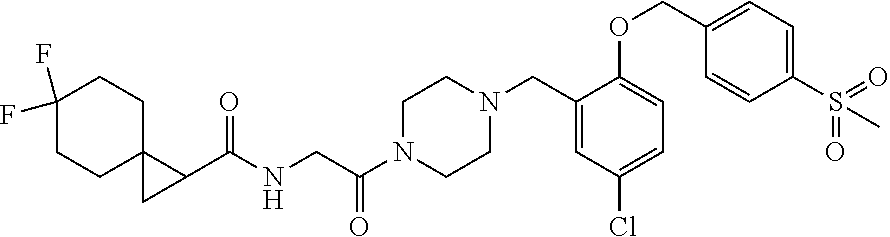
Priority Applications (1)
| Application Number | Priority Date | Filing Date | Title |
|---|---|---|---|
| US16/645,341 US11629139B2 (en) | 2017-09-08 | 2018-09-10 | Small molecule inhibitors of Ebola and Lassa fever viruses and methods of use |
Applications Claiming Priority (3)
| Application Number | Priority Date | Filing Date | Title |
|---|---|---|---|
| US201762556066P | 2017-09-08 | 2017-09-08 | |
| PCT/US2018/050238 WO2019051396A1 (en) | 2017-09-08 | 2018-09-10 | Small molecule inhibitors of ebola and lassa fever viruses and methods of use |
| US16/645,341 US11629139B2 (en) | 2017-09-08 | 2018-09-10 | Small molecule inhibitors of Ebola and Lassa fever viruses and methods of use |
Publications (2)
| Publication Number | Publication Date |
|---|---|
| US20210163454A1 US20210163454A1 (en) | 2021-06-03 |
| US11629139B2 true US11629139B2 (en) | 2023-04-18 |
Family
ID=63714059
Family Applications (1)
| Application Number | Title | Priority Date | Filing Date |
|---|---|---|---|
| US16/645,341 Active 2039-04-20 US11629139B2 (en) | 2017-09-08 | 2018-09-10 | Small molecule inhibitors of Ebola and Lassa fever viruses and methods of use |
Country Status (2)
| Country | Link |
|---|---|
| US (1) | US11629139B2 (en) |
| WO (1) | WO2019051396A1 (en) |
Citations (9)
| Publication number | Priority date | Publication date | Assignee | Title |
|---|---|---|---|---|
| WO2005105778A2 (en) | 2004-04-30 | 2005-11-10 | Otsuka Pharmaceutical Co., Ltd. | 4-amino-5-cyanopyrimidine derivatives |
| EP1652842A1 (en) | 2003-07-30 | 2006-05-03 | Kyowa Hakko Kogyo Co., Ltd. | Indazole derivatives |
| WO2006062898A2 (en) | 2004-12-06 | 2006-06-15 | Siga Technologies, Inc. | Compounds and methods for treating hemorrhagic fever viruses |
| WO2007011623A1 (en) | 2005-07-15 | 2007-01-25 | Schering Corporation | Quinazoline derivatives useful in cancer treatment |
| WO2008147474A2 (en) | 2007-01-17 | 2008-12-04 | Siga Technologies, Inc. | Sulfonyl semicarbazides, carbonyl semicarbazides, semicarbazides and ureas, pharmaceutical compositions thereof, and methods for treating hemorrhagic fever viruses, including infections associated with arenaviruses |
| WO2012031090A2 (en) | 2010-09-01 | 2012-03-08 | President And Fellows Of Harvard College | Small molecule inhibitors of ebola and lassa fever viruses and methods of use |
| US8232240B2 (en) | 2005-02-23 | 2012-07-31 | The Brigham And Women's Hospital, Inc. | Inhibitors of enveloped virus infectivity |
| WO2012103081A1 (en) | 2011-01-25 | 2012-08-02 | Albert Einstein College Of Medicine Of Yeshiva University | Methods and assays for treating filoviridae infections |
| US20140329834A1 (en) * | 2011-08-10 | 2014-11-06 | The Brigham And Women's Hospital, Inc. | Small Molecule Inhibitors of Ebola and Lassa Fever Viruses |
-
2018
- 2018-09-10 WO PCT/US2018/050238 patent/WO2019051396A1/en not_active Ceased
- 2018-09-10 US US16/645,341 patent/US11629139B2/en active Active
Patent Citations (10)
| Publication number | Priority date | Publication date | Assignee | Title |
|---|---|---|---|---|
| EP1652842A1 (en) | 2003-07-30 | 2006-05-03 | Kyowa Hakko Kogyo Co., Ltd. | Indazole derivatives |
| WO2005105778A2 (en) | 2004-04-30 | 2005-11-10 | Otsuka Pharmaceutical Co., Ltd. | 4-amino-5-cyanopyrimidine derivatives |
| WO2006062898A2 (en) | 2004-12-06 | 2006-06-15 | Siga Technologies, Inc. | Compounds and methods for treating hemorrhagic fever viruses |
| US8232240B2 (en) | 2005-02-23 | 2012-07-31 | The Brigham And Women's Hospital, Inc. | Inhibitors of enveloped virus infectivity |
| WO2007011623A1 (en) | 2005-07-15 | 2007-01-25 | Schering Corporation | Quinazoline derivatives useful in cancer treatment |
| WO2008147474A2 (en) | 2007-01-17 | 2008-12-04 | Siga Technologies, Inc. | Sulfonyl semicarbazides, carbonyl semicarbazides, semicarbazides and ureas, pharmaceutical compositions thereof, and methods for treating hemorrhagic fever viruses, including infections associated with arenaviruses |
| WO2012031090A2 (en) | 2010-09-01 | 2012-03-08 | President And Fellows Of Harvard College | Small molecule inhibitors of ebola and lassa fever viruses and methods of use |
| WO2012103081A1 (en) | 2011-01-25 | 2012-08-02 | Albert Einstein College Of Medicine Of Yeshiva University | Methods and assays for treating filoviridae infections |
| US20140329834A1 (en) * | 2011-08-10 | 2014-11-06 | The Brigham And Women's Hospital, Inc. | Small Molecule Inhibitors of Ebola and Lassa Fever Viruses |
| US9452992B2 (en) * | 2011-08-10 | 2016-09-27 | President And Fellows Of Harvard College | Small molecule inhibitors of ebola and lassa fever viruses |
Non-Patent Citations (11)
| Title |
|---|
| Assimon, Me d Chem Comm, vol. 6, 912-918, 2015. (Year: 2015). * |
| CAS Registry No. 1278381-27-3, entered into CA Registry File on Apr. 11, 2011, supplied by FCH Group. |
| CAS Registry No. 1295233-84-9, entered into CA Registry File on May 15, 2011, supplied by FCH Group. |
| CAS Registry No. 1299938-25-2, entered into CA Registry File on May 24, 2011, supplied by FCH Group. |
| Cote, Nature, VOI 477, 2011, 344-350. (Year: 2011). * |
| International Search Report and Written Opinion dated Feb. 20, 2013, from PCT/US2012/046677. |
| International Search Report and Written Opinion for International Application No. PCT/US2018/050238 dated Jan. 8, 2019. |
| Lee, ACS Med Chem Lett, vol. 4, 239-243, 2013. (Year: 2013). * |
| Liu et al., "Identification of Potent Ebola Virus Entry Inhibitors with Suitable Properties for in Vivo Studies," Journal of Medicinal Chemistry, 61(14):6293-6307 (2018). |
| PubChemCompound, datasheet retrieved from the Internet: <http//pubchem.ncbi.nlm.nih.gov/search/search.cgi> See CID 37198024, CID 31111847, CID 31678675, CID 37351054, CID 9041503, CID 9162573, CID 24654219, CID 2993072, CID 7964476, CID 9105639, etc. (2013). |
| Van der Linden, ACS infect Dis, vol. 2(3), 173-179, 2016. (Year: 2016). * |
Also Published As
| Publication number | Publication date |
|---|---|
| US20210163454A1 (en) | 2021-06-03 |
| WO2019051396A1 (en) | 2019-03-14 |
Similar Documents
| Publication | Publication Date | Title |
|---|---|---|
| US9452992B2 (en) | Small molecule inhibitors of ebola and lassa fever viruses | |
| JP6046735B2 (en) | Pharmaceutical compounds | |
| US9400280B2 (en) | Piperidine derivatives and methods of treating hepatitis B infections | |
| US10150742B2 (en) | Substituted heterocyclic compounds for treating or preventing viral infections | |
| ES2802412T3 (en) | Reverse sulfonamide compounds based on sulfide, alkyl and pyridyl for the treatment of HBV | |
| ES2223772T3 (en) | PYRIMIDINCARBOXAMIDS USED AS INHIBITORS OF THE ISOZIMAS PDE4. | |
| CN105001225B (en) | The heterocyclic modulators of lipid synthesis | |
| CA3139977A1 (en) | Peptidomimetics for the treatment of coronavirus and picornavirus infections | |
| ES2260036T3 (en) | DERIVATIVES OF UREA AS INHIBITORS OF THE CCR-3 RECEIVER. | |
| ES2724581T3 (en) | Pyridazinone compounds and uses thereof | |
| US9314468B2 (en) | Chemokine receptor modulators | |
| WO2018042343A2 (en) | Compounds that inhibit 3c and 3cl proteases and methods of use thereof | |
| US9676763B2 (en) | Method of treating Ebola | |
| US11040963B2 (en) | Piperazine derivatives for influenza virus inhibitions | |
| CN115504968A (en) | Triazine derivatives | |
| US20210276967A1 (en) | Inhibitors of hepatitis b virus | |
| US9849135B2 (en) | USP14 inhibitors for treating or preventing viral infections | |
| CN111620815A (en) | Chiral chloroquine, hydroxychloroquine and derivatives thereof, and preparation method and application thereof | |
| TW200835497A (en) | Chemical compounds 636 | |
| US20210163454A1 (en) | Small molecule inhibitors of ebola and lassa fever viruses and methods of use | |
| JP2009179589A (en) | Antiviral agent | |
| WO2023064368A1 (en) | Novel rhodanine derivatives and uses thereof | |
| HK40101641A (en) | Anti-influenza virus derivative and the use thereof | |
| HK40101641B (en) | Anti-influenza virus derivative and the use thereof |
Legal Events
| Date | Code | Title | Description |
|---|---|---|---|
| FEPP | Fee payment procedure |
Free format text: ENTITY STATUS SET TO UNDISCOUNTED (ORIGINAL EVENT CODE: BIG.); ENTITY STATUS OF PATENT OWNER: SMALL ENTITY |
|
| FEPP | Fee payment procedure |
Free format text: ENTITY STATUS SET TO SMALL (ORIGINAL EVENT CODE: SMAL); ENTITY STATUS OF PATENT OWNER: SMALL ENTITY |
|
| AS | Assignment |
Owner name: PRESIDENT AND FELLOWS OF HARVARD COLLEGE, MASSACHUSETTS Free format text: ASSIGNMENT OF ASSIGNORS INTEREST;ASSIGNORS:LEE, KATIE KYUNGAE;LIU, HU;SIGNING DATES FROM 20190425 TO 20190611;REEL/FRAME:054012/0567 Owner name: PRESIDENT AND FELLOWS OF HARVARD COLLEGE, MASSACHUSETTS Free format text: ASSIGNMENT OF ASSIGNORS INTEREST;ASSIGNOR:CUNNINGHAM, JAMES MORGAN;REEL/FRAME:054012/0611 Effective date: 20190424 Owner name: THE BRIGHAM AND WOMEN'S HOSPITAL, INC., MASSACHUSETTS Free format text: ASSIGNMENT OF ASSIGNORS INTEREST;ASSIGNOR:CUNNINGHAM, JAMES MORGAN;REEL/FRAME:054012/0611 Effective date: 20190424 Owner name: THE BRIGHAM AND WOMEN'S HOSPITAL, INC., MASSACHUSETTS Free format text: ASSIGNMENT OF ASSIGNORS INTEREST;ASSIGNOR:TIAN, YE;REEL/FRAME:054033/0056 Effective date: 20190423 |
|
| STPP | Information on status: patent application and granting procedure in general |
Free format text: DOCKETED NEW CASE - READY FOR EXAMINATION |
|
| STPP | Information on status: patent application and granting procedure in general |
Free format text: NON FINAL ACTION MAILED |
|
| STPP | Information on status: patent application and granting procedure in general |
Free format text: RESPONSE TO NON-FINAL OFFICE ACTION ENTERED AND FORWARDED TO EXAMINER |
|
| STPP | Information on status: patent application and granting procedure in general |
Free format text: NON FINAL ACTION MAILED |
|
| STPP | Information on status: patent application and granting procedure in general |
Free format text: NOTICE OF ALLOWANCE MAILED -- APPLICATION RECEIVED IN OFFICE OF PUBLICATIONS |
|
| STPP | Information on status: patent application and granting procedure in general |
Free format text: PUBLICATIONS -- ISSUE FEE PAYMENT RECEIVED |
|
| STPP | Information on status: patent application and granting procedure in general |
Free format text: AWAITING TC RESP, ISSUE FEE PAYMENT RECEIVED |
|
| STPP | Information on status: patent application and granting procedure in general |
Free format text: PUBLICATIONS -- ISSUE FEE PAYMENT RECEIVED |
|
| STPP | Information on status: patent application and granting procedure in general |
Free format text: PUBLICATIONS -- ISSUE FEE PAYMENT RECEIVED |
|
| STCF | Information on status: patent grant |
Free format text: PATENTED CASE |