US11623930B2 - Imidazodiazepinediones and methods of use thereof - Google Patents
Imidazodiazepinediones and methods of use thereof Download PDFInfo
- Publication number
- US11623930B2 US11623930B2 US16/977,945 US201916977945A US11623930B2 US 11623930 B2 US11623930 B2 US 11623930B2 US 201916977945 A US201916977945 A US 201916977945A US 11623930 B2 US11623930 B2 US 11623930B2
- Authority
- US
- United States
- Prior art keywords
- methyl
- chlorophenyl
- trifluoromethoxy
- phenoxy
- equiv
- Prior art date
- Legal status (The legal status is an assumption and is not a legal conclusion. Google has not performed a legal analysis and makes no representation as to the accuracy of the status listed.)
- Active, expires
Links
Classifications
-
- C—CHEMISTRY; METALLURGY
- C07—ORGANIC CHEMISTRY
- C07D—HETEROCYCLIC COMPOUNDS
- C07D487/00—Heterocyclic compounds containing nitrogen atoms as the only ring hetero atoms in the condensed system, not provided for by groups C07D451/00 - C07D477/00
- C07D487/02—Heterocyclic compounds containing nitrogen atoms as the only ring hetero atoms in the condensed system, not provided for by groups C07D451/00 - C07D477/00 in which the condensed system contains two hetero rings
- C07D487/04—Ortho-condensed systems
-
- A—HUMAN NECESSITIES
- A61—MEDICAL OR VETERINARY SCIENCE; HYGIENE
- A61P—SPECIFIC THERAPEUTIC ACTIVITY OF CHEMICAL COMPOUNDS OR MEDICINAL PREPARATIONS
- A61P13/00—Drugs for disorders of the urinary system
- A61P13/12—Drugs for disorders of the urinary system of the kidneys
-
- A—HUMAN NECESSITIES
- A61—MEDICAL OR VETERINARY SCIENCE; HYGIENE
- A61P—SPECIFIC THERAPEUTIC ACTIVITY OF CHEMICAL COMPOUNDS OR MEDICINAL PREPARATIONS
- A61P25/00—Drugs for disorders of the nervous system
-
- A—HUMAN NECESSITIES
- A61—MEDICAL OR VETERINARY SCIENCE; HYGIENE
- A61P—SPECIFIC THERAPEUTIC ACTIVITY OF CHEMICAL COMPOUNDS OR MEDICINAL PREPARATIONS
- A61P25/00—Drugs for disorders of the nervous system
- A61P25/22—Anxiolytics
-
- A—HUMAN NECESSITIES
- A61—MEDICAL OR VETERINARY SCIENCE; HYGIENE
- A61P—SPECIFIC THERAPEUTIC ACTIVITY OF CHEMICAL COMPOUNDS OR MEDICINAL PREPARATIONS
- A61P25/00—Drugs for disorders of the nervous system
- A61P25/24—Antidepressants
-
- A—HUMAN NECESSITIES
- A61—MEDICAL OR VETERINARY SCIENCE; HYGIENE
- A61P—SPECIFIC THERAPEUTIC ACTIVITY OF CHEMICAL COMPOUNDS OR MEDICINAL PREPARATIONS
- A61P3/00—Drugs for disorders of the metabolism
- A61P3/08—Drugs for disorders of the metabolism for glucose homeostasis
- A61P3/10—Drugs for disorders of the metabolism for glucose homeostasis for hyperglycaemia, e.g. antidiabetics
-
- A—HUMAN NECESSITIES
- A61—MEDICAL OR VETERINARY SCIENCE; HYGIENE
- A61P—SPECIFIC THERAPEUTIC ACTIVITY OF CHEMICAL COMPOUNDS OR MEDICINAL PREPARATIONS
- A61P35/00—Antineoplastic agents
-
- A—HUMAN NECESSITIES
- A61—MEDICAL OR VETERINARY SCIENCE; HYGIENE
- A61P—SPECIFIC THERAPEUTIC ACTIVITY OF CHEMICAL COMPOUNDS OR MEDICINAL PREPARATIONS
- A61P9/00—Drugs for disorders of the cardiovascular system
- A61P9/10—Drugs for disorders of the cardiovascular system for treating ischaemic or atherosclerotic diseases, e.g. antianginal drugs, coronary vasodilators, drugs for myocardial infarction, retinopathy, cerebrovascula insufficiency, renal arteriosclerosis
-
- C—CHEMISTRY; METALLURGY
- C07—ORGANIC CHEMISTRY
- C07D—HETEROCYCLIC COMPOUNDS
- C07D487/00—Heterocyclic compounds containing nitrogen atoms as the only ring hetero atoms in the condensed system, not provided for by groups C07D451/00 - C07D477/00
- C07D487/12—Heterocyclic compounds containing nitrogen atoms as the only ring hetero atoms in the condensed system, not provided for by groups C07D451/00 - C07D477/00 in which the condensed system contains three hetero rings
- C07D487/14—Ortho-condensed systems
-
- C—CHEMISTRY; METALLURGY
- C07—ORGANIC CHEMISTRY
- C07D—HETEROCYCLIC COMPOUNDS
- C07D498/00—Heterocyclic compounds containing in the condensed system at least one hetero ring having nitrogen and oxygen atoms as the only ring hetero atoms
- C07D498/12—Heterocyclic compounds containing in the condensed system at least one hetero ring having nitrogen and oxygen atoms as the only ring hetero atoms in which the condensed system contains three hetero rings
- C07D498/14—Ortho-condensed systems
-
- C—CHEMISTRY; METALLURGY
- C07—ORGANIC CHEMISTRY
- C07D—HETEROCYCLIC COMPOUNDS
- C07D513/00—Heterocyclic compounds containing in the condensed system at least one hetero ring having nitrogen and sulfur atoms as the only ring hetero atoms, not provided for in groups C07D463/00, C07D477/00 or C07D499/00 - C07D507/00
- C07D513/12—Heterocyclic compounds containing in the condensed system at least one hetero ring having nitrogen and sulfur atoms as the only ring hetero atoms, not provided for in groups C07D463/00, C07D477/00 or C07D499/00 - C07D507/00 in which the condensed system contains three hetero rings
- C07D513/14—Ortho-condensed systems
Definitions
- Proteinuria is a condition in which an excessive amount of protein in the blood leaks into the urine. Proteinuria can progress from a loss of 30 mg of protein in the urine over a 24-hour period (called microalbuminuria) to >300 mg/day (called macroalbuminuria), before reaching levels of 3.5 grams of protein or more over a 24-hour period, or 25 times the normal amount. Proteinuria occurs when there is a malfunction in the kidney's glomeruli, causing fluid to accumulate in the body (edema). Prolonged protein leakage has been shown to result in kidney failure. Nephrotic Syndrome (NS) disease accounts for approximately 12% of prevalent end stage renal disease cases at an annual cost in the United States of more than $3 billion.
- NS Nephrotic Syndrome
- kidney disease e.g., proteinuria
- TRP channel proteins form six-transmembrane cation-permeable channels that may be grouped into six subfamilies on the basis of amino acid sequence homology (TRPC, TRPV, TRPM, TRPA, TRPP, and TRPML).
- TRPC amino acid sequence homology
- TRPV amino acid sequence homology
- TRPM TRPM
- TRPA TRPA
- TRPP TRPP
- TRPML amino acid sequence homology
- TRPC6, TRPM6, and TRPP2 have been implicated in hereditary focal segmental glomerulosclerosis (FSGS), hypomagnesemia with secondary hypocalcemia (HSH), and polycystic kidney disease (PKD), respectively.
- TRPC5 has also been reported to contribute to the mechanisms underlying regulation of innate fear responses. (J Neurosci. 2014 Mar. 5; 34(10): 3653-3667).
- the invention is based, at least in part, on the discovery that Transient Receptor Potential Cation Channel, subfamily C, member 5 (TRPC5) activity abolishes actin stress fibers and diminishes focal adhesion formation, rendering a motile, migratory podocyte phenotype.
- TRPC5 Transient Receptor Potential Cation Channel, subfamily C, member 5
- the invention relates to small molecule TRPC5 modulators.
- the invention relates to small molecule TRPC5 inhibitors and the use of such inhibitors in methods of treating, or reducing risk of developing, kidney disease (e.g., proteinuria, microalbuminuria, macroalbuminuria), anxiety, depression, or cancer, comprising administering to a subject in need thereof.
- kidney disease e.g., proteinuria, microalbuminuria, macroalbuminuria
- anxiety, depression, or cancer comprising administering to a subject in need thereof.
- the invention relates to small molecule TRPC5 agonists and the use of such agonists in methods of treating, or reducing risk of developing, obesity.
- Examples of this behavior include the modulation of calcium channels, such as DHP receptors (G. C. Rovnyak et al., J Med Chem. 1995, 38(1):119-29, from Neil's email), calcium channels in heart cells (RS Kass, Circ Res 1987, 61(4 Pt 2), 11-5 and others (R. P. Hof et al., J Cardiovasc Pharmacol. 1985, 7(4):689-93).
- DHP receptors G. C. Rovnyak et al., J Med Chem. 1995, 38(1):119-29, from Neil's email
- calcium channels in heart cells RS Kass, Circ Res 1987, 61(4 Pt 2), 11-5 and others (R. P. Hof et al., J Cardiovasc Pharmacol. 1985, 7(4):689-93).
- Formula I and Formula II described herein include both agonists and inhibitors.
- One of ordinary skill in the art can easily determine if a compound of Formula I or Formula II is a TRPC5 agonist or inhibitor by testing it in the FLIPR assays described herein or any other assays that can determine if a compound is a TRPC5 inhibitor or a TRPC5 agonist.
- the therapeutic methods described above are effective for a variety of subjects including mammals, e.g., humans and other mammals, such as mice, rats, rabbits, and monkeys, and domesticated and farm mammals, e.g., cats, dogs, goats, sheep, pigs, cows, or horses.
- mammals e.g., humans and other mammals, such as mice, rats, rabbits, and monkeys
- domesticated and farm mammals e.g., cats, dogs, goats, sheep, pigs, cows, or horses.
- a compound of the invention is a compound of Formula (I) or (II), or a pharmaceutically acceptable salt thereof;
- a and A′ are independently selected from CR and N;
- R is L-R 1 ;
- L is absent, CH 2 , O, SO 2 , or NR 2 ;
- R 1 is selected from optionally substituted alkyl, optionally substituted aryl, and optionally substituted heteroaryl;
- each R 2 is independently H, or alkyl
- R 3 is selected from optionally substituted alkyl, optionally substituted alkylene-OR 2 , optionally substituted cycloalkylene-OR 2 , optionally substituted alkylene-N(R 7 ) 2 , optionally substituted cycloalkylene-N(R 7 ) 2 , optionally substituted alkylene-C(O)N(R 2 ) 2 , optionally substituted cycloalkylene-C(O)N(R 2 ) 2 , optionally substituted alkylene-S(O) 2 N(R 2 ) 2 , and optionally substituted cycloalkylene-S(O) 2 N(R 2 ) 2 ;
- R 4 is selected from alkyl, optionally substituted alkylene-aryl, and optionally substituted alkylene-heteroaryl;
- each R 5 is independently selected from H, N(R 2 ) 2 , OR 2 ;
- each R 7 is independently selected from H, alkyl, (alkyl)C(O)—, (aryl)C(O)—, (alkyl)S(O) 2 —, and (aryl)S(O) 2 —;
- X is —C(O)—, CH 2 , CHR 6 , C(R 6 ) 2 ;
- each R 6 is independently selected from H, alkyl, and optionally substituted alkylene-OH;
- X′ is —C(O)—, CH 2 , CHR 3′ , C(R 3′ ) 2 , or X′ is taken together with R 3 to form a 5- or 6-membered ring;
- each R 3′ is independently selected from optionally substituted alkyl, optionally substituted alkylene-OR 2 , optionally substituted cycloalkylene-OR 2 , optionally substituted alkylene-N(R 7 ) 2 , optionally substituted cycloalkylene-N(R 7 ) 2 , optionally substituted alkylene-C(O)N(R 2 ) 2 , optionally substituted cycloalkylene-C(O)N(R 2 ) 2 , optionally substituted alkylene-S(O) 2 N(R 2 ) 2 , and optionally substituted cycloalkylene-S(O) 2 N(R 2 ) 2 ; and
- Z is absent, CH 2 , CHR 5 , O, —NR 2 —, or —SO 2 —;
- X and X′ are not both —C(O)—, and R 5 is H when Z is O, NR or SO 2 .
- the invention features a composition, comprising a compound of any one of Formula (I) or (II) or a pharmaceutically acceptable salt thereof; and a pharmaceutically acceptable excipient.
- the invention features methods of treating, or the reducing risk of developing, a kidney disease, diabetic retinopathy, anxiety, depression, or cancer, comprising administering to a subject in need thereof a therapeutically effective amount of a compound of Formula (I) or (II).
- a kidney disease is treated or the risk of developing a kidney disease is reduced.
- a kidney disease is treated.
- the kidney disease is selected from the group consisting of Focal Segmental Glomerulosclerosis (FSGS), Diabetic nephropathy, Alport syndrome, hypertensive kidney disease, nephrotic syndrome, steroid-resistant nephrotic syndrome, minimal change disease, membranous nephropathy, idiopathic membranous nephropathy, membranoproliferative glomerulonephritis (MPGN), immune complex-mediated MPGN, complement-mediated MPGN, Lupus nephritis, postinfectious glomerulonephritis, thin basement membrane disease, mesangial proliferative glomerulonephritis, amyloidosis (primary), c1q nephropathy, rapidly progressive GN, anti-GBM disease, C3 glomerulonephritis, hypertensive nephrosclerosis, and IgA nephropathy.
- the kidney disease is proteinuria.
- the invention features methods of treating, or the reducing risk of developing, obesity.
- the subject is a mammal. In certain embodiments, the mammal is a human.
- the invention comprises administering the compound of Formula (I) or (II) to a mammal and evaluating an effect of the compound on calcium transport, wherein a compound that reduces or inhibits calcium transport is a therapeutic agent for treating or reducing risk of developing a kidney disease, anxiety, depression, or cancer.
- the invention provides several advantages.
- the prophylactic and therapeutic methods described herein are effective in treating kidney disease, e.g., proteinuria, and have minimal, if any, side effects. Further, methods described herein are effective to identify compounds that treat or reduce risk of developing a kidney disease, anxiety, depression, or cancer.
- acyl is art-recognized and refers to a group represented by the general formula hydrocarbylC(O)—, preferably alkylC(O)—.
- acylamino is art-recognized and refers to an amino group substituted with an acyl group and may be represented, for example, by the formula hydrocarbylC(O)NH—.
- acyloxy is art-recognized and refers to a group represented by the general formula hydrocarbylC(O)O—, preferably alkylC(O)O—.
- alkoxy refers to an alkyl group, preferably a lower alkyl group, having an oxygen attached thereto.
- Representative alkoxy groups include methoxy, trifluoromethoxy, ethoxy, propoxy, tert-butoxy and the like.
- alkoxyalkyl refers to an alkyl group substituted with an alkoxy group and may be represented by the general formula alkyl-O-alkyl.
- alkenyl refers to an aliphatic group containing at least one double bond and is intended to include both “unsubstituted alkenyls” and “substituted alkenyls”, the latter of which refers to alkenyl moieties having substituents replacing a hydrogen on one or more carbons of the alkenyl group. Such substituents may occur on one or more carbons that are included or not included in one or more double bonds. Moreover, such substituents include all those contemplated for alkyl groups, as discussed below, except where stability is prohibitive. For example, substitution of alkenyl groups by one or more alkyl, carbocyclyl, aryl, heterocyclyl, or heteroaryl groups is contemplated.
- alkyl group or “alkane” is a straight chained or branched non-aromatic hydrocarbon which is completely saturated. Typically, a straight chained or branched alkyl group has from 1 to about 20 carbon atoms, preferably from 1 to about 10 unless otherwise defined. Examples of straight chained and branched alkyl groups include methyl, ethyl, n-propyl, iso-propyl, n-butyl, sec-butyl, tert-butyl, pentyl, hexyl, pentyl and octyl. A C 1 -C 6 straight chained or branched alkyl group is also referred to as a “lower alkyl” group.
- alkyl (or “lower alkyl”) as used throughout the specification, examples, and claims is intended to include both “unsubstituted alkyls” and “substituted alkyls”, the latter of which refers to alkyl moieties having substituents replacing a hydrogen on one or more carbons of the hydrocarbon backbone.
- substituents can include, for example, a halogen (e.g., fluoro), a hydroxyl, a carbonyl (such as a carboxyl, an alkoxycarbonyl, a formyl, or an acyl), a thiocarbonyl (such as a thioester, a thioacetate, or a thioformate), an alkoxy, a phosphoryl, a phosphate, a phosphonate, a phosphinate, an amino, an amido, an amidine, an imine, a cyano, a nitro, an azido, a sulfhydryl, an alkylthio, a sulfate, a sulfonate, a sulfamoyl, a sulfonamido, a sulfonyl, a heterocyclyl, an aralkyl, or an aromatic or
- a halogen
- the substituents on substituted alkyls are selected from C 1-6 alkyl, C 3-6 cycloalkyl, halogen, carbonyl, cyano, or hydroxyl. In more preferred embodiments, the substituents on substituted alkyls are selected from fluoro, carbonyl, cyano, or hydroxyl. It will be understood by those skilled in the art that the moieties substituted on the hydrocarbon chain can themselves be substituted, if appropriate.
- the substituents of a substituted alkyl may include substituted and unsubstituted forms of amino, azido, imino, amido, phosphoryl (including phosphonate and phosphinate), sulfonyl (including sulfate, sulfonamido, sulfamoyl and sulfonate), and silyl groups, as well as ethers, alkylthios, carbonyls (including ketones, aldehydes, carboxylates, and esters), —CF 3 , —CN and the like. Exemplary substituted alkyls are described below.
- Cycloalkyls can be further substituted with alkyls, alkenyls, alkoxys, alkylthios, aminoalkyls, carbonyl-substituted alkyls, —CF 3 , —CN, and the like.
- alkylene by itself or as part of another substituent refers to a saturated straight-chain or branched divalent group having the stated number of carbon atoms and derived from the removal of two hydrogen atoms from the corresponding alkane.
- straight chained and branched alkylene groups include —CH 2 — (methylene), —CH 2 —CH 2 -(ethylene), —CH 2 —CH 2 —CH 2 — (propylene), —C(CH 3 ) 2 —, —CH 2 —CH(CH 3 )—, —CH 2 —CH 2 —CH 2 —CH 2 —CH 2 —CH 2 —CH 2 — (pentylene), —CH 2 —CH(CH 3 )—CH 2 —, and —CH 2 —C(CH 3 ) 2 —CH 2 —.
- C x -y when used in conjunction with a chemical moiety, such as, acyl, acyloxy, alkyl, alkenyl, alkynyl, or alkoxy is meant to include groups that contain from x to y carbons in the chain.
- C x-y alkyl refers to substituted or unsubstituted saturated hydrocarbon groups, including straight-chain alkyl and branched-chain alkyl groups that contain from x to y carbons in the chain, including haloalkyl groups.
- Preferred haloalkyl groups include trifluoromethyl, difluoromethyl, 2,2,2-trifluoroethyl, and pentafluoroethyl.
- Co alkyl indicates a hydrogen where the group is in a terminal position, a bond if internal.
- the terms “C 2-y alkenyl” and “C 2-y alkynyl” refer to substituted or unsubstituted unsaturated aliphatic groups analogous in length and possible substitution to the alkyls described above, but that contain at least one double or triple bond respectively.
- alkylamino refers to an amino group substituted with at least one alkyl group.
- alkylthio refers to a thiol group substituted with an alkyl group and may be represented by the general formula alkylS-.
- alkynyl refers to an aliphatic group containing at least one triple bond and is intended to include both “unsubstituted alkynyls” and “substituted alkynyls”, the latter of which refers to alkynyl moieties having substituents replacing a hydrogen on one or more carbons of the alkynyl group. Such substituents may occur on one or more carbons that are included or not included in one or more triple bonds. Moreover, such substituents include all those contemplated for alkyl groups, as discussed above, except where stability is prohibitive. For example, substitution of alkynyl groups by one or more alkyl, carbocyclyl, aryl, heterocyclyl, or heteroaryl groups is contemplated.
- amide refers to a group
- each R A independently represent a hydrogen or hydrocarbyl group, or two R A are taken together with the N atom to which they are attached complete a heterocycle having from 4 to 8 atoms in the ring structure.
- amine and “amino” are art-recognized and refer to both unsubstituted and substituted amines and salts thereof, e.g., a moiety that can be represented by
- each R A independently represents a hydrogen or a hydrocarbyl group, or two R A are taken together with the N atom to which they are attached complete a heterocycle having from 4 to 8 atoms in the ring structure.
- aminoalkyl refers to an alkyl group substituted with an amino group.
- aralkyl refers to an alkyl group substituted with an aryl group.
- aryl as used herein include substituted or unsubstituted single-ring aromatic groups in which each atom of the ring is carbon.
- the ring is a 6- or 10-membered ring, more preferably a 6-membered ring.
- aryl also includes polycyclic ring systems having two or more cyclic rings in which two or more carbons are common to two adjoining rings wherein at least one of the rings is aromatic, e.g., the other cyclic rings can be cycloalkyls, cycloalkenyls, aryls, heteroaryls, and/or heterocyclyls.
- Aryl groups include benzene, naphthalene, phenanthrene, phenol, aniline, and the like.
- each R A independently represent hydrogen or a hydrocarbyl group, such as an alkyl group, or both R A taken together with the intervening atom(s) complete a heterocycle having from 4 to 8 atoms in the ring structure.
- carbocycle refers to a saturated or unsaturated ring in which each atom of the ring is carbon.
- carbocycle includes both aromatic carbocycles and non-aromatic carbocycles.
- Non-aromatic carbocycles include both cycloalkane rings, in which all carbon atoms are saturated, and cycloalkene rings, which contain at least one double bond.
- Carbocycle includes 5-7 membered monocyclic and 8-12 membered bicyclic rings. Each ring of a bicyclic carbocycle may be selected from saturated, unsaturated and aromatic rings.
- Carbocycle includes bicyclic molecules in which one, two or three or more atoms are shared between the two rings.
- the term “fused carbocycle” refers to a bicyclic carbocycle in which each of the rings shares two adjacent atoms with the other ring.
- Each ring of a fused carbocycle may be selected from saturated, unsaturated and aromatic rings.
- an aromatic ring e.g., phenyl
- an aromatic ring e.g., phenyl
- a saturated or unsaturated ring e.g., cyclohexane, cyclopentane, or cyclohexene. Any combination of saturated, unsaturated and aromatic bicyclic rings, as valence permits, is included in the definition of carbocyclic.
- Exemplary “carbocycles” include cyclopentane, cyclohexane, bicyclo[2.2.1]heptane, 1,5-cyclooctadiene, 1,2,3,4-tetrahydronaphthalene, bicyclo[4.2.0]oct-3-ene, naphthalene and adamantane.
- Exemplary fused carbocycles include decalin, naphthalene, 1,2,3,4-tetrahydronaphthalene, bicyclo[4.2.0]octane, 4,5,6,7-tetrahydro-1H-indene and bicyclo[4.1.0]hept-3-ene.
- “Carbocycles” may be substituted at any one or more positions capable of bearing a hydrogen atom.
- a “cycloalkyl” group is a cyclic hydrocarbon which is completely saturated.
- “Cycloalkyl” includes monocyclic and bicyclic rings. Typically, a monocyclic cycloalkyl group has from 3 to about 10 carbon atoms, more typically 3 to 8 carbon atoms unless otherwise defined.
- the second ring of a bicyclic cycloalkyl may be selected from saturated, unsaturated and aromatic rings. Cycloalkyl includes bicyclic molecules in which one, two or three or more atoms are shared between the two rings.
- the term “fused cycloalkyl” refers to a bicyclic cycloalkyl in which each of the rings shares two adjacent atoms with the other ring.
- the second ring of a fused bicyclic cycloalkyl may be selected from saturated, unsaturated and aromatic rings.
- a “cycloalkenyl” group is a cyclic hydrocarbon containing one or more double bonds.
- Carbocyclylalkyl refers to an alkyl group substituted with a carbocycle group.
- carbonate is art-recognized and refers to a group —OCO 2 —R A , wherein R A represents a hydrocarbyl group.
- esters refers to a group —C(O)OR A wherein R A represents a hydrocarbyl group.
- ether refers to a hydrocarbyl group linked through an oxygen to another hydrocarbyl group. Accordingly, an ether substituent of a hydrocarbyl group may be hydrocarbyl-O—. Ethers may be either symmetrical or unsymmetrical. Examples of ethers include, but are not limited to, heterocycle-O-heterocycle and aryl-O-heterocycle. Ethers include “alkoxyalkyl” groups, which may be represented by the general formula alkyl-O-alkyl.
- halo and “halogen” as used herein means halogen and includes chloro, fluoro, bromo, and iodo.
- heteroalkyl and “heteroaralkyl”, as used herein, refers to an alkyl group substituted with a hetaryl group.
- heteroalkyl refers to a saturated or unsaturated chain of carbon atoms and at least one heteroatom, wherein no two heteroatoms are adjacent.
- heteroaryl and “hetaryl” include substituted or unsubstituted aromatic single ring structures, preferably 5- to 7-membered rings, more preferably 5- to 6-membered rings, whose ring structures include at least one heteroatom, preferably one to four heteroatoms, more preferably one or two heteroatoms.
- heteroaryl and “hetaryl” also include polycyclic ring systems having two or more cyclic rings in which two or more carbons are common to two adjoining rings wherein at least one of the rings is heteroaromatic, e.g., the other cyclic rings can be cycloalkyls, cycloalkenyls, aryls, heteroaryls, and/or heterocyclyls.
- Heteroaryl groups include, for example, pyrrole, furan, thiophene, imidazole, oxazole, thiazole, pyrazole, pyridine, pyrazine, pyridazine, and pyrimidine, and the like.
- heteroatom as used herein means an atom of any element other than carbon or hydrogen. Preferred heteroatoms are nitrogen, oxygen, and sulfur.
- heterocyclyl refers to substituted or unsubstituted non-aromatic ring structures, preferably 3- to 10-membered rings, more preferably 3- to 7-membered rings, whose ring structures include at least one heteroatom, preferably one to four heteroatoms, more preferably one or two heteroatoms.
- heterocyclyl and “heterocyclic” also include polycyclic ring systems having two or more cyclic rings in which two or more carbons are common to two adjoining rings wherein at least one of the rings is heterocyclic, e.g., the other cyclic rings can be cycloalkyls, cycloalkenyls, aryls, heteroaryls, and/or heterocyclyls.
- Heterocyclyl groups include, for example, piperidine, piperazine, pyrrolidine, tetrahydropyran, tetrahydrofuran, morpholine, lactones, lactams, and the like.
- heterocyclylalkyl or “heterocycloalkyl”, as used herein, refers to an alkyl group substituted with a heterocycle group.
- hydrocarbyl refers to a group that is bonded through a carbon atom that does not have a ⁇ O or ⁇ S substituent, and typically has at least one carbon-hydrogen bond and a primarily carbon backbone, but may optionally include heteroatoms.
- groups like methyl, ethoxyethyl, 2-pyridyl, and trifluoromethyl are considered to be hydrocarbyl for the purposes of this application, but substituents such as acetyl (which has a ⁇ O substituent on the linking carbon) and ethoxy (which is linked through oxygen, not carbon) are not.
- Hydrocarbyl groups include, but are not limited to aryl, heteroaryl, carbocycle, heterocyclyl, alkyl, alkenyl, alkynyl, and combinations thereof.
- hydroxyalkyl refers to an alkyl group substituted with a hydroxy group.
- lower when used in conjunction with a chemical moiety, such as, acyl, acyloxy, alkyl, alkenyl, alkynyl, or alkoxy is meant to include groups where there are ten or fewer non-hydrogen atoms in the substituent, preferably six or fewer.
- acyl, acyloxy, alkyl, alkenyl, alkynyl, or alkoxy substituents defined herein are respectively lower acyl, lower acyloxy, lower alkyl, lower alkenyl, lower alkynyl, or lower alkoxy, whether they appear alone or in combination with other substituents, such as in the recitations hydroxyalkyl and aralkyl (in which case, for example, the atoms within the aryl group are not counted when counting the carbon atoms in the alkyl substituent).
- polycyclyl refers to two or more rings (e.g., cycloalkyls, cycloalkenyls, aryls, heteroaryls, and/or heterocyclyls) in which two or more atoms are common to two adjoining rings, e.g., the rings are “fused rings”.
- Each of the rings of the polycycle can be substituted or unsubstituted.
- each ring of the polycycle contains from 3 to 10 atoms in the ring, preferably from 5 to 7.
- sil refers to a silicon moiety with three hydrocarbyl moieties attached thereto.
- substituted refers to moieties having substituents replacing a hydrogen on one or more carbons of the backbone. It will be understood that “substitution” or “substituted with” includes the implicit proviso that such substitution is in accordance with permitted valence of the substituted atom and the substituent, and that the substitution results in a stable compound, e.g., which does not spontaneously undergo transformation such as by rearrangement, cyclization, elimination, etc. As used herein, the term “substituted” is contemplated to include all permissible substituents of organic compounds.
- the permissible substituents include acyclic and cyclic, branched and unbranched, carbocyclic and heterocyclic, aromatic and non-aromatic substituents of organic compounds.
- the permissible substituents can be one or more and the same or different for appropriate organic compounds.
- the heteroatoms such as nitrogen may have hydrogen substituents and/or any permissible substituents of organic compounds described herein which satisfy the valences of the heteroatoms.
- Substituents can include any substituents described herein, for example, a halogen, a hydroxyl, a carbonyl (such as a carboxyl, an alkoxycarbonyl, a formyl, or an acyl), a thiocarbonyl (such as a thioester, a thioacetate, or a thioformate), an alkoxy, a phosphoryl, a phosphate, a phosphonate, a phosphinate, an amino, an amido, an amidine, an imine, a cyano, a nitro, an azido, a sulfhydryl, an alkylthio, a sulfate, a sulfonate, a sulfamoyl, a sulfonamido, a sulfonyl, a heterocyclyl, an aralkyl, or an aromatic or heteroaromatic moiety
- the substituents on substituted alkyls are selected from C 1-6 alkyl, C 3-6 cycloalkyl, halogen, carbonyl, cyano, or hydroxyl. In more preferred embodiments, the substituents on substituted alkyls are selected from fluoro, carbonyl, cyano, or hydroxyl. It will be understood by those skilled in the art that substituents can themselves be substituted, if appropriate. Unless specifically stated as “unsubstituted,” references to chemical moieties herein are understood to include substituted variants. For example, reference to an “aryl” group or moiety implicitly includes both substituted and unsubstituted variants.
- sulfate is art-recognized and refers to the group —OSO 3 H, or a pharmaceutically acceptable salt thereof.
- each R A independently represents hydrogen or hydrocarbyl, such as alkyl, or both R A taken together with the intervening atom(s) complete a heterocycle having from 4 to 8 atoms in the ring structure.
- sulfoxide is art-recognized and refers to the group —S(O)—R A , wherein R A represents a hydrocarbyl.
- sulfonate is art-recognized and refers to the group SO 3 H, or a pharmaceutically acceptable salt thereof.
- sulfone is art-recognized and refers to the group —S(O) 2 —R A , wherein R A represents a hydrocarbyl.
- thioalkyl refers to an alkyl group substituted with a thiol group.
- thioester refers to a group —C(O)SR A or —SC(O)R A wherein R A represents a hydrocarbyl.
- thioether is equivalent to an ether, wherein the oxygen is replaced with a sulfur.
- urea is art-recognized and may be represented by the general formula
- each R A independently represents hydrogen or a hydrocarbyl, such as alkyl, or any occurrence of R A taken together with another and the intervening atom(s) complete a heterocycle having from 4 to 8 atoms in the ring structure.
- Protecting group refers to a group of atoms that, when attached to a reactive functional group in a molecule, mask, reduce or prevent the reactivity of the functional group. Typically, a protecting group may be selectively removed as desired during the course of a synthesis. Examples of protecting groups can be found in Greene and Wuts, Protective Groups in Organic Chemistry, 3 rd Ed., 1999, John Wiley & Sons, NY and Harrison et al., Compendium of Synthetic Organic Methods , Vols. 1-8, 1971-1996, John Wiley & Sons, NY.
- nitrogen protecting groups include, but are not limited to, formyl, acetyl, trifluoroacetyl, benzyl, benzyloxycarbonyl (“CBZ”), tert-butoxycarbonyl (“Boc”), trimethylsilyl (“TMS”), 2-trimethylsilyl-ethanesulfonyl (“TES”), trityl and substituted trityl groups, allyloxycarbonyl, 9-fluorenylmethyloxycarbonyl (“FMOC”), nitro-veratryloxycarbonyl (“NVOC”) and the like.
- hydroxyl protecting groups include, but are not limited to, those where the hydroxyl group is either acylated (esterified) or alkylated such as benzyl and trityl ethers, as well as alkyl ethers, tetrahydropyranyl ethers, trialkylsilyl ethers (e.g., TMS or TIPS groups), glycol ethers, such as ethylene glycol and propylene glycol derivatives and allyl ethers.
- a therapeutic that “prevents” a disorder or condition refers to a compound that, in a statistical sample, reduces the occurrence of the disorder or condition in the treated sample relative to an untreated control sample, or delays the onset or reduces the severity of one or more symptoms of the disorder or condition relative to the untreated control sample.
- treating includes prophylactic and/or therapeutic treatments.
- prophylactic or therapeutic treatment is art-recognized and includes administration to the host of one or more of the subject compositions. If it is administered prior to clinical manifestation of the unwanted condition (e.g., disease or other unwanted state of the host animal) then the treatment is prophylactic (i.e., it protects the host against developing the unwanted condition), whereas if it is administered after manifestation of the unwanted condition, the treatment is therapeutic, (i.e., it is intended to diminish, ameliorate, or stabilize the existing unwanted condition or side effects thereof).
- the phrases “conjoint administration” and “administered conjointly” refer to any form of administration of two or more different therapeutic compounds such that the second compound is administered while the previously administered therapeutic compound is still effective in the body (e.g., the two compounds are simultaneously effective in the patient, which may include synergistic effects of the two compounds).
- the different therapeutic compounds can be administered either in the same formulation or in a separate formulation, either concomitantly or sequentially.
- the different therapeutic compounds can be administered within one hour, 12 hours, 24 hours, 36 hours, 48 hours, 72 hours, or a week of one another.
- an individual who receives such treatment can benefit from a combined effect of different therapeutic compounds.
- prodrug is intended to encompass compounds which, under physiologic conditions, are converted into the therapeutically active agents of the present invention.
- a common method for making a prodrug is to include one or more selected moieties which are hydrolyzed under physiologic conditions to reveal the desired molecule.
- the prodrug is converted by an enzymatic activity of the host animal.
- esters or carbonates e.g., esters or carbonates of alcohols or carboxylic acids
- some or all of the compounds of the invention in a formulation represented above can be replaced with the corresponding suitable prodrug, e.g., wherein a hydroxyl in the parent compound is presented as an ester or a carbonate or carboxylic acid present in the parent compound is presented as an ester.
- small molecules refers to small organic or inorganic molecules of molecular weight below about 3,000 Daltons.
- small molecules useful for the invention have a molecular weight of less than 3,000 Daltons (Da).
- the small molecules can be, e.g., from at least about 100 Da to about 3,000 Da (e.g., between about 100 to about 3,000 Da, about 100 to about 2500 Da, about 100 to about 2,000 Da, about 100 to about 1,750 Da, about 100 to about 1,500 Da, about 100 to about 1,250 Da, about 100 to about 1,000 Da, about 100 to about 750 Da, about 100 to about 500 Da, about 200 to about 1500, about 500 to about 1000, about 300 to about 1000 Da, or about 100 to about 250 Da).
- a “small molecule” refers to an organic, inorganic, or organometallic compound typically having a molecular weight of less than about 1000. In some embodiments, a small molecule is an organic compound, with a size on the order of 1 nm. In some embodiments, small molecule drugs of the invention encompass oligopeptides and other biomolecules having a molecular weight of less than about 1000.
- an “effective amount” is an amount sufficient to effect beneficial or desired results.
- a therapeutic amount is one that achieves the desired therapeutic effect. This amount can be the same or different from a prophylactically effective amount, which is an amount necessary to prevent onset of disease or disease symptoms.
- An effective amount can be administered in one or more administrations, applications or dosages.
- a therapeutically effective amount of a composition depends on the composition selected. The compositions can be administered from one or more times per day to one or more times per week; including once every other day. The skilled artisan will appreciate that certain factors may influence the dosage and timing required to effectively treat a subject, including but not limited to the severity of the disease or disorder, previous treatments, the general health and/or age of the subject, and other diseases present.
- treatment of a subject with a therapeutically effective amount of the compositions described herein can include a single treatment or a series of treatments.
- One aspect of the invention provides small molecule modulators of TRPC5.
- the invention provides small molecule inhibitors of TRPC5.
- the invention provides small molecule agonists of TRPC5.
- the compound of the invention is a compound of Formula (I) or (II), or a pharmaceutically acceptable salt thereof;
- a and A′ are independently selected from CR and N;
- R is L-R 1 ;
- L is absent, CH 2 , O, SO 2 , or NR 2 ;
- R 1 is selected from optionally substituted alkyl, optionally substituted aryl, and optionally substituted heteroaryl, and when L is absent, R 1 is additionally selected from H;
- each R 2 is independently H, or alkyl
- R 3 is selected from optionally substituted alkyl, optionally substituted alkylene-OR 2 , optionally substituted cycloalkylene-OR 2 , optionally substituted alkylene-N(R 7 ) 2 , optionally substituted cycloalkylene-N(R 7 ) 2 , optionally substituted alkylene-C(O)N(R 2 ) 2 , optionally substituted cycloalkylene-C(O)N(R 2 ) 2 , optionally substituted alkylene-S(O) 2 N(R 2 ) 2 , and optionally substituted cycloalkylene-S(O) 2 N(R 2 ) 2 ;
- R 4 is selected from alkyl, optionally substituted alkylene-aryl, and optionally substituted alkylene-heteroaryl;
- each R 5 is independently selected from H, N(R 2 ) 2 , OR 2 ;
- each R 7 is independently selected from H, alkyl, (alkyl)C(O)—, (aryl)C(O)—, (alkyl)S(O) 2 —, and (aryl)S(O) 2 —;
- X is —C(O)—, CH 2 , CHR 6 , C(R 6 ) 2 ;
- each R 6 is independently selected from H, alkyl, and optionally substituted alkylene-OH;
- X′ is —C(O)—, CH 2 , CHR 3′ , C(R 3′ ) 2 , or X′ is taken together with R 3 to form a 5- or 6-membered ring;
- each R 3′ is independently selected from optionally substituted alkyl, optionally substituted alkylene-OR 2 , optionally substituted cycloalkylene-OR 2 , optionally substituted alkylene-N(R 7 ) 2 , optionally substituted cycloalkylene-N(R 7 ) 2 , optionally substituted alkylene-C(O)N(R 2 ) 2 , optionally substituted cycloalkylene-C(O)N(R 2 ) 2 , optionally substituted alkylene-S(O) 2 N(R 2 ) 2 , and optionally substituted cycloalkylene-S(O) 2 N(R 2 ) 2 ; and
- Z is absent, CH 2 , CHR 5 , O, —NR 2 —, or —SO 2 —;
- X and X′ are not both —C(O)—, and R 5 is H when Z is O, NR or SO 2 .
- the compound is a compound of Formula (I). In some embodiments, the compound is a compound of Formula (II).
- At least one of A and A′ is CR.
- A is N. In some embodiments, A is CR.
- A′ is N. In some embodiments, A′ is CR.
- A′ is N and A is CR.
- R is L-R 1 .
- L is absent. In some embodiments, when L is absent, R 1 is additionally selected from H. In some embodiments, L is CH 2 . In some embodiments, L is O. In some embodiments, L is SO 2 . In some embodiments, L is NR 2 .
- R 1 is optionally substituted aryl. In some embodiments, R′ is optionally substituted phenyl. In some embodiments, R 1 is substituted phenyl. In some embodiments, the substituted phenyl is substituted with one or more substituents independently selected from halogen, —CF 3 , —C(H)F 2 , and —OCF 3 .
- R 1 is optionally substituted alkyl.
- alkyl is selected from methyl, ethyl, n-propyl, iso-propyl, n-butyl, iso-butyl, and tert-butyl.
- R 1 is optionally substituted heteroaryl. In some embodiments, R 1 is substituted heteroaryl substituted with one or more substituents independently selected from halogen, —CF 3 , —C(H)F 2 , and —OCF 3 .
- L is O and R 1 is 3-chlorophenyl, 3-fluorophenyl, 3-trifluoromethoxyphenyl, isopropyl, or n-propyl.
- R 2 is H. In some embodiments, R 2 is alkyl. In some embodiments, R 2 is selected from methyl, ethyl, n-propyl, iso-propyl, n-butyl, iso-butyl, and tert-butyl. In some embodiments, R 2 is methyl.
- R 3 is optionally substituted alkyl. In some embodiments, R 3 is optionally substituted alkylene-OR 2 . In some embodiments, R 3 is optionally substituted cycloalkylene-OR 2 . In some embodiments, R 3 is optionally substituted alkylene-N(R 7 ) 2 . In some embodiments, R 3 is optionally substituted cycloalkylene-N(R 7 ) 2 . In some embodiments, R 3 is optionally substituted alkylene-C(O)N(R 2 ) 2 . In some embodiments, R 3 is optionally substituted cycloalkylene-C(O)N(R 2 ) 2 .
- R 3 is optionally substituted alkylene-S(O) 2 N(R 2 ) 2 . In some embodiments, R 3 is optionally substituted cycloalkylene-S(O) 2 N(R 2 ) 2 . In some embodiments, R 3 is methyl, 2-hydroxyethyl, 2,3-dihydroxypropyl, 2,2-difluoro-3-hydroxypropyl, 3-hydroxypropyl, 3-methoxypropyl, 3-hydroxycyclobutyl, or 3-hydroxycyclopentyl.
- one instance of R 7 is H; and the second instance of R 7 is alkyl, (alkyl)C(O)—, (aryl)C(O)—, (alkyl)S(O) 2 —, or (aryl)S(O) 2 —.
- one instance of R 7 is alkyl; and the second instance of R 7 is H, (alkyl)C(O)—, (aryl)C(O)—, (alkyl)S(O) 2 —, or (aryl)S(O) 2 —.
- both instances of R 7 are H. In some embodiments, both instances of R 7 are alkyl.
- R 3 is selected from
- R 3 is
- R 3 is selected from
- R 3 is selected from
- R 4 is alkyl. In some embodiments, R 4 is selected from methyl, ethyl, n-propyl, iso-propyl, n-butyl, iso-butyl, and tert-butyl. In some embodiments, R 4 is selected from n-butyl, iso-butyl, and tert-butyl. In some embodiments, R 4 is n-butyl.
- R 4 is optionally substituted alkylene-aryl.
- the alkylene of alkylene-aryl is substituted.
- aryl of alkylene-aryl is substituted.
- substituted aryl is substituted with halogen, —CF 3 , —C(H)F 2 , or —OCF 3 .
- aryl of alkylene-aryl is optionally substituted phenyl.
- phenyl is substituted with one or more instances of halogen.
- alkylene of alkylene-aryl is methylene.
- R 4 is optionally substituted alkylene-heteroaryl.
- R 4 is n-butyl, 4-chlorobenzyl, or 2-(4-chlorophenyl)ethan-2-yl.
- R 4 is
- R 4 is
- R 4 is
- each R 5 is H. In some embodiments, one R 5 is hydrogen and the other R 5 is —O-alkyl. In some embodiments, one R 5 is hydrogen and the other R 5 is —OMe. In some embodiments, one R 5 is hydrogen and the other R 5 is —OH. In some embodiments, one R 5 is hydrogen and the other R 5 is —NMe 2 . In some embodiments, one R 5 is hydrogen and the other R 5 is —NH 2 .
- X is —C(O)—. In some embodiments, X is CH 2 . In some embodiments, X is —CHR 6 —. In some embodiments, X is —C(R 6 ) 2 —. In some embodiments, R 6 is alkyl. In some embodiments, R 6 is selected from methyl, ethyl, n-propyl, iso-propyl, n-butyl, iso-butyl, and tert-butyl. In some embodiments, R 6 is methyl. In some embodiments, R 6 is optionally substituted alkylene-OH. In some embodiments, R 6 is optionally substituted ethylene-OH. In some embodiments, R 6 is substituted ethylene-OH. In some embodiments, R 6 is H.
- X′ is —C(O)—. In some embodiments, X′ is CH 2 .
- X′ is —CHR 3′ —. In some embodiments, X′ is —C(R 3′ ) 2 —. In some embodiments, R 3′ is alkyl. In some embodiments, R 3′ is selected from methyl, ethyl, n-propyl, iso-propyl, n-butyl, iso-butyl, and tert-butyl. In some embodiments, R 3′ is methyl. In some embodiments, R 3′ is optionally substituted alkylene-OH. In some embodiments, R 3′ is optionally substituted ethylene-OH. In some embodiments, R 3′ is substituted ethylene-OH.
- Z is absent. In some embodiments, Z is CH 2 . In some embodiments, Z is —N(alkyl)-. In some embodiments, Z is selected from —N(n-butyl)-, —N(iso-butyl)-, and —N(tert-butyl)-. In some embodiments, Z is —SO 2 —. In some embodiments, Z is absent and each R 5 is hydrogen.
- the compound is selected from:
- the compound is:
- the compound is:
- the compound is selected from:
- the compound is selected from:
- the compound is:
- the compound is:
- the compound is:
- the compound is:
- the compound is:
- the compounds of the invention may be racemic. In certain embodiments, the compounds of the invention may be enriched in one enantiomer. For example, a compound of the invention may have greater than 30% ee, 40% ee, 50% ee, 60% ee, 70% ee, 80% ee, 90% ee, or even 95% or greater ee.
- the compounds of the invention have more than one stereocenter. Accordingly, the compounds of the invention may be enriched in one or more diastereomers. For example, a compound of the invention may have greater than 30% de, 40% de, 50% de, 60% de, 70% de, 80% de, 90% de, or even 95% or greater de. In certain embodiments, the compounds of the invention have substantially one isomeric configuration at one or more stereogenic centers, and have multiple isomeric configurations at the remaining stereogenic centers.
- the enantiomeric excess of the stereocenter is at least 40% ee, 50% ee, 60% ee, 70% ee, 80% ee, 90% ee, 92% ee, 94% ee, 95% ee, 96% ee, 98% ee or greater ee.
- hashed or bolded non-wedge bonds indicate relative, but not absolute, stereochemical configuration (e.g., do not distinguish between enantiomers of a given diastereomer).
- hashed or bolded wedge bonds indicate absolute stereochemical configuration.
- a therapeutic preparation of the compound of the invention may be enriched to provide predominantly one enantiomer of a compound.
- An enantiomerically enriched mixture may comprise, for example, at least 60 mol percent of one enantiomer, or more preferably at least 75, 90, 95, or even 99 mol percent.
- the compound enriched in one enantiomer is substantially free of the other enantiomer, wherein substantially free means that the substance in question makes up less than 10%, or less than 5%, or less than 4%, or less than 3%, or less than 2%, or less than 1% as compared to the amount of the other enantiomer, e.g., in the composition or compound mixture.
- composition or compound mixture contains 98 grams of a first enantiomer and 2 grams of a second enantiomer, it would be said to contain 98 mol percent of the first enantiomer and only 2% of the second enantiomer.
- a therapeutic preparation may be enriched to provide predominantly one diastereomer of the compound of the invention.
- a diastereomerically enriched mixture may comprise, for example, at least 60 mol percent of one diastereomer, or more preferably at least 75, 90, 95, or even 99 mol percent.
- TRP Transient Receptor Potential
- RhoA induces stress fiber and focal adhesion formation, while Rac1 mediates lamellipodia formation (Etienne-Manneville and Hall, Nature 420, 629-635, 2002).
- TRPC5 The Transient Receptor Potential Cation Channel, subfamily C, member 5 (TRPC5) acts in concert with TRPC6 to regulate Ca 2+ influx, actin remodeling, and cell motility in kidney podocytes and fibroblasts.
- TRPC5-mediated Ca 2+ influx increases Rac1 activity
- TRPC6-mediated Ca 2+ influx promotes RhoA activity.
- Gene silencing of TRPC6 channels abolishes stress fibers and diminishes focal contacts, rendering a motile, migratory cell phenotype.
- gene silencing of TRPC5 channels rescues stress fiber formation, rendering a contractile cell phenotype.
- the results described herein unveil a conserved signaling mechanism whereby TRPC5 and TRPC6 channels control a tightly regulated balance of cytoskeletal dynamics through differential coupling to Rac1 and RhoA.
- RhoA and Rac1 act as switches responsible for cytoskeletal rearrangements in migrating cells (Etienne-Manneville and Hall, Nature 420, 629-635, 2002); Raftopoulou and Hall, Dev Biol 265, 23-32, 2004).
- Activation of Rac1 mediates a motile cell phenotype, whereas RhoA activity promotes a contractile phenotype (Etienne-Manneville and Hall, Nature 420, 629-635, 2002).
- Ca 2+ plays a central role in small GTPase regulation (Aspenstrom et al., Biochem J 377, 327-337, 2004). Spatially and temporally restricted flickers of Ca 2+ are enriched near the leading edge of migrating cells (Wei et al., Nature 457, 901-905, 2009). Ca 2+ microdomains have thus joined local bursts in Rac1 activity (Gardiner et al., Curr Biol 12, 2029-2034, 2002; Machacek et al., Nature 461, 99-103, 2009) as critical events at the leading edge. To date, the sources of Ca 2+ influx responsible for GTPase regulation remain largely elusive.
- TRP Transient Receptor Potential channels generate time and space-limited Ca 2+ signals linked to cell migration in fibroblasts and neuronal growth cones0.
- TRPC5 channels are known regulators of neuronal growth cone guidance1 and their activity in neurons is dependent on PI3K and Rac1 activity (Bezzerides et al., Nat Cell Biol 6, 709-720, 2004).
- Podocytes are neuronal-like cells that originate from the metanephric mesenchyme of the kidney glomerulus and are essential to the formation of the kidney filtration apparatus (Somlo and Mundel, Nat Genet. 24, 333-335, 2000; Fukasawa et al., J Am Soc Nephrol 20, 1491-1503, 2009).
- TRPC6 TRP Canonical 6 channel mutations have been linked to podocyte injury (Winn et al., Science 308, 1801-1804, 2005; Reiser et al., Nat Genet 37, 739-744, 2005; Moller et al., J Am Soc Nephrol 18, 29-36, 2007; Hsu et al., Biochim Biophys Acta 1772, 928-936, 2007), but little is known about the specific pathways that regulate this process. Moreover, TRPC6 shares close homology with six other members of the TRPC channel family (Ramsey et al., Annu Rev Physiol 68, 619-647, 2006; Clapham, Nature 426, 517-524, 2003). TRPC5 channels antagonize TRPC6 channel activity to control a tightly regulated balance of cytoskeletal dynamics through differential coupling to distinct small GTPases.
- Proteinuria is a pathological condition wherein protein is present in the urine.
- Albuminuria is a type of proteinuria. Microalbuminuria occurs when the kidney leaks small amounts of albumin into the urine. In a properly functioning body, albumin is not normally present in urine because it is retained in the bloodstream by the kidneys. Microalbuminuria is diagnosed either from a 24-hour urine collection (20 to 200 ⁇ g/min) or, more commonly, from elevated concentrations (30 to 300 mg/L) on at least two occasions. Microalbuminuria can be a forerunner of diabetic nephropathy. An albumin level above these values is called macroalbuminuria. Subjects with certain conditions, e.g., diabetic nephropathy, can progress from microalbuminuria to macroalbuminuria and reach a nephrotic range (>3.5 g/24 hours) as kidney disease reaches advanced stages.
- Proteinuria can be associated with a number of conditions, including focal segmental glomerulosclerosis, IgA nephropathy, diabetic nephropathy, lupus nephritis, membranoproliferative glomerulonephritis, progressive (crescentic) glomerulonephritis, and membranous glomerulonephritis.
- FGS Focal Segmental Glomerulosclerosis
- FSGS Focal Segmental Glomerulosclerosis
- glomeruli kidney's filtering system
- FSGS is one of the many causes of a disease known as Nephrotic Syndrome, which occurs when protein in the blood leaks into the urine (proteinuria).
- IgA nephropathy also known as IgA nephritis, IgAN, Berger's disease, and synpharyngitic glomerulonephritis
- IgA nephropathy is a form of glomerulonephritis (inflammation of the glomeruli of the kidney).
- IgA nephropathy is the most common glomerulonephritis throughout the world.
- Primary IgA nephropathy is characterized by deposition of the IgA antibody in the glomerulus.
- HSP Henoch-Schönlein purpura
- HSP Henoch-Schonlein purpura presents with a characteristic purpuric skin rash, arthritis, and abdominal pain and occurs more commonly in young adults (16-35 yrs old). HSP is associated with a more benign prognosis than IgA nephropathy. In IgA nephropathy there is a slow progression to chronic renal failure in 25-30% of cases during a period of 20 years.
- Diabetic nephropathy also known as Kimmelstiel-Wilson syndrome and intercapillary glomerulonephritis, is a progressive kidney disease caused by angiopathy of capillaries in the kidney glomeruli. It is characterized by nephrotic syndrome and diffuse glomerulosclerosis. It is due to longstanding diabetes mellitus and is a prime cause for dialysis. The earliest detectable change in the course of diabetic nephropathy is a thickening in the glomerulus. At this stage, the kidney may start allowing more serum albumin than normal in the urine. As diabetic nephropathy progresses, increasing numbers of glomeruli are destroyed by nodular glomerulosclerosis and the amount of albumin excreted in the urine increases.
- Lupus nephritis is a kidney disorder that is a complication of systemic lupus erythematosus. Lupus nephritis occurs when antibodies and complement build up in the kidneys, causing inflammation. It often causes proteinuria and may progress rapidly to renal failure. Nitrogen waste products build up in the bloodstream. Systemic lupus erythematosus causes various disorders of the internal structures of the kidney, including interstitial nephritis. Lupus nephritis affects approximately 3 out of 10,000 people.
- Membranoproliferative glomerulonephritis is a type of glomerulonephritis caused by deposits in the kidney glomerular mesangium and basement membrane thickening, activating complement and damaging the glomeruli.
- Type I is caused by immune complexes depositing in the kidney and is believed to be associated with the classical complement pathway.
- Type II is similar to Type I, however, it is believed to be associated with the alternative complement pathway.
- Type III is very rare and it is characterized by a mixture of subepithelial deposits and the typical pathological findings of Type I disease.
- PG Progressive (crescentic) glomerulonephritis
- PG Progressive (crescentic) glomerulonephritis
- an underlying disease such as Goodpasture's syndrome, systemic lupus erythematosus, or Wegener granulomatosis; the remaining cases are idiopathic.
- PG involves severe injury to the kidney's glomeruli, with many of the glomeruli containing characteristic crescent-shaped scars.
- Patients with PG have hematuria, proteinuria, and occasionally, hypertension and edema.
- the clinical picture is consistent with nephritic syndrome, although the degree of proteinuria may occasionally exceed 3 g/24 hours, a range associated with nephrotic syndrome. Untreated disease may progress to decreased urinary volume (oliguria), which is associated with poor kidney function.
- MGN Membranous glomerulonephritis
- TrpC5 deficiency has been shown to cause a positive energy balance that leads to excess weight gain Y Gao et al., Cell Rep 2017, 18(3), pp. 583-92.
- agonism of TrpC5 may lead to a reduction in obesity.
- Protein levels in urine can be measured using methods known in the art. Until recently, an accurate protein measurement required a 24-hour urine collection. In a 24-hour collection, the patient urinates into a container, which is kept refrigerated between trips to the bathroom. The patient is instructed to begin collecting urine after the first trip to the bathroom in the morning. Every drop of urine for the rest of the day is to be collected in the container. The next morning, the patient adds the first urination after waking and the collection is complete.
- a single urine sample can provide the needed information.
- the amount of albumin in the urine sample is compared with the amount of creatinine, a waste product of normal muscle breakdown.
- the measurement is called a urine albumin-to-creatinine ratio (UACR).
- UCR urine albumin-to-creatinine ratio
- a urine sample containing more than 30 milligrams of albumin for each gram of creatinine (30 mg/g) is a warning that there may be a problem. If the laboratory test exceeds 30 mg/g, another UACR test should be performed 1 to 2 weeks later. If the second test also shows high levels of protein, the person has persistent proteinuria, a sign of declining kidney function, and should have additional tests to evaluate kidney function.
- Tests that measure the amount of creatinine in the blood will also show whether a subject's kidneys are removing wastes efficiently. Too much creatinine in the blood is a sign that a person has kidney damage. A physician can use the creatinine measurement to estimate how efficiently the kidneys are filtering the blood. This calculation is called the estimated glomerular filtration rate, or eGFR. Chronic kidney disease is present when the eGFR is less than 60 milliliters per minute (mL/min).
- TRPC is a family of transient receptor potential cation channels in animals.
- TRPC5 is subtype of the TRPC family of mammalian transient receptor potential ion channels. Three examples of TRPC5 are highlighted below in Table 1.
- the invention provides methods for treating, or the reducing risk of developing, a kidney disease comprising administering to a subject in need thereof a therapeutically effective amount of a TRPC5 inhibitory compound of the invention (e.g., a TRPC5 inhibitory compound of Formula I or II), or a pharmaceutical composition comprising said compound.
- a TRPC5 inhibitory compound of the invention e.g., a TRPC5 inhibitory compound of Formula I or II
- a pharmaceutical composition comprising said compound.
- the kidney disease is selected from the group consisting of Focal Segmental Glomerulosclerosis (FSGS), Diabetic nephropathy, Alport syndrome, hypertensive kidney disease, nephrotic syndrome, steroid-resistant nephrotic syndrome, minimal change disease, membranous nephropathy, idiopathic membranous nephropathy, membranoproliferative glomerulonephritis (MPGN), immune complex-mediated MPGN, complement-mediated MPGN, Lupus nephritis, postinfectious glomerulonephritis, thin basement membrane disease, mesangial proliferative glomerulonephritis, amyloidosis (primary), c1q nephropathy, rapidly progressive GN, anti-GBM disease, C3 glomerulonephritis, hypertensive nephrosclerosis, and IgA nephropathy.
- the kidney disease is proteinuria.
- the invention also provides methods of treating, or the reducing risk of developing, anxiety, or depression, or cancer, comprising administering to a subject in need thereof a therapeutically effective amount of a TRPC5 inhibitory compound of the invention (e.g., a TRPC5 inhibitory compound of Formula I or II), or a pharmaceutical composition comprising said compound.
- a TRPC5 inhibitory compound of the invention e.g., a TRPC5 inhibitory compound of Formula I or II
- a pharmaceutical composition comprising said compound.
- the invention provides methods for treating, or the reducing risk of developing, obesity comprising administering to a subject in need thereof a therapeutically effective amount of a TRPC5 agonist compound of the invention (e.g., a TRPC5 agonist compound of Formula I or II), or a pharmaceutical composition comprising said compound.
- a TRPC5 agonist compound of the invention e.g., a TRPC5 agonist compound of Formula I or II
- a pharmaceutical composition comprising said compound.
- a subject is selected on the basis that they have, or are at risk of developing, a kidney disease, anxiety, depression, or cancer.
- Subjects that have, or are at risk of developing, proteinuria include those with diabetes, hypertension, or certain family backgrounds.
- diabetes is the leading cause of end-stage renal disease (ESRD).
- ESRD end-stage renal disease
- albumin in the urine is one of the first signs of deteriorating kidney function. As kidney function declines, the amount of albumin in the urine increases.
- Another risk factor for developing proteinuria is hypertension. Proteinuria in a person with high blood pressure is an indicator of declining kidney function. If the hypertension is not controlled, the person can progress to full kidney failure. African Americans are more likely than Caucasians to have high blood pressure and to develop kidney problems from it, even when their blood pressure is only mildly elevated. Other groups at risk for proteinuria are American Indians, Hispanics/Latinos, Pacific Islander Americans, older adults, and overweight subjects.
- a subject is selected on the basis that they have, or are at risk of developing proteinuria.
- a subject that has, or is at risk of developing, proteinuria is one having one or more symptoms of the condition.
- Symptoms of proteinuria are known to those of skill in the art and include, without limitation, large amounts of protein in the urine, which may cause it to look foamy in the toilet. Loss of large amounts of protein may result in edema, where swelling in the hands, feet, abdomen, or face may occur. These are signs of large protein loss and indicate that kidney disease has progressed. Laboratory testing is the only way to find out whether protein is in a subject's urine before extensive kidney damage occurs.
- the methods are effective for a variety of subjects including mammals, e.g., humans and other animals, such as laboratory animals, e.g., mice, rats, rabbits, or monkeys, or domesticated and farm animals, e.g., cats, dogs, goats, sheep, pigs, cows, or horses.
- the subject is a mammal. In some embodiments, the subject is a human.
- the residue/crude product was purified by reverse phase flash with the following conditions (Column: Spherical C18 Column, 20-40 um, 120 g. Mobile Phase A: Water (0.1% AcOH), Mobile Phase B: ACN, Flow rate: 60 mL/min, Gradient:80-90% B in 15 min, 254 nm) to afford 4-bromo-1-[(4-chlorophenyl)methyl]-2-[3-(trifluoromethoxy)phenoxy]-1H-imidazole-5-carboxylic acid (7.5 g, 96.42%) as a white solid.
- reaction mixture was basified to pH 10 with K 2 CO 3 and extracted with ethyl acetate (5 ⁇ 50 mL), then the organic layer was washed with brine (2 ⁇ 50 mL), dried over anhydrous Na 2 SO 4 and filtered. The filtrate was concentrated to afford methyl 4-[(2-aminoethyl)(methyl)amino]-1-[(4-chlorophenyl)methyl]-2-[3-(trifluoromethoxy)phenoxy]-1H-imidazole-5-carboxylate (500 mg, crude) as a light yellow oil.
- the resulting mixture was stirred for additional 16 hours at 80° C.
- the mixture was basified to pH 10 with K 2 CO 3 (aq) and extracted with ethyl acetate (5 ⁇ 50 mL), then the organic layer was washed with brine (2 ⁇ 50 mL) and concentrated under reduced pressure.
- reaction mixture was concentrated under reduced pressure which was purified by silica gel column chromatography, eluted with PE:EtOAc (3:1 to 2:1) to afford 4-bromo-1-[(4-chlorophenyl)methyl]-N-[(2,2-dimethyl-1,3-dioxolan-4-yl)methyl]-2-[3-(trifluoromethoxy)phenoxy]-1H-imidazole-5-carboxamide (1.30 g, 91.37%) as a light yellow oil.
- the resulting mixture was stirred for additional 16 hours at room temperature.
- the resulting mixture was added ethyl acetate (300 mL) and brine (100 mL), then the water layer was extracted with ethyl acetate (100 mL).
- the combined organic layer was dried over anhydrous Na 2 SO 4 and filtered.
- the residue/crude product was purified by reverse phase flash with the following conditions (Column: Spherical C18 Column, 20-40 um, 120 g. Mobile Phase A: Water (0.1% AcOH), Mobile Phase B: ACN, Flow rate: 60 mL/min, Gradient:80-90% B in 15 min, 254 nm.) to afford 4-bromo-1-[(4-chlorophenyl)methyl]-2-[3-(trifluoromethoxy)phenoxy]-1H-imidazole-5-carboxylic acid (2.1 g, 86.40%) as a white solid.
- reaction mixture was purified by silica gel column chromatography, eluted with PE:EA (20:1 to 5:1) to afford methyl 2-([4-bromo-1-[(4-chlorophenyl)methyl]-2-[3-(trifluoromethoxy)phenoxy]-1H-imidazol-5-yl]formamido)-4-[(tert-butyldimethylsilyl)oxy]butanoate (1.2 g, 74.38%) as a light yellow oil.
- reaction mixture was purified by silica gel column chromatography, eluted with PE:EA (1:1 to 1:8) to afford 2-(1-[4-bromo-1-[(4-chlorophenyl)methyl]-2-[3-(trifluoromethoxy)phenoxy]-1H-imidazol-5-yl]-N-methylformamido)-4-[(tert-butyldimethylsilyl)oxy]-N-methylbutanamide (550 mg, 50.07%) as a light yellow oil.
- the racemate was separated by chiral HPLC with the following conditions (Column: CHIRALPAK IF, 2*25 cm, 5 um; Mobile Phase A: Hexane 0.1% DEA—HPLC, Mobile Phase B: EtOH—HPLC; Flow rate: 15 mL/min; Gradient: 50 B to 50 B in 13 min; 220/254 nm; RT1: 8.349; RT2: 9.504) to afford compound 19 (RT 8.349 min, 20 mg, 11.73%) and compound 20 (RT 9.504 min, 20 mg, 11.73%).
- the residue product was purified by reverse phase flash with the following conditions (Column: Spherical C18 Column, 20-40 um, 120 g; Mobile Phase A: Water (0.1% HOAc), Mobile Phase B: ACN; Flow rate: 60 mL/min; Gradient: 65% B to 85% B in 15 min, 254 nm) to afford 5-[(4-chlorophenyl)methyl]-4-[3-(trifluoromethoxy)phenoxy]-1,3,5,8-tetraazatricyclo[8.3.0.0 ⁇ circumflex over ( ) ⁇ [2,6]]trideca-2(6),3-diene-7,9-dione (115 mg, 66.09%) as an off-white solid.
- reaction mixture was basified to pH 10 with K 2 CO 3 and extracted with ethyl acetate (5 ⁇ 150 mL), then the organic layer was washed with brine (2 ⁇ 150 mL), dried over anhydrous Na 2 SO 4 and filtered. The filtrate was concentrated to afford methyl 4-[2-(aminomethyl)pyrrolidin-1-yl]-1-[(4-chlorophenyl)methyl]-2-[3-(trifluoromethoxy)phenoxy]-1H-imidazole-5-carboxylate (2.85 g, crude) as a light yellow oil.
- the resulting mixture was stirred for additional 16 h at 50 degrees C.
- the resulting mixture was added ethyl acetate (300 mL) and brine (100 mL), then the water layer was extracted with ethyl acetate (200 mL).
- the combined organic layer was dried over anhydrous Na 2 SO 4 and filtered.
- ICLN-1633 cells HEK-TREx hTRPC5 expressing TRPC5 were generated as follows.
- Commercially available HekTrex-293 cells were seeded at 0.7 ⁇ 106 cells/well in a 1 ⁇ 6-well plate 24 hrs prior to transfection using 2 mL cell growth media containing no antibiotics (1 ⁇ DMEM/high glucose (Hyclone #SH30022.02); 10% fetal bovine serum (Sigma) 2 mM sodium pyruvate, 10 mM HEPES).
- the human TRPC5 coding sequence (NM_012471 with a silent T478C mutation) was cloned into pcDNA5/TO (Invitrogen; Cat No.
- the next day selection was initiated to generate a stable pool by adding cell growth media containing 150 ⁇ g/mL Hygromycin and 5 ⁇ g/mL Blasticidin and cells were allowed to grow. Media with the selection agent was changed every 1-2 days as needed to remove dead cells. After 7 days, the hygromycin concentration was reduced to 75 ⁇ g/mL and cells growth was allowed to continue.
- Single clones were selected as follows. The stable pool was diluted to 10 cells/mL and seeded (100 ⁇ l/well) into 24 ⁇ 96 well plates ( ⁇ 1 cell/well) and allowed to grow for 7 days in cell growth media. Fresh media (100 ⁇ l) was added and the cells allowed to grow for another 1-2 weeks and then stored frozen or used immediately.
- TRPC5 cells were cultured according to our Standard Operating Procedure. Briefly, cells were harvested using TrypLETM Express, re-suspended in serum free medium, added to the automated platform and used within 0.5-3 hours. Internal and external physiological solutions were freshly prepared prior to the assay.
- the external solution contained: 145 mM NaCl, 4 mM KCl, 2 mM CaCl 2 , 1 mM MgCl 2 , 10 mM HEPES, 10 mM glucose, pH 7.4 with NaOH and 310 mOsm/L.
- the internal solution contained 120 mM L-aspartic acid, 120 mM CsOH.H 2 O, 20 mM CsCl, 2 mM MgCl 2 , 8.8 mM CaCl 2 , 10 mM EGTA, 10 mM HEPES and 2 mM Na 2 ATP; pH 7.2 with CsOH and 330 mOsm/L.
- the free internal Ca 2+ concentration was buffered to 1 ⁇ M, according to the WCabuf software.
- the automated electrophysiological platform QPatch 16 from Sophion (Denmark) was used to carry out the compounds profiling. The series resistance and quality of seals were continuously monitored during the experiments.
- Antagonist-mode After recording for a minimum of 60 seconds control period, the EC60 concentration of the TRPC5 agonist, Rosiglitazone (30 ⁇ M), was applied to activate the channel. After reaching steady-state, co-application of increasing concentrations of test compound were applied followed by two applications of Rosiglitazone EC60 and a saturating concentration of the specific blocker ML-204 (100 ⁇ M).
- Compounds were made up to, or supplied as a 10 mM stock solution generally using DMSO as the vehicle. 10-point dose response curves were generated using the Echo-550 acoustic dispenser.
- Compound source plates were made by serially diluting compound stocks to create 10 mM, 1 mM, and 0.1 mM solutions in DMSO into Echo certified LDV plates. The Echo then serially spotted 100% DMSO stock solutions into source dose response plates to generate a 4-fold dilution scheme. 100% DMSO was added to the spotted dose response plates to bring the final volume to 5 ⁇ l. 300 ⁇ l of the dose response stock plate was then spotted into pre-incubation and stimulation assay plates. 50 ⁇ l of pre-incubation buffer and 100 ⁇ l of stimulation buffer was then added to the plates resulting in a final assay test concentration range of 30 ⁇ M to 0.0001 ⁇ M with a final DMSO concentration of 0.3%.
- TRPC5 expression was induced by the application of 1 ⁇ g/mL tetracycline at the time of plating. Media was removed from the plates and 10 g of 4 ⁇ M of Fluo-4 AM (mixed with equal volume of Pluronic F-127) in Earls's Balanced Salt Solution (EBSS) was added to the cells. Cells were incubated at room temperature, protected from light, for 60-90 minutes. After the incubation period, the dye was removed and replaced with 10 ⁇ l of EBSS.
- EBSS Earls's Balanced Salt Solution
- TRPC5 calcium response was determined as follows. After the riluzole addition, fluorescence was monitored for a 5-minute period. For inhibition, the maximum relative fluorescence response (minus the control response of 1 ⁇ M of an internal control compound known to maximally block TRPC5 calcium response, the “REF INHIB” in the formula below) was captured and exported from the FLIPR.
- % ⁇ ⁇ inhibition RFU ⁇ ⁇ TEST ⁇ ⁇ AGENT - Plate ⁇ ⁇ Average ⁇ ⁇ RFU ⁇ ⁇ REF ⁇ ⁇ INHIB Plate ⁇ ⁇ Average ⁇ ⁇ RFU ⁇ ⁇ CONTROL - Plate ⁇ ⁇ Average ⁇ ⁇ RFU ⁇ ⁇ REF ⁇ ⁇ INHIB ⁇ 100 wherein “RFU” is the relative fluorescent units.
- Compound activation (agonism) of TRPC5 calcium response was determined as follows. After the initial compound addition, fluorescence was monitored for 5 minutes. The maximum relative fluorescence response (minus the control response of EBSS buffer alone) is captured and exported from the FLIPR. Compound activation is calculated using the following formula:
- % ⁇ ⁇ activation RFU ⁇ ⁇ TEST ⁇ ⁇ AGENT - Plate ⁇ ⁇ Average ⁇ ⁇ RFU ⁇ ⁇ Buffer Plate ⁇ ⁇ Average ⁇ ⁇ RFU ⁇ ⁇ Riluzole ⁇ ⁇ CONTROL - Plate ⁇ ⁇ Average ⁇ ⁇ RFU ⁇ ⁇ Buffer ⁇ 100
- Enantiomeric pairs indicated in Table 2 have relative stereochemistry to one another. In other words, the two enantiomers were separated from a racemic mixture, but the absolute stereochemistry of each has not been determined.
- TRPC5 Plasmid Sequence The DNA sequence of the TRPC5 plasmid used in Example 2 is included below. Underlined nucleic acids represent those encoding human TRPC5. SEQ ID NO: 1 GACGGATCGGGAGATCTCCCGATCCCCTATGGTGCACTCTCAGTACAATCTGCTCTG ATGCCGCATAGTTAAGCCAGTATCTGCTCCCTGCTTGTGTTGGAGGTCGCTGAGT AGTGCGCGAGCAAAATTTAAGCTACAACAAGGCAAGGCTTGACCGACAATTGCATG AAGAATCTGCTTAGGGTTAGGCGTTTTGCGCTGCTTCGCGATGTACGGGCCAGATAT ACGCGTTGACATTGATTATTGACTAGTTATTAATAGTAATCAATTACGGGGTCATTA GTTCATAGCCCATATATGGAGTTCCGCGTTACATAACTTACGGTAAATGGCCCGCCT GGCTGACCGCCCAACGACCCCCATTGACGTCAATAATGACGTAATGGGACTTTCCATTGAAAATAAATGGCCCGCCT GGCTGACC
Landscapes
- Chemical & Material Sciences (AREA)
- Organic Chemistry (AREA)
- Health & Medical Sciences (AREA)
- Chemical Kinetics & Catalysis (AREA)
- General Chemical & Material Sciences (AREA)
- Medicinal Chemistry (AREA)
- Nuclear Medicine, Radiotherapy & Molecular Imaging (AREA)
- Pharmacology & Pharmacy (AREA)
- Life Sciences & Earth Sciences (AREA)
- Animal Behavior & Ethology (AREA)
- General Health & Medical Sciences (AREA)
- Public Health (AREA)
- Veterinary Medicine (AREA)
- Engineering & Computer Science (AREA)
- Bioinformatics & Cheminformatics (AREA)
- Neurology (AREA)
- Diabetes (AREA)
- Neurosurgery (AREA)
- Urology & Nephrology (AREA)
- Biomedical Technology (AREA)
- Obesity (AREA)
- Emergency Medicine (AREA)
- Endocrinology (AREA)
- Hematology (AREA)
- Psychiatry (AREA)
- Pain & Pain Management (AREA)
- Vascular Medicine (AREA)
- Cardiology (AREA)
- Heart & Thoracic Surgery (AREA)
- Pharmaceuticals Containing Other Organic And Inorganic Compounds (AREA)
- Nitrogen Condensed Heterocyclic Rings (AREA)
- Peptides Or Proteins (AREA)
Abstract

Description

wherein

wherein each RA independently represent a hydrogen or hydrocarbyl group, or two RA are taken together with the N atom to which they are attached complete a heterocycle having from 4 to 8 atoms in the ring structure.

wherein each RA independently represents a hydrogen or a hydrocarbyl group, or two RA are taken together with the N atom to which they are attached complete a heterocycle having from 4 to 8 atoms in the ring structure.

wherein each RA independently represent hydrogen or a hydrocarbyl group, such as an alkyl group, or both RA taken together with the intervening atom(s) complete a heterocycle having from 4 to 8 atoms in the ring structure.

wherein each RA independently represents hydrogen or hydrocarbyl, such as alkyl, or both RA taken together with the intervening atom(s) complete a heterocycle having from 4 to 8 atoms in the ring structure.
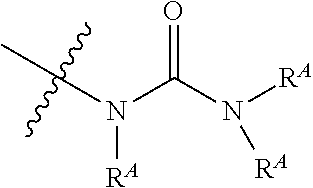
wherein each RA independently represents hydrogen or a hydrocarbyl, such as alkyl, or any occurrence of RA taken together with another and the intervening atom(s) complete a heterocycle having from 4 to 8 atoms in the ring structure.

wherein

In some embodiments, R3 is


In some embodiments, R4 is

In some embodiments, R4 is


In some embodiments, the compound is:

| TABLE 1 |
| The TRPC5 orthologs from three different species along |
| with their GenBank Ref Seq Accession Numbers. |
| Species | Nucleic Acid | Amino Acid | GeneID | |
| Homo sapiens | NM_012471.2 | NP_036603.1 | 7224 | |
| Mus musculus | NM_009428.2 | NP_033454.1 | 22067 | |
| Rattus norvegicus | NM_080898.2 | NP_543174.1 | 140933 | |

| Inter- | ||||
| mediate | Halide | Phenol | Structure | Characterization |
| C | 1- bromobutane | 3- (trifluoro methoxy) phenol |
 |
1H NMR (400 MHz, Chloroform-d) δ 7.44 (t, J = 8.3 Hz, 1H), 7.25 (ddd, J = 8.3, 2.4, 0.9 Hz, 1H), 7.19- 7.09 (m, 2H), 4.30 (t, J = 7.3 Hz, 2H), 3.92 (s, 3H), 1.81-1.70 (m, 2H), 1.45-1.34 (m, 2H), 0.97 (t, J = 7.4 Hz, 3H) |
| E | 1- (bromomethyl)- 4-chlorobenzene | 3- fluorophenol |
 |
1H NMR (400 MHz, Chloroform-d) δ 7.41-7.30 (m, 3H), 7.25-7.20 (m, 2H), 7.07-6.94 (m, 3H), 5.51 (s, 2H), 3.89 (s, 3H) |
| G | 1-(1- bromoethyl)- 4-chlorobenzene | 3- fluorophenol |
 |
1H NMR (400 MHz, Chloroform-d) δ 7.30 (s, 2H), 7.17 (d, J = 8.4 Hz, 1H), 6.91 (tdd, J = 8.8, 5.2, 2.8 Hz, 2H), 6.78-6.69 (m, 2H), 6.62 (q, J = 7.2 Hz, 1H), 5.45 (q, J = 7.2 Hz, 0H), 4.14 (q, J = 7.0 Hz, 0H), 3.94 (s, 3H), 1.95 (d, J = 7.2 Hz, 3H) |
| I | 1- bromobutane | 3- fluorophenol |
 |
1H NMR (400 MHz, Chloroform-d) δ 7.42-7.27 (m, 1H), 7.11-7.01 (m, 2H), 6.96 (ddd, J = 9.9, 8.1, 2.2 Hz, 1H), 4.30 (t, J = 7.3 Hz, 2H), 3.92 (s, 3H), 1.75 (p, J = 7.4 Hz, 2H), 1.39 (h, J = 7.3 Hz, 2H), 0.97 (t, J = 7.3 Hz, 3H). |
| J | 1- (bromomethyl)- 4-chlorobenzene | 3- fluorophenol |
 |
1H NMR (400 MHz, Chloroform-d) δ 7.39-7.31 (m, 3H), 7.23 (d, J = 8.4 Hz, 2H), 7.04 (dt, J = 9.6, 3.8 Hz, 2H), 6.97 (td, J = 8.3, 2.3 Hz, 1H), 5.51 (s, 2H), 3.89 (s, 3H) |
| K | 1- (bromomethyl)- 4-chlorobenzene | isopropanol |
 |
|
| L | 1- (bromomethyl)- 4-chlorobenzene | N-propanol |
 |
|
| M | 1- bromobutane | 3- chlorophenol |
 |
1H NMR (400 MHz, Chloroform-d) δ 7.34 (t, J = 8.1 Hz, 1H), 7.29 (d, J = 2.5 Hz, 1H), 7.24-7.16 (m, 2H), 4.29 (t, J = 7.3 Hz, 2H), 3.92 (s, 3H), 1.75 (p, J = 7.6 Hz, 2H), 1.39 (h, J = 7.4 Hz, 2H), 0.97 (t, J = 7.3 Hz, 3H) |
| N | 1- (bromomethyl)- 4- chlorobenzene | 3- chlorophenol |
 |
|
| Starting | |||
| Intermediate | Material | Structure | Characterization |
| D | C |
 |
1H NMR (400 MHz, Chloroform-d) δ 7.46 (t, J = 8.3 Hz, 1H), 7.29-7.25 (m, 1H), 7.21-7.12 (m, 2H), 4.34 (t, J = 7.2 Hz, 2H), 1.85-1.73 (m, 2H), 1.41 (h, J = 7.4 Hz, 2H), 0.99 (t, J = 7.4 Hz, 3H) |
| F | E |
 |
|
| H | G |
 |
|


| Starting | |||
| Compound | Material | NMR | LCMS |
| 3 | D | 1H NMR (400 MHz, Methanol-d4) δ 7.56 (t, J = | [M + H]+ |
| 8.3 Hz, 1H), 7.42-7.32 (m, 2H), 7.24-7.20 (m, | calculated for | ||
| 1H), 4.30 (t, J = 7.3 HZ, 2H), 4.13 (s, 2H), 3.68 (t, | molecular | ||
| J = 7.0 Hz, 2H), 3.59 (t, J = 6.2 Hz, 2H), 3.33 (s, | formula | ||
| 3H), 1.90-1.83 (m, 2H), 1.81-1.74 (m, 2H), 1.42- | C21H25F3N4O5: | ||
| 1.33 (m, 2H), 0.97 (t, J = 7.4 Hz, 3H) | 471, | ||
| observed: 471 | |||
| 4 | F | 1H NMR (400 MHz, Methanol-d4) δ 7.45-7.39 | [M + H]+ |
| (m, 1H), 7.37-7.26 (m, 4H), 7.18-7.06 (m, 2H), | calculated for | ||
| 7.04-6.99 (, 1H), 5.47 (s, 2H), 4.03 (s, 2H), | molecular | ||
| 3.64 (t, J = 7.0 Hz, 2H), 3.50 (t, J = 6.1 Hz, 2H), | formula | ||
| 3.31 (s, 3H), 1.81 (p, J = 6.6 Hz, 2H) | C23H22ClFN4O4: | ||
| 473, | |||
| observed: 473 | |||
| 5 | H | ||


| Compound | Amine | NMR |
| 11 | ethyl 3-amino-2,2- | 1H NMR (400 MHz, Methal-d4) δ 7.53 (, J = 8.3 Hz, |
| difluoropropanoate | 1H), 7.39-7.23 (m, 6H), 7.21 (d, J = 8.4 Hz, 1H), 5.51 (s, | |
| hydrochloride | 2H), 4.17 (s, 2H), 4.05 (t, J = 13.8 Hz, 2H), 3.64 (t, J = | |
| 13.1 Hz, 2H), 3.33 (s, 3H). | ||
| 12 | 3-aminocyclobutan- | 1H NMR (400 MHz, Methanol-d4) δ 7.52 (t, J = 8.1 Hz, |
| 1-ol | 1H), 7.38-7.24 (m, 6H), 7.20 (d, J = 8.3 Hz, 1H), 5.51 (s, | |
| 2H), 5.20 (t, J = 8.3 Hz, 1H), 4.41 (d, J = 7.0 Hz, 1H), 4.08 | ||
| (s, 2H), 3.33 (s, 3H), 2.60-2.53 (m, 2H), 2.28-2.23 (m, 2H). | ||
| 13 | 3-aminocyclobutan- | 1H NMR (400 MHz, Methanol-d4) δ 7.51 (t, J = 8.2 Hz, |
| 1-ol | 1H), 7.38-7.24 (m, 6H), 7.24-7.16 (m, 1H), 5.51 (s, 2H), | |
| 4.41 (tt, J = 9.8, 7.5 Hz, 1H), 4.11 (s, 2H), 4.01 (p, J = 7.2 | ||
| Hz, 1H), 3.33 (s, 3H), 2.62 (m, 2H), 2.16 (m, 2H) | ||
| 14 | rac-trans-3- | |
| aminocyclopentan-1- | ||
| ol | ||


| Starting | |||
| Compound | Material | NMR | LCMS |
| 26 | J | 1H NMR (400 MHz, Methanol-d4) chemical shifts 7.44 | [M + H]+ |
| (q, J = 7.8 Hz, 1H), 7.38-7.28 (m, 4H), 7.18-7.01 | calculated for | ||
| (m, 3H), 5.69 (d, J = 15.4 Hz, 1H), 5.50 (d, J = 15.4 | molecular | ||
| Hz, 1H), 4.10 (dt, J = 13.3, 6.8 Hz, 1H), 3.87 (dt, J = | formula | ||
| 13.7, 7.3 Hz, 1H), 3.75 (dd, J = 8.2, 4.9 Hz, 1H), 3.67 | C25H24ClFN4O4: | ||
| (q, J = 7.8 Hz, 1H), 3.53 (t, J = 6.6 Hz, 2H), 3.44 (dt, J = | 499, | ||
| 11.1, 6.0 Hz, 1H), 2.76 (dq, J = 12.1, 6.2 Hz, 1H), | observed: 499 | ||
| 2.15 (dd, J = 13.2, 7.4 Hz, 1H), 1.99 (dp, J = 12.8, 6.2 | |||
| Hz, 2H), 1.85-1.65 (m, J = 6.8 Hz, 2H). | |||
| 27 | J | 1H NMR (400 MHz, Methanol-d4) chemical shifts 7.44 | [M + H]+ |
| (q, J = 7.8 Hz, 1H), 7.37-7.30 (m, 4H), 7.18-7.01 | calculated for | ||
| (m, 3H), 5.69 (d, J = 15.3 Hz, 1H), 5.50 (d, J = 15.4 | molecular | ||
| Hz, 1H), 4.10 (dt, J = 13.4, 6.8 Hz, 1H), 3.86 (dt, J = | formula | ||
| 13.8, 7.3 Hz, 1H), 3.75 (dd, J = 8.2, 5.0 Hz, 1H), 3.67 | C25H24ClFN4O4: | ||
| (q, J = 7.6 Hz, 1H), 3.53 (t, J = 6.5 Hz, 2H), 3.44 (dt, J = | 499, | ||
| 10.9, 5.9 Hz, 1H), 2.76 (dq, J = 12.2, 6.0 Hz, 1H), | observed: 499 | ||
| 2.15 (dq, J = 15.1, 7.8 Hz, 1H), 2.00 (tq, J = 12.9, 6.7, | |||
| 6.3 Hz, 2H), 1.86-1.66 (m, J = 6.7 Hz, 2H). | |||
| 28 | K | 1H NMR (400 MHz, Methanol-d4) chemical shifts 7.31 | [M + H]+ |
| (d, J = 8.1 Hz, 2H), 7.23 (d, J = 8.2 Hz, 2H), 5.47 (d, J = | calculated for | ||
| 15.2 Hz, 1H), 5.26 (td, J = 13.6, 12.5, 7.1 Hz, 2H), | molecular | ||
| 4.06 (dt, J = 13.4, 6.8 Hz, 1H), 3.93-3.75 (m, 2H), | formula | ||
| 3.71-3.64 (m, 1H), 3.50 (q, J = 5.6, 5.1 Hz, 3H), 2.76 | C22H27ClN4O4: | ||
| (dq, J = 12.1, 6.0 Hz, 1H), 2.15 (dq, J = 14.6, 7.6 Hz, | 447, | ||
| 1H), 2.01 (dp, J = 13.2, 6.1 Hz, 2H), 1.82-1.61 (m, J = | observed: 447 | ||
| 6.7 Hz, 2H), 1.47-1.25 (m, 6H). | |||
| 29 | K | 1H NMR (400 MHz, Methanol-d4) chamical shifts 7.31 | [M + H]+ |
| (d, J = 8.1 Hz, 2H), 7.23 (d, J = 8.2 Hz, 2H), 5.47 (d, J = | calculated for | ||
| 15.2 Hz, 1H), 5.26 (td, J = 13.6, 7.2 Hz, 2H), | molecular | ||
| 4.06 (dt, J = 13.3, 6.8 Hz, 1H), 3.93-3.74 (m, 2H), 3.70 | formula | ||
| (dd, J = 8.1, 5.0 Hz, 1H), 3.50 (t, J = 6.2 Hz, 3H), 2.76 | C22H27ClN4O4: | ||
| (dd, J = 12.6, 6.2 Hz, 1H), 2.15 (dq, J = 14.6, 7.6 Hz, | 447, | ||
| 1H), 2.01 (dq, J = 13.3, 6.4 Hz, 2H), 1.73 (dp, J = 14.2, | observed: 447 | ||
| 6.8 Hz, 2H), 1.39 (dd, J = 6.3, 2.0 Hz, 6H). | |||
| 30 | L | 1H NMR (400 MHz, Methanol-d4) chemical shifts 7.32 | [M + H]+ |
| (d, J = 8.2 Hz, 2H), 7.23 (d, J = 8.2 Hz, 2H), 5.50 (d, J = | calculated for | ||
| 15.4 Hz, 1H), 5.32 (d, J = 15.3 Hz, 1H), 4.43 (t, J = | molecular | ||
| 6.5 Hz, 2H), 4.06 (dt, J = 13.4, 6.7 Hz, 1H), 3.90-3.75 | formula | ||
| (m, 2H), 3.71 (dd, J = 8.2, 5.0 Hz, 1H), 3.51 (q, J = 6.9 | C22H27ClN4O4: | ||
| Hz, 3H), 2.76 (dd, J = 12.4, 6.3 Hz, 1H), 2.15 (dq, J = | 447, | ||
| 14.5, 7.5 Hz, 1H), 2.01 (dq, J = 13.3, 6.3 Hz, 2H), 1.76 | observed: 447 | ||
| (m, 4H), 0.99 (t, J = 7.4 Hz, 3H). | |||
| 31 | L | 1H NMR (400 MHz, Methanol-d4) chemical shifts 7.32 | [M + H]+ |
| (d, J = 8.0 Hz, 2H), 7.23 (d, J = 8.1 Hz, 2H), 5.50 (d, J = | calculated for | ||
| 15.3 Hz, 1H), 5.32 (d, J = 15.2 Hz, 1H), 4.43 (t, J = | molecular | ||
| 6.5 Hz, 2H), 4.06 (dt, J = 13.4, 6.9 Hz, 1H), 3.91-3.74 | formula | ||
| (m, 2H), 3.72-3.67 (m, 1H), 3.50 (t, J = 6.9 Hz, 3H), | C22H27ClN4O4: | ||
| 2.76 (dd, J = 12.5, 6.3 Hz, 1H), 2.14 (dt, J = 14.9, 7.6 | 447, | ||
| Hz, 1H), 2.00 (dt, J = 13.3, 6.9 Hz, 2H), 1.76 (m, 4H), | observed: 447 | ||
| 0.99 (t, J = 7.4 Hz, 3H). | |||
| 32 | M | 1H NMR (400 MHz, Methanol-d4) chemical shifts 7.44 | [M + H] |
| (t, J = 8.2 Hz, 1H), 7.38 (d, J = 2.2 Hz, 1H), 7.32-7.28 | calculated for | ||
| (m, 1H), 7.24 (dd, J = 8.3, 2.4 Hz, 1H), 4.42 (dt, J = | molecular | ||
| 13.5, 6.8 Hz, 1H), 4.26 (dt, J = 13.9, 7.4 Hz, 1H), 4.13 | formula | ||
| (ddd, J = 13.4, 7.7, 5.8 Hz, 1H), 3.88 (dt, J = 13.6, 7.3 | C22H27ClN4O4: | ||
| Hz, 1H), 3.76 (dd, J = 8.2, 4.7 Hz, 1H), 3.64 (dt, J = | 447, | ||
| 10.2, 7.4 Hz, 1H), 3.59-3.51 (m, 2H), 3.43 (dt, J = 10.8, | observed: 447 | ||
| 5.7 Hz, 1H), 2.77 (dq, J = 12.1, 5.9 Hz, 1H), 2.15 (dt, J = | |||
| 12.9, 7.9 Hz, 1H), 1.98 (dp, J = 12.1, 6.4, 5.6 Hz, | |||
| 2H), 1.86-1.70 (m, 4H), 1.40 (h, J = 7.3 Hz, 2H), 0.99 | |||
| (t, J = 7.4 Hz, 3H). | |||
| 33 | N | 1H NMR (400 MHz, Methanol-d4) chemical shifts 7.42 | [M + H]+ |
| (t, J = 8.2 Hz, 1H), 7.37-7.30 (m, 6H), 7.25-7.18 (m, | calculated for | ||
| 1H), 5.70 (d, J = 15.3 Hz, 1H), 5.50 (d, J = 15.3 Hz, | molecular | ||
| 1H), 4.10 (dt, J = 13.4, 6.4 Hz, 1H), 3.86 (dt, J = 13.7, | formula | ||
| 7.3 Hz, 1H), 3.75 (dd, J = 8.1, 4.9 Hz, 1H), 3.70-3.58 | C25H24Cl2N4O4: | ||
| (m, 1H), 3.58-3.49 (m, 2H), 3.44 (dt, J = 10.9, 6.0 Hz, | 515, | ||
| 1H), 2.76 (dq, J = 12.1, 5.9 Hz, 1H), 2.19-2.09 (m, 1H), | observed: 515 | ||
| 2.00 (tq, J = 12.7, 6.6, 6.2 Hz, 2H), 1.76 (dp, J = 14.3, | |||
| 7.0 Hz, 2H). | |||

wherein “RFU” is the relative fluorescent units.
| TABLE 2 |
| QPatch, FLIPR Inhibitor and FLIPR Agonist potency ranges for representative compounds of the disclosure. |
| Qpatch | Inhibitor | Agonist | ||
| Potency | Potency | Potency | ||
| Compound | Structure | Range | Range | Range |
| 1 |
 |
B | ND | ND |
| 2 |
 |
B | B | ND |
| 3 |
 |
ND | B | ND |
| 4 |
 |
ND | B | ND |
| 5 |
 |
ND | ND | ND |
| 6 |
 |
C | C | ND |
| 7 |
 |
B | C | ND |
| 8 |
 |
ND | B | ND |
| 9 |
 |
B | ND | ND |
| 10 |
 |
ND | B | ND |
| 11 |
 |
C | B | ND |
| 12 |
 |
ND | ND | ND |
| 13 |
 |
B | ND | ND |
| 14 |
 |
ND | ND | ND |
| 15 |
 |
ND | A | ND |
| 16 |
 |
ND | B | ND |
| 17 |
 |
C | ND | ND |
| 18 |
 |
A | C | ND |
| 19 |
 |
C | C | D |
| 20 |
 |
B | A | ND |
| 21 |
 |
B | A | C |
| 22 |
 |
C | C | B |
| 23 |
 |
B | A | C |
| 24 |
 |
A | A | ND |
| 25 |
 |
ND | C | D |
| 26 |
 |
ND | A | ND |
| 27 |
 |
ND | C | A |
| 28 |
 |
ND | C | A |
| 29 |
 |
ND | C | B |
| 30 |
 |
ND | C | B |
| 31 |
 |
ND | C | A |
| 32 |
 |
ND | A | ND |
| 33 |
 |
ND | A | ND |
| 34 |
 |
ND | A | ND |
| 35 |
 |
ND | B | ND |
| TRPC5 Plasmid Sequence | |
| The DNA sequence of the TRPC5 plasmid used in Example 2 is included | |
| below. Underlined nucleic acids represent those encoding human TRPC5. | |
| SEQ ID NO: 1 | |
| GACGGATCGGGAGATCTCCCGATCCCCTATGGTGCACTCTCAGTACAATCTGCTCTG | |
| ATGCCGCATAGTTAAGCCAGTATCTGCTCCCTGCTTGTGTGTTGGAGGTCGCTGAGT | |
| AGTGCGCGAGCAAAATTTAAGCTACAACAAGGCAAGGCTTGACCGACAATTGCATG | |
| AAGAATCTGCTTAGGGTTAGGCGTTTTGCGCTGCTTCGCGATGTACGGGCCAGATAT | |
| ACGCGTTGACATTGATTATTGACTAGTTATTAATAGTAATCAATTACGGGGTCATTA | |
| GTTCATAGCCCATATATGGAGTTCCGCGTTACATAACTTACGGTAAATGGCCCGCCT | |
| GGCTGACCGCCCAACGACCCCCGCCCATTGACGTCAATAATGACGTATGTTCCCATA | |
| GTAACGCCAATAGGGACTTTCCATTGACGTCAATGGGTGGAGTATTTACGGTAAACT | |
| GCCCACTTGGCAGTACATCAAGTGTATCATATGCCAAGTACGCCCCCTATTGACGTC | |
| AATGACGGTAAATGGCCCGCCTGGCATTATGCCCAGTACATGACCTTATGGGACTTT | |
| CCTACTTGGCAGTACATCTACGTATTAGTCATCGCTATTACCATGGTGATGCGGTTTT | |
| GGCAGTACATCAATGGGCGTGGATAGCGGTTTGACTCACGGGGATTTCCAAGTCTCC | |
| ACCCCATTGACGTCAATGGGAGTTTGTTTTGGCACCAAAATCAACGGGACTTTCCAA | |
| AATGTCGTAACAACTCCGCCCCATTGACGCAAATGGGCGGTAGGCGTGTACGGTGG | |
| GAGGTCTATATAAGCAGAGCTCTCCCTATCAGTGATAGAGATCTCCCTATCAGTGAT | |
| AGAGATCGTCGACGAGCTCGTTTAGTGAACCGTCAGATCGCCTGGAGACGCCATCC | |
| ACGCTGTTTTGACCTCCATAGAAGACACCGGGACCGATCCAGCCTCCGGACTCTAGC | |
| GTTTAAACTTAAGCCCAAGCTGGCTAGACCGCCATGGCCCAACTGTACTACAAAAA | |
| GGTCAACTACTCACCGTACAGAGACCGCATCCCCCTGCAAATTGTGAGGGCTGAGA | |
| CAGAGCTCTCTGCAGAGGAGAAGGCCTTCCTCAATGCTGTGGAGAAGGGGGACTAT | |
| GCCACTGTGAAGCAGGCCCTTCAGGAGGCTGAGATCTACTATAATGTTAACATCAAC | |
| TGCATGGACCCCTTGGGCCGGAGTGCCCTGCTCATTGCCATTGAGAACGAGAACCTG | |
| GAGATCATGGAGCTACTGCTGAACCACAGCGTGTATGTGGGTGATGCATTGCTCTAT | |
| GCCATACGCAAGGAAGTGGTGGGCGCTGTGGAGCTTCTGCTCAGCTACAGGCGGCC | |
| CAGCGGAGAGAAGCAGGTCCCCACTCTGATGATGGACACGCAGTTCTCTGAATTCA | |
| CACCGGACATCACTCCCATCATGCTGGCTGCCCACACCAACAACTACGAAATCATCA | |
| AACTGCTTGTCCAAAAACGGGTCACTATCCCACGGCCCCACCAGATCCGCTGCAACT | |
| GTGTGGAGTGTGTGTCTAGTTCAGAGGTAGACAGCCTGCGCCACTCTCGCTCCCGAC | |
| TGAACATCTATAAGGCTCTGGCAAGCCCCTCACTCATTGCCTTATCAAGTGAGGACC | |
| CCATCCTAACTGCCTTCCGTCTGGGCTGGGAGCTCAAGGAGCTCAGCAAGGTGGAG | |
| AATGAGTTCAAGGCCGAGTATGAGGAGCTCTCTCAGCAGTGCAAGCTCTTTGCCAAA | |
| GACCTGCTGGACCAAGCTCGGAGCTCCAGGGAACTGGAGATCATCCTCAACCATCG | |
| AGATGACCACAGTGAAGAGCTTGACCCTCAGAAGTACCATGACCTGGCCAAGTTGA | |
| AGGTGGCAATCAAATACCACCAGAAAGAGTTTGTTGCTCAGCCCAACTGCCAACAG | |
| TTGCTTGCCACCCTGTGGTATGATGGCTTCCCTGGATGGCGGCGGAAACACTGGGTA | |
| GTCAAGCTTCTAACCTGCATGACCATTGGGTTCCTGTTTCCCATGCTGTCTATAGCCT | |
| ACCTGATCTCACCCAGGAGCAACCTTGGGCTGTTCATCAAGAAACCCTTTATCAAGT | |
| TTATCTGCCACACAGCATCCTATTTGACCTTCCTCTTTATGCTTCTCCTGGCTTCTCAG | |
| CACATTGTCAGGACAGACCTTCATGTACAGGGGCCTCCCCCAACTGTCGTGGAATGG | |
| ATGATATTGCCTTGGGTTCTAGGTTTCATTTGGGGTGAGATTAAGGAAATGTGGGAT | |
| GGTGGATTTACTGAATACATCCATGACTGGTGGAACCTGATGGATTTTGCAATGAAC | |
| TCCCTCTACCTGGCAACTATTTCCCTGAAGATTGTGGCCTATGTCAAGTATAATGGTT | |
| CTCGTCCAAGGGAGGAATGGGAAATGTGGCACCCGACTCTGATTGCGGAAGCACTC | |
| TTCGCAATATCCAACATTTTAAGTTCGTTGCGTCTCATATCCCTGTTCACAGCCAACT | |
| CCCACTTAGGACCTCTGCAGATCTCTTTGGGACGCATGCTGCTTGATATCCTCAAATT | |
| CCTCTTTATCTACTGCCTGGTACTACTAGCTTTTGCCAATGGACTGAACCAGCTTTAC | |
| TTCTATTATGAAACCAGAGCTATCGATGAGCCTAACAACTGCAAGGGGATCCGATGT | |
| GAGAAACAGAACAATGCCTTCTCCACGCTCTTTGAGACTCTTCAGTCACTCTTCTGG | |
| TCTGTATTTGGCCTTTTAAATCTATATGTCACCAATGTGAAAGCCAGACACGAATTC | |
| ACCGAGTTTGTAGGAGCTACCATGTTTGGAACATACAATGTCATCTCCCTGGTAGTG | |
| CTGCTGAACATGCTGATTGCTATGATGAACAACTCCTATCAGCTTATTGCCGATCAT | |
| GCTGATATCGAGTGGAAGTTTGCAAGGACGAAGCTCTGGATGAGTTACTTTGATGAA | |
| GGTGGCACCTTGCCACCTCCTTTCAACATCATCCCCAGCCCCAAGTCATTTCTATACC | |
| TTGGTAACTGGTTCAACAACACCTTCTGCCCCAAAAGAGACCCTGACGGTAGACGG | |
| AGAAGGCGCAACTTGAGAAGTTTCACAGAACGCAATGCTGACAGCCTGATACAAAA | |
| TCAACATTATCAGGAAGTTATCAGGAATTTAGTCAAAAGATATGTGGCTGCTATGAT | |
| AAGAAATTCCAAAACACATGAGGGACTTACAGAAGAAAATTTTAAGGAATTAAAGC | |
| AAGACATCTCCAGCTTTCGGTATGAAGTGCTTGACCTCTTGGGAAATAGAAAACATC | |
| CAAGGAGCTTTTCCACTAGCAGCACTGAACTGTCTCAGAGAGACGATAATAATGAT | |
| GGCAGTGGTGGGGCTCGGGCCAAATCCAAGAGTGTCTCTTTTAATTTAGGCTGCAAG | |
| AAAAAGACTTGCCATGGGCCACCTCTCATCAGAACCATGCCAAGGTCCAGTGGTGC | |
| CCAAGGAAAGTCAAAAGCTGAGTCATCAAGCAAACGCTCCTTCATGGGTCCTTCTCT | |
| CAAGAAACTGGGTCTCCTATTCTCCAAATTTAATGGTCATATGTCTGAACCCAGTTC | |
| AGAGCCAATGTACACAATTTCTGATGGAATTGTTCAGCAGCACTGTATGTGGCAGGA | |
| CATCAGATATTCTCAGATGGAGAAAGGGAAAGCAGAGGCCTGTTCTCAAAGTGAAA | |
| TTAACCTCAGTGAGGTAGAATTAGGTGAAGTCCAGGGCGCTGCTCAGAGCAGTGAA | |
| TGCCCTCTAGCCTGTTCCAGCTCTCTTCACTGTGCATCCAGCATCTGCTCCTCAAATT | |
| CTAAACTTTTAGACTCCTCAGAGGATGTATTTGAAACTTGGGGAGAGGCTTGTGACT | |
| TGCTCATGCACAAATGGGGTGATGGACAGGAAGAACAAGTTACAACTCGCCTCTAA | |
| TGACTCGAGTCTAGAGGGCCCGTTTAAACCCGCTGATCAGCCTCGACTGTGCCTTCT | |
| AGTTGCCAGCCATCTGTTGTTTGCCCCTCCCCCGTGCCTTCCTTGACCCTGGAAGGTG | |
| CCACTCCCACTGTCCTTTCCTAATAAAATGAGGAAATTGCATCGCATTGTCTGAGTA | |
| GGTGTCATTCTATTCTGGGGGGTGGGGTGGGGCAGGACAGCAAGGGGGAGGATTGG | |
| GAAGACAATAGCAGGCATGCTGGGGATGCGGTGGGCTCTATGGCTTCTGAGGCGGA | |
| AAGAACCAGCTGGGGCTCTAGGGGGTATCCCCACGCGCCCTGTAGCGGCGCATTAA | |
| GCGCGGCGGGTGTGGTGGTTACGCGCAGCGTGACCGCTACACTTGCCAGCGCCCTA | |
| GCGCCCGCTCCTTTCGCTTTCTTCCCTTCCTTTCTCGCCACGTTCGCCGGCTTTCCCCG | |
| TCAAGCTCTAAATCGGGGGCTCCCTTTAGGGTTCCGATTTAGTGCTTTACGGCACCTC | |
| GACCCCAAAAAACTTGATTAGGGTGATGGTTCACGTAGTGGGCCATCGCCCTGATAG | |
| ACGGTTTTTCGCCCTTTGACGTTGGAGTCCACGTTCTTTAATAGTGGACTCTTGTTCC | |
| AAACTGGAACAACACTCAACCCTATCTCGGTCTATTCTTTTGATTTATAAGGGATTTT | |
| GCCGATTTCGGCCTATTGGTTAAAAAATGAGCTGATTTAACAAAAATTTAACGCGAA | |
| TTAATTCTGTGGAATGTGTGTCAGTTAGGGTGTGGAAAGTCCCCAGGCTCCCCAGCA | |
| GGCAGAAGTATGCAAAGCATGCATCTCAATTAGTCAGCAACCAGGTGTGGAAAGTC | |
| CCCAGGCTCCCCAGCAGGCAGAAGTATGCAAAGCATGCATCTCAATTAGTCAGCAA | |
| CCATAGTCCCGCCCCTAACTCCGCCCATCCCGCCCCTAACTCCGCCCAGTTCCGCCC | |
| ATTCTCCGCCCCATGGCTGACTAATTTTTTTTATTTATGCAGAGGCCGAGGCCGCCTC | |
| TGCCTCTGAGCTATTCCAGAAGTAGTGAGGAGGCTTTTTTGGAGGCCTAGGCTTTTG | |
| CAAAAAGCTCCCGGGAGCTTGTATATCCATTTTCGGATCTGATCAGCACGTGATGAA | |
| AAAGCCTGAACTCACCGCGACGTCTGTCGAGAAGTTTCTGATCGAAAAGTTCGACA | |
| GCGTCTCCGACCTGATGCAGCTCTCGGAGGGCGAAGAATCTCGTGCTTTCAGCTTCG | |
| ATGTAGGAGGGCGTGGATATGTCCTGCGGGTAAATAGCTGCGCCGATGGTTTCTACA | |
| AAGATCGTTATGTTTATCGGCACTTTGCATCGGCCGCGCTCCCGATTCCGGAAGTGC | |
| TTGACATTGGGGAATTCAGCGAGAGCCTGACCTATTGCATCTCCCGCCGTGCACAGG | |
| GTGTCACGTTGCAAGACCTGCCTGAAACCGAACTGCCCGCTGTTCTGCAGCCGGTCG | |
| CGGAGGCCATGGATGCGATCGCTGCGGCCGATCTTAGCCAGACGAGCGGGTTCGGC | |
| CCATTCGGACCGCAAGGAATCGGTCAATACACTACATGGCGTGATTTCATATGCGCG | |
| ATTGCTGATCCCCATGTGTATCACTGGCAAACTGTGATGGACGACACCGTCAGTGCG | |
| TCCGTCGCGCAGGCTCTCGATGAGCTGATGCTTTGGGCCGAGGACTGCCCCGAAGTC | |
| CGGCACCTCGTGCACGCGGATTTCGGCTCCAACAATGTCCTGACGGACAATGGCCGC | |
| ATAACAGCGGTCATTGACTGGAGCGAGGCGATGTTCGGGGATTCCCAATACGAGGT | |
| CGCCAACATCTTCTTCTGGAGGCCGTGGTTGGCTTGTATGGAGCAGCAGACGCGCTA | |
| CTTCGAGCGGAGGCATCCGGAGCTTGCAGGATCGCCGCGGCTCCGGGCGTATATGC | |
| TCCGCATTGGTCTTGACCAACTCTATCAGAGCTTGGTTGACGGCAATTTCGATGATG | |
| CAGCTTGGGCGCAGGGTCGATGCGACGCAATCGTCCGATCCGGAGCCGGGACTGTC | |
| GGGCGTACACAAATCGCCCGCAGAAGCGCGGCCGTCTGGACCGATGGCTGTGTAGA | |
| AGTACTCGCCGATAGTGGAAACCGACGCCCCAGCACTCGTCCGAGGGCAAAGGAAT | |
| AGCACGTGCTACGAGATTTCGATTCCACCGCCGCCTTCTATGAAAGGTTGGGCTTCG | |
| GAATCGTTTTCCGGGACGCCGGCTGGATGATCCTCCAGCGCGGGGATCTCATGCTGG | |
| AGTTCTTCGCCCACCCCAACTTGTTTATTGCAGCTTATAATGGTTACAAATAAAGCA | |
| ATAGCATCACAAATTTCACAAATAAAGCATTTTTTTCACTGCATTCTAGTTGTGGTTT | |
| GTCCAAACTCATCAATGTATCTTATCATGTCTGTATACCGTCGACCTCTAGCTAGAGC | |
| TTGGCGTAATCATGGTCATAGCTGTTTCCTGTGTGAAATTGTTATCCGCTCACAATTC | |
| CACACAACATACGAGCCGGAAGCATAAAGTGTAAAGCCTGGGGTGCCTAATGAGTG | |
| AGCTAACTCACATTAATTGCGTTGCGCTCACTGCCCGCTTTCCAGTCGGGAAACCTG | |
| TCGTGCCAGCTGCATTAATGAATCGGCCAACGCGCGGGGAGAGGCGGTTTGCGTATT | |
| GGGCGCTCTTCCGCTTCCTCGCTCACTGACTCGCTGCGCTCGGTCGTTCGGCTGCGGC | |
| GAGCGGTATCAGCTCACTCAAAGGCGGTAATACGGTTATCCACAGAATCAGGGGAT | |
| AACGCAGGAAAGAACATGTGAGCAAAAGGCCAGCAAAAGGCCAGGAACCGTAAAA | |
| AGGCCGCGTTGCTGGCGTTTTTCCATAGGCTCCGCCCCCCTGACGAGCATCACAAAA | |
| ATCGACGCTCAAGTCAGAGGTGGCGAAACCCGACAGGACTATAAAGATACCAGGCG | |
| TTTCCCCCTGGAAGCTCCCTCGTGCGCTCTCCTGTTCCGACCCTGCCGCTTACCGGAT | |
| ACCTGTCCGCCTTTCTCCCTTCGGGAAGCGTGGCGCTTTCTCATAGCTCACGCTGTAG | |
| GTATCTCAGTTCGGTGTAGGTCGTTCGCTCCAAGCTGGGCTGTGTGCACGAACCCCC | |
| CGTTCAGCCCGACCGCTGCGCCTTATCCGGTAACTATCGTCTTGAGTCCAACCCGGT | |
| AAGACACGACTTATCGCCACTGGCAGCAGCCACTGGTAACAGGATTAGCAGAGCGA | |
| GGTATGTAGGCGGTGCTACAGAGTTCTTGAAGTGGTGGCCTAACTACGGCTACACTA | |
| GAAGAACAGTATTTGGTATCTGCGCTCTGCTGAAGCCAGTTACCTTCGGAAAAAGAG | |
| TTGGTAGCTCTTGATCCGGCAAACAAACCACCGCTGGTAGCGGTTGGTTTTTTGTTTG | |
| CAAGCAGCAGATTACGCGCAGAAAAAAAGGATCTCAAGAAGATCCTTTGATCTTTT | |
| CTACGGGGTCTGACGCTCAGTGGAACGAAAACTCACGTTAAGGGATTTTGGTCATGA | |
| GATTATCAAAAAGGATCTTCACCTAGATCCTTTTAAATTAAAAATGAAGTTTTAAAT | |
| CAATCTAAAGTATATATGAGTAAACTTGGTCTGACAGTTACCAATGCTTAATCAGTG | |
| AGGCACCTATCTCAGCGATCTGTCTATTTCGTTCATCCATAGTTGCCTGACTCCCCGT | |
| CGTGTAGATAACTACGATACGGGAGGGCTTACCATCTGGCCCCAGTGCTGCAATGAT | |
| ACCGCGAGACCCACGCTCACCGGCTCCAGATTTATCAGCAATAAACCAGCCAGCCG | |
| GAAGGGCCGAGCGCAGAAGTGGTCCTGCAACTTTATCCGCCTCCATCCAGTCTATTA | |
| ATTGTTGCCGGGAAGCTAGAGTAAGTAGTTCGCCAGTTAATAGTTTGCGCAACGTTG | |
| TTGCCATTGCTACAGGCATCGTGGTGTCACGCTCGTCGTTTGGTATGGCTTCATTCAG | |
| CTCCGGTTCCCAACGATCAAGGCGAGTTACATGATCCCCCATGTTGTGCAAAAAAGC | |
| GGTTAGCTCCTTCGGTCCTCCGATCGTTGTCAGAAGTAAGTTGGCCGCAGTGTTATC | |
| ACTCATGGTTATGGCAGCACTGCATAATTCTCTTACTGTCATGCCATCCGTAAGATG | |
| CTTTTCTGTGACTGGTGAGTACTCAACCAAGTCATTCTGAGAATAGTGTATGCGGCG | |
| ACCGAGTTGCTCTTGCCCGGCGTCAATACGGGATAATACCGCGCCACATAGCAGAA | |
| CTTTAAAAGTGCTCATCATTGGAAAACGTTCTTCGGGGCGAAAACTCTCAAGGATCT | |
| TACCGCTGTTGAGATCCAGTTCGATGTAACCCACTCGTGCACCCAACTGATCTTCAG | |
| CATCTTTTACTTTCACCAGCGTTTCTGGGTGAGCAAAAACAGGAAGGCAAAATGCCG | |
| CAAAAAAGGGAATAAGGGCGACACGGAAATGTTGAATACTCATACTCTTCCTTTTTC | |
| AATATTATTGAAGCATTTATCAGGGTTATTGTCTCATGAGCGGATACATATTTGAAT | |
| GTATTTAGAAAAATAAACAAATAGGGGTTCCGCGCACATTTCCCCGAAAAGTGCCA | |
| CCTGACGTC |
Claims (10)


Priority Applications (1)
| Application Number | Priority Date | Filing Date | Title |
|---|---|---|---|
| US16/977,945 US11623930B2 (en) | 2018-03-05 | 2019-03-05 | Imidazodiazepinediones and methods of use thereof |
Applications Claiming Priority (3)
| Application Number | Priority Date | Filing Date | Title |
|---|---|---|---|
| US201862638448P | 2018-03-05 | 2018-03-05 | |
| US16/977,945 US11623930B2 (en) | 2018-03-05 | 2019-03-05 | Imidazodiazepinediones and methods of use thereof |
| PCT/US2019/020732 WO2019173327A1 (en) | 2018-03-05 | 2019-03-05 | Imidazodiazepinediones and methods of use thereof |
Related Parent Applications (1)
| Application Number | Title | Priority Date | Filing Date |
|---|---|---|---|
| PCT/US2019/020732 A-371-Of-International WO2019173327A1 (en) | 2018-03-05 | 2019-03-05 | Imidazodiazepinediones and methods of use thereof |
Related Child Applications (1)
| Application Number | Title | Priority Date | Filing Date |
|---|---|---|---|
| US18/104,610 Continuation US12466834B2 (en) | 2018-03-05 | 2023-02-01 | Imidazodiazepinediones and methods of use thereof |
Publications (2)
| Publication Number | Publication Date |
|---|---|
| US20210087200A1 US20210087200A1 (en) | 2021-03-25 |
| US11623930B2 true US11623930B2 (en) | 2023-04-11 |
Family
ID=67847465
Family Applications (2)
| Application Number | Title | Priority Date | Filing Date |
|---|---|---|---|
| US16/977,945 Active 2039-03-16 US11623930B2 (en) | 2018-03-05 | 2019-03-05 | Imidazodiazepinediones and methods of use thereof |
| US18/104,610 Active US12466834B2 (en) | 2018-03-05 | 2023-02-01 | Imidazodiazepinediones and methods of use thereof |
Family Applications After (1)
| Application Number | Title | Priority Date | Filing Date |
|---|---|---|---|
| US18/104,610 Active US12466834B2 (en) | 2018-03-05 | 2023-02-01 | Imidazodiazepinediones and methods of use thereof |
Country Status (8)
| Country | Link |
|---|---|
| US (2) | US11623930B2 (en) |
| EP (2) | EP3761989B1 (en) |
| JP (3) | JP7408557B2 (en) |
| CN (2) | CN118908961A (en) |
| AU (2) | AU2019231208B2 (en) |
| CA (1) | CA3093084A1 (en) |
| ES (1) | ES3070460T3 (en) |
| WO (1) | WO2019173327A1 (en) |
Families Citing this family (4)
| Publication number | Priority date | Publication date | Assignee | Title |
|---|---|---|---|---|
| AU2019231208B2 (en) | 2018-03-05 | 2025-01-23 | Gfb (Abc), Llc | Imidazodiazepinediones and methods of use thereof |
| AU2020357178A1 (en) * | 2019-10-04 | 2022-05-12 | Gfb (Abc), Llc | Biomarker-based treatment of focal segmental glomerulosclerosis and diabetic kidney disease |
| CN115927202A (en) * | 2023-01-10 | 2023-04-07 | 北京爱思益普生物科技股份有限公司 | TRPC5 mutant cell strain and construction method and application thereof |
| CN118373832B (en) * | 2023-01-20 | 2025-01-28 | 深圳晶蛋生物医药科技有限公司 | Macrocyclic compounds, pharmaceutical compositions and applications thereof |
Citations (4)
| Publication number | Priority date | Publication date | Assignee | Title |
|---|---|---|---|---|
| US20090163545A1 (en) | 2007-12-21 | 2009-06-25 | University Of Rochester | Method For Altering The Lifespan Of Eukaryotic Organisms |
| WO2014143799A2 (en) | 2013-03-15 | 2014-09-18 | Hydra Biosciences, Inc. | Substituted xanthines and methods of use thereof |
| WO2014152287A2 (en) | 2013-03-14 | 2014-09-25 | Hydra Biosciences, Inc. | Substituted xanthines and methods of use thereof |
| WO2019173327A1 (en) | 2018-03-05 | 2019-09-12 | Goldfinch Bio, Inc. | Imidazodiazepinediones and methods of use thereof |
Family Cites Families (4)
| Publication number | Priority date | Publication date | Assignee | Title |
|---|---|---|---|---|
| WO1994020460A1 (en) * | 1993-03-11 | 1994-09-15 | Smithkline Beecham Corporation | Chemical compounds |
| JP6667092B2 (en) | 2014-08-11 | 2020-03-18 | ハイドラ・バイオサイエンシーズ・リミテッド・ライアビリティ・カンパニーHydra Biosciences, LLC | Pyrrolo [3,2-d] pyrimidine-2,4 (3H, 5H) -dione derivative |
| JP7114702B2 (en) | 2017-07-11 | 2022-08-08 | ベーリンガー インゲルハイム インターナショナル ゲゼルシャフト ミット ベシュレンクテル ハフツング | Novel substituted xanthine derivatives |
| EP3917940A1 (en) * | 2019-01-30 | 2021-12-08 | Rothamsted Research Ltd | Cylodimer of dehydrosalicortin and derivatives thereof isolated from plant of the genus salix for use in cancer therapy |
-
2019
- 2019-03-05 AU AU2019231208A patent/AU2019231208B2/en active Active
- 2019-03-05 ES ES19763337T patent/ES3070460T3/en active Active
- 2019-03-05 EP EP19763337.3A patent/EP3761989B1/en active Active
- 2019-03-05 WO PCT/US2019/020732 patent/WO2019173327A1/en not_active Ceased
- 2019-03-05 US US16/977,945 patent/US11623930B2/en active Active
- 2019-03-05 EP EP26177203.2A patent/EP4763288A2/en active Pending
- 2019-03-05 CN CN202410783264.2A patent/CN118908961A/en active Pending
- 2019-03-05 JP JP2020543957A patent/JP7408557B2/en active Active
- 2019-03-05 CA CA3093084A patent/CA3093084A1/en active Pending
- 2019-03-05 CN CN201980030356.0A patent/CN112351781B/en active Active
-
2023
- 2023-02-01 US US18/104,610 patent/US12466834B2/en active Active
- 2023-12-19 JP JP2023214175A patent/JP7809096B2/en active Active
-
2025
- 2025-04-17 AU AU2025202716A patent/AU2025202716A1/en active Pending
-
2026
- 2026-01-19 JP JP2026006881A patent/JP2026086459A/en active Pending
Patent Citations (4)
| Publication number | Priority date | Publication date | Assignee | Title |
|---|---|---|---|---|
| US20090163545A1 (en) | 2007-12-21 | 2009-06-25 | University Of Rochester | Method For Altering The Lifespan Of Eukaryotic Organisms |
| WO2014152287A2 (en) | 2013-03-14 | 2014-09-25 | Hydra Biosciences, Inc. | Substituted xanthines and methods of use thereof |
| WO2014143799A2 (en) | 2013-03-15 | 2014-09-18 | Hydra Biosciences, Inc. | Substituted xanthines and methods of use thereof |
| WO2019173327A1 (en) | 2018-03-05 | 2019-09-12 | Goldfinch Bio, Inc. | Imidazodiazepinediones and methods of use thereof |
Non-Patent Citations (26)
Also Published As
| Publication number | Publication date |
|---|---|
| WO2019173327A1 (en) | 2019-09-12 |
| CN118908961A (en) | 2024-11-08 |
| US20230365575A1 (en) | 2023-11-16 |
| JP2024037971A (en) | 2024-03-19 |
| JP7408557B2 (en) | 2024-01-05 |
| JP2021516225A (en) | 2021-07-01 |
| EP3761989A1 (en) | 2021-01-13 |
| EP3761989C0 (en) | 2026-05-13 |
| JP7809096B2 (en) | 2026-01-30 |
| CN112351781B (en) | 2024-07-02 |
| AU2019231208B2 (en) | 2025-01-23 |
| EP3761989A4 (en) | 2021-11-24 |
| ES3070460T3 (en) | 2026-06-16 |
| AU2019231208A1 (en) | 2020-09-17 |
| JP2026086459A (en) | 2026-05-26 |
| AU2025202716A1 (en) | 2025-05-08 |
| CN112351781A (en) | 2021-02-09 |
| CA3093084A1 (en) | 2019-09-12 |
| US20210087200A1 (en) | 2021-03-25 |
| EP3761989B1 (en) | 2026-05-13 |
| EP4763288A2 (en) | 2026-06-24 |
| US12466834B2 (en) | 2025-11-11 |
Similar Documents
| Publication | Publication Date | Title |
|---|---|---|
| US12466834B2 (en) | Imidazodiazepinediones and methods of use thereof | |
| US11046690B2 (en) | Pyridazinones and methods of use thereof | |
| JP7082446B2 (en) | Sulfoxyimine glycosidase inhibitor | |
| US20220152031A1 (en) | Pyridazinones and methods of use thereof | |
| US20200377505A1 (en) | Benzimidazoles and aza-benzimidazoles, and methods of use thereof | |
| MX2013003345A (en) | SUBSTITUTED AMIDA COMPOSITE. | |
| WO2018175537A1 (en) | Selective inhibition of gluconeogenic activity | |
| CA3156814A1 (en) | Biomarker-based treatment of focal segmental glomerulosclerosis and diabetic kidney disease | |
| EP1167369A1 (en) | Novel thiazolobenzimidazole derivatives | |
| US20210115036A1 (en) | Azaindoles and methods of use thereof | |
| JP2022549807A (en) | Xanthine CB1 inhibitor | |
| HK40115225A (en) | Pyridazinones and methods of use thereof | |
| HK40056020B (en) | Pyridazinones and methods of use thereof | |
| HK40056020A (en) | Pyridazinones and methods of use thereof | |
| EA048445B1 (en) | PYRIDAZINONES AND METHODS OF THEIR APPLICATION |
Legal Events
| Date | Code | Title | Description |
|---|---|---|---|
| FEPP | Fee payment procedure |
Free format text: ENTITY STATUS SET TO UNDISCOUNTED (ORIGINAL EVENT CODE: BIG.); ENTITY STATUS OF PATENT OWNER: SMALL ENTITY |
|
| FEPP | Fee payment procedure |
Free format text: ENTITY STATUS SET TO SMALL (ORIGINAL EVENT CODE: SMAL); ENTITY STATUS OF PATENT OWNER: SMALL ENTITY |
|
| AS | Assignment |
Owner name: GOLDFINCH BIO, INC., MASSACHUSETTS Free format text: ASSIGNMENT OF ASSIGNORS INTEREST;ASSIGNORS:DANIELS, MATTHEW H.;YU, MAOLIN;HARMANGE, JEAN-CHRISTOPHE P.;AND OTHERS;SIGNING DATES FROM 20190328 TO 20190329;REEL/FRAME:054020/0720 |
|
| STPP | Information on status: patent application and granting procedure in general |
Free format text: APPLICATION DISPATCHED FROM PREEXAM, NOT YET DOCKETED |
|
| STPP | Information on status: patent application and granting procedure in general |
Free format text: DOCKETED NEW CASE - READY FOR EXAMINATION |
|
| STPP | Information on status: patent application and granting procedure in general |
Free format text: NON FINAL ACTION MAILED |
|
| STPP | Information on status: patent application and granting procedure in general |
Free format text: RESPONSE TO NON-FINAL OFFICE ACTION ENTERED AND FORWARDED TO EXAMINER |
|
| STPP | Information on status: patent application and granting procedure in general |
Free format text: NON FINAL ACTION MAILED |
|
| STPP | Information on status: patent application and granting procedure in general |
Free format text: FINAL REJECTION MAILED |
|
| STPP | Information on status: patent application and granting procedure in general |
Free format text: AWAITING TC RESP., ISSUE FEE NOT PAID |
|
| STPP | Information on status: patent application and granting procedure in general |
Free format text: NOTICE OF ALLOWANCE MAILED -- APPLICATION RECEIVED IN OFFICE OF PUBLICATIONS |
|
| AS | Assignment |
Owner name: GFB (ABC), LLC, NEW JERSEY Free format text: ASSIGNMENT OF ASSIGNORS INTEREST;ASSIGNOR:GOLDFINCH BIO, INC.;REEL/FRAME:062974/0288 Effective date: 20230106 |
|
| STCF | Information on status: patent grant |
Free format text: PATENTED CASE |
|
| FEPP | Fee payment procedure |
Free format text: ENTITY STATUS SET TO UNDISCOUNTED (ORIGINAL EVENT CODE: BIG.); ENTITY STATUS OF PATENT OWNER: LARGE ENTITY |