US11607458B2 - Enrichment-triggered chemical delivery system - Google Patents
Enrichment-triggered chemical delivery system Download PDFInfo
- Publication number
- US11607458B2 US11607458B2 US16/758,833 US201816758833A US11607458B2 US 11607458 B2 US11607458 B2 US 11607458B2 US 201816758833 A US201816758833 A US 201816758833A US 11607458 B2 US11607458 B2 US 11607458B2
- Authority
- US
- United States
- Prior art keywords
- moiety
- compound
- cargo
- enrichment
- delivery system
- Prior art date
- Legal status (The legal status is an assumption and is not a legal conclusion. Google has not performed a legal analysis and makes no representation as to the accuracy of the status listed.)
- Active
Links
Images


Classifications
-
- A—HUMAN NECESSITIES
- A61—MEDICAL OR VETERINARY SCIENCE; HYGIENE
- A61K—PREPARATIONS FOR MEDICAL, DENTAL OR TOILETRY PURPOSES
- A61K45/00—Medicinal preparations containing active ingredients not provided for in groups A61K31/00 - A61K41/00
- A61K45/06—Mixtures of active ingredients without chemical characterisation, e.g. antiphlogistics and cardiaca
-
- A—HUMAN NECESSITIES
- A61—MEDICAL OR VETERINARY SCIENCE; HYGIENE
- A61K—PREPARATIONS FOR MEDICAL, DENTAL OR TOILETRY PURPOSES
- A61K47/00—Medicinal preparations characterised by the non-active ingredients used, e.g. carriers or inert additives; Targeting or modifying agents chemically bound to the active ingredient
- A61K47/50—Medicinal preparations characterised by the non-active ingredients used, e.g. carriers or inert additives; Targeting or modifying agents chemically bound to the active ingredient the non-active ingredient being chemically bound to the active ingredient, e.g. polymer-drug conjugates
- A61K47/51—Medicinal preparations characterised by the non-active ingredients used, e.g. carriers or inert additives; Targeting or modifying agents chemically bound to the active ingredient the non-active ingredient being chemically bound to the active ingredient, e.g. polymer-drug conjugates the non-active ingredient being a modifying agent
- A61K47/54—Medicinal preparations characterised by the non-active ingredients used, e.g. carriers or inert additives; Targeting or modifying agents chemically bound to the active ingredient the non-active ingredient being chemically bound to the active ingredient, e.g. polymer-drug conjugates the non-active ingredient being a modifying agent the modifying agent being an organic compound
- A61K47/55—Medicinal preparations characterised by the non-active ingredients used, e.g. carriers or inert additives; Targeting or modifying agents chemically bound to the active ingredient the non-active ingredient being chemically bound to the active ingredient, e.g. polymer-drug conjugates the non-active ingredient being a modifying agent the modifying agent being an organic compound the modifying agent being also a pharmacologically or therapeutically active agent, i.e. the entire conjugate being a codrug
-
- A—HUMAN NECESSITIES
- A61—MEDICAL OR VETERINARY SCIENCE; HYGIENE
- A61K—PREPARATIONS FOR MEDICAL, DENTAL OR TOILETRY PURPOSES
- A61K31/00—Medicinal preparations containing organic active ingredients
- A61K31/66—Phosphorus compounds
-
- A—HUMAN NECESSITIES
- A61—MEDICAL OR VETERINARY SCIENCE; HYGIENE
- A61K—PREPARATIONS FOR MEDICAL, DENTAL OR TOILETRY PURPOSES
- A61K31/00—Medicinal preparations containing organic active ingredients
- A61K31/66—Phosphorus compounds
- A61K31/675—Phosphorus compounds having nitrogen as a ring hetero atom, e.g. pyridoxal phosphate
-
- A—HUMAN NECESSITIES
- A61—MEDICAL OR VETERINARY SCIENCE; HYGIENE
- A61K—PREPARATIONS FOR MEDICAL, DENTAL OR TOILETRY PURPOSES
- A61K31/00—Medicinal preparations containing organic active ingredients
- A61K31/70—Carbohydrates; Sugars; Derivatives thereof
- A61K31/7028—Compounds having saccharide radicals attached to non-saccharide compounds by glycosidic linkages
- A61K31/7034—Compounds having saccharide radicals attached to non-saccharide compounds by glycosidic linkages attached to a carbocyclic compound, e.g. phloridzin
- A61K31/704—Compounds having saccharide radicals attached to non-saccharide compounds by glycosidic linkages attached to a carbocyclic compound, e.g. phloridzin attached to a condensed carbocyclic ring system, e.g. sennosides, thiocolchicosides, escin, daunorubicin
-
- A—HUMAN NECESSITIES
- A61—MEDICAL OR VETERINARY SCIENCE; HYGIENE
- A61K—PREPARATIONS FOR MEDICAL, DENTAL OR TOILETRY PURPOSES
- A61K47/00—Medicinal preparations characterised by the non-active ingredients used, e.g. carriers or inert additives; Targeting or modifying agents chemically bound to the active ingredient
- A61K47/50—Medicinal preparations characterised by the non-active ingredients used, e.g. carriers or inert additives; Targeting or modifying agents chemically bound to the active ingredient the non-active ingredient being chemically bound to the active ingredient, e.g. polymer-drug conjugates
- A61K47/51—Medicinal preparations characterised by the non-active ingredients used, e.g. carriers or inert additives; Targeting or modifying agents chemically bound to the active ingredient the non-active ingredient being chemically bound to the active ingredient, e.g. polymer-drug conjugates the non-active ingredient being a modifying agent
- A61K47/54—Medicinal preparations characterised by the non-active ingredients used, e.g. carriers or inert additives; Targeting or modifying agents chemically bound to the active ingredient the non-active ingredient being chemically bound to the active ingredient, e.g. polymer-drug conjugates the non-active ingredient being a modifying agent the modifying agent being an organic compound
-
- A—HUMAN NECESSITIES
- A61—MEDICAL OR VETERINARY SCIENCE; HYGIENE
- A61K—PREPARATIONS FOR MEDICAL, DENTAL OR TOILETRY PURPOSES
- A61K47/00—Medicinal preparations characterised by the non-active ingredients used, e.g. carriers or inert additives; Targeting or modifying agents chemically bound to the active ingredient
- A61K47/50—Medicinal preparations characterised by the non-active ingredients used, e.g. carriers or inert additives; Targeting or modifying agents chemically bound to the active ingredient the non-active ingredient being chemically bound to the active ingredient, e.g. polymer-drug conjugates
- A61K47/51—Medicinal preparations characterised by the non-active ingredients used, e.g. carriers or inert additives; Targeting or modifying agents chemically bound to the active ingredient the non-active ingredient being chemically bound to the active ingredient, e.g. polymer-drug conjugates the non-active ingredient being a modifying agent
- A61K47/54—Medicinal preparations characterised by the non-active ingredients used, e.g. carriers or inert additives; Targeting or modifying agents chemically bound to the active ingredient the non-active ingredient being chemically bound to the active ingredient, e.g. polymer-drug conjugates the non-active ingredient being a modifying agent the modifying agent being an organic compound
- A61K47/548—Phosphates or phosphonates, e.g. bone-seeking
-
- A—HUMAN NECESSITIES
- A61—MEDICAL OR VETERINARY SCIENCE; HYGIENE
- A61K—PREPARATIONS FOR MEDICAL, DENTAL OR TOILETRY PURPOSES
- A61K47/00—Medicinal preparations characterised by the non-active ingredients used, e.g. carriers or inert additives; Targeting or modifying agents chemically bound to the active ingredient
- A61K47/50—Medicinal preparations characterised by the non-active ingredients used, e.g. carriers or inert additives; Targeting or modifying agents chemically bound to the active ingredient the non-active ingredient being chemically bound to the active ingredient, e.g. polymer-drug conjugates
- A61K47/51—Medicinal preparations characterised by the non-active ingredients used, e.g. carriers or inert additives; Targeting or modifying agents chemically bound to the active ingredient the non-active ingredient being chemically bound to the active ingredient, e.g. polymer-drug conjugates the non-active ingredient being a modifying agent
- A61K47/54—Medicinal preparations characterised by the non-active ingredients used, e.g. carriers or inert additives; Targeting or modifying agents chemically bound to the active ingredient the non-active ingredient being chemically bound to the active ingredient, e.g. polymer-drug conjugates the non-active ingredient being a modifying agent the modifying agent being an organic compound
- A61K47/549—Sugars, nucleosides, nucleotides or nucleic acids
-
- A—HUMAN NECESSITIES
- A61—MEDICAL OR VETERINARY SCIENCE; HYGIENE
- A61P—SPECIFIC THERAPEUTIC ACTIVITY OF CHEMICAL COMPOUNDS OR MEDICINAL PREPARATIONS
- A61P35/00—Antineoplastic agents
-
- C—CHEMISTRY; METALLURGY
- C07—ORGANIC CHEMISTRY
- C07D—HETEROCYCLIC COMPOUNDS
- C07D257/00—Heterocyclic compounds containing rings having four nitrogen atoms as the only ring hetero atoms
- C07D257/02—Heterocyclic compounds containing rings having four nitrogen atoms as the only ring hetero atoms not condensed with other rings
- C07D257/08—Six-membered rings
-
- C—CHEMISTRY; METALLURGY
- C07—ORGANIC CHEMISTRY
- C07F—ACYCLIC, CARBOCYCLIC OR HETEROCYCLIC COMPOUNDS CONTAINING ELEMENTS OTHER THAN CARBON, HYDROGEN, HALOGEN, OXYGEN, NITROGEN, SULFUR, SELENIUM OR TELLURIUM
- C07F9/00—Compounds containing elements of Groups 5 or 15 of the Periodic Table
- C07F9/02—Phosphorus compounds
- C07F9/28—Phosphorus compounds with one or more P—C bonds
- C07F9/54—Quaternary phosphonium compounds
- C07F9/5407—Acyclic saturated phosphonium compounds
-
- C—CHEMISTRY; METALLURGY
- C07—ORGANIC CHEMISTRY
- C07F—ACYCLIC, CARBOCYCLIC OR HETEROCYCLIC COMPOUNDS CONTAINING ELEMENTS OTHER THAN CARBON, HYDROGEN, HALOGEN, OXYGEN, NITROGEN, SULFUR, SELENIUM OR TELLURIUM
- C07F9/00—Compounds containing elements of Groups 5 or 15 of the Periodic Table
- C07F9/02—Phosphorus compounds
- C07F9/547—Heterocyclic compounds, e.g. containing phosphorus as a ring hetero atom
- C07F9/6558—Heterocyclic compounds, e.g. containing phosphorus as a ring hetero atom containing at least two different or differently substituted hetero rings neither condensed among themselves nor condensed with a common carbocyclic ring or ring system
- C07F9/65586—Heterocyclic compounds, e.g. containing phosphorus as a ring hetero atom containing at least two different or differently substituted hetero rings neither condensed among themselves nor condensed with a common carbocyclic ring or ring system at least one of the hetero rings does not contain nitrogen as ring hetero atom
Definitions
- Prodrug strategies have been widely used to address delivery problems associated with pharmaceuticals. Essentially all such approaches have one goal, i.e., to deliver a drug to a desired location at a sufficiently high concentration.
- Prodrug efforts focused on improving physicochemical properties allow for enhanced permeability and solubility.
- Site-selective activation allows for targeting based on environmental factors such as pH; unique redox chemistry including levels of H 2 O 2 , glutathione, and other thiol species; and elevated levels of enzymes such as esterases, proteases, and phosphatases.
- gut bacteria also present unique redox chemistry and an active enzymatic environment for site-selective targeting.
- antibody-drug conjugates allow for targeted delivery of drugs to the desired site. See, e.g., Rossin et al. Bioconjug Chem 2016, 27(7): 1697-1706; Agarwal et al. Bioconjug Chem 2015, 26(2): 176-192; Kern et al. J Am Chem Soc 2016, 138(4): 1430-1445; and Chudasama et al. Nat Chem 2016, 8(2): 114-119.
- Other targeting molecules can be used to hone in on biomarkers such as the high affinity folate receptor, carbohydrate biomarkers, and prostate-specific membrane antigen (PSMA).
- PSMA prostate-specific membrane antigen
- the invention provides a chemical delivery system having:
- the first reactive moiety is a tetrazine and the second reactive moiety is a cyclooctyne.
- the enrichment moieties are mitochondrion-targeting moieties.
- the unimolecular cyclization reaction results in the formation of a lactone.
- the cargo moiety is a drug moiety.
- the invention provides a pharmaceutical composition containing a chemical delivery system as described herein and a pharmaceutically acceptable excipient.
- the invention provides a method for treating a disease or condition in a subject.
- the method includes administering an effective amount of a chemical delivery system as described herein to the subject.
- the disease or condition is cancer, inflammation, and/or a bacterial infection.
- FIG. 1 shows the general approach for drug release based on reaction kinetics, leading to enrichment triggered release.
- FIG. 2 shows the theoretical transition states of the reaction between model tetrazine compound 10 and cyclooctyne compound 2c. Activation energies and transition state energies are in kcal ⁇ mol ⁇ 1 .
- FIG. 3 A shows cytotoxicity of various prodrugs with 10 ⁇ M cyclooctyne compound.
- FIG. 3 B shows cytotoxicity of various prodrugs with 20 ⁇ M cyclooctyne compound.
- Targeted delivery to a desired site in a patient and controlled drug release at that site are important components of prodrug-based therapies.
- targeting molecules such as antibodies
- selective delivery of a drug to a desired site can be achieved.
- achieving triggered drug release only at the site of action while ensuring prodrug stability in the general circulation is a major challenge.
- Currently available methods including pH-, enzyme-, and redox-sensitive methods are applicable in unique situations.
- Disclosed herein is a concentration-sensitive platform approach for biorthogonal prodrug activation which takes advantage of reaction kinetics.
- Using a “click and release” system wherein both cargo compounds and trigger compound contain targeted enrichment moieties, drug enrichment in target sites such as mitochondria can be achieved.
- a payload such as doxorubicin can be released inside the mitochondrial matrix upon the enrichment-initiated click reaction.
- targeted delivery upon enrichment yields substantial augmentation of functional biological and therapeutic effects in vitro and in vivo, as compared to those without enrichment.
- the system described herein is not limited to cell-surface delivery as in the case of certain protein conjugates. The system can reduce the toxicity of anti-cancer drugs and other compounds, providing safer therapeutic agents and improved therapeutic methods.
- enrichment moiety refers to a functional group that provides an increase in the concentration of a compound containing the enrichment moiety at a target site.
- target site refers to a location at which chemical concentration is desired or otherwise intended.
- a target site can be a subcellular location in a subject to whom a compound is administered, such as a mitochondrion or other organelle.
- the target site can also be an organ or tissue.
- substantially unreactive indicates that a particular compound has not reacted in a way that provides an observable effect (e.g., a compound has not released a detectable amount of free cargo).
- cargo compounds and trigger compounds are considered substantially unreactive when they have not reacted with each other so as to release a drug cargo and cause a therapeutic effect or other medical effect, such as an adverse event.
- substantially unreactive indicates that a particular compound (e.g., a cargo compound as described herein) remains in its unreacted step prior to being subjected to particular conditions (e.g., contact with another compound such as a trigger compound as disclosed herein) or prior to undergoing a particular process (e.g., enrichment as described herein).
- a particular compound e.g., a cargo compound as described herein
- particular conditions e.g., contact with another compound such as a trigger compound as disclosed herein
- enrichment e.g., enrichment as described herein.
- greater than 50% (weight % or mole %) of a substantially unreactive cargo compound or a substantially unreactive trigger compound will remain in its unreacted state prior to enrichment at a target site.
- the substantially unreactive compound may remain in its unreacted state prior to enrichment at the target site. In certain embodiments, all of the substantially unreactive compound remains in its unreacted state prior to enrichment at the target site.
- the term “bimolecular reaction” refers to a reaction involving two separate reactant compounds (e.g., a cargo compound and a trigger compound).
- a “unimolecular reaction” refers to a reaction involving two functional groups in the same compound (e.g., a cyclization reaction involving reaction of a cargo-releasing moiety with a cleavable linker).
- the term “tethered” refers to a molecular fragment that is covalently bonded to a compound such as a cargo compound disclosed herein. In general, the tethered fragment remains covalently bonded to the compound prior to enrichment at a target site.
- cleavable linker refers to a divalent functional group that covalently connects a tethered molecular fragment to a compound such a cargo compound disclosed herein.
- the cleavable linker is sufficiently labile for disruption of at least one covalent bond in the linker and release of the tethered cargo.
- cleavable linkers include, but are not limited to, esters, amides, carbonates, carbamates, disulfides, and sulfonates.
- cargo-releasing moiety refers to a functional group that is sufficiently reactive to form a covalent bond with a cleavable linker and displace a cargo moiety bonded to the cleavable linker.
- cargo-releasing moieties include, but are not limited to, hydroxyl groups, amino groups, and sulfhydryl groups.
- alkyl refers to a straight or branched, saturated, aliphatic radical having the number of carbon atoms indicated.
- Alkyl can include any number of carbons, such as C 1-2 , C 1-3 , C 1-4 , C 1-5 , C 1-6 , C 1-7 , C 1-8 , C 1-9 , C 1-10 , C 2-3 , C 2-4 , C 2-5 , C 2-6 , C 3-4 , C 3-5 , C 3-6 , C 4-5 , C 4-6 and C 5-6 .
- C 1-6 alkyl includes, but is not limited to, methyl, ethyl, propyl, isopropyl, butyl, isobutyl, sec-butyl, tert-butyl, pentyl, isopentyl, hexyl, etc.
- Alkyl can also refer to alkyl groups having up to 20 carbons atoms, such as, but not limited to heptyl, octyl, nonyl, decyl, etc. Alkyl groups can be substituted or unsubstituted. Unless otherwise specified, “substituted alkyl” groups can be substituted with one or more groups selected from halo, hydroxy, amino, alkylamino, amido, acyl, nitro, cyano, and alkoxy.
- alkoxy by itself or as part of another substituent, refers to a group having the formula —OR, wherein R is alkyl as described above.
- cycloalkyl refers to a saturated or partially unsaturated, monocyclic, fused bicyclic or bridged polycyclic ring assembly containing from 3 to 12 ring atoms, or the number of atoms indicated.
- Cycloalkyl can include any number of carbons, such as C 3-6 , C 4-6 , C 5-6 , C 3-8 , C 4-8 , C 5-8 , C 6-8 , C 3-9 , C 3-10 , C 3-11 , and C 3-12 .
- Saturated monocyclic cycloalkyl rings include, for example, cyclopropyl, cyclobutyl, cyclopentyl, cyclohexyl, and cyclooctyl.
- Saturated bicyclic and polycyclic cycloalkyl rings include, for example, norbornane, [2.2.2] bicyclooctane, decahydronaphthalene and adamantane. Cycloalkyl groups can also be partially unsaturated, having one or more double or triple bonds in the ring.
- Representative cycloalkyl groups that are partially unsaturated include, but are not limited to, cyclobutene, cyclopentene, cyclohexene, cyclohexadiene (1,3- and 1,4-isomers), cycloheptene, cycloheptadiene, cyclooctene, cyclooctadiene (1,3-, 1,4- and 1,5-isomers), norbornene, and norbornadiene.
- exemplary groups include, but are not limited to cyclopropyl, cyclobutyl, cyclopentyl, cyclohexyl, cycloheptyl and cyclooctyl.
- exemplary groups include, but are not limited to cyclopropyl, cyclobutyl, cyclopentyl, and cyclohexyl. Cycloalkyl groups can be substituted or unsubstituted.
- substituted cycloalkyl groups can be substituted with one or more groups selected from halo, hydroxy, amino, alkylamino, amido, acyl, nitro, cyano, and alkoxy.
- alkylene refers to an alkyl group, as defined above, linking at least two other groups (i.e., a divalent alkyl radical).
- the two moieties linked to the alkylene group can be linked to the same carbon atom or different carbon atoms of the alkylene group.
- halo and “halogen,” by themselves or as part of another substituent, refer to a fluorine, chlorine, bromine, or iodine atom.
- haloalkyl refers to an alkyl group where some or all of the hydrogen atoms are replaced with halogen atoms.
- alkyl groups can have any suitable number of carbon atoms, such as C 1-6 .
- haloalkyl includes trifluoromethyl, fluoromethyl, etc.
- perfluoro can be used to define a compound or radical where all the hydrogens are replaced with fluorine.
- perfluoromethyl refers to 1,1,1-trifluoromethyl.
- aryl refers to an aromatic ring system having any suitable number of carbon ring atoms and any suitable number of rings.
- Aryl groups can include any suitable number of carbon ring atoms, such as C 6 , C 7 , C 8 , C 9 , C 10 , C 11 , C 12 , C 13 , C 14 , C 15 or C 16 , as well as C 6-10 , C 6-12 , or C 6-14 .
- Aryl groups can be monocyclic, fused to form bicyclic (e.g., benzocyclohexyl) or tricyclic groups, or linked by a bond to form a biaryl group.
- aryl groups include phenyl, naphthyl and biphenyl.
- Other aryl groups include benzyl, having a methylene linking group. Some aryl groups have from 6 to 12 ring members, such as phenyl, naphthyl or biphenyl. Other aryl groups have from 6 to 10 ring members, such as phenyl or naphthyl. Some other aryl groups have 6 ring members, such as phenyl.
- Aryl groups can be substituted or unsubstituted. Unless otherwise specified, “substituted aryl” groups can be substituted with one or more groups selected from halo, hydroxy, amino, alkylamino, amido, acyl, nitro, cyano, and alkoxy.
- heteroaryl refers to a monocyclic or fused bicyclic or tricyclic aromatic ring assembly containing 5 to 16 ring atoms, where from 1 to 5 of the ring atoms are a heteroatom such as N, O or S. Additional heteroatoms can also be useful, including, but not limited to, B, Al, Si and P. The heteroatoms can be oxidized to form moieties such as, but not limited to, —S(O)— and —S(O) 2 —.
- Heteroaryl groups can include any number of ring atoms, such as C 5-6 , C 3-8 , C 4-8 , C 5-8 , C 6-8 , C 3-9 , C 3-10 , C 3-11 , or C 3-12 , wherein at least one of the carbon atoms is replaced by a heteroatom. Any suitable number of heteroatoms can be included in the heteroaryl groups, such as 1, 2, 3, 4; or 5, or 1 to 2, 1 to 3, 1 to 4, 1 to 5, 2 to 3, 2 to 4, 2 to 5, 3 to 4, or 3 to 5.
- heteroaryl groups can be C 5-8 heteroaryl, wherein 1 to 4 carbon ring atoms are replaced with heteroatoms; or C 5-8 heteroaryl, wherein 1 to 3 carbon ring atoms are replaced with heteroatoms; or C 5-6 heteroaryl, wherein 1 to 4 carbon ring atoms are replaced with heteroatoms; or C 5-6 heteroaryl, wherein 1 to 3 carbon ring atoms are replaced with heteroatoms.
- the heteroaryl group can include groups such as pyrrole, pyridine, imidazole, pyrazole, triazole, tetrazole, pyrazine, pyrimidine, pyridazine, triazine (1,2,3-, 1,2,4- and 1,3,5-isomers), thiophene, furan, thiazole, isothiazole, oxazole, and isoxazole.
- heteroaryl groups can also be fused to aromatic ring systems, such as a phenyl ring, to form members including, but not limited to, benzopyrroles such as indole and isoindole, benzopyridines such as quinoline and isoquinoline, benzopyrazine (quinoxaline), benzopyrimidine (quinazoline), benzopyridazines such as phthalazine and cinnoline, benzothiophene, and benzofuran.
- Other heteroaryl groups include heteroaryl rings linked by a bond, such as bipyridine.
- Heteroaryl groups can be substituted or unsubstituted. Unless otherwise specified, “substituted heteroaryl” groups can be substituted with one or more groups selected from halo, hydroxy, amino, alkylamino, amido, acyl, nitro, cyano, and alkoxy.
- the heteroaryl groups can be linked via any position on the ring.
- pyrrole includes 1-, 2- and 3-pyrrole
- pyridine includes 2-, 3- and 4-pyridine
- imidazole includes 1-, 2-, 4- and 5-imidazole
- pyrazole includes 1-, 3-, 4- and 5-pyrazole
- triazole includes 1-, 4- and 5-triazole
- tetrazole includes 1- and 5-tetrazole
- pyrimidine includes 2-, 4-, 5- and 6-pyrimidine
- pyridazine includes 3- and 4-pyridazine
- 1,2,3-triazine includes 4- and 5-triazine
- 1,2,4-triazine includes 3-, 5- and 6-triazine
- 1,3,5-triazine includes 2-triazine
- thiophene includes 2- and 3-thiophene
- furan includes 2- and 3-furan
- thiazole includes 2-, 4- and 5-thiazole
- isothiazole includes 3-, 4- and 5-is
- heteroaryl groups include those having from 5 to 10 ring members and from 1 to 3 ring atoms including N, O or S, such as pyrrole, pyridine, imidazole, pyrazole, triazole, pyrazine, pyrimidine, pyridazine, triazine (1,2,3-, 1,2,4- and 1,3,5-isomers), thiophene, furan, thiazole, isothiazole, oxazole, isoxazole, indole, isoindole, quinoline, isoquinoline, quinoxaline, quinazoline, phthalazine, cinnoline, benzothiophene, and benzofuran.
- N, O or S such as pyrrole, pyridine, imidazole, pyrazole, triazole, pyrazine, pyrimidine, pyridazine, triazine (1,2,3-, 1,2,4- and 1,
- heteroaryl groups include those having from 5 to 8 ring members and from 1 to 3 heteroatoms, such as pyrrole, pyridine, imidazole, pyrazole, triazole, pyrazine, pyrimidine, pyridazine, triazine (1,2,3-, 1,2,4- and 1,3,5-isomers), thiophene, furan, thiazole, isothiazole, oxazole, and isoxazole.
- heteroatoms such as pyrrole, pyridine, imidazole, pyrazole, triazole, pyrazine, pyrimidine, pyridazine, triazine (1,2,3-, 1,2,4- and 1,3,5-isomers), thiophene, furan, thiazole, isothiazole, oxazole, and isoxazole.
- heteroaryl groups include those having from 9 to 12 ring members and from 1 to 3 heteroatoms, such as indole, isoindole, quinoline, isoquinoline, quinoxaline, quinazoline, phthalazine, cinnoline, benzothiophene, benzofuran and bipyridine.
- heteroaryl groups include those having from 5 to 6 ring members and from 1 to 2 ring atoms including N, O or S, such as pyrrole, pyridine, imidazole, pyrazole, pyrazine, pyrimidine, pyridazine, thiophene, furan, thiazole, isothiazole, oxazole, and isoxazole.
- heteroaryl groups include from 5 to 10 ring members and only nitrogen heteroatoms, such as pyrrole, pyridine, imidazole, pyrazole, triazole, pyrazine, pyrimidine, pyridazine, triazine (1,2,3-, 1,2,4- and 1,3,5-isomers), indole, isoindole, quinoline, isoquinoline, quinoxaline, quinazoline, phthalazine, and cinnoline.
- Other heteroaryl groups include from 5 to 10 ring members and only oxygen heteroatoms, such as furan and benzofuran.
- heteroaryl groups include from 5 to 10 ring members and only sulfur heteroatoms, such as thiophene and benzothiophene. Still other heteroaryl groups include from 5 to 10 ring members and at least two heteroatoms, such as imidazole, pyrazole, triazole, pyrazine, pyrimidine, pyridazine, triazine (1,2,3-, 1,2,4- and 1,3,5-isomers), thiazole, isothiazole, oxazole, isoxazole, quinoxaline, quinazoline, phthalazine, and cinnoline.
- heterocyclyl refers to a saturated ring system having from 3 to 12 ring members and from 1 to 4 heteroatoms of N, O and S. Additional heteroatoms can also be useful, including, but not limited to, B, Al, Si and P. The heteroatoms can be oxidized to form moieties such as, but not limited to, —S(O)— and —S(O) 2 —.
- Heterocyclyl groups can include any number of ring atoms, such as, C 3-6 , C 4-6 , C 5-6 , C 3-8 , C 4-8 , C 5-8 , C 6-8 , C 3-9 , C 3-10 , C 3-11 , or C 3-12 , wherein at least one of the carbon atoms is replaced by a heteroatom. Any suitable number of carbon ring atoms can be replaced with heteroatoms in the heterocyclyl groups, such as 1, 2, 3, or 4, or 1 to 2, 1 to 3, 1 to 4, 2 to 3, 2 to 4, or 3 to 4.
- the heterocyclyl group can include groups such as aziridine, azetidine, pyrrolidine, piperidine, azepane, azocane, quinuclidine, pyrazolidine, imidazolidine, piperazine (1,2-, 1,3- and 1,4-isomers), oxirane, oxetane, tetrahydrofuran, oxane (tetrahydropyran), oxepane, thiirane, thietane, thiolane (tetrahydrothiophene), thiane (tetrahydrothiopyran), oxazolidine, isoxazolidine, thiazolidine, isothiazolidine, dioxolane, dithiolane, morpholine, thiomorpholine, dioxane, or dithiane.
- groups such as aziridine, azetidine, pyrrolidine, piperidine, azepan
- heterocyclyl groups can also be fused to aromatic or non-aromatic ring systems to form members including, but not limited to, indoline.
- Heterocyclyl groups can be unsubstituted or substituted.
- substituted heterocyclyl groups can be substituted with one or more groups selected from halo, hydroxy, amino, oxo, alkylamino, amido, acyl, nitro, cyano, and alkoxy.
- the heterocyclyl groups can be linked via any position on the ring.
- aziridine can be 1- or 2-aziridine
- azetidine can be 1- or 2-azetidine
- pyrrolidine can be 1-, 2- or 3-pyrrolidine
- piperidine can be 1-, 2-, 3- or 4-piperidine
- pyrazolidine can be 1-, 2-, 3-, or 4-pyrazolidine
- imidazolidine can be 1-, 2-, 3- or 4-imidazolidine
- piperazine can be 1-, 2-, 3- or 4-piperazine
- tetrahydrofuran can be 1- or 2-tetrahydrofuran
- oxazolidine can be 2-, 3-, 4- or 5-oxazolidine
- isoxazolidine can be 2-, 3-, 4- or 5-isoxazolidine
- thiazolidine can be 2-, 3-, 4- or 5-thiazolidine
- isothiazolidine can be 2-, 3-, 4- or 5-isothiazolidine
- heterocyclyl includes 3 to 8 ring members and 1 to 3 heteroatoms
- representative members include, but are not limited to, pyrrolidine, piperidine, tetrahydrofuran, oxane, tetrahydrothiophene, thiane, pyrazolidine, imidazolidine, piperazine, oxazolidine, isoxazolidine, thiazolidine, isothiazolidine, morpholine, thiomorpholine, dioxane and dithiane.
- Heterocyclyl can also form a ring having 5 to 6 ring members and 1 to 2 heteroatoms, with representative members including, but not limited to, pyrrolidine, piperidine, tetrahydrofuran, tetrahydrothiophene, pyrazolidine, imidazolidine, piperazine, oxazolidine, isoxazolidine, thiazolidine, isothiazolidine, and morpholine.
- amino refers to a moiety —NR 2 , wherein each R group is H or alkyl. An amino moiety can be ionized to form the corresponding ammonium cation. “Dialkylamino” refers to an amino moiety wherein each R group is alkyl.
- sulfonyl refers to a moiety —SO 2 R, wherein the R group is alkyl, haloalkyl, or aryl. An amino moiety can be ionized to form the corresponding ammonium cation. “Alkylsulfonyl” refers to an amino moiety wherein the R group is alkyl.
- hydroxy refers to the moiety —OH.
- cyano refers to a carbon atom triple-bonded to a nitrogen atom (i.e., the moiety —C ⁇ N).
- carboxy refers to the moiety —C(O)OH.
- a carboxy moiety can be ionized to form the corresponding carboxylate anion.
- amido refers to a moiety —NRC(O)R or —C(O)NR 2 , wherein each R group is H or alkyl.
- nitro refers to the moiety —NO 2 .
- oxo refers to an oxygen atom that is double-bonded to a compound (i.e., O ⁇ ).
- salt refers to acid or base salts of the compounds of the invention.
- pharmaceutically acceptable salts include mineral acid salts (salts of hydrochloric acid, hydrobromic acid, phosphoric acid, and the like), organic acid salts (salts of acetic acid, propionic acid, glutamic acid, citric acid and the like) salts, and quaternary ammonium salts (salts of methyl iodide, ethyl iodide, and the like). It is understood that the pharmaceutically acceptable salts are non-toxic. Additional information on suitable pharmaceutically acceptable salts can be found in Remington: The Science & Practice of Pharmacy, 20th ed., Lippincott Williams & Wilkins, Philadelphia, Pa., 2000, which is incorporated herein by reference.
- salts of the acidic compounds of the present invention are salts formed with bases, namely cationic salts such as alkali and alkaline earth metal salts, such as sodium, lithium, potassium, calcium, magnesium, as well as ammonium salts, such as ammonium, trimethylammonium, diethylammonium, and tris-(hydroxymethyl)-methyl-ammonium salts.
- bases namely cationic salts such as alkali and alkaline earth metal salts, such as sodium, lithium, potassium, calcium, magnesium, as well as ammonium salts, such as ammonium, trimethylammonium, diethylammonium, and tris-(hydroxymethyl)-methyl-ammonium salts.
- acid addition salts such as of mineral acids, organic carboxylic and organic sulfonic acids, e.g., hydrochloric acid, methanesulfonic acid, maleic acid, are also possible provided a basic group, such as pyridyl, constitutes part of the structure.
- the neutral forms of the compounds can be regenerated by contacting the salt with a base or acid and isolating the parent compound in the conventional manner.
- the parent form of the compound differs from the various salt forms in certain physical properties, such as solubility in polar solvents, but otherwise the salts are equivalent to the parent form of the compound for the purposes of the present invention.
- Compounds of the present invention include all tautomers and stereoisomers thereof, either in admixture or in pure or substantially pure form.
- the compounds of the present invention can have asymmetric centers at the carbon atoms, and therefore the compounds of the present invention can exist in diastereomeric or enantiomeric forms or mixtures thereof. All conformational isomers (e.g., cis and trans isomers) and all optical isomers (e.g., enantiomers and diastereomers), racemic, diastereomeric and other mixtures of such isomers, as well as solvates, hydrates, isomorphs, polymorphs and tautomers are within the scope of the present invention.
- Certain compounds of the present invention can exist in unsolvated forms as well as solvated forms, including hydrated forms. In general, the solvated forms are equivalent to unsolvated forms and are intended to be encompassed within the scope of the present invention. Certain compounds of the present invention may exist in multiple crystalline or amorphous forms. In general, all physical forms are equivalent for the uses contemplated by the present invention and are intended to be within the scope of the present invention.
- any compound or formula given herein is intended to represent unlabeled forms as well as isotopically labeled forms of the compounds.
- Isotopically labeled compounds have structures depicted by the formulas given herein except that one or more atoms are replaced by an atom having a selected atomic mass or mass number.
- isotopes that can be incorporated into the disclosed compounds include isotopes of hydrogen, carbon, nitrogen, oxygen, phosphorous, fluorine, chlorine and iodine, such as 2 H, 3 H, 11 C, 13 C, 14 C, 13 N, 15 N, 15 O, 17 O, 18 O, 31 P, 32 P, 35 S, 18 F, 36 Cl, 123 I and 125 I, respectively.
- Such isotopically labelled compounds may be useful in metabolic studies, reaction kinetic studies, detection or imaging techniques, such as positron emission tomography (PET) or single-photon emission computed tomography (SPECT) including drug or substrate tissue distribution assays or in radioactive treatment of patients.
- PET positron emission tomography
- SPECT single-photon emission computed tomography
- the disclosure also includes deuterated analogs of compounds described herein in which from 1 to n hydrogens attached to a carbon atom is/are replaced by deuterium, in which n is the number of hydrogens in the molecule.
- deuterium in which from 1 to n hydrogens attached to a carbon atom is/are replaced by deuterium, in which n is the number of hydrogens in the molecule.
- Such compounds exhibit increased resistance to metabolism and are thus useful for increasing the half-life of any compound when administered to a mammal, particularly a human. See, for example, Foster, “Deuterium Isotope Effects in Studies of Drug Metabolism,” Trends Pharmacol. Sci. 5(12):524-527 (1984).
- Such compounds are synthesized by means well known in the art, for example by employing starting materials in which one or more hydrogens have been replaced by deuterium.
- Deuterium labelled or substituted therapeutic compounds of the disclosure may have improved DMPK (drug metabolism and pharmacokinetics) properties, relating to distribution, metabolism and excretion (ADME). Substitution with heavier isotopes such as deuterium may afford certain therapeutic advantages resulting from greater metabolic stability, for example increased in vivo half-life, reduced dosage requirements and/or an improvement in therapeutic index.
- An 18 F, 3 H, 11 C labeled compound may be useful for PET or SPECT or other imaging studies.
- Isotopically labeled compounds of this disclosure and prodrugs thereof can generally be prepared by carrying out the procedures disclosed in the schemes or in the examples and preparations described below by substituting a readily available isotopically labeled reagent for a non-isotopically labeled reagent. It is understood that deuterium in this context is regarded as a substituent in a compound described herein.
- the concentration of such a heavier isotope, specifically deuterium, may be defined by an isotopic enrichment factor.
- any atom not specifically designated as a particular isotope is meant to represent any stable isotope of that atom.
- a position is designated specifically as “H” or “hydrogen”, the position is understood to have hydrogen at its natural abundance isotopic composition.
- the term “pharmaceutical composition” is intended to encompass a product comprising the specified ingredients in the specified amounts, as well as any product, which results, directly or indirectly, from combination of the specified ingredients in the specified amounts.
- the term “pharmaceutically acceptable excipient” refers to a substance that aids the administration of an active agent to a subject.
- pharmaceutically acceptable it is meant that the excipient is compatible with the other ingredients of the formulation and is not deleterious to the recipient thereof.
- Pharmaceutical excipients useful in the present invention include, but are not limited to, binders, fillers, disintegrants, lubricants, glidants, coatings, sweeteners, flavors and colors.
- the terms “treat”, “treating,” and “treatment” refer to any indicia of success in the treatment or amelioration of an injury, pathology, condition, or symptom (e.g., pain), including any objective or subjective parameter such as abatement; remission; diminishing of symptoms or making the symptom, injury, pathology or condition more tolerable to the patient; decreasing the frequency or duration of the symptom or condition; or, in some situations, preventing the onset of the symptom.
- the treatment or amelioration of symptoms can be based on any objective or subjective parameter, including, e.g., the result of a physical examination.
- the terms “effective amount” and “therapeutically effective amount” refer to a dose of a compound, such as a cargo compound and/or a trigger compound as disclosed herein, that brings about a result, e.g., a therapeutic effect, for which the compound was administered.
- a result e.g., a therapeutic effect
- the desired result can refer to a therapeutic effect.
- an ex vivo method the desired results can refer to a detectable level of released drug cargo.
- the exact dose will depend on the purpose of the treatment, and will be ascertainable by one skilled in the art using known techniques (see, e.g., Lieberman, Pharmaceutical Dosage Forms (vols.
- any reference to “about X” or “around X” specifically indicates at least the values X, 0.90X, 0.91X, 0.92X, 0.93X, 0.94X, 0.95X, 0.96X, 0.97X, 0.98X, 0.99X, 1.01X, 1.02X, 1.03X, 1.04X, 1.05X, 1.07X, 1.08X, 1.09X, and 1.10X. Accordingly, “about X” and “around X” are intended to teach and provide written description support for a claim limitation of, e.g., “0.98X.”
- Linker chemistry is used to tether a cargo (e.g., a drug or other active agent) to a targeting molecule in a stable fashion, and to allow for selective cleavage at the desired site of action upon administration to a subject.
- a cargo e.g., a drug or other active agent
- one aspect of the invention provides a chemical delivery system having:
- the chemical delivery systems of the invention contain reactive partners (i.e., cargo compounds and trigger compounds) that undergo bioorthogonal reactions with tunable release rates, setting the stage for the subsequent release of a drugs or other chemical cargo.
- the rate of reaction can be tuned over several orders of magnitude. Tetrazines, for example, are known to react with trans-cyclooctenes and strained cyclooctynes with second order rate constants ranging from 0.0001 M ⁇ 1 s ⁇ 1 to more than 1000 M ⁇ 1 s ⁇ 1 .
- the reaction rate of the trigger compound with the cargo compound can therefore be matched with a cargo property (e.g., drug activity) to achieve cargo delivery with a desired parameter (e.g., therapeutic efficacy).
- the chemical delivery systems can be used for delivery of active agents having IC 50 values ranging from low micromolar concentrations to subnanomolar concentrations.
- a non-limiting scenario includes the use of a trigger compound and a cargo compound at a concentration of 10 ⁇ M in cell culture, without cytotoxicity until kinetically-controlled release is triggered.
- a second order rate constant around 0.25 M ⁇ 1 s ⁇ 1 would provide a first half-life over 100 h without enrichment (i.e., at 10 ⁇ M).
- the enrichment moieties present in the trigger compound and the cargo compound cause an increase in concentration at a target site.
- FIG. 1 depicts the delivery system going through targeted enrichment (e.g., mitochondrion-targeted enrichment), a kinetically-controlled click reaction (e.g., tetrazine/cyclooctyne reaction), and spontaneous cyclization-based release (e.g., lactonization-based release) of a drug cargo (e.g., doxorubicin).
- targeted enrichment e.g., mitochondrion-targeted enrichment
- a kinetically-controlled click reaction e.g., tetrazine/cyclooctyne reaction
- spontaneous cyclization-based release e.g., lactonization-based release
- a drug cargo e.g., doxorubicin
- the cargo compound and the trigger compound are substantially unreactive toward one another prior to enrichment at the target site, and the enrichment of the cargo compound and the trigger compound at the target site causes the reaction to form the cyclization precursor compound.
- the rate of the bimolecular reaction after the increase in concentration of the cargo compound and the concentration of the trigger compound at the target site is therefore higher than the rate of the bimolecular reaction without the increase in concentration.
- the concentration of the cargo compound and/or the concentration of the trigger compound at the target site will increase by 2-fold to about 1000-fold.
- the concentration of one or both compounds can increase, for example, by a factor ranging from about 2-fold to about 10-fold, or from about 10-fold to about 25-fold, or from about 25-fold to about 50-fold, or from about 50-fold to about 75-fold, or from about 75-fold to about 100-fold, or from about 100-fold to about 150-fold, or from about 150-fold to about 200-fold, or from about 200-fold to about 250-fold, or from about 250-fold to about 300-fold, or from about 300-fold to about 350-fold, or from about 350-fold to about 400-fold, or from about 400-fold to about-fold 450, or from about 450-fold to about 500-fold, or from about 500-fold to about 550-fold, or from about 550-fold to about 600-fold, or from about 600-fold to about 650-fold, or from about 650-fold to
- the concentration of one or both compounds will increase by a factor ranging from about 5-fold to about 500-fold, or from about 50-fold to about 450-fold, or from about 100-fold to about 400-fold, or from about 150-fold to about 350-fold, or from about 200-fold to about 300-fold. In some embodiments, the concentration of one or both compounds will increase by a factor ranging from about 45-fold to about 55-fold, or from about 40-fold to about 60-fold, or from about 25-fold to about 75-fold, or from about 10-fold to about 90-fold, or from about 5-fold to about 100-fold.
- the rate of the bimolecular reaction after the increase in concentration of the cargo compound and the concentration of the trigger compound at the target site is at least 2-500 times the rate of the bimolecular reaction without the increase in concentration.
- the rate of the reaction upon enrichment can increase, for example, by a factor ranging from about 2 to about 10, with respect to the rate of the reaction without enrichment.
- the rate of the reaction upon enrichment can increase, for example, by a factor ranging from about 2 to about 10, or from about 10 to about 25, or from about 25 to about 50, or from about 50 to about 75, or from about 75 to about 100, or from about 100 to about 150, or from about 150 to about 200, or from about 200 to about 250, or from about 250 to about 300, or from about 300 to about 350, or from about 350 to about 400, or from about 400 to about 450, or from about 450 to about 500 with respect to the rate of the reaction without enrichment.
- the rate of the reaction upon enrichment can increase, for example, by a factor ranging from about 5 to about 500, or from about 50 to about 450, or from about 100 to about 400, or from about 150 to about 350, or from about 200 to about 300, with respect to the rate of the reaction without enrichment.
- the rate of the bimolecular reaction after the increase of concentration of the cargo compound and the concentration of the trigger compound at the target site is at least 20-50 times the rate of the bimolecular reaction without the increase in concentration. In some embodiments, the rate of the bimolecular reaction after the increase of concentration of the cargo compound and the concentration of the trigger compound at the target site is at least 20-50 times the rate of the bimolecular reaction without the increase in concentration, or at least 30-50 times the rate of the bimolecular reaction without the increase in concentration, or at least 40-50 times the rate of the bimolecular reaction without the increase in concentration.
- the second order rate constant for the bimolecular reaction ranges from about 10 ⁇ 5 M ⁇ 1 s ⁇ 1 to about 120 M ⁇ 1 s ⁇ 1 . In some embodiments, the second order rate constant for the bimolecular reaction ranges from about 1.16 ⁇ 10 ⁇ 5 M ⁇ 1 s ⁇ 1 to about 116 M ⁇ 1 s ⁇ 1 .
- the second order rate constant for the bimolecular reaction can range, for example, from about 10 ⁇ 5 M ⁇ 1 s ⁇ 1 to about 10 ⁇ 4 M ⁇ 1 s ⁇ 1 ; or from about 10 ⁇ 4 M ⁇ 1 s ⁇ 1 to about 10 ⁇ 3 M ⁇ 1 s ⁇ 1 ; or from about 10 ⁇ 3 M ⁇ 1 s ⁇ 1 to about 10 ⁇ 2 M ⁇ 1 s ⁇ 1 ; or from about 10 ⁇ 2 M ⁇ 1 s ⁇ 1 to about 10 ⁇ 1 M ⁇ 1 s ⁇ 1 ; or from about 10 ⁇ 1 M ⁇ 1 s ⁇ 1 to 1 M ⁇ 1 s ⁇ 1 , or from about 1 M ⁇ 1 s ⁇ 1 to about 10 M ⁇ 1 s ⁇ 1 ; or from about 10 M ⁇ 1 s ⁇ 1 to about 100 M ⁇ 1 s ⁇ 1 ; or from about 100 M ⁇ 1 s ⁇ 1 to about 120 M ⁇ 1 s
- the second order rate constant can range from about 0.15 M ⁇ 1 s ⁇ 1 to about 0.35 M ⁇ 1 s ⁇ 1 ; or from about 0.2 M ⁇ 1 s ⁇ 1 to about 0.4 M ⁇ 1 s ⁇ 1 ; or from about 0.1 M ⁇ 1 s ⁇ 1 to about 0.5 M ⁇ 1 s ⁇ 1 ; or from about 0.05 M ⁇ 1 s ⁇ 1 to about 1 M ⁇ 1 s ⁇ 1 ; or from about 10 ⁇ 2 M ⁇ 1 s ⁇ 1 to about 10 M ⁇ 1 s ⁇ 1 ; or from about 10 ⁇ 3 M ⁇ 1 s ⁇ 1 to about 50 M ⁇ 1 s ⁇ 1 ; or from about 10 ⁇ 4 M ⁇ 1 s ⁇ 1 to about 100 M ⁇ 1 s ⁇ 1 .
- the second order rate constant for the bimolecular reaction is about 0.1 M ⁇ 1 s ⁇ 1 , or about 0.2 M ⁇ 1 s ⁇ 1 , or about 0.3 M ⁇ 1 s ⁇ 1 , or about 0.4 M ⁇ 1 s ⁇ 1 , or about 0.5 M ⁇ 1 s ⁇ 1 .
- the second order rate constant can be tuned by tailoring the structure of elements including, but not limited to, the first reactive moiety, the second reactive moiety, and the cargo-releasing moiety as described in more detail below.
- the enrichment moieties in the cargo compound and the trigger compound cause an increase in concentration of the compounds at a target site.
- the enrichment moieties provide enrichment at an organ, tissue, cell (e.g., a tumor cell or an infected cell), organelle, and/or other subcellular compartment/component.
- the enrichment can be modulated through the selection of a enrichment moieties with the appropriate affinity and specificity.
- enrichment moieties include, but are not limited to peptide moieties, nucleic acid moieties, lipid moieties, and saccharide moieties.
- Enrichment moieties can contain B vitamins, such as folic acid/folate (vitamin B9) and biotin (vitamin B7).
- Folate moieties i.e., N-(4- ⁇ [(2-amino-4-oxo-1,4-dihydropteridin-6-yl)methyl]amino ⁇ benzoyl)-L-glutamic acid and derivatives thereof, such as ester or amide derivatives
- folate receptors are overexpressed on around 40% of human cancers, so folate moieties are useful for providing compound enrichment at tumor tissue and treating cancer.
- cancers examples include, but are not limited to, carcinomas, sarcomas, lymphomas, Hodgkin's disease, melanomas, mesotheliomas, Burkitt's lymphoma, nasopharyngeal carcinomas, leukemias, and myelomas.
- the cancer can affect oral tissues, the thyroid, the endocrine system, the skin, the gastric system, the esophagus, larynx, pancreas, colon, bladder, bone, ovaries, cervix, uterus, breast, testes, prostate, rectum, kidneys, liver, or lungs.
- SMVT sodium-dependent multivitamin transporter
- SMVT is a transporter for biotin, so biotin moieties (i.e., 5-[(3aS,4S,6aR)-2-oxohexahydro-1H-thieno[3,4-d]limidazol-4-yl]pentanoic acid and derivatives thereof, such as ester or amide derivatives) can be used to provide enrichment at tissues expressing SMVT.
- biotin moieties i.e., 5-[(3aS,4S,6aR)-2-oxohexahydro-1H-thieno[3,4-d]limidazol-4-yl]pentanoic acid and derivatives thereof, such as ester or amide derivatives
- Peptides containing an arginine-glycine-aspartic acid (RGD) tripeptide sequence can be used to provide enrichment at tissues characterized by the presence of ⁇ v ⁇ 3 integrins, which are expressed on the surface of various normal and cancer cell types and which are involved in multiple physiological processes including angiogenesis, apoptosis, and bone resorption.
- the cargo compound and/or the trigger compound can include enrichment moieties containing linear RGD peptides, cyclic RGD peptides (e.g., cilengitide), and derivatives thereof as described, for example in U.S. Pat. Nos. 6,001,961; 7,030,213; and 9,115,170.
- Glucose moieties i.e., (2R,3S,4R,5R)-2,3,4,5,6-pentahydroxyhexanal, and glycans containing glucose
- GLUTs tissue expressing glucose transporters
- GLUTs vary in terms of their kinetics and affinities towards glucose and other hexoses, and the expression level can depending on the metabolic consumption of glucose by the particular tissue type.
- a high rate of glucose uptake and increased glucose metabolism are frequently involved in maintaining proliferation of tumor cells, a phenomenon known as the Warburg effect.
- GLUT1 and GLUT3 have been observed to be present at higher levels in a wide variety of cancerous cells than in normal cells.
- Boronic acid moieties can provide enrichment at tissues expressing carbohydrate antigens such as Tn antigens (i.e., glycosides containing GalNAc), Thomsen-Friedenreich antigens (i.e., glycosides containing Gal- ⁇ 1,3-GalNAc), and various sialosides (e.g., glycosides containing Neu5Ac or other sialic acids, including sialyl Lewis X).
- Tn antigens i.e., glycosides containing GalNAc
- Thomsen-Friedenreich antigens i.e., glycosides containing Gal- ⁇ 1,3-GalNAc
- various sialosides e.g., glycosides containing Neu5Ac or other sialic acids, including sialyl Lewis X.
- suitable boronic acid moieties include, but are not limited to, those described in U.S. Pat. Nos. 559,411; 6,008,406; 6,031,117;
- the enrichment moiety can include a suitable antibody or antibody fragment.
- a suitable antibody or antibody fragment For example, five human antibody classes (IgG, IgA, IgM, IgD and IgE), and within these classes, various subclasses, are recognized on the basis of structural differences, such as the number of immunoglobulin units in a single antibody molecule, the disulfide bridge structure of the individual units, and differences in chain length and sequence.
- An enrichment moiety may contain an antibody or antibody fragment from any of these classes.
- the enrichment moiety can contain an antigen-binding antibody fragment such as, for example, an Fab, an F(ab′), an F(ab′) 2 , an Fd chain, a single-chain Fv (scFv), a single-chain antibody, a disulfide-linked Fv (sdFv), a fragment comprising either a V L or V H domain, or fragments produced by a Fab expression library.
- the antibodies will be human, rodent (e.g., mouse and rat), donkey, sheep, rabbit, goat, guinea pig, camelid, horse, or chicken antibodies.
- human antibodies include antibodies having the amino acid sequence of a human immunoglobulin and include antibodies isolated from human immunoglobulin libraries, from human B cells, or from animals transgenic for one or more human immunoglobulin.
- the antibodies may be monospecific, bispecific, trispecific, or of greater multispecificity.
- the antibodies may be directed against antigens of medical and/or therapeutic interest, such as those associated with pathogens (such as but not limited to viruses, bacteria, fungi, and protozoa), parasites, tumor cells, or particular medical conditions.
- pathogens such as but not limited to viruses, bacteria, fungi, and protozoa
- the enrichment moiety can contain an antibody known for the treatment or prevention of cancer.
- antibodies for the treatment of cancer include, but are not limited to, trastuzumab (HERCEPTIN; Genentech; a humanized anti-HER2 monoclonal antibody for the treatment of patients with metastatic breast cancer); rituximab (RITUXAN; Genentech; a chimeric anti-CD20 monoclonal antibody for the treatment of patients with non-Hodgkin's lymphoma); bevacizumab (AVASTIN; Genentech; a humanized monoclonal IgG1 antibody that binds to human vascular endothelial growth factor (VEGF) for the treatment of colorectal cancer and other conditions); nivolumab (OPDIVO; Bristol-Meyers Squibb Co.; a human monoclonal antibody that blocks the interaction between PD-1 and its ligands, PD-L1 and PD-L2, for treatment of hepatocellular carcinoma and other conditions); pembrolizumab (KEYTRUDA; Merck &T
- the enrichment moieties described herein can also contain aptamers, which are associated with a number of advantageous properties. For example, most aptamers bind to targets with high affinity, demonstrating typical dissociation constants in the pico- to nanomolar range. In addition, aptamers are structurally stable across a wide range of temperature and storage conditions, maintaining the ability to form their unique tertiary structures. Furthermore, aptamers can be chemically synthesized, in contrast to the expensive and work-intensive biological systems needed to produce monoclonal antibodies. Both RNA and DNA (or analog) aptamers are known, and aptamer binding is frequently depends on the secondary structure formed by the aptamer oligonucleotide.
- Aptamer enrichment moieties will generally contain from about 10 nucleotides to about 150 nucleotides (i.e., ribonucleotides or deoxyribonucleotides).
- Aptamers can further include synthetic modifications to provide increased stability, such as increased resistance to cleavage by nucleases.
- Modified aptamers can include altered internucleotide linkages, altered sugars, altered bases, or combinations thereof.
- Such modifications include 2′-position sugar modifications; 5-position pyrimidine modifications; 8-position purine modifications; modifications at exocyclic amines; substitution of 4-thiouridine; substitution of 5-bromo or 5-iodo-uracil; backbone modifications; phosphorothioate or alkyl phosphate modifications; methylations; unusual base-pairing combinations such as the isobases isocytidine and isoguanosine; 3′ and 5′ modifications such as capping; conjugation to a high molecular weight, non-immunogenic compound (e.g., a polyalkylene glycol such as polyethylene glycol); conjugation to a lipophilic compound; and phosphate backbone modification (e.g., phosphorothioate incorporation). All of the foregoing can be incorporated into an aptamer using standard synthetic techniques.
- non-immunogenic compound e.g., a polyalkylene glycol such as polyethylene glycol
- conjugation to a lipophilic compound
- the enrichment moieties disclosed herein can contain a prostate-specific membrane antigen ligand.
- Prostate-specific membrane antigen (PMSA, also referred to as glutamate carboxypeptidase II, N-acetyl- ⁇ -linked acidic dipeptidase I, and folate hydrolase) is expressed in prostate tumor epithelium as well as the neovasculature of many other solid tumor types.
- PMSA ligands A number of synthetic PMSA ligands have been identified, including glutamate-derived hydroxyphosphinyl derivatives (e.g., phosphonomethylpentanedioic acid), phosphinic bisdicarboxylic acids (e.g., 4,4′ phosphinicobis(butane-1,3-dicarboxylic acid)), glutamate-urea-glutamate dimers, and glutamate-urea heterodimers.
- PSMA-targeted compounds include, but are not limited to, those described in U.S. Pat. Nos. 9,776,977; 9,636,413; 8,487,129; and 6,479,470.
- some embodiments of the invention provide chemical delivery systems wherein the first enrichment moiety and the second enrichment moiety are selected from the group consisting of a folic acid moiety, a biotin moiety, an RGD peptide, a glucose moiety, a boronic acid moiety, an antibody, an aptamer, and a prostate specific membrane antigen ligand moiety.
- the first enrichment moiety and the second enrichment moiety may have the same chemical structure or difference chemical structures, provided that the different chemical structures lead to an increase in concentration of the cargo compound and the concentration of the trigger compound at the same target site.
- the first enrichment moiety in some embodiments may be an integrin-targeting linear RGD peptide and the second enrichment moiety may be an integrin-targeting cyclic peptide such as cilengitide.
- the first enrichment moiety in some embodiments may be a mitochondrion-targeting carnitine analog and the second enrichment moiety may be a mitochondrion-targeting triphenylphosphonium group.
- the enrichment moieties can provide enrichment at a particular subcellular location such as an organelle or other compartment/component.
- the enrichment moieties can include a cell penetrating peptide, a nucleus-targeting moiety, a mitochondrion-targeting moiety, a lysosome/endosome-targeting moiety, or a Golgi/endoplasmic reticulum-targeting moiety.
- cell-penetrating peptides include, but are not limited to, synthetic peptides such as polyarginine as well as naturally-occurring sequences such as the HIV-1 Tat DNA binding domain and the HSV-1 VP22 protein. See, e.g., Li et al. Biochem Biophys Res Commun. 2002; 298(3): 439-449; Roeder, et al. Biotechnol Appl Biochem. 2004; 40(2): 157-165; and Futaki et al. J Biol Chem. 2001; 276(8); 5836-5840.
- nucleus-targeting moieties include, but are not limited to, peptides containing nuclear localization sequences such as KKKRKV (SEQ ID NO:1) and KRPAATKKAGQAKKKKL (SEQ ID NO:2) which are recognized by importins in the cytoplasm.
- nuclear localization sequences include PKKKRKV (SEQ ID NO:3); RRKRQR (SEQ ID NO:4); KRXXXXXXXXXXKKLR (SEQ ID NO:5); RKKRXXXXXXXXXKKSK (SEQ ID NO:6); MNKIPIKDLLNPQ (SEQ ID NO:7); YLTQETNKVETYKEQPLKTPGKKKKGKP (SEQ ID NO:8); NQS SNFGPMKGGNFGGRS SGPYGGGGQYFAKPRNQGGY (SEQ ID NO: 9); SANKVTKNKSNSSPYLNKRKGKPGPDS (SEQ ID NO:10); VHSHKKKKIRTSPTFTTPKTLRLRRQPKYPRKSAPRRNKLDHY (SEQ ID NO:11); NAPSAKATAAKKAVVKGTNGKKALKVRTSATFRLPKTLKLAR (SEQ ID NO:12); and other sequences disclosed in U.
- the enrichment moieties can contain groups that provide enrichment in lysosomes.
- lysosomal targeting can involve binding to the cation-independent M6P receptor which plays an important role in the trafficking of lysosomal enzymes through recognition of the M6P moiety on high mannose carbohydrate on lysosomal enzymes.
- the enrichment moieties can therefore include moieties that bind the cation-independent M6P receptor including, but not limited to, insulin-like growth factor 2 (IGF-II), retinoic acid, and urokinase-type plasminogen receptor (uPAR) as described in U.S. Pat. No. 7,396,811.
- IGF-II insulin-like growth factor 2
- uPAR urokinase-type plasminogen receptor
- Tyrosine-based motifs e.g., YXX ⁇ , wherein X is any amino acid and ⁇ is a bulky hydrophobic amino acid
- leucine-based motifs e.g., DEXXXLI (SEQ ID NO:13) or DXXLL (SEQ ID NO:14), wherein X is any amino acid
- DEXXXLI SEQ ID NO:13
- DXXLL SEQ ID NO:14
- Enrichment in the Golgi and/or endoplasmic reticulum can be provided by using a localization sequence from SV40, which binds to MHC class I receptors; cholera toxin, which binds to GM1 ganglioside molecules; or ricin, which binds to glycolipids and glycoproteins with terminal galactose on the surface of cells.
- the enrichment pathway may follow a variety of routes. For example, SV40 undergoes caveolar endocytosis and reaches the ER in a two-step process that bypasses the Golgi whereas cholera toxin undergoes caveolar endocytosis but traverses the Golgi before reaching the ER. Methods for reducing and/or limiting the toxicity of cholera toxin or ricin are advantageously employed, as described in U.S. Pat. No. 7,396,811.
- the enrichment moiety is a mitochondrion-targeting moiety.
- mitochondrion-targeting moieties include positively-charged triphenylphosphonium groups (described, for example, in U.S. Pat. No. 6,331,532), tribenzylammonium and phosphonium groups (described, for example, in U.S. Pat. No. 7,888,334), and carnitine ( ⁇ -amino-(R)- ⁇ -hydroxybutyric acid trimethylbetaine) or carnitine analogs.
- Carnitine analogs include, but are not limited to (1S,2R,3R)-2-hydroxy-3-trimethyl-ammoniocyclohexane-carboxylate, (1S,2R,3S)-2-hydroxy-3-trimethylammoniocyclohexanecarboxylate, (1R,2R,3R)-2-hydroxy-3-trimethylammoniocyclohexanecarboxylate, (1R,2R,3S)-2-hydroxy-3-trimethylammoniocyclohexanecarboxylate, D-3′-deoxy-3′-trimethylammonioglucuronate, and D-3′-deoxy-3′-trimethylammonioalluronate (described, for example, in U.S. Pat. No.
- Mitochondrion-specific enrichment moieties can also include peptidic mitochondrial targeting signals (MTS), which direct the transport of passenger polypeptides across the mitochondrial membranes and facilitate their anchoring in the mitochondrial membranes.
- MTS peptidic mitochondrial targeting signals
- MTS comprise charged, hydrophobic and hydroxylated amino acid residues.
- MTS include the N-terminal region of human cytochrome c oxidase subunit VIII, the N-terminal region of the P1 isoform of subunit c of human ATP synthase, or the N-terminal region of the aldehyde dehydrogenase targeting sequence.
- a number of MTS can be used, including those described in U.S. Pat. Nos. 9,260,495 and 9,139,628.
- some embodiments of the invention provide a chemical delivery system wherein the first enrichment moiety and the second enrichment moiety are mitochondrion-targeting moieties.
- the mitochondrion-targeting moiety is a positively charged phosphine (e.g., a triphenylphosphonium group).
- Enrichment moieties can be covalently bonded to the cargo compounds and the trigger compounds using a variety of linker strategies.
- an enrichment moiety can be bonded to a cargo compound or a trigger compound via a divalent linker -L-.
- the divalent linker -L- has a structure -L 1 -L 2 -, wherein:
- Intermediate compounds containing azide groups can be reacted with a enrichment moiety reactant having a complementary functional group such as an alkyne or a phosphine. Reaction of azides and alkynes via [3+2] cycloaddition can be used to install a variety of enrichment moieties in the cargo compounds and/or trigger compounds of the invention. Accordingly, some embodiments of the invention provide compounds wherein linking moiety -L 3 - is an optionally substituted triazolyl moiety according to the formula:
- the cargo compound and the trigger compound contain reactive moieties which do not react with one another prior to enrichment and do not react with other substances in the environment where chemical delivery is targeted.
- bioorthogonal “click” reactions are also characterized by tunable reaction kinetics that can be used to control release of cargo to a target site. A number of such bioorthogonal reactive pairs can be installed in the cargo compounds and trigger compounds disclosed herein.
- bioorthogonal reactive pairs include, but are not limited to: ketones/aldehydes and aminooxy compounds/hydrazides; azides and alkynes, including cyclooctynes; azides and phosphines, including triarylphosphines; tetrazines and alkenes/alkynes, including trans-cyclooctenes, norbornenes, and cyclooctynes; cyclopentadienones and alkynes, including cyclooctynes; and thiophene 1,1-dioxides and alkenes.
- the reactive pair is selected to provide a cyclization precursor compound upon reaction of the first reactive moiety and the second reactive moiety.
- the cargo-releasing moiety is positioned such that it can react with the cleavable linker to release the tethered cargo.
- a nucleophilic cargo-releasing moiety in the cyclization precursor compound e.g., as a hydroxyl group or an amine
- the cargo-releasing moiety and the cleavable linker may be positioned such that a stable five-membered, six-membered, or seven-membered ring is formed upon the unimolecular cyclization reaction.
- Scheme 1 sets forth non-limiting examples of bioorthogonal reactive pairs: i.e., tetrazine/alkyne (Ii/IIi), tetrazine/alkene (Ii/IIii), thiophene 1,1-dioxide/alkene (Iii/IIii), and cyclopentadienone/alkyne (Iiii/IIi).
- R 1 and R 4 are the first and second enrichment moieties, respectively, R 3 is a tethered cargo moiety, and R 5 is a cargo-releasing moiety.
- the bimolecular click reaction results in the loss of nitrogen, carbon monoxide, or sulfur dioxide and formation of a cyclization precursor compound (intermediate IIIi-IIIiv) containing tethered cargo moiety R 3 and cargo-releasing moiety R 5 properly situated for subsequent unimolecular cyclization and cargo release.
- a cyclization precursor compound intermediate IIIi-IIIiv
- R 5 group in Scheme 1 is —OH, —SH, or —NH 2
- the unimolecular cyclization reaction will result in the formation of a lactone, a thiolactone, or a lactam, respectively (e.g., compounds IVi-IViv in Scheme 1, where R 5a is —O—, —S—, or —NH—).
- the lactone, thiolactone, or lactam generally contains 5-8 ring members.
- subscript n in Scheme 1 can be 0, 1, 2, or 3.
- the thiolactone, or the lactam comprises a five-membered ring or a six-membered ring.
- the cargo moiety will be released from the cleavable linker in the cargo compound in the form R 3a H, as shown in Scheme 1.
- Cargo molecules containing amine groups are advantageously tethered as amides R 3b NHC(O)—, wherein R 3b is the non-amine portion of the cargo, and then released as free amines R 3b NH 2 .
- amine-containing cargo can be tethered as a carbamate or a urea.
- Cargo molecules containing alcohol groups are advantageously tethered as esters R 3b OC(O)—, wherein R 3b is the non-alcohol portion of the cargo, and then released as free alcohols R 3b OH.
- alcohol-containing cargo can be tethered as a carbamate or a carbonate.
- carbon monoxide released from a cyclopentadienone reactive moiety can also provide a therapeutic effect as described, for example, in Intl. Pat. Appl. Publ. No. WO 2015/191616.
- one or both of R 1 and R 4 can be a non-targeted moiety such as H, alkyl, and the like.
- the invention provides a chemical delivery system as described above, wherein the first reactive moiety is selected from the group consisting of a tetrazine, a thiophene 1,1-dioxide, and a cyclopentadienone.
- the second reactive moiety is selected from the group consisting of a cyclooctene and a cyclooctyne.
- the cargo compound has a structure according to Formula I:
- R 1 is the first targeting moiety
- R 2 is the cleavable linker
- R 3 is the tethered cargo moiety
- the cargo compound has a structure according to Formula Ia:
- R 1a is a linking diradical
- R 1b is a targeting radical
- R 3a is a cargo radical
- the cargo compound has a structure according to Formula Ib:
- the cargo compound has a structure according to Formula II:
- R 4 is the second targeting moiety and R 5 is the cargo-releasing moiety.
- the trigger compound has a structure according to Formula IIa:
- the trigger compound has a structure according to Formula IIb:
- the cargo compound is:
- the trigger compound is:
- the cargo moiety is a drug moiety.
- Parent drugs selected from broad classes of compounds can be incorporated as tethered cargo moieties in the cargo compounds disclosed herein. Examples of such parent drugs include respiratory drugs, including antiasthmatic agents; analgesic agents; antidepressants; antianginal agents; antiarrhythmic agents; antihypertensive agents; antidiabetic agents; antihistamines; anti-infective agents such as antibiotics; anti-inflammatory agents; anti-Parkinson's drugs; antipsychotics; antiproliferative agents, including but not limited to antimetabolites, anti-microtuble agents, and topoisomerase inhibitors; antipyretic agents; antiulcer agents; attention deficit hyperactivity disorder (ADHD) drugs; central nervous system stimulants; cough and cold preparations, including decongestants; and psychostimulants.
- respiratory drugs including antiasthmatic agents; analgesic agents; antidepressants; antianginal agents; antiarrhythmic agents; antihypertensive agents;
- amine-containing drugs include, but are not limited to, acebutalol, acebutolol, adaprolol, adrenolone, adrogolide, aladapcin, alatrofloxacin, albendazole, albuterol, albutoin, alendronate, alestramustine, aletamine, alinidine, aliskiren, alizapride, alniditan, alprafenone, alprenolol, alprenoxime, altromycin A, altromycin C, amantadine, a-methyltryptophan, amidephrine, amifostine, amikacin, amiloride, 21-aminoepothilone B, R-(+)-aminoindane, aminolevulinic acid, aminorex, amlodipine, amosulalol, amoxapine, amphetamine, amphotericin B, amrub
- alcohol-containing drugs include, but are not limited to, abiraterone, acarbose, acetohydroxamic acid, acetophenazine, acetyldigitoxin, alprostadil, alvimopan, amcinonide, apomorphine, atazanavir, atorvastatin, atropine, azithromycin, boledoxfiene, beclomethasone, bentiromide, benzyl alcohol, beractant, betamethasone, bimatoprost, biperiden, bromocriptine, budesonide, buprenorphine, calcifediol, calcipotriene, calcitriol, canagliflozin, capecitabine, capsaicin, captopril, carboprost, carphenazine, cefamandole, cefpiramide, cerivastatin, chenodiol, chlophedianol, chloramphenicol
- the cargo compound comprises an antiproliferative drug moiety.
- the antiproliferative drug is an antimetabolite or a topoisomerase inhibitor.
- the antiproliferative drug is selected from irinotecan, topotecan, camptothecin, lamellarin D, etoposide, teniposide, doxorubicin, daunorubicin, mitoxantrone, amsacrine, capecitabine, cytarabine, floxuridine, fludarabine, gemcitabine, methotrexate, and pemetrexed.
- a diagnostic agent used in the present invention can include any diagnostic agent known in the art, as provided, for example, in the following references: Armstrong et al., Diagnostic Imaging, 5 th Ed., Blackwell Publishing (2004); Torchilin, V. P., Ed., Targeted Delivery of Imaging Agents , CRC Press (1995); Vallabhajosula, S., Molecular Imaging: Radiopharmaceuticals for PET and SPECT , Springer (2009).
- a diagnostic agent can be detected by a variety of ways, including as an agent providing and/or enhancing a detectable signal that includes, but is not limited to, gamma-emitting, radioactive, echogenic, optical, fluorescent, absorptive, magnetic or tomography signals.
- Techniques for imaging the diagnostic agent can include, but are not limited to, single photon emission computed tomography (SPECT), magnetic resonance imaging (MRI), optical imaging, positron emission tomography (PET), computed tomography (CT), x-ray imaging, gamma ray imaging, and the like.
- the diagnostic agents can include optical agents such as fluorescent agents, phosphorescent agents, chemiluminescent agents, and the like.
- optical agents such as fluorescent agents, phosphorescent agents, chemiluminescent agents, and the like.
- Numerous agents e.g., dyes, probes, labels, or indicators
- Fluorescent agents can include a variety of organic and/or inorganic small molecules or a variety of fluorescent proteins and derivatives thereof.
- fluorescent agents can include but are not limited to cyanines, phthalocyanines, porphyrins, indocyanines, rhodamines, phenoxazines, phenylxanthenes, phenothiazines, phenoselenazines, fluoresceins, benzoporphyrins, squaraines, dipyrrolo pyrimidones, tetracenes, quinolines, pyrazines, corrins, croconiums, acridones, phenanthridines, rhodamines, acridines, anthraquinones, chalcogenopyrylium analogues, chlorins, naphthalocyanines, methine dyes, indolenium dyes, azo compounds, azulenes, azaazulenes, triphenyl methane dyes, indoles, benzoindoles, indoc
- agents that can be used include, but are not limited to, for example, fluorescein, fluorescein-polyaspartic acid conjugates, fluorescein-polyglutamic acid conjugates, fluorescein-polyarginine conjugates, indocyanine green, indocyanine-dodecaaspartic acid conjugates, indocyanine-polyaspartic acid conjugates, isosulfan blue, indole disulfonates, benzoindole disulfonate, bis(ethylcarboxymethyl)indocyanine, bis(pentylcarboxymethyl)indocyanine, polyhydroxyindole sulfonates, polyhydroxybenzoindole sulfonate, rigid heteroatomic indole sulfonate, indocyaninebispropanoic acid, indocyaninebishexanoic acid, 3,6-dicyano-2,5-[(N,N,N′,
- optical agents used can depend on the wavelength used for excitation, depth underneath skin tissue, and other factors generally well known in the art.
- optimal absorption or excitation maxima for the optical agents can vary depending on the agent employed, but in general, the optical agents of the present invention will absorb or be excited by light in the ultraviolet (UV), visible, or infrared (IR) range of the electromagnetic spectrum.
- UV ultraviolet
- IR infrared
- dyes that absorb and emit in the near-IR ⁇ 700-900 nm, e.g., indocyanines
- any dyes absorbing in the visible range are suitable.
- the diagnostic agents can include magnetic resonance (MR) and x-ray contrast agents that are generally well known in the art, including, for example, iodine-based x-ray contrast agents, superparamagnetic iron oxide (SPIO), complexes of gadolinium or manganese, and the like.
- MR magnetic resonance
- SPIO superparamagnetic iron oxide
- a diagnostic agent can include a magnetic resonance (MR) imaging agent.
- Exemplary magnetic resonance agents include but are not limited to paramagnetic agents, superparamagnetic agents, and the like.
- Exemplary paramagnetic agents can include but are not limited to gadopentetic acid, gadoteric acid, gadodiamide, gadolinium, gadoteridol, mangafodipir, gadoversetamide, ferric ammonium citrate, gadobenic acid, gadobutrol, or gadoxetic acid.
- Superparamagnetic agents can include but are not limited to superparamagnetic iron oxide and ferristene.
- x-ray contrast agents include, without limitation, iopamidol, iomeprol, iohexol, iopentol, iopromide, iosimide, ioversol, iotrolan, iotasul, iodixanol, iodecimol, ioglucamide, ioglunide, iogulamide, iosarcol, ioxilan, iopamiron, metrizamide, iobitridol and iosimenol.
- the x-ray contrast agents can include iopamidol, iomeprol, iopromide, iohexol, iopentol, ioversol, iobitridol, iodixanol, iotrolan and iosimenol.
- the diagnostic agent can include chelators that bind to metal ions to be used for a variety of imaging techniques.
- chelators include but are not limited to ethylenediaminetetraacetic acid (EDTA), [4-(1,4,8,11-tetraazacyclotetradec-1-yl) methyl]benzoic acid (CPTA), cyclohexanediaminetetraacetic acid (CDTA), ethylenebis(oxyethylenenitrilo)tetraacetic acid (EGTA), diethylenetriaminepentaacetic acid (DTPA), citric acid, hydroxyethyl ethylenediamine triacetic acid (HEDTA), iminodiacetic acid (IDA), triethylene tetraamine hexaacetic acid (TTHA), 1,4,7,10-tetraazacyclododecane-1,4,7,10-tetra(methylene phosphonic acid) (DOTP), 1,4,8,11-tetraazacyclododecane-1,4,
- a radioisotope can be incorporated into some of the diagnostic agents described herein and can include radionuclides that emit gamma rays, positrons, beta and alpha particles, and X-rays.
- Suitable radionuclides include but are not limited to 225 Ac, 72 As, 211 At, 11 B, 128 Ba, 212 Bi, 75 Br, 77 Br, 14 C, 109 Cd, 62 Cu, 64 Cu, 67 Cu, 18 F, 67 Ga, 68 Ga, 3 H, 123 I, 125 I, 130 I, 131 I, 111 In, 177 Lu, 13 N, 15 O, 32 P, 33 P, 212 Pb, 103 Pd, 223 Ra, 186 Re, 188 Re, 47 Sc, 153 Sm, 89 Sr, 99m Tc, 88 Y and 90 Y.
- radioactive agents can include 111 In-DTPA, 99m Tc(CO) 3 -DTPA, 99m Tc(CO) 3 -ENPy2, 62/64/67 Cu-TETA, 99m Tc(CO) 3 -IDA, and 99m Tc(CO) 3 triamines (cyclic or linear).
- the agents can include DOTA and its various analogs with 111 In, 177 Lu, 153 Sm, 88/90 Y, 62/64/67 Cu, or 67/68 Ga.
- a compound according to Formula I may contain, for example, an optionally substituted R 1 group, an optionally substituted R 2 group, or an optionally substituted R 3 group.
- a compound according to Formula II may contain an optionally-substituted R 4 group or an optionally substituted R 5 group.
- substituted whether preceded by the term “optionally” or not, means that one or more hydrogens of the designated moiety are replaced with a suitable substituent.
- an “optionally substituted” group may have a suitable substituent at each substitutable position of the group, and when more than one position in any given structure may be substituted with more than one substituent selected from a specified group, the substituent may be either the same or different at every position. Combinations of substituents are generally those that result in the formation of stable or chemically feasible compounds.
- stable refers to compounds that are not substantially altered when subjected to conditions to allow for their production, detection, and, in certain embodiments, their recovery, purification, and use for one or more of the purposes disclosed herein.
- substituted does not encompass replacement and/or alteration of a key functional group by which a molecule is identified, e.g., such that the “substituted” functional group becomes, through substitution, a different functional group.
- a “substituted phenyl” group must still comprise the phenyl moiety and cannot be modified by substitution, in this definition, to become, e.g., a cyclohexyl group.
- Suitable monovalent substituents on a substitutable carbon atom of an “optionally substituted” group are independently halogen; —(CH 2 ) 0-4 R ⁇ ; —(CH 2 ) 0-4 OR ⁇ ; —O(CH 2 ) 0-4 R ⁇ , —O—(CH 2 ) 0-4 C(O)OR ⁇ ; —(CH 2 ) 0-4 CH(OR ⁇ ) 2 ; —(CH 2 ) 0-4 SR ⁇ ; —(CH 2 ) 0-4 Ph, wherein Ph is phenyl which may be substituted with R ⁇ ; —(CH 2 ) 0-4 O(CH 2 ) 0-1 phenyl, which phenyl may be substituted with R ⁇ ; —CH ⁇ CHPh, wherein Ph is phenyl which may be substituted with R ⁇ ; —(CH 2 ) 0-4 O(CH 2 ) 0-1 -Py,
- Each R ⁇ is independently hydrogen; C 1-6 alkyl; —CH 2 Ph, —O(CH 2 ) 0-1 Ph; —CH 2 -(5- to 6-membered heteroaryl); C 3-8 cycloalkyl; C 6-10 aryl; 4- to 10-membered heterocyclyl; or 6- to 10-membered heteroaryl; and each R ⁇ may be further substituted as described below.
- Suitable monovalent substituents on R ⁇ are independently halogen, —(CH 2 ) 0-2 R ⁇ ; —(CH 2 ) 0-2 OH; —(CH 2 ) 0-2 OR ⁇ ; —(CH 2 ) 0-2 CH(OR ⁇ ) 2 ; —CN; —N 3 ; —(CH 2 ) 0-2 C(O)R ⁇ ; —(CH 2 ) 0-2 C(O)OH; —(CH 2 ) 0-2 C(O)OR ⁇ ; —(CH 2 ) 0-2 SR ⁇ ; —(CH 2 ) 0-2 SH; —(CH 2 ) 0-2 NH 2 ; —(CH 2 ) 0-2 NHR ⁇ ; —(CH 2 ) 0-2 NR ⁇ 2 ; —NO 2 ; SiR ⁇ 3 ; —OSiR ⁇ 3 ; —C(O)SR ⁇ ;
- Suitable divalent substituents on a saturated carbon atom of an “optionally substituted” group include the following: ⁇ O; ⁇ S; ⁇ NNR ⁇ 2 ; ⁇ NNHC(O)R ⁇ ; ⁇ NNHC(O)OR ⁇ ; ⁇ NNHS(O) 2 R ⁇ ; ⁇ NR ⁇ ; ⁇ NOR ⁇ ; ⁇ O(C(R ⁇ 2 )) 2-3 O—; or —S(C(R ⁇ 2 )) 2-3 S—; wherein each independent occurrence of R ⁇ is selected from hydrogen; C 1-6 alkyl, which may be substituted as defined below; C 3-8 cycloalkyl; C 6-10 aryl; 4- to 10-membered heterocyclyl; or 6- to 10-membered heteroaryl.
- Suitable divalent substituents that are bound to vicinal substitutable carbons of an “optionally substituted” group include: —O(CR ⁇ 2 ) 2-3 O—; wherein each independent occurrence of R ⁇ is selected from hydrogen; C 1-6 alkyl which may be substituted as defined below; C 3-8 cycloalkyl; C 6-10 aryl; 4- to 10-membered heterocyclyl; or 6- to 10-membered heteroaryl.
- Suitable substituents on the alkyl group of R ⁇ include halogen; —R ⁇ ; —OH; —OR ⁇ ; —CN; —C(O)OH; —C(O)OR ⁇ ; —NH 2 ; —NHR ⁇ ; —NR ⁇ 2 ; or —NO 2 ; wherein each R ⁇ is independently C 1-4 alkyl; —CH 2 Ph; —O(CH 2 ) 0-1 Ph; 4- to 10-membered heterocyclyl; or 6- to 10-membered heteroaryl.
- Suitable substituents on a substitutable nitrogen of an “optionally substituted” group include —R ⁇ ; —NR ⁇ 2 ; —C(O)R ⁇ ; —C(O)OR ⁇ ; —C(O)C(O)R ⁇ ; —C(O)CH 2 C(O)R ⁇ ; —S(O) 2 R ⁇ ; —S(O) 2 NR ⁇ 2 ; —C(S)NR ⁇ 2 ; —C(NH)NR ⁇ 2 ; or —N(R ⁇ )S(O) 2 R ⁇ ; wherein each R ⁇ is independently hydrogen; C 1-6 alkyl which may be substituted as defined below; C 3-8 cycloalkyl; C 6-10 aryl; 4- to 10-membered heterocyclyl; or 6- to 10-membered heteroaryl.
- Suitable substituents on the alkyl group of R ⁇ are independently halogen; —R ⁇ ; —OH; —OR ⁇ ; —CN; —C(O)OH; —C(O)OR ⁇ ; —NH 2 ; —NHR ⁇ ; —NR ⁇ 2 ; or —NO 2 ; wherein each R ⁇ is independently C 1-4 alkyl; —CH 2 Ph; —O(CH 2 ) 0-1 Ph; C 6-10 aryl; 4- to 10-membered heterocyclyl; or 6- to 10-membered heteroaryl.
- the invention provides a pharmaceutical composition
- a pharmaceutical composition comprising the chemical delivery system as described herein and a pharmaceutically acceptable excipient.
- the compounds can be administered orally, topically, parenterally, by inhalation or spray or rectally in dosage unit formulations.
- administration by injection includes intravenous, intramuscular, subcutaneous and parenteral injections, as well as use of infusion techniques.
- One or more compounds can be present in association with one or more non-toxic pharmaceutically acceptable carriers and if desired other active ingredients.
- Parenteral administration may include administration to a patient intravenously, intradermally, intraarterially, intraperitoneally, intralesionally, intracranially, intraarticularly, intraprostatically, intrapleurally, intratracheally, intravitreally, intratumorally, intramuscularly, subcutaneously, subconjunctivally, intravesicularly, intrapericardially, intraumbilically, by injection and by infusion.
- Parenteral formulations can be prepared as aqueous compositions using techniques is known in the art.
- such compositions can be prepared as injectable formulations, for example, solutions or suspensions; solid forms suitable for using to prepare solutions or suspensions upon the addition of a reconstitution medium prior to injection; emulsions, such as water-in-oil (w/o) emulsions, oil-in-water (o/w) emulsions, and microemulsions thereof, liposomes, or emulsomes.
- injectable formulations for example, solutions or suspensions
- solid forms suitable for using to prepare solutions or suspensions upon the addition of a reconstitution medium prior to injection emulsions, such as water-in-oil (w/o) emulsions, oil-in-water (o/w) emulsions, and microemulsions thereof, liposomes, or emulsomes.
- emulsions such as water-in-oil (w/o) emulsions
- the carrier can be a solvent or dispersion medium containing, for example, water, ethanol, one or more polyols (e.g., glycerol, propylene glycol, and liquid polyethylene glycol), oils, such as vegetable oils (e.g., peanut oil, corn oil, sesame oil, etc.), and combinations thereof.
- polyols e.g., glycerol, propylene glycol, and liquid polyethylene glycol
- oils such as vegetable oils (e.g., peanut oil, corn oil, sesame oil, etc.)
- the proper fluidity can be maintained, for example, by the use of a coating, such as lecithin, by the maintenance of the required particle size in the case of dispersion and/or by the use of surfactants.
- isotonic agents for example, sugars or sodium chloride. More details on non-aqueous liquid formulations are disclosed below.
- Solutions and dispersions of the cargo compound and/or trigger compound as a free acid or base, or as pharmacologically acceptable salt can be prepared in water or another solvent or dispersing medium suitably mixed with one or more pharmaceutically acceptable excipients including, but not limited to, surfactants, dispersants, emulsifiers, pH modifying agents, viscosity modifying agents, and combination thereof.
- Suitable surfactants may be anionic, cationic, amphoteric or nonionic surface-active agents.
- Suitable anionic surfactants include, but are not limited to, those containing carboxylate, sulfonate and sulfate ions.
- anionic surfactants include sodium, potassium, ammonium of long chain alkyl sulfonates and alkyl aryl sulfonates such as sodium dodecylbenzene sulfonate; dialkyl sodium sulfosuccinates, such as sodium dodecylbenzene sulfonate; dialkyl sodium sulfosuccinates, such as sodium bis-(2-ethylthioxyl)-sulfosuccinate; and alkyl sulfates such as sodium lauryl sulfate.
- Cationic surfactants include, but are not limited to, quaternary ammonium compounds such as benzalkonium chloride, benzethonium chloride, cetrimonium bromide, stearyl dimethylbenzyl ammonium chloride, polyoxyethylene and coconut amine.
- nonionic surfactants include ethylene glycol monostearate, propylene glycol myristate, glyceryl monostearate, glyceryl stearate, polyglyceryl-4-oleate, sorbitan acylate, sucrose acylate, PEG-150 laurate, PEG-400 monolaurate, polyoxyethylene monolaurate, polysorbates, polyoxyethylene octylphenylether, PEG-1000 cetyl ether, polyoxyethylene tridecyl ether, polypropylene glycol butyl ether, Poloxamer® 401, stearoyl monoisopropanolamide, and polyoxyethylene hydrogenated tallow amide.
- amphoteric surfactants include sodium N-dodecyl-.beta.-alanine, sodium N-lauryl-.beta.-iminodipropionate, myristoamphoacetate, lauryl betaine and lauryl sulfobetaine.
- the formulation can contain a preservative to prevent the growth of microorganisms. Suitable preservatives include, but are not limited to, parabens, chlorobutanol, phenol, sorbic acid, and thimerosal.
- the formulation may also contain an antioxidant to prevent degradation of the active agent(s).
- the formulation is typically buffered to a pH of 3-8 for parenteral administration upon reconstitution.
- Suitable buffers include, but are not limited to, phosphate buffers, acetate buffers, and citrate buffers.
- Water soluble polymers are often used in formulations for parenteral administration. Suitable water-soluble polymers include, but are not limited to, polyvinylpyrrolidone, dextran, carboxymethylcellulose, and polyethylene glycol.
- Sterile injectable solutions can be prepared by incorporating the compounds in the required amount in the appropriate solvent or dispersion medium with one or more of the excipients listed above, as required, followed by filtered sterilization.
- dispersions are prepared by incorporating the various sterilized active ingredients into a sterile vehicle which contains the basic dispersion medium and the required other ingredients from those listed above.
- the preferred methods of preparation are vacuum-drying and freeze-drying techniques which yield a powder of the active ingredient plus any additional desired ingredient from a previously sterile-filtered solution thereof.
- the powders can be prepared in such a manner that the particles are porous in nature, which can increase dissolution of the particles. Methods for making porous particles are well known in the art.
- compositions intended for oral use can be prepared according to any suitable method known to the art for the manufacture of pharmaceutical compositions.
- suitable oral dosage forms include tablets, capsules, solutions, suspensions, syrups, and lozenges.
- Such compositions can contain one or more agents selected from diluents, sweetening agents, flavoring agents, coloring agents and preserving agents in order to provide palatable preparations. Tablets can be made using compression or molding techniques well known in the art.
- Gelatin or non-gelatin capsules can be prepared as hard or soft capsule shells, which can encapsulate liquid, solid, and semi-solid fill materials, using techniques well known in the art.
- Formulations may be prepared using a pharmaceutically acceptable carrier.
- carrier includes, but is not limited to, diluents, preservatives, binders, lubricants, disintegrators, swelling agents, fillers, stabilizers, and combinations thereof.
- Carrier also includes all components of the coating composition which may include plasticizers, pigments, colorants, stabilizing agents, and glidants. Delayed release dosage formulations may be prepared as described in standard references. These references provide information on carriers, materials, equipment and process for preparing tablets and capsules and delayed release dosage forms of tablets, capsules, and granules.
- suitable coating materials include, but are not limited to, cellulose polymers such as cellulose acetate phthalate, hydroxypropyl cellulose, hydroxypropyl methylcellulose, hydroxypropyl methylcellulose phthalate and hydroxypropyl methylcellulose acetate succinate; polyvinyl acetate phthalate, acrylic acid polymers and copolymers, and methacrylic resins that are commercially available under the trade name Eudragit® (Roth Pharma, Westerstadt, Germany), zein, shellac, and polysaccharides.
- cellulose polymers such as cellulose acetate phthalate, hydroxypropyl cellulose, hydroxypropyl methylcellulose, hydroxypropyl methylcellulose phthalate and hydroxypropyl methylcellulose acetate succinate
- polyvinyl acetate phthalate acrylic acid polymers and copolymers
- methacrylic resins that are commercially available under the trade name Eudragit® (Roth Pharma, Westerstadt, Germany), zein,
- the coating material may contain conventional carriers such as plasticizers, pigments, colorants, glidants, stabilization agents, pore formers and surfactants.
- Optional pharmaceutically acceptable excipients include, but are not limited to, diluents, binders, lubricants, disintegrants, colorants, stabilizers, and surfactants.
- Diluents also referred to as “fillers,” are typically necessary to increase the bulk of a solid dosage form so that a practical size is provided for compression of tablets or formation of beads and granules.
- Suitable diluents include, but are not limited to, dicalcium phosphate dihydrate, calcium carbonate, calcium sulfate, lactose, sucrose, mannitol, sorbitol, cellulose, microcrystalline cellulose, kaolin, sodium chloride, sodium phosphate, sodium carbonate, dry starch, hydrolyzed starches, pregelatinized starch, silicone dioxide, titanium oxide, magnesium aluminum silicate and powdered sugar.
- Binders are used to impart cohesive qualities to a solid dosage formulation, and thus ensure that a tablet or bead or granule remains intact after the formation of the dosage forms.
- Suitable binder materials include, but are not limited to, starch, pregelatinized starch, gelatin, sugars (including sucrose, glucose, dextrose, lactose and sorbitol), polyethylene glycol, waxes, natural and synthetic gums such as acacia, tragacanth, sodium alginate, cellulose, including hydroxypropylmethylcellulose, hydroxypropylcellulose, ethylcellulose, and veegum, and synthetic polymers such as acrylic acid and methacrylic acid copolymers, methacrylic acid copolymers, methyl methacrylate copolymers, aminoalkyl methacrylate copolymers, polyacrylic acid/polymethacrylic acid and polyvinylpyrrolidone.
- Lubricants are used to facilitate tablet manufacture.
- suitable lubricants include, but are not limited to, magnesium stearate, calcium stearate, stearic acid, glycerol behenate, polyethylene glycol, talc, and mineral oil.
- Disintegrating and granulating agents are used to facilitate dosage form disintegration or “breakup” after administration, and generally include, but are not limited to, starch, sodium starch glycolate, sodium carboxymethyl starch, sodium carboxymethylcellulose, hydroxypropyl cellulose, pregelatinized starch, clays, cellulose, alginine, gums or cross-linked polymers, such as cross-linked PVP (Polyplasdone® XL from GAF Chemical Corp).
- PVP Polyplasdone® XL from GAF Chemical Corp.
- Stabilizers are used to inhibit or retard drug decomposition reactions which include, by way of example, oxidative reactions.
- Suitable stabilizers include, but are not limited to, antioxidants, butylated hydroxytoluene (BHT); ascorbic acid, its salts and esters; Vitamin E, tocopherol and its salts; sulfites such as sodium metabisulphite; cysteine and its derivatives; citric acid; propyl gallate, and butylated hydroxyanisole (BHA).
- the tablets can be uncoated or they can be coated by known techniques to delay disintegration and adsorption in the gastrointestinal tract and thereby provide a sustained action over a longer period.
- a time delay material such as glyceryl monostearate or glyceryl distearate can be employed. These compounds can also be prepared in solid, rapidly released form.
- compositions for oral use can also be formulated as hard gelatin capsules wherein the active ingredient is mixed with an inert solid diluent, for example, calcium carbonate, calcium phosphate or kaolin, or as soft gelatin capsules wherein the active ingredient is mixed with water or an oil medium, for example peanut oil, liquid paraffin or olive oil.
- an inert solid diluent for example, calcium carbonate, calcium phosphate or kaolin
- an oil medium for example peanut oil, liquid paraffin or olive oil.
- Aqueous suspensions contain the cargo compound and/or the trigger compound in admixture with excipients suitable for the manufacture of aqueous suspensions.
- excipients are suspending agents, for example sodium carboxymethylcellulose, methylcellulose, hydroxypropyl methylcellulose, sodium alginate, polyvinylpyrrolidone, gum tragacanth and gum acacia; dispersing or wetting agents can be a naturally occurring phosphatide, for example, lecithin, or condensation products or an alkylene oxide with fatty acids, for example polyoxyethylene stearate, or condensation products of ethylene oxide with long chain aliphatic alcohols, for example heptadecaethylene oxycetanol, or condensation products of ethylene oxide with partial esters derived from fatty acids and hexitol such as polyoxyethylene sorbitol monooleate, or condensation products of ethylene oxide with partial esters derived from fatty acids and hexitol anhydrides, for example polyethylene sorbitan
- the aqueous suspensions can also contain one or more preservatives, for example ethyl, or n-propyl p-hydroxybenzoate, one or more coloring agents, one or more flavoring agents, and one or more sweetening agents, such as sucrose or saccharin.
- preservatives for example ethyl, or n-propyl p-hydroxybenzoate
- coloring agents for example ethyl, or n-propyl p-hydroxybenzoate
- flavoring agents for example ethyl, or n-propyl p-hydroxybenzoate
- sweetening agents such as sucrose or saccharin.
- Dispersible powders and granules suitable for preparation of an aqueous suspension by the addition of water provide the compounds in admixture with a dispersing or wetting agent, suspending agent and one or more preservatives.
- a dispersing or wetting agent e.g., talc, kaolin, kaolin, kaolin, kaolin, kaolin, kaolin, kaolin, kaolin, kaolin, kaolin, kaolin, kaolin, kaolin, kaolin, kaolin, kaolin, kaolin, kaolin, kaolin, kaolin, kaolin, kaolin, kaolin, kaolin, kaolin, kaolin, kaolin, kaolin, kaolin, kaolin, kaolin, kaolin, kaolin, kaolin, kaolin, kaolin, kaolin, kaolin, kaolin, kaolin, kaolin, kaolin, kaolin, kaolin,
- the compounds can also be in the form of non-aqueous liquid formulations, e.g., oily suspensions which can be formulated by suspending the active ingredients in a vegetable oil, for example arachis oil, olive oil, sesame oil or peanut oil, or in a mineral oil such as liquid paraffin.
- the oily suspensions can contain a thickening agent, for example beeswax, hard paraffin or cetyl alcohol. Sweetening agents such as those set forth above, and flavoring agents can be added to provide palatable oral preparations.
- These compositions can be preserved by the addition of an anti-oxidant such as ascorbic acid.
- compositions of the invention can also be in the form of oil-in-water emulsions.
- the oily phase can be a vegetable oil, for example olive oil or arachis oil, or a mineral oil, for example liquid paraffin or mixtures of these.
- Suitable emulsifying agents can be naturally-occurring gums, for example gum acacia or gum tragacanth, naturally-occurring phosphatides, for example soy bean, lecithin, and esters or partial esters derived from fatty acids and hexitol anhydrides, for example sorbitan monooleate, and condensation products of the said partial esters with ethylene oxide, for example polyoxyethylene sorbitan monooleate.
- the emulsions can also contain sweetening and flavoring agents.
- Syrups and elixirs can be formulated with sweetening agents, for example glycerol, propylene glycol, sorbitol or sucrose. Such formulations can also contain a demulcent, a preservative and flavoring and coloring agents.
- sweetening agents for example glycerol, propylene glycol, sorbitol or sucrose.
- Such formulations can also contain a demulcent, a preservative and flavoring and coloring agents.
- the compounds can also be administered in the form of suppositories for rectal administration of the drug.
- These compositions can be prepared by mixing the drug with a suitable non-irritating excipient which is solid at ordinary temperatures but liquid at the rectal temperature and will therefore melt in the rectum to release the drug.
- suitable non-irritating excipient include cocoa butter and polyethylene glycols.
- the invention provides a method for treating a disease or condition.
- the method includes administering to a subject in need thereof an effective amount of a chemical delivery system or a pharmaceutical composition as described herein.
- the disease or condition is selected from the group consisting of cancer, inflammation, and bacterial infection.
- Cancers to be treated with the chemical delivery systems disclosed herein can be carcinomas, sarcomas, adenocarcinomas, lymphomas, leukemias, solid cancers and/or lymphoid cancers.
- Examples of different types of cancer include, but are not limited to, lung cancer (e.g., non-small cell lung cancer or NSCLC), ovarian cancer, prostate cancer, colorectal cancer, liver cancer (i.e., hepatocarcinoma), renal cancer (i.e., renal cell carcinoma), bladder cancer, breast cancer, thyroid cancer, pleural cancer, pancreatic cancer, uterine cancer, cervical cancer, testicular cancer, anal cancer, pancreatic cancer, bile duct cancer, gastrointestinal carcinoid tumors, esophageal cancer, gall bladder cancer, appendix cancer, small intestine cancer, stomach (gastric) cancer, cancer of the central nervous system, skin cancer, choriocarcinoma, head and neck cancer, blood cancer, osteogenic sarcoma
- the chemical delivery system is used for the treatment of cancer.
- the cancer is selected from lung, breast, prostate, brain, bone, bladder, cervical, gastric, oral, ovarian, testicular, liver, rectal, retinal, urethral, uterine and vaginal cancer.
- Chemical delivery systems for treatment of such cancer will generally include cargo moieties derived from anti-proliferative parent drugs including, but not limited to, doxorubicin, etoposide, lapatinib, methotrexate, prednisolone, vincristine, and other anti-proliferative agents described above.
- the chemical delivery system is used for treatment of inflammatory disorders, including but not limited to, acute inflammation, chronic inflammation, arthritis (i.e., rheumatoid arthritis and collagen-induced arthritis), inflammatory bowel disease (IBD), psoriasis, uveitis, mid-ear inflammation, and osteoarthritis.
- inflammatory disorders including but not limited to, acute inflammation, chronic inflammation, arthritis (i.e., rheumatoid arthritis and collagen-induced arthritis), inflammatory bowel disease (IBD), psoriasis, uveitis, mid-ear inflammation, and osteoarthritis.
- Chemical delivery systems for treatment of such inflammatory conditions will generally include cargo moieties derived from anti-inflammatory parent drugs including, but not limited to, piroxicam, dexamethasone, triamcinolone, and other anti-inflammatory agents described above.
- the chemical delivery system is used for treatment of an infection such as a bacterial infection, fungal infection, or viral infection.
- the chemical delivery system can be used to treat infection by a bacterium or bacteria such as, e.g., Staphylococcus epidermidis, Staphylococcus aureus, Pseudomonas aeruginosa, Clostridium difficile, Klebsiella pneumoniae, Enterococcus faecalis, Escherichia coli, Proteus mirabilis, Pseudomonas aeruginosa, Klebsiella pneumoniae, Enterobacter cloacae, Acinetobacter spp., Serratia marcescens, Enterobacter aerogenes, Stenotrophomonas maltophilia, Proteus mirabilis, Klebsiella oxytoca , and Citrobacter freundii .
- Chemical delivery systems for treatment of such infections will generally include cargo moi
- the specific dose level selected for any particular patient will depend upon a variety of factors, including the activity of the specific compound employed, the age, body weight, general health, sex, diet, time of administration, route of administration, and rate of excretion, drug combination and the severity of the condition undergoing therapy.
- Compounds in the chemical delivery system of the invention can be administered at any suitable dose in the methods of the invention.
- the compounds in the chemical delivery system are administered at a dose ranging from about 0.1 milligrams to about 1000 milligrams per kilogram of a subject's body weight (i.e., about 0.1-1000 mg/kg).
- the dose of the cargo compound and/or the trigger compound can be, for example, about 0.1-1000 mg/kg, or about 1-500 mg/kg, or about 25-250 mg/kg, or about 50-100 mg/kg.
- the dose of the cargo compound and/or the trigger compound can be about 10-20 mg/kg, or 5-25 mg/kg, or 1-50 to 17, wherein the lactone, the thiolactone, or the lactam comprises a five-membered ring be about 1, 2, 3, 4, 5, 10, 15, 20, 25, 30, 35, 40, 45, 50, 55, 60, 65, 70, 75, 85, 90, 95, 100, 150, 200, 250, 300, 350, 400, 450, 500, 550, 600, 650, 700, 750, 800, 850, 900, 950 or 1000 mg/kg.
- the cargo compound and/or the trigger compound can be administered at a dose below about 1, below about 2 mg/kg, below about 3 mg/kg, below about 4 mg/kg, below about 5 mg/kg, below about 10 mg/kg, below about 15 mg/kg, below about 20 mg/kg, below about 25 mg/kg, below about 30 mg/kg, below about 35 mg/kg, below about 40 mg/kg, below about 45 mg/kg, below about 50 mg/kg, below about 55 mg/kg, below about 60 mg/kg, below about 65 mg/kg, below about 70 mg/kg, below about 75 mg/kg, below about 85 mg/kg, below about 90 mg/kg, below about 95 mg/kg, below about 100 mg/kg, below about 150 mg/kg, below about 200 mg/kg, below about 250 mg/kg, below about 300 mg/kg, below about 350 mg/kg, below about 400 mg/kg, below about 450 mg/kg, below about 500 mg/kg, below about 550 mg/kg, below about 600 mg/kg, below about 650 mg/kg, below
- the dosages can be varied depending upon the needs of the patient, the particular formulation being administered, and other factors.
- the dose administered to a patient should be sufficient to result in a beneficial therapeutic response in the patient.
- the size of the dose will also be determined by the existence, nature, and extent of any adverse side-effects that accompany the administration of the drug in a particular patient. Determination of the proper dosage for a particular situation is within the skill of the typical practitioner.
- the total dosage can be divided and administered in portions over a period of time suitable to administer the desired amount of the cargo moiety to the subject.
- Administration of the chemical delivery system can be conducted for a period of time which will vary depending upon the nature of the particular cargo moiety, the severity of the disease or condition being treated, and the overall physical condition of the patient. Administration can be conducted, for example, hourly, every 2 hours, three hours, four hours, six hours, eight hours, or twice daily including every 12 hours, or any intervening interval thereof. Administration can be conducted once daily, or once every 36 hours or 48 hours, or once every month or several months. Following treatment, a patient can be monitored for changes in his or her condition and for alleviation of the symptoms of the disease or condition.
- the dosage of the cargo compound and/or the trigger compound can either be increased in the event the patient does not respond significantly to a particular dosage level, or the dose can be decreased if an alleviation of the symptoms of the disease or condition is observed, or if the disease or condition has been ablated, or if unacceptable side effects are seen with a particular dosage.
- a therapeutically effective amount of the chemical delivery system can be administered to the subject in a treatment regimen comprising intervals of at least 1 hour, or 6 hours, or 12 hours, or 24 hours, or 36 hours, or 48 hours between dosages. Administration can be conducted at intervals of at least 72, 96, 120, 168, 192, 216, or 240 hours, or the equivalent amount of days.
- the dosage regimen can consist of two or more different interval sets. For example, a first part of the dosage regimen can be administered to a subject multiple times daily, daily, every other day, or every third day. The dosing regimen can start with dosing the subject every other day, every third day, weekly, biweekly, or monthly.
- the first part of the dosing regimen can be administered, for example, for up to 30 days, such as 7, 14, 21, or 30 days.
- a subsequent second part of the dosing regimen with a different interval administration administered weekly, every 14 days, or monthly can optionally follow, continuing for 4 weeks up to two years or longer, such as 4, 6, 8, 12, 16, 26, 32, 40, 52, 63, 68, 78, or 104 weeks.
- the dosage may be maintained or kept at lower than maximum amount. If the disease or condition worsens, the first dosage regimen can be resumed until an improvement is seen, and the second dosing regimen can be implemented again. This cycle can be repeated multiple times as necessary.
- Mass spectral analyses were performed on an ABI API 3200 (ESI-Triple Quadruple) instrument. UV-Vis absorption spectra were recorded on a Shimadzu PharmaSpec UV-1700 UV-Visible spectrophotometer. Fluorescence spectra were recorded on a Shimadzu RF-5301PC fluorometer. 96-Well plates were read and recorded on a PerkinElmer 1420 multi-label counter.
- Reagents and conditions i) N 2 H 4 , Zn(OTf) 2 , 60° C., 24 h; then NaNO 2 , H 2 O, HCl; ii) dichloromethane (DCM), BBr 3 , 0° C., 0.5 h; iii) propargyl bromide, acetonitrile, K 2 CO 3 , 60° C., 3 h; iv) DCM, Dess-Martin periodinane, r.t., 10 min; then NaClO 2 /NaH 2 PO 4 , 2-methylbut-2-ene, t-BuOH, r.t, 2 h; v) C 2 O 2 Cl 2 , DMF, DCM.
- Reagents and conditions i) DCM, Et 3 N, r.t, 1 h; ii) DCM, TFA, 30 min. r.t.; iii) C 2 O 2 Cl 2 , DMF, DCM. r.t. 30 min; then NHS, Et 3 N, DCM, 1 h, r.t.; then 1a, Et 3 N, DCM, r.t., 20 min.
- Reagents and conditions i) Cs 2 CO 3 , P(OMe) 3 , DMSO, O 2 , r.t, 24 h; ii) TBDMSOTf, Et 3 N, DCM, r.t, 6 h; iii) KHMDS, THF, ⁇ 78° C., 1 h; then Tf 2 NPh, THF, ⁇ 78° C.
- Reagents and conditions i) LDA, THF, ⁇ 78° C., 1h; then methyliodide, THF, r.t, 40 min; ii) Cs 2 CO 3 , P(OEt) 3 , DMSO, O 2 (1.0 atm), r.t, 36 h; iii) TBDMSOTf, Et 3 N, DCM, r.t, 6 h; iv) KHMDS, THF, 46° C., 1 h; then Tf 2 NPh, THF, r.t, 1 h; v) LDA, THF, 0° C., 2.5 h, 89%; vi) TBAF, THF, r.t, 2 h.
- Detection wavelength 256 nm.
- Detection wavelength 1 256, detection wavelength 2: 337 nm.
- reaction mixtures Every 30 min about 500 ⁇ L reaction mixtures were taken out and 20 ⁇ L of them were injected into the HPLC by the autosampler; the rest of them were poured back to the reaction mixture. (Note: In the cases of prodrugs 1d or 1b reacting with alkyne 2d at 37° C., the final concentrations of 2d in the kinetic studies were 250 ⁇ M, 300 ⁇ M and 350 ⁇ M).
- the transition state geometries were obtained using the QST3 method. Schematic representations of the energy profiles for the tetrazine alkyne reactions are shown in FIG. 2 . All of the QM energies are in kcal mol ⁇ 1 . To simplify the calculation process, tetrazine 10 and alkyne 2c were used as models. The results showed that the activation energy for the first step of the DA inv between 10 and 2c via transition state TS1b is 17.1 kcal ⁇ mol ⁇ 1 as compared to 19.0 kcal ⁇ mol ⁇ 1 for the reaction via transition state TS1a. The qualitative difference in activation energy correlates well with the observed regiochemistry outcome.
- reaction rate of 0.25 M ⁇ 1 s ⁇ 1 between tetrazine-prodrug 1a and cyclooctyne compound 2b is similar to the reaction rate of 0.17 M ⁇ 1 s ⁇ 1 between tetrazine-prodrug 1b and cyclooctyne compound 2a, indicating that the introduction of the TPP moiety did not significantly affect the reaction kinetics. It should also be noted that the R 1 substituent accelerated the rate of the lactonization reaction, due to added conformational constraints.
- the R 2 substituent of the tetrazine-prodrug compound did not cause statistically significant changes in terms of reaction rates for dansylamine-prodrug 1d or Dox-prodrug 1b.
- the second order rate constant for the reaction of alkyne 2d with tetrazine 1d or 1b at 37° C. was 1.9 or 2.1 M ⁇ 1 s ⁇ 1 , respectively.
- the second order rate constant for the reaction of alkyne 2b with tetrazine 1d or 1b at 37° C. was 0.14 or 0.19 M ⁇ 1 s ⁇ 1 , respectively.
- results may be due to the “drug” moiety (i.e., R 2 ) of the tetrazine-prodrug compound being positioned away from all reaction centers.
- results show that slow lactonization rates may lead to partial drug release within a reasonable period of time. This is the case with alkyne trigger 2d.
- alkyne trigger 2d For example, only 60% dansylamine (compound 1d) and 20% Dox (compound 1b) was detected after treating prodrugs with alkyne 2d (1 mM) for 48 h.
- Prodrug (1d or 1b, 25 ⁇ M in PBS alone or in the presence of 1 mM cysteine (Cys) in PBS) was incubated at r.t or 37° C. for 24 h. Then HPLC was used to monitor the concentration of the remaining prodrug (Table 5). No stability problems were observed.
- HeLa cells were used in the following cell culture studies. HeLa cells were maintained in DMEM (Dulbecco's Modified Eagle's Medium) supplemented with 10% fetal bovine serum (MidSci; S01520HI), and 1% penicillin-streptomycin (Sigma-Aldrich; P4333) at 37° C. with 5% CO 2 .
- DMEM Dulbecco's Modified Eagle's Medium
- MidSci fetal bovine serum
- P4333 penicillin-streptomycin
- Test compound was dissolved in DMSO to afford a stock solution.
- the final concentration of DMSO in the cell culture was 1% (v/v) in PBS.
- HeLa cells were seeded in 96-well plates one day before the experiment. Different concentrations of prodrug was added into the cell culture. The cells were then incubated for 48 h at 37° C. with 5% CO 2 .
- the cell viability was tested by the MTT assay described in Levitz, S. M., et al. J Infect Dis 1985, 152, 938-945.
- MTT 3-(4,5-dimethylthiazol-2-yl)-2,5-diphenyltetrazolium bromide
- the IC 50 values from the HeLa cell cytotoxicity studies are shown below in Table 6.
- the Dox-prodrug 1b lost its activity with IC 50 well over 100 ⁇ M, while the IC 50 of the parent drug Dox was about 1.0 ⁇ M.
- the IC 50 of Dox-prodrug 1b is about 1.5 ⁇ M in the presence of 50 ⁇ M alkyne 2d and 2.0 ⁇ M in the presence of 50 ⁇ M alkyne 2b.
- Such results indicate efficient release of the parent drug, Dox, by alkynes 2d and 2b.
- HeLa cells were treated with 10 ⁇ M or 20 ⁇ M TPP-alkyne 2b and various concentrations of TPP-Dox-prodrug 1c (0, 1.2, 2.5, 5 and 10 ⁇ M) for 48 hours.
- the IC 50 ( ⁇ 1.5 ⁇ M) for TPP-Dox 1c in the presence of 20 ⁇ M of TPP-alkyne 2b was much lower than that of the corresponding non-TPP conjugated Dox prodrug 1b ( ⁇ 10 ⁇ M) in the presence of 20 ⁇ M alkyne 2a ( FIG. 3 b ). Similar results were observed when the alkyne concentration was decreased to 10 ⁇ M.
- the IC 50 of TPP-Dox prodrug 1c was about 2 ⁇ M in the presence of 2b, while the IC 50 for Dox prodrug 1b was well over 10 ⁇ M in the presence of 10 ⁇ M of the alkyne trigger 2a ( FIG. 3 a ).
- both the IC 50 values of 1c and 2b alone were higher than 40 ⁇ M, and the treatment of 20 ⁇ M of alkyne 2a or 2b alone had no effect on cell viability.
- Such dose-dependent results indicate that conjugation with TPP (2b and 2a) allows for enhanced release of Dox through enrichment of the prodrug in the mitochondria, subsequently leading to an enhanced bimolecular reaction rate and facilitated CCR-mediated activation of the prodrug.
- the reaction is expected to be slow, resulting in a lower level of active Dox being released.
- the second order rate constant of the reaction between the Dox-prodrug 1b and alkyne 2a was determined to be 0.17 M ⁇ 1 s ⁇ 1 , with the first half-life at 10 ⁇ M concentration of 1b and 10 ⁇ M concentration of 2a being about 163 h, with only 22% drug-release at 48 h. If the concentrations of both the tetrazine prodrug (1c) and alkyne (2b) were enriched to 500 ⁇ M in the mitochondria, the first half-life of the reaction would be 2.0 h (confirmed by experiments), which means almost complete Dox release at the 48-h time point.
- Embodiments in accordance with the present disclosure include, but are not limited to, those described in the appended claims and the following embodiments:
- a chemical delivery system comprising:
- the first enrichment moiety is selected from the group consisting of a folic acid moiety, a biotin moiety, an RGD peptide, a glucose moiety, an antibody, an aptamer, a prostate specific membrane antigen moiety, and a boronic acid moiety.
- the second enrichment moiety is selected from the group consisting of a folic acid moiety, a biotin moiety, an RGD peptide, a glucose moiety, an antibody, an aptamer, a prostate specific membrane antigen moiety, and a boronic acid moiety.
- R 5 is selected from the group consisting of —OH, —SH, and —NH 2 .
- a pharmaceutical composition comprising the chemical delivery system of any one of embodiments 1-24 and a pharmaceutically acceptable excipient.
- a method for treating a disease or condition comprising administering to a subject in need thereof an effective amount of a chemical delivery system according to any one of embodiments 1-24 or an effective amount of a pharmaceutical composition according to embodiment 25.
Landscapes
- Health & Medical Sciences (AREA)
- Chemical & Material Sciences (AREA)
- Life Sciences & Earth Sciences (AREA)
- General Health & Medical Sciences (AREA)
- Veterinary Medicine (AREA)
- Public Health (AREA)
- Medicinal Chemistry (AREA)
- Pharmacology & Pharmacy (AREA)
- Animal Behavior & Ethology (AREA)
- Epidemiology (AREA)
- Organic Chemistry (AREA)
- Engineering & Computer Science (AREA)
- Bioinformatics & Cheminformatics (AREA)
- Molecular Biology (AREA)
- Biochemistry (AREA)
- Biophysics (AREA)
- Chemical Kinetics & Catalysis (AREA)
- General Chemical & Material Sciences (AREA)
- Nuclear Medicine, Radiotherapy & Molecular Imaging (AREA)
- Pharmaceuticals Containing Other Organic And Inorganic Compounds (AREA)
Abstract
Description
-
- i) a cargo compound comprising a first reactive moiety covalently bonded to a first enrichment moiety and a tethered cargo moiety, wherein the first reactive moiety is bonded to the tethered cargo moiety via a cleavable linker; and
- ii) a trigger compound comprising a second reactive moiety covalently bonded to a second enrichment moiety and a cargo-releasing moiety;
- wherein:
- the first enrichment moiety and the second enrichment moiety cause an increase in concentration of the cargo compound and the concentration of the trigger compound at a target site;
- the first reactive moiety and the second reactive moiety are substantially unreactive toward one another without the increase in concentration of the cargo compound and the increase in concentration of the trigger compound at the target site;
- the increase in concentration of the cargo compound and the increase in concentration of the trigger compound at the target site cause a bimolecular reaction between the first reactive moiety and the second reactive moiety to form a cyclization precursor compound; and
- the cargo moiety is released from the cyclization precursor compound in a unimolecular cyclization reaction.
-
- i) a cargo compound comprising a first reactive moiety covalently bonded to a first enrichment moiety and a tethered cargo moiety, wherein the first reactive moiety is bonded to the tethered cargo moiety via a cleavable linker; and
- ii) a trigger compound comprising a second reactive moiety covalently bonded to a second enrichment moiety and a cargo-releasing moiety;
- wherein:
- the first enrichment moiety and the second enrichment moiety cause an increase in concentration of the cargo compound and the concentration of the trigger compound at a target site;
- the first reactive moiety and the second reactive moiety are substantially unreactive toward one another without the increase in concentration of the cargo compound and the increase in concentration of the trigger compound at the target site;
- the increase in concentration of the cargo compound and the increase in concentration of the trigger compound at the target site cause a bimolecular reaction between the first reactive moiety and the second reactive moiety to form a cyclization precursor compound; and
- the cargo moiety is released from the cyclization precursor compound in a unimolecular cyclization reaction.
-
- L1 and L2 are independently selected from a bond, a divalent polymer moiety, and linear or branched, saturated or unsaturated C1-30 alkylene;
- one or more carbon atoms in the C1-30 alkylene are optionally and independently replaced by O, S, NRa;
- two or more groupings of adjacent carbon atoms in the C1-30 alkylene are optionally and independently replaced by —NRa(CO)— or —(CO)NRa—; and
- two or more groupings of adjacent carbon atoms in the C1-30 alkylene are optionally and independently replaced by a 4- to 8-membered, divalent carbocycle or a 4- to 8-membered, divalent heterocycle having one to four heteroatoms selected from O, S, and N;
- and each Ra is independently selected from H and C1-6 alkyl.
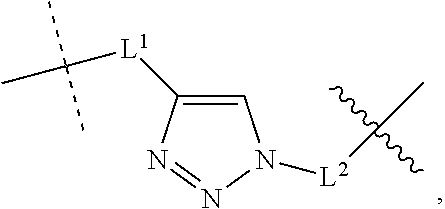
-
- wherein L1 and L2 are as described above, and
- wherein the wavy line is point of connection to the enrichment moiety and the dashed line is the point of connection to the cargo compound or the trigger compound (e.g., the dashed line is the point of connection to the first reactive moiety or the second reactive moiety).
Reactive Moieties and Cargo-Releasing Moieties


wherein R1 is the first targeting moiety, R2 is the cleavable linker, and R3 is the tethered cargo moiety.

wherein R1a is a linking diradical, R1b is a targeting radical, and R3a is a cargo radical.


wherein R4 is the second targeting moiety and R5 is the cargo-releasing moiety.


Cargo Moieties

Reagents and conditions: i) N2H4, Zn(OTf)2, 60° C., 24 h; then NaNO2, H2O, HCl; ii) dichloromethane (DCM), BBr3, 0° C., 0.5 h; iii) propargyl bromide, acetonitrile, K2CO3, 60° C., 3 h; iv) DCM, Dess-Martin periodinane, r.t., 10 min; then NaClO2/NaH2PO4, 2-methylbut-2-ene, t-BuOH, r.t, 2 h; v) C2O2Cl2, DMF, DCM. r.t.; then NHS, Et3N, DCM, r.t. 1 h; then Dox, Et3N, DMF, DCM, r.t.; vi) CuSO4 5H2O, sodium ascorbate, DMSO, t-BuOH, N3(CH2)9PPh3Br, TBTA, 6 h, r.t.

Reagents and conditions: i) DCM, Et3N, r.t, 1 h; ii) DCM, TFA, 30 min. r.t.; iii) C2O2Cl2, DMF, DCM. r.t. 30 min; then NHS, Et3N, DCM, 1 h, r.t.; then 1a, Et3N, DCM, r.t., 20 min.


Reagents and conditions: i) Cs2CO3, P(OMe)3, DMSO, O2, r.t, 24 h; ii) TBDMSOTf, Et3N, DCM, r.t, 6 h; iii) KHMDS, THF, −78° C., 1 h; then Tf2NPh, THF, −78° C. to r.t., 1 h; iv) LDA, THF, 0° C., 2.5 h; v) LiOH, dioxane/H2O (5:1), 60° C., 3 h; vi) TBAF, THF, r.t, 2 h; vii) EDC, NHS, DCM, r.t., 1 h; then 2.1b, DCM, Et3N, r.t., 3 h.

Reagents and conditions: i) LDA, THF, −78° C., 1h; then methyliodide, THF, r.t, 40 min; ii) Cs2CO3, P(OEt)3, DMSO, O2 (1.0 atm), r.t, 36 h; iii) TBDMSOTf, Et3N, DCM, r.t, 6 h; iv) KHMDS, THF, 46° C., 1 h; then Tf2NPh, THF, r.t, 1 h; v) LDA, THF, 0° C., 2.5 h, 89%; vi) TBAF, THF, r.t, 2 h.
| TABLE 1 |
| Retention time from the kinetic studies |
| Prodrugs | Dox/DA | Intermediates | |||
| retention | retention | retention | |||
| Method | Prodrugs | Alkyne | time (min) | time (min) | time (min) |
| A | 1b | 2d | 13.7 | 3.9 | 13.9/14.5 |
| 2c | 13.7 | 3.9 | NO | ||
| 2a | 13.7 | 4.0 | 18.5 | ||
| 2b | 13.7 | 4.0 | 22.8 | ||
| lc | 2b | 11.0 | 4.0 | 23.1 | |
| B | 1d | 2d | 11.7 | 5.7 | 11.5/12.1 |
| 2c | 11.7 | 5.7 | no | ||
| 2b | 11.7 | 5.7 | 23.5 | ||
Y=A exp(−k obs t) eq. 1
where Y is the prodrug area, and t is time. The pseudo-first-order rate constant, kobs, was then plotted against the concentration of alkyne to yield the second-order rate constant using eq 2:
k obs =k 2[Alkyne] eq. 2
where k2 is the second-order rate constant. The results are shown in Table 2.
| TABLE 2 |
| Kobs from the kinetic studies. |
| Concentration | ||||||
| Prodrugs | of Alkyne | Expt. 1 | Expt. 2 | Expt. 3 |
| Temp. | (25 μM) | Alkyne | (mM) | Kobs (h-1) |
| r.t | ld | 2d | 0.75 | 0.752 | 0.704 | 0.756 |
| 2d | 1.00 | 0.980 | 0.802 | 1.01 | ||
| 2d | 1.25 | 1.20 | 1.10 | 1.26 | ||
| 37° C. | 1d | 2d | 0.25 | 1.82 | 1.64 | 1.90 |
| 2d | 0.3 | 2.15 | 1.94 | 2.26 | ||
| 2d | 0.35 | 2.53 | 2.25 | 2.65 | ||
| r.t | 1d | 2c | 0.75 | 0.0203 | 0.0201 | 0.0217 |
| 2c | 1.00 | 0.0273 | 0.0269 | 0.0289 | ||
| 2c | 1.25 | 0.0339 | 0.0324 | 0.0359 | ||
| 37° C. | 1d | 2c | 0.75 | 0.0506 | 0.0584 | 0.0599 |
| 2c | 1.00 | 0.0670 | 0.0781 | 0.0801 | ||
| 2c | 1.25 | 0.083 | 0.0978 | 0.101 | ||
| r.t | 1d | 2b | 0.75 | 0.125 | 0.115 | 0.13 |
| 2b | 1.00 | 0.155 | 0.148 | 0.175 | ||
| 2b | 1.25 | 0.199 | 0.180 | 0.22 | ||
| 37° C. | 1d | 2b | 0.75 | 0.411 | 0.388 | 0.353 |
| 2b | 1.00 | 0.548 | 0.511 | 0.453 | ||
| 2b | 1.25 | 0.695 | 0.636 | 0.561 | ||
| r.t | 1b | 2d | 0.75 | 0.894 | 0.976 | 0.993 |
| 2d | 1.00 | 1.18 | 1.30 | 1.34 | ||
| 2d | 1.25 | 1.47 | 1.62 | 1.69 | ||
| 37° C. | 1b | 2d | 0.25 | 1.90 | 1.81 | 1.97 |
| 2d | 0.3 | 2.28 | 2.15 | 2.38 | ||
| 2d | 0.35 | 2.65 | 2.48 | 2.78 | ||
| r.t | 1b | 2c | 0.75 | 0.0202 | 0.0209 | 0.0207 |
| 2c | 1.00 | 0.0282 | 0.0262 | 0.0278 | ||
| 2c | 1.25 | 0.0353 | 0.0341 | 0.0344 | ||
| 37° C. | 1b | 2c | 0.75 | 0.0607 | 0.0671 | 0.0696 |
| 2c | 1.00 | 0.0798 | 0.0895 | 0.0941 | ||
| 2c | 1.25 | 0.0986 | 0.112 | 0.119 | ||
| r.t | 1b | 2b | 0.75 | 0.201 | 0.195 | 0.197 |
| 2b | 1.00 | 0.261 | 0.257 | 0.261 | ||
| 2b | 1.25 | 0.309 | 0.318 | 0.326 | ||
| 37° C. | 1b | 2b | 0.75 | 0.486 | 0.503 | 0.533 |
| 2b | 1.00 | 0.635 | 0.672 | 0.622 | ||
| 2b | 1.25 | 0.783 | 0.846 | 0.905 | ||
| r.t | 1b | 2a | 0.75 | 0.183 | 0.191 | 0.185 |
| 2a | 1.00 | 0.235 | 0.246 | 0.247 | ||
| 2a | 1.25 | 0.289 | 0.295 | 0.307 | ||
| 37° C. | 1b | 2a | 0.75 | 0.418 | 0.438 | 0.495 |
| 2a | 1.00 | 0.546 | 0.598 | 0.678 | ||
| 2a | 1.25 | 0.673 | 0.739 | 0.857 | ||
| r.t | 1c | 2b | 0.75 | 0.296 | 0.305 | 0.291 |
| 2b | 1.00 | 0.331 | 0.356 | 0.359 | ||
| 2b | 1.25 | 0.445 | 0.465 | 0.474 | ||
| 37° C. | 1c | 2b | 0.75 | 0.711 | 0.701 | 0.714 |
| 2b | 1.00 | 0.921 | 0.902 | 0.871 | ||
| 2b | 1.25 | 1.21 | 1.15 | 1.09 | ||
Y=A exp(−k 1 t) eq. 3
where Y is the intermediate areas, and t is the time.
| TABLE 3 |
| Lactonization rate constants. |
| Tetrazines | First Data | k1 (h-1) |
| prodrugs | Alkyne | point time* | |
Exp 2 | Expt. 3 |
| 1d | 2d | 1 h | 0.0253 | 0.0291 | 0.0332 |
| 1d | 2b | 4 h | 0.162 | 0.184 | 0.142 |
| 1b | 2b | 4 h | 0.223 | 0.179 | 0.196 |
| 1b | 2a | 4 h | 0.185 | 0.206 | 0.229 |
| 1c | 2b | 4 h | 0.225 | 0.191 | 0.265 |
| *The time point that more that 90% prodrug were consumed. | |||||
| TABLE 4 |
| Evaluation of the reaction kinetics of the CCR system. |
| Dox Peak % | |||||
| Tetra- | Al- | k2 at 37° C. | within 48 h, | ||
| zine | kyne | k2 at r.t (M-1s-1) | (M−1s−1 | k1 at r.t (h-1) | at r.t (%) |
| 1d | 2d | 0.25 ± 0.06 | 1.9 ± 0.4 | 0.029 ± 0.006 | 60 ± 6 (48 h) |
| 2c | 0.0075 ± 0.0009 | 0.021 ± 0.005 | * | 90 ± 5 (20 h) | |
| 2b | 0.042 ± 0.012 | 0.14 ± 0.04 | 0.16 ± 0.04 | 90 ± 3 (16 h) | |
| lb | 2d | 0.36 ± 0.07 | 2.1 ± 0.4 | A | 20 ± 5 (48 h) |
| 2c | 0.0078 ± 0.0009 | 0.025 ± 0.006 | * | 85 ± 5 (21 h) | |
| 2b | 0.065 ± 0.013 | 0.19 ± 0.04 | 0.20 ± 0.04 | 80 ± 5 (18 h) | |
| 2a | 0.061 ± 0.013 | 0.17 ± 0.05 | 0.21 ± 0.04 | 80 ± 5 (19h) | |
| 1c | 2b | 0.091 ± 0.013 | 0.25 ± 0.05 | 0.22 ± 0.05 | 78 ± 6 (18 h) |
| All reactions were conducted in PBS containing 10% DMSO. | |||||
| *not detectable because of the slow second order reaction and fast lactonization reaction. No intermediates were observed. | |||||
| Δ: not detectable because of Dox decomposition in PBS. | |||||
| (n = 3, p = 0.95). | |||||


| TABLE 5 |
| Stability studies of prodrugs 1d and 1b in PBS (5% DMSO, n = 4, p =0.95). |
| 24 h in | 24 h in | 24 h in PBS | 24 h in PBS with | |
| Prodrugs | PBS at r.t | PBS at | with 1 |
1 mM Cys at 37° |
| remaining | (%) | 37° C. (%) | at r.t (%) | C. (%) |
| 1d | 91 ± 5 | 85 ± 5 | 88 ± 5 | 81 ± 5 |
| 1b | 85 ± 5 | 78 ± 5 | 80 ± 5 | 76 ± 5 |
| TABLE 6 |
| IC50 in Hela cell line (n = 3, p = 0.95) |
| Compounds | IC50 (μM) | ||
| Dox-prodrug 1b | >100 | ||
| Alkyne 2d | >100 | ||
| Alkyne 2b | >50 | ||
| Dox | 1.0 ± 0.2 | ||
| Dox-prodrug 1b + 50 μM 2d | 1.5 ± 0.3 | ||
| Dox-prodrug lb + 100 μM 2d | 1.3 ± 0.2 | ||
| Dox-prodrug lb + 50 μM 2b | 2.3 ± 0.4 | ||
| Tetrazine 1a + 100 μM 2d | >100 | ||
-
- i) a cargo compound comprising a first reactive moiety covalently bonded to a first enrichment moiety and a tethered cargo moiety, wherein the first reactive moiety is bonded to the tethered cargo moiety via a cleavable linker; and
- ii) a trigger compound comprising a second reactive moiety covalently bonded to a second enrichment moiety and a cargo-releasing moiety;
- wherein:
- the first enrichment moiety and the second enrichment moiety cause an increase in concentration of the cargo compound and the concentration of the trigger compound at a target site;
- the first reactive moiety and the second reactive moiety are substantially unreactive toward one another without the increase in concentration of the cargo compound and the increase in concentration of the trigger compound at the target site;
- the increase in concentration of the cargo compound and the increase in concentration of the trigger compound at the target site cause a bimolecular reaction between the first reactive moiety and the second reactive moiety to form a cyclization precursor compound; and
- the cargo moiety is released from the cyclization precursor compound in a unimolecular cyclization reaction.

-
- wherein R1 is the first targeting moiety, R2 is the cleavable linker, and R3 is the tethered cargo moiety.

-
- wherein R1a is a linking diradical, R1b is a targeting radical, and R3a is a cargo radical.


-
- wherein R4 is the second targeting moiety and R5 is the cargo-releasing moiety.


Claims (11)


Priority Applications (1)
| Application Number | Priority Date | Filing Date | Title |
|---|---|---|---|
| US16/758,833 US11607458B2 (en) | 2017-10-25 | 2018-10-25 | Enrichment-triggered chemical delivery system |
Applications Claiming Priority (3)
| Application Number | Priority Date | Filing Date | Title |
|---|---|---|---|
| US201762577058P | 2017-10-25 | 2017-10-25 | |
| US16/758,833 US11607458B2 (en) | 2017-10-25 | 2018-10-25 | Enrichment-triggered chemical delivery system |
| PCT/US2018/057591 WO2019084323A1 (en) | 2017-10-25 | 2018-10-25 | Enrichment-triggered chemical delivery system |
Publications (2)
| Publication Number | Publication Date |
|---|---|
| US20210000965A1 US20210000965A1 (en) | 2021-01-07 |
| US11607458B2 true US11607458B2 (en) | 2023-03-21 |
Family
ID=66247722
Family Applications (1)
| Application Number | Title | Priority Date | Filing Date |
|---|---|---|---|
| US16/758,833 Active US11607458B2 (en) | 2017-10-25 | 2018-10-25 | Enrichment-triggered chemical delivery system |
Country Status (2)
| Country | Link |
|---|---|
| US (1) | US11607458B2 (en) |
| WO (1) | WO2019084323A1 (en) |
Families Citing this family (7)
| Publication number | Priority date | Publication date | Assignee | Title |
|---|---|---|---|---|
| EP4096694A4 (en) | 2020-01-30 | 2024-01-24 | Prognomiq Inc | Lung biomarkers and methods of use thereof |
| CN112939957B (en) * | 2021-02-03 | 2022-09-23 | 山西大学 | Benzoindole derivative In-XY1, and synthesis method and application thereof |
| US20220328134A1 (en) | 2021-03-31 | 2022-10-13 | PrognomIQ, Inc. | Multi-omic assessment |
| WO2023019148A1 (en) * | 2021-08-10 | 2023-02-16 | PrognomIQ, Inc. | Macromolecule enrichment |
| US12387508B2 (en) | 2021-09-10 | 2025-08-12 | PrognomIQ, Inc. | Direct classification of raw biomolecule measurement data |
| AU2022341187A1 (en) | 2021-09-13 | 2024-03-21 | PrognomIQ, Inc. | Enhanced detection and quantitation of biomolecules |
| CN117599001B (en) * | 2023-11-29 | 2025-05-09 | 南京鼓楼医院 | Biological orthogonal Janus microsphere and preparation method and application thereof |
Citations (15)
| Publication number | Priority date | Publication date | Assignee | Title |
|---|---|---|---|---|
| US6316652B1 (en) | 1995-06-06 | 2001-11-13 | Kosta Steliou | Drug mitochondrial targeting agents |
| US6331532B1 (en) | 1998-11-25 | 2001-12-18 | University Of Otago | Mitochondrially targeted antioxidants |
| WO2004069159A2 (en) | 2003-01-27 | 2004-08-19 | Endocyte, Inc. | Vitamin receptor binding drug delivery conjugates |
| WO2010051530A2 (en) | 2008-10-31 | 2010-05-06 | The General Hospital Corporation | Compositions and methods for delivering a substance to a biological target |
| US7799782B2 (en) * | 2003-03-03 | 2010-09-21 | Array Biopharma Inc. | P38 inhibitors and methods of use thereof |
| WO2012156919A1 (en) | 2011-05-16 | 2012-11-22 | Koninklijke Philips Electronics N.V. | Bio-orthogonal drug activation |
| US8552183B2 (en) | 2006-06-16 | 2013-10-08 | Deutsches Krebsforschungszentrum Stiftung Des Offentlichen Rechts | Process for the covalent coupling of two molecules by means of a diels-alder reaction with inverse electron requirement |
| WO2014065860A1 (en) | 2012-10-24 | 2014-05-01 | The General Hospital Corporation | Functionalized 1,2,4,5-tetrazine compounds for use in bioorthogonal coupling reactions |
| WO2014138186A1 (en) | 2013-03-05 | 2014-09-12 | The Johns Hopkins University | Bioorthogonal two-component delivery systems for enhanced internalization of nanotherapeutics |
| WO2015191616A1 (en) | 2014-06-09 | 2015-12-17 | Georgia State University Research Foundation, Inc. | Carbon monoxide-releasing molecules for therapeutic applications and methods of making and using thereof |
| WO2017046602A1 (en) | 2015-09-17 | 2017-03-23 | The University Court Of The University Of Edinburgh | Tetrazine as a trigger to release caged cargo |
| US20200115360A1 (en) | 2017-06-12 | 2020-04-16 | Georgia State University Research Foundation, Inc, | Enzyme-triggered carbon monoxide releasing molecules |
| US20200283382A1 (en) | 2017-08-09 | 2020-09-10 | Georgia State University Research Foundation, Inc. | Carbon monoxide-releasing molecules triggered by physiological stimuli |
| US10806807B2 (en) * | 2014-03-14 | 2020-10-20 | The Regents Of The University Of California | TCO conjugates and methods for delivery of therapeutic agents |
| US20210221835A1 (en) | 2016-11-16 | 2021-07-22 | Georgia State University Research Foundation, Inc. | Carbon-monoxide-releasing molecules and therapeutic applications thereof |
-
2018
- 2018-10-25 US US16/758,833 patent/US11607458B2/en active Active
- 2018-10-25 WO PCT/US2018/057591 patent/WO2019084323A1/en not_active Ceased
Patent Citations (18)
| Publication number | Priority date | Publication date | Assignee | Title |
|---|---|---|---|---|
| US6316652B1 (en) | 1995-06-06 | 2001-11-13 | Kosta Steliou | Drug mitochondrial targeting agents |
| US6331532B1 (en) | 1998-11-25 | 2001-12-18 | University Of Otago | Mitochondrially targeted antioxidants |
| WO2004069159A2 (en) | 2003-01-27 | 2004-08-19 | Endocyte, Inc. | Vitamin receptor binding drug delivery conjugates |
| US7799782B2 (en) * | 2003-03-03 | 2010-09-21 | Array Biopharma Inc. | P38 inhibitors and methods of use thereof |
| US8552183B2 (en) | 2006-06-16 | 2013-10-08 | Deutsches Krebsforschungszentrum Stiftung Des Offentlichen Rechts | Process for the covalent coupling of two molecules by means of a diels-alder reaction with inverse electron requirement |
| WO2010051530A2 (en) | 2008-10-31 | 2010-05-06 | The General Hospital Corporation | Compositions and methods for delivering a substance to a biological target |
| WO2012156919A1 (en) | 2011-05-16 | 2012-11-22 | Koninklijke Philips Electronics N.V. | Bio-orthogonal drug activation |
| WO2014065860A1 (en) | 2012-10-24 | 2014-05-01 | The General Hospital Corporation | Functionalized 1,2,4,5-tetrazine compounds for use in bioorthogonal coupling reactions |
| WO2014138186A1 (en) | 2013-03-05 | 2014-09-12 | The Johns Hopkins University | Bioorthogonal two-component delivery systems for enhanced internalization of nanotherapeutics |
| US10806807B2 (en) * | 2014-03-14 | 2020-10-20 | The Regents Of The University Of California | TCO conjugates and methods for delivery of therapeutic agents |
| WO2015191616A1 (en) | 2014-06-09 | 2015-12-17 | Georgia State University Research Foundation, Inc. | Carbon monoxide-releasing molecules for therapeutic applications and methods of making and using thereof |
| US20170128456A1 (en) * | 2014-06-09 | 2017-05-11 | Georgia State University Research Foundation, Inc, | Carbon monoxide-releasing molecules for therapeutic applications and methods of making and using thereof |
| US10300069B2 (en) | 2014-06-09 | 2019-05-28 | Georgia State University Research Foundation, Inc. | Carbon monoxide-releasing molecules for therapeutic applications and methods of making and using thereof |
| US10751344B2 (en) | 2014-06-09 | 2020-08-25 | Georgia State University Research Foundation, Inc. | Carbon monoxide-releasing molecules for therapeutic applications and methods for the preparation and use thereof |
| WO2017046602A1 (en) | 2015-09-17 | 2017-03-23 | The University Court Of The University Of Edinburgh | Tetrazine as a trigger to release caged cargo |
| US20210221835A1 (en) | 2016-11-16 | 2021-07-22 | Georgia State University Research Foundation, Inc. | Carbon-monoxide-releasing molecules and therapeutic applications thereof |
| US20200115360A1 (en) | 2017-06-12 | 2020-04-16 | Georgia State University Research Foundation, Inc, | Enzyme-triggered carbon monoxide releasing molecules |
| US20200283382A1 (en) | 2017-08-09 | 2020-09-10 | Georgia State University Research Foundation, Inc. | Carbon monoxide-releasing molecules triggered by physiological stimuli |
Non-Patent Citations (32)
Also Published As
| Publication number | Publication date |
|---|---|
| US20210000965A1 (en) | 2021-01-07 |
| WO2019084323A1 (en) | 2019-05-02 |
Similar Documents
| Publication | Publication Date | Title |
|---|---|---|
| US20210000965A1 (en) | Enrichment-triggered chemical delivery system | |
| US20240091371A1 (en) | Bio-orthogonal drug activation | |
| EP3788032B1 (en) | Compounds comprising a linker for increasing transcyclooctene stability | |
| EP3983363B1 (en) | Compounds for fast and efficient click release | |
| EP3903826B1 (en) | Biomolecule conjugates | |
| US20150031861A1 (en) | Chemical Modification of Antibodies | |
| EP3630732B1 (en) | Method and molecules | |
| KR20200067132A (en) | Programmable polymeric drugs | |
| US20150037360A1 (en) | Lysosome-Cleavable Linker | |
| KR20200064059A (en) | Programmable dendritic drugs | |
| CN113350518A (en) | Conjugated bridge linkers to cell binding molecules | |
| US20220356169A1 (en) | Tetrazines for high click release speed and yield | |
| NZ518764A (en) | Cytotoxic agents comprising modified doxorubicins and daunorubicins and their therapeutic use | |
| KR102840665B1 (en) | Conjugates of cytotoxic drugs and prodrug forms of said conjugates | |
| CA3099419A1 (en) | Tetrazines for high click conjugation yield in vivo and high click release yield | |
| EA012625B1 (en) | Cytotoxic agents comprising new taxanes | |
| JP5290142B2 (en) | Novel sugar-linked chlorin derivatives | |
| CA3203849A1 (en) | Dual-cleavage ester linkers for antibody-drug conjugates | |
| Ievoli | Antibody-drug conjugates charged with unconventional payloads |
Legal Events
| Date | Code | Title | Description |
|---|---|---|---|
| FEPP | Fee payment procedure |
Free format text: ENTITY STATUS SET TO UNDISCOUNTED (ORIGINAL EVENT CODE: BIG.); ENTITY STATUS OF PATENT OWNER: SMALL ENTITY |
|
| FEPP | Fee payment procedure |
Free format text: ENTITY STATUS SET TO SMALL (ORIGINAL EVENT CODE: SMAL); ENTITY STATUS OF PATENT OWNER: SMALL ENTITY |
|
| STPP | Information on status: patent application and granting procedure in general |
Free format text: APPLICATION DISPATCHED FROM PREEXAM, NOT YET DOCKETED |
|
| STPP | Information on status: patent application and granting procedure in general |
Free format text: DOCKETED NEW CASE - READY FOR EXAMINATION |
|
| STPP | Information on status: patent application and granting procedure in general |
Free format text: NON FINAL ACTION MAILED |
|
| STPP | Information on status: patent application and granting procedure in general |
Free format text: RESPONSE TO NON-FINAL OFFICE ACTION ENTERED AND FORWARDED TO EXAMINER |
|
| STPP | Information on status: patent application and granting procedure in general |
Free format text: NON FINAL ACTION MAILED |
|
| STPP | Information on status: patent application and granting procedure in general |
Free format text: RESPONSE TO NON-FINAL OFFICE ACTION ENTERED AND FORWARDED TO EXAMINER |
|
| STPP | Information on status: patent application and granting procedure in general |
Free format text: FINAL REJECTION MAILED |
|
| STPP | Information on status: patent application and granting procedure in general |
Free format text: DOCKETED NEW CASE - READY FOR EXAMINATION |
|
| STPP | Information on status: patent application and granting procedure in general |
Free format text: NOTICE OF ALLOWANCE MAILED -- APPLICATION RECEIVED IN OFFICE OF PUBLICATIONS |
|
| AS | Assignment |
Owner name: GEORGIA STATE UNIVERSITY RESEARCH FOUNDATION, INC., GEORGIA Free format text: ASSIGNMENT OF ASSIGNORS INTEREST;ASSIGNORS:WANG, BINGHE;ZHENG, YUEQIN;JI, XINGYUE;AND OTHERS;REEL/FRAME:061903/0032 Effective date: 20171127 |
|
| STPP | Information on status: patent application and granting procedure in general |
Free format text: NOTICE OF ALLOWANCE MAILED -- APPLICATION RECEIVED IN OFFICE OF PUBLICATIONS |
|
| STCF | Information on status: patent grant |
Free format text: PATENTED CASE |
|
| CC | Certificate of correction |