US11604962B2 - Method and system for training a machine learning system using context injection - Google Patents
Method and system for training a machine learning system using context injection Download PDFInfo
- Publication number
- US11604962B2 US11604962B2 US16/840,159 US202016840159A US11604962B2 US 11604962 B2 US11604962 B2 US 11604962B2 US 202016840159 A US202016840159 A US 202016840159A US 11604962 B2 US11604962 B2 US 11604962B2
- Authority
- US
- United States
- Prior art keywords
- input
- output
- iteration
- conversation
- chat
- Prior art date
- Legal status (The legal status is an assumption and is not a legal conclusion. Google has not performed a legal analysis and makes no representation as to the accuracy of the status listed.)
- Active, expires
Links
Images




Classifications
-
- G06N3/0445—
-
- G—PHYSICS
- G06—COMPUTING OR CALCULATING; COUNTING
- G06N—COMPUTING ARRANGEMENTS BASED ON SPECIFIC COMPUTATIONAL MODELS
- G06N3/00—Computing arrangements based on biological models
- G06N3/02—Neural networks
- G06N3/08—Learning methods
-
- G—PHYSICS
- G06—COMPUTING OR CALCULATING; COUNTING
- G06F—ELECTRIC DIGITAL DATA PROCESSING
- G06F18/00—Pattern recognition
- G06F18/20—Analysing
- G06F18/21—Design or setup of recognition systems or techniques; Extraction of features in feature space; Blind source separation
- G06F18/214—Generating training patterns; Bootstrap methods, e.g. bagging or boosting
-
- G06K9/6256—
-
- G—PHYSICS
- G06—COMPUTING OR CALCULATING; COUNTING
- G06N—COMPUTING ARRANGEMENTS BASED ON SPECIFIC COMPUTATIONAL MODELS
- G06N3/00—Computing arrangements based on biological models
- G06N3/004—Artificial life, i.e. computing arrangements simulating life
- G06N3/006—Artificial life, i.e. computing arrangements simulating life based on simulated virtual individual or collective life forms, e.g. social simulations or particle swarm optimisation [PSO]
-
- G—PHYSICS
- G06—COMPUTING OR CALCULATING; COUNTING
- G06N—COMPUTING ARRANGEMENTS BASED ON SPECIFIC COMPUTATIONAL MODELS
- G06N3/00—Computing arrangements based on biological models
- G06N3/02—Neural networks
- G06N3/04—Architecture, e.g. interconnection topology
- G06N3/044—Recurrent networks, e.g. Hopfield networks
-
- G—PHYSICS
- G06—COMPUTING OR CALCULATING; COUNTING
- G06N—COMPUTING ARRANGEMENTS BASED ON SPECIFIC COMPUTATIONAL MODELS
- G06N3/00—Computing arrangements based on biological models
- G06N3/02—Neural networks
- G06N3/04—Architecture, e.g. interconnection topology
- G06N3/044—Recurrent networks, e.g. Hopfield networks
- G06N3/0442—Recurrent networks, e.g. Hopfield networks characterised by memory or gating, e.g. long short-term memory [LSTM] or gated recurrent units [GRU]
-
- G—PHYSICS
- G06—COMPUTING OR CALCULATING; COUNTING
- G06N—COMPUTING ARRANGEMENTS BASED ON SPECIFIC COMPUTATIONAL MODELS
- G06N3/00—Computing arrangements based on biological models
- G06N3/02—Neural networks
- G06N3/04—Architecture, e.g. interconnection topology
- G06N3/045—Combinations of networks
-
- G—PHYSICS
- G06—COMPUTING OR CALCULATING; COUNTING
- G06N—COMPUTING ARRANGEMENTS BASED ON SPECIFIC COMPUTATIONAL MODELS
- G06N3/00—Computing arrangements based on biological models
- G06N3/02—Neural networks
- G06N3/04—Architecture, e.g. interconnection topology
- G06N3/045—Combinations of networks
- G06N3/0455—Auto-encoder networks; Encoder-decoder networks
-
- G—PHYSICS
- G06—COMPUTING OR CALCULATING; COUNTING
- G06N—COMPUTING ARRANGEMENTS BASED ON SPECIFIC COMPUTATIONAL MODELS
- G06N3/00—Computing arrangements based on biological models
- G06N3/02—Neural networks
- G06N3/04—Architecture, e.g. interconnection topology
- G06N3/048—Activation functions
-
- G06N3/0481—
-
- G—PHYSICS
- G06—COMPUTING OR CALCULATING; COUNTING
- G06N—COMPUTING ARRANGEMENTS BASED ON SPECIFIC COMPUTATIONAL MODELS
- G06N3/00—Computing arrangements based on biological models
- G06N3/02—Neural networks
- G06N3/08—Learning methods
- G06N3/09—Supervised learning
-
- H—ELECTRICITY
- H04—ELECTRIC COMMUNICATION TECHNIQUE
- H04L—TRANSMISSION OF DIGITAL INFORMATION, e.g. TELEGRAPHIC COMMUNICATION
- H04L51/00—User-to-user messaging in packet-switching networks, transmitted according to store-and-forward or real-time protocols, e.g. e-mail
- H04L51/02—User-to-user messaging in packet-switching networks, transmitted according to store-and-forward or real-time protocols, e.g. e-mail using automatic reactions or user delegation, e.g. automatic replies or chatbot-generated messages
Definitions
- This disclosure generally relates to machine learning techniques and, in particular, to training and use of machine learning systems based on sequence-to-sequence models.
- a machine learning system based on a sequence-to-sequence model can receive one sequence of characters, numbers, combinations of characters and numbers, words, etc., and can produce another sequence. For example, such a system can be used to translate a sentence or a question in one language (i.e., a sequence of words) into a sentence or a question in another language (i.e. another sequence).
- Such a machine learning system can also be designed to operate as a chatbots that can converse with users with the goal of mimicking a conversation between the user and another human.
- chatbots that are available today are usually notable to mimic a conversation between two humans. The users often find the conversation unnatural, and believe that the chatbots do not understand the users' questions and/or do not produce a meaningful response.
- a method for training a machine-learning system includes providing to the machine-learning system: in a first iteration, a first input-output pair that includes a first input and a first output; and, in a second iteration, a second input-output pair that includes a second input and a second output, where the second input includes the first input-output pair and the second output is different from the first output, so that a context for the second input-output pair is stored in a memory of the machine-learning system.
- FIG. 1 schematically depicts the training of a typical machine-learning system, and subsequent use of the system
- FIG. 2 illustrates example inputs and outputs of a machine-learning system designed to function as a chatbot
- FIG. 3 depicts an example sigmoid function
- FIG. 4 depicts an example sigmoid function in terms of weights and features of a machine learning system
- FIG. 5 schematically depicts an example recurrent neural network (RNN);
- FIG. 6 is a block diagram of an exemplary context injection system, according to one embodiment
- FIG. 7 illustrates the encoder and decoder of a context injection system, according to one embodiment
- FIG. 8 shows a training process of an artificial neural network (ANN) of a context injection system, according to one embodiment
- FIG. 9 shows a training process for training a machine learning system, according to one embodiment
- FIG. 10 illustrates an incremental training process, according to one embodiment
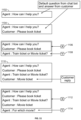
- FIG. 11 shows an example of prompts and responses used to train a machine learning system, according to one embodiment
- FIG. 12 illustrates the overall use of a machine learning system designed to operate as a chatbot, according to some embodiments
- FIG. 13 also illustrates the overall use of a machine learning system designed to operate as a chatbot, according to some embodiments.
- FIG. 14 an example use of a machine learning system trained using context injection.
- FIG. 1 schematically depicts the training of a typical machine-learning system 100 , and subsequent use of the system.
- supervised machine learning is a process used to learn patterns from data, where the machine learning process 104 derives a function ⁇ that yields the expected output Y, 106 , from input X, 102 .
- the machine is supplied with a set of various inputs X for which the corresponding set of correct outputs Y is known.
- a positive (or negative) feedback may be provided to the machine when it generates the correct (or incorrect) output.
- the machine tweaks the function ⁇ until it can correctly generate the outputs for at least a certain fraction of the inputs in the set X.
- a validation set for which also the corresponding correct outputs are known, may then be used to test if the machine is, in fact, generating the expected outputs at least for a certain fraction of the validation set.
- the machine can be supplied with an input X for which the correct output is not known.
- a property trained machine would then produce the correct output Y at a high probability (e.g., 0.5, 0.6, 0.75, 0.8, or more).
- the error (e) can be noise in the data or may account for the situation where the relationship between X and Y itself is not clearly or mathematically explainable. Formally stated, there may not be a closed form relationship between X and Y, and ⁇ * is hypothetical.
- FIG. 2 illustrates example inputs (X) and outputs (Y) of a machine-learning system designed to function as a chatbot, i.e., a computer program that mimics the actions of a human communicating with another human.
- a chatbot is a computer program that can converse with a human using text and/or audio responses.
- the training corpus is a collection of text used to train a machine learning system of the chatbot.
- the training corpus generally contains validated linguistic information that is attributed to the original text.
- the training corpus is typically used by machine-learning systems to create a statistical model of the input text.
- the training corpus can be used to check the accuracy of rule-based programs.
- Statistical programs can use a rule-based model developed using the training corpus, for analyzing new, unknown text.
- Logistic regression is used as an activation function in an artificial neural network (ANN).
- ANN artificial neural network
- a logistic regression model can ensure that the output always falls between 0 and 1.
- a sigmoid function produces output having the same characteristics, i.e., an output that falls between 0 and 1, as depicted in FIG. 3 .
- a typical sigmoid function is written as:
- sigmoid(z) would yield a value (a probability) between 0 and 1, given by:
- the w values are the model's learned weights, and b is the bias;
- the x′ values are the feature values related to one or more inputs x.
- z is also referred to as the log-odds because the inverse of the sigmoid states that z can be defined as the log of the probability of the “1” label (e.g., “dog barks” in the example above) divided by the probability of the “0” label (e.g., “the dog does not bark”), and is written as:
- Word embedding is a representation of document vocabulary. It captures one or more properties of the word, e.g., the context of a word in a document, semantic and syntactic similarity, relation with other words, etc. Word embedding typically allows words with similar meaning to have a similar representation. They are a distributed representation for the text, and are used for implementing deep learning methods on challenging natural language processing problems. Word embedding methods learn a real-valued vector representation for a predefined fixed sized vocabulary from a corpus of text. The learning process may be joined with the neural network model in some cases, such as document classification, or it can be an unsupervised learning process that uses document statistics. The words may be processed further using a recurrent neural network.
- a recurrent neural network is a type of artificial neural network typically used in speech recognition and natural language processing (NLP).
- RNNs can recognize a data's sequential characteristics, and use the detected patterns to predict the next likely scenario.
- RNNs may be used when context is important for predicting an outcome.
- RNNs are different from other types of artificial neural networks in that they use feedback loops to process a sequence of data in deriving the final output, which can also be a sequence of data. These feedback loops allow information to persist within the system. This effect is often described as memory.
- y t is the predicted output for some input x t
- ⁇ indicate the parameters of the function or the model that yields an output y t given an input x t .
- a feed-forward neural network produces ⁇ y 1 , y 2 , . . . , y t ⁇ one at a time, by taking ⁇ x 1 , x 2 , . . . , x t ⁇ as inputs, respectively.
- the predicted output y t at time t of a feed-forward neural network depends only on the current input x t .
- the model does not have or at least does not retain any knowledge about the inputs that led to x t , i.e., ⁇ x 1 , x 2 , . . . , x t-1 ⁇ .
- a feed-forward neural network will generally fail at a task where the current output not only depends on the current input but as also on one or more of the previous inputs.
- An RNN may be used to find a solution in such cases.
- x ⁇ x 1 , x 2 , . . . x T ⁇
- y ⁇ y 1 , y 2 , . . .
- FIG. 5 schematically depicts the computation of y 4 , where the function ⁇ 1 is applied to the state h 0 and the input x 1 to yield the state h 1 . The function ⁇ 2 is then applied to the state h 1 to yield the output y 1 .
- the RNN can become very large and its performance, in terms of processing time, required processing capacity, and/or required memory can degrade.
- T is greater than 10, 25, 40, 100, or greater
- it may become impractical or infeasible to compute the output sequence y ⁇ y 1 , y 2 , . . . , y T ⁇ .
- the sequences x and y can be of the same length, they can be of different lengths also.
- LSTM Long Short-Term Memory
- LSTM is an artificial recurrent neural network architecture that is used in the field of deep learning. Unlike the standard feed-forward neural networks, an LSTM has feedback connections that can make it Turing machine. It can not only process single data points (such as images, samples of speech, words in a text, etc.), but also entire sequences of data (such as video, speech, or conversations). An LSTM can accomplish this while avoiding the above-described performance problems of a regular RNN.
- an LSTM can discriminate between relatively more important and relatively less important learned information, and may remember only the relatively more important information and may forget the relatively less or unimportant information. For example, if you ask an average movie fan, who has seen the trailer of a new movie to be released, to repeat the trailer word-for-word, s/he would likely not be able to that, but the movie fan would most likely remember the release date.
- a LSTM may be trained similarly to discriminate between less and more important information, and to forget the information deemed less important. Therefore, an LSTM can be used to perform tasks such as unsegmented, connected handwriting recognition or speech recognition.
- an LSTM-based ANN can produce an output sequence of words, where the input and output sequences can be of the same or different lengths.
- the ANN can be trained to produce a meaningful response to the input sequence.
- LSTMs are used for the encoder part of an ANN used to implement a chatbot
- LSTMs are used for the decoder part of the ANN, as well.
- the output words for the conversation are predicted from the hidden state of the decoder. This prediction takes the form of a probability distribution over the entire output vocabulary. If there is a vocabulary of 50,000 words, then the prediction is a 50,000 dimensional vector, with each element corresponding to the probability predicted for one word in the vocabulary.
- FIG. 6 is a block diagram of an exemplary context injection system 600 , according to one embodiment.
- the input sequence X, 602 (“I need your help”) is received by the encoder 604 , which generates a full context 606 (also called the context vector “C”) for the entire input sequence 602 .
- the decoder 608 receives the full context 606 , and produces a response, i.e., the output sequence Y, 610 (“How can I help?”).
- both the full context 606 and the expected response, i.e., output sequence Y, 610 are provided as inputs to the decoder, using which the decoder can derive the parameters, e.g., weights, for its approximation function.
- the context vector C, 606 is learnt by the ANN that forms the encoder and, in the inference mode, the ANN of the decoder 608 uses the context vector C, 606 , to predict a reply, i.e., output sequence Y, 610 to the input sequence X, 602 .
- the ANN's in both the encoder 604 and the decoder 608 can be RNNs or LSTMs.
- the either or both ANNs are single-layer ANNs and in other embodiments, either or both ANNs are multi-layer ANNs.
- the ANNs of the encoder 604 and the decoder 608 may be collectively referred to as the ANN of a context injection system, which can operate as a chatbot in some embodiments.
- FIG. 7 illustrates the encoder and decoder of a context injection system 700 , according to one embodiment.
- the encoder 702 includes an encoding unit 704 , and each word 706 of the input sequence 708 (e.g., a sentence or a question) is processed by the encoding unit 704 in one respective step.
- the context information 710 derived from an earlier step is used in the next step, so that the final step produces a context vector 712 for the entire input sequence 708 .
- the decoder 714 includes a decoding unit 716 which receives the full context vector 712 in each decoding step.
- the decoding unit 716 In the first decoding step, the decoding unit 716 generates one word 718 of the output sequence 720 .
- the word 718 is used by the decoding unit 716 in the next step, along with the context vector 712 , to output the next word 718 , until the entire output sequence 720 is produced.
- FIG. 8 shows the training process 800 of the ANN 850 of a context injection system, according to one embodiment.
- the ANN 850 which includes the encoder 852 and the decoder 854 , is trained to understand entire conversation in an incremental fashion.
- the input X, 804 is: “I want to book a ticket,” and the known, correct output Y, 806 , is: “Train ticket or movie ticket?”
- the encoder 852 and the decoder 854 are trained using this pair of input X, 804 , and output Y, 806 , to generate the respective parameters of the respective ANNs of the encoder 852 and the decoder 854 .
- the input X, 814 is not just the next response from the user, but includes the entire conversation up to this point, i.e., the input X, 814 , includes three parts, namely, the input sequence X, 804 , received in Iteration 802 : “I want to book a ticket;” the expected response Y, 806 , in the iteration 802 : “Train ticket or movie ticket?;” and the subsequent response from the user received in Iteration 812 : “Movie ticket.”
- the known, correct output Y, 816 is: “For which movie?”
- the encoder 852 and the decoder 854 are trained further using the pair of input X, 814 , and output Y, 816 , to revise the respective parameters of the respective ANNs of the encoder 852 and the decoder 854 . This process is continued until the entire conversation is over. In each iteration, the encoder 852 provides to the decoder 854
- the encoder employs a multi-layer LSTM and includes:
- the decoder may also employ a multi-layer LSTM and may include:
- Sequential information derived as the ANN (forming an encoder and a decoder) learns, is preserved in the network's hidden state.
- the learning can span many time steps as each sentence or question in a conversation is processed word-by-word.
- the ANN is particularly trained to find relationships between events separated by many moments. Such relationships are called “long-term dependencies,” because an event downstream in time may depend upon, and can be a function of, one or more events that occurred before.
- An RNN can learn such dependencies by adjusting and sharing weights of certain features over time in the hidden states of recurrent network.
- the RNN used encodes words in a sequence from left to right, and the hidden states store the left context of each word, i.e., the hidden state may account for all the preceding words or at least those determined to be important.
- the RNN used obtains the right context by processing the words in a sequence from right-to-left or, more precisely, from the end of the sequence to the beginning of the sequence.
- Two RNNs may be used together in some embodiments, each processing the word sequence in different directions. The combination of the two RNNs is called a bidirectional recurrent neural network.
- the decoder is a recurrent neural network that receives as input a representation of the context vector C generated by the encoder and the previous hidden state, and outputs a word prediction. The decoder also generates a new hidden decoder state, which would be used subsequently to produce a new output word prediction. The first decoder stage uses the last hidden state of the encoder as an input. According to some embodiments, the decoder is formed using a bidirectional recurrent neural network.
- one challenge is that the number of steps in the decoder and the number of steps in the encoder can vary with each training sample. Specifically, if each training sample is a distinct pair of chat messages X and Y, such pairs may include sentences or questions of different lengths. As such, the computation graph for each training sample can be different. In some embodiments, computation graphs are dynamically created by unrolling recurrent neural networks. The number of layers an unrolled RNN may include is determined based on an average number of words in the training samples.
- GPUs graphics processing units
- CPUs central processing unit
- GPU cores are typically slower than CPU cores, they can more than make up for the relatively slow processing speed with their large number of cores and faster memory, because the operations performed by the ANN can be parallelized.
- a prompt can be a statement or a sentence, or it can be a question.
- a response that a human would likely provide, and the chatbot is expected to provide
- a tensor is a data structure having at least three dimensions, and is used as a building block of a machine learning chatbot in various embodiments.
- each input word in a particular prompt-response pair is represented by a vector h j .
- the respective vectors corresponding to a sequence of input words may be stored in a matrix.
- the matrices corresponding to each pair may be stacked, forming a three-dimensional tensor.
- the decoder hidden state for each output word is a vector. Because several prompt-response pairs in a batch may be processed in parallel, the decoder hidden states can be stored in a matrix. It may not be beneficial to do so, however, for all the output words, because in various embodiments the decoder states are computed sequentially, where the next decoder state depends on the previous decoder state and also on the output word selected by the previous decoder state.
- the machine learning system operating as a chatbot employs deep learning using stacked neural networks.
- the ANNs forming the encoder and/or decoder include several layers. Each layer includes one or more nodes (also called neurons), where a node combines input data with a coefficient from a set of coefficients (also called set of weights) that either amplify or dampen that input. This operation assigns significance to the different inputs in furthering the task of learning. In other words, the weights determine which input is more helpful than another in classifying or characterizing the input data while minimizing the error in data classification and/or characterization.
- the input-weight products are summed and the sum is processed by the node's activation function (e.g., a sigmoid function), to determine whether and to what extent the output of the node should progress further through the ANN to affect the ultimate outcome, say, an act of classification or characterization of the input data. If the signal is allowed to passes through, the corresponding node/neuron is said to be activated.
- the node's activation function e.g., a sigmoid function
- FIG. 9 shows a training process for training a machine learning system, according to one embodiment.
- the training process 900 begins with shuffling the training corpus, i.e., the entire dataset, to avoid undue biases due to temporal or topical order (step 902 ).
- a dataset may be sorted in a specified order (e.g., according to a topic (such as chats about technical problems, chats about travel, chats about health issues, etc.).
- the overall dataset is usually partitioned into a training dataset and a validation and/or test dataset. If such partitioning is performed without shuffling the overall dataset, different types of data may be selected for different tasks, resulting in unsuccessful training. This problem is mitigated in various embodiments by shuffling the overall data prior to obtaining different subsets of training, validation, and testing.
- the training dataset is divided into mini-batches, so that the machine learning system does not run out of memory and/or processing capacity during learning, and also does not take excessive time for learning. Dividing the training dataset into mini-batches trades of some learning accuracy for learning efficiency, as described next.
- the system computes an error between the answer the system generated and the expected or correct answer.
- the model parameters e.g., the weights/coefficients of different nodes
- the model parameters may then be adjusted so that the error decreases, along a gradient, so as to approach zero. This technique is referred to as gradient descent.
- the more the samples used in determining the error the more comprehensive the error analysis and, as such, potentially more accurate the determined error. While this can lead to a faster minimization of error during subsequent training, using more samples also requires more processing capacity, memory, and/or computation time, and the machine learning system can run out of the processing capacity and/or memory, and make take excessive processing time (e.g., hours, days, etc.).
- mini-batch gradient descent where the training dataset is split into small batches that are used to calculate model error and to update model parameters (e.g., weights or coefficients).
- Mini-batch gradient descent often finds a balance between the efficiency of stochastic gradient descent (where a batch includes only one sample) and the robustness of batch gradient descent (where the batch includes all the samples in the training dataset).
- each mini-batch is processed, i.e., the machine learning system is trained to produce the respective expected response to each prompt in the minibatch.
- the corresponding error gradients are also collected in step 906 .
- these gradients are used to update the model parameters, e.g., the weights or coefficients of different nodes in the ANN.
- the gradients across the mini-batches are aggregated, e.g., summed or averaged, and the aggregated gradient is used to update the model parameters.
- training an ANN takes about 5-15 epochs (passes through the entire training corpus).
- a common stopping criteria is to check the progress of the model on a validation set (that is not part of the training data) and halt when the error on the validation set does not improve, as training further would likely not lead to any further minimization of error and may even degrade performance due to overfitting.
- Chatbots are computer programs that are able to converse with users, aiming to mimic a conversation between the user and a human agent. This is especially useful to various service providers, usually to provide answers/solutions to easily addressable questions and issues that customers may have, instead of redirecting those customers to human operators.
- chatbots One important problem with chatbots is that customers often feel that the chatbots are too unnatural, i.e., they do not respond to customer's requests/questions as a human typically would. As such, users may prefer to talk to a human agent and not to a chatbot, thinking that the chatbot will not be able to answer the users' questions properly. Many chatbots have been trained on a question and answer dataset. Therefore a user's question is mapped to a question in a repository and the answer is retrieved. This answer is given back to the customer by the chatbot without regard to prior questions and responses.
- a conventional chatbot trained using pairs of single prompt and single response, would not be trained to understand “AB7034567” in the last prompt, because it was not trained to retain any knowledge of what was discussed earlier during the call.
- a machine learning system is trained using not only pairs of single prompt and single response, but using prompts and responses of an entire chat session. Such training may be performed incrementally, e.g., by starting with a pair of single prompt single response, and then using one or more pairs of earlier prompts and responses in conjunction with a pair of new single prompt and single response.
- the earlier pairs can provide context for the entire conversation and, as such, various embodiments can teach a machine learning system designed to operate as a chatbot to use the context of a chat dialog in producing responses. Such responses may more closely resemble the responses a human agent may provide.
- FIG. 10 illustrates an incremental training process, according to one embodiment.
- the training process 1000 is described with reference to the prompts and responses shown in FIG. 11 .
- the training process 1000 involves supplying to the machine learning system, in each iteration, an input sequence (denoted X j , for the j-th iteration), and the expected output sequence (denoted Y j , for the j-th iteration).
- An input X j may include one or more prompts and/or one or more responses from the previous iterations.
- the machine learning system may begin a conversation by presenting a default question 1102 .
- the user also referred to as “Customer”
- the first prompt “Please book ticket” shown in the combination 1104 of the default question 1102 and the first prompt.
- the first input-and-expected-output pair 1106 is generated and presented to the Agent. With this pair, the Agent is expected to learn to generate the expected output 1108 (“Train ticket or movie ticket?”) in response to the input 1104 , which includes the first prompt from the user.
- the user may provide the current prompt 1110 (“Movie ticket”).
- the entire conversation up to the current iteration which includes the first input 1104 , the first expected output 1108 , and the current prompt 1110 , is used to generate the current input 1112 at step 1004 , which corresponds to a current training iteration.
- the current input 1112 and expected output pair 1114 is generated and presented to the Agent.
- the input is the current input 1112
- the Agent is expected to learn to generate the current expected output 1116 (“For which movie”) in response to the current input 1112 .
- the current input 1112 includes the entire conversation up to the current iteration and, as such, provides a context for the response to be generated by the agent in the current iteration.
- the steps 1004 (of generating an input sequence for the current iteration) and 1006 (of generating the current pair of input and expected output to be used in the current iteration and presenting the current pair to the Agent) may be repeated over the entire conversation. It should be understood, that during the training phase the entire conversation would be known. Thus, the process 1000 iteratively updates the input in the input-and-expected-output pairs used for training in different iterations, where the updated input is injected with the available context for the conversation. The Agent is expected to learn this context and use it in generating its response in each iteration.
- the process 1000 may use to train a machine learning system using the prompts and expected reposes from the following entire dialogue:
- the inputs which include user prompts, and expected agent outputs that are used in each training iteration are shown in Table 1 below.
- FIGS. 12 and 13 illustrate the overall use of a machine learning system designed to operate as a chatbot according to some embodiments.
- a conversation between a customer 1252 and a human agent 1254 , via a user device 1256 is recorded and stored in a database 1258 .
- This conversation data is then used in step 1204 , e.g., according to the process 1000 ( FIG. 10 ), for training a machine learning system 1260 (e.g., the system 600 of FIG. 6 ).
- a machine learning system 1260 e.g., the system 600 of FIG. 6 .
- Several such conversations may be recorded and used for training, validation, and testing of the system 1260 .
- the trained machine learning system 1260 is deployed, where it may engage in a conversation, e.g., a chat, with another (or the same) user 1262 , chatting with the system 1260 using another (or the same) user device 1264 such as a smart phone, tablet computer, laptop, etc.
- a conversation e.g., a chat
- another (or the same) user 1262 chatting with the system 1260 using another (or the same) user device 1264 such as a smart phone, tablet computer, laptop, etc.
- FIG. 13 similarly shows the use of a machine learning system, an RNN in particular.
- old chat messages 1302 that may be collected from instances of users chatting with human agents
- RNN 1304 which would then derive a sequence-to-sequence model 1306 for mimicking chats between users and human agents.
- the old chat messages 1302 are processed to generate input-and-expected-output pairs that include context of the chat/conversation.
- the learned model is stored in the hidden states of the RNN 1304 .
- the RNN 1304 receives chat messages 1308 from a user/customer.
- the chat messages 1304 may include statements and/or questions.
- the RNN 1304 uses the model 1306 to generate a response to the received chat message 1310 , and provides the response (e.g., by displaying, sounding out, etc.) as a chat reply 1310 .
- FIG. 14 shows a beneficial example use of a machine learning system trained using input-and-expected-out pairs having context included in the inputs.
- the chatbot displayed a message 1402 , informing the user that a movie ticket was booked and that the booking number was AB7034567.
- the chat continued and, at a later time, the user sent a message 1404 , requesting cancellation of AB7034567.
- the message 1404 does not inform what is to be cancelled.
- the machine learning system trained using entire conversations generally learns, however, that certain information such as booking numbers, is important, and stores such learned information.
- the machine learning system can refer to the information learned earlier during the chat, and respond appropriately.
- chatbot may ask the user about the preferred toppings, but may forget that information, e.g., to prevent the learned model from becoming so large that it may run out of processing capacity and/or memory.
- the context injection system described herein may be used to train any sequence-to-sequence learning processes (e.g., attentional network, etc.).
Landscapes
- Engineering & Computer Science (AREA)
- Theoretical Computer Science (AREA)
- Physics & Mathematics (AREA)
- Data Mining & Analysis (AREA)
- Evolutionary Computation (AREA)
- Life Sciences & Earth Sciences (AREA)
- Artificial Intelligence (AREA)
- General Physics & Mathematics (AREA)
- General Engineering & Computer Science (AREA)
- Computing Systems (AREA)
- Software Systems (AREA)
- Molecular Biology (AREA)
- Computational Linguistics (AREA)
- Biophysics (AREA)
- Biomedical Technology (AREA)
- Mathematical Physics (AREA)
- General Health & Medical Sciences (AREA)
- Health & Medical Sciences (AREA)
- Computer Networks & Wireless Communication (AREA)
- Signal Processing (AREA)
- Bioinformatics & Cheminformatics (AREA)
- Bioinformatics & Computational Biology (AREA)
- Computer Vision & Pattern Recognition (AREA)
- Evolutionary Biology (AREA)
- Machine Translation (AREA)
Abstract
Description
Startled=p(bark|night)*nights
18˜=0.05*365
where:
-
- y′ is the output (can be internal) of the logistic regression model for a particular example;
z=b+w 1 x′ 1 +w 2 x′ 2 + . . . w N x′ N;
- y′ is the output (can be internal) of the logistic regression model for a particular example;
h t =g 1(x t ,h t-1)
y t =g 2(h t)
Now, replace g1 with a function approximator f1(xt, ht-1; Θ) that parametrized by the parameter set Θ, and that takes the current input xt and the previous state of the system ht-1 as inputs and produces the current state ht. Then, g2 is replaced with another function approximator f2 (ht; φ) that is parameterized by the parameter set φ, and that takes as input the current state of the system ht to produce the output yt. The above relationships can then be written as:
h t=ƒ1(x t ,h t-1;Θ)
Y t=ƒ2(h t;φ)
y t=ƒ2(ƒ1(x t ,h t-1;Θ);φ)
For example, y4 can be expressed as:
y 4=ƒ2(ƒ1(x 4 ,h 3;Θ);φ)
y 4=ƒ2(ƒ1(x 4,ƒ2(ƒ1(x 3,ƒ2(ƒ1(x 2,ƒ2(ƒ1(x 1 ,h o))))))))
-
- An input layer that takes the input sequence (a sentence, a question, or a combination) and passes it to the embedding layer;
- An embedding layer, that takes the input sequence and converts each word in the sequence into a fixed size vector;
- A first LSTM layer that, in each processing step, takes a vector that represents a word and passes its output to the next layer; and
- A final LSTM layer that generally operates as the previous layer but, instead of passing its output, the final LSTM layer passes its state to the decoder.
-
- An input Layer that, during the training mode, takes the target (i.e., the expected) output sequence (a sentence and/or a question) and passes it to an embedding layer;
- An embedding layer that takes the target output sentence and converts each word into a fixed size vector;
- A first LSTM layer that, in each processing step, takes as input a vector that represents a word of the output sequence and passes its output to the next layer. The state of this layer is initialized to be the last state of the last LSTM layer from the encoder;
- A final LSTM layer that processes the output from the previous layer and passes its output to a dense layer; and
- A dense layer (also called an output layer), takes the output from the previous layer and outputs a one hot vector representing a respective output word of the target sequence, in each processing step.
-
- Bot: Good morning. How can I help you?
- Customer: I want to book ticket for movie xyz.
- Bot: For which theater, date and time?
- Customer: Theater abc, today and 6:00 PM
- Bot: Ticket booked, details are sent to your Email. Booking number AB7034567
- Customer: Thank you
- Bot: Any other help you require?
- Customer: Can you order pizza for me?
- Bot: Done, you will receive SMS for confirmation
- Customer: Ok, Thanks
- Bot: Any other help you require?
- Customer: Cancel AB7034567 now
-
- Agent: Good morning. How can I help you?
- Customer: I want to book ticket for movie xyz.
- Agent: For which theater, date and time?
- Customer: Theater abc, today and 6:00 PM
- Agent: Ticket booked, details are sent to your Email.
- Customer: Thank you
- Agent: Any other help you require today?
- Customer: No thanks, Bye
- Agent: Bye
| TABLE 1 |
| Input-Expected Output Pairs |
| Iter. | Expected Agent | ||
| No. | Input | Output | User Prompt |
| Good morning. How can I help you? | I want to book | ||
| ticket for | |||
| movie xyz. | |||
| 1 | Good morning. How can I help you? + | For which | |
| I want to book ticket for movie xyz. | theater, date | ||
| and time? | |||
| Good morning. How can I help you? + | Theater abc, | ||
| I want to book ticket for movie xyz. + | today and 6:00 | ||
| For which theater, date and time? | |
||
| 2 | Good morning. How can I help you? + | Ticket booked, | |
| I want to book ticket for movie xyz. + | details are | ||
| For which theater, date and time? + | sent to your | ||
| Theater abc, today and 6:00 PM | Email. | ||
| Good morning. How can I help you? + | Thank you | ||
| I want to book ticket for movie xyz. + | |||
| For which theater, date and time? + | |||
| Theater abc, today and 6:00 PM + | |||
| Ticket booked, details are sent to your | |||
| Email. | |||
| 3 | Good morning. How can I help you? + | Any other | |
| I want to book ticket for movie xyz. + | help you | ||
| For which theater, date and time? + | require | ||
| Theater abc, today and 6:00 PM + | today? | ||
| Ticket booked, details are sent to your | |||
| Email. + | |||
| Thank you | |||
| Good morning. How can I help you? + | No thanks, Bye | ||
| I want to book ticket for movie xyz. + | |||
| For which theater, date and time? + | |||
| Theater abc, today and 6:00 PM + | |||
| Ticket booked, details are sent to your | |||
| Email. + | |||
| Thank you + Any other help you require | |||
| today? | |||
| 4 | Good morning. How can I help you? + | Bye | |
| I want to book ticket for movie xyz. + | |||
| For which theater, date and time? + | |||
| Theater abc, today and 6:00 PM + | |||
| Ticket booked, details are sent to your | |||
| Email. + | |||
| Thank you + Any other help you | |||
| require today? + | |||
| No thanks, Bye | |||
Claims (26)
Priority Applications (1)
| Application Number | Priority Date | Filing Date | Title |
|---|---|---|---|
| US16/840,159 US11604962B2 (en) | 2019-05-09 | 2020-04-03 | Method and system for training a machine learning system using context injection |
Applications Claiming Priority (2)
| Application Number | Priority Date | Filing Date | Title |
|---|---|---|---|
| US201962845669P | 2019-05-09 | 2019-05-09 | |
| US16/840,159 US11604962B2 (en) | 2019-05-09 | 2020-04-03 | Method and system for training a machine learning system using context injection |
Publications (2)
| Publication Number | Publication Date |
|---|---|
| US20200356838A1 US20200356838A1 (en) | 2020-11-12 |
| US11604962B2 true US11604962B2 (en) | 2023-03-14 |
Family
ID=70681834
Family Applications (1)
| Application Number | Title | Priority Date | Filing Date |
|---|---|---|---|
| US16/840,159 Active 2041-06-05 US11604962B2 (en) | 2019-05-09 | 2020-04-03 | Method and system for training a machine learning system using context injection |
Country Status (3)
| Country | Link |
|---|---|
| US (1) | US11604962B2 (en) |
| EP (1) | EP3931755A1 (en) |
| WO (1) | WO2020225446A1 (en) |
Families Citing this family (4)
| Publication number | Priority date | Publication date | Assignee | Title |
|---|---|---|---|---|
| CN109543824B (en) * | 2018-11-30 | 2023-05-23 | 腾讯科技(深圳)有限公司 | A processing method and device for a sequence model |
| US11971917B2 (en) | 2021-04-12 | 2024-04-30 | Cisco Technology, Inc. | Automatic quoting or forking of chats using deep learning in cloud based chat applications |
| CN113449491B (en) * | 2021-07-05 | 2023-12-26 | 思必驰科技股份有限公司 | Pre-training framework for language understanding and generation with two-stage decoder |
| US20250165557A1 (en) * | 2023-11-17 | 2025-05-22 | International Business Machines Corporation | Hypothetical configuration analysis |
Citations (4)
| Publication number | Priority date | Publication date | Assignee | Title |
|---|---|---|---|---|
| US20180285348A1 (en) | 2016-07-19 | 2018-10-04 | Tencent Technology (Shenzhen) Company Limited | Dialog generation method, apparatus, and device, and storage medium |
| US20180329884A1 (en) | 2017-05-12 | 2018-11-15 | Rsvp Technologies Inc. | Neural contextual conversation learning |
| US20190228297A1 (en) * | 2018-01-22 | 2019-07-25 | Yuan Shen | Artificial Intelligence Modelling Engine |
| US11270084B2 (en) * | 2018-10-12 | 2022-03-08 | Johnson Controls Tyco IP Holdings LLP | Systems and methods for using trigger words to generate human-like responses in virtual assistants |
-
2020
- 2020-04-03 US US16/840,159 patent/US11604962B2/en active Active
- 2020-05-08 WO PCT/EP2020/062949 patent/WO2020225446A1/en not_active Ceased
- 2020-05-08 EP EP20725499.6A patent/EP3931755A1/en active Pending
Patent Citations (4)
| Publication number | Priority date | Publication date | Assignee | Title |
|---|---|---|---|---|
| US20180285348A1 (en) | 2016-07-19 | 2018-10-04 | Tencent Technology (Shenzhen) Company Limited | Dialog generation method, apparatus, and device, and storage medium |
| US20180329884A1 (en) | 2017-05-12 | 2018-11-15 | Rsvp Technologies Inc. | Neural contextual conversation learning |
| US20190228297A1 (en) * | 2018-01-22 | 2019-07-25 | Yuan Shen | Artificial Intelligence Modelling Engine |
| US11270084B2 (en) * | 2018-10-12 | 2022-03-08 | Johnson Controls Tyco IP Holdings LLP | Systems and methods for using trigger words to generate human-like responses in virtual assistants |
Non-Patent Citations (8)
| Title |
|---|
| Gary Ren, et al., "Conversational Query Understanding Using Sequence to Sequence Modeling," Proceedings of the 2018 World Wide Web Conference on World Wide Web, WWW '18, Jan. 1, 2018, pp. 1715-1724, XP055591304, New York. |
| Kirthevasan Kandasamy, et al., "Batch Policy Gradient Methods for Improving Neural Conversation Models," Arxiv.org., Cornell University Library, 201 Olin Library, Feb. 10, 2017, XP080747453. |
| KIRTHEVASAN KANDASAMY; YORAM BACHRACH; RYOTA TOMIOKA; DANIEL TARLOW; DAVID CARTER: "Batch Policy Gradient Methods for Improving Neural Conversation Models", ARXIV.ORG, CORNELL UNIVERSITY LIBRARY, 201 OLIN LIBRARY CORNELL UNIVERSITY ITHACA, NY 14853, 10 February 2017 (2017-02-10), 201 Olin Library Cornell University Ithaca, NY 14853 , XP080747453 |
| Liu Yang, et al., "A Hybrid Retrieval-Generation Neural Conversation Model," arxiv.org, Cornell University Library, 201 Olin Library Cornell University Ithaca, NY 14853, Apr. 19, 2019, XP081468832. |
| LIU YANG; JUNJIE HU; MINGHUI QIU; CHEN QU; JIANFENG GAO; W. BRUCE CROFT; XIAODONG LIU; YELONG SHEN; JINGJING LIU: "A Hybrid Retrieval-Generation Neural Conversation Model", ARXIV.ORG, CORNELL UNIVERSITY LIBRARY, 201 OLIN LIBRARY CORNELL UNIVERSITY ITHACA, NY 14853, 19 April 2019 (2019-04-19), 201 Olin Library Cornell University Ithaca, NY 14853 , XP081468832 |
| Oswaldo Ludwig, "End-to-end Adversarial Learning for Generative Conversational Agents," arxiv.org, Cornel University Library, Ithaca, NY, 14853, Nov. 28, 2017, XP081308296. |
| OSWALDO LUDWIG: "End-to-end Adversarial Learning for Generative Conversational Agents", ARXIV.ORG, CORNELL UNIVERSITY LIBRARY, 201 OLIN LIBRARY CORNELL UNIVERSITY ITHACA, NY 14853, 28 November 2017 (2017-11-28), 201 Olin Library Cornell University Ithaca, NY 14853 , XP081308296 |
| PCT/EP2020/062949—International Search Report and Written Opinion, dated Aug. 3, 2020. |
Also Published As
| Publication number | Publication date |
|---|---|
| US20200356838A1 (en) | 2020-11-12 |
| WO2020225446A1 (en) | 2020-11-12 |
| EP3931755A1 (en) | 2022-01-05 |
Similar Documents
| Publication | Publication Date | Title |
|---|---|---|
| US11816439B2 (en) | Multi-turn dialogue response generation with template generation | |
| Windiatmoko et al. | Developing facebook chatbot based on deep learning using rasa framework for university enquiries | |
| CN113254675B (en) | Knowledge graph construction method based on self-adaptive few-sample relation extraction | |
| US11604962B2 (en) | Method and system for training a machine learning system using context injection | |
| US20240020486A1 (en) | Systems and methods for finetuning with learned hidden representations of parameter changes | |
| US11151328B2 (en) | Using neural network and score weighing to incorporate contextual data in sentiment analysis | |
| US20240291785A1 (en) | Scraping emails to determine patentable ideas | |
| CN111046157B (en) | Universal English man-machine conversation generation method and system based on balanced distribution | |
| CN113239167A (en) | Task type conversation management method and system capable of automatically generating conversation strategy | |
| CN116991982B (en) | Interactive dialogue method, device, equipment and storage medium based on artificial intelligence | |
| US20220385703A1 (en) | Cognitively learning to generate scripts that simulate live-agent actions and responses in synchronous conferencing | |
| Kamuni et al. | Enhancing end-to-end multi-task dialogue systems: A study on intrinsic motivation reinforcement learning algorithms for improved training and adaptability | |
| CN115455984B (en) | A task-based customer service upgrade method and device | |
| Surendran et al. | Conversational AI-A retrieval based chatbot | |
| Shin et al. | End-to-end task dependent recurrent entity network for goal-oriented dialog learning | |
| Wakchaure et al. | A scheme of answer selection in community question answering using machine learning techniques | |
| JP2026509041A (en) | System and method of a multi-reward reinforcement learning framework for generating images from text. | |
| Bunova et al. | Methodology for solving problems of classification of appeals/requests of citizens to the “hotline” of the President of the Russian Federation | |
| JP2025513868A (en) | Epistemological Machine Learning Models | |
| Abhinav et al. | Aqua: automatic quality analysis of conversational scripts in real-time | |
| US12614078B2 (en) | Domain-aware large language model governance | |
| Nagarajan | Server-Less Rule-Based Chatbot Using Deep Neural Network | |
| US20250182752A1 (en) | System and method for the generation of worklists from interaction recordings | |
| CN111402042A (en) | Data analysis and display method for stock market large disc state analysis | |
| US20260105311A1 (en) | Systems and methods for building large language model (llm) agents |
Legal Events
| Date | Code | Title | Description |
|---|---|---|---|
| FEPP | Fee payment procedure |
Free format text: ENTITY STATUS SET TO UNDISCOUNTED (ORIGINAL EVENT CODE: BIG.); ENTITY STATUS OF PATENT OWNER: LARGE ENTITY |
|
| STPP | Information on status: patent application and granting procedure in general |
Free format text: APPLICATION DISPATCHED FROM PREEXAM, NOT YET DOCKETED |
|
| AS | Assignment |
Owner name: GENPACT LUXEMBOURG S.A R.L. II, A LUXEMBOURG PRIVATE LIMITED LIABILITY COMPANY (SOCIETE A RESPONSABILITE LIMITEE), LUXEMBOURG Free format text: ASSIGNMENT OF ASSIGNORS INTEREST;ASSIGNOR:GENPACT LUXEMBOURG S.A R.L., A LUXEMBOURG PRIVATE LIMITED LIABILITY COMPANY (SOCIETE A RESPONSABILITE LIMITEE);REEL/FRAME:055104/0632 Effective date: 20201231 |
|
| STPP | Information on status: patent application and granting procedure in general |
Free format text: DOCKETED NEW CASE - READY FOR EXAMINATION |
|
| AS | Assignment |
Owner name: GENPACT LUXEMBOURG S.A R.L. II, LUXEMBOURG Free format text: ASSIGNMENT OF ASSIGNORS INTEREST;ASSIGNOR:SELVAKUMAR, PRAKASH;REEL/FRAME:059386/0834 Effective date: 20220324 |
|
| STPP | Information on status: patent application and granting procedure in general |
Free format text: NON FINAL ACTION MAILED |
|
| STPP | Information on status: patent application and granting procedure in general |
Free format text: RESPONSE TO NON-FINAL OFFICE ACTION ENTERED AND FORWARDED TO EXAMINER |
|
| STPP | Information on status: patent application and granting procedure in general |
Free format text: NOTICE OF ALLOWANCE MAILED -- APPLICATION RECEIVED IN OFFICE OF PUBLICATIONS |
|
| STCF | Information on status: patent grant |
Free format text: PATENTED CASE |
|
| AS | Assignment |
Owner name: GENPACT USA, INC., NEW YORK Free format text: MERGER;ASSIGNOR:GENPACT LUXEMBOURG S.A R.L. II;REEL/FRAME:066511/0683 Effective date: 20231231 |
|
| AS | Assignment |
Owner name: GENPACT USA, INC., NEW YORK Free format text: CORRECTIVE ASSIGNMENT TO CORRECT THE CONVEYANCE TYPE OF MERGER PREVIOUSLY RECORDED ON REEL 66511 FRAME 683. ASSIGNOR(S) HEREBY CONFIRMS THE CONVEYANCE TYPE OF ASSIGNMENT;ASSIGNOR:GENPACT LUXEMBOURG S.A R.L. II;REEL/FRAME:067211/0020 Effective date: 20231231 |