US11600427B2 - Coil component - Google Patents
Coil component Download PDFInfo
- Publication number
- US11600427B2 US11600427B2 US16/666,965 US201916666965A US11600427B2 US 11600427 B2 US11600427 B2 US 11600427B2 US 201916666965 A US201916666965 A US 201916666965A US 11600427 B2 US11600427 B2 US 11600427B2
- Authority
- US
- United States
- Prior art keywords
- coil
- lead
- support portions
- insulating substrate
- pattern
- Prior art date
- Legal status (The legal status is an assumption and is not a legal conclusion. Google has not performed a legal analysis and makes no representation as to the accuracy of the status listed.)
- Active, expires
Links
Images




Classifications
-
- H—ELECTRICITY
- H01—ELECTRIC ELEMENTS
- H01F—MAGNETS; INDUCTANCES; TRANSFORMERS; SELECTION OF MATERIALS FOR THEIR MAGNETIC PROPERTIES
- H01F27/00—Details of transformers or inductances, in general
- H01F27/28—Coils; Windings; Conductive connections
- H01F27/29—Terminals; Tapping arrangements for signal inductances
-
- H—ELECTRICITY
- H01—ELECTRIC ELEMENTS
- H01F—MAGNETS; INDUCTANCES; TRANSFORMERS; SELECTION OF MATERIALS FOR THEIR MAGNETIC PROPERTIES
- H01F17/00—Fixed inductances of the signal type
- H01F17/0006—Printed inductances
- H01F17/0013—Printed inductances with stacked layers
-
- H—ELECTRICITY
- H01—ELECTRIC ELEMENTS
- H01F—MAGNETS; INDUCTANCES; TRANSFORMERS; SELECTION OF MATERIALS FOR THEIR MAGNETIC PROPERTIES
- H01F27/00—Details of transformers or inductances, in general
- H01F27/28—Coils; Windings; Conductive connections
- H01F27/2804—Printed windings
-
- H—ELECTRICITY
- H01—ELECTRIC ELEMENTS
- H01F—MAGNETS; INDUCTANCES; TRANSFORMERS; SELECTION OF MATERIALS FOR THEIR MAGNETIC PROPERTIES
- H01F17/00—Fixed inductances of the signal type
- H01F17/04—Fixed inductances of the signal type with magnetic core
-
- H—ELECTRICITY
- H01—ELECTRIC ELEMENTS
- H01F—MAGNETS; INDUCTANCES; TRANSFORMERS; SELECTION OF MATERIALS FOR THEIR MAGNETIC PROPERTIES
- H01F27/00—Details of transformers or inductances, in general
- H01F27/24—Magnetic cores
- H01F27/245—Magnetic cores made from sheets, e.g. grain-oriented
-
- H—ELECTRICITY
- H01—ELECTRIC ELEMENTS
- H01F—MAGNETS; INDUCTANCES; TRANSFORMERS; SELECTION OF MATERIALS FOR THEIR MAGNETIC PROPERTIES
- H01F27/00—Details of transformers or inductances, in general
- H01F27/28—Coils; Windings; Conductive connections
-
- H—ELECTRICITY
- H01—ELECTRIC ELEMENTS
- H01F—MAGNETS; INDUCTANCES; TRANSFORMERS; SELECTION OF MATERIALS FOR THEIR MAGNETIC PROPERTIES
- H01F27/00—Details of transformers or inductances, in general
- H01F27/28—Coils; Windings; Conductive connections
- H01F27/29—Terminals; Tapping arrangements for signal inductances
- H01F27/292—Surface mounted devices
-
- H—ELECTRICITY
- H01—ELECTRIC ELEMENTS
- H01F—MAGNETS; INDUCTANCES; TRANSFORMERS; SELECTION OF MATERIALS FOR THEIR MAGNETIC PROPERTIES
- H01F27/00—Details of transformers or inductances, in general
- H01F27/28—Coils; Windings; Conductive connections
- H01F27/32—Insulating of coils, windings, or parts thereof
- H01F27/323—Insulation between winding turns, between winding layers
-
- H—ELECTRICITY
- H01—ELECTRIC ELEMENTS
- H01F—MAGNETS; INDUCTANCES; TRANSFORMERS; SELECTION OF MATERIALS FOR THEIR MAGNETIC PROPERTIES
- H01F41/00—Apparatus or processes specially adapted for manufacturing or assembling magnets, inductances or transformers; Apparatus or processes specially adapted for manufacturing materials characterised by their magnetic properties
- H01F41/02—Apparatus or processes specially adapted for manufacturing or assembling magnets, inductances or transformers; Apparatus or processes specially adapted for manufacturing materials characterised by their magnetic properties for manufacturing cores, coils, or magnets
- H01F41/0206—Manufacturing of magnetic cores by mechanical means
- H01F41/0233—Manufacturing of magnetic circuits made from sheets
-
- H—ELECTRICITY
- H01—ELECTRIC ELEMENTS
- H01F—MAGNETS; INDUCTANCES; TRANSFORMERS; SELECTION OF MATERIALS FOR THEIR MAGNETIC PROPERTIES
- H01F41/00—Apparatus or processes specially adapted for manufacturing or assembling magnets, inductances or transformers; Apparatus or processes specially adapted for manufacturing materials characterised by their magnetic properties
- H01F41/02—Apparatus or processes specially adapted for manufacturing or assembling magnets, inductances or transformers; Apparatus or processes specially adapted for manufacturing materials characterised by their magnetic properties for manufacturing cores, coils, or magnets
- H01F41/04—Apparatus or processes specially adapted for manufacturing or assembling magnets, inductances or transformers; Apparatus or processes specially adapted for manufacturing materials characterised by their magnetic properties for manufacturing cores, coils, or magnets for manufacturing coils
- H01F41/041—Printed circuit coils
-
- H—ELECTRICITY
- H01—ELECTRIC ELEMENTS
- H01F—MAGNETS; INDUCTANCES; TRANSFORMERS; SELECTION OF MATERIALS FOR THEIR MAGNETIC PROPERTIES
- H01F17/00—Fixed inductances of the signal type
- H01F17/04—Fixed inductances of the signal type with magnetic core
- H01F2017/048—Fixed inductances of the signal type with magnetic core with encapsulating core, e.g. made of resin and magnetic powder
-
- H01F2027/2809—
-
- H—ELECTRICITY
- H01—ELECTRIC ELEMENTS
- H01F—MAGNETS; INDUCTANCES; TRANSFORMERS; SELECTION OF MATERIALS FOR THEIR MAGNETIC PROPERTIES
- H01F27/00—Details of transformers or inductances, in general
- H01F27/28—Coils; Windings; Conductive connections
- H01F27/29—Terminals; Tapping arrangements for signal inductances
- H01F2027/297—Terminals; Tapping arrangements for signal inductances with pin-like terminal to be inserted in hole of printed path
-
- H—ELECTRICITY
- H01—ELECTRIC ELEMENTS
- H01F—MAGNETS; INDUCTANCES; TRANSFORMERS; SELECTION OF MATERIALS FOR THEIR MAGNETIC PROPERTIES
- H01F27/00—Details of transformers or inductances, in general
- H01F27/28—Coils; Windings; Conductive connections
- H01F27/2804—Printed windings
- H01F27/2809—Printed windings on stacked layers
Definitions
- the present disclosure relates to a coil component.
- An inductor, a coil component is a typical passive electronic component used in electronic devices, along with a resistor and a capacitor.
- An aspect of the present disclosure is to provide a thinner coil component.
- Another object of the present disclosure is to maintain the position of a coil portion within a body to be relatively constant while thinning the coil portion.
- a coil component includes a body having a first surface and a second surface facing each other in one direction, and having a plurality of wall surfaces connecting the first surface and the second surface to each other; an insulating substrate embedded in the body; a coil portion comprising a first lead-out pattern and a second lead-out pattern, each covered with the body and disposed on the insulating substrate; a first external electrode and a second external electrode disposed on the first surface of the body and spaced apart from each other; a first connection electrode and a second connection electrode respectively extending from the first and second lead-out patterns to the first and second external electrodes; and a first support portion and a second support portion respectively extending from the coil portion to be exposed to one of the plurality of wall surfaces of the body, and respectively disposed to be spaced apart from the first and second lead-out patterns.
- a coil component includes a body having a first surface and a second surface facing each other in one direction, and having a plurality of wall surfaces connecting the first surface and the second surface to each other; an insulating substrate embedded in the body; a coil portion comprising a first lead-out pattern and a second lead-out pattern respectively disposed on the insulating substrate; a first external electrode and a second external electrode disposed on the first surface of the body, being spaced apart from each other, and respectively connected to the first and second lead-out patterns; and at least one support portion extending from the coil portion to be exposed to one of the plurality of wall surfaces of the body, and being spaced apart from the first and second lead-out patterns.
- FIG. 1 is a schematic view illustrating a coil component according to an exemplary embodiment of the present disclosure.
- FIG. 2 is a view illustrating the coil component of FIG. 1 taken in a downward direction.
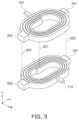
- FIG. 3 is an exploded view illustrating a coil portion.
- FIG. 4 is a cross-sectional view taken along line I-I′ of FIG. 1 .
- FIG. 5 is a cross-sectional view taken along line II-II′ of FIG. 1 .
- FIGS. 6 A to 6 D schematically illustrate a modified example of a support portion, respectively, corresponding to FIG. 2 .
- Coupled to may not only indicate that elements are directly and physically in contact with each other, but also include the configuration in which another element is interposed between the elements such that the elements are also in contact with the other component.
- an L direction is a first direction or a length (longitudinal) direction
- a W direction is a second direction or a width direction
- a T direction is a third direction or a thickness direction.
- various types of electronic components may be used, and various types of coil components may be used between the electronic components to remove noise, or for other purposes.
- a coil component may be used as a power inductor, a high frequency (HF) inductor, a general bead, a high frequency (GHz) bead, a common mode filter, and the like.
- HF high frequency
- GHz high frequency
- FIG. 1 is a schematic view illustrating a coil component according to an exemplary embodiment of the present disclosure.
- FIG. 2 is a view illustrating FIG. 1 in a downward direction.
- FIG. 3 is an exploded view illustrating a coil portion.
- FIG. 4 is a cross-sectional view taken along line I-I′ of FIG. 1 .
- FIG. 5 is a cross-sectional view taken along line II-II′ of FIG. 1 .
- FIGS. 6 A to 6 D schematically illustrate a modified example of a support portion, respectively, corresponding to FIG. 2 .
- FIG. 2 is a view illustrating FIG. 1 in a downward direction, a first coil pattern, first and second lead-out patterns, and first support portion are illustrated by a solid line by projecting them on a fifth surface 105 of a body 100 , for convenience of explanation.
- FIG. 2 does not illustrate external electrodes for convenience of explanation.
- a coil component 1000 may include a body 100 , an insulating substrate 200 , a coil portion 300 , connection electrodes 410 and 420 , external electrodes 500 and 600 , and support portions 710 and 720 .
- the body 100 may form an exterior of the coil component 1000 according to an exemplary embodiment of the present disclosure, and the insulating substrate 200 and the coil portion 300 may be embedded therein.
- the body 100 may be formed to have a hexahedral shape overall.
- the body 100 may include a first surface 101 and a second surface 102 facing each other in a length direction L, a third surface 103 and a fourth surface 104 facing each other in a width direction W, and a fifth surface 105 and a sixth surface 106 facing each other in a thickness direction T.
- Each of the first to fourth surfaces 101 , 102 , 103 , and 104 of the body 100 may correspond to wall surfaces of the body 100 connecting the fifth surface 105 and the sixth surface 106 of the body 100 .
- both end surfaces of the body 100 may refer to the first surface 101 and the second surface 102 of the body 100
- both side surfaces of the body 100 may refer to the third surface 103 and the fourth surface 104 of the body 100 .
- the body 100 of the coil component 1000 may be formed to have a length of 4.0 mm or less, a width of 4.0 mm or less, and a thickness of 1.5 mm or less, but is not limited thereto.
- the body 100 may include a magnetic material and an insulating resin. Specifically, the body 100 may be formed by stacking at least one magnetic composite sheet containing the insulating resin and the magnetic metal powder particles dispersed in the insulating resin.
- the body 100 may have a structure other than the structure in which the magnetic material may be dispersed in the insulating resin.
- the body 100 may be made of a magnetic material such as ferrite.
- the magnetic material may be, for example, a ferrite powder or a metal magnetic powder.
- Examples of the ferrite powder may include at least one of spinel type ferrites such as Mg—Zn-based ferrite, Mn—Zn-based ferrite, Mn—Mg-based ferrite, Cu—Zn-based ferrite, Mg—Mn—Sr-based ferrite, Ni—Zn-based ferrite, and the like, hexagonal ferrites such as Ba—Zn-based ferrite, Ba—Mg-based ferrite, Ba—Ni-based ferrite, Ba—Co-based ferrite, Ba—Ni—Co-based ferrite, and the like, garnet type ferrites such as Y-based ferrite, and the like, and Li-based ferrites.
- spinel type ferrites such as Mg—Zn-based ferrite, Mn—Zn-based ferrite, Mn—Mg-based ferrite, Cu—Zn-based ferrite, Mg—Mn—Sr-based ferrite, Ni—Zn-based ferrite,
- the metal magnetic powder may include at least one of iron (Fe), silicon (Si), chromium (Cr), cobalt (Co), molybdenum (Mo), aluminum (Al), niobium (Nb), copper (Cu), and nickel (Ni), and alloys thereof.
- the metal magnetic powder may be at least one of a pure iron powder, a Fe—Si-based alloy powder, a Fe—Si—Al-based alloy powder, a Fe—Ni-based alloy powder, a Fe—Ni—Mo-based alloy powder, a Fe—Ni—Mo—Cu-based alloy powder, a Fe—Co-based alloy powder, a Fe—Ni—Co-based alloy powder, a Fe—Cr-based alloy powder, a Fe—Cr—Si-based alloy powder, a Fe—Si—Cu—Nb-based alloy powder, a Fe—Ni—Cr-based alloy powder, and a Fe—Cr—Al-based alloy powder.
- the metallic magnetic powder may be amorphous or crystalline.
- the metal magnetic powder may be a Fe—Si—B—Cr-based amorphous alloy powder, but is not limited thereto.
- the ferrite powder and the metal magnetic powder may have an average diameter of about 0.1 ⁇ m to 30 ⁇ m, respectively, but are not limited thereto.
- the body 100 may include two or more types of magnetic materials dispersed in an insulating resin.
- the term “different types of magnetic materials” means that magnetic materials dispersed in an insulating resin are distinguished from each other by, for example, an average diameter, a composition, crystallinity, a shape, etc.
- the insulating resin may include an epoxy, a polyimide, a liquid crystal polymer, or the like, in a single form or in combined forms, but is not limited thereto.
- the body 100 may include a core 110 passing through the coil portion 300 , which will be described later.
- the core 110 may be formed by filling through holes of the coil portion 300 with a magnetic composite sheet, but is not limited thereto.
- the insulating substrate 200 may be embedded in the body 100 .
- the insulating substrate 200 may be configured to support the coil portion 300 and the support portions 710 and 720 , which will be described later.
- the insulating substrate 200 may be formed of an insulating material including a thermosetting insulating resin such as an epoxy resin, a thermoplastic insulating resin such as polyimide, or a photosensitive insulating resin, or may be formed of an insulating material in which a reinforcing material such as a glass fiber or an inorganic filler is impregnated with such an insulating resin.
- the insulating substrate 200 may be formed of an insulating material such as prepreg, Ajinomoto Build-up Film (ABF), FR-4, a bismaleimide triazine (BT) resin, a photoimageable dielectric (PID), and the like, but are not limited thereto.
- the inorganic filler at least one selected from a group consisting of silica (SiO 2 ), alumina (Al 2 O 3 ), silicon carbide (SiC), barium sulfate (BaSO 4 ), talc, mud, a mica powder, aluminum hydroxide (Al(OH) 3 ), magnesium hydroxide (Mg(OH) 2 ), calcium carbonate (CaCO 3 ), magnesium carbonate (MgCO 3 ), magnesium oxide (MgO), boron nitride (BN), aluminum borate (AlBO 3 ), barium titanate (BaTiO 3 ), and calcium zirconate (CaZrO 3 ) may be used.
- silica SiO 2
- alumina Al 2 O 3
- silicon carbide SiC
- BaSO 4 barium sulfate
- talc mud
- mica powder aluminum hydroxide (Al(OH) 3 ), magnesium hydroxide (Mg(OH) 2 ), calcium carbonate
- the insulating substrate 200 When the insulating substrate 200 is formed of an insulating material including a reinforcing material, the insulating substrate 200 may provide better rigidity. When the insulating substrate 200 is formed of an insulating material not containing glass fibers, the insulating substrate 200 may be advantageous for reducing a thickness of the overall coil portion 300 . When the insulating substrate 200 is formed of an insulating material containing a photosensitive insulating resin, the number of processes for forming the coil portion 300 may be reduced. Therefore, it may be advantageous in reducing production costs, and a fine via may be formed.
- the coil portion 300 may be embedded in the body 100 to manifest the characteristics of the coil portion.
- the coil portion 300 may function to stabilize the power supply of an electronic device by storing an electric field as a magnetic field and maintaining an output voltage.
- the coil portion 300 may include coil patterns 311 and 312 , lead-out patterns 331 and 332 , auxiliary lead-out patterns 341 and 342 , and vias 321 , 322 , and 323 .
- a first coil pattern 311 , a first lead-out pattern 331 , and a second lead-out pattern 332 may be disposed on a lower surface of the insulating substrate 200 , facing the sixth surface 106 of the body 100 , and a second coil pattern 312 , a first auxiliary lead-out pattern 341 , and a second auxiliary lead-out pattern 342 may be disposed on an upper surface of the insulating substrate 200 .
- the first coil pattern 311 may be in contact with the first lead-out pattern 331 , and the first coil pattern 311 and the first lead-out pattern 331 may be spaced apart from the second lead-out pattern 332 .
- the second coil pattern 312 may be in contact with the second auxiliary lead-out pattern 342 , and the second coil pattern 312 and the second auxiliary lead-out pattern 342 may be spaced apart from the first auxiliary lead-out pattern 341 .
- a first via 321 may pass through the insulating substrate 200 to respectively contact the first coil pattern 311 and the second coil pattern 312
- a second via 322 may pass through the insulating substrate 200 to respectively contact the first lead-out pattern 331 and the first auxiliary lead-out pattern 341
- a third via 323 may pass through the insulating substrate 200 to respectively contact the second lead-out pattern 332 and the second auxiliary lead-out pattern 342 .
- the coil portion 300 may function as a single coil which forms one or more turns about the core 110 as a whole.
- Each of the first coil pattern 311 and the second coil pattern 312 may be in a planar spiral shape having at least one turn formed about the core 110 .
- the first coil pattern 311 may form at least one turn about the core 110 on the lower surface of the insulating substrate 200 .
- the lead-out patterns 331 and 332 , and the auxiliary lead-out patterns 341 and 342 may be covered by the body 100 , respectively.
- the first to sixth surfaces 101 , 102 , 103 , 104 , 105 , and 106 of the body 100 may be not exposed.
- the lead-out patterns 331 and 332 may be not exposed to the first to sixth surfaces 101 , 102 , 103 , 104 , 105 , and 106 of the body 100 , respectively, although the lead-out portions of the conventional thin film type coil component are generally exposed to both end surfaces of the body in the length direction L.
- At least one of the coil patterns 311 and 312 , the vias 321 , 322 , and 323 , the lead-out patterns 331 and 332 , or the auxiliary lead-out patterns 341 and 342 may include at least one conductive layer.
- each of the second coil pattern 312 , the auxiliary lead-out patterns 341 and 342 , and the vias 321 , 322 , and 323 may include a seed layer of electroless plating layers, or the like, and an electroplating layer.
- each of the seed layer and the electroplating layer may have a single-layer structure or a multilayer structure.
- the electroplating layer of the multilayer structure may be formed using a conformal film structure in which one electroplating layer is covered by another electroplating layer, and another electroplating layer is only stacked on one side of the one electroplating layer, or the like.
- the seed layer of the second coil pattern 312 , the seed layers of the auxiliary lead-out patterns 341 and 342 , and the seed layers of the vias 321 , 322 , and 323 may be integrally formed, and no boundary therebetween may occur, but are not limited thereto.
- the electroplating layer of the second coil pattern 312 , the electroplating layers of the auxiliary lead-out patterns 341 and 342 , and the electroplating layers of the vias 321 , 322 , and 323 may be integrally formed, and no boundary therebetween may occur, but are not limited thereto.
- the vias 321 , 322 , and 323 may include a high melting point metal layer, and a low melting point metal layer having a melting point lower than a melting point of the high melting point metal layer.
- the low melting point metal layer may be formed of a solder containing lead (Pb) and/or tin (Sn).
- the low melting point metal layer may be melted at least in part due to the pressure and the temperature at the time of stacking in a batch.
- an intermetallic compound (IMC) layer may be formed at a portion of a boundary between the low melting point metal layer and the second coil pattern 312 .
- the coil patterns 311 and 312 , the lead-out patterns 331 and 332 , and the auxiliary lead-out patterns 341 and 342 may be protruded from the lower surface and the upper surface of the insulating substrate 200 , respectively.
- the first coil pattern 311 , and the lead-out patterns 331 and 332 may be protruded from the lower surface of the insulating substrate 200
- the second coil pattern 312 , and the auxiliary lead-out patterns 341 and 342 may be embedded in the upper surface of the insulating substrate 200 , to expose each of the upper surfaces of the second coil pattern 312 , and the auxiliary lead-out patterns 341 and 342 from the upper surface of the insulating substrate 200 .
- a recess may be formed in the upper surface of each of the upper surfaces of the second coil pattern 312 , and the auxiliary lead-out patterns 341 and 342 , the upper surface of each of the upper surfaces of the second coil pattern 312 , and the auxiliary lead-out patterns 341 and 342 , and the upper surface of the insulating substrate 200 may not be located on the same plane.
- the second coil pattern 312 and the auxiliary lead-out patterns 341 and 342 may protrude from the upper surface of the insulating substrate 200 , and the second coil pattern 312 and the auxiliary lead-out patterns 341 and 342 may be embedded in the lower surface of the insulating substrate 200 , to expose the lower surface of each of the upper surfaces of the second coil pattern 312 , and the auxiliary lead-out patterns 341 and 342 from the lower surface of the insulating substrate 200 .
- a recess may be formed in the lower surface of each of the upper surfaces of the second coil pattern 312 , and the auxiliary lead-out patterns 341 and 342 , the lower surface of each of the upper surfaces of the second coil pattern 312 , and the auxiliary lead-out patterns 341 and 342 , and the lower surface of the insulating substrate 200 may not be located on the same plane.
- Each of the coil patterns 311 and 312 , the lead-out patterns 331 and 332 , the auxiliary lead-out patterns 341 and 342 , and the vias 321 , 322 , and 323 may be formed of a conductive material such as copper (Cu), aluminum (Al), silver (Ag), tin (Sn), gold (Au), nickel (Ni), lead (Pb), titanium (Ti), or alloys thereof, but is not limited thereto.
- a conductive material such as copper (Cu), aluminum (Al), silver (Ag), tin (Sn), gold (Au), nickel (Ni), lead (Pb), titanium (Ti), or alloys thereof, but is not limited thereto.
- the first auxiliary lead-out pattern 341 may be independent of the electrical connection between the rest of the components of the coil portion 300 , and thus may be omitted in the present disclosure.
- the first auxiliary lead-out pattern 341 may be formed to omit an operation of distinguishing the fifth surface 105 and the sixth surface 106 of the body 100 from each other.
- the external electrodes 500 and 600 may be arranged to be spaced apart from each other on the sixth surface 106 of the body 100 .
- the external electrodes 500 and 600 may have a single-layer structure or a multilayer structure.
- a first external electrode 500 may include a first layer comprising copper (Cu), a second layer disposed on the first layer and comprising nickel (Ni), and a third layer disposed on the second layer and comprising tin (Sn).
- the first external electrode 500 may include a resin electrode including a conductive powder particle and a resin, and a plating layer formed by a plating process on the resin electrode.
- the external electrodes 500 and 600 may be formed of a conductive material such as copper (Cu), aluminum (Al), silver (Ag), tin (Sn), gold (Au), nickel (Ni), lead (Pb), titanium (Ti), or alloys thereof, but is not limited thereto.
- a conductive material such as copper (Cu), aluminum (Al), silver (Ag), tin (Sn), gold (Au), nickel (Ni), lead (Pb), titanium (Ti), or alloys thereof, but is not limited thereto.
- FIG. 1 illustrates that a width of the body 100 may be the same as a distance of the external electrodes 500 and 600 in the width direction W of the body 100 , but is merely illustrative. Sizes of the external electrodes 500 and 600 may be formed in a different manner to the size of FIG. 1 .
- connection electrodes 410 and 420 may pass through the body 100 to connect the first and second external electrodes 500 and 600 to the first and second lead-out patterns 331 and 332 .
- the first connection electrode 410 may connect the first external electrode 500 to the first lead-out pattern 331
- the second connection electrode 420 may connect the second external electrode 600 and the second lead-out pattern 332 .
- the connection electrodes 410 and 420 may extend from the lead-out patterns as the first and second connection electrodes, respectively.
- connection electrodes 410 and 420 may be disposed on the lead-out patterns 331 and 332 , before the operation of stacking a magnetic composite sheet, to form the body 100 , or may be formed by stacking a magnetic composite sheet, forming a hole passing through at least a portion of the magnetic composite sheet, and filling the hole with a conductive material. In the former case, since a seed layer is not required in forming the connection electrodes 410 and 420 by an electrolytic plating process, the connection electrodes 410 and 420 may be formed with only the electrolytic plating layer.
- connection electrodes 410 and 420 and the lead-out patterns 331 and 332 may be collectively formed in a plurality of unit coils at a strip level or a panel level.
- a seed layer such as an electroless plating layer may be interposed between the hole and the connection electrodes 410 and 420 , and between the lead-out patterns 331 and 332 and the connection electrodes 410 and 420 .
- connection electrodes 410 and 420 may be formed of a conductive material such as copper (Cu), aluminum (Al), silver (Ag), tin (Sn), gold (Au), nickel (Ni), lead (Pb), titanium (Ti), or alloys thereof, but is not limited thereto.
- a conductive material such as copper (Cu), aluminum (Al), silver (Ag), tin (Sn), gold (Au), nickel (Ni), lead (Pb), titanium (Ti), or alloys thereof, but is not limited thereto.
- the support portions 710 and 720 may extend from the coil portion 300 , may be exposed from one of the first to fourth surfaces 101 , 102 , 103 , and 104 of the body 100 , and may be arranged to be spaced apart from the lead-out patterns 331 and 332 .
- the support portions 710 and 720 may be distinguished and physically separated from the lead-out patterns 331 and 332 .
- the support portions 710 and 720 may be exposed from the first and second surfaces 101 and 102 of the body 100 , facing each other. Specifically, the first support portion 710 may extend from the outermost turn of the first coil pattern 311 to be exposed from the third surface 103 of the body 100 , and the first support portion 720 may extend from the outermost turn of the second coil pattern 312 to be exposed from the fourth side 104 of the body 100 .
- the support portions 710 and 720 may electrically and physically connect neighboring unit coils to each other, and support the neighboring unit coils during the manufacturing process. This will be described later. When the plurality of unit coils are separated by an individualization process such as dicing, the support portions 710 and 720 may be cut and exposed from a side surface of each unit component.
- the support portions 710 and 720 may be formed symmetrically with respect to the coil portion 300 .
- the expression of “being symmetrically formed” may be a concept including point symmetry and line symmetry.
- the support portions 710 and 720 may be formed symmetrically with each other in a central portion of the body 100 in the length direction, as illustrated in FIG. 2 .
- the support portions 710 and 720 may be spaced apart from each other by substantially the same distance from a center line of the body 100 in the length direction, as illustrated in FIG. 6 A .
- the support portions 710 and 720 may be arranged to have a certain angle with the width direction of the body 100 , as illustrated in FIG. 6 B .
- a linear width of each of the support portions 710 and 720 may be narrower than a length in an exposed surface of each of the support portions 710 and 720 .
- a cross-sectional area of each of the support portions 710 and 720 may be smaller than an area of an exposed surface of each of the support portions 710 and 720 .
- a first support portion 710 (including 711 and 712 ) and a second support portion 720 (including 721 and 722 ) may be formed in plural, respectively.
- each of the first support portion 710 (including 711 and 712 ) and the second support portion 720 (including 721 and 722 ) may be formed as a pair, respectively, and a pair of first support portion 710 (including 711 and 712 ) and a pair of second support portion 720 (including 721 and 722 ) may be formed symmetrically with respect to each other.
- the support portions 710 and 720 and the coil patterns 311 and 312 may be formed at the same time in the same electroplating process, and may be integrally formed without forming a boundary therebetween. Alternatively, the support portions 710 and 720 and the coil patterns 311 and 312 may be formed in different electroplating processes, and a boundary therebetween may be formed.
- the support portions 710 and 720 may be formed of a conductive material such as copper (Cu), aluminum (Al), silver (Ag), tin (Sn), gold (Au), nickel (Ni), lead (Pb), titanium (Ti), or alloys thereof, but is not limited thereto.
- a conductive material such as copper (Cu), aluminum (Al), silver (Ag), tin (Sn), gold (Au), nickel (Ni), lead (Pb), titanium (Ti), or alloys thereof, but is not limited thereto.
- an insulating film may be formed along surfaces of the lead-out patterns 331 and 332 , the coil patterns 311 and 312 , the insulating substrate 200 , the auxiliary lead-out patterns 341 and 342 , and the support portions 710 and 720 .
- the insulating film may be for insulating the lead-out patterns 331 and 332 , the coil patterns 311 and 312 , and the auxiliary lead-out patterns 341 and 342 from the body 100 , and may include a known insulating material such as parylene, and the like.
- An insulating material included in the insulation film 600 may be any material, and is not particularly limited thereto.
- the insulation film 600 may be formed using a vapor deposition process or the like, but not limited thereto, and may be formed by stacking an insulation film on both surfaces of the insulating substrate 200 .
- a thin film type coil component may be manufactured at a strip level or a panel level, to produce a plurality of unit components in a batch, and the plurality of unit components may be separated through an individualization process such as dicing. Electrical and physical coupling between neighboring unit coils may be required to form a plurality of unit coils at a strip level or a panel level by a plating process in a batch, and to stack magnetic composite sheets to form a body. Specifically, regions of forming neighboring unit coils should be electrically connected to each other such that electrolytic plating process may be carried out in a batch, and neighboring unit coils may be physically connected and mutually supported, such that variation in position of the unit coils during stacking of the magnetic composite sheets may be minimized.
- the conventional lead-out portion simultaneously takes charge of the above-mentioned function of coupling neighboring unit components, and the function of electrically connecting the external electrodes to each other after the individualization the components.
- a size of the lead-out portion should decrease as the coil component is thinned. There has been a limit in reducing a size of the lead-out pattern, in order to secure the coupling reliability between the lead-out portion and the external electrode and/or due to current concentration at the time of electroplating, and the like.
- the support portions 710 and 720 may be responsible for the electrical and physical connection between neighboring unit coils of the conventional lead-out portion. Therefore, the lead-out patterns 331 and 332 of the present disclosure may only be responsible for connecting the external electrodes 500 and 600 . Therefore, the size of the lead-out patterns 331 and 332 may be reduced.
- connection electrodes 410 and 420 may be formed before the stacking of the magnetic composite sheet, the lead-out patterns 331 and 332 themselves may be deleted.
- the connection electrodes 410 and 420 may be formed after the formation of the body 100 , the lead-out patterns 331 and 332 may be formed in a relatively large scale for matching between the connection electrodes 410 and 420 .
- the connection electrodes 410 and 420 may be formed directly on the end portions of the outermost turn of the coil patterns 311 and 312 , since the connection electrodes 410 and 420 may be formed before the stacking of the magnetic composite sheet.
- the coil component 1000 may form the lead-out patterns 311 and 312 in a relatively small scale. Therefore, the total volume of the magnetic body within the same component volume may be improved. Further, while the lead-out patterns 311 and 312 may be formed to be relatively small, neighboring unit coils during the manufacturing process may be connected to each other to be mutually supported.
- the coil component may be made thin.
Landscapes
- Engineering & Computer Science (AREA)
- Power Engineering (AREA)
- Microelectronics & Electronic Packaging (AREA)
- Manufacturing & Machinery (AREA)
- Coils Or Transformers For Communication (AREA)
Abstract
Description
Claims (17)
Applications Claiming Priority (2)
| Application Number | Priority Date | Filing Date | Title |
|---|---|---|---|
| KR10-2019-0040209 | 2019-04-05 | ||
| KR1020190040209A KR102706986B1 (en) | 2019-04-05 | 2019-04-05 | Coil component |
Publications (2)
| Publication Number | Publication Date |
|---|---|
| US20200321155A1 US20200321155A1 (en) | 2020-10-08 |
| US11600427B2 true US11600427B2 (en) | 2023-03-07 |
Family
ID=72662021
Family Applications (1)
| Application Number | Title | Priority Date | Filing Date |
|---|---|---|---|
| US16/666,965 Active 2041-06-21 US11600427B2 (en) | 2019-04-05 | 2019-10-29 | Coil component |
Country Status (3)
| Country | Link |
|---|---|
| US (1) | US11600427B2 (en) |
| KR (1) | KR102706986B1 (en) |
| CN (1) | CN111799058B (en) |
Families Citing this family (13)
| Publication number | Priority date | Publication date | Assignee | Title |
|---|---|---|---|---|
| KR102678629B1 (en) * | 2018-10-31 | 2024-06-27 | 삼성전기주식회사 | Coil component and manufacturing method of coil component |
| KR102335426B1 (en) * | 2020-01-07 | 2021-12-06 | 삼성전기주식회사 | Coil component |
| KR102900254B1 (en) * | 2020-11-03 | 2025-12-12 | 삼성전기주식회사 | Coil component |
| KR102900257B1 (en) * | 2020-11-05 | 2025-12-12 | 삼성전기주식회사 | Coil component |
| CN112466599B (en) * | 2020-11-19 | 2022-03-15 | 横店集团东磁股份有限公司 | High-low pin coil inductor and manufacturing method thereof |
| KR102899090B1 (en) * | 2020-11-27 | 2025-12-11 | 삼성전기주식회사 | Coil component |
| KR102960886B1 (en) * | 2020-11-30 | 2026-05-06 | 삼성전기주식회사 | Coil component |
| JP7628815B2 (en) * | 2020-12-11 | 2025-02-12 | Tdk株式会社 | Coil parts |
| KR102908319B1 (en) * | 2020-12-14 | 2026-01-05 | 삼성전기주식회사 | Coil component |
| KR102908323B1 (en) * | 2020-12-14 | 2026-01-05 | 삼성전기주식회사 | Coil component |
| KR20230049987A (en) * | 2021-10-07 | 2023-04-14 | 삼성전기주식회사 | Coil component |
| KR20230109946A (en) | 2022-01-14 | 2023-07-21 | 삼성전기주식회사 | Coil component |
| JP7819653B2 (en) * | 2023-03-06 | 2026-02-25 | 株式会社村田製作所 | Inductor Components |
Citations (16)
| Publication number | Priority date | Publication date | Assignee | Title |
|---|---|---|---|---|
| US20030030510A1 (en) * | 2001-08-09 | 2003-02-13 | Murata Manufacturing Co., Ltd. | Multilayered LC composite component and method for manufacturing the same |
| US20090085707A1 (en) * | 2007-09-28 | 2009-04-02 | Fujitsu Media Devices Limited | Electronic device |
| US20140009254A1 (en) * | 2012-07-04 | 2014-01-09 | Tdk Corporation | Coil component |
| JP2014197590A (en) * | 2013-03-29 | 2014-10-16 | Tdk株式会社 | Coil component |
| US20150048915A1 (en) * | 2013-08-14 | 2015-02-19 | Samsung Electro-Mechanics Co., Ltd. | Chip electronic component |
| CN104766691A (en) | 2014-01-07 | 2015-07-08 | 三星电机株式会社 | Chip electronic component and manufacturing method thereof |
| KR20160031391A (en) | 2014-09-11 | 2016-03-22 | 주식회사 이노칩테크놀로지 | Power inductor and method of manufacturing the same |
| US20160189840A1 (en) | 2014-12-30 | 2016-06-30 | Samsung Electro-Mechanics Co., Ltd. | Electronic component and method of manufacturing the same |
| US20180012696A1 (en) | 2016-07-07 | 2018-01-11 | Samsung Electro-Mechanics Co., Ltd. | Coil component and method for manufacturing the same |
| KR20180006246A (en) | 2016-07-07 | 2018-01-17 | 삼성전기주식회사 | Coil component |
| US20180174740A1 (en) | 2016-12-21 | 2018-06-21 | Murata Manufacturing Co., Ltd. | Surface-mount inductor |
| US20180358171A1 (en) | 2017-06-13 | 2018-12-13 | Samsung Electro-Mechanics Co., Ltd. | Coil component |
| US20180358169A1 (en) * | 2017-06-08 | 2018-12-13 | Tdk Corporation | Coil component and manufacturing methods thereof |
| CN109087775A (en) | 2017-06-13 | 2018-12-25 | 三星电机株式会社 | Coil block |
| US20190115143A1 (en) * | 2017-10-16 | 2019-04-18 | Murata Manufacturing Co., Ltd. | Multilayer coil component and inspection system for multilayer coil component |
| US20200279687A1 (en) * | 2019-02-28 | 2020-09-03 | Samsung Electro-Mechanics Co., Ltd. | Coil component |
Family Cites Families (2)
| Publication number | Priority date | Publication date | Assignee | Title |
|---|---|---|---|---|
| JP2002015925A (en) * | 2000-06-27 | 2002-01-18 | Fdk Corp | Multilayer inductance element |
| KR20170079183A (en) * | 2015-12-30 | 2017-07-10 | 삼성전기주식회사 | Coil Component |
-
2019
- 2019-04-05 KR KR1020190040209A patent/KR102706986B1/en active Active
- 2019-10-29 US US16/666,965 patent/US11600427B2/en active Active
-
2020
- 2020-01-19 CN CN202010057700.XA patent/CN111799058B/en active Active
Patent Citations (20)
| Publication number | Priority date | Publication date | Assignee | Title |
|---|---|---|---|---|
| US20030030510A1 (en) * | 2001-08-09 | 2003-02-13 | Murata Manufacturing Co., Ltd. | Multilayered LC composite component and method for manufacturing the same |
| US20090085707A1 (en) * | 2007-09-28 | 2009-04-02 | Fujitsu Media Devices Limited | Electronic device |
| US20140009254A1 (en) * | 2012-07-04 | 2014-01-09 | Tdk Corporation | Coil component |
| JP2014197590A (en) * | 2013-03-29 | 2014-10-16 | Tdk株式会社 | Coil component |
| US20150048915A1 (en) * | 2013-08-14 | 2015-02-19 | Samsung Electro-Mechanics Co., Ltd. | Chip electronic component |
| KR20150019730A (en) | 2013-08-14 | 2015-02-25 | 삼성전기주식회사 | Chip electronic component |
| CN104766691A (en) | 2014-01-07 | 2015-07-08 | 三星电机株式会社 | Chip electronic component and manufacturing method thereof |
| KR20160031391A (en) | 2014-09-11 | 2016-03-22 | 주식회사 이노칩테크놀로지 | Power inductor and method of manufacturing the same |
| US20160189840A1 (en) | 2014-12-30 | 2016-06-30 | Samsung Electro-Mechanics Co., Ltd. | Electronic component and method of manufacturing the same |
| CN105742035A (en) | 2014-12-30 | 2016-07-06 | 三星电机株式会社 | Electronic Component And Method Of Manufacturing The Same |
| US20180012696A1 (en) | 2016-07-07 | 2018-01-11 | Samsung Electro-Mechanics Co., Ltd. | Coil component and method for manufacturing the same |
| KR20180006246A (en) | 2016-07-07 | 2018-01-17 | 삼성전기주식회사 | Coil component |
| US20180174740A1 (en) | 2016-12-21 | 2018-06-21 | Murata Manufacturing Co., Ltd. | Surface-mount inductor |
| CN108231338A (en) | 2016-12-21 | 2018-06-29 | 株式会社村田制作所 | surface mounting inductor |
| US20180358169A1 (en) * | 2017-06-08 | 2018-12-13 | Tdk Corporation | Coil component and manufacturing methods thereof |
| US20180358171A1 (en) | 2017-06-13 | 2018-12-13 | Samsung Electro-Mechanics Co., Ltd. | Coil component |
| CN109087775A (en) | 2017-06-13 | 2018-12-25 | 三星电机株式会社 | Coil block |
| US20190115143A1 (en) * | 2017-10-16 | 2019-04-18 | Murata Manufacturing Co., Ltd. | Multilayer coil component and inspection system for multilayer coil component |
| US20200279687A1 (en) * | 2019-02-28 | 2020-09-03 | Samsung Electro-Mechanics Co., Ltd. | Coil component |
| CN111627674A (en) | 2019-02-28 | 2020-09-04 | 三星电机株式会社 | Coil assembly |
Non-Patent Citations (2)
| Title |
|---|
| Chinese Office Action dated Nov. 10, 2021 , issued in corresponding Chinese Patent Application No. 202010057700.X. |
| Office Action issued in corresponding Chinese Patent Application No. 202010057700.X dated Jul. 29, 2021, with English translation. |
Also Published As
| Publication number | Publication date |
|---|---|
| US20200321155A1 (en) | 2020-10-08 |
| KR20200117700A (en) | 2020-10-14 |
| KR102706986B1 (en) | 2024-09-19 |
| CN111799058B (en) | 2022-05-13 |
| CN111799058A (en) | 2020-10-20 |
Similar Documents
| Publication | Publication Date | Title |
|---|---|---|
| US20200321155A1 (en) | Coil component | |
| US12106885B2 (en) | Coil component | |
| US11574768B2 (en) | Coil component | |
| US11664153B2 (en) | Coil component | |
| US11521784B2 (en) | Coil component | |
| US11935682B2 (en) | Coil component and manufacturing method for the same | |
| US11830665B2 (en) | Coil electronic component | |
| US11830662B2 (en) | Coil component | |
| US20200357565A1 (en) | Coil electronic component | |
| US11295890B2 (en) | Coil component | |
| US11837388B2 (en) | Coil component | |
| US20190311829A1 (en) | Coil component | |
| US11574765B2 (en) | Coil component | |
| US11721475B2 (en) | Coil component | |
| US11830655B2 (en) | Coil component | |
| US11532426B2 (en) | Inductor | |
| US20200135374A1 (en) | Coil component and manufacturing method of coil component | |
| US11908612B2 (en) | Coil component | |
| CN112967863A (en) | Coil component | |
| US12009142B2 (en) | Coil component | |
| US20240212923A1 (en) | Coil component | |
| US20250132086A1 (en) | Coil component |
Legal Events
| Date | Code | Title | Description |
|---|---|---|---|
| AS | Assignment |
Owner name: SAMSUNG ELECTRO-MECHANICS CO., LTD., KOREA, REPUBLIC OF Free format text: ASSIGNMENT OF ASSIGNORS INTEREST;ASSIGNORS:PARK, KWANG IL;LEE, JONG MIN;REEL/FRAME:050854/0703 Effective date: 20191016 |
|
| FEPP | Fee payment procedure |
Free format text: ENTITY STATUS SET TO UNDISCOUNTED (ORIGINAL EVENT CODE: BIG.); ENTITY STATUS OF PATENT OWNER: LARGE ENTITY |
|
| STPP | Information on status: patent application and granting procedure in general |
Free format text: DOCKETED NEW CASE - READY FOR EXAMINATION |
|
| STPP | Information on status: patent application and granting procedure in general |
Free format text: NON FINAL ACTION MAILED |
|
| STPP | Information on status: patent application and granting procedure in general |
Free format text: RESPONSE TO NON-FINAL OFFICE ACTION ENTERED AND FORWARDED TO EXAMINER |
|
| STPP | Information on status: patent application and granting procedure in general |
Free format text: FINAL REJECTION MAILED |
|
| STPP | Information on status: patent application and granting procedure in general |
Free format text: RESPONSE AFTER FINAL ACTION FORWARDED TO EXAMINER |
|
| STPP | Information on status: patent application and granting procedure in general |
Free format text: NOTICE OF ALLOWANCE MAILED -- APPLICATION RECEIVED IN OFFICE OF PUBLICATIONS |
|
| STCF | Information on status: patent grant |
Free format text: PATENTED CASE |
|
| MAFP | Maintenance fee payment |
Free format text: PAYMENT OF MAINTENANCE FEE, 4TH YEAR, LARGE ENTITY (ORIGINAL EVENT CODE: M1551); ENTITY STATUS OF PATENT OWNER: LARGE ENTITY Year of fee payment: 4 |