US11600171B2 - Crosswalk warning lighting system - Google Patents
Crosswalk warning lighting system Download PDFInfo
- Publication number
- US11600171B2 US11600171B2 US17/537,278 US202117537278A US11600171B2 US 11600171 B2 US11600171 B2 US 11600171B2 US 202117537278 A US202117537278 A US 202117537278A US 11600171 B2 US11600171 B2 US 11600171B2
- Authority
- US
- United States
- Prior art keywords
- crosswalk
- warning light
- light
- optical path
- crosswalk warning
- Prior art date
- Legal status (The legal status is an assumption and is not a legal conclusion. Google has not performed a legal analysis and makes no representation as to the accuracy of the status listed.)
- Active
Links
Images




Classifications
-
- G—PHYSICS
- G08—SIGNALLING
- G08G—TRAFFIC CONTROL SYSTEMS
- G08G1/00—Traffic control systems for road vehicles
- G08G1/005—Traffic control systems for road vehicles including pedestrian guidance indicator
-
- F—MECHANICAL ENGINEERING; LIGHTING; HEATING; WEAPONS; BLASTING
- F21—LIGHTING
- F21S—NON-PORTABLE LIGHTING DEVICES; SYSTEMS THEREOF; VEHICLE LIGHTING DEVICES SPECIALLY ADAPTED FOR VEHICLE EXTERIORS
- F21S9/00—Lighting devices with a built-in power supply; Systems employing lighting devices with a built-in power supply
- F21S9/02—Lighting devices with a built-in power supply; Systems employing lighting devices with a built-in power supply the power supply being a battery or accumulator
- F21S9/03—Lighting devices with a built-in power supply; Systems employing lighting devices with a built-in power supply the power supply being a battery or accumulator rechargeable by exposure to light
- F21S9/035—Lighting devices with a built-in power supply; Systems employing lighting devices with a built-in power supply the power supply being a battery or accumulator rechargeable by exposure to light the solar unit being integrated within the support for the lighting unit, e.g. within or on a pole
-
- F—MECHANICAL ENGINEERING; LIGHTING; HEATING; WEAPONS; BLASTING
- F21—LIGHTING
- F21V—FUNCTIONAL FEATURES OR DETAILS OF LIGHTING DEVICES OR SYSTEMS THEREOF; STRUCTURAL COMBINATIONS OF LIGHTING DEVICES WITH OTHER ARTICLES, NOT OTHERWISE PROVIDED FOR
- F21V11/00—Screens not covered by groups F21V1/00, F21V3/00, F21V7/00 or F21V9/00
- F21V11/08—Screens not covered by groups F21V1/00, F21V3/00, F21V7/00 or F21V9/00 using diaphragms containing one or more apertures
-
- F—MECHANICAL ENGINEERING; LIGHTING; HEATING; WEAPONS; BLASTING
- F21—LIGHTING
- F21V—FUNCTIONAL FEATURES OR DETAILS OF LIGHTING DEVICES OR SYSTEMS THEREOF; STRUCTURAL COMBINATIONS OF LIGHTING DEVICES WITH OTHER ARTICLES, NOT OTHERWISE PROVIDED FOR
- F21V7/00—Reflectors for light sources
- F21V7/04—Optical design
- F21V7/048—Optical design with facets structure
-
- F—MECHANICAL ENGINEERING; LIGHTING; HEATING; WEAPONS; BLASTING
- F21—LIGHTING
- F21V—FUNCTIONAL FEATURES OR DETAILS OF LIGHTING DEVICES OR SYSTEMS THEREOF; STRUCTURAL COMBINATIONS OF LIGHTING DEVICES WITH OTHER ARTICLES, NOT OTHERWISE PROVIDED FOR
- F21V7/00—Reflectors for light sources
- F21V7/04—Optical design
- F21V7/05—Optical design plane
-
- F—MECHANICAL ENGINEERING; LIGHTING; HEATING; WEAPONS; BLASTING
- F21—LIGHTING
- F21V—FUNCTIONAL FEATURES OR DETAILS OF LIGHTING DEVICES OR SYSTEMS THEREOF; STRUCTURAL COMBINATIONS OF LIGHTING DEVICES WITH OTHER ARTICLES, NOT OTHERWISE PROVIDED FOR
- F21V7/00—Reflectors for light sources
- F21V7/0025—Combination of two or more reflectors for a single light source
- F21V7/0033—Combination of two or more reflectors for a single light source with successive reflections from one reflector to the next or following
-
- F—MECHANICAL ENGINEERING; LIGHTING; HEATING; WEAPONS; BLASTING
- F21—LIGHTING
- F21W—INDEXING SCHEME ASSOCIATED WITH SUBCLASSES F21K, F21L, F21S and F21V, RELATING TO USES OR APPLICATIONS OF LIGHTING DEVICES OR SYSTEMS
- F21W2111/00—Use or application of lighting devices or systems for signalling, marking or indicating, not provided for in codes F21W2102/00 – F21W2107/00
- F21W2111/02—Use or application of lighting devices or systems for signalling, marking or indicating, not provided for in codes F21W2102/00 – F21W2107/00 for roads, paths or the like
-
- F—MECHANICAL ENGINEERING; LIGHTING; HEATING; WEAPONS; BLASTING
- F21—LIGHTING
- F21Y—INDEXING SCHEME ASSOCIATED WITH SUBCLASSES F21K, F21L, F21S and F21V, RELATING TO THE FORM OR THE KIND OF THE LIGHT SOURCES OR OF THE COLOUR OF THE LIGHT EMITTED
- F21Y2105/00—Planar light sources
- F21Y2105/10—Planar light sources comprising a two-dimensional [2D] array of point-like light-generating elements
-
- F—MECHANICAL ENGINEERING; LIGHTING; HEATING; WEAPONS; BLASTING
- F21—LIGHTING
- F21Y—INDEXING SCHEME ASSOCIATED WITH SUBCLASSES F21K, F21L, F21S and F21V, RELATING TO THE FORM OR THE KIND OF THE LIGHT SOURCES OR OF THE COLOUR OF THE LIGHT EMITTED
- F21Y2115/00—Light-generating elements of semiconductor light sources
- F21Y2115/10—Light-emitting diodes [LED]
-
- Y—GENERAL TAGGING OF NEW TECHNOLOGICAL DEVELOPMENTS; GENERAL TAGGING OF CROSS-SECTIONAL TECHNOLOGIES SPANNING OVER SEVERAL SECTIONS OF THE IPC; TECHNICAL SUBJECTS COVERED BY FORMER USPC CROSS-REFERENCE ART COLLECTIONS [XRACs] AND DIGESTS
- Y02—TECHNOLOGIES OR APPLICATIONS FOR MITIGATION OR ADAPTATION AGAINST CLIMATE CHANGE
- Y02B—CLIMATE CHANGE MITIGATION TECHNOLOGIES RELATED TO BUILDINGS, e.g. HOUSING, HOUSE APPLIANCES OR RELATED END-USER APPLICATIONS
- Y02B20/00—Energy efficient lighting technologies, e.g. halogen lamps or gas discharge lamps
- Y02B20/72—Energy efficient lighting technologies, e.g. halogen lamps or gas discharge lamps in street lighting
Definitions
- the present invention is related to, and claims the benefit of Canadian Application Serial No. 3,103,594, filed on Dec. 1, 2020, and entitled CROSSWALK WARNING LIGHTING SYSTEM and which is hereby incorporated in its entirety including all tables, figures, and claims.
- the present technology is an improved crosswalk warning light system. More specifically, it is a warning light system that utilizes one lighting unit to alert both a driver and a pedestrian that the pedestrian has activated the lighting system and will be crossing the road.
- Pedestrian cross walks are the sites of numerous collisions between motor vehicles and pedestrians. The most dangerous cross walks are those that are not at a light-controlled intersection. Warning lights are often used at these cross walks.
- a pedestrian activates a warning light system when they want to cross the road. The light system then flashes to alert drivers that a pedestrian is about to cross or is crossing the road.
- a major deficiency in the earlier designs was that the pedestrian was not informed whether or not the warning light system was activated. For this reason, the warning light systems were designed that had two light units—one that faced the pedestrian and one that faced the motor vehicles. This involved two light circuits for each light system. This is not only overly complex but is subject to failure.
- the pedestrian safety lighting device and system comprises a housing, at least one light source, a communication means, and a power source. More specifically, the communication means is configured to receive external data from the same or a different traffic signal, selectively illuminate the light source, and generate and transmit internal data to the same or a different traffic signal, or a data center.
- the device and system may also comprise a light directing element, a light processing element, one or more sensors, a speaker, a camera, and a microphone. This is an overly complex system.
- an apparatus may include a control unit to extend a duration of a pedestrian crossing state of the pedestrian crossing or traffic light in response to receipt of sensor data that convey detection of at least one commence crossing event of the pedestrian, while the pedestrian crossing or traffic light is in a pedestrian crossing state, but yet to receive sensor data that convey detection of all corresponding end of crossing event or events of the one or more pedestrians, prior to expiration of the duration of the pedestrian crossing state.
- the controller may extend the duration of the pedestrian crossing state until receipt of sensor data that convey receipt of all corresponding end of crossing event/events of the one or more pedestrians, or until a timeout threshold is reached. This is an overly complex system.
- United States Patent Application Publication No. 20170256161 discloses safety systems for enhancing the visibility of pedestrian crosswalk traffic control devices and related methods.
- a plurality of crosswalk safety modules is provided, each of which is configured to be removably coupled with a separate crosswalk traffic control device.
- Each of the plurality of crosswalk safety modules may comprise one or more lights and/or one or more speakers or alarms, configured to, upon actuation, improve the visibility of a crosswalk traffic control device coupled with the accompanying crosswalk safety module to motorists.
- the system may further comprise a remote control configured to generate a signal for remote operation of each of the plurality of crosswalk modules.
- Each of the plurality of crosswalk modules is preferably configured such that actuation of the remote-control results in coordinated operation of the lights and/or sounds associated with the plurality of crosswalk modules. This is an overly complex system.
- a flashing beacon may include a signal unit, a control unit associated with the signal unit, a solar panel or collector, and an activation device that may all be mounted or otherwise positioned on a post of a roadway sign.
- Light units associated with the signal unit may be programmed to flash on and off in a unique wig-wag pattern.
- a light bar may also be used with the beacon to generate an intense flash of light soon after activation of the beacon as an additional means of grabbing the attention of the operator of a vehicle. This requires separate light systems for each light which is complicated and overly expensive. Further, as there are separate light systems, the lights facing the crosswalk could flash without the lights facing the motorist flashing.
- United States Patent Application Publication No. 20150084791 discloses an apparatus and method for managing safety of a pedestrian at a crosswalk, which determine the location of a pedestrian in a crosswalk area, and then selectively provide a pedestrian signal extension service, an approaching vehicle notification service, and a pedestrian danger notification service.
- a presented apparatus includes a monitoring unit for monitoring a crosswalk area in which a pedestrian waits or crosses a street.
- a detection unit detects whether a pedestrian is present in the crosswalk area, based on information output from the monitoring unit.
- a location determination unit determines a location of the pedestrian detected by the detection unit.
- a safety determination unit determines whether the pedestrian is safe, based on the location of the pedestrian and a state of a pedestrian signal.
- An information provision unit outputs danger notification information based on a safety/danger determination signal output from the safety determination unit. This is overly complex and is not foolproof.
- United States Patent Application Publication No. 20100214127 discloses an embodiment of the present invention is an illuminated stop sign for allowing pedestrians to control traffic.
- the system comprises a fixed support assembly; a pedestrian activated mechanism; a timer set for a predetermined period of time when the pedestrian activated mechanism is activated; and an octagonal display non-removably mounted to the fixed support assembly comprising a backlight within the display and a display surface comprising a word “STOP” visible when the backlight is illuminated and substantially not visible when the backlight is not illuminated, the backlight being illuminated until the predetermined period of time is expired. This does not alert the pedestrian that the stop light is on.
- the crosswalk warning system comprises two or more crosswalk warning beacons, located on opposite sides of the road.
- Each beacon comprises a solar panel to recharge a battery, a battery back, a control unit to charge the battery pack during daylight hours, a communication unit to communicate to the second crosswalk beacon, a traffic signal lamp ton warn oncoming traffic, and a triggering means by which the pedestrian can activate the beacons. This does not alert the pedestrian that the warning light is on.
- What is needed is a crosswalk warning light system that relies on a single lighting unit with a single lighting circuit to alert both a driver and a pedestrian that the warning lights are flashing. It would be preferable if it was a mechanical solution to an optical problem. It would be further preferable if it alerted the pedestrian if the warning lighting system failed to be activated. It would be further preferable if it was fool proof.
- the present technology a crosswalk warning light system that relies on a single lighting unit with a single lighting circuit to alert both a driver and a pedestrian that the warning lights are flashing. It is a mechanical solution to an optical problem. It alerts the pedestrian if the warning lighting system failed to be activated, hence it is fool proof.
- a crosswalk warning light comprising: a housing which includes a front, the front including a first end and a second end, at least one end including at least one slot, a face with at least one aperture, the aperture defining an outside edge, a step with a riser, the step including or housing at least one optical element, the riser adjacent the outside edge, a top shaped to conform to the front, a bottom shaped to conform to the top, and a back; and at least one bank of light emitting diode (LED) lights positioned such that a portion of the bank of light emitting diodes is aligned with the aperture and a portion of the bank of light emitting diodes is aligned with the step, wherein the at least one optical element is configured to deviate an incident optical path by between sixty degrees to one hundred and twenty degrees to provide a deviated optical path that is aligned with the at least one slot.
- LED light emitting diode
- the crosswalk warning light there may be two apertures, two banks of LED lights and two steps with risers.
- the LED lights may be on a single circuit.
- the crosswalk warning light may further comprise a solar panel in electrical communication with the LED lights.
- the riser may include a reflective inner surface which includes at least one angle which function as an acute forty-five degree to fifty-five degree angle to the face.
- the reflective inner surface may be an acute forty-five degrees to fifty-five degrees to the face.
- the reflective inner surface may be a polished mirrored surface.
- the at least one optical element may be at least one prism.
- the at least one optical element may be at least one lens.
- the at least one optical element may be a combination of optical elements selected from the group consisting of mirrors, prisms and lenses.
- a method of alerting a pedestrian that a crosswalk warning light has been activated comprising: the pedestrian activating a crosswalk warning light system; the crosswalk warning light system directing light in a first optical path to the road in front of the crosswalk and directing light in a second optical path to the road behind the crosswalk; and the crosswalk warning light system directing light in a third optical path to at least one optical element which is configured to deviate the third optical path by ninety degrees to provide a deviated optical path that is aligned with the crosswalk and is between sixty degrees to one hundred and twenty degrees to the first and the second optical paths.
- the deviation of the third optical path may be effected by reflection.
- the deviation of the third optical path is ninety degrees to the first and the second optical path.
- a crosswalk warning light system including two light, each light comprising: a housing which includes a front, the front including a first end and a second end, at least one end including at least one slot, a face with at least one aperture, the aperture defining an outside edge, a step with a riser, the step including or housing at least one optical element, the riser adjacent the outside edge, a top shaped to conform to the front, a bottom shaped to conform to the top, and a back; and at least one bank of light emitting diode (LED) lights positioned such that a portion of the bank of light emitting diodes is aligned with the aperture and a portion of the bank of light emitting diodes is aligned with the step, wherein the at least one optical element is configured to deviate an incident optical path by between sixty degrees to one hundred and twenty degrees to provide a deviated optical path that is aligned with the at least one slot.
- LED light emitting diode
- each light may include two apertures, two banks of LED lights and two steps with risers.
- each light may include two slots in the first end and two slots in the second end.
- the LED lights in each light may be on a single circuit.
- the crosswalk warning light system may further comprise a solar panel in electrical communication with the LED lights.
- each light may include the riser which includes a reflective inner surface which includes at least one angle which, in total, function is an acute forty-five degree to fifty-five degree angle to the face.
- the reflective inner surface may be an acute forty-five degrees to fifty-five degrees to the face.
- the reflective inner surface may be a polished mirrored surface.
- the at least one optical element may be at least one prism.
- the at least one optical element may be at least one lens.
- the at least one optical element may be a combination of optical elements selected from the group consisting of mirrors, prisms and lenses.
- FIG. 1 is a schematic of the crosswalk warning lighting system of the present technology.
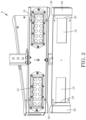
- FIG. 2 is an exploded view of the crosswalk warning lighting system of FIG. 1 .
- FIG. 3 is a schematic of the optical paths of the crosswalk warning lighting system of FIG. 1 .
- FIG. 4 is a schematic of the complete system ready for deployment of the crosswalk warning lighting system of FIG. 1 .
- FIG. 5 is a schematic of an alternative embodiment crosswalk warning lighting system of FIG. 1 . Only one bank of LEDs is shown.
- FIG. 6 is a schematic of an alternative embodiment crosswalk warning lighting system of FIG. 1 . Only one bank of LEDs is shown.
- FIG. 7 is a schematic of an alternative embodiment crosswalk warning lighting system of FIG. 1 . Only one bank of LEDs is shown.
- FIG. 8 is a schematic of an alternative embodiment crosswalk warning lighting system of FIG. 1 . Only one bank of LEDs is shown.
- FIG. 9 A- 9 D show the effect of different angles of the optical element relative to the face. Only one bank of LEDs is shown.
- FIG. 9 A is a schematic showing an optical light path deviated by 60 degrees;
- FIG. 9 B shows an optical light path deviated by 120 degrees;
- FIG. 9 C shows an optical light path deviated by 100 degrees; and
- FIG. 9 D shows an optical light path deviated by 80 degrees.
- an optical element in the context of the present technology, is a mirror, a lens or a prism.
- optical elements are a combination of a mirror or mirrors and a lens or lenses, a mirror or mirrors and a prism or prisms, or a lens or lenses and a prism or prisms.
- the mirrors may be planer, convex or concave.
- Deviated optical path in the context of the present technology, a deviated optical path is one that has undergone one or more of reflection, refraction or deviation.
- a crosswalk warning lighting system generally referred to as 8 is shown in FIG. 1 .
- Two banks of light emitting diode lights (LEDs) 10 are housed in a housing, generally referred to as 12 which is pivotally mounted on a vertical support such as a pole 14 .
- Ten LEDs 10 can be seen in each bank.
- the LEDs have about a 20 degree beam pattern.
- the housing 12 is positioned on the pole 14 such that the LEDs 10 face an oncoming vehicle.
- a second housing 12 also houses two banks of LEDs 10 and faces the vehicles coming the opposite direction.
- the front 16 of the housing 12 has a pair of apertures 18 in the face 20 of the front 16 .
- a step 26 Proximate to the first end 22 and the second end 24 is a step 26 which has a riser 28 which is at an obtuse angle of about 120 to about 160 degrees, preferably 135 degrees to the face 20 of the front 16 and abuts an outside edge 29 of each aperture 18 .
- the first end 22 and the second end 24 are perpendicular to the face 20 and the LEDs 10 .
- the top 32 is shaped to conform to the shape of the front 16 , hence it has a first end 34 and a second end 36 that is perpendicular to the remainder of the top 32 and a step 38 which has a riser 40 which is at about 120 to about 160, preferably 135 degrees to the remainder of the top 32 .
- the bottom 42 is also shaped to conform to the shape of the front 16 , hence it has a first end 44 and a second end 46 that is perpendicular to the remainder of the bottom 42 and a step 48 which has a riser 50 which is at about 120 to about 160, preferably 135 degrees to the remainder of the bottom 42 .
- the two banks of LEDs 10 each have twelve LEDs 10 . Comparing FIG. 1 with FIG. 2 , it can be seen that the apertures 18 are sized such that only ten of the LEDs 10 in each bank are in the aperture 18 .
- the optical path 60 of the ten LEDs 10 is through the apertures 18 and is perpendicular to the face 20 of the front 16 .
- the incident optical path 62 of the remaining two LEDs 10 is onto the reflective inner surface 70 of the riser 28 , which is an acute forty-five degrees to fifty-five degree from the face 20 .
- the inner surface 70 of the riser 28 is unpolished aluminum. In another embodiment, it is a polished mirrored surface, preferably electropolished. In an alternative embodiment the inner surface is provided with a mirrored surface.
- the light is reflected by the inner surface 70 of the riser 28 , hence the reflected optical path 72 is at right angles to the incident optical path 62 , is aligned with the two slots 30 in the respective end 22 , 24 and passes through the two slots 30 .
- the reflected optical path 72 is also at right angles to the optical path 60 of the ten LEDs 10 .
- a pedestrian sees the light from the reflected optical path 72 of the two LEDs 10 while a driver sees the light from the optical path 60 of the ten LEDs 10 .
- the two housings 12 are pivotally attached to one another with pivot mounts 80 , 82 which are attached the housing 12 .
- the crosswalk warning lighting system 8 is powered with solar panels 86 , with power stored in a battery 88 .
- There is a single circuit for the LEDs 10 in each housing 12 for a total of two circuits per system 8 .
- the step 26 has a riser 90 that is between about ninety degrees to about 160 degrees to the face 20 of the front 16 .
- a ninety-degree prism 92 is housed in the step 26 and is positioned such that the incident optical path 62 is deviated by ninety degrees to provide a deviated optical path 94 .
- the deviated optical path 94 is aligned with the slots 30 and passes through the slots 30 .
- a pedestrian sees the light from the deviated optical path 94 of the two LEDs 10 while a driver sees the light from the optical path 60 of the ten LEDs 10 . There is no need for a separate bank of LEDs and the associated circuitry.
- the step 26 has a riser 90 that is between about ninety degrees to about 160 degrees to the face 20 of the front 16 .
- a series of lenses 102 are housed in the step 26 and are positioned such that the incident optical path 62 is refracted by ninety degrees to provide a refracted optical path 104 .
- the refracted optical path 104 is aligned with the slots 30 and passes through the slots 30 .
- a pedestrian sees the light from the refracted optical path 104 of the two LEDs 10 while a driver sees the light from the optical path 60 of the ten LEDs 10 .
- the step 26 has a riser 110 that has an inner surface 116 with two or more sections 112 , 114 whose angles, when combined, function as a forty-five degree to fifty-five degree angle (to determine suitable angles, an angle less than 45 to 55 degrees is subtracted from an angle greater than 45 to 55 degrees to equal 45 to 55 degrees).
- the incident optical path 62 of the remaining two LEDs 10 is onto the inner surface 116 of the riser 110 .
- the inner surface 116 of the riser 28 is unpolished aluminum. In another embodiment, it is a polished mirrored surface, preferably electropolished. In an alternative embodiment the inner surface is provided with a mirrored surface.
- the light is reflected by the inner surfaces 116 of the sections 112 , 114 the riser 110 , hence the reflected optical path 118 is at right angles to the incident optical path 62 , is aligned with the two slots 30 in the respective end 22 , 24 and passes through the two slots 30 .
- the reflected optical path 118 is also at right angles to the optical path 60 of the ten LEDs 10 .
- a pedestrian sees the light from the reflected optical path 118 of the two LEDs 10 while a driver sees the light from the optical path 60 of the ten LEDs 10 .
- optical elements (which may be two or more) 120 , 122 , 124 are housed in the step 26 .
- the optical elements may be combinations of one or more lenses, one or more mirrors and one or more prisms, one or more lenses and one or more prisms, one or more mirrors and one or more lenses or one or more mirrors and one or more prisms.
- the optical elements 120 , 122 , 124 in combination, result in the incident optical path 62 being one or more of reflected, refracted or deviated by ninety degrees to produce a shifted light optical path 130 , which is at right angles to the incident optical path 62 , is aligned with the two slots 30 in the respective end 22 , 24 and passes through the two slots 30 .
- the shifted optical path 130 is also at right angles to the optical path 60 of the ten LEDs 10 .
- a pedestrian sees the light from the shifted optical path 130 of the two LEDs 10 while a driver sees the light from the optical path 60 of the ten LEDs 10 . There is no need for a separate bank of LEDs and the associated circuitry.
- the reflected optical light path 72 is about 120 degrees relative to the incident optical light path 62 .
- FIG. 9 C shows the optical light path when the optical element 70 is angled at about 50 degrees to the face 20 .
- the reflected optical light path 72 is about 100 degrees relative to the incident light path 62 .
- FIG. 9 D shows the optical light path when the optical element 70 is angled at about 40 degrees to the face 20 .
- the reflected optical light path 72 is about 80 degrees relative to the incident optical light path 62 .
- prisms and lens may be selected that have surfaces that deviate and refract the optical light path between about 60 degrees to about 120 degrees.
Landscapes
- Engineering & Computer Science (AREA)
- General Engineering & Computer Science (AREA)
- Life Sciences & Earth Sciences (AREA)
- Sustainable Development (AREA)
- Physics & Mathematics (AREA)
- General Physics & Mathematics (AREA)
- Road Signs Or Road Markings (AREA)
Abstract
Description
Claims (20)
Applications Claiming Priority (2)
| Application Number | Priority Date | Filing Date | Title |
|---|---|---|---|
| CA3103594A CA3103594A1 (en) | 2020-12-01 | 2020-12-01 | Crosswalk warning lighting system |
| CA3103594 | 2020-12-01 |
Publications (2)
| Publication Number | Publication Date |
|---|---|
| US20220172605A1 US20220172605A1 (en) | 2022-06-02 |
| US11600171B2 true US11600171B2 (en) | 2023-03-07 |
Family
ID=81752673
Family Applications (1)
| Application Number | Title | Priority Date | Filing Date |
|---|---|---|---|
| US17/537,278 Active US11600171B2 (en) | 2020-12-01 | 2021-11-29 | Crosswalk warning lighting system |
Country Status (2)
| Country | Link |
|---|---|
| US (1) | US11600171B2 (en) |
| CA (1) | CA3103594A1 (en) |
Citations (9)
| Publication number | Priority date | Publication date | Assignee | Title |
|---|---|---|---|---|
| US20050128405A1 (en) * | 2003-12-11 | 2005-06-16 | Lg.Philips Lcd Co., Ltd. | In-plane switching mode liquid crystal display device and method of fabricating the same |
| US20050128105A1 (en) | 2001-04-23 | 2005-06-16 | Carmanah Technologies Inc. | Solar-powered wireless crosswalk warning system |
| US20100207788A1 (en) | 2006-06-06 | 2010-08-19 | Jones Richard D | Flashing beacon |
| US20100214127A1 (en) | 2009-02-26 | 2010-08-26 | William Lloyd | Pedestrian activated stop sign |
| US20150084791A1 (en) | 2013-09-23 | 2015-03-26 | Electronics And Telecommunications Research Institute | Apparatus and method for managing safety of pedestrian at crosswalk |
| US20160358465A1 (en) | 2006-06-06 | 2016-12-08 | Richard D. Jones | Traffic beacon |
| US20170256161A1 (en) | 2015-10-08 | 2017-09-07 | M. Bennett Shaffer | Remotely-activated illuminating safety devices and related methods |
| US20190035262A1 (en) | 2017-07-27 | 2019-01-31 | Intel Corporation | Pedestrian crossing and/or traffic light control method and apparatus |
| US20200074846A1 (en) | 2018-08-30 | 2020-03-05 | Robert York | Pedestrian Safety Lighting Device and System |
-
2020
- 2020-12-01 CA CA3103594A patent/CA3103594A1/en active Pending
-
2021
- 2021-11-29 US US17/537,278 patent/US11600171B2/en active Active
Patent Citations (13)
| Publication number | Priority date | Publication date | Assignee | Title |
|---|---|---|---|---|
| US20050128105A1 (en) | 2001-04-23 | 2005-06-16 | Carmanah Technologies Inc. | Solar-powered wireless crosswalk warning system |
| US20050128405A1 (en) * | 2003-12-11 | 2005-06-16 | Lg.Philips Lcd Co., Ltd. | In-plane switching mode liquid crystal display device and method of fabricating the same |
| US20170039849A9 (en) | 2006-06-06 | 2017-02-09 | Richard D. Jones | Traffic Beacon |
| US20100207788A1 (en) | 2006-06-06 | 2010-08-19 | Jones Richard D | Flashing beacon |
| US20120001772A1 (en) | 2006-06-06 | 2012-01-05 | Jones Richard D | Flashing beacon |
| US20120306665A1 (en) | 2006-06-06 | 2012-12-06 | Jones Richard D | Flashing beacon having irregular Wig-Wag pattern |
| US20170200366A1 (en) | 2006-06-06 | 2017-07-13 | R.D. Jones, Stop Experts, Inc. | Traffic beacon |
| US20160358465A1 (en) | 2006-06-06 | 2016-12-08 | Richard D. Jones | Traffic beacon |
| US20100214127A1 (en) | 2009-02-26 | 2010-08-26 | William Lloyd | Pedestrian activated stop sign |
| US20150084791A1 (en) | 2013-09-23 | 2015-03-26 | Electronics And Telecommunications Research Institute | Apparatus and method for managing safety of pedestrian at crosswalk |
| US20170256161A1 (en) | 2015-10-08 | 2017-09-07 | M. Bennett Shaffer | Remotely-activated illuminating safety devices and related methods |
| US20190035262A1 (en) | 2017-07-27 | 2019-01-31 | Intel Corporation | Pedestrian crossing and/or traffic light control method and apparatus |
| US20200074846A1 (en) | 2018-08-30 | 2020-03-05 | Robert York | Pedestrian Safety Lighting Device and System |
Also Published As
| Publication number | Publication date |
|---|---|
| CA3103594A1 (en) | 2022-06-01 |
| US20220172605A1 (en) | 2022-06-02 |
Similar Documents
| Publication | Publication Date | Title |
|---|---|---|
| EP3175043B1 (en) | Ground level illumination system | |
| CN1050400C (en) | Signalling means | |
| US6384742B1 (en) | Pedestrian crosswalk signal apparatus—pedestrian crosswalk | |
| US7859432B2 (en) | Collision avoidance system based on detection of obstacles in blind spots of vehicle | |
| US8733001B2 (en) | Day/night safety sign using reflective internal lighting | |
| US10752167B2 (en) | Warning signal controlling device for blind zones when vehicles making a lane change | |
| US20150330040A1 (en) | Roadway delineator and safety system | |
| KR100845951B1 (en) | Collision avoidance system by detecting blind spot of vehicle | |
| KR20180123908A (en) | Lamp for vehicle and vehicle | |
| KR102080698B1 (en) | System for detecting stop line violation vehicles | |
| AU2007256693A1 (en) | Flashing beacon | |
| US20190103022A1 (en) | Portable remotely operated traffic control signals | |
| JP2024056783A (en) | Systems and programs | |
| US20070001872A1 (en) | Emergency response warning system | |
| KR20210043552A (en) | LED Lighting Apparatus for Safe of Crosswalk with Hybrid Self Generating System | |
| US20220172605A1 (en) | Crosswalk warning lighting system | |
| NL1007437C2 (en) | Device and system for issuing a warning in response to a wrong-way driver. | |
| KR20230121679A (en) | Vehicle Information Display Device and Vehicle Equipped with Same | |
| CN109961599A (en) | A kind of road construction security alerting system based on machine vision | |
| US4023888A (en) | Flashing retroreflecting device | |
| US10155475B1 (en) | Autonomous vehicle dual traffic reflector detector | |
| JP2021036352A (en) | Blind spot person or vehicle presence detection facilitation device | |
| KR20160090585A (en) | Crossroad type warning apparatus and Warning system thereof | |
| KR20200140486A (en) | Driving directions display on the road using laser beam line | |
| KR20190132305A (en) | LED Lighting Apparatus for Safe of Crosswalk with Hybrid Self Generating System |
Legal Events
| Date | Code | Title | Description |
|---|---|---|---|
| FEPP | Fee payment procedure |
Free format text: ENTITY STATUS SET TO UNDISCOUNTED (ORIGINAL EVENT CODE: BIG.); ENTITY STATUS OF PATENT OWNER: MICROENTITY |
|
| FEPP | Fee payment procedure |
Free format text: ENTITY STATUS SET TO MICRO (ORIGINAL EVENT CODE: MICR); ENTITY STATUS OF PATENT OWNER: MICROENTITY |
|
| STPP | Information on status: patent application and granting procedure in general |
Free format text: DOCKETED NEW CASE - READY FOR EXAMINATION |
|
| AS | Assignment |
Owner name: AVAILED TECHNOLOGIES CORP., CANADA Free format text: ASSIGNMENT OF ASSIGNORS INTEREST;ASSIGNORS:MILLER, GREGORY;MAGYAR, ROBERT;REEL/FRAME:063873/0767 Effective date: 20230202 |
|
| STCF | Information on status: patent grant |
Free format text: PATENTED CASE |
|
| CC | Certificate of correction | ||
| AS | Assignment |
Owner name: POLARA ENTERPRISES, LLC, TEXAS Free format text: ASSIGNMENT OF ASSIGNORS INTEREST;ASSIGNOR:AVAILED TECHNOLOGIES CORP.;REEL/FRAME:074513/0876 Effective date: 20260414 |