US11594690B2 - Organometallic complex, and polymer, mixture and formulation comprising same, and use thereof in electronic device - Google Patents
Organometallic complex, and polymer, mixture and formulation comprising same, and use thereof in electronic device Download PDFInfo
- Publication number
- US11594690B2 US11594690B2 US16/772,661 US201816772661A US11594690B2 US 11594690 B2 US11594690 B2 US 11594690B2 US 201816772661 A US201816772661 A US 201816772661A US 11594690 B2 US11594690 B2 US 11594690B2
- Authority
- US
- United States
- Prior art keywords
- group
- organometallic complex
- carbon atoms
- present disclosure
- mmol
- Prior art date
- Legal status (The legal status is an assumption and is not a legal conclusion. Google has not performed a legal analysis and makes no representation as to the accuracy of the status listed.)
- Active, expires
Links
Classifications
-
- H01L51/0085—
-
- H—ELECTRICITY
- H10—SEMICONDUCTOR DEVICES; ELECTRIC SOLID-STATE DEVICES NOT OTHERWISE PROVIDED FOR
- H10K—ORGANIC ELECTRIC SOLID-STATE DEVICES
- H10K85/00—Organic materials used in the body or electrodes of devices covered by this subclass
- H10K85/30—Coordination compounds
- H10K85/341—Transition metal complexes, e.g. Ru(II)polypyridine complexes
- H10K85/342—Transition metal complexes, e.g. Ru(II)polypyridine complexes comprising iridium
-
- C—CHEMISTRY; METALLURGY
- C07—ORGANIC CHEMISTRY
- C07F—ACYCLIC, CARBOCYCLIC OR HETEROCYCLIC COMPOUNDS CONTAINING ELEMENTS OTHER THAN CARBON, HYDROGEN, HALOGEN, OXYGEN, NITROGEN, SULFUR, SELENIUM OR TELLURIUM
- C07F15/00—Compounds containing elements of Groups 8, 9, 10 or 18 of the Periodic Table
- C07F15/0006—Compounds containing elements of Groups 8, 9, 10 or 18 of the Periodic Table compounds of the platinum group
- C07F15/0033—Iridium compounds
-
- C—CHEMISTRY; METALLURGY
- C09—DYES; PAINTS; POLISHES; NATURAL RESINS; ADHESIVES; COMPOSITIONS NOT OTHERWISE PROVIDED FOR; APPLICATIONS OF MATERIALS NOT OTHERWISE PROVIDED FOR
- C09K—MATERIALS FOR MISCELLANEOUS APPLICATIONS, NOT PROVIDED FOR ELSEWHERE
- C09K11/00—Luminescent materials, e.g. electroluminescent or chemiluminescent
- C09K11/06—Luminescent materials, e.g. electroluminescent or chemiluminescent containing organic luminescent materials
-
- C—CHEMISTRY; METALLURGY
- C09—DYES; PAINTS; POLISHES; NATURAL RESINS; ADHESIVES; COMPOSITIONS NOT OTHERWISE PROVIDED FOR; APPLICATIONS OF MATERIALS NOT OTHERWISE PROVIDED FOR
- C09K—MATERIALS FOR MISCELLANEOUS APPLICATIONS, NOT PROVIDED FOR ELSEWHERE
- C09K2211/00—Chemical nature of organic luminescent or tenebrescent compounds
- C09K2211/10—Non-macromolecular compounds
- C09K2211/1018—Heterocyclic compounds
- C09K2211/1025—Heterocyclic compounds characterised by ligands
- C09K2211/1029—Heterocyclic compounds characterised by ligands containing one nitrogen atom as the heteroatom
-
- C—CHEMISTRY; METALLURGY
- C09—DYES; PAINTS; POLISHES; NATURAL RESINS; ADHESIVES; COMPOSITIONS NOT OTHERWISE PROVIDED FOR; APPLICATIONS OF MATERIALS NOT OTHERWISE PROVIDED FOR
- C09K—MATERIALS FOR MISCELLANEOUS APPLICATIONS, NOT PROVIDED FOR ELSEWHERE
- C09K2211/00—Chemical nature of organic luminescent or tenebrescent compounds
- C09K2211/10—Non-macromolecular compounds
- C09K2211/1018—Heterocyclic compounds
- C09K2211/1025—Heterocyclic compounds characterised by ligands
- C09K2211/1029—Heterocyclic compounds characterised by ligands containing one nitrogen atom as the heteroatom
- C09K2211/1033—Heterocyclic compounds characterised by ligands containing one nitrogen atom as the heteroatom with oxygen
-
- C—CHEMISTRY; METALLURGY
- C09—DYES; PAINTS; POLISHES; NATURAL RESINS; ADHESIVES; COMPOSITIONS NOT OTHERWISE PROVIDED FOR; APPLICATIONS OF MATERIALS NOT OTHERWISE PROVIDED FOR
- C09K—MATERIALS FOR MISCELLANEOUS APPLICATIONS, NOT PROVIDED FOR ELSEWHERE
- C09K2211/00—Chemical nature of organic luminescent or tenebrescent compounds
- C09K2211/10—Non-macromolecular compounds
- C09K2211/1018—Heterocyclic compounds
- C09K2211/1025—Heterocyclic compounds characterised by ligands
- C09K2211/1044—Heterocyclic compounds characterised by ligands containing two nitrogen atoms as heteroatoms
-
- C—CHEMISTRY; METALLURGY
- C09—DYES; PAINTS; POLISHES; NATURAL RESINS; ADHESIVES; COMPOSITIONS NOT OTHERWISE PROVIDED FOR; APPLICATIONS OF MATERIALS NOT OTHERWISE PROVIDED FOR
- C09K—MATERIALS FOR MISCELLANEOUS APPLICATIONS, NOT PROVIDED FOR ELSEWHERE
- C09K2211/00—Chemical nature of organic luminescent or tenebrescent compounds
- C09K2211/18—Metal complexes
- C09K2211/185—Metal complexes of the platinum group, i.e. Os, Ir, Pt, Ru, Rh or Pd
-
- H01L51/5016—
-
- H—ELECTRICITY
- H10—SEMICONDUCTOR DEVICES; ELECTRIC SOLID-STATE DEVICES NOT OTHERWISE PROVIDED FOR
- H10K—ORGANIC ELECTRIC SOLID-STATE DEVICES
- H10K2101/00—Properties of the organic materials covered by group H10K85/00
- H10K2101/10—Triplet emission
-
- H—ELECTRICITY
- H10—SEMICONDUCTOR DEVICES; ELECTRIC SOLID-STATE DEVICES NOT OTHERWISE PROVIDED FOR
- H10K—ORGANIC ELECTRIC SOLID-STATE DEVICES
- H10K50/00—Organic light-emitting devices
- H10K50/10—OLEDs or polymer light-emitting diodes [PLED]
- H10K50/11—OLEDs or polymer light-emitting diodes [PLED] characterised by the electroluminescent [EL] layers
-
- Y—GENERAL TAGGING OF NEW TECHNOLOGICAL DEVELOPMENTS; GENERAL TAGGING OF CROSS-SECTIONAL TECHNOLOGIES SPANNING OVER SEVERAL SECTIONS OF THE IPC; TECHNICAL SUBJECTS COVERED BY FORMER USPC CROSS-REFERENCE ART COLLECTIONS [XRACs] AND DIGESTS
- Y02—TECHNOLOGIES OR APPLICATIONS FOR MITIGATION OR ADAPTATION AGAINST CLIMATE CHANGE
- Y02E—REDUCTION OF GREENHOUSE GAS [GHG] EMISSIONS, RELATED TO ENERGY GENERATION, TRANSMISSION OR DISTRIBUTION
- Y02E10/00—Energy generation through renewable energy sources
- Y02E10/50—Photovoltaic [PV] energy
- Y02E10/549—Organic PV cells
Definitions
- the present disclosure relates to the field of electroluminescent materials, and more particularly to an organometallic complex, and a polymer, a mixture and a formulation comprising the same, and an application thereof in organic electronic devices, especially in organic phosphorescent light-emitting diodes.
- the present disclosure also relates to an organic electronic device comprising the organometallic complex of the present disclosure and an application thereof.
- OLEDs Organic light-emitting diodes
- OLEDs show great potentials in the applications of optoelectronic devices (such as flat-panel displays and lighting) due to the synthetic diversities, relatively low manufacturing costs, and excellent optical and electrical properties of organic semiconductor materials.
- organic light-emitting diodes In order to improve the luminescence efficiency of the organic light-emitting diodes, various light-emitting material systems based on fluorescent and phosphorescent materials have been developed.
- the organic light-emitting diodes based on fluorescent materials have high reliability, but their internal electroluminescence quantum efficiency is limited to 25% under electric field excitation, since the probability ratio of the exciton to generate a singlet excited state and a triplet excited state is 1:3.
- the internal quantum efficiency of the phosphorescent OLED is close to 100%.
- most of phosphorescent materials have too broad luminescence spectrum and poor color purity, which are not conducive to high-end display, and the stabilities of such phosphorescent OLEDs need to be further improved.
- a main object of the present disclosure is to provide an organometallic complex, and a polymer, a mixture, and a formulation containing the same, and an application thereof in organic electronic devices, which aims to provide a novel high-performance phosphorescent metal complex, to solve the problems such as broad luminescence spectrum and poor color purity of the existing phosphorescent materials, and to improve the device performance.
- Another object of the present disclosure is to provide an organic electronic device comprising the organometallic complex of the present disclosure, and an application thereof.
- organometallic complex of the general formula (I) is provided:
- each occurrence of Ar 1 is the same or different and is a heteroaromatic group containing at least one N; each occurrence of Ar 2 is the same or different and is an aromatic group or a heteroaromatic group; Ar 1 and Ar 2 may be further substituted by one or more R 1 ;
- X is selected from the group consisting of O, S, Se, NR 1 , C(R 1 ) 2 or Si(R 1 ) 2 ;
- Z is selected from the group consisting of B, N, P, P ⁇ O or P ⁇ S;
- R 1 and R 2 are the same or different and is selected from the group consisting of H, deuterium, a linear alkyl containing 1 to 20 carbon atoms, a linear alkoxy containing 1 to 20 carbon atoms, a linear thioalkoxy group containing 1 to 20 carbon atoms, a branched or cyclic alkyl containing 3 to 20 carbon atoms, a branched or cyclic alkoxy containing 3 to 20 carbon atoms, a branched or cyclic thioalkoxy group containing 3 to 20 carbon atoms, a branched or cyclic silyl group containing 3 to 20 carbon atoms, a substituted keto group containing 1 to 20 carbon atoms, an alkoxycarbonyl group containing 2 to 20 carbon atoms, an aryloxycarbonyl group containing 7 to 20 carbon atoms, a cyano group (—CN), a carbamoyl group (—C( ⁇ O)NH 2 atoms,
- M is a transition metal element
- n is an integer from 1 to 3.
- a polymer comprising at least one repeating unit which comprises the structural unit represented by the general formula (1) is also provided.
- a mixture comprising the organometallic complex or the polymer as described above and at least another organic functional material is further provided, wherein the another organic functional material may be selected from the group consisting of a hole injection material (HIM), a hole transport material (HTM), an electron transport material (ETM), an electron injection material (EIM), an electron blocking material (EBM), a hole blocking material (HBM), a light-emitting material (emitter), a host material, and an organic dye.
- HIM hole injection material
- HTM hole transport material
- ETM electron transport material
- EIM electron injection material
- EBM electron blocking material
- HBM hole blocking material
- emitter light-emitting material
- a formulation comprising the organometallic complex, the polymer or the mixture as described above and at least one organic solvent is further provided.
- organometallic complex An application of the organometallic complex, the polymer, the mixture or the formulation as described above in an organic electronic device is further provided.
- An organic electronic device comprising at least the organometallic complex, the polymer, the mixture or the formulation as described above is further provided.
- the above organic electronic device which the characteristics are selected from the group consisting of an organic light-emitting diode (OLED), an organic photovoltaic cell (OPV), an organic light-emitting electrochemical cell (OLEEC), an organic field effect transistor (OFET), an organic light-emitting field effect transistor, an organic laser, an organic spintronic device, an organic sensor, and an organic plasmon emitting diode.
- OLED organic light-emitting diode
- OCV organic photovoltaic cell
- OEEC organic light-emitting electrochemical cell
- OFET organic field effect transistor
- an organic light-emitting field effect transistor an organic laser, an organic spintronic device, an organic sensor, and an organic plasmon emitting diode.
- the present disclosure increases the degree of conjugation and rigidity of the complex by introducing fused ring units containing different main group elements into the phosphorescent metal complex, which is conducive to enhancing the luminescence efficiency of the complex, improving the color purity, and adjusting the light-emitting wavelength of the complex.
- the present disclosure provides an organometallic complex and an application thereof in organic electroluminescent devices.
- organic electroluminescent devices In order to make the purposes, technical solutions and effects of the present disclosure clearer and more specific, the present disclosure will be further described in detail below. It should be understood that, the specific embodiments illustrated herein are merely for the purpose of explanation, and should not be deemed to limit the disclosure.
- the host material and the matrix material have the same meaning and they are interchangeable.
- the metal organic clathrate, the metal organic complex, and the organometallic complex have the same meaning and are interchangeable.
- the singlet and the singlet state have the same meaning and are interchangeable.
- triplet and triplet state have the same meaning and are interchangeable.
- Polymer includes homopolymer, copolymer, and block copolymer.
- the polymer also includes dendrimer.
- dendrimers please refer to [Dendrimers and Dendrons, Wiley-VCH Verlag GmbH & Co. KGaA, 2002, Ed. George R. Newkome, Charles N. Moorefield, Fritz Vogtle.].
- the present disclosure provides an organometallic complex as shown in general formula (I)
- each occurrence of Ar 1 is the same or different and is a heteroaromatic group containing at least one N; each occurrence of Ar 2 is the same or different and is an aromatic group or a heteroaromatic group; Ar 1 and Ar 2 may be further substituted by one or more R 1 ;
- X is selected from the group consisting of O, S, Se, NR 1 , C(R 1 ) 2 or Si(R 1 ) 2 ;
- Z is selected from the group consisting of B, N, P, P ⁇ O or P ⁇ S;
- R 1 and R 2 are the same or different and is selected from the group consisting of H, deuterium, a linear alkyl containing 1 to 20 carbon atoms, a linear alkoxy containing 1 to 20 carbon atoms, a linear thioalkoxy group containing 1 to 20 carbon atoms, a branched or cyclic alkyl containing 3 to 20 carbon atoms, a branched or cyclic alkoxy containing 3 to 20 carbon atoms, a branched or cyclic thioalkoxy group containing 3 to 20 carbon atoms, a branched or cyclic silyl group containing 3 to 20 carbon atoms a substituted keto group containing 1 to 20 carbon atoms, an alkoxycarbonyl group containing 2 to 20 carbon atoms, an aryloxycarbonyl group containing 7 to 20 carbon atoms, a cyano group, a carbamoyl group, a haloformyl group, a for
- M is a transition metal element
- n is an integer from 1 to 3.
- X is O or S, and Z is B or N. In another embodiment, X is O or S and Z is N. In a specific embodiment, X is O and Z is N.
- each occurrence of R 1 and R 2 is the same or different and is selected from the group consisting of H, deuterium, a linear alkyl group containing 1 to 10 carbon atoms, a linear alkoxy group containing 1 to 10 carbon atoms, a linear thioalkoxy group containing 1 to 10 carbon atoms, a branched or cyclic alkyl containing 3 to 10 carbon atoms, a branched or cyclic alkoxy containing 3 to 10 carbon atoms, a branched or cyclic thioalkoxy group containing 3 to 10 carbon atoms, or a branched or cyclic silyl group containing 3 to 10 carbon atoms, a substituted keto group containing 1 to 10 carbon atoms, an alkoxycarbonyl group containing 2 to 10 carbon atoms, an aryloxycarbonyl group containing 7 to 10 carbon atoms, a cyano group, a carbamoyl group, a halo
- the metal element M may be selected from any one of the transition metals consisting of chromium, molybdenum, tungsten, ruthenium, rhodium, nickel, silver, copper, zinc, palladium, gold, osmium, rhenium, iridium and platinum.
- the metal element M is selected from the group consisting of ruthenium, copper, palladium, gold, osmium, rhenium, iridium and platinum.
- the organometallic complex is characterized in that the metal element M is iridium or platinum.
- each occurrence of Ar 1 is the same or different and is a heteroaromatic group containing at least one N. In another embodiment, each occurrence of Ar 1 is the same or different and is a heteroaromatic group containing at least one N with a ring atom number of 6 to 70. In another embodiment, each occurrence of Ar 1 is the same or different and is a heteroaromatic group containing at least one N with a ring atom number of 6 to 60. In another embodiment, each occurrence of Ar 1 is the same or different and is a heteroaromatic group containing at least one N with a ring atom number of 6 to 50. In another embodiment, each occurrence of Ar 1 is the same or different and is a heteroaromatic group containing at least one N with a ring atom number of 6 to 40. Ar 1 may be further substituted by one or more R 1 .
- each occurrence of Ar 1 is the same or different and is a heteroaromatic group containing at least two or three N, wherein at least one N in Ar 1 is coordinated with the metal, and Ar 1 may be further substituted by one or more R 1 .
- the organometallic complex is characterized in that each of Ar 1 on multiple occurrences may be independently selected from any one of the general formulas C1 to C3:
- #M represents a site attached to the transition metal M
- y1 represents an integer from 0 to 4
- y2 represents an integer from 0 to 6
- the dotted line represents a connection in the form of a single bond
- Ar 2 is an aromatic group or a heteroaromatic group with a ring atom number of 6 to 70. In another embodiment, Ar 2 is an aromatic group or a heteroaromatic group with a ring atom number of 6 to 60. In another embodiment, Ar 2 is an aromatic group or a heteroaromatic group with a ring atom number of 6 to 50. In another embodiment, Ar 2 is an aromatic group or a heteroaromatic group with a ring atom number of 6 to 40. One or more groups may be further substituted by R 1 .
- the aromatic ring system or aromatic group refers to the hydrocarbyl comprising at least one aromatic ring, including monocyclic group and polycyclic ring system.
- the heteroaromatic ring system or heteroaromatic group refers to the hydrocarbyl group (containing heteroatoms) comprising at least one heteroaromatic ring, including monocyclic group and polycyclic ring system.
- the heteroatom is selected from Si, N, P, O, S and/or Ge, and particularly from Si, N, P, O and/or S.
- Such polycyclic rings may have two or more rings, wherein two carbon atoms are shared by two adjacent rings, i.e., fused ring. At least one ring of such polycyclic rings is aromatic or heteroaromatic.
- the aromatic or heteroaromatic ring systems include aromatic or heteroaromatic systems, and further in the system a plurality of aryls or heteroaryls may be interrupted by short non-aromatic units ( ⁇ 10% of non-H atoms, specially less than 5% of non-H atoms, such as C, N or O atoms). Therefore, systems such as 9,9′-spirobifluorene, 9,9-diarylfluorene, triarylamine, diaryl ether and the like are also considered to be aromatic ring systems for the purpose of this disclosure.
- examples of the aromatic group include: benzene, naphthalene, anthracene, phenanthrene, perylene, tetracene, pyrene, benzopyrene, triphenylene, acenaphthene, fluorene, and derivatives thereof.
- heteroaromatic group examples include: furan, benzofuran, thiophene, benzothiophene, pyrrole, pyrazole, triazole, imidazole, oxazole, oxadiazole, thiazole, tetrazole, indole, carbazole, pyrroloimidazole, pyrrolopyrrole, thienopyrrole, thienothiophene, furopyrrole, furofuran, thienofuran, benzisoxazole, benzisothiazole, benzimidazole, pyridine, pyrazine, pyridazine, pyrimidine, triazine, quinoline, isoquinoline, o-diazonaphthalene, quinoxaline, phenanthridine, perimidine, quinazoline, quinazolinone, and derivatives thereof.
- Ar 2 of the organometallic complex is selected from the group consisting of benzene, biphenyl, naphthalene, anthracene, phenanthrene, benzophenanthrene, pyrene, pyridine, pyrimidine, triazine, fluorene, dibenzothiophene, silafluorene, carbazole, thiophene, furan, thiazole, triphenylamine, triphenylphosphine oxide, tetraphenyl silicane, spirofluorene, spirosilabifluorene and derivatives thereof, wherein one or more groups may be further substituted by R 1 .
- Ar 2 of the organometallic complex is selected from the group consisting of benzene, biphenyl, naphthalene, anthracene, phenanthrene, benzophenanthrene, fluorene, spirofluorene and derivatives thereof, wherein one or more groups may be further substituted by R 1 .
- each of Ar 2 on multiple occurrences is the same and is further selected from substituted or unsubstituted benzene or naphthalene.
- L1 to L15 is a mono-anionic ligand, each of which on multiple occurrences may be independently selected from any one of the following general formulas L1 to L15:
- R 3 to R 72 are selected from one of the group consisting of —H, —F, —Cl, —Br, —I, -D, —CN, —NO 2 , —CF 3 , B(OR 2 ) 2 , Si(R 2 ) 3 , linear alkane, alkane ether, alkane sulfide containing 1 to 10 carbon atoms, or branched alkane, or cycloalkane, alkane ether or alkane sulfide group containing 3 to 10 carbon atoms, and aryl containing 6 to 10 carbon atoms, wherein the dotted line represents the bond directly connected to the metal element M.
- the organometallic complex is selected from, but not limited to, the following general formulas:
- n n n n m and n are defined as above, y represents an integer from 0 to 4, and z represents an integer from 0 to 6.
- the organometallic complex is selected from the compounds represented by the following general formulas:
- Z is B or N
- organometallic complex examples are listed below, but are not limited to the following structures:
- the organometallic complex according to the present disclosure is a light-emitting material with a light-emitting wavelength between 300 nm and 1000 nm, further, the organometallic complex according to the present disclosure is a light-emitting material with a light-emitting wavelength between 350 nm and 900 nm in another embodiment, further, the organometallic complex according to the present disclosure is a light-emitting material with a light-emitting wavelength between 400 nm and 800 nm in a particular embodiment.
- the term luminescence/light-emitting herein refers to photoluminescence or electroluminescence.
- the organometallic complex according to the present disclosure has a photoluminescence or electroluminescence efficiency greater than or equal to 30%, further, the organometallic complex according to the present disclosure has a photoluminescence or electroluminescence efficiency greater than or equal to 40% in other embodiments, further, the organometallic complex according to the present disclosure has a photoluminescence or electroluminescence efficiency greater than or equal to 50% in other embodiments, further, the organometallic complex according to the present disclosure has a photoluminescence or electroluminescence efficiency greater than or equal to 60% in other embodiments.
- the organometallic complex according to the present disclosure may also be a non-emitting material.
- the present disclosure also relates to a polymer comprising at least one repeating unit which comprises the structural unit represented by the general formula (I).
- the synthesis method of the polymer is selected from the group consisting of SUZUKI-, YAMAMOTO-, STILLE-, NIGESHI-, KUMADA-, HECK-, SONOGASHIRA-, HIYAMA-, FUKUYAMA-, HARTWIG-BUCHWALD- and ULLMAN.
- the polymer according to the present disclosure has a glass transition temperature (T g ) ⁇ 100° C.
- T g glass transition temperature
- the polymer according to the present disclosure has a T g ⁇ 120° C. in another embodiment, further, the polymer according to the present disclosure has a T g ⁇ 140° C. in another embodiment, further, the polymer according to the present disclosure has a T g ⁇ 160° C. in another embodiment, further, the polymer according to the present disclosure has a T g ⁇ 180° C. in a particular embodiment.
- the polymer according to the present disclosure has a molecular weight distribution (PDI) in the range of 1 to 5, further, the polymer according to the present disclosure has a molecular weight distribution (PDI) in the range of 1 to 4 in another embodiment, further, the polymer according to the present disclosure has a molecular weight distribution (PDI) in the range of 1 to 3 in another embodiment, further, the polymer according to the present disclosure has a molecular weight distribution (PDI) in the range of 1 to 2 in another embodiment, further, the polymer according to the present disclosure has a molecular weight distribution (PDI) in the range of 1 to 1.5 in a particular embodiment.
- PDI molecular weight distribution
- PDI molecular weight distribution
- the polymer according to the present disclosure has a weight average molecular weight (Mw) in the range of 10,000 to 1,000,000, and further, the polymer according to the present disclosure has a weight average molecular weight (Mw) in the range of 50,000 to 500,000 in another embodiment, further, the polymer according to the present disclosure has a weight average molecular weight (Mw) in the range of 100,000 to 400,000 in another embodiment, further, the polymer according to the present disclosure has a weight average molecular weight (Mw) in the range of 150,000 to 300,000 in another embodiment, further, the polymer according to the present disclosure has a weight average molecular weight (Mw) in the range of 200,000 to 250,000 in a particular embodiment.
- Mw weight average molecular weight
- the present disclosure also provides a mixture comprising at least one or more organometallic complexes or polymers as described above and at least another organic functional material, wherein the at least another organic functional material may be selected from the group consisting of a hole injection material (HIM), a hole transport material (HTM), an electron transport material (ETM), an electron injection material (EIM), an electron blocking material (EBM), a hole blocking material (HBM), a light-emitting material (emitter), a host material, and an organic dye.
- HIM hole injection material
- HTM hole transport material
- ETM electron transport material
- EIM electron injection material
- EBM electron blocking material
- HBM hole blocking material
- emitter a light-emitting material
- the content of the metal organic complex in the mixture according to the present disclosure is 0.01 wt % to 30 wt %, 0.5 wt % to 20 wt % in other embodiments, 2 wt % to 15 wt % in other embodiments, 5 wt % to 15 wt % in other embodiments.
- the mixture according to the present disclosure comprises the organometallic complex or the polymer according to the present disclosure and a triplet matrix material.
- the mixture according to the present disclosure comprises the organometallic complex or the polymer according to the present disclosure, a triplet matrix material and another triplet emitter.
- the mixture according to the present disclosure comprises the organometallic complex or the polymer according to the present disclosure and a thermally activated delayed fluorescent material (TADF).
- TADF thermally activated delayed fluorescent material
- the mixture according to the present disclosure comprises the organometallic complex or the polymer according to the present disclosure, a triplet matrix material and a thermally activated delayed fluorescent material (TADF).
- TADF thermally activated delayed fluorescent material
- triplet matrix materials triplet emitters and TADF materials are described in more detail below (but are not limited thereto).
- triplet host material examples are not particularly limited, and any metal complex or organic compound may be used as a host as long as its triplet energy level is higher than that of an emitter, particularly a triplet emitter or a phosphorescent emitter.
- metal complex examples include (but are not limited to) the following general structure:
- M3 is a metal
- (Y 3 -Y 4 ) is a bidentate ligand, Y 3 and Y 4 are independently selected from C, N, O, P and S; L is an auxiliary ligand; m3 is an integer from 1 to the maximum coordination number of the metal.
- the metal complex that may be used as the triplet host has the following forms:
- (O—N) is a bidentate ligand, wherein the metal is coordinated with O and N atoms, m3 is an integer from 1 to the maximum coordination number of this metal.
- M3 may be selected from Ir and Pt.
- each Ar may be further substituted, and the substituent may be selected from the group consisting of hydrogen, deuterium, cyano group, halogen, alkyl, alkoxy, amino, alkenyl, alkynyl, aralkyl, heteroalkyl, aryl and heteroaryl.
- the singlet host material may be selected from compounds containing at least one of the following groups:
- R 2 -R 7 are defined as R L
- X 1 ⁇ X 9 are CR 1 R 2 or NR 1
- Y is selected from CR 1 R 2 , NR 1 , O and S
- n2 is any integer from 1 to 20
- each occurrence of Ar 1 ⁇ Ar 3 is independently an aromatic group or a heteroaromatic group
- R 1 and R 2 are defined as above.
- triplet host material examples include:
- This type of materials generally have a small singlet-triplet energy level difference ( ⁇ Est), and the triplet exciton can emit light through being converted to singlet exciton by anti-intersystem crossing. This can make full use of the singlet exciton and triplet exciton formed under electric excitation.
- the device can achieve 100% internal quantum efficiency. Meanwhile, the materials are controllable in structure, stable in property, have low cost and no need for precious metals, and have a promising application prospect in the OLED field.
- TADF materials need to have a smaller singlet-triplet energy level difference, typically ⁇ Est ⁇ 0.3 eV, further ⁇ Est ⁇ 0.25 eV, still further ⁇ Est ⁇ 0.20 eV, even further ⁇ Est ⁇ 0.1 eV.
- TADF materials have a relatively small ⁇ Est, and in another embodiment, TADF materials have a better fluorescence quantum efficiency.
- TADF materials can be found in the following patent documents: CN103483332(A), TW201309696(A), TW201309778(A), TW201343874(A), TW201350558(A), US20120217869(A1), WO2013133359(A1), WO2013154064(A1), Adachi, et. al. Adv. Mater., 21, 2009, 4802, Adachi, et. al. Appl. Phys. Lett., 98, 2011, 083302, Adachi, et. al. Appl. Phys. Lett., 101, 2012, 093306, Adachi, et. al. Chem.
- TADF light-emitting materials are listed below:
- triplet emitters are also called phosphorescent emitters.
- triplet emitters are metal complexes with general formula M′(L′) n , wherein M′ is a metal atom, and each occurrence of L′ may be the same or different and is an organic ligand which is bonded or coordinated to the metal atom M′ through one or more sites, and n is an integer greater than 1, particularly is 1, 2, 3, 4, 5 or 6.
- these metal clathrates are connected to a polymer through one or more sites, particularly through organic ligands.
- the metal atom M′ is selected from transition metal elements, lanthanide elements or actinide elements. In another embodiment, the metal atom M′ is selected from the group consisting of Ir, Pt, Pd, Au, Rh, Ru, Os, Sm, Eu, Gd, Tb, Dy, Re, Cu and Ag. In another embodiment, the metal atom M′ is selected from the group consisting of Os, Ir, Ru, Rh, Re, Pd, Au and Pt.
- the triplet emitter comprises chelating ligands, i.e. ligands, which are coordinated with the metal via at least two binding sites.
- the triplet emitter comprises two or three same or different bidentate or multidentate ligands.
- the chelating ligands are beneficial to improve the stability of the metal complexes.
- organic ligands may be selected from the group consisting of phenylpyridine derivatives, 7,8-benzoquinoline derivatives, 2 (2-thienyl) pyridine derivatives, 2 (1-naphthyl) pyridine derivatives, and 2 phenylquinoline derivatives. All of these organic ligands may be substituted by, for example, fluoromethyl or trifluoromethyl. Auxiliary ligands may be selected from acetylacetone or picric acid.
- the metal complexes that can be used as the triplet emitters have the following form:
- M′ is a metal and selected from transition metal elements, lanthanide elements, or actinide elements, particularly from Ir, Pt and Au;
- triplet emitter materials and applications thereof can be found in the following patent documents and references: WO 200070655, WO 200141512, WO 200202714, WO 200215645, EP 1191613, EP 1191612, EP 1191614, WO 2005033244, WO 2005019373, US 2005/0258742, WO 2009146770, WO 2010015307, WO 2010031485, WO 2010054731, WO 2010054728, WO 2010086089, WO 2010099852, WO 2010102709, US 20070087219 A1, US 20090061681 A1, US 20010053462 A1, Baldo, Thompson et al.
- triplet emitters Some suitable examples of triplet emitters are listed below:
- One object of the present disclosure is to provide material solutions for printing OLEDs.
- the organometallic complex according to the present disclosure has a molecular weight no greater than 1100 g/mol, further, the organometallic complex according to the present disclosure has a molecular weight no greater than 1000 g/mol in other embodiments, further, the organometallic complex according to the present disclosure has a molecular weight no greater than 950 g/mol in other embodiments, further, the organometallic complex according to the present disclosure has a molecular weight no greater than 900 g/mol in other embodiments, further, the organometallic complex according to the present disclosure has a molecular weight no greater than 800 g/mol in other embodiments.
- Another object of the present disclosure is to provide a material solution for printing OLEDs.
- the organometallic complex according to the present disclosure has a molecular weight no less than 700 g/mol, further, the organometallic complex according to the present disclosure has a molecular weight no less than 800 g/mol in other embodiments, further, the organometallic complex according to the present disclosure has a molecular weight no less than 900 g/mol in other embodiments, further, the organometallic complex according to the present disclosure has a molecular weight no less than 1000 g/mol in other embodiments, further, the organometallic complex according to the present disclosure has a molecular weight no less than 1100 g/mol in other embodiments.
- the solubility of the organometallic complex according to the present disclosure in toluene at 25° C. is no less than 2 mg/ml. In other embodiments, the solubility of the organometallic complex according to the present disclosure in toluene at 25° C. is no less than 4 mg/ml. In other embodiments, the solubility of the organometallic complex according to the present disclosure in toluene at 25° C. is no less than 5 mg/ml.
- the present disclosure further relates to a formulation or a printing ink comprising at least the organometallic complex, the polymer and the mixture as described above and at least one organic solvent.
- the at least one organic solvent is selected from the group consisting of aromatic or heteroaromatic compounds, ester, aromatic ketone or aromatic ether, aliphatic ketone or aliphatic ether, alicyclic or alkene compounds, borate or phosphate compounds, or a mixture of two or more solvents.
- the at least one organic solvent is selected from aromatic or heteroaromatic based solvents.
- aromatic or heteroaromatic based solvents suitable for the present disclosure include, but are not limited to: p-diisopropylbenzene, pentyl benzene, tetrahydronaphthalene, cyclohexylbenzene, chloronaphthalene, 1,4-dimethylnaphthalene 3-isopropylbiphenyl, p-methylisopropylbenzene, dipentylbenzene, tripentylbenzene, pentyltoluene, o-diethylbenzene, m-diethylbenzene, p-diethylbenzene, 1,2,3,4-tetramethylbenzene, 1,2,3,5-tetramethylbenzene, 1,2,4,5-tetramethylbenzene, butylbenzene, dodecylbenzene, dihexylbenzene, dibutylbenzene, p-diisopropylbenz
- aromatic ketone based solvents suitable for the present disclosure include, but are not limited to: 1-tetralone, 2-tetralone, 2-(phenylepoxy)tetralone, 6-(methyloxy)tetralone, acetophenone, propiophenone, benzophenone, and derivatives thereof, such as 4-methylacetophenone, 3-methylacetophenone, 2-methylacetophenone, 4-methylpropiophenone, 3-methylpropiophenone, 2-methylpropiophenone, and the like.
- aromatic ether based solvents suitable for the present disclosure include, but are not limited to: 3-phenoxytoluene, butoxybenzene, p-anisaldehyde dimethyl acetal, tetrahydro-2-phenoxy-2H-pyran, 1,2-dimethoxy-4-(1-propenyl)benzene, 1,4-benzodioxane, 1,3-dipropylbenzene, 2,5-dimethoxytoluene, 4-ethylphenetole, 1,3-dipropoxybenzene, 1,2,4-trimethoxybenzene, 4-(1-propenyl)-1,2-dimethoxybenzene, 1,3-dimethoxybenzene, glycidyl phenyl ether, dibenzyl ether, 4-tert-butylanisole, trans-p-propenyl anisole, 1,2-dimethoxybenzene, 1-methoxynaphthalene, diphenyl
- the at least one organic solvent may be selected from the group consisting of aliphatic ketones, such as 2-nonanone, 3-nonanone, 5-nonanone, 2-decanone, 2,5-hexanedione, 2,6,8-trimethyl-4-nonanone, fenchone, phorone, isophorone, 6-undecanone, and the like; and aliphatic ethers, such as pentyl ether, hexyl ether, dioctyl ether, ethylene glycol dibutyl ether, diethylene glycol diethyl ether, diethylene glycol butyl methyl ether, diethylene glycol dibutyl ether, triethylene glycol dimethyl ether, triethylene glycol ethyl methyl ether, triethylene glycol butyl methyl ether, tripropylene glycol dimethyl ether, tetraethylene glycol dimethyl ether, and the like.
- aliphatic ketones such as 2-nonanone,
- the at least one organic solvent may be selected from the ester based solvents: alkyl caprylate, alkyl sebacate, alkyl stearate, alkyl benzoate, alkyl phenylacetate, alkyl cinnamate, alkyl oxalate, alkyl maleate, alkyl lactone, alkyl oleate, and the like.
- the at least one organic solvent may be selected from the group consisting of octyl octanoate, diethyl sebacate, diallyl phthalate, and isononyl isononanoate.
- the solvent may be used alone or used as a mixture of two or more organic solvents.
- the formulation according to the present disclosure comprises at least the organometallic complex, the polymer and the mixture as described above and at least one organic solvent, and may further comprise another organic solvent.
- the another organic solvent include, but are not limited to, methanol, ethanol, 2-methoxyethanol, dichloromethane, trichloromethane, chlorobenzene, o-dichlorobenzene, tetrahydrofuran, anisole, morpholine, toluene, o-xylene, m-xylene, p-xylene, 1,4-dioxane, acetone, methyl ethyl ketone, 1,2-dichloroethane, 3-phenoxy toluene, 1,1,1-trichloroethane, 1,1,2,2-tetrachloroethane, ethyl acetate, butyl acetate, dimethylformamide, dimethylacetamide, dimethyl sulfoxide, t
- the solvents particularly suitable for the present disclosure are solvents with Hansen solubility parameters in the following range:
- ⁇ d (dispersion force) is in the range of 17.0 ⁇ 23.2 MPa 1/2 , especially in the range of 18.5 ⁇ 21.0 MPa 1/2 ;
- ⁇ p (polarity force) is in the range of 0.2 ⁇ 12.5 MPa 1/2 , especially in the range of 2.0 ⁇ 6.0 MPa 1/2 ;
- ⁇ h (hydrogen bonding force) is in the range of 0.9 ⁇ 14.2 MPa 1/2 , especially in the range of 2.0 ⁇ 6.0 MPa 1/2 .
- the boiling point parameter must be taken into account when selecting the organic solvent.
- the boiling point of the organic solvent is no less than 150° C., no less than 180° C. in another embodiment, no less than 200° C. in another embodiment, no less than 250° C. in another embodiment, no less than 275° C. or no less than 300° C. in another embodiment. Boiling points in these ranges are beneficial for preventing the clogging of the nozzle of the inkjet printing head.
- the organic solvent can be evaporated from the solvent system to form a film comprising the functional material.
- the formulation according to the present disclosure is a solution.
- the formulation according to the present disclosure is a suspension.
- the formulation in one embodiment of the present disclosure may include 0.01 wt % to 20 wt % of the organometallic complex or the polymer or the mixture according to the present disclosure. In another embodiment, the formulation may include 0.1 wt % to 15 wt % of the organometallic complex or the polymer or the mixture according to the present disclosure. In another embodiment, the formulation may include 0.2 wt % to 10 wt % of the organometallic complex or the polymer or the mixture according to the present disclosure. In another embodiment, the formulation may include 0.25 wt % to 5 wt % of the organometallic complex or the polymer or the mixture according to the present disclosure.
- the present disclosure further relates to the use of the formulation as a coating or printing ink in the preparation of organic electronic devices, particularly by the printing or coating method.
- the appropriate printing technology or coating technology includes, but is not limited to, inkjet printing, nozzle printing, typography, screen printing, dip coating, spin coating, blade coating, roller printing, twist roller printing, lithography, flexography, rotary printing, spray coating, brush coating or transfer printing, slot die coating, and the like, Specially gravure printing, nozzle printing and inkjet printing.
- the solution or the suspension may further comprise one or more components, such as surfactant compound, lubricant, wetting agent, dispersant, hydrophobic agent, binder, and the like, to adjust the viscosity and the film forming property and to improve the adhesion property.
- the present disclosure further provides an application of the organometallic complex, the polymer, the mixture or the formulation as described above in organic electronic devices.
- the organic electronic devices may be selected from, but are not limited to, organic light-emitting diode (OLED), organic photovoltaic cell (OPV), organic light-emitting electrochemical cell (OLEEC), organic field effect transistor (OFET), organic light-emitting field effect transistor, organic laser, organic spintronic device, organic sensor, and organic plasmon emitting diode, and the like, specially OLED.
- OLED organic light-emitting diode
- OCV organic photovoltaic cell
- OEEC organic light-emitting electrochemical cell
- OFET organic field effect transistor
- organic light-emitting field effect transistor organic laser, organic spintronic device, organic sensor, and organic plasmon emitting diode, and the like, specially OLED.
- the organometallic complex or the polymer is particularly used in the light-emitting layer of the OLED device.
- the present disclosure further relates to an organic electronic device comprising at least the organometallic complex, the polymer, the mixture or the formulation as described above.
- the organic electronic device includes at least one cathode, one anode, and one functional layer located between the cathode and the anode, wherein the functional layer comprises at least the organic mixture as described above.
- the organic electronic devices may be selected from, but are not limited to, organic light-emitting diode (OLED), organic photovoltaic cell (OPV), organic light-emitting electrochemical cell (OLEEC), organic field effect transistor (OFET), organic light-emitting field effect transistor, organic laser, organic spintronic device, organic sensor, and organic plasmon emitting diode, and the like, specially organic electroluminescent device, such as OLED, OLEEC and organic light-emitting field effect transistor.
- OLED organic light-emitting diode
- OCV organic photovoltaic cell
- OEEC organic light-emitting electrochemical cell
- OFET organic field effect transistor
- organic light-emitting field effect transistor organic laser, organic spintronic device, organic sensor, and organic plasmon emitting diode, and the like, specially organic electroluminescent device, such as OLED, OLEEC and organic light-emitting field effect transistor.
- the light-emitting layer of the electroluminescent device comprises the organometallic complex, the polymer, the mixture or the formulation as described above, or comprises the organometallic complex, the polymer, the mixture or the formulation and a phosphorescent emitter, or comprises the organometallic complex, the polymer, the mixture or the formulation and a host material, or comprises the organometallic complex, the polymer, the mixture or the formulation, a phosphorescent emitter and a host material.
- a substrate, an anode, at least one light-emitting layer and a cathode are included.
- the substrate may be opaque or transparent.
- a transparent substrate may be used to fabricate a transparent light-emitting device.
- the substrate may be rigid or elastic.
- the substrate may be plastic, metal, semiconductor wafer or glass. Particularly, the substrate has a smooth surface.
- the substrate without surface defect is a particular desirable choice.
- the substrate is flexible and may be selected from a polymer thin film or plastic which has a glass transition temperature T g greater than 150° C., greater than 200° C. in another embodiment, greater than 250° C. in another embodiment, greater than 300° C. in another embodiment.
- Suitable examples of the flexible substrate include polyethylene terephthalate (PET) and polyethylene 2,6-naphthalate (PEN).
- the anode may include a conductive metal, a metallic oxide, or a conductive polymer.
- the anode can inject holes easily into the hole injection layer (HIL), or the hole transport layer (HTL), or the light-emitting layer.
- the absolute value of the difference between the work function of the anode and the HOMO energy level or the valence band energy level of the emitter in the light-emitting layer or of the p-type semiconductor material as the HIL or HTL or the electron blocking layer (EBL) is less than 0.5 eV, further less than 0.3 eV, still further less than 0.2 eV.
- anode material examples include, but are not limited to, Al, Cu, Au, Ag, Mg, Fe, Co, Ni, Mn, Pd, Pt, ITO, aluminum-doped zinc oxide (AZO), and the like.
- suitable anode materials are known and may be easily selected by one of ordinary skilled in the art.
- the anode material may be deposited with any suitable technology, such as the suitable physical vapor deposition method which includes radio frequency magnetron sputtering, vacuum thermal evaporation, e-beam, and the like.
- the anode is patterned and structured. Patterned ITO conductive substrates are commercially available and can be used to prepare the device according to the present disclosure.
- the cathode may include a conductive metal or metal oxide.
- the cathode can inject electrons easily into the EIL or ETL, or directly into the light-emitting layer.
- the absolute value of the difference between the work function of the cathode and the LUMO energy level or the valence band energy level of the emitter in the light-emitting layer or of the n type semiconductor material as the electron injection layer (EIL) or the electron transport layer (ETL) or the hole blocking layer (HBL) is less than 0.5 eV, further less than 0.3 eV, still further less than 0.2 eV.
- all materials that can be used as cathodes for OLED may be used as the cathode materials for the devices of the present disclosure.
- cathode material examples include, but are not limited to, Al, Au, Ag, Ca, Ba, Mg, LiF/Al, MgAg alloy, BaF 2 /Al, Cu, Fe, Co, Ni, Mn, Pd, Pt, ITO, and the like.
- the cathode material may be deposited with any suitable technology, such as the suitable physical vapor deposition method which includes radio frequency magnetron sputtering, vacuum thermal evaporation, electron beam, and the like.
- OLED may also comprise other functional layers such as hole injection layer (HIL), hole transport layer (HTL), electron blocking layer (EBL), electron injection layer (EIL), electron transport layer (ETL), and hole blocking layer (HBL).
- HIL hole injection layer
- HTL hole transport layer
- EBL electron blocking layer
- EIL electron injection layer
- ETL electron transport layer
- HBL hole blocking layer
- the light-emitting wavelength of the light-emitting device according to the present disclosure is between 300 nm and 1000 nm. In one embodiment, the light-emitting wavelength of the light-emitting device according to the present disclosure is between 350 nm and 900 nm. In another embodiment, the light-emitting wavelength of the light-emitting device according to the present disclosure is between 400 nm and 800 nm.
- the present disclosure also relates to the application of the electroluminescent device according to the present disclosure in various electronic equipment, which includes, but are not limited to, display equipment, lighting equipment, light source, and sensor, and the like.
- the filtrate was extracted by adding water and dichloromethane, concentrated to remove dichloromethane, and then distilled under reduced pressure to remove o-dichlorobenzene. Then a large amount of dichloromethane were added and the filtrate was mixed with silica gel (three times), the organic phase was concentrated, then a large amount of petroleum ether were added to precipitate 1.25 g of white solid (1-a), with a yield of 80%.
- the filtrate was extracted by adding water and dichloromethane, concentrated to remove dichloromethane, and then distilled under reduced pressure to remove o-dichlorobenzene. Then a large amount of dichloromethane were added and the filtrate was mixed with silica gel (three times), the organic phase was concentrated, then a large amount of petroleum ether were added to precipitate 1.54 g of white solid (2-a), with a yield of 80%.
- reaction solution was quenched by the addition of a deionized aqueous solution of sodium acetate, and then extracted by the addition of deionized water and dichloromethane.
- the organic phase was concentrated, and m-xylene was removed under reduced pressure. Solids were precipitated after the addition of petroleum ether, and then filtered with suction and dried to obtain 160 mg of yellow solid, with a yield of 90%.
- the energy levels of the metal organic complexes Ir-1-Ir-10 can be obtained by quantum calculations, such as using TD-DFT (Time Dependent-Density Functional Theory) by Gaussian03W (Gaussian Inc.), and the specific simulation methods can be found in WO2011141110.
- TD-DFT Time Dependent-Density Functional Theory
- Gaussian03W Gaussian Inc.
- the specific simulation methods can be found in WO2011141110.
- the molecular geometry is optimized by semi-empirical method “Ground State/Semi-empirical/Default Spin/LanL2 MB” (Charge 0/Spin Singlet)
- TD-DFT time-density functional theory
- TD-SCF/DFT/Default Spin/B3PW91 the basis set “6-31G (d)” (Charge 0/Spin Singlet).
- HOMO and LUMO energy levels are calculated according to the following calibration formulas, S1 and T1 are used directly.
- HOMO(eV) ((HOMO(G) ⁇ 27.212) ⁇ 0.9899)/1.1206
- LUMO(eV) ((LUMO(G) ⁇ 27.212) ⁇ 2.0041)/1.385
- the preparation process of the OLED devices using the above-mentioned organometallic complex is described in detail through specific examples.
- the structure of the OLED devices is: ITO/NPD (60 nm)/15% dopant (for example, Ir-1 ⁇ Ir4): mCP (45 nm)/TPBi (35 nm)/LiF (1 nm)/Al (150 nm)/cathode
- the conductive glass substrate when it was used for the first time, the conductive glass substrate may be cleaned with various solvents such as chloroform, ketone and isopropanol, and then ultraviolet ozone treatment and plasma treatment were performed;
- HIL 60 nm
- EML 25 nm
- ETL 65 nm
- Cathode LiF/Al (1 nm/150 nm) was formed by thermal evaporation in high vacuum (1 ⁇ 10 ⁇ 6 mbar);
- the device was encapsulated with UV-curable resin in a chlorine glove box.
- EML material is 15% Ir-1: mCP (45 nm); 15% Ir-1 represents 15% wt of Ir-1 in EML material.
- EML material is 15% Ir-2: mCP (45 nm); 15% Ir-2 represents 15% wt of Ir-2 in EML material.
- EML material is 15% Ir-3: mCP (45 nm); 15% Ir-3 represents 15% wt of Ir-3 in EML material.
- EML material is 15% Ir-4: mCP (45 nm); 15% Ir-4 represents 15% wt of Ir-4 in EML material.
- JVL current-voltage-luminance
- optimization of the combination of HTM, ETM and host material can further improve the properties of the device, especially efficiency, driving voltage and lifetime.
Landscapes
- Chemical & Material Sciences (AREA)
- Organic Chemistry (AREA)
- Engineering & Computer Science (AREA)
- Materials Engineering (AREA)
- Crystallography & Structural Chemistry (AREA)
- Inorganic Chemistry (AREA)
- Electroluminescent Light Sources (AREA)
Abstract
Description

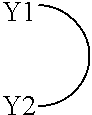
is a bidentate ligand;


is a bidentate ligand;


is a mono-anionic ligand, each of which on multiple occurrences may be independently selected from any one of the following general formulas L1 to L15:


wherein Ar1, R1, R2, M,

m and n are defined as above, y represents an integer from 0 to 4, and z represents an integer from 0 to 6.

wherein, Z is B or N;

m and n are defined as above.


Synthesis Route of Ligand L-1/L-2/L-3


HOMO(eV)=((HOMO(G)×27.212)−0.9899)/1.1206
LUMO(eV)=((LUMO(G)×27.212)−2.0041)/1.385
| TABLE 1 | ||||||
| HOMO | HOMO − 1 | LUMO | LUMO + 1 | T1 | S1 | |
| Materials | [eV] | [eV] | [eV] | [eV] | [eV] | [eV] |
| Ir-1 | −5.00 | −5.05 | −2.45 | −2.40 | 2.32 | 2.69 |
| Ir-2 | −4.92 | −4.95 | −2.46 | −2.44 | 2.28 | 2.65 |
| Ir-3 | −4.96 | −5.23 | −2.44 | −2.34 | 2.36 | 2.71 |
| Ir-4 | −5.13 | −5.22 | −2.58 | −2.55 | 2.35 | 2.65 |
| Ir-5 | −5.05 | −5.12 | −2.48 | −2.43 | 2.21 | 2.68 |
| Ir-6 | −5.21 | −5.25 | −2.48 | −2.42 | 2.18 | 2.67 |
| Ir-7 | −5.29 | −5.33 | −2.49 | −2.45 | 2.17 | 2.66 |
| Ir-8 | −5.41 | −5.37 | −2.46 | −2.42 | 1.95 | 2.43 |
| Ir-9 | −5.42 | −5.38 | −2.45 | −2.41 | 2.01 | 2.47 |
| Ir-10 | −5.35 | −5.31 | −2.44 | −2.39 | 2.08 | 2.51 |
Claims (16)


Applications Claiming Priority (3)
| Application Number | Priority Date | Filing Date | Title |
|---|---|---|---|
| CN201711341877 | 2017-12-14 | ||
| CN201711341877.7 | 2017-12-14 | ||
| PCT/CN2018/120700 WO2019114764A1 (en) | 2017-12-14 | 2018-12-12 | Organometallic complex, and polymer, mixture and composition comprising same, and use thereof in electronic device |
Publications (2)
| Publication Number | Publication Date |
|---|---|
| US20210083204A1 US20210083204A1 (en) | 2021-03-18 |
| US11594690B2 true US11594690B2 (en) | 2023-02-28 |
Family
ID=66819573
Family Applications (1)
| Application Number | Title | Priority Date | Filing Date |
|---|---|---|---|
| US16/772,661 Active 2039-06-18 US11594690B2 (en) | 2017-12-14 | 2018-12-12 | Organometallic complex, and polymer, mixture and formulation comprising same, and use thereof in electronic device |
Country Status (3)
| Country | Link |
|---|---|
| US (1) | US11594690B2 (en) |
| CN (1) | CN111278839B (en) |
| WO (1) | WO2019114764A1 (en) |
Families Citing this family (7)
| Publication number | Priority date | Publication date | Assignee | Title |
|---|---|---|---|---|
| US11871653B2 (en) | 2019-02-22 | 2024-01-09 | Universal Display Corporation | Organic electroluminescent materials and devices |
| US12250872B2 (en) | 2019-02-22 | 2025-03-11 | Universal Display Corporation | Organic electroluminescent materials and devices |
| KR102239440B1 (en) | 2019-07-31 | 2021-04-13 | 주식회사 엘지화학 | Multicyclic compound and organic light emitting device comprising the same |
| US12426495B2 (en) * | 2020-01-28 | 2025-09-23 | Universal Display Corporation | Organic electroluminescent materials and devices |
| WO2022078429A1 (en) * | 2020-10-14 | 2022-04-21 | 浙江光昊光电科技有限公司 | Light-emitting device and use thereof in display |
| CN115894873B (en) * | 2022-12-01 | 2025-08-05 | 中国科学院宁波材料技术与工程研究所 | A polymer with HLCT properties, preparation method thereof, application thereof, organic light-emitting diode and display panel |
| CN119409736B (en) * | 2024-11-04 | 2025-10-03 | 江苏科技大学 | A boron-containing fused-ring carbene iridium and platinum complex and its preparation method and application |
Citations (58)
| Publication number | Priority date | Publication date | Assignee | Title |
|---|---|---|---|---|
| WO2000070655A2 (en) | 1999-05-13 | 2000-11-23 | The Trustees Of Princeton University | Very high efficiency organic light emitting devices based on electrophosphorescence |
| WO2001041512A1 (en) | 1999-12-01 | 2001-06-07 | The Trustees Of Princeton University | Complexes of form l2mx as phosphorescent dopants for organic leds |
| US20010053462A1 (en) | 2000-05-02 | 2001-12-20 | Masayuki Mishima | Light-emitting device |
| WO2002002714A2 (en) | 2000-06-30 | 2002-01-10 | E.I. Du Pont De Nemours And Company | Electroluminescent iridium compounds with fluorinated phenylpyridines, phenylpyrimidines, and phenylquinolines and devices made with such compounds |
| WO2002015645A1 (en) | 2000-08-11 | 2002-02-21 | The Trustees Of Princeton University | Organometallic compounds and emission-shifting organic electrophosphorescence |
| EP1191613A2 (en) | 2000-09-26 | 2002-03-27 | Canon Kabushiki Kaisha | Luminescence device, display apparatus and metal coordination compound |
| EP1191614A2 (en) | 2000-09-26 | 2002-03-27 | Canon Kabushiki Kaisha | Luminescence device and metal coordination compound therefor |
| EP1191612A2 (en) | 2000-09-26 | 2002-03-27 | Canon Kabushiki Kaisha | Luminescence device, display apparatus and metal coordination compound |
| US6824895B1 (en) | 2003-12-05 | 2004-11-30 | Eastman Kodak Company | Electroluminescent device containing organometallic compound with tridentate ligand |
| US6830828B2 (en) | 1998-09-14 | 2004-12-14 | The Trustees Of Princeton University | Organometallic complexes as phosphorescent emitters in organic LEDs |
| US6835469B2 (en) | 2001-10-17 | 2004-12-28 | The University Of Southern California | Phosphorescent compounds and devices comprising the same |
| WO2005019373A2 (en) | 2003-08-19 | 2005-03-03 | Basf Aktiengesellschaft | Transition metal complexes comprising carbene ligands serving as emitters for organic light-emitting diodes (oled's) |
| WO2005033244A1 (en) | 2003-09-29 | 2005-04-14 | Covion Organic Semiconductors Gmbh | Metal complexes |
| US20050258742A1 (en) | 2004-05-18 | 2005-11-24 | Yui-Yi Tsai | Carbene containing metal complexes as OLEDs |
| US7029766B2 (en) | 2003-12-05 | 2006-04-18 | Eastman Kodak Company | Organic element for electroluminescent devices |
| US20070087219A1 (en) | 2005-10-19 | 2007-04-19 | Eastman Kodak Company | Electroluminescent device |
| WO2007095118A2 (en) | 2006-02-10 | 2007-08-23 | Universal Display Corporation | METAL COMPLEXES OF CYCLOMETALLATED IMIDAZO[1,2-f]PHENANTHRIDINE AND DIIMIDAZO[1,2-A:1',2'-C]QUINAZOLINE LIGANDS AND ISOELECTRONIC AND BENZANNULATED ANALOGS THEREOF |
| WO2008027220A2 (en) | 2006-08-28 | 2008-03-06 | Schering Corporation | Process and intermediates for the synthesis of (3-alkyl-5-piperidin-1-yl-3, 3a-dihydropyrazol0 [1, 5-a] pyrimidin-7-yl) -amino derivatives |
| US20090061681A1 (en) | 2007-09-05 | 2009-03-05 | Mcmunigal Tom | Electrical receptacle assembly |
| US20090134784A1 (en) | 2004-10-21 | 2009-05-28 | Universal Display Corporation | Carbazole-containing materials in phosphorescent light emitting diodes |
| WO2009118087A1 (en) | 2008-03-25 | 2009-10-01 | Merck Patent Gmbh | Metal complexes |
| WO2009146770A2 (en) | 2008-06-05 | 2009-12-10 | Merck Patent Gmbh | Electronic device comprising metal complexes |
| WO2010015307A1 (en) | 2008-08-04 | 2010-02-11 | Merck Patent Gmbh | Electronic devices comprising metal complexes having isonitrile ligands |
| WO2010031485A1 (en) | 2008-09-22 | 2010-03-25 | Merck Patent Gmbh | Materials for organic electroluminescence devices |
| WO2010054731A1 (en) | 2008-11-13 | 2010-05-20 | Merck Patent Gmbh | Materials for organic electroluminescent devices |
| WO2010054728A1 (en) | 2008-11-13 | 2010-05-20 | Merck Patent Gmbh | Materials for organic electroluminescent devices |
| WO2010086089A1 (en) | 2009-02-02 | 2010-08-05 | Merck Patent Gmbh | Metal complexes |
| WO2010099852A1 (en) | 2009-03-02 | 2010-09-10 | Merck Patent Gmbh | Metal complexes having azaborol ligands and electronic device having the same |
| WO2010102709A1 (en) | 2009-03-13 | 2010-09-16 | Merck Patent Gmbh | Materials for organic electroluminescence devices |
| WO2010135519A1 (en) | 2009-05-20 | 2010-11-25 | Universal Display Corporation | Metal complexes with boron-nitrogen heterocycle containing ligands for use in organic light emitting devices |
| WO2011110277A1 (en) | 2010-03-11 | 2011-09-15 | Merck Patent Gmbh | Fibers in therapy and cosmetics |
| WO2011141110A2 (en) | 2010-05-12 | 2011-11-17 | Merck Patent Gmbh | Photo-stabilizing agents |
| WO2011157339A1 (en) | 2010-06-15 | 2011-12-22 | Merck Patent Gmbh | Metal complexes |
| WO2012007088A1 (en) | 2010-07-16 | 2012-01-19 | Merck Patent Gmbh | Metal complexes |
| WO2012007086A1 (en) | 2010-07-16 | 2012-01-19 | Merck Patent Gmbh | Metal complexes |
| WO2012007087A1 (en) | 2010-07-16 | 2012-01-19 | Merck Patent Gmbh | Metal complexes |
| US20120217869A1 (en) | 2011-02-28 | 2012-08-30 | Kyushu University National University Corporation | Delayed fluorescence material and organic electroluminescence device |
| TW201309778A (en) | 2011-07-15 | 2013-03-01 | Univ Kyushu Nat Univ Corp | Organic electroluminescence element and compound used therefor |
| TW201309696A (en) | 2011-07-15 | 2013-03-01 | Univ Kyushu Nat Univ Corp | Delayed fluorescent material and organic electroluminescence element using same |
| WO2013094620A1 (en) | 2011-12-23 | 2013-06-27 | Semiconductor Energy Laboratory Co., Ltd. | Organometallic complex, light-emitting element, light-emitting device, electronic device, and lighting device |
| WO2013107487A1 (en) | 2012-01-16 | 2013-07-25 | Merck Patent Gmbh | Organic metal complexes |
| WO2013133359A1 (en) | 2012-03-09 | 2013-09-12 | 国立大学法人九州大学 | Light-emitting material, and organic light-emitting element |
| WO2013154064A1 (en) | 2012-04-09 | 2013-10-17 | 国立大学法人九州大学 | Organic light emitting element, and light emitting material and compound used in same |
| TW201343874A (en) | 2012-04-25 | 2013-11-01 | Univ Kyushu Nat Univ Corp | Luminescence material and organic luminescence device |
| WO2013174471A1 (en) | 2012-05-24 | 2013-11-28 | Merck Patent Gmbh | Metal complexes comprising condensed heteroaromatic rings |
| TW201350558A (en) | 2012-05-17 | 2013-12-16 | Univ Kyushu Nat Univ Corp | Compound, luminescence material and organic luminescence device |
| CN103483332A (en) | 2013-09-11 | 2014-01-01 | 中山大学 | Novel piezoluminescence material with thermal activation delayed fluorescence and aggregation-induced emission properties and synthetic method and application of novel piezoluminescence material |
| WO2014007565A1 (en) | 2012-07-04 | 2014-01-09 | 제일모직 주식회사 | Compound for organic optoelectric device, organic optoelectric device comprising same, and display apparatus comprising organic optoelectric device |
| WO2014008982A1 (en) | 2012-07-13 | 2014-01-16 | Merck Patent Gmbh | Metal complexes |
| WO2014023377A2 (en) | 2012-08-07 | 2014-02-13 | Merck Patent Gmbh | Metal complexes |
| WO2014024131A1 (en) | 2012-08-09 | 2014-02-13 | Basf Se | Transition metal complexes with carbene ligands and use thereof in oleds |
| WO2014031977A1 (en) | 2012-08-24 | 2014-02-27 | Arizona Board Of Regents For And On Behalf Of Arizona State University | Metal compounds and methods and uses thereof |
| WO2014038456A1 (en) | 2012-09-04 | 2014-03-13 | コニカミノルタ株式会社 | Organic electroluminescent element, lighting device and display device |
| WO2014112450A1 (en) | 2013-01-17 | 2014-07-24 | Canon Kabushiki Kaisha | Organic light-emitting element |
| CN105555792A (en) | 2013-09-17 | 2016-05-04 | 默克专利有限公司 | Polycyclic phenylpyridine iridium complexes and derivatives thereof for OLEDs |
| WO2016091217A1 (en) | 2014-12-11 | 2016-06-16 | 广州华睿光电材料有限公司 | Organic metal complex, and polymer, mixture, composition and organic electronic device containing same and use thereof |
| US20160233443A1 (en) * | 2013-09-11 | 2016-08-11 | Merck Patent Gmbh | Metal Complexes |
| WO2017092545A1 (en) | 2015-12-04 | 2017-06-08 | 广州华睿光电材料有限公司 | Organometallic complex and application thereof in electronic device |
Family Cites Families (1)
| Publication number | Priority date | Publication date | Assignee | Title |
|---|---|---|---|---|
| CN101851501B (en) * | 2010-05-27 | 2012-12-19 | 深圳丹邦投资集团有限公司 | Novel electrophosphorescent material and synthesis method thereof |
-
2018
- 2018-12-12 CN CN201880069888.0A patent/CN111278839B/en active Active
- 2018-12-12 WO PCT/CN2018/120700 patent/WO2019114764A1/en not_active Ceased
- 2018-12-12 US US16/772,661 patent/US11594690B2/en active Active
Patent Citations (68)
| Publication number | Priority date | Publication date | Assignee | Title |
|---|---|---|---|---|
| US6830828B2 (en) | 1998-09-14 | 2004-12-14 | The Trustees Of Princeton University | Organometallic complexes as phosphorescent emitters in organic LEDs |
| WO2000070655A3 (en) | 1999-05-13 | 2004-05-27 | Univ Princeton | Very high efficiency organic light emitting devices based on electrophosphorescence |
| WO2000070655A2 (en) | 1999-05-13 | 2000-11-23 | The Trustees Of Princeton University | Very high efficiency organic light emitting devices based on electrophosphorescence |
| WO2001041512A1 (en) | 1999-12-01 | 2001-06-07 | The Trustees Of Princeton University | Complexes of form l2mx as phosphorescent dopants for organic leds |
| US20010053462A1 (en) | 2000-05-02 | 2001-12-20 | Masayuki Mishima | Light-emitting device |
| WO2002002714A2 (en) | 2000-06-30 | 2002-01-10 | E.I. Du Pont De Nemours And Company | Electroluminescent iridium compounds with fluorinated phenylpyridines, phenylpyrimidines, and phenylquinolines and devices made with such compounds |
| WO2002015645A1 (en) | 2000-08-11 | 2002-02-21 | The Trustees Of Princeton University | Organometallic compounds and emission-shifting organic electrophosphorescence |
| EP1191614A2 (en) | 2000-09-26 | 2002-03-27 | Canon Kabushiki Kaisha | Luminescence device and metal coordination compound therefor |
| EP1191612A2 (en) | 2000-09-26 | 2002-03-27 | Canon Kabushiki Kaisha | Luminescence device, display apparatus and metal coordination compound |
| EP1191613A2 (en) | 2000-09-26 | 2002-03-27 | Canon Kabushiki Kaisha | Luminescence device, display apparatus and metal coordination compound |
| US6835469B2 (en) | 2001-10-17 | 2004-12-28 | The University Of Southern California | Phosphorescent compounds and devices comprising the same |
| WO2005019373A2 (en) | 2003-08-19 | 2005-03-03 | Basf Aktiengesellschaft | Transition metal complexes comprising carbene ligands serving as emitters for organic light-emitting diodes (oled's) |
| WO2005033244A1 (en) | 2003-09-29 | 2005-04-14 | Covion Organic Semiconductors Gmbh | Metal complexes |
| US6824895B1 (en) | 2003-12-05 | 2004-11-30 | Eastman Kodak Company | Electroluminescent device containing organometallic compound with tridentate ligand |
| US7029766B2 (en) | 2003-12-05 | 2006-04-18 | Eastman Kodak Company | Organic element for electroluminescent devices |
| US20050258742A1 (en) | 2004-05-18 | 2005-11-24 | Yui-Yi Tsai | Carbene containing metal complexes as OLEDs |
| US20090134784A1 (en) | 2004-10-21 | 2009-05-28 | Universal Display Corporation | Carbazole-containing materials in phosphorescent light emitting diodes |
| US20070087219A1 (en) | 2005-10-19 | 2007-04-19 | Eastman Kodak Company | Electroluminescent device |
| WO2007095118A2 (en) | 2006-02-10 | 2007-08-23 | Universal Display Corporation | METAL COMPLEXES OF CYCLOMETALLATED IMIDAZO[1,2-f]PHENANTHRIDINE AND DIIMIDAZO[1,2-A:1',2'-C]QUINAZOLINE LIGANDS AND ISOELECTRONIC AND BENZANNULATED ANALOGS THEREOF |
| WO2008027220A2 (en) | 2006-08-28 | 2008-03-06 | Schering Corporation | Process and intermediates for the synthesis of (3-alkyl-5-piperidin-1-yl-3, 3a-dihydropyrazol0 [1, 5-a] pyrimidin-7-yl) -amino derivatives |
| WO2008027220A3 (en) | 2006-08-28 | 2009-08-27 | Schering Corporation | Process and intermediates for the synthesis of (3-alkyl-5-piperidin-1-yl-3, 3a-dihydropyrazol0 [1, 5-a] pyrimidin-7-yl) -amino derivatives |
| US20090061681A1 (en) | 2007-09-05 | 2009-03-05 | Mcmunigal Tom | Electrical receptacle assembly |
| WO2009118087A1 (en) | 2008-03-25 | 2009-10-01 | Merck Patent Gmbh | Metal complexes |
| WO2009146770A2 (en) | 2008-06-05 | 2009-12-10 | Merck Patent Gmbh | Electronic device comprising metal complexes |
| WO2010015307A1 (en) | 2008-08-04 | 2010-02-11 | Merck Patent Gmbh | Electronic devices comprising metal complexes having isonitrile ligands |
| WO2010031485A1 (en) | 2008-09-22 | 2010-03-25 | Merck Patent Gmbh | Materials for organic electroluminescence devices |
| WO2010054731A1 (en) | 2008-11-13 | 2010-05-20 | Merck Patent Gmbh | Materials for organic electroluminescent devices |
| WO2010054728A1 (en) | 2008-11-13 | 2010-05-20 | Merck Patent Gmbh | Materials for organic electroluminescent devices |
| CN102282150A (en) | 2009-02-02 | 2011-12-14 | 默克专利有限公司 | Metal complexes |
| CN102282150B (en) | 2009-02-02 | 2015-07-08 | 默克专利有限公司 | Metal complexes |
| US20110284799A1 (en) | 2009-02-02 | 2011-11-24 | Merck Patent Gmbh | Metal complexes |
| WO2010086089A1 (en) | 2009-02-02 | 2010-08-05 | Merck Patent Gmbh | Metal complexes |
| US20120004407A1 (en) | 2009-03-02 | 2012-01-05 | Merck Patent Gmbh | Metal complexes having azaborol ligands and electronic device having the same |
| WO2010099852A1 (en) | 2009-03-02 | 2010-09-10 | Merck Patent Gmbh | Metal complexes having azaborol ligands and electronic device having the same |
| WO2010102709A1 (en) | 2009-03-13 | 2010-09-16 | Merck Patent Gmbh | Materials for organic electroluminescence devices |
| WO2010135519A1 (en) | 2009-05-20 | 2010-11-25 | Universal Display Corporation | Metal complexes with boron-nitrogen heterocycle containing ligands for use in organic light emitting devices |
| WO2011110277A1 (en) | 2010-03-11 | 2011-09-15 | Merck Patent Gmbh | Fibers in therapy and cosmetics |
| WO2011141110A2 (en) | 2010-05-12 | 2011-11-17 | Merck Patent Gmbh | Photo-stabilizing agents |
| WO2011157339A1 (en) | 2010-06-15 | 2011-12-22 | Merck Patent Gmbh | Metal complexes |
| WO2012007086A1 (en) | 2010-07-16 | 2012-01-19 | Merck Patent Gmbh | Metal complexes |
| WO2012007087A1 (en) | 2010-07-16 | 2012-01-19 | Merck Patent Gmbh | Metal complexes |
| WO2012007088A1 (en) | 2010-07-16 | 2012-01-19 | Merck Patent Gmbh | Metal complexes |
| US20120217869A1 (en) | 2011-02-28 | 2012-08-30 | Kyushu University National University Corporation | Delayed fluorescence material and organic electroluminescence device |
| TW201309778A (en) | 2011-07-15 | 2013-03-01 | Univ Kyushu Nat Univ Corp | Organic electroluminescence element and compound used therefor |
| TW201309696A (en) | 2011-07-15 | 2013-03-01 | Univ Kyushu Nat Univ Corp | Delayed fluorescent material and organic electroluminescence element using same |
| US10454038B2 (en) | 2011-07-15 | 2019-10-22 | Kyulux, Inc. | Delayed-fluorescence material and organic electroluminescence element using same |
| US9660198B2 (en) | 2011-07-15 | 2017-05-23 | Kyulux, Inc. | Organic electroluminescence element and compound used therein |
| WO2013094620A1 (en) | 2011-12-23 | 2013-06-27 | Semiconductor Energy Laboratory Co., Ltd. | Organometallic complex, light-emitting element, light-emitting device, electronic device, and lighting device |
| WO2013107487A1 (en) | 2012-01-16 | 2013-07-25 | Merck Patent Gmbh | Organic metal complexes |
| WO2013133359A1 (en) | 2012-03-09 | 2013-09-12 | 国立大学法人九州大学 | Light-emitting material, and organic light-emitting element |
| WO2013154064A1 (en) | 2012-04-09 | 2013-10-17 | 国立大学法人九州大学 | Organic light emitting element, and light emitting material and compound used in same |
| US20150141642A1 (en) | 2012-04-25 | 2015-05-21 | Kyushu University National University Corporation | Light-emitting material and organic light-emitting device |
| TW201343874A (en) | 2012-04-25 | 2013-11-01 | Univ Kyushu Nat Univ Corp | Luminescence material and organic luminescence device |
| US9660199B2 (en) | 2012-05-17 | 2017-05-23 | Kyulux, Inc. | Compound, light-emitting material, and organic light-emitting device |
| TW201350558A (en) | 2012-05-17 | 2013-12-16 | Univ Kyushu Nat Univ Corp | Compound, luminescence material and organic luminescence device |
| WO2013174471A1 (en) | 2012-05-24 | 2013-11-28 | Merck Patent Gmbh | Metal complexes comprising condensed heteroaromatic rings |
| WO2014007565A1 (en) | 2012-07-04 | 2014-01-09 | 제일모직 주식회사 | Compound for organic optoelectric device, organic optoelectric device comprising same, and display apparatus comprising organic optoelectric device |
| WO2014008982A1 (en) | 2012-07-13 | 2014-01-16 | Merck Patent Gmbh | Metal complexes |
| WO2014023377A2 (en) | 2012-08-07 | 2014-02-13 | Merck Patent Gmbh | Metal complexes |
| WO2014024131A1 (en) | 2012-08-09 | 2014-02-13 | Basf Se | Transition metal complexes with carbene ligands and use thereof in oleds |
| WO2014031977A1 (en) | 2012-08-24 | 2014-02-27 | Arizona Board Of Regents For And On Behalf Of Arizona State University | Metal compounds and methods and uses thereof |
| WO2014038456A1 (en) | 2012-09-04 | 2014-03-13 | コニカミノルタ株式会社 | Organic electroluminescent element, lighting device and display device |
| WO2014112450A1 (en) | 2013-01-17 | 2014-07-24 | Canon Kabushiki Kaisha | Organic light-emitting element |
| US20160233443A1 (en) * | 2013-09-11 | 2016-08-11 | Merck Patent Gmbh | Metal Complexes |
| CN103483332A (en) | 2013-09-11 | 2014-01-01 | 中山大学 | Novel piezoluminescence material with thermal activation delayed fluorescence and aggregation-induced emission properties and synthetic method and application of novel piezoluminescence material |
| CN105555792A (en) | 2013-09-17 | 2016-05-04 | 默克专利有限公司 | Polycyclic phenylpyridine iridium complexes and derivatives thereof for OLEDs |
| WO2016091217A1 (en) | 2014-12-11 | 2016-06-16 | 广州华睿光电材料有限公司 | Organic metal complex, and polymer, mixture, composition and organic electronic device containing same and use thereof |
| WO2017092545A1 (en) | 2015-12-04 | 2017-06-08 | 广州华睿光电材料有限公司 | Organometallic complex and application thereof in electronic device |
Non-Patent Citations (28)
Also Published As
| Publication number | Publication date |
|---|---|
| CN111278839A (en) | 2020-06-12 |
| CN111278839B (en) | 2023-10-17 |
| WO2019114764A1 (en) | 2019-06-20 |
| US20210083204A1 (en) | 2021-03-18 |
Similar Documents
| Publication | Publication Date | Title |
|---|---|---|
| US11239428B2 (en) | Boron-containing organic compound and applications thereof, organic mixture, and organic electronic device | |
| US11680059B2 (en) | Organic mixture and application thereof in organic electronic devices | |
| US11292875B2 (en) | Cross-linkable polymer based on Diels-Alder reaction and use thereof in organic electronic device | |
| EP3547385B1 (en) | Organic mixture, composition, and organic electronic component | |
| US20180366653A1 (en) | D-a type compound and application thereof | |
| US10968243B2 (en) | Organometallic complex and application thereof in electronic devices | |
| US20190378982A1 (en) | Organic mixture, composition, organic electronic device and application | |
| US20210083204A1 (en) | Organometallic complex, and polymer, mixture and formulation comprising same, and use thereof in electronic device | |
| US20170365789A1 (en) | Compound, mixture comprising the same, composition and organic electronic device | |
| WO2017118238A1 (en) | Deuterated triarylamine derivative and application thereof in electronic devices | |
| US11447496B2 (en) | Nitrogen-containing fused heterocyclic ring compound and application thereof | |
| US20190334099A1 (en) | Transition metal complex and application thereof, mixture and organic electronic device | |
| US20180312522A1 (en) | Sulfone-containing fused heterocyclic compound and application thereof | |
| US20190006609A1 (en) | Organic functional compound for preparing organic electronic device and application thereof | |
| US11674080B2 (en) | Transition metal complex, polymer, mixture, formulation and use thereof | |
| US20200185615A1 (en) | Organic chemical compound, organic mixture, and organic electronic component | |
| US11161933B2 (en) | Conjugated polymer and use thereof in organic electronic device | |
| US10804470B2 (en) | Organic compound | |
| US20200109235A1 (en) | Conjugated polymer and use thereof in organic electronic device | |
| CN112585144A (en) | Organometallic complexes, polymers containing the same, mixtures, compositions and organic electronic devices | |
| US20230357169A1 (en) | Organic compounds, mixtures, and uses thereof in organic eletronic devices | |
| US12240864B2 (en) | Phosphine oxide group-contained transition metal complex, and polymer, mixture, composition, and organic electronic device thereof | |
| US12540275B2 (en) | Organic compounds, mixtures and applications thereof in organic electronic devices | |
| US20240343715A1 (en) | Organic compounds, mixtures and formulations comprising same, organic electronic devices, and applications of compounds | |
| US20190355911A1 (en) | Organic mixture, organic composition, organic electronic component and preparation method therefor |
Legal Events
| Date | Code | Title | Description |
|---|---|---|---|
| FEPP | Fee payment procedure |
Free format text: ENTITY STATUS SET TO UNDISCOUNTED (ORIGINAL EVENT CODE: BIG.); ENTITY STATUS OF PATENT OWNER: LARGE ENTITY |
|
| AS | Assignment |
Owner name: GUANGZHOU CHINARAY OPTOELECTRONIC MATERIALS LTD., CHINA Free format text: ASSIGNMENT OF ASSIGNORS INTEREST;ASSIGNORS:SHI, CHAO;HUANG, HONG;PAN, JUNYOU;REEL/FRAME:052937/0244 Effective date: 20200610 |
|
| STPP | Information on status: patent application and granting procedure in general |
Free format text: APPLICATION DISPATCHED FROM PREEXAM, NOT YET DOCKETED |
|
| STPP | Information on status: patent application and granting procedure in general |
Free format text: DOCKETED NEW CASE - READY FOR EXAMINATION |
|
| STPP | Information on status: patent application and granting procedure in general |
Free format text: NON FINAL ACTION MAILED |
|
| STPP | Information on status: patent application and granting procedure in general |
Free format text: RESPONSE TO NON-FINAL OFFICE ACTION ENTERED AND FORWARDED TO EXAMINER |
|
| STPP | Information on status: patent application and granting procedure in general |
Free format text: NON FINAL ACTION MAILED |
|
| STPP | Information on status: patent application and granting procedure in general |
Free format text: RESPONSE TO NON-FINAL OFFICE ACTION ENTERED AND FORWARDED TO EXAMINER |
|
| STPP | Information on status: patent application and granting procedure in general |
Free format text: NOTICE OF ALLOWANCE MAILED -- APPLICATION RECEIVED IN OFFICE OF PUBLICATIONS |
|
| STCF | Information on status: patent grant |
Free format text: PATENTED CASE |