US11592790B2 - MIMO different-factor partial-form model-free control with parameter self-tuning - Google Patents
MIMO different-factor partial-form model-free control with parameter self-tuning Download PDFInfo
- Publication number
- US11592790B2 US11592790B2 US16/777,122 US202016777122A US11592790B2 US 11592790 B2 US11592790 B2 US 11592790B2 US 202016777122 A US202016777122 A US 202016777122A US 11592790 B2 US11592790 B2 US 11592790B2
- Authority
- US
- United States
- Prior art keywords
- time
- control
- error
- mimo
- factor
- Prior art date
- Legal status (The legal status is an assumption and is not a legal conclusion. Google has not performed a legal analysis and makes no representation as to the accuracy of the status listed.)
- Active, expires
Links
Images



Classifications
-
- G—PHYSICS
- G05—CONTROLLING; REGULATING
- G05B—CONTROL OR REGULATING SYSTEMS IN GENERAL; FUNCTIONAL ELEMENTS OF SUCH SYSTEMS; MONITORING OR TESTING ARRANGEMENTS FOR SUCH SYSTEMS OR ELEMENTS
- G05B13/00—Adaptive control systems, i.e. systems automatically adjusting themselves to have a performance which is optimum according to some preassigned criterion
- G05B13/02—Adaptive control systems, i.e. systems automatically adjusting themselves to have a performance which is optimum according to some preassigned criterion electric
- G05B13/0205—Adaptive control systems, i.e. systems automatically adjusting themselves to have a performance which is optimum according to some preassigned criterion electric not using a model or a simulator of the controlled system
- G05B13/024—Adaptive control systems, i.e. systems automatically adjusting themselves to have a performance which is optimum according to some preassigned criterion electric not using a model or a simulator of the controlled system in which a parameter or coefficient is automatically adjusted to optimise the performance
-
- G—PHYSICS
- G05—CONTROLLING; REGULATING
- G05B—CONTROL OR REGULATING SYSTEMS IN GENERAL; FUNCTIONAL ELEMENTS OF SUCH SYSTEMS; MONITORING OR TESTING ARRANGEMENTS FOR SUCH SYSTEMS OR ELEMENTS
- G05B13/00—Adaptive control systems, i.e. systems automatically adjusting themselves to have a performance which is optimum according to some preassigned criterion
- G05B13/02—Adaptive control systems, i.e. systems automatically adjusting themselves to have a performance which is optimum according to some preassigned criterion electric
- G05B13/04—Adaptive control systems, i.e. systems automatically adjusting themselves to have a performance which is optimum according to some preassigned criterion electric involving the use of models or simulators
- G05B13/042—Adaptive control systems, i.e. systems automatically adjusting themselves to have a performance which is optimum according to some preassigned criterion electric involving the use of models or simulators in which a parameter or coefficient is automatically adjusted to optimise the performance
-
- G—PHYSICS
- G05—CONTROLLING; REGULATING
- G05B—CONTROL OR REGULATING SYSTEMS IN GENERAL; FUNCTIONAL ELEMENTS OF SUCH SYSTEMS; MONITORING OR TESTING ARRANGEMENTS FOR SUCH SYSTEMS OR ELEMENTS
- G05B13/00—Adaptive control systems, i.e. systems automatically adjusting themselves to have a performance which is optimum according to some preassigned criterion
- G05B13/02—Adaptive control systems, i.e. systems automatically adjusting themselves to have a performance which is optimum according to some preassigned criterion electric
- G05B13/0265—Adaptive control systems, i.e. systems automatically adjusting themselves to have a performance which is optimum according to some preassigned criterion electric the criterion being a learning criterion
- G05B13/027—Adaptive control systems, i.e. systems automatically adjusting themselves to have a performance which is optimum according to some preassigned criterion electric the criterion being a learning criterion using neural networks only
-
- G—PHYSICS
- G06—COMPUTING OR CALCULATING; COUNTING
- G06N—COMPUTING ARRANGEMENTS BASED ON SPECIFIC COMPUTATIONAL MODELS
- G06N3/00—Computing arrangements based on biological models
- G06N3/02—Neural networks
- G06N3/04—Architecture, e.g. interconnection topology
- G06N3/044—Recurrent networks, e.g. Hopfield networks
-
- G06N3/0445—
-
- G—PHYSICS
- G06—COMPUTING OR CALCULATING; COUNTING
- G06N—COMPUTING ARRANGEMENTS BASED ON SPECIFIC COMPUTATIONAL MODELS
- G06N3/00—Computing arrangements based on biological models
- G06N3/02—Neural networks
- G06N3/04—Architecture, e.g. interconnection topology
- G06N3/045—Combinations of networks
-
- G06N3/0454—
-
- G—PHYSICS
- G06—COMPUTING OR CALCULATING; COUNTING
- G06N—COMPUTING ARRANGEMENTS BASED ON SPECIFIC COMPUTATIONAL MODELS
- G06N3/00—Computing arrangements based on biological models
- G06N3/02—Neural networks
- G06N3/04—Architecture, e.g. interconnection topology
- G06N3/0499—Feedforward networks
-
- G—PHYSICS
- G06—COMPUTING OR CALCULATING; COUNTING
- G06N—COMPUTING ARRANGEMENTS BASED ON SPECIFIC COMPUTATIONAL MODELS
- G06N3/00—Computing arrangements based on biological models
- G06N3/02—Neural networks
- G06N3/08—Learning methods
- G06N3/084—Backpropagation, e.g. using gradient descent
-
- G—PHYSICS
- G06—COMPUTING OR CALCULATING; COUNTING
- G06N—COMPUTING ARRANGEMENTS BASED ON SPECIFIC COMPUTATIONAL MODELS
- G06N3/00—Computing arrangements based on biological models
- G06N3/02—Neural networks
- G06N3/08—Learning methods
- G06N3/09—Supervised learning
-
- Y—GENERAL TAGGING OF NEW TECHNOLOGICAL DEVELOPMENTS; GENERAL TAGGING OF CROSS-SECTIONAL TECHNOLOGIES SPANNING OVER SEVERAL SECTIONS OF THE IPC; TECHNICAL SUBJECTS COVERED BY FORMER USPC CROSS-REFERENCE ART COLLECTIONS [XRACs] AND DIGESTS
- Y02—TECHNOLOGIES OR APPLICATIONS FOR MITIGATION OR ADAPTATION AGAINST CLIMATE CHANGE
- Y02D—CLIMATE CHANGE MITIGATION TECHNOLOGIES IN INFORMATION AND COMMUNICATION TECHNOLOGIES [ICT], I.E. INFORMATION AND COMMUNICATION TECHNOLOGIES AIMING AT THE REDUCTION OF THEIR OWN ENERGY USE
- Y02D30/00—Reducing energy consumption in communication networks
- Y02D30/70—Reducing energy consumption in communication networks in wireless communication networks
Definitions
- the present invention relates to the field of automatic control, and more particularly to MIMO different-factor partial-form model-free control with parameter self-tuning.
- MIMO systems multi-input multi-output systems
- MIMO partial-form model-free control method is one of the existing control methods for MIMO systems.
- MIMO partial-form model-free control method is a data-driven control method, which is used to analyze and design the controller depending only on the online measured input data and output data instead of any mathematical model information of the MIMO controlled plant, and has good application prospects with concise implementation, low computational burden and strong robustness.
- the theoretical basis of MIMO partial-form model-free control method is proposed by Hou and Jin in Model Free Adaptive Control: Theory and Applications (Science Press, Beijing, China, 2013, p. 105), the control scheme is given as follows:
- u(k) is the control input vector at time k, u(k) [u 1 (k), . . . , u m (k)] T
- m is the total number of control inputs (m is a positive integer greater than 1)
- ⁇ u(k) u(k) ⁇ u(k ⁇ 1)
- e(k) is the error vector at time k
- e(k) [e 1 (k), . . .
- the above-mentioned existing MIMO partial-form model-free control method adopts the same-factor structure, namely, at time k, different control inputs u 1 (k), . . . , u m (k) in the control input vector u(k) can only use the same value of penalty factor ⁇ , the same value of step-size factor ⁇ 1 , . . . , and the same value of step-size factor ⁇ L .
- the existing MIMO partial-form model-free control method with the same-factor structure is difficult to achieve ideal control performance, which restricts the popularization and application of MIMO partial-form model-free control method.
- the present invention proposes a method of MIMO different-factor partial-form model-free control with parameter self-tuning.
- the present invention addresses the problems cited above, and provides a method of MIMO different-factor partial-form model-free control with parameter self-tuning, the method comprising:
- a mathematical formula for calculating the i-th control input u i (k) at time k using said method is as follows:
- k is a positive integer
- m is the total number of control inputs in said MIMO system, m is a positive integer greater than 1
- n is the total number of system outputs in said MIMO system, n is a positive integer
- i denotes the i-th of the total number of control inputs in said MIMO system, i is a positive integer, 1 ⁇ i ⁇ m
- j denotes the j-th of the total number of system outputs in said MIMO system, j is a positive integer, 1 ⁇ j ⁇ n
- u i (k) is the i-th control input at time k
- ⁇ u iu (k) u iu (k) ⁇ u iu (k ⁇ 1)
- iu is a positive integer
- ⁇ (k) is the estimated value of pseudo partitioned Jacobian matrix for said MIMO system at time k
- ⁇ p (k) is the p-th block of ⁇ (k)
- ⁇ j,i,p (k) is the j-th row and the i-th column of matrix ⁇ p (k)
- ⁇ 1 (k) ⁇ is the 2-norm of matrix ⁇ 1 (k)
- p is a positive integer, 1 ⁇ p ⁇ L
- ⁇ i is the penalty factor for the i-th control input
- ⁇ i,p is the p-th step-size factor for the i-th control input
- L is the control input length constant of linearization and L is a positive integer
- said method has a different-factor characteristic; said different-factor characteristic is that at least one of the following L+1 inequalities holds true for any two unequal positive integers i and x in the positive integer interval [1, m] during controlling said MIMO system by using said method:
- u m (k)] T with respect to the parameters to be tuned in the mathematical formula of said u i (k) comprise the partial derivatives at time k of u i (k) with respect to the parameters to be tuned in the mathematical formula of said u i (k); the partial derivatives at time k of said u i (k) with respect to the parameters to be tuned in the mathematical formula of said u i (k) are calculated as follows:
- the inputs of said neural network comprise at least one of: elements in said set ⁇ gradient set ⁇ , and elements in set ⁇ error set ⁇ ;
- said error function group of element e j (k) comprises at least one of: the accumulation of the j-th error at time k and all previous times
- ⁇ t 0 k e j ( t ) , the first order backward difference of the j-th error e j (k) at time k e j (k) ⁇ e j (k ⁇ 1), the second order backward difference of the j-th error e j (k) at time k e j (k) ⁇ 2e j (k ⁇ 1)+e j (k ⁇ 2), and high order backward difference of the j-th error e j (k) at time k.
- Said j-th error e j (k) at time k is calculated by the j-th error function; independent variables of said j-th error function comprise the j-th desired system output and the j-th actual system output.
- Said neural network is BP neural network; said BP neural network adopts a single hidden layer structure, namely a three-layer network structure, comprising an input layer, a single hidden layer, and an output layer.
- Said controlled plant comprises at least one of: a reactor, a distillation column, a machine, a device, a set of equipment, a production line, a workshop, and a factory.
- the hardware platform for running said method comprises at least one of: an industrial control computer, a single chip microcomputer controller, a microprocessor controller, a field programmable gate array controller, a digital signal processing controller, an embedded system controller, a programmable logic controller, a distributed control system, a fieldbus control system, an industrial control system based on internet of things, and an industrial internet control system.
- the inventive MIMO different-factor partial-form model-free control method with parameter self-tuning uses different penalty factors or step-size factors for different control inputs in the control input vector, which can solve control problems of strongly nonlinear MIMO systems with different characteristics between control channels widely existing in complex plants.
- parameter self-tuning is proposed to effectively address the problem of time-consuming and cost-consuming when tuning the penalty factors and/or step-size factors.
- the inventive MIMO different-factor partial-form model-free control method with parameter self-tuning has higher control accuracy, stronger stability and wider applicability.
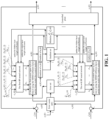
- FIG. 1 shows a schematic diagram according to the embodiments of the invention
- FIG. 2 shows a structure diagram of the i-th BP neural network according to the embodiments of the invention
- FIG. 3 shows the tracking performance of the first system output when controlling the two-input two-output MIMO system in the first exemplary embodiment by using the inventive MIMO different-factor partial-form model-free control method with parameter self-tuning;
- FIG. 4 shows the tracking performance of the second system output when controlling the two-input two-output MIMO system in the first exemplary embodiment by using the inventive MIMO different-factor partial-form model-free control method with parameter self-tuning;
- FIG. 5 shows the control inputs when controlling the two-input two-output MIMO system in the first exemplary embodiment by using the inventive MIMO different-factor partial-form model-free control method with parameter self-tuning;
- FIG. 6 shows the changes of penalty factor when controlling the two-input two-output MIMO system in the first exemplary embodiment by using the inventive MIMO different-factor partial-form model-free control method with parameter self-tuning;
- FIG. 7 shows the changes of the first step-size factor when controlling the two-input two-output MIMO system in the first exemplary embodiment by using the inventive MIMO different-factor partial-form model-free control method with parameter self-tuning;
- FIG. 8 shows the changes of the second step-size factor when controlling the two-input two-output MIMO system in the first exemplary embodiment by using the inventive MIMO different-factor partial-form model-free control method with parameter self-tuning;
- FIG. 9 shows the changes of the third step-size factor when controlling the two-input two-output MIMO system in the first exemplary embodiment by using the inventive MIMO different-factor partial-form model-free control method with parameter self-tuning;
- FIG. 10 shows the tracking performance of the first system output when controlling the two-input two-output MIMO system in the first exemplary embodiment by using the existing MIMO partial-form model-free control method with the same-factor structure;
- FIG. 11 shows the tracking performance of the second system output when controlling the two-input two-output MIMO system in the first exemplary embodiment by using the existing MIMO partial-form model-free control method with the same-factor structure;
- FIG. 12 shows the control inputs when controlling the two-input two-output MIMO system in the first exemplary embodiment by using the existing MIMO partial-form model-free control method with the same-factor structure;
- FIG. 13 shows the tracking performance of the first system output when controlling the two-input two-output MIMO system of coal mill in the second exemplary embodiment
- FIG. 14 shows the tracking performance of the second system output when controlling the two-input two-output MIMO system of coal mill in the second exemplary embodiment
- FIG. 15 shows the first control input when controlling the two-input two-output MIMO system of coal mill in the second exemplary embodiment
- FIG. 16 shows the second control input when controlling the two-input two-output MIMO system of coal mill in the second exemplary embodiment
- FIG. 17 shows the changes of penalty factors ⁇ 1 and ⁇ 2 for two control inputs when controlling the two-input two-output MIMO system of coal mill in the second exemplary embodiment
- FIG. 18 shows the changes of step-size factors ⁇ 1,1 , ⁇ 1,2 , ⁇ 1,3 , ⁇ 1,4 for the first control input when controlling the two-input two-output MIMO system of coal mill in the second exemplary embodiment
- FIG. 19 shows the changes of step-size factors ⁇ 2,1 , ⁇ 2,2 , ⁇ 2,3 , ⁇ 2,4 for the second control input when controlling the two-input two-output MIMO system of coal mill in the second exemplary embodiment.
- FIG. 1 shows a schematic diagram according to the embodiments of the invention.
- the MIMO different-factor partial-form model-free control method is adopted to control the system; set the control input length constant of linearization L of the MIMO different-factor partial-form model-free control method where L is a positive integer.
- the parameters in the mathematical formula for calculating u i (k) using the MIMO different-factor partial-form model-free adaptive control method include penalty factor ⁇ i and step-size factors ⁇ i,1 , . .
- the parameters to be tuned in the mathematical formula of u i (k), which are part or all of the parameters in the mathematical formula of u i (k), including at least one of the penalty factor ⁇ i , and step-size factors ⁇ i,1 , . . . , ⁇ i,L ; in the schematic diagram of FIG. 1 , the parameters to be tuned in the mathematical formula of all control inputs u i (k) (i 1, . . . , m) are the penalty factors ⁇ i and step-size factors ⁇ i,1 , . . . , ⁇ i,L ; the parameters to be tuned in the mathematical formula of u i (k) are calculated by the i-th BP neural network.
- FIG. 2 shows a structure diagram of the i-th BP neural network according to the embodiments of the invention
- BP neural network can adopt a single hidden layer structure or a multiple hidden layers structure; for the sake of simplicity, BP neural network in the diagram of FIG. 2 adopts the single hidden layer structure, namely a three-layer network structure comprising an input layer, a single hidden layer and an output layer; set the number of input layer nodes, hidden layer nodes and output layer nodes of the i-th BP neural network; the number of input layer nodes of the i-th BP neural network is set to m ⁇ (Ly+Lu+1)+n ⁇ 3, m ⁇ (Ly+Lu+1) of which are the elements
- the number of output layer nodes of the i-th BP neural network is no less than the number of parameters to be tuned in the mathematical formula of u i (k); in FIG. 2 , the number of parameters to be tuned in the mathematical formula of u i (k) is L+1, which are the penalty factor ⁇ i and step-size factors ⁇ i,1 , . . . , ⁇ i,L ; detailed updating process of hidden layer weight coefficients and output layer weight coefficients of the i-th BP neural network is as follows: in FIG. 2 , aiming at minimizing the system error function
- the gradient descent method is used to update the hidden layer weight coefficients and the output layer weight coefficients of the i-th BP neural network, where the gradients is calculated by system error back propagation; in the process of updating the hidden layer weight coefficients and the output layer weight coefficients of the i-th BP neural network, the elements in set ⁇ gradient set ⁇ , comprising the set ⁇ gradient of u 1 (k) ⁇ , . . . , set ⁇ gradient of u m (k) ⁇ , are used, namely the gradients at time
- a two-input two-output MIMO system which has the complex characteristics of non-minimum phase nonlinear system, is adopted as the controlled plant, and it belongs to the MIMO system that is particularly difficult to control:
- y 1 ( k ) 2 . 5 ⁇ y 1 ( k - 1 ) ⁇ y 1 ( k - 2 ) 1 + y 1 2 ( k - 1 ) + y 2 2 ( k - 2 ) + y 1 2 ( k - 3 ) + 0.09 u 1 ( k - 1 ) ⁇ u 1 ( k - 2 ) + 1.2 u 1 ( k - 1 ) + 1.6 u 1 ( k - 3 ) + 0 . 5 ⁇ u 2 ( k - 1 ) + 0.7 sin ⁇ ( 0 .
- RMSE root mean square error
- e j (k) y j * (k) ⁇ y j (k)
- y j * (k) is the j-th desired system output at time k
- y j (k) is the j-th actual system output at time k.
- the hardware platform for running the inventive control method is the industrial control computer.
- FIG. 6 shows the changes of penalty factor
- FIG. 7 shows the changes of the first step-size factor
- FIG. 8 shows the changes of the second step-size factor
- FIG. 9 shows the changes of the third step-size factor
- step-size factors in FIG. 7 , 8 , 9 basically do not overlap, indicating that the different-factor characteristic for step-size factors are significant when controlling the above two-input two-output MIMO system.
- the second experiment (RUN2): the number of input layer nodes of the first BP neural network and the second BP neural network is both set to 8, all of which are the elements
- the third experiment (RUN3): the number of input layer nodes of the first BP neural network and the second BP neural network is both set to 6, all of which are the elements
- the number of hidden layer nodes of the first BP neural network and the second BP neural network is both set to 6; the number of output layer nodes of the first BP neural network and the second BP neural network is set to 4, where the first BP neural network outputs penalty factor ⁇ 1 and step-size factors, ⁇ 1,1 , ⁇ 1,2 , ⁇ 1,3 , and the second BP neural network outputs penalty factor ⁇ 2 and step-size factors ⁇ 2,1 , ⁇ 2,2 , ⁇ 2,3 ; the inventive MIMO different-factor partial-form model-free control
- the fourth experiment (RUN4): the penalty factors ⁇ 1 , ⁇ 2 and step-size factors ⁇ 1,1 , ⁇ 1,2 , ⁇ 1,3 are fixed, and only the step-size factors ⁇ 2,1 , ⁇ 2,2 , ⁇ 2,3 for the second control input are chosen for the parameters to be tuned, therefore, only one BP neural network is adopted here; the number of input layer nodes of the BP neural network is set to 6, all of which are the elements
- the number of hidden layer nodes of the BP neural network is set to 6; the number of output layer nodes of the BP neural network is set to 3, where the outputs are step-size factors ⁇ 2,1 , ⁇ 2,2 , ⁇ 2,3 ; the inventive MIMO different-factor partial-form model-free control method with parameter self-tuning is adopted to control the above two-input two-output MIMO system; evaluate the control method from the control performance indexes: the RMSE(e 1 ) of the first system output is 0.5876, and the RMSE(e 2
- a coal mill is a very important set of equipment that pulverizes raw coal into fine powder, providing fine powder for the pulverized coal furnace. Realizing the control of coal mill with high accuracy, strong stability and wide applicability is of great significance to ensure the safe and stable operation of thermal power plant.
- the two-input two-output MIMO system of coal mill which has the complex characteristics of nonlinearity, strong coupling and time-varying, is adopted as the controlled plant, and it belongs to the MIMO system that is particularly difficult to control.
- Two control inputs u 1 (k) and u 2 (k) of the coal mill are hot air flow (controlled by the opening of hot air gate) and recycling air flow (controlled by the opening of recycling air gate), respectively.
- Two system outputs y 1 (k) and y 2 (k) of the coal mill are outlet temperature (° C.) and inlet negative pressure (Pa), respectively.
- the desired system output y 1 *(50) is adjusted from 70° C. to 80° C., and the desired system output y 2 *(k) is required to remain unchanged at ⁇ 400 Pa.
- the control input length constant of linearization L is set to 4.
- the hardware platform for running the inventive control method is the industrial control computer.
- the sixth experiment (RUN6): the number of input layer nodes of the first BP neural network and the second BP neural network is both set to 16, 10 of which are the elements
- the number of hidden layer nodes of the first BP neural network and the second BP neural network is both set to 20;
- the number of output layer nodes of the first BP neural network and the second BP neural network is both set to 5, where the first BP neural network outputs penalty factor ⁇ 1 and step-size factors ⁇ 1,1 , ⁇ 1,2 , ⁇ 1,3 , ⁇ 1,4 , and the second BP neural network outputs penalty factor ⁇ 2 and step-size factors ⁇
- FIG. 13 the tracking performance of the second output is shown as RUN6 in FIG. 14
- the first control input is shown as RUN6 in FIG. 15
- the second control input is shown as RUN6 in FIG. 16
- FIG. 17 shows the changes of penalty factors ⁇ 1 and ⁇ 2 for two control inputs
- FIG. 18 shows the changes of step-size factors ⁇ 1,1 , ⁇ 1,2 , ⁇ 1,3 , ⁇ 1,4 for the first control input
- FIG. 19 shows the changes of step-size factors ⁇ 2,1 , ⁇ 2,2 , ⁇ 2,3 , ⁇ 2,4 for the second control input; evaluate the control method from the control performance indexes: the RMSE(e 1 ) of the first system output, RUN6 in FIG.
- the first control input is shown as RUN7 in FIG. 15
- the second control input is shown as RUN7 in FIG. 16 ; evaluate the control method from the control performance indexes: the RMSE(e 1 ) of the first system output, RUN7 in FIG. 13 , is 2.3072, and the RMSE(e 2 ) of the second system output, RUN7 in FIG. 14 , is 0.1683.
- the continuous stirred tank reactor is a MIMO system with complex characteristics of non-minimum phase nonlinear system, which is particularly difficult to control.
- the controlled plant with two inputs and two outputs also has the complex characteristic of non-minimum phase nonlinear system and belongs to the MIMO system that is particularly difficult to control;
- the inventive controller is capable of controlling the plant with high accuracy, strong stability and wide applicability, indicating that it can also achieve high accuracy, strong stability and wide applicability control on complex MIMO systems such as reactors, distillation columns, machines, equipment, devices, production lines, workshops, factories, etc.
- the hardware platform for running the inventive controller is the industrial control computer; in practical applications, according to the specific circumstance, a single chip microcomputer controller, a microprocessor controller, a field programmable gate array controller, a digital signal processing controller, an embedded system controller, a programmable logic controller, a distributed control system, a fieldbus control system, an industrial control system based on internet of things, or an industrial internet control system, can also be used as the hardware platform for running the inventive control method.
- the j-th error e j (k) can also be defined by other methods whose independent variables include the j-th desired system output and the j-th actual system output, for example,
- the inputs of BP neural network include at least one of: the elements in set ⁇ gradient set ⁇ , and the elements in set ⁇ error set ⁇ ; when the inputs of BP neural network include the elements in set ⁇ gradient set ⁇ , the gradients at time k ⁇ 1 are used in the first exemplary embodiment, namely
- the gradients at more time can be further added according to the specific situation; for example, the gradients at time k ⁇ 2 can be added, namely
- system error function can also adopt other functions whose independent variables include any one or any combination of the elements in n errors, n desired system outputs and n actual system outputs; for example, said system error function can adopt another way of
- ⁇ jy 1 n ⁇ e jy 2 ⁇ ( k ) , such as
- said parameters to be tuned can also include the parameters for calculating the estimated value of pseudo partitioned Jacobian matrix ⁇ (k) for said MIMO system.
Landscapes
- Engineering & Computer Science (AREA)
- Artificial Intelligence (AREA)
- Physics & Mathematics (AREA)
- Evolutionary Computation (AREA)
- General Physics & Mathematics (AREA)
- Health & Medical Sciences (AREA)
- Software Systems (AREA)
- Theoretical Computer Science (AREA)
- Automation & Control Theory (AREA)
- Medical Informatics (AREA)
- Computer Vision & Pattern Recognition (AREA)
- General Health & Medical Sciences (AREA)
- Computing Systems (AREA)
- General Engineering & Computer Science (AREA)
- Molecular Biology (AREA)
- Mathematical Physics (AREA)
- Data Mining & Analysis (AREA)
- Computational Linguistics (AREA)
- Biophysics (AREA)
- Biomedical Technology (AREA)
- Life Sciences & Earth Sciences (AREA)
- Feedback Control In General (AREA)
Abstract
Description
-
- λi≠λx; ρi,1≠ρx,1; . . . ; ρi,L≠ρx,L
the first order backward difference of the j-th error ej(k) at time k ej(k)−ej(k−1), the second order backward difference of the j-th error ej(k) at time k ej(k)−2ej(k−1)+ej(k−2), and high order backward difference of the j-th error ej(k) at time k.
where ejy(k) is the jy-th error at time k, Δuiu(k)=uiu(k)−uiu(k−1), uiu(k) is the iu-th control input at time k, ajy and biu are two constants greater than or equal to zero, jy and iu are two positive integers.
(iu=1, . . . , m) in set {gradient set}, and the other n×3 are the elements
ejy(k)−ejy(k−1)} (jy=1, . . . , n) in set {error set}; the number of output layer nodes of the i-th BP neural network is no less than the number of parameters to be tuned in the mathematical formula of ui(k); in
with all contributions of n errors comprehensively considered, the gradient descent method is used to update the hidden layer weight coefficients and the output layer weight coefficients of the i-th BP neural network, where the gradients is calculated by system error back propagation; in the process of updating the hidden layer weight coefficients and the output layer weight coefficients of the i-th BP neural network, the elements in set {gradient set}, comprising the set {gradient of u1(k)}, . . . , set {gradient of um(k)}, are used, namely the gradients at time
of the control input vector u(k)=[u1(k), . . . , um(k)]T with respect to parameters to be tuned in their respective mathematical formula.
in set {gradient set} and the elements
in set {error set} as the inputs of the i-th BP neural network; obtain the parameters to be tuned in the mathematical formula for calculating ui(k) using the MIMO different-factor partial-form model-free control method by the output layer of the i-th BP neural network through forward propagation; based on the error vector e(k) and the parameters to be tuned in the mathematical formula of ui(k), calculate the i-th control input ui(k) at time k using the MIMO different-factor partial-form model-free adaptive control method; traverse all values of i in the positive integer interval [1, m] and obtain the control input vector u(k)=[u1(k), . . . , um(k)]T at time k; for ui(k) in the control input vector u(k), calculate all partial derivatives of ui(k) with respect to the parameters to be tuned in the mathematical formula, and put them all into the set {gradient of ui(k)}; traverse all values of i in the positive integer interval [1, m] and obtain the set {gradient of u1(k)}, . . . , set {gradient of um(k)}, and put them all into the set {gradient set}; then, aiming at minimizing the system error function
with all contributions of n errors comprehensively considered and using the gradients
(iu=1, . . . , m) in set {gradient set}, update the hidden layer weight coefficients and the output layer weight coefficients of the i-th BP neural network using the gradient descent method, where the gradients is calculated by system error back propagation; traverse all values of i in the positive integer interval [1, m] and update the hidden layer weight coefficients and the output layer weight coefficients of all m BP neural networks; obtain the n actual system outputs at next time by applying the control input vector u(k) into the controlled plant, and then repeat the steps described in this paragraph for controlling the MIMO system at next sampling time.
y 1 *(k)=5 sin(k/50)+2 cos(k/20)
y 2 *(k)=2 sin(k/50)+5 cos(k/20)
in set {gradient set}, and the other 6 are the elements
in set {error set}; the number of hidden layer nodes of the first BP neural network and the second BP neural network is both set to 6; the number of output layer nodes of the first BP neural network and the second BP neural network is both set to 4, where the first BP neural network outputs penalty factor λ1 and step-size factors ρ1,1, ρ1,2, ρ1,3, and the second BP neural network outputs penalty factor λ2 and step-size factors ρ2,1, ρ2,2, ρ2,3; the inventive MIMO different-factor partial-form model-free control method with parameter self-tuning is adopted to control the above two-input two-output MIMO system; the tracking performance of the first system output and second system output are shown in
in set {gradient set}; the number of hidden layer nodes of the first BP neural network and the second BP neural network is both set to 6; the number of output layer nodes of the first BP neural network and the second BP neural network is both set to 4, where the first BP neural network outputs penalty factor λ1 and step-size factors ρ1,1, ρ1,2, ρ1,3, and the second BP neural network outputs penalty factor λ2 and step-size factors ρ2,1, ρ2,2, ρ2,3; the inventive MIMO different-factor partial-form model-free control method with parameter self-tuning is adopted to control the above two-input two-output MIMO system; evaluate the control method from the control performance indexes: the RMSE(e1) of the first system output is 0.4761, and the RMSE(e2) of the second system output is 0.8876.
in set {error set}; the number of hidden layer nodes of the first BP neural network and the second BP neural network is both set to 6; the number of output layer nodes of the first BP neural network and the second BP neural network is set to 4, where the first BP neural network outputs penalty factor λ1 and step-size factors, ρ1,1, ρ1,2, ρ1,3, and the second BP neural network outputs penalty factor λ2 and step-size factors ρ2,1, ρ2,2, ρ2,3; the inventive MIMO different-factor partial-form model-free control method with parameter self-tuning is adopted to control the above two-input two-output MIMO system; evaluate the control method from the control performance indexes: the RMSE(e1) of the first system output is 0.5256, and the RMSE(e2) of the second system output is 1.1019.
in set {error set}; the number of hidden layer nodes of the BP neural network is set to 6; the number of output layer nodes of the BP neural network is set to 3, where the outputs are step-size factors ρ2,1, ρ2,2, ρ2,3; the inventive MIMO different-factor partial-form model-free control method with parameter self-tuning is adopted to control the above two-input two-output MIMO system; evaluate the control method from the control performance indexes: the RMSE(e1) of the first system output is 0.5876, and the RMSE(e2) of the second system output is 1.1861.
| TABLE 1 |
| Comparison Results of The Control Performance |
| The first system output | The second system output |
| RMSE(e1) | Improvement | RMSE(e2) | Improvement | ||
| RUN1 | 0.3781 | 47.740% | 0.7201 | 66.004% |
| RUN2 | 0.4761 | 34.195% | 0.8876 | 58.096% |
| RUN3 | 0.5256 | 27.353% | 1.1019 | 47.979% |
| RUN4 | 0.5876 | 18.784% | 1.1861 | 44.004% |
| RUN5 | 0.7235 | Baseline | 2.1182 | Baseline |
in set {gradient set}, and the other 6 are the elements
in set {error set}; the number of hidden layer nodes of the first BP neural network and the second BP neural network is both set to 20; the number of output layer nodes of the first BP neural network and the second BP neural network is both set to 5, where the first BP neural network outputs penalty factor λ1 and step-size factors ρ1,1, ρ1,2, ρ1,3, ρ1,4, and the second BP neural network outputs penalty factor λ2 and step-size factors ρ1,2, ρ1,2, ρ2,3, ρ2,4; the inventive MIMO different-factor partial-form model-free control method with parameter self-tuning is adopted to control the above two-input two-output MIMO system; the tracking performance of the first output is shown as RUN6 in
| TABLE 2 |
| Comparison Results of The Control Performance of Coal Mill |
| The first system output | The second system output |
| RMSE(e1) | Improvement | RMSE(e2) | Improvement | ||
| RUN6 | 2.0549 | 15.903% | 0.1554 | 14.989% |
| RUN7 | 2.3072 | 5.578% | 0.1638 | 10.394% |
| RUN8 | 2.4435 | Baseline | 0.1828 | Baseline |
for the controlled plants in the first and second exemplary embodiments, all different definitions of the error function can achieve good control performance.
in practical applications, the gradients at more time can be further added according to the specific situation; for example, the gradients at time k−2 can be added, namely
when the inputs of BP neural network include the elements in set {error set}, the error function group
is used in the first and second exemplary embodiments; in practical applications, more error function groups can be further added to the set {error set} according to the specific situation; for example, the second order backward difference of the j-th error ejy(k), namely {e1(k)−2e1(k−1)+e1(k−2), e2(k)−2e2(k−1)+e2(k−2)}, can also be added into the inputs of BP neural network; furthermore, the inputs of BP neural network include, but is not limited to, the elements in set {gradient set} and set {error set}; for example, {u1(k−1), u2(k−1)} can also be added into the inputs of BP neural network; for the controlled plants in the first and second exemplary embodiments, the inventive controller can achieve good control performance with the increasing of the number of input layer nodes of BP neural network, and in most cases it can slightly improve the control performance, but at the same time it increases the computational burden; therefore, the number of input layer nodes of BP neural network can be set to a reasonable number according to specific conditions in practical applications.
which is just one of the system error functions; said system error function can also adopt other functions whose independent variables include any one or any combination of the elements in n errors, n desired system outputs and n actual system outputs; for example, said system error function can adopt another way of
such as
for another example, said system error function can adopt
where ejy(k) is the jy-th error at time k, Δuiu(k)=uiu(k)−uiu(k−1), uiu(k) is the iu-th control input at time k, ajy and biu are two constants greater than or equal to 0, jy and iu are two positive integers; obviously, when biu equals to zero, said system error function only considers the contribution of ejy 2(k), indicating that the objective is to minimize the system error and pursue high control accuracy; when biu is greater than zero, said system error function considers the contributions of ejy 2(k) and Δuiu 2(k) simultaneously, indicating that the objective is not only to minimize the system error but also to minimize the variance of control inputs, that is, to pursue high control accuracy and stable control; for the controlled plants in the first and second exemplary embodiments, all different system error functions can achieve good control performance; compared with the system error function only considering the contribution of ejy 2(k), the control accuracy is slightly reduced while the handling stability is improved when the contributions of ejy 2(k) and Δuiu 2(k) are taken into account simultaneously in the system error function.
Claims (7)
Applications Claiming Priority (2)
| Application Number | Priority Date | Filing Date | Title |
|---|---|---|---|
| CN201910103033.1A CN109581864A (en) | 2019-02-01 | 2019-02-01 | The inclined format non-model control method of the different factor of the MIMO of parameter self-tuning |
| CN201910103033.1 | 2019-02-01 |
Publications (2)
| Publication Number | Publication Date |
|---|---|
| US20200249643A1 US20200249643A1 (en) | 2020-08-06 |
| US11592790B2 true US11592790B2 (en) | 2023-02-28 |
Family
ID=65918624
Family Applications (1)
| Application Number | Title | Priority Date | Filing Date |
|---|---|---|---|
| US16/777,122 Active 2041-06-24 US11592790B2 (en) | 2019-02-01 | 2020-01-30 | MIMO different-factor partial-form model-free control with parameter self-tuning |
Country Status (2)
| Country | Link |
|---|---|
| US (1) | US11592790B2 (en) |
| CN (2) | CN109581864A (en) |
Families Citing this family (6)
| Publication number | Priority date | Publication date | Assignee | Title |
|---|---|---|---|---|
| US11922314B1 (en) * | 2018-11-30 | 2024-03-05 | Ansys, Inc. | Systems and methods for building dynamic reduced order physical models |
| CN109782588A (en) * | 2019-02-01 | 2019-05-21 | 浙江大学 | The tight format non-model control method of the different factor of MIMO |
| CN109634109A (en) * | 2019-02-01 | 2019-04-16 | 浙江大学 | The inclined format non-model control method of the different factor of MIMO |
| CN109581864A (en) * | 2019-02-01 | 2019-04-05 | 浙江大学 | The inclined format non-model control method of the different factor of the MIMO of parameter self-tuning |
| CN112034858B (en) * | 2020-09-14 | 2022-04-29 | 哈尔滨工程大学 | A Model-Free Adaptive Heading Control Method Based on Weak Observation High-Order Output Data |
| CN115569395B (en) * | 2022-10-13 | 2024-11-15 | 四川大学 | Intelligent safety monitoring method for rectifying tower based on neural network |
Citations (3)
| Publication number | Priority date | Publication date | Assignee | Title |
|---|---|---|---|---|
| US20200249643A1 (en) * | 2019-02-01 | 2020-08-06 | Zhejiang University | Mimo different-factor partial-form model-free control with parameter self-tuning |
| US20200249642A1 (en) * | 2019-02-01 | 2020-08-06 | Zhejiang University | Mimo different-factor full-form model-free control with parameter self-tuning |
| US20200249641A1 (en) * | 2019-02-01 | 2020-08-06 | Zhejiang University | Mimo different-factor full-form model-free control |
Family Cites Families (8)
| Publication number | Priority date | Publication date | Assignee | Title |
|---|---|---|---|---|
| US6055524A (en) * | 1997-10-06 | 2000-04-25 | General Cybernation Group, Inc. | Model-free adaptive process control |
| US7152052B2 (en) * | 2003-08-12 | 2006-12-19 | George Shu-Xing Cheng | Apparatus and method of controlling single-input-multi-output systems |
| CN108132600B (en) * | 2017-12-04 | 2020-08-21 | 浙江大学 | Parameter Self-tuning Method Based on Partial Derivative Information for MIMO Compact Model-Free Controller |
| CN108287470B (en) * | 2017-12-04 | 2020-10-09 | 浙江大学 | Parameter Self-tuning Method Based on Partial Derivative Information for MIMO Partial Format Model-Free Controller |
| CN108287471B (en) * | 2017-12-04 | 2020-10-09 | 浙江大学 | Parameter Self-tuning Method Based on System Error for MIMO Partial Format Model-Free Controller |
| CN108170029B (en) * | 2017-12-12 | 2020-10-09 | 浙江大学 | Parameter self-tuning method based on partial derivative information for MIMO full-format model-free controller |
| CN108181808B (en) * | 2017-12-12 | 2020-06-09 | 浙江大学 | System error-based parameter self-tuning method for MISO partial-format model-free controller |
| CN108519781A (en) * | 2018-03-21 | 2018-09-11 | 北矿机电科技有限责任公司 | A kind of cleaning table intelligent control method |
-
2019
- 2019-02-01 CN CN201910103033.1A patent/CN109581864A/en active Pending
- 2019-12-30 CN CN201911393491.XA patent/CN111522229B/en active Active
-
2020
- 2020-01-30 US US16/777,122 patent/US11592790B2/en active Active
Patent Citations (3)
| Publication number | Priority date | Publication date | Assignee | Title |
|---|---|---|---|---|
| US20200249643A1 (en) * | 2019-02-01 | 2020-08-06 | Zhejiang University | Mimo different-factor partial-form model-free control with parameter self-tuning |
| US20200249642A1 (en) * | 2019-02-01 | 2020-08-06 | Zhejiang University | Mimo different-factor full-form model-free control with parameter self-tuning |
| US20200249641A1 (en) * | 2019-02-01 | 2020-08-06 | Zhejiang University | Mimo different-factor full-form model-free control |
Also Published As
| Publication number | Publication date |
|---|---|
| CN109581864A (en) | 2019-04-05 |
| US20200249643A1 (en) | 2020-08-06 |
| CN111522229A (en) | 2020-08-11 |
| CN111522229B (en) | 2023-12-08 |
Similar Documents
| Publication | Publication Date | Title |
|---|---|---|
| US11256221B2 (en) | MIMO different-factor full-form model-free control with parameter self-tuning | |
| US11592790B2 (en) | MIMO different-factor partial-form model-free control with parameter self-tuning | |
| US11733657B2 (en) | MIMO different-factor compact-form model-free control with parameter self-tuning | |
| US11449034B2 (en) | MIMO different-factor compact-form model-free control | |
| US11385606B2 (en) | MIMO different-factor full-form model-free control | |
| CN108490779A (en) | A kind of Rare-Earth Extraction Process decoupling control method | |
| CN108829058B (en) | Fuzzy iterative learning control method for chemical batch process | |
| Wu et al. | Stochastic fuzzy predictive fault‐tolerant control for time‐delay nonlinear system with actuator fault under a certain probability | |
| US11449033B2 (en) | MIMO different-factor partial-form model-free control | |
| Girei et al. | Data-driven self-optimizing control | |
| He et al. | Nonlinear fault detection of batch processes using functional local kernel principal component analysis | |
| Tong et al. | Discretized quasi‐time‐dependent control for asynchronously switched systems with dynamic dwell‐time | |
| CN106647250A (en) | Double layer structure prediction control method based on offline optimization/online table lookup mode | |
| CN109814388B (en) | A Model-Free Control Method of MISO Different Factor Partial Scheme for Parameter Self-tuning | |
| CN109814390B (en) | MISO different-factor full-format model-free control method | |
| CN109581992B (en) | Parameter self-tuning MISO different-factor full-format model-free control method | |
| CN114690628A (en) | Pseudo Jacobian matrix parameter self-tuning MIMO (multiple input multiple output) compact format model-free control method | |
| Hong et al. | An improved dynamic matrix control with output penalty for industrial processes | |
| Huaguang et al. | Multivariable fuzzy generalized predictive control | |
| Dong et al. | An output probabilistic constrained optimal control algorithm based on multivariable mac and its application in looper control system | |
| Lin et al. | Support vector machine and neural network united system for NC machine tool thermal error modeling | |
| Wang et al. | Performance analysis for operational optimal control for complex industrial processes—the square impact principle | |
| Lu et al. | Matter-element modeling of parallel structure and application about extension PID control system | |
| Li et al. | Minimum rational entropy fault-tolerant control for nonlinear stochastic distribution control systems with quantized signals | |
| Muromtsev et al. | Algorithms for synthesis of energy-efficient control by mimo systems functioning on long time intervals |
Legal Events
| Date | Code | Title | Description |
|---|---|---|---|
| FEPP | Fee payment procedure |
Free format text: ENTITY STATUS SET TO UNDISCOUNTED (ORIGINAL EVENT CODE: BIG.); ENTITY STATUS OF PATENT OWNER: SMALL ENTITY |
|
| AS | Assignment |
Owner name: ZHEJIANG UNIVERSITY, CHINA Free format text: ASSIGNMENT OF ASSIGNORS INTEREST;ASSIGNORS:LU, JIANGANG;CHEN, CHEN;REEL/FRAME:051740/0203 Effective date: 20200124 |
|
| FEPP | Fee payment procedure |
Free format text: ENTITY STATUS SET TO SMALL (ORIGINAL EVENT CODE: SMAL); ENTITY STATUS OF PATENT OWNER: SMALL ENTITY |
|
| STPP | Information on status: patent application and granting procedure in general |
Free format text: DOCKETED NEW CASE - READY FOR EXAMINATION |
|
| STPP | Information on status: patent application and granting procedure in general |
Free format text: NON FINAL ACTION MAILED |
|
| STPP | Information on status: patent application and granting procedure in general |
Free format text: RESPONSE TO NON-FINAL OFFICE ACTION ENTERED AND FORWARDED TO EXAMINER |
|
| STPP | Information on status: patent application and granting procedure in general |
Free format text: AWAITING TC RESP., ISSUE FEE NOT PAID |
|
| STPP | Information on status: patent application and granting procedure in general |
Free format text: NOTICE OF ALLOWANCE MAILED -- APPLICATION RECEIVED IN OFFICE OF PUBLICATIONS |
|
| STCF | Information on status: patent grant |
Free format text: PATENTED CASE |