US11584749B2 - Phosphor-tetrazine compound and use thereof - Google Patents
Phosphor-tetrazine compound and use thereof Download PDFInfo
- Publication number
- US11584749B2 US11584749B2 US17/058,893 US201817058893A US11584749B2 US 11584749 B2 US11584749 B2 US 11584749B2 US 201817058893 A US201817058893 A US 201817058893A US 11584749 B2 US11584749 B2 US 11584749B2
- Authority
- US
- United States
- Prior art keywords
- group
- compound
- alkyl
- μmol
- hydrogen
- Prior art date
- Legal status (The legal status is an assumption and is not a legal conclusion. Google has not performed a legal analysis and makes no representation as to the accuracy of the status listed.)
- Active
Links
Images


Classifications
-
- C—CHEMISTRY; METALLURGY
- C07—ORGANIC CHEMISTRY
- C07D—HETEROCYCLIC COMPOUNDS
- C07D471/00—Heterocyclic compounds containing nitrogen atoms as the only ring hetero atoms in the condensed system, at least one ring being a six-membered ring with one nitrogen atom, not provided for by groups C07D451/00 - C07D463/00
- C07D471/12—Heterocyclic compounds containing nitrogen atoms as the only ring hetero atoms in the condensed system, at least one ring being a six-membered ring with one nitrogen atom, not provided for by groups C07D451/00 - C07D463/00 in which the condensed system contains three hetero rings
- C07D471/14—Ortho-condensed systems
-
- A—HUMAN NECESSITIES
- A61—MEDICAL OR VETERINARY SCIENCE; HYGIENE
- A61K—PREPARATIONS FOR MEDICAL, DENTAL OR TOILETRY PURPOSES
- A61K49/00—Preparations for testing in vivo
-
- G—PHYSICS
- G01—MEASURING; TESTING
- G01N—INVESTIGATING OR ANALYSING MATERIALS BY DETERMINING THEIR CHEMICAL OR PHYSICAL PROPERTIES
- G01N33/00—Investigating or analysing materials by specific methods not covered by groups G01N1/00 - G01N31/00
- G01N33/48—Biological material, e.g. blood, urine; Haemocytometers
- G01N33/50—Chemical analysis of biological material, e.g. blood, urine; Testing involving biospecific ligand binding methods; Immunological testing
- G01N33/52—Use of compounds or compositions for colorimetric, spectrophotometric or fluorometric investigation, e.g. use of reagent paper and including single- and multilayer analytical elements
Definitions
- the present invention relates to a novel phosphor-tetrazine and a use thereof and, more particularly, provides a novel compound having high fluorescence amplification efficiency in various wavelength ranges by using a compound having a novel core skeleton called tert-butyl (3-(7-(6-methyl-1,2,4,5-tetrazin-3-yl)-3-oxo-9-phenyl-1H-pyrrolo[3,4-b]indolizin-2(3H)-yl)propyl)carbamate.
- tert-butyl 3-(7-(6-methyl-1,2,4,5-tetrazin-3-yl)-3-oxo-9-phenyl-1H-pyrrolo[3,4-b]indolizin-2(3H)-yl)propyl
- Fluorogenic probes have been widely used as research tools in biological science, clinical diagnosis and new drug development and the like due to their high sensitivity and ease of handling.
- Bio-imaging especially imaging in living cells plays an important role in studying life phenomena. The success or failure of such bio-imaging may depend on the development of a good fluorogenic probe. Therefore, a fluorogenic bioorthogonal probe that reacts with a desired target substance in living cells to fluoresce becomes a key element of bio-imaging.
- a fluorogenic probe bound to tetrazine has been actively studied because it has rapid reactivity and high fluorescence amplification efficiency.
- the conventional tetrazine-based fluorogenic probe has a limitation in that the fluorescence amplification efficiency significantly decreases in a long wavelength range (>600 nm), which is known to have excellent light transmittance in vivo and little signal overlap with a biopolymer. This was a limiting factor that made it difficult to perform multiplex imaging for obtaining various informations in bio-imaging.
- the conventional tetrazine-based fluorogenic probes induced quenching of the probe through an energy transfer method in which the excited energy of the fluorescent molecule is transferred to the tetrazine molecule, which is a quencher.
- Tetrazine is a quencher that fits well with a short wavelength fluorogenic probe, but a long wavelength fluorogenic probe does not fit well with tetrazine, so energy transfer is not smooth, and as a result, there is a limitation in which the fluorescence amplification efficiency is significantly reduced at a long wavelength. Therefore, the present inventor has attempted to develop a fluorogenic bioorthogonal probe having high fluorescence amplification efficiency regardless of the wavelength range.
- the previously developed fluorogenic bioorthogonal probe electronically separates the fluorescent molecule from the tetrazine, and then induced the quenching of the probe through an energy transfer method in which the excited energy of the fluorescent molecule is transferred to the tetrazine molecule, a quencher.
- the above probe has the disadvantage that the fluorescence amplification efficiency is greatly reduced in a long wavelength range, but it is a method used by many researchers because it is easy to synthesize.
- an object of the present invention is to provide a fluorogenic probe having excellent fluorescence amplification efficiency even in a long wavelength range and a method of preparing the same.
- the present invention provides a novel compound represented by Formula 1 below.
- R 1 is hydrogen, C 1 -C 6 alkoxy, hydroxy or NR 4 R 5 (wherein, R 4 and R 5 are each independently hydrogen, a C 1 -C 6 alkyl group or a C 3 -C 8 cycloalkyl group),
- R 2 is hydrogen, a C 1 -C 6 alkyl, C 6 -C 20 aryl or C 4 -C 20 heteroaryl group, and
- R 3 is hydrogen, hydroxy, an alcohol protected by triisopropylsilyl (TIPS), a C 3 -C 8 heterocyclic or amine group, wherein the heterocyclic or amine group may or may not be substituted with C 1 -C 6 alkyl; a carboxylC 1 -C 6 alkyl or tert-butyloxycarbonyl group (Boc group).
- TIPS triisopropylsilyl
- Boc group tert-butyloxycarbonyl
- the present invention provides the compound characterized in that
- R 1 is hydrogen, C 1 -C 6 alkoxy, or NR 4 R 5 (wherein, R 4 and R 5 are each independently hydrogen or a C 1 -C 6 alkyl group),
- R 2 is hydrogen or C 1 -C 6 alkyl
- R 3 is hydrogen, a C 3 -C 8 heterocyclic or amine group
- heterocyclic or amine group may or may not be substituted with C 1 -C 6 alkyl; a carboxylC 1 -C 6 alkyl or tert-butyloxycarbonyl group (Boc group).
- the present invention provides the compound characterized in that R 2 is C 1 -C 6 alkyl.
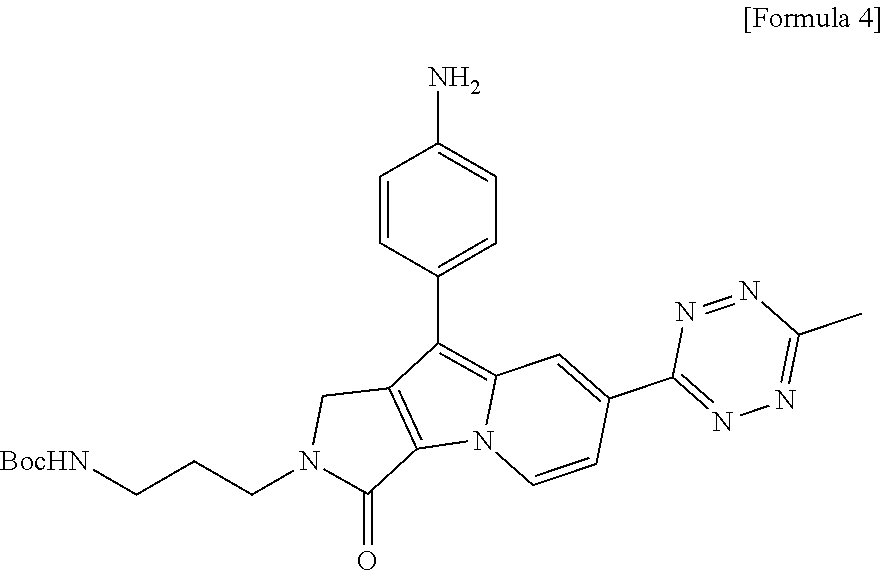
- the present invention provides the compound selected from the group consisting of compounds of Formulae 2 to 7 below:
- the present invention provides the compound characterized in that the compound does not have an absorption peak of 500-550 nm in the absorption spectrum measured using a UV-VIS spectrophotometer.
- the present invention provides a novel fluorogenic bioorthogonal probe capable of amplifying a fluorescence signal with very high efficiency in all wavelength ranges since it is possible to quench the excited energy of the phosphor regardless of the wavelength by treating the phosphor and the tetrazine quencher in a monochromophore type, with deviating from the conventional method of connecting the phosphor-tetrazine in a bichromophore type.
- FIG. 1 shows the change in absorbance before and after the reaction between the compounds of Examples 1 to 4 and TCO.
- FIG. 2 shows the change in absorbance before and after the reaction between the compounds of Comparative Examples 1 to 4 and TCO.
- FIG. 3 shows the fluorescence intensity before and after the reaction between the compounds of Examples 1 to 4 and TCO.
- FIG. 4 shows the change in fluorescence intensity before and after the reaction between the compounds of Comparative Examples 1 to 4 and TCO.
- the present invention provides a novel compound represented by Formula 1 below.
- the compound of the present invention is a compound having a core skeleton of “9-phenyl-2-propyl-7-(1,2,4,5-tetrazin-3-yl)-1H-pyrrolo[3,4-b](2H)-one” in Formula 1 above and a derivative thereof, and has special photophysical properties and photochemical properties through a change in a substituent group.
- the compound of the present invention enables tuning and prediction of a fluorescence wavelength through a change in a substituent group, thereby providing a new fluorogenic bioorthogonal probe that can be used at various wavelengths.
- it can be used as a useful fluorescent compound that can selectively track in vivo targets that have been difficult to observe due to a small amount of fluorescence expression.
- the compound of the present invention can be usefully used in organic light emitting elements, bio-imaging and bio applications as a fluorescent dye or a fluorogenic probe, and in particular, can be used as a fluorogenic probe capable of specifically labeling a protein of interest in the field of immunocytochemistry.
- R 1 is hydrogen, C 1 -C 6 alkoxy, hydroxy or NR 4 R 5 (wherein, R 4 and R 5 are each independently hydrogen, a C 1 -C 6 alkyl group or a C 3 -C 8 cycloalkyl group),
- R 2 is hydrogen, a C 1 -C 6 alkyl, C 6 -C 20 aryl or C 4 -C 20 heteroaryl group, and
- R 3 is hydrogen, hydroxy, an alcohol protected by triisopropylsilyl (TIPS), a C 3 -C 8 heterocyclic or amine group,
- TIPS triisopropylsilyl
- heterocyclic or amine group may or may not be substituted with C 1 -C 6 alkyl; a carboxylC 1 -C 6 alkyl or tert-butyloxycarbonyl group (Boc group).
- the present invention provides the compound characterized in that
- R 1 is hydrogen, C 1 -C 6 alkoxy, or NR 4 R 5 (wherein, R 4 and R 5 are each independently hydrogen or a C 1 -C 6 alkyl group),
- R 2 is hydrogen or C 1 -C 6 alkyl
- R 3 is hydrogen, a C 3 -C 8 heterocyclic or amine group, wherein the heterocyclic or amine group may or may not be substituted with C 1 -C 6 alkyl; a carboxylC 1 -C 6 alkyl or tert-butyloxycarbonyl group (Boc group).
- the present invention provides the compound characterized in that R 2 is C 1 -C 6 alkyl.
- the present invention provides the compound selected from the group consisting of compounds of Formulae 2 to 7 below:
- the present invention provides the compound characterized in that the compound does not have an absorption peak of 500-550 nm in the absorption spectrum measured using a UV-VIS spectrophotometer.
- Heterocyclic is a heterocyclic having 3 to 30 ring atoms in which one or more ring carbons are each replaced with a heteroatom selected from B, N, O and S.
- Heteroaryl is a heteroaryl having 3 to 30 ring atoms in which one or more ring carbons are each replaced with a heteroatom selected from B, N, O and S.
- Tetrazine is an aromatic hexagonal ring compound containing four nitrogen atoms, and has a chemical reactivity that can cause a rapid bioorthogonal reaction with a target substance, and can serve as a fluorescence quencher that reduces the fluorescence signal when connected to a fluorescent molecule.
- tetrazine rapidly causes a chemical reaction with the target substance and the chemical structure is modified, the fluorescence signal is amplified.
- Bioorthogonal reaction is a chemical reaction that occurs in a physiological environment, and refers to a chemical reaction that occurs selectively with a substance introduced from outside without causing a reaction with in vivo intrinsic molecules.
- Fluorescence quencher refers to a chemical substance that is connected to a phosphor to reduce a fluorescence signal, and exhausts the excited energy absorbed from the phosphor through a process such as heat emission rather than in the form of light.
- the conventional phosphor-tetrazine bichromophore type has a structural form in which the ⁇ -electron sharing between the phosphor and the quencher is cut off, and it was the way in which the energy of the fluorescent molecule was transferred into tetrazine through dipole-dipole exchange or electron interchange manner. Therefore, it was not possible to prevent the decrease in fluorescence amplification efficiency in a long wavelength range (>600 nm), which is known to have an excellent light transmittance in vivo.
- the phosphor-tetrazine monochromophore type of the present invention uses a compound designed to share the ⁇ -electrons of the two molecules in the form of a single molecule by connecting the phosphor and the quencher in one adjacent plane, and unlike the bichromophore type, there is no distinction between an energy donor and acceptor, and energy absorbed in a form other than light is exhausted by emitting the excited energy through the non-magnetic radiation transition of the quencher. Due to these properties, the monochromophore type can obtain high fluorescence amplification efficiency even in a long wavelength range.
- the compound of the present invention may be used as a fluorogenic probe, and in particular, may be used as a multiplex imaging fluorogenic probe.
- the compound of the present invention may be used as a fluorogenic probe through a bioorthogonal reaction in vivo.
- tert-butyl (3-(7-cyano-9-(4-methoxyphenyl)-3-oxo-1H-pyrrolo[3,4-b]indolizin-2(3H)-yl)propyl)carbamate (33.4 mg, 72.5 ⁇ mol), acetonitrile (190 ⁇ L, 3.63 mmol), zinc trifluoromethanesulfonate (13.2 mg, 36.3 ⁇ mol) and hydrazine monohydrate (352 ⁇ L, 7.25 mmol) were added to a microwave reaction vial, and irradiated under a microwave at 80° C. (100 W) while magnetically stirring for 0.5 hours.
- tert-butyl (3-(7-cyano-9-(4-nitrophenyl)-3-oxo-1H-pyrrolo[3,4-b]indolizin-2(3H)-yl)propyl)carbamate (40 mg, 84 ⁇ mol), acetonitrile (220 ⁇ L, 4.21 mmol), zinc trifluoromethanesulfonate (15.3 mg, 42.1 ⁇ mol) and hydrazine monohydrate (409 ⁇ L, 8.41 mmol) were added to a microwave reaction vial (10 ml), and irradiated under a microwave at 80° C. (100 W) while magnetically stirring for 1.5 hours.
- tert-butyl (3-(7-cyano-9-(4-diethylamino)phenyl)-3-oxo-1H-pyrrolo[3,4-b]indolizin-2(3H)-yl)propyl)carbamate (60.2 mg, 120 ⁇ mol), acetonitrile (313 ⁇ L, 6.00 mmol), zinc trifluoromethanesulfonate (21.8 mg, 60.0 ⁇ mol) and hydrazine monohydrate (583 ⁇ L, 12.0 mmol) were added to a microwave reaction vial (10 ml), and irradiated under a microwave at 100° C. (40 W) while magnetically stirring for 1.5 hours.
- the absorption spectrum was measured with a UV-VIS spectrophotometer UV-1650PC (Shimadzu), and the emission spectrum and motion data were measured using a Cary Eclipse Fluorescence spectrophotometer (Varian Associates), and the absolute quantum yield was measured with a QE-2000 (Otsuka Electronics).
- the electrical orthogonality can be confirmed by analyzing the change in absorption peak after the reaction with TCO. If indolizine and tetrazine are in two independent and electronically de-coupled states, after the cyclization reaction of the compound and TCO, the absorption peaks around 500-550 nm due to the absorption of tetrazine disappear and the remaining absorption peaks will be maintained the same.
- the compounds of Examples 1 to 4 had absorption peaks of about 400-420 nm, but absorption peaks of about 500-550 nm were not observed. Since the tetrazine derivative generally exhibits a distinct absorption peak around 500-550 nm, it can be seen that in the compounds of Examples 1 to 4, the bonding state between indolizine and tetrazine is strong.
- the compounds of Examples 1 to 4 exhibited fluorescence property of complete quenching (quantum yield: 0.1 to 0.2%) before the reaction with TCO, and the compounds of Comparative Examples 1 to 4 exhibited the residual fluorescence property (quantum yield: at most 4%) before the reaction with TCO.
- the fluorescence signal was amplified by about 10 to 70 times, and in the compounds of Examples 1 and 2, the fluorescence signal was amplified by 1,000 times or more, and in the compounds of Examples 3 and 4, the fluorescence signal was amplified by 600 times or more.
- the emission spectrum was compared when the maximum fluorescence intensity was reached before and after the reaction of the compound and TCO, and changes in fluorescence of the compounds of Examples 1 and 4 and Comparative Examples 3 to 6 were observed, and the results are shown in Table 2 below, FIGS. 3 and 4 .
- the compounds of Examples 1 and 4 having the structure of the phosphor-quencher monochromophore type have an excellent fluorescence signal amplification efficiency even in a long wavelength range, which is independent of the electron donating group at the R 1 position.
- the compound of the present invention has high fluorescence amplification efficiency even in a long wavelength range, it was confirmed by the following method whether it has utility as a multiplex imaging probe capable of simultaneously confirming various colors.
- the fluorescence imaging test was performed using a DeltaVision Elite imaging system of GE Healthcare, and an Olympus IX-71 microscope was used.
- the compounds of Examples 5 and 6 were prepared by introducing water-soluble substituents such as piperazine and carboxyl groups at the R 3 position of Formula 1 below.
- Docetaxel-TCO conjugate (Dox-TCO) was used for fluorescence bio-imaging of microtubule. HeLa human cervical cancer cells were fixed, and cultured with Dox-TCO for 1 hour, and then washed with PBS.
- Example 5 As soon as the compound of Example 5 or Example 6 was added to the cells, a bright fluorescence signal was generated, and the intracellular fluorescence image was observed to be similar to a typical spindle structure of microtubules.
- HeLa cells were incubated for 1 hour in the presence or absence of triphenylphosphonium (TPP)-TCO, and then HeLa cells were washed and treated with the compound of Example 5 or Example 6.
- TPP triphenylphosphonium
- the compound of the present invention can secure excellent fluorescence image in various fluorescence wavelength ranges, and can be utilized as multiplex imaging.
Landscapes
- Health & Medical Sciences (AREA)
- Chemical & Material Sciences (AREA)
- Life Sciences & Earth Sciences (AREA)
- Hematology (AREA)
- Immunology (AREA)
- Engineering & Computer Science (AREA)
- Organic Chemistry (AREA)
- Biomedical Technology (AREA)
- Molecular Biology (AREA)
- Urology & Nephrology (AREA)
- General Health & Medical Sciences (AREA)
- Food Science & Technology (AREA)
- General Physics & Mathematics (AREA)
- Medicinal Chemistry (AREA)
- Physics & Mathematics (AREA)
- Analytical Chemistry (AREA)
- Biochemistry (AREA)
- Cell Biology (AREA)
- Microbiology (AREA)
- Pathology (AREA)
- Biotechnology (AREA)
- Epidemiology (AREA)
- Animal Behavior & Ethology (AREA)
- Public Health (AREA)
- Veterinary Medicine (AREA)
- Nitrogen Condensed Heterocyclic Rings (AREA)
Abstract
Description




| TABLE 1 | ||||||
| fluorescence | ||||||
| amplification | ||||||
| K2 | λex | λem | rate | |||
| No. | Φoff | (m−1s−1) | (nm) | (nm) | Φon | (on/off) |
| Example 1 | 0.002 | 24 | 375 | 484 | 0.683 | >1,000 |
| Example 2 | 0.001 | 23 | 383 | 505 | 0.485 | >1,000 |
| Example 3 | 0.002 | 22 | 390 | 562 | 0.064 | >600 |
| Example 4 | 0.001 | 22 | 401 | 581 | 0.045 | >600 |
| Comparative | 0.011 | 21 | 416 | 532 | 0.168 | 20 |
| Example 1 | ||||||
| Comparative | 0.042 | 15 | 401 | 522 | 0.583 | 14 |
| Example 2 | ||||||
| Comparative | 0.012 | 15 | 375 | 493 | 0.616 | 67 |
| Example 3 | ||||||
| Comparative | 0.017 | 8.5 | 401 | 530 | 0.325 | 24 |
| Example 4 | ||||||
| Φoff and Φon absolute quantum yield before and after the reaction with TCO, respectively | ||||||
| K2 second rate constant value measured at 20° C. | ||||||
| λex largest excitation maxima at a given maximum emission wavelength | ||||||
| λem maximum emission wavelength | ||||||

| TABLE 2 | ||||||
| fluorescence | ||||||
| amplification | ||||||
| K2 | λex | λem | rate | |||
| No. | Φoff | (m−1s−1) | (nm) | (nm) | Φon | (on/off) |
| Example 1 | 0.002 | 24 | 375 | 484 | 0.683 | >1,000 |
| Example 4 | 0.001 | 22 | 401 | 581 | 0.045 | >600 |
| Comparative | 0.012 | 15 | 375 | 493 | 0.616 | 67 |
| Example 3 | ||||||
| Comparative | 0.017 | 8.5 | 401 | 530 | 0.325 | 24 |
| Example 4 | ||||||
| Comparative | 0.005 | 15 | 418 | 608 | 0.016 | 30 |
| Example 5 | ||||||
| Comparative | 0.013 | 1.2 | 438 | 625 | 0.028 | 3 |
| Example 6 | ||||||
| Φoff and Φon absolute quantum yield before and after the reaction with TCO, respectively | ||||||
| K2 second rate constant value measured at 20° C. | ||||||
| λex largest excitation maxima at a given maximum emission wavelength | ||||||
| λem maximum emission wavelength | ||||||

Claims (7)


Applications Claiming Priority (1)
| Application Number | Priority Date | Filing Date | Title |
|---|---|---|---|
| PCT/KR2018/006206 WO2019231016A1 (en) | 2018-05-31 | 2018-05-31 | Novel phosphor-tetrazine compound and use thereof |
Publications (2)
| Publication Number | Publication Date |
|---|---|
| US20210198260A1 US20210198260A1 (en) | 2021-07-01 |
| US11584749B2 true US11584749B2 (en) | 2023-02-21 |
Family
ID=68697648
Family Applications (1)
| Application Number | Title | Priority Date | Filing Date |
|---|---|---|---|
| US17/058,893 Active US11584749B2 (en) | 2018-05-31 | 2018-05-31 | Phosphor-tetrazine compound and use thereof |
Country Status (2)
| Country | Link |
|---|---|
| US (1) | US11584749B2 (en) |
| WO (1) | WO2019231016A1 (en) |
Citations (4)
| Publication number | Priority date | Publication date | Assignee | Title |
|---|---|---|---|---|
| US20090023916A1 (en) | 2007-07-17 | 2009-01-22 | University Of Delaware | Tetrazine-based bio-orthogonal coupling reagents and methods |
| KR20090114092A (en) | 2008-04-29 | 2009-11-03 | 재단법인서울대학교산학협력재단 | Radioactive fluorescent compound, preparation method thereof and use thereof |
| KR20130025709A (en) | 2011-09-02 | 2013-03-12 | 서울대학교산학협력단 | Fluorescent compounds for lipid droplet selective staining |
| JP5993940B2 (en) | 2011-05-16 | 2016-09-21 | コーニンクレッカ フィリップス エヌ ヴェKoninklijke Philips N.V. | Bio-orthogonal drug activation |
-
2018
- 2018-05-31 WO PCT/KR2018/006206 patent/WO2019231016A1/en not_active Ceased
- 2018-05-31 US US17/058,893 patent/US11584749B2/en active Active
Patent Citations (4)
| Publication number | Priority date | Publication date | Assignee | Title |
|---|---|---|---|---|
| US20090023916A1 (en) | 2007-07-17 | 2009-01-22 | University Of Delaware | Tetrazine-based bio-orthogonal coupling reagents and methods |
| KR20090114092A (en) | 2008-04-29 | 2009-11-03 | 재단법인서울대학교산학협력재단 | Radioactive fluorescent compound, preparation method thereof and use thereof |
| JP5993940B2 (en) | 2011-05-16 | 2016-09-21 | コーニンクレッカ フィリップス エヌ ヴェKoninklijke Philips N.V. | Bio-orthogonal drug activation |
| KR20130025709A (en) | 2011-09-02 | 2013-03-12 | 서울대학교산학협력단 | Fluorescent compounds for lipid droplet selective staining |
Non-Patent Citations (7)
| Title |
|---|
| Choi, E. J. et al., "Rational Perturbation of the Fluorescence Quantum Yield in Emission-Tunable and Predictable Fluorophores (Seoul-Fluors) by a Facile Synthetic Method Involving C—H Activation," Angewandte Chemie International Edition, vol. 53:1346-1350 (2014). |
| Choi, E.J., et al., "Unique photophysical properties of 9-styryl-1,2-dihydropyrrolo[3,4-?]indolizin-3-one and its e?cient synthesis via direct C—H activation," Organic & Biomolecular Chemistry, vol. 13 (5202) 7 pages (2015). |
| Development for Technology of High Efficiency Fluorescence Enhancement in Vivo Probe, BRIC Trend, BRIC, Retrieved from the Internet <http://www.ibric.org/mybroad/read.php?Board=new&id=291143> See the entire document. Feb. 5, 2018. |
| Lee, Y. et al., "Systematic Exploration of Indolizine- Based Small Fluorescent Molecules," Doctoral Thesis in Organic Chemistry, Department of Chemisry, Graduate School of Seoul National University, May 14, 2018, 252 pages. |
| Lee, Y. et al.,"Monochromophoric Design Strategy for Tetrazine-Based Colorful Bioorthogonal Probes with a Single Fluorescent Core Skeleton," Journal of the American Chemical Society, vol. 140:974-983 (2018). |
| Lee, Y. et al.,"Tetrazine-Containing Colorful Bioorthogonal Probes based on the Indolizine Core Skeleton," 121th General Meeting of Korean Chemical Society. Apr. 19, 2018, ICC Jeju, ORGN.O-8 See abstract, 4 pages. |
| Park, J-W et al., "Measurement of Lipid Droplet Accumulation Kinetics Chlamydomonas reinhardtii Using Seoul-Fluor," Energies, vol. 6:5703-5716; doi:10.3390/en6115703 (2013). |
Also Published As
| Publication number | Publication date |
|---|---|
| WO2019231016A1 (en) | 2019-12-05 |
| US20210198260A1 (en) | 2021-07-01 |
Similar Documents
| Publication | Publication Date | Title |
|---|---|---|
| Gao et al. | A fluorescent dye with large Stokes shift and high stability: synthesis and application to live cell imaging | |
| Yu et al. | Room-temperature phosphorescent γ-cyclodextrin-cucurbit [6] uril-cowheeled [4] rotaxanes for specific sensing of tryptophan | |
| Gibbs et al. | Synthesis, spectroscopic, and in vitro investigations of 2, 6-diiodo-BODIPYs with PDT and bioimaging applications | |
| Wang et al. | A six-membered-ring incorporated Si-rhodamine for imaging of copper (ii) in lysosomes | |
| Yüzeroğlu et al. | Synthesis of new zinc phthalocyanines including schiff base and halogen; photophysical, photochemical, and fluorescence quenching studies | |
| Collado et al. | PEGylated aza-BODIPY derivatives as NIR probes for cellular imaging | |
| Komatsu et al. | Indolequinone-rhodol conjugate as a fluorescent probe for hypoxic cells: enzymatic activation and fluorescence properties | |
| Murphy et al. | Synthesis, photophysical and cytotoxicity evaluations of DNA targeting agents based on 3-amino-1, 8-naphthalimide derived Tröger's bases | |
| CN107098923A (en) | One class feux rouges targets fluorescent dye and preparation method thereof and purposes near infrared emission lysosome | |
| CN116082854B (en) | Off-site substituted pentamethine cyanine dye and synthetic method and application thereof | |
| CN110684370A (en) | Near-infrared fluorescent dye based on coumarin skeleton and synthetic method thereof | |
| Gomes et al. | Squaraine dyes derived from indolenine and benzo [e] indole as potential fluorescent probes for HSA detection and antifungal agents | |
| Qiu et al. | Mild dealkylative N-nitrosation of N, N-dialkylaniline derivatives for convenient preparation of photo-triggered and photo-calibrated NO donors | |
| CN114773875A (en) | Azaindole-squarylium cyanine dye, and synthesis method and application thereof | |
| Dallagnol et al. | Synthesis of porphyrin glycoconjugates bearing thiourea, thiocarbamate and carbamate connecting groups: Influence of the linker on chemical and photophysical properties | |
| JP5889987B2 (en) | Novel fluorescent derivatives of polyamines, methods for their preparation, and their use as diagnostic tools in the treatment of cancerous tumors | |
| RU2621710C1 (en) | Porphyrazine, gadolinius porphyrazine complex and their application | |
| KR101578384B1 (en) | A composition for simultaneous imaging of lysosomes and mitochondria in live cell and tissue, and method of imaging the lysosomes and mitochondria in live cell using the same | |
| CN112010838B (en) | A Fluorescent Probe for Endoplasmic Reticulum Based on Naphthalimide-Indole Derivatives and Its Application | |
| Kawakami et al. | Photophysical properties of the 2-hydroxytryptanthrin and its sodium salt as near-infrared dyes for fluorescent imaging | |
| Topal et al. | pH-induced “off–on–off” type molecular switch behaviors of zinc and free tetraimidazophthalocyanines | |
| US11584749B2 (en) | Phosphor-tetrazine compound and use thereof | |
| KR102011772B1 (en) | Novel fluorophore-tetrazine compound and its use | |
| Han et al. | A diphenylacrylonitrile conjugated porphyrin with near-infrared emission by AIE–FRET | |
| CN118290959B (en) | Anthraquinone and anthracene compound meso-substituted cyanine dye and preparation method and application thereof |
Legal Events
| Date | Code | Title | Description |
|---|---|---|---|
| AS | Assignment |
Owner name: SPARK BIOPHARMA, INC., KOREA, REPUBLIC OF Free format text: ASSIGNMENT OF ASSIGNORS INTEREST;ASSIGNORS:PARK, SEUNG BUM;LEE, YOUNG JUN;REEL/FRAME:055123/0200 Effective date: 20201120 Owner name: SEOUL NATIONAL UNIVERSITY R&DB FOUNDATION, KOREA, REPUBLIC OF Free format text: ASSIGNMENT OF ASSIGNORS INTEREST;ASSIGNORS:PARK, SEUNG BUM;LEE, YOUNG JUN;REEL/FRAME:055123/0200 Effective date: 20201120 |
|
| FEPP | Fee payment procedure |
Free format text: ENTITY STATUS SET TO UNDISCOUNTED (ORIGINAL EVENT CODE: BIG.); ENTITY STATUS OF PATENT OWNER: SMALL ENTITY |
|
| FEPP | Fee payment procedure |
Free format text: ENTITY STATUS SET TO SMALL (ORIGINAL EVENT CODE: SMAL); ENTITY STATUS OF PATENT OWNER: SMALL ENTITY |
|
| STPP | Information on status: patent application and granting procedure in general |
Free format text: APPLICATION DISPATCHED FROM PREEXAM, NOT YET DOCKETED |
|
| STPP | Information on status: patent application and granting procedure in general |
Free format text: DOCKETED NEW CASE - READY FOR EXAMINATION |
|
| STPP | Information on status: patent application and granting procedure in general |
Free format text: NON FINAL ACTION MAILED |
|
| STPP | Information on status: patent application and granting procedure in general |
Free format text: RESPONSE TO NON-FINAL OFFICE ACTION ENTERED AND FORWARDED TO EXAMINER |
|
| STPP | Information on status: patent application and granting procedure in general |
Free format text: NON FINAL ACTION MAILED |
|
| STPP | Information on status: patent application and granting procedure in general |
Free format text: RESPONSE TO NON-FINAL OFFICE ACTION ENTERED AND FORWARDED TO EXAMINER |
|
| STPP | Information on status: patent application and granting procedure in general |
Free format text: FINAL REJECTION MAILED |
|
| STPP | Information on status: patent application and granting procedure in general |
Free format text: RESPONSE AFTER FINAL ACTION FORWARDED TO EXAMINER |
|
| STPP | Information on status: patent application and granting procedure in general |
Free format text: NOTICE OF ALLOWANCE MAILED -- APPLICATION RECEIVED IN OFFICE OF PUBLICATIONS |
|
| STCF | Information on status: patent grant |
Free format text: PATENTED CASE |