US11584108B2 - Superabsorbent polymer capsules and bio-mineralization process for the mitigation of corrosion under insulation as smart packaging materials - Google Patents
Superabsorbent polymer capsules and bio-mineralization process for the mitigation of corrosion under insulation as smart packaging materials Download PDFInfo
- Publication number
- US11584108B2 US11584108B2 US16/555,745 US201916555745A US11584108B2 US 11584108 B2 US11584108 B2 US 11584108B2 US 201916555745 A US201916555745 A US 201916555745A US 11584108 B2 US11584108 B2 US 11584108B2
- Authority
- US
- United States
- Prior art keywords
- corrosion
- insulation
- insulation material
- composite
- microorganisms
- Prior art date
- Legal status (The legal status is an assumption and is not a legal conclusion. Google has not performed a legal analysis and makes no representation as to the accuracy of the status listed.)
- Active, expires
Links
- 238000005260 corrosion Methods 0.000 title claims abstract description 67
- 238000009413 insulation Methods 0.000 title claims abstract description 26
- 238000000034 method Methods 0.000 title claims abstract description 18
- 230000008569 process Effects 0.000 title claims abstract description 11
- 230000033558 biomineral tissue development Effects 0.000 title claims abstract description 10
- 229920000247 superabsorbent polymer Polymers 0.000 title claims description 23
- 230000007797 corrosion Effects 0.000 title abstract description 22
- 239000002775 capsule Substances 0.000 title description 36
- 239000005022 packaging material Substances 0.000 title description 3
- 238000009450 smart packaging Methods 0.000 title description 3
- 230000000116 mitigating effect Effects 0.000 title 1
- 239000012774 insulation material Substances 0.000 claims abstract description 42
- 239000011810 insulating material Substances 0.000 claims abstract description 37
- 239000002131 composite material Substances 0.000 claims abstract description 35
- 244000005700 microbiome Species 0.000 claims description 60
- XLYOFNOQVPJJNP-UHFFFAOYSA-N water Substances O XLYOFNOQVPJJNP-UHFFFAOYSA-N 0.000 claims description 38
- 238000005253 cladding Methods 0.000 claims description 21
- 239000011159 matrix material Substances 0.000 claims description 21
- 239000004583 superabsorbent polymers (SAPs) Substances 0.000 claims description 18
- QVGXLLKOCUKJST-UHFFFAOYSA-N atomic oxygen Chemical compound [O] QVGXLLKOCUKJST-UHFFFAOYSA-N 0.000 claims description 12
- 239000001301 oxygen Substances 0.000 claims description 12
- 229910052760 oxygen Inorganic materials 0.000 claims description 12
- 239000007788 liquid Substances 0.000 claims description 9
- 239000011152 fibreglass Substances 0.000 claims description 7
- 239000011490 mineral wool Substances 0.000 claims description 7
- 235000016709 nutrition Nutrition 0.000 claims description 7
- 230000035764 nutrition Effects 0.000 claims description 7
- 229910000831 Steel Inorganic materials 0.000 claims description 4
- 239000002198 insoluble material Substances 0.000 claims description 4
- 239000010959 steel Substances 0.000 claims description 4
- 239000004793 Polystyrene Substances 0.000 claims description 3
- 239000000378 calcium silicate Substances 0.000 claims description 3
- 229910052918 calcium silicate Inorganic materials 0.000 claims description 3
- OYACROKNLOSFPA-UHFFFAOYSA-N calcium;dioxido(oxo)silane Chemical compound [Ca+2].[O-][Si]([O-])=O OYACROKNLOSFPA-UHFFFAOYSA-N 0.000 claims description 3
- 230000001413 cellular effect Effects 0.000 claims description 3
- 239000011491 glass wool Substances 0.000 claims description 3
- 229910052500 inorganic mineral Inorganic materials 0.000 claims description 3
- 229920002223 polystyrene Polymers 0.000 claims description 3
- 229920002635 polyurethane Polymers 0.000 claims description 3
- 239000004814 polyurethane Substances 0.000 claims description 3
- 229920005830 Polyurethane Foam Polymers 0.000 claims description 2
- 239000004964 aerogel Substances 0.000 claims description 2
- 229920001971 elastomer Polymers 0.000 claims description 2
- 239000011521 glass Substances 0.000 claims description 2
- 229920000582 polyisocyanurate Polymers 0.000 claims description 2
- 239000011495 polyisocyanurate Substances 0.000 claims description 2
- 239000011496 polyurethane foam Substances 0.000 claims description 2
- 239000004800 polyvinyl chloride Substances 0.000 claims description 2
- 210000002268 wool Anatomy 0.000 claims description 2
- XAGFODPZIPBFFR-UHFFFAOYSA-N aluminium Chemical compound [Al] XAGFODPZIPBFFR-UHFFFAOYSA-N 0.000 claims 1
- 229910052782 aluminium Inorganic materials 0.000 claims 1
- 230000004888 barrier function Effects 0.000 abstract description 10
- 239000000463 material Substances 0.000 description 53
- 229920000642 polymer Polymers 0.000 description 45
- VTYYLEPIZMXCLO-UHFFFAOYSA-L Calcium carbonate Chemical compound [Ca+2].[O-]C([O-])=O VTYYLEPIZMXCLO-UHFFFAOYSA-L 0.000 description 32
- 235000015097 nutrients Nutrition 0.000 description 18
- 229910000019 calcium carbonate Inorganic materials 0.000 description 16
- 239000000835 fiber Substances 0.000 description 15
- 239000012212 insulator Substances 0.000 description 12
- 241000894006 Bacteria Species 0.000 description 8
- 229910052751 metal Inorganic materials 0.000 description 7
- 239000002184 metal Substances 0.000 description 7
- 210000004666 bacterial spore Anatomy 0.000 description 6
- OYPRJOBELJOOCE-UHFFFAOYSA-N Calcium Chemical compound [Ca] OYPRJOBELJOOCE-UHFFFAOYSA-N 0.000 description 5
- 239000011575 calcium Substances 0.000 description 5
- 229960005069 calcium Drugs 0.000 description 5
- 229910052791 calcium Inorganic materials 0.000 description 5
- 230000007613 environmental effect Effects 0.000 description 5
- 229920005594 polymer fiber Polymers 0.000 description 5
- 230000001580 bacterial effect Effects 0.000 description 4
- ZCCIPPOKBCJFDN-UHFFFAOYSA-N calcium nitrate Chemical compound [Ca+2].[O-][N+]([O-])=O.[O-][N+]([O-])=O ZCCIPPOKBCJFDN-UHFFFAOYSA-N 0.000 description 4
- 238000009415 formwork Methods 0.000 description 4
- 230000001681 protective effect Effects 0.000 description 4
- 230000004044 response Effects 0.000 description 4
- 241000894007 species Species 0.000 description 4
- 150000001805 chlorine compounds Chemical class 0.000 description 3
- 230000008595 infiltration Effects 0.000 description 3
- 238000001764 infiltration Methods 0.000 description 3
- 238000004806 packaging method and process Methods 0.000 description 3
- 239000011148 porous material Substances 0.000 description 3
- 239000002244 precipitate Substances 0.000 description 3
- 238000001556 precipitation Methods 0.000 description 3
- 239000000758 substrate Substances 0.000 description 3
- IJGRMHOSHXDMSA-UHFFFAOYSA-N Atomic nitrogen Chemical compound N#N IJGRMHOSHXDMSA-UHFFFAOYSA-N 0.000 description 2
- -1 Ca2+ ions Chemical class 0.000 description 2
- 238000009825 accumulation Methods 0.000 description 2
- MKJXYGKVIBWPFZ-UHFFFAOYSA-L calcium lactate Chemical compound [Ca+2].CC(O)C([O-])=O.CC(O)C([O-])=O MKJXYGKVIBWPFZ-UHFFFAOYSA-L 0.000 description 2
- 239000001527 calcium lactate Substances 0.000 description 2
- 229960002401 calcium lactate Drugs 0.000 description 2
- 235000011086 calcium lactate Nutrition 0.000 description 2
- 239000011248 coating agent Substances 0.000 description 2
- 238000000576 coating method Methods 0.000 description 2
- 239000000356 contaminant Substances 0.000 description 2
- 238000003487 electrochemical reaction Methods 0.000 description 2
- 238000005538 encapsulation Methods 0.000 description 2
- 239000012530 fluid Substances 0.000 description 2
- 238000004519 manufacturing process Methods 0.000 description 2
- 230000004060 metabolic process Effects 0.000 description 2
- 235000010755 mineral Nutrition 0.000 description 2
- 239000000203 mixture Substances 0.000 description 2
- 239000008188 pellet Substances 0.000 description 2
- 239000000047 product Substances 0.000 description 2
- 239000011253 protective coating Substances 0.000 description 2
- 210000004215 spore Anatomy 0.000 description 2
- 230000008961 swelling Effects 0.000 description 2
- 241000193830 Bacillus <bacterium> Species 0.000 description 1
- 241001328127 Bacillus pseudofirmus Species 0.000 description 1
- UXVMQQNJUSDDNG-UHFFFAOYSA-L Calcium chloride Chemical compound [Cl-].[Cl-].[Ca+2] UXVMQQNJUSDDNG-UHFFFAOYSA-L 0.000 description 1
- OKTJSMMVPCPJKN-UHFFFAOYSA-N Carbon Chemical compound [C] OKTJSMMVPCPJKN-UHFFFAOYSA-N 0.000 description 1
- VEXZGXHMUGYJMC-UHFFFAOYSA-M Chloride anion Chemical compound [Cl-] VEXZGXHMUGYJMC-UHFFFAOYSA-M 0.000 description 1
- 241000193403 Clostridium Species 0.000 description 1
- 241000186541 Desulfotomaculum Species 0.000 description 1
- 235000019738 Limestone Nutrition 0.000 description 1
- 240000004808 Saccharomyces cerevisiae Species 0.000 description 1
- 241000186547 Sporosarcina Species 0.000 description 1
- XSQUKJJJFZCRTK-UHFFFAOYSA-N Urea Chemical compound NC(N)=O XSQUKJJJFZCRTK-UHFFFAOYSA-N 0.000 description 1
- 238000010521 absorption reaction Methods 0.000 description 1
- 230000001133 acceleration Effects 0.000 description 1
- 230000004913 activation Effects 0.000 description 1
- 238000013459 approach Methods 0.000 description 1
- 239000007864 aqueous solution Substances 0.000 description 1
- 239000010425 asbestos Substances 0.000 description 1
- 230000010065 bacterial adhesion Effects 0.000 description 1
- 239000011324 bead Substances 0.000 description 1
- 230000015572 biosynthetic process Effects 0.000 description 1
- 239000006227 byproduct Substances 0.000 description 1
- VSGNNIFQASZAOI-UHFFFAOYSA-L calcium acetate Chemical compound [Ca+2].CC([O-])=O.CC([O-])=O VSGNNIFQASZAOI-UHFFFAOYSA-L 0.000 description 1
- 239000001639 calcium acetate Substances 0.000 description 1
- 235000011092 calcium acetate Nutrition 0.000 description 1
- 229960005147 calcium acetate Drugs 0.000 description 1
- 239000001110 calcium chloride Substances 0.000 description 1
- 229910001628 calcium chloride Inorganic materials 0.000 description 1
- 229960002713 calcium chloride Drugs 0.000 description 1
- 235000011148 calcium chloride Nutrition 0.000 description 1
- 229940041514 candida albicans extract Drugs 0.000 description 1
- 239000004202 carbamide Substances 0.000 description 1
- 229910052799 carbon Inorganic materials 0.000 description 1
- 210000004027 cell Anatomy 0.000 description 1
- 238000006243 chemical reaction Methods 0.000 description 1
- 239000003795 chemical substances by application Substances 0.000 description 1
- 238000005354 coacervation Methods 0.000 description 1
- 238000009833 condensation Methods 0.000 description 1
- 230000005494 condensation Effects 0.000 description 1
- 230000007423 decrease Effects 0.000 description 1
- 230000003247 decreasing effect Effects 0.000 description 1
- 238000007872 degassing Methods 0.000 description 1
- 238000010586 diagram Methods 0.000 description 1
- 238000004090 dissolution Methods 0.000 description 1
- 238000009826 distribution Methods 0.000 description 1
- 230000005059 dormancy Effects 0.000 description 1
- 239000003792 electrolyte Substances 0.000 description 1
- 238000004945 emulsification Methods 0.000 description 1
- 238000001125 extrusion Methods 0.000 description 1
- 230000002349 favourable effect Effects 0.000 description 1
- 239000002657 fibrous material Substances 0.000 description 1
- 238000004108 freeze drying Methods 0.000 description 1
- 238000007306 functionalization reaction Methods 0.000 description 1
- 230000035784 germination Effects 0.000 description 1
- 239000000017 hydrogel Substances 0.000 description 1
- 229920001477 hydrophilic polymer Polymers 0.000 description 1
- 238000007689 inspection Methods 0.000 description 1
- 238000009434 installation Methods 0.000 description 1
- 239000006028 limestone Substances 0.000 description 1
- 229920002521 macromolecule Polymers 0.000 description 1
- 230000014759 maintenance of location Effects 0.000 description 1
- 230000002503 metabolic effect Effects 0.000 description 1
- 230000000813 microbial effect Effects 0.000 description 1
- 238000001000 micrograph Methods 0.000 description 1
- 239000011707 mineral Substances 0.000 description 1
- 239000011185 multilayer composite material Substances 0.000 description 1
- 229910052757 nitrogen Inorganic materials 0.000 description 1
- 239000002245 particle Substances 0.000 description 1
- 230000035515 penetration Effects 0.000 description 1
- 229920001495 poly(sodium acrylate) polymer Polymers 0.000 description 1
- 229920002492 poly(sulfone) Polymers 0.000 description 1
- XAEFZNCEHLXOMS-UHFFFAOYSA-M potassium benzoate Chemical compound [K+].[O-]C(=O)C1=CC=CC=C1 XAEFZNCEHLXOMS-UHFFFAOYSA-M 0.000 description 1
- 239000002243 precursor Substances 0.000 description 1
- 230000009467 reduction Effects 0.000 description 1
- 229910052895 riebeckite Inorganic materials 0.000 description 1
- 239000000565 sealant Substances 0.000 description 1
- NNMHYFLPFNGQFZ-UHFFFAOYSA-M sodium polyacrylate Chemical compound [Na+].[O-]C(=O)C=C NNMHYFLPFNGQFZ-UHFFFAOYSA-M 0.000 description 1
- 239000000243 solution Substances 0.000 description 1
- 238000001694 spray drying Methods 0.000 description 1
- 239000000126 substance Substances 0.000 description 1
- 235000000346 sugar Nutrition 0.000 description 1
- 150000008163 sugars Chemical class 0.000 description 1
- 150000003467 sulfuric acid derivatives Chemical class 0.000 description 1
- 230000002123 temporal effect Effects 0.000 description 1
- 238000009827 uniform distribution Methods 0.000 description 1
- 239000012138 yeast extract Substances 0.000 description 1
Images



Classifications
-
- B—PERFORMING OPERATIONS; TRANSPORTING
- B01—PHYSICAL OR CHEMICAL PROCESSES OR APPARATUS IN GENERAL
- B01J—CHEMICAL OR PHYSICAL PROCESSES, e.g. CATALYSIS OR COLLOID CHEMISTRY; THEIR RELEVANT APPARATUS
- B01J20/00—Solid sorbent compositions or filter aid compositions; Sorbents for chromatography; Processes for preparing, regenerating or reactivating thereof
- B01J20/22—Solid sorbent compositions or filter aid compositions; Sorbents for chromatography; Processes for preparing, regenerating or reactivating thereof comprising organic material
- B01J20/26—Synthetic macromolecular compounds
- B01J20/262—Synthetic macromolecular compounds obtained otherwise than by reactions only involving carbon to carbon unsaturated bonds, e.g. obtained by polycondensation
-
- B—PERFORMING OPERATIONS; TRANSPORTING
- B32—LAYERED PRODUCTS
- B32B—LAYERED PRODUCTS, i.e. PRODUCTS BUILT-UP OF STRATA OF FLAT OR NON-FLAT, e.g. CELLULAR OR HONEYCOMB, FORM
- B32B15/00—Layered products comprising a layer of metal
- B32B15/04—Layered products comprising a layer of metal comprising metal as the main or only constituent of a layer, which is next to another layer of the same or of a different material
- B32B15/08—Layered products comprising a layer of metal comprising metal as the main or only constituent of a layer, which is next to another layer of the same or of a different material of synthetic resin
- B32B15/082—Layered products comprising a layer of metal comprising metal as the main or only constituent of a layer, which is next to another layer of the same or of a different material of synthetic resin comprising vinyl resins; comprising acrylic resins
-
- B—PERFORMING OPERATIONS; TRANSPORTING
- B32—LAYERED PRODUCTS
- B32B—LAYERED PRODUCTS, i.e. PRODUCTS BUILT-UP OF STRATA OF FLAT OR NON-FLAT, e.g. CELLULAR OR HONEYCOMB, FORM
- B32B27/00—Layered products comprising a layer of synthetic resin
- B32B27/30—Layered products comprising a layer of synthetic resin comprising vinyl (co)polymers; comprising acrylic (co)polymers
- B32B27/308—Layered products comprising a layer of synthetic resin comprising vinyl (co)polymers; comprising acrylic (co)polymers comprising acrylic (co)polymers
-
- C—CHEMISTRY; METALLURGY
- C08—ORGANIC MACROMOLECULAR COMPOUNDS; THEIR PREPARATION OR CHEMICAL WORKING-UP; COMPOSITIONS BASED THEREON
- C08L—COMPOSITIONS OF MACROMOLECULAR COMPOUNDS
- C08L33/00—Compositions of homopolymers or copolymers of compounds having one or more unsaturated aliphatic radicals, each having only one carbon-to-carbon double bond, and only one being terminated by only one carboxyl radical, or of salts, anhydrides, esters, amides, imides or nitriles thereof; Compositions of derivatives of such polymers
- C08L33/04—Homopolymers or copolymers of esters
- C08L33/06—Homopolymers or copolymers of esters of esters containing only carbon, hydrogen and oxygen, which oxygen atoms are present only as part of the carboxyl radical
- C08L33/08—Homopolymers or copolymers of acrylic acid esters
-
- C—CHEMISTRY; METALLURGY
- C08—ORGANIC MACROMOLECULAR COMPOUNDS; THEIR PREPARATION OR CHEMICAL WORKING-UP; COMPOSITIONS BASED THEREON
- C08L—COMPOSITIONS OF MACROMOLECULAR COMPOUNDS
- C08L33/00—Compositions of homopolymers or copolymers of compounds having one or more unsaturated aliphatic radicals, each having only one carbon-to-carbon double bond, and only one being terminated by only one carboxyl radical, or of salts, anhydrides, esters, amides, imides or nitriles thereof; Compositions of derivatives of such polymers
- C08L33/24—Homopolymers or copolymers of amides or imides
- C08L33/26—Homopolymers or copolymers of acrylamide or methacrylamide
-
- C—CHEMISTRY; METALLURGY
- C08—ORGANIC MACROMOLECULAR COMPOUNDS; THEIR PREPARATION OR CHEMICAL WORKING-UP; COMPOSITIONS BASED THEREON
- C08L—COMPOSITIONS OF MACROMOLECULAR COMPOUNDS
- C08L81/00—Compositions of macromolecular compounds obtained by reactions forming in the main chain of the macromolecule a linkage containing sulfur with or without nitrogen, oxygen or carbon only; Compositions of polysulfones; Compositions of derivatives of such polymers
- C08L81/06—Polysulfones; Polyethersulfones
-
- B—PERFORMING OPERATIONS; TRANSPORTING
- B01—PHYSICAL OR CHEMICAL PROCESSES OR APPARATUS IN GENERAL
- B01J—CHEMICAL OR PHYSICAL PROCESSES, e.g. CATALYSIS OR COLLOID CHEMISTRY; THEIR RELEVANT APPARATUS
- B01J2220/00—Aspects relating to sorbent materials
- B01J2220/40—Aspects relating to the composition of sorbent or filter aid materials
- B01J2220/48—Sorbents characterised by the starting material used for their preparation
- B01J2220/4812—Sorbents characterised by the starting material used for their preparation the starting material being of organic character
- B01J2220/4868—Cells, spores, bacteria
-
- B—PERFORMING OPERATIONS; TRANSPORTING
- B01—PHYSICAL OR CHEMICAL PROCESSES OR APPARATUS IN GENERAL
- B01J—CHEMICAL OR PHYSICAL PROCESSES, e.g. CATALYSIS OR COLLOID CHEMISTRY; THEIR RELEVANT APPARATUS
- B01J2220/00—Aspects relating to sorbent materials
- B01J2220/50—Aspects relating to the use of sorbent or filter aid materials
- B01J2220/68—Superabsorbents
-
- B—PERFORMING OPERATIONS; TRANSPORTING
- B32—LAYERED PRODUCTS
- B32B—LAYERED PRODUCTS, i.e. PRODUCTS BUILT-UP OF STRATA OF FLAT OR NON-FLAT, e.g. CELLULAR OR HONEYCOMB, FORM
- B32B2307/00—Properties of the layers or laminate
- B32B2307/70—Other properties
- B32B2307/726—Permeability to liquids, absorption
-
- B—PERFORMING OPERATIONS; TRANSPORTING
- B32—LAYERED PRODUCTS
- B32B—LAYERED PRODUCTS, i.e. PRODUCTS BUILT-UP OF STRATA OF FLAT OR NON-FLAT, e.g. CELLULAR OR HONEYCOMB, FORM
- B32B2419/00—Buildings or parts thereof
-
- C—CHEMISTRY; METALLURGY
- C08—ORGANIC MACROMOLECULAR COMPOUNDS; THEIR PREPARATION OR CHEMICAL WORKING-UP; COMPOSITIONS BASED THEREON
- C08L—COMPOSITIONS OF MACROMOLECULAR COMPOUNDS
- C08L2203/00—Applications
- C08L2203/18—Applications used for pipes
Definitions
- the present disclosure is directed to packaging or insulation materials that are designed to reduce or eliminate corrosion under insulation.
- Corrosion under insulation is a type of corrosion that occurs due to moisture buildup on the external surface of insulated metal equipment/piping. If undetected, the results of CUI can lead to, for example, failure of pipes and attendant consequences, such as the shutdown of a process unit or an entire facility.
- the precursor of the corrosion is the accumulation of moisture and water patches underneath the insulating layers.
- the corrosion of steel or other materials under insulation initiates due to the presence of water, oxygen, and other corrodents. Once water and oxygen are present on a metal surface, corrosion takes place via metal dissolution (anodic reaction), which is balanced by the reduction of oxygen.
- the rate of CUI is determined by factors such as the availability of oxygen, contaminants in water, temperature, and heat transfer properties of the metal surface and wet/dry conditions of the surface.
- the insulation type used can include, for example, fibrous material (e.g., glass/mineral wool) or cellular material (e.g., calcium silicate, poly urethane, or poly styrene).
- fibrous material e.g., glass/mineral wool
- cellular material e.g., calcium silicate, poly urethane, or poly styrene.
- One insulation structure starts from the inner (pipe surface) and moves towards the periphery, such as coating the pipe with a compatible coating system, then insulation to insulate the pipe, and then a metal jacket cladding.
- the cladding acts as a protective barrier/weather shield. It helps prevent the insulation from getting exposed to rain and physical damages.
- the main contribution of insulation to CUI is to provide an annular space for the retention or accumulation of water, with access to air (oxygen).
- Water may be introduced from external sources such as rainfall and wash downs, or from condensation.
- the chemistry and properties of the insulation also play a role in CUI.
- the insulation material may wick or absorb water, thus providing the required aqueous environment for electrochemical reactions to take place.
- the chemicals within the insulation such as chlorides and sulfates, may leach into the electrolyte causing an acceleration in the corrosion.
- a composite insulating material is provided.
- the composite insulating material includes one or more active or responsive elements that mitigate corrosion under insulation (CUI).
- one or more active components of a composite insulation material are provided in order to dynamically generate an insoluble water barrier through a bio-mineralization process.
- a composite, anti-corrosion insulator material includes an outer cladding jacket, an anti-corrosion layer, and an insulating material layer.
- the anti-corrosion layer includes a plurality of porous superabsorbent capsules or fibers embedded with dormant microorganism spores and a nutrient source. The dormant microorganisms are revivable upon contact with water. Though biomineralization processes, the revived microorganisms generate a calcium carbonate barrier that inhibits further water intrusion.
- a method for producing a composite insulating material includes providing dormant, calcium carbonate producing microorganisms and a nutrition source to a porous superabsorbent polymer. The method also includes securing the superabsorbent polymer in a hosting matrix and forming a composite insulating material by combining an external cladding, the hosting matrix and a general insulating material.
- FIG. 1 illustrates a cross-section view of the composite insulation material without inclusion of anti-corrosion elements according to one or more embodiments of the present disclosure.
- FIG. 2 illustrates a cross-section view of the composite insulation material with the inclusion of anti-corrosion elements according to one or more embodiments of the present disclosure.
- FIG. 3 provides skeletal formulae for the superabsorbent polymers according to one or more embodiments of the present disclosure.
- FIG. 4 depicts a capsule configuration of a polymer according to one or more embodiments of the present disclosure.
- FIG. 5 depicts a fiber configuration of a polymer according to one or more embodiments of the present disclosure.
- FIG. 6 depicts an electron scanning microscope image of the surface of a polymer according to one or more embodiments of the present disclosure.
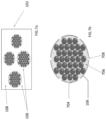
- FIG. 7 a illustrates an anti-corrosion element of the composite insulating material according to one or more embodiments of the present disclosure.
- FIG. 7 b illustrates a polymer capsule configuration incorporating microorganisms according to one or more embodiments of the present disclosure.
- FIG. 8 illustrates a perspective view of the anti-corrosion element according to one or more embodiments of the present disclosure.
- the products and methods described herein are directed to a composite insulation material that includes anti-corrosion properties that inhibit or reduce the corrosion of the insulted material due to corrosion under insulation (CUI).
- the described composite insulation material includes active elements that respond to changes in the amount of water present in the insulation. When water infiltrates the composite insulation, active elements respond by generating at least a water insoluble or otherwise protective barrier that prevents or restricts further intrusion of water.
- the composite insulation material described herein includes a plurality superabsorbent polymers that are coated or embedded with dormant microorganisms. Upon exposure to liquid water, these dormant microorganisms are revived. Through a process of biomineralization, the revived microorganisms generate a fluid impermeable barrier within a portion of the insulation material. Here, such the fluid impermeable barrier restricts or prevents the infiltration of water through the insulation material such that CUI is prevented restricted.
- the microorganism embedded superabsorbent polymers can be added as a material layer that works in conjunction with common or commercially used insulation.
- the microorganism embedded superabsorbent polymers described herein can be incorporated into insulation such that the microorganism embedded superabsorbent polymers are distributed within some or all of an insulating material.
- FIG. 1 illustrates a perspective cross-section of an insulated structure 105 and an insulation material provided therewith.
- insulating material e.g., a foam, a glass, or a ceramic, or a ceramic, or a ceramic, or a ceramic, or a ceramic, or a ceramic, or a ceramic, or a ceramic, or a ceramic, or a ceramic, or a ceramic, or a ceramic, or a ceramic, or insulating material 104 .
- the insulated structure 105 is a pipeline, conduit, vent, ductwork or similar structure. It will be appreciated by those possessing an ordinary level of skill in the requisite art that the insulated structure 105 , can, in various alternative arrangements be any material where protection from exposure to direct environmental conditions (i.e. rain, washdowns, etc.) is desired.
- the bulk insulation material 104 abuts or encases the insulated structure 105 .
- the bulk insulation material 104 surrounds at least a portion of the total length of the insulated structure.
- the bulk insulation material 104 is, in turn, encased by a cladding material 101 .
- the cladding material 101 is a metallic cladding jacket that prevents physical and environmental damage to the bulk insulating material 104 .
- the cladding material 101 is a synthetic, composite, or other material type suitable to protect the bulk insulating material 104 .
- the cladding material 101 is not placed in direct contact with the general insulating material 104 .
- annular space 107 is provided between the cladding material 101 and the bulk insulating material 104 .
- moisture infiltrates and collects within the annular space 107 . From there, moisture penetrates the bulk insulating material 104 and corrodes the insulated structure 105 .
- the annular space 107 is provided between the insulated component 105 and the bulk insulator.
- the bulk insulating material 104 is in proximity to the cladding material 101 such that there is no annular space provided between the cladding jacket 101 and the bulk insulating material 104 .
- the composite insulation material 100 is shown.
- the composite insulation material 100 is configured such that an anti-corrosion material 102 is positioned within the annular space 107 between the bulk insulation and the cladding jacket 101 .
- the anti-corrosion material 102 is provided within an annular space between the insulated component 105 and the bulk insulator 104 .
- the anti-corrosion material 102 is positioned and configured so as to reduce or eliminate the intrusion of liquid to the insulated component 105
- the bulk insulation material 104 and the anti-corrosion material 102 together form a composite insulation material 100 .
- the composite insulation material 100 is made of one or more layers of anti-corrosion material 102 and one or more layers of bulk insulation 104 .
- such layers may be separately manufactured and combined at the time of installation.
- the bulk insulation material 104 and the anti-corrosion material 102 are joined, bonded, fused, or otherwise made into a single, multi-layer composite material.
- multiple layers of the anti-corrosion material 102 can be used in connection with one or more layers of bulk insulating material 104 .
- the anti-corrosion material 102 can be placed in both annular spaces.
- the composite insulating material 100 described can include alternating layers of material, such that layers of anti-corrosion material 102 are separated by layers of bulk insulating material 104 . Such patterns of layers of material can be adapted or refined based on the particular need.
- the anti-corrosion material 102 is provided separately from the bulk insulation material 104 . According to such an arrangement, the bulk insulating material and the anti-corrosion material 102 can be installed at different times. In this arrangement, while the two materials are placed in close proximity to one another, they are not a single integrated material.
- the bulk insulation material 104 provided herein is formed of insulation materials commonly used in industrial applications.
- the material used in the bulk insulation material 104 can be selected from one or more of fiberglass, PVC, steel wool, mineral or rock wool, aerogel, cellular glass, closed rubber cell, calcium silicate, polyurethane, polystyrene, or polyisocyanurate.
- the bulk insulation material 104 provided in FIG. 2 is formed of fiberglass.
- the anti-corrosion material 102 includes a plurality of polymers or other similar macromolecules.
- the plurality of polymers is provided in a substrate or hosting matrix.
- the polymers are configured as a bead or capsule 106
- the polymers are supported by a substrate or hosting matrix 108 that suspends the particles so to provide a uniform distribution of polymers.
- the supporting substrate or hosting matrix 108 is mineral wool insulation, glass wool, fiberglass, and polyurethane foam.
- the anti-corrosion material 102 can also include a formwork that includes one or more frames, forms, molds, and other apparatus or material which may be used to hold, secure or contain the polymers when used in accordance with the particular aspects of the disclosure described herein.
- the formwork is porous to permit the entrance of water into the formwork.
- the polymers are configured to absorb moisture.
- the polymers included in the anti-corrosion material 102 are hydrophilic polymers.
- the plurality of polymers included in the anti-corrosion insulation material are superabsorbent polymers (SAP).
- SAP are hydrogels capable of absorbing considerable amounts of water without dissolving.
- the SAPs used in the anti-corrosion material 102 are selected from one or more of sodium polyacrylate, poly(acrylamide-co-acrylic acid) potassium salt, or sulfonated polysulfone.
- sodium polyacrylate poly(acrylamide-co-acrylic acid) potassium salt
- sulfonated polysulfone a polymer that are able to absorb multiples of liquid relative to its mass.
- the polymers incorporated into the anti-corrosion material 102 are provided in a plurality of structural forms. As shown in FIG. 4 , the polymers, such as one or more SAPs, are provided in the form of nodules, pellets or capsules. In a particular implementation the nodules, pellets or capsules have sizes ranging from of 1 ⁇ -to-1000 ⁇ m.
- the one or more polymers incorporated into the anti-corrosion material 102 are provided as synthesized fibers. Regardless of the configuration (capsules or fibers) the SAPs are synthesized such that either the capsules or the fibers have a porous microstructure.
- SAPs having a porous structure are able to absorb liquid (i.e. water) without swelling or otherwise significantly increasing is relative volume.
- FIG. 6 which shows an image taken of a sample synthesized PSf fiber using a scanning electron microscope and an illustrated representation thereof, the polymer has pores 602 on its surface 604 so as to prevent swelling of the SAP upon contact with water.
- porous PSf fibers allow for improved bacterial adhesion to the surface of the polymers relative to non-porous polymers.
- synthesized polymers require no further functionalization or treatment in order to be implemented as a host for microorganism such as bacterial spores.
- FIG. 7 a depicts a cross-section of the anti-corrosion material 102 .
- a plurality of polymer capsules 106 are distributed throughout a hosting matrix 108 .
- the porous nature of the synthesized polymer capsules allows the encapsulation of microorganism or otherwise allows the capsules to be host to microorganisms. It will be appreciated that the microorganisms can be integrated into the capsules using one or more extrusion, spray drying, emulsification, and/or coacervation processors.
- the microorganisms and suitable nutrition source are mixed with polymeric aqueous solution then the resulting mixture will be immediately subjected to degassing using Freeze-drying technique to remove water to preserve the dormant state of the microorganism.
- one or more strands, types, genius, species (modified or wild type) of microorganism is coated, applied or seeded onto the surface of the porous polymer fiber.
- microorganism are encapsulated in a polymer capsule. In one or more different configurations, the microorganism is selected for alkali-tolerant, heat, and contaminant tolerant characteristics.
- the microorganisms are selected based on the ability of the microorganism to generate insoluble materials.
- the microorganisms encapsulated in the polymer capsules 106 include bacteria capable of producing insoluble material though the process of biomineralization.
- Microbially induced calcium carbonate precipitation is a natural phenomenon associated with a wide range of bacterial species.
- microorganisms are able to precipitate, in response to a suitable nutrition source, calcium carbonate as a product or biproduct of its metabolism.
- the microorganisms selected for inclusion in the polymer capsules are selected from one or more different bacterial genus and species able to induce calcium carbonate precipitation.
- the polymer capsules 106 serve as host to bacteria such as Bacillus spp., Spoloactobacilus spp., Clostridium ssp. and Desulfotomaculum ssp. and Sporosarcina ssp.
- bacteria such as Bacillus spp., Spoloactobacilus spp., Clostridium ssp. and Desulfotomaculum ssp. and Sporosarcina ssp.
- the bacteria selected is an alkali-tolerant bacteria species, such as Bacillus pseudofirmus.
- a plurality of microorganisms 704 are incorporated into the polymer capsules 106 .
- Bacteria can often maintain periods of dormancy for many years, only to be revived in the presence of favorable environmental conditions.
- Dormant bacterial or bacterial spores can be activated though the presence of sufficient quantities of water and oxygen.
- the microorganisms 704 are bacterial spores that can germinate under pre-determined environmental conditions and once activated consume calcium to produce calcium carbonate through a bio-mineralization process.
- Such dormant microorganisms can be revived after extended periods of little to no metabolic activity.
- the microorganisms 704 are dormant bacterial spores or other dormant bacterial forms.
- the dormant microorganisms 704 included in the polymer capsules 106 can be revived in the presence of liquid water, oxygen and nutrients.
- the polymer capsule 106 also includes one or more growing medium, feedstock or nutrient sources 706 for the microorganism 704 .
- growing medium, feedstock or nutrient source used herein applies both the nutrients required for germination and/or growth of microorganisms 704 , but also to one or more calcium sources used by the microorganism to provoke the formation of calcium-containing minerals.
- Such nutrient sources 706 include, but are not limited to, urea (CO(NH 2 ) 2 ), suitable carbon, calcium and nitrogen sources such as sugars, nutrient broth, yeast, yeast extract, organic oil, hydrated calcium nitrate (Ca(NO3) 2 *4H 2 O), calcium chloride, calcium acetate, calcium lactate and the like.
- the one or more nutrient sources 706 included within the polymer capsules 106 is calcium lactate or another calcium source that can be metabolized by the microorganisms 704 .
- the polymer capsules 106 have a porous surface. Such pores 708 allow for liquid to pass into the polymer capsule 106 and contact the microorganism 704 .
- the porous structure of the polymer capsules permits the generated calcium carbonate precipitate on the internal surface of the capsules without damaging the overall structure of the polymer.
- the microorganism 704 i.e. bacteria
- the microorganism 704 begins to germinate.
- the germinated microorganisms metabolize the nutrients provided as part of the nutrient source
- the now active microorganism metabolize water, oxygen and the nutrition source and precipitate or otherwise generate insoluble calcium carbonate.
- anti-corrosion material 102 allows for the activation of the microorganism that are contained within polymer capsules 106 or coated on surfaces of the super absorbent polymers fibers (not shown). Once activated, though the process of bio-mineralization, limestone (i.e. calcium carbonate) or another insoluble precipitate is formed. As a result, the composite insulation material 100 develops into a corrosion protection layer by producing calcium carbonate which prevents further infiltration of water.
- an insoluble barrier can be formed in response to the presence of water in the insulation material.
- precipitation of calcium carbonate takes place according to the following formula: Ca 2+ +CO3 2 ⁇ ⁇ CaCO 3 i.
- microorganisms 704 when moisture infiltrates the anti-corrosion material 102 from the protective cladding 101 , the water comes into contact with microorganisms 704 .
- the microorganism 704 are bacterial spores
- the presence of water and nutrients ( 706 ) causes the bacterial spores to germinate and begin metabolizing the nutrients 706 .
- the germinated bacteria produce CO3 2 ⁇ .
- a second biproduct of the bacteria metabolization of the nutrients produces Ca 2+ ions.
- CaCO 3 calcium carbonate
- the polymer capsules 106 are embedded into a hosting matrix 802 to form the anti-corrosion material 102 .
- the hosting matrix 802 is formed of material having insulating properties.
- the hosting matrix 802 is formed of fiberglass or another insulating material.
- the SAP fibers (as shown in FIG. 5 ) can form the basis of a hosting matrix 802 .
- the hosting matrix 802 formed of SAP fibers is not coated or seeded with microorganism 704 .
- the SAP fibers provide liquid absorption properties as well as supporting an even distribution of the capsules 106 .
- the SAP fibers are further seeded or coated with microorganisms and nutrient sources.
- the hosting matrix 802 is a material that has that a strong affinity to water and is able to contain it. Regardless of the composition of the hosting matrix 802 , the composite insulation material 102 is positioned so as to intercept and prevent further intrusion of liquid. In one arrangement, this can be accomplished as a single hosting matrix layer 802 that incorporates capsules 106 . In alternative configurations, several layers of hosting matrices, each with different microorganism or nutrition sources, or both, are provided. For instance, the composite insulation material 102 can, in one implementation, include several layers of capsules 106 , wherein each layer of capsule includes a different microorganism 704 that is tailored to a specific environmental condition or specific application.
- the bulk insulation material 104 is expected to contain chlorides (as in asbestos), such chlorides might interfere with the metabolism of certain microorganisms.
- the polymer capsules 106 contain microorganisms 704 that have a high tolerance for chloride containing solutions.
- the temperature of the metal surface plays an important role with regard to CUI.
- increasing the temperature increases the rate at which electrochemical reactions take place, thus increasing the corrosion rate.
- further increases in temperature reduce the corrosion rate due to the lack of a corrosive environment as water evaporates.
- concentration of corrosive species on the metal surface increases, which increases the corrosion rate.
- high temperatures reduce the service life of protective coatings and sealants, which also increases the corrosion rate.
- the oxygen concentration in water decreases with increasing temperature, thus decreasing the corrosion rate.
- the corrosion rate in a closed system increases with increasing temperature.
- the microorganisms 704 and superabsorbent polymers selected for inclusion in the materials described herein are selected based on a temperature range and type of insulation system envisioned. For example, where the system is closed, the microorganism and polymers selected are those having relatively high heat tolerances. Similarly, in open system, the microorganism selected are those having relatively high tolerance for low oxygen environments.
- the microorganisms described are embedded in a plurality of polymer fibers.
- the polymer fibers illustrated in FIG. 5 serve as a host to a plurality of microorganisms and nutrients.
- the microorganism embedded polymers form the anti-corrosion material 102 .
- the use of the microorganism embedded fibers eliminates the need to provide a hosting matrix.
- such fibers can be encased in a formwork to provide structural stability when installing or manipulating the anti-corrosion material 102 .
- either the polymer capsules 106 or the microorganism embedded polymer fibers are incorporated into the bulk insulating material 104 .
- the bulk insulating material 104 incorporates the anti-corrosion properties such that upon exposure to water, a portion of the bulk insulating material 104 generates a insoluble material barrier.
- a multi-layer insulator that includes an outer cladding jacket, an anti-corrosion layer and an inner insulating layer.
- the anti-corrosion layer is formed of porous surface SAP capsules or fibers that have embedded dormant microorganism spores and a nutrient source.
- Such a multi-layer insulator is affixed to a component in need of insulation.
- the use of such an insulation material permits the ready inspection of the anti-corrosion layer. For example, based on direct examination of the amount of calcium carbonate precipitated into the anti-corrosion layer, an inference can be made as to the amount of moisture encountered.
- a method for producing an insulating material includes providing dormant calcium carbonate producing microorganisms and a nutrition source to a porous superabsorbent polymer.
- the method also includes securing the superabsorbent polymer in a hosting matrix and forming a composite insulating material by combining an external cladding, the hosting matrix and a general insulating material.
- Such a method can be carried out using either the polymer capsules or the polymer fibers as a source material for the anti-corrosion material.
- one or more configurations of the multi-layer insulator described can be used as smart packaging for equipment or hardware.
- pipes and other hardware can be packaged in one or more configurations of the multi-layer insulator described herein.
- Such packaging can prohibit corrosion or moisture intrusion of such hardware when in transport or being stored.
- one or more configurations of the described multi-layer insulator can be applied to other objects or structures in need to anticorrosion protection.
- one or more configurations of the multi-layer insulator described herein can be applied to any structure, object, or equipment that is susceptible to corrosion.
- one or more configurations of the multi-layer insulator can be used to provide smart packaging, encasement or encapsulation for an object in order to provide enhanced corrosion resistance when exposed to the elements and to mitigate the intrusion of moisture to from the external environment.
Landscapes
- Chemical & Material Sciences (AREA)
- Chemical Kinetics & Catalysis (AREA)
- Organic Chemistry (AREA)
- Health & Medical Sciences (AREA)
- Medicinal Chemistry (AREA)
- Polymers & Plastics (AREA)
- Analytical Chemistry (AREA)
- Laminated Bodies (AREA)
- Purification Treatments By Anaerobic Or Anaerobic And Aerobic Bacteria Or Animals (AREA)
Abstract
Description
Ca2++CO32−→CaCO3 i.
Claims (6)
Priority Applications (2)
| Application Number | Priority Date | Filing Date | Title |
|---|---|---|---|
| US16/555,745 US11584108B2 (en) | 2019-08-29 | 2019-08-29 | Superabsorbent polymer capsules and bio-mineralization process for the mitigation of corrosion under insulation as smart packaging materials |
| PCT/US2020/048115 WO2021041614A1 (en) | 2019-08-29 | 2020-08-27 | Superabsorbent polymer capsules and bio-mineralization process for the mitigation of corrosion under insulation |
Applications Claiming Priority (1)
| Application Number | Priority Date | Filing Date | Title |
|---|---|---|---|
| US16/555,745 US11584108B2 (en) | 2019-08-29 | 2019-08-29 | Superabsorbent polymer capsules and bio-mineralization process for the mitigation of corrosion under insulation as smart packaging materials |
Publications (2)
| Publication Number | Publication Date |
|---|---|
| US20210060899A1 US20210060899A1 (en) | 2021-03-04 |
| US11584108B2 true US11584108B2 (en) | 2023-02-21 |
Family
ID=72615936
Family Applications (1)
| Application Number | Title | Priority Date | Filing Date |
|---|---|---|---|
| US16/555,745 Active 2040-12-07 US11584108B2 (en) | 2019-08-29 | 2019-08-29 | Superabsorbent polymer capsules and bio-mineralization process for the mitigation of corrosion under insulation as smart packaging materials |
Country Status (2)
| Country | Link |
|---|---|
| US (1) | US11584108B2 (en) |
| WO (1) | WO2021041614A1 (en) |
Families Citing this family (2)
| Publication number | Priority date | Publication date | Assignee | Title |
|---|---|---|---|---|
| CN117460571A (en) * | 2021-05-21 | 2024-01-26 | 埃克森美孚技术与工程公司 | Polymer sorbent fiber composites incorporated into metal-organic frameworks |
| CN116140165B (en) * | 2023-02-28 | 2023-08-29 | 上海海事大学 | Biomineralization coating capable of being rapidly synthesized and preparation method and application thereof |
Citations (7)
| Publication number | Priority date | Publication date | Assignee | Title |
|---|---|---|---|---|
| US4395159A (en) * | 1980-06-06 | 1983-07-26 | Frc Composites Limited | Mechanical protection coating for coated metal substrate |
| JP2002273805A (en) * | 2001-03-21 | 2002-09-25 | Nippon Steel Corp | Fiber-reinforced resin-coated steel pipe and method for producing the same |
| US20100086367A1 (en) * | 2007-01-30 | 2010-04-08 | Sabine Darson-Baulleur | Calcification method using calcifying bacteria |
| WO2014131913A1 (en) | 2013-03-01 | 2014-09-04 | Devan Chemicals Nv | Microcapsules and concrete containing the same |
| US20160009596A1 (en) | 2013-03-01 | 2016-01-14 | Devan Chemicals Nv | Microcapsules and concrete containing the same |
| US9428418B2 (en) | 2010-04-27 | 2016-08-30 | Biomason, Inc. | Production and manufacture with enzymes and bacteria |
| KR101779935B1 (en) * | 2016-06-29 | 2017-09-19 | 경기대학교 산학협력단 | Development of coating materials for concrete protection using bacteria slime |
-
2019
- 2019-08-29 US US16/555,745 patent/US11584108B2/en active Active
-
2020
- 2020-08-27 WO PCT/US2020/048115 patent/WO2021041614A1/en not_active Ceased
Patent Citations (7)
| Publication number | Priority date | Publication date | Assignee | Title |
|---|---|---|---|---|
| US4395159A (en) * | 1980-06-06 | 1983-07-26 | Frc Composites Limited | Mechanical protection coating for coated metal substrate |
| JP2002273805A (en) * | 2001-03-21 | 2002-09-25 | Nippon Steel Corp | Fiber-reinforced resin-coated steel pipe and method for producing the same |
| US20100086367A1 (en) * | 2007-01-30 | 2010-04-08 | Sabine Darson-Baulleur | Calcification method using calcifying bacteria |
| US9428418B2 (en) | 2010-04-27 | 2016-08-30 | Biomason, Inc. | Production and manufacture with enzymes and bacteria |
| WO2014131913A1 (en) | 2013-03-01 | 2014-09-04 | Devan Chemicals Nv | Microcapsules and concrete containing the same |
| US20160009596A1 (en) | 2013-03-01 | 2016-01-14 | Devan Chemicals Nv | Microcapsules and concrete containing the same |
| KR101779935B1 (en) * | 2016-06-29 | 2017-09-19 | 경기대학교 산학협력단 | Development of coating materials for concrete protection using bacteria slime |
Non-Patent Citations (19)
| Title |
|---|
| Achal—biogenic treatment concrete cracks—Constr.Build.Mat.—2013 (Year: 2013). * |
| Ersan—enhanced crack closure microbial mortar—Cem.Conc.Comp.—2016 (Year: 2016). * |
| Fiedler—fiber-reinforced biocers—living cells—Chem.Mater.—2004 (Year: 2004). * |
| Fischer, Karl P., et al. "Performance history of thermal-sprayed aluminum coatings in offshore service." Materials performance 34.4 (1995): 27-35. |
| Giriselvam, M. G., et al. "Enhancement of crack healing efficiency and performance of SAP in biocrete." InIOP Conference Series: Materials Science and Engineering. IOP Publishing, 2018. |
| Giriselvam—crack healing efficiency of SAP in concrete—ISR D1—IOP Conf.Mat.Sci.Eng.—2018 (Year: 2018). * |
| International Preliminary Report on Patentability in Corresponding PCT Application PCT/US2020/048115 dated Apr. 15, 2021. 11 pages. |
| International Search Report and Written Opinion in Corresponding PCT Application PCT/US2020/048115 dated Dec. 4, 2020. 11 pages. |
| Matar, Gerald, et al. "Temporal changes in extracellular polymeric substances on hydrophobic and hydrophilic membrane surfaces in a submerged membrane bioreactor." Water research 95 (2016): 27-38. |
| MicrobeOnLine.com—Oxygen Requirements for Pathogenic Bacteria ⋅ Microbe Online—Feb. 4, 2022 (Year: 2022). * |
| NACE SP0198-2010; Standard Practice; Control of Corrosion Under Thermal Insulation and Fireproofing Materials-A Systems Approach. |
| PubChem—Calcium carbonate—CaCO3—Feb. 4, 2022 (Year: 2022). * |
| Soltmann—sol-gel ceramics immobilizing microorganisms—J.Sol-Gel Sci.Tech.—2008 (Year: 2008). * |
| Takami, Hideto, et al. "Complete genome sequence of the alkaliphilic bacterium Bacillus halodurans and genomic sequence comparison with Bacillus subtilis." Nucleic acids research 28.21 (2000): 4317-4331. |
| Wang, J. Y., et al. "Application of hydrogel encapsulated carbonate precipitating bacteria for approaching a realistic self-healing in concrete." Construction and building materials 68 (2014): 110-119. |
| Wang—silica gel or PU immobilized bacteria for healing concrete—Constr.Build.Mat.—2012 (Year: 2012). * |
| Written Opinion of the International Preliminary in Corresponding PCT Application No. PCT/US2020/048115 dated Feb. 15, 2021. 6 pages. |
| Yang—KR101779935 B1—MT—concrete protection w-bacteria+SAP—2017 (Year: 2017). * |
| Yoshizaki +Yasuda—JP 2002-273805 A—MT—fiber-reinforced corrosive resistant resin coating for steel pipes—2002 (Year: 2002). * |
Also Published As
| Publication number | Publication date |
|---|---|
| WO2021041614A1 (en) | 2021-03-04 |
| US20210060899A1 (en) | 2021-03-04 |
Similar Documents
| Publication | Publication Date | Title |
|---|---|---|
| Li et al. | Marine biofilms with significant corrosion inhibition performance by secreting extracellular polymeric substances | |
| Gaylarde et al. | Deteriogenic biofilms on buildings and their control: a review | |
| US11584108B2 (en) | Superabsorbent polymer capsules and bio-mineralization process for the mitigation of corrosion under insulation as smart packaging materials | |
| US6488998B1 (en) | Pipe wrap for preventing microbiologically influenced corrosion in buried conduits | |
| US6773774B1 (en) | Micro-perforated polyethylene encasement | |
| Tan et al. | Carriers of Healing Agents in Biological Self‐Healing Concrete | |
| Lin et al. | Biofilms affecting progression of mild steel corrosion by Gram positive Bacillus sp. | |
| Booth et al. | Novel biodesign enhancements to at-risk traditional building materials | |
| Tator et al. | Coating deterioration-A mechanistic overview | |
| US20040131785A1 (en) | Heat dissipating coating and method for decreasing the inner temperature of buildings and similar constructions | |
| Yang et al. | A new solvent‐free super high build epoxy coating evaluated by marine corrosion simulation apparatus | |
| Yang et al. | A graphene-enhanced high-barrier and fast-curing film for deep in situ condition preserved coring in coal seams | |
| Al-Borno et al. | Effect of high temperature sodium hydroxide immersion on fusion bond epoxy coating | |
| KR102374734B1 (en) | Aseptic room construction method for mushroom cultivation and aseptic systme thereof | |
| CN108441087B (en) | Anti-corrosion and anti-seepage pipeline and preparation method thereof | |
| Nürnberger et al. | Durability of galvanised fasteners in timber construction | |
| Van Tittelboom et al. | Bacteria protect and heal concrete and stone | |
| Muntasser et al. | Prevention of microbiologically influenced corrosion using coatings | |
| CN222456415U (en) | A pre-laid TPO polymer self-adhesive waterproof membrane | |
| Li et al. | Surface Treatment for Corroding Concrete Sewers | |
| Ozol et al. | Preserving CARC with Corrosion-Control Covers | |
| Chen et al. | The effectiveness of epoxy coating for preventing microbially induced corrosion of rock bolts | |
| Ribeiro et al. | Assets–Bibliographic Review | |
| Soares et al. | Anomalies of Sandwich Panels in Industrial Assets–Bibliographic Review | |
| Ghirmay et al. | Determination of Asbestos–Cement Pipe Deterioration Rate Using Accelerated Acid Degradation |
Legal Events
| Date | Code | Title | Description |
|---|---|---|---|
| AS | Assignment |
Owner name: SAUDI ARABIAN OIL COMPANY, SAUDI ARABIA Free format text: ASSIGNMENT OF ASSIGNORS INTEREST;ASSIGNORS:ALAMRI, HALEEMA;FIHRI, AZIZ;MAAB, HUSNUL;AND OTHERS;SIGNING DATES FROM 20190824 TO 20190827;REEL/FRAME:050216/0168 |
|
| FEPP | Fee payment procedure |
Free format text: ENTITY STATUS SET TO UNDISCOUNTED (ORIGINAL EVENT CODE: BIG.); ENTITY STATUS OF PATENT OWNER: LARGE ENTITY |
|
| STPP | Information on status: patent application and granting procedure in general |
Free format text: DOCKETED NEW CASE - READY FOR EXAMINATION |
|
| STPP | Information on status: patent application and granting procedure in general |
Free format text: NON FINAL ACTION MAILED |
|
| STPP | Information on status: patent application and granting procedure in general |
Free format text: NON FINAL ACTION MAILED |
|
| STPP | Information on status: patent application and granting procedure in general |
Free format text: FINAL REJECTION MAILED |
|
| STPP | Information on status: patent application and granting procedure in general |
Free format text: ADVISORY ACTION MAILED |
|
| STPP | Information on status: patent application and granting procedure in general |
Free format text: DOCKETED NEW CASE - READY FOR EXAMINATION |
|
| STPP | Information on status: patent application and granting procedure in general |
Free format text: NOTICE OF ALLOWANCE MAILED -- APPLICATION RECEIVED IN OFFICE OF PUBLICATIONS |
|
| STCF | Information on status: patent grant |
Free format text: PATENTED CASE |