US11581497B2 - Materials for organic electroluminescent devices - Google Patents
Materials for organic electroluminescent devices Download PDFInfo
- Publication number
- US11581497B2 US11581497B2 US17/258,787 US201917258787A US11581497B2 US 11581497 B2 US11581497 B2 US 11581497B2 US 201917258787 A US201917258787 A US 201917258787A US 11581497 B2 US11581497 B2 US 11581497B2
- Authority
- US
- United States
- Prior art keywords
- group
- radicals
- compound
- aromatic
- carbon atoms
- Prior art date
- Legal status (The legal status is an assumption and is not a legal conclusion. Google has not performed a legal analysis and makes no representation as to the accuracy of the status listed.)
- Active, expires
Links
Classifications
-
- C—CHEMISTRY; METALLURGY
- C07—ORGANIC CHEMISTRY
- C07D—HETEROCYCLIC COMPOUNDS
- C07D487/00—Heterocyclic compounds containing nitrogen atoms as the only ring hetero atoms in the condensed system, not provided for by groups C07D451/00 - C07D477/00
- C07D487/02—Heterocyclic compounds containing nitrogen atoms as the only ring hetero atoms in the condensed system, not provided for by groups C07D451/00 - C07D477/00 in which the condensed system contains two hetero rings
- C07D487/04—Ortho-condensed systems
-
- H01L51/0072—
-
- C—CHEMISTRY; METALLURGY
- C09—DYES; PAINTS; POLISHES; NATURAL RESINS; ADHESIVES; COMPOSITIONS NOT OTHERWISE PROVIDED FOR; APPLICATIONS OF MATERIALS NOT OTHERWISE PROVIDED FOR
- C09K—MATERIALS FOR MISCELLANEOUS APPLICATIONS, NOT PROVIDED FOR ELSEWHERE
- C09K11/00—Luminescent materials, e.g. electroluminescent or chemiluminescent
- C09K11/06—Luminescent materials, e.g. electroluminescent or chemiluminescent containing organic luminescent materials
-
- C—CHEMISTRY; METALLURGY
- C07—ORGANIC CHEMISTRY
- C07D—HETEROCYCLIC COMPOUNDS
- C07D471/00—Heterocyclic compounds containing nitrogen atoms as the only ring hetero atoms in the condensed system, at least one ring being a six-membered ring with one nitrogen atom, not provided for by groups C07D451/00 - C07D463/00
- C07D471/02—Heterocyclic compounds containing nitrogen atoms as the only ring hetero atoms in the condensed system, at least one ring being a six-membered ring with one nitrogen atom, not provided for by groups C07D451/00 - C07D463/00 in which the condensed system contains two hetero rings
- C07D471/04—Ortho-condensed systems
-
- C—CHEMISTRY; METALLURGY
- C07—ORGANIC CHEMISTRY
- C07D—HETEROCYCLIC COMPOUNDS
- C07D471/00—Heterocyclic compounds containing nitrogen atoms as the only ring hetero atoms in the condensed system, at least one ring being a six-membered ring with one nitrogen atom, not provided for by groups C07D451/00 - C07D463/00
- C07D471/12—Heterocyclic compounds containing nitrogen atoms as the only ring hetero atoms in the condensed system, at least one ring being a six-membered ring with one nitrogen atom, not provided for by groups C07D451/00 - C07D463/00 in which the condensed system contains three hetero rings
- C07D471/14—Ortho-condensed systems
-
- C—CHEMISTRY; METALLURGY
- C09—DYES; PAINTS; POLISHES; NATURAL RESINS; ADHESIVES; COMPOSITIONS NOT OTHERWISE PROVIDED FOR; APPLICATIONS OF MATERIALS NOT OTHERWISE PROVIDED FOR
- C09K—MATERIALS FOR MISCELLANEOUS APPLICATIONS, NOT PROVIDED FOR ELSEWHERE
- C09K11/00—Luminescent materials, e.g. electroluminescent or chemiluminescent
- C09K11/02—Use of particular materials as binders, particle coatings or suspension media therefor
-
- C—CHEMISTRY; METALLURGY
- C09—DYES; PAINTS; POLISHES; NATURAL RESINS; ADHESIVES; COMPOSITIONS NOT OTHERWISE PROVIDED FOR; APPLICATIONS OF MATERIALS NOT OTHERWISE PROVIDED FOR
- C09K—MATERIALS FOR MISCELLANEOUS APPLICATIONS, NOT PROVIDED FOR ELSEWHERE
- C09K11/00—Luminescent materials, e.g. electroluminescent or chemiluminescent
- C09K11/08—Luminescent materials, e.g. electroluminescent or chemiluminescent containing inorganic luminescent materials
-
- H01L51/0067—
-
- H01L51/0073—
-
- H—ELECTRICITY
- H10—SEMICONDUCTOR DEVICES; ELECTRIC SOLID-STATE DEVICES NOT OTHERWISE PROVIDED FOR
- H10K—ORGANIC ELECTRIC SOLID-STATE DEVICES
- H10K50/00—Organic light-emitting devices
- H10K50/10—OLEDs or polymer light-emitting diodes [PLED]
- H10K50/11—OLEDs or polymer light-emitting diodes [PLED] characterised by the electroluminescent [EL] layers
-
- H—ELECTRICITY
- H10—SEMICONDUCTOR DEVICES; ELECTRIC SOLID-STATE DEVICES NOT OTHERWISE PROVIDED FOR
- H10K—ORGANIC ELECTRIC SOLID-STATE DEVICES
- H10K85/00—Organic materials used in the body or electrodes of devices covered by this subclass
- H10K85/30—Coordination compounds
- H10K85/341—Transition metal complexes, e.g. Ru(II)polypyridine complexes
- H10K85/342—Transition metal complexes, e.g. Ru(II)polypyridine complexes comprising iridium
-
- H—ELECTRICITY
- H10—SEMICONDUCTOR DEVICES; ELECTRIC SOLID-STATE DEVICES NOT OTHERWISE PROVIDED FOR
- H10K—ORGANIC ELECTRIC SOLID-STATE DEVICES
- H10K85/00—Organic materials used in the body or electrodes of devices covered by this subclass
- H10K85/60—Organic compounds having low molecular weight
- H10K85/631—Amine compounds having at least two aryl rest on at least one amine-nitrogen atom, e.g. triphenylamine
- H10K85/633—Amine compounds having at least two aryl rest on at least one amine-nitrogen atom, e.g. triphenylamine comprising polycyclic condensed aromatic hydrocarbons as substituents on the nitrogen atom
-
- H—ELECTRICITY
- H10—SEMICONDUCTOR DEVICES; ELECTRIC SOLID-STATE DEVICES NOT OTHERWISE PROVIDED FOR
- H10K—ORGANIC ELECTRIC SOLID-STATE DEVICES
- H10K85/00—Organic materials used in the body or electrodes of devices covered by this subclass
- H10K85/60—Organic compounds having low molecular weight
- H10K85/631—Amine compounds having at least two aryl rest on at least one amine-nitrogen atom, e.g. triphenylamine
- H10K85/636—Amine compounds having at least two aryl rest on at least one amine-nitrogen atom, e.g. triphenylamine comprising heteroaromatic hydrocarbons as substituents on the nitrogen atom
-
- H—ELECTRICITY
- H10—SEMICONDUCTOR DEVICES; ELECTRIC SOLID-STATE DEVICES NOT OTHERWISE PROVIDED FOR
- H10K—ORGANIC ELECTRIC SOLID-STATE DEVICES
- H10K85/00—Organic materials used in the body or electrodes of devices covered by this subclass
- H10K85/60—Organic compounds having low molecular weight
- H10K85/649—Aromatic compounds comprising a hetero atom
- H10K85/654—Aromatic compounds comprising a hetero atom comprising only nitrogen as heteroatom
-
- H—ELECTRICITY
- H10—SEMICONDUCTOR DEVICES; ELECTRIC SOLID-STATE DEVICES NOT OTHERWISE PROVIDED FOR
- H10K—ORGANIC ELECTRIC SOLID-STATE DEVICES
- H10K85/00—Organic materials used in the body or electrodes of devices covered by this subclass
- H10K85/60—Organic compounds having low molecular weight
- H10K85/649—Aromatic compounds comprising a hetero atom
- H10K85/657—Polycyclic condensed heteroaromatic hydrocarbons
- H10K85/6572—Polycyclic condensed heteroaromatic hydrocarbons comprising only nitrogen in the heteroaromatic polycondensed ring system, e.g. phenanthroline or carbazole
-
- H—ELECTRICITY
- H10—SEMICONDUCTOR DEVICES; ELECTRIC SOLID-STATE DEVICES NOT OTHERWISE PROVIDED FOR
- H10K—ORGANIC ELECTRIC SOLID-STATE DEVICES
- H10K85/00—Organic materials used in the body or electrodes of devices covered by this subclass
- H10K85/60—Organic compounds having low molecular weight
- H10K85/649—Aromatic compounds comprising a hetero atom
- H10K85/657—Polycyclic condensed heteroaromatic hydrocarbons
- H10K85/6574—Polycyclic condensed heteroaromatic hydrocarbons comprising only oxygen in the heteroaromatic polycondensed ring system, e.g. cumarine dyes
-
- C—CHEMISTRY; METALLURGY
- C09—DYES; PAINTS; POLISHES; NATURAL RESINS; ADHESIVES; COMPOSITIONS NOT OTHERWISE PROVIDED FOR; APPLICATIONS OF MATERIALS NOT OTHERWISE PROVIDED FOR
- C09K—MATERIALS FOR MISCELLANEOUS APPLICATIONS, NOT PROVIDED FOR ELSEWHERE
- C09K2211/00—Chemical nature of organic luminescent or tenebrescent compounds
- C09K2211/10—Non-macromolecular compounds
- C09K2211/1003—Carbocyclic compounds
- C09K2211/1007—Non-condensed systems
-
- C—CHEMISTRY; METALLURGY
- C09—DYES; PAINTS; POLISHES; NATURAL RESINS; ADHESIVES; COMPOSITIONS NOT OTHERWISE PROVIDED FOR; APPLICATIONS OF MATERIALS NOT OTHERWISE PROVIDED FOR
- C09K—MATERIALS FOR MISCELLANEOUS APPLICATIONS, NOT PROVIDED FOR ELSEWHERE
- C09K2211/00—Chemical nature of organic luminescent or tenebrescent compounds
- C09K2211/10—Non-macromolecular compounds
- C09K2211/1018—Heterocyclic compounds
- C09K2211/1025—Heterocyclic compounds characterised by ligands
- C09K2211/1029—Heterocyclic compounds characterised by ligands containing one nitrogen atom as the heteroatom
-
- C—CHEMISTRY; METALLURGY
- C09—DYES; PAINTS; POLISHES; NATURAL RESINS; ADHESIVES; COMPOSITIONS NOT OTHERWISE PROVIDED FOR; APPLICATIONS OF MATERIALS NOT OTHERWISE PROVIDED FOR
- C09K—MATERIALS FOR MISCELLANEOUS APPLICATIONS, NOT PROVIDED FOR ELSEWHERE
- C09K2211/00—Chemical nature of organic luminescent or tenebrescent compounds
- C09K2211/18—Metal complexes
- C09K2211/185—Metal complexes of the platinum group, i.e. Os, Ir, Pt, Ru, Rh or Pd
-
- H01L51/5016—
-
- H01L51/5056—
-
- H01L51/5072—
-
- H01L51/5096—
-
- H—ELECTRICITY
- H10—SEMICONDUCTOR DEVICES; ELECTRIC SOLID-STATE DEVICES NOT OTHERWISE PROVIDED FOR
- H10K—ORGANIC ELECTRIC SOLID-STATE DEVICES
- H10K2101/00—Properties of the organic materials covered by group H10K85/00
- H10K2101/10—Triplet emission
-
- H—ELECTRICITY
- H10—SEMICONDUCTOR DEVICES; ELECTRIC SOLID-STATE DEVICES NOT OTHERWISE PROVIDED FOR
- H10K—ORGANIC ELECTRIC SOLID-STATE DEVICES
- H10K50/00—Organic light-emitting devices
- H10K50/10—OLEDs or polymer light-emitting diodes [PLED]
- H10K50/14—Carrier transporting layers
- H10K50/15—Hole transporting layers
-
- H—ELECTRICITY
- H10—SEMICONDUCTOR DEVICES; ELECTRIC SOLID-STATE DEVICES NOT OTHERWISE PROVIDED FOR
- H10K—ORGANIC ELECTRIC SOLID-STATE DEVICES
- H10K50/00—Organic light-emitting devices
- H10K50/10—OLEDs or polymer light-emitting diodes [PLED]
- H10K50/14—Carrier transporting layers
- H10K50/16—Electron transporting layers
-
- H—ELECTRICITY
- H10—SEMICONDUCTOR DEVICES; ELECTRIC SOLID-STATE DEVICES NOT OTHERWISE PROVIDED FOR
- H10K—ORGANIC ELECTRIC SOLID-STATE DEVICES
- H10K50/00—Organic light-emitting devices
- H10K50/10—OLEDs or polymer light-emitting diodes [PLED]
- H10K50/18—Carrier blocking layers
Definitions
- the present invention relates to materials for use in electronic devices, especially in organic electroluminescent devices, and to electronic devices, especially organic electroluminescent devices comprising these materials.
- Emitting materials used in organic electroluminescent devices are frequently phosphorescent organometallic complexes.
- OLEDs organic electroluminescent devices
- the properties of phosphorescent OLEDs are not just determined by the triplet emitters used. More particularly, the other materials used, such as matrix materials, are also of particular significance here. Improvements to these materials can thus also lead to improvements in the OLED properties.
- the problem addressed by the present invention is that of providing compounds suitable for use in an OLED, especially as matrix material for phosphorescent emitters, but also as electron transport materials or hole blocker materials.
- a further problem addressed by the present invention is that of providing further organic semiconductors for organic electroluminescent devices, in order thus to enable the person skilled in the art to have a greater possible choice of materials for the production of OLEDs.
- the present invention provides a compound of formula (1)
- An aryl group in the context of this invention contains 6 to 40 carbon atoms; a heteroaryl group in the context of this invention contains 2 to 40 carbon atoms and at least one heteroatom, with the proviso that the sum total of carbon atoms and heteroatoms is at least 5.
- the heteroatoms are preferably selected from N, O and/or S.
- an aryl group or heteroaryl group is understood to mean either a simple aromatic ring, i.e.
- Aromatic systems joined to one another by a single bond for example biphenyl, by contrast, are not referred to as an aryl or heteroaryl group but as an aromatic ring system.
- An aromatic ring system in the context of this invention contains 6 to 60 carbon atoms, preferably 6 to 40 carbon atoms, in the ring system.
- a heteroaromatic ring system in the context of this invention contains 2 to 60 carbon atoms, preferably 2 to 40 carbon atoms, and at least one heteroatom in the ring system, with the proviso that the sum total of carbon atoms and heteroatoms is at least 5.
- the heteroatoms are preferably selected from N, O and/or S.
- An aromatic or heteroaromatic ring system in the context of this invention shall be understood to mean a system which does not necessarily contain only aryl or heteroaryl groups, but in which it is also possible for two or more aryl or heteroaryl groups to be joined by a nonaromatic unit, for example a carbon, nitrogen or oxygen atom.
- a nonaromatic unit for example a carbon, nitrogen or oxygen atom.
- These shall likewise be understood to mean systems in which two or more aryl or heteroaryl groups are joined directly to one another, for example biphenyl, terphenyl, bipyridine or phenylpyridine.
- systems such as fluorene, 9,9′-spirobifluorene, 9,9-diarylfluorene, triarylamine, diaryl ethers, stilbene, etc.
- aromatic or heteroaromatic ring systems shall also be regarded as aromatic ring systems in the context of this invention, and likewise systems in which two or more aryl groups are joined, for example, by a short alkyl group.
- Preferred aromatic or heteroaromatic ring systems are simple aryl or heteroaryl groups and groups in which two or more aryl or heteroaryl groups are joined directly to one another, for example biphenyl or bipyridine, and also fluorene or spirobifluorene.
- an aliphatic hydrocarbyl radical or an alkyl group or an alkenyl or alkynyl group which may contain 1 to 40 carbon atoms and in which individual hydrogen atoms or CH 2 groups may also be substituted by the abovementioned groups is preferably understood to mean the methyl, ethyl, n-propyl, i-propyl, n-butyl, i-butyl, s-butyl, t-butyl, 2-methylbutyl, n-pentyl, s-pentyl, neopentyl, cyclopentyl, n-hexyl, neohexyl, cyclohexyl, n-heptyl, cycloheptyl, n-octyl, cyclooctyl, 2-ethylhexyl, trifluoromethyl, pentafluoroethyl, 2,2,
- An alkoxy group OR 1 having 1 to 40 carbon atoms is preferably understood to mean methoxy, trifluoromethoxy, ethoxy, n-propoxy, i-propoxy, n-butoxy, i-butoxy, s-butoxy, t-butoxy, n-pentoxy, s-pentoxy, 2-methylbutoxy, n-hexoxy, cyclohexyloxy, n-heptoxy, cycloheptyloxy, n-octyloxy, cyclooctyloxy, 2-ethylhexyloxy, pentafluoroethoxy and 2,2,2-trifluoroethoxy.
- a thioalkyl group SR 1 having 1 to 40 carbon atoms is understood to mean especially methylthio, ethylthio, n-propylthio, i-propylthio, n-butylthio, i-butylthio, s-butylthio, t-butylthio, n-pentylthio, s-pentylthio, n-hexylthio, cyclohexylthio, n-heptylthio, cycloheptylthio, n-octylthio, cyclooctylthio, 2-ethylhexylthio, trifluoromethylthio, pentafluoroethylthio, 2,2,2-trifluoroethylthio, ethenylthio, propenylthio, butenylthio, pentenylthio, cyclopenten
- alkyl, alkoxy or thioalkyl groups according to the present invention may be straight-chain, branched or cyclic, where one or more nonadjacent CH 2 groups may be replaced by the abovementioned groups; in addition, it is also possible for one or more hydrogen atoms to be replaced by D, F, Cl, Br, I, CN or NO 2 , preferably F, Cl or CN, more preferably F or CN.
- An aromatic or heteroaromatic ring system which has 5-60 aromatic ring atoms and may also be substituted in each case by the abovementioned R 2 radicals or a hydrocarbyl radical and which may be joined to the aromatic or heteroaromatic system via any desired positions is understood to mean especially groups derived from benzene, naphthalene, anthracene, benzanthracene, phenanthrene, pyrene, chrysene, perylene, fluoranthene, naphthacene, pentacene, benzopyrene, biphenyl, biphenylene, terphenyl, triphenylene, fluorene, spirobifluorene, dihydrophenanthrene, dihydropyrene, tetrahydropyrene, cis- or trans-indenofluorene, cis- or trans-indenocarbazole, cis- or trans-indolocarbazole, tru
- the compound of the formula (1) contains a group of the formula (2).
- not more than one symbol Y is N, and the other symbols Y are the same or different and are CR′. More preferably, all symbols Y in formula (2) and (3) are CR′.
- the R′ radicals on Y do not form an aromatic or heteroaromatic ring system with one another.
- the groups of the formulae (2) and (3) are selected from the groups of the formulae (2a) and (3a) below.
- the R′ radicals on Y form an aromatic or heteroaromatic ring system with one another, preferably an aromatic ring system. If adjacent R′ radicals on Y form an aromatic ring system with one another, the group of the formula (2) is preferably a group of one of the following formulae (2b) to (2e):
- not more than one symbol X is N. More preferably, the symbols X that are not a group of the formula (2) or (3) are the same or different at each instance and are CR. In a particularly preferred embodiment of the invention, the symbols Y are the same or different at each instance and are CR′, such that the group is preferably one of the formula (2a) to (2e), and the symbols X that are not a group of the formula (2) or (3) are the same or different at each instance and are CR.
- not more than three R and R′ radicals in total, more preferably not more than two R and R′ radicals and most preferably not more than one R or R′ radical in the compound of the formula (1) or the preferred structures detailed above are/is a group other than hydrogen.
- two R′ radicals together form an aromatic or heteroaromatic ring system it is preferable when, apart from these two R′ radicals, not more than two further R and/or R′ radicals, especially not more than one further R and/or R′ radical, are/is a group other than hydrogen.
- Ar is the same or different at each instance and is an aromatic or heteroaromatic ring system which has 6 to 30 aromatic ring atoms and may be substituted by one or more R radicals. More preferably, Ar is the same or different at each instance and is an aromatic or heteroaromatic ring system which has 6 to 24 aromatic ring atoms, especially 6 to 12 aromatic ring atoms, and may be substituted by one or more, preferably nonaromatic, R radicals.
- Ar is a heteroaryl group, especially triazine, pyrimidine, quinazoline or carbazole, preference may also be given to aromatic or heteroaromatic substituents R on this heteroaryl group. It may further be preferable when Ar is substituted by an N(Ar′) 2 group, such that the Ar substituent constitutes a triarylamine or triheteroarylamine group overall.
- Suitable aromatic or heteroaromatic ring systems Ar are the same or different at each instance and are selected from phenyl, biphenyl, especially ortho-, meta- or para-biphenyl, terphenyl, especially ortho-, meta- or para-terphenyl or branched terphenyl, quaterphenyl, especially ortho-, meta- or para-quaterphenyl or branched quaterphenyl, fluorene which may be joined via the 1, 2, 3 or 4 position, spirobifluorene which may be joined via the 1, 2, 3 or 4 position, naphthalene which may be joined via the 1 or 2 position, indole, benzofuran, benzothiophene, carbazole which may be joined via the 1, 2, 3 or 4 position, dibenzofuran which may be joined via the 1, 2, 3 or 4 position, dibenzothiophene which may be joined via the 1, 2, 3 or 4 position, indenocarbazole, indolocarbazole, pyridine
- Ar here is preferably the same or different at each instance and is selected from the groups of the following formulae Ar-1 to Ar-83:
- R and R′ are the same or different at each instance and are selected from the group consisting of H, D, F, N(Ar′) 2 , CN, OR 1 , a straight-chain alkyl group having 1 to 10 carbon atoms or an alkenyl group having 2 to 10 carbon atoms or a branched or cyclic alkyl group having 3 to 10 carbon atoms, where the alkyl or alkenyl group may each be substituted by one or more R 1 radicals, but is preferably unsubstituted, and where one or more nonadjacent CH 2 groups may be replaced by O, or an aromatic or heteroaromatic ring system which has 6 to 30 aromatic ring atoms and may be substituted in each case by one or more R 1 radicals; at the same time, two R radicals together may also form an aliphatic ring system; in addition, two R′ radicals together may also form an aliphatic or aromatic ring system.
- R and R′ are the same or different at each instance and are selected from the group consisting of H, N(Ar′) 2 , a straight-chain alkyl group having 1 to 6 carbon atoms, especially having 1, 2, 3 or 4 carbon atoms, or a branched or cyclic alkyl group having 3 to 6 carbon atoms, where the alkyl group in each case may be substituted by one or more R 1 radicals, but is preferably unsubstituted, or an aromatic or heteroaromatic ring system which has 6 to 24 aromatic ring atoms and may be substituted in each case by one or more R 1 radicals, preferably nonaromatic R 1 radicals.
- R and R′ are the same or different at each instance and are selected from the group consisting of H or an aromatic or heteroaromatic ring system which has 6 to 24 aromatic ring atoms and may be substituted in each case by one or more R 1 radicals, preferably nonaromatic R 1 radicals. It may additionally be preferable when R or R′ is a triaryl-or-heteroarylamine group which may be substituted by one or more R 1 radicals. This group is one embodiment of an aromatic or heteroaromatic ring system, in which case two or more aryl or heteroaryl groups are joined to one another by a nitrogen atom. When R or R′ is a triaryl-or-heteroarylamine group, this group preferably has 18 to 30 aromatic ring atoms and may be substituted by one or more R 1 radicals, preferably nonaromatic R 1 radicals.
- Ar′ is an aromatic or heteroaromatic ring system which has 6 to 30 aromatic ring atoms and may be substituted by one or more R 1 radicals.
- Ar′ is an aromatic or heteroaromatic ring system which has 6 to 24 aromatic ring atoms, especially 6 to 13 aromatic ring atoms, and may be substituted by one or more, preferably nonaromatic, R 1 radicals.
- R 1 is the same or different at each instance and is selected from the group consisting of H, D, F, CN, OR 2 , a straight-chain alkyl group having 1 to 10 carbon atoms or an alkenyl group having 2 to 10 carbon atoms or a branched or cyclic alkyl group having 3 to 10 carbon atoms, where the alkyl or alkenyl group may in each case be substituted by one or more R 2 radicals, and where one or more nonadjacent CH 2 groups may be replaced by O, or an aromatic or heteroaromatic ring system which has 6 to 30 aromatic ring atoms and may be substituted in each case by one or more R 2 radicals; at the same time, two or more R 1 radicals together may form an aliphatic ring system.
- R 1 is the same or different at each instance and is selected from the group consisting of H, a straight-chain alkyl group having 1 to 6 carbon atoms, especially having 1, 2, 3 or 4 carbon atoms, or a branched or cyclic alkyl group having 3 to 6 carbon atoms, where the alkyl group may be substituted by one or more R 2 radicals, but is preferably unsubstituted, or an aromatic or heteroaromatic ring system which has 6 to 24 aromatic ring atoms and may be substituted in each case by one or more R 2 radicals, but is preferably unsubstituted.
- R 2 is the same or different at each instance and is H, F, an alkyl group having 1 to 4 carbon atoms or an aryl group having 6 to 10 carbon atoms, which may be substituted by an alkyl group having 1 to 4 carbon atoms, but is preferably unsubstituted.
- Suitable aromatic or heteroaromatic ring systems R, R′ or Ar′ are selected from phenyl, biphenyl, especially ortho-, meta- or para-biphenyl, terphenyl, especially ortho-, meta- or para-terphenyl or branched terphenyl, quaterphenyl, especially ortho-, meta- or para-quaterphenyl or branched quaterphenyl, fluorene which may be joined via the 1, 2, 3 or 4 position, spirobifluorene which may be joined via the 1, 2, 3 or 4 position, naphthalene which may be joined via the 1 or 2 position, indole, benzofuran, benzothiophene, carbazole which may be joined via the 1, 2, 3 or 4 position, dibenzofuran which may be joined via the 1, 2, 3 or 4 position, dibenzothiophene which may be joined via the 1, 2, 3 or 4 position, indenocarbazole, indolocarbazole, pyridine, pyr
- R or R′ groups here, when they are an aromatic or heteroaromatic ring system, or Ar′ are preferably selected from the groups of the following formulae R-1 to R-83:
- the dotted bond represents the bond to a carbon atom of the base skeleton in formulae (1), (2) and (3) or in the preferred embodiments or to the nitrogen atom in the N(Ar′) 2 group and, in addition:
- Ar-1 to Ar-83 groups for Ar or R-1 to R-83 groups for R, R′ or Ar′ have two or more A groups
- possible options for these include all combinations from the definition of A.
- Preferred embodiments in that case are those in which one A group is NR or NR 1 and the other A group is C(R) 2 or C(R 1 ) 2 or in which both A groups are NR or NR 1 or in which both A groups are O.
- R or Ar′ groups having two or more A groups at least one A group is C(R) 2 or C(R 1 ) 2 or is NR or NR 1 .
- the substituent R or R 1 bonded to the nitrogen atom is preferably an aromatic or heteroaromatic ring system which has 5 to 24 aromatic ring atoms and may also be substituted by one or more R 1 or R 2 radicals.
- this R or R 1 substituent is the same or different at each instance and is an aromatic or heteroaromatic ring system which has 6 to 24 aromatic ring atoms, preferably 6 to 12 aromatic ring atoms, and which does not have any fused aryl groups or heteroaryl groups in which two or more aromatic or heteroaromatic 6-membered ring groups are fused directly to one another, and which may also be substituted in each case by one or more R 1 or R 2 radicals.
- phenyl, biphenyl, terphenyl and quaterphenyl having bonding patterns as listed above for Ar-1 to Ar-11 or R-1 to R-11, where these structures may be substituted by one or more R 1 or R 2 radicals, but are preferably unsubstituted.
- the substituents R or R 1 bonded to this carbon atom are preferably the same or different at each instance and are a linear alkyl group having 1 to 10 carbon atoms or a branched or cyclic alkyl group having 3 to 10 carbon atoms or an aromatic or heteroaromatic ring system which has 5 to 24 aromatic ring atoms and may also be substituted by one or more R 1 or R 2 radicals.
- R or R 1 is a methyl group or a phenyl group.
- the R or R 1 radicals together may also form a ring system, which leads to a spiro system.
- Ar, R, R′ or Ar′ groups are groups of the formula —Ar 4 —N(Ar 2 )(Ar 3 ) where Ar 2 , Ar 3 and Ar 4 are the same or different at each instance and are an aromatic or heteroaromatic ring system which has 5 to 24 aromatic ring atoms and may be substituted in each case by one or more R 1 radicals. Ar results in such a group when the Ar group is substituted by an N(Ar′) 2 group.
- the total number of aromatic ring atoms in Ar 2 , Ar 3 and Ar 4 here is not more than 60 and preferably not more than 40.
- Ar 4 and Ar 2 may also be bonded to one another and/or Ar 2 and Ar 3 to one another via a group selected from C(R 1 ) 2 , NR 1 , O and S.
- Ar 4 and Ar 2 are joined to one another and Ar 2 and Ar 3 to one another in the respective ortho position to the bond to the nitrogen atom.
- none of the Ar 2 , Ar 3 and Ar 4 groups are bonded to one another.
- Ar 4 is an aromatic or heteroaromatic ring system which has 6 to 24 aromatic ring atoms, especially 6 to 12 aromatic ring atoms, and may be substituted in each case by one or more R 1 radicals. More preferably, Ar 4 is selected from the group consisting of ortho-, meta- or para-phenylene or ortho-, meta- or para-biphenyl, each of which may be substituted by one or more R 1 radicals, but are preferably unsubstituted. Most preferably, Ar 4 is an unsubstituted phenylene group. This is especially true when Ar 4 is bonded to Ar 2 via a single bond.
- Ar 2 and Ar 3 are the same or different at each instance and are an aromatic or heteroaromatic ring system which has 6 to 24 aromatic ring atoms and may be substituted in each case by one or more R 1 radicals.
- Particularly preferred Ar 2 and Ar 3 groups are the same or different at each instance and are selected from the group consisting of benzene, ortho-, meta- or para-biphenyl, ortho-, meta- or para-terphenyl or branched terphenyl, ortho-, meta- or para-quaterphenyl or branched quaterphenyl, 1-, 2-, 3- or 4-fluorenyl, 1-, 2-, 3- or 4-spirobifluorenyl, 1- or 2-naphthyl, indole, benzofuran, benzothiophene, 1-, 2-, 3- or 4-carbazole, 1-, 2-, 3- or 4-dibenzofuran, 1-, 2-, 3- or 4-dibenzothiophene, indenocarbazole, in
- Ar 2 and Ar 3 are the same or different at each instance and are an aromatic ring system which has 6 to 24 aromatic ring atoms and may be substituted by one or more R 1 radicals, especially selected from the groups consisting of benzene, biphenyl, especially ortho-, meta- or para-biphenyl, terphenyl, especially ortho-, meta- or para-terphenyl or branched terphenyl, quaterphenyl, especially ortho-, meta- or para-quaterphenyl or branched quaterphenyl, fluorene, especially 1-, 2-, 3- or 4-fluorene, or spirobifluorene, especially 1-, 2-, 3- or 4-spirobifluorene.
- R 1 radicals especially selected from the groups consisting of benzene, biphenyl, especially ortho-, meta- or para-biphenyl, terphenyl, especially ortho-, meta- or para-terphenyl or branched terphenyl, quater
- the alkyl groups in compounds of the invention which are processed by vacuum evaporation preferably have not more than five carbon atoms, more preferably not more than 4 carbon atoms, most preferably not more than 1 carbon atom.
- suitable compounds are also those substituted by alkyl groups, especially branched alkyl groups, having up to 10 carbon atoms or those substituted by oligoarylene groups, for example ortho-, meta- or para-terphenyl or branched terphenyl or quaterphenyl groups.
- the compounds of the formula (1) or the preferred embodiments are used as matrix material for a phosphorescent emitter or in a layer directly adjoining a phosphorescent layer, it is further preferable when the compound does not contain any fused aryl or heteroaryl groups in which more than two six-membered rings are fused directly to one another. It is especially preferable when the Ar, R, R′, Ar′, R 1 and R 2 radicals do not contain any fused aryl or heteroaryl groups in which two or more six-membered rings are fused directly to one another. An exception to this is formed by phenanthrene and triphenylene which, because of their high triplet energy, may be preferable in spite of the presence of fused aromatic six-membered rings.
- the base structure of the compounds of the invention can be prepared by the route outlined in schemes 1 to 3.
- Scheme 1 shows the reaction of the pyridobenzimidazoles known from the literature with 2-chloroaniline in a palladium-catalyzed amination.
- Scheme 2 shows the CH-activating cyclization of these products to give the corresponding indolopyridobenzimidazole base structures.
- the functionalized base structures may subsequently be obtained by means of a further palladium-catalyzed amination (scheme 3), for example Buchwald or Ullmann coupling, with a suitable aryl halide.
- Scheme 3 further palladium-catalyzed amination
- These structures may also be further halogenated, especially in the para position to the nitrogen on the indole ring, and converted to further derivatives, for example by a Buchwald coupling or a Suzuki coupling.
- the present invention therefore further provides a process for preparing the compounds of the invention, wherein the base skeleton that still does not contain an Ar group is first synthesized and, in a next step, the Ar group is introduced, for example by a C—N coupling reaction.
- formulations of the compounds of the invention are required. These formulations may, for example, be solutions, dispersions or emulsions. For this purpose, it may be preferable to use mixtures of two or more solvents.
- Suitable and preferred solvents are, for example, toluene, anisole, o-, m- or p-xylene, methyl benzoate, mesitylene, tetralin, veratrole, THF, methyl-THF, THP, chlorobenzene, dioxane, phenoxytoluene, especially 3-phenoxytoluene, ( ⁇ )-fenchone, 1,2,3,5-tetramethylbenzene, 1,2,4,5-tetramethylbenzene, 1-methylnaphthalene, 2-methylbenzothiazole, 2-phenoxyethanol, 2-pyrrolidinone, 3-methylanisole, 4-methylanisole, 3,4-dimethylanisole, 3,5-dimethylanisole, acetophenone, ⁇ -terpineol, benzothiazole, butyl benzoate, cumene, cyclohexanol, cyclohexanone, cyclohexylbenzene, decalin, do
- the present invention therefore further provides a formulation comprising compound of the invention and at least one further compound.
- the further compound may, for example, be a solvent, especially one of the abovementioned solvents or a mixture of these solvents.
- the further compound may alternatively be at least one further organic or inorganic compound which is likewise used in the electronic device, for example an emitting compound and/or a further matrix material. Suitable emitting compounds and further matrix materials are listed at the back in connection with the organic electroluminescent device.
- This further compound may also be polymeric.
- the compounds of the invention are suitable for use in an electronic device, especially in an organic electroluminescent device.
- the present invention therefore further provides for the use of a compound of the invention in an electronic device, especially in an organic electroluminescent device.
- the present invention still further provides an electronic device comprising at least one compound of the invention.
- An electronic device in the context of the present invention is a device comprising at least one layer comprising at least one organic compound.
- This component may also comprise inorganic materials or else layers formed entirely from inorganic materials.
- the electronic device is preferably selected from the group consisting of organic electroluminescent devices (OLEDs), organic integrated circuits (O-ICs), organic field-effect transistors (O-FETs), organic thin-film transistors (O-TFTs), organic light-emitting transistors (O-LETs), organic solar cells (O-SCs), dye-sensitized organic solar cells (DSSCs), organic optical detectors, organic photoreceptors, organic field-quench devices (O-FQDs), light-emitting electrochemical cells (LECs), organic laser diodes (O-lasers) and organic plasmon emitting devices, but preferably organic electroluminescent devices (OLEDs), more preferably phosphorescent OLEDs.
- OLEDs organic electroluminescent devices
- O-ICs organic integrated circuits
- O-FETs organic field-effect transistors
- OF-TFTs organic thin-film transistors
- O-LETs organic light-emitting transistors
- O-SCs organic solar cells
- the organic electroluminescent device comprises cathode, anode and at least one emitting layer. Apart from these layers, it may also comprise further layers, for example in each case one or more hole injection layers, hole transport layers, hole blocker layers, electron transport layers, electron injection layers, exciton blocker layers, electron blocker layers and/or charge generation layers. It is likewise possible for interlayers having an exciton-blocking function, for example, to be introduced between two emitting layers. However, it should be pointed out that not necessarily every one of these layers need be present. In this case, it is possible for the organic electroluminescent device to contain an emitting layer, or for it to contain a plurality of emitting layers.
- a plurality of emission layers are present, these preferably have several emission maxima between 380 nm and 750 nm overall, such that the overall result is white emission; in other words, various emitting compounds which may fluoresce or phosphoresce are used in the emitting layers.
- various emitting compounds which may fluoresce or phosphoresce are used in the emitting layers.
- systems having three emitting layers where the three layers show blue, green and orange or red emission.
- the organic electroluminescent device of the invention may also be a tandem OLED, especially for white-emitting OLEDs.
- the compound of the invention according to the above-detailed embodiments may be used in different layers, according to the exact structure. Preference is given to an organic electroluminescent device comprising a compound of formula (1) or the above-recited preferred embodiments in an emitting layer as matrix material for phosphorescent emitters or for emitters that exhibit TADF (thermally activated delayed fluorescence), especially for phosphorescent emitters.
- the organic electroluminescent device may contain an emitting layer, or it may contain a plurality of emitting layers, where at least one emitting layer contains at least one compound of the invention as matrix material.
- the compound of the invention can also be used in an electron transport layer and/or in a hole blocker layer and/or in a hole transport layer and/or in an exciton blocker layer.
- the compound of the invention When used as matrix material for a phosphorescent compound in an emitting layer, it is preferably used in combination with one or more phosphorescent materials (triplet emitters).
- Phosphorescence in the context of this invention is understood to mean luminescence from an excited state having higher spin multiplicity, i.e. a spin state>1, especially from an excited triplet state.
- all luminescent complexes with transition metals or lanthanides, especially all iridium, platinum and copper complexes shall be regarded as phosphorescent compounds.
- the mixture of the compound of the invention and the emitting compound contains between 99% and 1% by volume, preferably between 98% and 10% by volume, more preferably between 97% and 60% by volume and especially between 95% and 80% by volume of the compound of the invention, based on the overall mixture of emitter and matrix material.
- the mixture contains between 1% and 99% by volume, preferably between 2% and 90% by volume, more preferably between 3% and 40% by volume and especially between 5% and 20% by volume of the emitter, based on the overall mixture of emitter and matrix material.
- a further preferred embodiment of the present invention is the use of the compound of the invention as matrix material for a phosphorescent emitter in combination with a further matrix material.
- Suitable matrix materials which can be used in combination with the inventive compounds are aromatic ketones, aromatic phosphine oxides or aromatic sulfoxides or sulfones, for example according to WO 2004/013080, WO 2004/093207, WO 2006/005627 or WO 2010/006680, triarylamines, carbazole derivatives, e.g.
- CBP N,N-biscarbazolylbiphenyl
- carbazole derivatives disclosed in WO 2005/039246, US 2005/0069729, JP 2004/288381, EP 1205527, WO 2008/086851 or WO 2013/041176, indolocarbazole derivatives, for example according to WO 2007/063754 or WO 2008/056746, indenocarbazole derivatives, for example according to WO 2010/136109, WO 2011/000455, WO 2013/041176 or WO 2013/056776, azacarbazole derivatives, for example according to EP 1617710, EP 1617711, EP 1731584, JP 2005/347160, bipolar matrix materials, for example according to WO 2007/137725, silanes, for example according to WO 2005/111172, azaboroles or boronic esters, for example according to WO 2006/117052, triazine derivatives, for example according to WO 2007/063754, WO 2008/0567
- Especially suitable in combination with the compound of the invention as co-matrix material are compounds which have a large bandgap and themselves take part at least not to a significant degree, if any at all, in the charge transport of the emitting layer.
- Such materials are preferably pure hydrocarbons. Examples of such materials can be found, for example, in WO 2006/130598, WO 2009/021126, WO 2009/124627 and WO 2010/006680.
- the materials are used in combination with a further matrix material.
- Preferred co-matrix materials are selected from the group of the biscarbazoles, the bridged carbazoles, the triarylamines, the dibenzofuran-carbazole derivatives or dibenzofuran-amine derivatives, and the carbazoleamines.
- Preferred biscarbazoles are the structures of the following formulae (16) and (17):
- Ar and A have the definitions given above and R has the definitions given above, but R radicals here may also together form an aromatic or heteroaromatic ring system.
- A is CR 2 .
- Preferred embodiments of the compounds of the formulae (16) and (17) are the compounds of the following formulae (16a) and (17a):
- Preferred bridged carbazoles are the structures of the following formula (18):
- a and R have the definitions given above and A is preferably the same or different at each instance and is selected from the group consisting of NAr and CR 2 .
- a preferred embodiment of the formula (18) is the compounds of the formula (18a), particular preference being given to the compounds of the formula (18b), and very particular preference to the compounds of the formula (18c)
- Ar and R have the definitions given above.
- Ar here is preferably the same or different at each instance and is an aromatic ring system having 6 to 18 aromatic ring atoms, for example phenyl, ortho-, meta- or para-biphenyl or terphenyl.
- the R radical on the indene carbon atom is preferably the same or different at each instance and is an alkyl group having 1 to 5 carbon atoms, especially methyl, or an aromatic ring system having 6 to 18 aromatic ring atoms, especially phenyl.
- Preferred triarylamines are the structures of the following formula (19):
- Preferred dibenzofuran derivatives are the compounds of the following formula (20):
- L is a single bond or an aromatic or heteroaromatic ring system which has 5 to 30 aromatic ring atoms and may also be substituted by one or more R radicals, and R and Ar have the definitions given above. It is also possible here for the two Ar groups that bind to the same nitrogen atom, or for one Ar group and one L group that bind to the same nitrogen atom, to be bonded to one another, for example to give a carbazole.
- Preferred embodiments of the compounds of the formula (20) are the compounds of the following formulae (20a) and (20b):
- R and Ar have the definitions given above, where two adjacent R radicals, especially on the carbazole, here may also together form an aromatic or heteroaromatic ring system.
- Particularly preferred embodiments are the compounds of the following formulae (20c) and (20d):
- oxygen may also be replaced by sulfur so as to form a dibenzothiophene
- Ar has the definitions given above, where two adjacent R radicals, especially on the carbazole, here may also together form an aromatic or heteroaromatic ring system.
- Examples of suitable dibenzofuran derivatives are the compounds depicted below.
- Preferred carbazoleamines are the structures of the following formulae (21), (22) and (23):
- L is an aromatic or heteroaromatic ring system which has 5 to 30 aromatic ring atoms and may be substituted by one or more R radicals, and R and Ar have the definitions given above, where two adjacent R radicals here too may form an aromatic ring system.
- Examples of suitable carbazoleamine derivatives are the compounds depicted below.
- Suitable phosphorescent compounds are especially compounds which, when suitably excited, emit light, preferably in the visible region, and also contain at least one atom of atomic number greater than 20, preferably greater than 38 and less than 84, more preferably greater than 56 and less than 80, especially a metal having this atomic number.
- Preferred phosphorescence emitters used are compounds containing copper, molybdenum, tungsten, rhenium, ruthenium, osmium, rhodium, iridium, palladium, platinum, silver, gold or europium, especially compounds containing iridium or platinum.
- Examples of the emitters described above can be found in applications WO 00/70655, WO 2001/41512, WO 2002/02714, WO 2002/15645, EP 1191613, EP 1191612, EP 1191614, WO 05/033244, WO 05/019373, US 2005/0258742, WO 2009/146770, WO 2010/015307, WO 2010/031485, WO 2010/054731, WO 2010/054728, WO 2010/086089, WO 2010/099852, WO 2010/102709, WO 2011/032626, WO 2011/066898, WO 2011/157339, WO 2012/007086, WO 2014/008982, WO 2014/023377, WO 2014/094961, WO 2014/094960, WO 2015/036074, WO 2015/104045, WO 2015/117718, WO 2016/015815, WO 2016/124304, WO 2017/032439,
- Examples of phosphorescent dopants are adduced below.
- the compounds of the invention are especially also suitable as matrix materials for phosphorescent emitters in organic electroluminescent devices, as described, for example, in WO 98/24271, US 2011/0248247 and US 2012/0223633.
- an additional blue emission layer is applied by vapor deposition over the full area to all pixels, including those having a color other than blue. It has been found that, surprisingly, the compounds of the invention, when they are used as matrix materials for the red and/or green pixels, still lead to very good emission together with the blue emission layer applied by vapor deposition.
- the organic electroluminescent device of the invention does not contain any separate hole injection layer and/or hole transport layer and/or hole blocker layer and/or electron transport layer, meaning that the emitting layer directly adjoins the hole injection layer or the anode, and/or the emitting layer directly adjoins the electron transport layer or the electron injection layer or the cathode, as described, for example, in WO 2005/053051. It is additionally possible to use a metal complex identical or similar to the metal complex in the emitting layer as hole transport or hole injection material directly adjoining the emitting layer, as described, for example, in WO 2009/030981.
- an organic electroluminescent device characterized in that one or more layers are coated by a sublimation process.
- the materials are applied by vapor deposition in vacuum sublimation systems at an initial pressure of less than 10 ⁇ 5 mbar, preferably less than 10 ⁇ 6 mbar.
- the initial pressure is even lower, for example less than 10 ⁇ 7 mbar.
- an organic electroluminescent device characterized in that one or more layers are coated by the OVPD (organic vapor phase deposition) method or with the aid of a carrier gas sublimation.
- the materials are applied at a pressure between 10 ⁇ 5 mbar and 1 bar.
- OVPD organic vapor phase deposition
- a special case of this method is the OVJP (organic vapor jet printing) method, in which the materials are applied directly by a nozzle and thus structured.
- an organic electroluminescent device characterized in that one or more layers are produced from solution, for example by spin-coating, or by any printing method, for example screen printing, flexographic printing, offset printing, LITI (light-induced thermal imaging, thermal transfer printing), inkjet printing or nozzle printing.
- any printing method for example screen printing, flexographic printing, offset printing, LITI (light-induced thermal imaging, thermal transfer printing), inkjet printing or nozzle printing.
- soluble compounds are needed, which are obtained, for example, through suitable substitution.
- hybrid methods are possible, in which, for example, one or more layers are applied from solution and one or more further layers are applied by vapor deposition.
- the residue is subjected to hot extraction with toluene, recrystallized from toluene/n-heptane and finally sublimed under high vacuum.
- the purity is 99.9%.
- the yield is 43 g (89 mmol), corresponding to 83% of theory.
- Pretreatment for examples E1-E6 Glass plaques coated with structured ITO (indium tin oxide) of thickness 50 nm are treated prior to coating with an oxygen plasma, followed by an argon plasma. These plasma-treated glass plaques form the substrates to which the OLEDs are applied.
- the OLEDs basically have the following layer structure: substrate/hole injection layer (HIL)/hole transport layer (HTL)/electron blocker layer (EBL)/emission layer (EML)/optional hole blocker layer (HBL)/electron transport layer (ETL)/optional electron injection layer (EIL) and finally a cathode.
- the cathode is formed by an aluminum layer of thickness 100 nm.
- the exact structure of the OLEDs can be found in table 1. The materials required for production of the OLEDs are shown in table 2.
- the emission layer always consists of at least one matrix material (host material) and an emitting dopant (emitter) which is added to the matrix material(s) in a particular proportion by volume by co-evaporation.
- IC1:IC2:TER5 55%:35%:10%) mean here that the material IC1 is present in the layer in a proportion by volume of 55%, IC2 in a proportion by volume of 35% and TER5 in a proportion by volume of 10%.
- the electron transport layer may also consist of a mixture of two materials.
- the OLEDs are characterized in a standard manner.
- the electroluminescence spectra are determined at a luminance of 1000 cd/m 2 , and the CIE 1931 x and y color coordinates are calculated therefrom.
- the materials of the invention can be used in the emission layer in phosphorescent red OLEDs.
- the inventive compounds EG1 to EG6 can be used in examples E1 to E6 as matrix material in the emission layer.
Landscapes
- Chemical & Material Sciences (AREA)
- Organic Chemistry (AREA)
- Engineering & Computer Science (AREA)
- Materials Engineering (AREA)
- Physics & Mathematics (AREA)
- Spectroscopy & Molecular Physics (AREA)
- Inorganic Chemistry (AREA)
- Optics & Photonics (AREA)
- Crystallography & Structural Chemistry (AREA)
- Electroluminescent Light Sources (AREA)
- Plural Heterocyclic Compounds (AREA)
Abstract
Description

where the symbols used are as follows:
- X two adjacent X are a group of the following formula (2) or (3), and the remaining X are the same or different at each instance and are CR or N;

-
- where the dotted bonds indicate the linkage of this group in the formula (1);
- Y is the same or different at each instance and is CR′ or N;
- Ar is the same or different at each instance and is an aromatic or heteroaromatic ring system which has 5 to 40 aromatic ring atoms and may be substituted by one or more R radicals;
- R, R′ is the same or different at each instance and is H, D, F, Cl, Br, I, N(Ar′)2, N(R1)2, OAr′, SAr′, CN, NO2, OR1, SR1, COOR1, C(═O)N(R1)2, Si(R1)3, B(OR1)2, C(═O)R1, P(═O)(R1)2, S(═O)R1, S(═O)2R1, OSO2R1, a straight-chain alkyl group having 1 to 20 carbon atoms or an alkenyl or alkynyl group having 2 to 20 carbon atoms or a branched or cyclic alkyl group having 3 to 20 carbon atoms, where the alkyl, alkenyl or alkynyl group may in each case be substituted by one or more R1 radicals, where one or more nonadjacent CH2 groups may be replaced by Si(R1)2, C═O, NR1, O, S or CONR1, or an aromatic or heteroaromatic ring system which has 5 to 60 aromatic ring atoms, preferably 5 to 40 aromatic ring atoms, and may be substituted in each case by one or more R1 radicals; at the same time, two R radicals together may also form an aliphatic or heteroaliphatic ring system; in addition, two R′ radicals together may also form an aliphatic, heteroaliphatic, aromatic or heteroaromatic ring system;
- Ar′ is the same or different at each instance and is an aromatic or heteroaromatic ring system which has 5 to 40 aromatic ring atoms and may be substituted by one or more R1 radicals;
- R1 is the same or different at each instance and is H, D, F, Cl, Br, I, N(R2)2, CN, NO2, OR2, SR2, Si(R2)3, B(OR2)2, C(═O)R2, P(═O)(R2)2, S(═O)R2, S(═O)2R2, OSO2R2, a straight-chain alkyl group having 1 to 20 carbon atoms or an alkenyl or alkynyl group having 2 to 20 carbon atoms or a branched or cyclic alkyl group having 3 to 20 carbon atoms, where the alkyl, alkenyl or alkynyl group may each be substituted by one or more R2 radicals, where one or more nonadjacent CH2 groups may be replaced by Si(R2)2, C═O, NR2, O, S or CONR2 and where one or more hydrogen atoms in the alkyl, alkenyl or alkynyl group may be replaced by D, F, Cl, Br, I or CN, or an aromatic or heteroaromatic ring system which has 5 to 40 aromatic ring atoms and may be substituted in each case by one or more R2 radicals; at the same time, two or more R1 radicals together may form an aliphatic ring system;
- R2 is the same or different at each instance and is H, D, F, CN or an aliphatic, aromatic or heteroaromatic organic radical, especially a hydrocarbyl radical, having 1 to 20 carbon atoms, in which one or more hydrogen atoms may also be replaced by F.


where the symbols used have the definitions given above.

where the symbols used have the definitions given above and the R′ radicals do not form an aromatic or heteroaromatic ring system with one another.


where the symbols used have the definitions given above.


where the symbols used have the definitions given above.


where R is as defined above, the dotted bond represents the bond to the nitrogen atom and, in addition:
- Ar1 is the same or different at each instance and is a bivalent aromatic or heteroaromatic ring system which has 6 to 18 aromatic ring atoms and may be substituted in each case by one or more R radicals;
- A is the same or different at each instance and is C(R)2, NR, O or S;
- n is 0 or 1, where n=0 means that no A group is bonded at this position and R radicals are bonded to the corresponding carbon atoms instead;
- m is 0 or 1, where m=0 means that the Ar1 group is absent and that the corresponding aromatic or heteroaromatic group is bonded directly to the nitrogen atom.


where R1 has the definitions given above, the dotted bond represents the bond to a carbon atom of the base skeleton in formulae (1), (2) and (3) or in the preferred embodiments or to the nitrogen atom in the N(Ar′)2 group and, in addition:
- Ar1 is the same or different at each instance and is a bivalent aromatic or heteroaromatic ring system which has 6 to 18 aromatic ring atoms and may be substituted in each case by one or more R1 radicals;
- A is the same or different at each instance and is C(R1)2, NR1, O or S;
- n is 0 or 1, where n=0 means that no A group is bonded at this position and R1 radicals are bonded to the corresponding carbon atoms instead;
- m is 0 or 1, where m=0 means that the Ar1 group is absent and that the corresponding aromatic or heteroaromatic group is bonded directly to a carbon atom of the base skeleton in formula (1) or in the preferred embodiments, or to the nitrogen atom in the N(Ar′)2 group; with the proviso that m=1 for the structures (R-12), (R-17), (R-21), (R-25), (R-26), (R-30), (R-34), (R-38) and (R-39) when these groups are embodiments of Ar′.
 |
 |
 |
 |
 |
 |
 |
 |
 |
 |
 |
 |
 |
 |
 |
 |
 |
 |
 |
 |
 |
 |
 |
 |
 |
 |
 |
 |
 |
 |
 |
 |
 |
 |
 |
 |
 |
 |
 |
 |
 |
 |
 |
 |
 |
 |
 |
 |
 |
 |
 |
 |
 |
 |
 |
 |
 |
 |
 |
 |
 |
 |
 |
 |
 |
 |
 |
 |
 |
 |
 |
 |
 |
 |
 |
 |
 |
 |
 |
 |
 |
 |
 |
 |
 |
 |
 |
 |
 |
 |
 |
 |
 |
 |
 |
 |
 |
 |
 |
 |
 |
 |
 |
 |
 |
 |
 |
 |
 |
 |
 |
 |
 |
 |
 |
 |
 |
 |
 |
 |
 |
 |
 |
 |
 |
 |
 |
 |
 |
 |
 |
 |
 |
 |
 |
 |
 |
 |
 |
 |
 |
 |
 |
 |
 |
 |
 |
 |
 |
 |
 |
 |
 |
 |
 |
 |
 |
 |
 |
 |
 |
 |
 |
 |
 |
 |
 |
 |
 |
 |
 |
 |
 |
 |
 |
 |
 |
 |
 |
 |
 |
 |
 |
 |
 |
 |
 |
 |
 |
 |
 |
 |
 |
 |
 |
 |
 |
 |
 |
 |
 |
 |
 |
 |
 |


where Ar and A have the definitions given above and R has the definitions given above, but R radicals here may also together form an aromatic or heteroaromatic ring system. In a preferred embodiment of the invention, A is CR2.

where the symbols used have the definitions given above.


where A and R have the definitions given above and A is preferably the same or different at each instance and is selected from the group consisting of NAr and CR2.

where Ar and R have the definitions given above. Ar here is preferably the same or different at each instance and is an aromatic ring system having 6 to 18 aromatic ring atoms, for example phenyl, ortho-, meta- or para-biphenyl or terphenyl. The R radical on the indene carbon atom is preferably the same or different at each instance and is an alkyl group having 1 to 5 carbon atoms, especially methyl, or an aromatic ring system having 6 to 18 aromatic ring atoms, especially phenyl.

where Ar has the definitions given above.

where the oxygen may also be replaced by sulfur so as to form a dibenzothiophene, L is a single bond or an aromatic or heteroaromatic ring system which has 5 to 30 aromatic ring atoms and may also be substituted by one or more R radicals, and R and Ar have the definitions given above. It is also possible here for the two Ar groups that bind to the same nitrogen atom, or for one Ar group and one L group that bind to the same nitrogen atom, to be bonded to one another, for example to give a carbazole.

where the oxygen may also be replaced by sulfur so as to form a dibenzothiophene, and R and Ar have the definitions given above, where two adjacent R radicals, especially on the carbazole, here may also together form an aromatic or heteroaromatic ring system.

where the oxygen may also be replaced by sulfur so as to form a dibenzothiophene, and Ar has the definitions given above, where two adjacent R radicals, especially on the carbazole, here may also together form an aromatic or heteroaromatic ring system.


where L is an aromatic or heteroaromatic ring system which has 5 to 30 aromatic ring atoms and may be substituted by one or more R radicals, and R and Ar have the definitions given above, where two adjacent R radicals here too may form an aromatic ring system.


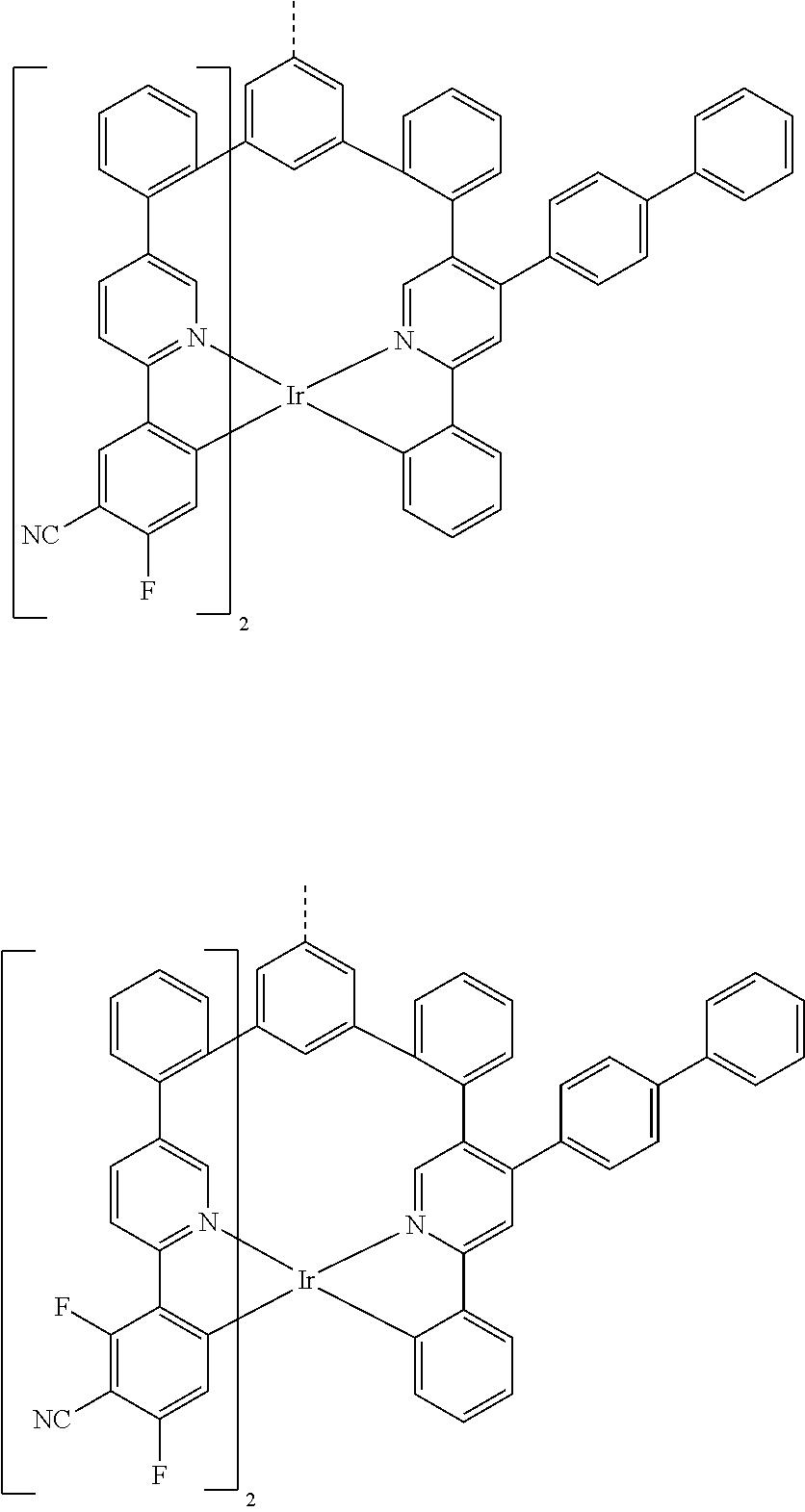


- 1. The compounds of the invention, used as matrix material for phosphorescent emitters, lead to long lifetimes.
- 2. The compounds of the invention lead to high efficiencies. This is especially true when the compounds are used as matrix material for a phosphorescent emitter.
- 3. The compounds of the invention lead to low operating voltages. This is especially true when the compounds are used as matrix material for a phosphorescent emitter.

| Reactant 1 | Reactant 2 | Product | Yield | |
| 1a |
 |
 |
 |
77% |
| 2a |
 |
 |
 |
79% |
| 3a |
 |
 |
 |
80% |
| 4a |
 |
 |
 |
75% |
| 5a |
 |
 |
 |
69% |
| 6a |
 |
 |
 |
88% |
| 7a |
 |
 |
 |
83% |
| 8a |
 |
 |
 |
82% |
| 9a |
 |
 |
 |
77% |
| 10a |
 |
 |
 |
73% |
| 11a |
 |
 |
 |
84% |
| 12a |
 |
 |
 |
85% |
| 13a |
 |
 |
 |
69% |

| Yield | ||||
| Reactant | Product a | Product b | a, b | |
| 1b |
 |
 |
 |
58%, 18% |
| 2b |
 |
 |
 |
65%, 13% |
| 3b |
 |
 |
78% | |
| 4b |
 |
 |
 |
61%, 19% |
| 5b |
 |
 |
 |
57%, 12% |
| 6b |
 |
 |
80% | |
| 7b |
 |
 |
 |
64%, 11% |
| 8b |
 |
 |
 |
63%, 13% |
| 9b |
 |
 |
 |
60%, 15% |
| 10b |
 |
 |
81% | |
| 11b |
 |
 |
 |
57%, 16% |
| 12b |
 |
 |
 |
50% 18% |

| Reactant 1 | Reactant 2 | Product | Yield | |
| 1c |
 |
 |
 |
84% |
| 2c |
 |
 |
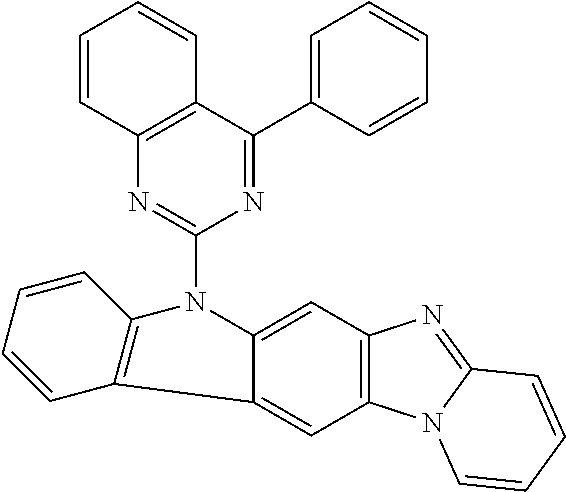 |
81% |
| 3c |
 |
 |
 |
82% |
| 4c |
 |
 |
 |
82% |
| 5c |
 |
 |
 |
85% |
| 6c |
 |
 |
 |
75% |
| 7c |
 |
 |
 |
74% |
| 8c |
 |
 |
 |
73% |
| 9c |
 |
 |
 |
77% |
| 10c |
 |
 |
 |
76% |
| 11c |
 |
 |
 |
68% |
| 12c |
 |
 |
 |
75% |
| 13c |
 |
 |
 |
82% |
| 14c |
 |
 |
 |
87% |
| 15c |
 |
 |
 |
70% |
| 16c |
 |
 |
 |
73% |
| 17c |
 |
 |
 |
79% |
| 18c |
 |
 |
 |
71% |
| 19c |
 |
 |
 |
65% |
| 20c |
 |
 |
 |
66% |
| 21c |
 |
 |
 |
65% |
| 22c |
 |
 |
 |
62% |
| 23c |
 |
 |
 |
60% |
| 24c |
 |
 |
 |
63% |
| 25c |
 |
 |
 |
68% |
| 26c |
 |
 |
 |
76% |
| 27c |
 |
 |
 |
70% |
| 28c |
 |
 |
 |
72% |

| Reactant 1 | Reactant 2 | Product | Yield | |
| 1d |
 |
 |
 |
75% |
| 2d |
 |
 |
 |
80% |
| 3d |
 |
 |
 |
81% |
| 4d |
 |
 |
 |
76% |
| 5d |
 |
 |
 |
83% |
| 6d |
 |
 |
 |
78% |
| 7d |
 |
 |
 |
79% |

| Reactant | Product | Yield | |
| 1e |
 |
 |
59% |
| 2e |
 |
 |
56% |
| 3e |
 |
 |
57% |
| 4e |
 |
 |
55% |

| Reactant 1 | Reactant 2 | Product | Yield | |
| 1j |  |  |  | 57% |
| 2j |  |  |  | 60% |
| 3j |  |  |  | 64% |
| 4j |  |  |  | 59% |
| 5j |  |  |  | 78% |
| 6j |  |  |  | 56% |
Production of the OLEDs
| TABLE 1 |
| Structure of the OLEDs |
| HIL | HTL | EBL | EML | HBL | ETL | EIL | |
| Ex. | thickness | thickness | thickness | thickness | thickness | thickness | thickness |
| E1 | HATCN | SpMA1 | SpMA3 | EG1:TER5 | — | ST2:LiQ | — |
| 5 nm | 125 nm | 10 nm | (95%:5%) | (50%:50%) | |||
| 40 nm | 35 nm | ||||||
| E2 | HATCN | SpMA1 | SpMA3 | EG2:TER5 | — | ST2:LiQ | — |
| 5 nm | 125 nm | 10 nm | (95%:5%) | (50%:50%) | |||
| 40 nm | 35 nm | ||||||
| E3 | HATCN | SpMA1 | SpMA3 | EG3:IC2:TER5 | — | ST2:LiQ | — |
| 5 nm | 125 nm | 10 nm | (60%:35%:5%) | (50%:50%) | |||
| 40 nm | 35 nm | ||||||
| E4 | HATCN | SpMA1 | SpMA3 | EG4:TER5 | — | ST2:LiQ | — |
| 5 nm | 125 nm | 10 nm | (95%:5%) | (50%:50%) | |||
| 40 nm | 35 nm | ||||||
| E5 | HATCN | SpMA1 | SpMA3 | IC1:EG5:TER5 | — | ST2:LiQ | — |
| 5 nm | 125 nm | 10 nm | (25%:70%:5%) | (50%:50%) | |||
| 40 nm | 35 nm | ||||||
| E6 | HATCN | SpMA1 | SpMA3 | IC3:EG6:TER5 | ST2 | ST2:LiQ | — |
| 5 nm | 125 nm | 10 nm | (47%:48%:5%) | 5 nm | (50%:50%) | ||
| 40 nm | 30 nm | ||||||
| TABLE 2 |
| Structural formulae of the materials for the OLEDs |
 |
 |
 |
 |
 |
 |
 |
 |
 |
 |
 |
 |
 |
 |
 |
Claims (17)


Applications Claiming Priority (4)
| Application Number | Priority Date | Filing Date | Title |
|---|---|---|---|
| EP18182473.1 | 2018-07-09 | ||
| EP18182473 | 2018-07-09 | ||
| EP8182473 | 2018-07-09 | ||
| PCT/EP2019/068195 WO2020011686A1 (en) | 2018-07-09 | 2019-07-08 | Materials for organic electroluminescent devices |
Publications (2)
| Publication Number | Publication Date |
|---|---|
| US20210320264A1 US20210320264A1 (en) | 2021-10-14 |
| US11581497B2 true US11581497B2 (en) | 2023-02-14 |
Family
ID=63014312
Family Applications (1)
| Application Number | Title | Priority Date | Filing Date |
|---|---|---|---|
| US17/258,787 Active 2039-12-30 US11581497B2 (en) | 2018-07-09 | 2019-07-08 | Materials for organic electroluminescent devices |
Country Status (5)
| Country | Link |
|---|---|
| US (1) | US11581497B2 (en) |
| EP (1) | EP3820966B1 (en) |
| KR (1) | KR102789336B1 (en) |
| CN (1) | CN112384595B (en) |
| WO (1) | WO2020011686A1 (en) |
Families Citing this family (3)
| Publication number | Priority date | Publication date | Assignee | Title |
|---|---|---|---|---|
| CN112266389B (en) * | 2020-10-20 | 2022-03-08 | 吉林奥来德光电材料股份有限公司 | Benzimidazole organic compound and preparation method thereof |
| CN113501824A (en) * | 2021-06-10 | 2021-10-15 | 浙江华显光电科技有限公司 | Fused heterocyclic organic compound and organic photoelectric element using same |
| CN113563344B (en) * | 2021-07-27 | 2023-11-21 | 北京八亿时空液晶科技股份有限公司 | Carbazole derivatives, organic electroluminescent materials, light-emitting components and consumer products |
Citations (5)
| Publication number | Priority date | Publication date | Assignee | Title |
|---|---|---|---|---|
| KR20100097797A (en) | 2009-02-27 | 2010-09-06 | 주식회사 엘지화학 | Nitrogen containing compound and organic electronic device using the same |
| KR20150064500A (en) | 2013-12-03 | 2015-06-11 | 롬엔드하스전자재료코리아유한회사 | Organic Electroluminescent Compounds and Organic Electroluminescent Device Comprising the Same |
| WO2015125986A1 (en) | 2014-02-20 | 2015-08-27 | 주식회사 두산 | Organic compound and organic electroluminescent device comprising same |
| WO2019081391A1 (en) | 2017-10-24 | 2019-05-02 | Merck Patent Gmbh | MATERIALS FOR ORGANIC ELECTROLUMINESCENT DEVICES |
| WO2019107739A1 (en) | 2017-11-30 | 2019-06-06 | 덕산네오룩스 주식회사 | Compound for organic electronic device, organic electronic device using same, and electronic apparatus thereof |
Family Cites Families (82)
| Publication number | Priority date | Publication date | Assignee | Title |
|---|---|---|---|---|
| JPH07133483A (en) | 1993-11-09 | 1995-05-23 | Shinko Electric Ind Co Ltd | Organic light emitting material for EL device and EL device |
| JP3899566B2 (en) | 1996-11-25 | 2007-03-28 | セイコーエプソン株式会社 | Manufacturing method of organic EL display device |
| KR100913568B1 (en) | 1999-05-13 | 2009-08-26 | 더 트러스티즈 오브 프린스턴 유니버시티 | Very high efficiency organic light emitting devices based on electrophosphorescence |
| WO2001041512A1 (en) | 1999-12-01 | 2001-06-07 | The Trustees Of Princeton University | Complexes of form l2mx as phosphorescent dopants for organic leds |
| TW532048B (en) | 2000-03-27 | 2003-05-11 | Idemitsu Kosan Co | Organic electroluminescence element |
| US20020121638A1 (en) | 2000-06-30 | 2002-09-05 | Vladimir Grushin | Electroluminescent iridium compounds with fluorinated phenylpyridines, phenylpyrimidines, and phenylquinolines and devices made with such compounds |
| CN101924190B (en) | 2000-08-11 | 2012-07-04 | 普林斯顿大学理事会 | Organometallic compounds and emission-shifting organic electrophosphorescence |
| JP4154138B2 (en) | 2000-09-26 | 2008-09-24 | キヤノン株式会社 | Light emitting element, display device and metal coordination compound |
| JP4154140B2 (en) | 2000-09-26 | 2008-09-24 | キヤノン株式会社 | Metal coordination compounds |
| JP4154139B2 (en) | 2000-09-26 | 2008-09-24 | キヤノン株式会社 | Light emitting element |
| ITRM20020411A1 (en) | 2002-08-01 | 2004-02-02 | Univ Roma La Sapienza | SPIROBIFLUORENE DERIVATIVES, THEIR PREPARATION AND USE. |
| JP4411851B2 (en) | 2003-03-19 | 2010-02-10 | コニカミノルタホールディングス株式会社 | Organic electroluminescence device |
| US7345301B2 (en) | 2003-04-15 | 2008-03-18 | Merck Patent Gmbh | Mixtures of matrix materials and organic semiconductors capable of emission, use of the same and electronic components containing said mixtures |
| JP4635870B2 (en) | 2003-04-23 | 2011-02-23 | コニカミノルタホールディングス株式会社 | Organic electroluminescence element, lighting device and display device |
| DE10338550A1 (en) | 2003-08-19 | 2005-03-31 | Basf Ag | Transition metal complexes with carbene ligands as emitters for organic light-emitting diodes (OLEDs) |
| DE10345572A1 (en) | 2003-09-29 | 2005-05-19 | Covion Organic Semiconductors Gmbh | metal complexes |
| US7795801B2 (en) | 2003-09-30 | 2010-09-14 | Konica Minolta Holdings, Inc. | Organic electroluminescent element, illuminator, display and compound |
| WO2005053051A1 (en) | 2003-11-25 | 2005-06-09 | Merck Patent Gmbh | Organic electroluminescent element |
| US7790890B2 (en) | 2004-03-31 | 2010-09-07 | Konica Minolta Holdings, Inc. | Organic electroluminescence element material, organic electroluminescence element, display device and illumination device |
| DE102004023277A1 (en) | 2004-05-11 | 2005-12-01 | Covion Organic Semiconductors Gmbh | New material mixtures for electroluminescence |
| US7598388B2 (en) | 2004-05-18 | 2009-10-06 | The University Of Southern California | Carbene containing metal complexes as OLEDs |
| JP4862248B2 (en) | 2004-06-04 | 2012-01-25 | コニカミノルタホールディングス株式会社 | Organic electroluminescence element, lighting device and display device |
| ITRM20040352A1 (en) | 2004-07-15 | 2004-10-15 | Univ Roma La Sapienza | OLIGOMERIC DERIVATIVES OF SPIROBIFLUORENE, THEIR PREPARATION AND THEIR USE. |
| WO2006117052A1 (en) | 2005-05-03 | 2006-11-09 | Merck Patent Gmbh | Organic electroluminescent device and boric acid and borinic acid derivatives used therein |
| CN101203583A (en) | 2005-05-31 | 2008-06-18 | 通用显示公司 | Benzo [9,10] phenanthrene matrices in phosphorescent emitting diodes |
| EP1956022B1 (en) | 2005-12-01 | 2012-07-25 | Nippon Steel Chemical Co., Ltd. | Compound for organic electroluminescent element and organic electroluminescent element |
| DE102006025777A1 (en) | 2006-05-31 | 2007-12-06 | Merck Patent Gmbh | New materials for organic electroluminescent devices |
| EP2080762B1 (en) | 2006-11-09 | 2016-09-14 | Nippon Steel & Sumikin Chemical Co., Ltd. | Compound for organic electroluminescent device and organic electroluminescent device |
| JP2010515255A (en) | 2006-12-28 | 2010-05-06 | ユニバーサル ディスプレイ コーポレイション | Long-life phosphorescent organic light-emitting device (OLED) structure |
| DE102007002714A1 (en) | 2007-01-18 | 2008-07-31 | Merck Patent Gmbh | New materials for organic electroluminescent devices |
| KR20160086983A (en) | 2007-08-08 | 2016-07-20 | 유니버셜 디스플레이 코포레이션 | Benzo-fused thiophene or benzo-fused furan compounds comprising a triphenylene group |
| DE102007053771A1 (en) | 2007-11-12 | 2009-05-14 | Merck Patent Gmbh | Organic electroluminescent devices |
| DE102008017591A1 (en) | 2008-04-07 | 2009-10-08 | Merck Patent Gmbh | New materials for organic electroluminescent devices |
| DE102008027005A1 (en) | 2008-06-05 | 2009-12-10 | Merck Patent Gmbh | Organic electronic device containing metal complexes |
| DE102008033943A1 (en) | 2008-07-18 | 2010-01-21 | Merck Patent Gmbh | New materials for organic electroluminescent devices |
| DE102008036247A1 (en) | 2008-08-04 | 2010-02-11 | Merck Patent Gmbh | Electronic devices containing metal complexes |
| DE102008036982A1 (en) | 2008-08-08 | 2010-02-11 | Merck Patent Gmbh | Organic electroluminescent device |
| DE102008048336A1 (en) | 2008-09-22 | 2010-03-25 | Merck Patent Gmbh | Mononuclear neutral copper (I) complexes and their use for the production of optoelectronic devices |
| DE102008056688A1 (en) | 2008-11-11 | 2010-05-12 | Merck Patent Gmbh | Materials for organic electroluminescent devices |
| JP5701766B2 (en) | 2008-11-11 | 2015-04-15 | メルク パテント ゲーエムベーハー | Organic electroluminescent device |
| DE102008057050B4 (en) | 2008-11-13 | 2021-06-02 | Merck Patent Gmbh | Materials for organic electroluminescent devices |
| DE102008057051B4 (en) | 2008-11-13 | 2021-06-17 | Merck Patent Gmbh | Materials for organic electroluminescent devices |
| DE102009007038A1 (en) | 2009-02-02 | 2010-08-05 | Merck Patent Gmbh | metal complexes |
| DE102009011223A1 (en) | 2009-03-02 | 2010-09-23 | Merck Patent Gmbh | metal complexes |
| DE102009013041A1 (en) | 2009-03-13 | 2010-09-16 | Merck Patent Gmbh | Materials for organic electroluminescent devices |
| DE102009014513A1 (en) | 2009-03-23 | 2010-09-30 | Merck Patent Gmbh | Organic electroluminescent device |
| DE102009023155A1 (en) | 2009-05-29 | 2010-12-02 | Merck Patent Gmbh | Materials for organic electroluminescent devices |
| DE102009031021A1 (en) | 2009-06-30 | 2011-01-05 | Merck Patent Gmbh | Materials for organic electroluminescent devices |
| DE102009041414A1 (en) | 2009-09-16 | 2011-03-17 | Merck Patent Gmbh | metal complexes |
| DE102009053644B4 (en) | 2009-11-17 | 2019-07-04 | Merck Patent Gmbh | Materials for organic electroluminescent devices |
| DE102009053645A1 (en) | 2009-11-17 | 2011-05-19 | Merck Patent Gmbh | Materials for organic electroluminescent device |
| DE102009048791A1 (en) | 2009-10-08 | 2011-04-14 | Merck Patent Gmbh | Materials for organic electroluminescent devices |
| DE102009053382A1 (en) | 2009-11-14 | 2011-05-19 | Merck Patent Gmbh | Materials for electronic devices |
| DE102009053836A1 (en) | 2009-11-18 | 2011-05-26 | Merck Patent Gmbh | Materials for organic electroluminescent devices |
| DE102009057167A1 (en) | 2009-12-05 | 2011-06-09 | Merck Patent Gmbh | Electronic device containing metal complexes |
| DE102010005697A1 (en) | 2010-01-25 | 2011-07-28 | Merck Patent GmbH, 64293 | Connections for electronic devices |
| JP5678487B2 (en) | 2010-04-09 | 2015-03-04 | ソニー株式会社 | Organic EL display device |
| DE112011102008B4 (en) | 2010-06-15 | 2022-04-21 | Merck Patent Gmbh | metal complexes |
| DE102010027317A1 (en) | 2010-07-16 | 2012-01-19 | Merck Patent Gmbh | metal complexes |
| DE102010048608A1 (en) | 2010-10-15 | 2012-04-19 | Merck Patent Gmbh | Materials for organic electroluminescent devices |
| JP5778950B2 (en) | 2011-03-04 | 2015-09-16 | 株式会社Joled | Organic EL display device and manufacturing method thereof |
| KR101979469B1 (en) | 2011-04-18 | 2019-05-16 | 메르크 파텐트 게엠베하 | Materials for organic electroluminescent devices |
| CA2849087A1 (en) | 2011-09-21 | 2013-03-28 | Merck Patent Gmbh | Carbazole derivatives for organic electroluminescent devices |
| US9515266B2 (en) | 2011-10-20 | 2016-12-06 | Merck Patent Gmbh | Materials for organic electroluminescent devices |
| WO2014008982A1 (en) | 2012-07-13 | 2014-01-16 | Merck Patent Gmbh | Metal complexes |
| US11917901B2 (en) | 2012-08-07 | 2024-02-27 | Udc Ireland Limited | Metal complexes |
| KR102188214B1 (en) | 2012-12-21 | 2020-12-08 | 메르크 파텐트 게엠베하 | Metal complexes |
| KR102188212B1 (en) | 2012-12-21 | 2020-12-08 | 메르크 파텐트 게엠베하 | Metal complexes |
| CN105531347B (en) | 2013-09-11 | 2018-09-11 | 默克专利有限公司 | Metal complex |
| US11005050B2 (en) | 2014-01-13 | 2021-05-11 | Merck Patent Gmbh | Metal complexes |
| CN105980519B (en) | 2014-02-05 | 2019-06-14 | 默克专利有限公司 | metal complex |
| EP3140302B1 (en) | 2014-05-05 | 2019-08-21 | Merck Patent GmbH | Materials for organic light emitting devices |
| JP6707517B2 (en) | 2014-07-28 | 2020-06-10 | メルク、パテント、ゲゼルシャフト、ミット、ベシュレンクテル、ハフツングMerck Patent GmbH | Metal complex |
| WO2016015810A1 (en) | 2014-07-29 | 2016-02-04 | Merck Patent Gmbh | Materials for organic electroluminescent devices |
| CN106661007B (en) | 2014-08-13 | 2019-08-13 | 默克专利有限公司 | Materials for organic electroluminescent devices |
| WO2016124304A1 (en) | 2015-02-03 | 2016-08-11 | Merck Patent Gmbh | Metal complexes |
| JP6946269B2 (en) | 2015-08-25 | 2021-10-06 | メルク、パテント、ゲゼルシャフト、ミット、ベシュレンクテル、ハフツングMerck Patent GmbH | Metal complex |
| KR102740106B1 (en) | 2016-03-03 | 2024-12-09 | 메르크 파텐트 게엠베하 | Materials for organic electroluminescent devices |
| WO2018011186A1 (en) | 2016-07-14 | 2018-01-18 | Merck Patent Gmbh | Metal complexes |
| WO2018041769A1 (en) | 2016-08-30 | 2018-03-08 | Merck Patent Gmbh | Binuclear and trinuclear metal complexes composed of two inter-linked tripodal hexadentate ligands for use in electroluminescent devices |
| CN110461859A (en) | 2017-03-29 | 2019-11-15 | 默克专利有限公司 | metal complex |
| TWI776926B (en) | 2017-07-25 | 2022-09-11 | 德商麥克專利有限公司 | Metal complexes |
-
2019
- 2019-07-08 WO PCT/EP2019/068195 patent/WO2020011686A1/en not_active Ceased
- 2019-07-08 KR KR1020217003642A patent/KR102789336B1/en active Active
- 2019-07-08 US US17/258,787 patent/US11581497B2/en active Active
- 2019-07-08 EP EP19737711.2A patent/EP3820966B1/en active Active
- 2019-07-08 CN CN201980045505.0A patent/CN112384595B/en active Active
Patent Citations (6)
| Publication number | Priority date | Publication date | Assignee | Title |
|---|---|---|---|---|
| KR20100097797A (en) | 2009-02-27 | 2010-09-06 | 주식회사 엘지화학 | Nitrogen containing compound and organic electronic device using the same |
| KR20150064500A (en) | 2013-12-03 | 2015-06-11 | 롬엔드하스전자재료코리아유한회사 | Organic Electroluminescent Compounds and Organic Electroluminescent Device Comprising the Same |
| WO2015125986A1 (en) | 2014-02-20 | 2015-08-27 | 주식회사 두산 | Organic compound and organic electroluminescent device comprising same |
| WO2019081391A1 (en) | 2017-10-24 | 2019-05-02 | Merck Patent Gmbh | MATERIALS FOR ORGANIC ELECTROLUMINESCENT DEVICES |
| US20200358005A1 (en) | 2017-10-24 | 2020-11-12 | Merck Patent Gmbh | Materials for organic electroluminescent devices |
| WO2019107739A1 (en) | 2017-11-30 | 2019-06-06 | 덕산네오룩스 주식회사 | Compound for organic electronic device, organic electronic device using same, and electronic apparatus thereof |
Non-Patent Citations (2)
| Title |
|---|
| International Preliminary Reporton Patentability received for PCT Patent Application No. PCT/EP2019/068195, dated Jan. 21, 2021, 13 pages. (7 pages of English Translation and 6 pages of Original Document). |
| International Search Report and Written Opinion received for PCT Patent Application No. PCT/EP2019/068195, dated Aug. 28, 2019, 15 pages (7 pages of English Translation and 8 pages of Original Document). |
Also Published As
| Publication number | Publication date |
|---|---|
| WO2020011686A1 (en) | 2020-01-16 |
| KR102789336B1 (en) | 2025-03-31 |
| CN112384595B (en) | 2024-05-28 |
| KR20210031714A (en) | 2021-03-22 |
| EP3820966B1 (en) | 2022-06-08 |
| US20210320264A1 (en) | 2021-10-14 |
| CN112384595A (en) | 2021-02-19 |
| EP3820966A1 (en) | 2021-05-19 |
Similar Documents
| Publication | Publication Date | Title |
|---|---|---|
| US11407766B2 (en) | Materials for organic electroluminescent devices | |
| US11309497B2 (en) | Materials for organic electroluminescent devices | |
| US10644246B2 (en) | Materials for organic electroluminescent devices | |
| US11296281B2 (en) | Materials for organic electroluminescent devices | |
| US20210111351A1 (en) | Materials for organic electroluminescent devices | |
| US11370965B2 (en) | Materials for organic electroluminescent devices | |
| US11437588B2 (en) | Materials for organic electroluminescent devices | |
| US20230295104A1 (en) | Materials for organic electroluminescent devices | |
| US20230151026A1 (en) | Multi-layer body for diffuse transillumination | |
| US12419192B2 (en) | Organic electroluminescence devices | |
| US20230422610A1 (en) | Sulfurous compounds for organic electroluminescent devices | |
| US12035625B2 (en) | Materials for organic electroluminescent devices | |
| US10923665B2 (en) | Materials for organic electroluminescent devices | |
| US20250098532A1 (en) | Nitrogenous compounds for organic electroluminescent devices | |
| US11495751B2 (en) | Materials for organic electroluminescent devices | |
| KR102789336B1 (en) | Materials for organic electroluminescent devices | |
| US20240357926A1 (en) | Materials for organic electroluminescent devices | |
| US20240092783A1 (en) | Heteroaromatic compounds for organic electroluminescent devices | |
| US20220289718A1 (en) | Materials for organic electroluminescent devices | |
| US11466021B2 (en) | Materials for organic electroluminescent devices | |
| US20220177478A1 (en) | Materials for organic electroluminescent devices | |
| US20220162205A1 (en) | Materials for organic electroluminescent devices | |
| US20220216424A1 (en) | Materials for organic electroluminescent devices | |
| US20220020934A1 (en) | 5,6-diphenyl-5,6-dihydro-dibenz[c,e][1,2]azaphosphorin and 6-phenyl-6h-dibenzo[c,e][1,2]thiazin-5,5-dioxide derivatives and similar compounds as organic electroluminescent materials for oleds | |
| US12108665B2 (en) | Materials for organic electroluminescent devices |
Legal Events
| Date | Code | Title | Description |
|---|---|---|---|
| FEPP | Fee payment procedure |
Free format text: ENTITY STATUS SET TO UNDISCOUNTED (ORIGINAL EVENT CODE: BIG.); ENTITY STATUS OF PATENT OWNER: LARGE ENTITY |
|
| STPP | Information on status: patent application and granting procedure in general |
Free format text: DOCKETED NEW CASE - READY FOR EXAMINATION |
|
| AS | Assignment |
Owner name: MERCK PATENT GMBH, GERMANY Free format text: ASSIGNMENT OF ASSIGNORS INTEREST;ASSIGNOR:MERCK PERFORMANCE MATERIALS GERMANY GMBH;REEL/FRAME:057851/0001 Effective date: 20200123 Owner name: MERCK PERFORMANCE MATERIALS GERMANY GMBH, GERMANY Free format text: ASSIGNMENT OF ASSIGNORS INTEREST;ASSIGNOR:MERCK KGAA;REEL/FRAME:057850/0746 Effective date: 20200622 Owner name: MERCK KGAA, GERMANY Free format text: ASSIGNMENT OF ASSIGNORS INTEREST;ASSIGNORS:PARHAM, AMIR;KROEBER, JONAS;ENGELHART, JENS;AND OTHERS;SIGNING DATES FROM 20210504 TO 20210519;REEL/FRAME:057850/0555 |
|
| STPP | Information on status: patent application and granting procedure in general |
Free format text: NON FINAL ACTION MAILED |
|
| STPP | Information on status: patent application and granting procedure in general |
Free format text: RESPONSE TO NON-FINAL OFFICE ACTION ENTERED AND FORWARDED TO EXAMINER |
|
| STPP | Information on status: patent application and granting procedure in general |
Free format text: NOTICE OF ALLOWANCE MAILED -- APPLICATION RECEIVED IN OFFICE OF PUBLICATIONS |
|
| STPP | Information on status: patent application and granting procedure in general |
Free format text: PUBLICATIONS -- ISSUE FEE PAYMENT RECEIVED |
|
| STPP | Information on status: patent application and granting procedure in general |
Free format text: PUBLICATIONS -- ISSUE FEE PAYMENT VERIFIED |
|
| STCF | Information on status: patent grant |
Free format text: PATENTED CASE |