US11575159B2 - Wireless battery system, method of operating wireless battery system, and robot with application of wireless battery system - Google Patents
Wireless battery system, method of operating wireless battery system, and robot with application of wireless battery system Download PDFInfo
- Publication number
- US11575159B2 US11575159B2 US16/824,066 US202016824066A US11575159B2 US 11575159 B2 US11575159 B2 US 11575159B2 US 202016824066 A US202016824066 A US 202016824066A US 11575159 B2 US11575159 B2 US 11575159B2
- Authority
- US
- United States
- Prior art keywords
- battery
- processor
- slave
- processors
- master
- Prior art date
- Legal status (The legal status is an assumption and is not a legal conclusion. Google has not performed a legal analysis and makes no representation as to the accuracy of the status listed.)
- Active, expires
Links
Images




Classifications
-
- H—ELECTRICITY
- H01—ELECTRIC ELEMENTS
- H01M—PROCESSES OR MEANS, e.g. BATTERIES, FOR THE DIRECT CONVERSION OF CHEMICAL ENERGY INTO ELECTRICAL ENERGY
- H01M10/00—Secondary cells; Manufacture thereof
- H01M10/42—Methods or arrangements for servicing or maintenance of secondary cells or secondary half-cells
- H01M10/425—Structural combination with electronic components, e.g. electronic circuits integrated to the outside of the casing
-
- H—ELECTRICITY
- H02—GENERATION; CONVERSION OR DISTRIBUTION OF ELECTRIC POWER
- H02J—ELECTRIC POWER NETWORKS; CIRCUIT ARRANGEMENTS OR SYSTEMS FOR SUPPLYING OR DISTRIBUTING ELECTRIC POWER; SYSTEMS FOR STORING ELECTRIC ENERGY
- H02J7/00—Circuit arrangements for charging or discharging batteries or for supplying loads from batteries
-
- B—PERFORMING OPERATIONS; TRANSPORTING
- B60—VEHICLES IN GENERAL
- B60L—PROPULSION OF ELECTRICALLY-PROPELLED VEHICLES; SUPPLYING ELECTRIC POWER FOR AUXILIARY EQUIPMENT OF ELECTRICALLY-PROPELLED VEHICLES; ELECTRODYNAMIC BRAKE SYSTEMS FOR VEHICLES IN GENERAL; MAGNETIC SUSPENSION OR LEVITATION FOR VEHICLES; MONITORING OPERATING VARIABLES OF ELECTRICALLY-PROPELLED VEHICLES; ELECTRIC SAFETY DEVICES FOR ELECTRICALLY-PROPELLED VEHICLES
- B60L3/00—Electric devices on electrically-propelled vehicles for safety purposes; Monitoring operating variables, e.g. speed, deceleration or energy consumption
- B60L3/12—Recording operating variables ; Monitoring of operating variables
-
- B—PERFORMING OPERATIONS; TRANSPORTING
- B60—VEHICLES IN GENERAL
- B60L—PROPULSION OF ELECTRICALLY-PROPELLED VEHICLES; SUPPLYING ELECTRIC POWER FOR AUXILIARY EQUIPMENT OF ELECTRICALLY-PROPELLED VEHICLES; ELECTRODYNAMIC BRAKE SYSTEMS FOR VEHICLES IN GENERAL; MAGNETIC SUSPENSION OR LEVITATION FOR VEHICLES; MONITORING OPERATING VARIABLES OF ELECTRICALLY-PROPELLED VEHICLES; ELECTRIC SAFETY DEVICES FOR ELECTRICALLY-PROPELLED VEHICLES
- B60L58/00—Methods or circuit arrangements for monitoring or controlling batteries or fuel cells, specially adapted for electric vehicles
- B60L58/10—Methods or circuit arrangements for monitoring or controlling batteries or fuel cells, specially adapted for electric vehicles for monitoring or controlling batteries
-
- B—PERFORMING OPERATIONS; TRANSPORTING
- B60—VEHICLES IN GENERAL
- B60L—PROPULSION OF ELECTRICALLY-PROPELLED VEHICLES; SUPPLYING ELECTRIC POWER FOR AUXILIARY EQUIPMENT OF ELECTRICALLY-PROPELLED VEHICLES; ELECTRODYNAMIC BRAKE SYSTEMS FOR VEHICLES IN GENERAL; MAGNETIC SUSPENSION OR LEVITATION FOR VEHICLES; MONITORING OPERATING VARIABLES OF ELECTRICALLY-PROPELLED VEHICLES; ELECTRIC SAFETY DEVICES FOR ELECTRICALLY-PROPELLED VEHICLES
- B60L58/00—Methods or circuit arrangements for monitoring or controlling batteries or fuel cells, specially adapted for electric vehicles
- B60L58/10—Methods or circuit arrangements for monitoring or controlling batteries or fuel cells, specially adapted for electric vehicles for monitoring or controlling batteries
- B60L58/16—Methods or circuit arrangements for monitoring or controlling batteries or fuel cells, specially adapted for electric vehicles for monitoring or controlling batteries responding to battery ageing, e.g. to the number of charging cycles or the state of health [SoH]
-
- B—PERFORMING OPERATIONS; TRANSPORTING
- B60—VEHICLES IN GENERAL
- B60L—PROPULSION OF ELECTRICALLY-PROPELLED VEHICLES; SUPPLYING ELECTRIC POWER FOR AUXILIARY EQUIPMENT OF ELECTRICALLY-PROPELLED VEHICLES; ELECTRODYNAMIC BRAKE SYSTEMS FOR VEHICLES IN GENERAL; MAGNETIC SUSPENSION OR LEVITATION FOR VEHICLES; MONITORING OPERATING VARIABLES OF ELECTRICALLY-PROPELLED VEHICLES; ELECTRIC SAFETY DEVICES FOR ELECTRICALLY-PROPELLED VEHICLES
- B60L58/00—Methods or circuit arrangements for monitoring or controlling batteries or fuel cells, specially adapted for electric vehicles
- B60L58/10—Methods or circuit arrangements for monitoring or controlling batteries or fuel cells, specially adapted for electric vehicles for monitoring or controlling batteries
- B60L58/18—Methods or circuit arrangements for monitoring or controlling batteries or fuel cells, specially adapted for electric vehicles for monitoring or controlling batteries of two or more battery modules
- B60L58/21—Methods or circuit arrangements for monitoring or controlling batteries or fuel cells, specially adapted for electric vehicles for monitoring or controlling batteries of two or more battery modules having the same nominal voltage
-
- B—PERFORMING OPERATIONS; TRANSPORTING
- B60—VEHICLES IN GENERAL
- B60L—PROPULSION OF ELECTRICALLY-PROPELLED VEHICLES; SUPPLYING ELECTRIC POWER FOR AUXILIARY EQUIPMENT OF ELECTRICALLY-PROPELLED VEHICLES; ELECTRODYNAMIC BRAKE SYSTEMS FOR VEHICLES IN GENERAL; MAGNETIC SUSPENSION OR LEVITATION FOR VEHICLES; MONITORING OPERATING VARIABLES OF ELECTRICALLY-PROPELLED VEHICLES; ELECTRIC SAFETY DEVICES FOR ELECTRICALLY-PROPELLED VEHICLES
- B60L58/00—Methods or circuit arrangements for monitoring or controlling batteries or fuel cells, specially adapted for electric vehicles
- B60L58/10—Methods or circuit arrangements for monitoring or controlling batteries or fuel cells, specially adapted for electric vehicles for monitoring or controlling batteries
- B60L58/18—Methods or circuit arrangements for monitoring or controlling batteries or fuel cells, specially adapted for electric vehicles for monitoring or controlling batteries of two or more battery modules
- B60L58/22—Balancing the charge of battery modules
-
- H—ELECTRICITY
- H01—ELECTRIC ELEMENTS
- H01M—PROCESSES OR MEANS, e.g. BATTERIES, FOR THE DIRECT CONVERSION OF CHEMICAL ENERGY INTO ELECTRICAL ENERGY
- H01M10/00—Secondary cells; Manufacture thereof
- H01M10/42—Methods or arrangements for servicing or maintenance of secondary cells or secondary half-cells
- H01M10/44—Methods for charging or discharging
-
- H—ELECTRICITY
- H01—ELECTRIC ELEMENTS
- H01M—PROCESSES OR MEANS, e.g. BATTERIES, FOR THE DIRECT CONVERSION OF CHEMICAL ENERGY INTO ELECTRICAL ENERGY
- H01M10/00—Secondary cells; Manufacture thereof
- H01M10/42—Methods or arrangements for servicing or maintenance of secondary cells or secondary half-cells
- H01M10/48—Accumulators combined with arrangements for measuring, testing or indicating the condition of cells, e.g. the level or density of the electrolyte
- H01M10/482—Accumulators combined with arrangements for measuring, testing or indicating the condition of cells, e.g. the level or density of the electrolyte for several batteries or cells simultaneously or sequentially
-
- H—ELECTRICITY
- H04—ELECTRIC COMMUNICATION TECHNIQUE
- H04W—WIRELESS COMMUNICATION NETWORKS
- H04W84/00—Network topologies
- H04W84/18—Self-organising networks, e.g. ad-hoc networks or sensor networks
- H04W84/20—Leader-follower arrangements
-
- B—PERFORMING OPERATIONS; TRANSPORTING
- B60—VEHICLES IN GENERAL
- B60L—PROPULSION OF ELECTRICALLY-PROPELLED VEHICLES; SUPPLYING ELECTRIC POWER FOR AUXILIARY EQUIPMENT OF ELECTRICALLY-PROPELLED VEHICLES; ELECTRODYNAMIC BRAKE SYSTEMS FOR VEHICLES IN GENERAL; MAGNETIC SUSPENSION OR LEVITATION FOR VEHICLES; MONITORING OPERATING VARIABLES OF ELECTRICALLY-PROPELLED VEHICLES; ELECTRIC SAFETY DEVICES FOR ELECTRICALLY-PROPELLED VEHICLES
- B60L2260/00—Operating Modes
- B60L2260/20—Drive modes; Transition between modes
- B60L2260/32—Auto pilot mode
-
- G—PHYSICS
- G06—COMPUTING OR CALCULATING; COUNTING
- G06N—COMPUTING ARRANGEMENTS BASED ON SPECIFIC COMPUTATIONAL MODELS
- G06N3/00—Computing arrangements based on biological models
- G06N3/02—Neural networks
- G06N3/04—Architecture, e.g. interconnection topology
-
- G—PHYSICS
- G06—COMPUTING OR CALCULATING; COUNTING
- G06N—COMPUTING ARRANGEMENTS BASED ON SPECIFIC COMPUTATIONAL MODELS
- G06N3/00—Computing arrangements based on biological models
- G06N3/02—Neural networks
- G06N3/08—Learning methods
-
- H—ELECTRICITY
- H01—ELECTRIC ELEMENTS
- H01M—PROCESSES OR MEANS, e.g. BATTERIES, FOR THE DIRECT CONVERSION OF CHEMICAL ENERGY INTO ELECTRICAL ENERGY
- H01M10/00—Secondary cells; Manufacture thereof
- H01M10/42—Methods or arrangements for servicing or maintenance of secondary cells or secondary half-cells
- H01M10/425—Structural combination with electronic components, e.g. electronic circuits integrated to the outside of the casing
- H01M2010/4271—Battery management systems including electronic circuits, e.g. control of current or voltage to keep battery in healthy state, cell balancing
-
- H—ELECTRICITY
- H01—ELECTRIC ELEMENTS
- H01M—PROCESSES OR MEANS, e.g. BATTERIES, FOR THE DIRECT CONVERSION OF CHEMICAL ENERGY INTO ELECTRICAL ENERGY
- H01M10/00—Secondary cells; Manufacture thereof
- H01M10/42—Methods or arrangements for servicing or maintenance of secondary cells or secondary half-cells
- H01M10/425—Structural combination with electronic components, e.g. electronic circuits integrated to the outside of the casing
- H01M2010/4278—Systems for data transfer from batteries, e.g. transfer of battery parameters to a controller, data transferred between battery controller and main controller
-
- H—ELECTRICITY
- H01—ELECTRIC ELEMENTS
- H01M—PROCESSES OR MEANS, e.g. BATTERIES, FOR THE DIRECT CONVERSION OF CHEMICAL ENERGY INTO ELECTRICAL ENERGY
- H01M2220/00—Batteries for particular applications
- H01M2220/30—Batteries in portable systems, e.g. mobile phone, laptop
-
- Y—GENERAL TAGGING OF NEW TECHNOLOGICAL DEVELOPMENTS; GENERAL TAGGING OF CROSS-SECTIONAL TECHNOLOGIES SPANNING OVER SEVERAL SECTIONS OF THE IPC; TECHNICAL SUBJECTS COVERED BY FORMER USPC CROSS-REFERENCE ART COLLECTIONS [XRACs] AND DIGESTS
- Y02—TECHNOLOGIES OR APPLICATIONS FOR MITIGATION OR ADAPTATION AGAINST CLIMATE CHANGE
- Y02E—REDUCTION OF GREENHOUSE GAS [GHG] EMISSIONS, RELATED TO ENERGY GENERATION, TRANSMISSION OR DISTRIBUTION
- Y02E60/00—Enabling technologies; Technologies with a potential or indirect contribution to GHG emissions mitigation
- Y02E60/10—Energy storage using batteries
-
- Y—GENERAL TAGGING OF NEW TECHNOLOGICAL DEVELOPMENTS; GENERAL TAGGING OF CROSS-SECTIONAL TECHNOLOGIES SPANNING OVER SEVERAL SECTIONS OF THE IPC; TECHNICAL SUBJECTS COVERED BY FORMER USPC CROSS-REFERENCE ART COLLECTIONS [XRACs] AND DIGESTS
- Y02—TECHNOLOGIES OR APPLICATIONS FOR MITIGATION OR ADAPTATION AGAINST CLIMATE CHANGE
- Y02T—CLIMATE CHANGE MITIGATION TECHNOLOGIES RELATED TO TRANSPORTATION
- Y02T10/00—Road transport of goods or passengers
- Y02T10/60—Other road transportation technologies with climate change mitigation effect
- Y02T10/70—Energy storage systems for electromobility, e.g. batteries
-
- Y—GENERAL TAGGING OF NEW TECHNOLOGICAL DEVELOPMENTS; GENERAL TAGGING OF CROSS-SECTIONAL TECHNOLOGIES SPANNING OVER SEVERAL SECTIONS OF THE IPC; TECHNICAL SUBJECTS COVERED BY FORMER USPC CROSS-REFERENCE ART COLLECTIONS [XRACs] AND DIGESTS
- Y02—TECHNOLOGIES OR APPLICATIONS FOR MITIGATION OR ADAPTATION AGAINST CLIMATE CHANGE
- Y02T—CLIMATE CHANGE MITIGATION TECHNOLOGIES RELATED TO TRANSPORTATION
- Y02T90/00—Enabling technologies or technologies with a potential or indirect contribution to GHG emissions mitigation
- Y02T90/10—Technologies relating to charging of electric vehicles
- Y02T90/16—Information or communication technologies improving the operation of electric vehicles
Definitions
- the present disclosure relates to a wireless battery system, a method of operating a wireless battery system, and a robot to which a wireless battery system is applied.
- a battery system refers to a system that includes multiple batteries capable of storing power and being discharged.
- the multiple batteries may be connected to multiple battery management systems (BMSs), respectively.
- BMSs battery management systems
- the multiple BMSs may perform communication with each other.
- the multiple BMSs have been capable of performing communication with a wireless scheme.
- a limit on positions of the multiple batteries (or multiple BMSs) can be reduced.
- the battery system may not operate normally.
- FIG. 1 is a view showing an AI apparatus according to an embodiment of the present disclosure
- FIG. 2 is a view showing an AI server according to an embodiment of the present disclosure
- FIG. 3 is a view showing an AI system according to an embodiment of the present disclosure
- FIG. 4 is a view showing a battery system according to embodiments of the present disclosure.
- FIG. 5 is a view showing battery balancing according to embodiments of the present disclosure.
- FIG. 6 is a flowchart showing a method of operating a master battery processor according to embodiments of the present disclosure
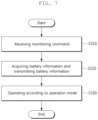
- FIG. 7 is a flowchart showing a method of operating a slave battery processor according to embodiments of the present disclosure
- FIGS. 8 to 10 are views showing operations of a battery system according to embodiments of the present disclosure.
- FIG. 11 is a view showing a robot according to embodiments of the present disclosure.
- Machine learning refers to the field of defining various problems in the field of artificial intelligence and researching the methodology for solving the problems.
- Machine learning is defined as an algorithm that improves the performance of an operation by performing a consistent experience for the operation.
- An artificial neural network is a model used in machine learning, configured with artificial neurons (nodes) constituting a network in a synapse coupling, and means a model with problem solving ability.
- the artificial neural network may be defined by a connection pattern between neurons of other layers, a learning process of updating a model parameter, and an activation function generating an output value.
- the artificial neural network may include an input layer, an output layer, and at least one selective hidden layer. Each layer may include at least one neuron, and the artificial neural network may include a synapse that connects neurons. In the artificial neural network, each neuron may output input signals input through a synapse, weights, and a function value of an activation function for a bias.
- the model parameter means a parameter determined through learning, and includes a weight of a synapse connection, a bias of a neuron, etc.
- a hyper-parameter means a parameter that has to be set before performing learning in a machine learning algorithm, and includes a learning rate, a number of repetition times, a size of a mini-batch, an initialization function, etc.
- An objective of performing learning for an artificial neural network is to determine a model parameter that minimizes a loss function.
- the loss function may be used as an index for determining an optimum model parameter in a learning process of the artificial neural network.
- Machine learning may be classified into supervised learning, unsupervised learning, and reinforcement learning according to a learning method.
- Supervised learning may mean a method of performing learning for an artificial neural network where a label related to learning data is provided, and the label may mean a right answer (or result value) that has to be estimated by the artificial neural network when the learning data is input to the artificial neural network.
- Unsupervised learning may mean a method of performing learning for an artificial neural network where a label related to learning data is not provided.
- Reinforcement learning may mean a learning method performing learning so as to select, by an agent defined under a certain environment, an action or an order thereof such that an accumulated reward in each state is maximized.
- Machine learning among artificial neural networks, employed in a deep neural network (DNN) including a plurality of hidden layers, is referred to as deep learning, and the deep learning is a part of the machine learning.
- machine learning is used to include deep learning.
- a robot may mean a machine capable of automatically carrying out or operating a given operation by its own ability. Particularly, a robot having a function of recognizing an environment, and performing an operation by performing determination by itself may be referred to as an intelligent robot.
- a robot may be classified into an industrial type, a medical type, a household type, a military type, etc. according to the usage purpose or field.
- the robot may be provided with a manipulator including an actuator or a driving device so that the robot may perform various physical operations such as moving a robot joint, and so on.
- a movable robot may navigate on the ground or fly in the air by including wheels, brakes and propellers, etc.
- Self-driving means the technology of autonomous driving
- a self-driving vehicle means a vehicle that drives without user's manipulations or with the minimum manipulation of the user.
- self-driving may include the technique of maintaining a driving lane, the technique of automatically adjusting a speed such as adaptive cruise control, the technique of automatically driving along a predetermined route, the technique of automatically setting a route when a destination is set, etc.
- Vehicles may include a vehicle with only an internal combustion engine, a hybrid vehicle with an internal combustion engine and an electric motor together, and an electric vehicle with only an electric motor, and may include not only automobiles but also trains and motorcycles.
- a self-driving vehicle may be referred to as a robot with a self-driving function.
- Extended reality refers to virtual reality (VR), augmented reality (AR), and mixed reality (MR).
- VR virtual reality
- AR augmented reality
- MR mixed reality
- the VR technique provides objects and backgrounds of the real world in CG images
- the AR technique provides virtual CG images by reflecting the same on real object images
- the MR technique is a computer graphic technique mixing and coupling virtual objects and providing by reflecting the same in the real word.
- the MR technique is similar to the AR technique in that real objects and virtual objects are provided together.
- virtual objects are used to complement real objects, but in the MR technique, virtual objects and real objects are equivalently used.
- the XR technique may be applied by using a head-mount display (HMD), a head-up display (HUD), a mobile phone, a tablet PC, a laptop PC, a desktop PC, a TV, a digital signage, etc., and a device to which the XR technique is applied may be referred to an XR device.
- HMD head-mount display
- HUD head-up display
- mobile phone a tablet PC, a laptop PC, a desktop PC, a TV, a digital signage, etc.
- a device to which the XR technique is applied may be referred to an XR device.
- FIG. 1 is a view showing an AI apparatus 100 according to an embodiment of the present disclosure.
- the AI apparatus 100 may be employed in a fixed or movable type device such as TVs, projectors, mobile phones, smart phones, desktop PCs, laptop PCs, digital broadcasting terminals, PDAs (personal digital assistants), PMPs (portable multimedia player), navigations, tablet PCs, wearable devices, set-top boxes (STB), DMB receiver, radios, washers, refrigerators, digital signages, robots, vehicles, etc.
- a fixed or movable type device such as TVs, projectors, mobile phones, smart phones, desktop PCs, laptop PCs, digital broadcasting terminals, PDAs (personal digital assistants), PMPs (portable multimedia player), navigations, tablet PCs, wearable devices, set-top boxes (STB), DMB receiver, radios, washers, refrigerators, digital signages, robots, vehicles, etc.
- the AI apparatus 100 may include a communication circuit 110 , an input device 120 , a learning processor 130 , a sensor 140 , an output device 150 , a memory 170 , and a processor 180 .
- the communication circuit 110 may transmit and receive data to/from another AI apparatuses ( 100 a to 100 e ) or external devices such as an AI server 200 by using wired/wireless communication methods.
- the communication circuit 110 may transmit and receive sensor information, user input, learning model, control signals, etc. to/from external devices.
- GSM global system for mobile communication
- CDMA code division multi access
- LTE long term evolution
- 5G wireless LAN
- WLAN wireless-fidelity
- Wi-Fi wireless-fidelity
- BluetoothTM radio frequency identification
- IrDA infrared data association
- ZigBee ZigBee
- NFC near field communication
- the input device 120 may be for obtaining various types of data.
- the input device 120 may include a camera for an image signal input, a microphone for receiving audio signals, and a user input part for receiving information from the user. Signals obtained from the camera or microphone by using the same as sensors may be referred to as sensing data or sensor information.
- the input device 120 may be for obtaining input data used for outputting that is performed by using learning data and a learning model for model learning.
- the input device 120 may be for obtaining input data that is not processed.
- the processor 180 or learning processor 130 may obtain an input feature from input data as preprocessing.
- the learning processor 130 may perform learning for a model configured with an artificial neural network by using learning data.
- the artificial neural network for which learning is performed may be referred to as a learning model.
- the learning model may be used for estimating a result value for new input data other than learning data, and the estimated value may be used as a reference for performing a certain operation.
- the learning processor 130 may perform AI processing with a learning processor 240 of the AI server 200 .
- the learning processor 130 may be integrated in the AI apparatus 100 or may include a memory employed therein. Alternatively, the learning processor 130 may be employed by using the memory 170 , an external memory directly connected to the AI apparatus 100 , or a memory maintained in an external device.
- the sensor 140 may obtain at least one among internal information of the AI apparatus 100 , surrounding environmental information of the AI apparatus 100 , and user information by using various sensors.
- the senor 140 may include a proximity sensor, an ambient light sensor, an acceleration sensor, a magnetic sensor, a gyro sensor, an inertial sensor, an RGB sensor, an IR sensor, a fingerprint recognizing sensor, a ultrasonic sensor, an optical sensor, a microphone, a lidar, a radar, etc.
- the output device 150 may generate an output related to visual, auditory, or tactile.
- the output device 150 may include a display for visually outputting information, a speaker for acoustically outputting information, and a haptic actuator for tactually outputting information.
- the display may output an image or video
- the speaker may output a voice or sound
- the haptic actuator may output vibration.
- the memory 170 may be for storing data supporting various functions of the AI apparatus 100 .
- input data obtained through the input device 120 learning data, a learning model, a learning history, etc. may be stored.
- the processor 180 may determine at least one executable operation of the AI apparatus 100 which is determined on the basis of information determined or generated by using a data analysis algorithm or machine learning algorithm. In addition, the processor 180 may perform the determined operation by controlling components of the AI apparatus 100 .
- the processor 180 may make a request, retrieve, receive, or use data of the learning processor 130 or the memory 170 , and control components of the AI apparatus 100 so as to perform the estimated operation of the at least one executable operation, or an operation that is determined to be desirable.
- the processor 180 may generate, when association with an external device is required, a control signal for controlling the corresponding external device, and transmit the generated control signal to the corresponding external device.
- the processor 180 may obtain intention information on the user's input, and determine a user's requirement on the basis of the obtained intention information.
- the processor 180 may obtain intention information in association with the user's input by using at least one among a STT (speech-to-text) engine converting a voice input into text strings, and a natural language processing (NLP) engine obtaining intention information of natural language.
- STT speech-to-text
- NLP natural language processing
- a part of the at least one among the STT engine and the NLP engine may be configured with an artificial neural network for which learning is performed according to a machine learning algorithm.
- learning may be performed by the learning processor 130 , learning may be is performed by the learning processor 240 of the AI server 200 , or learning may be performed through distribution processing of the above processors.
- the processor 180 may collect record information including operation content of the AI apparatus 100 and user's feedback in association with the operation, etc. so as to store in the memory 170 or learning processor 130 , or transmit the information to the external device such as an AI server 200 , etc.
- the collected record information may be used when updating a learning model.
- the processor 180 may control a part of components of the AI apparatus 100 so as to execute application programs stored in the memory 170 . Further, the processor 180 may operate components of the AI apparatus 100 by combining at least two thereof so as to execute the application programs.
- FIG. 2 is a view showing an AI server 200 according to an embodiment of the present disclosure.
- the AI server 200 may mean a device performing learning for an artificial neural network by using a machine learning algorithm, or a device using the artificial neural network for which learning is performed.
- the AI server 200 may perform distributed processing by being configured with a plurality of servers, or may be defined as a 5G network.
- the AI server 200 may perform at least a part of AI processing by being included as a partial component of the AI apparatus 100 .
- the AI server 200 may perform at least a part of AI processing by being included as a partial component of the AI apparatus 100 .
- the communication circuit 210 may transmit and receive data to/from the external devices such as AI apparatus 100 , etc.
- the memory 230 may be for storing a model (or artificial neural network, 231 ) for which learning is ongoing or performed by the learning processor 240 .
- the learning processor 240 may perform learning for an artificial neural network 231 by using learning data.
- a learning model may be used by being integrated in the AI server 200 of the artificial neural network, or by being integrated in the external device such as an AI apparatus 100 , etc.
- the learning model may be employed in hardware, software, or combination thereof. When a part or the entire of the learning model is employed in software, at least one instruction constituting the learning model may be stored in the memory 230 .
- the processor 260 may estimate a result value for new input data by using the learning model, and generate a response or control command on the basis of the estimated result value.
- FIG. 3 is a view showing an AI system 1 according to an embodiment of the present disclosure.
- the AI system 1 is connected to at least one cloud network 10 among the AI server 200 , a robot 100 a , self-driving vehicle 100 b , an XR device 100 c , a smart phone 100 d , and a home appliance 100 e .
- the robot 100 a , the self-driving vehicle 100 b , the XR device 100 c , the smart phone 100 d or the home appliance 100 e to which the AI technique is applied may be referred to as the AI apparatus ( 100 a to 100 e ).
- the cloud network 10 may mean a network constituting a part of cloud computing infrastructure or a network present in the cloud computing infrastructure.
- the cloud network 10 may be configured by using a 3G network, a 4G or LTE network, a 5G network, etc.
- each device ( 100 a to 100 e , 200 ) constituting the AI system 1 may be connected with each other through the cloud network 10 .
- each device ( 100 a to 100 e , 200 ) may perform communication with each other through a base station, and also may perform direct communication without using the base station.
- the AI server 200 may include a server performing AI processing, and a server performing calculation for big data.
- the AI server 200 may be connected to at least one of AI apparatus constituting an AI system 1 configured with the robot 100 a , the self-driving vehicle 100 b , the XR device 100 c , the smart phone 100 d , and the home appliance 100 e through the cloud network 10 , and the AI server 200 may support a part of the AI processing of the connected AI apparatuses ( 100 a to 100 e ).
- the AI server 200 may perform learning on an artificial neural network according to a machine learning algorithm in place of the AI apparatus ( 100 a to 100 e ), may directly store a learning model, or transmit the learning model to the AI apparatus ( 100 a to 100 e ).
- the AI server 200 may receive input data from the AI apparatus ( 100 a to 100 e ), estimate a result value for the received input data by using a learning model, and generate a response or control command on the basis of the estimated result value so as to transmit the same to the AI apparatus ( 100 a to 100 e ).
- the AI apparatus may estimate a result value for the received input data by directly using a learning model, and generate a response or control command on the basis of the estimated result value.
- the AI apparatus ( 100 a to 100 e ) shown in FIG. 3 may be referred to a detailed example of the AI apparatus 100 shown in FIG. 1 .
- the robot 100 a may be employed in a guide robot, a transport robot, a cleaning robot, a wearable robot, an entertainment robot, a pet robot, an unmanned flying robot, etc. by applying the AI technique thereto.
- the robot 100 a may include a robot control module for controlling operations, and the robot control module may mean a software module or a chip where the same is employed therein.
- the robot 100 a may obtain state information of the robot 100 a , detect (recognize) a surrounding environment or objects, generate map data, determine a moving path or driving plan, determine a response in association with a user interaction, or determine operations by using sensor information that is obtained through various types of sensors.
- the robot 100 a may use sensor information obtained by using at least one sensor of a lidar, a radar, and a camera.
- the robot 100 a may perform the above operations by using a learning model configured with at least one artificial neural network.
- the robot 100 a may recognize a surrounding environment and objects by using a learning model, and determine operations by using the recognized surrounding environment information or object information.
- the learning model may be obtained by directly performing learning by the robot 100 a , or by performing learning by the external device such as an AI server 200 , etc.
- the robot 100 a may generate a result by directly using the learning model so as to perform operations. However, the robot 100 a may transmit the sensor information to the external device such as an AI server 200 , and receive a result generated according thereto so as to perform operations.
- the external device such as an AI server 200
- the robot 100 a may determine a moving path and a driving plan by using at least one among map data, object information detected from the sensor information, and object information obtained from the external device, and drive according to the determined moving path and the driving plan by controlling a driving part.
- Map data may include object identification information on various objects arranged in a space where the robot 100 a moves.
- the map data may include object identification information on fixed objects such as walls, doors, etc., and movable objects such as flowerpots, tables, etc.
- the object identification information may include a name, a type, a distance, a position, etc.
- the robot 100 a may perform operations or drive by controlling the driving part on the basis of the user's control/interaction.
- the robot 100 a may obtain intention information on interaction according to a user's behavior or voice input, and determine a response on the basis of the obtained intention information so as to perform operations.
- the self-driving vehicle 100 b may be employed as a movable robot, a vehicle, an unmanned flying robot, etc. by applying the AI technique thereto.
- the self-driving vehicle 100 b may include a self-driving control module controlling a self-driving function, and the self-driving control module may mean a software module or a chip where the same is employed in hardware.
- the self-driving control module may be included in the self-driving vehicle 100 b as a component thereof, but may be connected to the self-driving vehicle 100 b by being configured in separate hardware.
- the self-driving vehicle 100 b may obtain state information of the self-driving vehicle 100 b , detect (recognize) a surrounding environment and objects, generate map data, determine a moving path and a driving plan, or determine operations by using sensor information obtained through various types of sensors.
- the self-driving vehicle 100 b may use sensor information obtained by using at least one sensor of a lidar, a radar, and a camera.
- the self-driving vehicle 100 b may recognize an environment and objects for areas that are hidden from view or over a certain distance by receiving sensor information from external devices, or by receiving information directly recognized from the external devices.
- the self-driving vehicle 100 b may perform the above operations by using a learning model configured with at least one artificial neural network.
- the self-driving vehicle 100 b may recognize a surrounding environment and objects by using a learning model, and determine a driving path by using the recognized surrounding environment information or object information.
- the learning model may be obtained by directly performing learning by the self-driving vehicle 100 b , or by performing learning by the external device such as an AI server 200 , etc.
- the self-driving vehicle 100 b may generate a result by directly using the learning model so as to perform operations. However, the self-driving vehicle 100 b may transmit the sensor information to the external device such as an AI server 200 , and receive a result generated according thereto so as to perform operations.
- the external device such as an AI server 200
- the self-driving vehicle 100 b may determine a moving path and a driving plan by using at least one among map data, object information detected from the sensor information, and object information obtained from the external device, and drive according to the determined moving path and the driving plan by controlling a driving part.
- Map data may include object identification information on various objects (for example, roads) arranged in a space where the self-driving vehicle 100 b drives.
- the map data may include object identification information on fixed objects such as street lamps, rocks, buildings, etc. and movable objects such as vehicles, pedestrians, etc.
- the object identification information may include a name, a type, a distance, a position, etc.
- the self-driving vehicle 100 b may perform operations or drive by controlling the driving part on the basis of the user's control/interaction.
- the self-driving vehicle 100 b may obtain intention information on interaction according to a user's behavior or voice input, and determine a response on the basis of the obtained intention information so as to perform operations.
- the XR device 100 c may be employed by using a HMD, a HUD provided in a vehicle, a TV, a mobile phone, a smart phone, a PC, a wearable device, a home appliance, a digital signage, a vehicle, or a fixed type robot or movable type robot.
- the XR device 100 c analyze 3D point cloud data or image data which is obtained through various sensors or external devices, generate position data and feature data on 3D points, and obtain information on a surrounding space and real objects and output XR objects to be rendered.
- the XR device 100 c may output XR objects including additional information on the recognized objects by reflecting the same in the corresponding recognized objects.
- the XR device 100 c may perform the above operations by using a learning model configured with at least one artificial neural network.
- the XR device 100 c may recognize real objects from 3D point cloud data or image data by using a learning model, and provide information in association with the recognized real objects.
- the learning model may be obtained by directly performing learning by the XR device 100 c , or by performing learning by the external device such as an AI server 200 , etc.
- the XR device 100 c may generate a result by directly using the learning model so as to perform operations. However, the XR device 100 c may transmit the sensor information to the external device such as an AI server 200 , and receive a result generated according thereto so as to perform operations.
- the external device such as an AI server 200
- the robot 100 a may be employed in a guide robot, a transport robot, a cleaning robot, a wearable robot, an entertainment robot, a pet robot, an unmanned flying robot, etc. by applying the AI technique and the self-driving technique thereto.
- the robot 100 a to which the AI technique and the self-driving technique are applied may mean a robot itself with a self-driving function, or the robot 100 a operating in conjunction with the self-driving vehicle 100 b.
- the robot 100 a with the self-driving function may refer to all devices moving by itself according to a given movement, or by determining a moving path by itself without a user control.
- the robot 100 a and the self-driving vehicle 100 b which respectively have self-driving functions may use a common sensing method for determining at least one among a moving path and a driving plan.
- the robot 100 a and the self-driving vehicle 100 b which respectively have self-driving functions may determine a moving path or driving plan by using information sensed through a lidar, a radar, a camera, etc.
- the robot 100 a operating in conjunction with the self-driving vehicle 100 b may be present separate from the self-driving vehicle 100 b , while the robot 100 a is internally or externally connected to the self-driving function of the self-driving vehicle 100 b , or may perform operations in association with the driver of the self-driving vehicle 100 b.
- the robot 100 a operating in conjunction with the self-driving vehicle 100 b may obtain sensor information in place of the self-driving vehicle 100 b so as to provide the information to the self-driving vehicle 100 b , or obtain sensor information and generate surrounding environment information or object information so as to provide the information to the self-driving vehicle 100 b , and thus control or supplement the self-driving function of the self-driving vehicle 100 b.
- the robot 100 a operating in conjunction with the self-driving vehicle 100 b may monitor a driver of the self-driving vehicle 100 b , or control functions of the self-driving vehicle 100 b by operating in conjunction with the driver. For example, when it is determined that the driver is drowsy, the robot 100 a may activate the self-driving function of the self-driving vehicle 100 b or control the driving part of the self-driving vehicle 100 b .
- functions of the self-driving vehicle 100 b which are controlled by the robot 100 a include, in addition to the self-driving function, functions provided from a navigation system or audio system provided in the self-driving vehicle 100 b.
- the robot 100 a operating in conjunction with the self-driving vehicle 100 b may provide information or supplement functions of the self-driving vehicle 100 b from the outside of the self-driving vehicle 100 b .
- the robot 100 a may provide traffic information including signal information such as smart signals to the self-driving vehicle 100 b , or may automatically connect to an electrical charging device such as an automatic electric charger of an electric vehicle by operating in conjunction with the self-driving vehicle 100 b.
- the robot 100 a may be employed in a guide robot, a transport robot, a cleaning robot, a wearable robot, an entertainment robot, a pet robot, an unmanned flying robot, a drone, etc. by applying the AI technique and the XR technique thereto.
- the robot 100 a to which the XR technique is applied may mean a robot that becomes a target controlled/operated within an XR image.
- the robot 100 a may be distinguished from the XR device 100 c and operate in conjunction with the same.
- the robot 100 a For the robot 100 a that becomes a target controlled/operated within an XR image, when sensor information is obtained from sensors including a camera, the robot 100 a or the XR device 100 c may generate an XR image on the basis of the sensor information, and the XR device 100 c may output the generated XR image.
- the above robot 100 a may operate on the basis of a control signal input through the XR device 100 c , or in conjunction with the user.
- the user may check an XR image in association with a view of the robot 100 a that is in conjunction with the external device such as XR device 100 c in a remote manner, adjust a self-driving path of the robot 100 a through in conjunction with the robot 100 a , control operations or driving, or check information on surrounding objects.
- the external device such as XR device 100 c
- the self-driving path of the robot 100 a through in conjunction with the robot 100 a
- control operations or driving or check information on surrounding objects.
- the self-driving vehicle 100 b may be employed in a movable robot, a vehicle, an unmanned flying robot, etc. by applying the AI technique and the XR technique thereto.
- the self-driving vehicle 100 b to which the XR technique is applied may mean self-driving vehicle provided with a device providing an XR image, and self-driving vehicle that becomes a target controlled/operated within an XR image, etc.
- the self-driving vehicle 100 b that becomes a target controlled/operated within an XR image may be distinguished from the XR device 100 c , and operate in conjunction with the same.
- the self-driving vehicle 100 b provided with a device providing an XR image may obtain sensor information from sensors including a camera, and output an XR image generated on the basis of the obtained sensor information.
- the self-driving vehicle 100 b outputs an XR image by using a HUD, and thus provides to a passenger a real object or XR object in association with objects within a screen.
- the XR object when the XR object is displayed on the HUD, at least a part of the XR object may be displayed to overlap the real object to which the passenger's eyes are directed.
- the XR object displayed on a display included in the self-driving vehicle 100 b at least a part of the XR object may be displayed to overlap an object within the screen.
- the self-driving vehicle 100 b may output XR objects in association with carriageways, other vehicles, signals, traffic signs, motorcycles, pedestrians, buildings, etc.
- the self-driving vehicle 100 b For the self-driving vehicle 100 b that becomes a target controlled/operated within an XR image, when sensor information is obtained from sensors including a camera, the self-driving vehicle 100 b or XR device 100 c may generate an XR image on the basis of the sensor information, and the XR device 100 c may output the generated XR image.
- the above self-driving vehicle 100 b may operate on the basis of a control signal input through the external device such as XR device 100 c , etc. or in conjunction with the user.
- FIG. 4 is a view showing a battery system according to embodiments of the present disclosure.
- a battery system 20 may include slave battery processors 300 - 1 to 300 - n (herein, n is a natural number of 2 or more), a master battery processor 400 , and batteries 500 - 1 to 500 - n .
- n is a natural number of 2 or more
- a master battery processor 400 may include two or more master battery processors.
- the master battery processor 400 and the slave battery processors 300 - 1 to 300 - n may be hardware having calculation processing capabilities. According to embodiments, the master battery processor 400 and the slave battery processors 300 - 1 to 300 - n may be integrated circuits, central processing units (CPUs), micro processing units (MCUs), graphic processing units (GPUs), or application specific integrated circuits (ASICs), but are not limited thereto.
- CPUs central processing units
- MCUs micro processing units
- GPUs graphic processing units
- ASICs application specific integrated circuits
- the battery system 20 may perform charging with power or discharging.
- the battery system 20 may be included in the AI apparatus 100 or the AI server 200 described with reference to FIGS. 1 to 3 , and may supply power required for the AI apparatus 100 or the AI server 200 .
- the battery system 20 may supply the stored power that is the power required for the AI apparatus 100 or the AI server 200 , and may also store power supplied from a power source (for example, a grid).
- the battery system 20 may be a wireless battery system.
- the master battery processor 400 and the slave battery processors 300 - 1 to 300 - n may transmit and receive data from each other by using a wireless communication protocol.
- the slave battery processors 300 - 1 to 300 - n may be coupled to the batteries 500 - 1 to 500 - n in a one-to-one manner. According to embodiments, the slave battery processors 300 - 1 to 300 - n may be electrically connected to the batteries 500 - 1 to 500 - n , respectively. For example, a first slave battery processor 300 - 1 may be electrically connected to a first battery 500 - 1 .
- the slave battery processors 300 - 1 to 300 - n may receive, from the batteries 500 - 1 to 500 - n respectively coupled thereto, battery information indicating states of the batteries 500 - 1 to 500 - n , respectively. According to embodiments, the slave battery processors 300 - 1 to 300 - n may monitor the states of the batteries 500 - 1 to 500 - n respectively coupled thereto, and may acquire the battery information indicating the states of the batteries 500 - 1 to 500 - n respectively coupled thereto, according to a result of the monitoring.
- the battery information may refer to information indicating the overall states of the batteries 500 - 1 to 500 - n .
- the battery information may include at least one among capacities of the batteries 500 - 1 to 500 - n , state of charge (SOC) or depth of discharge of the batteries 500 - 1 to 500 - n , a remaining lifespan (state of health (SOH)) of the batteries 500 - 1 to 500 - n , temperatures of the batteries 500 - 1 to 500 - n , voltages of the batteries 500 - 1 to 500 - n , currents of the batteries 500 - 1 to 500 - n , and positions of the batteries 500 - 1 to 500 - n , but it is not limited thereto.
- the capacity of the battery may refer to the amount of power that a completely discharged battery may store or the amount of power that a completely charged battery may supply. In general, the capacity of the battery may be determined at the time of manufacture. However, as will be described later, as the battery is used, the amount of power that the battery may actually store or supply is decreased. Therefore, the capacity of the battery described in this specification may refer to the capacity of the battery of which the remaining lifespan is 100%.
- the state of charge (SOC) of the battery indicates the amount of power that the battery currently stores. That is, the case where the state of charge (SOC) of the battery is 100% (in other words, the depth of discharge is 0%) refers to the fact that the battery is completely charged.
- the remaining lifespan (or state of health (SOH)) of the battery indicates the available capacity compared to the (initial) capacity of the battery. That is, in the case where the remaining lifespan is reduced as the battery is used, the amount of power in which the battery is actually capable of being charged (or discharged) is lower than the amount of power in which the initial battery is capable of being charged.
- the available capacity of the battery of which the remaining lifespan is 100% may be the same as the (initial) capacity of the battery, but the available capacity of the battery of which the remaining lifespan is 50% may be half of the (initial) capacity of the battery.
- the slave battery processors 300 - 1 to 300 - n may transmit data to the master battery processor 400 .
- the data may include the battery information.
- the slave battery processors 300 - 1 to 300 - n may transmit respective IDs and data of the slave battery processors 300 - 1 to 300 - n to the master battery processor 400 .
- the first slave battery processor 300 - 1 may transmit first battery information and a first ID for identifying the first slave battery processor 300 - 1 , to the master battery processor 400 .
- a second slave battery processor 300 - 2 may transmit second battery information and a second ID for identifying the second slave battery processor 300 - 2 , to the master battery processor 400 .
- the slave battery processors 300 - 1 to 300 - n may receive data transmitted from nearby devices, and may store the received data. According to embodiments, the slave battery processors 300 - 1 to 300 - n may receive data transmitted from another slave battery processors or the master battery processor 400 , and may store the received data.
- the slave battery processors 300 - 1 to 300 - n may control the batteries 500 - 1 to 500 - n respectively coupled thereto. According to embodiments, the slave battery processors 300 - 1 to 300 - n may control at least one among charging and discharging of the batteries 500 - 1 to 500 - n respectively coupled thereto. That is, in this specification, controlling, by the slave battery processors 300 - 1 to 300 - n , the batteries 500 - 1 to 500 - n coupled thereto may refer to controlling at least one among charging and discharging of the batteries 500 - 1 to 500 - n coupled thereto.
- the slave battery processors 300 - 1 to 300 - n may operate using electric energy (or power) with which the batteries 500 - 1 to 500 - n coupled thereto is charged.
- the slave battery processors 300 - 1 to 300 - n may perform, by using energy stored in the batteries 500 - 1 to 500 - n respectively coupled thereto, communication with the master battery processor 400 , or may supply energy stored in the batteries 500 - 1 to 500 - n coupled thereto, to nearby devices.
- the master battery processor 400 and the slave battery processors 300 - 1 to 300 - n may transmit and receive data from with other.
- the master battery processor 400 may receive, from the slave battery processors 300 - 1 to 300 - n , battery information of the batteries 500 - 1 to 500 - n respectively coupled thereto.
- the master battery processor 400 may receive, from the slave battery processors 300 - 1 to 300 - n , the IDs of the slave battery processors 300 - 1 to 300 - n and the battery information.
- the master battery processor 400 may control the slave battery processors 300 - 1 to 300 - n . According to embodiments, the master battery processor 400 may transmit an operation command for operating the slave battery processors 300 - 1 to 300 - n , to the slave battery processors 300 - 1 to 300 - n .
- the slave battery processors 300 - 1 to 300 - n may control the batteries 500 - 1 to 500 - n coupled thereto, in response to the operation command.
- the master battery processor 400 may receive the battery information transmitted from the slave battery processors 300 - 1 to 300 - n , and may control operation of the slave battery processors 300 - 1 to 300 - n , on the basis of the received battery information. According to embodiments, the master battery processor 400 may determine, on the basis of the received battery information, operation modes of the respective slave battery processors 300 - 1 to 300 - n.
- the operation modes of the slave battery processors 300 - 1 to 300 - n are related to power consumption (or electric energy consumption) of the slave battery processors 300 - 1 to 300 - n , and electric energy consumed by the slave battery processors 300 - 1 to 300 - n may vary according to operation mode. That is, the slave battery processors 300 - 1 to 300 - n may consume electric energy of the batteries 500 - 1 to 500 - n coupled thereto, according to the operation modes.
- the master battery processor 400 may transmit operation commands including the determined operation modes to the slave battery processors 300 - 1 to 300 - n.
- the master battery processor 400 may transmit operation commands including the IDs and the operation modes of the slave battery processors 300 - 1 to 300 - n , to the slave battery processors 300 - 1 to 300 - n .
- the slave battery processors 300 - 1 to 300 - n may recognize the operation modes corresponding to the IDs and may operate according to the operation modes.
- the master battery processor 400 may transmit operation commands including the operation modes corresponding to the respective slave battery processors 300 - 1 to 300 - n , to the slave battery processors 300 - 1 to 300 - n , individually.
- the slave battery processors 300 - 1 to 300 - n may operate according to the operation modes included in the received operation commands.
- the batteries 500 - 1 to 500 - n may be electrically coupled to the slave battery processors 300 - 1 to 300 - n , and may be subjected to at least one among charging and discharging, according to control by the slave battery processors 300 - 1 to 300 - n.
- Each of the batteries 500 - 1 to 500 - n may include multiple battery cells.
- the multiple batteries may be connected in series, parallel, or a combination of series and parallel connections.
- the batteries 500 - 1 to 500 - n may be secondary batteries, but are not limited thereto.
- the batteries 500 - 1 to 500 - n may be any batteries capable of being charged with power or discharged.
- FIG. 5 is a view showing battery balancing according to embodiments of the present disclosure.
- FIG. 5 shows four batteries 500 - 1 to 500 - 4 with the respective voltages V 1 to V 4 .
- battery states for example, voltages V 1 to V 4
- battery states of the respective batteries 500 - 1 to 500 - 4 may differ.
- imbalance between the batteries 500 - 1 to 500 - 4 occurs, and a particular battery among the batteries 500 - 1 to 500 - 4 is charged first or is discharged first.
- efficiency of the batteries 500 - 1 to 500 - 4 may be reduced, and this inequality may be exacerbated.
- the battery system 20 performs balancing to solve the imbalance between the batteries 500 - 1 to 500 - 4 .
- the master battery processor 400 may transmit balancing commands to the slave battery processors 300 - 1 to 300 - 4 coupled to the batteries requiring balancing.
- the slave battery processors may perform balancing in response to the balancing commands.
- the slave battery processor may further increase power usage of the battery coupled thereto, in response to the balancing command.
- the slave battery processor may include resistors for balancing, and may further discharge the battery storing power, by using the resistors for balancing, in response to the balancing command.
- the master battery processor 400 may determine, on the basis of the battery information, the battery requiring balancing among the batteries 500 - 1 to 500 - 4 . According to a result of the determination, the master battery processor 400 may transmit the balancing command for performing balancing on the battery requiring balancing, to the corresponding slave battery processors 300 - 1 to 300 - 4 . For example, in the case where the master battery processor 400 determines that the first battery 500 - 1 requires balancing, the master battery processor 400 may transmit the balancing command to the first slave battery processor 300 - 1 .
- the master battery processor 400 may determine that the battery among the batteries 500 - 1 to 500 - 4 which has a voltage equal to or higher than a reference voltage V REF requires balancing. For example, in the case of FIG. 5 , a second voltage V 2 of a second battery 500 - 2 and a third voltage V 3 of a third battery 500 - 3 exceed the reference voltage V REF , and thus the master battery processor 400 may determine that the second battery 500 - 2 and the third battery 500 - 3 require balancing. Further, the master battery processor 400 may transmit the balancing commands to the second slave battery processor 300 - 2 and a third slave battery processor 300 - 3 .
- the second slave battery processor 300 - 2 and the third slave battery processor 300 - 3 may increase usage of the second battery 500 - 2 and the third battery 500 - 3 in response to the balancing commands. Accordingly, the voltage V 2 of the second battery 500 - 2 and the voltage V 3 of the third battery 500 - 3 reduce quicker than the voltages of the remaining batteries, and thus the imbalance between the batteries 500 - 1 to 500 - 4 may be gradually solved.
- the master battery processor 400 may determine that the battery among the batteries 500 - 1 to 500 - 4 which has the highest voltage requires balancing. For example, in the case of FIG. 5 , the second voltage V 2 of the second battery 500 - 2 is higher than the voltages of the remaining batteries. Therefore, the master battery processor 400 may determine that the second battery 500 - 2 requires balancing. Further, the master battery processor 400 may transmit the balancing command to the second slave battery processor 300 - 2 . The second slave battery processor 300 - 2 may increase usage of the second battery 500 - 2 in response to the balancing command. Accordingly, the voltage V 2 of the second battery 500 - 2 reduces quicker than the voltages of the remaining batteries, and thus the imbalance between the batteries 500 - 1 to 500 - 4 may be gradually solved.
- a communication participation rate for the slave battery processor coupled to the battery requiring balancing may be increased, and reliability of communication of the battery system 20 may be enhanced.
- the communication participation rate refers to the degree (or relative importance) at which each of the slave battery processors accounts for, in communication with the master battery processor. According to embodiments, the communication participation rate may indicate the electric energy that each of the slave battery processors uses in communication with the master battery processor.
- the case where the communication participation rate for the first slave battery processor is higher than the communication participation rate for the second slave battery processor may refer to the fact that the first slave battery processor transmits more signals than the second slave battery processor, the fact that the first slave battery processor transmits a stronger signal than the second slave battery processor, the fact that the first slave battery processor transmits signals with greater frequency (in other words, more often) than the second slave battery processor, or the fact that the first slave battery processor uses more electric energy (or power) for communication than the second slave battery processor, but it is not limited thereto.
- FIG. 6 is a flowchart showing a method of operating a master battery processor according to embodiments of the present disclosure.
- the method shown in FIG. 6 may be performed by the master battery processor 400 .
- the method may be implemented by instructions executable by the master battery processor 400 .
- the instructions may be stored in a computer readable storage medium.
- the master battery processor 400 may transmit monitoring commands at step S 110 .
- the master battery processor 400 may transmit monitoring commands to the slave battery processors 300 - 1 to 300 - n .
- the master battery processor 400 may transmit the monitoring commands to the slave battery processors 300 - 1 to 300 - n at set intervals.
- the master battery processor 400 may receive the battery information from the slave battery processors 300 - 1 to 300 - n at step S 120 .
- the master battery processor 400 may receive the battery information and the ID of the corresponding slave battery processor, and may match the received ID and the received battery information for storage.
- the first slave battery processor 300 - 1 may transmit the first battery information of the first battery 500 - 1 and the first ID of the first slave battery processor 300 - 1 to the master battery processor 400
- the master battery processor 400 may receive the first battery information and the first ID.
- the master battery processor 400 may periodically transmit the monitoring commands. Each time a period ends, the master battery processor 400 may transmit, to the slave battery processors 300 - 1 to 300 - n , acknowledgements including the IDs of the slave battery processors (specifically, the slave battery processors transmitting the battery information that the master battery processor 400 receives) corresponding to the received battery information among slave battery processors 300 - 1 to 300 - n.
- the master battery processor 400 may determine, on the basis of the battery information, the operation modes of the slave battery processors 300 - 1 to 300 - n at step S 130 . According to embodiments, the master battery processor 400 may determine each of the operation modes of the slave battery processors 300 - 1 to 300 - n to be any one among an active mode, a normal mode, and a passive mode. In this specification, the active mode may be referred to as a first mode, and the normal mode and the passive mode may be referred to as a second mode. That is, the master battery processor 400 may determine each of the operation modes of the slave battery processors 300 - 1 to 300 - n to be any one among the first mode and the second mode. The master battery processor 400 may transmit the operation commands including the determined operation modes, to the slave battery processors 300 - 1 to 300 - n at step S 140 .
- the master battery processor 400 may determine, on the basis of the battery information, the battery among the batteries 500 - 1 to 500 - n which requires balancing. In addition, the master battery processor 400 may determine the operation mode of the slave battery processor coupled to the battery requiring balancing among the slave battery processors 300 - 1 to 300 - n , to be the active mode (for example, the first mode).
- the master battery processor 400 may determine, on the basis of the battery information, the operation mode of the slave battery processor coupled to the battery among the batteries 500 - 1 to 500 - n which has a relatively high voltage, to be the active mode (for example, the first mode). For example, the master battery processor 400 may determine the operation mode of the slave battery processor coupled to the battery among the batteries 500 - 1 to 500 - n which has the highest voltage, to be the active mode (for example, the first mode). Further, the master battery processor 400 may determine the operation mode of the slave battery processor coupled to the battery among the batteries 500 - 1 to 500 - n which has a voltage exceeding the reference voltage, to be the active mode (for example, the first mode).
- the master battery processor 400 may determine, on the basis of the battery information, the battery among the batteries 500 - 1 to 500 - n which does not require balancing. In addition, the master battery processor 400 may determine the operation mode of the slave battery processor coupled to the battery among the slave battery processors 300 - 1 to 300 - n which does not require balancing, to be the passive mode or the normal mode (for example, the second mode).
- the master battery processor 400 may determine, on the basis of the battery information, the operation mode of the slave battery processor coupled to the battery among the batteries 500 - 1 to 500 - n which has a relatively low voltage, to be the passive mode (for example, the second mode). For example, the master battery processor 400 may determine the operation mode of the slave battery processor coupled to the battery among the batteries 500 - 1 to 500 - n which has the lowest voltage, to be the passive mode (for example, the second mode). Further, the master battery processor 400 may determine the operation mode of the slave battery processor coupled to the battery among the batteries 500 - 1 to 500 - n which has a voltage equal to or lower than the reference voltage, to be the passive mode (for example, the second mode).
- the master battery processor 400 may determine the operation mode of the slave battery processor among the slave battery processors 300 - 1 to 300 - n which is in a good communication state with the master battery processor 400 , to be the active mode (for example, the first mode). For example, the master battery processor 400 may determine the operation mode of the slave battery processor among the slave battery processors 300 - 1 to 300 - n , to be the active mode (for example, the first mode), wherein the slave battery processor transmits data with a transmission signal strength equal to or greater than a reference strength, transmits with a transmission period shorter than a reference period, transmits with frequency of transmissions greater than reference frequency, or transmits the battery information to the master battery processor 400 normally.
- the active mode for example, the first mode
- the master battery processor 400 may determine the operation mode of the slave battery processor among the slave battery processors 300 - 1 to 300 - n which is in a bad communication state with the master battery processor 400 , to be the passive mode (for example, the second mode). For example, the master battery processor 400 may determine the operation mode of the slave battery processor among the slave battery processors 300 - 1 to 300 - n , to be the passive mode (for example, the second mode), wherein the slave battery processor transmits with a transmission signal strength less than the reference strength, transmits during a transmission period equal to or longer than the reference period, transmits with frequency of transmission equal to or less than the reference frequency, or does not transmit the battery information to the master battery processor 400 normally.
- the passive mode for example, the second mode
- the master battery processor 400 may determine the operation mode of the slave battery processor among the slave battery processors coupled to the batteries requiring balancing which is in a good communication state with the master battery processor 400 , to be the active mode (for example, the first mode).
- the master battery processor 400 may determine the operation mode of the slave battery processor among the slave battery processors coupled to the batteries not requiring balancing which is in a bad communication state with the master battery processor 400 , to be the passive mode (for example, the second mode).
- the master battery processor 400 may determine, on the basis of the battery states of the batteries 500 - 1 to 500 - n , the operation modes of the slave battery processors 300 - 1 to 300 - n coupled thereto.
- FIG. 7 is a flowchart showing a method of operating a slave battery processor according to embodiments of the present disclosure.
- the method shown in FIG. 7 may be performed by the slave battery processors 300 - 1 to 300 - n .
- the method may be implemented by instructions executable by the slave battery processors 300 - 1 to 300 - n .
- the instructions may be stored in a computer readable storage medium.
- the slave battery processors 300 - 1 to 300 - n may receive the monitoring commands at step S 210 . According to embodiments, the slave battery processors 300 - 1 to 300 - n may receive the monitoring commands transmitted from the master battery processor 400 .
- the slave battery processors 300 - 1 to 300 - n may receive, from the master battery processor 400 , the acknowledgements including the IDs of the slave battery processors in which transmission of the battery information is completed.
- the slave battery processors 300 - 1 to 300 - n may acquire the battery information from the batteries 500 - 1 to 500 - n in response to the monitoring commands, and may transmit the battery information to the master battery processor 400 at step S 220 . According to embodiments, the slave battery processors 300 - 1 to 300 - n may transmit the battery information and their IDs to the master battery processor 400 .
- the slave battery processors 300 - 1 to 300 - n may operate according to the operation modes determined by the master battery processor 400 , at step S 230 .
- the slave battery processors 300 - 1 to 300 - n may receive, from the master battery processor 400 , the operation commands including information on the operation modes, and may consume, on the basis of the received operation commands, electric energy with which the batteries 500 - 1 to 500 - n coupled to the slave battery processors 300 - 1 to 300 - n are charged.
- the first slave battery processor 300 - 1 may consume the electric energy stored in the first battery 300 - 1 in response to the operation command.
- Each of the slave battery processors 300 - 1 to 300 - n may operate according to any one among the first mode and the second mode.
- the slave battery processors 300 - 1 to 300 - n may communicate with the master battery processor 400 at the higher participation rate or may consume more electric energy when operating in the first mode than when operating in the second mode.
- each of the slave battery processors 300 - 1 to 300 - n may operate in any one among the active mode, the normal mode, or the passive mode.
- the communication participation rate in the active mode may be higher than the communication participation rate in the normal mode.
- the communication participation rate in the normal mode may be higher than the communication participation rate in the passive mode.
- the electric energy consumed in the active mode may be greater than the power consumed in the normal mode.
- the electric energy consumed in the normal mode may be greater than the power consumed in the passive mode.
- the slave battery processors 300 - 1 to 300 - n may enter an idle mode. Afterward, the slave battery processors 300 - 1 to 300 - n may be woken up on the basis of a wake-up command transmitted from the master battery processor 400 . According to embodiments, when the first slave battery processor 300 - 1 operates in the passive mode, the first slave battery processor 300 - 1 enters the idle mode. The first slave battery processor 300 - 1 entering the idle mode may no longer transmit the first battery information until the wake-up command is received. That is, the slave battery processor operating in the passive mode may not transmit the battery information even though the monitoring command is received.
- the slave battery processors 300 - 1 to 300 - n may consume more electric energy than in the passive mode. According to embodiments, all the slave battery processors operating in the normal mode may consume the same electric energy. For example, in the case where the first slave battery processor 300 - 1 and the second slave battery processor 300 - 2 operate in the normal mode, the power of the first battery 500 - 1 consumed by the first slave battery processor 300 - 1 may be substantially the same as the power of the second battery 500 - 2 consumed by the second slave battery processor 300 - 2 .
- the slave battery processors 300 - 1 to 300 - n may communicate with the master battery processor 400 at the higher communication participation rate than in the passive mode and the normal mode.
- the slave battery processors operating in the active mode may transmit data to the master battery processor 400 with at least one among higher transmission strength, the greater number of times, and shorter intervals, than operating in the normal mode and the passive mode.
- the data may include the battery information.
- the slave battery processors operating in the active mode may receive and store data transmitted from the slave battery processors except themselves.
- the slave battery processors operating in the active mode may transmit data received from the slave battery processors except themselves, to the master battery processor 400 instead (namely, a relay function).
- the slave battery processors 300 - 1 to 300 - n may receive the acknowledgements transmitted from the master battery processor 400 .
- the acknowledgement includes the ID of the slave battery processor (specifically, the slave battery processor transmitting the battery information received by the master battery processor 400 ) corresponding to the battery information received by the master battery processor 400 .
- the slave battery processors operating in the active mode may receive and store the battery information transmitted from the slave battery processors except themselves, and may transmit the battery information that is not received by the master battery processor 400 among the pieces of the stored battery information, to the master battery processor 400 .
- the slave battery processors operating in the active mode may transmit the battery information not received by the master battery processor 400 , to the master battery processor 400 with the high transmission strength.
- the slave battery processors operating in the active mode may transmit, to the master battery processor 400 , the battery information of the batteries coupled to the slave battery processors operating in the passive mode and the normal mode.
- the slave battery processors operating in the active mode may periodically transmit synchronization signals. According to embodiments, when all the slave battery processors 300 - 1 to 300 - n enter the idle mode (or a sleep mode), the slave battery processors operating in the active mode are periodically woken up and transmit synchronization signals.
- the slave battery processors 300 - 1 to 300 - n may use more power stored in the batteries or use the power quickly than in the passive mode and the normal mode. According to embodiments, the slave battery processors operating in the active mode may further use the energy stored in the battery, by using the resistor for balancing.
- the operations of the slave battery processors in the active mode may be performed individually or in combination of two or more.
- the slave battery processors 300 - 1 to 300 - n may operate in various operation modes depending on the states of the batteries 500 - 1 to 500 - n coupled thereto.
- the slave battery processors operating in the active mode may communicate with the master battery processor 400 at the high participation rate, resulting in the increase in reliability of communication.
- FIGS. 8 to 10 are views showing operations of a battery system according to embodiments of the present disclosure. Although eight slave battery processors 300 - 1 to 300 - 8 are shown in FIGS. 8 to 10 , embodiments of the present disclosure are not limited thereto.
- the master battery processor 400 and the slave battery processors 300 - 1 to 300 - 8 may transmit and receive data from each other.
- the master battery processor 400 may transmit the monitoring commands
- the slave battery processors 300 - 1 to 300 - n may transmit the battery information of the batteries 500 - 1 to 500 - n coupled thereto, to the master battery processor 400 in response to the monitoring commands.
- the master battery processor 400 may determine, on the basis of the battery information, the operation modes of the slave battery processors 300 - 1 to 300 - 8 , and the slave battery processors 300 - 1 to 300 - 8 may operate according to the determined operation modes.
- FIG. 9 shows that the slave battery processors 300 - 1 to 300 - 8 operate in the normal mode. All the slave battery processors 300 - 1 to 300 - 8 may consume the same electric energy in the normal mode. Accordingly, voltage change rates of the batteries 500 - 1 to 500 - 8 coupled thereto may be similar to each other.
- FIG. 10 shows that the slave battery processors 300 - 1 to 300 - 8 operate in different modes according to the determination by the master battery processor 400 .
- the first slave battery processor 300 - 1 to the fourth slave battery processor 300 - 4 operate in the normal mode; a fifth slave battery processor 300 - 5 and a sixth slave battery processor 300 - 6 operate in the active mode; and a seventh slave battery processor 300 - 7 and an eighth slave battery processor 300 - 8 operate in the passive mode.
- the batteries coupled to the seventh slave battery processor 300 - 7 and the eighth slave battery processor 300 - 8 that operate in the active mode may be the batteries requiring balancing. That is, the voltages of the battery coupled to the seventh slave battery processor 300 - 7 and the battery coupled to the eighth slave battery processor 300 - 8 may be relatively high.
- the seventh slave battery processor 300 - 7 and the eighth slave battery processor 300 - 8 operating in the active mode may be in a relatively good communication state with the master battery processor 400 .
- the master battery processor 400 may transmit the operation commands ordering the following: the first slave battery processor 300 - 1 to the fourth slave battery processor 300 - 4 operate in the normal mode; the fifth slave battery processor 300 - 5 and the sixth slave battery processor 300 - 6 operate in the active mode; and the seventh slave battery processor 300 - 7 and the eighth slave battery processor 300 - 8 operate in the passive mode.
- Each of the slave battery processors 300 - 1 to 300 - 8 may receive the operation command, and may operate in any one among the normal mode, the active mode, and the passive mode according to the operation command.
- the seventh slave battery processor 300 - 7 and the eighth slave battery processor 300 - 8 operating in the passive mode may consume lower electric energy than the remaining slave battery processors 300 - 1 to 300 - 6 consume.
- the seventh slave battery processor 300 - 7 and the eighth slave battery processor 300 - 8 operating in the passive mode may communicate with the master battery processor 400 at the lower communication participation rates than the remaining slave battery processors 300 - 1 to 300 - 6 communicate.
- the seventh slave battery processor 300 - 7 and the eighth slave battery processor 300 - 8 operating in the passive mode may enter the idle mode, and may be woken up on the basis of the wake-up commands.
- the seventh slave battery processor 300 - 7 and the eighth slave battery processor 300 - 8 enter the idle mode in response to the operation commands and thus may not participate in communication with the master battery processor 400 until being woken up.
- the fifth slave battery processor 300 - 5 and the sixth slave battery processor 300 - 6 operating in the active mode may consume higher electric energy than the remaining slave battery processors 300 - 1 to 300 - 4 , and 300 - 7 and 300 - 8 consume.
- the fifth slave battery processor 300 - 5 and the sixth slave battery processor 300 - 6 operating in the active mode may communicate with the master battery processor 400 at the higher communication participation rates than the remaining slave battery processors 300 - 1 to 300 - 4 , and 300 - 7 and 300 - 8 communicate.
- the fifth slave battery processor 300 - 5 and the sixth slave battery processor 300 - 6 operating in the active mode may transmit data to the master battery processor 400 with at least one among higher transmission strength, the greater number of times, and shorter intervals, than the remaining slave battery processors 300 - 1 to 300 - 4 , and 300 - 7 , and 300 - 8 transmit.
- the fifth slave battery processor 300 - 5 and the sixth slave battery processor 300 - 6 operating in the active mode may receive and store data transmitted from the remaining slave battery processors 300 - 1 to 300 - 4 , and 300 - 7 and 300 - 8 , and may transmit the stored data to the master battery processor 400 instead (namely, the relay function).
- the fifth slave battery processor 300 - 5 and the sixth slave battery processor 300 - 6 operating in the active mode may transmit, on the basis of the acknowledgements transmitted from the master battery processor 400 , the battery information not received by the master battery processor 400 , to the master battery processor 400 .
- the fifth slave battery processor 300 - 5 and the sixth slave battery processor 300 - 6 may transmit, to the master battery processor 400 , the battery information corresponding to the seventh slave battery processor 300 - 7 and the eighth slave battery processor 300 - 8 operating in the passive mode.
- the fifth slave battery processor 300 - 5 and the sixth slave battery processor 300 - 6 operating in the active mode may periodically transmit synchronization signals.
- the slave battery processor coupled to the battery requiring balancing is caused to operate at the high communication participation rate, thereby performing balancing through battery consumption and simultaneously enhancing the reliability of communication.
- FIG. 11 is a view showing a robot according to embodiments of the present disclosure.
- a robot 100 shown in FIG. 11 may be the AI apparatus 100 described with reference to FIG. 1 .
- the robot 100 may include multiple parts PART 1 to PART 6 .
- the multiple parts PART 1 to PART 6 may be groups of elements of the robot 100 divided according to function or may be groups of elements of the robot 100 divided according to position, but they are not limited thereto.
- the batteries coupled to the slave battery processors 300 - 1 to 300 - 6 are omitted.
- the multiple parts PART 1 to PART 6 may include respective battery processors.
- a first part PART 1 to a sixth part PART 6 may include the first slave battery processor 300 - 1 to the sixth slave battery processors 300 - 6 , respectively.
- the sixth part PART 6 may further include the master battery processor 400 .
- the batteries coupled to the slave battery processors 300 - 1 to 300 - 6 may be included in the same part as the respective slave battery processors 300 - 1 to 300 - 6 are included.
- the sixth slave battery processor 300 - 6 and the master battery processor 400 are shown separately in FIG. 11 , these may be integrated as one processor.
- the integrated processor may be the processor 180 shown in FIG. 1 , but it is not limited thereto. That is, the battery system 20 according to embodiments of the present disclosure may be applied to the robot 100 , and each of the battery processors of the battery system 20 may be included in each of the parts grouped according to function or position in the robot 100 .
- the battery processors 300 - 1 to 300 - 6 and 400 may control the batteries coupled thereto so as to supply the power required for operation of the robot 100 .
- the parts PART 1 to PART 6 may supply power respectively required from the battery processors 300 - 1 to 300 - 6 and 400 corresponding thereto.
- the first slave battery processor 300 - 1 may control the battery coupled thereto so that the power is supplied to the first part PART 1 .
- the battery processors 300 - 1 to 300 - 6 and 400 may transmit and receive data from each other.
- the slave battery processors 300 - 1 to 300 - 6 may transmit the battery information to the master battery processor 400 .
- the battery processors 300 - 1 to 300 - 6 and 400 may transmit and receive data on the respective parts PART 1 to PART 6 corresponding thereto, from each other.
- the battery processors 300 - 1 to 300 - 6 and 400 may transmit and receive information on their positions, from each other.
- the slave battery processors 300 - 1 to 300 - 6 and the master battery processor 400 may perform the functions and the operations described with reference to FIGS. 4 to 10 . Accordingly, the reliability of communication between the battery processors 300 - 1 to 300 - 6 and 400 in the robot 100 may be enhanced.
- the battery system 20 may be applied to the robot 100 . Since the battery system 20 includes the battery processors capable of communicating with each other, the batteries required for operation of the robot 100 may be distributed to the respective parts PART 1 to PART 6 of the robot 100 , thereby securing stability of the center of gravity of the robot 100 .
- control method of the robot or operation method of the processor may be stored in a computer readable storage medium so as to be employed in commands executable by the processor.
- the storage medium can include a database, including distributed database, such as a relational database, a non-relational database, an in-memory database, or other suitable databases, which can store data and allow access to such data via a storage controller, whether directly and/or indirectly, whether in a raw state, a formatted state, an organized stated, or any other accessible state.
- the storage medium can include any type of storage, such as a primary storage, a secondary storage, a tertiary storage, an off-line storage, a volatile storage, a non-volatile storage, a semiconductor storage, a magnetic storage, an optical storage, a flash storage, a hard disk drive storage, a floppy disk drive, a magnetic tape, or other suitable data storage medium.
- the present disclosure has been made keeping in mind the above problems occurring in the related art, and the present disclosure is intended to provide a battery system including slave battery processors that communicate with a master battery processor at different communication participation rates according to modes determined on the basis of battery information.
- a battery system including: a master battery processor configured to transmit monitoring commands; and slave battery processors configured to be coupled to batteries, and to transmit battery information of the batteries coupled thereto, to the master battery processor in response to the monitoring commands, wherein the master battery processor determines operation modes of the slave battery processors on the basis of the battery information transmitted from the slave battery processors, and the slave battery processors communicate with the master battery processor at different communication participation rates according to the determined operation modes.
- a method of operating a battery system including a master battery processor and multiple slave battery processors, the method including: transmitting, by the master battery processor, monitoring commands; transmitting, by the slave battery processors, battery information of batteries coupled thereto, to the master battery processor in response to the monitoring commands; determining, by the master battery processor, operation modes of the slave battery processors on the basis of the transmitted battery information; and communicating, by the slave battery processors, with the master battery processor at different communication participation rates according to the determined operation modes.
- a battery system including: a master battery processor configured to transmit monitoring commands; a first slave battery processor configured to be coupled to a first battery, and to transmit first battery information of the first battery to the master battery processor in response to the monitoring commands; and a second slave battery processor configured to be coupled to a second battery, and to transmit second battery information of the second battery to the master battery processor in response to the monitoring commands, wherein the master battery processor determines, on the basis of the first battery information and the second battery information, operation modes of first slave battery processor and the second slave battery processor, the first slave battery processor communicates with the master battery processor at first frequency according to the determined operation mode, and the second slave battery processor communicates with the master battery processor at second frequency according to the determined operation mode.
- a computer program for performing a method of operating a battery system may be stored in a computer-readable storage medium.
- the slave battery processors can perform communication with the master battery processor at different communication participation rates on the basis of the battery information, thereby enhancing reliability of communication.
- first, second, third, etc. may be used herein to describe various elements, components, regions, layers and/or sections, these elements, components, regions, layers and/or sections should not be limited by these terms. These terms are only used to distinguish one element, component, region, layer or section from another region, layer or section. Thus, a first element, component, region, layer or section could be termed a second element, component, region, layer or section without departing from the teachings of the present invention.
- spatially relative terms such as “lower”, “upper” and the like, may be used herein for ease of description to describe the relationship of one element or feature to another element(s) or feature(s) as illustrated in the figures. It will be understood that the spatially relative terms are intended to encompass different orientations of the device in use or operation, in addition to the orientation depicted in the figures. For example, if the device in the figures is turned over, elements described as “lower” relative to other elements or features would then be oriented “upper” relative to the other elements or features. Thus, the exemplary term “lower” can encompass both an orientation of above and below. The device may be otherwise oriented (rotated 90 degrees or at other orientations) and the spatially relative descriptors used herein interpreted accordingly.
- Embodiments of the disclosure are described herein with reference to cross-section illustrations that are schematic illustrations of idealized embodiments (and intermediate structures) of the disclosure. As such, variations from the shapes of the illustrations as a result, for example, of manufacturing techniques and/or tolerances, are to be expected. Thus, embodiments of the disclosure should not be construed as limited to the particular shapes of regions illustrated herein but are to include deviations in shapes that result, for example, from manufacturing.
- any reference in this specification to “one embodiment,” “an embodiment,” “example embodiment,” etc. means that a particular feature, structure, or characteristic described in connection with the embodiment is included in at least one embodiment of the invention.
- the appearances of such phrases in various places in the specification are not necessarily all referring to the same embodiment.
Landscapes
- Engineering & Computer Science (AREA)
- Power Engineering (AREA)
- Life Sciences & Earth Sciences (AREA)
- Mechanical Engineering (AREA)
- Sustainable Energy (AREA)
- Transportation (AREA)
- Sustainable Development (AREA)
- Manufacturing & Machinery (AREA)
- Chemical & Material Sciences (AREA)
- Chemical Kinetics & Catalysis (AREA)
- Electrochemistry (AREA)
- General Chemical & Material Sciences (AREA)
- Physics & Mathematics (AREA)
- Theoretical Computer Science (AREA)
- Microelectronics & Electronic Packaging (AREA)
- Biomedical Technology (AREA)
- General Engineering & Computer Science (AREA)
- Biophysics (AREA)
- Computational Linguistics (AREA)
- Data Mining & Analysis (AREA)
- Evolutionary Computation (AREA)
- General Health & Medical Sciences (AREA)
- Molecular Biology (AREA)
- Computing Systems (AREA)
- Artificial Intelligence (AREA)
- General Physics & Mathematics (AREA)
- Mathematical Physics (AREA)
- Software Systems (AREA)
- Health & Medical Sciences (AREA)
- Computer Networks & Wireless Communication (AREA)
- Signal Processing (AREA)
- Charge And Discharge Circuits For Batteries Or The Like (AREA)
- Selective Calling Equipment (AREA)
- User Interface Of Digital Computer (AREA)
Abstract
Description
Claims (20)
Applications Claiming Priority (2)
| Application Number | Priority Date | Filing Date | Title |
|---|---|---|---|
| KR1020190138060A KR102939424B1 (en) | 2019-10-31 | 2019-10-31 | Wireless battery system, method of operating of wireless battery system and robot with wireless battery system |
| KR10-2019-0138060 | 2019-10-31 |
Publications (2)
| Publication Number | Publication Date |
|---|---|
| US20210135293A1 US20210135293A1 (en) | 2021-05-06 |
| US11575159B2 true US11575159B2 (en) | 2023-02-07 |
Family
ID=75688181
Family Applications (1)
| Application Number | Title | Priority Date | Filing Date |
|---|---|---|---|
| US16/824,066 Active 2041-03-12 US11575159B2 (en) | 2019-10-31 | 2020-03-19 | Wireless battery system, method of operating wireless battery system, and robot with application of wireless battery system |
Country Status (2)
| Country | Link |
|---|---|
| US (1) | US11575159B2 (en) |
| KR (1) | KR102939424B1 (en) |
Families Citing this family (3)
| Publication number | Priority date | Publication date | Assignee | Title |
|---|---|---|---|---|
| CN114072983A (en) * | 2019-05-16 | 2022-02-18 | 特洛斯公司 | Method and system for dual equalization battery and battery pack performance management |
| CN113839427B (en) * | 2020-06-05 | 2025-09-23 | 华为技术有限公司 | Charging management method, electronic device and system |
| US12462671B2 (en) * | 2022-12-16 | 2025-11-04 | Dragonfly Energy Corp. | Apparatuses and methods for monitoring battery systems including mesh networks |
Citations (3)
| Publication number | Priority date | Publication date | Assignee | Title |
|---|---|---|---|---|
| US20090027009A1 (en) * | 2007-07-23 | 2009-01-29 | Ac Propulsion, Inc., A California Corporation | System and method for battery management |
| WO2019066214A1 (en) * | 2017-09-27 | 2019-04-04 | 주식회사 엘지화학 | Battery module equalization apparatus, and battery pack and automobile including same |
| US20190237816A1 (en) * | 2017-07-19 | 2019-08-01 | Lg Chem, Ltd. | Wireless battery management system and battery pack including same |
-
2019
- 2019-10-31 KR KR1020190138060A patent/KR102939424B1/en active Active
-
2020
- 2020-03-19 US US16/824,066 patent/US11575159B2/en active Active
Patent Citations (4)
| Publication number | Priority date | Publication date | Assignee | Title |
|---|---|---|---|---|
| US20090027009A1 (en) * | 2007-07-23 | 2009-01-29 | Ac Propulsion, Inc., A California Corporation | System and method for battery management |
| US20190237816A1 (en) * | 2017-07-19 | 2019-08-01 | Lg Chem, Ltd. | Wireless battery management system and battery pack including same |
| WO2019066214A1 (en) * | 2017-09-27 | 2019-04-04 | 주식회사 엘지화학 | Battery module equalization apparatus, and battery pack and automobile including same |
| US20190356025A1 (en) * | 2017-09-27 | 2019-11-21 | Lg Chem, Ltd. | Battery module equalization apparatus and battery pack and vehicle including the same |
Also Published As
| Publication number | Publication date |
|---|---|
| KR102939424B1 (en) | 2026-03-16 |
| KR20210052037A (en) | 2021-05-10 |
| US20210135293A1 (en) | 2021-05-06 |
Similar Documents
| Publication | Publication Date | Title |
|---|---|---|
| US11397020B2 (en) | Artificial intelligence based apparatus and method for forecasting energy usage | |
| US11654570B2 (en) | Self-driving robot and method of operating same | |
| KR102821663B1 (en) | Method for charging battery included in robot and apparatus thereof | |
| US11233280B2 (en) | Method for charging battery included in robot and apparatus thereof | |
| US11138844B2 (en) | Artificial intelligence apparatus and method for detecting theft and tracing IoT device using same | |
| US11878417B2 (en) | Robot, method of controlling same, and server for controlling same | |
| KR102258381B1 (en) | Artificial intelligence server for controlling plurality of robots and method for the same | |
| US11575159B2 (en) | Wireless battery system, method of operating wireless battery system, and robot with application of wireless battery system | |
| US20200219019A1 (en) | Artificial intelligence device and operating method thereof | |
| US11927931B2 (en) | Artificial intelligence-based air conditioner | |
| US11379783B2 (en) | Package storage system and method of controlling same | |
| KR102915357B1 (en) | Control server of delivery robot and control method thereof | |
| US11345023B2 (en) | Modular robot and operation method thereof | |
| KR102891708B1 (en) | An artificial intelligence apparatus for freezing a product and method thereof | |
| US20210335344A1 (en) | Artificial intelligence device capable of controlling other devices based on device information | |
| US20190392382A1 (en) | Refrigerator for managing item using artificial intelligence and operating method thereof | |
| US20200020339A1 (en) | Artificial intelligence electronic device | |
| US20210163273A1 (en) | Transport device and robot including same | |
| US11604959B2 (en) | Artificial intelligence-based apparatus and method for providing wake-up time and bed time information | |
| US11524413B2 (en) | Emergency stop of robot | |
| US11511439B2 (en) | Method for managing modular robot and robot thereof | |
| US11465287B2 (en) | Robot, method of operating same, and robot system including same | |
| US12021719B2 (en) | Artificial intelligence apparatus and method for providing target device manual thereof | |
| US20210086367A1 (en) | Robot and operation method for robot | |
| KR102914201B1 (en) | An artificial intelligence apparatus and method for updating interlocking devices thereof |
Legal Events
| Date | Code | Title | Description |
|---|---|---|---|
| AS | Assignment |
Owner name: LG ELECTRONICS INC., KOREA, REPUBLIC OF Free format text: ASSIGNMENT OF ASSIGNORS INTEREST;ASSIGNOR:HONG, SUBONG;REEL/FRAME:052169/0527 Effective date: 20200220 |
|
| FEPP | Fee payment procedure |
Free format text: ENTITY STATUS SET TO UNDISCOUNTED (ORIGINAL EVENT CODE: BIG.); ENTITY STATUS OF PATENT OWNER: LARGE ENTITY |
|
| STPP | Information on status: patent application and granting procedure in general |
Free format text: DOCKETED NEW CASE - READY FOR EXAMINATION |
|
| STPP | Information on status: patent application and granting procedure in general |
Free format text: NON FINAL ACTION MAILED |
|
| STPP | Information on status: patent application and granting procedure in general |
Free format text: RESPONSE TO NON-FINAL OFFICE ACTION ENTERED AND FORWARDED TO EXAMINER |
|
| STPP | Information on status: patent application and granting procedure in general |
Free format text: NOTICE OF ALLOWANCE MAILED -- APPLICATION RECEIVED IN OFFICE OF PUBLICATIONS |
|
| STPP | Information on status: patent application and granting procedure in general |
Free format text: PUBLICATIONS -- ISSUE FEE PAYMENT VERIFIED |
|
| STCF | Information on status: patent grant |
Free format text: PATENTED CASE |