US11575125B2 - Patterned anode for lithium-ion batteries - Google Patents
Patterned anode for lithium-ion batteries Download PDFInfo
- Publication number
- US11575125B2 US11575125B2 US16/268,208 US201916268208A US11575125B2 US 11575125 B2 US11575125 B2 US 11575125B2 US 201916268208 A US201916268208 A US 201916268208A US 11575125 B2 US11575125 B2 US 11575125B2
- Authority
- US
- United States
- Prior art keywords
- anode
- lithium ion
- ion battery
- superlattice
- active material
- Prior art date
- Legal status (The legal status is an assumption and is not a legal conclusion. Google has not performed a legal analysis and makes no representation as to the accuracy of the status listed.)
- Active, expires
Links
Images


Classifications
-
- C—CHEMISTRY; METALLURGY
- C23—COATING METALLIC MATERIAL; COATING MATERIAL WITH METALLIC MATERIAL; CHEMICAL SURFACE TREATMENT; DIFFUSION TREATMENT OF METALLIC MATERIAL; COATING BY VACUUM EVAPORATION, BY SPUTTERING, BY ION IMPLANTATION OR BY CHEMICAL VAPOUR DEPOSITION, IN GENERAL; INHIBITING CORROSION OF METALLIC MATERIAL OR INCRUSTATION IN GENERAL
- C23C—COATING METALLIC MATERIAL; COATING MATERIAL WITH METALLIC MATERIAL; SURFACE TREATMENT OF METALLIC MATERIAL BY DIFFUSION INTO THE SURFACE, BY CHEMICAL CONVERSION OR SUBSTITUTION; COATING BY VACUUM EVAPORATION, BY SPUTTERING, BY ION IMPLANTATION OR BY CHEMICAL VAPOUR DEPOSITION, IN GENERAL
- C23C14/00—Coating by vacuum evaporation, by sputtering or by ion implantation of the coating forming material
- C23C14/06—Coating by vacuum evaporation, by sputtering or by ion implantation of the coating forming material characterised by the coating material
- C23C14/14—Metallic material, boron or silicon
- C23C14/16—Metallic material, boron or silicon on metallic substrates or on substrates of boron or silicon
- C23C14/165—Metallic material, boron or silicon on metallic substrates or on substrates of boron or silicon by cathodic sputtering
-
- H—ELECTRICITY
- H01—ELECTRIC ELEMENTS
- H01M—PROCESSES OR MEANS, e.g. BATTERIES, FOR THE DIRECT CONVERSION OF CHEMICAL ENERGY INTO ELECTRICAL ENERGY
- H01M4/00—Electrodes
- H01M4/02—Electrodes composed of, or comprising, active material
- H01M4/36—Selection of substances as active materials, active masses, active liquids
- H01M4/362—Composites
- H01M4/366—Composites as layered products
-
- C—CHEMISTRY; METALLURGY
- C23—COATING METALLIC MATERIAL; COATING MATERIAL WITH METALLIC MATERIAL; CHEMICAL SURFACE TREATMENT; DIFFUSION TREATMENT OF METALLIC MATERIAL; COATING BY VACUUM EVAPORATION, BY SPUTTERING, BY ION IMPLANTATION OR BY CHEMICAL VAPOUR DEPOSITION, IN GENERAL; INHIBITING CORROSION OF METALLIC MATERIAL OR INCRUSTATION IN GENERAL
- C23C—COATING METALLIC MATERIAL; COATING MATERIAL WITH METALLIC MATERIAL; SURFACE TREATMENT OF METALLIC MATERIAL BY DIFFUSION INTO THE SURFACE, BY CHEMICAL CONVERSION OR SUBSTITUTION; COATING BY VACUUM EVAPORATION, BY SPUTTERING, BY ION IMPLANTATION OR BY CHEMICAL VAPOUR DEPOSITION, IN GENERAL
- C23C14/00—Coating by vacuum evaporation, by sputtering or by ion implantation of the coating forming material
- C23C14/22—Coating by vacuum evaporation, by sputtering or by ion implantation of the coating forming material characterised by the process of coating
- C23C14/34—Sputtering
- C23C14/35—Sputtering by application of a magnetic field, e.g. magnetron sputtering
- C23C14/352—Sputtering by application of a magnetic field, e.g. magnetron sputtering using more than one target
-
- H—ELECTRICITY
- H01—ELECTRIC ELEMENTS
- H01M—PROCESSES OR MEANS, e.g. BATTERIES, FOR THE DIRECT CONVERSION OF CHEMICAL ENERGY INTO ELECTRICAL ENERGY
- H01M10/00—Secondary cells; Manufacture thereof
- H01M10/05—Accumulators with non-aqueous electrolyte
- H01M10/052—Li-accumulators
- H01M10/0525—Rocking-chair batteries, i.e. batteries with lithium insertion or intercalation in both electrodes; Lithium-ion batteries
-
- H—ELECTRICITY
- H01—ELECTRIC ELEMENTS
- H01M—PROCESSES OR MEANS, e.g. BATTERIES, FOR THE DIRECT CONVERSION OF CHEMICAL ENERGY INTO ELECTRICAL ENERGY
- H01M4/00—Electrodes
- H01M4/02—Electrodes composed of, or comprising, active material
- H01M4/04—Processes of manufacture in general
- H01M4/0402—Methods of deposition of the material
- H01M4/0421—Methods of deposition of the material involving vapour deposition
- H01M4/0423—Physical vapour deposition
- H01M4/0426—Sputtering
-
- H—ELECTRICITY
- H01—ELECTRIC ELEMENTS
- H01M—PROCESSES OR MEANS, e.g. BATTERIES, FOR THE DIRECT CONVERSION OF CHEMICAL ENERGY INTO ELECTRICAL ENERGY
- H01M4/00—Electrodes
- H01M4/02—Electrodes composed of, or comprising, active material
- H01M4/04—Processes of manufacture in general
- H01M4/0402—Methods of deposition of the material
- H01M4/0421—Methods of deposition of the material involving vapour deposition
- H01M4/0428—Chemical vapour deposition
-
- H—ELECTRICITY
- H01—ELECTRIC ELEMENTS
- H01M—PROCESSES OR MEANS, e.g. BATTERIES, FOR THE DIRECT CONVERSION OF CHEMICAL ENERGY INTO ELECTRICAL ENERGY
- H01M4/00—Electrodes
- H01M4/02—Electrodes composed of, or comprising, active material
- H01M4/13—Electrodes for accumulators with non-aqueous electrolyte, e.g. for lithium-accumulators; Processes of manufacture thereof
- H01M4/134—Electrodes based on metals, Si or alloys
-
- H—ELECTRICITY
- H01—ELECTRIC ELEMENTS
- H01M—PROCESSES OR MEANS, e.g. BATTERIES, FOR THE DIRECT CONVERSION OF CHEMICAL ENERGY INTO ELECTRICAL ENERGY
- H01M4/00—Electrodes
- H01M4/02—Electrodes composed of, or comprising, active material
- H01M4/13—Electrodes for accumulators with non-aqueous electrolyte, e.g. for lithium-accumulators; Processes of manufacture thereof
- H01M4/139—Processes of manufacture
-
- H—ELECTRICITY
- H01—ELECTRIC ELEMENTS
- H01M—PROCESSES OR MEANS, e.g. BATTERIES, FOR THE DIRECT CONVERSION OF CHEMICAL ENERGY INTO ELECTRICAL ENERGY
- H01M4/00—Electrodes
- H01M4/02—Electrodes composed of, or comprising, active material
- H01M4/13—Electrodes for accumulators with non-aqueous electrolyte, e.g. for lithium-accumulators; Processes of manufacture thereof
- H01M4/139—Processes of manufacture
- H01M4/1395—Processes of manufacture of electrodes based on metals, Si or alloys
-
- H—ELECTRICITY
- H01—ELECTRIC ELEMENTS
- H01M—PROCESSES OR MEANS, e.g. BATTERIES, FOR THE DIRECT CONVERSION OF CHEMICAL ENERGY INTO ELECTRICAL ENERGY
- H01M4/00—Electrodes
- H01M4/02—Electrodes composed of, or comprising, active material
- H01M4/36—Selection of substances as active materials, active masses, active liquids
- H01M4/38—Selection of substances as active materials, active masses, active liquids of elements or alloys
- H01M4/386—Silicon or alloys based on silicon
-
- H—ELECTRICITY
- H01—ELECTRIC ELEMENTS
- H01M—PROCESSES OR MEANS, e.g. BATTERIES, FOR THE DIRECT CONVERSION OF CHEMICAL ENERGY INTO ELECTRICAL ENERGY
- H01M4/00—Electrodes
- H01M4/02—Electrodes composed of, or comprising, active material
- H01M4/62—Selection of inactive substances as ingredients for active masses, e.g. binders, fillers
-
- H—ELECTRICITY
- H01—ELECTRIC ELEMENTS
- H01M—PROCESSES OR MEANS, e.g. BATTERIES, FOR THE DIRECT CONVERSION OF CHEMICAL ENERGY INTO ELECTRICAL ENERGY
- H01M4/00—Electrodes
- H01M4/02—Electrodes composed of, or comprising, active material
- H01M4/64—Carriers or collectors
- H01M4/66—Selection of materials
- H01M4/661—Metal or alloys, e.g. alloy coatings
-
- H—ELECTRICITY
- H01—ELECTRIC ELEMENTS
- H01M—PROCESSES OR MEANS, e.g. BATTERIES, FOR THE DIRECT CONVERSION OF CHEMICAL ENERGY INTO ELECTRICAL ENERGY
- H01M4/00—Electrodes
- H01M4/02—Electrodes composed of, or comprising, active material
- H01M2004/021—Physical characteristics, e.g. porosity, surface area
-
- H—ELECTRICITY
- H01—ELECTRIC ELEMENTS
- H01M—PROCESSES OR MEANS, e.g. BATTERIES, FOR THE DIRECT CONVERSION OF CHEMICAL ENERGY INTO ELECTRICAL ENERGY
- H01M4/00—Electrodes
- H01M4/02—Electrodes composed of, or comprising, active material
- H01M2004/026—Electrodes composed of, or comprising, active material characterised by the polarity
- H01M2004/027—Negative electrodes
-
- H—ELECTRICITY
- H01—ELECTRIC ELEMENTS
- H01M—PROCESSES OR MEANS, e.g. BATTERIES, FOR THE DIRECT CONVERSION OF CHEMICAL ENERGY INTO ELECTRICAL ENERGY
- H01M4/00—Electrodes
- H01M4/02—Electrodes composed of, or comprising, active material
- H01M4/62—Selection of inactive substances as ingredients for active masses, e.g. binders, fillers
- H01M4/628—Inhibitors, e.g. gassing inhibitors, corrosion inhibitors
-
- Y—GENERAL TAGGING OF NEW TECHNOLOGICAL DEVELOPMENTS; GENERAL TAGGING OF CROSS-SECTIONAL TECHNOLOGIES SPANNING OVER SEVERAL SECTIONS OF THE IPC; TECHNICAL SUBJECTS COVERED BY FORMER USPC CROSS-REFERENCE ART COLLECTIONS [XRACs] AND DIGESTS
- Y02—TECHNOLOGIES OR APPLICATIONS FOR MITIGATION OR ADAPTATION AGAINST CLIMATE CHANGE
- Y02E—REDUCTION OF GREENHOUSE GAS [GHG] EMISSIONS, RELATED TO ENERGY GENERATION, TRANSMISSION OR DISTRIBUTION
- Y02E60/00—Enabling technologies; Technologies with a potential or indirect contribution to GHG emissions mitigation
- Y02E60/10—Energy storage using batteries
Definitions
- the present technology relates generally to lithium rechargeable batteries. More particularly, the present technology relates to an anode for a lithium ion battery, and methods for making the anode.
- Lithium-ion batteries are classes of electrochemical energy storage devices that comprise a cathode (positive electrode), an anode (negative electrode), and an electrolyte filling the space between the electrically insulated cathode and anode.
- a porous separator is used to electrically separate the cathode from the anode.
- the electrolyte typically comprises a lithium salt dissolved in a non-aqueous (aprotic) organic solvent, which may be a linear carbonates, such as ethyl methyl carbonate, or a cyclic carbonate, like ethylene carbonate.
- Lithium-ion batteries are widely used pursued as energy storage devices for portable electronics, as well as electric vehicles, due to their high energy density.
- graphitic materials are the dominant negative electrode materials as the intercalation host for lithium ions.
- this class of materials can deliver a theoretical specific capacity of about 372 mAh/g.
- metallic and intermetallic host materials such Si, Sn, Zn based materials have attracted substantial R&D attention as they can deliver a very high theoretical reversible capacity (up to 3800 mAh/g for Si).
- the disadvantages for these types of materials is the high volumetric changes that can occur upon cycling (up to 300%).
- the present disclosure provides for an anode for a lithium ion battery that includes a current collector and a superlattice disposed on at least a portion of the current collector; the superlattice comprising alternating layers of an anode active material and an anode inactive material, and a plurality of channels that extend from the current collector through the alternating layers of anode active material and anode inactive material.
- the current collector includes copper, stainless steel, titanium, tantalum, platinum, gold, aluminum, nickel, cobalt, cobalt nickel alloy, highly alloyed ferritic stainless steel containing molybdenum and chromium, a nickel-containing alloy, a chromium-containing alloy, or a molybdenum-containing alloy.
- the current collector includes a foil.
- the superlattice has a thickness of about 5 nm to about 5 ⁇ m.
- each of the plurality of alternating layers of the anode active material and the anode inactive material individually has a thickness of about 0.1 nm to about 150 nm.
- the anode active material includes Si, Zn, Sn, As, Sb, P, Cd, In, Mg, Ge, Al, S, Na, K, C, an oxide thereof, or a combination of any two or more thereof. In some embodiments, the anode active material includes Si.
- the superlattice includes about 5 wt % to about 95 wt % anode active material.
- the plurality of alternating layers of an anode active material include a nanocrystalline structure.
- the plurality of alternating layers of an anode active material include an amorphous structure.
- the anode inactive material includes Cu, Mo, Bi, Ni, Fe, Ti, V, C, Mn, Co, Ni, Ru, Rh, Ag, Au, Pd, W, Y, Sc, Zr, Nb, Hf, Ta, an oxide thereof, or a combination of any two or more thereof.
- the anode inactive material comprises an intermetallic material of any two or more of Cu, Mo, Bi, Ni, Fe, Ti, V, C, Mn, Co, Ni, Tc, Ru, Rh, Ag, Au, Pd, W, Y, Sc, Zr, Nb, Hf, Ta, or an oxide thereof, or a combination of any two or more thereof.
- the intermetallic material includes CuMo.
- the superlattice includes about 95 wt % to about 5 wt % anode inactive material.
- the plurality of channels has a width of about 0.1 nm to about 10 nm.
- the plurality of channels allow diffusion of a non-aqueous electrolyte.
- the present disclosure provides a method for making an anode for a lithium ion battery, wherein the method includes providing a current collector and depositing alternating layers of an anode active material and an anode inactive material to form a superlattice; wherein the superlattice is disposed on at least a portion of the current collector.
- the superlattice is deposited using a physical vapor deposition method.
- the physical vapor deposition method comprises magnetron sputtering or electron beam evaporation.
- the physical vapor deposition method comprises the current collector configured to be disposed on a rotating table.
- the physical vapor deposition method comprises at least one target for the anode active material.
- the physical vapor deposition method comprises at least one target for the anode inactive material.
- the alternating layers of the anode active material and the anode inactive material are deposited discontinuously to form a plurality of channels.
- the plurality of channels extends from the current collector through the alternating layers of anode active material and anode inactive material. In some embodiments, a plurality of channels are cut and/or etched into the superlattice after forming the superlattice on the current collector. In some embodiments, the plurality of channels extends from the current collector through the alternating layers of anode active material and anode inactive material.
- the present disclosure provides a lithium ion battery that includes a non-aqueous electrolyte, a cathode, and an anode; wherein the anode includes a current collector and a superlattice disposed on at least a portion of the current collector; the superlattice comprising alternating layers of an anode active material and an anode inactive material, and a plurality of channels that extend from the current collector through the alternating layers of anode active material and anode inactive material.
- FIG. 1 is a non-limiting, diagrammatic representation of an embodiment of the anode of the present technology.
- FIG. 2 is a scanning electron microscope (SEM) image of a SiCuMo sample showing the morphology of a nanorod array.
- FIG. 3 is an energy-dispersive x-ray spectroscopy (EDS) mapping of a patterned SiCuMo sample, illustrating the layer by layer structure.
- EDS energy-dispersive x-ray spectroscopy
- FIG. 4 illustrates electron diffraction patterns of a patterned SiCuMo sample, illustrating the amorphous nature of the sample.
- FIG. 5 illustrates Nano Secondary Ion Mass Spectrometry (NanoSims) data showing the concentration variation of both Cu and Mo in a SiCuMo sample to illustrate the layer-by-layer structure.
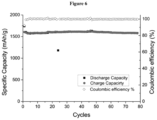
- FIG. 6 illustrates a graph of charge and discharge capacity versus cycle number of LiI SiCuMo cell, demonstrating a highly reversible capacity and an excellent capacity retention.
- substituted refers to an alkyl, alkenyl, alkynyl, aryl, or ether group, as defined below (e.g., an alkyl group) in which one or more bonds to a hydrogen atom contained therein are replaced by a bond to non-hydrogen or non-carbon atoms.
- Substituted groups also include groups in which one or more bonds to a carbon(s) or hydrogen(s) atom are replaced by one or more bonds, including double or triple bonds, to a heteroatom.
- a substituted group will be substituted with one or more substituents, unless otherwise specified.
- a substituted group is substituted with 1, 2, 3, 4, 5, or 6 substituents.
- substituent groups include: halogens (i.e., F, Cl, Br, and I); hydroxyls; alkoxy, alkenoxy, alkynoxy, aryloxy, aralkyloxy, heterocyclyloxy, and heterocyclylalkoxy groups; carbonyls (oxo); carboxyls; esters; urethanes; oximes; hydroxylamines; alkoxyamines; aralkoxyamines; thiols; sulfides; sulfoxides; sulfones; sulfonyls; sulfonamides; amines; N-oxides; hydrazines; hydrazides; hydrazones; azides; amides; ureas; amidines; guanidines; enamines; imides; isocyanates; isothiocyanates; cyanates; thiocyanates; imines; nitro groups; nitriles (i.
- alkyl groups include straight chain and branched alkyl groups having from 1 to about 20 carbon atoms, and typically from 1 to 12 carbons or, in some embodiments, from 1 to 8 carbon atoms.
- alkyl groups include cycloalkyl groups as defined below. Alkyl groups may be substituted or unsubstituted. Examples of straight chain alkyl groups include methyl, ethyl, n-propyl, n-butyl, n-pentyl, n-hexyl, n-heptyl, and n-octyl groups.
- branched alkyl groups include, but are not limited to, isopropyl, sec-butyl, t-butyl, neopentyl, and isopentyl groups.
- Representative substituted alkyl groups may be substituted one or more times with, for example, amino, thio, hydroxy, cyano, alkoxy, and/or halo groups such as F, Cl, Br, and I groups.
- haloalkyl is an alkyl group having one or more halo groups. In some embodiments, haloalkyl refers to a per-haloalkyl group.
- Cycloalkyl groups are cyclic alkyl groups such as, but not limited to, cyclopropyl, cyclobutyl, cyclopentyl, cyclohexyl, cycloheptyl, and cyclooctyl groups.
- the cycloalkyl group has 3 to 8 ring members, whereas in other embodiments the number of ring carbon atoms range from 3 to 5, 6, or 7. Cycloalkyl groups may be substituted or unsubstituted.
- Cycloalkyl groups further include polycyclic cycloalkyl groups such as, but not limited to, norbornyl, adamantyl, bornyl, camphenyl, isocamphenyl, and carenyl groups, and fused rings such as, but not limited to, decalinyl, and the like. Cycloalkyl groups also include rings that are substituted with straight or branched chain alkyl groups as defined above.
- Representative substituted cycloalkyl groups may be mono-substituted or substituted more than once, such as, but not limited to: 2,2-; 2,3-; 2,4-; 2,5-; or 2,6-disubstituted cyclohexyl groups or mono-, di-, or tri-substituted norbornyl or cycloheptyl groups, which may be substituted with, for example, alkyl, alkoxy, amino, thio, hydroxy, cyano, and/or halo groups.
- Alkenyl groups are straight chain, branched or cyclic alkyl groups having 2 to about 20 carbon atoms, and further including at least one double bond. In some embodiments alkenyl groups have from 1 to 12 carbons, or, typically, from 1 to 8 carbon atoms. Alkenyl groups may be substituted or unsubstituted. Alkenyl groups include, for instance, vinyl, propenyl, 2-butenyl, 3-butenyl, isobutenyl, cyclohexenyl, cyclopentenyl, cyclohexadienyl, butadienyl, pentadienyl, and hexadienyl groups among others.
- Alkenyl groups may be substituted similarly to alkyl groups.
- Divalent alkenyl groups i.e., alkenyl groups with two points of attachment, include, but are not limited to, CH—CH ⁇ CH 2 , C ⁇ CH 2 , or C ⁇ CHCH 3 .
- aryl or “aromatic,” groups are cyclic aromatic hydrocarbons that do not contain heteroatoms.
- Aryl groups include monocyclic, bicyclic and polycyclic ring systems.
- aryl groups include, but are not limited to, phenyl, azulenyl, heptalenyl, biphenylenyl, indacenyl, fluorenyl, phenanthrenyl, triphenylenyl, pyrenyl, naphthacenyl, chrysenyl, biphenyl, anthracenyl, indenyl, indanyl, pentalenyl, and naphthyl groups.
- aryl groups contain 6-14 carbons, and in others from 6 to 12 or even 6-10 carbon atoms in the ring portions of the groups.
- aryl groups includes groups containing fused rings, such as fused aromatic-aliphatic ring systems (e.g., indanyl, tetrahydronaphthyl, and the like).
- Aryl groups may be substituted or unsubstituted.
- electrochemical cells that are based upon a superlattice nanostructured anode that improve upon cycling stability in such cells when compared to electrochemical cells having conventional anodes.
- the anodes include alternating thin film layers of active material and inactive material, and have a plurality of small channels to allow for the electrolyte to deliver lithium ions to the layers of active material within the superlattice.
- the active material may include Si and the inactive material may include an intermetallic composition of copper and molybdenum.
- the inactive material may act as a rigid skeleton for the electrode and provide integrity to the anode by mechanically tolerating the destructive effect of the volumetric changes induced by Si atoms upon cycling.
- the alternating layers of active and inactive material in the superlattice advantageously improve the electrochemical performance of the electrode by minimizing and/or eliminating pulverization and unstable SEI formation, and suppressing the formation of crystalline Li 15 Si 4 (c-Li 15 Si 4 ) upon deep lithiation.
- the anodes of the present technology reduce the exposed surface area of the Si active material to the electrolyte by intercalating the active layer between two inactive material layers. Accordingly, the anodes of the present technology are expected to undergo a slower parasitic reaction than conventional Si based anodes.
- an anode for a lithium ion battery.
- the anodes include a current collector and a superlattice.
- the superlattice is configured to be disposed on at least a portion of the current collector, and the superlattice includes alternating layers of an anode active material and an anode inactive material.
- the superlattice may further include a plurality of channels that extend from the current collector through the alternating layers of anode active material and anode inactive material.
- FIG. 1 is one illustration that is representative of an anode as described herein.
- the current collector may include copper, stainless steel, titanium, tantalum, platinum, gold, aluminum, nickel, cobalt, cobalt nickel alloy, highly alloyed ferritic stainless steel containing molybdenum and chromium, a nickel-containing alloy, a chromium-containing alloy, or a molybdenum-containing alloy. Additionally, or alternatively, in some embodiments, the current collector is a foil.
- the superlattice may have a thickness of about 5 nm to about 5 ⁇ m. This may include, for example, a thickness of about 5 nm, about 6 nm, about 7 nm, about 8 nm, about 9 nm, about 10 nm, about 11 nm, about 12 nm, about 13 nm, about 14 nm, about 15 nm, about 16 nm, about 17 nm, about 18 nm, about 19 nm, about 20 nm, about 22 nm, about 24 nm, about 26 nm, about 28 nm, about 30 nm, about 32 nm, about 34 nm, about 36 nm, about 38 nm, about 40 nm, about 42 nm, about 44 nm, about 46 nm, about 48 nm, about 50 nm, about 52 nm, about 54 nm, about 56 nm, about 58 nm, about 60 nm, about 62
- Each of the plurality of alternating layers of the anode active material and the anode inactive material individually may have a thickness of about 0.1 nm to about 150 nm. This may include, for example, a thickness of about 0.1 nm, about 0.2 nm, about 0.3 nm, about 0.4 nm, about 0.5 nm, about 0.6 nm, about 0.7 nm, about 0.8 nm, about 0.9 nm, about 1 nm, about 1.1 nm, about 1.2 nm, about 1.3 nm, about 1.4 nm, about 1.5 nm, about 1.6 nm, about 1.7 nm, about 1.8 nm, about 1.9 nm, about 2 nm, about 2.2 nm, about 2.4 nm, about 2.6 nm, about 2.8 nm, about 3 nm, about 3.2 nm, about 3.4 nm, about 3.6 nm, about 3.8 nm,
- the anode active material may include Si, Zn, Sn, As, Sb, P, Cd, In, Mg, Ge, Al, S, Na, K, C, an oxide thereof, or a combination of any two or more thereof.
- the anode active material may include Si.
- the superlattice may include about 5 wt % to about 95 wt % anode active material. This may include, for example, about 5 wt %, about 5.2 wt %, about 5.4 wt %, about 5.6 wt %, about 5.8 wt %, about 6 wt %, about 6.2 wt %, about 6.4 wt %, about 6.6 wt %, about 6.8 wt %, about 7 wt %, about 7.2 wt %, about 7.4 wt %, about 7.6 wt %, about 7.8 wt %, about 8 wt %, about 8.2 wt %, about 8.4 wt %, about 8.6 wt %, about 8.8 wt %, about 9 wt %, about 9.2 wt %, about 9.4 wt %, about 9.6 wt %, about 9.8 wt %
- the plurality of alternating layers of an anode active material may include a nanocrystalline structure. In some embodiments, the plurality of alternating layers of an anode active material may include an amorphous structure.
- the anode inactive material includes Cu, Mo, Bi, Ni, Fe, Ti, V, C, Mn, Co, Ni, Ru, Rh, Ag, Au, Pd, W, Y, Sc, Zr, Nb, Hf, Ta, an oxide thereof, or a combination of any two or more thereof.
- the anode inactive material includes an intermetallic material of any two or more of Cu, Mo, Bi, Ni, Fe, Ti, V, C, Mn, Co, Ni, Tc, Ru, Rh, Ag, Au, Pd, W, Y, Sc, Zr, Nb, Hf, Ta, or an oxide thereof.
- the intermetallic material includes Cu and Mo.
- the superlattice may include about 95 wt % to about 5 wt % anode inactive material. This may include, for example, about 95 wt %, about 94 wt %, about 92 wt %, about 90 wt %, about 88 wt %, about 86 wt %, about 84 wt %, about 82 wt %, about 80 wt %, about 78 wt %, about 76 wt %, about 74 wt %, about 72 wt %, about 70 wt %, about 68 wt %, about 66 wt %, about 64 wt %, about 62 wt %, about 60 wt %, about 58 wt %, about 56 wt %, about 54 wt %, about 52 wt %, about 50 wt %, about 48 wt %.
- the superlattice may include a plurality of channels that extend from the current collector through the alternating layers of anode active material and anode inactive material.
- the plurality of channels may each have a width of about 0.1 nm to about 10 nm.
- This may include, for example, a width of about 0.1 nm, about 0.15 nm, about 0.2 nm, about 0.25 nm, about 0.3 nm, about 0.35 nm, about 0.4 nm, about 0.45 nm, about 0.5 nm, about 0.55 nm, about 0.6 nm, about 0.65 nm, about 0.7 nm, about 0.75 nm, about 0.8 nm, about 0.85 nm, about 0.9 nm, about 0.95 nm, about 1 nm, about 1.1 nm, about 1.2 nm, about 1.3 nm, about 1.4 nm, about 1.5 nm, about 1.6 nm, about 1.7 nm, about 1.8 nm, about 1.9 nm, about 2 nm, about 2.2 nm, about 2.4 nm, about 2.6 nm, about 2.8 nm, about 3 nm, about 3.2 nm, about
- the superlattice may further include a polymeric binder.
- binders may include, but are not limited to, polyvinylidene difluoride (PVDF), poly(acrylic acid) (PAA), lithiated PAA, polyimide (PI), polyacrylonitrile (PAN), styrene-butadiene rubber (SBR), carboxymethyl cellulose (CMC), or a combination of any two or more thereof.
- PVDF polyvinylidene difluoride
- PAA poly(acrylic acid)
- PI polyimide
- PAN polyacrylonitrile
- SBR styrene-butadiene rubber
- CMC carboxymethyl cellulose
- the anode may exhibit a specific capacity of about 1650 mAh/g to about 1750 mAh/g. This may include, for example, a specific capacity of about 1650 mAh/g, about 1655 mAh/g, about 1660 mAh/g, about 1665 mAh/g, about 1670 mAh/g, about 1675 mAh/g, about 1680 mAh/g, about 1685 mAh/g, about 1690 mAh/g, about 1695 mAh/g, about 1700 mAh/g, about 1705 mAh/g, about 1710 mAh/g, about 1715 mAh/g, about 1720 mAh/g, about 1725 mAh/g, about 1730 mAh/g, about 1735 mAh/g, about 1740 mAh/g, about 1745 mAh/g, about 1750 mAh/g, or any range including and/or in between any two of the preceding values.
- the present disclosure is directed to a lithium ion battery that includes a non-aqueous electrolyte, a cathode, and any of the anodes disclosed herein.
- the non-aqueous electrolyte may include an aprotic solvent and a metal salt.
- the non-aqueous electrolyte may include an alkali metal salt.
- the alkali metal salt may be a lithium salt or a sodium salt.
- the non-aqueous electrolyte includes a polar aprotic solvent and a lithium metal salt.
- a variety of solvents may be employed in the electrolyte as the polar aprotic solvent.
- the electrolytes are substantially non-aqueous. As used herein, the term “substantially non-aqueous” means that the electrolytes do not contain water, or if water is present, it is only present at trace levels. For example, where the water is present at trace levels it is present at less than 20 ppm.
- the polar aprotic solvent may include liquids and gels capable of solubilizing sufficient quantities of the lithium salt and a redox shuttle so that a suitable quantity of charge can be transported from the positive electrode to negative electrode.
- the solvents may be used over a wide temperature range, e.g., from about ⁇ 30° C. to about 70° C. without freezing or boiling, and are stable in the electrochemical range within which the cell electrodes and shuttle operate.
- the solvents may be used over a wide temperature range, e.g., from about ⁇ 30° C., about ⁇ 28° C., about ⁇ 26° C., about ⁇ 24° C., about ⁇ 22° C., about ⁇ 20° C., about ⁇ 19° C., about ⁇ 18° C., about ⁇ 17° C., about ⁇ 16° C., about ⁇ 15° C., about ⁇ 14° C., about ⁇ 13° C., about ⁇ 12° C., about ⁇ 11° C., about ⁇ 10° C., about ⁇ 9° C., about ⁇ 8° C., about ⁇ 7° C., about ⁇ 6° C., about ⁇ 5° C., about ⁇ 4° C., about ⁇ 3° C., about ⁇ 2° C., about ⁇ 1° C., about 0° C., about 1° C., about 2° C., about 3° C., about 4° C.
- Illustrative solvents include, but are not limited to, ethylene carbonate, dimethyl carbonate, ethyl methyl carbonate, diethyl carbonate, methyl propyl carbonate, ethyl propyl carbonate, dipropyl carbonate, propylene carbonate, fluoroethylene carbonate, bis(trifluoroethyl) carbonate, bis(pentafluoropropyl) carbonate, trifluoroethyl methyl carbonate, pentafluoroethyl methyl carbonate, heptafluoropropyl methyl carbonate, perfluorobutyl methyl carbonate, trifluoroethyl ethyl carbonate, pentafluoroethyl ethyl carbonate, heptafluoropropyl ethyl carbonate, perfluorobutyl ethyl carbonate, dioloxane, fluorinated oligomers, dimethoxyethane,
- Suitable salts for the electrolyte may include, but are not limited to, lithium alkyl fluorophosphates; lithium alkyl fluoroborates; lithium 4,5-dicyano-2-(trifluoromethyl)imidazole; lithium 4,5-dicyano-2-methylimidazole; trilithium 2,2′,2′′-tris(trifluoromethyl)benzotris(imidazolate); Li(CF 3 CO 2 ); Li(C 2 F 5 CO 2 ); LiCF 3 SO 3 ; LiCH 3 SO 3 ; LiN(SO 2 CF 3 ) 2 ; LiC(CF 3 SO 2 ) 3 ; LiN(SO 2 C 2 F 5 ) 2 ; LiClO 4 ; LiBF 4 ; LiAsF 6 ; LiPF 6 ; LiPF 2 (C 2 O 4 ) 2 ; LiPF 4 (C 2 O 4 ); LiB(C 2 O 4 ) 2 ; LiBF 2 (C 2 O 4 ) 2 ; Li 2 (B
- the salt may be present in the electrolyte at a concentration from about 0.5M to about 2M. This may include, for example, from about 0.5M, about 0.52M, about 0.54M, about 0.56M, about 0.58M, about 0.6M, about 0.62M, about 0.64M, about 0.66M, about 0.68M, about 0.7M, about 0.72M, about 0.74M, about 0.76M, about 0.78M, about 0.8M, about 0.82M, about 0.84M, about 0.86M, about 0.88M, about 0.9M, about 0.92M, about 0.94M, about 0.96M, about 0.98M, about 1M, about 1.02M, about 1.04M, about 1.06M, about 1.08M, about 1.1M, about 1.12M, about 1.14M, about 1.16M, about 1.18M, about 1.2M, about 1.22M, about 1.24M, about 1.26M, about 1.28M, about 1.3M, about 1.32M, about 1.34M, about
- the electrolyte may also include a redox shuttle.
- the redox shuttle if present, will have an electrochemical potential above the positive electrode's maximum normal operating potential.
- Illustrative redox shuttles include, but are not limited to, a spirocyclic hydrocarbon containing at least one oxygen atom and at least on alkenyl or alkynyl group, pyridazine, vinyl pyridazine, quinolone, pyridine, vinyl pyridine, 2,4-divinyl-tetrahydrooyran, 3,9-diethylidene-2,4,8-trioxaspiro[5,5]undecane, 2-ethylidene-5-vinyl-[1,3]dioxane, lithium alkyl fluorophosphates, lithium alkyl fluoroborates, lithium 4,5-dicyano-2-(trifluoromethyl)imidazole, lithium 4,5-dicyano-2-
- the lithium salt is LiClO 4
- it may also perform the dual function of being a redox shuttle, however if a redox shuttle is included in that same cell, it will be a different material than LiClO 4 .
- the lithium ion batteries may include a cathode that includes a cathode active material.
- the cathode active material may include, but is not limited to, a spinel, an olivine, a carbon-coated olivine, LiFePO 4 , LiMn 0.5 Ni 0.5 O 2 , LiCoO 2 , LiNiO 2 , LiNi 1-x Co y Me z O 2 , LiNi ⁇ Mn ⁇ Co ⁇ O 2 , LiMn 2 O 4 , LiFeO 2 , LiNi 0.5 Me 1.5 O 4 , Li 1+x′ Ni h Mn k Co l Me 2 y′ O 2-z′ F z′ , VO 2 or E x′′ F 2 (Me 3 O 4 ) 3 , LiNi m Mn n O 4 , wherein Me is Al, Mg, Ti, B, Ga, Si, Mn, or Co; Me 2 is Mg, Zn, Al
- the electrically conductive material ly may include, but is not limited to, graphite, graphene, expanded graphite, reduced graphene oxide, Black Pearls® 2000, Ketjenblack®, acetylene black, carbon black, a metal-organic framework, porous carbon, carbon spheres, carbon aerogel, single-walled carbon nanotubes, multi-walled carbon nanotubes, carbon nanofibers, carbon nanotube arrays, or a combination of any two or more thereof.
- spinel refers to a manganese-based spinel such as, Li 1+x Mn 2-y Me z O 4-h A k , wherein Me is Al, Mg, Ti, B, Ga, Si, Ni, or Co; A is S or F; and wherein 0 ⁇ x ⁇ 0.5, 0 ⁇ y ⁇ 0.5, 0 ⁇ z ⁇ 0.5, 0 ⁇ h ⁇ 0.5, and 0 ⁇ k ⁇ 0.5.
- olivine refers to an iron-based olivine such as, LiFe 1 ⁇ x Me y PO 4-h A k , wherein Me is Al, Mg, Ti, B, Ga, Si, Ni, or Co; A is S or F; and wherein 0 ⁇ x ⁇ 0.5, 0 ⁇ y ⁇ 0.5, 0 ⁇ h ⁇ 0.5, and 0 ⁇ k ⁇ 0.5.
- the cathode may be further stabilized by surface coating the active particles with a material that can neutralize acid or otherwise lessen or prevent leaching of the transition metal ions.
- the cathodes may also include a surface coating of a metal oxide or a metal fluoride such as ZrO 2 , TiO 2 , ZnO 2 , WO 3 , Al 2 O 3 , MgO, SiO 2 , SnO 2 , AlPO 4 , Al(OH) 3 , AlF 3 , ZnF 2 , MgF 2 , TiF 4 , ZrF 4 , CaO, In 2 O 3 , Ga 2 O 3 , Sc 2 O 3 , Y 2 O 3 , La 2 O 3 , HfO 2 , V 2 O 5 , Nb 2 O 5 , Ta 2 O 5 , MnO, MnO 2 , CoO, Co 2 O 3 , NiO, NiO 2 , CuO, ZnO, MgF
- the cathode may be further stabilized by surface coating the active particles with polymer materials.
- polymer coating materials include, but are not limited to, polysiloxanes, polyethylene glycol, poly(3,4-ethylenedioxythiophene) polystyrene sulfonate, or a combination of any two or more thereof.
- the electrolyte may further include an electrode stabilizing additive.
- the electrode stabilizing additive is used to protect the electrodes from degradation. Examples of electrode stabilizing additives may be found in U.S. patent application Ser. Nos. 10/857,365, 11/279,120, and 60/647,361, of which the entire contents are incorporated herein by reference. Hence, the electrode stabilizing additive which may be included herein may be reduced or polymerized on the surface of the negative electrode. Likewise, the electrode stabilizing additive which may be included herein may be oxidized or polymerized on the surface of the positive electrode.
- the electrolyte may include about 0.001 wt % to about 8 wt % of the electrode stabilizing additive. This may include, for example, about 0.001 wt %, about 0.002 wt %, about 0.003 wt %, about 0.004 wt %, about 0.005 wt %, about 0.006 wt %, about 0.007 wt %, about 0.008 wt %, about 0.009 wt %, about 0.01 wt %, about 0.02 wt %, about 0.03 wt %, about 0.04 wt %, about 0.05 wt %, about 0.06 wt %, about 0.07 wt %, about 0.08 wt %, about 0.09 wt %, about 0.1 wt %, about 0.15 wt %, about 0.2 wt %, about 0.25 wt %, about 0.3
- the electrode stabilizing additive may include 1,2-divinyl furoate, 1,3-butadiene carbonate, 1-vinylazetidin-2-one, 1-vinylaziridin-2-one, 1-vinylpiperidin-2-one, 1-vinylpyrrolidin-2-one, 2,4-divinyl-1,3-dioxane, 2-amino-3-vinylcyclohexanone, 2-amino-3-vinylcyclopropanone, 2-amino-4-vinylcyclobutanone, 2-amino-5-vinylcyclopentanone, 2-aryloxy-cyclopropanone, 2-vinyl-[1,2]oxazetidine, 2-vinylaminocyclohexanol, 2-vinylaminocyclopropanone, 2-vinyloxetane, 2-vinyloxy-cyclopropanone, 3-(N-vinylamino)cyclohexanone, 3,5-diviny
- the electrode stabilizing additive may be a cyclotriphosphazene that is substituted with F, alkyloxy, alkenyloxy, aryloxy, methoxy, allyloxy groups, or a combination of any two or more thereof.
- Illustrative electrode stabilizing additives may include, but are not limited to (divinyl)-(methoxy)(trifluoro)cyclotriphosphazene, (trivinyl)(difluoro)(methoxy)cyclotriphosphazene, (vinyl)(methoxy)(tetrafluoro)cyclotriphosphazene, (aryloxy)(tetrafluoro)(methoxy)-cyclotriphosphazene, (diaryloxy)(trifluoro)(methoxy)cyclotriphosphazene, or a combination of any two or more thereof.
- the electrode stabilizing additive may include compounds with phenyl, naphthyl, anthracenyl, pyrrolyl, oxazolyl, furanyl, indolyl, carbazolyl, imidazolyl, or thiophenyl groups.
- Illustrative electrode stabilizing additives may include, but are not limited to, aryloxy pyrrole, aryloxy ethylene sulfate, aryloxy pyrazine, aryloxy-carbazole trivinylphosphate, aryloxy-ethyl-2-furoate, aryloxy-o-terphenyl, aryloxy-pyridazine, butyl-aryloxy-ether, divinyl diphenyl ether, (tetrahydro-furan-2-yl)-vinylamine, divinyl methoxybipyridine, methoxy-4-vinylbiphenyl, vinyl methoxy carbazole, vinyl methoxy piperidine, vinyl methoxypyrazine, vinyl methyl carbonate-allylanisole, vinyl pyridazine, 1-divinylimidazole, 3-vinyltetrahydrofuran, divinyl furan, divinyl methoxy furan, divinyl
- the electrode stabilizing additives may include substituted or unsubstituted spirocyclic hydrocarbons which may contain at least one oxygen atom and at least one alkenyl or alkynyl group.
- Illustrative electrode stabilizing additives include, but are not limited to, a compound represented by the Formula X:
- Illustrative compounds of Formula X include, but are not limited to, 3,9 divinyl-2,4,8,10-tetraoxaspiro[5.5]undecane, 3,9-divinyl-2,4,8-trioxaspiro[5.5]undecane, 3,9-divinyl-2,4-dioxaspiro[5.5]undecane, 3,9-diethylidene-2,4,8,10-tetraoxaspiro[5.5]undecane, 3,9 diethylidene-2,4,8-trioxaspiro[5.5]undecane, 3,9-diethylidene-2,4-dioxaspiro[5.5]undecane, 3,9-dimethylene-2,4,8,10-tetraoxaspiro[5.5]undecane, 3,9-divinyl-1,5,7,11-tetraoxaspiro[5.5]undecane, 3,9 dimethylene-1,
- the electrode stabilizing additive may be an anion receptor.
- the anion receptor is a Lewis acid.
- the anion receptor is a borane, a boronate, a borate, a borole, or a combination of any two or more thereof.
- Illustrative anion receptors include, but are not limited to, a compound represented by the Formula XI:
- R 14 , R 15 , and R 16 are independently at each occurrence halogen, alkyl, aryl, halogen-substituted alkyl, halogen-substituted aryl, or OR 17 ; or any two of R 14 , R 15 , R 16 , and R 17 , together with the atoms to which they are attached, form a heterocyclic ring having 5-9 members, and R 17 is independently at each occurrence alkyl, aryl, halogen-substituted alkyl, or halogen-substituted aryl.
- R 14 , R 15 , and R 16 are independently at each occurrence halogen, alkyl, aryl, halogen-substituted alkyl, or halogen-substituted aryl; or any two of R 14 , R 15 , and R 16 together with the atoms to which they are attached, form a heterocyclic ring having 5-9 members.
- the anion receptor may be tri(propyl)borate, tris(1,1,1,3,3,3-hexafluoro-propan-2-yl)borate, tris(1,1,1,3,3,3-hexafluoro-2-phenyl-propan-2-yl)borate, tris(1,1,1,3,3,3-hexafluoro-2-(trifluoromethyl)propan-2-yl)borate, triphenyl borate, tris(4-fluorophenyl)borate, tris(2,4-difluorophenyl)borate, tris(2,3,5,6-tetrafluorophenyl)borate, tris(pentafluorophenyl)borate, tris(3-(trifluoromethyl)phenyl)borate, tris(3,5-bis(trifluoromethyl)phenyl)borate, tris(pentafluorophenyl)borane, or a combination of
- the anion receptor may be one or more of 2-(2,4-difluorophenyl)-4-fluoro-1,3,2-benzodioxaborole, 2-(3-trifluoromethyl phenyl)-4-fluoro-1,3,2-benzodioxaborole, 2,5-bis(trifluoromethyl)phenyl-4-fluoro-1,3,2-benzodioxaborole, 2-(4-fluorophenyl)-tetrafluoro-1,3,2-benzodioxaborole, 2-(2,4-difluorophenyl)-tetrafluoro-1,3,2-benzodioxaborole, 2-(pentafluorophenyl)-tetrafluoro-1,3,2-benzodioxaborole, 2-(2-trifluoromethyl phenyl)-tetrafluoro-1,3,2-benzodioxaborole, 2,5-bis(triflufluoromethyl
- the lithium ion batteries may further include a porous separator.
- the porous separator may separate the cathode from the anode and prevent, or at least minimize, short-circuiting in the device.
- the separator may be a polymer or ceramic or a mixed separator.
- the separator may include, but is not limited to, polypropylene (PP), polyethylene (PE), trilayer (PP/PE/PP), or polymer films that may optionally be coated with alumina-based ceramic particles.
- the present disclosure provides a method for making an anode for a lithium ion battery, the method including providing a current collector, and depositing alternating layers of an anode active material and an anode inactive material to form a superlattice; wherein the superlattice is disposed on at least a portion of the current collector.
- the superlattice may be deposited using a physical vapor deposition method.
- the physical vapor deposition method may include magnetron sputtering or electron beam evaporation.
- the physical vapor deposition method may include magnetron sputtering.
- the methods may include mounting a current collector on a rotating table to receive deposited material via sputtering.
- the physical vapor deposition method may have the current collector configured to be disposed on a rotating table.
- the current collector may be provided as a substrate on the rotating table.
- the rotating table may be a planetary turn table.
- the planetary turn table may be configured to provide substrate rotation.
- substrate rotation may provide 2-fold, 3-fold, 4-fold, 5-fold, or 6-fold rotation.
- substrate rotation may provide 2-fold rotation.
- substrate rotation may provide 3-fold rotation.
- the substrate may be cleaned via argon etching prior to deposition.
- BIAS is applied to the substrate to increase the adhesion of the film to the substrate and/or to increase the density of the microstructures.
- the physical vapor deposition method includes at least one target for the anode active material. In some embodiments, the physical vapor deposition method includes at least two targets for the anode active material. In other embodiments, the physical vapor deposition method includes at least three targets for the anode active material. In further embodiments, the physical vapor deposition method includes at least four targets for the anode active material. In some embodiments, the physical vapor deposition method includes at least five targets for the anode active material. In some embodiments, the physical vapor deposition method includes at least six targets for the anode active material.
- the physical vapor deposition method includes at least one target for the anode inactive material. In some embodiments, the physical vapor deposition method includes at least two targets for the anode inactive material. In some embodiments, the physical vapor deposition method includes at least three targets for the anode inactive material. In some embodiments, the physical vapor deposition method includes at least four targets for the anode inactive material. In some embodiments, the physical vapor deposition method includes at least five targets for the anode inactive material. In some embodiments, the physical vapor deposition method includes at least six targets for the anode inactive material.
- the alternating layers of the anode active material and the anode inactive material may be deposited discontinuously to form a plurality of channels.
- the plurality of channels extends from the current collector through the alternating layers of anode active material and anode inactive material.
- a plurality of channels may be cut and/or etched into the superlattice after forming the superlattice on the current collector. The plurality of channels extends from the current collector through the alternating layers of anode active material and anode inactive material.
- the present technology is further illustrated by the following Example, which should not be construed as limiting in any way.
- the examples herein are provided to illustrate advantages of the present technology and to further assist a person of ordinary skill in the art with preparing or using the compositions and systems of the present technology.
- the examples should in no way be construed as limiting the scope of the present technology, as defined by the appended claims.
- the examples can include or incorporate any of the variations, aspects, or embodiments of the present technology described above.
- the variations, aspects, or embodiments described above may also further each include or incorporate the variations of any or all other variations, aspects or embodiments of the present technology.
- a superlattice, nanostructured SiCuMo electrode was prepared by physical vapor deposition, specifically via magnetron sputtering.
- substrates Prior to deposition, substrates were located on a substrate tower in a planetary turn table wherein the gear ratio is 100:37. High purity and Cu—Mo targets were used for the preparation of the anode.
- the samples were rotated on a planetary holder system to increase the interaction among the Cu—Si—Mo atoms.
- the planetary turn table provides two-fold rotation with the main turntable rotating at a speed of 10 rpm (anti-clock wise) with 6 satellites.
- the samples Prior to deposition, the samples were cleaned with acetone and isopropyl alcohol. The deposition chamber was then pumped down to a pressure less than 10-5 Pa.
- argon etching was applied to the substrate at 550 V bipolar pulsed with 250 kHz frequency and 1600 ns reverse time. After substrate cleaning, 500 W and 2000 W were applied to Cu-Mo and Si targets, respectively for 150 min at ⁇ 100 V bias for the deposition. Magnetron sputtering occurred without mechanical shielding/shuttering or gas flow. To sputter the Cu—Mo and Si targets, direct current (DC) and high-power impulse magnetron sputtering (HPPMS) power supplies were used respectively and independently. As shown in FIG. 2 , the small gaps provided between the domains may serve as the channels for the non-aqueous electrolyte to diffuse in and provide a pathway for lithium ions to access the layers of active material.
- DC direct current
- HPPMS high-power impulse magnetron sputtering
- FIG. 3 shows the energy-dispersive x-ray spectroscopy (EDS) elemental mapping of the superlattice, nanostructured SiCuMo electrode.
- the bright area in FIG. 3 shows the presence of heavy elements (Cu and Mo) and the dark area shows the presence of light elements (Si).
- the results illustrate the presence of a layer-by-layer structure. Further details on elemental distribution was determined via Nano Secondary Ion Mass Spectrometry (NanoSims) experiments ( FIG. 5 ).
- the data demonstrate homogenous distribution of Si along the thickness of the thin film. However, the data clearly demonstrate concentration attenuation for both Cu and Mo along the thickness of the thin film. Accordingly, the data from the both the EDS and nano-SIM experiments confirm the layer-by-layer structure design principle.
- FIG. 4 shows electron diffraction patterns of the superlattice, nanostructured SiCuMo electrode.
- the data demonstrates the amorphous structure of the thin film, which decreases the destructive effect of the internal stresses in the electrode upon cycling.
- FIG. 6 shows the charge/discharge capacity of a Li/SiCuMo electrochemical cell during cycling with a constant current of C/10.
- the anode is a superlattice nanostructured SiCuMo electrode that has a total thickness of 3.6 ⁇ m.
- the electrolyte used in this study was LiPF 6 (1.0 M) in an ethylene carbonate (EC)-dimethyl carbonate (DMC) (1:1) electrolyte solution with 10% fluoroethylene carbonate (FEC).
- the electrochemical cell delivers an initial discharge capacity of about 1750 mAh/g, and an initial charge capacity of about 1650 mAh/g.
- the initial irreversible capacity loss was about 5%, which is substantially smaller than the traditional Si-based intermetallic alloys. The latter value being sustained for more than 50 cycles.
- a range includes each individual member.
- a group having 1-3 atoms refers to groups having 1, 2, or 3 atoms.
- a group having 1-5 atoms refers to groups having 1, 2, 3, 4, or 5 atoms, and so forth.
Landscapes
- Chemical & Material Sciences (AREA)
- Chemical Kinetics & Catalysis (AREA)
- Engineering & Computer Science (AREA)
- Electrochemistry (AREA)
- General Chemical & Material Sciences (AREA)
- Materials Engineering (AREA)
- Manufacturing & Machinery (AREA)
- Mechanical Engineering (AREA)
- Metallurgy (AREA)
- Organic Chemistry (AREA)
- Composite Materials (AREA)
- Secondary Cells (AREA)
Abstract
Description

wherein A1, A2, A3, and A4 are independently at each occurrence O or CR12R13; provided that A1 is not O when G1 is O, A2 is not O when G2 is O, A3 is not O when G3 is O, and A4 is not O when G4 is O; G1, G2, G3, and G4 are independently at each occurrence O or CR12R13; provided that G1 is not O when A1 is O, G2 is not O when A2 is O, G3 is not O when A3 is O, and G4 is not O when A4 is O; R10 and R11 are independently at each occurrence a substituted or unsubstituted divalent alkenyl or alkynyl group; and R12 and R13 are independently at each occurrence H, F, Cl, or a substituted or an unsubstituted alkyl, alkenyl, or alkynyl group.

wherein R14, R15, and R16 are independently at each occurrence halogen, alkyl, aryl, halogen-substituted alkyl, halogen-substituted aryl, or OR17; or any two of R14, R15, R16, and R17, together with the atoms to which they are attached, form a heterocyclic ring having 5-9 members, and R17 is independently at each occurrence alkyl, aryl, halogen-substituted alkyl, or halogen-substituted aryl. In some embodiments, R14, R15, and R16 are independently at each occurrence halogen, alkyl, aryl, halogen-substituted alkyl, or halogen-substituted aryl; or any two of R14, R15, and R16 together with the atoms to which they are attached, form a heterocyclic ring having 5-9 members.
Claims (22)
Priority Applications (1)
| Application Number | Priority Date | Filing Date | Title |
|---|---|---|---|
| US16/268,208 US11575125B2 (en) | 2019-02-05 | 2019-02-05 | Patterned anode for lithium-ion batteries |
Applications Claiming Priority (1)
| Application Number | Priority Date | Filing Date | Title |
|---|---|---|---|
| US16/268,208 US11575125B2 (en) | 2019-02-05 | 2019-02-05 | Patterned anode for lithium-ion batteries |
Publications (2)
| Publication Number | Publication Date |
|---|---|
| US20200251725A1 US20200251725A1 (en) | 2020-08-06 |
| US11575125B2 true US11575125B2 (en) | 2023-02-07 |
Family
ID=71837876
Family Applications (1)
| Application Number | Title | Priority Date | Filing Date |
|---|---|---|---|
| US16/268,208 Active 2039-09-04 US11575125B2 (en) | 2019-02-05 | 2019-02-05 | Patterned anode for lithium-ion batteries |
Country Status (1)
| Country | Link |
|---|---|
| US (1) | US11575125B2 (en) |
Families Citing this family (1)
| Publication number | Priority date | Publication date | Assignee | Title |
|---|---|---|---|---|
| US20260112683A1 (en) * | 2023-02-14 | 2026-04-23 | Graphenix Development, Inc. | Solid-state lithium-ion batteries and methods of making same |
Citations (5)
| Publication number | Priority date | Publication date | Assignee | Title |
|---|---|---|---|---|
| US20050019670A1 (en) | 2003-07-17 | 2005-01-27 | Khalil Amine | Long life lithium batteries with stabilized electrodes |
| US20120315543A1 (en) * | 2010-02-19 | 2012-12-13 | Toshie Wata | Coin-type lithium secondary battery |
| US20140099539A1 (en) * | 2012-10-05 | 2014-04-10 | Semiconductor Energy Laboratory Co., Ltd. | Negative electrode for lithium-ion secondary battery, manufacturing method thereof, and lithium-ion secondary battery |
| US20140212735A1 (en) * | 2013-01-25 | 2014-07-31 | Wenming Li | System, Method and Apparatus for Forming a Thin Film Lithium Ion Battery |
| US20160020035A1 (en) * | 2014-07-18 | 2016-01-21 | Semiconductor Energy Laboratory Co., Ltd. | Electrode, power storage device, electronic device, and vehicle |
-
2019
- 2019-02-05 US US16/268,208 patent/US11575125B2/en active Active
Patent Citations (5)
| Publication number | Priority date | Publication date | Assignee | Title |
|---|---|---|---|---|
| US20050019670A1 (en) | 2003-07-17 | 2005-01-27 | Khalil Amine | Long life lithium batteries with stabilized electrodes |
| US20120315543A1 (en) * | 2010-02-19 | 2012-12-13 | Toshie Wata | Coin-type lithium secondary battery |
| US20140099539A1 (en) * | 2012-10-05 | 2014-04-10 | Semiconductor Energy Laboratory Co., Ltd. | Negative electrode for lithium-ion secondary battery, manufacturing method thereof, and lithium-ion secondary battery |
| US20140212735A1 (en) * | 2013-01-25 | 2014-07-31 | Wenming Li | System, Method and Apparatus for Forming a Thin Film Lithium Ion Battery |
| US20160020035A1 (en) * | 2014-07-18 | 2016-01-21 | Semiconductor Energy Laboratory Co., Ltd. | Electrode, power storage device, electronic device, and vehicle |
Non-Patent Citations (1)
| Title |
|---|
| Gao, et al., "Parasitic Reactions in Nanosized Silicon Anodes for Lithium-Ion Batteries," Nano. Lett., Feb. 8, 2017, vol. 17, No. 3, pp. 1512-1519 (abstract). |
Also Published As
| Publication number | Publication date |
|---|---|
| US20200251725A1 (en) | 2020-08-06 |
Similar Documents
| Publication | Publication Date | Title |
|---|---|---|
| US12327844B2 (en) | Materials to improve the performance of lithium and sodium batteries | |
| JP4379743B2 (en) | Electrolyte and secondary battery | |
| JP4241815B2 (en) | Electrolyte and battery | |
| EP3598560B1 (en) | Electrolyte solution for non-aqueous-electrolyte battery, and non-aqueous electrolyte battery using the same | |
| US9203111B2 (en) | Secondary battery | |
| US20200313157A1 (en) | Over-lithiated cathodes for lithium ion batteries and processes of manufacture | |
| US8394540B2 (en) | Anode and method of manufacturing same, secondary battery and method of manufacturing same, and sulfone compound | |
| JP4780337B2 (en) | Lithium ion secondary battery | |
| JP4329806B2 (en) | Secondary battery | |
| WO2011081113A1 (en) | Non-aqueous electrolyte and non-aqueous electrolyte battery | |
| JP5066807B2 (en) | Lithium secondary battery electrolyte and lithium secondary battery | |
| JP4836767B2 (en) | Lithium ion secondary battery | |
| JPWO2016063902A1 (en) | Secondary battery | |
| US20130337345A1 (en) | Oxide anode materials for lithium batteries | |
| KR20080018850A (en) | Electrolyte and Battery | |
| US20230246240A1 (en) | Lithium secondary battery | |
| US10847839B2 (en) | Non-aqueous electrolytes for lithium batteries | |
| US10283810B2 (en) | Lithium-ion battery | |
| JP5120596B2 (en) | Non-aqueous electrolyte, electrochemical device and non-aqueous secondary battery | |
| JP2008135273A (en) | Electrolyte and battery | |
| JP4506782B2 (en) | Secondary battery electrolyte and secondary battery | |
| KR101423632B1 (en) | Ionic compounds, electrolytes, electrochemical devices and batteries | |
| JPWO2015194559A1 (en) | Electrolyte and secondary battery | |
| KR20090099496A (en) | Electrolyte and Secondary Battery | |
| US10978741B2 (en) | Non-aqueous electrolytes for electrochemical cells |
Legal Events
| Date | Code | Title | Description |
|---|---|---|---|
| FEPP | Fee payment procedure |
Free format text: ENTITY STATUS SET TO UNDISCOUNTED (ORIGINAL EVENT CODE: BIG.); ENTITY STATUS OF PATENT OWNER: SMALL ENTITY |
|
| FEPP | Fee payment procedure |
Free format text: ENTITY STATUS SET TO SMALL (ORIGINAL EVENT CODE: SMAL); ENTITY STATUS OF PATENT OWNER: SMALL ENTITY |
|
| AS | Assignment |
Owner name: UNITED STATES DEPARTMENT OF ENERGY, DISTRICT OF COLUMBIA Free format text: CONFIRMATORY LICENSE;ASSIGNOR:UCHICAGO ARGONNE, LLC;REEL/FRAME:049460/0662 Effective date: 20190405 |
|
| AS | Assignment |
Owner name: UCHICAGO ARGONNE, LLC, ILLINOIS Free format text: ASSIGNMENT OF ASSIGNORS INTEREST;ASSIGNORS:CHEN, ZONGHAI;AMINE, KHALIL;AMINE, RACHID;AND OTHERS;SIGNING DATES FROM 20200224 TO 20200310;REEL/FRAME:052757/0858 |
|
| STPP | Information on status: patent application and granting procedure in general |
Free format text: NON FINAL ACTION MAILED |
|
| STPP | Information on status: patent application and granting procedure in general |
Free format text: RESPONSE TO NON-FINAL OFFICE ACTION ENTERED AND FORWARDED TO EXAMINER |
|
| STPP | Information on status: patent application and granting procedure in general |
Free format text: FINAL REJECTION MAILED |
|
| STPP | Information on status: patent application and granting procedure in general |
Free format text: RESPONSE AFTER FINAL ACTION FORWARDED TO EXAMINER |
|
| STPP | Information on status: patent application and granting procedure in general |
Free format text: ADVISORY ACTION MAILED |
|
| STPP | Information on status: patent application and granting procedure in general |
Free format text: DOCKETED NEW CASE - READY FOR EXAMINATION |
|
| STPP | Information on status: patent application and granting procedure in general |
Free format text: NON FINAL ACTION MAILED |
|
| STPP | Information on status: patent application and granting procedure in general |
Free format text: RESPONSE TO NON-FINAL OFFICE ACTION ENTERED AND FORWARDED TO EXAMINER |
|
| STPP | Information on status: patent application and granting procedure in general |
Free format text: FINAL REJECTION MAILED |
|
| STPP | Information on status: patent application and granting procedure in general |
Free format text: DOCKETED NEW CASE - READY FOR EXAMINATION |
|
| STPP | Information on status: patent application and granting procedure in general |
Free format text: NOTICE OF ALLOWANCE MAILED -- APPLICATION RECEIVED IN OFFICE OF PUBLICATIONS |
|
| STCF | Information on status: patent grant |
Free format text: PATENTED CASE |
|
| MAFP | Maintenance fee payment |
Free format text: PAYMENT OF MAINTENANCE FEE, 4TH YR, SMALL ENTITY (ORIGINAL EVENT CODE: M2551); ENTITY STATUS OF PATENT OWNER: SMALL ENTITY Year of fee payment: 4 |