US11566955B2 - Detection apparatus that improves a positional relation between a working surface and a sensor - Google Patents
Detection apparatus that improves a positional relation between a working surface and a sensor Download PDFInfo
- Publication number
- US11566955B2 US11566955B2 US17/174,651 US202117174651A US11566955B2 US 11566955 B2 US11566955 B2 US 11566955B2 US 202117174651 A US202117174651 A US 202117174651A US 11566955 B2 US11566955 B2 US 11566955B2
- Authority
- US
- United States
- Prior art keywords
- force
- detection
- detection axis
- working surface
- sensor
- Prior art date
- Legal status (The legal status is an assumption and is not a legal conclusion. Google has not performed a legal analysis and makes no representation as to the accuracy of the status listed.)
- Active, expires
Links
Images




Classifications
-
- G—PHYSICS
- G01—MEASURING; TESTING
- G01L—MEASURING FORCE, STRESS, TORQUE, WORK, MECHANICAL POWER, MECHANICAL EFFICIENCY, OR FLUID PRESSURE
- G01L27/00—Testing or calibrating of apparatus for measuring fluid pressure
- G01L27/002—Calibrating, i.e. establishing true relation between transducer output value and value to be measured, zeroing, linearising or span error determination
-
- G—PHYSICS
- G01—MEASURING; TESTING
- G01L—MEASURING FORCE, STRESS, TORQUE, WORK, MECHANICAL POWER, MECHANICAL EFFICIENCY, OR FLUID PRESSURE
- G01L5/00—Apparatus for, or methods of, measuring force, work, mechanical power, or torque, specially adapted for specific purposes
- G01L5/16—Apparatus for, or methods of, measuring force, work, mechanical power, or torque, specially adapted for specific purposes for measuring several components of force
-
- B—PERFORMING OPERATIONS; TRANSPORTING
- B25—HAND TOOLS; PORTABLE POWER-DRIVEN TOOLS; MANIPULATORS
- B25J—MANIPULATORS; CHAMBERS PROVIDED WITH MANIPULATION DEVICES
- B25J13/00—Controls for manipulators
- B25J13/08—Controls for manipulators by means of sensing devices, e.g. viewing or touching devices
- B25J13/085—Force or torque sensors
-
- G—PHYSICS
- G01—MEASURING; TESTING
- G01L—MEASURING FORCE, STRESS, TORQUE, WORK, MECHANICAL POWER, MECHANICAL EFFICIENCY, OR FLUID PRESSURE
- G01L5/00—Apparatus for, or methods of, measuring force, work, mechanical power, or torque, specially adapted for specific purposes
- G01L5/0061—Force sensors associated with industrial machines or actuators
Definitions
- the present disclosure relates to a detection apparatus.
- Force/torque sensors which detect the direction and magnitude of exerted force.
- the force/torque sensor detects, for example, the magnitude of the force in three axis directions (x, y, z) and the magnitude of torque around each of the axes. Examples of the force/torque sensor are described, for example, in Japanese Patent Laid-Open No. 2004-325367, Japanese Patent Laid-Open No. 2004-354049, and Japanese Patent Laid-Open No. Hei 8-122178.
- the force/torque sensor above detects the force and moment exerted on a surface such as a ground contact surface of a foot sole of a robot, for example. In detecting such a force and a moment, it is appropriate to correct the output of the sensor by taking into account the location where the sensor is installed in the robot and the effect of the environment in which the robot is placed.
- viable techniques for optimizing the positional relation between the working surface of the robot and the sensor on the assumption of these conditions have not been proposed yet.
- a detection apparatus including a housing that includes a working surface, and a sensor configured to detect the force or the moment exerted on the working surface, on at least a first detection axis and a second detection axis.
- the working surface coincides with a surface that includes the first detection axis and the second detection axis, the working surface being at least partially symmetrical around the first detection axis passing through the center of the sensor.
- the working surface may be at least partially symmetrical further around the second detection axis passing through the center of the sensor.
- the working surface as a whole may be symmetrical around each of the first detection axis and the second detection axis passing through the center of the sensor.
- the working surface may have a missing portion formed symmetrically around the first detection axis passing through the center of the sensor.
- the missing portion may be formed symmetrically further around the second detection axis passing through the center of the sensor.
- the working surface may be a ground contact surface of a foot part of a robot.
- the detection apparatus may further include a correction processing section configured to correct the output of the sensor on the assumption that the force and the moment are generated evenly on both sides of the first detection axis in a part of the working surface that is symmetrical around the first detection axis.
- the configurations outlined above make it possible to optimize the positional relation between the working surface and the sensor. Specifically, for example, the calculations for sensor output correction are simplified on the assumption that the force and the moment are evenly exerted on both sides of each detection axis.
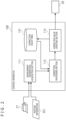
- FIG. 1 is a view depicting a typical hardware configuration of a robot according to one embodiment of the present disclosure
- FIG. 2 is a block diagram depicting a functional block configuration related to the control of a force/torque sensor illustrated in FIG. 1 ;
- FIG. 3 is a set of views conceptually explaining an example of temperature-based output correction in the embodiment of the present disclosure
- FIG. 4 is a flowchart depicting a typical process of updating the correction value in the example illustrated in FIG. 3 ;
- FIG. 5 is a view conceptually explaining an example of material-based output correction in the embodiment of the present disclosure.
- FIG. 6 A is a view depicting a first arrangement example of the force/torque sensor
- FIG. 6 B is another view depicting the first arrangement example of the force/torque sensor
- FIG. 7 is a view depicting a second arrangement example of the force/torque sensor
- FIG. 8 A is a view depicting a third arrangement example of the force/torque sensor.
- FIG. 8 B is another view depicting the third arrangement example of the force/torque sensor.
- FIG. 1 is a view depicting a typical hardware configuration of a robot according to the embodiment of the present disclosure.
- a robot 10 has a control apparatus 100 installed in its main body part 12 .
- the control apparatus 100 includes a central processing unit (CPU) 110 , a random access memory (RAM) 120 , a read-only memory (ROM) 130 , and an external memory 140 .
- the control apparatus 100 determines the operation of the robot 10 according to video data acquired by a camera 21 , audio data obtained by a microphone 22 , command signals received by a communication interface 24 , or the like.
- the camera 21 , microphone 22 , and communication interface 24 are connected to the control apparatus 100 via a bus interface 150 .
- the control apparatus 100 controls the components of the robot 10 in a manner executing the determined operation. Specifically, the control apparatus 100 controls motors 30 that rotatively drive the joints of arm parts 13 L and 13 R, hand parts 14 L and 14 R, leg parts 15 L and 15 R, and foot parts 16 L and 16 R of the robot 10 so as to carry out the determined operation. Although not illustrated, a head part 11 and the main body part 12 may also have joints driven by the motors 30 .
- the CPU 110 of the control apparatus 100 selects a pattern corresponding to the determined operation out of the control patterns stored in the ROM 130 or in the external memory 140 , sets a foot part movement, a zero-moment point (ZMP) locus, a trunk movement, an upper limb movement, and the horizontal position and height of a lumbar part in keeping with the selected pattern, and controls the motors 30 according to the settings.
- ZMP zero-moment point
- the robot 10 further incorporates sensors such as an inertial measurement unit (IMU) 25 , a force/torque sensor 26 , and a temperature sensor 27 .
- the sensors are connected to the control apparatus 100 via the bus interface 150 .
- the control apparatus 100 controls the components of the robot 10 by referencing the output values of the sensors as needed.
- IMU inertial measurement unit
- FIG. 2 is a block diagram depicting a functional block configuration related to the control of the force/torque sensor illustrated in FIG. 1 .
- the control apparatus 100 includes an environment information acquisition section 111 , a correction processing section 112 , and a correction value updating section 113 as functional blocks implemented by operating the CPU 110 (processor) according to programs stored in the ROM 130 or in the external memory 140 .
- the ROM 130 or the external memory 140 stores a correction value table 131 . The functions of the sections are described below in more detail.
- the environment information acquisition section 111 acquires environment information indicative of an operating environment of the force/torque sensor 26 .
- the force/torque sensor 26 detects the force and the moment exerted on the housing surface of the robot 10 , specifically, on a ground contact surface of each of the foot parts 16 L and 16 R attached to the leg parts 15 L and 15 R.
- the environment information includes information representing the operating environment of the force/torque sensor 26 , such as an ambient temperature, the presence or absence of any object (including the floor surface and the land surface) in contact with the ground contact surface, and the material of the ground contact surface.
- the correction processing section 112 corrects the output of the force/torque sensor 26 on the basis of the environment information acquired by the environment information acquisition section 111 .
- the output correction may be performed, for example, as initialization of the force/torque sensor 26 or carried out continuously or periodically while the force/torque sensor 26 is in operation.
- the force/torque sensor 26 detects the force (Fx, Fy, Fz) and moment (Mx, My, Mz) exerted on each axis.
- the correction processing section 112 may perform output correction differently on each of the axes.
- the correction value updating section 113 updates the correction value in keeping with changes over time in the environment information, as will be discussed later. Specifically, for example, in a case where an ideal output value of the force/torque sensor 26 is already known by means of some other suitable method, the correction value updating section 113 updates the correction value corresponding to the operating environment indicated by the current environment information, on the basis of the difference between the actual output value of the force/torque sensor 26 and its ideal output value.
- FIG. 3 is a set of views conceptually explaining an example of temperature-based output correction in the embodiment of the present disclosure.
- the output value of the force/torque sensor 26 includes a bias output that is output regardless of the magnitude of the force or moment exerted on a detection surface.
- the correction value may be initially set by performing calibration at a standard temperature (25° C. in the illustrated example), for example, in a manner canceling the bias output.
- the bias output is dependent on the temperature.
- the bias output is not canceled by the correction value.
- the output value then incurs a drift due to an error in the bias output and to accumulated errors therein.
- the correction processing section 112 in the embodiment determines the correction value with respect to the output value of the force/torque sensor 26 in keeping with its ambient temperature.
- the environment information acquired by the environment information acquisition section 111 includes temperature information indicative of the temperature measured by the temperature sensor 27 . Since the temperature sensor 27 is mounted on the robot 10 along with the force/torque sensor 26 , the temperature information may be regarded as information indicating the ambient temperature of the force/torque sensor 26 .
- the correction value table 131 may store correction values set individually for different temperatures.
- the correction values are set in such a manner that the output value of the force Fz is zero in no-load state at an ambient temperature of 25° C. If the same correction value is used at an ambient temperature of 30° C., an increased bias output puts the output value of the force Fz in no-load state not at zero but at 1.8 N. Thus, it is appropriate to make the correction value larger by 1.8 N at 30° C. than that at 25° C. Likewise, it is appropriate to make the correction value larger by 4 N at an ambient temperature of 35° C. than that at 25° C.
- the correction values may be set discretely with respect to the temperature.
- the correction processing section 112 may interpolate the correction values (by linear interpolation in a simplified example) stored in the correction value table 131 so as to determine the correction value in a manner varying continuously with respect to the ambient temperature of the force/torque sensor 26 .
- the correction value may be set as a function of the temperature, with the correction value table 131 storing coefficients of the function.
- the correction processing section 112 inputs, to the function, the ambient temperature of the force/torque sensor 26 indicated by the temperature information, thereby determining a correction value that varies continuously with respect to the ambient temperature.
- FIG. 4 is a flowchart depicting a typical process of updating the correction value in the example illustrated in FIG. 3 .
- the correction values with respect to the output values of the force/torque sensor 26 may be set beforehand by experiment and stored as fixed values in the correction value table 131 , for example.
- the correction value updating section 113 updates the correction value with respect to changes over time in the environment information, specifically, with regard to changes over time in the ambient temperature of the force/torque sensor 26 .
- the force/torque sensor 26 in the embodiment detects the force and the moment exerted on the ground contact surface of the foot part 16 L or 16 R of the robot 10 . It follows that, if there is no object (including the floor surface and the land surface) in contact with the ground contact surface, the force/torque sensor 26 is in no-load state. In this state, the output value of the force/torque sensor 26 , specifically, the output value indicative of the force exerted perpendicularly to the ground contact surface (referred to as the force Fz hereunder), should ideally be zero.
- the environment information acquisition section 111 acquires, as posture information 251 indicating the posture of the robot 10 , information indicative of the robot operation determined by the control apparatus 100 as well as information representative of changes in the measured value of the IMU 25 generated as a result of the robot operation performed by control of the motors 30 . From the posture information 251 , it is possible to determine, for example, whether or not either of the leg parts 15 L and 15 R of the robot 10 is in a leg swing state, i.e., whether or not one of the leg parts is off the floor surface or land surface while the other leg part mainly supports the own weight of the robot 10 .
- the posture information 251 above may be used as contact information indicative of the presence or absence of any object in contact with the ground contact surface.
- the environment information acquisition section 111 acquires the posture information 251 regarding the robot 10 (step S 102 ). From the posture information 251 , the correction value updating section 113 determines whether or not either of the leg parts 15 L and 15 R is in the leg swing state (step S 103 ). Specifically, the correction value updating section 113 determines whether or not the robot 10 is in such a position that one of the leg parts 15 L and 15 R supports the own weight of the robot 10 . In the case where one of the leg parts 15 L and 15 R is supporting the own weight of the robot 10 , the other leg part is in the leg swing state.
- the correction value updating section 113 updates the correction value of the force/torque sensor 26 attached to the ground contact surface of the foot part 16 L or 16 R coupled to the leg part in the leg swing state. Specifically, the correction value updating section 113 acquires the output value of the force Fz from the force/torque sensor 26 (step S 104 ). The correction value updating section 113 also acquires temperature information indicative of the ambient temperature of the force/torque sensor 26 via the environment information acquisition section 111 (step S 105 ). The correction value updating section 113 proceeds to update the correction value set in the correction value table 131 for the ambient temperature at this point in time in such a manner that the output value of the force Fz becomes zero (step S 106 ).
- the correction value update above makes it possible to set the appropriate correction value in keeping with the latest state of the force/torque sensor 26 in a case where an error is generated between the predetermined correction value or a previously updated correction value on one hand and the actual bias output of the force/torque sensor 26 on the other hand, for example.
- the correction value updating section 113 may set, as in step S 101 in FIG. 4 , a new correction value in a case where the ambient temperature of the force/torque sensor 26 indicated by the temperature information reaches a temperature range for which no correction value is set beforehand.
- the correction value may be set by the correction value updating procedure such as one depicted in FIG. 4 including correction value initialization. In this case, there is no need to initially set the correction value.
- the above-described correction value updating procedure may be used to update the coefficients of the function stored in the correction value table 131 .
- the updating of the coefficients may fit the function that is initially set as a linear function with an average gradient into a curve indicative of the relation between the actual temperatures and the correction values.
- FIG. 5 is a view conceptually explaining an example of material-based output correction in the embodiment of the present disclosure.
- the bias output included in the output value of the force/torque sensor 26 also varies depending on the material of a member interposed between the detection surface and the force/torque sensor 26 . This is presumably attributable to physical coefficients such as a thermal expansion rate, hardness, and stiffness being different from one material to another.
- the environment information acquisition section 111 acquires material information indicative of the material of the member interposed between the detection surface and the force/torque sensor 26 , i.e., the material information that indicates the material of the ground contact surface of the foot part 16 L or 16 R.
- the correction processing section 112 determines the correction value according to the thermal expansion rate of each material at the ambient temperature of the force/torque sensor 26 indicated by separately acquired temperature information. In the illustrated example, the correction processing section 112 determines the correction value that increases with respect to the temperature at a rate corresponding to each thermal expansion rate in two cases, that is, in one case where the material of the ground contact surface of the foot part 16 L or 16 R is a magnesium alloy (Mg) and in the other case where the material of the ground contact surface is a stainless alloy (SUS).
- Mg magnesium alloy
- SUS stainless alloy
- the configuration of the above-described embodiment of the present disclosure permits appropriate output correction of the force/torque sensor in keeping with its usage environment such as the temperature and the material of the detection surface.
- the output of the force/torque sensor that detects both the force on the three axes (Fx, Fy, Fz) and the moment on the three axes (Mx, My, Mz) is corrected.
- the sensor may detect either the force or the moment.
- not three but two or one axis may be subject to detection by the sensor.
- the sensor may alternatively detect the force or moment exerted on some other part of the robot or on the housing surface of an apparatus other than the robot, the surface being in contact with an object.
- the force/torque sensor may be adopted in the embodiment of the present disclosure.
- the sensor arrangement examples explained below may be used in a case where the output of the force/torque sensor is corrected according to the above-described embodiment, for example.
- the sensor arrangement examples may be used in a case where the sensor output is corrected in a manner different from the above embodiment.
- the examples that follow will explain how a ground contact surface 16 S of the foot part 16 L or 16 R of the robot 10 in FIG. 1 acts as a working surface
- the sensor may alternatively detect the force or moment exerted on some other part of the robot or on the working surface of the housing of an apparatus other than the robot.
- FIGS. 6 A and 6 B are views depicting a first arrangement example of the force/torque sensor 26 .
- the force/torque sensor 26 is arranged in such a manner that detection axes x and y coincide with the ground contact surface 16 S and that the entire ground contact surface 16 S is symmetrical around each of the detection axes x and y passing through the center of the force/torque sensor 26 .
- the detection axis x is an axis on which the force Fx and the moment Mx are detected
- the detection axis y is an axis on which the force Fy and the moment My are detected.
- the ground contact surface 16 S is shaped to be symmetrical at a position with equal distances along the detection axes x and y in reference to the center of the force/torque sensor 26 .
- the symmetrical shape allows the force and moment to be generated evenly on both sides of each detection axis.
- the calculations for correction can be simplified on the assumption that the force and the moment are evenly exerted on both sides of each detection axis.
- FIG. 7 is a view depicting a second arrangement example of the force/torque sensor 26 .
- the outer shape of the ground contact surface 16 S is rectangularly symmetrical around each of the detection axes x and y.
- the ground contact surface 16 S has missing portions 16 A that are symmetrical around each of the detection axes x and y.
- the missing portions 16 A are cut-out portions formed for the purpose of saving weight, for example.
- FIGS. 8 A and 8 B are views depicting a third arrangement example of the force/torque sensor 26 .
- the missing portions 16 B and 16 C formed on the ground contact surface 16 S are shaped differently from each other.
- the entire ground contact surface 16 S is symmetrical on both sides of the detection axis y but not on both sides of the detection axis x.
- the transmission pathways for the force and the moment on both sides of the detection axis x are not uniform. Therefore, it is appropriate to take measures such as changing correction coefficients on both sides of the detection axis x.
- FIG. 8 A the missing portions 16 B and 16 C formed on the ground contact surface 16 S are shaped differently from each other.
- the entire ground contact surface 16 S is symmetrical on both sides of the detection axis y but not on both sides of the detection axis x.
- the ground contact surface 16 S as a whole is not symmetrical around each of the detection axes x and y passing through the center of the force/torque sensor 26 . Still, of missing portions 16 D, 16 E, and 16 F formed on the ground contact surface 16 S, the missing portions 16 E and 16 F are arranged to be symmetrical around the detection axis y. Thus, a part of the ground contact surface 16 S that includes the missing portions 16 E and 16 F may be assumed to have the force and the moment generated evenly.
Landscapes
- Engineering & Computer Science (AREA)
- Physics & Mathematics (AREA)
- General Physics & Mathematics (AREA)
- Human Computer Interaction (AREA)
- Robotics (AREA)
- Mechanical Engineering (AREA)
- Chemical & Material Sciences (AREA)
- Analytical Chemistry (AREA)
- Force Measurement Appropriate To Specific Purposes (AREA)
- Manipulator (AREA)
Abstract
Description
Claims (6)
Applications Claiming Priority (3)
| Application Number | Priority Date | Filing Date | Title |
|---|---|---|---|
| JP2020028361A JP7077348B2 (en) | 2020-02-21 | 2020-02-21 | Detection device |
| JP2020-028361 | 2020-02-21 | ||
| JPJP2020-028361 | 2020-02-21 |
Publications (2)
| Publication Number | Publication Date |
|---|---|
| US20210262878A1 US20210262878A1 (en) | 2021-08-26 |
| US11566955B2 true US11566955B2 (en) | 2023-01-31 |
Family
ID=77365199
Family Applications (1)
| Application Number | Title | Priority Date | Filing Date |
|---|---|---|---|
| US17/174,651 Active 2041-02-13 US11566955B2 (en) | 2020-02-21 | 2021-02-12 | Detection apparatus that improves a positional relation between a working surface and a sensor |
Country Status (2)
| Country | Link |
|---|---|
| US (1) | US11566955B2 (en) |
| JP (1) | JP7077348B2 (en) |
Families Citing this family (1)
| Publication number | Priority date | Publication date | Assignee | Title |
|---|---|---|---|---|
| JP7046110B2 (en) * | 2020-02-21 | 2022-04-01 | 株式会社ソニー・インタラクティブエンタテインメント | Sensor control device, sensor control method and program |
Citations (9)
| Publication number | Priority date | Publication date | Assignee | Title |
|---|---|---|---|---|
| US5490427A (en) | 1994-10-17 | 1996-02-13 | Fanuc Usa Corporation | Six axis force sensor employing multiple shear strain gages |
| JP2004188532A (en) * | 2002-12-10 | 2004-07-08 | Japan Science & Technology Agency | Walking-type moving device, its walking control device, and walking control method |
| US20040187602A1 (en) | 2003-03-31 | 2004-09-30 | Wacoh Corporation | Force detection device |
| JP2004325367A (en) | 2003-04-28 | 2004-11-18 | Wacoh Corp | Force detection device |
| US20120165987A1 (en) * | 2010-12-23 | 2012-06-28 | Samsung Electronics Co., Ltd. | Walking robot and control method thereof |
| US20130144437A1 (en) * | 2011-12-05 | 2013-06-06 | Hyundai Motor Company | Module and method for measuring repulsive force for walking robot |
| US20160109311A1 (en) * | 2014-10-21 | 2016-04-21 | Seiko Epson Corporation | Force detection apparatus and robot |
| US9623568B1 (en) * | 2014-11-11 | 2017-04-18 | Google Inc. | Yaw slip handling in a robotic device |
| US9778132B1 (en) * | 2015-12-16 | 2017-10-03 | X Development Llc | Methods and systems for force sensor calibration |
-
2020
- 2020-02-21 JP JP2020028361A patent/JP7077348B2/en active Active
-
2021
- 2021-02-12 US US17/174,651 patent/US11566955B2/en active Active
Patent Citations (15)
| Publication number | Priority date | Publication date | Assignee | Title |
|---|---|---|---|---|
| US5490427A (en) | 1994-10-17 | 1996-02-13 | Fanuc Usa Corporation | Six axis force sensor employing multiple shear strain gages |
| JPH08122178A (en) | 1994-10-17 | 1996-05-17 | Fanuc Usa Corp | Six-axial force sensor using plurality of shearing strain gages |
| JP2004188532A (en) * | 2002-12-10 | 2004-07-08 | Japan Science & Technology Agency | Walking-type moving device, its walking control device, and walking control method |
| US6915709B2 (en) | 2003-03-31 | 2005-07-12 | Wacoh Corporation | Force detection device |
| JP2004354049A (en) | 2003-03-31 | 2004-12-16 | Wacoh Corp | Force detection device |
| US20040187602A1 (en) | 2003-03-31 | 2004-09-30 | Wacoh Corporation | Force detection device |
| JP2004325367A (en) | 2003-04-28 | 2004-11-18 | Wacoh Corp | Force detection device |
| US20060169060A1 (en) | 2003-04-28 | 2006-08-03 | Kazuhiro Okada | Force-detecting device |
| US7219561B2 (en) | 2003-04-28 | 2007-05-22 | Wacoh Corporation | Force-detecting device |
| JP4387691B2 (en) | 2003-04-28 | 2009-12-16 | 株式会社ワコー | Force detection device |
| US20120165987A1 (en) * | 2010-12-23 | 2012-06-28 | Samsung Electronics Co., Ltd. | Walking robot and control method thereof |
| US20130144437A1 (en) * | 2011-12-05 | 2013-06-06 | Hyundai Motor Company | Module and method for measuring repulsive force for walking robot |
| US20160109311A1 (en) * | 2014-10-21 | 2016-04-21 | Seiko Epson Corporation | Force detection apparatus and robot |
| US9623568B1 (en) * | 2014-11-11 | 2017-04-18 | Google Inc. | Yaw slip handling in a robotic device |
| US9778132B1 (en) * | 2015-12-16 | 2017-10-03 | X Development Llc | Methods and systems for force sensor calibration |
Non-Patent Citations (1)
| Title |
|---|
| Notice of Reasons for Refusal for corresponding JP Application No. 2020-028631, 4 pages, dated Oct. 15, 2021. |
Also Published As
| Publication number | Publication date |
|---|---|
| JP2021131373A (en) | 2021-09-09 |
| JP7077348B2 (en) | 2022-05-30 |
| US20210262878A1 (en) | 2021-08-26 |
Similar Documents
| Publication | Publication Date | Title |
|---|---|---|
| CN104908047B (en) | Robot control device detecting contact with external environment | |
| KR101665543B1 (en) | Tabilization apparatus for humanoid robot and method thereof | |
| US8786549B2 (en) | Gyro mouse de-drift and hand jitter reduction | |
| US20160346935A1 (en) | Robot system for monitoring contact force of robot and human | |
| CN102121828A (en) | Method for estimating body posture angle of humanoid robot in real time | |
| US20120303162A1 (en) | Mobile object controller and floor surface estimator | |
| CN101233390B (en) | Zero point calibration device and method for angular velocity sensor | |
| KR20170085569A (en) | Robot adaptive placement system with end-effector position estimation | |
| US11042179B1 (en) | Multidirectional input device | |
| JP2012121680A (en) | Board conveyance hand, board conveyance robot system, board position departure detection method, and board position correction method | |
| US9815510B2 (en) | Controller for mobile robot | |
| US11691293B2 (en) | Robot | |
| US20210262878A1 (en) | Detection apparatus | |
| WO2020184678A1 (en) | Three-dimensional measuring system, and three-dimensional measuring method | |
| CN114748306B (en) | A method for correcting wearing error of exoskeleton equipment | |
| US12122055B2 (en) | Sensor control apparatus, sensor control method, and program | |
| JP2702015B2 (en) | Weight and center of gravity position correction device for force control work machine | |
| JP5040693B2 (en) | Legged robot and control method thereof | |
| JP7400183B2 (en) | 3D measurement system and 3D measurement method | |
| KR100927572B1 (en) | Balance Control System and Control Method of Biped Robot Using Kalman Filter | |
| JP2021096142A (en) | Sensor system, movable device system, detection processing device, detection method, and computer program | |
| JP2020037172A (en) | robot | |
| JP2025507622A (en) | Mobile welding robot with remote motion center | |
| JP2021013985A (en) | Robot system, manufacturing method of articles using robot system, control method of robot system, calibration method of robot device, input device, control program and recording medium | |
| JP2006329758A (en) | Magnetic search system |
Legal Events
| Date | Code | Title | Description |
|---|---|---|---|
| AS | Assignment |
Owner name: SONY INTERACTIVE ENTERTAINMENT INC., JAPAN Free format text: ASSIGNMENT OF ASSIGNORS INTEREST;ASSIGNORS:MIYAZAKI, YOSHIO;SHIKAMA, KAZUYUKI;REEL/FRAME:055245/0167 Effective date: 20210126 |
|
| FEPP | Fee payment procedure |
Free format text: ENTITY STATUS SET TO UNDISCOUNTED (ORIGINAL EVENT CODE: BIG.); ENTITY STATUS OF PATENT OWNER: LARGE ENTITY |
|
| STPP | Information on status: patent application and granting procedure in general |
Free format text: DOCKETED NEW CASE - READY FOR EXAMINATION |
|
| STPP | Information on status: patent application and granting procedure in general |
Free format text: NON FINAL ACTION MAILED |
|
| STPP | Information on status: patent application and granting procedure in general |
Free format text: RESPONSE TO NON-FINAL OFFICE ACTION ENTERED AND FORWARDED TO EXAMINER |
|
| STPP | Information on status: patent application and granting procedure in general |
Free format text: NOTICE OF ALLOWANCE MAILED -- APPLICATION RECEIVED IN OFFICE OF PUBLICATIONS |
|
| STPP | Information on status: patent application and granting procedure in general |
Free format text: PUBLICATIONS -- ISSUE FEE PAYMENT VERIFIED |
|
| STCF | Information on status: patent grant |
Free format text: PATENTED CASE |
|
| MAFP | Maintenance fee payment |
Free format text: PAYMENT OF MAINTENANCE FEE, 4TH YEAR, LARGE ENTITY (ORIGINAL EVENT CODE: M1551); ENTITY STATUS OF PATENT OWNER: LARGE ENTITY Year of fee payment: 4 |