US11566112B2 - High-performance triple-crosslinked polymer and preparation method thereof - Google Patents
High-performance triple-crosslinked polymer and preparation method thereof Download PDFInfo
- Publication number
- US11566112B2 US11566112B2 US16/853,785 US202016853785A US11566112B2 US 11566112 B2 US11566112 B2 US 11566112B2 US 202016853785 A US202016853785 A US 202016853785A US 11566112 B2 US11566112 B2 US 11566112B2
- Authority
- US
- United States
- Prior art keywords
- monomer
- cross
- functional
- linking
- polymer
- Prior art date
- Legal status (The legal status is an assumption and is not a legal conclusion. Google has not performed a legal analysis and makes no representation as to the accuracy of the status listed.)
- Active, expires
Links
Images



Classifications
-
- C—CHEMISTRY; METALLURGY
- C08—ORGANIC MACROMOLECULAR COMPOUNDS; THEIR PREPARATION OR CHEMICAL WORKING-UP; COMPOSITIONS BASED THEREON
- C08G—MACROMOLECULAR COMPOUNDS OBTAINED OTHERWISE THAN BY REACTIONS ONLY INVOLVING UNSATURATED CARBON-TO-CARBON BONDS
- C08G59/00—Polycondensates containing more than one epoxy group per molecule; Macromolecules obtained by polymerising compounds containing more than one epoxy group per molecule using curing agents or catalysts which react with the epoxy groups
- C08G59/18—Macromolecules obtained by polymerising compounds containing more than one epoxy group per molecule using curing agents or catalysts which react with the epoxy groups ; e.g. general methods of curing
- C08G59/20—Macromolecules obtained by polymerising compounds containing more than one epoxy group per molecule using curing agents or catalysts which react with the epoxy groups ; e.g. general methods of curing characterised by the epoxy compounds used
- C08G59/22—Di-epoxy compounds
- C08G59/24—Di-epoxy compounds carbocyclic
- C08G59/245—Di-epoxy compounds carbocyclic aromatic
-
- C—CHEMISTRY; METALLURGY
- C08—ORGANIC MACROMOLECULAR COMPOUNDS; THEIR PREPARATION OR CHEMICAL WORKING-UP; COMPOSITIONS BASED THEREON
- C08J—WORKING-UP; GENERAL PROCESSES OF COMPOUNDING; AFTER-TREATMENT NOT COVERED BY SUBCLASSES C08B, C08C, C08F, C08G or C08H
- C08J3/00—Processes of treating or compounding macromolecular substances
- C08J3/24—Crosslinking, e.g. vulcanising, of macromolecules
-
- C—CHEMISTRY; METALLURGY
- C08—ORGANIC MACROMOLECULAR COMPOUNDS; THEIR PREPARATION OR CHEMICAL WORKING-UP; COMPOSITIONS BASED THEREON
- C08G—MACROMOLECULAR COMPOUNDS OBTAINED OTHERWISE THAN BY REACTIONS ONLY INVOLVING UNSATURATED CARBON-TO-CARBON BONDS
- C08G59/00—Polycondensates containing more than one epoxy group per molecule; Macromolecules obtained by polymerising compounds containing more than one epoxy group per molecule using curing agents or catalysts which react with the epoxy groups
- C08G59/18—Macromolecules obtained by polymerising compounds containing more than one epoxy group per molecule using curing agents or catalysts which react with the epoxy groups ; e.g. general methods of curing
- C08G59/40—Macromolecules obtained by polymerising compounds containing more than one epoxy group per molecule using curing agents or catalysts which react with the epoxy groups ; e.g. general methods of curing characterised by the curing agents used
- C08G59/50—Amines
- C08G59/5006—Amines aliphatic
-
- C—CHEMISTRY; METALLURGY
- C08—ORGANIC MACROMOLECULAR COMPOUNDS; THEIR PREPARATION OR CHEMICAL WORKING-UP; COMPOSITIONS BASED THEREON
- C08G—MACROMOLECULAR COMPOUNDS OBTAINED OTHERWISE THAN BY REACTIONS ONLY INVOLVING UNSATURATED CARBON-TO-CARBON BONDS
- C08G59/00—Polycondensates containing more than one epoxy group per molecule; Macromolecules obtained by polymerising compounds containing more than one epoxy group per molecule using curing agents or catalysts which react with the epoxy groups
- C08G59/18—Macromolecules obtained by polymerising compounds containing more than one epoxy group per molecule using curing agents or catalysts which react with the epoxy groups ; e.g. general methods of curing
- C08G59/40—Macromolecules obtained by polymerising compounds containing more than one epoxy group per molecule using curing agents or catalysts which react with the epoxy groups ; e.g. general methods of curing characterised by the curing agents used
- C08G59/50—Amines
- C08G59/5046—Amines heterocyclic
- C08G59/5053—Amines heterocyclic containing only nitrogen as a heteroatom
- C08G59/508—Amines heterocyclic containing only nitrogen as a heteroatom having three nitrogen atoms in the ring
-
- C—CHEMISTRY; METALLURGY
- C08—ORGANIC MACROMOLECULAR COMPOUNDS; THEIR PREPARATION OR CHEMICAL WORKING-UP; COMPOSITIONS BASED THEREON
- C08G—MACROMOLECULAR COMPOUNDS OBTAINED OTHERWISE THAN BY REACTIONS ONLY INVOLVING UNSATURATED CARBON-TO-CARBON BONDS
- C08G73/00—Macromolecular compounds obtained by reactions forming a linkage containing nitrogen with or without oxygen or carbon in the main chain of the macromolecule, not provided for in groups C08G12/00 - C08G71/00
- C08G73/02—Polyamines
- C08G73/0206—Polyalkylene(poly)amines
-
- C—CHEMISTRY; METALLURGY
- C08—ORGANIC MACROMOLECULAR COMPOUNDS; THEIR PREPARATION OR CHEMICAL WORKING-UP; COMPOSITIONS BASED THEREON
- C08J—WORKING-UP; GENERAL PROCESSES OF COMPOUNDING; AFTER-TREATMENT NOT COVERED BY SUBCLASSES C08B, C08C, C08F, C08G or C08H
- C08J3/00—Processes of treating or compounding macromolecular substances
- C08J3/24—Crosslinking, e.g. vulcanising, of macromolecules
- C08J3/243—Two or more independent types of crosslinking for one or more polymers
-
- C—CHEMISTRY; METALLURGY
- C08—ORGANIC MACROMOLECULAR COMPOUNDS; THEIR PREPARATION OR CHEMICAL WORKING-UP; COMPOSITIONS BASED THEREON
- C08J—WORKING-UP; GENERAL PROCESSES OF COMPOUNDING; AFTER-TREATMENT NOT COVERED BY SUBCLASSES C08B, C08C, C08F, C08G or C08H
- C08J2363/00—Characterised by the use of epoxy resins; Derivatives of epoxy resins
-
- C—CHEMISTRY; METALLURGY
- C08—ORGANIC MACROMOLECULAR COMPOUNDS; THEIR PREPARATION OR CHEMICAL WORKING-UP; COMPOSITIONS BASED THEREON
- C08J—WORKING-UP; GENERAL PROCESSES OF COMPOUNDING; AFTER-TREATMENT NOT COVERED BY SUBCLASSES C08B, C08C, C08F, C08G or C08H
- C08J2379/00—Characterised by the use of macromolecular compounds obtained by reactions forming in the main chain of the macromolecule a linkage containing nitrogen with or without oxygen, or carbon only, not provided for in groups C08J2361/00 - C08J2377/00
- C08J2379/02—Polyamines
Definitions
- the present invention relates to a high-performance polymer, and more specifically relates to a high-performance triple-crosslinked polymer and a preparation method thereof.
- High-performance polymers have gradually substituted most conventional metal and inorganic materials and been widely used in microelectronics, precision machinery, and aerospace and other aspects because they possess a series of prominent features including excellent high-temperature resistance, perfect corrosion resistance, remarkable mechanical strength lightweight, structural designability, shape adjustability and the like, showing broad application prospects and great commercial value.
- China has achieved great progresses in aerospace, medical equipment, military manufacturing and infrastructure construction, and higher requirements are placed on the performance of related materials.
- high-performance polymer materials used as core components in many devices are expected not only to have optimal thermal stability and ideal mechanical strength, but also to possess good tensile ductility.
- traditional high-performance polymer materials hardly meet the above requirements. Therefore, the research and development of novel high-performance polymer materials with more excellent comprehensive properties has become an urgent and valuable scientific problem.
- the objective of the present invention is to provide a high-performance triple-crosslinked polymer and a preparation method thereof, which solves the existing problem that it is difficult to endow high strength and high ductility to polymers concurrently.
- the present invention uses the following technical solutions.
- a high-performance triple-crosslinked polymer is obtained by curing and cross-linking a monomer having two epoxy groups, a cross-linking monomer, and a functional monomer.
- the obtained polymer contains a cross-linking network formed by covalent bonds and two types of multi-level hydrogen bonds with different strengths. The interaction strength between the covalent bonds and the two types of hydrogen bonds decreases in a gradient.
- the multi-level hydrogen bonds with the different strengths may be formed between the functional monomers as well as between the functional monomer and the monomer having the two epoxy groups; the covalent bonds may be formed between the monomer having the two epoxy groups and the cross-linking monomer as well as between the monomer having the two epoxy groups and the functional monomer.
- the monomer having the two epoxy groups is an aromatic epoxy resin having a functionality of more than or equal to 2
- the cross-linking monomer is a polyamine having a functionality of more than 2
- the functional monomer is a compound containing two functional groups, wherein one of the two functional groups has a functionality of more than or equal to 1 and can form a covalent bond with epoxy by a ring-opening polymerization, and the other one of the two functional groups contains both a hydrogen bond donor and a hydrogen bond acceptor.
- the monomer having the two epoxy groups is any one selected from the group consisting of bisphenol A epoxy resin and bisphenol F epoxy resin
- the cross-linking monomer is any one selected from the group consisting of ethylenediamine, diethylenetriamine, triethylenetetramine, tetraethylenepentamine, 1,6-hexanediamine, methylcyclopentanediamine, m-xylylenediamine, isophoronediamine, and 2-methylpentanediamine
- the functional monomer is 5-amino-1H-benzotriazole.
- a method for preparing a high-performance triple-crosslinked polymer including the following process steps and conditions:
- step (2) filtering the mixed solution obtained in step (1), then pouring on a clean flat glass, and curing at 60-180° C. and 0-450 Torr for 3-12 hours.
- a molar ratio of the monomer having the two epoxy groups, the cross-linking monomer, and the functional monomer in step (1) is 10:2.5-4.5:1-5.
- a molar ratio of the monomer having the two epoxy groups, the cross-linking monomer, and the functional monomer in step (1) is 10:3:4.
- the solvent is any one selected from the group consisting of N, N-dimethylformamide, N, N-dimethylacetamide, N-methylpyrrolidone, dimethyl sulfoxide, 1,4-dioxane, p-xylene, m-xylene, and acetonitrile.
- the present invention overcomes the dilemma of the strength-ductility tradeoff in a high-performance polymer by forming a triple-crosslinked network with covalent bonds and multi-level hydrogen bonds with different strengths in the polymer.
- the dynamic and hierarchical hydrogen bonds are broken and recombined timely and continuous to simultaneously maintain the complete structure of the polymer network and enable the polymer network to quickly respond to the transmission and dissipation of the external environment.
- the obtained rigid polymer has high tensile strength and good ductility at the same time.
- the covalent cross-linking and the two types of hydrogen bonds with different strengths work together to prevent the material from damage.
- the energy can be dissipated through the breaking and recombination of the reversible hydrogen bond having a weaker acting force, while the combined action of the hydrogen bond having a stronger acting force and the covalent cross-linking can protect the polymer from damage.
- the two types of multi-level hydrogen bonds with the different strengths work together to transfer and eliminate internal stresses, which allows the polymer film to be stretched a lot without being damaged, because the chemical cross-linking still protects the structural integrity.
- the addition of the multi-level hydrogen bonds with the different strengths in the polymer of the present invention does not affect the thermal stability of the polymer.
- the polymer has good thermal stability besides high strength and high ductility.
- the polymer of the present invention shows good solvent resistance in all common solvents due to the presence of the chemical cross-linking, which has good application prospects.
- FIG. 1 shows Fourier-transform infrared spectroscopy (FT-IR) spectra of the polymers prepared in Embodiments 1-5;
- FIG. 2 shown an FT-IR spectrum of the polymer prepared in Comparative Example 1;
- FIG. 3 shows FT-IR spectra of the polymers prepared in Comparative Examples 2-5;
- FIG. 4 shows a 13C cross polarization magic-angle spinning (CP/MAS) NMR spectra of the polymers prepared in Embodiment 2, Embodiment 4, and Comparative Example 1;
- FIG. 5 shows thermogravimetric curves of Embodiment 2, Embodiment 4, and Comparative Example 1;
- FTIR spectra of the samples are recorded on a Nicolt 6700 Fourier transform infrared spectrometer;
- the glass transition temperature of the polymer is measured by differential scanning calorimetry (DSC) at a rate of 20° C./min.
- thermogravimetric analysis (TGA) is performed on Mettler tga2 at a heating rate of 20° C./min.
- a uniaxial tensile test is performed on film-like sample having a size of 58 ⁇ 7 mm by a KD-5 material testing machine at a tensile rate of 1 mm/min and a loading unit of 500N.
- 0.2 g of a mixture of bisphenol A epoxy resin, 1, 6-hexanediamine and 5-amino-1H-benzotriazole in a molar ratio of 10:4.5:1 was dissolved in 2.5 mL of N, N-dimethylformamide (DMF) for evenly stirring to form a mixed solution. Then, the mixed solution was poured on a clean flat glass after being filtered and cured at 80° C. and 450 Torr for 12 hours to obtain the polymer sample PAHB-1.
- DMF N, N-dimethylformamide
- the molar ratio of bisphenol A epoxy resin, 1, 6-hexanediamine and 5-amino-1H-benzotriazole was changed to be 10:4:2, and other conditions were the same as those in Embodiment 1.
- the polymer sample PAHB-2 was obtained.
- the molar ratio of bisphenol A epoxy resin, 1, 6-hexanediamine and 5-amino-1H-benzotriazole was changed to be 10:3.5:3, and other conditions were the same as those in Embodiment 1.
- the polymer sample PAHB-3 was obtained.
- the molar ratio of bisphenol A epoxy resin, 1, 6-hexanediamine and 5-amino-1H-benzotriazole was changed to be 10:3:4, and other conditions were the same as those in Embodiment 1.
- the polymer sample PAHB-4 was obtained.
- the molar ratio of bisphenol A epoxy resin, 1, 6-hexanediamine and 5-amino-1H-benzotriazole was changed to be 10:2.5:5, and other conditions were the same as those in Embodiment 1.
- the polymer sample PAHB-5 was obtained.
- Comparative Example 1 excluding hydrogen bonds
- Comparative Examples 2-5 having similar structures but containing only covalent cross-linking and relatively weak single hydrogen bond cross-linking
- 0.2 g of a mixture of bisphenol A epoxy resin and 1, 6-hexanediamine is dissolved in 2.5 mL of N, N-dimethylformamide (DMF) to form a homogeneous solution.
- the mixed solution was poured on a clean flat glass after being filtered and cured at 80° C. and 450 Torr for 12 hours to obtain the polymer sample PHB.
- the molar ratio of bisphenol A epoxy resin to 1, 6-hexanediamine is 2:1.
- 0.2 g of a mixture of bisphenol A epoxy resin, 1, 6-hexanediamine and 4-aminopyridine in a molar ratio of 10:4:2 is dissolved in 2.5 mL of N, N-dimethylformamide (DMF) to form a homogeneous solution.
- the homogeneous solution was poured on a clean flat glass after being filtered and cured at 80° C. and 450 Torr for 12 hours to obtain the polymer sample PYHB-2.
- the molar ratio of bisphenol A epoxy resin, 1, 6-hexanediamine and 4-aminopyridine was changed to be 10:3.5:3, and other conditions were the same as those in Comparative Example 2.
- the polymer sample PYHB-3 was obtained.
- the molar ratio of bisphenol A epoxy resin, 1, 6-hexanediamine and 4-aminopyridine was changed to be 10:3:4, and other conditions were the same as those in Comparative Example 2.
- the polymer sample PYHB-4 was obtained.
- the molar ratio of bisphenol A epoxy resin, 1, 6-hexanediamine and 4-aminopyridine was changed to be 10:2.5:5, and other conditions were the same as those in Comparative Example 2.
- the polymer sample PYHB-5 was obtained.
- Embodiments 1-5 and Comparative Examples 1-5 were characterized by the Fourier transform infrared spectrometer and the Agilent-NMR-vnmrs 600 spectrometer, and the results are shown in FIG. 1 , FIG. 2 , FIG. 3 , and FIG. 4 . It can be seen from the FT-IR spectra of FIGS.
- the strong absorption peaks at 2964 cm ⁇ 1 and 2871 cm ⁇ 1 correspond to the tensile vibration
- the strong absorption peaks at 1501 cm ⁇ 1 and 1457 cm ⁇ 1 correspond to the bending vibrations of —CH 2 — and —CH 3
- the absorption peaks at 1252 cm ⁇ 1 and 1184 cm ⁇ 1 correspond to the stretching vibration of —C—O—C—
- the characteristic absorption peaks of the epoxide ring modes at 920 cm ⁇ 1 and 860 cm ⁇ 1 are missing, which indicates that the expected curing reaction occurred, and the PHB and PAHBs polymers were successfully synthesized.
- Embodiments 1-5, Comparative Examples 1-5, and conventional polymer materials were subjected to a uniaxial tensile test, and the maximum breaking stress and maximum breaking strain were measured, as shown in Table 1:
- the polymer sample PAHB-4 prepared in Embodiment 4 has the maximum breaking stress and maximum breaking strain, which are 117.7 MPa and 14.93%, respectively. Therefore, the molar ratio of the raw materials in Embodiment 4 is the optimal molar ratio, and the comprehensive performance of the PAHB-4 polymer is the highest.
- the effect of the ratio of covalent bonds to hydrogen bonds in the polymer system on the properties of the polymer is investigated by adjusting the content of the benzotriazole groups in the polymer system.
- the tensile strength and ductility of the polymer sample PAHB-4 obtained in Embodiment 4 are significantly higher than those of the traditional epoxy resin, aromatic polyimide (PI), polyaryletherketone (PAEK), polyetherimide (PEIS), and polylactic acid (PLA), which proves that the polymer prepared by the present invention has higher tensile strength and better ductility than traditional polymer materials.
- PI aromatic polyimide
- PAEK polyaryletherketone
- PEIS polyetherimide
- PLA polylactic acid
- the tensile strength and breaking elongation of the polymer sample PAHB-4 are much higher than those of the polymer sample MB prepared in Comparative Example 1 and the polymer samples prepared in Comparative Examples 2-5, which indicates that the multi-level hydrogen bonds with different strengths in the polymer network is a necessary condition for giving PAHBs polymers excellent tensile strength and ductility.
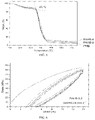
- the polymers prepared in Comparative Example 1, Embodiment 2 and Embodiment 4 were subjected to the thermogravimetric analysis (TGA) and differential scanning calorimetry (DSC) measurement, and the solvent resistance of the polymers prepared in Embodiments 1-5 were tested, and the results are shown in FIG. 5 , FIG. 6 , FIG. 7 and Table 2.
- TGA thermogravimetric analysis
- DSC differential scanning calorimetry
- PAHB-1 — — — — — — PAHB-2 — — — — — — PAHB-3 — — — — — — PAHB-4 — — — — — — PAHB-5 — — — — — — — — — represents the polymer cannot be dissolved.
- DMF is N, N-dimethylformamide
- DMAc is N, N-dimethylacetamide
- NMP is N-methylpyrrolidone
- DMSO is dimethyl sulfoxide
- THF is tetrahydrofuran
- Chloroform is trichloromethane.
Landscapes
- Chemical & Material Sciences (AREA)
- Health & Medical Sciences (AREA)
- Chemical Kinetics & Catalysis (AREA)
- Medicinal Chemistry (AREA)
- Polymers & Plastics (AREA)
- Organic Chemistry (AREA)
- Epoxy Resins (AREA)
Abstract
Description
| TABLE 1 |
| Mechanical properties of embodiments, |
| comparative examples, and |
| conventional polymer materials |
| Project |
| Tensile strength/ | Breaking | |
| Samples | MPa | elongation % |
| PAHB-1 | 68.6 ± 4.71 | 8.4 ± 0.65 |
| PAHB-2 | 77.1 ± 4.28 | 15.3 ± 0.51 |
| PAHB-3 | 77.3 ± 4.63 | 11.7 ± 0.75 |
| PAHB-4 | 117.7 ± 3.13 | 14.93 ± 0.60 |
| PAHB-5 | 75.1 ± 4.03 | 14.2 ± 0.55 |
| PHB | 55.7 ± 4.62 | 5.23 ± 0.83 |
| PYHB-2 | 50.3 ± 5.43 | 6.01 ± 0.63 |
| PYHB-3 | 78.0 ± 4.82 | 10.84 ± 0.77 |
| PYHB-4 | 80.2 ± 5.26 | 9.41 ± 0.74 |
| PYHB-5 | 78.7 ± 5.03 | 9.18 ± 0.59 |
| Epoxy resin | 76.1 | 3.97 |
| Aromatic polyimide (PI) | 115 | 10.6 |
| Polyaryletherketone | 105.7 | 8.90 |
| (PAEK) | ||
| Polyetherimide (PEIS) | 99 | 5.02 |
| Polylactic acid (PLA) | 65.5 | 2.49 |
| TABLE 2 |
| Solvent resistance of PAHBs |
| Solvents |
| Polymers | DMAc | DMSO | DMF | NMP | THF | Chloroform |
| PAHB-1 | — | — | — | — | — | — |
| PAHB-2 | — | — | — | — | — | — |
| PAHB-3 | — | — | — | — | — | — |
| PAHB-4 | — | — | — | — | — | — |
| PAHB-5 | — | — | — | — | — | — |
| — represents the polymer cannot be dissolved. DMF is N, N-dimethylformamide, DMAc is N, N-dimethylacetamide; NMP is N-methylpyrrolidone, DMSO is dimethyl sulfoxide, THF is tetrahydrofuran, and Chloroform is trichloromethane. | ||||||
Claims (6)
Applications Claiming Priority (2)
| Application Number | Priority Date | Filing Date | Title |
|---|---|---|---|
| CN202010095804.XA CN111363122B (en) | 2020-02-17 | 2020-02-17 | A kind of triple cross-linked high-performance polymer and preparation method thereof |
| CN202010095804.X | 2020-02-17 |
Publications (2)
| Publication Number | Publication Date |
|---|---|
| US20210253805A1 US20210253805A1 (en) | 2021-08-19 |
| US11566112B2 true US11566112B2 (en) | 2023-01-31 |
Family
ID=71202266
Family Applications (1)
| Application Number | Title | Priority Date | Filing Date |
|---|---|---|---|
| US16/853,785 Active 2040-12-16 US11566112B2 (en) | 2020-02-17 | 2020-04-21 | High-performance triple-crosslinked polymer and preparation method thereof |
Country Status (2)
| Country | Link |
|---|---|
| US (1) | US11566112B2 (en) |
| CN (1) | CN111363122B (en) |
Families Citing this family (4)
| Publication number | Priority date | Publication date | Assignee | Title |
|---|---|---|---|---|
| CN114524965B (en) * | 2022-02-20 | 2023-11-10 | 中国科学院山西煤炭化学研究所 | Method for preparing epoxy porous material or aromatic glyceryl ether compound by using anhydride cured epoxy resin |
| CN115304764B (en) * | 2022-09-20 | 2023-06-09 | 福州大学 | Epoxidized fluorine-containing polyarylether compound and preparation method thereof |
| CN115612093B (en) * | 2022-11-04 | 2024-10-18 | 西南科技大学 | Hydrogen-bond-crosslinked high-performance polyarylene imide ether nitrile and preparation method thereof |
| CN116444949B (en) * | 2023-04-24 | 2026-06-23 | 广西至善新材料科技有限公司 | Self-repairing phenolic epoxy resin and preparation method and application thereof |
Citations (5)
| Publication number | Priority date | Publication date | Assignee | Title |
|---|---|---|---|---|
| US4428987A (en) * | 1982-04-28 | 1984-01-31 | Shell Oil Company | Process for improving copper-epoxy adhesion |
| US20100279566A1 (en) * | 2009-05-01 | 2010-11-04 | 3M Innovative Properties Company | Passive electrical article |
| US20130142733A1 (en) * | 2007-11-05 | 2013-06-06 | Vanderbilt University | Multifunctional degradable nanoparticles with control over size and functionalities |
| US20190330413A1 (en) * | 2018-04-26 | 2019-10-31 | Sabic Global Technologies B.V. | Curing agent compositions for thermosetting epoxy resin compositions |
| US20210040269A1 (en) * | 2018-04-25 | 2021-02-11 | Henkel Ag & Co. Kgaa | Process for the preparation of hydroxyl-functionalized polyether-polysiloxane block copolymers |
Family Cites Families (2)
| Publication number | Priority date | Publication date | Assignee | Title |
|---|---|---|---|---|
| US6577492B2 (en) * | 2001-07-10 | 2003-06-10 | 3M Innovative Properties Company | Capacitor having epoxy dielectric layer cured with aminophenylfluorenes |
| WO2011056455A2 (en) * | 2009-11-06 | 2011-05-12 | 3M Innovative Properties Company | Dielectric material with non-halogenated curing agent |
-
2020
- 2020-02-17 CN CN202010095804.XA patent/CN111363122B/en not_active Expired - Fee Related
- 2020-04-21 US US16/853,785 patent/US11566112B2/en active Active
Patent Citations (5)
| Publication number | Priority date | Publication date | Assignee | Title |
|---|---|---|---|---|
| US4428987A (en) * | 1982-04-28 | 1984-01-31 | Shell Oil Company | Process for improving copper-epoxy adhesion |
| US20130142733A1 (en) * | 2007-11-05 | 2013-06-06 | Vanderbilt University | Multifunctional degradable nanoparticles with control over size and functionalities |
| US20100279566A1 (en) * | 2009-05-01 | 2010-11-04 | 3M Innovative Properties Company | Passive electrical article |
| US20210040269A1 (en) * | 2018-04-25 | 2021-02-11 | Henkel Ag & Co. Kgaa | Process for the preparation of hydroxyl-functionalized polyether-polysiloxane block copolymers |
| US20190330413A1 (en) * | 2018-04-26 | 2019-10-31 | Sabic Global Technologies B.V. | Curing agent compositions for thermosetting epoxy resin compositions |
Also Published As
| Publication number | Publication date |
|---|---|
| CN111363122A (en) | 2020-07-03 |
| US20210253805A1 (en) | 2021-08-19 |
| CN111363122B (en) | 2022-05-17 |
Similar Documents
| Publication | Publication Date | Title |
|---|---|---|
| US20210253805A1 (en) | High-performance triple-crosslinked polymer and preparation method thereof | |
| TWI488887B (en) | Polyimides, coating composition formed therefrom and use thereof | |
| CN103772981B (en) | Low dielectric constant polymer/fluorinated graphene composite and preparation method thereof | |
| EP2551288B1 (en) | Epoxy resin composition for use in a carbon-fiber-reinforced composite material, prepreg, and carbon-fiber-reinforced composite material | |
| CN110607077B (en) | A kind of bio-based thermosetting resin composite material and preparation method thereof | |
| JP4282750B1 (en) | Imide oligomer and polyimide resin obtained by heat curing this | |
| CN102884107B (en) | Process for producing wholly aromatic polyimide resin having improved heat resistance and elongation in high temperature range | |
| EP3378977B1 (en) | Polyimide fiber and preparation method therefor | |
| US20110218272A1 (en) | Thermosetting resin composition and prepreg using the same | |
| KR102899627B1 (en) | Resin composition, resin molded body and method for producing the same | |
| Cui et al. | Preparation of a crosslinked chitosan coated calcium sulfate whisker and its reinforcement in polyvinyl chloride | |
| CN106536597A (en) | High heat-resistant polyamic acid solution and polyimide film | |
| CN114230791A (en) | Intrinsic low-dielectric fluorine-containing polyimide film and preparation method thereof | |
| CN106661225A (en) | Varnish using 2-phenyl-4,4'-diaminodiphenyl ether, imide resin composition exhibiting excellent moldability, cured resin molded article having excellent breaking elongation, prepreg using same, imide prepreg, and fiber-reinforced material exhibiting excellent heat resistance and mechanical strength | |
| CN104211980A (en) | Low-dielectric-constant polyimide film and preparation method thereof | |
| Shen et al. | Synchronously improved toughness and dielectric properties of cyanate ester resins via modification with biobased poly (N‐phenylmaleimide‐co‐limonene) | |
| CN103965824A (en) | Acetenyl polyimide modified cyanate ester adhesive and preparation method thereof | |
| Li et al. | Highly soluble phenylethynyl‐terminated imides derived from mellophanic dianhydride (MPDA) | |
| TWI857187B (en) | Polyimide resin composition and molded article | |
| Wang et al. | Effective Modulation of Reactivity, Processability and Thermal Properties of Melamine‐Based Benzoxazine Resins by the Introduction of Benzeneguanoamine | |
| Xiong et al. | Preparation and properties of high performance phthalide‐containing bismaleimide modified epoxy matrices | |
| CN114686157B (en) | Three-dimensional reticular polymer for adhesive and preparation method thereof | |
| TWI888645B (en) | Polyimide resin composition and molded article | |
| Liu et al. | Synthesis and properties study of a thermoplastic polyimide with high glass transition temperature for wafer level package | |
| CN1232568C (en) | High-performance high toughness addition type resin matrix composite substrate and process for preparing the same |
Legal Events
| Date | Code | Title | Description |
|---|---|---|---|
| AS | Assignment |
Owner name: SOUTHWEST UNIVERSITY OF SCIENCE AND TECHNOLOGY, CHINA Free format text: ASSIGNMENT OF ASSIGNORS INTEREST;ASSIGNORS:CHANG, GUANJUN;YANG, LI;XU, YEWEI;AND OTHERS;REEL/FRAME:052448/0372 Effective date: 20200417 Owner name: SICHUAN GUANMUSIYANG NEW MATERIAL TECHNOLOGY CO., LTD., CHINA Free format text: ASSIGNMENT OF ASSIGNORS INTEREST;ASSIGNORS:CHANG, GUANJUN;YANG, LI;XU, YEWEI;AND OTHERS;REEL/FRAME:052448/0372 Effective date: 20200417 |
|
| FEPP | Fee payment procedure |
Free format text: ENTITY STATUS SET TO UNDISCOUNTED (ORIGINAL EVENT CODE: BIG.); ENTITY STATUS OF PATENT OWNER: SMALL ENTITY |
|
| FEPP | Fee payment procedure |
Free format text: ENTITY STATUS SET TO SMALL (ORIGINAL EVENT CODE: SMAL); ENTITY STATUS OF PATENT OWNER: SMALL ENTITY |
|
| STPP | Information on status: patent application and granting procedure in general |
Free format text: DOCKETED NEW CASE - READY FOR EXAMINATION |
|
| STPP | Information on status: patent application and granting procedure in general |
Free format text: NON FINAL ACTION MAILED |
|
| STPP | Information on status: patent application and granting procedure in general |
Free format text: RESPONSE TO NON-FINAL OFFICE ACTION ENTERED AND FORWARDED TO EXAMINER |
|
| STPP | Information on status: patent application and granting procedure in general |
Free format text: FINAL REJECTION MAILED |
|
| STPP | Information on status: patent application and granting procedure in general |
Free format text: RESPONSE AFTER FINAL ACTION FORWARDED TO EXAMINER |
|
| STPP | Information on status: patent application and granting procedure in general |
Free format text: NOTICE OF ALLOWANCE MAILED -- APPLICATION RECEIVED IN OFFICE OF PUBLICATIONS |
|
| STPP | Information on status: patent application and granting procedure in general |
Free format text: PUBLICATIONS -- ISSUE FEE PAYMENT RECEIVED |
|
| STCF | Information on status: patent grant |
Free format text: PATENTED CASE |
|
| FEPP | Fee payment procedure |
Free format text: MAINTENANCE FEE REMINDER MAILED (ORIGINAL EVENT CODE: REM.); ENTITY STATUS OF PATENT OWNER: SMALL ENTITY |