US11562281B2 - Hierarchical portfolio optimization using clustering and near-term quantum computers - Google Patents
Hierarchical portfolio optimization using clustering and near-term quantum computers Download PDFInfo
- Publication number
- US11562281B2 US11562281B2 US16/669,700 US201916669700A US11562281B2 US 11562281 B2 US11562281 B2 US 11562281B2 US 201916669700 A US201916669700 A US 201916669700A US 11562281 B2 US11562281 B2 US 11562281B2
- Authority
- US
- United States
- Prior art keywords
- sub
- cluster
- quantum processor
- clusters
- quantum
- Prior art date
- Legal status (The legal status is an assumption and is not a legal conclusion. Google has not performed a legal analysis and makes no representation as to the accuracy of the status listed.)
- Active, expires
Links
Images


Classifications
-
- G—PHYSICS
- G06—COMPUTING OR CALCULATING; COUNTING
- G06Q—INFORMATION AND COMMUNICATION TECHNOLOGY [ICT] SPECIALLY ADAPTED FOR ADMINISTRATIVE, COMMERCIAL, FINANCIAL, MANAGERIAL OR SUPERVISORY PURPOSES; SYSTEMS OR METHODS SPECIALLY ADAPTED FOR ADMINISTRATIVE, COMMERCIAL, FINANCIAL, MANAGERIAL OR SUPERVISORY PURPOSES, NOT OTHERWISE PROVIDED FOR
- G06Q40/00—Finance; Insurance; Tax strategies; Processing of corporate or income taxes
- G06Q40/06—Asset management; Financial planning or analysis
-
- G—PHYSICS
- G06—COMPUTING OR CALCULATING; COUNTING
- G06N—COMPUTING ARRANGEMENTS BASED ON SPECIFIC COMPUTATIONAL MODELS
- G06N10/00—Quantum computing, i.e. information processing based on quantum-mechanical phenomena
-
- G—PHYSICS
- G06—COMPUTING OR CALCULATING; COUNTING
- G06F—ELECTRIC DIGITAL DATA PROCESSING
- G06F17/00—Digital computing or data processing equipment or methods, specially adapted for specific functions
- G06F17/10—Complex mathematical operations
- G06F17/11—Complex mathematical operations for solving equations, e.g. nonlinear equations, general mathematical optimization problems
-
- G—PHYSICS
- G06—COMPUTING OR CALCULATING; COUNTING
- G06F—ELECTRIC DIGITAL DATA PROCESSING
- G06F18/00—Pattern recognition
- G06F18/20—Analysing
- G06F18/23—Clustering techniques
-
- G—PHYSICS
- G06—COMPUTING OR CALCULATING; COUNTING
- G06N—COMPUTING ARRANGEMENTS BASED ON SPECIFIC COMPUTATIONAL MODELS
- G06N10/00—Quantum computing, i.e. information processing based on quantum-mechanical phenomena
- G06N10/60—Quantum algorithms, e.g. based on quantum optimisation, quantum Fourier or Hadamard transforms
-
- G—PHYSICS
- G06—COMPUTING OR CALCULATING; COUNTING
- G06N—COMPUTING ARRANGEMENTS BASED ON SPECIFIC COMPUTATIONAL MODELS
- G06N20/00—Machine learning
-
- G—PHYSICS
- G06—COMPUTING OR CALCULATING; COUNTING
- G06V—IMAGE OR VIDEO RECOGNITION OR UNDERSTANDING
- G06V10/00—Arrangements for image or video recognition or understanding
- G06V10/70—Arrangements for image or video recognition or understanding using pattern recognition or machine learning
- G06V10/762—Arrangements for image or video recognition or understanding using pattern recognition or machine learning using clustering, e.g. of similar faces in social networks
-
- G—PHYSICS
- G06—COMPUTING OR CALCULATING; COUNTING
- G06F—ELECTRIC DIGITAL DATA PROCESSING
- G06F17/00—Digital computing or data processing equipment or methods, specially adapted for specific functions
- G06F17/10—Complex mathematical operations
- G06F17/16—Matrix or vector computation, e.g. matrix-matrix or matrix-vector multiplication, matrix factorization
-
- G—PHYSICS
- G06—COMPUTING OR CALCULATING; COUNTING
- G06N—COMPUTING ARRANGEMENTS BASED ON SPECIFIC COMPUTATIONAL MODELS
- G06N5/00—Computing arrangements using knowledge-based models
- G06N5/01—Dynamic search techniques; Heuristics; Dynamic trees; Branch-and-bound
Definitions
- the subject disclosure relates generally to a system and method that optimizes asset portfolios using hybrid classical-quantum algorithms when integer constraints are present or when assets can only be bought and sold in odd lots, and support a constraint where quantum computers have limited number of qubits.
- a system comprises: a memory that stores computer-executable components; a processor, operably coupled to the memory, and that executes the computer-executable components stored in the memory, wherein the computer executable components comprise: an analyzer component that analyzes an investment universe where integer constraints are present or when assets can only be bought and sold in odd lots; a clustering component that performs hierarchical clustering on M number of assets of the universe to generate sub-clusters of aggregated subsets of the assets; an allocation component that performs a recursive capital allocation to the sub-clusters until the sub-clusters (Ci) are small enough that the capital allocation of said sub-clusters can be executed by a quantum processor; a transmission component that transmits the sub-clusters to the quantum processor for solving an optimization problem associated with the respective M number of assets; and a presentation component that receives from the Quantum processor respective solutions for each of the Ci sub- Page 2 of 37 P201906129US01 clusters and presents a set of optimized solutions
- a computer implemented method comprises: using a processor to execute computer executable components stored in memory to perform the following acts: analyze an investment universe where integer constraints are present or when assets can only be bought and sold in odd lots; perform hierarchical clustering on M number of assets of the universe to generate sub-clusters of aggregated subsets of the assets; perform a recursive capital allocation to the sub-clusters until the sub-clusters (C i ) are small enough that the capital allocation of said sub-clusters is executable by a quantum processor; transmit the C i sub-clusters to the quantum processor for solving an optimization problem associated with the respective M number of assets; and receive from the quantum processor respective solutions for each of the C i sub-clusters and presents a set of optimized solutions.
- a system comprises a memory that stores computer executable components; and a quantum processor that executes the following computer executable components: a receiving component that receives from a classical computer a set of sub-clusters (Ci), of aggregated subsets of M number of assets of an investment universe where integer constraints are present or when assets can only be bought and sold in odd lots, wherein the size of Ci is equal to or below a threshold executable by the quantum processor; a computing component that performs a binary/mixed-integer mean-variance optimization on each subcluster; and a transmission component that transmits to the classical computer optimized solutions for asset allocation for respective sub-clusters (Ci).
- a receiving component that receives from a classical computer a set of sub-clusters (Ci), of aggregated subsets of M number of assets of an investment universe where integer constraints are present or when assets can only be bought and sold in odd lots, wherein the size of Ci is equal to or below a threshold executable by the quantum processor
- a computing component that performs
- a computer-implemented method comprises using a quantum processor to execute computer executable components stored in memory to perform the following acts: using the quantum processor to receive from a classical computer a set of sub-clusters (Ci), of aggregated subsets of M number of assets of an investment universe where integer constraints are present or when assets can only be bought and sold in odd lots, wherein the size of Ci is equal to or below a threshold executable by the quantum processor; performing, using the quantum processor, a binary/mixed-integer mean-variance optimization on each sub-cluster; and transmitting, using the quantum processor, to the classical computer optimized solutions for asset allocation for respective sub-clusters (Ci).
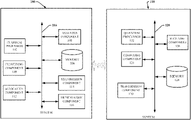
- FIG. 1 illustrates a block diagram of an example system implemented that can function as Hierarchical portfolio optimization using clustering and near-term quantum computers.
- FIG. 2 illustrates a flow chart of a hybrid classical-quantum algorithm that facilitates optimizing asset portfolios.
- FIG. 3 illustrates clustering that can be applied to real-world applications which can be used by a clustering component.
- FIG. 4 illustrates a classical representation of two types of Hierarchical clustering, Agglomerative and Divisive algorithms.
- FIG. 5 illustrates an example of Hierarchical clustering of asset correlation matrix into a hierarchical cluster tree.
- FIG. 6 illustrates a Hierarchical clustering correlation, distance matrix and its corresponding dendrogram of cluster formation.
- FIG. 7 illustrates an example of capital allocation of an asset correlation matrix into corresponding clusters and budget allocation.
- FIG. 8 illustrates a flow chart of a process to allocate capital allocation to sub-clusters.
- FIG. 9 illustrates an example of capital allocation using a method A by cluster bisection and fraction budget allocation.
- FIG. 10 illustrates a flow chart of a method B for capital allocation to sub-clusters.
- FIG. 11 illustrates an example of capital allocation using method B by aggregating sub-clusters.
- FIG. 12 illustrates a Quantum circuit for a VQE algorithm
- FIG. 13 illustrates an example annualized portfolio return for asset portfolios on a 5-qubit processor.
- FIG. 14 illustrates a schematic diagram of an example operating environment in accordance with one or more implementations described herein.
- Big Data represents a new era in data exploration and utilization such that it consists of data that is high in volume, variety and velocity.
- SaaS software as services
- a ‘big-data’ clustering software as a service which takes a set of data instances as input, performs computations for data clustering and returns partitioning of the data to a client as an output.
- Big data can be used in many scenarios for data mining such as, to track user generated content in social media, analyze web page images from the web and census data, obtain required data from Internet of Things (IoT) sensors, activity tracking from smartphones and network traffic data for cyber-security.
- IoT Internet of Things
- One such technique known as Vector Quantization assists to manage data and provide data mining results for statistical analysis.
- Vector Quantization is a system that maps a sequence of continuous or discrete vectors (known as data sets) into digital sequence so that it is suitable for communication.
- Vector Quantization is mainly used for data compression wherein bit rates are reduced to minimize communication channel capacity or digital storage memory requirements while maintaining data integrity.
- Some common examples of Vector Quantization include medical/satellite image storage and transmission of audio signals through old noisy radio mobile communication channels.
- Vector Quantization helps to segregate large set of data sets into groups that have similar set of data points. Each group would be segregated by its common point based on various machine learning algorithms which are categorized into supervised and unsupervised algorithms. Majority of the machines use supervised learning algorithm that process input and output values and use an algorithm to map the input and output values accordingly.
- unsupervised algorithms have a set of input values and no corresponding output values. The main objective of an unsupervised learning algorithm is to understand the algorithm and ultimately compute an interesting structure to the data.
- One such algorithm classified as unsupervised is Clustering.
- Clustering is a process of classifying data samples based on observations or patterns and distinguishing data points (also known as vectors) into disjoint groups (known as clusters). Each group contains objects with similar profiles and attributes.
- the data classification often requires a machine learning algorithm to measure distance or similarity between data sets.
- These algorithms are widely used across retail, banking, manufacturing, healthcare and other industries to help organize unstructured data. Many businesses use such algorithms to segregate customers data based on similar characteristics of the data.
- One of such industry is healthcare, where a hospital might cluster patients based on tumor size, for example, such that patients with different tumor sizes can be treated differently.
- Some common uses of clustering are to cluster customers based on purchase history, cluster documents based on similar words or cluster DNA sequences based on edit distance.
- Machine learning algorithms use various types of clustering techniques to differentiate similarity or dissimilarity of data sets.
- Clustering algorithms are widely used in data mining and machine learning applications to analyze data in an organized manner and structure according to their data patterns.
- clustering algorithms such as K-means, fuzzy c-means, Hierarchical clustering and many more. These clustering techniques use distance measures to group data to corresponding families. Clustering is a very useful tool for big data management and helps discover patterns within data in an unsupervised manner.
- Hierarchical clustering algorithm is widely utilized in the market.
- Hierarchical clustering algorithms are classical clustering algorithms where sets of clusters are created. In this algorithm, clusters are compared with one another based on their similarity and clusters are combined accordingly. Thus, this clustering algorithm is based on the concept of grouping data objects into a hierarchy of tree of clusters.
- Hierarchical clustering analysis Agglomerative and Divisive.
- Agglomerative Hierarchical clustering is based on bottom-up merging and Divisive Hierarchical clustering algorithm is based on top-down splitting.
- each object is its own initial cluster at the beginning and at each iteration, pairs of clusters are merged based on their similarities as the clusters move up the hierarchy. This merging continues until many objects are in the same cluster.
- Divisive approach many objects start in one cluster. Then each object is split into multiple clusters recursively as it moves down the hierarchy. Through this way, each object forms its own cluster until many clusters only contain one object respectively.
- clustering algorithms are important as they assist to break large problems into smaller sub-problems.
- Quantum computing is generally the use of Quantum-mechanical phenomena for the purpose of performing computing and information processing functions. Quantum computing can be viewed in contrast to classical computing, which generally operates on binary values with transistors. That is, while classical computers can operate on bit values that are either 0 or 1, Quantum computers operate on Quantum bits that comprise superpositions of both 0 and 1, can entangle multiple Quantum bits, and use interference. Superconducting qubits offer a promising path toward constructing fully-operational Quantum computers as it can exhibit Quantum-mechanical behavior (allowing to be used for Quantum information processing) at the macroscopic level (allowing to be designed and fabricated by existing integrated circuit technologies). A Quantum computation uses the Qubit as its fundamental unit instead of the classical computing bit.
- the qubit (e.g., quantum binary digit) is the quantum-mechanical analogue of the classical bit.
- classical bits can take on only one of two basis states (e.g., 0 or 1)
- qubits can take on superpositions of those basis states (e.g., ⁇
- 2 1), allowing a number of qubits to theoretically hold exponentially more information than the same number of classical bits.
- quantum computers e.g., computers that employ qubits instead of solely classical bits
- the bits of a classical computer are just binary digits, with a value of either 0 or 1. Almost any device with two distinct states can serve to represent a classical bit: a switch, a valve, a magnet, a coin. Qubits, partaking of the quantum mystique, can occupy a superposition of 0 and 1 states. It's not that the qubit can have an intermediate value, such as 0.63; when the state of the qubit is measured, the result is always 0 or 1. But in the course of a computation a qubit can act as if it were a mixture of states—say, 63 percent 0 and 37 percent 1.
- Quantum computers By processing information using the laws of Quantum mechanics, Quantum computers offer novel ways to perform computation tasks such as molecular calculations, financial risk calculations, optimization and many more. For instance, in an investment universe, there are a large set of assets wherein subsets of these assets need to be identified based on budget constraints such that an optimal process is used to identify viable assets that can be purchased to meet the profit margin. The optimal process is calculated based on methods such as mean-variance which is a process of weighing risk, expressed as variance against expected return.
- mean-variance is a process of weighing risk, expressed as variance against expected return.
- a 1-1 mapping is used between number of assets and the number of qubits required in a Quantum computer. Also, one asset could be represented by more than one qubit.
- mixed integer binary optimization is a hard problem in Quantum computers. Mixed integer binary optimization depicts the combination of real-values (can take fractions) and integer values. While it is not believed that quantum computers may solve hard problems, it can offer heuristics to find near optimal solutions. Such heuristics include the Variational Quantum Eigensolver (VQE) algorithm and the Quantum Approximate Optimization Algorithm (QAOA). Many business relevant problems are too large to be tackled using the noisy intermediate scale Quantum computers that may be available in the near future.
- VQE Variational Quantum Eigensolver
- QAOA Quantum Approximate Optimization Algorithm
- computational tasks can be broken down into smaller optimization instances. For instance, computational tasks that are amendable to a divide and conquer approach may benefit from noisy intermediate scale quantum (NISQ) computers. Computational tasks that can be broken down into smaller instances using other approaches may thus also benefit from quantum computing.
- Portfolios of financial assets are often constructed by trading-off risk for return while taking into account external constraints. This mean-variance optimization problem can become hard when the assets can only be traded in odd-lots or when certain constraints, such as integer budget constraints, are introduced. As an example, consider the hedge fund space where hedge fund managers only let clients invest if the clients bring a minimum amount of capital. A fund-of-fund asset manager may wish to invest only in a subset of hedge fund managers for his new fund-of-funds investment vehicle.
- the asset manager is thus faced with a binary decision problem: choose N hedge fund managers out of M>N.
- the asset manager may invest K$ with each chosen hedge fund manager.
- Quantum computers may be better suited at dealing with binary/mixed-integer optimization problems than classical computers.
- near term Quantum computers may not have enough qubits to represent the typical number of assets considered when optimizing a portfolio.
- these embodiments show how to perform portfolio optimization with a hybrid Quantum/classical algorithm on limited size Quantum computers and address budget constraints when using the Quantum processor to optimize the asset allocation to the clusters.
- a hybrid classical-quantum algorithm is used to optimize large portfolios when integer constraints are present or when assets can only be bought and sold in odd lots. This method is designed to work for any Quantum computer but its design was specifically guided by the constraint that near-term Quantum computers only have a limited number of qubits.
- These embodiments can be used to solve portfolio optimization problems that map both to mixed binary optimization problems and quadratic binary optimization problems. Given an investment universe with M potential investments, a total budget B, and a Quantum computer with N q qubits (for instance N q ⁇ M), first the optimization problem is decomposed into smaller instances using a classical Hierarchical clustering on a classical computer. Next, a recursive capital allocation to the sub-clusters is performed.
- Quantum computer such as gate-based Quantum computer can be used to optimize these sub-clusters.
- This task can be performed by a binary/mixed-integer mean-variance optimization method on each sub-cluster using a gate-based Quantum computer via a VQE/QAOA algorithms.
- Other algorithms that are best suited for the data set optimization can also be used accordingly.
- These embodiments mainly focus to solve the problem wherein modern portfolio optimization instances are too large to fit on near-term NISQ computers (Noisy Intermedia Scale Quantum).
- a significant part of this embodiment is the usage of clustering to reduce the optimization problem to sub-problems small enough to be dealt with using gate-based Quantum computers.
- FIG. 1 illustrates a block diagram of example systems 100 and 118 implemented that can access data and process that data using variable computing components depicted in accordance with one or more embodiments described herein.
- System 100 represents a client-side system that employs classical computing techniques
- system 118 represents a host system that employs quantum computing techniques.
- System 100 decomposes an asset allocation problem to a level that can be rapidly processed by system 118 as a function of available quantum bits.
- Systems 100 and 118 can facilitate a process of assessing and identifying a large amount of various forms of data, and using machine learning, training a neural network or other type of model.
- the systems 100 and 118 can also generate predictive recommendations to an individual level resulting in a context in accordance with one or more embodiments described herein.
- aspects of systems e.g., system 100 and 118 and the like
- apparatuses or processes explained in this disclosure can constitute machine-executable component(s) embodied within machine(s), e.g., embodied in one or more computer readable mediums (or media) associated with one or more machines.
- Such component(s) when executed by the one or more machines, e.g., computer(s), computing device(s), virtual machine(s), etc. can cause the machine(s) to perform the operations described.
- Repetitive description of like elements employed in one or more embodiments described herein is omitted for sake of brevity.
- System 100 and 118 can optionally include a server device, one or more networks and one or more devices (not shown).
- the system 100 can also include or otherwise be associated with at least one classical processor 102 that executes computer executable components stored in memory 104 .
- the system 100 can further include a system bus 106 that can couple various components including, but not limited to, an analyzer component 108 that component that analyzes an investment universe where integer constraints are present or when assets can only be bought and sold in odd lots; a clustering component 110 that performs Hierarchical clustering on M number of assets of the universe to generate sub-clusters of aggregated subsets of the assets or by assigning a fraction of the budget to each sub-clusters; an allocation component 112 that performs a recursive capital allocation to the sub-clusters until the size of the sub-clusters (C i ) is equal to or below a threshold executable by a quantum processor; a transmission component 114 that transmit the C i sub-clusters to the quantum processor for solving on
- System 100 and 118 can optionally include a server device, one or more networks and one or more devices (not shown).
- the system 100 can also include or otherwise be Page 10 of 37 P201906129US01 associated with at least one classical processor 102 that executes computer executable components stored in memory 104 .
- the system 100 can further include a system bus 106 that can couple various components including, but not limited to, an analyzer component 108 that component that analyzes an investment universe where integer constraints are present or when assets can only be bought and sold in odd lots; a clustering component 110 that performs Hierarchical clustering on M number of assets of the universe to generate sub-clusters of aggregated subsets of the assets or by assigning a fraction of the budget to each sub-clusters; an allocation component 112 that performs a recursive capital allocation to the sub-clusters until the size of the sub-clusters (Ci) is equal to or below a threshold executable by a quantum processor; a transmission component 114 that transmits the Ci sub-clusters to the quantum processor for solving an optimization problem associated with the respective M number of assets; and a presentation component 116 that receives from the quantum processor respective solutions for each of the Ci sub-clusters and presents a set of optimized solutions.
- an analyzer component 108 that component that analyzes an investment universe where integer constraints are
- the system 118 can also include or otherwise be associated with at least one Quantum processor 122 that executes computer executable components stored in memory 124 .
- the system 118 can further include a system bus 120 that can couple various components including, but not limited to, a receiving component 126 that receives from a classical computer a set of sub-clusters (Ci), of aggregated subsets of M number of assets of an investment universe where integer constraints are present or when assets can only be bought and sold in odd lots, wherein Ci is equal to or below a threshold executable by the quantum processor; a computing component 128 that performs a binary/mixed-integer mean-variance optimization on each subcluster; and a transmission component 130 that transmits to the classical computer optimized solutions for asset allocation for respective sub-clusters (Ci).
- a receiving component 126 that receives from a classical computer a set of sub-clusters (Ci), of aggregated subsets of M number of assets of an investment universe where integer constraints are present or when assets can only be bought and
- a memory 104 can store computer executable components executable by the classical processor 102 on a classical computer.
- the system 118 includes a memory 124 can store computer executable components executable by the Quantum processor 122 .
- Hierarchical clustering needs to be performed on a clustering component 110 after analyzing an investment universe, e.g., using analyzing component 108 .
- system 100 performs capital allocation, e.g., using allocation component 112 , the sub-clusters are transmitted through transmission component 114 to the Quantum processor 122 .
- the receiving component 126 receives the sub-clusters data from the classical computer of system 100 .
- the computing component 128 of system 118 performs a binary/mixed-integer mean-variance optimization on each sub-cluster and transmits through transmission component 130 optimized solutions for asset allocation for respective sub-clusters to the classical computer.
- the presentation component 116 of system 100 presents a set of optimized solutions received from system 118 .
- the various components of systems 100 or 118 can be connected either directly or via one or more networks.
- networks can include wired and wireless networks, including, but not limited to, a cellular network, a wide area network (WAN) (e.g., the Internet), or a local area network (LAN), non-limiting examples of which include cellular, WAN, wireless fidelity (Wi-Fi), Wi-Max, WLAN, radio communication, microwave communication, satellite communication, optical communication, sonic communication, or any other suitable communication technology.
- WAN wide area network
- LAN local area network
- radio communication microwave communication
- satellite communication optical communication
- sonic communication or any other suitable communication technology.
- the aforementioned systems and/or devices have been described with respect to interaction between several components. It may be appreciated that such systems and components can include those components or sub-components specified therein, some of the specified components or sub-components, and/or additional components.
- Sub-components could also be implemented as components communicatively coupled to other components rather than included within parent components. Further yet, one or more components and/or sub-components can be combined into a single component providing aggregate functionality. The components can also interact with one or more other components not specifically described herein for the sake of brevity, but known by those of skill in the art.
- the subject computer processing systems, methods apparatuses and/or computer program products can be employed to solve new problems that arise through advancements in technology, computer networks, the Internet and the like.
- FIG. 2 depicts a hybrid classical-quantum algorithm that can optimize asset portfolios when integer constraints are present or when assets can only be bought and sold in odd lots.
- the set of investible assets is decomposed into smaller components by Hierarchical clustering on a classical computer as denoted at 202 and 204 .
- recursive capital allocation as denoted at 206 is performed to the sub-clusters either by aggregating the assets in the clusters until the size of the sub-clusters is equal to or below a threshold size imposed by the Quantum or classical computer.
- assets 1 and 3 in C 2 i.e. ⁇ 1,3 ⁇ and asset 2 in C 3 i.e. ⁇ 2 ⁇ .
- the resulting smaller instances of the problem can be optimized at 208 on a gate-based Quantum computer by binary/mixed-integer mean-variance optimization on each sub-cluster using VQE/QAOA algorithms. The number of iterations of this process can depend upon the number of sub-clusters in a problem.
- the process is repeated from block 204 . If there are no more iterations then based on optimization results, the portfolio manager can evaluate and determine suitable assets that can be purchased as denoted at 212 and thus the process is completed at 214 .
- the novelty of these embodiments is to solve the problem that modern portfolio optimization instances are too large to fit on near-term noisy Intermedia Scale Quantum computers (NISQ computers).
- NISQ computers near-term noisy Intermedia Scale Quantum computers
- These embodiments address the budget constraints when using the Quantum processor to optimize the asset allocation to the clusters. Also, these embodiments address portfolio problems that correspond to a Mixed Binary and Quadratic Binary Optimization (e.g., optimization problems that feature both continuous and integer decision variables).
- FIG. 3 illustrates basics of clustering that can be applied to many real-world domains. Clustering can reduce large portfolio optimization instances into smaller sub-problems that can be optimized using NISQ computers. For instance, this figure is an illustration that can be used as sample data points for potential various tumor sizes that are shown as three uniquely identified clusters.
- This drawing can be a typical representation of various clustering algorithms and computation of centroids. The drawing illustrates three clusters namely cluster A, B and C identified in their respective axis. The sample data points in each cluster are labeled as block 308 , 310 and 312 along with additional data points within each cluster area.
- the idea behind a clustering algorithm is to classify a given set of data points into k number of disjoint clusters such as A, B, and C as show in the illustration.
- the algorithm is executed in two phases: the first phase is to define centroids for each cluster and in this example the centroids are labelled at blocks 302 , 304 , 306 .
- the next phase is to associate each data point to its corresponding nearest centroid such as blocks 308 , 310 , and 312 .
- data points with similar characteristics can be grouped to their corresponding cluster.
- Many businesses use these algorithms to separate customers sharing similar characteristics.
- One of such industry is healthcare, as stated above, where the hospital might cluster patients based on their tumor size so that patients with different tumor sizes can be treated differently. This technique helps to organize unstructured data and it can be used in other areas such tabular data, images, text data as well.
- FIG. 4 illustrates an example of the two types of Hierarchical clustering as mentioned above.
- Hierarchical clustering builds a cluster tree to represent data, where each node links to two or more successor groups. Eventually the groups are nested and organized as a tree, which ideally portrays as a meaningful classification scheme. Each node may contain a group of similar data such that clusters at one level may join with clusters in the next level up. This is a recursive process until every node is in the tree.
- the two types of Hierarchical clustering algorithms Agglomerative clustering method is denoted by 402 and Divisive clustering method is denoted by 404 .
- each data point is a single-point cluster.
- Two data points that have close distance proximity make one cluster as shown in FIG. 4 , where (P,Q) forms one cluster, (S,T) forms one cluster and (R,S,T) forms one cluster. These steps are repeated until only one cluster is formed in the end (P,Q,R,S,T) as denoted by 406 .
- a Divisive method denoted at 404 which is the opposite of Agglomerative method, it follows a top-down clustering method where data points denoted at 406 are assigned to a single cluster and then the cluster is partitioned into a minimum number of non-similar clusters. This process is repeated recursively until there is one cluster for each observation as denoted by 408 where P, Q, R, S, T are individual clusters.
- QUBO Quadrattic Unconstrained Binary Optimization
- FIG. 5 illustrates an example of Hierarchical clustering, wherein a complete set of 50 asset correlation matrix is denoted by 502 .
- a correlation matrix shows the correlation coefficients between sets of variables. Each random variable in a set is correlated with each other of the other values in a set. This allows to see which pairs have the highest correlation.
- the same group of assets in 502 can be clustered into 4 branches as shown in 504 .
- the cluster in each branch can vary accordingly however the clusters cannot overlap in each branch in Hierarchical clustering.
- These embodiments use the correlation matrix p to construct a distance matrix d with entry i, j given by:
- a Hierarchical clustering can be represented as a dendrogram denoted by 604 , i.e. a tree graph in which the leaves are the assets.
- the dendrogram in 604 illustrates the cluster formation in an investment universe of 10 stocks.
- stocks S 2 and S 3 are video gaming companies
- stocks S 6 , S 8 and S 9 operate in the semiconductor industry
- the remaining stocks S 7 , S 0 , S 1 , S 4 and S 5 are large technology companies. It can be seen that similar assets are placed together in 604 .
- Reordering the assets in the correlation matrix following the in-order sorting of the leaves in the dendrogram arranges the correlation matrix into a quasi-block-diagonal form as denoted in 602 .
- the block-diagonal correlation matrix can be leveraged to decompose the portfolio optimization problem into sub-problems. Indeed, when the covariance matrix is block-diagonal, e.g.,
- Hierarchical clustering may be used to reduce large portfolio optimization instances into smaller sub-problems that can be optimized using NISQ computers. However, care may be taken in preserving as best as possible the budget constraints.
- FIG. 7 illustrates an example of capital allocation for a 50-asset correlation matrix.
- capital allocation can be performed in which 4 clusters are formed with Budget B i allocated to each cluster. If clustering is performed for a computer with 14 qubits, each cluster can have assets less than or equal to 14 qubits as shown in 704 . Clusters 1, 2, and 3 respectively have 14 assets and Cluster 4 has 8 assets accordingly.
- a portfolio manager may elect to allocate capital based on various methods. In these embodiments two of these methods are illustrated as method A and method B.
- Method A is the inverse-variance capital allocation method. This can be demonstrated by an example for a QUBO problem capital allocation is performed within a cluster Cj with a budget constraint:
- ⁇ j 1 - ⁇ j , 1 ⁇ j , 1 + ⁇ j , 2
- ⁇ j,i w T i ⁇ j,i w i and the weights are:
- w i ( diag ⁇ ⁇ i , j ) - 1 ⁇ 1 Tr [ ( diag ⁇ ⁇ j , i ) - 1 ] .
- the rounding is used to preserve the integer nature of the constraint. Therefore, the inaccuracies may arise each time an optimization problem is decomposed into two smaller sub-problems.
- the rounding can be done by rounding-up and/or rounding-down.
- the optimization problem is decomposed into instances small enough to fit on NISQ computers instead of breaking the problem down to the single asset level.
- larger NISQ computers may require less steps to break the initial problem down into sub-problems that fit onto the hardware, thus, resulting in lower inaccuracies.
- FIG. 8 illustrates a flow chart of capital allocation to sub-clusters using method A. This can be denoted as a top down method starting at 802 , in which with M potential investments, a total budget B and N q bits as denoted at 804 . A fraction of the budget is assigned to each sub-cluster at 806 . Capital is allocated to each sub-cluster by exploiting the quasi-diagonal cluster correlation matrix. Upon capital allocation, optimization is performed on each sub-cluster at 808 . This process is repeated as denoted at 810 , based on the number of sub-clusters. If there are more iterations at 812 , then the process is repeated from 808 based on the number of sub-clusters available.
- the best subset of assets in each sub-cluster can be derived such that budget constraint is satisfied at 814 and this ends the process at 816 .
- the budget is assigned to each sub-cluster and then the problem is solved at a smaller level to decide which assets to buy within the cluster. For example, if there are 50 qubits and 10 clusters with at most 50 assets, then every cluster has optimization run individually such that for every cluster C, 30% of the overall budget is used. Through this way, for every cluster a detailed result is obtained which identifies which assets to purchase. This method is run 10 times to achieve an overall result. It is to be noted that budget allocation for the cluster in this method needs to be chosen wisely.
- FIG. 9 illustrates an example of method A, where there are 13 stocks S 0 to S 13 .
- a single step bisection is performed to reduce the cluster size.
- a fraction of the budget is assigned to sub-cluster 1 as 54.0% and 46.0% for sub-cluster 2.
- best assets within the cluster can be purchased.
- there are thirteen decision variables x i ⁇ 0, 1 ⁇ with i 1, . . . , 13 and the task is:
- the assets are clustered resulting in a dendrogram with two clusters C 1 , C 2 with seven, six assets, respectively as shown in FIG. 9 . If two clusters are small enough to be optimized together, and to avoid breaking the problem down into very small instances, said clusters can be considered as one cluster.
- mapping is performed by:
- FIG. 10 illustrates a flow chart for 1/N capital allocation to sub-cluster using method B.
- this allocation process starts at 1002 with an input M potential investment, total budget B and N q bits denoted at 1004 .
- the capital is allocated to the sub-clusters such that the amount of capital allocated to a sub-cluster is proportional to the number of assets in the sub-cluster as denoted at 1006 .
- portfolio optimization problem is solved on the aggregated clusters using a gate-based Quantum computer. This process is repeated based on the number of clusters 1010 .
- FIG. 11 illustrates an example of method B capital allocation to sub-cluster.
- clustering is performed by aggregating sub-clusters using 1/N weighting.
- the aggregated cluster AC1 denoted by 1102 is obtained.
- the cluster AC2 denoted by 1104 is denoted.
- Aggregating S 7 and S 0 resulted with aggregated cluster AC3 denoted by 1106 and S 1
- S 4 and S 5 resulted with aggregated cluster AC4 denoted by 1108 .
- the optimization problem is decomposed into sub-problems.
- capital allocation is performed by preserving budget constraints following multiple methods mentioned above.
- x j is the solution vector of cluster j and j identifies which cluster is being taken into consideration.
- Cluster j has n j assets so x j is a binary vector of n j elements.
- x j projects whether to buy the asset (1) or not to buy the asset (0). Then, to minimize the variance of the resulting portfolio minus the expected return and maximize the expected return minus the risk. This is weighed by q which is the risk factor.
- the ⁇ j is the covariance matrix of the assets in cluster j and is the expected return vector for the assets in cluster j.
- the first part of the equation mentioned above is the variance of the return of the portfolio.
- the larger the variance the higher the risk of the cluster. This is subtracted with the portfolio expected return.
- the constraint to be noted here is to choose exactly B j assets in this vector x j such that B j assets equal to 1 and rest is 0. It is important to note that allocation to a single asset may be more than just a decision to be made between buying the asset versus not buying the asset.
- the portfolio optimization problem is a QUBO problem and each asset is represented by one qubit with a Quantum processor of 5 qubits, then optimization on sub-clusters can only be done with 5 or less assets.
- the capital allocation problem may take on other forms, for instance, a continuous asset weights but with integer constraints. (e.g. invest in exactly 5 assets) is also a hard problem to solve. Hence, this form details the optimization formula for every cluster and budget is allocated upfront.
- the resulting smaller instances of the problem can be optimized on a Quantum computer such as a gate-based Quantum computer using various algorithms such as the VQE or QAOA as mentioned in the above sections.
- the VQE algorithm is a quantum/classical hybrid algorithm that can be used to find eigenvalues of a (often large) matrix.
- An eigenvalue is a set of values of a parameter for which a differential equation has a nonzero solution (an eigenfunction) under given conditions.
- This algorithm has been introduced as a hybrid quantum-classical algorithm for simulating quantum systems.
- Some examples of quantum simulation using VQE include solving the molecular electronic Schrödinger equation and model systems in condensed matter physics.
- FIG. 12 illustrates the Quantum circuit for the VQE algorithm.
- N qubits denoted by 1202 and 1204 are parametrized single qubit cases. These cases change the state of each qubit and classical parameter is used.
- the blocks in 1206 are entangled to different qubits such that search can reach larger space. This algorithm is repeated D-times and the longer this process runs, the more parameters the system learns to optimize.
- the qubit is measured and returns either a 0 or 1 which translates to whether the asset might be purchased or not. Every measurement gives a potential answer to the optimization problem. If a bit string is chosen to put it in the objective function, an objective value is returned.
- the QAOA algorithm is a hybrid quantum-classical variational algorithm designed to tackle combinatorial optimization problems. This algorithm depends on a positive integer p and the approximation quality is improved asp is increased.
- the Quantum circuit that implements this algorithm consists of unitary gates and the depth of the circuit grows linearly with p times the number of constraints. If p is a fixed value, independent of the input size, then the algorithm uses the efficient method called the classical preprocessing. If p grows with the input size, a different strategy is proposed.
- These embodiments are not limited to VQE or QAOA algorithms. There are other suitable algorithms which can also be used for portfolio optimization depending on the optimization problem. Upon performing clustering, capital allocation and optimization, the portfolio return can be analyzed using the risk factor q mentioned above.
- FIG. 13 illustrates the annualized portfolio return for the example mentioned above about 10 asset portfolios on a 5-qubit processor.
- the risk factor graph in 1302 represents an efficient frontier.
- the efficient frontier is a trade-off between risk and return wherein given a risk factor, a maximum return it produces.
- the efficient frontier is a basis for modern portfolio theory.
- the portfolios that fall below the efficient frontier are sub-optimal as these portfolios do not provide enough return for a level of risk. Portfolios that are to the right of the efficient frontiers are also sub-optimal as these portfolios have a higher risk level for a defined rate of return.
- variable q controls a risk-return trade-off during optimization.
- a classical brute force search was done with many different q-values to benchmark the Quantum optimization.
- this problem is discrete in nature and exhibits jumps in the solution as the q-value controlling the risk-return tradeoff is varied.
- FIG. 14 illustrates a suitable operating environment 1400 for implementing various aspects of this disclosure can also include a computer 1412 .
- the computer 1412 can also include a processing unit 1414 , a system memory 1416 , and a system bus 1418 .
- the system bus 1418 couples system components including, but not limited to, the system memory 1416 to the processing unit 1414 .
- the processing unit 1414 can be any of various available processors. Dual microprocessors and other multiprocessor architectures also can be employed as the processing unit 1414 .
- the system bus 1418 can be any of several types of bus structure(s) including the memory bus or memory controller, a peripheral bus or external bus, and/or a local bus using any variety of available bus architectures including, but not limited to, Industrial Standard Architecture (ISA), Micro-Channel Architecture (MSA), Extended ISA (EISA), Intelligent Drive Electronics (IDE), VESA Local Bus (VLB), Peripheral Component Interconnect (PCI), Card Bus, Universal Serial Bus (USB), Advanced Graphics Port (AGP), Firewire (IEEE 1094), and Small Computer Systems Interface (SCSI).
- the system memory 1416 can also include volatile memory 1420 and nonvolatile memory 1422 .
- nonvolatile memory 1422 can include read only memory (ROM), programmable ROM (PROM), electrically programmable ROM (EPROM), electrically erasable programmable ROM (EEPROM), flash memory, or nonvolatile random-access memory (RAM) (e.g., ferroelectric RAM (FeRAM).
- Volatile memory 1420 can also include random access memory (RAM), which acts as external cache memory.
- RAM is available in many forms such as static RAM (SRAM), dynamic RAM (DRAM), synchronous DRAM (SDRAM), double data rate SDRAM (DDR SDRAM), enhanced SDRAM (ESDRAM), Synchlink DRAM (SLDRAM), direct Rambus RAM (DRRAM), direct Rambus dynamic RAM (DRDRAM), and Rambus dynamic RAM.
- SRAM static RAM
- DRAM dynamic RAM
- SDRAM synchronous DRAM
- DDR SDRAM double data rate SDRAM
- ESDRAM enhanced SDRAM
- SLDRAM Synchlink DRAM
- DRRAM direct Rambus RAM
- DRAM direct Rambus dynamic RAM
- Rambus dynamic RAM Rambus dynamic RAM
- Computer 1412 can also include removable/non-removable, volatile/non-volatile computer storage media.
- FIG. 14 illustrates, for example, a disk storage 1424 .
- Disk storage 1424 can also include, but is not limited to, devices like a magnetic disk drive, floppy disk drive, tape drive, Jaz drive, Zip drive, LS-100 drive, flash memory card, or memory stick.
- the disk storage 1424 also can include storage media separately or in combination with other storage media including, but not limited to, an optical disk drive such as a compact disk ROM device (CD-ROM), CD recordable drive (CD-R Drive), CD rewritable drive (CD-RW Drive) or a digital versatile disk ROM drive (DVD-ROM).
- CD-ROM compact disk ROM device
- CD-R Drive CD recordable drive
- CD-RW Drive CD rewritable drive
- DVD-ROM digital versatile disk ROM drive
- FIG. 14 also depicts software that acts as an intermediary between users and the basic computer resources described in the suitable operating environment 1400 .
- Such software can also include, for example, an operating system 1428 .
- Operating system 1428 which can be stored on disk storage 1424 , acts to control and allocate resources of the computer 1412 .
- System applications 1430 take advantage of the management of resources by operating system 1428 through program modules 1432 and program data 1434 , e.g., stored either in system memory 1416 or on disk storage 1424 . It is to be appreciated that this disclosure can be implemented with various operating systems or combinations of operating systems.
- Input devices 1436 include, but are not limited to, a pointing device such as a mouse, trackball, stylus, touch pad, keyboard, microphone, joystick, game pad, satellite dish, scanner, TV tuner card, digital camera, digital video camera, web camera, and the like. These and other input devices connect to the processing unit 1414 through the system bus 1418 via interface port(s) 1438 .
- Interface port(s) 1438 include, for example, a serial port, a parallel port, a game port, and a universal serial bus (USB).
- Output device(s) 1440 use some of the same type of ports as input device(s) 1436 .
- a USB port can be used to provide input to computer 1412 , and to output information from computer 1412 to an output device 1440 .
- Output adapter 1442 is provided to illustrate that there are some output devices 1440 like monitors, speakers, and printers, among other output devices 1440 , which require special adapters.
- the output adapters 1442 include, by way of illustration and not limitation, video and sound cards that provide a means of connection between the output device 1440 and the system bus 1418 . It can be noted that other devices and/or systems of devices provide both input and output capabilities such as remote computer(s) 1444 .
- Computer 1412 can operate in a networked environment using logical connections to one or more remote computers, such as remote computer(s) 1444 .
- the remote computer(s) 1444 can be a computer, a server, a router, a network PC, a workstation, a microprocessor-based appliance, a peer device or other common network node and the like, and typically can also include many or all the elements described relative to computer 1412 .
- only a memory storage device 1446 is illustrated with remote computer(s) 1444 .
- Remote computer(s) 1444 is logically connected to computer 1412 through a network interface 1448 and then physically connected via communication connection 1450 .
- Network interface 1448 encompasses wire and/or wireless communication networks such as local-area networks (LAN), wide-area networks (WAN), cellular networks, etc.
- LAN technologies include Fiber Distributed Data Interface (FDDI), Copper Distributed Data Interface (CDDI), Ethernet, Token Ring and the like.
- WAN technologies include, but are not limited to, point-to-point links, circuit switching networks like Integrated Services Digital Networks (ISDN) and variations thereon, packet switching networks, and Digital Subscriber Lines (DSL).
- Communication connection(s) 1450 refers to the hardware/software employed to connect the network interface 1448 to the system bus 1418 . While communication connection 1450 is shown for illustrative clarity inside computer 1412 , it can also be external to computer 1412 .
- the hardware/software for connection to the network interface 1448 can also include, for exemplary purposes only, internal and external technologies such as, modems including regular telephone grade modems, cable modems and DSL modems, ISDN adapters, and Ethernet cards.
- Embodiments of the present invention may be a system, a method, an apparatus and/or a computer program product at any possible technical detail level of integration
- the computer program product can include a computer readable storage medium (or media) having computer readable program instructions thereon for causing a processor to carry out aspects of the present invention.
- the computer readable storage medium can be a tangible device that can retain and store instructions for use by an instruction execution device.
- the computer readable storage medium can be, for example, but is not limited to, an electronic storage device, a magnetic storage device, an optical storage device, an electromagnetic storage device, a semiconductor storage device, or any suitable combination of the foregoing.
- a non-exhaustive list of more specific examples of the computer readable storage medium can also include the following: a portable computer diskette, a hard disk, a random access memory (RAM), a read-only memory (ROM), an erasable programmable read-only memory (EPROM or Flash memory), a static random access memory (SRAM), a portable compact disc read-only memory (CD-ROM), a digital versatile disk (DVD), a memory stick, a floppy disk, a mechanically encoded device such as punch-cards or raised structures in a groove having instructions recorded thereon, and any suitable combination of the foregoing.
- RAM random access memory
- ROM read-only memory
- EPROM or Flash memory erasable programmable read-only memory
- SRAM static random access memory
- CD-ROM compact disc read-only memory
- DVD digital versatile disk
- memory stick a floppy disk
- a mechanically encoded device such as punch-cards or raised structures in a groove having instructions recorded thereon
- a computer readable storage medium is not to be construed as being transitory signals per se, such as radio waves or other freely propagating electromagnetic waves, electromagnetic waves propagating through a waveguide or other transmission media (e.g., light pulses passing through a fiber-optic cable), or electrical signals transmitted through a wire.
- Computer readable program instructions described herein can be downloaded to respective computing/processing devices from a computer readable storage medium or to an external computer or external storage device via a network, for example, the Internet, a local area network, a wide area network and/or a wireless network.
- the network can comprise copper transmission cables, optical transmission fibers, wireless transmission, routers, firewalls, switches, gateway computers and/or edge servers.
- a network adapter card or network interface in one or more computing/processing device receives computer readable program instructions from the network and forwards the computer readable program instructions for storage in a computer readable storage medium within the respective computing/processing device.
- Computer readable program instructions for carrying out operations of various aspects of the present invention can be assembler instructions, instruction-set-architecture (ISA) instructions, machine instructions, machine dependent instructions, microcode, firmware instructions, state-setting data, configuration data for integrated circuitry, or either source code or object code written in any combination of one or more programming languages, including an object oriented programming language such as Smalltalk, C++, or the like, and procedural programming languages, such as the “C” programming language or similar programming languages.
- the computer readable program instructions can execute entirely on the user's computer, partly on the user's computer, as a stand-alone software package, partly on the user's computer and partly on a remote computer or entirely on the remote computer or server.
- the remote computer can be connected to the user's computer through any type of network, including a local area network (LAN) or a wide area network (WAN), or the connection can be made to an external computer (for example, through the Internet using an Internet Service Provider).
- electronic circuitry including, for example, programmable logic circuitry, field-programmable gate arrays (FPGA), or programmable logic arrays (PLA) can execute the computer readable program instructions by utilizing state information of the computer readable program instructions to customize the electronic circuitry, to perform aspects of the present invention.
- These computer readable program instructions can also be stored in a computer readable storage medium that can direct a computer, a programmable data processing apparatus, and/or other devices to function in a manner, such that the computer readable storage medium having instructions stored therein comprises an article of manufacture including instructions which implement aspects of the function/act specified in the flowchart and/or block diagram block or blocks.
- the computer readable program instructions can also be loaded onto a computer, other programmable data processing apparatus, or other device to cause a series of operational acts to be performed on the computer, other programmable apparatus or other device to produce a computer implemented process, such that the instructions which execute on the computer, other programmable apparatus, or other device implement the functions/acts specified in the flowchart and/or block diagram block or blocks.
- one or more blocks in the flowchart or block diagrams can represent a module, segment, or portion of instructions, which comprises one or more executable instructions for implementing the specified logical function(s).
- the functions noted in the blocks can occur out of the order noted in the Figures.
- two blocks shown in succession can, in fact, be executed substantially concurrently, or the blocks can sometimes be executed in the reverse order, depending upon the functionality involved.
- one or more block of the block diagrams and/or flowchart illustration, and combinations of blocks in the block diagrams and/or flowchart illustration can be implemented by special purpose hardware-based systems that perform the specified functions or acts or carry out combinations of special purpose hardware and computer instructions.
- program modules include routines, programs, components, data structures, etc. that perform particular tasks and/or implement abstract data types.
- inventive computer-implemented methods can be practiced with other computer system configurations, including single-processor or multiprocessor computer systems, mini-computing devices, mainframe computers, as well as computers, hand-held computing devices (e.g., PDA, phone), microprocessor-based or programmable consumer or industrial electronics, and the like.
- the illustrated aspects can also be practiced in distributed computing environments where tasks are performed by remote processing devices that are linked through a communications network. However, some, if not many aspects of this disclosure can be practiced on stand-alone computers. In a distributed computing environment, program modules can be located in both local and remote memory storage devices.
- ком ⁇ онент can refer to and/or can include a computer-related entity or an entity related to an operational machine with one or more specific functionalities.
- the entities disclosed herein can be either hardware, a combination of hardware and software, software, or software in execution.
- a component can be, but is not limited to being, a process running on a processor, a processor, an object, an executable, a thread of execution, a program, and/or a computer.
- an application running on a server and the server can be a component.
- One or more components can reside within a process and/or thread of execution and a component can be localized on one computer and/or distributed between two or more computers.
- respective components can execute from various computer readable media having various data structures stored thereon.
- the components can communicate via local and/or remote processes such as in accordance with a signal having one or more data packets (e.g., data from one component interacting with another component in a local system, distributed system, and/or across a network such as the Internet with other systems via the signal).
- a component can be an apparatus with specific functionality provided by mechanical parts operated by electric or electronic circuitry, which is operated by a software or firmware application executed by a processor.
- a component can be an apparatus that provides specific functionality through electronic components without mechanical parts, wherein the electronic components can include a processor or other means to execute software or firmware that confers at least in part the functionality of the electronic components.
- a component can emulate an electronic component via a virtual machine, e.g., within a server computing system.
- processor can refer to substantially any computing processing unit or device comprising, but not limited to, single-core processors; single-processors with software multithread execution capability; multi-core processors; multi-core processors with software multithread execution capability; multi-core processors with hardware multithread technology; parallel platforms; and parallel platforms with distributed shared memory.
- a processor can refer to an integrated circuit, an application specific integrated circuit (ASIC), a digital signal processor (DSP), a field programmable gate array (FPGA), a programmable logic controller (PLC), a complex programmable logic device (CPLD), a discrete gate or transistor logic, discrete hardware components, or any combination thereof designed to perform the functions described herein.
- ASIC application specific integrated circuit
- DSP digital signal processor
- FPGA field programmable gate array
- PLC programmable logic controller
- CPLD complex programmable logic device
- processors can exploit nano-scale architectures such as, but not limited to, molecular and quantum-dot based transistors, switches and gates, to optimize space usage or enhance performance of user equipment.
- a processor can also be implemented as a combination of computing processing units.
- terms such as “store,” “storage,” “data store,” data storage,” “database,” and substantially any other information storage component relevant to operation and functionality of a component are utilized to refer to “memory components,” entities embodied in a “memory,” or components comprising a memory. It is to be appreciated that memory and/or memory components described herein can be either volatile memory or nonvolatile memory, or can include both volatile and nonvolatile memory.
- nonvolatile memory can include read only memory (ROM), programmable ROM (PROM), electrically programmable ROM (EPROM), electrically erasable ROM (EEPROM), flash memory, or nonvolatile random-access memory (RAM) (e.g., ferroelectric RAM (FeRAM).
- Volatile memory can include RAM, which can act as external cache memory, for example.
- RAM is available in many forms such as synchronous RAM (SRAM), dynamic RAM (DRAM), synchronous DRAM (SDRAM), double data rate SDRAM (DDR SDRAM), enhanced SDRAM (ESDRAM), Synchlink DRAM (SLDRAM), direct Rambus RAM (DRRAM), direct Rambus dynamic RAM (DRDRAM), and Rambus dynamic RAM (RDRAM).
- SRAM synchronous RAM
- DRAM dynamic RAM
- SDRAM synchronous DRAM
- DDR SDRAM double data rate SDRAM
- ESDRAM enhanced SDRAM
- SLDRAM Synchlink DRAM
- DRRAM direct Rambus RAM
- DRAM direct Rambus dynamic RAM
- RDRAM Rambus dynamic RAM
Landscapes
- Engineering & Computer Science (AREA)
- Physics & Mathematics (AREA)
- Theoretical Computer Science (AREA)
- General Physics & Mathematics (AREA)
- Data Mining & Analysis (AREA)
- Mathematical Physics (AREA)
- Software Systems (AREA)
- Mathematical Analysis (AREA)
- Mathematical Optimization (AREA)
- Pure & Applied Mathematics (AREA)
- Computational Mathematics (AREA)
- Business, Economics & Management (AREA)
- General Engineering & Computer Science (AREA)
- Evolutionary Computation (AREA)
- Artificial Intelligence (AREA)
- Computing Systems (AREA)
- Accounting & Taxation (AREA)
- Databases & Information Systems (AREA)
- Operations Research (AREA)
- Development Economics (AREA)
- Finance (AREA)
- Computer Vision & Pattern Recognition (AREA)
- Medical Informatics (AREA)
- Algebra (AREA)
- Condensed Matter Physics & Semiconductors (AREA)
- Technology Law (AREA)
- Game Theory and Decision Science (AREA)
- Marketing (AREA)
- Strategic Management (AREA)
- Human Resources & Organizations (AREA)
- General Business, Economics & Management (AREA)
- Entrepreneurship & Innovation (AREA)
- Economics (AREA)
- General Health & Medical Sciences (AREA)
- Health & Medical Sciences (AREA)
- Multimedia (AREA)
- Life Sciences & Earth Sciences (AREA)
- Bioinformatics & Cheminformatics (AREA)
- Bioinformatics & Computational Biology (AREA)
- Evolutionary Biology (AREA)
Abstract
Description
subject to given constraints. Here, the variable q controls the risk-return trade-off and xi is the weight allocated to asset i. This problem, with the budget constraint Σixi=1, is efficiently solvable when the weights are continuous, e.g., xi ∈

which states invest in exactly K assets with xi∈[ϵi, δi], can transform the problem mentioned above into hard mixed binary optimization problem to solve. Furthermore, the portfolio optimization problem becomes a QUBO (Quadratic Unconstrained Binary Optimization) problem if the weights are restricted to integers xi∈{0, 1}ki. This situation can arise when the assets can only be traded in odd lots. MBO and QUBO problems can be addressed using Quantum computers, for example, using the QAOA or the VQE algorithm. In these algorithms each asset is represented by one or several qubits. However, in practical cases, portfolios may feature thousands or more assets making it impossible to represent using the limited number of qubits that NISQ computers are expected to have. Solutions to efficiently solve portfolio optimization problems are found by inverting the correlation matrix Σ. This requires a non-singular estimation of Σ which is built from at least N(N−1)/2 independent and identically distributed return observations of the N assets. The time span of the required price time-series, thus, increases quadratically with the portfolio size. However, because correlations do not persist indefinitely, it may not be meaningful to gather return observations beyond a certain time-horizon. Additionally, a direct inversion of Σ tends to concentrate capital in a few assets and makes the weights highly sensitive to small changes in covariances. Therefore, it is desirable to decompose large problems into smaller sub-problems both from a financial perspective and to accommodate hardware constraints. In order to fit large portfolio optimizations on small NISQ computers, these embodiments propose to reduce the problem size by exploiting the Hierarchical structure of financial assets. Similar assets, such as the stock of similar companies in the same industry, are highly correlated.
The distance matrix can be used to construct a Hierarchical clustering of the assets, as exemplified by
problem can be decomposed into sub-problems:
Correlation matrix of the assets after reordering, follow the in-order sorting of the dendrogram's leaves is shown in 604. Hierarchical clustering may be used to reduce large portfolio optimization instances into smaller sub-problems that can be optimized using NISQ computers. However, care may be taken in preserving as best as possible the budget constraints.
The following discussion may also apply to budget constraints ≤Bj and ≥Bj. In the inverse-variance capital allocation method, capital allocation is performed by descending down a binary clustering tree. A fraction αj and 1−αj of the capital allocated to node j is allocated to the left and right sub-clusters of node j, respectively. This fraction is given by:
where σj,i=wT iΣj,iwi and the weights are:
Here, Σj,i is the covariance matrix of the i=1, 2 sub-clusters of Cj. Therefore, the budget constraint is split into two sub-budgets Bj,1=└αjBj┘ and Bj,2=└(1−αj)Bi┘. The rounding is used to preserve the integer nature of the constraint. Therefore, the inaccuracies may arise each time an optimization problem is decomposed into two smaller sub-problems. For instance, the relation Bj,1+Bj,2=Bj may not always hold. The rounding can be done by rounding-up and/or rounding-down. Here, the optimization problem is decomposed into instances small enough to fit on NISQ computers instead of breaking the problem down to the single asset level. Furthermore, larger NISQ computers may require less steps to break the initial problem down into sub-problems that fit onto the hardware, thus, resulting in lower inaccuracies.
Here, pi is the cost of asset i. The budget constraint mentioned in the equation above states that the total price paid for many of the assets may be smaller or equal to the budget B=5. This optimization problem is too large to fit in a NISQ computer. Therefore, the assets are clustered resulting in a dendrogram with two clusters C1, C2 with seven, six assets, respectively as shown in
with k=1, 2, B1=┌αB┐, and B2=└(1−α)B┘. The split factor α where Vi is the number of assets in cluster i can also be represented as shown below:
B1 is rounded differently from B2 to ensure B1+B2=B. To solve the sub-problem mentioned in the above equation on NISQ computers, mapping is performed by:
This allows to optimize the capital allocation in the two clusters using the VQE. When the quantum results are compared to a classical brute force search, it is noted that the classical method is not scalable to large portfolio instances. Hence, various methods are chosen to perform classical allocation wherein a portfolio manager may elect to spread the capital evenly across many of the sub-clusters as well.
Where xj is the solution vector of cluster j and j identifies which cluster is being taken into consideration. Cluster j has nj assets so xj is a binary vector of nj elements. For every asset in the cluster, xj projects whether to buy the asset (1) or not to buy the asset (0). Then, to minimize the variance of the resulting portfolio minus the expected return and maximize the expected return minus the risk. This is weighed by q which is the risk factor. When q is 0 then the risk is neutral and the return is maximized. The larger the q value, the greater the emphasis is on the risk minimization. The Σj is the covariance matrix of the assets in cluster j and is the expected return vector for the assets in cluster j. Thus, the first part of the equation mentioned above is the variance of the return of the portfolio. The larger the variance, the higher the risk of the cluster. This is subtracted with the portfolio expected return. The constraint to be noted here is to choose exactly Bj assets in this vector xj such that Bj assets equal to 1 and rest is 0. It is important to note that allocation to a single asset may be more than just a decision to be made between buying the asset versus not buying the asset. For xj,i∈{0,1}, it determines whether to buy the asset or not for i of cluster j where there are 1 qubit/asset. Also, for xj,i∈{0,1}{circumflex over ( )}2, max allocation to asset i of cluster j is 2{circumflex over ( )}2−1=3. Amount held of asset i is ∈{0,1,2,3} where there are 2 qubits/asset. In the capital allocation problem above, the assets can only be held in integer quantities (odd lots). This is a QUBO problem which is hard to solve. If the portfolio optimization problem is a QUBO problem and each asset is represented by one qubit with a Quantum processor of 5 qubits, then optimization on sub-clusters can only be done with 5 or less assets. The capital allocation problem may take on other forms, for instance, a continuous asset weights but with integer constraints. (e.g. invest in exactly 5 assets) is also a hard problem to solve. Hence, this form details the optimization formula for every cluster and budget is allocated upfront. The resulting smaller instances of the problem can be optimized on a Quantum computer such as a gate-based Quantum computer using various algorithms such as the VQE or QAOA as mentioned in the above sections. The VQE algorithm is a quantum/classical hybrid algorithm that can be used to find eigenvalues of a (often large) matrix. An eigenvalue is a set of values of a parameter for which a differential equation has a nonzero solution (an eigenfunction) under given conditions. This algorithm has been introduced as a hybrid quantum-classical algorithm for simulating quantum systems. Some examples of quantum simulation using VQE include solving the molecular electronic Schrödinger equation and model systems in condensed matter physics.
Claims (18)
Priority Applications (2)
| Application Number | Priority Date | Filing Date | Title |
|---|---|---|---|
| US16/669,700 US11562281B2 (en) | 2019-10-31 | 2019-10-31 | Hierarchical portfolio optimization using clustering and near-term quantum computers |
| US18/064,043 US11809964B1 (en) | 2019-10-31 | 2022-12-09 | Hierarchical portfolio optimization using clustering and near-term quantum computers |
Applications Claiming Priority (1)
| Application Number | Priority Date | Filing Date | Title |
|---|---|---|---|
| US16/669,700 US11562281B2 (en) | 2019-10-31 | 2019-10-31 | Hierarchical portfolio optimization using clustering and near-term quantum computers |
Related Child Applications (1)
| Application Number | Title | Priority Date | Filing Date |
|---|---|---|---|
| US18/064,043 Continuation US11809964B1 (en) | 2019-10-31 | 2022-12-09 | Hierarchical portfolio optimization using clustering and near-term quantum computers |
Publications (2)
| Publication Number | Publication Date |
|---|---|
| US20210133881A1 US20210133881A1 (en) | 2021-05-06 |
| US11562281B2 true US11562281B2 (en) | 2023-01-24 |
Family
ID=75687892
Family Applications (2)
| Application Number | Title | Priority Date | Filing Date |
|---|---|---|---|
| US16/669,700 Active 2041-04-04 US11562281B2 (en) | 2019-10-31 | 2019-10-31 | Hierarchical portfolio optimization using clustering and near-term quantum computers |
| US18/064,043 Active US11809964B1 (en) | 2019-10-31 | 2022-12-09 | Hierarchical portfolio optimization using clustering and near-term quantum computers |
Family Applications After (1)
| Application Number | Title | Priority Date | Filing Date |
|---|---|---|---|
| US18/064,043 Active US11809964B1 (en) | 2019-10-31 | 2022-12-09 | Hierarchical portfolio optimization using clustering and near-term quantum computers |
Country Status (1)
| Country | Link |
|---|---|
| US (2) | US11562281B2 (en) |
Families Citing this family (14)
| Publication number | Priority date | Publication date | Assignee | Title |
|---|---|---|---|---|
| US11194573B1 (en) | 2018-02-09 | 2021-12-07 | Rigetti & Co, Llc | Streaming execution for a quantum processing system |
| US11443380B2 (en) * | 2020-02-20 | 2022-09-13 | Mark Cummings | System and method of providing and recording personalized context-specific advice in the form of an artificial intelligence view of a hierarchical portfolio |
| US11551132B2 (en) | 2020-05-28 | 2023-01-10 | Wells Fargo Bank, N.A. | Systems and methods for quantum based optimization of a personalized portfolio |
| US20220114487A1 (en) * | 2020-09-04 | 2022-04-14 | Erich Lawson Spangenberg | System and method for patent clustering |
| US20220084123A1 (en) * | 2020-09-16 | 2022-03-17 | Accenture Global Solutions Limited | Quantum mixed integer quadratic programming and graphical user interface for portfolio optimization |
| US11620263B2 (en) * | 2020-12-17 | 2023-04-04 | EMC IP Holding Company LLC | Data compression using dictionaries |
| US20220368701A1 (en) * | 2021-05-17 | 2022-11-17 | Palo Alto Networks, Inc. | Automated clustering of sessions of unstructured traffic |
| US20220405132A1 (en) * | 2021-06-17 | 2022-12-22 | Multiverse Computing S.L. | Method and system for quantum computing |
| CN115907021B (en) * | 2021-09-29 | 2024-08-13 | 本源量子计算科技(合肥)股份有限公司 | Data clustering method, device and quantum computer based on quantum computing |
| US20230298101A1 (en) * | 2022-03-02 | 2023-09-21 | Jpmorgan Chase Bank, N.A. | Systems and methods for quantum computing-assisted portfolio selection |
| JP7758161B2 (en) * | 2022-03-18 | 2025-10-22 | 日本電気株式会社 | Learning device, presentation device, learning method and program |
| US12373579B2 (en) | 2022-11-09 | 2025-07-29 | Bank Of America Corporation | Data processing and storage using quantum and DNA computing |
| WO2025080283A1 (en) * | 2022-12-29 | 2025-04-17 | Entanglement, Inc. | Qubo computing for investment optimization |
| WO2025123180A1 (en) * | 2023-12-11 | 2025-06-19 | Hsbc Software Development (Guangdong) Limited | Hybrid computer system for asset selection optimization |
Citations (5)
| Publication number | Priority date | Publication date | Assignee | Title |
|---|---|---|---|---|
| US20030195831A1 (en) * | 2002-04-12 | 2003-10-16 | Ibbotson Associates, Inc. | Portfolio generation using resampled efficient frontiers and interval-associated groups |
| US20130117200A1 (en) | 2011-11-09 | 2013-05-09 | D-Wave Systems Inc. | Systems and methods for optimization of investment portfolios |
| US20170323206A1 (en) | 2016-05-09 | 2017-11-09 | 1Qb Information Technologies Inc. | Method and system for determining a weight allocation in a group comprising a large plurality of items using an optimization oracle |
| US20170372427A1 (en) | 2016-06-27 | 2017-12-28 | QC Ware Corp. | Quantum-Annealing Computer Method for Financial Portfolio Optimization |
| US20210216897A1 (en) * | 2020-01-10 | 2021-07-15 | International Business Machines Corporation | System and method for handling inequality constraints in mixed binary optimization on quantum computers |
-
2019
- 2019-10-31 US US16/669,700 patent/US11562281B2/en active Active
-
2022
- 2022-12-09 US US18/064,043 patent/US11809964B1/en active Active
Patent Citations (5)
| Publication number | Priority date | Publication date | Assignee | Title |
|---|---|---|---|---|
| US20030195831A1 (en) * | 2002-04-12 | 2003-10-16 | Ibbotson Associates, Inc. | Portfolio generation using resampled efficient frontiers and interval-associated groups |
| US20130117200A1 (en) | 2011-11-09 | 2013-05-09 | D-Wave Systems Inc. | Systems and methods for optimization of investment portfolios |
| US20170323206A1 (en) | 2016-05-09 | 2017-11-09 | 1Qb Information Technologies Inc. | Method and system for determining a weight allocation in a group comprising a large plurality of items using an optimization oracle |
| US20170372427A1 (en) | 2016-06-27 | 2017-12-28 | QC Ware Corp. | Quantum-Annealing Computer Method for Financial Portfolio Optimization |
| US20210216897A1 (en) * | 2020-01-10 | 2021-07-15 | International Business Machines Corporation | System and method for handling inequality constraints in mixed binary optimization on quantum computers |
Non-Patent Citations (11)
| Title |
|---|
| Alipour et al., "Quantum-inspired hierarchical risk parity," 1QBit Information Technologies, 2016, 11 pages. |
| Barkoutsos et al., "Improving Variational Quantum Optimization using CVaR," arXiv:1907.04769v1 [quant-ph], Jul. 10, 2019, 11 pages. |
| Elsokkary et al., "Financial Portfolio Management using D-Wave's Quantum Optimizer: The Case of Abu Dhabi Securities Exchange," 2017 IEEE High Performance Extreme Computing Conference (HPEC '17) Twenty-first Annual HPEC Conference, Sep. 1, 2017, 5 pages. |
| Farhi et al., "A Quantum Approximate Optimization Algorithm," arXiv:1411.4028 [quant-ph], Nov. 14, 2014, 16 pages. |
| Fernandez et al., "Portfolio selection using neural networks," arXiv:cs/0501005 [cs.NE], Jan. 3, 2005, 12 pages. |
| Prado, "Building Diversified Portfolios that Outperform Out-of-Sample," Guggenheim Partners, Computational Research Division, Lawrence Berkeley National Laboratory, May 23, 2016, 31 pages. |
| Rosenberg et al., "Solving the Optimal Trading Trajectory Problem Using a Quantum Annealer," arXiv:1508.06182v3 [q-fin.CP], Aug. 11, 2016, 13 pages. |
| Simonetto et al., "Qiskit Finance: Portfolio diversification," https://github.com/Qiskit/qiskit-iqx-tutorials/blob/master/qiskit/advanced/aqua/finance/optimization/portfolio_diversification.ipynb, 13 pages, last accessed Oct. 2, 2019. |
| Venturelli et al., "Reverse Quantum Annealing Approach to Portfolio Optimization Problems," arXiv:1810.08584 [quant-ph], Oct. 25, 2018, 19 pages. |
| Woerner et al., "Qiskit Finance: Portfolio Optimization," https://github.com/Qiskit/qiskit-iqx-tutorials/blob/master/qiskit/advanced/aqua/finance/optimization/ portfolio_optimization.ipynb, 8 pages, last accessed Oct. 2, 2019. |
| Zakaria Marakbi; Mean-Variance Portfolio Optimization: Challenging the role of traditional covariance estimation; Master of Science Thesis; Stockholm, Sweden 2016 (Year: 2016). * |
Also Published As
| Publication number | Publication date |
|---|---|
| US20210133881A1 (en) | 2021-05-06 |
| US11809964B1 (en) | 2023-11-07 |
Similar Documents
| Publication | Publication Date | Title |
|---|---|---|
| US11809964B1 (en) | Hierarchical portfolio optimization using clustering and near-term quantum computers | |
| Sina Mirabdolbaghi et al. | Model optimization analysis of customer churn prediction using machine learning algorithms with focus on feature reductions | |
| US11693917B2 (en) | Computational model optimizations | |
| US11651264B2 (en) | System and method for handling inequality constraints in mixed binary optimization on quantum computers | |
| Chen et al. | Mining the customer credit using hybrid support vector machine technique | |
| US11681931B2 (en) | Methods for automatically configuring performance evaluation schemes for machine learning algorithms | |
| Jahin et al. | QAmplifyNet: pushing the boundaries of supply chain backorder prediction using interpretable hybrid quantum-classical neural network | |
| Ta et al. | Prediction and portfolio optimization in quantitative trading using machine learning techniques | |
| Georgescu | Using genetic algorithms to evolve type-2 fuzzy logic systems for predicting bankruptcy | |
| Kumar et al. | Blended computation of machine learning with the recurrent neural network for intra-day stock market movement prediction using a multi-level classifier | |
| Ali et al. | Improving credit card fraud detection using machine learning and GAN technology | |
| Koshiyama et al. | Algorithms in future capital markets: A survey on AI, ML and associated algorithms in capital markets | |
| Heiden et al. | Applying LSTM for stock price prediction with sentiment analysis | |
| Korangi et al. | Large-scale time-varying portfolio optimisation using graph attention networks | |
| Mirza et al. | Stock price forecasting through symbolic dynamics and state transition graphs with a convolutional recurrent neural network architecture | |
| Oluwatoyin et al. | Customer churn prediction in banking industry using power bi | |
| Benjamin et al. | A professional strategy for Bitcoin and Ethereum using Machine Learning for Investors | |
| Wu et al. | An efficient bilevel differential evolution algorithm with adaptation of lower level population size and search radius | |
| Sarker et al. | A Comparative Review on Stock Market Prediction Using Artificial Intelligence | |
| Kumari et al. | Stock movement prediction using hybrid normalization technique and artificial neural network | |
| Lee et al. | Introduction to support vector machines and their applications in bankruptcy prognosis | |
| Wagner et al. | On the effect of response transformations in sequential parameter optimization | |
| Sharma et al. | Enhancing predictive customer retention using machine learning algorithms: a comparative study of random forest, xgboost, and neural networks | |
| Nousi et al. | Leveraging deep learning and online source sentiment for financial portfolio management | |
| Garouani | An experimental survey and Perspective View on Meta-Learning for Automated Algorithms Selection and Parametrization |
Legal Events
| Date | Code | Title | Description |
|---|---|---|---|
| AS | Assignment |
Owner name: INTERNATIONAL BUSINESS MACHINES CORPORATION, NEW YORK Free format text: ASSIGNMENT OF ASSIGNORS INTEREST;ASSIGNORS:EGGER, DANIEL JOSEF;WOERNER, STEFAN;REEL/FRAME:050877/0553 Effective date: 20191031 |
|
| FEPP | Fee payment procedure |
Free format text: ENTITY STATUS SET TO UNDISCOUNTED (ORIGINAL EVENT CODE: BIG.); ENTITY STATUS OF PATENT OWNER: LARGE ENTITY |
|
| STPP | Information on status: patent application and granting procedure in general |
Free format text: NON FINAL ACTION MAILED |
|
| STPP | Information on status: patent application and granting procedure in general |
Free format text: RESPONSE TO NON-FINAL OFFICE ACTION ENTERED AND FORWARDED TO EXAMINER |
|
| STPP | Information on status: patent application and granting procedure in general |
Free format text: NOTICE OF ALLOWANCE MAILED -- APPLICATION RECEIVED IN OFFICE OF PUBLICATIONS |
|
| STPP | Information on status: patent application and granting procedure in general |
Free format text: AWAITING TC RESP., ISSUE FEE NOT PAID |
|
| STPP | Information on status: patent application and granting procedure in general |
Free format text: NOTICE OF ALLOWANCE MAILED -- APPLICATION RECEIVED IN OFFICE OF PUBLICATIONS |
|
| STPP | Information on status: patent application and granting procedure in general |
Free format text: PUBLICATIONS -- ISSUE FEE PAYMENT RECEIVED |
|
| STPP | Information on status: patent application and granting procedure in general |
Free format text: PUBLICATIONS -- ISSUE FEE PAYMENT VERIFIED |
|
| STCF | Information on status: patent grant |
Free format text: PATENTED CASE |